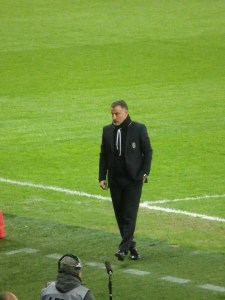
Stade Brestois 1 Olympique Lyonnais 0

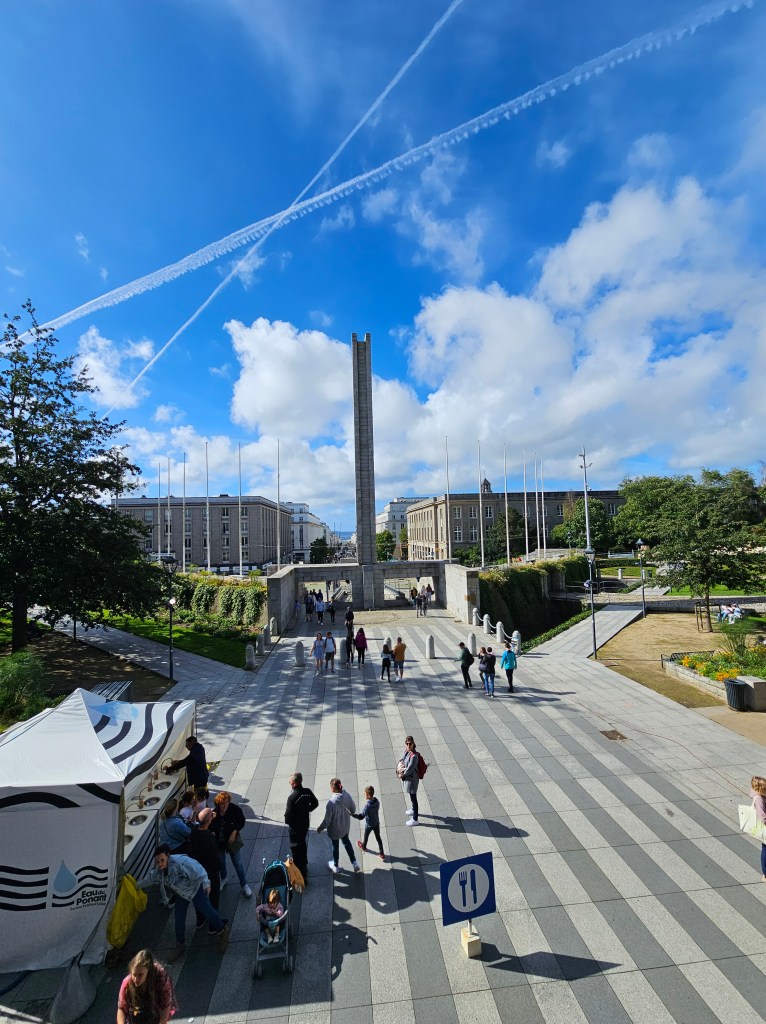
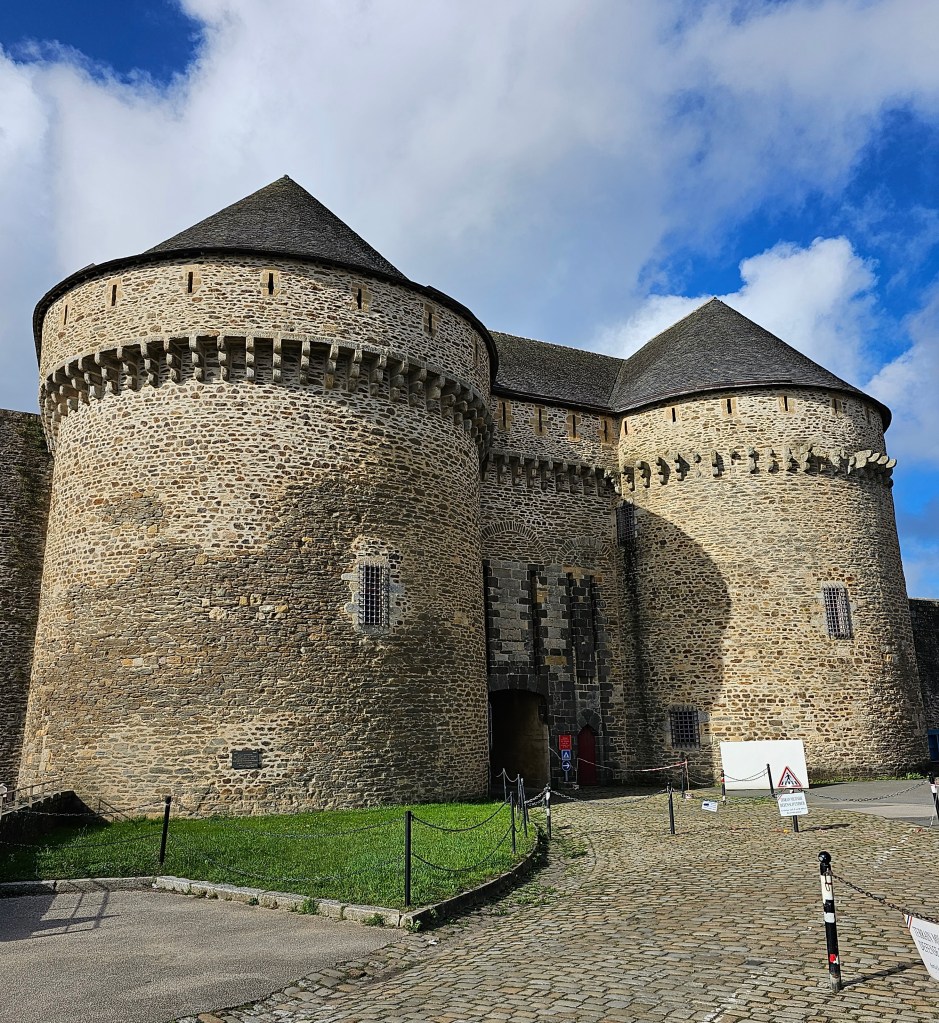
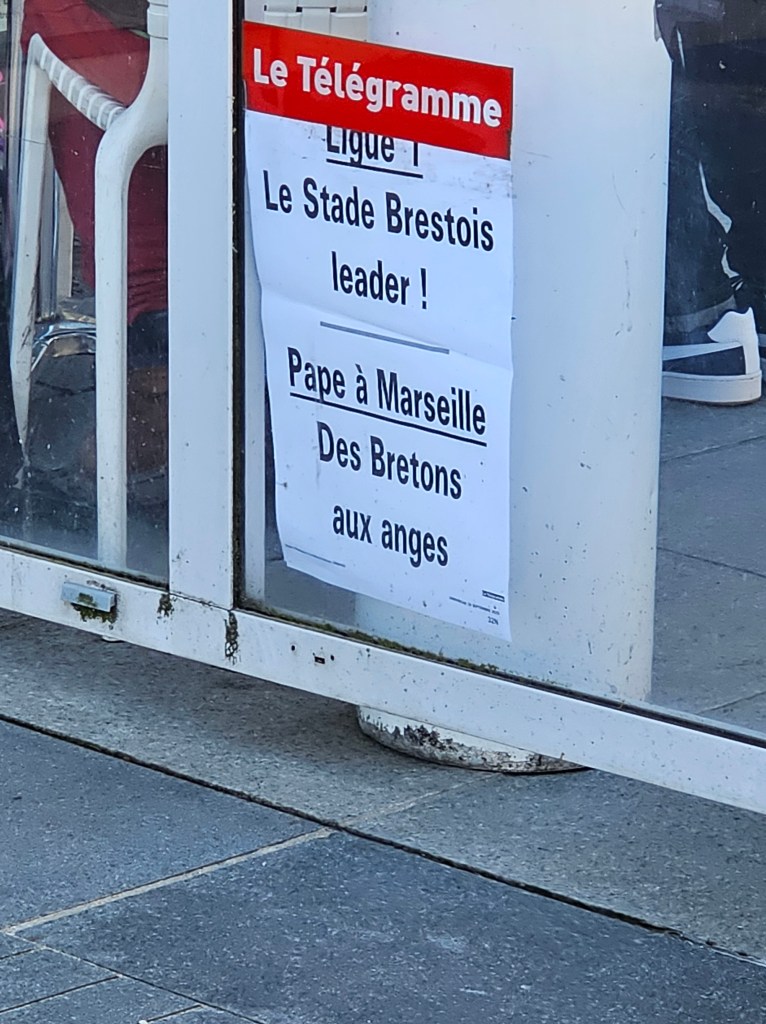
Finistere is the most westerly departement or ‘county’ of metropolitan France, with its name translating pretty much as ’the end of the earth’.  Not far east of the most westerly point of the most westerly department is Finistere’s largest town, Brest, an historic port and naval city, which was almost totally flattened by allied bombing during World War Two because the Nazis occupied it and made it part of their strategic ‘Atlantic Wall’.  Today, having been rebuilt in the 1950’s with an emphasis on space and layout rather than impressive or pretty architecture, although the church of St Louis de Brest is a notable exception, Brest has a population a little larger than that of Ipswich, but serves a metropolitan area of twice as many people, and is home to Stade Brestois 29, a football club in their present incarnation now enjoying their longest spell in the French first division since the 1960’s. Tonight, Stade Brestois who are currently third in the first division table, play Olympique Lyonnais who are third from bottom and I will be there. A win for Brest will put them top of the league above OGC Nice who won 1-0 away to previous leaders AS Monaco last night.

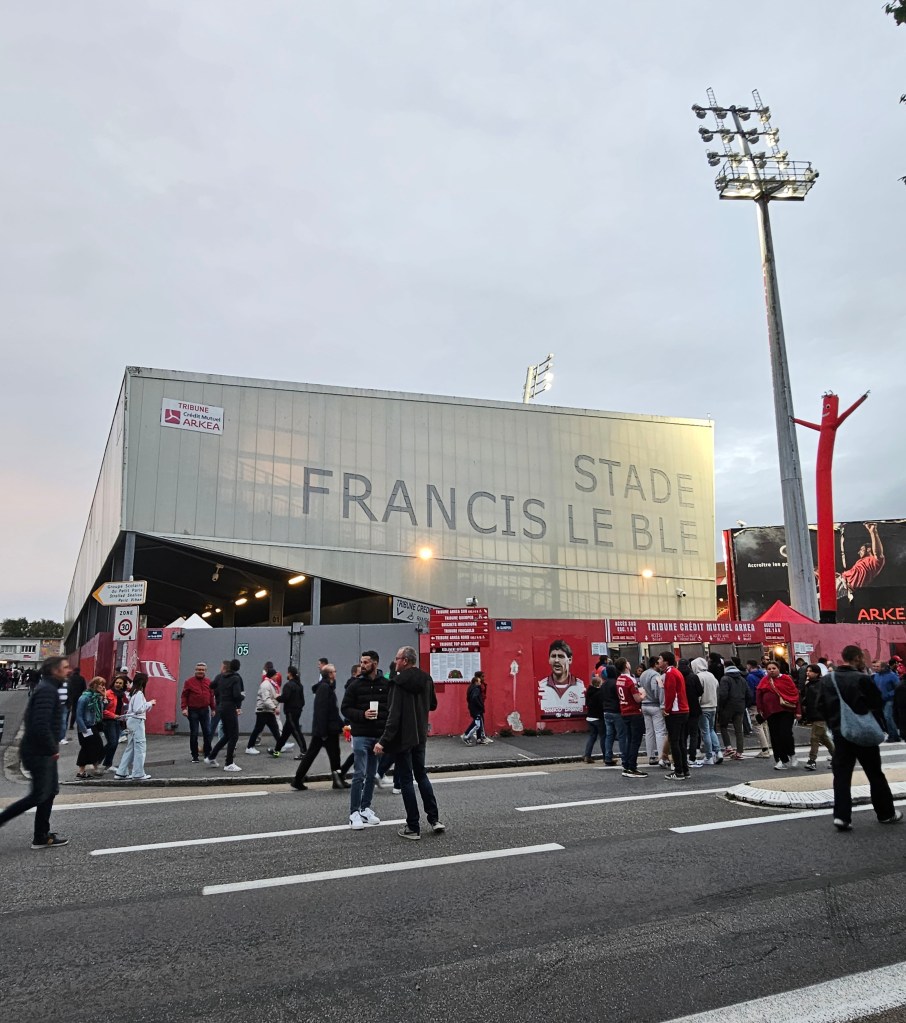
My wife Paulene and I are staying in a city centre hotel, which proves very handy indeed for the Liberte tram stop, where I just manage to extract two tickets (€1.70 each) from the vending machine and jump aboard a bright lime green Ligne A tram before it shuts its doors and begins a gentle, whirring, electricity-drinking ascent up Rue Jean Jaures towards Place de Strasbourg, from where it is just a short walk along Rue de Quimper to Stade de Francois Ble, home of Stade Brestois 29 (the 29 is the number of the Finistere departement – for some reason the mainland departements are numbered from 1 to 100, although weirdly Corsica gets to be 2A and 2B).   A gathering crowd is plainly in motion as we alight from the tram, and there is no difficulty finding the stadium as we are consumed by the human tide being drawn by the glow of floodlights shining out through the Breton dusk, and the promise of beer from the bar immediately behind the ground.  There is something about the approach to the ground and its relationship to the street that reminds me of the old Dell in Southampton, but I don’t let it worry me and not seeing any indication of a club shop I follow Paulene into the stadium after the usual ‘patting down’ by a huge, friendly man of Franco-African origin, who ensures I am not smuggling flares or other unfashionable trousers into the stadium. 
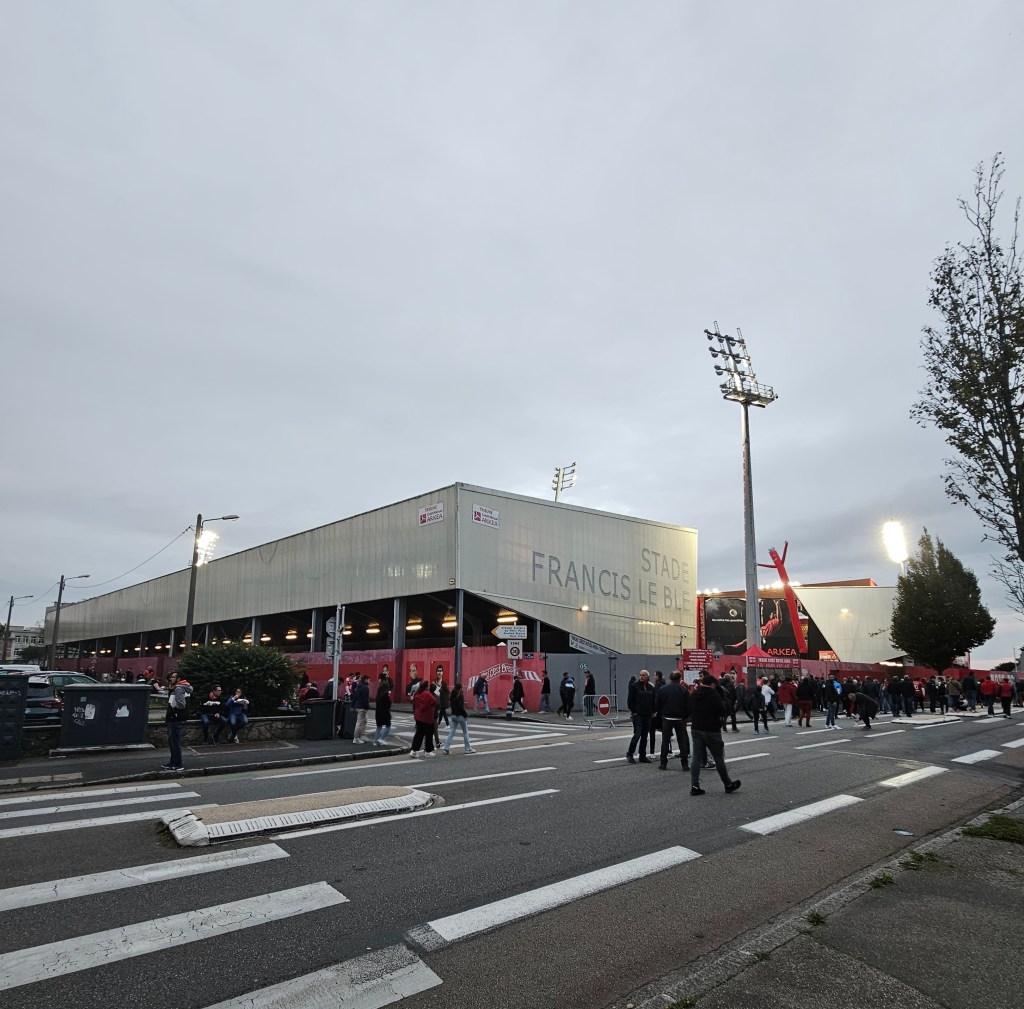
My fears about being unable to source club merchandise are quickly allayed as I spot a small wooden hut which looks like it could double up for use at a Christmas market.  I‘ve done my homework on-line, and know that for a bargain €9.90 I might be able to obtain a T-shirt bearing the club crest and the slogan Marree Rouge  (Red Tide). I point at a box of red T-shirts which bear the markings described and ask if there is one in ‘Large’ size.  The helpful young woman searches, examining the labels in collar after collar, one by one, but without success.  Eventually, sensing my desperation she holds up XL and XXL shirts as if suspecting that I am the sort of bloke who looks capable of putting on several kilos in weight if it suddenly proves necessary.  Optimistically, believing that I can fool the world by holding my stomach in, I ask if there is not a medium sized shirt instead; there is, but then, as she delves into the cardboard box just one more time a miracle happens, and she pulls out a ‘Large’; very possibly the last one in existence that isn’t already being worn by a well-proportioned Breton.

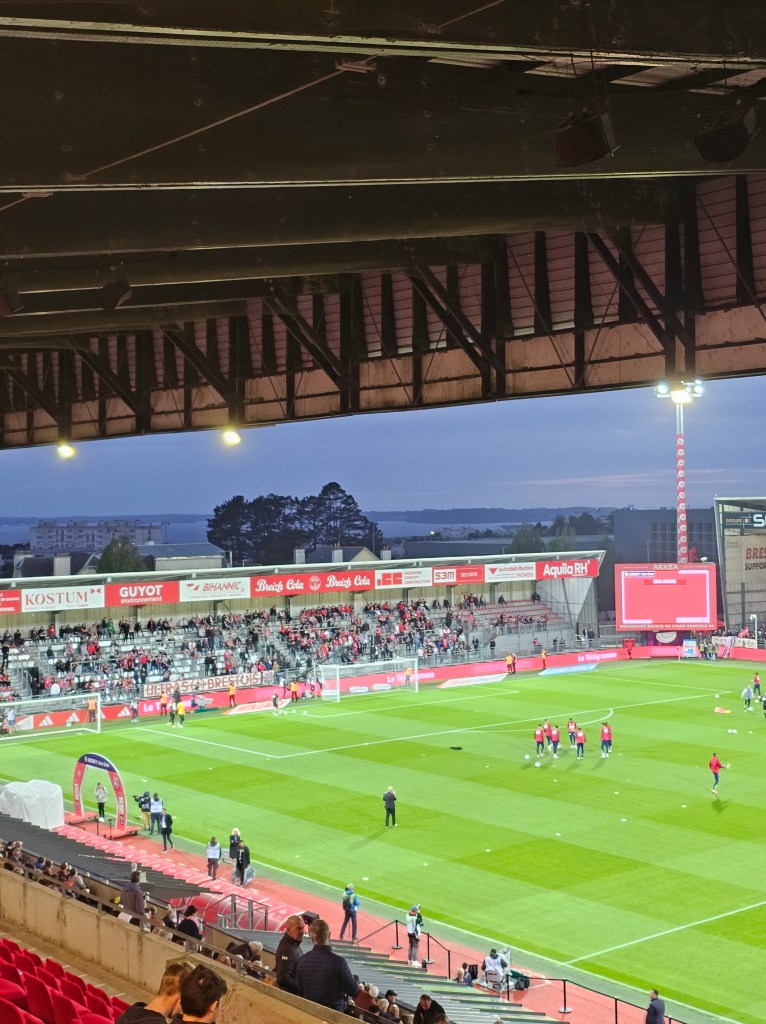
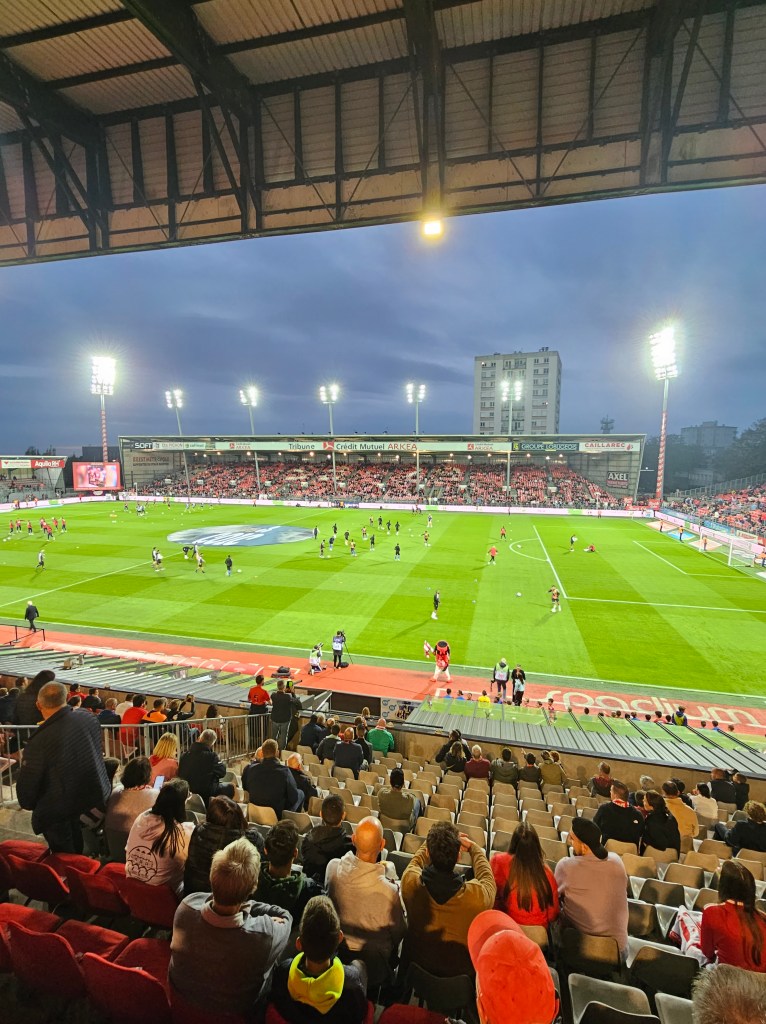
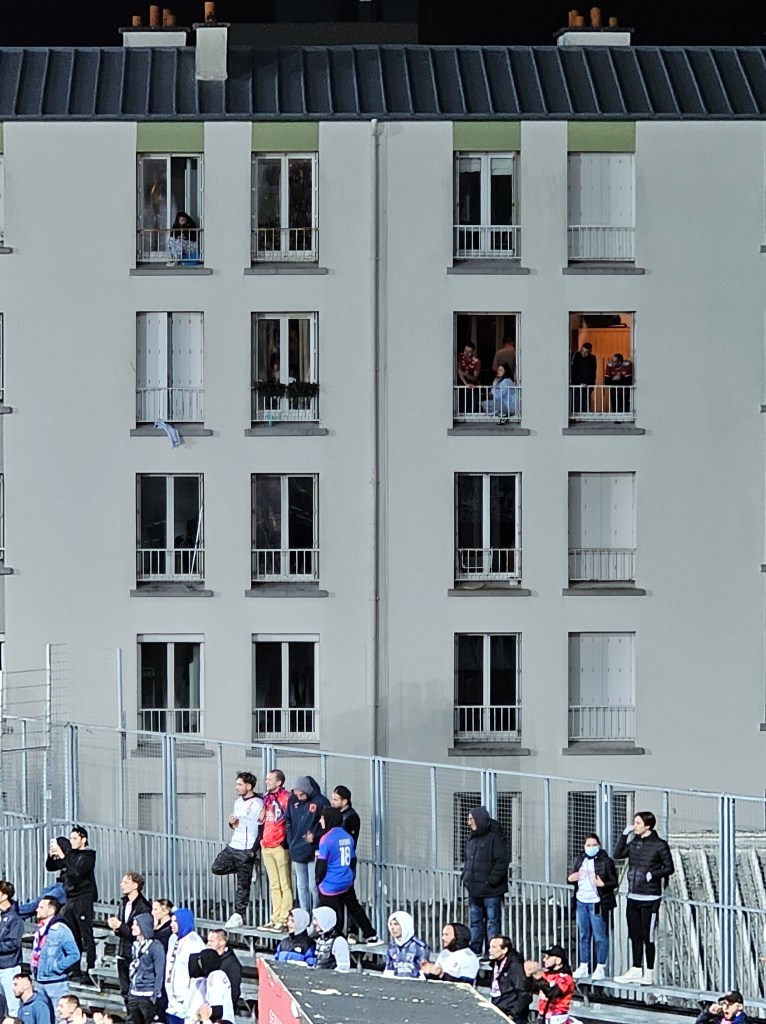
Clutching my precious T-shirt, I head for stairway five of the Tribune Foucauld and having climbed three flights of concrete steps I find myself looking over the brilliant green, floodlit pitch; all that remains is a further climb to row X and our seats, which I bought on-line a couple of weeks back.  Stade Brestois operate a loathsome ‘dynamic’ pricing system in which the club acts like a tout and the price of a seat changes, according to how much they think they can get for it.  When I first looked, tickets were €80 each; I eventually scored two of the few remaining ones for €45.  The club says the system means that people playing top price for seats allows less well-off fans to get cheap seats, but presumably this is only if these poorer fans have nothing to do with their time but be permanently logged onto the club website, waiting for a ticket price they might be able to afford.  The stadium has a capacity of not many more than 15,000 and is almost full for every Ligue 1 game. We sit in our over-priced seats and enjoy the view, which includes, through fading light, sight of the wide inlet from the Atlantic Ocean, which gives Brest its advantage as a port and naval dockyard.  Opposite us, the Tribune Credit Mutuel Arkea has five thick tubular stanchions set at a rakish angle to hold up the roof; atop the stanchions and the roof are floodlights, although the ground also has lights in all four corners.  To our right is the open Tribune Atlantique, a metal temporary stand a la Gillingham, and it’s where the away supporters are inevitably penned into a corner, they don’t even get seats, just metal benches.  Behind the stand, the occupants of a block of flats get a free view and can be seen crowding around windows and Juliet balconies. To the left is the small but freshly renovated Tribune Quimper; the ‘home end’ where the majority of the Brest Ultras congregate.

Whilst Paulene stays put to get maximum value from her seat, I soon take a wander to see what I can see and to find a programme, which is as ever free, and tonight is of the newspaper variety; it tells me the squads and who the referee and linesmen are and that’s it, which is all I need to know.  On the mezzanine level one staircase down from our seats is a bar, above which is a banner advertising the Breton Lancelot brewery.   Expecting one of Lancelot’s tasty beers, I invest 5 euros.  The beer is sweet and nasty and probably non-alcoholic; I tell the barmaid so and ask if it is Lancelot, because it doesn’t taste like it.  She doesn’t know but thinks it’s probably Carlsberg.  I’ve been poisoned.  At either ends of the stand are what look like private members bars, “Le Caban” and “L’esprit des Legendes”.  Spectators entering these bars do so only after having received the nod from people dressed intimidatingly all in black; presumably that’s where they serve the good stuff.  I’m guessing those spectators aren’t in the cheap seats.

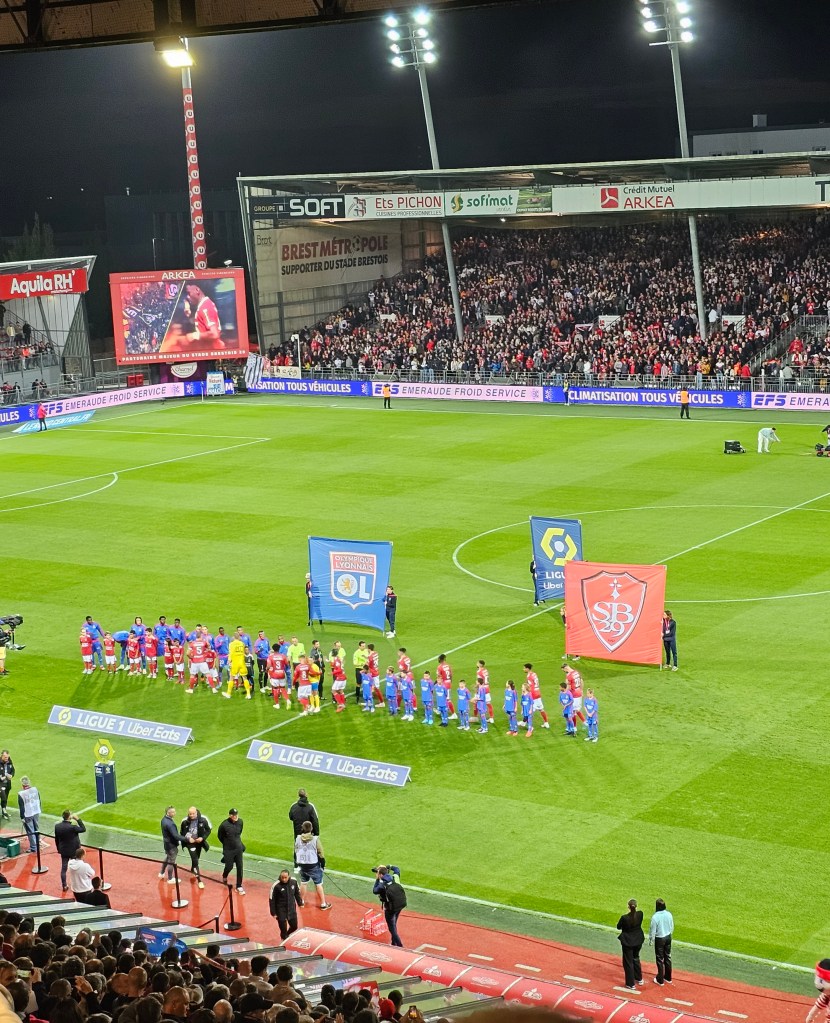
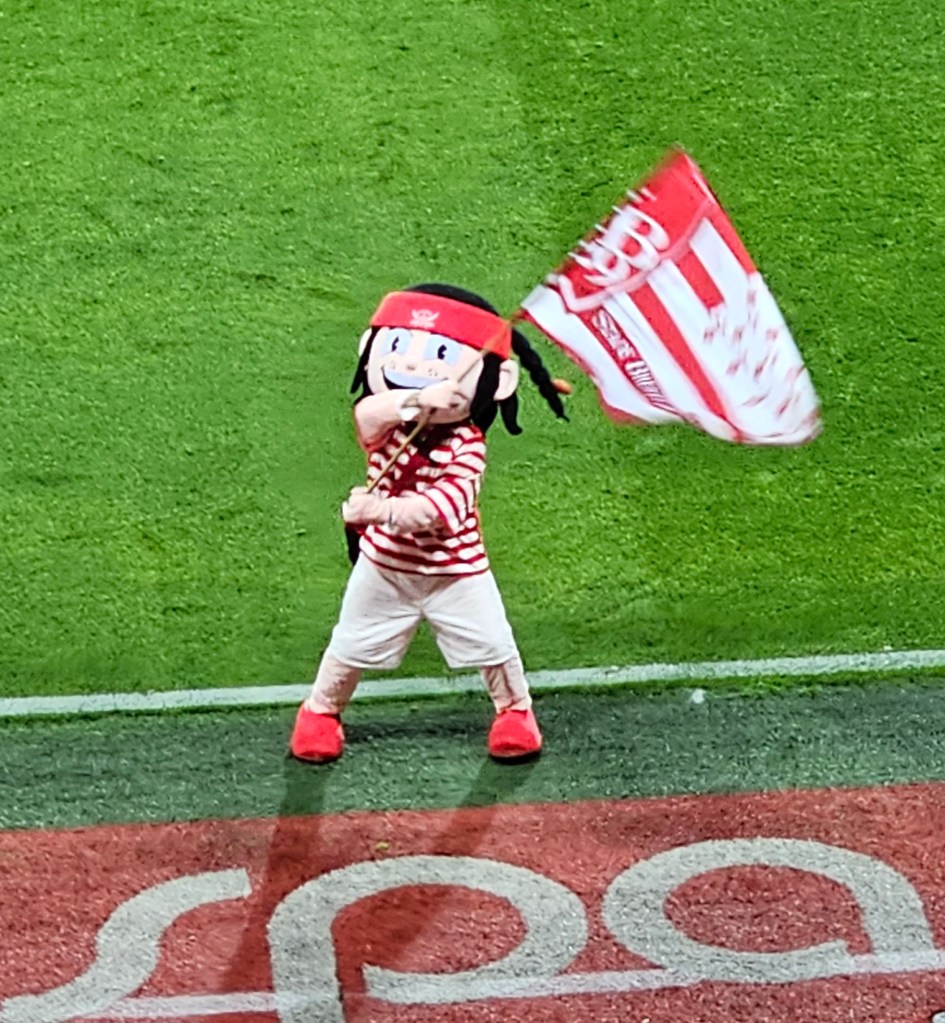
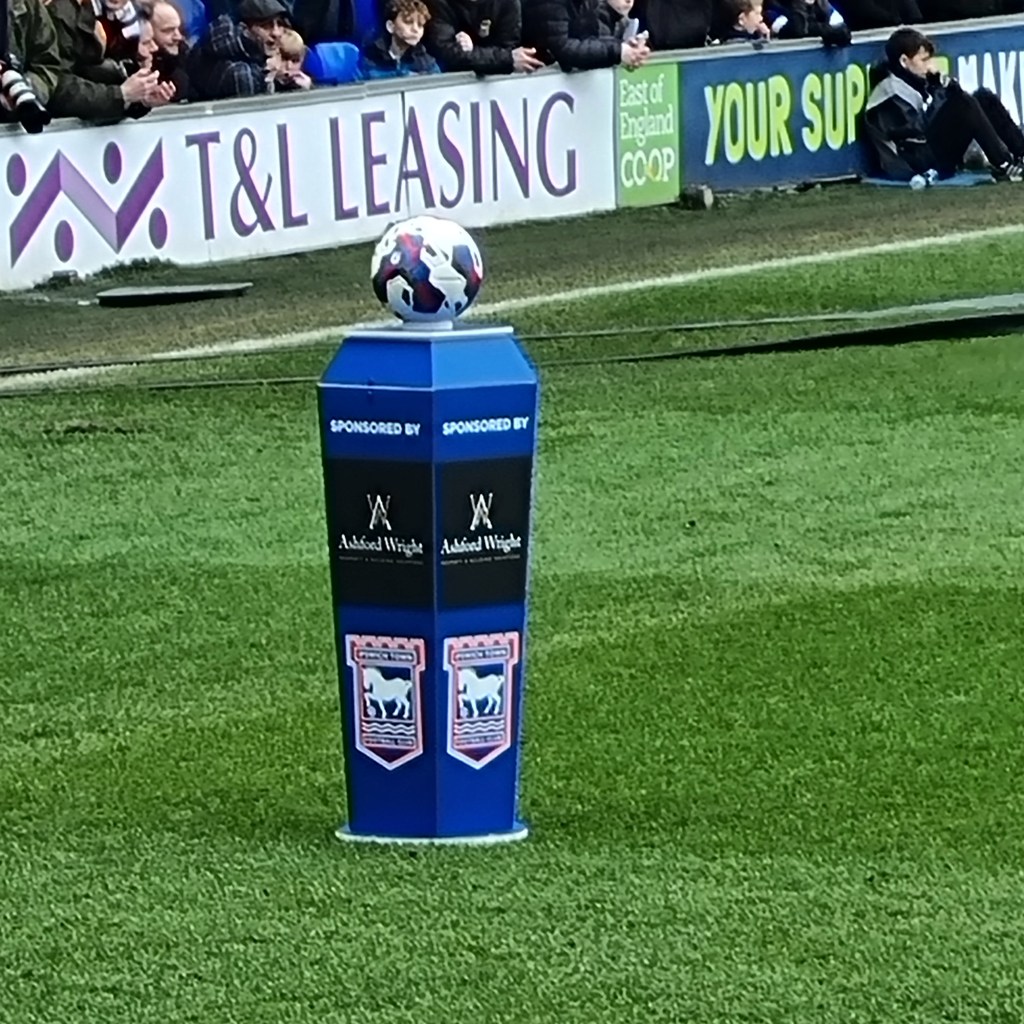
I return to my seat, and in the company of Paulene time passes quickly as we watch Zif, Brest’s pirate mascot, parade before the stand, and enjoy the arrival of the people in the seats around us, most of whom seem to be blokes in their seventies who all know each other.  The man next to me wears a beret and seems very clean, like Paul McCartney’s grandad in A Hard Day’s Night, but French. When the teams at last come onto the pitch, it’s to the fanfare of the Ligue 1 ‘anthem’, leaping flames, and the presentation of the match ball on a shiny plinth in front of banners displaying the two club badges and the Ligue 1 logo.  The public address system seems loud enough to make my ears bleed, but happily it doesn’t, although I do check.

When the game begins it is Lyon, generally known as OL in France, who get first go with the ball which they try and aim in the direction of the ocean whenever they can.  OL wear a frankly hideous, and annoyingly unnecessary away kit of all blue with red trim, whilst Brest are in their signature red shirts with white shorts and red socks. It’s been a warm day, but now a strong breeze blows up the hill from the dockyard and towards the OL goal. From the start, the slogan on my recently purchased T-shirt proves accurate as Brest sweep forward with wave after wave of attacking intent.  A shot goes way, way over the Lyon goal and then another soon earns a corner.  Brest are easily the better team but can’t find the final pass or the final touch that counts.  In midfield for Brest, Pierre Lees-Melou is brilliant, despite having previously played for Norwich City, and I imagine that the Canaries simply had no idea how to integrate a player into their team who can pass accurately, tackle, shoot, run with the ball and generally be quite good.  Fortunately, Lees-Melou seems to have suffered no ill-effects from his thirty-odd games wearing  yellow and green., but he’s probably receiving counselling.
All around the ground, the crowd brays with indignant disapproval whenever a Brest player is fouled. When referee Thomas Leonard books OL’s Ernest Nuamah for fouling Lees-Melou, the cheers sound like a goal has been scored.  I enjoy the wonderful name of Kenny Lala for Brest and the terrible haircut of Maxence Caqueret of Lyon, a player who looks like he was born 120 years too late and should have been the singer in a 1930’s dance band. On twenty-four minutes Lees-Melou has a shot tipped onto the cross bar by OL goalkeeper, the excellent Anthony Lopes, and then Brest’s Jeremy Le Douaran curls the rebound around the angle of the post and the bar.  “Allez-Allez-Allez” chant the home crowd from every stand.  A minute later OL get the ball into the Brest penalty area for the first time, but it comes to nought and instead all around is the noise of Brest fans urging their team on to score the goal the balance of play says they deserve.  The Ultras in the Tribune Quimper call out and the rest of the stadium answers back.  Mahdi Camara, a recent signing from Montpellier, dribbles deep into the OL box but again, there is no goal, only anticipation and excitement.  In the corner of the open end, the OL fans seem oblivious to their team’s ineffectiveness, other than in defence, and have sung and chanted all through the first half, prompted by two blokes perched astride the high metal fence that separates the supporters from the pitch.  Both blokes wield loud halers, but I don’t know if it’s the effect of the strong on shore breeze blowing away most of the sounds of their voices, but they both sound like Rob Brydon’s small man trapped in a box.

The fortieth minute is a milestone in the game as OL win their first corner, but of course it doesn’t result in a goal, and it’s the Brest supporters who remain in ebullient mood, holding their scarves aloft in the Tribune Quimper as the first half draws to a close in a sort of 1970’s tribute that suits the architecture of the stadium and the old blokes all around me who were themselves probably the Ultras of fifty years ago.  In front of me, a bloke wears double denim, and succeeds in accentuating the feeling, as if he’d come to a game in 1973 and never went home.
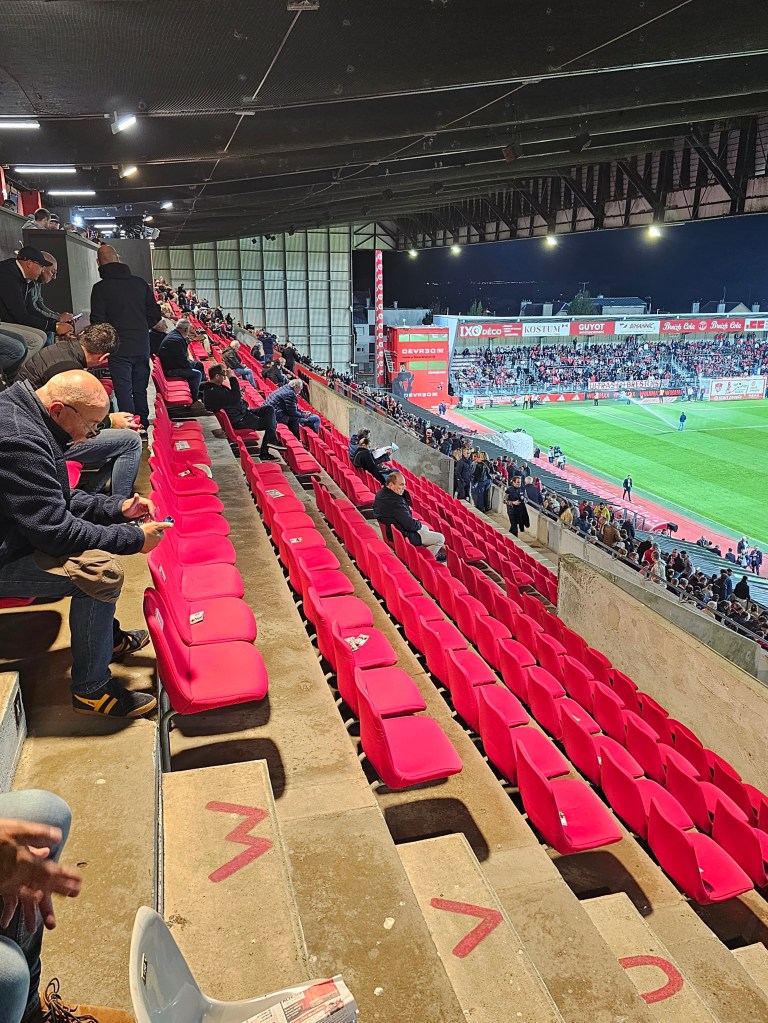
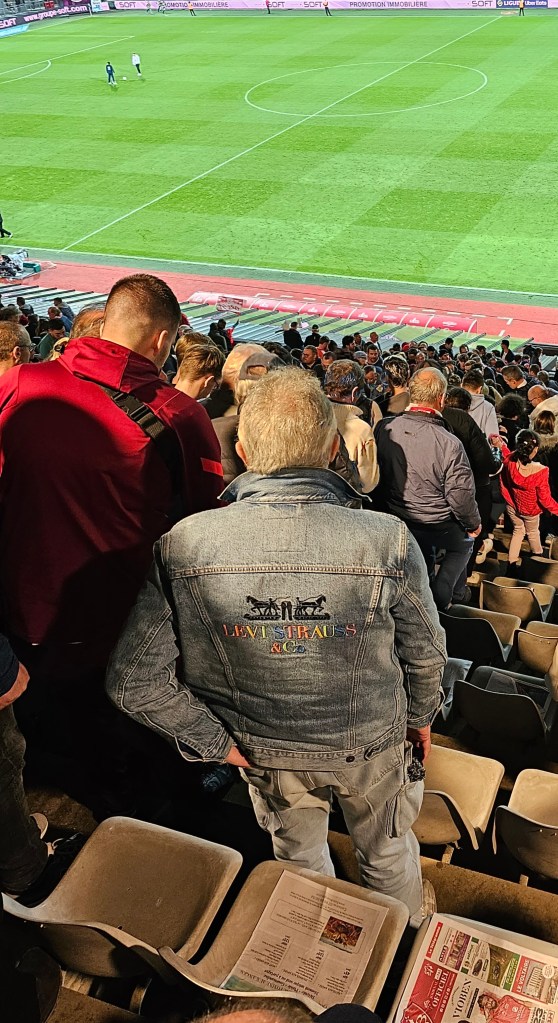
With half-time, the seats to our left are nearly all vacated, revealing the fact that they all sport red covers and suggesting perhaps that their occupants are now all enjoying some form of hospitality somewhere, perhaps in Le Caban or L’Esprit des Legendes. I will read later that the club owners wish to build a new stadium at the end of the tram line at the edge of the city, but that it will still only have a capacity of 15,000, no doubt because they want to be able to still charge top prices for the comfortable few and forget about the sweaty oiks who may be don’t wear shirts, and chant and light flares and drink too much beer containing alcohol in the bar across the road.

The second half begins and nothing changes, although encouragingly the block of seats to our left is soon re-populated, proving either that the occupants are genuinely interested in the match or that the hospitality isn’t free or unlimited. After just seven minutes however, OL roll the dice by replacing Ernest Nuamah, Diego Moreira and Paul Akounkou with Mama Balde, Tino Kadeware and Ainsley Naitland-Miles, who tonight wears a silly number 98 shirt and a few seasons ago mostly failed to excite when on loan at Ipswich from Arsenal.  The change sort of works for a short while and Alexandre Lacazette finds space to launch a thirty-yarder which flies over the Brest cross bar, but then a weak Caqueret pass is intercepted by Lees-Melou who dribbles away from his own half and to the edge of the OL penalty area before frustratingly shooting beyond the far post.  An hour has gone and Brest miss another chance, probably the best yet, as a low cross is somehow steered wide of the OL goal by Jeremy Douaron from just a couple of yards.  Whilst clutching their collective heads the crowds shout “Aye-Aye-Aye” and I find myself joining in with swelling chants of “Allez les Rouges! Allez les Rouges!”  Paulene, a Pompey fans says the atmosphere is like that of Fratton Park. “The same sort of people” she says. “What? All dockyard mateys” I reply, thinking of my dead father, a one-time Pompey based matelot who I know would have said exactly the same thing.

The game enters its final twenty minutes, and to mark the occasion tonight’s attendance is announced as being 14,636, and Brest substitute number seven, Martin Satriano for number nine, Steve Mounie.  But it’s OL who, still against the run of play, now come closest to a goal as Lacazette sends a decent low shot goalwards from the edge of the penalty area which Brest ‘keeper Marco Bizot dives to his right to stop and then jealously grab.  Lacazette lasts five minutes more before being replaced by Rayan Cherki, a man whose distinctly bushy facial hair and short back and sides give him the look of an Edwardian naval captain.

Three minutes of normal time now remain.  A move down the right produces a cross from Brest’s Kenny Lala, which Steve Mounie heads against the foot of Lopes’s left hand post.  As the crowd gasps in thrilled disappointment the ball runs back to Lala who crosses it again and Mounie, who has back-pedalled judiciously, this time hurls himself forward to head the ball past Lopes into the near top corner of the net, and Brest have the goal they deserve.  The crowd is on its feet, but OL defender Tino Kadewere is on the ground having been barged out of the way by the hurtling Mounie, although there was no real suspicion of a foul.

“Allez, Allez, Allez, Allez” we all sing triumphantly, Billal Brahimi shoots, Lopes saves, and Brest have a corner and five minutes of added on time in which to retain their clean sheet or even score again.  The very clean old bloke in the beret, next to me, leaves early, but very few others do.  Jonas Martin shoots and misses for Brest, and Naitland-Miles has a shot saved for OL, but there are no more goals and as the clock ticks towards eleven o’clock Monsieur Leonard blows his whistle for the last time.  Brest are top of the league, or more accurately given our geography, a la tete du classement.  We stay a short while to applaud before heading off into the night and back along Rue de Quimper to the tram stop, and a journey back to our hotel on the most crowded tram I have ever ridden on. It’s been a fantastic evening and still with our minds whirring excitedly, in our hotel room we celebrate Brest’s success by cracking open a small bottle of Cremant that had been cooling in the mini-bar, and unwind by watching the game all over again on Canal Plus tv. Allez les Rouges!
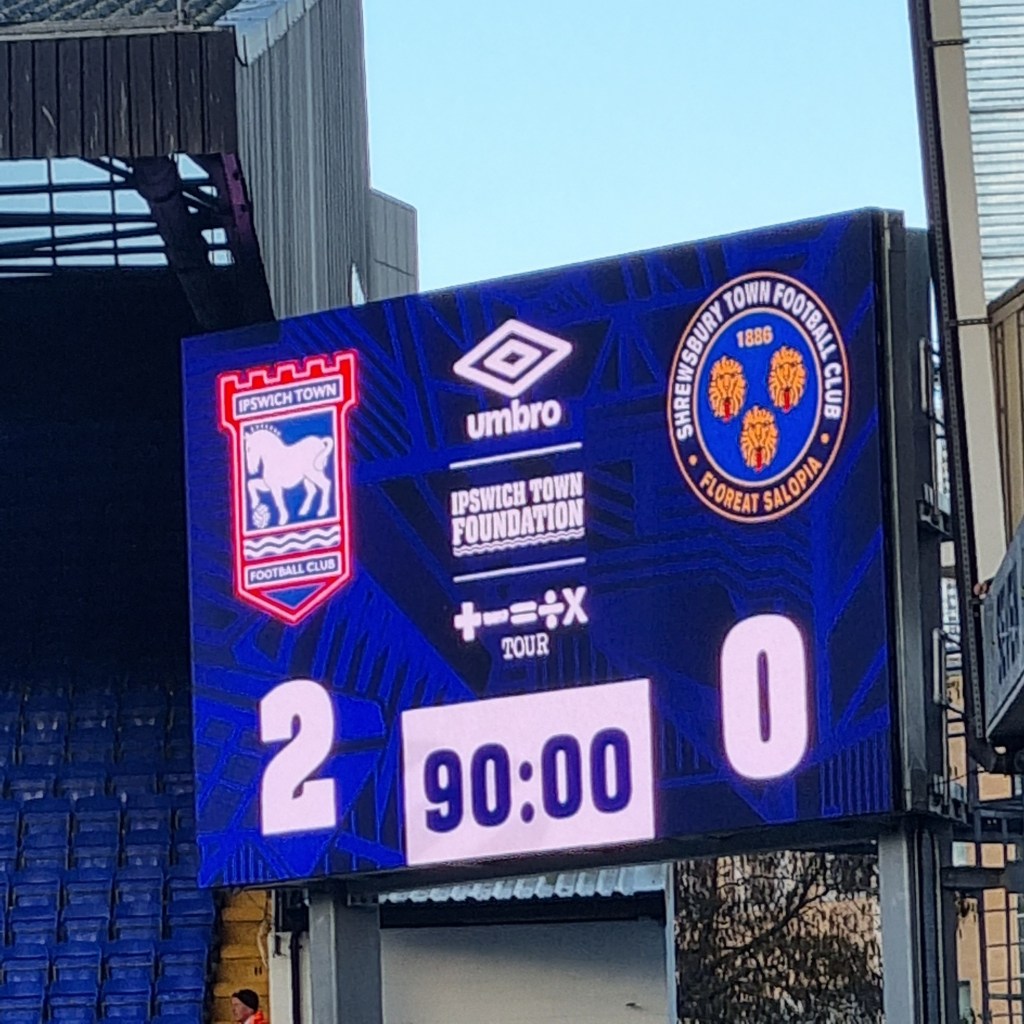
Ipswich Town 2 Shrewsbury Town 0

It’s been a beautiful wet morning of silvery grey light beneath a shroud of pale cloud.   I woke early, before six, when the sky was blue and red as the sun came up, but that was too early, so I went back to bed, then overslept.

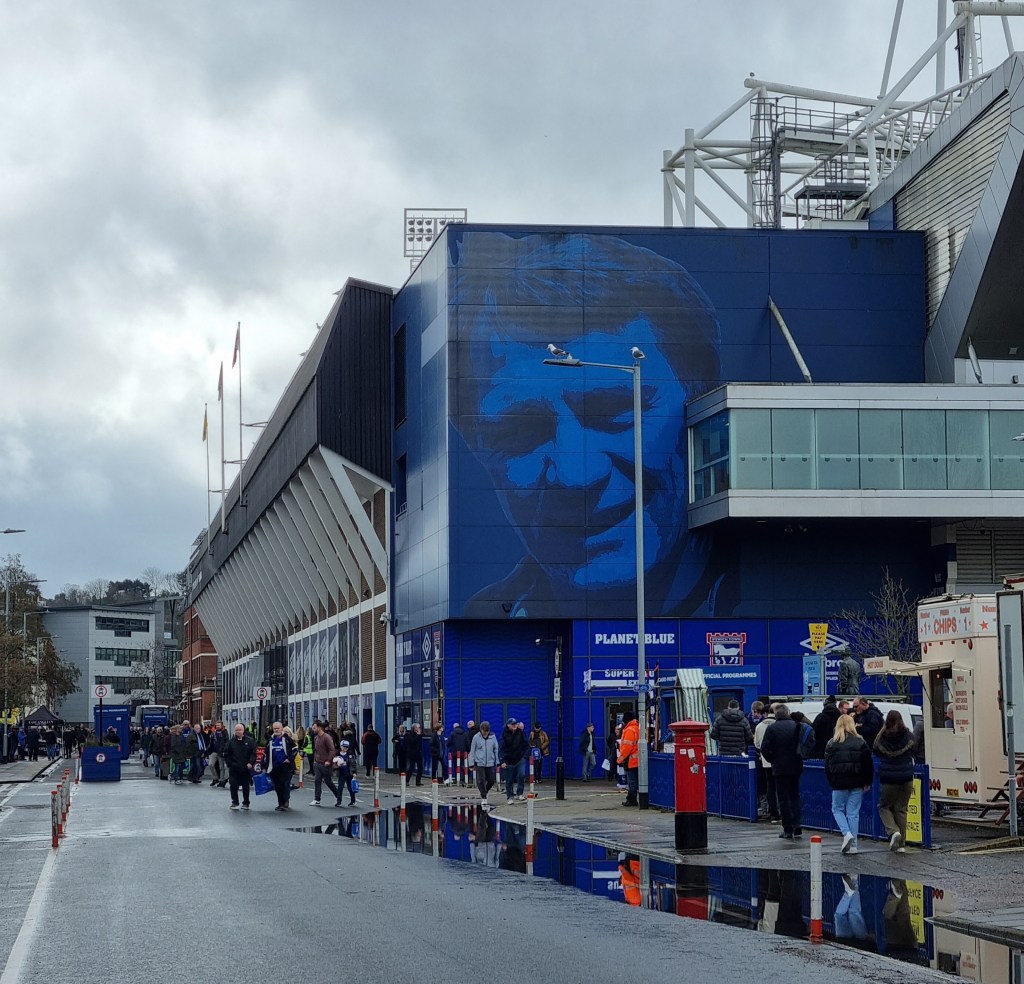
Earlier this week I woke up with my mind disturbed by vivid dreams of a time over forty years ago when I was a university student coming to terms with base desires to form shallow relationships with members of the opposite sex. Worryingly, in these dreams I fancied girls who at the time I didn’t think I did. Why my subconscious mind should want to re-appraise events of forty years ago I cannot fathom. The week has improved since then, and psychologically re-balanced I’ve now parked up my planet saving Citroen e-C4 and have stepped out across a slippery, soggy Gippeswyk Park, beneath Ancaster Road railway bridge and over the river to the old tram depot and Sir Alf Ramsey Way, where I cashlessly buy a programme for today’s match having waited my turn behind  a man who called the programme seller ‘mate’ at least four times and possibly as many as six during the  course of his brief transaction. I was tempted to address the programme seller as ‘programme seller’ but of course I didn’t. One day.

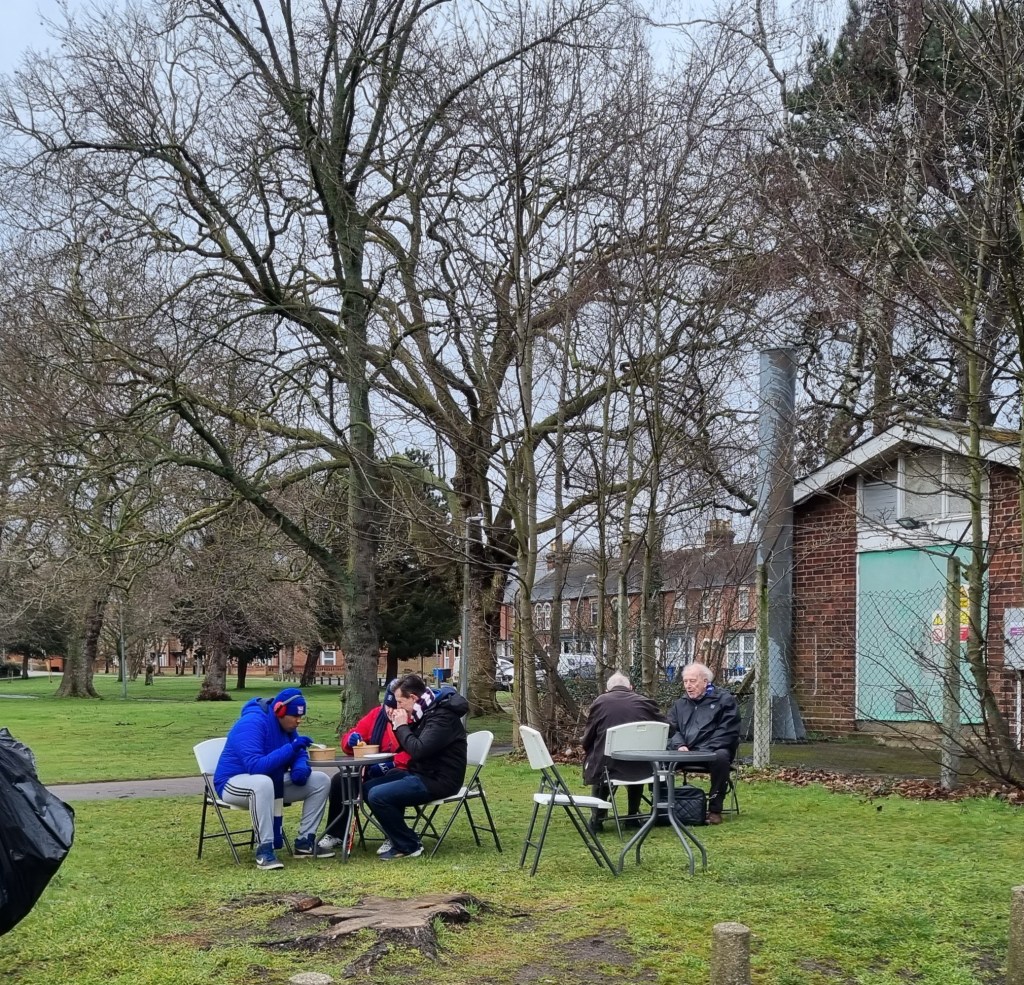
 At ‘the Arb’, I am a little bemused that there is no Mauldon’s Suffolk Pride today, but on the barman’s recommendation I order a pint of Mauldon’s Silver Adder (£4.00) and retire to the beer garden, which is already occupied by several drinkers of late middle age. I drink alone today because my friend Mick might be required away at any moment to collect a ‘stiff’; my words, not his and is taking the calls. Despite Mick’s absence, death still stalks me as at a nearby table I overhear a man talking of a funeral he had recently been to at the Seven Hills Crematorium.  “They just talked a bit about his life, played some music, and that was it” he says.  Later, he will tell his fellow drinkers about watching football on tv in Arabic by means of his Firestick, and how Richard Keys and Andy Gray are still working for beinsports in Qatar, where their grubby attitude towards women is clearly tolerated.  I would like to hear Andy Gray speaking Arabic.

I read my programme, gleaning from it the fact that Sam Morsy has been booked twelve times this season, which is four more times than any other Town player and twice as many times as the third most booked player, Wes Burns.  Finishing the Silver Adder, I return to the bar for a pint of Lacon’s Encore (£3.51 with Camra discount), by way of an encore.  At about twenty to three I depart for Portman Road. In Crown Street a young man steps out of a barber’s shop and sprays what I assume to be deodorant under his armpits from beneath his T-shirt.  An ambulance speeds by with its siren blaring; “Go, go save that person” shouts a lairy youth, no doubt trying to impress his friends with his off-the-wall ‘humour’.

I reach Portman Road and behind what was the North Stand a bearded man I know called Kevin sidles up to me and says hello. Kevin’s pre-match ritual is to have a pint at St Jude’s Tavern; he would join me at the Arb but can’t not stick to his ritual in case it causes a calamitous result.  We walk to turnstile 61 together; Kevin uses turnstile 61 because 1961 was the year he was born.  On what used to be the Churchman’s terrace I edge past Fiona to my seat next but one to the man from Stowmarket, although Fiona says he’s actually from Stowupland.  Two rows in front of us are ever-present Phil who never misses a game and his young son Elwood.  Pat from Clacton arrives a little after I do; she’s going to Great Yarmouth tomorrow on a ‘whist holiday’.

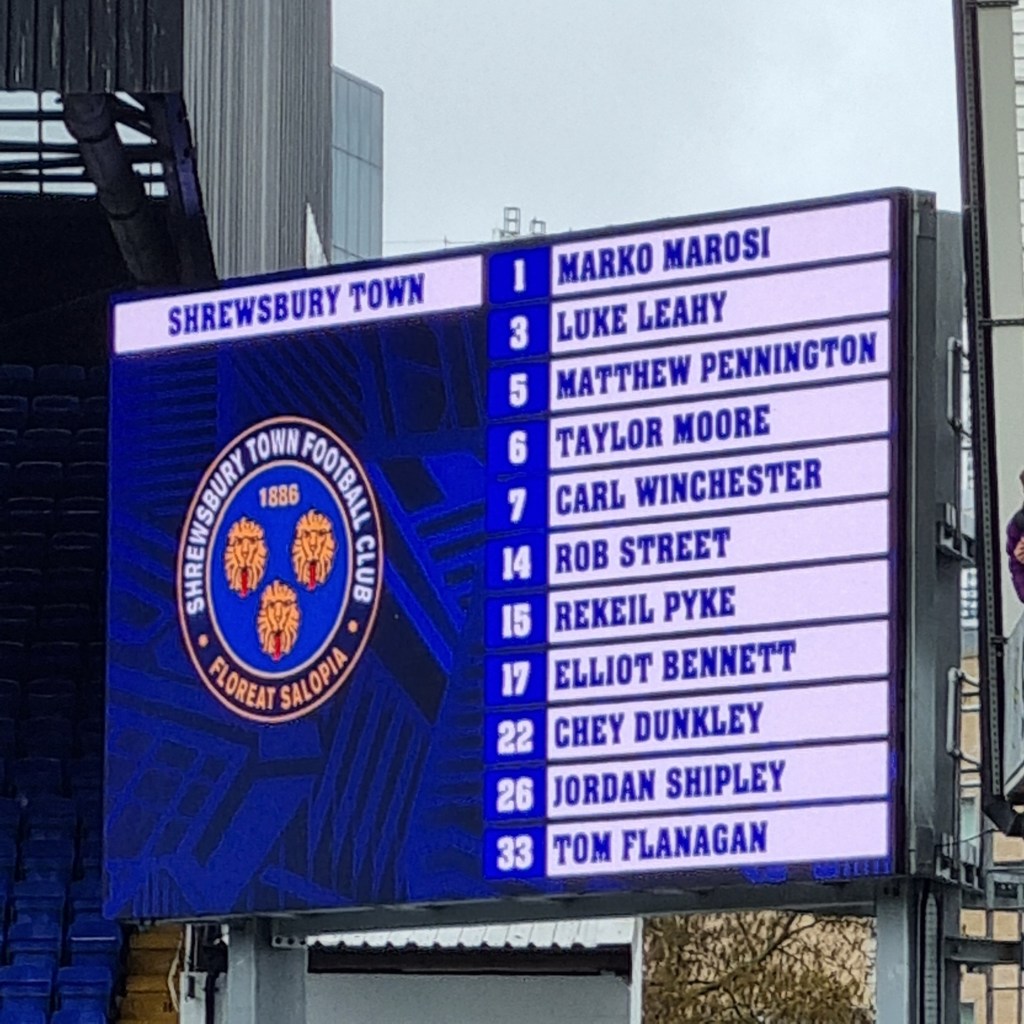
The teams process onto the pitch and Stephen Foster, the former BBC Radio Suffolk presenter and class-mate of my friends Pete and Ian, reads out the teams.  Along with ever-present Phil, I bawl out the Town players’ surnames, pretending to be French. If I was French, I’d already be retired now, and depending on where I lived I might support Racing Club de Lens, Lorient, Clermont Foot or Montpellier. It’s something I think about a lot in my many idle moments.  After a minute’s applause for former Town director John Kerr who died this week, Shrewsbury Town take the knee and applaud whilst Town players form a huddle, and then the match begins. Shrewsbury get first go with the ball attempting to send it mostly in the direction of the goal just in front of me, Pat, Fiona, Phil and Elwood.  Shrewsbury are sporting a change kit today because their usual, distinctive blue and yellow striped shirts would clash with Town’s all blue shirts.  Disappointingly,  Shrewsbury have opted for all-black, the magnolia of modern-day football kits,  for people who choose club kits but who also lack imagination. The addition of red smudges over the shoulders does nothing to alleviate the depressing absence of colour.  The referees however are doing their best for us and are wearing orange shirts.

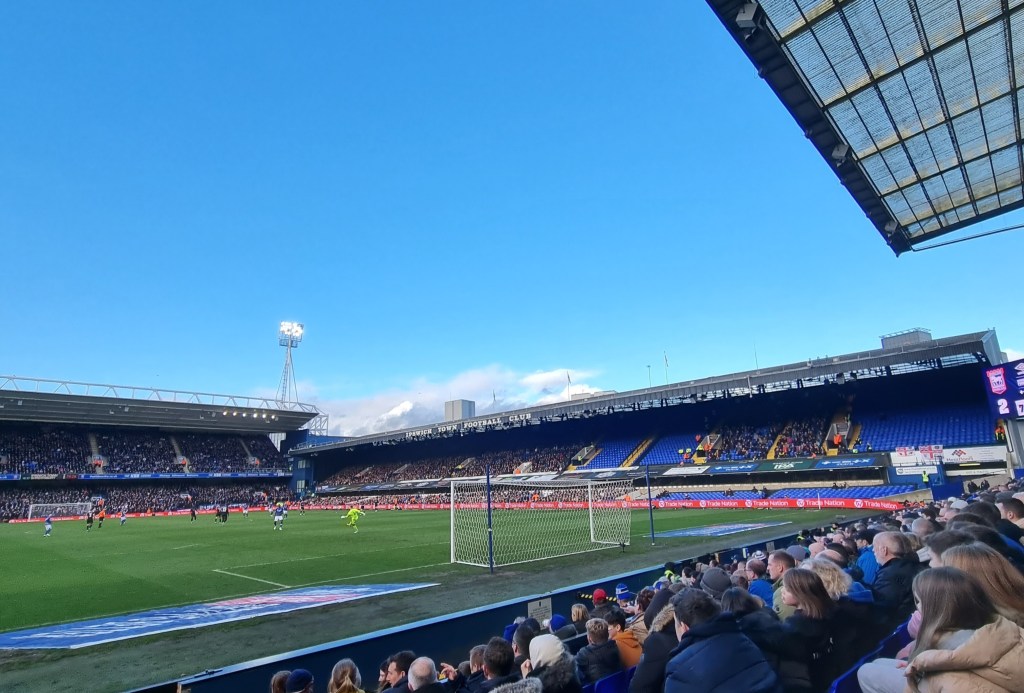
An intimidating, brooding wall of silence encloses the ground providing the soundtrack to the games’ opening moves, but a bit of noise eventually emanates from the Blue Action section in the lower tier of the Sir Bobby Robson Stand, followed by the curious chants of “Addy, Addy, Addy-O”.  It’s damp, and a faint mist seems to hang over the pitch.  Town have the ball mostly, but all of a sudden Christian Walton is leaping acrobatically to tip a header from Luke Leahy (I like to think Leahy is pronounced leaky) over the cross bar to give Shrewsbury the game’s first corner. Quickly it has been established that Shrewsbury are going to be one of those teams who are all free-kicks, set pieces and shoving people over.  It’s a style of ‘football’ that is effective for a bit, but people soon get tired of it and that includes the players, just ask Mick McCarthy. 

Town soon re-establish their superiority, which manifests itself in three corners in five minutes as crosses and shots are blocked.  A dozen minutes have gone forever and half the pitch is now bathed in mottled sunlight and the other half wallows in the shadows of the stands.  I am struck by how spindly the legs of Shrewsbury’s number 33, Tom Flanagan, are and just to prove the point he slips over like new born Bambi.  The fifteenth minute arrives and Wes Burns scampers off down the wing, crosses the ball and George Hirst rises high, twists his neck, and heads the ball gloriously into the goal beyond goalkeeper Marko Marosi.  It’s the sort of goal centre forwards used to score all the time, and at half-time Ray will tell me how it reminded him very much of Trevor Whymark’s best work, and he’s right.  Town lead 1-0.

The sun is shining, the Town (Ipswich not Shrewsbury ) are winning and all is right with the world as I sit back and wait for Town’s next goal.  Before that however, comes the first booking as Wes Burns is tripped by Jordan Shipley, who forty years ago might have been called Gordon Shipley.  All twenty outfield players are within forty yards of the Shrewsbury goal as the resulting free-kick is taken, but the ball goes straight into the arms of Marosi.

With the game entering its second quarter, it feels like Town ease off a little as what had been a busy period of crosses and constantly probing possession comes to an end.  But the rest, is just a rest and soon Town are winning more corners. “Come On You Blues” I bawl.  “ They can’t hear you” says Pat from Clacton.  “I don’t think anyone can” I tell her, disappointed that all across the bottom tier of the Sir Alf Ramsey stand people haven’t joined in with me. “I can hear you” says Fiona, sounding like she wishes she couldn’t.

We descend towards half-time and from another  Wes Burns cross it looks as though the until now excellent Massimo Luongo has an open goal, but somehow he contrives to head the ball where we and presumably he didn’t want it to go, not into the goal.  In the interests of variety, Shrewsbury are awarded a corner as Cameron Burgess clears the ball behind from a rare, but awkward foray forward by the visting team, and Christian Walton saves a shot from that Gordon Shipley, before Conor Chaplin restores order but shoots wide of the Shrewsbury goal.  The half closes with an homage to BBC tv sitcom Dad’s Army as Shrewsbury number 15, Rekeil Pyke  fouls Luke Woolfenden, and hopefully referee Ollie Yates adopts a German accent to say “ Your name will also go into the book, what is it?”  From the touchline I think I hear Shrewsbury manager Steve Cotterill shout “Don’t tell him Pyke!” and both benches and Mr Yates fall about laughing.

With half-time, I hasten away beneath the stand to make use of the facilities and enjoy the luxury of the new hand dryers which since the last home game have replaced the old asthmatic ones.  I return to talk with Ray and his grandson Harrison at the front of the stand. Ray seems disappointed with the first half because Shrewsbury have had a couple of reasonable chances and Town have only scored once, but he liked the goal and talks of Trevor Whymark and Alan Lee.

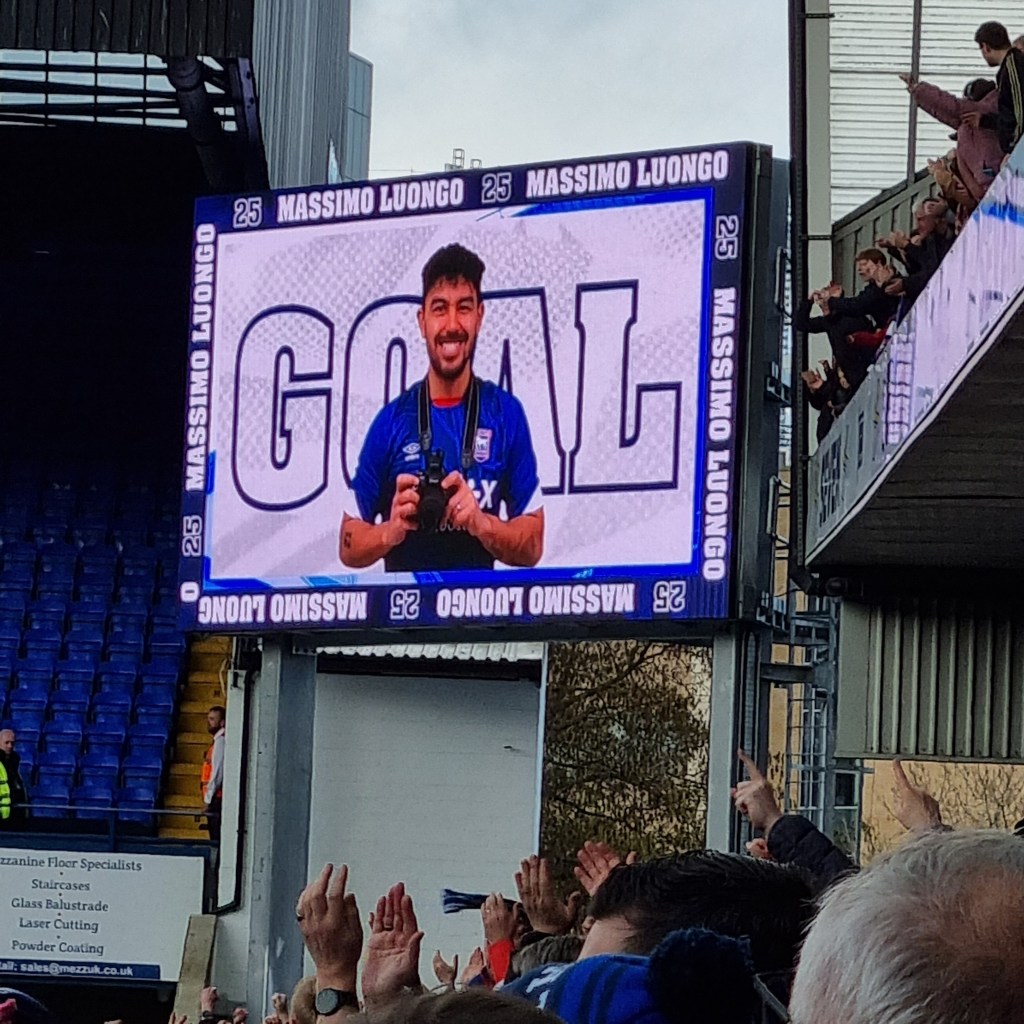
The football resumes at seven minutes past four and I eat a Nature Valley honey and nut cereal bar, which I finish before Town seemingly score again as Conor Chaplin taps the ball in at the far post after a deep cross, but apparently he is offside; he doesn’t argue so he probably was, or he is the first player to work out that referees do not change their decisions.   The disappointment is only temporary however, but what isn’t?  Two minutes later there’s a cross, a Conor Chaplin shot is blocked and Massimo Luongo places a precise hooked shot inside the far post to put Town 2-0 up.

It feels to me like we’ve won already and it’s just a matter of how many goals Town can get. Shrewsbury are putting up decent resistance but we’re too good for them and almost proving the point George Hi⁸rst thumps a shot against a goal post, although he must ask himself why he missed the 7.32m wide gap to its left.  A minute later  Shrewsbury’s Matthew Pennington is booked for reacting childishly to a perceived dive by Nathan Broadhead and then an unseemly melee ensues with all the usual posturing and macho behaviour that you would expect from the drivers of enormous black SUVs.   When the free-kick is eventually taken, Leif Davis uncharacteristically launches it wastefully over the cross bar.

Ipswich’s early dominance of the second half nevertheless inspires some noise from the home crowd and the Sir Bobby Robson stand treat everyone else to the usual truncated rendering of Harry Belafonte’s, or may be Boney M’s, Mary Boy Child with specially adapted lyrics that tell of what now seem like mythical fights with Norwich on Boxing Day.  Shrewsbury are first to blink with regard to substitutions and two are made together, one of them being the aforementioned Pyke. 

Time rattles on by twenty minutes and Shrewsbury win a corner and Nathan Broadhead is booked for being fouled in the Shrewsbury penalty area despite Shrewsbury players concernedly helping him to his feet rather than pointing accusing fingers.  Todays’ attendance is announced by Stephen Foster as 26, 432 with 343 from Shropshire, and weirdly but as per usual, people applaud themselves  or each other, or may be they’re applauding Stephen Foster.  On the Clacton supporters coach the guess the crowd competition is won by Pat from Clacton’s great nephew Liam, who is just visiting for the weekend and is a West Ham United supporter.  Understandably, Pat seems disappointed that this ‘part-time supporter’ has won the prize and suggests various other guesses  on her list to Fiona and me that might be closer, but none of them are.

Fifteen minutes remain and it’s time for Town to begin their usual catalogue of substitutions and Freddie Ladapo and Marcus Harness replace George Hirst and Nathan Broadhead.  Another Shrewsbury corner sees Chey Dunkley strike the Town cross-bar  with a header, but typically for a team reliant on ‘big blokes’  there has been a foul, and Town are awarded a free-kick and Christian Walton receives lengthy treatment whilst everyone else enjoys a break by the touchline.  “Get Up!” shouts a frustrated pre-pubescent voice behind me.  His dad explains that you don’t shout “Get Up” at your own players, but the child simply replies ”But it’s taking forever”.  When he’s older he’ll realise that some of life’s best moments are when nothing is happening.

The last ten minutes of normal time have found their way here and it still time for two more Shrewsbury players to be shown Ollie’s yellow card  for fouling Conor Chaplin, and Kayden Jackson, who has replaced Wes Burns, although they probably would have fouled him too given the chance.   The eternal treatment to Christian Walton results in only seven minutes of added on time and whilst I hope for a third Town goal which would mark out the result as a modest thrashing rather than just a satisfactory win, it doesn’t happen, despite two more Town substitutions and an outbreak of rhythmic clapping.

Finally, at a minute before five o’clock the game ends and my little band of ultras and I bid our adieus until Good Friday.  It’s been a fine performance from Ipswich and ultimately a comfortable, if hard fought victory.  I will travel home this evening content, and safe in the knowledge that in forty years’ time it is unlikely my subconscious mind will unexpectedly want to re-appraise todays events, because I expect I will be dead.

Ipswich Town 0 Newport County 1

The first and second rounds of the Football League Cup are always an early season treat, a chance to play an interesting ‘lower league’ club and maybe visit a ground never visited before, in fact that was almost guaranteed back in the days of two-legged ties.  Added to that, summer isn’t over (if it has ever started) and a hot and sticky road trip precedes a balmy evening of lengthening shadows beneath a maturing, setting sun. Early season evening games are blissful, beautiful occasions and I fondly remember visits to Torquay, Exeter, Scunthorpe, Darlington, Brentford, Stockport, Bolton and Wigan.   Sadly, Ipswich Town are now one of those lower league teams, and a decade or more of abject failure has transformed cup ties from nights of wonder and joy into painful experiences to be endured like a trip to the dentist or having your car MoT’d.

Tonight, our opponents are ‘little Newport County’, a phoenix club resurrected from the one that went bust in 1988, following relegation from the fourth division.  I recall seeing the original County play out a magnificently awful goalless draw at Layer Road, Colchester in that fabulously terrible relegation season, but I also recall their glorious 2-3 European Cup Winners Cup quarter final defeat to Carl Zeiss Jena at the same time as Town were cruising past St Etienne on our way to winning the UEFA Cup.  Again, like on Saturday when Morecambe played their first ever third division game at Portman Road sixty years after Town played our first ever top division game, it is somehow fitting that Newport and Town should meet forty years after both clubs’ finest moments in European competition. I visited Newport’s old Somerton Park ground back in 1988 and could only think how their opponents from the German Democratic Republic must have been glad to get back behind the ’iron curtain’, doubtless with renewed faith that Communism was far superior to Capitalism and produced much better football stadiums, which of course it is and did, if you do it right.  Communism is a bit like sex, a great idea but best only conducted between consenting adults.

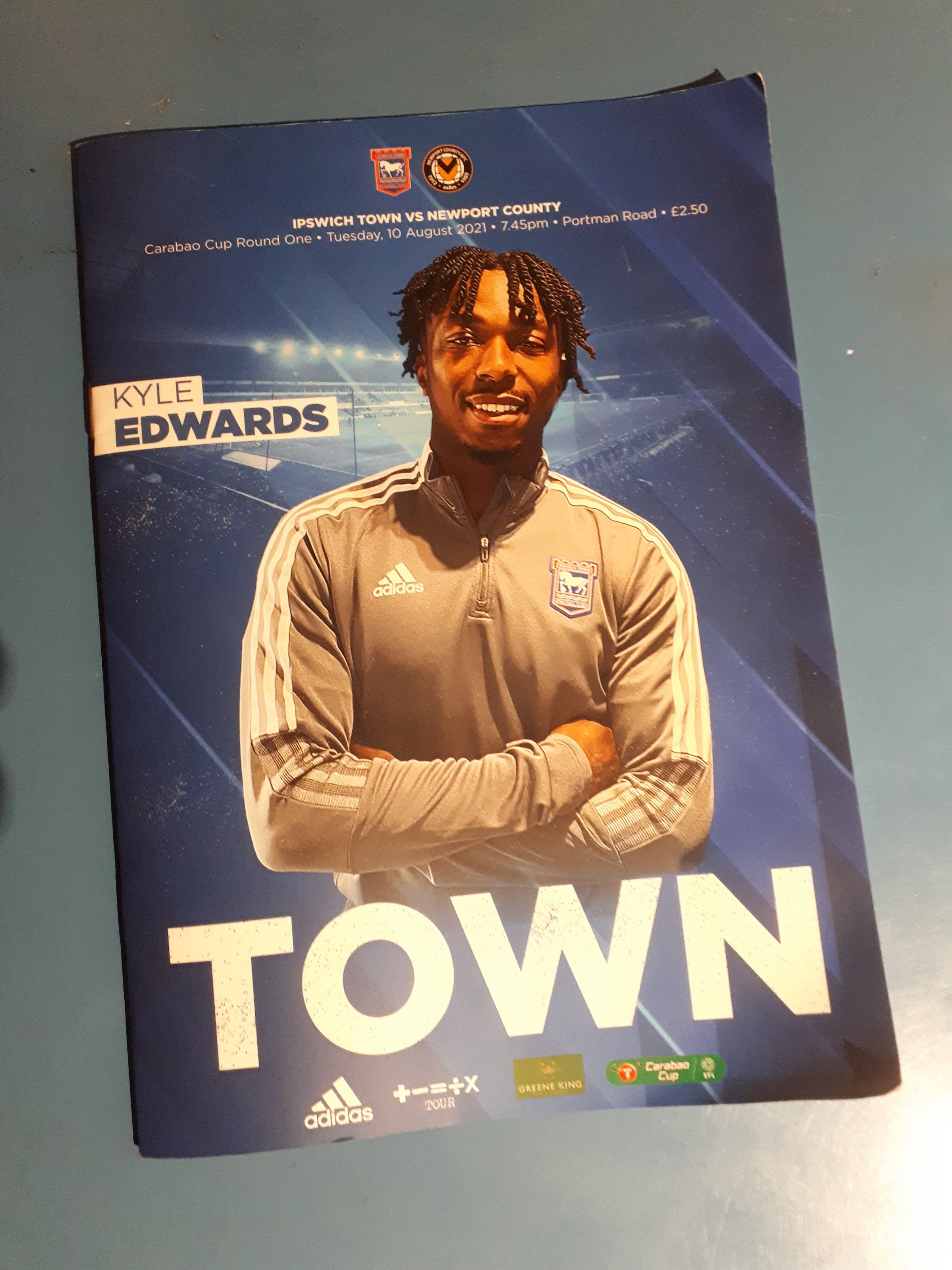
Shamefully arriving by car and not public transport because of continuing Covid induced paranoia, I park-up in West End Road car park at a little after 7 pm; the tariff is £1.00 until 8.00pm, after which it is free.  Stepping from my trusty, air-conditioned Citroen C3 the warmth of the evening air hits me unexpectedly and stirs pleasant memories of going to night matches in more exotic locations such as Beziers, Nice, Marseille and Montpellier whilst on holiday in the south of France.  Musing that the stadium catering at Portman Road probably doesn’t serve espresso coffee or cheese and ham baguettes, I stroll to the ground where there are queues at the guichets (look it up). I buy a programme (£2.50) from a booth in which the gently smiling young female programme seller seems rather heavily made-up for the occasion, but then it’s nice that she’s made the effort.  Drinking in the pre-match ambience I pass by the back of the Sir Bobby Robson stand and enter Portman Road, which is strangely quiet.  I realise later that this is because the only people occupying the Cobbold Stand tonight are the 131 from Newport, many of whom will have travelled on the six-wheeled charabanc of Watt’s Coaches, which idles by the Portman Road bus stop; I ask one of the drivers how long the journey took; “Five and a half hours” he tells me stretching out his vowel sounds with his rich, lilting and somewhat tired sounding South Walean accent, which oozes Rarebit and Eisteddfods.

Returning to Sir Alf Ramsey Way the queues for turnstiles 43 to 47 are lengthening and beginning to snake, so I head for turnstile 49 where there’s hardly anyone ahead of me at all.  Inside the ground a line of Heras fencing separates the fanzone from those of us who have passed through the turnstiles. The back of the stand is a noisy place as a disco inside a shipping container seems to be operating from a corner of the fanzone, predictably no one is dancing, and I wonder what the point of it is.   Fearing that my hearing is being damaged I head for my seat which tonight is in Block H, so lettered I will discover because at the end of the match it’s difficult to get out of, like the prisoner cell block.

As I stand and flick through my programme, kick-off comes ever closer and the PA system which successfully scrambles any spoken word delivers a medley of tunes associated with the Town.  I enjoy the anthemic Edward Ebenezer Jeremiah Brown from the 1970’s, but cringe at the dire Singin’ the Blues of the George Burley era, which sounds as if it is performed by Vic Reeves and Suzi Quattro, and the surreal and corny Sweet Caroline.  My only pleasure is from a childish giggle provoked by the name of a Newport substitute, Evan Ovendale. 

Finally, my torture by music is ended when the teams come onto the pitch, and I’m pleased to report are warmly applauded as they ‘take the knee’.  The match kicks off; Newport pointing in the direction of the Sir Bobby Robson stand in their traditional amber shirts and black shorts and getting first go with the ball.  Barely two minutes pass and an Armando Dobra shot strikes Newport’s right hand goal post. Within a further two minutes Newport lead.  One of Town’s many debutants, Sone Aluko needlessly concedes a free kick, from which a low cross is diverted into the net via the heel of Timmy Abraham, who rather wonderfully sounds like he should be, and indeed he is, the little brother of the Chelsea player, Tammy Abraham.

At least we probably still have 90 minutes to score a couple of goals of our own. But inevitably, given Town’s recent record in cup competitions, I have a nagging sensation that some writing is already being daubed on a wall somewhere.  Meanwhile, Armando Dobra has a shot saved and the oddly named Macauley Bonne heads over the Newport cross bar.   When Newport are awarded the game’s first corner, the Sir Bobby Robson stand chant “Who the fuckin’ ‘ell are you” to the taker, displaying a boastfulness of their own ignorance that is fitting in a town that voted for Brexit.

Town may be losing, but the game is nevertheless an entertaining one and despite the mostly empty stands the spectacle is enhanced by the fading daylight. With 21 minutes gone Sone Aluko claims the glory as the first player to be booked by the strangely competent referee Mr Neil Hair, or Herr Hair as he would be known if this were the Bundesliga.  Quite suddenly at about ten past eight I notice that all sunlight has gone and the ground is totally in the shade of whatever the Pioneer stand is now called.  The oddly named Macauley Bonne strikes the outside of Newport’s left-hand post with a shot and some childish banter ensues between him and the Newport goalkeeper Nick Townsend, with Bonne clutching his stomach to indicate that that Townsend is not merely big-boned; you can take the boy out of Chantry High School but you can’t …etcetera.

Five minutes of the half remain, and Town produce a delightful passing move, sending the ball from Luke Woolfenden to Idris El-Mizouni (whose father incidentally drank a post-match coffee with me when AS Meudon played St Ouen L’Aumone in the Coupe de France in 2018) to Sone Aluko to Armando Dobra, whose cross is headed over by the oddly named Macauley Bonne.  There is still time for Newport’s short and dumpy, but wonderfully named and impressively numbered (he’s No 56) Aneurin Livermore to be booked, for Idris El-Mizouni to have a free kick saved, and for him to provide a deliciously whipped-in cross for the oddly named Macauley Bonne to head over the bar yet again.

Half-time brings relief from the claustrophobia of the oldest part of the stadium, as those around me leave to get refreshment; people genuinely were smaller in the 1950’s when the old West Stand was built, possibly because there was no stadium catering back then.  Tonight, I am seemingly surrounded by youths in their late teens and early twenties who are all about 2metres tall.  Two of them return with trays of chips and the game begins again.

My seat is closer to “Churchman’s” than the Bobby Robson Stand and perhaps that’s why I notice for the first time this evening that Tomas Holy is a vision in cerise, he’s quite a sight.  Five minutes pass and the oddly named Macauley Bonne heads a looping cross into the goal, the giants all around me stand as one, but I had already spotted the offside flag.  “You fat bastard” chant the North Standers, presumably at goalkeeper Townsend and not to the oddly named Macauley Bonne.

Tonight’s attendance of 6,154 is announced and a good proportion of that number applaud themselves like performing seals do after catching a fish thrown at them from a bucket.  Town’s Scott Fraser replaces Sone Aluko who looks like he knows he’s had a poor game.  “He’s weird in ‘e? He’s got funny little legs in ’e?” I hear a voice behind me say.  I think the voice is talking about Newport’s left-back Aaron Lewis, who indeed does have funny little legs; he also has hair like Grayson Perry; he’s not a bad footballer mind, and I like to think he might also be able to knock up some decent ceramics or tapestries.

Over an hour of the match has passed and a fine shot from Armando Dobra brings an equally fine flying save from the fat bastard in the Newport goal; James Norwood and Kayden Jackson replace Louie Barry and the oddly named Macauley Bonne.  Newport mount a rare attack down the right and Town’s Corrie Ndaba, whose first name reminds me of the episode in series nine of The Simpsons in which Lisa becomes addicted to ringing the ‘Corey hotline’, spectacularly and miraculously slices the ball into the arms of Tomas Holy who is stood behind him.

With the match in the final twenty minutes Newport players twice clear the ball off their own goal line in the space of a few seconds and James Norwood heads a decent cross from Bailey Clements over the bar in a manner which I had thought was the preserve of the oddly named Macauley Bonne.  Just a short while later Norwood begins to limp and then leaves the field of play to be replaced by no one at all because we’ve used all our substitutes.  The bloke next to me doesn’t notice for a further few minutes that we are down to ten men and when he does, he thinks we’ve had someone sent off; “What happened?” he asks; and I thought I was guilty of not paying attention.

Newport’s shaven headed forty-two-year-old, Kevin Ellison is substituted and hobbles off, clearly attempting to eke out the remaining time in a way which doesn’t involve football being played. “Get off you old git” I bawl at him despite being almost twenty years his senior. I’m not sure what came over me, although these West Standers seem rather dull and need livening up.  Unfortunately, Ellison and his team win the day with their time-wasting ways and despite five minutes of added on time Ipswich fail to score, and so once again leave the League Cup at the earliest opportunity, leaving Newport County and the likes of Forest Green Rovers, Barrow and Oldham Athletic to seek the sort of glory we can only dream of.

Despite the result it’s been an enjoyable match, with some fine performances from young players, particularly Bailey Clements, Idris El-Mizouni and Cameron Humphreys. As I stand helplessly waiting to get out of the slowly clearing stand, I applaud Newport and their intrepid supporters and reassure myself by believing that although the score reads as another Cup defeat I have simply witnessed the birth pangs of a Grand Projet that will one day see us reach the next round.

AS Fabregues 0 Canet Rousillon 2

Fabregues is a very attractive small town about 10 kilometres southwest of Montpellier in the Hérault department of southern France. The town has a population of fewer than 7,000 but has a history dating back a thousand years, the centre being set out in a pattern of concentric circles around the church or chateau, a form of early medieval urban development known as a circulade. The town’s history probably goes back further to the Gallo-Roman era as the name Fabregues being derived from a Latin word meaning forges.
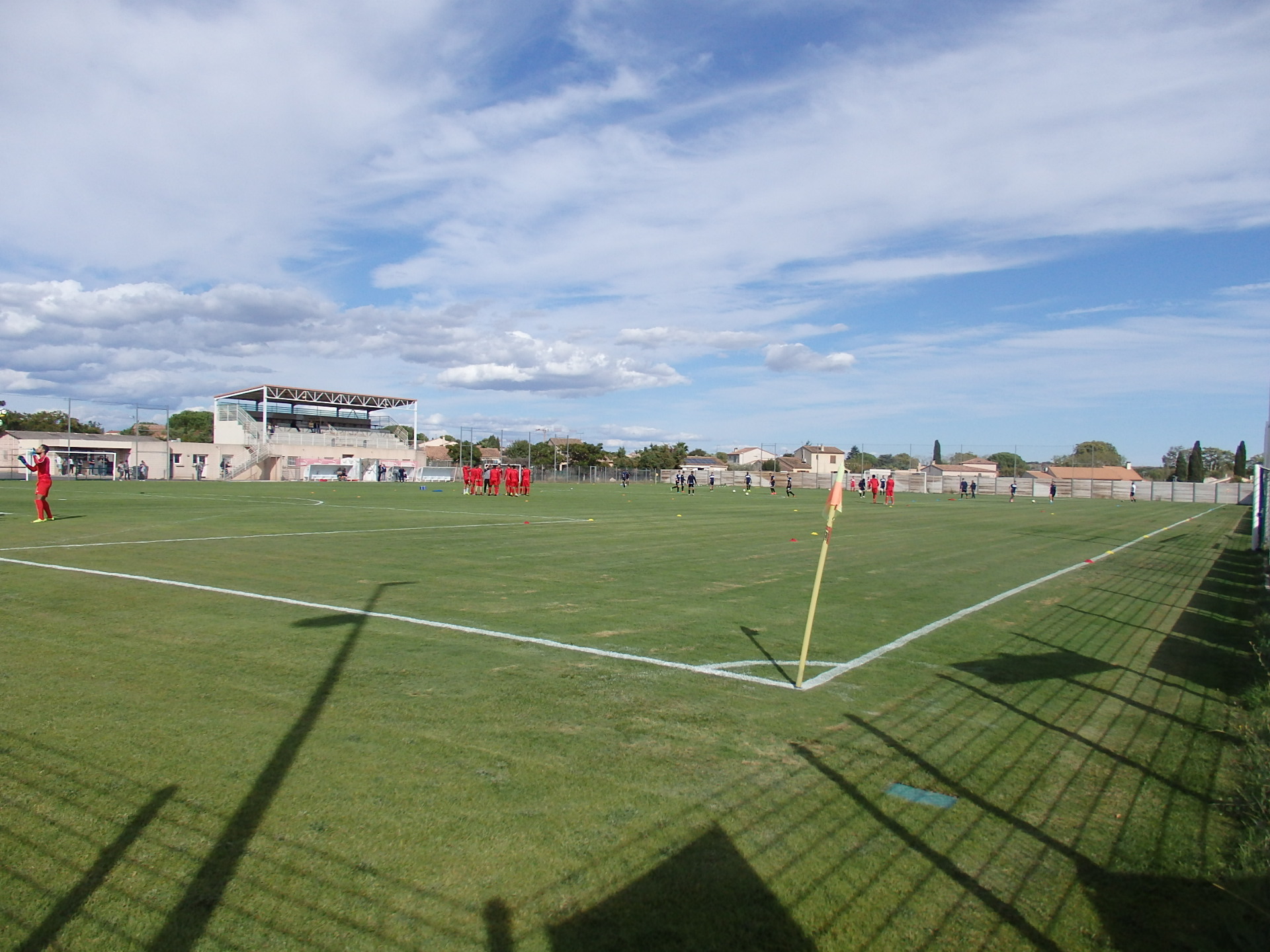
The Stade Joseph Jeanton is a part of a sports complex dating from 1993 that sits on the other side of the River Coulazu from the medieval town of Fabregues and it is here that my wife and I arrive today with a half an hour to spare before the kick-off of the match between Fabregues and Canet Roussillon in National Ligue 3, the fifth tier of French football, which is amateur, although the professional teams play reserve or ‘B’ teams in it. We park up in the neatly laid out car park which is landscaped with trees and shrubs and then walk through a metal gate to a wooden hut where we pay the 5 euros each admission fee. The Stade Joseph Jeanton is much like most other small town football grounds in France; a pitch surrounded by a high metal fence and a single stand affording a decent view of the pitch.

OLYMPUS DIGITAL CAMERA
The teams and referees are warming up as we walk behind one goal and round towards

the stand and buvette. I am impressed that one of the goalkeeping coaches is a woman and can’t imagine that many if any men’s teams in England have a female coach. The FA and English football in general really needs to get with the programme. We stop to ask three men in their sixties or seventies which team is which. One of them speaks a little English which he is keen to practice and he seems impressed that we have come to see Fabregues, which he describes as a good little club. At the buvette I buy a bottle of water (1 euro) and pick up a copy of the club’s directory. It is mostly adverts for local businesses, but contains details of every team in the club from the under 6 and 7’s up to the seniors. There is a statement from the president setting out the aims of the club and the overall impression is of the club being an important and well-run focus for the local community.
It is a warm afternoon and a strong breeze stretches white clouds out across the blue sky. We climb up into the stand and look out over the pitch towards the pink roof tops of 36538176213_715c21d13e_ocirculade and the old town. This is a pleasant spot to spend the afternoon it seems. Below us the referee (Monsieur Gauthier Lapalu) and his assistants (Monsieurs Jeremy Noiret and Maximilien Demoustier) are warming up, the referee looks very young, very neat and very enthusiastic, too enthusiastic and a little officious perhaps. He seems to want to organise his assistants overly and they don’t look that impressed.
Kick-off is scheduled for 3 pm but the teams aren’t on the pitch yet, although we can see them waiting at the mouth of the players’ tunnel, everyone seems to be waiting for the referee. Eventually, after the usual introductions, Canet Rousillon, from the town of Canet some 35 to 40 kilometres to the west, kick off in their white shirts with black shorts and socks; Fabregues wear all red. The first foul is committed after about five minutes and Monsieur Lapalu quickly airs his yellow card and then takes time to explain his decision to the Fabregues bench who are perhaps miffed, and understandably so because it wasn’t much of a foul. Five minutes later a Canet player is booked, but justifiably this time. It takes another fifteen minutes for Monsieur to get his hat-trick of cards.
This is a poor game. It may be because the afternoon is still warm, but the players aren’t running about much. One or two like to run with the ball, particularly the Fabregues number eleven, who is quite good at it, but there is not much running off the ball so there is seldom anyone to pass to near the opposition penalty area and therefore there are no shots on goal to speak of, except for optimistic long range ones. In addition, the players of both teams like to fall over and scream as if fatally wounded and Monsieur Lapalu is proving to be quite fussy and precise; he runs like Forrest Gump and his shorts fit too snugly, like his mum has cut down a pair of trousers from a dark suit.
Fabregues make a first-half substitution and the substitute adjusts his hair carefully before coming on, appearing to arrange his top-notch like the leaves on top of a carrot. But the substitute claims the distinction of being the first player to have a shot worthy of the name, in first half injury time.
With half-time we leave the stand to get out of the sun and the breeze, and to get away from the body spray of the young man next to me, which smells like pine disinfectant. This stadium has advertisement hoardings and they remind me of those at Eastern Counties League grounds. There is one for a Pompe Funèbre (undertaker) and one for Auto Ecole Thierry (Terry’s Driving School) as well as one for Pub Resto O’Papa Chico, which sounds like an Irish, Mexican pub. The local butcher, Bouchère des Beaux-Arts sounds a step up from an English pub meat raffle, but in a country that takes food seriously, such a name is probably not pretentious.
For the second half of the match we stand, peering through the fence from the opposite side of the ground to the main stand, where we are shielded from the wind by a hedge.

The second half starts well as the first discernible passing move of the game in an opponent’s half results in the Fabregues goalkeeper diving at the feet of the Canet number seven, to make a decent save. Just a minute later Canet’s number eight collapses to the turf inside the Fabregues penalty area and a penalty kick is awarded by Monsieur Lapalu. It seems a trifle harsh, but Monsieur Lapalu takes so long ensuring that no ones’ toes are in the penalty area that the number eight has far too long to think about his kick and when he eventually takes it, it provides a relatively easy save for the Fabregues ‘keeper, who dives to his right and smothers the ball completely to keep the scores level.
The game now enters a ridiculous stage where players fall like nine pins every few seconds; any physical contact apparently leads to mortal injury. The best moment is when three players come together and all three end up lying on the ground pleading for attention. If the Keystone Cops had played football it would have looked like this. It is at once both amusing and pathetic. The game is stopped and miraculously all three players recover to carry on. A banger goes off in the bushes close to where we are stood; everyone ignores it although some teenage girls trying their best to look innocent look like they might know who was responsible.
With an hour gone Canet somewhat surprisingly take the lead. The ball lands at the feet of their number ten; he shoots and the ball is saved, but the rebound bounces off him and into the net, although he may have adjusted his feet quickly enough to ensure the direction of the rebound was goal-wards rather than anywhere else. A good number of Canet supporters in the main stand celebrate. A second banger goes off in the bushes close to where we are stood and there is a delay as Monsieur Lapalu checks with his assistant that all is okay; he indicates that his ears are ringing a bit but otherwise he is fine. Monsieur Lapalu then checks with the Délègue Principal monsieur Jean Pierre Jullian, but carries on with the re-start. Fabregues are stung into action and are unlucky to have a goal disallowed five minutes later for offside when the ball was possibly heading into the net without the extra touch from the offside player. I detect the scent of cannabis on the breeze, but can understand why people watching this game may seek solace in illicit drugs.
There is about a quarter of an hour left and Canet’s number nine lofts the ball onto the roof of the goal net as his team hit Fabregues on the break. Two minutes later Fabregues’ number five stretches out a leg to win the ball, he does so, but he then catches his opponent too and Monsieur Lapalu deems this a foul and cautions number five for a second time this afternoon resulting in his sending off. To his credit number five does not complain, although having won the ball he probably had cause to. Monsieur Lapalu goes on to also caution Fabregues’ number three as he organises the human wall to defend the resulting free-kick.
Fabregues continue to search in vain for an equaliser and they seem more capable and energetic now that the sun is lower in the sky, casting a long shadow over the pitch from the adjacent sports hall. But with four minutes of normal time remaining Canet hit them on the break again as their number 10 feeds the ball beyond the Fabregues full-back for the moustachioed number two to run on to. The Clark Gable look-alike rounds the goalkeeper and scores. Canet celebrate wildly whilst Fabregues cannot believe they have conceded a goal to a bloke with a moustache.
The result is assured now and Canet almost claim an undeserved third goal as number nine strikes the ball against the cross bar. Monsieur Lapalu even seems to have lost interest a little and has seemingly relaxed his grip on the proceedings. Only two minutes added time are played, which is a relief for everyone. Canet and their supporters celebrate noisily again as the final whistle blows.
This has been a poor game, perhaps the worst I have ever seen in France. It is a shame because the Fabregues club appears to be such a well-run, ideal community based club; but I guess all teams have off days. I hope this was one of those days for both teams, because even though Canet won, they were terrible too. Monsieur Lapalu should also learn from this game too and we will look out for this name in Ligue 1 in may be ten years’ time.

This slideshow requires JavaScript.


LOSC Lille 1 Montpellier HSC 1

After a wet, drizzly afternoon enjoying an exhibition of marionettes at the Hospice Comtesse,

This slideshow requires JavaScript.

a rather groovy establishment called ‘The Beerstro’ and then the birthplace of Charles de Gaulle, the Grand Finale is an eight o’clock kick-off at the Stade Pierre Mauroy where LOSC Lille meet Montpellier Hérault in the 29th Journee of Ligue 1. Montpellier sit in 6th position in the twenty-team French league, whilst Lille flounder uncharacteristically just one place off the bottom, battling against relegation. I am with my wife Paulene and after a relaxed, light meal we head for the Gambetta Metro station. It’s a little after six o’clock and as the streets begin to dry with warm air up moving up from the south, so the Lillois are venturing out to drink, to dine and to watch football. At Gambetta station the escalator is out of action and at the foot of the stairs a ticket man greets us; somehow he instantly detects that we are English and calls out over his shoulder “Alain! Ils sont Anglais”. A smiling, balding man in glasses walks over to us “Awright?” he says and we shake hands. He continues to talk to us in English with a strange hint of an estuarine accent; he must have learnt English in Dartford or Thurrock. He explains the system of rechargeable tickets and although the ticket itself costs 0.20E he lets us have one for free and on to this one ticket we add four journeys for the trip to the stadium and back (6.40E). Alain even validates our tickets for us before we thank him and bid “Au revoir” and descend down onto the platform. What a lovely bloke. The driverless trains on the Lille Metro are frequent and one soon draws up alongside the automatic doors at the edge of the platform. We step on and sit at the front of the carriage, a siren sounds, the doors close and we’re soon hurtling along through concrete tunnels beneath the city

OLYMPUS DIGITAL CAMERA

above. The stadium is the twelfth stop on our mostly subterranean journey, although it is possible to alight at any of the four stops from Villeneuve d’Ascq onwards and the stadium is still easily walkable. People board and leave the train along the route at Republique Beaux-Arts, Gare Lille-Flandres, Caulier, Fives and Marbrerie, some sport red and navy blue knitwear betraying their support for the local team. Before the end of the line at 4 Cantons

Stade Pierre Mauroy, the train rises out of the ground on to an elevated section and just like the last time I made this journey I am for a minute or two Guy Montag and my wife is Clarisse (Julie Christie) in Francois Truffaut’s film of Ray Bradbury’s book Fahrenheit 451. But it soon passes. From the Metro station it’s a ten minute walk to the stadium through a university campus and science park, past the student accommodation called residence Albert Camus; a much cooler name than Essex House, where I lived in my first year at university. It’s dusk and the stadium and its great neon name is visible through

OLYMPUS DIGITAL CAMERA

the black branches of the trees that line our route. The path then opens out onto a wide bridge across Lille’s peripherique motorway and Stade Pierre Mauroy is directly in front of us. To the left a broad concrete piazza is filled with French football fans, and the smell of chips and hot oil. The sun sets behind the stadium to the left, turning the clouds a blurry red and casting ruddy reflections in the puddles; adding some late colour to what has been a grey day.

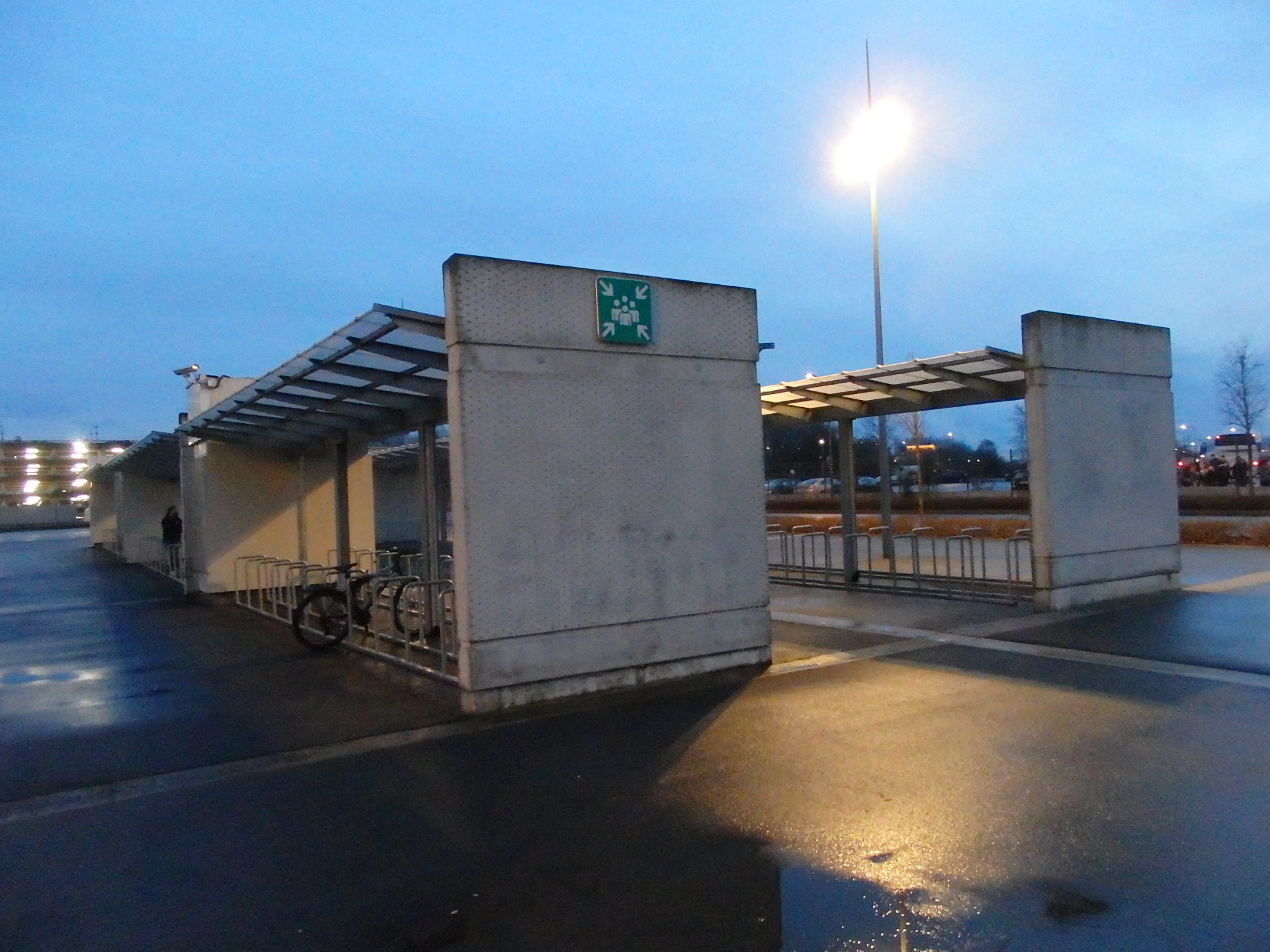
It’s northern France; Belgium with added je ne sais crois, but similar quantities of frites and beer. Low buildings face the stadium across the piazza, a parade of fast food outlets and bars. Further on the crowds diminish and we pass a large area set aside for cycle parking. Although the stadium is some way from central Lille, next to the motorway and has masses of covered car parking beneath and around it, the French planners were clearly optimistic for sustainable travel and there are two concrete canopied blocks of covered cycle racks in which I sadly count just two bikes and a bloke having a smoke.

OLYMPUS DIGITAL CAMERA

At gate M my wife chooses to go inside, get comfortable and watch the warm ups before the match, but I want to wander about a bit and so we part. I walk around to the ‘front’ of the stadium where it faces the road and the retail park opposite. There is a trailer here from which more chips are being dispensed, the queue of ‘diners’ snakes out of the descending darkness and into the bright light spilling out from above the deep fat fryers.

I walk on, following four members of the Police National, who bristle with shields and kevlar armour. A neon display advertises a future event at the stadium, a concert by the Pink Floyd pensioner, Roger Waters; its title ‘Us and Them’ will seem fateful by the end of the evening. At the ‘corner’ of the stadium is the club shop, red letters spelling out LOSC glow in the windows and fans walking past are silhouetted in its light. Inside the shop, the colour of the club shirt, red, is overwhelming; the colour red is everywhere it seems,

WW2 night-time bomber pilots could have spent time in here to improve their night vision. But to me there is more than a hint of the subcutaneous, of viscera; this is the sort of place to give a sensitive person like me nightmares. Feeling queasy I head back outside for the fresh air and then re-trace my steps back to gate M where after the customary patting down I pass through the automatic, bar-code operated turnstile, pick up my free programme and head for my seat. Re-united with Mrs Brooks I study the sixteen-page A5 size glossy programme, which contains just three advertisements not directly related to the club. The programme is small and necessarily concise and all the more excellent for that, with everything you need to know, which is really just the squads, the league table and details of the next match. If you crave extraneous information such as forward Anwar El Ghazi’s recipe for lentil soup then there is a fortnightly club paper available in the club shop, ‘LOSC in the City’, which is also free. As I read, a superannuated looking band perform live from the side of the pitch. I think they’re playing the Sex Pistol’s ‘Problems’ but Paulene tells me it’s Jumpin’ Jack Flash. I’m a bit disappointed to be honest and their rocked-up version of The Beatles’ ‘Come Together’ doesn’t please me either , but to my possible shame in these modern times, they’re next number, Hendrix’s Foxy Lady, makes me smile. My reading and musical reverie however, is disturbed by a large bang and some chanting from outside the ground; I had seen on the local TV station that there was to be demonstration by supporters before the game because of the poor performance of the team this season, and this must be it. I walk out to the back of the stand to witness through the mesh wall and some acrid smoke a couple of hundred fans following a bloke holding aloft a red flare; more firecrackers go off and there is some chanting. Excitement over, I return to my seat. Many of the other seats in the stadium are still unoccupied, particularly those on the Virage Est (East Stand) that the Lille Ultras occupy. It is soon evident however, that the ultras were the protestors as the Virage Est sees a torrent of flag waving humanity flood towards the back of the goal.

This slideshow requires JavaScript.

Meanwhile a female announcer gees up the crowd with some disco music and a dance-cam

OLYMPUS DIGITAL CAMERA

shows supporters boogeying insanely on the big screen above the Virage Est. People seem to be enjoying themselves at a football match which hasn’t even started yet. On the pitch everything is being set up for the grand entry of the teams. Ball boys in orange shirts are camped across the centre circle, the Ligue 1 logo is carried out and put into place along with the sponsor’s logo (Conforama – a furniture retailer) and the match ball is placed on a plinth.

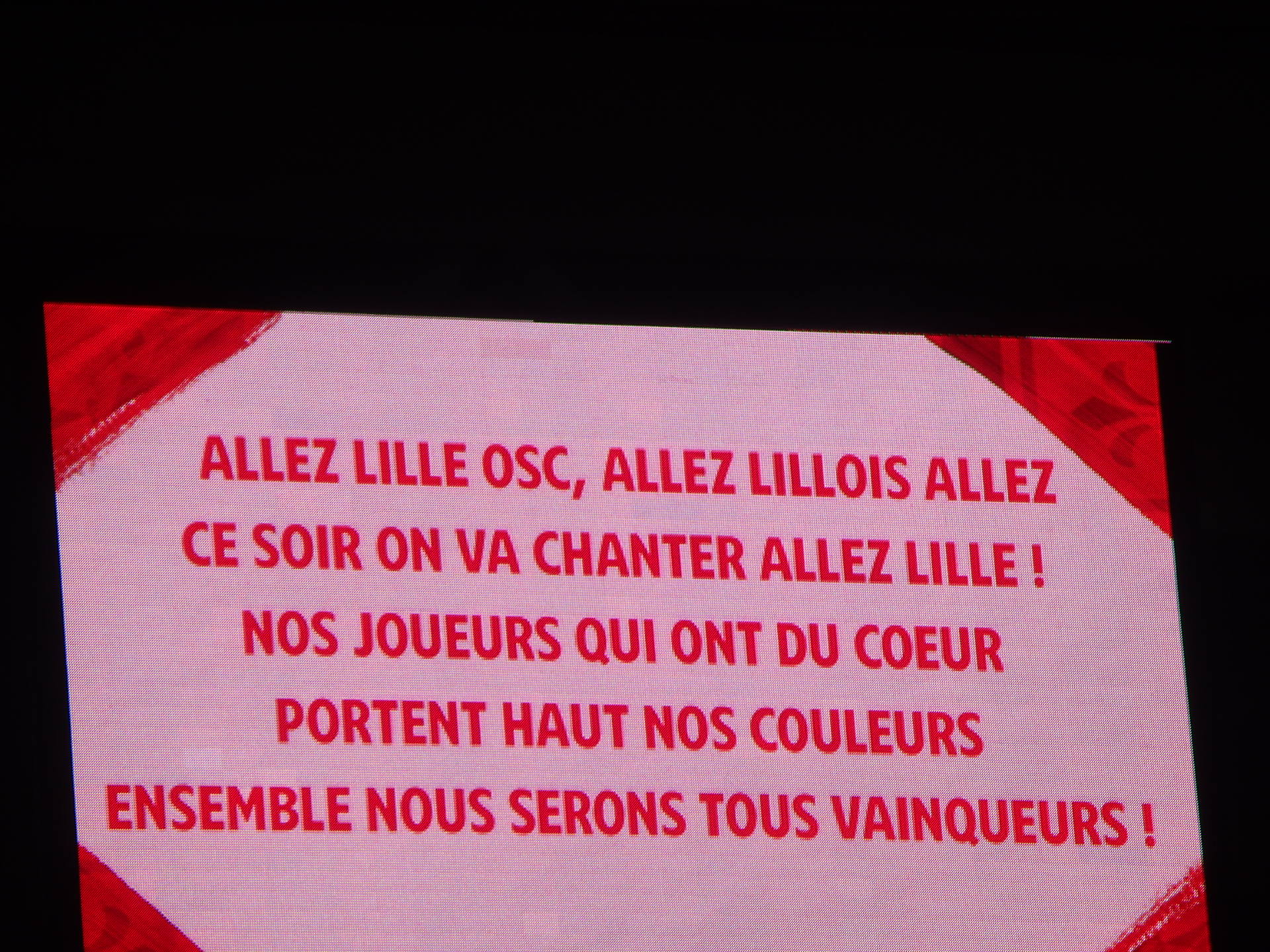
Banners featuring the club badges flank the ball and plinth and another banner displaying the Ligue 1 logo and then more banners are marched on to the field, these are red and bear the squad numbers and a photos of the players in tonight’s Lille team. As if all these banners aren’t enough a short film is played on the big screen which follows a journey around the city of Lille and shows images of LOSC players projected onto its most notable sites and buildings, culminating in all the players being projected on to the Stade Pierre Mauroy. It is a mightily impressive little film and conveys brilliantly the ideal of the club and the city and its people as one, I am not a little moved by all it all and wish for a day when I see something like it in Ipswich. We shouldn’t be leaving the EU, we should be saying can we forget about ‘being English’ and instead be French, or German, or Italian or even Belgian. The final act of the pre-match rituals is the singing of the club song, to the tune of Amazing Grace.

OLYMPUS DIGITAL CAMERA

The words appear on the giant screen and the singing hasn’t finished before referee Monsieur Sebastien Moreira, a stocky bald man, signals the start of the game. Montpellier in all white with pale orange shoulders have the first kick, in the direction of the Virage Est but it’s as if they are mesmerised by the club song, they pass the ball about and then as the song melts away immediately lose possession. That strange, musically accompanied start aside, it’s an exciting start to the game, with both teams dashing towards their opponent’s goal at every opportunity. Montpellier’s 19 year old Jonathan Ikone, a loanee from Paris St Germain, leads the charge and his team dominate the early possession, understandably believing that against the team second from bottom in the league, they are bound to score if they keep pressing. A Montpellier shot is soon saved by Mike Maignan, Lille’s goalkeeper. Montpellier are good to watch, they’re fast and direct even if most attacks break down before anyone has a shot. Lille burst forward when they can, particularly through Algerian Yassine Benzia who has the facial hair of a swarthy Mr Pickwick and his arms look unusually long; he is also the first player to be cautioned by referee Monsieur Moreira. Montpellier’s Ellyes Shkiri is injured and replaced by Saloman Sambia, but their forty year old Brazilian captain

OLYMPUS DIGITAL CAMERA

Vittorino Hilton

Vittorino Hilton, a veteran even six years ago when Montpellier won Ligue 1, plays on. Although the early excitement dies down a little as defences settle into their roles, the Ultras behind both goals never waver and give constant support, their beating drums being the beating heart and rhythm of the match. Each end sings their own songs, and then call to one another down the pitch. It sounds marvellous, even though the Ultras make up no more than five thousand in a crowd of 28,609 in a stadium that holds nearly twice that number . With less than five minutes until half-time, Yassine Benzia surges forward again for Lille, running at the centre of the Montpellier defence. Leaving two, then three Montpellierians in his wake Benzia pushes the ball forward into the path of Nicholas Pepe who is sprinting into the penalty area. Pepe takes a touch and then sweeps the ball past Benjamin Lecomte in the Montpellier goal. A fast, incisive if slightly unexpected goal. Pepe runs to the corner of the pitch and salutes no one in particular in the way that players like to do nowadays, but then he’s only a young lad of twenty-two. Half-time comes and two teams of boys, one in all white and one in all black, take to the field to participate in something called the Orange Football Challenge; it’s a shoot-out which at first is a non-event as none of the boys is capable of scoring , but eventually one team wins, I think. Both teams get their photo taken in the centre circle before another competition takes place in the far goal as three blokes try to hit the cross-bar with a single kick of the ball from 20 metres. The first contestant steps up and casually succeeds, winning 500 Euros in cash as a result. Predictably the next bloke doesn’t hit the cross-bar, although he’s not too far off, whilst the third slips over and shanks his shot along the grounds six metres wide of the goal. He may never be able to watch or participate in football ever again. As the players return to the field for the second half a camera man sets up in front of us to film people in the crowd who will then appear on the giant screen; as if being at the match isn’t enough you have to be able to see yourself and be seen at the match by other people at the match, although they have actually only come to watch the match; Jean Baudrillard might have something to say about it or may be Michel Foucault. Montpellier run at the Lille defence from the start, with chunky Jerome Roussillon attacking down the left and Paul Lasne down the right. It’s about twenty minutes past eight and Roussillon receives the ball some 20 metres or more from goal; he reacts instantly and dispatches a hard, low shot between the outstretched arm of Mike Maignan and the right hand post of the goal. Montpellier have a deserved equaliser, which their small knot of fans high up in the corner of the stadium

OLYMPUS DIGITAL CAMERA

also deserve for having made the 972 kilometre road trip; it’s no wonder there aren’t many of them, but equally a wonder there are as many as there are. No one boos, despite the dire loss of a winning position and behind the goals the Ultras maintain their support. On the touchline the Montpellier coach Michel Der Zakarian looks thoughtful, stroking his chin in his skinny legged tracky bottoms and shapeless black coat. The Lille coach Christophe Galtier moves between his seat in the stand and the technical area, he wears shiny shoes and a dark suit; he steps out of the technical area and onto the pitch at one point when play has stopped for an injured player and is admonished by the fourth official. Galtier waves his arms about in frustration and as he turns to go back to his seat gestures at the official as if to say ‘fuck you’. My wife likes Christophe Galtier; he’s very French.

OLYMPUS DIGITAL CAMERA

There are three minutes added on time in which both sides press forward seeking the winning goal, but neither finds it. Monsieur Moreira blows the final whistle and almost instantly supporters from the Virage Est begin to run onto the pitch and towards the players tunnel and the seats where the directors and officials are sat. More and more supporters pour onto the field; one or two approach Lille players with a look of complaint. The referee and his assistants are the first down the tunnel. A large crowd has gathered but a cordon of stewards has quickly formed creating a semi-circle around the mouth of the tunnel. Whilst most of the people on the pitch are facing the main stand and chanting something like “ If the club goes down , then you go down” at the club officials, there are a few who are taking selfies with the handful of Montpellier players stranded on the pitch as they went over to applaud their supporters. Scenes like this always look uglier than they are and whilst there are a few kicks and scuffles as stewards feel the need to man-handle some people, the cordon of stewards around the tunnel has controlled the situation. For a football tourist like me local difficulties like this just add to the entertainment, but I do wonder what the point is of these demonstrations. The supporters didn’t complain when the new regime at the club installed previously well-respected Argentinian coach Marcelo Bielsa and backed him with an overhaul of the squad. Bielsa had been a fabled legend at Marseille but his short tenure at Lille was a disaster and he was first suspended and then sacked as the newly assembled team failed to perform with Lille slumping into the relegation places from early in the season. Watching people stood on the pitch not playing football is only entertaining for a short while and not wanting boredom to spoil what had been an entertaining evening we decide to head back to the Metro of Montag, Julie Christie and Alain.

This slideshow requires JavaScript.