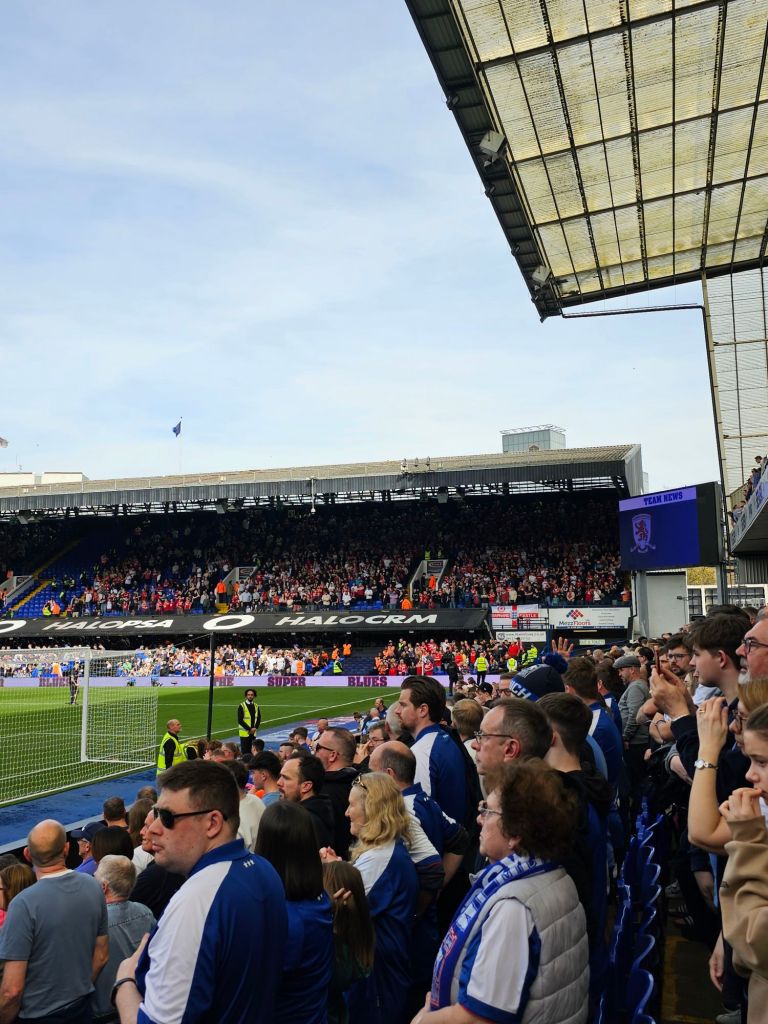
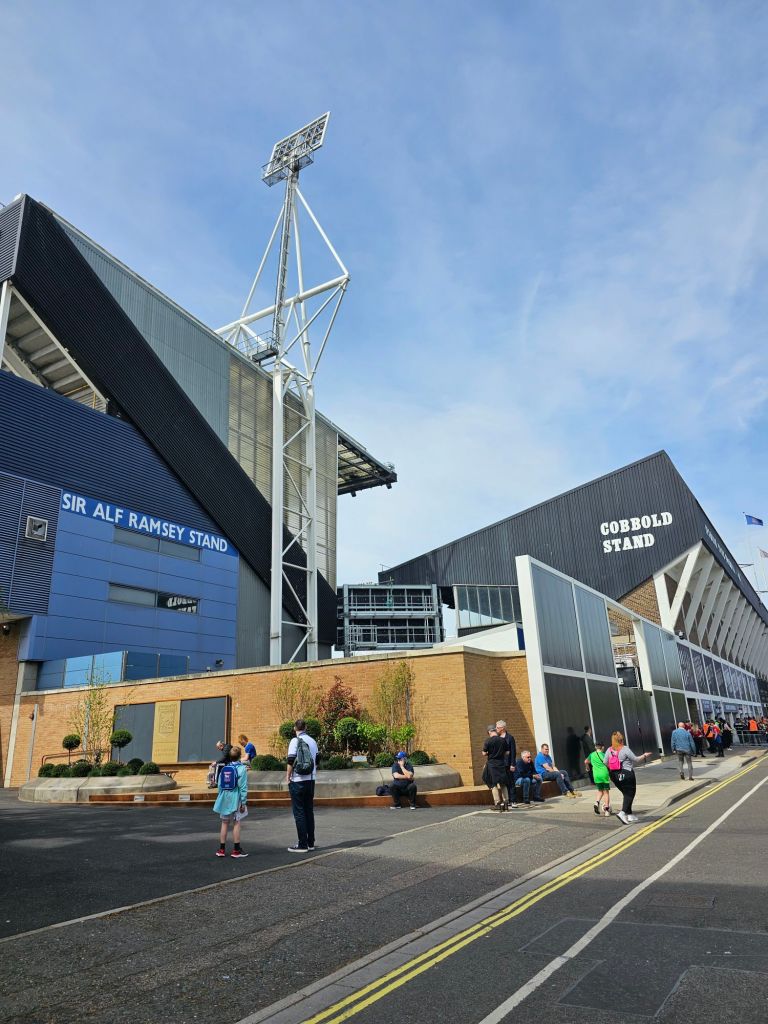
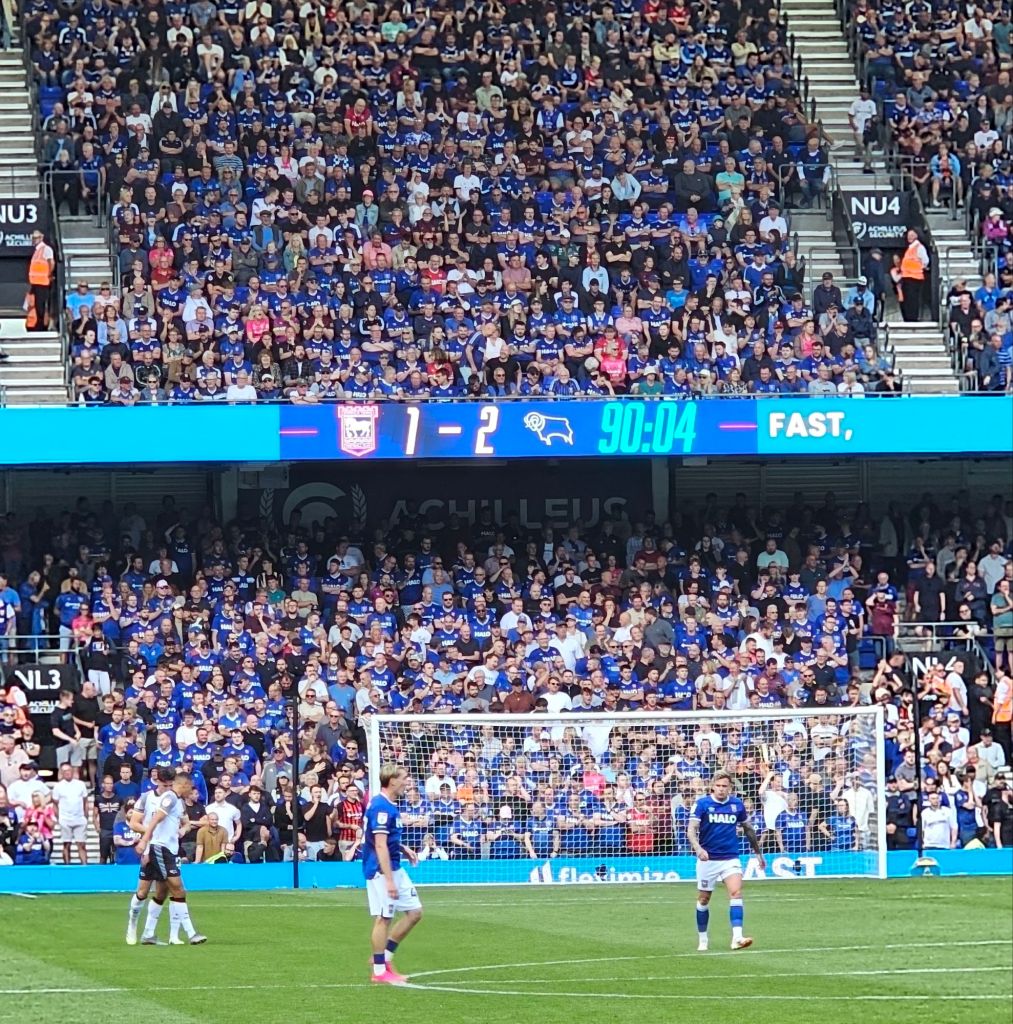
Ipswich Town 2 Derby County 2

It’s been a week in which summer, previously baked by the hot sun, has started to crumble away, buffeted by cool breezes, drenched by heavy showers and obscured by clouds.   As an Ipswich Town season ticket holder however, I am used to disappointment, and more than just believing it is, I know this is the natural order of things.  This morning, after a breakfast of sausage, egg, mushrooms and toast I put a coat of white gloss paint on the inside of my upstairs toilet door.  The paint was old and past its best, another coat or two will be needed and probably from a new tin.

Outside, the sun shone this morning, and it still does.  A wild array of billowing white clouds decorate the blue sky as I walk to my local railway station to catch the train to Ipswich, which is delayed by two minutes. Three blokes sat up straight on scooters, scoot past noisily.  At the station, a grey-haired man wears a T-shirt proclaiming, “Punk’s not Dead – The Exploited”, of course even in 1981 when that album was released, that wasn’t true, Punk inevitably committed suicide or took an overdose long before that.

 Gary joins me at the first station stop and we discuss his injured achilles tendon, which means that on arrival in Ipswich we will not be walking to ‘the Arb’ but will drink in the Fanzone.  There are of course also still polar bears in Wherstead, although I only spot one today, which like a lot of other things is a little disappointing.   Gary asks if I will be buying an “ice cream” today and I think I probably will not because it feels like a football programme that costs four quid has lost sight of what a football programme is meant to be; not that football programmes can really see of course.

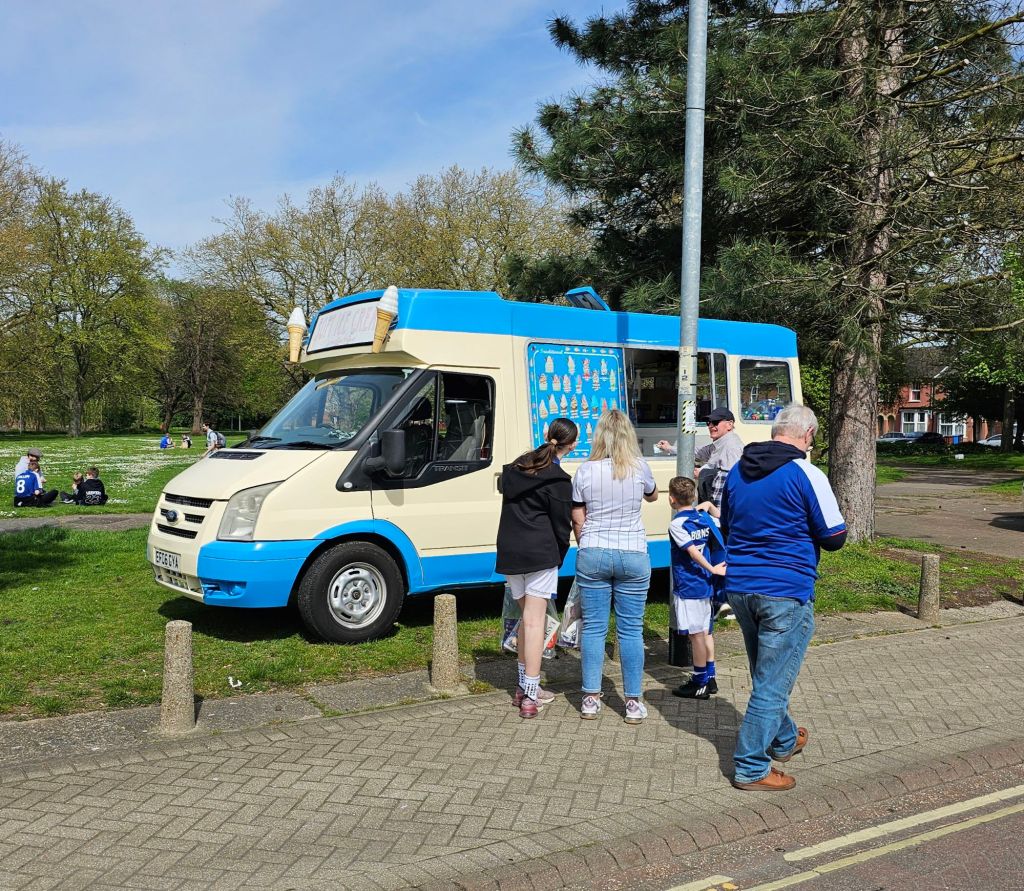
It feels like a long arduous walk down Princes Street and Portman Road and into Sir Alf Ramsey Way alongside a gently limping Gary, and our lack of speed worsens the confused pangs of longing I feel as I pass numerous programme sellers.  Eventually, we make it to the Fanzone with its  loud music, ice cream van, beer tent and huge tv screen, which today is telling us how lucky we are we aren’t from ‘Up North’ by showing Middlesbrough versus Sheffield United.  Many people seem strangely mesmerised by it, however.

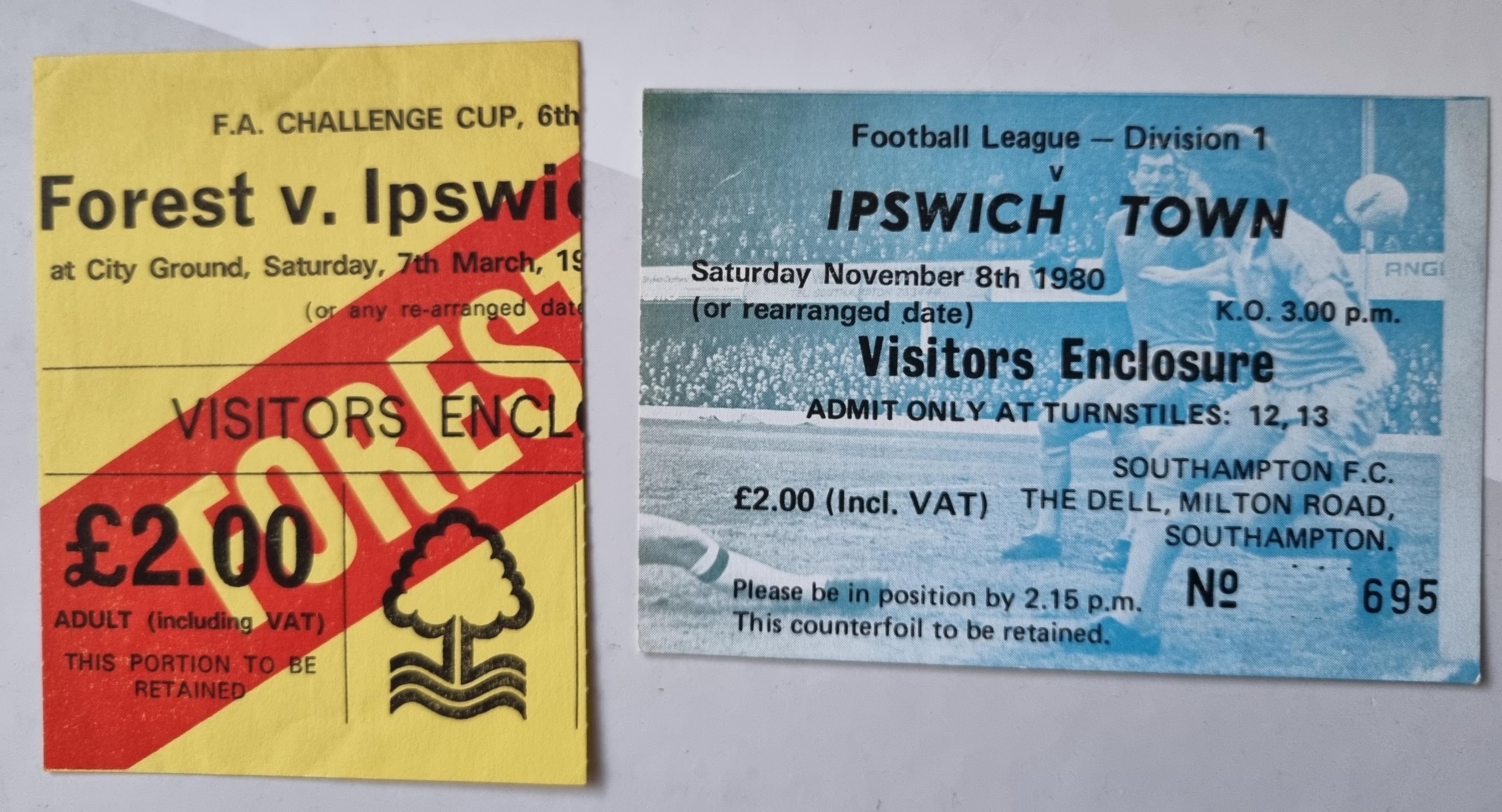
In the beer tent queues of uneven length line up for young women to dispense plastic cups of dull yellow liquid.  Gary says he’s on a diet, so should not really have a drink but he’s going to anyway.  We look up at the list of beers, the names of which mean nothing to me. Why doesn’t it just say Lager and Bitter?  Gary has something that sounds Spanish and out of sheer cruelty I get him to ask the young woman server if they’ve got a bitter.  She looks worriedly at a list and says there’s a lager and then describes something else as an IPA, although she also mentions fruit.  Foolishly, half remembering IPAs as amber coloured beers I opt for the IPA and receive a cloudy looking tub of yellow liquid that tastes only of grapefruit; that was the fruit, I guess.  The ‘beers’ cost a staggering £6.50 each and miraculously I suddenly realise that in December 1976 the programme for the Ipswich v Liverpool match, which coincidentally advertised the Sex Pistols ‘Anarchy in the UK’ tour, cost 15 pence, whilst at that time a pint of beer cost about 23 pence.   So, in a world where the retail price index is based solely on beer and football programmes, in nearly forty-nine years the price of programmes relative to the price of beer has actually fallen a little. Nevertheless, given the choice, and I have been, I will give up football programmes before I give up beer.

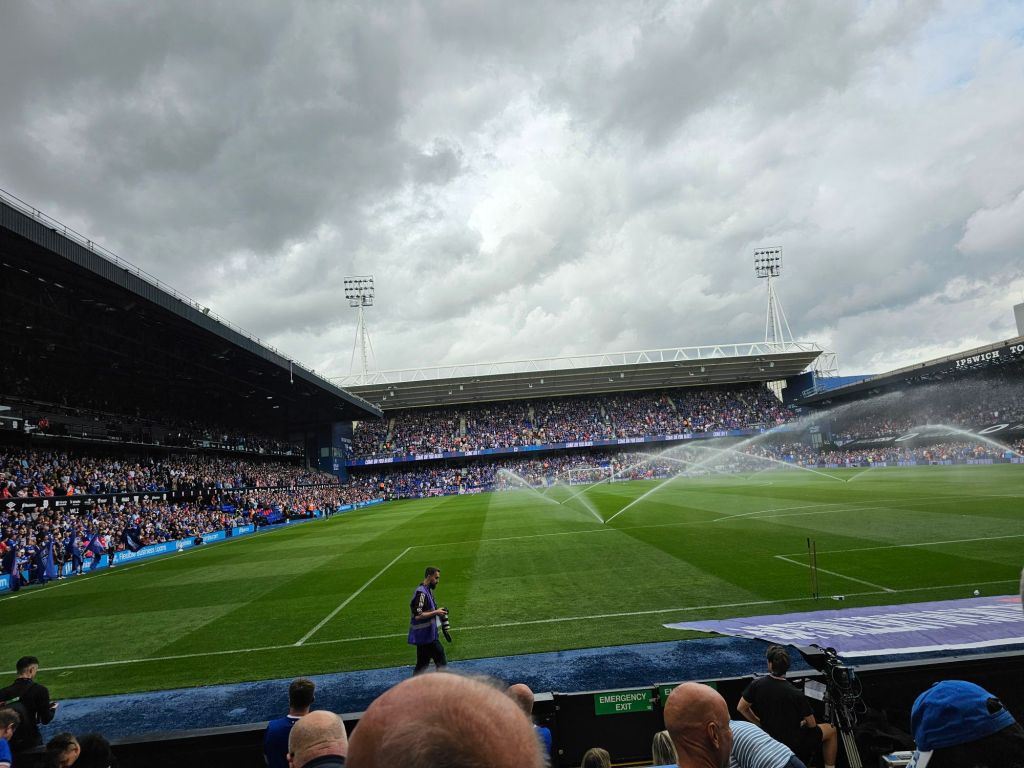
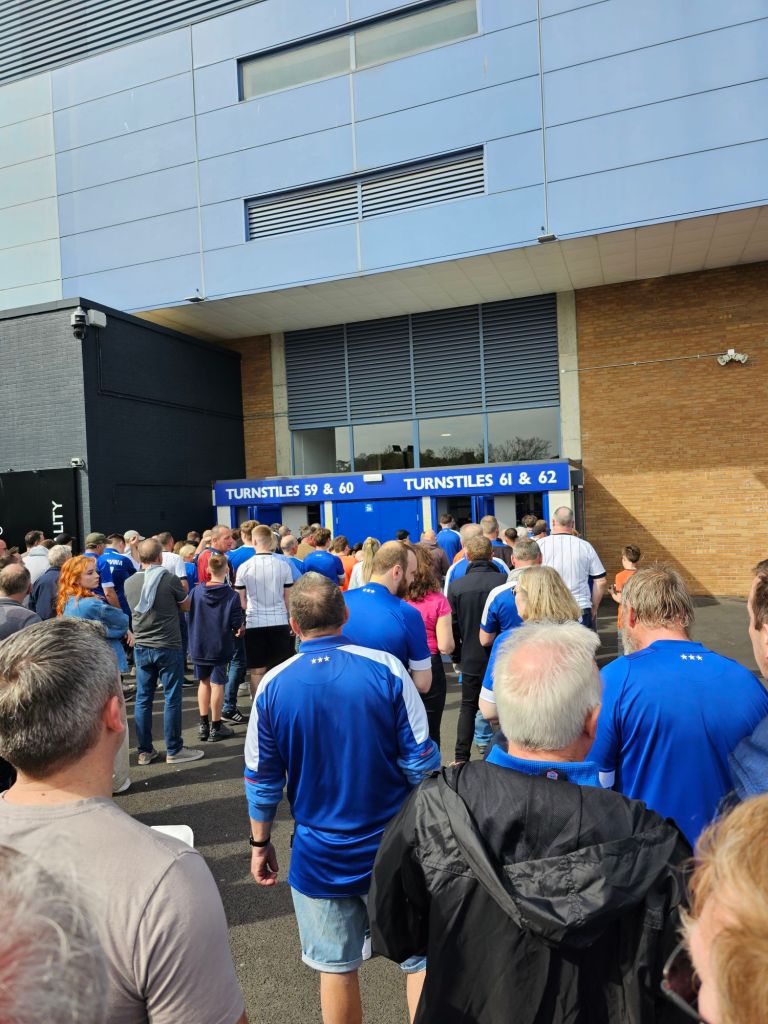
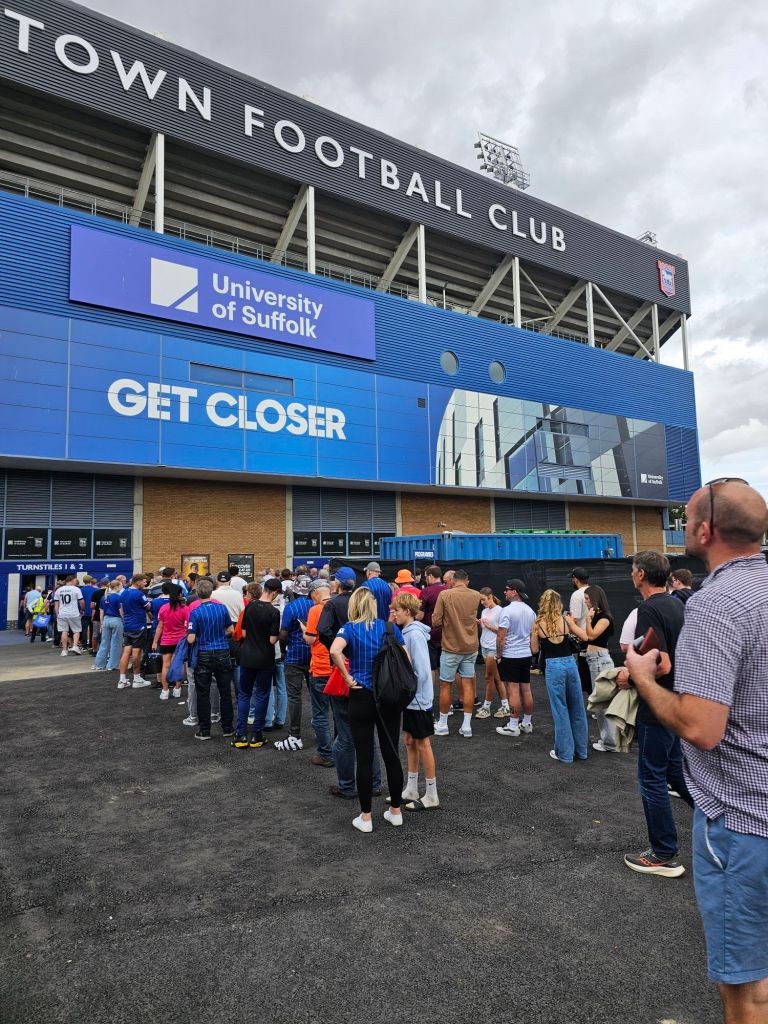
At about a quarter to three a man in a day-glo coat effectively tells us to leave and go to our seats. He seems a little curt, even rude, but I let it pass considering that a lot of people have strange jobs nowadays, and Gary and I soon bid our farewells.  The blue skies punctuated with white cloud have given way to grey cloud and there is a queue to the Sir Alf Ramsey stand, but it moves as if well lubricated and I am soon passing through the hallowed turnstile 62, named in honour of Sir Alf Ramsey’s team’s achievements back in 1962.  I arrive at my seat moments before Fiona arrives at hers and not long after Pat from Clacton reached hers.  The man from Stowmarket (Paul),  ever-present Phil who never misses a game, and his son Elwood are already here too and I’m in good time to join in, in the manner of a Frenchman at the Stade Marie Marvinght or Stade Marcel Picot when the excitable young stadium announcer, who today has seemingly mislaid his jacket but wears a shiny brown waistcoat, reads out the team.
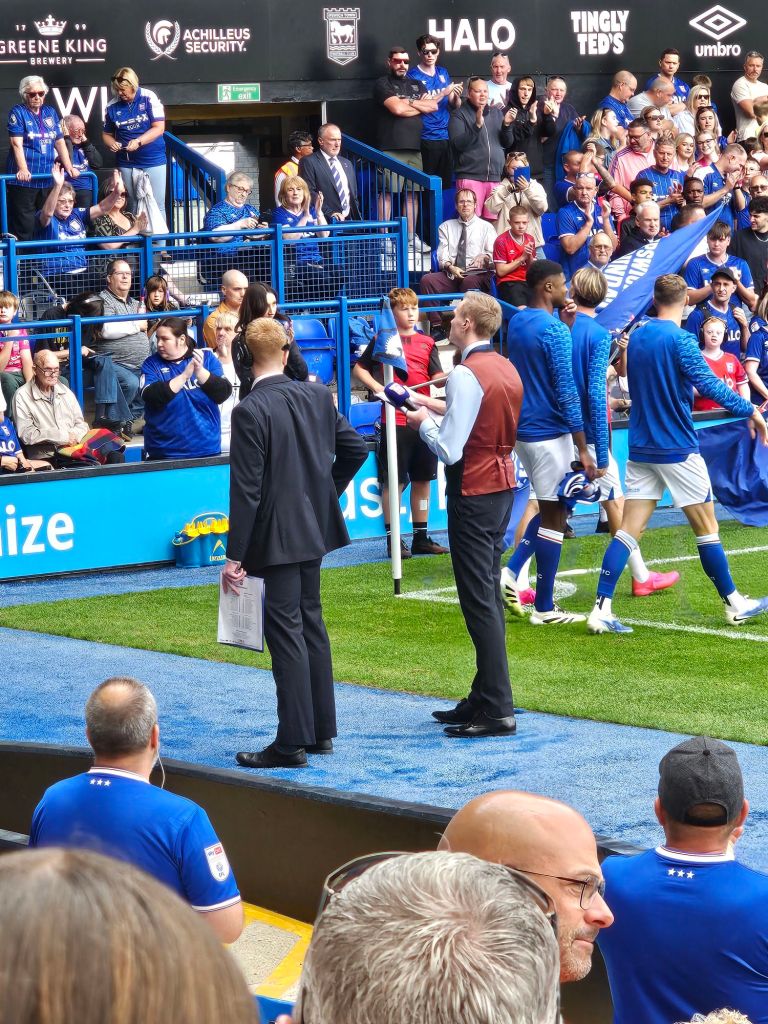
“Be loud, be proud” announces the excitable young stadium announcer as a final gesture, before the strains of The Beatles “Hey Jude” begin. With Jude’s na-na-nas fading away arm in arm with August, the game begins and it’s Derby who get first go with the ball, booting it where possible in the direction of the old telephone exchange, Coes and the Halal butcher on Norwich Road. Derby sport a modern, plastic looking version of their traditional kit of white shorts and black shorts, which sadly fails to conjure spectral visions of Kevin Hector, Archie Gemmill or Colin Todd.  Town are similarly in a modern incarnation of blue and white that doesn’t really suggest David Johnson, Jimmy Robertson or Trevor Whymark were once here either.

A man arrives and sits in the seat in front of me but then continuously turns around, his arm hanging over the back of his seat, to talk to the bloke beside me.  I try to watch the game. The bloke in front stays mostly turned round to talk to my neighbour.  The space in front of me has always been small and now it’s smaller, the seat is pressing against my knee, I’m trying to watch the match, I’m feeling a bit annoyed, a bit grumpy, that pint of IPA in the Fanzone was truly horrible, the bloke in front of me is still turning round. “Look, why don’t you just sit here, and I’ll sit there, this is getting on my nerves” I say, standing up and gesturing the bloke in front to climb over his seat whilst I do the same in the opposite direction.  The manoeuvre seems to cause a bit of consternation around me and I think the bloke now behind me is explaining what’s happened to the blokes behind him.  “I’m sure we can all read about it later” says ever-present Phil who never misses a game.

“We are Derby” sing the Derby fans.  “Create more space with a mezzanine floor” reads the illuminated advertisement between the two tiers of the Sir Bobby Robson stand.  “We hate Nottingham Forest” continue the Derby fans and it feels like the world is falling in on me. On the pitch,  Derby seem very enthusiastic, running and jumping and barging about like they’ve all over-dosed on pre-match Sunny Delight.  It’s not pretty to watch but it’s stopping Ipswich from playing much football. “Windows that Wow. Doors that delight” announces the Sir Bobby Robson stand as a Derby player takes a throw.  The Derby goalkeeper is wearing a dayglo orange kit that looks like it might also be worn by staff of the Derbyshire  County Council highways department.

Nineteen minutes have gone the way of the previous twenty-nine and a half days of August and the Derby fans chant “Football in a library, do-do-do”, illustrating how human evolution seems to be standing still.  A break by Kasey McAteer, and a cross leads to Leif Davis having Town’s first decent shot on goal but it bounces conveniently into the arms of the man from the highways department, and Town begin to get to grips with Derby’s WWF inspired style of play.   Twenty-seven minutes are up and Town earn a corner.  “Come on you Blues” chant a handful of us lamely.  Five minutes later a Conor Chaplin shot earns another corner.  More half-hearted chants but they’re all Town need and as the ball sails over the flailing fist of the bloke from the Council, Jacob Greaves applies a stooping header, the humblest of all headers, to put Town one-nil up.

With Town ahead, it’s only a matter of two minutes before the first Derby player is booked for dissent as the Sunny Delight hangover begins to kick-in.  “Come on Town, this is good” shouts the bloke behind me and Town win another corner from which Dara O’Shea hits a post with a header before the referee laughably books McAteer, seemingly for over-optimistically jumping alongside the man from the Council who is eight centimetres taller than him.  Two minutes of additional time follow, in which Town win a fourth corner but nothing more.

Half-time is a time to talk to Ray, reflect on his forthcoming birthday which features a zero at the end and discuss why Kasey McAteer was booked. Even as a former county highways department employee Ray does not know.  On my way back to my seat Pat from Clacton tells me not to swap my seat with the same bloke again because he’s been getting on her nerves too.

The game re-starts, and I eat a Slovakian Horalky wafer bar to help my body forget the memory of what I consumed in the Fanzone.  I’m not sure if my lack of concentration whilst eating is partly to blame, but there is also a sudden lack of concentration in the Town defence and some bloke in a white shirt has to be chased into the penalty area by Leif Davis, who is then adjudged to have handled the ball as he dives in to block a shot and Derby are awarded a penalty, which one of them scores.  Despite the equalising goal, which the balance of play suggests they should be slightly embarrassed about, Derby’s players are haranguing the referee seemingly wanting Davis sent off for the handball.  Quite why these players are not booked or even sent off for unsporting behaviour is a mystery, especially when George Hirst is then booked for alleged diving and weirdly we’re all wishing we still had VAR.

With the scores once again level, Derby clearly intend not to go behind again and have evidently decided the best way to do this is to ensure as little football as possible takes place in the remaining thirty-five minutes. At times the game now resembles a match involving the Keystones Cops and American Civil War soldiers as players comically fall about and then lay on the pitch like extras from the scene in Gone With the Wind after the battle of Atlanta.  “Shit referee, shit referee, shit referee” chant the home support imaginatively.  “We forgot you were here” reply the Derby fans also failing to roll back the frontiers of witty ripostes before doing it again by once more chanting “Football in a library, do-do-do”.

Time moves on and the inevitable rash of substitutions are made with twenty-two minutes left of normal time.  Two minutes later another lack of concentration in the Town defence sees both O’Shea and Greaves miss the ball to allow some brutish part-time actor from Derby to score and give his team the lead. Town win a corner, another substitution is made and we are told by the excitable young stadium announcer that we number 29,155 and 1,144 of us are supporting the bunch that are currently winning and have a road mender for a goalkeeper.

With time not unexpectedly continuing to ebb away into the abyss, Town struggle against  Derby’s “tactic” of not wanting any one to play football and the bloke behind me announces that “Nobody seems to want it”, although Chuba Akpom’s shot that goes narrowly over the bar doesn’t really back him up. Certainly, it seems many supporters don’t want to witness the final whistle, and the stands would only empty out more quickly if Nigel Farage had made a guest appearance.  Help eventually comes from an unexpected source as it is announced that there will be a minimum of thirteen minutes additional time, and I think I detect a sudden dash to the toilets amongst anxious Derby fans.  As the additional time, unfortunately, proves no better than the wasted time it replaces,  it seems like maybe my prevailing emotion on a Saturday evening will once  again be disappointment.

But then, as once more and then once more again Town sling the ball into the Derby penalty area, the referee awards a penalty.  I couldn’t see why from the far end of the ground, but in the absence of VAR I trust the referee who obviously knows what he’s doing, on this occasion.  Jack Clarke steps up to take the penalty as the blokes behind me agree that they would have Ashley Young take it and the bloke next to me holds his head in his hands and seems to weep as he says “Not, Jack Clarke, please not Jack Clarke.”  But happily, yes, Jack Clarke,  as he takes one of the best penalties by an Ipswich player that I think I’ve ever seen, striking the ball hard and into a corner and with a bit of a curl on it too for good measure.  There’s still time to win I say to myself, but it turns out there isn’t.

Inevitably, with sixteen minutes of additional time having been played, on hearing the final whistle people don’t hang about.  I too turn and head for the exit and my train home to reflect on what despite the last minute goal, still feels like a disappointing afternoon; that beer in the Fanzone was disgusting.

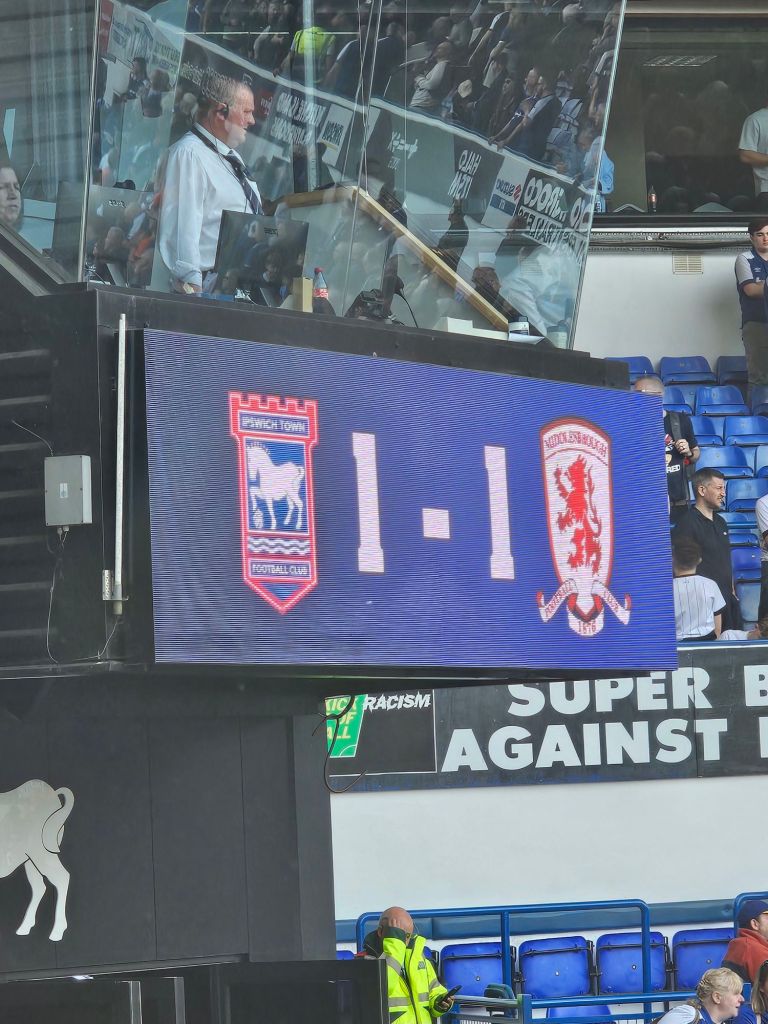
Ipswich Town 1 Middlesbrough 1

Today, for the first time in six years, Ipswich Town will play Middlesbrough at Portman Road. It’s bright, sunny and warm and the pale blue sky is wreathed in thin, high cloud.  As I walk to the railway station a woman in an open-top car motors past me, the Rolling Stones’ (Can’t get me no) Satisfaction playing on her car radio. Momentarily, I feel like I’m in a film from the swinging Sixties, but happily Julie Christie never had tattoos like the woman driving the car.  I realise I’m not in Billy Liar or Blow Up, I’m in Essex.  The train for Ipswich departs one minute later than advertised.  There were a goodly number of Ipswich Town fans on the station platform when I arrived there and even a couple of Middlesbrough ones, but now In the seat in front of me sits a pouty girl with pre-Raphaelite hair.  When I hear her speak, she’s American, from the east coast I reckon, so more Patti Smith than Lizzie Siddal.  In the seats behind me a father and his young son natter about which stations the trains to Norwich stop at.  As the train descends Wherstead Hill I see a Polar bear; I know Middlesbrough is way up North, but that’s ridiculous.

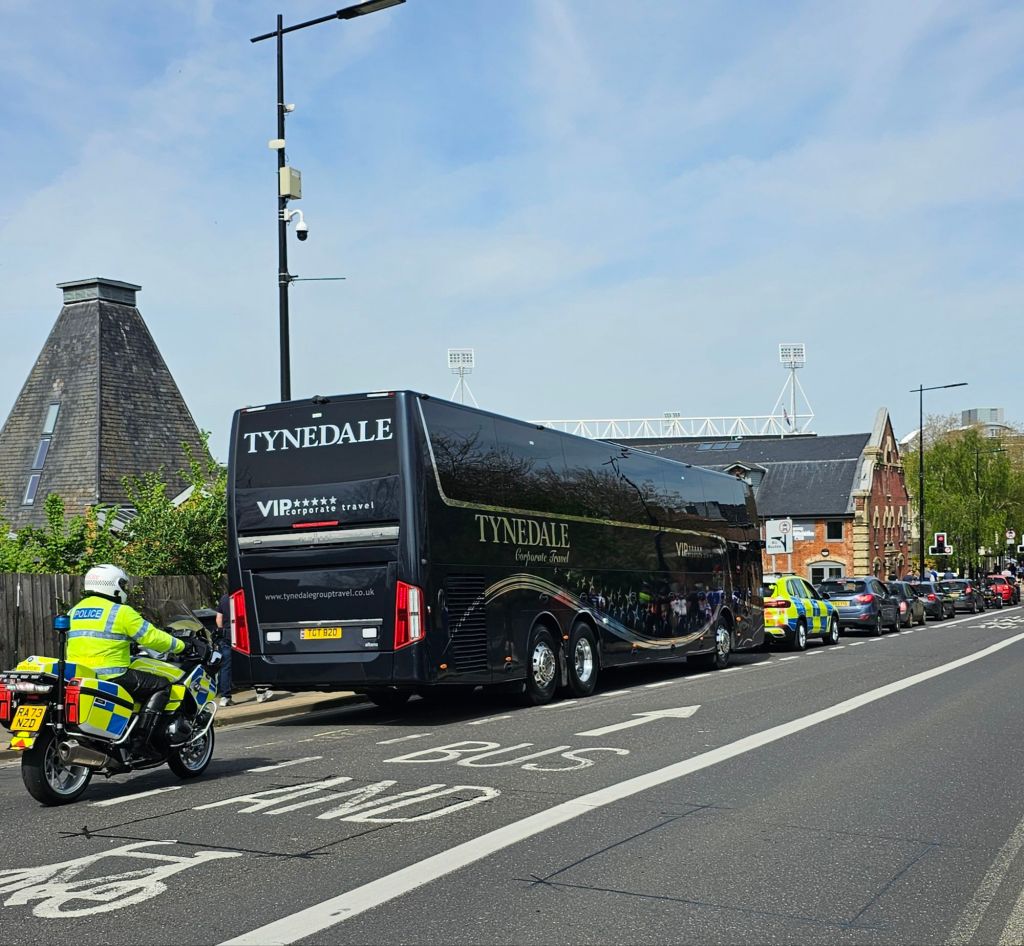
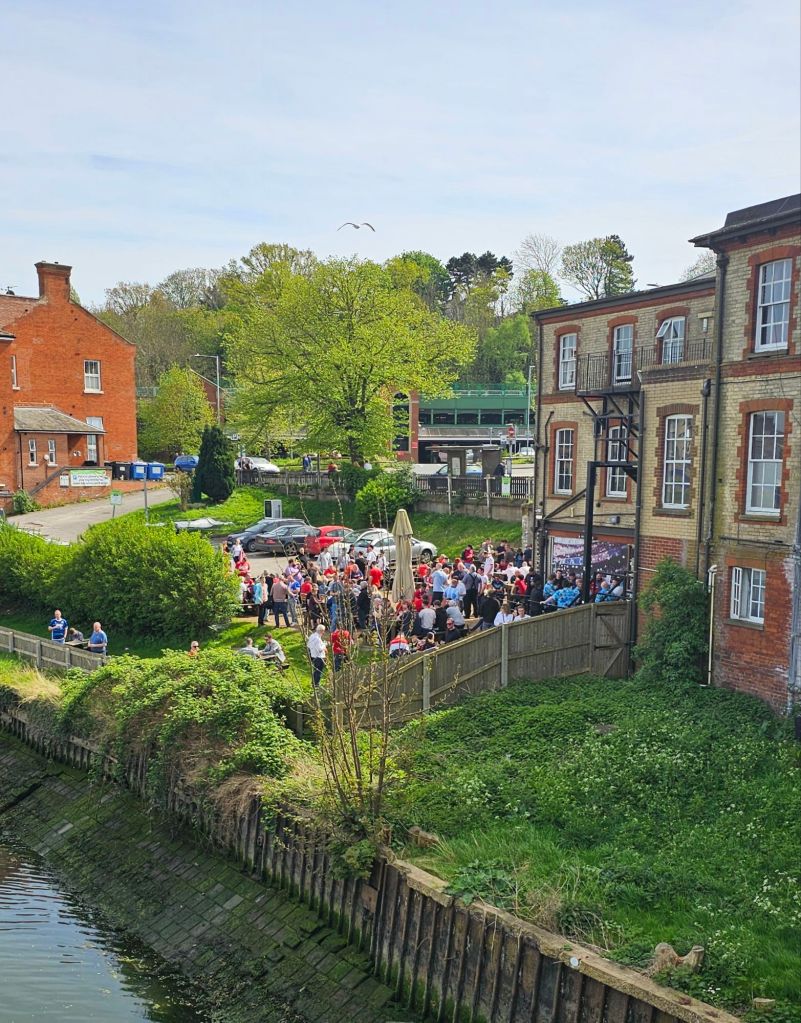
Ipswich looks good in the sunshine and in the garden of the Station Hotel our visitors from Middlebrough must be wondering what the big yellow, sparkly thing up in the sky is.  The Middlesbrough team pass over the river in a shiny, six-wheeled, grey metal box. In Portman Road I pause to buy a programme (£3.50) and an ice cream, but as ever fail to ask for the ice cream. Today, after last seeing Town play back in February, against West Bromwich Albion, Mick is returning from injury (a foot operation) , but he’s not fully fit and cannot manage the walk from ’the Arb’ so is being dropped off near Portman Road, and our  pre-match toast will take place in the Fanzone.  I arrive some time before Mick, and having stood in an impressively fast moving queue for a pint of massively over-priced Greene King East Coast IPA (£5.95!), I talk to ever-present Phil who never misses a game, who is hanging about in the beer tent.  A huge cheer goes up as Blackburn Rovers score against Leeds United.   Phil and I talk of pre-season, of  matches to go to next weekend, the sale of miniature versions of  the statues of Sir Alf, Sir Bobby and Sir Kevin in the club shop, clubs to visit if staying in Hunstanton (King’s Lynn Town, Heacham and  Swaffham Town), and how, should Ipswich get promoted, the victory parade ought to involve an open-top bus ride to the Port Authority building and then a boat trip down the River Orwell and back to the old Tolly Cobbold Brewery accompanied by a flotilla of small craft, packed to the gunnels with Town fans.  Thanks to Athletic Bilbao for the idea, although of course they sailed down the estuary of Bilbao when they recently won the Copa del Rey, not the estuary of the Orwell.

Mick arrives about 2:15 and we join the still fast-moving queue for more over-priced, pasteurised beer, although the club must be congratulated on how efficiently it is dispensed. Leeds United lose.  Beers in paper cups in hands we sit at a Yogi Bear style picnic table to catch up on the past two months. Time passes and people are leaving to get to their seats even as we sit down, and by and by we are the only people left sat here and it’s not even ten to three yet; we don’t usually leave ‘the Arb’ until gone twenty to three.  A woman steward seems very keen to see us leave, telling us she doesn’t want us to miss kick-off; I hate being made to hurry up over meals and drinks, it wouldn’t happen in France.  We should be allowed to miss kick-off if we want to, particularly with beer at £5.95 a pint.

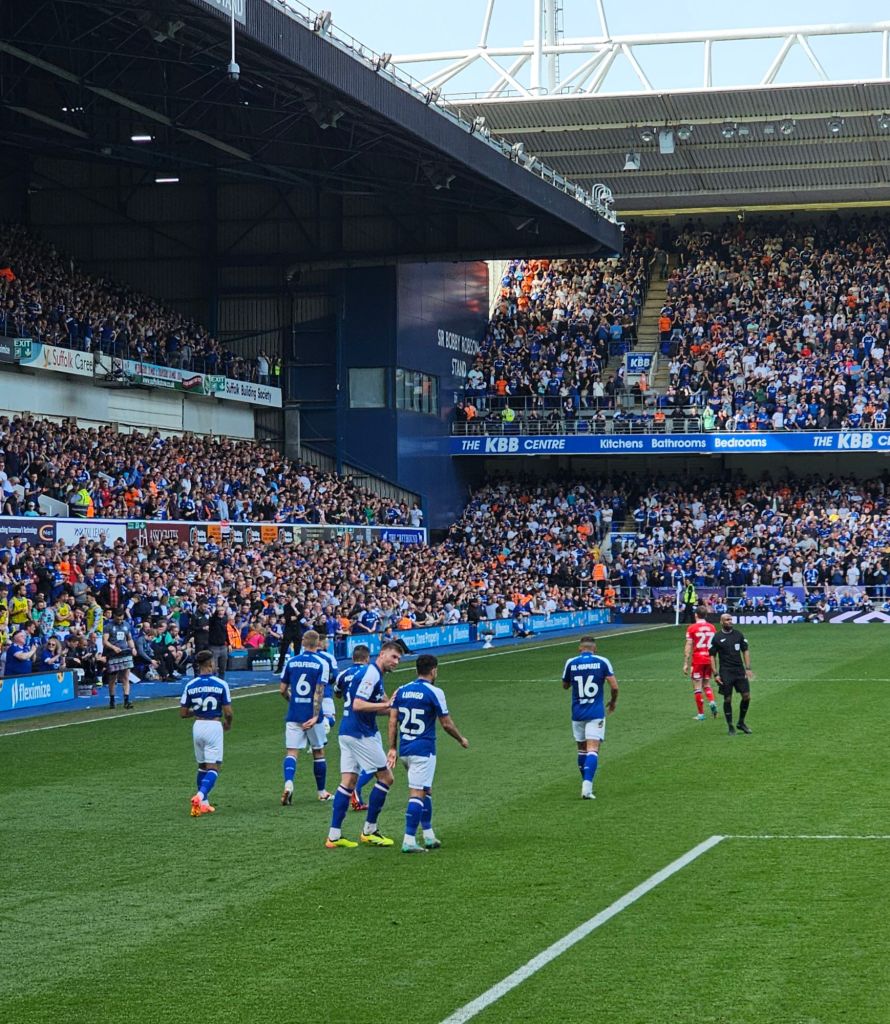
Having bade Mick farewell, I make for the Sir Alf Ramsey stand via Constantine Road, past the offices of Ipswich Buses, proudly owned like our football ground by the people of Ipswich, and along Russell Road to turnstile 62.  My appearance on the bottom tier of the stand coincides with that of the teams on the pitch and I exchange cheery hellos with Pat from Clacton, Fiona and the man from Stowmarket (Paul), who jokes that my just-completed team talk was clearly very serious this week.  Ever-present Phil who never misses a game is here too with his son Elwood, but I knew that I already.  Murphy announces the teams and at least Phil and I bawl out the Town players’ surnames as if this was the Stade Felix Boleart or Le Roazhon Park, before we all join in with a stirring rendition of ’Hey Jude’, which is only just fading away as Ipswich get first go with the ball, sending it towards me and my fellow ultras.  Town are of course in blue and white, whilst the ‘Boro are in their signature kit of all red, although the white bit across their chests, synonymous with the shirts worn by likes of Platt, Cuff, Craggs, Brine, Spraggon, Boam and Foggon in 1974, is sadly reduced to a couple of tram lines either side of the name of a betting company.

Portman Road is noisy. “Blue and White Army” gives way to “We’ve got super Keiran McKenna” and they’re even clapping rhythmically or rattling their jewellery in the West Stand.  Leeds lost, Leicester lost, this is the chance to worry about getting clear at the top of the table instead of just enjoying the game.  Six minutes on, Town win a corner and Conor Chaplin smacks the ball over the cross bar from inside the six-yard box as he darts to the near post.  “Come On Boro, Come On Boro” shout the Teessiders in the Cobbold stand, fearful of conceding an early goal, and possibly of the bright sunshine too.

Three minutes more and Jeremy Sarmiento shoots straight at Seny Dieng the ‘Boro goalkeeper.  Pat from Clacton tells us that a week today she’ll be flying to America, but in the excitement I forget to tell her to give Donald Trump a good kick if she sees him.  Back on the pitch I notice that Middlesbrough’s number twenty-seven is called Engel and I ponder on how, except in an episode of Monty Python’s Flying Circus, I can’t ever recall a player called Marx, or Engels come to that.  “Alley, alley, alley- O” sing the Sir Bobby Robson standers, a bit like the schoolchildren in the 1961 film adaptation of Shelagh Delaney’s a Taste of Honey, starring Rita Tushingham and Dora Bryan.

“Oh when the Town go marching in, Oh when the Town go marching in”  is  next in the sequence of football family favourites from the Sir Bobby Robson stand, and behind me the bloke sat there decries the apparent unwillingness of Omari Hutchinson to run at the full-back, “He’s got the ability to fuckin’ do’ im”.   Ali Al-Hamadi is barged over when in full flight and from somewhere off behind me and to my left a voice calls out “That’s a foul ref, you’re fuckin’ shit”.  The tension is palpable, but Town are on top and surely, it’s just a matter of time before we start scoring.

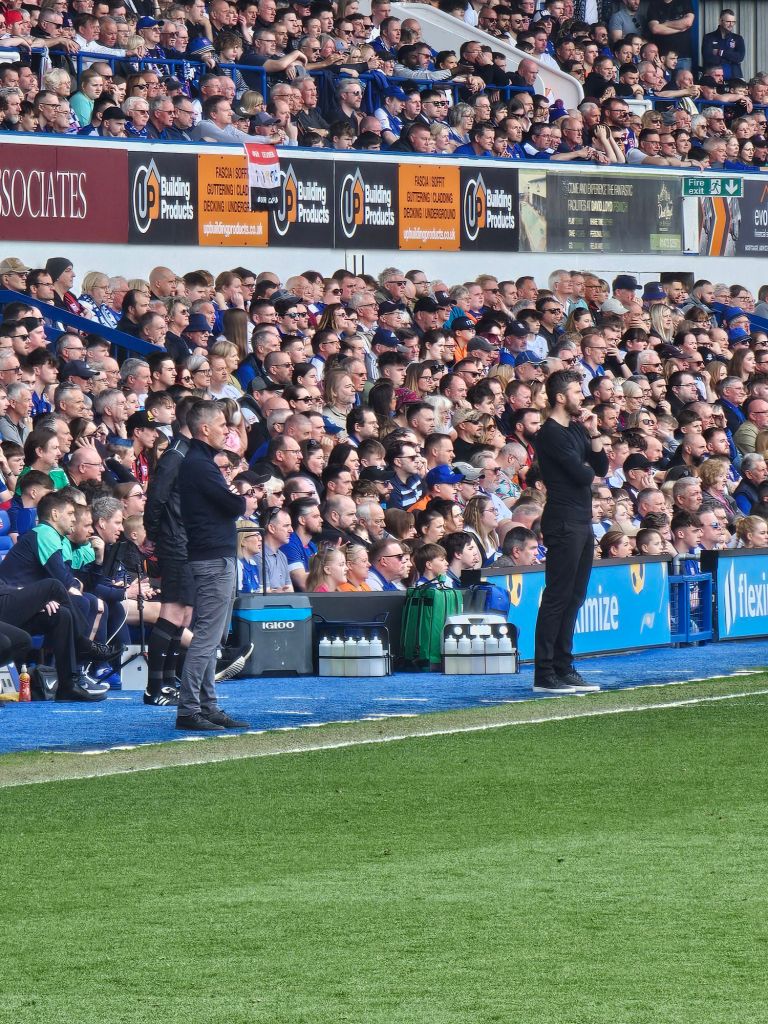
Twenty minutes have gone forever into history and Vaclav Hladky’s clearance doesn’t go as far as it might, the ball is played out to the right and crossed back in and a Middlesbrough head rises above all others to send the ball into the far side of the goal and Town are trailing one-nil.  We weren’t expecting that, but then again.  So, running away clear at the top of the table isn’t going to be as easy as first hoped, or as it seemed an hour ago as we celebrated Leeds losing at home to Blackburn.  On the touchline, the managers are trying hard to be inscrutable in black and grey shirts and slacks.

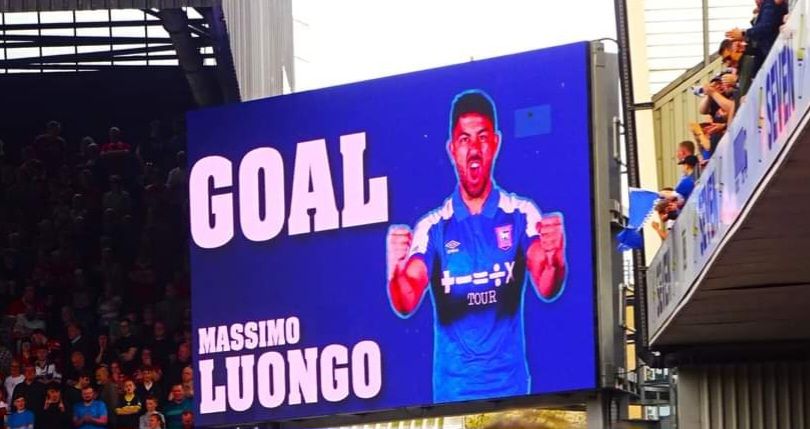
The goal is a fillip for Middlesbrough who share more of the game for a while, but then Leif Davis is free down the left and pulls the ball back, Omari Hutchinson shoots but the ball looks down on the cross bar as it sails above it.  Town win a corner as a low cross is blocked by what the linesman says was a shoulder,  but what looked to those around me like a whole outstretched arm.  But from the corner kick a kind of justice is done. At the far post Massimo Luongo appears from the knot of players of both teams to welly the  ball at the cross bar from close range; the ball hits the cross bar for a second time as it bounces back up from the goal line and then finally drops and gives itself up to the goal side of the line, and Town are no longer losing. How can Town not now go on to win?  Although It is possibly the first time I have ever seen one shot hit the cross bar twice.

Town’s second goal is soon on the way as Jeremy Sarmiento is put through to steer his shot beyond Dieng, only for it too hit the post and contrarily deflect away from the goal when bouncing the opposite way would have been a far more popular decision by the inanimate, plastic coated leather sphere. “Ipswich Town, Ipswich Town FC, they’re by far the greatest team the World has ever seen” we sing, telling the ball in no uncertain terms that its behaviour doesn’t bother us.

The last five minutes of the half arrive and Massimo Luongo places a shot into the arms of Dieng before Conor Chaplin floats a speculative forty-yard attempt wide and the Sir Bobby Robson standers get all festive with a rendition of “Hark now hear, the Ipswich sing, the Norwich ran away” Then, just to remind us that they’re still here Middlesbrough send  a couple of shots wide and earn a corner before  the half is extended by two minutes and referee Mr Allison turns down another Town penalty appeal as Conor Chaplin falls beneath an enthusiastic challenge.  I thought the Middlesbrough player got the ball, but Ray will soon tell me that he thought the player went through Chaplin to get to it.

With the half-time whistle, I talk to the man from Stowmarket as there is no one sat between us again, despite the match being sold out, and then go to talk with Ray and his grandson Harrison. Harrison and I bump fists and Ray and I talk of the National Health Service and that penalty controversy.  At seven minutes past four the football resumes and after just four minutes Massimo Luongo is the first player to see Mr Allison’s yellow card up close after he tugs on the shoulder of some bloke or other who’s playing for Middlesbrough.

The second half is still young as Omari Hutchinson goes on a magnificent run to within what looks like a few metres of the ‘Boro goal, only to win just a corner. Pat form Clacton gets out her “Altogether now” ITFC badge and I question whether it has anything to do with the Beatles’ song of the same name on the Yellow Submarine album.   I don’t think it does.  Back on the pitch, and Middlesbrough even up the bookings as number sixteen hauls down Jeremy Sarmiento, which was a bit of a waste of time because Jeremy is substituted for Nathan Broadhead two minutes later in the usual change, which today only also sees Keiffer Moore replace Ali Al-Hamidi. “Na-na, na-na, na-na, na-na, na, na, now, Keiffer, Keiffer Moore, Keiffer Moore, Keiffer Keiffer Moore” sing the Sir Bobby standers by way of celebration, to the tune of KC and the Sunshine Band’s 1973 hit single ‘Give It Up’.  The final twenty minutes are approaching, and Pat from Clacton is delving into her supply of lucky charms and pulls out a blue Dodo from Mauritius. The efficacy of the lucky Dodo has not yet been established, but today is its big chance to promote the worth of Dodos everywhere, if it isn’t too late.

Murphy the stadium announcer tells us that we are 28,771 today, with 1,324 from Teesside and then thanks us in the usual pre-programmed way “for our continued support”.  Really Murph, it was nothing, you’re welcome.  “Sing your hearts out for the lads” continue the Sir Bobby standers having heard that confirmation of just how many of us there could be singing, and then the ground goes quiet before the noise returns with some Oles. Twenty minutes of normal time remain, and possession of the ball is lost forcing Vaclav Hladky into making a save.  “Blue and White Army! Blue and White Army!”. I can feel the tension coming up at me through the concrete of the stand.

“Attack him!” shouts the bloke behind me, still frustrated that Omari Hutchinson isn’t running at the full-back as much as he’d like.  This feels like a play-off match, which can’t be good.  Fourteen minutes left and Hutchinson shoots over the cross bar again, but also earns a corner again, and then another.  Jack Taylor replaces Massimo Luongo who receives rich applause. Eleven minutes left and Nathan Broadhead shoots wide. Ten minutes left and Luke Woolfenden is caught out near the half-way line resulting eventually in a shot which Hladky saves superbly, diving low to his left to tip the ball away, and then a minute later he makes an even better save, hurling himself to his right to tip a powerful header over the cross bar.

On the cusp of full-time Conor Chaplin is replaced by Lewis Travis and Axel Tuanzebe by Dom Ball. There aren’t many people leaving the stadium like there would have been at one time; if this Town team has achieved one thing already this season it is that it has cured a lot of people of leaving before the end.  Today however, proves not to be one of those days when the winning goal is the punch line, and five minutes of added on time merely ends with Mr Allison’s final whistle a signal for a muted celebration of another point. We can only hope for, not expect satisfaction, although I don’t think the Rolling Stones mentioned that in thier song.

Ipswich Town 1 Nostalgia 1

On a damp May evening three years ago, I recall thinking to myself that it feels like 1978 and Ipswich Town have won the FA Cup all over again.  With my Portsmouth supporting wife Paulene, I had gone to see the Wolsey Theatre’s production of ‘Our Blue Heaven’, the music-backed play that celebrated the fortieth anniversary of Town’s FA Cup win. I can honestly say it was the most enjoyable Ipswich Town related evening I had had in nearly twenty years, since that season in the sun at the start of the third millennium when Town did things like beating Liverpool and Manchester City at their own grounds, having finally managed the previous May, to win a play-off semi-final and victoriously tread the turf at the old Wembley stadium for the last time. 

Fast forward to October 9th 2021, and in the spirit of celebration of Town’s winning the UEFA Cup forty years and five months before, which the club itself has seen fit to mark with the sale of a wallet, luxury boxed badge, and travel mug, the New Wolsey Theatre is staging the final performance of its production ‘Never Lost at Home’, the story of the 1980-81 season, but mainly the winning of the UEFA Cup, something no ordinarily lovable, small town football club will probably ever do again.  Not keen on spending an evening in an enclosed space with about 400 other people, most of whom will probably not be wearing a face mask, I have opted to cough up the £20 to watch the two- and a-bit hour performance on-line from the safety of my living room.

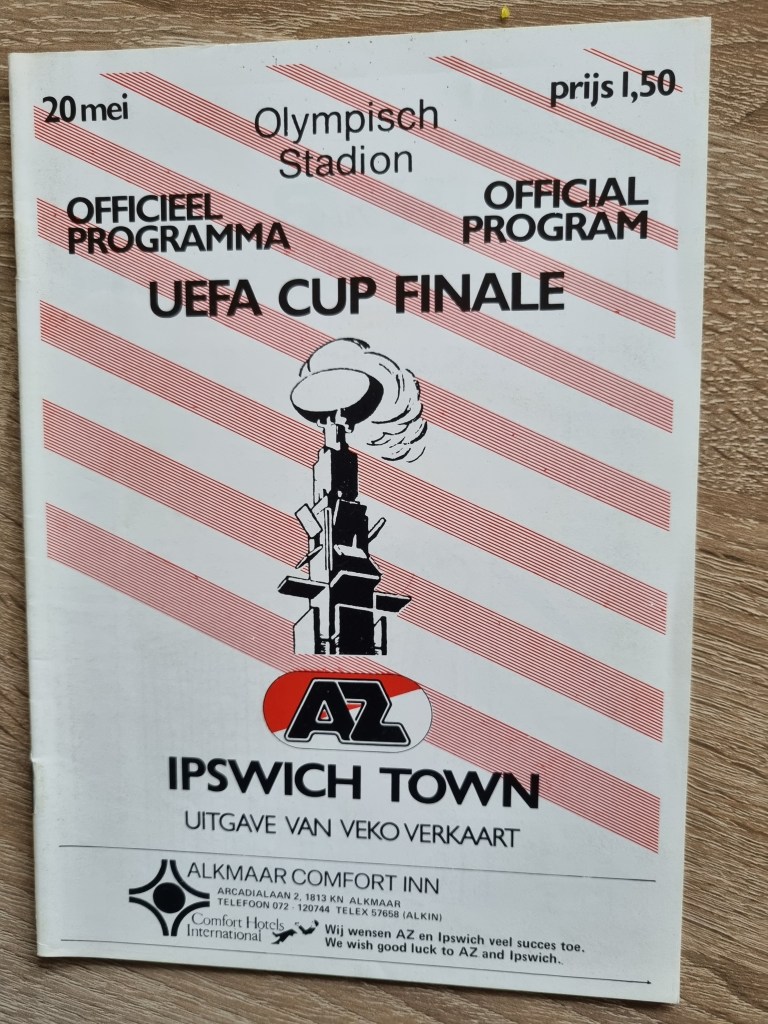
Forty and a bit years ago in May of 1981, I had just finished my final exam at the University of Sussex and I was now just wasting my time, until the lease on my shared student house was up, by playing football, going on pub crawls, walking on the Downs, visiting friends at the other end of the country and taking days out in an aged, bright orange, Dutch registered, left-hand drive Fiat 600 which my friend Chris (mainly known as ‘Jah’ due to his love of Reggae) had borrowed from a woman on his Social Anthropology course.  A lack of available cash and the demands of academia had sadly meant that in Town’s run to the final of the 1981 UEFA Cup final, I had only seen two home games, those against Aris Salonika and FC Koln.  Of the other games, I mostly remember the nervous anticipation of waiting for the result on the radio or television news.  The away matches I recall most are those at St Etienne and Koln.  I remember learning that Town were a goal down in St Etienne and was very chuffed to hear they had equalised as I headed off to the Student Union bar that March evening.  When I discovered Town had won 4-1, I could hardly believe it, and indeed it was a performance that has gone down in history as one of the best-ever by a British club in Europe and possibly Ipswich Town’s greatest performance ever.  As for the game in Koln, I remember that my friend Stephen went to the game on a supporters’ coach from Shotley and I remember seeing Terry Butcher’s winning goal on television, having been fearful that the one goal lead from the first leg would not be enough.

On the morning of 20th May 1981 my sister dropped me and my father off at Ipswich railway station where we caught a chartered train to Parkeston Quay and a chartered ferry to the Hook of Holland before boarding a chartered coach to Amsterdam.  Everyone travelled with the Ipswich Town Supporters Club and Anglia Tours back then, and I still have the pennant to prove it.  I wouldn’t enter Holland again for another 35 years, until I drove through a small corner of it on my way to Dusseldorf for a pre-season game in 2016, but I recall it being very neat.  In Amsterdam my father and I spent the time before the game in a small bar where we drank Amstel, a beer rarely seen in Britain back then, thankfully.  My father had encountered it before in foreign ports when in the Royal Navy and had warned me that it was gnats’; he was right, but it was all there was, they didn’t have any Tolly Cobbold Original.    Amsterdam was beautifully warm that May evening, which was just as well because terraces of the Olympic Stadium were open to the elements, which given that it was built for the 1928 Olympics isn’t that surprising; stadium builders weren’t always big on rooves back then.  In 1987 the Dutch government designated the Olympic Stadium as a National Monument, obviously because Town won the UEFA Cup there, but also because of the fine brick architecture by Jan Wils, an exponent of the Amsterdamse School.  It’s good to know that there is a corner of the Dutch capital that will forever be imbued with the memory of the presence of 7,500 Town fans.

My memory of the match that night in Amsterdam is one of anxiety and tension, despite taking an early lead that put us 4-0 up on aggregate and then gaining a second away goal.  AZ 67 Alkmaar were a bloody good team, but happily not quite good enough, despite Town being visibly knackered at the end of a colossal sixty-six game season. Forty years is a long time, and I’m not sure now what I remember from being there and what I remember from having seen various tv clips since.  I think I remember being frustrated that in the second half we couldn’t keep the ball away from Alkmaar, but I know I do recall wishing away the last twenty minutes of the game, and constantly checking my watch; willing Alkmaar not to score again and the Town defence to hold firm.  I remember nothing of the journey home, although I think my father might have invested in the luxury of a two-berth cabin in the hope of a couple of hours of sleep.

Tonight, “Never Lost at Home” picks up the story of the fictional Coombes family who followed Town to Wembley in “Our Blue Heaven”, and the story very much has the feel of being a sequel, which of course it is.  This time the tale begins with the family vowing to have someone at every game for what promises to be the greatest season in the club’s history as it vies to win an unprecedented treble.  Once again, the story is set against the background of the events of the times, in particular the high rates of unemployment resulting from the Thatcher government’s monetarist policies and indeed Scott loses his job to create some jeopardy in the story as it inevitably hinders his ability to get to games. Once again also, the story and the season unfold to a soundtrack of popular tunes of the time, although just like in ‘Our Blue Heaven’ it doesn’t, because several of the songs are from as much a four years later, which rankles somewhat because songs such as Tears for Fears ‘Everybody wants to rule the world’ (1985) were actually the soundtrack to avoiding relegation, not seeking glory.

Despite the failure to use the actual music of 1980 and 1981 (what a pity we never played Rapid Vienna or IK Start), rather than just generic 1980’s hits, there is nevertheless an authentic feeling of nostalgia for a time and a place.  I can’t fully explain why, but I had tears in my eyes in the first part of this production.  It might have been because I was reminded of how awful some of the music of the 1980’s was; I always hated ‘Eye of The Tiger’ (1982) and have consequently never seen any of the ‘Rocky’ films, but more likely I was mourning my lost youth and my lost football team, both of which seemed to go missing at much the same time.

 One major departure from the mostly repeated formula of “Our Blue Heaven” is the introduction in “Never Lost at Home” of one of the players as a recurring character, that player being the now legendary Arnold Muhren.  The choice of Arnold was, if not inspired, then obvious, because perhaps more than any other player, even his fellow Dutchman Frans Thijssen, Arnold somehow personifies that 1980-81 team, despite having actually joined Town three years before in September of 1978.  Again, the story employs a little artistic license as it almost implies that Arnold and Frans joined for the 80-81 season, but that is easily forgiven and does add to the mythology of that remarkable season.  I can only think that in casting actor Dan Bottomley as Arnold Muhren, one of the main considerations must have been his legs, because these have the same straight up and down shape of Arnold’s.  Not for Arnold the meaty thighs of Mick Mills or Paul Mariner; Arnold was a sinewy thoroughbred, built for the measured pass, the clever change of pace and direction in a single stride, the sort of footballer who simply danced through midfield and no longer exists in a game where speed, strength and bulk has usurped grace and subtlety.

The greatest triumph of ‘Never Lost at Home’, as it was of ‘Our Blue Heaven’, is the performance of Peter Peverley as Bobby Robson.   Not only does Peverley, with his gently hoarse County Durham accent, and perfectly observed Robson-esque mannerisms create a wholly believable vision of the Town manager, but he also delivers the great man’s words as he sends his team out in search of glory.  So stirring and convincing are Peverley’s words it might be an idea if the current Town management employed him to give Paul Cook’s team talks.

Oddly perhaps, ‘Never Lost at Home’ tails off towards the end, in contrast to the prequel which had something of a grand finale as the stories of the characters all came together on 6th May with a birth, a marriage and the Cup Final itself.  This time the characters don’t have their own stories to be resolved other than what happens to them as they travel across Europe in the rounds leading up to the final. We all know the ending, and although Town ultimately win the UEFA Cup, sadly mine and a lot of people’s memories of 1980-81 are probably tinged with a feeling of ‘what should have been’ with the loss of the FA Cup semi-final to the hugely inferior Manchester City and the loss of the ever-elusive League Championship to Aston Villa, a team we beat no less than three times over the course of the season.  But as one of the characters in the play points out, we had already won the Cup and the League before, so if it was to be only one out of three, best that it was the UEFA Cup.   Reassuringly however, it’s good to know that we only lost out in the Cup and the League because none of the characters in the play could get to the Cup semi-final or the penultimate League game of the season at Middlesbrough.

In truth, ‘Never Lost at Home’ wasn’t quite as good as ‘My Blue Heaven’, although my seeing it through the television screen rather than in the flesh is doubtless a factor in that. The story doesn’t have the drama of its predecessor and by drifting further into 1980’s the music is not so much ‘not as good’, as ‘worse’. Nevertheless, it was still massively enjoyable all the same, bringing back those memories of what genuinely was a marvelous time to be a Town supporter and which seems even more so given all that’s happened since. I can only hope that both ‘Our Blue Heaven’ and ‘Never Lost at Home’ are both resurrected in ten years time, not only to celebrate the fiftieth anniversaries of the FA Cup and UEFA Cup wins, but also their own 10th anniversaries; or perhaps we could have a musical about going to a musical about winning the FA Cup and UEFA Cup; I’d watch it.

FC Sete 0 Stade Bordelais 1

The town of Sète is a fabulous seaport, fishing port and resort in Languedoc, it nestles by the sea where a rocky outcrop meets a saltwater lake. It has trawlers and its own network of canals and narrow streets, which give it the character of a cross between Venice, Naples and Lowestoft with a bit of North Africa thrown in thanks to its ferry links to Morocco. It has a population according to Wikipedia of about forty three thousand. Of all the places I have ever been I think Sète is one of my favourite towns anywhere.

FC Sète were early members of the French professional football league, winning the title in both 1934 and 1939 and the Coupe de France (French FA Cup) in 1930 and 1934, being the first club to win ‘the double’ in France. After 1960 the club declined and then, having been in Ligue 2 as recently as 2006, were relegated to the regional leagues in 2009 due to financial problems. But promotion to the second amateur tier (CFA2) in 2013 was followed by promotion to the top amateur tier in 2015. The club remains at the amateur, fourth level of French league football, which is now known as League National 2 and is divided imto four regionally based leagues with sixteen clubs in each.

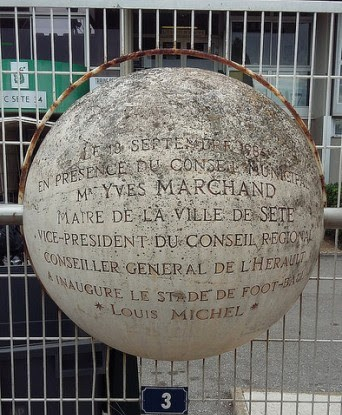
So far this season Sète have won just one of their four games but are undefeated; their opponents today are Stade Bordelais from Bordeaux20170909_173047.jpg near the Atlantic coast, some 380 kilometres away by road; they have won one and lost two of their four games so far. Kick-off is at six pm and we arrive about a half an hour beforehand, parking in the spacious gravel topped car park at the side of the Stade Louis Michel, although other spectators prefer to park in the road outside. Entry to the stadium costs €6 and we buy our tickets from the aptly porthole-shaped guichets 20170909_173102.jpgoutside the one gate into the ground. Just inside the gate a cardboard box propped on a chair provides a supply of the free eight-page, A4 sized programme ‘La Journal des Verts et Blancs’. Also today there is a separate team photo and fixture list on offer.
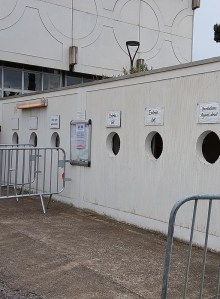
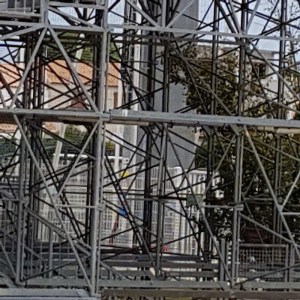
The Stade Louis  Michel was opened in 1990, but its pre-fabricated concrete panels somehow make it look older, but in a good way; 20170909_173348.jpgthe brutal angular concrete of the main stand, the Tribune Presidentielle, could be from the 1960’s or 1970’s, channeling the inspiration perhaps of Auguste Perret or even Le Corbusier. The concrete panels on the back of the stand are lightly decorated and sit above wide windows; a pair of curving staircases run up to the first floor around the main entrance, 20170909_175009.jpgabove which is a fret-cut dolphin, the symbol of the town and the club. The stand runs perhaps half the length of the pitch either side of the halfway line and holds about twelve hundred spectators, as well as club offices and changing rooms. Opposite the main stand a large bank of open, 20170909_173643.jpg‘temporary’ seating runs the length of the pitch, it is built up on an intricate lattice IMG_20170909_223051_287.jpgof steel supports. Behind both goals are well tended grass banks; there is a scoreboard at the end that backs onto the carpark.
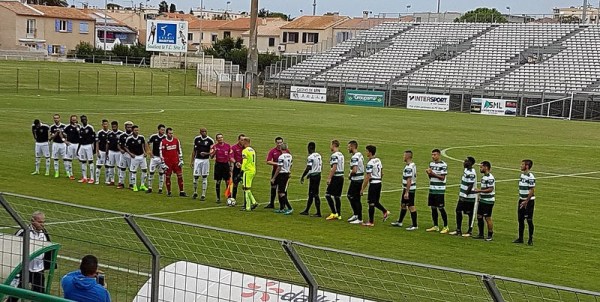
There is now not long to wait until kick-off and the teams line up; 20170909_175652.jpgSète in green and white hooped shirts with black shorts and socks, Stade Bordelais with black shirts with white shorts and socks. There is a ‘ceremonial’ kick-off before the real one, taken by a youmg woman with a green and white scarf draped around her shoulders.  Eventually, referree Monsieur Guillaume Janin gives the signal for the game to start in earnest.
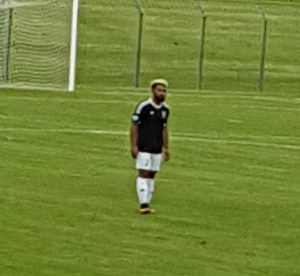
Its a grey, overcast afternoon, but not a cold one and the game quickly settles down with both teams enjoying attacking bursts in turn. The visiting team perhaps look slightly more accomplished, a bit more knowing, particularly at the back where their number four is the only player to have a tattooed forearm. He has long, lank hair and a beard and looks like he might have ridden into town on a Harley-Davidson rather than travelled over from Bordeaux with the rest of the team. The Bordelais number two is a 20170913_130330.jpgman mountain with a wide shock of bleached hair on the top of his head, and thighs the size of other men’s waists.

There’s not much of a crowd here today, three or four hundred perhaps and I count just eleven people on each of the grassy banks behind the goals and about the same number looking lost amongst the expanse of empty seats opposite. A few spectators stand and peer through the metal fence below the main stand, but most are up in the plastic, backless seats where we sit in the company of greyhaired men, idle players, club volunteers, wags and their children. A man in front of us wearing double denim reminds me of a petit Yosser Hughes, not that Yosser Hughes ever wore double denim.

The first real scoring opportunity falls to Stade Bordelais after seventeen minutes as a ball over the top of the Sète defence puts their number nine through on goal with just the goalkeeper between him and glory.  But he must have been dazzled by the dayglo yellow kit of the bald and bearded goalkeeper, who makes a startling, even dazzling save from close range.

It’s only a quarter past six, but the floodlights are coming on; every now and then there is a metallic rattle and rush behind us as a passenger or freight train speeds by on the track between Montpellier and Perpignan, which is just the other side of the road behind the Tribune Presidentialle. Sète win their first corner of the match and I am surprised to hear rythmic clapping rise from the ‘posh’ seats at the centre of the stand, but Sete has no Ultras so someone has to get behind the team; it’s a lesson that would be well learned by many club owners and officials in England.

It’s now half-past six and a ball forward is headed down to the feet of the Bordelais number ten; he feints one way and then the other to shake off the defender and shoots past the luminous Sète goalkeeper to give the away team the lead. Before the game resumes the Stade Bordelais goalkeeper is given timeout by the referree to throw a ball back to a bunch of children who have been playing their own game on the grassy slope behind his goal.

It’s six-thirty seven by the scoreboard clock and Sète win another corner to elicit more rythmic clapping from the centre of the stand; sadly it doesn’t produce an equalising goal only spiky, bitter shouts of disappointment. In the final minute of the half Séte’ s number five is booked for a trip, which leads to a Stade Bordelais free-kick within striking distance of the goal, but the opportunity is spurned.

I can’t deny I’ve been looking forward to half-time as I nimbly nip down the stairs to the buvette, 20170909_173408.jpgFC Sete.jpgwhich is close by at the corner of the stand where we are sat. The reason for my eagerness is that Sète is the home of the tielle, a small, spicy, calamari and tomato pie, with a bread like case. I love a tielle, and I love that they are specific to Sete, and are served at the football ground as a half-time snack. I only wish there were English clubs that served local delicacies. Middlesbrough has its parmo, but I can’t think of any others. Do Southend United serve jellied eels or plates of winkles? Do West Ham United serve pie and mash? Do Newcastle United serve stotties? Did the McDonald’s in Anfield’s Kop serve lobscouse in a bun? I need to know. Sadly, I don’t think my town Ipswich even has a local dish. Many English clubs don’t even serve a local beer; Greene King doesn’t count because it is a national chain with all the blandness that entails.
Having eaten my tielle (€3) with relish, by which I don’t mean some sort of pickle, but rather enthusiasm, I wash it down with a small beer (€2) and I treat my wife to a bottle of cold water (€1).

Reflecting my sense of tielle induced well-being, sunshine floods the stadium some time after the start of the second half. I look out across the pitch to the backdrop of the tree covered rocky outcrop that is Mont St Clair and all is right with the world, except that Sete are still losing; they substitute their number ten for number fifteen, but their opponents counter ny swapping thier number eleven for a thirteen.

Sète don’t look particularly like scoring, despite the change in personnel, and Stade Bordelais almost double their woe as a corner kick is headed firmly but deftly against the far post from an unlikely distance by a player whose shirt number I didn’t quite catch. The Stade Bordelais number nine is very quick and slaloms between two or three Sète players before being outnumbered. Sète’s eight becomes a fourteen. There are twenty minutes left and a free-kick to Sète is saved at full stretch by the Stade Bordelais goalkeeper. Sète’s eleven is replaced by their thirteen, a player and father of a little girl who calls and waves to him as he warms up in front of the stand, and he waves back. But undaunted by familial pleasantness Stade Bordelais replace their number seven by number fourteen. Stade Bordelais’ number nine breaks free down the left; he gets behind the Sète defence and delivers a low cross which is perfectly placed to meet the incoming run of the number ten who, from a position near the penalty spot, embarrasses himself with a shot which misses the goal in two directions. Two minutes later ten’s failure is compounded as his time under the unforgiving glare of the floodlights is terminated and he is replaced by twelve. There are still ten minutes left, but the final act of any note sees Sète’s number nine head the ball past the post from a corner. Stade Bordelais’ defenders hold firm to win the game. No one is a match for their huge full-back, their very own, very mobile rocky outcrop.

It’s not been the best game I’ve ever seen, but it’s been an oddly calm, measured one. Was anyone booked? I don’t recall. Stade Bordelais have won with greater guile and knowledge and strength, but Sète will always have their tielle, although they’ve run out of them in the buvette today.

20170909_173156.jpg