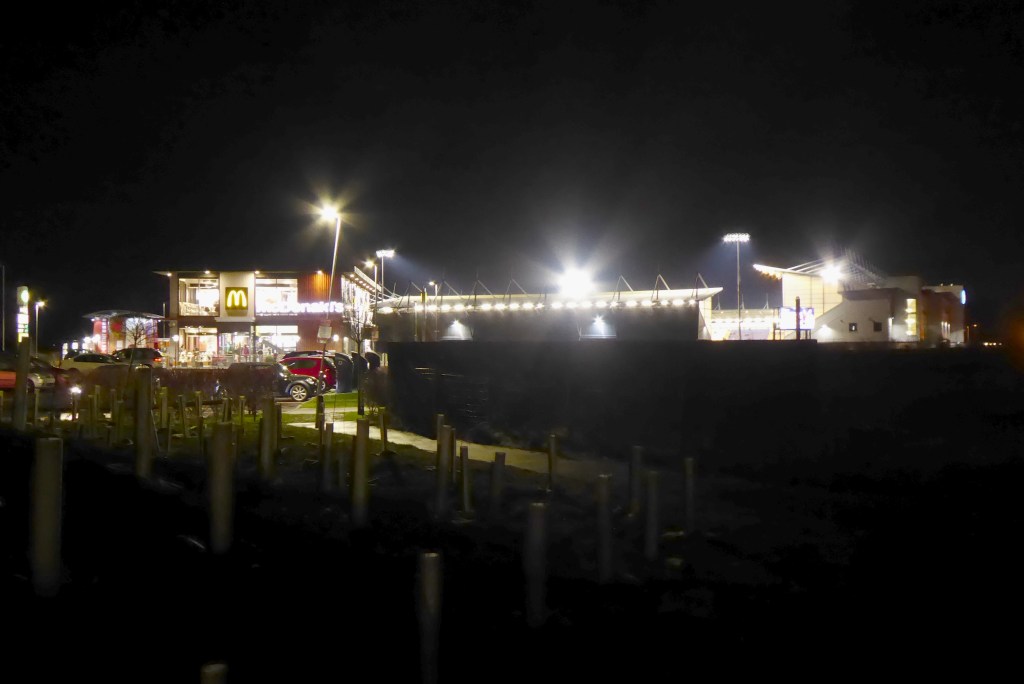
It’s been a foul March day; blustery, wet and cold; at times the word very has been in front of those adjectives. Now it is gone seven o’clock, the sun has gone down and it’s mainly miserable and dark, particularly at the Colchester Park & Ride car park, an exposed expanse of dimly lit tarmac next to the A12, adjacent to a petrol station and a McDonald’s. Colchester is Britain’s oldest recorded town.
Across the A12 the lights of the Colchester Community Stadium, currently known as the Jobserve Community Stadium and formerly the Weston Homes Community Stadium, which I like to call ‘Layer Road’, shine, but not enough to satisfactorily illuminate the ticket machine at the edge of the car park. The machine asks for at least three digits from my car number plate, then changes its mind and asks for all of them and then tells me to pay with coins; I don’t have any. I trudge the 70 odd metres to the typically streamlined Park & Ride waiting room building and change a fiver into coins with the help of another machine. I ignore the queue of other people buying tickets at the machines there and trudge back to the dimly lit machine. A kind man illuminates it with his mobile phone and after the machine first claims ignorance of my car registration it eventually allows me to purchase a ticket (£3).
I walk to the football ground between bright lights planted into the ground that don’t actually illuminate the path only give me a clue where it might be. I turn left onto Boxted Road and traverse the bridge over the A12 with its high metal sides presumably there to prevent suicidal football supporters from jumping down onto the highway; I turn left into United Way and arrive at another open expanse of tarmac upon which here and there are painted the words BUS STOP. A white Mercedes Benz is parked partly across the word STOP. I shed a tear for the shuttle buses which no longer ply their way to the stadium and were the only thing that made this god forsaken location for a football ground even faintly viable. I have probably watched Colchester United play well over 300 times in the last 35 to 40 years but have not been to ‘Layer Road’ since the shuttle bus service stopped running, until tonight. Tonight I have come to see Forest Green Rovers play Colchester United because I want to see Forest Green Rovers, the Football League’s only vegan football club, the only Football League club owned by a former ‘New Age’ traveller. The irony that I have had to drive to watch this club famed for its ‘green’ credentials is not lost on me.


The Community Stadium is as bleak and lonely as it ever was, surrounded by a car park and nothing much else. The Forest Green Rovers team bus sits up a corner by the main stand, disappointingly it looks like a regular team bus, not powered by methane or biofuel or anything other than dirty old diesel. I take a look in the well-stocked club shop, where trade is slow; toy bears stare out into the car park but no one is buying.

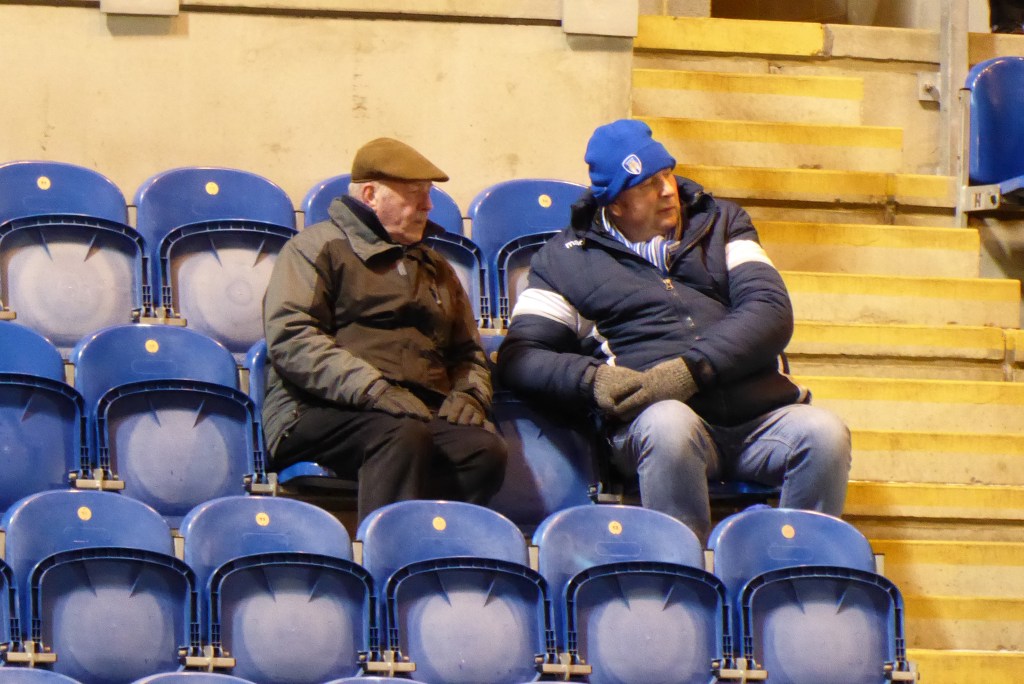
I queue at the turnstile for what feels like seconds wishing I had a bag for the steward to look into to make this experience more interesting. Inside the ground however things look up, the programmes are free! This is like being in a civilised country like France where free football programmes are de rigeur and fleetingly I am transported to the imaginary Rue de Layer where Unifie de Colcestre are about to take on Nomades de Foret Vert in the Ligue National. The sight of Pukka pies not baguettes and Carling instead of espresso coffee returns me from my reverie. I spot a former work colleague called Mark, which is nice, and we shake one another warmly by the hand; he introduces me to his friend Darren who like me is really an Ipswich Town supporter. Mark tells me this should be a good game, although Colchester United tend to either ‘do alright’ or lose 3-0. Up in the South stand I take my seat, I am sat behind a man and woman who I recognise from the Barside at Layer Road from over thirty years ago, they look much the same, just slightly shrivelled with age.


The U’s soon kick off towards me in their customary blue and white stripes, although from behind their shirts are all blue with white sleeves as if they couldn’t really decide if they want to be in stripes or not. Their white socks have just two blue hoops as if they couldn’t decide if they should be hooped or not either. There are no such uncertainties with Forest Green Rovers’ kit of overly dark bottle green with lurid day-glo green trim.
Colchester dominate the start of the game taking on the role of 6th placed promotion hopefuls eager to cement their place in the play-off positions, as someone on Sky Sports TV might say. Ninth placed Forest Green defend capably. “It’s a long way on a Tuesday, innit?” says the bloke behind me and is not fully understood by his companion. He explains that it’s a long way for Forest Green supporters to travel from wherever it is that Forest Green is, “Somewhere down Portsmouth way, I think”. Forest Green Rovers actually play in Nailsworth in Gloucestershire, so they’re more Laurie Lee than Lord Nelson, but I don’t turn round and tell him that.
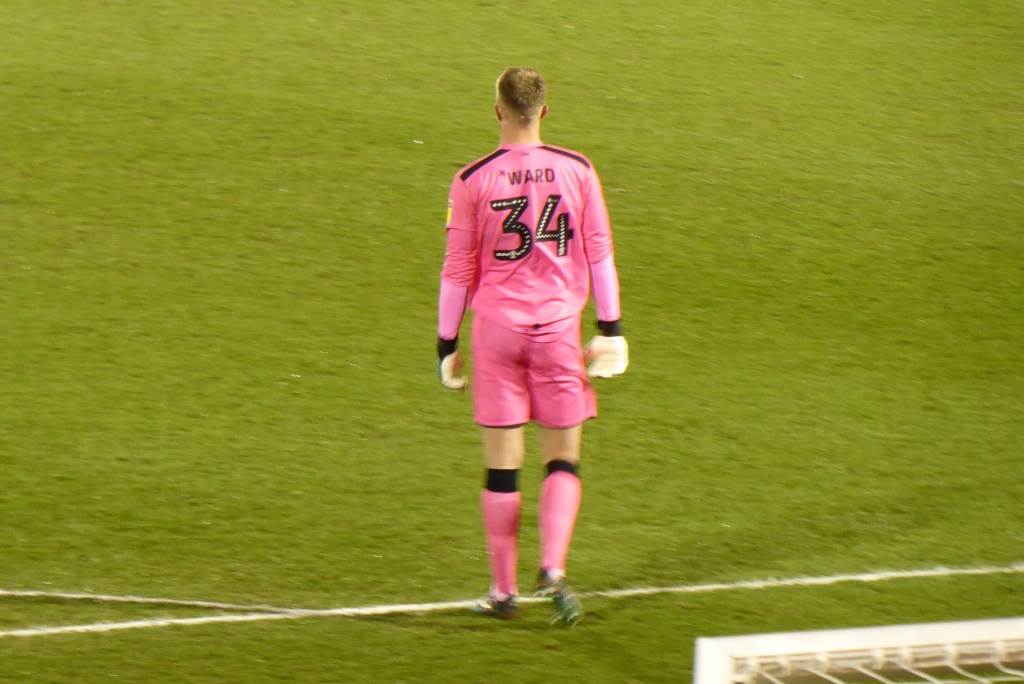
The Forest Green number 23 Joseph Mills is the first player to make an impression; he is wearing his hair in a bun. “You’ll never make it Ward” says a voice at the back of the stand, seemingly attempting to goad the Forest Green goalkeeper Lewis Ward who is dressed all in pink. From the middle of the stand directly behind the goal a chorus of “Ole, Ole, Ole” rises or perhaps it’s “Allez, Allez, Allez”; it’s hard to tell, it could be both. After twelve minutes Colchester win the game’s first corner.
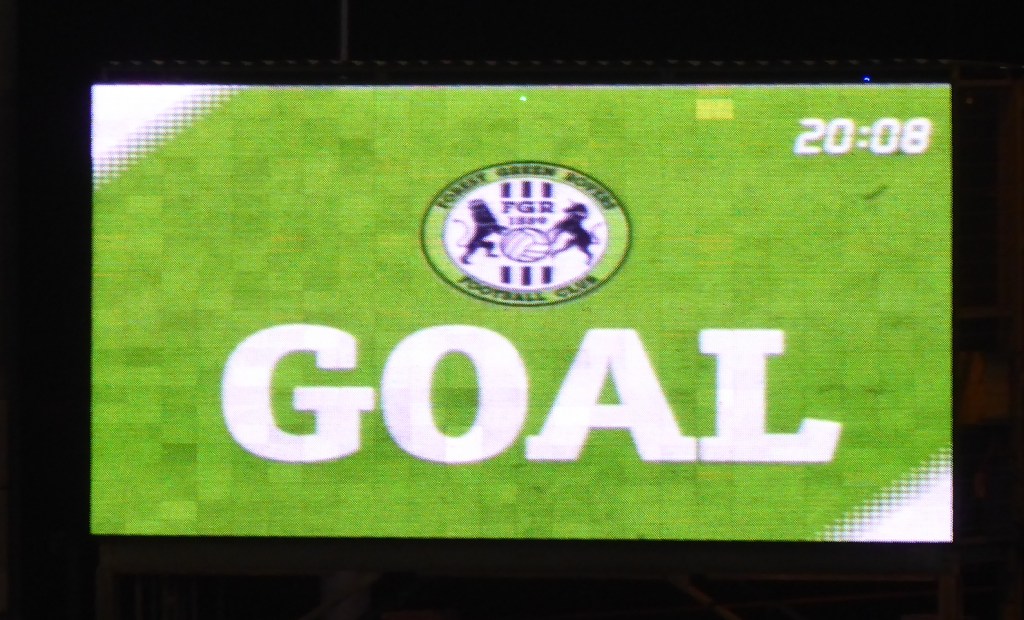
Twenty minutes have passed, Colchester are doing okay just not scoring. Forest Green cross the ball from the left to Lloyd James, he quickly shoots and scores from a good 18 metres or so from goal. No one was expecting that, it’s probably the first shot on target. “Come on Col U” chant the understandably disappointed but not unduly upset occupants of the South Stand. But things change, the crowd becomes more vociferous, less happy, more angry. Colchester win another corner to no avail and Forest Green players spend time sat on the turf looking pained. “Get on with it, you bloody…” shouts an angry man so irate that he can’t think of a word to finish his sentence. It’s nearly twenty past eight and Forest Green break away down the right, one pass, another pass and number ten Reece Brown side foots the ball past Colchester’s slightly exotically named goalkeeper Rene Gilmartin. Forest Green lead 2-0. Colchester’s number forty-five Frank Nouble kicks Lewis Ward out of spite and becomes the first player to be booked by the slightly portly referee Mr Alan Young. Colchester rather pointlessly win a third corner and Lewis Ward is booked for mucking about.

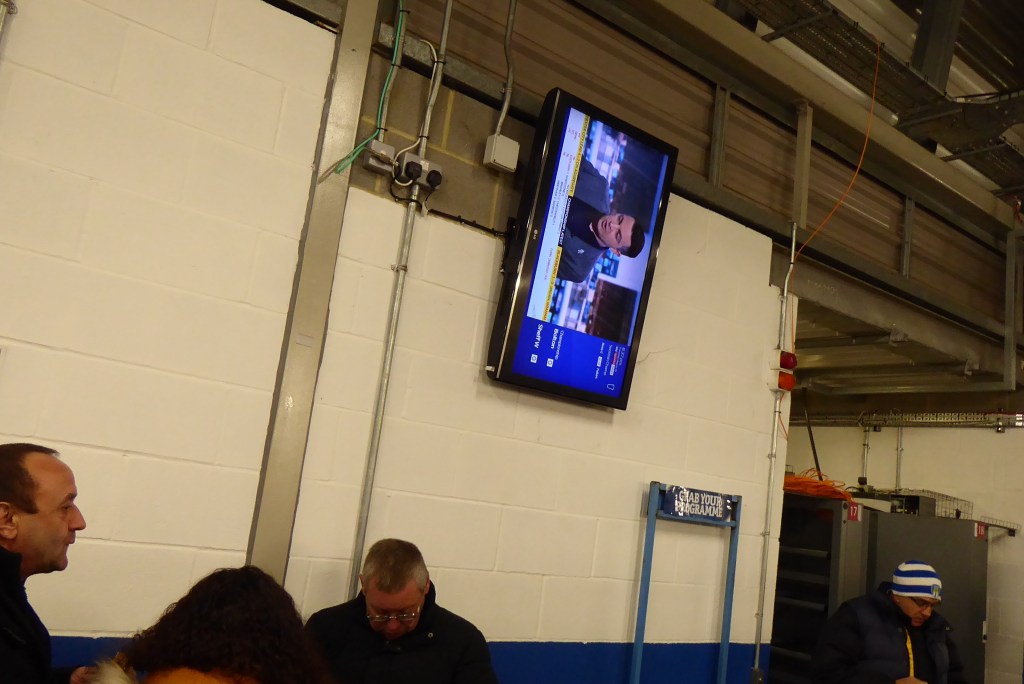
After three minutes of added on time comes the half-time whistle and I head downstairs for a pounds worth of PG Tips in a plastic cup and to check the half-time scores, but mysteriously all the TV sets are on their sides; perhaps the Sky subscription is cheaper like that; it would be okay if you could lie down on a sofa to watch it. Ipswich are losing.
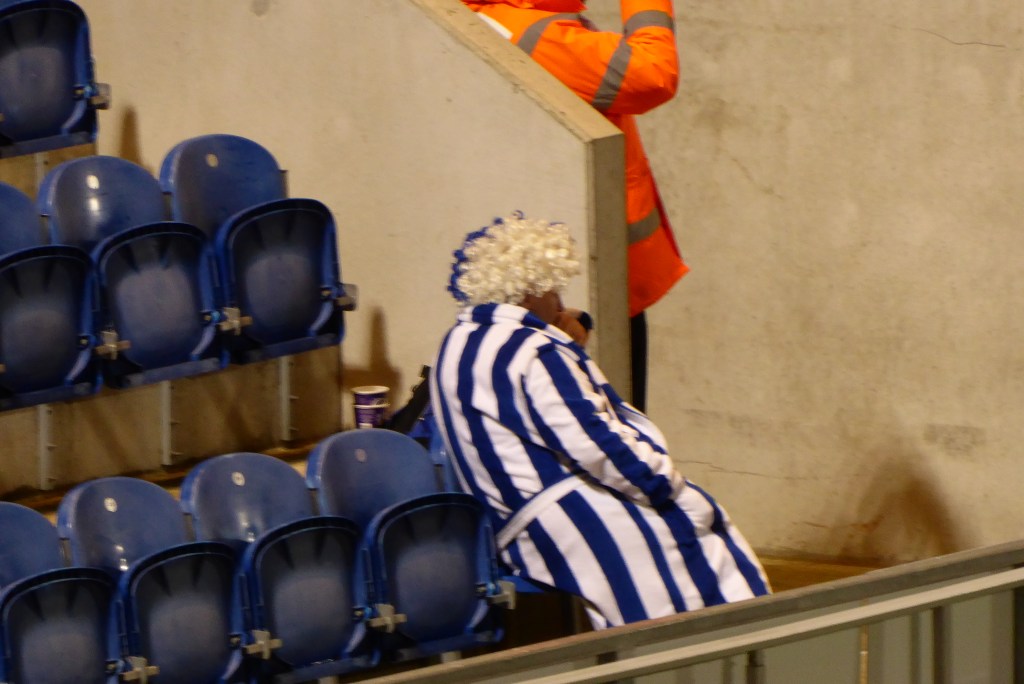
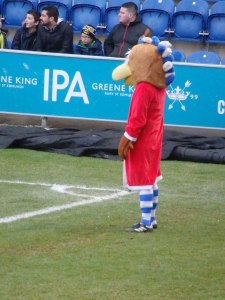
The second half is much like the first, just a bit colder. The breeze is getting stronger and there are a few spots of rain in the air. In the West Stand a man in a blue and white wig and bath robe reclines against his seat looking bored. Perhaps like Bobby Ewing he will later step out of the shower and find it was all a bad dream. Colchester press forward but Forest Green defend well, blocking every shot, thwarting every move, frustrating the spectators. The crowd begin to blame Mr Young for a lack of free-kicks to Colchester or too many free-kicks to Forest Green. “You are kidding” shouts an exasperated man at Mr Young and drawing out every word. “What is wrong with you referee?” asks someone else. “Show some flair referee” says another rather more obscurely “Show some bollocks” replies yet another, a little crudely. I for one want Mr Young to keep his shorts very definitely on. A few rows in front of me a young woman, or very high pitched man shouts viciously, rendering herself or himself incoherent with vented spleen. The atmosphere is unpleasant and it’s no wonder Boudicca sacked the place back in AD60 if the inhabitants were as narky as this.
Despite Colchester’s dominance of possession and shots it takes until gone ten past nine for Lewis Ward to make a decent save as he dives away to his right like a flying raspberry blancmange to give Colchester another pointless corner kick. The final ten minutes begin and Forest Green show that they can keep and pass the ball very neatly, so much so that they end up passing to an unmarked Christian Doige who despite a suspicion of offside amongst the home supporters scores a third goal. The names Shephard, Brown, Doige appear as verse on the scoreboard.
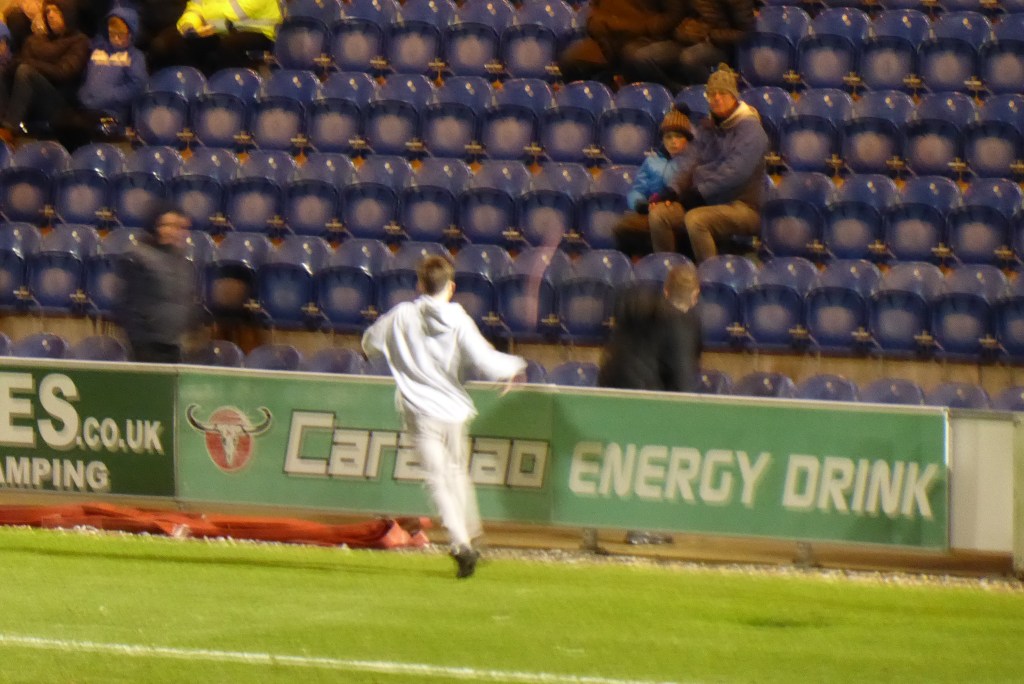


With the game lost its time for two youths to run onto the pitch, probably as their tribute to recent televised pitch incursions at Arsenal and Birmingham. They only look about fourteen. One of them makes a break for it trapping himself at the back of the East Stand having athletically vaulted over several rows of seats. “Wanker, Wanker, Wanker” shout the South Stand. “Wanker!” shouts an angry man behind me a little belatedly, and sounding a bit stupid as a result. He should have saved his shout for the equally silly Frank Nouble who rounds off an entertaining evening by committing a needless foul, getting booked for a second time and consequently sent off.

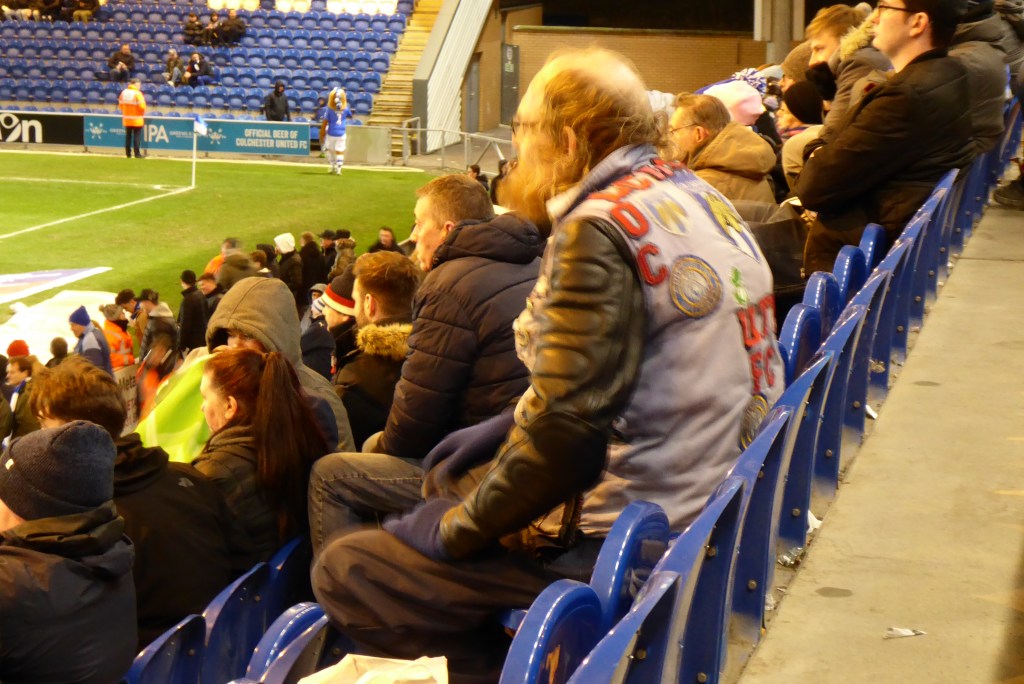
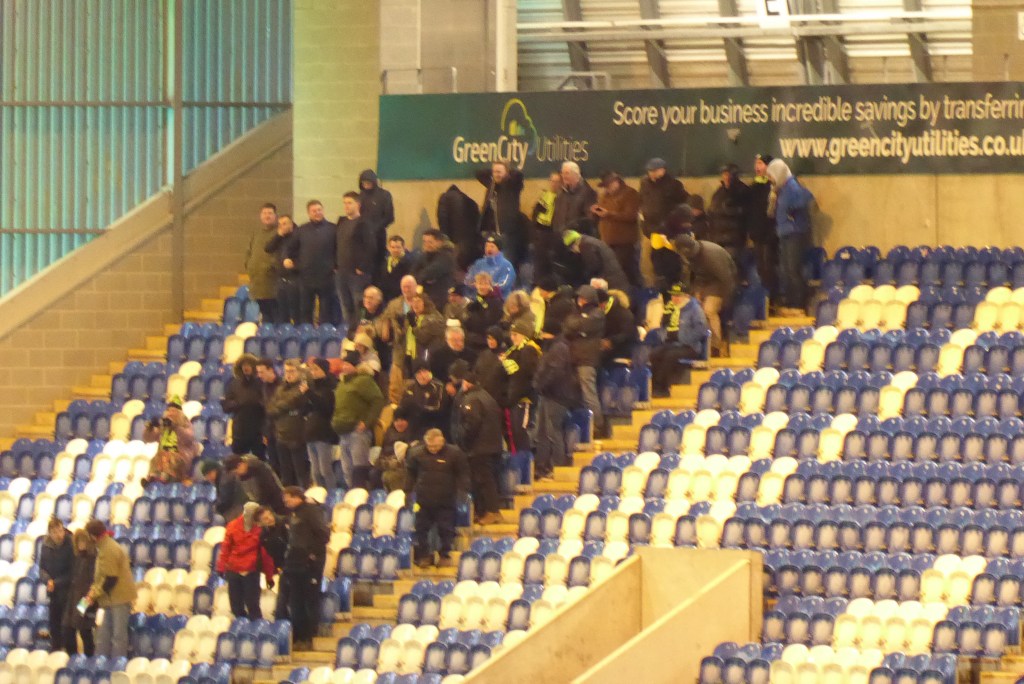
The crowd of 2871 are already heading off into the dingy car parks and wasteland outside before five minutes of added on time are announced. A wildly bearded man in patched double denim rails at the team as others shuffle past. “Worst game of the season” a man says to me unintentionally referencing Comic Book Guy in The Simpsons as he raises his eyebrows and edges past me. I wait until the very end to get my money’s worth (£18.50) before also heading off into the damp and dark to walk to my car and travel home alone fondly remembering the days when we left the ground together sharing our misery in a crowded shuttle bus.






 to see the tie with Clermontaise, who are from the town of Clermont l’Herault, some thirty kilometres to the north west.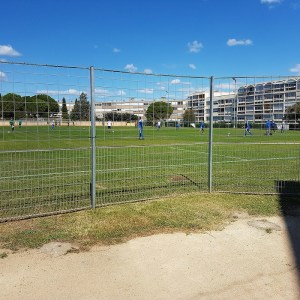
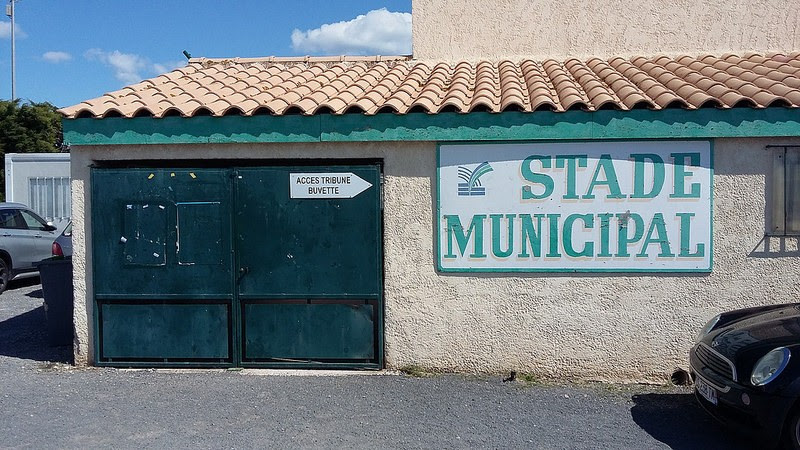
 It looks like the original roof has been replaced with new metal sheeting on another metal frame, which obscures the row of the pitch from the front row of seats. We enter the stadium through a wide opening in the back wall and find ourselves in the players tunnel; it’s an entrance that is closed soon afterwards, but it’s not quite two -thirty yet and the game doesn’t kick off until three. A wonky sign points roughly in the direction of the buvette,
 which is a portakabin style structure with a counter even more wonky than the sign. To the other side of the stand is a dark room with high-up shelves of trophies on two walls and a bar counter;


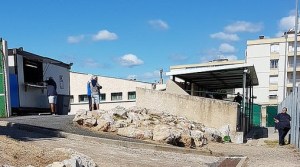 and the teams line up on the pitch. Balaruc wear an unattractive all-black kit with green trim, which displays no team badge or sponsor’s names. Clermontaise and Balaruc are in the same regional league (Poule A of the Languedoc-Rousillon section of the Occitanie region’s Division Honneur 2 – the seventh level of French football), but Clermontaise look much smarter and ‘professional’ in their all blue kit with badge. The McDonald’s golden arch logo is on the Clermontaise shorts; they can’t have read the poster on the table in the trophy room.
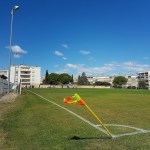 at the Mediterranean end of the ground. A bloke in a t-shirt and trakkie bottoms is called on to sort them out and once he has done so the game carries on. Early on Clermontaise look the better team, but it might just be because they’re wearing a nicer kit. Just before twenty past three it looks like they have scored, but I can’t tell if it was offside or the shot was missed. There are flattened practice goals either side of the real one and from my rock it’s hard to tell which is which.
 There are a number of people, mostly men in their sixties and seventies, sat at windows and balconies looking down on the game. I envy them their home comforts, it has to be better than perching like a lizard on a rock in the sun. Dissatisfied with my view sat on the rock, I watch the remainder of the first half standing up.
 It proves to be a good choice and our enjoyment of the second half is much increased by our new location, which is shaded, out of the wind and high enough to see over the fence, with the added bonus of atmosphere as the stand is full; spectating nirvana.
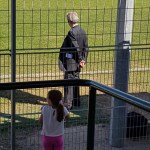 Monsieur Gerard Blanchet busy in front of us. Clermontaise’s number twelve confirms his presence by boldly attempting a shot from a thirty metre free kick; of course he misses, but not embarrassingly so. The Balaruc bookings continue and five blatantly kicks the Clermontaise twelve as he dribbles past him and three knocks over his opposite number as they run side by side. All afternoon tbere is a pleasing symmetry with many of the fouls and bookings as players with the same shirt number go for each other.
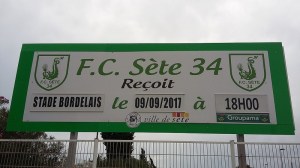 near the Atlantic coast, some 380 kilometres away by road; they have won one and lost two of their four games so far. Kick-off is at six pm and we arrive about a half an hour beforehand, parking in the spacious gravel topped car park at the side of the Stade Louis Michel, although other spectators prefer to park in the road outside. Entry to the stadium costs €6 and we buy our tickets from the aptly porthole-shaped guichets
 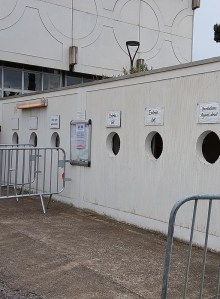 outside the one gate into the ground. Just inside the gate a cardboard box propped on a chair provides a supply of the free eight-page, A4 sized programme ‘La Journal des Verts et Blancs’. Also today there is a separate team photo and fixture list on offer.
 the brutal angular concrete of the main stand, the Tribune Presidentielle, could be from the 1960’s or 1970’s, channeling the inspiration perhaps of Auguste Perret or even Le Corbusier. The concrete panels on the back of the stand are lightly decorated and sit above wide windows; a pair of curving staircases run up to the first floor around the main entrance,
  above which is a fret-cut dolphin, the symbol of the town and the club. The stand runs perhaps half the length of the pitch either side of the halfway line and holds about twelve hundred spectators, as well as club offices and changing rooms. Opposite the main stand a large bank of open,
  ‘temporary’ seating runs the length of the pitch, it is built up on an intricate lattice
 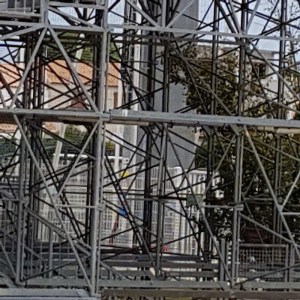 of steel supports. Behind both goals are well tended grass banks; there is a scoreboard at the end that backs onto the carpark.
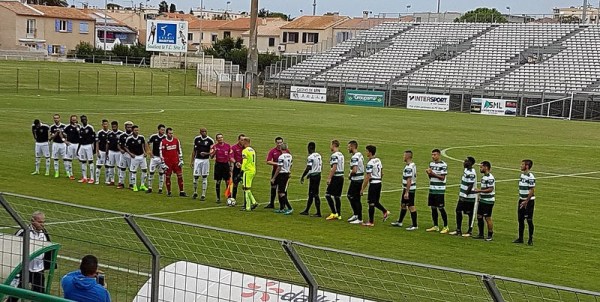 Sète in green and white hooped shirts with black shorts and socks, Stade Bordelais with black shirts with white shorts and socks. There is a ‘ceremonial’ kick-off before the real one, taken by a youmg woman with a green and white scarf draped around her shoulders. Eventually, referree Monsieur Guillaume Janin gives the signal for the game to start in earnest.
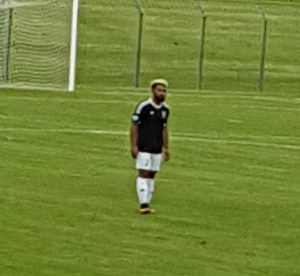 man mountain with a wide shock of bleached hair on the top of his head, and thighs the size of other men’s waists.
 which is close by at the corner of the stand where we are sat. The reason for my eagerness is that Sète is the home of the tielle, a small, spicy, calamari and tomato pie, with a bread like case. I love a tielle, and I love that they are specific to Sete, and are served at the football ground as a half-time snack. I only wish there were English clubs that served local delicacies. Middlesbrough has its parmo, but I can’t think of any others. Do Southend United serve jellied eels or plates of winkles? Do West Ham United serve pie and mash? Do Newcastle United serve stotties? Did the McDonald’s in Anfield’s Kop serve lobscouse in a bun? I need to know. Sadly, I don’t think my town Ipswich even has a local dish. Many English clubs don’t even serve a local beer; Greene King doesn’t count because it is a national chain with all the blandness that entails.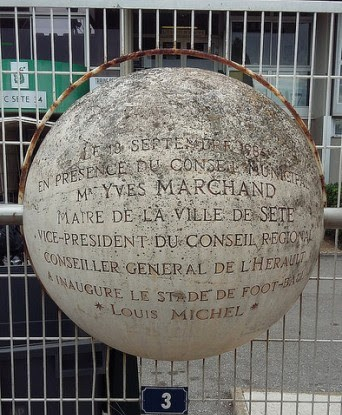
 trippingovertheball