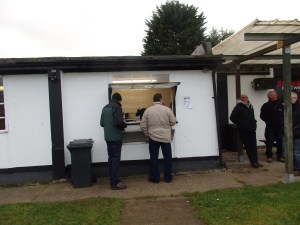
Halesworth Town 3 Haverhill Rovers 1

Between March 2017 and April 2019, I watched matches at each one of Suffolk’s then twenty-four senior football clubs and recounted my experiences in this here blog.  Since then, Debenham Leisure Centre and Whitton United have sadly dropped out of senior football but this season the Eastern Counties League First Division North has welcomed two more Suffolk clubs into the fold in the shape of Kings Park Rangers, who are from Great Cornard but seemingly too shy to admit it, and Halesworth Town, who are proudly, clearly from Halesworth. 

Today, with Ipswich Town playing far too far away in deepest Wales to trouble me to even think of getting a ticket, even if I had enough ‘points,’ I am travelling up to Halesworth in part one of my plan to restore my record of having seen all of Suffolk’s senior teams on their home turf.  Fortuitously, today’s fixture is also an all-Suffolk cup-tie against Haverhill Rovers of the Eastern Counties Premier League, and the first time Halesworth Town have ever reached the second round of the FA Vase.   To add to the adventure even more, despite the additional twenty minutes each way that it will take me, I am responsibly reducing congestion on the roads by eschewing making the 88-kilometre journey from my home by planet saving Citroen e-C4 in favour of taking the train (£18.10 return with senior railcard). It also means I can get plastered if I choose to.

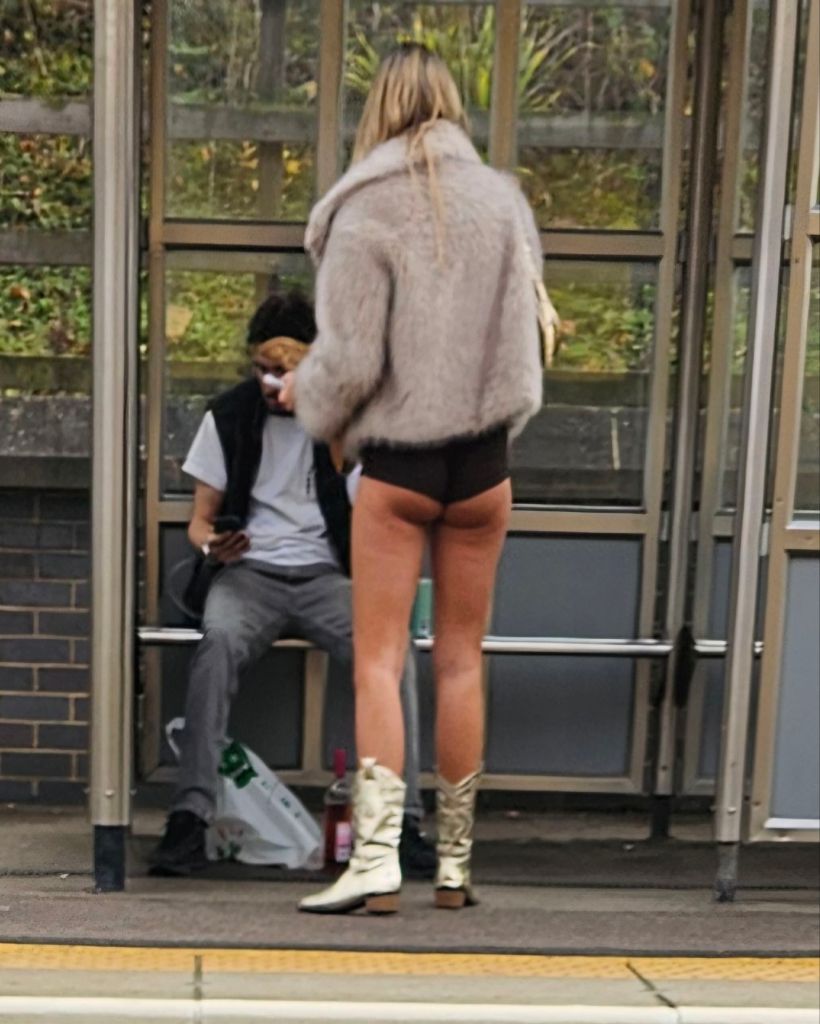
It’s an intermittently cloudy but mild November day as I set off for Halesworth, but I am nevertheless surprised as I wait for the train that one of my fellow travellers appears to have forgotten to put on any trousers or a skirt.  Once on the train, the infinite variety of human life continues to reveal itself as a small man of pensionable age repeats the names of the station stops as they are heard over the public address system; every now and then he delves headfirst into a large carrier bag as if checking on the wellbeing of a small animal or perhaps a baby.  When the woman sitting opposite me goes to the buffet car, she asks me to mind her belongings. I of course agree but tell her she needs to be back before we get to Ipswich.   When she returns, I tell her I had to fight off a couple of people who looked interested in her jacket but otherwise everything has been fine.  Fortunately, she laughs, but the man of east Asian origin next to me looks at me askance and when she begins to struggle to open a bottle of drink, he very quickly offers to help so that she doesn’t have to deal with the looney opposite her again.  The woman soon begins to chew on a large sandwich and a younger man on the other side of the aisle between the seats does the same thing, but takes much bigger bites, happily from a different sandwich, although with every bite he looks like he might lose a finger.

I change trains at Ipswich, boarding the 13:16 to Lowestoft, which departs a good twelve seconds early.  I like the East Suffolk line, to me it feels like a one-hundred- and seventy-year-old umbilical cord connecting the outside world to rural Suffolk with its rustic sounding stations such as Campsea Ashe and Darsham and their Victorian architecture.  Between the stations are Suffolk landscapes of river and marsh, Oak and Broom, sheep and pigs, outwash sands and boulder clay and gaunt, grey, flint church towers.  As the guard checks passengers’ tickets, he helpfully advises those alighting at Halesworth not to use the doors in the front carriage, because the Halesworth station platform is not that long.  There seem to be quite a few of us alighting at Halesworth.

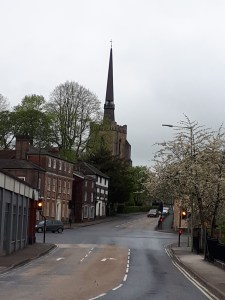
The train arrives on time in Halesworth, where the sun shines from a pale blue autumn sky. A helpful sign points and tells pedestrians that it’s a seven-minute walk to the town centre and a minute’s walk to local bus stops on Norwich Road. Sadly however, no sign points helpfully towards Halesworth Town football ground, although having previously consulted the interweb I happen to know it is very close indeed, perhaps no more than a hefty goal-kick away.   I walk up an alley between the railway lines and Halesworth Police station, a huge four-storey block of a building, which although it probably dates from the1960’s makes me think of a Norman castle keep, built to keep the locals in check.  At the top of the alley, I turn right over a bridge above the railway and then right again down another alley the other side of the tracks, and down to the Ipswich bound railway platform. From here it is no more than 150 metres up Dairy Hill to the football ground, making it a toss-up between Halesworth and Newmarket as to which senior Suffolk football ground is most easily accessible by rail, my money’s on Halesworth.

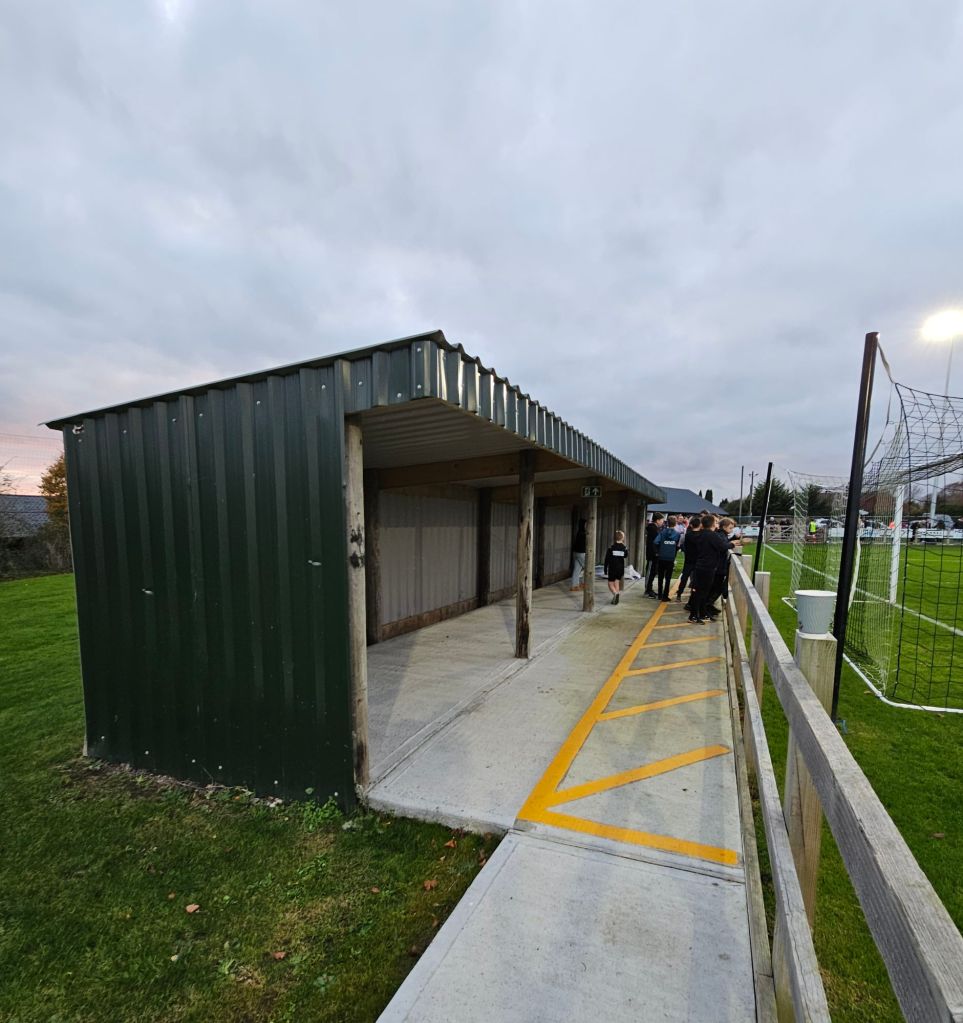
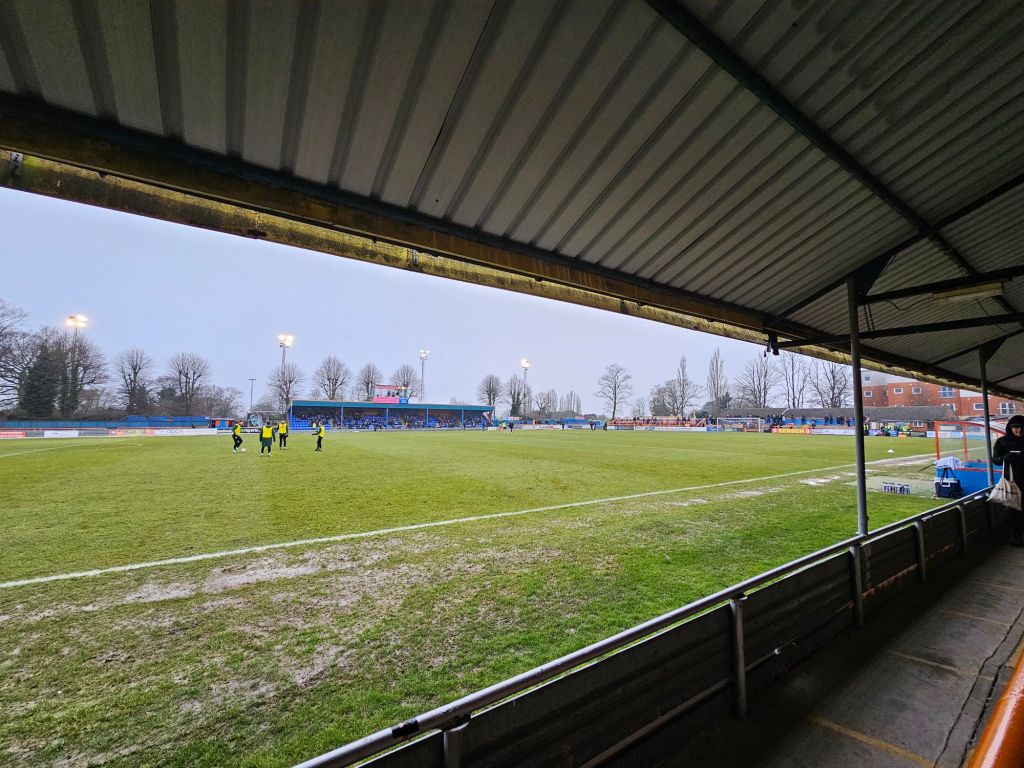
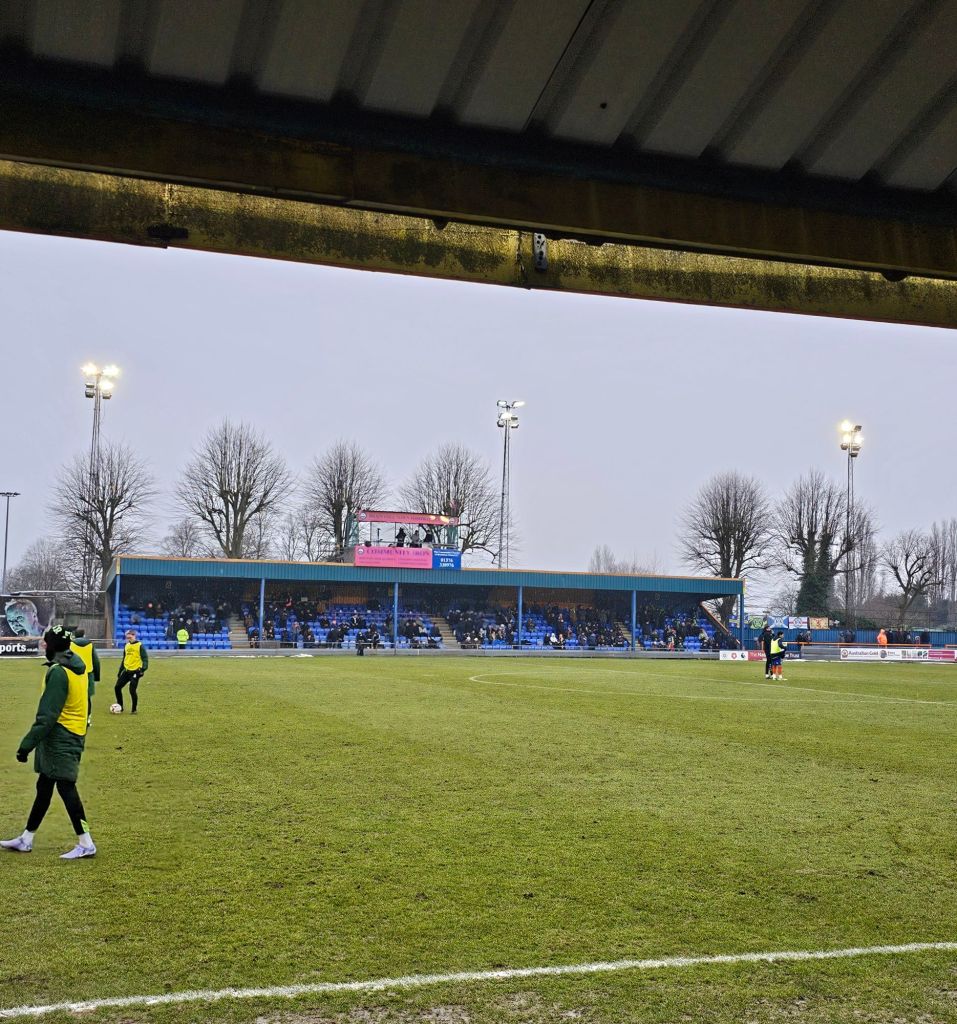
Despite its attractive name, Dairy Hill is just an uninspiring street of modest modern houses; from the top I make my way across the stony club car park and along the back of the club house to the ground entrance.  For a mere seven pounds I gain a programme (£1.00) and entry to the match as an over sixty-five, all that is missing is the click of a turnstile.  The ground itself is underwhelming, but it does boast a decent looking pitch with a smart timber fence all around and a small stand at the end nearest the clubhouse, which according to ground grading rules needs to be big enough to accommodate fifty spectators, although I’m not sure if FA rules say how large or small the spectators need to be.  The height of Halesworth’s stand suggests they should not be significantly taller than about 1.8 metres unless wearing crash helmets.
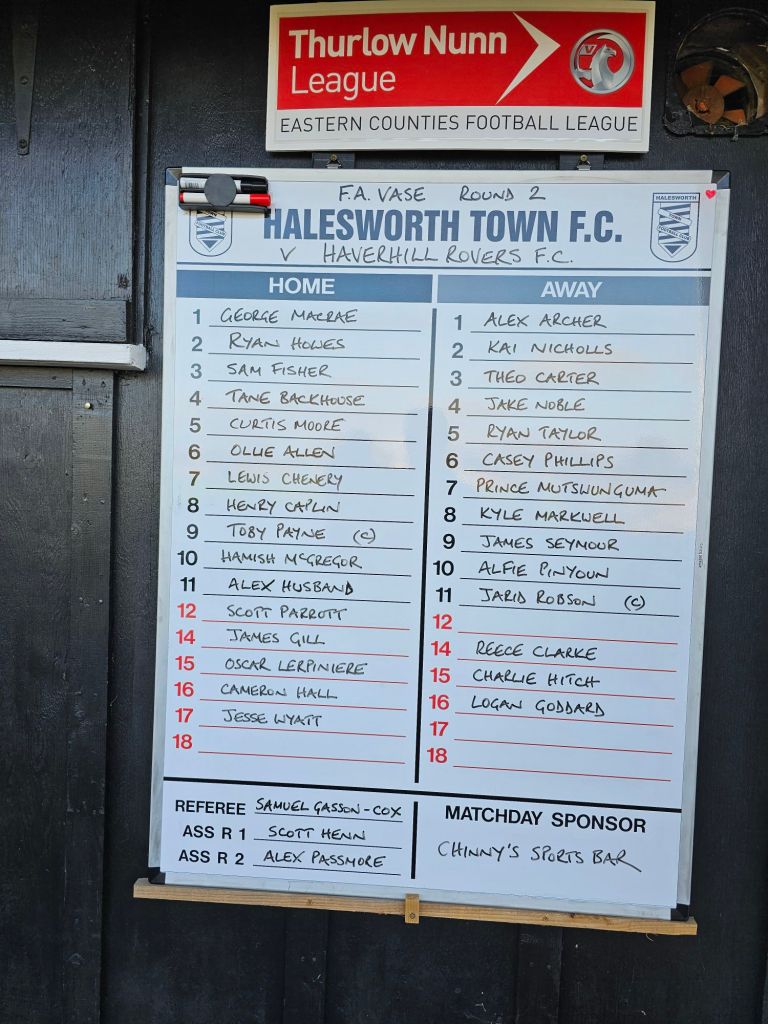
I head for the club house where the bar offers the usual array of fizzy lagers and cider and a pump which intriguingly bears the name ‘Wainwright’ written in biro on a plain white sticky label.  The barman generously allows me a sampler of the ‘Wainwright’ and seeing as there’s nothing-else I might like I order a pint (£4.60) before heading outside again to visit the food trailer, where a tall man with tattooed arms, who looks like men in food trailers often do serves me chilli, chips and cheese for a modest six pounds, less than half what I paid for much the same thing in an Ipswich pub earlier this week. 

I return to the club house to eat my chips and drink my beer, not being someone who likes to eat or drink standing up.  The club house looks like there might be an older timber building, which has had a new roof and supporting structure placed over the top of it, it smells a little like that too, having a faint musty odour which isn’t uncommon in old village halls and clubhouses.  The black and white interior décor and monochrome photos of old teams on the walls remind me a little of the Long Melford club house before it was re-built.

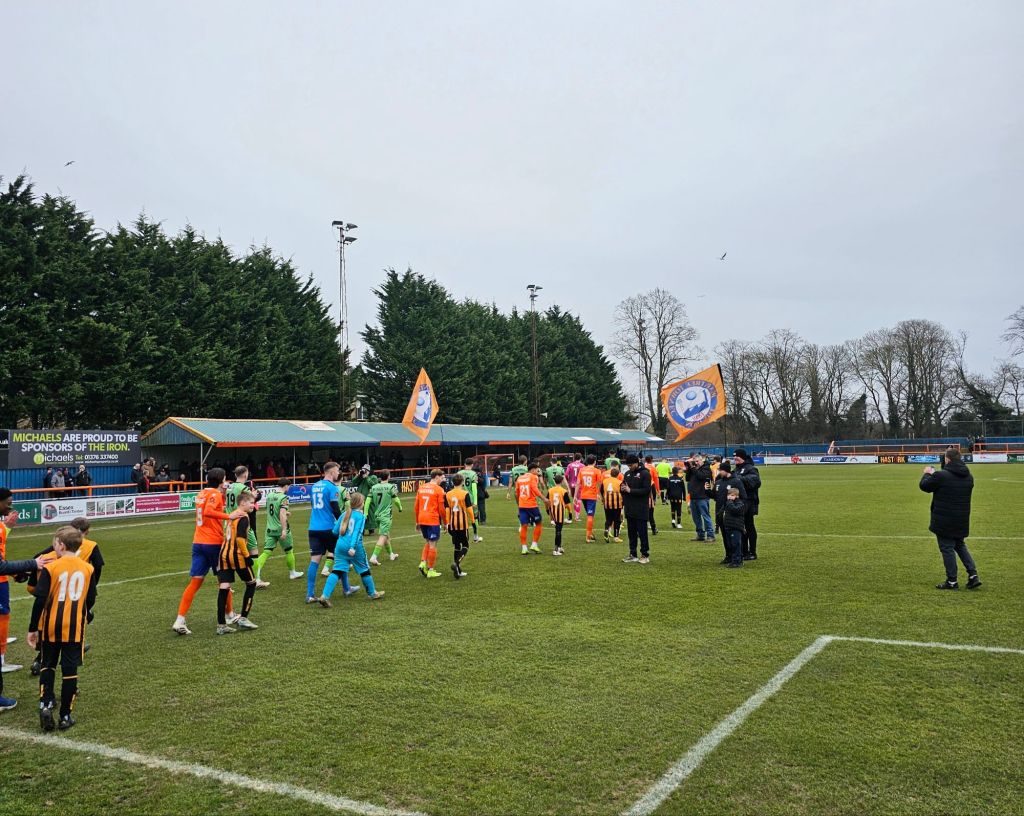
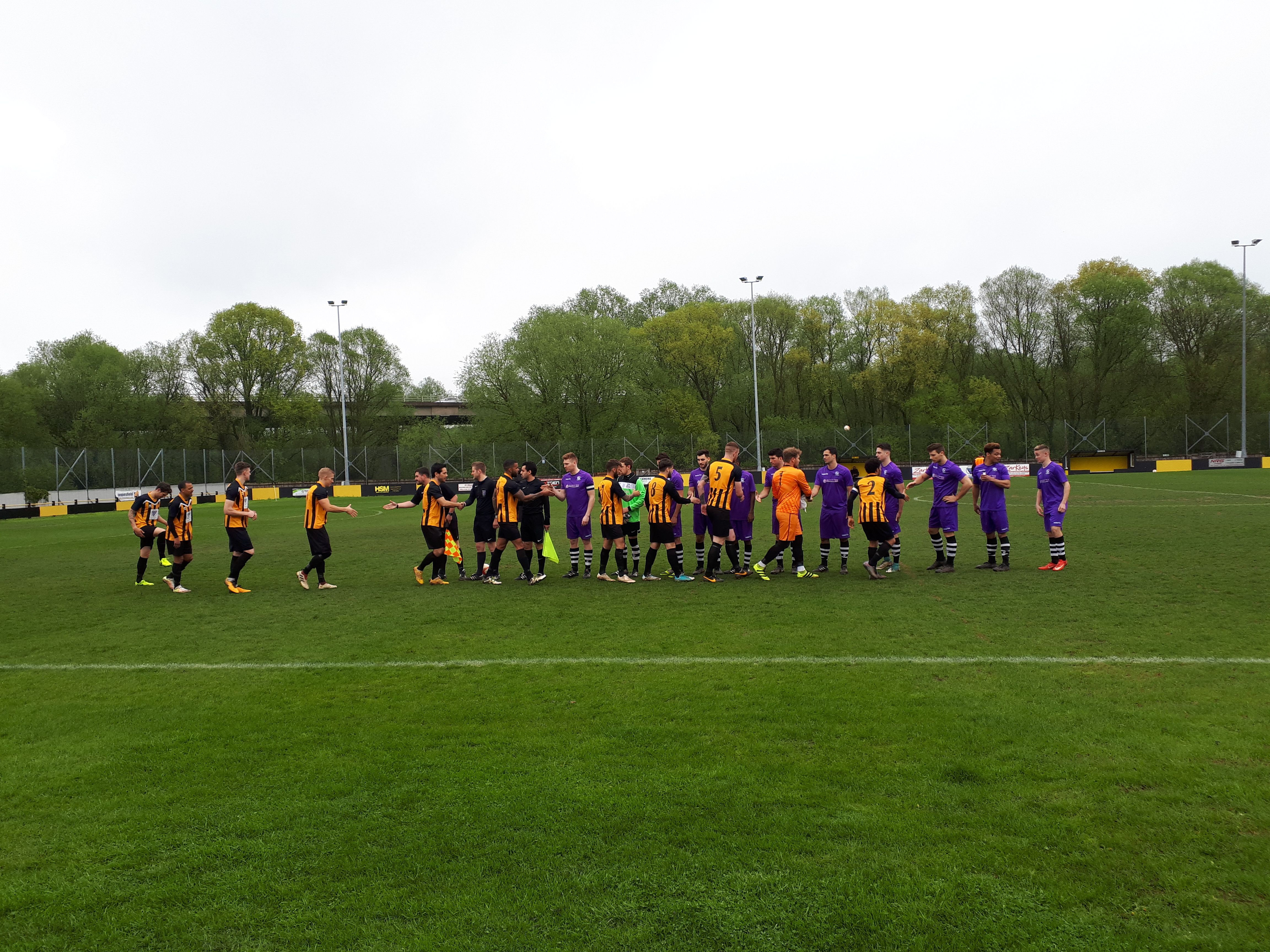
With chips eaten and beer drunk, I wait outside for kick-off, observing the growing crowd and the queue to get in at the gate, before standing closer to where the two teams will line up before the procession on to the pitch to shake hands and then observe the minute’s silence for remembrance day, a silence  which whilst well observed around the pitch plays out to a back ground of chatter from inside the bar and clubhouse, where life continues as usual, oblivious to the  silence outside.
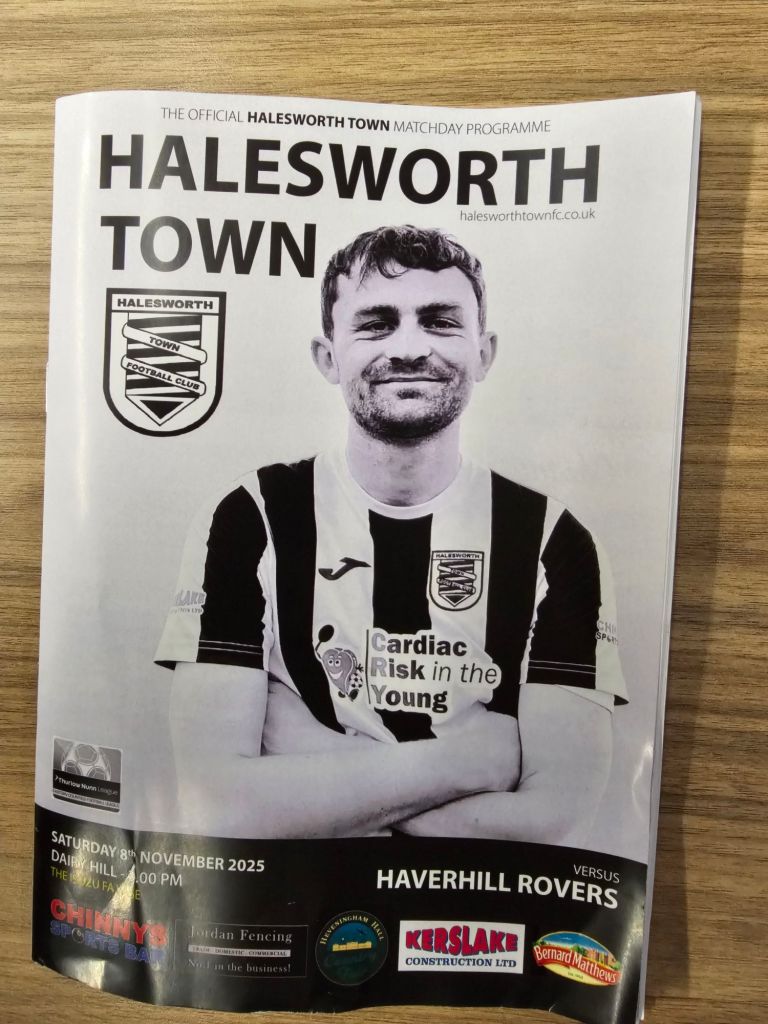
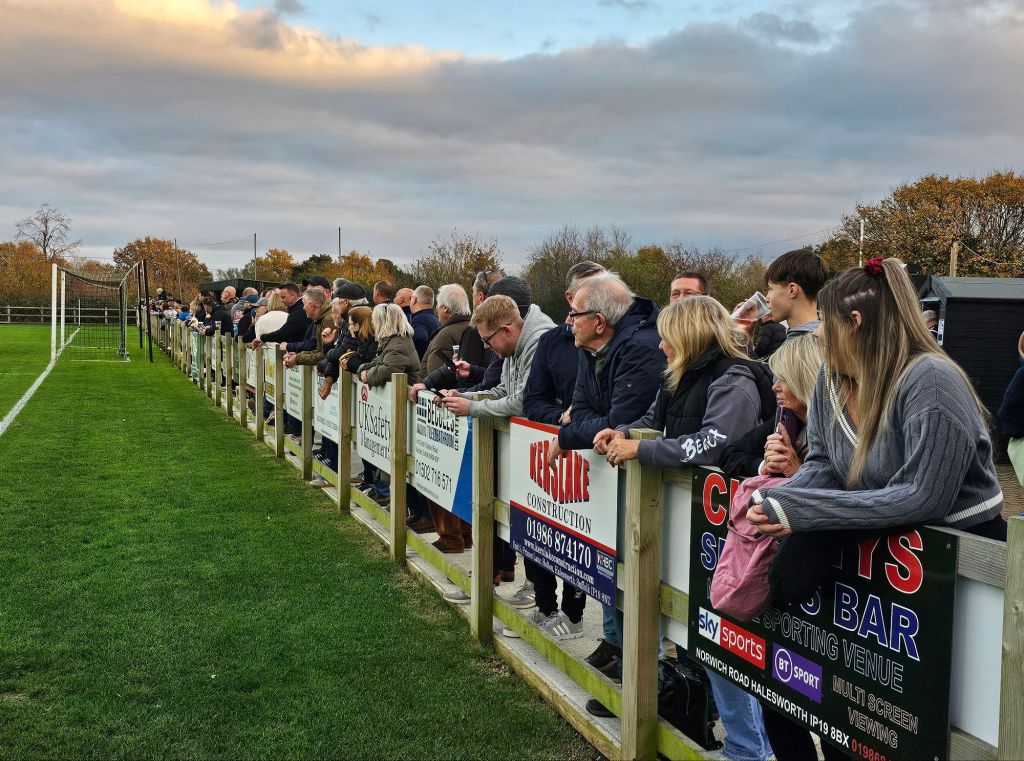
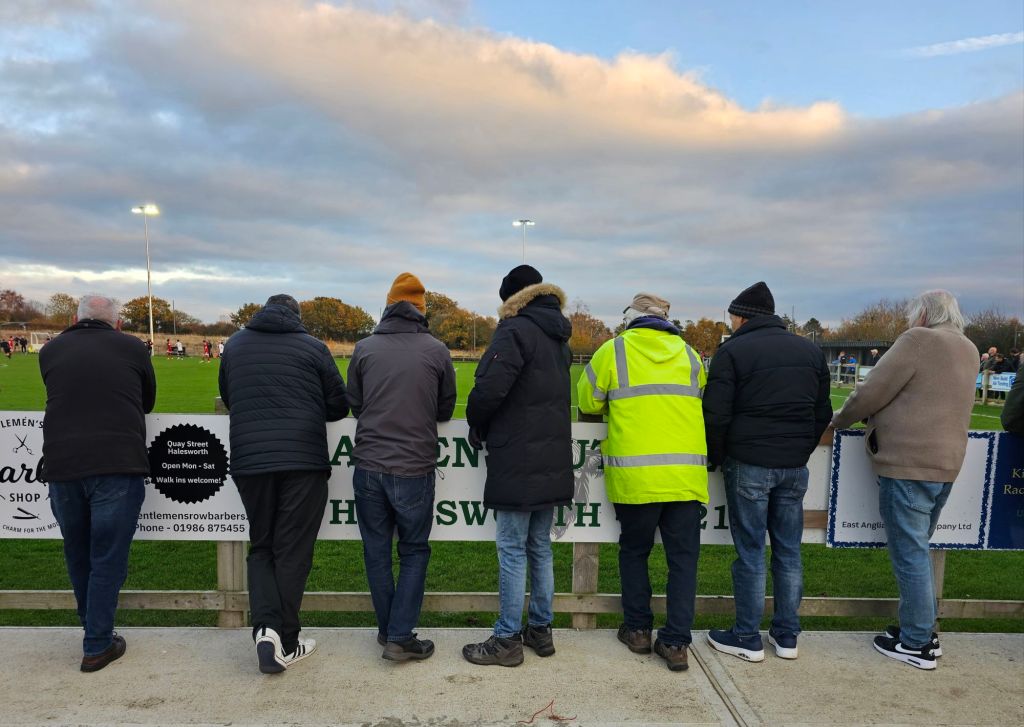
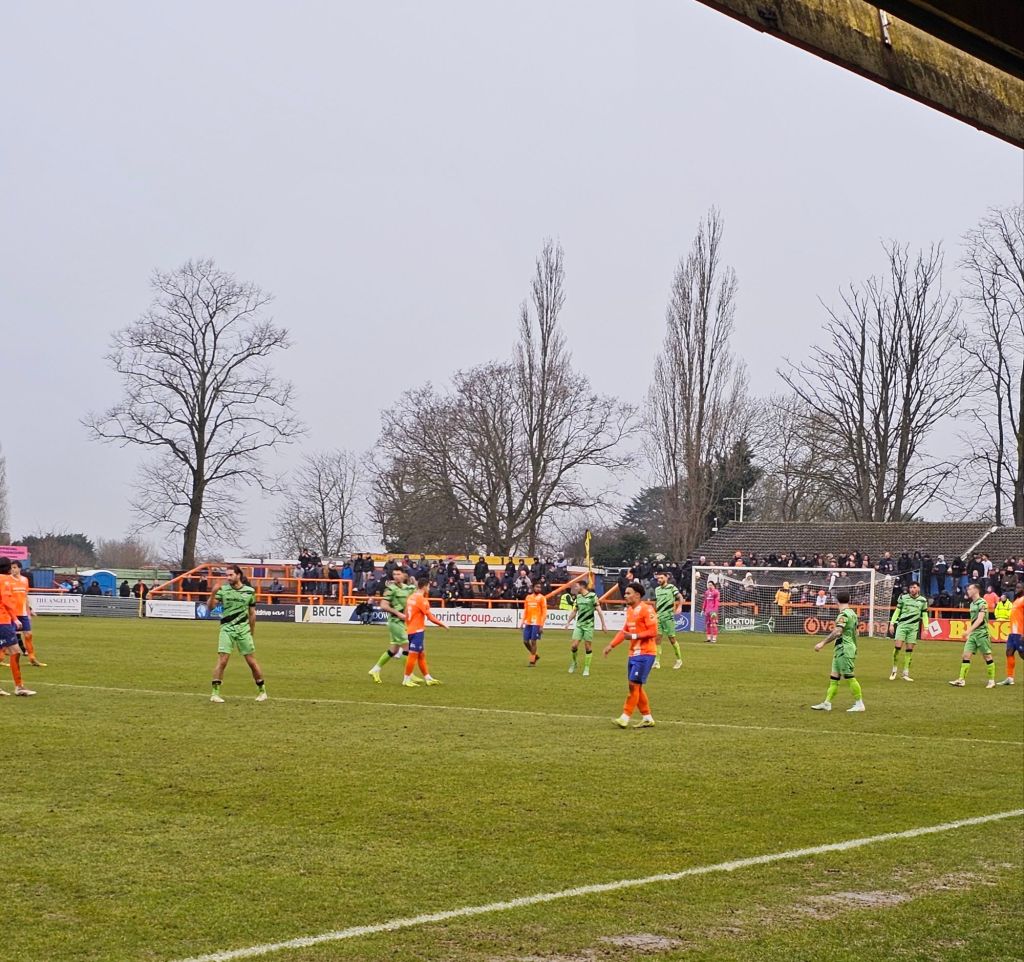
Eventually, it is Haverhill Rovers who begin the game, by getting first go with the ball, which they quickly hoof forward in the general direction of the stand, the railway station and town centre beyond, before it is booted into touch by a Halesworth defender, not unreasonably practicing safety first.  It’s good to see both teams wearing their signature kits, Rovers in a rich shade of all red, whilst Halesworth sport black and white stripes with black shorts. In front of the only stand, a youth bangs the sort of drum I wouldn’t bet against him having been given as a present for his sixth birthday, probably about six years ago.  The bulk of the crowd are lined up behind the post and rail fence along the touchline opposite the dug outs and when Halesworth win the ball they emit an encouraging rustic roar.

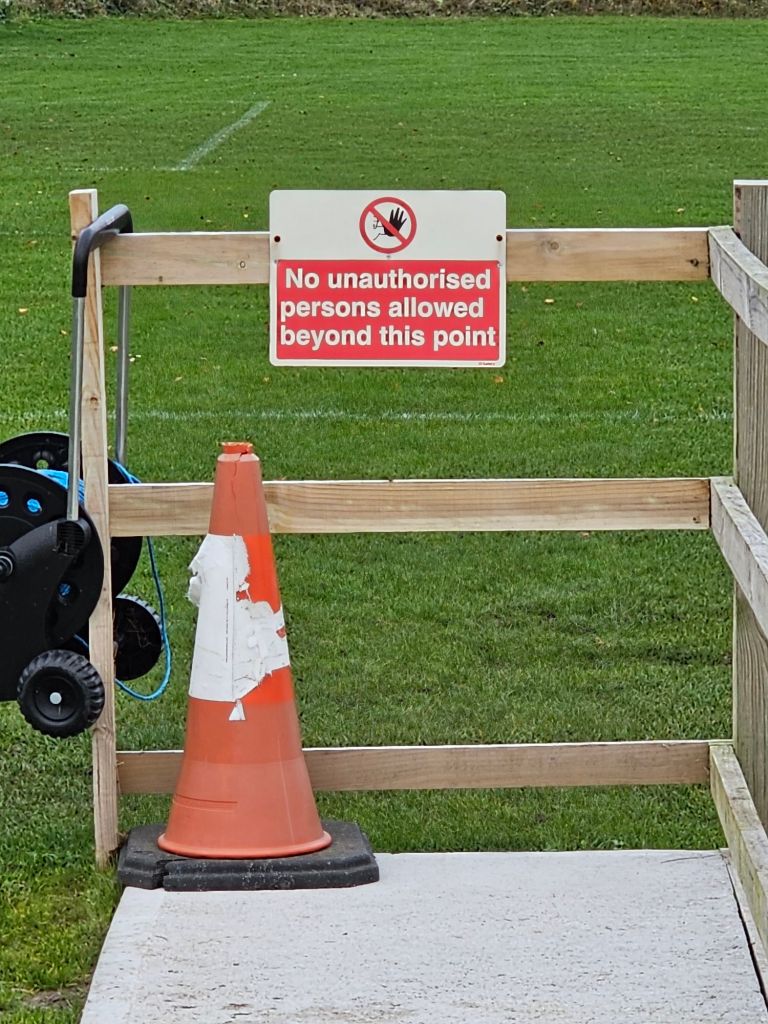
Seven minutes have passed and it’s Rovers who are the team kicking the ball most of the time; their number seven Prince Mutswunguma performs a neat turn and a decent cross which is headed over the Halesworth cross bar.  The pattern of the game is generally one where the long ball is favoured over short passes and two minutes later Mutswunguma blazes the ball high above the Halesworth cross bar.  I stroll along the front of the empty stand between it and the pre-pubescent ultras but remain nervous of hitting my head on the low roof.  I stop close to the corner flag, halted by a sign forbidding further progress and disappointingly preventing me from walking round to watch the game from behind or between the dugouts, where the angst and frequent bad language of the managers and coaches is often as entertaining as the match.   I am nevertheless now in a good position to see Rovers’ desperate claims for a penalty as Mutswunguma tumbles under a challenge from number 6, Ollie Allen and then two more players fall over. “Fucking disgraceful” opines a gruff voice from somewhere, either on the pitch or in the dugouts, but I’m not sure if he means not giving a penalty or having the temerity to appeal for one.

Keen to see the game from as many angles as possible I move again, this time to near the corner flag diagonally opposite the one I have been standing by.  I settle near a man in late middle age who sports a Stranglers t-shirt and beanie hat bearing the name of The Rezillos, the excellent late 1970’s Scottish ‘punk’ band fronted by Faye Fife and Eugene Reynolds.  He is on his mobile phone and seems to be arranging a claim on his motor insurance having hit something when parking his car in the club car park.  In my new position I also benefit from a good view of an increasing number of unsuccessful Halesworth breakaways as the home team gain in confidence from repelling all Rovers’ attempts to score.

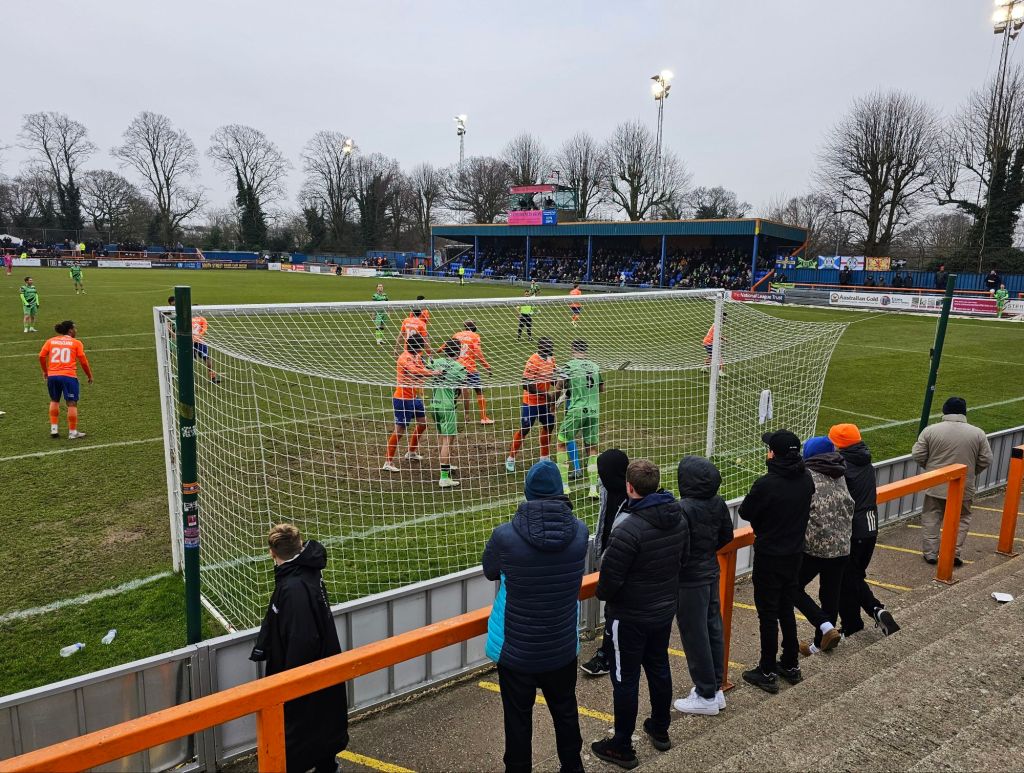
In goal for Halesworth, George Macrae has made a string of fine saves as Rovers win a succession of corners.  Rovers’ best effort is a shot from Kyle Markwell, whose surname gives a clue to the opposition as to how to treat him, that whistles past a post.  A half an hour is lost to history and Halesworth fashion another breakaway as captain Toby Payne receives a diagonal pass out on the left.  “He’s on!  He’s on! Well, he’s not off” shouts a young man to my left with rising excitement as Rovers’ offside trap is sprung. Payne advances into the penalty box, shapes up to shoot but then side foots weakly too close to the goalkeeper Alex Archer, who doesn’t have to stretch far to prevent a goal.  Two minutes later however Halesworth break again down the left and this time the ball is pulled back from the by-line for Lewis Chenery to score easily into the middle of the Rovers’ goal from no more than 8 metres out and it’s 1-0 to Halesworth Town.

The remaining dozen minutes of the half repeat the established pattern of the previous thirty-three, and another Rovers’ corner is headed wide, which I view from back near the clubhouse as I prepare to be ahead of the queues for the toilet and the tea bar when the referee, the extravagantly monikered Mr Gasson-Cox sounds the half-time whistle.  Having invested in a pound’s worth of tea I take-up a position for the second half just to the right of the stand, but not before I overhear a club official talking to the man on the gate and learn that the attendance today is a stonking two-hundred and fifty-eight.    As the new half begins and the light fades, the lovely smell of the turf rises up from the pitch. A woman standing next to me tells me we will see the goals at this end in the second half and I agree, telling her that with the goal being scored at the other end in the first half, it figures that this is the end where the goals will be scored this half.  We talk a little more and after I reveal I have an Ipswich Town season ticket, she admits to being a Norwich City supporter, but sympathetically I tell her someone has to be.
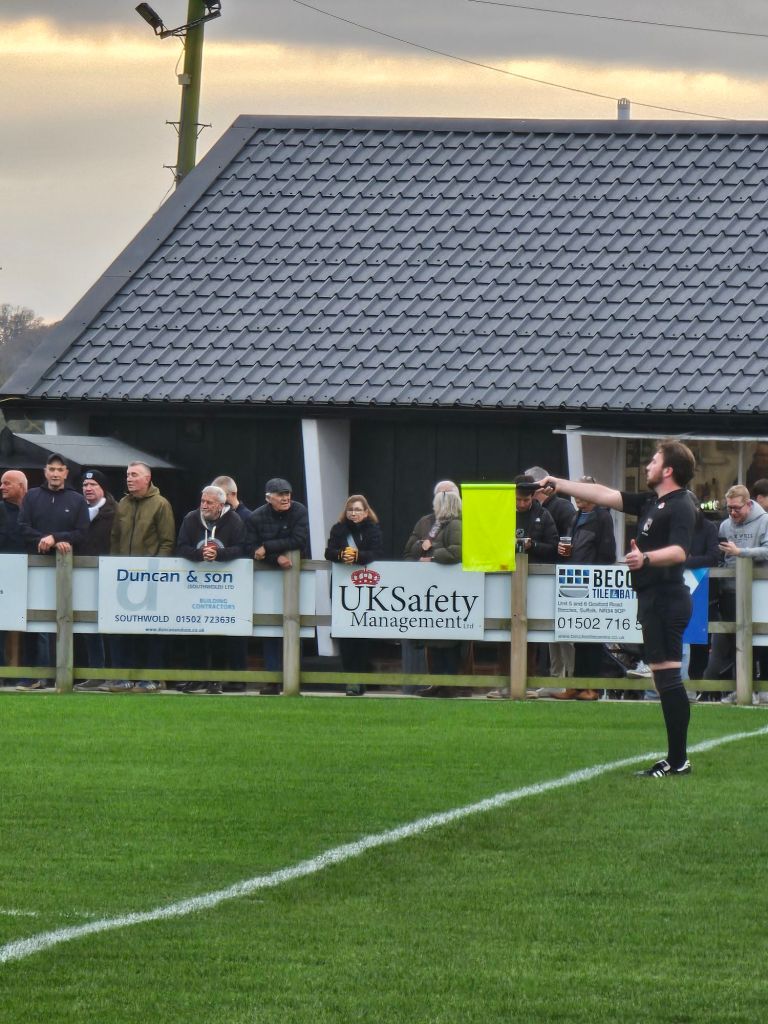
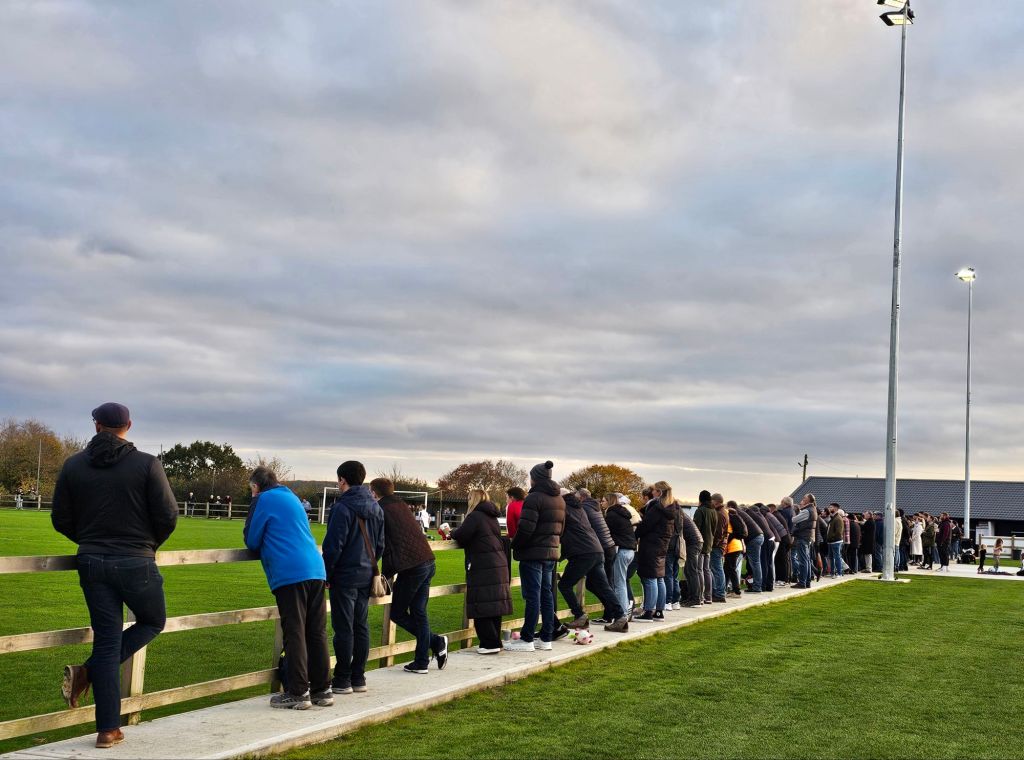
With the start of the second half at three minutes past four Halesworth seem to have lost a little of the confidence they showed by the end of the first half, perhaps because they realise they have to go through another forty-five minutes similar to the first, and indeed they do. But with twenty minutes gone and no further score it is Rovers who first feel the need to make substitutions.  “Who are ya?” chant the pre-pubescent ultras, as well they might as the new players emerge from the dugout.  Five minutes later and Halesworth’s Tane Backhouse is the first player to see the yellow one of Mr Gasson-Cox’s two cards, although as I become increasingly biased in favour of the home team and their superb goalkeeper, I can’t really figure out why.  Two minutes later and I’m cheering as another characteristic break down the right sees Toby Payne run to the edge of the Rovers penalty area, cut across a little towards the middle and then shoot unerringly inside the far post and Halesworth lead 2-0.  “Oh when the Town go marching in” sing the mini ultras, as do a number of people old enough to know better, but understandably carried away by the moment.

Things get no better for Rovers as after  an innocuous looking foul Mr Gasson-Cox nevertheless seems annoyed with Prince Mutswunguma and standing his ground, summons him over before showing him the yellow card.  “Wemberley, Wemberley” sing the Halesworth fans who should know better but are now too happy to care, but as they do so Rovers, perhaps realising their desperate position with only ten minutes left embark on a final push.   It’s twenty to five as George Macrae makes another fine save, this time diving low to his left. “Two-nil down on your big day out” sing the pre-pubescents, not helping the situation with their cruel taunts and Rovers win another corner.  The corner is cleared but moments later the ball is crossed low from the right and Rovers’ number eleven and captain Jarid Robson half volleys it high into the centre of the goal from a narrow angle and the score is a nerve-wracking 2-1.

It’s now eleven minutes to five, the match is a minute into added on time and Rovers are besieging the Halesworth goal like local Saxons or Danes outside the Norman police station.  A cross comes in from the left, and a Rovers head goes up diverting the ball goalwards but once again George Macrae appears, seemingly from nowhere to save the day again by cleanly catching the ball.  “Six more minutes Haverhill” I hear a voice call, perhaps from the Rovers’ dugout, or perhaps it was Mr Gasson-Cox or someone just mucking about. Six minutes seems an awfully long time given that neither I nor the lady next to me can recall anyone really being injured.  Another Rovers corner goes straight to the arms of Macrae but then Halesworth break away again, bearing down on goal on the right and then switching the ball across the edge of the penalty box before number eleven Alex Husband shoots from a narrow angle and the ball strikes a Rovers defender and arcs up over Archer the goalkeeper and into the goal off the far post.  It’s 3-1 to Halesworth! The game is surely won and the knot of Halesworth players hugging by the corner flag and the under12’s ultras who have run along behind us hoping to celebrate with them clearly think so.

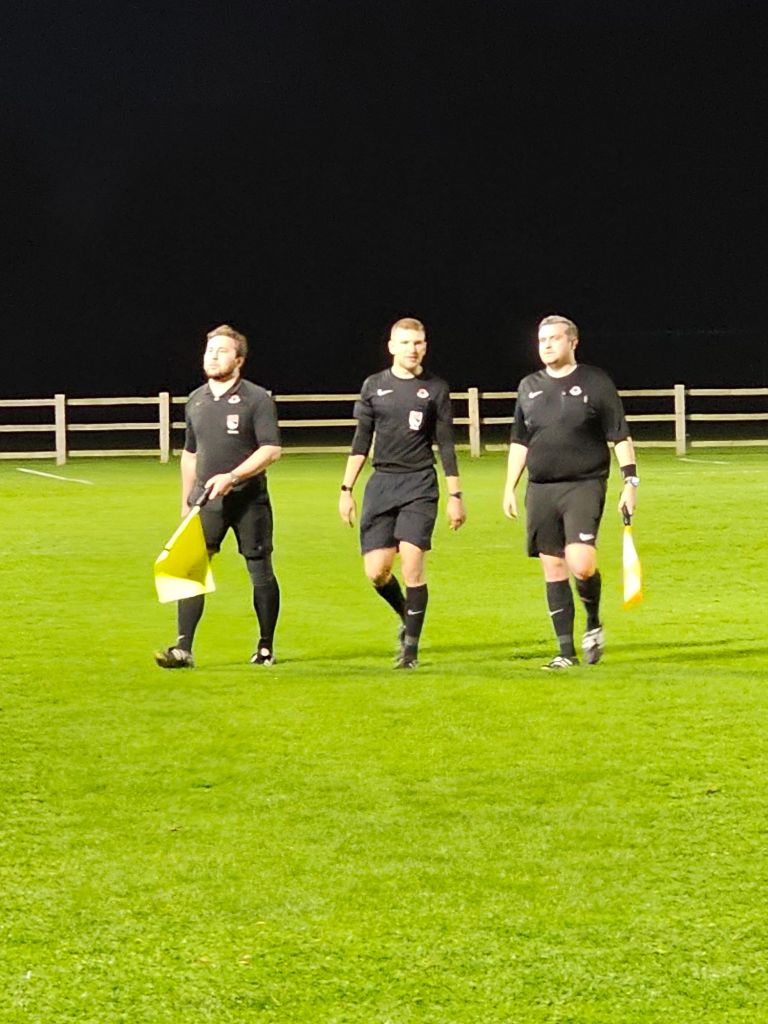
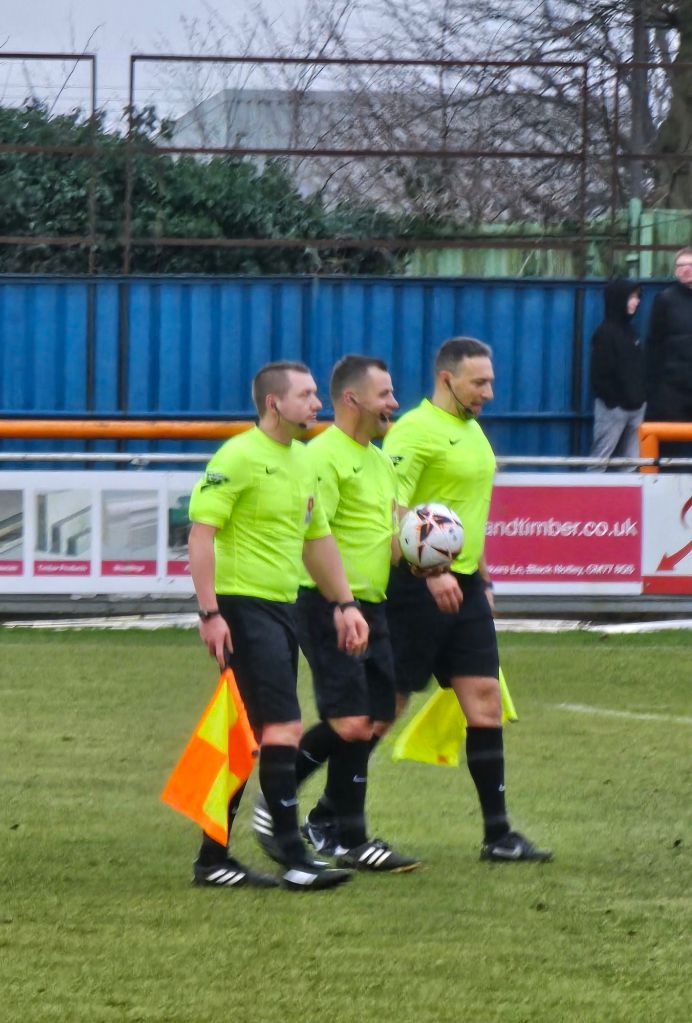
Very soon however, it’s three minutes to five and finally Mr Gasson-Cox parps his whistle for the last time today and Halesworth are into the third round of the FA Vase. Most people wait to cheer and applaud the team as they leave the pitch, but not before they applaud Mr Gasson-Cox the referee and his assistants, which is something you don’t see every day, and then the Haverhill players too.  It’s been a wonderful afternoon, an exciting cup-tie played in front of a large and appreciative crowd, and everyone’s had a lovely time.  As I leave the ground and make my way back across the stony car park and down Dairy Hill to the station I reflect on what a fine little town Halesworth is and how one day I really should return. All hail Halesworth!

Braintree Town 2 Forest Green Rovers 0

It is roughly seven years and three months ago that I last made the 14.5 kilometre journey from my house to Braintree to watch Braintree Town play.  That mild, blowy November evening in 2017 Braintree Town, or ‘The Irons’ as they are known to their friends, played out a one-all draw against Truro City and as on all the previous seven times I had been to see Braintree Town, I travelled by car.  Today, having dismissed the idea of driving the 27.9 kilometres to Long Melford in my planet saving Citroen e-C4 to see ‘The Villagers’, as they are known to their friends, play Soham Town Rangers, I am going to return to Braintree.  As a responsible adult however, I am keen to do things Donald Trump wouldn’t do, and to reduce the double scourge of traffic congestion and on-street parking I have therefore decided to take the X20 bus to Braintree, where most appropriately Braintree Town are to play probably England’s greenest football club, Forest Green Rovers, in the Vanarama National League.  What is more, Forest Green Rovers are also supported by the Grateful Dead. As it used say on the sides of buses back in the 1960’s, “It’s better by bus”.

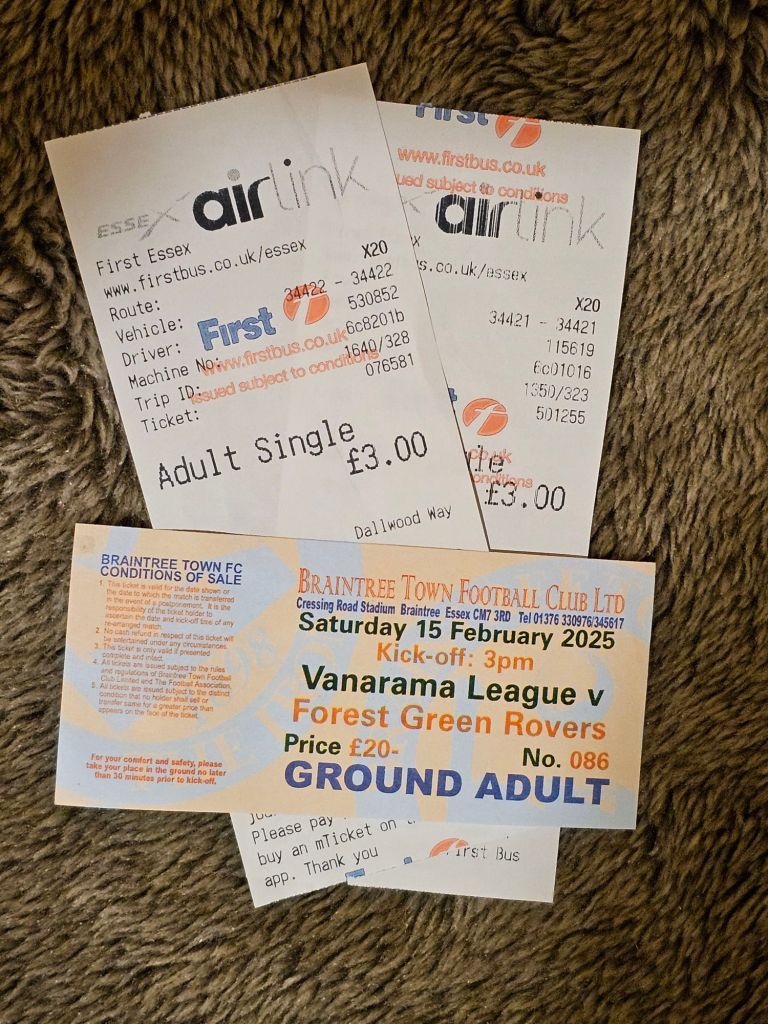
The X20 bus stop is only 200 metres from my front door and although the bus is about five minutes late, I am soon passing two one pound coins and two fifty pence pieces through the gap beneath the Perspex screen that separates me from the cheerful, bearded bus driver, who, although not old enough, looks a bit like he might once have been, or should have been in the Incredible String Band.  Fortunately, the bus is a double-decker so I can safely sit upstairs; the leather high-backed seats are comfortable, the bus is warm, and the windows aren’t steamed up, so I look out on the gloriously grey Essex countryside as it alternately sweeps and judders by as the bus passes along the pot-holed roads.  Behind me, younger, more self-centred people than myself either noisily watch ‘content’ or hold loud, vacuous conversations on their mobile phones.  When I was young, old people would often sit next to me on buses and want to talk.

The timetable that I looked at on-line when planning my journey indicated that it would take twenty-three minutes, and the big blue bus is soon arriving on the outskirts of Braintree, something that is announced with its cathedral, a Tesco supermarket.  From Tesco’s, Braintree unfolds as lines of dull looking houses of decreasing size. I am due to get off at the stop identified as “Braintree o/s King’s Head” and recognising the approach to the junction with Cressing Road where the King’s Head is situated and seeing a bus stop flag, I press the bell, but too soon and the bus draws up at a stop called “Dallwood Way”.  Whilst stupidly unable not to think of Virginia Woolf, I nevertheless manage to say to the bus driver “Oh, I wanted the next stop . “He offers to drive on, because obviously he’s going to anyway, but I tell him it (Cressing Road) is only round the corner, and as things work out the bus is held by a red light at the junction and I get round the corner in to Cressing Road before I would have done if I’d got off at my intended stop.  Across Cressing Road I can see that what was once the King’s Head pub is now a Tesco ‘local’.

It has started to rain, and weighed down with the responsibility of not wasting the valuable seconds I have gained by getting off the bus early, I step out on the ten-minute walk up Cressing Road and along Clockhouse Way to what was called the Ironmongery Direct stadium the last time I was here, but now rejoices under the name of The Rare Breed Meat Co Stadium.  Being the world’s first vegan football club, I’m surprised Forest Green Rovers haven’t refused to play here, and there are so few people walking up Clockhouse Way with me I do begin to wonder if the game hasn’t been postponed.  But the sight of a man in a day-glo coat, a full club car park, a man in an orange football club hat and three other people obviously dressed for an afternoon of spectating allays my fears and I head for the turnstile labelled “card only” where the wonder of modern technology takes £20 from my bank account with the mere tap of a piece of plastic.  Satisfyingly, I am given a small, printed ticket in exchange, it’s number 86.

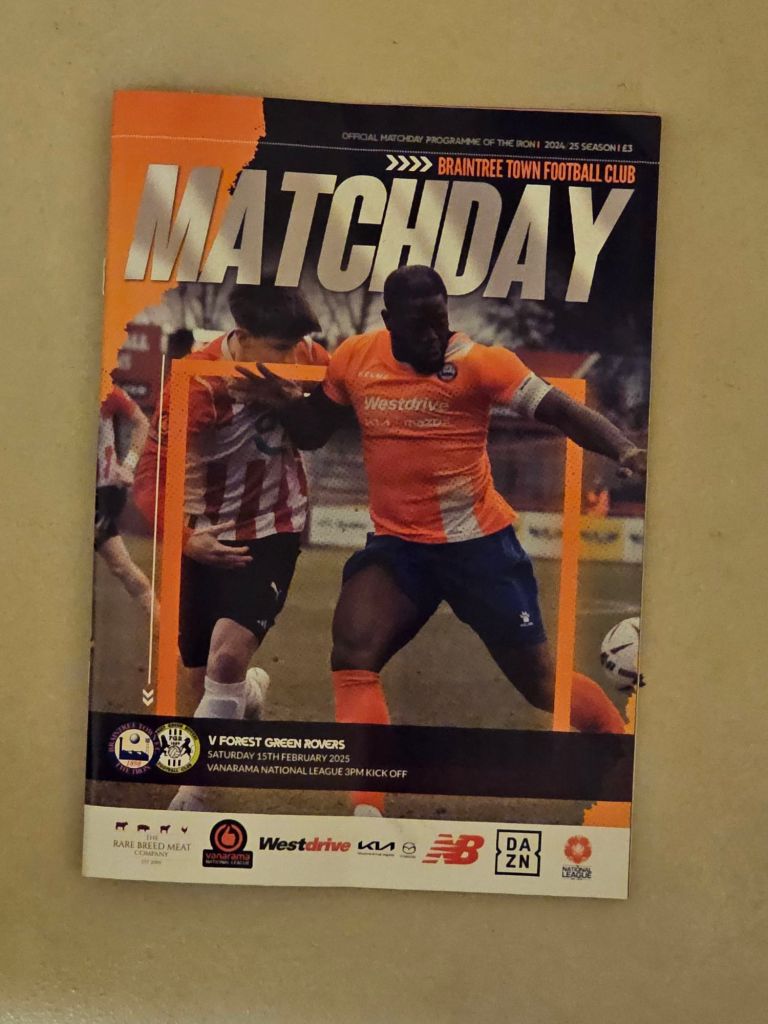
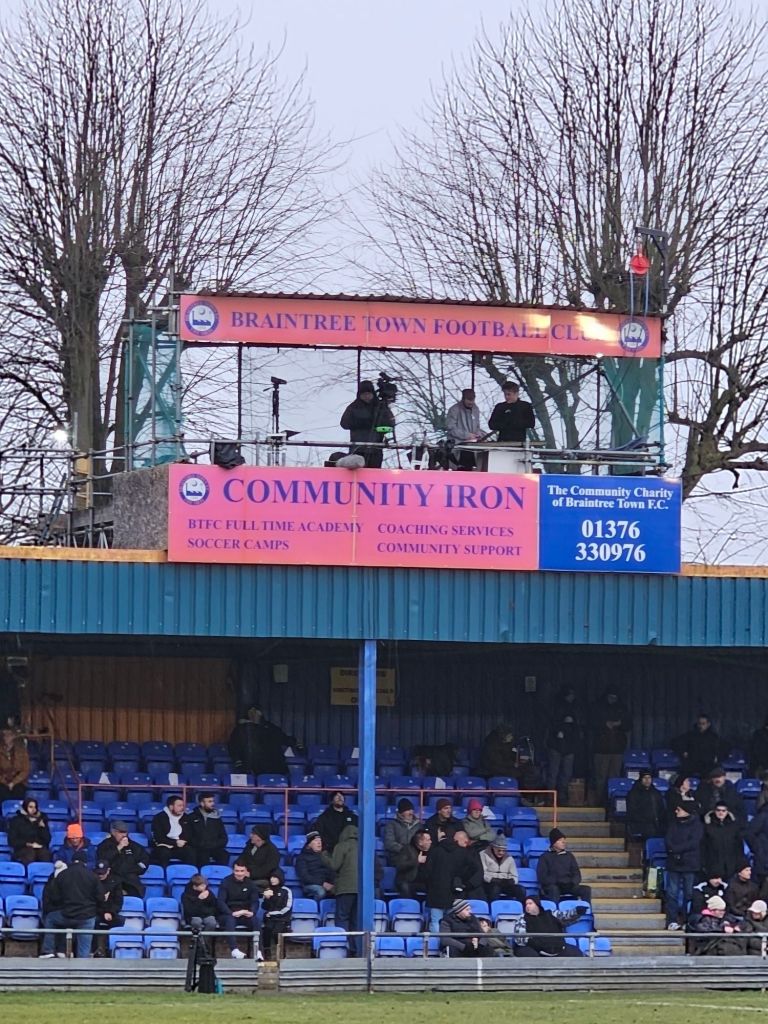
To buy a programme (£3.00) I make for the club shop, a cornucopia of old programmes, club badges and general football fan bric-a-brac in a portacabin; every club should have one, but fewer and fewer do. A radio in the club shop is tuned to Radio Essex and a time check tells me that it is six minutes to three, so I head out and onto the open terrace behind the goal to select a spot against the back wall, level with the eaves of the club house just behind.

The teams process onto the pitch to the strains of “Firestarter” by ‘electronic punk’ or ‘rave’ band The Prodigy,  who are or were Braintree’s modern claim to fame. There is a minute’s silence before the kick-off for a recently deceased former player.  It’s a silence that is at first disturbed by shouts of ‘Rovers’ from somewhere off to my right.  Once achieved, the silence seems a long one as if the referee in schoolteacher mode had decided that we were just going to have to wait to begin until everyone was quiet.

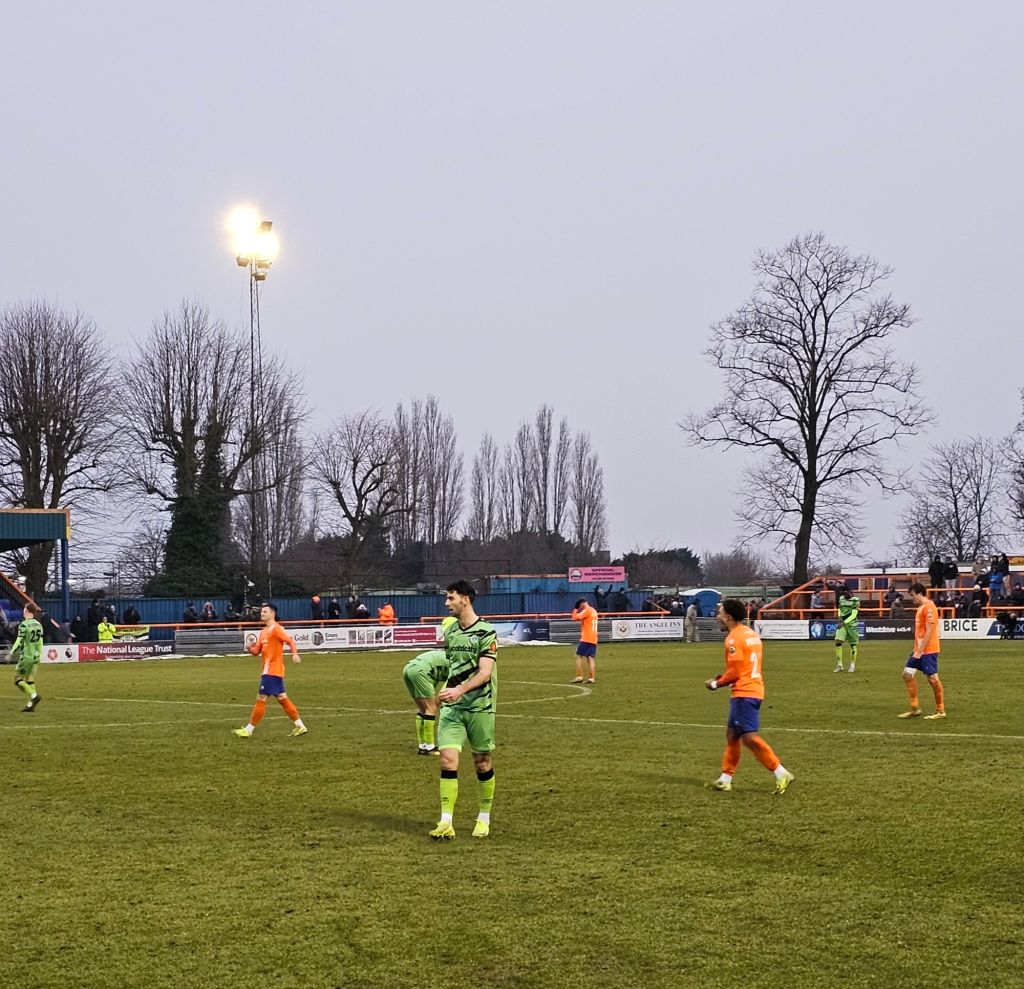
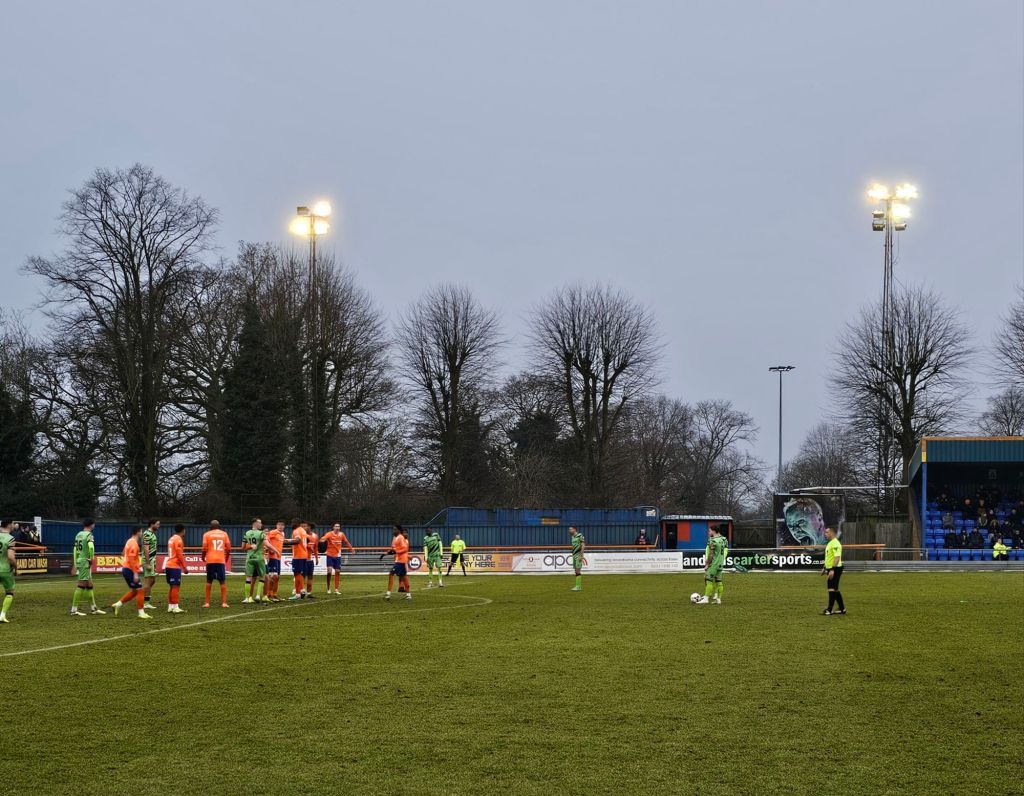
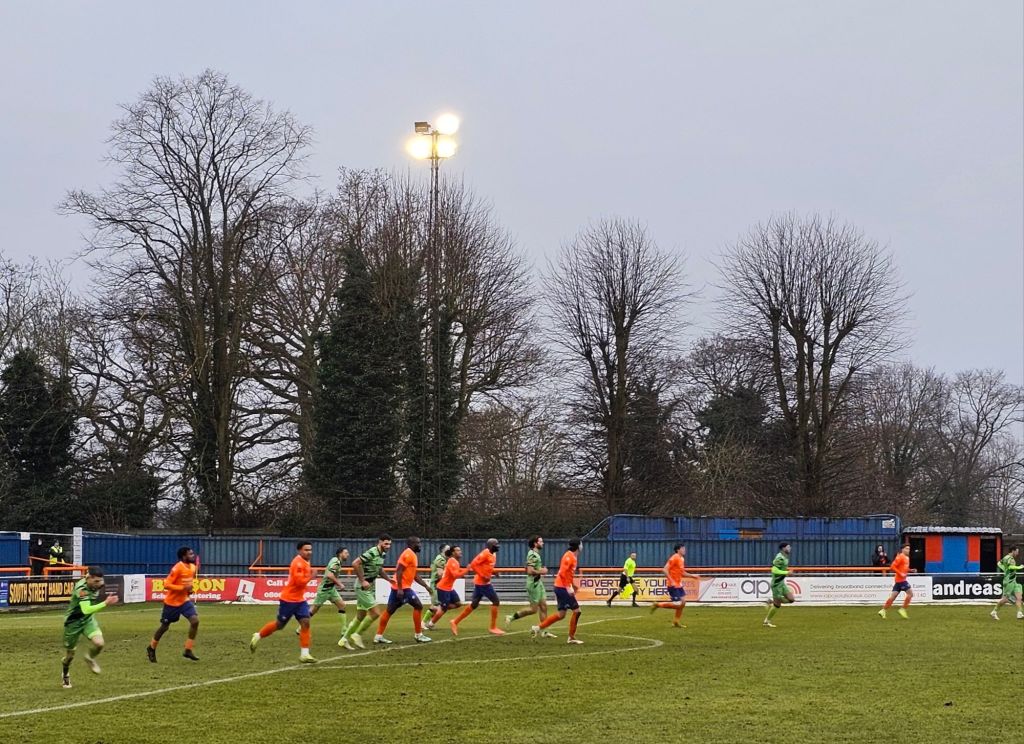
When the match eventually begins, it is Braintree who get first go with the ball, sending it mostly away from where I am standing, and in a south easterly direction towards the village of Tye Green and far off Witham, where this afternoon Witham Town are going to lose heavily to Bury Town in the Isthmian League.  Braintree wear a gloriously colourful kit of orange shirts and blue shorts, a brighter version of Montpellier HSC of French Ligue 1.  Forest Green Rovers by contrast are in a disappointingly dull, faded looking shade of all-over green, but with black slashes on the front of their shirts as if they had originally been intended for use by a safari park eleven.

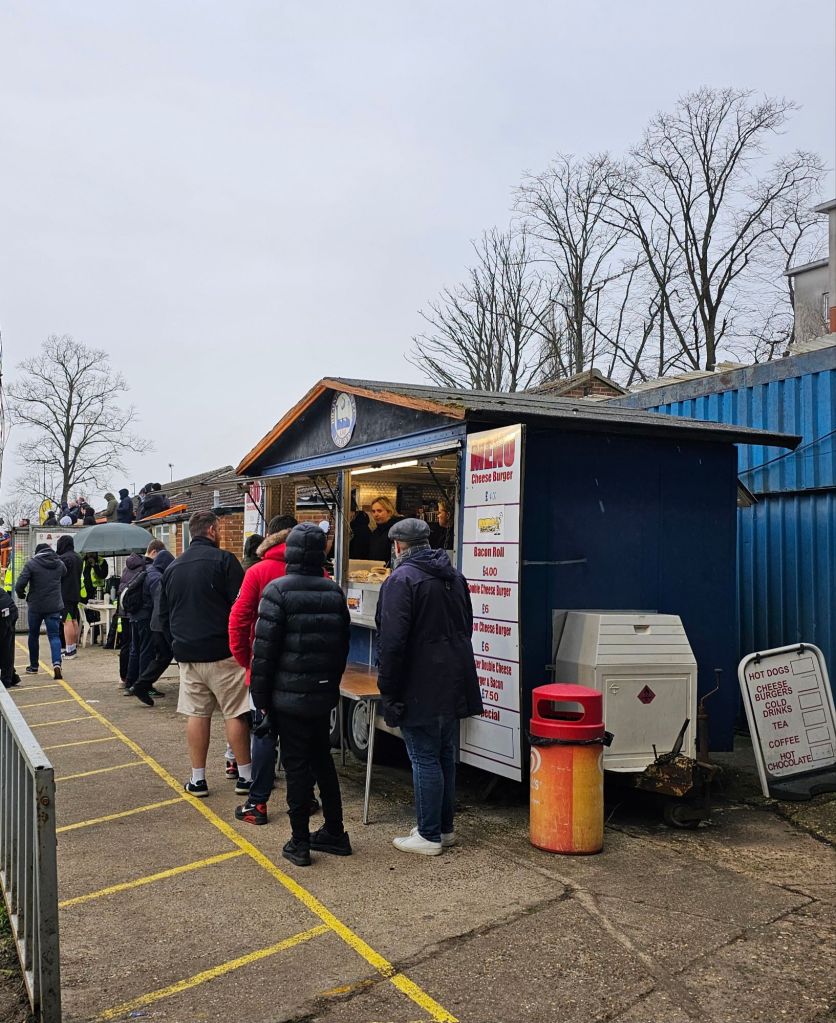
Braintree dominate the start of the game and all the action is at the far end where it looks compressed into a few yards.  A few feet along from me a middle-aged man twitches and flexes as he wills Braintree to score with a quiet commentary of encouragement to himself. “Oooooh” he suddenly exclaims as an early cross eludes the straining head of an orange shirted player at the far post.  The rain has started to feel like sleet.  Along the walkway at the foot of the terrace, a procession of hungry-looking ten and eleven-year-olds ferry polystyrene trays stacked with chips and burgers, which may or may not be from the meat of slaughtered rare breeds.  “Your support is fucking shit” comes the chant from beneath the low roof of the terrace on the east side of the ground.  “Come on” continues the bloke a few feet away from me, quietly to himself as Braintree win another early corner.

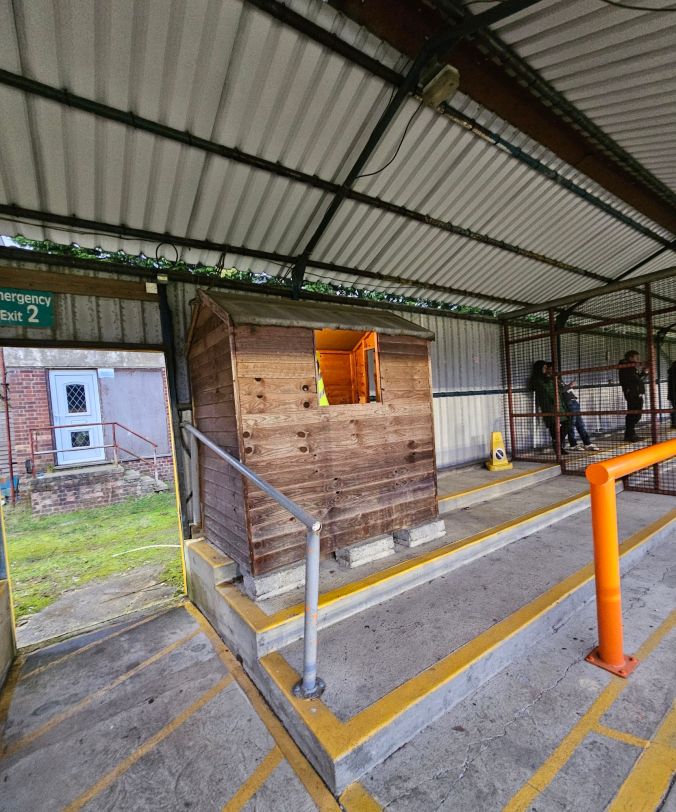
It is eleven minutes past three and Braintree score. A low shot from wide on the left into the far side of the Forest Green goal. “Goal scorer for…” says the stadium announcer from his garden shed inside the low-roofed terrace.  He stops mid announcement but then continues to tell us that the goal scorer is what sounds to me like “Cairo Lisbie”.  “Goal scorer today” he repeats as if he thinks it’s unlikely anyone else will score, “Cairo Lisbie”.  In fact, of course, he is saying Kyrell Lisbie.

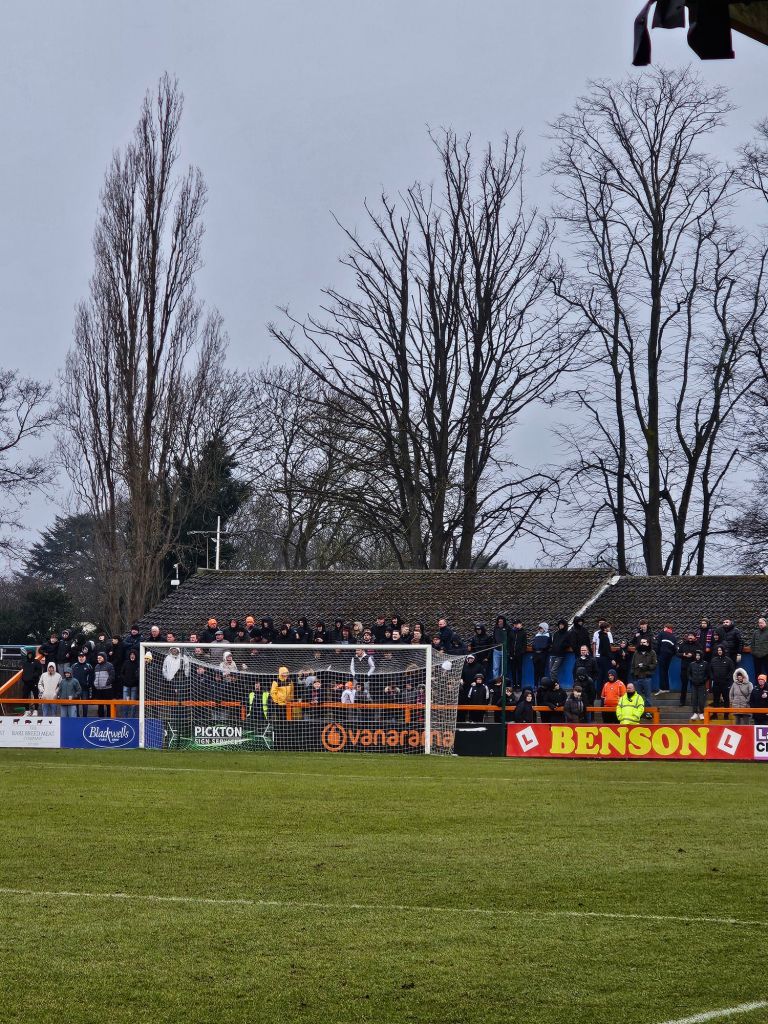
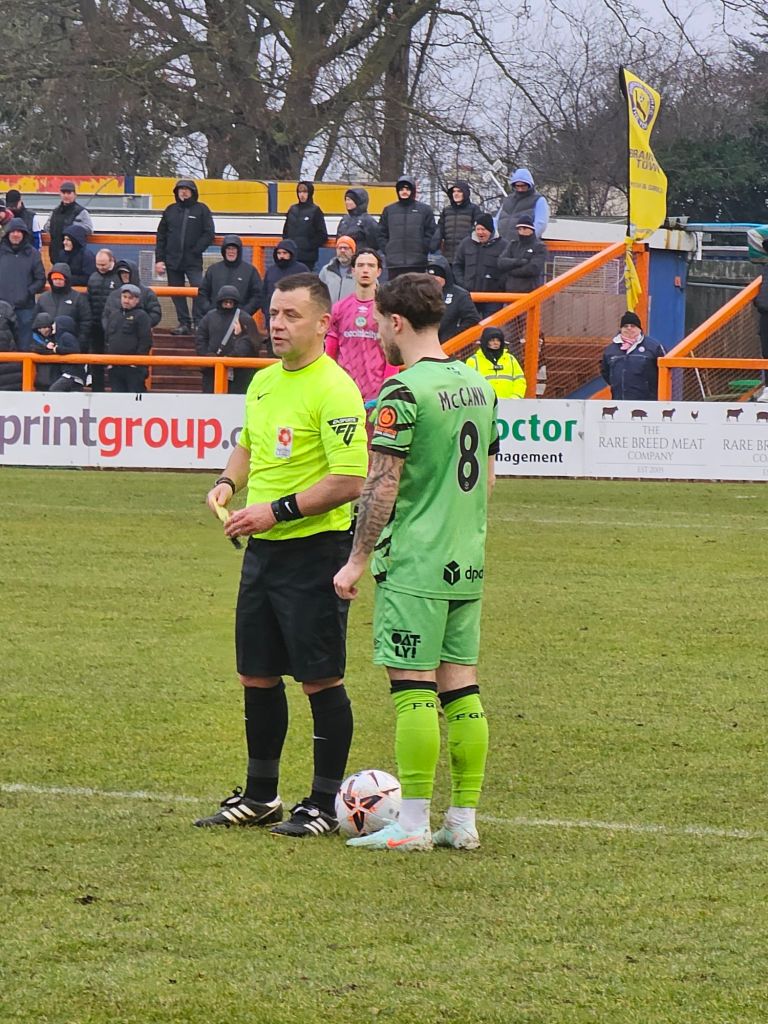
“No noise from the Vegan boys” is the chant from beneath the low roof of the side terrace, as if to rub it in that we’re in the “Rare Breeds Meat Co stadium”, and I decide that the drizzle is now too cold and heavy and so I make for the covered terrace beneath the low roof.  “When’s the Southend game?” I hear a bloke say as I walk by.  “I’ve got a feeling it’s next month” says his interlocutor evidently preferring to rely on sensations rather than the actual fixture list, which confirms that the fixture is on April 18th.  In my new location on the covered terrace with the low roof I have a new set of neighbours. “Yellow there ref, yellow, that is a yellow, thank you” says a bloke nearby as Forest Green’s Adam May becomes the first player to be booked by referee Gareth Rhodes, whose name is similar to that of a once popular, but now deceased tv chef.

A high cross field ball from a Forest Green player is greeted with a derisory jeer from the home crowd and then a collective, disappointed ‘Oh’ as it drops perfectly onto the bounce-free turf at the feet of Rovers’ wide player.  Around me the locals continue to take umbrage at Mr Rhodes’ failure to book any more Rovers players.  “Should of (sic) got booked earlier” shouts someone, “How many more times?” enquires someone else, before shouting it again, and then again, making me wonder how many more times he would shout it. “Cynical!” calls a short bespectacled youth next to me, and then “I’m watching you ten”, as if this matters.

At twenty-seven minutes to three Braintree score a second goal; one very much like the first, but this time with a shot from wide on the right into the far corner of the goal by number seven, Tom Blackwell.  After three minutes of added on time, half-time arrives and the public address system returns us to 1979 with the sound of ‘A message to you Rudy’ by the Specials. I eat a Polish Grzeski chocolate-coated wafer bar from the Sainsbury’s World Foods aisle and reflect on all the other delicious European foodstuffs that could have been so much more freely available had Britain not left the European Union.

Today’s attendance is announced as being 860 and the football resumes at five past four.  I walk to the far end of the low-roofed terrace where I find myself amongst mostly Forest Green Rovers supporters, and I feel happier amongst the sounds of their west country burr than amongst the aggressive rants and growls of the voices of the displaced Londoners who now live in Essex.

Rovers begin the half with purpose, and in the first few minutes spend as much time in the Braintree penalty area as they did in the whole of the first half.   But then Braintree breakaway and hit the post or the bar with a shot. “Come on Rovers” call the people around me from beneath their green and black knitted headwear.   “We’re winning” says a young bloke nearby and it seems from subsequent mention of Liam Delap that he and his friends are either Ipswich Town supporters watching Forest Green, or Forest Green supporters who follow Ipswich.

I’m seeing Forest Green at closer quarters this half and soon establish that their team is ‘set up’ in the traditional formation of a couple of big blokes at the back, a big bloke up front with smaller blokes all around, especially on the wings.  Braintree would seem to be similar and with a blend of youth and experience which includes the venerable thirty-five year olds John Akinde, a man in the mould of the legendary Adie Akinbiyi, but obviously not as big,  and defender Jamal Fyfield.  Despite more possession this half, Forest Green are not making any decent chances.  “Shoot” plead the people around me. “Bring on a fuckin’ strikerr” says another, more directly and rolling his ‘r’s like a comedy pirate in the process.  It’s nearly twenty to five when Forest Green have a shot good enough to force the Braintree goalkeeper into making a save and by then they have replaced half their outfield with substitutes, including one Harvey Bunker, who I like to think has a brother called Cole.

The second half is one of frustration for away supporters and tension for home fans, only occasionally relieved by a wet, slippery, muddy pitch which induces a sprinkling of pratfalls and mis-kicks for added comedic effect.  Eventually, after the initial ninety minutes are played out, Mr Rhodes adds another six for good measure and halfway through these the Braintree fans feel sufficiently confident of victory to begin chanting “We are staying up”.  Their optimism is well placed as not surprisingly, given what has happened since three o’clock, Forest Green fail to produce a miraculous come-back .

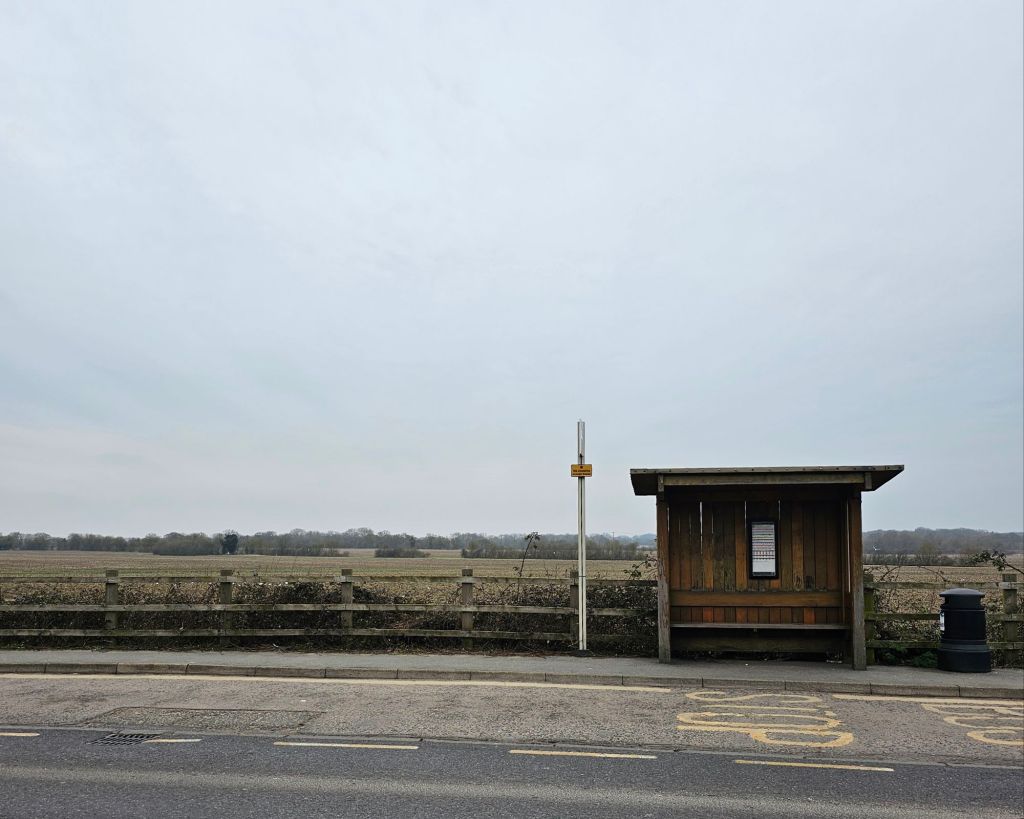
With the final whistle, a mostly happy crowd slips away into the receding dusky light whilst a few Forest Green fans hang about to berate their players by way of encouraging better in the future.  I too drift away, past the interesting 1930’s modernist workers houses beyond the club car park and back down Clockhouse Way and Cressing Road to the bus stop.  The bus will be late again, the stop has no shelter and it starts to rain again, but as the win to the local team proves, it’s better by bus.

Ipswich Town 3 Bristol Rovers 0

It’s the first Saturday in September and the weather has broken, although to be truthful it’s been looking a bit cracked for a while now.  Autumn approaches.  It rained overnight and whilst there are glimpses of sunshine it is straining to penetrate through the clouds and worst of all it feels cold.   But on the bright side, today sees the start of the football season and mighty Ipswich Town, the vessel in which the hopes and dreams of a good many of the people of Suffolk are invested will be playing Bristol Rovers in what I refer to as the League Cup, but the football club, media and those who don’t know any better call the Carabao Cup.  I didn’t used to know what Carabao was, I erroneously thought it was a wrongly spelt American name for a reindeer, but because of the League Cup, and thanks to Wikipedia,  I now know that it is a domestic water buffalo from the Philippines and also a drink; not a proper drink mind, like Adnams Broadside, tea, Noilly Prat, milk, red wine, Fuller’s 1845, espresso coffee, Crémant, pineapple juice, Champagne, lime cordial, Belgian Trappist beer , hot chocolate or malt whisky but something called an ‘energy drink’.   The sponsorship of football competitions is a curious thing and only adds to the feelings I have that I live as an outsider on the fringes of society, with the Milk Marketing Board being the only sponsor whose product I can honestly admit to ever having set out to purchase.

Kick-off is at three o’clock, but of course due to the Covid-19 pandemic it is not safe for a large crowd to gather and therefore no one is going to Portman Road today. Sadly, I shall be denied the joys of travelling on the trains of Greater Anglia, the pre-match pints, the quickening anticipation-filled walk down Portman Road and the click of the turnstile.  Today I will not hear the moans of the home supporters nor the witless abuse of the away supporters; I will not receive the suspicious glances of luminous stewards nor feel the soft artificial fur of Bluey and Crazee as they brush past me with their out-sized heads and weird hoof-hands; I will not become engrossed in conversation nor share see-sawing emotions with Mick, ever-present Phil who never misses a game, the old dears, Ray and his grandson Harrison, or Pat from Clacton with her bag of sweets and lucky charm, the masturbating monkey.

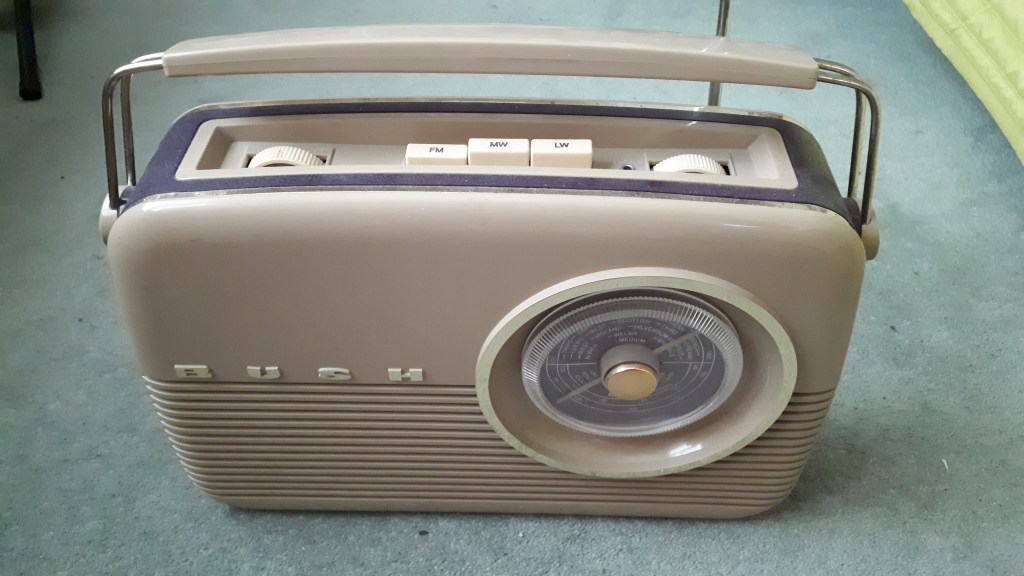
Not thinking of what I am missing, I enjoy a light lunch of home-made spicy carrot soup with my wife Paulene whilst resisting the temptation of a beer, despite a choice of Adnams Ghostship, Adnams Ease Up IPA, Fuller’s Bengal Lancer, Chimay, Chimay Brun, Orval, Westmalle and Faro Foudroyante from my ‘beer cupboard’.  We watch the Tour de France on the television, losing ourselves in the French countryside as an escape from the memory of lockdown. We talk and reminisce about holidays and trips to France.  It’s a quarter past three.  Flippin’ eck! The game has started and I hadn’t realised, this is what life is like without the discipline of the railway timetable to get me to the match.   I leave Paulene somewhere in the Haute Garonne and find my radio, which is already tuned to BBC Radio Suffolk, because I like a laugh.  I decided long ago that watching Town on the ifollow is not worth £10, particularly when I’ve already spent over £300 on a season ticket, so I settle down in an Ikea Poang chair in the back bedroom with Brenner Woolley and Mick Mills. Elvis Costello was right ” Radio is a sound salvation”.

Very quickly I learn that Aaron Drinan is pronounced Dry-nen and doesn’t rhyme with ‘linen’ as I previously thought it did, which I think is a useful start and then Mick Mills tells me that a half-chance for Bristol Rovers is the first time they have threatened Town’s goal so at least I can now be confident that we’re not losing.   Brenner and Mick witter on and Brenner tells me that Tomas Holy “puts his foot through the ball”; I wait for the referee to stop the game to extricate Holy’s foot, but rather confusingly the commentary carries on with Brenner describing the ball as being passed “along the deck “and I now wonder if the game has been moved from Portman Road to an oil tanker; it’s common after all for the size of such ships to be measured in terms of football pitches.   I’m still not sure of the up to date score but Brenner is hoping for a result in normal time, which implies the scores are still level and that he’s got better things to do after five o’clock than commentate on this.  The absence of any crowd noise then strikes me for the first time and I am conscious of the shouts of the players echoing through the stands left cavernous and empty.  Fittingly in all this blankness, Brenner at last reprises the score, it’s still nil-nil; I haven’t missed anything then. Phew.

Mick Mills is not a man to ever sound at all excited, but he feels moved to say that our left hand side has ‘come to life’ and produced two or three ‘moments’.  That’s what the game is all about I think to myself and am heartened to hear Mick provide balance by wishing that the right hand side of the team could do the same.  Brenner takes back control of the commentary and I learn that today Paul Lambert is wearing a big over coat, which is most unusual; I don’t think I’ve ever seen him not in a black v-neck sweater; perhaps the added security of his five year contract has led him to invest in a more extensive wardrobe, but I do worry that it’s a bit early in the year for an overcoat and surely this can only provoke more abuse from his critics on social media. 

As I drift off into reverie about what is an appropriate coat for a football manager on a cool early September Saturday, Brenner announces that “Sears was not going to miss” and Town are 1-0 up.  It’s twenty-eight minutes past three, I clench my left fist and softly whisper a sibilant ‘Yes’ to myself. “It was easy to get the ball down the corridor to Sears” says Mick Mills and once again I’m a bit lost trying to imagine where I’d seen any corridors at Portman Road, except beneath the stands, and worrying that if the ball was in a corridor surely it should have been a throw-in.  I thank our lucky stars that our level of football is not subject to VAR.

With Town a goal up the game soon sounds like it has become a tad dull, or it could just be the commentary.  Mick Mills increasingly seems like a comfortably retired man in his seventies, but the I remember that he is.  Brenner meanwhile goes off piste and begins to talk about Town’s next game at home to the Arsenal Under-23 team in the now despicably compromised, credibility-lacking EFL Trophy, expressing his interest in seeing “…how good the latest crop of kids at the Emirates are”.  If he’s so interested in bleedin’ Arsenal perhaps he should clear off to BBC London.   Hopefully as annoyed as I am by Brenner’s concern about a club that isn’t Ipswich Town, Mick tries to break the mould by injecting a hint of excitement into the commentary and announces “That was a super pass from Dozzell” but he spoils it rather by pausing and then adding   “so that was good”, as if his use of the adjective “super” was in retrospect going a bit far.

I look at my watch and find that it’s approaching half time and I think I discern from the commentary that Town have a corner.  They do, and now it’s 2-0 courtesy of what Mick Mills dubs a ‘fabulous goal’ from Luke Chambers. “Luke Chambers is pretty deadly in the opposition box” says Mick leaving me to fill in the blanks that he can, on occasions, be quite deadly in his own box too.  Half-time arrives and unlike at Portman Road I don’t make an undignified dash to the khasi but stay in my seat. This is no doubt in part due to not having a bladder full of the remnants of two or more pints of beer and partly because at Portman Road I am not pleasantly paralysed through sitting on a comfortable chair.  For remaining seated I am rewarded by hearing Mick Mills refer to Aaron Drinan as Aaron Dry-nan although he instantly corrects himself to make Aaron’s surname rhyme with linen a la Brenner Woolley.  Mick goes on to tempt fate horribly by saying that he “…cannot see Bristol Rovers coming back in to this”.  I admire Mick’s forthrightness, but recent experience nevertheless leads me to offer a small prayer for him, and his opinion, despite my probable atheism.  I take a brief trip downstairs to France to bring the gospel to my Christian wife that Town are winning 2-0.  She asks if I am sure I have tuned into the right radio station.

The second half begins at the ridiculously late time of 4:06pm, and it’s not long before Mick Mills is telling me that the game has become a “…little but drab, a little bit boring”; if anyone should know about that it’s monotone Mick.  Personally, I am finding the experience of sitting in my back bedroom listening to the wireless quite exciting and probably more interesting than if I had had to fork out a tenner or so for a match ticket plus as much again for the train fare, beer and perhaps a pie, all requirements if I was to attend in person.  I am further enthralled when Brenner advises me as the ball is booted off the pitch that “…the ball is dipped in some sort of sterilizing solution when it goes in the seats over there”.  I can’t help wondering why this is necessary; who normally sits in that part of the ground? What sort of unpleasant residue have they left? Why hasn’t that corner of the ground be cleaned since last March?

Moving on, Mick Mills is providing the most enjoyable moments of the commentary and, as he did in the first half, he gives praise but then tempers it.  “That was a wonderful corner by Judge” he says before qualifying his statement by explaining “It was…………good”, once again suggesting that given time to think about it perhaps his initial assessment was a little too enthusiastic.   It’s either that or he just doesn’t know that many adjectives.  But there is no doubt that lurking beneath Mick’s inherent reticence and quietude there is a passion and he soon lets it out with the statement “There’s a lot of football in the team”.  As for Brenner he can’t help but betray a certain cynicism, no doubt borne of over fifteen years commentating on the mighty Blues; “Good play from the Blues” says Brenner, before adding with perfect timing “At the moment”.

The second half is clearly not totally thrilling, but the impression received is thankfully that Town are playing within themselves and have the measure of these “Pirates”.  The game plays on and I am guilty of paying more attention to Twitter than to Brenner and Mick as I seek to discover how the likes of Whitton United, Long Melford, Ipswich Wanderers, Stowmarket Town and Framlingham Town are getting on.  I admit I haven’t really been paying close attention to the commentary but am nevertheless surprised at four thirty-three to hear Brenner say that Town are now 3-0 up, and although I will admit to reading Twitter I wonder how I could have missed hearing the goal go in. I am left to suppose Mick’s less than excited general delivery and Brenner’s overriding interest in the Arsenal’s “kids” could explain why neither commentator had succeeded in grabbing my attention.   Fortunately, Twitter can also tell me that it was Freddie Sears who scored the third goal, in the 68th minute as well as actually showing me the first two goals and then the third as well.

Time moves on inexorably and it’s now four forty-nine, and Brenner confirms that it’s been “all over really” since Freddie Sears scored Town’s third goal, as he stifles a yawn.  Fittingly the commentary peters out a little with periods of silence punctuated with commentator clichés letting the eager listeners know that Bristol Rovers don’t have “enough left in the tank” to change the result and that Town have been “good value” for their lead.  “Three-nil, Ipswich Town” says Brenner, saving up his allocation of useful verbs and adjectives for another day, perhaps when Arsenal’s “kids” might be playing.  “Town, winding the clock down” says Mick.  “According to my watch we’re just about there” are Brenner’s final words, as if prompting the referee to blow his whistle, which miraculously he then does.

Pleased that Town have won and pleased that I can leave Brenner and Mick alone together and return downstairs to my wife, I turn off my radio.  I haven’t really had a clue what’s been going on all afternoon but I do know that Town have won a cup tie, scoring three times in the process and not conceding, even if I only noticed two of the goals and it feels as if it all happened in a far off universe, but being divorced from the proceedings the result is all that matters.  Back to reality, if not normality; a glass of beer and fish and chips for tea.  As Ray Davies of the Kinks told us in Autumn Almanac, “I like my football on a Saturday”.

“Radio, it’s a sound salvation”

Stowmarket Town 5 Long Melford 1

The end of the football season is nigh and where promotion and relegation has not already been decided, hope and anxiety masquerade as excitement. When “mathematically” a team can still be promoted it really means they have as much chance as winning a lottery jackpot, realistically none. Attracted by this sense of hopeless futility I am heading to Stowmarket who must win their last four matches, hope Felixstowe lose their final three and at the same time overhaul a superior goal difference.
It’s a grey, wet, day in late April in which the showers for which the month is famed have seemingly joined together in an unwanted show of soggy solidarity. My train is hurtling towards Ipswich through a blur of swishing greenery; rain drops speckle and streak the windows and opposite me sits a slight teenage girl; her head consumed by a set of massive earphones; only that little head and her dangling legs are visible behind a bulging rucksack twice the size of her torso. Arriving at Ipswich I have to buy a ticket for the second part of my journey; walking into the booking hall four clerks sit in a row as if awaiting a sudden rush for tickets, only one of them acknowledges my presence and therefore, although he is at the far end of the row I buy my ticket from him. There is a twenty minute wait for my connecting train and so I sink into the soft two-seater sofa in the waiting room between platforms three and four. I gaze up through the long, gracefully shaped window of the small room at the wooden fretwork valance of the platform canopy and beyond through the steady drizzle at the reflection of a brick chimney on the shiny slate roof of the main station building. The train is late but beauty abounds.
From Ipswich it’s just an eleven minute train journey to Stowmarket (£3.65 return with a Gold Card), out past marshalling yards and Morrison’s, past the scrapyards of Claydon and along the valley of the River Gipping through Needham Market; arrival at Stowmarket is announced by Munton’s (Passionate about Malt) and the multi-coloured storage tanks of the ICI paint factory.

Leaving the red-brick station with its glorious Jacobean style gable, I walk only a few paces before entering the Kings Arms public house to enjoy a pint of Woodforde’s Wherry (£3.30). It’s another attractive little building, although plain, but its appearance is spoiled by the unsympathetic UPVC windows. In the lounge I sink again into a two-seater sofa almost identical to the one in the waiting room at Ipswich station.

There is snooker on the television and a man and woman sit on another sofa drinking tea and reading the papers. “Miserable out there, isn’t it” says the man. I resist the temptation to contradict him and say that I think it rather beautiful, if wet, so I tow the party line and say something fatuous about wondering when it will clear up.
It’s twenty past two and my mobile phone tells me it’s a fifteen minute walk to Green’s Meadow, the home of Stowmarket Town. The rain has ceased and I set off, crossing the River Gipping, admiring the Grade 1 Listed church of St Peter and St Mary and the Grade41059492994_bca1edfba5_o II* listed, but seemingly derelict eighteenth century Lynton House in front of it. The route to Green’s Meadow is along Gipping Way, past the badly spelt Bodywize Gym, Lidl and the predictable queues of shoppers at its checkout tills, who stare out through the plate glass to assuage their boredom; perhaps I should wave.39969490770_e013c32e92_o
Stowmarket Town is a part of Stowmarket Community Sports and Social Club whose premises, a low, single-storey prefabricated building, reminiscent of the temporary classrooms of my childhood primary school, sits behind a large surface car park by a roundabout. It’s not 41735827652_308b47713e_oimpressive looking, but the yellow and black signage gives it a certain unity and smartness. Entry to the Greens Meadow ‘stadium’ (£6) on match days is through the ‘turnstiles’ which are close to the half way line. There is no queue and as I walk in the referees and some players are warming up on the pitch, which on such a grey day appears almost luminous, its grass, lush, damp and very green.


A few people have already taken up their positions in the corrugated iron clad stand to the left where strangely a white UPVC door is propped on its side; a portal to a horizontal universe. I cross through the metal cage that is the players’ tunnel; glancing towards the changing rooms I see more UPVC windows leaning against a fence. I take a wander round the ground, a man stands on a chair to fix one of the goal nets, there is a lot of signage about toilets. I head towards the bar, which is doing a good trade as people stay

This slideshow requires JavaScript.

out of the cold and damp. I buy a plastic pint ‘glass’ of Greene King IPA (£3) and find a table where I sit and look through the programme (£1). The IPA has its familiar taste, something reminiscent of the smell of plasticine. The programme contains a lot of adverts and it’s good to see local butchers, chip shops, metal merchants, plumbers, carpet fitters and purveyors of aggregates supporting the club. I particularly like the full page advert for Emmitt Plant with its colourful pictures of diggers and dumper trucks. A bald man called Russell Hall, who wears a black shirt covered in yellow smiley faces is available for ‘adult comedy nights’, after dinner speaking and ladies/gents nights; I shudder a little and turn the page. Apart from a bored eight or nine year old, the only females I can see here are serving behind the bar.
I leave the bar and head outside via the toilet; there is a slight smell of damp in the corridor. Back outside, the teams appear from the metal cage and run through the pre-match handshake routine. Stowmarket wear their customary yellow and black striped27908577378_1bc30b2e09_o shirts with black shorts and socks, whilst Long Melford wear an Anderlecht or perhaps Fiorentina or Toulouse inspired change kit of all purple or violet, but with black and white hooped socks, as if they forgot to buy the whole ensemble. Melford kick off the match with their backs to the town, playing towards the A14 and the looming concrete bridge which crosses the adjacent railway track and River Gipping.
The men who were in the bar drinking are now stood in the corner of the ground27908515908_dc57ee32d9_o drinking. A few wear flat caps, some fashionably, some less so. “Blimey, it’s like an audition for Peaky Blinders round here” says one bloke; it’s a comment that makes me smile more than anything I anticipate Russell Hall might say. I wander round to behind the dugouts. Stowmarket win a corner and their number five heads the ball directly into the arms of the Melford goalkeeper. One of the Stowmarket coaches clutches his head in anguish as if imitating Edvard Munch’s ‘The Scream’, or having a seizure. The Melford right-back then rather uncharitably passes to the Melford number eleven, simultaneously calling “man-on”. It’s akin to throwing him something boiling hot and yet also very fragile. He might have done better to pass to someone else.
Stowmarket are the more adept team but they’re struggling to make chances and Melford are competing equally well. A man with a rucksack on his back opens a Tupperware box and bites into a soft roll. It is about twenty-five past three and the ball hits the net in the back of the Long Melford goal, off the head of Stowmarket’s top-scorer Josh Mayhew. The public address announcer hasn’t been paying attention, the goal did arrive a little out of the blue and his announcement is a bit late. One spectator tells him the score is still nil-nil whilst another says “No, that goal was in the first half”. The excitement is too much for me and unusually I feel hungry, I stroll to the tea bar and order a bacon roll (£2.50); the bacon is quite tasty if not as crispy as it could be.
On the pitch Melford’s number seven Jose Zarzoso-Hernandez is keeping the Stowmarket right-back occupied. It’s about twenty to four now and suddenly Stowmarket are two-nil up as Remi Garrett scores from close range and a slight deflection. The announcer is fully awake now and has James Brown with him, who feels good even if he does end his celebration a little abruptly and mid-note. Melford break away but prevaricate and fail to score and a minute before half time, James Brown literally picks up where he left off, feeling good again as Luke Read scores a third Stowmarket goal, again from close range. James Brown finishes before just a hint, but no more of Tom Hark leaks out of the PA.
Referee Mr Thomas Hancock soon whistles to end the half and I get a pounds-worth of tea to wash away the remnants of my bacon roll; bits of the bread are stuck in thick pasty lumps between my gums and cheeks. Carrying my tea I step back inside the club house to catch the half-time scores (Ipswich at Reading is goalless). One end of the room is screened off and a printed notice announces that it is the Sponsors’ Area; blokes in smart casual dress are gathered around a buffet with paper napkins and paper plates. I glance out of the window and see players returning for the second half, so I join them, in a manner of speaking.
The man who earlier ate a soft roll from a Tupperware box remarks to his friend as he looks across the pitch from outside the club house, “You can see the slope from here”. “Oooh, yes” says his friend. Tupperware man then eats a chocolate coated biscuit, possibly a Nestle’s Breakaway or supermarket own brand equivalent. I walk away to stand level with the edge of the penalty area looking across towards the sweeping concrete flyover that is the A14. The view reminds me of the cover of the booklet inside39969482350_80eee01721_o the 30th anniversary edition of George Harrison’s defining triple album “All Things Must Pass”. The concrete bridge is a wonderful backdrop to the corner of the football ground, running as it does above the height of the trees, which surround the ground on two sides. The roar from the traffic is constant and I wonder how polluting it must be down here at pitch level. Do asthmatic players struggle more at Stowmarket?
It’s now four minutes past four and a long throw from Melford’s David Lopez is headed on before Will Wingfield forces it over the goal line from close range to make the score 3-1. “That was some throw” remarks the old boy stood next to me, a comment that I belatedly realise was made to me. What can I do but agree? It certainly was. Another old boy joins the first “How are ya?” he says. “Arroight” Is the reply.
-“You?”
– “Yeah, foine” says the first, with an air almost of disappointment.
At just gone ten past four Stowmarket’s Josh Mayhew scores his second goal, reacting in a split second to hit the ball hard and high into the Melford net from more than 20 metres out. Now Tom Hark is heard over the PA and the announcer calls out Mayhew’s name in the exaggerated drawn out manner of a boxing match compere. The majority Stowmarket contingent in the crowd of 179 cheered a little and applauded when the goal went in, but they don’t seem overly thrilled and don’t react to the amplified call to celebration. There are no Ultras here, but then, it is Suffolk. If the people aren’t taciturn, they’re not saying what they are.
I continue to enjoy the match and the spectacle of Greens Meadow, the green of the pitch and trees all around, the amber, black and purple of the team kits and the concrete, corrugated iron and yellow painted steel and the knot of drinkers by the clubhouse. Stowmarket make three substitutions all in one go and then at about twenty five to five Josh Mayhew completes his hat-trick and the PA gets positively frenzied as it launches Nirvana’s “Smells like teen spirit” at us and Grunge meets the flat cap, as Stowmarket meets Seattle.
No further goals are scored, but the afternoon has grown increasingly cold as a creeping, penetrating chill seeps from the damp ground. Thanks to Suffolk stoicism or quiet inebriation there are no complaints,  but disappointingly with the final whistle the vast majority of spectators either just leave or head back inside the clubhouse without offering up the applause both teams deserve.   As the players stand in ragged circles to receive their post match de-briefs from their respective coaches, I too turn and leave, and walk the wet streets back to the railway station, and as I do so I reflect upon the joy of a damp afternoon in Stowmarket.

This slideshow requires JavaScript.


Long Melford 2 Newmarket Town 1

Long Melford is a big village, one of the most appealing and attractive in Suffolk according to Suffolk Tourist Guide.com with, according to Wikipedia, a population in 2011 of some 3,518. Melford, as it is known locally, is just a few miles north of Sudbury, it used to have a railway but since 1967 and the evil Doctor Beeching, the line now terminates at Sudbury. If you want to get to Long Melford by public transport therefore, it is necessary get the No 753 bus from Sudbury to Bury St Edmunds. Like the train service from Marks Tey, the bus service runs hourly, but as this is England the trains and buses are not properly co-ordinated; the train to Sudbury arrives at 13.08 and the bus conveniently leaves at 13:30, reaching Long Melford Post Office ten minutes later. On the return journey however, the 754 bus passes Long Melford Post Office at 17:11 and arrives in Sudbury four minutes after the train has left, at 17:20, so there is nearly an hour’s wait in Sudbury for the next train at 18:16.
Today however, I am driving to Long Melford’s Stoneylands ground because I have agreed to give a lift to a man called Roly, who lives in nearby Borley. I happen to know Roly’s house is within walking distance of Stoneylands because Roly has walked it before, but I was in generous mood when we discussed by text message going to the game and very slightly inebriated.
It is a grey, still, cold winter’s day as I make the twisting, undulating drive through Chappel, home of the East Anglian Railway Museum, Mount Bures with its excellent Thatchers Arms pub, Bures with its large empty bus depot, the edge of Cornard and through busy Sudbury before taking the turn towards the wonderfully named Foxearth. In Borley, Roly’s Victorian cottage home is a scene of domestic bliss; his partner Sarah reclines on the sofa with their young baby Lottie, whilst Penny the dog rolls over at my feet and wriggles excitedly. But I don’t linger, there is football to go to and within

OLYMPUS DIGITAL CAMERA

OLYMPUS DIGITAL CAMERA

minutes Roly and I are bouncing down the pitted, puddle filled private road that leads to the football ground and my Citroen C3 gets a taste of what it must have been like to be a Citroen 2CV carrying a tray of eggs across a field somewhere in the Auvergne.
Getting parked takes longer than it should as the man in the car in front seems to want to park as close to the entrance as possible, which means reversing gingerly and at first unsuccessfully into a narrow space despite the presence of acres of car free space just 15metres away. There is an air of the village hall about Melford’s ground from the

OLYMPUS DIGITAL CAMERA

outside and indeed the club’s nickname is The Villagers. There is no turnstile as such here, just a few metal and plastic barriers herding would be spectators towards a kiosk of the type that used to be at the exit to municipal car parks back before the days of Pay & Display, when a bloke stamped your ticket and took your money as you left. There is a short queue to get in because it takes the

OLYMPUS DIGITAL CAMERA

grey-haired woman in the kiosk a little while to root around for change from a plastic tub. A board on the side of the kiosk announces the price of admission, but in reality it’s just a green smudge of felt tip pen; fortunately I’ve done my homework so I know from the club website that admission is £7 including a programme.
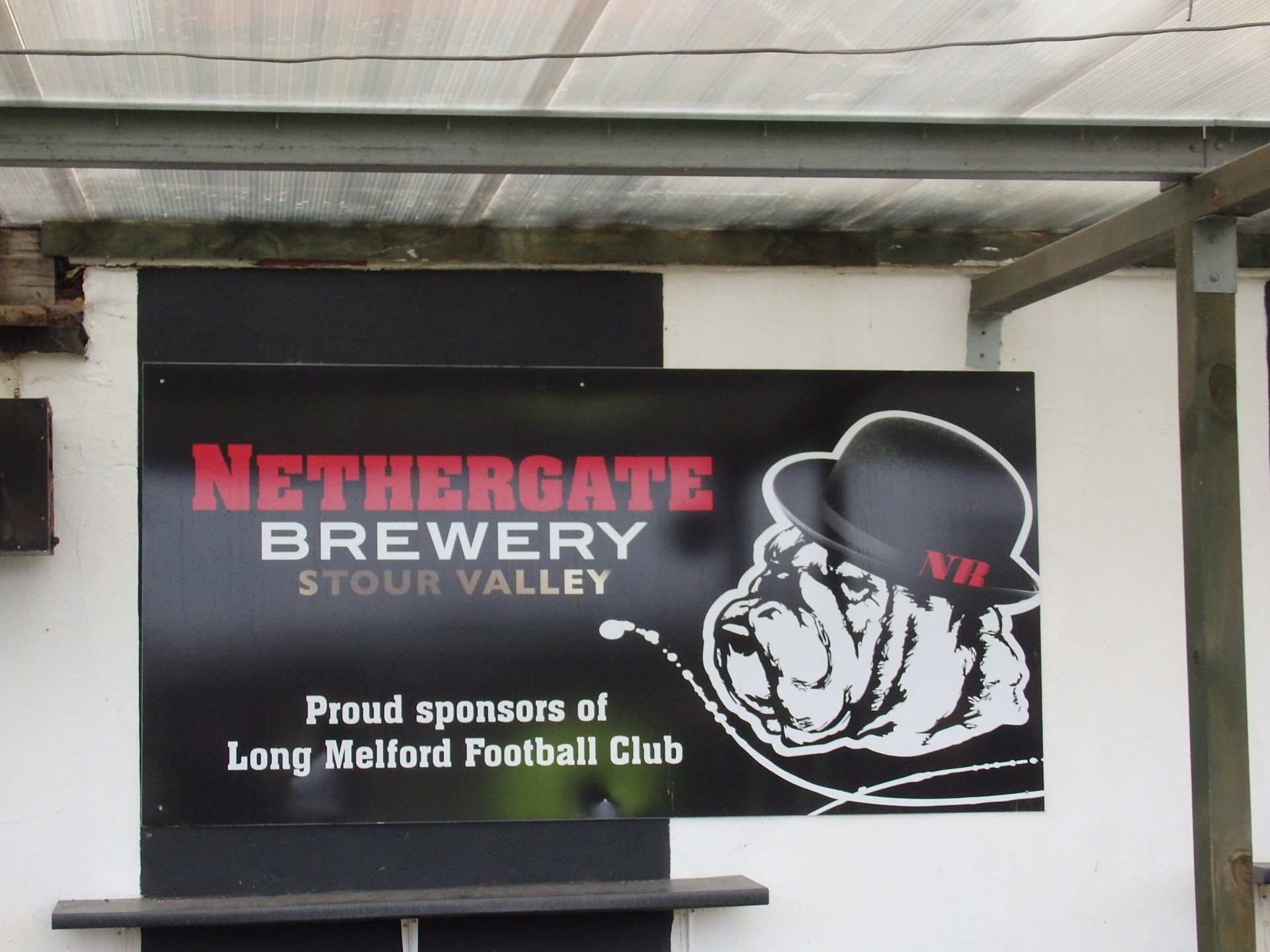
Once inside, Roly buys me a bottle of Nethergate IPA (£3.50) in the bar, which is the least he could do after I went out of my way to drive him here, selfishly he gets one for himself too. We drink bottled beer because sadly the hand pump on the bar is covered over with a tea towel, which is very disappointing. The woman serving is struggling for change and asks rhetorically how she is expected to run a bar with a float of just four pound coins. I empty my pockets and find just short of ten pounds in change, which she is happy to exchange for a ten pound note; I’m 40p up!

OLYMPUS DIGITAL CAMERA

We sup our beer in the company of other middle-aged and older men stood around tables as men do in bars, but soon we are aware that the teams are coming on to the pitch. We leave the clubhouse just as the line-up for the obligatory handshakes is dissolving away into the two halves of the pitch. Newmarket Town are the visiting team today and they sit seventh with 53 points from 31 games in the Thurlow Nunn Eastern Counties Premier League table; Melford are 16th with 39 points from 32 games. It’s a clash between a village known for antique shops and a town known for horse racing. I suspect that watching local football puts us firmly outside those two spheres of activity although weirdly I think, there is an advert in the match programme for “Wealth management advice”, whatever happened to plain old financial advice?
The 1970’s pop blaring from the tannoy stops abruptly as Newmarket, nicknamed predictably as the Jockeys, kick off towards the dull, suburban estate-style houses at the Sudbury end of the ground. Newmarket’s club colours are yellow and blue, but for some unknown reason today they are wearing a rather ugly all red kit with white stripes below the chest, as if they’d brushed their teeth before coming on and dribbled Colgate down their stomachs. Melford play towards the dilapidated wooden fence, shelter and open fields to the north, wearing their signature black and white striped shirts and black shorts. Melford’s kit is embellished with name of the excellent Nethergate Brewery, who have newly built premises at the entrance to the village by the turning to Foxearth.
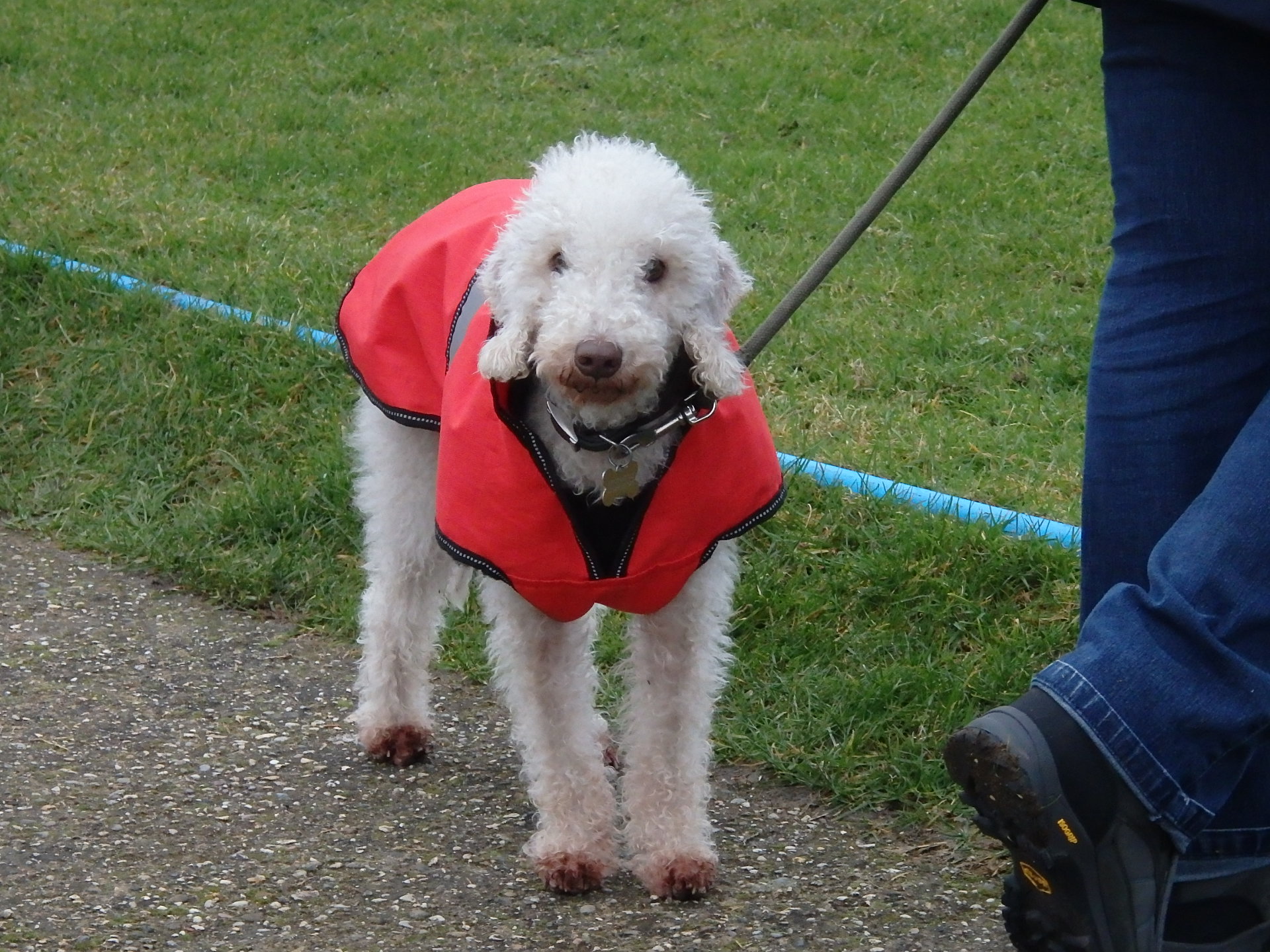
Newmarket start well, passing neatly and getting forward, but Melford suddenly win possession, breakaway and have a shot, and so it continues. Both teams have a lot of players with beards. Newmarket have the ball most of the time, but Melford spring the occasional surprise, getting the ball to their number seven Hassan Ally who is always in the right place, but never quite makes the final telling cross or pass. The Melford cross bar is hit by a header and then at about twenty five past three a long ball to the right is chased down by Lewis Whitehead who shoots across the Melford goal keeper; Newmarket lead and a number of middle aged men cheer unexpectedly. No one in the crowd is wearing club colours but for a Bedlington Terrier in a red coat, so the presence of away supporters is a surprise.

OLYMPUS DIGITAL CAMERA

Half-time arrives and Newmarket would seem to be in control. Roly has already treated

OLYMPUS DIGITAL CAMERA

or ‘tret’ himself, as he would say in his quaint rustic dialect, to a cheeseburger (£3.00) from the food bar which the programme tells us is called Deb’s Diner. The concluding paragraph of the joint managers’ column in the programme says “Whatever happens, we hope you enjoy your afternoon here in Long Melford, get yourself something to eat and drink…” and Roly has clearly taken note. I don’t ask him if it was an early tea or late lunch or just a celebration that his NHS health check during the week had shown him to be a well man, clearly capable of absorbing the ill-effects of junk food, for the time being at least.
We go into the club house again for two more bottles of Nethergate IPA and to catch the half-time scores on the TV and are much heartened that Ipswich are winning 2-0 at Sunderland. The club house is recently refurbished after the roof fell-in last year and there are several marvellous photos on the walls of past achievements such as Suffolk Senior Cup wins. A trophy cabinet contains a couple of old brown leather footballs which impress me more than the cups and trinkets. When there is a cosy clubhouse, half time is never long enough and it’s soon time to re-join the rows of middle-aged men hanging over the rail around the pitch.

This slideshow requires JavaScript.


The second half is not the same as the first, roles are reversed and it is the Villagers who more frequently have the ball at their feet whilst the Jockeys chase about in vain and are pushed back into their own half. For the second half we stand on the opposite side of the ground to the clubhouse near the dugouts and in front of a coniferous hedge, carefullyOLYMPUS DIGITAL CAMERA and neatly cut into a modernist architectural shape; behind the hedge a close-board wooden fence is in places nailed to its thick trunks. In its neatness the hedge is only matched by the Newmarket goalkeeper’s haircut, but is less contrived. There is more noise on this side of the pitch as the coaches of both team teams shout and urge their teams on.
As the game continues Melford dominate more and more and Newmarket are getting tetchy. Whilst there were hardly any fouls at all in the first half, tiredness and desperation and swearing are introducing a new kind of entertainment. A Melford player goes down and the Newmarket number two complains to Mr Pope and anyone who is listening, because Mr Pope isn’t, that Melford have some right prima donnas, although he pronounces it pre-madonnas. Another foul and a free-kick on the edge of the box and then another. Then, whilst Roly is in the toilet, Melford win a third free-kick. Despite referee Mr Pope taking time to book the perpetrator, Roly still isn’t back by the time Ross Waugh scores, apparently with a header, although to be honest it was one of those messy goals and I had lost track of the ball.
There are only eight minutes left and the blokes in trackie bottoms and sports coats onOLYMPUS DIGITAL CAMERA the touchline are visibly tense. The Melford number ten Scott Sloots is hurt and is substituted; as he hobbles off the pitch one or two of his own players seem to be complaining that he is taking his time. “Come on ref, make him get off quicker” I hear. I hadn’t previously realised that there was a point where team togetherness and the will to win would clash. But nevertheless, Melford continue to push forward and in the final minute of injury time there is a run down the left, the ball’s in the box, a shot is blocked and Hassan Ally is in the right place to score from the rebound. Rarely have I seen such elation from a team sixteenth in the league to a winning goal; both coaches burst onto the pitch to celebrate with the team as if this was a most crucial victory. I’m all in favour of making your own fun but this seems to be going a bit far.
To his credit, Mr Pope the referee makes nothing of the exuberance of the Melford coaches and in no time at all the match is over. Roly and I stroll round to the club house to make final use of the toilet before applauding the Melford team from the pitch. It’s been a very entertaining game with a dramatic finale and I’ve made 40p.