US Concarneau 1 AS Nancy 2

The Breton coastal town of Concarneau is apparently best known as a successful fishing port and for its walled Ville Close, a quaint and historic medieval fortified town transformed into an appalling tourist trap full of the sort of shops or pristine buildings you find in places like Lavenham or Bourton-On-The-Water in England. In its favour however, Concarneau is also home of the Brasserie de Bretagne (Britanny Brewery) and Union Sportive Concarnoise, its local football club, which plays in the third division of French football known as Ligue National.

US Concarneau, as they are commonly called, are relatively recent arrivals in Ligue National and have aspirations to reach Ligue 2; tonight, they face Association Sportive Nancy-Lorraine, more usually known as AS Nancy, a club which has twice won the French FA Cup and spent twenty-five seasons in Ligue 2 and thirty in Ligue 1.  Today however, Concarneau are second from top of Ligue National and Nancy seventeenth, albeit after just three games.

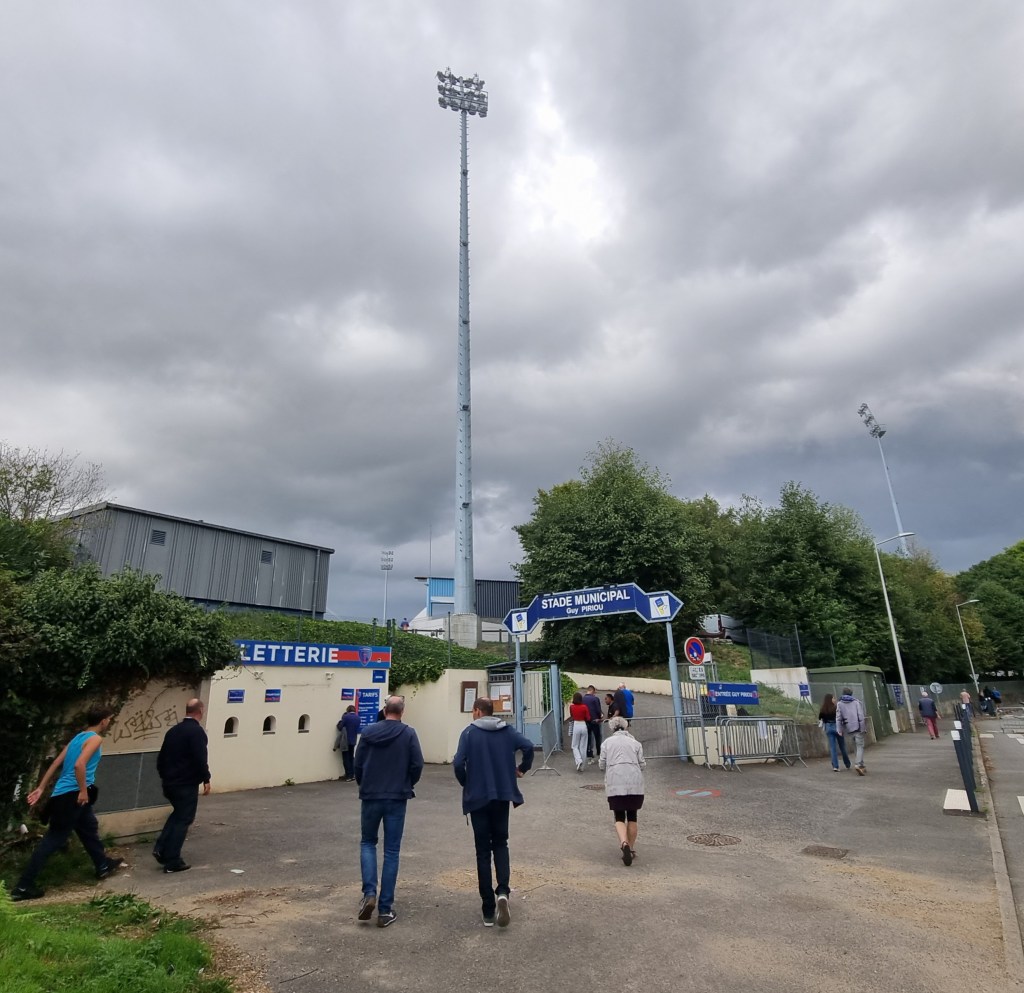
The Stade Guy Piriou where USC play their home games is at the edge of town in that nether world of retail parks, Zones Industrielles and feeder roads inaccessible to pedestrians. I had asked in the Tourist Information Office where is a good place to park and the pretty young woman there had rolled her eyes with a look that told of chaos, but then said we could park in the car park of the LeClerc supermarket which is about 100m from the ground through a tunnel beneath the main road.  After getting a bit of shopping and an evening picnic, which my wife Paulene and I eat in the car, we make for the ground.

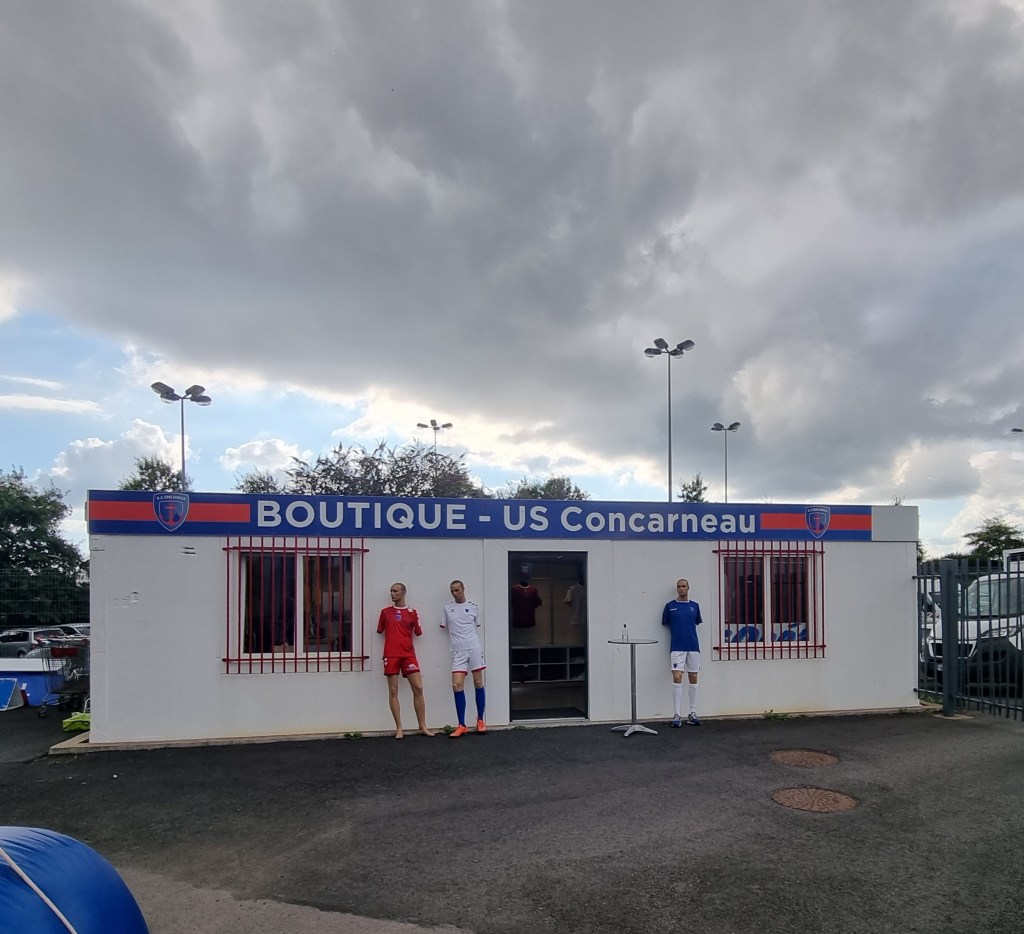
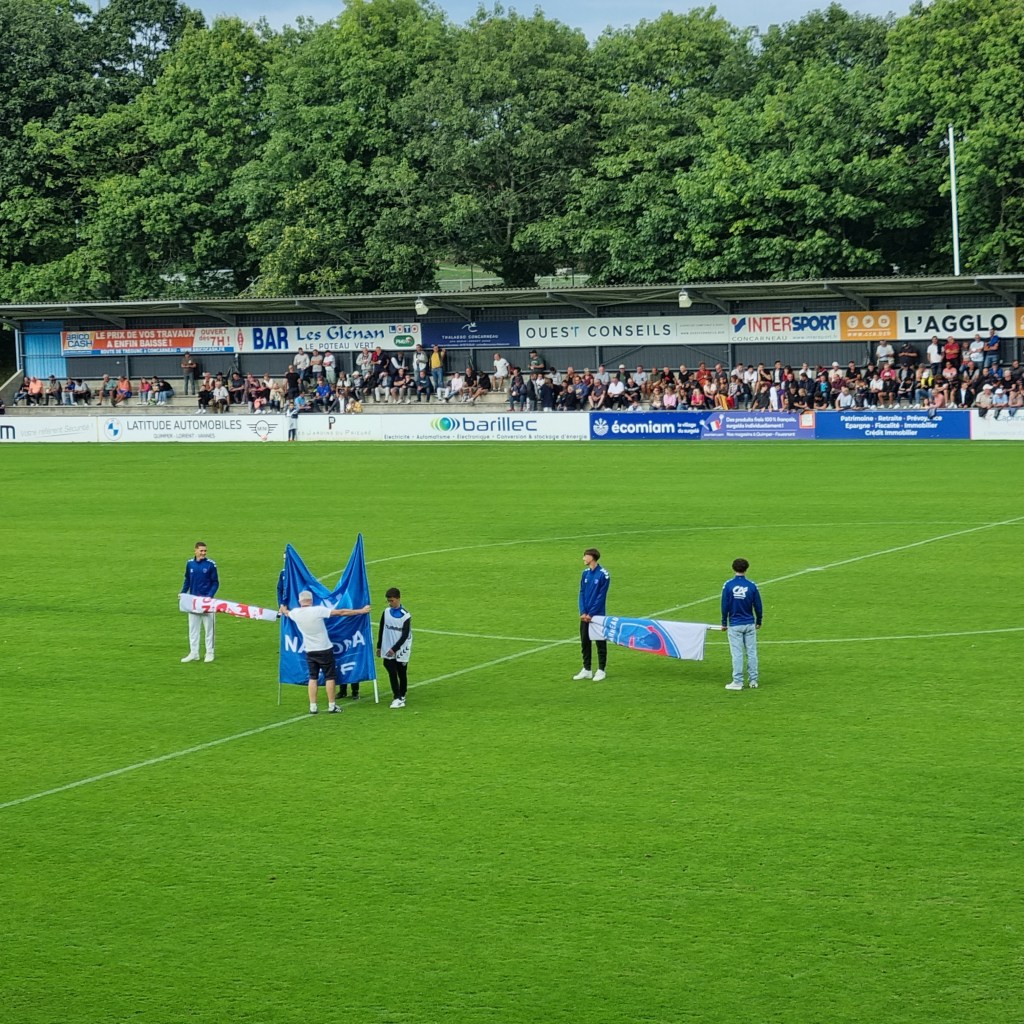
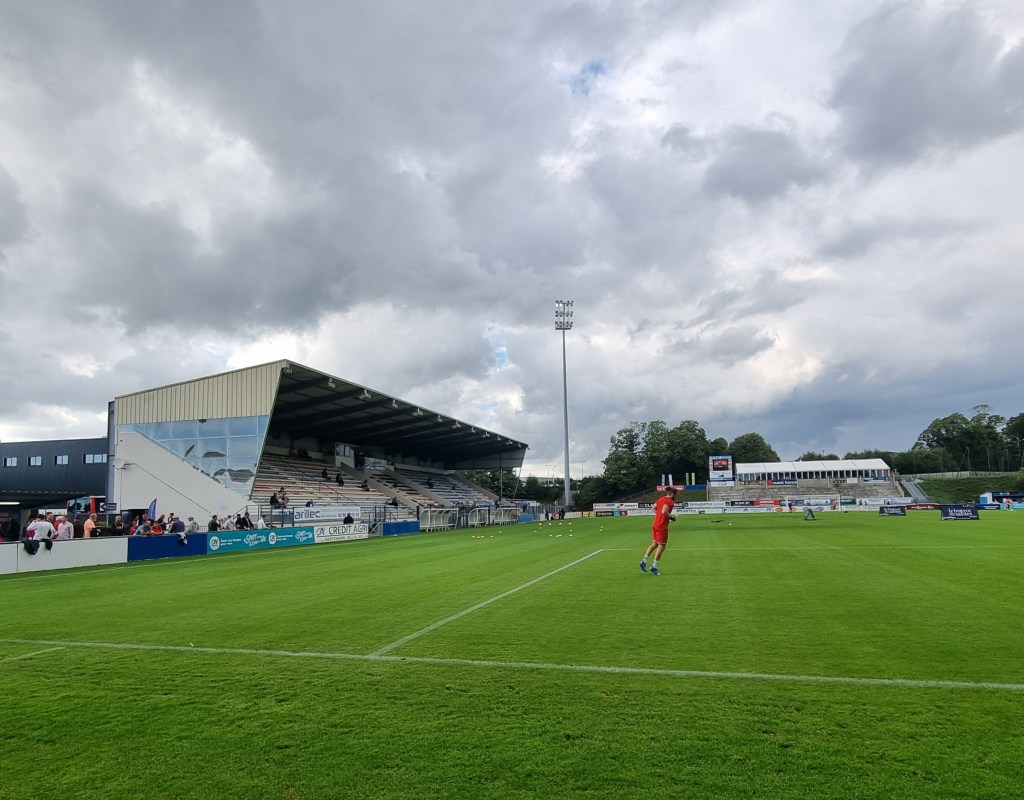
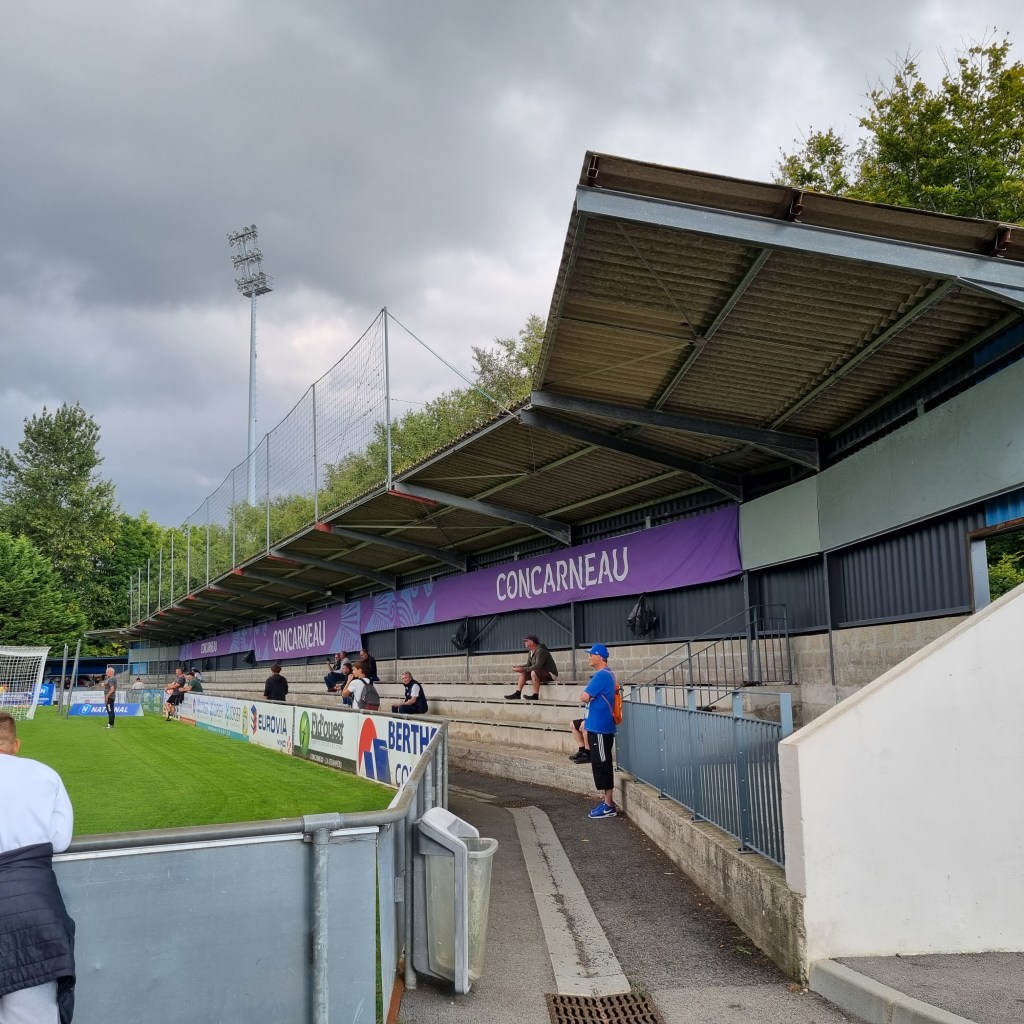
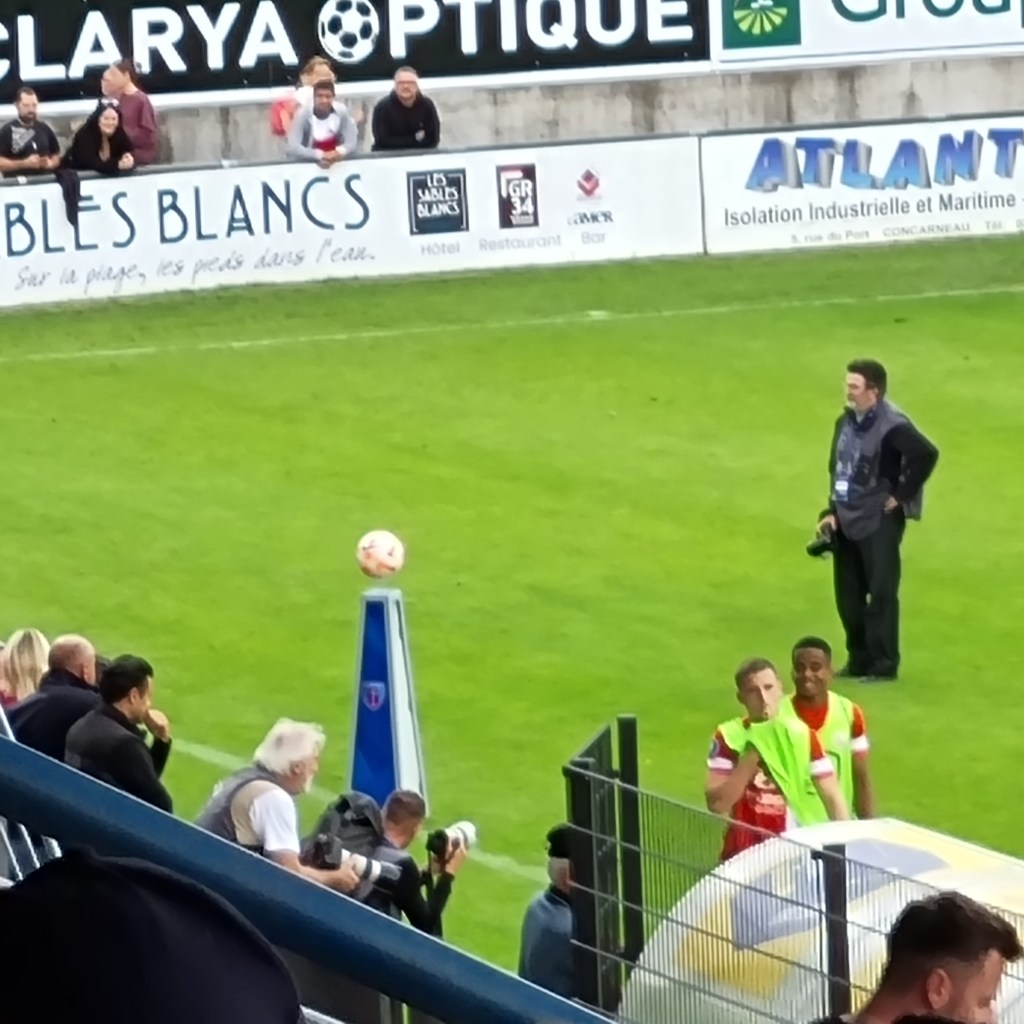
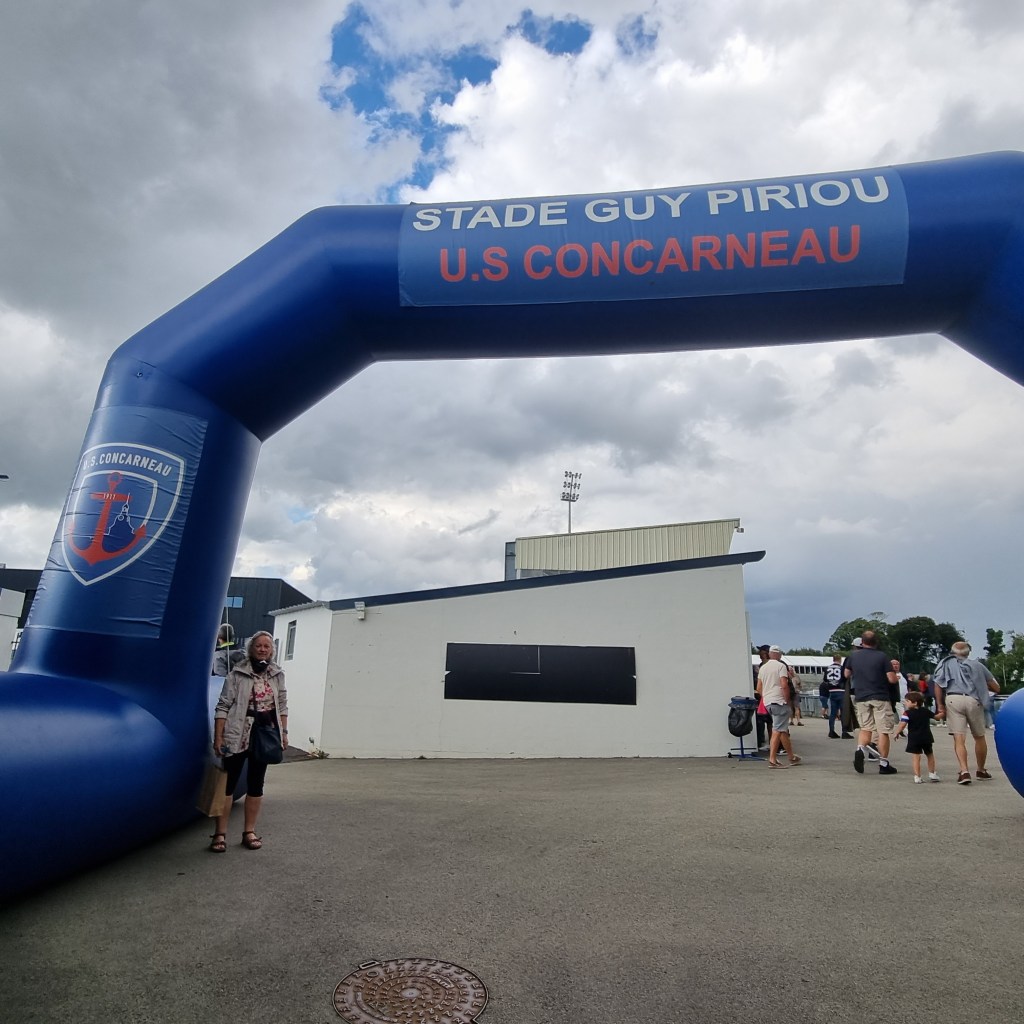
Having had difficulty trying to buy tickets on-line we had visited the ground earlier in the afternoon on arrival at Concarneau.  Although there are guichets open at the entrance to the ground selling tickets, these were shut when we arrived earlier and I had gone directly into the club office where I had selected our seats on someone’s lap-top and stood by his desk as he printed out two tickets for the main stand (12 euros each).  The stadium sits on the top of a small hill and the main entrance delivers us up a slope through an inflatable arch to the corner of the stadium; I don’t know if I’m in a football ground or a bouncy castle, but there is a main stand in front of us and to our left.  Pleasingly there is a club shop where for 5 euros I add to the collection of petit fanions (pennants) that adorn my upstairs toilet at home, and also purchase a mug (9 euros) and acquire a match day programme which, like at every French club that produces a programme, is free.  The ground has three excellent buvettes which remind me of stalls at a fairground; they serve huge sausages piled on top of massive heaps of chips, and the very tasty local ‘Britt’ beer. After visiting what is possibly the smartest and sweetest smelling toilet I have ever encountered in a football ground; it’s all stainless steel and shiny coloured tiles, I change euros into tokens worth a euro each and buy a beer for me (3 euros) and a cola (2 euros) for Paulene, which surprisingly and disappointingly is not Breizh Cola. I then join Paulene in the main stand for the pre-match entertainment of observing everyone else arrive, search for their seats or eat sausage and chips, before watching a fastidious man organise three pairs of youths into holding banners displaying the Ligue National logo and the two club crests.  Off to our left the match ball sits above a plinth in front of the players’ tunnel and appears to be hovering in mid-air.
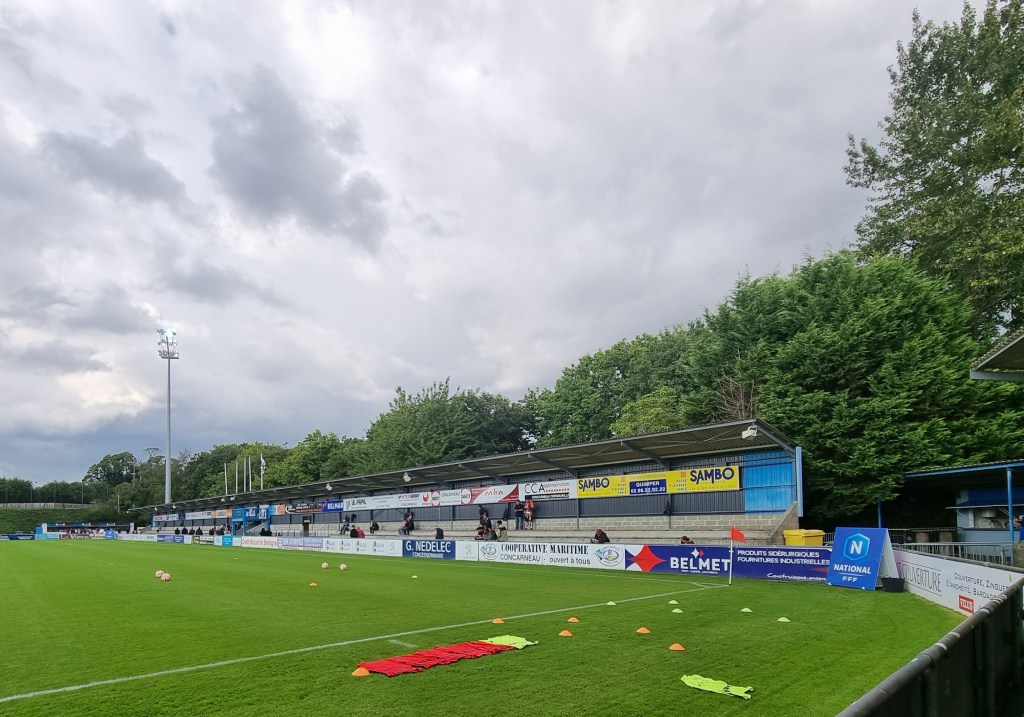
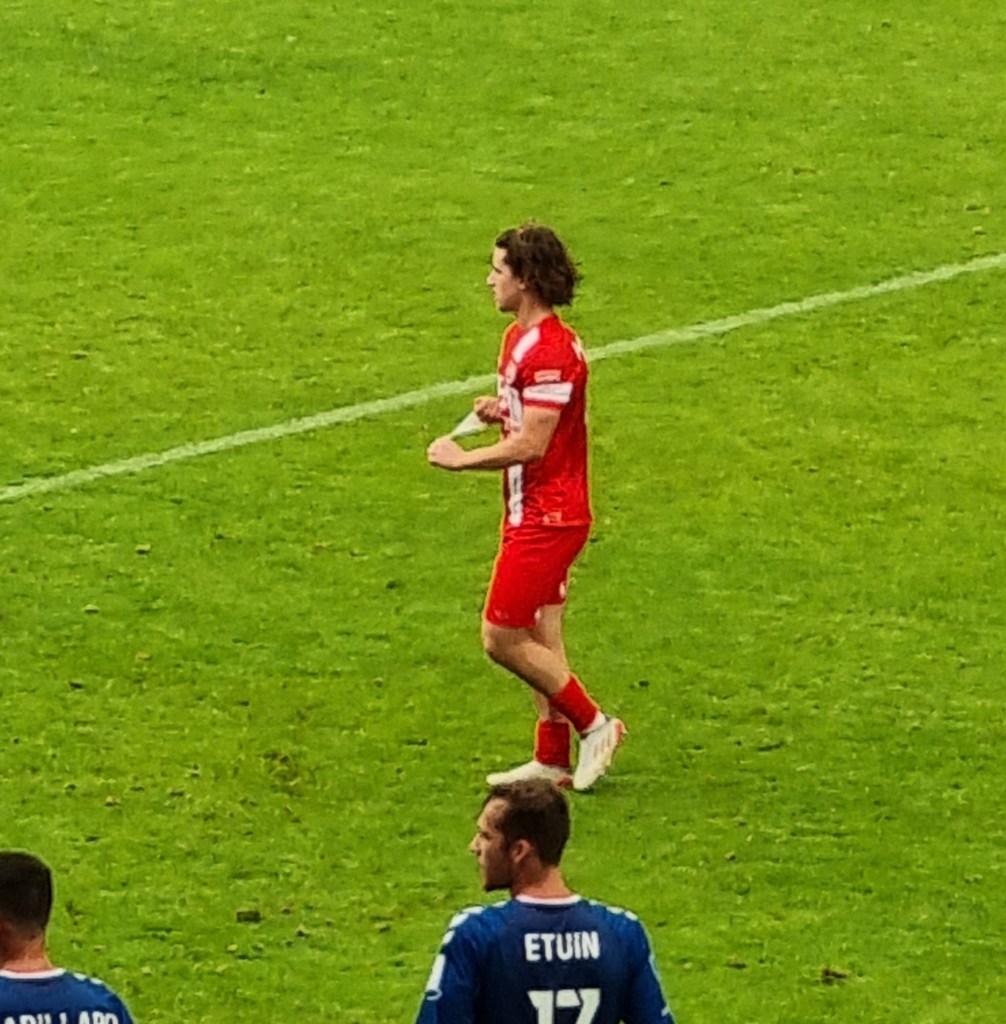
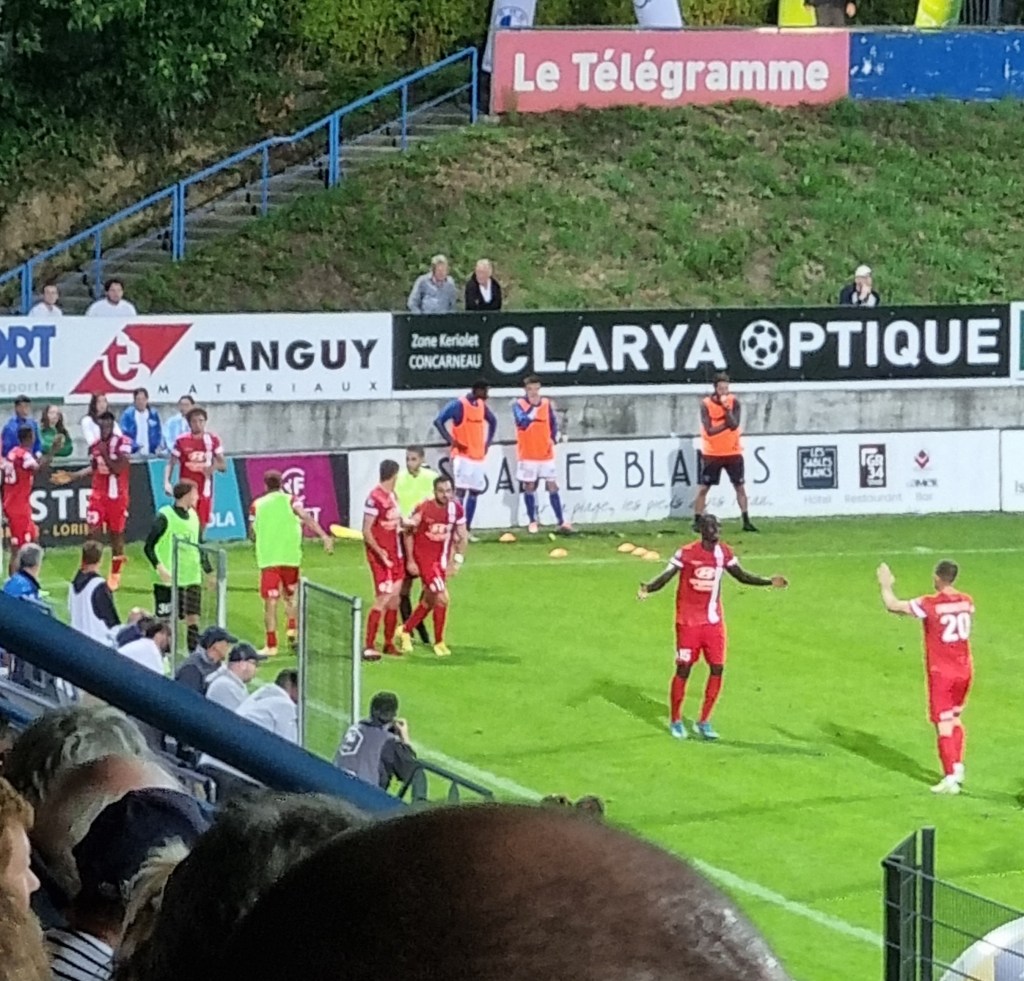
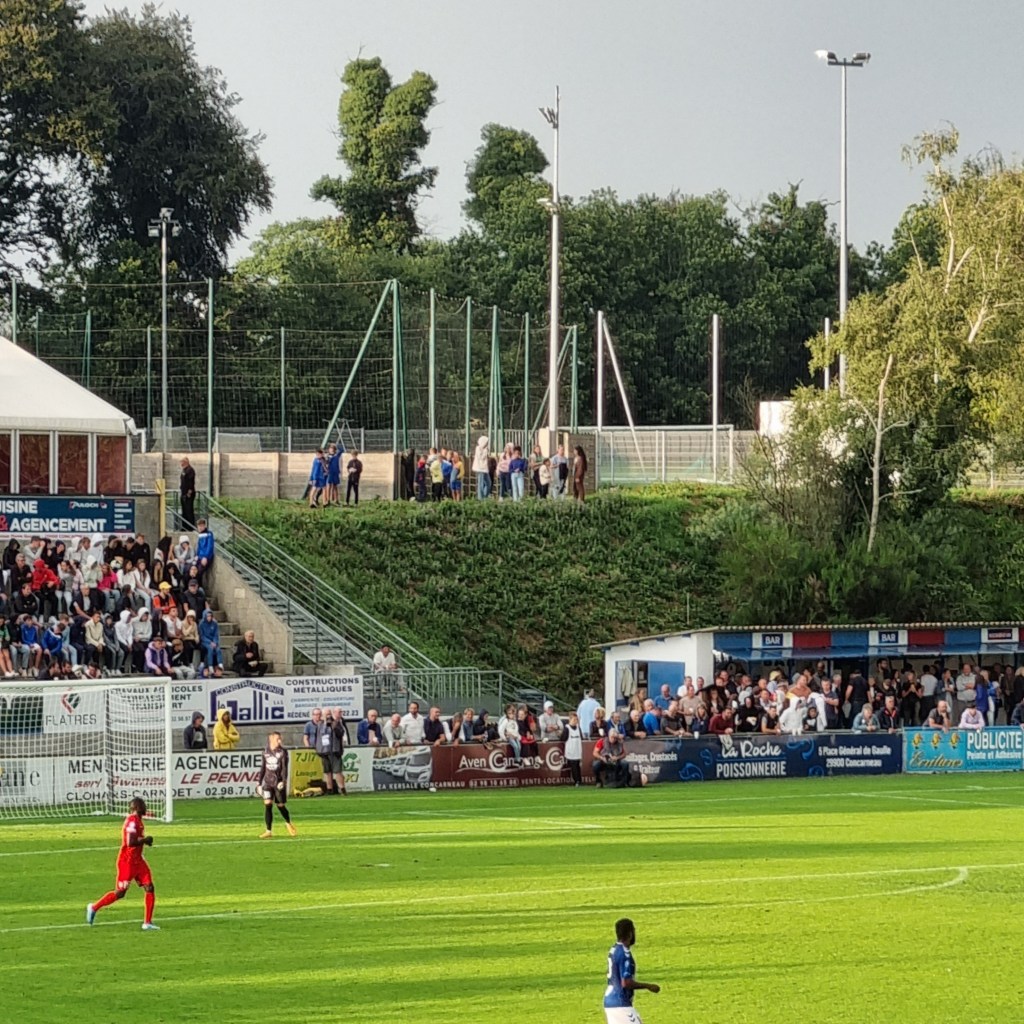
At half past seven the match kicks off, with Nancy in their all-red kit getting first go with the ball.  Concarneau are in blue shirts and socks with white shorts and the first chant of the evening surprisingly emanates from the main stand; “Allez les bleus, Allez les bleus” confirms that I am not suddenly colour blind. On the far side of the ground, in the long, low, basic but well maintained partly seated, partly terraced stand a knot of supporters sing “Allez, Allez, Allez” to the tune of The Beatles ‘Yellow Submarine’.  

Perhaps because of the backing of the home crowd, USC quickly settle into the game and their number 24 Ambroise Gboho soon threads an excellent diagonal through ball into the path of Antoine Rabillard, who has made an overlapping run, but Rabillard hits his shot straight into the body of Nancy’s goalkeeper. USC’s Amine Boutrah then wins the games’ first corner and Tom Lebeau wins the second. “Allez les bleus, Allez les bleus” sings the home crowd again.  Lebeau crosses the ball and Rabillard heads over the bar. Low, evening sunlight falls across the pitch illuminating the grass vividly where it doesn’t cast a lengthening shadow of the main stand. The sky is gun metal grey in the distance; there have been heavy showers inland throughout the day and a rainbow extends up then fades away beyond the opposite stand.  Behind the left-hand goal, on the steep concrete terrace below the hospitality area people appear to be putting their coats on; it doesn’t seem to be raining but briefly there is a faint rattle on the metal roof of the stand.

Back on the pitch, Nancy’s defending is effective but becoming more desperate and Lucas Pellegrini is the first player to see the carton jaune (yellow card) of the referee after he knocks over USC’s Amine Boutrah, who I am not surprised to read in the programme is the player of the month for August.  Within sixty-seconds Nancy’s number eight, Lenny Nangis follows the bad example that has been set and is booked for a foul on USC’s Georges Gope Fenepes.  If Lenny Nangis has any defence, it is that he has a great name.  The resultant free-kick is deflected over the cross bar for another corner to Concarneau.  A third Nancy player is booked five minutes later when Baptiste Mouaza fouls Ambroise Gboho. The supporters on the far side of the ground sing the na-na-nas from The Beatles’ “Hey Jude” and then Mouaza provokes a sharp intake of breath as he trips USC’s Gaoussa Traore and we await the consequences. Like a not very good magician the referee holds up his yellow card and then with a distinct absence of sleight of hand replaces it with a red one.  Mouaza hangs around for a bit, seemingly discussing his misfortune with anyone who’ll listen as most of the other players crowd around the referee and the prostrate Gaussa Traore. When the melee clears and Traore has risen from the dead, Mouaza seeks clarification from the referee that he is no longer required on the pitch and his worst fears are confirmed with a wave of the referee’s arm.

  A minute of the first half remains, and USC win another corner; the ball is crossed from the left and having evaded everyone else, falls in front of captain Thibault Sinquin who appears to do little more than absent-mindedly stick out a leg, and thereby scores.  After two minutes of added on time, the teams retreat to the dressing rooms for mi-temps (half-time) with Concarneau in possession of a well-deserved lead, although having failed to score for the first forty-four minutes the eventual goal came as a bit of a surprise. Half-time sees a flood of people towards the buvettes and I get up from my seat to stretch my legs and peer down on them through the scratched Perspex screen at the end of the stand.

The game resumes at 8:32 and although Nancy have some early forays down the flanks it is USC’s Ambroise Gnoho who comes closest to scoring but for an offside flag and Lebeau shoots past the post from all of 30 metres.  With just ten minutes gone of the new half Georges Gape Fenepes,  who might be the first player from New Caledonia I have ever seen, is substituted by Faisal Mannai.  I don’t think it’s Mannai’s fault but within a minute of his appearance a passing move down the left for Nancy ends with the sort of cross commonly known as ‘inviting’, and Lenny Nangis  accepts the invitation, heading firmly into the Concarneau net to unexpectedly equalise.

Despite having lost their lead, Concarneau will surely still go onto win having a man advantage and they continue to press forward with Robillard, Traore and Boutrah always looking the most likely to conjure up a decent chance.  With a third of the match remaining USC win another corner after a flurry of activity around the Nancy goal.  A low cross from the right is just too far ahead of everyone to allow anyone to touch it into the net.  “Merde” says the bloke behind me through gritted teeth as a pass by substitute Faisal Mannai is intercepted by a Nancy player who breaks forward into the Concarneau half.  Nothing comes of it however and Thibault Sinquin in turn breaks forward for USC from his centre half position, but his low cross from inside the penalty area is cleared.

The game is into its last fifteen minutes or normal time and Gaoussa Traore lashes a shot somewhat desperately, which travels high and wide of the Nancy goal.  Nancy substitute Lamine Cisse for Isaak Umbdenstock, but not before Cisse looks confused as to which direction he must run to leave the pitch; after initially running away from the benches he checks and runs back and Umbdenstock runs on.  Concarneau replace Adrien Jouliex with Alec Georgen but are coming no closer to scoring a second goal.

Ten minutes remain of normal time and Nancy win a rare corner;  Diafra Sakho meets the ball on his forehead and Nancy are suddenly winning as the ball bulges the net with the Concarneau goalkeeper and defenders static.  Even now I can’t bring myself to believe that Concarneau won’t equalise,  but as Tom Lebeau is replaced by Pierre Jouan there are just seven minutes left and Nancy are taking every opportunity, and creating more to eke out that time by winning free kicks and staying down on the ground.  When a player goes down ‘injured’ on the far side of the field the slow-moving physio who looks about seventy-five can only trundle across the pitch.  Nancy make use of their penultimate substitution before six minutes of added on time are announced and then make the final one as they control the end of the game, not in terms of active football but in terms of frustrating Concarneau by fragmenting the remaining time into useless moments of nothingness.

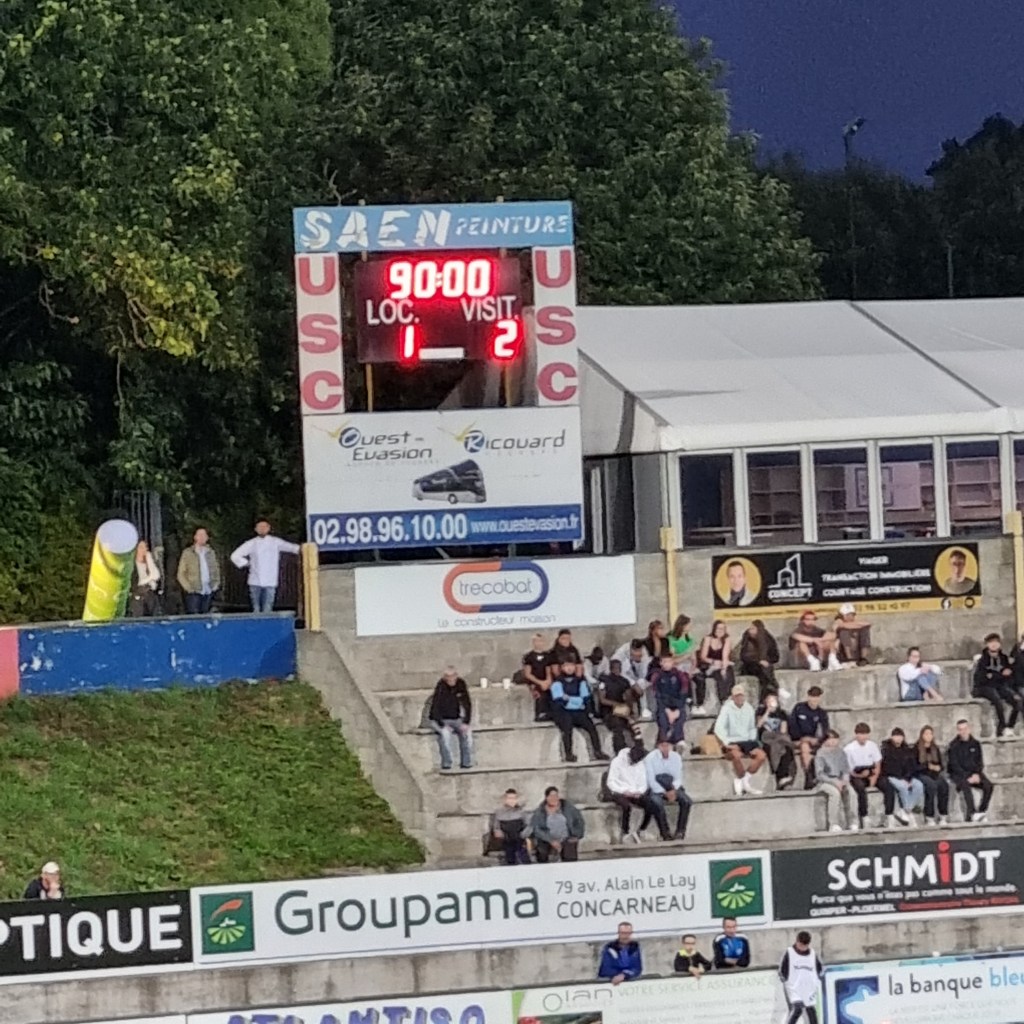
Full-time arrives too soon for Concarneau and Nancy will make the 920 kilometre journey back to Alsace with an unexpected win, which in the context of modern football they deserve, but it wasn’t always much fun to watch and many would say they had ‘stolen’ the points.  Nevertheless, Concarneau is a great place to come to watch a match and is reminiscent of an English fourth division ground but with better beer, better food and cheaper admission prices; Paulene and I therefore have had a splendid time.

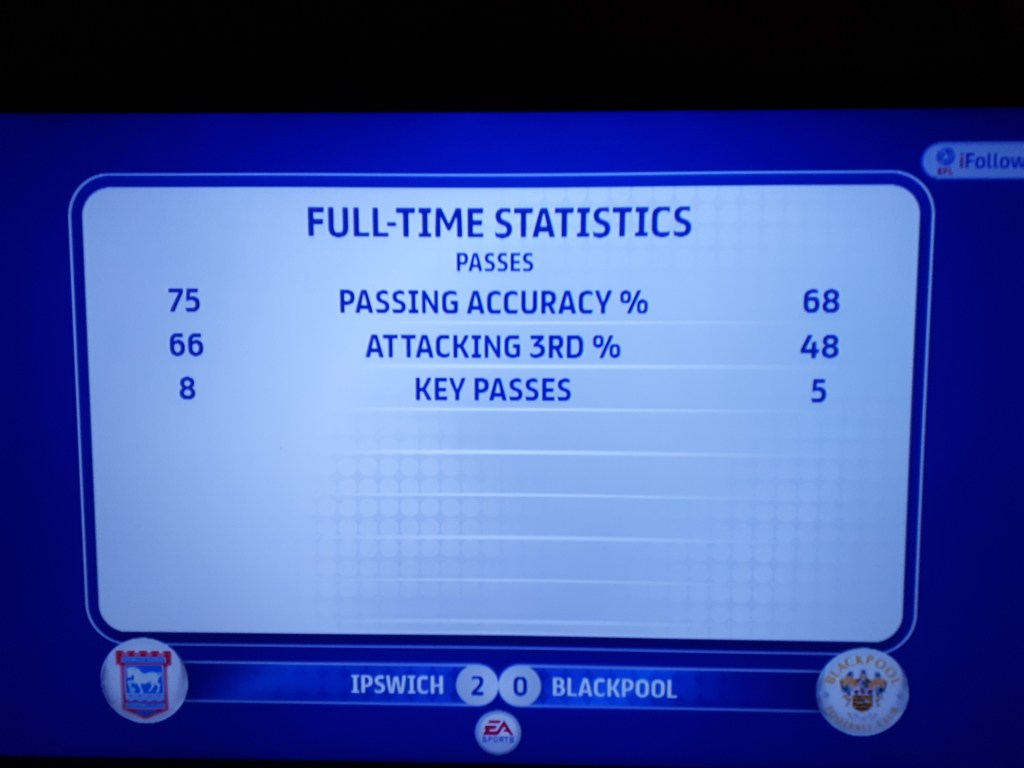
Ipswich Town 2 Blackpool 0

I am a little ashamed to admit it, but my record of seeing Ipswich play Blackpool is rather poor and weirdly, of the nine occasions on which I have seen Blackpool play away from home, six of them have been at Layer Road, Elm Park, Griffin Park or Fratton Park, not Portman Road.  Of course I have excuses.  Ipswich’s first nine fixtures against the Tangerines in the 1960’s and early 1970’s occurred before I attended my first game in April 1971. Town then didn’t play Blackpool at all throughout the 1980’s and 1990’s which were the years when I had the time, the money and inclination to rarely miss a game. When Town’s and Blackpool’s paths next crossed again, in the 2007/08 season, I am pleased to say I did make it to both Portman Road and Bloomfield Road; but one visit to the coastal town they forgot to close down was enough for me, and I haven’t been back since, despite the lovely trams.

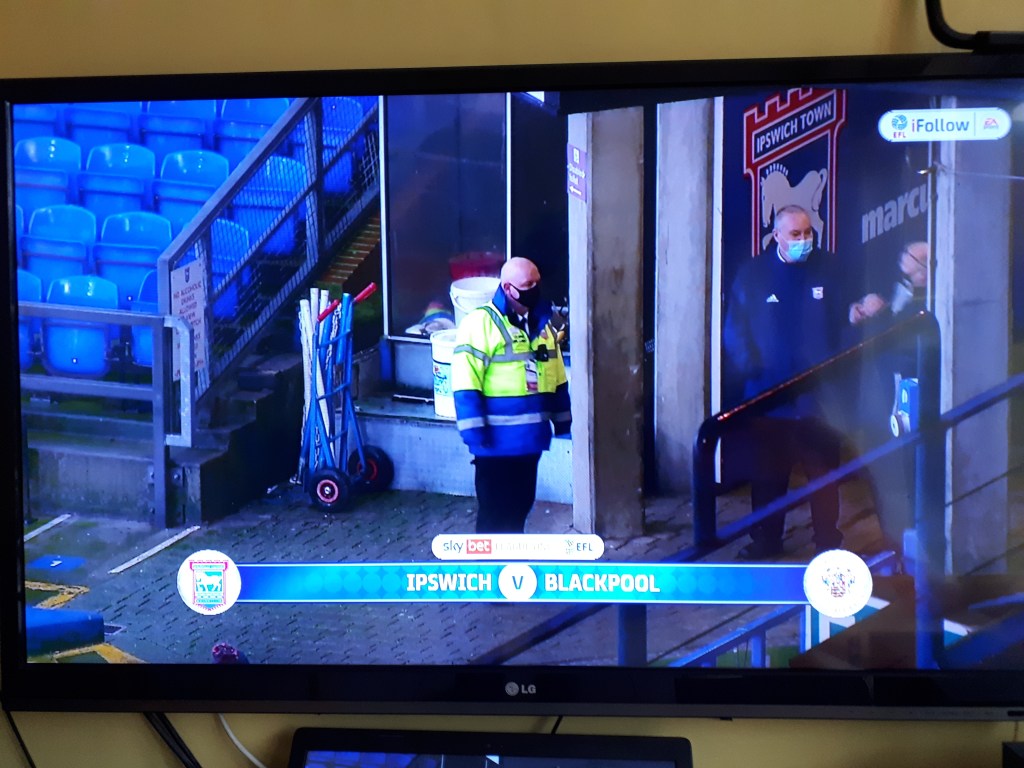
In 2009 the home fixture versus Blackpool coincided rather inconveniently with my father’s funeral; I guess I could have sneaked away after the interment; he wouldn’t have minded I don’t suppose, particularly given that he was dead beneath a couple of metres of Suffolk sod, but some of the relatives and other folk left breathing might have thought it was a bit off.  Since then, due to disillusionment inspired by the appointment of Roy Keane, a four year spell on the committee of an Eastern Counties League club and then a sudden illness I have  made it to just two of the seven subsequent Portman Road fixtures.  Today therefore I am rather chuffed to even be ‘virtually’ at the game, courtesy of the ifollow and I have even ordered a programme, which I am pleased to say has arrived in this post this morning; well played Royal Mail.

The post isn’t the only good thing about today I find. It’s a beautifully grey, dank winter’s day and a pall of dull cloud hangs over the horizon as I take a walk along puddle strewn roads between sodden fields and beneath the gaunt, dripping trees.  It’s a lovely day for football.  Back in the warmth of my centrally heated home I enjoy a pre-match ‘pint’ of fennel tea; I awoke in the small hours with a terrible stomach ache and it feels like it might still have a grievance.  My wife Paulene is watching Troyes v Toulouse on BEINSports tv and I join her on the sofa for the top of the table Ligue 2 clash; Paulene kindly says she will forgo the second half so that I can watch the ifollow in the comfort of the living room; she’ll just sit and read.

Having left the Stade de l’Aube with second placed Toulouse enjoying a 1-0 half-time lead over first placed Troyes, I log into the ifollow in time to hear the names of today’s virtual mascots, Sheeran, Adolf and Brenner, being announced, or rather given their “Shout Out”, although thankfully no one actually shouts them out.  The mascots’ names may really have been Sebastien, Brodie and Zak, but I couldn’t say for sure and I like to think either set of names is equally plausible.  A brief excerpt of commentary follows from 2013 when a goal from the underrated but foolish Michael Chopra gave Town our last but one victory over Blackpool at Portman Road.  Finally the main event arrives, and the BBC Radio Suffolk studio hands over to “Mick Mills alongside Brenner Woolley.”

Brenner’s opening gambit is that defeat for Town this afternoon is “something that simply cannot be allowed to happen” although he doesn’t raise our hopes much as he refers to Town being “stuck in this malaise”, and I imagine a world in which Morrissey is a BBC local radio football commentator.  Brenner asks Mick what he makes of Luke Chambers being dropped from the team for today’s game.  Mick is not surprised but clearly feeling solidarity with another Town captain he admits to feeling “shameful” about it, which he shouldn’t because unless he’s not telling us something it wasnt his decision.  Mick explains how Chambers has been a “fabulous servant” and whilst he’s not a “10” each week, he’s never a “3” either, and is “…right in the middle of those”; which makes him a six and a half which is almost  on the sunny side of  solidly average.  Mick carries on with his monologue and I drift off before I am eventually shaken from my reverie by Brenner’s joyful sounding reference to a possible “Sears, Parrott partnership”.  I don’t suppose for a minute such a thing will happen and suspect Brenner simply liked the sound of those three words together, I know I did. Blackpool kick off towards Churchman’s in their “all tangerine” kit and Brenner ignores the white band across their shoulders.

It takes Brenner less than 47 seconds to use the phrase “early doors”, which is a new record; the doors are clearly getting earlier, very much Light My Fire rather than Riders on the Storm.  Brenner quickly ploughs on through his regular obsessions, telling us that Luke Woolfenden has had his haircut ; “ gone is the alice band” he says, before revealing that the ball has been given away by the  “Australian Dougal”, who sounds like a character in an antipodean version of the Magic Roundabout.

Town have started well. “A lot to like about that attack” says Mick as Myles Kenlock and the fabulously monikered and on-loan Troy Parrott link up.  Nine minutes pass. “Very little in the way of goalmouth action so far” says Brenner bringing us back down to earth.   Another Town attack flounders before getting inside the Blackpool penalty area. “Parrott lost his footing “ says Mick and childishly I laugh imagining a tropical bird falling off its perch.

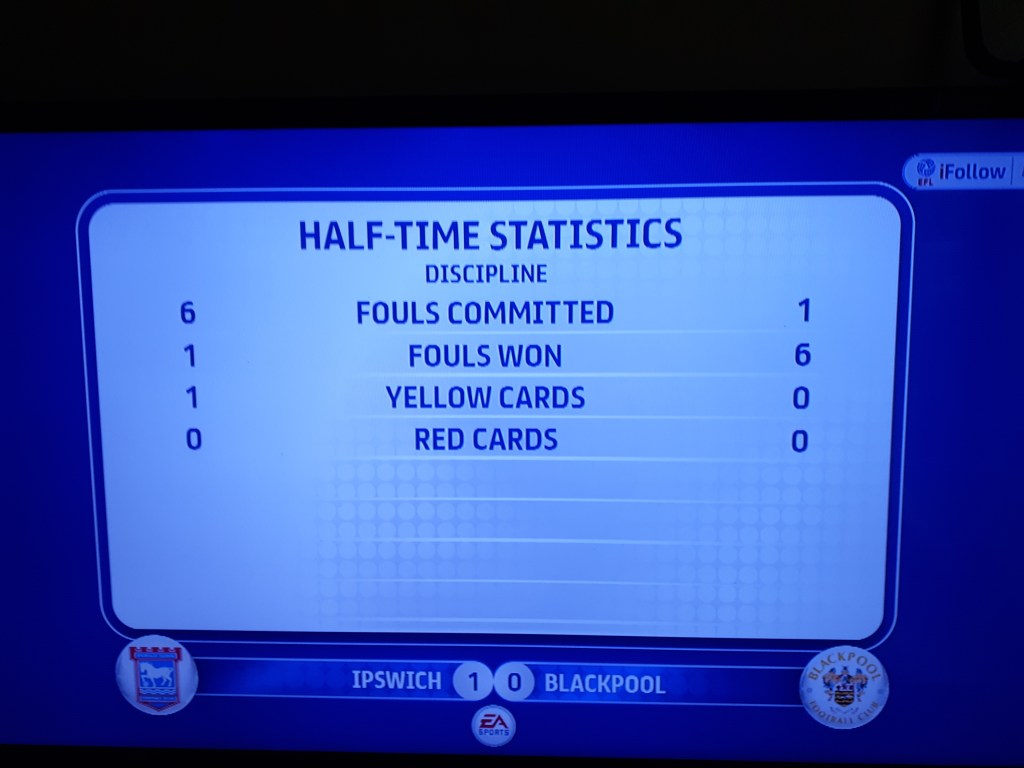
“Corner kick in the rain” says Brenner coming up with what sounds like a song title as he combines commentary with a weather report.   The corner comes to nothing, but it keeps on raining.  “We’re quite strange to each other, this line-up” adds Mick having difficulty finding the right words to tell us that the Town players won’t be very familiar with each other as team mates.  As if to prove Mick’s point the play immediately becomes a little messy, “Harum scarum” is how Brenner describes it, delving into his supply of slightly archaic expressions that most people no longer use.  Myles Kenlock is booked for what Mick rightly labels an “unnecessary challenge” on Jordan Lawrence-Gabriel; Freddie Sears was covering but it was as if Kenlock had just wanted to kick Lawrence-Gabriel anyway, perhaps because of his unnecessarily extravagant surname.

The nearside of the pitch beneath the shadow of the West Stand is very wet and the ball doesn’t run freely here. “Held up in the brown ground” says Brenner finding a of saying mud without mentioning awful 1970’s pop bands.  Blackpool are now having a bit more possession and have had a couple of decent opportunities from free kicks wide on their left. As another passing move breaks down Mick resorts to helpful homily, “They often say in football the simple ball is the most difficult one” he says, but taking care not to quote his sources.

Luke Thomas shoots wide for Town after another decent passage of play.  “Blackpool have never ever won here” says Brenner, acknowledging that he is tempting fate but suggesting it’s okay if he says it very quickly, although I’m not sure that makes a difference unless fate is a bit hard of hearing.  But Mick raises our spirits with what doesn’t sound too much like faint praise “We’re close, we’re close to playing some good stuff here”.

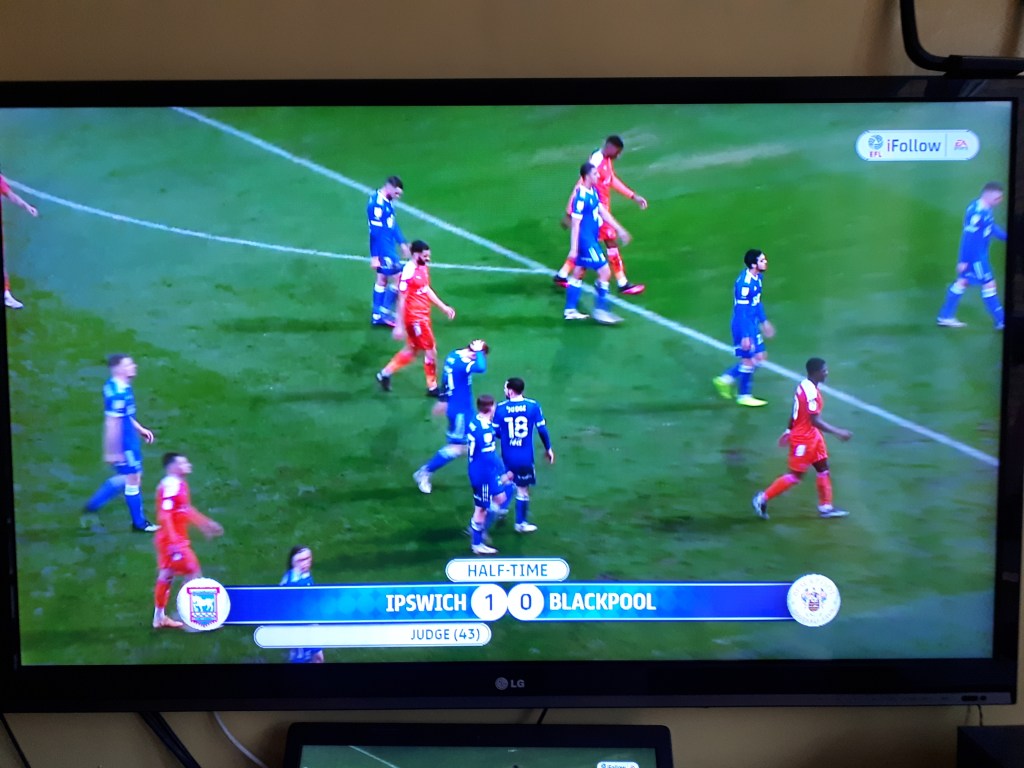
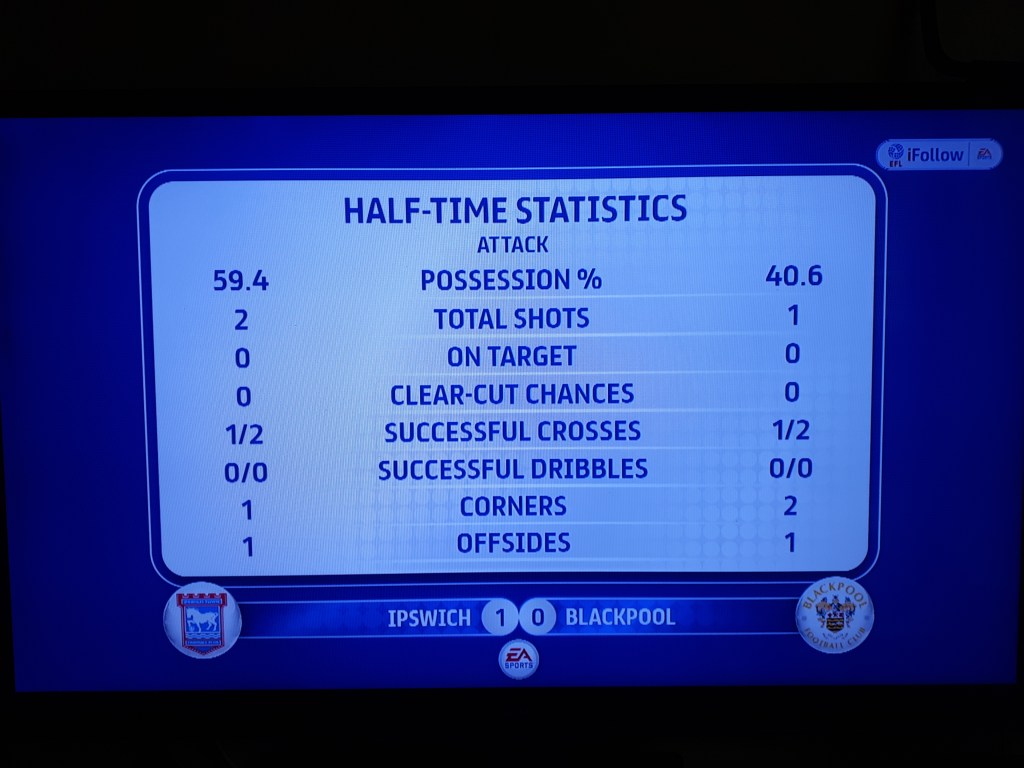
Thirty-eight minutes have gone since kick-off; Freddie Sears has a ‘goal’ disallowed for offside after some excellent play by Troy Parrott who is living up to his name and playing like a Trojan; “Really like Parrott” says Brenner, understandably.  Mick’s only quibble with Town’s first half performance is the centre halves, of whom he says “They’re a bit easy-ozy”; it’s an expression that not even Brenner would use.  Half-time is looming, it’s the 43rd minute and Brenner gets the opportunity to say “Town get a rare first half goal” as little Alan Judge strikes the ball with the outside of his right boot from at least 20 metres out.  “Wa hey!” I shout, a little disbelievingly. But it’s true, and when half-time arrives Town are in the lead, although the ifollow half-time scoreboard still says the score is nil-nil, but I don’t expect any better of the EFL.

In the half-time break I drink another cup of fennel tea and eat a Nature Valley peanut and chocolate protein bar. I muse about how Blackpool were a top club in the late 1930’s through to the mid 1950’s and how back then their fans probably never imagined that they’d one day be playing a league fixture against Ipswich, certainly not one in the third division. Coincidentally, Town fans no doubt thought the same in about 1981.  At 16:07 the game resumes and Brenner is soon saying “That would’ve been a fabulous goal from the home team” as Freddie Sears’ shot is saved by Chris Maxwell in the Blackpool goal. From the corner it‘s a matter of “…nodded down by Woolfenden and in” from Brenner after a Blackpool player obligingly heads the ball on at the near post.  Town lead 2-0 and I’m cheering again, releasing that inner cheer which has been welling inside me in recent weeks with nowhere to go. Mick is so excited he can barely explain anything anymore “He just dinked it in to the, err empty sort of, not an empty net, but into the net, you know” he says incoherently.

Town look very good for the lead and are plainly the better team with the best players.  Brenner starts getting clever. “Here’s Parrott, dropping off the front line” he says, clearly winning a bet to get the words ‘parrot dropping’ into his commentary.  Mick meanwhile revisits his favourite lesson about the third goal being important; today he explains it succinctly and with crystal clarity, as if he’s been practicing.  Town win a corner from an errant Blackpool pass “Corner from 40 yards, love it” says Mick, revelling in Town’s dominance and almost collapsing into laughter at Blackpool’s  mistake.  Within seconds he’s as giddy as Brenner and is talking about “gymnasium football” once again, the sort of football everyone else knows as 5-a-side.

Nearly an hour has been played. Troy Parrott is fouled by Chris Maxwell, who charged out of his goal to get him, Maxwell is booked and, Brenner tells us, is wearing a “washed out light green kit”, he’s the tangerine that hasn’t ripened. From an Andre Dozzell free-kick Mark McGuinness misses the goal with a header when he should score. “Definitely, the better side, Ipswich” says Brenner, once again using his trademark sentence construction of placing the subject at the end.  Gwion Edwards replaces Luke Thomas.  “The final 27 minutes” says Brenner, adding unexpected gravity to a random, and still quite lengthy amount of remaining time.  Josh Harrop replaces Andre Dozzell and Oliver Norwood replaces Troy Parrott, whose name I will miss in Brenner’s commentary.

Twenty minutes remain. Oliver Norwood wins a corner from a low cross.   Flynn Downes has a long conversation with the referee “… as he’s entitled to do” says Brenner in an oddly defensive way.  “All very mannerly” continues Brenner, as if he would normally expect Downes to have head-butted him.  The game resumes with a “corner-kick to Ipswich in the rain” as if somehow it’s not raining on all parts of the pitch, or it’s optional whether it is taken in the rain or not.   In a slightly bizarre turn of events the referee then finds that the goal net at the North Stand end is not properly attached to the goal post; “He needs help from a handyman” explains Brenner.

Former Town player Grant Ward replaces Kenneth Dougall, who sounds like a composite of 1960’s and 70’s BBC newsreaders and Luke Garbutt, who also played for Town (on loan), replaces James Husband who was called Jimmy in the 1960’s and 1970’s and played for Everton and Luton Town.  These are Blackpool’s fourth and fifth substitutions of the game and it’s all too much for Mick “It’s hard to keep up with all this” he says playing the old duffer card, which Brenner might tell us he is entitled to do.

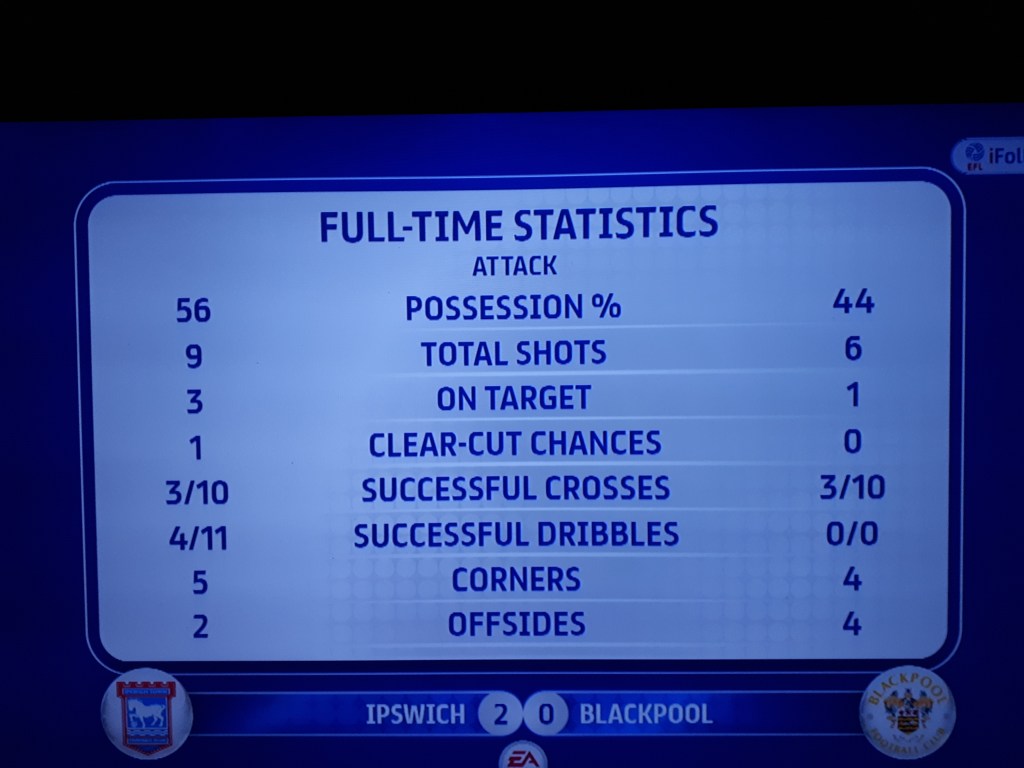
With seven minutes of normal time remaining Freddie Sears has a glorious chance for a third goal deflected away for a corner and then Mr Busby the referee has to be substituted because of  what looks like a pulled hamstring. “I think all the substitutions have been made” quips Mick, sharp as a tack.   The upshot is seven minutes of added on time, which passes without incident as Town continue to exercise control over the game.  Asked by Brenner for his verdict at the final whistle Mick is clearly not getting carried away, as good a performance as this was, “A result that almost keeps us in touch” he says.   Personally, I think this has been the first time we’ve played like a proper, half-decent football team all season, with everyone playing in a position that suits them. I don’t expect us to lose another game.

Burton Albion 0 Ipswich Town 1

This morning I awoke, along with everyone else in eastern England who hadn’t died in their sleep, to the sight of streets and gardens, trees and roof tops covered in a reasonable, but not thick layer of snow.  I’ve seen plenty of snow before of course and it had been forecast so it was not a surprise, but I couldn’t help but stop and stare at it out of the bedroom window.  Snow is always beautiful, a bit like sunsets.

I have been looking forward to the match today having suppressed the memory of last week’s game and crushed it into a tightly knotted, dense ball of pain and suffering which is now buried deep within my psyche. That covering of snow has added to the sense of joy and hope that I now feel as it has made me thankful that despite Town playing in Burton-On-Trent, normally the kind of town I would be first on the bus for, I don’t have to leave the house today.

This morning my wife Paulene has finished a jigsaw that has occupied a table in front of our French windows for at least the past four months, possibly longer.  I have listened to The Byrds’ ‘Younger Than Yesterday’ album, because that’s how I feel, and I have also taped up the ill-fitting kitchen window to keep the draft out, hung out four fatballs in the garden for the birds, put the coffee dregs and vegetable peelings in the compost tip and washed up one of three Lapins Cretins (Rabid Rabbits in the UK) glasses which don’t go in the dishwasher and which were acquired in France as part of a special offer at the Intermarche supermarket chain.  Enthused in the wake of that completed jigsaw Paulene and I have also completed a 3D ‘jigsaw’ of the Eiffel Tower which Paulene’s brother gave us for Christmas. Time has flown by carried on the wings of our industry and it’s now thirteen minutes to three.  I have not even thought about a pre-match pint today and strangely it feels like the middle of the afternoon, which, if the evening begins at six o’clock I guess it is.

Leaving Paulene to watch Toulouse versus Grenoble Foot 38 in Ligue 2 on Serbian television courtesy of the wonders of the Amazon Firestick, I skulk off to the cool of the back bedroom and its Ikea Poang chair, where I fire up Radio Suffolk on the trustee Bush TR82/79 in time to hear unwanted word of Norwich City and their visit today to Cardiff.  As unpleasant as that is it soon passes, but I then discover that the clicky bit on the top of the ITFC branded ballpoint pen with which I intend to jot down a few notes for this blog has fallen off somewhere and now the pen is unusable.  The portents for this afternoon are so far not good, but finding a replacement Montpellier HSC branded pen I get comfy in the Poang and am aurally transferred to Studio 2 at Radio Suffolk from where Brenner Woolley is providing the commentary.   Brenner speaks of remote commentary positions at the San Siro and Bernabeu stadiums and how today’s commentary tops those because he is 160 miles away (256 kilometres) from the Pirelli Stadium, the location for today’s fixture.  Although it sounds like it’s in Turin, the Pirelli Stadium is of course in Burton On Trent.  At no time does Brenner let on that he will be watching the match on a tv screen, it’s as if he wants us to believe he has a superhero’s eyesight.

As the game begins I learn from Brenner that Town are in all blue and line-up against yellow shirts, black shorts and yellow socks; if we’re just playing a kit with no one in it this game should be easy. In the studio with Brenner is someone called Stuart, but I don’t catch his surname at first hearing and I don’t recognise his voice.  Brenner may have missed last week’s game through illness but is soon into his stride quickly telling us that James Norwood is wearing pink boots, and using new synonyms for kicking as the ball is “…clouted forward by O’Toole”.  There are several changes to the Town team today including Tomas Holy replacing Dai Cornell. “It’s an easy change to make” says Brenner’s accomplice who I learn is former Town FA Youth Cup winner and Felixstowe & Walton United captain, Stuart Ainsley.  “It’s a new voice at the back” says Stuart obliquely; a comment that has me imagining Tomas Holy shouting “Keeper’s!” as a cross comes over and the centre-backs turning to each other enquiringly and mouthing “Who said that?”.

Stuart has a light Suffolk accent, but it’s not a voice made for broadcasting, even on Radio Suffolk.   Brenner compensates however, with his command of football speak and unusual use of words to describe the movement of the ball.  “The ball rumbles into touch nearside” says Brenner and then, as Burton’s John-Joe O’Toole is substituted, he tells us that “ …it’s a setback for Jimmy Floyd Hasselbaink early doors”.  “Not a great deal of quality to report in this game so far is there Stuart?” Adds Brenner telling us more in one sentence than all of his other commentary has so far.  “Chambers; an early ball in, not the worst in the world” says Brenner, from which I infer that it was a better cross than Brenner expected.

It’s nearly twenty-five past three, the game does not sound entertaining.  “A little bit of football broke out there, Stuart” says Brenner sounding surprised.  Stuart chips in now and then but he’s not very interesting.  It’s left to Brenner to make up for Stuart’s inexperience in front of the microphone with startling commentary like “Bishop opens his legs and crosses the half-way line”.  Just before half past three Luke Chambers is booked by referee Mr Hare, who if he was German would be known as Herr Hare,  which is what the people in the posh seats at Carrow Road say when they agree with what someone has just said.

Brenner’s commentary is sounding more positive as half-time approaches and Town enjoy more possession of the ball. “Chambers seeing an awful lot of the ball, here he is with his left peg” says Brenner again using curious colloquialisms and making it sound as if Chambers doesn’t always have his ‘left peg’ with him.  Brenner continues in positive vein telling us that it’s great to see three academy players in the midfield today.  Stuart agrees but further explains also that it’s “…difficult for them out there with the pitch looking like it does”, making it sound as if they are all sensitive aesthetes.  Otherwise, Stuart sounds bored and nearly everything he says is punctuated with sighs.   It’s now twenty to three and we are told there hasn’t been a shot on goal, but Brenner remains up-beat. “Town turning the screw” he says, suggesting perhaps that Town are hoping to torture Burton into submission. 

There are minutes to go until half-time, “Town have always scored when they’ve been at the Pirelli Stadium” says Brenner, and almost immediately Burton hit the top of the cross bar and Brenner is saying “this has to be a tap-in”, but fortunately Luke Chambers blocks the shot. Three minutes of added on time are played and half-time arrives.  I put the kettle on, check with Paulene on the final score at the Stade Municipal in Toulouse (the home team won 2-0, Allez les Violets!) and eat a couple of Waitrose Stollen bites as a half-time snack.  At four o’clock Serbian tv moves its attention to Olympique Marseille v Nimes Olympique in Ligue 1 and I leave Paulene at the Velodrome as I climb the stairs back to the Pirelli Stadium, where the ‘action’ has already re-started and Town have conceded a corner. 

Burton Albion are “…sharper out of the blocks early doors in this second half” says Brenner mixing metaphor from an unrelated sport with football-speak; but nevertheless the view of Stuart is that Burton pose no threat except from set pieces.  Stuart is concerned however, that Town players are not chasing back when they lose the ball, but stops short of calling them lazy and overpaid, which is probably what many listeners are thinking.  But tuning into the need for honest assessment Brenner adds “…the game is really boring at the moment, it has to be said”, before telling us that , as he keeps emphasising, the Burton Albion goalkeeper is yet to make a save.

The sense of gloom builds and Brenner begins to speculate that “Burton will see this as a chance to build on their away win at Gillingham” before adding after a pause, having seemingly completed some swift mental arithmetic “Six points out of six”.   Stuart’s confidence has grown in the shadow of Brenner’s pessimism and he tells us that Town have “…no belief in what they’re trying to do, whatever tactics they’re trying to play”.  Stuart’s reference to “whatever tactics” makes it plain that he hasn’t been able to spot any.

James Norwood is replaced by Aaron Drinan with thirty minutes left to play and Tomas Holy concedes a corner. “Was that a shot we just saw there Brenner?”  asks Stuart as Burton’s Lucas Akins’ kick at goal is saved. Now Ipswich win two corners in quick succession and Aaron Drinan hits the Burton cross bar with a header.  “Drinan done well” says Stuart like a true footballer.  Town win another corner and then Mark McGuinness wins a free-kick. Oliver Hawkins replaces Teddy Bishop and the possibility arises that Town will play with two forwards who are actually playing up-front.   Little Alan Judge has a shot blocked before crossing the ball following a short free-kick. “Headed in by McGuinness” says Brenner, “His first professional goal”.   It’s the seventy-third minute of the match and Town lead 1-0. “Town had been on top for 15 minutes” says Stuart a little uncertainly, “Playing the right football in the right places”.

Brenner tells us that Town quickly come close to scoring a second goal with a header by Aaron Drinan that is well saved.  We learn that Paul Lambert is wearing a black beanie hat and snood before Gwion Edwards is replaced by Freddie Sears.   It doesn’t sound as if Burton are likely to score, but all of a sudden, out of the blue “ Oh, a slice by Nsiala” and Tomas Holy makes his best save of the afternoon from one his own centre halves.  Stuart has been impressed by Toto Nsiala this afternoon and generously blames the ‘dodgy pitch’ for his mis-kick.  Burton have a couple of shots which don’t trouble Tomas Holy and Brenner introduces yet another word to describe the ball being kicked as it is “…clattered up to half-way by Gallacher.”

Hopes for a second consecutive away win are now high. “Town upwardly mobile in terms of the table” says Brenner using lots of words to describe Town climbing the league table without saying in what position they will be.  It’s six minutes five.  Mr Hare blows the final whistle and Town win.  “Big victory this” says Brenner, as he usually does when Town win.  As nice as it is to be told that we have  ‘big victories’ I can’t help thinking that they wouldn’t be so big if it wasn’t for all the big defeats that come between them.  “Was that deserved overall, Stuart Ainsley? asks Brenner. “I think so, yeah” says Stuart, as convincingly as he can.

Personally, I’m glad the game is over; it’s not that I was nervous and on the edge of my seat, wondering if Town would hold on, more that I was bored.  Unfairly, I decide to blame Stuart Ainsley, he’s no Mick Mills, but who is?  Relieved and happy however, I turn off the radio and return downstairs to watch the second half of Marseille v Nimes where Paulene is happy too because her team Portsmouth has also won 1-0 away from home.   Like the snow and sunsets, away wins are always beautiful.

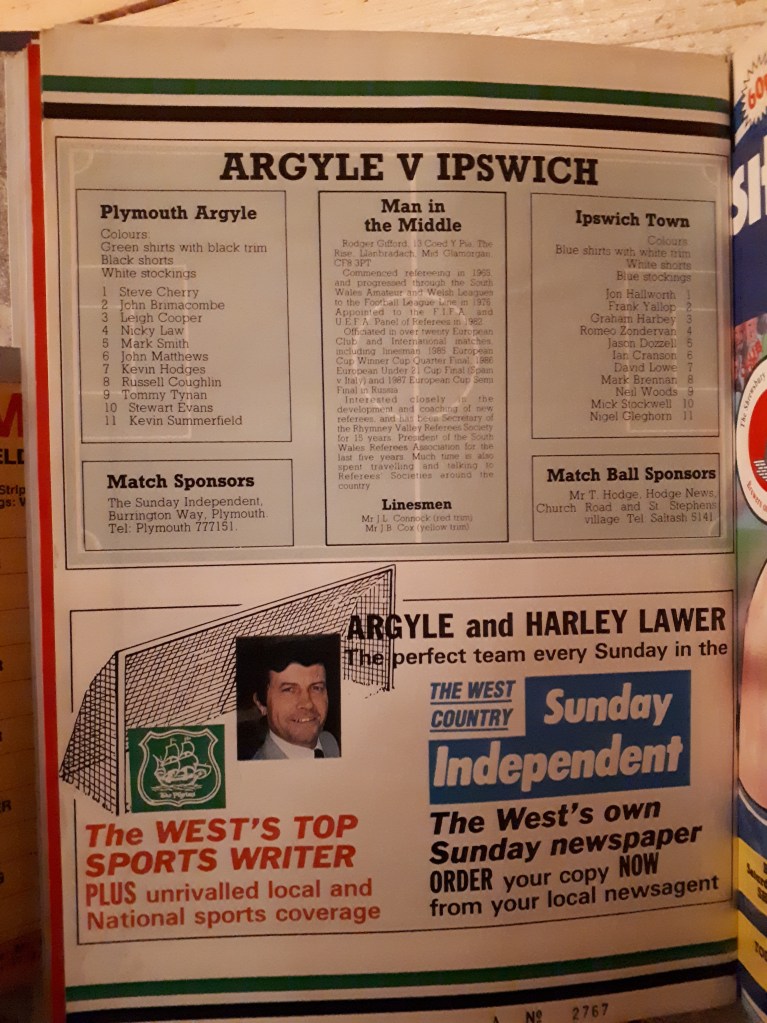
Plymouth Argyle 1 Ipswich Town 2

I am a little ashamed to admit it, but I have only ever been to Home Park, the sensibly named home of Plymouth Argyle, twice.  The first occasion was in August 1987 for an evening fixture, when after a seemingly interminable coach journey from Portman Road I witnessed a goalless draw.   Then, at the start of 2005 I returned, this time by car, to enjoy a 2-1 victory courtesy of Darren Currie as Town went top of the league but, as ever, ultimately failed to achieve promotion.  My memories of Plymouth therefore are on the whole not disagreeable, although if the city has memories of me they might not all be as positive. My very first visit to the city of Plymouth was in the summer of 1966 when on a family holiday. My father was in the Royal Navy and serving on HMS Tiger at the time and the ship happened to be in Plymouth dockyard; he took us aboard and I vomited on the wardroom carpet.  Given that the eleven thousand ton cruiser was in harbour I can’t blame sea sickness, it was more a surfeit of free peanuts from what I remember.

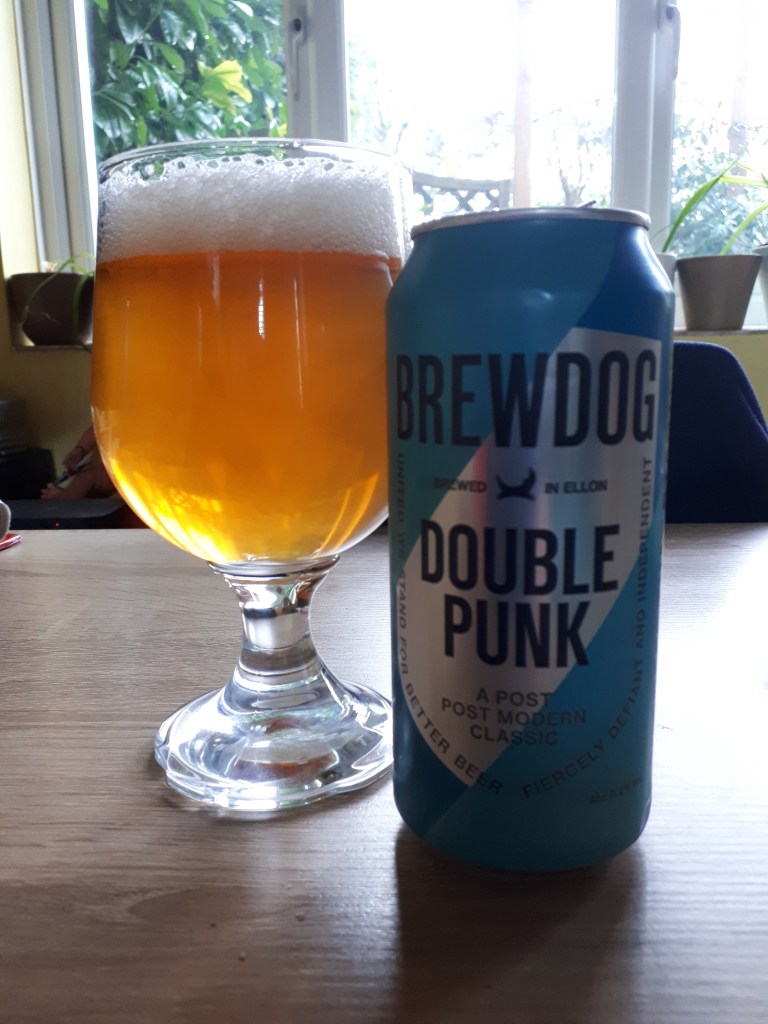
Today, I have not eaten any peanuts but for a pre-match snack enjoy a handful of Nairn’s ‘naturally nutritious’ rough oatcakes with some Cheddar and Port Salut cheese. My pre-match ‘pint’ is a 440 ml can of Brewdog Double Punk, today’s offering from my beer advent calendar; a different beer every day until Christmas.  Feeling sociable, perhaps because the beer has alcohol by volume of 8.2%, and having half an eye on Troyes v Paris FC in French Ligue 2, which my wife Paulene is watching on tv using an Amazon Firestick, I settle down on the two-seater blue leather sofa in the living room.  With a plastic earpiece in place I tune into Radio Suffolk on my Sony 310 transistor radio in time to hear the tail end of a pre-match summary of this afternoon’s encounter between Stowmarket Town and Eynesbury in the FA Vase.  My attention is grabbed by the fact that former Ipswich Town starlet and Bermudan international Reggie Lambe is appearing for Stowmarket.  Reggie Lambe has always retained a high profile in my football memory, possibly not because of his on-field exploits so much as the fact that he sounds like he could also be a cuddly character from an undiscovered episode of Watch with Mother.

The reportage from Home Park begins with a replay of commentary from 2008 in which commentator Brenner Woolley became very excited about two goals from Owen Garvan and one from Kevin Lisbie; as well he might.  After reference to the 976 kilometre round trip from Ipswich, although Brenner archaically quotes the distance in miles, we are introduced to the glorious West Country burr of this afternoon’s co-commentator Marcus Stewart; in the week that David Prowse died it seems a fitting tribute.  Brenner sarcastically speaks of the receding sound of the ‘loudest PA system in the country’ as Town’s goalkeeper, who he refers to as “Dai” Cornell, leads the Town team on to the pitch.  Marcus Stewart meanwhile says that it is time for everyone to “get onside and support the club and get behind the club”.  I will admit that I did not know that as well as being closer to the opponent’s goal line than both the ball and the second-last opponent, it is also possible to be offside by not being behind the club.

Very quickly Marcus tells us that he is going to put his “head on the block” as he predicts that there will be goals in this game.  I can’t help feeling that he is sounding hopeful when he suggests that if he is wrong it might be the last time he is asked to ‘appear’ on Radio Suffolk.  The opening minutes of the game sound entertaining as Brenner relays to us that there is “Good play from Town”, that Home Park is “sunny but blowy” and that “Woolfenden seems to have had a haircut”.   “Wrong decision” says Marcus in the assertive style of tv’s Kirtan Mucklowe as an Argyle player picks the wrong pass.  The commentary briefly takes the form of a conversation “Very open, Marcus” says Brenner. “End to end” replies Marcus, who a short while later provides some interesting tactical analysis about full-backs having more time on the ball when playing against a 4-3-3 formation, and being able to push forward.    Brenner meanwhile talks up the promise of goals for Town against Plymouth. “Only Swindon and Burton have conceded more goals” he says.  It’s a fact that shows Brenner has been assiduous in his research again, but personally I just love to hear the names of un-related English provincial towns in the same sentence; it makes me think of railway lines and town halls, local papers and building societies.

The thirteenth minute passes and seemingly out of not very much Plymouth score through Luke Jephcott.  “Good finish in terms of build-up play” says Marcus a little confusingly “ Plymouth again pinging the ball around” he adds.  Disappointed that what had sounded like a reasonable start to the game has taken the familiar wrong turn I take a mouthful of my beer, which because of its alcoholic strength has lived beyond it’s original ‘pre-match pint’ billing.  “Mmmm” I say to Paulene “This is a very fruity beer”.  What sort of fruit?” she asks.  Caught off guard by this question I make up something   “Oh, just a generic sort of fruit” I say, but she demands more detail. “Pineapple, banana?” She asks. “Yes” I reply “and apple, pear, mango, raspberry, kiwi fruit, lychee”.  “What about grapes, cherries and star fruit?” asks Paulene. “Yes”, I say “and strawberry, tomato, orange”.  “Melon, plum, papaya?” asks Paulene, “Yeah, and cranberry, blackberry, damson, even a hint of brazil nut.” 

Our listing of the world’s fruits is interrupted as I hear Brenner say “any fixture at the moment seems to be tricky for Ipswich” before mentioning “mitigating factors”.   Then all of a sudden Kayden Jackson is through on goal. “No excuses, should be 1-1” says Brenner as Kayden is tackled “We’ll be looking back on that through very painful eyes” continues Brenner, all too easily imagining the scenario in which Town fail to score and adding un-diagnosed medical problems to the mix for good measure.  “Just as he cocked his leg to take the shot – good defending” adds Marcus trying to describe what happened, but making Jackson sound a bit like a dog beneath a lamp post.

Despite the current score line I remain optimistic.  “Ward invited to come forward” says Brenner of Town’s left-back , creating an image in my head of Plymouth players ushering Ward along or handing him little cards with RSVP on the bottom.   Brenner soon engages Marcus in conversation again, “Jephcott’s a strong boy isn’t he Marcus?”  “Like a little bulldog” replies Marcus clearly still trying to develop his canine analogies.  Despite a lull in play around half past three which forces Brenner into telling us that there is very little happening, the consensus between the two commentators seems to be that it’s an entertaining game.  “ Town don’t look like a team short on confidence” says Brenner before unleashing a combination of stats upon the listeners about how many wins Town have had in the past five games (one) and how many points they’ve taken from the past ten games (nine).   The criticism remains implied, but Brenner is careful to explain that this is a “…very young Ipswich Town side” and “needs must at the moment”.

Half-time arrives at fourteen minutes to four and Marcus repeats that “There is goals in this game” which he has found “thoroughly entertaining”.  It’s left to Brenner to encourage me to return for the second half, “This game could be anything.  There could be a comeback for Ipswich Town, or it could be 3-0 to Plymouth”.  As insightful summaries go it fits well into either of the “Hedging one’s bets” or the “Why the hell are you asking me?” categories.

I enjoy a half-time of putting the kettle on, shutting and locking the garage door, drawing the blinds and closing the curtains.  Troyes have beaten Paris FC 2-1 with Paris having a spectacular volleyed ‘goal’ in the seventh minute of time added-on disallowed for dangerous play (jeu dangereux).  Troyes replace Paris FC at the top of Ligue 2 on goal difference and Paulene re-tunes the Amazon Firestick for the Ligue 1 game at Parc Roazhon between Stade Rennais and Racing Club de Lens.  I reflect that Home Park is only 402 kilometres from Rennes by sea and road, which is almost 90 kilometres closer than it is to Portman Road. 

Carelessly, I miss the re-start at Home Park and re-join the game just as little Alan Judge makes a “suicidal pass”, which almost gives Luke Jephcott a second goal.  Brenner moves on to speak of Newport County, Cheltenham Town and Exeter City all doing well in the fourth division this season and the prospect of further trips west next season,  clearly suggesting he has already given up on hopes of Town being promoted. “Cambridge would be a nice short trip” he adds, adopting the outlook of the Radio Suffolk accountant.

It doesn’t sound like Town are having many shots on goal ,but the game remains open and Brenner is moved to tell us that “ There is still no way of knowing what the full-time score will be”, which is frankly somewhat obvious unless he has access to some sort of Old Mother Woolley figure who has a crystal ball.  “Strong young lads” says Brenner of Jephcott and McGuinness, introducing an unexpected frisson of homo-eroticism as the game enters its final 25 minutes.  Jack Lankester and Brett McGavin are replaced by the weirdly named Keanan Bennetts,  and Oliver Hawkins.

It’s the seventieth minute and I am told that Plymouth’s Danny Mayor has “kicked the feet away” from Town’s Armando Dobra, a player who is Albanian and whose name incidentally rhymes with Enver Hoxha the former Communist leader of Albania.  Mayor is booked for a second time in the match and is therefore sent off.  Quickly following on, former Town player Frank Nouble is booked also, but only for the first time; “Getting a yellow card for verbals” says Brenner , incorrectly using the word ‘verbals’, which actually refers to different forms of verbs rather than bad language; we should expect the BBC’s broadcasters to know this sort of thing.  Marcus or Brenner, I’m not sure which, now tells us that against ten men we are going to have a lot of the ball, we just have to do something with it.   Seconds later, Paulene cheers as over in France Lens take the lead through eighteen year old Arnaud Kalimuendo Muinga and then in what is turning out to be a very busy three minutes Town take those words about doing something with the ball to heart and equalise. “Nolan shoots, he scores says Brenner succinctly.  “A great volley” confirms Marcus.  Within a minute I am hearing Brenner say “Hawkins chests it down and Jackson scores” and Town lead 2-1.  “Yay” I shout from my reclining position on the blue leather sofa.  This is the most fun I’ve had since last February.

To add to my enjoyment Brenner tells me that the 1800 Plymouth fans who have been allowed into the ground are “really aggravated” and in the background I hear them bawling and moaning in a real life version of people in supporters groups on the interweb.  The final fifteen minutes and injury time pass in a parade of observations from Brenner and Marcus.  “ … keep playing forward like they ‘ave been doing” is Marcus’s recipe for success as he turns up his West Countryness a notch . “ Ill-discipline from Watts” says Brenner revelling in another booking for a Plymouth player. “Fans getting disgruntled” adds Marcus picking up Brenner’s theme before sounding a note of caution with “Dangerous times now”.   Marcus’s voice is becoming increasingly gravelly, as if he’s been chain smoking Woodbines and slugging whisky all afternoon; he sounds like a Somerset Jimmy Durante.

It is evident that Plymouth are succeeding in getting back into the game. “Decent effort on goal from Hardy” says Brenner before ramping up the tension and pessimism with “This‘ll be a massive disappointment if Town draw this one”.   He carries on in similar vein by validating those listeners surprised that Town aren’t losing with “Town ahead; if you lost faith earlier in the game and thought here we go again”.   It doesn’t get any better; “Plymouth close – over the bar” and “Not pleasant viewing at the moment” before Brenner perhaps tries to lighten the mood with “Two players with similar pinkie-orange footwear on the far side” as full-time approaches.  The pretty-much statutory four minutes of additional time will be added.  The four minutes pass and Town win.

I am elated. After foolishly depressing myself by reading the ‘opinions’ of people on social media in the wake of two recent defeats and a draw, I am now ecstatic that Town have won and this afternoon I feel like I have travelled to Plymouth and back, played the match and wilfully thrown up on the wardroom carpet of every warship in Plymouth harbour.

Perhaps Town will lose again next Saturday, perhaps they won’t, but that’s what football teams do, they win, they lose and they draw and the margins between those three outcomes are small.  This season Ipswich Town have won more than we have lost, today we won, life is sweet.

Dijon Football Cote d’Or 2 Racing Club Strasbourg Alsace 1

The 570 kilometre journey down the A26, A5 and A31 motorways from Calais to the elegant and historic city of Dijon takes a good five hours plus stops, but it’s worth it.   The medieval city was the seat of the influential dukes of Burgundy and the modern city is still the regional capital with a population of about 155,000.   But that aside, tonight Dijon FCO are playing RC Strasbourg Alsace in Ligue 1 of the French professional football league and I am heading out with my wife Paulene to the Stade Gaston Gerard, to witness it.  If I hang out of the window of our hotel room in I can see the stadium and the lights are already on.

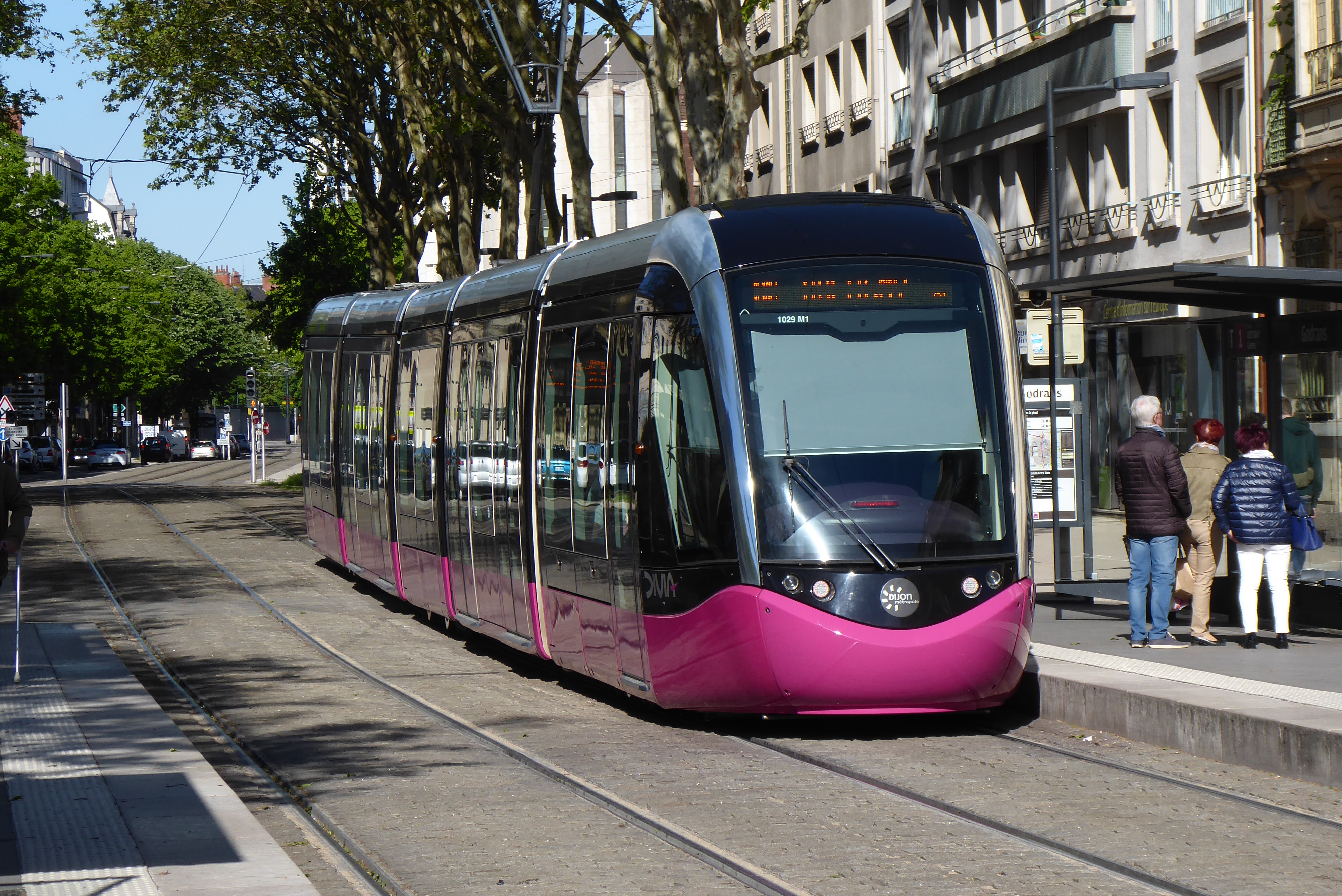
It’s been a day of gusty wind, sunshine and showers, of cafes and bars and the tombs of dead dukes and duchesses.  We have pre-purchased our joint ticket for the tram (5.60 euros for two journeys each) and are at Place Darcy in the shadow of Dijon’s triumphal arch, the Porte Guillaume, ready to ride out to the Parc des Sports wherein lies Gaston Gerard’s eponymous football stadium.  Gaston Gerard incidentally was mayor of Dijon from 1919 to 1935 and later a member of the French government.  But there is a problem, we want to catch a T1 tram in the direction of Quetigny but it seems they are not running the length of the line due to a ‘perturbation’.  We could catch the T2 and then walk to Auditorium to catch a T1, but the helpful man at the tram stop, who works for the transport company Divia, advises us to cross the road and catch the number five bus to Université, and then catch a T1 tram from there, so that’s what we do.  The bus soon arrives and with our ticket validated we are soon out of the city centre travelling through anonymous looking early evening streets in a bright pink, 18m long Heuliez articulated bus.  From the end of the bus route the tram stop is just around the corner on a windswept, open part of the university campus, but a tram arrives within a few minutes, almost as if the public transport services were somehow co-ordinated; we know from living in England however that such a thing is just not possible.  From the university it is just three stops to the Parc des Sports tram stop, which is but a nonnette de Dijon’s throw from the Parc des Sports itself.

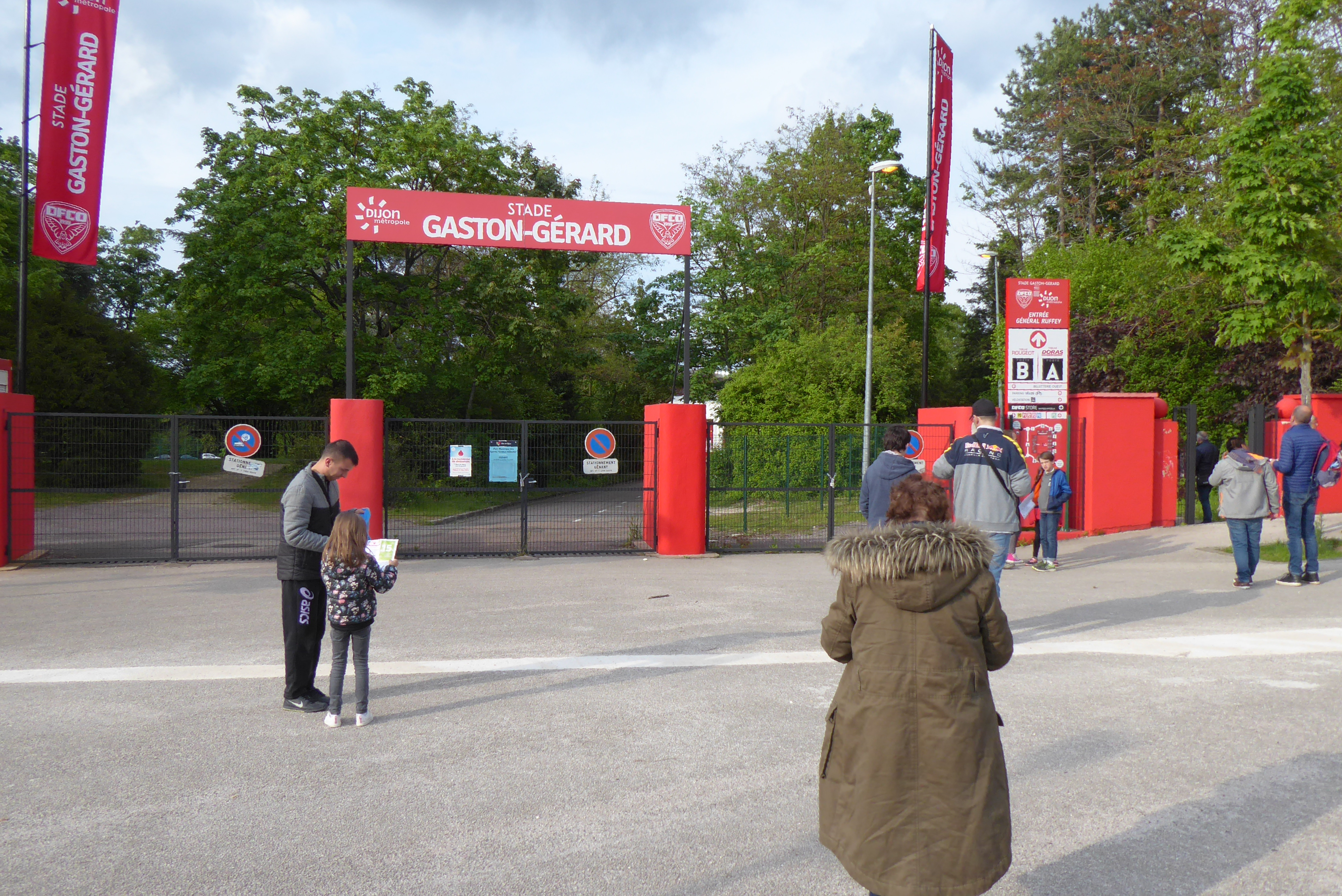
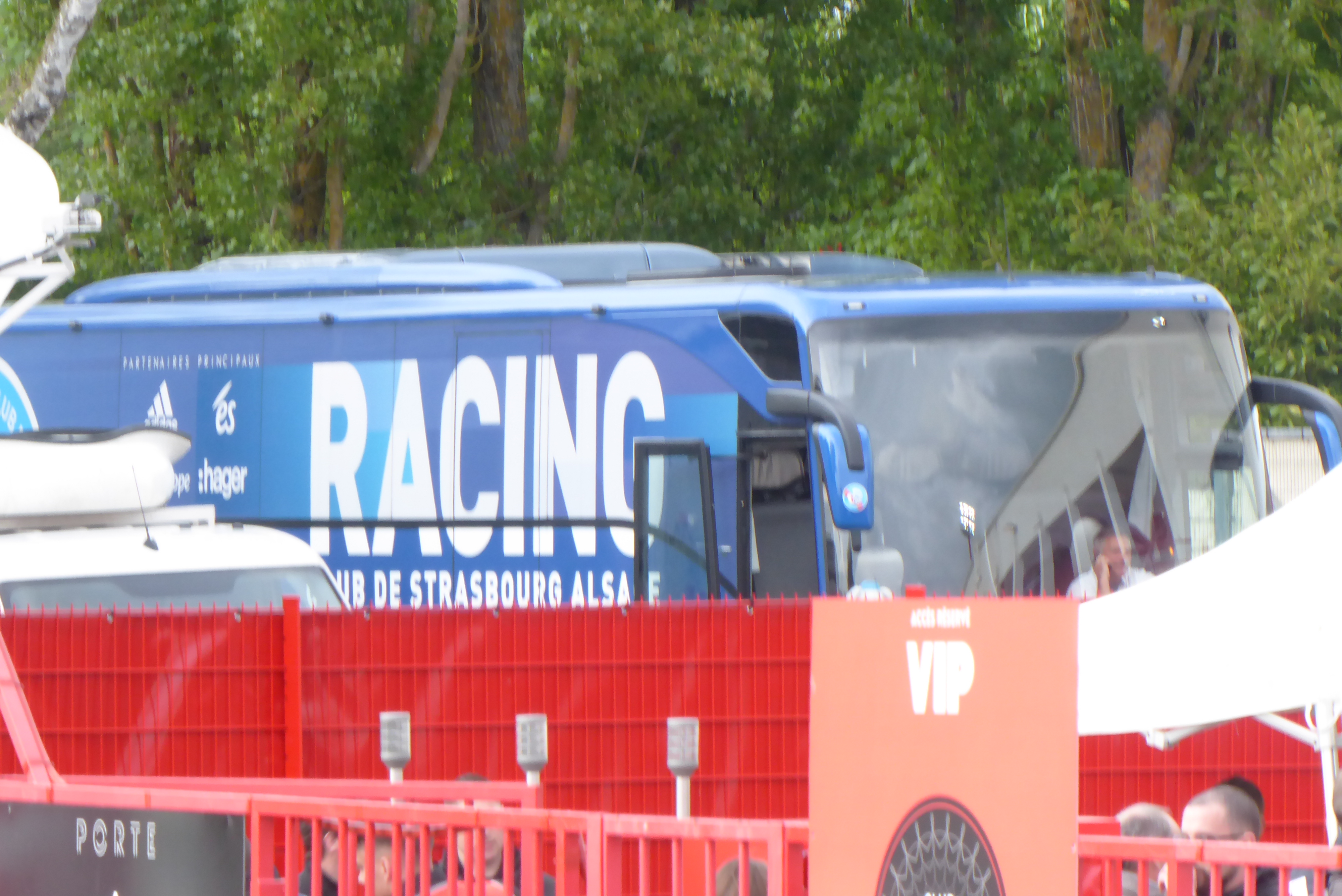
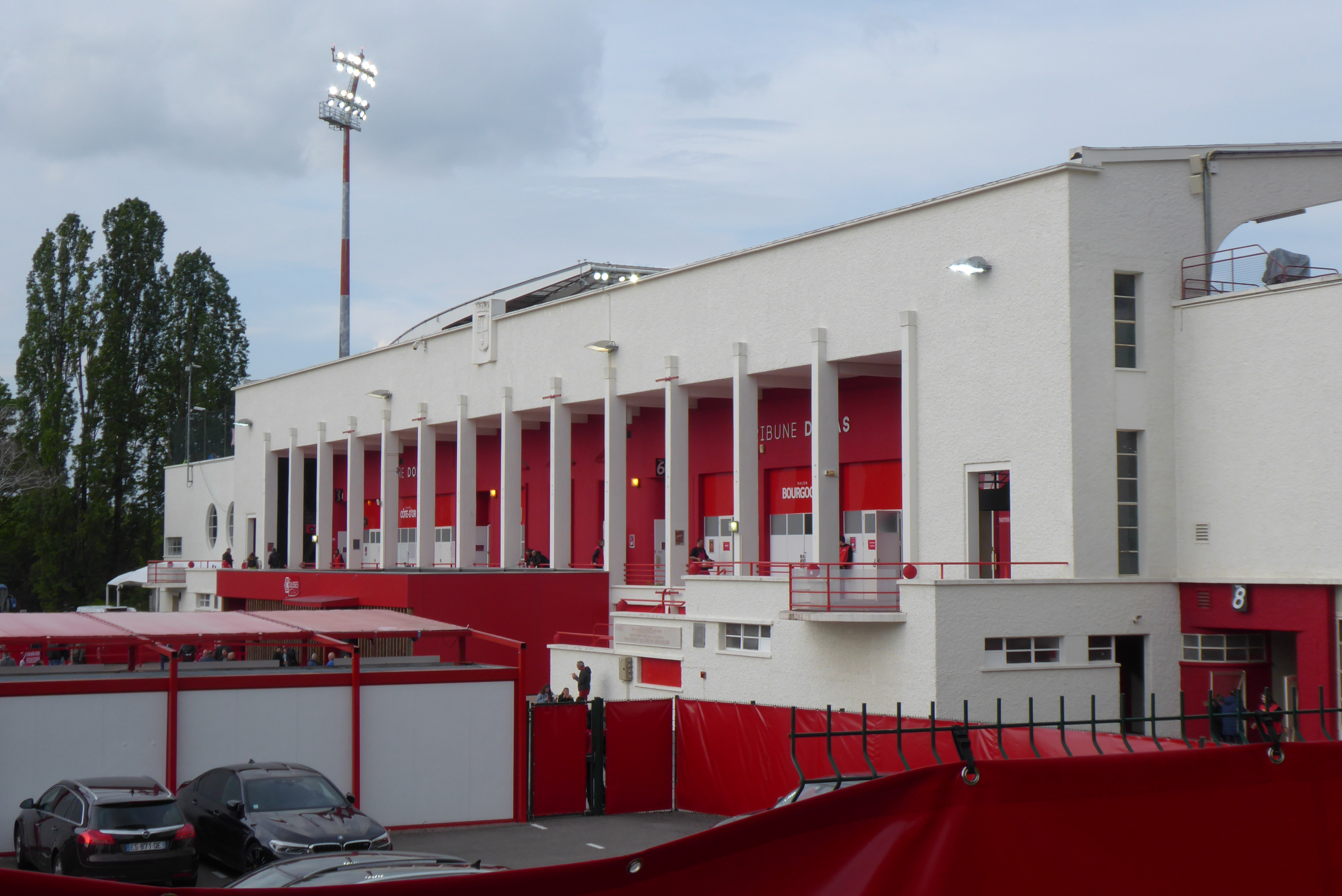
A man in a ‘gilet orange’ checks our tickets and ushers us through the gate and into what seems like a leafy suburban park.  We follow a trail down between the trees; there are tennis courts off to our right, we round a couple of bends and then the stadium is before us.  Three sides of the Stade Gaston Gerard have been re-built  this century, the remaining part of the original stadium has its back to us; it’s a neat, classical looking concrete structure which dates from 1934  and is quite typical of pre-war French municipal buildings; it’s got style; it’s a bit Art Deco.   Over a fence there is a glimpse of the blue Strasbourg team bus.

We walk on and pass through the turnstiles which read our bar-coded tickets before we are patted down and wished “bon match”.  It amuses me that Paulene seems to be searched more thoroughly than I am, but then the French have a history of female villains; Madame Defarge, Madame Thenardier, Marine Le Pen.   At the back of the Tribune Sud (south stand), which is built into the hillside behind the goal, a couple of blokes who look a bit old to be Ultras are unfolding a tifosi banner in the form of a huge Dijon home shirt.  I half expect to see them plugging in an especially large iron. 

Our tickets (24 euros each) are in the top tier of the east stand at the side of the pitch, so we keep on walking, on past the ‘Le Bon Sucre’ stall selling crepes, gauffres and beignets, and bizarrely decorated with the figure of a busty woman, posed with her mouth slightly open and about to lick a dollop of cream from her finger.   France can be oddly schizophrenic with regard to women; seemingly ahead of Britain in the use of female football presenters and commentators and in appreciating women’s football, but still displaying the same casual sexism of the 1930’s when Gaston Gerard’s wife Reine impressed a well-regarded critic and gastronome with a new chicken dish, which thereafter became known as Chicken Gaston Gerard after her husband, not her.

Resisting the temptations of le Bon Sucre we walk on beneath the Tribune Caisse D’Epargne as it is known thanks to sponsorship from the bank of that name, where we cannot resist the lure of the club shop. 

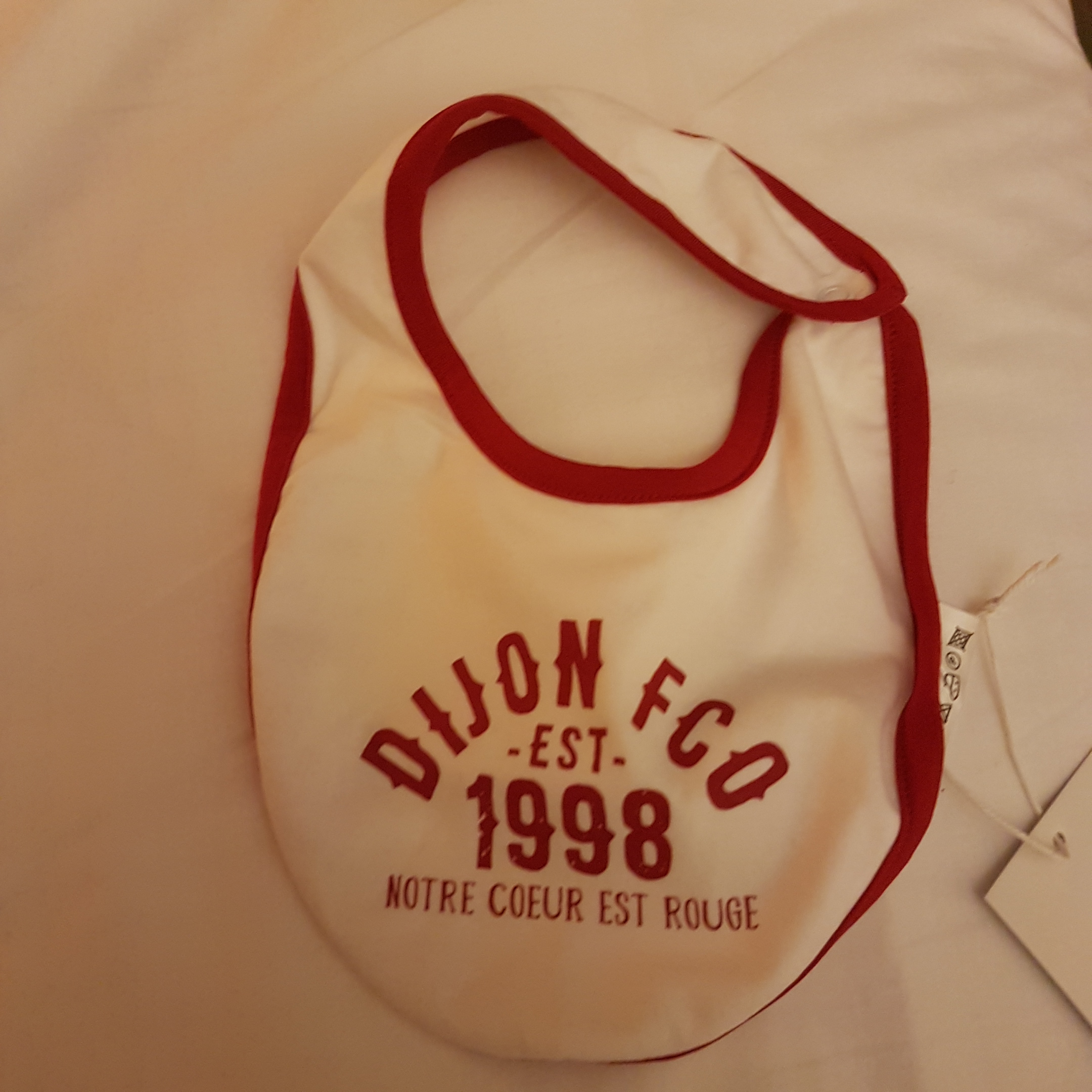
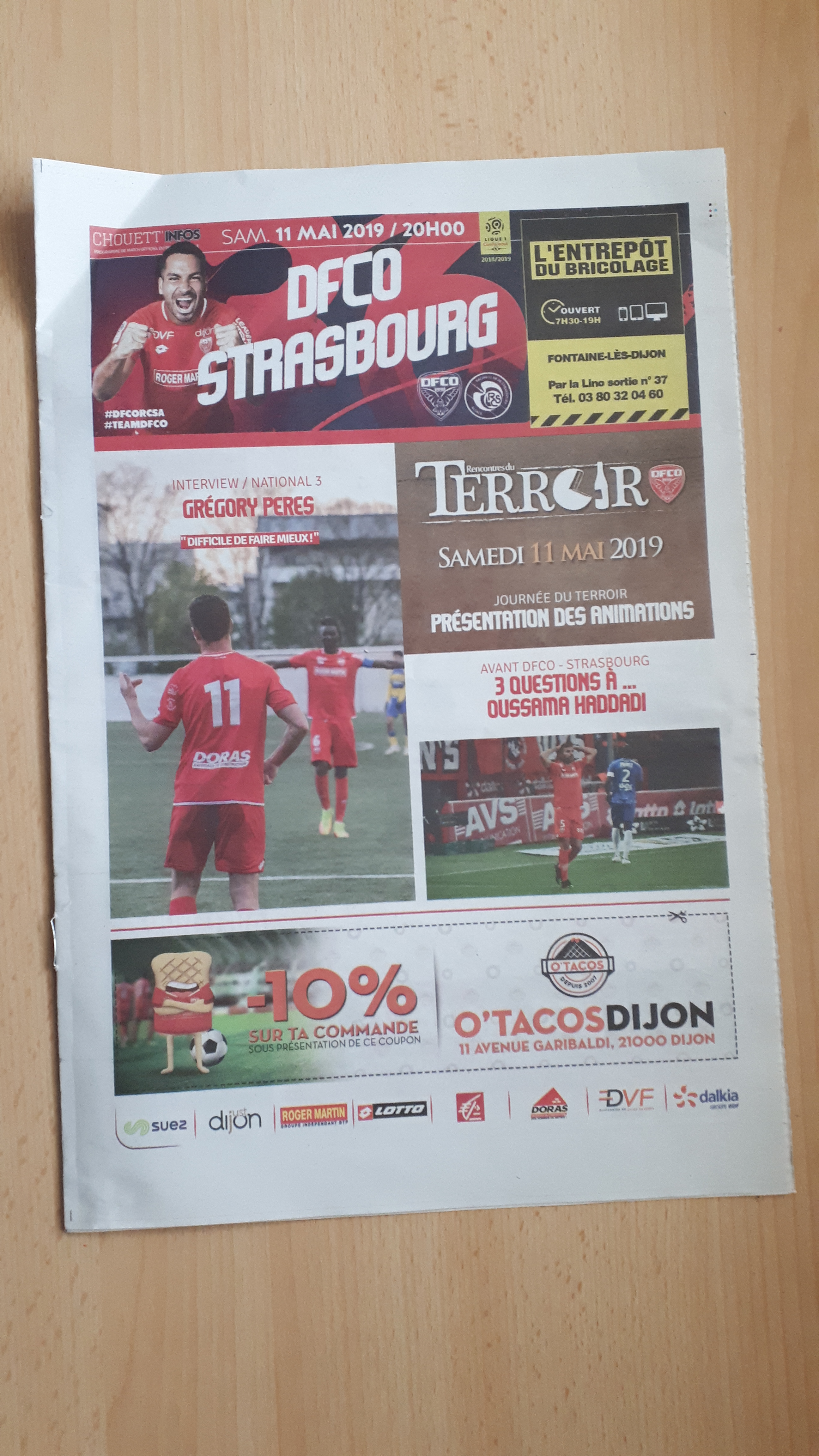
Thankfully Dijon FCO do not have their own brand of mustard, and sadly their T-shirts don’t appeal so we restrict our purchases to a petit fanion (5 euros) to add to the collection in the upstairs toilet, a bear in a red and white scarf (10 euros) for Paulene’s cupboard of football related cuddly toys and a bib (6.50 euros) for the new grandson Jackson, because he needs more bibs.  Leaving the shop we pass by one of the buvettes, from which people are leaving with the best looking chips I have ever seen at a football ground, proper big chunky ones.  I collect a couple of the free match day programmes, which are actually more like 12 page newspapers, but they tell us all we need to know, listing the squads, tonight’s other fixtures and the up to date league table.

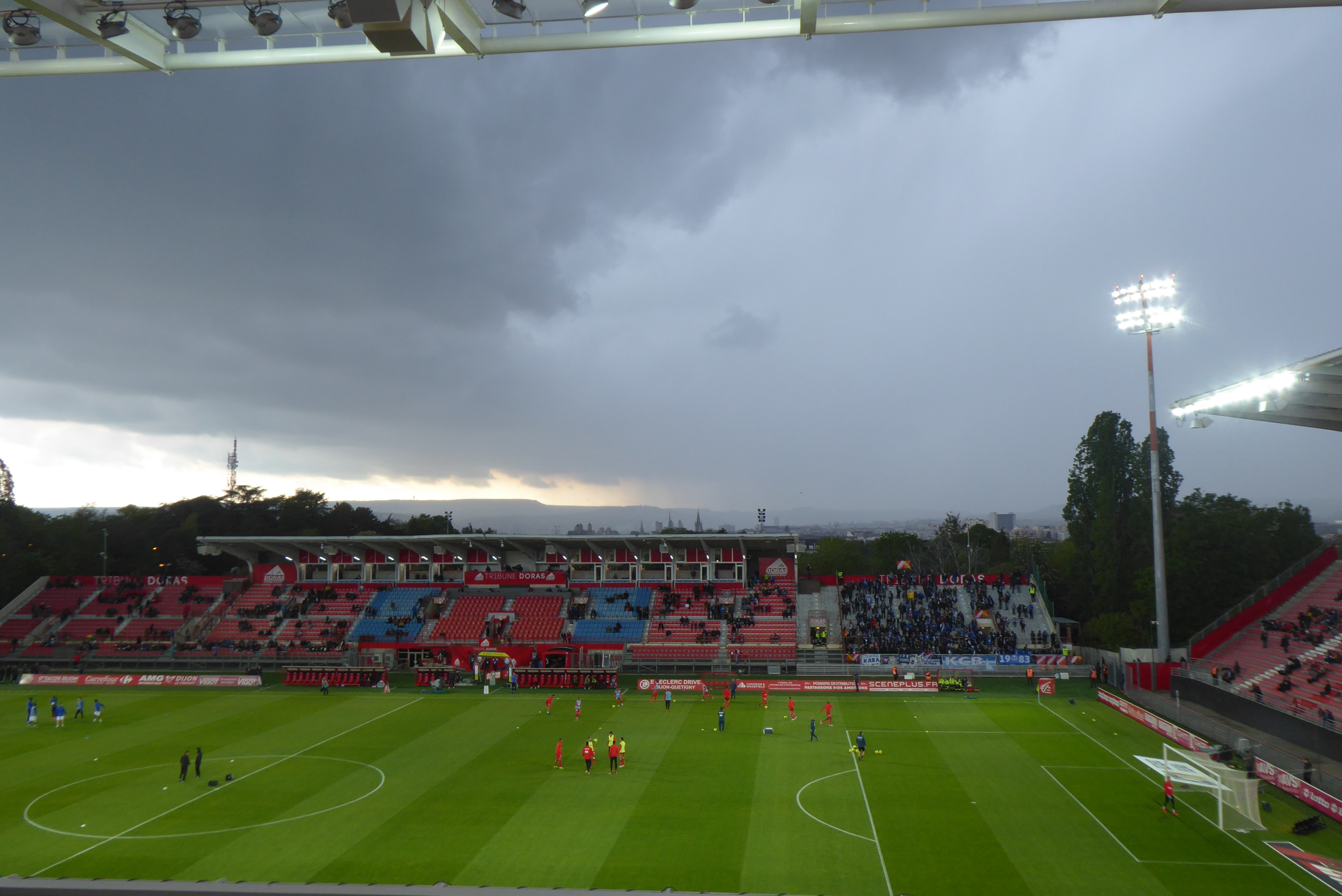
Our seats, we learn, are in the top tier of the stand;  it’s been a bit of a walk from the tram stop and Paulene’s asthma means she’s not feeling up to climbing two or three flights of stairs so I ask one of the many young women in gilets oranges if there is a lift.  I am directed to a man in a blue jacket with the words Besoin d’aide? (Need help?) printed on the back; he asks us to follow him and  having led us into a room from which he collects a set of keys he unlocks a white door hidden within the white walls of the concourse beneath the stand.  The blue jacketed man leads us down a long white corridor and round a corner, part of a hidden labyrinth within the stand; I think to myself that this is what near death experiences are supposed to be like.  The man then unlocks what seems like a secret compartment, but is in fact a lift, which takes us to an open concourse at the back of the top tier of the stand.  We thank the man but not before he shows us to our seats; what a helpful bloke.  From each seat projects a red flag at 45 degrees which bears the Dijon FCO club crest; it doesn’t do to sit down in a hurry; it could be painful.  We are in the second row at the front of the top tier and have a fine view of the pitch, but also, over the top of the stand opposite, a panorama of Dijon stretches out with an array of towers and spires, like a Gallic version of Oxford. Beyond the city, rolling hills and forests.

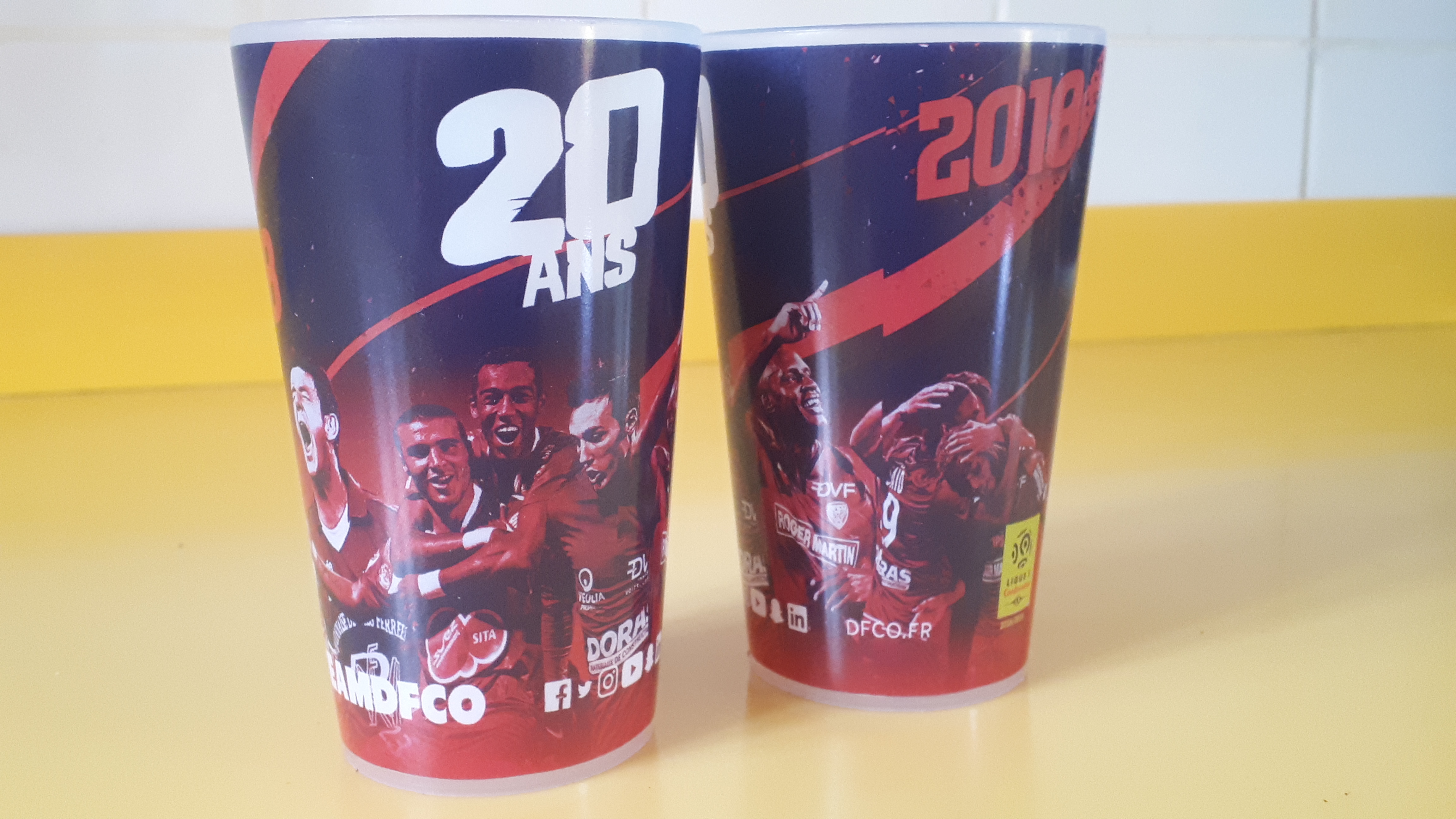
There is a still a while until kick-off so I return to the open concourse for some drinks, returning with a cup of orange Fanta for Paulene and a small beer for me (7 euros for the two). Both drinks are in re-usable plastic cups which celebrate Dijon FCO’s twentieth anniversary; Dijon had a club dating back to 1913 (Cercle Laique Dijonnais) but it remained resolutely amateur, like my own beloved Ipswich Town did unti 1936, before merging with Dijon FC in 1998 and the new club eventually turned professional in 2004.  Looking north-east from the back of the stand the sky is a menacing grey and in the distance it is clearly raining; a strong gusty wind is blowing it towards us, something wicked this way comes, but more probably something wet.  Walking back to my seat I begin to regret not having noticed until I had ordered beer and fanta that I could have had a cup of the vin chaud (2.50 euros).  The rain arrives in the form of stair rods, it is spectacular and I am thankful I am not in the Tribune Sud into which the wind is blowing, or on the open terrace opposite where an increasing and impressive following of Strasbourg supporters are gathering and getting soaked.  The deluge is mercifully brief and heads off into the hills of Burgundy leaving the fading evening sunlight to glisten and reflect off the roof tops of the city.

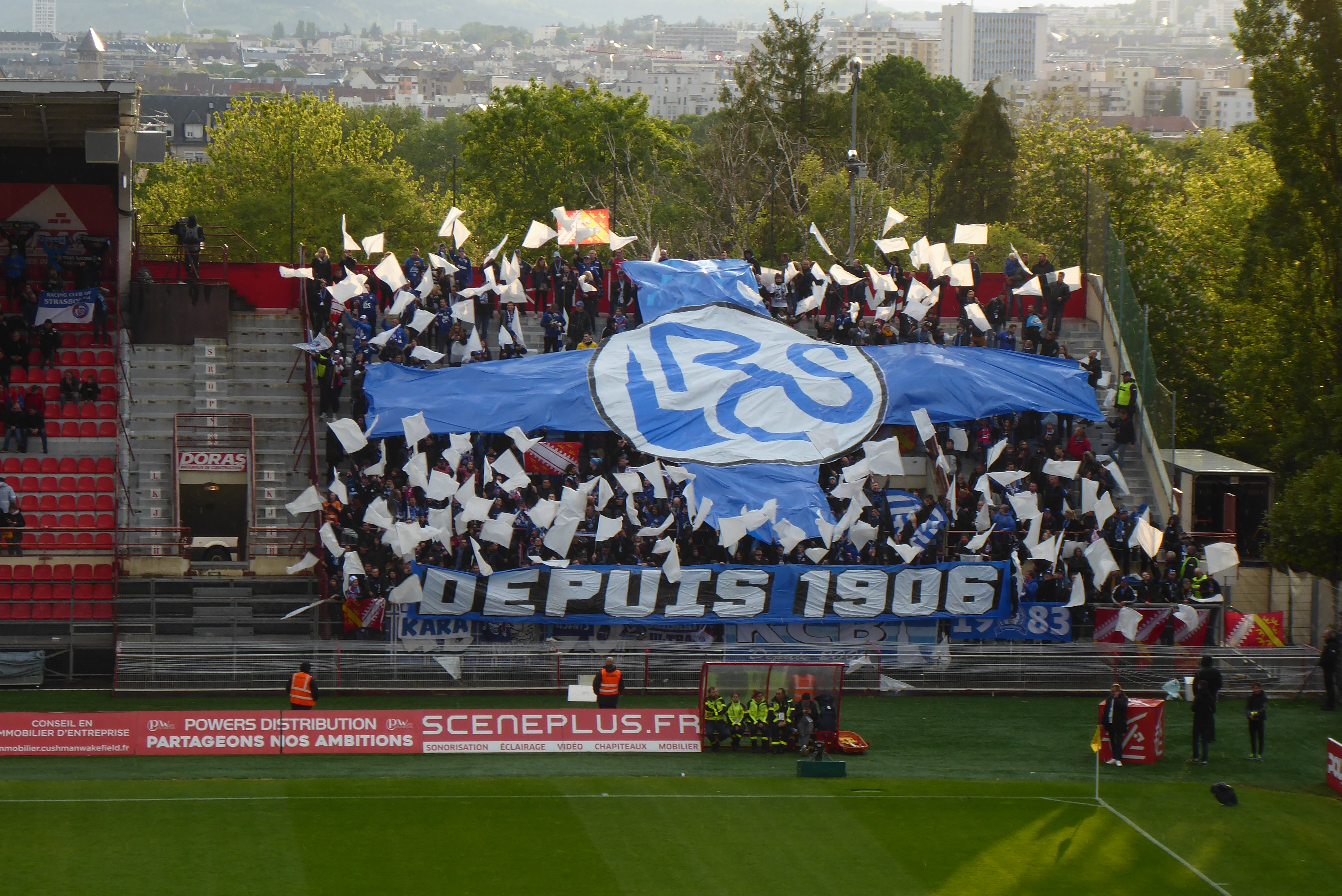
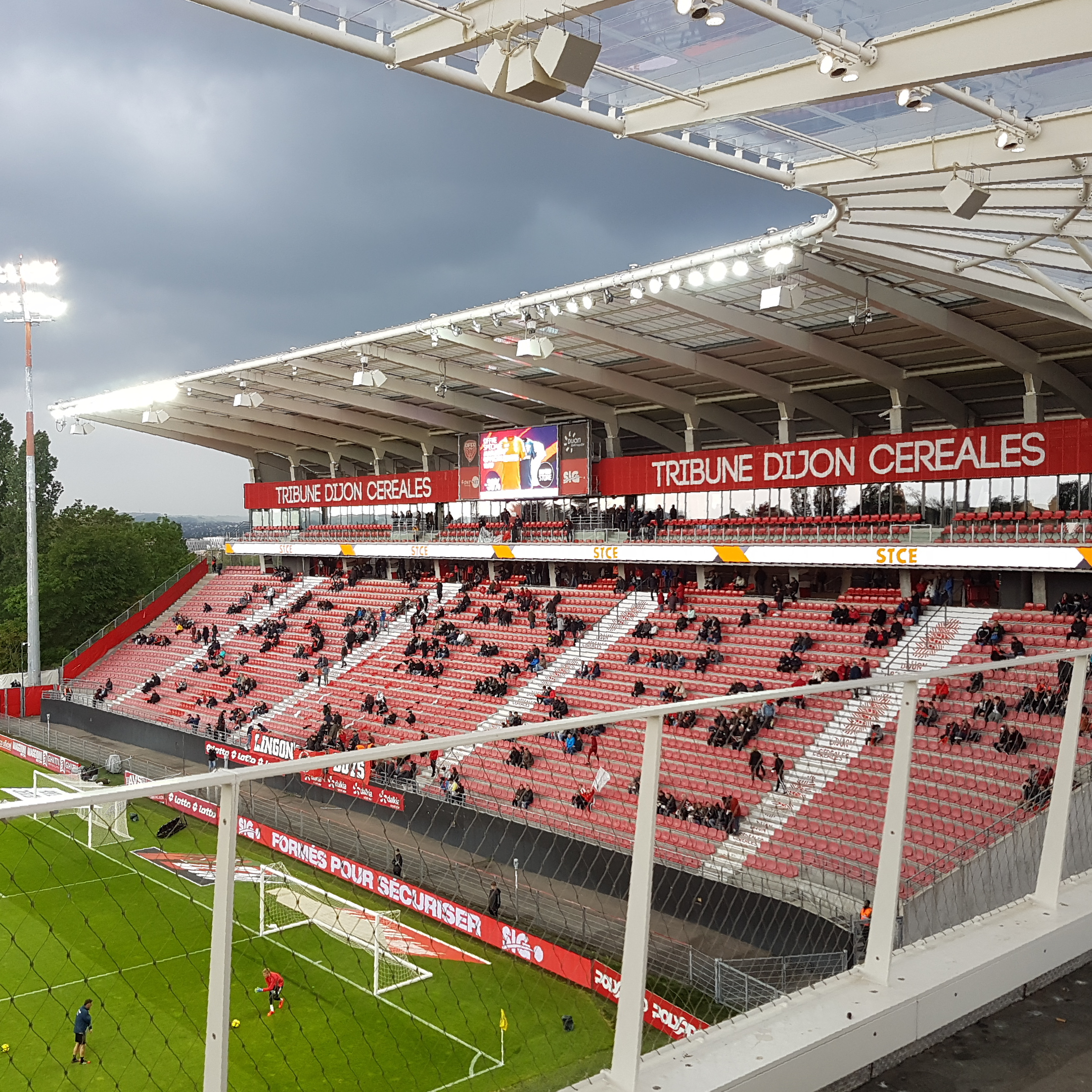
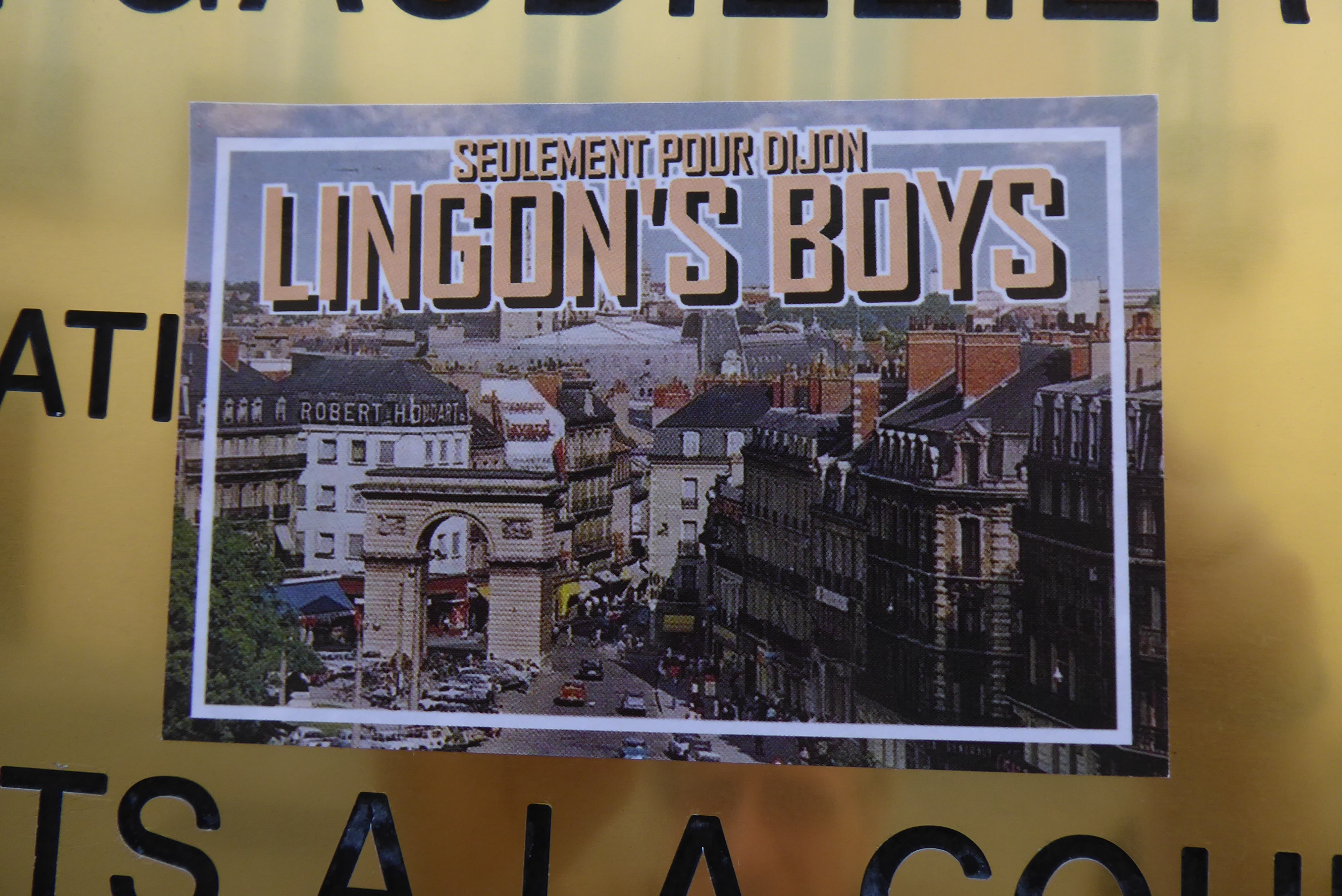
As kick-off approaches the public address system pumps out loud euro-pop, the teams are announced, their faces looming in technicolour on the scoreboard.  That tifosi shirt ripples across the lower tier of the Tribune Sud; the Lingon’s Boys Ultras at the north end hang out their banners.  The best display however is from the Racing Club Strasbourg supporters who celebrate making the 330 kilometre journey by waving white flags around a central blue cross with the letter RCS in the centre of that.  All around there is noise from the crowd of 13,105 and then the teams enter the pitch through a colonnade of giant Roman candles as the Ligue 1 theme tune plays over the public address system and everyone waves their red Dijon flags, me included; one of the many things they know how to do in France is put on a show and give everyone a free flag.

After handshakes and huddles the game begins with Dijon all in red and the words “Roger Martin” emblazoned across their chests, a sentiment I heartily agree with. Strasbourg unnecessarily wear all- white; their ‘proper’ signature kit of blue shirts with white shorts would not clash with Dijon’s home strip. Dijon are playing towards the Lingon’s Boys, with Strasbourg aiming in the direction of the Tribune Sud.  It’s the 36th journee of the 38 game season and Dijon are struggling in 19th place in the twenty team league.  Strasbourg are mid-table (10th) and have every right to feel smug and relaxed having qualified for the Europa League by winning the Coupe de La Ligue against En Avant Guingamp, the team bottom in Ligue 1, who by the end of tomorrow afternoon are destined to be relegated to Ligue 2.

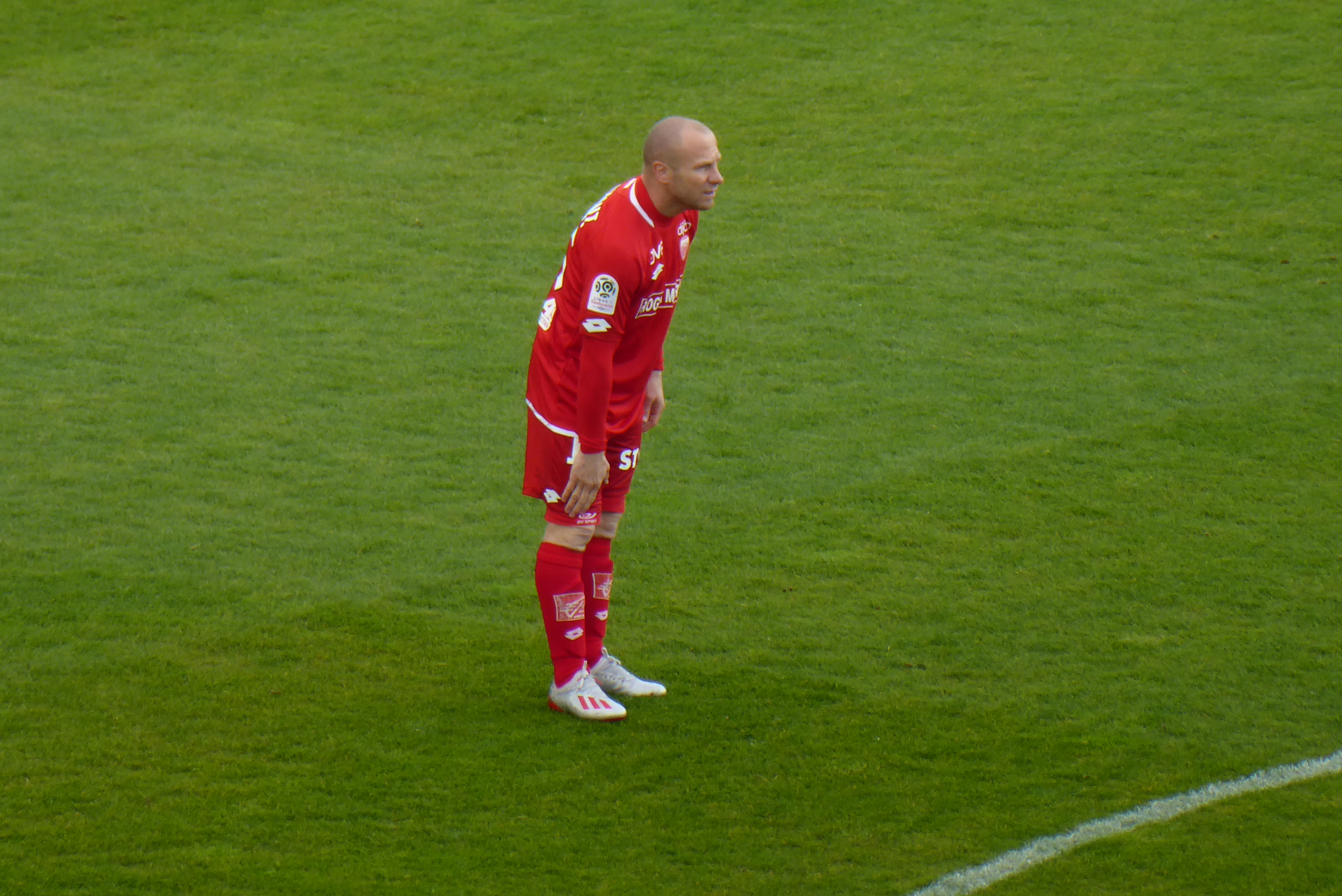
Dijon are more eager because they have more at stake and they have the first shot on goal, from 39 year old Florent Balmont, a marvellous if unexciting, mostly defensive midfield player who simply keeps the team ticking over like a sort of bald-headed human, metronome.  Paulene and I reminisce about seeing him play a much more dynamic game for Lille against Copenhagen in a Champions League qualifier back in 2012.  This game is not dynamic.  Dijon struggle to play accurately whilst Strasbourg’s season has already finished, and they appear to lack motivation.   Lacking inspiration from the football I enjoy the architecture of the three re-built sides of the stadium; three individual stands linked by an arching, curving translucent roof; architect Michel Rémon has done a fine job and I get to thinking what self-respecting architect would put his name to the breeze block and tin sheet constructions that pass for provincial football stadia in England.

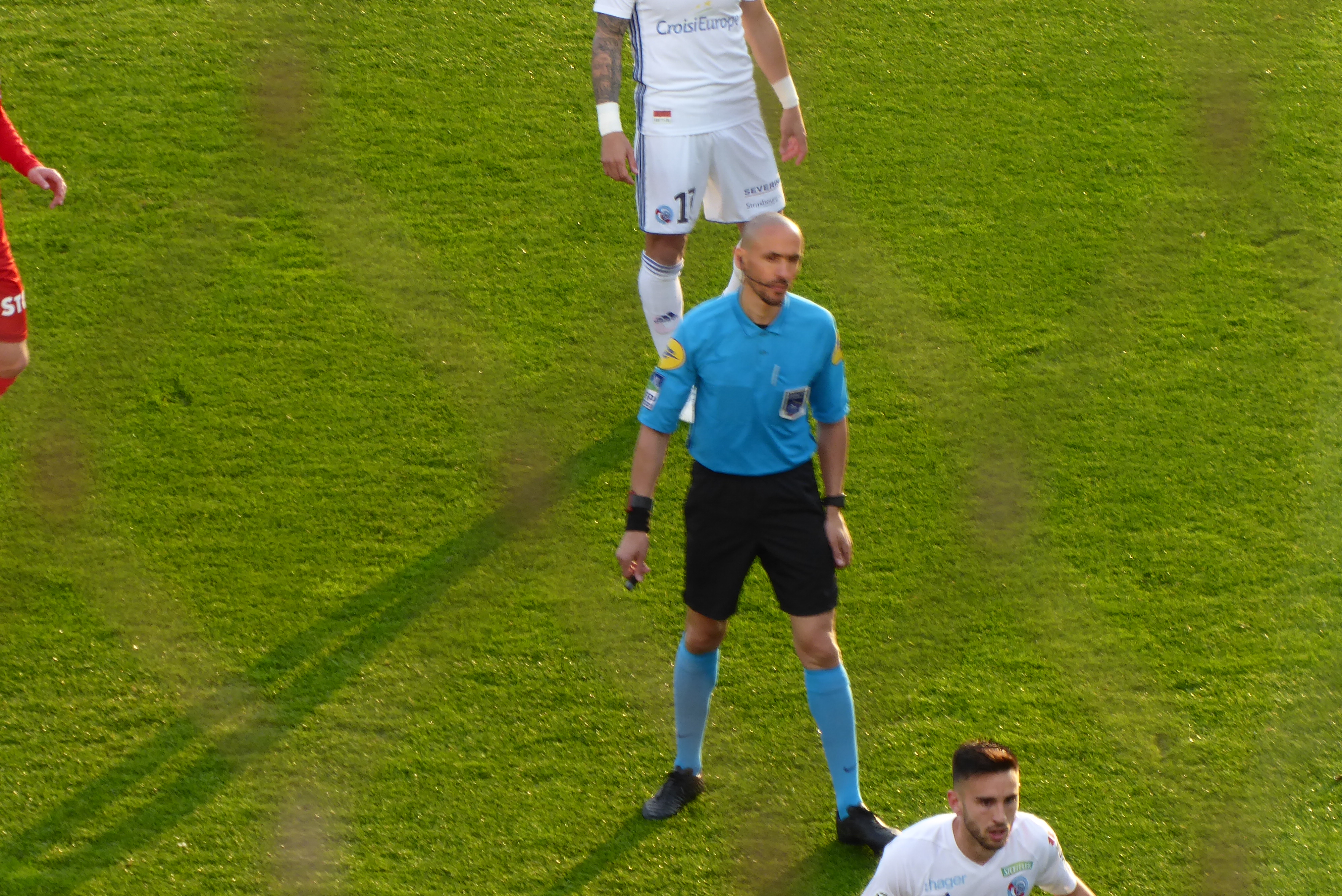
With only fourteen minutes played Florent Balmont is cautioned by referee Monsieur Hakim Ben El Hadj for complaining too vociferously when a free-kick is awarded against a team mate.  Dijon are ponderous and what shots on goal there are, are blocked or wide and no one looks much like scoring, that is until five minutes before half-time.  Tunisian international Naim Sliti pursues another mis-placed pass inside the penalty area, it’s running away from the goal towards the corner flag but somehow the chasing defender manages to clip Sliti’s heels, he goes down and Monsieur Ben El Hadj awards a penalty.  Paulene thinks it’s a bit harsh, suggesting that Sliti was moving so slowly towards the ball that the chasing defender, Adrien Thomasson, just caught up with him sooner than expected.  Monsieur Ben El Hadj ignores her pleas and Dijon’s Cape Verde international Julio Tavares gets the glory, booting the ball beyond the dive of Strasbourg’s Belgian goal keeper Matz Sels into the bottom left-hand corner of the goal;  Stade Gaston-Gerard is rocking all the way to mi-temps (half-time).
I make use of the break to use the facilities but haven’t got the will to wait at the buvette for another drink; I return to my seat and zip up my wind-cheater against the evening chill.  Small boys take part in a shoot-out and I feel very sorry for a particularly ungainly looking one whose control is so poor that the goalkeeper has claimed the ball before he even shoots, you just know he gets picked last in the playground.

The second half begins and Strasbourg are re-vitalised by their half-time espresso and now look much more interested, whilst Dijon are no better than before.  But time moves on, it gets dark and still Dijon lead but their Icelandic goalkeeper Runar Runarsson is busy, running off his line and making saves.  A corner from Strasbourg’s fabulously monikered Kenny Lala is sent goalwards by the Bosnian Stefan Mitrovic, the header is blocked by Dijon’s Roman Amalfitano but rebounds to  Ludovic Ajorque who has a simple ‘tap-in’ to equalise.   As Strasbourg celebrate a pall of gloom falls over most of Stade Gaston-Gerard.  Runarsson is called to make further saves from Thomasson, Da Costa and Goncalves, and Dijon manager Antoine Kombouare seems to be facing the prospect of both the Ligue 1 clubs he has managed this season being relegated; he was given the Dijon job in January having been sacked by Guingamp in November.
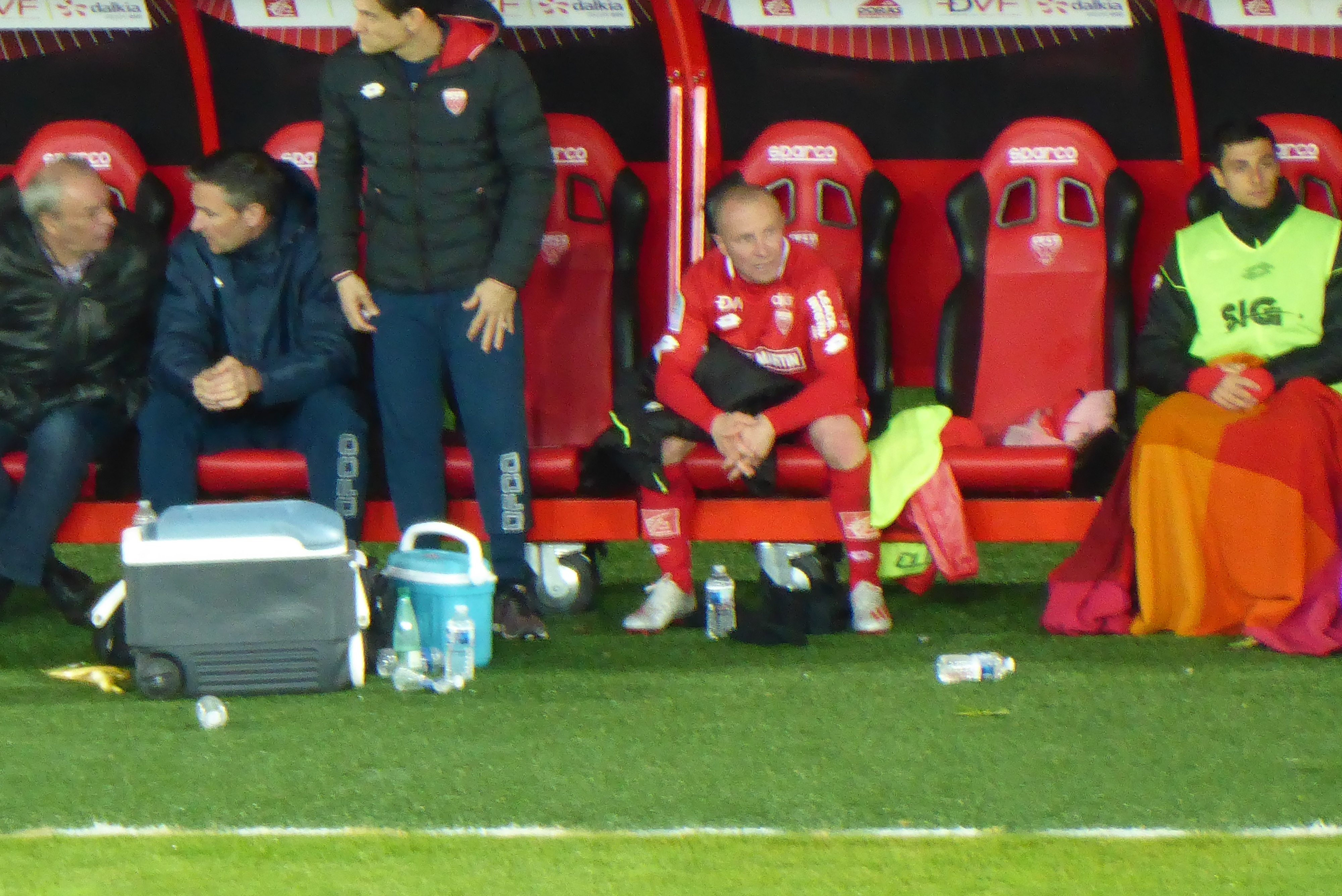
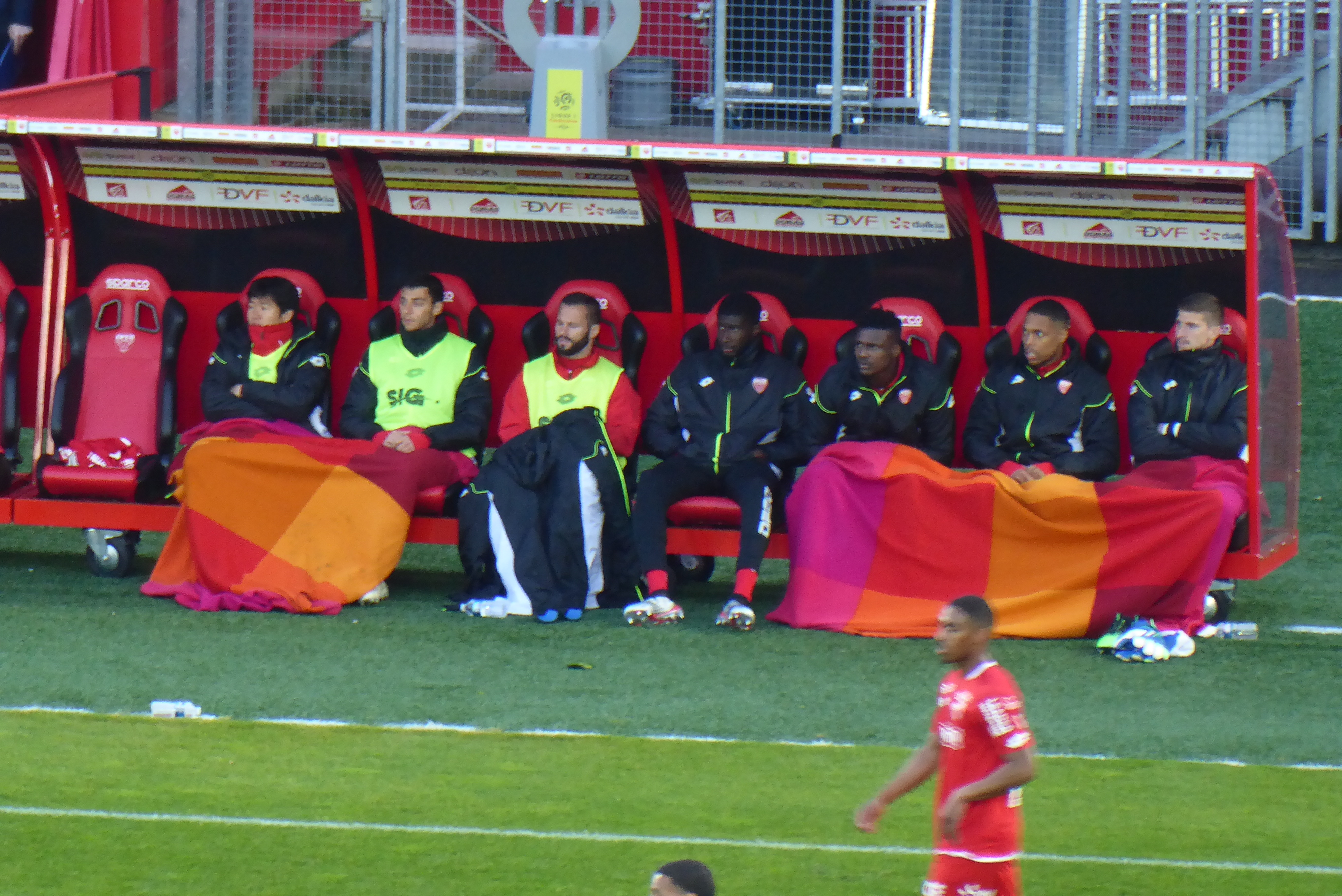
I like Antoine Kombouare, he has a kindly face and previously managed Strasbourg, Lens and Paris Saint-Germain, where he was sacked when they were top of the league. He looks on impassively in his grey suit and baseball hat.  With 15 minutes left Kombouare acts and replaces Florent Balmont with the Korean Kwon Chang-Hoon.   Balmont takes his place on the bench to great applause from the Dijonnais, he doesn’t look happy, not because he’s been substituted but because of how the game is going. 

Kombouare’s decision makes a difference however as Kwon seems to have far more energy than the rest of his team put together; he darts about, running at the Strasbourg defence and shooting on sight, he energises the crowd. But despite his efforts nobody scores for Dijon, although Ludovic Ajorque is prompted to even up the scores for yellow cards.  The ninetieth minute arrives and leaves; five minutes time added-on will be played and the home crowd urge their team on.  Dijon have to win to have a chance of avoiding relegation, their main rivals Caen are beating Reims 3-2.  If they lose Dijon will be five points behind with two games left, one of which is away to Paris Saint-Germain.  It’s the ninety third minute, Tavares has the ball, it runs on to Kwon in the centre of the penalty area, he takes a step and lashes the ball magnificently into the net past Sels. Kwon is engulfed by blokes in red shirts and in the stands everyone is on their feet cheering.  This is the way to win a football match, be ropey for ninety minutes and then get a last minute winner.  In the following day’s local paper “Le Bien Public” the game will be marked as a five out of ten, although the national sports paper L’Equipe will give it four stars out of six.   The stats will show that Dijon had fewer shots, fewer corners, less possession, won fewer duels and fewer tackles, made fewer passes and interceptions and their passes were less accurate.  What the stats cannot show however is that they never stopped believing they could win.

The full-time whistle soon follows and as we applaud the teams a man in a blue jacket appears from nowhere to take us back to the lift.  Paulene would be fine going down the stairs, but is mightily impressed that she has been remembered.  We are joined by two older men with gammy legs; the man in the blue jacket pushes the button on the lift control panel marked “-1” and leaves us.  One of the older men clearly thinks he knows better and pushes the button marked “0”; the lift descends and the doors open onto a darkened cupboard.  Fortunately the doors close again and we complete our descent,  and having negotiated a long white corridor find ourselves back in the concourse beneath the stand from where we step out into the night and stroll back to the tram stop.  Riding back into town on the packed tram I feel like Albert Camus in Algiers.  I love going to football matches in France.