EA Guingamp 2 USL Dunkerque 1

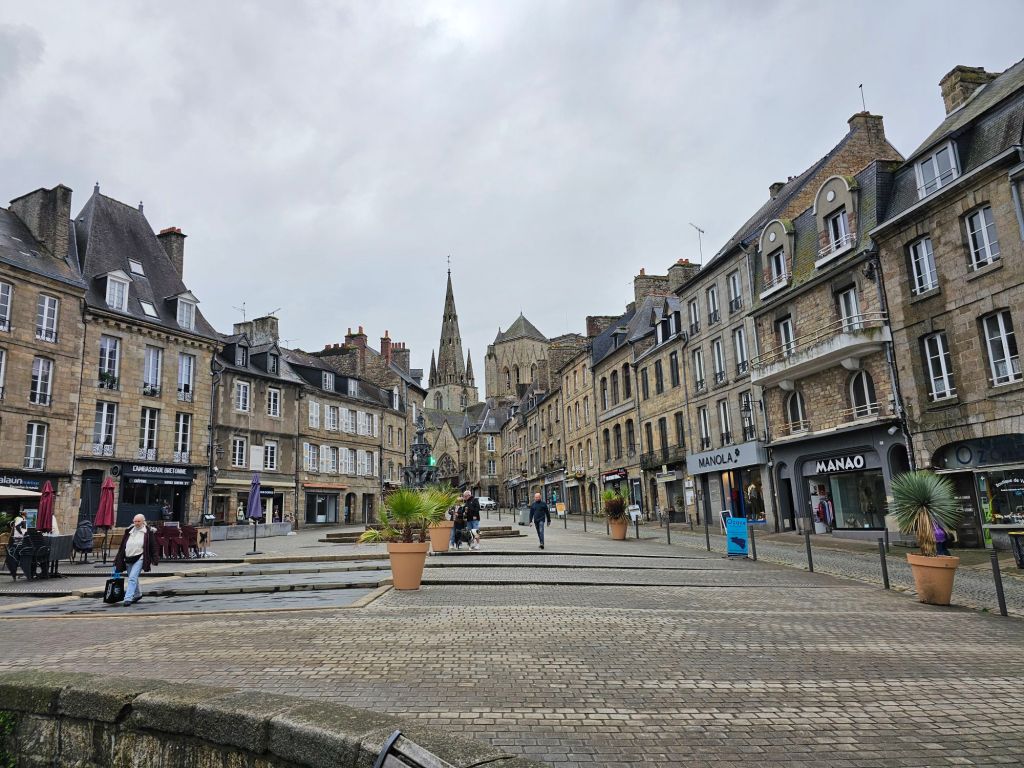
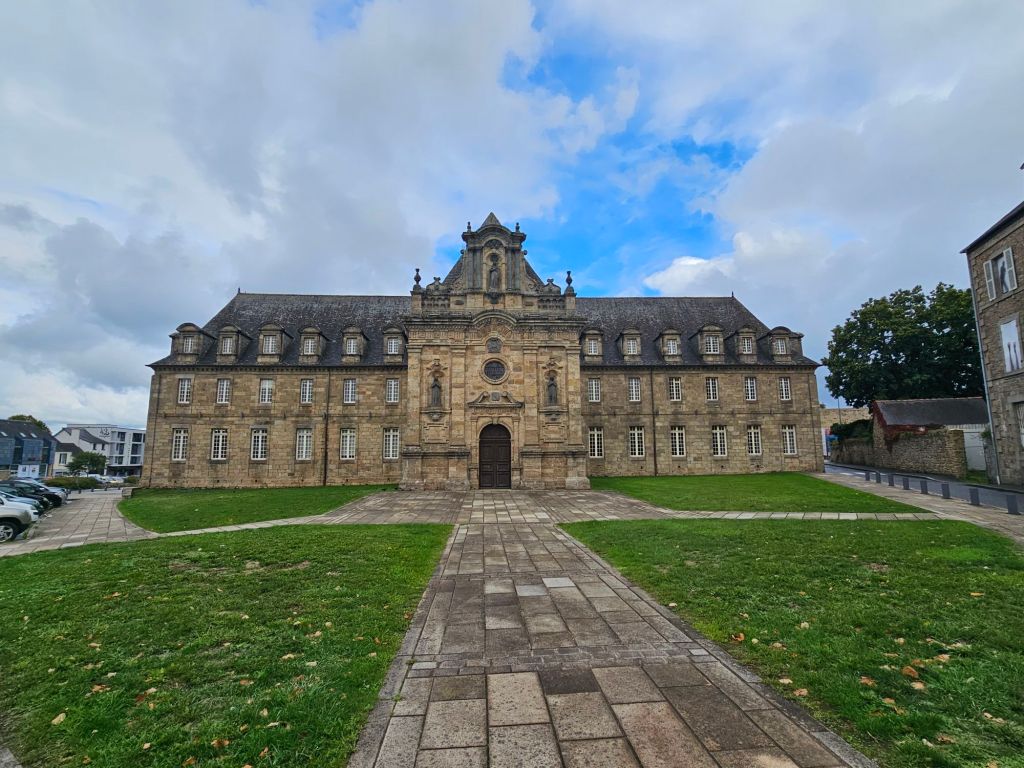
Guingamp (Gwengamp in the local Breton language, and pronounced gangomp) is a small town of only seven or eight thousand people, which sits on a rocky escarpment above the River Trieux in the heavily agricultural north-west corner of France. For thirteen seasons since 1995, this tiny rural town with a population smaller than Beccles, Mildenhall or Woodbridge had a team in the top division of French football, and also won the French FA Cup (the Coupe de France) twice in that time.    But more than that, the name ‘Guingamp’ is just beautiful to the ears, the club plays at the wonderfully named Stade de Roudourou and when Guingamp reached the final of the Coupe de France in Paris, some fans travelled there by tractor.  For these reasons, I am fulfilling an ambition today in making a 160-kilometre pilgrimage from where my wife Paulene and I are staying on holiday in Carnac in the south-west of Brittany.

Our journey is elongated a bit by a stopping off north of the topographically scintillating town of Morlaix, 60 km west of Guingamp to visit the huge six-thousand year old Neolitihic cairn at Barnenez, but we eventually rock up in good time in Guingamp to buy two tickets for the match (26.00 euros each) at the club ‘boutik’ in the town, along with a petit fanion (pennant) and fridge magnet (6.50 euros for the two) for my respective pointless collections.  Disappointingly, the T-shirts showing a representation of the town of Guingamp through its most prominent buildings such as the basilica and hotel de ville is only available in bizarrely small or large sizes, and whilst I’d like a mug that displays the same design, it would probably just sit on a shelf above the petit fanions overlooking the fridge magnet, and with a little thought I could surely spend that 12 euros doing good. More happily, the very pretty shop assistant, whose name, I think, from what it says on our tickets may be Angelique compliments me on my French, although after initial exchanges we mainly speak in English.  

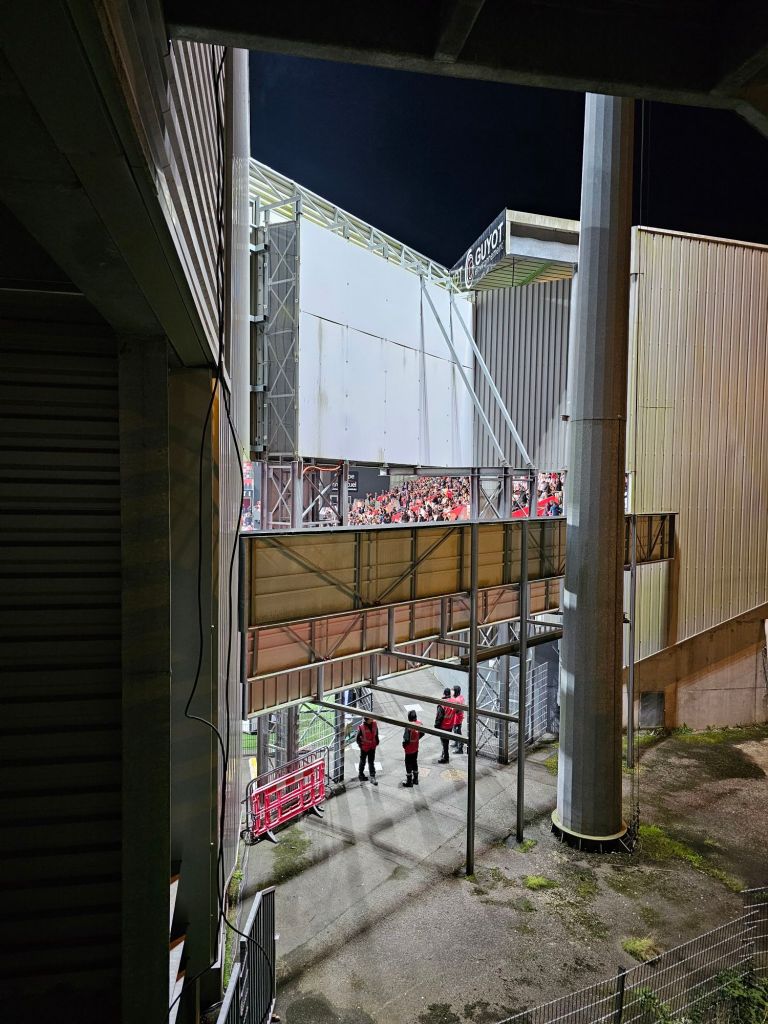
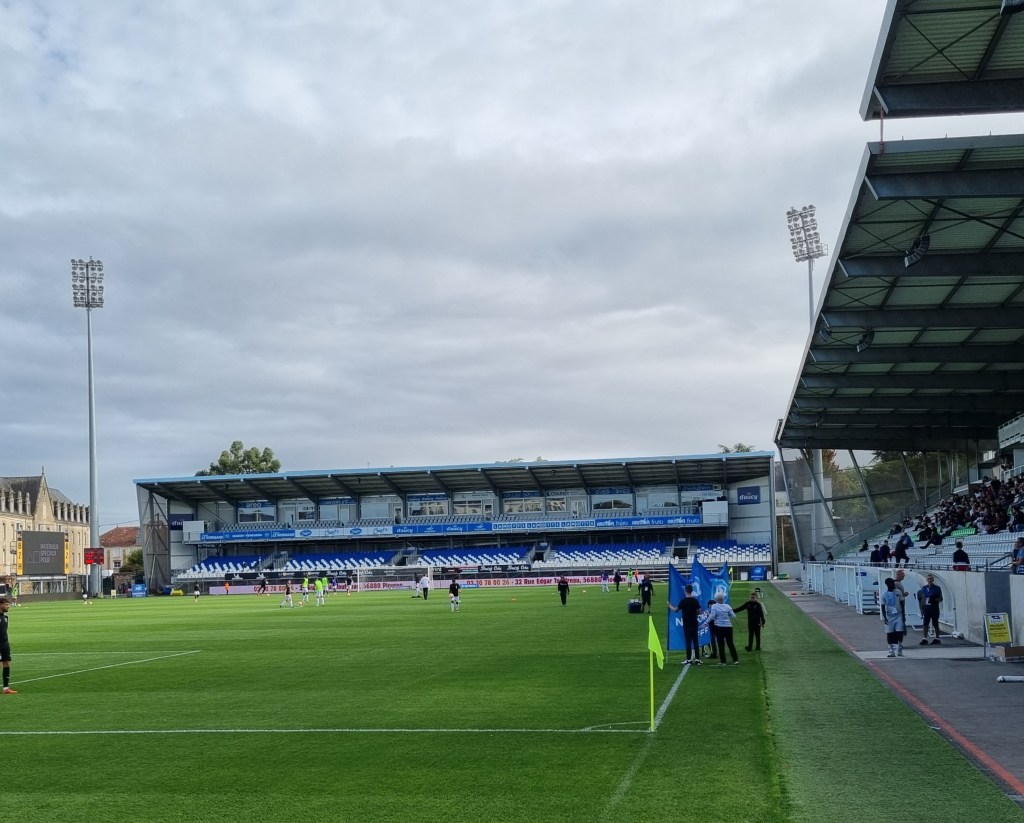
Our hotel room for the night is in a grand nineteenth century house not far from the town centre, but it is a half an hour’s walk from Stade Roudourou and Paulene’s asthma will not stand that once the cold night air surrounds us after 10:30 when the match will probably finish.  Sadly, there is no ‘navette’ (shuttle bus service) to the stadium, but on the advice of the two very helpful ladies in the local Tourist Information Office we make a short car journey across town to the Place St Saveur where we park up our planet saving Citroen e-C4 at no cost. Remarkably nearly all car parking in Guingamp seems to be free.  From the car park, we can see the floodlights of the stadium, and the walk to the Stade Roudourou takes us only a few minutes over the shallow looking, gurgling River Trieux and down a few closed off streets.  The stadium is situated in a residential area which has the appearance of one of the banlieus of a much larger town and is enclosed behind iron fences as if fortified against the outside world, an impression further strengthened by the harsh steel and concrete architecture of the stadium, which is in some ways is at odds with the stone buildings of the town but is perhaps also a modern and cost effective version of them.

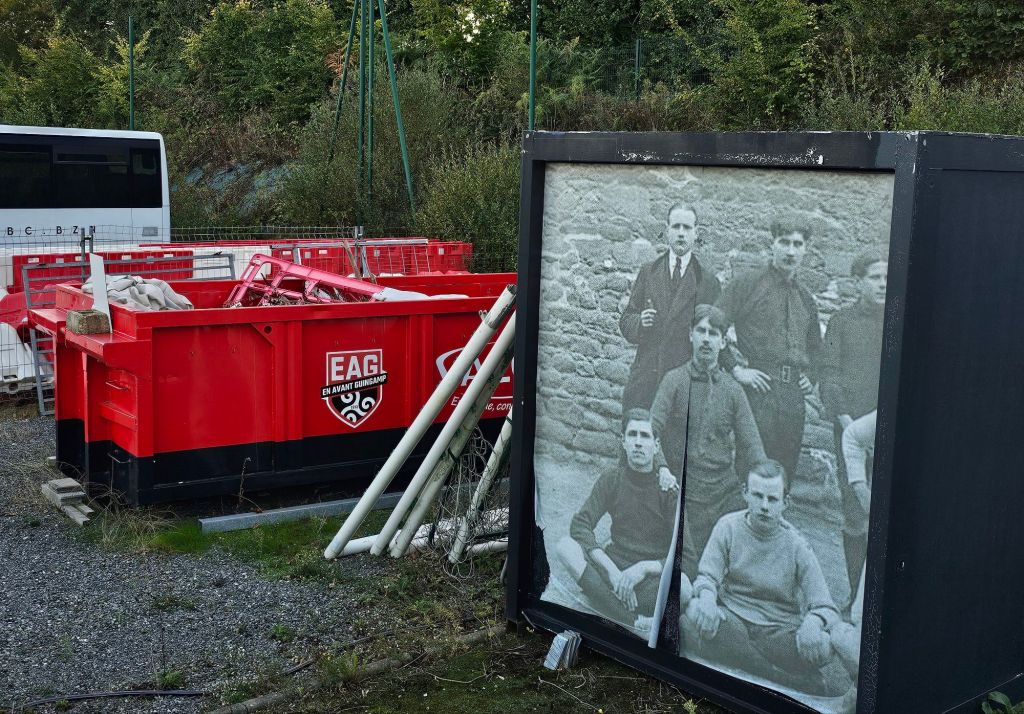
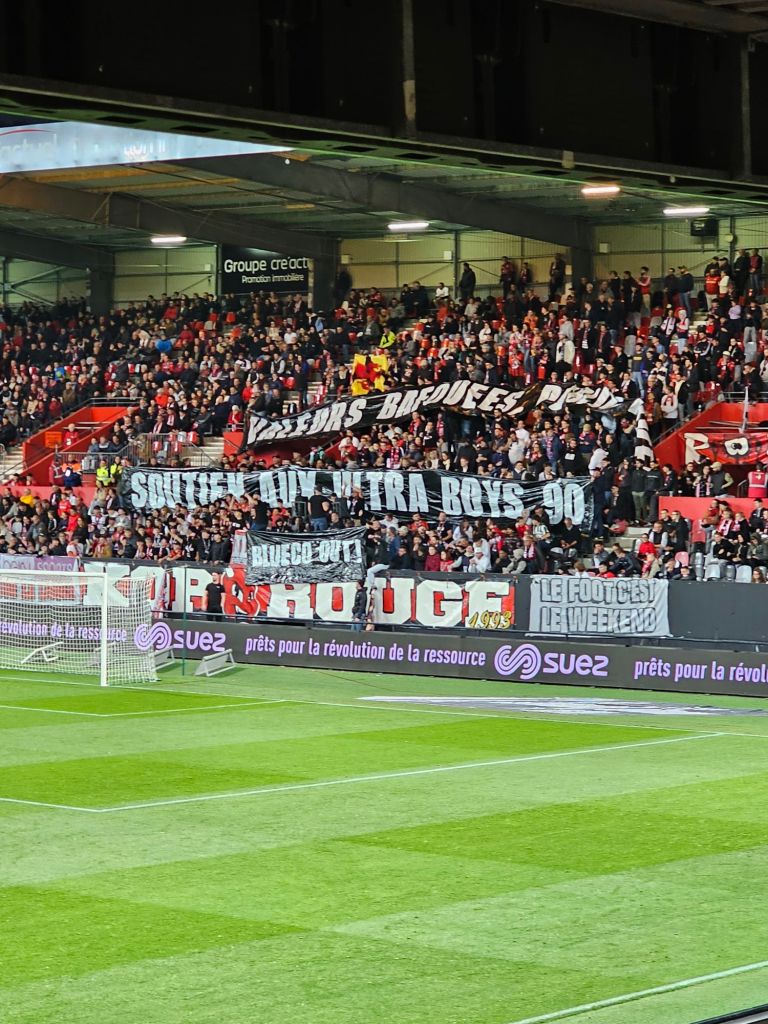
The walk to our seats in the Tribune France Barnums (presumably named after a sponsor) takes us around the back of the main stand (the Tribune Cotes d’Amour) past a small wooden hut from which two middle-aged women are selling club souvenirs.  I ask if they have any T-shirts like the ones I saw in the shop in the town; they don’t, but nevertheless they laugh either at my description of the very large and very small sizes available in the shop in the town, or just at my French, I’m not sure which. Paulene and I walk on past a skip decorated in club colours and the back of the Kop Rouge where the local Ultras will later gather.

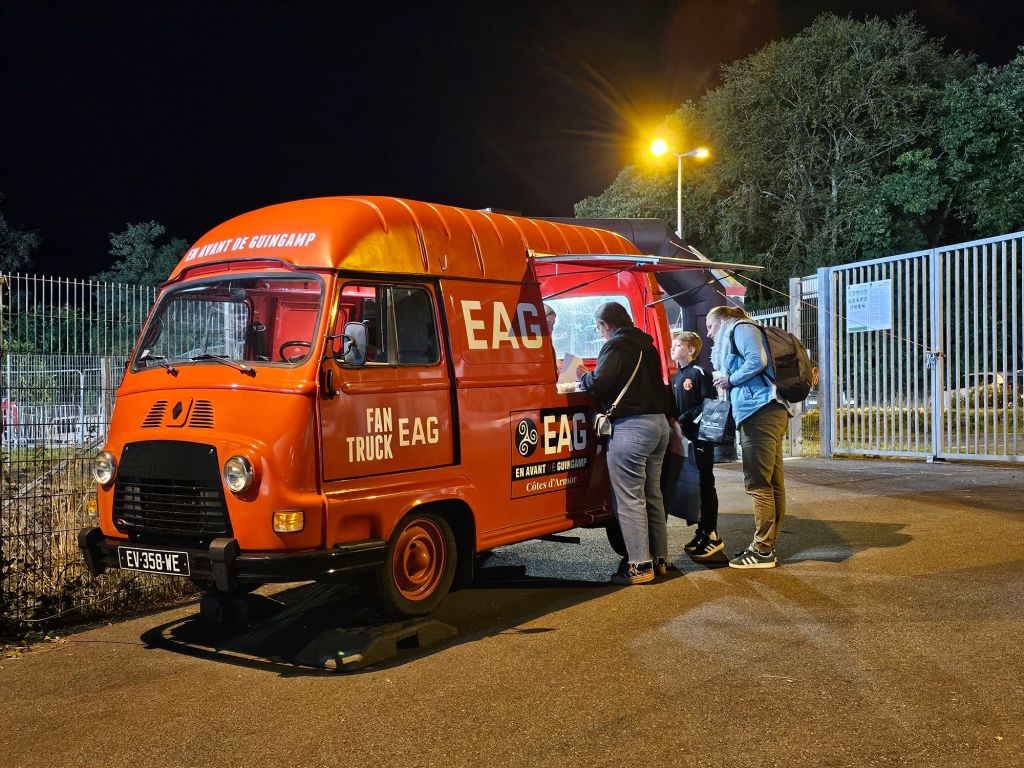
The back of the Tribune Frace Barnums is the least attractive of the four sides of the Stade Roudourou, consisting mostly of sheet metal, but undeterred I make my way in past a smiling member of security staff who frisks me and wishes me ‘Bon match’ under the somewhat glaring eye of another member of security staff whose demeanour suggests she does not approve of such bonhomie.  With our tickets duly validated by barcode technology we walk on towards our seats past a classic Renault Estafette van painted in Guingamp colours, from which Angelique of club ‘boutik’ fame is selling hats and scarves and shirts; she confirms that she has no stock of the cherished T-shirts stashed away in the Estafette.

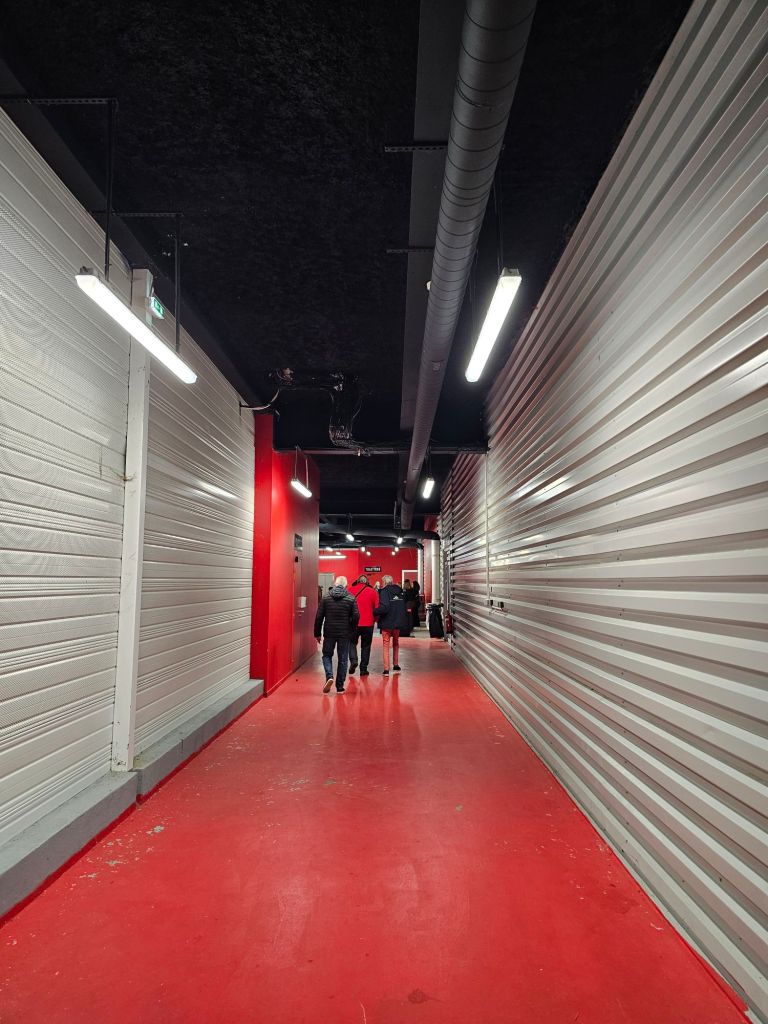
Our entrance to the stand itself, along a corridor, reminds me of the inside of one of carriages on Le Shuttle.  Up an external staircase, I am tempted by the ‘pub Lancelot’, only for two teenage doormen and the smell of sandwiches and nibbles wafting out to disappointingly confirm that it is a room reserved for those paying for hospitality.  Back downstairs I buy a small plastic cup of beer and a similar cup of the local Breizh Cola (8 euros for the two), which Paulene much prefers to the over-hyped American stuff.  We find our seats cosily situated at the back of the lower tier of the stand almost level with the halfway line and next to a galvanised tubular stanchion, which handily ensures people will not be able to edge past us to get to their seats. We pass the time before kick-off making up the life stories of the referee and his assistants, who are warming up in front of us and keeping us amused with their co-ordinated exercises, which with some appropriate music could enable them to pass themselves off as a small all-male dance troupe.   One of the assistants we decide looks slightly ill however,  and has dark shadows under his eyes.  The referee, Monsieur Landry meanwhile, is a tall man with a long body but capable of a neat heel turn, chasse and pirouette.

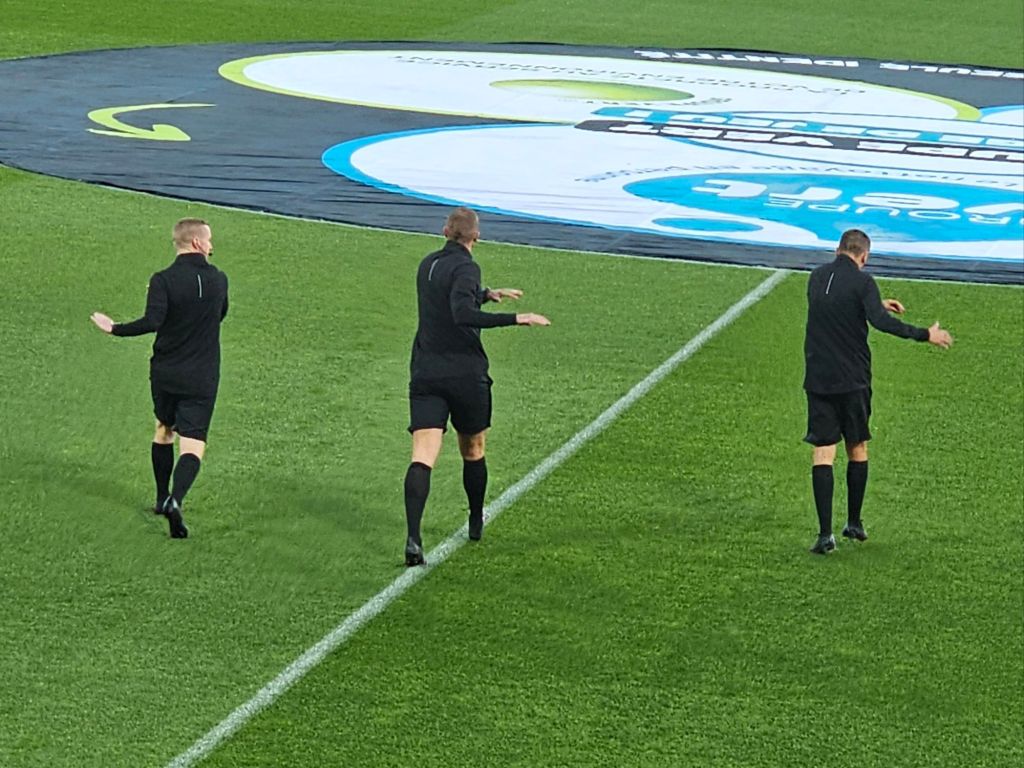
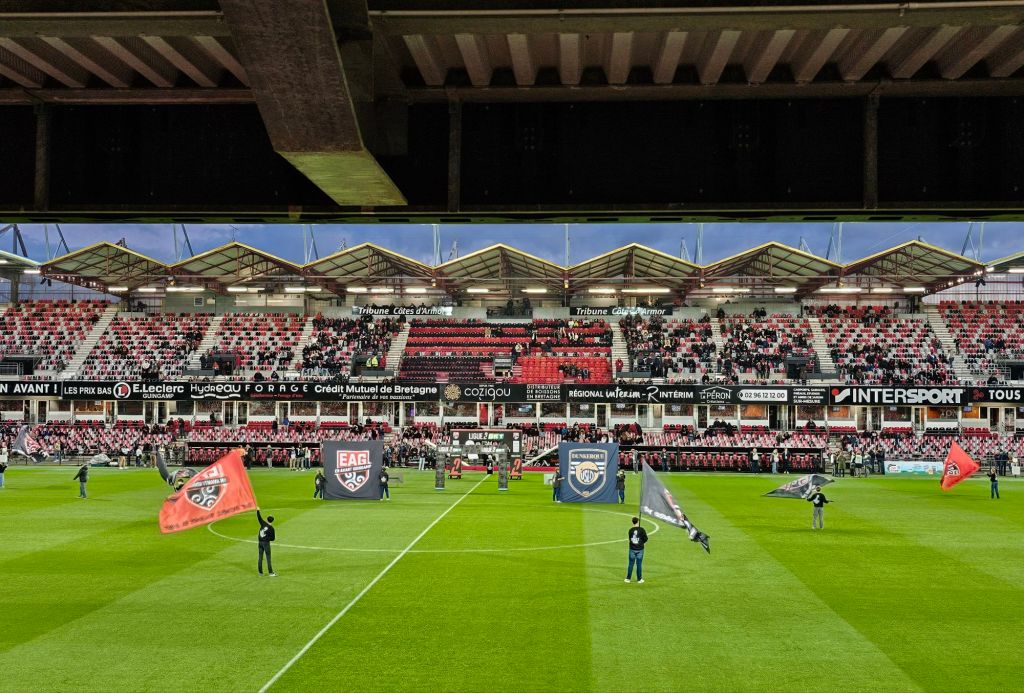
As kick-off (coupe d’envoi) approaches, the stand fills up with people bearing baguettes stuffed with chips, whilst a row or two in front of us a family unpack homemade sandwiches which appear to be of white sliced bread that has had the crusts cut off, which is not something I ever expected to see in France. Meanwhile, the pitch fills up with youths waving banners with varying degrees of enthusiasm but then, when the teams are read out by the stadium announcer  I am shocked, amazed  and I have to admit, disturbed to find that unlike everywhere else I’ve ever been in France, the home supporters do not bellow out the surnames of their players as they appear on the big screen in the corner of the ground; they just clap politely. I can’t quite believe it. Being in Brittany I had also expected bagpipe music as the teams trudged out, but It seems these Bretons aren’t like other French or Breton people at all.  I am a little disappointed; they don’t even have a cuddly mascot.

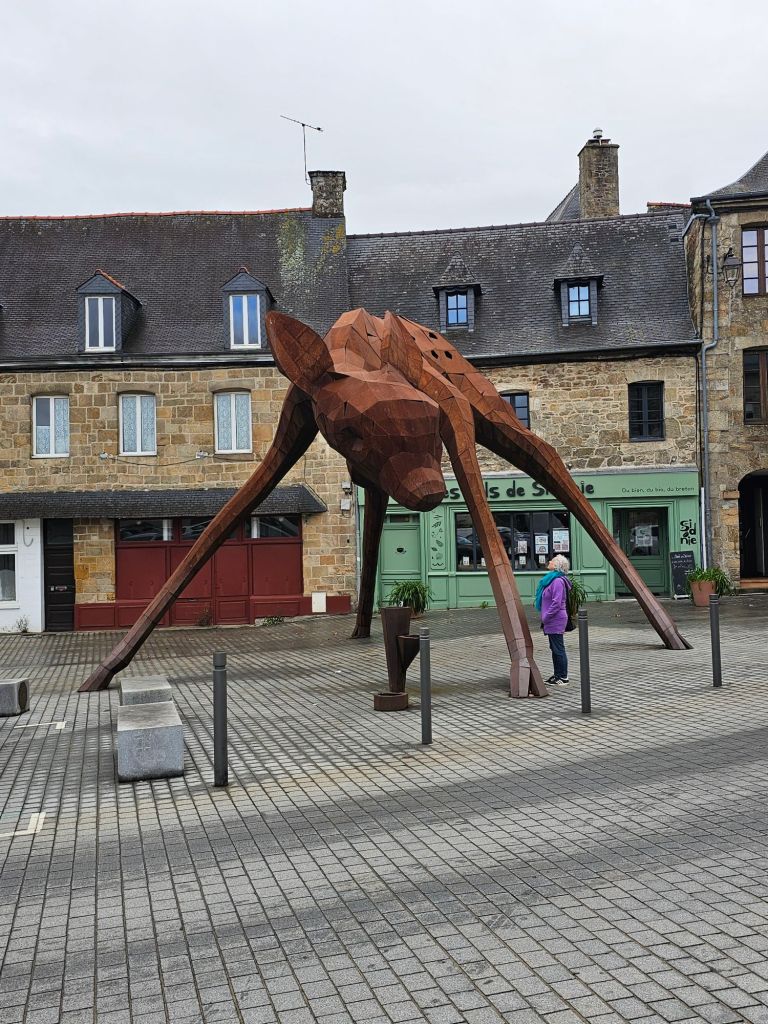
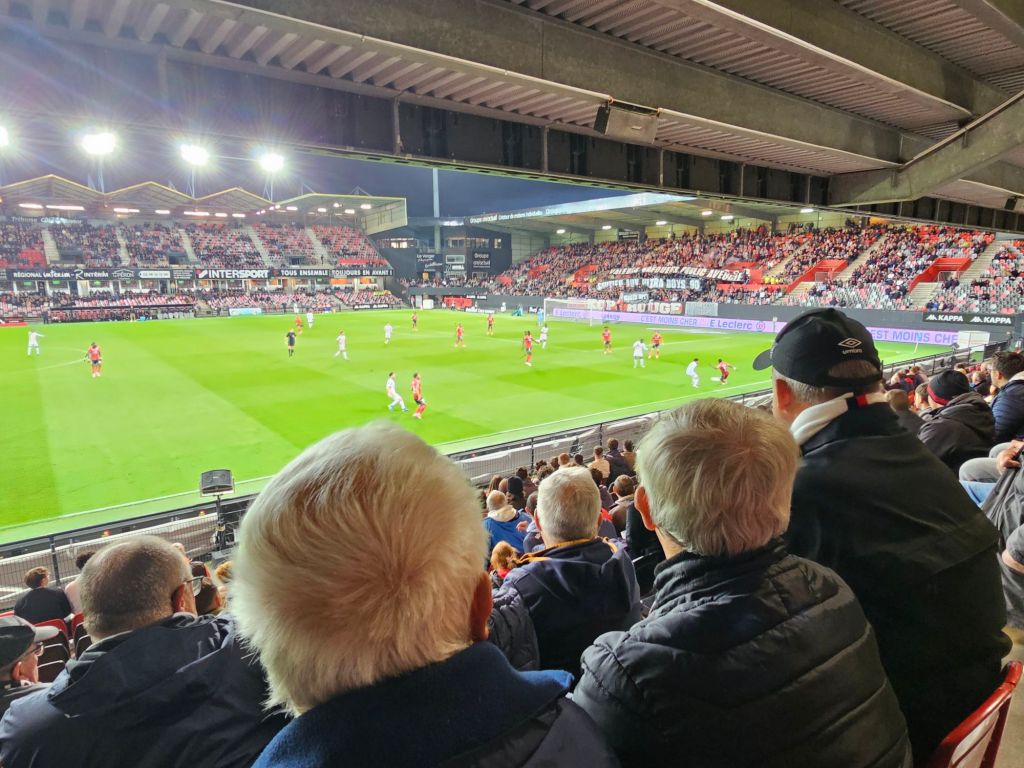
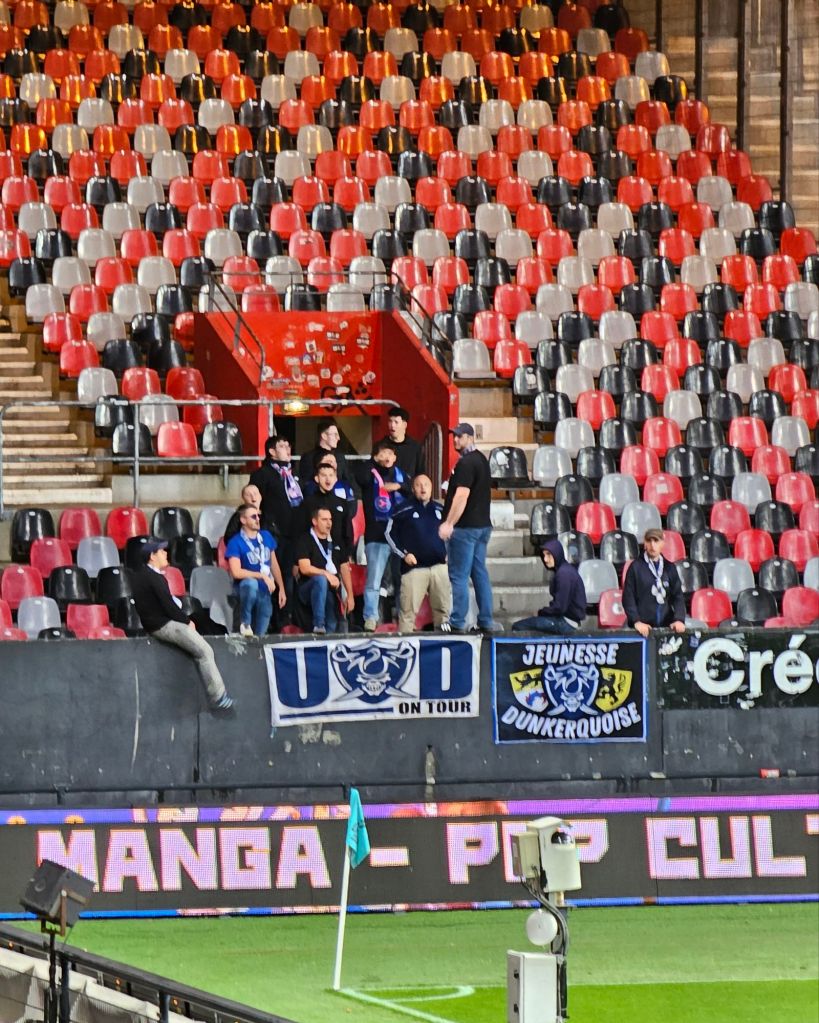
When the match eventually begins at half past eight, it is visiting Dunkerque who get first go with the ball, which they generally kick in the direction of the Kop Rouge and far off Morlaix, whilst Guingamp are aiming just to the north of the town centre with its Basilica, castle ruins and huge metal statue of Bambi. Guingamp sport their handsome signature kit of red and black striped shirts with black shorts whilst Dunkerque wear all white with golden squiggles down the shirt front.  Despite my disappointment before kick-off, the stadium has now come to life, with a flood of chip and beer quaffing latecomers finding their seats and the Kop Rouge now in full voice with chants of “Allez, Allez, Allez, Guingampaises”. I count thirteen Dunkerque supporters, who I could hear chanting before kick-off, but now they are drowned out by the Guingampaise voices and drums.

The opening play from both teams is fast and slick on the well-watered pitch but Guingamp appear slightly more direct and with only four minutes having passed into history a smart through ball and a low cross from the right lead to the ball being placed past the Dunkerque goalkeeper from about six metres out by Freddy Mbemba, who the interweb tells me is on loan to Guingamp from Charleroi in Belgium.  “Buuut” announces the giant screen in the corner in large letters, and when the stadium announcer says “Freddy” the home supporters bellow “Mbemba” and when the announcer says “Freddy” again and the crowd shout “Mbemba” again,  and then wonderfully the same thing happens again.  It feels like a weight has been lifted from my shoulders. “Mbemba!” I shout on cue after the final “Freddy”.

The game continues at pace with Guingamp looking sharper but Dunkerque not appearing to be slouches either.  Standing out for Guingamp, mainly but not entirely because he is two metres tall is their number eight, Kalidou Sidibe, whilst I am also impressed by the tangled mop of hair sprouting from behind the black headband of Guingamp’s number thirty-six, Albin Demouchy who often wins headers and elegantly ‘plays-out’ from the back.  On the electronic boards around the pitch there are advertisements for John Deere tractors and Husqvarna mini tractors as well as the supermarket E Leclerc, who if they had shops in Britain would surely employ the tv sitcom ‘Allo, ‘Allo in their advertising.

After fourteen minutes Dunkerque win their first corner; Guingamp have already had two however and as if to prove that this matters Guingamp’s Amine Hemia soon beats the square but not square enough Dunkerque defence on the right, bears down on goal and scores into the far corner off the goalkeeper’s out-stretched palm, and Guingamp lead two-nil.  “Amine” calls the stadium announcer, “Hemia” bawls the crowd. “Amine” calls the stadium announcer, “Hemia” bawls the crowd. “Amine” calls the stadium announcer, “Hemia” bawls the crowd, and the scoreboard silently but colourfully shouts “Buuut!” as well.

The row of seats in front of us consists mainly of men with grey hair whilst off to our left a younger bearded man looks a bit like Bob Ferris from the 1970’s sitcom The Likely Lads (actor Rodney Bewes).  Behind us there is a gathering of men and women in day-glo tabards; if they’re not orchestrating a “gillets jaune” style protest I guess they must be the first aiders and stewards watching the match. At the front of the stand clouds of smoke billow up from teenage vapers and then dissipate into the night air. I notice that Bob Ferris has quite girlish looking hands.

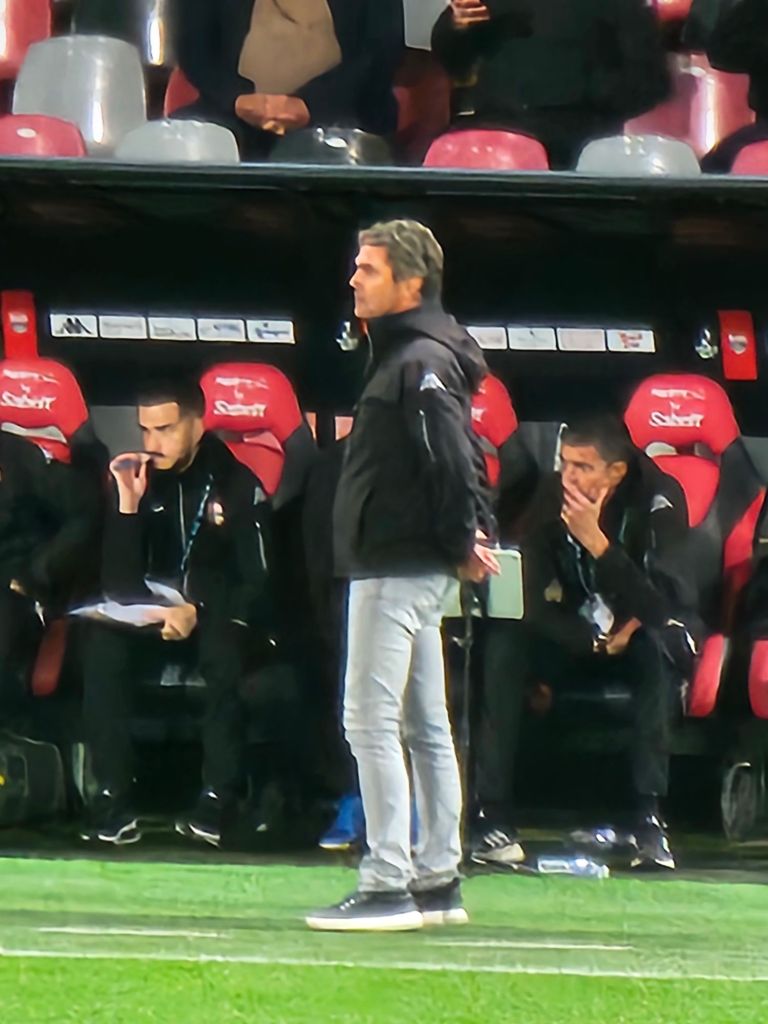
There are now less than ten minutes of the first half remaining; Dunkerque’s number twenty shoots from the edge of the penalty area and the impressively agile and wonderfully named Guingamp goalkeeper Teddy Bartouche tips the shot over the cross bar spectacularly.  Two minutes later and yet another move down the right for Guingamp leaves Louis Mafouta with a seemingly open goal, but with the co-ordination of someone whose foot has ‘gone to sleep’ and who has both arms strapped to his sides, he heads the resulting cross hopelessly and clumsily past the far post.  On the touchline, Guingamp manager Sylvain Ripoll, who incidentally once said ‘Bonjour’ to me and Paulene in the lift of a Paris hotel (the Mercure near Parc des Princes) looks frustrated in his pale trousers and zip-up jacket.

The last action of the half seems likely to be the substitution of the Dunkerque goalkeeper, who unexpectedly and mysteriously has hurt himself but then a quick pass in from the Dunkerque right finds Enzo Bartelli inside the ‘D’ outside the Guingamp penalty box. Almost in slow motion Bartelli gently passes the ball beyond agile Teddy in the Guingamp goal and Dunkerque, as they say on the telly, are “back in the game”, although of course as long as Monsieur Landry hadn’t terminally parped his whistle, they were never out of it.  Five minutes of added on time fail to alter the score any further.
Half-time is the usual melange of children on the pitch, but as before the start, with added flag waving of varying enthusiasm.  The match resumes at twenty-four minutes to ten and the Kop Rouge quickly dive back into endless chants of “Allez, Allez, Allez”.  I soon decide that for a man taller than your average back garden fence panel, Sidibe has quite a delicate touch and then within ten minutes Monsieur Landry airs his yellow card for the first time this evening after Dunkerque’s Inigo Eguaras fouls Mbemba.  

It is Dunkerque who are now selfishly dominating possession, a situation which Guingamp are contributing to by quickly giving the ball back to them whenever they lose it.  On the Kop Rouge, the ultras are swirling their scarves in the style of 1970’s Leeds United fans, whilst the big screen in the corner is showing pictures of real estate as if anyone interested in buying a house would pay more attention to the screen than the match.  As the people in the ground with least interest in buying property in Guingamp, surprise transfer moves notwithstanding, the Dunkerque players fashion an intricate passing move down the left only for Eddy Silvestre to shoot narrowly over the cross bar.  With the game now two-thirds over, Dunkerque blink first and make two substitutions.

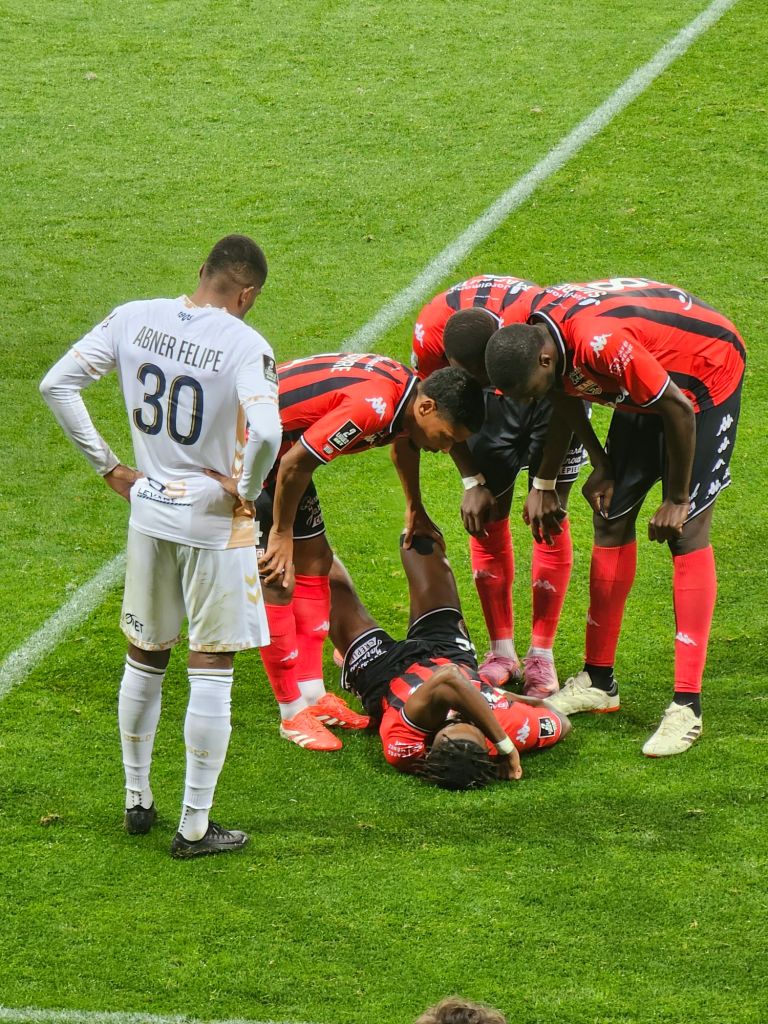
The slick passing of the first half has been replaced with increased niggle and Paulene and I discuss the colour of the shorts worn by Dunkerque’s Brazilian number thirty, Abner.   They look more yellow than other Dunkerque players’ shorts, which Paulene attributes to his frequent falling over on the wet grass, whilst I suggest, a little unpleasantly perhaps, that maybe he ‘forgot to go’ before he left the dressing room. Twenty minutes remain and Eddy Silvestre shoots over the bar again for Dunkerque whilst the Kop Rouge sways with a sea of banners and the towering Kalidou Sidibe is replaced by a man with hair reminiscent of the late Tina Turner, Tanguy Ahile.

Somewhat annoyingly, the final ten minutes of normal time dissolve into something like chaos and nothing like football as players of both teams proceed to fall to the ground with alarming frequency.  If all the players who go down have genuine injuries, both clubs will need to be trawling the job centres of Brittany and Pas de Calais in the morning for additional physiotherapists.  Monsieur Landry, meanwhile, is rushed off his feet, airing his yellow card four more times and showing his red card to someone in the Dunkerque dugout.   Six minutes of added time are not so much played out, as acted out, and the final whistle comes as a blessed relief to all. The result lifts Guingamp to eighth in the Ligue 2 table, a point outside the barrage (play-off) places, whilst Dunkerque slide down to fourth from bottom, one above the relegation places.

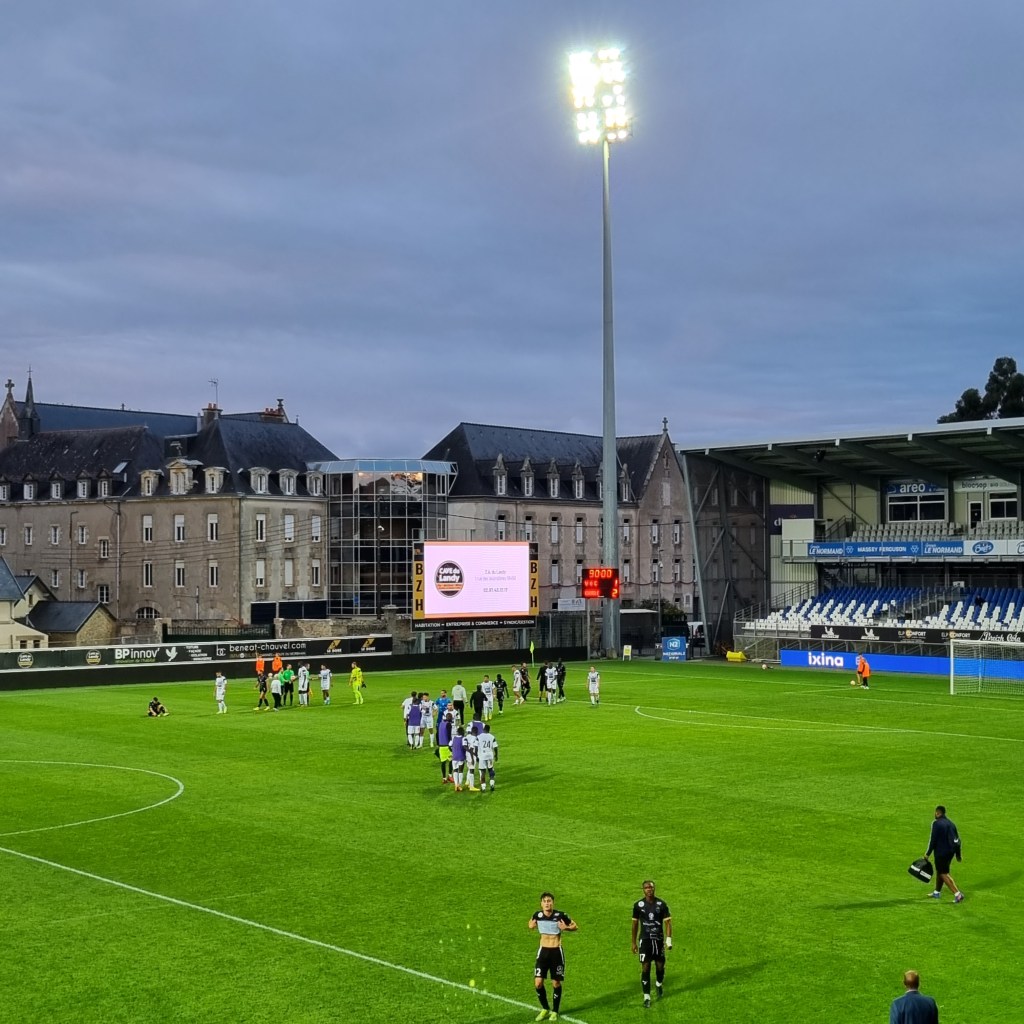
Despite the weirdness of the last ten minutes, and the unexpected pre-match disappointments over T-shirts, bagpipes and the reading out of the players’ names, overall, the match has been a good one and everything has worked out fine; well except for the T-shirt and the bagpipes, but you can’t have everything. We therefore make our way back to our planet saving Citroen in good spirits, like all but thirteen of the 6,562 strong crowd, but who knows, they probably enjoyed it too.
Le Mans FC 0 Rodez Aveyron Foot 1

If travelling from where the channel tunnel burrows its way out from beneath the water into France across to Carnac in Britanny, there are several towns where it is convenient to make an overnight stop and, if you’re that way inclined (and I am), take in a football match.  Having previously enjoyed stops in Rouen, Caen and Rennes, this year it is the turn of Le Mans, whose team are hosting Rodez AF in Ligue 2, the French version of England’s Championship but with smaller budgets and better architecture.  According to the ‘Football’ Le guide ultime magazine, Le Mans have the joint smallest budget in Ligue 2 this season (5.0m euros), whilst Rodez have the next smallest (7.0m euros).

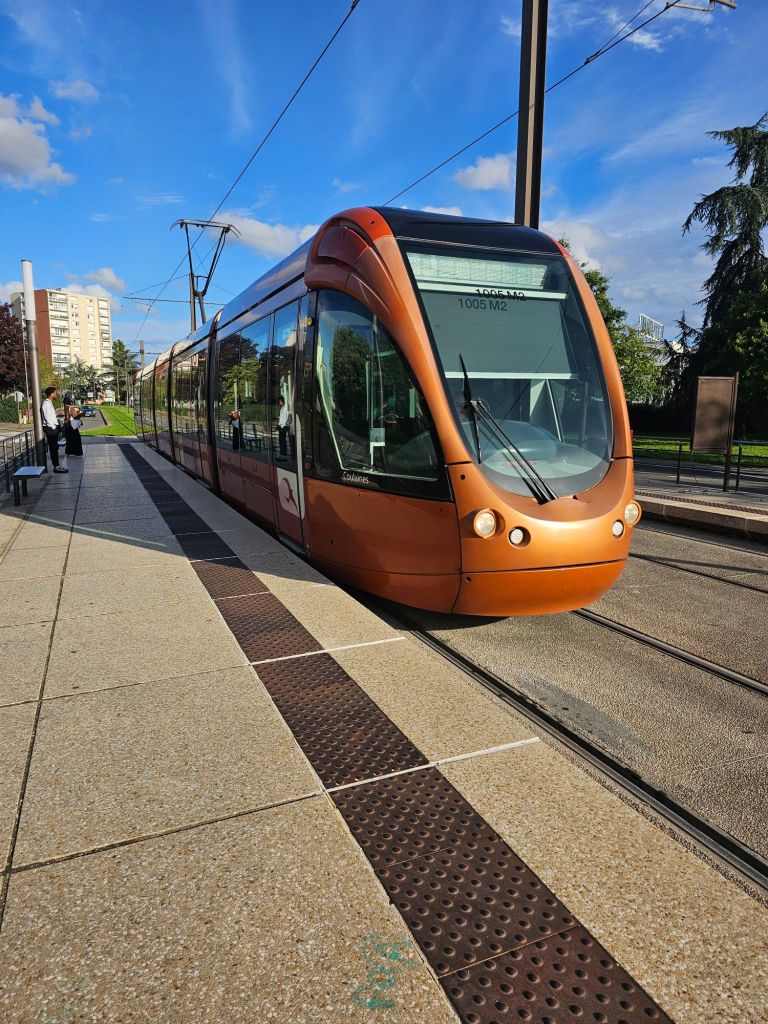
Our hotel is in a leafy suburb of tower blocks just 200 metres from the Ile de Sport tram stop from where it is a 35-minute journey (e1.50 or e2.90 for a return) changing from tram Line 2 to tram Line 1 at St Martin, to the Stade Marie-Marvingt.  This afternoon there is a large, six-wheeled luxury coach in the car park of the hotel and from a short and stilted conversation with the driver I learn that he is driving the Rodez team from the hotel to the stadium.  I photograph the coach with the Rodez club badge displayed in the front window as the driver stands back proudly but out of shot.  I am tempted to ask for a lift to the stadium but don’t want to miss out on the tram ride to the match, something which makes me pretend I’m Albert Camus.  In the hotel lobby, bored looking blokes in grey matching tracksuits hang about mournfully. I wish a couple of them ‘bon match’ and tell them my team is Ipswich Town, it doesn’t appear to relieve their boredom, but pleasingly they have heard of Ipswich Town.  

The match is due to kick off at eight o’clock, but keen to immerse ourselves in the pre-match atmosphere my wife Paulene and I head for the tram stop around six, before the team bus has left the hotel.  We just miss one tram as I fumble with my bank card at the ticket machine, but another soon arrives, and we are lucky enough to get a seat each.   It’s a mild but cloudy evening as we pass through tram stops with names such as Durand-Vaillant, Goya and Gionnieres and on through the uninteresting outskirts arriving eventually at the terminus close to the stadium, the tram depot and the world-famous racing car circuit.

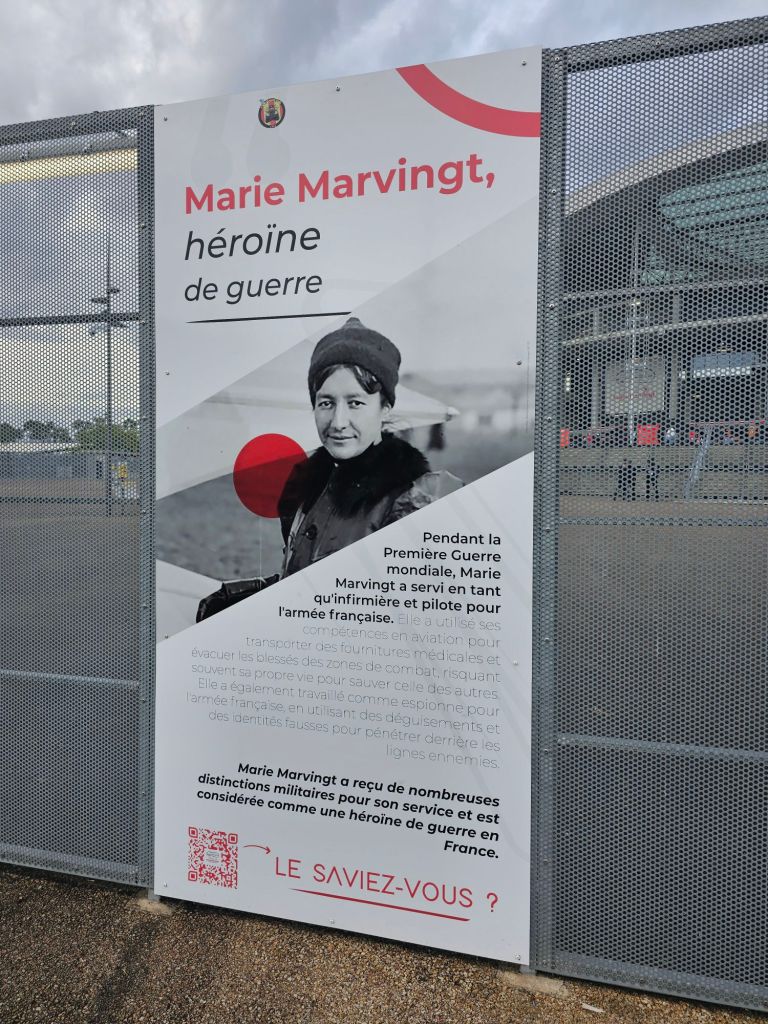
It’s only a short walk from the tram terminus to the stadium, but we accidentally make it longer by walking in the wrong direction, inexplicably failing to follow our fellow would-be spectators as we alight from the tram. Oddly, despite the size of the Stade Marie-Marvingt (it has a capacity in excess of 25,000), it is not visible above the trees.  Adjacent to the stadium is a large surface car park, which, showing an impressively sensible double use of the land is roofed by banks of solar panels.  A wall surrounds the stadium with blocks of automatic turnstiles at points along it.  The approach to the turnstiles features a series of information boards about Marie-Marvingt after whom the stadium is named.  Marie was a remarkable woman who not only spied and flew planes for the French Army during World War One but was an accomplished mountaineer.  Once inside we are frisked and wished ‘bon match’ by smiling security staff before a very helpful man directs us to the gate nearest our seats, and the club boutique, a lock-up hatch, where in the absence of a petit-fanion or fridge magnet I will later buy a key ring to add obsessively to my collection of French football club souvenirs.

Having located our seats (25 euros each), I decide to explore and discover I can make a complete circuit of the stadium.   It’s something of a lazy cliché to describe a modern stadium like the Stade Marie-Marvingt as a ‘soulless bowl’ and on the outside at least it is nothing like the metal-clad B&Q lookalikes found in England as its metal stairs and landings are exposed and sit beneath an elliptical, overhanging roof supported by what look like miniature versions of the Skylon from the Festival of Britain.  Having enjoyed the architecture, I buy a beer (7 euros plus 2 euros for an optional re-usable cup featuring club colours and crest) and a bottle of water for Paulene (2 euros) from a buvette where the attractive young woman who serves me has a heavily tattooed decolletage, which I don’t like to look at too closely given its location.

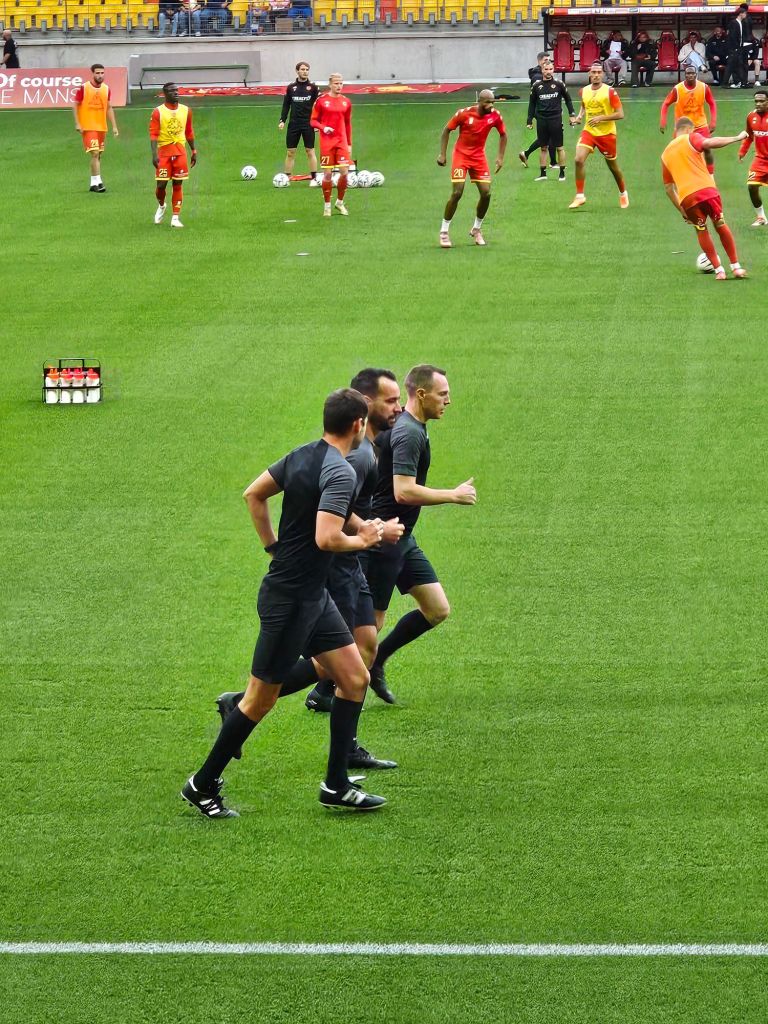
After returning to my seat, Paulene and I pass the time until kick-off laughing at the referee and his assistants as they warm up and rolling our eyes because of the drippy europop being played over the public address system.  Eventually, a sort of crescendo is reached, and the floodlights begin to flash on and off like some I’ve seen at non-league grounds, although at them it wasn’t intentional. This is the signal for the teams to process onto the pitch amidst the usual display of flags and banners before the team line-ups are read out and I join in with the home supporters in shouting out the Le Mans players’ surnames, my favourites amongst which are Rossignol and Vercruysse.

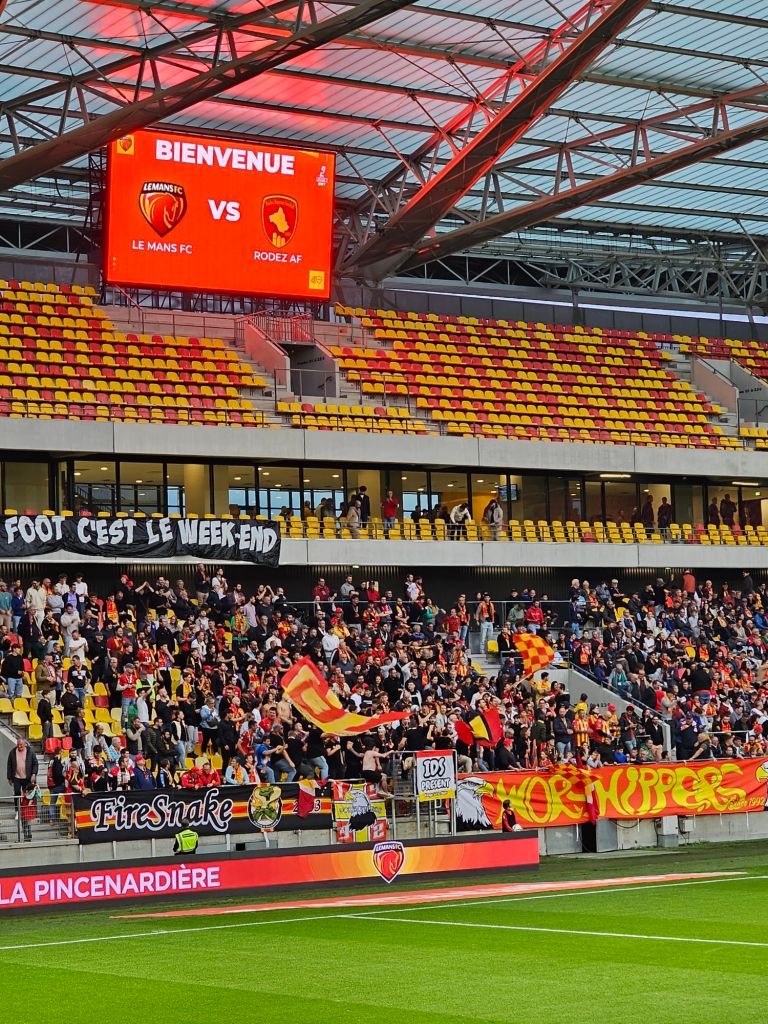
When the kick-off, or coupe d’envoi, finally happens it is Le Mans who get first go with the ball playing it back before punting it forward in the direction of the city centre and the medieval cathedral of Saint Julian with its fabulous stained glass; Rodez are playing towards the tram terminus.  Le Mans wear red and yellow striped shirts with red shorts although from behind they are all in red; Rodez meanwhile sport an all-white creation with black trim, which looks the same from any angle. From the start, and indeed since before it, the Le Mans fans behind the goal which Rodez are ‘attacking’ have been in fine voice with continuous chants of “Allez Le Mans” and “Aux Armes”.  I text my friend Mick back in blighty and send him a photo of the Le Mans fans.  He texts back to say they look like hedonists.

On the pitch, my attention is soon taken by the Le Mans numbers five and twenty-one, Harld Voyer and Theo Eyoum, who have their hair tied back in raffish fashion, whilst I also recognise the Rodez number twenty-seven from the hotel lobby. Early exchanges are cagey with Le Mans enjoying a little more possession but looking unsure what to do with it.  At the edge of the pitch behind the Rodez goal I am disappointed by the poor grammar of a Le Mans fan group, or possibly just an individual fan, whose banner reads Fanatic’s. Fanatic’s what? I wonder.  Another more literate fan group, perhaps from the top stream at the local lycee, are called ‘Worshippers’, whilst another banner reads ‘IDS Present’ and I begin to wonder why  former Tory party leader Ian Duncan Smith would be here. After fifteen minutes Le Mans win a corner. A minute later the first decent chance of the game appears but number twenty-five for Rodez, Nolan Galves boots it high over the cross bar.

Time proceeds to the twentieth minute and coincidentally perhaps the Le Mans number twenty William Harhouz is booked for making the Rodez number five Clement Jolibois roll around on the floor unnecessarily, but seven minutes later a rare display of skill in the form of a neat turn and cross by Le Mans’ eighteen, Lucas Buades ends with number twenty-five, Dame Gueye producing a spectacular overhead kick, which is so  spectacular it clears the cross bar.  More drama ensues after some odd refereeing from Monsieur Aurelien Petit who plays-on whilst Le Mans have the ball, only to then stop play and give a free-kick to Rodez, whose number twenty-eight Mathis Saka is subsequently carried off on a stretcher.

The match rolls on towards half-time, rarely threatening to produce a goal but instead producing the yellow card from the pocket of Monsieur Petit another five times whilst an aeroplane buzzes overhead invisibly through the deepening gloom of dusk. Five minutes of additional time are played during which the last two yellow cards of the half are shown, one for a player of each team, and then it is mi-temps.

The football resumes at five minutes past nine with a boot into touch but things soon improve with a spectacular save from the Rodez goalkeeper Quentin Braat after a free-kick to Le Mans and a close range shot, which would surely have beaten Braat had it not been so weak.  At the back for Rodez it seems that number four Mathis Magnin is charged with spraying deep penetrating passes, some of which penetrate too far and result in goal kicks and throw-ins. He nevertheless wears a head band to signal his creativity. 

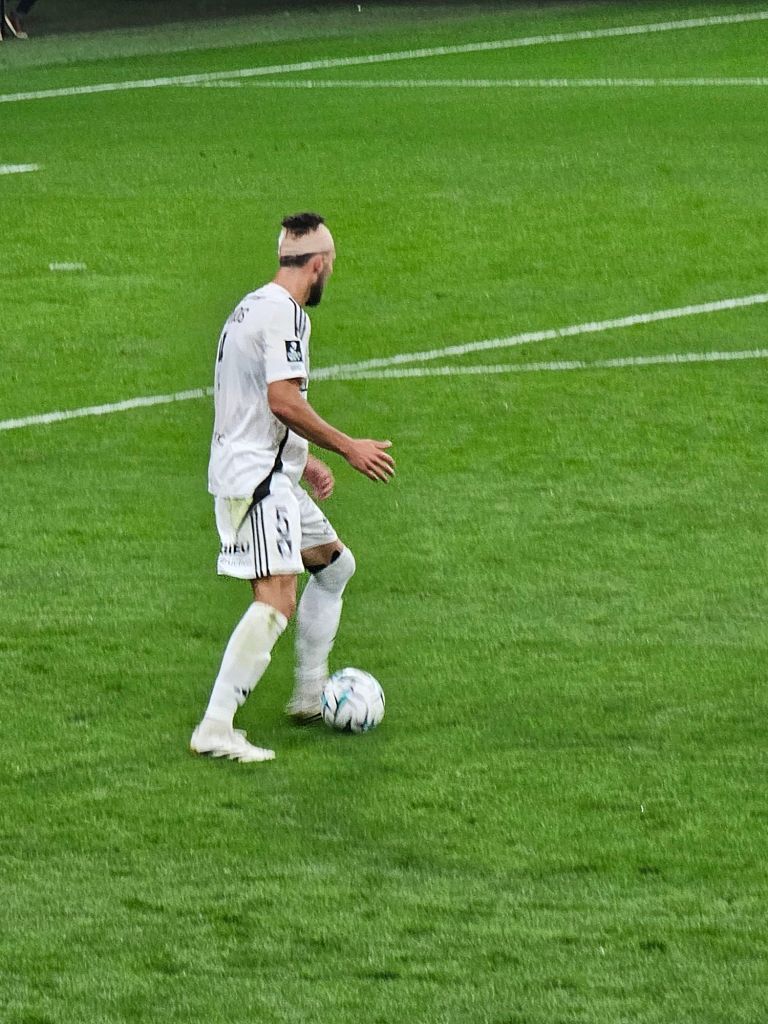
With the sun now having disappeared below the horizon it’s feeling colder, and the breeze previously only felt outside the stadium is finding its way inside; I zip up my jacket.  Back on the pitch, the Rodez number five Clement Jolibois appears to be channelling the spirit of Terry Butcher as he strides about with a bandage around the top of his head, although there is no visible trace of gore.  There doesn’t seem much prospect of a goal either, but then with a fraction more than thirty minutes of normal time remaining Rodez’s number fifteen, Jean Lambert Evans produces a cross from the left which allows number eleven Tairyk Arconte, who is stood all alone at the near post to head in the limpest looking goal I’ve seen in some time. Happily, for the fifteen away supporters I have counted, who have apparently made the 6 hour 20 minute, 657 kilometre journey up from Rodez, the goal is scored at their end of the ground.

The Le Mans coach Patrick Videira, who is unlikely to be confused with former Arsenal captain Patrick Vieira responds to the goal with a mass substitution, bringing on club captain Edwin Quarshie and the popular Erwan Colas as well as Baptiste Guillaume.  The change almost works as Le Mans quickly win a corner, but Guillaume volleys over the cross bar from about 10 metres out.  Two more substitutes appear just a few minutes later in the shape of Brice Oggad and Isaac Cossier and Rodez have some catching up to do in terms of player replacement, which begins as soon as the seventy-first minute and will be completed a mere nine minutes later.

With seventeen minutes of normal time remaining the opportunity to more or less guarantee victory presents itself to Rodez but although stood with the whole goal before him, recent substitute Ibrahima Balde cannot beat Nicolas Kocik in the Le Mans goal and merely wins a corner, not the match.  Meanwhile, I am becoming tetchy due to the pungent smell of the body spray or aftershave of the man sat in front of me.  I wonder to myself if his toiletries are becoming more active as the tension of the game mounts.

  Le Mans twice come close to equalising in the increasingly frantic final fifteen minutes with Quarshie shooting too high and then having another shot expertly tipped over the cross bar.  Brice Oggad also has a shot following a corner in what will prove to be the last decent opportunity for anyone to score, but he ‘shanks it’ high and wide.  The four minutes of added on time seem pretty solid when held up on the electronic display by the fourth official, but like grains of sand they slip through Le Mans’ fingers and the game ends.

On the walk back to the tram terminus Paulene and I agree that overall Rodez were the better team even if Le Mans had most of the possession.  We also agree that whilst it’s not been a particularly good match, it’s been an enjoyable one and I am therefore able to report that the best thing about the evening has not been the tram ride, although that was pretty good too.

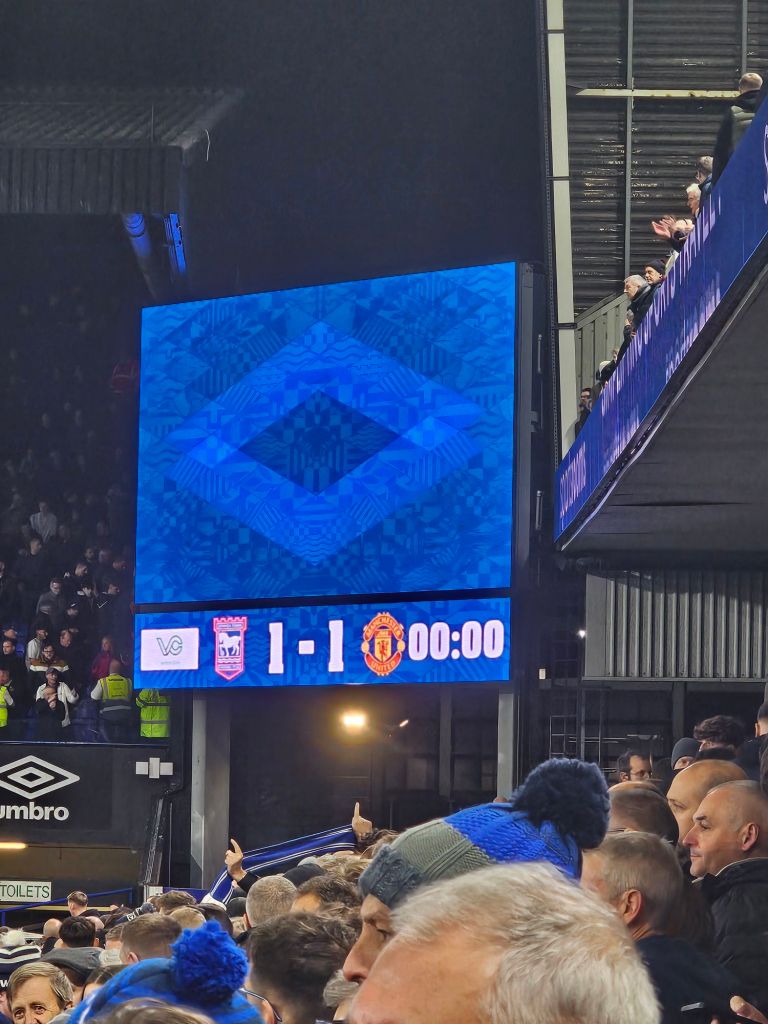
Ipswich Town 1 Manchester United 1

When I was young, so much younger than today I would often travel to Layer Road, Colchester on a Friday night to see the U’s engage with the likes of Torquay United, Darlington or Aldershot, and then on Saturday afternoon I would watch Ipswich Town in the First Division.  The days of ‘Col U’ playing on a Friday evening are sadly gone, as is Layer Road, but this weekend I had the opportunity to see two games in two days once again, taking my pick from an extensive menu of local non-league matches on Saturday afternoon and then catching the Town on Sunday afternoon with a wholly unwelcome four-thirty kick-off.  As it turned out, I didn’t bother,  but stayed indoors and courtesy of a ‘Firestick’ watched Paris FC play Annecy in French Ligue 2, and then Ligue 1 RC Lens play Marseille on the telly. I sometimes think I have lost my joie de vivre.

Today is Sunday and it is blowing a gale as I waste away a whole morning and much of an afternoon waiting to go to Portman Road. I tried drilling some holes in a wall to put up some shelves, but I think the party wall in my house must be made of granite and all the time I’ve been wondering if the trains are going to be disrupted, some have been cancelled already.  Mick has been in touch to see what time I might be at the Arb’ but the Sunday train times either get me there earlier than I’d like or with not enough time for a couple of drinks.  I should be able to sue Sky TV and the Premier League for the inconvenience.  The pre-match tension is palpable.

In time, I decide that it would be best for everyone if I simply spent a bit longer at the pub before the game and so after a train journey on which Manchester United supporters sing ‘Eric Cantona’  endlessly to the tune of The Twelve Days of Christmas and on which I don’t see a single polar bear, I buy a programme in Portman Road and finally arrive at the Arb’ to purchase a pint of Mauldon’s Suffolk Pride (£4.14 with CAMRA discount).  Mick has already texted me to say he is ‘on the bench in the beer garden’ and that is where I join him to discuss Gary’s absence, houses of multiple occupation, local non-league football, how Mick has been seeing ‘someone’ (a woman), newspapers,  religion, today’s Town team and what time we go to bed; Mick is a bit of ‘night owl’ it seems, and if I didn’t get up at twenty past six each morning I think I’d quite like to be able to watch Newsnight too.
A good hour and twenty minutes drift by in a sea of words and more Suffolk Pride, and we realise that everyone else in the pub beer garden seems to have left, so we do too not wishing to miss the kick-off, although happy to forego the leaping flames and tiresome, over-excited young stadium announcer with his elongated vowels and slightly cheap-looking suit.   There are no queues to get into what used to be Churchman’s and I arrive at my seat as ever to find ever-present Phil who never misses a game, his son Elwood, Pat from Clacton, Fiona and the man from Stowmarket (Paul) already here.  There’s a lot of noise as the two teams process onto the pitch and I don’t know why, but I can’t help feeling rather bemused, so much so that I suddenly notice Pat from Clacton looking at me a bit quizzically because the over-excited young stadium announcer is reading out the Town team and I’m not bawling out the players’ surnames in the manner of a Frenchman.  It’s been so long since Town were last at home that I’ve forgotten what to do and I’m lost in idle reverie. Returning to Earth, I try to make amends but find that the over-excited young stadium announcer is not in -sync with the score board and I therefore have no idea which surname comes next; it’s like a bad dream in which Murphy has returned but years younger and taller, and in a shiny suit

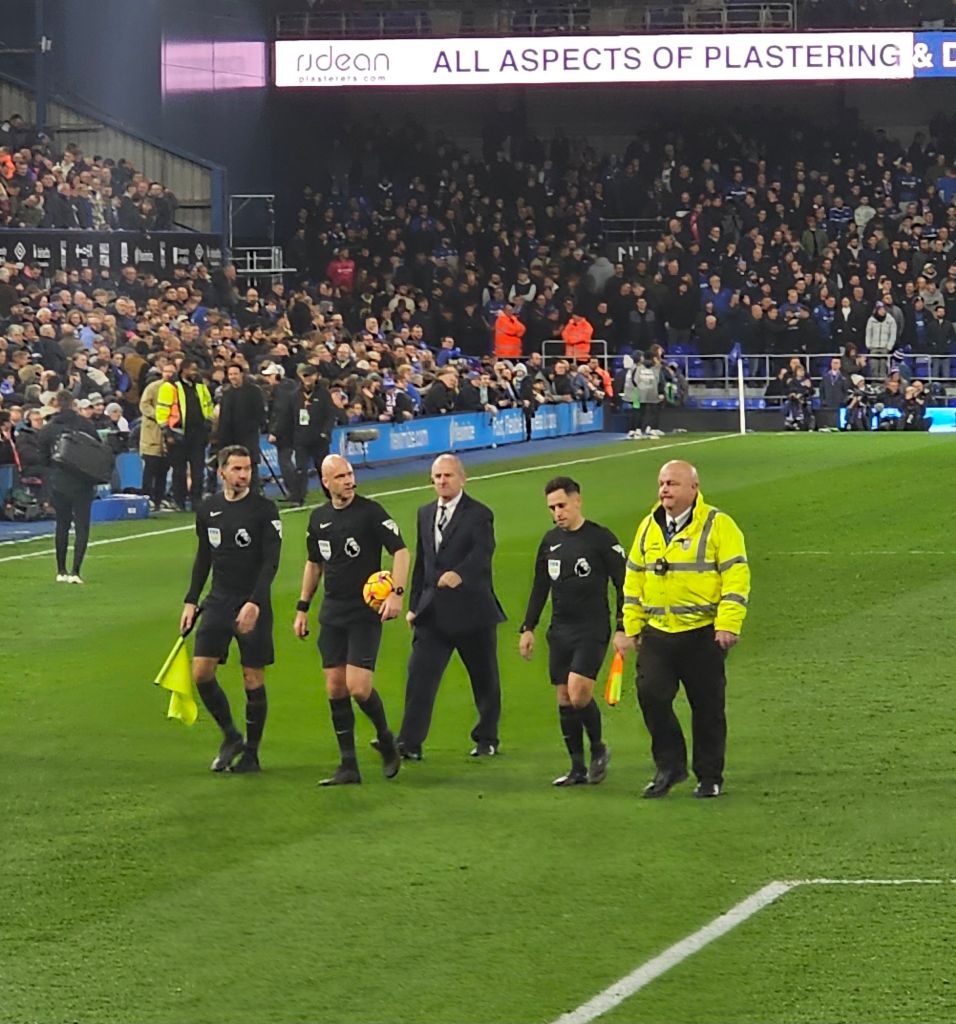
Kick-off comes as a relief with Town getting first go with the ball and aiming it in the direction of me and my fellow ultras. Town are of course in blue and white whilst Manchester United are in red shirts and black shorts, a bit like Stade Rennais,  but messily the shirts are two shades of red and the shorts have red flashes on them.  The relief is short-lived as within eighty seconds Manchester’s number 16 skips past a Town player, puts in a somewhat limp looking low cross and their number ten nips in to tap the ball past Aro Muric, who looks as if he was expecting to simply casually pick the ball up.   My hopes that VAR will have spotted some invisible infringement in the run up to the goal are dashed, largely because there simply wasn’t enough time for anything to have happened. 

The game resumes over a minute after the goal was scored and we all feel a bit shocked. The current Manchester United team is widely believed to be pretty useless I believe and here we are losing already. I thought we were going to win two-nil and had told Mick as much.  Five minutes are almost gone however, as Town win a corner.  Eleven minutes disappear and Sam Szmodics has a decent shot that the goalkeeper saves and in terms of attacking intent at least, Town have drawn level.

“United, United, United, United” chant the Mancunians and their friends from London and the Home Counties up in the Cobbold Stand, separating each ‘United’ with three quick claps.   A little slow to catch on, the Blue Action group belatedly shout “Shit, just like people did in the 1970’s, but usually before the visitors had stopped shouting ‘United’.  The football is quite good though. Lots of passing is going on and Ipswich are probably doing more of it than Manchester.  The half is half over and finding himself next to Sam Morsy, the Manchester number seventeen falls to the ground and rolls over and over and over and over to both the anger and amusement of the home crowd.  “Get up, ya great pussy” I tell him loudly.  “That’s Garnacho” says the bloke in front of me. “Yer what?” I ask him. “That’s Garnacho” he says again.  A bit confused being unfamiliar with the names of any footballers unless they play for Ipswich Town I say “So it’s not Pussy then.”  “He’s a funny looking bleeder” says the bloke behind me of the aforementioned Garnacho and the bloke next to me momentarily reflects on how children don’t get called ‘little bleeders’ nowadays, and sadly I think he’s right.  Amusingly, to me anyway,  ‘ya little bleeder’ was probably the polite version of ‘ya little bugger’ which is how my grandfather affectionately knew me.

Another Town corner unexpectedly inspires a warm booming chant of “Come On You Blues” and Liam Delap earns a free-kick on the edge of the penalty area as United’s captain Jonny Evans looks bothered; having only this week watched a version on the telly, I think of Evans The Death, the undertaker in   Dylan Thomas’s  ‘Under Milk Wood’.  The free-kick is neatly taken, but goes straight to the goalkeeper Andre Onana for whom I am amazed the United supporters do not sing KC and the Sunshine Band’s ‘Baby Give It Up’. Sensing my disappointment when Town don’t score, Pat from Clacton tells me that she’s already had her dinner today – a Marks & Spencer roast turkey ready meal.  “It’s not even Christmas yet” I tell her and Town win another corner from which a shot is blocked after the ball had been headed back across goal.  United breakaway up field,  but Sam Morsy slides across to sweep the ball out for a throw with the sort of tackle that takes the Manchester player as ‘collateral damage’ and which the home crowd loves, especially against a rather ‘poncey’ team like this one seems  to be.

With five minutes until half-time,Town produce the move of the match, tearing the Manchester defence apart as Leif Davis chases a raking long pass, checks inside and plays in Liam Delap who has a whole goal to aim at , but somehow Onana gets a hand or an arm or a shoulder in the way of the goal bound ball.  Within sixty seconds, another move opens up a view of goal for Jens Cajuste, but he shoots over.  The momentum is with Ipswich however and Omari Hutchinson claims the equaliser very soon afterwards with a shooting star of a shot from outside the penalty area which loops gently off a Manchester head on its rapid journey into the top right hand corner of the goal net, at last beyond the reach of Onana.  Three minutes of added on time follow without incident and we are relieved not to be losing anymore, but also feeling like we could be winning.

With half-time I dispose of excess Suffolk Pride and then speak with Ray, to whom it seems I haven’t spoken in months.  We speak of car parks and Kemi Badenoch, whose surname Ray pronounces as Bad Enoch, which for those like us who remember Mr Powell seems worryingly appropriate.  On the way back to my seat I congratulate ever-present Phil who never misses a game on having recently completed his quest to see a game at every one of the ninety-two League grounds in England and Wales.  I tell him I got to around seventy-eight grounds about fifteen years ago but have never managed to get any further.  I don’t tell him it’s a metaphor for my entire life.

The football resumes at twenty-four minutes to six when people without a subscription to Sky Sports TV are watching Countryfile and eating buttered teacakes. I notice the moving advertisement for Aspall cider which reads “made in Suffolk since 1728” , words that fosters images in my romantic mind of misty orchards, wooden vats and apple presses, horses, carts and crusted rustic characters, and then the illuminated display says “now available in a can”.

“Come On Ipswich, Come on Ipswich” we chant a good three or four times because Manchester are keeping the ball more than we’d like.  The encouragement works and Town get the ball,  Wes Burns whips in a low cross and Onana saves brilliantly again from Liam Delap and Town have another corner.  Manchester break again and Jens Cajuste chases back to make a perfect tackle inside the Town penalty area and now Manchester have a corner.   Not an hour has been played and Manchester are making substitutions as Evans the Death and some bloke who is so good he only has one name goes off and some other blokes I’ve not heard of come on.  Up in the Cobbold Stand the away supporters sing songs about Roy Keane and Eric Cantona, perhaps because like me they don’t know who their current players are either.

Then Ipswich make substitutions; Sam Szmodics and Jens Cajuste departing and Jack Taylor and Jack Clarke arriving. “For me, Burns ain’t done nothing” says the bloke behind me clearly thinking he should have been substituted but perhaps not having noticed his pass to Omari Hutchinson for the goal, that cross for Liam Delap, or his defensive play.  Twenty-three minutes are left and Manchester have another corner before a couple more substitutions; a bloke called Zirkzee comes on. “Sounds like a cleaning product” say the bloke behind me.  This early afternoon and early evening’s attendance is announced by the over-excitable young stadium announcer in the shiny suit as being 30,017 with a very nicely rounded 3,000 of that number being here to sing about Eric Cantona.

Manchester United are mostly the team with the ball in the second half, but despite some grace and speed and long accurate passes they aren’t threatening the Town goal much, they just look like they could if they thought about it a bit more.  Perhaps they just have too much confidence and and self-love for their own good.  The good thing is it means Town look more likely to score,  but as Pat from Clacton says to Fiona “You can feel the tension” .  Eventually, the bloke behind me gets his wish as Wes Burns is replaced by Conor Chaplin, and the match rolls on into the final ten minutes of normal time. Ali Al-Hamadi shoots and Onana saves, again. Conor Chaplin shoots, but pretty much straight at Onana.

Only four minutes of added on time are added on and I can’t decide if that’s a good thing or a bad thing. Do we need more time to score or less time so we don’t concede?  “Oh when the Town go marching in, Oh when the Town go marching in“ drone the home crowd mournfully as if they’ll be following a coffin when it happens. Manchester United win a corner and the ball is booted clear to create maximum distance between it and the Town goal and then the match ends.  Fiona and Pat from Clacton are quickly away, but not before Fiona says “See you next Tuesday”- it’s when Town play Crystal Palace.

It’s been another fine game, perhaps not as exciting as some of the others this season, but despite not dictating enough of the play in the second half there is no doubt Town can claim they deserved to win more than Manchester did, and Onana is clearly Manchester’s ‘Man of the Match’, although they probably won’t admit it.   Leaving Portman Road for the railway station I think back to the first time I ever saw Town play Manchester United, in December 1971.  That game ended in a draw too, a goalless one, and Best, Law and Charlton were all rubbish.

Stade Malherbe Caen 1 AC Ajaccio 0

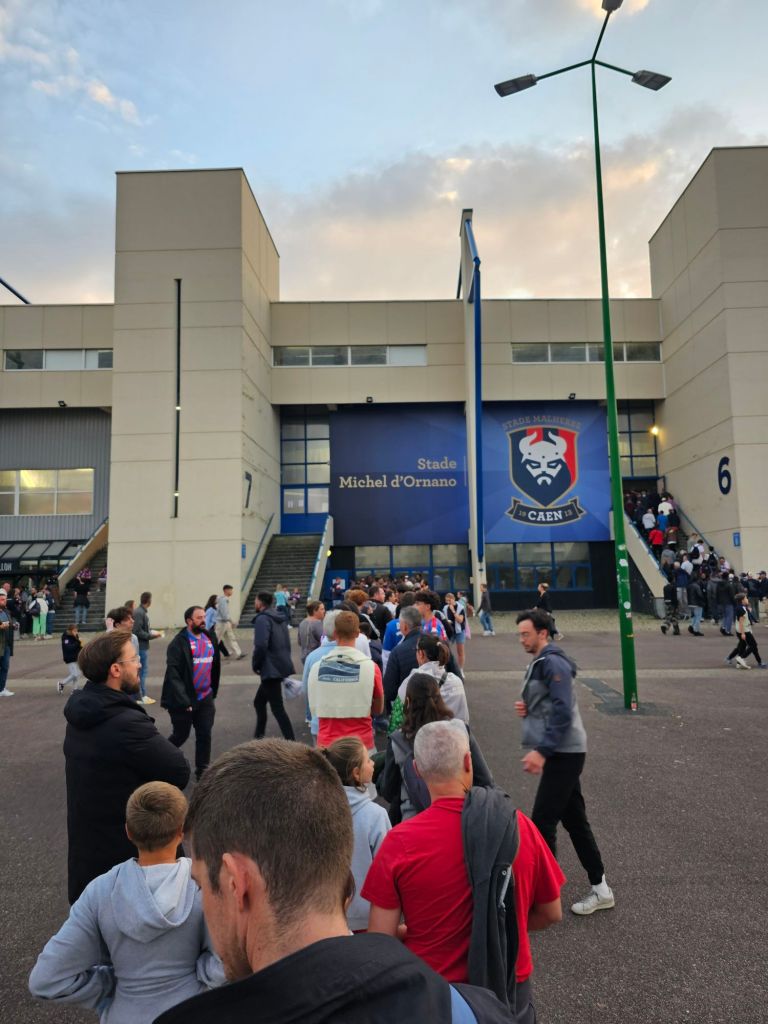
When travelling, in no real hurry, the 670 kilometres from Calais to Carnac in Brittany, the fine city of Caen is the perfect place to break the journey in two, particularly if SM Caen are playing at home.  So it is that I find myself with my wife Paulene on a Friday evening stood at the Bellivet bus stop in the centre of Caen, waiting for the free shuttle bus (navette) out to the Stade Michel d’Ornano in the suburbs of the city.  The bus is due at seven o’clock, but it’s barely six forty-five yet; we weren’t sure how long it would take to walk from our hotel on the Quai de Plaisance, not long it turns out.

We stand on the pavement outside the bus shelter, which is well populated with people who don’t look like they’re going to a football match, but then, the stop is served by several other bus routes. A man in his early thirties turns to us and asks if this is the stop for the navette (I think he must have deduced from the Ipswich Town badge on my T-shirt that we are football fans).  We tell him that’s what it says on the football club website, and we believe it.   The man is from Caen but has never used the navette before; he is going to the match with a friend who is also Caennais, but has lived in Paris and has never even been to any game before; they are taking the bus so they can have a drink before and after the game., which seems to be the main point of the exercise. The man who has lived in Paris reveals that when he was a teenager, he stayed in Ipswich on a student exchange scheme; they were good times he says, even though he never made it to Portman Road.

Time passes.  Seven o’clock passes. Several buses stop, passengers alight and others get on.  A ramp slides out from under one bus and a woman in a powered wheelchair backs along it onto the pavement.  “Oi Ipswich, my friend here is a Norwich fan” says a rich Welsh voice. “No I’m not, I’m from Cardiff” says the tall grey-haired man standing next to me.  “Have you got your match tickets?” asks the first Welshman.  “Yes” I tell him “But I don’t reckon you’ll need them for the bus, the driver isn’t going to want to check everyone has got one.”  The first Welshman asks if we had been to the ground earlier to buy them, but we tell him we bought them on-line.  “See, I told you we could have got them on-line” says Welshman number two to Welshman number one. “Well, I looked” says Welshman number one, “But it was all in French.”

We talk some more and tell the Welshmen how we were in Cardiff last year to see Haverfordwest (Hwlfordd in Welsh) play their two European Conference League qualifiers. They ask why, and I tell them I was born in Haverfordwest. “You’re Welsh then” they say.  Welshman number two then tells us he’s obsessed with going to new football grounds and after asking us to guess how many he’s been to, he reveals that he’s visited over seven-hundred.   It’s about a quarter past seven now, and an articulated single-deck bus hoves into view bearing the destination “Allez le SM Caen”, At last, it’s the navette, and about forty of us pile on before the bus lurches and twists off up the street, past William the Conqueror’s castle and on past the eleventh century l’Abbeye aux hommes, the Hotel de ville, and the palais de justice all of which miraculously survived allied bombing in World War Two.  On the bus ploughs, on a stop start journey past the more recently built palais des sports, and through the heavy traffic heading for the Caen international fair (Foire International de Caen), which begins tonight.

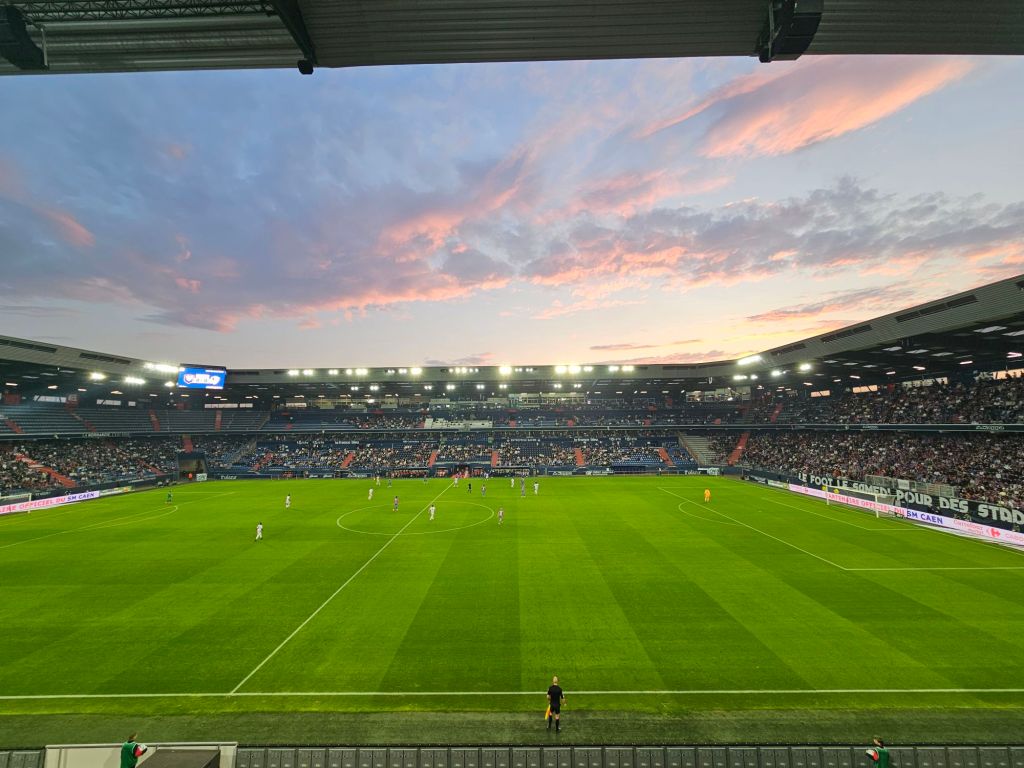
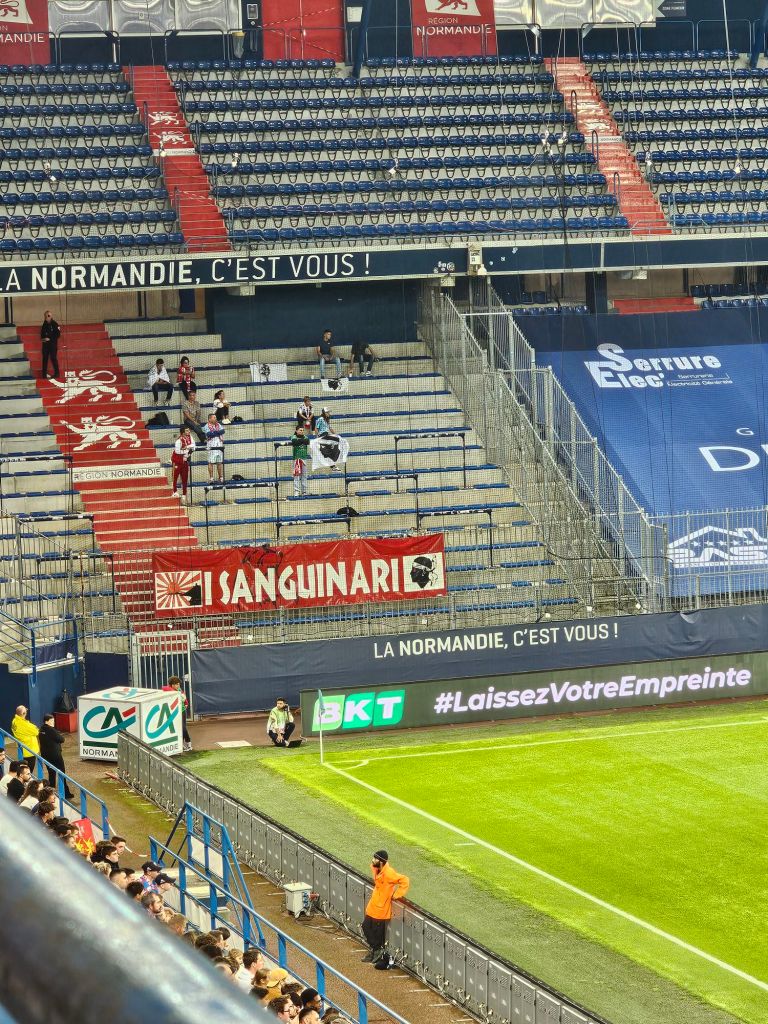
It’s gone twenty to eight by the time the bus disgorges its load at the oddly named  ‘Silicon Valley’ bus stop, directly opposite the Stade d’Onano, and Paulene and I head for the club shop to add to the pointless collections of cuddly club mascots, fridge magnets and T-shirts that clutter up our home back in blighty, although I do wear the T-shirts.   After then joining a queue for Gate 7, six flights of stairs take us to the top of the Tribune Caen from where we have to descend the steep gangway to our seats (24 euros each) in the front row of the top tier of the stand.  Within moments of our sitting down the game begins, tonight’s visiting team AC Ajaccio from Corsica getting first go with the ball, which they succeed in keeping to themselves for much of the first minute of the game. Ajaccio are wearing red and white striped shirts with white shorts, reminiscent of Stoke City and Signal toothpaste.  Caen meanwhile are kitted out in blue shorts and blue and red striped shirts, but the stripes are wavy, reminding me of the sleeve of the Cosmic Roughriders LP ‘Enjoy the Melodic Sunshine’.  Caen are kicking from right to left, back towards the city centre, whilst Ajaccio are aiming more in the direction of the Bayeux tapestry.

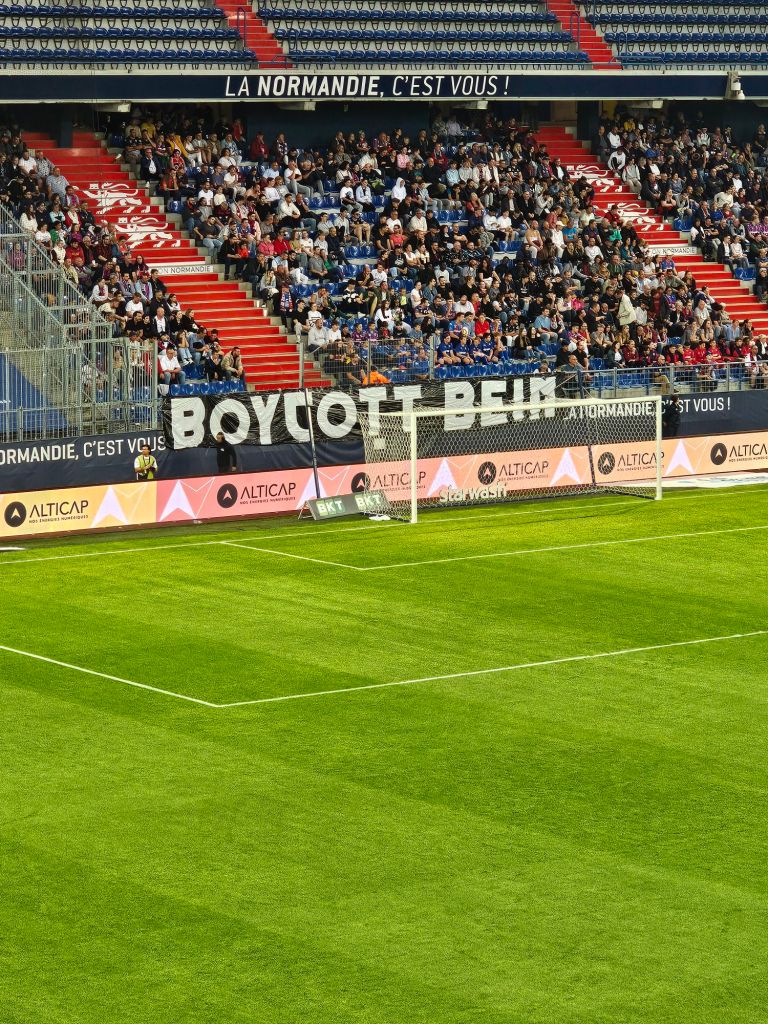
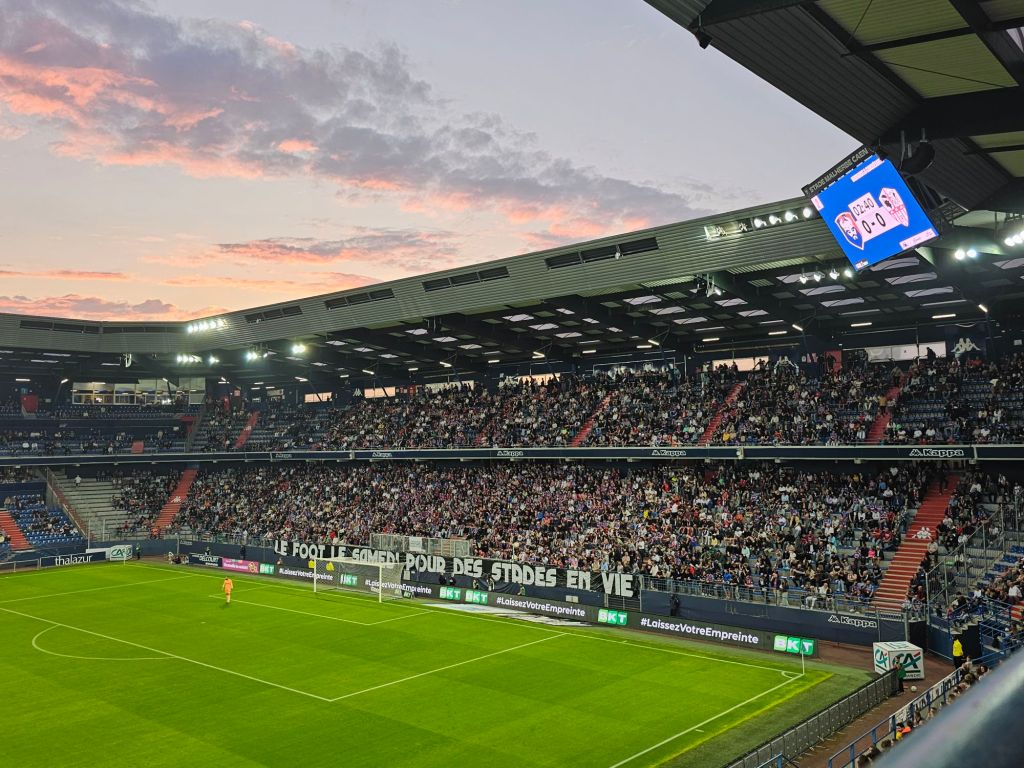
Unexpectedly, the ground seems very quiet as the game begins, possibly because in four matches in Ligue 2 so far this season, Caen have not won, only succeeding in losing three times.  Whenever a Caen player crosses into the opposition half however, I think I can hear a muffled murmurs of “Allez, allez, allez” all around me, and when Caen win an early corner rhythmic clapping breaks out.  With not much happening I take the opportunity to visit the buvette back at the top of the stand where I buy a bottle of water (2 euros) and a merguez sandwich (6 euros).  I return to my seat in time to witness a twelfth minute shot from a Caen player strike the Ajaccio cross bar. Before three minutes later a blizzard of paper planes rain down on to the pitch from behind the Ajaccio goal, possibly as part of the ongoing protest against Ligue 2 matches being moved to Friday nights this season at the behest of Bein Sports tv.  Banners behind the goals read “Le foot le Samedi pour des stades en vie” (Football on Saturdays for lively stadiums) and “Boycott Bein”.

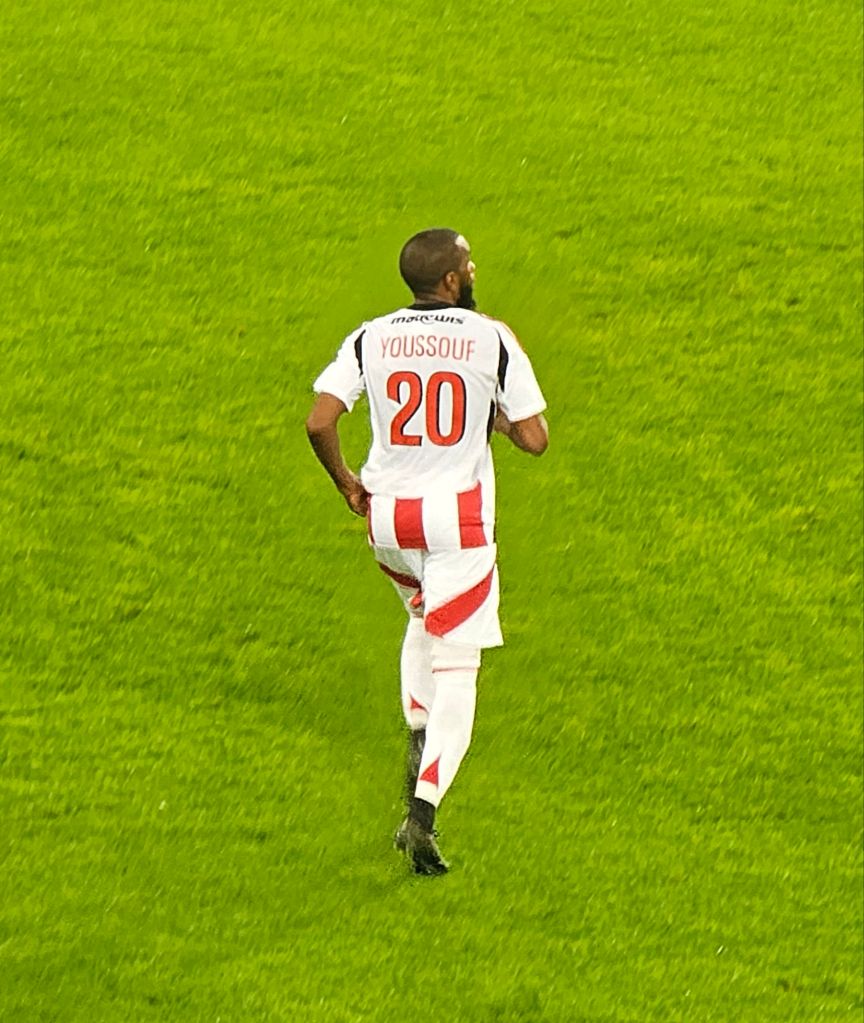
To our left, I count thirteen Ajaccio supporters in their enclosure behind the goal and I think of the Last Supper, before noticing that the Ajaccio number twenty Mohamed Youssef is so short that his socks meet his shorts, creating the effect that he is wearing puttees.  The first half is half over as Caen build a move down the left before wasting all the effort with a shot over the crossbar.  Nine minutes later Caen’s number seven flicks the ball up inside the penalty area before crashing a spectacular volley directly at the Ajaccio goalkeeper, who is in two shades of green.

The game is one-sided with Caen monopolising possession and attempts on goal until six minutes before half-time when Ajaccio have their first shot at goal, a curling effort from number 99, which nevertheless curls straight into the arms of the Caen goalkeeper who admittedly is not easy to miss because he is all in orange.  The first booking of the game follows soon afterwards when Ajaccio’s number thirty-one chooses to tug at the Caen number nineteen’s shoulder rather than attempt to tackle him in the conventional manner.  Two minutes of added on time are added on, to little effect, and at half-time the score remains blank. In a sense therefore, Ajaccio are winning.

Paulene and I move seat during the break because I have been having to duck my head whenever the ball has been in the Caen half due to a large, blue, metal safety rail at the foot of the steps, which extends in front of my seat.  The half-time break passes with people trying to kick a ball into a box for money, and two teams of children in red and blue kit taking a shoot-out competition. The red children all seem about twice the size of the blues and predictably they win, although the only girl in the competition is a blue and she scores her goal.

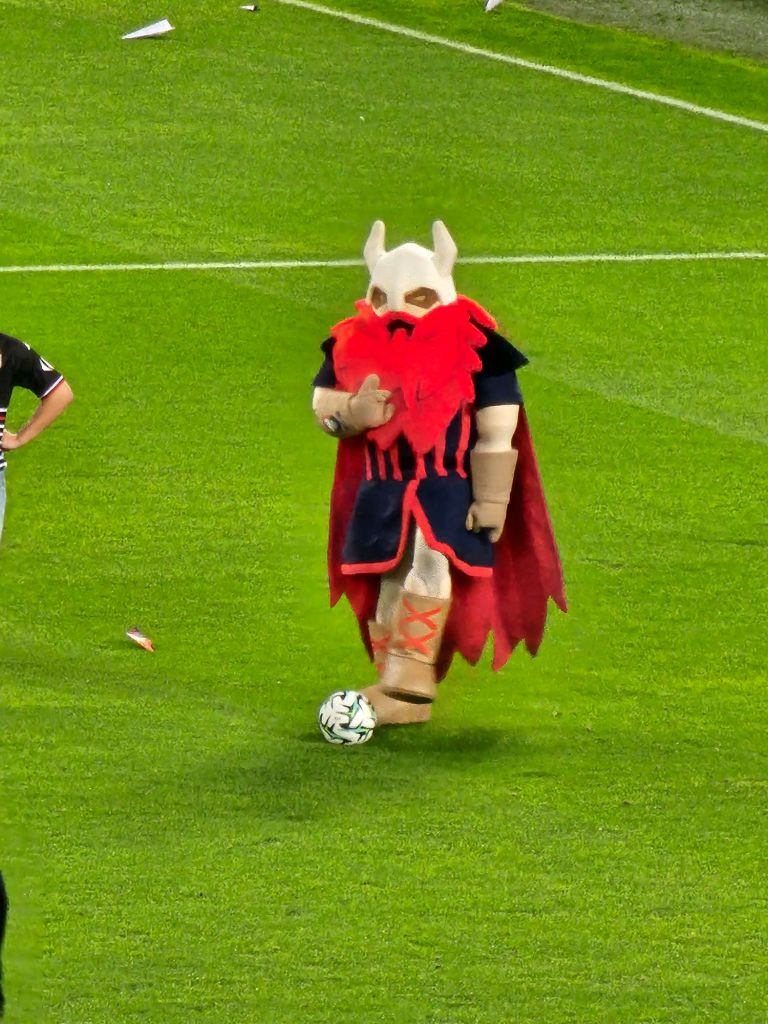
Now, with a clear view of the whole pitch we see the game re-start at nine o’clock and suddenly the stadium is full of enthusiasm and chanting. For no apparent reason the home supporters are singing “Allez, Allez, Allez” to Verdi’s Triumphal March from his opera Aida.  The effect is almost instantaneous as a ball into the box results in claims for a penalty, albeit somewhat specious ones. But a corner satisfies the more realistic supporters, which leads to a shot and another corner and more urging chants of “Allez, Allez, Allez” as the Caen fans loudly live up to what one would expect of their mascot, Vik the Viking.

Only five minutes of the half have gone and now number seventeen Kyheremeh is shooting straight at the Ajaccio goalkeeper before number nineteen heads over the cross bar from a corner.  Sadly however, the score remains blank and for a while the game descends into a Keystone Cops style knockabout with players falling over and colliding with abandon.  Paulene and I begin to notice the advertisements around the ground for the likes of Entreprise Bacon, Calvados the departement or County, as opposed to Calvados the apple brandy, and the interestingly named Twisto, the local transport company who brought us here this evening in one of their articulated buses.  Off to our left, I can only count eleven Ajaccio fans now and wonder if two have had to leave early to catch a ferry, or whether they just gave up hope.

Only twenty-five minutes remain as Caen’s Kyeremeh is through on goal, but he chooses to run wide and cross low to the near post where the ball is saved at the expense of a corner.  “Allez, Allez, Allez” sing the home fans again, but this time to the tune of the Beatles’ Yellow Submarine, not Verdi.  Thirteen minutes remains and Caen’s number four has come on as a substitute only to quickly get booked as he struggles to influence the game.   Three minutes later however, comes the decisive moment. Caen’s number ten, Bilal Brahimi, who has been neat but nothing more for most of the game, suddenly has space outside the Ajaccio penalty area from where he unexpectedly launches a shot into the top right-hand corner of the Corsican goal; Caen lead one-nil.  “Bilal, Bilal” chant the Caen fans as his picture appears on the scoreboard and the stadium announcer tells us who scored.

Ajaccio have made little effort to score themselves and now they might have left it too late.  Ajaccio substitute number twenty-one Ivane Chegra is brought on to add flair by the look of his Marc Bolan style coiffure, and number twenty-two Moussa Soumano succeeds only in getting booked as the match rolls on into five minutes of added on time.  The added-on time is of no consequence however, and with the final whistle the relief for Caen’s supporters having won their first match of the season is plain to see.

With a bus to catch we don’t linger to join the ensuing love-in, and that bus is almost full and ready to leave as we board it.  Down the streets beyond stadium vivid, sudden flashes of light appear and soon there are spots of rain on the windows of the bus as it weaves its way through the post-match traffic.  By the time we reach the city centre a heavy downpour is drumming against the roof of the bus and the streets are awash.  With the bus windows steamed up and streaked with rain I have to ask a fellow passenger to tell me when we’re back at Bellivet bus stop.  It’s a dramatic end to the evening and an uncomfortably wet walk back to the hotel, but I don’t think we’ll forget our night in Caen.

Vannes OC 1 Chambly-Oise 2

Ligue National 2 is the fourth tier of French league football; it consists of amateur clubs and the reserve teams of the clubs in Ligue 1 and 2 and is divided up into four regional groups each containing sixteen teams.  There are nevertheless many clubs at this level that have previously been in the two professional leagues, and both Vannes and Chambly fall into this category, with Chambly having had just a single season in Ligue 2 as recently as 2020; neither club has ever scaled the heights of Ligue 1 but Vannes were in Ligue 2 from 2008 to 2011 and reached the final of the Coupe de la Ligue (League Cup) at the Stade de France in 2008, although they lost 0-4 to Bordeaux.

Vannes is a coastal town and former port, which in some ways might be said to be comparable to my hometown of Ipswich due to its physical geography and former dockside and having a history dating back well over a thousand years, although based on how busy it is today Vannes seems to be thriving a little more than Ipswich at the present time, but then France is in the EU and the French realise in the spirit of egalite and fraternite that taxation and public spending allow money to be spent for the greater good.

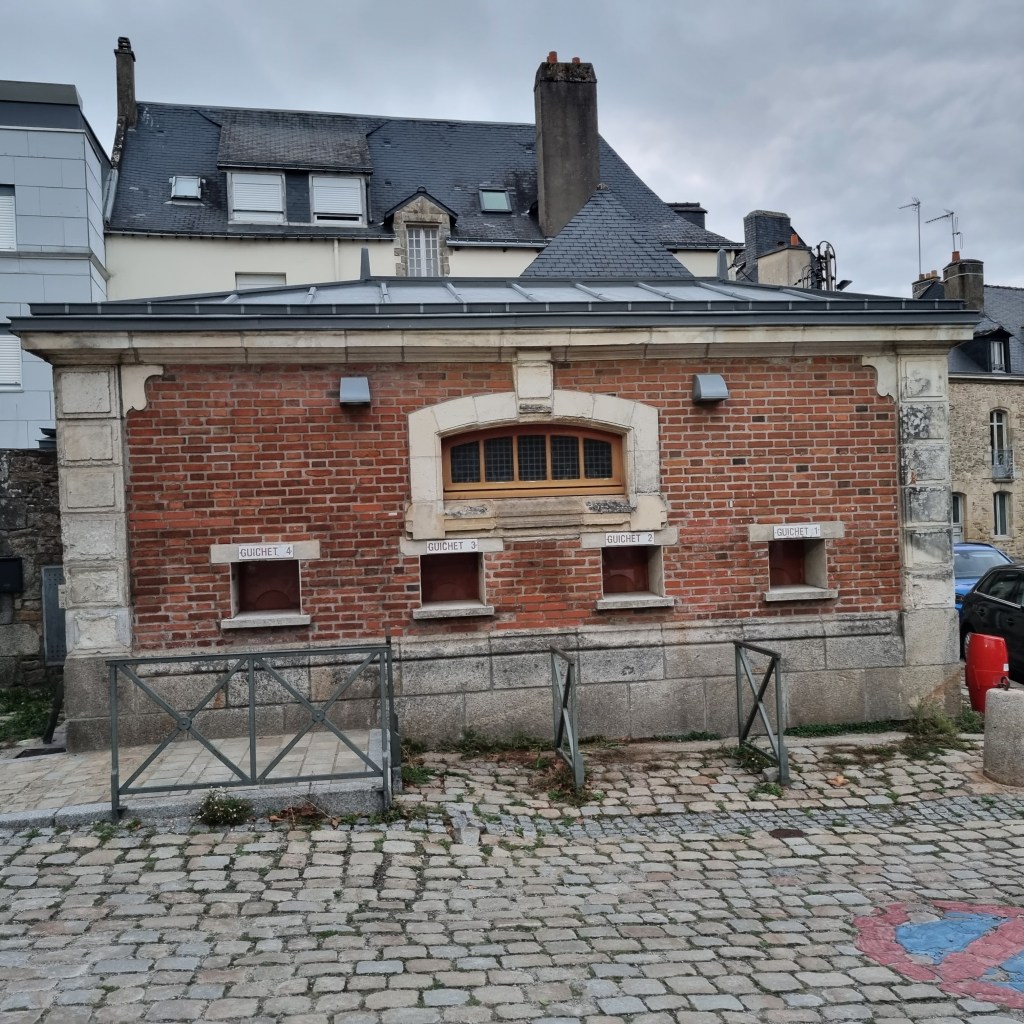
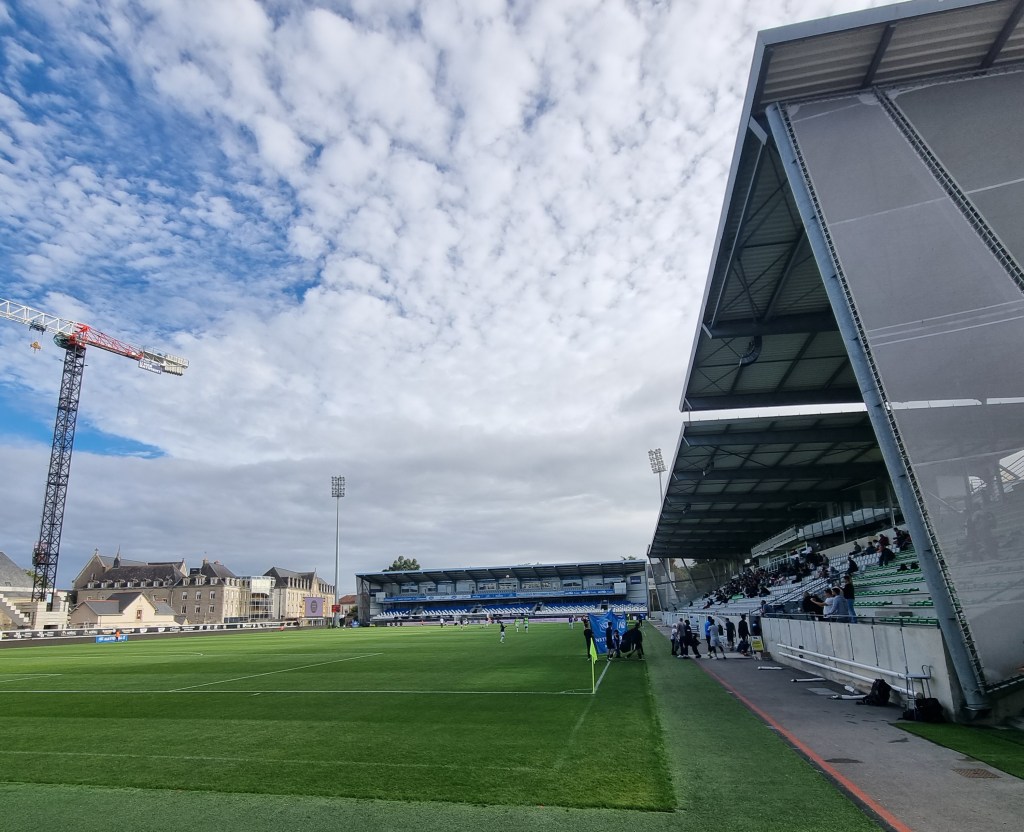
After a lazy afternoon in Vannes spent mostly sat at a pavement café, in the gardens beneath the town walls and by the old port which is now filled with yachts, my wife Paulene and I stroll across the road from the port to the guichets where we buy two tickets (8 euros each) for this evening’s match which kicks-off at six-thirty.  Entry to the Stade de la Rabine is just up the road and round the corner from the guichets and at the gate our tickets are checked, and the stubs torn off by two redoubtable looking middle-aged women.  Entry takes us directly into the under croft of the steel framed south stand; walking along beneath the upper tier it feels like we are in a lofty cloister.  The main stand is a plain concrete and steel structure typical of many French municipal stadiums but a little newer than most.

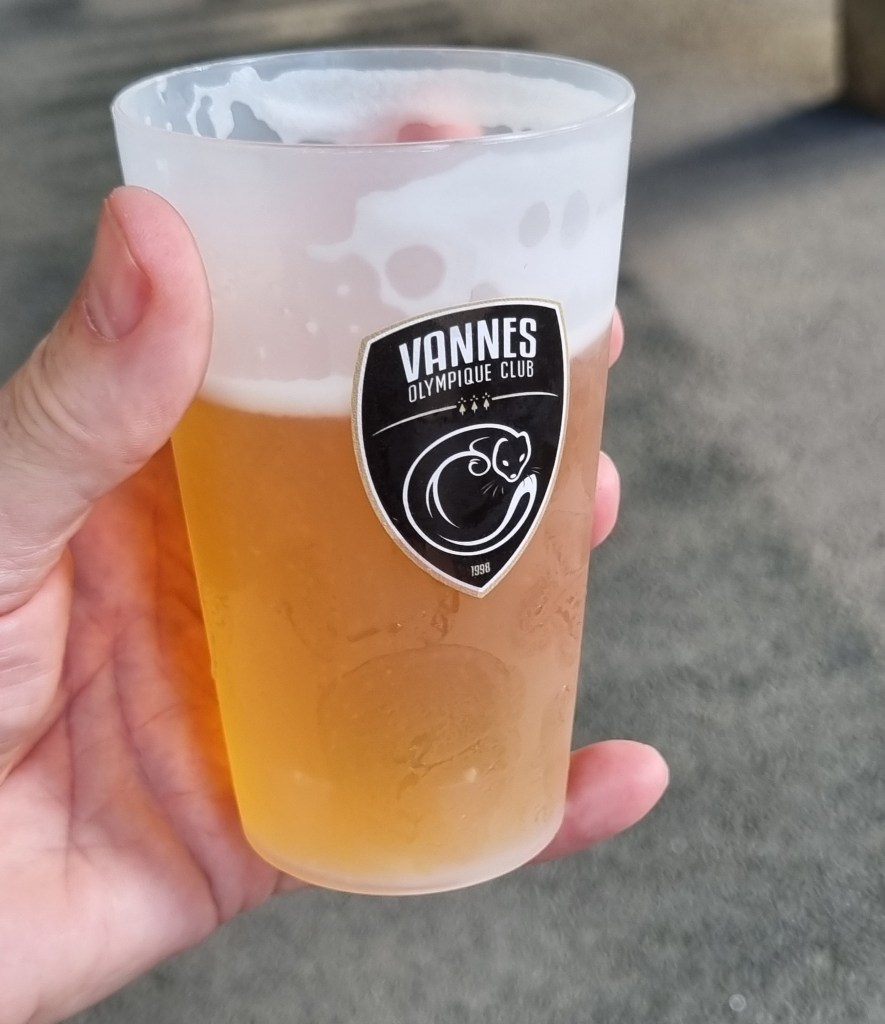
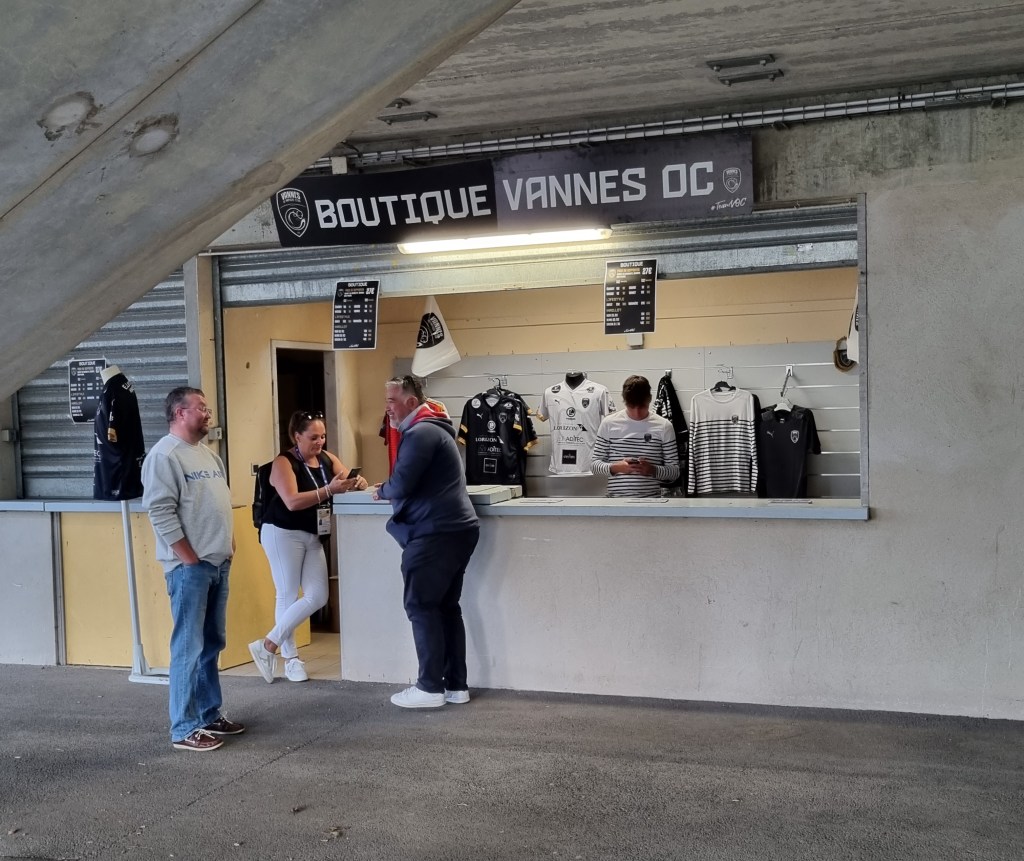
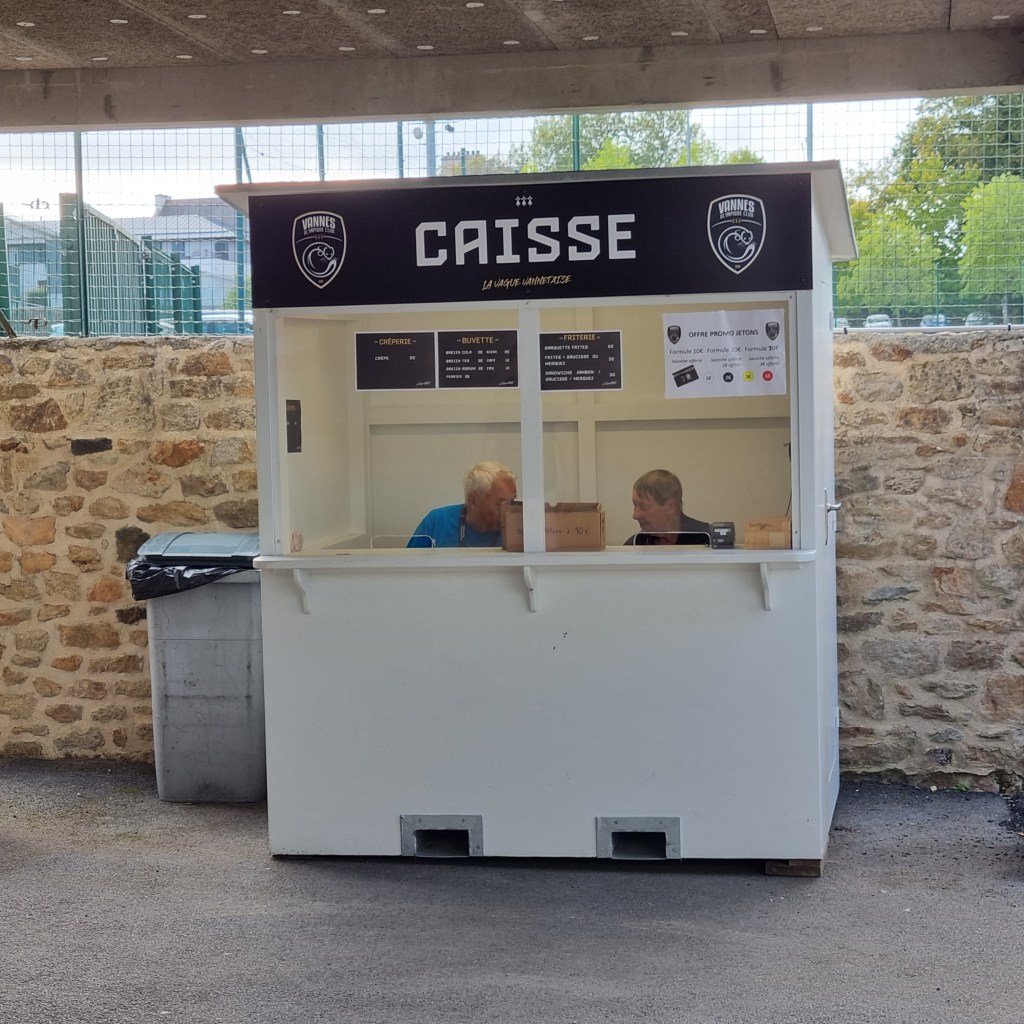
Getting into the feel of what is effectively the French equivalent of ‘non-league’ football, I have to have a beer. An un-identified blonde beer in a re-usable plastic cup adorned with the club crest costs just 2 euros. Paulene has a coffee and bottle of water which are a euro each, but first I must exchange my cash for the Jetons (tokens) that are the only means of paying for food and drink in the ground.  I am happy to see there is also a club shop where for just three euros I add another petit fanion (pennant) to the collection that hangs above the cistern in my upstairs toilet back home. I wander about a bit and snap a few photos and then we find our seats as the PA system plays some rather strange bland electro-pop music, as it has done since we first walked in.

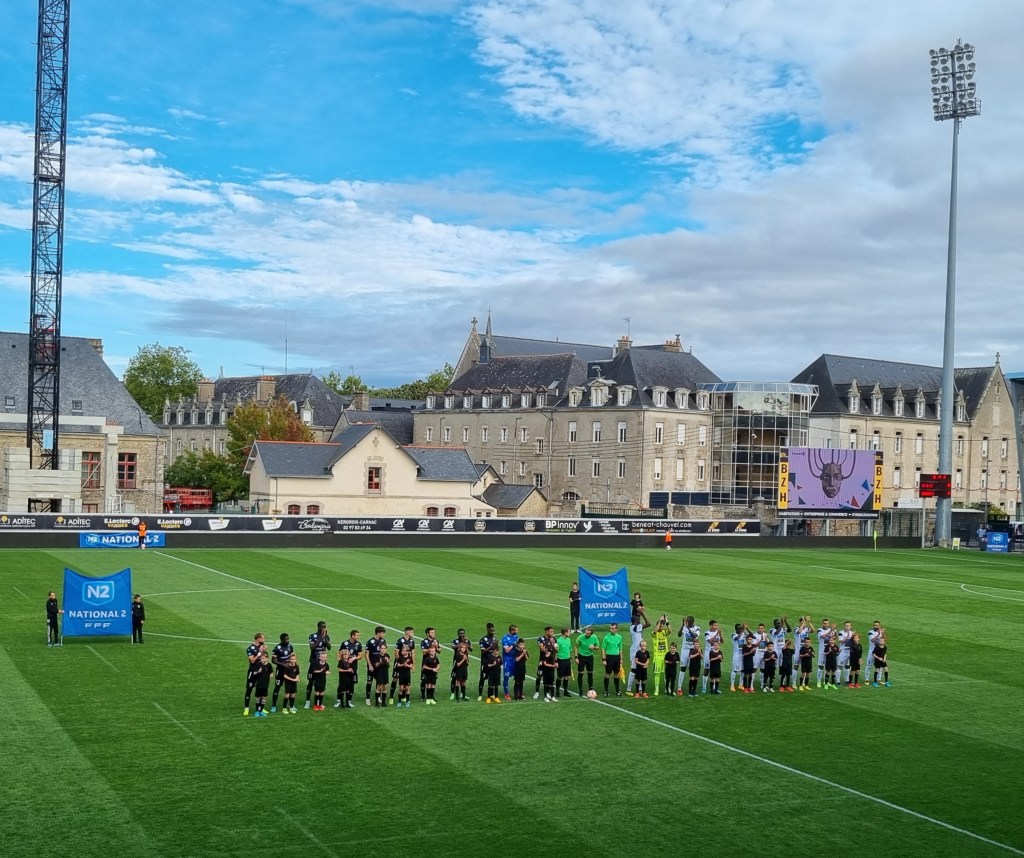
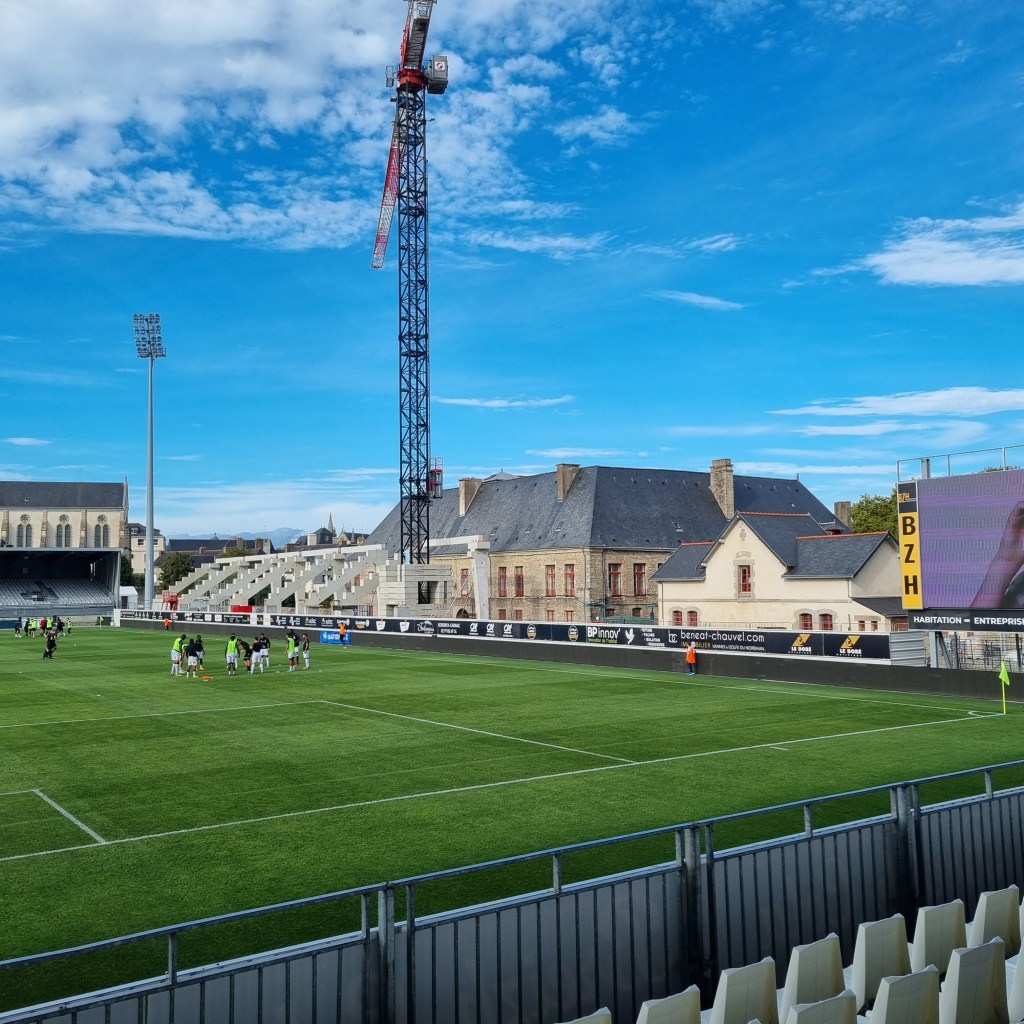
The main stand eventually fills up with the usual collection of old blokes, actual and would-be wives and girlfriends of players, young boys in club tracksuits who probably play for the under 13s team, and other sundry supporters of the local team.  The stand to our left is completely empty; there is one lonely man in the stand to our right and the far side of the ground is a building site on which the concrete frame that has so far been erected could be compared to a sort of modern-day Stonehenge, but only if the light was very, very bad.  The teams process onto the pitch and line up in a single row before two banners proclaiming the name of league National 2.  Three-minutes late, at twenty-seven minutes to seven after a ‘ceremonial’ kick-off involving two older men in smart but casual clothing, Chambly Oise kick off, aiming towards the goal in front of the two-tiered stand occupied by the lone supporter.

Before three minutes have passed, Chambly win the games’ first corner.  A minute later and a cross from the left is diverted into the Vannes goal by the foot on the end of the outstretched leg of Chambly’s number 19, which he has dangled beyond the defender who is alongside him.  The goal catches me by surprise a bit, as it did that defender, and I clap, drawing a look of mild disapproval from the very tall, elderly man who is folded up on the seat next but one to me.  To be honest I had thought Chambly were Vannes because Chambly are wearing an all-white kit whilst Vannes are wearing all-black and I couldn’t imagine that any club’s first choice kit would be all-black; I had therefore assumed that they were the away team.   The French Wikipedia page on Vannes OC later tells me that Vannes OC did formerly play in black and white but changed to all-black a few seasons ago; personally, as someone who still can’t get used to seeing teams of referees, I think it was a bad decision.

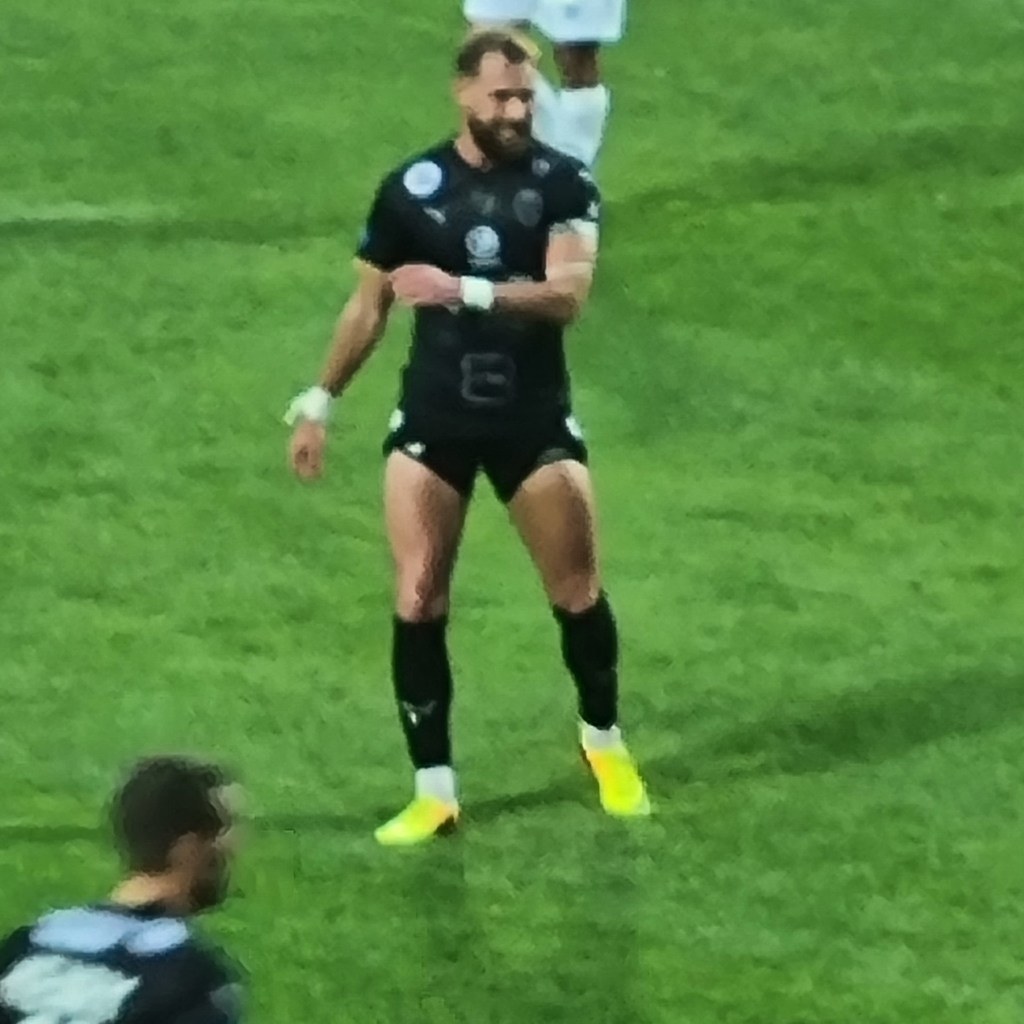
The quality of the football so far is not high and the crowd is quiet, particularly the lone man behind the goal, but Chambly look the better team.  In the absence of anything more interesting I note that the Chambly players do not have their names on the back of their shirts, but the Vannes players do with the exception of number 33.  Also, number 9 for Vannes, whose name is Ebrard, has one leg of his shorts hanging down, but the other one rolled up.  Paulene and I speculate as to why this is.  Is it perhaps to remind him to kick the ball now and then with his weaker foot or, in the absence of a knot in his hankie, is it something more prosaic such as a reminder to put the cat out when he gets home.

In the eighteenth minute a cross from the right by Chambly’s number 8, a short, stocky and industrious player, is headed in unchallenged by the towering number 23.  The Vannes goalkeeper Pettiogenet (number 40) gets a hand or two to the ball but cannot prevent it from hitting the net.  The goal seems to further prove the point so far made that Chambly are the better team. But slowly Vannes are improving, as if they needed at least twenty minutes to warm up, and they win a couple of corners. Ebrard looks keen and almost threatens on a couple of occasions before, as the game is about to enter its second third, he dribbles into the penalty area and tumbles to the ground as a result of a probable trip.  Ebrard gets up and strikes the ball to the anonymous goalkeeper’s right and with his right foot, the one beneath the long leg of his shorts.  The goalkeeper gets a hand to the shot but cannot keep it out, merely pushing it into the corner of the net. 

A couple of minutes after the goal the eager Ebrard concedes a free-kick as he dives in a little too keenly on a Chambly defender.  The defender doesn’t seem too bothered but the goalkeeper comes running out of his goal to remonstrate with Ebrard as if he now harbours a grudge against him for having beaten him with that penalty kick.  Vannes are now up and running and pressing for an equaliser and Kimbembe and Nzuzi link up well down the right and Nzuzi’s low cross travels to the far side of the penalty area where Ebrard has the time and space to sweep the ball majestically into the top left-hand corner of the stand behind the goal.  His attempt was a bold one as the outcome showed.

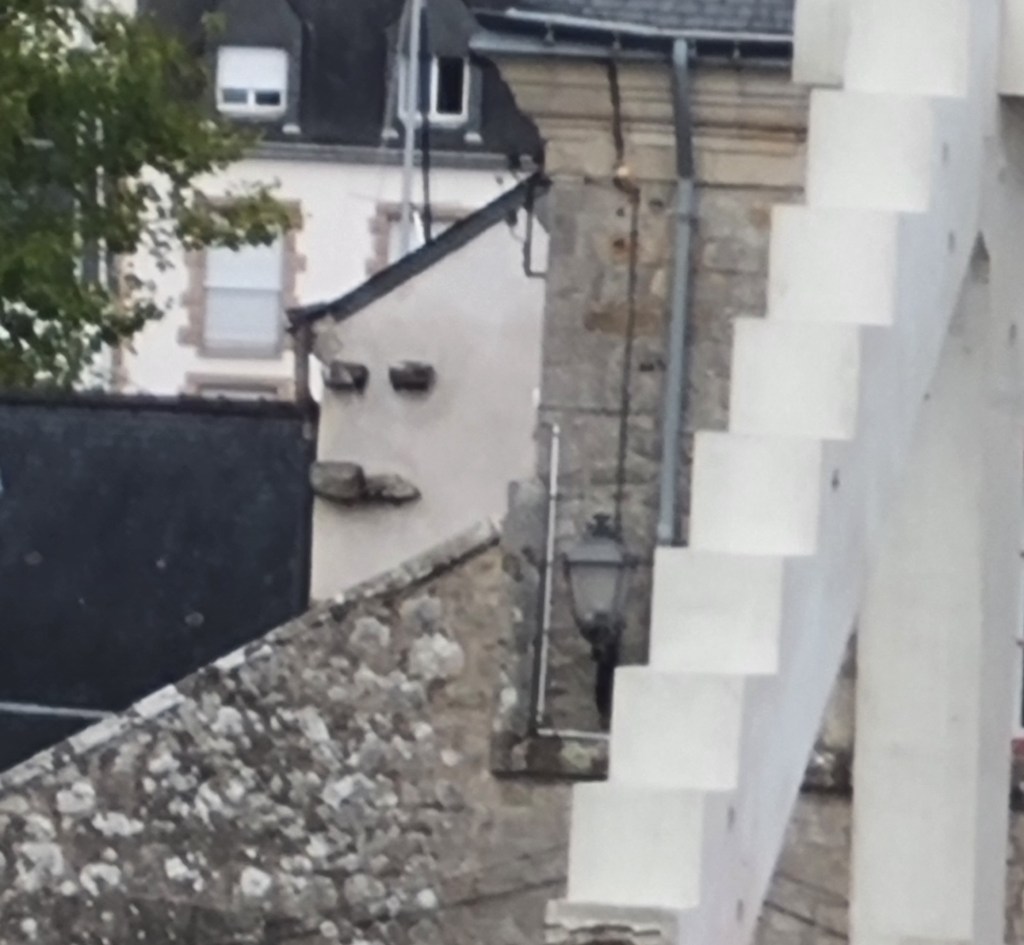
The last ten minutes of the first half are notable for Paulene spotting that a lean-to projection from the side of the building opposite looks like it has two eyes and pouting mouth.  A minute of additional time is played and I go and purchase a tray of chips (2 euros) with mayonnaise with my remaining jetons.  I return to the stand to eat my chips whilst a pair of black-headed gulls swoop into the stand on the look out for any stray deep fried food that might come their way; I guard my chips jealously and give the gulls a discouraging glare.

The match resumes at twenty-four minutes to eight. In the box like building next door to the lean-to building that looks like a face, a man is watching the game, presumably free of charge, from an upstairs window.  A short while later the windows are shut and we assume he decided it was either getting too cold to have the window wide open or he just got bored.  The second half sees substitutions for Chambly first as number twenty-seven replaces number eleven, and then for Vannes with Mvogo replacing Duclovel.  In a departure from how I have previously seen substitutions made, a woman in ‘late middle-age’ wearing a Breton jumper holds up the electronic board displaying the numbers of the incoming and outgoing players.  Paulene and I assume she is the club secretary , but alongside the referee’s assistant, the coaches and the delegue principal (an overseeing official) in his rather crumpled looking blue suit, she complements an interesting tableau of touchline figures.

The second half witnesses the first concerted outbreak of support from the crowd but in the form of the treble voices of the under 13’s who chant “Allez les Noires” over and over again, until they get bored, which thankfully doesn’t take too long.  More substitutions happen and Nzuzi is replaced by another anonymous player, the mysterious number thirty-four whilst anonymous thirty-three is replaced by equally anonymous thirty-two.  In due course the final minutes approach and there is a discernible effort from Vannes to finally equalise.  The ninetieth minute sees Vannes win a corner and in what seems like a final push both legs of Ebrard’s shorts miraculously appear to be the same length as he surges forward.  But it seems like his last hurrah and having lost the ball he stands bent over with his hands on his knees, a spent force.  Five minutes of time additionelle are announced, but Vannes can’t do enough to score and the initial judgement from the first twenty minutes that Chambly are the better team holds good.

With the full-time whistle we exit the ground the way we came in and head back to our car, where we will learn we have to pay a stonking 9 euros 80.  If you come to Vannes for more than an hour or so try not to park at Republique.  It’s not been the greatest evening’s football in truth, but Vannes OC is a decent little club with an excellent stadium and lovely people selling the tickets, the food and the drink.  I sincerely hope they get back to Ligue National and possibly Ligue 2 soon. As the Under13’s told us “Allez les Noires”.