Meudon AS 0 St Ouen L’Aumone AS 2

Today is the last day of September, my wife Paulene and are staying in Meudon on the edge of Paris, and having enjoyed both professional Ligue 1 and Ligue 2 football in the past week and a bit, watching both Paris FC and Paris St Germain, this afternoon we are getting down with the French equivalent of ‘non-league’. Not much more than ten minutes away by car at the Stade Georges Millandy in Meudon Le Foret (twenty minutes by bus service No 289) is a Coupe de France fourth round tie between Meudon AS of the Ile de Paris regional league Division 3 and St Ouen L’Aumone AS of the Ile de Paris regional league Division 1. These leagues are the 6th and 8th levels of the French football league ladder, although probably not directly comparable to those levels in the English non-league ‘pyramid’.
The parking at the local community sports centre, where the match is to take place is full, so we park our trusty Citroen C3 around the corner in Rue Georges Millandy between large blocks of modern apartments. We are not sure exactly where we are going, but the Federation Football Francais (FFF, the French Football Association) website says this is the where the match is taking place and having walked through a corridor in a sports hall we find ourselves next to an artificial football pitch. There is no turnstile and watching this match is free. A bunch of blokes in tracksuits sit outside a portacabin eating baguettes and drinking coffee. In my exquisite school boy French I ask if this is this is where the Coupe de France game is taking place at 2.30; I am relieved to learn that it is, and flattered that the man I speak to recognises the Ipswich Town crest on my T-shirt. I explain that I am a fan and not from the club itself, but we both quickly make the connection that Ipswich’s Under 18 player Idris El Mazouni is from Meudon. I will later discover that I have been talking to Idris’s dad.
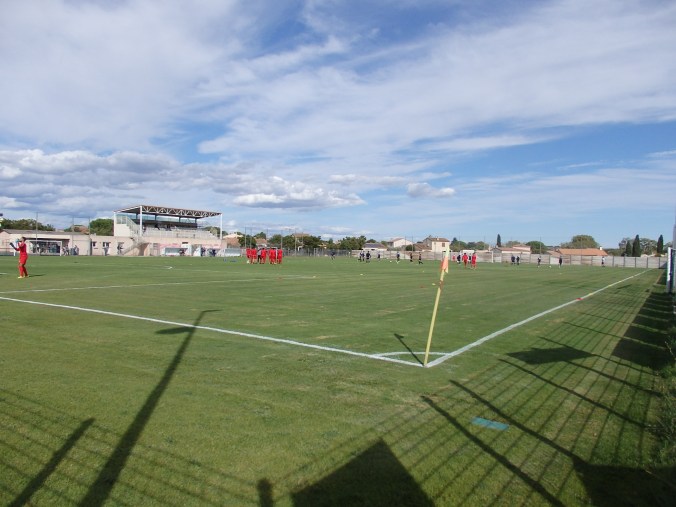
The Stade Georges Millandy is not a stadium as we might understand it in Britain, because it has no stands; it’s just a 3G synthetic pitch with dugouts and a metal fence, overlooked by five or six large, shiny white apartment blocks.

This slideshow requires JavaScript.

It wouldn’t make the grade for the Thurlow Nunn Eastern Counties League, although in truth the playing facilities are better than at most clubs in that league. It seems quite new, is in good condition and is the sort of installation that a town the size of Ipswich should probably have at least ten of. Given that these pitches are not cheap to install it is doubly impressive that the surface extends beyond the actual pitch to the area around it, with a mini pitch and goals in the space behind one goal. A game (possibly Under 15s) is

just finishing with a penalty shoot-out and I return to the portacabin, which is a sort of club house and buvette, to get two cups of green tea and a Kit-Kat (all 1 euro each); the tea is poured from a huge pot. On one wall is a large array of trophies won by all age groups within the club.

Paulene and I wander around the pitch as we drink our tea and I scoff a Kit-Kat trying to remember why Nestle products were boycotted and if they still should be; too late now, I have become complicit in their multi-national nastiness. It is a beautiful, bright sunny

45013661531_f3c54472c1_o

afternoon beneath a clear blue sky and the gaze of those shiny apartment blocks, which cast no shadows on one another or the pitch; this has to be how Le Corbusier imagined La Ville Radieuse.

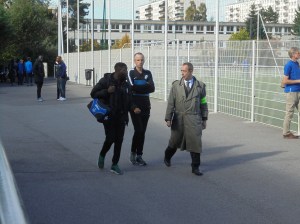
A man in a loosely belted gabardine raincoat appears; if he was wearing a trilby hat he could have stepped from a 1940’s film. He sports a bright arm band which adds to the look, but in a slightly sinister manner; he is however the délègue principal, the FFF official who
43201967200_10152fe2e5_o

will oversee this afternoon’s game from the side lines. Out of the blue one of the spectators walks up to me and shakes my hand. In due course the two teams emerge from their respective changing rooms and walk through the metal gate onto the pitch before lining up side by side, then in a line before shaking hands. Introductions between the referee and players and délègue principal are made all-round, before the game kicks off about five minutes late (it was advertised as a 14:30 kick–off) with St Ouen having first go with the ball, aiming at the goal in front of the buvette. Meudon kick in the general direction of far off Stade Charlety and the 13th Arrondissement. St Ouen wear an all-green kit, whilst Meudon are all in red; neither club has its club crest on its shirts but instead bear the logo of the FFF with its cockerel.

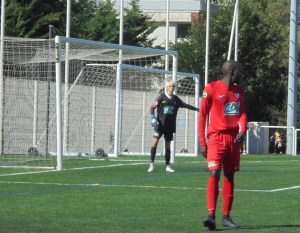
St Ouen quickly win a free-kick as their tricky number nine goes down under a challenge; he gets up to send a neat free-kick over the red wall of Meudon, but into the arms of the very young looking Meudon goalkeeper, who strangely is one of the smallest players on the pitch, a sort of French Laurie Sivell. It is also St Ouen who have the second serious goal attempt, again a free-kick, but this time firmly hit from a wide position by their number ten. Once again the goalkeeper, whose blond hair may not be its original
30077406907_10dcb243ea_o(1)

colour, saves, batting the ball away for the first of five corners that St Ouen will win this half. Most of these corners are either poorly taken or all the St Ouen players are waiting for the ball in the wrong places.
Meudon are very competitive and the game is played at a fast pace with the emphasis on passing rather than just getting the ball forward by the fastest route. Meudon come close to scoring a bit before three o’clock as their huge number eleven breaks through on the left. The St Ouen goalkeeper, who incidentally reminds me of St Etienne ‘keeper Stephane Ruffier on account of his designer stubble and very short dark hair, and is possibly the second smallest on the pitch, dives at his feet. The ball rebounds to the Meudon number seven whose goal-bound shot is headed away at improbably close range.
Meudon seem to be growing in confidence and their number ten does a few feints and jinks over the ball like a footballing Michael Jackson (Bubbles’ friend, not the one who played for Tranmere and Shrewsbury) might have done. There are a few jeers and within the next twenty seconds his ankles are swept away from beneath him by the St Ouen number three as he goes to dribble down the right touchline. It’s one of those situations that some people would try to excuse by saying that number ten had been ‘disrespectful’, but that’s just a modern buzzword, a sort of false political correctness and it is tosh; I blame Eastenders. Football is a game of skill, and dumping someone on their bum shows little ‘respect’ itself. Referee Monsieur Charly Legendre doesn’t see fit to book anyone either way.
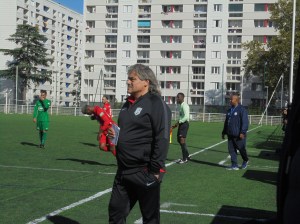
The coaches on the side lines are animated, “Parlez –vous” one calls urging his players to talk to one another. The St Ouen coach, a portly man in his fifties sports a fine mullet and
43201968530_160c2105a2_o

has the look of Maradona about him. The Meudon coach becomes involved in a prolonged discussion with the linesman Mefa Bakayoko about an offside or a free-kick which has been and gone and so no longer matters. On the field, the St Ouen number ten sends a free-kick solidly over the cross bar whilst Meudon’s number six comes as close as anyone else with a long range shot that goes wide. St Ouen’s number nine is proving industrious and creates a couple of shots for himself, one of which is well saved and Meudon replace their number three with substitute number thirteen. Half-time arrives and Paulene and I look back on a good but slightly frustrating forty-five minutes, which was too tight to be really entertaining. I head for the buvette to get a bottle of water (1 euro).
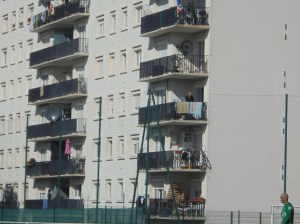
During the half-time break we stand about and as a man walks by he shouts “Ipswich!”. We could do with that sort of enthusiasm at Portman Road. As I stand I enjoy the
44294420204_39f8378ac4_o

contents of the many balconies that overlook the pitch from the surrounding apartments. Bikes, mattresses, plants and drying clothes decorate the bright white buildings and on one corner is a tricolour, perhaps left over from the summer’s World Cup win. As the afternoon wears on more people seem to arrive to watch the game and by the end I estimate that at least one-hundred people are here.
The délègue principal oversees the away team leaving their dressing room by a side door to the sports centre building and heads back to the pitch still wearing his gabardine raincoat, although it’s a warm afternoon; he is perhaps the anti-thesis of the banker in The Beatles’ Penny Lane and also feels as if he’s in a play, or a British TV sitcom. The bearded referee begins the game again and St Ouen soon win their sixth and seventh corners of the game, although in between their number eleven also shoots over the cross bar. At about four o’clock the St Ouen number eleven breaks forward through the middle, stretching the Meudon defence before playing a through ball to number ten who slips the ball inside the near post past the ‘blonde’ goalkeeper; St Ouen lead 1-0.
They may be losing and disappointed to be doing so, but Meudon still pose a threat and a good run and cross from number eleven meets the thigh of number seven just a few yards out, but he can’t direct the ball past the goal keeper. The first booking of the game goes to Meudon’s number two and the game enters a tetchy stage where it seems it could flare up at any moment. As at most French football matches I have seen where this happens however, there are only outbreaks of animated discussion between the players, but the referee stands back and let’s this carry on. It’s a civilised approach which may reflect the character of a country that has produced far more philosophers than England has produced ‘World Class’ footballers.
St Ouen are buoyed by their goal and their bearded number three controls a ball beautifully on his chest before advancing down the flank. The lads watching near us jeer at his skill and nickname him Fekir, and they’re right to do so because he does vaguely resemble the French international. But Meudon are not beaten yet and the large number eleven strides past a couple of St Ouen players before playing a through ball to number twelve who either wasn’t paying attention or the pass wasn’t as good as it looked. Paulene and I belatedly realise that the number twelve has replaced the number seven, who we had thought was Meudon’s best player.
St Ouen almost score a second goal as their number nine diverts a cross from ‘Fekir’ the wrong side of the post from close range, but the game is becoming more scrappy and there are more fouls. The Meudon number ten spends more time than most not being upright. St Ouen win an eighth corner and as a passage of play ends Monsieur Legendre calls over Meudon’s number nine and ‘Fekir’ and books them for a mystery offence that neither Paulene or I saw. It is now gone half past four and we are witnessing time added on as St Ouen’s number eight runs down the right and then pulls the ball back across the penalty area for substitute number fourteen to side foot beyond the small, blond goalkeeper into the far corner of the goal. St Ouen L’Aumone AS is the name that will go into the draw for the 5th round of the Coupe de France.
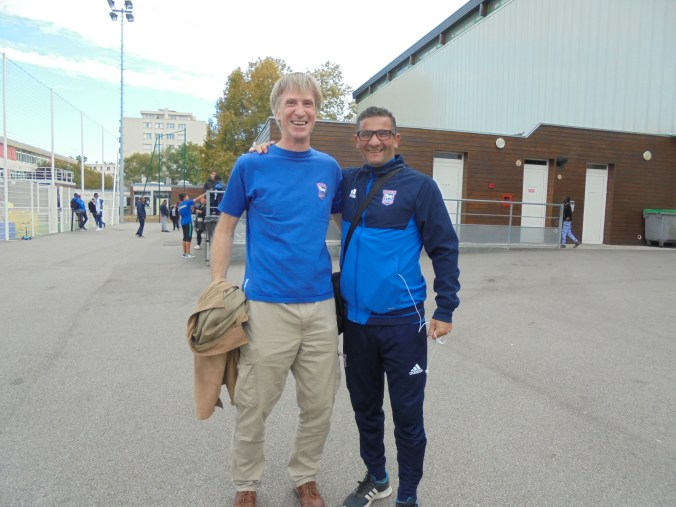
It’s been a reasonable game although not an exciting one in terms of goalmouth action. We turn to leave and Paulene notices a man with an Ipswich Town crest on his coat; I speak to him and it turns out he is the father of a second player from Meudon AS who is now in Ipswich Town’s Under 18 squad, Lounes Fodil.
44294397894_dca5642a04_o

Lounes’s dad, who is called Mustapha (apologies if the spelling is wrong) is a lovely bloke and is genuinely pleased to meet us and invites us for a coffee in the buvette. Our conversation probably isn’t the best as neither our French nor Mustapha’s English are fully fluent, but Mustapha gets across his philosophy of football; it’s a game of skill and intelligence not brute strength. He’s been to Portman Road and has noticed the glum atmosphere, which he attributes to the dull football. Whilst we are at the buvette some of the players come in for post-match drinks and snacks, one of them (I think it might have been the big number eleven or the captain) tells me Lounes is a good player. I tell him that’s good news because Ipswich Town really needs some good players; before he leaves he shakes my hand. The man who I first spoke to when we arrived comes to the bar counter and gets out his mobile phone before showing us a montage of clips of Idris El Mizouni playing for the Under 18’s, this is when I discover that this is Idris’s dad.
After a good half an hour or more we have to leave and walk from the ground with Mustapha who leaves us his phone number and invites us round to eat; sadly Paulene’s food intolerances and allergies will make that too complicated. We thank Mustapha and say how good it has been to meet him. Hopefully we will see him again.
This slideshow requires JavaScript.

AS Fabregues 0 Canet Rousillon 2

Fabregues is a very attractive small town about 10 kilometres southwest of Montpellier in the Hérault department of southern France. The town has a population of fewer than 7,000 but has a history dating back a thousand years, the centre being set out in a pattern of concentric circles around the church or chateau, a form of early medieval urban development known as a circulade. The town’s history probably goes back further to the Gallo-Roman era as the name Fabregues being derived from a Latin word meaning forges.
The Stade Joseph Jeanton is a part of a sports complex dating from 1993 that sits on the other side of the River Coulazu from the medieval town of Fabregues and it is here that my wife and I arrive today with a half an hour to spare before the kick-off of the match between Fabregues and Canet Roussillon in National Ligue 3, the fifth tier of French football, which is amateur, although the professional teams play reserve or ‘B’ teams in it. We park up in the neatly laid out car park which is landscaped with trees and shrubs and then walk through a metal gate to a wooden hut where we pay the 5 euros each admission fee. The Stade Joseph Jeanton is much like most other small town football grounds in France; a pitch surrounded by a high metal fence and a single stand affording a decent view of the pitch.

OLYMPUS DIGITAL CAMERA
The teams and referees are warming up as we walk behind one goal and round towards

the stand and buvette. I am impressed that one of the goalkeeping coaches is a woman and can’t imagine that many if any men’s teams in England have a female coach. The FA and English football in general really needs to get with the programme. We stop to ask three men in their sixties or seventies which team is which. One of them speaks a little English which he is keen to practice and he seems impressed that we have come to see Fabregues, which he describes as a good little club. At the buvette I buy a bottle of water (1 euro) and pick up a copy of the club’s directory. It is mostly adverts for local businesses, but contains details of every team in the club from the under 6 and 7’s up to the seniors. There is a statement from the president setting out the aims of the club and the overall impression is of the club being an important and well-run focus for the local community.
It is a warm afternoon and a strong breeze stretches white clouds out across the blue sky. We climb up into the stand and look out over the pitch towards the pink roof tops of 36538176213_715c21d13e_ocirculade and the old town. This is a pleasant spot to spend the afternoon it seems. Below us the referee (Monsieur Gauthier Lapalu) and his assistants (Monsieurs Jeremy Noiret and Maximilien Demoustier) are warming up, the referee looks very young, very neat and very enthusiastic, too enthusiastic and a little officious perhaps. He seems to want to organise his assistants overly and they don’t look that impressed.
Kick-off is scheduled for 3 pm but the teams aren’t on the pitch yet, although we can see them waiting at the mouth of the players’ tunnel, everyone seems to be waiting for the referee. Eventually, after the usual introductions, Canet Rousillon, from the town of Canet some 35 to 40 kilometres to the west, kick off in their white shirts with black shorts and socks; Fabregues wear all red. The first foul is committed after about five minutes and Monsieur Lapalu quickly airs his yellow card and then takes time to explain his decision to the Fabregues bench who are perhaps miffed, and understandably so because it wasn’t much of a foul. Five minutes later a Canet player is booked, but justifiably this time. It takes another fifteen minutes for Monsieur to get his hat-trick of cards.
This is a poor game. It may be because the afternoon is still warm, but the players aren’t running about much. One or two like to run with the ball, particularly the Fabregues number eleven, who is quite good at it, but there is not much running off the ball so there is seldom anyone to pass to near the opposition penalty area and therefore there are no shots on goal to speak of, except for optimistic long range ones. In addition, the players of both teams like to fall over and scream as if fatally wounded and Monsieur Lapalu is proving to be quite fussy and precise; he runs like Forrest Gump and his shorts fit too snugly, like his mum has cut down a pair of trousers from a dark suit.
Fabregues make a first-half substitution and the substitute adjusts his hair carefully before coming on, appearing to arrange his top-notch like the leaves on top of a carrot. But the substitute claims the distinction of being the first player to have a shot worthy of the name, in first half injury time.
With half-time we leave the stand to get out of the sun and the breeze, and to get away from the body spray of the young man next to me, which smells like pine disinfectant. This stadium has advertisement hoardings and they remind me of those at Eastern Counties League grounds. There is one for a Pompe Funèbre (undertaker) and one for Auto Ecole Thierry (Terry’s Driving School) as well as one for Pub Resto O’Papa Chico, which sounds like an Irish, Mexican pub. The local butcher, Bouchère des Beaux-Arts sounds a step up from an English pub meat raffle, but in a country that takes food seriously, such a name is probably not pretentious.
For the second half of the match we stand, peering through the fence from the opposite side of the ground to the main stand, where we are shielded from the wind by a hedge.

The second half starts well as the first discernible passing move of the game in an opponent’s half results in the Fabregues goalkeeper diving at the feet of the Canet number seven, to make a decent save. Just a minute later Canet’s number eight collapses to the turf inside the Fabregues penalty area and a penalty kick is awarded by Monsieur Lapalu. It seems a trifle harsh, but Monsieur Lapalu takes so long ensuring that no ones’ toes are in the penalty area that the number eight has far too long to think about his kick and when he eventually takes it, it provides a relatively easy save for the Fabregues ‘keeper, who dives to his right and smothers the ball completely to keep the scores level.
The game now enters a ridiculous stage where players fall like nine pins every few seconds; any physical contact apparently leads to mortal injury. The best moment is when three players come together and all three end up lying on the ground pleading for attention. If the Keystone Cops had played football it would have looked like this. It is at once both amusing and pathetic. The game is stopped and miraculously all three players recover to carry on. A banger goes off in the bushes close to where we are stood; everyone ignores it although some teenage girls trying their best to look innocent look like they might know who was responsible.
With an hour gone Canet somewhat surprisingly take the lead. The ball lands at the feet of their number ten; he shoots and the ball is saved, but the rebound bounces off him and into the net, although he may have adjusted his feet quickly enough to ensure the direction of the rebound was goal-wards rather than anywhere else. A good number of Canet supporters in the main stand celebrate. A second banger goes off in the bushes close to where we are stood and there is a delay as Monsieur Lapalu checks with his assistant that all is okay; he indicates that his ears are ringing a bit but otherwise he is fine. Monsieur Lapalu then checks with the Délègue Principal monsieur Jean Pierre Jullian, but carries on with the re-start. Fabregues are stung into action and are unlucky to have a goal disallowed five minutes later for offside when the ball was possibly heading into the net without the extra touch from the offside player. I detect the scent of cannabis on the breeze, but can understand why people watching this game may seek solace in illicit drugs.
There is about a quarter of an hour left and Canet’s number nine lofts the ball onto the roof of the goal net as his team hit Fabregues on the break. Two minutes later Fabregues’ number five stretches out a leg to win the ball, he does so, but he then catches his opponent too and Monsieur Lapalu deems this a foul and cautions number five for a second time this afternoon resulting in his sending off. To his credit number five does not complain, although having won the ball he probably had cause to. Monsieur Lapalu goes on to also caution Fabregues’ number three as he organises the human wall to defend the resulting free-kick.
Fabregues continue to search in vain for an equaliser and they seem more capable and energetic now that the sun is lower in the sky, casting a long shadow over the pitch from the adjacent sports hall. But with four minutes of normal time remaining Canet hit them on the break again as their number 10 feeds the ball beyond the Fabregues full-back for the moustachioed number two to run on to. The Clark Gable look-alike rounds the goalkeeper and scores. Canet celebrate wildly whilst Fabregues cannot believe they have conceded a goal to a bloke with a moustache.
The result is assured now and Canet almost claim an undeserved third goal as number nine strikes the ball against the cross bar. Monsieur Lapalu even seems to have lost interest a little and has seemingly relaxed his grip on the proceedings. Only two minutes added time are played, which is a relief for everyone. Canet and their supporters celebrate noisily again as the final whistle blows.
This has been a poor game, perhaps the worst I have ever seen in France. It is a shame because the Fabregues club appears to be such a well-run, ideal community based club; but I guess all teams have off days. I hope this was one of those days for both teams, because even though Canet won, they were terrible too. Monsieur Lapalu should also learn from this game too and we will look out for this name in Ligue 1 in may be ten years’ time.

This slideshow requires JavaScript.


LOSC Lille 1 Montpellier HSC 1

After a wet, drizzly afternoon enjoying an exhibition of marionettes at the Hospice Comtesse,

This slideshow requires JavaScript.

a rather groovy establishment called ‘The Beerstro’ and then the birthplace of Charles de Gaulle, the Grand Finale is an eight o’clock kick-off at the Stade Pierre Mauroy where LOSC Lille meet Montpellier Hérault in the 29th Journee of Ligue 1. Montpellier sit in 6th position in the twenty-team French league, whilst Lille flounder uncharacteristically just one place off the bottom, battling against relegation. I am with my wife Paulene and after a relaxed, light meal we head for the Gambetta Metro station. It’s a little after six o’clock and as the streets begin to dry with warm air up moving up from the south, so the Lillois are venturing out to drink, to dine and to watch football. At Gambetta station the escalator is out of action and at the foot of the stairs a ticket man greets us; somehow he instantly detects that we are English and calls out over his shoulder “Alain! Ils sont Anglais”. A smiling, balding man in glasses walks over to us “Awright?” he says and we shake hands. He continues to talk to us in English with a strange hint of an estuarine accent; he must have learnt English in Dartford or Thurrock. He explains the system of rechargeable tickets and although the ticket itself costs 0.20E he lets us have one for free and on to this one ticket we add four journeys for the trip to the stadium and back (6.40E). Alain even validates our tickets for us before we thank him and bid “Au revoir” and descend down onto the platform. What a lovely bloke. The driverless trains on the Lille Metro are frequent and one soon draws up alongside the automatic doors at the edge of the platform. We step on and sit at the front of the carriage, a siren sounds, the doors close and we’re soon hurtling along through concrete tunnels beneath the city

OLYMPUS DIGITAL CAMERA

above. The stadium is the twelfth stop on our mostly subterranean journey, although it is possible to alight at any of the four stops from Villeneuve d’Ascq onwards and the stadium is still easily walkable. People board and leave the train along the route at Republique Beaux-Arts, Gare Lille-Flandres, Caulier, Fives and Marbrerie, some sport red and navy blue knitwear betraying their support for the local team. Before the end of the line at 4 Cantons

Stade Pierre Mauroy, the train rises out of the ground on to an elevated section and just like the last time I made this journey I am for a minute or two Guy Montag and my wife is Clarisse (Julie Christie) in Francois Truffaut’s film of Ray Bradbury’s book Fahrenheit 451. But it soon passes. From the Metro station it’s a ten minute walk to the stadium through a university campus and science park, past the student accommodation called residence Albert Camus; a much cooler name than Essex House, where I lived in my first year at university. It’s dusk and the stadium and its great neon name is visible through

OLYMPUS DIGITAL CAMERA

the black branches of the trees that line our route. The path then opens out onto a wide bridge across Lille’s peripherique motorway and Stade Pierre Mauroy is directly in front of us. To the left a broad concrete piazza is filled with French football fans, and the smell of chips and hot oil. The sun sets behind the stadium to the left, turning the clouds a blurry red and casting ruddy reflections in the puddles; adding some late colour to what has been a grey day.

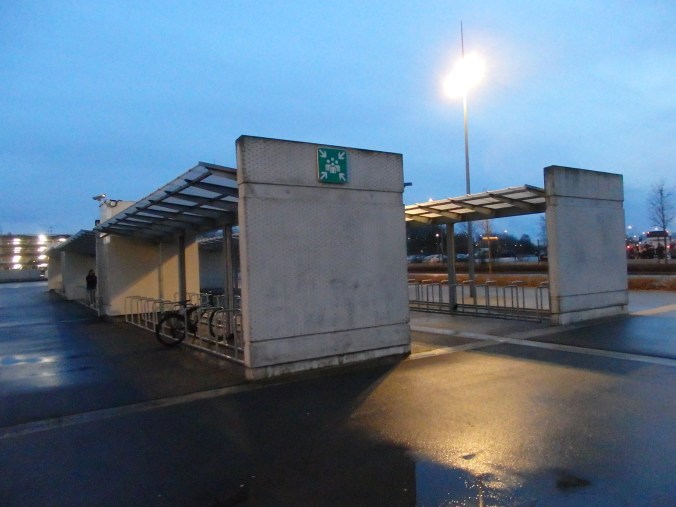
It’s northern France; Belgium with added je ne sais crois, but similar quantities of frites and beer. Low buildings face the stadium across the piazza, a parade of fast food outlets and bars. Further on the crowds diminish and we pass a large area set aside for cycle parking. Although the stadium is some way from central Lille, next to the motorway and has masses of covered car parking beneath and around it, the French planners were clearly optimistic for sustainable travel and there are two concrete canopied blocks of covered cycle racks in which I sadly count just two bikes and a bloke having a smoke.

OLYMPUS DIGITAL CAMERA

At gate M my wife chooses to go inside, get comfortable and watch the warm ups before the match, but I want to wander about a bit and so we part. I walk around to the ‘front’ of the stadium where it faces the road and the retail park opposite. There is a trailer here from which more chips are being dispensed, the queue of ‘diners’ snakes out of the descending darkness and into the bright light spilling out from above the deep fat fryers.

I walk on, following four members of the Police National, who bristle with shields and kevlar armour. A neon display advertises a future event at the stadium, a concert by the Pink Floyd pensioner, Roger Waters; its title ‘Us and Them’ will seem fateful by the end of the evening. At the ‘corner’ of the stadium is the club shop, red letters spelling out LOSC glow in the windows and fans walking past are silhouetted in its light. Inside the shop, the colour of the club shirt, red, is overwhelming; the colour red is everywhere it seems,

WW2 night-time bomber pilots could have spent time in here to improve their night vision. But to me there is more than a hint of the subcutaneous, of viscera; this is the sort of place to give a sensitive person like me nightmares. Feeling queasy I head back outside for the fresh air and then re-trace my steps back to gate M where after the customary patting down I pass through the automatic, bar-code operated turnstile, pick up my free programme and head for my seat. Re-united with Mrs Brooks I study the sixteen-page A5 size glossy programme, which contains just three advertisements not directly related to the club. The programme is small and necessarily concise and all the more excellent for that, with everything you need to know, which is really just the squads, the league table and details of the next match. If you crave extraneous information such as forward Anwar El Ghazi’s recipe for lentil soup then there is a fortnightly club paper available in the club shop, ‘LOSC in the City’, which is also free. As I read, a superannuated looking band perform live from the side of the pitch. I think they’re playing the Sex Pistol’s ‘Problems’ but Paulene tells me it’s Jumpin’ Jack Flash. I’m a bit disappointed to be honest and their rocked-up version of The Beatles’ ‘Come Together’ doesn’t please me either , but to my possible shame in these modern times, they’re next number, Hendrix’s Foxy Lady, makes me smile. My reading and musical reverie however, is disturbed by a large bang and some chanting from outside the ground; I had seen on the local TV station that there was to be demonstration by supporters before the game because of the poor performance of the team this season, and this must be it. I walk out to the back of the stand to witness through the mesh wall and some acrid smoke a couple of hundred fans following a bloke holding aloft a red flare; more firecrackers go off and there is some chanting. Excitement over, I return to my seat. Many of the other seats in the stadium are still unoccupied, particularly those on the Virage Est (East Stand) that the Lille Ultras occupy. It is soon evident however, that the ultras were the protestors as the Virage Est sees a torrent of flag waving humanity flood towards the back of the goal.

This slideshow requires JavaScript.

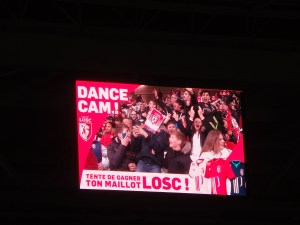
Meanwhile a female announcer gees up the crowd with some disco music and a dance-cam

OLYMPUS DIGITAL CAMERA

shows supporters boogeying insanely on the big screen above the Virage Est. People seem to be enjoying themselves at a football match which hasn’t even started yet. On the pitch everything is being set up for the grand entry of the teams. Ball boys in orange shirts are camped across the centre circle, the Ligue 1 logo is carried out and put into place along with the sponsor’s logo (Conforama – a furniture retailer) and the match ball is placed on a plinth.

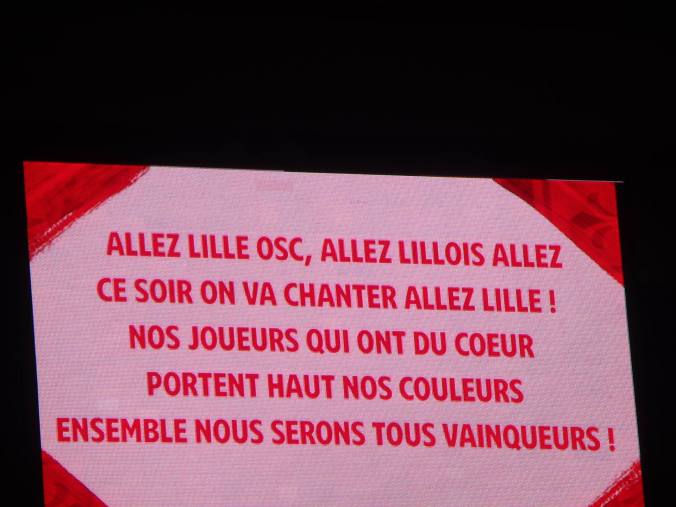
Banners featuring the club badges flank the ball and plinth and another banner displaying the Ligue 1 logo and then more banners are marched on to the field, these are red and bear the squad numbers and a photos of the players in tonight’s Lille team. As if all these banners aren’t enough a short film is played on the big screen which follows a journey around the city of Lille and shows images of LOSC players projected onto its most notable sites and buildings, culminating in all the players being projected on to the Stade Pierre Mauroy. It is a mightily impressive little film and conveys brilliantly the ideal of the club and the city and its people as one, I am not a little moved by all it all and wish for a day when I see something like it in Ipswich. We shouldn’t be leaving the EU, we should be saying can we forget about ‘being English’ and instead be French, or German, or Italian or even Belgian. The final act of the pre-match rituals is the singing of the club song, to the tune of Amazing Grace.

OLYMPUS DIGITAL CAMERA

The words appear on the giant screen and the singing hasn’t finished before referee Monsieur Sebastien Moreira, a stocky bald man, signals the start of the game. Montpellier in all white with pale orange shoulders have the first kick, in the direction of the Virage Est but it’s as if they are mesmerised by the club song, they pass the ball about and then as the song melts away immediately lose possession. That strange, musically accompanied start aside, it’s an exciting start to the game, with both teams dashing towards their opponent’s goal at every opportunity. Montpellier’s 19 year old Jonathan Ikone, a loanee from Paris St Germain, leads the charge and his team dominate the early possession, understandably believing that against the team second from bottom in the league, they are bound to score if they keep pressing. A Montpellier shot is soon saved by Mike Maignan, Lille’s goalkeeper. Montpellier are good to watch, they’re fast and direct even if most attacks break down before anyone has a shot. Lille burst forward when they can, particularly through Algerian Yassine Benzia who has the facial hair of a swarthy Mr Pickwick and his arms look unusually long; he is also the first player to be cautioned by referee Monsieur Moreira. Montpellier’s Ellyes Shkiri is injured and replaced by Saloman Sambia, but their forty year old Brazilian captain

OLYMPUS DIGITAL CAMERA

Vittorino Hilton

Vittorino Hilton, a veteran even six years ago when Montpellier won Ligue 1, plays on. Although the early excitement dies down a little as defences settle into their roles, the Ultras behind both goals never waver and give constant support, their beating drums being the beating heart and rhythm of the match. Each end sings their own songs, and then call to one another down the pitch. It sounds marvellous, even though the Ultras make up no more than five thousand in a crowd of 28,609 in a stadium that holds nearly twice that number . With less than five minutes until half-time, Yassine Benzia surges forward again for Lille, running at the centre of the Montpellier defence. Leaving two, then three Montpellierians in his wake Benzia pushes the ball forward into the path of Nicholas Pepe who is sprinting into the penalty area. Pepe takes a touch and then sweeps the ball past Benjamin Lecomte in the Montpellier goal. A fast, incisive if slightly unexpected goal. Pepe runs to the corner of the pitch and salutes no one in particular in the way that players like to do nowadays, but then he’s only a young lad of twenty-two. Half-time comes and two teams of boys, one in all white and one in all black, take to the field to participate in something called the Orange Football Challenge; it’s a shoot-out which at first is a non-event as none of the boys is capable of scoring , but eventually one team wins, I think. Both teams get their photo taken in the centre circle before another competition takes place in the far goal as three blokes try to hit the cross-bar with a single kick of the ball from 20 metres. The first contestant steps up and casually succeeds, winning 500 Euros in cash as a result. Predictably the next bloke doesn’t hit the cross-bar, although he’s not too far off, whilst the third slips over and shanks his shot along the grounds six metres wide of the goal. He may never be able to watch or participate in football ever again. As the players return to the field for the second half a camera man sets up in front of us to film people in the crowd who will then appear on the giant screen; as if being at the match isn’t enough you have to be able to see yourself and be seen at the match by other people at the match, although they have actually only come to watch the match; Jean Baudrillard might have something to say about it or may be Michel Foucault. Montpellier run at the Lille defence from the start, with chunky Jerome Roussillon attacking down the left and Paul Lasne down the right. It’s about twenty minutes past eight and Roussillon receives the ball some 20 metres or more from goal; he reacts instantly and dispatches a hard, low shot between the outstretched arm of Mike Maignan and the right hand post of the goal. Montpellier have a deserved equaliser, which their small knot of fans high up in the corner of the stadium

OLYMPUS DIGITAL CAMERA

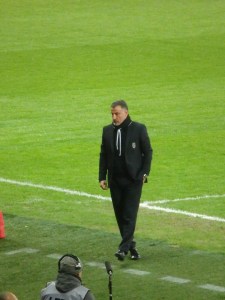
also deserve for having made the 972 kilometre road trip; it’s no wonder there aren’t many of them, but equally a wonder there are as many as there are. No one boos, despite the dire loss of a winning position and behind the goals the Ultras maintain their support. On the touchline the Montpellier coach Michel Der Zakarian looks thoughtful, stroking his chin in his skinny legged tracky bottoms and shapeless black coat. The Lille coach Christophe Galtier moves between his seat in the stand and the technical area, he wears shiny shoes and a dark suit; he steps out of the technical area and onto the pitch at one point when play has stopped for an injured player and is admonished by the fourth official. Galtier waves his arms about in frustration and as he turns to go back to his seat gestures at the official as if to say ‘fuck you’. My wife likes Christophe Galtier; he’s very French.

OLYMPUS DIGITAL CAMERA

There are three minutes added on time in which both sides press forward seeking the winning goal, but neither finds it. Monsieur Moreira blows the final whistle and almost instantly supporters from the Virage Est begin to run onto the pitch and towards the players tunnel and the seats where the directors and officials are sat. More and more supporters pour onto the field; one or two approach Lille players with a look of complaint. The referee and his assistants are the first down the tunnel. A large crowd has gathered but a cordon of stewards has quickly formed creating a semi-circle around the mouth of the tunnel. Whilst most of the people on the pitch are facing the main stand and chanting something like “ If the club goes down , then you go down” at the club officials, there are a few who are taking selfies with the handful of Montpellier players stranded on the pitch as they went over to applaud their supporters. Scenes like this always look uglier than they are and whilst there are a few kicks and scuffles as stewards feel the need to man-handle some people, the cordon of stewards around the tunnel has controlled the situation. For a football tourist like me local difficulties like this just add to the entertainment, but I do wonder what the point is of these demonstrations. The supporters didn’t complain when the new regime at the club installed previously well-respected Argentinian coach Marcelo Bielsa and backed him with an overhaul of the squad. Bielsa had been a fabled legend at Marseille but his short tenure at Lille was a disaster and he was first suspended and then sacked as the newly assembled team failed to perform with Lille slumping into the relegation places from early in the season. Watching people stood on the pitch not playing football is only entertaining for a short while and not wanting boredom to spoil what had been an entertaining evening we decide to head back to the Metro of Montag, Julie Christie and Alain.

This slideshow requires JavaScript.

Ipswich Town 0 Queen’s Park Rangers 0

It is Boxing Day and I would quite like to stay in and eat and drink the leftovers from the day before, may be read a book, watch a film, do some colouring-in in my book of “…tous les 20 logos des équipes de Ligue 1 pour la saison 2016-17.” The colouring book was a Christmas present.
Up until 1959 there were Football League matches played on Christmas Day; imagine that. Often, a season’s biggest attendance is drawn for a Boxing Day game and whilst this used to be due to local derbies, there is still an added attraction for games played over the Christmas holiday period, perhaps just because there’s not a lot else to do.
Mindful of the tradition of the Boxing Day football fixture today I am setting out to watch Ipswich at home to Queen’s Park Rangers, which as a London club is as close as we now get to a local derby on a public holiday. Sadly, in these cautious, pale and insipid, wimpish modern times the days of the Christmas and Easter derby games against Norwich are long gone. Incredibly, there is no public transport today; it is wrong that that a football match that will definitely draw a crowd in excess of 10,000 is allowed to go ahead at all when there are no buses and no trains. So much for trying to reduce road congestion and air pollution by discouraging the use of private cars.
Previously, I have not bothered with Boxing Day games because of the absence of public transport, but no one wanted my ticket today and rather than waste it I thought I’d help contribute to global warming instead and drive to the game. Parking up ‘over Chantry’,OLYMPUS DIGITAL CAMERA it’s a pleasant stroll down through sunny Gippeswyk Park beneath a pale blue winter sky towards Portman Road. From the top of the Park there is a fine view across the town centre, which takes in the Portman Road floodlights and the back drop of town centre office blocks which define down-town Ipswich from a distance. It’s a bit after two o’clock and the streets are quiet; I walk past the railway station not quite believing that it could be shut, but it definitely is.
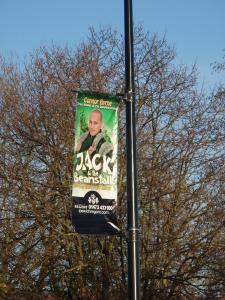
On Princes Street, banners have been put up on the lamp standards to advertise the OLYMPUS DIGITAL CAMERApantomime at the Regent theatre; aside from the railway station being shut, it’s the only sign that it might be Christmas. Across the car park from Portman Road the former Sporting Farmer public house sits shut and awaiting demolition; it’s been a part of the match day landscape of Ipswich since 1962, but there is no seasonal, pre-match boozing this year, just Heras fencing and darkened windows.


Portman Road is a little busier than usual for a quarter past two, and I snake my way through the crowds as I head for the Fanzone. Usually, I might have a couple of pre-match pints at St Jude’s Tavern, but having to drive to the match today has meant that

This slideshow requires JavaScript.

not only will I be helping destroy the planet, I will also be helping with the decline of the local economy. A group of three or four stewards stand at the entrance to the Fanzone, checking tickets and bags. A casual wave of my season ticket card and I’m in. I feel like I’ve been admitted to Studio 54.
In the Fanzone there is a large white marquee that looks like something from a summer wedding reception. It’s warm inside the marquee and people mill about holding plastic cups of lager and Greene King beer. At one end are three TV screens, which face three or four neat lines of chairs, it’s like a waiting room, it just needs a few magazines and an occasional table. Outside there is a children’s penalty shoot-out, which is popular, in contrast to the merchandise stall from which a lonely salesperson peers blankly.
There’s nothing for me here so I leave and make my way to the Sir Alf Ramsey stand; inside I decide to break with tradition and invest in an overpriced cup of hot chocolate. A pretty, smiling young woman serves me and asks for £2.10. I hand her a twenty-pound OLYMPUS DIGITAL CAMERAnote and apologise, but add that the club doesn’t make her job any easier by sticking odd ten pences onto their prices. She agrees that the prices are awkward for what is supposed to be a fast service. Any way to squeeze an extra few pence out of the supporters though. Clutching my Cadbury’s branded cup of pale brown liquid I find my seat. The club mascot Bluey is prowling the aisle that leads to my seat, offering himself up for selfies and hugs. Bluey doesn’t speak and a woman tries to communicate with him through grunts and sign language; odd.
Once Bluey has gone I take the plastic lid off my hot chocolate and stir it thoroughly toOLYMPUS DIGITAL CAMERA ensure that all of the chocolatey gunk which contains the flavour has dissolved. I taste the pale brown liquid; it’s watery and the water has a slight tang which fights with and then beats off the chocolate flavour. Hot chocolate should be thick, this isn’t; I won’t be buying it again.
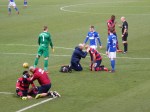
The game begins and the QPR fans are the quickest this season to ask if they are in a library, it’s almost as if they had already decided that would be their first song before they even got here. Ipswich start the game reasonably well and David McGoldrick soon has a decent shot on goal. Teddy Bishop, who I don’t feel I have ever really seen play, has made a rare start and is looking good, although QPR seem intent of kicking him into the air at every opportunity; perhaps because he has the temerity to run at defenders.
Teddy returns to the toy box before half-time due to injury and the game goes downhill from here. Callum Connolly has had a good looking shot from distance for Ipswich and Bartosz Bialkowski tips a QPR player’s header onto the cross-bar, but otherwise the game is awful. The physicality of the game leads to injuries, which are a good way of wasting time and nullifying the scant football content still further. The referee Mr Andy Davies, a couple of physios and a clutch of QPR players with bald heads create a tableau ofOLYMPUS DIGITAL CAMERA suffering in the QPR penalty area. The only cheers from the crowd are derisive ones as a pass goes wildly astray or someone falls over, which happens quite a lot; derisive cheers are what the Portman Road crowd does best.
Half-time is a blessed relief and I descend beneath the stand to check the other half-time scores and join the spectators standing about and gawping at the tv screens which mostly advertise some mysterious place called Brocket Hall and days at the races. White lights dangle from the high roof and there is a Christmas tree at the foot of the stairs to

the Legends Bar and a string of something green winds its way around a soil pipe, but otherwise it doesn’t seem like Boxing Day, the Christmas spirit is elusive.
I decide to endure the second half with Phil the ever present fan but today he has his son Elwood with him and the seats beyond Elwood are taken up by people for whom this is presumably some sort of Christmas ‘treat’. I sit a couple of rows back next to Pat the secretary of the Clacton branch of the supporters club. Pat admits to not really liking Boxing Day fixtures either, she’d rather be at home and says she hopes every year for away fixture.
The second half witnesses the home crowd finally get festive with an albeit isolated chorus of “Hark now hear the Ipswich sing, the Norwich ran away, and we will fight for ever more, because of Boxing Day” . Christmas is the season of peace and goodwill to all men after all, but that may be why, regrettably, Ipswich Town have not played Norwich City on Boxing Day for over thirty years.
The match gets worse; both teams are inept, but this is largely due to their desire to simply run around as fast as they can and knock each other off the ball. A lot of modern professional football is like this in an age where the levels of fitness and strength of footballers exceed the level of their skill. Sports science is a curse. Both Ipswich and Queen’s Park Rangers are managed by pragmatists whose teams are built on their ability to ‘put in a shift’. I get tired just watching it; or is it bored?
Seven minutes from time Ipswich Town bring on arguably their most skilful player, Bersant Celina. The crowd cheer cheerily for once. Messiah-like, Bersant brings light to the game and brightens up the final minutes. He introduces some hope, some optimism, but that’s all, even when QPR’s Josh Scowen is sent off, booked by Mr Davies for a second time. Despite Scowen making the longest walk even longer there are only three minutes of added on time and they quickly ebb away as does the crowd of 18,696 when Mr Davies blows the final whistle.

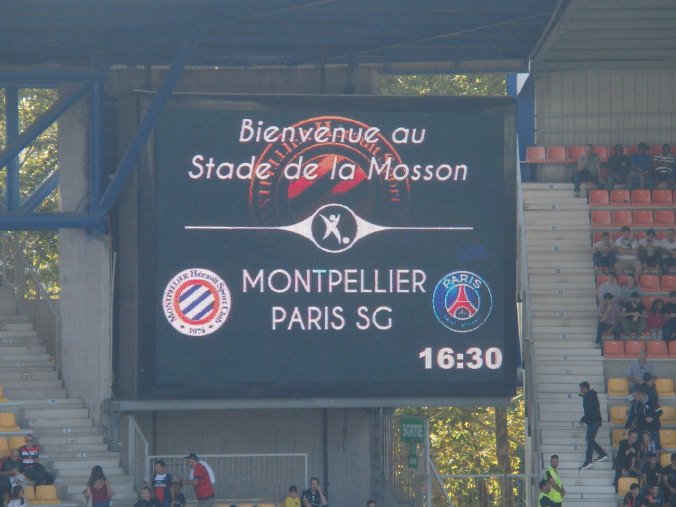
Montpellier Hérault SC 0 Paris St Germain 0

Having arrived on holiday in Languedoc on Monday, on Tuesday tickets for this match went on general sale. With no secure internet connection acquiring tickets required a forty-five minute drive to Montpellier, to the Odysseum complex just off the A9 motorway where Montpellier Hérault SC has its’ club shop. Joining the queue outside in the blazing sun at about 12:15 we emerged from the shop clutching a pair of 35 euro tickets at about 13:45. By the time we had reached the front of the queue the only tickets left had been in the upper tiers of the stands behind each goal. We chose seats in the Tribune Petite Camargue above the Montpellier Ultras at the opposite end of the Stade de la Mosson to the Paris St Germain supporters.
Two weeks and four days later we park up in the dedicated football car park near the37399307972_eb9bb2373d_o park and ride tram station in Mosson, or La Paillade as it is colloquially known. It costs just 2 euros to park. It’s early, not much after 3 o’clock and the game won’t kick off until 5 pm. We dawdle out of the car park towards the stadium enjoying the warm afternoon sun. I am supporting Montpellier today because like a lot of football supporters I despise clubs like Chelsea, Billericay Town and Salford City that are bankrolled by people with too much money. But also I first saw Montpellier in 2011 against PSG (they lost 0-3) and followed their results for the rest of that season, in which they ended up winning the Ligue 1 title. I like their navy blue and orange kit too and added to which Montpellier is a very attractive and exciting city. The upshot is today I am wearing a Montpellier Hérault SC t-shirt, and as we cross the car park I exchange glances with a PSG fan who is stood with two women under the shade of a tree enjoying a snack and a drink. He rolls his eyes at my T-shirt and smiles and so I decide to stop and try and talk with him. Happily neither his English nor my French are so inadequate that we can’t make ourselves understood to one another. I tell him that I really support Ipswich Town and he rolls his eyes again, although he agrees that they had a good team a long time ago; he believes that Chelsea and Liverpool are okay, but then I’d expect as much from the sort of person who supports France’s most hated club. My wife tells him her team is Portsmouth, which he doesn’t understand until she pronounces it ‘Ports-moose’. He is in his fifties, a scruffy looking bloke in a denim jacket with a beard and long hair; he and his wife and daughter live in Béziers but he is a PSG ultra; he grew up in Paris and his dad took him to watch PSG at the Parc des Princes as a boy. Having both shared our deep disappointment over Brexit (every German, Belgian and Frenchman I have spoken to seems as upset as me) and probably exhausted our respective vocabularies in each other’s language we wish one another well and my wife and I carry on towards the stadium.
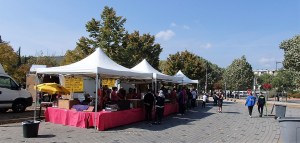
There is a lot of hanging about going on because the road to the stadium is closed off. But there are a number of gazebos selling food and beer to help while away the wait.OLYMPUS DIGITAL CAMERA A blacked out Mercedes minivan is guided through the road block behind two police motor cycles and an army of policemen look on, some in full Kevlar riot gear, one or two with sub-machine guns, including one who looks a bit like the late John Le Mesurier.37397661451_31eb220131_o Later we learn that former president Nicolas Sarkozy was at the game and it is likely it was him in the Mercedes.

Eventually, having enjoyed a beer in the shade of some trees we are allowed through the barriers and approach Stade de la Mosson at about twenty to four. Unusually perhaps for a stadium that was used in the 1998 World Cup, Stade Mosson is not particularly spectacular looking; in fact it is a fairly basic cantilever roofed design, which forms an angular horseshoe around three sides of the pitch. The steel stanchions from which the roof hangs are painted in the club colours of orange and blue. It does have one striking looking stand however,

a triple decker with a massive top tier but no roof, supported on streamlined, sloping concrete legs. Bizarrely however, the top tier is closed; something to do with the club’s average attendances and its licence from the French Football Federation, which is explained on the website, but I don’t quite follow.
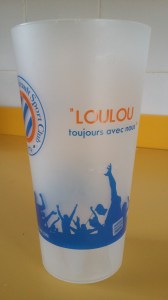
There is a mobile club shop out in the road and a bar run by one of the ultra groups is built into the back of a stand by the roadside. After the usual pat down we enter the stadium and entering the stand pick up one of the glossy, A5 size, 28 page and free match day programmes entitled ‘L’Echo de la Mosson’, which are left in cardboard boxes at the top of the stairs. I buy another beer (4.50 euros but this price includes a club–branded reusable plastic 500ml ‘glass’).37399326532_c0479ae95c_o The guy who serves me at the buvette instantly detects that I am not French but sees my Montpellier T-shirt and so I explain that I dislike PSG; not as much as he does he replies.
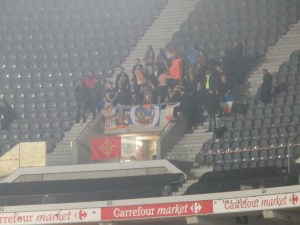
It’s a good view from our backless plastic seats and we watch the players warm up. The PSG players are roundly booed as they come onto the field. We watch the stands fill up and are interested by the eclectic mix of spectators. Montpellierians tend to be keener on rugby than football and the average attendance at Stade de la Mosson last season was only 12,356, although the team were mostly struggling, finishing fifteenth out of twenty in Ligue 1. It is inevitable that there are a lot of people here today who probably rarely come to Mosson; many will have been drawn by the anticipated presence of Neymar, the world’s most ludicrously expensive footballer. Fortunately for the club, the tickets sold out long before PSG announced their squad would be minus Neymar. There are many families here but also a group of four young women who seem to be dressed more for a night out rather than a football match; they perhaps want to look their best for PSG and its millionaires. A happy looking man works hard up and down the aisles and staircases selling packets of cacahuètes andOLYMPUS DIGITAL CAMERA crisps from a tray; I buy a packet of the locally made crisps (2 euros) which are in a plain bag which carries no branding whatsoever, very good they are too.
Before the teams come on to the field there is a display of flag waving and then with much fanfare and the playing of the Ligue 1 theme music the teams take to the field led by Monsieur Clément Turpin possibly Europe’s finest current referee.

Montpellier wear an all navy blue kit with orange names and numbers on the back; oddly but fashionably the shoulders are a different colour too, a sort of burgundy. Paris St Germain wear an all yellow kit and they remind me of Leeds United of the 1970’s, not just because of the kit but because of how obvious it is that everybody in the ground except their own supporters loathes them. Like in most countries there is much antipathy between the regions and the capital in France, but Montpellier is deep in the south of the country just a few kilometres from the Mediterranean coast and that dislike of all things Parisian is even greater down here.

OLYMPUS DIGITAL CAMERA
The game begins, Montpellier kicking towards the Tribune Petite Camargue, and predictably PSG don’t let go of the ball; they pass it around effortlessly and endlessly but Montpellier are not going to be a pushover, they chase and they tackle and every success is cheered wildly by the fiercely partisan home crowd. A couple of bangers are let off to our right somewhere and a fire cracker burns in the PSG goalmouth down in front of us. PSG’s Brazilian defender Marquinos is booked after just twelve minutes and the home supporters cheer like a goal has been scored; to please them that bit more PSG’s Italian hard-man Thiago Motta has a free-kick awarded against him and seems to hurt himself in the process of committing the foul.OLYMPUS DIGITAL CAMERA
There is a lot of football being played in this game, PSG are great to watch. There is the incredible speed and quickness of thought of Kylian MbappéOLYMPUS DIGITAL CAMERA, the sheer presence of the rugged Edinson CavaniOLYMPUS DIGITAL CAMERA and the elegance of Adrien Rabiot with his pre-Raphaelite looks.OLYMPUS DIGITAL CAMERA The atmosphere is intoxicating with constant noise from both sets of ultras; the PSG fans ceaselessly waving flags and banners at the far end;OLYMPUS DIGITAL CAMERA a short while before half-time the PSG fans together raise their scarves aloft as English fans once did. The perpetual threat of a possible goal from PSG at any time is its own form of excitement, enhanced by the tension of 20,000 of us willing it not to happen. But as PSG go on longer without scoring, Montpellier get more into the game and come forward; there is a belief that they could grab a goal themselves which only adds to the churn of emotions, hopes and fears.
Half-time brings respite and a visit to the ‘toilette’, which is a bit dark and a little grim but there’s no queue, unlike for ‘the ladies where as is often the case there just aren’t enough cubicles. The bars are busy so I return to my seat to enjoy the scene and the warmth of this beautiful bright, late September afternoon. Looking out across the pitch it is plain to see that it isn’t in a very good condition; it is almost bare in places and if they don’t win PSG can always use that as an excuse.
As the second half begins the Tribune Minervois behind the far goal now casts a shadow over the penalty area at that end. The same pattern of play resumes with PSG dominating possession of the ball. The Montpellier defence is playing brilliantly however, and their captain, 40 year old Brazilian, Vittorino Hilton,OLYMPUS DIGITAL CAMERA a veteran of the 2012 title winning side is outstanding. At different times both Mbappé and Cavani look sure to score but don’t, but now Montpellier also get the opportunity to spurn chances. As much as most of us in the ground would love Montpellier to score, it is enough that PSG do not. For the impartial, if that is possible in this atmosphere, or for journalists, this game is probably not the best and indeed the following week’s France Football magazine will only give it 8 marks out of 20 in its summary of matches, although no match will get a mark higher than 14. But football matches are not just about the football. On 74 minutes the whole crowd breaks out into applause for Louis Nicollin the wealthy industrialist and former chairman of Montpellier Hérault SC who died on his 74th birthday during the summer. Nicollin was a legend in Montpellier and across France having led the club from the regional amateur leagues in the early 1970’s to Ligue 1 in the space of just eight years. Nicollin was affectionately known as ‘Loulou’ and this name adorns the team shirts this season and that plastic cup that I drank my beer from before the game. Despite the divisions between the ultras of Montpellier and PSG, Loulou succeeds in uniting them.
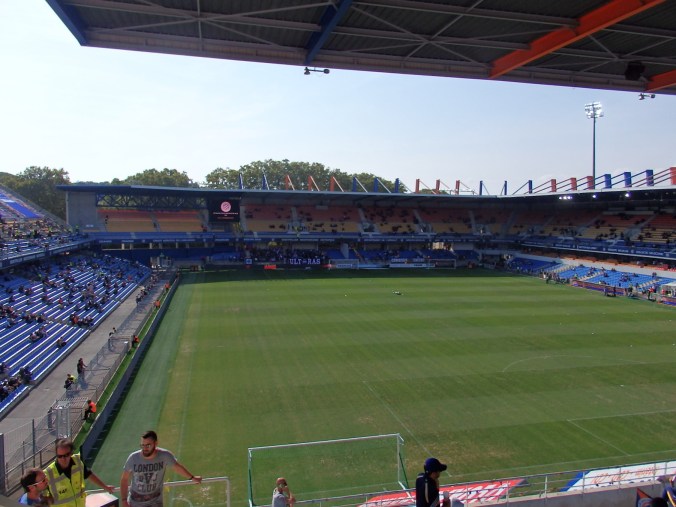
By now the shadow of the Tribune Minervois has lengthened to shroud the whole pitch and the four minutes of added on time are a final test, creating a terminal tension which explodes with joy and relief and pride with Monsieur Turpin’s final whistle. This has been a fantastic afternoon, a classic example of the underdog winning through, one of the very best things in football. As much as people love to hate clubs like PSG the pantomime villain has his place and if he didn’t exist he would need to be invented…as indeed he has been.


OLYMPUS DIGITAL CAMERA