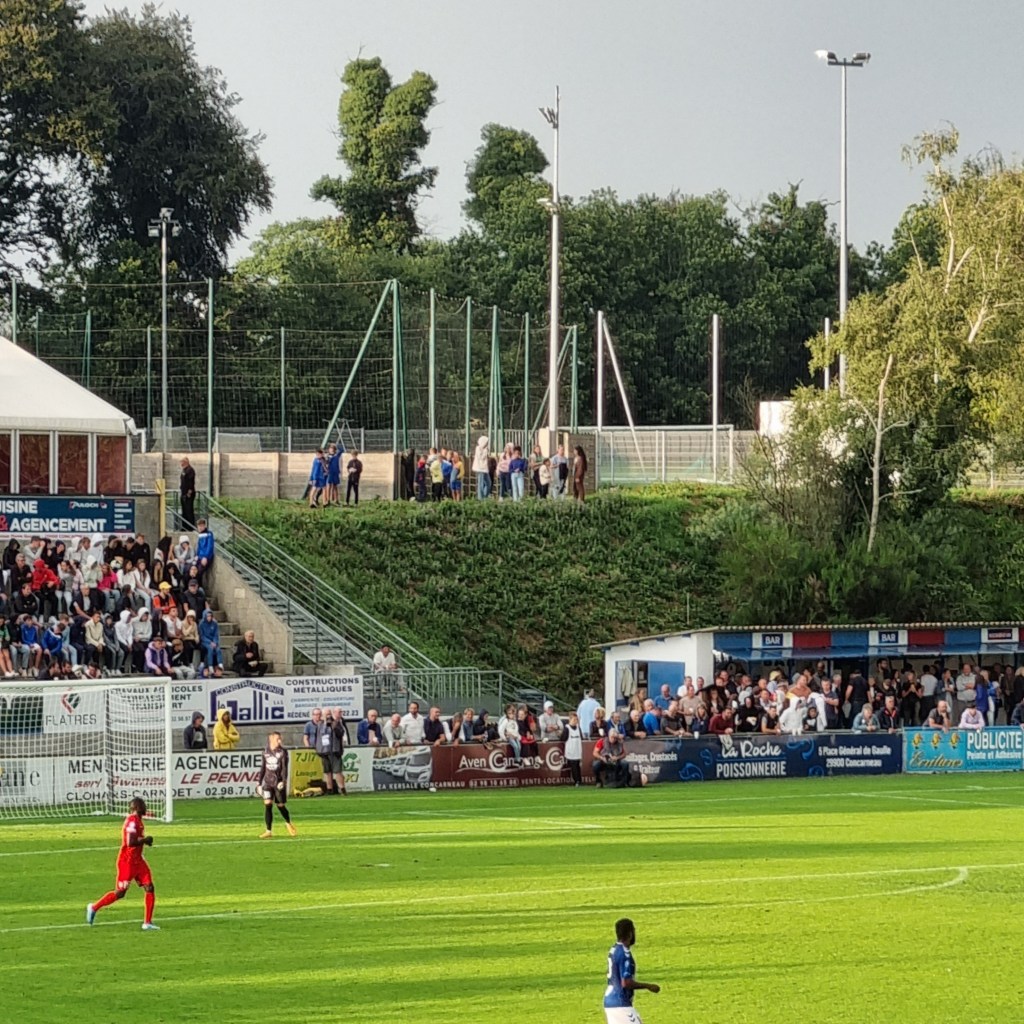
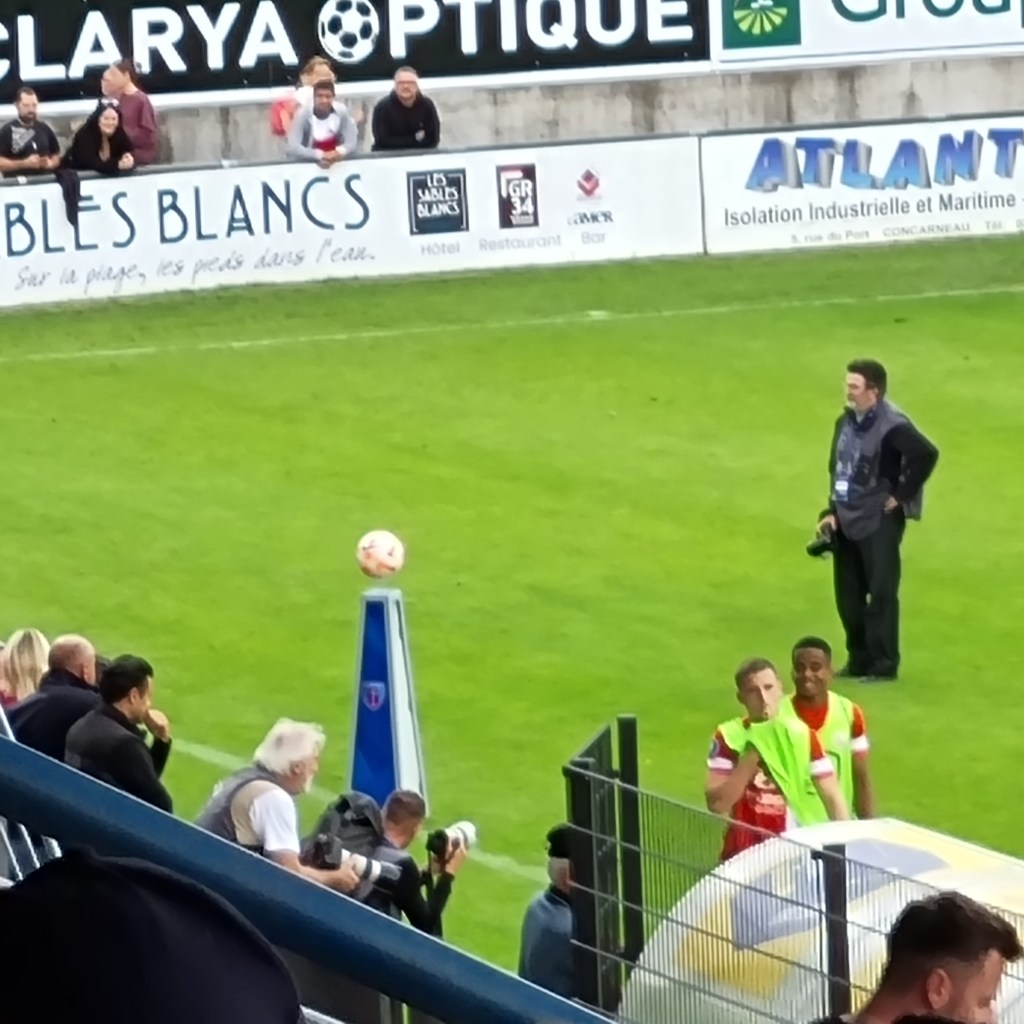
Stade Brestois 1 Olympique Lyonnais 0

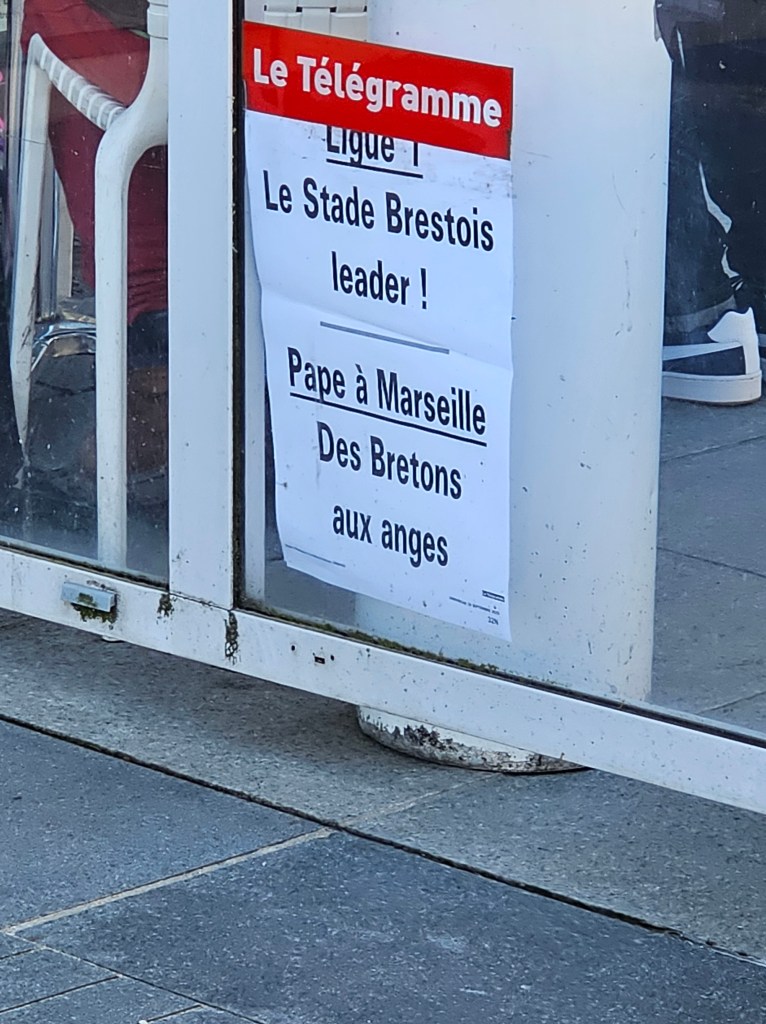
Finistere is the most westerly departement or ‘county’ of metropolitan France, with its name translating pretty much as ’the end of the earth’.  Not far east of the most westerly point of the most westerly department is Finistere’s largest town, Brest, an historic port and naval city, which was almost totally flattened by allied bombing during World War Two because the Nazis occupied it and made it part of their strategic ‘Atlantic Wall’.  Today, having been rebuilt in the 1950’s with an emphasis on space and layout rather than impressive or pretty architecture, although the church of St Louis de Brest is a notable exception, Brest has a population a little larger than that of Ipswich, but serves a metropolitan area of twice as many people, and is home to Stade Brestois 29, a football club in their present incarnation now enjoying their longest spell in the French first division since the 1960’s. Tonight, Stade Brestois who are currently third in the first division table, play Olympique Lyonnais who are third from bottom and I will be there. A win for Brest will put them top of the league above OGC Nice who won 1-0 away to previous leaders AS Monaco last night.

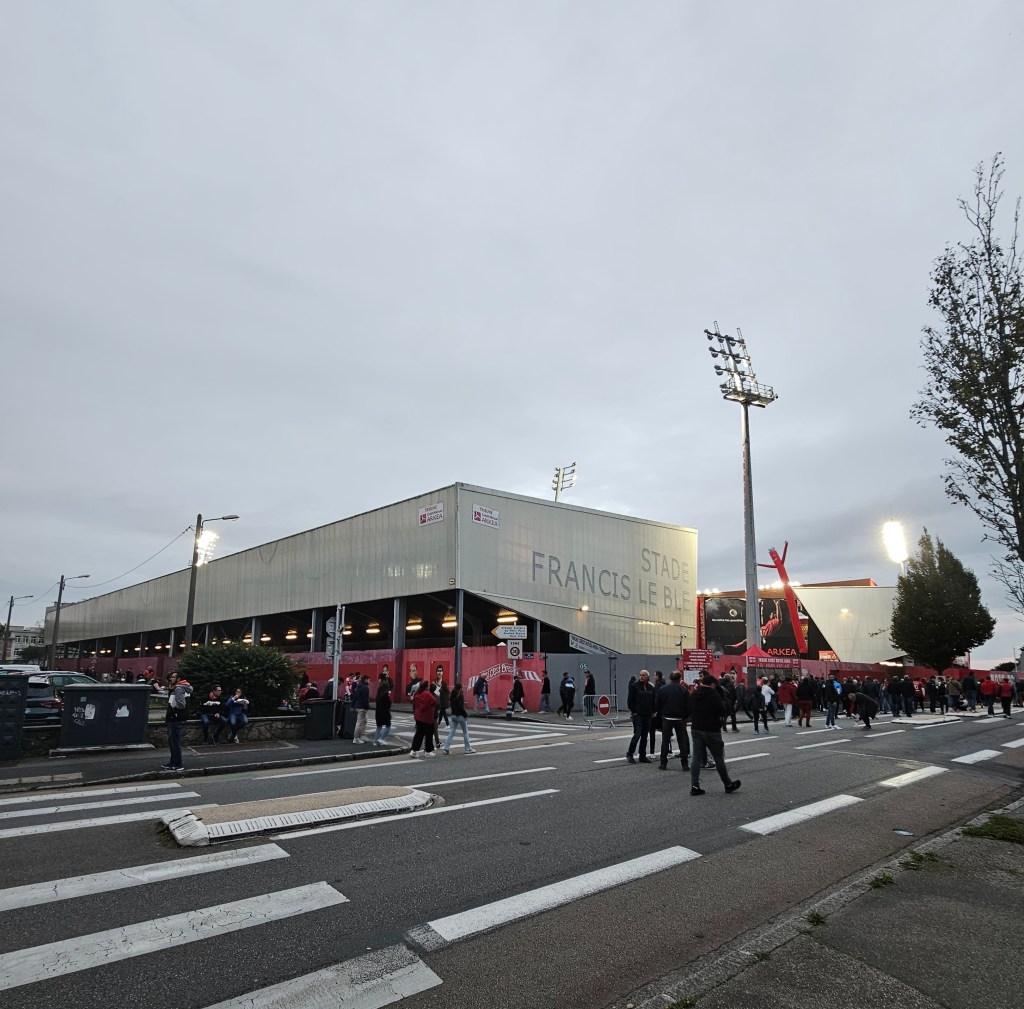
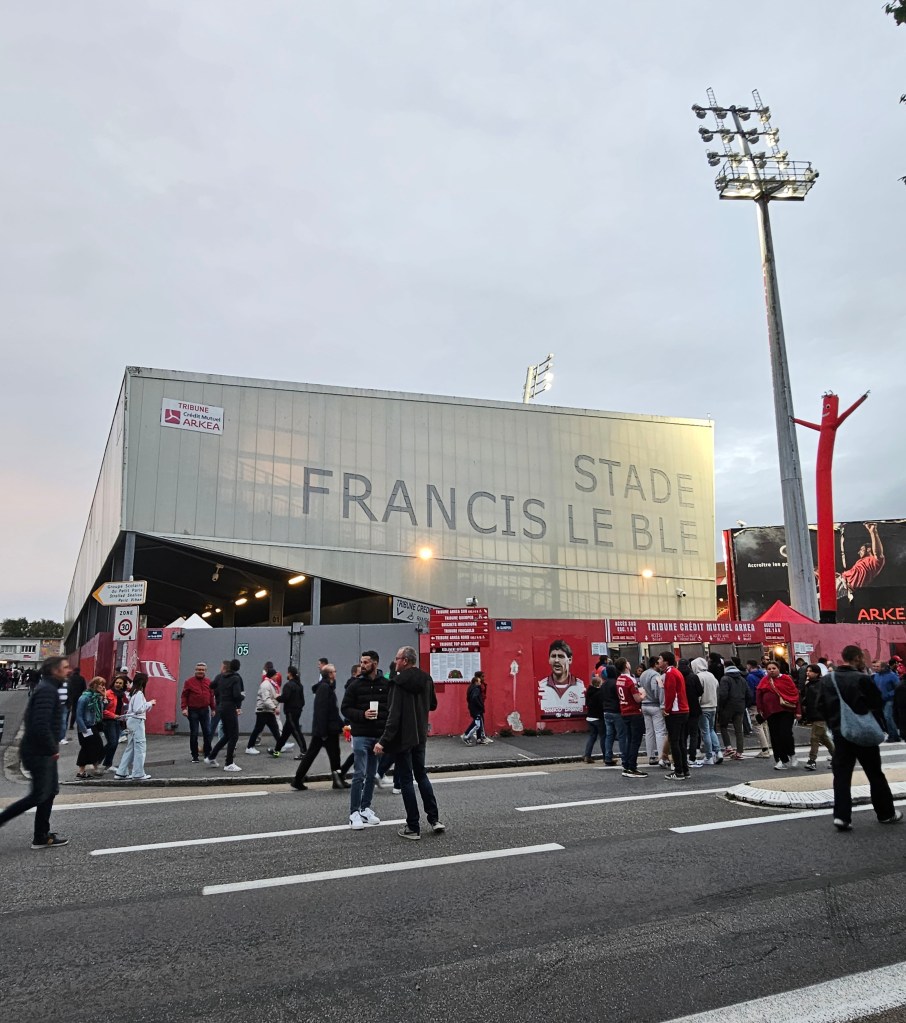
My wife Paulene and I are staying in a city centre hotel, which proves very handy indeed for the Liberte tram stop, where I just manage to extract two tickets (€1.70 each) from the vending machine and jump aboard a bright lime green Ligne A tram before it shuts its doors and begins a gentle, whirring, electricity-drinking ascent up Rue Jean Jaures towards Place de Strasbourg, from where it is just a short walk along Rue de Quimper to Stade de Francois Ble, home of Stade Brestois 29 (the 29 is the number of the Finistere departement – for some reason the mainland departements are numbered from 1 to 100, although weirdly Corsica gets to be 2A and 2B).   A gathering crowd is plainly in motion as we alight from the tram, and there is no difficulty finding the stadium as we are consumed by the human tide being drawn by the glow of floodlights shining out through the Breton dusk, and the promise of beer from the bar immediately behind the ground.  There is something about the approach to the ground and its relationship to the street that reminds me of the old Dell in Southampton, but I don’t let it worry me and not seeing any indication of a club shop I follow Paulene into the stadium after the usual ‘patting down’ by a huge, friendly man of Franco-African origin, who ensures I am not smuggling flares or other unfashionable trousers into the stadium. 

My fears about being unable to source club merchandise are quickly allayed as I spot a small wooden hut which looks like it could double up for use at a Christmas market.  I‘ve done my homework on-line, and know that for a bargain €9.90 I might be able to obtain a T-shirt bearing the club crest and the slogan Marree Rouge  (Red Tide). I point at a box of red T-shirts which bear the markings described and ask if there is one in ‘Large’ size.  The helpful young woman searches, examining the labels in collar after collar, one by one, but without success.  Eventually, sensing my desperation she holds up XL and XXL shirts as if suspecting that I am the sort of bloke who looks capable of putting on several kilos in weight if it suddenly proves necessary.  Optimistically, believing that I can fool the world by holding my stomach in, I ask if there is not a medium sized shirt instead; there is, but then, as she delves into the cardboard box just one more time a miracle happens, and she pulls out a ‘Large’; very possibly the last one in existence that isn’t already being worn by a well-proportioned Breton.

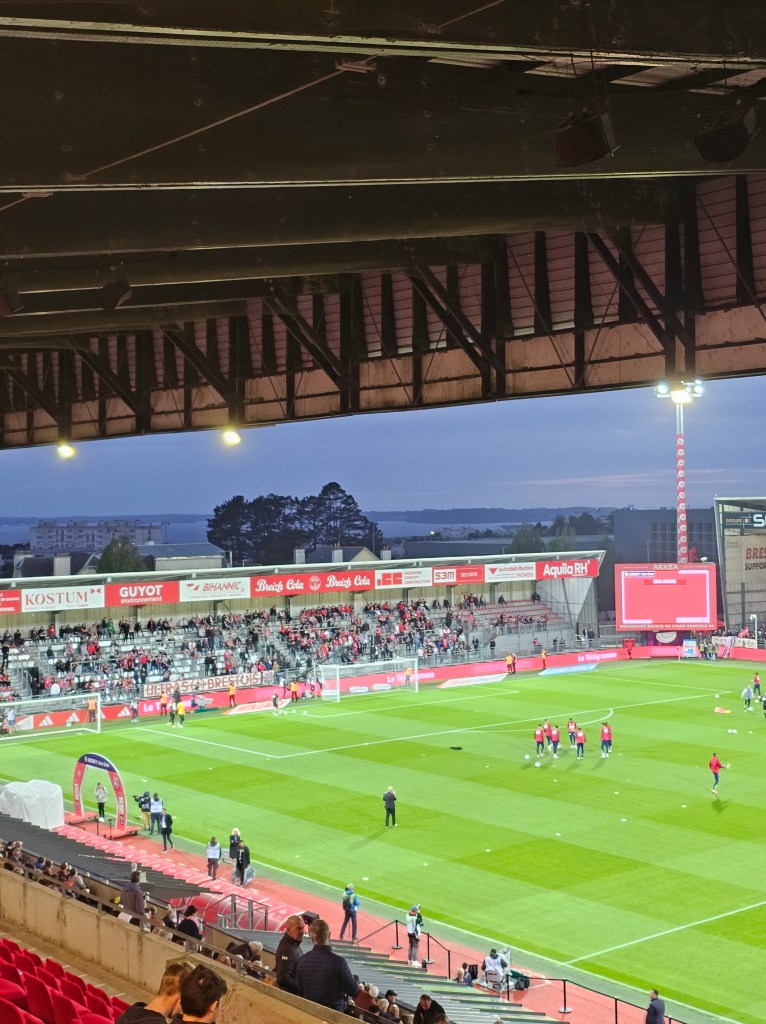
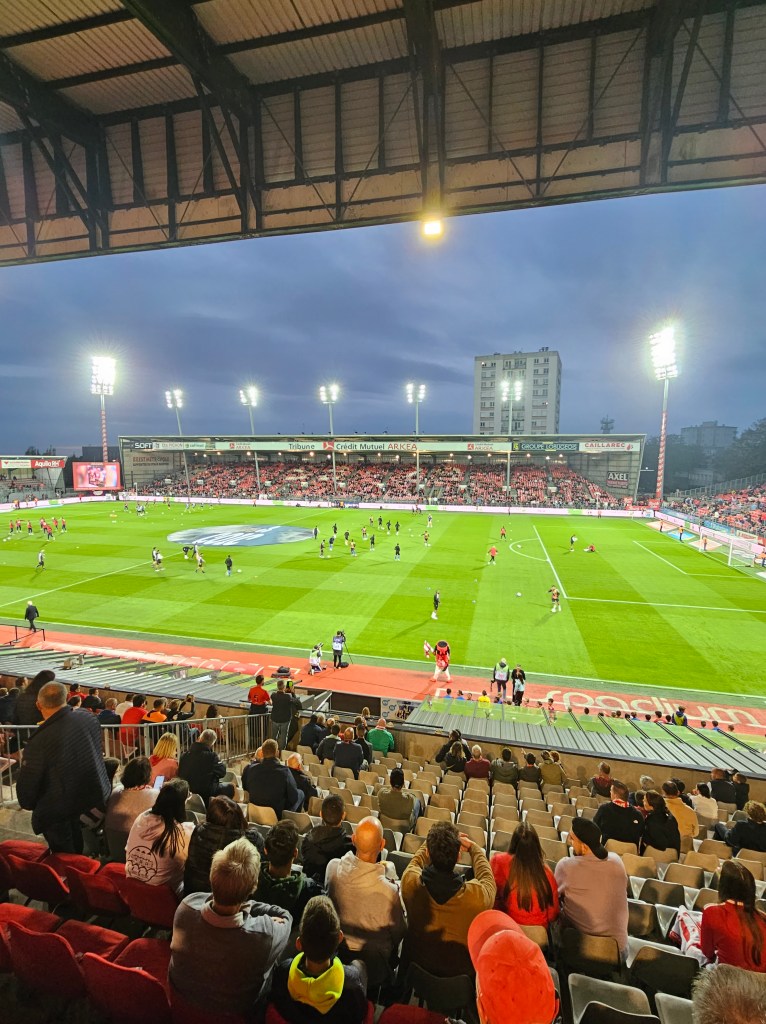
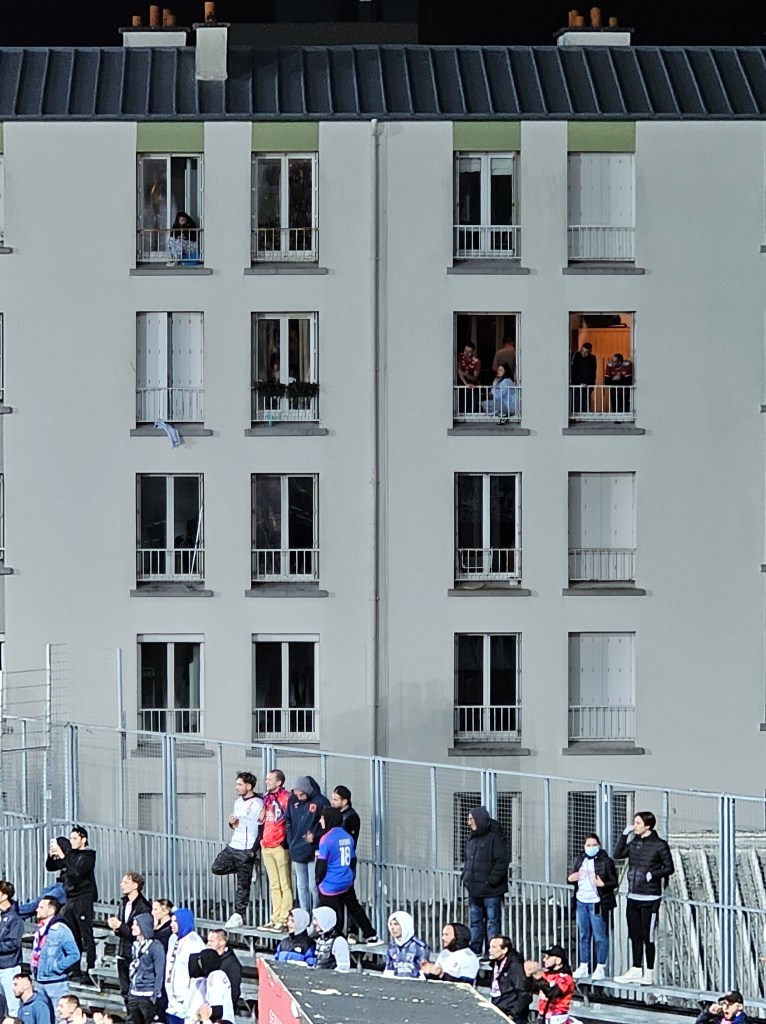
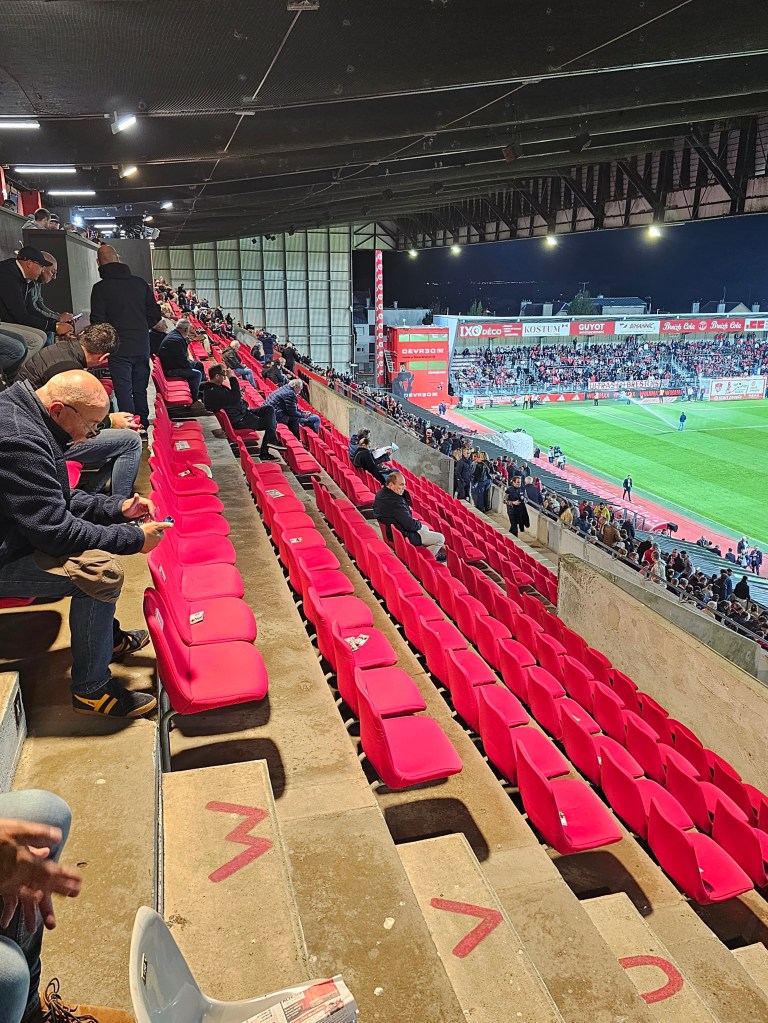
Clutching my precious T-shirt, I head for stairway five of the Tribune Foucauld and having climbed three flights of concrete steps I find myself looking over the brilliant green, floodlit pitch; all that remains is a further climb to row X and our seats, which I bought on-line a couple of weeks back.  Stade Brestois operate a loathsome ‘dynamic’ pricing system in which the club acts like a tout and the price of a seat changes, according to how much they think they can get for it.  When I first looked, tickets were €80 each; I eventually scored two of the few remaining ones for €45.  The club says the system means that people playing top price for seats allows less well-off fans to get cheap seats, but presumably this is only if these poorer fans have nothing to do with their time but be permanently logged onto the club website, waiting for a ticket price they might be able to afford.  The stadium has a capacity of not many more than 15,000 and is almost full for every Ligue 1 game. We sit in our over-priced seats and enjoy the view, which includes, through fading light, sight of the wide inlet from the Atlantic Ocean, which gives Brest its advantage as a port and naval dockyard.  Opposite us, the Tribune Credit Mutuel Arkea has five thick tubular stanchions set at a rakish angle to hold up the roof; atop the stanchions and the roof are floodlights, although the ground also has lights in all four corners.  To our right is the open Tribune Atlantique, a metal temporary stand a la Gillingham, and it’s where the away supporters are inevitably penned into a corner, they don’t even get seats, just metal benches.  Behind the stand, the occupants of a block of flats get a free view and can be seen crowding around windows and Juliet balconies. To the left is the small but freshly renovated Tribune Quimper; the ‘home end’ where the majority of the Brest Ultras congregate.

Whilst Paulene stays put to get maximum value from her seat, I soon take a wander to see what I can see and to find a programme, which is as ever free, and tonight is of the newspaper variety; it tells me the squads and who the referee and linesmen are and that’s it, which is all I need to know.  On the mezzanine level one staircase down from our seats is a bar, above which is a banner advertising the Breton Lancelot brewery.   Expecting one of Lancelot’s tasty beers, I invest 5 euros.  The beer is sweet and nasty and probably non-alcoholic; I tell the barmaid so and ask if it is Lancelot, because it doesn’t taste like it.  She doesn’t know but thinks it’s probably Carlsberg.  I’ve been poisoned.  At either ends of the stand are what look like private members bars, “Le Caban” and “L’esprit des Legendes”.  Spectators entering these bars do so only after having received the nod from people dressed intimidatingly all in black; presumably that’s where they serve the good stuff.  I’m guessing those spectators aren’t in the cheap seats.

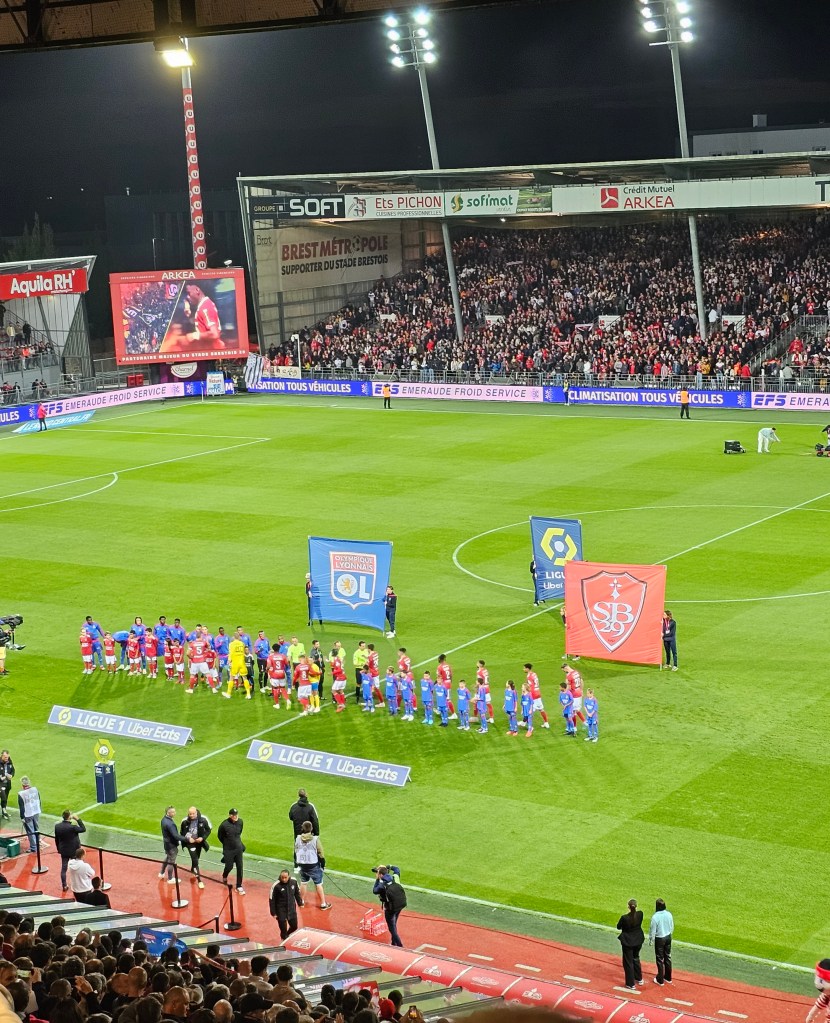
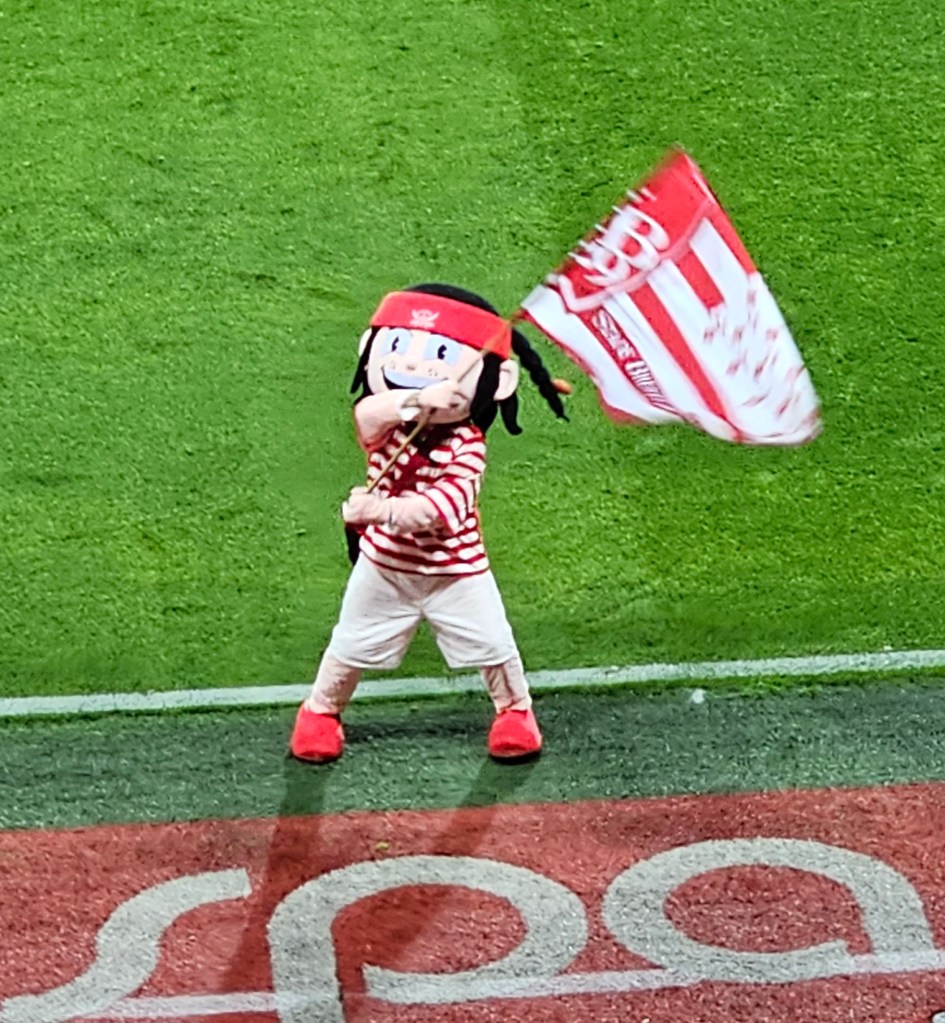
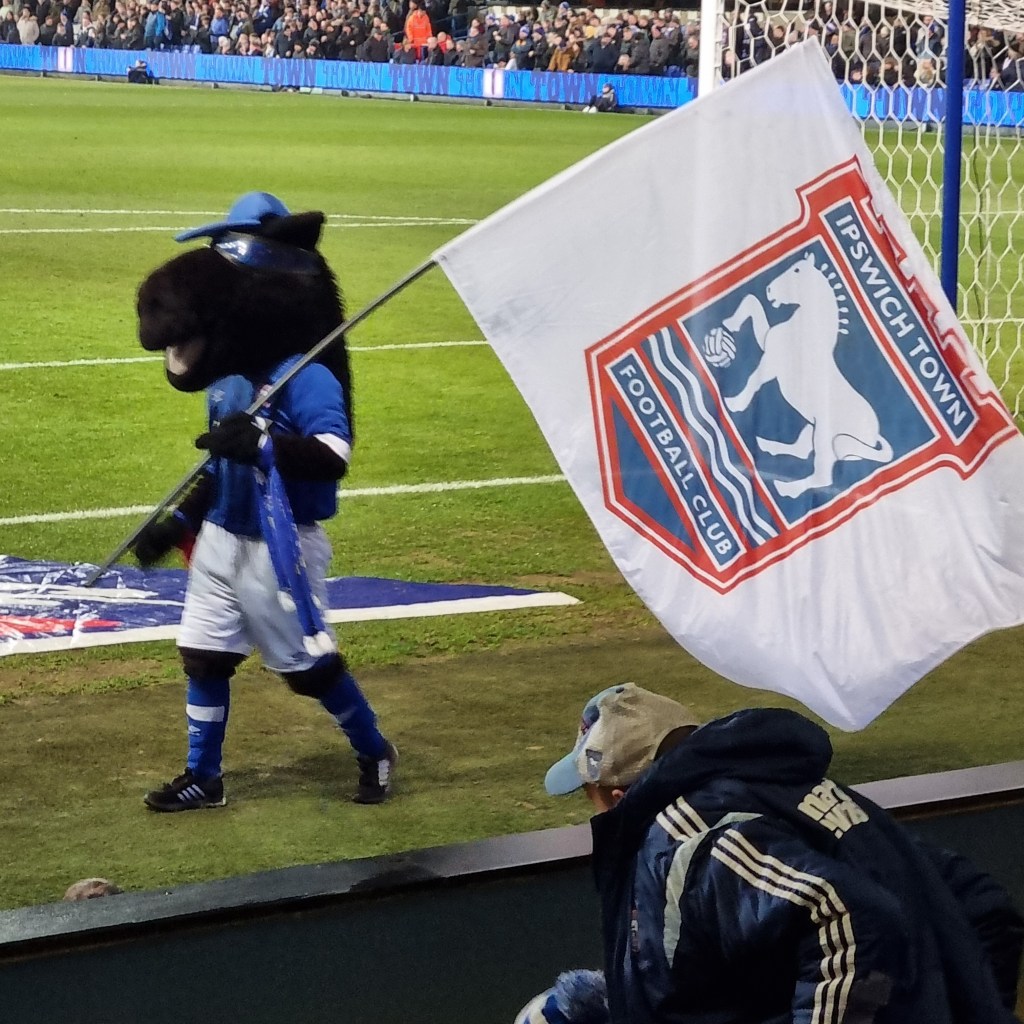
I return to my seat, and in the company of Paulene time passes quickly as we watch Zif, Brest’s pirate mascot, parade before the stand, and enjoy the arrival of the people in the seats around us, most of whom seem to be blokes in their seventies who all know each other.  The man next to me wears a beret and seems very clean, like Paul McCartney’s grandad in A Hard Day’s Night, but French. When the teams at last come onto the pitch, it’s to the fanfare of the Ligue 1 ‘anthem’, leaping flames, and the presentation of the match ball on a shiny plinth in front of banners displaying the two club badges and the Ligue 1 logo.  The public address system seems loud enough to make my ears bleed, but happily it doesn’t, although I do check.

When the game begins it is Lyon, generally known as OL in France, who get first go with the ball which they try and aim in the direction of the ocean whenever they can.  OL wear a frankly hideous, and annoyingly unnecessary away kit of all blue with red trim, whilst Brest are in their signature red shirts with white shorts and red socks. It’s been a warm day, but now a strong breeze blows up the hill from the dockyard and towards the OL goal. From the start, the slogan on my recently purchased T-shirt proves accurate as Brest sweep forward with wave after wave of attacking intent.  A shot goes way, way over the Lyon goal and then another soon earns a corner.  Brest are easily the better team but can’t find the final pass or the final touch that counts.  In midfield for Brest, Pierre Lees-Melou is brilliant, despite having previously played for Norwich City, and I imagine that the Canaries simply had no idea how to integrate a player into their team who can pass accurately, tackle, shoot, run with the ball and generally be quite good.  Fortunately, Lees-Melou seems to have suffered no ill-effects from his thirty-odd games wearing  yellow and green., but he’s probably receiving counselling.

All around the ground, the crowd brays with indignant disapproval whenever a Brest player is fouled. When referee Thomas Leonard books OL’s Ernest Nuamah for fouling Lees-Melou, the cheers sound like a goal has been scored.  I enjoy the wonderful name of Kenny Lala for Brest and the terrible haircut of Maxence Caqueret of Lyon, a player who looks like he was born 120 years too late and should have been the singer in a 1930’s dance band. On twenty-four minutes Lees-Melou has a shot tipped onto the cross bar by OL goalkeeper, the excellent Anthony Lopes, and then Brest’s Jeremy Le Douaran curls the rebound around the angle of the post and the bar.  “Allez-Allez-Allez” chant the home crowd from every stand.  A minute later OL get the ball into the Brest penalty area for the first time, but it comes to nought and instead all around is the noise of Brest fans urging their team on to score the goal the balance of play says they deserve.  The Ultras in the Tribune Quimper call out and the rest of the stadium answers back.  Mahdi Camara, a recent signing from Montpellier, dribbles deep into the OL box but again, there is no goal, only anticipation and excitement.  In the corner of the open end, the OL fans seem oblivious to their team’s ineffectiveness, other than in defence, and have sung and chanted all through the first half, prompted by two blokes perched astride the high metal fence that separates the supporters from the pitch.  Both blokes wield loud halers, but I don’t know if it’s the effect of the strong on shore breeze blowing away most of the sounds of their voices, but they both sound like Rob Brydon’s small man trapped in a box.

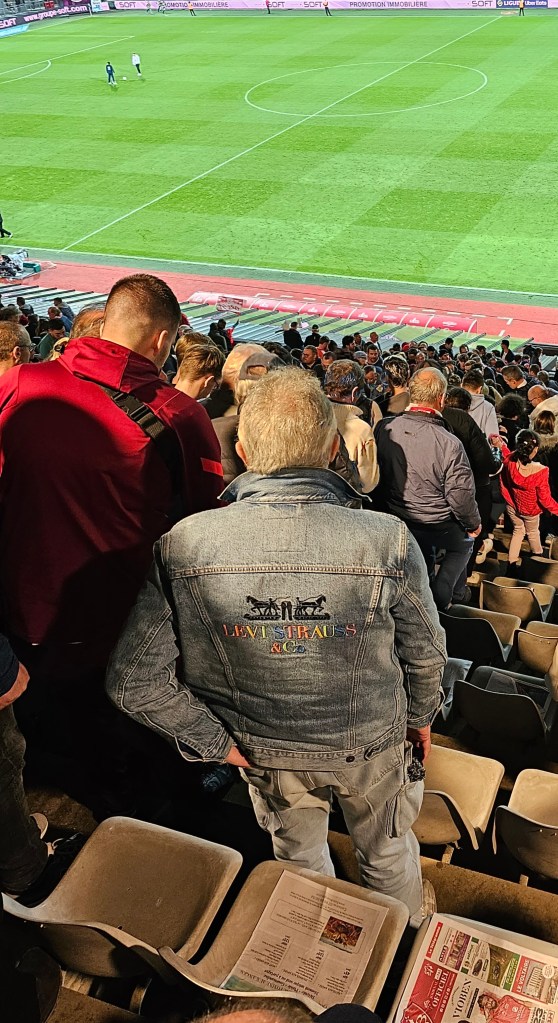
The fortieth minute is a milestone in the game as OL win their first corner, but of course it doesn’t result in a goal, and it’s the Brest supporters who remain in ebullient mood, holding their scarves aloft in the Tribune Quimper as the first half draws to a close in a sort of 1970’s tribute that suits the architecture of the stadium and the old blokes all around me who were themselves probably the Ultras of fifty years ago.  In front of me, a bloke wears double denim, and succeeds in accentuating the feeling, as if he’d come to a game in 1973 and never went home.

With half-time, the seats to our left are nearly all vacated, revealing the fact that they all sport red covers and suggesting perhaps that their occupants are now all enjoying some form of hospitality somewhere, perhaps in Le Caban or L’Esprit des Legendes. I will read later that the club owners wish to build a new stadium at the end of the tram line at the edge of the city, but that it will still only have a capacity of 15,000, no doubt because they want to be able to still charge top prices for the comfortable few and forget about the sweaty oiks who may be don’t wear shirts, and chant and light flares and drink too much beer containing alcohol in the bar across the road.

The second half begins and nothing changes, although encouragingly the block of seats to our left is soon re-populated, proving either that the occupants are genuinely interested in the match or that the hospitality isn’t free or unlimited. After just seven minutes however, OL roll the dice by replacing Ernest Nuamah, Diego Moreira and Paul Akounkou with Mama Balde, Tino Kadeware and Ainsley Naitland-Miles, who tonight wears a silly number 98 shirt and a few seasons ago mostly failed to excite when on loan at Ipswich from Arsenal.  The change sort of works for a short while and Alexandre Lacazette finds space to launch a thirty-yarder which flies over the Brest cross bar, but then a weak Caqueret pass is intercepted by Lees-Melou who dribbles away from his own half and to the edge of the OL penalty area before frustratingly shooting beyond the far post.  An hour has gone and Brest miss another chance, probably the best yet, as a low cross is somehow steered wide of the OL goal by Jeremy Douaron from just a couple of yards.  Whilst clutching their collective heads the crowds shout “Aye-Aye-Aye” and I find myself joining in with swelling chants of “Allez les Rouges! Allez les Rouges!”  Paulene, a Pompey fans says the atmosphere is like that of Fratton Park. “The same sort of people” she says. “What? All dockyard mateys” I reply, thinking of my dead father, a one-time Pompey based matelot who I know would have said exactly the same thing.

The game enters its final twenty minutes, and to mark the occasion tonight’s attendance is announced as being 14,636, and Brest substitute number seven, Martin Satriano for number nine, Steve Mounie.  But it’s OL who, still against the run of play, now come closest to a goal as Lacazette sends a decent low shot goalwards from the edge of the penalty area which Brest ‘keeper Marco Bizot dives to his right to stop and then jealously grab.  Lacazette lasts five minutes more before being replaced by Rayan Cherki, a man whose distinctly bushy facial hair and short back and sides give him the look of an Edwardian naval captain.

Three minutes of normal time now remain.  A move down the right produces a cross from Brest’s Kenny Lala, which Steve Mounie heads against the foot of Lopes’s left hand post.  As the crowd gasps in thrilled disappointment the ball runs back to Lala who crosses it again and Mounie, who has back-pedalled judiciously, this time hurls himself forward to head the ball past Lopes into the near top corner of the net, and Brest have the goal they deserve.  The crowd is on its feet, but OL defender Tino Kadewere is on the ground having been barged out of the way by the hurtling Mounie, although there was no real suspicion of a foul.

“Allez, Allez, Allez, Allez” we all sing triumphantly, Billal Brahimi shoots, Lopes saves, and Brest have a corner and five minutes of added on time in which to retain their clean sheet or even score again.  The very clean old bloke in the beret, next to me, leaves early, but very few others do.  Jonas Martin shoots and misses for Brest, and Naitland-Miles has a shot saved for OL, but there are no more goals and as the clock ticks towards eleven o’clock Monsieur Leonard blows his whistle for the last time.  Brest are top of the league, or more accurately given our geography, a la tete du classement.  We stay a short while to applaud before heading off into the night and back along Rue de Quimper to the tram stop, and a journey back to our hotel on the most crowded tram I have ever ridden on. It’s been a fantastic evening and still with our minds whirring excitedly, in our hotel room we celebrate Brest’s success by cracking open a small bottle of Cremant that had been cooling in the mini-bar, and unwind by watching the game all over again on Canal Plus tv. Allez les Rouges!

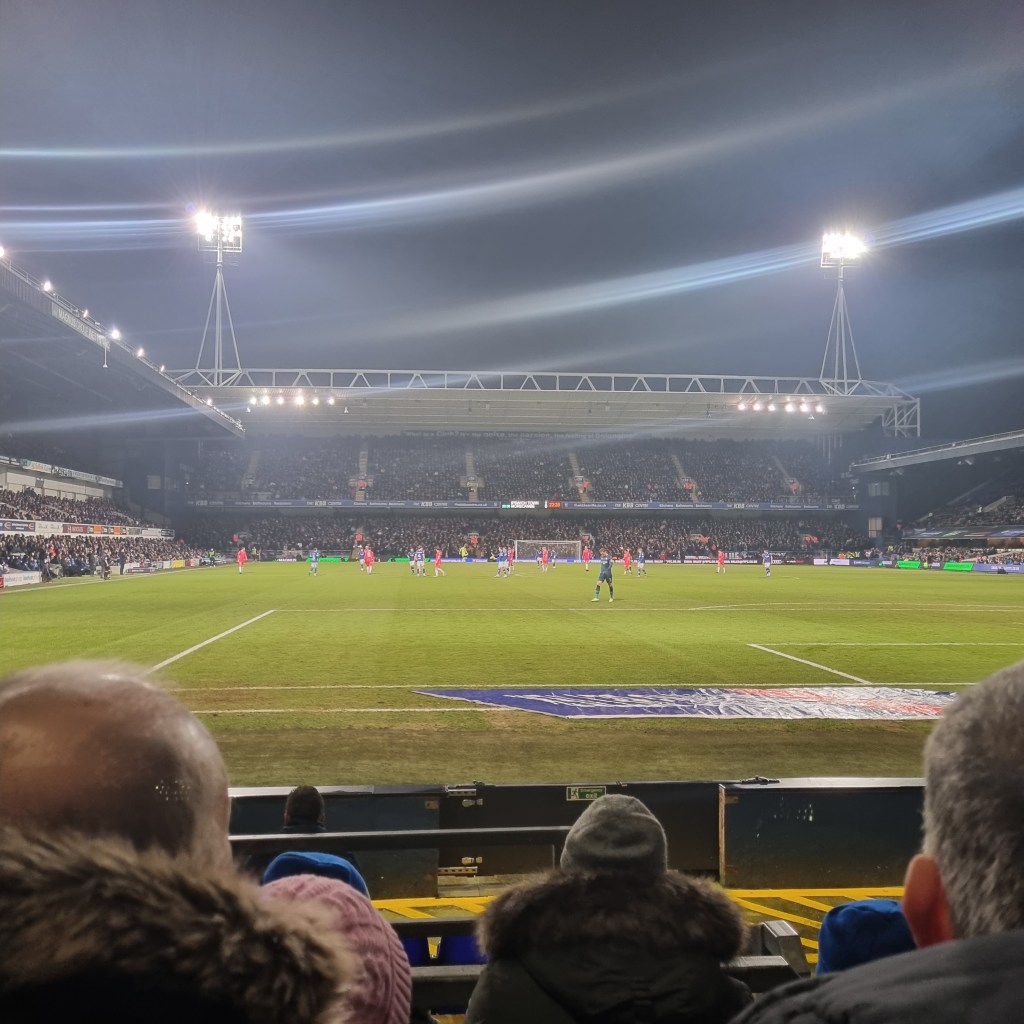
Ipswich Town 4 Morecambe 0

One of the many potentially good things about the FA Cup for supporters of third division clubs, is that if your team gets to the third round or beyond, then Saturday fixtures get postponed and are magically transformed into midweek games under floodlight.  This is a good thing if your re-arranged games are at home, not so good if you feel the need to travel to every away game.   Those good people of Morecambe for whom supporting their football team is a kind of religious devotion must wonder what they have done wrong. Not only is it a particularly cold and damp month, but they live in an out of season seaside resort somewhere up North and now the Football League are telling them that to support their team they must travel the best part of five hours on English motorways  to the far end of the country on a grey Tuesday afternoon in January.  At lunchtime today I was told that the Morecambe FC coach was already in the West End Road car park. When I walked past later I took a look, it had a parking ticket on the windscreen.

I have suffered too today,  I have been to work in the office instead of staying in the comfort of my own home.  But now, at a quarter past four, after almost eight hours of ceaseless toil I am meeting Roly and we are heading for the pub.  By way of a change we are in the Three Wise Monkeys where we drink coffee like the sophisticated metrosexuals that we are, I have an Americano and Roly has some frothy milky looking thing.  We settle in two large arm chairs beneath the stairs and discuss the late Cyril Fletcher, the ridiculousness of BBC tv’s That’s Life,  and football.  I detect a level of pessimism in Roly that I attribute to his long Suffolk heritage.  Coffee can only take a man so far along the path to enlightenment however, and we eventually move on to The Arb to drink beer and eat:  a pint of Lacon’s Encore (£3.90?) and Cajun Chicken Burger (£13) for Roly and a pint of Mauldon’s Suffolk Pride(£4?)  and a Scotch Egg with thick cut chips (£9) for me.  Unusually, we sit inside the pub and not outside, probably because we have arrived early enough for there to be a vacant table.  After a while Mick arrives, walks through the bar and out towards the garden, returns, presumably because we aren’t there, and finally buys us both very low alcohol beers brewed by the Big Drop Brewing Company and has a pint of Suffolk Pride for himself. The conversation continues mostly courtesy of Roly who occasionally interrupts if someone else speaks, apologises for interrupting and then carries on, before apologising for interrupting again.  It sounds worse than it is because I don’t have much to say anyway, which is just as well.

When Roly finally draws breath, I take the opportunity to suggest it’s time to leave for Portman Road and that’s what we do. We part in Sir Alf Ramsey Way, Roly strangely and quickly joining a queue for a turnstile into the West stand, whilst Mick walks further on to a turnstile where there is no queue; I make my way to turnstile 60 and the Sir Alf Ramsey Stand, which perhaps ought to be in Sir Alf Ramsey Way, but isn’t.  Inside the ground, Fiona is here and so is ever present Phil who never misses a game and the man from Stowmarket, but Elwood and Pat from Clacton are not.  Pat had sent me a message at twelve minutes past three to say she wouldn’t be coming tonight on account of her not fancying sitting in the cold with her arthritic pains; I guess sitting in the cold without her arthritic pains was not an option; like a faithful dog, wherever she goes they go too.

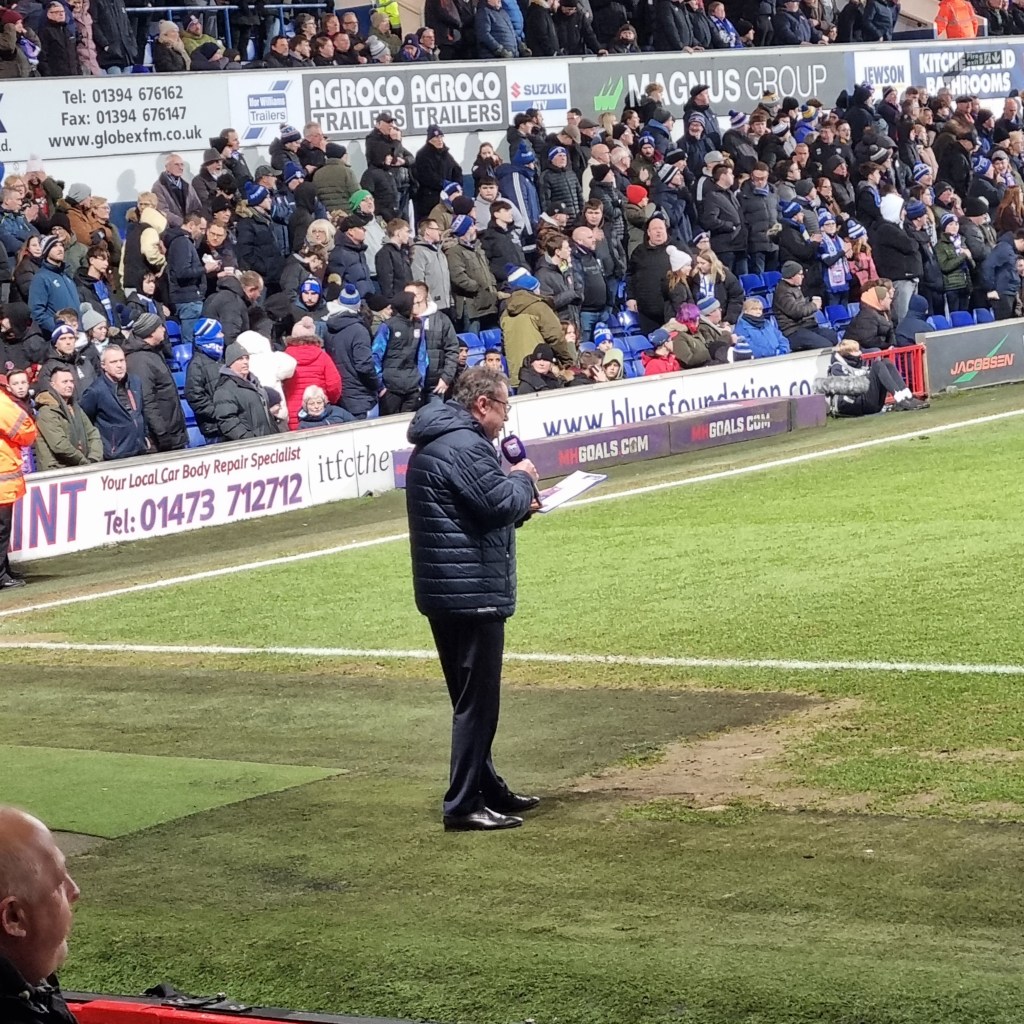
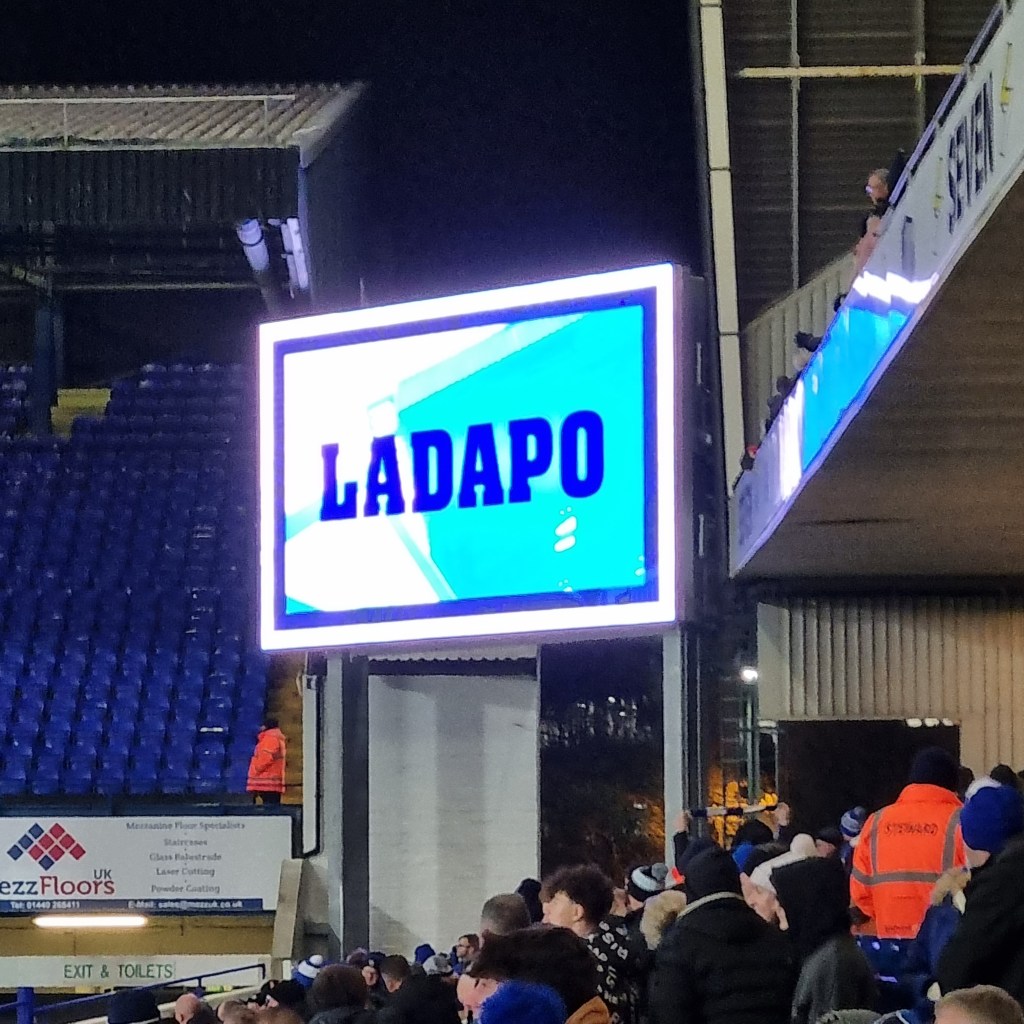
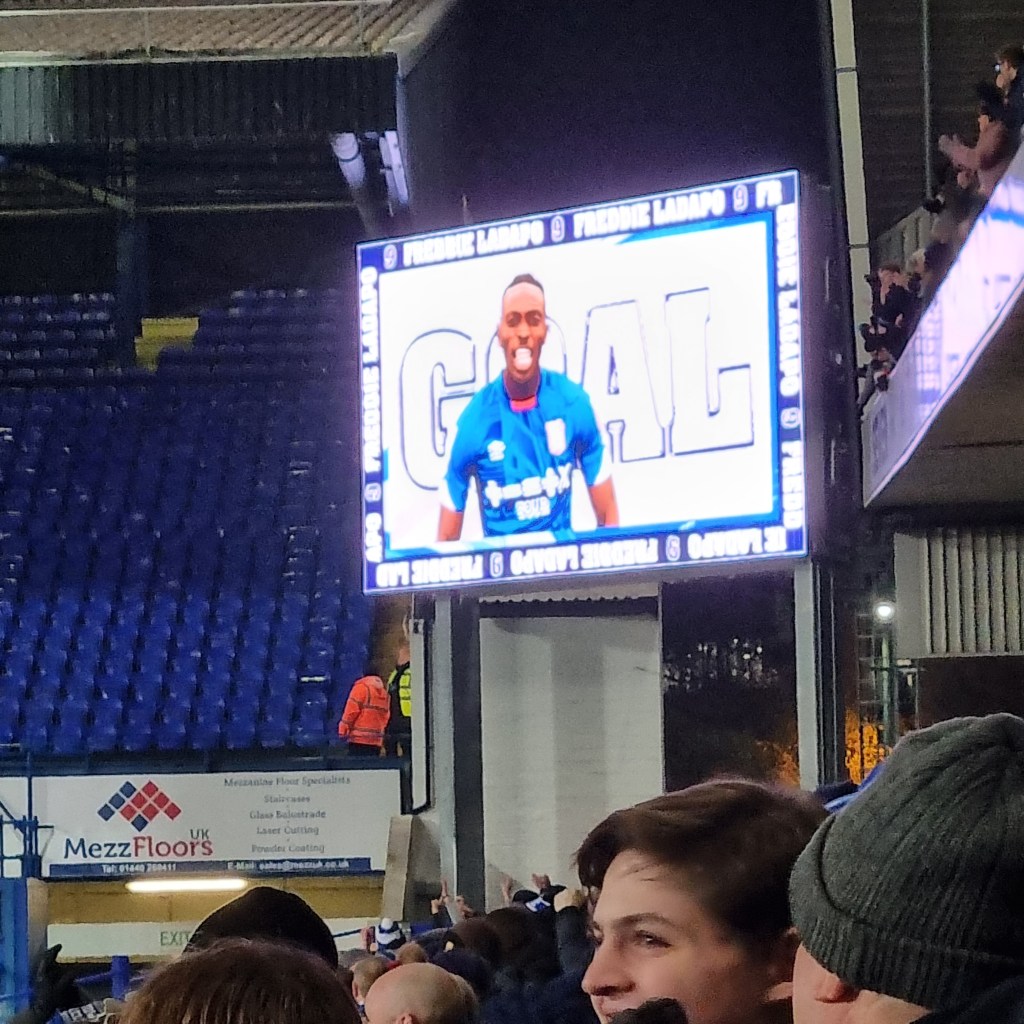
I’ve missed the start of Stephen Foster reading out the Town team, which is a shame, but I join in just as soon as I can, shouting out the surnames of the players as he announces them.  No one has started joining in with me yet,  but I  live in hope.    The game begins, Town get first go with the ball, we win a corner and the ball drops kindly; Freddie Ladapo is more alert than anyone else and scores from close range.  We’re winning and I’ve not really had time yet to notice that Morecambe are in red shirts and shorts with white socks, which I am a little surprised to find is a pretty good combination, and shows just how important socks are.

 Of course we scored in the first minute against Fleetwood a few weeks back and that didn’t end as well as we’d  hoped, so no one’s getting too excited and after a brief bit of shouting and cheering and  even a brief chant,  which fades out like no one knows the words after the first line, the crowd becomes quiet. “ I missed the first goal didn’t I?” says a voice from somewhere  behind me.

Leif Davis breaks down the left flank at high speed and weirdly the referee, Mr Rock, appears to be chasing him.  Mr Rock , what an example he is to all football officials, cut him in half and you’ll find the word ‘referee’ is written all the way through him.  Lee Evans steps forward and from nothing unleashes a shot against the Morecambe goalkeeper’s righthand goalpost. I probably say “Phwoarr!” or something similar.  Meanwhile, the bloke behind me sounds impressed with new signing Harry Clarke.  “That Clarke likes to take the ball forward” he says, before adding “He likes travelling with the ball”  making me imagine him on the bus with a ball on the seat next to him.  Harry Clarke will go on to have one of the best home debuts I’ve seen since Finidi George dazzled us over twenty years ago.

It really is very quiet in Portman Road tonight. There aren’t many Morecambe supporters here but I can hear them singing “Oh when the reds going marching in” . A Morecambe player, Jensen Weir, is down injured after a foul by Wes Burns and silence reigns as if everyone is holding their breath to see if he’s going to be alright; he is. Within seconds of the game resuming another new Town signing, Nathan Broadhead, plays the ball forward, Freddie Ladapo runs around his marker, gets sight of goal and shoots against the foot of the far post.  Normally the ball would defy the laws of physics and bounce out to be cleared by a fortuitously placed defender,  but the alignment of the  planets and stars must be on the huh tonight and the ball spins across behind the goal line and against the net on the far side as if it’s doing a little celebratory dance,  and Town lead 2-0.

Town win another corner, the Sir Bobby Robson stand sing “We’ve got Super Kieran McKenna he knows exactly what we need…” and the floodlights seem to be producing a lot of glare in the lenses of my glasses tonight, it could be because it’s a damp evening or may be my glasses are just a bit grubby.  Town treat us to some quick and attractive passing, running and movement; the working man’s ballet as Alf Garnett called it. “Champagne football” says the bloke behind me to his neighbour, as you would if you were watching Stade de Reims versus Troyes in Ligue 1.  The crowd is very quiet again, almost as if they are in awe of what they’re seeing on the pitch, or are concentrating very hard to understand it.  In the Sir Bobby Robson stand the lights keep turning off and on as if someone is leaning on the switch.  “Ladapo’s got the touch of Messi tonight” says the bloke behind me in an unrelated incident.

In their defence tonight Morecambe have the exotically named Farrend Rawson, a tall player made more conspicuous by his totally bald head and goatee beard. It makes me think how different Flash Gordon could have been if Emperor Ming had also turned out for a third division football team.  “Come On You Blues” is an unexpected if faint chant from the bottom tier of the Cobbold Stand. Another corner to Town, a header from Richard Keogh and a flying save from the talented Conor Ripley in the Morecambe goal , who is probably the chunkiest goal keeper  at Portman Road so far this season.

Thirty-seven minutes are up and Wes Burns escapes down the right wing, crosses the ball and Conor Chaplin shoots low inside the far post to make the score 3-0 to Town. “Ole, Ole, Ole” sings the crowd for all of five seconds before returning to quiet contemplation. There are six minutes of additional time to be played and it’s enough for Chaplin to score again, this time with a typical snap shot inside the near post and the score is 4-0.

As ever I take a half-time stroll to the front of the stand to say hello to Ray, his son Michael and grandson Harrison.   Michael and Harrison have a new van, Harrison has tickets to see Noel Gallagher  and The Zutons and has discovered that ‘psychedelic folk’ artist Robyn Hitchcock is some thirty years older than his wife Emma Swift.  Otherwise, talk is of how many more goals can Town get in the second half.

The game resumes at six minutes to nine and Morecambe bring on three substitutes in one fell swoop, which includes the replacement of Curly Watts with Aleister Crowley, something which the writers of Coronation Street were never brave enough to do.  Also entering the fray is Michael Mellon, one of the few players in league football whose surname is a mis-spelt fruit.

Four minutes in to the half and Mr Rock displays his yellow card for the first time after the sophisticated sounding Jacob Bedeau assaults Nathan Broadhead.  Morecambe’s Crowley is a tiny man who one might think was a child if it wasn’t for his five o’clock shadow.   Nathan Broadhead produces a superb shot which is heading for the inside of the goal net until the huge flying frame of Ripley hoves into view and a Ripley arm extends and pushes it away beyond the post.  Ripley is having a fine game and five minutes later performs a sort of break dance after he slips when making a hasty  clearance from in front of the looming Freddie Ladapo. A little while later he does it again after taking a goal kick.

Almost an hour of the game has receded into history and Morecambe have their first attempt on the Town goal, a speculative near post header than arcs slowly beyond the far post.  Two minutes later and after some fabulous skill from Conor Chaplin, Kayden Jackson sprints away down the right and lays the ball back for Nathan Broadhead to place a firm shot in Ripley’s midriff.  It’s now Town’s turn to get in on the multiple substitution act as the unlikely firm of solicitors Morsy, Broadhead and Ladapo leave to be replaced by Cameron Humphreys, Kyle Edwards and George Hirst.  Fiona reveals that she once had a cat called George.

Just under twenty minutes of normal time remain and Morecambe earn their first corner and  appreciation of their travelling supporters who get their kicks where they can and celebrate disproportionately.  Marcus Harness replaces the excellent Conor Chaplin and Stephen Foster tells us that tonight’s attendance is 21,948 with one-hundred and two from Morcambe, although I have a quick count and can only spot sixty-four.

After such a goal laden first half, the second half has been less thrilling, but it has nevertheless passed quickly.  Apart from already being four-nil up, the crowd has had not very much to sing about in the second half, but the quiet at Portman Road has at times been almost oppressive, as if some people had turned up for a bit of a moan after Saturday’s defeat at Oxford and are now sulking.  As the final minutes roll by and just three more are added, the Sir Bobby Robson stand at last break into song with some celebratory Ole, Ole Oles and a drum can be heard too.  Perhaps the Rio de Janeiro branch of the supporters club were late getting here tonight.

With the final whistle I swiftly depart, erroneously thinking that I will quickly be able to get out of the Portman Road car park and away into the night.  It seems that far too many people had already left and have clogged up the streets.  But I didn’t turn up tonight just so I could get away early, that would be daft.  I came for the football and that’s been excellent, it’s been a night to remember for Town and I doubt Morecambe will forget it either.

Vannes OC 1 Chambly-Oise 2

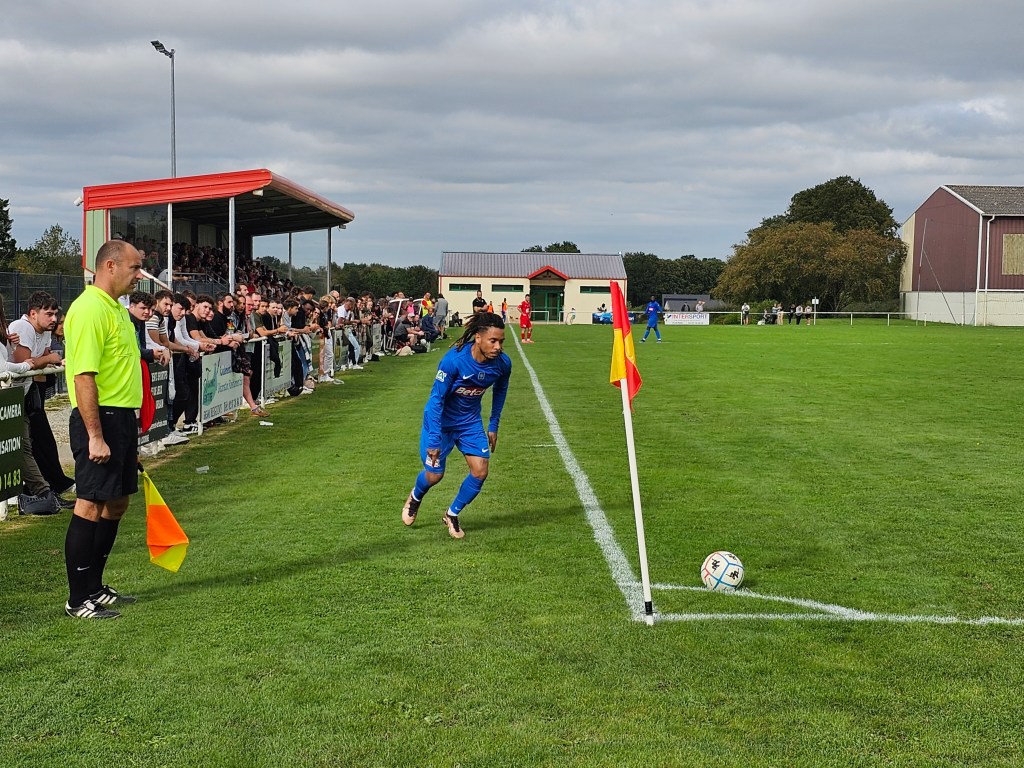
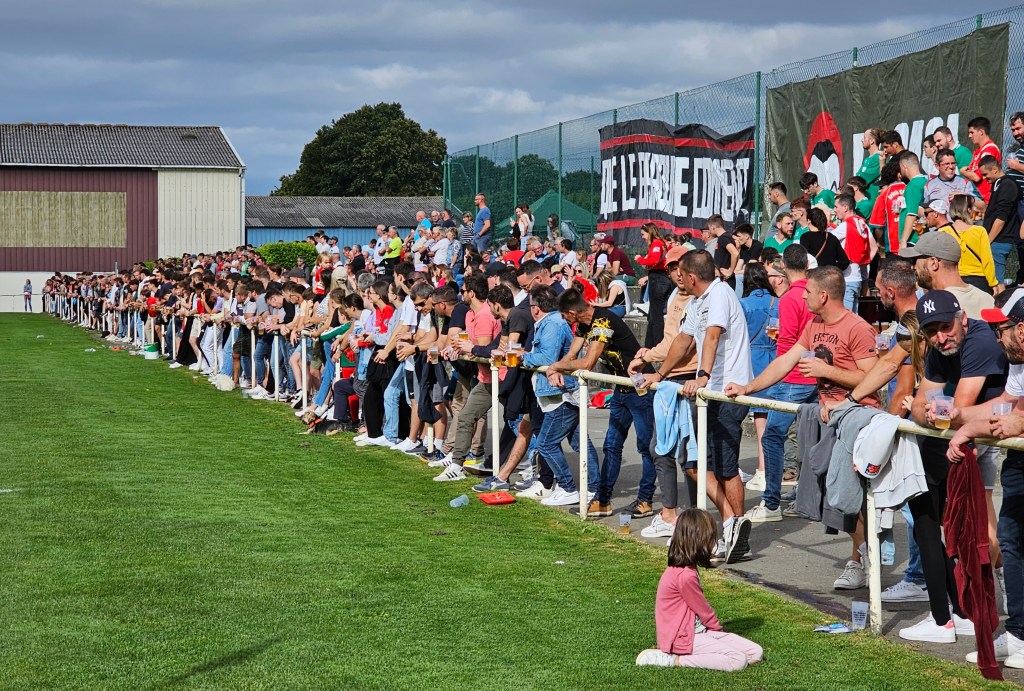
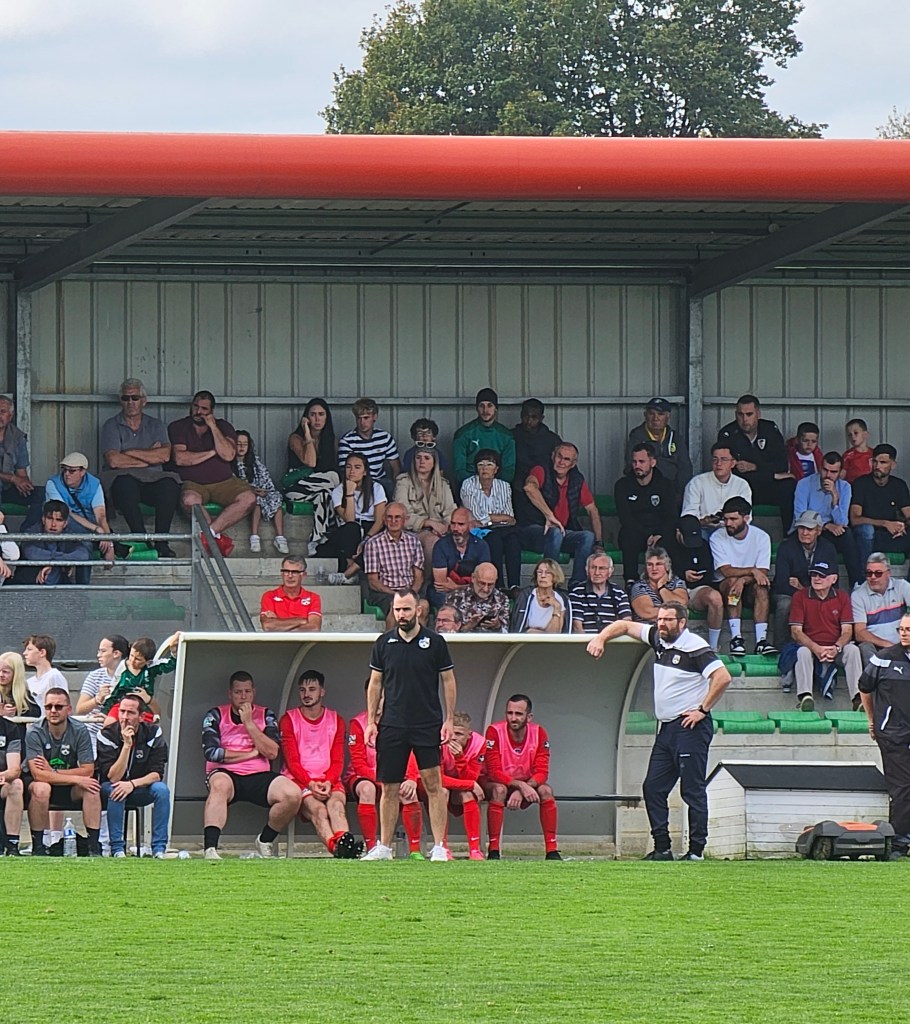
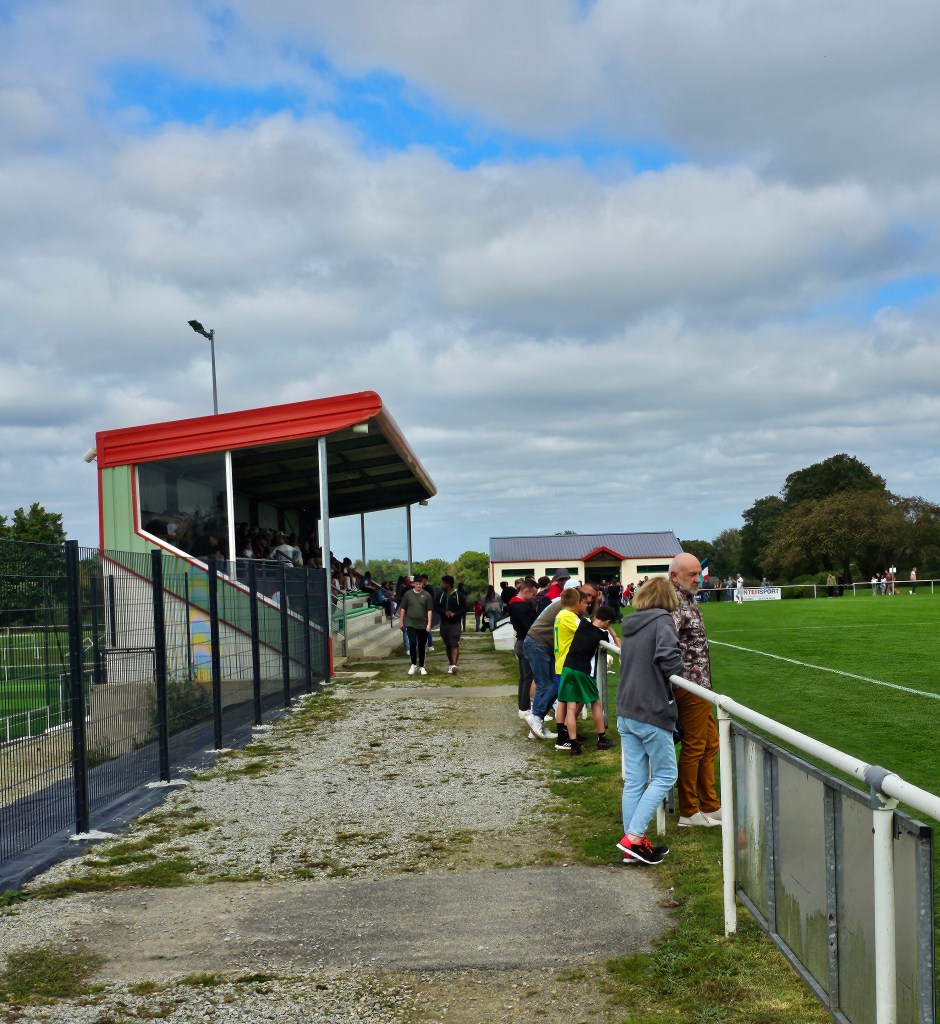
Ligue National 2 is the fourth tier of French league football; it consists of amateur clubs and the reserve teams of the clubs in Ligue 1 and 2 and is divided up into four regional groups each containing sixteen teams.  There are nevertheless many clubs at this level that have previously been in the two professional leagues, and both Vannes and Chambly fall into this category, with Chambly having had just a single season in Ligue 2 as recently as 2020; neither club has ever scaled the heights of Ligue 1 but Vannes were in Ligue 2 from 2008 to 2011 and reached the final of the Coupe de la Ligue (League Cup) at the Stade de France in 2008, although they lost 0-4 to Bordeaux.

Vannes is a coastal town and former port, which in some ways might be said to be comparable to my hometown of Ipswich due to its physical geography and former dockside and having a history dating back well over a thousand years, although based on how busy it is today Vannes seems to be thriving a little more than Ipswich at the present time, but then France is in the EU and the French realise in the spirit of egalite and fraternite that taxation and public spending allow money to be spent for the greater good.

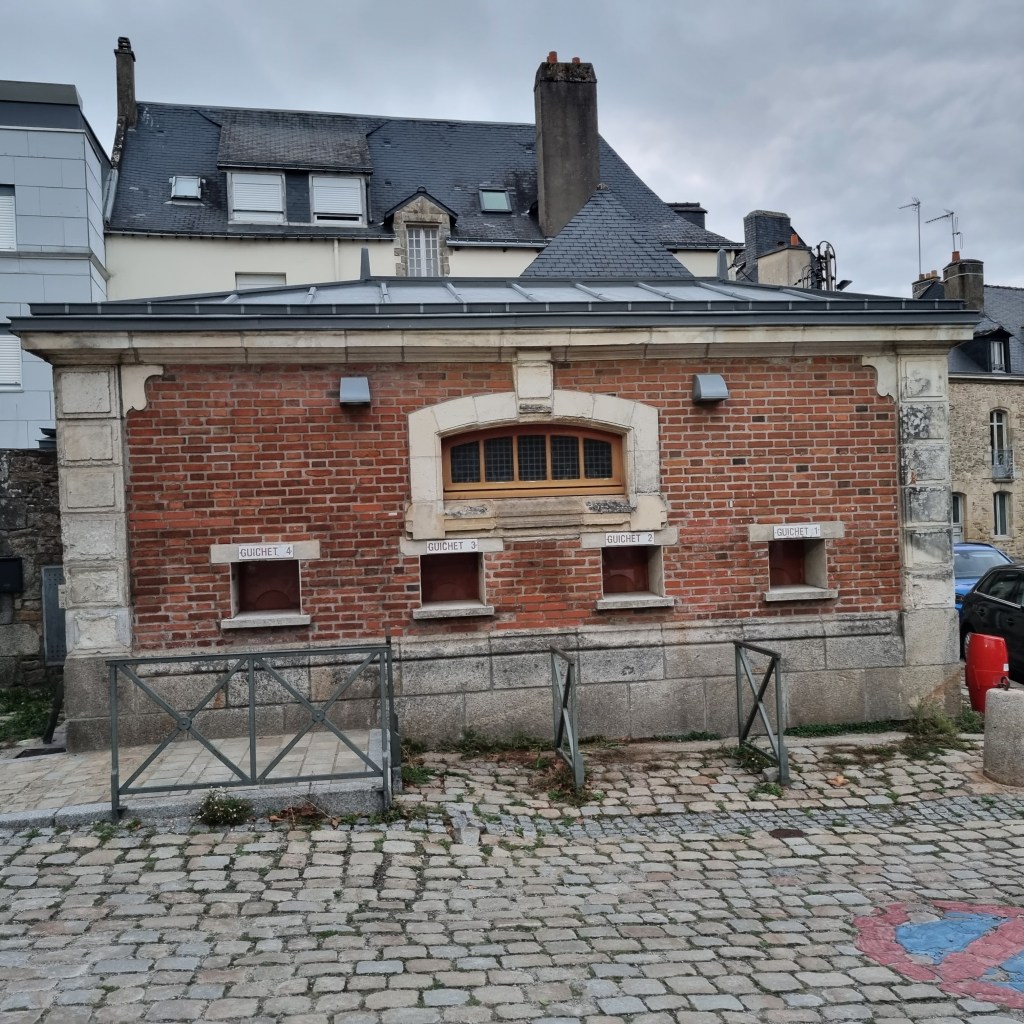
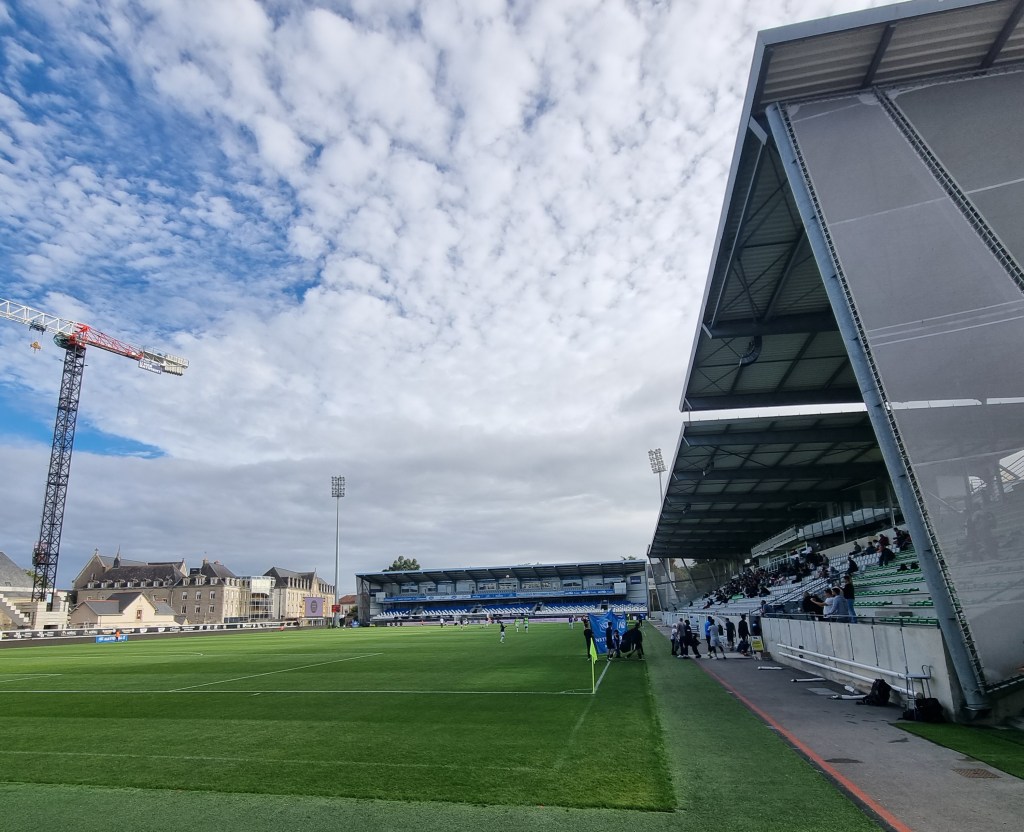
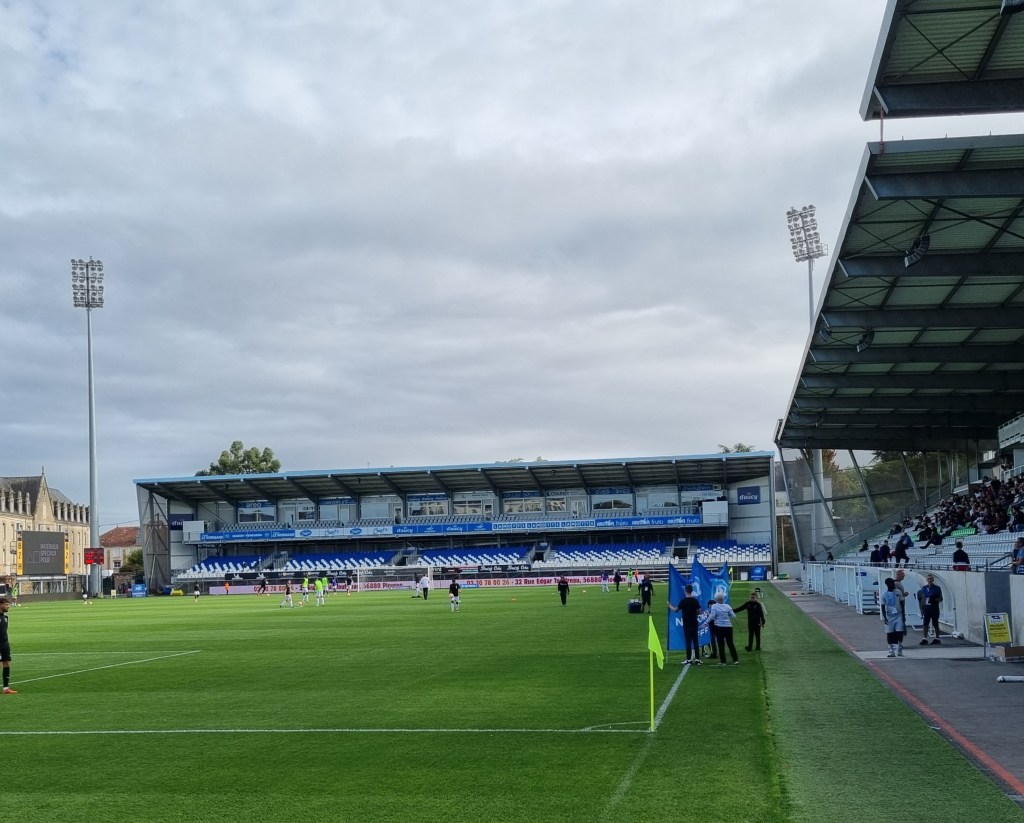
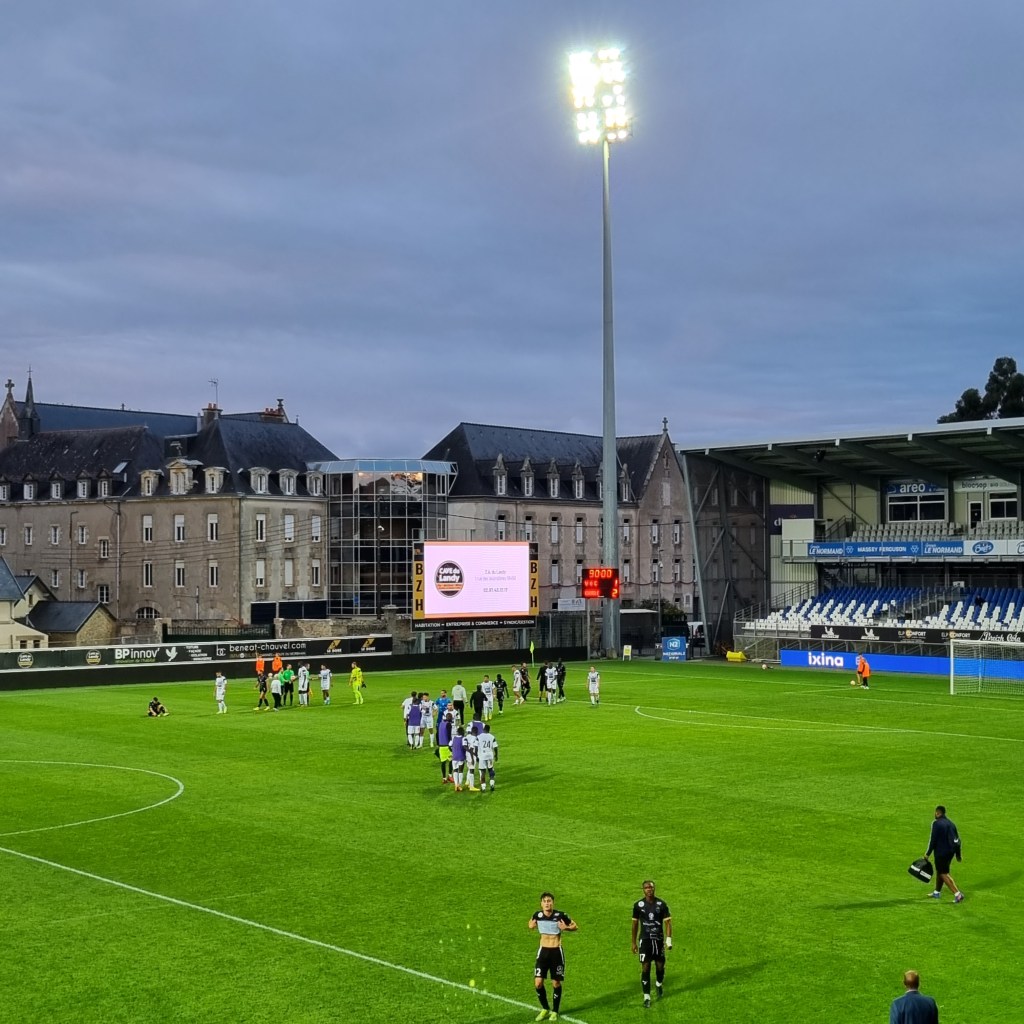
After a lazy afternoon in Vannes spent mostly sat at a pavement café, in the gardens beneath the town walls and by the old port which is now filled with yachts, my wife Paulene and I stroll across the road from the port to the guichets where we buy two tickets (8 euros each) for this evening’s match which kicks-off at six-thirty.  Entry to the Stade de la Rabine is just up the road and round the corner from the guichets and at the gate our tickets are checked, and the stubs torn off by two redoubtable looking middle-aged women.  Entry takes us directly into the under croft of the steel framed south stand; walking along beneath the upper tier it feels like we are in a lofty cloister.  The main stand is a plain concrete and steel structure typical of many French municipal stadiums but a little newer than most.

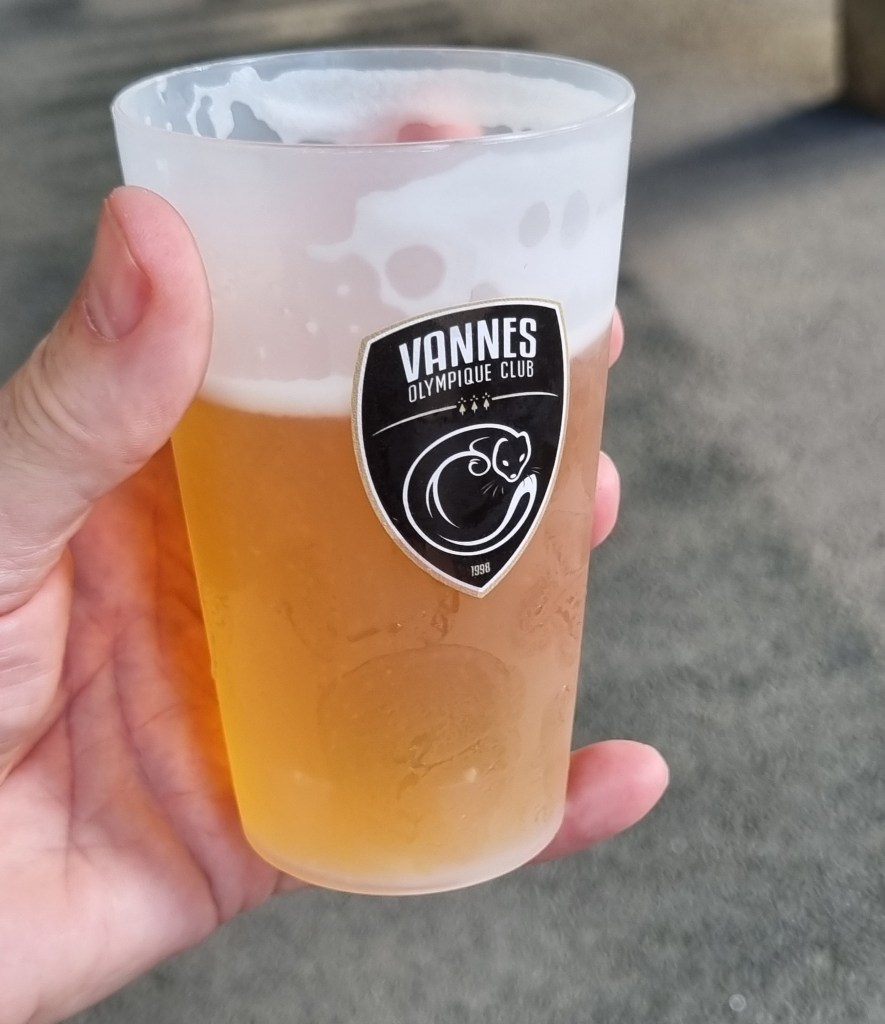
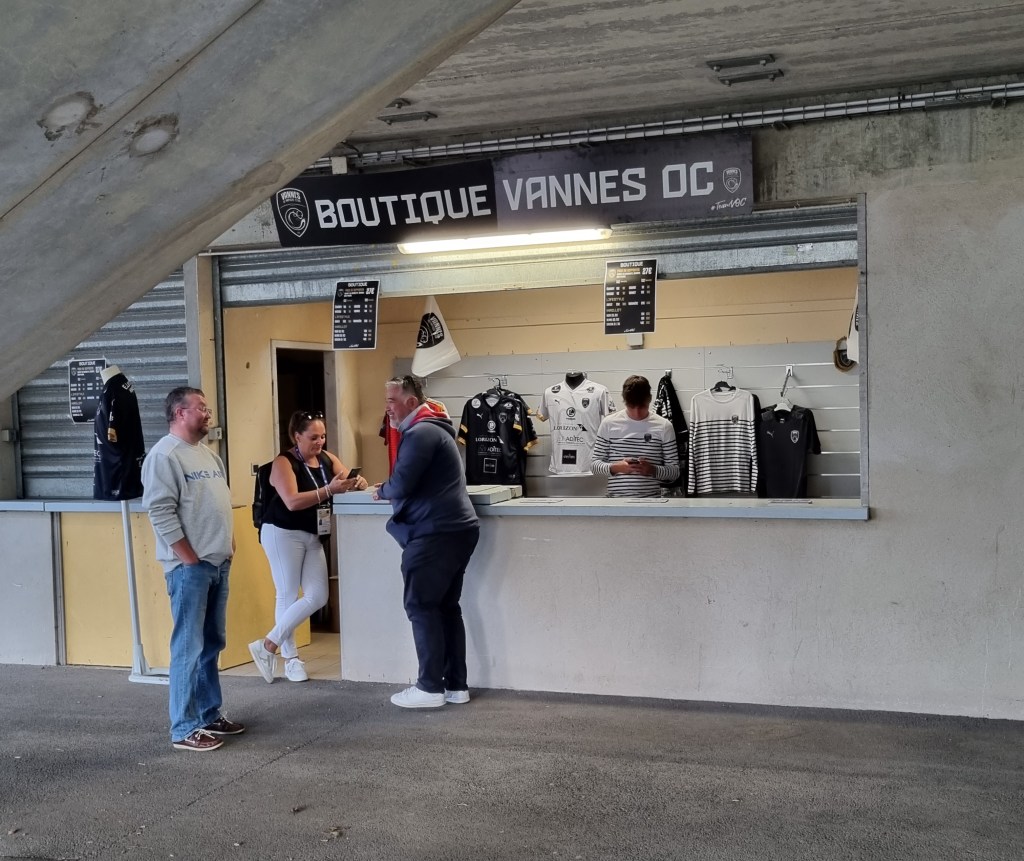
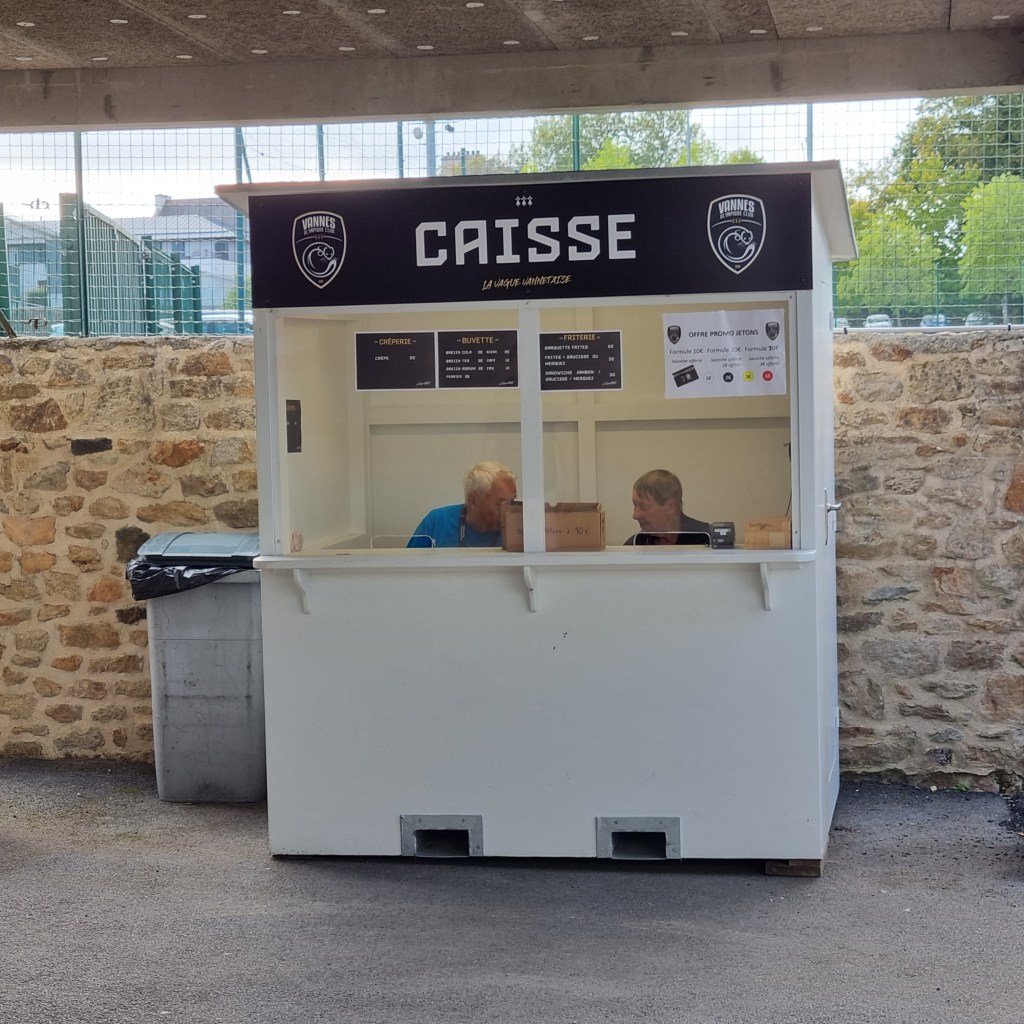
Getting into the feel of what is effectively the French equivalent of ‘non-league’ football, I have to have a beer. An un-identified blonde beer in a re-usable plastic cup adorned with the club crest costs just 2 euros. Paulene has a coffee and bottle of water which are a euro each, but first I must exchange my cash for the Jetons (tokens) that are the only means of paying for food and drink in the ground.  I am happy to see there is also a club shop where for just three euros I add another petit fanion (pennant) to the collection that hangs above the cistern in my upstairs toilet back home. I wander about a bit and snap a few photos and then we find our seats as the PA system plays some rather strange bland electro-pop music, as it has done since we first walked in.

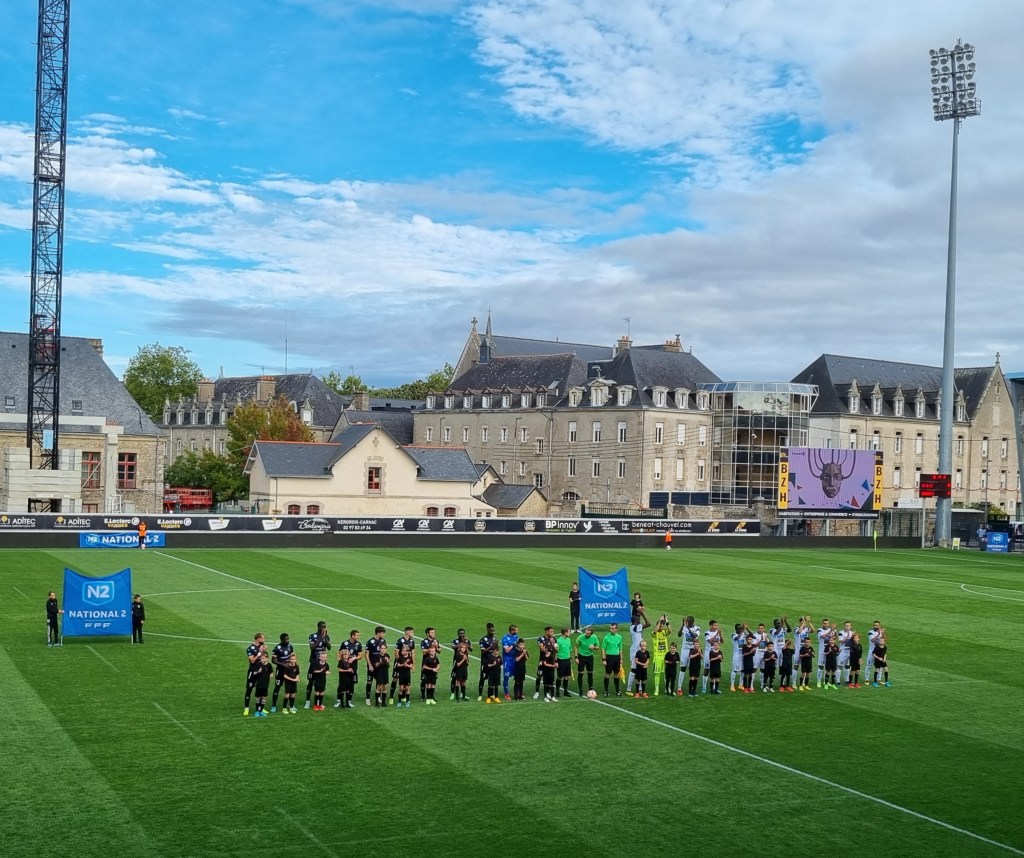
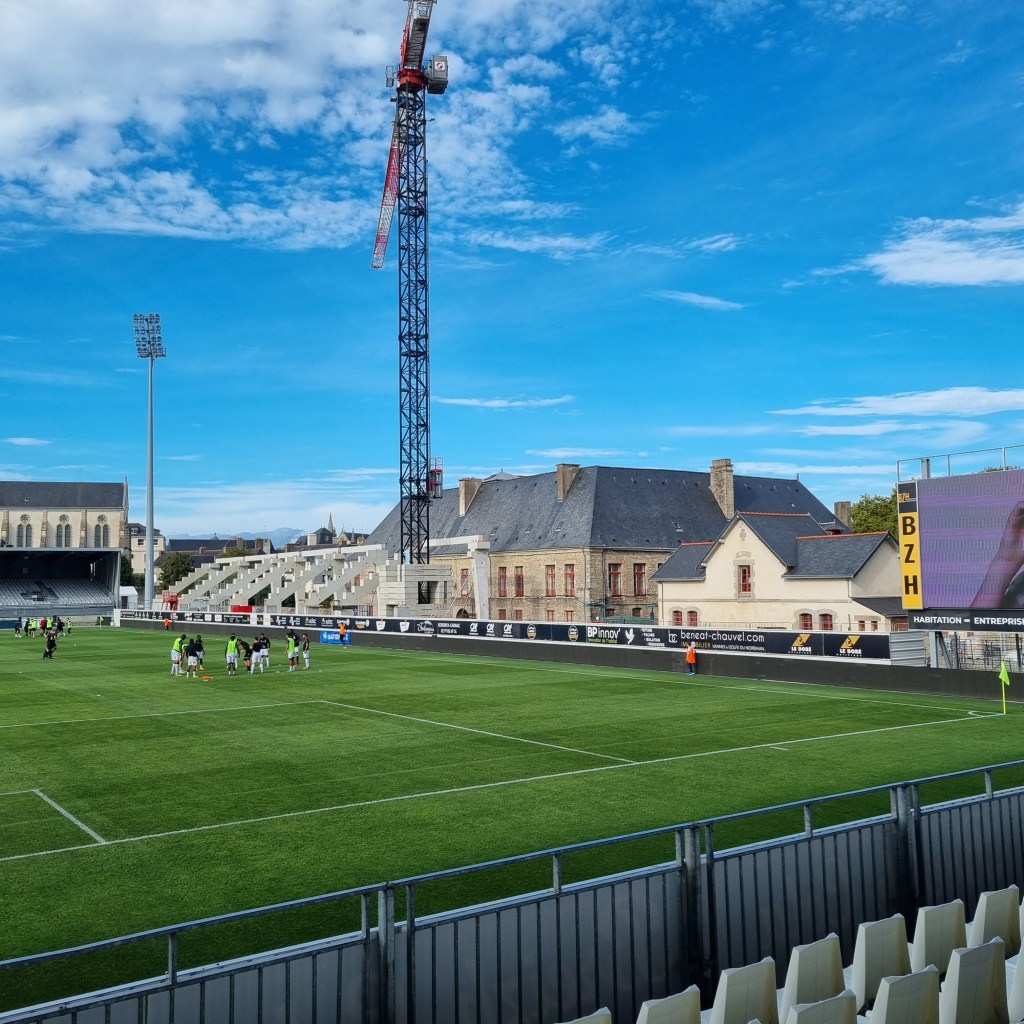
The main stand eventually fills up with the usual collection of old blokes, actual and would-be wives and girlfriends of players, young boys in club tracksuits who probably play for the under 13s team, and other sundry supporters of the local team.  The stand to our left is completely empty; there is one lonely man in the stand to our right and the far side of the ground is a building site on which the concrete frame that has so far been erected could be compared to a sort of modern-day Stonehenge, but only if the light was very, very bad.  The teams process onto the pitch and line up in a single row before two banners proclaiming the name of league National 2.  Three-minutes late, at twenty-seven minutes to seven after a ‘ceremonial’ kick-off involving two older men in smart but casual clothing, Chambly Oise kick off, aiming towards the goal in front of the two-tiered stand occupied by the lone supporter.

Before three minutes have passed, Chambly win the games’ first corner.  A minute later and a cross from the left is diverted into the Vannes goal by the foot on the end of the outstretched leg of Chambly’s number 19, which he has dangled beyond the defender who is alongside him.  The goal catches me by surprise a bit, as it did that defender, and I clap, drawing a look of mild disapproval from the very tall, elderly man who is folded up on the seat next but one to me.  To be honest I had thought Chambly were Vannes because Chambly are wearing an all-white kit whilst Vannes are wearing all-black and I couldn’t imagine that any club’s first choice kit would be all-black; I had therefore assumed that they were the away team.   The French Wikipedia page on Vannes OC later tells me that Vannes OC did formerly play in black and white but changed to all-black a few seasons ago; personally, as someone who still can’t get used to seeing teams of referees, I think it was a bad decision.

The quality of the football so far is not high and the crowd is quiet, particularly the lone man behind the goal, but Chambly look the better team.  In the absence of anything more interesting I note that the Chambly players do not have their names on the back of their shirts, but the Vannes players do with the exception of number 33.  Also, number 9 for Vannes, whose name is Ebrard, has one leg of his shorts hanging down, but the other one rolled up.  Paulene and I speculate as to why this is.  Is it perhaps to remind him to kick the ball now and then with his weaker foot or, in the absence of a knot in his hankie, is it something more prosaic such as a reminder to put the cat out when he gets home.

In the eighteenth minute a cross from the right by Chambly’s number 8, a short, stocky and industrious player, is headed in unchallenged by the towering number 23.  The Vannes goalkeeper Pettiogenet (number 40) gets a hand or two to the ball but cannot prevent it from hitting the net.  The goal seems to further prove the point so far made that Chambly are the better team. But slowly Vannes are improving, as if they needed at least twenty minutes to warm up, and they win a couple of corners. Ebrard looks keen and almost threatens on a couple of occasions before, as the game is about to enter its second third, he dribbles into the penalty area and tumbles to the ground as a result of a probable trip.  Ebrard gets up and strikes the ball to the anonymous goalkeeper’s right and with his right foot, the one beneath the long leg of his shorts.  The goalkeeper gets a hand to the shot but cannot keep it out, merely pushing it into the corner of the net. 

A couple of minutes after the goal the eager Ebrard concedes a free-kick as he dives in a little too keenly on a Chambly defender.  The defender doesn’t seem too bothered but the goalkeeper comes running out of his goal to remonstrate with Ebrard as if he now harbours a grudge against him for having beaten him with that penalty kick.  Vannes are now up and running and pressing for an equaliser and Kimbembe and Nzuzi link up well down the right and Nzuzi’s low cross travels to the far side of the penalty area where Ebrard has the time and space to sweep the ball majestically into the top left-hand corner of the stand behind the goal.  His attempt was a bold one as the outcome showed.

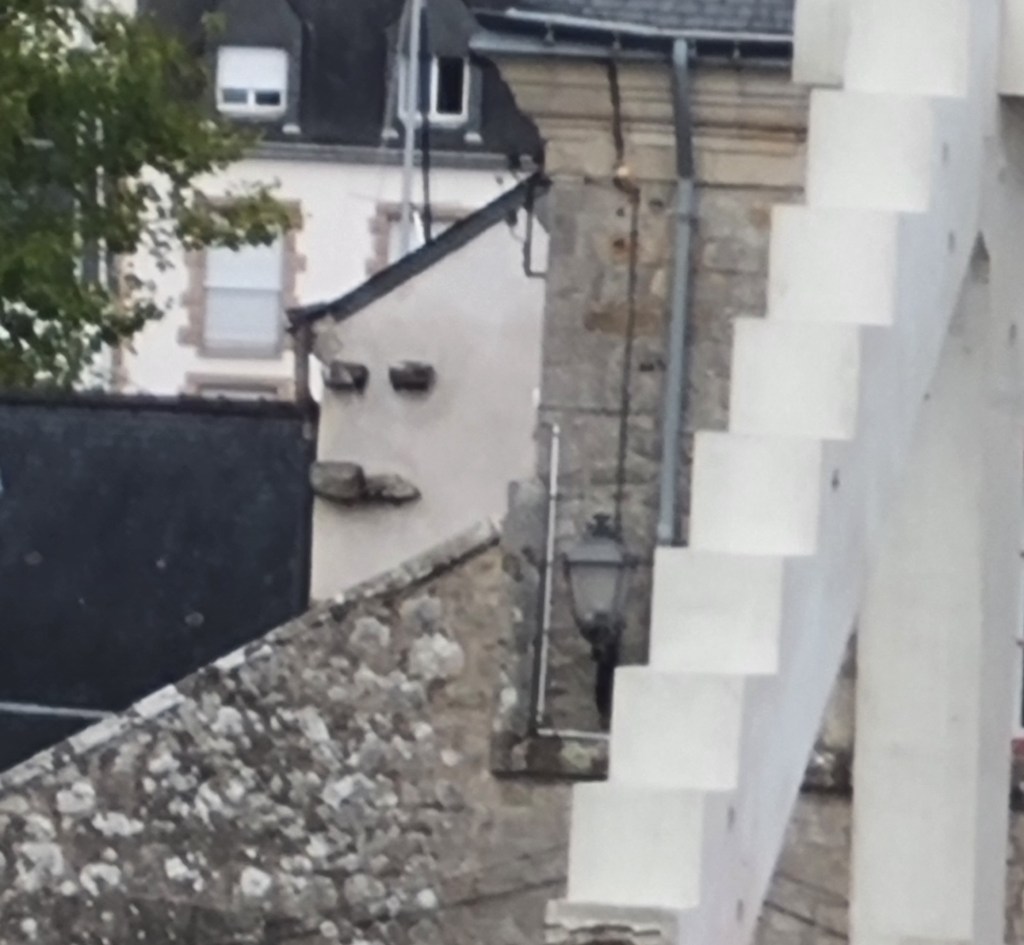
The last ten minutes of the first half are notable for Paulene spotting that a lean-to projection from the side of the building opposite looks like it has two eyes and pouting mouth.  A minute of additional time is played and I go and purchase a tray of chips (2 euros) with mayonnaise with my remaining jetons.  I return to the stand to eat my chips whilst a pair of black-headed gulls swoop into the stand on the look out for any stray deep fried food that might come their way; I guard my chips jealously and give the gulls a discouraging glare.

The match resumes at twenty-four minutes to eight. In the box like building next door to the lean-to building that looks like a face, a man is watching the game, presumably free of charge, from an upstairs window.  A short while later the windows are shut and we assume he decided it was either getting too cold to have the window wide open or he just got bored.  The second half sees substitutions for Chambly first as number twenty-seven replaces number eleven, and then for Vannes with Mvogo replacing Duclovel.  In a departure from how I have previously seen substitutions made, a woman in ‘late middle-age’ wearing a Breton jumper holds up the electronic board displaying the numbers of the incoming and outgoing players.  Paulene and I assume she is the club secretary , but alongside the referee’s assistant, the coaches and the delegue principal (an overseeing official) in his rather crumpled looking blue suit, she complements an interesting tableau of touchline figures.

The second half witnesses the first concerted outbreak of support from the crowd but in the form of the treble voices of the under 13’s who chant “Allez les Noires” over and over again, until they get bored, which thankfully doesn’t take too long.  More substitutions happen and Nzuzi is replaced by another anonymous player, the mysterious number thirty-four whilst anonymous thirty-three is replaced by equally anonymous thirty-two.  In due course the final minutes approach and there is a discernible effort from Vannes to finally equalise.  The ninetieth minute sees Vannes win a corner and in what seems like a final push both legs of Ebrard’s shorts miraculously appear to be the same length as he surges forward.  But it seems like his last hurrah and having lost the ball he stands bent over with his hands on his knees, a spent force.  Five minutes of time additionelle are announced, but Vannes can’t do enough to score and the initial judgement from the first twenty minutes that Chambly are the better team holds good.

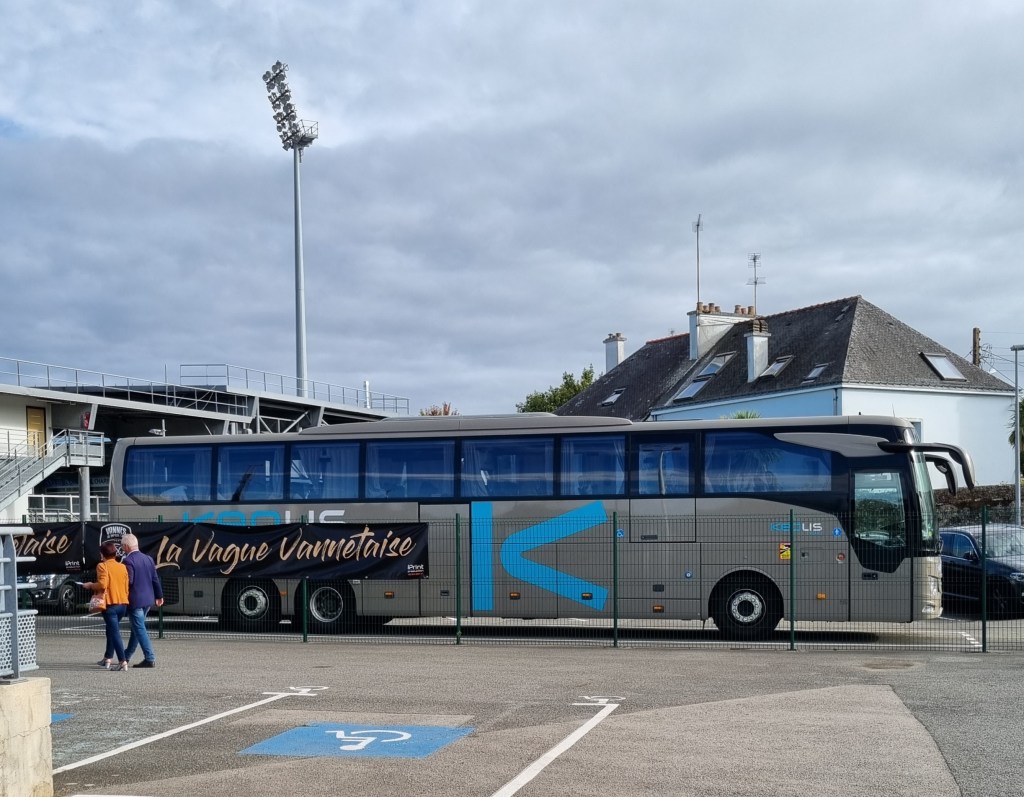
With the full-time whistle we exit the ground the way we came in and head back to our car, where we will learn we have to pay a stonking 9 euros 80.  If you come to Vannes for more than an hour or so try not to park at Republique.  It’s not been the greatest evening’s football in truth, but Vannes OC is a decent little club with an excellent stadium and lovely people selling the tickets, the food and the drink.  I sincerely hope they get back to Ligue National and possibly Ligue 2 soon. As the Under13’s told us “Allez les Noires”.

US Concarneau 1 AS Nancy 2

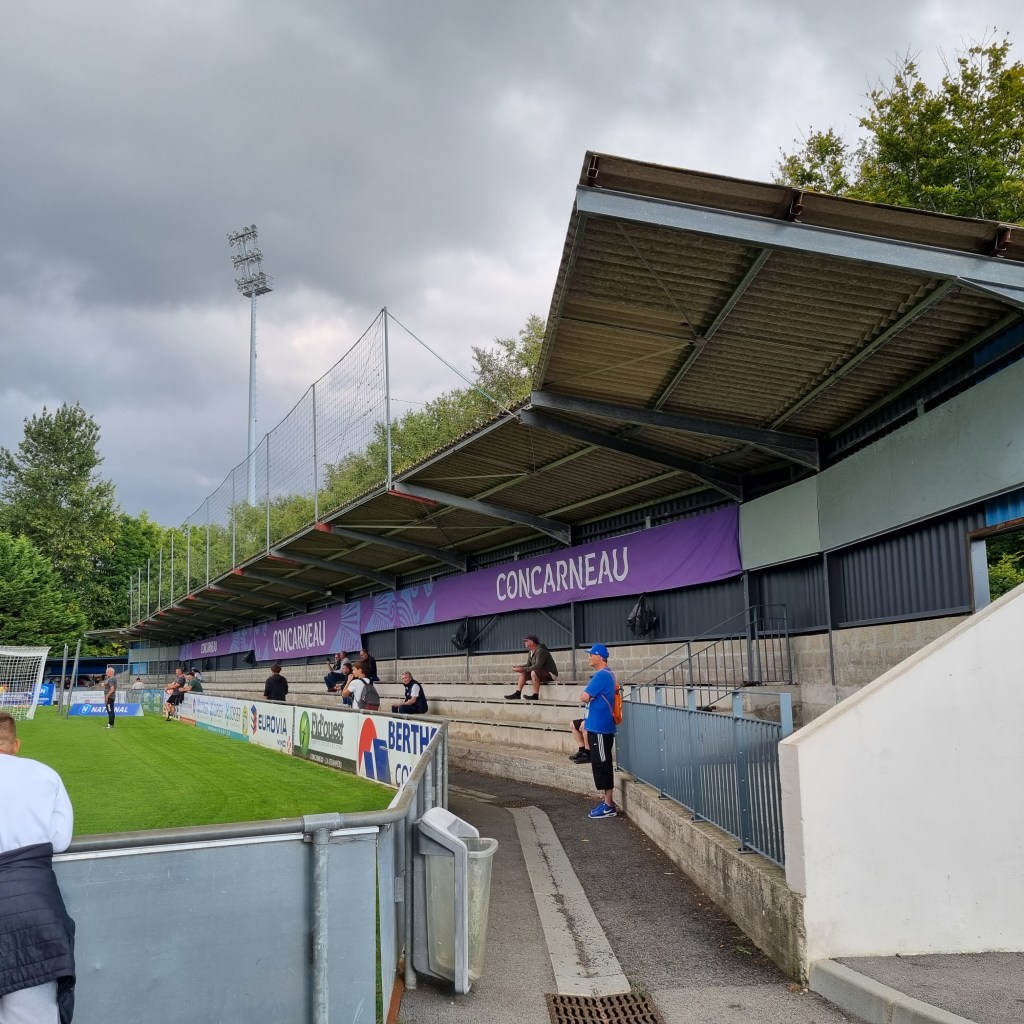
The Breton coastal town of Concarneau is apparently best known as a successful fishing port and for its walled Ville Close, a quaint and historic medieval fortified town transformed into an appalling tourist trap full of the sort of shops or pristine buildings you find in places like Lavenham or Bourton-On-The-Water in England. In its favour however, Concarneau is also home of the Brasserie de Bretagne (Britanny Brewery) and Union Sportive Concarnoise, its local football club, which plays in the third division of French football known as Ligue National.

US Concarneau, as they are commonly called, are relatively recent arrivals in Ligue National and have aspirations to reach Ligue 2; tonight, they face Association Sportive Nancy-Lorraine, more usually known as AS Nancy, a club which has twice won the French FA Cup and spent twenty-five seasons in Ligue 2 and thirty in Ligue 1.  Today however, Concarneau are second from top of Ligue National and Nancy seventeenth, albeit after just three games.

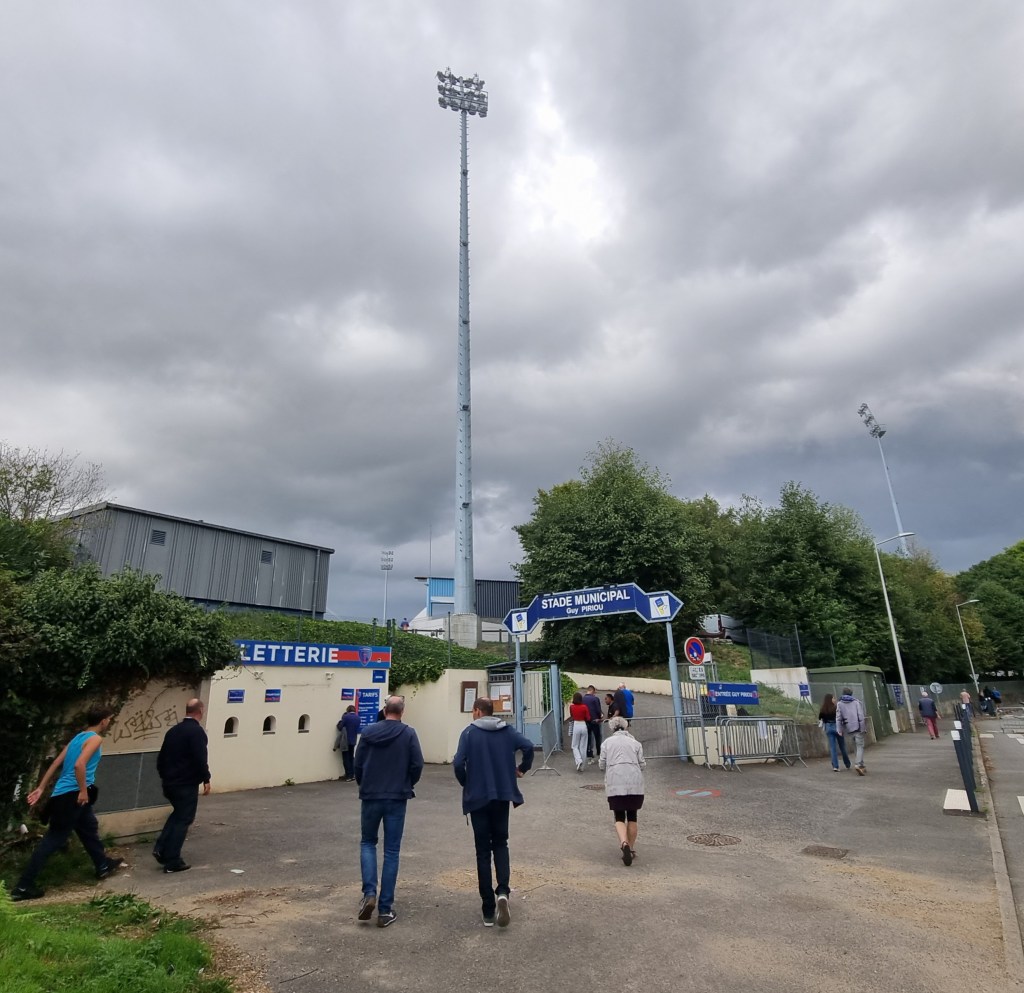
The Stade Guy Piriou where USC play their home games is at the edge of town in that nether world of retail parks, Zones Industrielles and feeder roads inaccessible to pedestrians. I had asked in the Tourist Information Office where is a good place to park and the pretty young woman there had rolled her eyes with a look that told of chaos, but then said we could park in the car park of the LeClerc supermarket which is about 100m from the ground through a tunnel beneath the main road.  After getting a bit of shopping and an evening picnic, which my wife Paulene and I eat in the car, we make for the ground.

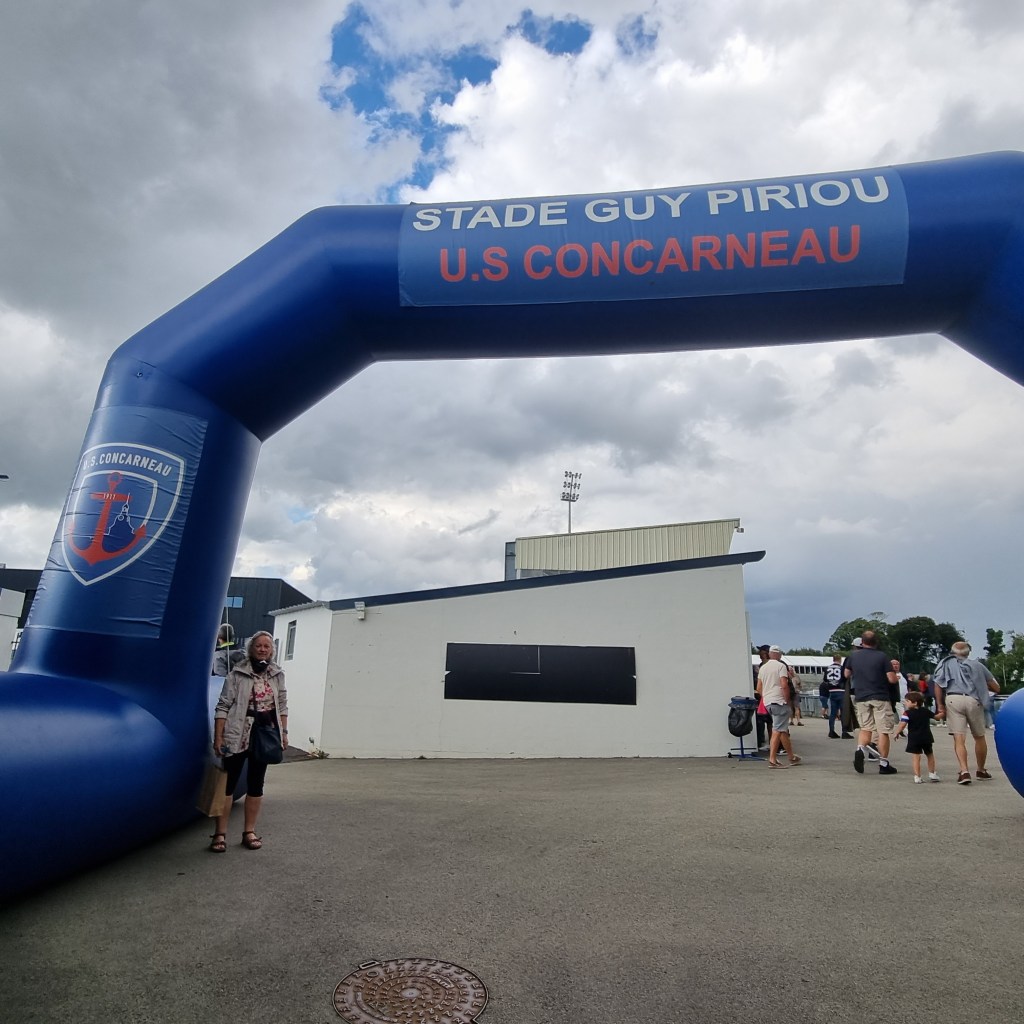
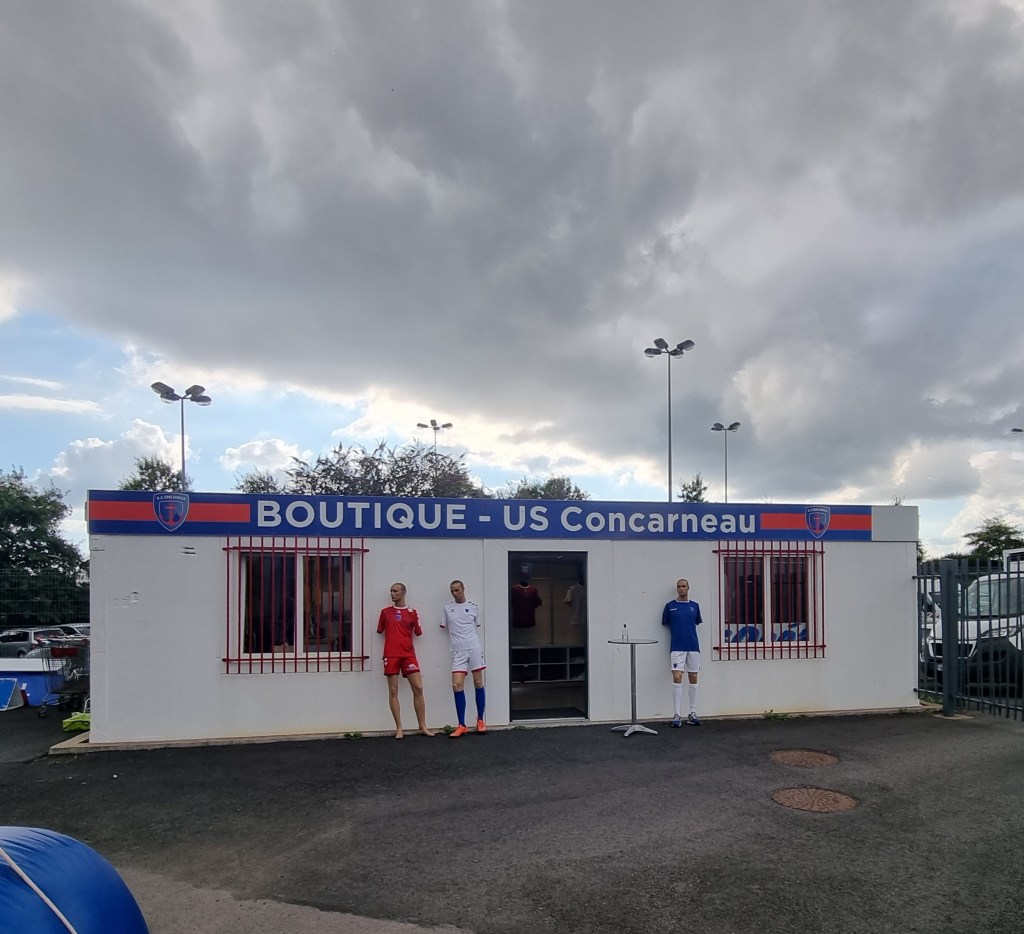
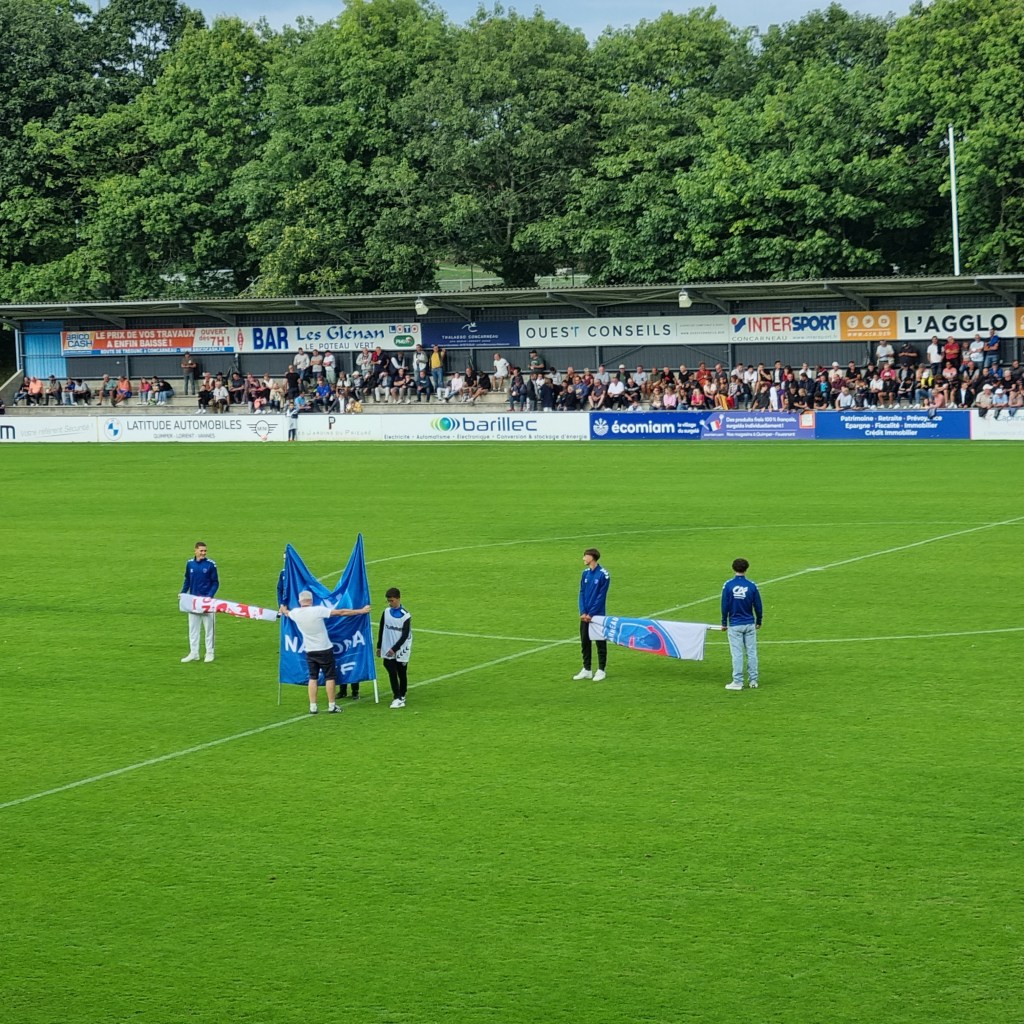
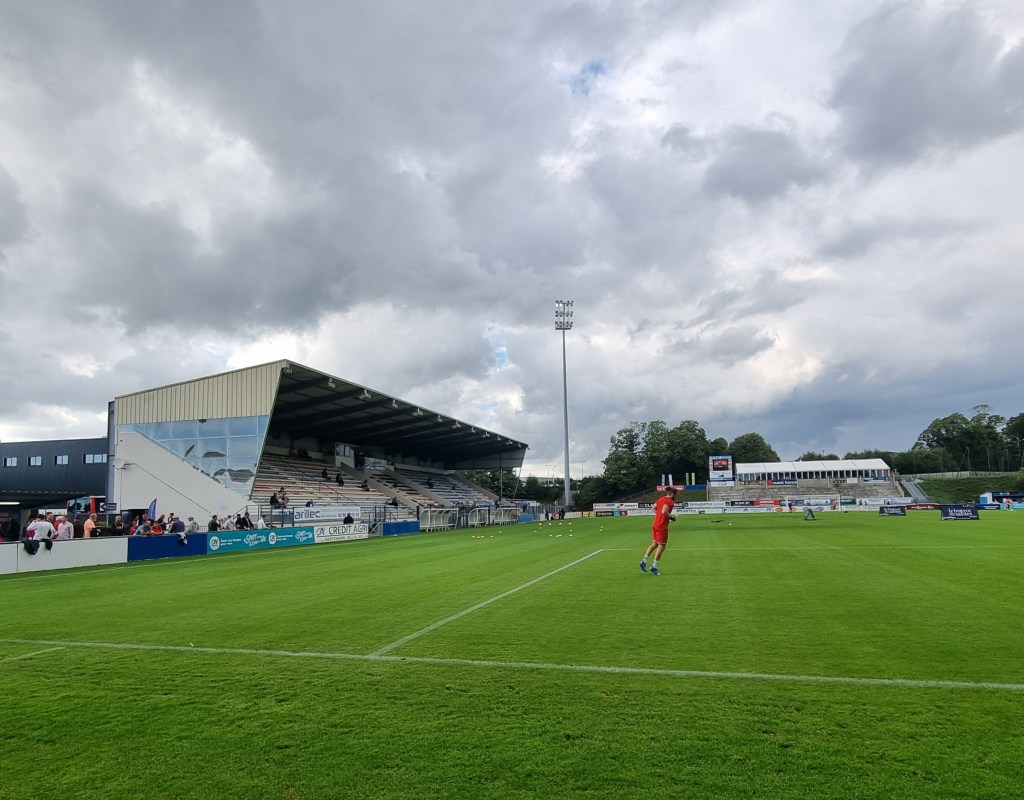
Having had difficulty trying to buy tickets on-line we had visited the ground earlier in the afternoon on arrival at Concarneau.  Although there are guichets open at the entrance to the ground selling tickets, these were shut when we arrived earlier and I had gone directly into the club office where I had selected our seats on someone’s lap-top and stood by his desk as he printed out two tickets for the main stand (12 euros each).  The stadium sits on the top of a small hill and the main entrance delivers us up a slope through an inflatable arch to the corner of the stadium; I don’t know if I’m in a football ground or a bouncy castle, but there is a main stand in front of us and to our left.  Pleasingly there is a club shop where for 5 euros I add to the collection of petit fanions (pennants) that adorn my upstairs toilet at home, and also purchase a mug (9 euros) and acquire a match day programme which, like at every French club that produces a programme, is free.  The ground has three excellent buvettes which remind me of stalls at a fairground; they serve huge sausages piled on top of massive heaps of chips, and the very tasty local ‘Britt’ beer. After visiting what is possibly the smartest and sweetest smelling toilet I have ever encountered in a football ground; it’s all stainless steel and shiny coloured tiles, I change euros into tokens worth a euro each and buy a beer for me (3 euros) and a cola (2 euros) for Paulene, which surprisingly and disappointingly is not Breizh Cola. I then join Paulene in the main stand for the pre-match entertainment of observing everyone else arrive, search for their seats or eat sausage and chips, before watching a fastidious man organise three pairs of youths into holding banners displaying the Ligue National logo and the two club crests.  Off to our left the match ball sits above a plinth in front of the players’ tunnel and appears to be hovering in mid-air.
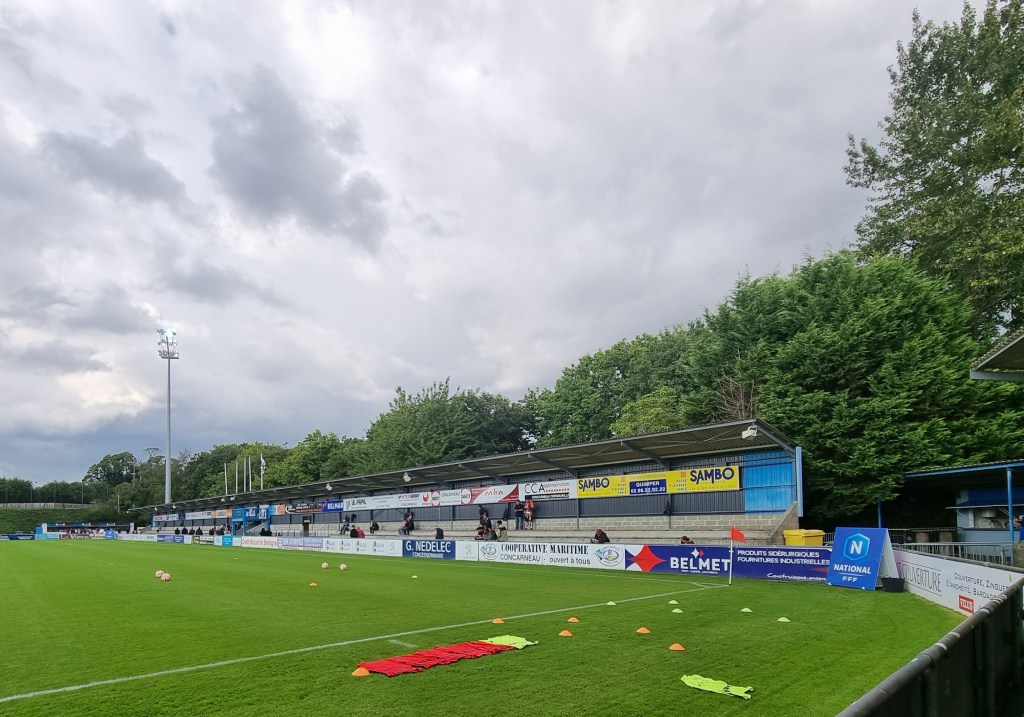
At half past seven the match kicks off, with Nancy in their all-red kit getting first go with the ball.  Concarneau are in blue shirts and socks with white shorts and the first chant of the evening surprisingly emanates from the main stand; “Allez les bleus, Allez les bleus” confirms that I am not suddenly colour blind. On the far side of the ground, in the long, low, basic but well maintained partly seated, partly terraced stand a knot of supporters sing “Allez, Allez, Allez” to the tune of The Beatles ‘Yellow Submarine’.  

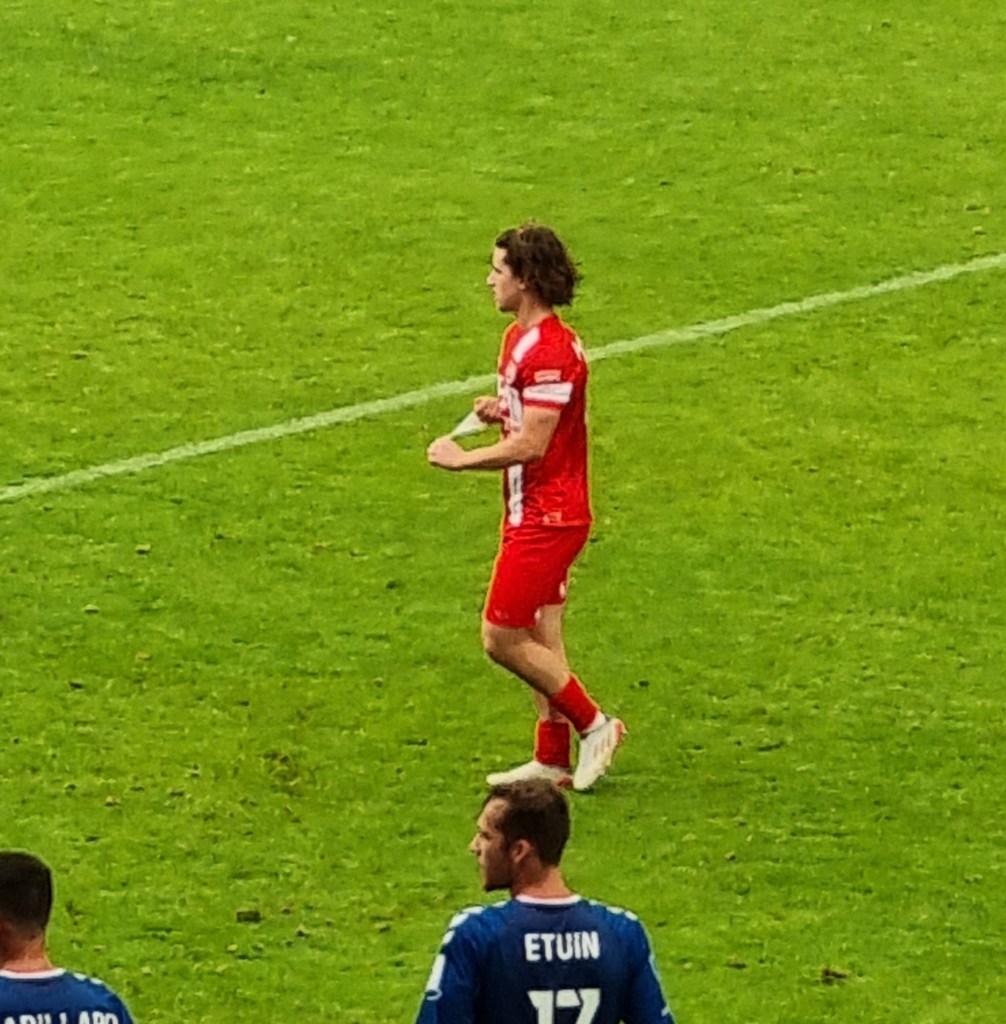
Perhaps because of the backing of the home crowd, USC quickly settle into the game and their number 24 Ambroise Gboho soon threads an excellent diagonal through ball into the path of Antoine Rabillard, who has made an overlapping run, but Rabillard hits his shot straight into the body of Nancy’s goalkeeper. USC’s Amine Boutrah then wins the games’ first corner and Tom Lebeau wins the second. “Allez les bleus, Allez les bleus” sings the home crowd again.  Lebeau crosses the ball and Rabillard heads over the bar. Low, evening sunlight falls across the pitch illuminating the grass vividly where it doesn’t cast a lengthening shadow of the main stand. The sky is gun metal grey in the distance; there have been heavy showers inland throughout the day and a rainbow extends up then fades away beyond the opposite stand.  Behind the left-hand goal, on the steep concrete terrace below the hospitality area people appear to be putting their coats on; it doesn’t seem to be raining but briefly there is a faint rattle on the metal roof of the stand.

Back on the pitch, Nancy’s defending is effective but becoming more desperate and Lucas Pellegrini is the first player to see the carton jaune (yellow card) of the referee after he knocks over USC’s Amine Boutrah, who I am not surprised to read in the programme is the player of the month for August.  Within sixty-seconds Nancy’s number eight, Lenny Nangis follows the bad example that has been set and is booked for a foul on USC’s Georges Gope Fenepes.  If Lenny Nangis has any defence, it is that he has a great name.  The resultant free-kick is deflected over the cross bar for another corner to Concarneau.  A third Nancy player is booked five minutes later when Baptiste Mouaza fouls Ambroise Gboho. The supporters on the far side of the ground sing the na-na-nas from The Beatles’ “Hey Jude” and then Mouaza provokes a sharp intake of breath as he trips USC’s Gaoussa Traore and we await the consequences. Like a not very good magician the referee holds up his yellow card and then with a distinct absence of sleight of hand replaces it with a red one.  Mouaza hangs around for a bit, seemingly discussing his misfortune with anyone who’ll listen as most of the other players crowd around the referee and the prostrate Gaussa Traore. When the melee clears and Traore has risen from the dead, Mouaza seeks clarification from the referee that he is no longer required on the pitch and his worst fears are confirmed with a wave of the referee’s arm.

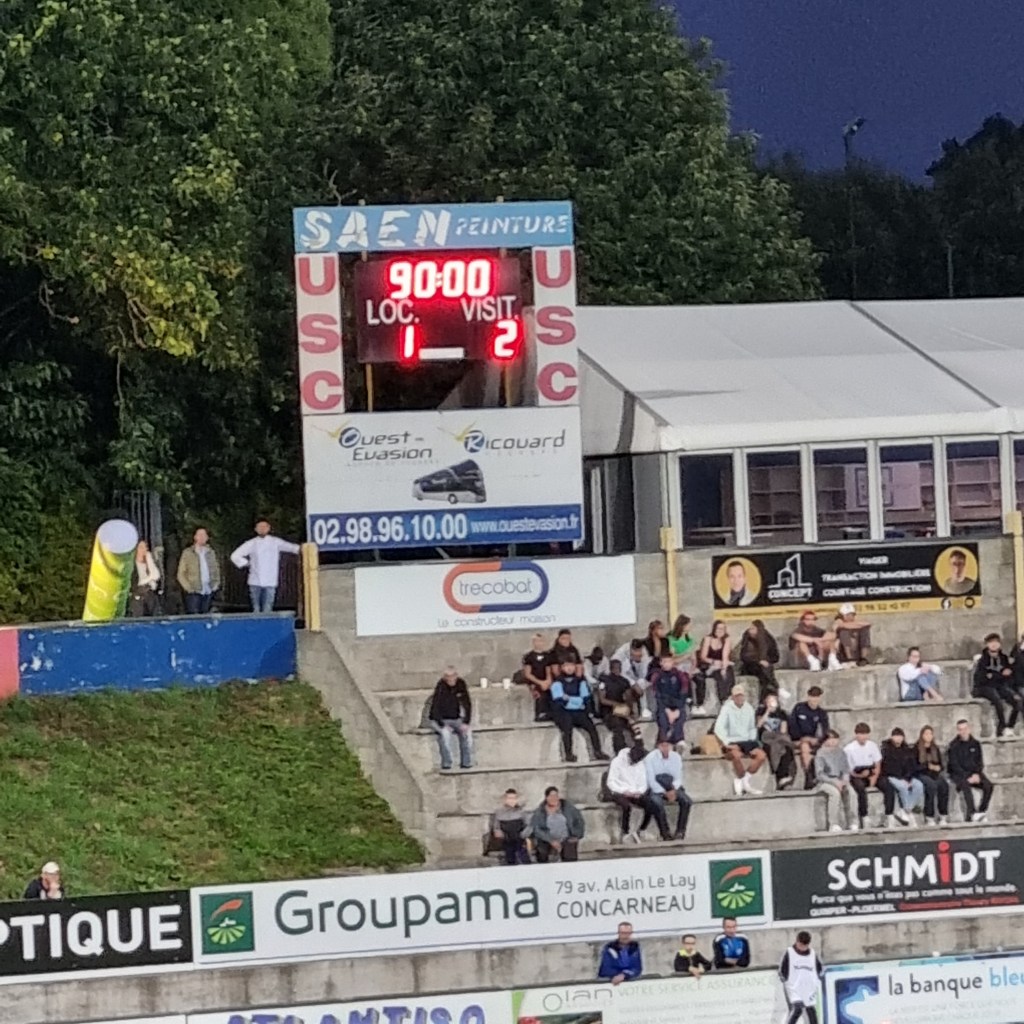
  A minute of the first half remains, and USC win another corner; the ball is crossed from the left and having evaded everyone else, falls in front of captain Thibault Sinquin who appears to do little more than absent-mindedly stick out a leg, and thereby scores.  After two minutes of added on time, the teams retreat to the dressing rooms for mi-temps (half-time) with Concarneau in possession of a well-deserved lead, although having failed to score for the first forty-four minutes the eventual goal came as a bit of a surprise. Half-time sees a flood of people towards the buvettes and I get up from my seat to stretch my legs and peer down on them through the scratched Perspex screen at the end of the stand.

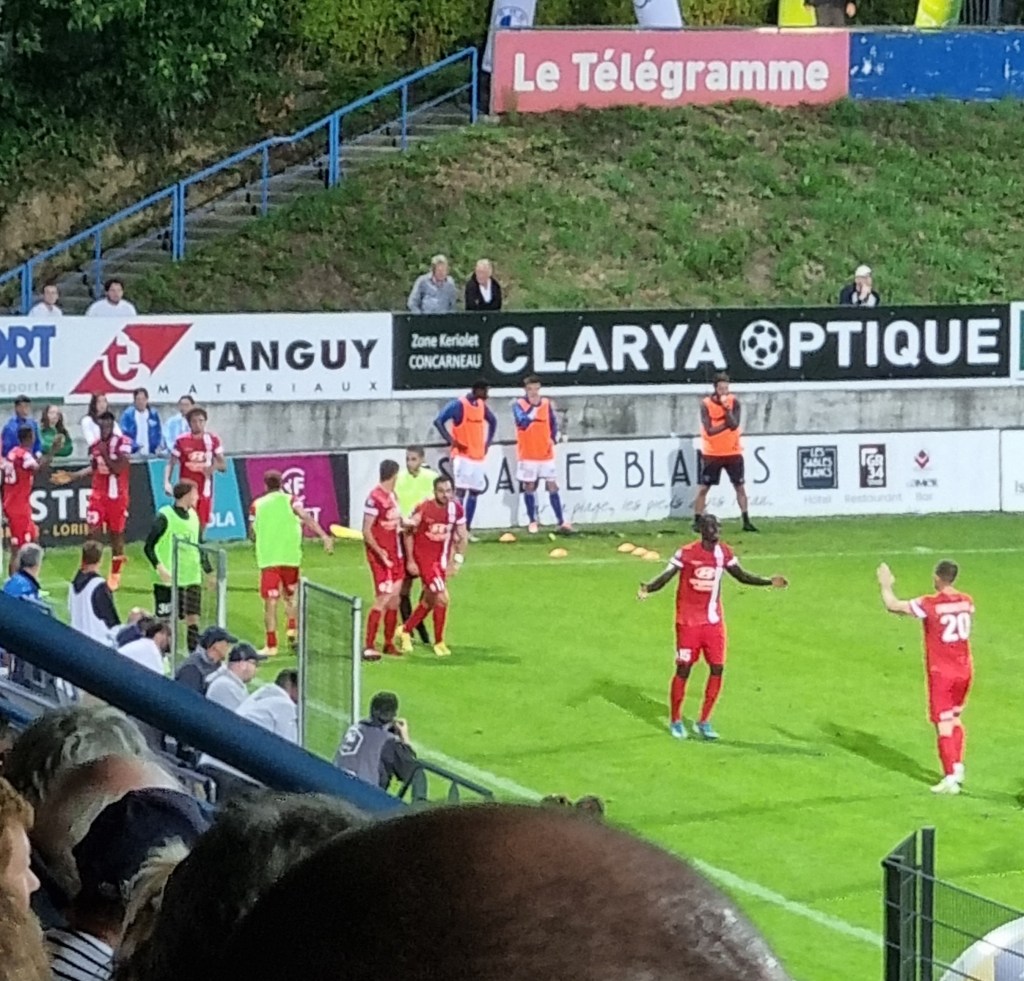
The game resumes at 8:32 and although Nancy have some early forays down the flanks it is USC’s Ambroise Gnoho who comes closest to scoring but for an offside flag and Lebeau shoots past the post from all of 30 metres.  With just ten minutes gone of the new half Georges Gape Fenepes,  who might be the first player from New Caledonia I have ever seen, is substituted by Faisal Mannai.  I don’t think it’s Mannai’s fault but within a minute of his appearance a passing move down the left for Nancy ends with the sort of cross commonly known as ‘inviting’, and Lenny Nangis  accepts the invitation, heading firmly into the Concarneau net to unexpectedly equalise.

Despite having lost their lead, Concarneau will surely still go onto win having a man advantage and they continue to press forward with Robillard, Traore and Boutrah always looking the most likely to conjure up a decent chance.  With a third of the match remaining USC win another corner after a flurry of activity around the Nancy goal.  A low cross from the right is just too far ahead of everyone to allow anyone to touch it into the net.  “Merde” says the bloke behind me through gritted teeth as a pass by substitute Faisal Mannai is intercepted by a Nancy player who breaks forward into the Concarneau half.  Nothing comes of it however and Thibault Sinquin in turn breaks forward for USC from his centre half position, but his low cross from inside the penalty area is cleared.

The game is into its last fifteen minutes or normal time and Gaoussa Traore lashes a shot somewhat desperately, which travels high and wide of the Nancy goal.  Nancy substitute Lamine Cisse for Isaak Umbdenstock, but not before Cisse looks confused as to which direction he must run to leave the pitch; after initially running away from the benches he checks and runs back and Umbdenstock runs on.  Concarneau replace Adrien Jouliex with Alec Georgen but are coming no closer to scoring a second goal.

Ten minutes remain of normal time and Nancy win a rare corner;  Diafra Sakho meets the ball on his forehead and Nancy are suddenly winning as the ball bulges the net with the Concarneau goalkeeper and defenders static.  Even now I can’t bring myself to believe that Concarneau won’t equalise,  but as Tom Lebeau is replaced by Pierre Jouan there are just seven minutes left and Nancy are taking every opportunity, and creating more to eke out that time by winning free kicks and staying down on the ground.  When a player goes down ‘injured’ on the far side of the field the slow-moving physio who looks about seventy-five can only trundle across the pitch.  Nancy make use of their penultimate substitution before six minutes of added on time are announced and then make the final one as they control the end of the game, not in terms of active football but in terms of frustrating Concarneau by fragmenting the remaining time into useless moments of nothingness.

Full-time arrives too soon for Concarneau and Nancy will make the 920 kilometre journey back to Alsace with an unexpected win, which in the context of modern football they deserve, but it wasn’t always much fun to watch and many would say they had ‘stolen’ the points.  Nevertheless, Concarneau is a great place to come to watch a match and is reminiscent of an English fourth division ground but with better beer, better food and cheaper admission prices; Paulene and I therefore have had a splendid time.

Ipswich Town 0 Barrow 0

When I first became interested in football at the tender age of ten, Barrow were in Division Four and had been in the Football League since 1921, when they were elected as original members of Division Three North.  In my Observer’s Book of Football, the one that has a picture of Bobby Charlton on the dust jacket, it states “Honours have always been elusive for Barrow” and it goes on to say that Barrow had just “one season of triumph”, in 1967 when they finished third in Division Four. Sadly for Barrow, by the time I first saw them play, at Layer Road, Colchester in 1990, they had been replaced in the Football League by Hereford United and were not yet half way through a forty-eight year stint in non-league football.  Thirty years on and today, through the wonder of the 2nd round of the FA Cup, Ipswich Town and Barrow meet for the first time ever. I’ve been looking forward to today’s game to some extent since 1971, but more tangibly since the Cup draw was made, and in reality since Idris El Mizouni’s cracking goal ensured Oldham Athletic wouldn’t be making an unexpected run to Wembley.

As befits an FA Cup Day, the sun is shining gloriously, although with little impact on the outdoor temperature as I stroll across Gippeswyk Park and up Portman Road beneath clear azure skies.     Portman Road is notable this afternoon for the atypical absence from the car park behind Sir Alf Ramsey’s statue of some of the usual vendors of chips and other grease-based foods sold inside spongy ‘bread’ products.  There is also a corresponding shortage of human beings in Portman Road today compared to other match days, and whilst you might infer from this that people only come for the grease-based foods, the sadder truth is that the FA Cup simply doesn’t attract football fans like it once did.  I can recall paying full-price to watch Town play fourth division Halifax Town and Hartlepool United in the company of about 24,000 other souls back in the late 1970’s, and now find it hard to understand why with reduced ticket prices the lure of Cup glory against such Northern exotics is no longer an attraction.  In this age of instant gratification and tv reality game shows, Cup football should be more popular than ever with its promise of advancement to the next round and the jeopardy of defeat and expulsion from the competition after just ninety minutes; Death or Glory as The Clash sang just a year after Town lifted the FA Cup. The tyranny of Sky tv and the Premier League is clearly to blame.

Having purchased a match day programme (£2), I head on to what was The Arboretum pub back in the days when 24,000 turned up to see Hartlepool United and Halifax Town at Portman Road,  but is now The Arbor House.  With a pint of Mauldon’s Suffolk Pride (£3.80) in my cold right hand I sit and wait for Mick in the garden.  Mick soon arrives with a pint of Mauldon’s Molecatcher, a packet of Fairfields Farm cheese and onion crisps and a cup of dry-roasted peanuts.  Mick explains that Molecatcher is brewed to the same recipe as Suffolk Pride but is less alcoholic; I can’t really see the advantage of that at the moment, but our conversation explores various avenues from last night’s Have I Got News For You tv programme to nuns before it is time to walk down the hill past Ipswich Museum to Portman Road.

Today, taking advantage of the reduced flat rate ticket price (£10 for adults and £5 for concessions plus £1.50 each for the pleasure of buying them, which goes to a parasitic organisation called Seatgeek) we are in the top tier of what was the West Stand, but is now the Magnus Group Stand. We are in Block Y where the seats are brown in colour, not because of any sort of unpleasant staining but merely because I imagine brown looked ‘classy’ in 1982 when the top tier was opened; the seats are also padded.  I bought our tickets soon after they went on sale and we benefit from being close to the stairway or vomitorium, and just two seats in from the gangway, so only two old men must rise from their seats for us to access ours.  With everyone in their winter coats it’s a tight squeeze nevertheless.

The teams appear to an introduction from stadium announcer Stephen Foster worthy of the occasion and with knees taken and duly applauded the game begins;  a strong Town team getting first go with the ball and kicking towards the Sir Alf Ramsey stand, formerly plain old Churchman’s.  Town are wearing their traditional blue shirts and socks and white shorts whilst Barrow are in an unexpectedly stylish pale pink shirt and socks with black shorts, vaguely reminiscent of Sicily’s Palermo or the now defunct Evian Thonon Gaillard, briefly of French Ligue 1.   The largely empty stadium is filled with a sense of expectation as the game starts and the murmur of a nascent chant can be detected from the Sir Bobby Robson stand.  Within a minute of kick-off however silence reigns.

From the start Town look as hesitant and short of ideas as their supporters are of rousing supportive chants. It is Barrow who show the first serious attacking intent as several players in pink break forward “They’re all offside, nine of ‘em; except him” says a man with a loud and annoying voice a couple of rows behind me as Barrow’s number eleven Josh Kay bears down on goal beneath the shade of the Magnus Group Stand.  The same voice is all too audible a short while later as Barrow break forward again. “Toto, Toto, leave him alone Toto” he calls as Toto Nsiala tracks a Barrow player into the Town penalty area and makes a tackle before he can fashion a shot on goal.  Had Toto Nsiala followed the spectator’s advice it is likely Barrow would have scored or at least had a shot on target. It’s not a good start by Town or their supporters.  But as a consolation the low winter sun is reflecting a sparkling yellow light back off the windows of the Guardian Royal Exchange office block on Civic Drive, so although the football isn’t, the backdrop is gently inspiring.

Over twenty minutes pass and Barrow earn two free-kicks in quick succession in the Town half and then win the game’s first corner.  Barrow come close to scoring twice as one free header hits a post and then one from Mark Ellis is saved by Christian Walton.  Barrow’s Josh Kay shoots and his shot is tipped over the bar by Christian Walton. “Come on Lambert, sort it out” bawls the ruddy-faced old boy sat in the seat next but one from mine.   Nobody reacts in the seats around me; I fear some of my fellow supporters might have died. I turn to Mick and dare him to shout “Robson Out”.

 It takes Town over half an hour to have a shot on goal worthy of the name as Scott Fraser eventually launches a shot over the cross-bar from outside the penalty box.  I remark to Mick that with the number eleven on the back of his shirt and his short brown hair, from this distance Fraser sometimes makes me think of Mick Lambert.  “I can’t think what Mick Lambert looks like” says Mick. “Well I expect he looks a bit different now” I respond.   Idris El-Mizouni is booked for a foul, a little harshly in my opinion and I wonder to myself whether referee Mr Sam Purkiss is a closet French nationalist in the thrall of Marine Le Pen.  As half-time approaches a rare moment of hope sees Conor Chaplin break away and from a low cross earn a second corner for Town, and then the oddly named Macauley Bonne strides forward to unleash an appallingly bad shot which results in a throw-in to Barrow. “What the fuck, what the fuck, what the fuckin’ ‘ell was that?” sing the Barrovians up in the Cobbold stand in the time honoured fashion. “Good question” mutters the old boy next to me to himself.

Half-time comes as a welcome relief and whilst Mick gains further relief using the facilities, I remain in the stand alongside the two old boys. The match resumes at three minutes past four as dusk descends to shroud Suffolk’s County town in chilly December darkness.

Half-time has brought change and Joe Pigott has replaced Idris El-Mizouni who hadn’t looked sure where he was meant to be playing, with Sam Morsy seemingly competing with him for the ball in midfield.  Within three minutes Joe Pigott has found space and strikes a post with a firm shot.  Pigott’s presence continues to make a difference as he seeks space behind the Barrow defence and controls and lays the ball off in a manner which the oddly named Macauley Bonne has so far appeared incapable of doing.  Things are looking up and the Sir Bobby Robson stand feels moved to sing a song which has quite a lot of words, few of which I am able to decipher, but then Kay scoops a shot over the bar for Barrow when it was certainly no more difficult to get his shot on target.

This is a much better half for Town and I sense a glimmer of optimism amongst the Town followers in the meagre crowd of 6,425, of whom a respectable 205 are from Barrow.  The mood hasn’t affected the loud man behind me however, who continues to provide a mainly sarcastic commentary, which sounds both smug and moronic in its delivery.  He clearly doesn’t like Toto Nsiala and bewilderingly urges him to chip the ball over Christian Walton as Toto turns it back towards goal, before saying “He was tempted”.  This man has the sort of voice that would make a more violent person than myself want to punch him in the throat.

Town now dominate possession and whilst still a little slow on the ball they are getting players down both flanks to put in crosses, an approach that is helped by bringing on the exciting Sone Aluko.  The Town  support has corresponding moments of enthusiasm and sing another song with plenty of hard to fathom words, but a simple chorus of “Addy, Addy, Addy – O”, which is the sort of thing heard sung by children in one of those black and white films from the early 1960’s such as A Taste Of Honey, and I half want to see Rita Tushingham and Dora Bryan warming up on the touchline.

As the match winds down into its final fifteen minutes the support wanes, and as we enter six minutes of normal time the ground is once again silent.  As ever, there is a late flurry of goal attempts as the realisation dawns on the players that their failure to score a goal can only result in an evening in Barrow-In-Furness.   Corners are won but no booming chants of “Come of You Blues” or  intimidatingly repetitive calls of “ Ipswich, Ipswich, Ipswich” materialise from the stands;  even the score board seems apathetic as each corner kick is met, not with an entreaty to shout support for the team, but instead a message about how the Ipswich Mortgage Centre “corners all your home improvement and mortgage needs”.    The old boys beside me leave with a couple of minutes to go.  Sam Morsy shoots over the cross bar from close range and substitute Cameron Humphreys heads against it , but Town don’t score and the breath saved by not shouting in support of the Town is expended in a chorus of sadly predictable boos and jeers.

Later this evening I will learn that the Town manager has been sacked and briefly I wonder to myself if the old boy sat next but one to me had been right; Paul Lambert had never actually left the club he’d just shaved the top of his head and swopped his Scottish accent for a Scouse one, but after nearly a season’s worth of games he’d finally been found out.   It’s certainly never dull being a Town fan, well except for the actual games that is. Try stopping me going through it all again in a fortnight’s time though. No, please, try.