Stade Brestois 1 Olympique Lyonnais 0

Finistere is the most westerly departement or ‘county’ of metropolitan France, with its name translating pretty much as ’the end of the earth’.  Not far east of the most westerly point of the most westerly department is Finistere’s largest town, Brest, an historic port and naval city, which was almost totally flattened by allied bombing during World War Two because the Nazis occupied it and made it part of their strategic ‘Atlantic Wall’.  Today, having been rebuilt in the 1950’s with an emphasis on space and layout rather than impressive or pretty architecture, although the church of St Louis de Brest is a notable exception, Brest has a population a little larger than that of Ipswich, but serves a metropolitan area of twice as many people, and is home to Stade Brestois 29, a football club in their present incarnation now enjoying their longest spell in the French first division since the 1960’s. Tonight, Stade Brestois who are currently third in the first division table, play Olympique Lyonnais who are third from bottom and I will be there. A win for Brest will put them top of the league above OGC Nice who won 1-0 away to previous leaders AS Monaco last night.

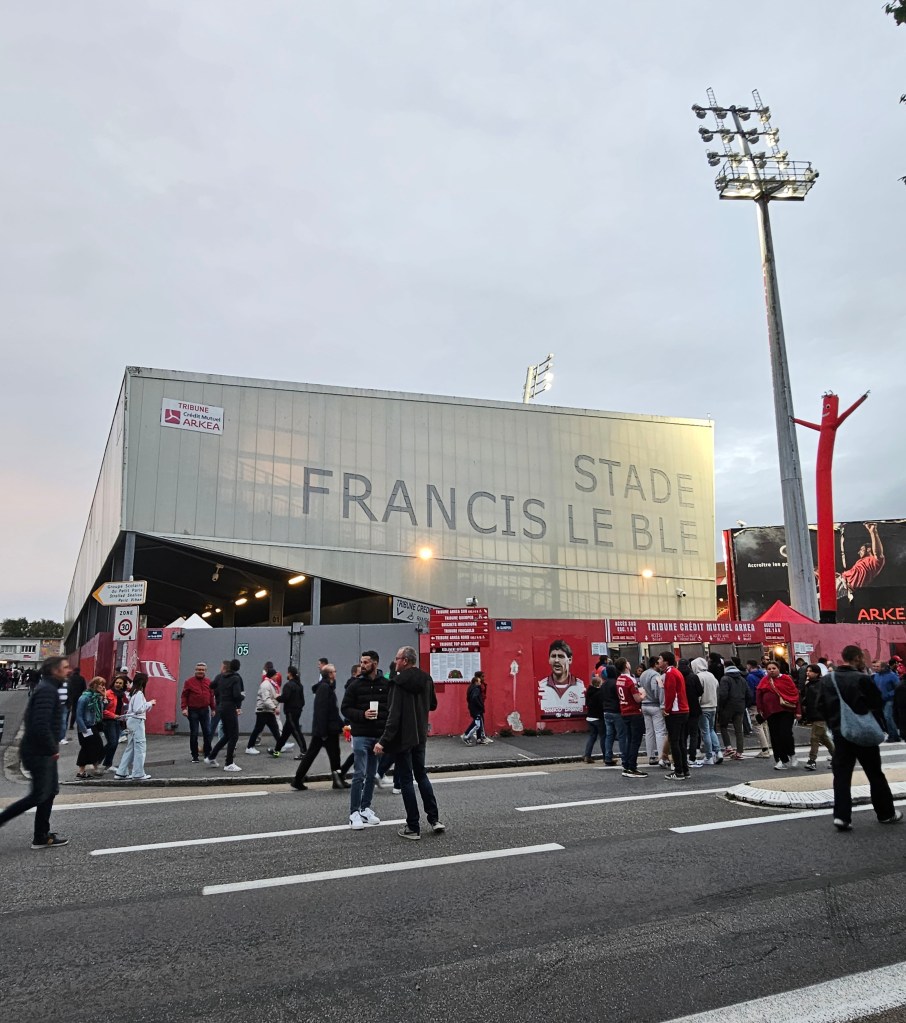
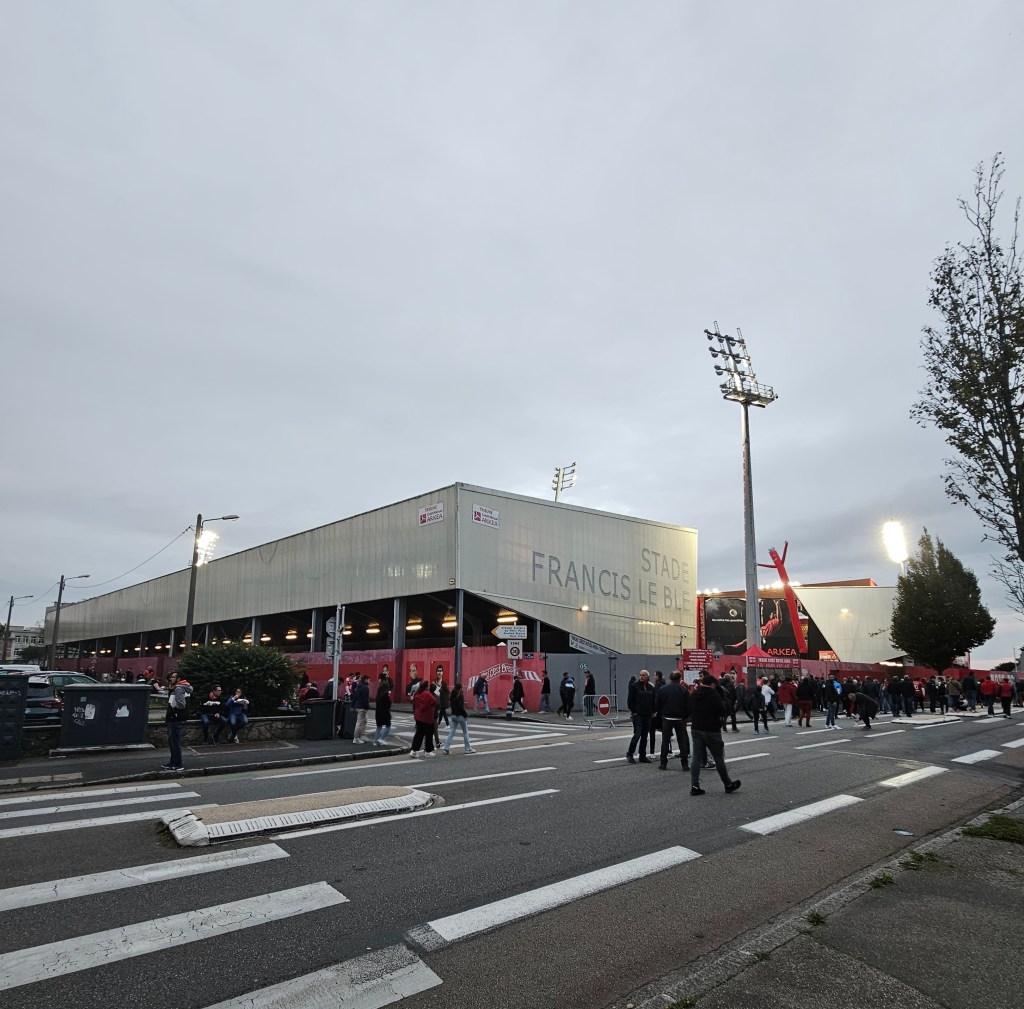
My wife Paulene and I are staying in a city centre hotel, which proves very handy indeed for the Liberte tram stop, where I just manage to extract two tickets (€1.70 each) from the vending machine and jump aboard a bright lime green Ligne A tram before it shuts its doors and begins a gentle, whirring, electricity-drinking ascent up Rue Jean Jaures towards Place de Strasbourg, from where it is just a short walk along Rue de Quimper to Stade de Francois Ble, home of Stade Brestois 29 (the 29 is the number of the Finistere departement – for some reason the mainland departements are numbered from 1 to 100, although weirdly Corsica gets to be 2A and 2B).   A gathering crowd is plainly in motion as we alight from the tram, and there is no difficulty finding the stadium as we are consumed by the human tide being drawn by the glow of floodlights shining out through the Breton dusk, and the promise of beer from the bar immediately behind the ground.  There is something about the approach to the ground and its relationship to the street that reminds me of the old Dell in Southampton, but I don’t let it worry me and not seeing any indication of a club shop I follow Paulene into the stadium after the usual ‘patting down’ by a huge, friendly man of Franco-African origin, who ensures I am not smuggling flares or other unfashionable trousers into the stadium. 
My fears about being unable to source club merchandise are quickly allayed as I spot a small wooden hut which looks like it could double up for use at a Christmas market.  I‘ve done my homework on-line, and know that for a bargain €9.90 I might be able to obtain a T-shirt bearing the club crest and the slogan Marree Rouge  (Red Tide). I point at a box of red T-shirts which bear the markings described and ask if there is one in ‘Large’ size.  The helpful young woman searches, examining the labels in collar after collar, one by one, but without success.  Eventually, sensing my desperation she holds up XL and XXL shirts as if suspecting that I am the sort of bloke who looks capable of putting on several kilos in weight if it suddenly proves necessary.  Optimistically, believing that I can fool the world by holding my stomach in, I ask if there is not a medium sized shirt instead; there is, but then, as she delves into the cardboard box just one more time a miracle happens, and she pulls out a ‘Large’; very possibly the last one in existence that isn’t already being worn by a well-proportioned Breton.

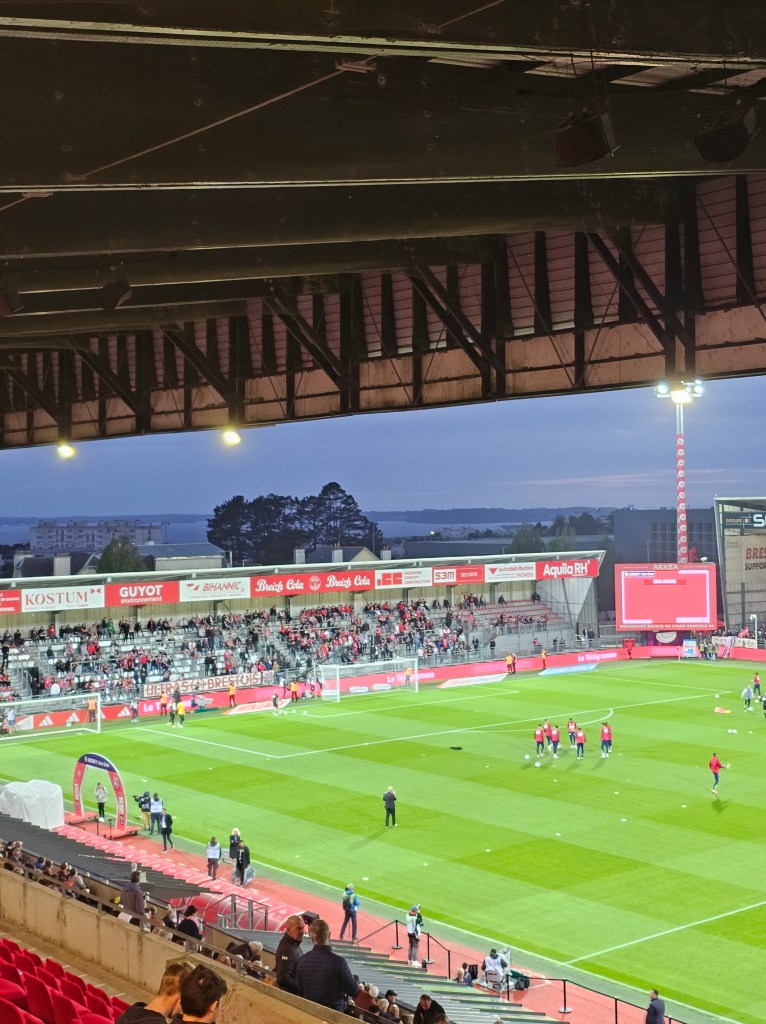
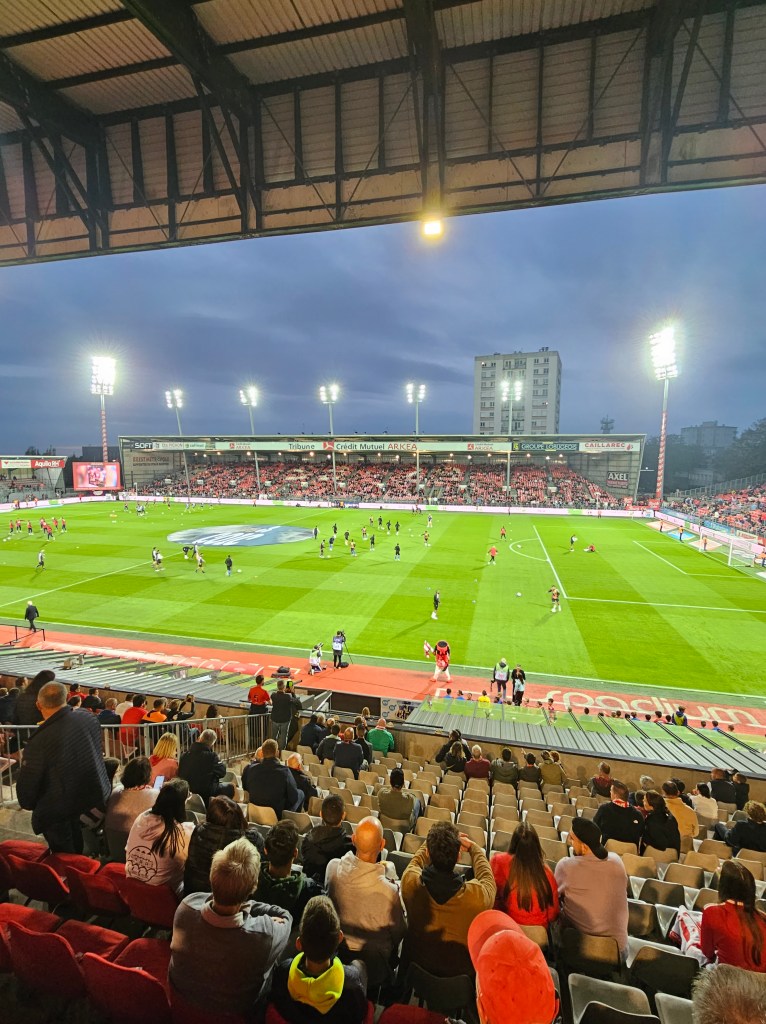
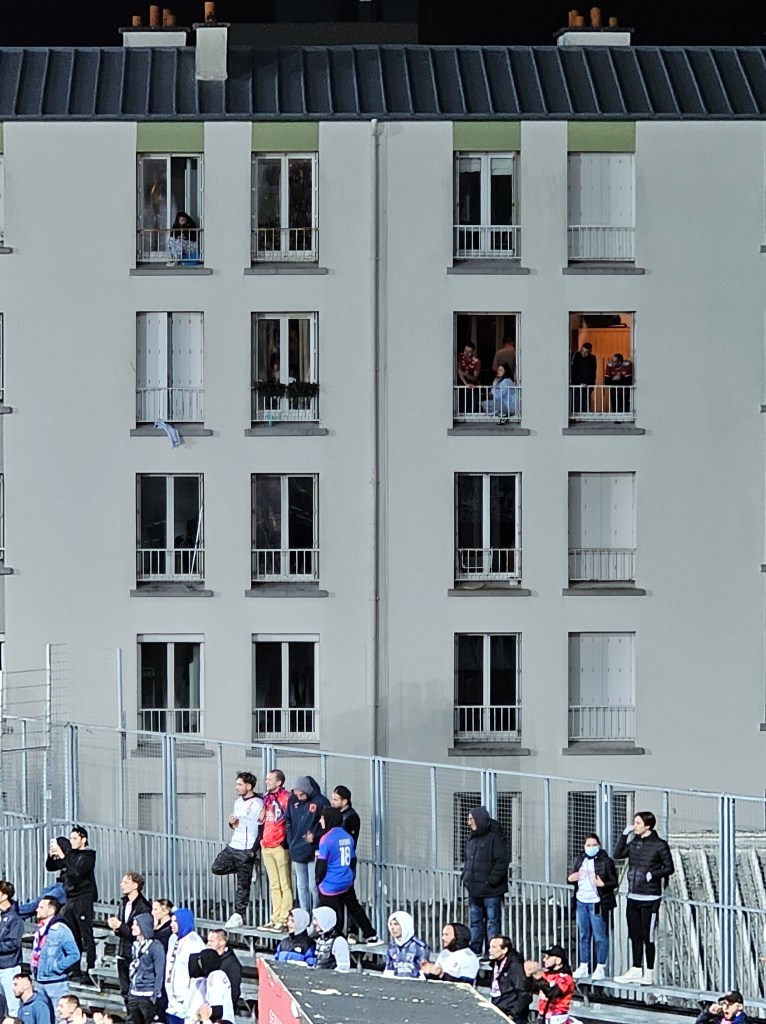
Clutching my precious T-shirt, I head for stairway five of the Tribune Foucauld and having climbed three flights of concrete steps I find myself looking over the brilliant green, floodlit pitch; all that remains is a further climb to row X and our seats, which I bought on-line a couple of weeks back.  Stade Brestois operate a loathsome ‘dynamic’ pricing system in which the club acts like a tout and the price of a seat changes, according to how much they think they can get for it.  When I first looked, tickets were €80 each; I eventually scored two of the few remaining ones for €45.  The club says the system means that people playing top price for seats allows less well-off fans to get cheap seats, but presumably this is only if these poorer fans have nothing to do with their time but be permanently logged onto the club website, waiting for a ticket price they might be able to afford.  The stadium has a capacity of not many more than 15,000 and is almost full for every Ligue 1 game. We sit in our over-priced seats and enjoy the view, which includes, through fading light, sight of the wide inlet from the Atlantic Ocean, which gives Brest its advantage as a port and naval dockyard.  Opposite us, the Tribune Credit Mutuel Arkea has five thick tubular stanchions set at a rakish angle to hold up the roof; atop the stanchions and the roof are floodlights, although the ground also has lights in all four corners.  To our right is the open Tribune Atlantique, a metal temporary stand a la Gillingham, and it’s where the away supporters are inevitably penned into a corner, they don’t even get seats, just metal benches.  Behind the stand, the occupants of a block of flats get a free view and can be seen crowding around windows and Juliet balconies. To the left is the small but freshly renovated Tribune Quimper; the ‘home end’ where the majority of the Brest Ultras congregate.

Whilst Paulene stays put to get maximum value from her seat, I soon take a wander to see what I can see and to find a programme, which is as ever free, and tonight is of the newspaper variety; it tells me the squads and who the referee and linesmen are and that’s it, which is all I need to know.  On the mezzanine level one staircase down from our seats is a bar, above which is a banner advertising the Breton Lancelot brewery.   Expecting one of Lancelot’s tasty beers, I invest 5 euros.  The beer is sweet and nasty and probably non-alcoholic; I tell the barmaid so and ask if it is Lancelot, because it doesn’t taste like it.  She doesn’t know but thinks it’s probably Carlsberg.  I’ve been poisoned.  At either ends of the stand are what look like private members bars, “Le Caban” and “L’esprit des Legendes”.  Spectators entering these bars do so only after having received the nod from people dressed intimidatingly all in black; presumably that’s where they serve the good stuff.  I’m guessing those spectators aren’t in the cheap seats.

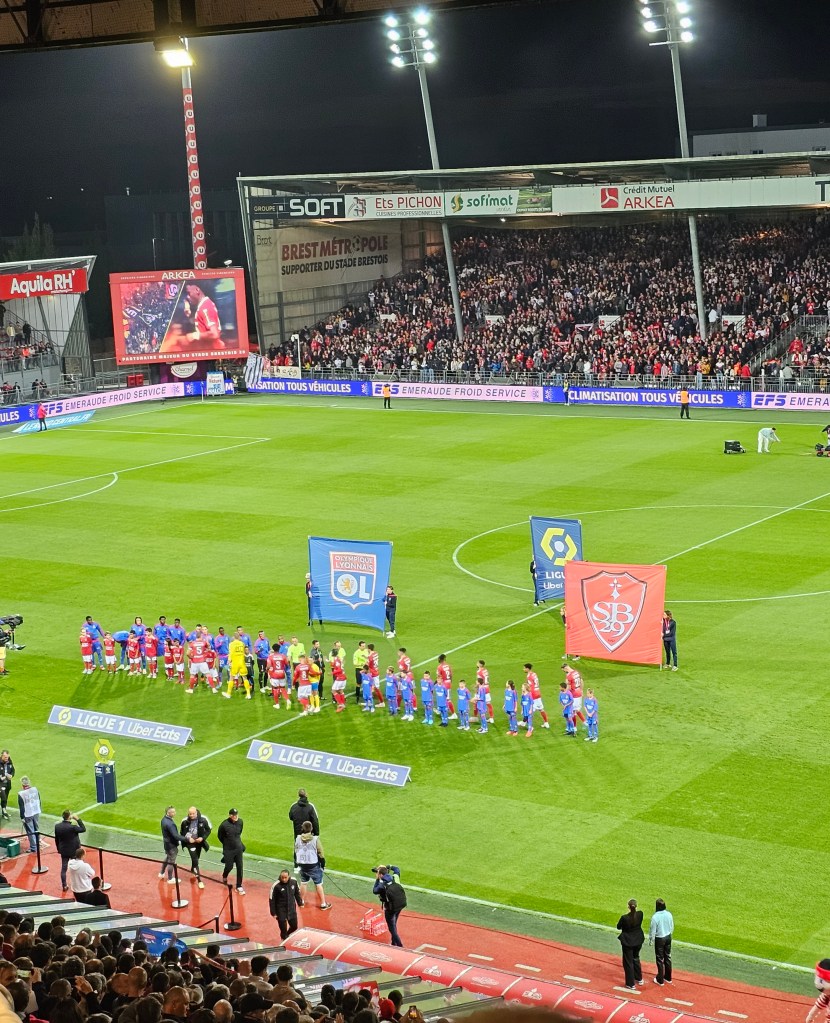
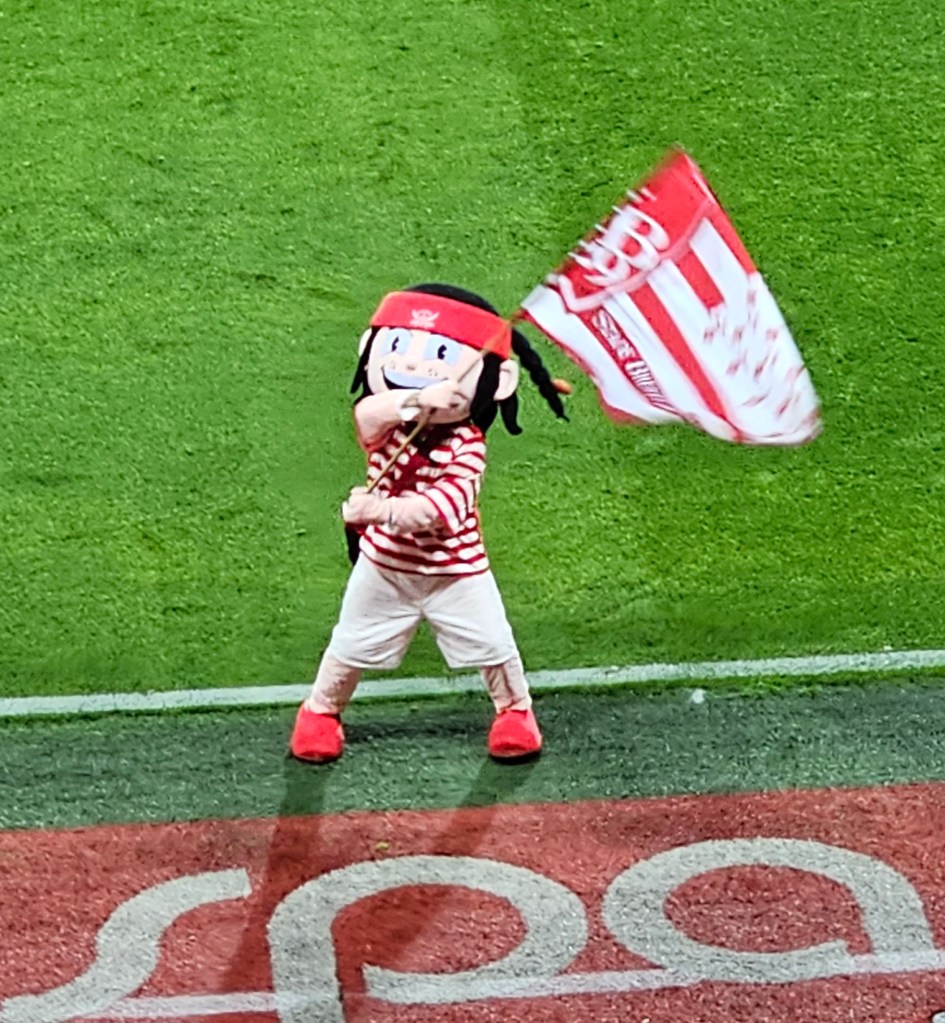
I return to my seat, and in the company of Paulene time passes quickly as we watch Zif, Brest’s pirate mascot, parade before the stand, and enjoy the arrival of the people in the seats around us, most of whom seem to be blokes in their seventies who all know each other.  The man next to me wears a beret and seems very clean, like Paul McCartney’s grandad in A Hard Day’s Night, but French. When the teams at last come onto the pitch, it’s to the fanfare of the Ligue 1 ‘anthem’, leaping flames, and the presentation of the match ball on a shiny plinth in front of banners displaying the two club badges and the Ligue 1 logo.  The public address system seems loud enough to make my ears bleed, but happily it doesn’t, although I do check.

When the game begins it is Lyon, generally known as OL in France, who get first go with the ball which they try and aim in the direction of the ocean whenever they can.  OL wear a frankly hideous, and annoyingly unnecessary away kit of all blue with red trim, whilst Brest are in their signature red shirts with white shorts and red socks. It’s been a warm day, but now a strong breeze blows up the hill from the dockyard and towards the OL goal. From the start, the slogan on my recently purchased T-shirt proves accurate as Brest sweep forward with wave after wave of attacking intent.  A shot goes way, way over the Lyon goal and then another soon earns a corner.  Brest are easily the better team but can’t find the final pass or the final touch that counts.  In midfield for Brest, Pierre Lees-Melou is brilliant, despite having previously played for Norwich City, and I imagine that the Canaries simply had no idea how to integrate a player into their team who can pass accurately, tackle, shoot, run with the ball and generally be quite good.  Fortunately, Lees-Melou seems to have suffered no ill-effects from his thirty-odd games wearing  yellow and green., but he’s probably receiving counselling.
All around the ground, the crowd brays with indignant disapproval whenever a Brest player is fouled. When referee Thomas Leonard books OL’s Ernest Nuamah for fouling Lees-Melou, the cheers sound like a goal has been scored.  I enjoy the wonderful name of Kenny Lala for Brest and the terrible haircut of Maxence Caqueret of Lyon, a player who looks like he was born 120 years too late and should have been the singer in a 1930’s dance band. On twenty-four minutes Lees-Melou has a shot tipped onto the cross bar by OL goalkeeper, the excellent Anthony Lopes, and then Brest’s Jeremy Le Douaran curls the rebound around the angle of the post and the bar.  “Allez-Allez-Allez” chant the home crowd from every stand.  A minute later OL get the ball into the Brest penalty area for the first time, but it comes to nought and instead all around is the noise of Brest fans urging their team on to score the goal the balance of play says they deserve.  The Ultras in the Tribune Quimper call out and the rest of the stadium answers back.  Mahdi Camara, a recent signing from Montpellier, dribbles deep into the OL box but again, there is no goal, only anticipation and excitement.  In the corner of the open end, the OL fans seem oblivious to their team’s ineffectiveness, other than in defence, and have sung and chanted all through the first half, prompted by two blokes perched astride the high metal fence that separates the supporters from the pitch.  Both blokes wield loud halers, but I don’t know if it’s the effect of the strong on shore breeze blowing away most of the sounds of their voices, but they both sound like Rob Brydon’s small man trapped in a box.

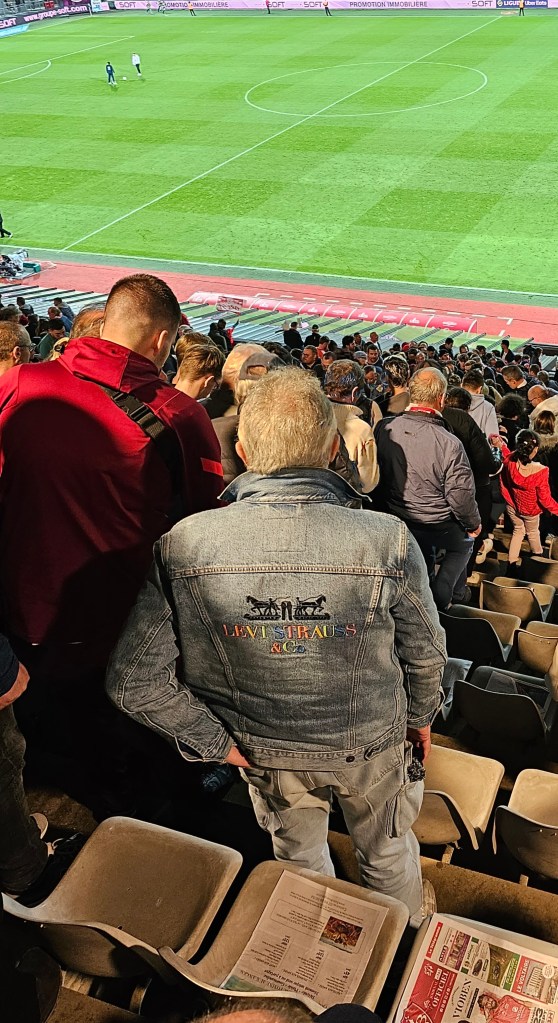
The fortieth minute is a milestone in the game as OL win their first corner, but of course it doesn’t result in a goal, and it’s the Brest supporters who remain in ebullient mood, holding their scarves aloft in the Tribune Quimper as the first half draws to a close in a sort of 1970’s tribute that suits the architecture of the stadium and the old blokes all around me who were themselves probably the Ultras of fifty years ago.  In front of me, a bloke wears double denim, and succeeds in accentuating the feeling, as if he’d come to a game in 1973 and never went home.
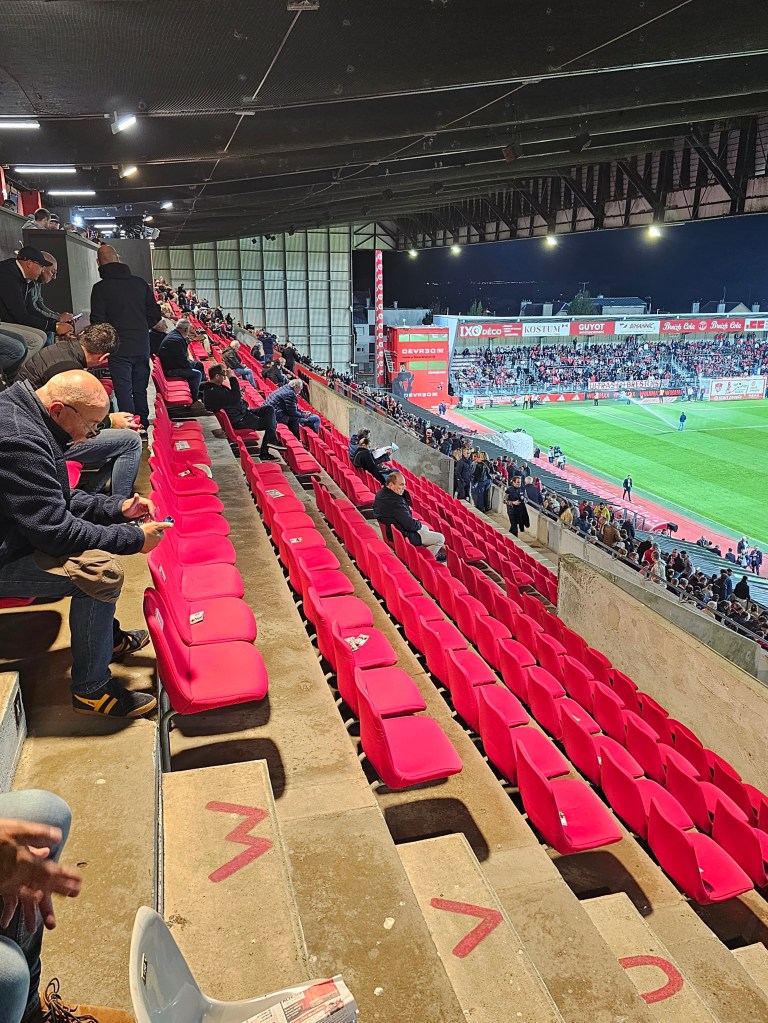
With half-time, the seats to our left are nearly all vacated, revealing the fact that they all sport red covers and suggesting perhaps that their occupants are now all enjoying some form of hospitality somewhere, perhaps in Le Caban or L’Esprit des Legendes. I will read later that the club owners wish to build a new stadium at the end of the tram line at the edge of the city, but that it will still only have a capacity of 15,000, no doubt because they want to be able to still charge top prices for the comfortable few and forget about the sweaty oiks who may be don’t wear shirts, and chant and light flares and drink too much beer containing alcohol in the bar across the road.

The second half begins and nothing changes, although encouragingly the block of seats to our left is soon re-populated, proving either that the occupants are genuinely interested in the match or that the hospitality isn’t free or unlimited. After just seven minutes however, OL roll the dice by replacing Ernest Nuamah, Diego Moreira and Paul Akounkou with Mama Balde, Tino Kadeware and Ainsley Naitland-Miles, who tonight wears a silly number 98 shirt and a few seasons ago mostly failed to excite when on loan at Ipswich from Arsenal.  The change sort of works for a short while and Alexandre Lacazette finds space to launch a thirty-yarder which flies over the Brest cross bar, but then a weak Caqueret pass is intercepted by Lees-Melou who dribbles away from his own half and to the edge of the OL penalty area before frustratingly shooting beyond the far post.  An hour has gone and Brest miss another chance, probably the best yet, as a low cross is somehow steered wide of the OL goal by Jeremy Douaron from just a couple of yards.  Whilst clutching their collective heads the crowds shout “Aye-Aye-Aye” and I find myself joining in with swelling chants of “Allez les Rouges! Allez les Rouges!”  Paulene, a Pompey fans says the atmosphere is like that of Fratton Park. “The same sort of people” she says. “What? All dockyard mateys” I reply, thinking of my dead father, a one-time Pompey based matelot who I know would have said exactly the same thing.

The game enters its final twenty minutes, and to mark the occasion tonight’s attendance is announced as being 14,636, and Brest substitute number seven, Martin Satriano for number nine, Steve Mounie.  But it’s OL who, still against the run of play, now come closest to a goal as Lacazette sends a decent low shot goalwards from the edge of the penalty area which Brest ‘keeper Marco Bizot dives to his right to stop and then jealously grab.  Lacazette lasts five minutes more before being replaced by Rayan Cherki, a man whose distinctly bushy facial hair and short back and sides give him the look of an Edwardian naval captain.

Three minutes of normal time now remain.  A move down the right produces a cross from Brest’s Kenny Lala, which Steve Mounie heads against the foot of Lopes’s left hand post.  As the crowd gasps in thrilled disappointment the ball runs back to Lala who crosses it again and Mounie, who has back-pedalled judiciously, this time hurls himself forward to head the ball past Lopes into the near top corner of the net, and Brest have the goal they deserve.  The crowd is on its feet, but OL defender Tino Kadewere is on the ground having been barged out of the way by the hurtling Mounie, although there was no real suspicion of a foul.

“Allez, Allez, Allez, Allez” we all sing triumphantly, Billal Brahimi shoots, Lopes saves, and Brest have a corner and five minutes of added on time in which to retain their clean sheet or even score again.  The very clean old bloke in the beret, next to me, leaves early, but very few others do.  Jonas Martin shoots and misses for Brest, and Naitland-Miles has a shot saved for OL, but there are no more goals and as the clock ticks towards eleven o’clock Monsieur Leonard blows his whistle for the last time.  Brest are top of the league, or more accurately given our geography, a la tete du classement.  We stay a short while to applaud before heading off into the night and back along Rue de Quimper to the tram stop, and a journey back to our hotel on the most crowded tram I have ever ridden on. It’s been a fantastic evening and still with our minds whirring excitedly, in our hotel room we celebrate Brest’s success by cracking open a small bottle of Cremant that had been cooling in the mini-bar, and unwind by watching the game all over again on Canal Plus tv. Allez les Rouges!
Dijon Football Cote d’Or 2 Racing Club Strasbourg Alsace 1

The 570 kilometre journey down the A26, A5 and A31 motorways from Calais to the elegant and historic city of Dijon takes a good five hours plus stops, but it’s worth it.   The medieval city was the seat of the influential dukes of Burgundy and the modern city is still the regional capital with a population of about 155,000.   But that aside, tonight Dijon FCO are playing RC Strasbourg Alsace in Ligue 1 of the French professional football league and I am heading out with my wife Paulene to the Stade Gaston Gerard, to witness it.  If I hang out of the window of our hotel room in I can see the stadium and the lights are already on.

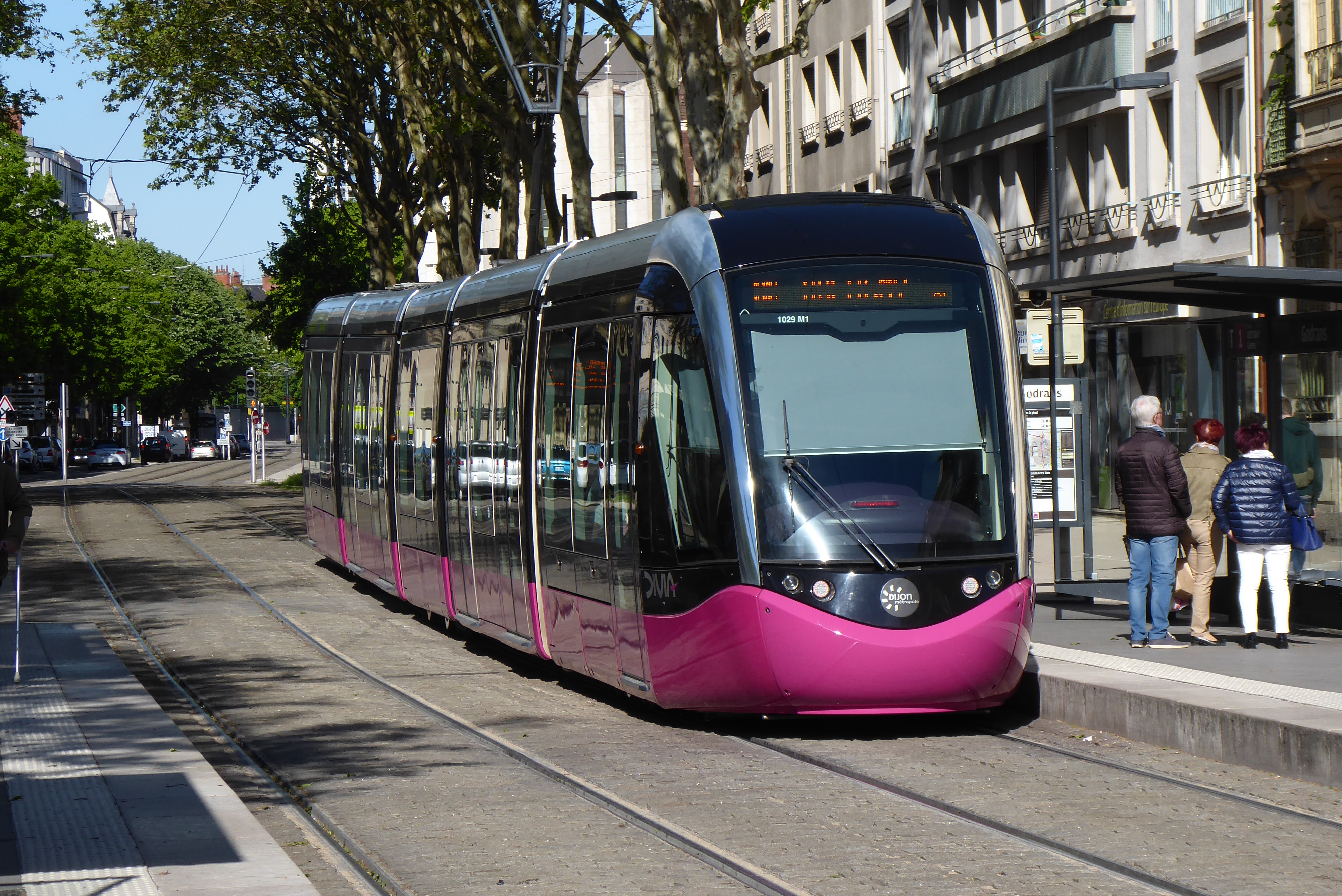
It’s been a day of gusty wind, sunshine and showers, of cafes and bars and the tombs of dead dukes and duchesses.  We have pre-purchased our joint ticket for the tram (5.60 euros for two journeys each) and are at Place Darcy in the shadow of Dijon’s triumphal arch, the Porte Guillaume, ready to ride out to the Parc des Sports wherein lies Gaston Gerard’s eponymous football stadium.  Gaston Gerard incidentally was mayor of Dijon from 1919 to 1935 and later a member of the French government.  But there is a problem, we want to catch a T1 tram in the direction of Quetigny but it seems they are not running the length of the line due to a ‘perturbation’.  We could catch the T2 and then walk to Auditorium to catch a T1, but the helpful man at the tram stop, who works for the transport company Divia, advises us to cross the road and catch the number five bus to Université, and then catch a T1 tram from there, so that’s what we do.  The bus soon arrives and with our ticket validated we are soon out of the city centre travelling through anonymous looking early evening streets in a bright pink, 18m long Heuliez articulated bus.  From the end of the bus route the tram stop is just around the corner on a windswept, open part of the university campus, but a tram arrives within a few minutes, almost as if the public transport services were somehow co-ordinated; we know from living in England however that such a thing is just not possible.  From the university it is just three stops to the Parc des Sports tram stop, which is but a nonnette de Dijon’s throw from the Parc des Sports itself.

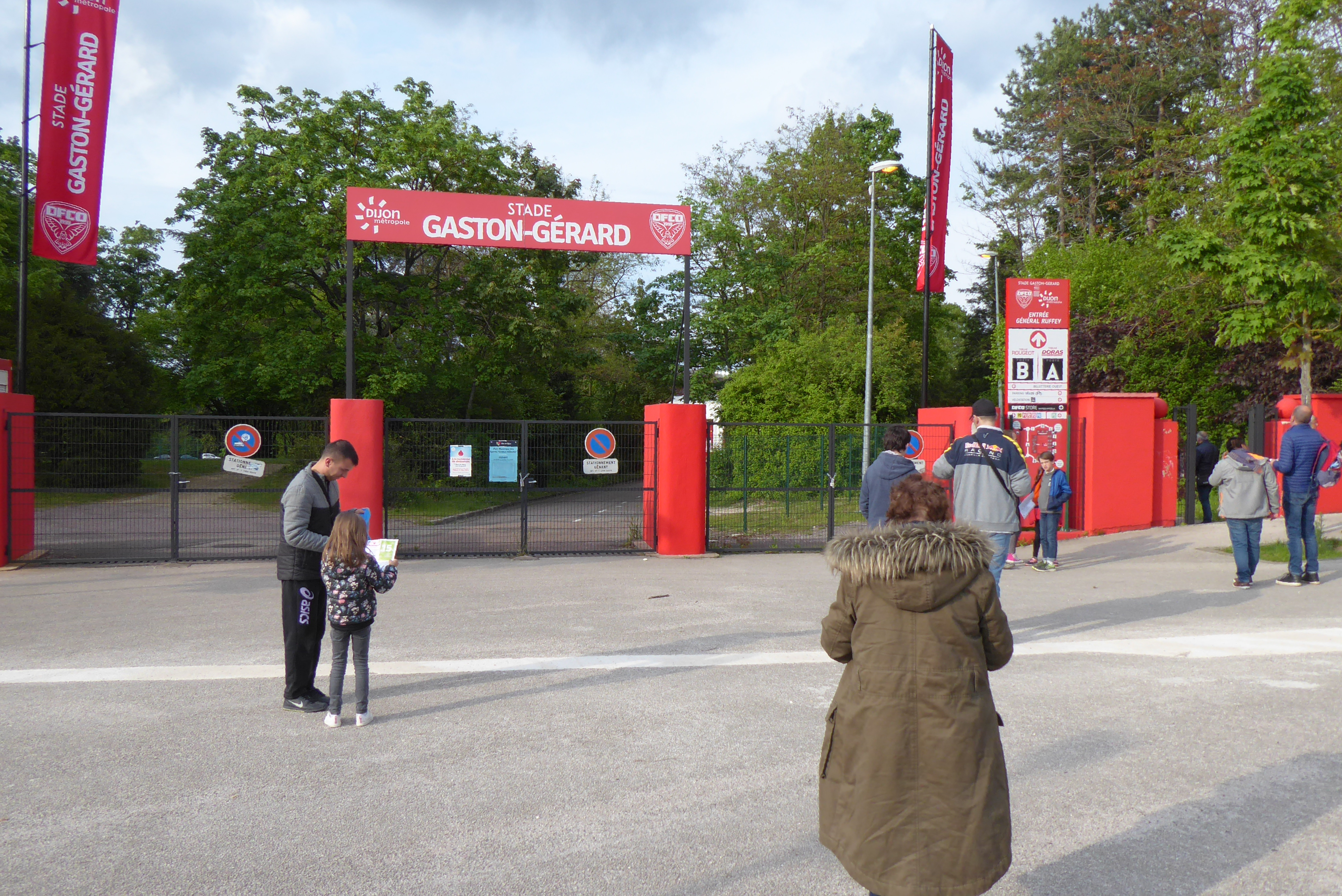
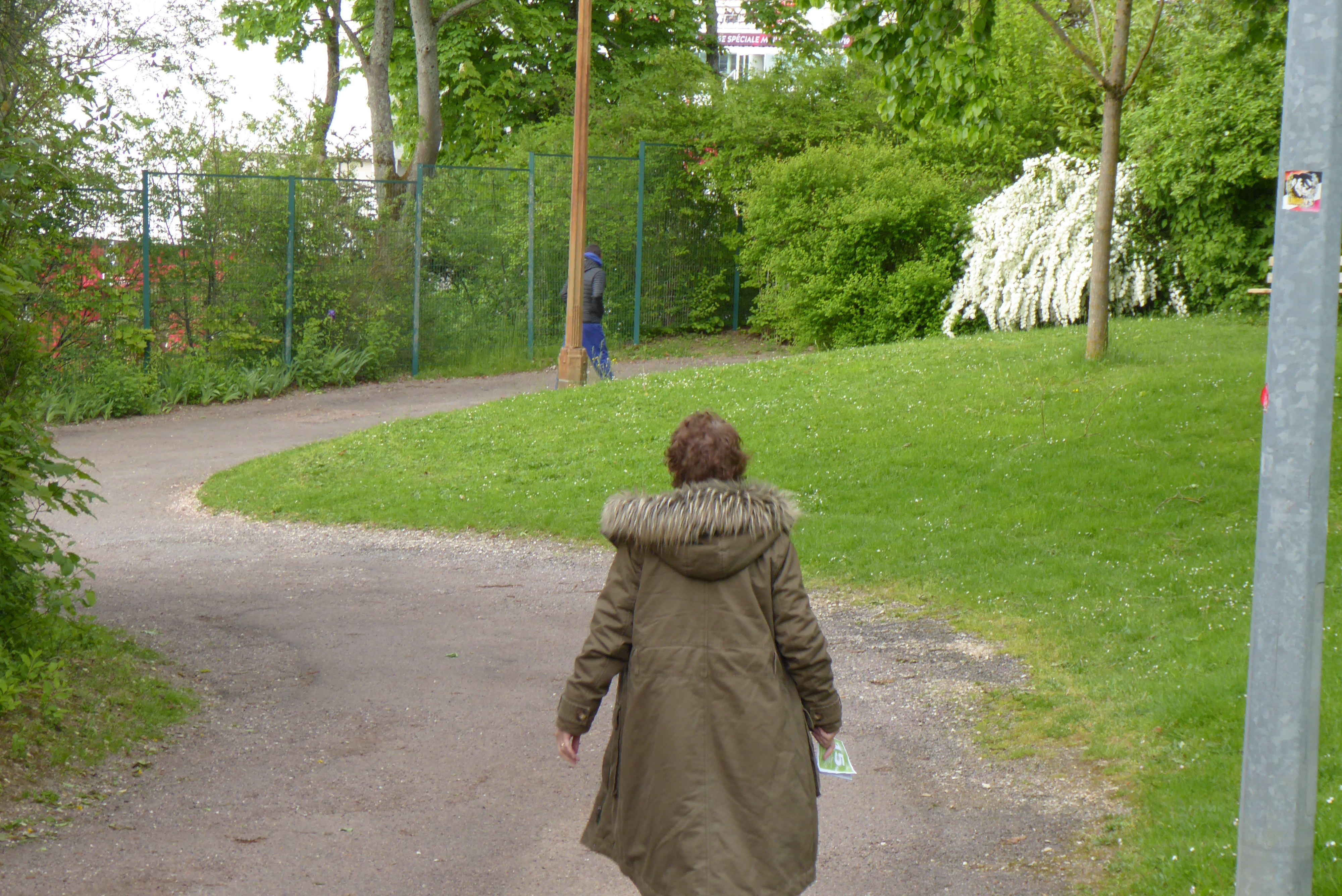
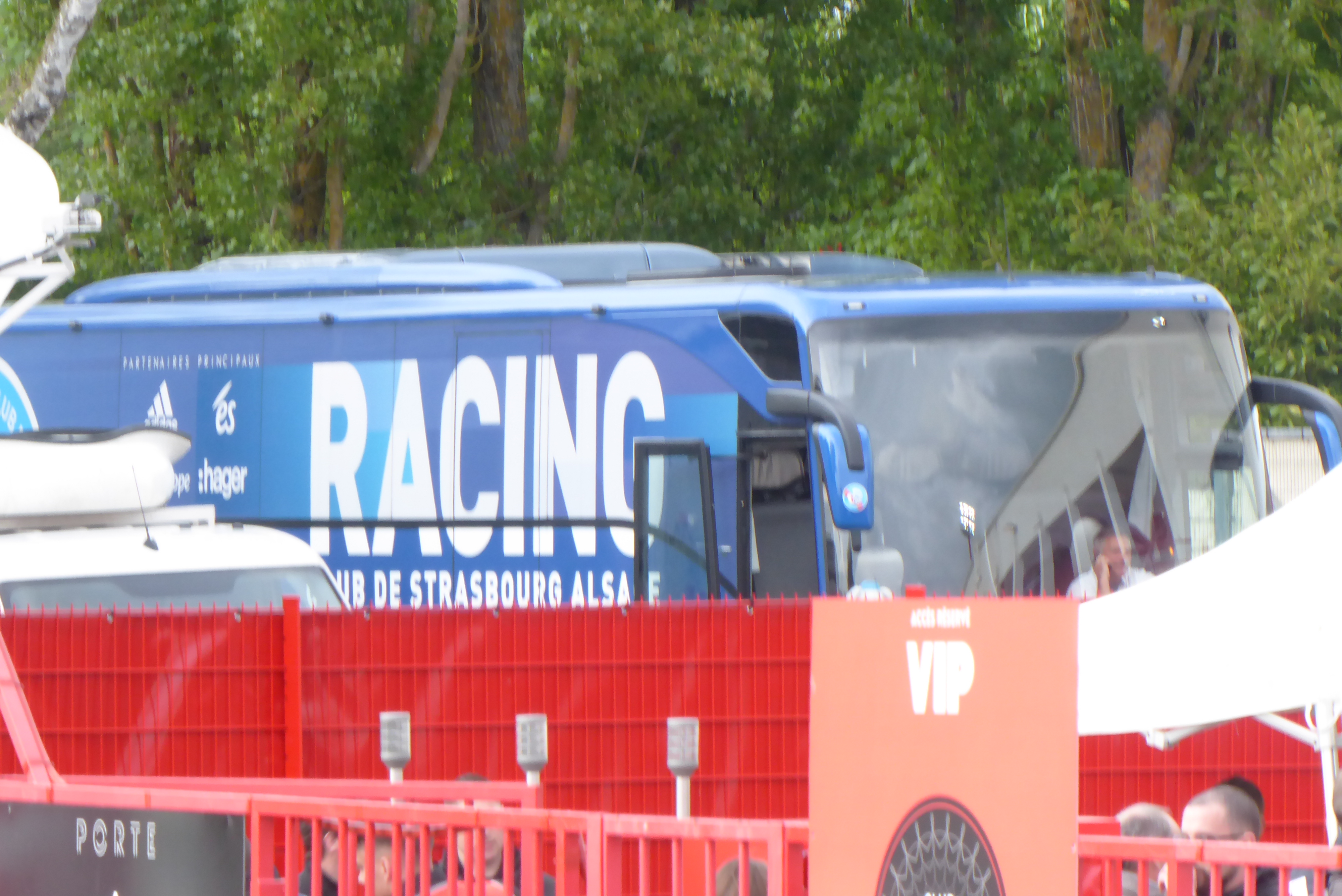
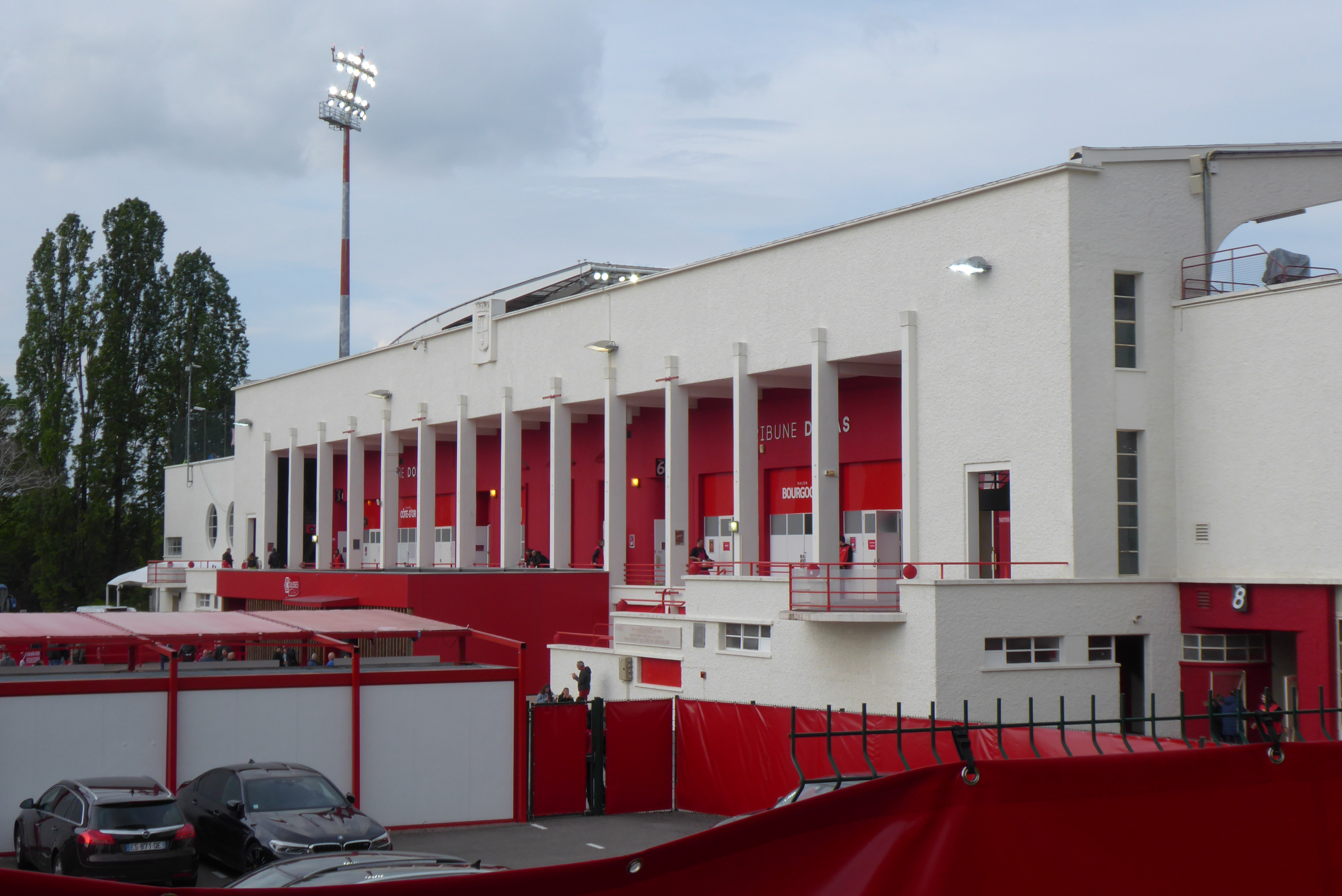
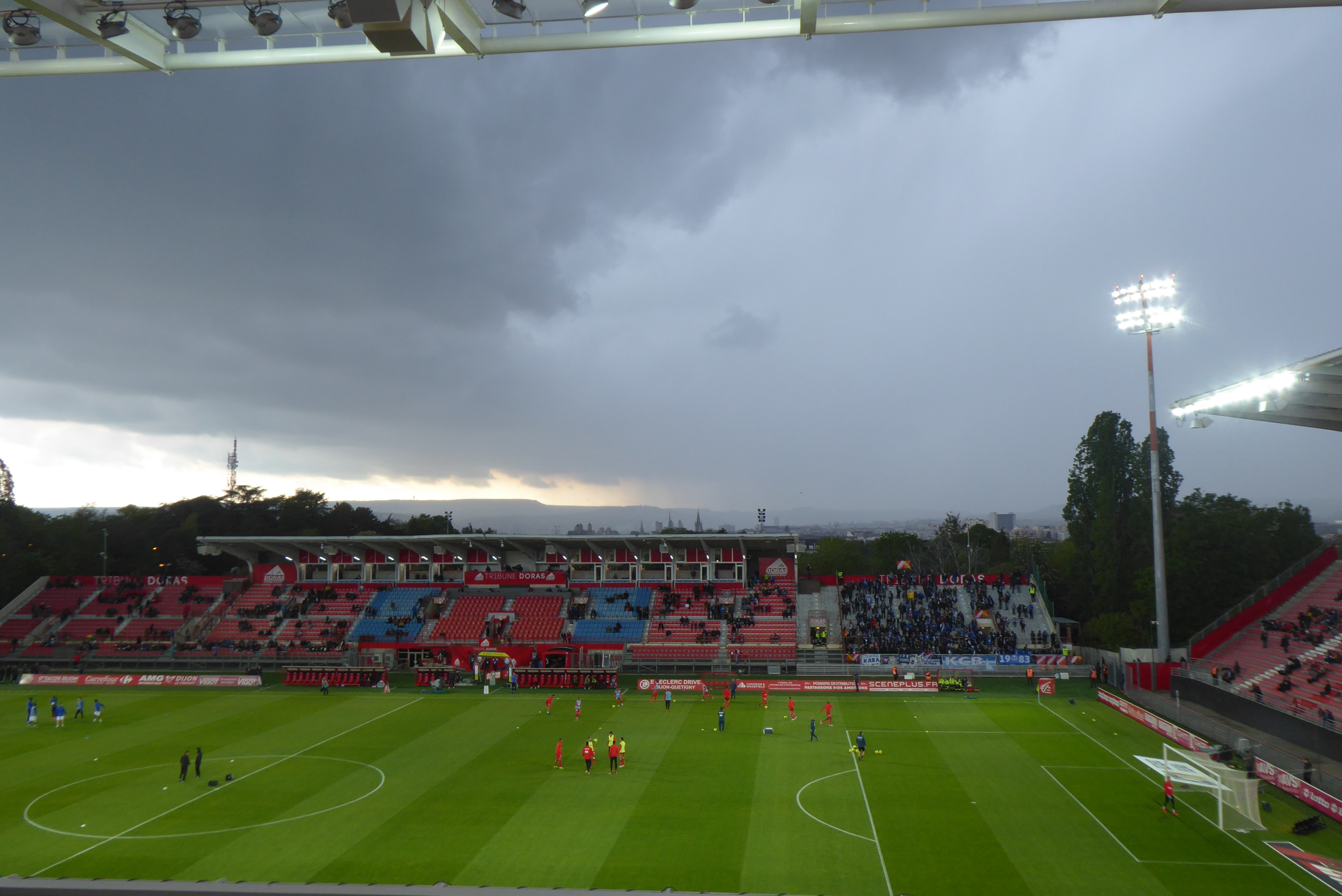
A man in a ‘gilet orange’ checks our tickets and ushers us through the gate and into what seems like a leafy suburban park.  We follow a trail down between the trees; there are tennis courts off to our right, we round a couple of bends and then the stadium is before us.  Three sides of the Stade Gaston Gerard have been re-built  this century, the remaining part of the original stadium has its back to us; it’s a neat, classical looking concrete structure which dates from 1934  and is quite typical of pre-war French municipal buildings; it’s got style; it’s a bit Art Deco.   Over a fence there is a glimpse of the blue Strasbourg team bus.

We walk on and pass through the turnstiles which read our bar-coded tickets before we are patted down and wished “bon match”.  It amuses me that Paulene seems to be searched more thoroughly than I am, but then the French have a history of female villains; Madame Defarge, Madame Thenardier, Marine Le Pen.   At the back of the Tribune Sud (south stand), which is built into the hillside behind the goal, a couple of blokes who look a bit old to be Ultras are unfolding a tifosi banner in the form of a huge Dijon home shirt.  I half expect to see them plugging in an especially large iron. 

Our tickets (24 euros each) are in the top tier of the east stand at the side of the pitch, so we keep on walking, on past the ‘Le Bon Sucre’ stall selling crepes, gauffres and beignets, and bizarrely decorated with the figure of a busty woman, posed with her mouth slightly open and about to lick a dollop of cream from her finger.   France can be oddly schizophrenic with regard to women; seemingly ahead of Britain in the use of female football presenters and commentators and in appreciating women’s football, but still displaying the same casual sexism of the 1930’s when Gaston Gerard’s wife Reine impressed a well-regarded critic and gastronome with a new chicken dish, which thereafter became known as Chicken Gaston Gerard after her husband, not her.

Resisting the temptations of le Bon Sucre we walk on beneath the Tribune Caisse D’Epargne as it is known thanks to sponsorship from the bank of that name, where we cannot resist the lure of the club shop. 

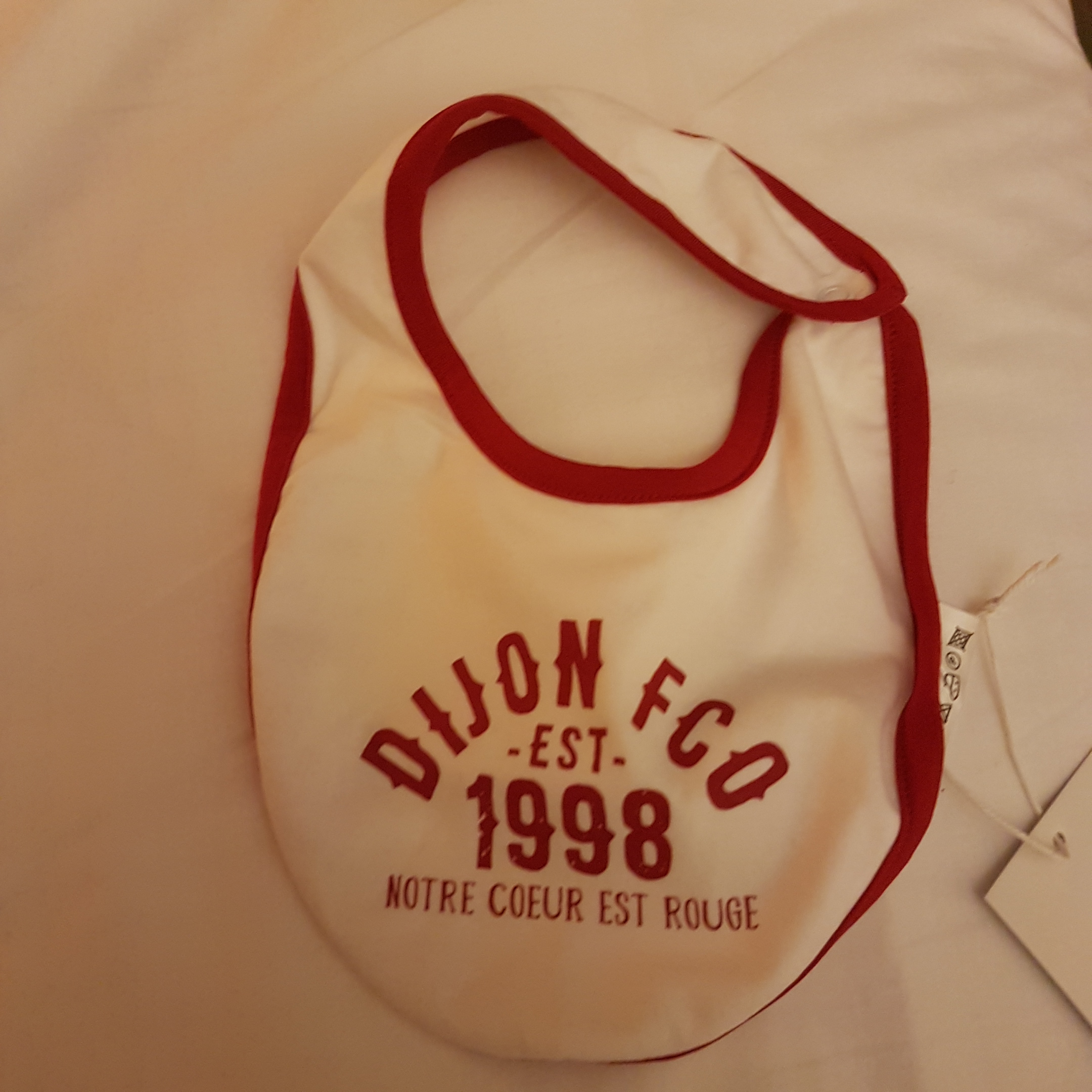
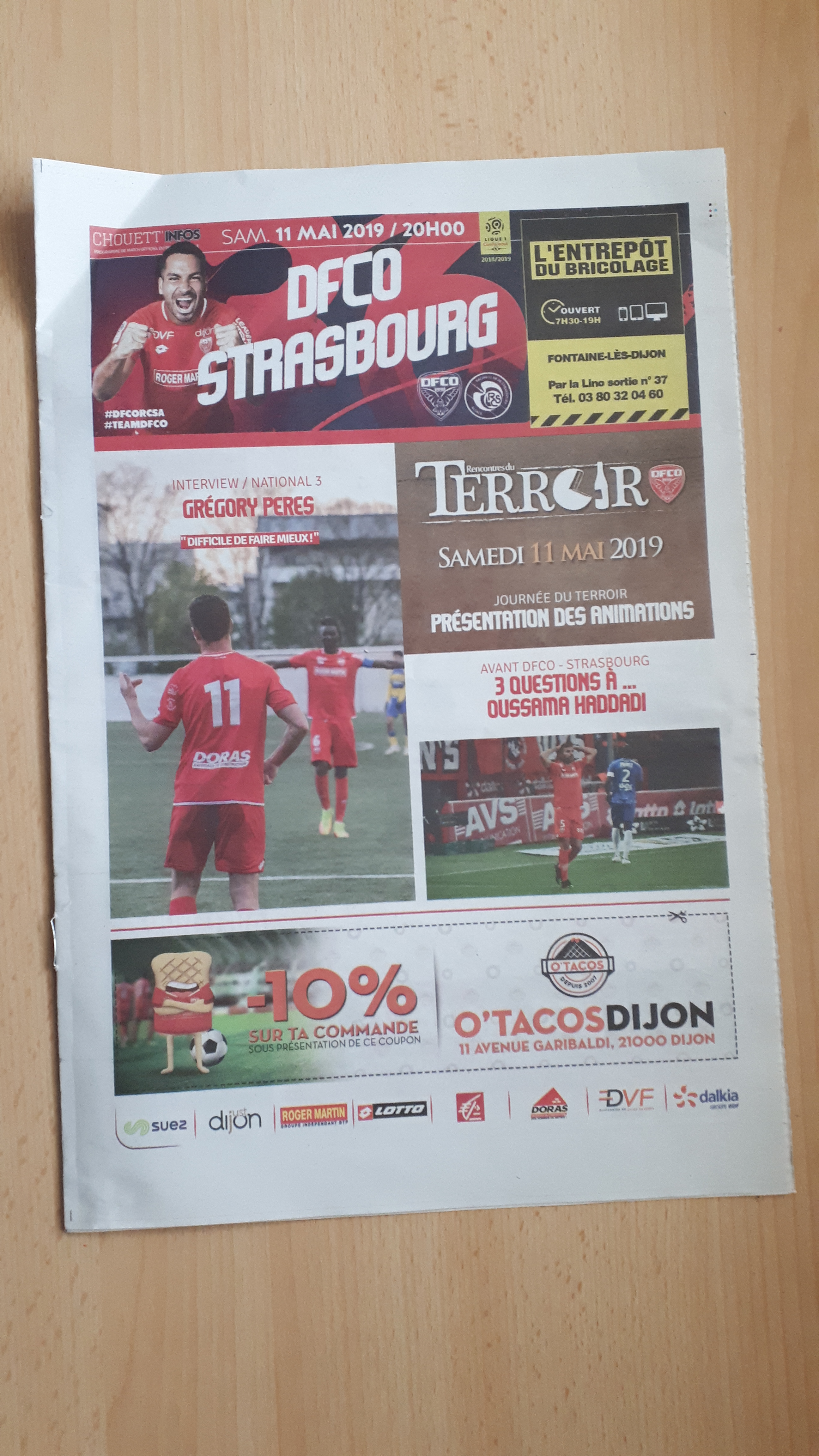
Thankfully Dijon FCO do not have their own brand of mustard, and sadly their T-shirts don’t appeal so we restrict our purchases to a petit fanion (5 euros) to add to the collection in the upstairs toilet, a bear in a red and white scarf (10 euros) for Paulene’s cupboard of football related cuddly toys and a bib (6.50 euros) for the new grandson Jackson, because he needs more bibs.  Leaving the shop we pass by one of the buvettes, from which people are leaving with the best looking chips I have ever seen at a football ground, proper big chunky ones.  I collect a couple of the free match day programmes, which are actually more like 12 page newspapers, but they tell us all we need to know, listing the squads, tonight’s other fixtures and the up to date league table.

Our seats, we learn, are in the top tier of the stand;  it’s been a bit of a walk from the tram stop and Paulene’s asthma means she’s not feeling up to climbing two or three flights of stairs so I ask one of the many young women in gilets oranges if there is a lift.  I am directed to a man in a blue jacket with the words Besoin d’aide? (Need help?) printed on the back; he asks us to follow him and  having led us into a room from which he collects a set of keys he unlocks a white door hidden within the white walls of the concourse beneath the stand.  The blue jacketed man leads us down a long white corridor and round a corner, part of a hidden labyrinth within the stand; I think to myself that this is what near death experiences are supposed to be like.  The man then unlocks what seems like a secret compartment, but is in fact a lift, which takes us to an open concourse at the back of the top tier of the stand.  We thank the man but not before he shows us to our seats; what a helpful bloke.  From each seat projects a red flag at 45 degrees which bears the Dijon FCO club crest; it doesn’t do to sit down in a hurry; it could be painful.  We are in the second row at the front of the top tier and have a fine view of the pitch, but also, over the top of the stand opposite, a panorama of Dijon stretches out with an array of towers and spires, like a Gallic version of Oxford. Beyond the city, rolling hills and forests.

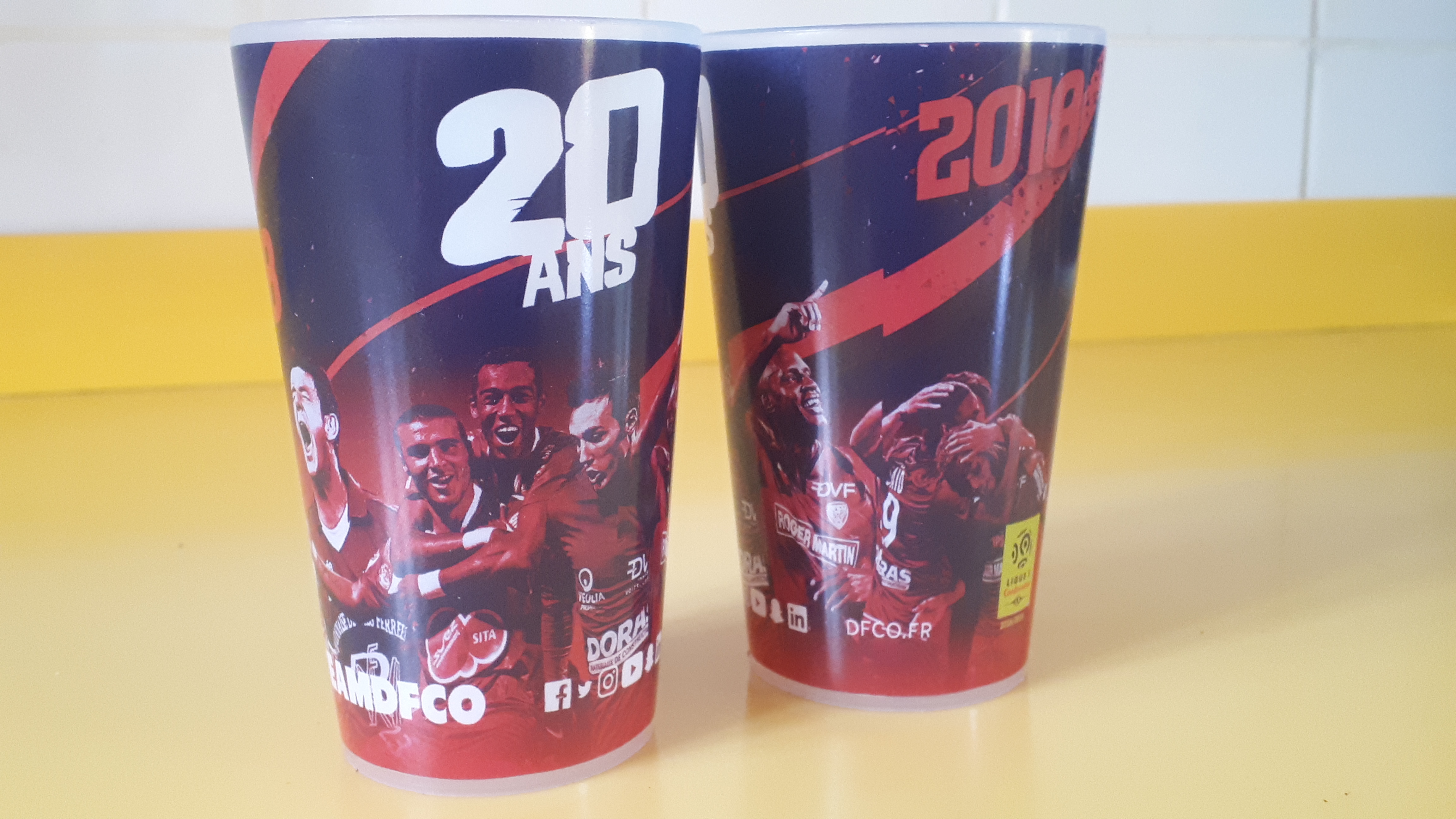
There is a still a while until kick-off so I return to the open concourse for some drinks, returning with a cup of orange Fanta for Paulene and a small beer for me (7 euros for the two). Both drinks are in re-usable plastic cups which celebrate Dijon FCO’s twentieth anniversary; Dijon had a club dating back to 1913 (Cercle Laique Dijonnais) but it remained resolutely amateur, like my own beloved Ipswich Town did unti 1936, before merging with Dijon FC in 1998 and the new club eventually turned professional in 2004.  Looking north-east from the back of the stand the sky is a menacing grey and in the distance it is clearly raining; a strong gusty wind is blowing it towards us, something wicked this way comes, but more probably something wet.  Walking back to my seat I begin to regret not having noticed until I had ordered beer and fanta that I could have had a cup of the vin chaud (2.50 euros).  The rain arrives in the form of stair rods, it is spectacular and I am thankful I am not in the Tribune Sud into which the wind is blowing, or on the open terrace opposite where an increasing and impressive following of Strasbourg supporters are gathering and getting soaked.  The deluge is mercifully brief and heads off into the hills of Burgundy leaving the fading evening sunlight to glisten and reflect off the roof tops of the city.

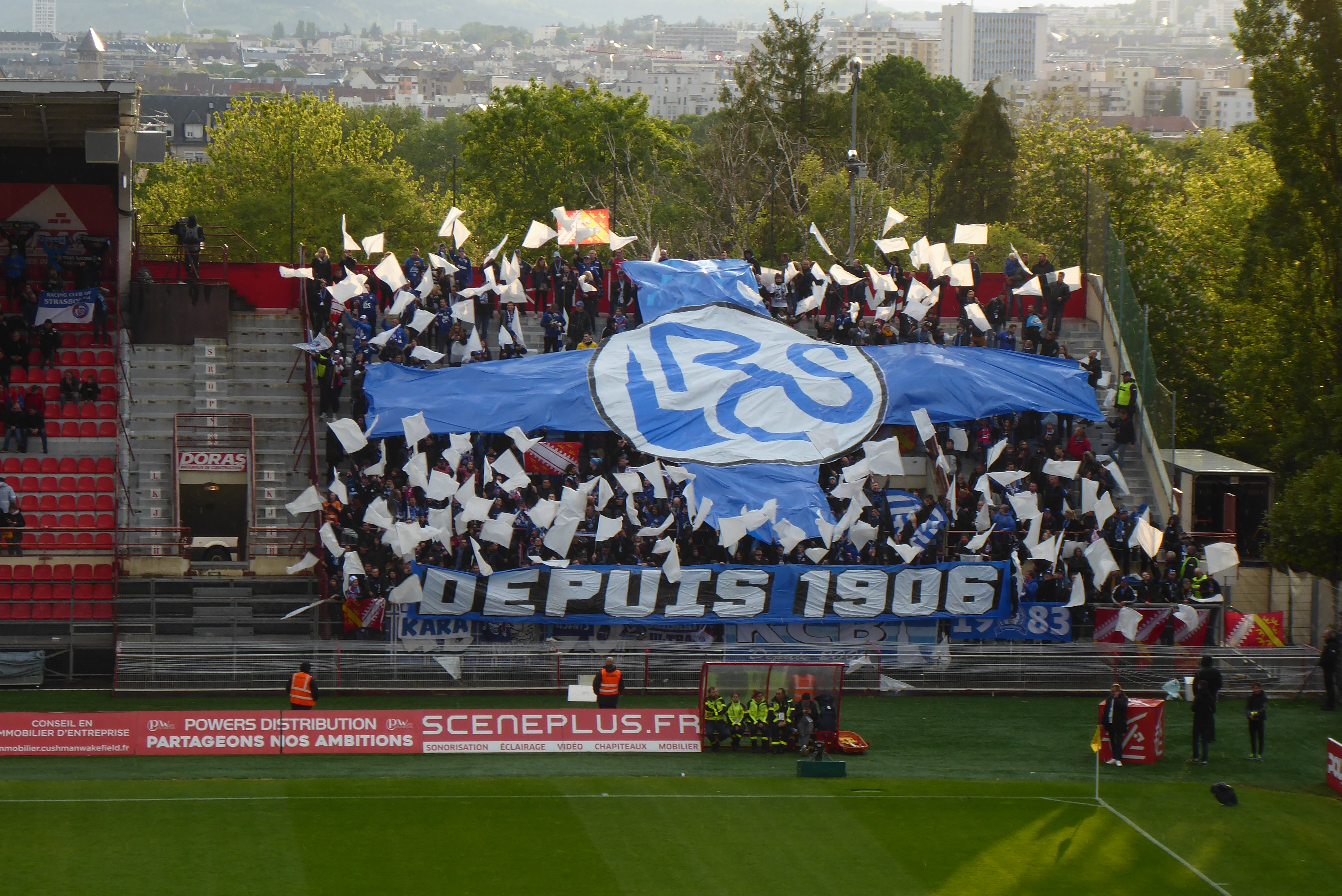
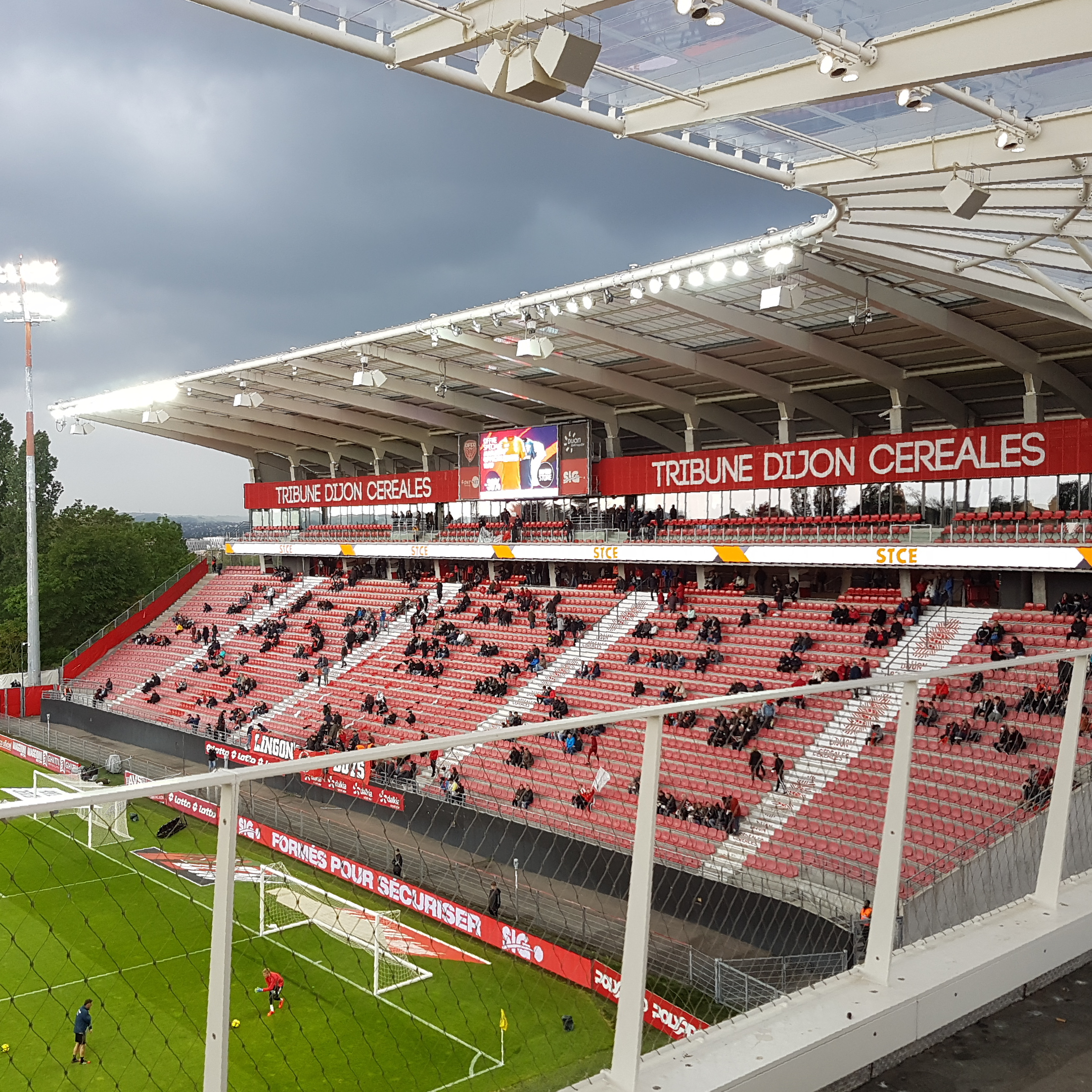
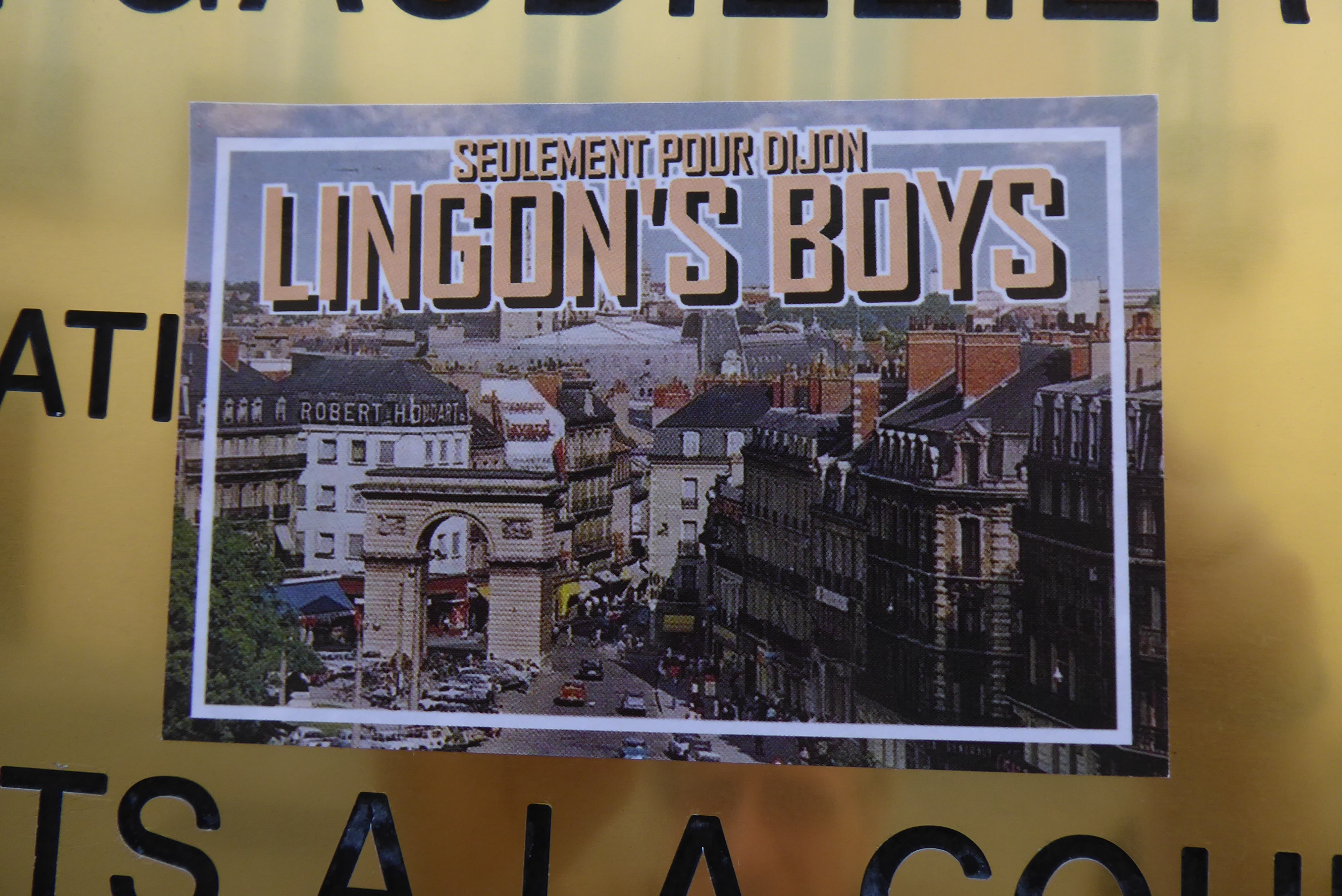
As kick-off approaches the public address system pumps out loud euro-pop, the teams are announced, their faces looming in technicolour on the scoreboard.  That tifosi shirt ripples across the lower tier of the Tribune Sud; the Lingon’s Boys Ultras at the north end hang out their banners.  The best display however is from the Racing Club Strasbourg supporters who celebrate making the 330 kilometre journey by waving white flags around a central blue cross with the letter RCS in the centre of that.  All around there is noise from the crowd of 13,105 and then the teams enter the pitch through a colonnade of giant Roman candles as the Ligue 1 theme tune plays over the public address system and everyone waves their red Dijon flags, me included; one of the many things they know how to do in France is put on a show and give everyone a free flag.

After handshakes and huddles the game begins with Dijon all in red and the words “Roger Martin” emblazoned across their chests, a sentiment I heartily agree with. Strasbourg unnecessarily wear all- white; their ‘proper’ signature kit of blue shirts with white shorts would not clash with Dijon’s home strip. Dijon are playing towards the Lingon’s Boys, with Strasbourg aiming in the direction of the Tribune Sud.  It’s the 36th journee of the 38 game season and Dijon are struggling in 19th place in the twenty team league.  Strasbourg are mid-table (10th) and have every right to feel smug and relaxed having qualified for the Europa League by winning the Coupe de La Ligue against En Avant Guingamp, the team bottom in Ligue 1, who by the end of tomorrow afternoon are destined to be relegated to Ligue 2.

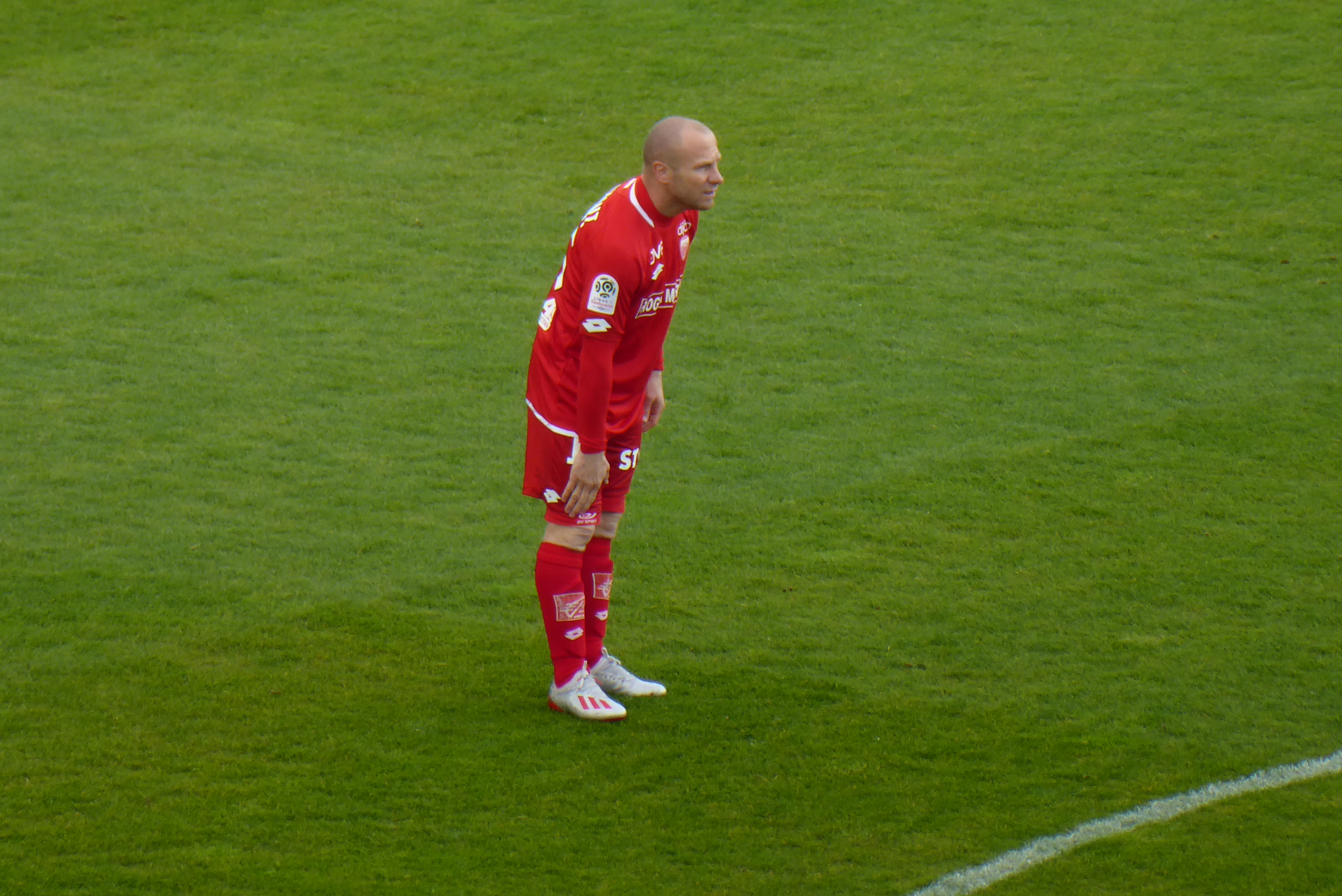
Dijon are more eager because they have more at stake and they have the first shot on goal, from 39 year old Florent Balmont, a marvellous if unexciting, mostly defensive midfield player who simply keeps the team ticking over like a sort of bald-headed human, metronome.  Paulene and I reminisce about seeing him play a much more dynamic game for Lille against Copenhagen in a Champions League qualifier back in 2012.  This game is not dynamic.  Dijon struggle to play accurately whilst Strasbourg’s season has already finished, and they appear to lack motivation.   Lacking inspiration from the football I enjoy the architecture of the three re-built sides of the stadium; three individual stands linked by an arching, curving translucent roof; architect Michel Rémon has done a fine job and I get to thinking what self-respecting architect would put his name to the breeze block and tin sheet constructions that pass for provincial football stadia in England.

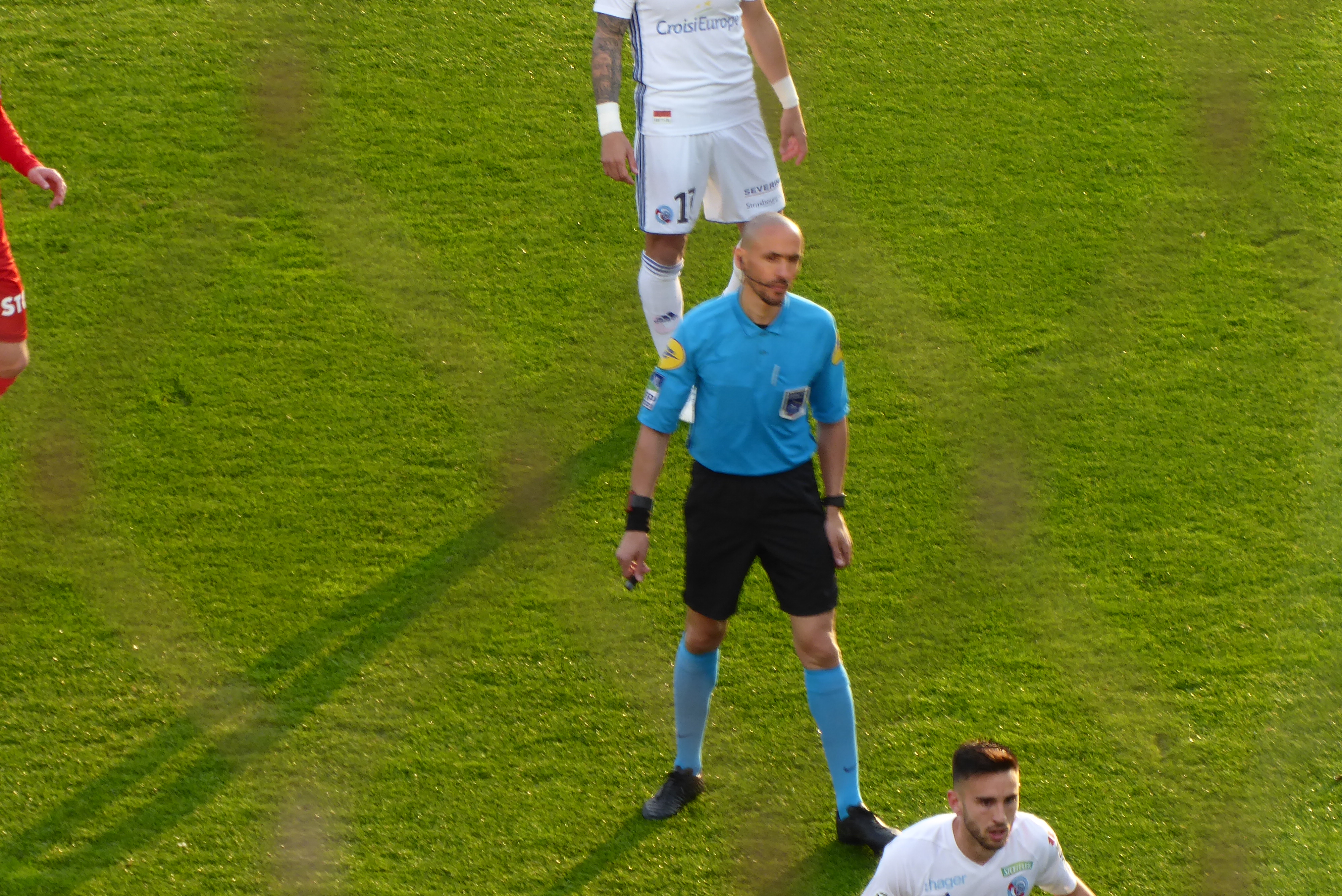
With only fourteen minutes played Florent Balmont is cautioned by referee Monsieur Hakim Ben El Hadj for complaining too vociferously when a free-kick is awarded against a team mate.  Dijon are ponderous and what shots on goal there are, are blocked or wide and no one looks much like scoring, that is until five minutes before half-time.  Tunisian international Naim Sliti pursues another mis-placed pass inside the penalty area, it’s running away from the goal towards the corner flag but somehow the chasing defender manages to clip Sliti’s heels, he goes down and Monsieur Ben El Hadj awards a penalty.  Paulene thinks it’s a bit harsh, suggesting that Sliti was moving so slowly towards the ball that the chasing defender, Adrien Thomasson, just caught up with him sooner than expected.  Monsieur Ben El Hadj ignores her pleas and Dijon’s Cape Verde international Julio Tavares gets the glory, booting the ball beyond the dive of Strasbourg’s Belgian goal keeper Matz Sels into the bottom left-hand corner of the goal;  Stade Gaston-Gerard is rocking all the way to mi-temps (half-time).

I make use of the break to use the facilities but haven’t got the will to wait at the buvette for another drink; I return to my seat and zip up my wind-cheater against the evening chill.  Small boys take part in a shoot-out and I feel very sorry for a particularly ungainly looking one whose control is so poor that the goalkeeper has claimed the ball before he even shoots, you just know he gets picked last in the playground.

The second half begins and Strasbourg are re-vitalised by their half-time espresso and now look much more interested, whilst Dijon are no better than before.  But time moves on, it gets dark and still Dijon lead but their Icelandic goalkeeper Runar Runarsson is busy, running off his line and making saves.  A corner from Strasbourg’s fabulously monikered Kenny Lala is sent goalwards by the Bosnian Stefan Mitrovic, the header is blocked by Dijon’s Roman Amalfitano but rebounds to  Ludovic Ajorque who has a simple ‘tap-in’ to equalise.   As Strasbourg celebrate a pall of gloom falls over most of Stade Gaston-Gerard.  Runarsson is called to make further saves from Thomasson, Da Costa and Goncalves, and Dijon manager Antoine Kombouare seems to be facing the prospect of both the Ligue 1 clubs he has managed this season being relegated; he was given the Dijon job in January having been sacked by Guingamp in November.

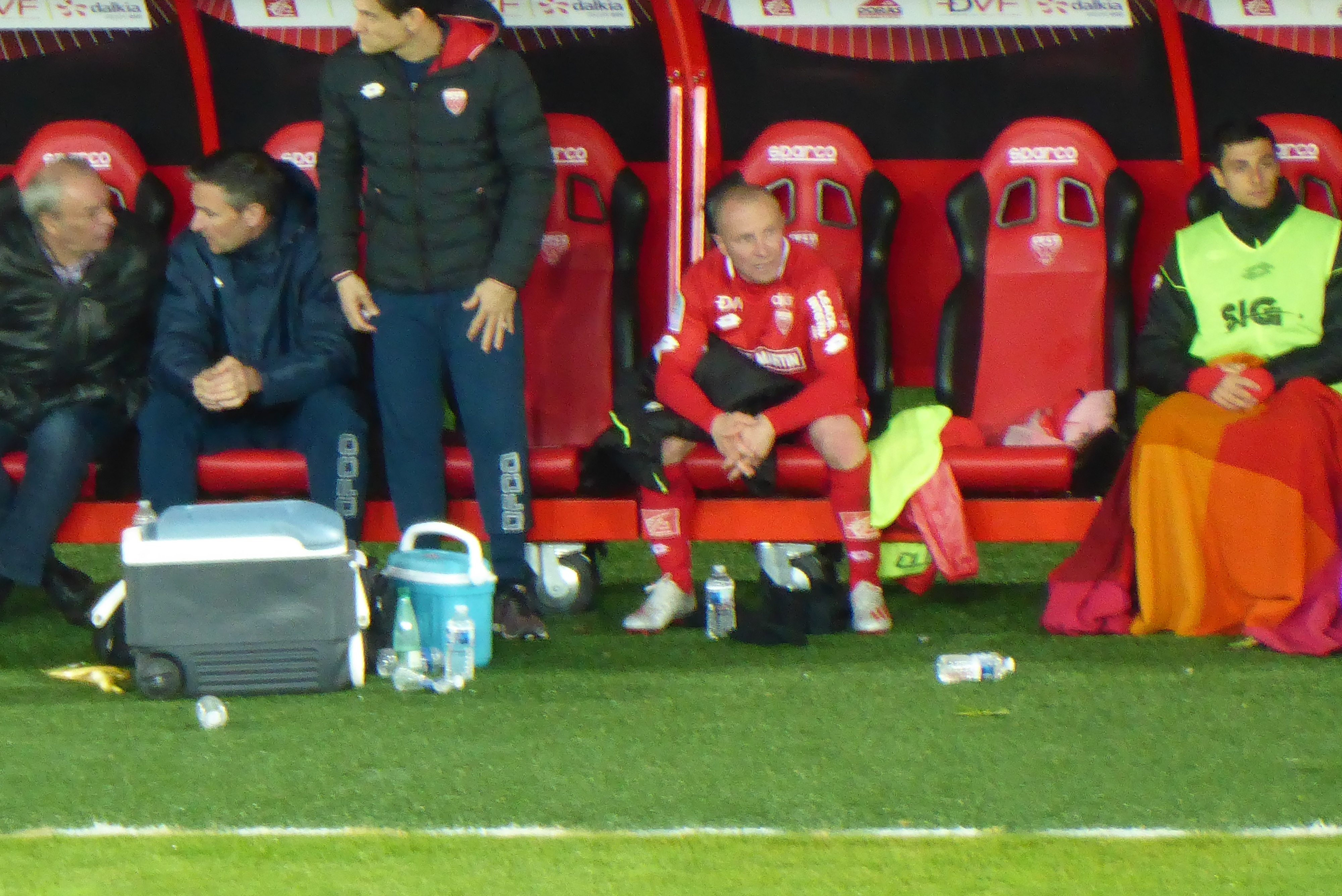
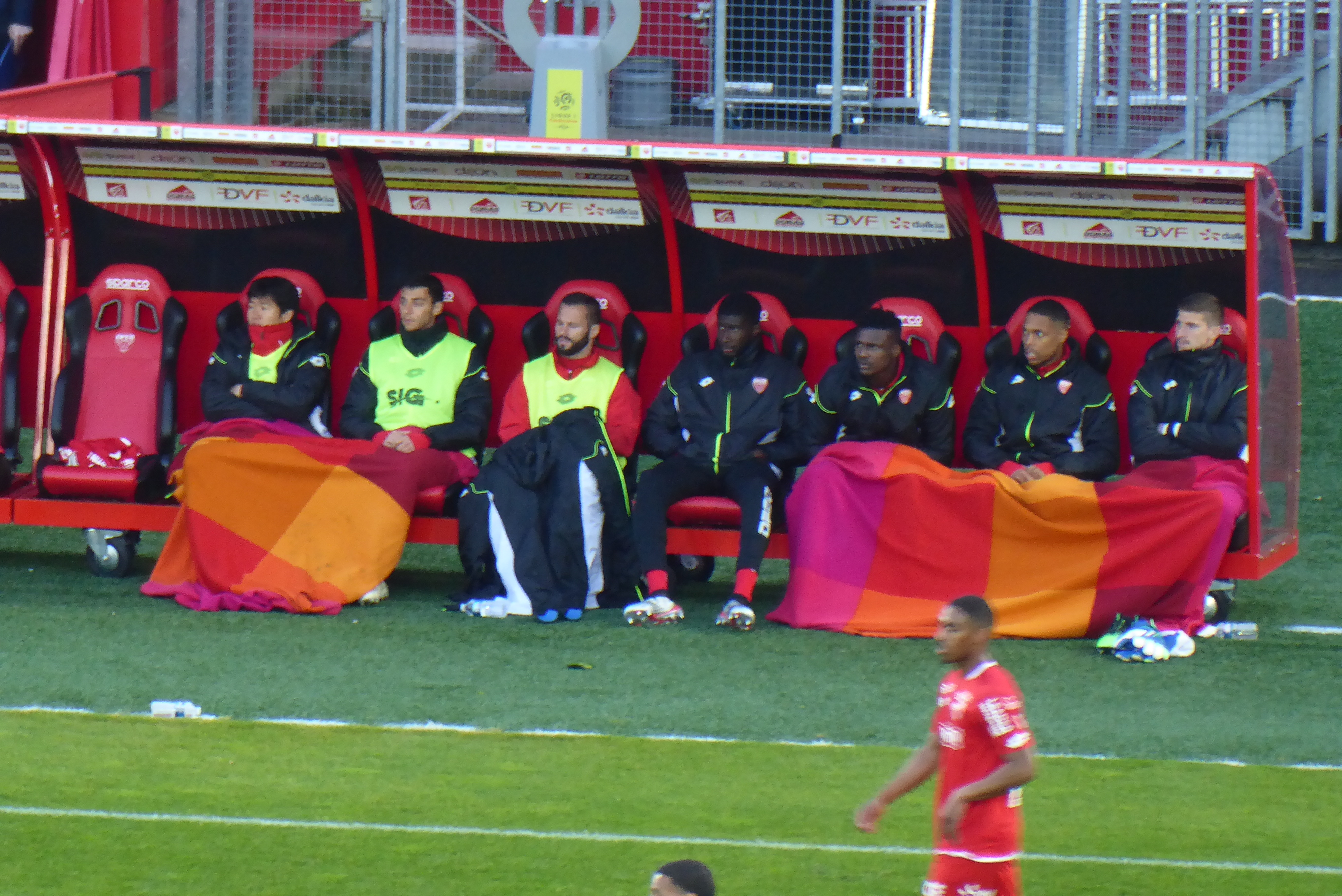
I like Antoine Kombouare, he has a kindly face and previously managed Strasbourg, Lens and Paris Saint-Germain, where he was sacked when they were top of the league. He looks on impassively in his grey suit and baseball hat.  With 15 minutes left Kombouare acts and replaces Florent Balmont with the Korean Kwon Chang-Hoon.   Balmont takes his place on the bench to great applause from the Dijonnais, he doesn’t look happy, not because he’s been substituted but because of how the game is going. 

Kombouare’s decision makes a difference however as Kwon seems to have far more energy than the rest of his team put together; he darts about, running at the Strasbourg defence and shooting on sight, he energises the crowd. But despite his efforts nobody scores for Dijon, although Ludovic Ajorque is prompted to even up the scores for yellow cards.  The ninetieth minute arrives and leaves; five minutes time added-on will be played and the home crowd urge their team on.  Dijon have to win to have a chance of avoiding relegation, their main rivals Caen are beating Reims 3-2.  If they lose Dijon will be five points behind with two games left, one of which is away to Paris Saint-Germain.  It’s the ninety third minute, Tavares has the ball, it runs on to Kwon in the centre of the penalty area, he takes a step and lashes the ball magnificently into the net past Sels. Kwon is engulfed by blokes in red shirts and in the stands everyone is on their feet cheering.  This is the way to win a football match, be ropey for ninety minutes and then get a last minute winner.  In the following day’s local paper “Le Bien Public” the game will be marked as a five out of ten, although the national sports paper L’Equipe will give it four stars out of six.   The stats will show that Dijon had fewer shots, fewer corners, less possession, won fewer duels and fewer tackles, made fewer passes and interceptions and their passes were less accurate.  What the stats cannot show however is that they never stopped believing they could win.

The full-time whistle soon follows and as we applaud the teams a man in a blue jacket appears from nowhere to take us back to the lift.  Paulene would be fine going down the stairs, but is mightily impressed that she has been remembered.  We are joined by two older men with gammy legs; the man in the blue jacket pushes the button on the lift control panel marked “-1” and leaves us.  One of the older men clearly thinks he knows better and pushes the button marked “0”; the lift descends and the doors open onto a darkened cupboard.  Fortunately the doors close again and we complete our descent,  and having negotiated a long white corridor find ourselves back in the concourse beneath the stand from where we step out into the night and stroll back to the tram stop.  Riding back into town on the packed tram I feel like Albert Camus in Algiers.  I love going to football matches in France.