Harwich & Parkeston 2 Benfleet 1

My mother was born and grew up in Shotley at the mouth of the River Stour. As a child she hardly ever went to Ipswich, and Saturday afternoon shopping would mean a boat trip with her mum across the estuary to Harwich and to Dovercourt. Her father was a mild-mannered man, but if someone did manage to annoy him he would not tell them to “Go to hell” but instead to “Go to Harwich”, by which I think he meant to go and jump in the river rather than any slur on the gateway to the Continent. My childhood memories from thirty odd years later were of going to Harwich by car, an ice cream cornet outside the town hall, Dovercourt Woolworth’s and having shrimps for tea.
With these fond family memories in mind I guide my Citroen C3 along the winding, undulating B1352 from Manningtree to Harwich, through Mistley, Bradfield, Wrabness and Ramsey. My wife Paulene and I have been to Ipswich to visit some of the historic buildings open to the public for the Heritage Open Days, but were a bit miffed to find two of the three buildings we wanted to view, which were advertised as open in the leaflet, were shut and only open next weekend. But arriving in Harwich our fortunes have improved, it is warm and it’s not raining, even if it is a bit cloudy and the Royal Oak

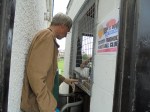
ground is open for this afternoon’s fixture in the tortuously titled Thurlow Nunn Eastern Counties First Division South. We park up in the car park at the side of the stadium and cross the lane to the turnstile by the main stand. Entry costs £4 each and the-grey haired man operating the turnstile helpfully verbalises the mental arithmetic of £4 plus £430684736148_a5cac6de7b_o making a total of £8 and the addition of the glossy and groovily typefaced, 16 page programme “Black and White” (£1) making a total of £9. A few steps inside the ground an old boy in a flat cap relieves me of the final tenth of the ten pound note I proffered at the turnstile, in exchange for a strip of draw tickets (Nos 61 to 65).
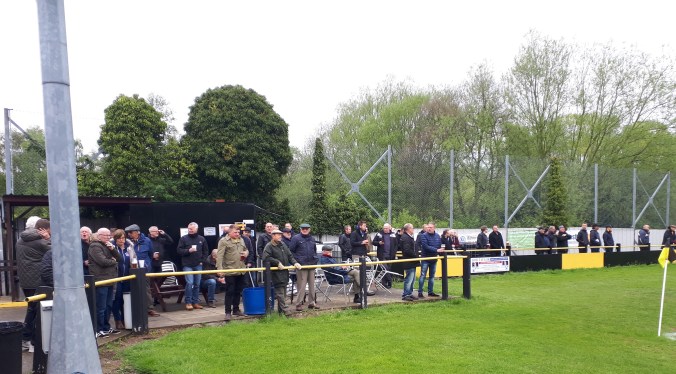
The Royal Oak Ground , where Harwich & Parkeston have played since 1898 stretches out before us , a green panorama, the broad pitch sloping away across its width, down towards Harwich town itself. Beyond the far side of the pitch a terrace of 1950’s houses, one with a hideous loft extension overlook the pitch. To the left behind one goal a steep but shallow concrete stand with a rusting tin roof and faded red steel stanchions, a sort of truncated barn backing on to Main Road, where the Royal Oak pub stands, and which leads into Dovercourt High Street; to the right and set back some way beyond the other goal, the changing rooms in a building with gabled dormer windows and a small clock on the roof, like a 1980’s pastiche of a village cricket pavilion. Behind us the main stand is short in length but disproportionately tall with a steep, corrugated, pitched roof; a typical football stand from the 1950’s, sadly its top half is now closed off.

This slideshow requires JavaScript.

It’s about twenty past two and the Harwich team are appearing from the changing rooms to warm up; we walk to that end of the ground to perhaps catch a word with their coach Michael, who we know from our previous mutual involvement at Wivenhoe Town.

This slideshow requires JavaScript.

Appropriately, page five of the programme has a small feature on Michael, from which we learn amongst other things that he drives a Citroen C4, his favourite food is curry and his favourite holiday resort is Acapulco. There is a photo of Michael stood with arms folded and looking quite butch, if a little overweight. After the game Michael will tell me that he likes to read this Blog whilst sat on the toilet.
“Well he should have some fresh milk, I put some in there on Tuesday, er no Thursday” we hear a man in a white shirt and black and white striped tie say to another man. At the corner of the ground a man with a Scottish accent asks us if we are from Benfleet, because, he explains, he didn’t recognise us. We tell him we are not but, are partly here to see Michael the coach, but also to just enjoy a Saturday afternoon at ‘the football’. Whilst Paulene watches the warm up, the Scottish man tells me how the club owns the ground and is debt-free. Harwich & Parkeston are playing at a lower level than they once did, but I am told that the club trustees saw that the need to simply keep the club alive was more important than trying to compete unsustainably in a higher league. The Scottish man bemoans the rise of ‘village teams’ into the semi-professional ranks, which he feels has fragmented local football and he’d like to see a league of clubs just from the main East Anglian towns. It’s a somewhat Stalinist approach, but I can see the attraction. The population of Harwich is about 18,000.
Kick-off is approaching and I buy two teas (£1 each) from the tea hut, a neat brick30685788148_87460e7c1e_o building probably dating from the 1950’s or 1960’s, which wouldn’t look out of place on a seafront esplanade. In the tea hut a woman is incredulous that an official has come from Norwich to referee a match in Harwich, she thought the point of the league re-structure was to cut travelling costs. “You can bet your arse that in Yarmouth they’ve got a referee from London” she says, and she’s probably right, although I’m not sure Ladbrokes would be interested in her or anyone else’s bottom as a wager. “There’s not many here today” she adds.
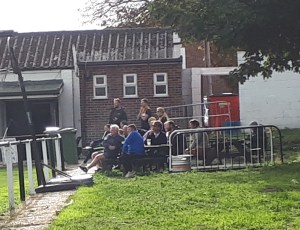
42747605380_9cc3b7bca7_oAs the game begins we take up a spot at a Yogi Bear–style picnic table in the corner of the ground by the bar and backing onto Main Road. Harwich kick off towards us, the River Stour and Shotley beyond. Harwich are wearing black and white striped shirts with black shorts and socks, completing a hat-trick of clubs along with Newcastle United and Grimsby Town that span the length of the east coast and wear black and white stripes. Benfleet are in a rather boring all red kit, although their home kit is a much more interesting light blue shirt with dark blue shorts.
From kick-off the ball is almost instantly hoofed into touch and early action sees the Benfleet number five take out both the Harwich number nine and one of his own team mates with a lunging tackle. The free-kick produces nothing of note but at least the tackle made me laugh. The football is scrappy but the passes that do get strung together are mostly strung together by Harwich or ‘The Shrimpers’ as they are known, a nickname which no doubt has to do with what I had for tea as a child. The neighbouring picnic tables are occupied too and on one of them some young women, possibly ‘wags’, talk about an away game they went to recently. “There was no bar” one of them says “Just a bottle of Blossom Hill in the fridge”. At another table a middle aged woman calls out “Come on ‘arridge”.
Despite Harwich’s dominance, at about twenty past three they almost fall behind as the centre-half misses the ball and Benfleet’s number nine Ben Foord is gifted a clear run at goal; he runs, looks up and shoots, but the Harwich ‘keeper Sam Felgate makes a fine diving save to his left. Stung by that near miss Harwich soon produce the best move of the match so far as number three Jake Kioussis overlaps into the penalty area, but loses his composure and blazes the ball high over the goal and onto the vegetation covered bank in the corner of the ground. Distraught at his failure to do better, Jake appears to try and garrotte himself in the netting behind the goal. Michael the Harwich coach leaves his post in front of the dug-outs to fetch the ball. The entertainment is improving and Benfleet win a corner but hit the ball straight to an unopposed Sam Felgate.
Just before half past three The Shrimpers take the lead as Sean Gunn dinks the ball into the net from close range as three Benfleet defenders look on admiringly; it’s what Harwich deserve in what has so far been quite a one-sided game. Paulene and I decide to get a different perspective on the match and wander further round behind the goal

enjoying the cascade of greenery in the corner of the stand and an abandoned roller. Non-league football just wouldn’t be the same without the atmosphere of decay and the implied memories of better days long ago; the Royal Oak has that beautiful faded glory in spades.
All of sudden a bit of ill-temper erupts on the pitch and the Benfleet number four squares up to the Harwich number two and shoves him backwards, not just once but three times. A melee ensues and Michael is on the pitch to help break it up. The referee Mr Harvey looks uncertain about what has happened and he consults his version of the VAR, the linesman Mr Arnot. 30686126038_1dc5f53e29_oUnusually both linesman are called Arnot, although if they are related the relationship looks like grandfather and grandson, with one being stocky and totally bald and the other lanky and very youthful. The referee consults Mr Arnot senior, who talks to Mr Harvey with his hand over his mouth, like players do on the telly. I’m not certain why he does this; even if Mr Arnot has a strange paranoia about lip-readers what can he possibly be saying that is such a big secret? The result is a free-kick to Benfleet and bookings for both players, although I’ve seen players sent off for shoving before. A short while later the match breaks down again into confrontation as Benfleet’s number five tackles horizontally at knee height and a Shrimper hits the turf clutching a leg. This time Mr Harvey sorts it out on his own, but again appears lenient as he doesn’t even show a yellow card. Happily, half-time soon arrives and everyone can go for a lie down.
Paulene and I continue our wander around the ground and I picture how the bank42747580570_69889cf102_o behind the dug- outs was perhaps once a grassy ‘terrace’. Beneath the vegetation a path can be discerned which runs up to a large pair of metal gates onto Main Road, I feel like some sort of football archaeologist, and as I look across at the terrace of 1950’s houses that overlook the ground I am struck with a sense of deja-vous. The layout of the Royal Oak with the houses on one side, the rickety main stand opposite and the club house up the corner is a lot like that of the Stade Municipal in Balaruc-les -Bains in southern France, where Paulene and I watched a Coupe de France (French FA Cup) game last September (see the archive section of this blog for an account of our visit and the match) . I buy two more teas (£2) and am served at the tea hut by the Scottish man who is helping out with the half-time rush. Paulene and I take a look in the club house where a display on the wall recalls Harwich & Parkeston’s appearance in the 1953 FA Amateur Cup final before a crowd of 100,000; The Shrimpers lost 6-0 to Pegasus (a combined Oxford & Cambridge University team) and it was probably Pegasus that drew the crowd rather than The Shrimpers, but it’s still an impressive piece of history nonetheless.
The game begins again and Benfleet are playing a bit better, although Harwich still get opportunities to score again. But at just gone twenty past four the Harwich defence recreates the error they made an hour ago. Harwich’s number five mis-reads the flight of the ball and fails to play it back to the goalkeeper who is a long way off his goal line; they are both left helpless as Benfleet’s number ten Rob Lacey nips in to lob the ball over Sam Felgate and into the goal to equalise. Quickly some of the Harwich players turn on one another to apportion blame. One of them stands with arms outstretched and says “If are going to make mistakes…” but sadly I don’t catch the end of the sentence. For a little while Benfleet are the better team and they seem to have broken up the link between the Harwich midfield and forwards. Benfleet’s blond-haired number six Martin Lacey has moved to left back and snuffed out the Harwich attacks down this flank; added to which his haircut has a hint of the 1960’s Mod about it.
Benfleet now look the more likely team to score again and we walk round behind the goal that they are attacking. We arrive in time to see the game again erupt into an unseemly mess as a Harwich player scrambles about on the ground and then a scrum of pushing and shoving and angry faces develops from seemingly nothing. Michael again appears to break things up. I don’t have a clue what happened or who was involved and sadly it seems neither does referee Mr Harvey who once again consults the human VAR Mr Arnot senior. The decision from Mr Harvey is to send off Harwich’s number five Ben Hammond and Benfleet’s number two Lewis Hunt and to book Harwich’s number four Shaun Kioussis and Benfleet substitute, number twenty Stephan Adeyemi , who hasn’t even come on to the pitch yet. Lewis Hunt and his team mates, manager and coaches protest his innocence and he certainly didn’t appear to be involved in the ruckus. Lewis heads for the dressing room and walks past us, I ask him what happened. He didn’t know but said he didn’t do anything, he tried to separate people and got hit in the mouth and then stepped away. He seems like a really nice bloke, which is what the Benfleet team were telling Mr Harvey. During the mayhem the Harwich ‘keeper takes to time to relax and have a lie down, adopting the pose of a gentleman-player in one of those photographs of a Victorian football team.
The break in play seems to have affected Benfleet more than Harwich, possibly because of the sense of injustice that Lewis Hunt has been wrongly sent off; perhaps whoever was guilty, and someone was, should have owned up and said “Send me off Ref, Lewis is innocent”. Never before has my wearing of my Albert Camus philosophy football T-shirt been so poignant, with its slogan “All that I know most surely know about morality and obligations I owe to football”. Benfleet have lost concentration and at a bit past four thirty The Shrimpers number eleven Sean Gunn breaks through the middle and places a low shot wide of Florent Gislette in the Benfleet goal. Understandably after all that has happened the Harwich team celebrate somewhat.
The final fifteen minutes play out without too much sense that there will be any more goals, although Shrimpers substitute Nicky Palmer sends a shot out towards the North Sea when nicely set up by number ten Michael Hammond, who had passed up on a chance to have a shot of his own. Hammond also becomes the eighth player to be booked before Mr Harvey eventually closes proceedings and the crowd of 160 give appreciative applause for what has been a thoroughly entertaining afternoon of football and brawling, but mostly football.
Paulene and I retire to the bar for a pint of Greene King Abbot Ale (easily Greene King’s best beer) and a Bacardi with Soda (£5.25) and a chance to reflect on a very enjoyable (and cheap) afternoon. We might have been disappointed not to sample the Heritage of Ipswich earlier today, but the sporting heritage of Harwich and Parkestone’s Royal Oak ground has more than made up for it. We’ll be back.

This slideshow requires JavaScript.

World Cup 1 Ipswich 0

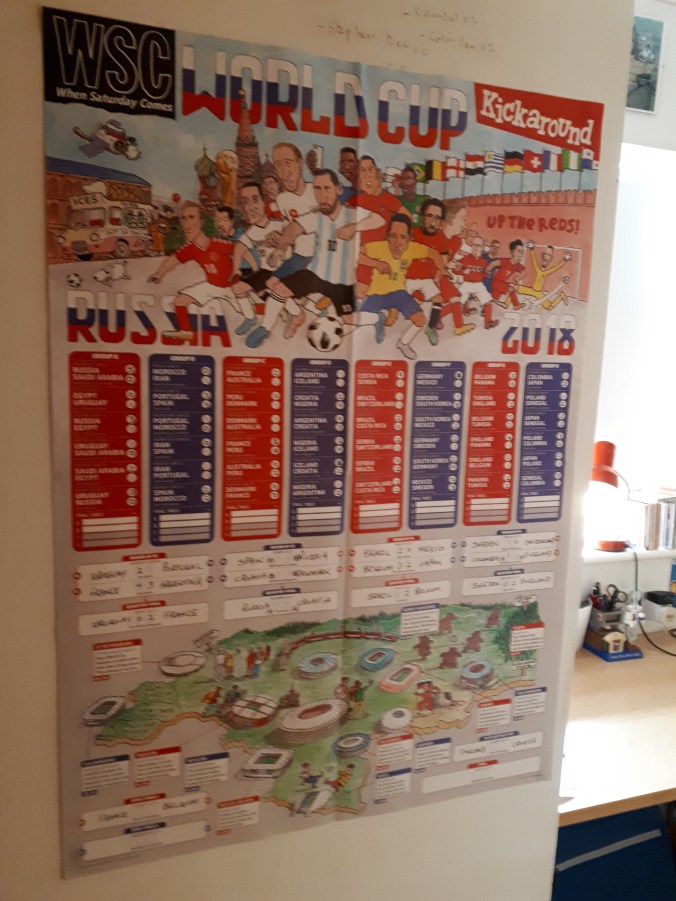
Oh how I love the World Cup. For a month every four years football is somehow reinvented; transformed into something more magical, intriguing, strange and joyous and I just want to wallow in it.

29402264768_be6e6e9583_o

The World Cup is not just sixty-four football matches in a month on the telly; for the first two weeks it’s thrice daily football on the telly and this year on the first Saturday there were four matches to watch in one day. But it’s not just the overdose of football that excites, we’re not exactly short of televised football anymore; what makes the World Cup so different, so much better is that it’s a celebration and it’s all so exotic. It’s not the same-old boring diet of Premier League and Champions League that gluts the airwaves the rest of the year, with the same boring, conceited, miserable clubs playing each other over and over and over again. Some of the players are the same, but lots of them aren’t and for a month they are released from prostituting themselves for filthy TV money and they play for something higher, for the glory (okay, there have been a few exceptions, step forward Togo2006 for example).
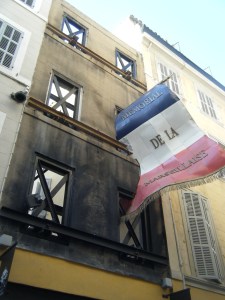
Just the idea of Japan v Senegal, Serbia v Cost Rica, Iran v Spain, Panama v Belgium, Australia v Peru and Iceland v Argentina is thrilling; such diversity of geography , weather, indigenous wildlife, people and culture is mind boggling and it’s all united for a month by football and a desire to hear each country’s national anthem at least three times, and of course the national anthems are marvellous. The South American countries have anthems that are like mini-symphonies with an overture and then what follows is so grand and so passionate. Then there is the wonderful Russian national anthem and of course the Marseillaise, in my opinion the finest of all national anthems. If you are ever

14214314935_6f473ee4ba_o

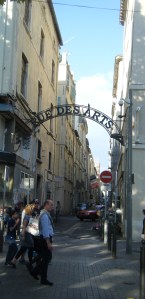
in Marseille then I can thoroughly recommend the

14214135594_26a46deac4_o

museum in Rue des Arts which is devoted to the Marseillaise and its history. As the anthems play we get to see the supporters in the stand, many in fancy dress or national costume, singing and holding on to the moment.
On the pitch there are players of different creeds and cultures representing those creeds and cultures that define their country, and whilst those things are beautiful and fascinating and really matter, and each team is driven by national pride and the essence of what identifies them as a nation, at the same time these things do not matter because the World Cup is actually all about the football; football is the common language and it unites. So whilst we cannot help but be aware of all this diversity of race, beliefs, attitudes, cultures and national anthems which matter to individuals from each country, at the same time we can ignore it and get on with just playing football. This is how not being racist really works, being aware of race and respecting it but simultaneously paying no attention to it at all, so that you don’t actually notice what race a person is; we are all just people.
Enthused by the melting pot that is the World Cup therefore, when I saw a Tweet from Ipswich Town saying that the fanzone would be open for people to watch England World Cup matches on a big screen I re-Tweeted it with this comment:
“Here’s an idea, what about showing Poland’s games and Portugal’s games in the fanzone too? Not everyone in Ipswich supports England. In fact, why not show every game?”
It wasn’t long before someone Tweeted a two word response; “Terrible idea” they Tweeted, which I thought was rather rude and a bit arrogant. If you want to disagree at least explain why. A polite person would surely have begun their Tweet with “Sorry, but I do not agree that that is a good idea, for the following reasons…” Foolishly rising to the bait, I replied to the rude tweet asking in an innocent and curious tone “Why’s that then?”. The ‘answer’ to my question was soon Tweeted, although it wasn’t really an answer but rather an unnecessary question, which suggested that the other Tweeter hadn’t really read and understood my initial Tweet properly; his question was “Where would it stop?”. I replied that it wouldn’t and that the whole of the World Cup could be shown. A further reply was soon forthcoming, once again in the form of a question, but with a couple of statements at the end.
“You want the whole of the World Cup shown in a fan zone, in a sleepy suffolk town. Columbia vs Japan? Azerbaijan vs Kazakhstan? There’s just no market for it Martin.” There were plenty of things wrong with this response beyond the absence of a capital ‘S’ in Suffolk and the mis-spelling of Colombia I thought, but the final sentence of this Tweet sent this exchange of tweets hurtling into the abyss with what I can only describe as the ‘punchline’; “Lets not forget brexit means brexit” it read. Despite the missing apostrophe I was particularly amused by the use of the words “Lets not forget… ”, but nevertheless, the overall effect on me was one of disappointment and incredulity. What was this bloke on about?
I didn’t reply to the Tweet because of the whiff of xenophobic nutcase that it had released. I had however desperately wanted to reply so that I could point out that neither Azerbaijan nor Kazakhstan are in the World Cup finals, that the Tweeter had seemingly confused Ipswich with Wickham Market or Eye (sleepy Suffolk Town?) and to ask for the evidence that there was no market for showing all of the World Cup in the Portman Road fan zone. But of course mostly I wanted to know what the heck the World Cup, Colombia, Japan, Azerbaijan and Kazakhstan had to do with ‘Brexit’. In fact what does anything have to do with ‘Brexit’, a composite word for something that doesn’t exist and which to date no one can define.

42368032625_3bb39ea081_o

At the very beginning of Simon Critchley’s book “What we think about when we think about football” he quotes nineteenth century American philosopher William James who wrote “I am sorry for the boy or girl, man or woman who has not been touched by the spell of this mysterious sensorial life…with its supreme felicity”. I know exactly what William James meant. It is so sad that people have such a blinkered, joyless perception of the world around them, that their worlds are so closed. I hope that the Tweeter I have quoted was the exception and not indicative of the general opinion of Ipswich Town fans, but later two other Tweeters ‘liked’ the “Terrible Idea“ response to my initial Tweet and I died a little inside.
But I’m alright again now, for the time being, until August when Championship football comes home to Portman Road once again.

42368032845_2db816905c_o(1)

Ipswich Town 1 Arsenal 0 – Our Blue Heaven

It’s Saturday May 6th 1978, I will be eighteen in about seven weeks’ time and today I am going to the FA Cup final. I am going with my dad; we were two of the 24,207 who saw Town beat Hartlepool United in the fourth round of the FA Cup and the 29,532 who witnessed the 3-0 win in the fifth round replay against Bristol Rovers; we went to the semi-final at Highbury on a supporters’ coach from Shotley. We saw Landskrona Bois, Las Palmas and Barcelona at Portman Road back in the autumn and have seen about a dozen league games on top of that, so we had the requisite vouchers to get tickets for the final. But this morning my father has woken up feeling unwell; he doesn’t think he’ll be up to going to Wembley and so for my friend Tim who lives five doors away, it’s his lucky day. I walk along the street, knock on his front door and ask if he wants to come to the FA Cup final; he does. Tim’s dad Charlie will this evening deliver a bottle of sherry by way of a thank you.
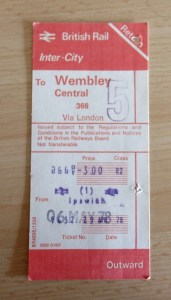
I listen to a few selected tracks from Blondie’s first album ‘Blondie’ (released in December 1976 )as I get ready to go; ‘Look good in Blue’ seems apposite this bright morning as does ‘In the sun’ with its lyric “In the sun , we’re gonna have some fun”. We get to Ipswich railway station somehow; on the 202 bus, or does someone give us a lift? Ticket to WembleyFrom Ipswich we are on a special chartered train that turns right at Stratford and plots a course through north London round to Wembley Central. In Wembley Stadium the terrace steps at the tunnel end are much bigger and steeper than those in Churchman’s or in front of the East Stand, blue and white abounds. The sun shines and Arsenal, wearing yellow and blue, kick off with Ipswich playing towards that blue and white tunnel end. Paul Mariner hits the cross bar, John Wark twice shoots against a post, Pat Jennings saves acrobatically from George Burley, Paul Mariner misses, bigmouth Malcolm McDonald is rubbish, Clive Woods is brilliant, David Geddes crosses, Willie Young is a lumbering donkey, Roger Osborne scores, we cheer, we sing, Roger Osborne is substituted for Mick Lambert, Town win and Mick Mills lifts the FA Cup and turns to show it to us.
Back at Wembley Central railway station after the match a half-brick or a stone bounces off the window of our train as we wait to depart back to Ipswich. Arriving back in Ipswich, Tim and I celebrate with a couple of pints of Tolly Cobbold bitter in the Railway Tavern on Burrell Road as we wait for a lift home in Tim’s dad’s green Morris Minor 1000.

OLYMPUS DIGITAL CAMERA
Forty years and eighteen days later it’s a dank evening in Ipswich, I have been to work, visited my mum, parked up in Portman Road and arrived at the New Wolsey theatre, which didn’t exist in 1978, although there was repertory theatre in Tower Street. I am with my wife Paulene. My father has been dead for nine years, happily his cause of death was unrelated to his illness of 6th May 1978, he enjoyed almost 21 years of good health subsequent to that and made it to the UEFA Cup final second leg in Amsterdam. Tim now lives in Weymouth and oddly he still only gets to see the Town when I get him a ticket (this season we went to Brentford). The Railway Tavern has been demolished; the green Morris Minor was scrapped long ago. But the name of Ipswich Town is still inscribed on the plinth of the FA Cup.
My seat at the Wolsey theatre tonight is in the front row of the auditorium, my wife Paulene is sat in the row behind; she sat behind to give me more legroom. The production is so popular we couldn’t get two seats together. We are the first people in the auditorium, Paulene’s asthma means she needs time to acclimatise. I read the programme (£4) and think “Cup final prices”. The stage is just a metre in front of me, the ‘boards’ are under a green covering patterned to look like turf. At the back of the stage a pair of blue doors look like the doors at the back of the old North Stand, above them is a projection of the type of corrugated cladding also redolent of the old North Stand. But there was never a sign that said ‘Welcome to Portman Road’ back then, there isn’t now. Also part of the projection is the old Ipswich Town crest, the slightly imperfect yellow and blue one, which should be restored out of respect to the past and to John Gammage who won the competition to design a distinct crest for the club back in 1972.41429848635_33f2609053_o
I watch the ‘crowd’ as the auditorium fills up to the sounds of assorted 1970’s pop hits, nostalgic but mostly awful. The majority of people here seem to be my age or older, old enough to have witnessed the 1978 Cup final. A few people are sporting blue and white scarves; one man wears a bright red blazer as if he’s just got here from Butlins. In the front row are three young lads, pre-teens, one of them wears a parka which lends an unexpected layer of 1970’s authenticity. Paulene says she feels cold, I say if I’d known she was going to I would have brought a blue and white bobble hat for her.
The lights dim and tonight’s performance of ‘Our Blue Heaven’ begins with Blondie’s “Hanging on the telephone” played live as the soundtrack to a domestic scene in which a young couple, Mel and Scott arrange their wedding for Saturday 6th May 1978, and then the draw for the third round of the FA Cup is announced. I resist the temptation to put my hand up to point that Blondie’s Parallel Lines album, from which ‘Hanging on the telephone’ was taken as a single would not be released until September 1978. I am not really a pedant and whilst I may not always like it, I do understand the concept of artistic licence and have been known to use it myself; I deny all accusations that it was merely lying.
Mel’s sister Sue is a dedicated and faithful Town fan and from the start foresees that she will want to be at Wembley on May 6th. Meanwhile, in a parallel story Smudger and Ange are awaiting their first child, with Ange’s ‘expected date of confinement’ surprisingly enough being 6th May, although the nurse at the hospital, who happens to be Mel and Sue’s mum Sheila tells them that babies never arrive on time. Smudger is as committed a Town fan as Sue and is predictably torn between his love for the Town and supporting his wife.
The simple domesticity portrayed is all a bit ‘Play for Today’, particularly when it transpires that Mel and Sue’s dad Paul is a striking fireman, whilst Scott’s dad Brian is a Thatcherite policeman; and that just adds to the authenticity and feel that it is 1978. I am transported back in time on a wave of Nostalgia (from the Buzzcocks Love Bites album and like Blondie’s Parallel Lines, also not released until September 1978, but also sadly not in the show).
Scenes from the two families’ stories are spliced with Town’s progress through each round of the FA Cup introduced by popular songs of the time, Bowie’s ‘Heroes’, Patti Smith’s ‘Because the night’, something or other by the Bee Gees. For the sixth round trip to Millwall the band plays the Clash’s London Calling, at which point I really do want to put my hand up because the Clash’s album was not released until December1979, a whole 20 months later. I only hold back when London Calling runs into White Riot, which is much more temporally authentic having been released as a single in March 1977, and a cracking tune to boot.
For each match a group of male and female dancers act out the crucial on-pitch events to the background of the songs and a BBC radio style commentary. My friend Gary texted me before the performance to tell me there was just one thing he did not like about the production and later he will tell me that it was the football sequences. Re-creating football well is notoriously difficult to do, as proven by awful films such as Yesterday’s Hero, in which incidentally the football sequences were filmed at half-time during a game at Portman Road; this is why I don’t consider that the director really bothered to do so. The dancers don’t look like footballers and they are only dancing, creating an impression through movement; they could have been supporters recreating the goals, children doing so in the school playground, and that is authentic. So Gary, you are wrong and need to brush up on your critiquing skills.
The intertwined stories of the families and the FA Cup run are good ones, there is drama, pathos, human emotion aplenty, humour and of course a happy ending. But the thread that runs through the production is the character of Bobby Robson who intermittently comes on to the stage like some sort of visiting angel wearing a series of 1970’s style suits and coats, imparting words of wisdom and assorted homilies about football and the wider experience of our lives beyond. As if this isn’t enough, the actor playing him, Peter Peverley does so brilliantly, better even than Michael Sheen’s rendering of Brian Clough in The Damned United. Peverley has the accent which is easy enough, and he has perfected the mannerisms too, but more than that he has captured the slight hoarseness in the voice, it’s almost uncanny. He wears a pretty bad wig though.
The finale to the production has the marriage, the birth and the FA Cup final taking place on stage simultaneously following the singing of Abide With Me, the Cup final hymn since 1927; a maudlin little number but a cracker nevertheless because it is the Cup final hymn and has been marinated in 90 years of Cup final history. Being sat right at the front, my view is now partly obscured by some of the on stage props, so I watch the audience. People who know the words sing along with Abide With Me, whilst others hold their scarves aloft. It is likely that many of the people here, like me were at the Cup final in May 1978 and are part of the story, but this makes people feel involved all over again, it’s nostalgia with knobs on, re-enacting the past, albeit part fictional, but this is somehow how it felt.
The story ends and it truly feels like Town have won the FA Cup all over again, and then Roger Osborne, the personification of the day because he scored the winning goal enters the stage, inevitably to a standing ovation. The ultimate finale however, comes with the cast all assembled on stage with Bobby Robson leading us in a sing-song, some Cup final community singing of our own; a rousing rendition of Edward Ebenezer Jeremiah Brown. It’s bloody marvellous and everything that matches at Portman Road no longer seem to be, utterly joyous. I give it my all.
I have had a most marvellous evening and for much of it I am not ashamed to admit I have had a tear in my eye. I have been taken back in time, but don’t know if I’m tearful for my lost youth and the passing of the days when Ipswich Town was such a wonderful football club and team, and when the FA Cup was something that really mattered, or if these are tears of joy and happiness, for a love of my team and a sense of belonging that has been re-kindled.
Nostalgia is warm and cosy, but it’s not a healthy thing, because we cannot go back and we have to live in the present; but tonight after watching Our Blue Heaven I genuinely feel uplifted.
My name is Edward Ebenezer Jeremiah Brown
I’m a football supporter of Ipswich Town
Wherever they play, you’ll find me
I haven’t missed a game since I was three
With me scarf and me rattle and me big rosette
Singing where was the goalie when the ball went in the net
Follow the Town
Up or Down
I’m Edward Ebenezer Jeremiah Brown but everybody calls me Ted.

Football, Football,
Whose the greatest of them all,
Let’s put it to the test
Come to Portman Road on a Saturday and you’ll see the best
Oi!
Ipswich! Ipswich! Come On The Town!

My name is Edward Ebenezer Jeremiah Brown
I’m a football supporter of Ipswich Town
Wherever they play, you’ll find me
I haven’t missed a game since I was three
With me scarf and me rattle and me big rosette
Singing where was the goalie when the ball went in the net
Follow the Town
Up or Down
I’m Edward Ebenezer Jeremiah Brown but everybody calls me Ted.

2-4-6-8 who de we appreciate?
It isn’t hard to tell
Just you take a closer look at me
And you’ll know darn well
Oi
Ipswich! Ipswich! Come On The Town!

La la la
La lala la lala lalala
Lala lalala la lala lalala
La lalala lalala, and lots more lalalaing, you get the picture ?


Felixstowe & Walton United 2 Coggeshall Town 4

It’s rare that I finish work and take a trip to the seaside but this evening, having ‘logged out’ and put away the tools of my trade for another day, I find myself heading for the 16:58 from Ipswich stopping at all stations to Felixstowe, which means Westerfield, Derby Road and Trimley St Mary. It’s a bright, breezy evening as the single carriage box on rails roars into life and departs the platform ten seconds early. The frantic diesel engine growls and then subsides as if the driver is searching through a crash gearbox and struggling to double de-clutch. We pass over the bridges of Bramford Road and Norwich Road and I look along those streets to down town Ipswich with its chunky, if not gleaming towers and the Portman Road football ground, which looks massive beyond the low, humble rooftops of Ipswich’s residential streets. On a bright Spring evening Ipswich shows off its trees; it’s a fine town.
The train is fairly full of people heading home from work. Opposite me a simian looking man in a grey anorak; behind him a tall man with a crew cut wearing a red Adidas tracksuit top; he looks like a Russian cosmonaut. On the other side of the train to him is a luxuriantly bearded man with long hair hanging over bristly temples, he is wearing an infantile coat decorated with a gaudy cartoon character; the woman with him could surely do better than that. “Hello Mum, how are you doin?” says another man answering his mobile phone. The cheery conductor asks to see my ticket (£3.05 for a single with a Goldcard) and scribbles on it in biro. He hasn’t singled me out, he looks at other people’s tickets too. I only bought a single because it is impossible to get back from Felixstowe to most intermediate stations between Colchester and London after 9.25pm. I shall be cadging a lift home with two Coggeshall regulars Keith and Jim.
The journey takes about 25 minutes and is well worth the £3.05 fare, with its tour of the cuttings, embankments, bridges and viaduct of Ipswich and then the open countryside towards Trimley with its glimpses of the tops of dockside cranes. The track runs parallel to the road for some way and as we hurtle along and overtake a bus I am reminded of the Titfield Thunderbolt; Greater Anglia should have a bar on this commuter run.


Felixstowe station has a beautiful canopy and concourse which are Grade II listed, it’s just a shame a the platform is now divided in two by a surface car park. The fate of the railway station is that of Felixstowe in microcosm, one of faded, compromised Edwardian grace and occasional grandeur. Felixstowe could be posh like Southwold and Frinton and in places it is, but it has an unfortunate underbelly like most of divided Britain; on Hamilton Road a man sits on a bench wrapped in a sleeping bag. I do a spot of sightseeing, walking down to the cliff top get a glimpse of the sea and then back along Grosvenor Road, stopping off for a pint of Sharp’s Doom Bar (£3.35) in the Grosvenor Arms, a typical Greene King pub, weirdly decorated like a cross between an hotel lounge and a small town museum.

This slideshow requires JavaScript.


It’s just gone six o’clock and I amble back towards the railway station and cross over the road into Beatrice Avenue, a clichéd, leafy, suburban street of detached houses with Tudorbethan gables. I half expect to see a Reggie Perrin. The ‘Goldstar Ground’ and Dellwood Avenue, home of Felixstowe & Walton United, runs off Beatrice Avenue and is much the same, but it’s got bungalows too. There are two stewards in day-glo waistcoats at the entrance to the club car park, clearly tonight’s game is a big one. I crunch my way across the beach-like car park, past the old club house which stands forgotten, forlorn and falling apart; there are tiles missing from its roof and the paint is peeling from its weather boarded walls. It could look good if restored as a cricket pavilion, but as it is it looks like it might soon be offering up spare parts for allotment sheds.

This slideshow requires JavaScript.


The turnstiles have only been open a few minutes and there is no queue, only an array of signs, one of which refers to ‘Spectator Balls’ and would seem to be purely for comedic effect. I pay my £6 entry fee and collect a programme (£1.50) from a man sat at a foldaway table. I head towards the swish new club house, a low brick building with black timber cladding, which only opened at the start of the season; it sits behind a tarmac area in the shade of a row of small trees like a French town square. I make for the snack bar and order a chip buttie (£2 – ticket no 57) and very good it is too, with lots of crinkle cut chips served in a little cardboard box. I sit and eat at a Yogi bear-style picnic table and gain amusement from the pre-match music play list; Dancing Queen (Abba) ; Since You’ve Been Gone (Rainbow) Don’t Stop Me Now (Queen); The Boys Are Back In Town (Thin Lizzie) and so on. It’s no surprise when the stadium announcer sounds like Mike Smash, drawing out the final syllables of every sentence. Someone needs to tell him it’s no longer 1980.
Finding Keith, my driver for the night, already ensconced in the stand with his sidekick Jim, I offer to get them a drink; two coffees (£1 each) and I pop into the bar, a plain but

27966581938_1353fc665e_o

durable looking room, for a pint of Guinness (£3.50), but am very, very disappointed that there is no real ale, not even Greene King IPA. I return to Keith and Jim and settle down in a seat for the evening as the crowds begin to roll in, gathering mostly in the area in front of the bar, but fanning out all around the perimeter fence too. Both Felixstowe and Coggeshall have already secured promotion to Bostik Division One North, but if Coggeshall win tonight they will be Champions; if Felixstowe win they will go top of the league and could clinch the Championship on Saturday. The excitement is palpable and clearly worth six quid of several people’s money. The eventual crowd will eventually be announced as 1,541, easily the biggest attendance in the Eastern Counties League this season and possibly since the 1960’s and nearly 700 more than watched Morecambe play Colchester United earlier this season in the fourth division.
Kick-off is delayed for five minutes because there are still queues at the turnstiles but referee Mr Aaron Farmer seems keen to get on as the teams appear on time to go through all that handshaking malarkey. The teams are announced over the PA in the style of a bingo caller. “On his o-w-n, Numb-e-r One, Dann–y Cruuuuump”, except he didn’t say “On his o-w-n”, sadly. Felixstowe & Walton United being “The Seasiders”, it is entirely possible that their stadium announcer’s day-job is on the pier. The teams line up and we wait about as the swirly, impatient sounds of Fat Boy Slim’s “Right Here, Right Now” build the sense of occasion; I always think that that tune should be played at bus stops and on station platforms in the minutes leading up to arrival and departure.
Eventually, Coggeshall Town kick off in the direction of Woodbridge wearing a change kit of all blue with white sleeves, which makes them look rather fetchingly like the mighty Ipswich Town, a good omen for them surely. Felixstowe & Walton United meanwhile model their customary Signal toothpaste inspired design of red and white striped shirts with red shorts and socks; they are kicking towards the town and the North Sea. Fat Boy Slim breaks off abruptly, but not before the game has started.

Coggeshall start well and quickly have a shot on goal, the Felixstowe goalkeeper Danny Crump making a diving save from Coggeshall’s number ten Ross Wall and the Seedgrowers win an early corner. Coggeshall get forward well, particularly down the left wing with Aaron Cosgrove, but gradually Felixstowe edge back, although their play is more about just getting the ball into the box. There are a few chants of “Sea-Sea-Seasiders” mostly from the area in front of the bar, but not as many as you might expect from a crowd of this size. Behind the goal at the ’Woodbridge end’ a loan voice occasionally bellows support for Felixstowe.
Coggeshall are looking the better team, but it still surprises me when Jamie Shaw heads Coggeshall into the lead from a Curtis Haynes Brown cross; the ball is seemingly cleared off the goal line but the linesman signals that the ball had crossed the line. This LAR (Linesman Assisted Referee) system really works. Then Coggeshall score again, Aaron Cosgrove displaying the sort of skill that on the night is setting Coggeshall apart from their rivals. Barely twenty minutes have been played, the night is young, it isn’t even dark yet.
The goals dampen the home crowd’s ardour, but the game is played at a furious pace so there is still excitement aplenty as muscular tackles and thundering hoofs are punctuated by occasional flashes of pace and skill and a booking for each team. Felixstowe spectacularly hit the Coggeshall bar with a shot from Boardley and then a cross into the box from a free-kick is swept in from close range by Felixstowe captain Rhys Barber. It’s 2-1 to Coggeshall as everyone breaks ranks for half-time and many of us discover that the two urinals and one toilet in the clubhouse aren’t enough tonight. I take a walk around the ground to take in the sights as daylight rapidly fades and is swapped for floodlight and the unique atmosphere of the night match. Such a big crowd stood on the grass beneath the trees, it feels more like Bonfire Night.
Returning to my seat just in time for the re-start, the ground is now transformed by the floodlights. The grass seems to glow beneath the dark blue sky and backdrop of lofty trees. The score line is finely poised. It’s five to nine and once again Coggeshall’s Aaron Cosgrove runs at speed at the Felixstowe defence, this time at its very heart. Cosgrove is tripped by Dan Davis who is booked for his efforts and Conor Hubble arcs a glorious free-kick over the defensive wall in to the top left hand corner of the Felixstowe goal. Not long later Cosgrove is tripped again, this time in the penalty area, and Coggeshall captain Luke Wilson makes the score 4-1 from the spot.
Felixstowe substitute Jamal Wiggins still manages to get a second goal for Felixstowe from close range and then the game changes into a lower gear. Half chances come and go but Coggeshall are largely in control. In the stand some of the spectators betray their loss of hope, appealing desperately and randomly to players, the referee and anyone in earshot. “Keep the ball!”, “Put it up there!” “What’s he doing now? Booking the ball?” More players of both teams are booked and the referee becomes equally unpopular with both sets of supporters, as is only right. One voice has given up on goals and just wants Coggeshall players booked for swearing; has he never been to a football match before I wonder. The best of the game has passed, but it remains exciting nevertheless and Keith and I speculate about the damaged greenhouses and cold frames in the gardens of the detached houses beyond the far touch line, as numerous balls are booted out of the ground.
The crowd thins out as it becomes evident that Felixstowe will not win, and they don’t. Coggeshall Town are champions of the Thurlow Nunn Eastern Counties Premier League and the game ends in a burst of deserved and prolonged applause for both teams.
It’s novel to see a team win something, it’s not something that as an Ipswich Town supporter I have witnessed lately and I have had to experience the joy of winning trophies vicariously through other clubs. Tonight has been memorable.

This slideshow requires JavaScript.

Stowmarket Town 5 Long Melford 1

The end of the football season is nigh and where promotion and relegation has not already been decided, hope and anxiety masquerade as excitement. When “mathematically” a team can still be promoted it really means they have as much chance as winning a lottery jackpot, realistically none. Attracted by this sense of hopeless futility I am heading to Stowmarket who must win their last four matches, hope Felixstowe lose their final three and at the same time overhaul a superior goal difference.
It’s a grey, wet, day in late April in which the showers for which the month is famed have seemingly joined together in an unwanted show of soggy solidarity. My train is hurtling towards Ipswich through a blur of swishing greenery; rain drops speckle and streak the windows and opposite me sits a slight teenage girl; her head consumed by a set of massive earphones; only that little head and her dangling legs are visible behind a bulging rucksack twice the size of her torso. Arriving at Ipswich I have to buy a ticket for the second part of my journey; walking into the booking hall four clerks sit in a row as if awaiting a sudden rush for tickets, only one of them acknowledges my presence and therefore, although he is at the far end of the row I buy my ticket from him. There is a twenty minute wait for my connecting train and so I sink into the soft two-seater sofa in the waiting room between platforms three and four. I gaze up through the long, gracefully shaped window of the small room at the wooden fretwork valance of the platform canopy and beyond through the steady drizzle at the reflection of a brick chimney on the shiny slate roof of the main station building. The train is late but beauty abounds.
From Ipswich it’s just an eleven minute train journey to Stowmarket (£3.65 return with a Gold Card), out past marshalling yards and Morrison’s, past the scrapyards of Claydon and along the valley of the River Gipping through Needham Market; arrival at Stowmarket is announced by Munton’s (Passionate about Malt) and the multi-coloured storage tanks of the ICI paint factory.

Leaving the red-brick station with its glorious Jacobean style gable, I walk only a few paces before entering the Kings Arms public house to enjoy a pint of Woodforde’s Wherry (£3.30). It’s another attractive little building, although plain, but its appearance is spoiled by the unsympathetic UPVC windows. In the lounge I sink again into a two-seater sofa almost identical to the one in the waiting room at Ipswich station.

There is snooker on the television and a man and woman sit on another sofa drinking tea and reading the papers. “Miserable out there, isn’t it” says the man. I resist the temptation to contradict him and say that I think it rather beautiful, if wet, so I tow the party line and say something fatuous about wondering when it will clear up.
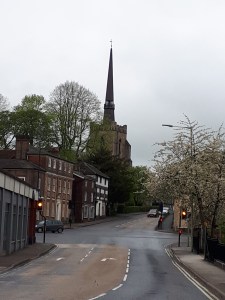
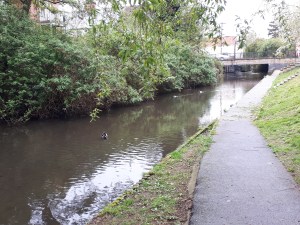
It’s twenty past two and my mobile phone tells me it’s a fifteen minute walk to Green’s Meadow, the home of Stowmarket Town. The rain has ceased and I set off, crossing the River Gipping, admiring the Grade 1 Listed church of St Peter and St Mary and the Grade41059492994_bca1edfba5_o II* listed, but seemingly derelict eighteenth century Lynton House in front of it. The route to Green’s Meadow is along Gipping Way, past the badly spelt Bodywize Gym, Lidl and the predictable queues of shoppers at its checkout tills, who stare out through the plate glass to assuage their boredom; perhaps I should wave.39969490770_e013c32e92_o
Stowmarket Town is a part of Stowmarket Community Sports and Social Club whose premises, a low, single-storey prefabricated building, reminiscent of the temporary classrooms of my childhood primary school, sits behind a large surface car park by a roundabout. It’s not 41735827652_308b47713e_oimpressive looking, but the yellow and black signage gives it a certain unity and smartness. Entry to the Greens Meadow ‘stadium’ (£6) on match days is through the ‘turnstiles’ which are close to the half way line. There is no queue and as I walk in the referees and some players are warming up on the pitch, which on such a grey day appears almost luminous, its grass, lush, damp and very green.


A few people have already taken up their positions in the corrugated iron clad stand to the left where strangely a white UPVC door is propped on its side; a portal to a horizontal universe. I cross through the metal cage that is the players’ tunnel; glancing towards the changing rooms I see more UPVC windows leaning against a fence. I take a wander round the ground, a man stands on a chair to fix one of the goal nets, there is a lot of signage about toilets. I head towards the bar, which is doing a good trade as people stay

This slideshow requires JavaScript.

out of the cold and damp. I buy a plastic pint ‘glass’ of Greene King IPA (£3) and find a table where I sit and look through the programme (£1). The IPA has its familiar taste, something reminiscent of the smell of plasticine. The programme contains a lot of adverts and it’s good to see local butchers, chip shops, metal merchants, plumbers, carpet fitters and purveyors of aggregates supporting the club. I particularly like the full page advert for Emmitt Plant with its colourful pictures of diggers and dumper trucks. A bald man called Russell Hall, who wears a black shirt covered in yellow smiley faces is available for ‘adult comedy nights’, after dinner speaking and ladies/gents nights; I shudder a little and turn the page. Apart from a bored eight or nine year old, the only females I can see here are serving behind the bar.
I leave the bar and head outside via the toilet; there is a slight smell of damp in the corridor. Back outside, the teams appear from the metal cage and run through the pre-match handshake routine. Stowmarket wear their customary yellow and black striped27908577378_1bc30b2e09_o shirts with black shorts and socks, whilst Long Melford wear an Anderlecht or perhaps Fiorentina or Toulouse inspired change kit of all purple or violet, but with black and white hooped socks, as if they forgot to buy the whole ensemble. Melford kick off the match with their backs to the town, playing towards the A14 and the looming concrete bridge which crosses the adjacent railway track and River Gipping.
The men who were in the bar drinking are now stood in the corner of the ground27908515908_dc57ee32d9_o drinking. A few wear flat caps, some fashionably, some less so. “Blimey, it’s like an audition for Peaky Blinders round here” says one bloke; it’s a comment that makes me smile more than anything I anticipate Russell Hall might say. I wander round to behind the dugouts. Stowmarket win a corner and their number five heads the ball directly into the arms of the Melford goalkeeper. One of the Stowmarket coaches clutches his head in anguish as if imitating Edvard Munch’s ‘The Scream’, or having a seizure. The Melford right-back then rather uncharitably passes to the Melford number eleven, simultaneously calling “man-on”. It’s akin to throwing him something boiling hot and yet also very fragile. He might have done better to pass to someone else.
Stowmarket are the more adept team but they’re struggling to make chances and Melford are competing equally well. A man with a rucksack on his back opens a Tupperware box and bites into a soft roll. It is about twenty-five past three and the ball hits the net in the back of the Long Melford goal, off the head of Stowmarket’s top-scorer Josh Mayhew. The public address announcer hasn’t been paying attention, the goal did arrive a little out of the blue and his announcement is a bit late. One spectator tells him the score is still nil-nil whilst another says “No, that goal was in the first half”. The excitement is too much for me and unusually I feel hungry, I stroll to the tea bar and order a bacon roll (£2.50); the bacon is quite tasty if not as crispy as it could be.
On the pitch Melford’s number seven Jose Zarzoso-Hernandez is keeping the Stowmarket right-back occupied. It’s about twenty to four now and suddenly Stowmarket are two-nil up as Remi Garrett scores from close range and a slight deflection. The announcer is fully awake now and has James Brown with him, who feels good even if he does end his celebration a little abruptly and mid-note. Melford break away but prevaricate and fail to score and a minute before half time, James Brown literally picks up where he left off, feeling good again as Luke Read scores a third Stowmarket goal, again from close range. James Brown finishes before just a hint, but no more of Tom Hark leaks out of the PA.
Referee Mr Thomas Hancock soon whistles to end the half and I get a pounds-worth of tea to wash away the remnants of my bacon roll; bits of the bread are stuck in thick pasty lumps between my gums and cheeks. Carrying my tea I step back inside the club house to catch the half-time scores (Ipswich at Reading is goalless). One end of the room is screened off and a printed notice announces that it is the Sponsors’ Area; blokes in smart casual dress are gathered around a buffet with paper napkins and paper plates. I glance out of the window and see players returning for the second half, so I join them, in a manner of speaking.
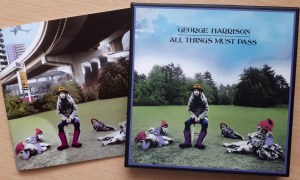
The man who earlier ate a soft roll from a Tupperware box remarks to his friend as he looks across the pitch from outside the club house, “You can see the slope from here”. “Oooh, yes” says his friend. Tupperware man then eats a chocolate coated biscuit, possibly a Nestle’s Breakaway or supermarket own brand equivalent. I walk away to stand level with the edge of the penalty area looking across towards the sweeping concrete flyover that is the A14. The view reminds me of the cover of the booklet inside39969482350_80eee01721_o the 30th anniversary edition of George Harrison’s defining triple album “All Things Must Pass”. The concrete bridge is a wonderful backdrop to the corner of the football ground, running as it does above the height of the trees, which surround the ground on two sides. The roar from the traffic is constant and I wonder how polluting it must be down here at pitch level. Do asthmatic players struggle more at Stowmarket?
It’s now four minutes past four and a long throw from Melford’s David Lopez is headed on before Will Wingfield forces it over the goal line from close range to make the score 3-1. “That was some throw” remarks the old boy stood next to me, a comment that I belatedly realise was made to me. What can I do but agree? It certainly was. Another old boy joins the first “How are ya?” he says. “Arroight” Is the reply.
-“You?”
– “Yeah, foine” says the first, with an air almost of disappointment.
At just gone ten past four Stowmarket’s Josh Mayhew scores his second goal, reacting in a split second to hit the ball hard and high into the Melford net from more than 20 metres out. Now Tom Hark is heard over the PA and the announcer calls out Mayhew’s name in the exaggerated drawn out manner of a boxing match compere. The majority Stowmarket contingent in the crowd of 179 cheered a little and applauded when the goal went in, but they don’t seem overly thrilled and don’t react to the amplified call to celebration. There are no Ultras here, but then, it is Suffolk. If the people aren’t taciturn, they’re not saying what they are.
I continue to enjoy the match and the spectacle of Greens Meadow, the green of the pitch and trees all around, the amber, black and purple of the team kits and the concrete, corrugated iron and yellow painted steel and the knot of drinkers by the clubhouse. Stowmarket make three substitutions all in one go and then at about twenty five to five Josh Mayhew completes his hat-trick and the PA gets positively frenzied as it launches Nirvana’s “Smells like teen spirit” at us and Grunge meets the flat cap, as Stowmarket meets Seattle.
No further goals are scored, but the afternoon has grown increasingly cold as a creeping, penetrating chill seeps from the damp ground. Thanks to Suffolk stoicism or quiet inebriation there are no complaints,  but disappointingly with the final whistle the vast majority of spectators either just leave or head back inside the clubhouse without offering up the applause both teams deserve.   As the players stand in ragged circles to receive their post match de-briefs from their respective coaches, I too turn and leave, and walk the wet streets back to the railway station, and as I do so I reflect upon the joy of a damp afternoon in Stowmarket.

This slideshow requires JavaScript.