Once upon a time, five o’clock on a Sunday afternoon in November in suburban England would have been the time to be thinking about sitting down to eat toasted teacakes or buttered crumpets with a pot of tea and perhaps a slice of Battenburg or Dundee cake. In our modern times of course, anything goes, and we are free from the strictures of Sunday tea and can now watch football whenever we want, or whenever someone in China, Canada, Bolivia, Cuba, Cyprus, Guadeloupe, Israel, Latvia, Nicaragua, St Kitts and Nevis, Switzerland, Thailand, US Virgin Islands, Uruguay or Vietnam, to name just a few, wants to show it on the telly in their far-off Ipswich Town supporting country. Today therefore, for the benefit of viewers of TV channels such as Star+, ESPN Play Caribbean, Nova Sport 1, Bilibili and Astro SuperSport, I am pleased to attend my first ever 5 o’clock kick-off football match and forego my usual relaxing Sunday evening at home in which I try and savour the final few hours of the weekend before the drudgery of another working week.
The TV viewers of Brunei and Ecuador etcetera are as discerning as you or I and naturally would not watch any old rubbish, which is why today’s match is special; today Ipswich Town play Buxton in the second round of the FA Cup. Buxton F.C. are in the National League North, the sixth tier of the league pyramid, although oddly the game is not being shown in Egypt. Sixth ‘tierness’ is a status Buxton share with the likes of Banbury United, Blyth Spartans, Bradford Park Avenue and other clubs many of which don’t begin with the letter ‘B’, like Spennymoor Town. I recall visiting Buxton on a family holiday to the Peak District in 1976, and then again in 1986 when I was best man at a friend’s wedding there; I spent the night in a caravan that looked like it had travelled forward in time from the 1950’s; of course it had done, but just a day at a time.
Today might be a special match day in some ways, what with the impending thrill of knock-out cup football and the kick-off time being moved for the benefit of unknown Venezuelan and Costa Rican couch potatoes, but mostly it’s not, and after parking up my trusty Citroen C3, I am soon crossing the threshold of the Arbor House (formerly The Arboretum) like I do before every match. Today, I purchase a pint of Woodforde’s Norfolk Nog (£4.10) which makes me feel slightly traitorous, but I soon recover before joining Mick in the pub garden. Being a damp, dreary day there is just one other drinker in the garden and he soon departs leaving us to talk about our beers, (Mick is drinking Mauldon’s Moletrap) buying an electric car, the world from a Marxist perspective, this year’s local government pay deal and the reality of cities like Cambridge, Oxford and Brighton away from the colleges and the candy floss. After a further single malt whisky for Mick and a half of Woodforde’s Hiberno (£6.80) for me, which leads to a discussion about whether Hibernia was the Roman name for Scotland or Ireland (it was Ireland), we head off into the quiet of a Sunday evening in Ipswich. I remark how it’s so quiet that it doesn’t feel like we’re going to a football match; more like we’re going to evensong, which leads Mick to confess to having been an altar boy at Orford church in the far off days before he hit the hippie trail to Morocco. It’s not until we get to Civic Drive that we see anyone else who is obviously heading for the match. If LS Lowry had been from Ipswich and gone out with his easel on a night like this he’d have had to have painted something else. But behind the Sir Bobby Robson stand, a long queue snakes along the back of the stand towards the turnstiles beyond. Mick and I are wise however to the propensity some people have for joining the first queue they see, and we walk on further towards the corporation bus depot. At the last turnstile (No58), we attach ourselves to a queue of about five other people and are soon stepping out across the artificial grass towards the entrance to the palatial Block Y of the Magnus west stand.
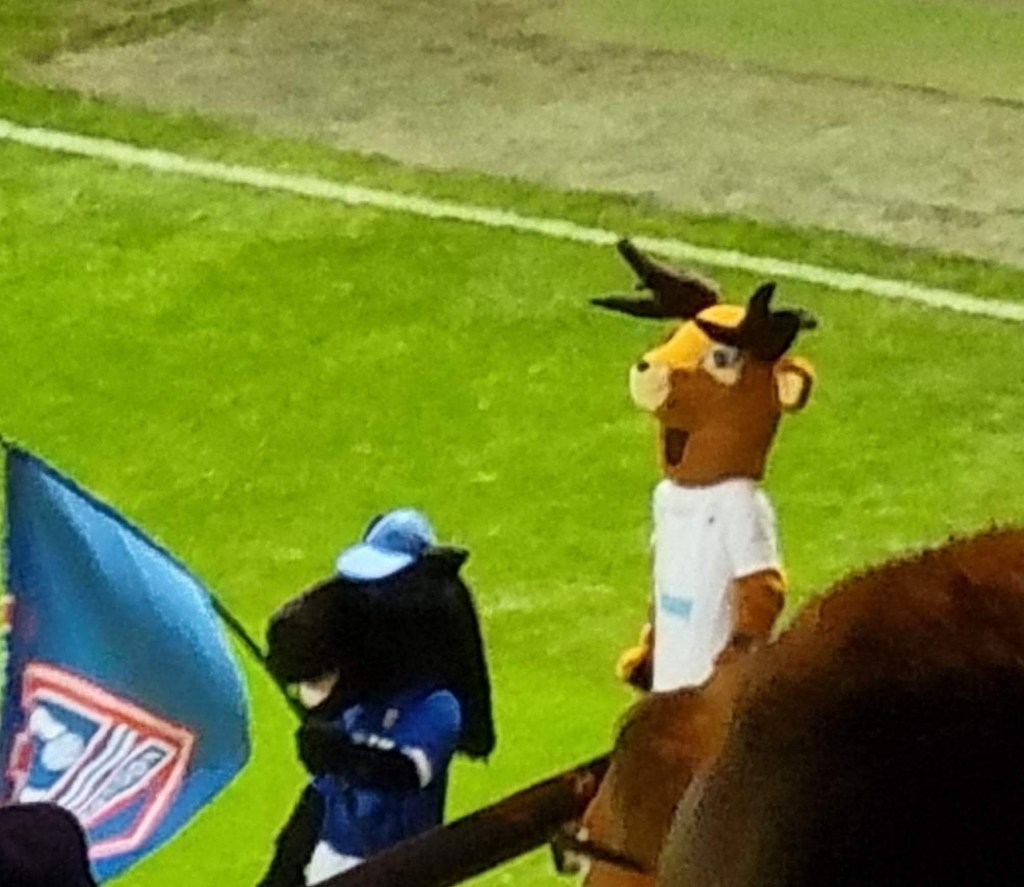
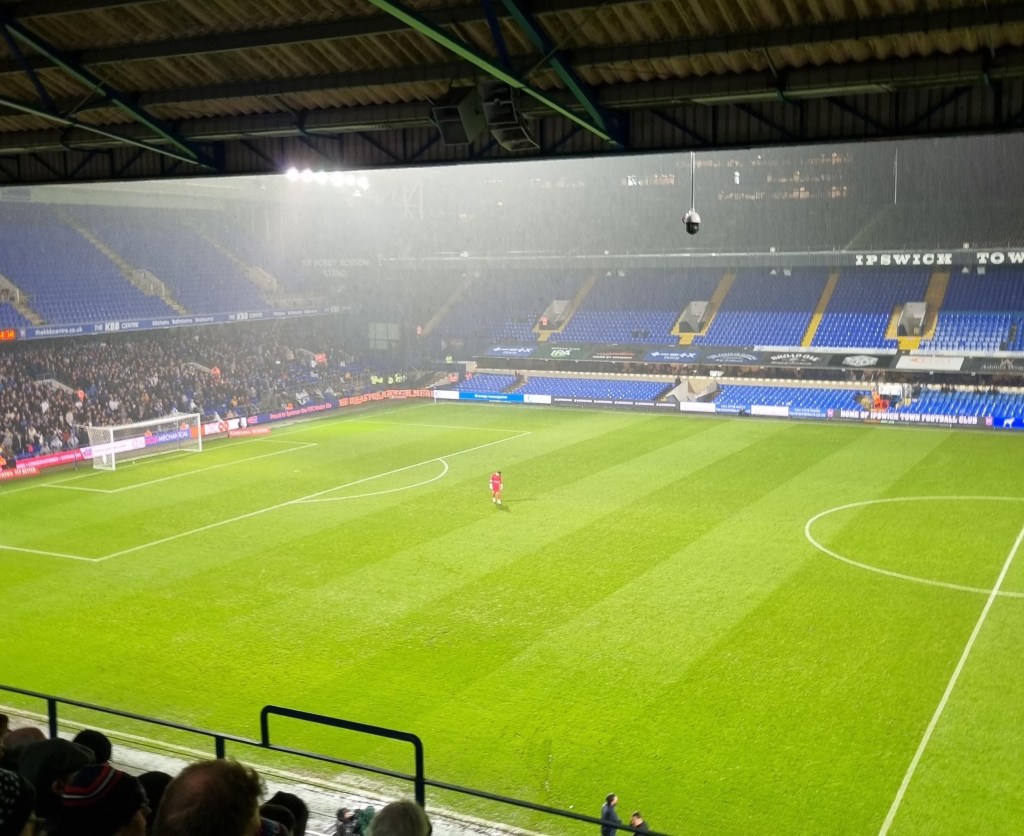
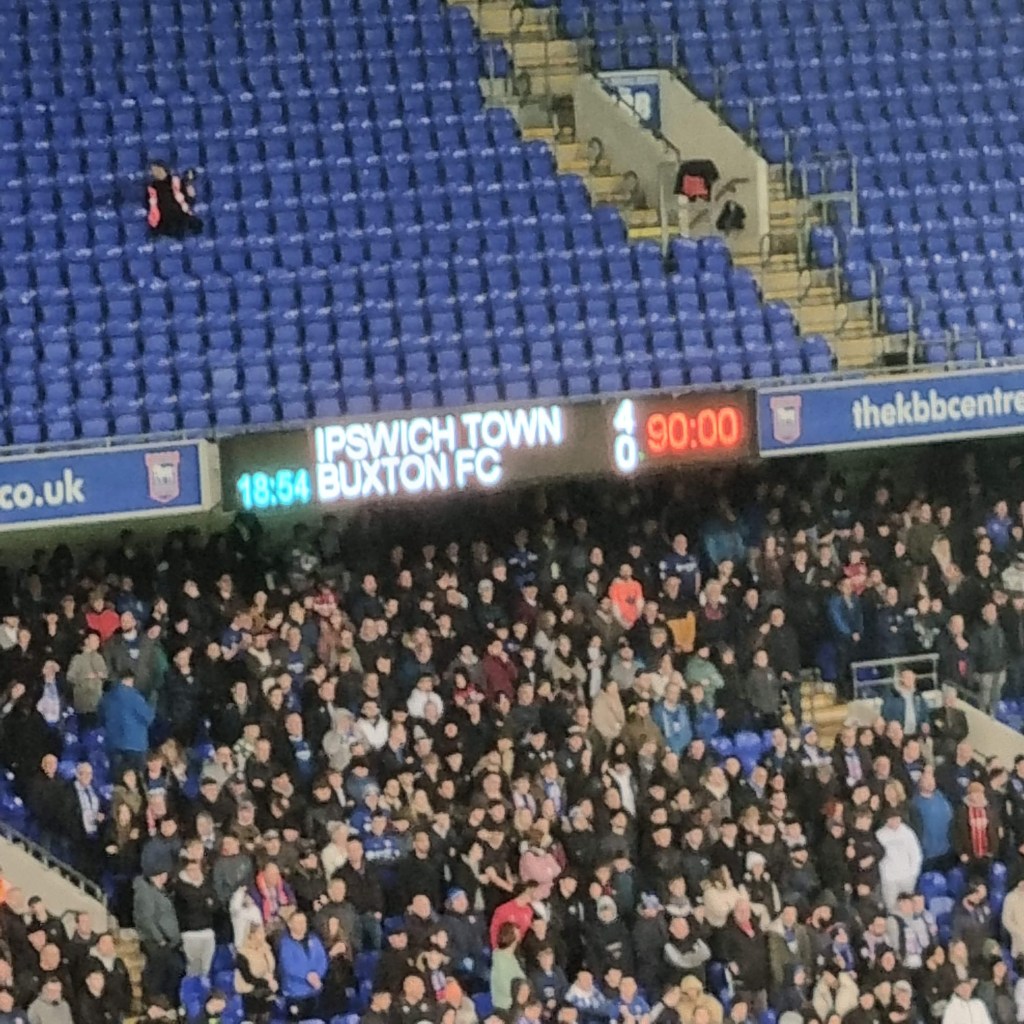
We take our seats just as the teams are walking onto the pitch past Crazee the mascot and a mysterious reindeer; we stand to applaud and stay on our feet as there is a minute’s applause for the recently deceased David Johnson, arguably Town’s third best-ever centre-forward after Paul Mariner and Ray Crawford. We will later learn that there are fewer than 10,000 of us in Portman Road this evening, but there is nevertheless a frisson of excitement around the ground as a fine drizzle starts to fall and the game begins with Town kicking off towards what was Churchman’s when David Johnson last played here. Buxton are wearing a kit of white shirts and dark blue shorts giving them the air of a poor man’s Tottenham Hotspur, and oddly they have no players of colour.

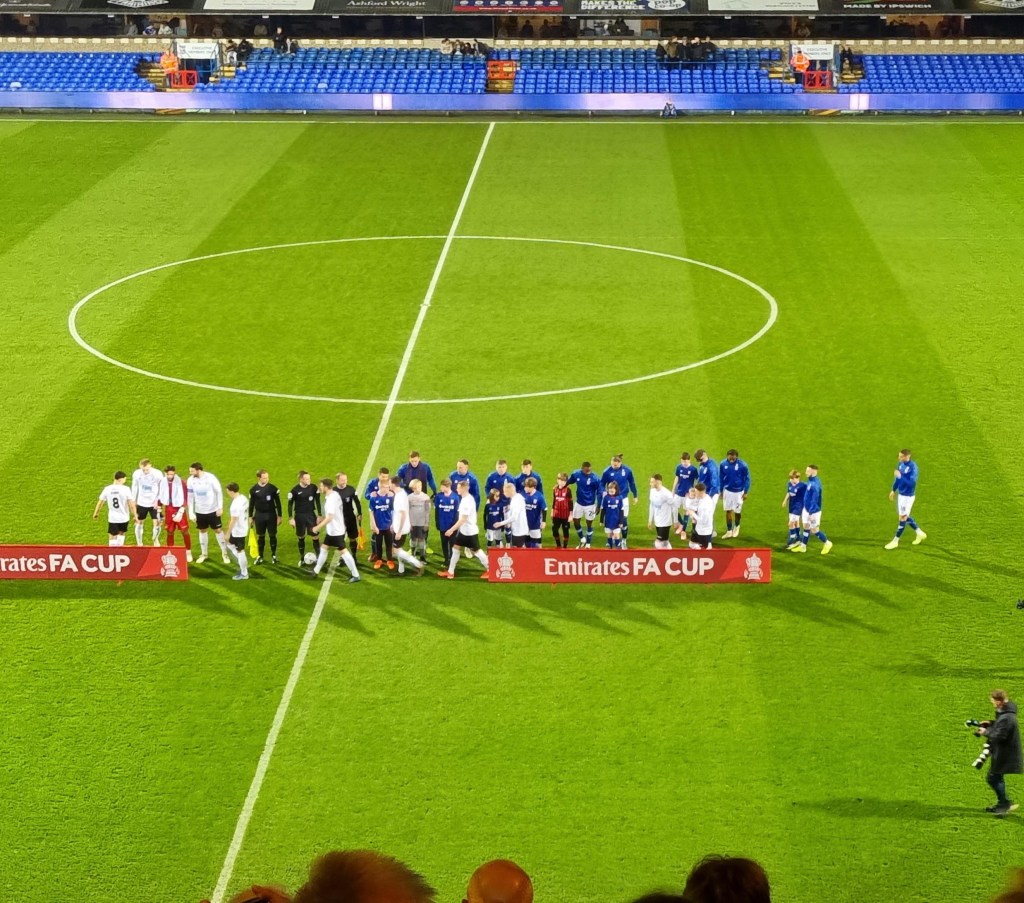
The opening minutes are dull as Town accelerate slowly through several gears like a very large articulated lorry before finding their desired passing rhythm. The fragile enthusiasm of the home crowd quickly dissipates and it’s open season for the Buxton fans to begin singing “We’ve got more fans than you” before gaining in confidence with a chorus of “Your support is fucking shit” and then asking the ultimate, damning question “Is this a library?”. Naively perhaps, I didn’t expect the followers of non-league Buxton to sing the same tired, unimaginative old songs as followers of Football League teams and it sets me to wondering if the folk that occupy the end of the upper tier of the Cobbold Stand aren’t actually just the same people every fortnight but wearing different colour replica shirts. Thoughts like this can make you question the very nature of reality.
Although Buxton might be dominating the singing with their off the shelf wit, on the pitch their team are barely getting sight of the ball, let alone a touch. Such is Town’s superiority in keeping the ball that the Buxton fans are reduced to cheering enthusiastically when they win a throw-in. When Buxton do win the ball Ipswich invariably win it straight back. But nevertheless, the first fifteen minutes or so are a bit dull. Mick yawns. The bloke behind me starts to pray audibly that something will happen. “Here we go” he says optimistically whenever a Town player takes the ball forward more than a couple of paces. Patient passing football to draw the opposition onto you and create spaces to move into is all very well, but this is the FA Cup for which the watch words are surely “Up and at ’em”.
“Shall we sing, shall we sing , shall we sing a song for you?” ask the Buxtonians through the medium of Cwm Rhondda, which seems appropriate if this is evensong. Sufficiently goaded by the Buxtonians up in the Cobbold stand, a few of the occupants of the Sir Bobby Robson stand summon a limp rendition of “Come On You Blues” before a more lively burst of rhythmic clapping emerges and even a few extroverts around me in the Magnus west stand join in . The first half is half over, but Town are now into their passing stride and are putting in crosses and looking likely to score. “Addy, Addy, Addy-O” chants what used to be the North Stand. “Come on ref” moans the woolly-hatted geriatric next to me for some reason I haven’t spotted. Beyond the dark sloping roof of the Magnus Stand the fine steady drizzle looks like steam. The first Buxton player is booked and then referee Mr Ross Joyce gets into his stride too and records the name of Town’s first Welsh Scandinavian Geordie, Leif Davis in his little notebook too. It looks like a second Buxton player has got away with a foul on Kyle Edwards but it’s as if Mr Joyce is thinking to himself, “No, I think I will book him after all” and shows a slightly belated yellow card.
The last third of the half begins and the game has blossomed into something quite enjoyable as Town dominate and create chances but still haven’t scored. But then Wes Burns speeds off down the right , crosses the ball low to Conor Chaplin who skips to one side and sends a darting angled shot into the bottom right hand corner of the Buxton goal from about 12 metres out; it’s a trademark Conor Chaplin goal. Four minutes later Kyle Edwards races into the penalty area, ball at his feet and Buxton players flailing around him before releasing a low cross, which Gassan Ahadme turns into a goal from very close range.
This is how things should be and I can only wonder why 9,000 voices aren’t singing “Wemb-er-ley, Wemb-er-ley, we’re the famous Ipswich town and we’re going to Wemb-er-ley”, but they’re not. With the half-time whistle I descend into the bowels of the stand to drain off some Woodforde’s beer whist Mick queues for a vegan pie which he is impressed to find comes with a wooden spork.

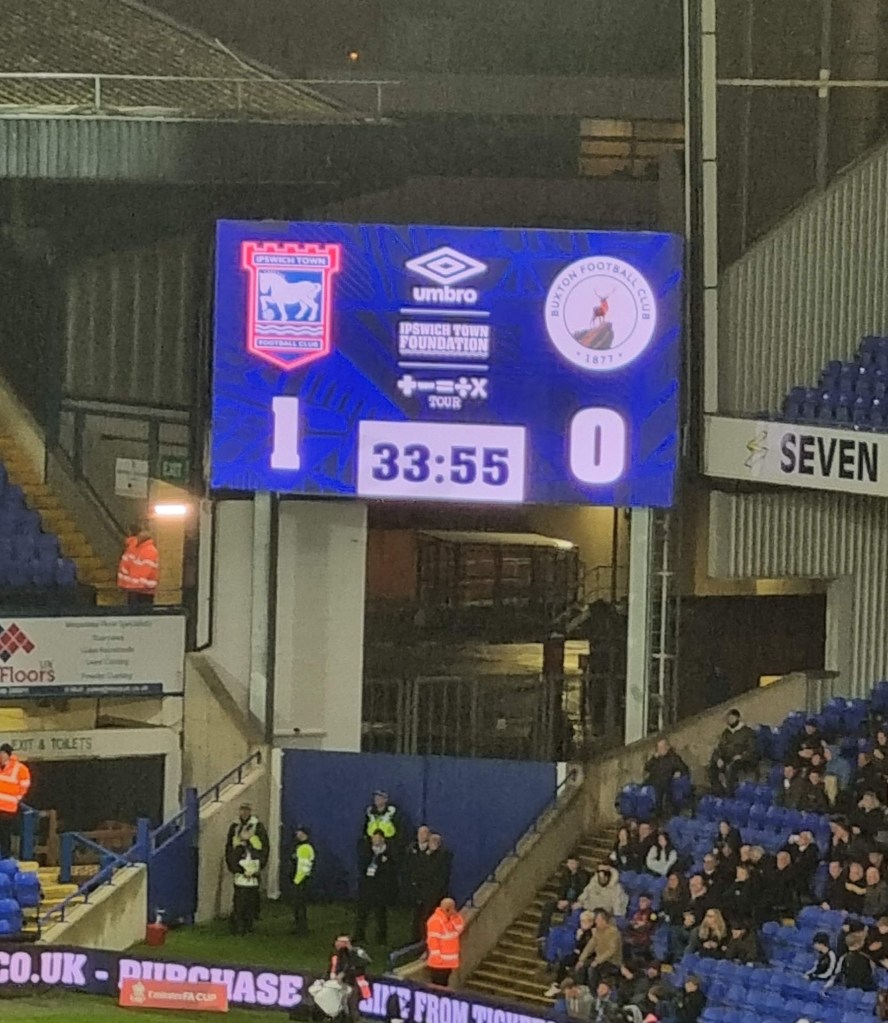
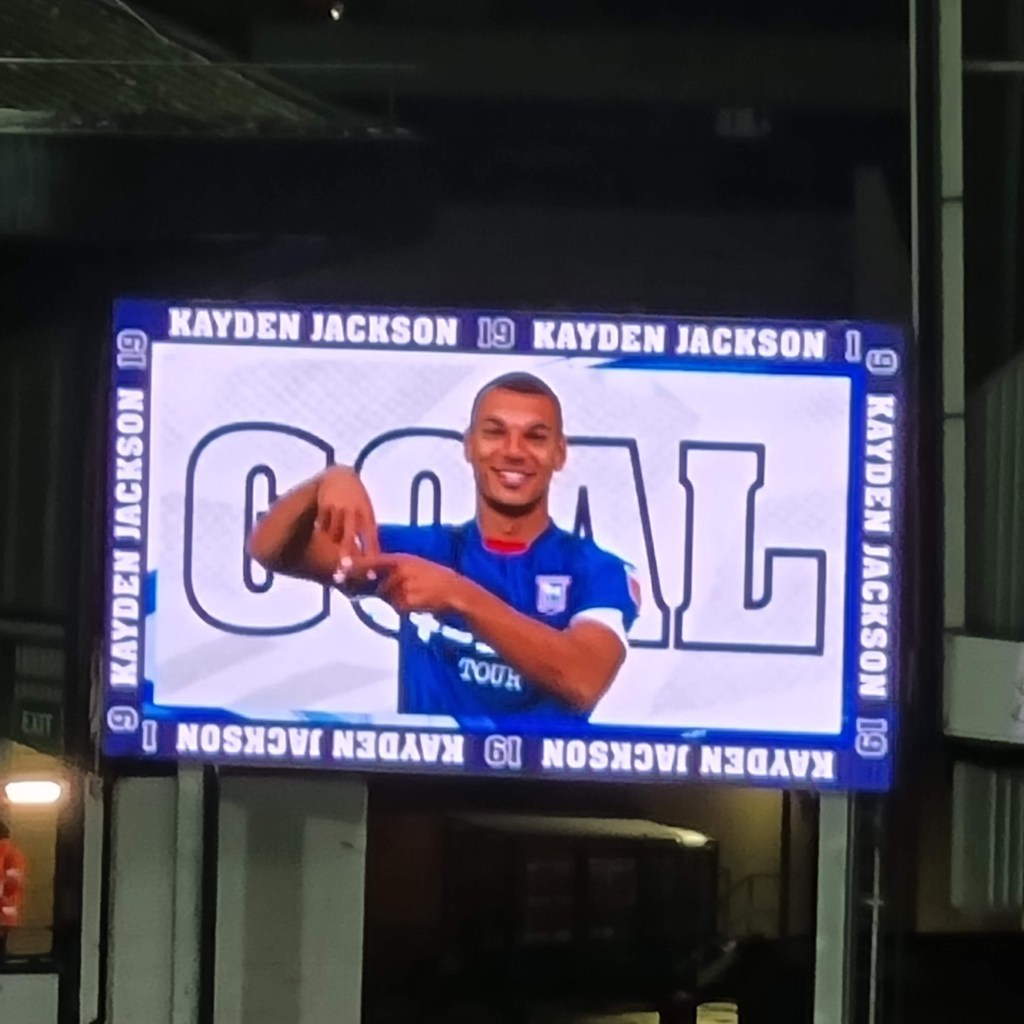
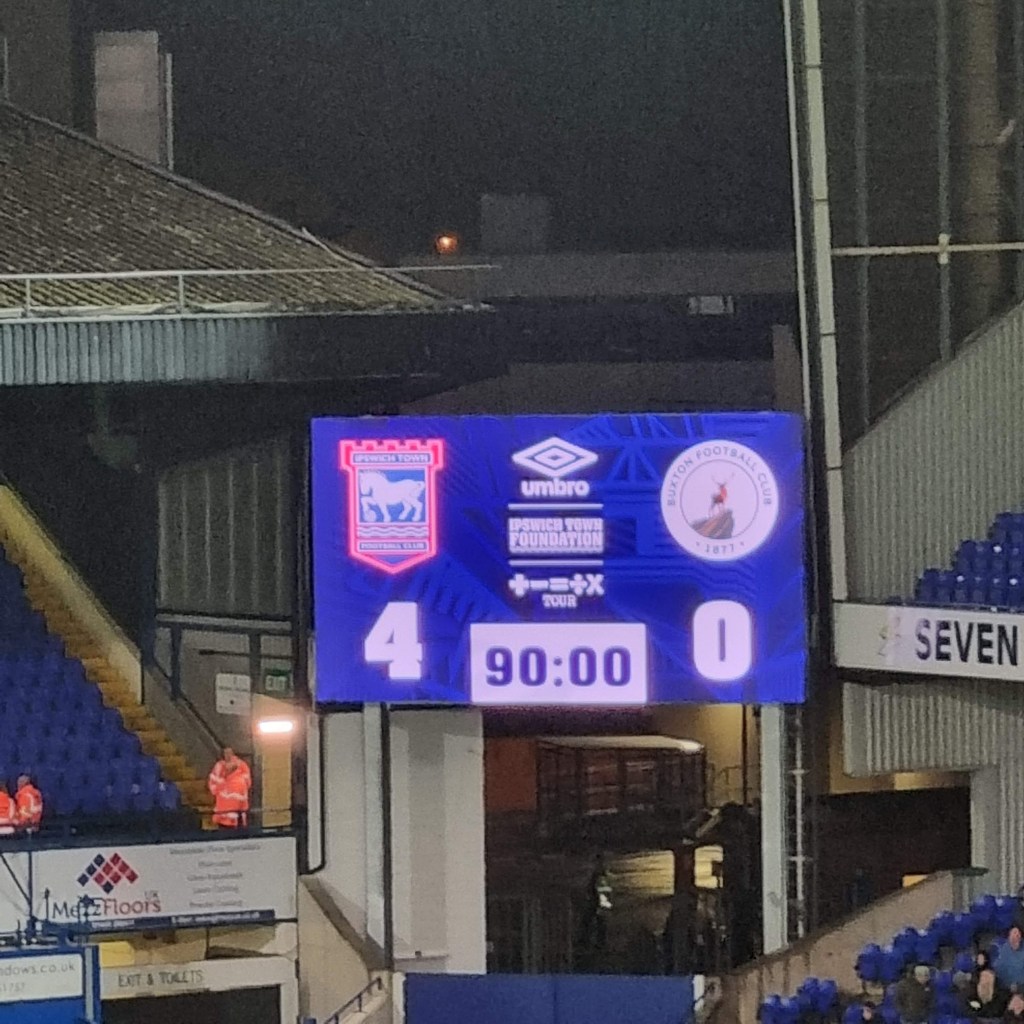
The second half is a breeze. Sam Morsy earns his customary booking to help keep the third division title race alive for Plymouth and Sheffield Wednesday and a pair of young players get their opportunity to play as Leif Davis and Cameron Humphreys are substituted for Tawanda Chirewa and Albie Armin. The drizzle persists. Buxton bring on a substitute with the memorable name of Harry Bunn and Town add two more goals, another typical, but more spectacular strike from Conor Chaplin and a less characteristic one-on-one shot into the corner from Kayden Jackson, but a fine goal nonetheless. Four-nil is the perfect score for this match, reflecting Town’s complete domination and superiority but not causing unwarranted and undeserved humiliation for Buxton.
With the final whistle Mick and I stay briefly to applaud before making the long way down to the ground and out into the damp, drizzly night. “Well worth a fiver wasn’t it”, I tell Mick who agrees, but feels guilty that his seat was half the price of mine. I tell him it’s not his fault I’m so young and he asks me when I will get my pension. “Four more years” I tell him, stupidly channelling Richard Nixon. But at least Town are into the third round of the Cup and TV viewers all over the planet know it. “Wemb-er-ley! Wemb-er-ley!” they must be singing.

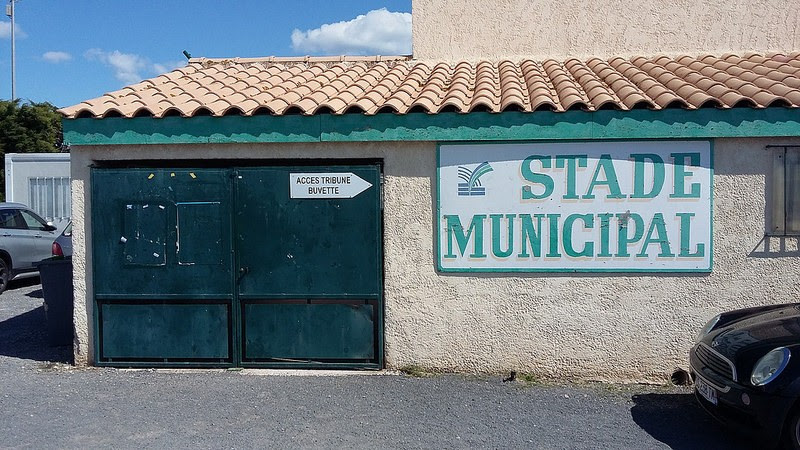 to see the tie with Clermontaise, who are from the town of Clermont l’Herault, some thirty kilometres to the north west.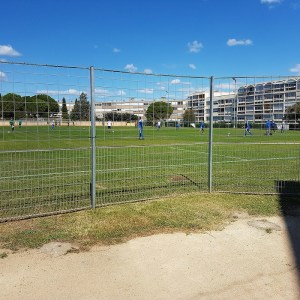
 It looks like the original roof has been replaced with new metal sheeting on another metal frame, which obscures the row of the pitch from the front row of seats. We enter the stadium through a wide opening in the back wall and find ourselves in the players tunnel; it’s an entrance that is closed soon afterwards, but it’s not quite two -thirty yet and the game doesn’t kick off until three. A wonky sign points roughly in the direction of the buvette,
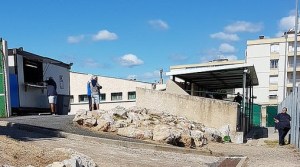
 which is a portakabin style structure with a counter even more wonky than the sign. To the other side of the stand is a dark room with high-up shelves of trophies on two walls and a bar counter;


 and the teams line up on the pitch. Balaruc wear an unattractive all-black kit with green trim, which displays no team badge or sponsor’s names. Clermontaise and Balaruc are in the same regional league (Poule A of the Languedoc-Rousillon section of the Occitanie region’s Division Honneur 2 – the seventh level of French football), but Clermontaise look much smarter and ‘professional’ in their all blue kit with badge. The McDonald’s golden arch logo is on the Clermontaise shorts; they can’t have read the poster on the table in the trophy room.
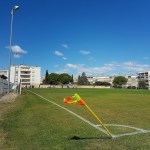 at the Mediterranean end of the ground. A bloke in a t-shirt and trakkie bottoms is called on to sort them out and once he has done so the game carries on. Early on Clermontaise look the better team, but it might just be because they’re wearing a nicer kit. Just before twenty past three it looks like they have scored, but I can’t tell if it was offside or the shot was missed. There are flattened practice goals either side of the real one and from my rock it’s hard to tell which is which.
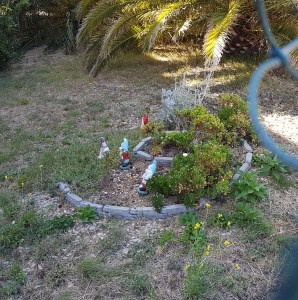 There are a number of people, mostly men in their sixties and seventies, sat at windows and balconies looking down on the game. I envy them their home comforts, it has to be better than perching like a lizard on a rock in the sun. Dissatisfied with my view sat on the rock, I watch the remainder of the first half standing up.
 It proves to be a good choice and our enjoyment of the second half is much increased by our new location, which is shaded, out of the wind and high enough to see over the fence, with the added bonus of atmosphere as the stand is full; spectating nirvana.
 Monsieur Gerard Blanchet busy in front of us. Clermontaise’s number twelve confirms his presence by boldly attempting a shot from a thirty metre free kick; of course he misses, but not embarrassingly so. The Balaruc bookings continue and five blatantly kicks the Clermontaise twelve as he dribbles past him and three knocks over his opposite number as they run side by side. All afternoon tbere is a pleasing symmetry with many of the fouls and bookings as players with the same shirt number go for each other.
 trippingovertheball