Ipswich Town 1 Southampton 1

My wife Paulene grew up in the city of Portsmouth like her parents and their parents before them.  Her father was present at Wembley to see victorious Pompey lift the FA Cup in 1939 and was a regular at Fratton Park before he got married.  Paulene started watching Pompey in the late 1960’s and hers is one of the names on the wall behind the North Stand at Fratton Park which records those who bought shares to keep the club alive and take it out of administration back in 2011.   Today, my team Ipswich Town play Pompey’s bitter rivals Southampton and must win, and by several goals.  The reason for this is that Paulene will then be in my debt because yesterday Pompey lost to flippin’ Norwich.

Weirdly, it’s Sunday, and almost every other team in whatever league it is Ipswich now play in have already played.  To make matters even more confusing, kick-off is at 12 o’clock, barely giving time for the God-fearing to get home from church before heading for the match.  Untroubled by such matters however, I have already checked that ‘The Arb’ will be opening early, and after a breakfast of all manner of things left in the fridge and then introduced to a frying pan, I am heading to the railway station in sandals, shorts and t-shirt beneath an ITFC bucket hat and a blazing August sun.  Despite my outwardly sunny disposition, I can’t help but quietly question what I’m doing embarking on yet another season of probable anguish and despair.   After all, we reached the ‘promised land’ last year and it turned out to be something of a disappointment, why bother trying to go back?  It was like saving up for a luxury holiday, expecting to stay at the Hotel de Paris in Monte Carlo and then finding yourself with half-board in a B & B in Lowestoft.

Just like last season, Gary joins me on the train at the first station stop.  Our conversation joins the dots between now and last May before we look for polar bears on the rolling slopes of Wherstead.  Opposite us sits an inscrutable, full-faced and bearded man in dark glasses, who looks so miserable he makes me want to laugh.  He has a face to ward-off evil spirits.  As ever, due to careful planning our carriage draws up by the lower of the two foot bridges that span the tracks at Ipswich station, and having negotiated the ticket barriers we make for the Arb via Portman Road and its ice cream kiosks that sell programmes.  But today there is a technical issue at the first kiosk, a queue at the second and so I buy my programme from a large young bloke with just a two-wheeled, blue trolley with a stick on it bearing a sign that says “programmes”. To my horror the programme now costs four pounds. “Four pounds!” I exclaim. “Yes, everything is going up” says the large young bloke sounding like the voice of experience.  “How much were programmes when you first came to Portman Road?” asks Gary. “Five pence” I tell him, and for that you would also get a Football League Revue which cost five-pence on its own.  I wonder why at French football matches programmes are free, and speculate that if everyone at the game was given a programme it might be possible to charge more for the advertising.  On the plus side, the front cover of the programme features a painted portrait of Dara O’Shea with Umbro badge to the fore.  The painting is in a conventional style by an artist called Louise Cobbold but I look forward in the weeks to come to enjoying the faces of Luke Woolfenden and  Ali Al-Hamadi as they might have been seen by Francis Bacon, Lucian Freud or Picasso.

Since yesterday Gary has had a bad ankle.  He tells me he drove to Braintree and when he got out of his car his ankle hurt.  Our journey to the Arb is therefore a slow and arduous one and by the time we get there I feel a lot like Mao Zedong and the Red Army must have at the end of ‘Long March’, but minus the revolutionary fervour.   I buy a pint of Mauldon’s Suffolk Pride for myself and a pint of Estrella Galicia for Gary (£10.50 for the two with Camra discount) because The Arb no longer sells Lager 43.  Like a twit, I pronounce ‘Galicia’ as I imagine a Spanish person would, I think it’s my age.  Beers in hands, we retire to the beer garden to mourn the absence of Mick, who is at a wedding in Scotland, and to talk of films, immigration and the town of Bromley.  Gary later buys another round of pints of Suffolk Pride and Galicia too.

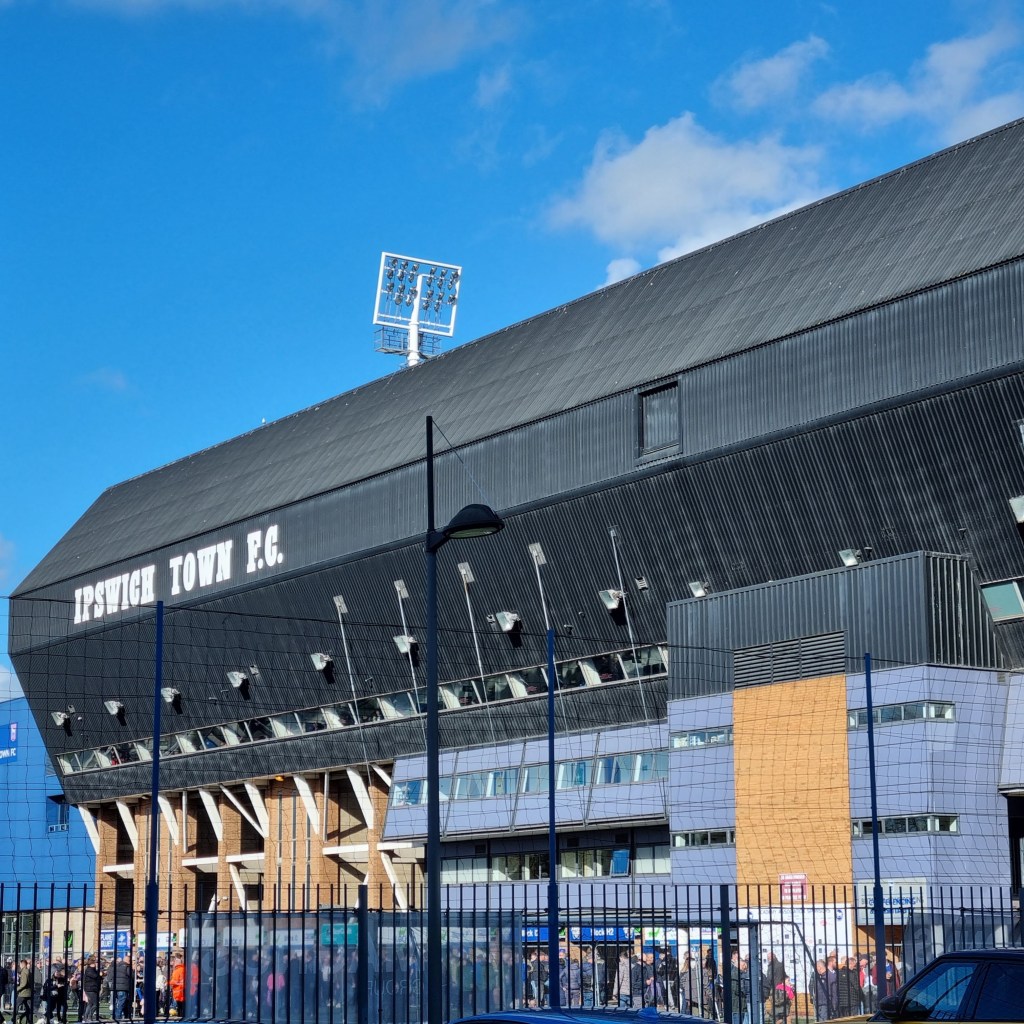
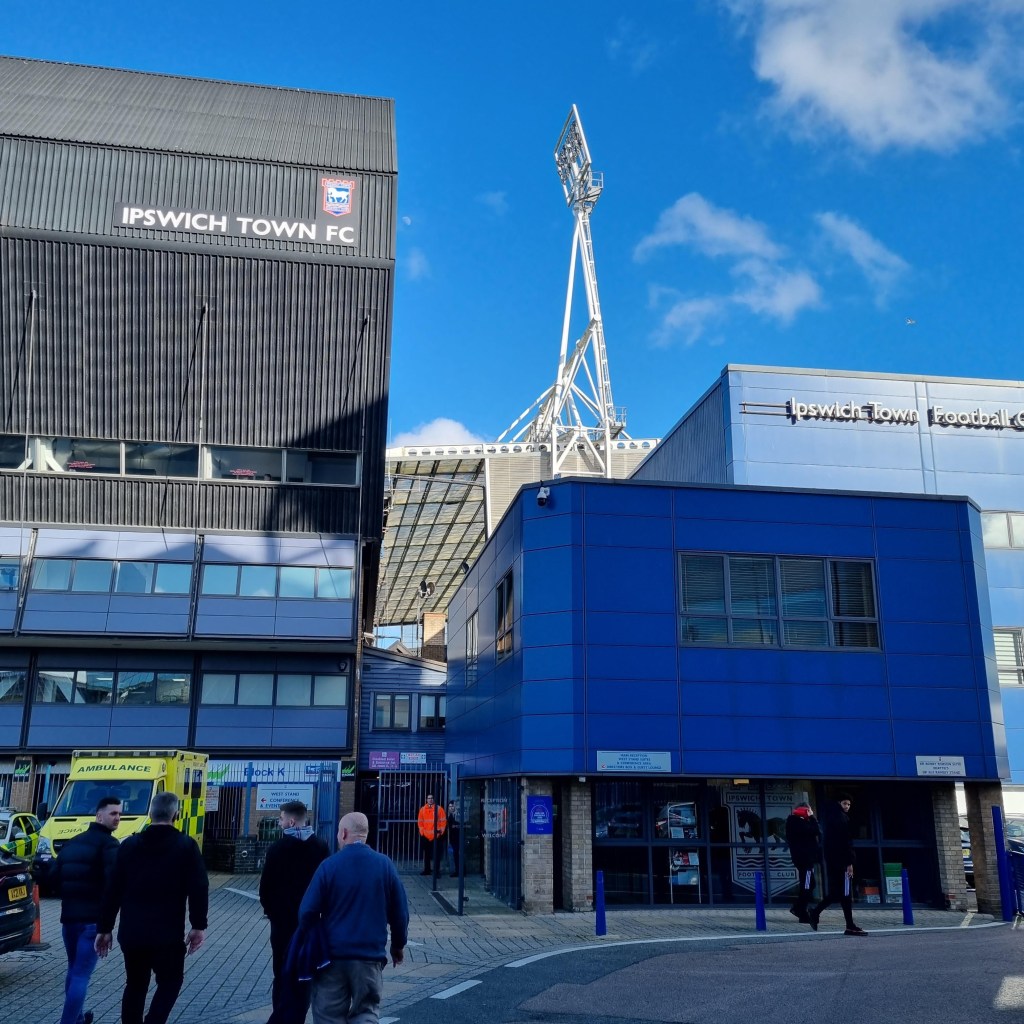
It’s just gone twenty-five to twelve when we head for Portman Road; we leave a little early because of Gary’s painful ankle but proudly we’re still the last people to go.  We part ways near where Alf Ramsey’s statue stands hands in pockets perhaps wondering why football fans sing about Bobby Robson but not him, even though he won the League and the World Cup and Sir Bobby won neither.  I saunter past queues for the turnstiles in Portman Road but at the back of the Sir Alf Ramsey stand emergency measures are in place and as I arrive hopeful spectators are being ushered through the side entrance past recent building works and a sign that reads ‘Broadcasters Toilet’, which I hope is specially adapted to flush away what comes out of their mouths.

I make it into the company of the man from Stowmarket (Paul), Fiona, Pat from Clacton, ever-present Phil who never misses a game, and his son Elwood before the excitable young stadium announcer finishes telling us who ‘our’ team are today.  In the time-honoured manner, I bawl the players’ surnames out as if I was at the Stade du Roudourou in Guingamp or Stade Saint-Symphorien in Metz. It’s as if I’d never been away, or indeed to either of those stadiums and oddly enough I haven’t.  At the far end of the ground a banner, it’s not really big enough in size or ambition to be called a tifo, reads “Side by side a sea of blue and white” which doesn’t quite sound right but I think I get the general idea.

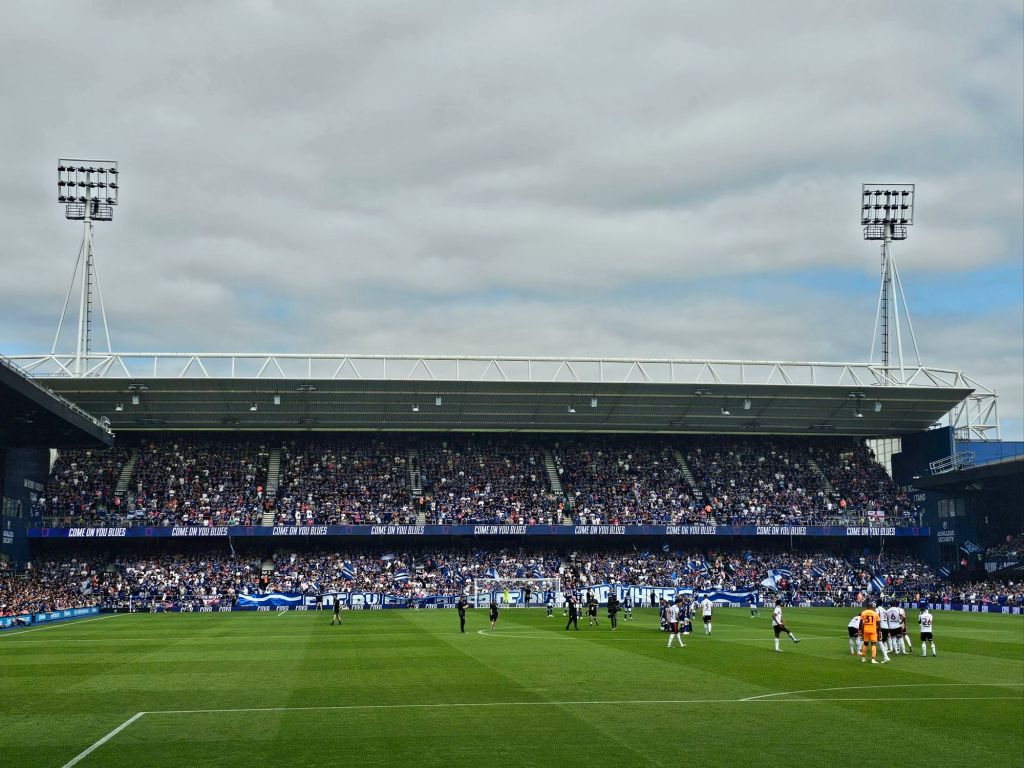
When the game begins, it is Ipswich who get first go with the ball, which they proceed to boot very effectively towards the goal just in front of me and my fellow ultras.  Naturally enough Town are in traditional blue and white, whilst Southampton are in their usual red stripes and black shorts but have seemingly travelled here through time and have donned the kit that Mike Channon and little Alan Ball used to wear back in the second half through the 1970’s.  Within four minutes Town score as George Hirst nicks a back pass and crosses to Jack Clarke who skilfully sets the ball up for the flamboyantly monikered Taylor Harwood-Bellis to score an own goal.

With promotion assured, we settle down to enjoy the match, the sunshine and the remainder of the season.  Pat from Clacton has had an operation on one of her eyes she tells me, and I guess that’s why she’s looking extra cool in her shades today; and luckily, she’s looking much more cheerful than the bloke in the dark glasses on the train this morning. “Sit down if you love Pompey” sing the Southampton fans and so because we do, we do.  

On the pitch however, things have taken a turn for the worse and Southampton unsportingly won’t let Town have the ball.   The upshot is that it all gets a bit too much and Southampton score an equalising goal with a ‘towering’ header from a bloke called Jay Robinson. All around people agree that “it had been coming”, which philosophically speaking is probably something of a truism because looking back hasn’t everything?    Disappointed, I seek solace in telling Fiona that Southampton’s number thirty-four, Wellington, used to play for Wimbledon. Without hesitation, Fiona gets the joke, possibly because I said the same thing the last time Southampton were at Portman Road.

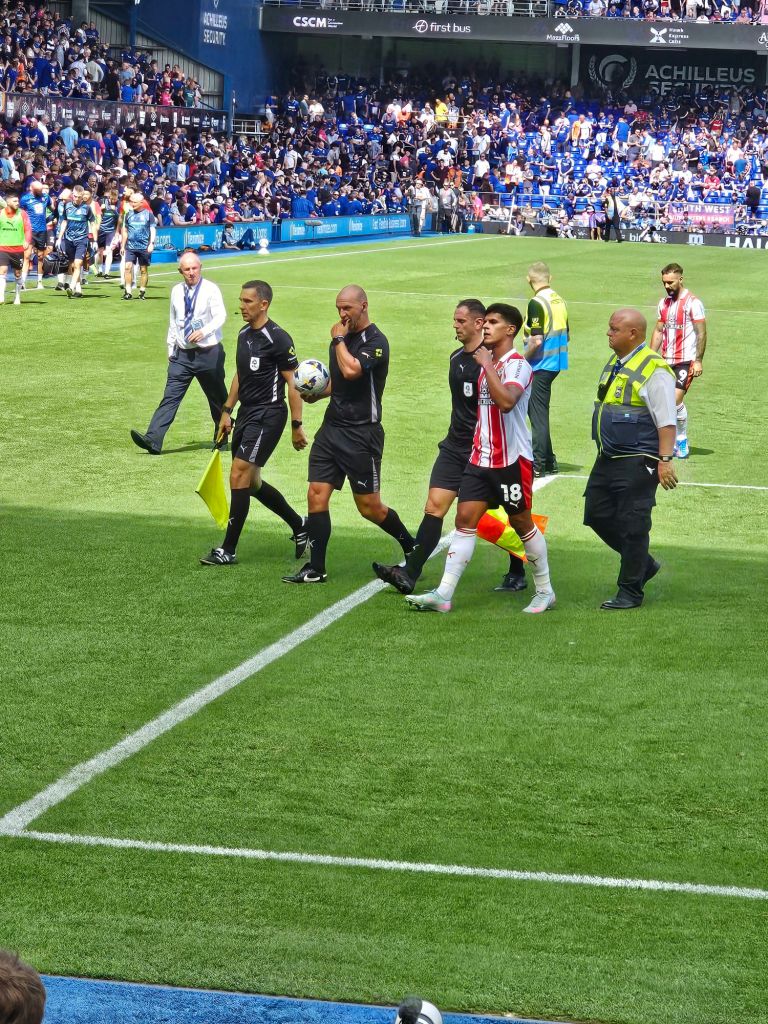
Wellington is booked before half-time by referee Mr Madley, who has taken to annoying supporters of both teams who accuse him through the medium of a tuneless chant of not knowing what he is doing.  I however think he does know what he is doing and that is the opposite to what we think he should be doing. He proceeds to book Jack Taylor and Azor Matusiwa.

With half-time I vent excess Suffolk Pride and then reacquaint myself with Ray and his grandson Harrison  who have spent the summer attending gigs, concerts and happenings and are soon due to see Tom Jones.  I hope Ray has a clean pair of knickers to throw at the Octogenarian.

After the somewhat uneasy first-half in which Southampton would probably claim to have been the better team, in the second half it soon becomes clear that whatever Kieran McKenna said at half time to his players was much more worth listening to than whatever the ginger Anglo-Belgian Will Still said.  Sammie Szmodics hits a post and the ball defies the laws of physics by bouncing back to the goalkeeper instead of into the net and Jadon Philogene executes a spectacular overhead scissor kick.  There are other chances for Town too, whilst as a tall slim man, for Southampton I find Adam Armstrong and Ryan Frazer antagonisingly stocky.

Wellington is substituted by Will Still before he plays an hour and Fiona and I are disappointed but not surprised when he’s not replaced by Orinoco.  Pat from Clacton tells me she’s having a baked potato for tea, with chicken and salad. Southampton’s number 18 Mateus Fernandes shoots over the Town cross bar from a free-kick and then smacks the palm of one hand obliquely across the other in a gesture that says ‘darn my luck’ or, if Google translate can be believed ‘droga a minha sorte’ in Portuguese.  The excitable young stadium announcer goes on to thank us for our being 29,128 in number today and almost as a final act before declaring the game over, Mr Madley books Southampton’s Shea Charles in the manner of a man who enjoys being the architect of the practical joke.  Madley allows Charles to walk away from the scene of his crime, before suddenly calling him back and thrusting the yellow card at him the moment he turns around.  It’s a decent finale to a match that wouldn’t otherwise have one.

I don’t hang about after the final whistle and leave for the railway station to the sound of people reluctantly saying it was probably a fair result.  I’m not sure my wife Paulene will think it was and I may have some explaining to do, but at least we didn’t lose.
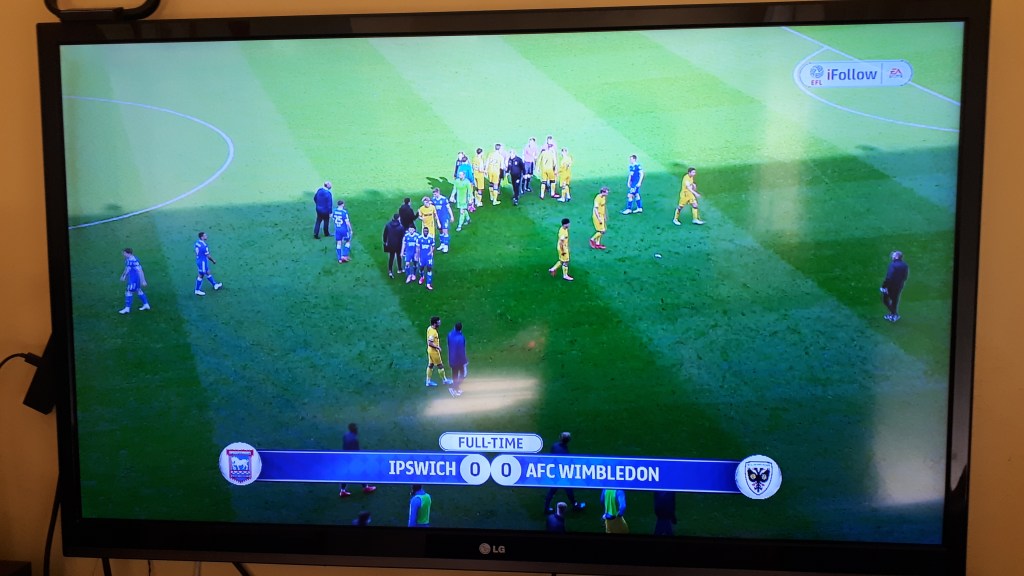
Ipswich Town 0 AFC Wimbledon 0

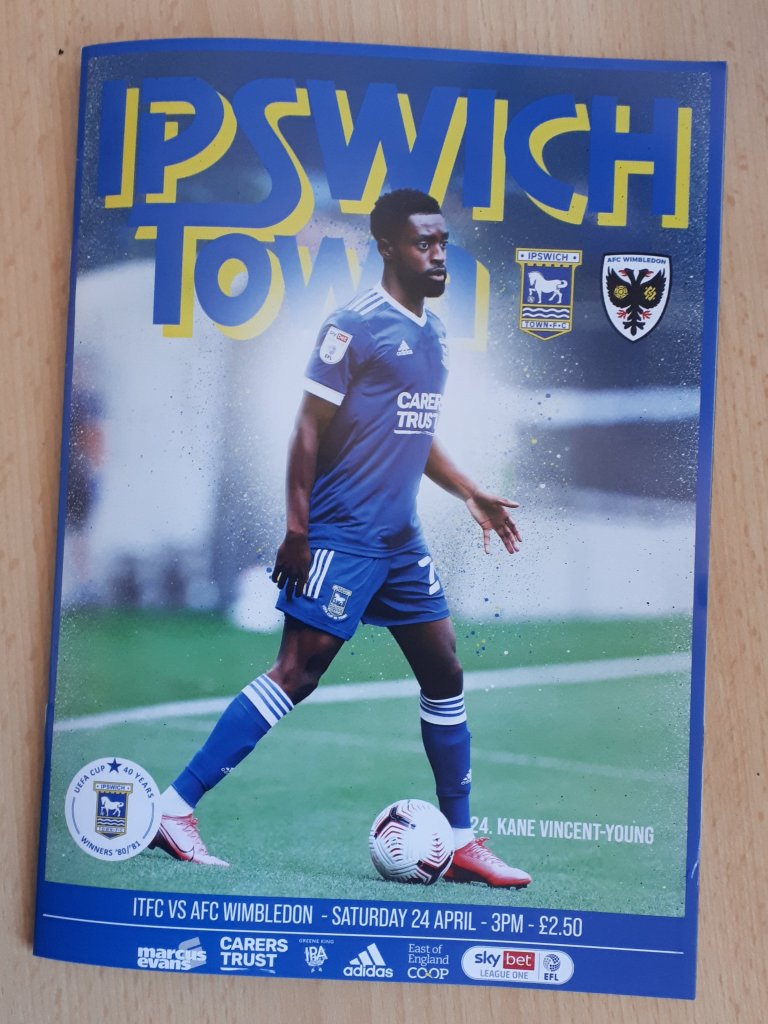
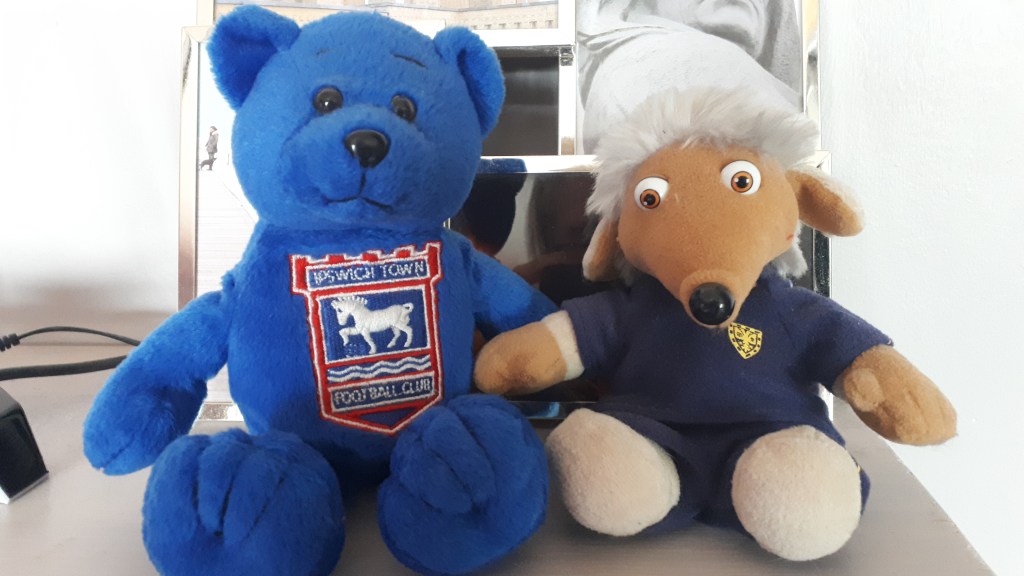
I’ve been waiting a while to see my team Ipswich Town play AFC Wimbledon at Portman Road. Sadly for me I missed the clubs’ first encounter back in September 2019 having been detained by the National Health Service; something to do with heart valves. Town’s 2-1 victory back then no doubt aided my recovery from surgery and now, re-built using bovine spare parts, I am fit enough to attend Portman Road,  but circumstances have conspired against me again and the global pandemic means I along with everyone else must once again witness today’s match via the marvel of modern technology that is the ifollow.  But with Town in a remarkable run of form that has seen them fail to score a single goal in five matches, mine and everyone else’s exile from Portman Road is probably for the best.  Excited at the prospect of today’s game nevertheless, I have made the effort to order a programme, on the cover which is a slightly startled, or possibly forlorn, looking Kane Vincent-Young

Startled or forlorn?

Earlier today, as part of an attempt to ensure that the nation’s investment in one of my vital organs should not be in vain, I pumped up the tyres on my bicycle for the first time in three years and cycled a little over six miles.  I had quite forgotten how uncomfortable a bicycle saddle can be and I am now only just able to walk, my legs feeling as if I am wading thigh deep through thick mud.  Such exercise requires reward and I therefore enjoy a pre-match ‘pint’ of Fuller’s ESB (four for £6 from Waitrose) as I slump lifelessly in front of the telly catching the tail-end of Portsmouth versus Bristol Rovers on the ifollow, which my wife Paulene has been watching, Pompey being her team.  Pompey win and Bristol Rovers are relegated.  Coincidentally,  Pompey and Bristol Rovers are the only two teams against whom Ipswich have scored in the last nine games; furthermore Town have beaten Bristol Rovers three times this season whilst  Pompey have beaten Ipswich three times.  I regale Paulene with these fascinating facts in the style of a radio commentator; predictably she is unimpressed, but it doesn’t stop me.

Pre-match ‘pint’

With tv pictures of Fratton Park now just a memory, I log on to the ifollow in time to catch the names of today’s virtual mascots who are Finlay, Harrison, and what sounds like RJ and Milan, but I could be wrong. It nevertheless sets me to hoping that Milan has a sister called Florence and that somewhere in northern Italy there is a child called Ipswich.  In the manner of the FA Cup draw the next voice I hear is that of BBC Radio Suffolk’s stalwart commentator Brenner Woolley, who as ever has alongside him the redoubtable and legendary Mick Mills.  “We really are at the business end of the season” says Brenner , by which I think he means that all the speculation since August about which teams would be promoted and relegated will soon be resolved.  Ipswich will neither be promoted nor relegated, but their ‘business’ appears to be that of setting a new record for consecutive matches without scoring a goal; five and counting.

Brenner asks Mick to expound his current theory as to Town’s existence.  Mick postulates that Town “…went from playing ‘A’ class football and not being able to do it and going for a more direct style”.  Mick continues at length and I start to stare into the distance, but I get the drift.  “No sign of the boys in blue” says Brenner as the Town team begin to saunter onto the pitch.  I don’t think he’s talking about the police, he’s just not being very observant.

After the teams “take the knee” the game begins, Wimbledon getting first go with the ball and kicking towards the Sir Bobby Robson Stand.  “Here’s Vincent-Young coming in-field with pink footwear” announces Brenner, eschewing deeper analysis for the sheer colour of the spectacle.  “Not very much has happened so far but the one thing that’s happened is watching Teddy Bishop…” chips in Mick before completing his observation, which is  that Teddy Bishop has been pushing forward down the left; so far he’s successfully been caught offside twice, but Mick’s advice is that he should keep trying.

“Paul Cook sipping on his coffee” says Brenner, introducing the by now obligatory mention of Paul Cook drinking coffee, and providing the sort of aimless detail worthy of an existential novel.  It’s the fourth minute and Wimbledon’s Will Nightingale heads over the Town cross-bar.  Mick Mills muses on how Town goalkeeper David Cornell stayed on his goal line but should have come to catch the cross. Mick is not impressed.  Meanwhile Brenner tells us that Wimbledon have scored as many goals in their last four games as Ipswich have in their last nineteen, before reporting  “Beautiful day at Portman Road, nil-nil, Town have now gone nine hours without a goal”.  It’s a careful combination of facts from Brenner that leaves me not knowing whether to feel happy, disappointed or in awe.  Wimbledon win a corner, Town win a corner.  A punt forward sees Mark McGuinness head the ball away from David Cornell as he comes out to collect the ball. “McGuinness and Cornell got in a bit of a sixes and sevens situation” is Brenner’s peculiar description of events.

The match proceeds much as all recent games have done. “Bennetts; that was terrible” says Brenner as the oddly-named Keanan Bennetts runs at the Wimbledon defence and then sends a shot hopelessly wide of the far post.  At the other end Wimbledon are no better. “Rudoni shoots wide, he should have scored”.  Twenty minutes have passed. “Wimbledon on top at the moment; the better side” is Brenner’s assessment and then Wimbledon are awarded a penalty, possibly for shirt-pulling.  Happily Joe Piggott’s spot-kick is easily saved by Cornell, albeit with his legs and feet. “ I didn’t like the run-up of the player” explains Mick relaying how he thought Piggott would miss.

“Bennetts; terrible lay-off” says Brenner, continuing the theme of inept play that has “ Paul Cook screaming his heart out down below” ; it’s a description from Brenner that suggests an image of the  Town manager suffering  infernal torment.  There are twelve minutes of the half remaining. “Surprise, surprise it’s nil-nil” says Brenner, introducing an unwelcome note of sarcasm.  Gwion Edwards shoots over the Wimbledon cross-bar; it’s Town’s second shot on goal in thirty-four minutes. “A massive difference in positivity in both teams” says Mick attempting to explain what we’re seeing.

Some passing breaks out. “Good play this from Ipswich Town” says Brenner as a corner is won, but then taken short and Mick shares our frustration.  With none of the current Town team capable of scoring, Brenner resorts to telling BBC Radio Suffolk listeners that former Town player Will Keane has scored for Wigan Athletic and is currently in a “rich vein of form”.  It’s just the sort of thing we all want to hear.  Back to Portman Road and “Poor from Dozzell, ball out” are Brenner’s words.  “He wanted to do something that wasn’t there” explains Mick raising philosophical questions about the nature of reality.  Gwion Edwards wins Town’s third corner of the half with two minutes to go before a minute of added on time is…added on.  It’s time enough for Brenner to refer to “Cornell…the Welshman” in much the same way that he usually refers to “Holy…the Czech”.  Half-time arrives and Brenner concludes that “Ipswich continue to struggle”. “We are the inferior team” is Mick’s summation before he is rudely cut-off by the ifollow commercial break; it’s a phrase from Mick that would look good on a banner in the North Stand or on a t-shirt.

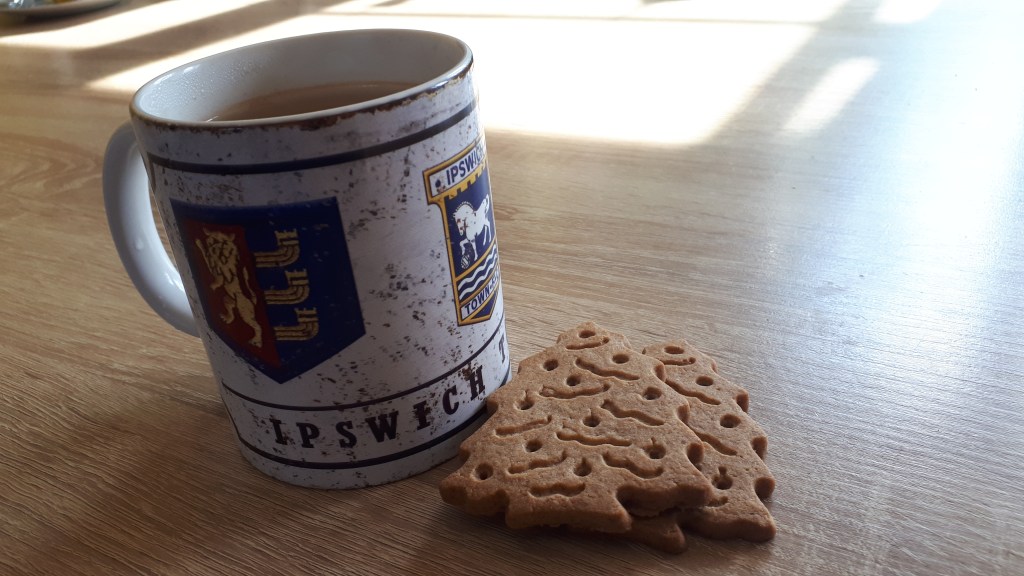
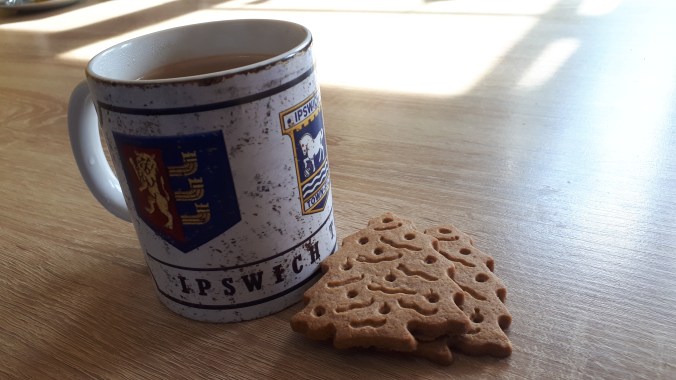
Half-time relief comes in the form of a mug of tea and two Christmas tree-shaped ginger biscuits; stocks of the un-seasonal confections acquired at a knock-down price remain healthy.  All too quickly the game begins again. “Just three and a half more games for us to suffer” says Brenner.  Armando Dobra has replaced the oddly-named Keanan Bennetts although “…anybody could have come off at half-time” is the honest assessment of Brenner.

Cornell is soon making a decent save at the feet of Wimbledon’s Ayoub Assal.  “A lovely afternoon at Portman Road” says Brenner trying hard to look on the bright side of life before referring to “spring-heeled McGuinness”, which almost sounds like an epithet he’d pre-prepared.  Ollie Hawkins appears to head the ball against the Wimbledon crossbar but Town earn a corner so he probably didn’t.  “Nice little spell, it’s not lasted long, but it’s promising” says Mick as Town start to look more like a team that hasn’t just turned up because it’s a sunny afternoon and they’ve nothing better to do.

The game is nearly an hour old.  “Nine and three-quarter hours since a Town goal” says Brenner, clearly not counting down the minutes until he can say that Town haven’t scored in ten hours.  Kane Vincent-Young breaks down the right. “Vincent-Young has got open grass in front of him, just opening his legs” is Brenner’s slightly unpleasant description which probably sounds even more disturbing to BBC Radio Suffolk listeners who don’t have the accompanying tv pictures.  Town players are moving and passing the ball well; another corner kick ensues which Gwion Edwards steps up to take and lumps way beyond the penalty area.  “Ridiculous” says Mick “An awful corner kick”, and there is not a soul on Earth who would contradict him.

Woolfenden wrestles the ball from Assal; “…too big and strong for the young Moroccan” says Brenner, ticking another off the list of nationalities that he has referenced in his commentaries this season.  Cole Skuse replaces Teddy Bishop and Armando Dobra has a shot on goal. “Tzanev finally makes a save after sixty-three minutes of this game” says Brenner.  Mick then points out that Vincent-Young had made a good run ahead of Dobra “…if he’d rolled the ball to him” says Mick “I think we might have created a walk-in opportunity”.  Oh for a “walk-in opportunity” I think to myself, whilst also reflecting that Brenner’s pronunciation of Tzanev sounds a lot like Sanef, the company that manages the  best part of 2,000 kilometres of the French motorway network. 

Aaron Drinan replaces Ollie Hawkins. Wimbledon are awarded a free-kick about 25 metres from goal after a foul by Andre Dozzell; Joe Piggott takes the kick, “The Welshman had to make the save and he did” Brenner tells us leaving radio listeners unsure if the shot had been saved by David Cornell, Gwion Edwards or Harry Secombe. The game reaches its seventieth minute; “Ipswich Town have now gone ten hours without scoring a goal” announces Brenner unable to hide the fact that he has been waiting all afternoon to say it.

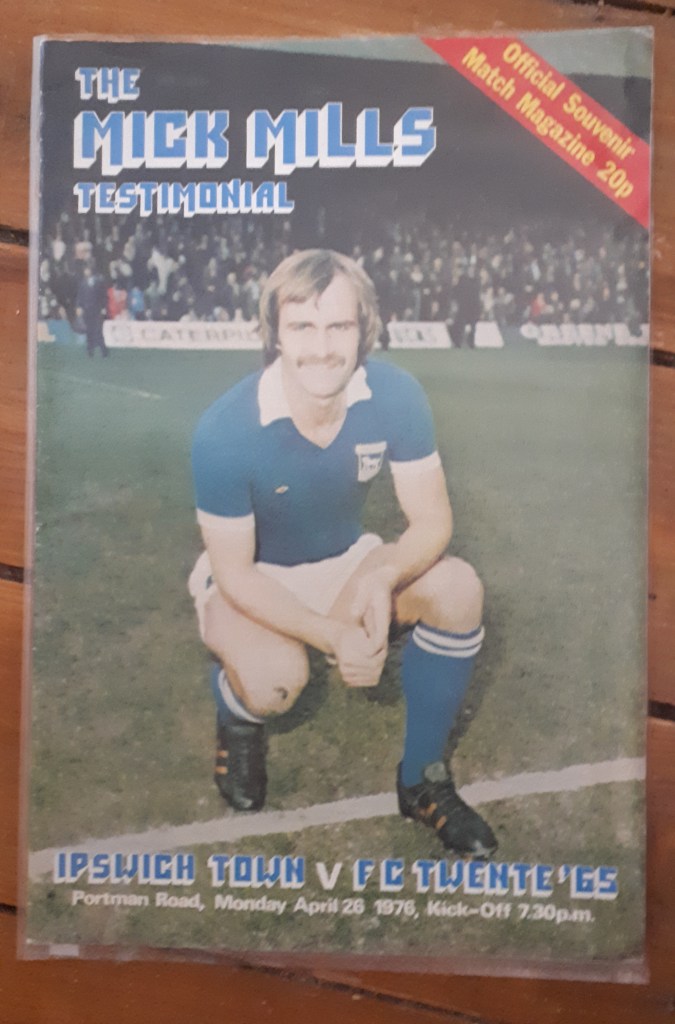
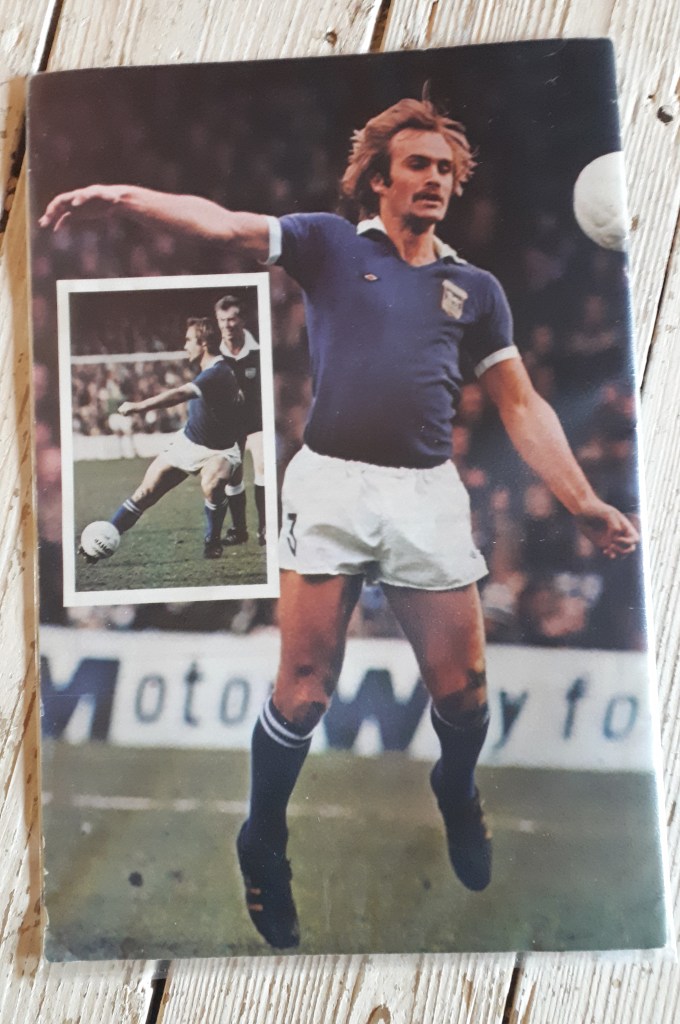
“We’ve been better in this half” says Mick very reasonably. “Are Ipswich Town going to score another goal this season?” asks Brenner, rhetorically I assume and so does Mick because he doesn’t offer an answer.  Kayden Jackson replaces Andre Dozzell and I begin to feel a little sleepy.  Tzanev makes a block at the feet of Jackson. Mick suggests Town could score “since we’ve tinkered with a few changes”.  Brenner guffaws loudly, seemingly amused by Mick’s tentative suggestion that this Town team “could score a goal against AFC Wimbledon”. How dare Brenner laugh at anything Mick says, particularly just two days before the forty-fifth anniversary of his testimonial match against FC Twente Enschede.

With the game into its final ten minutes of normal time, Town win a free-kick to the left of the Wimbledon penalty area.  “It’s ten hours since Ipswich Town last scored a goal, is this their moment?” asks Brenner as Gwion Edwards steps up to take it.  Edwards boots the ball high over the penalty area and cross-bar and into the North Stand. “Oh, Christ” Mick can be heard to say off-mike, sounding as glum as Marvin the paranoid android in the ‘Hitchhiker’s Guide to the Galaxy’. Despite excellent comic timing Mick apologises for his blasphemy whilst Brenner laughs like a schoolboy.  This is the sort of enjoyment supporters of clubs at the top of the table will never know.

Five minutes remain of normal time.  My eyes close involuntarily and I have to try hard to stay awake; I blame strong beer at lunchtime.  Wimbledon win a corner, Cornell takes a drop kick and “…hits it high into the Suffolk sky” according to Brenner.  A throw-in is taken and “Dobra offers himself up” continues Brenner in his own slightly weird poetic mode.  Three minutes of added on time are played and the game ends. “Another ninety-minutes in the can for Vincent -Young” is as good as it gets from Brenner who doesn’t bother to explain, depending on your choice of slang, either why he is now drawing analogies with film making or why Vincent-Young spent ninety minutes in the toilet.

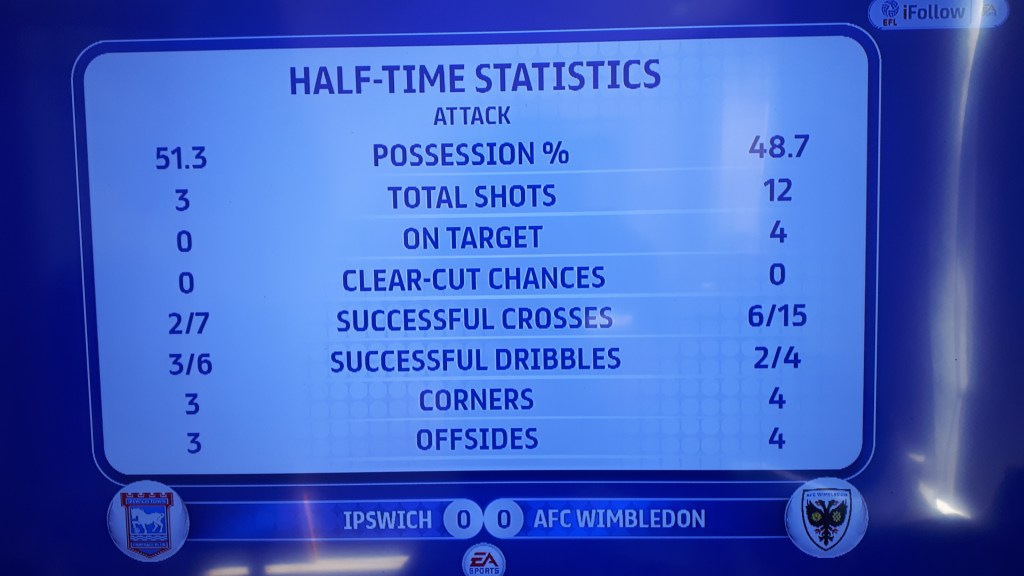
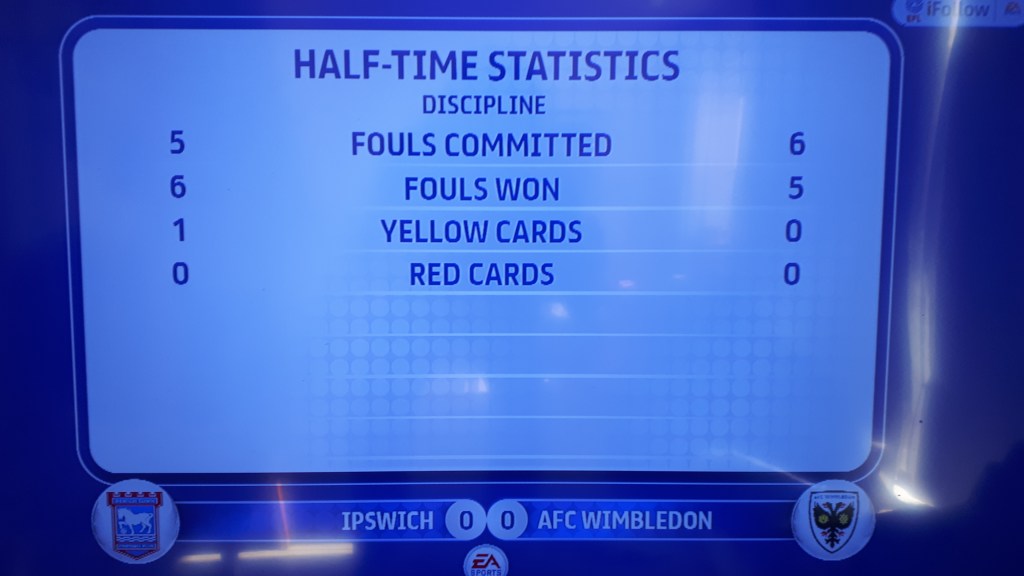
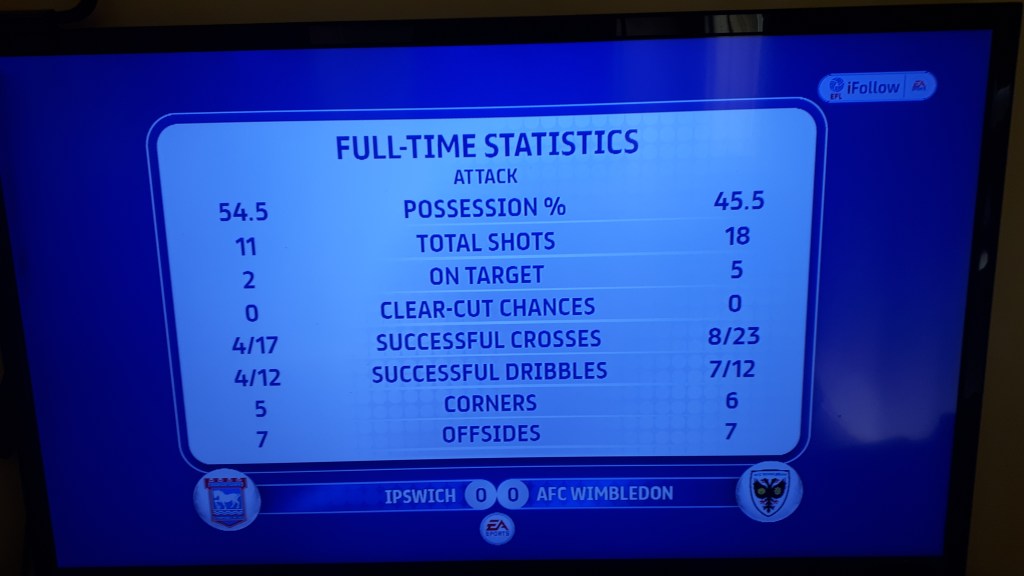
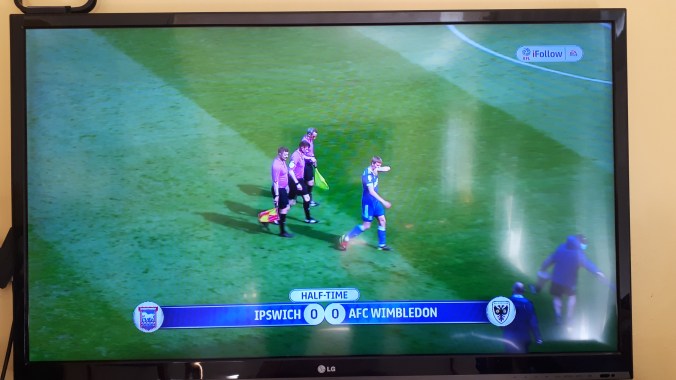
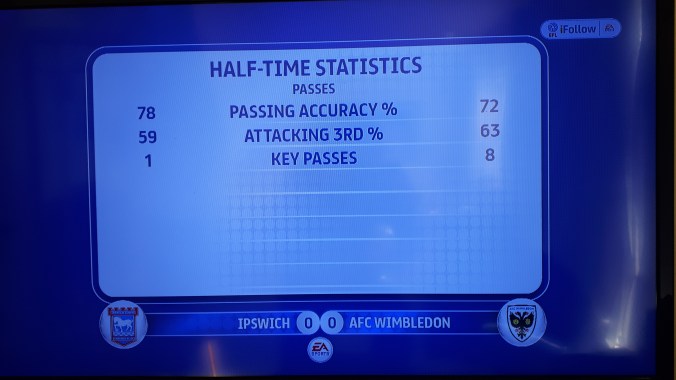
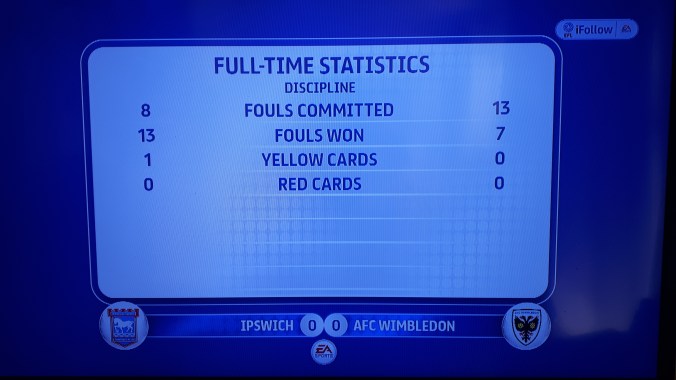
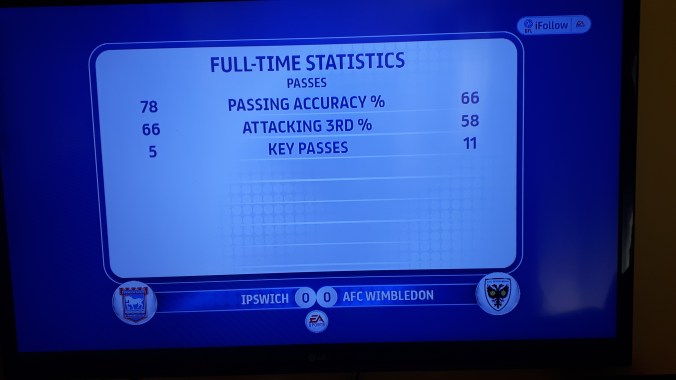
The ifollow doesn’t allow us to enjoy Mick’s match summary before its broadcast effs-off into adverts and match statistics.  For myself, I think the second half has been reasonably enjoyable despite the absence of goals, but after  six and a bit matches I have now become accustomed to that and have sought my pleasure where I can.  Today I have particularly enjoyed the exotic name of the Wimbledon right-back Nesta Guinness-Walker and every mention by Brenner of Wimbledon’s  Ben Heneghan has to my addled mind sounded like  van Hanegem,  and has had me imagining I was watching  Feyenoord or Holland in the mid 1970’s.  On that basis, the wait to watch AFC Wimbledon play at Portman Road was worth it. 

Three more matches, four and half more hours…plus time added-on.

Stade Brestois 1 Olympique Lyonnais 0

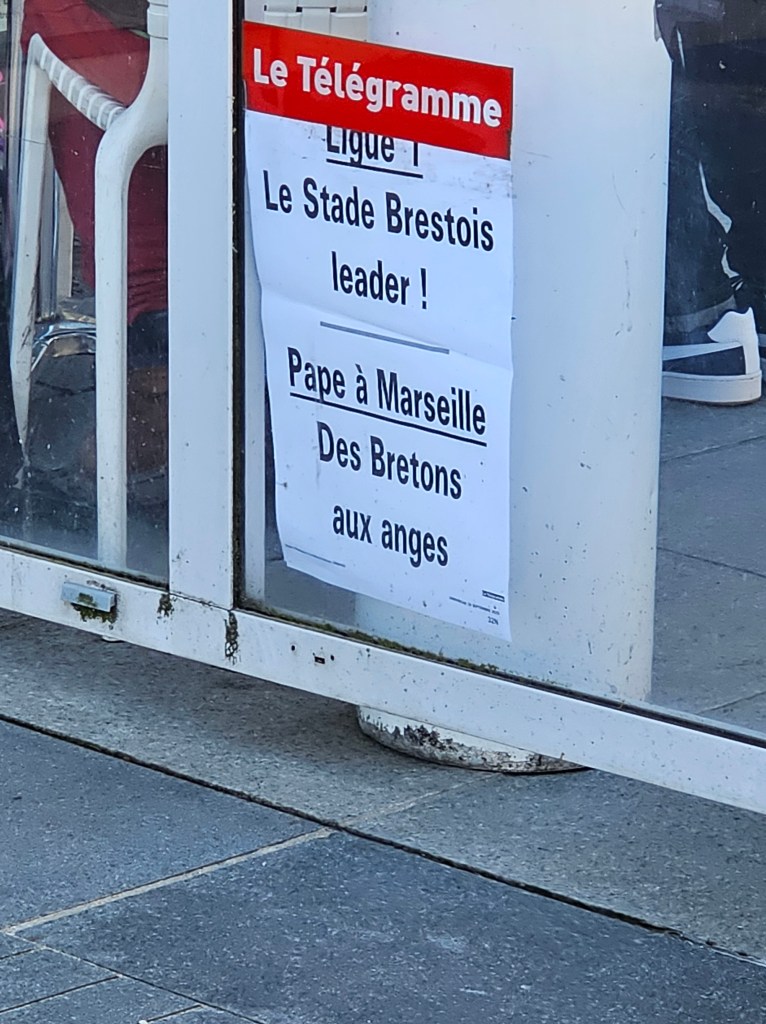
Finistere is the most westerly departement or ‘county’ of metropolitan France, with its name translating pretty much as ’the end of the earth’.  Not far east of the most westerly point of the most westerly department is Finistere’s largest town, Brest, an historic port and naval city, which was almost totally flattened by allied bombing during World War Two because the Nazis occupied it and made it part of their strategic ‘Atlantic Wall’.  Today, having been rebuilt in the 1950’s with an emphasis on space and layout rather than impressive or pretty architecture, although the church of St Louis de Brest is a notable exception, Brest has a population a little larger than that of Ipswich, but serves a metropolitan area of twice as many people, and is home to Stade Brestois 29, a football club in their present incarnation now enjoying their longest spell in the French first division since the 1960’s. Tonight, Stade Brestois who are currently third in the first division table, play Olympique Lyonnais who are third from bottom and I will be there. A win for Brest will put them top of the league above OGC Nice who won 1-0 away to previous leaders AS Monaco last night.

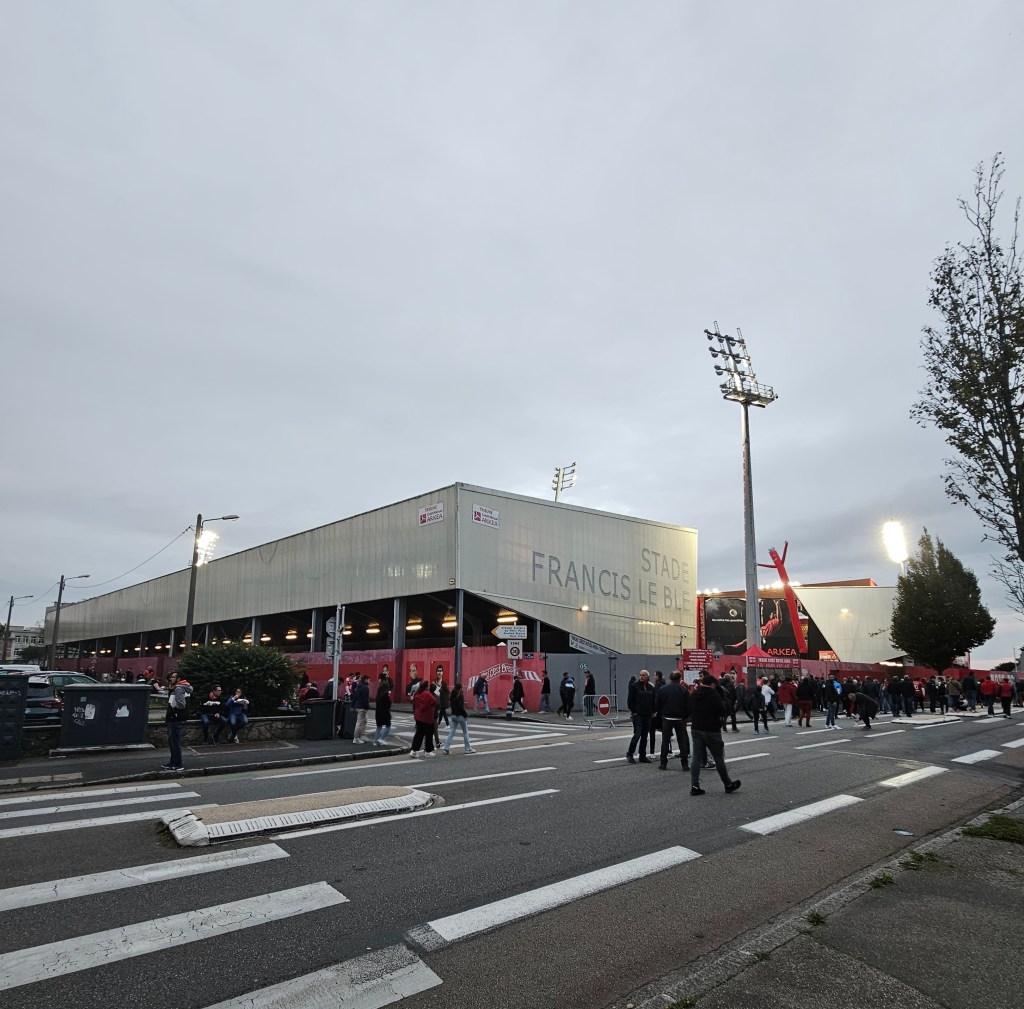
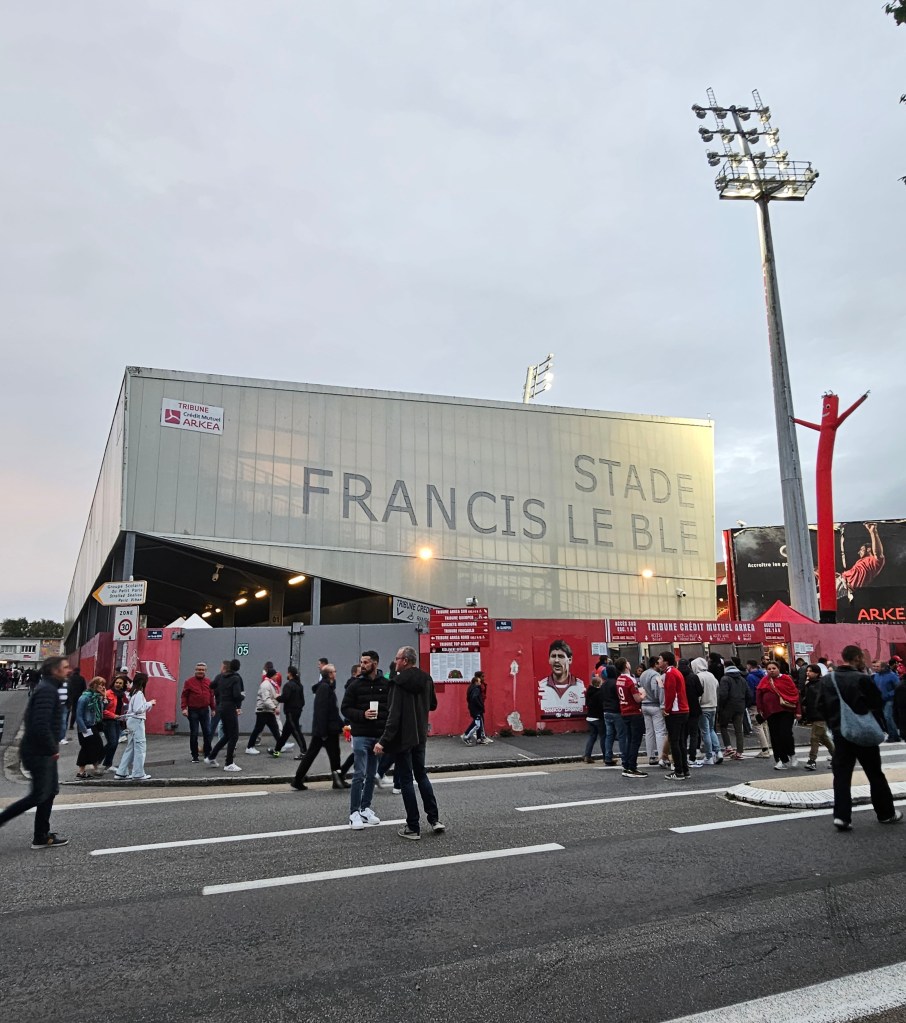
My wife Paulene and I are staying in a city centre hotel, which proves very handy indeed for the Liberte tram stop, where I just manage to extract two tickets (€1.70 each) from the vending machine and jump aboard a bright lime green Ligne A tram before it shuts its doors and begins a gentle, whirring, electricity-drinking ascent up Rue Jean Jaures towards Place de Strasbourg, from where it is just a short walk along Rue de Quimper to Stade de Francois Ble, home of Stade Brestois 29 (the 29 is the number of the Finistere departement – for some reason the mainland departements are numbered from 1 to 100, although weirdly Corsica gets to be 2A and 2B).   A gathering crowd is plainly in motion as we alight from the tram, and there is no difficulty finding the stadium as we are consumed by the human tide being drawn by the glow of floodlights shining out through the Breton dusk, and the promise of beer from the bar immediately behind the ground.  There is something about the approach to the ground and its relationship to the street that reminds me of the old Dell in Southampton, but I don’t let it worry me and not seeing any indication of a club shop I follow Paulene into the stadium after the usual ‘patting down’ by a huge, friendly man of Franco-African origin, who ensures I am not smuggling flares or other unfashionable trousers into the stadium. 

My fears about being unable to source club merchandise are quickly allayed as I spot a small wooden hut which looks like it could double up for use at a Christmas market.  I‘ve done my homework on-line, and know that for a bargain €9.90 I might be able to obtain a T-shirt bearing the club crest and the slogan Marree Rouge  (Red Tide). I point at a box of red T-shirts which bear the markings described and ask if there is one in ‘Large’ size.  The helpful young woman searches, examining the labels in collar after collar, one by one, but without success.  Eventually, sensing my desperation she holds up XL and XXL shirts as if suspecting that I am the sort of bloke who looks capable of putting on several kilos in weight if it suddenly proves necessary.  Optimistically, believing that I can fool the world by holding my stomach in, I ask if there is not a medium sized shirt instead; there is, but then, as she delves into the cardboard box just one more time a miracle happens, and she pulls out a ‘Large’; very possibly the last one in existence that isn’t already being worn by a well-proportioned Breton.

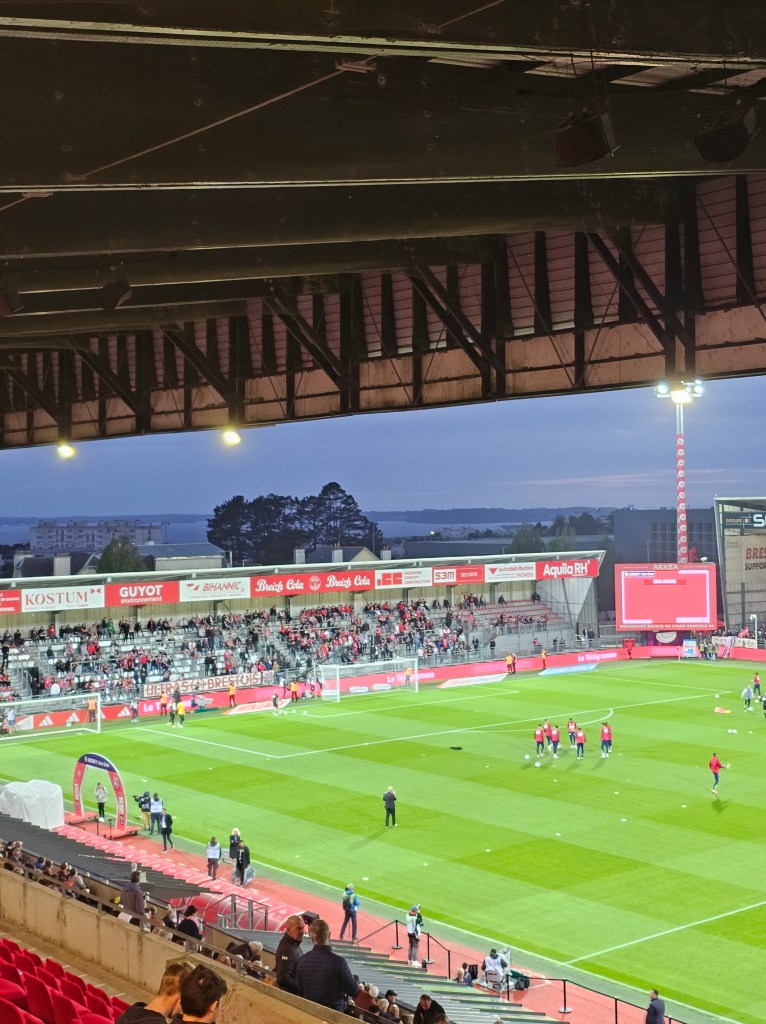
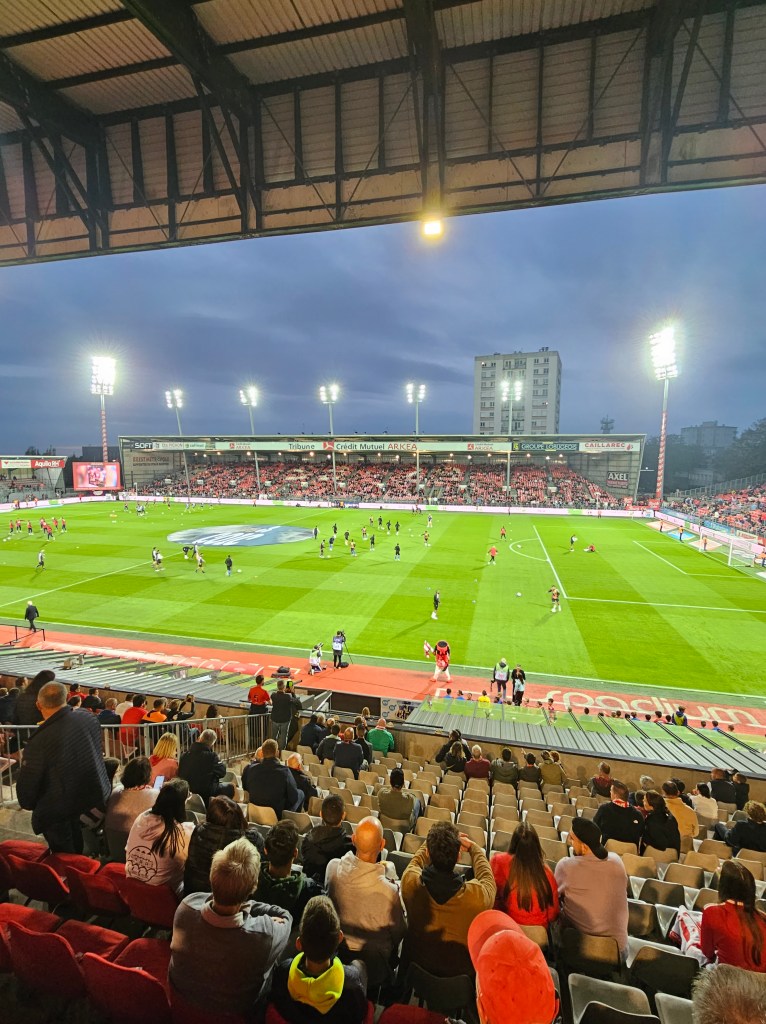
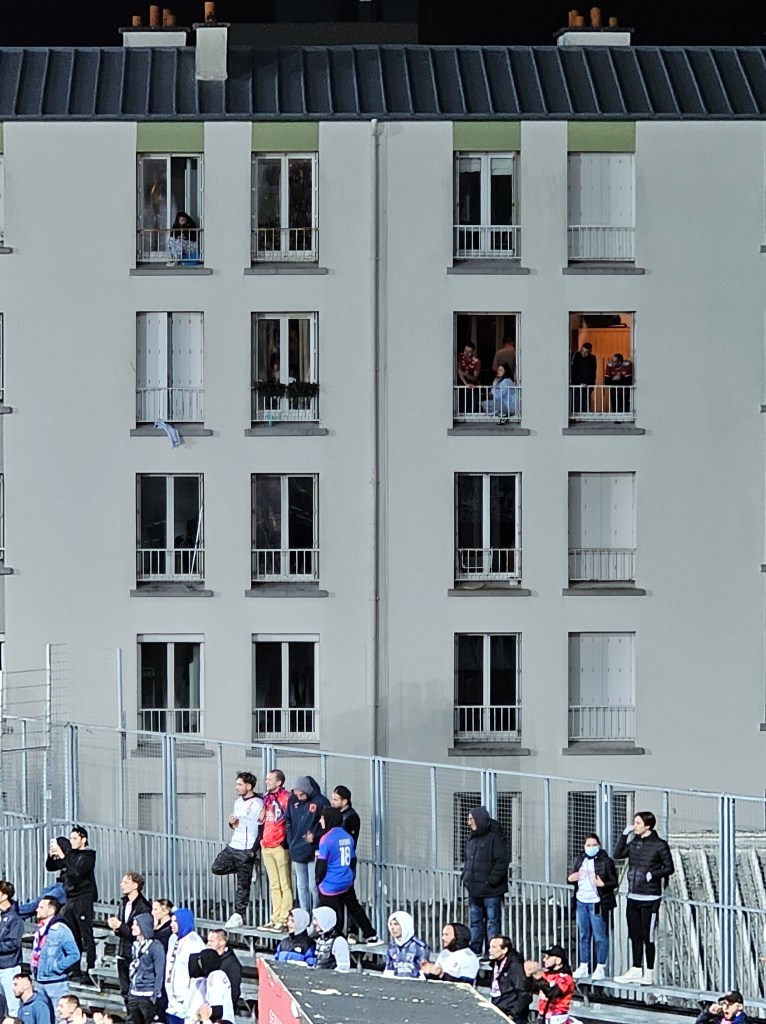
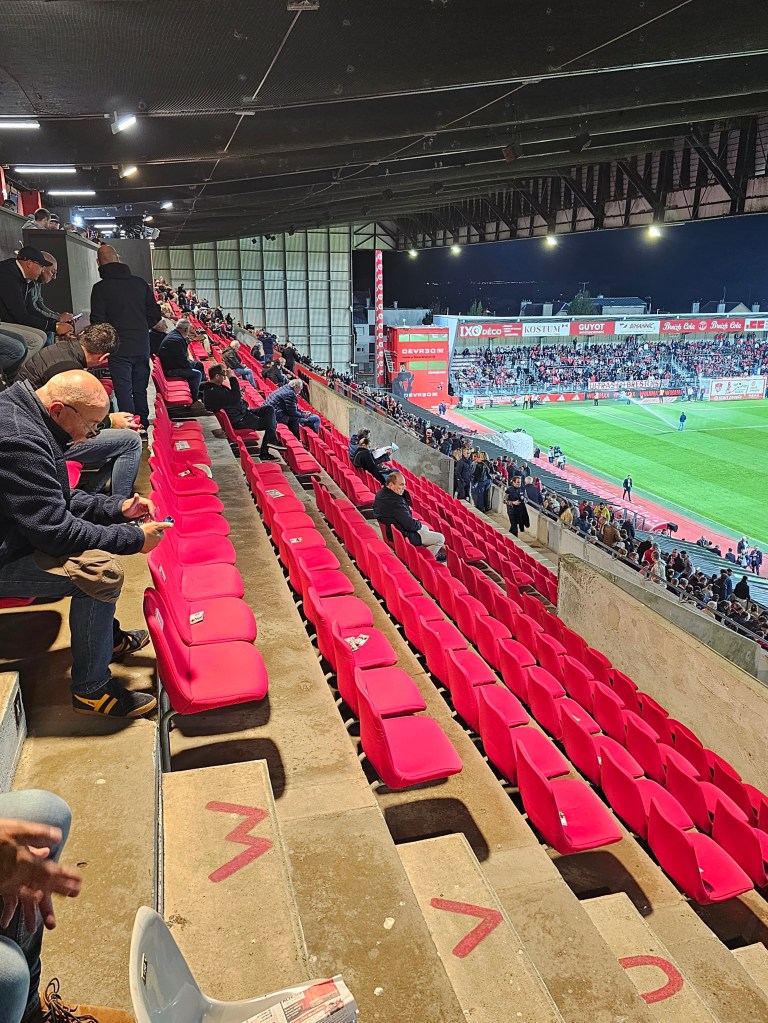
Clutching my precious T-shirt, I head for stairway five of the Tribune Foucauld and having climbed three flights of concrete steps I find myself looking over the brilliant green, floodlit pitch; all that remains is a further climb to row X and our seats, which I bought on-line a couple of weeks back.  Stade Brestois operate a loathsome ‘dynamic’ pricing system in which the club acts like a tout and the price of a seat changes, according to how much they think they can get for it.  When I first looked, tickets were €80 each; I eventually scored two of the few remaining ones for €45.  The club says the system means that people playing top price for seats allows less well-off fans to get cheap seats, but presumably this is only if these poorer fans have nothing to do with their time but be permanently logged onto the club website, waiting for a ticket price they might be able to afford.  The stadium has a capacity of not many more than 15,000 and is almost full for every Ligue 1 game. We sit in our over-priced seats and enjoy the view, which includes, through fading light, sight of the wide inlet from the Atlantic Ocean, which gives Brest its advantage as a port and naval dockyard.  Opposite us, the Tribune Credit Mutuel Arkea has five thick tubular stanchions set at a rakish angle to hold up the roof; atop the stanchions and the roof are floodlights, although the ground also has lights in all four corners.  To our right is the open Tribune Atlantique, a metal temporary stand a la Gillingham, and it’s where the away supporters are inevitably penned into a corner, they don’t even get seats, just metal benches.  Behind the stand, the occupants of a block of flats get a free view and can be seen crowding around windows and Juliet balconies. To the left is the small but freshly renovated Tribune Quimper; the ‘home end’ where the majority of the Brest Ultras congregate.

Whilst Paulene stays put to get maximum value from her seat, I soon take a wander to see what I can see and to find a programme, which is as ever free, and tonight is of the newspaper variety; it tells me the squads and who the referee and linesmen are and that’s it, which is all I need to know.  On the mezzanine level one staircase down from our seats is a bar, above which is a banner advertising the Breton Lancelot brewery.   Expecting one of Lancelot’s tasty beers, I invest 5 euros.  The beer is sweet and nasty and probably non-alcoholic; I tell the barmaid so and ask if it is Lancelot, because it doesn’t taste like it.  She doesn’t know but thinks it’s probably Carlsberg.  I’ve been poisoned.  At either ends of the stand are what look like private members bars, “Le Caban” and “L’esprit des Legendes”.  Spectators entering these bars do so only after having received the nod from people dressed intimidatingly all in black; presumably that’s where they serve the good stuff.  I’m guessing those spectators aren’t in the cheap seats.

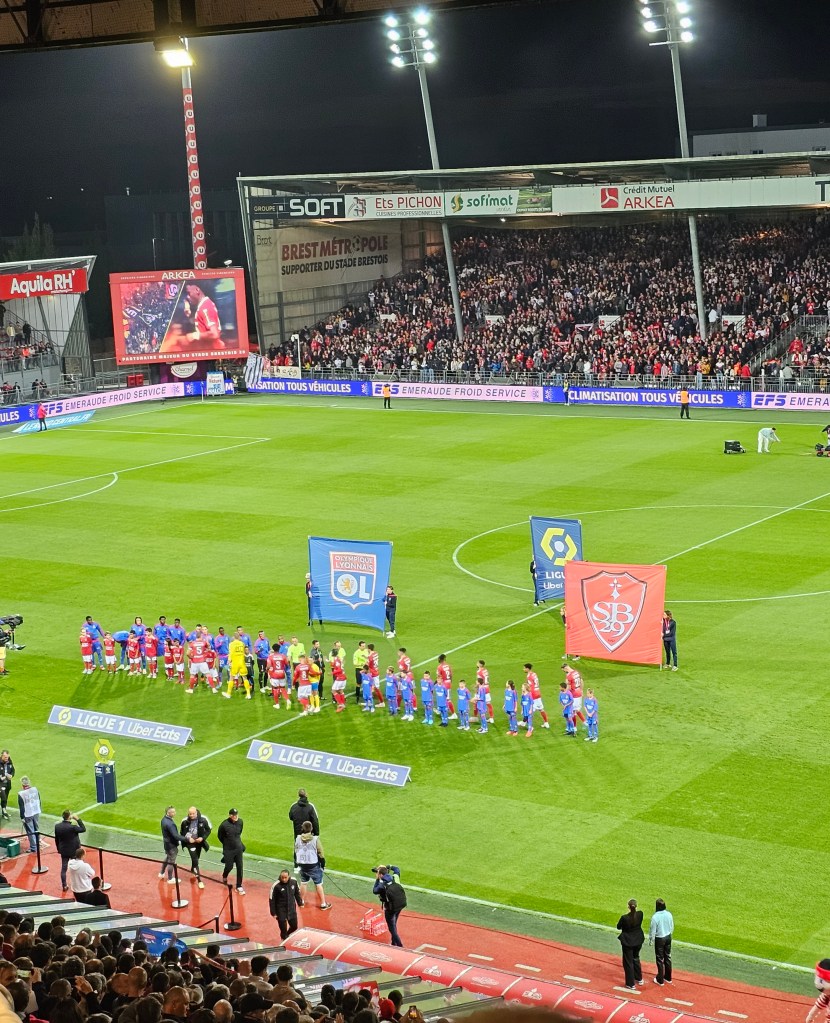
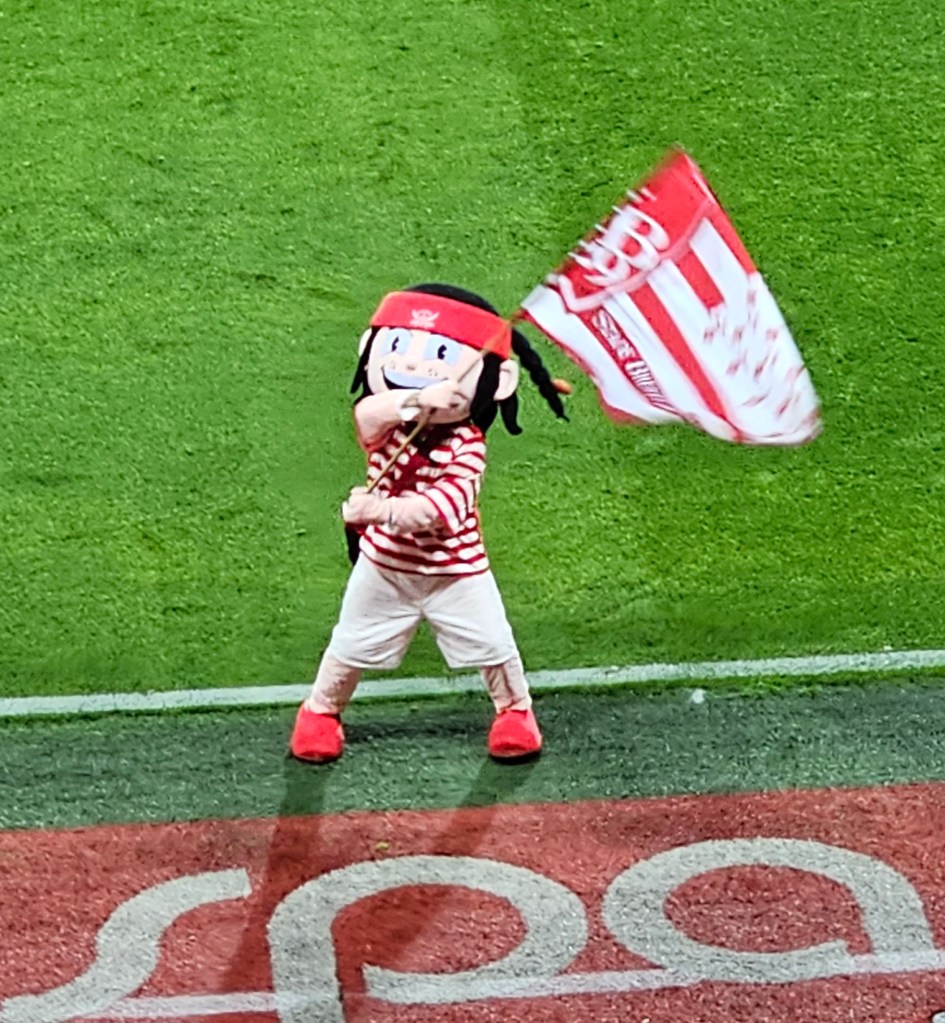
I return to my seat, and in the company of Paulene time passes quickly as we watch Zif, Brest’s pirate mascot, parade before the stand, and enjoy the arrival of the people in the seats around us, most of whom seem to be blokes in their seventies who all know each other.  The man next to me wears a beret and seems very clean, like Paul McCartney’s grandad in A Hard Day’s Night, but French. When the teams at last come onto the pitch, it’s to the fanfare of the Ligue 1 ‘anthem’, leaping flames, and the presentation of the match ball on a shiny plinth in front of banners displaying the two club badges and the Ligue 1 logo.  The public address system seems loud enough to make my ears bleed, but happily it doesn’t, although I do check.

When the game begins it is Lyon, generally known as OL in France, who get first go with the ball which they try and aim in the direction of the ocean whenever they can.  OL wear a frankly hideous, and annoyingly unnecessary away kit of all blue with red trim, whilst Brest are in their signature red shirts with white shorts and red socks. It’s been a warm day, but now a strong breeze blows up the hill from the dockyard and towards the OL goal. From the start, the slogan on my recently purchased T-shirt proves accurate as Brest sweep forward with wave after wave of attacking intent.  A shot goes way, way over the Lyon goal and then another soon earns a corner.  Brest are easily the better team but can’t find the final pass or the final touch that counts.  In midfield for Brest, Pierre Lees-Melou is brilliant, despite having previously played for Norwich City, and I imagine that the Canaries simply had no idea how to integrate a player into their team who can pass accurately, tackle, shoot, run with the ball and generally be quite good.  Fortunately, Lees-Melou seems to have suffered no ill-effects from his thirty-odd games wearing  yellow and green., but he’s probably receiving counselling.

All around the ground, the crowd brays with indignant disapproval whenever a Brest player is fouled. When referee Thomas Leonard books OL’s Ernest Nuamah for fouling Lees-Melou, the cheers sound like a goal has been scored.  I enjoy the wonderful name of Kenny Lala for Brest and the terrible haircut of Maxence Caqueret of Lyon, a player who looks like he was born 120 years too late and should have been the singer in a 1930’s dance band. On twenty-four minutes Lees-Melou has a shot tipped onto the cross bar by OL goalkeeper, the excellent Anthony Lopes, and then Brest’s Jeremy Le Douaran curls the rebound around the angle of the post and the bar.  “Allez-Allez-Allez” chant the home crowd from every stand.  A minute later OL get the ball into the Brest penalty area for the first time, but it comes to nought and instead all around is the noise of Brest fans urging their team on to score the goal the balance of play says they deserve.  The Ultras in the Tribune Quimper call out and the rest of the stadium answers back.  Mahdi Camara, a recent signing from Montpellier, dribbles deep into the OL box but again, there is no goal, only anticipation and excitement.  In the corner of the open end, the OL fans seem oblivious to their team’s ineffectiveness, other than in defence, and have sung and chanted all through the first half, prompted by two blokes perched astride the high metal fence that separates the supporters from the pitch.  Both blokes wield loud halers, but I don’t know if it’s the effect of the strong on shore breeze blowing away most of the sounds of their voices, but they both sound like Rob Brydon’s small man trapped in a box.

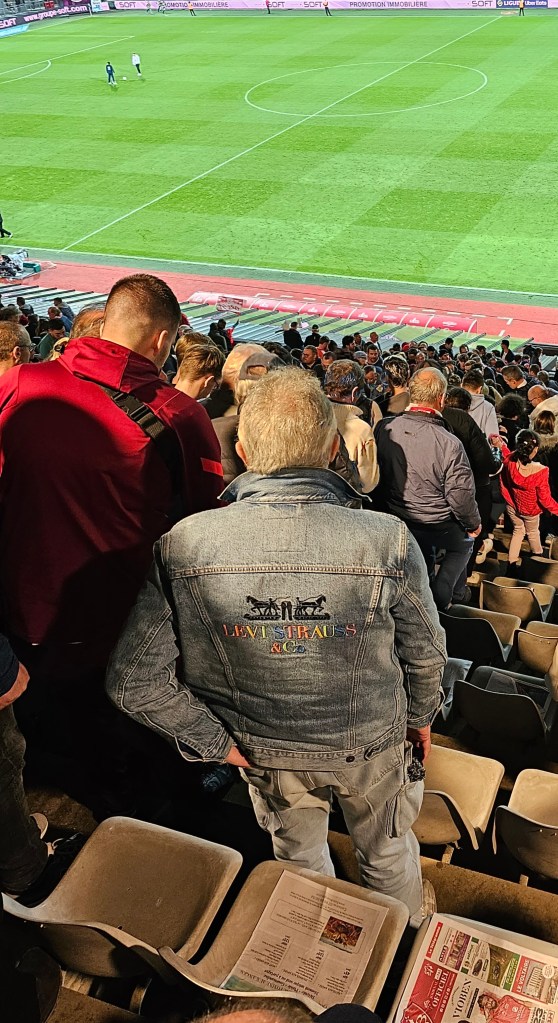
The fortieth minute is a milestone in the game as OL win their first corner, but of course it doesn’t result in a goal, and it’s the Brest supporters who remain in ebullient mood, holding their scarves aloft in the Tribune Quimper as the first half draws to a close in a sort of 1970’s tribute that suits the architecture of the stadium and the old blokes all around me who were themselves probably the Ultras of fifty years ago.  In front of me, a bloke wears double denim, and succeeds in accentuating the feeling, as if he’d come to a game in 1973 and never went home.

With half-time, the seats to our left are nearly all vacated, revealing the fact that they all sport red covers and suggesting perhaps that their occupants are now all enjoying some form of hospitality somewhere, perhaps in Le Caban or L’Esprit des Legendes. I will read later that the club owners wish to build a new stadium at the end of the tram line at the edge of the city, but that it will still only have a capacity of 15,000, no doubt because they want to be able to still charge top prices for the comfortable few and forget about the sweaty oiks who may be don’t wear shirts, and chant and light flares and drink too much beer containing alcohol in the bar across the road.

The second half begins and nothing changes, although encouragingly the block of seats to our left is soon re-populated, proving either that the occupants are genuinely interested in the match or that the hospitality isn’t free or unlimited. After just seven minutes however, OL roll the dice by replacing Ernest Nuamah, Diego Moreira and Paul Akounkou with Mama Balde, Tino Kadeware and Ainsley Naitland-Miles, who tonight wears a silly number 98 shirt and a few seasons ago mostly failed to excite when on loan at Ipswich from Arsenal.  The change sort of works for a short while and Alexandre Lacazette finds space to launch a thirty-yarder which flies over the Brest cross bar, but then a weak Caqueret pass is intercepted by Lees-Melou who dribbles away from his own half and to the edge of the OL penalty area before frustratingly shooting beyond the far post.  An hour has gone and Brest miss another chance, probably the best yet, as a low cross is somehow steered wide of the OL goal by Jeremy Douaron from just a couple of yards.  Whilst clutching their collective heads the crowds shout “Aye-Aye-Aye” and I find myself joining in with swelling chants of “Allez les Rouges! Allez les Rouges!”  Paulene, a Pompey fans says the atmosphere is like that of Fratton Park. “The same sort of people” she says. “What? All dockyard mateys” I reply, thinking of my dead father, a one-time Pompey based matelot who I know would have said exactly the same thing.

The game enters its final twenty minutes, and to mark the occasion tonight’s attendance is announced as being 14,636, and Brest substitute number seven, Martin Satriano for number nine, Steve Mounie.  But it’s OL who, still against the run of play, now come closest to a goal as Lacazette sends a decent low shot goalwards from the edge of the penalty area which Brest ‘keeper Marco Bizot dives to his right to stop and then jealously grab.  Lacazette lasts five minutes more before being replaced by Rayan Cherki, a man whose distinctly bushy facial hair and short back and sides give him the look of an Edwardian naval captain.

Three minutes of normal time now remain.  A move down the right produces a cross from Brest’s Kenny Lala, which Steve Mounie heads against the foot of Lopes’s left hand post.  As the crowd gasps in thrilled disappointment the ball runs back to Lala who crosses it again and Mounie, who has back-pedalled judiciously, this time hurls himself forward to head the ball past Lopes into the near top corner of the net, and Brest have the goal they deserve.  The crowd is on its feet, but OL defender Tino Kadewere is on the ground having been barged out of the way by the hurtling Mounie, although there was no real suspicion of a foul.

“Allez, Allez, Allez, Allez” we all sing triumphantly, Billal Brahimi shoots, Lopes saves, and Brest have a corner and five minutes of added on time in which to retain their clean sheet or even score again.  The very clean old bloke in the beret, next to me, leaves early, but very few others do.  Jonas Martin shoots and misses for Brest, and Naitland-Miles has a shot saved for OL, but there are no more goals and as the clock ticks towards eleven o’clock Monsieur Leonard blows his whistle for the last time.  Brest are top of the league, or more accurately given our geography, a la tete du classement.  We stay a short while to applaud before heading off into the night and back along Rue de Quimper to the tram stop, and a journey back to our hotel on the most crowded tram I have ever ridden on. It’s been a fantastic evening and still with our minds whirring excitedly, in our hotel room we celebrate Brest’s success by cracking open a small bottle of Cremant that had been cooling in the mini-bar, and unwind by watching the game all over again on Canal Plus tv. Allez les Rouges!

Ipswich Town 0 Portsmouth 0

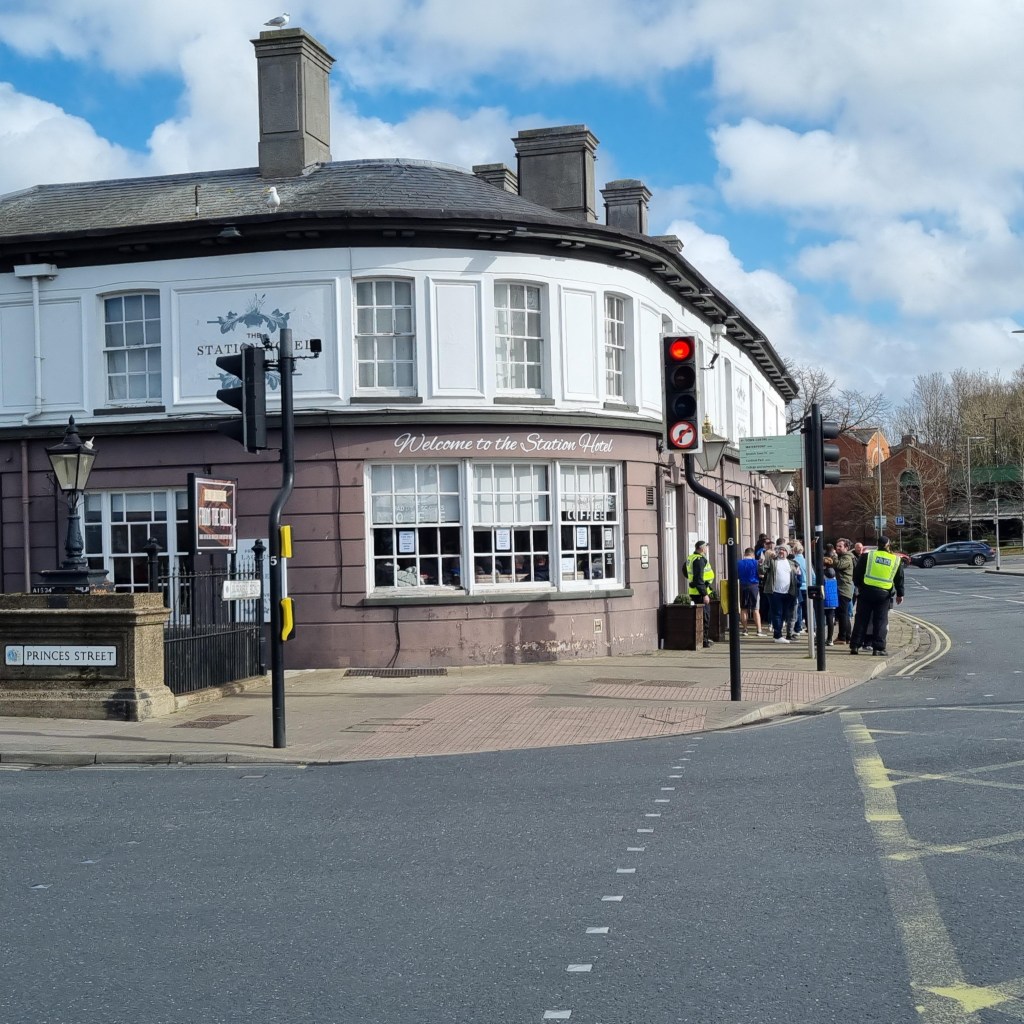
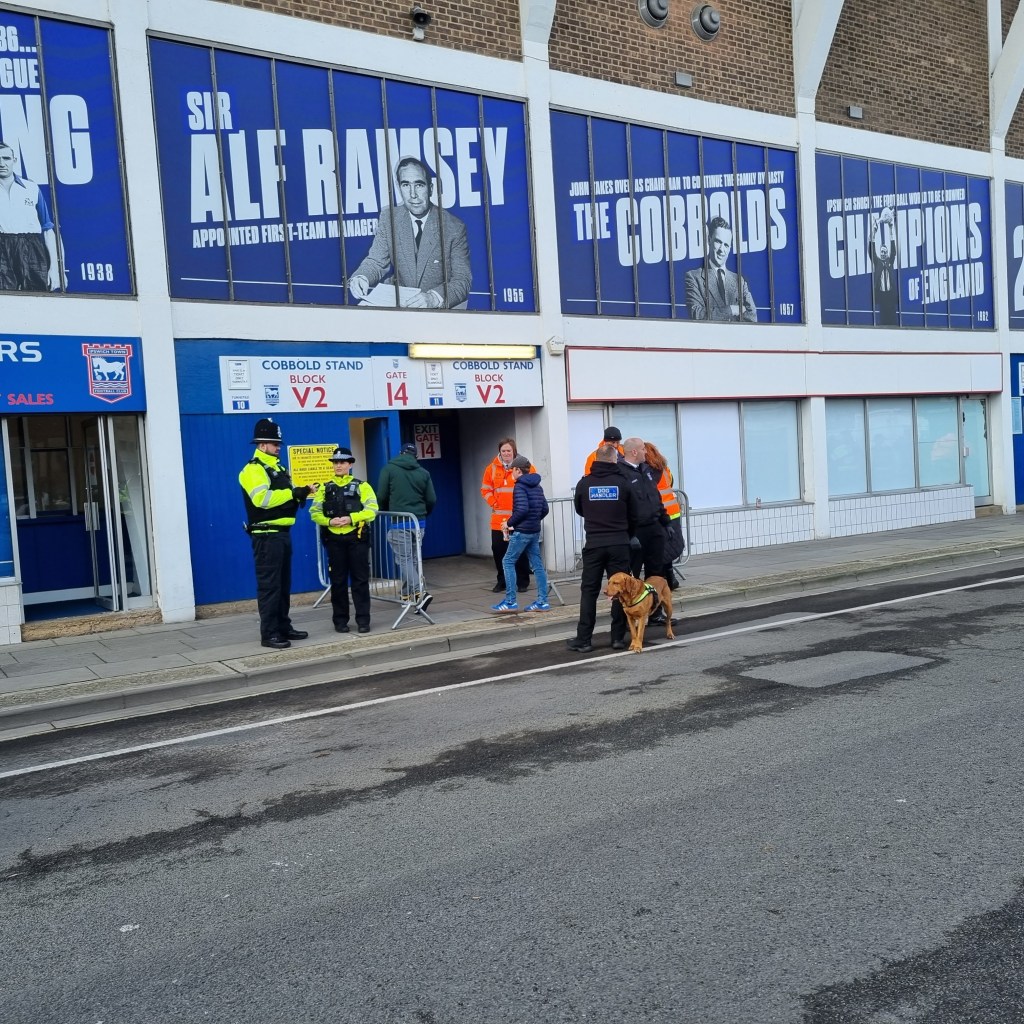
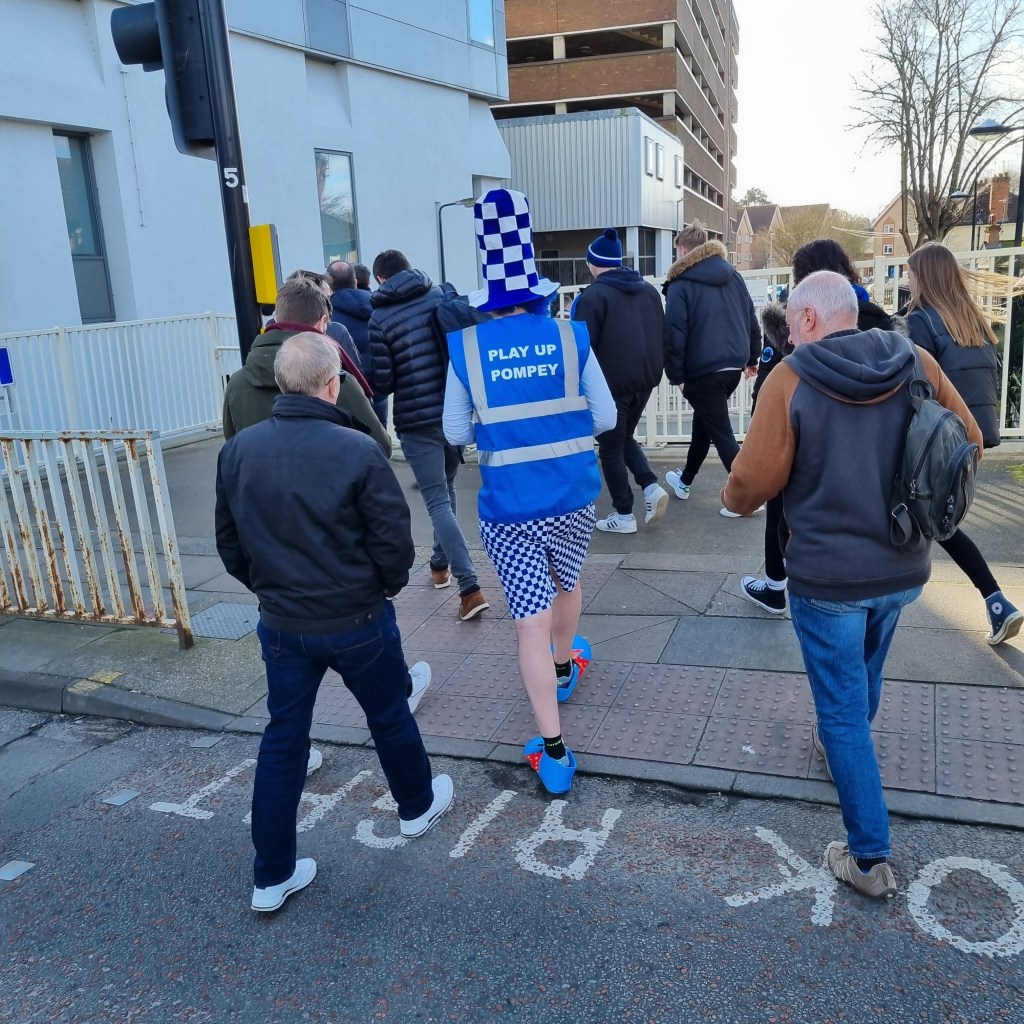
Spring is sprung and as former Poet Laureate, Alfred, Lord Tennyson tells us, a young man’s fancy lightly turns to thoughts of promotion and sneaking into the play-offs. With such thoughts in mind, I once again park up my trustee Citroen C3 in classical sounding Waller’s Grove, and tread steadily across Gippeswyk Park towards Portman Road and the Arboretum pub beyond, which is now known as the Arbor House.   It’s a gloriously sunny day, which sits beneath a pale blue sky, once the grey clouds have broken up.  The human contents of the Station Hotel spill out onto Burrell Road and in the pub garden Pompey fans revel in the joys of beer and life.  On Portman Road a golden Labrador sniffs for incendiaries and I buy a programme (£3.50) for the first time using cashless payment.  There are far more police about than usual, no doubt because of some strange belief that the followers of today’s opponents, Portsmouth Football Club, are somehow rowdier than your average spectator, but on Portsea Island life is lived to the full.
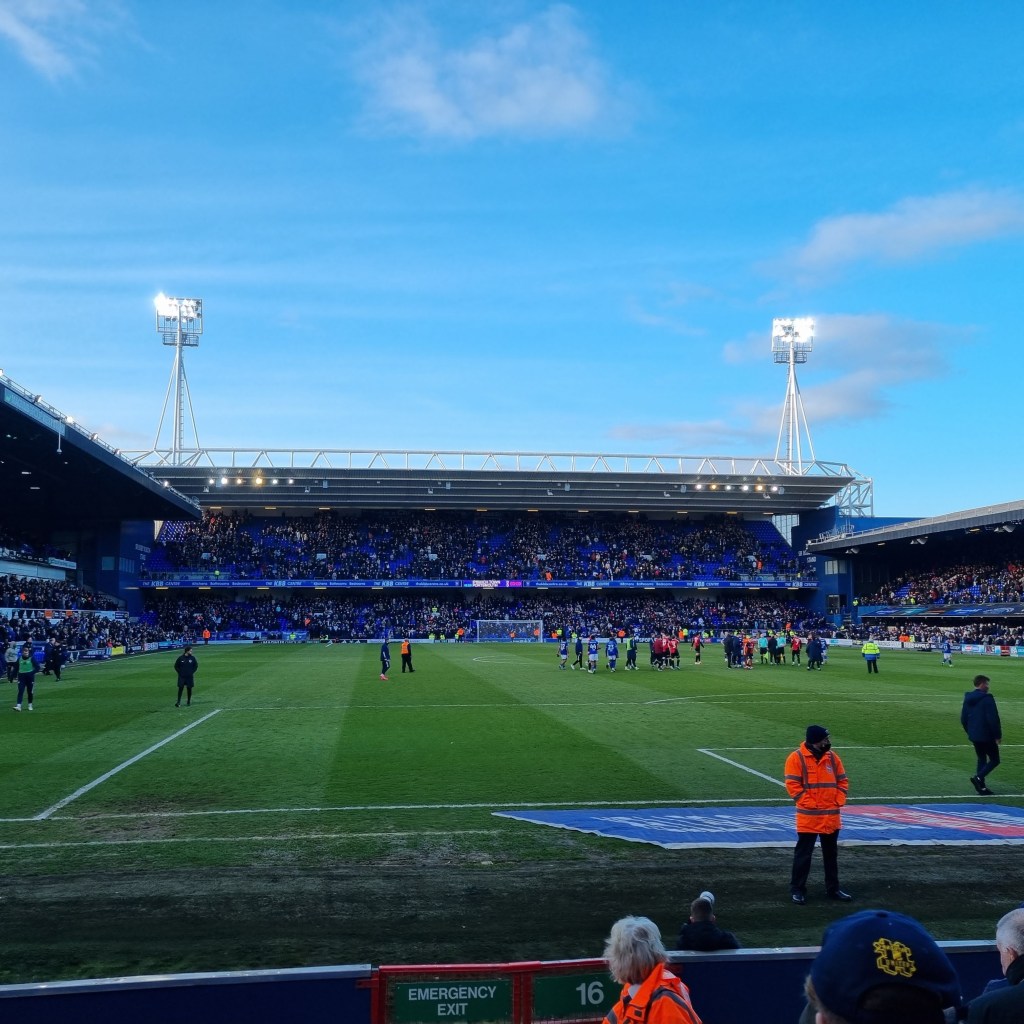
At the Arb’ I purchase a pint of Mauldon’s Suffolk Pride (£3.80) and bask in the sun in the beer garden where I am soon joined by Mick. who I haven’t seen since before Christmas.  We talk of Fatty Liver Disease, Home Office funding for the housing of Afghan refugees, conversations with mutual friends, bicycles, people who still think Brexit was a good idea, Baptists, my wife’s twin aunts in Portsmouth, one of whom has sadly died and electric cars.  We don’t talk of Ukraine except to say that it makes us too angry and sad, and we simply don’t know what to say about it.  At some time after two-thirty, having finished our beers, we depart for Portman Road, Mick walking his Raleigh bicycle as we go and finally locking it up in Sir Alf Ramsey Way where we head for our respective turnstiles, Mick making for the posh West Stand seats and me the cheap seats in the lower tier of what I still think of as Churchman’s.  For a second consecutive fixture there are queues at turnstiles 59 and 60, but I’m inside the stadium by ten to three giving plenty of time to use the ‘bathroom’ facilities before taking up my seat.

In the stand, Pat from Clacton is here, as is ever-present Phil who never misses a game, along with his young son Elwood.  Fiona is away on a cruise to the Canary Islands, but her seat is occupied by Mark, a long -time supporter who travels on the coach from Clacton with Pat, but usually sits in the West Stand. Curiously the seats immediately in front of me are empty today.  We will later learn that there are 25, 495 other people here too, each with their own distinct lives, hope and fears and tales to tell, and 1,986 of them are also Portsmouth supporters.

At a minute past three, after knees are taken and applauded the Town begin the game, hoping to rattle the net of the goal just a little to the right and in front of Pat, Phil, Elwood, Mark and me.  Town are back in our traditional blue shirts and white shorts after Tuesday’s flirtation with all blue, whilst Pompey are in a handsome kit of red and black halves with black shorts, it’s a kit with personal significance for me because my wife was wearing an earlier version of the shirt when I first spoke to her back in the 1990’s, and it was the shirt I spoke to her about.

“Hello, hello, we are the Pompey boys” sing the Portsmouth supporters helpfully and politely introducing themselves, as if to hold out a hand and bid us all a good afternoon.  There is a fine atmosphere inside Portman Road today courtesy of the Pompey boys (and girls) and a chorus of “Play Up Pompey, Pompey Play Up” is soon ringing out and the Sir Bobby Robson stand respond with “Oh when the Town go marching in” sung to the tempo of a funeral march and with a similar quota of joie de vivre.   It’s conceivable that the Pompey fans can’t hear the Town supporters’ dirge above the sound of their own anthem, or it could be that they can only clearly see the impassive faces of the Town fans in the Sir Alf Ramsey Stand, but our visitors soon break into the old  favourites of away fans at Portman Road with choruses of “You’re support is fucking shit” and its intellectually superior sibling chant “ Is this a library?”.  Moving swiftly into goading mode they produce a rendition of the geographically inaccurate “Small town in Norwich, you’re just a small Town in Norwich” before finishing with “You’re supposed to be at home”. Such is the wit of football supporters. “Never heard that one before” says the bloke behind me sarcastically as I imagine that I’ve been listening to an advertisement for a compilation of football ‘s favourite chants from K-tel Records.

Twelve minutes past three and Town, who have been dominating possession, win the game’s first corner. “Play Up Pompey, Pompey Play Up” sing the Pompey boys and girls showing that it’s possible to vocally encourage your team when they’re defending as well as when they attack; this afternoon is proving to be an education.   The corner kick is delivered and Luke Woolfenden, looking a bit like a 1990’s Eminem with his bleached blond hair stoops and twists to somehow head the ball away from goal rather than into it.  Four minutes later and Pompey win a corner too, eliciting even more chimes.

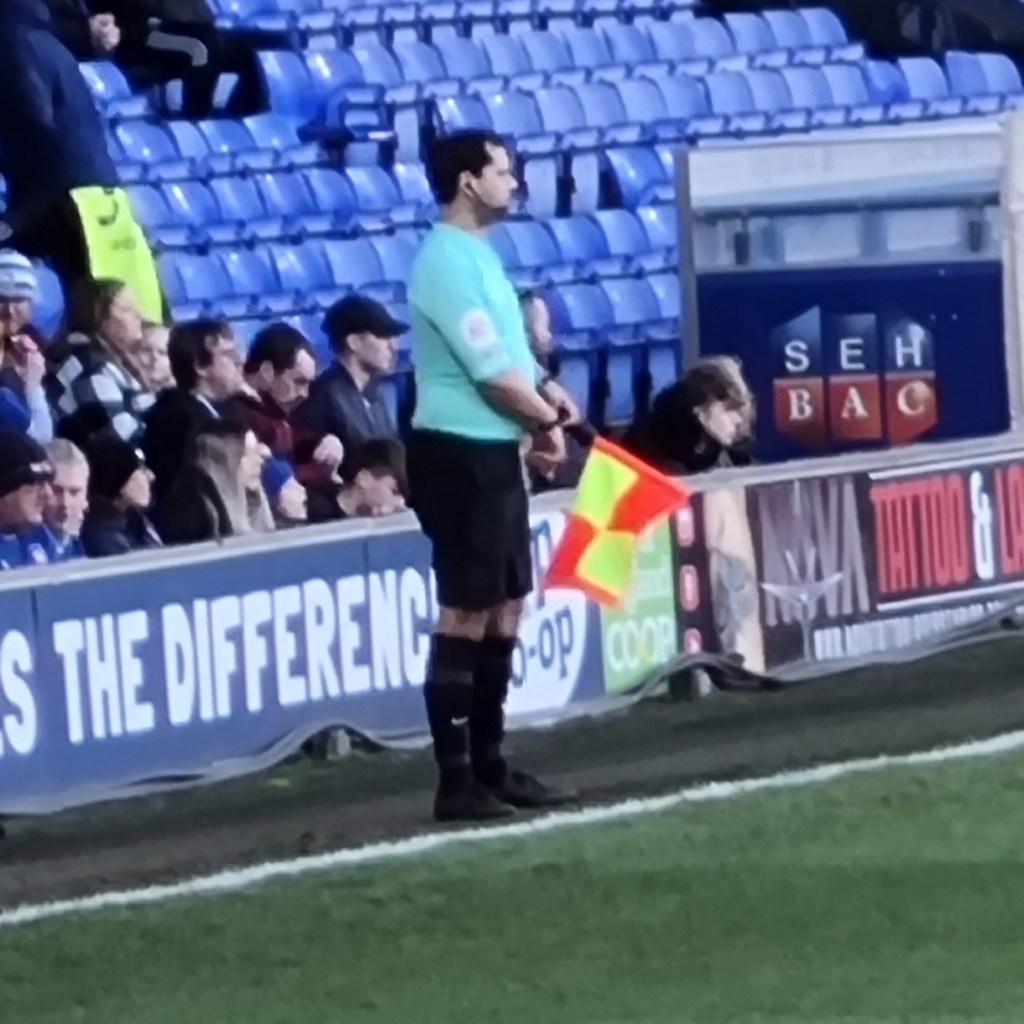
Sam Morsy has already had to pause the game once to check on his gammy leg; a legacy (no pun intended, though it’s a pretty good one, isn’t it?) from Tuesday night’s game, but now with seventy minutes still to play, he has to be substituted by Tommy Carroll, who incidentally last played for Town against Pompey on 4th May 1968 (Town won 2-1 at Fratton Park).  Bringing on a player who would be over eighty if he was still alive unsettles the Town team and Pompey nearly score as Aiden O’Brien shoots spectacularly over the cross bar from very close range and then Luke Woolfenden gives the ball away to O’Brien who thankfully misses again, this time shooting wide of the far post.  It’s almost as if Town had been setting up O’Brien to embarrass himself. Town bounce back briefly to win a second corner but then a George Hirst shot has to be saved by Christian Walton. On the left touchline the referees assistant fits very snugly into his pale green shirt, almost as if he’s been vacuum packed.

After twenty minutes, the incidence of foul play is increasing, and O’Brien falls beautifully, arching his back in a graceful curve as he is allegedly fouled by Wes Burns.  If they ever put on Swan Lake at the Kings Theatre in Albert Road, Southsea, O’Brien has to be worth a punt for the part of Odette.  A short while later Pompey’s Louis Thompson is the first player to be shown the yellow card belonging to the largely ineffectual referee Mr Christopher Sarginson, as Wes Burns wriggles in a heap on the turf.

A third town corner is greeted with a song involving repeated Ole’s or Allez, I’m not clear which, from the Sir Bobby Robson stand, but the corner kick is easily cleared at the near post.  The improbably named Mahlon Romeo then drags down Dominic Thompson and holds the ball up angrily in the air as if to say to “But look, I got the ball” when he is called out by Mr Sarginson,  who, I like to think ,tells him that he could equally have come away with the ball if he’d hit Thompson with a long plank of wood or set a dog on him, but it would still be a foul.

“Oh, great ball Bakinson” calls a sarcastic voice somewhere behind me as Janoi Donacien mistakenly passes to a Pompey player.  “Oh Shut up” says someone else, understandably frustrated by the sort of people who inexplicably seem to need a bete noire in every Town team.  Conor Chaplin has a shot blocked and with half-time nearby Cameron Burgess concedes a corner. “Play Up Pompey, Pompey Play Up” sing the 1,986 in the Cobbold Stand. “Fuck off Pompey, Pompey Fuck Off” answer the Sir Bobby Robson Stand revealing a level of sophistication, wit and humour which goes some way to explaining the popularity of TV’s ‘Mrs Brown’s Boys’ among much of the general population.  Entering time added on a Conor Chaplin snap shot whistles past the left hand post of the Pompey goal before Kayden Jackson runs on to a through ball and has his shot saved by Gavin Bazunu.  Jackson appears to tweak a hamstring in the process of running and shooting and troops off angrily and dejectedly to be replaced by the oddly named Macaulay Bonne whilst Town take another corner and the three minutes of added on time are played out.

Half-time brings relief and nourishment in the form of a wee and a Nature Valley chocolate and peanut protein bar, but unusually I do not go and talk to Ray and his grandson Harrison because Ray is somewhere up the back of the stand with his brother-in-law today.  Half-time nevertheless passes quickly and the football soon resumes along with the pattern of Ipswich possession interspersed with corner kicks and a series of crosses which carefully avoid anyone likely to divert the ball into the Pompey goal.

As Bersant Celina wins another corner, the volume of the home crowd seems to be turned up a notch as if there is either a sudden collective understanding that they can help the team, or an outbreak of collective anxiety. From a cross, subsequent to the corner kick , the ball comes out to Wes Burns, but he wellies it over-enthusiastically and high above the Pompey cross bar.  Pompey are mostly the lesser team in this contest but they retain the ability to threaten occasionally and as half past four approaches a header from Sean Raggett lands on the roof of the Town goal net and the “Play Up Pompey/ Pompey Fuck Off” duet is reprised. It took the home fans a while to think of their response to the Chimes, but now that they have they’re not missing a beat.

Pompey’s Louis Thompson is replaced by Joe Morell and Tyreeq Bakinson seems to carefully place a shot into the arms of Pompey goalkeeper Gavin Bazunu before Bersant Celina wins yet another corner, and Bakinson heads the ball into the side netting, promoting jeers from the Pompey supporters directed at those Town supporters who might have thought the net was bulging from within.  Over seventy minutes have passed and the competitive edge in the game unfortunately boils over as it appears that the Pompey manager, the never-smiling Danny Cowley, gets in Dominic Thompson’s way as he prepares to take a throw-in.  Thompson seems to over react somewhat, but Cowley makes no attempt to appease the offended wing-back and starts to come over all macho.  An unseemly melee ensues and the Sir Bobby Robson  stand are unforgiving as they announce “ Cowley, Cowley, You’re a cunt; Cowley, You’re a cunt”.  To my shame I join in with a shout of “Bugger-off back to Braintree”, but mainly because I enjoy the alliteration and find any mention of Braintree faintly amusing.

The match descends into its final ten minutes as Bersant Celina shoots wide and Tyreeq Bakinson is booked. Meanwhile Pompey swap Aiden O’Brien for the interestingly monikered Denver Hume and   I notice that their bearded Ryan Tunnicliffe has strange hair, cut into a sort of bob like a 1920’s flapper.  Pompey also replace George Hirst, whose name is satisfyingly close enough to Geoff Hurst to make me smile and his substitute is a man with two surnames, Tyler Walker. With three minutes of added on time ebbing away some folk in the home crowd begin to accuse Pompey of time wasting; there are even calls of “Boring Boring Portsmouth”, which are ridiculous and reveal how easily some people can slip into repetitive behaviour; it saves having to think.

The final whistle brings inevitable disappointment that Town haven’t won, tempered by the understanding that this has been a good match and we haven’t lost either, which we often do at home to Portsmouth.   Pat from Clacton makes a swift exit and Mark thanks me for my company;  I reciprocate before heading out into the chill of the early evening for the journey home and the thoughts of Mick Mills through the medium of BBC Radio Suffolk and the car radio.  Life is generally good, although it could sometimes be better.

Ipswich Town 0 AFC Wimbledon 0

I’ve been waiting a while to see my team Ipswich Town play AFC Wimbledon at Portman Road. Sadly for me I missed the clubs’ first encounter back in September 2019 having been detained by the National Health Service; something to do with heart valves. Town’s 2-1 victory back then no doubt aided my recovery from surgery and now, re-built using bovine spare parts, I am fit enough to attend Portman Road,  but circumstances have conspired against me again and the global pandemic means I along with everyone else must once again witness today’s match via the marvel of modern technology that is the ifollow.  But with Town in a remarkable run of form that has seen them fail to score a single goal in five matches, mine and everyone else’s exile from Portman Road is probably for the best.  Excited at the prospect of today’s game nevertheless, I have made the effort to order a programme, on the cover which is a slightly startled, or possibly forlorn, looking Kane Vincent-Young

Startled or forlorn?

Earlier today, as part of an attempt to ensure that the nation’s investment in one of my vital organs should not be in vain, I pumped up the tyres on my bicycle for the first time in three years and cycled a little over six miles.  I had quite forgotten how uncomfortable a bicycle saddle can be and I am now only just able to walk, my legs feeling as if I am wading thigh deep through thick mud.  Such exercise requires reward and I therefore enjoy a pre-match ‘pint’ of Fuller’s ESB (four for £6 from Waitrose) as I slump lifelessly in front of the telly catching the tail-end of Portsmouth versus Bristol Rovers on the ifollow, which my wife Paulene has been watching, Pompey being her team.  Pompey win and Bristol Rovers are relegated.  Coincidentally,  Pompey and Bristol Rovers are the only two teams against whom Ipswich have scored in the last nine games; furthermore Town have beaten Bristol Rovers three times this season whilst  Pompey have beaten Ipswich three times.  I regale Paulene with these fascinating facts in the style of a radio commentator; predictably she is unimpressed, but it doesn’t stop me.

Pre-match ‘pint’

With tv pictures of Fratton Park now just a memory, I log on to the ifollow in time to catch the names of today’s virtual mascots who are Finlay, Harrison, and what sounds like RJ and Milan, but I could be wrong. It nevertheless sets me to hoping that Milan has a sister called Florence and that somewhere in northern Italy there is a child called Ipswich.  In the manner of the FA Cup draw the next voice I hear is that of BBC Radio Suffolk’s stalwart commentator Brenner Woolley, who as ever has alongside him the redoubtable and legendary Mick Mills.  “We really are at the business end of the season” says Brenner , by which I think he means that all the speculation since August about which teams would be promoted and relegated will soon be resolved.  Ipswich will neither be promoted nor relegated, but their ‘business’ appears to be that of setting a new record for consecutive matches without scoring a goal; five and counting.

Brenner asks Mick to expound his current theory as to Town’s existence.  Mick postulates that Town “…went from playing ‘A’ class football and not being able to do it and going for a more direct style”.  Mick continues at length and I start to stare into the distance, but I get the drift.  “No sign of the boys in blue” says Brenner as the Town team begin to saunter onto the pitch.  I don’t think he’s talking about the police, he’s just not being very observant.

After the teams “take the knee” the game begins, Wimbledon getting first go with the ball and kicking towards the Sir Bobby Robson Stand.  “Here’s Vincent-Young coming in-field with pink footwear” announces Brenner, eschewing deeper analysis for the sheer colour of the spectacle.  “Not very much has happened so far but the one thing that’s happened is watching Teddy Bishop…” chips in Mick before completing his observation, which is  that Teddy Bishop has been pushing forward down the left; so far he’s successfully been caught offside twice, but Mick’s advice is that he should keep trying.

“Paul Cook sipping on his coffee” says Brenner, introducing the by now obligatory mention of Paul Cook drinking coffee, and providing the sort of aimless detail worthy of an existential novel.  It’s the fourth minute and Wimbledon’s Will Nightingale heads over the Town cross-bar.  Mick Mills muses on how Town goalkeeper David Cornell stayed on his goal line but should have come to catch the cross. Mick is not impressed.  Meanwhile Brenner tells us that Wimbledon have scored as many goals in their last four games as Ipswich have in their last nineteen, before reporting  “Beautiful day at Portman Road, nil-nil, Town have now gone nine hours without a goal”.  It’s a careful combination of facts from Brenner that leaves me not knowing whether to feel happy, disappointed or in awe.  Wimbledon win a corner, Town win a corner.  A punt forward sees Mark McGuinness head the ball away from David Cornell as he comes out to collect the ball. “McGuinness and Cornell got in a bit of a sixes and sevens situation” is Brenner’s peculiar description of events.

The match proceeds much as all recent games have done. “Bennetts; that was terrible” says Brenner as the oddly-named Keanan Bennetts runs at the Wimbledon defence and then sends a shot hopelessly wide of the far post.  At the other end Wimbledon are no better. “Rudoni shoots wide, he should have scored”.  Twenty minutes have passed. “Wimbledon on top at the moment; the better side” is Brenner’s assessment and then Wimbledon are awarded a penalty, possibly for shirt-pulling.  Happily Joe Piggott’s spot-kick is easily saved by Cornell, albeit with his legs and feet. “ I didn’t like the run-up of the player” explains Mick relaying how he thought Piggott would miss.

“Bennetts; terrible lay-off” says Brenner, continuing the theme of inept play that has “ Paul Cook screaming his heart out down below” ; it’s a description from Brenner that suggests an image of the  Town manager suffering  infernal torment.  There are twelve minutes of the half remaining. “Surprise, surprise it’s nil-nil” says Brenner, introducing an unwelcome note of sarcasm.  Gwion Edwards shoots over the Wimbledon cross-bar; it’s Town’s second shot on goal in thirty-four minutes. “A massive difference in positivity in both teams” says Mick attempting to explain what we’re seeing.

Some passing breaks out. “Good play this from Ipswich Town” says Brenner as a corner is won, but then taken short and Mick shares our frustration.  With none of the current Town team capable of scoring, Brenner resorts to telling BBC Radio Suffolk listeners that former Town player Will Keane has scored for Wigan Athletic and is currently in a “rich vein of form”.  It’s just the sort of thing we all want to hear.  Back to Portman Road and “Poor from Dozzell, ball out” are Brenner’s words.  “He wanted to do something that wasn’t there” explains Mick raising philosophical questions about the nature of reality.  Gwion Edwards wins Town’s third corner of the half with two minutes to go before a minute of added on time is…added on.  It’s time enough for Brenner to refer to “Cornell…the Welshman” in much the same way that he usually refers to “Holy…the Czech”.  Half-time arrives and Brenner concludes that “Ipswich continue to struggle”. “We are the inferior team” is Mick’s summation before he is rudely cut-off by the ifollow commercial break; it’s a phrase from Mick that would look good on a banner in the North Stand or on a t-shirt.

Half-time relief comes in the form of a mug of tea and two Christmas tree-shaped ginger biscuits; stocks of the un-seasonal confections acquired at a knock-down price remain healthy.  All too quickly the game begins again. “Just three and a half more games for us to suffer” says Brenner.  Armando Dobra has replaced the oddly-named Keanan Bennetts although “…anybody could have come off at half-time” is the honest assessment of Brenner.

Cornell is soon making a decent save at the feet of Wimbledon’s Ayoub Assal.  “A lovely afternoon at Portman Road” says Brenner trying hard to look on the bright side of life before referring to “spring-heeled McGuinness”, which almost sounds like an epithet he’d pre-prepared.  Ollie Hawkins appears to head the ball against the Wimbledon crossbar but Town earn a corner so he probably didn’t.  “Nice little spell, it’s not lasted long, but it’s promising” says Mick as Town start to look more like a team that hasn’t just turned up because it’s a sunny afternoon and they’ve nothing better to do.

The game is nearly an hour old.  “Nine and three-quarter hours since a Town goal” says Brenner, clearly not counting down the minutes until he can say that Town haven’t scored in ten hours.  Kane Vincent-Young breaks down the right. “Vincent-Young has got open grass in front of him, just opening his legs” is Brenner’s slightly unpleasant description which probably sounds even more disturbing to BBC Radio Suffolk listeners who don’t have the accompanying tv pictures.  Town players are moving and passing the ball well; another corner kick ensues which Gwion Edwards steps up to take and lumps way beyond the penalty area.  “Ridiculous” says Mick “An awful corner kick”, and there is not a soul on Earth who would contradict him.

Woolfenden wrestles the ball from Assal; “…too big and strong for the young Moroccan” says Brenner, ticking another off the list of nationalities that he has referenced in his commentaries this season.  Cole Skuse replaces Teddy Bishop and Armando Dobra has a shot on goal. “Tzanev finally makes a save after sixty-three minutes of this game” says Brenner.  Mick then points out that Vincent-Young had made a good run ahead of Dobra “…if he’d rolled the ball to him” says Mick “I think we might have created a walk-in opportunity”.  Oh for a “walk-in opportunity” I think to myself, whilst also reflecting that Brenner’s pronunciation of Tzanev sounds a lot like Sanef, the company that manages the  best part of 2,000 kilometres of the French motorway network. 

Aaron Drinan replaces Ollie Hawkins. Wimbledon are awarded a free-kick about 25 metres from goal after a foul by Andre Dozzell; Joe Piggott takes the kick, “The Welshman had to make the save and he did” Brenner tells us leaving radio listeners unsure if the shot had been saved by David Cornell, Gwion Edwards or Harry Secombe. The game reaches its seventieth minute; “Ipswich Town have now gone ten hours without scoring a goal” announces Brenner unable to hide the fact that he has been waiting all afternoon to say it.

“We’ve been better in this half” says Mick very reasonably. “Are Ipswich Town going to score another goal this season?” asks Brenner, rhetorically I assume and so does Mick because he doesn’t offer an answer.  Kayden Jackson replaces Andre Dozzell and I begin to feel a little sleepy.  Tzanev makes a block at the feet of Jackson. Mick suggests Town could score “since we’ve tinkered with a few changes”.  Brenner guffaws loudly, seemingly amused by Mick’s tentative suggestion that this Town team “could score a goal against AFC Wimbledon”. How dare Brenner laugh at anything Mick says, particularly just two days before the forty-fifth anniversary of his testimonial match against FC Twente Enschede.

With the game into its final ten minutes of normal time, Town win a free-kick to the left of the Wimbledon penalty area.  “It’s ten hours since Ipswich Town last scored a goal, is this their moment?” asks Brenner as Gwion Edwards steps up to take it.  Edwards boots the ball high over the penalty area and cross-bar and into the North Stand. “Oh, Christ” Mick can be heard to say off-mike, sounding as glum as Marvin the paranoid android in the ‘Hitchhiker’s Guide to the Galaxy’. Despite excellent comic timing Mick apologises for his blasphemy whilst Brenner laughs like a schoolboy.  This is the sort of enjoyment supporters of clubs at the top of the table will never know.

Five minutes remain of normal time.  My eyes close involuntarily and I have to try hard to stay awake; I blame strong beer at lunchtime.  Wimbledon win a corner, Cornell takes a drop kick and “…hits it high into the Suffolk sky” according to Brenner.  A throw-in is taken and “Dobra offers himself up” continues Brenner in his own slightly weird poetic mode.  Three minutes of added on time are played and the game ends. “Another ninety-minutes in the can for Vincent -Young” is as good as it gets from Brenner who doesn’t bother to explain, depending on your choice of slang, either why he is now drawing analogies with film making or why Vincent-Young spent ninety minutes in the toilet.

The ifollow doesn’t allow us to enjoy Mick’s match summary before its broadcast effs-off into adverts and match statistics.  For myself, I think the second half has been reasonably enjoyable despite the absence of goals, but after  six and a bit matches I have now become accustomed to that and have sought my pleasure where I can.  Today I have particularly enjoyed the exotic name of the Wimbledon right-back Nesta Guinness-Walker and every mention by Brenner of Wimbledon’s  Ben Heneghan has to my addled mind sounded like  van Hanegem,  and has had me imagining I was watching  Feyenoord or Holland in the mid 1970’s.  On that basis, the wait to watch AFC Wimbledon play at Portman Road was worth it. 

Three more matches, four and half more hours…plus time added-on.