Stade de Reims 0 AS Monaco 0

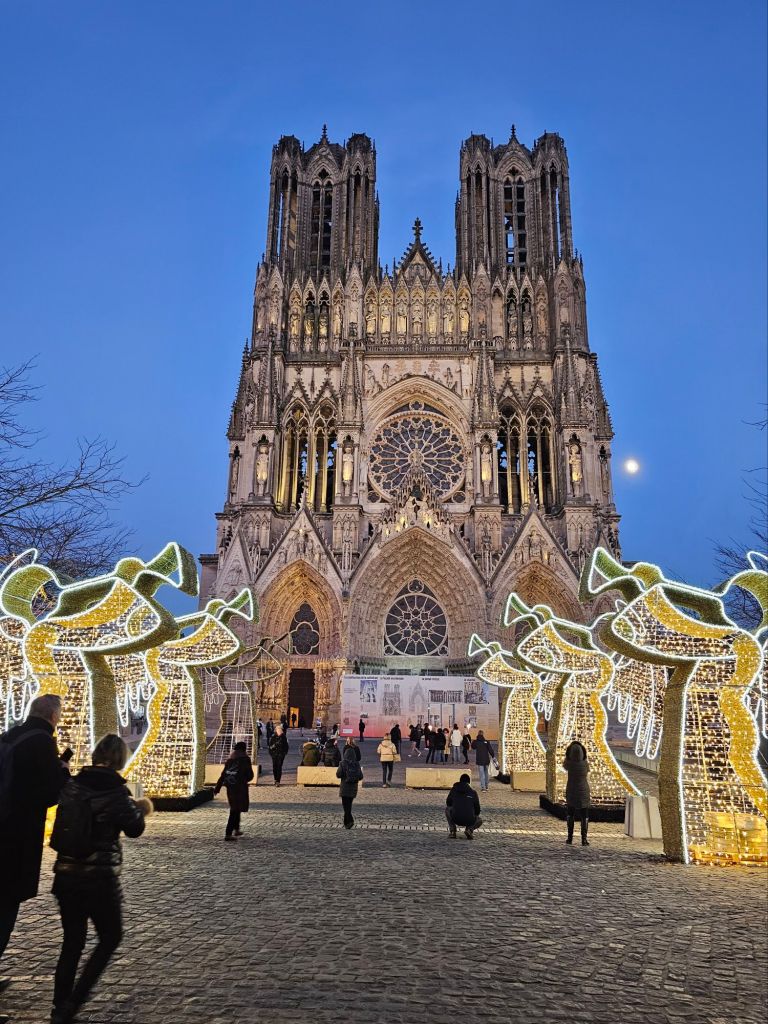
When planning a long weekend trip to France, ostensibly to enjoy a Christmas market, it is important to ensure that there will also be a convenient football fixture to attend, there’s only so much mulled wine, churros and roast chestnuts that one can imbibe after all.  So it is that with Amiens away to Laval and Lille in Marseille, I find myself with my wife Paulene in Reims (pronounced Rance but without really saying the ‘n’), city of Champagne, art deco architecture, Gothic splendour and the place where Clovis, the first king of what would become France, was baptised in about four ninety-seven.  Coincidentally, in two night’s time this very same Clovis will be the answer to a question on University Challenge about which king was baptised in Reims in about four ninety-seven.

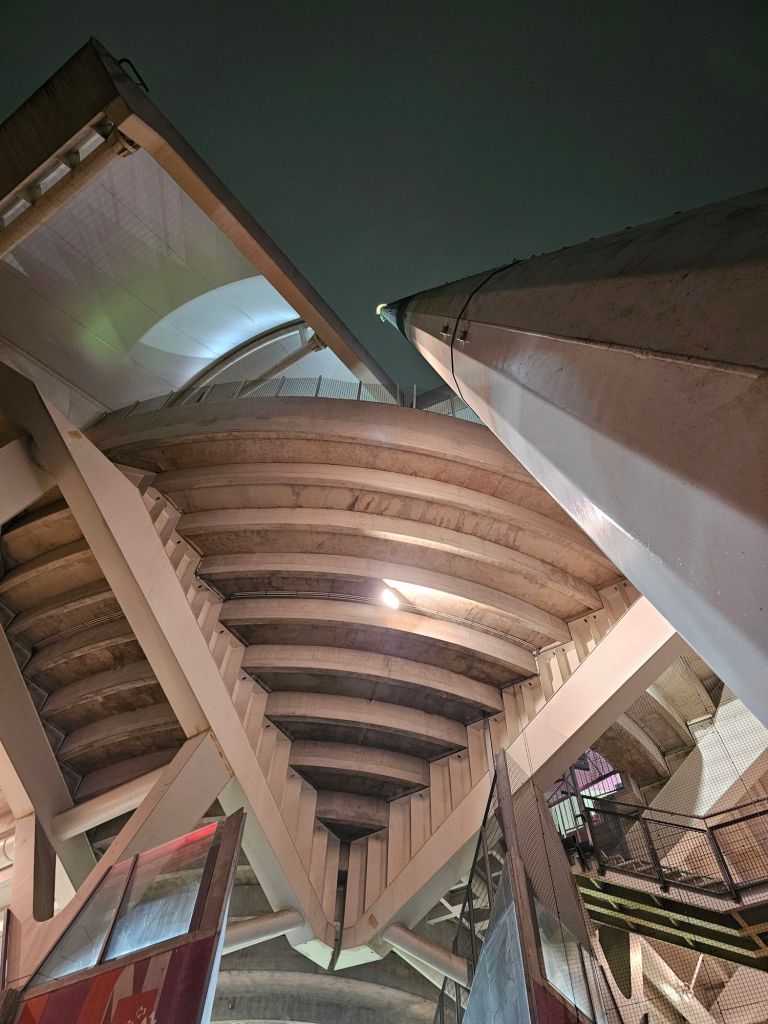
The dramatic concrete shapes of Stade Auguste Delaune, home of Stade de Reims are a twenty-five minute walk from our hotel according to Google maps.  With kick off at 9pm local time we set off well before eight o’clock to allow for my wife’s short legs and asthma, and getting lost.  The last time we went to a match in Reims we caught a tram, but that night our hotel was near a tram stop; tonight it’s not and it’s probably just as well because I don’t think the trams are running, something about an earlier “perturbation” (disturbance) and a “greve” (strike).  It’s a marrow chillingly cold evening, so a walk will keep the circulation going, and it is warmer than it has been during the afternoon, when it rained; an hour away to the north there are reports of snow.

Two of the satisfyingly avant-garde, pointy floodlights of the Stade Auguste Delaune eventually hove into view like a seven or eight centuries late alternative to the Gothic spires that the magnificent cathedral of Notre-Dame de Reims was meant to have, but never did; cancelled like a medieval HS2.  The whole stadium then appears before us as we reach the busy Boulevard Paul Doumer and cross over the Aisne-Marne canal and Voie Jean Tattinger, which run side by side.  Eventually, we reach the stadium and the short queue to negotiate security who pat us down thoroughly. It is strange how at French football matches, despite much tighter security than in England, someone, and often several people, always seem to be able to sneak in some flares or smoke canisters.

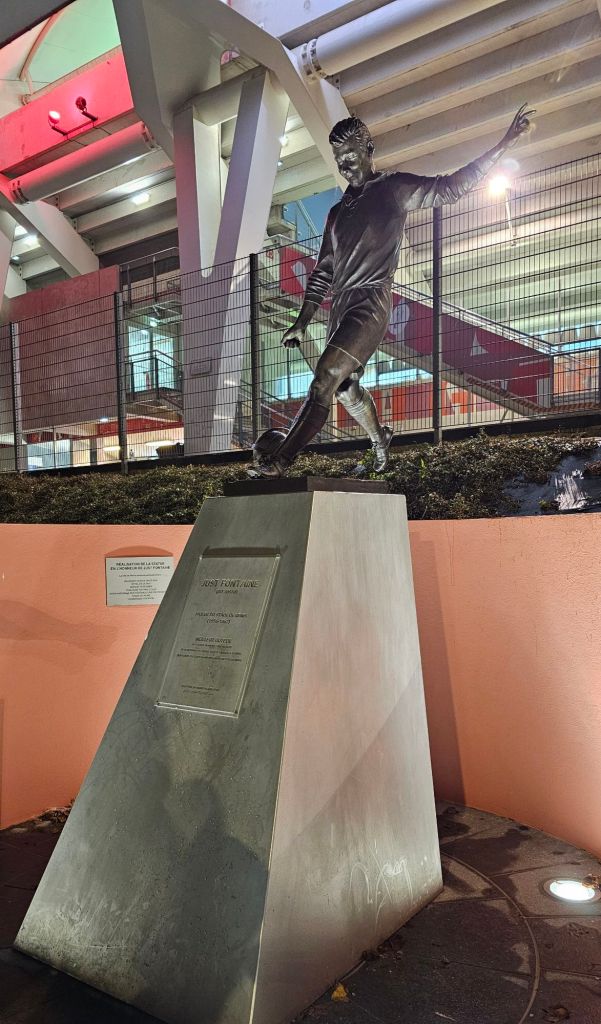
After a brief visit to the club boutique, where I decide 29.95 euros is too much for a T-shirt, we make our way to the other side of the stadium, past statues and murals of Raymond Kopa and Juste Fontaine, who were the French Ted Phillips and Ray Crawford in 1962, to the turnstiles and our seats  (35 euros each) in the  upper tier of the tribune Francis Meano.  We take it in turns to use the facilities and as I wait for Paulene I stand and watch two men looking very pleased with themselves as they drink champagne and photograph themselves at the back of the stand.  Sadly, I haven’t spotted any programmes, and with our tickets being on our phone I will have no memento of this game only memories, unless that is I rip my seat off its concrete base and hide it under my coat on the way out..
Stade Auguste Delaune is an exciting looking stadium, the work of architect Michel Remon. It was completed in 2008 and is on the site of the ground where the club has always played.  Weirdly however, there is perhaps less to it than meets the eye, as it is skeletal with no enclosed landings or concourses, only the vaulted, cantilevered roofs over the four tribunes.  In contrast to most similar sized English stadiums (21,684 capacity) however, it is a triumph of rakish angles, steps, curves and concrete, not a defeat to painted metal sheeting and tubular steel.

On arrival at the top of the final flight of stairs, we stand a moment to get our bearings and look about to try and spot our seats amongst the lettered rows.  Immediately to our right sits a line of six men and women in late middle age and one much younger male; all of them are, not to put too fine a point on it, very fat.  Like Michel Platini or Zinedine Zidane about to take a free-kick over a defensive wall into the top corner of the goal, our brains and eyes quickly and instinctively make a  calculation and conclude that we will not be able to squeeze past these enormous people to our seats, and nor would we want to.  Instead, we opt for a short free-kick, walking unopposed along the row behind, which fortuitously is completely vacant.  We sit in the seats directly behind where we should be sitting and hope no one has bought them. As  we await kick-off, we take in the sights and sounds of flashing floodlights and a bullish stadium announcer, who although annoying in almost every way imaginable, reads out the first names of the home team wonderfully, providing the perfect cues for the home crowd to bellow the players’ surnames; and what surnames they are, Agbadou, Atangana Edoa and Nakamura to name just three.  Who wouldn’t enjoy shouting those out?

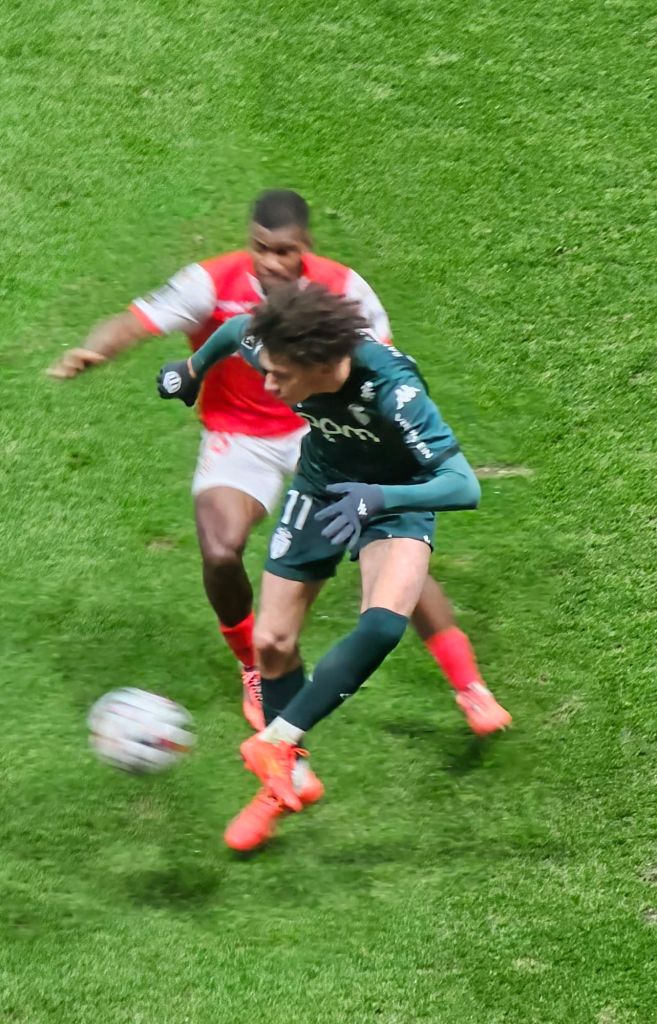
When the game begins it is Monaco who get first go with the ball, aiming it mostly in the direction of the goal to our left, which stands before the tribune Albert Batteux and the turnstiles through which we entered the stadium.  Monaco wear an all bottle green kit, looking like and yet looking nothing like a more chromatically subdued Yeovil Town or Gorleston.  Reims parade in their signature home kit of red shirts with white sleeves and shorts, like a sophisticated Rotherham United, albeit from a city steeped in Champagne and the historic coronation of French royalty rather than scrap metal.

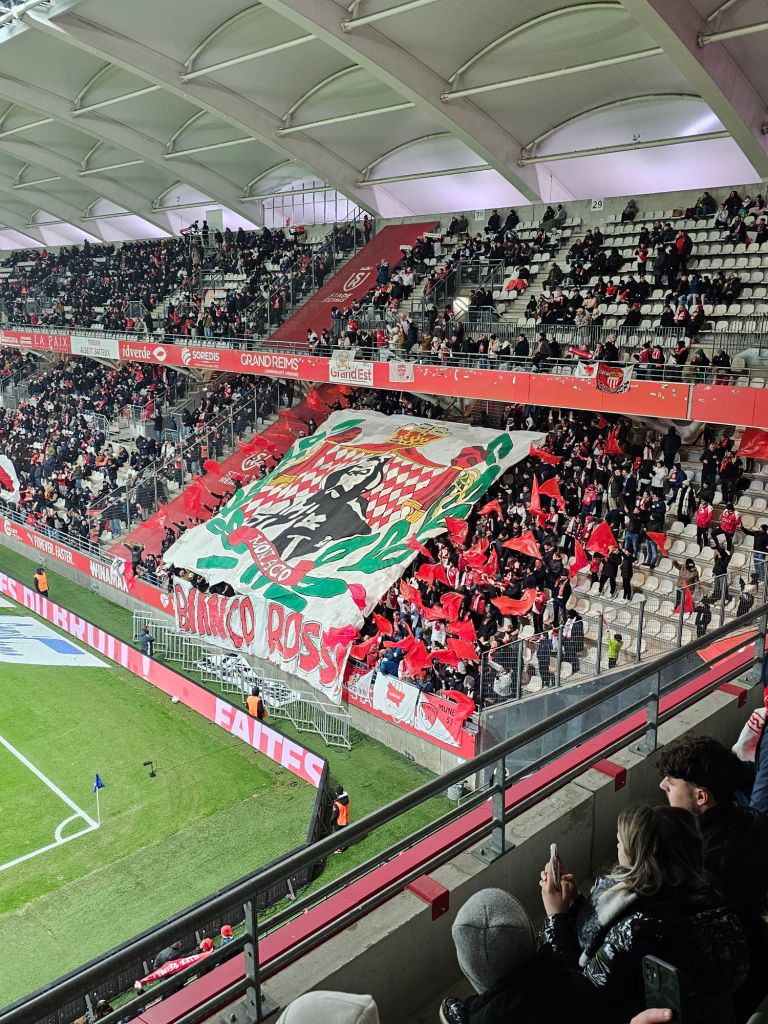
To our right, behind the other goal, but confined to a corner are the Monaco fans, about 900 of them and they are in fine voice, chanting “Monagasque, Monagasque” and “Allez, Allez, Monaco” to the constant rhythm of a drum, the beater of which hardly ever looks up at the match, it’s as if he’s here in a wholly professional capacity, just to beat the drum.  I like to think he’s on the payroll of Prince Albert, the Monagasque sovereign.

Since the game began, the seats to our right have become occupied, the three closest to us being a temporary home to three impossibly smart and neatly presented young people, a man and two women. The man sits between Paulene and the taller of the two women, who is dressed in white trousers over which she wears a long white fur coat; she probably spent more time applying her make-up and doing her hair than she’ll spend at the match.  On the pitch, eleven quite dull minutes pass before the first shot of the game arrives, an effort which goes both wide of and above the goal.  The shot is by the usually pretty reliable Aleksandr Golovin, a player who for some reason I consider to be a Dean Bowditch lookalike.

Golovin’s impressively inaccurate goal attempt will unexpectedly prove to be representative of the whole match and ten minutes later Monaco’s Eliesse Ben Seghir is through on goal but smashes a terrible shot over the cross bar.  Seven minutes after that Monaco’s Takumi Minamino is all on his own in much the same position and succeeds in winning the game’s first corner.  Although hopeless in front of goal, Monaco have been marginally the better side until Reims breakaway, win a corner and Marshall Munetsi glances a header over the Monaco cross bar.  The Monaco supporters continue to chant and sing however, undeterred by a line of half a dozen stewards who cover some of the area in front of the stand , like a sort of human Maginot line, which would inevitably be easily breached if anyone made it onto the pitch.

The descent towards half-time brings the worst miss yet as Reims’ Keto Nakamura appears to be set up perfectly at the far post after a break down the right , only to despatch the ball in almost the completely the wrong direction in the manner of someone who has no idea what he is doing, or if he does, he doesn’t want to do it.   Another type of entertainment is soon provided by Monaco’s extravagantly numbered Soungoutu Magassa (number 88, but still not the highest numbered player on the field) as he is pointlessly booked for tugging at Junya Ito before Ito himself joins the ranks of players intent on blazing the ball as high and wide of the goal as possible.  With the final minute of the half and then added on time, Ben Seghir and Golovin shoot straight at Diouf the Reims goalkeeper and Reims ruin a promising looking  break from defence with an awful cross.

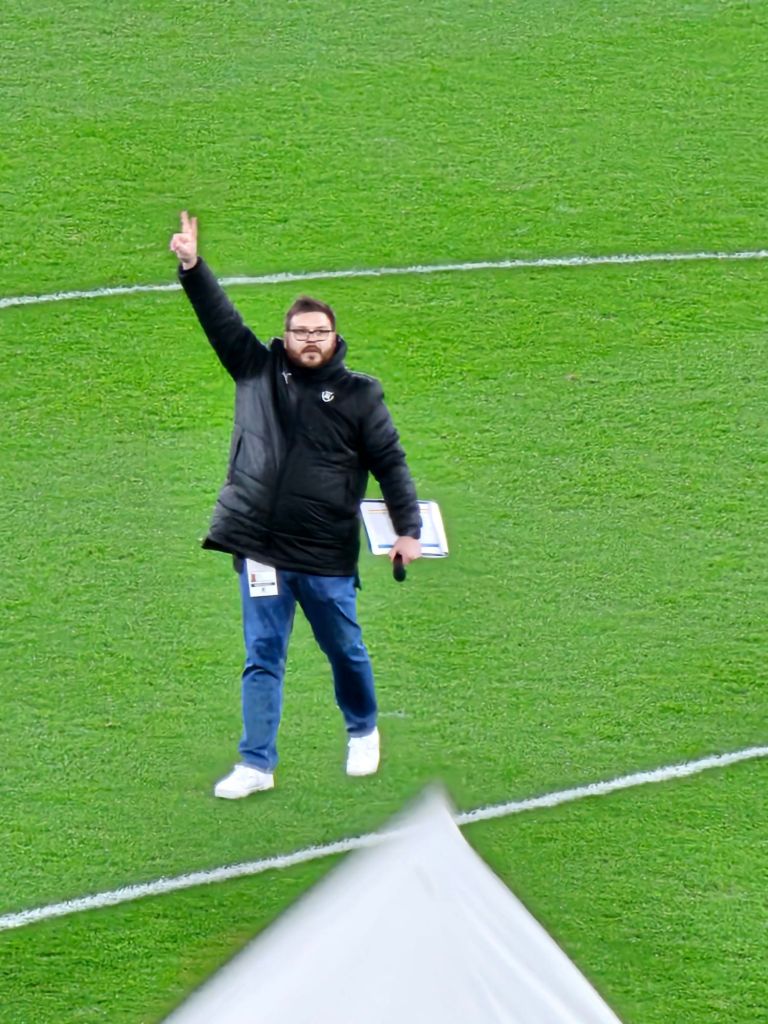
Half-time comes as a welcome break from the frustrating performances on the pitch and the girl in white fur embarks on her own personal telephone photo shoot as she explores how, through pictures she can tell the world of social media that she is at a football match.  In front of us the tubbiest people in the ground all up and leave, presumably for a re-fuel at the buvette; they are joined by another even larger , but younger woman from the row in front of them whose clothes fail to cover up a large expanse of what must be cold flesh where her top was meant to meet the top of her trousers.  On the pitch, we are entertained by three people attempting to kick a football through holes in a sheet hung across the face of one of the goals.   One of them fails to lift the ball off the ground in three attempts, but another scores one out of three, which everyone seems to agree is a decent effort.

At ten o’clock the football resumes and the Monaco fans unfurl a tifo which reads Daghe Munegu, which, if the Monagasque dialect is as similar to the Ligurian dialect as Wikipedia says it is, possibly means something like “Give it a chance”.  Sadly, as to why this makes any sense as a slogan at a football match, I have no idea, but it all adds to the colour, even though on this occasion the words on the tifo are in black type on a white background. Back on the field of play, the pattern of the first half more or less continues as Ito runs down the wing, cuts inside and sets up Diakite to shoot against the cross bar for arguably the best shot of the game so far.

Monaco have improved on their first half display and win three corners in quickish succession as the first hour of the match slips away into history.  Just to prove his increased commitment Kassoum Ouattara also gets himself booked.  The increasing cold is penetrating deeper into our bones and Paulene puts a blanket over her knees whilst the seats directly behind us are filled by teenagers who all seem to be supporting Monaco, as does the young woman in the white fur, who has begun squealing excitedly when Soungoutu Magassa gets anywhere near the ball.  In front of us, the weight watchers on a night out have returned to their seats and have colonised the places that are really ours, with buttocks straddling two seats at a time.  Monaco are the first to make substitutions, perhaps as the team of whom more is expected because they sit second in the Ligue 1 league table to Reims’s middling ninth.
The final twenty minutes witness a Reims corner which is headed away, but otherwise it is Monaco who come closest, but never particularly close to scoring.  Minamino gets past a defender only to shoot wide, substitute Elio Matazo scoops a shot over the bar and Ben Seghir shoots high too.  But it’s all grist for the Monaco fans who happily  sing  “Na Na, Nana, Naa, Naa, Wey hey hey, Monaco” to the tune of the 1969  single “Na na, Hey hey, Kiss him goodbye” by the made-up band Steam.  In the final ten minutes Henrique and Minamino add to the catalogue of missed goal attempts for Monaco and in time added on play ebbs back and forth in vain, whilst the young woman in the white furs, and her friend continue to yelp and shriek.  The final whistle confirms what had become increasingly likely, that neither team would score.  As we go to leave, the young man raises his eyebrows and possibly almost rolls his eyes. I’m not sure if his gesture is made in reference to the game or his accomplices, or all three.

The walk back to the hotel will prove to be long, cold and gently uphill,  and there still won’t be any trams.  As enjoyable as tonight has been tomorrow evening I think we’ll go back to the mulled wine, churros and roast chestnuts.

Ipswich Town 1 Leicester City 1

Suddenly it’s November and my back garden is strewn with yellow fig leaves, which might be odd if it wasn’t for the presence of the increasingly naked fig tree just beyond the back of my house.  The fig leaves are a reliable indicator of what time of year it is and usually, so is a list of the number of football matches I’ve seen since the start of the football season. By November of last season, I had seen Ipswich Town play six games at Portman Road, and I’d missed two because I was away in France watching Lorient and Stade Brestois instead.  By November of the 2022-23 season, I’d seen Town play eight matches at Portman Road and that was without seeing any Town games at all during the whole of September because I away again.   This season I’ve missed just one home match, but I’ve only seen Town three times. I’m beginning to think I’m not getting value for money from this Premier League malarkey. 

Leaden skies and spits of rain accompany me on my walk to the railway station where I stand far up the platform away from the hoi polloi, in a spot where I know the second carriage with a pointy front end will stop.  Another man with grey hair has been pacing up and down the platform and gets into the same carriage once the doors eventually open, which they don’t for a good thirty seconds.  He looks a bit nerdy, like a possible contestant on Only Connect.  Gary joins me at the next station stop and we talk of someone he knows who is over seventy and still works in order to pay off his mortgage.  Sliding down the hill into Ipswich we see two of the four polar bears and Gary muses on how many other football supporters travelling to games this weekend across Europe have seen polar bears on their journey to the match.  I tell him how an article in the Guardian referred to the ‘Polar Express’.

The ‘plaza’ in front of Ipswich station doesn’t seem quite as busy as usual, but the Leicester supporters in the car park-cum-beer garden of the Station Hotel are plentiful. We stop and buy from a pretty, smiling young programme seller who is working the blue, mobile, metal desk at the end of Portman Road this week.  The turnstiles aren’t yet open, and we have to weave between static Leicester supporters.  A bunch of people surround a large white banner that reads “Premier League stop exploiting our loyalty” and pose for photos.  “They’re Leicester fans” says Gary. “Well, they won’t be Ipswich” I reply cynically, obliquely expressing my belief that the revolution will not begin in Ipswich or be televised on Look East or About Anglia.

Reaching ‘the Arb’, we order a pint of Mauldon’s Suffolk Pride and a pint of Lager 43, for which Gary kindly pays. In the beer garden we find Mick half-way through a pint of Suffolk Pride already because he’s been here since a quarter past one having forgotten what time we agreed to meet up.   I tell him he’s getting old and Mick soon remarks upon the gaberdine raincoat I am wearing, which I tell him my father wore when he was in the Royal Navy, and it is older than I am.  This provokes Mick into telling us how as a child he grew up wearing the cast-off gaberdine raincoats of Ken Bruce, the radio broadcaster.  Mick’s aunt, who lived in Scotland, was friends with the mother of the juvenile Ken and she would send the coats that Ken had grown out of down for little Mick to wear.  This in turn leads to mention of former Prime Minister Harold Wilson’s Gannex raincoats and Keir Starmer’s tickets to see Taylor Swift, before Mick stuns us both with his surprising admission that although he despises the woman, he really fancies Kemi Badenoch.

After Mick’s confession I need a drink and head inside to buy another round, but am disappointed to find that the Suffolk Pride is now ‘off’ and I have to have Mauldon’s Special Bitter instead.  Time moves on as it always seems to and not much after twenty-five to three after Gary has suggested we just stay at the pub all afternoon, we depart for Portman Road, Mick locking his bicycle to one of the stands close to where the olde West Gate to the town once stood.  We go our separate ways near Sir Alf’s statue, and I walk down Portman Road alongside a small man with long hair wearing a replica home shirt, who introduces himself as Matt and predicts a 3-2 win for Town.  I tell him I think we’ll win 2-0.  The queues at the back of ‘Churchmans’ are quite long again and that at turnstile 62 seems the longest, but I can’t not join it and by the time I get to my seat everyone is stood silently, hopefully contemplating the futility and stupidity of war, even though it is a full nine days before ‘Armistice Day’.  Even the seagulls atop the cross bar of the Sir Bobby Robson stand appear to be standing to attention. As usual however, I find it slightly weird how professional football now attaches itself to Remembrance, it never used to.  Is it just what is now called ‘virtue signalling’?   I’ve come to watch a football match, and I only really wanted to remember the fabulous Trevor Whymark today.  I will remember those killed by wars on 11th November.

The game soon kicks off, Leicester getting first go with the ball, aiming in the direction of Alderman Road and the canal and wearing all white, although just ‘white’ isn’t good enough for football kits anymore and the programme tells us on page 31 that the colour of the kit is actually ‘light ice blue’.  Town are thankfully in the usual plain old blue and white.   A little surprisingly, at the referee’s whistle Leicester play the ball back from the centre spot and hoof it forward like in days of yore.  Then, to home fans amusement an early back pass goes beyond the Leicester goalkeeper towards his own goal, but unfortunately it is easily recovered.  “We’ve only just got in the ground too” says Pat from Clacton “they were searching everyone’s bags”.

The afternoon is wonderfully grey, with the floodlights and illuminated adverts somehow making it look even greyer because of the contrast. “Hark now hear the Ipswich sing, The Norwich ran away” chant the Sir Bobby Robson standers getting prematurely excited with the season of Advent just 30 days away.  Leicester create a couple of early chances attacking Town from wide positions. Eight minutes are lost, and Muric makes a flying save at the expense of the game’s first corner kick. “Come On Leicester” chant people who might once have parked their cars over the grave of King Richard III or bought a swede from Gary Lineker’s father.

It’s the fifteenth minute and Aro Muric makes another necessary save at the expense of a corner, this time keeping out a shot from Facundo Buonanotte, whose first name is derived from the Latin word for ‘eloquent’, which is unusual for a footballer.  So far, but for Sam Szmodics heading an Omari Hutchinson cross over the goal and Conor Chaplin shooting past a post, Leicester have been the better team, without being very good; it’s a bit like a Second Division match as if both teams are re-living old times.   Leicester’s Wout Faes clashes with Leif Davis which displeases the home crowd. “Fuck off, you fluffy-haired cunt” shouts someone from behind, and I think of Alan Brazil, probably Town’s only fluffy-haired player as long as I continue  to forget about Kevin Beattie’s and Trevor Whymark’s perms.

An eighteenth minute shot from Conor Chaplin earns Town a corner and at last I get the opportunity to bellow “Come On You Blues” repeatedly until the kick is taken.  “Do-do-do, football in a library” chant the Leicesterites revealing either that they rarely visit libraries, which is believable, or that the libraries of Leicester are quite unlike those in other places.  The game is changing and Town win two corners in quick succession and again I bellow “Come On You Blues”, possibly until I’m blue in the face.  The eloquent Facundo Buonanotte is booked by referee Tim Robinson, inevitably for dissent, although in this case by kicking the ball away his action has spoken louder than any words.

With the game a third over, Town win more corners and Dara O’Shea heads wide.” On a plate that” says the bloke behind me.  Conor Chaplin shoots wide again and then spectacularly past the top corner after a run across the edge of the penalty area.  “I-pswich Town, I-pswich Town FC, They’re by far the greatest team the world has ever seen” chant the Sir Bobby standers to the tune of the Irish Rover, and if Ipswich and Leicester City were the only two teams in the world it would currently be true.  The last notable action before two minutes of added on time sees Ben Johnson hit a rasping shot towards the top corner of the goal, but the Leicester goalkeeper was perfectly situated to simply and rather nonchalantly pluck it from the air.

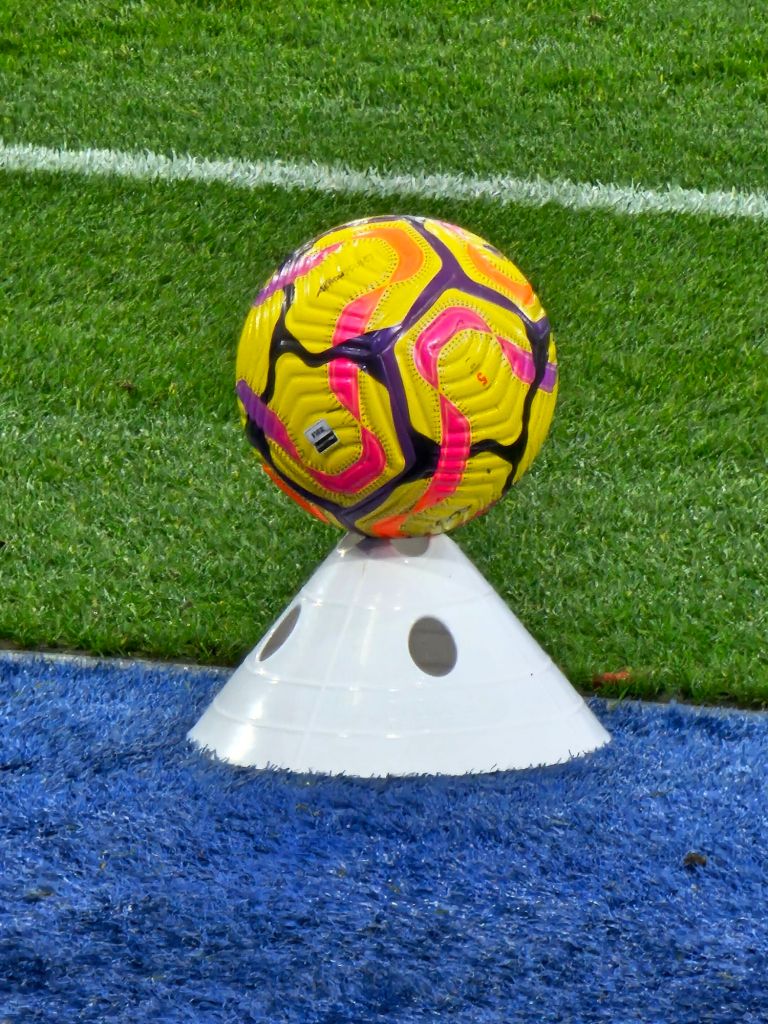
The Town are worth the applause they receive as they trot off for their half-time tea, or oranges, or whatever it is they consume and the man from Stowmarket (Paul) and I agree that once the Town got going, they were much the better team; we just need to score. Ray is not here today, so instead of talking to him I eat a Nature Valley cereal bar and consider the design of the Premier League football which, with its oddly molded surfaces looks like something that if somewhat smaller I imagine might be sold in an Ann Summers store, but wouldn’t appear in the window display.

The football resumes at five past four and happily in the same vein as before the players went away and then came back again. For a while it even sounds as if the Leicester fans are singing “I’m Ipswich ‘til I die” before they start on about Jamie Vardy. “Jamie Vardy has won more than you” they chant to the tune of Sloop John B, but they can’t possibly know what I’ve won and to be honest I neither know nor care what Jamie Vardy has won, except perhaps Rebecca Vardy’s hand in marriage, and to be honest that doesn’t seem like something to boast about.  “Small town in Norwich, you’re just a small town in Norwich” they continue, revealing that they will probably get lost on the way home.

Moments later and a diagonal cross field ball from Sam Morsy is volleyed beautifully, sumptuously, gloriously, magnificently and above all successfully into the Leicester goal by Leif Davis to give Town the lead they so richly deserve.  After Wes Burns’ goal versus Coventry last season, this could well be one of the best goals seen at Portman Road this century.  I text my wife to get her to put a bottle of Cremant in the fridge.  It feels like we can only go on to score more goals and win because it’s plain to see Town are better than Leicester.  But then referee Tim Robinson books Aro Muric for time wasting as he kicks the ball back to Cameron Burgess after it has gone out for a goal-kick and it’s time for Conor Chaplin to go down to receive treatment and everyone else to get some remedial coaching on the touchline. I think people call it “game management”, but there’s still half an hour to go.

“Champions of Europe, you weren’t even born” chant the geographically ignorant and ill-read Leicester fans jealously, realising that three League Cups do not equal a European trophy. Furthermore, Fiona, Pat from Clacton, the man from Stowmarket and I were all born when Town won the UEFA Cup, and three of us were there to see it.  Such is the Leicester fans’ brazen lack of familiarity with facts that I’m beginning to wonder if Donald Trump isn’t a Leicester fan.

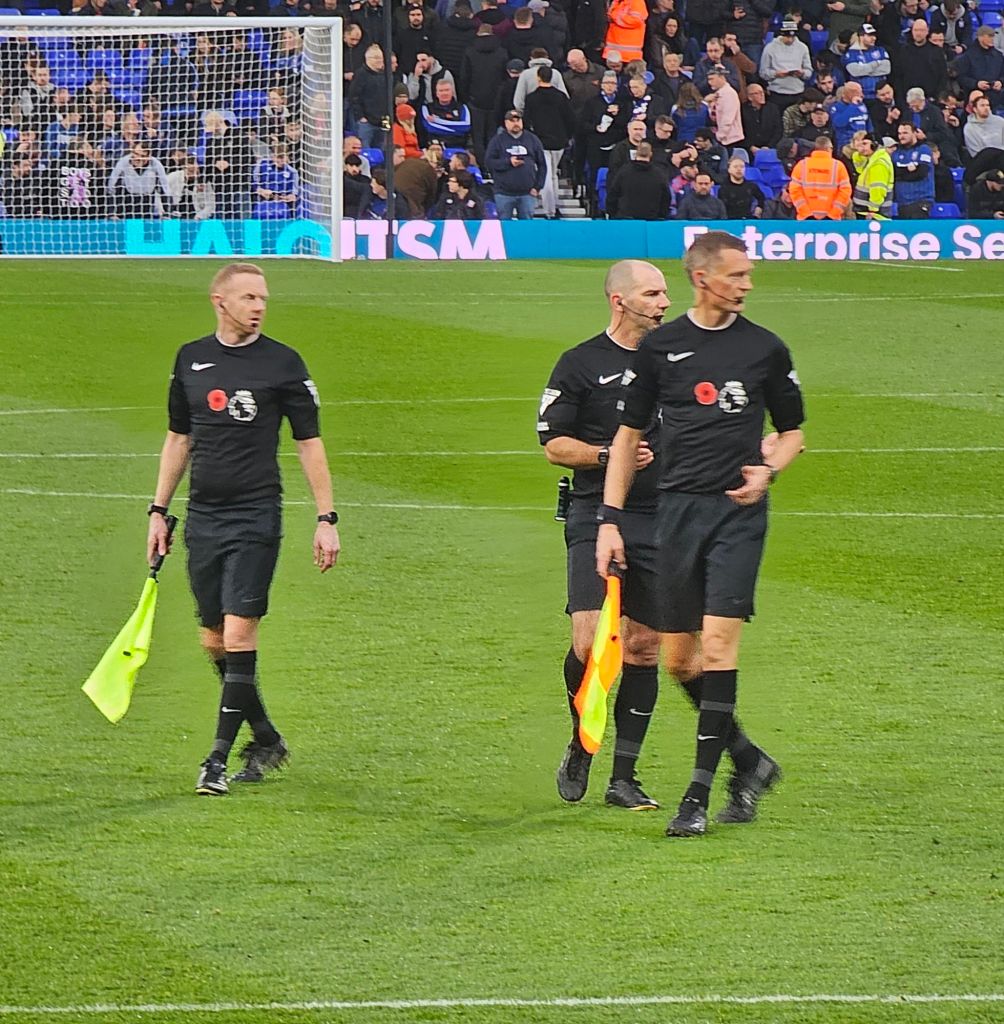
In the seats around me there’s a debate about who has played well.  “To be fair” says the bloke behind me “they‘ve all played well” and he’s  right, as he often is. Leicester blink first and make substitutions and four minutes later Jack Clarke and George Hirst replace Sam Szmodics and the glorious Liam Delap, possibly Town’s best centre forward since Paul Mariner.  Then suddenly everything goes wrong, as if touched by the hand of some malevolent, unseen force, or the referee.  Conor Chaplin is blatantly pole-axed by a Leicester player in the Leicester penalty area and no penalty is given, a clear and obvious error that VAR fails to point out, raising the possibility that we now need a VAR to assist the VAR.  Moments later Kalvin Phillips catches a Leicester player with a dangling foot as he checks his run and referee Robinson books him for a second time, and he’s off.

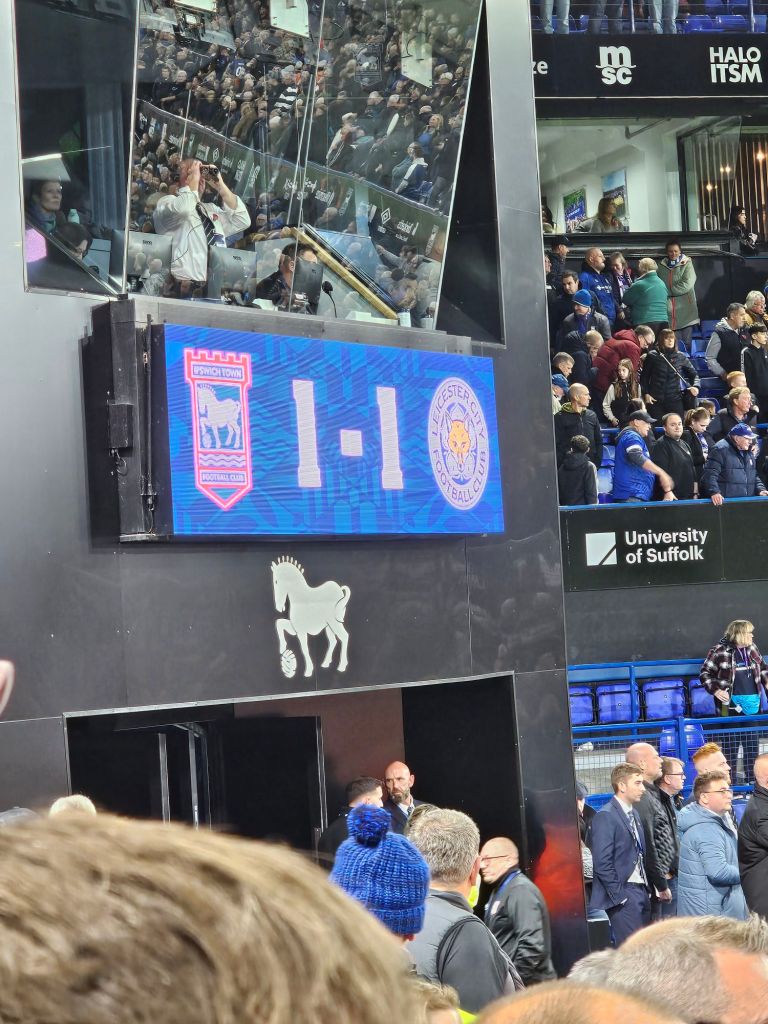
Hereafter the Town are just hanging on.  It doesn’t matter about the ‘incredible support’ of 29.874 (2,991 with little experience or knowledge of libraries and the geography of East Anglia).  It seems too late for Pat to bring on the masturbating monkey charm from the depths of her handbag. All around is cursing and swearing about VAR and the referee. “Blue Army, Blue Army” chant the crowd, ready to storm FA Headquarters and string up the Premier League ‘grandees’, perhaps.  Trying to reduce the tension I confirm that Pat from Clacton is looking forward to her usual, baked potato for her tea when she gets in. Leicester win two corners, Cameron Burgess clears a goal bound shot from substitute Jordan Ayew with an outstretched leg.  There will be eight minutes of added on time, more than was added to all the matches played at Portman Road throughout the whole of the 1970’s. Half-way through the added epoch Leicester score through substitute Jordan Ayew and that’s it. Town haven’t won.  I guess we now know how Southampton fans felt back in September when Sam Morsy scored.  But who wants to feel like a Southampton fan?  My wife texts me to say the Crémant is on the top shelf and she can’t reach it, I tell her not to worry.

With the final whistle I applaud the Town team but can’t be bothered to boo the referee Tim Robinson, an aloof and arrogant looking man whose hair is too short and who suspiciously has the same surname as a garrulous,  overweight  boy I remember from primary school, who was a Leicester City fan and was always getting into fights. 
Feeling like I’ve been in a fight myself I head home and on the train, reflecting on how VAR seems to create the conditions for a belief in an unseen, but all-seeing big brother which promises on-field justice, but because it doesn’t share and explain all that it sees gives the impression rightly or wrongly that it sees what it wants to see, a possibility made more real by the corporate, heavily branded, money-loving nature of the Premier League with its need to suckle the big clubs and their global reach, whilst the smaller clubs are all just interchangeable parts. From such fertile soil conspiracy theories sprout.

The Premier League continues to short change me but I’m no doubt in the wrong demographic so no one cares. Tomorrow I shall wear my black T-shirt that bears the slogan “FC IT… where’s the pub”.

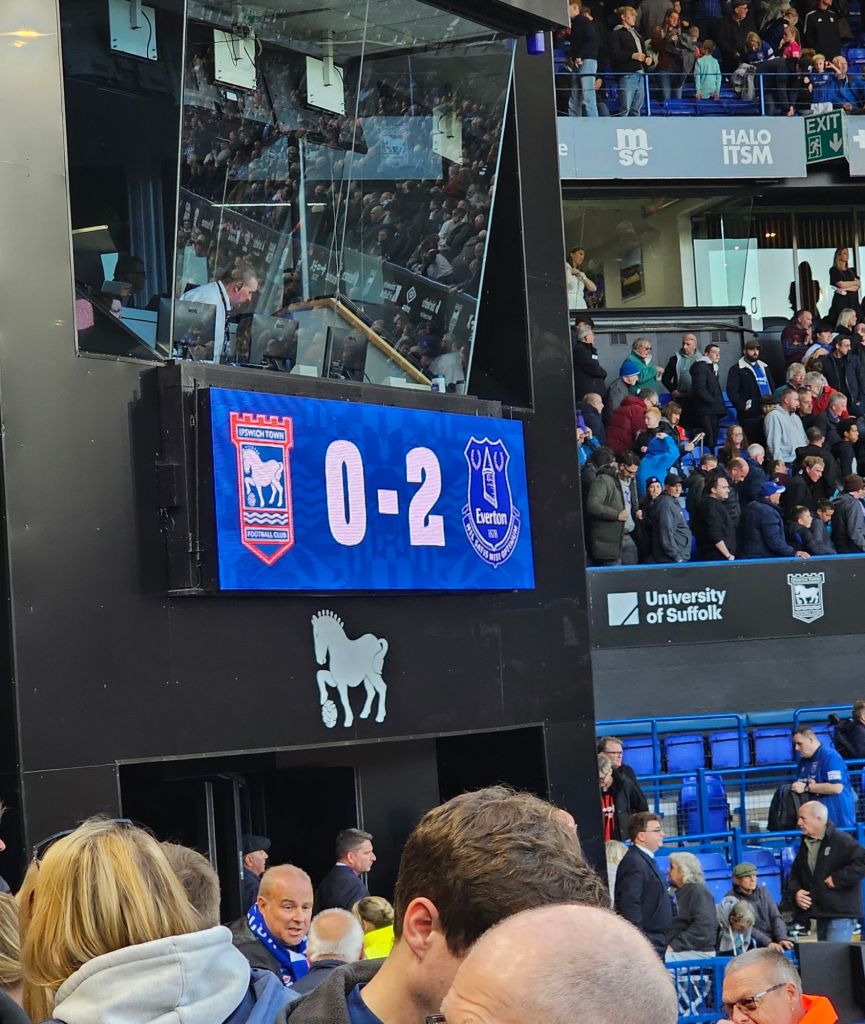
Ipswich Town 0 Everton 2

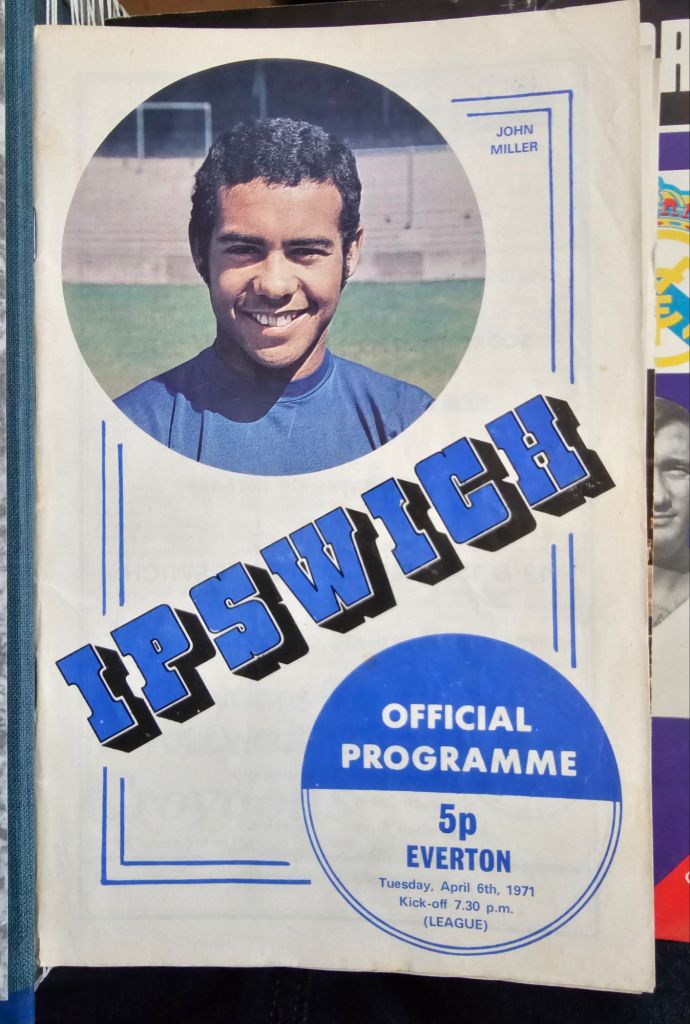
It’s a grey, wet, autumn Saturday morning and I’m thinking of the last time I saw Ipswich Town play Everton at Portman Road.  It was almost exactly twenty-three years ago, on 13th October 2001.  In fact, that was the last time anyone saw Ipswich Town play Everton at Portman Road. The result that day was a goalless draw, and I have no recollection of it whatsoever.  The first time I saw Ipswich Town play Everton at Portman Road however is a different matter, because that was the first time I ever went to Portman Road; it was the 6th April 1971 and I sat with my father in the then soon to be demolished ‘chicken run’.  We travelled to the match in the family Ford Cortina. It was an evening kick-off and I remember it being light outside the ground, then dark, and the programme having a photo of Johnny Miller on the front; it cost 5 pence but was effectively free because that was also the price of the Football League Review that was stapled inside.  A vague, coincidental symmetry through time meant the result was another goalless draw as it would be thirty-one years later and, just as they are fifty-three years later, Town were fourth from bottom of the league table.  

Today’s family Ford Cortina is a train as I embrace the concept of ‘modal shift’, and it’s on time.  The rain has stopped, the sky is clearing, and I’m sat in the first of the two carriages with pointy ends which makes it easy for Gary to find me when he boards at the next station stop.  Making life easy is a lot about planning.  Gary is a generous fellow and today he is carrying a polythene bag from the Cadbury’s outlet shop inside which is a book called ‘Tinpot’, which is about supposedly forgotten football tournaments such as the Anglo-Italian Cup, Watney Cup and Texaco Cup, although of course no one in Ipswich or hopefully Norwich has ever forgotten that Mick Mills lifted the Texaco Cup at Carrow Road in 1973.  Gary had bought a copy of the book himself and thought I would like one too, so he bought me one.  Such random acts of generosity and thoughtfulness probably make the world go round, and I urge everyone to make them as often as possible and to send postcards when on holiday.

As the train speeds onwards towards Ipswich we talk of my recent holiday in France and the French football results, and as we descend the hill through Wherstead I think it may not only be my imagination that has the train lurching to one side as everyone finds a window through which to gawp at the polar bears; Gary and I spot two of them, bears that is, not gawpers.

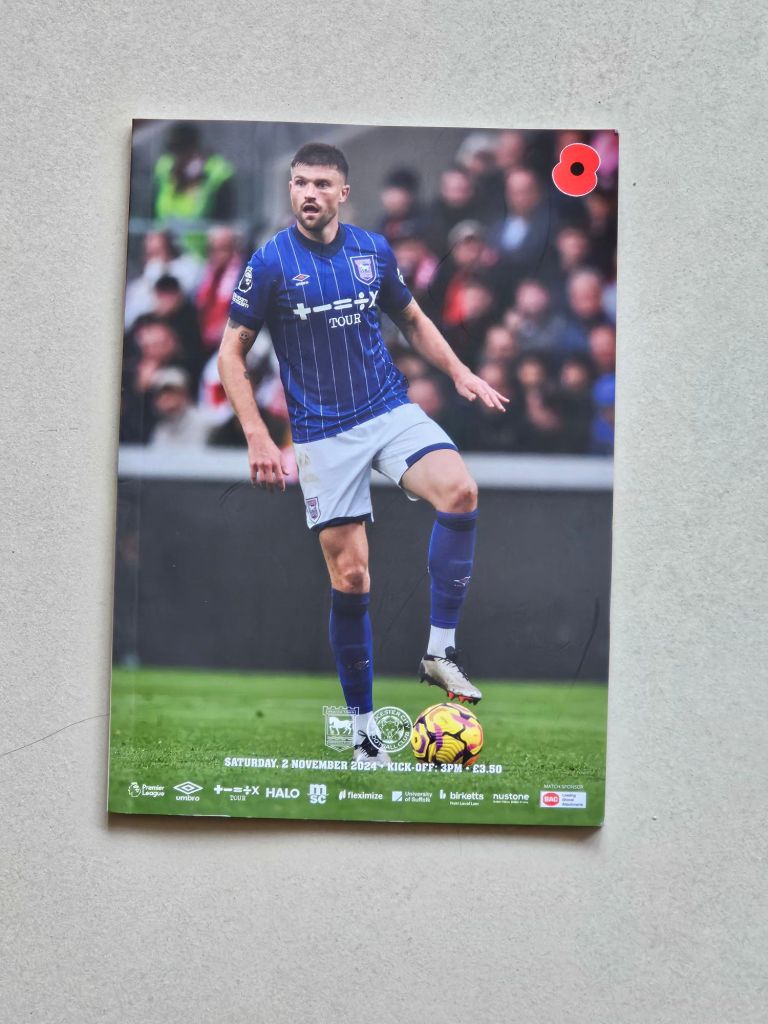
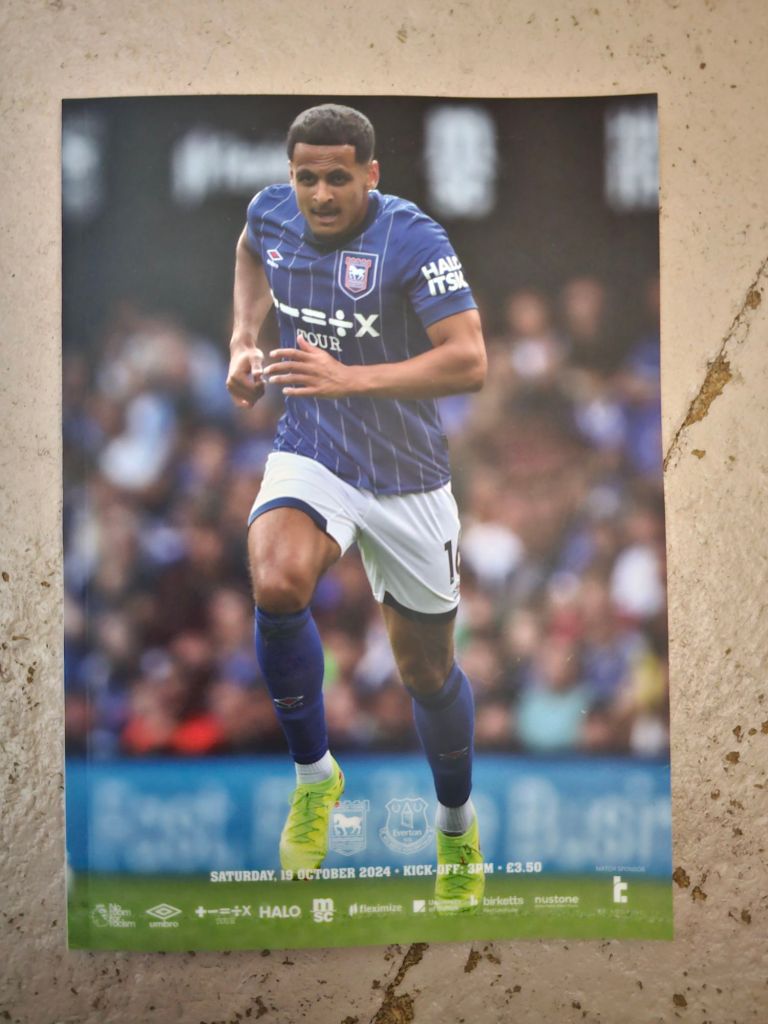
Ipswich station forecourt is busy, as is the garden of the Station Hotel, which crawls with and echoes to the sound of Evertonians.  Gary asks me if I’m going to buy an ice cream, and I tell him I am but unusually we don’t make it to one of the blue booths but instead buy our programmes (£3.50 each) from a young man at a sort of blue painted, mobile, metal desk; I ask for a choc ice and he ignores me, possibly because his mind is totally focused on programmes, possibly because he recognises an idiot when he meets one.  To our collective disappointment, the programme cover today does not feature one of the much trumpeted and popular “Call me Ted” poster-like designs, but instead displays just a boring photograph of a running Ali Al-Hamadi.  The poster design is instead on a tear-out page at the back, negating what we were originally told was the point of the exercise to have these posters as the cover.  I ask myself why it is that even when professional football clubs get something right, they then manage to get it so very wrong?

Gary wants to buy a Town shirt for his nephew and says he will see me in ‘the Arb’ a bit later and so I wish him luck as he heads for the club shop and I stride on up the hill, becoming progressively warmer and sweatier as the sun shines down on what is now an unseasonably warm afternoon.

 At ‘the Arb’ the bar is surprisingly not very busy, so I am soon clutching a pint of Mauldon’s Suffolk Pride (£3.96 with Camra discount) and seeking out Mick in the beer garden, which is very busy.  Luckily, a table is vacated much the same time as I arrive, allowing us to sit and talk of bowels, cancer screening, colonoscopies and prescription drugs in the afternoon sun.  I also explain why Gary will be joining us later but am surprised when he appears sooner than expected bearing a glass of Lager 43 lager but no Ipswich Town shirt.  It seems the only shirts available are in outlandish sizes and apparently his nephew is neither tiny nor vast. 

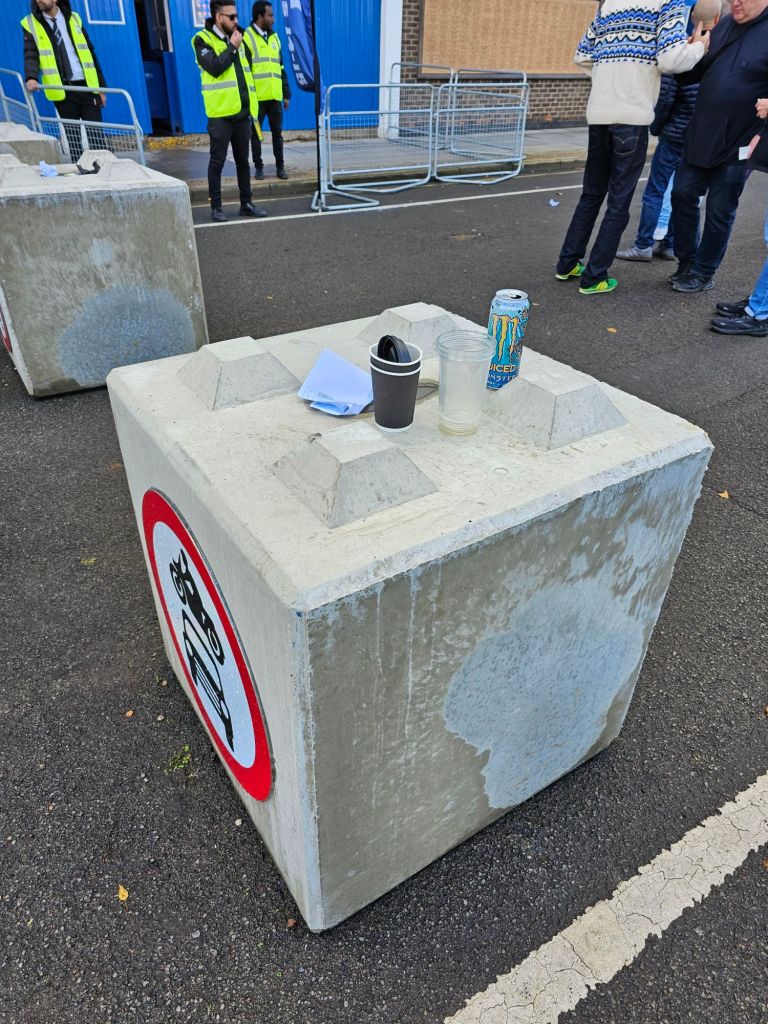
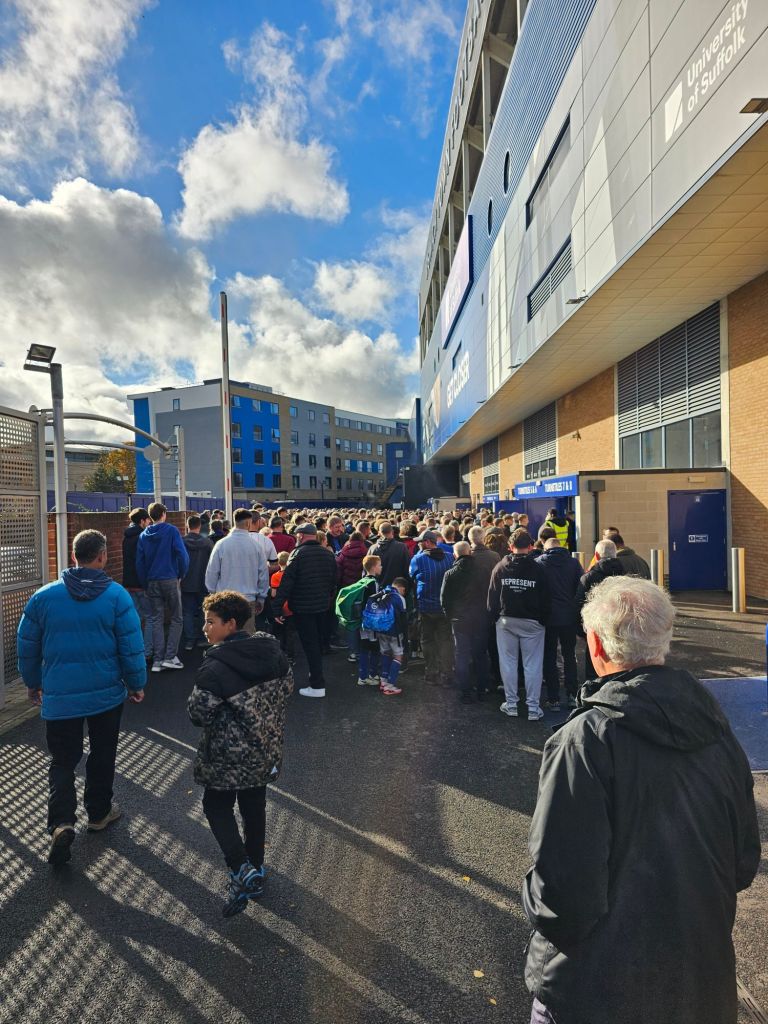
We talk, we drink, Mick buys another round and we talk and drink some more.  The Suffolk Pride is extremely good today but resisting the temptation to just stay and drink it all afternoon we leave for Portman Road, although not until all our fellow drinkers have done so first.  Portman Road is busy, thick with queues as if the turnstiles are all clogged up with fans who need outsized shirts. Ironically, it is Gary who hears the public announcement that kick-off is delayed by fifteen minutes and so, having bid Gary and Mick farewell somewhere near Sir Alf’s statue, I amble nonchalantly through the crowds and queues past lumps of molded concrete decorated with empty plastic glasses, paper cups, drinks cans and paper napkins.

 Joining the queue for my favourite turnstile, number 62, I am followed by two blokes who are complaining about the queues; they’re the sort of blokes who describe anything that goes a bit wrong as “a fucking joke”.  I explain that the kick-off has been delayed until a quarter past three and they seem disappointed that they can no longer be outraged at possibly missing kick-off.  Then one of them notices a steward, who is not white, at the front of the queue checking people’s pockets, bags and jackets. “I’m not racist but…” says the previously outraged bloke “but all these stewards, they’re…”   As I eventually pass through the turnstile, I hear the bloke who isn’t racist remonstrating with the steward for touching him.

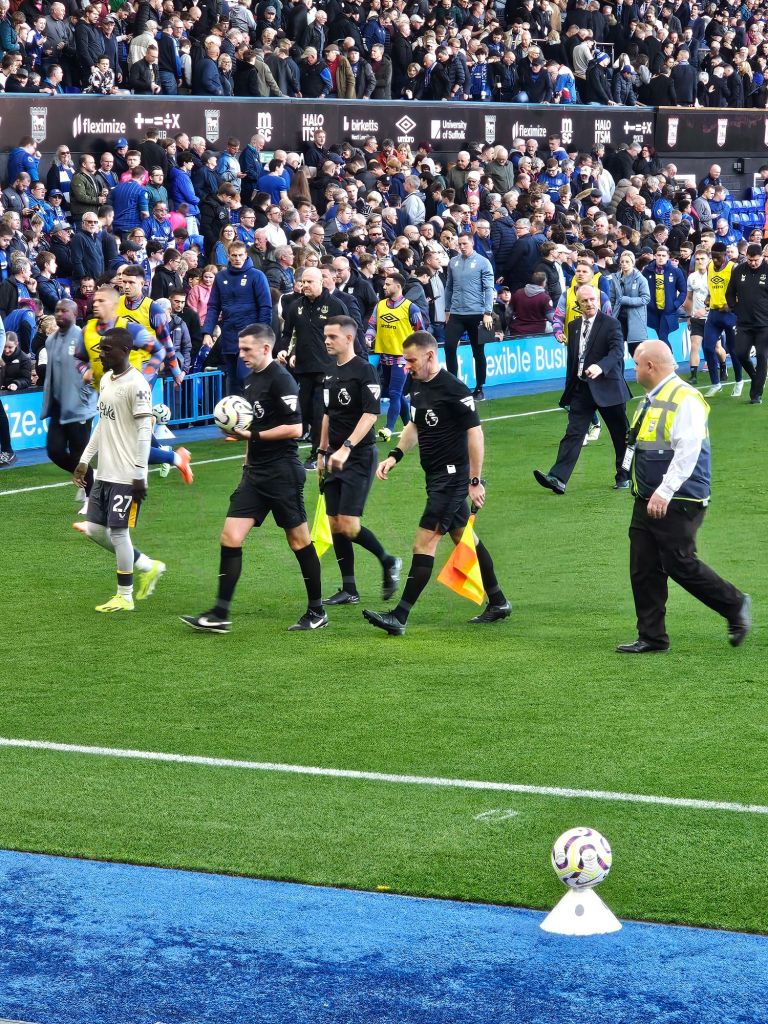
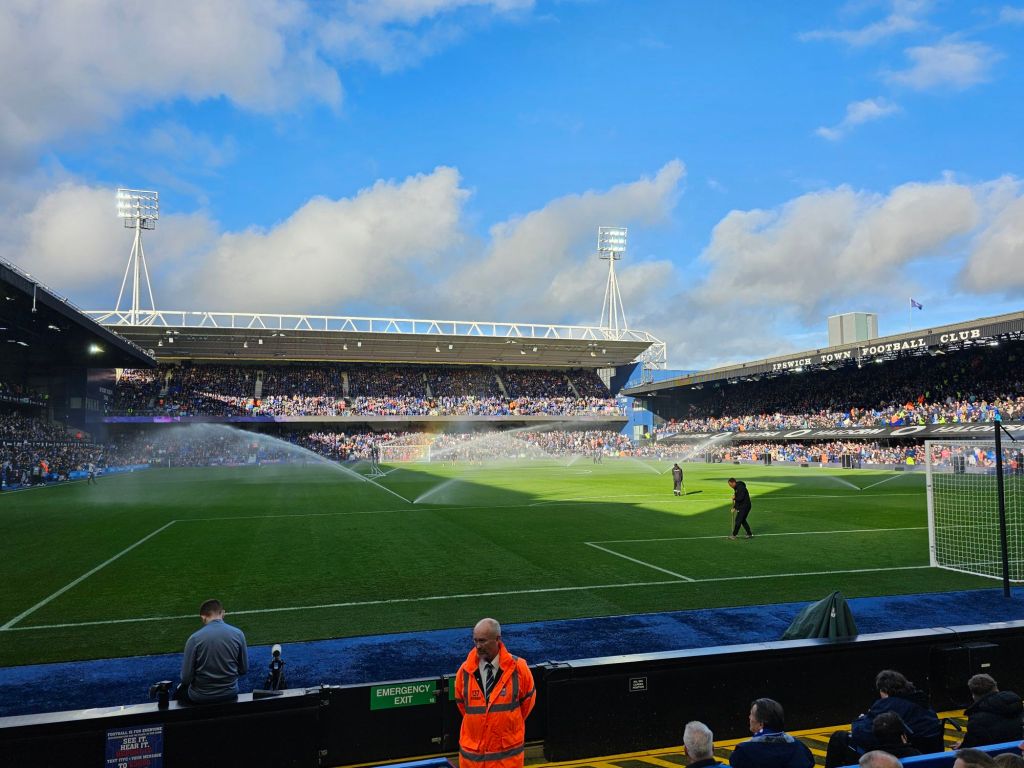
On the lower tier of the Sir Alf Ramsey stand Pat from Clacton, Fiona, the man from Stowmarket (Paul) , ever present Phil who never misses a game and his son Elwood are as ever all in place awaiting the delayed plucking of the ball from its Premier League branded plinth as flames climb high into the pale blue afternoon sky and everyone cheers enthusiastically.   Since the Fulham match at the end of August, when I was last here, the stadium announcer seems to have completed a degree course in Stadium Announcing,probably at somewhere like the University of South Florida, and over-dosed on vowel-expanding drugs.  He sounds utterly ridiculous, and I think I hear him at one point refer to “The Everton”, but he does at least synchronise his team announcing with the scoreboard allowing me to shout out the surnames of the Town players as if I am at a game in France.  For this I am very grateful.

Eventually, the now heavily choreographed prelude to kick off arrives. A young man in crumpled trousers and jacket, which don’t match, appears to orchestrate the grand arrival of the teams and I think how I miss ‘Entry of the Gladiators’ and how with its acquired circus connotations it would be so appropriate in the Premier League.  The teams pour onto the pitch from beneath what looks like a stack of speakers at a rock concert or a part of the Nazis’ Atlantic Wall fortifications. When everyone settles down a bit, Town get first go with the ball and mostly aim it in the direction of the Sir Bobby Robson Stand. Town are of course in blue shirts and white shorts whilst Everton sport what at first looks like white shirts and blue shorts, but closer up the shirts look off-white and the shorts a sort of bluey grey.  How very moderne, I think to myself.  Confusingly, the front of the Everton shirt appears to bear the word ‘Stoke’, but given how all things football now mostly relate betting it probably says stake, which coincidentally is what the Premier League needs driving through its heart.

Everton take an early lead in corner kicks, the Town fans sing “Blooo and White Army” and Pat from Clacton tells me how she’s just got back from her annual week playing whist in Great Yarmouth, and she won a bit shy of thirty-five quid.  Then excitingly, a break down the right from Wes Burns ends with Jack Clarke shooting hopelessly high and wide of the goal.  As the bloke beside me remarks of Clarke’s shot “That was awful”.  But it’s good enough for the northern end of the ground to break into the joyless dirge that is their version of ‘When the saints go marching in’, substituting the word saints for Town of course.  But despite this, Everton are looking the better team and their players seem much quicker in both thought and deed. Aro Muric makes a save from the Everton number nine who has only Muric to beat after a criminally poor pass from Kalvin Phillips, but then Muric boots a back pass from Luke Woolfenden out for a corner, possibly a comment on the back pass.

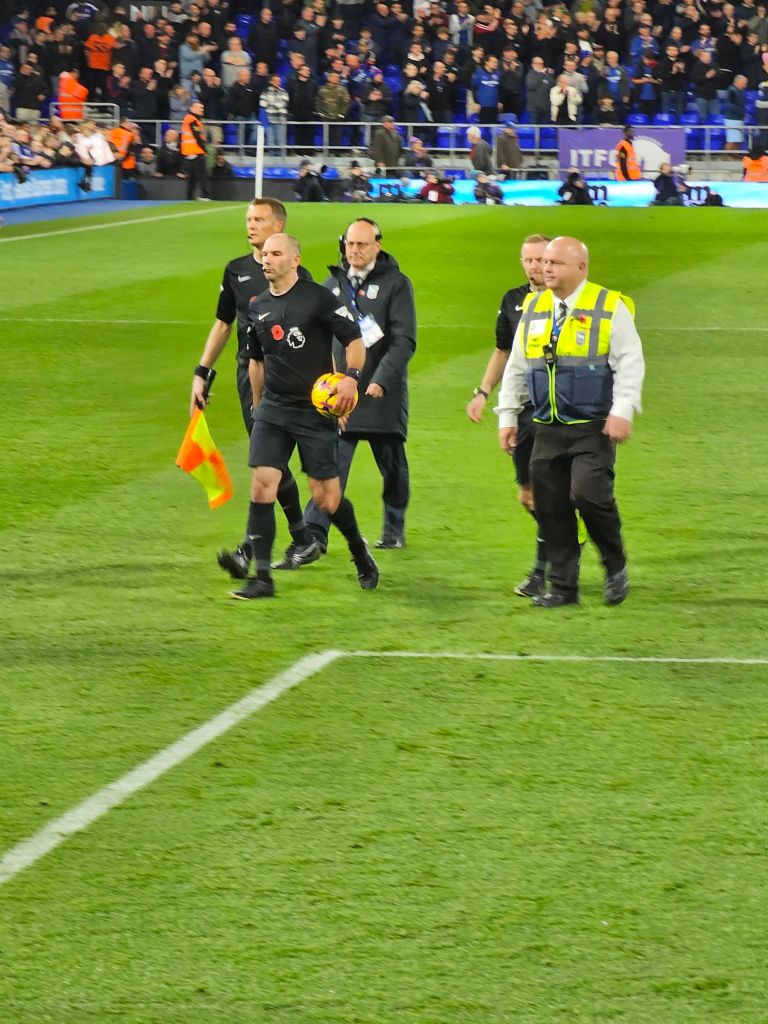
With just seventeen minutes consigned to the history of goalless football, Everton score as a result of some poor ball control in the penalty area from Wes Burns, which hands the ball to Iliaman Ndiaye, who only has to score, which he does.  Everton are playing as if on Ecstasy, whilst Town are on Temazepam.   Nevertheless, it’s not as if Town haven’t gone 1-0 down before and Omari Hutchinson is soon being hacked down by number five Michael Keane who is booked by referee Michael Oliver, who from the look of his hair I have deduced isn’t related to Neil Oliver and doesn’t visit John Olivers the chain of East Anglian hairdressing salons.

A free-kick and then a corner follow and then Jack Clarke slaloms into the penalty area only to tumble to the ground and Michael Oliver points to the penalty spot.  In leagues not totally beholden to the wonder of the cathode ray tube this would be enough to give Town a free shot on goal, but being the Premier League VAR must decide and it’s time to place your bets on whether Town will get a penalty or not.  My money is on not and I win the unwelcome jackpot as Mr Oliver decides with the help of video assistance that it was actually Jack Clarke who kicked an Everton player rather than the other way round.  How very convenient.  “You can stick your Premier League up you arse” I chant coarsely to the tune of ‘She’ll be coming round the mountain’.  This is what the Premier League does to people.

Town win another corner and the crowd chants “Come on You Blues” at least twice before Everton win two corners of their own, after the second of which Town fail to clear the ball properly and somehow allow the previously convicted Michael Keane to get behind the defence and score from a narrow angle.  “Everton, Everton, Everton” sing the Evertonians, revealing themselves as true heirs to the lyrical imagination and genius of Lennon and McCartney.

The pantomime of VAR has resulted in six minutes of added on time as well as the mental scars of having been given and then having dashed all hope of a swift equaliser. Kalvin Phillips offers more hope with a free-kick after Leif Davis is cynically fouled, but he then dashes that with his shot over the Everton crossbar instead of under it.  Meanwhile, I can’t help thinking that the name Calvin-Lewin on the back of the Everton number nine’s shirt looks like it reads Calvin Klein. I surmise that this is because I have become overly used to seeing the words ‘Calvin Klein’ on the fashionably exposed waist bands of millennials’ underpants.

Half-time is a sort of relief and I talk to Ray who I haven’t seen for six weeks, but then at twenty three minutes past four the football resumes.  “They’re chasing shadows int they” says the bloke behind me and Everton win two corners as the clock tells us that the game is two thirds over.  Conor Chaplin and Harry Clarke replace Wes Burns and Dara O’Shea.  Pat from Clacton wonders whether she should unleash the masturbating monkey good luck charm from her handbag, and I wonder if Kieren McKenna would have an opinion on that.  Perhaps Pat should write to him and ask when he’d like her to ‘bring him on’.

Sammy Szmodics and Jack Taylor replace Kalvin Phillips and Jack Clarke, and today’s attendance is announced as 29,862, with 2,977 being Evertonians. The excitable stadium announcer uses words such as incredible, amazing and fantastic to describe the support and I begin to wonder if he might need a sponsor for his incontinence pants.

With the changes to the team, Town seem to have improved a bit and are dominating the last fifteen minutes as Liam Delap shoots spectacularly past the post, Omari Hutchnson shoots and wins a corner and Cameron Burgess heads over the cross bar.  Then, as Pat from Clacton worries whether the baked potato she is having for he tea is going to be burnt to a cinder by the time she gets in, George Hurst replaces Liam Delap and from a Town corner Conor Chaplin shoots straight at the Everton goalkeeper before Jack Taylor forces a low diving save from him.  Four minutes of added on time fail to influence events although Muric prevents a third Everton goal as Calvin Klein runs through on his own again.

With the final whistle I am one of many quick to head for the exits to catch trains and buses and without really knowing the exact time I am surprised to get to the station two minutes before my train is due to depart.  It’s a small victory on a day of defeat, but heck, there are still another fifteen home games to endure or hope for better.

FC Megalithes 2 Riantec OC 1

The small town of Carnac on the coast of Brittany is famed for its sprawling, ritual landscape of neolithic, megalithic alignments, menhirs and dolmens, but less so for its football clubs.  It is unlikely therefore that many people outside the local football fraternity of the Morbihan departement (County), noticed the merger in 2023 of two or maybe three local clubs to create what its name suggests is a giant ritualistic rock of a football club, FC Megalithes, which possibly prefers to kick-off games in the direction of the mid-winter sunrise.

The website for the French equivalent of the local County Football Association helpfully lists associated clubs and their fixtures and having arrived in Carnac the day before and settled in, my wife Paulene and I have dusted off our autumn almanac and are seeking entertainment on what is a sunny September Sunday afternoon.  The website tells us that FC Megalithes are at home to Riantec OC, playing their second league match of the season in the Ligue Bretagne de Football, District Morbihan, District 1 Poule B.  If Ligue 1, where the likes of Paris St Germain and Olympique Marseille hang out is level one of French football, we think this is about level ten of may be twelve or thirteen.  Riantec is a village a bit more than 30 kilometres away near the much larger town of Lorient, albeit this side of the estuary of the River Blavet; Wikipedia tells us that in 2017 Riantec had a population of about 5,600.

The football association website states that kick off is at 3.30 pm, and believing the match will be played at the main sports ground in Carnac, we set off at about ten to three from our ‘hut’ in a nearby camp site to make the 3.3 kilometre journey in our planet saving electric Citroen eC4.  As is often the case with local municipal sports grounds in France, there is plenty of free parking, but worryingly perhaps, as we roll up almost all of it is unoccupied,  and walking through the stone gateway of the Stade it is evident that there is no one else here except some youths playing an impromptu game of ‘three and in’ behind the albeit impressive, but lonely looking and very empty main stand.  The pitch is freshly marked out, but there aren’t even any goals up.  Clearly in the wrong place, we consult the interweb again and discover, courtesy of our very own administrative error, that we should be at Parc des Sports Kermouroux, about 7 kilometres away in St Philibert.

It is an easy trip across town to St Philibert, despite some 30 kilometre per hour maximum speed zones and a couple of red lights, and whilst we arrive after three-thirty we can see from the road outside that the players are only just lining up to shake hands and accept the applause of a crowd of what must be about a hundred people.  As we step through a side gate, we can even hear some Ultra-style chanting, although that seems to be from the players of the B team whose match had kicked off at one-thirty and has since ended.

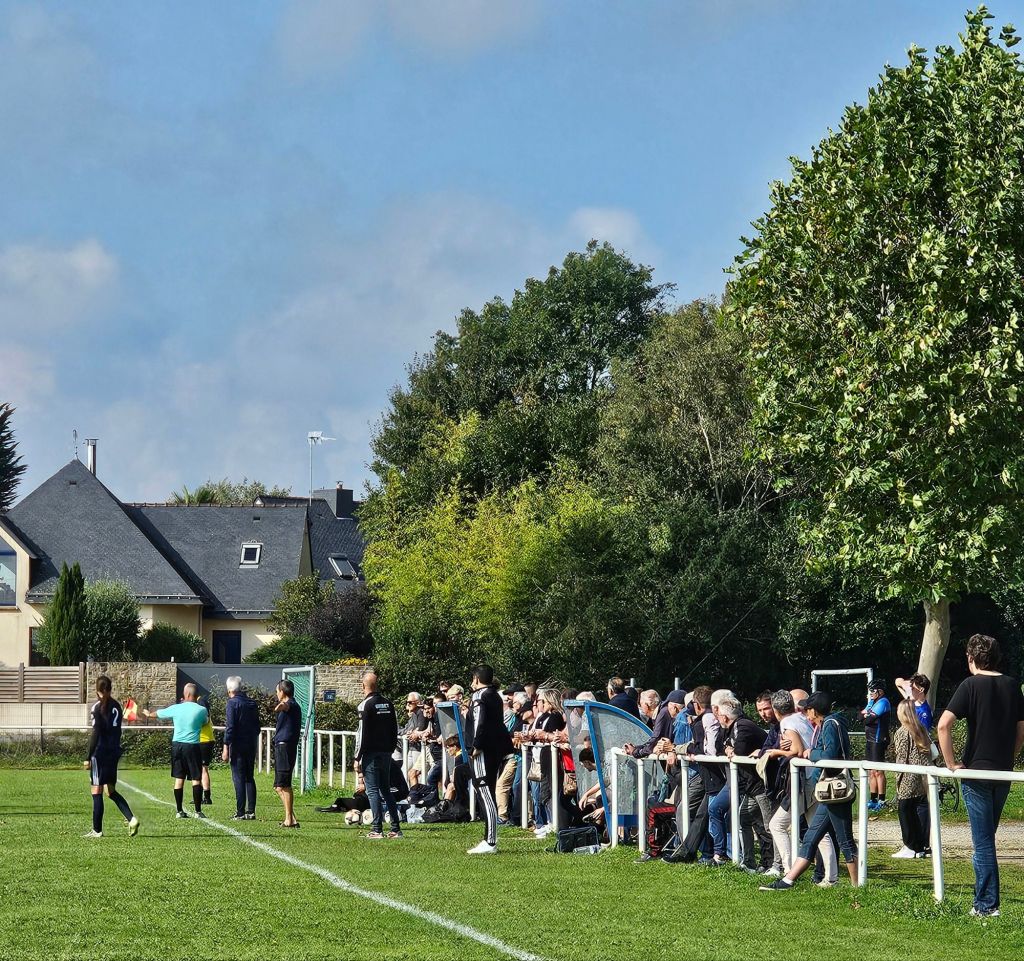
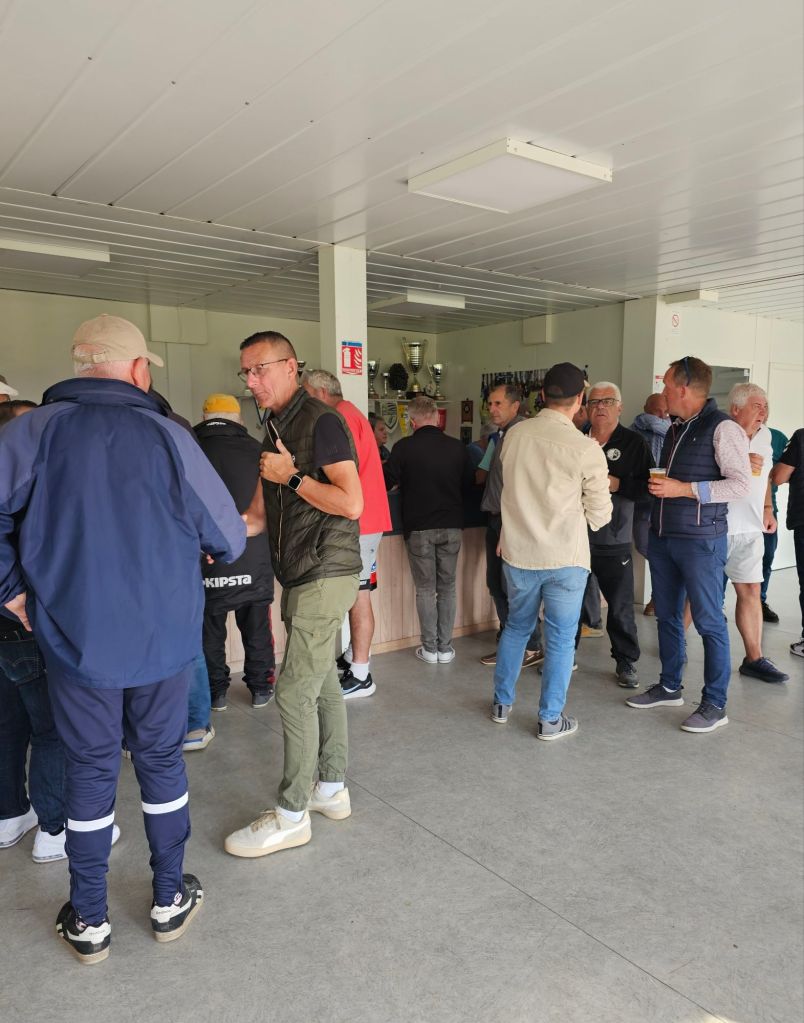
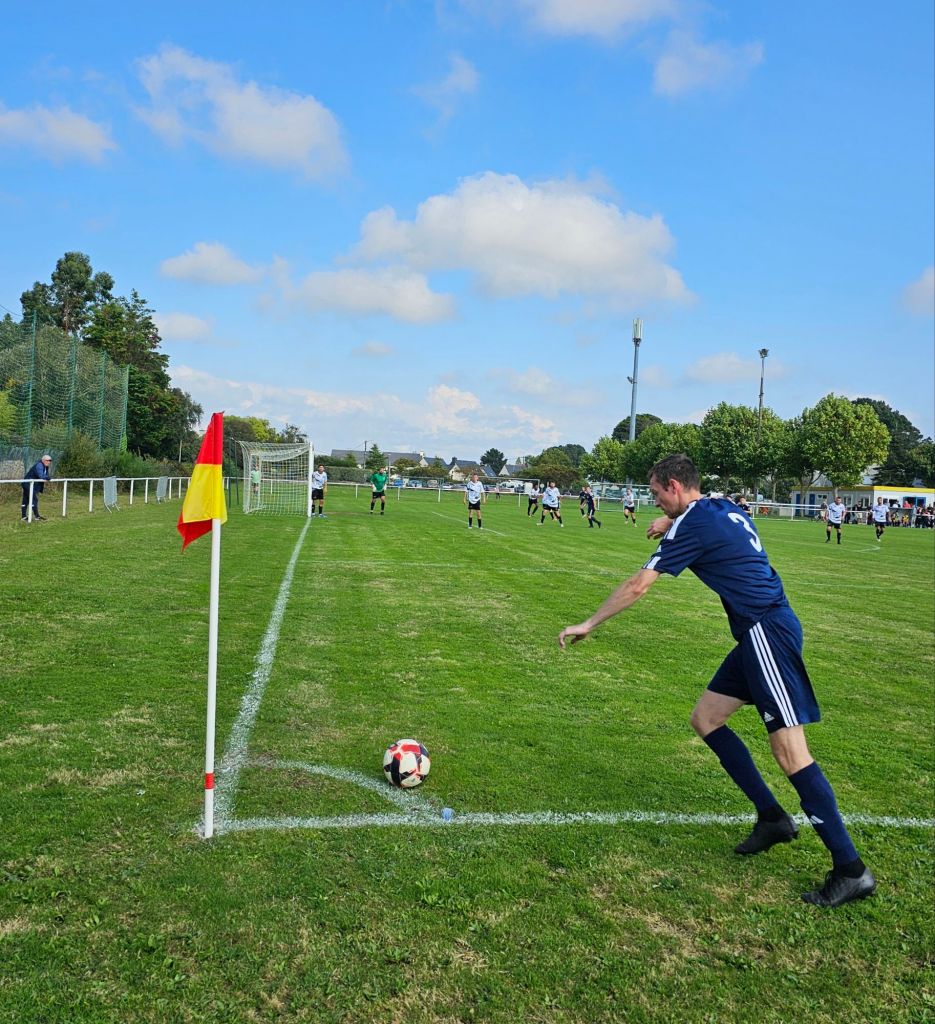
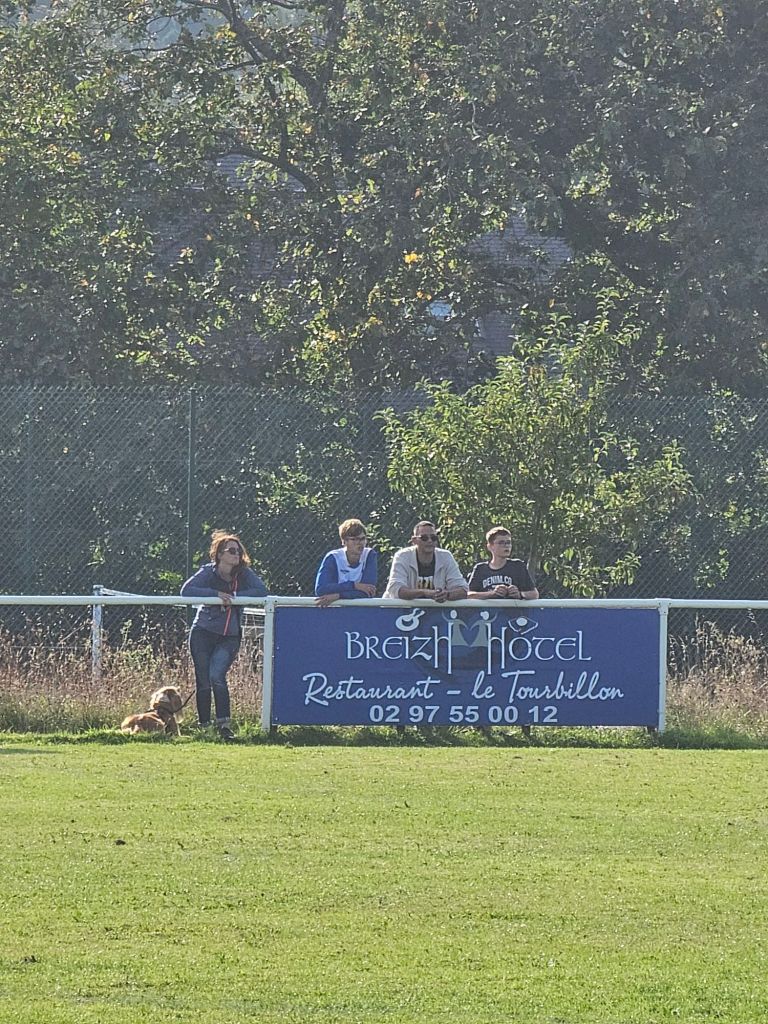
The Parc des Sports Kermouroux has no stands or floodlights, just a neat white rail all around the pitch, a couple of dugouts and a clubhouse.  The site is surrounded by houses, but on the far side of the pitch is also a playground and what looks like judiciously mowed, planted wildlife area.  The majority of the crowd lean on the rail in front of the clubhouse, inside which a couple of middle-aged women are doing a good trade in beer.  Wine and coffee are also available. 

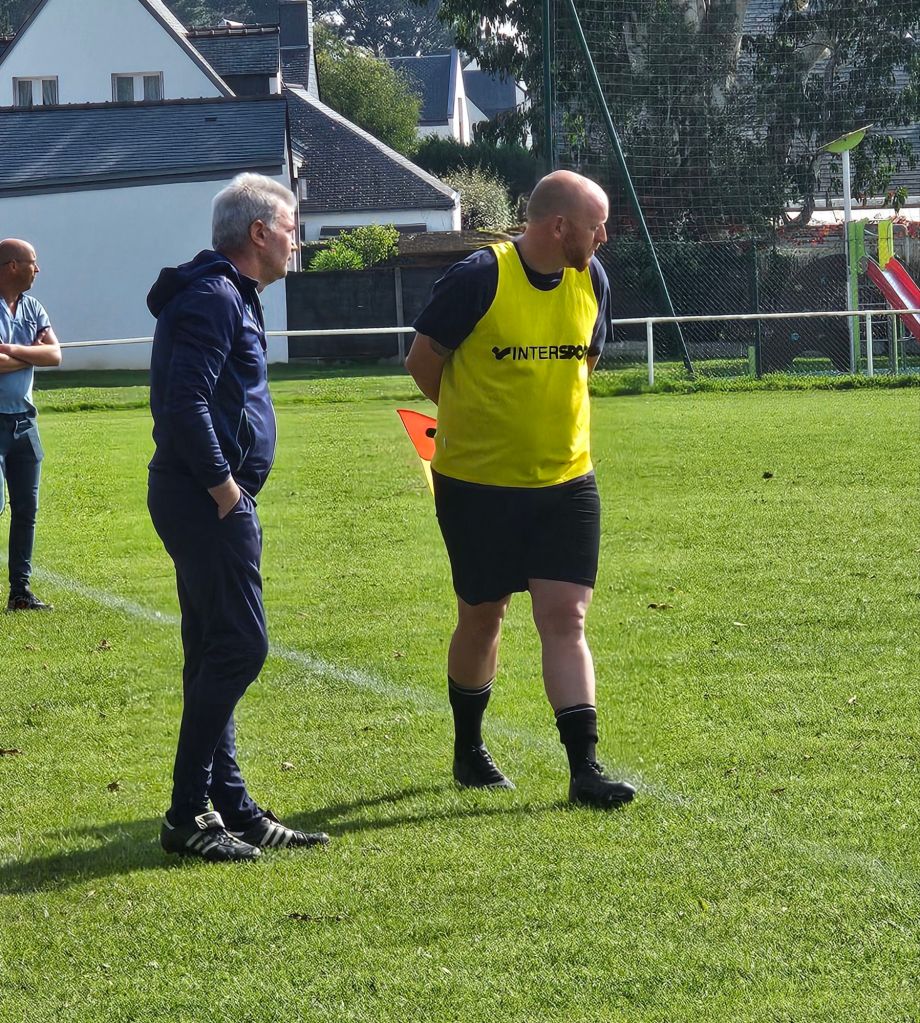
We miss the actual kick off, or coupe d’envoi as the French call it, as we find a decent spot against the rail, but we are paying attention when at eighteen minutes to four the Megalithes’ number nine bustles his way through the Riantec defence, checks and turns a couple of times and then boots the ball beyond the Riantec goalkeeper and into the goal.   Two minutes later he repeats the dose, running beyond the back four and a sluggish linesman to score from about six yards out.    The linesman doesn’t really seem to have grasped what his role is yet, but to be fair to him it does look like he didn’t expect to be linesman when he turned up, as he is wearing a day-glo yellow tabard rather than the standard officials’ uniform that the referee and the other linesman are wearing. As for the teams and their apparel, Megalithes are smart all in navy blue with white trim, whilst Riantec are less so in a messy looking combination of baggy white shirts and with streaks on,  and black shorts.

After two goals in the first five minutes, the arrival of the first corner of the match at seven minutes to four leaves everyone somewhat non-plussed.  This is even more the case when a minute later a punt forward for Riantec is met with another hopeful punt-cum-shot from their number ten and the ball sails into the top corner of the Megalithes’ net to make the score 2-1, against the run of play.  Although the goal adds to the excitement and sense of jeopardy, which I believe is what football matches are all about, I can’t help but feel a bit disappointed because Megalithes are by far the better team.

Megalithes continue to dominate the match and pass the ball well but seem unwilling to score again, although their number nine keeps threatening to nip behind the Riantec defence just as he did twice before, but he never quite manages to get his shot into the net.  Without more goals to concentrate players’ minds on keeping up to date with the score, a combination of fouls and outlandish acting creeps into the game, with more than one player letting out blood curdling screams as he collapses to the ground as if the subject of some sort of unexpected, attempted human sacrifice.

The gnarled looking, but neatly coiffured, grey-haired referee is totally in control of the shenanigans, looking down deeply unimpressed at the writhing players, whilst politely but firmly dealing with the perpetrators of genuine fouls. “S’il-vous plait Monsieur” he says politely but wearily as he beckons over the perpetrator of a foul to instruct him as to his future conduct.  In the first instance Rianec’s number eight is merely spoken to, but then Carnac’s number ten, a lithe youth with curly hair a la Adrien Rabiot, is booked after being summoned with the ominous words “Numero dix, s’il vous plait”

Half-time comes as a relief after the frustration of FC Megalithes not scoring the goals they deserve and all that falling about and screaming.  I head for the club house as the players make for the dressing rooms and am quickly acquiring two cups of coffee (one euro each), which are served from a filter coffee machine; none of your instant muck here. Paulene and I find a better position by the rail as almost everyone else heads indoors for more beer, and we nick their ‘spots’.

It is nineteen minutes to four when play resumes and within moments Megalithes number nine is centring a low cross, which number three easily and mournfully taps wide of the goal having arrived in position perfectly on time and completely unseen by the opposition.  The second half is twelve minutes old when Megalithes’ number nine elicits a fine save from the Riantec ‘keeper at the expense of a corner and then the scenario repeats itself.  Megalithes continue to dominate the second half as they had the first and the mystery of how they fail to score more goals continues every bit as mysteriously as the question of why the neolithic locals erected all these megaliths in the first place.

It is a quarter past five when Riantec win a corner and I can’t help thinking to myself that this is the first corner the away team has won, and it has taken them almost an hour and a quarter to do so.  Normal service is resumed however just two minutes later as Megalithes’ number twelve beats the offside ‘trap’, takes the ball around the Riantec goalkeeper and then places it precisely into the side netting of the goal.  A minute later Megalithes number two, a beautifully skilful player, repeats the process, taking the ball around the goalkeeper, but doing so without the necessary speed to get the ball into the goal before two defenders get back and combine to clear the goal bound ball.

Finally, and fittingly, in the final minute of the game, Megalithes place the ball in the Riantec goal to make the score justifiably, although sadly only temporarily 3-1, as almost inevitably the linesman raises his flag to declare it hors-jeu, offside, which it rather blatantly was.

The final whistle brings relief to both teams as the home side finally confirm their narrow win, and the away team gain respite from the footballing lesson they have been given.  The sun has now begun to sink low in the sky and a cool breeze has spoiled what was an almost balmy autumn afternoon for a while.  Pleasingly, the better team has won and whilst not winning by as many goals as they should have, a decent hour and a half’s entertainment has been provided by everyone involved. There is a palpable warmth and feeling of community amongst the crowd and as ever as we leave the ground and head happily  for our Citroen to make the short drive back to Carnac, our experience of French amateur football has been a pleasant and uplifting one.  Vive le Foot!

Stade Malherbe Caen 1 AC Ajaccio 0

When travelling, in no real hurry, the 670 kilometres from Calais to Carnac in Brittany, the fine city of Caen is the perfect place to break the journey in two, particularly if SM Caen are playing at home.  So it is that I find myself with my wife Paulene on a Friday evening stood at the Bellivet bus stop in the centre of Caen, waiting for the free shuttle bus (navette) out to the Stade Michel d’Ornano in the suburbs of the city.  The bus is due at seven o’clock, but it’s barely six forty-five yet; we weren’t sure how long it would take to walk from our hotel on the Quai de Plaisance, not long it turns out.

We stand on the pavement outside the bus shelter, which is well populated with people who don’t look like they’re going to a football match, but then, the stop is served by several other bus routes. A man in his early thirties turns to us and asks if this is the stop for the navette (I think he must have deduced from the Ipswich Town badge on my T-shirt that we are football fans).  We tell him that’s what it says on the football club website, and we believe it.   The man is from Caen but has never used the navette before; he is going to the match with a friend who is also Caennais, but has lived in Paris and has never even been to any game before; they are taking the bus so they can have a drink before and after the game., which seems to be the main point of the exercise. The man who has lived in Paris reveals that when he was a teenager, he stayed in Ipswich on a student exchange scheme; they were good times he says, even though he never made it to Portman Road.

Time passes.  Seven o’clock passes. Several buses stop, passengers alight and others get on.  A ramp slides out from under one bus and a woman in a powered wheelchair backs along it onto the pavement.  “Oi Ipswich, my friend here is a Norwich fan” says a rich Welsh voice. “No I’m not, I’m from Cardiff” says the tall grey-haired man standing next to me.  “Have you got your match tickets?” asks the first Welshman.  “Yes” I tell him “But I don’t reckon you’ll need them for the bus, the driver isn’t going to want to check everyone has got one.”  The first Welshman asks if we had been to the ground earlier to buy them, but we tell him we bought them on-line.  “See, I told you we could have got them on-line” says Welshman number two to Welshman number one. “Well, I looked” says Welshman number one, “But it was all in French.”

We talk some more and tell the Welshmen how we were in Cardiff last year to see Haverfordwest (Hwlfordd in Welsh) play their two European Conference League qualifiers. They ask why, and I tell them I was born in Haverfordwest. “You’re Welsh then” they say.  Welshman number two then tells us he’s obsessed with going to new football grounds and after asking us to guess how many he’s been to, he reveals that he’s visited over seven-hundred.   It’s about a quarter past seven now, and an articulated single-deck bus hoves into view bearing the destination “Allez le SM Caen”, At last, it’s the navette, and about forty of us pile on before the bus lurches and twists off up the street, past William the Conqueror’s castle and on past the eleventh century l’Abbeye aux hommes, the Hotel de ville, and the palais de justice all of which miraculously survived allied bombing in World War Two.  On the bus ploughs, on a stop start journey past the more recently built palais des sports, and through the heavy traffic heading for the Caen international fair (Foire International de Caen), which begins tonight.

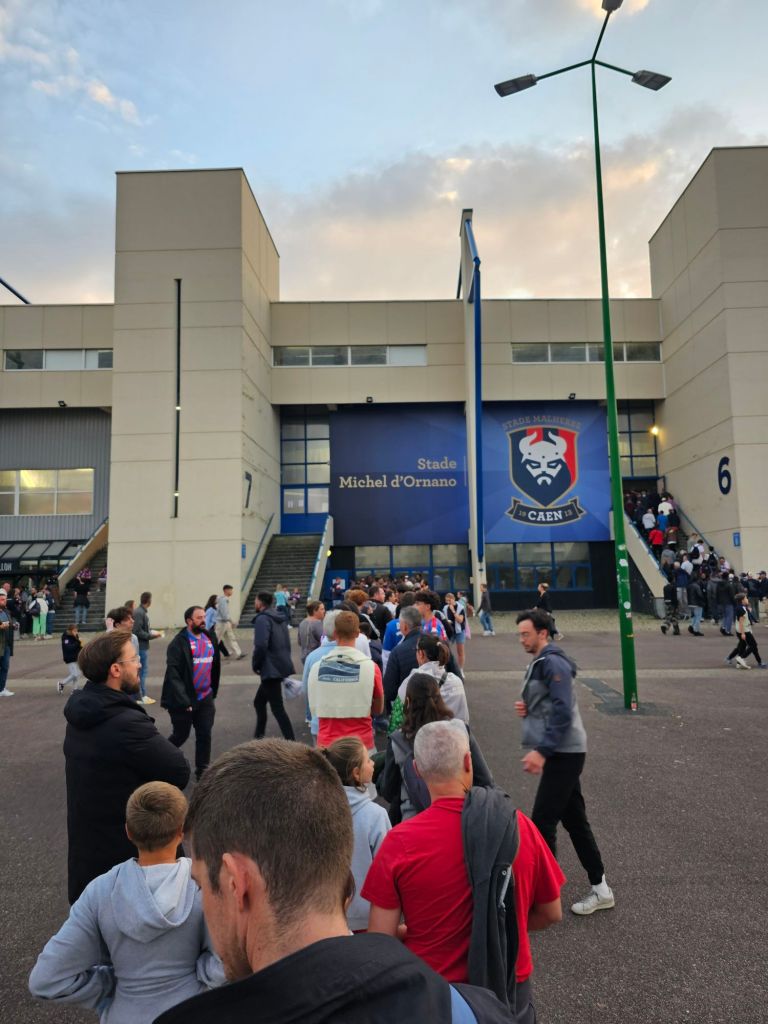
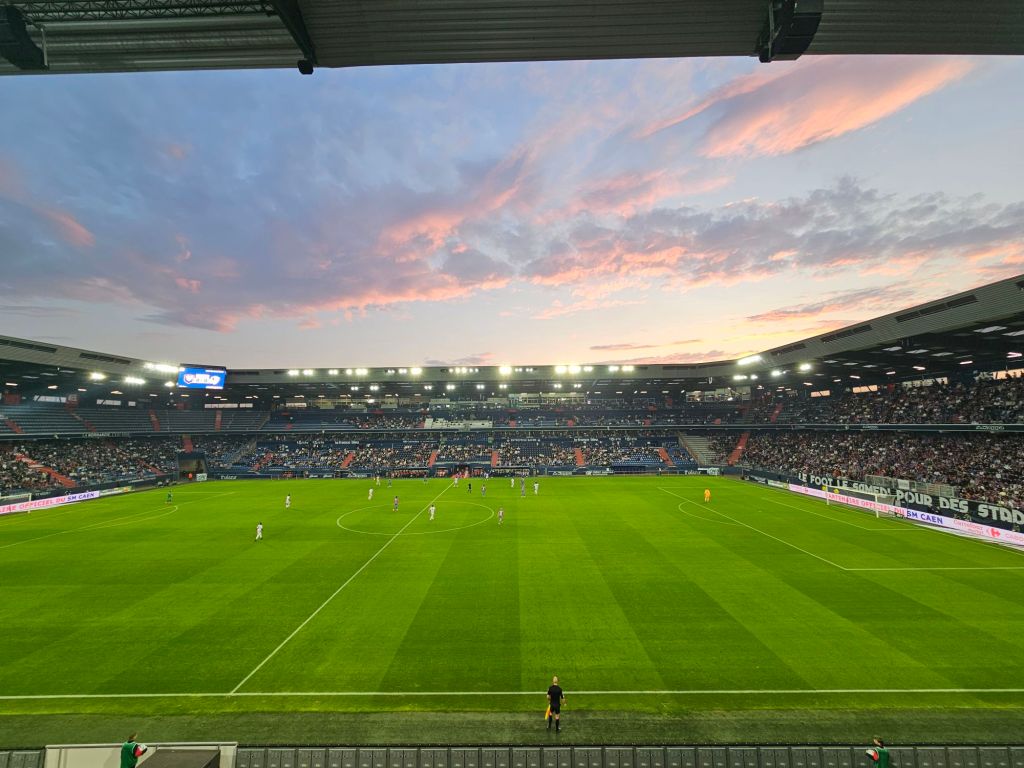
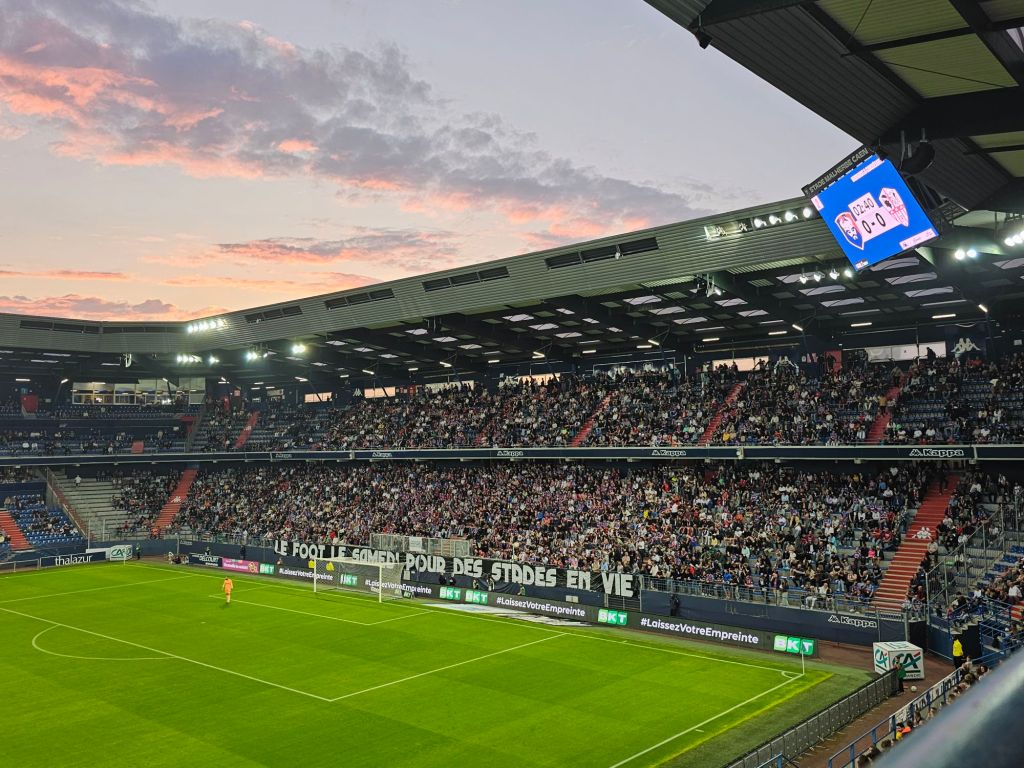
It’s gone twenty to eight by the time the bus disgorges its load at the oddly named  ‘Silicon Valley’ bus stop, directly opposite the Stade d’Onano, and Paulene and I head for the club shop to add to the pointless collections of cuddly club mascots, fridge magnets and T-shirts that clutter up our home back in blighty, although I do wear the T-shirts.   After then joining a queue for Gate 7, six flights of stairs take us to the top of the Tribune Caen from where we have to descend the steep gangway to our seats (24 euros each) in the front row of the top tier of the stand.  Within moments of our sitting down the game begins, tonight’s visiting team AC Ajaccio from Corsica getting first go with the ball, which they succeed in keeping to themselves for much of the first minute of the game. Ajaccio are wearing red and white striped shirts with white shorts, reminiscent of Stoke City and Signal toothpaste.  Caen meanwhile are kitted out in blue shorts and blue and red striped shirts, but the stripes are wavy, reminding me of the sleeve of the Cosmic Roughriders LP ‘Enjoy the Melodic Sunshine’.  Caen are kicking from right to left, back towards the city centre, whilst Ajaccio are aiming more in the direction of the Bayeux tapestry.

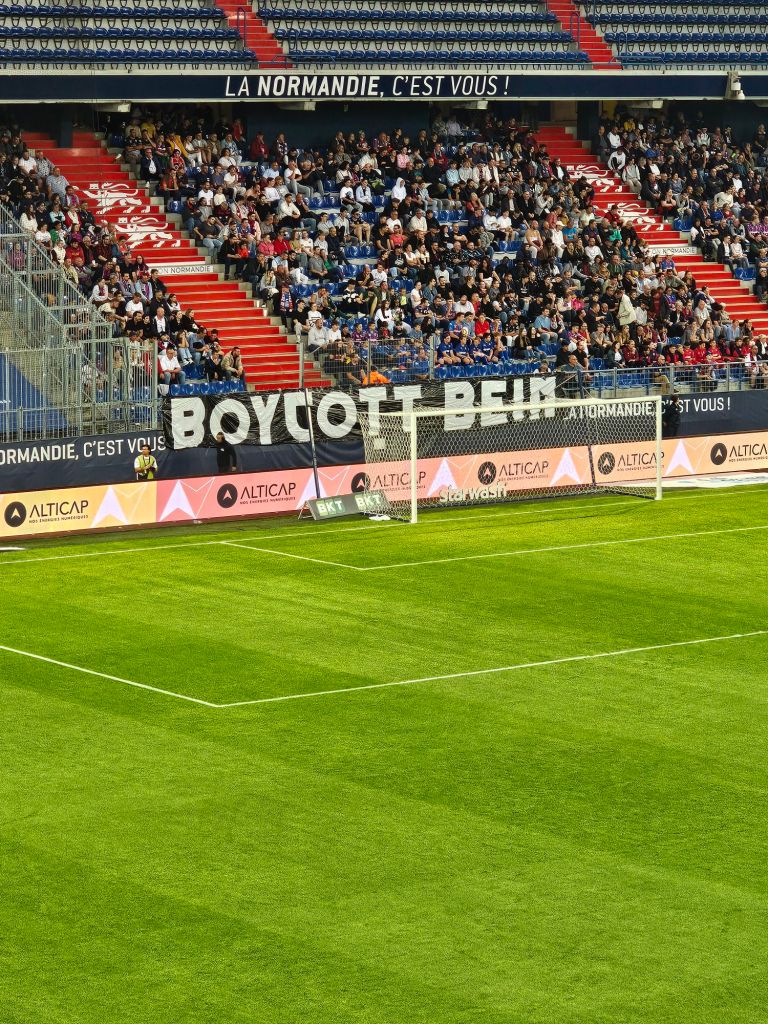
Unexpectedly, the ground seems very quiet as the game begins, possibly because in four matches in Ligue 2 so far this season, Caen have not won, only succeeding in losing three times.  Whenever a Caen player crosses into the opposition half however, I think I can hear a muffled murmurs of “Allez, allez, allez” all around me, and when Caen win an early corner rhythmic clapping breaks out.  With not much happening I take the opportunity to visit the buvette back at the top of the stand where I buy a bottle of water (2 euros) and a merguez sandwich (6 euros).  I return to my seat in time to witness a twelfth minute shot from a Caen player strike the Ajaccio cross bar. Before three minutes later a blizzard of paper planes rain down on to the pitch from behind the Ajaccio goal, possibly as part of the ongoing protest against Ligue 2 matches being moved to Friday nights this season at the behest of Bein Sports tv.  Banners behind the goals read “Le foot le Samedi pour des stades en vie” (Football on Saturdays for lively stadiums) and “Boycott Bein”.

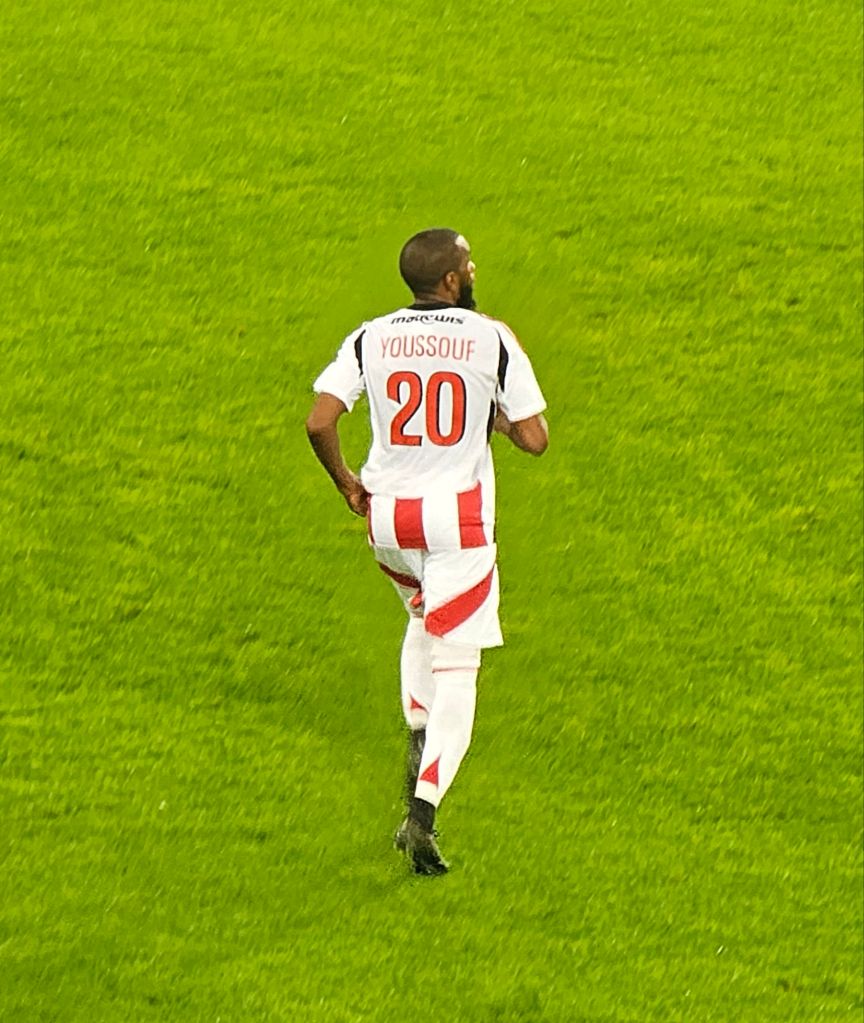
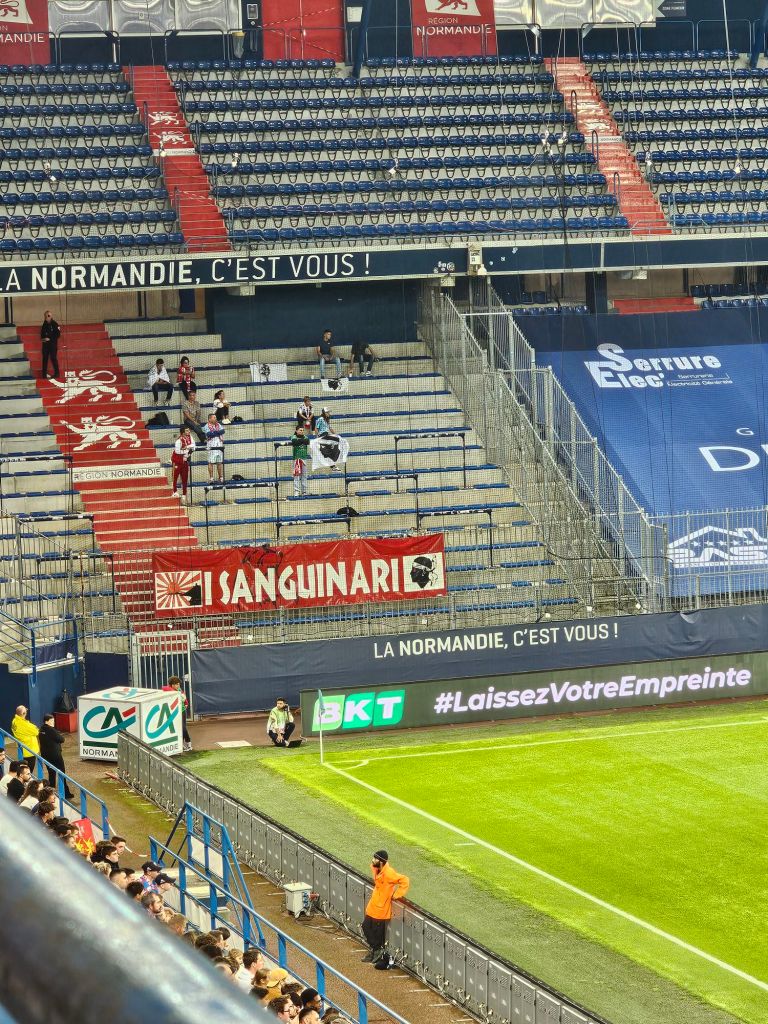
To our left, I count thirteen Ajaccio supporters in their enclosure behind the goal and I think of the Last Supper, before noticing that the Ajaccio number twenty Mohamed Youssef is so short that his socks meet his shorts, creating the effect that he is wearing puttees.  The first half is half over as Caen build a move down the left before wasting all the effort with a shot over the crossbar.  Nine minutes later Caen’s number seven flicks the ball up inside the penalty area before crashing a spectacular volley directly at the Ajaccio goalkeeper, who is in two shades of green.

The game is one-sided with Caen monopolising possession and attempts on goal until six minutes before half-time when Ajaccio have their first shot at goal, a curling effort from number 99, which nevertheless curls straight into the arms of the Caen goalkeeper who admittedly is not easy to miss because he is all in orange.  The first booking of the game follows soon afterwards when Ajaccio’s number thirty-one chooses to tug at the Caen number nineteen’s shoulder rather than attempt to tackle him in the conventional manner.  Two minutes of added on time are added on, to little effect, and at half-time the score remains blank. In a sense therefore, Ajaccio are winning.

Paulene and I move seat during the break because I have been having to duck my head whenever the ball has been in the Caen half due to a large, blue, metal safety rail at the foot of the steps, which extends in front of my seat.  The half-time break passes with people trying to kick a ball into a box for money, and two teams of children in red and blue kit taking a shoot-out competition. The red children all seem about twice the size of the blues and predictably they win, although the only girl in the competition is a blue and she scores her goal.

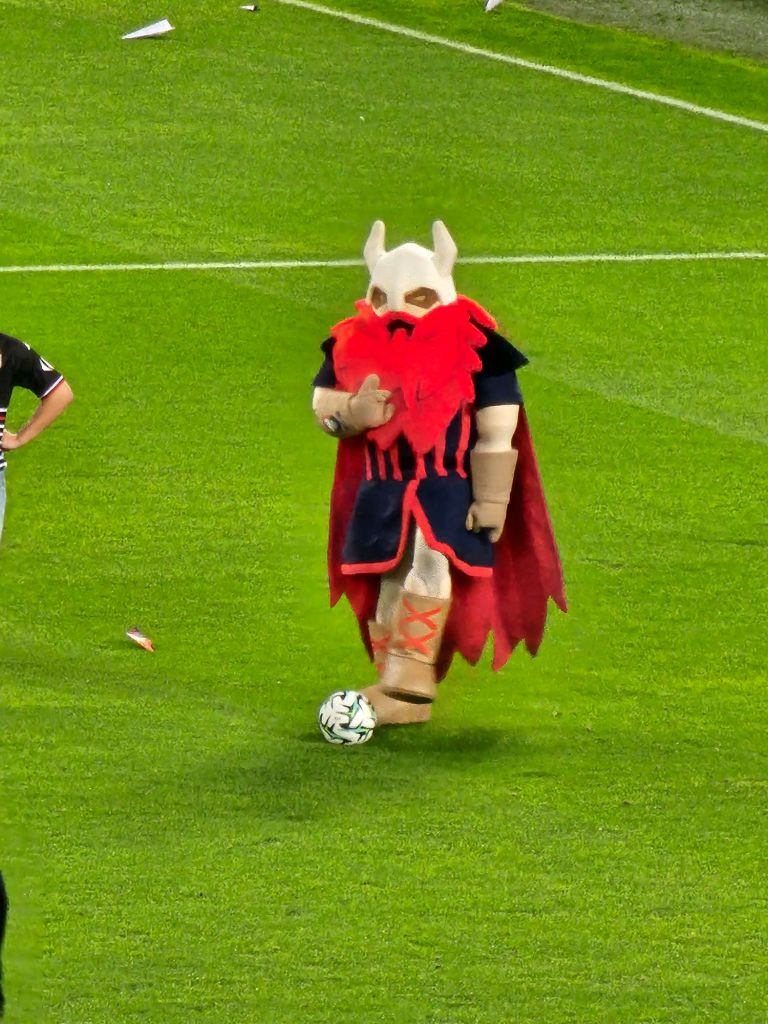
Now, with a clear view of the whole pitch we see the game re-start at nine o’clock and suddenly the stadium is full of enthusiasm and chanting. For no apparent reason the home supporters are singing “Allez, Allez, Allez” to Verdi’s Triumphal March from his opera Aida.  The effect is almost instantaneous as a ball into the box results in claims for a penalty, albeit somewhat specious ones. But a corner satisfies the more realistic supporters, which leads to a shot and another corner and more urging chants of “Allez, Allez, Allez” as the Caen fans loudly live up to what one would expect of their mascot, Vik the Viking.

Only five minutes of the half have gone and now number seventeen Kyheremeh is shooting straight at the Ajaccio goalkeeper before number nineteen heads over the cross bar from a corner.  Sadly however, the score remains blank and for a while the game descends into a Keystone Cops style knockabout with players falling over and colliding with abandon.  Paulene and I begin to notice the advertisements around the ground for the likes of Entreprise Bacon, Calvados the departement or County, as opposed to Calvados the apple brandy, and the interestingly named Twisto, the local transport company who brought us here this evening in one of their articulated buses.  Off to our left, I can only count eleven Ajaccio fans now and wonder if two have had to leave early to catch a ferry, or whether they just gave up hope.

Only twenty-five minutes remain as Caen’s Kyeremeh is through on goal, but he chooses to run wide and cross low to the near post where the ball is saved at the expense of a corner.  “Allez, Allez, Allez” sing the home fans again, but this time to the tune of the Beatles’ Yellow Submarine, not Verdi.  Thirteen minutes remains and Caen’s number four has come on as a substitute only to quickly get booked as he struggles to influence the game.   Three minutes later however, comes the decisive moment. Caen’s number ten, Bilal Brahimi, who has been neat but nothing more for most of the game, suddenly has space outside the Ajaccio penalty area from where he unexpectedly launches a shot into the top right-hand corner of the Corsican goal; Caen lead one-nil.  “Bilal, Bilal” chant the Caen fans as his picture appears on the scoreboard and the stadium announcer tells us who scored.

Ajaccio have made little effort to score themselves and now they might have left it too late.  Ajaccio substitute number twenty-one Ivane Chegra is brought on to add flair by the look of his Marc Bolan style coiffure, and number twenty-two Moussa Soumano succeeds only in getting booked as the match rolls on into five minutes of added on time.  The added-on time is of no consequence however, and with the final whistle the relief for Caen’s supporters having won their first match of the season is plain to see.

With a bus to catch we don’t linger to join the ensuing love-in, and that bus is almost full and ready to leave as we board it.  Down the streets beyond stadium vivid, sudden flashes of light appear and soon there are spots of rain on the windows of the bus as it weaves its way through the post-match traffic.  By the time we reach the city centre a heavy downpour is drumming against the roof of the bus and the streets are awash.  With the bus windows steamed up and streaked with rain I have to ask a fellow passenger to tell me when we’re back at Bellivet bus stop.  It’s a dramatic end to the evening and an uncomfortably wet walk back to the hotel, but I don’t think we’ll forget our night in Caen.