It’s just under 37 kilometres from my house to the Rush Green Bowl, home of Clacton Town Football Club, but as far as I can tell the quickest that it is possible to make this journey by public transport is one hour and thirty-six minutes, and this involves a challenging degree of co-ordination of buses, trains and footsteps, probably not possible on a Saturday and not convenient for a 3pm kick-off, and then I still have to get home. Never mind, I think to myself, I have an electric car so can save an hour for worthy purposes and still try and save the planet too whilst travelling to watch non-league football, and so that’s what I shall do today having chosen to watch Clacton Town versus Diss Town in the snappily monikered Thurlow Nunn Eastern Counties League First Division North.
It’s been a while since I last saw Clacton play; eleven years and eight months to be almost precise, but rocking up at the Rush Green Bowl it doesn’t seem that very much has changed in all that time but for a superficial and recent switch from being FC Clacton back to being Clacton Town, and as William Shakespeare might have said if in a sarcastic mood, a rose by any other name would smell as sweet.
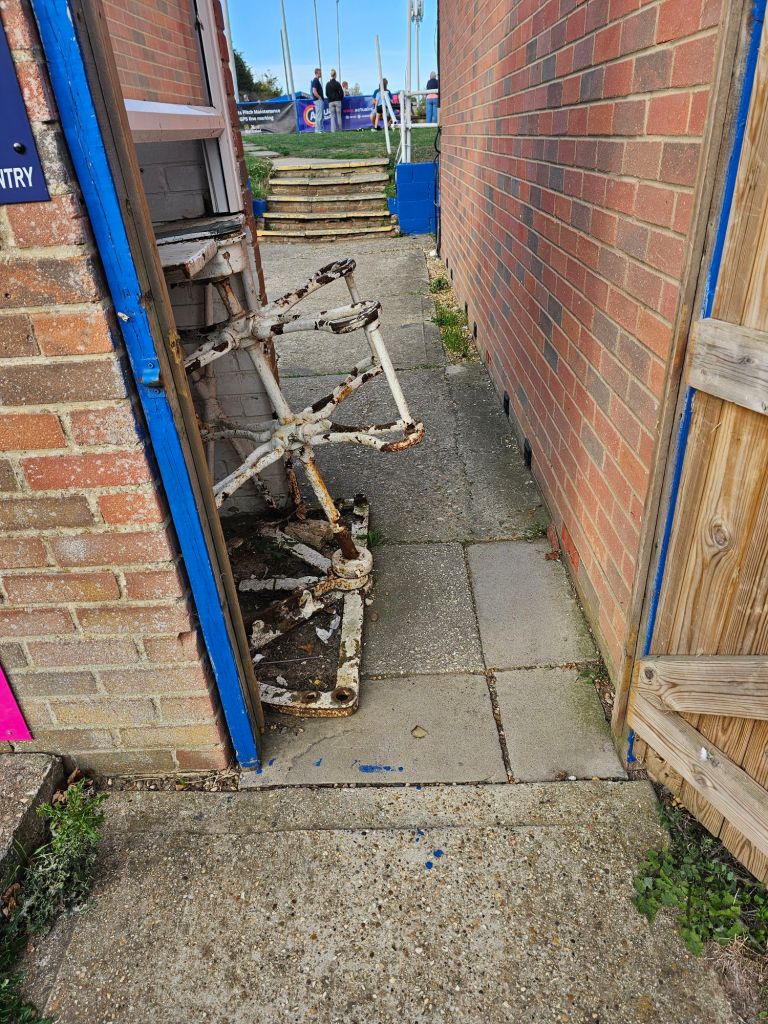
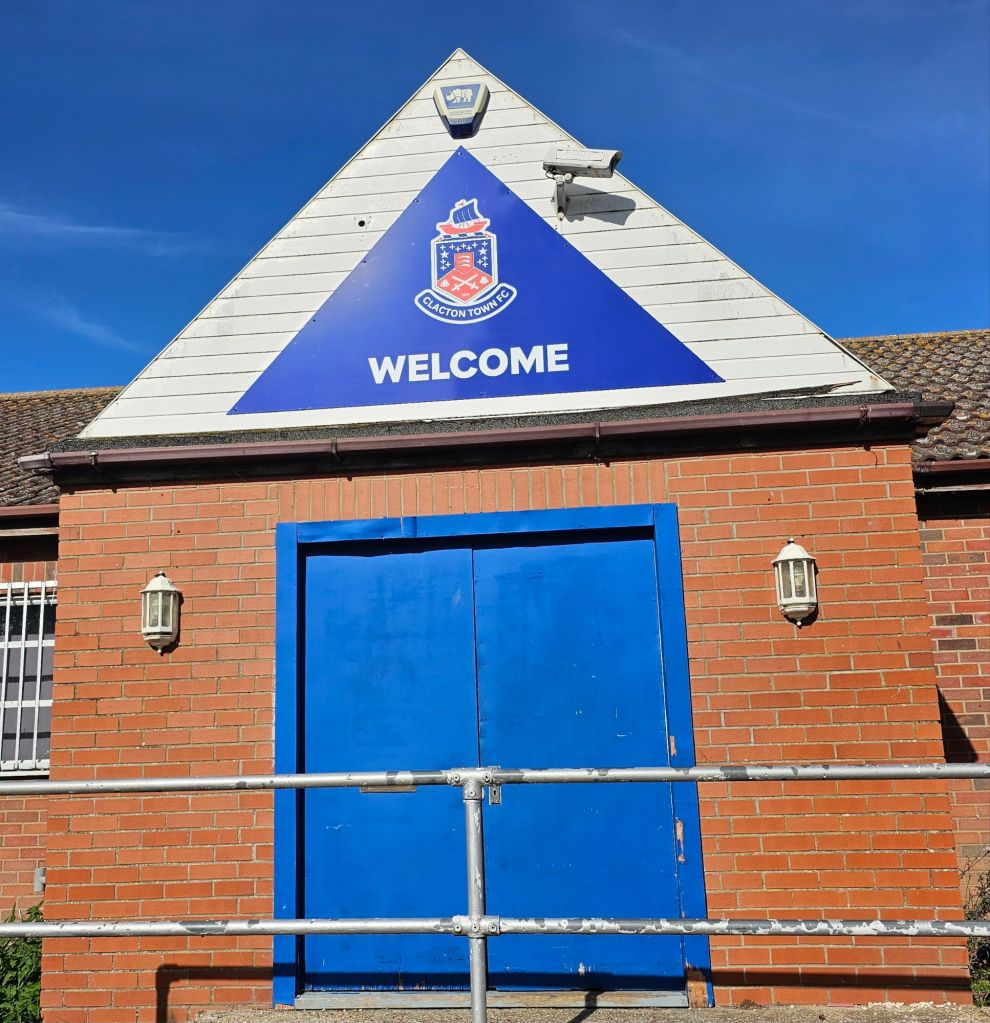
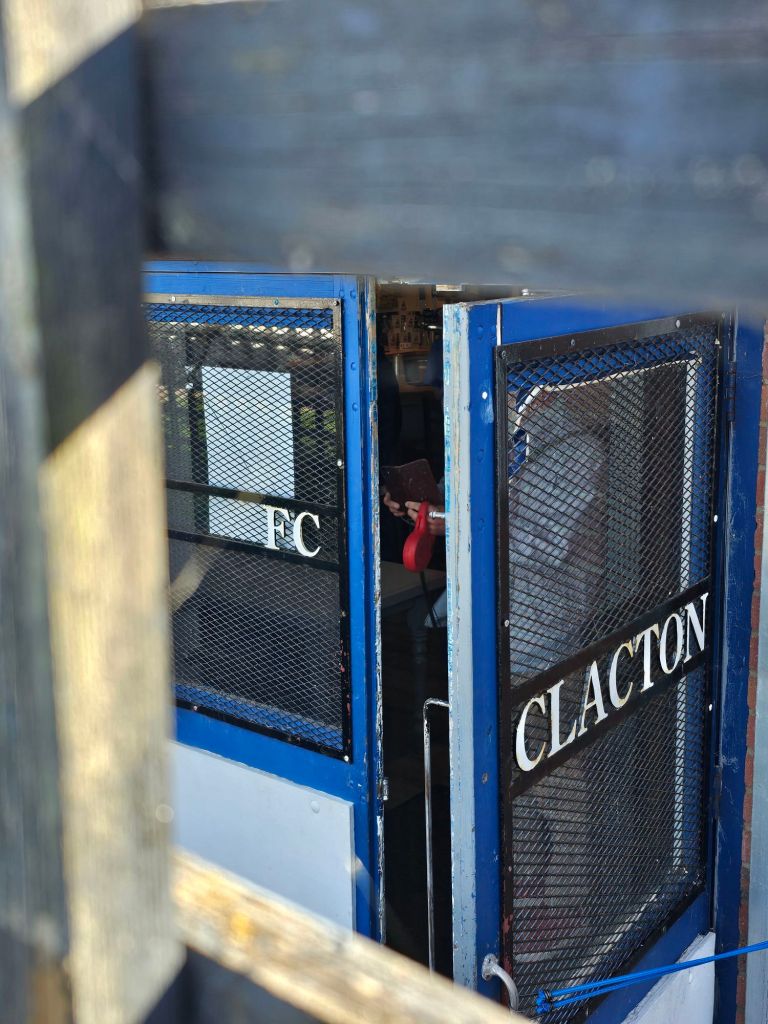
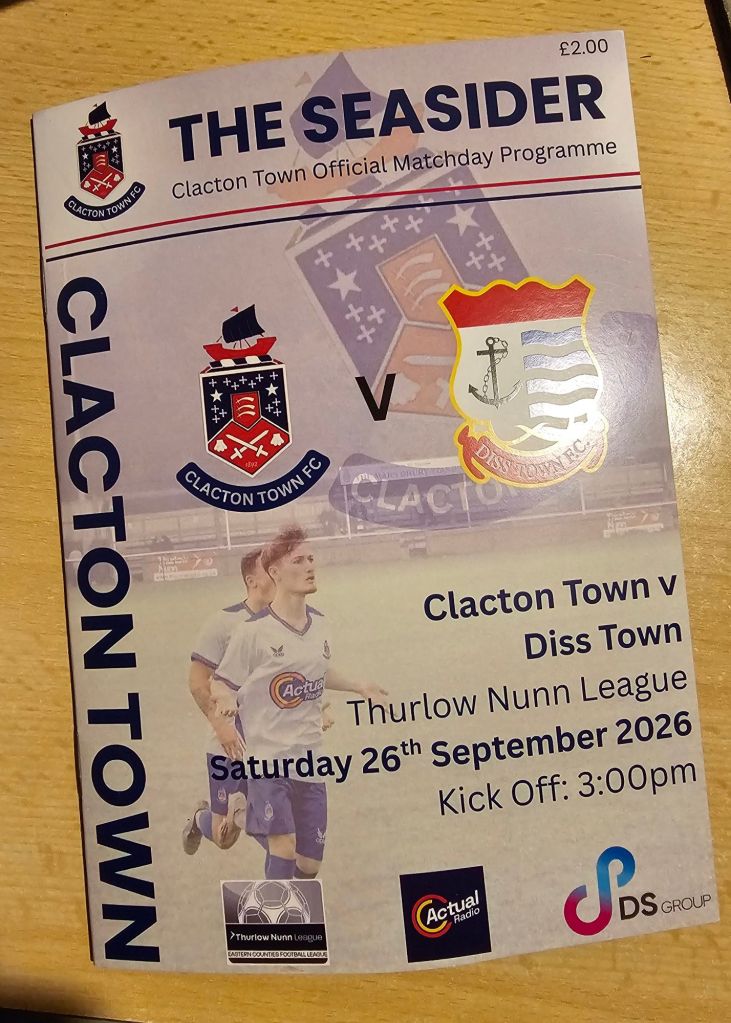
It’s a gloriously sunny, early autumn day as I step out of my neatly parked Citroen, breath in the briny scent of sea air and walk to the turnstile along the back of the clubhouse beneath an ugly gable and a sign bearing the Clacton Town crest, the word ‘Welcome’, a CCTV camera and a burglar alarm. The turnstile itself is a magnificent piece of iron work but is set at a somewhat impractical angle as if an overly large person had tried to force their way through it or it had been rescued from a shipwreck. I ask the lady operator if it’s from the pier, but she doesn’t know. Entry for a ‘senior’ costs a fiver, but more importantly and satisfyingly Clacton Town still produce a programme (£2.00), an impressively glossy twelve-page effort between stiff covers. Through the turnstile, a man sells old programmes and ‘goes’ on a pub card on which the pubs are football clubs. Seeing that Ipswich Town has already been bagged by someone called Richard, I plump for Burnley, who Ipswich beat to the 1962 version of what is now called the “Premier League” title.
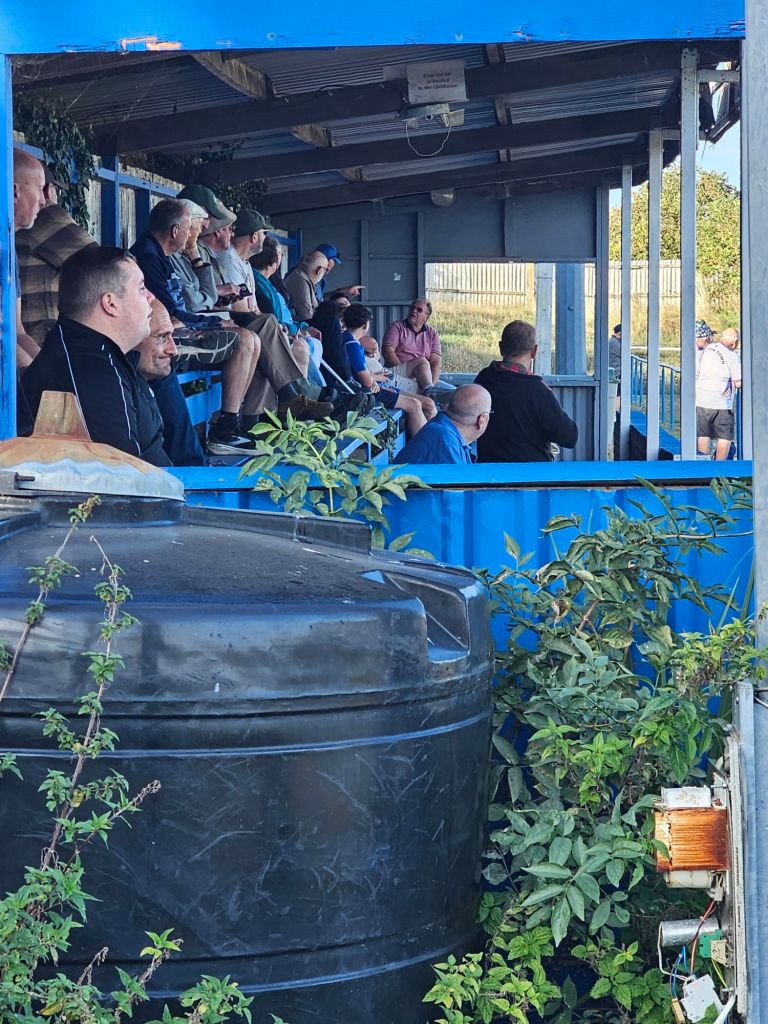
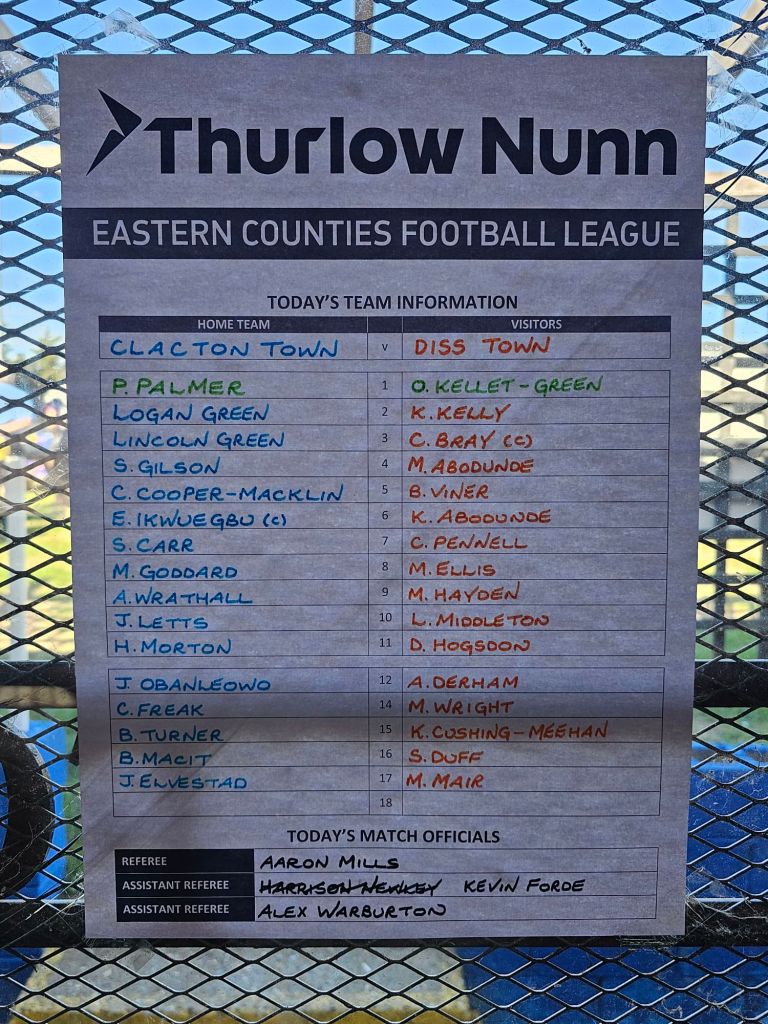
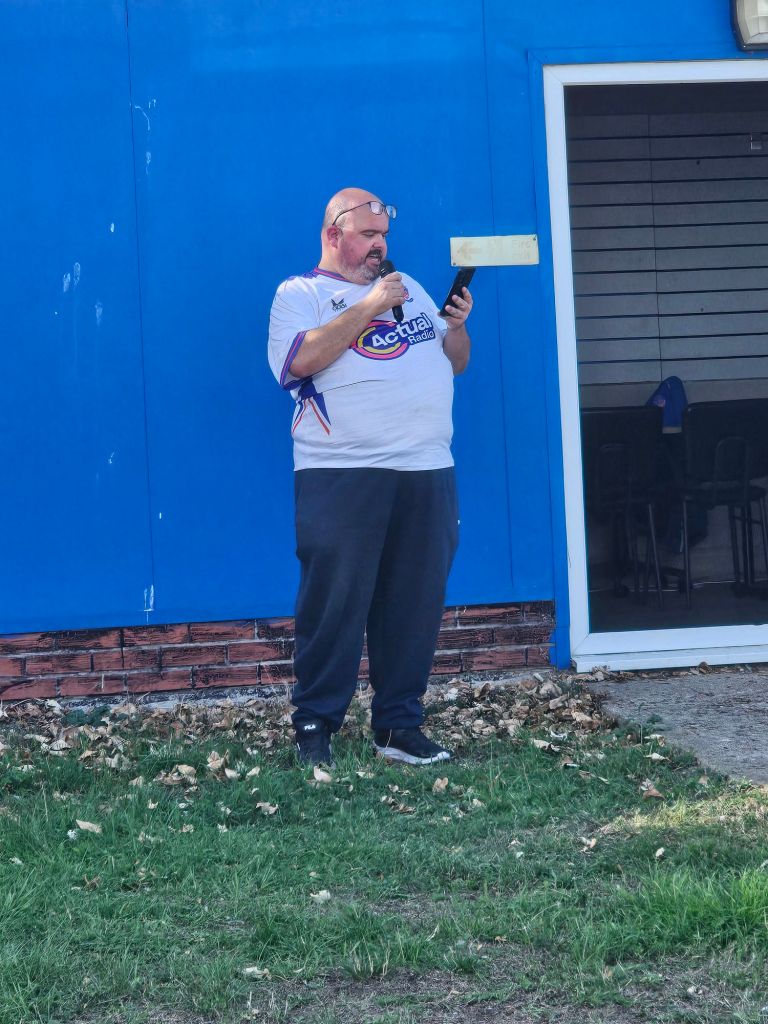
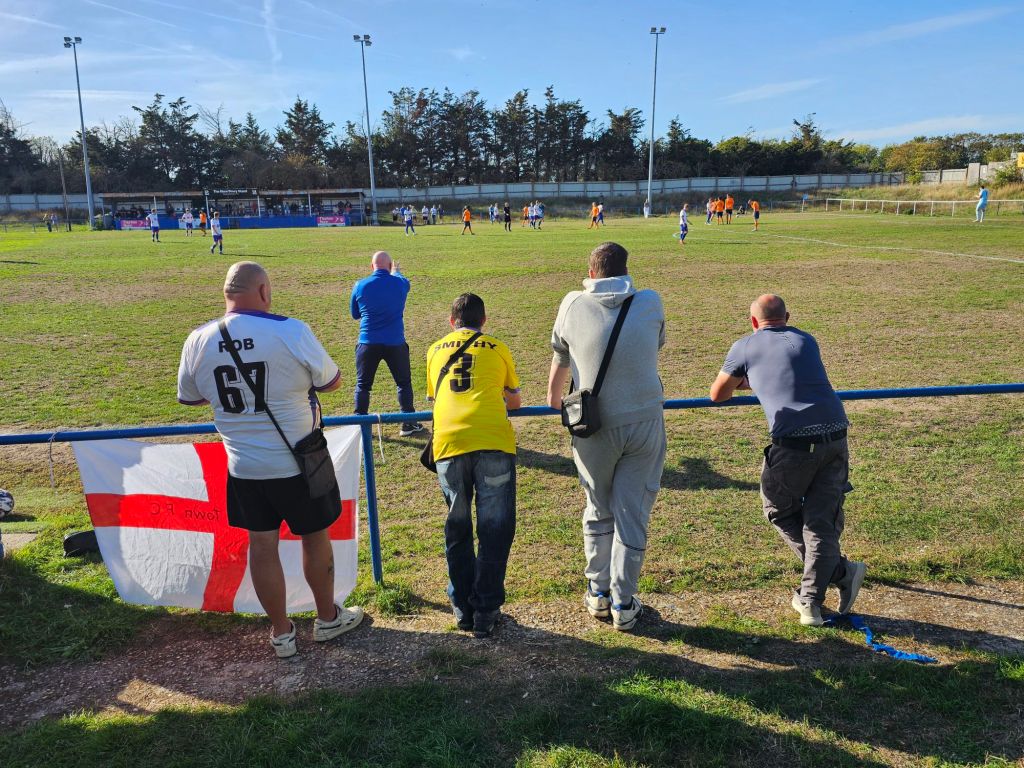
There is still most of a half an hour until kick-off and so I look about a bit. I poke my head in the club house, a large, gloomy space that smells of body spray and has a large bar at one end; the back of the door is where the team line-ups are posted. Returning outside, I take in the architecture comprising three small stands and a gathering of blue portacabins linked by a porch that looks like a massive nesting box and features another gable, which in this case grandly announces, “Hospitality Suite”. Mostly blokes stand about awaiting kick-off as last-minute adjustments are made to the goal nets at the clubhouse end of the ground. Some blokes hold plastic pint glasses of pale beery liquid. One of the blokes not holding a plastic pint of beery liquid turns out to be Richard of pub card fame, who I know from our mutual historical association with Wivenhoe Town. Richard had booked a trip to the nearby Essex County Council dump to dispose of some garden rubbish and to my amusement had decided to combine that trip with one to the Rush Breen Bowl, which handily is next door. We stand and talk and listen as the Clacton Town club secretary, a man called Karl, looks at his mobile phone and reads out the teams over the public address system. Richard and I look at each other askance as the name of Clacton’s number three is announced as Lincoln Green. “Surely, that’s a colour not a left-back” we almost say as one.
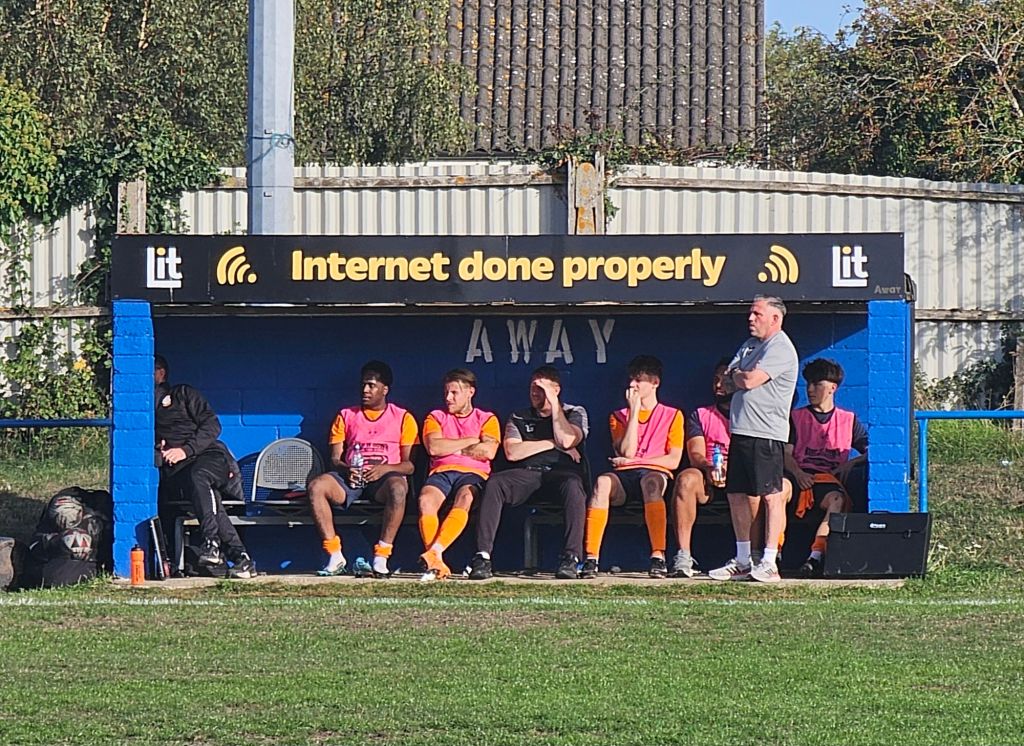
When the football begins, it is visiting Diss Town who get first go with the ball, which they despatch in the general direction of the club house and the North Sea, whilst hoping the goal net stops it from going that far. Diss, known as “The Tangerines” wear an attractive kit of orange (more accurately tangerine) shirts and navy-blue shorts. Richard and I agree that you can’t go far wrong with an orange football shirt. Clacton meanwhile sport white shirts with royal blue trim and royal blue shorts. To avoid doubt they have the words Clacton and Town printed across their shoulders where players at professional level have their names. Any musings about the comparative merits of the team kits are quickly forgotten as Diss Town soon lose possession and inside a minute Clacton dismantle the Diss defence and number seven Sonny Carr scores with a low, casually placed shot into the corner of the goal to give Clacton a very early lead. It’s a lead which is almost doubled very soon afterwards as Letts’ header is saved and number two, Logan Green has a shot cleared off the goal line.
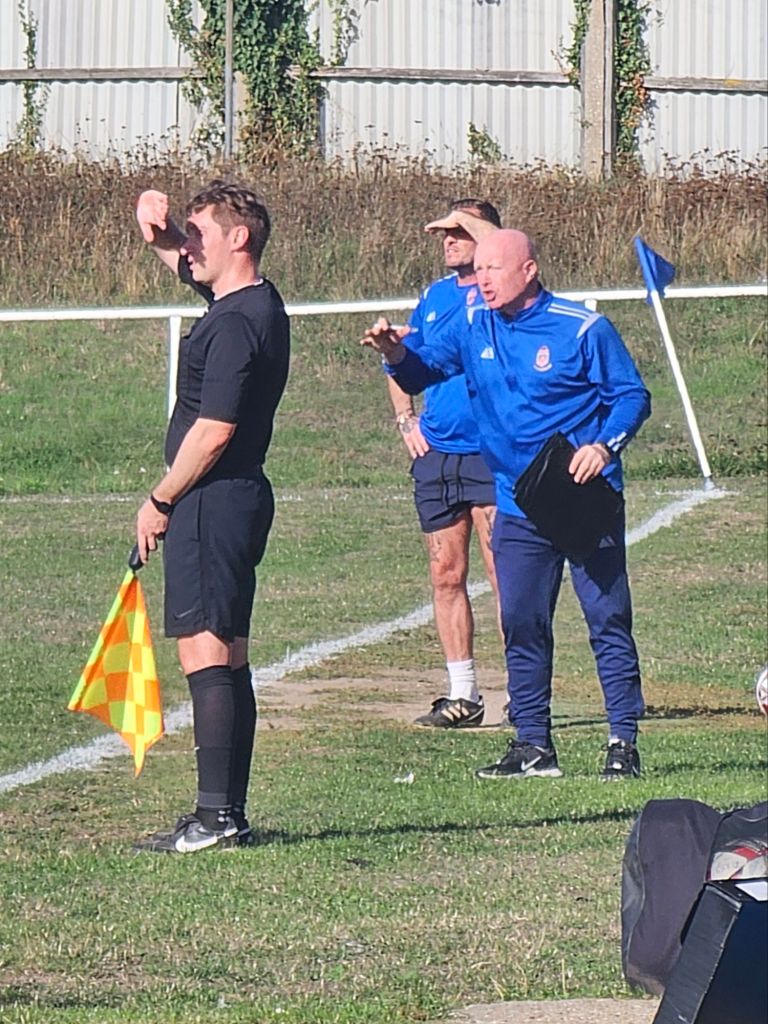
After thinking that Clacton might run away with the game, it settles down into one of scuffs and miskicks on the hard, uneven and dusty surface. More than one hoofed clearance is propelled at an unexpected angle and into the undergrowth beyond the pitch. Diss make it into the Clacton penalty area to win a couple of corners but seem to lack attacking players. “’kin ‘ell” shouts a Diss player in response to a high boot and the game is held up as the Diss physio runs on carrying what looks like a first-aid kit from the glove compartment of his car. The game resumes with a Diss free kick which is booted straight out beyond the goal line from a good 40 metres out. Cirrus clouds wheel above us, a small plane takes off from the adjacent airfield. “We’re fuckin’ walkin’” shouts the totally bald Clacton coach as the game fleetingly descends into the not unusual swearing match often associated with local football. “Keep it down for the kids” says Richard to me quoting the Thurlow Nunn League’s long-time mantra, and weirdly it seems to do the trick.
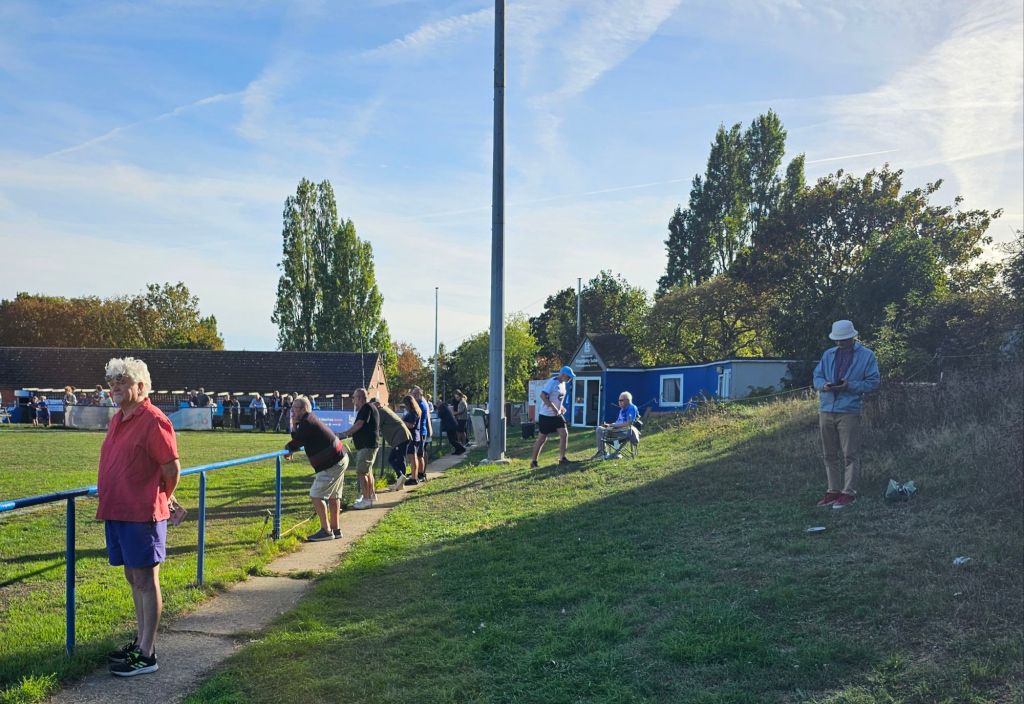
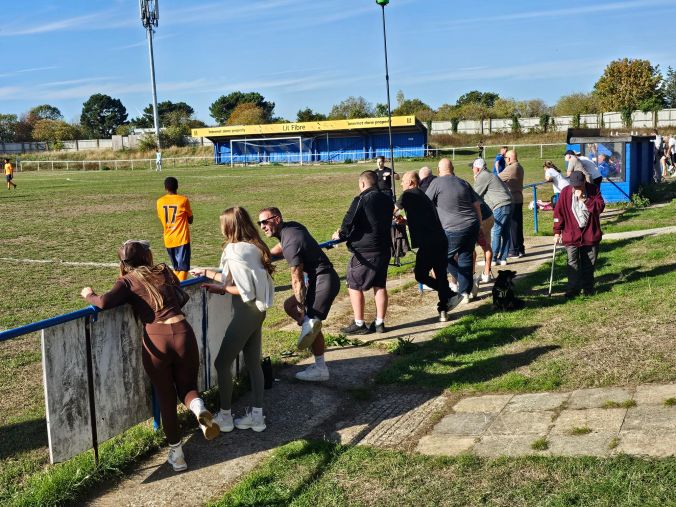
It’s now twenty-six minutes past three and all of a sudden Clacton lead two-nil as the speedy but diminutive number nine Adam Wrathall runs at goal, number seven Carr has a shot blocked at close range and number ten Letts bundles the ball into the roof of the net from even closer range. It’s a goal which owes its existence to pace and poor marking and the home crowd cheers. The Rush Green Bowl as its name more than implies is shaped like a bowl and on three sides there are mostly overgrown banks of grass on which spectators stand like the occupants of broken-down cars at the side of a motorway. In front of us Diss’s number eight Ellis shepherds the ball out putting himself between it and the Clacton number five Cooper-Macklin. As the ball crosses the touchline Cooper-Macklin kicks Ellison on the ankle in what might generously be described as an act of petulance. The referee Mr Mills explains to Cooper-Macklin that the ball was already out but fails to book him for his spitefulness. Soon afterwards, karma takes a holiday and after a Clacton corner kick the ball runs to Cooper Macklin on the edge of the penalty area and his low shot is deflected into the Diss goal to make the score three-nil.
The bald Clacton coach standing near the touch line in his blue tracksuit continues to shout and encourage. Clouds of dust accompany almost every kick, and such is the apparent lack of any reaction in the Diss Town dugout I wonder if Diss have a coach at all, or whether the team functions as some sort of autonomous collective. There are five minutes of the nominal first forty-five remaining as Clacton score their fourth goal from the penalty spot courtesy of captain Emmanuel Ikwuegbu after Wrathall runs at and around the Diss centre-half Viner and seems to be about to shoot when Mr Mills points to the penalty spot. Richard and I agree it looked a soft penalty decision (shirt tugging?) and we wonder if Wrathall wouldn’t have scored anyway. As if to let the world know that yes, he would have scored, five minutes later Wrathall rattles in a fantastic shot into the top corner of the Diss goal from something like 30 metres out. When the half-time whistle is blown at twelve minutes to four the score is a probably decisive Clacton Town 5 Diss Town 0.
Richard and I have, during the course of the match, been making our way around the pitch and with half-time, we move from the sunny eastern side to the more shaded area next to what passes as the main stand. On our way, we go onto the pitch to get around the subsiding terrace stand behind the goal that is now closed off for safety reasons. It is at the same time a shame that the stand cannot be used but it also strangely adds to the character of the place and the delightfully depressing sense of decay and dilapidation that often characterises lower league football.
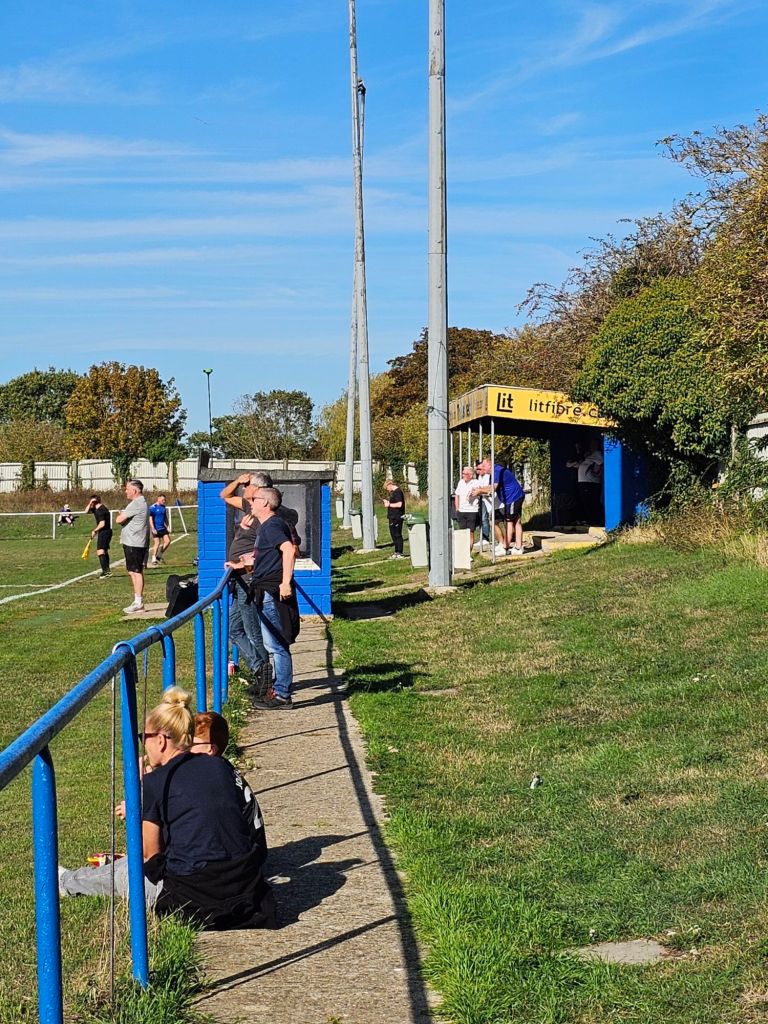
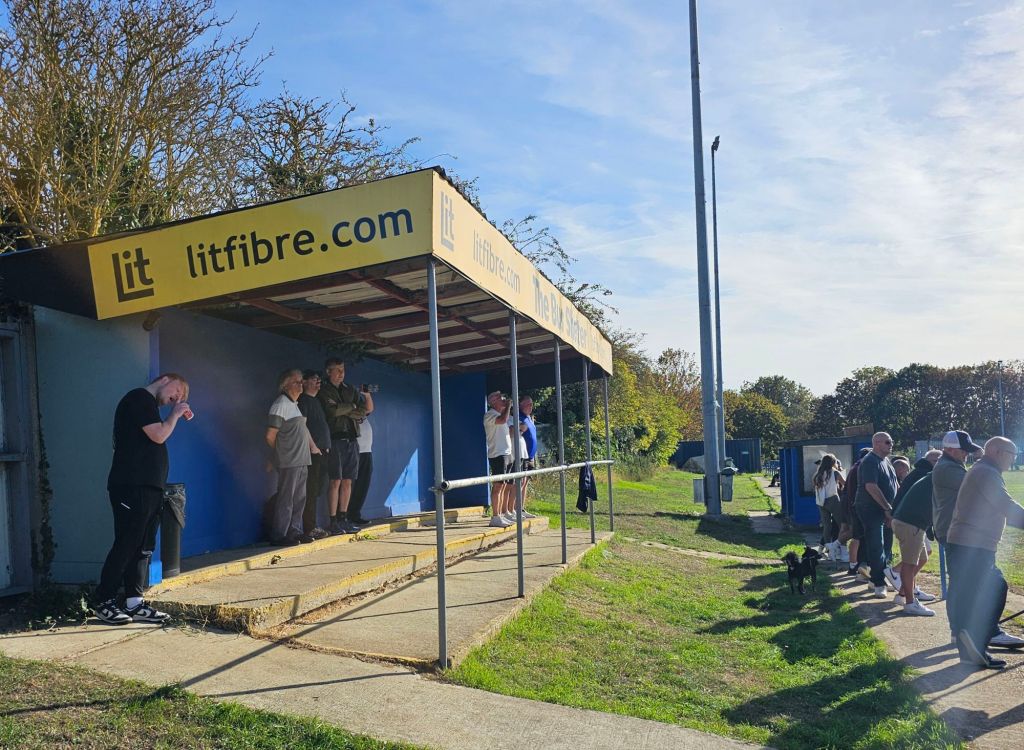
The football resumes not much after four o’clock and at three minutes past Clacton score a sixth goal as number eleven Morton receives a square pass and from about 10 metres shoots the ball into the top right-hand corner of the Diss Town net. The game resumes again and a man in a blue shirt, Diss Town club tie and possibly stay-pressed trousers, walks past us from the direction of the hospitality suite. Earlier this afternoon as we stood near some of the Diss Town committee members I reflected on how even now some club officials come to games looking like refugees from the 1950’s with their collared shirts and club ties and sometimes even blazers and as a result they can’t help but also look a bit like coach drivers. Richard suggests that if Diss have a bus in the car park they should make a note to park it in front of their goal in future. Our reverie is broken as the ball flies off the pitch and lands in the long grass next to me. As I throw it back, I think it feels a bit soft, but on a rock-hard pitch that’s probably a good thing.
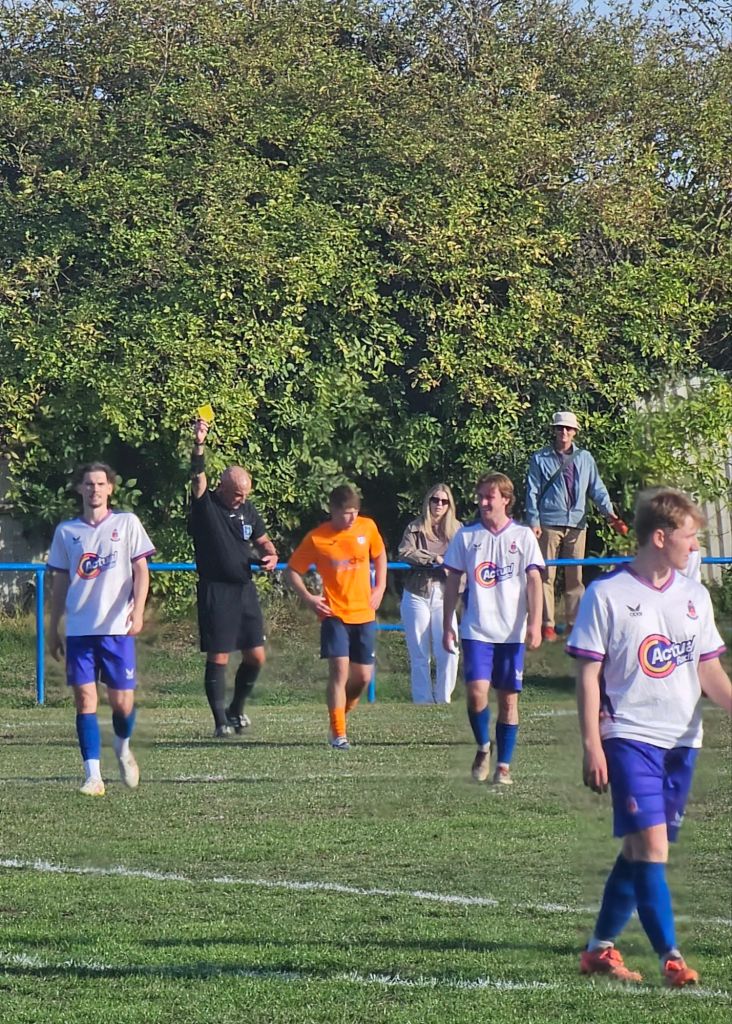
A Diss player is the first to be booked by Mr Mills, possibly for tugging a shirt, we’re not sure, and as a cool breeze blows in off the sea the players shadows begin to lengthen across the mottled green of the pitch. Diss win a freekick outside the Clacton penalty area, the Clacton captain is booked and from the kick Clacton’s goalkeeper Palmer, palms the ball away for his only save of the game. Four minutes later and Clacton score their seventh goal as Wrathall scurries into the penalty area holding off a towering defender before sending a scorching shot high into the top corner of the net at the goalkeeper’s near post.
The last fifteen minutes of the match have arrived and to their credit Diss Town continue to do what they can to score and Ellis should do so when confronted with an open goal, but instead he boots the ball high over the subsiding stand. Four minutes later and once again I have to throw the ball back onto the pitch for a second time, I think I’ve now had more touches than the Clacton Keeper’ and the Diss centre forward. Clearly a sympathetic man, Richard is hoping for a Diss goal but all they can manage is a shot that sails higher above the subsiding stand than the previous one and another which curls increasingly wide of the goal after leaving the Diss player’s boot. It is a quarter to five when Clacton score an eighth goal, an audacious lob over the luckless Diss goalkeeper’s head from 50 metres after he misguidedly leaves his penalty area and clears weakly.
Finally, after an uncomfortable sounding clatter of shin guards on studs there is a late caution for Diss Town’s number three and captain Bray, who had deserved a booking for some earlier successful attempts to con freekicks out of Mr Mills. With the final whistle, an understandably appreciative crowd applaud the teams and Richard and I make for the car park only to wonder if either of us had won the pub card. Although it’s been a one-sided game in terms of goals, it has still been an entertaining one and on a beautiful autumn afternoon. After a rotten day for Diss Town however, we can only wish them and their coach drivers a safe journey home.