Ipswich Town 1 Nottingham Forest 1


Thirty-eight years ago today, give or take ten days, Ipswich Town played Nottingham Forest in the sixth round of the FA Cup.  I travelled up to Nottingham for the game, taking the train from Brighton where I was at university and then, having met up with three other Town fans in London, by Morris Minor 1000 up the M1.  We spent the night in Nottingham after the match, ate mushy peas and chips, drank large quantities of Home Ales bitter, slept on a floor of someone we knew at Nottingham University and drove back down south the next day.  Nottingham Forest were the reigning European Cup holders and in two months’ time Ipswich Town would win the UEFA Cup.  They were happy times.
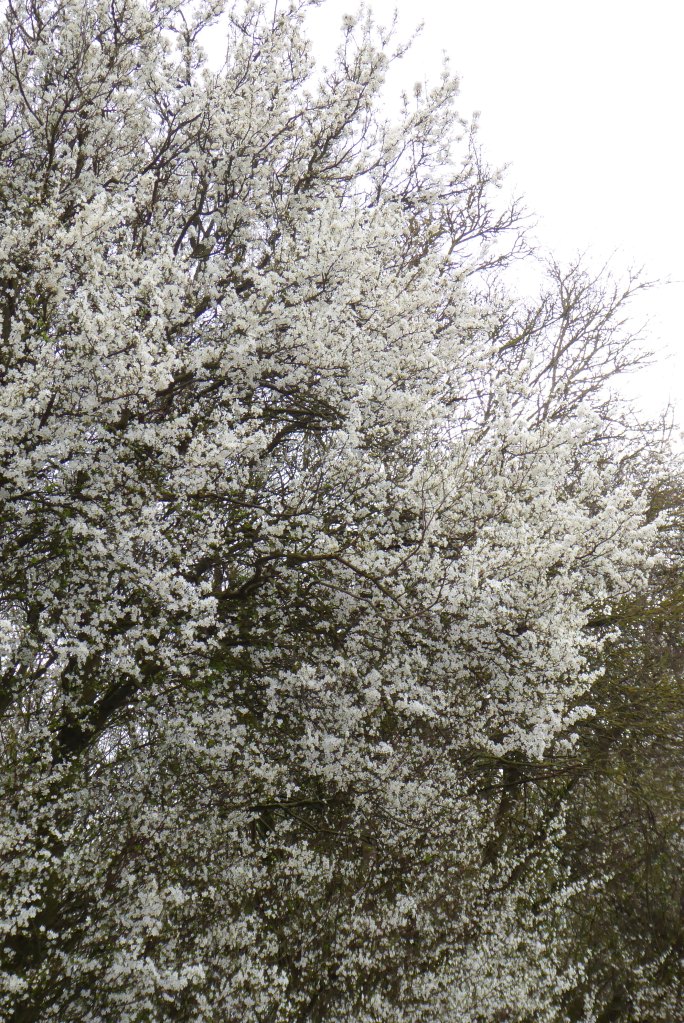
Today, both clubs languish in the second division, Town awaiting inevitable relegation whilst Forest struggle in vain for a play-off place; but they meet in the day’s only match between the former winners of European cup competitions. It is a dull, blustery, mid-March day and layers of grey cloud are stacked up overhead as I walk to the railway station.  Blossom from the trees is blown into the gutter.  I pass by a newspaper recycling bin and feel perplexed that it is considered necessary to paint a sign on it advising people not to climb inside.  At the railway station I meet Roly; the train is on time.  Roly shows me a short video on his mobile phone of his eighteen month old daughter kicking a ball. Roly is nothing if not a very proud father.

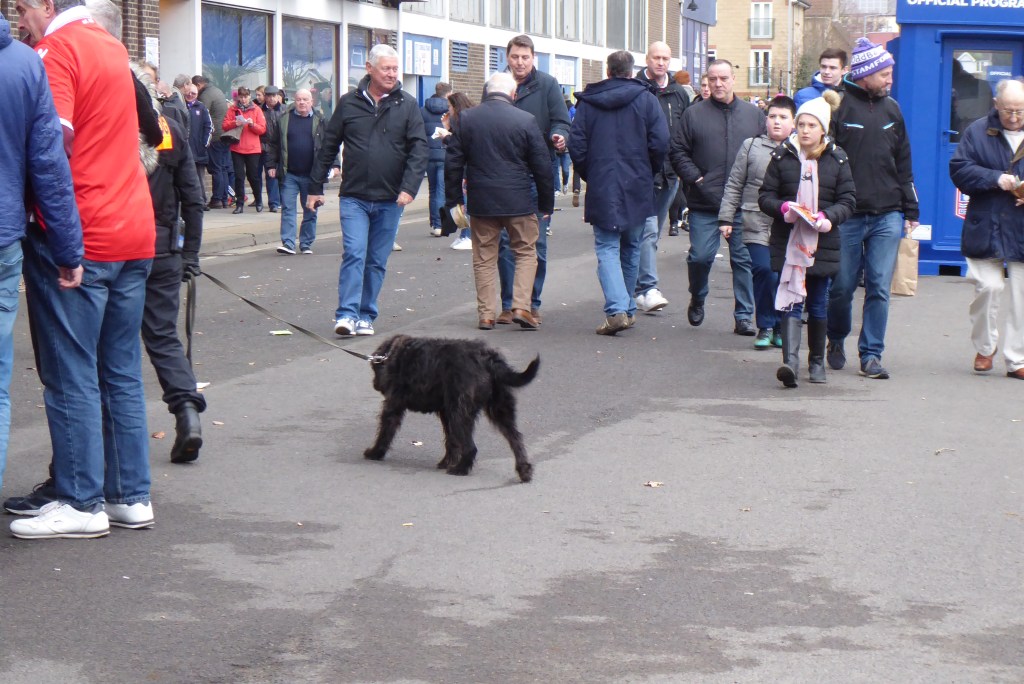
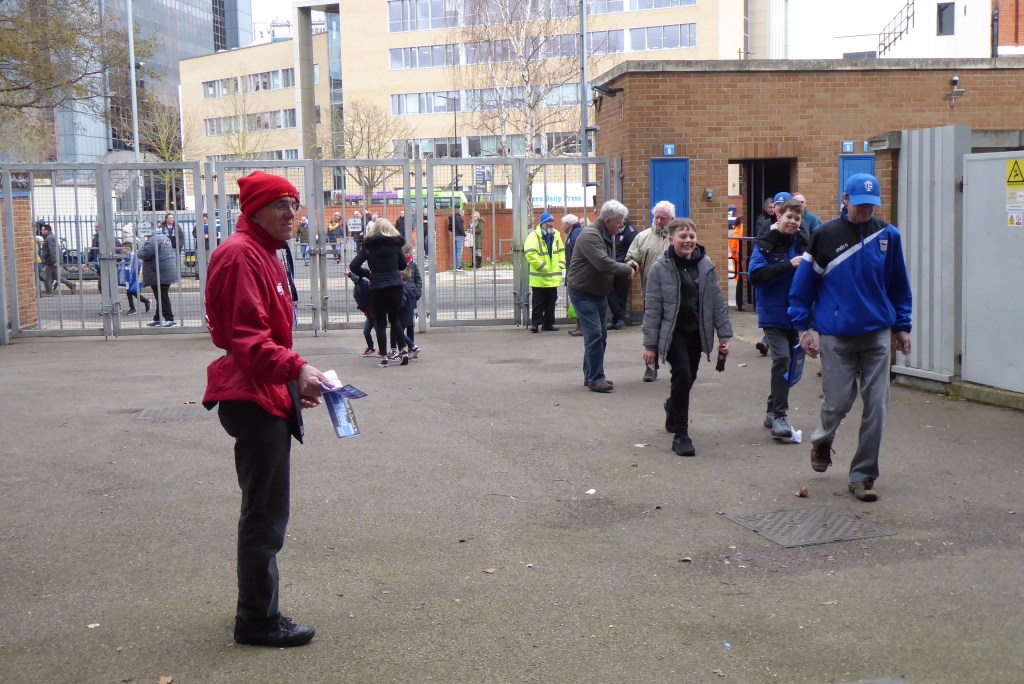
Arriving in Ipswich the weather hasn’t changed; Roly gets some cash from an ATM whilst a group of Ipswich supporters struggle to get a car park ticket from an automatic machine. We head down Princes Street towards Portman Road and on to St Jude’s Tavern.  As usual people mill about aimlessly in Portman Road waiting for the turnstiles to open, they must retain the hope that one week they will open early, otherwise why get here early week after week after week?  There is always hope.

At St Jude’s Tavern Roly has a pint of Nethergate Bulldog (£2.50) and I have a similar quantity of the Match Day Special, which once again is St Jude’s own attractively named Goblin’s Piss (£2.50), a name that St Jude’s should really offer to Greene King for their IPA.  We sit at a table next to the usual retirees who meet here pre-match. We talk football.  Another clutch of retirees arrives, “What do you recommend” one asks looking at the beer list, “That you clear off somewhere else” is the response. Statler and Waldorf live. Not entirely satisfied by the ‘tired’ condition of our first pints, Roly and I switch to Nethergate Venture (£3.40) for our second; it’s okay but a bit too ‘floral’ for my tastes.

Jackson

At about twenty to three the pub begins to empty out and Roly and I leave too.  He doesn’t admit it but I suspect Roly wants time to get something to eat, that’s the kind of guy he is.  With fifteen minutes until kick-off Portman Road is busy but the club shop isn’t and I pop in, much as I might pop to the Co-op, and buy a programme, redeeming the 115 loyalty points I have accrued from previous purchases in the process.  In the past week I have now enjoyed two free programmes (at Kirkley & Pakefield and Colchester United) and a cut-price one, I am feeling blessed and if this carries on I will soon have saved enough to retire; hopefully Brexit won’t happen and I can go and live in the south of France, although if it does happen that is probably all the more reason to move to the south of France, or anywhere.
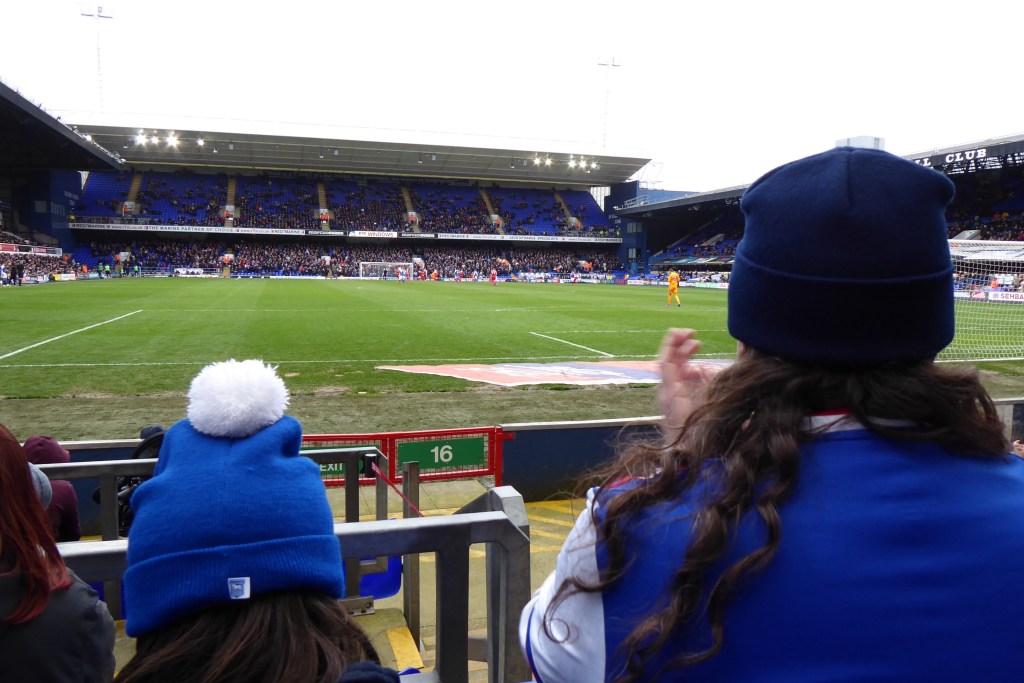
There is no queue at the turnstiles, I smile and thank the moustachioed turnstile operator as I pass through.   After a brief conversation with Dave the steward, a former work colleague, I use the toilet facilities and then take up my place alongside Pat from Clacton, ever-present Phil who never misses a game and his young son Elwood.  There are a lot of Nottingham Forest supporters here today (the score board will tell us during the second-half that there are 1,691 in a crowd of 16,709) and Phil recounts how he visited his mum in Newmarket this morning and as he left he even saw one heading for Newmarket railway station.  The teams enter the field and my view is through the net of a practice goal which hadn’t been wheeled away before the concertina-like players’ tunnel was extended out to the corner of the pitch. 

The game begins with Nottingham Forest getting first go with the ball and playing towards the Sir Bobby Robson Stand and Alderman Road rec’, they are wearing red shirts, shorts and socks.  Town are in their customary blue and white kit, despoiled by an ugly advert for an on-line scamming organisation, a likely contributor to this season’s eventual relegation; they are aiming in the direction of me, Pat, Phil and Elwood, but hopefully a bit to our right.   The Nottingham supporters are in very good voice regaling us with a lyrically altered version of Land of Hope & Glory that tells of how they hate a number of other clubs but love Nottingham Forest, it’s an old favourite and takes me back to the 1970’s; the old ones are the best I think, sounding like my late father and his father and probably his father before that.  Enjoy your youth while you can Elwood, because one day you will be an old git too.

Barely five minutes pass and Town produce a quick move of short passes in front of the East of England Co-operative Stand and the lifeless souls that populate it; Gwion Edwards gets behind the Nottingham defence, delivers a low cross and like a magical genie the hard to hide Collin Quaner appears from nowhere to deftly stroke the ball into the goal to give Ipswich the lead.  It was a most beautiful goal.  I have heard so-called supporters say rude things about Collin Quaner but I like him, he’s German, he has the distinctive, exotic look of an Easter Island statue (minus the big ears), but most of all he plays for Ipswich Town and therefore he’s alright.

The goal gets the home crowd going for a short while, “Allez, Allez-Allez-Allez” some of us sing, enjoying the linguistic abilities that a meeting of two former European competition winners bring.  The noise of the crowd rises and swirls around in the strongly gusting breeze. But by and by the enthusiasm recedes and that goal is one of the last exciting things that happens at my end of the pitch as Nottingham Forest go on to un-sportingly monopolise the remainder of the first half winning four corners to Town’s none and having eight shot to our two.   It’s not long before the home crowd is quiet once again and the Nottingham Forest supporters can begin their goading. “One-nil, and you still don’t sing” they chant to the tune of the Village People’s “Go West”, but without the manly bravura of the original version.  Exasperated perhaps by the lack of a reaction the Forest fans invoke the Beach Boys’ Sloop John B to sing “We’ll sing on our own, we’ll sing on own”, which is probably the sensible thing to do in the circumstances, before their attention then turns to an obese Town supporter to whom they sing “Fatty, Fatty, give us a song”.  After enquiring through the medium of song if he has ever seen his own genitals they entreat him to “Get your tits out for the lads”, he duly obliges.  It’s hard to say if ‘Fatty’ enjoys his five minutes or fame, but he doesn’t return to his seat after half-time.   

The game carries on and Ipswich are denied what looked like a corner “That was literally in front of you, you Muppet” shouts a woman from behind me at the linesman.  Would that we could really have Muppet linesman I think to myself; the FA and The Jim Henson Company should forge closer links.  I note how many foreign players Nottingham’s are fielding and am impressed by the performance of Pele at number 28 which is remarkable for a man in his seventies, but I am surprised to learn from the tiny little Guinea-Bissau flag against his name on the back of the programme that he is no longer Brazilian.  My attention is also drawn to Forest’s number 29, Tunisian Yohan Benalouane who, with his completely bald head and pale complexion makes me think of Nosferatu; I don’t get a look at his finger nails.

It’s just gone half-past three and Nottingham Forest win a corner, the ball is directed towards goal, Bartosz Bialkowski dives to his left, Nottingham players raise their arms and the diminutive referee Mr Keith Stroud signals a goal, which the scoreboard attributes to the Malian number 13 Molla Wague, although it will later be said to be a Jon Nolan own-goal.  It’s a shame for Town, for Molla Wague and for Jon Nolan and given that the goal has brought so much disappointment I am surprised it is allowed to stand.   “Que Sera Sera, Whatever will be will be, You’re going to Shrewsbury, Que Sera Sera” sing the gloating Nottinghamians, revealing a hitherto unexpected admiration for Doris Day, although the earlier Go West song was perhaps a clue as to their preferences.

Half-time arrives and briefly Portman Road is once again back in the long lost 1970’s as the PA system provides an aural treat in the sound of Bachman Turner Overdrive’s  “You ain’t seen nothing yet”, a song which makes me want to laugh and cry at the same time. I visit the facilities beneath the stand to drain off some more of that Goblin’s Piss; at the urinal I stand next to a man who is simultaneously either texting or checking the half-time scores on his mobile phone.  I find the scene rather disconcerting and leave as quickly as nature allows before consuming a Panda brand liquorice stick as a tasty half-time snack and to help me forget.

The second half begins and Trevoh Chalobah replaces Cole Skuse.  At ten past four Trev’ unleashes a spectacular shot that whistles just centimetres outside the right hand post of the Nottingham goal.  Sometimes such a narrow miss is more thrilling than a goal, particularly an opposition one.  The second half turns out to be much better than the first for Ipswich and Town dominate the attacking play, although admittedly without making too many clear cut chances to score.  Chants of “Come on You Blues, Come on Blues” burst from stands on all sides of the ground and with increasing frequency. The referee Keith Stroud, who ‘has previous’ as far as Town fans are concerned adds to his record of failure and bias by not awarding Town free-kicks whilst giving undeserved favour to Nottingham, whose fans are now largely quiet.  “Short refs, we only get short refs” sing Phil and I to the tune of Blue Moon. On the touchline Paul Lambert, as ever in his black v-neck jumper and black trousers, swings his arms about encouraging his team and the crowd.  Little Alan Judge crosses the ball and Jon Nolan heads wide of an open goal.

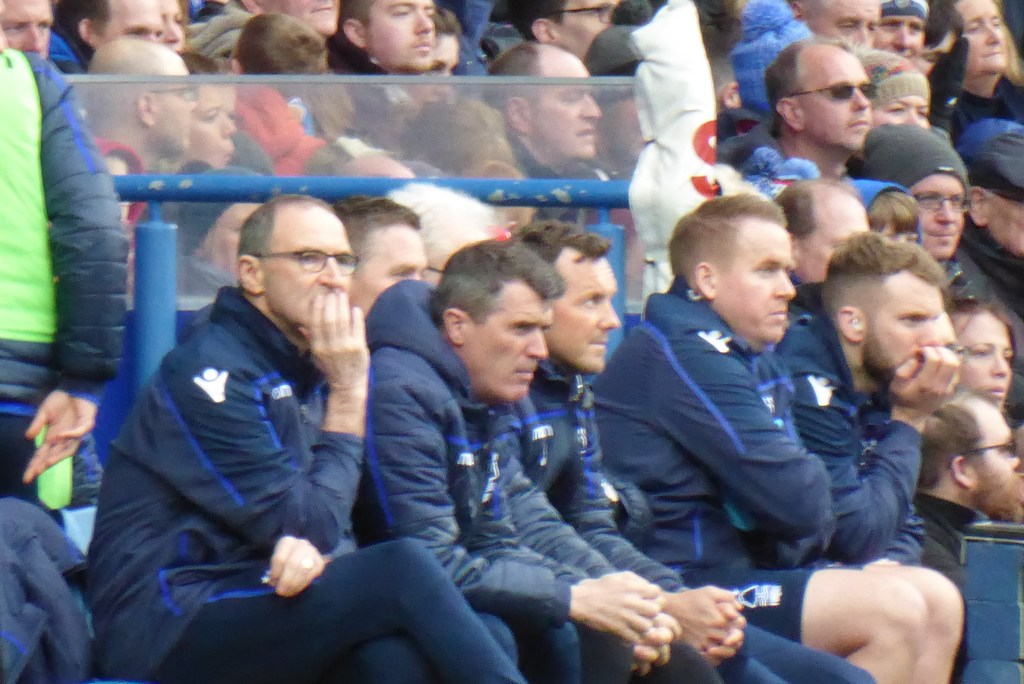
On the Nottingham bench Roy Keane at first looks his usual sullen self, but as Town dominate more and more and the game moves into its last ten minutes he stands in the technical area gesticulating, looking annoyed and filled with murderous intent.  The combination of the ‘enigmatic’ Martin O’Neil and psychopathic Roy Keane as a sort of latter day Celtic incarnation of the Clough/Taylor partnership can surely only end badly, but it could be fun to watch. I ensure that when the game is over I stay on long enough to boo Keane from the field for what he did to Ipswich Town.  I offered to my friend Mick to boo Keane on his behalf as he could not be here today, he said to feel free and he was happy for me to spit for him too if I wanted. I thought that was going a bit far, although I imagine it is the sort of protest Keane might respect as he would then feel justified in meeting it with extreme violence.

Ipswich deserve to score again but don’t and the result is yet another one-all draw.  This has arguably been the best game of the season at Portman Road and curiously despite being bottom of the league by several points for several months, with very little or no hope of staying up and only two home wins since August it has been the most enjoyable season for several years.  What is more, the crowd are at last getting behind the team; if this is what it takes perhaps Town should just go for relegation every year.

To the tune of Auld Lang Syne….all together now…

We’ve won the League, we’ve won the Cup

We’ve won in Europe too

Now every week we draw one-all

There’s f-all else to do.

Framlingham Town 2 Norwich United 0

On a Saturday afternoon the number 118 bus leaves Ipswich at a quarter to two and arrives outside the former White Horse pub in Framlingham about forty-five minutes later, from where according to Google maps it is a thirteen minute walk up Bridge Street and Market Hill, along Church Street, Castle Street and up Badingham Road to the Badingham Road Sports ground, home of Framlingham Town Football Club. The only problem with this if wanting to watch a football match is that it is necessary to leave at half-time to catch the last bus back to Ipswich at a quarter past four. There are two later buses out of Framlingham, but they will only get you as far as Framsden. With passenger rail services to Fram’ having ceased in 1952, and deciding that unless sleeping in a hedge, stopping over for the weekend in Framsden or Framlingham (the next bus to Ipswich is on Monday morning) is a tad extravagant just to watch a Thurlow Nunn Eastern Counties Premier League game, I have no option today but to get a bigger shoe for my carbon footprint and travel by car.
Even for someone wracked with guilt over his Citroen C3’s carbon emissions, having turned off the A12 it’s a pleasant drive along the B1116, which follows the valley of the River Ore through Hacheston and Parham. Tilled brown fields, grey flints, golden leaves and gaunt trees beneath a broad, bright sky set the scene for our winding, undulating journey. It’s all a bit ‘Akenfield’ out here. In Framlingham I park up near the 12th century castle and we, for today I am with my wife Paulene, pop to the Co-op for a small picnic; we would eat at the football club, but Paulene’s food intolerances won’t allow it. We stop off at the church of St Michael on the way back to the car to look at the display of knitted poppies draped over the south porch for Remembrance day tomorrow and take a look inside at the tombs of the ancient Howard family, feudal lords of the area after Sir Roger; appropriately the local Conservative Club is just over the road too.44933944875_965acaf762_z
It’s a very short drive from Sir Roger Bigod’s castle to Framlingham Sports Club on Badingham Road; like Stowmarket Town , Walsham le Willows and Brantham Athletic, Framlingham Town Football Club is now a part of the local sports club. Back in the 12th century Sir Roger was probably more of a hunting man than a footballer though. The roughly surfaced car park is pretty full, but we find a space and head into the club house for a drink, where we encounter what appears to be a ladies’ sports team all sat down in green trackie-tops having their dinner, and the shutters on the bar are down. Making an about turn we head around the corner to the turnstile entrance to the football ground , a nicely painted and brightly lit walk-through shed. Inside the shed a jolly man with a proper Suffolk accent relieves me of the admission fee (£8 each), which by at least a pound is the most I have ever paid to see an Eastern Counties League game and therefore seems a bit steep; I don’t think I paid more than a fiver when I last came to a match here about eighteen months ago. Financially bruised as I am, it doesn’t deter me however from splashing out on a programme (£1) too. On some days money means nothing to me. The man in the shed tells us that we can get beer or wine at the tea bar now, so the bar only opens later, I then have to remind him that I’ve paid for a programme too and he hands one over.
We walk the few yards to the main stand, briefly stopping to exchange pleasantries with a contented looking lady sat on a chair, basking in the low autumn sun. She always sits here she tells us. The tea bar is in the middle of the small brick stand at the back of the three rows of neat green seats. We both have a tea (£1), I have milk, Paulene doesn’t due to dairy intolerance; coincidentally she’s a bit scared of cows too. Paulene selects a seat in the corner of the stand; it will no doubt get colder later and this looks like a spot that will offer the closest approximation to ‘cosy’ once the sun has gone down. We drink our tea and eat our picnic, which mostly consists of Suffolk ham and crisps; we watch the officials warm up, which is always entertaining. Today’s threesome look refreshinglyOLYMPUS DIGITAL CAMERA young and unusually trendy; one has a beard, one sports what may be designer stubble whilst the third has one of those tied-up, top-knot haircuts with two partings. I always thought the Football Association had their own barbers who tried to make all referees look like Action Man, but it seems not. They’ll have to keep an eye on the fella with the top-knot; seems a bit of a individualist.
It’s still only about half past two, so like the spend thrift that I am I return to the tea bar for a bottle of Adnam’s Ghostship (£3) to wash down the salty picnic. The lady who serves me pours the beer expertly whilst explaining how it tends to froth up in plastic glasses. I tell her I think she deserves some sort of drum roll as she pours, but hold back with a round of applause when it’s done. Beer in hand I take a stroll round the pitch and wait for the teams to emerge from the dressing room behind the stand. Eventually, to the strains of Nancy Sinatra’s “These boots were made for walking”, an unusual but impressive choice, the teams walk on to the pitch led by the referee Mr Jack Willmore and his assistants Jack Lock and the somewhat theatrical sounding Ayrton Hursey; if I had to make a guess I’d say Ayrton is the one with ‘the hair’.
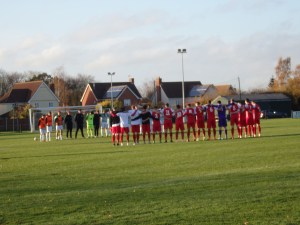
The ritual handshaking occurs and the teams chase off to their respective halves of the pitch. The Framlingham players then line the centre circle and because it is Remembrance Day tomorrow the Last Post is played over the PA system, but no one seems to have told Norwich United and they ‘knock up’ as usual, as footballers do. Sadly it’s a bit shambolic and had it been filmed would surely make the cut for a possible Channel 5 documentary series entitled “When poignant ceremonies goes wrong”. OLYMPUS DIGITAL CAMERAWith the Last Post over, it’s time for the minute’s silence, which happily is well observed by everyone and I suspect we all feel much better for it. For future reference, the Last Post should probably follow the silence.
It’s Norwich United, nickname The Planters, who kick-off the match in the direction of Rendham wearing a change kit of red shirts with white sleeves, red shorts and socks whilst Fram’, known informally as ‘The Castlemen’ wear green and white hooped shirts with white shorts and socks. Fram’ play in the direction of the town and the castle, of which one of the decorated Tudor chimneys is just visible from the Rendham end of the ground. The game begins quietly with Fram’ playing neatly and Norwich occasionally bursting forward, but neither side is very effective close to the opposition goal with the important forward passes often being over-hit or too easily intercepted; but it’s nice enough to watch all the same.
The sun sinks ever lower through a wreath of cloud as the half progresses and with the main stand and facilities on the north side of the pitch, most of the sixty-three strong crowd spend a lot of time squinting and holding their hands up to their foreheads as if looking out to sea. Spectators stood by the pitch-side rail cast long shadows behind them on to the metal boundary fence. I stand for a while by the team dugouts on the shaded side of the pitch where it feels rather cold and damp. Behind me is what looks like a small, dilapidated cricket pavilion and rather bizarrely, next to that is what appears to be a boarded up Council house.

The game is being played in a good spirit and although the players whinge and whine about perceived unpunished fouls and faux free-kicks there seems to be a realisation that it’s only a game; a fact that quiet reflection during the minute’s silence should have confirmed beyond all doubt. When Mr Willmore doesn’t give handball as the ball strikes the upper arm of Norwich’s full-back Adam Probert, Fram’s number seven Simon Poacher grasps his head with both hands in over-affected disbelief. Probert laughs, although it’s not clear if he’s laughing at having got away with a handball or at Poacher’s ham-handed histrionics. There are corners and crosses and misses of a sort, but it takes until the fortieth minute for either team to have a really decent looking attempt on goal when Fram’s Max Willet lands a long range shot on the roof of the Norwich goal just as the floodlights come on; a moment of double illumination. When Fram’s number five Anthony Johnson then unnecessarily concedes a corner his goalkeeper Gary Rose can be heard to say frustratedly “I told him to leave it, I told him”. But the corner comes to nothing, so no harm done.
Half-time and the seeping chill of the late autumn afternoon demands another pound’s worth of tea from the tea-bar. The result of the 50-50 draw is announced and it is revealed that the winner is the club chairman. “Money goes to money” says a man next to me in the queue at the tea bar. But the chairman seems down to earth enough, he’s stood in the tea bar and he’s not dressed up in a suit like the Norwich contingent. Teas purchased, Paulene and I huddle in the corner of the stand, the side screen of which, somewhat peculiarly, is double-glazed, which seems a little unnecessary given that it is a necessary feature of all stands that one side is left completely open. I have a flick through the programme. It’s a colourful and glossy little publication, short of text but sporting the best advert I have seen in a programme for some time – “AFS for Your Fumigation Requirements” it reads; I will be sure to give them a call for my next pre-harvest grainstore treatments. There is also an advert for agricultural trailers and, more prosaically, for Framlingham Pizza and Grill, which shows a colourful array of pizzas and fast foods against a back drop of the castle, as if the two are somehow intrinsically linked. Genuinely, I never cease to be impressed by the support of local businesses for their local team, even if they do make me laugh a bit too; all power to their advertising elbows.
At three fifty-six Mr Willmore blows his whistle to begin the second half. Within a short space of time Fram’s number nine Danny Smith runs down the right, crosses the ball and it strikes the arm or hand of the Norwich number six and captain Andy Eastaugh. Mr Willmore awards a penalty. There is a bit of a delay as we wait for the inevitable arguments from the Norwich players to subside. A seasoned Suffolk voice to my left says “If I was the ref that ruddy goalkeeper woulda gone by now”. When the penalty is finally taken, Simon Poacher scores; a rustic cheer erupts from the main stand to which I add my voice. I can’t remain impartial when it’s Suffolk versus a Norwich team, although in truth Norwich United aren’t from Norwich at all, but from Blofield five miles away, as is Poringland where the club began in 1903 as Poringland and District, a name which sounds more like a bus company than a football club.
The game needed a goal and given the first half display a penalty seemed the only way it was likely to happen. Fram’ hadn’t really pushed enough players forward in the first half, but now they are looking strong down the right wing where number eleven Max Willet is getting plenty of the ball; he puts in a couple of crosses but there is no one to get on the end of them. Fram’s number ten comes close however as he twist and turns and shoots forcing the purple clad Norwich goalkeeper Luke Pearson to make the first proper save of the match as he tips the ball over the cross-bar.
Play goes on and darkness descends and I inexplicably notice how many of the players have severe haircuts and resemble those of army conscripts from World War One. TheOLYMPUS DIGITAL CAMERA Norwich number four Sam Applegate would seem to have a particularly vicious barber who has given Sam a haircut which makes him look as if he is wearing a skull cap. Fram’s number six James Mayhew becomes the first player to be booked by Mr Willmore. The excitement increases as Fram’ look for a second goal, but also look to hang on to their lead. “Go on Fram’”, “Go on, close ‘em down” “Come on Fram’, play football” are the calls of advice from the main stand.
Norwich have an attack and win a corner. “When was the last time we scored from a corner?” says a Norfolk accent. There’s a slight pause before the terse reply “Last week wasn’t it?” From the corner a Norwich header hits the Fram’ goalkeeper or someone on the goal line provoking predictable calls of handball, but nobody seems very convinced, least of all Mr Willmore.
45815355781_1b8fc59db8_oAt just before twenty five past four Max Willets chases off down the right for Fram’ once again. He gets into the penalty area, checks, changes pace and gains half a yard on the full-back before crossing the ball and Jake Seaber, whose name doesn’t even appear in the programme, scores a simple tap-in at the far post. The cheer for the second goal is even bigger than for the first and I once again join in; witnessing a Suffolk team called Town score a second goal against a team from Norwich is something I’ve not done in quite a while. Up the Towun!
I wander off around the other side of the ground again to enjoy the final quarter of the game. Under the floodlights the colours of the two teams comes alive and so does the match, but not in a good way. Norwich have applied some pressure without success, but have also had to defend and evidently not to the standard their goalkeeper Luke Pearson expects and he suddenly throws a tantrum, stomping stiff-legged from his goal and bawling incomprehensibly. A short while later there is a fracas near the centre of the pitch, I have no clue what has happened but Fram’s Simon Poacher staggers from a melee looking like he’s been punched in the stomach. A Norwich player is booked and the Fram’ coaches tell the linesman he knows what he saw; something to do with Norwich number five Sam Watts throwing a punch. Mr Willmore consults his assistant with the haircut and Watts is shown the red card; after a short argument he accepts his fate and returns to the dressing room. There’s not long left now, especially as the referee seems keen to finish the game as quickly as he can and within a few minutes as Fram’ goalkeeper launches a kick Mr Willmore calls time.
The crowd of mostly middle-aged and older men are appreciative of what they’ve seen this afternoon. Although Fram’ remain second from bottom in the twenty team Eastern Counties Premier League they’ve beaten a team who were ten places above them and only last season were two divisions above them. For my part it’s been a fun afternoon of goals, beer, medieval architecture and a sending off, I couldn’t ask for more.

This slideshow requires JavaScript.

Coggeshall Town 0 Witham Town 0

It’s a Friday evening in late August and in Coggeshall history is being made as the local football club, established in October 1878, will play its first ever FA Cup tie after almost 140 years of non-involvement in what used to be, until the Premier League ruined everything, England’s most thrilling and most-loved football competition.
It’s been a blustery day, but the afternoon has been quite warm. My wife Paulene and I have had our tea early (bangers and mash) and are making the short drive to Coggeshall; a large crowd is predicted tonight for what is a local ‘derby’ against Witham Town, so we thought we would get in early, park up and have a drink before the rush. Driving along West Street towards ‘The Crops’ we follow a large Audi car with the registration M1 LTS, the personalised number plate of former Ipswich Town player Simon Milton; I wonder to myself if footballers are more likely to have personalised number plates than ‘normal’ people. I think perhaps they are. As we follow I tell Paulene about how hack sportswriter Dave Allard would nearly always refer to Simon Milton in the back pages of the Ipswich Evening Star as “… the former paint sprayer and van driver from Thetford”. Paulene thinks this was rather rude of him. The Audi brakes suddenly as it reaches the turning into the Coggeshall Town car park; “Milts” is evidently not a regular at the Crops. We turn in after him and wait whilst he backs his transport into a space close to the entrance.
There are a good number of cars here already but there is no queue at the turnstile and we soon pay our entrance money (£9 each) and buy a programme (£1.50). At the bar I order a pint of Adnams Ghostship (sadly keg and not real ale) for me and a Campari and soda for Paulene. “A what?” says the young woman behind the bar .
“Campari and soda” I reply.
“What’s that?” She asks.
“It’s Campari topped up with soda”
“What, like lime and soda?”
“Yes, but with Campari instead of the lime, but still with the soda”
“I don’t know if we’ve got that”
“Yes, you have, the Campari is on the top shelf”. The barmaid turns to look at the shelves behind the bar. “Which one is it?”
“The bottle in the middle with the word ‘Campari’ on it”. Paulene is served her Campari and soda (£7.70 with the pint of Ghostship) and explains to the woman stood next to her (who had asked) how she cannot have grain-based drinks due to a food intolerance and so has to stick to wine-based ones like Campari, Martini and Noilly Prat. The woman’s husband tells me how he has a bottle of Campari in a cupboard at home, but has never opened it. Plastic cups of drink in hand we stand outside on the deck and watch what’s occurring whilst playing “Spot the Groundhopper”. We speak with ‘Migz’ who we know from his having played at Wivenhoe Town; he has just joined Witham, his younger brother Tristan plays for Ipswich Town. It’s rather lovely sat out here, with the neat, well-tended pitch before us and the grey leaves of the riverside trees beyond the fields behind the ground blowing in the breeze. But it’s getting a bit chilly and I put my coat on. On the pitch the Coggeshall coach is interviewed in front of a video camera, apparently BT will be showing the match in a highlights programme. Good luck with finding it on BT’s poorly advertised schedules.


Drinks drunk we move to the low seated stand at the side of the pitch and pick a spot at the back, in the middle, saving a seat for Paul who normally videos the match but has given over his gantry to BT tonight.

The BT people said they will let him have a copy of their recording, which is nice of them and much better than the service you get as one of their paying subscribers. The ground is filling up; a large man in front of says to his wife “The barbecue is up and burning, do you want anyfink?” He leaves and returns with burgers and paper napkins; the burgers don’t look burnt despite what he said. The referee and his assistants warm up in front of us, the referee who has scrupulously short hair setting out a series of flattened cones to run between, although he begins by running with his chums to the goal line and back. I thought I saw one of his assistant smirk as the cones were laid out, but it might have been me. They don’t really need these flattened cone things, perhaps they were a Christmas present and he feels obliged to use them or may be just setting them all out and picking them up again is part of the warm up.


The light is fading as cloud builds and the floodlights come on before kick-off. Barbecuedsc00074_30406466408_o smoke drifts in to the air and teases our nostrils as Witham Town in yellow shirts and blue shorts have first kick at the ball playing towards the town, with its fabulous medieval tithe barn and Tudor, double jettied, Paycocke’s house. Coggeshall sport their usual black and red striped shirts with black shorts and socks.
An early free-kick to Coggeshall and their number six and captain Luke Wilson heads the ball over the goal. The game is fast and frantic. “Well in son” shouts a shiny headed man standing near to us and then “Well up son” to another player, showing a touching fatherliness towards the Coggeshall team. At the open end of the ground a lone voice bellows “You’re supposed to be at home” single-handedly trying to create the big match, local derby, cup-tie atmosphere that I hope for at every game.
After just six minutes the Coggeshall captain is substituted due to injury and then there is a flash. I thought the floodlights flickered, but the rumble of thunder that follows

confirms that it was lightning. If the crowd isn’t creating much of a ‘cup-tie’ atmosphere the weather seems to be making an effort and soon it begins to rain. Coggeshall win the first corner of the match as a swarm of raindrops swirl within the beam of the floodlights above. The referee speaks with Witham’s number eleven and two grumpy looking men in suits and ties enter the stand to shelter from the rain, they are wearing dsc00089_30406410328_ohuge black coats plastered with the logos of Mitre and Bostik, they must be League or FA officials. It’s another thing I love about non-league football; officials all dressed up and made to sit in a tin shack. Perhaps that’s why they look so grumpy, but at least they’ll get free sandwiches at half-time.
It’s not quite a quarter past eight and Witham’s number three claims the first booking of the evening for acting the playground bully as he unsubtly shoves a Coggeshall player in the back. I’d like to say that he stares wild-eyed up through the rain at the yellow card as it is illuminated by a flash of lightning, but it didn’t really happen like that. The rain gets harder and a dark bank of cloud forms the back drop to the floodlit pitch, which sparkles with rain drops. The thunder and lightning passes over, it’s nearly twenty past eight and Witham win their first corner with what could be their first attempt on goal. Coggeshall have been dominating this game but without troubling the Witham goalkeeper who has a stockade of four big blokes in front of him who block every way through to goal. Coggeshall are nimble and quick but small and Witham are big and solid. A hoofed clearance disappears above the roof line of the stand and I wait for it to fall like someone in 1944 who has just heard a doodlebug engine cut out. After a silent pause the ball noisily clatters the corrugated iron above us. There’s time for Coggeshall to win another corner, which is cleared and then it’s half time.
It’s still raining so we stay where we are, a cup of tea might be in order usually, but there are over 300 people here tonight (309 to be precise) and I don’t want to queue in the rain. I flick through the programme and Paul leaves and returns with a burger. The large man at the front of the stand goes to get a burger, but returns empty-handed, put off by the queue.
The second half brings the football back and Witham’s number ten is soon cautioned for a tackle which the shiny headed man says was two-footed. From the resultant free-kick, Coggeshall’s number ten Ross Wall (a moniker which I randomly notice combines the names of two frozen food manufacturers) sends a flying header goal-wards, but the Witham goalkeeper is equally air worthy and hurls himself to his right to push the ball onto the post and away, drawing excited but frustrated “Ooooohs” from the crowd, including me.
It’s still raining as Coggeshall’s number ten is booked, seemingly because several Witham players surrounded the referee appealing for his censure. But Coggeshall remain the better team, or at least the more attack-minded and entertaining team and soon a throw on the right reaches number seven who turns smartly to send in a rising shot, which the Witham ‘keeper again touches on to the cross bar in spectacular fashion. An hour of the game has passed and another Coggeshall player, number fourteen is booked for sliding into an opponent across the wet turf.
dsc00069_43555980904_oThe game remains physical and frantic and wet. A free-kick for Coggeshall almost sneaks under the cross bar and a corner is won after number eleven Nnamdi Nwachuk produces some nifty footwork and tries several times to tee up a shot on his right foot. Coggeshall’s number fifteen replaces number seven and Witham’s number four joins those already booked by the very neat Mr Michael Robertson – Tant the referee. It’s been a game of several free-kicks and much falling over and a special prize should go to Witham number nine, a huge man who several times falls to the ground heavily and lies perfectly still as if mortally wounded. He has clearly learned from watching the World Cup that rolling over and over and over is not convincing; he is the anti-Neymar and amusing with it.
Nnamdi Nwachuk stays down on the turf “Get up , we need you” bawls a team mate. A Witham player goes down and seeks attention “Come on ref, he’s a pansy” shouts the shiny headed man. Coggeshall win more corners, the ball is cleared, is headed over and Nwachuk’s shot is deflected away as everyone struggles to control it on the greasy, wet grass. Nwachuk cannot carry on and is replaced by number eighteen. Witham’s number four is replaced by number fourteen, a curly haired, bearded man who looks like a history teacher who taught me back in 1976. Frustration grows but the pattern of the game doesn’t , Coggeshall press and Witham hold out. The shiny headed man develops a rising, piercing falsetto voice as Witham’s nine fails to get booked “Why doesn’t he book him? He’s taking the piss. It’s ridiculous”. Moments later nine is booked for childishly withholding the ball before a Coggeshall free-kick. The shiny-headed man is apoplectic and with the game ebbing away he turns to religion. “Jesus Christ!” he spits as a searching through ball is played much too long and rolls harmlessly off the pitch. The good word spreads to the woman next to me who on being told there wouldn’t be extra-time if the game is drawn says “Thank God, I don’t think I could take it”.
Entering time added on, the Witham players have taken to complaining heavily when fouled; they earn a free kick which is cleared to the edge of the penalty area where the history teacher clubs it on the volley just past the Coggeshall ‘keeper’s right hand post. It’s the last notable action of the game. The rain has stopped and the smell of cooking meat returns as a pall of barbecue smoke hangs over the pitch. After four minutes of added time it’s all over and we emerge from our shelter into the damp night to say our goodbyes. It’s disappointing not to have seen any goals and ultimately effort and strength have beaten skill but the thunder, lightning and lashing rain beneath the floodlights have made it a memorable evening.

This slideshow requires JavaScript.

Woodbridge Town 2 Clapton 2

Today is the day of my favourite round of the FA Cup. Whilst supporters of professional clubs may enjoy the third round when the ‘big’ clubs deign to take part, or the first round when the not quite so big clubs join in, I love the very first day. For a start, it is still summer and the days remain long and warm, but what I love about it more is not that any particular clubs take part, or even that it is the beginning, what I like is its name, the extra-preliminary round. Before the first round there are four qualifying rounds; before the first one of those there is a preliminary round, but the FA clearly don’t think that goes far enough and rather than have six qualifying rounds, they decide to have both a preliminary round and an extra-preliminary round. This seems to me to embody the FA’s attitude to grass roots football clubs as a bit of a nuisance that must be culled before the competition can begin properly. This is the FA ‘putting it’ to these little clubs that they are nothing. It’s no wonder that only 800 odd clubs enter the FA Cup, the FA would never cope with what happens in France where over 7,000 clubs enter their equivalent competition, the Coupe de France, but then, France is a republic.
Today I am travelling to Woodbridge by train (£3.15 return from Ipswich with a Goldcard) to watch Woodbridge Town, newly promoted to the Thurlow Nunn Eastern Counties Premier League, play Clapton of the Essex Senior league, a club with a distinguished history and where the fabled Walter Tull began his football career. On the first part of my journey to Ipswich I sit next to two women discussing a man called Amos and what he does when he is in Uganda. When I change trains I sit at a table where a girl in red socks and white T-shirt is quick to tell me that she is innocent of having made the neat arrangement of two empty Lucozade bottles and three crisp packets that sit on the table. I tell her it’s okay, I will avert my gaze and look out of the window. British Transport police are looking for an obese person with OCD who is recovering from illness. Two West Bromwich Albion supporters on their way to Norwich sit across the gangway from me, we chat a little and I wish them luck, telling them that I am expecting at least four or five goals from their team; pleasingly they will oblige. I also recoil from the hideous sight of a tall, well-spoken young man in a Norwich City shirt; he has ‘Cooper’ ‘21’ on his shirt back; his name and IQ I surmise, or possibly the number of members of his family with whom he has had a sexual relationship.
The three carriage 13:18 to Lowestoft leaves Ipswich on time and slowly roars its way through marshalling yards and past Hadleigh Road industrial estate with its mighty disused gas holder that sits in a nest of buddleia. Beyond the River Gipping the view of Ipswich from the bridges over Bramford Lane and Norwich Road is a joy with its cluster of modernist blocks and the floodlights of Portman Road looming up beyond low streets of red roofs, which haven’t changed much in eighty years, in many cases much longer. This is a lovely train journey, albeit a noisy one thanks to the diesel engine and old-fashioned clickety-clack of the rails. The train arrives at 13:32 and Woodbridge seems busy; a group of women, all teetering heels, tanned legs, tight dresses, make-up, flowers and fascinators await a taxi; on their way to a wedding, I hope. Woodbridge station is a homely looking building, but I waste no time in setting off up the hill towards Notcutt’s Park, which is a good twenty-minute walk away.


Woodbridge is clearly a well-heeled town, there are large houses, some with naked statuary in the garden and the lamp posts are adorned with somewhat twee hanging baskets, overflowing with summer flowers. I pass by the Cherry Tree pub but do just that, pass by, it looks busy and full of Saturday lunchtime diners. Further up the hill is the local Ford motor dealership where in 1970 my father traded in his maroon 1962 Ford Cortina 1200 for an almost new (ex-demonstrator), beige Ford Cortina 1600 Super, which he always maintained was the best car he ever owned.

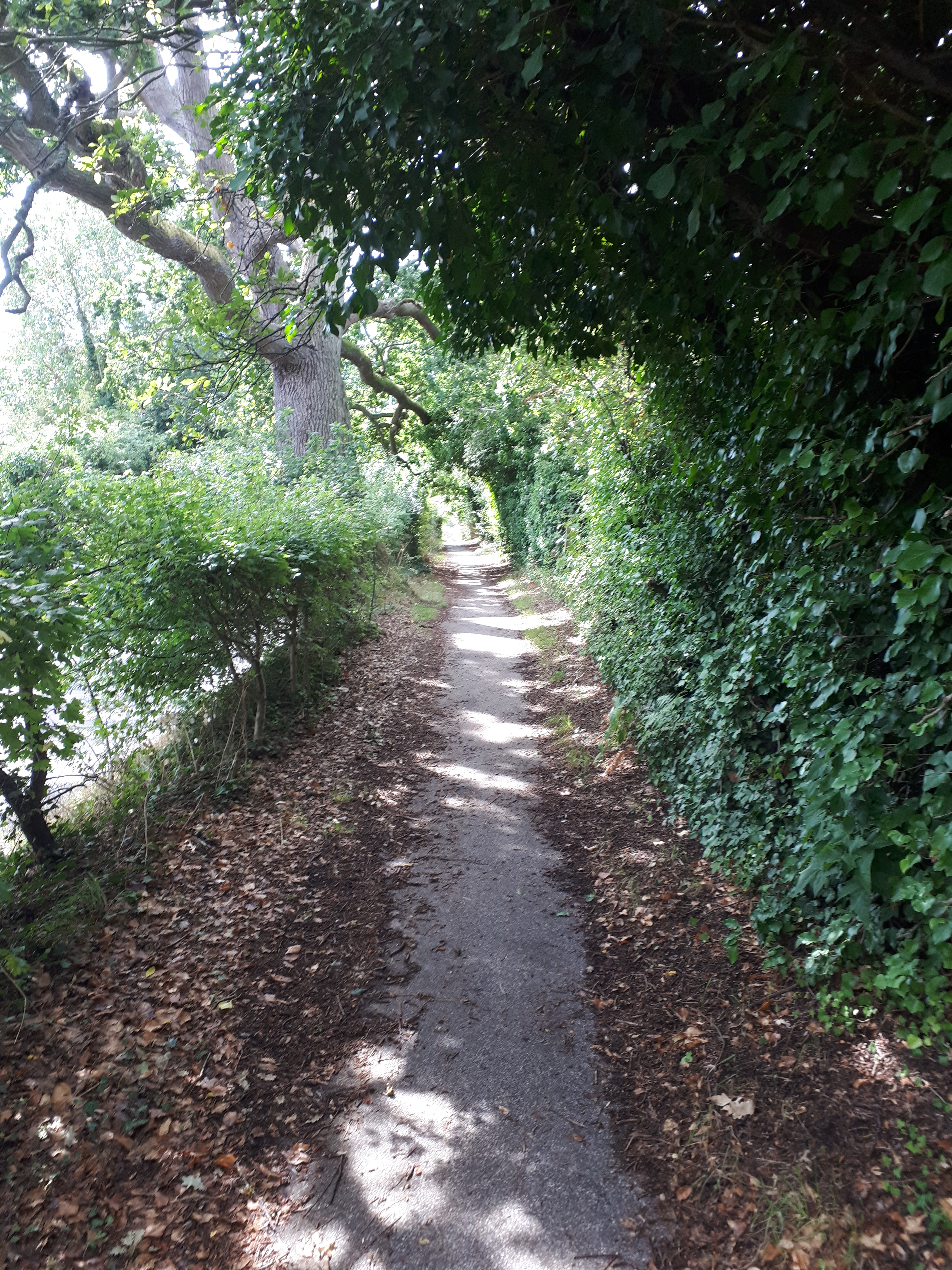
Further on, the path leaves the roadside, ascending an embankment and becoming a leafy bower

43072886655_a4cf6c222d_o

before emerging again into the full light by the Duke of York ‘country’ pub, which is really a ‘family diner’ masquerading as a pub and part of the Vintage Inns chain whose “…rustic buildings offer a country style dining experience…” .

I have been walking for almost fifteen minutes and fearful that the Woodbridge Town clubhouse might only serve insipid Greene King IPA I call in for a pint of Adnams Southwold Bitter (£3.90). At the bar a youngish man orders food. “The menu says you have those kofte things” he says. “Yes” says the bar maid. “I’ll er, have some of them, er please” says the man, showing what sophisticated diners the English have become thanks to the country style dining experience and its ilk.
Refreshed by Adnams Southwold Bitter I press on with the final short leg of my walk to the match through a modern estate of red brick houses, which all look like they are

43072882865_26c0797c46_o

trying to be nineteenth century Suffolk farmhouses; I imagine their occupants having Ploughman’s lunches for every meal. At the end of a winding road of executive homes is Woodbridge Town Football Club. I follow a man with a carrier bag of empty bottles which he tips into the recycling bin outside before proceeding through the turnstile.

I pay my entry fee (£6.00) receiving a yellow and white ticket in exchange and purchase a programme (£1.00), which annoyingly I will later lose in mysterious circumstances (did it fall from my pocket, or did I leave it in the bar?), it was a glossy publication which I rather liked. After a cursory look across the pitch, where players of both teams are limbering up, I enter the bar and a youth wearing a thick grey anorak as if he’s in in 1990’s indie band serves me with a pint of Adnams Ghostship (£3.50). I feel foolish for worrying about Greene King IPA now and my faith in football club bars is restored, for now. The barman doesn’t look old enough to serve alcohol, but he later takes the anorak off revealing tattoos suggesting he is indeed over eighteen. But maybe he serially lies about his age, has been driving since he was thirteen and had this been a century ago he would already have spent a couple of years in the trenches of northern France. I sink the Ghostship and wander outside into the sun where the crowd is gathering. There are just two stands at Notcutt’s Park, one a covered, shallow metal terrace and the other, which is directly next to it, a brick structure with half a dozen rows of bench seats; I pick a spot in the seated stand and read my programme, which I have not yet lost. After a short while I am surprised to look up and see the two teams and the officials all lined up on the pitch, shaking hands like Baptists on a Sunday morning.
The game begins with Clapton in all blue with yellow socks and sleeves kicking off in the direction of whatever lies northeast of Woodbridge; Ufford probably. Woodbridge Town wear black and white stripes with black shorts and socks, hence their nickname ‘The Woodpeckers’, not that woodpeckers wear football kits and of course not all woodpeckers are black and white; a fact highlighted by the most laudable poster above

20180811_144447_42172634410_o

the urinals in the toilet urging spectators to buy a re-usable drinks cup and become a ‘green’ woodpecker. All clubs should be doing something

OLYMPUS DIGITAL CAMERA

similar.

Woodbridge play towards the junction with the A12, Martlesham and the tower of BT’s research laboratories which is visible in the distance.

The first foul of the game, after just a few seconds, draws a shout from the crowd “That’s about time ref”. Woodbridge look much the better of the two teams in the opening minutes; perhaps they should with former Ipswich Town and Sunderland player Carlos Edwards in their team; they pass the ball whilst Clapton just run about after them. But Woodbridge don’t create any chances to score and when it looks like they might, a Clapton player always manages to be in the way. Woodbridge have the first proper shot of the game, which flies over the Clapton cross bar in the seventh minute. Woodbridge are playing well, but then again they’re not; and Clapton are struggling, but then in a way they’re not because their goalkeeper has not had a save to make. Some of the crowd amuse themselves with shouts and cat calls. “VAR. That was a penalty!” is heard as a Woodbridge player tumbles in the box, and then “Eh, absolute shite ref” as play is waved on. I decide to take a wander, and alone at the corner of the ground I get to play the ball back to the Clapton full-back Lanre Vigo when it goes out for a throw. There is a pause in the action as the somewhat portly referee Mr James Beal speaks to two complaining Woodbridge players. ”Get on with it Porky” is the shout from the crowd; you can’t beat humour at the expense of fat people. I get to touch the ball back to Lanre Vigo again, this time a header, no one congratulates me and although it does knock my glasses off I thought ’I done well’.
Considering that as someone who paid to get in I am getting too many touches of the ball and am therefore bound to embarrass myself (if the flying glasses haven’t already done so) I walk round to the dug outs on the opposite side of the pitch to the stands. Here the Clapton manager and his coach are providing a constant commentary of the game as they live every touch of the ball by their players. “Why do you put it there?” shouts the manager to his goalkeeper Jack Francis “I keep telling you mate, I don’t want it in the centre I want it here”. There are a number of players who receive constant encouragement and instruction, the names Jerome, Warren, Gio and Dylan feature prominently. Number five Dylan Ebongo is a ‘big lad’ who rivals and outstrips the referee for the space he takes up on the pitch, but as is so often the case with players that spectators accuse of having eaten all the pastry based foods, he can play a bit and Dylan is a rock in the Clapton defence.
It’s about twenty five past three and against the run of play Clapton have a corner; at the near post the ball is flicked on, the young Woodbridge goalkeeper Alfie Stronge flaps a bit and the ball meets the goal net in the lovely way that footballs do; it’s 1-0 to Clapton. “Who scored?” asks the happy and surprised Clapton manager of his neatly coiffured number seven Ryan Reed, but he doesn’t seem to know, or I at least I can’t work out what he says.
“Take heart from that” shouts the Clapton manager to his team as if none of them expects not to lose. Despite his constant imploring and helpful encouragement to his players the Clapton manager seems quite pessimistic in private moments when speaking to his coach or simply verbalising his thoughts, or perhaps he’s just realistic. “We’re our own worst enemy”, “We could be in trouble here”, “Now we’ve got trouble” are a few of his comments as the Woodpeckers press, along with his admirably honest assessment that his team has actually done nothing and Woodbridge have had all the play. Despite being a goal up however, ten minutes before half-time there is a falling out between the manager and his number ten Jerome Mortell. Jerome is threatened with being substituted, but his response is simply “Go on then” and within a minute he is stomping his way round to the dressing room, leaving the pitch with the words “I’ve had enough of this shit”. Clapton had only Jacod Dingli on the bench today, and now he’s on the pitch, but at least they’re still winning and very soon they are almost two-nil up as another corner against the run of play sees a header thud against the woodwork of the Woodbridge goal.

This slideshow requires JavaScript.

OLYMPUS DIGITAL CAMERA

Across the pitch a tall man, immaculately dressed in a dark suit stands out amongst the general scruffiness of the usual football crowd, I believe this is Vince McBean the current owner of Clapton FC and a controversial figure after he allegedly attempted to liquidate the charity that administers Clapton’s Old Spotted Dog ground. From where I stand he looks like an undertaker.

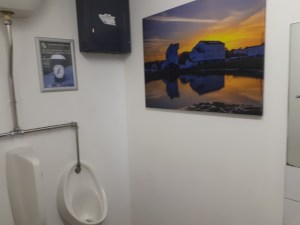
Half-time and I’m one of the first at the bar for another pint of Ghostship (still £3.50) which I follow up with a visit to the toilet where I admire the juxtaposition of a large print of a sunset over the Woodbridge’s tide mill with the urinals; it makes me think of Marcel Duchamp’s ‘Fountain’.

20180811_144443_42172634020_o

But there is little time to consider twentieth century art, the players are on the pitch and Woodbridge line-up as Clapton huddle. I return to stand between the dugouts where the entertainment is richest, although I do take a moment to enjoy the Co-op’s side by side, edge of pitch advertisements, one solemnly telling us how their funeral service is “Supporting loved ones locally when it matters” (and presumably telling non-local loved ones to clear off) and the other in a lighter frame of mind urging us to ‘Pop to the Co-op’.

OLYMPUS DIGITAL CAMERA
The second half begins and before not very long Ryan Reed intercepts a poor pass and breaks forward, he rides a tackle and is through on goal, he shoots, Alfie Stronge saves but the ball rebounds to Ryan who strikes it confidently and with force inside the far post from a tight angle. It’s 2-0 to Clapton.
The Clapton manager stresses the importance to his players, particularly to big Dylan at the centre of the defence, of holding onto the 2-0 lead in the next ten minutes, which he says will break Woodbridge’s hearts if they can do it. They do and the game seems to settle down with Woodbridge still dominating possession, but mostly over-hitting all their forward passes and crosses. Substitutions are made by Woodbridge and approaching the last fifteen minutes it looks like Clapton will hold on. The Woodbridge manager who incidentally is probably bigger than both the referee and Clapton’s Dylan seems calm, despite his frequent frustration at those over hit passes; is he resigned to a defeat?
Woodbridge for all their inadequacy in terms of shots, are still dominating however, and the ball is spending most of its time on the Clapton half of the field. A Clapton player is nearly always the last man to touch the ball inside their own penalty area, but then just after twenty five to five the ball runs loose and Woodbridge’s number seven Callum Sinclair lashes it on the half volley in to the top corner of the Clapton goal to halve Clapton’s lead and give Woodbridge hope.
I came to this game as a neutral but the enthusiasm of the Clapton manager and coach and the fact that they turned up with just one substitute and seemingly a team that must be coached through every kick has me wanting them to hang on for the win. There is also a bit of me that wants rough, deprived, inner city Clapton to triumph over wealthy, privileged Woodbridge, although of course I know in reality that those distinctions don’t actually have any relevance in the context of these two football clubs.
Woodbridge earn a corner, it’s late in the game and goalkeeper Alfie Stronge comes up to add his presence and he heads narrowly over the Clapton cross bar. The Clapton manager berates his players for trying to pass the ball when clearly a hoof is required. That has been a recurring theme, but I find it reassuring that players want to play the game ‘beautifully’, because that’s what makes it so good to watch, and play, whether it comes off or not. The game is into time added-on and a half-hearted challenge, which causes a slight stumble but no trip, sees Mr Neal award a free-kick just outside the penalty area, in range for a well taken direct shot. The Clapton coach is apoplectic and winds himself up by imagining that it’s as if the referee wants Woodbridge to equalise; the manager is not happy about it but is more sanguine, realising preumably that whatever will be, will be on the way to Wemb-er-ley. Woodbridge’s number five Liam Scopes steps up to scoop a shot over the wall and into the top left hand corner of the Clapton goal. Woodbridge have tied the match and the Clapton coach is sent off by Mr Neal for simply getting carried away with himself.
There is no time for anything more to happen and I am only sorry that with the time now almost five o’clock I must leave and hot foot it back to the railway station to catch the 17:18 back to Ipswich. It’s been a lovely afternoon in the August sun and a thoroughly entertaining game, which has been a credit to both clubs. I am tempted to try and make it to the replay. I’ve had a great time, but in about twenty-five minutes I will realise I no longer have my programme.

AS Fabregues 0 Canet Rousillon 2

Fabregues is a very attractive small town about 10 kilometres southwest of Montpellier in the Hérault department of southern France. The town has a population of fewer than 7,000 but has a history dating back a thousand years, the centre being set out in a pattern of concentric circles around the church or chateau, a form of early medieval urban development known as a circulade. The town’s history probably goes back further to the Gallo-Roman era as the name Fabregues being derived from a Latin word meaning forges.
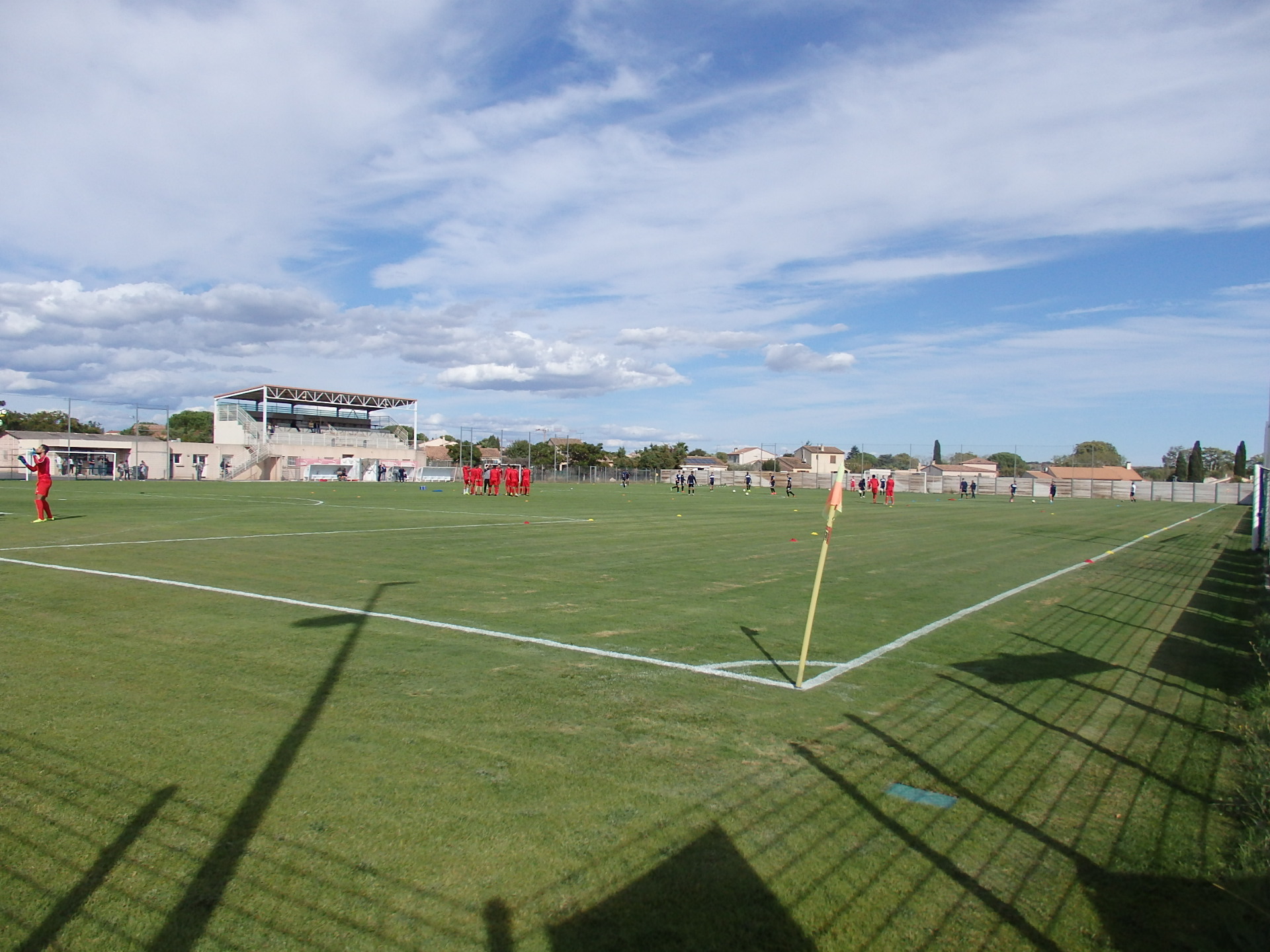
The Stade Joseph Jeanton is a part of a sports complex dating from 1993 that sits on the other side of the River Coulazu from the medieval town of Fabregues and it is here that my wife and I arrive today with a half an hour to spare before the kick-off of the match between Fabregues and Canet Roussillon in National Ligue 3, the fifth tier of French football, which is amateur, although the professional teams play reserve or ‘B’ teams in it. We park up in the neatly laid out car park which is landscaped with trees and shrubs and then walk through a metal gate to a wooden hut where we pay the 5 euros each admission fee. The Stade Joseph Jeanton is much like most other small town football grounds in France; a pitch surrounded by a high metal fence and a single stand affording a decent view of the pitch.

OLYMPUS DIGITAL CAMERA
The teams and referees are warming up as we walk behind one goal and round towards

the stand and buvette. I am impressed that one of the goalkeeping coaches is a woman and can’t imagine that many if any men’s teams in England have a female coach. The FA and English football in general really needs to get with the programme. We stop to ask three men in their sixties or seventies which team is which. One of them speaks a little English which he is keen to practice and he seems impressed that we have come to see Fabregues, which he describes as a good little club. At the buvette I buy a bottle of water (1 euro) and pick up a copy of the club’s directory. It is mostly adverts for local businesses, but contains details of every team in the club from the under 6 and 7’s up to the seniors. There is a statement from the president setting out the aims of the club and the overall impression is of the club being an important and well-run focus for the local community.
It is a warm afternoon and a strong breeze stretches white clouds out across the blue sky. We climb up into the stand and look out over the pitch towards the pink roof tops of 36538176213_715c21d13e_ocirculade and the old town. This is a pleasant spot to spend the afternoon it seems. Below us the referee (Monsieur Gauthier Lapalu) and his assistants (Monsieurs Jeremy Noiret and Maximilien Demoustier) are warming up, the referee looks very young, very neat and very enthusiastic, too enthusiastic and a little officious perhaps. He seems to want to organise his assistants overly and they don’t look that impressed.
Kick-off is scheduled for 3 pm but the teams aren’t on the pitch yet, although we can see them waiting at the mouth of the players’ tunnel, everyone seems to be waiting for the referee. Eventually, after the usual introductions, Canet Rousillon, from the town of Canet some 35 to 40 kilometres to the west, kick off in their white shirts with black shorts and socks; Fabregues wear all red. The first foul is committed after about five minutes and Monsieur Lapalu quickly airs his yellow card and then takes time to explain his decision to the Fabregues bench who are perhaps miffed, and understandably so because it wasn’t much of a foul. Five minutes later a Canet player is booked, but justifiably this time. It takes another fifteen minutes for Monsieur to get his hat-trick of cards.
This is a poor game. It may be because the afternoon is still warm, but the players aren’t running about much. One or two like to run with the ball, particularly the Fabregues number eleven, who is quite good at it, but there is not much running off the ball so there is seldom anyone to pass to near the opposition penalty area and therefore there are no shots on goal to speak of, except for optimistic long range ones. In addition, the players of both teams like to fall over and scream as if fatally wounded and Monsieur Lapalu is proving to be quite fussy and precise; he runs like Forrest Gump and his shorts fit too snugly, like his mum has cut down a pair of trousers from a dark suit.
Fabregues make a first-half substitution and the substitute adjusts his hair carefully before coming on, appearing to arrange his top-notch like the leaves on top of a carrot. But the substitute claims the distinction of being the first player to have a shot worthy of the name, in first half injury time.
With half-time we leave the stand to get out of the sun and the breeze, and to get away from the body spray of the young man next to me, which smells like pine disinfectant. This stadium has advertisement hoardings and they remind me of those at Eastern Counties League grounds. There is one for a Pompe Funèbre (undertaker) and one for Auto Ecole Thierry (Terry’s Driving School) as well as one for Pub Resto O’Papa Chico, which sounds like an Irish, Mexican pub. The local butcher, Bouchère des Beaux-Arts sounds a step up from an English pub meat raffle, but in a country that takes food seriously, such a name is probably not pretentious.
For the second half of the match we stand, peering through the fence from the opposite side of the ground to the main stand, where we are shielded from the wind by a hedge.

The second half starts well as the first discernible passing move of the game in an opponent’s half results in the Fabregues goalkeeper diving at the feet of the Canet number seven, to make a decent save. Just a minute later Canet’s number eight collapses to the turf inside the Fabregues penalty area and a penalty kick is awarded by Monsieur Lapalu. It seems a trifle harsh, but Monsieur Lapalu takes so long ensuring that no ones’ toes are in the penalty area that the number eight has far too long to think about his kick and when he eventually takes it, it provides a relatively easy save for the Fabregues ‘keeper, who dives to his right and smothers the ball completely to keep the scores level.
The game now enters a ridiculous stage where players fall like nine pins every few seconds; any physical contact apparently leads to mortal injury. The best moment is when three players come together and all three end up lying on the ground pleading for attention. If the Keystone Cops had played football it would have looked like this. It is at once both amusing and pathetic. The game is stopped and miraculously all three players recover to carry on. A banger goes off in the bushes close to where we are stood; everyone ignores it although some teenage girls trying their best to look innocent look like they might know who was responsible.
With an hour gone Canet somewhat surprisingly take the lead. The ball lands at the feet of their number ten; he shoots and the ball is saved, but the rebound bounces off him and into the net, although he may have adjusted his feet quickly enough to ensure the direction of the rebound was goal-wards rather than anywhere else. A good number of Canet supporters in the main stand celebrate. A second banger goes off in the bushes close to where we are stood and there is a delay as Monsieur Lapalu checks with his assistant that all is okay; he indicates that his ears are ringing a bit but otherwise he is fine. Monsieur Lapalu then checks with the Délègue Principal monsieur Jean Pierre Jullian, but carries on with the re-start. Fabregues are stung into action and are unlucky to have a goal disallowed five minutes later for offside when the ball was possibly heading into the net without the extra touch from the offside player. I detect the scent of cannabis on the breeze, but can understand why people watching this game may seek solace in illicit drugs.
There is about a quarter of an hour left and Canet’s number nine lofts the ball onto the roof of the goal net as his team hit Fabregues on the break. Two minutes later Fabregues’ number five stretches out a leg to win the ball, he does so, but he then catches his opponent too and Monsieur Lapalu deems this a foul and cautions number five for a second time this afternoon resulting in his sending off. To his credit number five does not complain, although having won the ball he probably had cause to. Monsieur Lapalu goes on to also caution Fabregues’ number three as he organises the human wall to defend the resulting free-kick.
Fabregues continue to search in vain for an equaliser and they seem more capable and energetic now that the sun is lower in the sky, casting a long shadow over the pitch from the adjacent sports hall. But with four minutes of normal time remaining Canet hit them on the break again as their number 10 feeds the ball beyond the Fabregues full-back for the moustachioed number two to run on to. The Clark Gable look-alike rounds the goalkeeper and scores. Canet celebrate wildly whilst Fabregues cannot believe they have conceded a goal to a bloke with a moustache.
The result is assured now and Canet almost claim an undeserved third goal as number nine strikes the ball against the cross bar. Monsieur Lapalu even seems to have lost interest a little and has seemingly relaxed his grip on the proceedings. Only two minutes added time are played, which is a relief for everyone. Canet and their supporters celebrate noisily again as the final whistle blows.
This has been a poor game, perhaps the worst I have ever seen in France. It is a shame because the Fabregues club appears to be such a well-run, ideal community based club; but I guess all teams have off days. I hope this was one of those days for both teams, because even though Canet won, they were terrible too. Monsieur Lapalu should also learn from this game too and we will look out for this name in Ligue 1 in may be ten years’ time.

This slideshow requires JavaScript.