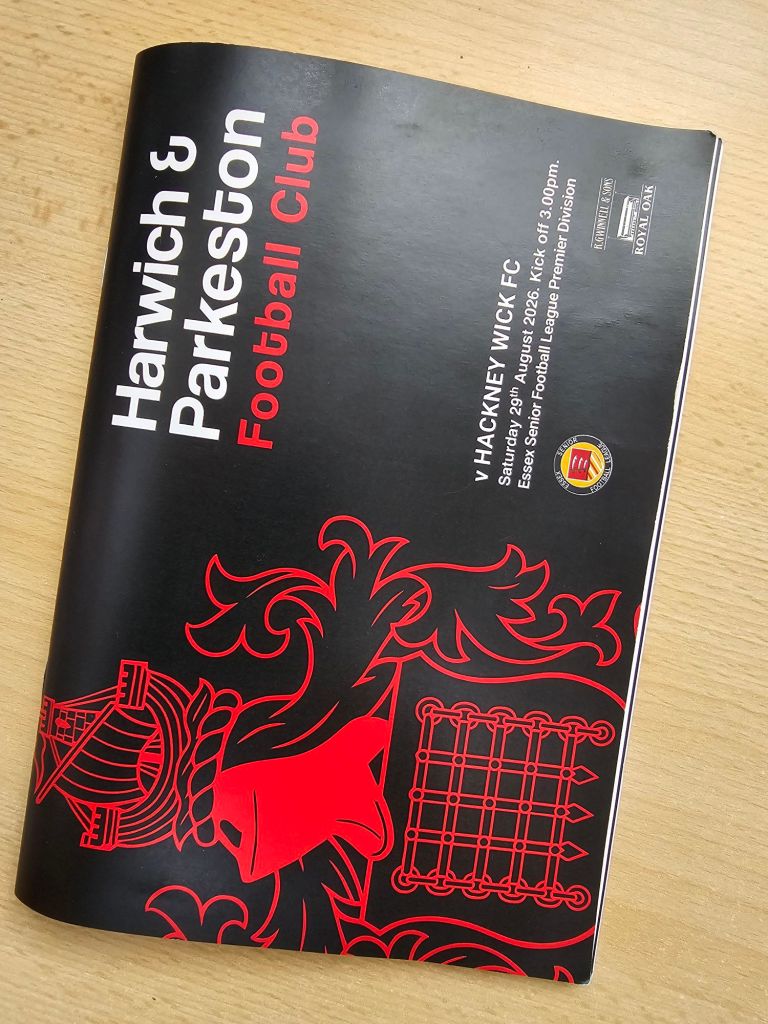
Harwich & Parkeston 1 Hackney Wick 1

Having grown up in Shotley, in the extreme bottom right-hand corner of Suffolk, Harwich & Parkeston, in the extreme top right-hand corner of Essex had always been somewhere not very far from the top of the sludge in my mind.  All I had to do was look out of my bedroom window over the roofs of the Council bungalows behind our house, and along with Dovercourt, there they were across the River Stour estuary.  At night-time, the lights in the docks twinkled in the distance and at midnight on New Year’s Eve we would nip outside to hear the ship’s hooters and sirens sounding.   My maternal grandfather, who more or less lived in Shotley all his life would tell people who upset him to “Go to Harwich”, which was either an oblique way of telling them to go and jump in the river, or a polite way of saying “Go to Hell”, probably both.

My maternal grandmother meanwhile, was born in Hackney Wick and lived there as a child.  It is with these loose family connections in mind that I choose today to eschew the probable delights of football fixtures a little closer to home such as Halstead Town versus Sporting Bengal United, Cornard United versus Ely City, Coggeshall Town versus London Fennecs and Brantham Athletic versus Thetford Town to watch Harwich & Parkeston versus Hackney Wick in the Essex Senior League.

It is a wet, windy, miserable afternoon as I step out of my front door to walk to the railway station, and I half wish I hadn’t already bought my rail ticket (£10.70 with Senior Person’s Railcard).  It’s a fifty-minute journey to Dovercourt with the final eighteen minutes of the journey being from Manningtree to Dovercourt along what is now called the Mayflower Line.  The Mayflower Line is sadly not known as such because the Pilgrim Fathers at some time caught the train to Harwich before making their somewhat fateful but nevertheless well-intentioned journey, which has years later indirectly resulted in Donald Trump, but because Harwich was The Mayflower’s home port and was where it was built.   If, in our ever more likely looking dystopian future Americans were to buy the Mayflower Line, I imagine we could look forward to hearing Chattanooga Choo Choo played as we pull out of Manningtree station.

From Manningtree station, the train pulls gently uphill away from the River Stour to run along its south bank through Mistley and Wrabness, with murky views through the raindrop coated train windows of the River Stour at high tide, the southern shore of the Shotley Peninsula and the tower of the Royal Hospital School at Holbrook, where incidentally my father was an unhappy pupil back in the 1930’s.  Harwich International Station is just yards from the dockside and here it is possible to catch a glimpse of the red hull of the RRS David Attenborough, or to the 124,109 members of the Great British public who voted to name it so, Boaty McBoatface.

Arriving in Dovercourt, it is thankfully no longer raining, and it is just a ten-minute walk up Kingsway, along High Street and Main Road past what was Woolworth’s and what still is the Royal Oak pub to the Royal Oak Ground, home of Harwich & Parkeston football club.  When I last came here almost exactly eight years ago (Harwich & Parkeston v Benfleet) , I entered the ground through the turnstile down the side of the ground in the shadow of the main stand. Today however, the turnstile is shut, and although the external metal door is hanging off slightly, I wouldn’t be able to squeeze through even if I wanted to.  I return to the main road and am directed through to the far end of the clubhouse, which in the tradition of scout huts and community halls everywhere smells a bit of damp. 

At the far end of the musty clubhouse two men stand at a table with a carboard box.  The one on the left looks at me enquiringly and I ask for “One for an old git, and a programme please”.  I am very pleased to see that Harwich still bother to print a proper hold in your hand and stuff in your pocket programme rather than rely on some digital, virtual creation which only exists in the ether.

Having paid up my seven quid using cash, I am mugged at the door by an elderly man at least in his seventies, who relieves me of a further pound in exchange for a strip of draw tickets.  Folding the tickets away in my pocket, I head for the tea bar where I buy a paper cup of tea and am served by a surly woman who seems to think I should know the price.  “One-fifty? A pound?” I ask her as I reach for my remaining change. “Two pounds” she barks aggressively “Unless they haven’t told me.” she adds, supplementing her aggressive with some passive.  “Well, it’s the first time I’ve been here in eight years” I tell her, “So I don’t know”.   As I walk away with my tea, I see that above the word tea on the blackboard menu outside it says “£1.50”.  “I’d better rub this out then” I say, so I do.   Wiping my chalky finger on my trousers I consume my tea and then find a seat up in the main stand.
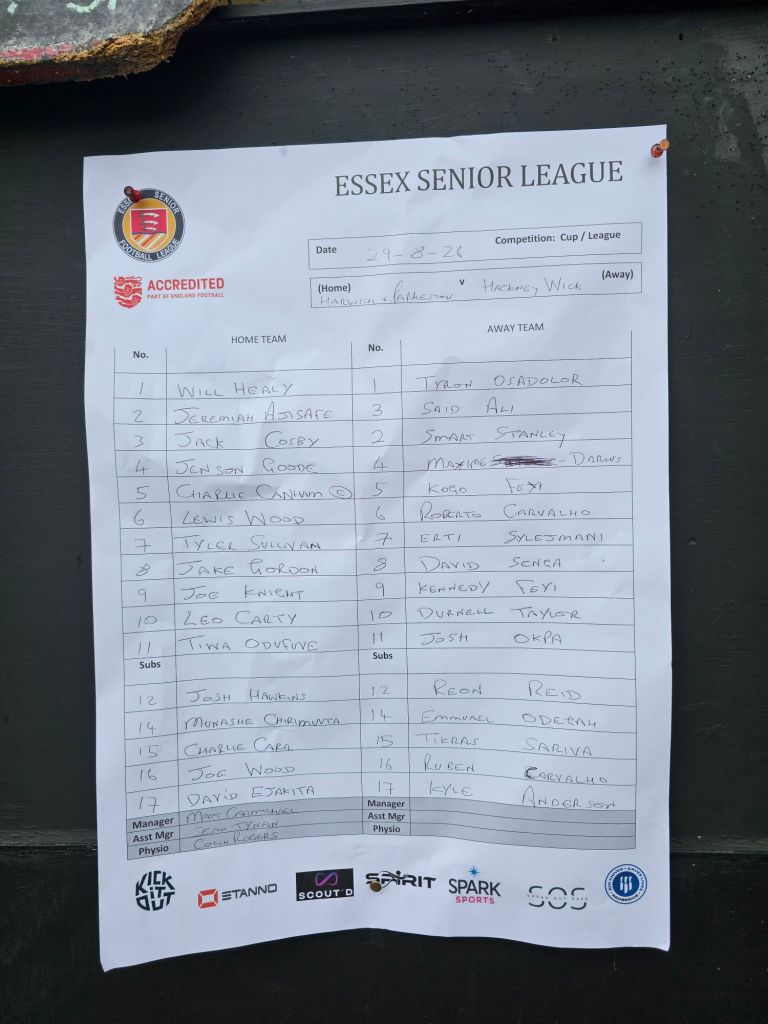
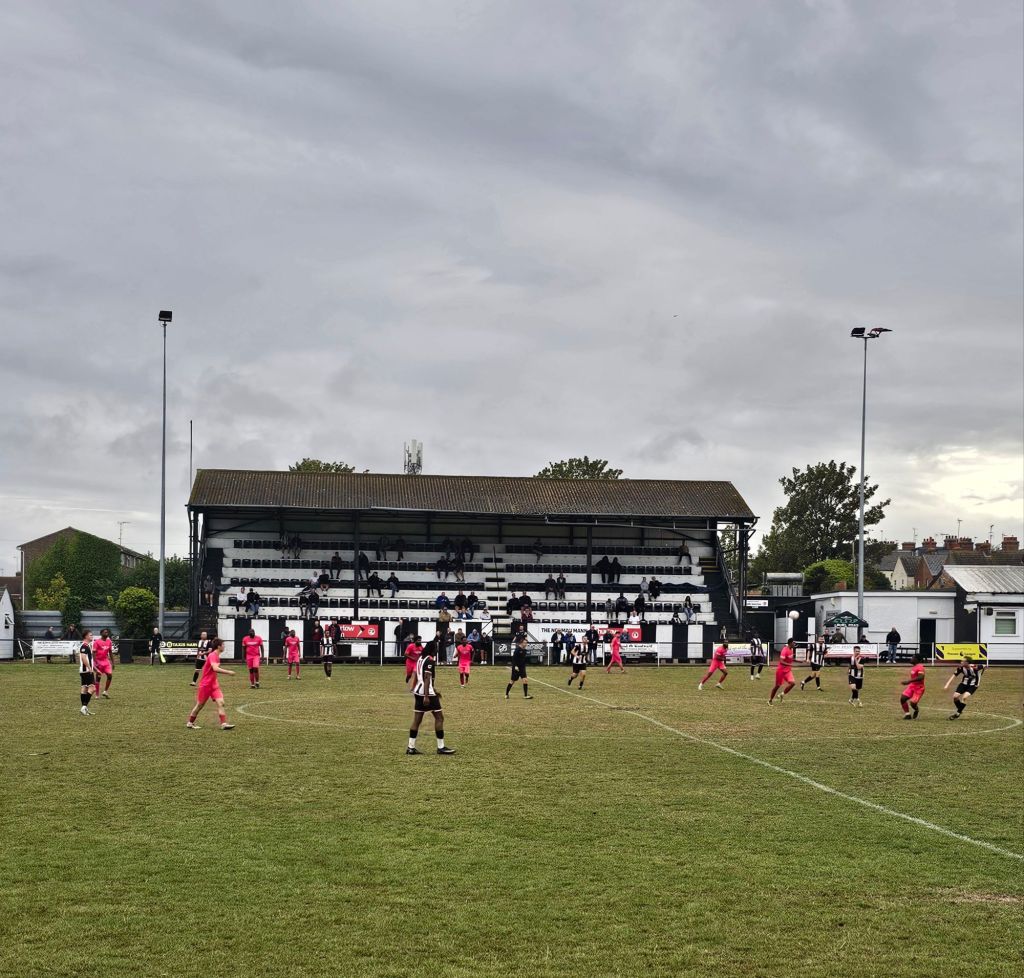
When the game begins, it is Harwich & Parkeston or ‘The Shrimpers’ as they are known colloquially that get first go with the ball, launching it towards the Royal Oak’s other covered stand more or less in the direction of Boaty McBoatface, the River Stour and Shotley beyond. Harwich & Parkeston look smart in their traditional black and white striped shirts and black shorts echoing the kits of their bigger east coast brothers Grimsby Town and Newcastle United.  Hackney Wick sport an all-cerise kit with yellow and green collars and cuffs and yellow numbers, which set off the dominant deep pink rather well. If it wasn’t for the yellow trim, and the heads and limbs, they’d look a bit like raspberry Mivvi ice lollies.  “Keep going Harwich” shouts somebody either from on the pitch or in the crowd, I’m not sure which, but the game has barely started.  I can’t decide if such a shout so early on is hyper-supportive or a bit pessimistic.  Either way, within a few moments Shrimpers’ number eight Jenson Goode lobs a shot over the Hackney Wick goalkeeper, but also wide of the goal.

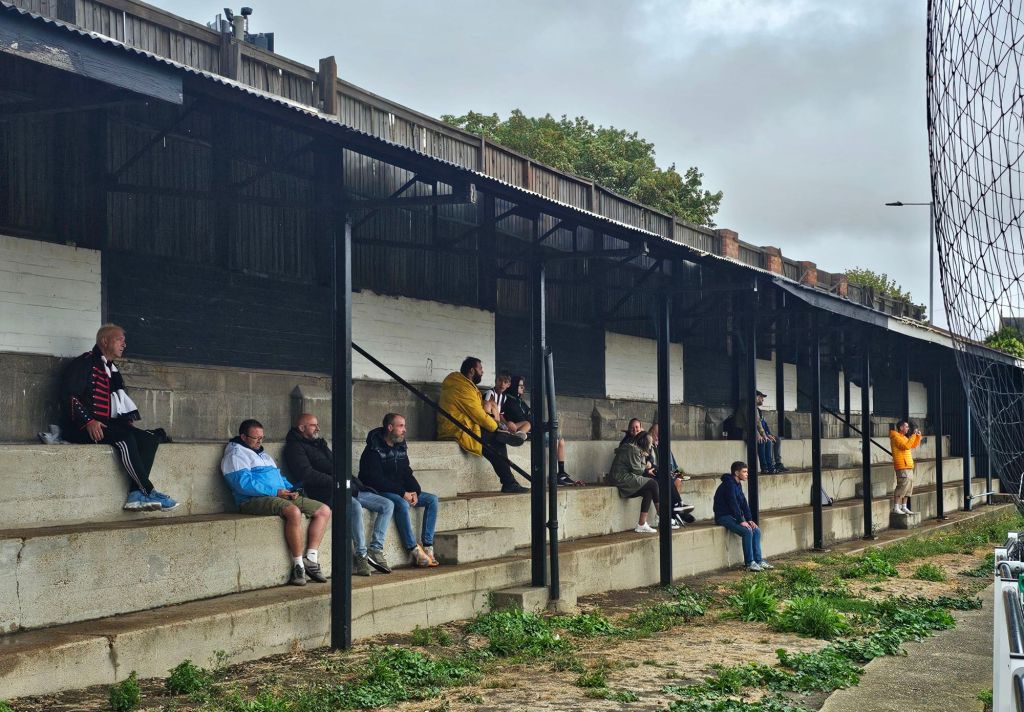
From my seat, up in the vertiginous main stand, I can see dock cranes beyond the battered black and white corrugated tin roof of the one other stand, which backs on to Main Road.  Back on the pitch, both teams are looking to attack one another down the flanks.  The Hackney Wick ‘keeper Tyron Osadolor misses the ball completely as a Shrimpers cross from the left flies across the face of his goal. “Goalie, you’re rubbish” shouts a voice in the crowd, a little prematurely it will turn out. It’s nine minutes past three and The Shrimpers win the game’s first corner, but it comes to nothing and the match settles down to being a bit messy, perhaps in part because of the bumpy, slippery pitch and blustery wind.

I turn my collar up against the breeze, which is coming over the hill to my right and off the North Sea beyond.  It’s not cold but it’s unpleasantly drafty. Beneath me, the yellow pitch almost looks as if it’s coming back to life whilst we watch as it drinks up the rain that has fallen.  The Shrimpers number ten shoots on goal but the Hackney Wick goalkeeper makes a decent diving save at the expense of a corner.  Eighteen minutes have passed and it’s almost as if the sun is trying to shine, but not quite. “Ball forward, ball forward” shouts a wanna-be coach from the stand as Hackney Wick pass the ball amongst themselves in the centre circle.

Twenty-five minutes have gone and as Shrimpers’ number three Jack Cosby receives treatment in the centre circle, there is an ad hoc drinks break, and I decide the breeze up here in the stand is more than I can bear so I make for the other covered stand behind the goal.  Two minutes later and the Shrimpers take the lead as their number nine Joe Knight runs towards goal and takes a shot from outside the penalty box, which strikes a defender and is deflected over the out-stretched goalkeeper. Knight performs a knee-slide by way of celebration and a jolly, well-fed looking woman in the crowd rings a hand bell.

The last worthwhile action of the half sees Hackney Wick’s number ten Durnall Taylor go through on goal and confidently lift the ball over the on-rushing goalkeeper only for the ball to go well wide of the goal. Taylor looks absolutely incredulous, as if the goal had somehow moved between his kicking the ball and looking up to see it not go in the goal.  The jolly woman with the bell is laughing like a drain and an elderly man wanders around the ground with a small blackboard displaying the winning draw numbers, none of which are sadly replicated by the tickets in my pocket.

Too scared to encounter the woman in the tea hut again, I forego a half-time cuppa and spend a few minutes on the phone to my wife, catching up on the latest at home. It seems we’ve lost power to the garage, kitchen and the fountain in the garden pond, but she’s rigged up an extension-lead to keep the freezer going. Good job I’m here really.

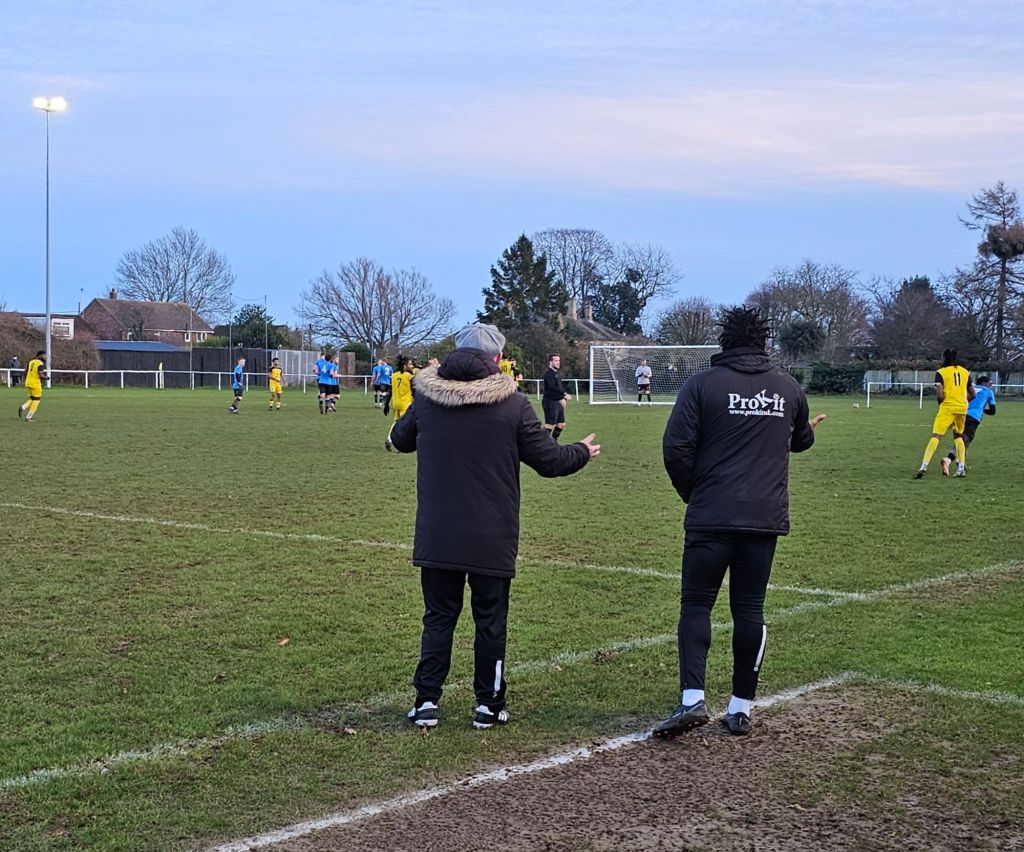
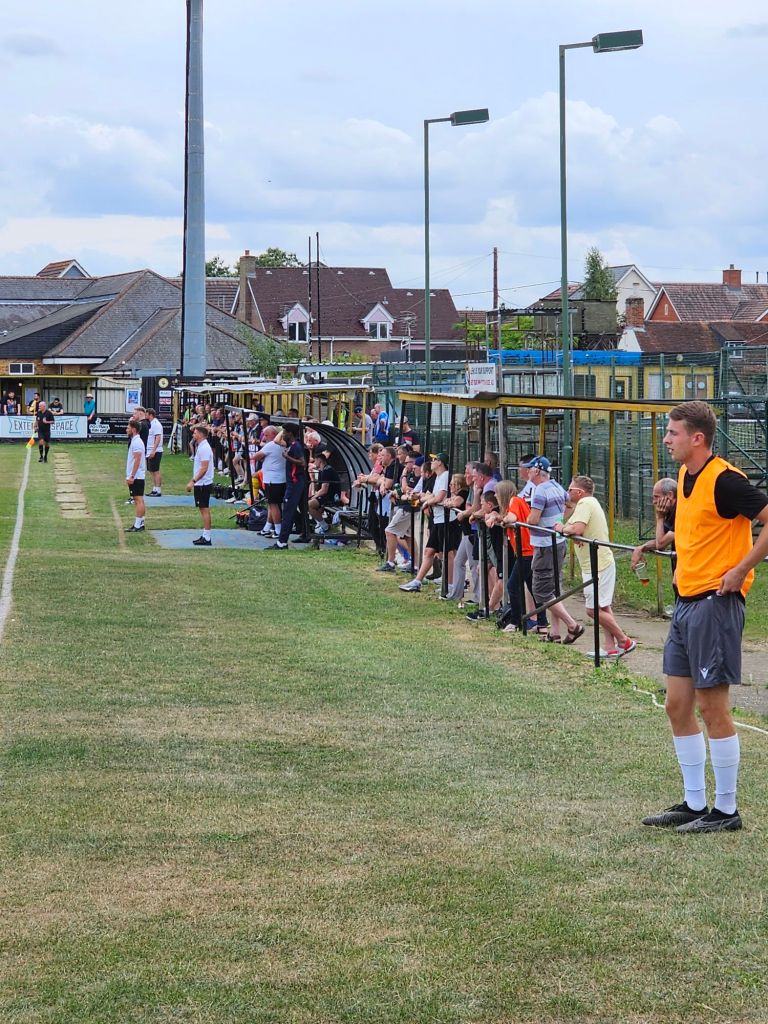
The football resumes at five past four and from somewhere unknown three Hackney Wick fans have taken up residence in the stand behind the goal and are chanting “Hackney Wick, Na Na Na, Hackney Wick, Na Na Na” repeatedly.   I’m now stood by the Hackney Wick dug out from where one of two coaches, a serious, slightly unhappy looking man bawls “Keep that pressure” and indeed his team do, pinning back the Shrimpers from the start, with their number eleven Josh Okpa in particular very busy down the right flank. “The Wick’n, The Wick’n” (I think, but possibly The Wicker?) continue the either newly arrived or miraculously cured of shyness Hackney Wick supporters, one of whom wears a bucket hat and one a bright yellow anorak.  The Hackney Wick coach is becoming a bit more effusive too. “Keep that fuckin’ pressure” he bawls, adding seemingly unnecessary coarseness to his advice. 

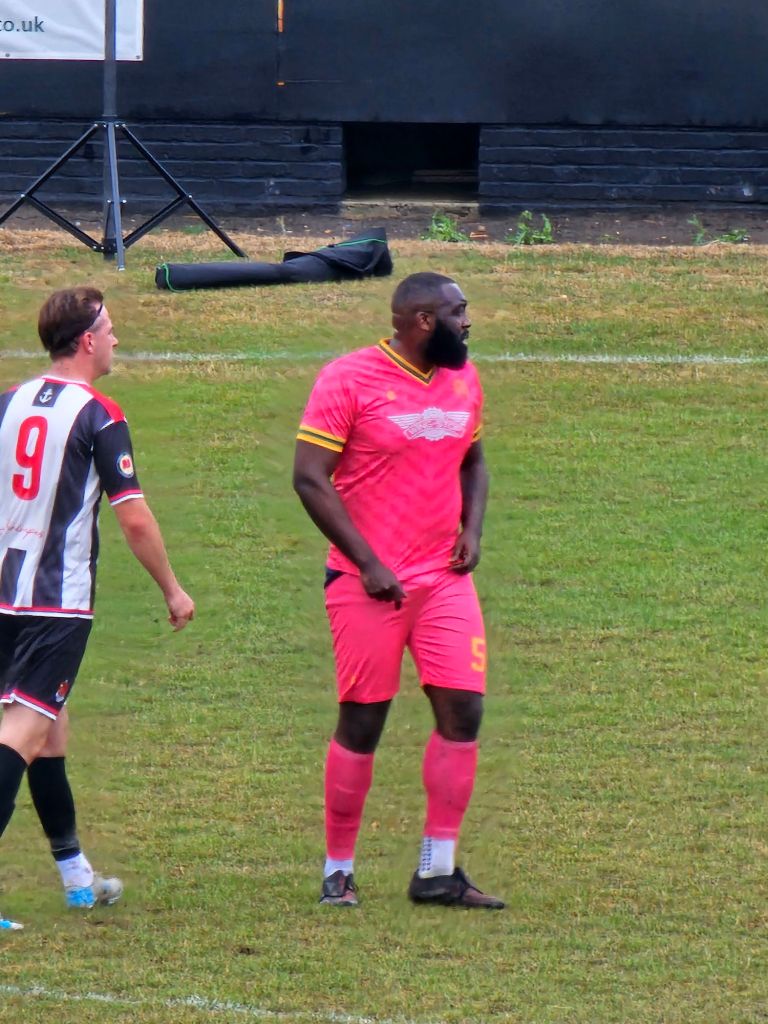
It has just gone a quarter past four and Shrimpers’ number eight Jake Gordon surges forward, only to overreach himself and slide through the legs of Hackney Wick’s massive number five and captain Kogo Feyi, who drops to the ground like a felled tree.  After the usual mass complaining and sweary advice to the referee that invariably accompanies these incidents, Gordon becomes the recipient of the afternoon’s first yellow card, to which strangely he gives the thumbs up. Five minutes later and Hackney Wick equalise as the ball is slipped through the square Shrimpers defence for number fourteen Emmuael Odegah to run after and roll past the exposed goalkeeper Will Healy. “We are The Wick, We are The Wick” chant the Hackney Wick Three in celebration.
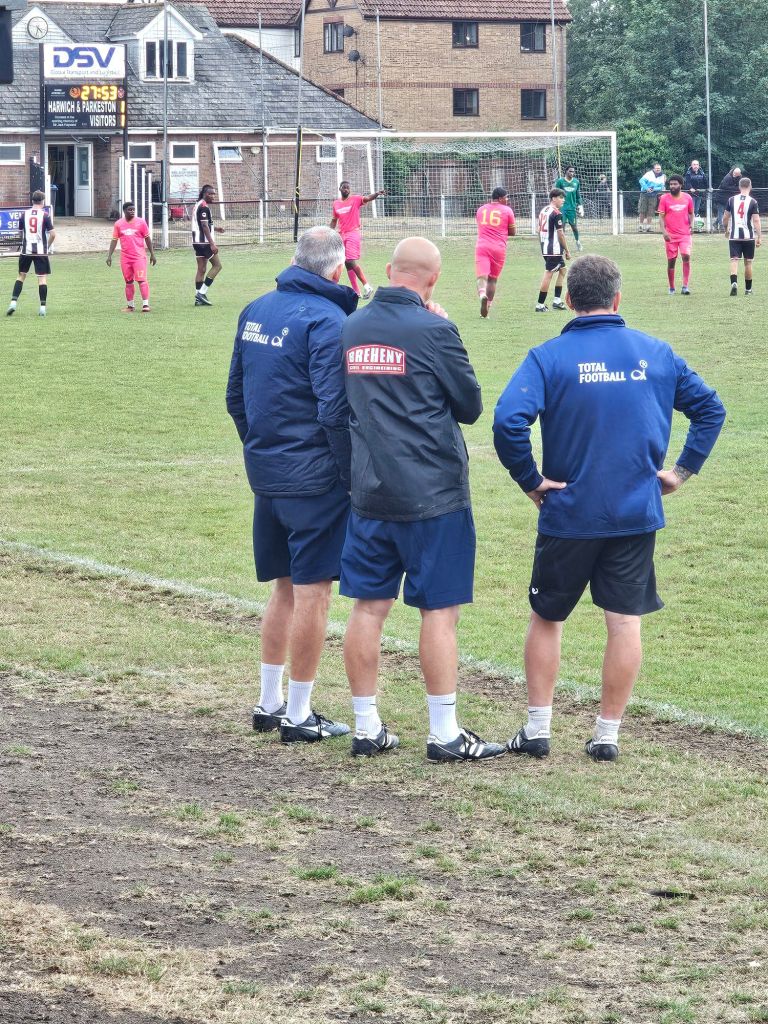
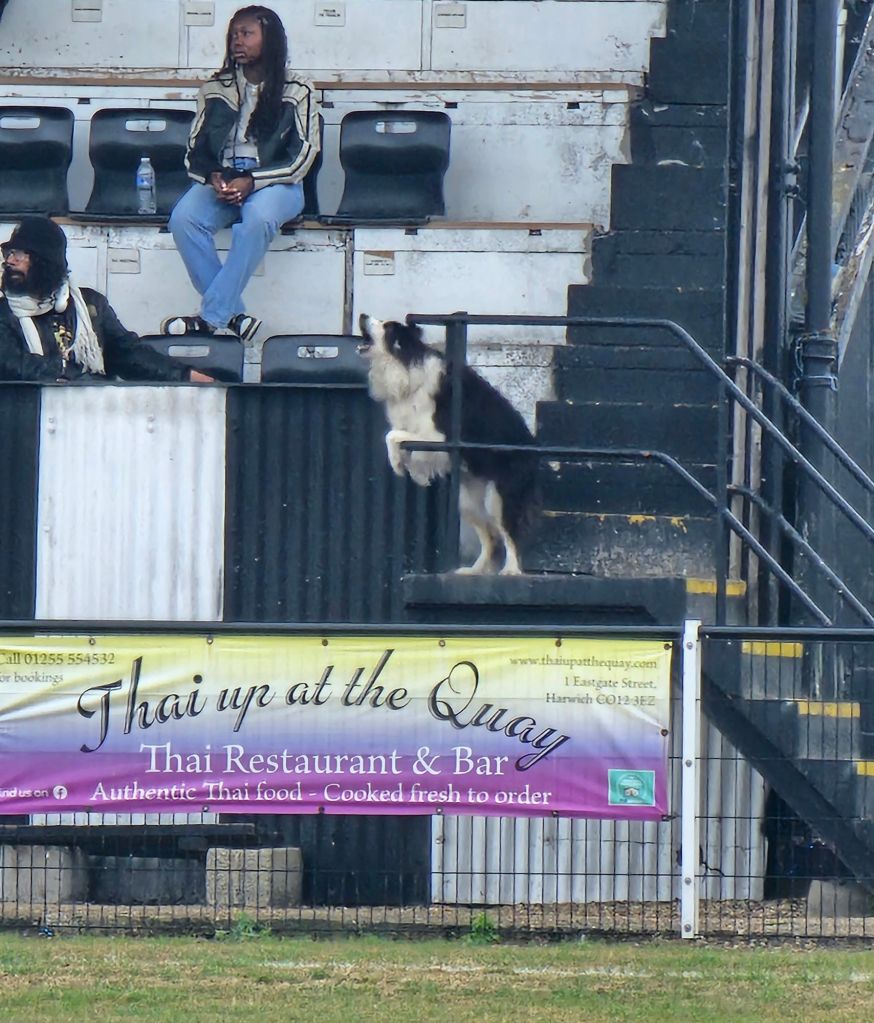
Another five minutes pass and both teams now make substitutions like they’re about to go out of fashion. Hackney Wick continue to press with the creative Josh Okpa revealing his frustration and possible artistic temperament as increasingly nothing his team does quite comes off.  The Shrimpers are the more stoic of the two teams.  “Gotta dig in” is their advice from the touchline. With the second half, half over, there is once again a hint of rain on the air, and the three Harwich & Parkeston coaches huddle conspiratorially to plan the ‘final push’.  There is mounting tension as both triumph and disaster remain possible outcomes for either team.  From the main stand a black and white dog (presumably a Shrimpers supporter) follows the action intently and every now and then barks his support or advice, I’m unsure which; he might even be swearing.
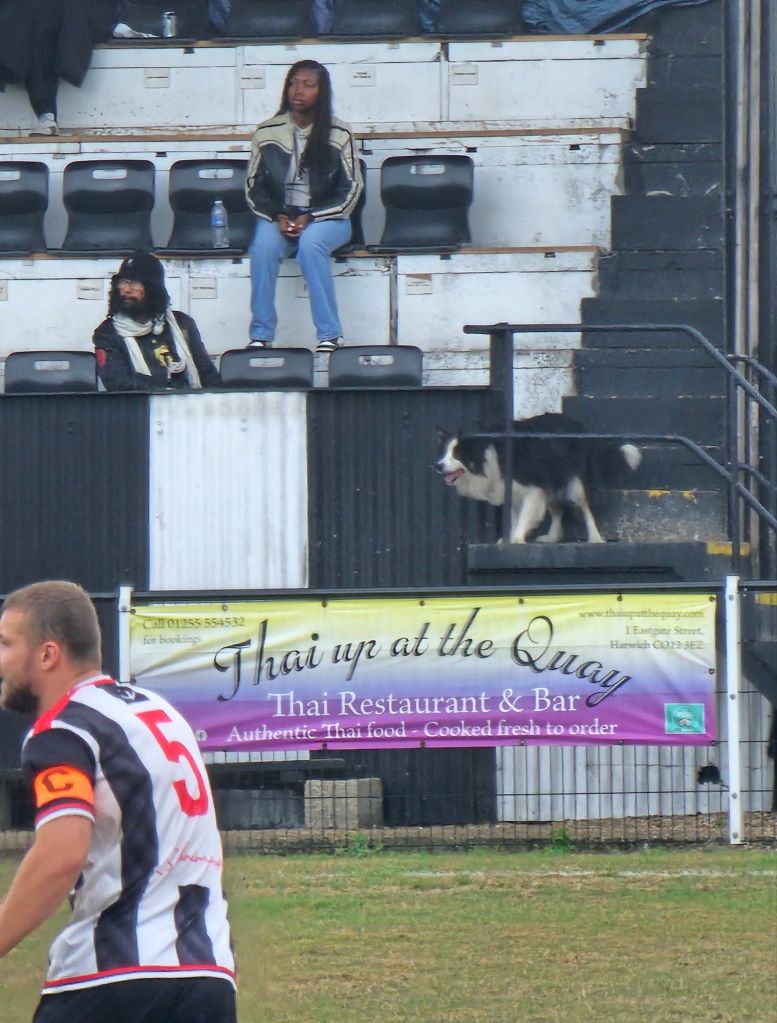
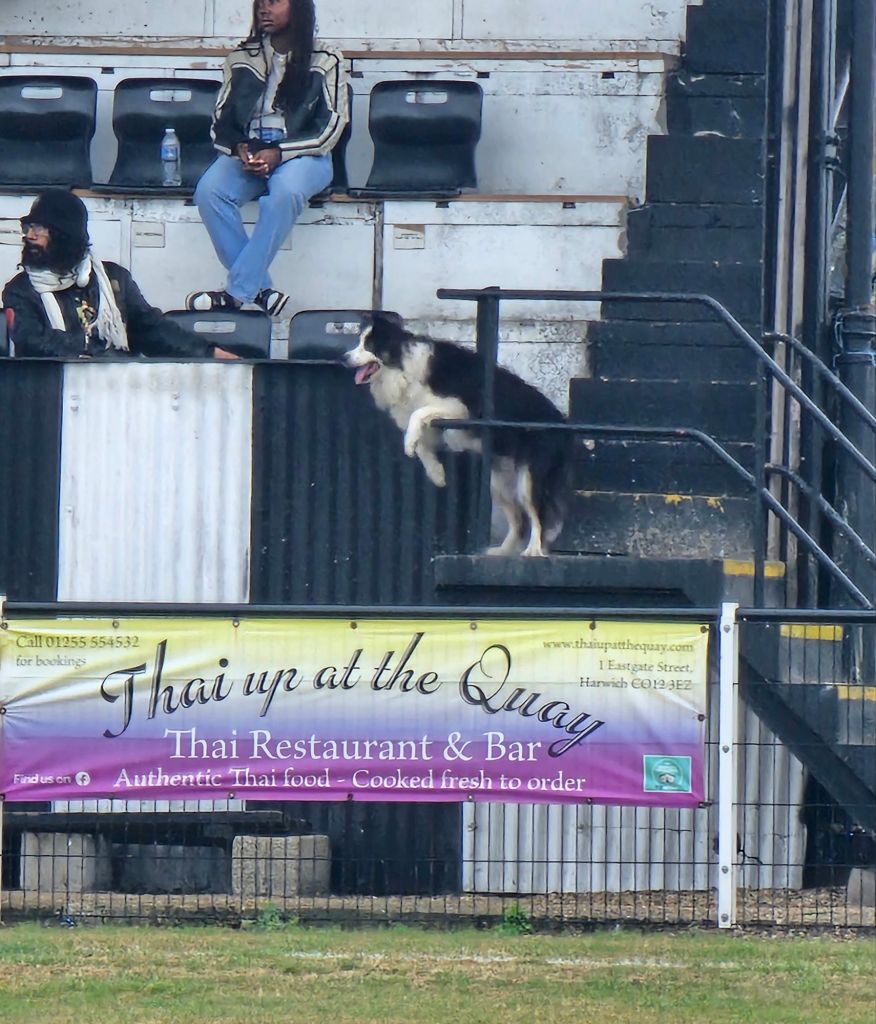
It’s nearly twenty to five. “Wicker Army, Oh, oh, oh” chant the Hackney Wick three, who just won’t shut up.  The Shrimpers win a corner; the ball sails over the penalty area but is crossed back in and number six Lewis Wood heads it firmly goalwards only for Wicker goalkeeper Tyron Osadolor to fly across the goal and spectacularly grasp it in mid-flight. It’s a save which reminds me of one I think I saw Ipswich Town’s David Best make against Real Madrid back in September 1973.

The end of the game is nigh.  One of the linesmen has to remind the referee to give a drop ball after he stops the game as Lewis Wood struggles to get up off the turf and then as sunshine momentarily threatens to break through the cloud, Wood recovers sufficiently to chip the ball against the Hackney Wick cross bar and number ten Leo Carty chases a ball over the top only for it to bounce off his shin and past the post.  The Shrimpers have ended the game more strongly and in the final minute a handball just outside the penalty area by goalkeeper Osadolor gives them a final direct free kick.    Substitute Joe Wood steps up to take the kick but his low shot is comfortably saved by the capable Tyron Osadolor.

The final whistle is blown at six minutes to five and there is a ripple of appreciative applause from the crowd, which I will later learn numbers 141, although I‘m not sure if that includes the dog.  I hang about to applaud the referee, linesmen and the teams from the pitch, but the teams take so long I am heading for the club house and the exit with the Shrimpers still on the field.  As I walk back to the railway station I reflect on what has made this an enjoyable afternoon and decide it is because the two teams were evenly matched, the Royal Oak Ground is delightfully scruffy and full of character, and there was a dog.  All that and I’ve still got the train ride home and another glimpse of Boaty McBoatface .
Little Oakley 1 Barking 1

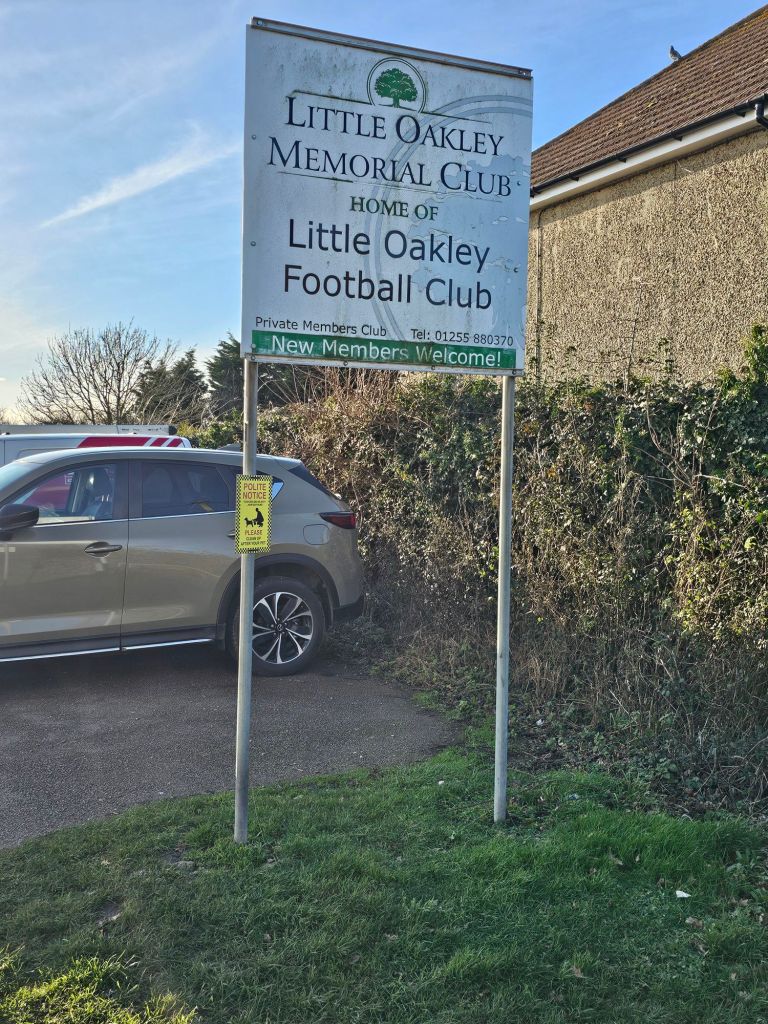
The village of Little Oakley in Essex, Wikipedia tells us, had a population in 2011 of 1,171 and is on the outskirts of Harwich.  More precisely, Google maps tells us that Little Oakley is a four kilometre, fifty-eight minute walk from Harwich International railway station.  Now, I reckon I could walk 4 kilometres in less than 58 minutes, but I am nevertheless of a lazy disposition and therefore, today I have opted to drive the thirty-six kilometres from my house to the Memorial Ground, home of Little Oakley FC in my planet saving Citroen e-C4,  rather than enjoy a travel melange of rail, bus and walking, which would take me between one and  half and two and a half hours depending on connections.  Today at the Memorial Ground, Little Oakley FC are playing Barking in the Essex Senior League, the ninth level of English league football.

It’s a beautiful, bright, clear, winter’s day and but for a Luton van pulling out in front of me from a lay-by on the A120, I have a relaxed, trouble-free journey, played out to a soundtrack of the Saturday afternoon pre-match football coverage on BBC Radio Essex, featuring amongst others, the dulcet tones of Glenn Pennyfather and Danny Cowley.  My Citroen’s SatNav doesn’t seem to know about the Memorial Ground, so my journey ends with an abrupt left hand turn when suddenly from the B1414 I see the street sign for Lodge Road, which I remember from looking at a map is adjacent to the Memorial Ground.  I park up at the side of the narrow approach road, beneath an avenue of trees with a deep ditch on one side and wooden fence on the other on which several signs plead with drivers not to park too close to it.  I make the short walk to the clubhouse enjoying the sound of birdsong whilst inhaling the smell of hot cooking oil, probably chip fat.

The clubhouse is welcoming and populated with happy pre-match drinkers.  I buy a bottle of Adnams’ almost non-alcoholic ‘Ghostship’ (£3.20) and the bar maid asks if I’d like a glass, I would. I stand and look up at one of three TV screens showing Sky TV.  From a hatch, behind which is the clubhouse kitchen, a middle-aged woman looks out glumly. “Fed up?” I ask her.  “Bored” she says “It was busy, and now it’s quiet”.  This lady seems responsible for fulfilling the whole crowd’s need for food and hot drink on her own but it will soon be kick-off, so for now she’s not needed.

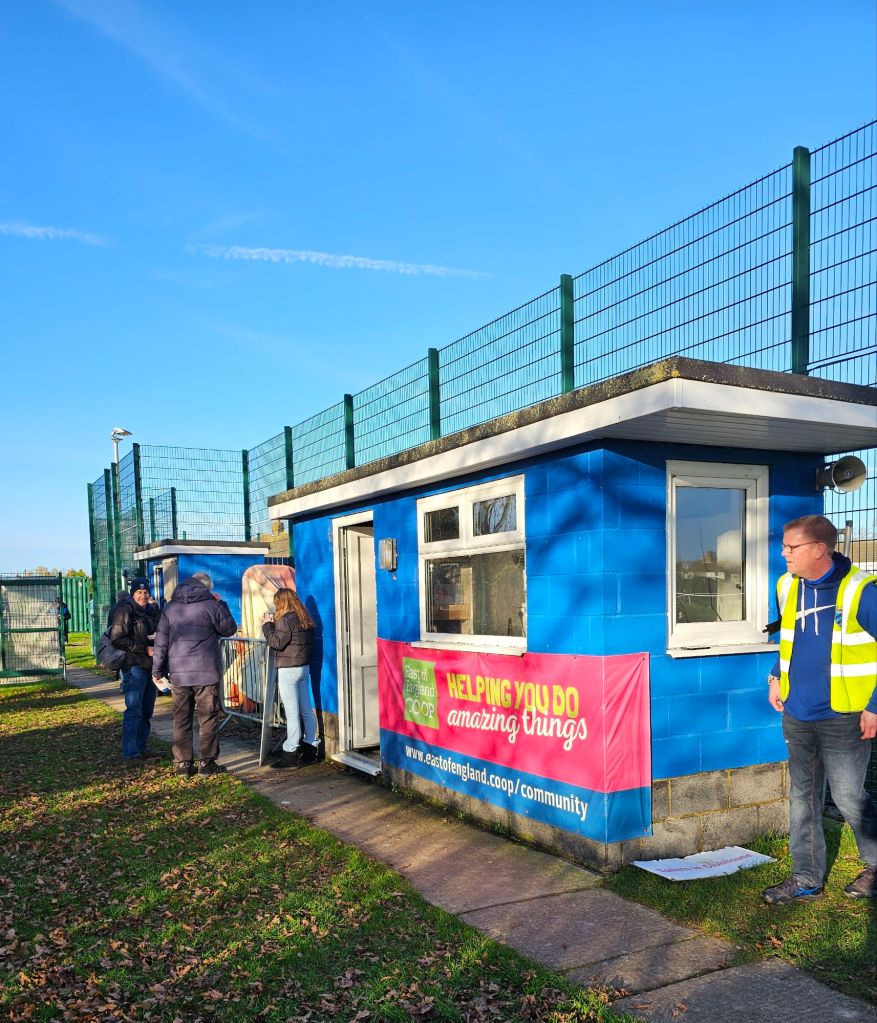
I sink my low alcohol beer as quickly as I can without burping and head outdoors where a man with a loud, deep voice directs me to turn left beyond the shipping container at the far end of the car park.  A short, friendly man emerges from a hut, a bit like municipal car park attendants used to in the far off days before ‘Pay and Display’, and asks if I’m a concession.  I ask how old you have to be to be a concession; it turns out it’s sixty-five and he apologises when I tell him I’m only sixty-four. But it does mean I’m about six months further from the grave than I would have been if I’d been a concession, even if I will be three quid poorer for it.  Having handed over my £8.00 in cash, I ask if there is a programme and am surprised to find that there is. “Here you are, if you’d like something to read” says the man, handing me six colourful sheets of A4 paper stapled together in the top left-hand corner.  Best of all the programme is free, as if a little bit of France has been re-located to the top right-hand corner of rural Essex.

Pap-rock plays over the public address system as I take stock of the ground, which has two small pre-fabricated metal terraces behind one goal and another pre-fabricated metal stand with seats overlooking the far half of the pitch; it looks as if there wasn’t room behind the dugouts for the stand to be level with the half way line.  The ground backs onto a hedge and a couple of Oak trees on one side and onto the gardens of a row of semi-detached houses on the other.  At the far end there is just a playing field and a trio of teenagers have leaned their bikes against the rail around the pitch. I can also see from here that the clubhouse appears to have a partly corrugated metal roof; I bet it rattles when it rains.

The pap-rock gives way to Jeff Beck’s ‘Hi-Ho Silver Lining’ and the two teams amble onto the pitch; if there is any shaking of hands or other gestures of sportsmanship I miss them. I stand close to the home team dugout and next to me a man talking into his mobile phone says “We got two meal deals at the Co-op before we came out, so we ‘ad them”.  In the ‘technical area’ in front of the dugout, a track-suited man calls out to the home players “Ave a look, ‘ave a look, just be aware of the fuckin’ double bluff”.  I have no idea what he means, and decide not to ask him.

The match begins, and Barking get first go with the ball, their second touch being a hefty hoof out to the left wing.  Little Oakley, known as ‘The Acorns’ are wearing blue and black striped shirts with black shorts, a bit like a destitute man’s Inter Milan and are defending the empty, featureless end of the ground with marshes, Hamford Water and the North Sea a kilometre or two beyond.  Barking are all in yellow, with black sleeves, and they defend the clubhouse and Ramsey end of the ground, with the River Stour and Suffolk beyond that.   Barking win an early corner with some clever play by their number seven Michele Maccari. “Why’s that big guy on the edge? ‘e’s got a massive head on him” asks a lad sat behind me of his two friends, who I think could all be Little Oakley players who are not playing today. The ‘guy on the edge’ is stood at the edge of the penalty box and whilst he is quite tall, I must admit I can’t really see that his head is any bigger than anyone else’s.

“Barking, Barking give us a song” chants a bloke tamely, somewhere off to my right.  “If you all ‘ate Dagenham clap your ‘ands” comes the response from three or four other voices.  Unfortunately, Little Oakley has no such choir. It’s just gone a quarter past three and despite Barking probably playing, or at least attempting to play the more attractive and neater football, it is Little Oakley who have the first decent shot on goal, as number ten, Daniel Rowe spectacularly volleys the ball against the foot of a goalpost creating a pleasing metallic pinging sound. Recovering from the momentary excitement, I notice that between the semi-detached houses on the far side of the ground and across the water inbetween, I can see two dockside cranes at the Port of Felixstowe, beyond which and unbeknown to me, Felixstowe & Walton Football Club are on their way to drawing nil-nil with Haringey Borough in the Isthmian League.

Barking make claims for a penalty as one of their number tumbles between two Oakley defenders and at this point the referee seems to lose any affection the visitors might have once had for him. “You’re a joke ref” calls a man from behind a camera with a tele-photo lens, “Absolute clown ref”.  It’s nearly twenty-five past three and all of a sudden Barking take the lead; a clever, arcing cross being headed in at the near post by number six and captain Fahad Nyanja.

As the game is about to resume, an Acorns’ player calls out “We keep going, we fucking keep going”.  It is stating the obvious and I for one would feel a bit short-changed if this early in the game they’d all along been secretly playing ‘next goal wins’ .  As unnecessary as it should be, these apparent words of encouragement nevertheless almost work but in an unexpected way, as a low cross from the Oakley number seven, Idris Namisi is diverted against a goal post by Barking number four Sam Edwards.  Idris Namisi seems a popular player amongst the home crowd, and I can’t help but like him too, even if it’s probably because his first name is the same as that of the dragon who lived in the firebox of Ivor the Engine.

Oakley’s number ten, Rowe claims the honour of being the first player to be booked as he pulls back a Barking player and I agree with the old boy stood next to me, whose grandson is the Oakley number eleven, Luke Hipkin, when he says it was a needless, stupid foul.   The old boy asks me if I’m from Harwich and I tell him I grew up in Shotley just over the river from here. “Not far away, then “. He says. ”Not if you’ve got a boat” I reply.  Back on the pitch, the Oakley players are arguing amongst themselves. 

The half ends with Rowe being put through on goal for Oakley with just the Barking keeper to beat, but his shot is saved and Idris the popular dragon blazes the rebound high and wide.   I check my phone and Ipswich are losing 0-3 at Liverpool, which makes me glad I’m here and not on Merseyside.   With the half-time whistle I make for the club house to drain off excess low alcohol Ghostship and invest in one pound fifty’s worth of tea, because under a clear sky it’s beginning to get cold as the sun sinks in the west.  The middle-aged woman in the kitchen is being cheerfully rushed off her feet serving tea, frying chips, griddling burgers and taking cash and card payments. I can’t help but think it’s a pity the players and managers of both teams can’t just get on with what they’re meant to be doing with as little complaint. I haven’t heard her say ‘fuck’ once.

I take my tea outside into the softening, late, winter afternoon sunlight and the match resumes at two minutes past four; I stand by the Barking dugout. “Get ‘old of the fucker” barks the Barking manager  a seemingly irascible  man sporting a stylish grey cap and white goatee beard, who sounds like Ray Winstone and mostly never says ‘fuck’ or ‘fuckin’ in a sentence unless he can say it half a dozen times.  Mostly, his exasperation seems to be directed at his own Barking team who, I can only guess, aren’t playing so much like the Spanish national team, as may be he told them to.

Time goes on and Barking’s number eleven Ugonna Emineke is booked for time wasting as he delays taking a throw-in because there is a rumpus happening in the penalty area and he’s waiting for it to subside.  Unfortunately for Emineke, the referee only had eyes for him and hadn’t noticed the pushing and shoving in the penalty  area, although before the throw is eventually taken he has to go and sort it out and speak to his assistant about it. Then, with twenty minutes of the half gone Oakley equalise, Idris Namisi nipping in to poke a cross over the goal line from close range.

As it has progressed, the game has become increasingly fractious, with a number of Acorns players being quite aggressive, whilst Barking players have acted out fouls where none has been made, sometimes squealing and moaning for additional effect.  All this has been against a  background of some of the most  liberal use of the word ‘fuck’ I have ever heard and I wonder what people do during the week to make them so angry on a Saturday.

Things don’t improve when at twenty-seven minutes to five Emineke is sent off for a ‘professional’ (or, as this is only the Essex Senior League perhaps ‘semi-professional’) foul, and The Acorns are awarded a penalty, which the balding and bearded Darren Mills takes and Daniel Purdue saves, diving excellently to his right.  “How many more fucking chances do we get?” moans The Acorns’ number three Adie Cant.  “Calm the fuck down” shouts the coach “Fuckin’ ‘ell”. It’s as if Peter Cook and Dudley Moore’s Derek and Clive had had an afternoon out at the football.

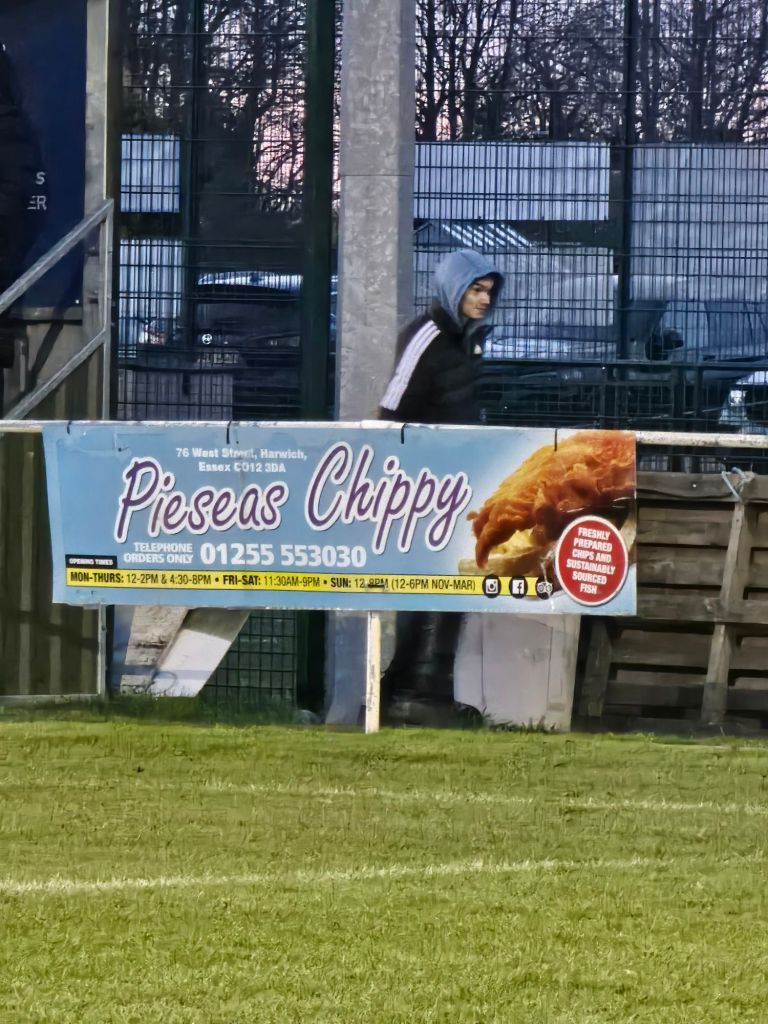
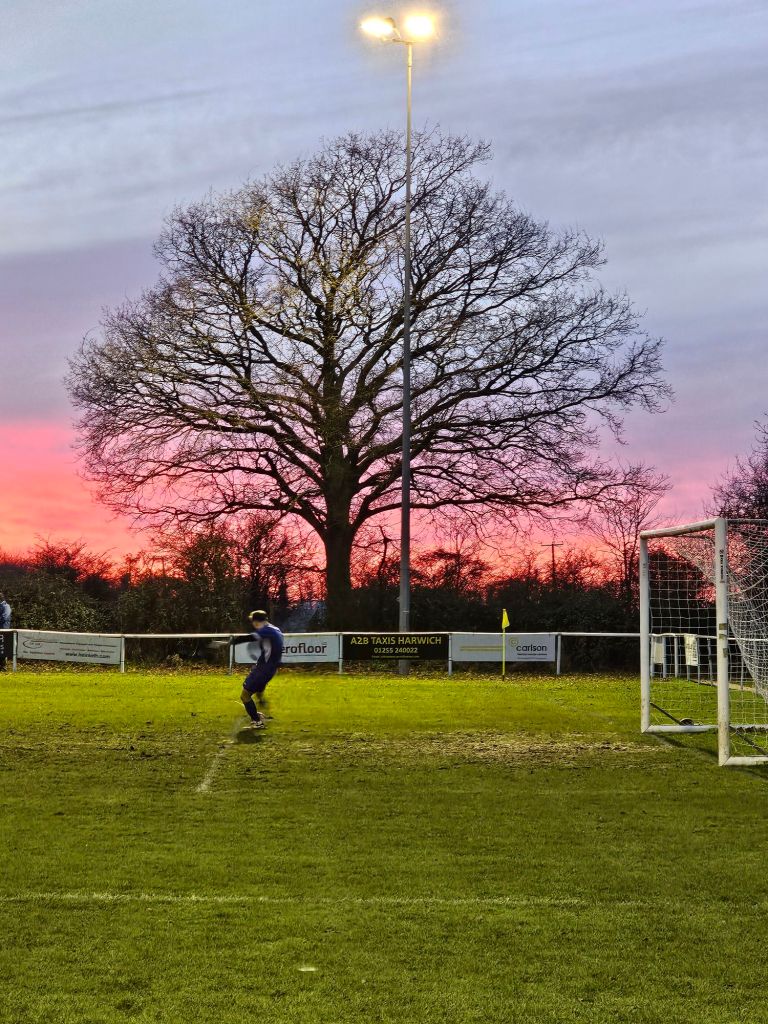
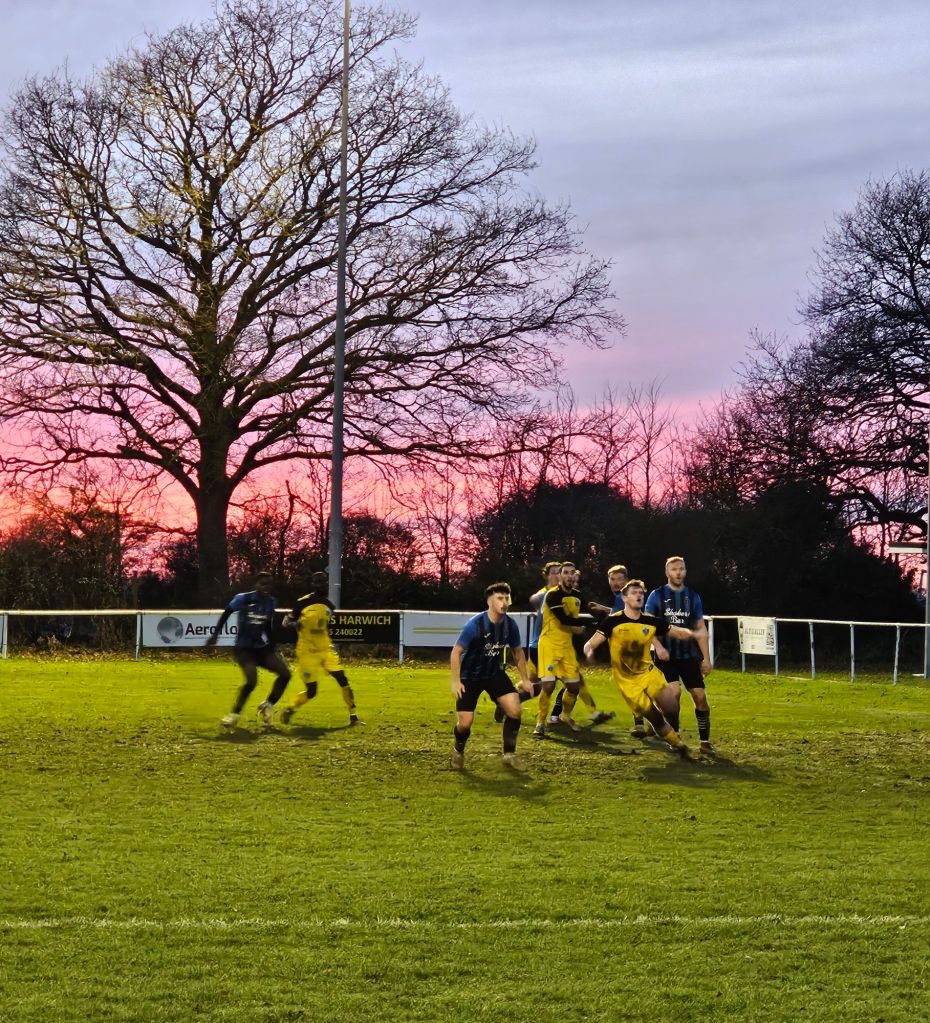
With the aftermath of the penalty, the worst of the afternoon’s fractiousness is over and much  of the final twenty minutes plays out against the back-drop of a glorious, blood red sunset,   A friendly man wearing a day-glo gilet bearing the words ‘LO Media Officer’ on the back, talks to me briefly and asks if I’m a ground hopper, “Not really” I tell him, “ I usually watch Ipswich”,  although I don’t let on that for forty years I’ve kept a list of every game I’ve ever been to.  He’s soon photographing the main stand against the sunset however, and the match plays out shifting freely from end to end,  but with neither side looking much like scoring the winning goal. Meanwhile, I wonder at the name of a local fish and chip shop, Pieseas Chippy, which is advertised at the pitch side.

The final whistle blows at eight minutes to five and an appreciative crowd applaud the efforts of both teams in a match which whilst mostly not a thing of beauty, apart from the sunset, has been entertaining and hard fought.  I think a draw is a fair result although home fans might not agree, and as I head for my car I hear a man muttering to himself about the ‘village team’ holding the team from the city (Wikipedia tells us that in 2011 Barking had a population of 59,011) as if the moral victory belongs to Little Oakley.  Perhaps it does, but even if it doesn’t it’s been a lovely afternoon out.

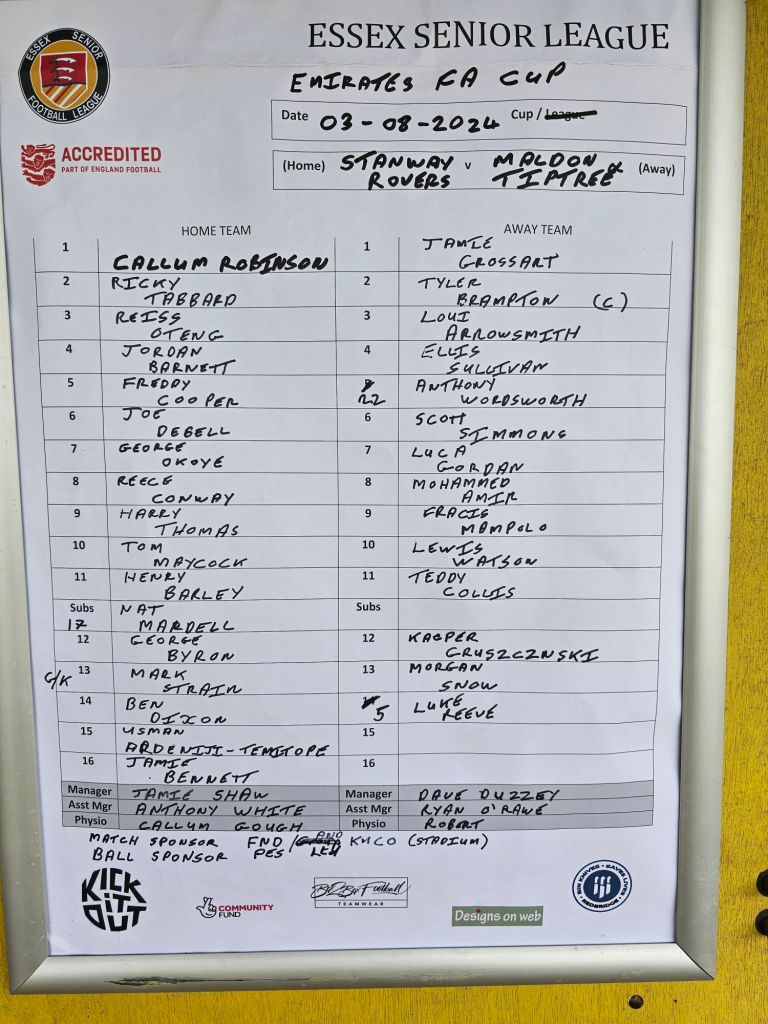
Stanway Rovers 0 Maldon & Tiptree 0

It’s the third day of August and the domestic football season is yawning and stretching after a  long sleep throughout June and July.  However, in the same way that an early morning shower, or a nice cup of tea, will bring enjoyment and refreshment at the start of another day, so the FA Cup also invigorates and refreshes and quickly brings a sense of purpose, and today is the start of this season’s FA Cup (although some games were played last night).  The ‘proper’ rounds of the FA Cup of course do not begin until the league clubs enter in November, and non-league football clubs have to qualify to get into the ‘proper’ FA Cup and so obsessed with hierarchy is the Football Association that before the first qualifying round there is a preliminary round, and before that is the extra preliminary round, and that’s what’s happening today.  It’s as if the FA is saying to the smallest clubs, at the lowest levels of the league pyramid “You are nothing and you have no money, so whilst we’ll let you play in the FA Cup, it won’t be the ‘proper’ FA Cup”   Worse still, some clubs, those below Step Nine, aren’t even allowed to enter the extra-preliminary round. 

I have toyed with the idea of attending any number of possible FA Cup fixtures today with Long Melford, Cornard United, FC Clacton, Basildon United, Little Oakley, Stowmarket Town, Heybridge Swifts, Ipswich Wanderers and even Harleston Town all having home ties that I could surely get to.  But as a lazy person who economises on effort wherever possible, I eventually choose the fixture that is closest to my house and therefore easiest to get to.   I briefly consider catching the bus, but the service is only hourly and whilst I would arrive in plenty of time for kick-off, I can’t be certain that I would make it back to the bus stop in time after the final whistle.  So it is that I set off forty minutes after the bus, just before half-past two, in my planet saving Citroen eC4 to travel the 5.76 kilometres to New Farm Road and ‘The Hawthorns’ where at three-o’clock Stanway Rovers of the Essex Senior league will be playing Maldon & Tiptree of the Pitching-In Isthmian League North.

It’s been a sultry morning under cloudy skies, but now the sun is shining as I edge through the car park and am directed by a man in a dayglo tabard into what is possibly the last available parking space.  The car park is like Brighton beach without the nudists, and pebbles crunch under foot as having left my car I head for the club house and the bar, where I am delighted to see real ale for sale.  With kick-off only twenty minutes away I buy just a half a pint of Colchester Brewery “Romans go home”, which of course they did at the beginning of the 5th century.   At £2.30 it seems rather expensive but the beer is tasty and I quaff it quickly before I trudge back across the beach between the cars to the turnstile, where a queue has formed, largely due to the time taken for someone up ahead to pay by debit card, although cash is also accepted.  To heighten and prolong my sense of eager anticipation and impatience to see the game, and that of the people behind me, I too pay by card (£8.00).

Stepping inside the ‘stadium’ I exercise a visual stock take and don’t think the place has changed much since I was last here, which was on a cold day in December 2013 to see Stanway Rovers lose improbably by a single goal to mighty Wivenhoe Town.  There may now be a few more bus shelter style stands and a couple less portacabins but that’s about it.  What does differ from eleven years ago is that there are no programmes on sale today but a faded, laminated A4 poster displays a QR code for digital programmes, although these turn out to be last season’s, not today’s game.  I ask a man in a dayglo gilet if there is a programme today; he doesn’t know, although trying to help he asks another man in a dayglo gilet who doesn’t know either but responds in a manner which suggests it’s nothing to do with him and he prefers not to answer questions about anything.

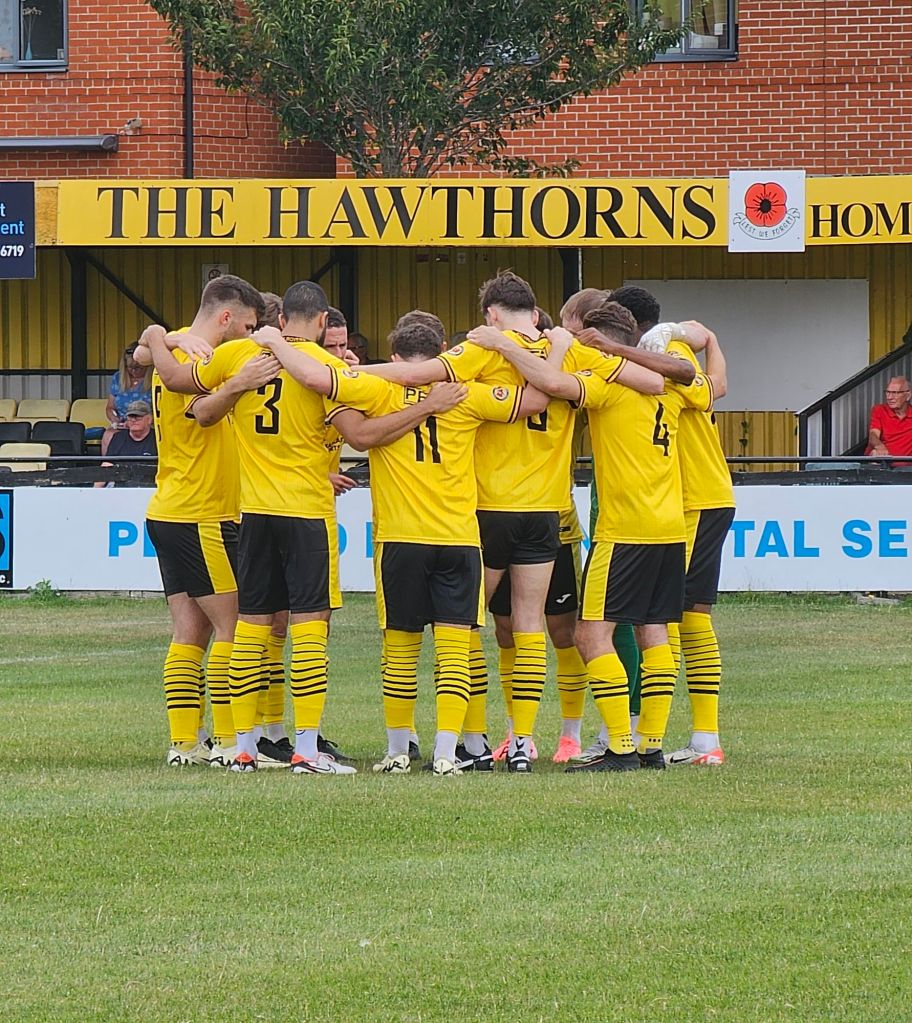
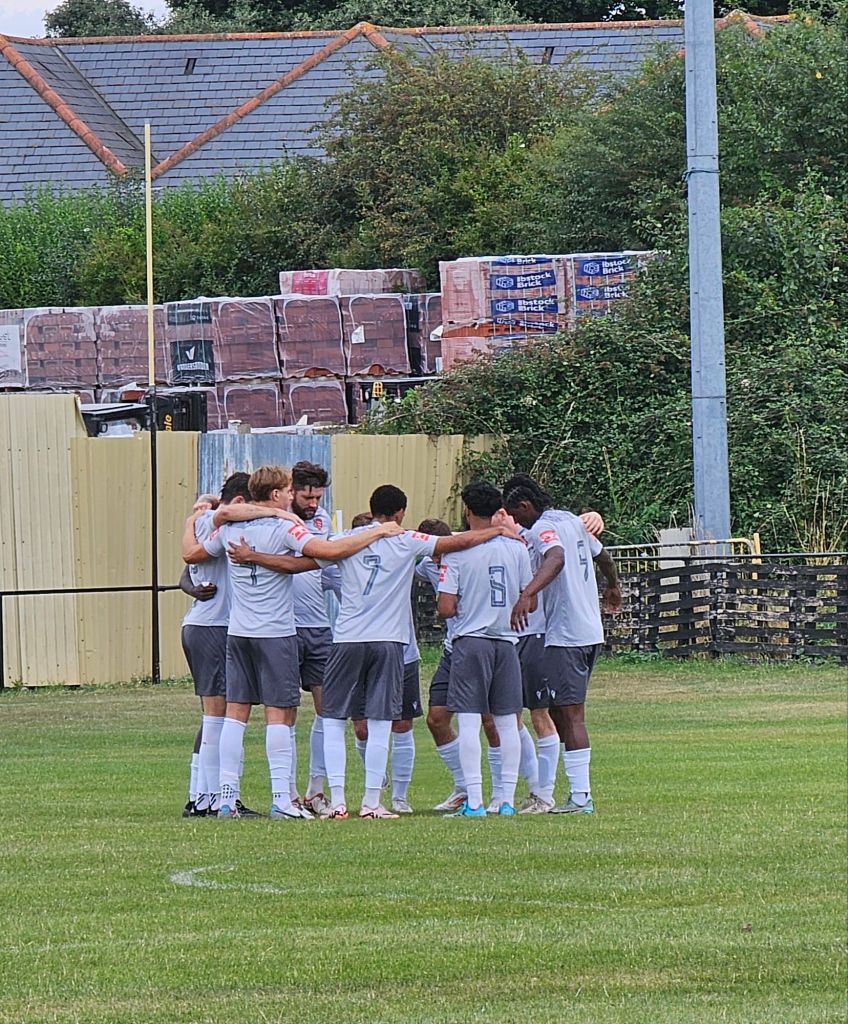
Time passes as Nineties dance music plays over the public address system, which turns out to be two large roof mounted speakers, one on its side, that look like they’ve been liberated from an ageing hi-fi system.  The music stops abruptly as the two teams appear from the corner near the turnstile to process onto the pitch and go through all the usual handshaking before forming separate huddles and then lining up to await the ‘parp’ of the referee’s whistle. The Stanway number eleven has one leg of his shorts rolled up over his thigh as if to ‘show a bit of leg’. Slightly late, at two minutes past three, the match begins with Maldon & Tiptree getting first go with the ball, which they boot towards the car park end.  The visiting team are wearing a frighteningly dull kit of pale grey shirts and slightly darker grey shorts; it makes them looked like all life and natural colour has been drained out of them as if by some previously unknown Essex coast vampire.  Maldon’s home kit is one of red and blue stripes like Barcelona of the Spanish La Liga or Stade Malherbe Caen of French Ligue 2 and it’s a mystery why they’re not wearing it as it would not clash with Stanway’s yellow shirts and black shorts. Perhaps the home kit is in the wash, or maybe they are wearing it and that vampire is real.

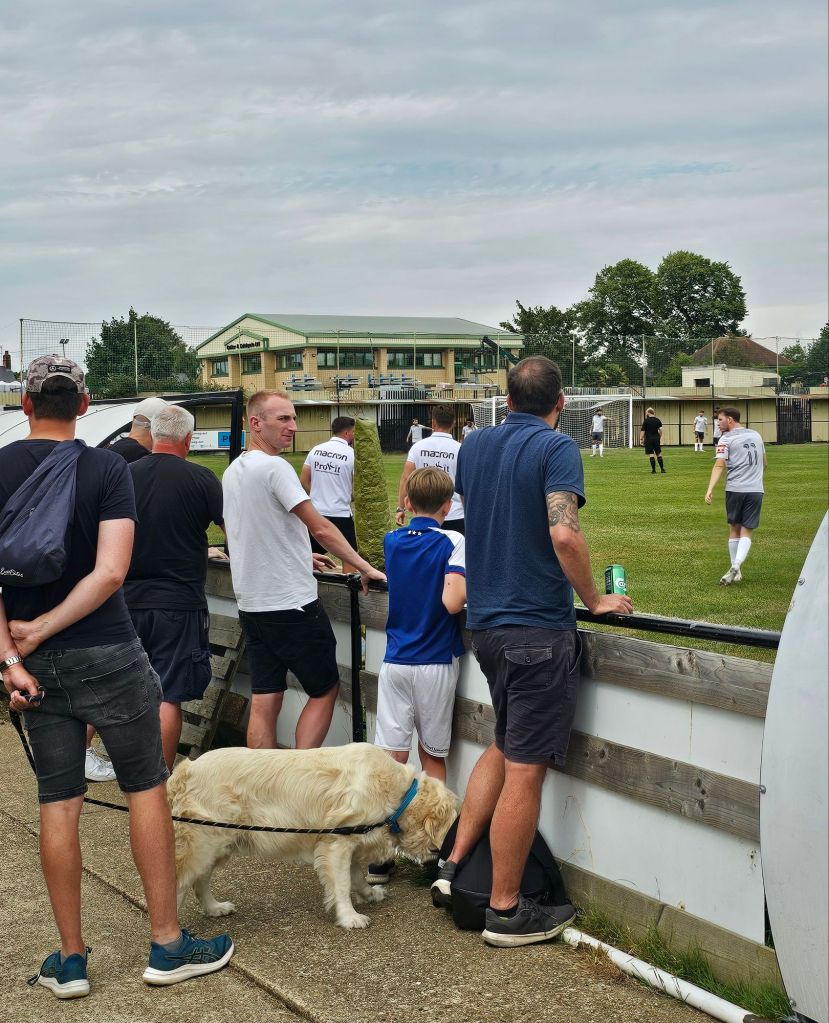
The opening stages of the game seem tense and cautious.  “Mick, right shoulder” shouts the home goalkeeper. “’old ‘im” bawls someone else “Get over!”.  It’s a relief when the ball leaves the pitch and hits a man with a jade-coloured jumper draped over his shoulders.  I walk down the ground behind the dugouts past a man with a golden retriever dog.  I overhear a snatch of conversation “Tooting Broadway Witherspoons (sic) is right across the road” explains someone. I stand between the dugouts “Joe, Joe, can we?” implores one of the Stanway coaches curiously as he stands momentarily with hands on hips in his black nylon tracksuit. “Come On Ref!”

At twelve minutes past three the Stanway number four heads wide of the Maldon goal.  The opinion in the Stanway dugout is that he “needed” to score that.  As if to almost  prove them right Maldon are almost immediately on the attack and win two corners in quick succession.  A Maldon player dribbles the ball cleverly between two opponents.  “Nice feet” says a man near me, who is possibly a chiropodist.   Stanway almost score almost again as a back-header skims off a crown and is tipped away acrobatically by the Maldon goalkeeper.

Keen to experience the game from all around the Hawthorns I move to the corner of the ground where the slope on the site affords me an unexpectedly elevated view across the gently, but nevertheless worryingly rolling, undulating pitch.  Above me a blackberry bush hangs down over the fence and I spend the remainder of the half feasting on plump, ripe blackberries which are being warmed by the mid-afternoon sun.   By half-time I have eaten more blackberries than I have ever eaten before whilst watching a football match.  It’s now twenty-five past three and the somewhat lumbering, balding and clearly bearded referee calls for a drinks break.  The Stanway substitutes trot about in front of me, stretching and discussing football boots; apparently, one of them owns a pair “…like the Trent Alexander Arnold ones”.

When the match resumes Maldon pass the ball amongst their centre backs, in the style of England, until number six carefully side foots the ball into touch.   It’s three thirty-eight, and a Maldon free-kick thumps the head of the Stanway number eight, who was in a defensive wall but now lies prone on the grass; the game is stopped while he receives treatment and then leaves the pitch.  In due course he returns, but oddly now has his shorts rolled up over his thighs like the number eleven.

The match is not of the highest quality and the ball regularly sails aimlessly through the upper atmosphere and on one occasion into a neighbouring garden.  At eleven minutes to four however Maldon’s number nine shoots and only a low diving save from the Stanway goalkeeper prevents a goal. From the resultant corner however, the ball is fired out into the car park and hopefully avoids my Citroen; the high fence behind the goal doesn’t seem to be quite high enough.  The half ends with me reflecting on the names on the advertisement boards and questioning whether  Planned Environmental Services have a rival company called Un-planned Environmental Services.  Finally, I find myself disappointed that neither club seems to have neither a band of noisy teenage Ultras or one of ageing but witty malcontents.

With half time I head to the tea bar where I invest in a pound’s worth of tea and two pounds’ worth of sausage roll, which comes with a free paper napkin.   I don’t think the sausage roll is as good as the ones at Coggeshall Town, although it is cheaper, but it is definitely better than the ones from Greggs. Having eaten my sausage roll I move to the two-step terrace cum bus shelter  behind the goal at the car park end and strangely overhear more people talking about Tooting Broadway. I finish my tea and the teams amble out only to line up and then have to wait for the referee and his two linesmen, one of whom has a beard, whilst the other is older and has a bit of a pot belly.

It is eight minutes past four as the football resumes and unexpectedly a small man in a polo shirt with a tie draped around his shoulders begins to bawl Yellow Army, Yellow Army, Yellow Army several times.  I see from my phone that the current temperature is twenty-four degrees and then the man in the dayglo gilet who I asked about the programme appears and tells me that there is currently an ‘error’ with the programme.  I wonder if the error is that no one produced one as Maldon win successive corners and I get the impression that they are the slightly more dominant team.

Continuing my odyssey I walk a little further round the ground and on to the fourth side where there is a small pre-fabricated stand containing the only seats in the stadium.  I am suddenly struck with the thought that Stanway Rovers seem to have an uncharacteristically small number of players with visible tattoos before I spot what looks like my friend Gary in the seats.  Approaching the stand, I confirm that the reason the person I see looks like Gary is because it is Gary, and I decide to sit down in the seat in front of him just as Maldon’s number four is booked by the referee for a misdemeanour I didn’t see fully because I was concentrating on identifying Gary. 

As Stanway make their first substitution, Gary tells me how his mother has been ill and in hospital. It’s now twenty-three minutes to five and the game remains tense, cautious and lacking in goalmouth action with both teams either defending well or just lacking the ability to score a goal, I’m not sure which. At seventeen minutes to five some football suddenly breaks out as Maldon’s number nine dribbles down the right flank leaving three Stanway players in his wake before putting in a low cross.  The cross unfortunately runs behind the Maldon player’s team-mates, but their number seven manages to get to the ball and turn, but then sends his shot over the goal, the fence and into the premises of Collier and Catchpole, the independent local builders’ merchants.

The clock is running down, it’s nine minutes to five and my thoughts are turning to what I might have for tea as a Stanway shot rolls rapidly towards goal and this time it is necessary for the Maldon goalkeeper to make a save.  Gary and I chat as we watch and I learn from him that the concessionary admission price at Stanway applies to over sixties, not over sixty-fives, so I’ve spent three pounds more to get in than I needed to.  It’s two minutes to five as another football sails out of the ground and into one of the neighbouring properties, but a minute later the game is over; the final score nil-nil.

The game over and with no conclusion except that there will be replay at Maldon, Gary and I quickly vacate our seats, leaving together as he heads for the toilet, and I make for my Citroen.  Briefly deconstructing the game in the style of football pundits, I think the match was a bit of a non-event, but Gary thinks the second half was better than the first. 

With no conclusive result, no programme and having paid three quid more to get in than I needed to, it hasn’t been the best afternoon, but then again the sun has shone, I had a decent half of beer, a decent cup of tea, an ok sausage roll and most memorably of all more blackberries than I’ve ever eaten before at a football match.  It must be the magic of the Cup.  

Woodbridge Town 2 Clapton 2

Today is the day of my favourite round of the FA Cup. Whilst supporters of professional clubs may enjoy the third round when the ‘big’ clubs deign to take part, or the first round when the not quite so big clubs join in, I love the very first day. For a start, it is still summer and the days remain long and warm, but what I love about it more is not that any particular clubs take part, or even that it is the beginning, what I like is its name, the extra-preliminary round. Before the first round there are four qualifying rounds; before the first one of those there is a preliminary round, but the FA clearly don’t think that goes far enough and rather than have six qualifying rounds, they decide to have both a preliminary round and an extra-preliminary round. This seems to me to embody the FA’s attitude to grass roots football clubs as a bit of a nuisance that must be culled before the competition can begin properly. This is the FA ‘putting it’ to these little clubs that they are nothing. It’s no wonder that only 800 odd clubs enter the FA Cup, the FA would never cope with what happens in France where over 7,000 clubs enter their equivalent competition, the Coupe de France, but then, France is a republic.
Today I am travelling to Woodbridge by train (£3.15 return from Ipswich with a Goldcard) to watch Woodbridge Town, newly promoted to the Thurlow Nunn Eastern Counties Premier League, play Clapton of the Essex Senior league, a club with a distinguished history and where the fabled Walter Tull began his football career. On the first part of my journey to Ipswich I sit next to two women discussing a man called Amos and what he does when he is in Uganda. When I change trains I sit at a table where a girl in red socks and white T-shirt is quick to tell me that she is innocent of having made the neat arrangement of two empty Lucozade bottles and three crisp packets that sit on the table. I tell her it’s okay, I will avert my gaze and look out of the window. British Transport police are looking for an obese person with OCD who is recovering from illness. Two West Bromwich Albion supporters on their way to Norwich sit across the gangway from me, we chat a little and I wish them luck, telling them that I am expecting at least four or five goals from their team; pleasingly they will oblige. I also recoil from the hideous sight of a tall, well-spoken young man in a Norwich City shirt; he has ‘Cooper’ ‘21’ on his shirt back; his name and IQ I surmise, or possibly the number of members of his family with whom he has had a sexual relationship.
The three carriage 13:18 to Lowestoft leaves Ipswich on time and slowly roars its way through marshalling yards and past Hadleigh Road industrial estate with its mighty disused gas holder that sits in a nest of buddleia. Beyond the River Gipping the view of Ipswich from the bridges over Bramford Lane and Norwich Road is a joy with its cluster of modernist blocks and the floodlights of Portman Road looming up beyond low streets of red roofs, which haven’t changed much in eighty years, in many cases much longer. This is a lovely train journey, albeit a noisy one thanks to the diesel engine and old-fashioned clickety-clack of the rails. The train arrives at 13:32 and Woodbridge seems busy; a group of women, all teetering heels, tanned legs, tight dresses, make-up, flowers and fascinators await a taxi; on their way to a wedding, I hope. Woodbridge station is a homely looking building, but I waste no time in setting off up the hill towards Notcutt’s Park, which is a good twenty-minute walk away.


Woodbridge is clearly a well-heeled town, there are large houses, some with naked statuary in the garden and the lamp posts are adorned with somewhat twee hanging baskets, overflowing with summer flowers. I pass by the Cherry Tree pub but do just that, pass by, it looks busy and full of Saturday lunchtime diners. Further up the hill is the local Ford motor dealership where in 1970 my father traded in his maroon 1962 Ford Cortina 1200 for an almost new (ex-demonstrator), beige Ford Cortina 1600 Super, which he always maintained was the best car he ever owned.

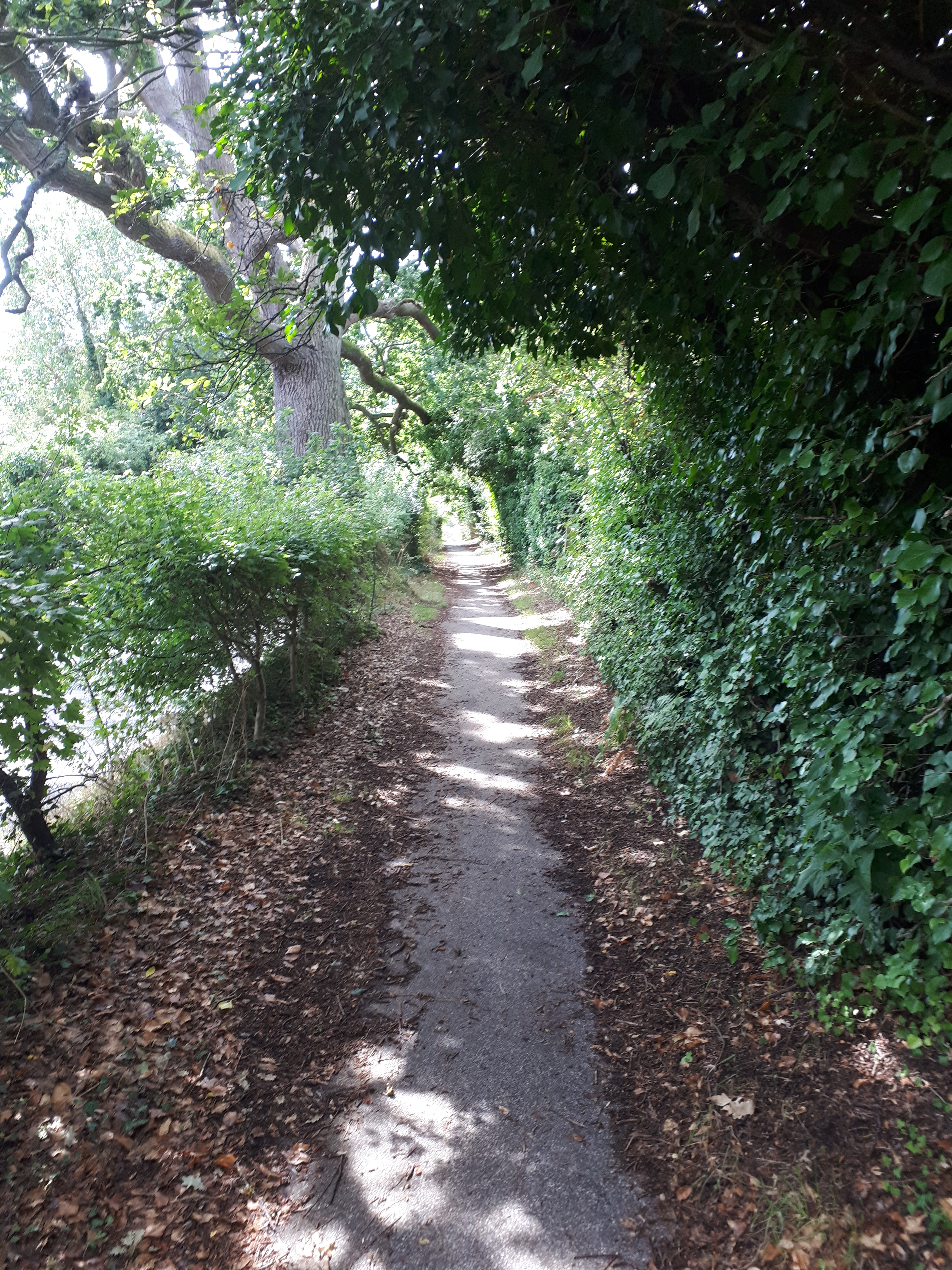
Further on, the path leaves the roadside, ascending an embankment and becoming a leafy bower

43072886655_a4cf6c222d_o

before emerging again into the full light by the Duke of York ‘country’ pub, which is really a ‘family diner’ masquerading as a pub and part of the Vintage Inns chain whose “…rustic buildings offer a country style dining experience…” .

I have been walking for almost fifteen minutes and fearful that the Woodbridge Town clubhouse might only serve insipid Greene King IPA I call in for a pint of Adnams Southwold Bitter (£3.90). At the bar a youngish man orders food. “The menu says you have those kofte things” he says. “Yes” says the bar maid. “I’ll er, have some of them, er please” says the man, showing what sophisticated diners the English have become thanks to the country style dining experience and its ilk.
Refreshed by Adnams Southwold Bitter I press on with the final short leg of my walk to the match through a modern estate of red brick houses, which all look like they are

43072882865_26c0797c46_o

trying to be nineteenth century Suffolk farmhouses; I imagine their occupants having Ploughman’s lunches for every meal. At the end of a winding road of executive homes is Woodbridge Town Football Club. I follow a man with a carrier bag of empty bottles which he tips into the recycling bin outside before proceeding through the turnstile.

I pay my entry fee (£6.00) receiving a yellow and white ticket in exchange and purchase a programme (£1.00), which annoyingly I will later lose in mysterious circumstances (did it fall from my pocket, or did I leave it in the bar?), it was a glossy publication which I rather liked. After a cursory look across the pitch, where players of both teams are limbering up, I enter the bar and a youth wearing a thick grey anorak as if he’s in in 1990’s indie band serves me with a pint of Adnams Ghostship (£3.50). I feel foolish for worrying about Greene King IPA now and my faith in football club bars is restored, for now. The barman doesn’t look old enough to serve alcohol, but he later takes the anorak off revealing tattoos suggesting he is indeed over eighteen. But maybe he serially lies about his age, has been driving since he was thirteen and had this been a century ago he would already have spent a couple of years in the trenches of northern France. I sink the Ghostship and wander outside into the sun where the crowd is gathering. There are just two stands at Notcutt’s Park, one a covered, shallow metal terrace and the other, which is directly next to it, a brick structure with half a dozen rows of bench seats; I pick a spot in the seated stand and read my programme, which I have not yet lost. After a short while I am surprised to look up and see the two teams and the officials all lined up on the pitch, shaking hands like Baptists on a Sunday morning.
The game begins with Clapton in all blue with yellow socks and sleeves kicking off in the direction of whatever lies northeast of Woodbridge; Ufford probably. Woodbridge Town wear black and white stripes with black shorts and socks, hence their nickname ‘The Woodpeckers’, not that woodpeckers wear football kits and of course not all woodpeckers are black and white; a fact highlighted by the most laudable poster above

20180811_144447_42172634410_o

the urinals in the toilet urging spectators to buy a re-usable drinks cup and become a ‘green’ woodpecker. All clubs should be doing something

OLYMPUS DIGITAL CAMERA

similar.

Woodbridge play towards the junction with the A12, Martlesham and the tower of BT’s research laboratories which is visible in the distance.

The first foul of the game, after just a few seconds, draws a shout from the crowd “That’s about time ref”. Woodbridge look much the better of the two teams in the opening minutes; perhaps they should with former Ipswich Town and Sunderland player Carlos Edwards in their team; they pass the ball whilst Clapton just run about after them. But Woodbridge don’t create any chances to score and when it looks like they might, a Clapton player always manages to be in the way. Woodbridge have the first proper shot of the game, which flies over the Clapton cross bar in the seventh minute. Woodbridge are playing well, but then again they’re not; and Clapton are struggling, but then in a way they’re not because their goalkeeper has not had a save to make. Some of the crowd amuse themselves with shouts and cat calls. “VAR. That was a penalty!” is heard as a Woodbridge player tumbles in the box, and then “Eh, absolute shite ref” as play is waved on. I decide to take a wander, and alone at the corner of the ground I get to play the ball back to the Clapton full-back Lanre Vigo when it goes out for a throw. There is a pause in the action as the somewhat portly referee Mr James Beal speaks to two complaining Woodbridge players. ”Get on with it Porky” is the shout from the crowd; you can’t beat humour at the expense of fat people. I get to touch the ball back to Lanre Vigo again, this time a header, no one congratulates me and although it does knock my glasses off I thought ’I done well’.
Considering that as someone who paid to get in I am getting too many touches of the ball and am therefore bound to embarrass myself (if the flying glasses haven’t already done so) I walk round to the dug outs on the opposite side of the pitch to the stands. Here the Clapton manager and his coach are providing a constant commentary of the game as they live every touch of the ball by their players. “Why do you put it there?” shouts the manager to his goalkeeper Jack Francis “I keep telling you mate, I don’t want it in the centre I want it here”. There are a number of players who receive constant encouragement and instruction, the names Jerome, Warren, Gio and Dylan feature prominently. Number five Dylan Ebongo is a ‘big lad’ who rivals and outstrips the referee for the space he takes up on the pitch, but as is so often the case with players that spectators accuse of having eaten all the pastry based foods, he can play a bit and Dylan is a rock in the Clapton defence.
It’s about twenty five past three and against the run of play Clapton have a corner; at the near post the ball is flicked on, the young Woodbridge goalkeeper Alfie Stronge flaps a bit and the ball meets the goal net in the lovely way that footballs do; it’s 1-0 to Clapton. “Who scored?” asks the happy and surprised Clapton manager of his neatly coiffured number seven Ryan Reed, but he doesn’t seem to know, or I at least I can’t work out what he says.
“Take heart from that” shouts the Clapton manager to his team as if none of them expects not to lose. Despite his constant imploring and helpful encouragement to his players the Clapton manager seems quite pessimistic in private moments when speaking to his coach or simply verbalising his thoughts, or perhaps he’s just realistic. “We’re our own worst enemy”, “We could be in trouble here”, “Now we’ve got trouble” are a few of his comments as the Woodpeckers press, along with his admirably honest assessment that his team has actually done nothing and Woodbridge have had all the play. Despite being a goal up however, ten minutes before half-time there is a falling out between the manager and his number ten Jerome Mortell. Jerome is threatened with being substituted, but his response is simply “Go on then” and within a minute he is stomping his way round to the dressing room, leaving the pitch with the words “I’ve had enough of this shit”. Clapton had only Jacod Dingli on the bench today, and now he’s on the pitch, but at least they’re still winning and very soon they are almost two-nil up as another corner against the run of play sees a header thud against the woodwork of the Woodbridge goal.

This slideshow requires JavaScript.

OLYMPUS DIGITAL CAMERA

Across the pitch a tall man, immaculately dressed in a dark suit stands out amongst the general scruffiness of the usual football crowd, I believe this is Vince McBean the current owner of Clapton FC and a controversial figure after he allegedly attempted to liquidate the charity that administers Clapton’s Old Spotted Dog ground. From where I stand he looks like an undertaker.

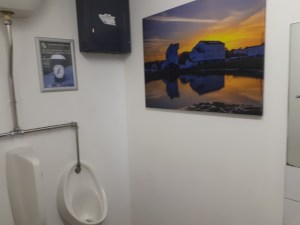
Half-time and I’m one of the first at the bar for another pint of Ghostship (still £3.50) which I follow up with a visit to the toilet where I admire the juxtaposition of a large print of a sunset over the Woodbridge’s tide mill with the urinals; it makes me think of Marcel Duchamp’s ‘Fountain’.

20180811_144443_42172634020_o

But there is little time to consider twentieth century art, the players are on the pitch and Woodbridge line-up as Clapton huddle. I return to stand between the dugouts where the entertainment is richest, although I do take a moment to enjoy the Co-op’s side by side, edge of pitch advertisements, one solemnly telling us how their funeral service is “Supporting loved ones locally when it matters” (and presumably telling non-local loved ones to clear off) and the other in a lighter frame of mind urging us to ‘Pop to the Co-op’.

OLYMPUS DIGITAL CAMERA
The second half begins and before not very long Ryan Reed intercepts a poor pass and breaks forward, he rides a tackle and is through on goal, he shoots, Alfie Stronge saves but the ball rebounds to Ryan who strikes it confidently and with force inside the far post from a tight angle. It’s 2-0 to Clapton.
The Clapton manager stresses the importance to his players, particularly to big Dylan at the centre of the defence, of holding onto the 2-0 lead in the next ten minutes, which he says will break Woodbridge’s hearts if they can do it. They do and the game seems to settle down with Woodbridge still dominating possession, but mostly over-hitting all their forward passes and crosses. Substitutions are made by Woodbridge and approaching the last fifteen minutes it looks like Clapton will hold on. The Woodbridge manager who incidentally is probably bigger than both the referee and Clapton’s Dylan seems calm, despite his frequent frustration at those over hit passes; is he resigned to a defeat?
Woodbridge for all their inadequacy in terms of shots, are still dominating however, and the ball is spending most of its time on the Clapton half of the field. A Clapton player is nearly always the last man to touch the ball inside their own penalty area, but then just after twenty five to five the ball runs loose and Woodbridge’s number seven Callum Sinclair lashes it on the half volley in to the top corner of the Clapton goal to halve Clapton’s lead and give Woodbridge hope.
I came to this game as a neutral but the enthusiasm of the Clapton manager and coach and the fact that they turned up with just one substitute and seemingly a team that must be coached through every kick has me wanting them to hang on for the win. There is also a bit of me that wants rough, deprived, inner city Clapton to triumph over wealthy, privileged Woodbridge, although of course I know in reality that those distinctions don’t actually have any relevance in the context of these two football clubs.
Woodbridge earn a corner, it’s late in the game and goalkeeper Alfie Stronge comes up to add his presence and he heads narrowly over the Clapton cross bar. The Clapton manager berates his players for trying to pass the ball when clearly a hoof is required. That has been a recurring theme, but I find it reassuring that players want to play the game ‘beautifully’, because that’s what makes it so good to watch, and play, whether it comes off or not. The game is into time added-on and a half-hearted challenge, which causes a slight stumble but no trip, sees Mr Neal award a free-kick just outside the penalty area, in range for a well taken direct shot. The Clapton coach is apoplectic and winds himself up by imagining that it’s as if the referee wants Woodbridge to equalise; the manager is not happy about it but is more sanguine, realising preumably that whatever will be, will be on the way to Wemb-er-ley. Woodbridge’s number five Liam Scopes steps up to scoop a shot over the wall and into the top left hand corner of the Clapton goal. Woodbridge have tied the match and the Clapton coach is sent off by Mr Neal for simply getting carried away with himself.
There is no time for anything more to happen and I am only sorry that with the time now almost five o’clock I must leave and hot foot it back to the railway station to catch the 17:18 back to Ipswich. It’s been a lovely afternoon in the August sun and a thoroughly entertaining game, which has been a credit to both clubs. I am tempted to try and make it to the replay. I’ve had a great time, but in about twenty-five minutes I will realise I no longer have my programme.