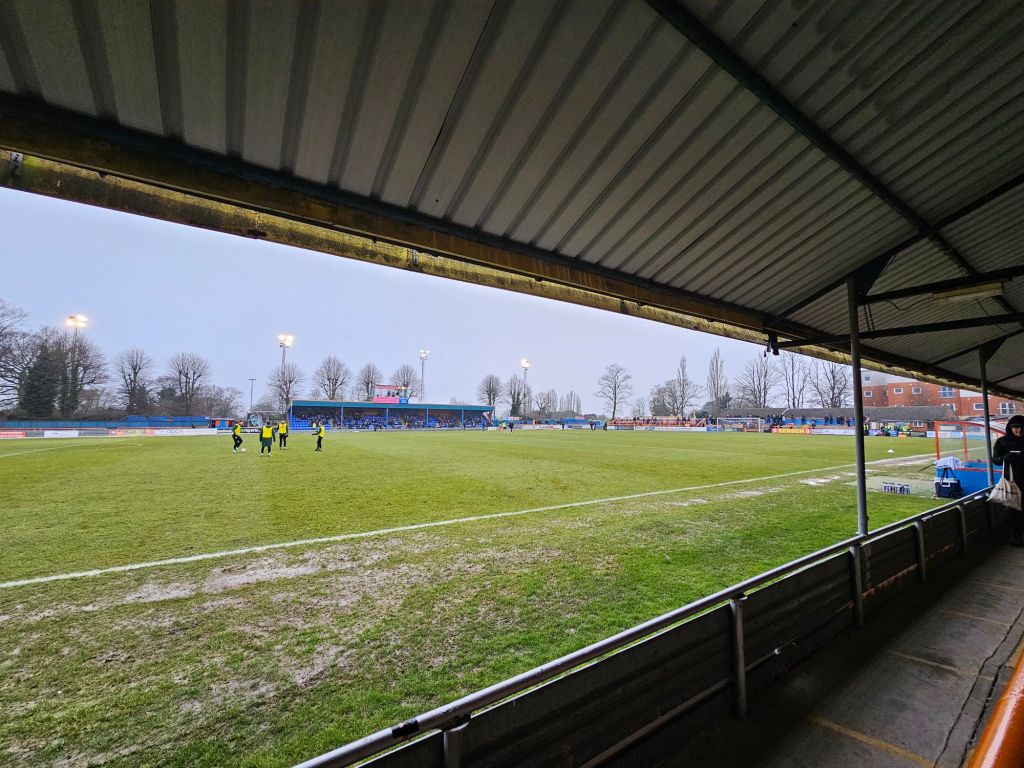
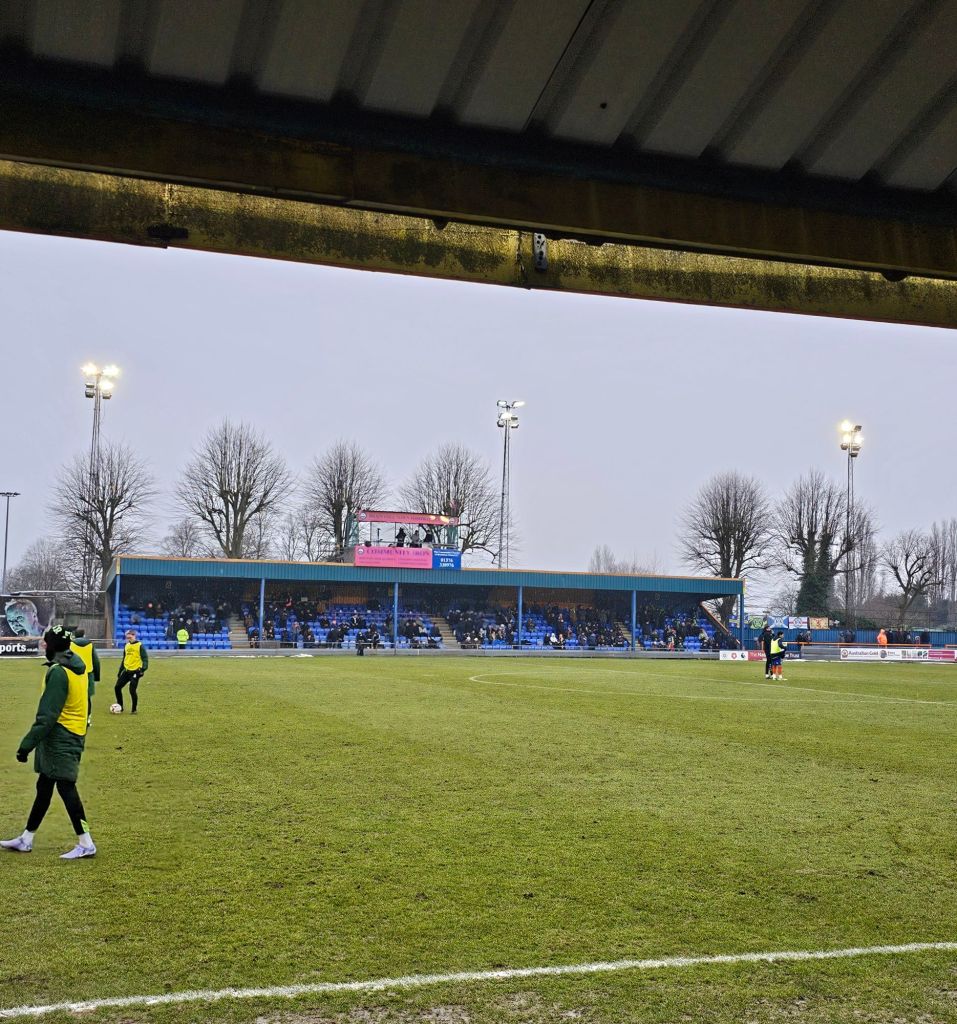
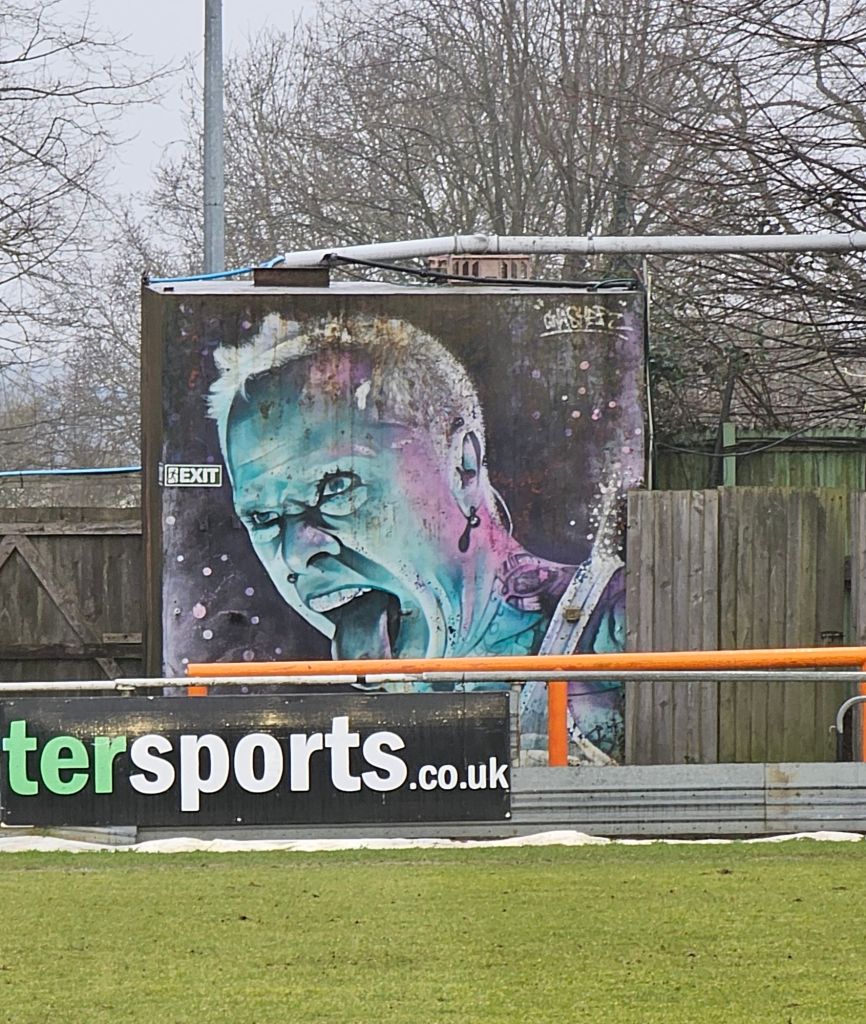
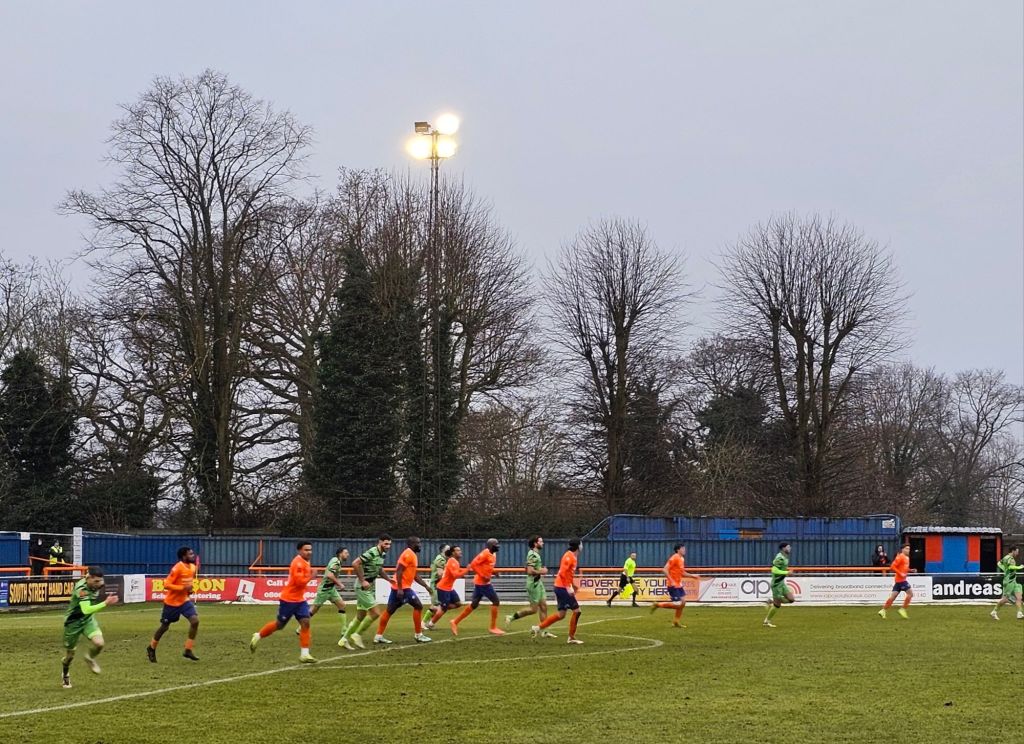
Braintree Town 2 Forest Green Rovers 0

It is roughly seven years and three months ago that I last made the 14.5 kilometre journey from my house to Braintree to watch Braintree Town play.  That mild, blowy November evening in 2017 Braintree Town, or ‘The Irons’ as they are known to their friends, played out a one-all draw against Truro City and as on all the previous seven times I had been to see Braintree Town, I travelled by car.  Today, having dismissed the idea of driving the 27.9 kilometres to Long Melford in my planet saving Citroen e-C4 to see ‘The Villagers’, as they are known to their friends, play Soham Town Rangers, I am going to return to Braintree.  As a responsible adult however, I am keen to do things Donald Trump wouldn’t do, and to reduce the double scourge of traffic congestion and on-street parking I have therefore decided to take the X20 bus to Braintree, where most appropriately Braintree Town are to play probably England’s greenest football club, Forest Green Rovers, in the Vanarama National League.  What is more, Forest Green Rovers are also supported by the Grateful Dead. As it used say on the sides of buses back in the 1960’s, “It’s better by bus”.

The X20 bus stop is only 200 metres from my front door and although the bus is about five minutes late, I am soon passing two one pound coins and two fifty pence pieces through the gap beneath the Perspex screen that separates me from the cheerful, bearded bus driver, who, although not old enough, looks a bit like he might once have been, or should have been in the Incredible String Band.  Fortunately, the bus is a double-decker so I can safely sit upstairs; the leather high-backed seats are comfortable, the bus is warm, and the windows aren’t steamed up, so I look out on the gloriously grey Essex countryside as it alternately sweeps and judders by as the bus passes along the pot-holed roads.  Behind me, younger, more self-centred people than myself either noisily watch ‘content’ or hold loud, vacuous conversations on their mobile phones.  When I was young, old people would often sit next to me on buses and want to talk.

The timetable that I looked at on-line when planning my journey indicated that it would take twenty-three minutes, and the big blue bus is soon arriving on the outskirts of Braintree, something that is announced with its cathedral, a Tesco supermarket.  From Tesco’s, Braintree unfolds as lines of dull looking houses of decreasing size. I am due to get off at the stop identified as “Braintree o/s King’s Head” and recognising the approach to the junction with Cressing Road where the King’s Head is situated and seeing a bus stop flag, I press the bell, but too soon and the bus draws up at a stop called “Dallwood Way”.  Whilst stupidly unable not to think of Virginia Woolf, I nevertheless manage to say to the bus driver “Oh, I wanted the next stop . “He offers to drive on, because obviously he’s going to anyway, but I tell him it (Cressing Road) is only round the corner, and as things work out the bus is held by a red light at the junction and I get round the corner in to Cressing Road before I would have done if I’d got off at my intended stop.  Across Cressing Road I can see that what was once the King’s Head pub is now a Tesco ‘local’.

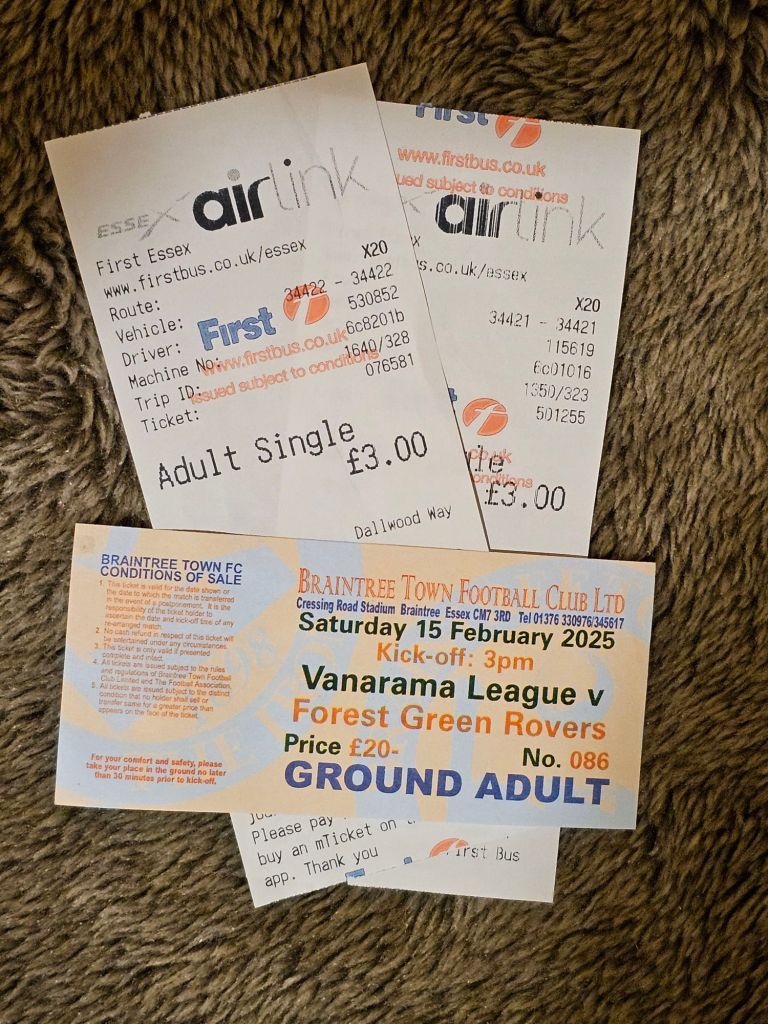
It has started to rain, and weighed down with the responsibility of not wasting the valuable seconds I have gained by getting off the bus early, I step out on the ten-minute walk up Cressing Road and along Clockhouse Way to what was called the Ironmongery Direct stadium the last time I was here, but now rejoices under the name of The Rare Breed Meat Co Stadium.  Being the world’s first vegan football club, I’m surprised Forest Green Rovers haven’t refused to play here, and there are so few people walking up Clockhouse Way with me I do begin to wonder if the game hasn’t been postponed.  But the sight of a man in a day-glo coat, a full club car park, a man in an orange football club hat and three other people obviously dressed for an afternoon of spectating allays my fears and I head for the turnstile labelled “card only” where the wonder of modern technology takes £20 from my bank account with the mere tap of a piece of plastic.  Satisfyingly, I am given a small, printed ticket in exchange, it’s number 86.
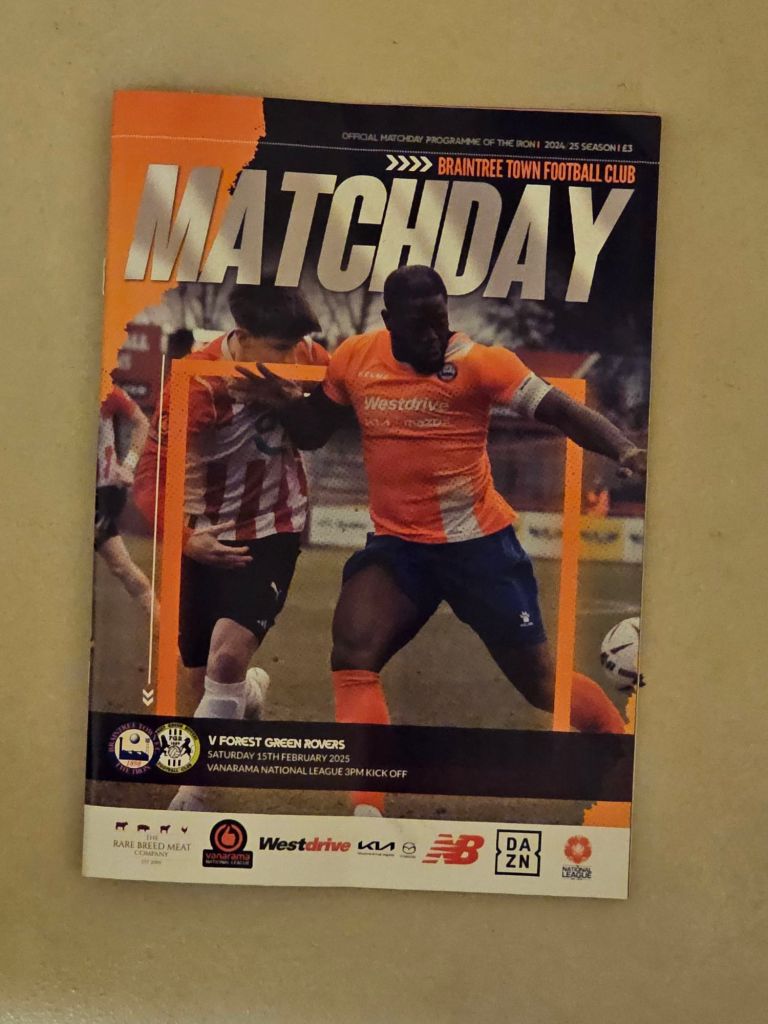
To buy a programme (£3.00) I make for the club shop, a cornucopia of old programmes, club badges and general football fan bric-a-brac in a portacabin; every club should have one, but fewer and fewer do. A radio in the club shop is tuned to Radio Essex and a time check tells me that it is six minutes to three, so I head out and onto the open terrace behind the goal to select a spot against the back wall, level with the eaves of the club house just behind.

The teams process onto the pitch to the strains of “Firestarter” by ‘electronic punk’ or ‘rave’ band The Prodigy,  who are or were Braintree’s modern claim to fame. There is a minute’s silence before the kick-off for a recently deceased former player.  It’s a silence that is at first disturbed by shouts of ‘Rovers’ from somewhere off to my right.  Once achieved, the silence seems a long one as if the referee in schoolteacher mode had decided that we were just going to have to wait to begin until everyone was quiet.

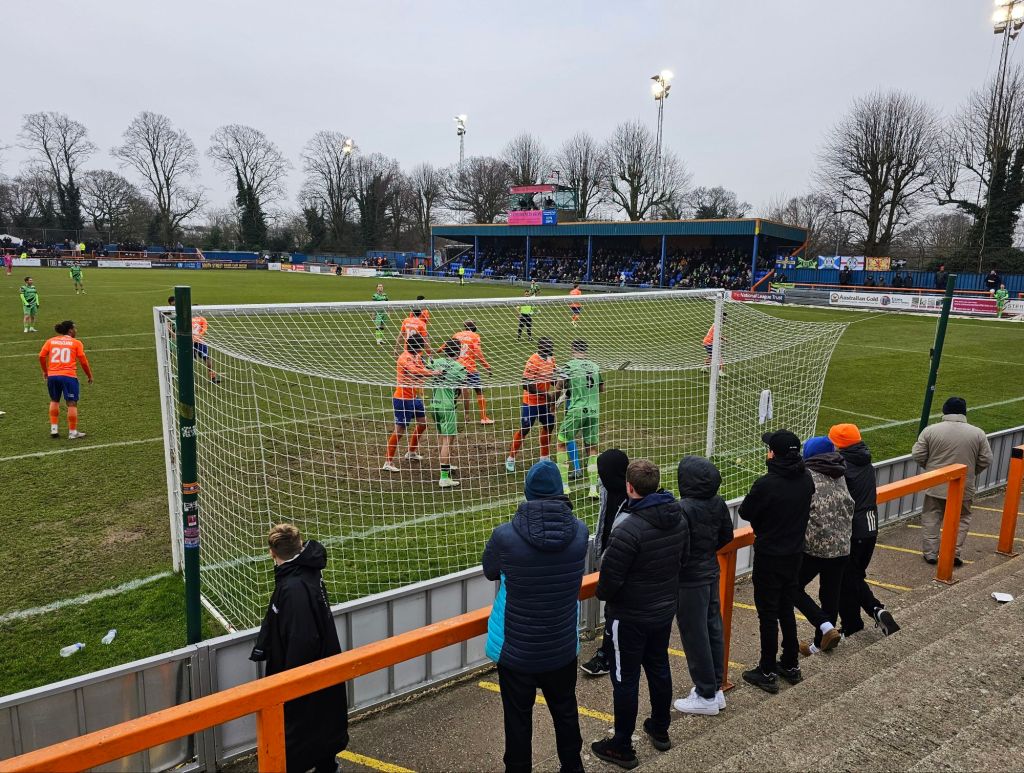
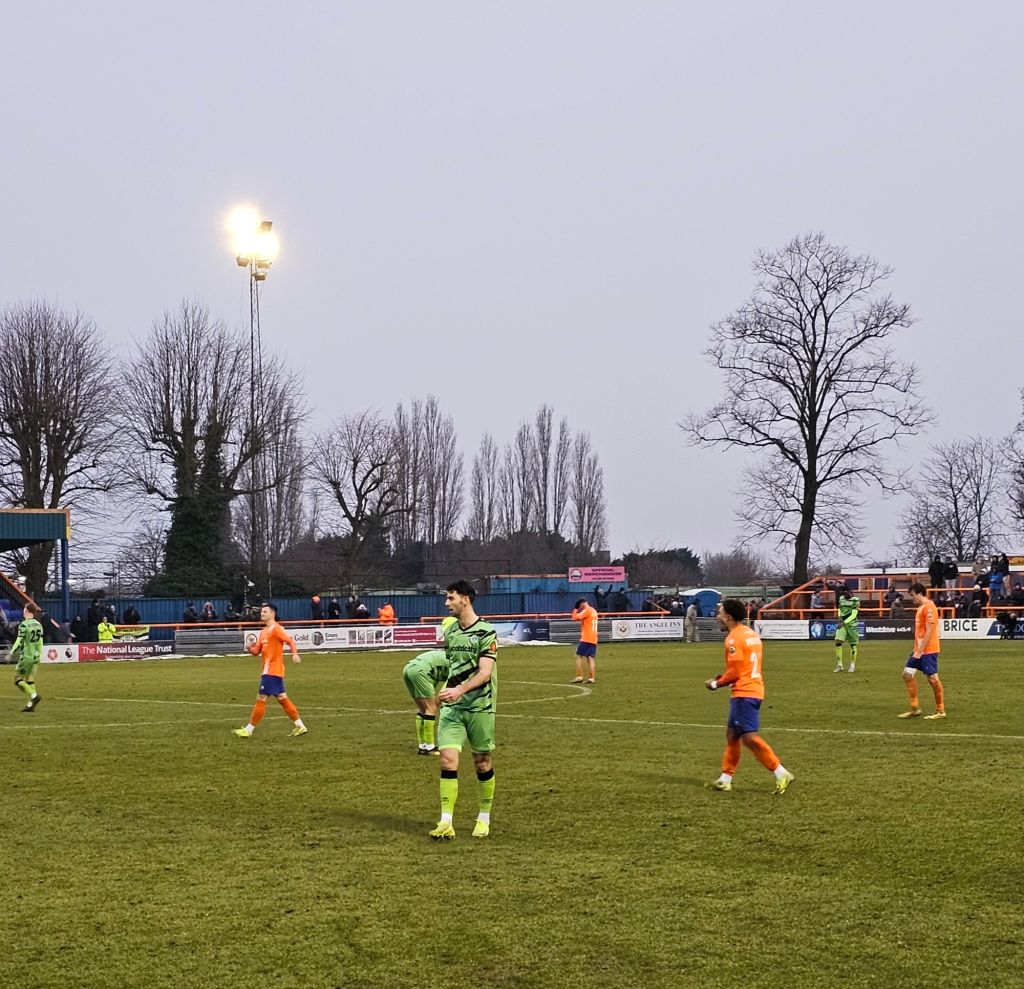
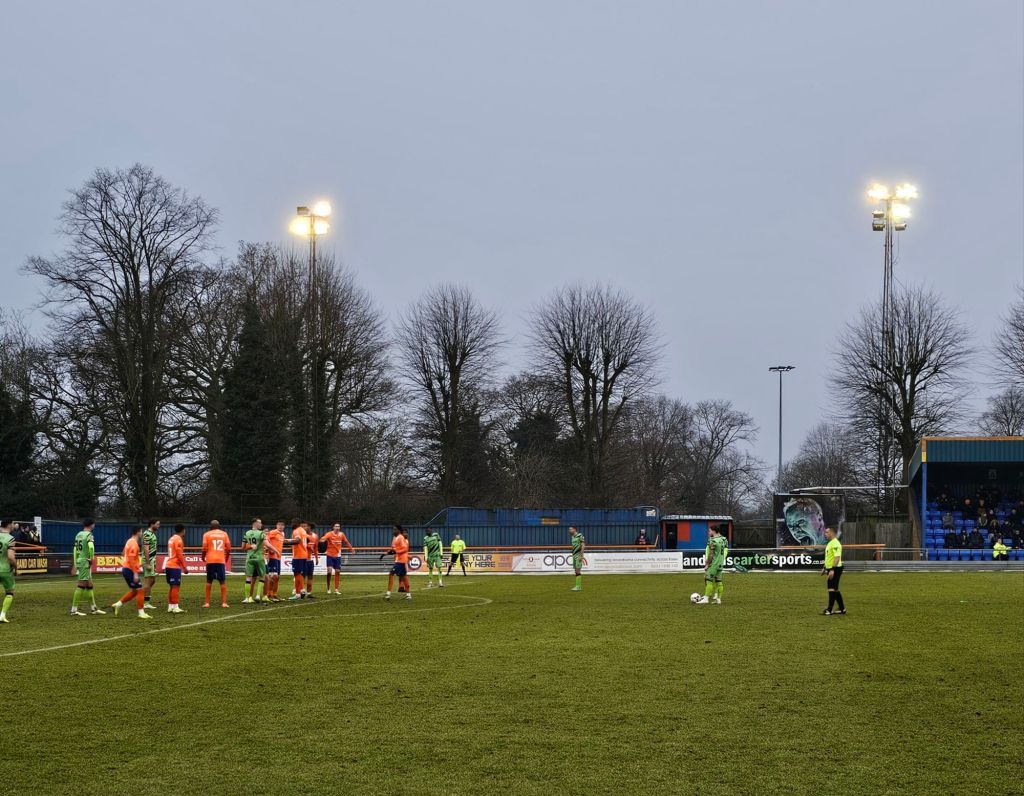
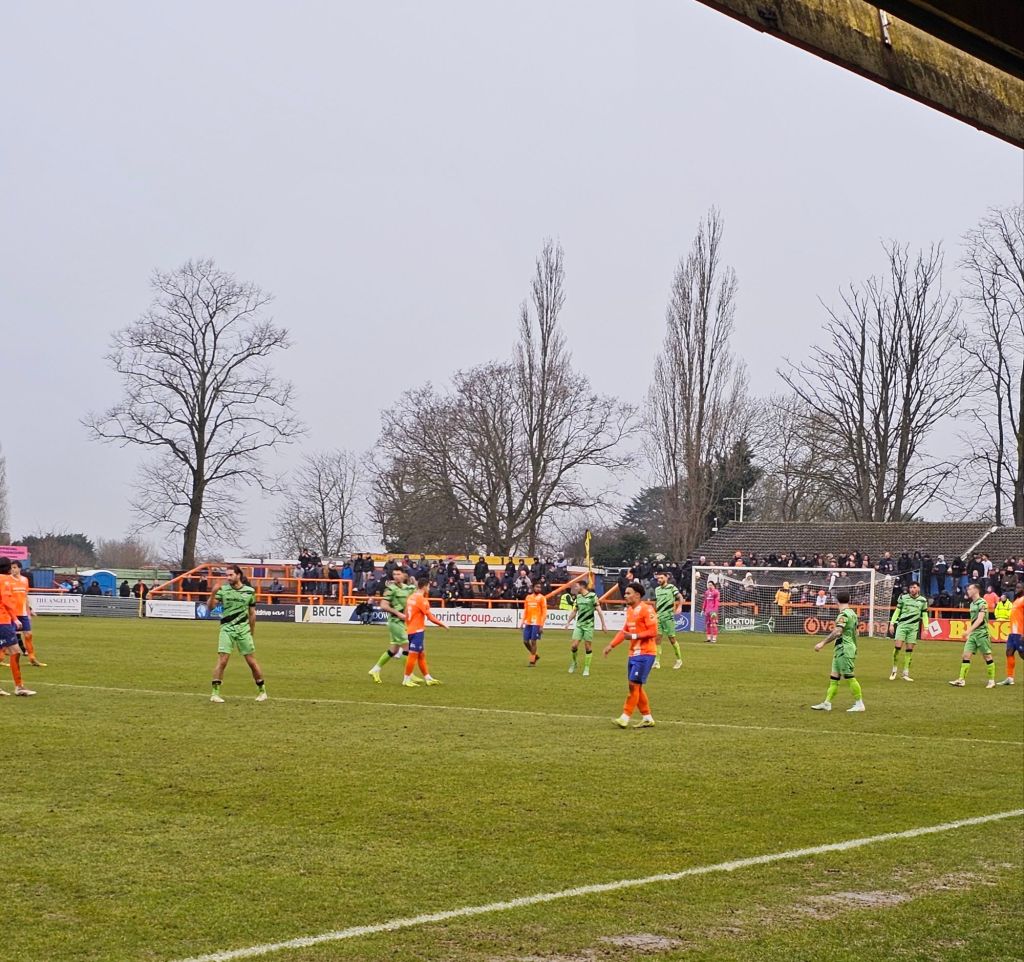
When the match eventually begins, it is Braintree who get first go with the ball, sending it mostly away from where I am standing, and in a south easterly direction towards the village of Tye Green and far off Witham, where this afternoon Witham Town are going to lose heavily to Bury Town in the Isthmian League.  Braintree wear a gloriously colourful kit of orange shirts and blue shorts, a brighter version of Montpellier HSC of French Ligue 1.  Forest Green Rovers by contrast are in a disappointingly dull, faded looking shade of all-over green, but with black slashes on the front of their shirts as if they had originally been intended for use by a safari park eleven.

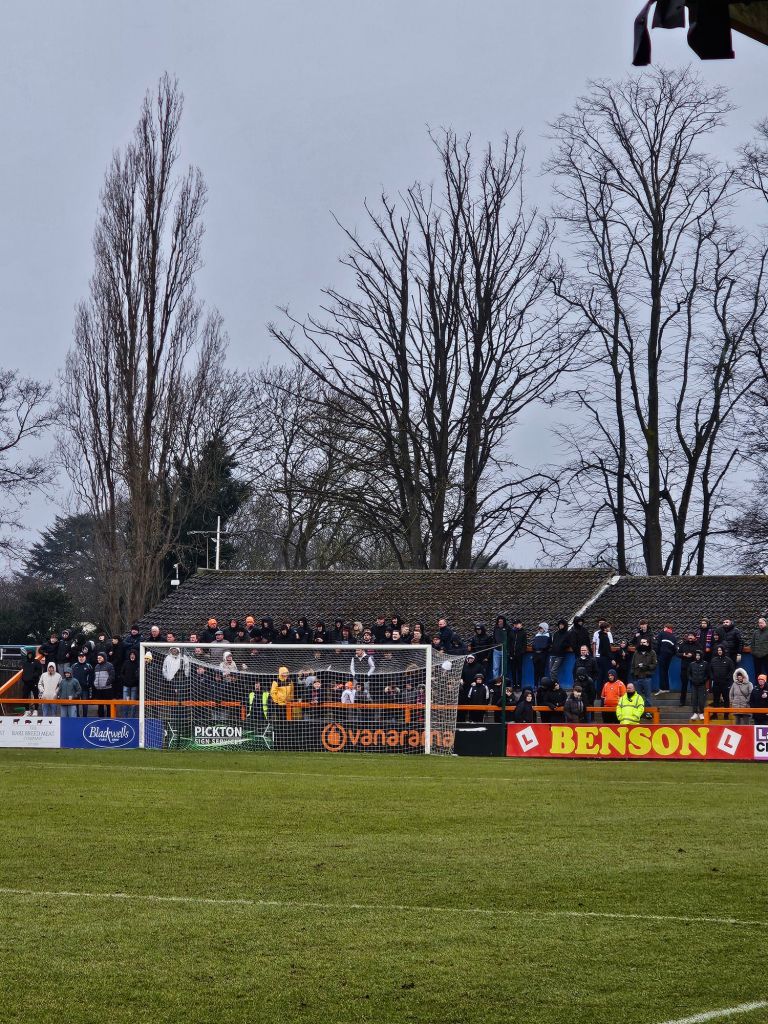
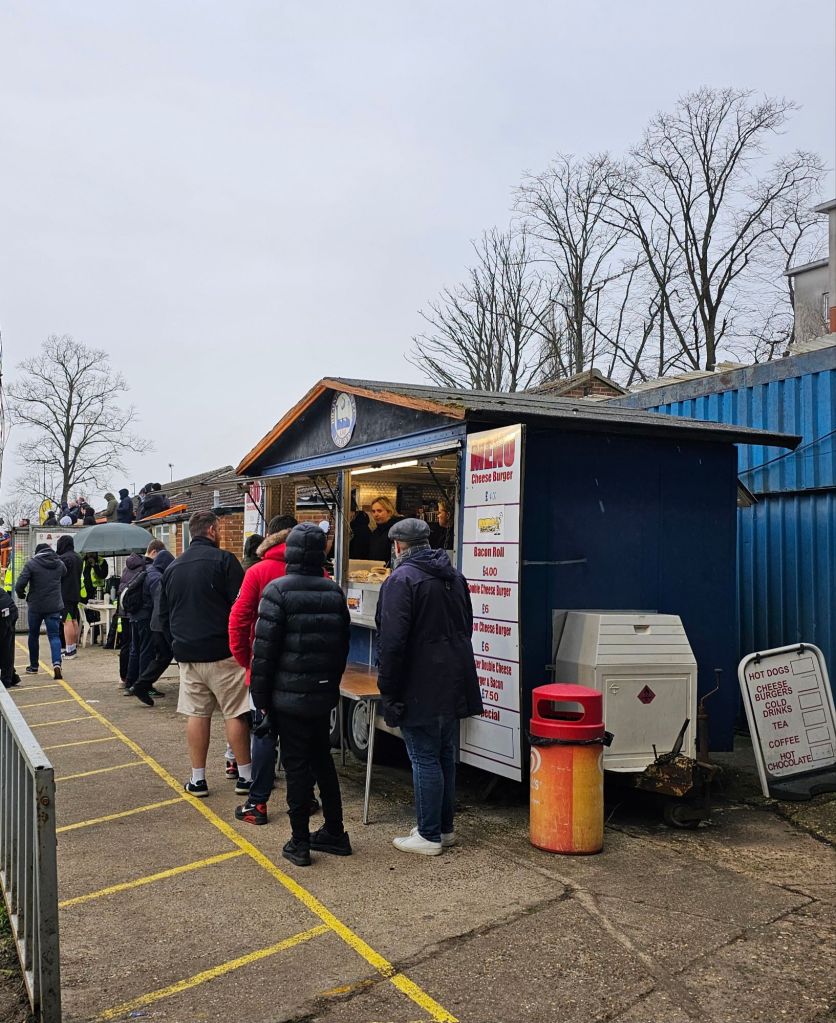
Braintree dominate the start of the game and all the action is at the far end where it looks compressed into a few yards.  A few feet along from me a middle-aged man twitches and flexes as he wills Braintree to score with a quiet commentary of encouragement to himself. “Oooooh” he suddenly exclaims as an early cross eludes the straining head of an orange shirted player at the far post.  The rain has started to feel like sleet.  Along the walkway at the foot of the terrace, a procession of hungry-looking ten and eleven-year-olds ferry polystyrene trays stacked with chips and burgers, which may or may not be from the meat of slaughtered rare breeds.  “Your support is fucking shit” comes the chant from beneath the low roof of the terrace on the east side of the ground.  “Come on” continues the bloke a few feet away from me, quietly to himself as Braintree win another early corner.

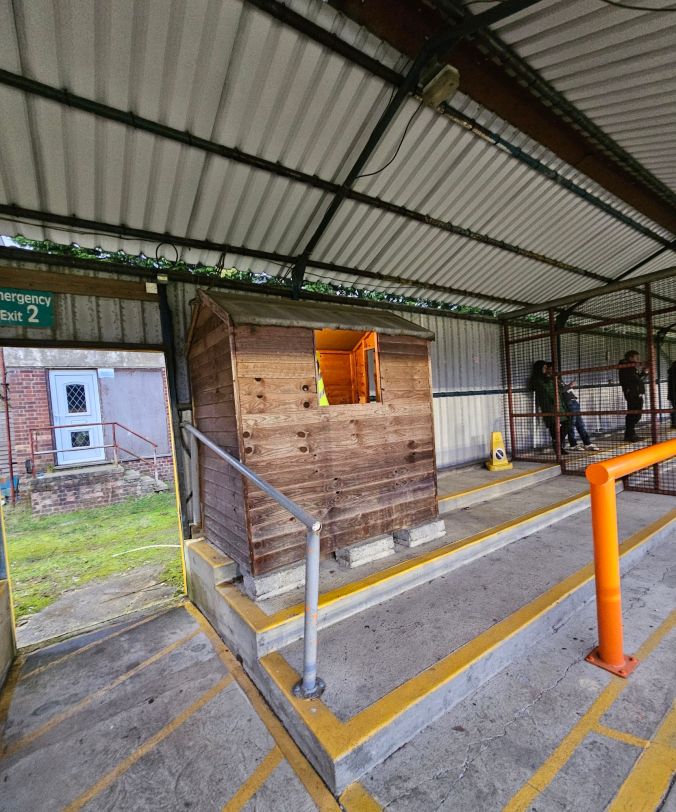
It is eleven minutes past three and Braintree score. A low shot from wide on the left into the far side of the Forest Green goal. “Goal scorer for…” says the stadium announcer from his garden shed inside the low-roofed terrace.  He stops mid announcement but then continues to tell us that the goal scorer is what sounds to me like “Cairo Lisbie”.  “Goal scorer today” he repeats as if he thinks it’s unlikely anyone else will score, “Cairo Lisbie”.  In fact, of course, he is saying Kyrell Lisbie.

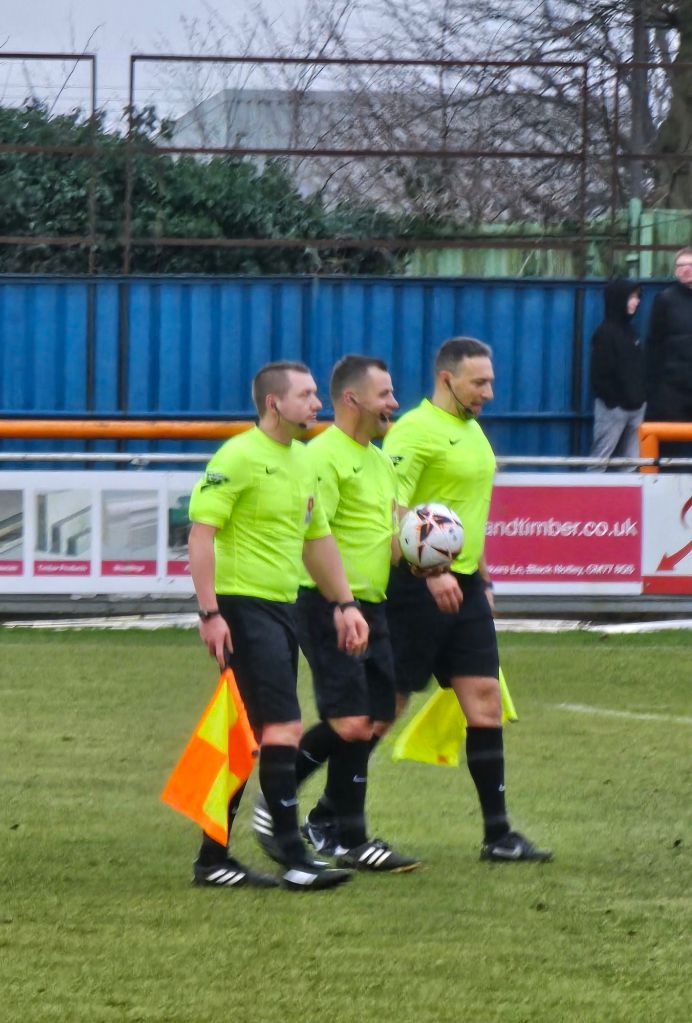
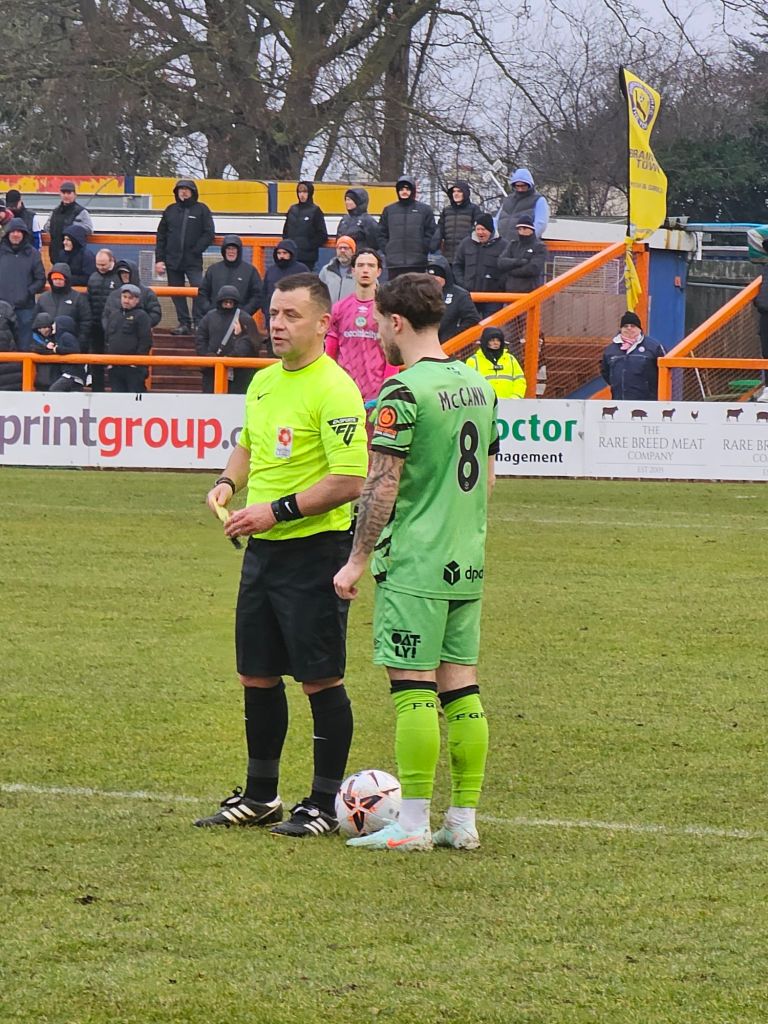
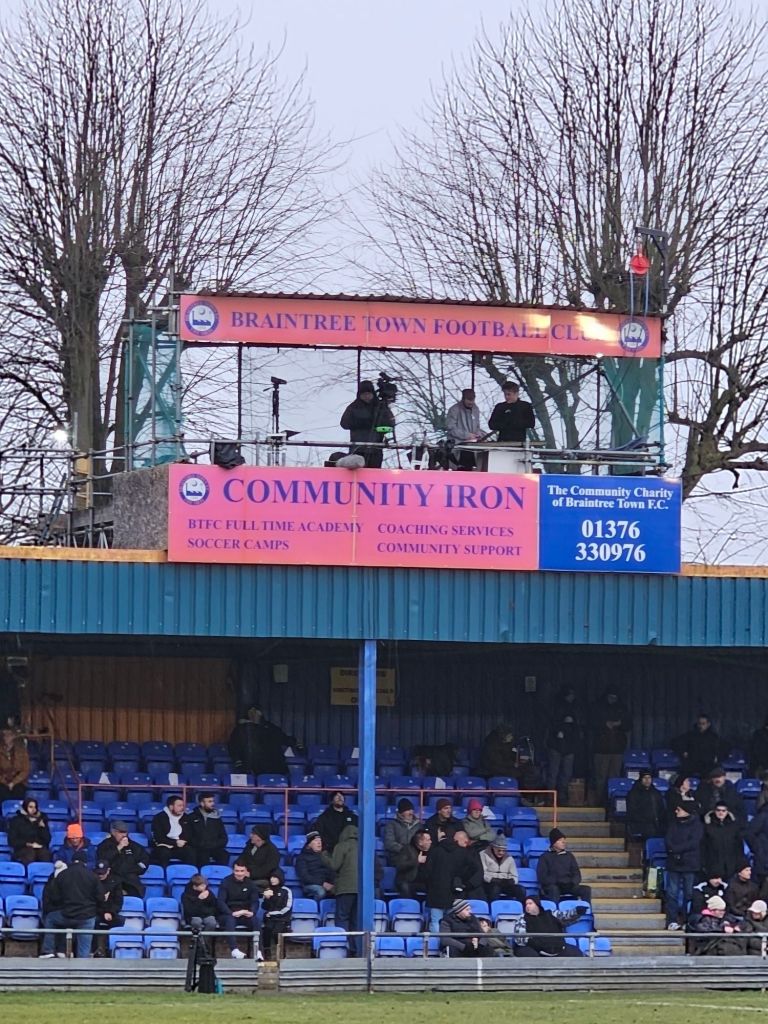
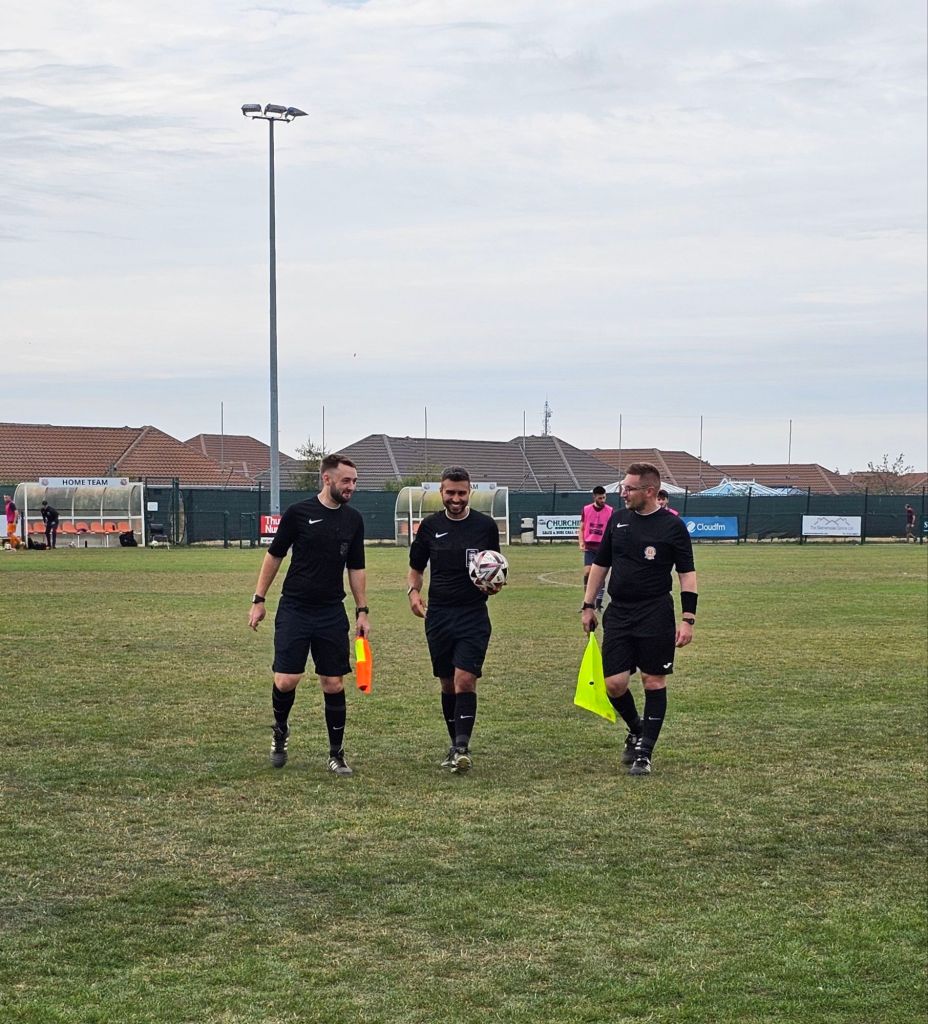
“No noise from the Vegan boys” is the chant from beneath the low roof of the side terrace, as if to rub it in that we’re in the “Rare Breeds Meat Co stadium”, and I decide that the drizzle is now too cold and heavy and so I make for the covered terrace beneath the low roof.  “When’s the Southend game?” I hear a bloke say as I walk by.  “I’ve got a feeling it’s next month” says his interlocutor evidently preferring to rely on sensations rather than the actual fixture list, which confirms that the fixture is on April 18th.  In my new location on the covered terrace with the low roof I have a new set of neighbours. “Yellow there ref, yellow, that is a yellow, thank you” says a bloke nearby as Forest Green’s Adam May becomes the first player to be booked by referee Gareth Rhodes, whose name is similar to that of a once popular, but now deceased tv chef.

A high cross field ball from a Forest Green player is greeted with a derisory jeer from the home crowd and then a collective, disappointed ‘Oh’ as it drops perfectly onto the bounce-free turf at the feet of Rovers’ wide player.  Around me the locals continue to take umbrage at Mr Rhodes’ failure to book any more Rovers players.  “Should of (sic) got booked earlier” shouts someone, “How many more times?” enquires someone else, before shouting it again, and then again, making me wonder how many more times he would shout it. “Cynical!” calls a short bespectacled youth next to me, and then “I’m watching you ten”, as if this matters.

At twenty-seven minutes to three Braintree score a second goal; one very much like the first, but this time with a shot from wide on the right into the far corner of the goal by number seven, Tom Blackwell.  After three minutes of added on time, half-time arrives and the public address system returns us to 1979 with the sound of ‘A message to you Rudy’ by the Specials. I eat a Polish Grzeski chocolate-coated wafer bar from the Sainsbury’s World Foods aisle and reflect on all the other delicious European foodstuffs that could have been so much more freely available had Britain not left the European Union.
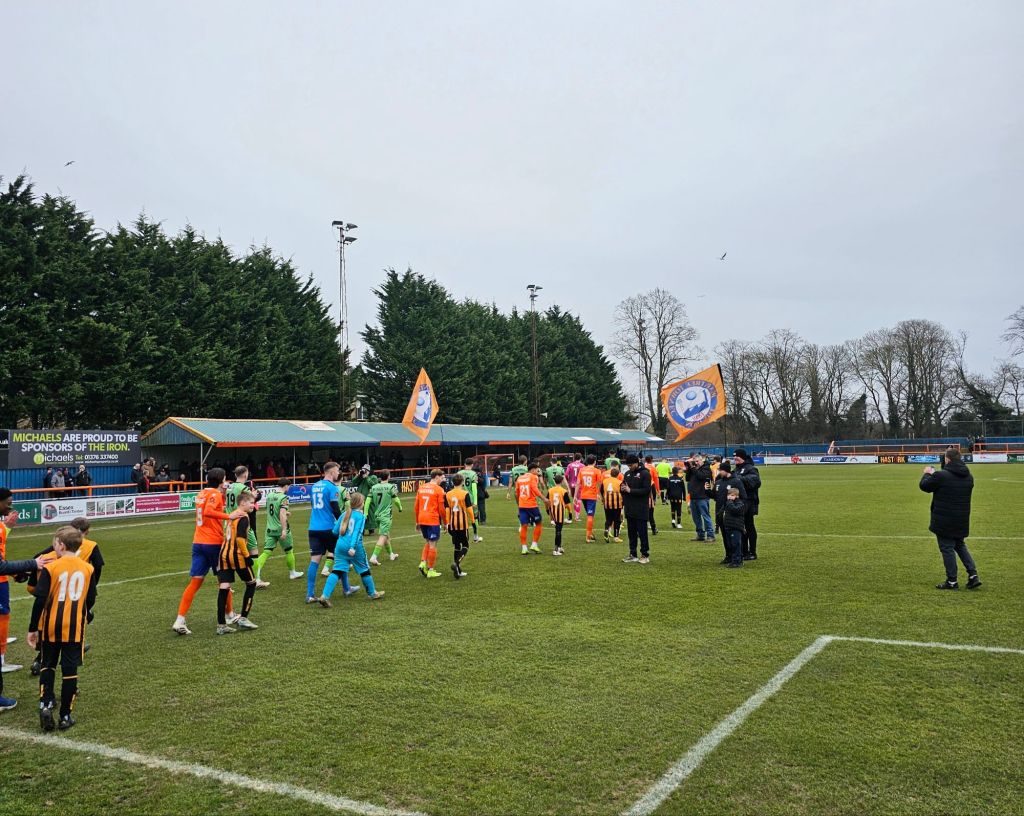
Today’s attendance is announced as being 860 and the football resumes at five past four.  I walk to the far end of the low-roofed terrace where I find myself amongst mostly Forest Green Rovers supporters, and I feel happier amongst the sounds of their west country burr than amongst the aggressive rants and growls of the voices of the displaced Londoners who now live in Essex.

Rovers begin the half with purpose, and in the first few minutes spend as much time in the Braintree penalty area as they did in the whole of the first half.   But then Braintree breakaway and hit the post or the bar with a shot. “Come on Rovers” call the people around me from beneath their green and black knitted headwear.   “We’re winning” says a young bloke nearby and it seems from subsequent mention of Liam Delap that he and his friends are either Ipswich Town supporters watching Forest Green, or Forest Green supporters who follow Ipswich.

I’m seeing Forest Green at closer quarters this half and soon establish that their team is ‘set up’ in the traditional formation of a couple of big blokes at the back, a big bloke up front with smaller blokes all around, especially on the wings.  Braintree would seem to be similar and with a blend of youth and experience which includes the venerable thirty-five year olds John Akinde, a man in the mould of the legendary Adie Akinbiyi, but obviously not as big,  and defender Jamal Fyfield.  Despite more possession this half, Forest Green are not making any decent chances.  “Shoot” plead the people around me. “Bring on a fuckin’ strikerr” says another, more directly and rolling his ‘r’s like a comedy pirate in the process.  It’s nearly twenty to five when Forest Green have a shot good enough to force the Braintree goalkeeper into making a save and by then they have replaced half their outfield with substitutes, including one Harvey Bunker, who I like to think has a brother called Cole.

The second half is one of frustration for away supporters and tension for home fans, only occasionally relieved by a wet, slippery, muddy pitch which induces a sprinkling of pratfalls and mis-kicks for added comedic effect.  Eventually, after the initial ninety minutes are played out, Mr Rhodes adds another six for good measure and halfway through these the Braintree fans feel sufficiently confident of victory to begin chanting “We are staying up”.  Their optimism is well placed as not surprisingly, given what has happened since three o’clock, Forest Green fail to produce a miraculous come-back .

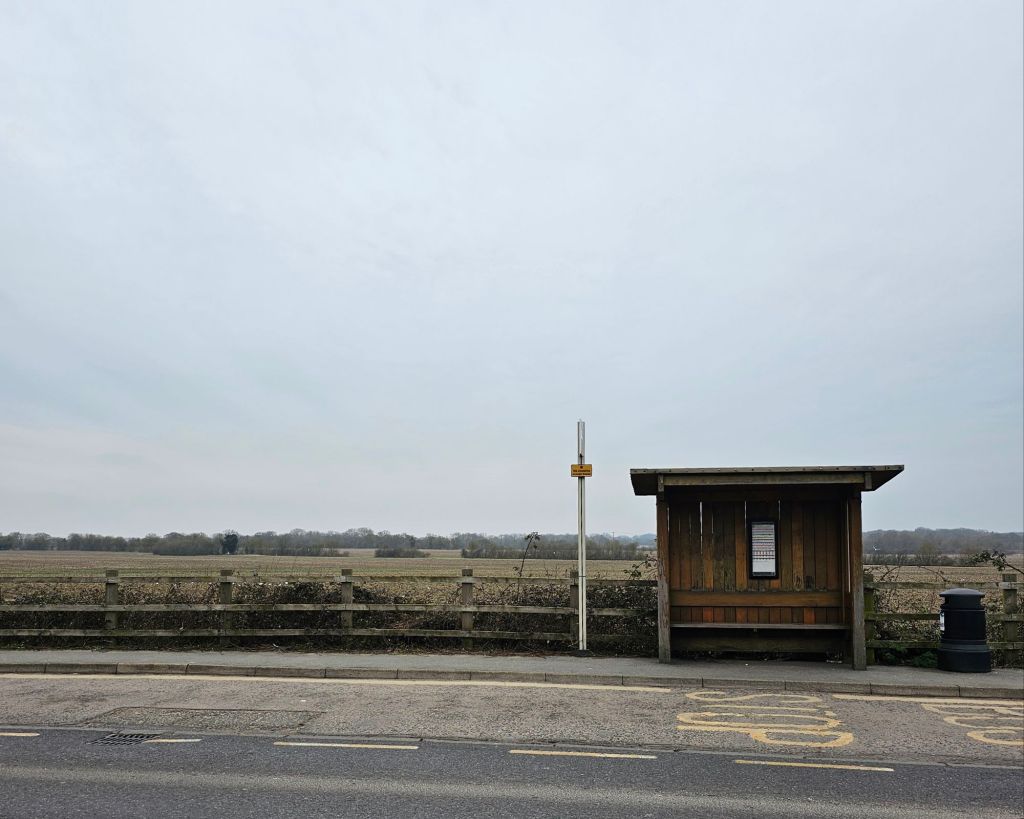
With the final whistle, a mostly happy crowd slips away into the receding dusky light whilst a few Forest Green fans hang about to berate their players by way of encouraging better in the future.  I too drift away, past the interesting 1930’s modernist workers houses beyond the club car park and back down Clockhouse Way and Cressing Road to the bus stop.  The bus will be late again, the stop has no shelter and it starts to rain again, but as the win to the local team proves, it’s better by bus.

Little Oakley 1 Barking 1

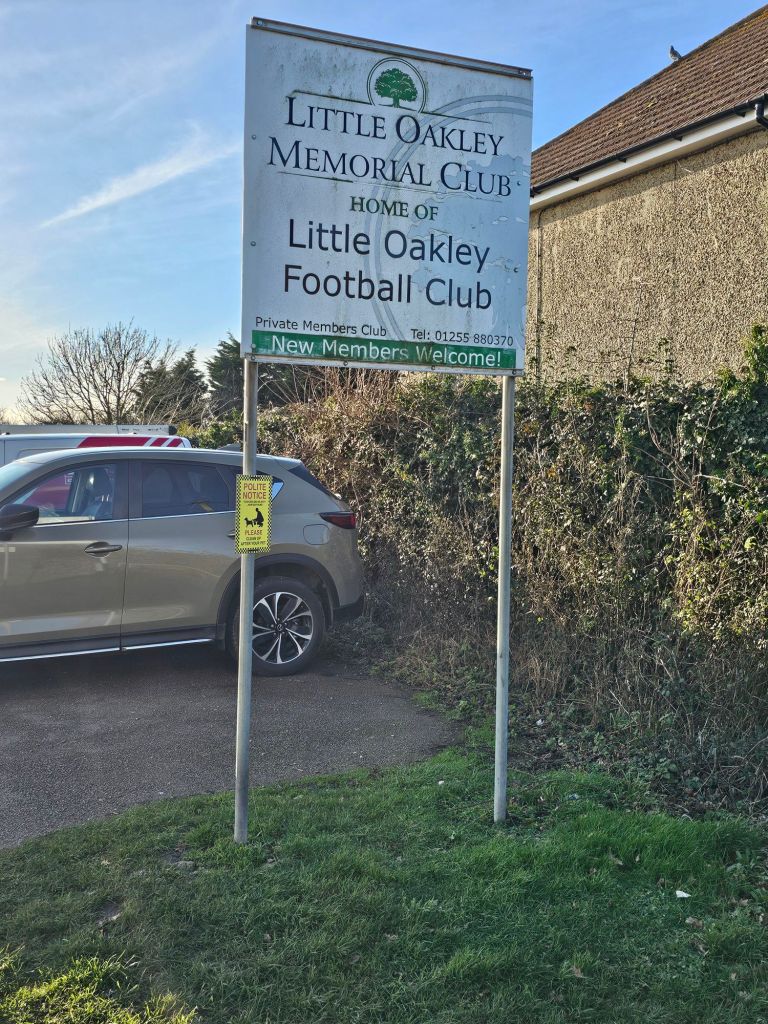
The village of Little Oakley in Essex, Wikipedia tells us, had a population in 2011 of 1,171 and is on the outskirts of Harwich.  More precisely, Google maps tells us that Little Oakley is a four kilometre, fifty-eight minute walk from Harwich International railway station.  Now, I reckon I could walk 4 kilometres in less than 58 minutes, but I am nevertheless of a lazy disposition and therefore, today I have opted to drive the thirty-six kilometres from my house to the Memorial Ground, home of Little Oakley FC in my planet saving Citroen e-C4,  rather than enjoy a travel melange of rail, bus and walking, which would take me between one and  half and two and a half hours depending on connections.  Today at the Memorial Ground, Little Oakley FC are playing Barking in the Essex Senior League, the ninth level of English league football.

It’s a beautiful, bright, clear, winter’s day and but for a Luton van pulling out in front of me from a lay-by on the A120, I have a relaxed, trouble-free journey, played out to a soundtrack of the Saturday afternoon pre-match football coverage on BBC Radio Essex, featuring amongst others, the dulcet tones of Glenn Pennyfather and Danny Cowley.  My Citroen’s SatNav doesn’t seem to know about the Memorial Ground, so my journey ends with an abrupt left hand turn when suddenly from the B1414 I see the street sign for Lodge Road, which I remember from looking at a map is adjacent to the Memorial Ground.  I park up at the side of the narrow approach road, beneath an avenue of trees with a deep ditch on one side and wooden fence on the other on which several signs plead with drivers not to park too close to it.  I make the short walk to the clubhouse enjoying the sound of birdsong whilst inhaling the smell of hot cooking oil, probably chip fat.

The clubhouse is welcoming and populated with happy pre-match drinkers.  I buy a bottle of Adnams’ almost non-alcoholic ‘Ghostship’ (£3.20) and the bar maid asks if I’d like a glass, I would. I stand and look up at one of three TV screens showing Sky TV.  From a hatch, behind which is the clubhouse kitchen, a middle-aged woman looks out glumly. “Fed up?” I ask her.  “Bored” she says “It was busy, and now it’s quiet”.  This lady seems responsible for fulfilling the whole crowd’s need for food and hot drink on her own but it will soon be kick-off, so for now she’s not needed.

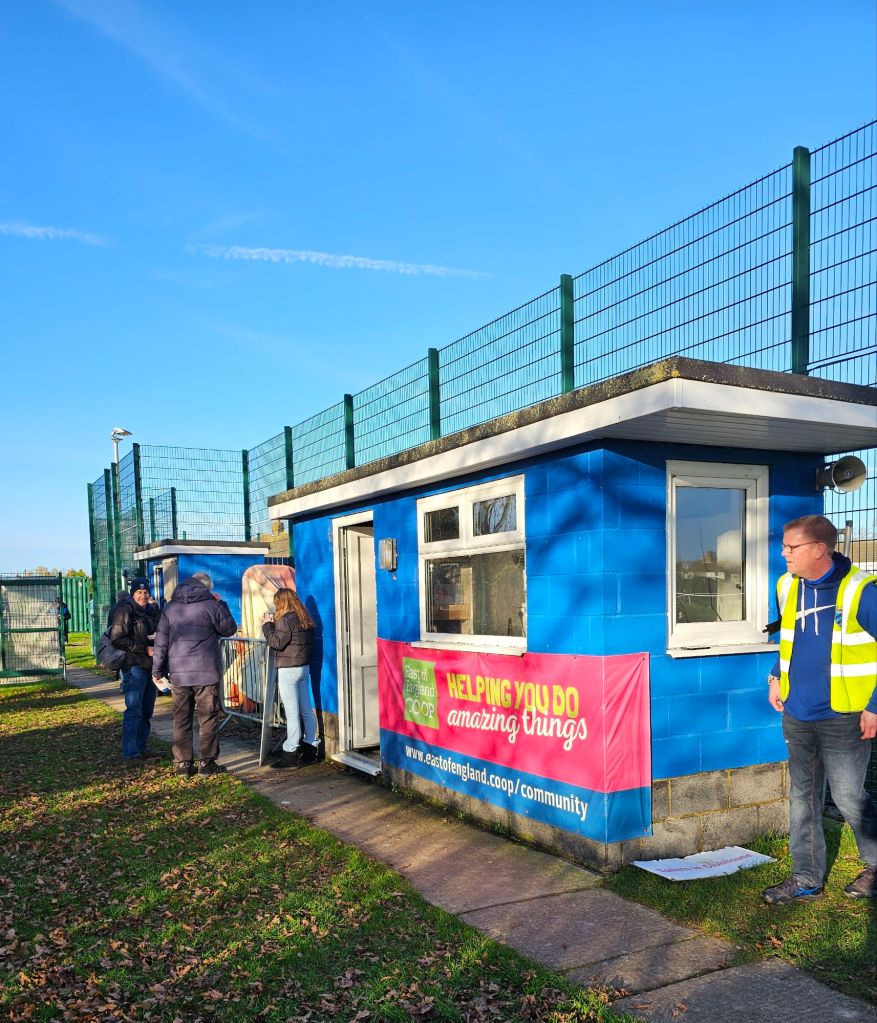
I sink my low alcohol beer as quickly as I can without burping and head outdoors where a man with a loud, deep voice directs me to turn left beyond the shipping container at the far end of the car park.  A short, friendly man emerges from a hut, a bit like municipal car park attendants used to in the far off days before ‘Pay and Display’, and asks if I’m a concession.  I ask how old you have to be to be a concession; it turns out it’s sixty-five and he apologises when I tell him I’m only sixty-four. But it does mean I’m about six months further from the grave than I would have been if I’d been a concession, even if I will be three quid poorer for it.  Having handed over my £8.00 in cash, I ask if there is a programme and am surprised to find that there is. “Here you are, if you’d like something to read” says the man, handing me six colourful sheets of A4 paper stapled together in the top left-hand corner.  Best of all the programme is free, as if a little bit of France has been re-located to the top right-hand corner of rural Essex.

Pap-rock plays over the public address system as I take stock of the ground, which has two small pre-fabricated metal terraces behind one goal and another pre-fabricated metal stand with seats overlooking the far half of the pitch; it looks as if there wasn’t room behind the dugouts for the stand to be level with the half way line.  The ground backs onto a hedge and a couple of Oak trees on one side and onto the gardens of a row of semi-detached houses on the other.  At the far end there is just a playing field and a trio of teenagers have leaned their bikes against the rail around the pitch. I can also see from here that the clubhouse appears to have a partly corrugated metal roof; I bet it rattles when it rains.

The pap-rock gives way to Jeff Beck’s ‘Hi-Ho Silver Lining’ and the two teams amble onto the pitch; if there is any shaking of hands or other gestures of sportsmanship I miss them. I stand close to the home team dugout and next to me a man talking into his mobile phone says “We got two meal deals at the Co-op before we came out, so we ‘ad them”.  In the ‘technical area’ in front of the dugout, a track-suited man calls out to the home players “Ave a look, ‘ave a look, just be aware of the fuckin’ double bluff”.  I have no idea what he means, and decide not to ask him.

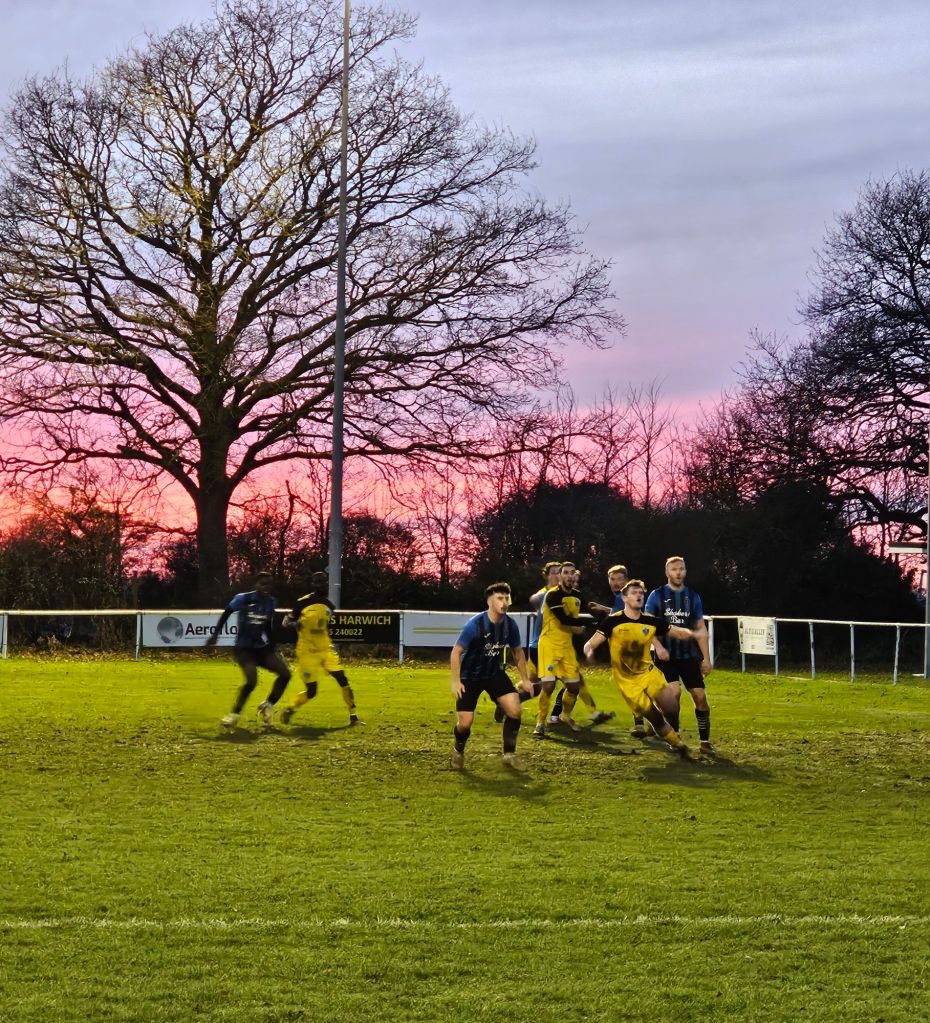
The match begins, and Barking get first go with the ball, their second touch being a hefty hoof out to the left wing.  Little Oakley, known as ‘The Acorns’ are wearing blue and black striped shirts with black shorts, a bit like a destitute man’s Inter Milan and are defending the empty, featureless end of the ground with marshes, Hamford Water and the North Sea a kilometre or two beyond.  Barking are all in yellow, with black sleeves, and they defend the clubhouse and Ramsey end of the ground, with the River Stour and Suffolk beyond that.   Barking win an early corner with some clever play by their number seven Michele Maccari. “Why’s that big guy on the edge? ‘e’s got a massive head on him” asks a lad sat behind me of his two friends, who I think could all be Little Oakley players who are not playing today. The ‘guy on the edge’ is stood at the edge of the penalty box and whilst he is quite tall, I must admit I can’t really see that his head is any bigger than anyone else’s.

“Barking, Barking give us a song” chants a bloke tamely, somewhere off to my right.  “If you all ‘ate Dagenham clap your ‘ands” comes the response from three or four other voices.  Unfortunately, Little Oakley has no such choir. It’s just gone a quarter past three and despite Barking probably playing, or at least attempting to play the more attractive and neater football, it is Little Oakley who have the first decent shot on goal, as number ten, Daniel Rowe spectacularly volleys the ball against the foot of a goalpost creating a pleasing metallic pinging sound. Recovering from the momentary excitement, I notice that between the semi-detached houses on the far side of the ground and across the water inbetween, I can see two dockside cranes at the Port of Felixstowe, beyond which and unbeknown to me, Felixstowe & Walton Football Club are on their way to drawing nil-nil with Haringey Borough in the Isthmian League.

Barking make claims for a penalty as one of their number tumbles between two Oakley defenders and at this point the referee seems to lose any affection the visitors might have once had for him. “You’re a joke ref” calls a man from behind a camera with a tele-photo lens, “Absolute clown ref”.  It’s nearly twenty-five past three and all of a sudden Barking take the lead; a clever, arcing cross being headed in at the near post by number six and captain Fahad Nyanja.

As the game is about to resume, an Acorns’ player calls out “We keep going, we fucking keep going”.  It is stating the obvious and I for one would feel a bit short-changed if this early in the game they’d all along been secretly playing ‘next goal wins’ .  As unnecessary as it should be, these apparent words of encouragement nevertheless almost work but in an unexpected way, as a low cross from the Oakley number seven, Idris Namisi is diverted against a goal post by Barking number four Sam Edwards.  Idris Namisi seems a popular player amongst the home crowd, and I can’t help but like him too, even if it’s probably because his first name is the same as that of the dragon who lived in the firebox of Ivor the Engine.

Oakley’s number ten, Rowe claims the honour of being the first player to be booked as he pulls back a Barking player and I agree with the old boy stood next to me, whose grandson is the Oakley number eleven, Luke Hipkin, when he says it was a needless, stupid foul.   The old boy asks me if I’m from Harwich and I tell him I grew up in Shotley just over the river from here. “Not far away, then “. He says. ”Not if you’ve got a boat” I reply.  Back on the pitch, the Oakley players are arguing amongst themselves. 

The half ends with Rowe being put through on goal for Oakley with just the Barking keeper to beat, but his shot is saved and Idris the popular dragon blazes the rebound high and wide.   I check my phone and Ipswich are losing 0-3 at Liverpool, which makes me glad I’m here and not on Merseyside.   With the half-time whistle I make for the club house to drain off excess low alcohol Ghostship and invest in one pound fifty’s worth of tea, because under a clear sky it’s beginning to get cold as the sun sinks in the west.  The middle-aged woman in the kitchen is being cheerfully rushed off her feet serving tea, frying chips, griddling burgers and taking cash and card payments. I can’t help but think it’s a pity the players and managers of both teams can’t just get on with what they’re meant to be doing with as little complaint. I haven’t heard her say ‘fuck’ once.

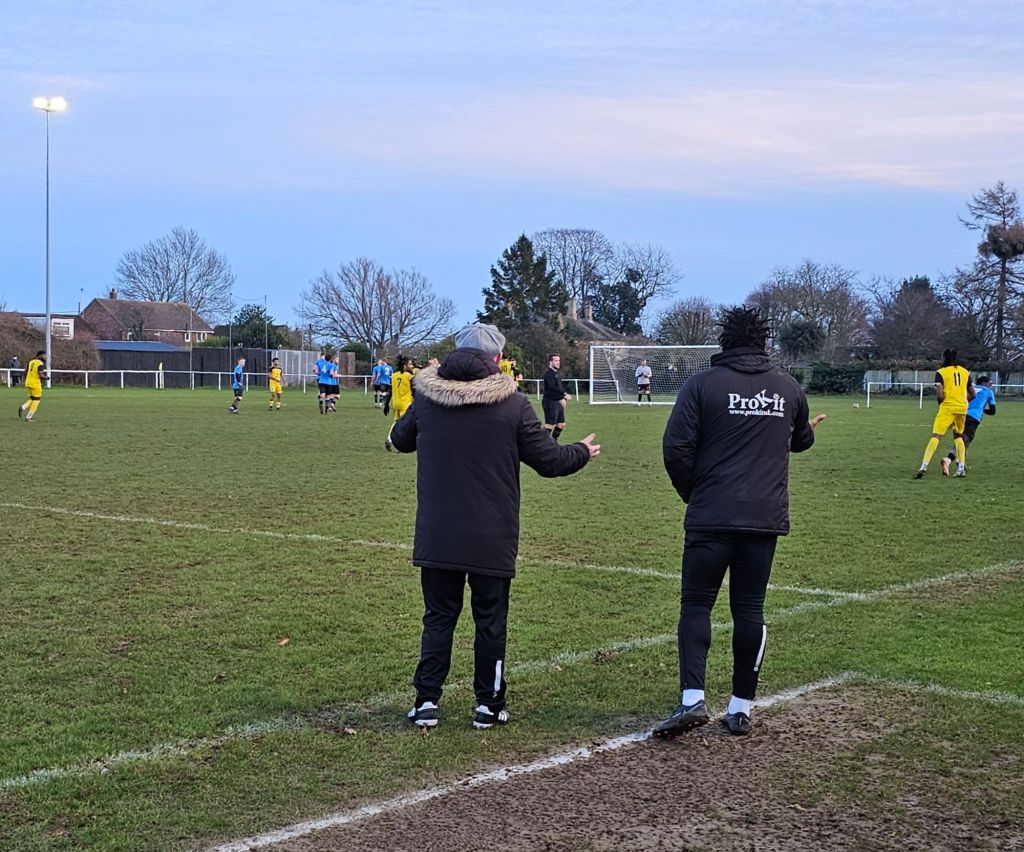
I take my tea outside into the softening, late, winter afternoon sunlight and the match resumes at two minutes past four; I stand by the Barking dugout. “Get ‘old of the fucker” barks the Barking manager  a seemingly irascible  man sporting a stylish grey cap and white goatee beard, who sounds like Ray Winstone and mostly never says ‘fuck’ or ‘fuckin’ in a sentence unless he can say it half a dozen times.  Mostly, his exasperation seems to be directed at his own Barking team who, I can only guess, aren’t playing so much like the Spanish national team, as may be he told them to.

Time goes on and Barking’s number eleven Ugonna Emineke is booked for time wasting as he delays taking a throw-in because there is a rumpus happening in the penalty area and he’s waiting for it to subside.  Unfortunately for Emineke, the referee only had eyes for him and hadn’t noticed the pushing and shoving in the penalty  area, although before the throw is eventually taken he has to go and sort it out and speak to his assistant about it. Then, with twenty minutes of the half gone Oakley equalise, Idris Namisi nipping in to poke a cross over the goal line from close range.

As it has progressed, the game has become increasingly fractious, with a number of Acorns players being quite aggressive, whilst Barking players have acted out fouls where none has been made, sometimes squealing and moaning for additional effect.  All this has been against a  background of some of the most  liberal use of the word ‘fuck’ I have ever heard and I wonder what people do during the week to make them so angry on a Saturday.

Things don’t improve when at twenty-seven minutes to five Emineke is sent off for a ‘professional’ (or, as this is only the Essex Senior League perhaps ‘semi-professional’) foul, and The Acorns are awarded a penalty, which the balding and bearded Darren Mills takes and Daniel Purdue saves, diving excellently to his right.  “How many more fucking chances do we get?” moans The Acorns’ number three Adie Cant.  “Calm the fuck down” shouts the coach “Fuckin’ ‘ell”. It’s as if Peter Cook and Dudley Moore’s Derek and Clive had had an afternoon out at the football.

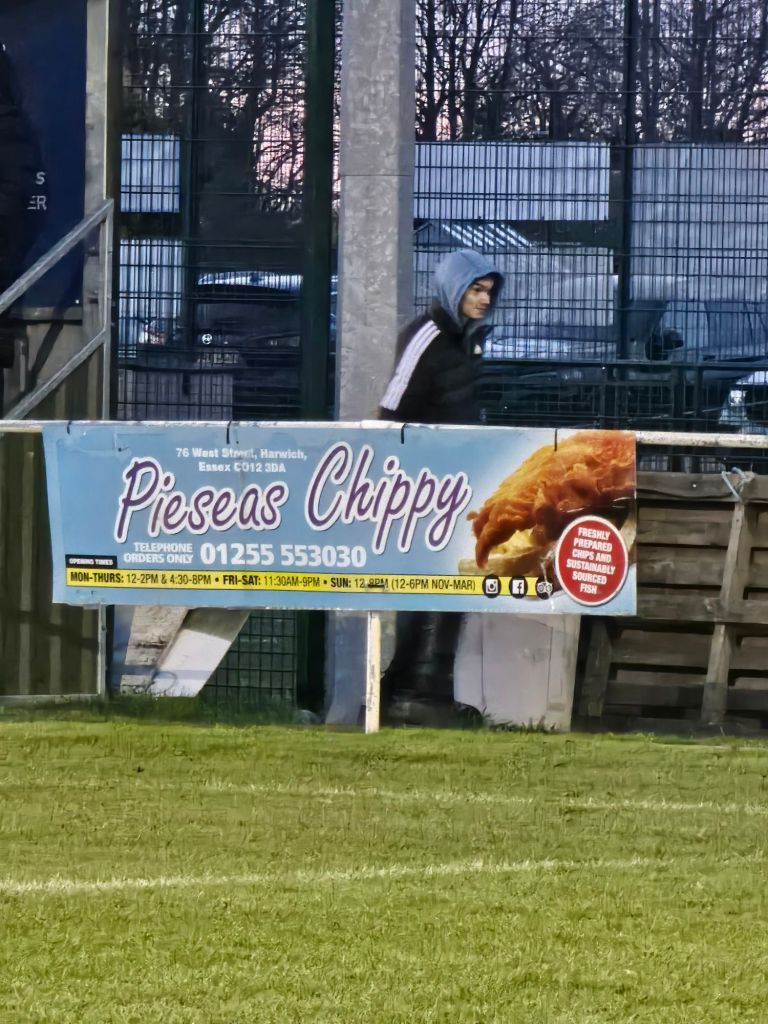
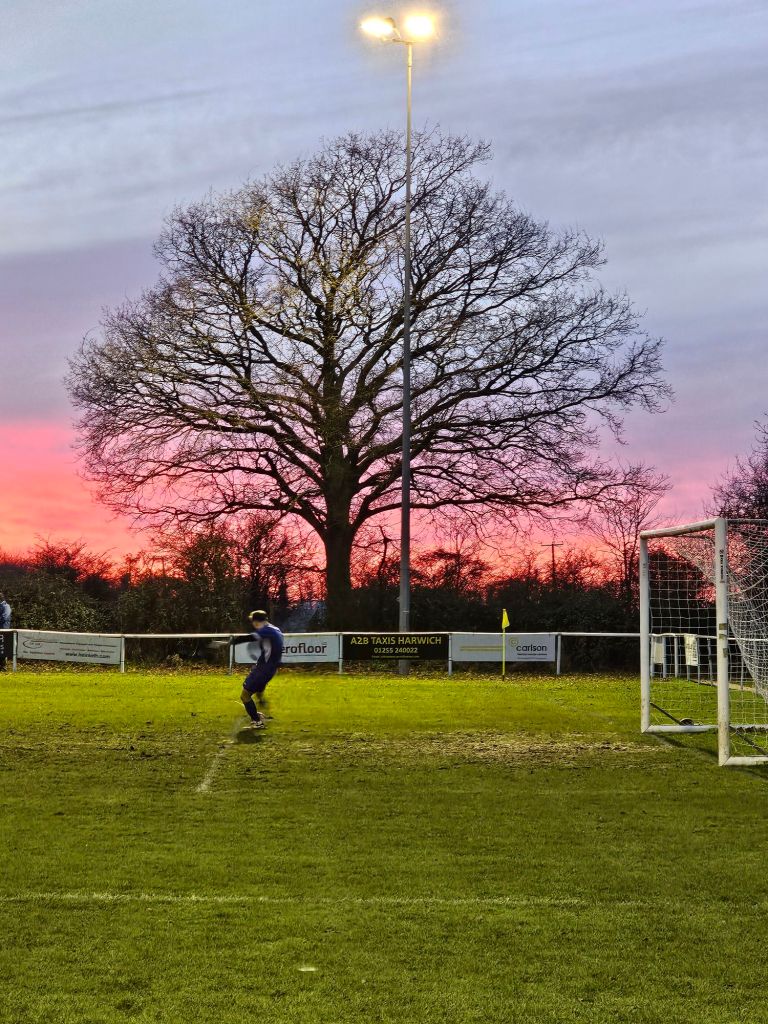
With the aftermath of the penalty, the worst of the afternoon’s fractiousness is over and much  of the final twenty minutes plays out against the back-drop of a glorious, blood red sunset,   A friendly man wearing a day-glo gilet bearing the words ‘LO Media Officer’ on the back, talks to me briefly and asks if I’m a ground hopper, “Not really” I tell him, “ I usually watch Ipswich”,  although I don’t let on that for forty years I’ve kept a list of every game I’ve ever been to.  He’s soon photographing the main stand against the sunset however, and the match plays out shifting freely from end to end,  but with neither side looking much like scoring the winning goal. Meanwhile, I wonder at the name of a local fish and chip shop, Pieseas Chippy, which is advertised at the pitch side.

The final whistle blows at eight minutes to five and an appreciative crowd applaud the efforts of both teams in a match which whilst mostly not a thing of beauty, apart from the sunset, has been entertaining and hard fought.  I think a draw is a fair result although home fans might not agree, and as I head for my car I hear a man muttering to himself about the ‘village team’ holding the team from the city (Wikipedia tells us that in 2011 Barking had a population of 59,011) as if the moral victory belongs to Little Oakley.  Perhaps it does, but even if it doesn’t it’s been a lovely afternoon out.

Holland 2  Dussindale & Hellesdon Rovers 1

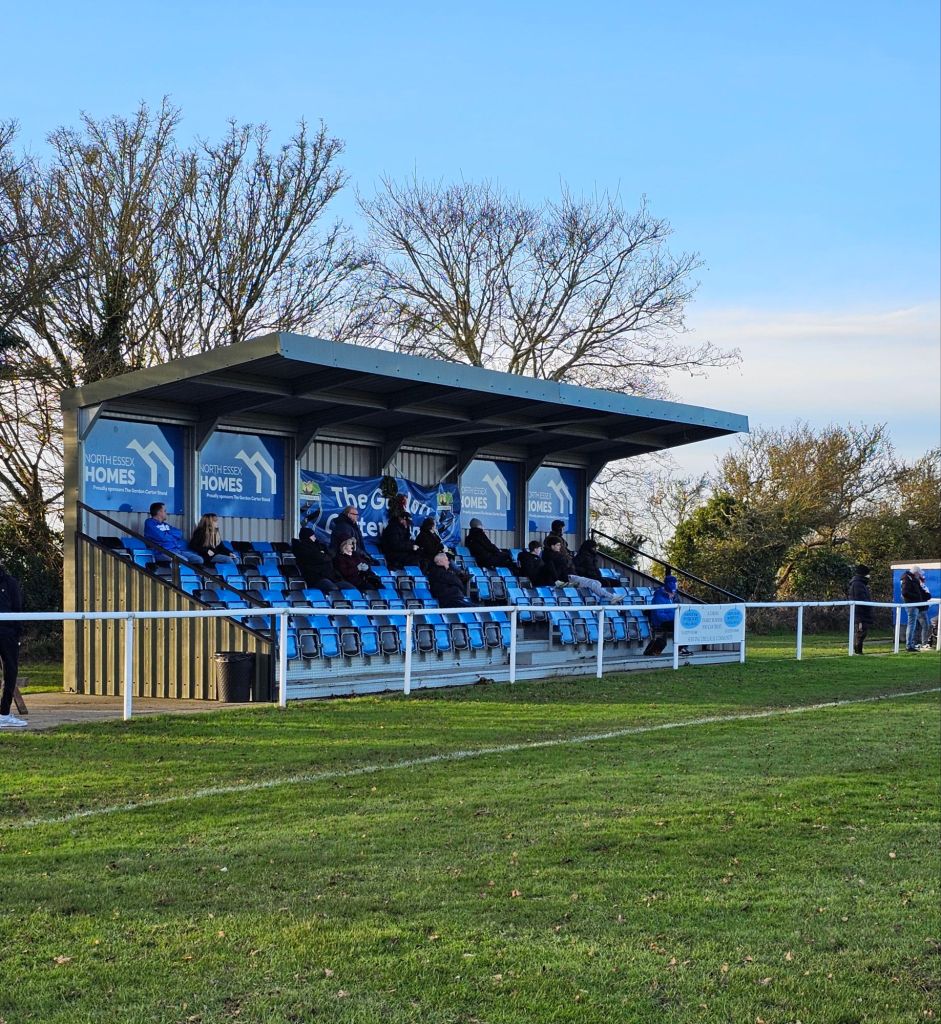
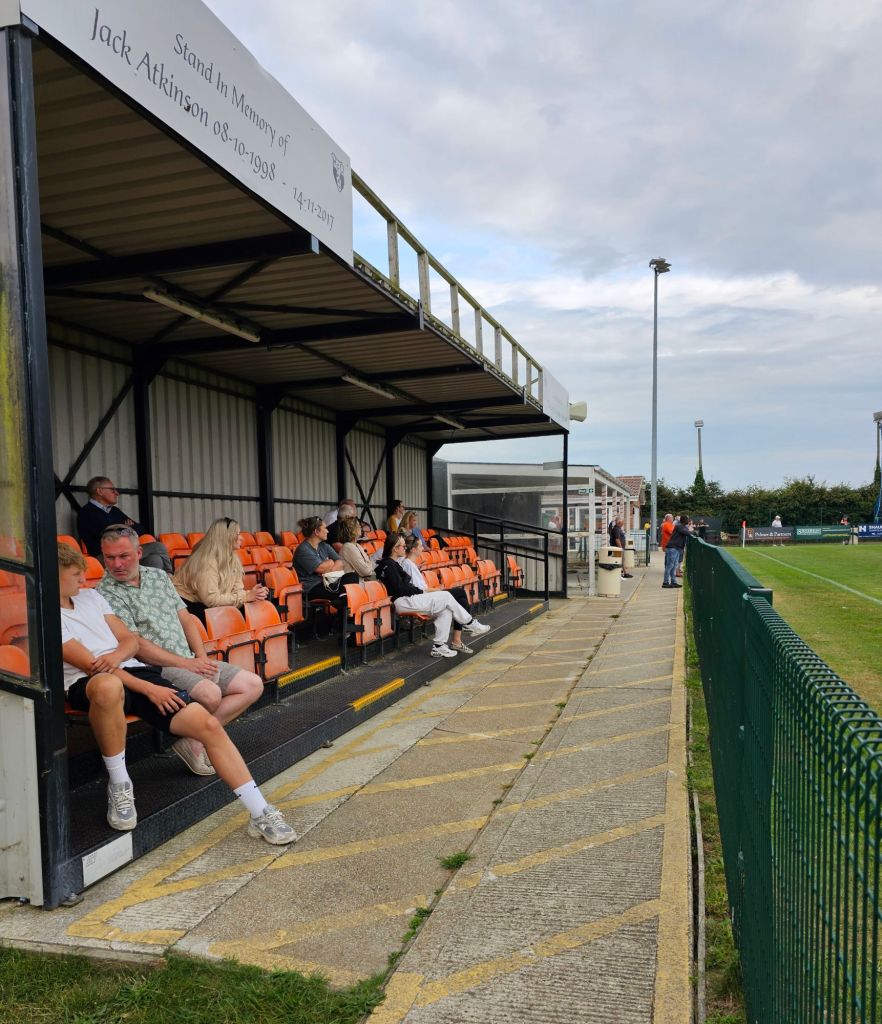
Holland-On-Sea, Wikipedia tells us, is a suburb of Clacton-On-Sea and was known as Little Holland until the early twentieth century; it also has a football club called Holland FC.  What Wikipedia doesn’t tell us however is that Holland is just a 30 minute, thirty-eight-and-a-half-kilometre drive from my house, although Google maps does.  Stanway Rovers, Halstead Town, Coggeshall Town, Cornard United, Wivenhoe Town and Hadleigh United football clubs are all playing at home today and are probably all closer to home, but none of them are “On-Sea” and I’ve been to all of their home grounds in the last twelve years, which isn’t true of Holland FC’s Dulwich Road, where I am given to understand that the pitch, as if by some freakish movement of tectonic plates, has moved through ninety degrees in that time, throwing up a metal fence all around itself and a smart new clubhouse.  Therefore, with the promise of sea air and the prospect of a geologically formed football ground, it is on a warm but cloudy Saturday afternoon in early September that I set off in my planet saving Citroen eC4 for Holland-On-Sea.  I had contemplated catching the train to Clacton and making the half hour walk to Dulwich Road, but with only one train an hour I wouldn’t have got home until seven o’clock, and I have a wife whose heart I risk breaking if I stay out too long.

It’s an uneventful journey down the A133 and I arrive in relaxed mood in the Holland FC car park, where I have a wide choice of parking spaces; I draw up next to a modest silver-coloured family saloon, which had turned into the pebbly, beach-like car park shortly before my I and my Citroen did.  It’s not half past two yet , so I decide to take a look at the sea before entering the ground; the cliff top and sandy beach below are only 200 metres away across the grassy expanse of the Eastcliff Recreation Ground and Marine Parade.  From the cliff top, Clacton Pier is visible through the haze at the end of the beach, and out to sea sit the ranks of wind turbines that I like to think made the electricity that powered my car and brought me here.  A West Indian man of pensionable age and riding a low-slung tricycle asks me if I’m local and if I know where the Kings Cliff Hotel is.  I tell him I’m not and I don’t know where the hotel is, but I do know he is heading towards Kings Parade.  I think to myself that the ‘King’ in King’s Parade fame was probably either King Edward the Seventh or some egotistical Tendring District councillor with the surname King.

I walk back inland to the football ground up Lyndhurst Road, a typically suburban, tree-lined street of inter-war bungalows, all of which are almost frighteningly neat and well maintained. Just past a public toilet is a hedge which is teeming with bees and butterflies, mostly Red Admirals.  I am not sure I’ve ever seen so many butterflies in one place, but start to worry that wealthy local MP Nigel Farage might be having them specially bred so that he can pull their wings off or place them in his reptile-like mouth before washing them down with a pint of beer.  But then again, I don’t suppose he ever comes here; he probably gets his butterflies in Florida.

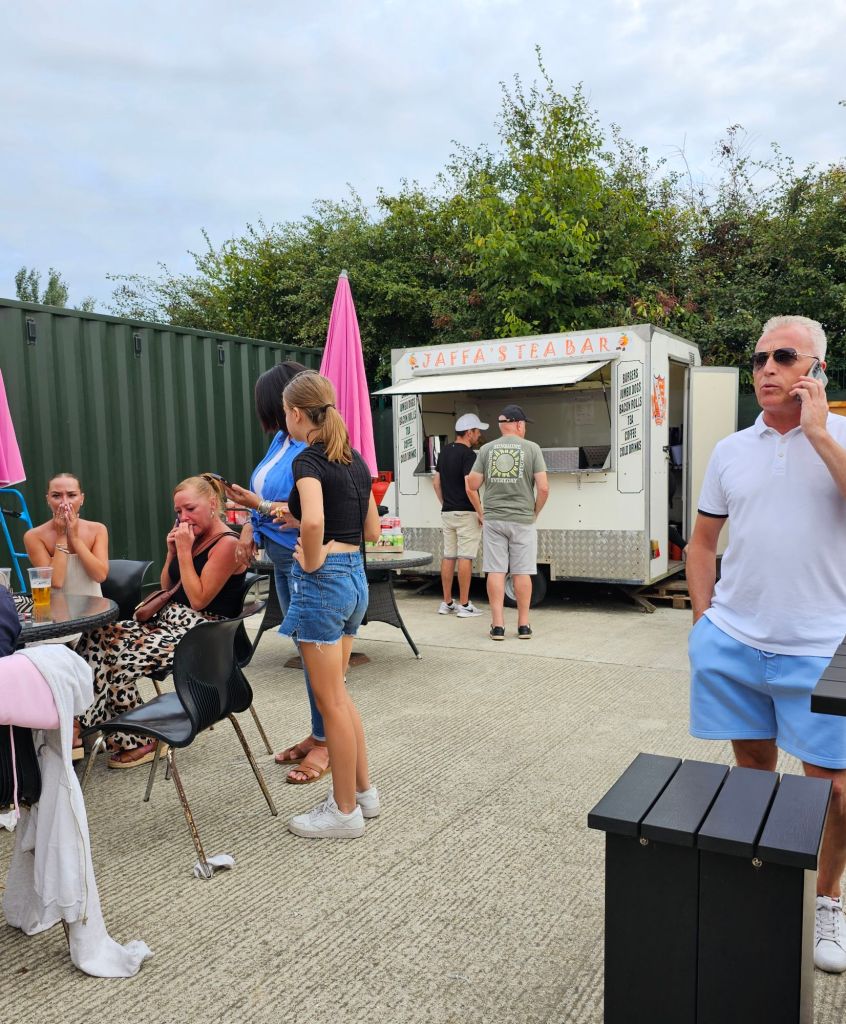
Back at the football ground, the friendly, cheery but visibly overweight man at the gate tells me that the concessionary entry fee of £5.00 applies to over sixties; I tender a twenty-pound note and receive fifteen pounds change.  After I ask if there is a programme today, I am told that the club does produce a match programme, but hasn’t done so today, which to me seems a bit lazy of them.  With the two pounds I saved at the gate by being old, I buy £1.50’s worth of tea from Jaffa’s Tea Bar.  I don’t know who Jaffa is, but his or her (it was a woman who served me) tea is pretty good, even if it is just a tea bag in a paper cup with some added water and milk.    I suspect however that the name of the tea bar is derived from the club nickname, “The Jaffas” and so the apostrophe is in the wrong place, this is Essex after all.  I wander inside the clubhouse which, although bright and new and with a display of trophies on one wall, seems a little soulless due to its grey floor, plain walls and vaulted ceiling; the only pumps on the bar are for Stella Artois, San Miguel and Carlsberg. I am pleased I bought tea and enjoy the irony that in Farage’s constituency all the ‘beers’ are, nominally at least, foreign brands.  Most of the drinkers are sat outside at an array of tables and look like they are settled in for the afternoon. 

“Are you sat here for the music?” I ask two old boys sat on stackable chairs in a covered area outside the home dressing room,  through the window of which can be heard the typical, pumped-up, high volume musical selection of the millennial footballer.  “Is that what it is?” Says one of the old boys.  I wonder to myself if Stanley Matthews, Len Shackleton and Tommy Lawton would get themselves ready for kick-off by cranking up the volume on the latest 78’s from Glenn Miller,  Al Bowlly and Bing Crosby.  With the music turned off we can hear the team talk. “It’s a long journey from Norwich or wherever they come from” says the coach encouragingly to the Holland players.

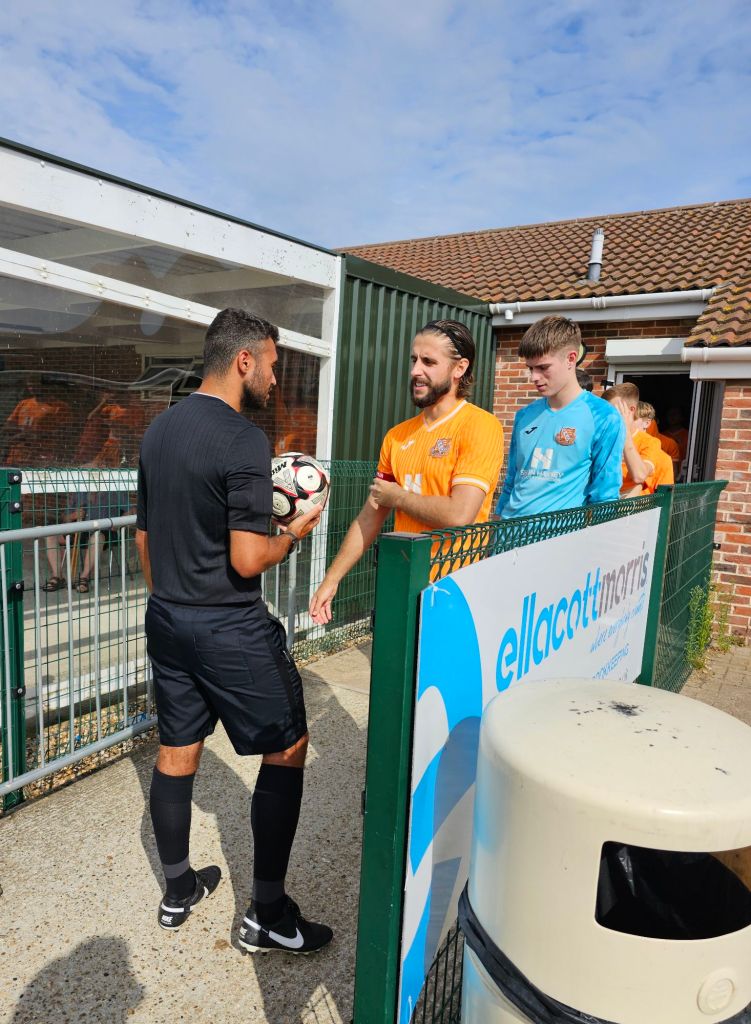
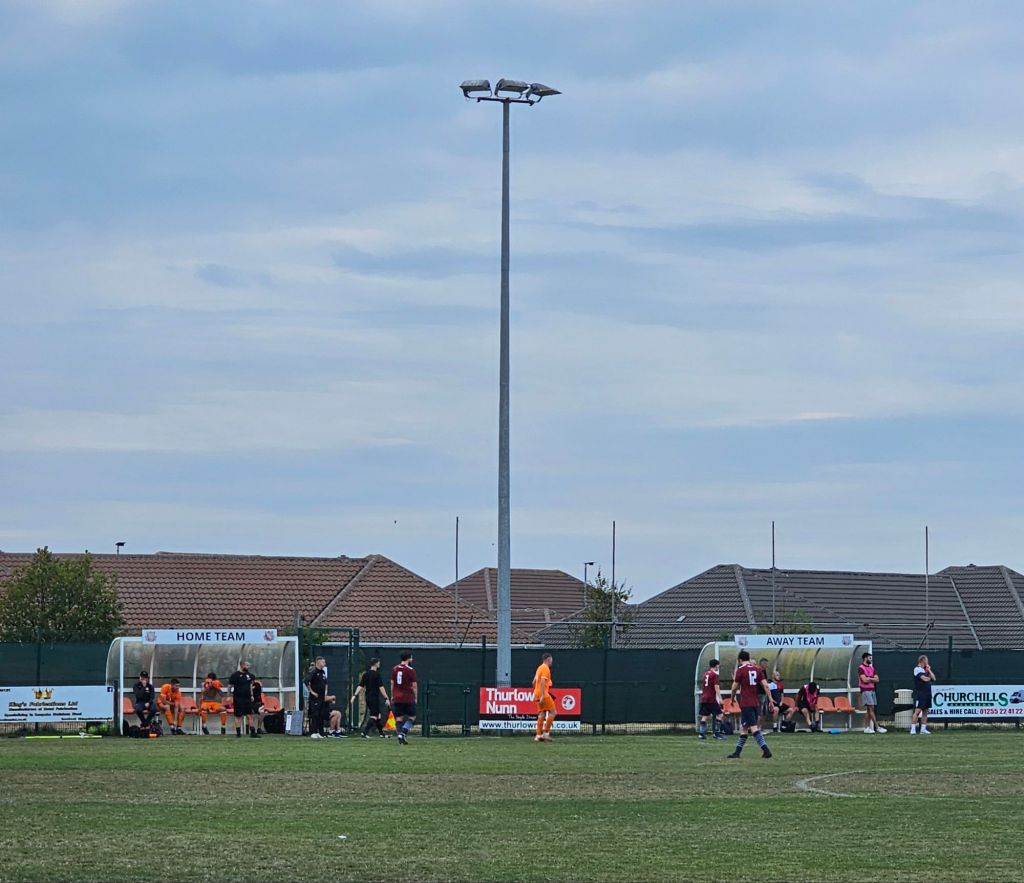
It’s not long before the teams are lining up to parade onto the pitch with the players of today’s opponents Dussindale and Hellesdon Rovers, looking suitably jet lagged.  Dussindale and Hellesdon are two suburban areas on opposite sides of Norwich, but their clubs amalgamated a few years ago and have made it into the snappily titled Thurlow Nunn Eastern Counties League First Division North and now play in Horsford, which is at least next to Hellesdon and close to Norwich airport, which is handy for away games.   After all the usual handshaking and hand-gripping malarkey, it is Dussindale and Hellesdon who kick-off towards the sea in burgundy shirts and navy-blue shorts. It’s a tasteful, if slightly dull kit and doesn’t compare with Holland’s vivid all orange ensemble.  Wikipedia tells us that the nickname of Holland FC is The Tangerines, no doubt due to the colour of their kit, but Holland’s own website refers to them as The Jaffas, although it doesn’t appear to have been updated since last May.  I wonder if there has perhaps been a referendum during the close season on what type of orange best represents the club, with members choosing to reject Satsumas, Mandarins, Clementines, Navels, Cara Caras and Easy peelers.   

The early exchanges on the pitch are typically noisy with the ball frequently flying high into the afternoon sky as an optimistic through pass for someone to chase is booted away.  “Go wide, hit the channel, good chap” bawls the Rovers’ goalkeeper revealing a hint of a Norwich accent as the ball sails in to touch.  Holland have the classic two big blokes at the back, numbers 5 and 12.  Number 12 has the sort of build which, if this were a professional game, would no doubt leave him open to chants from opposing supporters of “You fat bastard”, but he is a ‘rock’ at the back for Holland. 

I walk round the pitch to stand between the team dugouts. Holland win two early corners.  More Norfolk accents are detected on the away team bench.  Holland seem to lack club volunteers, with there being no programme today and no team sheet posted on a wall anywhere either.  The on-pitch commentary from the players however reveals that the Rovers number three is called Eggy and the number four Martin; other players have names too.

A poor back pass lets in the Holland number eleven,  who crosses in a low ball which a Rovers centre-back clears over the cross bar for corner.  It’s the first real opportunity, even if it was entirely manufactured by one team for the other.  The game is full of endeavour, but no one is capable of providing a pass that will lead to a goal. It’s a game of just shouts at the moment.  “Get out”, “First and second ball”, “What we talked about”, “Jump early”, “Ref that was blatant”, the usual anxious nonsense that the players hear every week and must get sick of.  On the Rovers’ bench the coaches are simply willing their team to do better; “Get the ball” urges one, going back to basics.  Then Rovers break down the right; number eleven scampering into the penalty area and crossing the ball low to where somebody should be to tap it in but isn’t.

“That’s the first chance of the game, and it’s to us” says a Rovers coach moments before the Holland number nine heads the ball against the Rovers cross bar from what looked like inside the six-yard box.  Fortunately, he can’t hear the cursing on the Holland bench.  It was the sort of incident that explains why the Rovers number five displays a constantly slightly worried look on his face, in contrast however to the number four playing in front of him, who is calmness personified and always has unhurried time on the ball. “Go on Matt, Dylan” shouts another coach, and I think of a parallel world where a film director working with Jack Nicholson and Charlton Heston might say “Go On, Jack, Charlton.”

 “It’s a great run again” says a Holland coach sounding like a radio commentator as Holland move forward again down the right.   The pattern of the first half has now been established and Holland are the dominant team, but with Rovers are a constant threat on the break. In midfield for Holland, number eight has a beard, and hair swept back with an alice band; it makes him look a bit like a bargain basement Alessandro Pirlo, which would explain why he is captain.  “Keep on side” shouts someone as Rovers’ number eleven breaks forward again, but he’s too late, the linesman’s flag is raised, if only that advice had been shouted sooner.

Unusually, in the final twenty minutes of the first half there are three substitutions, with Holland’s number three, who has been looking physically uncomfortable, being usurped by number seventeen, who is soon having a shot on goal well saved.  For Rovers, numbers seven and eight leave the pitch to be replaced with numbers fourteen and fifteen, like the start of a mathematical puzzle.  Just as unusual is the smell of deep-frying fish and chips that is wafting around when at half past three in the afternoon people should surely be having no more than an afternoon cup of tea and a biscuit.

The thought of tea sends me further round the pitch, back towards Jaffa’s tea bar and when I pass behind the linesmen he warns “Nothing silly” as opposing players chase another hopeful punt forward for Rovers.  The ball is soon returned to the other end of the pitch however, where Holland’s number nine shoots weakly at the goalkeeper as he redirects a square pass.  But the disappointment is short-lived as number ten finds himself in much the same position, but crucially manages to shoot past the goalkeeper and high into the net to give Holland a more or less deserved lead.

 Half-time arrives soon afterwards and teas and beers taste better than they would have if Holland had not scored, although I don’t think everyone sat drinking outside the bar noticed the goal or any of the first-half come to that.  For the second-half I decide to take up a seat in the main and only stand, selecting a spot in the middle of the second row where I can easily see most of the pitch above the metal mesh fence.   From here I can also see the sea of hipped bungalow roofs with ugly concrete tiles and the white UPVC conservatories that squat beyond the surrounding boundary fence and off into the distance.  A seagull stands and squawks from on top of a ridge tile.

The football resumes at two minutes past three and Rovers are soon seeing more of the ball than previously; they’re not playing so deep into their own half, but like Holland before the half-time break, they’re not creating many chances to score.  Suddenly, out of the blue, it all gets a bit too much for Rovers’ number nine who bawls in frustration “Fuckin’ell, fuckin’ play!”.  Moments later, as if to say “Alright, alright, keep your hair on”, his team-mates fashion a corner kick and then number fourteen becomes the first player to be booked as he fouls Holland’s number eleven.   In contrast to the increased excitement on the pitch the afternoon now feels quite still; the sky has clouded over and it’s cooler than it was. 

Despite both number nine and ten having decent shots on goal for Rovers, Holland are holding on fairly comfortably, but it must nevertheless come as a relief to them when around half past four  Rovers’ number five swings a foot to clear the ball and misses it, letting Holland’s number eight take it to the edge of the box, check inside and send a gently curling shot beyond the goalkeeper and inside the far post. Holland lead 2-0.

It’s the sort of a goal that commentators tell us will ‘wrap the game up’ and ‘put it to bed’; it’s just what Holland have been waiting for.  Two minutes later and it hasn’t, as Rover’s number ten has a shot parried by the Holland goalkeeper and number nine sweeps the rebound into the goal.  The score is 2-1 and anxiety takes hold.  It’s been a game of very few fouls, but someone cries “Late every time” when there is an accidental collision of boot and ankle, and I begin to wonder if all referees shouldn’t also be primary school teachers.

It is seven minutes to five when the game ends, and before returning to my trusty planet saving Citroen for the drive home, I pause to applaud and reflect on what has been a very good game. As I say to one of the old boys as he gathers up his sticks to toddle off home, we’ve had a decent five pounds worth of entertainment.   But shuddering slightly, I nevertheless can’t help wondering how all these people voted at the last general election.

Ipswich Town 1 Cheltenham Town 1

In the final scenes of Lindsay Anderson’s 1968 film ‘If’, the central character Mick Travis, played by Malcolm McDowell, and his nameless girlfriend launch a machine gun attack on the parents, teachers and governors at a school speech day.  The scene was filmed at Cheltenham College and it’s one of my favourite scenes in one of my favourite films; Wikipedia tells us that ‘If’ won the Palme d’Or at Cannes in 1969 and in 1999 the British Film Institute ranked it as the 12th greatest British film of all time.  As if that association with such a great film is not enough kudos for Cheltenham, it also has a football team that has never lost to Ipswich Town. Today Ipswich Town and Cheltenham Town meet at Portman Road for only the second time in recorded history.  I don’t know it yet, but later today I’m going to feel like Mick Travis.

In north Essex it has been a stupendously dull morning, both still and depressingly grey, like November days should be. It’s only when I approach Ipswich that a diffuse yellow light begins to filter through the grimness and then bright sunshine bursts from a clear blue sky like a metaphor for the end of the working week and the arrival of Saturday, heralding a match at Portman Road.  Before the game I visit my mother and we reminisce about all manner of things from years ago and she tells me how her grandfather, Sam Scarff, an agricultural labourer from Needham Market, enrolled with a friend for evening classes, joined the police and rose to the rank of inspector in the Met’ before retiring to become a game-keeper in Shotley; his friend became a police commissioner, and I thought social mobility was a 1960’s thing.

Leaving my mother with her memories, I drive across town and park up on Chantry. The streets are busy with people in football-supporting attire. I walk across the wet grass of Gippeswyk Park and marvel at how lush and green the turf now is compared to how dried up, brown and withered it was on the first day of the football season three months ago.  In Sir Alf Ramsey way I attempt to buy a programme (£3.50) in the modern cashless manner, but the technology isn’t working today.  I laugh and hand over a five pound note to the somewhat miserable and overweight looking youth in the programme booth.  The Arbor House, formerly known as The Arboretum, is busy with pre-match drinkers, but I am served quite quickly and order a pint of Nethergate Complete Howler (£4.00). I head for the garden where Mick is already sat at a table with a pint of a dark beer from the Grain brewery which he’s not very keen on, I take a sip and agree that it’s not exactly moreish, but then the Grain brewery is located in Norfolk, albeit with an IP postcode.  Before long Roly joins us and proceeds to dominate the conversation, mainly because he seems to have the ability to talk without drawing breath, which means a polite person like me can’t get a word in edgeways, not that I have much to say.  We, by which I mean mostly Roly, talk of local council chief executives, Roly’s five-year-old daughter Lottie, primary schools on the Essex Suffolk border and the performances of Town player Dom Ball.  Between twenty-five and twenty to three we leave via the back gate of the beer garden and head for Portman Road.  I bid Mick and Roly farewell by the turnstiles to the Magnus Stand, formerly known as the West Stand.  We speak briefly of when we will next meet; it will be for the five o’clock kick off v Buxton in the FA Cup on Sunday 26th November.   I won’t be going to the mid-week game versus Portsmouth as I am boycotting the Papa John’s EFL Trophy, not because I have anything against oily, takeaway pizza, but because I think the competition has been debased by the inclusion of Evil Premier League under-21 teams.  I am particularly looking forward to not going to Wembley should Town make it to the final, when I will blow a metaphorical raspberry to all those people who believe that anyone boycotting the competition will automatically abandon their principles if Town get to the final.  Such beliefs help explain why we have a Tory government.

Most unusually, today there is a queue at the turnstiles for the Sir Alf Ramsey Stand which are accessed from Constantine Road, but quite soon an extra turnstile opens up (No61) and a cheerful man presents bar codes to a screen and I pass through the portal to another world.  That pint of beer has already found its way to the exit and from the gents beneath the stand I hear stadium announcer Stephen Foster reading the team line-ups from the scoreboard in his best local radio DJ voice.  I arrive at my seat just as a minute’s silence begins for Armistice day, although that was actually yesterday.  Oddly, the Football Association have decided not to cancel the fixtures today as they did when they felt they couldn’t trust football crowds to observe a minute’s silence for the death of Queen Elizabeth back in September.  The minute’s silence is of course observed perfectly. Stephen Foster reads from Laurence Binyon’s 1914 poem ‘For the Fallen’ and the last post is played exquisitely, even if it does slightly spoil the solemnity and dignity of the moment to then be told by Stephen Foster that Jon Holden who played it is a member of the Co-op East of England Brass Band.  It’s probably just me, but I can’t help sniggering a little at any mention of the Co-op.

After a fly-past by a couple of Army helicopters, and a brief burst of ‘Hey Jude’, the game begins with Town getting first go with the ball and kicking towards me , Pat from Clacton, ever-present Phil who never misses a game, Fiona and the man from Stowmarket.  Town are thankfully back to wearing their blue shirts and white shorts after the all-black aberration against Derby, whilst Cheltenham Town are wearing red shirts and shorts with their ruddiness off-set by white socks and a white pin-stripe on their shirt fronts.  Quickly, Portman Road sounds in good voice as the altered version of ‘Mary’s Boy Child’ in which she eternally fights Norwich on Boxing Day rings around the ground.  On the touchline, Town manager Kieran McKenna is looking stylish, if a little drab in a black jacket and trousers with a plain jumper, which I at first think is beige but then think is grey; perhaps it’s taupe?

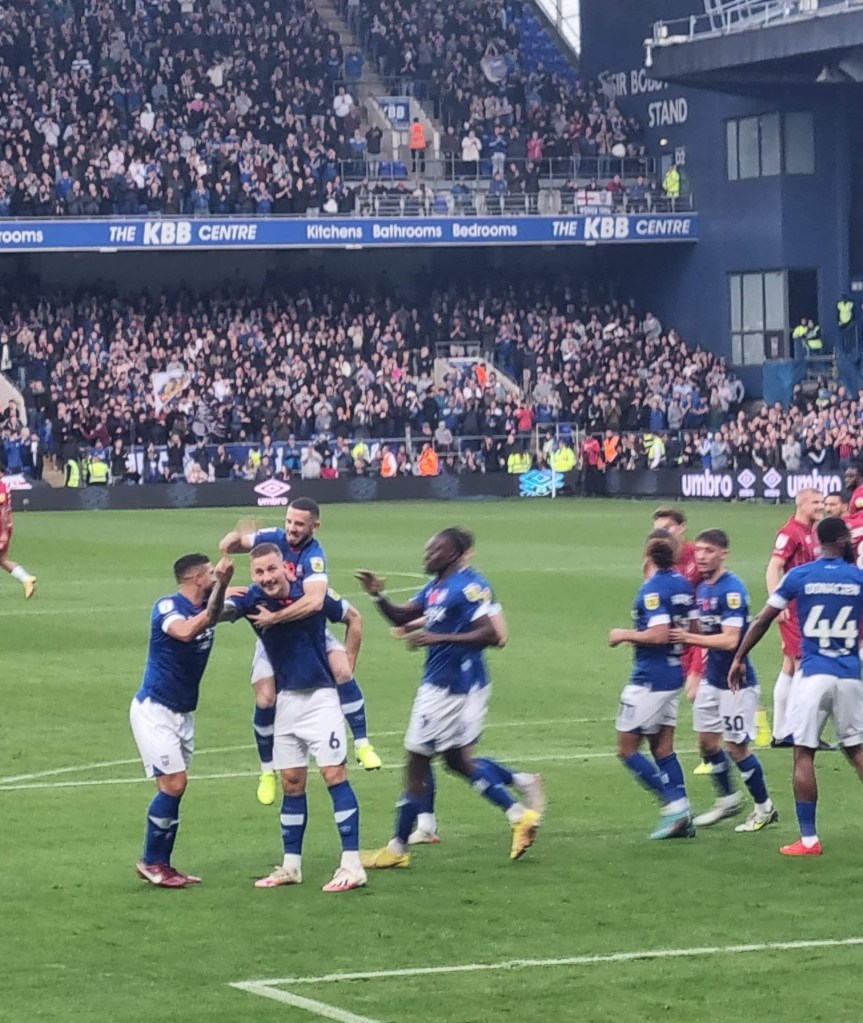
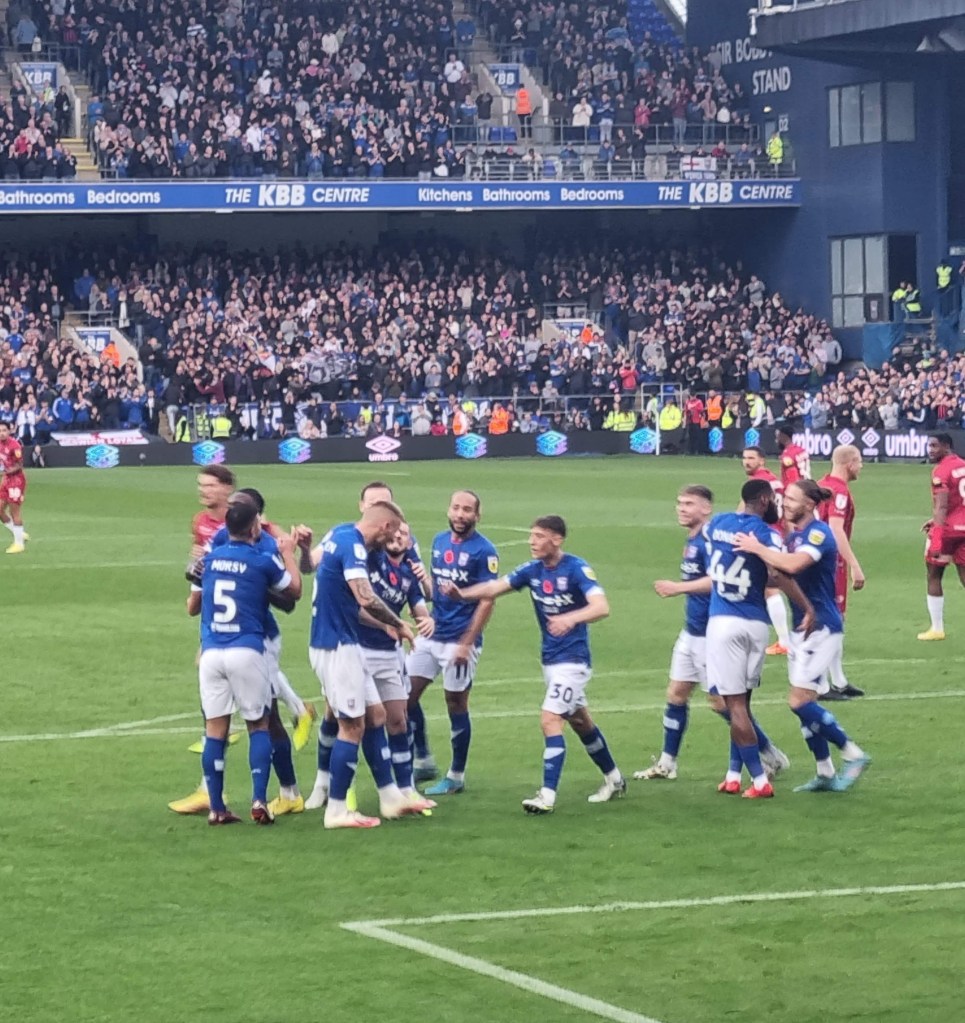
From the start Ipswich dominate and it feels as if everyone, from the supporters to the players really wants to win this match. We all remember the life-denying, spirit crushing goalless draw against Cheltenham from last season and that’s our inspiration to see Town give these upstarts, better known for their poncey Regency spa a sound thrashing.   Crosses rain into the Cheltenham penalty area and although one from Conor Chaplin goes a bit off course and strikes Wes Burns in the throat Sam Morsy soon has the first shot on goal and then from a corner Luke Woolfenden hooks the ball into the goal from close range and Town lead 1-0.  Woolfenden runs off sucking his thumb with the ball up his jumper and ever-present Phil mentions something about the birth of wolf cubs; I suggest he has simply discovered the joy of sucking his thumb. 

More corners and crosses follow and I chant “Come On You Blues” and so does Phil, but no one else does.  “Two of you singing, there’s only two of you singing” announces Pat from Clacton, sort of singing herself, which is ironic.  Janoi Donacien strides forward into a rare bit of space and pulls the ball back to Marcus Harness; the Cheltenham defence is rent open like a tin of corned beef on which the key has broken half-way round and it’s been necessary to open both ends with a tin-opener to get the meat out. Harness must score, but somehow the ball strikes the under-side of the cross bar as if deflected away from the goal net by some invisible force…either that or Harness made a hash of it.

There are more corners to Ipswich, loads of them, and Phil and I keep chanting “Come On You Blues” vainly hoping someone will join in with us. We change to the simpler “Come on Ipswich, Come on Ipswich” but the occupants of the Sir Alf Ramsey stand aren’t moved.  I think to myself that I might as well be singing in French and so I do “Allez les Bleus, Allez les Bleus” I chant; Fiona says I’ve gone too far. On the pitch Janoi Donacien is hurt and is replaced by Kane Vincent-Young and the ball skims off the top of Cheltenham number six Lewis Freestone’s head as if he was a man who had applied too much brylcreem to his hair.  Another cross and Leif Davis precisely places a carefully controlled header over the Cheltenham cross bar.  Within a minute, Cheltenham equalise as Ryan Broom sweeps forward and shoots at Christian Walton, who somehow cannot stop the ball squirming around, or under,or through him into the goal.  It might have been the brylcreem on the ball.  It will prove to be Cheltenham’s only real shot of the game and up in the Cobbold stand a knot of about twenty excited youths jump around and wave their arms about like bookies on a race course, or idiots trying to fly.

Disappointing as that equaliser is, Town press on, although not quite as well as before.  When the Cheltenham goalkeeper parries a low Marcus Harness cross out to Cameron Humphreys, somehow the ball comes straight back to him.  Two minutes of added on time are announced very noisily by Stephen Foster, as if he’d turned the PA system up to eleven. “Speak Up” says Pat from Clacton.   I applaud Town off the field with the half-time whistle and go and talk with Ray, his son Michael and grandson Harrison.  I ask Harrison if he has got the new Robyn Hitchcock album ‘Shufflemania’ yet, he says he may get it for Christmas as he looks at his dad.

The match resumes at six minutes past four and a chorus of ‘Blue and White Army’ briefly rolls around the stands, not exactly like thunder. On the stroke of the 53rd minute the crowd rises for a minute’s applause in memory of Supporters’ Club Chairman Martin Swallow who died at the end of October.  A lone seagull floats above the pitch; no doubt someone would think it poignant. 

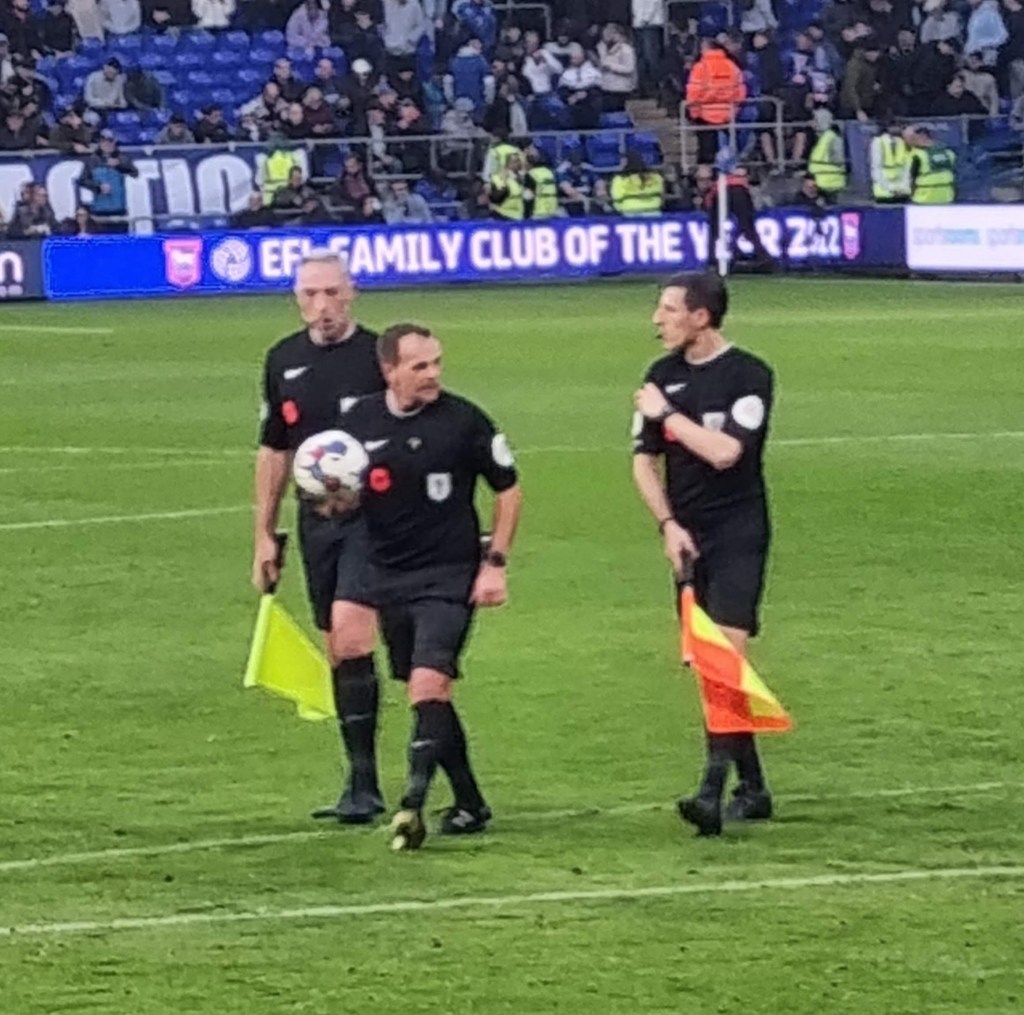
With Cheltenham confined to their half of the pitch due to constant Ipswich possession, this is the sort of game where every moment lost through a Cheltenham player sitting on the grass or receiving treatment is going to be attributed to time-wasting, and so it proves. Referee Mr Eltringham, a man with ‘ten to two’ feet, books the Cheltenham goalkeeper as a warning shot to his team-mates in this regard and in all fairness, they do not break the game up as much as they did in the goalless game last season, but it’s not enough to stop the bloke behind me from saying “He’s gotta be one of the worst fuckin’ refs we’ve ‘ad down here”.   When Cheltenham players do receive treatment their physio runs on with a huge bag and what looks like a small surf board; with a blonde wig and high cut one piece swim suit he could have doubled for Pamela Anderson in Baywatch. 
“Over and in” says Pat from Clacton in the time-honoured fashion, but it never happens. Marcus Harness heads carefully past the post in the same way Leif Davis headed over the bar in the first half, Wes Burns and Marcus Harness are replaced by Kayden Jackson and Kyle Edwards, but it makes little difference.  Chances come and inevitably go as if there is no possible way to get a ball across the line between the two goalposts.  The crowd is announced as 25,400 including 175 from Cheltenham; it’s the smallest away following at any Ipswich match this season; so more credit to those who did bother.  “Here for Cheltenham, you’re only here for the Cheltenham” they sing which I guess they are, and on the Clacton supporters coach Chris wins the prize with his guess of 25,444; Pat is disappointed that so few pet animals have been attributed guesses this week.

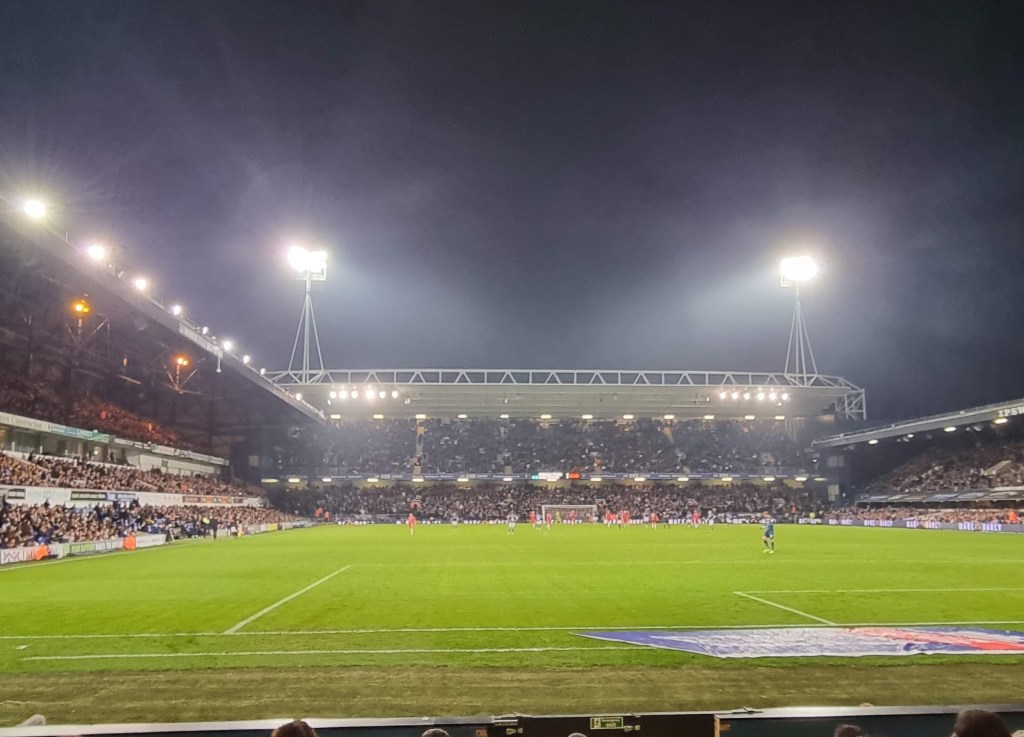
With time slipping away, the gloom of the late autumn evening descends along with a seasonal mist which softly shrouds the floodlights. “There’s nothing wrong with you, there’s nothing wrong with you” chant the North Stand appropriating some Verdi opera as another Cheltenham player takes a breather by sitting on the turf.  The final minute arrives and Panutche Camara replaces Conor Chaplin. There will be at least seven minutes of additional time, which is time enough for Camara to strike a shot against the inside of a goal post; again, the ball of course stays out of the goal rather than deflecting into it. All too soon the final whistle is blown and for a second time this year Cheltenham Town have clung on to a point at Portman Road with resolute defending and huge dollops of luck.  With defending like this and the ball having such an aversion to crossing their goal line, it seems odd that Cheltenham Town have ever lost any match.

“Frustrating” says the man from Stowmarket as he edges past me to the exit “Yes, but we’ve seen it all before, just a few weeks ago” I reply, re-living the pain of the match versus Lincoln.  But my comment hides my disappointment and beneath my reasonable exterior irrational thoughts and questions swirl in a maelstrom of post-match angst and anger; how can Ipswich Town be so much better than the opposition but still not beat them? Is Ipswich Town somehow cursed?  Where is there a high roof from which a sniper could shoot freely and indiscriminately?

Ipswich Town 1 Oldham Athletic 1

One of the many wonderful things about supporting a football team that is in the third division is that the FA Cup begins at the beginning of November.  None of this inexorable waiting about for Advent, Christmas and then New Year to come and go. No siree, the joy of knockout football comes early to the meek who do more than just inherit the Earth, they get to chase the glory that is knockout competition football.  Of course, we have already missed out on six rounds of extra-preliminary, preliminary, and qualifying rounds, but we can’t have everything and being meek we wouldn’t want it.

Today, the transparent plastic tub that serves as the 21st century’s replacement for the Football Association’s velvet bag has paired Ipswich Town with fourth division Oldham Athletic.  This is a pairing to rival some of the worst failures ever, like a race between a Ford Edsel and a Sinclair C5, or a competition between the Enron bank and ITV digital.   Ipswich Town and Oldham Athletic, I have been told, are the least successful clubs in English professional football in the past twenty years, being the only two who have either not been promoted or not made it to any sort of match at the new Wembley Stadium.  The good thing is that this has saved us supporters a considerable amount of money on grossly over-priced tickets, match day programmes and catering, for which we should be grateful.

It’s a blustery, cloudy day and fallen leaves scuttle along the footpath as I make my way through Gippeswyk Park; the autumnal scene reminds me of some of the opening sequences of the film The Exorcist. Portman Road is very quiet, stewards in huge fluorescent orange coats, and sniffer dogs easily out number supporters outside the away fans’ entrance.  The display on the windows at the back of the Cobbold Stand tell of former FA Cup glories and the day in March 1975 when a record crowd of 38,010 filled Portman Road to see the sixth-round tie versus Leeds United. I look at my watch, it’s a quarter to two; I had already been inside the ground nearly twenty minutes by now on that day forty-six and a half years ago. I buy a programme for a knockdown price (£2.00), and  confirm to myself that I prefer this 32 page programme to the usual 68 page one, even though it costs more per page; I live in hope of an eight or twelve page edition for less than a pound.

At the Arboretum pub (currently known as the Arbour House), I choose a pint of Nethergate Augustinian Amber Ale (£3.80).  The bar is unusually full, so my pint and I decant to the safety of the beer garden, which is reassuringly more like a backyard with tables and chairs. I text Mick to tell him “Je suis dans le jardin”.  It’s not long before he joins me with a pint of beer and a cup of dry roasted peanuts.  We talk of Ipswich Town, of property development and pension funds, catching the TGV to Marseille, the buildings of Le Corbusier, the colour theory of Wassily Kandinsky and the Bauhaus, and electric cars.  A little after twenty-five to three we leave for Portman Road, bidding the barmaid goodbye as Mick places our empty glasses and the cup that no longer contains peanuts on the bar.

Our tickets today (£10 for me, £5 for Mick plus £1.50 each unavoidable donation to some parasitic organisation called Seatgeek) are for Block Y of what is now known as the Magnus Group Stand, but used to be the plain old West Stand, named simply after the compass point rather than a commercial concern called West that had paid for the privilege.  Flight upon flight of stairs take us to the dimly lit upper tier of the stand where we edge past a line of sour-faced males of indeterminate age, but over fifty, to our seats.  My guess is there won’t be much banging of drums, lighting of flares or even vocal encouragement from these people, who look more like Jesuit priests than football supporters.

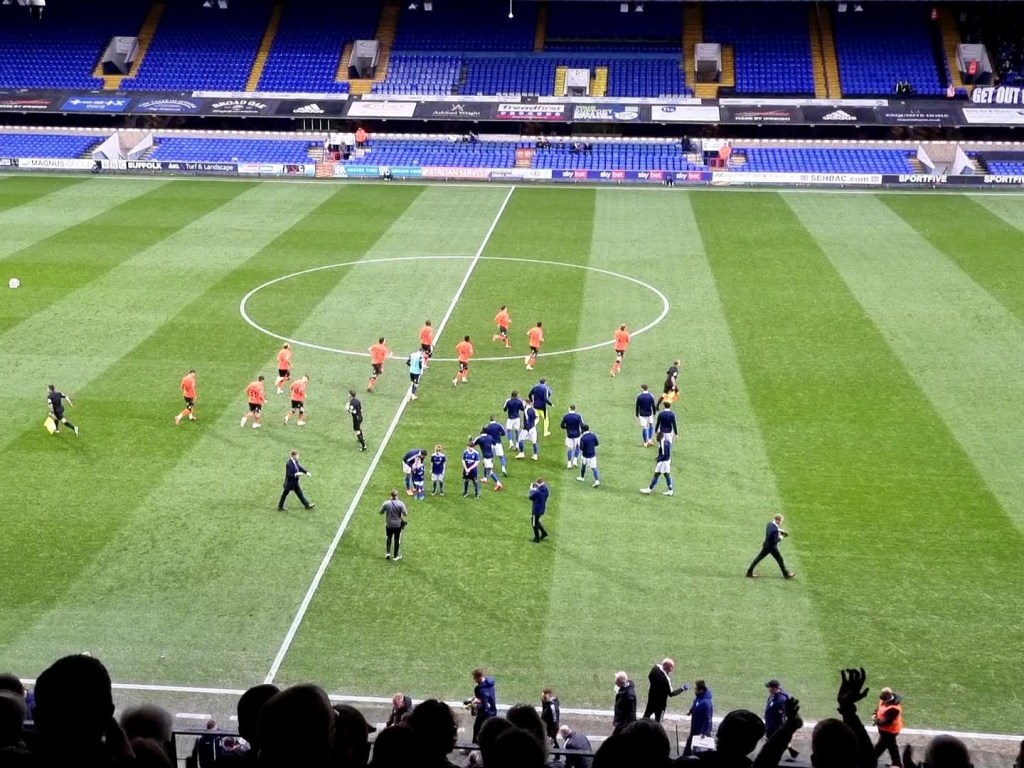
Although Remembrance Sunday isn’t until next week, and there will be a minute’s silence before the game versus Oxford United next Saturday, bizarrely we have another pre-match minute’s silence today.  Stadium announcer Stephen Foster tells us it is because we are in the ‘Remembrance period’ but it feels like football just likes minutes silences.  As ever the silence is strangely followed by applause, and then the game begins.  For the first forty-five minutes Town will be mostly trying to send the ball in the direction of the goal in front of the Sir Alf Ramsey stand (previously known as Churchman’s end) where in the lower tier I can make out ever-present Phil who never misses a game and Pat from Clacton.  Later, Mick will ask me if “the lady from Essex” still comes to the games, and I will point her out to him, locating her using gangways and rows of seats like co-ordinates in a game of Battleships.   Mick spots her and Pat from Clacton is sunk. Oldham Athletic are wearing a fetching ensemble of orange shirts and black shorts with orange socks; it’s a kit that stirs memories of Town’s fifth round tie away at Bristol Rovers in the snow of February 1978; or it would if, as is the modern fashion, Oldham’s shirts didn’t look like they’d had something spilled down the front of them.

Town start the game well with Oldham’s interestingly named Dylan Fage conceding a corner within the first minute before the oddly named Macauley Bonne heads a cross directly at goalkeeper Jayson Leutwiler.  Within eight minutes Town lead as the oddly named Macauley Bonne’s cross sees Wes Burns do an impression of the shopkeeper in Mr Benn as suddenly, as if by magic he appears to score from very close range.  This is just the start we need; we will now surely go on to win by three or four goals to nil because Oldham Athletic are third from bottom of the fourth division and Town won 4-1 at Wycombe Wanderers on Tuesday, what more convincing evidence predicting our inevitable victory could there be?  Indeed, Town continue to look the better team as the oddly named Macauley Bonne and Wes Burns both have shots blocked, but then the shots become fewer to be replaced by scores of passes back and forwards across the pitch.

Bersant Celina tries a little flick pass with the outside of his right foot, which doesn’t succeed. “You’ve got to earn the right to do that sort of thing” announces the joyless sounding man beside me to the World, presumably unaware that he is talking rubbish; you just need to get it right.  Oldham break forward and are a pass away from a shot on goal on a couple of occasions. “We’re leaving the door open” continues the joyless man, seemingly happy to be miserable.

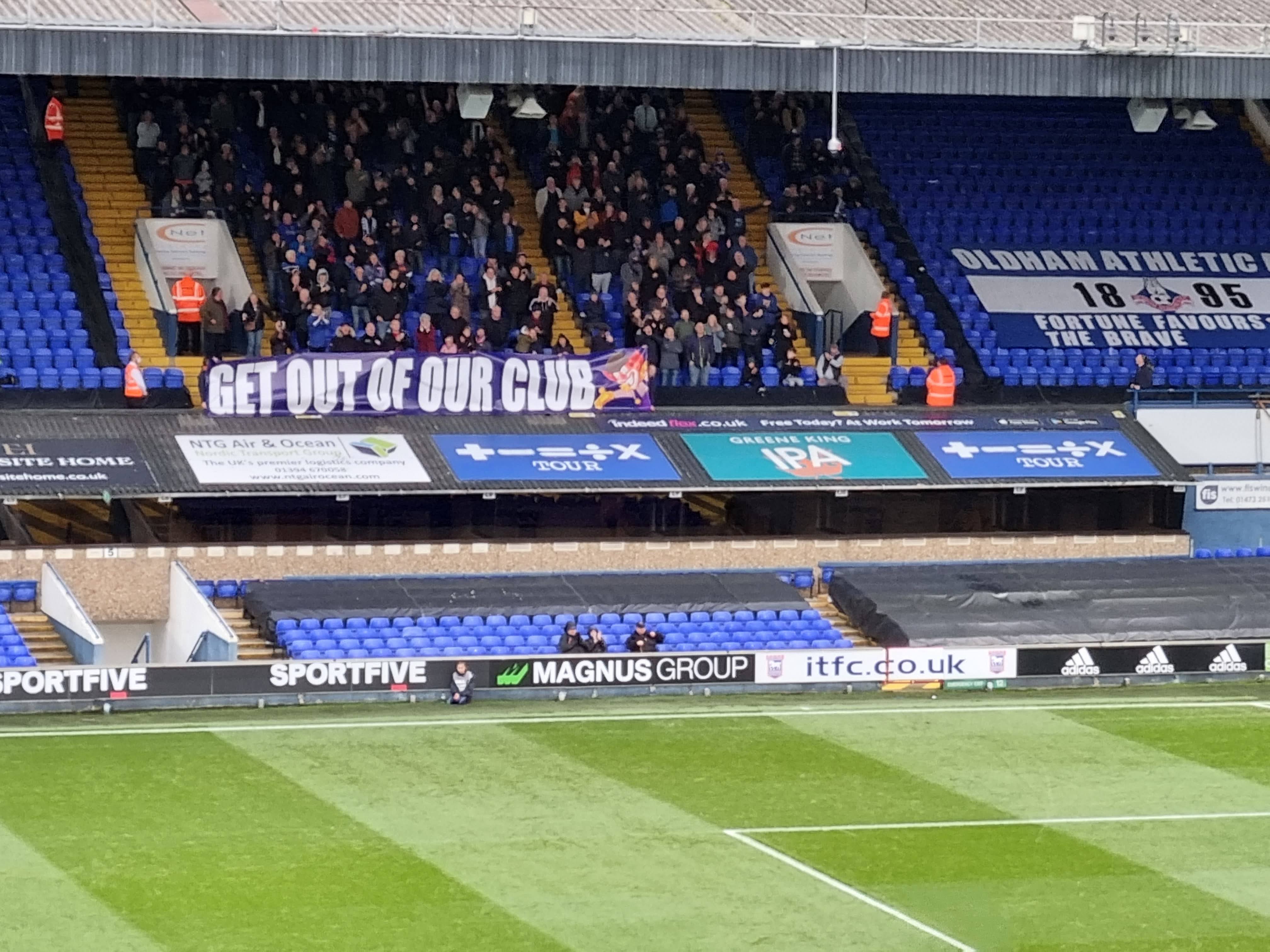
Despite the 1-0 lead, the Portman Road crowd, which will later be announced as consisting of 437 Oldham supporters within a paltry total of 8,845, is quiet.  Where are the other 29,165 who were here in 1975?  A good number are probably no longer alive, I guess.  “Your support, your support, your support is fucking shit”  chant the Oldham supporters in the Cobbold stand with predictable coarseness.  I feel like telling them that’s because some of us are dead.  Despite high hopes the FA Cup seems to have lost a little of its sparkle and it’s only twenty -five past three.  I realise that over the Cobbold Stand and across the roof tops beyond I can see the top of the Buttermarket shopping centre.  It’s the twenty seventh minute and Oldham’s number nine, the optimistic sounding Hallam Hope heads the ball just wide of the Town goal. 

Seven more unremarkable minutes pass and the sometimes not very controlled Sam Morsy is booked by referee Mr Hair, who it is to be hoped will one day referee in the Bundesliga.  Stupidly, having dropped to the ground under a challenge, Morsy grabs hold of the ball as if to award himself a free-kick.  Rightfully, Herr Hair books him for hand ball and the pointlessness of the incident mirrors the drifting aimlessness of the Town performance and its quiet backdrop; this isn’t what Cup football is meant to be like. 

After a couple of further failed goal attempts from Oldham, with four minutes left until half-time they score. Latics’ number ten, Davis Keillor-Dunn, who sounds like he could have been friends with Lytton Strachey and Virginia Woolf, sends a fine shot into the corner of the Town goal from about 20 metres after Toto Nsiala initially fails to deal with a ball that had been booted forward.  “How shit must you be we’re drawing 1-1” sing the Oldham supporters to the tune of Sloop John B, coincidentally showing the majestic timelessness of the Beach Boys’ 1966 album, Pet Sounds.

With half-time fast approaching Kane Vincent-Young tugs an Oldham shirt to concede a free-kick. “Stupid boy” says a man who sounds even more joyless than the man next to me but nothing like Captain Mainwaring in Dad’s Army.  I suggest to Mick that players should have their hands bound with tape to prevent them from pulling each other’s shirts; ever reasonable and practical Mick suggests they simply wear mittens.  Following a corner to Oldham, the half ends and with the exception of one man, the occupants of Row J rise and then descend the stairs to use the toilets and the catering,  or to just stand about.

As Mick and I wait for the queue to the toilet to shorten we talk of exorcism, the disappointment of the first half, the architectural splendour of the Corporation tram shed and power station in Constantine Road, and how my wife Paulene has a degree in theology.  I decide I can wait until after the game for a pee and whilst Mick joins the queue and disappears into the toilet, I am impressed by the long hair of a man standing a few metres away from me,  but die a little inside when I read in the programme that when he grows up one of today’s mascots wants to be a policeman.  More happily, the other two mascots want to be a footballer and a superhero.

Back in our seats the second half begins with the unusual replacement of both Ipswich full-backs as Janoi Donacien and Steve Penney replace Kane Vincent-Young and Cameron Burgess.  It’s a change that brings almost immediate results as a mittenless Janoi Donacien tugs an orange shirt and Herr Hair awards a penalty to Oldham.  The otherwise impressive Dylan Bahamboula steps up for Oldham to see his penalty kick saved by Christian Walton and a sudden roar fills Portman Road which belies the small number of people present.  For a few minutes the home crowd is energised and it physically feels as if we care as much we think do.  Wes Burns dashes down the wing, urged on by the crowd, but the sudden excitement is evidently too much and he propels his cross way beyond the far post and away for a goal kick.   “How much more waking up do we need?” asks the joyless soul next to me.

To an extent Town’s performance in the second half is better than that of the first.  The full-backs now on the pitch are an improvement on those they replaced and Oldham produce fewer decent chances to score.   When Connor Chaplin replaces the ineffective Kyle Edwards the link between Morsy and the front players is strengthened and another dimension is added to our attacking play, but somehow it’s still not enough.  As I tell Mick, all our players look like they got home at four o’clock this morning.

As Town’s failure to score grows roots and blossoms, the Oldham supporters gain in confidence. “Come on Oldham, Come on Oldham” they chant, giving a clue to the home fans as to what they might be doing, but we don’t twig.  The upshot with ten minutes to go is a reprise of that old favourite “Your support, your support, your support is fucking shit” and who can argue, it’s no longer 1975.  Despite Oldham encouraging Town with a misplaced pass out of defence, we are unable to capitalise and the Oldham supporters are the only ones singing as they ask “Shall we sing, shall we sing, shall we sing a song for you?” Predictably no one dares break our vow of silence to answer their question.

As the game enters its final minutes Sone Aluko replaces our best player, Wes Burns, and Rekeem Harper replaces Lee Evans.  Encouragingly Oldham replace their best player, Dylan Bahamboula with Harry Vaughan, but nothing works and five minutes of added on time only raises hopes, but does not fulfil them.

The final whistle is blown by Herr Hair and the crowd get up from their seats showing the same level of emotion that they might if they were all on a bus and it had just reached their stop, turning away from the pitch and averting their gaze like you would if trying to avoid eye contact with a drunk.  It has been a very disappointing afternoon of FA Cup football,  and has failed on every level to live up to what the competition is supposed to be about. 

On the bright side, at least we are still in the draw for the Second Round and until we lose, the promise of glory still remains.  It’s not every year we do as well as this.