AS Fabregues 0 Canet Rousillon 2

Fabregues is a very attractive small town about 10 kilometres southwest of Montpellier in the Hérault department of southern France. The town has a population of fewer than 7,000 but has a history dating back a thousand years, the centre being set out in a pattern of concentric circles around the church or chateau, a form of early medieval urban development known as a circulade. The town’s history probably goes back further to the Gallo-Roman era as the name Fabregues being derived from a Latin word meaning forges.
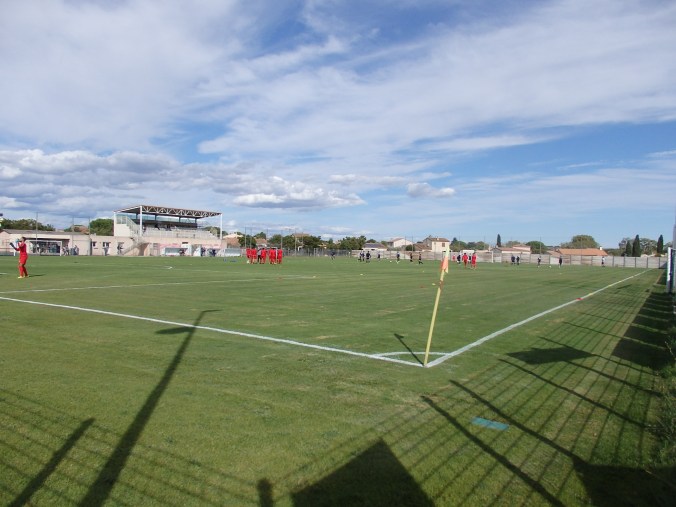
The Stade Joseph Jeanton is a part of a sports complex dating from 1993 that sits on the other side of the River Coulazu from the medieval town of Fabregues and it is here that my wife and I arrive today with a half an hour to spare before the kick-off of the match between Fabregues and Canet Roussillon in National Ligue 3, the fifth tier of French football, which is amateur, although the professional teams play reserve or ‘B’ teams in it. We park up in the neatly laid out car park which is landscaped with trees and shrubs and then walk through a metal gate to a wooden hut where we pay the 5 euros each admission fee. The Stade Joseph Jeanton is much like most other small town football grounds in France; a pitch surrounded by a high metal fence and a single stand affording a decent view of the pitch.
OLYMPUS DIGITAL CAMERA
The teams and referees are warming up as we walk behind one goal and round towards

the stand and buvette. I am impressed that one of the goalkeeping coaches is a woman and can’t imagine that many if any men’s teams in England have a female coach. The FA and English football in general really needs to get with the programme. We stop to ask three men in their sixties or seventies which team is which. One of them speaks a little English which he is keen to practice and he seems impressed that we have come to see Fabregues, which he describes as a good little club. At the buvette I buy a bottle of water (1 euro) and pick up a copy of the club’s directory. It is mostly adverts for local businesses, but contains details of every team in the club from the under 6 and 7’s up to the seniors. There is a statement from the president setting out the aims of the club and the overall impression is of the club being an important and well-run focus for the local community.
It is a warm afternoon and a strong breeze stretches white clouds out across the blue sky. We climb up into the stand and look out over the pitch towards the pink roof tops of 36538176213_715c21d13e_ocirculade and the old town. This is a pleasant spot to spend the afternoon it seems. Below us the referee (Monsieur Gauthier Lapalu) and his assistants (Monsieurs Jeremy Noiret and Maximilien Demoustier) are warming up, the referee looks very young, very neat and very enthusiastic, too enthusiastic and a little officious perhaps. He seems to want to organise his assistants overly and they don’t look that impressed.
Kick-off is scheduled for 3 pm but the teams aren’t on the pitch yet, although we can see them waiting at the mouth of the players’ tunnel, everyone seems to be waiting for the referee. Eventually, after the usual introductions, Canet Rousillon, from the town of Canet some 35 to 40 kilometres to the west, kick off in their white shirts with black shorts and socks; Fabregues wear all red. The first foul is committed after about five minutes and Monsieur Lapalu quickly airs his yellow card and then takes time to explain his decision to the Fabregues bench who are perhaps miffed, and understandably so because it wasn’t much of a foul. Five minutes later a Canet player is booked, but justifiably this time. It takes another fifteen minutes for Monsieur to get his hat-trick of cards.
This is a poor game. It may be because the afternoon is still warm, but the players aren’t running about much. One or two like to run with the ball, particularly the Fabregues number eleven, who is quite good at it, but there is not much running off the ball so there is seldom anyone to pass to near the opposition penalty area and therefore there are no shots on goal to speak of, except for optimistic long range ones. In addition, the players of both teams like to fall over and scream as if fatally wounded and Monsieur Lapalu is proving to be quite fussy and precise; he runs like Forrest Gump and his shorts fit too snugly, like his mum has cut down a pair of trousers from a dark suit.
Fabregues make a first-half substitution and the substitute adjusts his hair carefully before coming on, appearing to arrange his top-notch like the leaves on top of a carrot. But the substitute claims the distinction of being the first player to have a shot worthy of the name, in first half injury time.
With half-time we leave the stand to get out of the sun and the breeze, and to get away from the body spray of the young man next to me, which smells like pine disinfectant. This stadium has advertisement hoardings and they remind me of those at Eastern Counties League grounds. There is one for a Pompe Funèbre (undertaker) and one for Auto Ecole Thierry (Terry’s Driving School) as well as one for Pub Resto O’Papa Chico, which sounds like an Irish, Mexican pub. The local butcher, Bouchère des Beaux-Arts sounds a step up from an English pub meat raffle, but in a country that takes food seriously, such a name is probably not pretentious.
For the second half of the match we stand, peering through the fence from the opposite side of the ground to the main stand, where we are shielded from the wind by a hedge.

The second half starts well as the first discernible passing move of the game in an opponent’s half results in the Fabregues goalkeeper diving at the feet of the Canet number seven, to make a decent save. Just a minute later Canet’s number eight collapses to the turf inside the Fabregues penalty area and a penalty kick is awarded by Monsieur Lapalu. It seems a trifle harsh, but Monsieur Lapalu takes so long ensuring that no ones’ toes are in the penalty area that the number eight has far too long to think about his kick and when he eventually takes it, it provides a relatively easy save for the Fabregues ‘keeper, who dives to his right and smothers the ball completely to keep the scores level.
The game now enters a ridiculous stage where players fall like nine pins every few seconds; any physical contact apparently leads to mortal injury. The best moment is when three players come together and all three end up lying on the ground pleading for attention. If the Keystone Cops had played football it would have looked like this. It is at once both amusing and pathetic. The game is stopped and miraculously all three players recover to carry on. A banger goes off in the bushes close to where we are stood; everyone ignores it although some teenage girls trying their best to look innocent look like they might know who was responsible.
With an hour gone Canet somewhat surprisingly take the lead. The ball lands at the feet of their number ten; he shoots and the ball is saved, but the rebound bounces off him and into the net, although he may have adjusted his feet quickly enough to ensure the direction of the rebound was goal-wards rather than anywhere else. A good number of Canet supporters in the main stand celebrate. A second banger goes off in the bushes close to where we are stood and there is a delay as Monsieur Lapalu checks with his assistant that all is okay; he indicates that his ears are ringing a bit but otherwise he is fine. Monsieur Lapalu then checks with the Délègue Principal monsieur Jean Pierre Jullian, but carries on with the re-start. Fabregues are stung into action and are unlucky to have a goal disallowed five minutes later for offside when the ball was possibly heading into the net without the extra touch from the offside player. I detect the scent of cannabis on the breeze, but can understand why people watching this game may seek solace in illicit drugs.
There is about a quarter of an hour left and Canet’s number nine lofts the ball onto the roof of the goal net as his team hit Fabregues on the break. Two minutes later Fabregues’ number five stretches out a leg to win the ball, he does so, but he then catches his opponent too and Monsieur Lapalu deems this a foul and cautions number five for a second time this afternoon resulting in his sending off. To his credit number five does not complain, although having won the ball he probably had cause to. Monsieur Lapalu goes on to also caution Fabregues’ number three as he organises the human wall to defend the resulting free-kick.
Fabregues continue to search in vain for an equaliser and they seem more capable and energetic now that the sun is lower in the sky, casting a long shadow over the pitch from the adjacent sports hall. But with four minutes of normal time remaining Canet hit them on the break again as their number 10 feeds the ball beyond the Fabregues full-back for the moustachioed number two to run on to. The Clark Gable look-alike rounds the goalkeeper and scores. Canet celebrate wildly whilst Fabregues cannot believe they have conceded a goal to a bloke with a moustache.
The result is assured now and Canet almost claim an undeserved third goal as number nine strikes the ball against the cross bar. Monsieur Lapalu even seems to have lost interest a little and has seemingly relaxed his grip on the proceedings. Only two minutes added time are played, which is a relief for everyone. Canet and their supporters celebrate noisily again as the final whistle blows.
This has been a poor game, perhaps the worst I have ever seen in France. It is a shame because the Fabregues club appears to be such a well-run, ideal community based club; but I guess all teams have off days. I hope this was one of those days for both teams, because even though Canet won, they were terrible too. Monsieur Lapalu should also learn from this game too and we will look out for this name in Ligue 1 in may be ten years’ time.

This slideshow requires JavaScript.


Felixstowe & Walton United 2 Coggeshall Town 4

It’s rare that I finish work and take a trip to the seaside but this evening, having ‘logged out’ and put away the tools of my trade for another day, I find myself heading for the 16:58 from Ipswich stopping at all stations to Felixstowe, which means Westerfield, Derby Road and Trimley St Mary. It’s a bright, breezy evening as the single carriage box on rails roars into life and departs the platform ten seconds early. The frantic diesel engine growls and then subsides as if the driver is searching through a crash gearbox and struggling to double de-clutch. We pass over the bridges of Bramford Road and Norwich Road and I look along those streets to down town Ipswich with its chunky, if not gleaming towers and the Portman Road football ground, which looks massive beyond the low, humble rooftops of Ipswich’s residential streets. On a bright Spring evening Ipswich shows off its trees; it’s a fine town.
The train is fairly full of people heading home from work. Opposite me a simian looking man in a grey anorak; behind him a tall man with a crew cut wearing a red Adidas tracksuit top; he looks like a Russian cosmonaut. On the other side of the train to him is a luxuriantly bearded man with long hair hanging over bristly temples, he is wearing an infantile coat decorated with a gaudy cartoon character; the woman with him could surely do better than that. “Hello Mum, how are you doin?” says another man answering his mobile phone. The cheery conductor asks to see my ticket (£3.05 for a single with a Goldcard) and scribbles on it in biro. He hasn’t singled me out, he looks at other people’s tickets too. I only bought a single because it is impossible to get back from Felixstowe to most intermediate stations between Colchester and London after 9.25pm. I shall be cadging a lift home with two Coggeshall regulars Keith and Jim.
The journey takes about 25 minutes and is well worth the £3.05 fare, with its tour of the cuttings, embankments, bridges and viaduct of Ipswich and then the open countryside towards Trimley with its glimpses of the tops of dockside cranes. The track runs parallel to the road for some way and as we hurtle along and overtake a bus I am reminded of the Titfield Thunderbolt; Greater Anglia should have a bar on this commuter run.


Felixstowe station has a beautiful canopy and concourse which are Grade II listed, it’s just a shame a the platform is now divided in two by a surface car park. The fate of the railway station is that of Felixstowe in microcosm, one of faded, compromised Edwardian grace and occasional grandeur. Felixstowe could be posh like Southwold and Frinton and in places it is, but it has an unfortunate underbelly like most of divided Britain; on Hamilton Road a man sits on a bench wrapped in a sleeping bag. I do a spot of sightseeing, walking down to the cliff top get a glimpse of the sea and then back along Grosvenor Road, stopping off for a pint of Sharp’s Doom Bar (£3.35) in the Grosvenor Arms, a typical Greene King pub, weirdly decorated like a cross between an hotel lounge and a small town museum.

This slideshow requires JavaScript.


It’s just gone six o’clock and I amble back towards the railway station and cross over the road into Beatrice Avenue, a clichéd, leafy, suburban street of detached houses with Tudorbethan gables. I half expect to see a Reggie Perrin. The ‘Goldstar Ground’ and Dellwood Avenue, home of Felixstowe & Walton United, runs off Beatrice Avenue and is much the same, but it’s got bungalows too. There are two stewards in day-glo waistcoats at the entrance to the club car park, clearly tonight’s game is a big one. I crunch my way across the beach-like car park, past the old club house which stands forgotten, forlorn and falling apart; there are tiles missing from its roof and the paint is peeling from its weather boarded walls. It could look good if restored as a cricket pavilion, but as it is it looks like it might soon be offering up spare parts for allotment sheds.

This slideshow requires JavaScript.


The turnstiles have only been open a few minutes and there is no queue, only an array of signs, one of which refers to ‘Spectator Balls’ and would seem to be purely for comedic effect. I pay my £6 entry fee and collect a programme (£1.50) from a man sat at a foldaway table. I head towards the swish new club house, a low brick building with black timber cladding, which only opened at the start of the season; it sits behind a tarmac area in the shade of a row of small trees like a French town square. I make for the snack bar and order a chip buttie (£2 – ticket no 57) and very good it is too, with lots of crinkle cut chips served in a little cardboard box. I sit and eat at a Yogi bear-style picnic table and gain amusement from the pre-match music play list; Dancing Queen (Abba) ; Since You’ve Been Gone (Rainbow) Don’t Stop Me Now (Queen); The Boys Are Back In Town (Thin Lizzie) and so on. It’s no surprise when the stadium announcer sounds like Mike Smash, drawing out the final syllables of every sentence. Someone needs to tell him it’s no longer 1980.
Finding Keith, my driver for the night, already ensconced in the stand with his sidekick Jim, I offer to get them a drink; two coffees (£1 each) and I pop into the bar, a plain but

27966581938_1353fc665e_o

durable looking room, for a pint of Guinness (£3.50), but am very, very disappointed that there is no real ale, not even Greene King IPA. I return to Keith and Jim and settle down in a seat for the evening as the crowds begin to roll in, gathering mostly in the area in front of the bar, but fanning out all around the perimeter fence too. Both Felixstowe and Coggeshall have already secured promotion to Bostik Division One North, but if Coggeshall win tonight they will be Champions; if Felixstowe win they will go top of the league and could clinch the Championship on Saturday. The excitement is palpable and clearly worth six quid of several people’s money. The eventual crowd will eventually be announced as 1,541, easily the biggest attendance in the Eastern Counties League this season and possibly since the 1960’s and nearly 700 more than watched Morecambe play Colchester United earlier this season in the fourth division.
Kick-off is delayed for five minutes because there are still queues at the turnstiles but referee Mr Aaron Farmer seems keen to get on as the teams appear on time to go through all that handshaking malarkey. The teams are announced over the PA in the style of a bingo caller. “On his o-w-n, Numb-e-r One, Dann–y Cruuuuump”, except he didn’t say “On his o-w-n”, sadly. Felixstowe & Walton United being “The Seasiders”, it is entirely possible that their stadium announcer’s day-job is on the pier. The teams line up and we wait about as the swirly, impatient sounds of Fat Boy Slim’s “Right Here, Right Now” build the sense of occasion; I always think that that tune should be played at bus stops and on station platforms in the minutes leading up to arrival and departure.
Eventually, Coggeshall Town kick off in the direction of Woodbridge wearing a change kit of all blue with white sleeves, which makes them look rather fetchingly like the mighty Ipswich Town, a good omen for them surely. Felixstowe & Walton United meanwhile model their customary Signal toothpaste inspired design of red and white striped shirts with red shorts and socks; they are kicking towards the town and the North Sea. Fat Boy Slim breaks off abruptly, but not before the game has started.

Coggeshall start well and quickly have a shot on goal, the Felixstowe goalkeeper Danny Crump making a diving save from Coggeshall’s number ten Ross Wall and the Seedgrowers win an early corner. Coggeshall get forward well, particularly down the left wing with Aaron Cosgrove, but gradually Felixstowe edge back, although their play is more about just getting the ball into the box. There are a few chants of “Sea-Sea-Seasiders” mostly from the area in front of the bar, but not as many as you might expect from a crowd of this size. Behind the goal at the ’Woodbridge end’ a loan voice occasionally bellows support for Felixstowe.
Coggeshall are looking the better team, but it still surprises me when Jamie Shaw heads Coggeshall into the lead from a Curtis Haynes Brown cross; the ball is seemingly cleared off the goal line but the linesman signals that the ball had crossed the line. This LAR (Linesman Assisted Referee) system really works. Then Coggeshall score again, Aaron Cosgrove displaying the sort of skill that on the night is setting Coggeshall apart from their rivals. Barely twenty minutes have been played, the night is young, it isn’t even dark yet.
The goals dampen the home crowd’s ardour, but the game is played at a furious pace so there is still excitement aplenty as muscular tackles and thundering hoofs are punctuated by occasional flashes of pace and skill and a booking for each team. Felixstowe spectacularly hit the Coggeshall bar with a shot from Boardley and then a cross into the box from a free-kick is swept in from close range by Felixstowe captain Rhys Barber. It’s 2-1 to Coggeshall as everyone breaks ranks for half-time and many of us discover that the two urinals and one toilet in the clubhouse aren’t enough tonight. I take a walk around the ground to take in the sights as daylight rapidly fades and is swapped for floodlight and the unique atmosphere of the night match. Such a big crowd stood on the grass beneath the trees, it feels more like Bonfire Night.
Returning to my seat just in time for the re-start, the ground is now transformed by the floodlights. The grass seems to glow beneath the dark blue sky and backdrop of lofty trees. The score line is finely poised. It’s five to nine and once again Coggeshall’s Aaron Cosgrove runs at speed at the Felixstowe defence, this time at its very heart. Cosgrove is tripped by Dan Davis who is booked for his efforts and Conor Hubble arcs a glorious free-kick over the defensive wall in to the top left hand corner of the Felixstowe goal. Not long later Cosgrove is tripped again, this time in the penalty area, and Coggeshall captain Luke Wilson makes the score 4-1 from the spot.
Felixstowe substitute Jamal Wiggins still manages to get a second goal for Felixstowe from close range and then the game changes into a lower gear. Half chances come and go but Coggeshall are largely in control. In the stand some of the spectators betray their loss of hope, appealing desperately and randomly to players, the referee and anyone in earshot. “Keep the ball!”, “Put it up there!” “What’s he doing now? Booking the ball?” More players of both teams are booked and the referee becomes equally unpopular with both sets of supporters, as is only right. One voice has given up on goals and just wants Coggeshall players booked for swearing; has he never been to a football match before I wonder. The best of the game has passed, but it remains exciting nevertheless and Keith and I speculate about the damaged greenhouses and cold frames in the gardens of the detached houses beyond the far touch line, as numerous balls are booted out of the ground.
The crowd thins out as it becomes evident that Felixstowe will not win, and they don’t. Coggeshall Town are champions of the Thurlow Nunn Eastern Counties Premier League and the game ends in a burst of deserved and prolonged applause for both teams.
It’s novel to see a team win something, it’s not something that as an Ipswich Town supporter I have witnessed lately and I have had to experience the joy of winning trophies vicariously through other clubs. Tonight has been memorable.

This slideshow requires JavaScript.

Ipswich Wanderers 0 Coggeshall Town 3

The historic and much under-valued port and town of Ipswich has two senior clubs within the pyramid of non-league football, albeit clubs close to or at the base of that pyramid. Whitton United has been knocking around since the 1920’s and possibly before, but Ipswich Wanderers are up-starts by comparison, having begun in 1980 as a boys’ team and joined the Eastern Counties League in 1987 they only became Ipswich Wanderers in 1988. The Wanderers are now struggling uncomfortably close to the foot of the Thurlow Nunn Eastern Counties League Premier Division, they are second from bottom and probably heading for relegation, whilst their opponents today from North Essex are second from top and keen to move up the pyramid from Step 5 to Step 4.

The Wanderers’ home on Humber Doucy Lane is on the north eastern edge of the town in a semi-rural setting which is actually within the village of Rushmere St Andrew. The environmentally responsible can access the ground by bus; not some country service that runs the third Tuesday of every month, but by Ipswich Buses route No 6 running every 20 minutes from Tower Ramparts bus station and passing near enough to leave just a five minute walk to the ground. But today I, along with my wife have been to visit my mum, so somewhat shamefully we have travelled by car.

It is a beautifully sunny, clear, winter’s day, some might think it spring-like, but it’s still a


bit too damp and chilly for that. We draw up into the large car park at ‘the Doucy’, parking on the grass behind the blue metal fence and the row of low metal-roofed stands. It’s ten to three and most people who are going to be here are here. An impressive row of portakabins line the route to the entrance, Ipswich Wanderers may be struggling on the pitch but they have portakabins to spare. The entrance, although it is a


couple of metres wide has a turnstile set on one side. I pay our entrance money (£6 each) to the cheery, welcoming gateman who records our presence with another couple of strikes from his biro on a piece of paper marked with ‘five bar gates’. We step past the turnstile, which I turn manually, just for fun so that it clicks twice; the gateman gets the joke, such as it is. I am disappointed to hear however that the programmes have sold out (normally £1.50).
Inside the ground the teams come onto the pitch to the strains of Dion’s “The Wanderer” but minus the words, meanwhile I fetch a couple of teas (£1 each) and start to see people I know; there’s Ipswich Town fan John, whose sister is serving in the tea hut, his friend


Michael, Jimmy from Coggeshall who introduces me to his friend Shane, Keith and Jim who live down the road from me, Geoff the Coggeshall Town turnstile operator with his slicked back hair and pint in hand, and quietly spoken Paul who runs the Coggeshall Town website and films the match. Feeling thoroughly at home, I stand my tea on the perimeter wall and Coggeshall Town kick the game off in their black and red striped shirts and black shorts travelling towards the battered, cream coloured, metal fence and equally battered looking and hacked about row of conifers at the Rushmere Road end of the ground. Ipswich Wanderers are in all blue and the scene is a colourful one with the clear sky, backdrop of conifers and the chill in the air lending it a Nordic feel, as if we might all have come to see Osterlenn FF versus Solvesborgs.

Coggeshall are soon dominating play and most of the game is being played out in the Wanderers’ half of the pitch. There are a couple of close calls for the Wanderers and it’s barely 3:15 when a free-kick on the right is brought down by Coggeshall number 7 Tom Monk, who then turns and half volleys into the corner of the net to give the ‘Seedgrowers’ of Coggeshall the lead. The good following of fans from Coggeshall cheer and the Wanderers fans look on stoically having seen it all before. I stand with Paul who is filming the match from between two of the three wonderful ‘home-made’ looking stands on the Humber Doucy Lane side of the ground. In front of us the Wanderers’ kit man bobs up and down making sure there is always another ball available every time one is booted out into the car park, which happens quite often. He curses Paul’s camera


This slideshow requires JavaScript.

and doesn’t seem happy in his work as he mutters profanities at the players of both teams when they don’t get the ball back into play as quickly as he’d like; he’s doing a worthwhile job though. I take a wander to view the game from behind the Coggeshall goal and then return to find my wife talking to Keith and Jim; they used to divide their football habit between Colchester United and Wivenhoe Town, but Coggeshall is much closer and have now taken Wivenhoe’s place as their second team. Keith is an upright, tall man whilst Dave is quite small; they make me think of Yogi and Boo Boo. Although I don’t think they’d nick anyone’s picnic or packed lunch, I think Keith would suit a hat.

Coggeshall still dominate but are struggling to turn possession into clear cut chances let alone goals. The Wanderers are in combative mood and always able to get a head or a foot in the way when it counts and when that fails their goal keeper Jack Spurling is always in just the right place to collect the ball. It takes until twenty to four for Wanderers to have a shot on goal as their lanky number 9 Ashley Rankin chases a punt forward and despite an over heavy first touch strikes a first time shot from a narrow angle, which the Coggeshall ‘keeper James Bransgrove parries before smothering. There’s still time for another Coggeshall attack, which Ipswich clear but not without a bit of a panic. It’s been a typically noisy game but now for the first time we get some really loud swearing; “Play the fucking ball deep” somebody shouts, forgetting to ‘Keep it down for the kids’.

Half-time arrives amongst lengthening shadows and it’s been a reasonably entertaining half. Coggeshall are clearly the better side going forward but Ipswich Wanderers have competed and defended well enough to thoroughly frustrate them and the result is still


in the balance. We saunter towards the club house and the tea hut where I join a queue, which moves very slowly. As I reach the head of the queue there seems to be some sort of hiatus in the kitchen; one of my teas is placed before me but then there’s a delay and the kitchen staff gather round the large urn of hot water; one of the ‘tea-ladies’ turns towards me “I am sorry” she says sincerely “The lid of the tea pot has fallen in the urn”. The tallest person in the kitchen carefully fishes out said teapot lid, happily avoids serious scalding and I get the second tea just as the teams are coming out for the second half. Phew.

The long shadows have made the stand side of the ground even chillier than before so we crave what little warmth there is from the winter sun and stand behind the goal that Coggeshall are now attacking. Within minutes of the re-start Coggeshall score a second goal. A ball forward sees Tom Monk bearing down on Wanderer’s number five who struggles and slips and Monk is through on goal. From the corner of the box he wellies the ball solidly against the inside of the far post and a satisfying metallic crack rings out as the ball ricochets across into the far corner of the net; on the goal line Jack Spurling reacts quickly enough to turn and see his undoing. I feel blessed, I had a great view of the goal, but also if the ball hadn’t hit the post it would have hit me, and I would surely have dropped my tea.

The second half follows the pattern of the first with Coggeshall providing all the best bits, but Jack Spurling is providing his own one man show with call after catch after save after dive; a giant of a man having a giant of a match. The stand behind the goal is another beautiful self-build, with corrugated sheeting over a frame of scaffolding poles and a floor of paving slabs; it strongly reminds me of the metal bus shelters that used to stand on the Cornhill in front of Ipswich’s marvellous town hall, which incidentally has its 150th anniversary this year. Behind the dugout a tall green metal pole that looks like it might once have held up trolley bus wires adds to a likeable look of municipal knock-offs.

Architecturally the ‘Doucy is a treasure and today it is illuminated to advantage by the low winter sun. The crooked roof on the terrace is as quaint as any crooked half-timber Tudor house in Coggeshall, whilst the wooden tip-up seats (possibly from the director’s box at Portman Road?) are also something to admire. Strangely, overall it reminds me inexplicably of the stadium of an amateur club from Balaruc les Bains near Montpellier in southern France (see previous blog post in September 2017). In a way this is appropriate because supposedly the name Humber Doucy is derived from the French ‘ombres douces’ meaning soft shadows, which is how Napoleonic prisoners of war referred to the lane as they sought shade, having been working out in the open fields. I like to think they had a kick about too with berets and strings of onions for goalposts.

This slideshow requires JavaScript.

The sunny side of the ground is more popular this half and the size of the crowd is doubled by the soft shadows on the metal fence behind.

In the ‘Cornhill bus shelter’ a bunch of lads sing occasional songs, ironically aping those sometimes heard at Portman Road.    Twice Coggeshall ‘score’ only to see the flag of linesman Mr Elwalawang delete the achievement and the lads amuse themselves with a rendition of “You thought you had scored, you were wrong, you were wrong”. They progress later onto “You are my Wanderers, my only Wanderers you make me happy when skies are grey”. A gang of older men with silver hair stand in a group close to the corner; laughing and being blokes they are the singing lads fifty years on. A couple of them hadn’t noticed the score is now 2-0. A man who recognises me from pre-match drinking at St Jude’s Tavern says hello.

The shadows of trees forty metres behind the ground now stretch right across the pitch and I move to stand with Paul who has placed his camera in the corner of the ground by the club house; he has very kindly managed to get a programme for me through his contacts with the Coggeshall club officials. Mild-mannered Paul is secretly seething however, because the kit man caused him to miss the second Coggeshall goal, but a third goal, probably the best of the match hopefully applies balm to soothe his troubled brow. Coggeshall’s substitute Aaron Cosgrave repeats a trick of running along the edge of the box, taunting the Wanderers defence with his close control before eventually the ball runs to number nine Ross Wall who sends it firmly and neatly into the corner of the net from 20 metres or so.

There are only a couple of minutes to play now and Paul is wishing them away because on his own admission he is a bit under dressed today and is therefore freezing cold. The final whistle from referee Mr Carter is consequently a welcome sound. It’s been an enjoyable afternoon of decent football played competitively and sportingly in a quirky stadium of soft shadows and scaffolding poles. Ipswich’s Jack Spurling has been a colossus and a lesser goalkeeper might have let in six or seven. Coggeshall win, but Wanderers have the best player on the field .

This slideshow requires JavaScript.


Whitton United 5 Coggeshall Town 4

The Eastern Counties First Division is the tenth tier of English football, just a few seats, some floodlights and a half-time plate of sandwiches for the opposition committee separates it  from the clubs that play on a piece of waste ground and use jumpers for goalposts, well  almost.  But that doesn’t mean clubs at this level don’t have history; Whitton United have been going since 1926 and Coggeshall Town since 1878, the same year as mighty, illustrious Ipswich Town, former League Champions, FA Cup, UEFA Cup and Texaco Cup winners.

It says in the match programme that a Whitton team existed in the late 1800’s, back when Whitton was a small village a mile or more outside Ipswich.  But between the World Wars Ipswich Corporation, as it was then, began to build the Whitton estate providing much needed,  good quality, rented housing for working class people.  Whitton is now a part of Ipswich, and if supporters in the Eastern Counties league did sing (with the notable exception of Wivenhoe Town’s they tend not to) they could chant “Small club in Ipswich, You’re just a small club in Ipswich” without fear of contradiction.

Whitton United is a rare thing in the Eastern Counties League, a team representing a truly urban area, and more than that it might be said to represent a large council estate.  The contrast with Coggeshall therefore is on the face of it quite stark.  Coggeshall, with its National Trust owned medieval buildings and its vineyard and ley lines is positively poncey by comparison.  The other big difference is that Coggeshall Town are being bankrolled; there are stories of players attracted from beyond Essex on the promise of big appearance money.  The realisation of this is shown in their relative league positions with Coggeshall currently top of the table, where they have been virtually all season, whilst Whitton are merely near the top of the bottom half of the table, albeit on a roll of five consecutive victories.

The King George V Fields ground is outside the Whitton estate next to the main road out of town towards the A14 and Stowmarket.   A third of the pitch is overlooked by a large heap of rubble that was once the concrete floor of the Tooks bakery (aka bread factory), formerly the club’s neighbour. Behind one goal there is no accommodation for spectators whatsoever, just a stretch of grass from the goal net to a very big fence, with the road beyond.   There is a stand on each of the other three sides; two of them resembling country bus shelters, one of which is labelled ‘The Shed’; whilst downhill, behind the other goal is a pre- fabricated, metal stand containing the requisite number of seats for the club to play in the Eastern Counties Premier League. should the need arise.  The changing rooms have a wonderful green and white striped tin roof.

It’s a grey, blustery afternoon with a constant threat of rain, but the two teams in their striped kits, Whitton in green and white and Coggeshall in red and black stand out through the gloom and offer the promise of excitement.  I wander around the perimeter rail before the game kicks off and a bloke on his way to one of those ‘bus shelters’ and carrying a couple of pints of beer says hello; “ We need a good result today after last week” he says.  I have no idea what either team did last week, but I agree because it would be churlish and a bit weird not to do so and I’m not one to start an argument with someone I don’t really know.  To begin with, the promise of a good game is all there  as the ball bounces awkwardly on the soft pitch and is buffeted by the wind, producing a scrappy match with neither team looking much good.  Despite kicking up the not inconsiderable slope and against the wind however, Coggeshall gradually start to look the stronger team.

I walk round the back of the dugouts and towards the end of the ground where the only spectators are those in passing cars and buses who are probably surprised to find themselves watching a football match, albeit for a few fleeting seconds only.  One or two beep their car horns as they drive by.  Coggeshall are kicking towards the goal at this end and it doesn’t take long before they score, a close range tap-in from Scarlett, despite claims of offside from Whitton.  Somewhat bizarrely Coggeshall’s number four is booked in the aftermath and from what I can make of what referee Mr Pope seems to be saying, it is because he egged on the Whitton players in their offside protests. ‘You started it’ I think I hear the Pope say as if scolding Martin Luther.  The same player is then spoken to again by his holiness and told to concentrate just on the football by the Coggeshall coach; “I only said bad luck baldy” the player opines after Whitton’s follicly challenged centre-half concedes a free-kick on the edge of his own penalty area.

I drift back towards the Whitton bench having had enough of the Essex club’s manager’s questioning of Mr Pope and decide to briefly compare and contrast him with the Whitton manager.  I conclude that the Whitton man mostly complains to himself and to the bench in a sort of audible internal dialogue.  The results of the comparison fit with my own pre-conceived ideas of Ipswich and Essex people.  Happily for Whitton however, my move into their half coincides with a couple of attacks down the left, one of which results in a free-kick and ends with an unexpected, but not completely undeserved equaliser from Bell.

Half-time arrives with scores all square and I indulge in a pounds worth of tea and a warm in the clubhouse, although I have to be let in because the door only seems to open from the inside.  I return to pitch side too late for the re-start, but haven’t missed anything and take up a spot in the seats behind the goal.  It starts to rain.

With the wind at their backs and playing down the slope it seems like it might be easier for Coggeshall in the second half and gradually, as in the first half they begin to dominate the attacking play, but without really making any decent chances to score; then, a break down the left, a through ball and a goal for Whitton by Percy (sadly his surname not his first name).   It’s a bit of a surprise but the game returns to its previous pattern and with about fifteen minutes left, after some more Coggeshall domination the ball is crossed low, blocked and partly cleared before the Coggeshall substitute Guthmy coolly places the ball in the middle of the goal to equalise.  Now it really looks like Coggeshall will go on to win and that’s what the bloke behind me tells his children when they ask.

The good thing about football however is that is totally unpredictable, which is why all these ‘sports betting companies’ (bookies) advertise relentlessly to part mugs with their money.  Proof of football’s unpredictably arrived within just a minute or two as a deep cross from a corner was headed in at the far post by Griggs to put Whitton ahead again and then within minutes of that a through ball saw  Cheetham brought down in the box resulting in a penalty which gave Whitton a 4-2 lead. The rain had now eased and I stepped out of the stand so that I didn’t have to peer through a goal net and another bigger net placed across the front of the stand to protect inattentive spectators from stray footballs that might inadvertently smack them in the chops when they were looking at their mobile phones rather than the game; serves ‘em right I say.  Barely had I done this and with about six minutes left Whitton scored yet again with Cheetham ‘converting’ a cross by the beautifully named Franco Mallardo.

Surely that was it, 5-2 with just five minutes left? But no, Coggeshall rightly decided that the game wasn’t over until his holiness Mr Pope says so, and just as I would never leave a game before the final whistle, so the ‘Seedgrowers’ , for that is what their nickname is, continued to try and win the match.  And it was a good job they did or this report would be over already.  First, continuing the ecclesiastical surname theme started by the referee, Monk made it 5-3 with a fine half volley from the edge of the penalty area,  and a short while later he then crossed the ball for Nwachuku to smack a fourth goal high in to the Whitton United net.  There was still enough time for a free kick on the edge of the penalty area to be sent over the Whitton cross bar, but finally Mr Pope whistled Amen and the game was over.

It had been a most entertaining game, even if some of the defending had at times been hard to spot, and in difficult conditions on an awkward slopey pitch the players of both teams had given their all.  I was surprised therefore and disappointed that at the end no one clapped or cheered as the two teams left the pitch; but no one booed either, so it was one up on Portman Road I guess.   The 5-4 score line alone deserved some appreciation, but there was nothing, not a cough, not a wheeze, not even a tiny chortle. Everyone just filed away into the car park.   To an extent, at this level of football the result doesn’t matter as much as the fact that the two clubs are still there each week to play; this is perhaps true more for a real community club like Whitton United than a club like Coggeshall Town which has been adopted by someone with spare cash like a mini Roman Abramovich.

There was apparently only a crowd of 57 at this match, which is disappointing for a Saturday when Ipswich Town are not playing, and looking about there were very few people under thirty there.  A football match where you can drink in sight of the pitch should be a massive draw and at £6.00 entrance fee it provides good value for money compared to the £40 Norwich City wanted from IpswichTown fans to get into Carrow Road the following day.

Eastern Counties League Football should be the model for sustainable football, so I urge you, support your local team, it’s friendly, it’s funny, it’s fun, it is well worth it.  I had a lovely time.  Thank you Whitton United.