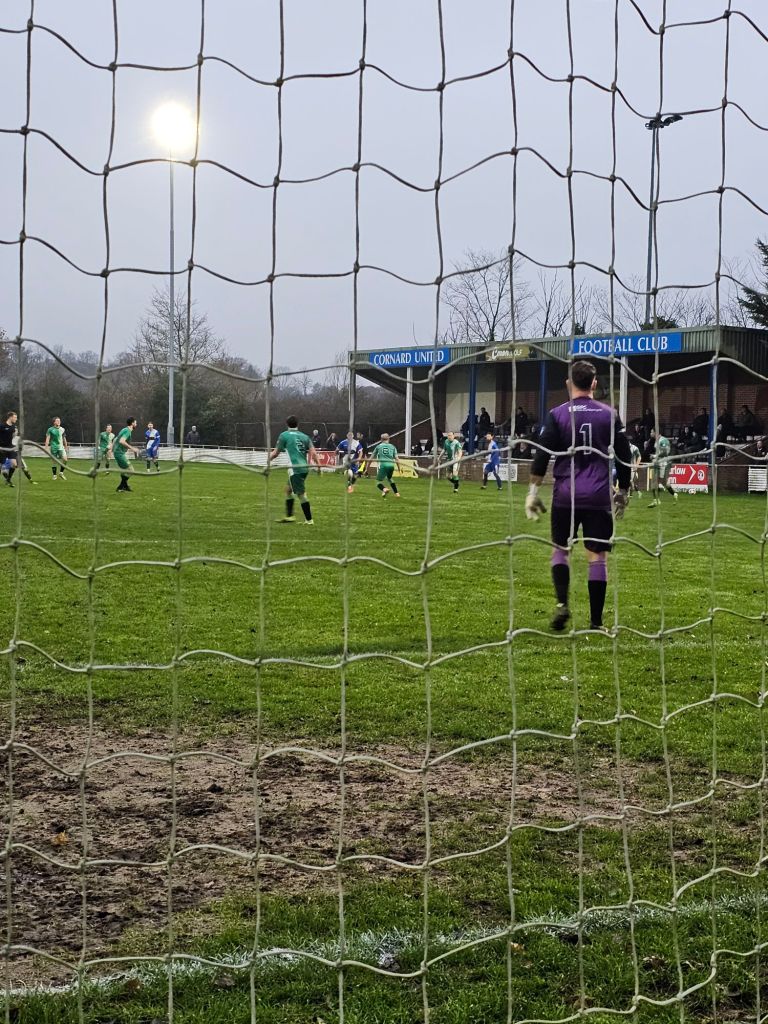
Kings Park Rangers 2 Stanway Pegasus 0

The snappily titled Thurlow Nunn Eastern Counties League Division One South has in the last year been shorn of two Suffolk clubs in the shape of Whitton United and Debenham Leisure Centre, who voluntarily dropped into the Suffolk and Ipswich League.  But as if by magic, two replacements have immediately filled the gaps left, one in the shape of the venerable Halesworth Town (founded 1887) and the other in the form of the altogether less venerable King’s Park Rangers,  who sprang suddenly from the Essex and Suffolk Border League after a brief two-season gestation, a bit like The Alien did from John Hurt’s stomach.

It is the final chapter of my two-part quest to be able to boast idly that I have seen every senior team in Suffolk play a home game.  Today I am making the brief 19.2-kilometre road trip across the border from Essex to Backhouse Lane, Little Cornard where I hope to see King’s Park Rangers play another team of recent graduates from the Border League, Stanway Pegasus.  If I was a younger man for whom the concept of time on this planet running out was less of an immediate concern, I might have caught the train to Colchester, or from Marks Tey to Bures, and then the number 44 bus to Great Cornard, but in truth I couldn’t really be bothered with the palaver, and in any case I have an electric car, so I am doing my bit to save the planet and reduce global warming.  It is therefore a little after two o’clock when I set off from my front drive towards Sudbury.

Being in Little Cornard, it is no surprise that Backhouse Lane is the longstanding home of Cornard United, but more intriguing is why is it now also the home of Kings Park Rangers, who are they, why are they, and where is Kings Park?   These questions have been niggling me all week in my idle moments, and fancifully I had postulated that they are perhaps a team from Kings Park, Suffolk County, Long Island, New York,  a team of South African ex-pats who have named their club after Kings Park Stadium in Durban, or even that they are an incel’s bitter and twisted response to the existence of Queens Park Rangers.  Eventually, there was nothing for it but to consult the interweb and hope I could find some information that was believable and not merely ‘content’ designed to enrage, influence or peddle consumer goods.   It turns out, so it seems, that Kings Park Rangers are a sort of works team for Kings Park Fulfilment Ltd of Pebmarsh, Essex, a company that works for Amazon, aiding Jeff Bezos’s bid for world domination.  According to ‘Suffolk News’, the club was set up in 2023 by “former Cornard resident” Josh Pollard “…as a way of connecting his family- including famous cousin Olly Murs – and work colleagues through their shared love of football.”  I can’t decide if this is philanthropy, megalomania or just weird but it probably makes Kings Park Rangers a Pebmarsh team, an Essex team, that just plays in Suffolk.

Looking out from the drizzle flecked windows of my planet saving Citroen e-C4 it’s a miserable, depressingly grey November day, the aftermath of an even more depressingly miserable, wet, November day, the day before.  The only thing to raise one’s spirits a little is the fact that today the moisture in the air is just occasional fine drizzle, not the persistent rain and occasional monsoon that hit yesterday.  Nevertheless, there’s no denying that the dripping trees, puddles, mud and soggy leaves are all rather glorious in their own way and provide a characterful backdrop to the twisting, turning, undulating B1508 as it makes its way along the north bank of the River Stour from Bures towards Sudbury.

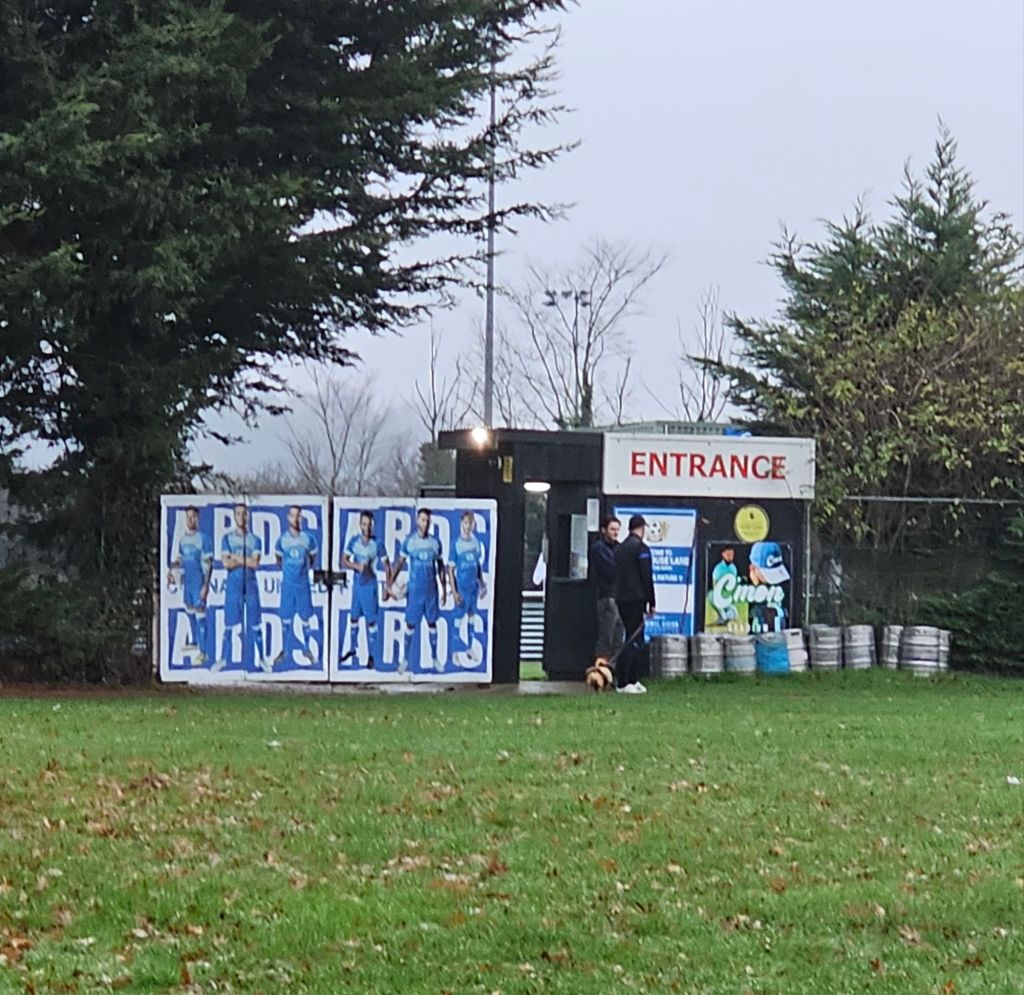
Suddenly, out of the gloom I reach Great Cornard and quickly identify the need to brake and turn right into Backhouse Lane, a very narrow road which in places has a deep water-filled ditch on one side; it is not wide enough for two cars to pass.  Fortunately, I meet only one car coming in the opposite direction and that is at one of the few passing places.  I am therefore soon parking up my planet saving Citroen in the mostly full car park, next to a white Ford Transit van.  The entrance to the football ground is off to my right, through the mist and back towards the B1508 along a concrete path strewn with fallen, brown leaves that have the consistency of wet papier mache.  Two men stand talking each other by the entrance, which seems to marked by a collection of beer kegs, and as I approach they end their conversation and one of them nips into the turnstile booth.  When I last came to Cornard, back in January 2019, the ‘turnstile’ was just a wooden hut but at some time in the intervening six years and ten months this has been replaced by a very neat structure that looks something like a cross between a very small domestic conservatory and one of the old toll booths at the Dartford tunnel.  I tender my £5 concessionary entry fee by means of my bank card.  There is no printed programme, but the window of the toll booth displays a QR code for a programme which is free.  Pretending to be completely familiar with QR codes I point my mobile phone at it, because I think I know that is what you do.  I have succeeded in accessing on-line programmes in the past, but not today, but at least I will have a nice photo of a QR code.  The young man at the turnstile then strangely tells me that there are plenty of people in the club house, perhaps he thinks I look lonely.

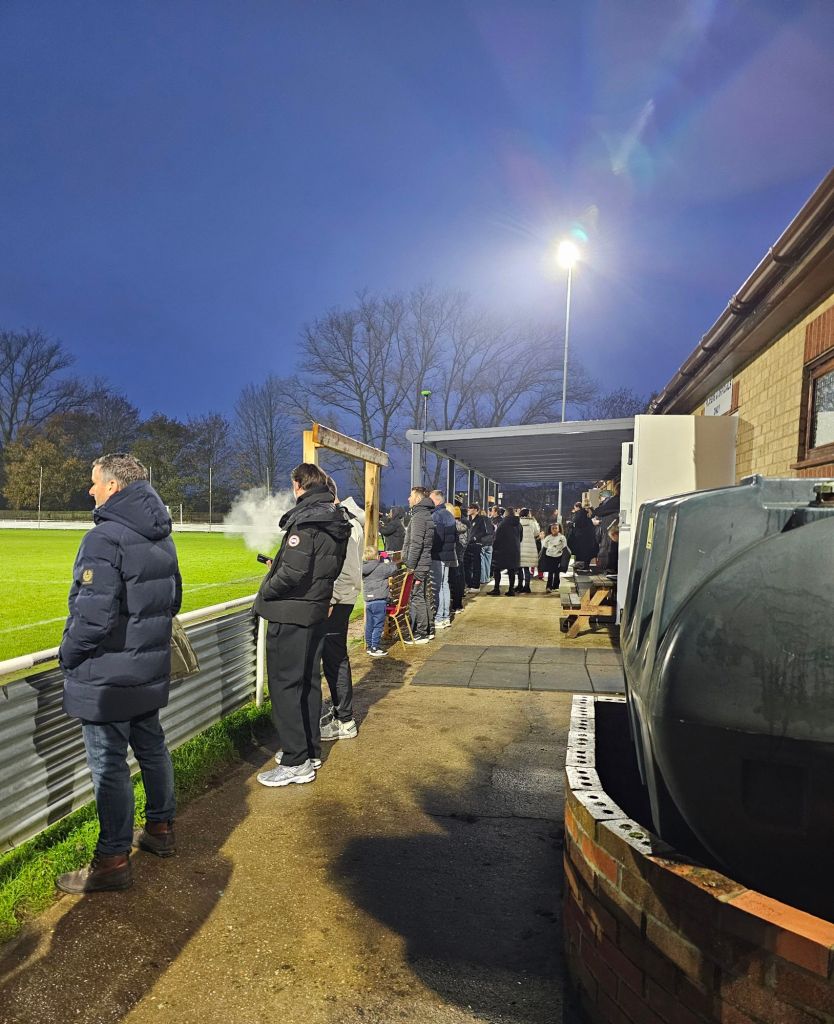
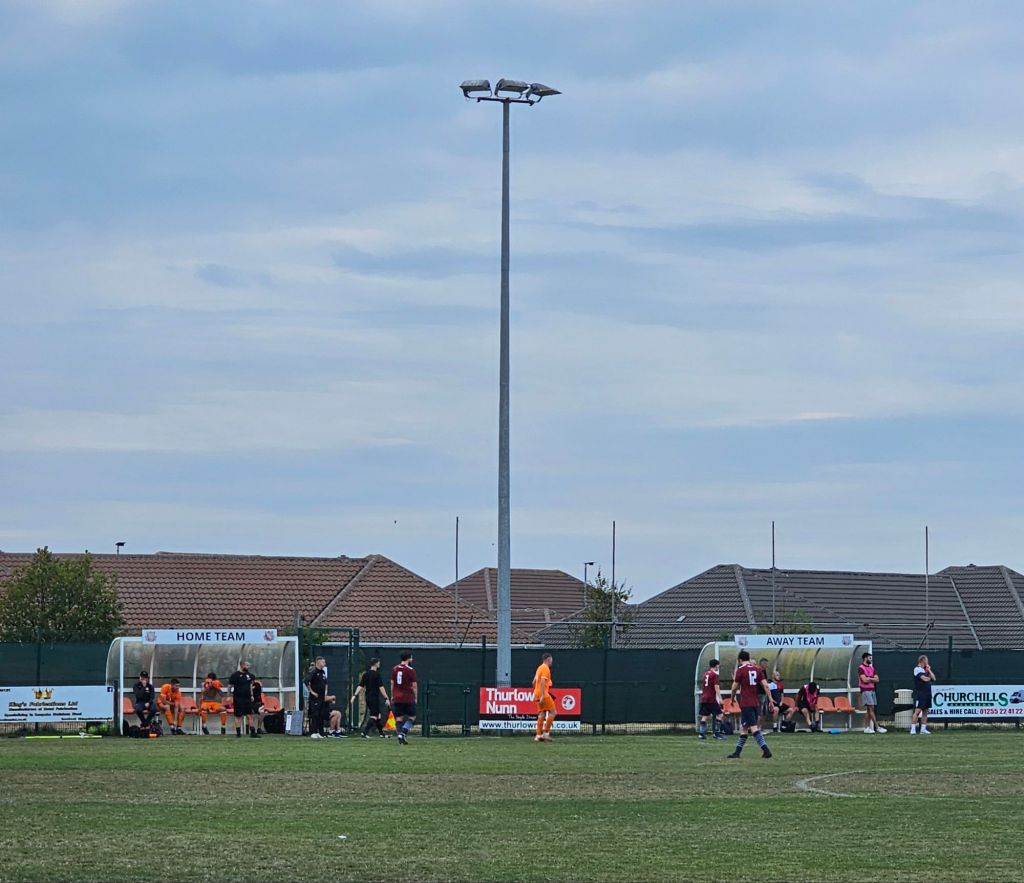
There are indeed plenty of people in the clubhouse as the young man in the toll booth said, but I only talk to the barman who, when I ask if there is a bitter available, tells me there isn’t the call for it nowadays but helpfully adds that a pub nearby wins awards for its beer.  Sadly, there’s no danger of that here and I settle for a bottle of alcohol-free St Austell Brewery Proper Job (£4.90).  The barman apologises for not letting me have the bottle to pour the beer myself and explains that whilst he doesn’t think I look like I would cause any trouble, he’s not allowed to.  Avoiding eye-contact with anyone else in the bar, I worry a little for my safety and take my beer outside where I watch the players, the referee and his assistants warm up, and a player in a track suit top walks a small brown dog. I notice that the two dugouts are almost at opposite ends of the pitch, when I was here in 2019, they were next to one another.

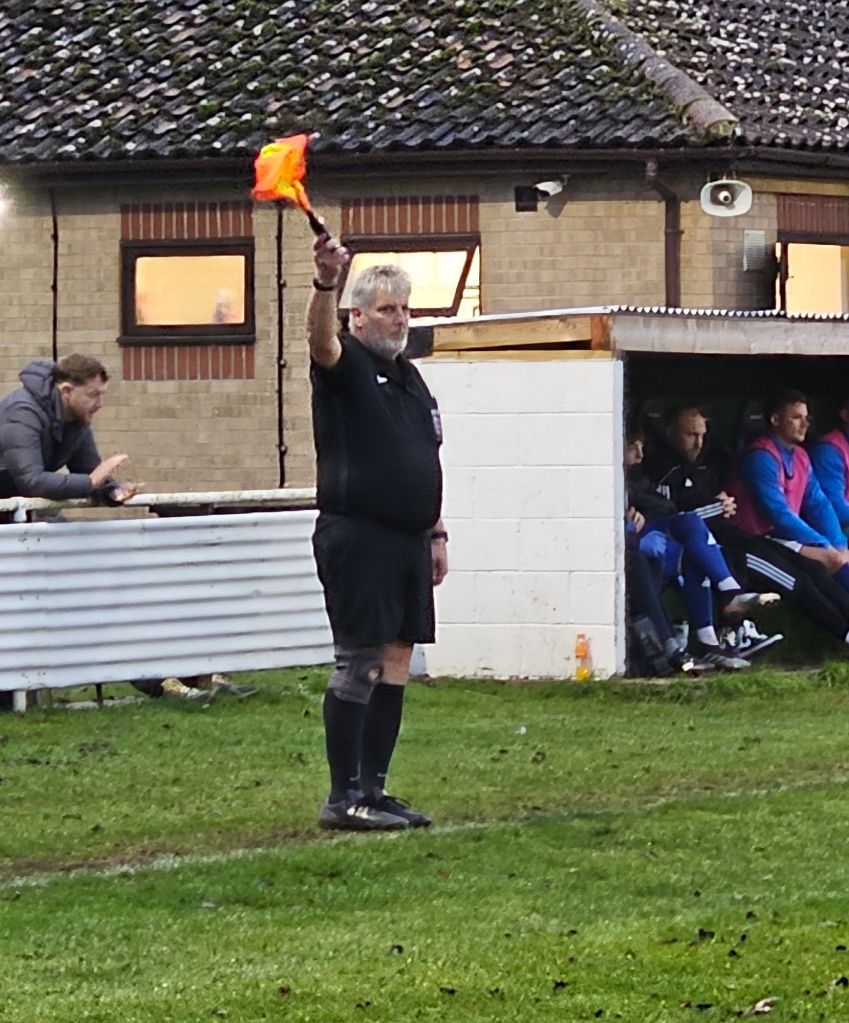
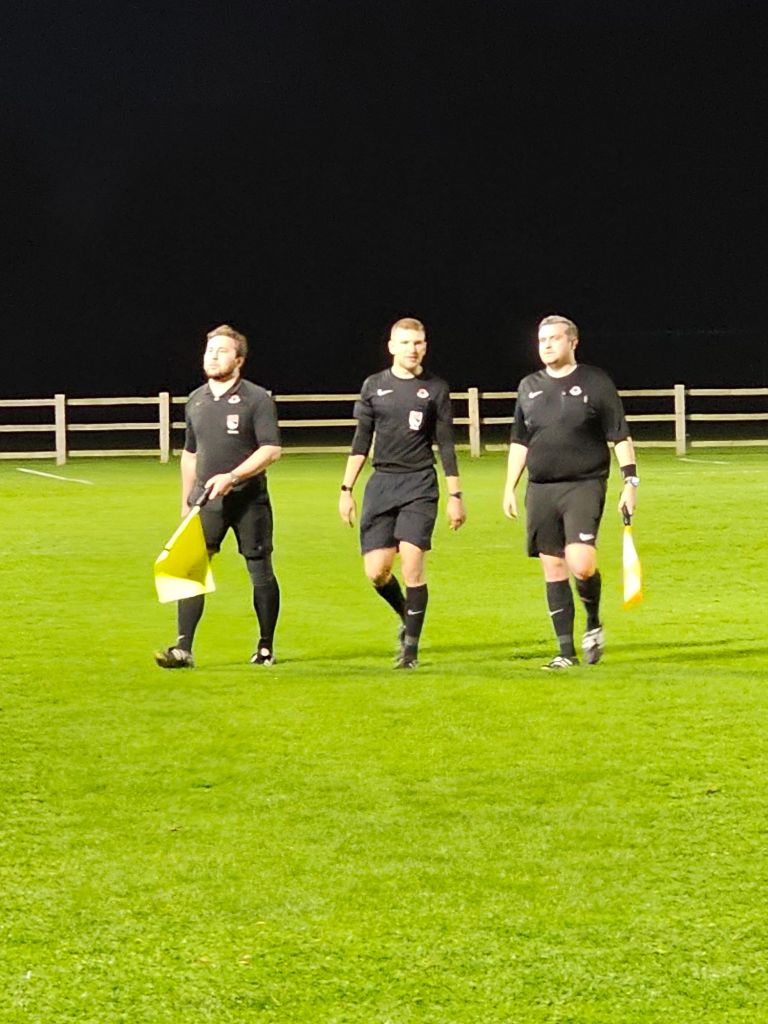
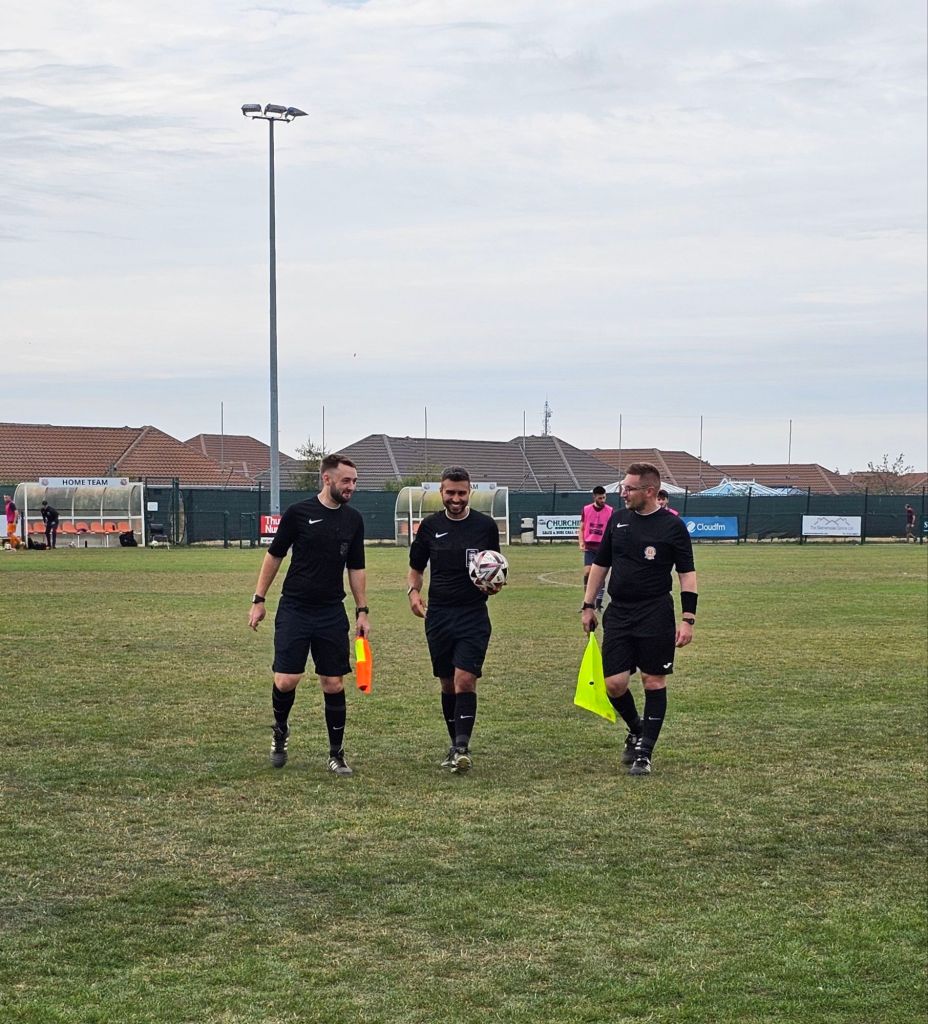
 The referee is a young man with impossibly short hair who looks very keen and serious as he turns and sprints along the touchline and then does the same again. His assistants, two much older men, follow him for all of a few seconds, by which time he is almost out of sight.  “Five minutes.  Do your stretches”, says the referee and one of the assistants a portly, grey-haired man wearing an open knee support stretches down to his knee once or twice and the expression on his face says “that’ll do”.

The game begins at a minute past three and it’s Kings Park who get first go with ball, which they rapidly boot towards Sudbury and the Thomas Gainsborough school, which is just over the fence from the ground.  Kings Park sport an all-blue kit with a wide, white, slightly blurry diagonal stripe across the front, and I think to myself what kit would I choose if I was inventing my own football club, probably not this one.   Stanway Pegasus meanwhile are in all-green with a blurry white stripe down their left side and black socks, like an unhappy man’s Plymouth Argyle.
The most notable thing about this game from the start is the shouting on the pitch and from the dugouts. “You gotta work”, “Chase”, come the early, more polite commands extolling effort over skill.  “Away” shouts the Kings Park goalkeeper and for some reason I think of the Teletubbies. Kings Park win an early corner.  “Seconds, seconds” is another shout, appropriately twice. On the pitch, both teams seem wound up already and the Pegasus number nine screams at the referee’s assistant as he strides towards him intimidatingly over the trivial matter of a throw in.  “Mental” he says to himself after being told to calm down by referee Mr Glasson-Cox, who coincidentally also refereed the match I saw at Halesworth last week.

The half is half over. “Fuckin’ ‘ell ref” says someone about possibly anything but soon the initial intensity of the match seems to have thankfully subsided a bit.  I move into the main stand, a utilitarian, boxy looking structure but with a bit more character than most of the prefabricated metal stands erected nowadays.   In a quiet moment I reflect upon the referee’s assistant stood in front of me, a wiry man with a large beard, which he looks as if he might have grown having been told by his doctor that he needs to put on a bit of weight.  Between me and the referee’s assistant raindrops cling to the white painted rail around the pitch.   The slightly calmer mood continues into a short delay in which the referee speaks to his assistant on the far side, the portly, grey-haired one with the dodgy knee who it seems has noticed that following a goal mouth scramble the goal at the Sudbury end of the ground, which is on wheels, has moved a little.  Mr Gasson-Cox takes a look and gives the goal a little shove.

After the calm, there follows a short storm as Kings Park’s number eight and captain Noah Collard scythes down an unidentified Pegasus player who proceeds to writhe on the ground screaming.  Once the Pegasus player has cried wolf for long enough Collard becomes the first player to see Mr Gasson-Cox’s yellow card, but discussion in the crowd is more about the girlish screaming than the booking.  “Does he have to go off with the screaming?” asks a spectator not unreasonably.   But as if to quickly even things up, a Pegasus player also gets to view the yellow card before half-time, although there is no further screaming from either side and the half ends goalless.

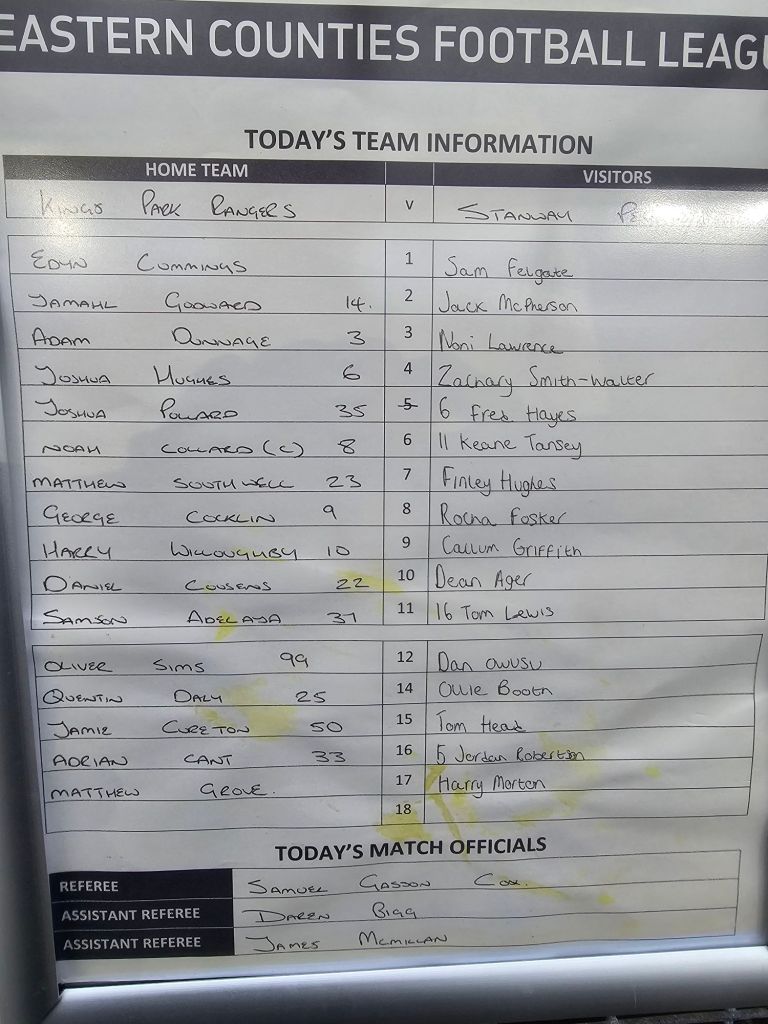
With half-time I drain-off some of the Proper Job and eat a Polish Grzeski chocolate bar from the World food aisle in Sainsbury’s.  I peer through the window of the club house where a man and a woman, presumably club officials from Stanway Pegasus, and two men in large black coats featuring the crest of the Suffolk County Football Association drink tea with an array of what look like shop bought sausage rolls and homemade bread pudding wrapped in tin foil laid out before them.  Only the man from Stanway Pegasus seems to be eating anything.  I wonder to myself where the Battenburg and Swiss Roll are.  Outside, next to the window I look at today’s team sheet, which looks like whoever wrote it might have been eating an orange at the same time.  Beyond the club house the small brown dog is being walked by a different man, possibly a player, who is evidently not playing today; I hear him say he doesn’t know the dog’s name.  “Come on you” he says.  Two other small dogs are present in the crowd today too, one in a coat and one not. 

At three minutes past four the match resumes and the Kings Park coach is immediately barking instructions to Georgie, Zammo and Hughsie as if his very existence depended on it, whilst also sounding like the games teacher from tv’s Grange Hill, but only because he said ‘Zammo’.   His shouting works however and six minutes later a ball from left to right finds number twenty-two Daniel Cousens inside the penalty area.  Cousens calmly places the ball wide of the Pegasus goalkeeper, and Kings Park lead one-nil.

Ten minutes later and Kings Park lead two-nil when a low cross from the right travels across the face of the goal, past the flailing limbs of a couple of Pegasus players until it reaches Kings Park number ten Harry Willoughby, who bundles it into the goal from close range before running off madly.  “Whatever ‘appens, don’t let ‘em fucking score again” bawls a rough voice, presumably of a Pegasus supporter. 

It’s getting on for half past four and the game seems over. Pegasus don’t offer much else but for a goal mouth scramble which leaves the Pegasus coach feeling hard done by and asking rhetorically “ ‘ow’s your luck?”  and then asking it again.  For Kings Park the goalscorer Willoughby is substituted for the 50-year-old former Norwich City, Colchester United, Reading, Queens Park Rangers, Swindon Town, Shrewsbury Town, Bristol Rovers, Leyton Orient, Bournemouth, Barnsley and umpteen other clubs’ player Jamie Cureton. As Willoughby heads for the changing room, he emits a sort of howl.

Back on the pitch, Pegasus number five Jordan Robertson is booked after Kings Park’s number ninety-nine Oliver Sims is not given offside, and Robertson seemingly exorcises his disappointment by hacking Sims down.  “Fucking embarrassing” says the Pegasus coach, but only about the presumed offside. Time runs down, on into the ninetieth minute.  Pegasus can’t decide whether to just boot the ball forward as quickly as possible or pass it. “Just kick the fuckin’ thing” shouts an elderly spectator summarising a century and a half of tactics from the country that apparently invented the game.  “Darren, time” shouts a player. “Darren, man on” shouts the same player a moment later. The final action sees another booking for Kings Park. “Fuck me, it’s getting boring now” say the Pegasus coach and happily at 16:52 Mr Gasson-Cox, who I think has had a good game calls time.

I wait as the players leave the field to no applause, just the blokey clasping of fists with a few spectators and shouts from inside the changing rooms.  It’s been a good game in terms of the ability shown, but it’s not been a particularly enjoyable one. There’s been too much trying to pressure the referee, too much needless swearing and too much of a sense of needing to win above all else. I think I’ll just try to remember the afternoon for the miserable weather, the soggy leaves and the small dogs.

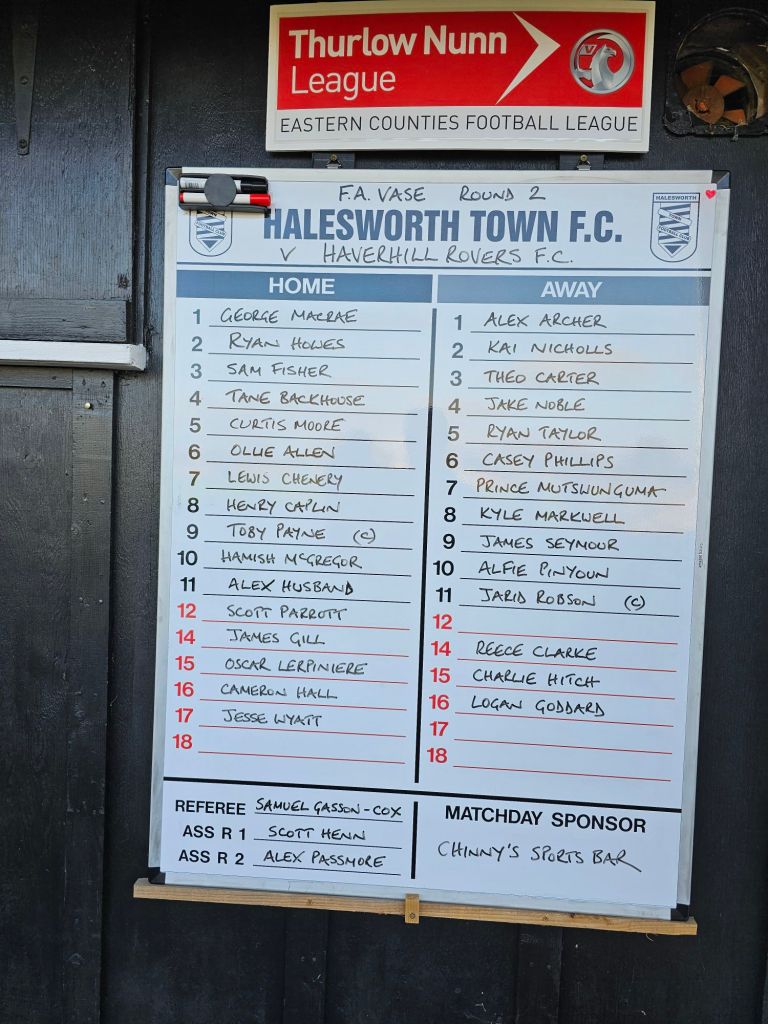
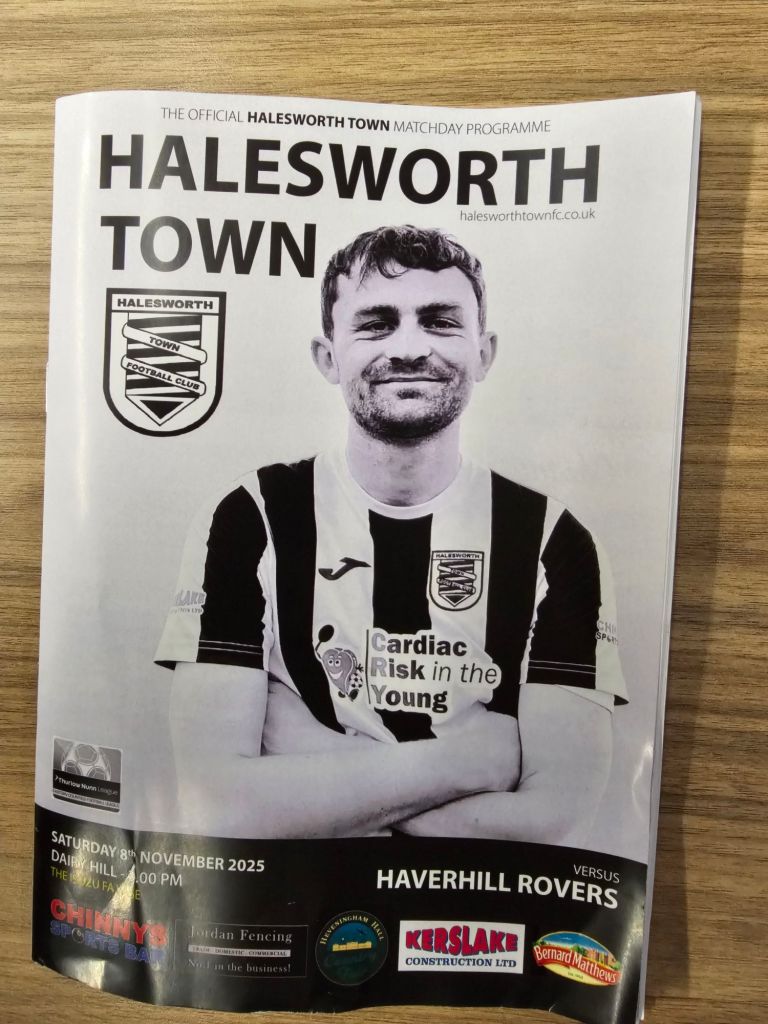
Halesworth Town 3 Haverhill Rovers 1

Between March 2017 and April 2019, I watched matches at each one of Suffolk’s then twenty-four senior football clubs and recounted my experiences in this here blog.  Since then, Debenham Leisure Centre and Whitton United have sadly dropped out of senior football but this season the Eastern Counties League First Division North has welcomed two more Suffolk clubs into the fold in the shape of Kings Park Rangers, who are from Great Cornard but seemingly too shy to admit it, and Halesworth Town, who are proudly, clearly from Halesworth. 

Today, with Ipswich Town playing far too far away in deepest Wales to trouble me to even think of getting a ticket, even if I had enough ‘points,’ I am travelling up to Halesworth in part one of my plan to restore my record of having seen all of Suffolk’s senior teams on their home turf.  Fortuitously, today’s fixture is also an all-Suffolk cup-tie against Haverhill Rovers of the Eastern Counties Premier League, and the first time Halesworth Town have ever reached the second round of the FA Vase.   To add to the adventure even more, despite the additional twenty minutes each way that it will take me, I am responsibly reducing congestion on the roads by eschewing making the 88-kilometre journey from my home by planet saving Citroen e-C4 in favour of taking the train (£18.10 return with senior railcard). It also means I can get plastered if I choose to.

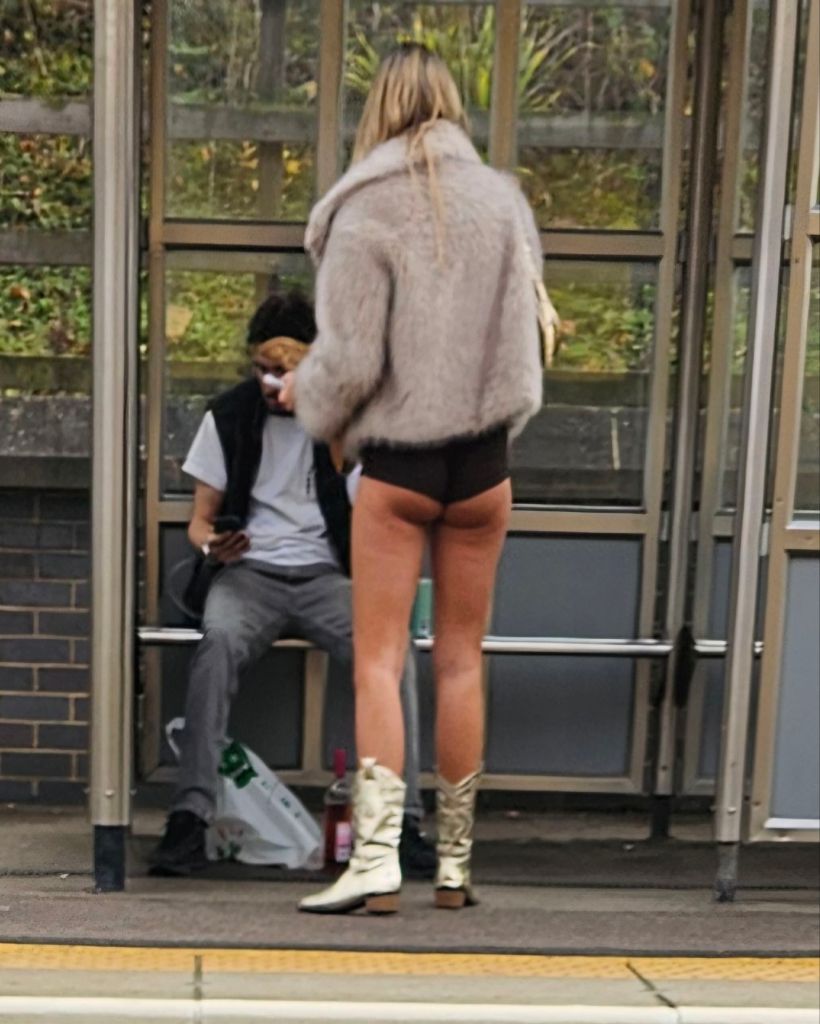
It’s an intermittently cloudy but mild November day as I set off for Halesworth, but I am nevertheless surprised as I wait for the train that one of my fellow travellers appears to have forgotten to put on any trousers or a skirt.  Once on the train, the infinite variety of human life continues to reveal itself as a small man of pensionable age repeats the names of the station stops as they are heard over the public address system; every now and then he delves headfirst into a large carrier bag as if checking on the wellbeing of a small animal or perhaps a baby.  When the woman sitting opposite me goes to the buffet car, she asks me to mind her belongings. I of course agree but tell her she needs to be back before we get to Ipswich.   When she returns, I tell her I had to fight off a couple of people who looked interested in her jacket but otherwise everything has been fine.  Fortunately, she laughs, but the man of east Asian origin next to me looks at me askance and when she begins to struggle to open a bottle of drink, he very quickly offers to help so that she doesn’t have to deal with the looney opposite her again.  The woman soon begins to chew on a large sandwich and a younger man on the other side of the aisle between the seats does the same thing, but takes much bigger bites, happily from a different sandwich, although with every bite he looks like he might lose a finger.
I change trains at Ipswich, boarding the 13:16 to Lowestoft, which departs a good twelve seconds early.  I like the East Suffolk line, to me it feels like a one-hundred- and seventy-year-old umbilical cord connecting the outside world to rural Suffolk with its rustic sounding stations such as Campsea Ashe and Darsham and their Victorian architecture.  Between the stations are Suffolk landscapes of river and marsh, Oak and Broom, sheep and pigs, outwash sands and boulder clay and gaunt, grey, flint church towers.  As the guard checks passengers’ tickets, he helpfully advises those alighting at Halesworth not to use the doors in the front carriage, because the Halesworth station platform is not that long.  There seem to be quite a few of us alighting at Halesworth.
The train arrives on time in Halesworth, where the sun shines from a pale blue autumn sky. A helpful sign points and tells pedestrians that it’s a seven-minute walk to the town centre and a minute’s walk to local bus stops on Norwich Road. Sadly however, no sign points helpfully towards Halesworth Town football ground, although having previously consulted the interweb I happen to know it is very close indeed, perhaps no more than a hefty goal-kick away.   I walk up an alley between the railway lines and Halesworth Police station, a huge four-storey block of a building, which although it probably dates from the1960’s makes me think of a Norman castle keep, built to keep the locals in check.  At the top of the alley, I turn right over a bridge above the railway and then right again down another alley the other side of the tracks, and down to the Ipswich bound railway platform. From here it is no more than 150 metres up Dairy Hill to the football ground, making it a toss-up between Halesworth and Newmarket as to which senior Suffolk football ground is most easily accessible by rail, my money’s on Halesworth.

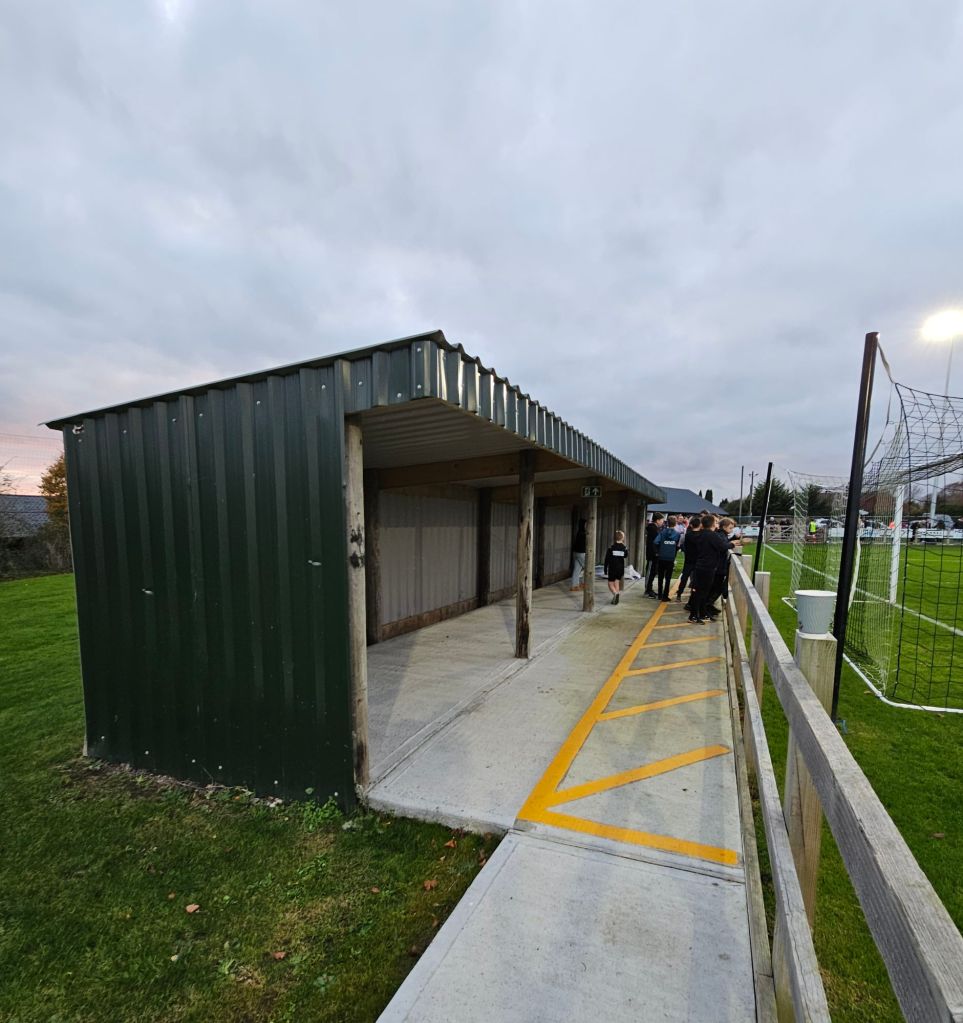
Despite its attractive name, Dairy Hill is just an uninspiring street of modest modern houses; from the top I make my way across the stony club car park and along the back of the club house to the ground entrance.  For a mere seven pounds I gain a programme (£1.00) and entry to the match as an over sixty-five, all that is missing is the click of a turnstile.  The ground itself is underwhelming, but it does boast a decent looking pitch with a smart timber fence all around and a small stand at the end nearest the clubhouse, which according to ground grading rules needs to be big enough to accommodate fifty spectators, although I’m not sure if FA rules say how large or small the spectators need to be.  The height of Halesworth’s stand suggests they should not be significantly taller than about 1.8 metres unless wearing crash helmets.

I head for the club house where the bar offers the usual array of fizzy lagers and cider and a pump which intriguingly bears the name ‘Wainwright’ written in biro on a plain white sticky label.  The barman generously allows me a sampler of the ‘Wainwright’ and seeing as there’s nothing-else I might like I order a pint (£4.60) before heading outside again to visit the food trailer, where a tall man with tattooed arms, who looks like men in food trailers often do serves me chilli, chips and cheese for a modest six pounds, less than half what I paid for much the same thing in an Ipswich pub earlier this week. 

I return to the club house to eat my chips and drink my beer, not being someone who likes to eat or drink standing up.  The club house looks like there might be an older timber building, which has had a new roof and supporting structure placed over the top of it, it smells a little like that too, having a faint musty odour which isn’t uncommon in old village halls and clubhouses.  The black and white interior décor and monochrome photos of old teams on the walls remind me a little of the Long Melford club house before it was re-built.

With chips eaten and beer drunk, I wait outside for kick-off, observing the growing crowd and the queue to get in at the gate, before standing closer to where the two teams will line up before the procession on to the pitch to shake hands and then observe the minute’s silence for remembrance day, a silence  which whilst well observed around the pitch plays out to a back ground of chatter from inside the bar and clubhouse, where life continues as usual, oblivious to the  silence outside.

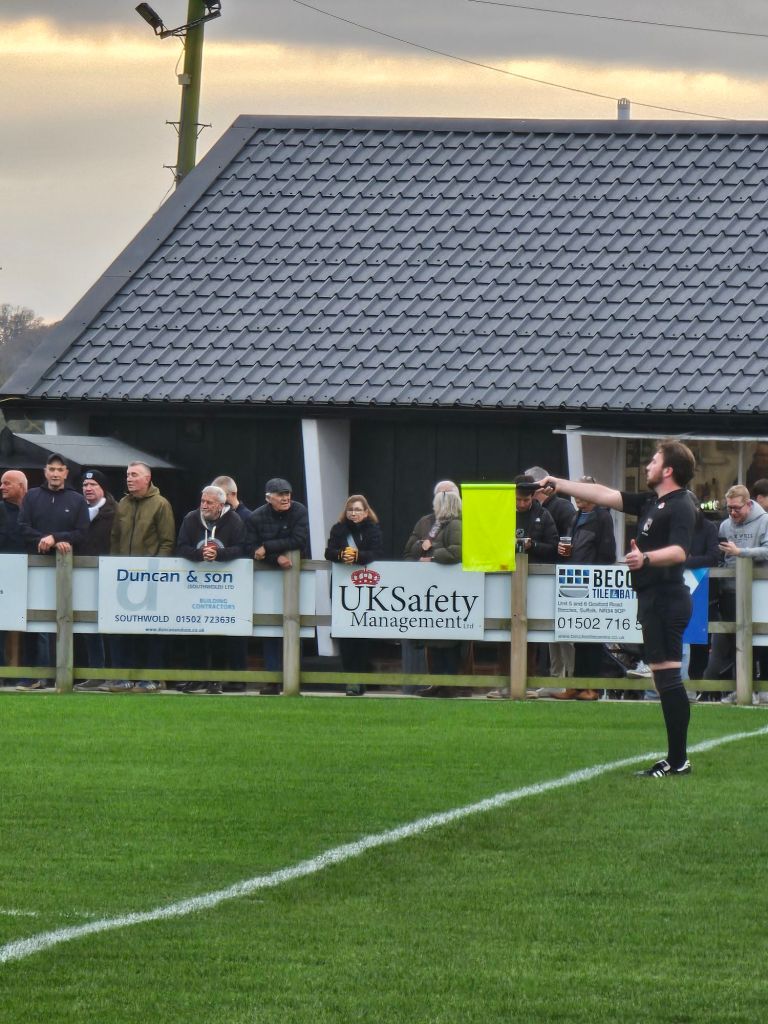
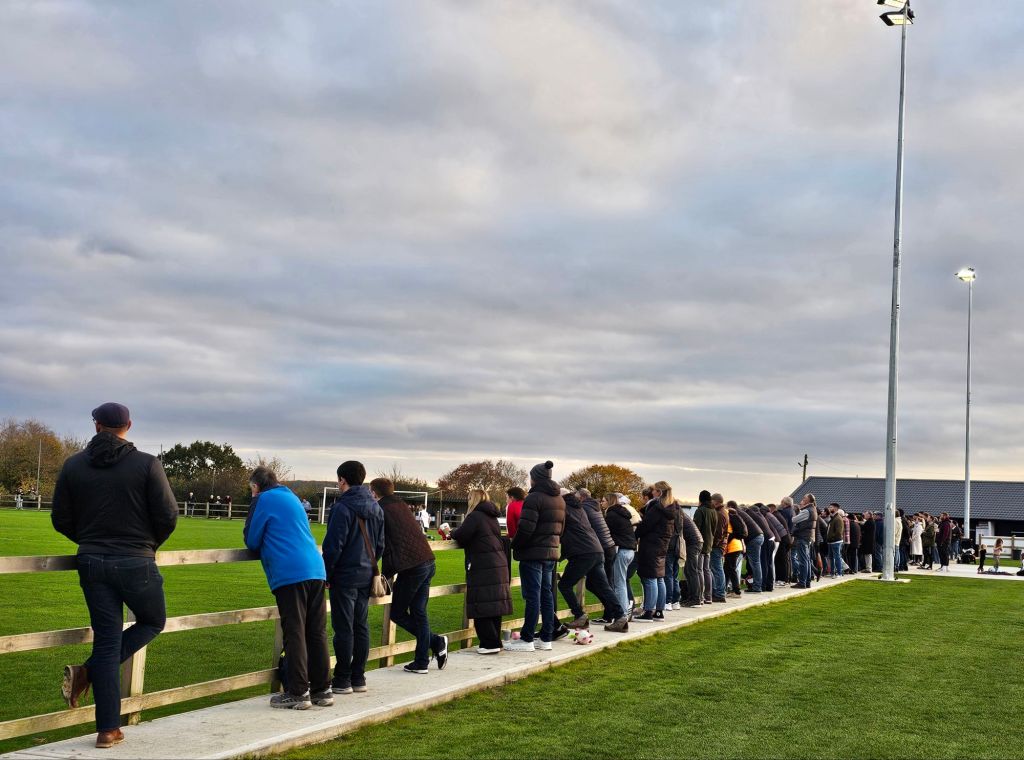
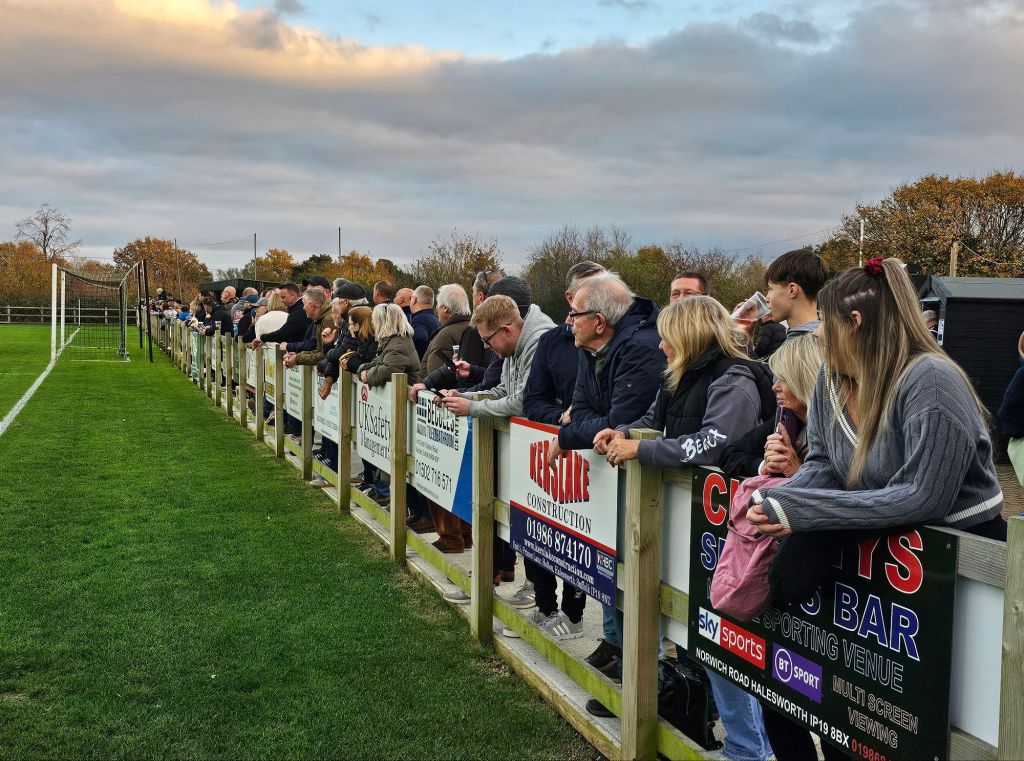
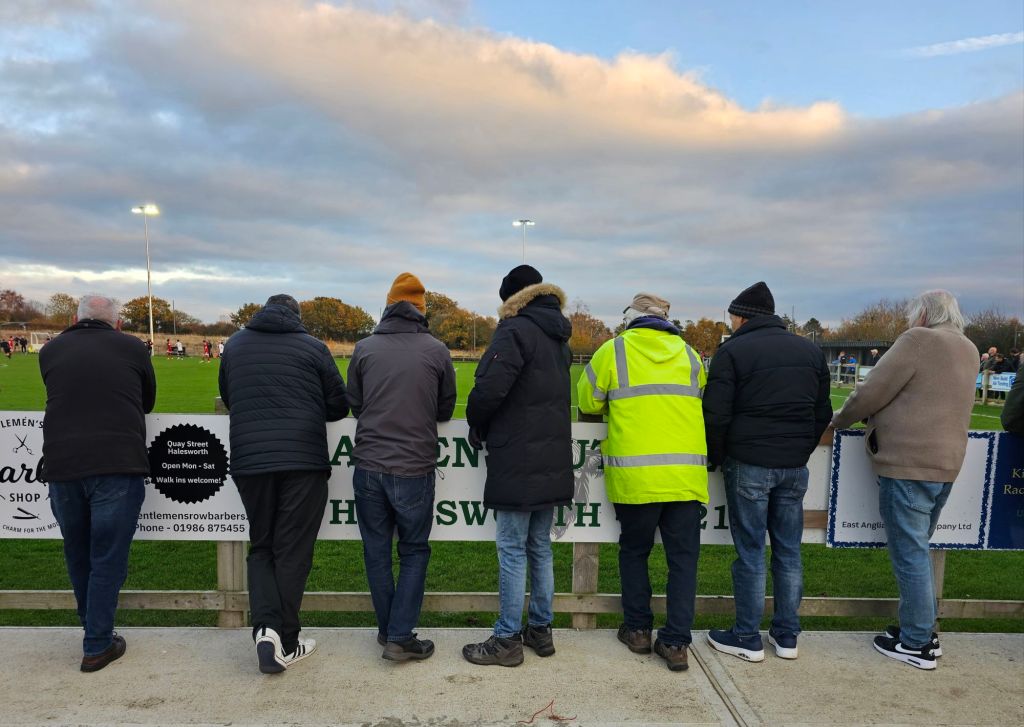
Eventually, it is Haverhill Rovers who begin the game, by getting first go with the ball, which they quickly hoof forward in the general direction of the stand, the railway station and town centre beyond, before it is booted into touch by a Halesworth defender, not unreasonably practicing safety first.  It’s good to see both teams wearing their signature kits, Rovers in a rich shade of all red, whilst Halesworth sport black and white stripes with black shorts. In front of the only stand, a youth bangs the sort of drum I wouldn’t bet against him having been given as a present for his sixth birthday, probably about six years ago.  The bulk of the crowd are lined up behind the post and rail fence along the touchline opposite the dug outs and when Halesworth win the ball they emit an encouraging rustic roar.

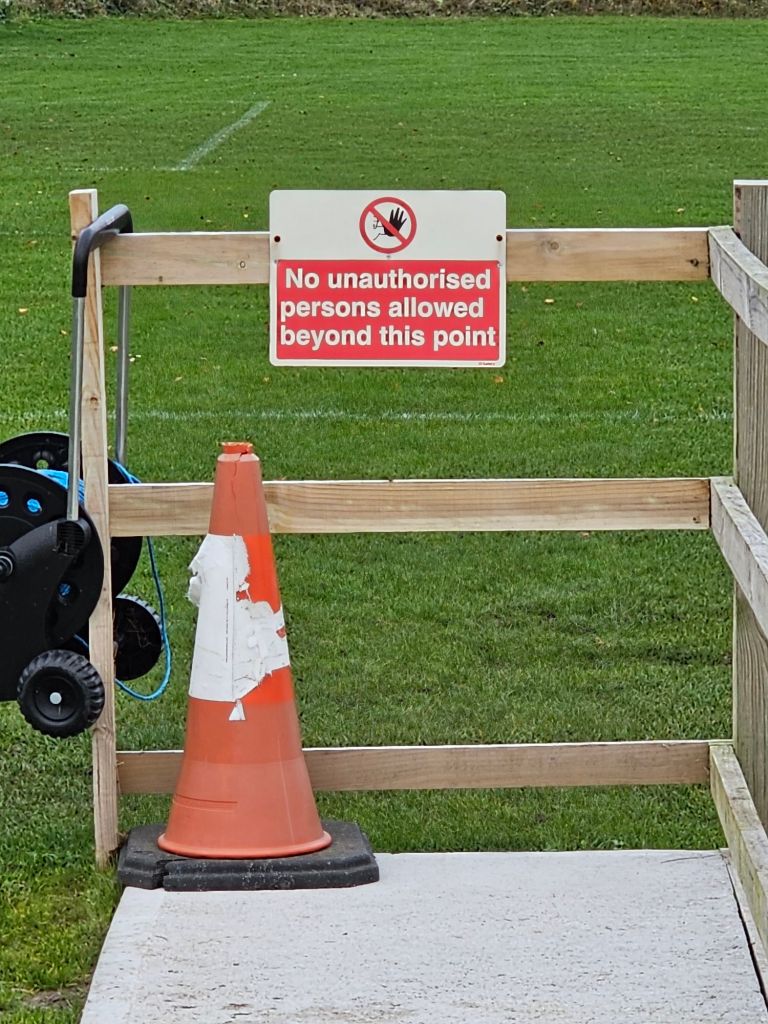
Seven minutes have passed and it’s Rovers who are the team kicking the ball most of the time; their number seven Prince Mutswunguma performs a neat turn and a decent cross which is headed over the Halesworth cross bar.  The pattern of the game is generally one where the long ball is favoured over short passes and two minutes later Mutswunguma blazes the ball high above the Halesworth cross bar.  I stroll along the front of the empty stand between it and the pre-pubescent ultras but remain nervous of hitting my head on the low roof.  I stop close to the corner flag, halted by a sign forbidding further progress and disappointingly preventing me from walking round to watch the game from behind or between the dugouts, where the angst and frequent bad language of the managers and coaches is often as entertaining as the match.   I am nevertheless now in a good position to see Rovers’ desperate claims for a penalty as Mutswunguma tumbles under a challenge from number 6, Ollie Allen and then two more players fall over. “Fucking disgraceful” opines a gruff voice from somewhere, either on the pitch or in the dugouts, but I’m not sure if he means not giving a penalty or having the temerity to appeal for one.

Keen to see the game from as many angles as possible I move again, this time to near the corner flag diagonally opposite the one I have been standing by.  I settle near a man in late middle age who sports a Stranglers t-shirt and beanie hat bearing the name of The Rezillos, the excellent late 1970’s Scottish ‘punk’ band fronted by Faye Fife and Eugene Reynolds.  He is on his mobile phone and seems to be arranging a claim on his motor insurance having hit something when parking his car in the club car park.  In my new position I also benefit from a good view of an increasing number of unsuccessful Halesworth breakaways as the home team gain in confidence from repelling all Rovers’ attempts to score.

In goal for Halesworth, George Macrae has made a string of fine saves as Rovers win a succession of corners.  Rovers’ best effort is a shot from Kyle Markwell, whose surname gives a clue to the opposition as to how to treat him, that whistles past a post.  A half an hour is lost to history and Halesworth fashion another breakaway as captain Toby Payne receives a diagonal pass out on the left.  “He’s on!  He’s on! Well, he’s not off” shouts a young man to my left with rising excitement as Rovers’ offside trap is sprung. Payne advances into the penalty box, shapes up to shoot but then side foots weakly too close to the goalkeeper Alex Archer, who doesn’t have to stretch far to prevent a goal.  Two minutes later however Halesworth break again down the left and this time the ball is pulled back from the by-line for Lewis Chenery to score easily into the middle of the Rovers’ goal from no more than 8 metres out and it’s 1-0 to Halesworth Town.

The remaining dozen minutes of the half repeat the established pattern of the previous thirty-three, and another Rovers’ corner is headed wide, which I view from back near the clubhouse as I prepare to be ahead of the queues for the toilet and the tea bar when the referee, the extravagantly monikered Mr Gasson-Cox sounds the half-time whistle.  Having invested in a pound’s worth of tea I take-up a position for the second half just to the right of the stand, but not before I overhear a club official talking to the man on the gate and learn that the attendance today is a stonking two-hundred and fifty-eight.    As the new half begins and the light fades, the lovely smell of the turf rises up from the pitch. A woman standing next to me tells me we will see the goals at this end in the second half and I agree, telling her that with the goal being scored at the other end in the first half, it figures that this is the end where the goals will be scored this half.  We talk a little more and after I reveal I have an Ipswich Town season ticket, she admits to being a Norwich City supporter, but sympathetically I tell her someone has to be.

With the start of the second half at three minutes past four Halesworth seem to have lost a little of the confidence they showed by the end of the first half, perhaps because they realise they have to go through another forty-five minutes similar to the first, and indeed they do. But with twenty minutes gone and no further score it is Rovers who first feel the need to make substitutions.  “Who are ya?” chant the pre-pubescent ultras, as well they might as the new players emerge from the dugout.  Five minutes later and Halesworth’s Tane Backhouse is the first player to see the yellow one of Mr Gasson-Cox’s two cards, although as I become increasingly biased in favour of the home team and their superb goalkeeper, I can’t really figure out why.  Two minutes later and I’m cheering as another characteristic break down the right sees Toby Payne run to the edge of the Rovers penalty area, cut across a little towards the middle and then shoot unerringly inside the far post and Halesworth lead 2-0.  “Oh when the Town go marching in” sing the mini ultras, as do a number of people old enough to know better, but understandably carried away by the moment.

Things get no better for Rovers as after  an innocuous looking foul Mr Gasson-Cox nevertheless seems annoyed with Prince Mutswunguma and standing his ground, summons him over before showing him the yellow card.  “Wemberley, Wemberley” sing the Halesworth fans who should know better but are now too happy to care, but as they do so Rovers, perhaps realising their desperate position with only ten minutes left embark on a final push.   It’s twenty to five as George Macrae makes another fine save, this time diving low to his left. “Two-nil down on your big day out” sing the pre-pubescents, not helping the situation with their cruel taunts and Rovers win another corner.  The corner is cleared but moments later the ball is crossed low from the right and Rovers’ number eleven and captain Jarid Robson half volleys it high into the centre of the goal from a narrow angle and the score is a nerve-wracking 2-1.

It’s now eleven minutes to five, the match is a minute into added on time and Rovers are besieging the Halesworth goal like local Saxons or Danes outside the Norman police station.  A cross comes in from the left, and a Rovers head goes up diverting the ball goalwards but once again George Macrae appears, seemingly from nowhere to save the day again by cleanly catching the ball.  “Six more minutes Haverhill” I hear a voice call, perhaps from the Rovers’ dugout, or perhaps it was Mr Gasson-Cox or someone just mucking about. Six minutes seems an awfully long time given that neither I nor the lady next to me can recall anyone really being injured.  Another Rovers corner goes straight to the arms of Macrae but then Halesworth break away again, bearing down on goal on the right and then switching the ball across the edge of the penalty box before number eleven Alex Husband shoots from a narrow angle and the ball strikes a Rovers defender and arcs up over Archer the goalkeeper and into the goal off the far post.  It’s 3-1 to Halesworth! The game is surely won and the knot of Halesworth players hugging by the corner flag and the under12’s ultras who have run along behind us hoping to celebrate with them clearly think so.

Very soon however, it’s three minutes to five and finally Mr Gasson-Cox parps his whistle for the last time today and Halesworth are into the third round of the FA Vase. Most people wait to cheer and applaud the team as they leave the pitch, but not before they applaud Mr Gasson-Cox the referee and his assistants, which is something you don’t see every day, and then the Haverhill players too.  It’s been a wonderful afternoon, an exciting cup-tie played in front of a large and appreciative crowd, and everyone’s had a lovely time.  As I leave the ground and make my way back across the stony car park and down Dairy Hill to the station I reflect on what a fine little town Halesworth is and how one day I really should return. All hail Halesworth!

Holland 2  Dussindale & Hellesdon Rovers 1

Holland-On-Sea, Wikipedia tells us, is a suburb of Clacton-On-Sea and was known as Little Holland until the early twentieth century; it also has a football club called Holland FC.  What Wikipedia doesn’t tell us however is that Holland is just a 30 minute, thirty-eight-and-a-half-kilometre drive from my house, although Google maps does.  Stanway Rovers, Halstead Town, Coggeshall Town, Cornard United, Wivenhoe Town and Hadleigh United football clubs are all playing at home today and are probably all closer to home, but none of them are “On-Sea” and I’ve been to all of their home grounds in the last twelve years, which isn’t true of Holland FC’s Dulwich Road, where I am given to understand that the pitch, as if by some freakish movement of tectonic plates, has moved through ninety degrees in that time, throwing up a metal fence all around itself and a smart new clubhouse.  Therefore, with the promise of sea air and the prospect of a geologically formed football ground, it is on a warm but cloudy Saturday afternoon in early September that I set off in my planet saving Citroen eC4 for Holland-On-Sea.  I had contemplated catching the train to Clacton and making the half hour walk to Dulwich Road, but with only one train an hour I wouldn’t have got home until seven o’clock, and I have a wife whose heart I risk breaking if I stay out too long.

It’s an uneventful journey down the A133 and I arrive in relaxed mood in the Holland FC car park, where I have a wide choice of parking spaces; I draw up next to a modest silver-coloured family saloon, which had turned into the pebbly, beach-like car park shortly before my I and my Citroen did.  It’s not half past two yet , so I decide to take a look at the sea before entering the ground; the cliff top and sandy beach below are only 200 metres away across the grassy expanse of the Eastcliff Recreation Ground and Marine Parade.  From the cliff top, Clacton Pier is visible through the haze at the end of the beach, and out to sea sit the ranks of wind turbines that I like to think made the electricity that powered my car and brought me here.  A West Indian man of pensionable age and riding a low-slung tricycle asks me if I’m local and if I know where the Kings Cliff Hotel is.  I tell him I’m not and I don’t know where the hotel is, but I do know he is heading towards Kings Parade.  I think to myself that the ‘King’ in King’s Parade fame was probably either King Edward the Seventh or some egotistical Tendring District councillor with the surname King.

I walk back inland to the football ground up Lyndhurst Road, a typically suburban, tree-lined street of inter-war bungalows, all of which are almost frighteningly neat and well maintained. Just past a public toilet is a hedge which is teeming with bees and butterflies, mostly Red Admirals.  I am not sure I’ve ever seen so many butterflies in one place, but start to worry that wealthy local MP Nigel Farage might be having them specially bred so that he can pull their wings off or place them in his reptile-like mouth before washing them down with a pint of beer.  But then again, I don’t suppose he ever comes here; he probably gets his butterflies in Florida.

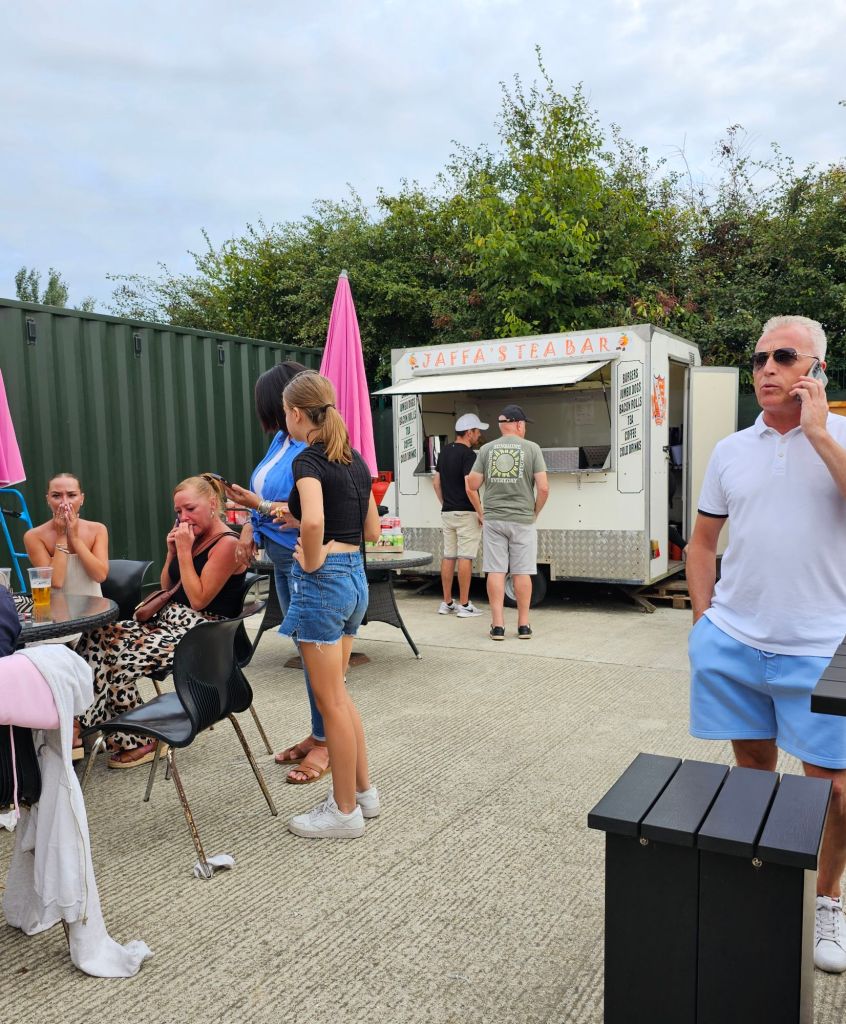
Back at the football ground, the friendly, cheery but visibly overweight man at the gate tells me that the concessionary entry fee of £5.00 applies to over sixties; I tender a twenty-pound note and receive fifteen pounds change.  After I ask if there is a programme today, I am told that the club does produce a match programme, but hasn’t done so today, which to me seems a bit lazy of them.  With the two pounds I saved at the gate by being old, I buy £1.50’s worth of tea from Jaffa’s Tea Bar.  I don’t know who Jaffa is, but his or her (it was a woman who served me) tea is pretty good, even if it is just a tea bag in a paper cup with some added water and milk.    I suspect however that the name of the tea bar is derived from the club nickname, “The Jaffas” and so the apostrophe is in the wrong place, this is Essex after all.  I wander inside the clubhouse which, although bright and new and with a display of trophies on one wall, seems a little soulless due to its grey floor, plain walls and vaulted ceiling; the only pumps on the bar are for Stella Artois, San Miguel and Carlsberg. I am pleased I bought tea and enjoy the irony that in Farage’s constituency all the ‘beers’ are, nominally at least, foreign brands.  Most of the drinkers are sat outside at an array of tables and look like they are settled in for the afternoon. 

“Are you sat here for the music?” I ask two old boys sat on stackable chairs in a covered area outside the home dressing room,  through the window of which can be heard the typical, pumped-up, high volume musical selection of the millennial footballer.  “Is that what it is?” Says one of the old boys.  I wonder to myself if Stanley Matthews, Len Shackleton and Tommy Lawton would get themselves ready for kick-off by cranking up the volume on the latest 78’s from Glenn Miller,  Al Bowlly and Bing Crosby.  With the music turned off we can hear the team talk. “It’s a long journey from Norwich or wherever they come from” says the coach encouragingly to the Holland players.

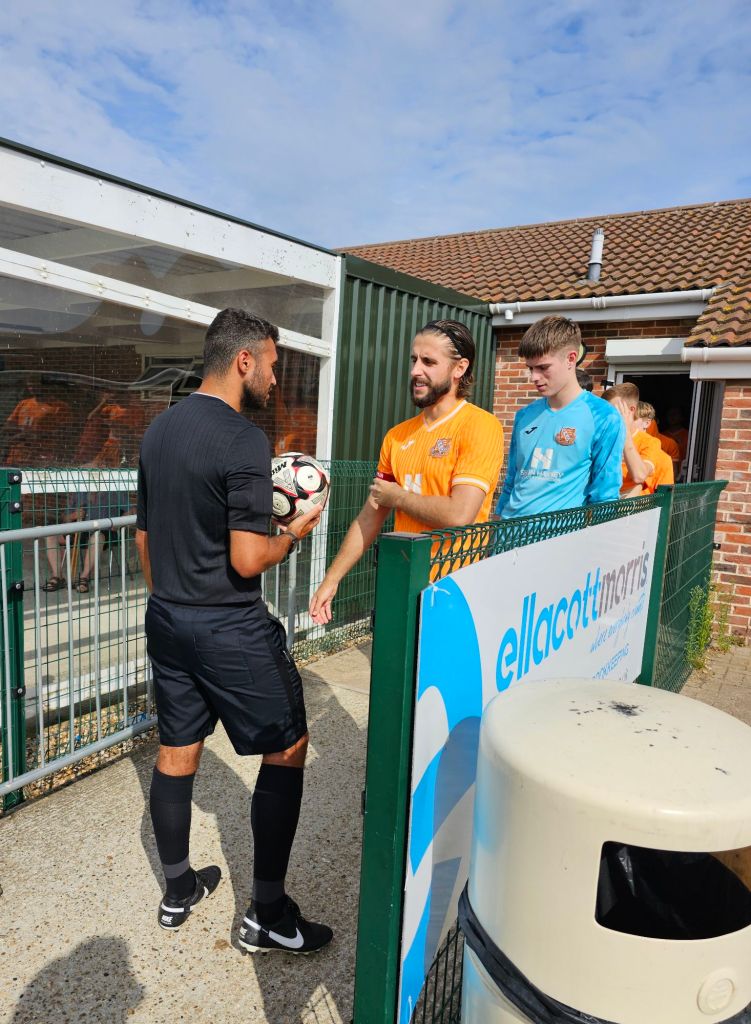
It’s not long before the teams are lining up to parade onto the pitch with the players of today’s opponents Dussindale and Hellesdon Rovers, looking suitably jet lagged.  Dussindale and Hellesdon are two suburban areas on opposite sides of Norwich, but their clubs amalgamated a few years ago and have made it into the snappily titled Thurlow Nunn Eastern Counties League First Division North and now play in Horsford, which is at least next to Hellesdon and close to Norwich airport, which is handy for away games.   After all the usual handshaking and hand-gripping malarkey, it is Dussindale and Hellesdon who kick-off towards the sea in burgundy shirts and navy-blue shorts. It’s a tasteful, if slightly dull kit and doesn’t compare with Holland’s vivid all orange ensemble.  Wikipedia tells us that the nickname of Holland FC is The Tangerines, no doubt due to the colour of their kit, but Holland’s own website refers to them as The Jaffas, although it doesn’t appear to have been updated since last May.  I wonder if there has perhaps been a referendum during the close season on what type of orange best represents the club, with members choosing to reject Satsumas, Mandarins, Clementines, Navels, Cara Caras and Easy peelers.   

The early exchanges on the pitch are typically noisy with the ball frequently flying high into the afternoon sky as an optimistic through pass for someone to chase is booted away.  “Go wide, hit the channel, good chap” bawls the Rovers’ goalkeeper revealing a hint of a Norwich accent as the ball sails in to touch.  Holland have the classic two big blokes at the back, numbers 5 and 12.  Number 12 has the sort of build which, if this were a professional game, would no doubt leave him open to chants from opposing supporters of “You fat bastard”, but he is a ‘rock’ at the back for Holland. 

I walk round the pitch to stand between the team dugouts. Holland win two early corners.  More Norfolk accents are detected on the away team bench.  Holland seem to lack club volunteers, with there being no programme today and no team sheet posted on a wall anywhere either.  The on-pitch commentary from the players however reveals that the Rovers number three is called Eggy and the number four Martin; other players have names too.

A poor back pass lets in the Holland number eleven,  who crosses in a low ball which a Rovers centre-back clears over the cross bar for corner.  It’s the first real opportunity, even if it was entirely manufactured by one team for the other.  The game is full of endeavour, but no one is capable of providing a pass that will lead to a goal. It’s a game of just shouts at the moment.  “Get out”, “First and second ball”, “What we talked about”, “Jump early”, “Ref that was blatant”, the usual anxious nonsense that the players hear every week and must get sick of.  On the Rovers’ bench the coaches are simply willing their team to do better; “Get the ball” urges one, going back to basics.  Then Rovers break down the right; number eleven scampering into the penalty area and crossing the ball low to where somebody should be to tap it in but isn’t.

“That’s the first chance of the game, and it’s to us” says a Rovers coach moments before the Holland number nine heads the ball against the Rovers cross bar from what looked like inside the six-yard box.  Fortunately, he can’t hear the cursing on the Holland bench.  It was the sort of incident that explains why the Rovers number five displays a constantly slightly worried look on his face, in contrast however to the number four playing in front of him, who is calmness personified and always has unhurried time on the ball. “Go on Matt, Dylan” shouts another coach, and I think of a parallel world where a film director working with Jack Nicholson and Charlton Heston might say “Go On, Jack, Charlton.”

 “It’s a great run again” says a Holland coach sounding like a radio commentator as Holland move forward again down the right.   The pattern of the first half has now been established and Holland are the dominant team, but with Rovers are a constant threat on the break. In midfield for Holland, number eight has a beard, and hair swept back with an alice band; it makes him look a bit like a bargain basement Alessandro Pirlo, which would explain why he is captain.  “Keep on side” shouts someone as Rovers’ number eleven breaks forward again, but he’s too late, the linesman’s flag is raised, if only that advice had been shouted sooner.

Unusually, in the final twenty minutes of the first half there are three substitutions, with Holland’s number three, who has been looking physically uncomfortable, being usurped by number seventeen, who is soon having a shot on goal well saved.  For Rovers, numbers seven and eight leave the pitch to be replaced with numbers fourteen and fifteen, like the start of a mathematical puzzle.  Just as unusual is the smell of deep-frying fish and chips that is wafting around when at half past three in the afternoon people should surely be having no more than an afternoon cup of tea and a biscuit.

The thought of tea sends me further round the pitch, back towards Jaffa’s tea bar and when I pass behind the linesmen he warns “Nothing silly” as opposing players chase another hopeful punt forward for Rovers.  The ball is soon returned to the other end of the pitch however, where Holland’s number nine shoots weakly at the goalkeeper as he redirects a square pass.  But the disappointment is short-lived as number ten finds himself in much the same position, but crucially manages to shoot past the goalkeeper and high into the net to give Holland a more or less deserved lead.

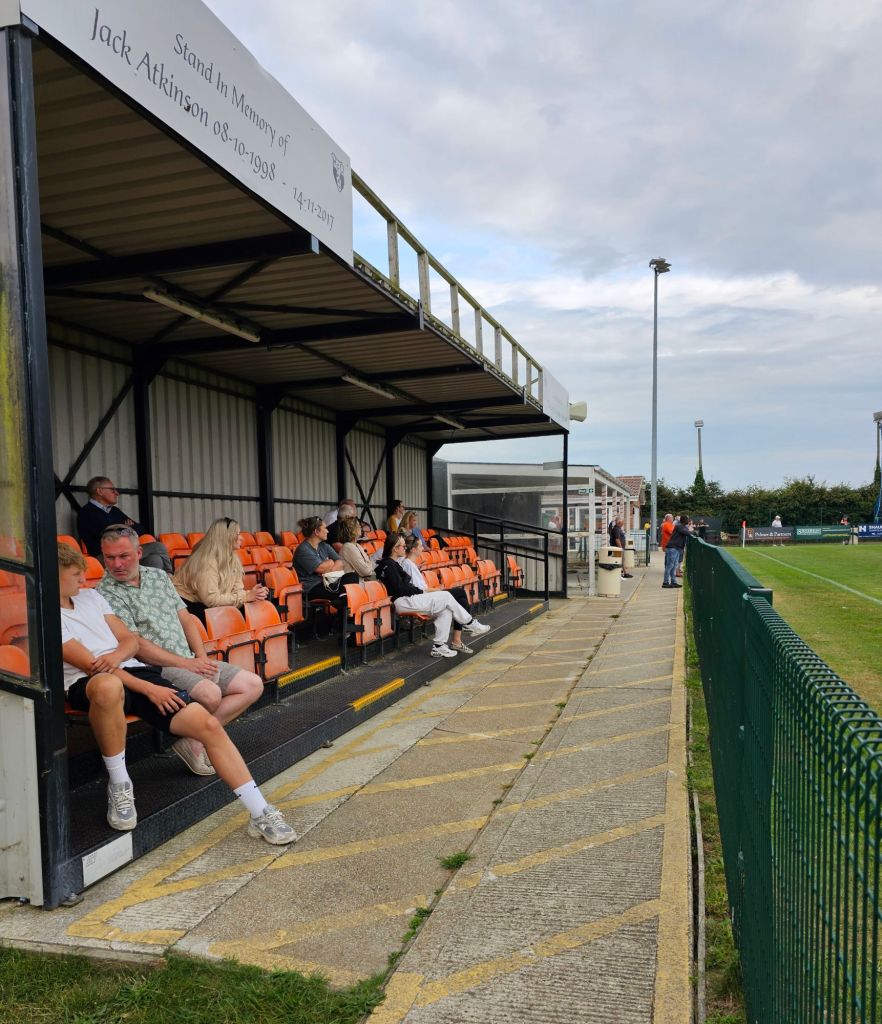
 Half-time arrives soon afterwards and teas and beers taste better than they would have if Holland had not scored, although I don’t think everyone sat drinking outside the bar noticed the goal or any of the first-half come to that.  For the second-half I decide to take up a seat in the main and only stand, selecting a spot in the middle of the second row where I can easily see most of the pitch above the metal mesh fence.   From here I can also see the sea of hipped bungalow roofs with ugly concrete tiles and the white UPVC conservatories that squat beyond the surrounding boundary fence and off into the distance.  A seagull stands and squawks from on top of a ridge tile.

The football resumes at two minutes past three and Rovers are soon seeing more of the ball than previously; they’re not playing so deep into their own half, but like Holland before the half-time break, they’re not creating many chances to score.  Suddenly, out of the blue, it all gets a bit too much for Rovers’ number nine who bawls in frustration “Fuckin’ell, fuckin’ play!”.  Moments later, as if to say “Alright, alright, keep your hair on”, his team-mates fashion a corner kick and then number fourteen becomes the first player to be booked as he fouls Holland’s number eleven.   In contrast to the increased excitement on the pitch the afternoon now feels quite still; the sky has clouded over and it’s cooler than it was. 

Despite both number nine and ten having decent shots on goal for Rovers, Holland are holding on fairly comfortably, but it must nevertheless come as a relief to them when around half past four  Rovers’ number five swings a foot to clear the ball and misses it, letting Holland’s number eight take it to the edge of the box, check inside and send a gently curling shot beyond the goalkeeper and inside the far post. Holland lead 2-0.

It’s the sort of a goal that commentators tell us will ‘wrap the game up’ and ‘put it to bed’; it’s just what Holland have been waiting for.  Two minutes later and it hasn’t, as Rover’s number ten has a shot parried by the Holland goalkeeper and number nine sweeps the rebound into the goal.  The score is 2-1 and anxiety takes hold.  It’s been a game of very few fouls, but someone cries “Late every time” when there is an accidental collision of boot and ankle, and I begin to wonder if all referees shouldn’t also be primary school teachers.

It is seven minutes to five when the game ends, and before returning to my trusty planet saving Citroen for the drive home, I pause to applaud and reflect on what has been a very good game. As I say to one of the old boys as he gathers up his sticks to toddle off home, we’ve had a decent five pounds worth of entertainment.   But shuddering slightly, I nevertheless can’t help wondering how all these people voted at the last general election.

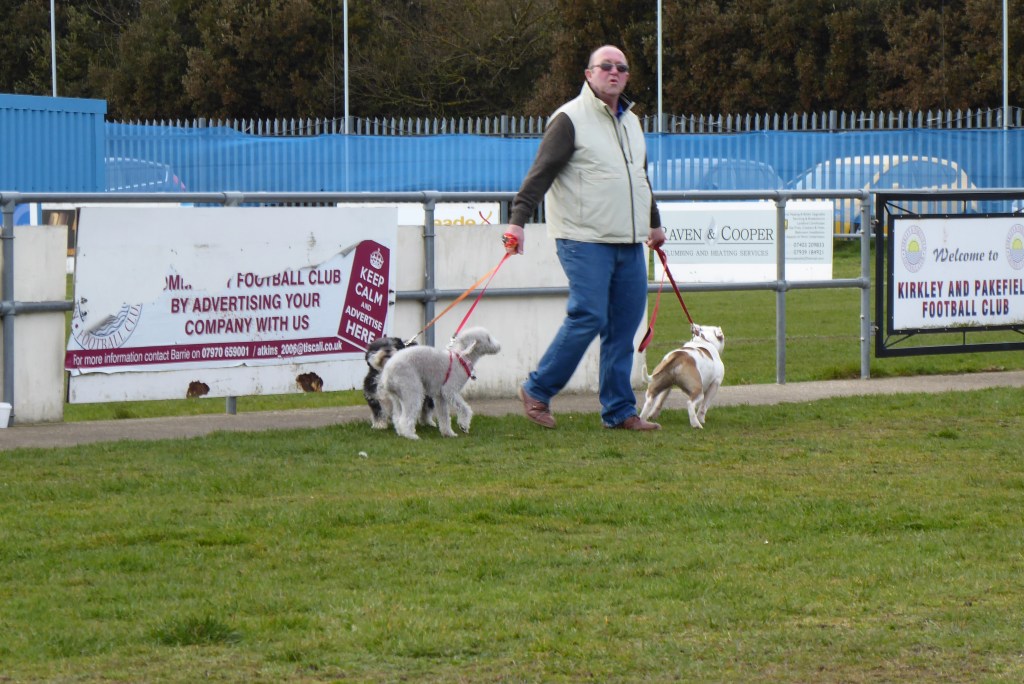
Kirkley & Pakefield 0 Wroxham 0


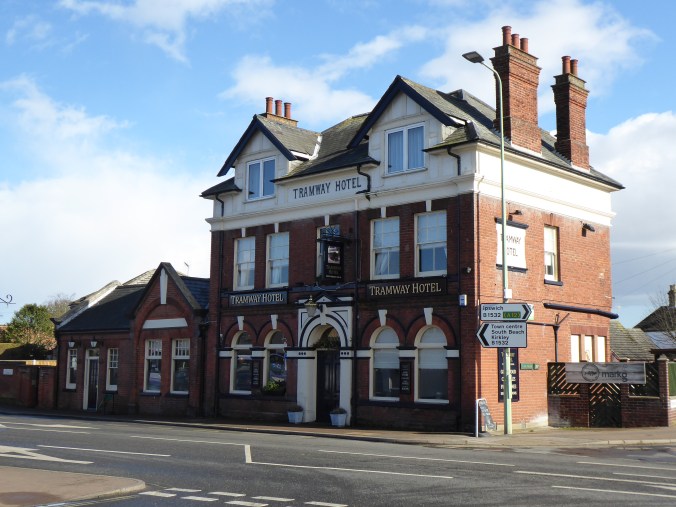
tramway hotel

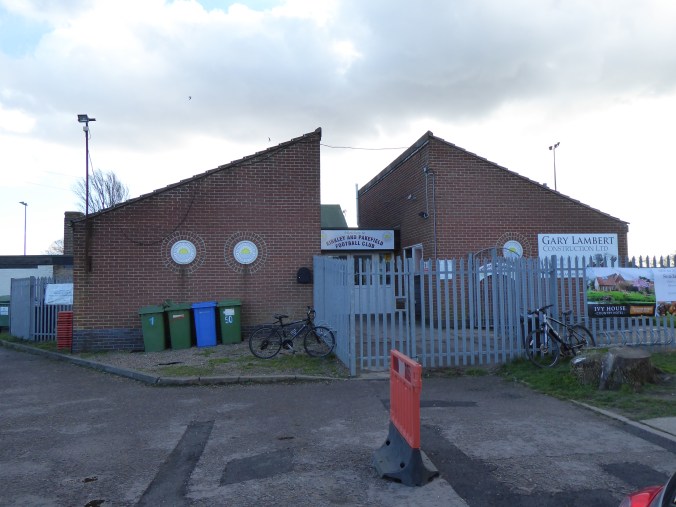
Once upon a time Kirkley and Pakefield were Suffolk villages, but they are now suburbs of Lowestoft on the south side of Lake Lothing.  Up until 1931 Lowestoft Corporation ran trams down to Pakefield terminating at the appropriately named Tramway Hotel; it’s a pity they don’t still run today and if only Lowestoft was in Belgium or France or Germany they probably would.   That aside, it’s a lovely rural train ride from Ipswich to Lowestoft and then a walk of over 3 kilometres or a ten minute trip on the X2 bus and then another five minute walk to get to Walmer Road, home of Kirkley and Pakefield Football Club.  But that all takes the best part of two hours and today I’m in a hurry to get home afterwards so I am making the 60 kilometre journey up the A12 by car.  Despite the small pleasure of opening up the throttle on my trusty Citroen C3 along the dual carriageway past Wickham Market, driving is nowhere near as much fun as sitting on the train, for a start everyone else on the road either drives too fast or too slow.   Also, unless I opt to eschew normal road safety and not look where I am going there’s much less to see from a car on the A12 too, perhaps with the exception of a brief vista of beautiful Blythburgh church across the marshes.

A quick glimpse of Woodbridge Town’s floodlights and road signs pointing the way to Framlingham and Leiston are tantalising reminders of senior football in east Suffolk as I plough on up towards Lowestoft listening to BBC Radio Suffolk’s ‘Life’s a Pitch’ on the Citroen’s radio. With its mix of decades old pop music and football talk with Terry Butcher and an otherwise anonymous pre-pubescent youth known only as ‘Tractor Boy’, whose presence is never really explained,  ‘Life’s a Pitch’ is a gently weird preamble for an afternoon of football.  Speaking directly from West Bromwich where Ipswich play today, former fanzine editor Phil Hamm mixes his metaphors delightfully as he speculates on whether Ipswich’s cruel defeat to Reading last week will have “knocked the stuffing out of their sails”.

It’s a very windy early Spring day and a heavy but short shower of rain sweeps across the road as I head out of Wrentham resulting in my arrival on the edge of Lowestoft being announced with a rainbow.   Passing Pontin’s Pakefield holiday camp I leave the modern A12 at the Pakefield roundabout and head down the old one, past the splendid Tramway Hotel and then take a left turn into Walmer Road and suburbia before making a final left turn towards the Recreation Ground.

It’s about twenty past two and the main car park is full so I splash my way into the pitted, puddled field that is the overflow car park at the north end of the ground and reverse up against the hedge in a spot where I won’t risk drowning as I step out of the car.

There’s no queue to get in the ground and at  the blue kiosk that looks like it might once have served a municipal car park in the days before ‘pay and display’, I say to the grey-haired man inside “One please, and do you do a programme?” .  Apparently the programmes are in the clubhouse.  I hand over a ten pound note; entry is £6 for adults and £4 for concessions.   I take my change unthinkingly and I now realise that the man on the gate must have thought I looked like a pensioner; my Ipswich Town season ticket is taking its toll.

I head for the clubhouse;⁹ with its deep, green felt roof topped off by a cupola it resembles a village cricket pavilion; it’s probably the most characterful club house in the Eastern Counties League. 

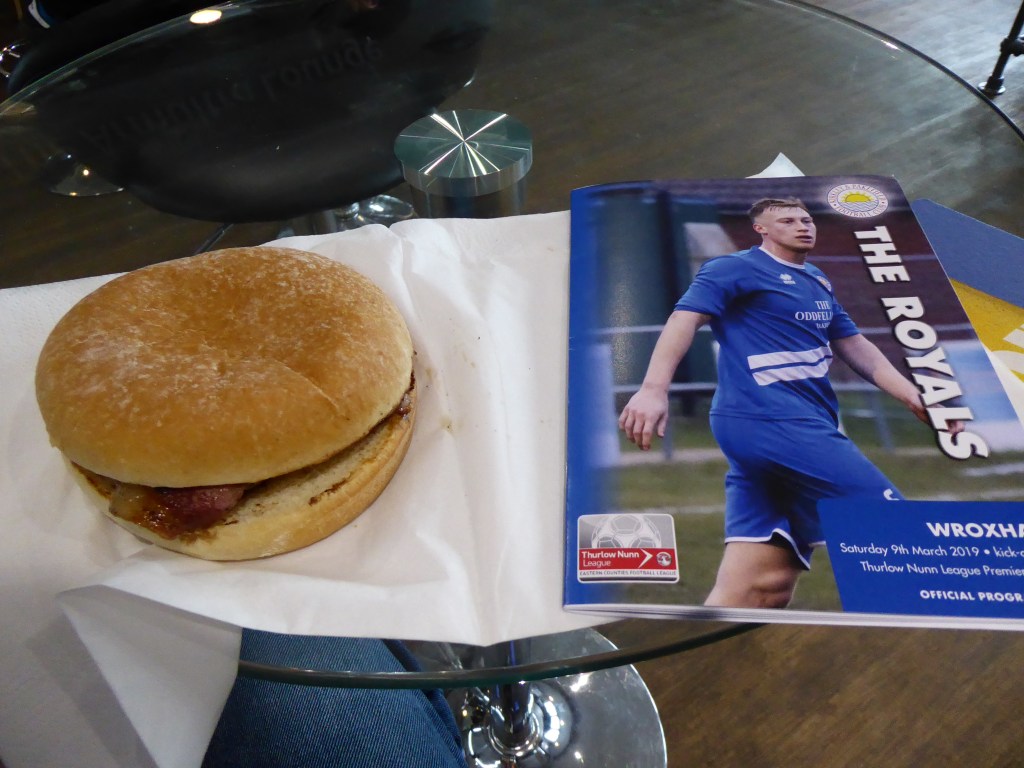
The inside bears little relation to the outside however and the ‘Armultra Lounge’ is decked out in a trendy grey colour scheme with matching leather sofas and oak-look laminate flooring.  I see a club official with some programmes and ask him if I can buy one (£1), he begins to direct me to someone else but then very kindly just says “Here, you can have this one on me”; what a lovely bloke.  Touched with the knowledge that people being kind and generous to other people is what life’s all about I celebrate with a bacon roll (£2.30) from the food hatch in the corner of the room.  It’s a very good bacon roll too; at first I am fooled by the roll having been toasted, into thinking it’s the bacon that is crispy, but actually it is anyway. I sit at a glass table on what looks like a tractor seat on a stick and eat the bacon roll and read the programme; I resist having a beer however because sadly the hand pumps on the bar are naked and the afternoon is windy enough without the terrible burps that a chilled glass of Greene King’s East Coast IPA nitrokeg would induce.  The programme tells me that Wroxham’s Sonny Cary is a “…gifted young football”.   I search for other amusing mis-prints but can’t find any.

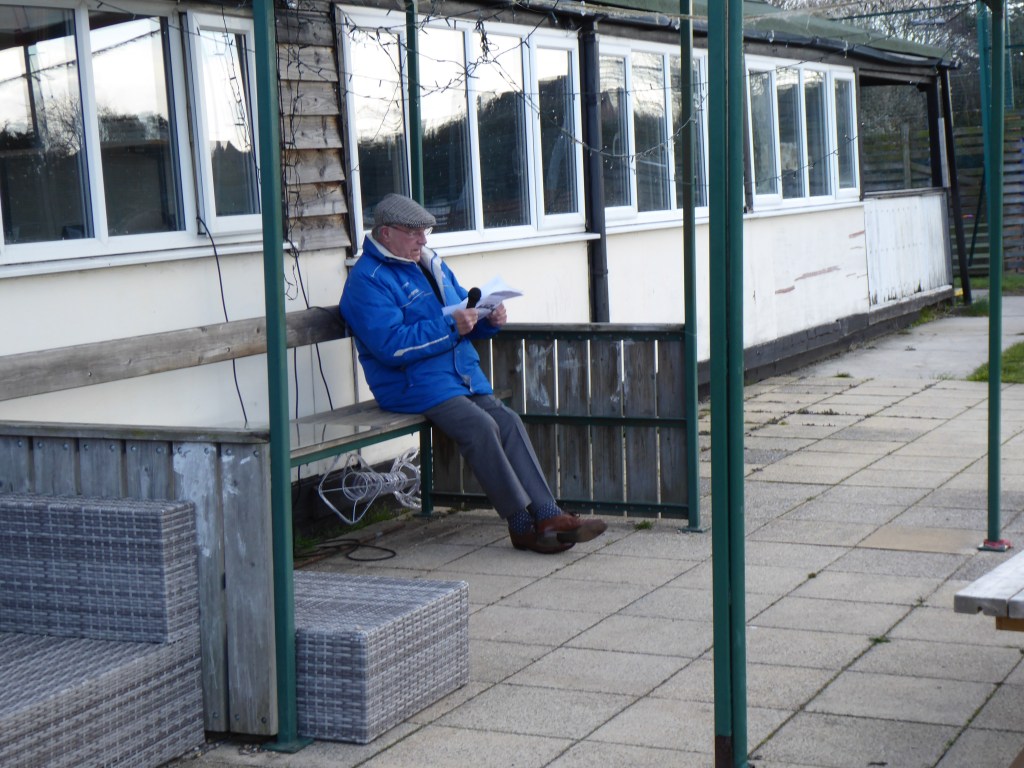
As 3pm approaches I venture outside but not before pausing by the door where a man is donning his coat, scarf and hat; he tells me that the main stand on the other side of the ground is the best place to watch from, because it’s out of the wind.  I thank him for this insight and tell him I suspect that is where I will end up then.  Outside, a man well into his sixties is sat on a bench with a microphone in hand announcing the teams; in the strong, gusty wind he struggles to hold onto the sheet of paper from which he is reading and the rattle of the paper in the wind competes with his voice over the PA system.  

I am already on the far side of the ground as the teams come on to the pitch behind the referee Mr Luigi Lungarella who has an impressive shock of swept back dark hair.  Handshakes follow before the Kirkley & Pakefield huddle in a moment of team togetherness and the Wroxham players stand waiting as if to say “ Oh come on. Can’t we get on with this”.  Huddling over, Wroxham, known as the Yachtsmen,  get first go with the ball kicking it in the direction of  Lowestoft town centre and the fish dock; they wear a dull change kit of white shirts with bluey-grey shorts and socks.  Kirkley and Pakefield, known for some reason as The Royals, play towards Pontin’s and far off Southwold and wear the same kit as Brantham Athletic; all blue with two diagonal white stripes across their stomachs, as if the shirts had been left lying on the pitch when it was marked out.

Wroxham settle quickly and pin The Royals back in their half, their “gifted young football”, the red-headed and slightly spindly number ten Sonny Carey has their first shot on goal, but it’s comfortably wide.   Despite most of the game taking place in the Kirkley & Pakefield half Wroxham don’t come close to scoring and in a somewhat solid way the teams are evenly matched,  which is to be expected as they are fifth and sixth in the Eastern Counties Premier League table, both  with forty-nine points but with Wroxham having a better goal difference.  The game is characterised by effort, but more so by lots of shouting; it reminds me of a windy day in a school playground.   “Squeeze, squeeze” shouts the Wroxham ‘keeper George MacRae, perhaps feeling a little left out.  “Higher, higher.  Switch” he adds, trying to get involved.  Wroxham appear to have won the first corner, only to be denied by a raised flag denoting offside.   “ We in’t had a shot on gool  yit” says an old boy, one of a half a dozen stood against the rail along from the stand.  He asks the time, it’s about twenty past three. Attention seems to be wandering.  “I see Bodyshop is closing” says someone else, although it probably won’t affect his shopping habits too much.  “There’s not a lot happening here” says the old boy “Though there’s a lot of ‘em in that fuckin’ dugout”.

At last Wroxham win a corner, but they take it short and I feel a bit let down. All that waiting for a corner and then it might as well have been a throw-in.  Everyone hates short corners, don’t they?   Kirkley & Pakefield’s number five Jack Herbert is spoken to by Mr Lungarella and Wroxham keep pressing. “He in’t got a left foot” someone says of Wroxham’s Cruise Nyadzayo as he keeps trying to cut inside on the left wing.  A few minutes later Nyadzayo switches to the right.  As Wroxham threaten the penalty area the ball is booted clear; “Don’t panic Mr Mainwaring” calls a voice from the stand. “What’s your name, Pike?” says another, hopelessly and irrelevantly misquoting the famous lines completely out of all context.  People laugh nevertheless.

As the game edges closer towards half-time, Kirkley and Pakefield begin to frequent the Wroxham end of the pitch a bit more.  “We got a corner, bloody hellfire, but it took us half an hour to get et” is the assessment of one local. But all of a sudden real excitement breaks out as a header is cleared off the Wroxham goal line and then a shot from Jordan Haverson is kept out of the goal with a spectacular flying save from George MacRae, before play quickly moves to the other end and Cruise Nyadzayo dribbles through before having his shot saved at close range by Adam Rix, Kirkley & Pakefield pony-tailed goalkeeper

I move along the rail and stand near a couple of Wroxham supporters “ I think it could take me a couple of years to get the kitchen sorted” says the younger of the two as Kirkley & Pakefield prepare to take  a free-kick in a dangerous looking position, before winning a second corner.  It’s the final notable action and comment of the half and I return to the club house for a pounds’ worth of tea and to catch up on the half-time scores. Ipswich are losing but the tea’s just fine.

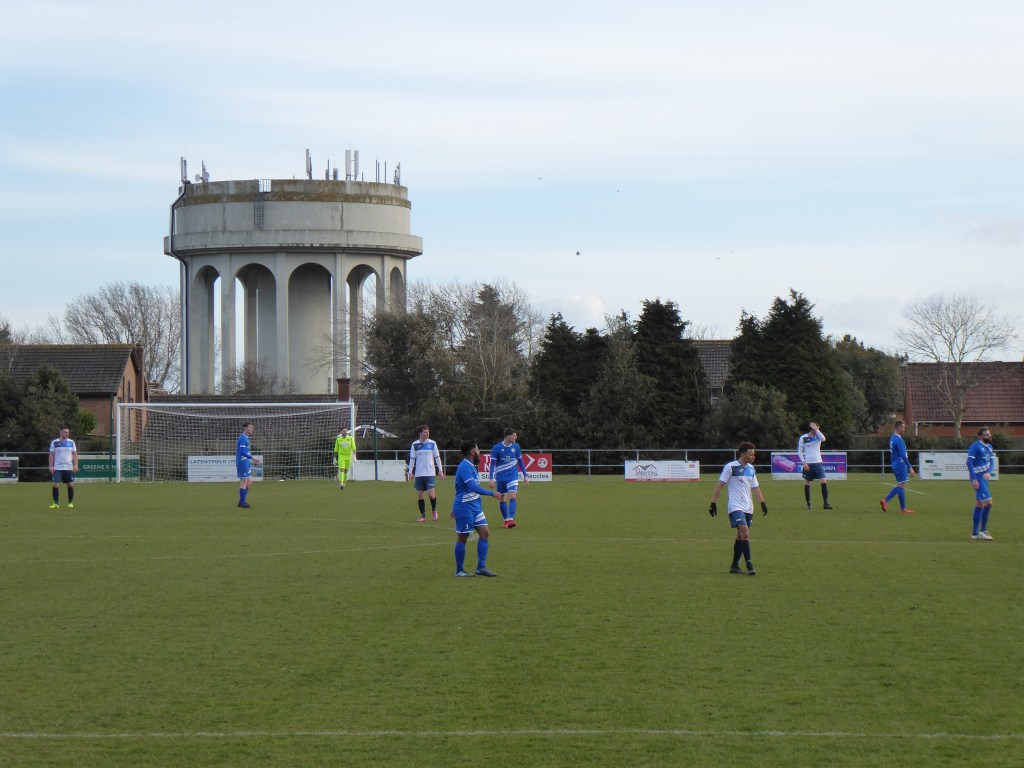
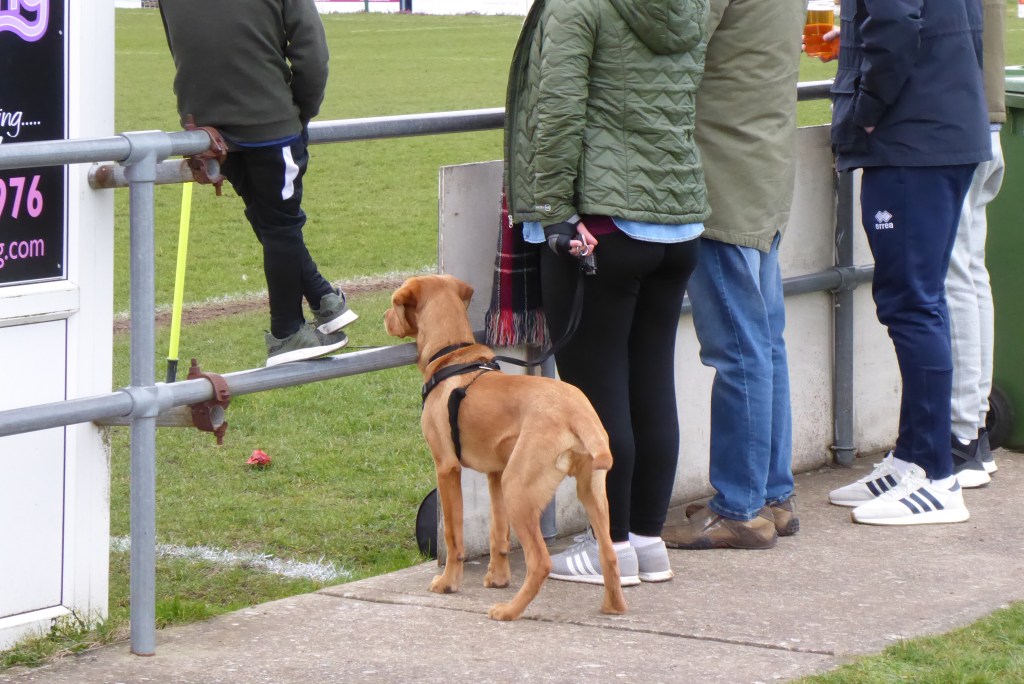
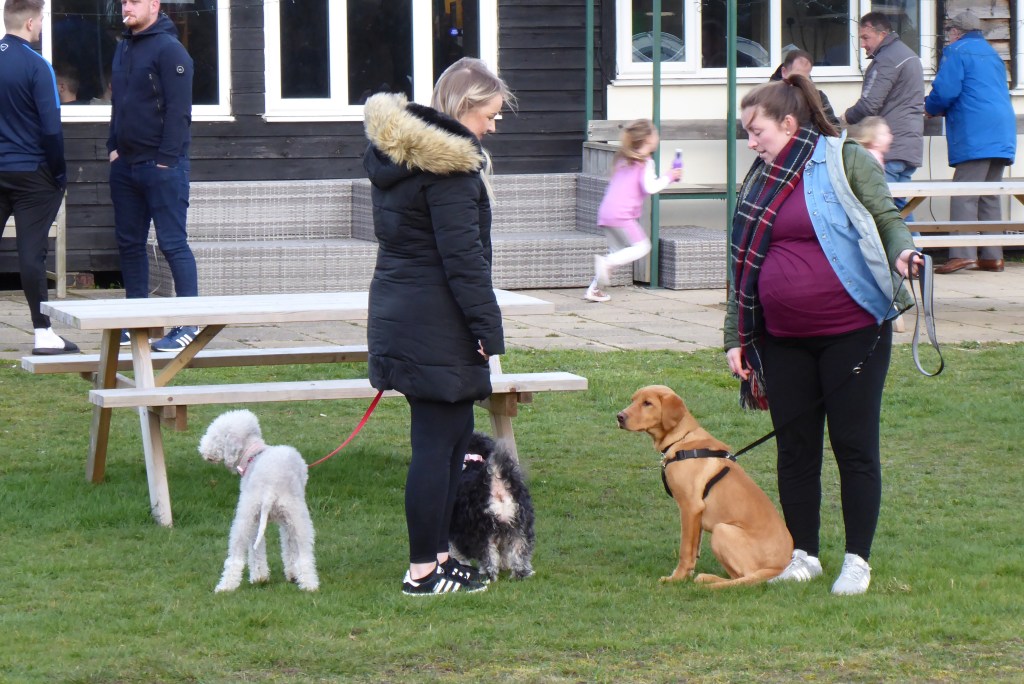
At two minutes past four Mr Lungarella blows his whistle for the start of the second half and Wroxham’s George MaCrae shouts “Squeeze” before the last note from the referee’s whistle is scattered by the wind.  Grey clouds are heaped up behind the main stand hiding a pale, milky sun.  Rooks are nesting high in the trees beyond the club house and a golden Labrador puppy is showing a keen interest in the game as he stands on his hind legs to watch over the rail.  I think to myself what a fine back drop to the game  the water tower at the  southern end of the ground makes.

The second half is played out more evenly across both halves of the pitch rather than predominantly in one half but neither goalkeeper has to stretch himself too much with virtually every shot being blocked or speeding past  the far post, as several low crosses do also.  The ‘star’ of the second half however is the referee Mr Lungarella who succeeds in making himself  equally disliked by both teams with a catalogue of unpopular decisions and a handful of bookings for Kirkley & Pakefield players.  “It was a corner ref. Ref! Ref! That was a corner” shouts one man from within the Russell Brown Community Stand behind the goal at the Lowestoft end of the ground after a goal kick is awarded. It’s almost as if he expects the referee to say “Oh, was it? Sorry. Okay then”.   It was a corner.  At the other end of the ground a Wroxham supporter is just as perplexed. “Fuckin’ guesswork” he says of Mr Lungarella’s decisions, before asking the linesman “Have a word with him will ya?”   The linesman replies, asking if he’d like him to speak about anything in particular.

– “About the rule book”

-“Well there isn’t one is there?” says the linesman mysteriously.

Mr Lungarella saves the best  until last and his piece de resistance comes with only a few minutes remaining.  As Kirkley & Pakefield’s Miguel Lopez stoops to head the ball, Wroxham’s Harley Black attempts to kick it with the inevitable and unfortunate consequences.  As the Kirkley & Pakefield ‘keeper discusses with a Wroxham fan behind the goal it was not intentional or malicious, just an accident. But not for the first time this afternoon Mr Lungarella’s interpretation of events differs to that of most people watching and Harley Black is sent off. Happily Miguel Lopez is not hurt and after a bit of TLC from the physio he carries on to see-out the end of the game, which soon arrives.

Despite some doubts surrounding some of the referee’s decisions the game ends amicably and Mr Lungarella leaves the field unmolested with his two assistants.  Equally, despite there having been no goals, it has been a very entertaining match.  Kirkley & Pakefield Football Club exists in the shadow of Lowestoft Town, perhaps more so than Ipswich Wanderers and Whitton United exist in the shadow of Ipswich Town, because both Lowestoft clubs are non-league, but it’s a fine, friendly little club nonetheless.  I have had a grand afternoon out at Britain’s second most easterly senior football club and one day, when I am in less of a hurry, I will use the train and the bus to get here; whilst also hoping they bring back the tram.

Ipswich Town 1 Rotherham United 0

January is reputedly the most miserable and depressing of months and the closer to the middle of January it gets the more miserable and depressing it becomes. The third Monday in January has been designated ‘Blue Monday’; nothing to do with The Blues of Ipswich Town but rather something to do with the pleasure and happiness of Christmas having worn off completely and the realisation for people that they are now deep in debt; the weather has something to do with it too. Today is only 12th January however, I have no debt and my Christmas was not noticeably any more happy or pleasurable than any other couple of days off work, and although the weather is grey and overcast today, I have an afternoon at Portman Road to look forward to.
My erstwhile colleague and still current friend Roly is waiting for me at the railway station, he is drinking a cup of coffee which I imagine he imagines lends him an air of sophistication. Ignoring this, I tell him how I long for the weekends when I see Town play and how I feel a curious kinship with the many species of Mayfly that live for but a few short hours. It’s a twelve carriage train so we wander down the platform away from everyone else knowing that we won’t have so far to walk to the bridge over the tracks when the train arrive at Ipswich station; every second counts in the all too brief joy of a pre-match drink and then the match. Roly fritters away some of our precious time getting a fresh twenty pound note from a cash machine, but we are soon heading for St Jude’s Tavern where we are going to meet Mick. Portman Road is busy, the ticket enquiry office bleeds out into the road with a queue of late comers taking advantage of the special offer of tickets in any part of the ground for just £12. People with nothing better to do queue for the turnstiles to open. I buy a programme (£3) from one of the portable kiosks, which always make me think of a Tardis piloted by a Dr Who played by Mick Mills, transporting us back to the 1970’s. The programme seller is unsmiling and I wonder if he and his colleagues have been instructed to no longer invite customers to “Enjoy the match”; if programme buyers are anything like many of the nasty, ignorant and rude people who seem to inhabit social media I imagine such words of goodwill are generally met with verbal abuse. How I long to live in a civilised country like France where it is impossible to even make eye contact with club employees on a match day without them wishing you “bon match”.
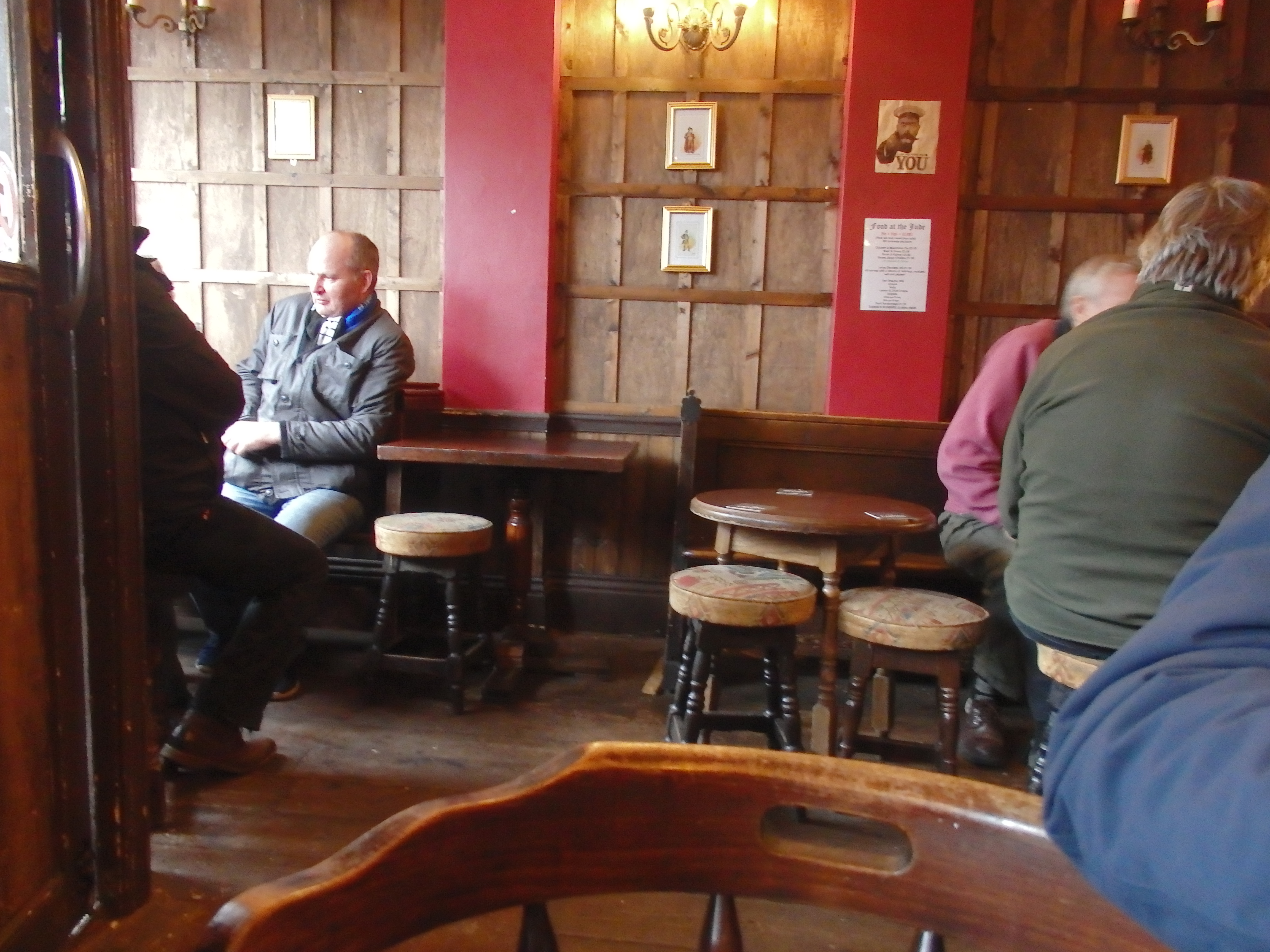
In St Jude’s Tavern a group of three very young looking lads with Yorkshire accents buy two Coca-Colas and a pint of lager whilst I wait to purchase two pints of the Match Day Special (£2.50 a pint), which today is Cliff Quay Brewery Neptune’s Nip; Mick appears, like the shopkeeper in Mr Benn to bump my order up to three pints and the barman for some reason makes an un-necessary association between Neptune’s Nip and Poseidon’s penis. Roly, Mick and I sit at a table next to the young Yorkshiremen. We talk of Ipswich’s new signings and Mick is impressed at Roly’s knowledge, which he imparts with a weightiness of tone as if to say “…these are the facts, think otherwise if you wish, but I will not be held responsible.” I sit and listen and hope he gets to the bar soon because I need to drink as much as possible before the match to dull the pain. Roly buys the next round of Match Day Specials which is now Cliff Quay Brewery’s Tolly Roger (still £2.50 each). Whilst Roly is at the bar I get Mick to show me how he has so neatly tied his blue and white scarf around his neck. “It’s like a cravat” he tells me. I follow his instruction and achieve the desired look of Michael Palin in the episode of Ripping Yarns entitled ‘Golden Gordon’. The Yorkshire lads have left leaving two half glasses of Coca Cola and most of a pint of lager, very strange. I imagine they’ve gone to see if there is a rain gauge at the town hall. Before we leave I feel the solitary need to sink a further half pint of Cliff Quay Brewery Sir Roger’s Porter (£1.70), and then one of the retired gentlemen I drank with before the Millwall game on New Year’s Day comes over to say hello and remarks that I have some friends with me today. I tell him yes and that I therefore don’t need his company.
Glasses drained and returned to the bar, we negotiate the door and descend Portman Road, crossing Handford Road and joining the expanding throng of match-goers. At the turnstiles in Sir Alf Ramsey Way we walk past the end of the queues of the first block of gates to reach the second turnstile block where there are no queues; I smile to myself about how stupid people are who join the first queue they come to and surmise that they probably voted ‘leave’ too. The lady turnstile operator and I smile broadly to one another as I pass through and Mick reveals that she smiled at him too when Roly complains that his turnstile operator was miserable. He cannot understand it he tells us, explaining that he is so much younger and therefore more attractive than Mick and me.
Once inside the East of England Co-op stand bladders are emptied and we head for our seats. Because the tickets are a mere £12 each today I have traded up my usual seat with the groundlings of the lower tier of the Sir Alf Ramsey stand and have taken up a place with Mick in the upper tier of the East of England Co-op Stand. The view of the game is better here, but it is also somehow a little too far removed from it, as if we are watching on TV and I sense that some of the people around me will be just waiting for a convenient break in play to go and put the kettle on. It wouldn’t occur to them to shout or chant in support of the team, they truly are just spectators and nothing more.

Phil and Pat

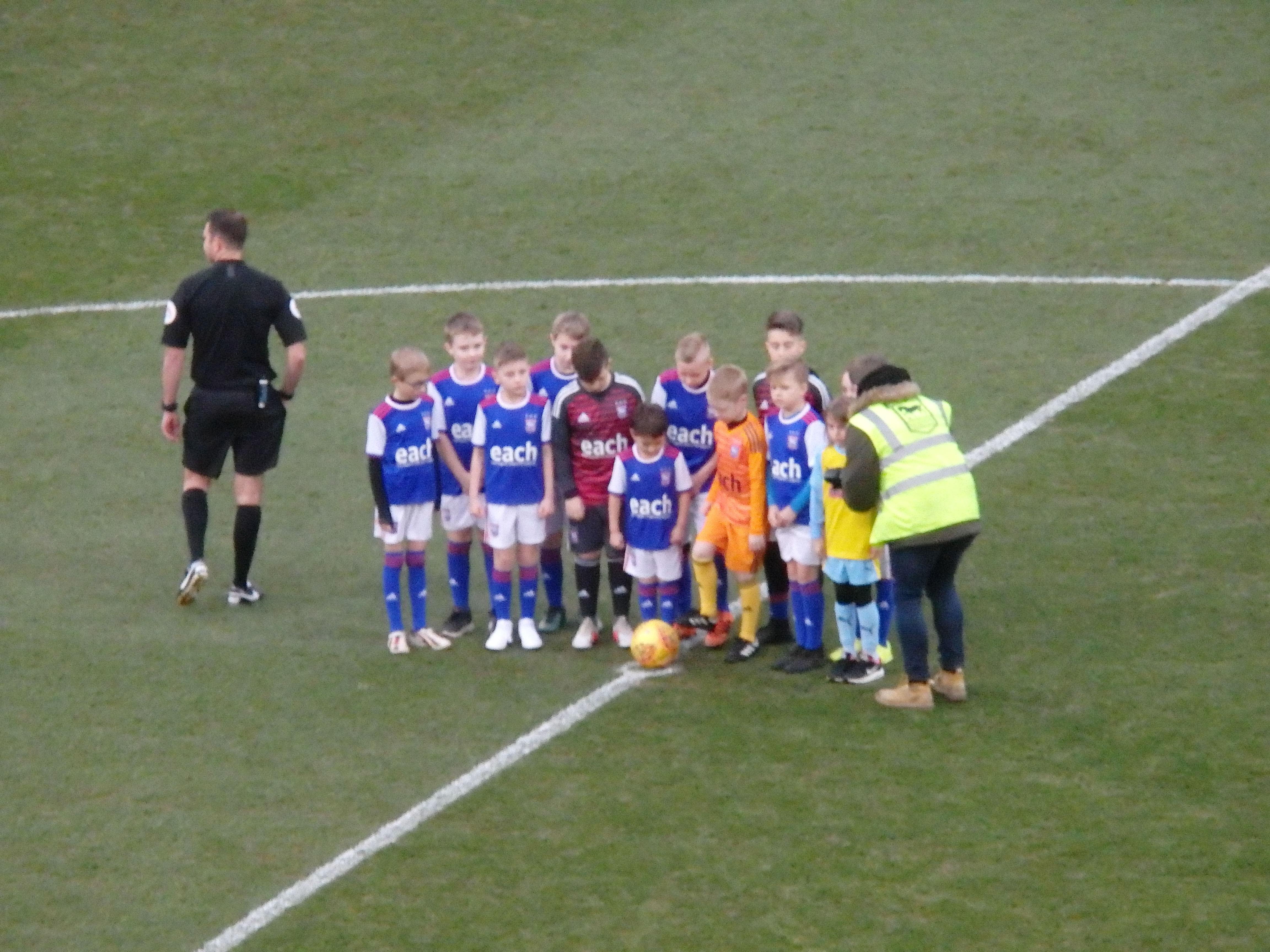
After group photos for the family album are posed in the centre circle, the game begins with Town kicking-off with their backs towards ever-present Phil who never misses a game and Pat from Clacton, who I can see in their usual seats in the Sir Alf Ramsey Stand, or Churchman’s as us people who remember the ’good old days’ call it. Town sport their usual blue and white kit despoiled by an ugly advertisement for an organisation of on-line scammers. The usual team colours of today’s opponents Rotherham United are red and white, but eschewing the opportunity to recreate the classic blue and white versus red and white Subbuteo encounter, they wear an un-necessary change kit of yellow shirts with pale blue sleeves, and pale blue shorts and socks.

insipid kit and a yellow card

Sadly Rotherham’s kit is insipid and somewhat effete; it detracts from the spectacle and speaks nothing to me of Yorkshire grit and scrap reclamation for which Rotherham is rightly famed.
The match is fast and furious and lacks finesse but unusually Ipswich have the upper hand. There is an air of expectation as a bevy of debutants (or debutantes if you prefer to see this match as a sort of ‘coming out’ ball) before the home crowd. The transfer window is open and a wind of change is blowing through Portman Road as Paul Lambert gets to choose his own players rather than just make do entirely with what he has inherited from that false Messiah, Paul Hurst.

James Collins

Outstanding in the Ipswich defence is an enormous bald-headed man by the name of James Collins; he is thirty-five years old but looks fifty, he is a colossus and carries the Ipswich rear guard on his back like Atlas, though not literally of course. If for some bizarre reason I were to make a TV adaptation of Victor Hugo’s Les Miserables, I would cast James Collins as Jean Valjean, not Dominic West.
With only twelve minutes gone referee Mr James Linington brandishes his yellow card in the direction of Rotherham’s Zak Vyner, a man whose name is distinguished by having more than its fair share of letters from the back end of the alphabet and is worth a decent score in the brand of imaginary Scrabble in which only footballers names and not proper words are currency. It’s one of the few popular actions Mr Linington makes all afternoon, although I do approve of his choice of all-black kit; it’s what referees should wear.
A half an hour passes and Freddie Sears scampers down the left; he gets beyond the Rotherham defence and crosses the ball low to the near post. No one has control and the ball looks like it is trying to escape, but it only runs as far as new signing Will Keane, who despite the unpleasant associations of his surname and a hairstyle more becoming of the Eastern Counties League strikes a low shot into the goal. The crowd rises as one and all but the 729 Rotherham United fans in the corner of the Cobbold Stand enter a state of joyful delirium. Town lead 1-0.
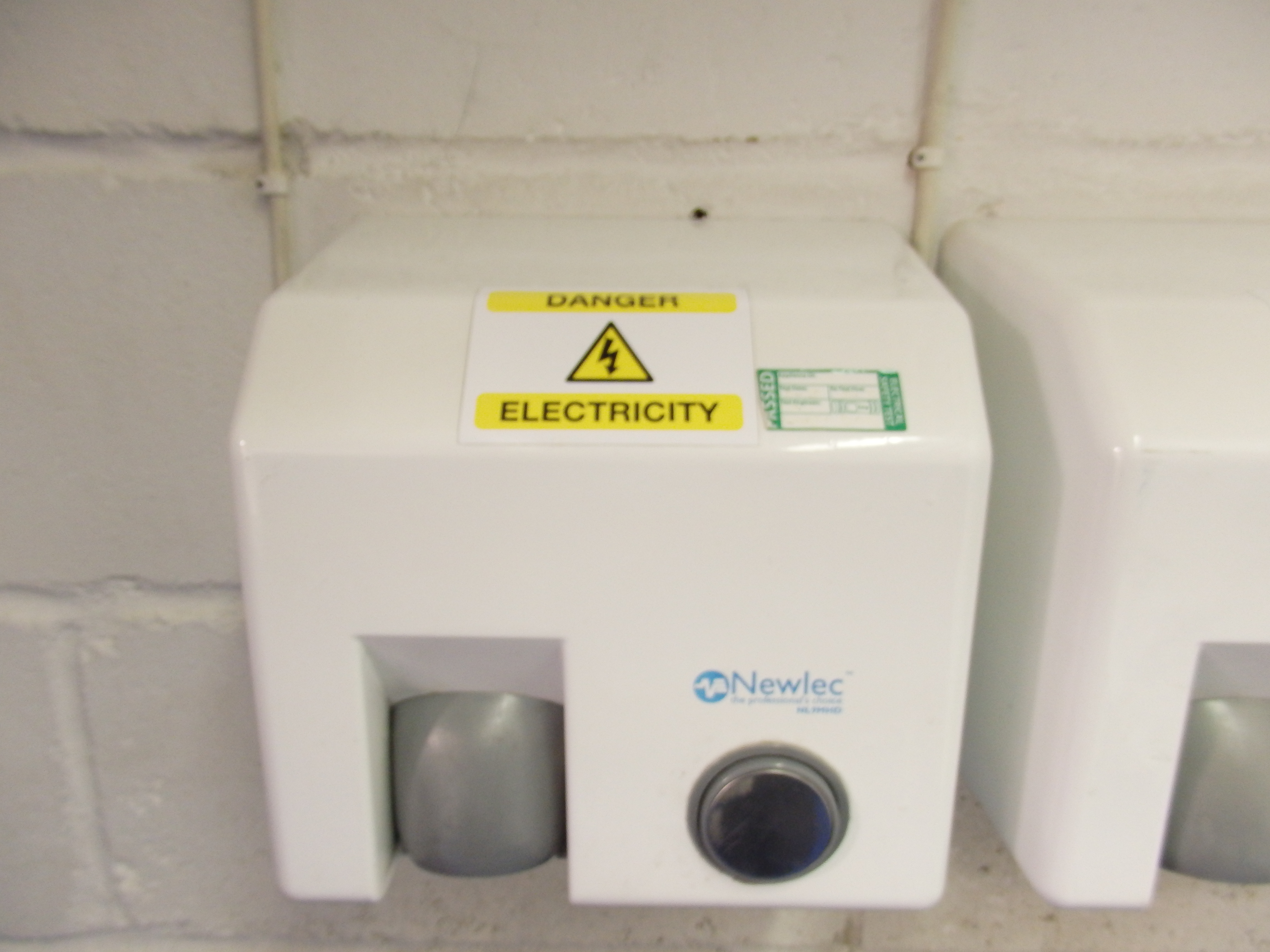
It’s half-time and the toilet beckons; as I enter the ‘smallest room’ in the stadium I hear Roly giving his friend Andrew from Bury St Edmunds the benefit of his analysis of the first half; he sounds very earnest, like a bearded, Caucasian Garth Crooks; I stand next to him at the urinal and open-zippered tell him I disagree with his analysis, although in truth I hadn’t heard what he had said. I wash my hands and am amused by the words ‘Danger Electricity’ which appear on the top of the hand dryer “ Ah, the old enemy , electricity” says Roly convincingly.
The game begins again and the two blokes behind me discuss refurbishing a kitchen; “ Seriously, if you do it, I can get you a 10% discount at B&Q.” says one “ Does that include stuff already on offer?” says the other, looking a gift horse in the mouth. But I shouldn’t be surprised, these two haven’t a clue who any of the Town players are and are clearly here because the tickets are cheap. Out of the kitchen and back on the pitch the match has changed. Ipswich no longer dominate, quite the opposite in fact. They are incapable of retaining the ball for more than a few seconds and have seemingly abandoned all attempts to pass it to one another. Rotherham produce wave after wave of ineffectual attacks which are repelled by a mighty rear guard action from the Blues. This is good on one level but immensely frustrating, worrying and disappointing on another. We are making Rotherham look like Paris St Germain; lose this and they’ll be wanting to take the Eiffel Tower down for scrap.
Despite Town’s apparent ineptness, brought on in my opinion by a shortage of proper midfield players, the crowd of 20,893 remain firmly behind the team. The lower tier of the Sir Bobby Robson Stand, galvanised by the Blue Action supporters group and some welcome support from a bunch of fans of Fortuna Dusseldorf, Town’s unofficial ‘twinned club’ are proving inspiring, and every now and then even people in the East of England Co-op Stand are moved to clap their hands rhythmically. The floodlights are on as darkness envelopes the town and we benefit from the atmosphere of a night match, but Town still struggle to do anything but defend. On the touchline Paul Lambert the Town manager is very active, prowling up and down the technical area and swinging his arms directorially. I suggest to Mick that he’s probably just trying to keep warm because as ever he is in black slacks and a v-necked Marks & Spencer jumper and not wearing a coat, but Mick tells me in an authentic sounding Scottish accent that this is T-shirt weather.

Mr Lambert and his 'Marks and Spencer' jumper

Mr Limington the referee awards a catalogue of free-kicks to Rotherham, most, seemingly because a Town player has simply stood too close to one from Rotherham or has given him a funny look. The crowd tell Mr Limington he doesn’t know what he’s doing although I would prefer that they had asked “Who’s the bastard in the black?” Flynn Downes replaces German debutant Collin Quaner for Town as Paul Lambert reacts to that need for a stronger midfield and the bloke behind me with the kitchen asks “Who’s that?” “ Number twenty-one” says the bloke with connections at B&Q.
Finally, after five minutes of added time and a couple of narrow escapes for Town, Mr Limington gets something right and blows the full-time whistle unleashing rapturous scenes. The Sir Bobby Robson Stand finds a bigger voice than at any time during the match and hails the winners. It is a famous victory, as any victory is in this season mostly of defeats. But whilst the win is much needed and keeps hope alive, what this match has really shown is that people still care enough to come to a game, discounted prices or not, and Suffolk is still behind its team. Whether Town escape relegation or not, if managed properly this could be the start of a renaissance for Town and a re-connection with its fan base; I bloody well hope so.