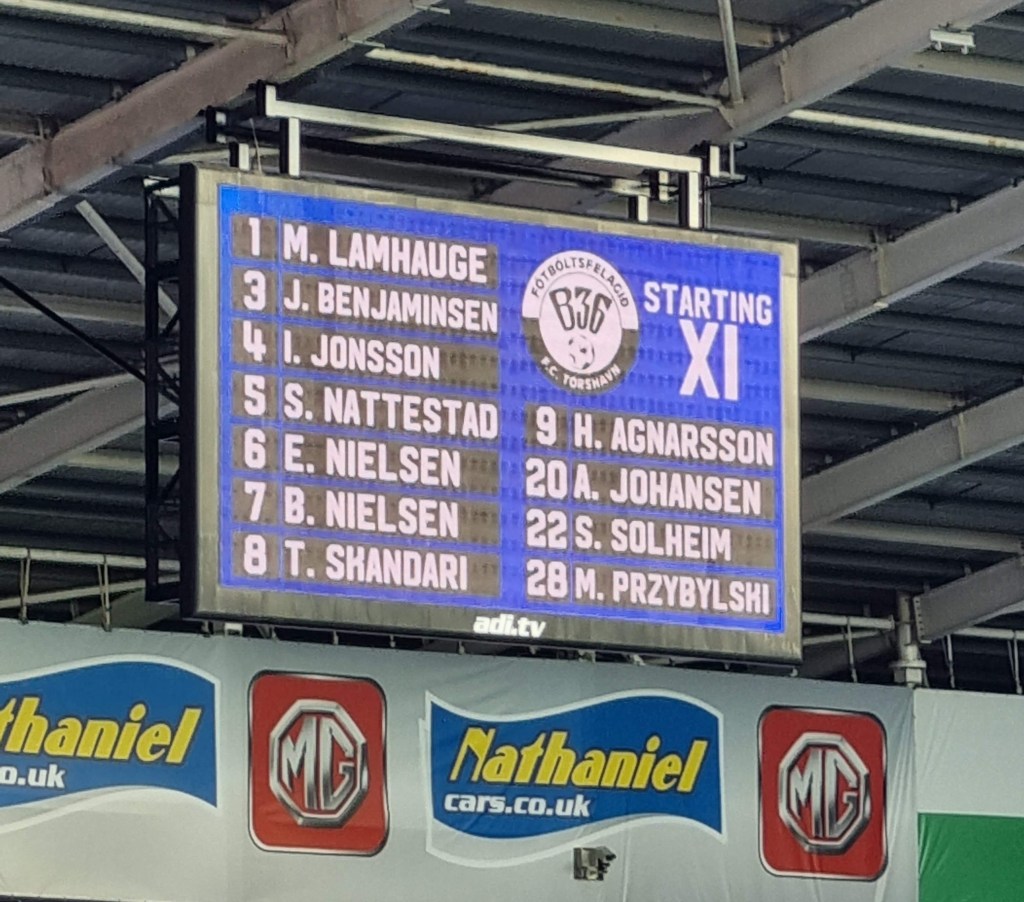
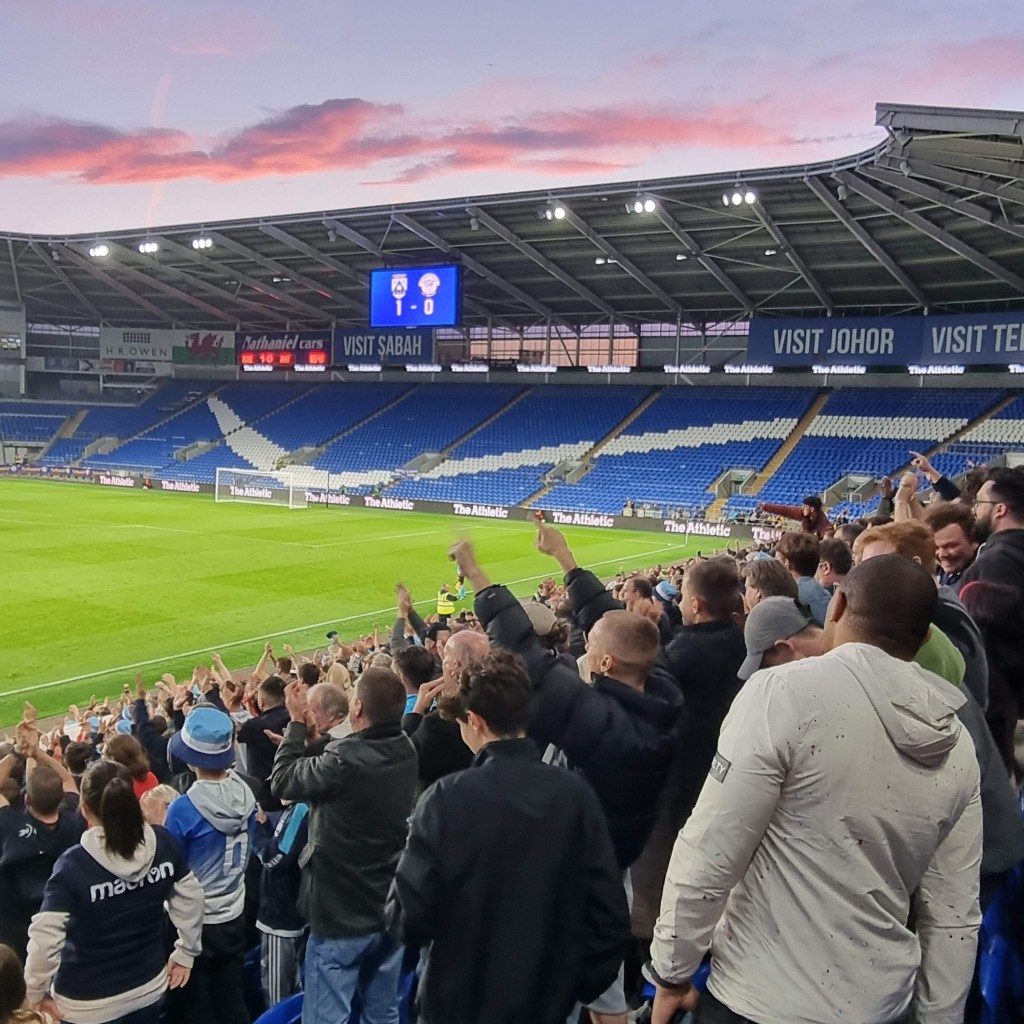
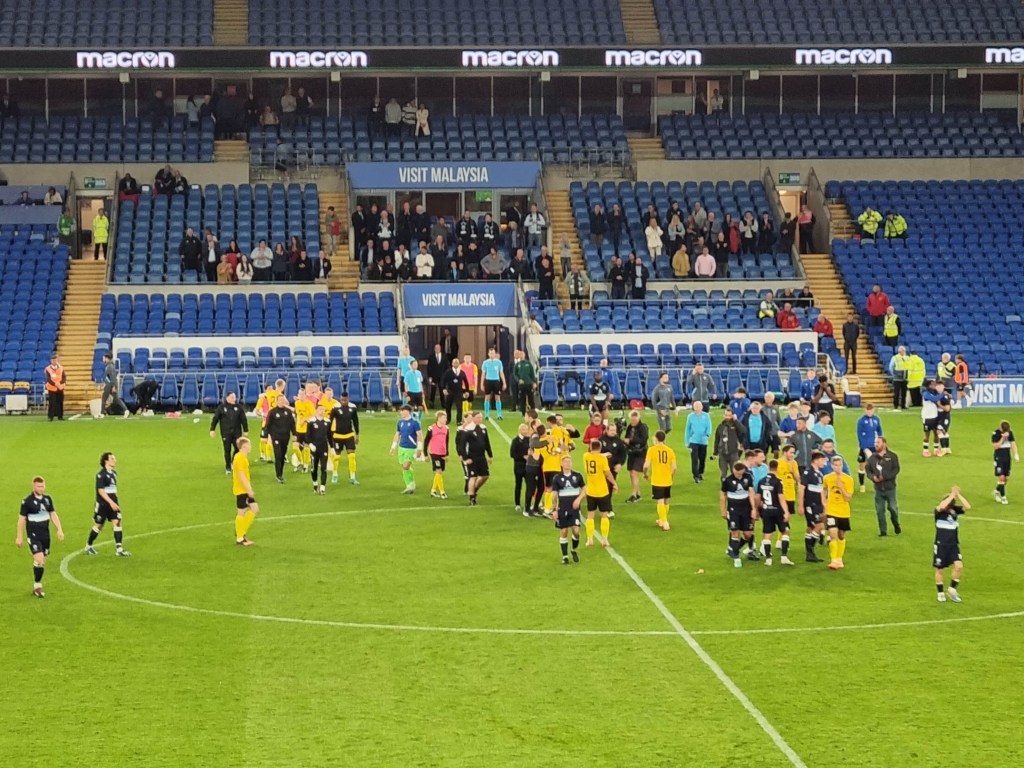
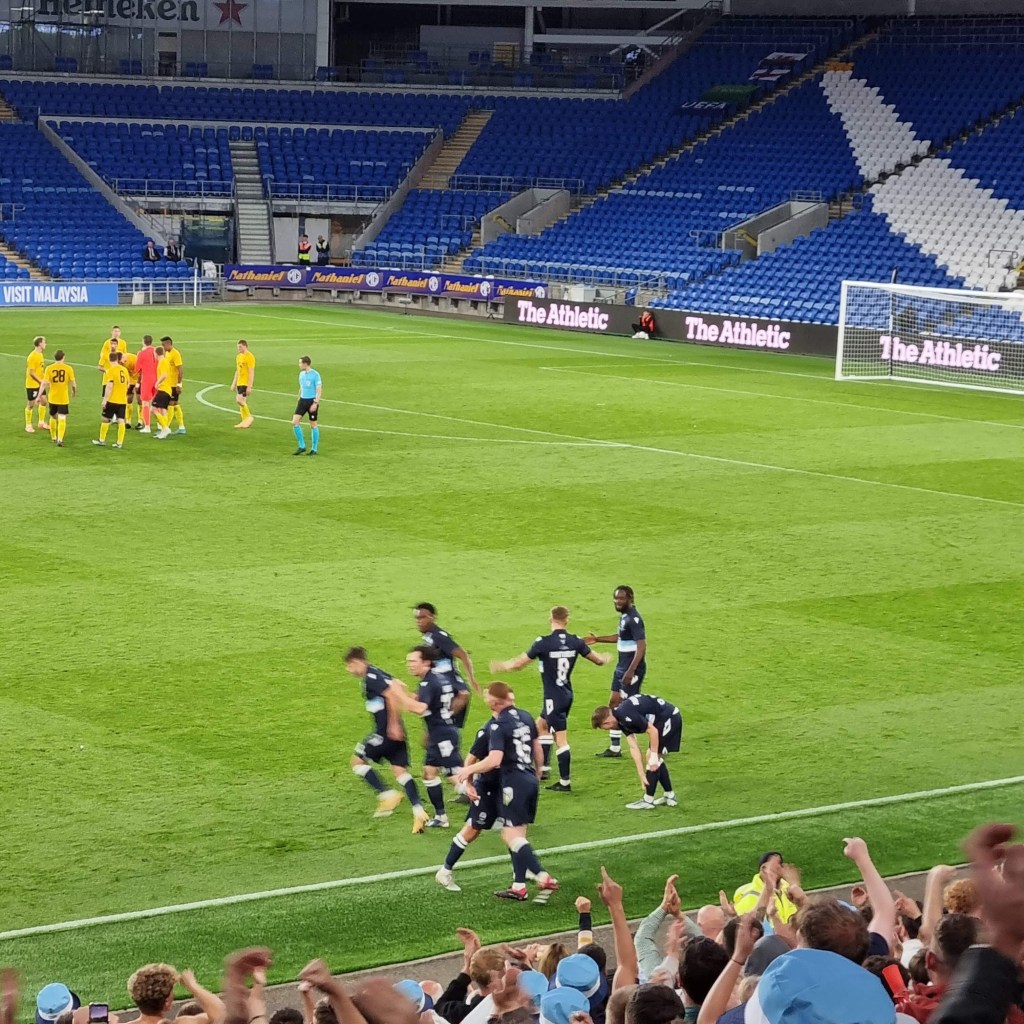
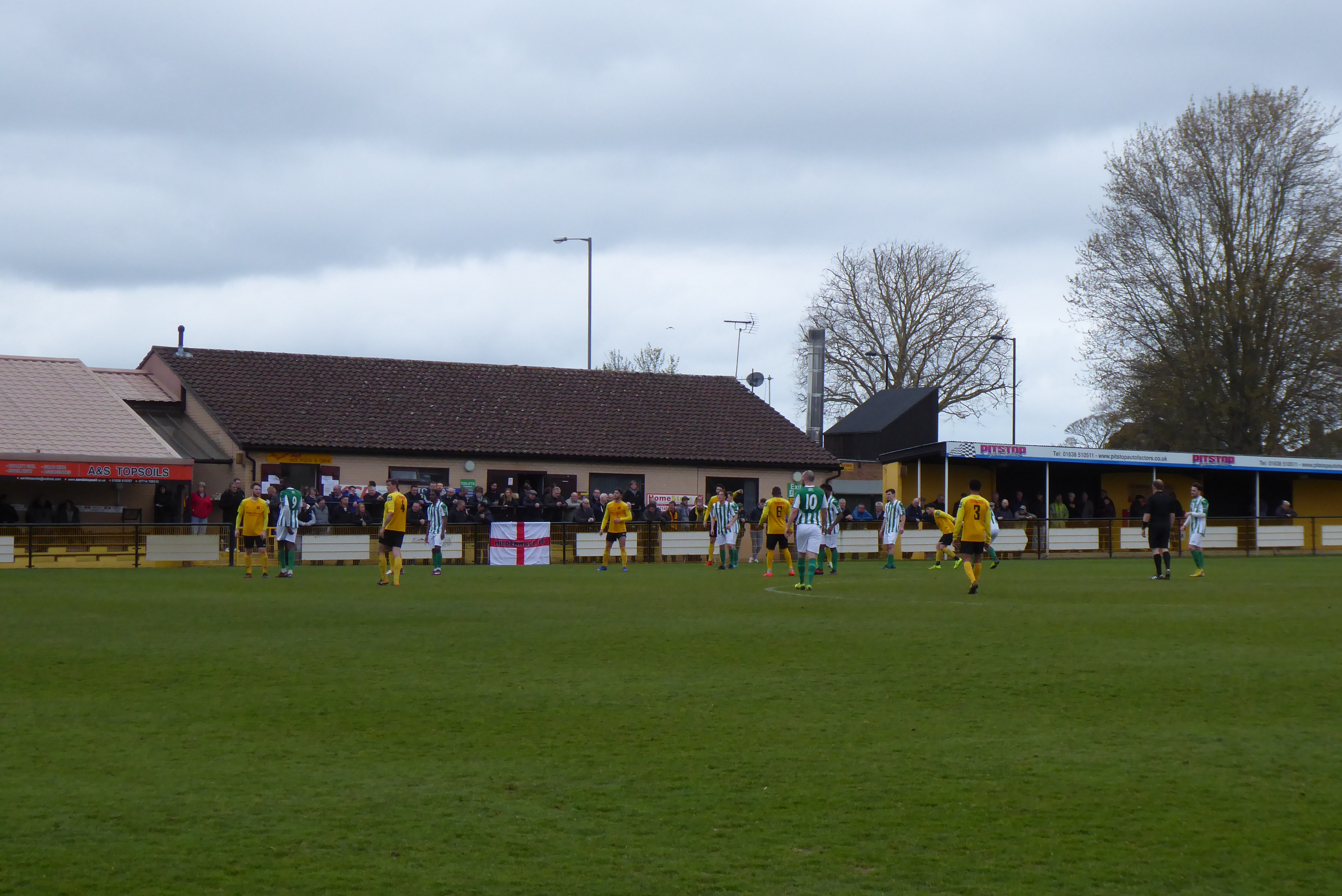
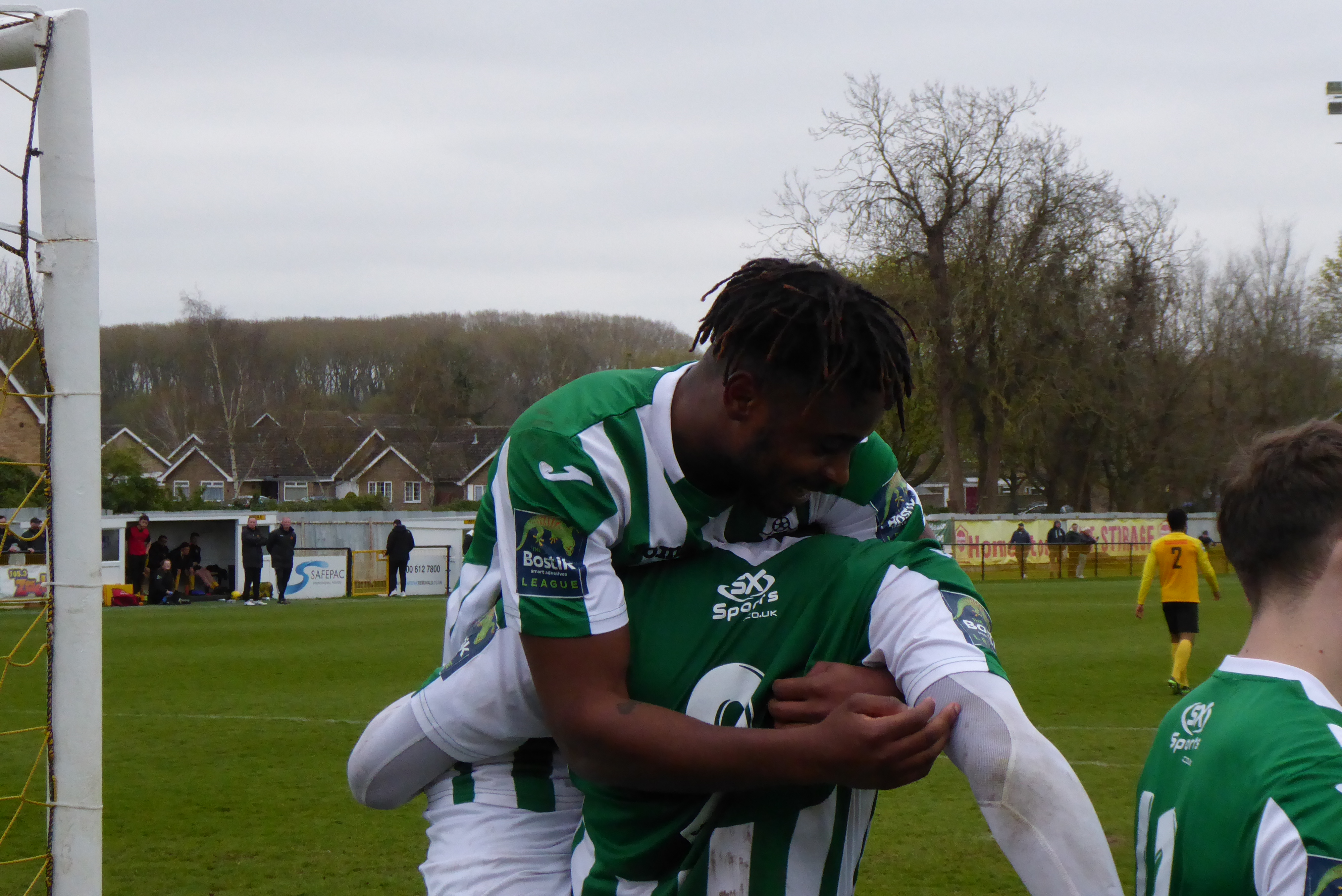
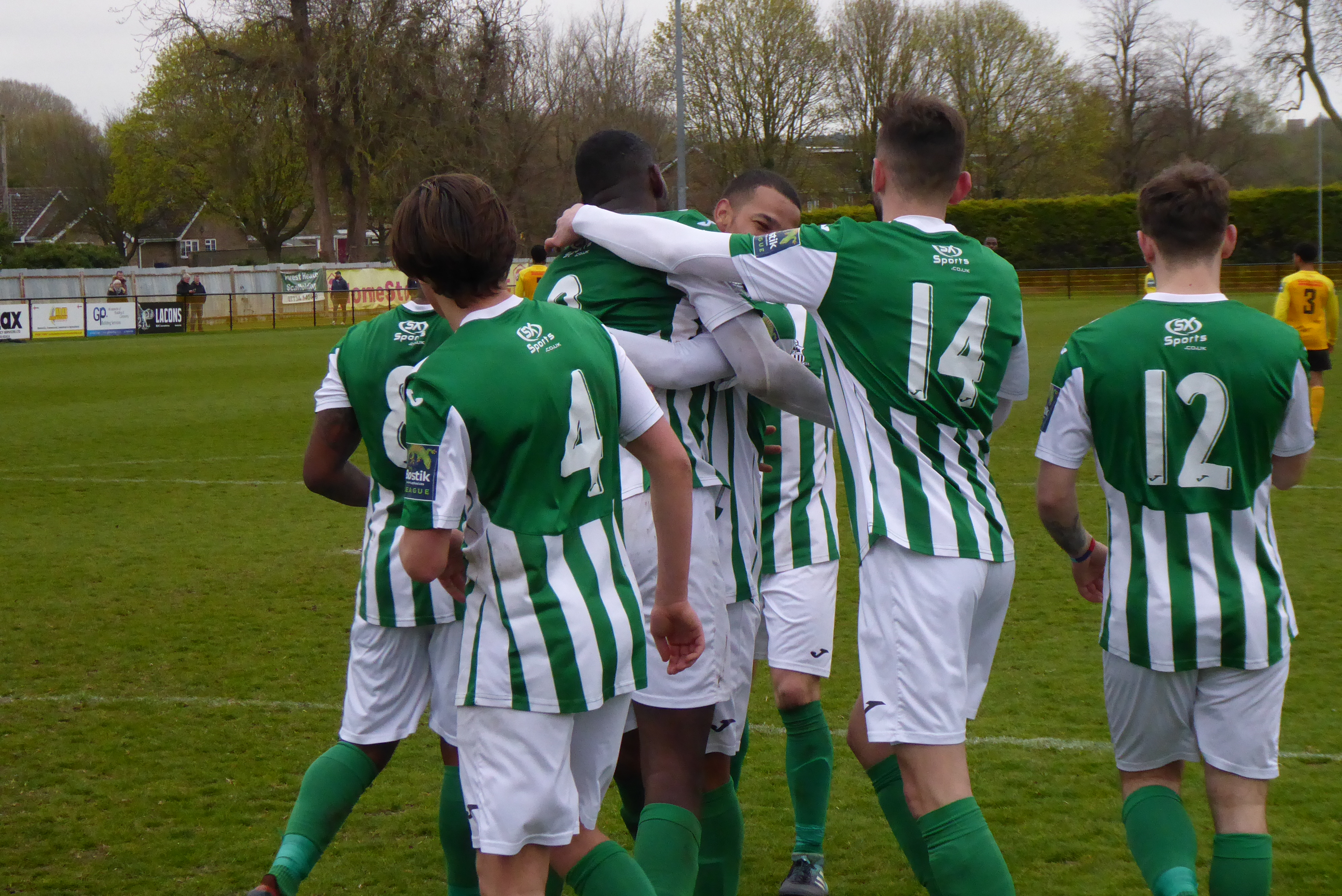
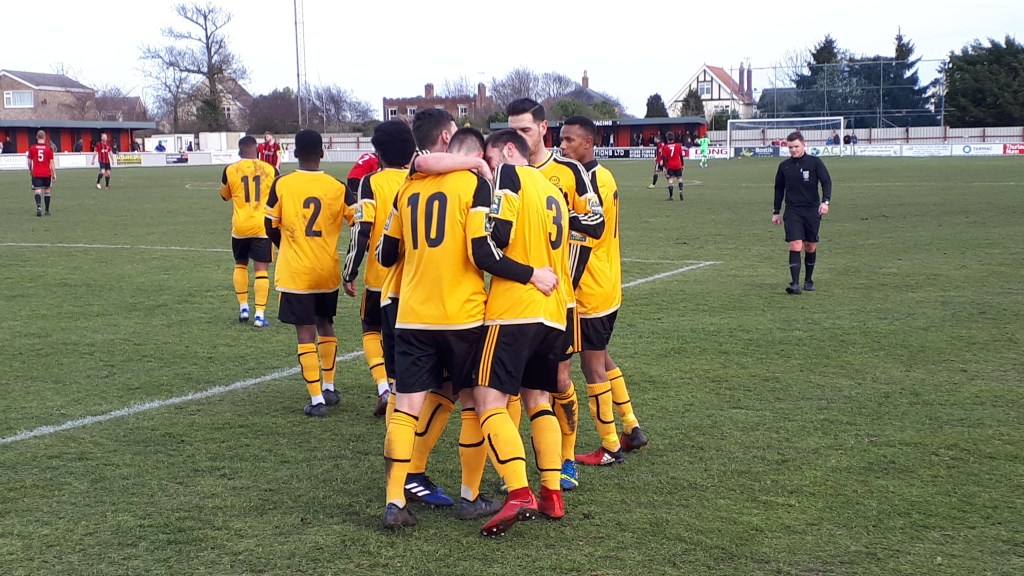
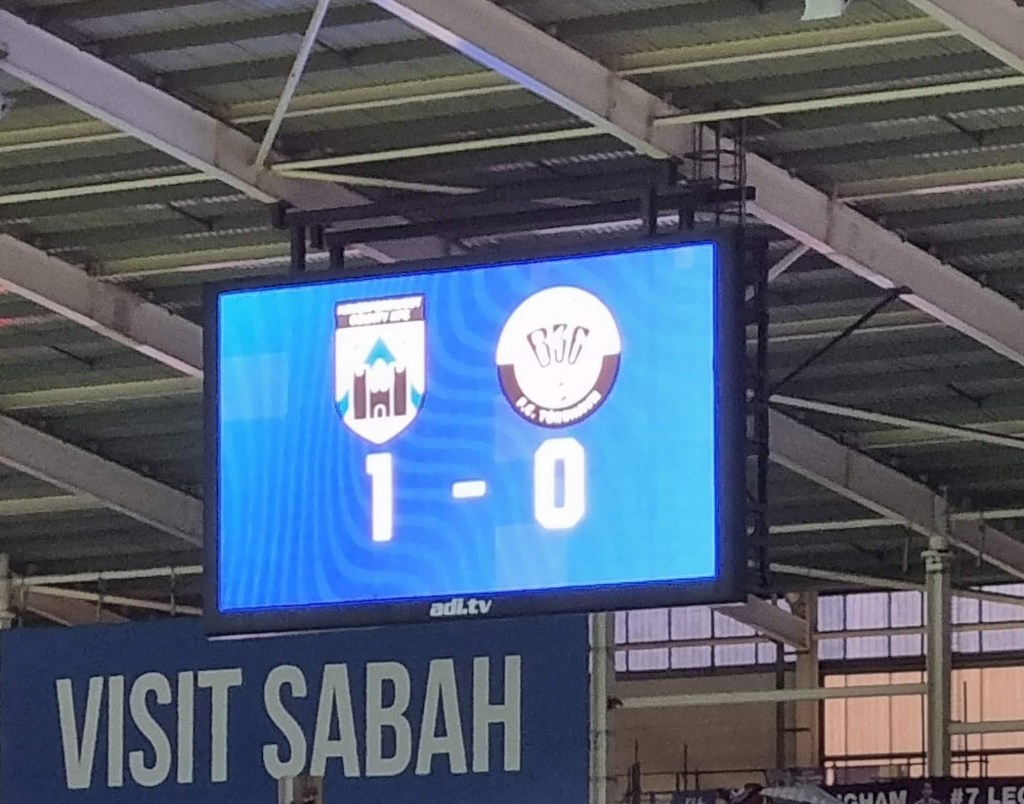
Haverfordwest County 1 B36 Torshavn 1(aet)

(B36 Torshavn win 3-2 on aggregate)

Haverfordwest County’s progress into the second qualifying round of the European Conference League was a beautiful thing and a tremendous way to witness my long-awaited first ever Haverfordwest County match.  It brought its own problems, however.  I hadn’t honestly expected that win, as welcome and wonderful as it was, but having started out on the ‘European adventure’ I now had to see the next game and consequently arrange time off work, match tickets and somewhere to stay in Cardiff.  Lovely, first world problems, but to a fundamentally lazy person committed only to bobbing through life like a cork on the tide, a challenge that had me feeling unpleasantly like Odysseus or other heroic figure charged with completing onerous tasks.

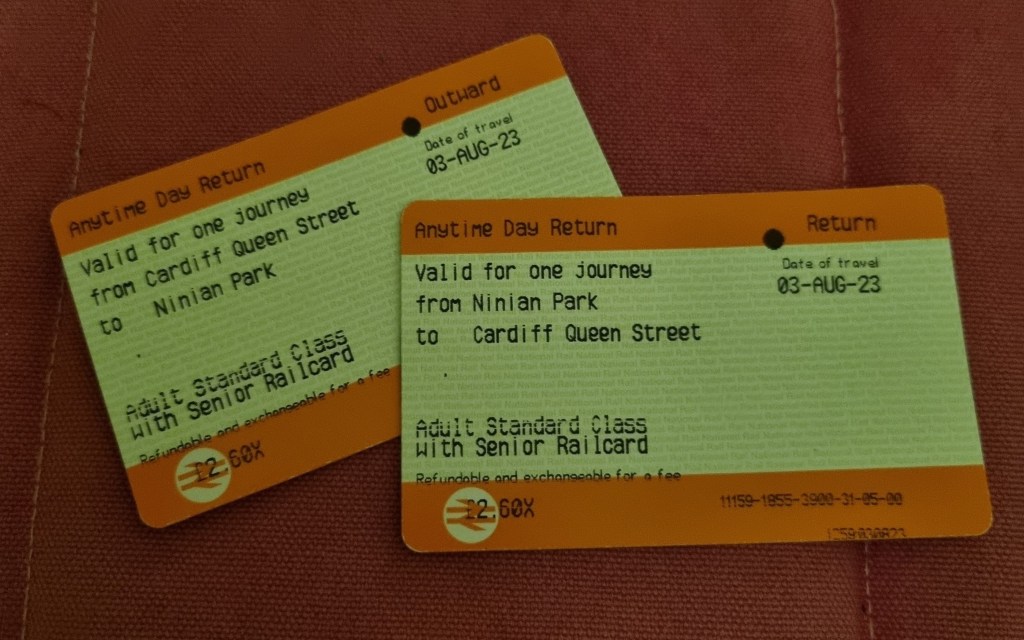
My wife Paulene arranged everything of course, except the time off, which I managed, and after intermittently aquaplaning and queuing along the M4, waking up to a spectacular view of the Bristol Channel from our ninth-floor hotel room and whiling away the day marvelling at the cuddly dragon and sheep souvenirs available in Cardiff gift shops, we now find ourselves on platform 3 of Cardiff Queen Street station awaiting the 18:31 for Radyr, calling at Cardiff Central (Caerdydd Canelog) and more importantly Ninian Park (Parc Ninian).  On platform 2 are two well-built women, one carries a large koala bear on her back, the other an even larger red and white fluffy octopus; they gaze across the tracks then descend the stairs into the subway that connects the platforms and disappear from view forever.   When the ‘train’ eventually arrives, seven minutes late, it is sadly no Ivor the Engine, but instead an aged sort of bus on rails, which chugs and grinds and squeals its way past Cardiff’s ripped backside towards once elegant Cardiff Central station where, the guard explains, we are held by a red light. “A riddle for you while we wait” says the guard, “What starts red and ends on green?”.   The riddle solved, some passengers alight and others climb aboard before we continue what is probably the shortest and slowest train journey I have ever been on (£2.60 return with Senior railcard).  Ninian Park station consists of two windswept open platforms and if the train hadn’t stopped there to disgorge, we might have thought it had been closed since the days of the evil Dr Beeching.

It’s a short and now familiar walk to the Cardiff City stadium, across Sloper Road, past the Jubilee Recreation Ground where a rugby team is about to begin a practice session, and then through the Lidl car park.  Entry to the stadium tonight is again through Gate 9.  Approaching the nest of steel barriers around the turnstiles, I spot a man wearing a day-glo coat featuring an Ipswich Town club crest.  Being an Ipswich Town season ticket holder myself we accost him but don’t learn much. He’s lives in Torquay, would very much like a Haverfordwest shirt, was an Ipswich season ticket holder several years ago and claims Ipswich is a dump nowadays and Colchester is better. I re-educate him as best I can about the relative merits of Ipswich and Colchester and tell him Ipswich still has its beautiful buildings and parks and history and is therefore as good as it ever was, it’s just that the inhabitants buy everything on-line, so the town centre shops have shut and for some of them being miserable and a bit racist is all that keeps them happy, hence we have a Tory MP.

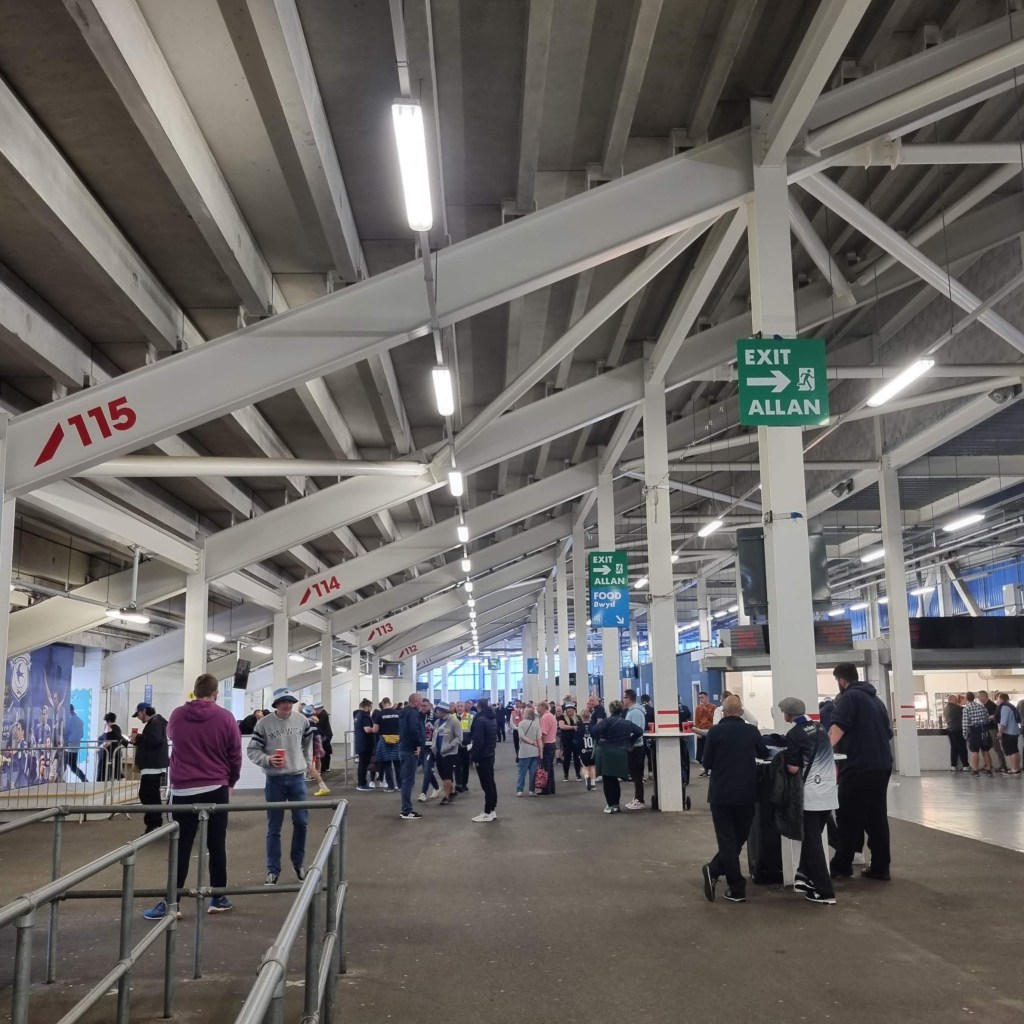
Having previously mastered the concept of my mobile phone having a wallet, entry to the stadium is a breeze tonight and I am soon eagerly presenting my bank card to pay for a replica Haverfordwest County shirt (£45) and a bucket hat (£15) which both commemorate the Pembrokeshire club’s presence in this season’s European Conference League. Excited beyond words and now sporting my commemorative bucket hat, I head with Paulene for our seats.  Emerging from beneath the stand back into the evening sunlight we talk to the steward at the top of the stairs who tells us where we will find our seats, but also points out there are free Haverfordwest T-shirts randomly draped over the backs of the seats; they’re in different sizes so it’s a question of looking until we find two our size.  The tag inside the neck of the first shirt I pick up reads ‘L’ and on the back of the shirt is the surname of the current French president.  That’s me kitted out, but the search for a ‘S’ for Paulene continues.  A man with two sons says all the ‘kids’ have been looking for them, then another younger man says “What size do you want?” I tell him I need a small. “Here you are” he says, almost immediately turning up the required shirt on the next seat he comes to. What a kind bloke, I think to myself as I thank him.
We watch the two teams warm up and the seats about us fill up with Welsh bottoms; I return ‘below’ to buy two bottles of water (£2.50 each), but experience no urge to pay £6 for a paper carton of insipid Amstel beer, I did that before the previous match, so do not need to do it again.  I reminisce that the only other occasion when I ever drank Amstel was in a bar in Amsterdam before the second leg of the 1981 UEFA Cup Final, I don’t know how many guilders and cents it cost but I expect it was my father’s round anyway.  When the game eventually kicks off, B36 Torshavn get first go with the ball and are kicking from left to right towards far off Pontypridd and Aberdare; they wear yellow shirts and socks with navy blue shorts, a bit like Oxford United or the Swedish national team, which is unexpected because the Faroes are Danish.  Haverfordwest are in this season’s signature kit of all navy blue with pale blue and white chevrons on the front, and to my knowledge resemble no one else but Haverfordwest.  Away from the pitch and back in the stand, people are still emerging at the top of the stairs like bubbles from a crack in the seabed, but they’re much more annoying as they dither on the steps trying to find their seats and blocking my view.  I can at least console myself with the thought that they have arrived too late to nab a free T-shirt, that’ll teach them.

“Blooobi-irds, Blooobi-irds!” chant several people like demented evening paper vendors as the excitement of the game having actually started takes hold.  “What seat is your number?” says a bloke behind me confusedly to the person next to him and in a not overly Welsh accent.  I don’t catch the answer, and I’m not really interested.  On the pitch, Torshavn’s number 8 Taufee Skandari hacks down Haverfordwest number 3 Rhys Abbruzzese, and whilst escaping punishment from the referee, other than a free-kick, he will hereafter be roundly booed by the crowd whenever he touches the ball.  Barely ten minutes have passed, but it’s always good to identify a pantomime villain early on.

“That’s blown my mind a little bit” says the bloke behind me about something which disappointingly I didn’t catch.  The game is close at the moment and cagey, and perhaps therefore a little dull, so I would have liked to have known what blew his mind, even if it did only get blown a little.  After ten minutes Haverfordwest get the kudos of winning the game’s first corner. “Blooobi-irds” chant the blokes who like to chant, and when Skandari touches the ball they boo too.  “  ‘kin ‘ell man” says the bloke behind me as the ball seems to wilfully run away from a Haverfordwest defender as he shapes to clear it.  “Aaah, talk man” continues my neighbour as the ball is booted out for Torshavn’s first corner kick just a goalkeeper Zac Jones arrives hoping to gather it up in his arms.  The Faroese number three takes an age to take the corner as if he’s first having to calculate precisely the trajectory of the ball before kicking it.  A second corner follows but thankfully to no effect.

It takes a half an hour before Haverfordwest have a shot on goal, although a diving header is required from Torshavn defender moments before to clear the ball for a corner and a few minutes before that Oscar Borg sent Martell Taylor-Crossdale away down the left to optimistic and encouraging cheers, but the Faroese goalkeeper got to the ball first.  To even things up, Skandari volleys over the cross bar to inevitable jeers and his team are on the up as they win two more corners and Haverfordwest captain Jazz Richards goes down injured and has to be substituted with ten minutes still to go until half time.  It’s not a good time for the home team as a shot now has to be cleared off the goal line after a Torshavn free-kick; I thought it was going to go in.  As if by way of desperately trying to restore the balance in favour of Haverfordwest, the boos when Skandari next touches the ball are even louder.

After another Torshavn corner and a shot which narrowly misses the Haverfordwest goal but ‘scores’ in the staircase up into the seats behind the goal, Haverfordwest’s Lee Jenkins misses arguably the best chance for a goal so far as he heads a fine cross back across the goal instead of into it.  With half-time two minutes away a mass exodus occurs, which includes the bloke behind me and his friends who it seems are heading for the bar.   Above us, a gang of three or four seagulls circle and swoop over the crowd, perhaps on the look out for someone who has already obtained a hot, half-time carton of chips or someone who has discarded a cold one.  Paulene is intrigued by the men in suits stood by the players’ tunnel and remarks that at every game there are always men in suits stood by the players’ tunnel.  We wonder who they are, and I speculate that they are no one in particular, but that for a fee football clubs will hire anyone a suit and let you stand there, like a sort of adult mascot. Then half-time arrives.

I usually like to take a wander at half-time, but tonight I don’t. I think the sight of that mass exodus a few minutes ago has made me want to stay put; I‘m not one to follow the herd.  The match resumes at twelve minutes to nine and Haverfordwest set off as if the first half was just a warm-up and now they’re going to play properly.  A corner is soon won and then Ben Fawcett is free in space and time at the edge of the penalty area, but he shoots wide of the Torshavn goal.

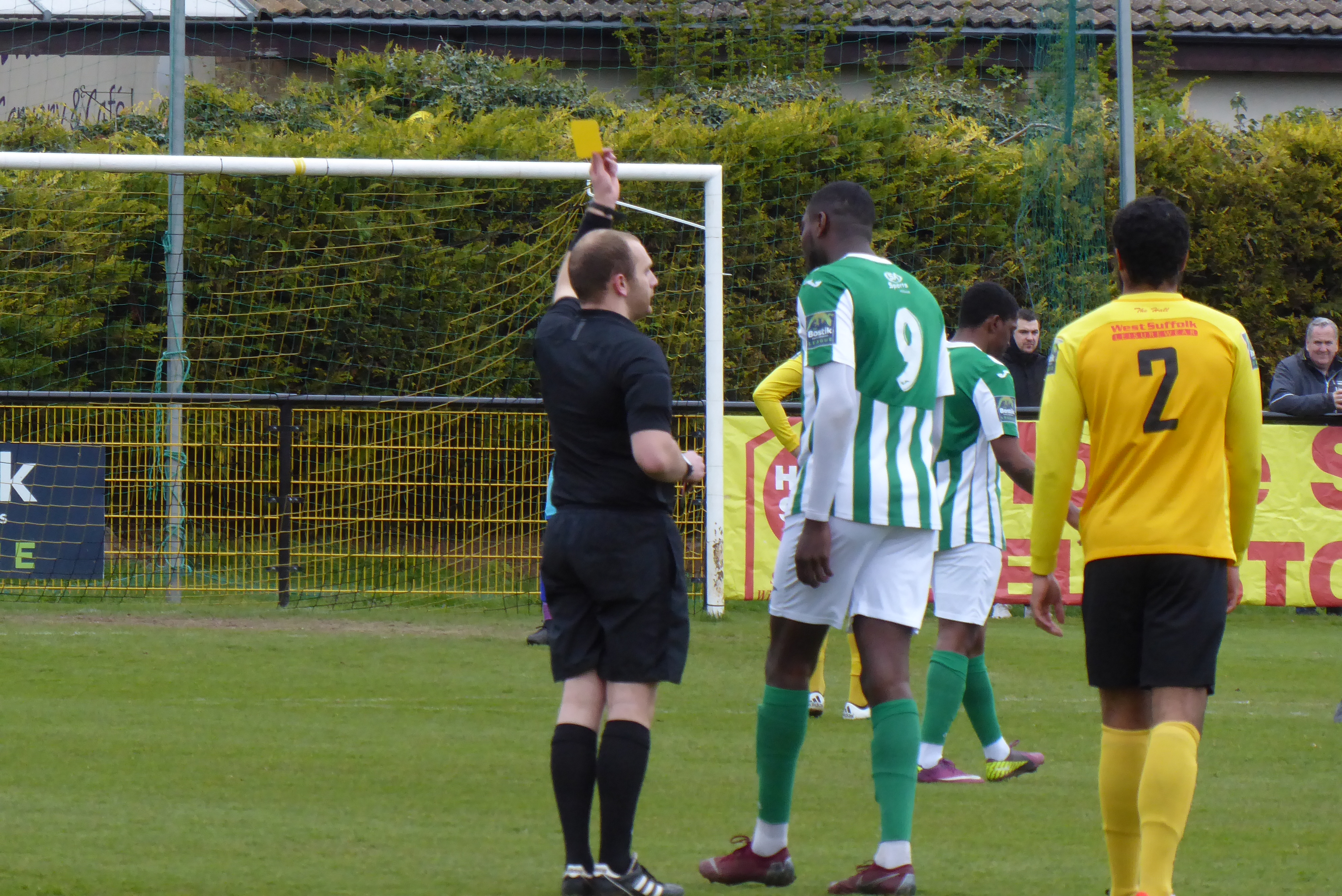
As always seems to happen in the second half of games, players start getting shown the referee’s yellow card.  Like in life, the more time goes on the less one cares, but perhaps others become more desperate.  The names of Lee Jenkins, Ricky Watts and Torshavn’s Isak Jonsson all enter the referee’s notebook in just seven minutes of deviant behaviour.   From the crowd a new song is heard to the tune of Jeff Beck’s ‘Hi-Ho Silver Lining’, with the words ‘Silver Lining’ being substituted rather neatly and amusingly with ‘Hav-er-ford-west’.  Twenty-minutes of the second half pass and the ball is knocked down in the Torshavn penalty area. Messy moments of uncertainty follow before the ball is slamming into the roof of the goal net; booted there by Ben Fawcett. Haverfordwest have scored, and the tie is level on aggregate; I begin to mentally prepare for penalties and Fawcett slides across the turf towards the adoring, cheering crowd before disappearing under a pile of his excited team-mates.
TV pundits tell us that goals change games, but Torshavn change their team by bringing on a couple of substitutes.  It works to an extent as they reverse the traffic towards their goal and win a corner, and their number nine has a shot on goal which draws a few worried gasps from fellow spectators around me, but happily the shot goes wide.

Tonight’s attendance is announced as 2,119, and as often happens at football matches nowadays some people break into a round of applause.  I can’t decide if they’re clapping themselves, each other, the announcer or whoever it was who counted everyone.  There are seven minutes of normal time remaining and Skandari falls to the ground with an anguished groan; naturally he is booed. When he gets up a bloke behind me somewhere shouts “Miracle!”.  The final minutes belong to Torshavn who win a succession of corners as Kai Whitmore joins the gang of Haverfordwest renegades who have been booked and Torshavn substitute Valerijs Sabala shoots over the cross bar. Only two-minutes of added on time are added on, it’s as if the referee thinks it’s pointless adding any more because no one’s going to score so we might as get on with extra-time.

Extra-time begins at twenty-one minutes to ten and I realise there will be no prospect of catching the five to ten train from Ninian Park back to Cardiff Queen Street, or the ten-thirteen.  The first half of extra-time sees Haverfordwest’s Oscar Borg stride forward and shoot over the cross bar, but then disaster strikes as a mess in the Haverfordwest goal mouth ends with a shot which is blocked on the goal line by Rhys Abruzzese and the referee awards a penalty for handball. Jann Julian Benjaminsen accepts the referee’s gift to the people of the Faroe Islands and scores high into the net as Zac Jones dives, conveniently for Benjaminsen, in the opposite direction.  A minute of added on time is played and the final fifteen minutes of the European tour beckon.

Naturally, Haverfordwest attack.  A shot is tipped over the bar for a corner, Martell Taylor-Crossdale is crowded out and falls down in the penalty area; was he shoved?  A shout of “The referee’s a wanker” from somewhere behind me suggests someone thinks he was, but it could be cramp.  When they get the ball, Torshavn pass it around just to retain possession, which they do quite well.  With the game into two minutes of added on time, Zac Jones heads up field to join the throng in the penalty area for a corner but, there’s to be no glorious goal from the goalkeeper tonight, and no glorious penalty saves.

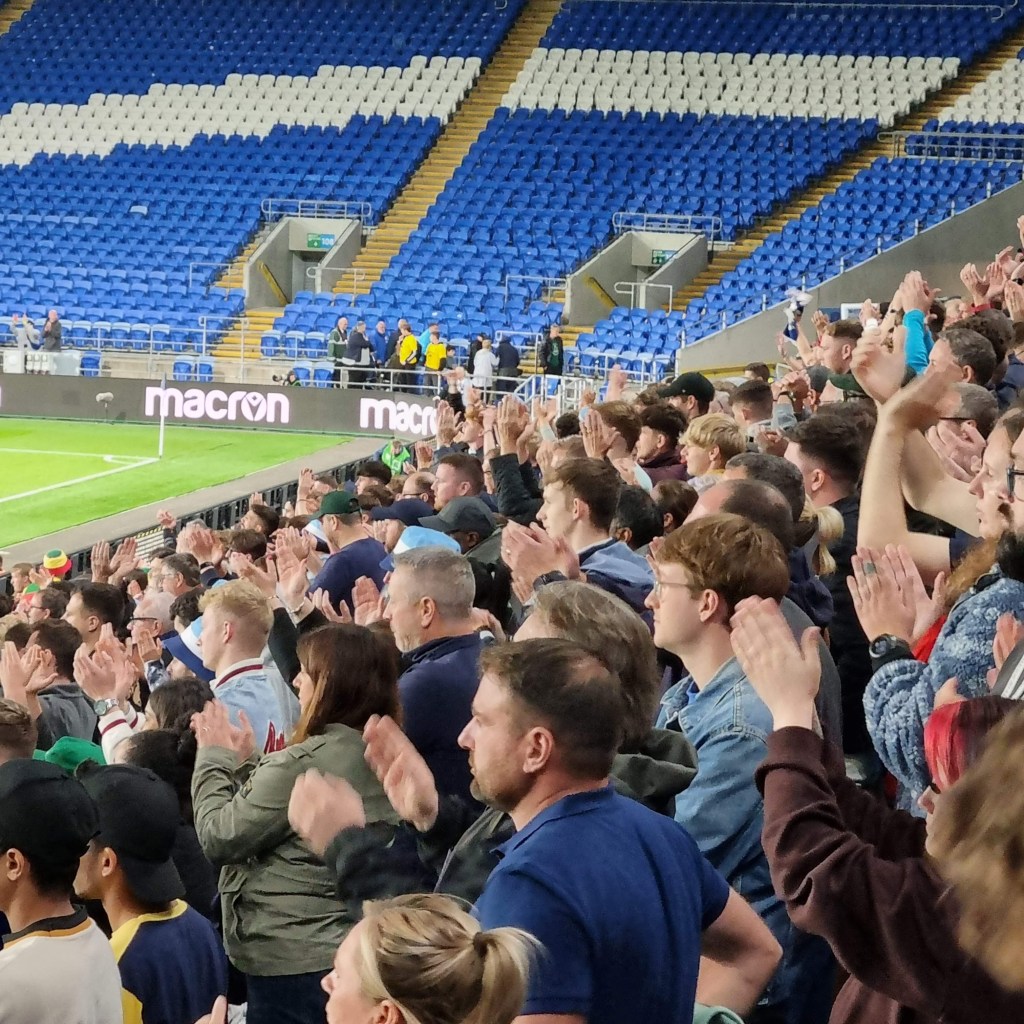
With the final whistle, the applause from the crowd is every bit as loud and appreciative as it might have been had Haverfordwest won, it just lacks the roar and the beaming smiles.  Paulene and I stay for a while to pay our respects before heading off into the night for Ninian Park station.  It’s 10:30 when we get there; the last train is at five to eleven, but the information screen says it’s not expected until eight minutes past.  With over half an hour to wait on a bleak cold platform we decide it will be quicker to walk, and this is how our European Tour ends.
Brightlingsea Regent 1 Merstham 1

Until 1964 I could have journeyed all the way to Brightlingsea by train via Colchester and Wivenhoe, but the treacherous activities of the evil Dr Beeching mean that it is now necessary to leave the train at Colchester and then catch a number 62 bus. My excuse today for not using public transport is that the bus journey alone would take me the best part of an hour and it would also prevent me from stopping off on the way home to buy much needed mushrooms, salad and bananas at Waitrose. Today therefore I am making the 32 kilometre trip by Citroen C3 and saving the planet takes second place to future breakfasts, lunches and a boeuf bourguignon.
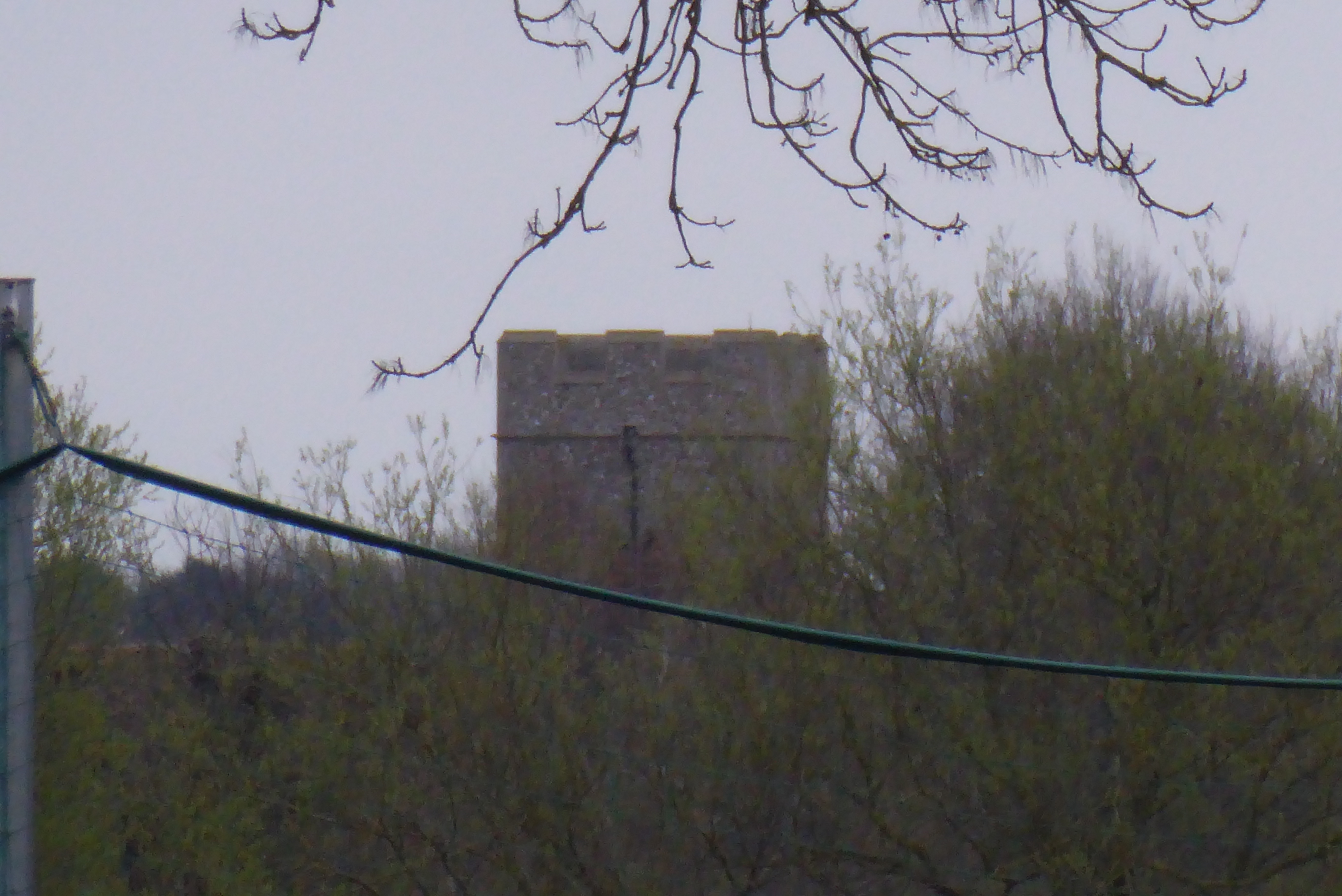
It’s a bright and blowy Saturday afternoon and wispy clouds scud across a pale blue sky. The B1029 twists its way across the flat lands of the Tendring peninsula and down into Brightlingsea from the north, past medieval All Saints Church with its impressive tower, sitting high on a hill outside the town; part place of worship, part lighthouse. Brightlingsea itself arrives as a sprawl of mid-twentieth century houses around a much older central core and a waterfront. I miss a turn, but having gone round the block I find my way. Residential North Road, all pebbledash and net curtains leads to Brightlingsea Regent’s home ground, currently called the Taydal Stadium, but more traditionally referred to as plain old North Road.
I reverse the Citroen into a space at the end of a line of other similarly neatly reversed family saloons. It’s a very short walk to the turnstile where I tender the correct money for entry and a programme (£10 + £2). Just inside and I am assailed by a lady with copper coloured haired selling draw tickets (£1 each); although not a gambling man I can’t help but feel it would be rude not to buy one, so I do. Come half-time ticket No372 will win, I’m sixteen tickets too late; if only I hadn’t missed that turning into Spring Road. It’s not quite twenty to three, so optimistically I think I might have a beer and therefore take a look in the bar; sadly there’s no hand pump, so I don’t bother; I can’t be doing with that cold stuff full of burps. At one end of the room however is a very brightly lit trophy cabinet which shines like a beacon and could easily attract magpies or ward off shipping from the mud banks in the Colne estuary; it has a slightly incongruous appearance in the otherwise very plain surroundings.
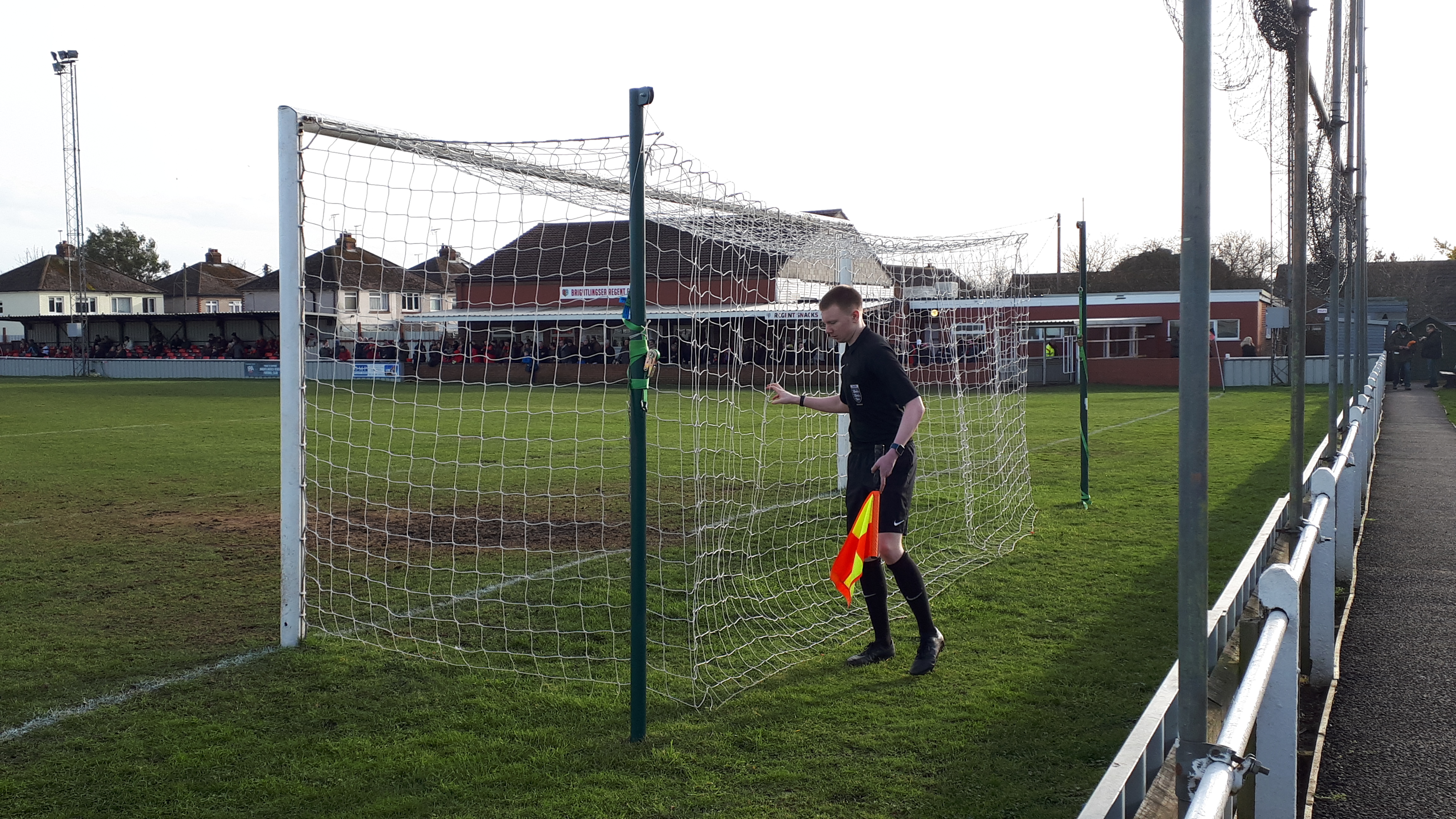
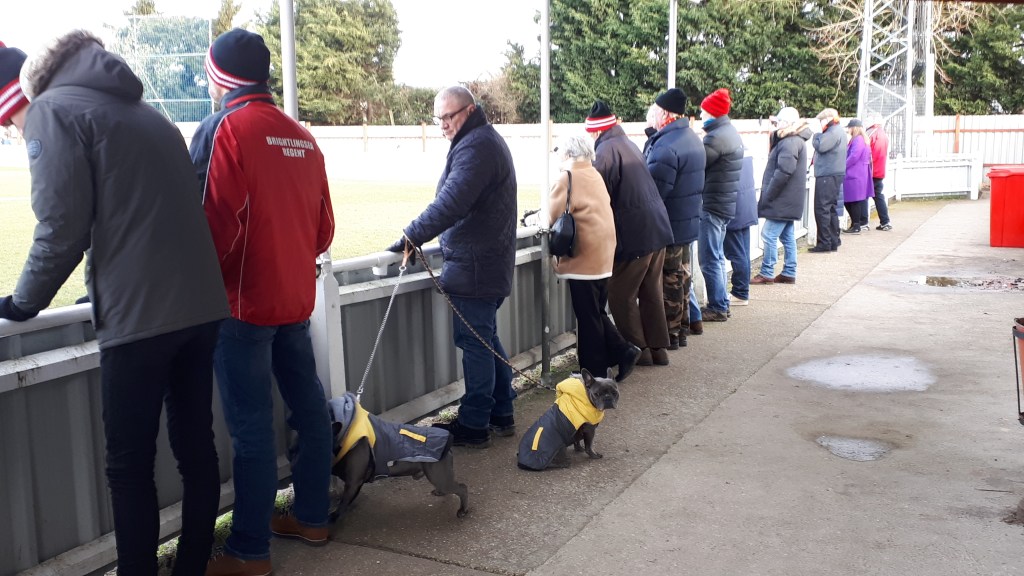
Back outside I seek out the ambience of non-league football. North Road is a hotch-potch of low stands and covered terraces confined within a steel fence backed up against the gardens of dull suburban houses. Beneath the cover outside the clubhouse people are eating chips from small polystyrene trays and drinking beer from plastic cups. The hatch in the club house wall beneath a sign that reads Regent Snacks is doing a steady trade.

Several free range children run about the stands and path around the pitch; today’s match is sponsored by the Brightlingsea Regent Youth Section which no doubt accounts for this. From the public address system, the names of the teams are announced. “First, the Mersham team” says the disembodied voice, mispronouncing the name of the visiting club and annoying at least one of their twenty or thirty supporters who are preparing to choose a goal to stand behind. As I drove to the ground this afternoon even the BBC Radio Essex announcer made the same mistake; I can only attribute this to being in a County where much of the population can’t pronounce the letters ‘th’ as anything other than an ‘f’ or a ‘v’, but ‘Mersfam’ would sound silly.

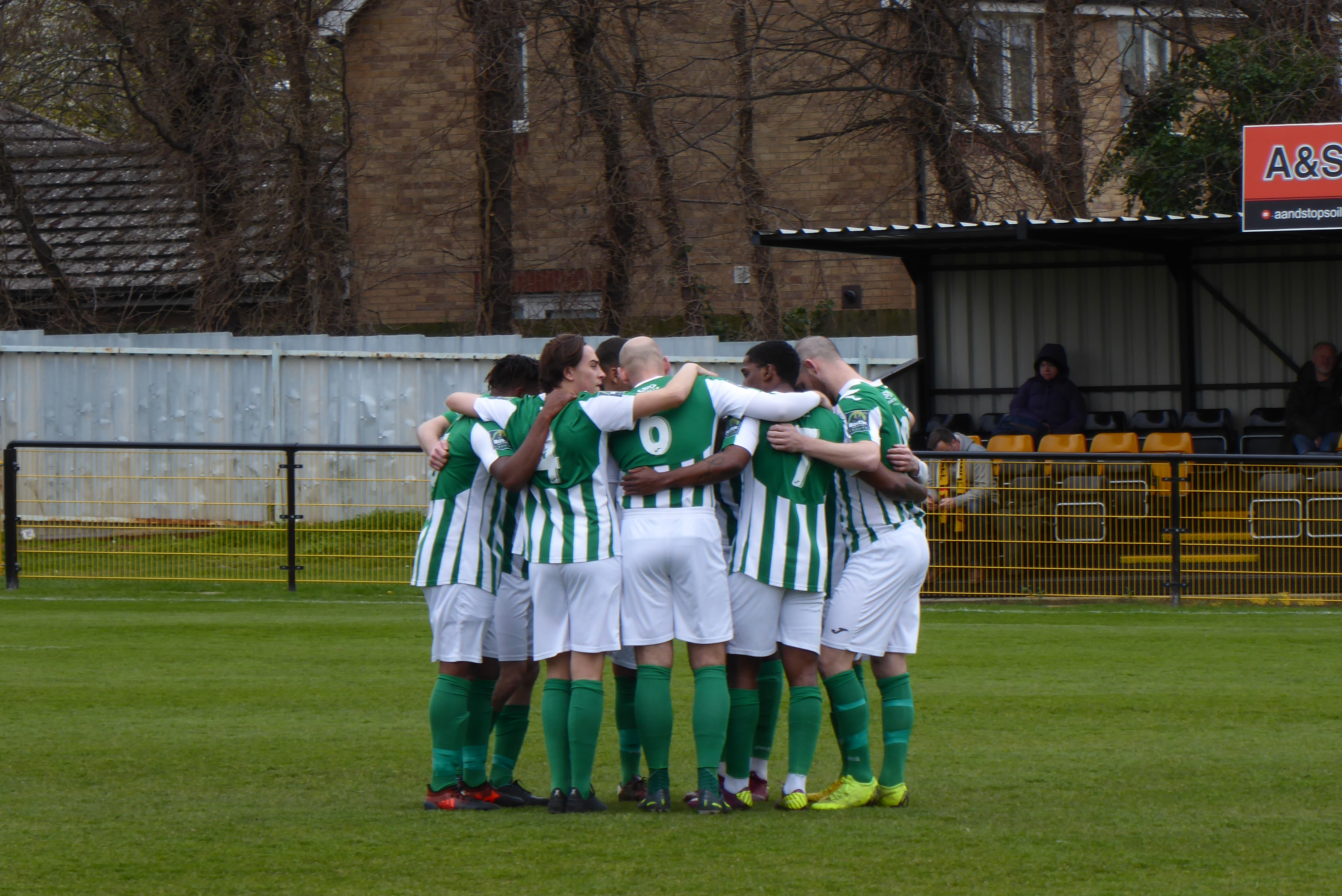
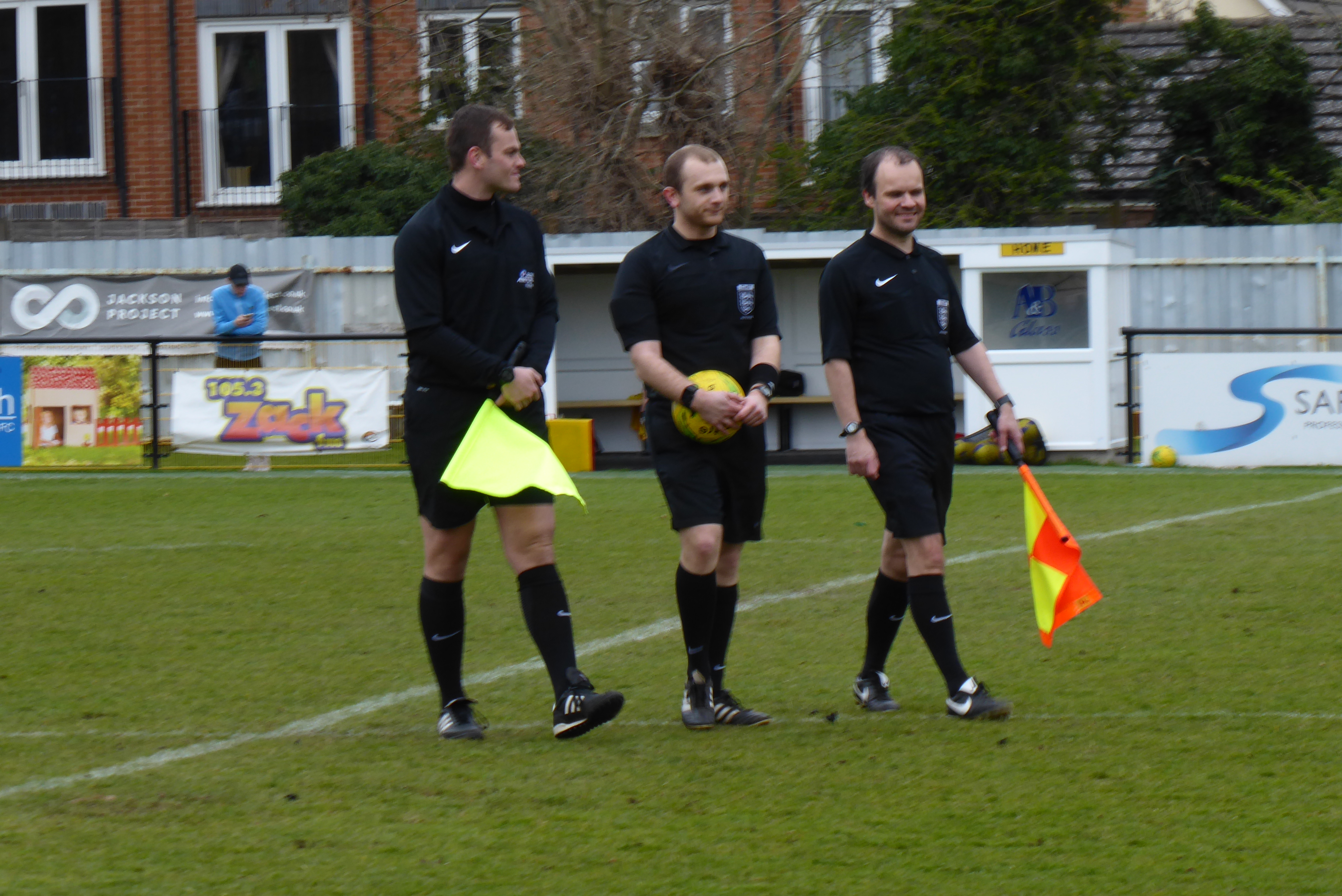
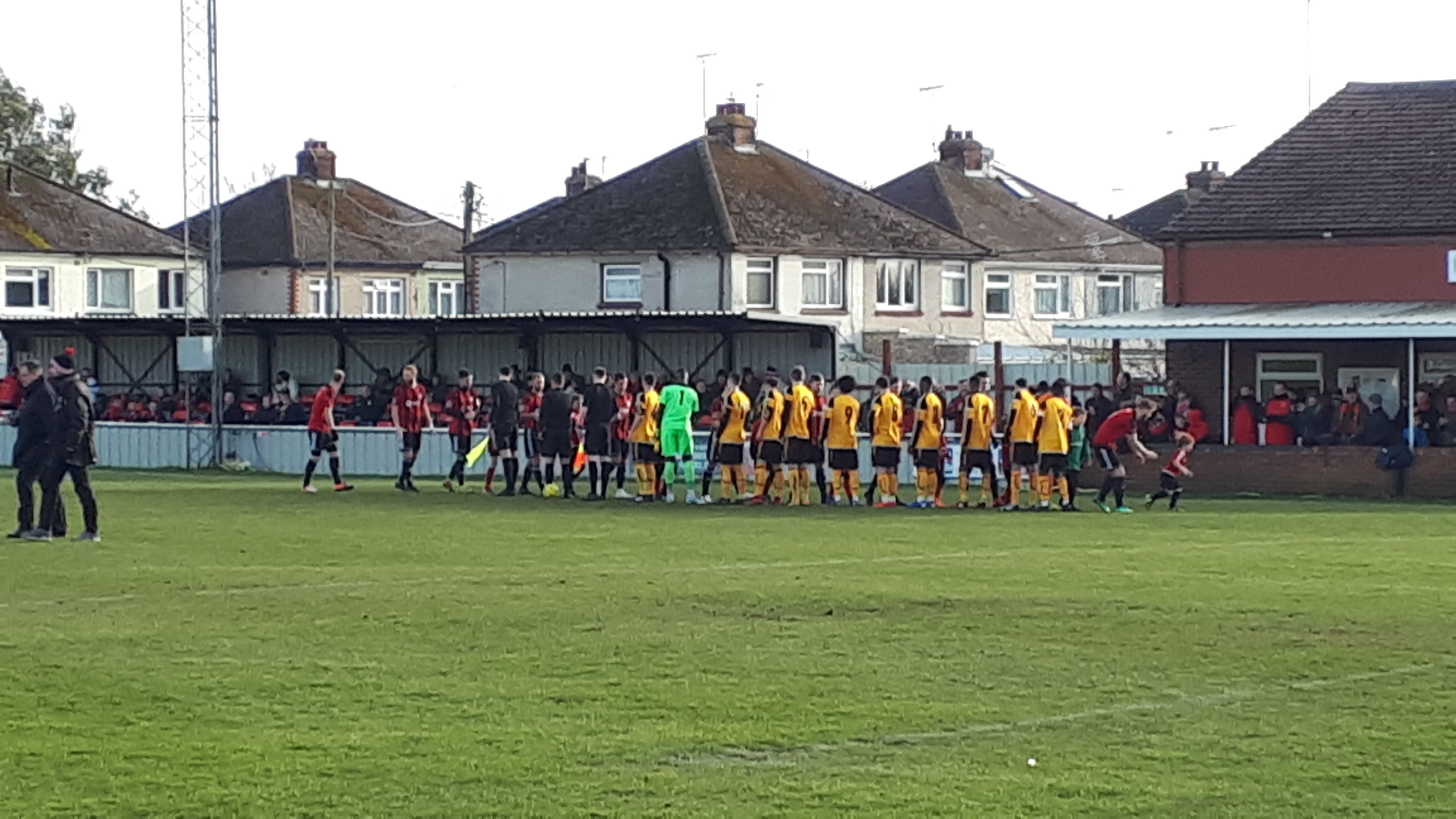
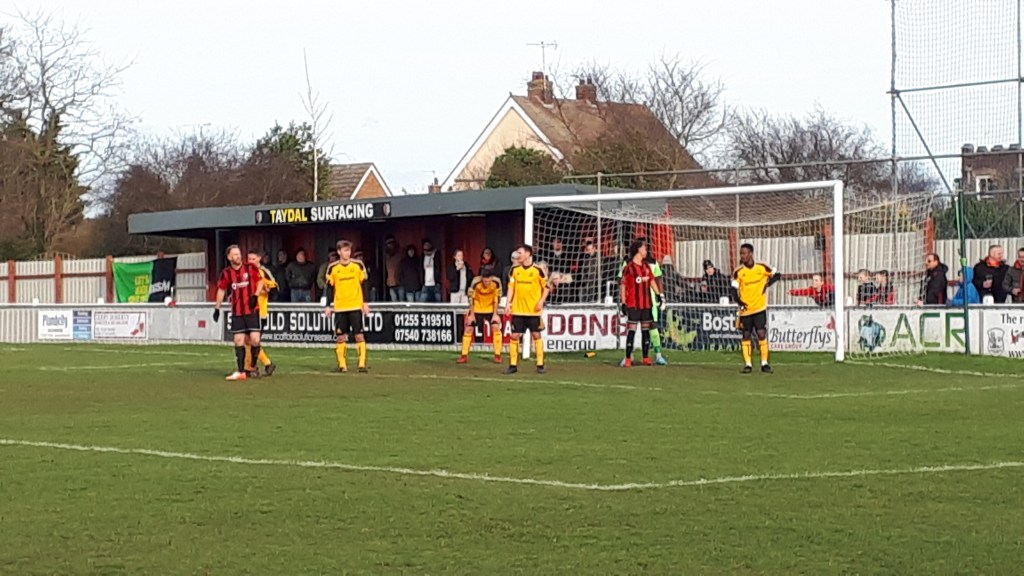
I take a walk around the perimeter of the pitch and then the teams emerge from the corner of the ground by the club house, walking in two neat lines behind the referee Mr Karl Sear and his leggy assistants Leo Del Rosso and Ashley Butler. The standard mass handshaking ensues before Merstham break from a team huddle to kick off towards a row of ugly bungalow roofs which form the backdrop to the goal at the clubhouse end of the ground. Merstham wear yellow shorts and socks with black shorts, whilst Brightlingsea sport a natty kit of black and red striped shirts with black shorts and red socks and kick towards the suburban back gardens of houses on Regent Road, one of which rather unexpectedly and splendidly has crennellations. It’s a colourful sight.
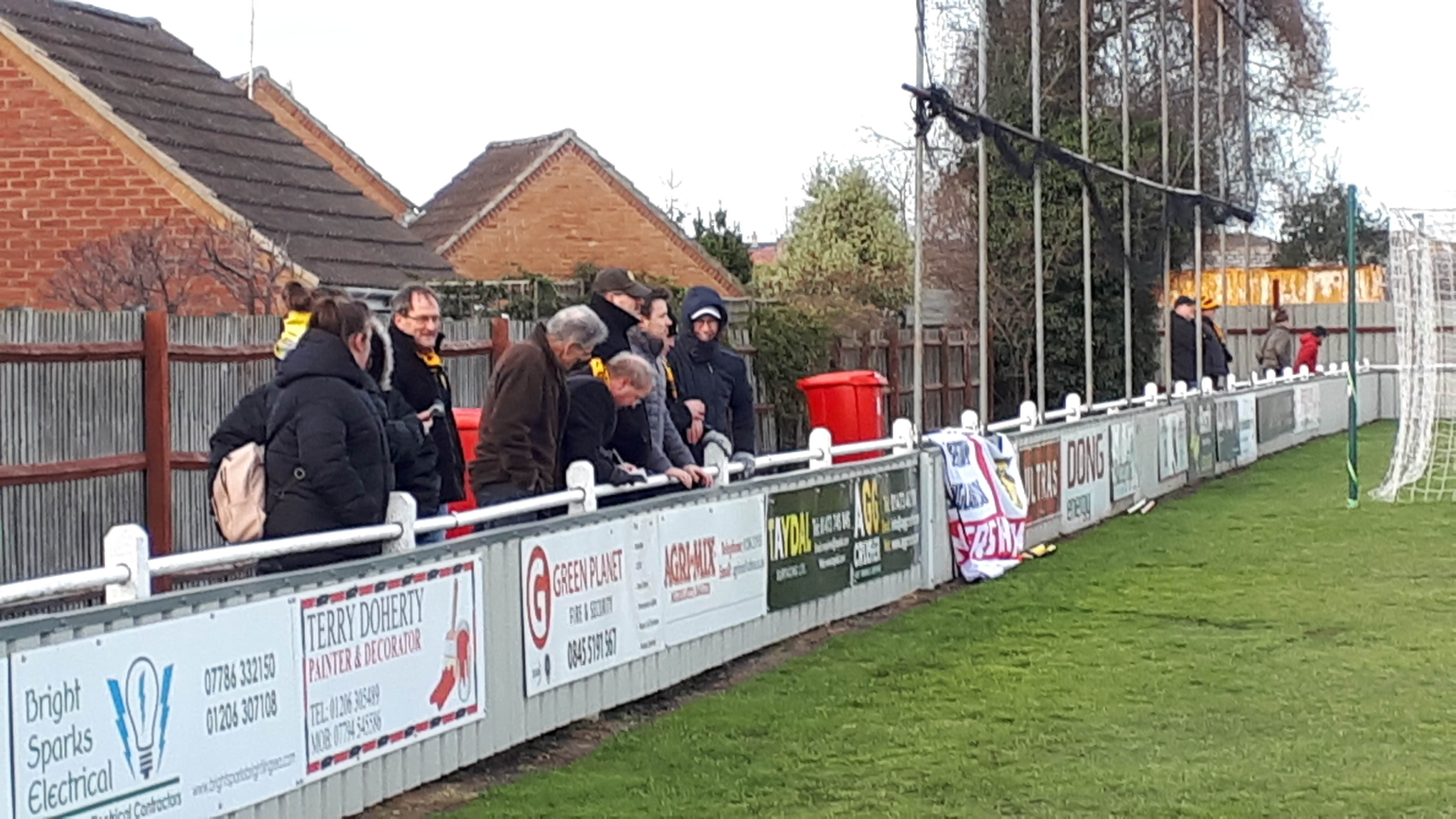
The opening minutes of the game see Merstham, who are third in the excitingly titled Bostik Premier League, but only five points ahead of twelfth placed Brightlingsea, spending as much time in the Brightlingsea half as Brightlingsea, but gradually the game evens out into an inconclusive midfield struggle. Brightlingsea have a shot cleared off the line which the home crowd are convinced was a goal. Fortunately there is no VAR to make shouting “Linesman, you’re useless” a redundant exercise, so somebody shouts it. On the covered shallow terrace behind the Merstham goal the self-styled Brightlingsea Ultras sing “Can you hear the Merstham Sing?” A respectable looking middle-aged woman quite quietly says “No swearing, please” and the Ultras complete their chant singing “I can’t hear (pause), anything, wo-oa, wo-oa-oah”.
I wander round to the dugouts, interested in what the coaches and managers are doing. The Merstham manager is smartly dressed in a mid-length, navy blue rain coat, shiny black shoes and neatly pressed trousers; he sips from what appears to be a paper cup of coffee, although I guess it could be super-strength cider, but that wouldn’t really fit the pattern established by his wardrobe. The Brightlingsea manager wears a woolly hat, trackie-bottoms and football boots; he glugs from a plastic water bottle which he chucks to the floor when he’s finished. This is the Surrey stockbroker belt versus Tendring. Merstham is on the edge of Reigate, a town 21st out of 401 in a league of average tax bills drawn up by Chartered Accountants Hacker Young for 2011-12.

“Go Manny” shouts the Merstham manager, not just when number eleven Emanuel Ighorea has the ball, but whenever anyone else does too. “Come inside, keep sucking it in” he adds complicating matters. His subsequent plea to “Get the ball” seems sensible if perhaps over simple. On the Brightlingsea bench there is the same concern for their number eleven, Harrison Banner. “Look at Banner, look at Banner!” is the exasperated call, followed by “For fuck’s sake” suggesting that if anyone did look at Banner they forgot to do anything else.

With half-time approaching I move on to behind the goal where the Merstham fans are congregated in a long line. Merstham enjoy a little flourish at the end of the half and all of a sudden number ten Fabio Saralva has the ball with no one much around him, he steps forward to the edge of the Brightlingsea penalty area before launching a shot into the top left hand corner of the Brightlingsea goal; ‘keeper James Bradbrook’s dive is despairing and Merstham lead 1-0 from a very fine looking goal. Understandably the Merstham supporters are thrilled by this event and I can’t deny being impressed somewhat too. I wander round past the players’ tunnel which looks like it might once have accommodated primates at Colchester zoo and wait just a few yards from the tea bar for half-time. The final action of the half sees referee Mr Sear wave his yellow card at Merstham’s number nine Walter Figuiera whom the referee has seemingly ‘had it in for’ all afternoon, to the extent of calling back play for a free-kick to Merstham as he was about to cross the ball. As the players leave the field for their half time cuppa the Merstham fans gather at the players’ tunnel and I add my voice to questions to Mr Sear about his attitude towards Figuiera; he doesn’t answer, confirming his guilt to my mind.

I queue for a cup of tea (£1.50) and consider why tea costs more the further up the football league pyramid one goes. I fish the tea bag from my cup and drop it in the bin next to the table on which the milk and sugar is placed. An elderly man with a flat cap and a stick tries to flick his teabag from his cup to the bin, but his tea bag falls on the ground with a wet splat. “That’s you out of the basketball team” I tell him, he smiles sympathetically. I stand my tea on the brick perimeter wall to allow it to cool. “Haringey are losing again” says an excited voice behind me “Potters Bar are winning at Worthing”. No one responds, but another voice declares that the hot chocolate is lovely. “Best in the league, since they cleaned the machine” says someone else. I look through the programme. It’s an attractive glossy publication and I am reminded why it is so disappointing that some clubs no longer produce one. Where else would it be possible to learn that Regent’s number nine Michael Brothers brings some “top banter” to the dressing room?
At four minutes past four the game resumes and Brightlingsea look to have had the more inspiring half-time team talk, getting forward more consistently than they managed before and they win a couple of corners. “Head it, head the ball” is the considered advice from the stands, as well as a more violent sounding “Attack it!” “Come on you R’s” sing the Ultras. At twenty past four a Brightlingsea corner is cleared but only to a point a few yards outside the penalty area from where it is lobbed high back towards the goal. Necks are craned but only Brightlingsea’s Jake Turner moves his feet and follows the flight of the ball and the two come together about five yards from the goal where he sweeps it unchallenged into the net past a surprised looking Amadou Tangara, the Merstham goalkeeper.
The remainder of the second half is more open than the first with both teams having chances as the sun is engulfed behind hazy cloud and the floodlights come on. Substitutions are made and the PA announcer attempts to induce excitement by lifting the tone of his voice on the final syllable of Clarke Gilbert, as he replaces Michael Brothers; it has no discernible impact. Having equalised, the urgency they had at the start of the half deserts Brightlingsea somewhat, but it remains an entertaining match. There’s a worrying few minutes late on however as Brightlingsea’s number seven Jordan Barnett appears to have some sort of fit after a collision with his own goalkeeper and after several minutes of uncertainty he is stretchered off.
Today’s attendance is announced as 231, and as the sun sinks towards the horizon, the telephone wires across North Road are silhouetted through the descending gloom, looking like a cat’s cradle. I stroll past the Merstham fans assembled behind the goal at the Regent Road end of the ground. “Come on Merstham” they shout. “Who’s that? Mersham?” I ask innocently. Happily, they seem get the joke, I think. I head past the main stand towards the exit and with the final whistle am handily placed for a swift departure.
I make the short walk back to my trusty Citroen reflecting that I have not witnessed a classic match, but it has had its moments and the result is a fair one, which counts for something in this unfair world.  Waitrose awaits.

Leiston 0 Rushall Olympic 1

Leiston is about 35 kilometres northeast of Ipswich and when my mother was a child she was taken there on the train to visit her grandfather who lived in nearby Aldringham. Remarkably perhaps, for a town of just five and half thousand inhabitants tucked away in a corner of rural Suffolk it is still possible to get to Leiston by rail today, but only if you’re the engine driver of the train collecting radioactive waste from Sizewell nuclear power station, a few kilometres east. Passenger services to Leiston ceased in 1966; the evil Dr Beeching saw to that, but on a Saturday afternoon the No 521 bus leaves Saxmundham railway station at 14:04, about ten minutes after the 13:17 train from Ipswich arrives there and it will get you to Leiston in time for a three o’clock kick-off at Victory Road, home of Leiston FC. Incredibly, there is also a bus back from Leiston to Saxmundham, at 1740. But with meticulous mis-timing however, the bus arrives in Sax’ three minutes after the 17:57 train back to Ipswich has left, giving you a fifty seven minute wait for the next one.
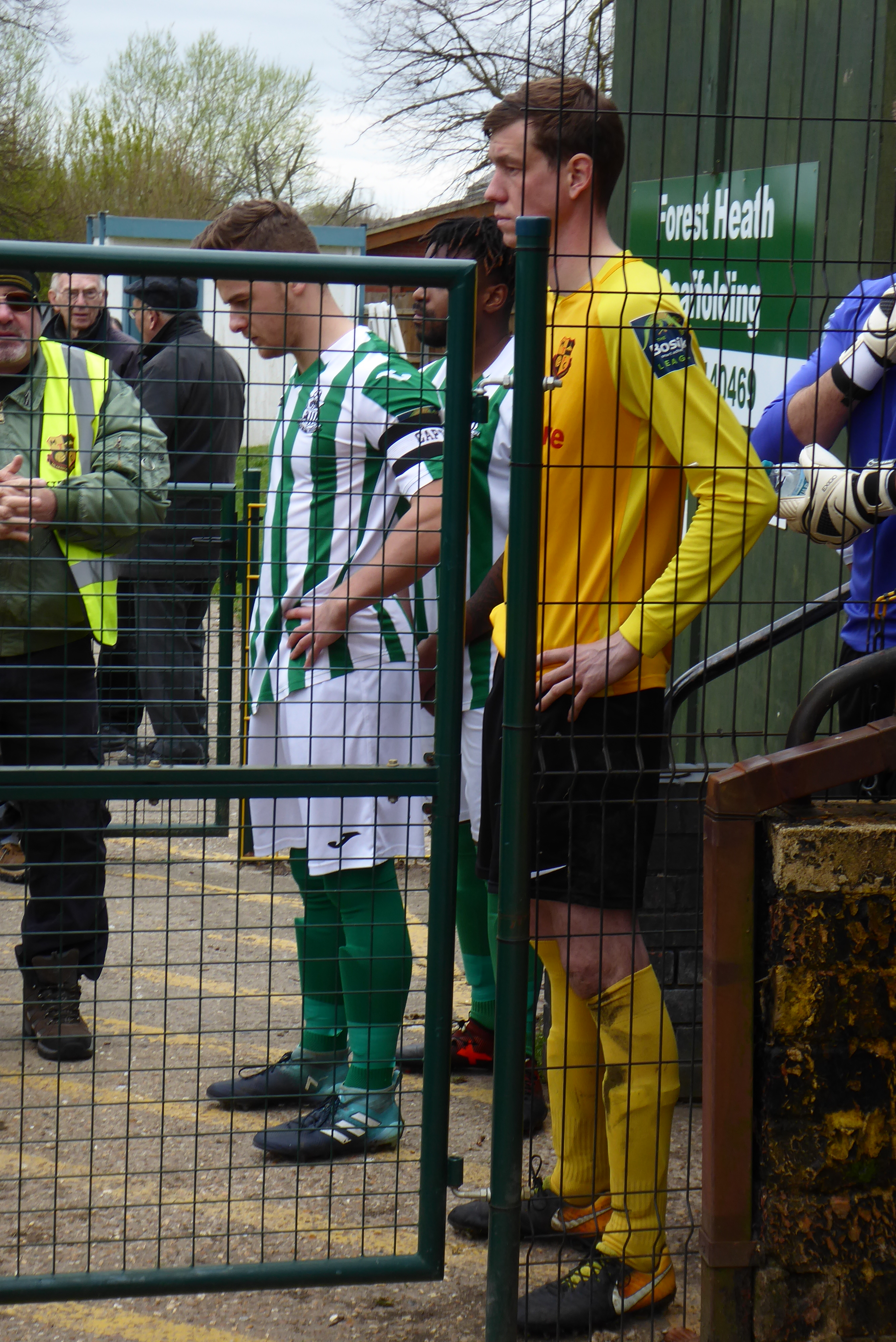
My excuse for not using public transport today is not because we are apparently being discouraged by poor timetabling from doing so, but rather because what goes around comes around and it’s now my mother’s turn to be visited, by me. Filial duty carried out, I proceed up the A12 on what is a beautiful, bright autumn afternoon. Letting the throttle out on the largely deserted dual carriageway between Ufford and Marlesford my Citroen C3 must feel like its back on the péage heading for Lyon, not Leiston. But Leiston it is and after skirting Snape and Friston, and passing pigs and pill-boxes outside Knodishall my Leiston FCCitroen and I roll into Victory Road at about twenty past two, where it is already so busy we are ushered into overflow car parking. I drive across the grass behind one goal and onto a field behind the pitch. Once out of my car a steward explains that entry today is through a side gate in order to keep pedestrians from slipping over where the cars have churned up the grass; health and safety eh? Entry costs £11, but I keep the gateman happy by tendering the right money. My wife Paulene has refused to join me today because she maintains that £11 is too much to pay to watch ‘local football’, and she makes a fair point, although today’s opponents aren’t exactly local, Rushall being about 285 kilometres away near Walsall in the West Midlands. In France it is possible to watch a fully professional second division match in a modern stadium for not much more than I have paid today, and sometimes for a bit less.OLYMPUS DIGITAL CAMERA
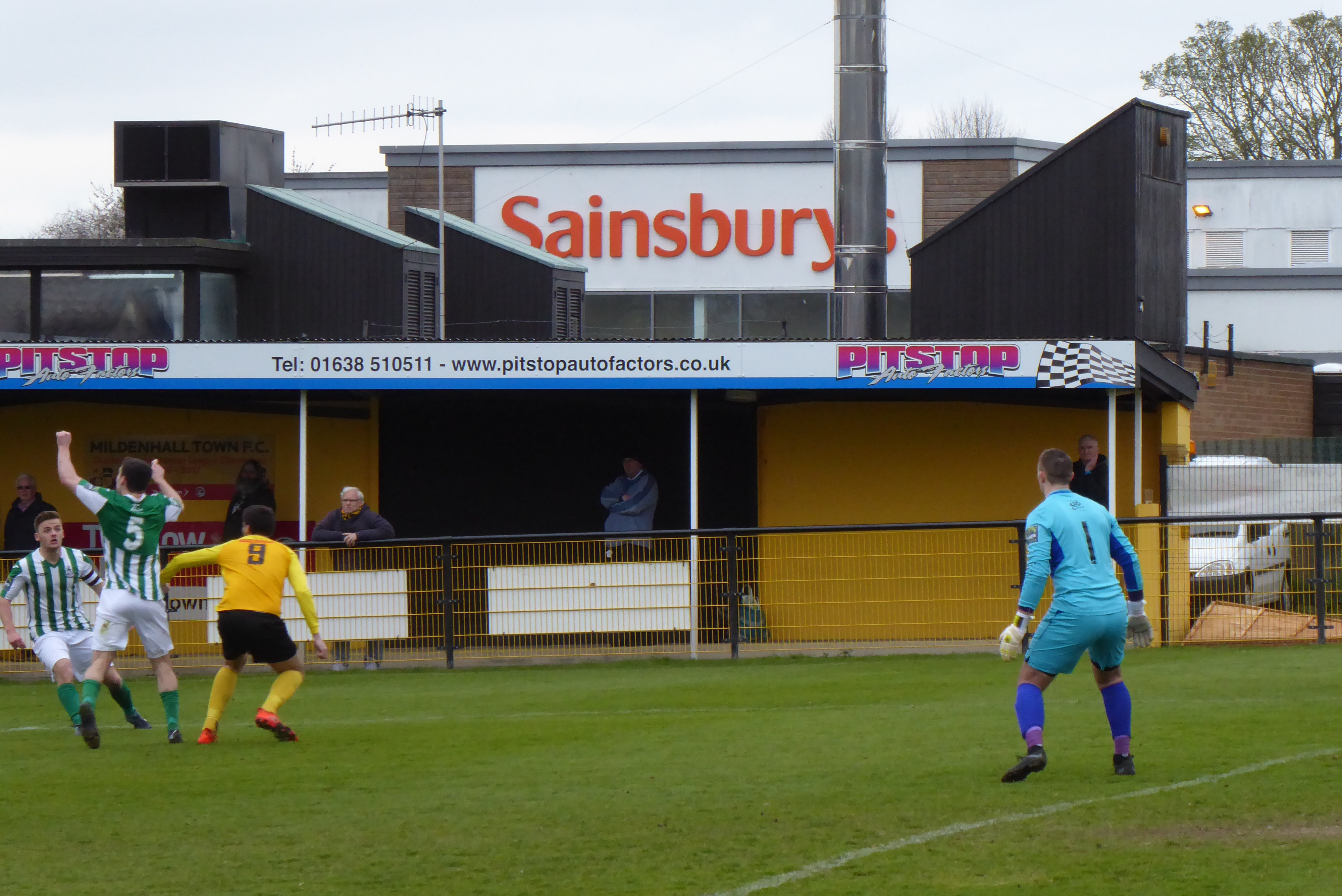
There is plenty of time before kick-off so I have a look about and visit the club shop where I witness its first ever ‘card transaction’. The middle-aged lady serving seems genuinely excited and I suggest she should be giving her customer some sort of commemorative certificate to mark the occasion. Sadly, I cannot lay claim to becoming the second ever card-paying customer of the Leiston club shop, as I all too easily resist the temptation of a teddy bear (£12), mug (£5) or red, white and blue painted football rattle (£2), although I do try the rattle to see if it works; it does but it’s quite small and the action is a bit stiff. OLYMPUS DIGITAL CAMERA
Leaving the shop I realise I don’t have a programme and I see if there is one available at the main turnstile, where a very apologetic man explains that due to printing costs and not selling all the programmes it’s no longer financially viable to produce one; he hands me a slip of paper which puts his words into print. I quite like the idea that the slip of paper could be distributed as a substitute programme if it was stamped with today’s date and name of the opposition.
Programme-less and therefore slightly crestfallen, I turn back from the turnstile but must wait as a steward ushers past a car towards the overflow car park, I tell the steward he needs a lollipop-man’s uniform or at least his lollipop, he doesn’t seem that keen. Still depressed at the state of modern football I head for the bar where a hand pump bears pump clips for both Adnam’s Ghostship and something called Garrett’s Ale. When I ask, the balding barman explains that Garrett’s is made in a micro-brewery down the road in the Long Shop museum, but then he says it’s not and he made it up. He says it’s brewed by Greene King, and he made the name up and then he says it’s actually Ruddle’s. Confused, I buy a pint (£3.20); it’s okay, but I wish I’d bought a pint of Ghostship.
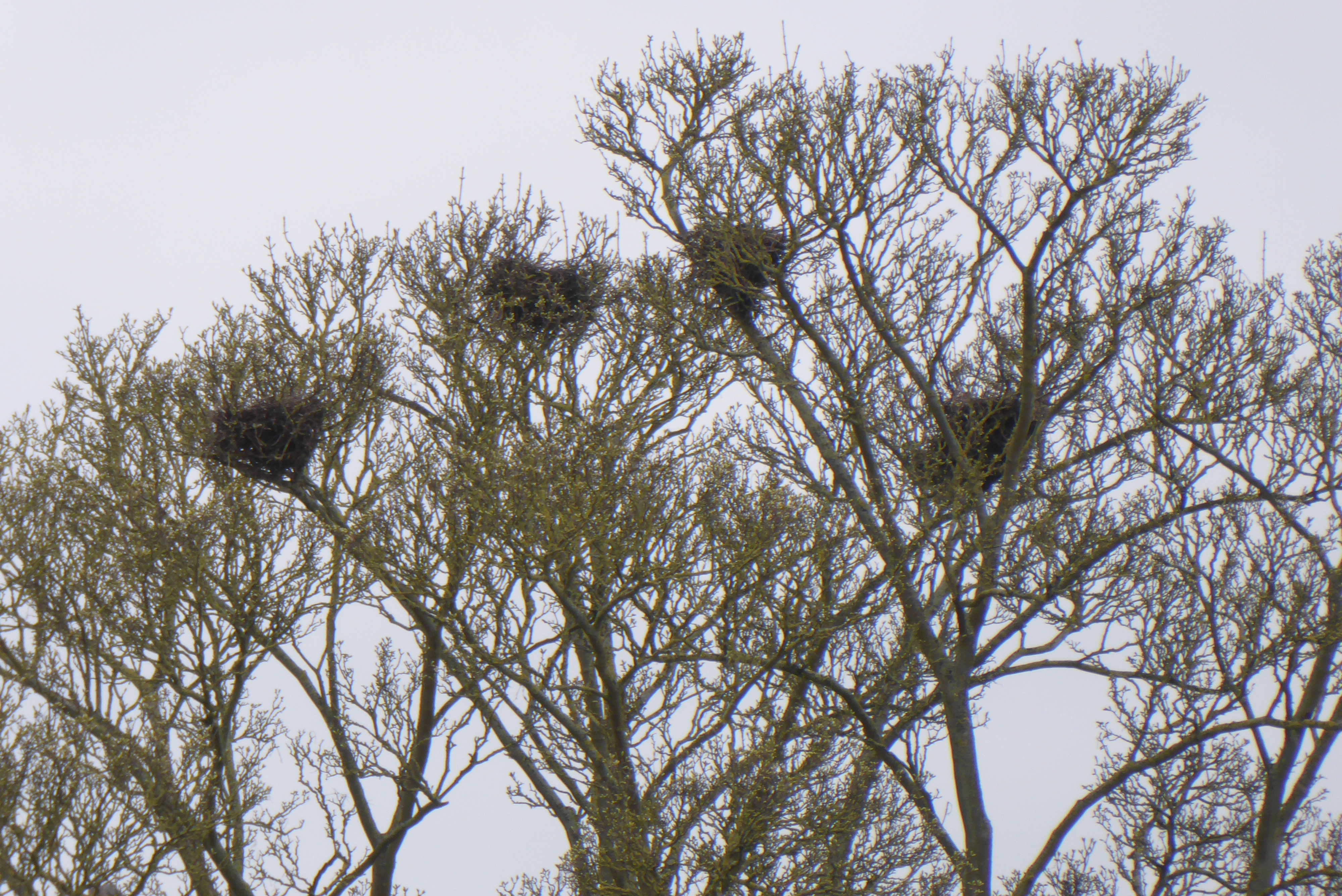
I find a spot to drink my beer and speak briefly to a man who recognises me from matches at Portman Road; he is apparently originally from Aldeburgh and today is a guest of the match sponsors. Having drained my glass I head back outside to await the teams and in due course they emerge from a concertinaed tunnel, which is wheeled across the concourse from the side of the red-brick clubhouse.OLYMPUS DIGITAL CAMERA
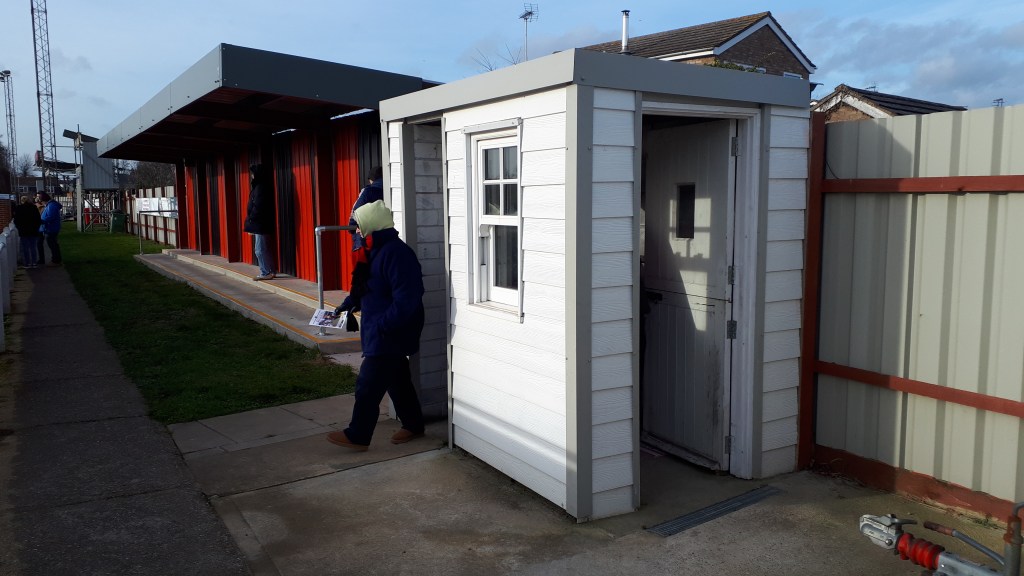
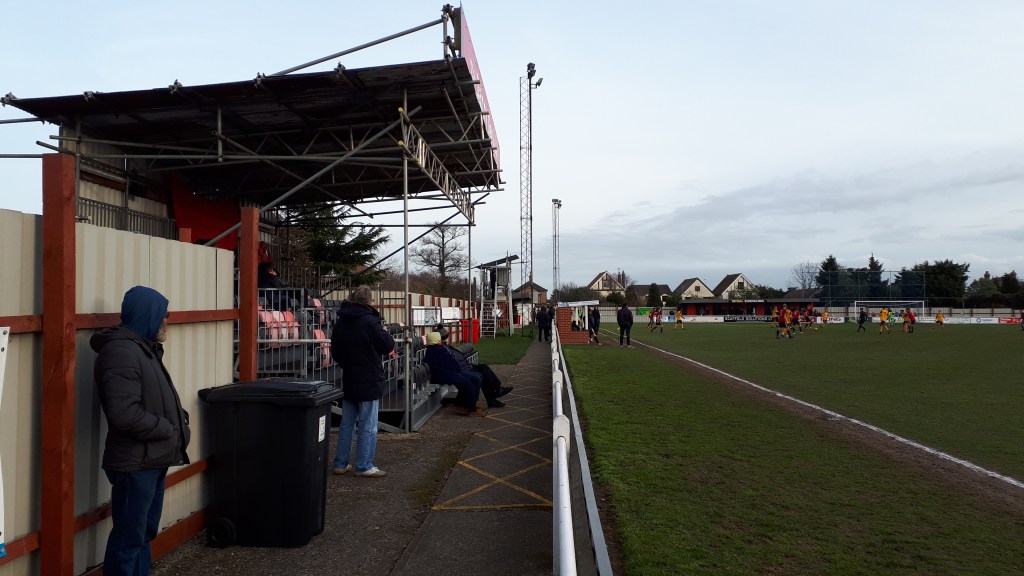
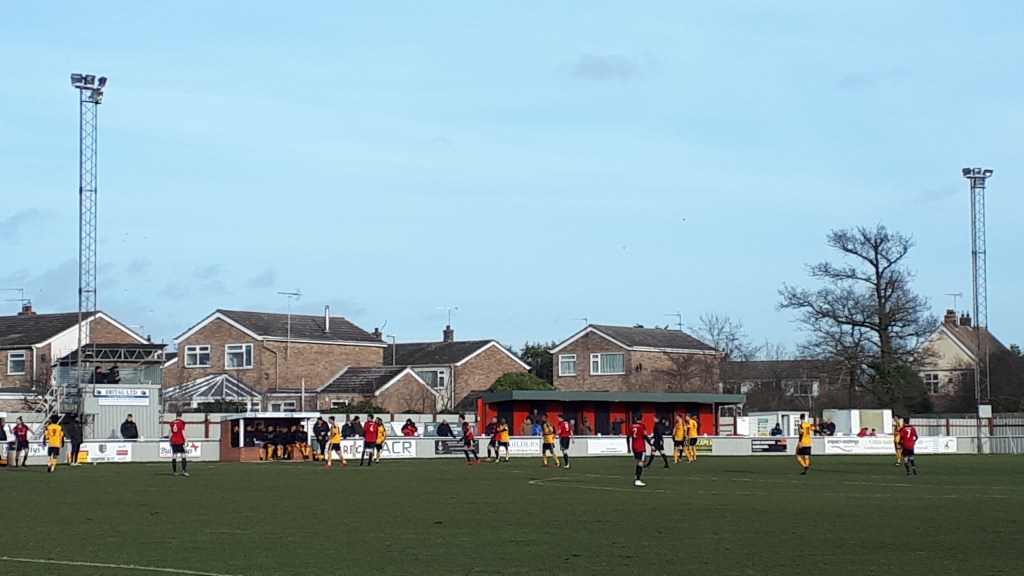
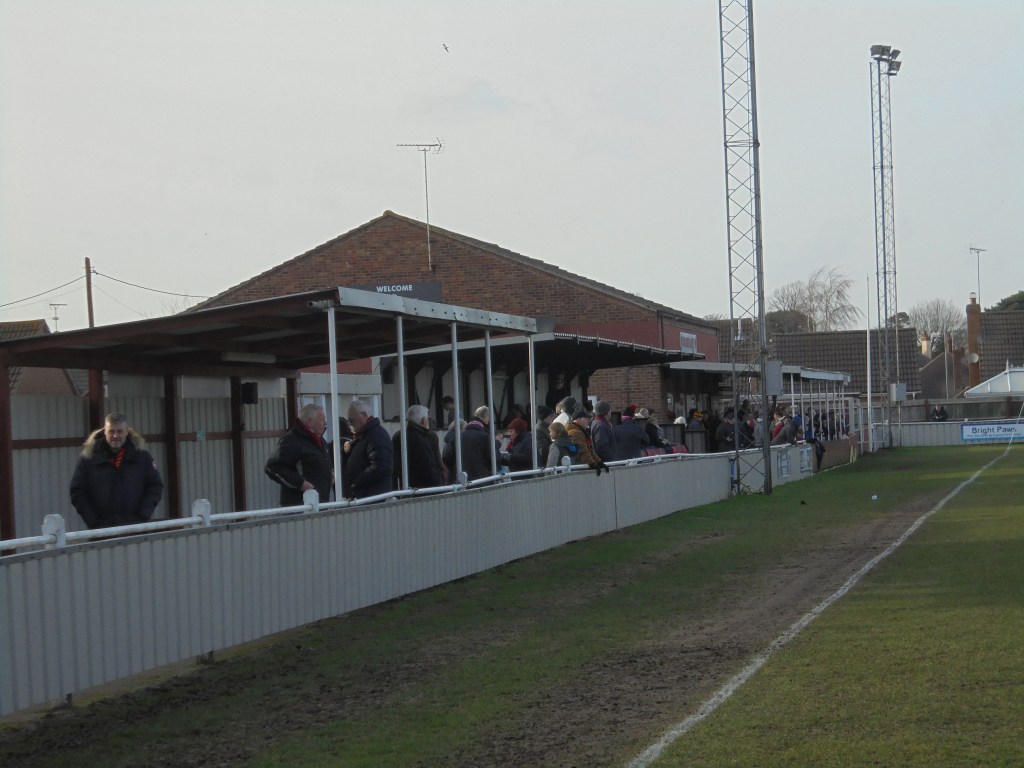
Victory Road is not really an attractive or interesting ground; the clubhouse looks like a massive Council bungalow, there is a small metal terrace stand at one end and opposite the bungalow a row of low metal prefabricated stands join together to create the Leiston Press Stand, in the middle of which sits a large glazed press box. Between the clubhouse and the main turnstile is a ten or fifteen metre terrace which misleadingly looks like a good place to wait for a bus. The setting is altogether a little dull.

This slideshow requires JavaScript.

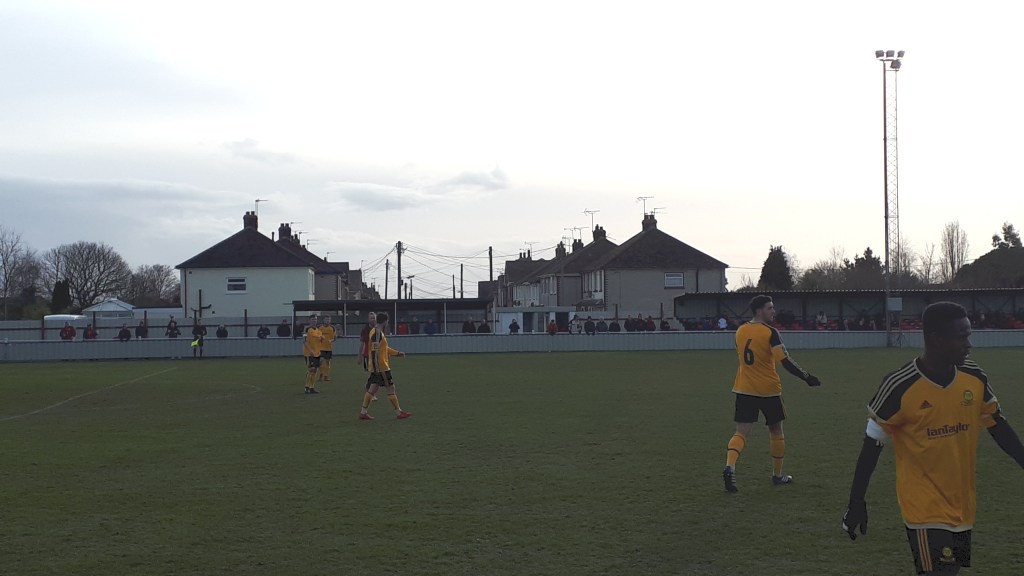
The two teams’ arrival on the pitch brightens things up a bit however, with Leiston all in blue and Rushall Olympic in black and yellow stripes with black shorts and socks, although from behind they’re kit is all-black, so they look like numbered referees. To make matters worse the referee Mr Hancock is also wearing all black, the first of a number of poor decisions he will make this afternoon.
With the multiple handshaking malarkey out of the way, Rushall kick-off in the direction of Aldringham and the metal terrace, the front of which is adorned appropriately with a large advert that reads Screwbolt Fixings. The early stages of the game are rough and shouty with plenty of strength and running on show but not the necessary guile to score a goal. It’s entertaining enough, but is more like all-in wrestling than the working man’s ballet. I stand behind the goal close to four blokes in their sixties; one wears a deerstalker, another wears a ‘Vote Leave’ badge and swears a lot whilst complaining that people don’t know how lucky they are that a little club like Leiston is playing at such a high level, and he’s right because he can’t be wrong about everything. A Rushall player sends a shot high over the cross bar and off towards Aldringham. Everybody jeers, “Three points to Wigan” shouts a grey-haired man.
The game is a struggle, Leiston are having the better of it but neither goalkeeper is exactly rushed off their feet with save-making. The wannabe coaches in the crowd offer their advice “Simple balls man, simple” calls one as the ball is lofted forward hopefully. “Keep it on the deck” shouts another. “Go on Seb” shouts someone else, taking a more OLYMPUS DIGITAL CAMERAone to one approach. As half time nears I head back round towards the giant bungalow so that I can be handily placed for the tea bar when the whistle blows. As I watch on from behind the Leiston bench their number two Matt Rutterford commits a fairly innocuous foul, sidling up behind a Rushall player. Sadly for Leiston, Mr Hancock doesn’t consider that the foul is that innocuous and proceeds to whip out his yellow card in the direction of the unfortunate full-back, who having already seen the card once earlier in the game gets to see Mr Hancock’s red card also. Much wailing and gnashing of teeth ensues and there is a strong feeling that Leiston cannot now possibly win and Mr Hancock has ruined the game more than a few fouls ever could.
As the sun sinks towards the horizon everyone on the bungalow side of the ground has

to shield their eyes. Half-time can’t come soon enough. “How long to go lino?” asks the Rushall manager as the clock ticks past ten to four. “How long would you like?” says a voice from the crowd. With the half-time whistle I go indoors for a pounds worth of tea. Behind me in the queue is a man with white flowing hair and small beard, he looks like Buffalo Bill, but is wearing an Ipswich Town branded coat. “Don’t I know you from Portman Road or from a holiday in Majorca?” asks another man of Bill. “No I don’t think so, I haven’t been on holiday since I was thirty” says Bill. I tell him that his coat is a bit of a giveaway that he might have been to Portman Road. Tea in hand I seek the fresh air outside, and it is fresh. There has been a stingy east wind all afternoon and with the sun going down it’s getting even colder. Happily my tea is warm, but it’s also a bit weak and I suspect Leiston FC are cutting costs on tea bags as well as programmes, but I’m not surprised given the distances they have to travel to games in this very silly league, which stretches from Lowestoft in the east to Stourbridge in the west, a distance of over 330 kilometres.
At six minutes past four Mr Hancock begins the second half and the Screwbolt Fixings terrace is now occupied by about a dozen men, half of whom unexpectedly begin to sing. They go through a variety of chants and tunes including ‘Tom Hark’ and also Neil Diamond’s ‘Sweet Caroline’, betraying that they too may have been to Portman Road. What I like best about the Screwbolt choir is that they are all over forty and half of them are probably over fifty, something they confirm later when substitute Harry Knights comes on and they break into a chorus of Sham 69’s ‘Hurry Up Harry’.
Over by the main stand is a line of Rushall supporters some of whom sport black and gold scarves, like Wolverhampton Wanderers supporters on a day off. I sit for a while at the front of the stand. A Rushall shot hits the cross-bar at the Theberton end of the ground. Mr Hancock makes another dubious decision. “This referee’s from another planet” says a thick West Midland’s accent. Behind us the sky glows a violent red, but nobody panics because Sizewell nuclear power station is in the opposite direction. A man in the stand shouts “Come on Leiston” very enthusiastically; he’s the reporter from BBC Radio Suffolk. A Rushall player goes down “Get up you worm” shouts someone else, not very charitably.
OLYMPUS DIGITAL CAMERAAs darkness shrouds the ground it loses its plainness and takes on a new atmosphere. The long shadows have gone to be replaced by the glow of the floodlights. On the pitch Rushall push forward and Leiston defend; their goalkeeper Marcus Garnham makes a couple of smart saves. Leiston try to catch Rushall on the break with quick, astute passes and diagonal punts but it doesn’t feel as though Leiston or their supporters expect to win, and holding on for the goalless draw will be victory enough, of a sort. The story is a simple one; Leiston must keep Rushall at bay. But there have been injuries and delays and time added on at the end seems interminable. It’s the ninety fifth minute and Marcus Garnham makes a spectacular reaction save, followed quickly by another but before we have time to applaud the ball runs to Rushall substitute Keiron Berry stood just three yards from the open goal, a prod is all that’s needed.
Back behind the goal the Leiston supporter who owns the flag that hangs over theOLYMPUS DIGITAL CAMERA pitchside rail says he’s “had it” with the referee and he’s going home, he starts to untie his flag. Another group of young lads head off too. “Fucking Toby’s fault” says a lad with long curly hair like Marc Bolan “it’s the same every time we come here with him”. The despondent occupants of the Screwbolt Fixings stand shuffle off with Mr Hancock’s final whistle whilst jeering at the Rushall goalkeeper Joseph Slinn, “Cheats” they shout, rather un-sportingly. In return the ‘keeper tells them how much he enjoyed their Neil Diamond song, but such is their disappointment they’re not listening and he was only trying to be friendly.
I head back to my Citroen C3 and catch a glimpse of the Rushall players enjoying a post-match cuddle through the side gate. The result leaves Leiston in fourth place in the Evo-stik Central Premier League, five points behind Kettering Town who are top and six-points ahead of Rushall Olympic. The last time I came to watch Leiston, they lost 3-1 to Gloucester in the FA Cup, I begin to wonder if I’m not a bit like Toby.

This slideshow requires JavaScript.

Halstead Town 2 Fire United 1

Had today’s fixture in the Thurlow Nunn Eastern Counties League Division One South been played at pretty much any time between April 1860 and January 1st 1962 I could have travelled to it by train. However, thanks to the evil Dr Beeching I am making the twenty minute journey to Rosemary Lane Halstead by Citroen C3. It’s not an unpleasant twenty minute drive on a bright, September afternoon along the winding and undulating rural roads of north Essex, through Earl’s Colne with its three pubs and finally down the hill of Halstead’s High Street and over the River Colne, but I can’t help thinking I would have arrived happier if I hadn’t been personally responsible for the burning of fossil fuel and release of carbon monoxide and other noxious gases. If I was Donald Trump I don’t suppose I would give a shit, but he is an ignoramus. There is a bus service via Colchester (Hedingham Omnibus route 88) but I’m 58, so time isn’t on my side.

In Rosemary Lane I reverse between two marks of Ford Fiesta and scrunch across the shingle, Halstead Town’s own beach, to the turnstile where I pay £6 for entry and £1 for a programme. An impatient youth wants to push past me and I tell him to hang on ten seconds until I have my change. Although the car park is full there doesn’t seem to be

OLYMPUS DIGITAL CAMERA

any one much here yet, it’s only twenty-five past two. A man stands at the end of the main stand and copies down names from today’s team sheet, the tea and food bar isn’t open so I take a look inside the club house. A cluster of drinkers stand at the bar and some sit at tables. I consider buying a drink, but there’s no real ale on offer and I can still taste the cup of tea I had before leaving home, so it’s not like I’m thirsty and I never have any real desire for a glass of artificially carbonated beer. I return outside and ‘do’ a circuit of the pitch to the soundtrack of some awful, sub-disco, bland pop playing over the public address system.

OLYMPUS DIGITAL CAMERA

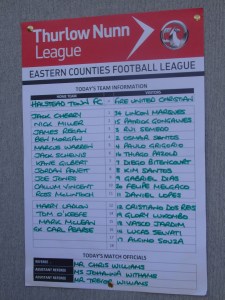
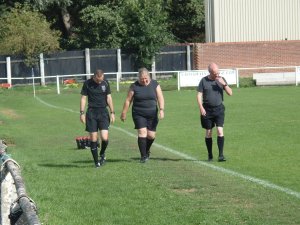
The referee and assistants are warming up; I noticed from the team sheet that the referee and one of his assistants share the surname Williams, and whilst they do stretches against the rail around the pitch I impudently ask if they are related. They are not, but the referee confirms that Messers Arnot, who officiated at the game I saw last week in Harwich are father and son, although they looked like grandfather and grandson to me. Unusually, but less so than in the not too distant past, the other assistant to the referee is a woman, Ms Withams. They form a contrasting threesome, the referee typically neat and fastidious looking, his male assistant older and almost frail in appearance and his female assistant a somewhat full-figured woman.

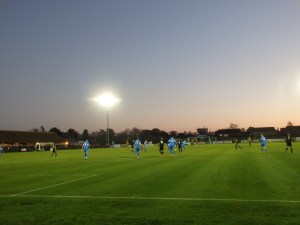
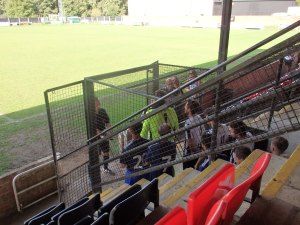
Halstead Town football ground, known for now as the Milbank Stadium, has only one stand, it is plain, a little dark and very utilitarian, but to a football fan it is a thing of beauty, arguably the finest stand in the Eastern Counties League after Great Yarmouth’s, which is a Listed Building. May be Heritage England should be listing buildings like this one; its corrugated pitched roof and steel stanchions are redolent of the 1950’s and it was indeed erected in 1950; its plain, post-war utility makes it a sort of football prefab. Most Football League clubs have already demolished their stands like this; it may be small but it’s perfectly formed.

This slideshow requires JavaScript.

Time ticks away, more spectators arrive, I choose a seat in the main stand and in due

OLYMPUS DIGITAL CAMERA

course the teams appear in the tunnel at the centre of the stand, beneath a metal cage. The programme tells me that Halstead are top of the league having played seven games, but suffered their first defeat of the season in midweek at home to nearby Coggeshall United, not to be confused with Coggeshall Town. Fire United languish in sixteenth place in the nineteen team league having played only four games, they lost the first three but won 4-0 in midweek.

Fire United Christian Football Club (fortunately they don’t use an acronym) are one of a small number of oddities amongst teams in the non-league football pyramid in that they don’t represent a town or geographical location, but rather people who share a common faith and who largely have a Brazilian background. Founded by a Christian ministry in only 2012, the club has progressed quickly into senior football and is made up of mainly Brazilian ex-pats living and working in London. Whilst they are a new club, interestingly Fire United’s Christian foundation echoes the earliest days of organised football in Britain in which many clubs including the likes of Fulham, Everton, Liverpool, Tottenham and Swindon Town all had their nineteenth century roots in local churches. For Fire United’s sake I hope they don’t end up like them.

The teams line up and the announcer receives a round of applause for his thoroughly plausible pronunciations of the Brazilian/Portuguese names of the Fire United team; but perhaps he was ‘speaking in tongues’ (see Acts of the Apostles 19:6). The Halstead Town chairman resplendent in shorts and T-shirt, no show-off club ties and blazers here, makes a presentation to a player (Nick Miller) making his 100th appearance for the club and then referee Mr Chris Williams begins the game. Fire United, wearing a kit of two

OLYMPUS DIGITAL CAMERA

shades of blue kick-off, playing towards the River Colne and small industrial units between the ground and the river. Halstead Town wear black shorts and socks with black and white striped shirts from which they derive their nickname “The Humbugs”, which as nicknames go is one of the very best. More teams should make reference to sweets and confectionary in their nicknames instead of birds and animals. Halstead are playing in the rough direction of the redundant Holy Trinity Church, a Grade II* Listed Building of the 1840’s designed by George Gilbert Scott (architect of the Midland Hotel at St Pancras Station) in the Gothic Revival style and well worth a look if you like such things.

Early on, ⁹Halstead look eager and have the ball at their feet more than Fire United do. It is a Fire United player who commits the first foul and the one after that and their number seven, Diego Bitencourt is the first player to be spoken to by Mr Williams. Bitencourt is a balding, wiry man, greying at the temples and he looks like he could be any age between thirty and fifty; he can play a bit though. Despite Halstead’s early dominance, it is Fire United who earn the first corner and from then on they don’t look back and win a procession of corner kicks as they begin to dominate the match themselves. The Fire United number four Paulo Grigorio fails to make the best of a few headers from corners but it is his team’s play between the penalty areas that is most impressive. Unfortunately, this team of Brazilians are conforming to the stereotype that I thought had lazily earned them the nickname of the Samba Boys. But they do genuinely play a languid, smooth style of passing game. On the left, number eleven Daniel Lopes is quick and dribbles with both feet, and in the middle and everywhere else number twenty Felipe Melgaco flits and energetically dances about with the ball. At the back number three Rui Semedo is in the mould of OGC Nice’s Dante or Olympique Lyon’s Marcelo as he is unafraid to stop and look up, to stand with the ball at his feet, then nicking and dinking it away from on-rushing forwards before passing it again. It seems that even your average group of working or church-going Brazilians can just form a team and quickly make the ranks of English senior football, so superior is their understanding of the game to ours. Latin American rhythm versus boiled sweets.

Halstead have disappeared from the game largely and when in the twenty third minute Fire United take the lead it is thoroughly deserved, although it is an own-goal from Halstead’s number six Jack Schelvis, who diverts a cross after the Halstead defence give the ball away. Having taken the lead, Fire United fail however to build on their advantage. The game is punctuated by injuries; Paul Grigorio goes down and requires

OLYMPUS DIGITAL CAMERA

treatment; the trainer a large man in grey tracky bottoms and polo shirt runs on holding just a can of spray; miraculously it’s enough and Grigorio is soon back on his feet. As half-time draws near Fire United are comfortable, so much so that like Holland in the 1974 World Cup final they perhaps take things a little for granted. A nascent move down the right is stopped and played all the way back to the goalkeeper for no particular reason. Square passes are played between the Fire United defenders and Halstead close them down; the goalkeeper Lincoln Marques scuffs his clearance into touch. Halstead string a few short passes together from the throw and get into the penalty area, Fire United haven’t picked everyone up; a shot is blocked and runs to Joe Jones who has space to send a low shot beneath Marques and give Halstead a barely deserved equaliser with possibly their first shot on target. Within moments it’s half-time.

I wander down to the clubhouse behind the stand. There is an orderly queue for beer at the bar and two giant TV screens flash images brightly but silently on the walls. There is a print of a painting of the ground back in the 1950’s when the railway line still ran behind the end that doesn’t back on to the river, the painting is entitled “Playing to the whistle” proving that football and puns have never been strangers to one another. When I last came here there were some marvellous old photos of long dead Halstead Town teams on the walls but they seem to have gone, which is a shame. Just inside the door to the clubhouse an area is divided off from the main room and a small sign announces that this is the hospitality area. A long table is covered with plates of sandwiches, sausage rolls, cakes and biscuits, some wrapped in silver foil. It looks like a child’s birthday party minus the balloons and a cake. Rows of stackable chairs surround the table, upon which committee members and life members sit with paper plates on their laps. I head outside to the tea bar and invest in a pounds worth of tea.

From the very start of the second half Halstead Town are quicker and more energetic than before and they soon impose themselves on the game through sheer effort. Marques makes good saves from both Jones and Vincent and Jones heads wide when unchallenged. Pavett produces a hard low shot for which Marques throws himself down to his left to push away around the goal post. Fire United bring on a substitute, number eighteen Vasco Jardim, who is large in girth and rivals Humbugs’ number four Ben Morgan and goalkeeper Jack Cherry as the stoutest player on the pitch. Jardim has short legs and amuses several people in the crowd when he falls over spectacularly to claim a free-kick, but is the booked by Mr Williams.

It looks increasingly like Halstead will score again, it is just a question of when, but Fire

OLYMPUS DIGITAL CAMERA

United still create one or two opportunities of their own on the break. I wander around a bit to take in some different views that form the back drop to this game. The fourteenth century church of St Andrew is visible at the top of the hill and behind what is now the Halstead goal, where the railway track once ran a hedge row follows the line of the old embankment; berry laden bushes billowing out in a line like steam from a ghostly locomotive. As the sun begins to

OLYMPUS DIGITAL CAMERA

sink in the west, the shadows of trees envelope one corner of the ground in dappled shade.

I return to the main stand. Fire United’s Daniel Lopes shoots over an empty goal as Gabriel Dias and Jack Cherry collide, and after receiving treatment from the coach’s spray can, Dias is then substituted for number nineteen Glory Lukombo. “ What a great name” says a bloke behind me and I can’t disagree. The Mr Williams holding a flag has to defend not giving an offside decision against Halstead and seems to be talking to himself as he runs back up the line. Then Halstead score. Number eight Jordan Pavett chips a perfect pass over the Fire United defence onto which Callum Vincent runs before placing the ball beyond Marques with what could accurately be called aplomb. Purely on their second half performance Halstead probably deserve it, but as a naturally lazy person I am slightly disappointed that effort and hard work has seemingly won out over strolling about stylishly.

It’s not long before Mr Williams blows his whistle for the final time and with it an appreciative crowd of ninety-three make their respective ways back into the clubhouse or out into the car park and down Rosemary Lane. I and a few others wait a short while to applaud Fire United from the field, before I head back to my Citroen and the journey home.