Ipswich Town 0 Swansea City 1


Despite being fortunate enough to grow up and go to school in Suffolk, I was born in Haverfordwest in Pembrokeshire, Wales, where I lived until I was a few months old and my parents moved to my mother’s home village of Shotley  and took me and my sister with them, like the good parents that they were.  The nearest Football League club to Haverfordwest is Swansea City, (still Swansea Town when I was born) and there is an argument that says I might follow their fortunes, but I don’t.  The dual nationality comes in handy when Wales do well in the rugby and I like leeks,  cheese on toast, Ivor the Engine, Sgorio  and daffodils; but that’s as Welsh as I am see.  I wouldn’t normally mention it but today Town play Swansea City, and I’ve written this first paragraph in a Welsh accent. 
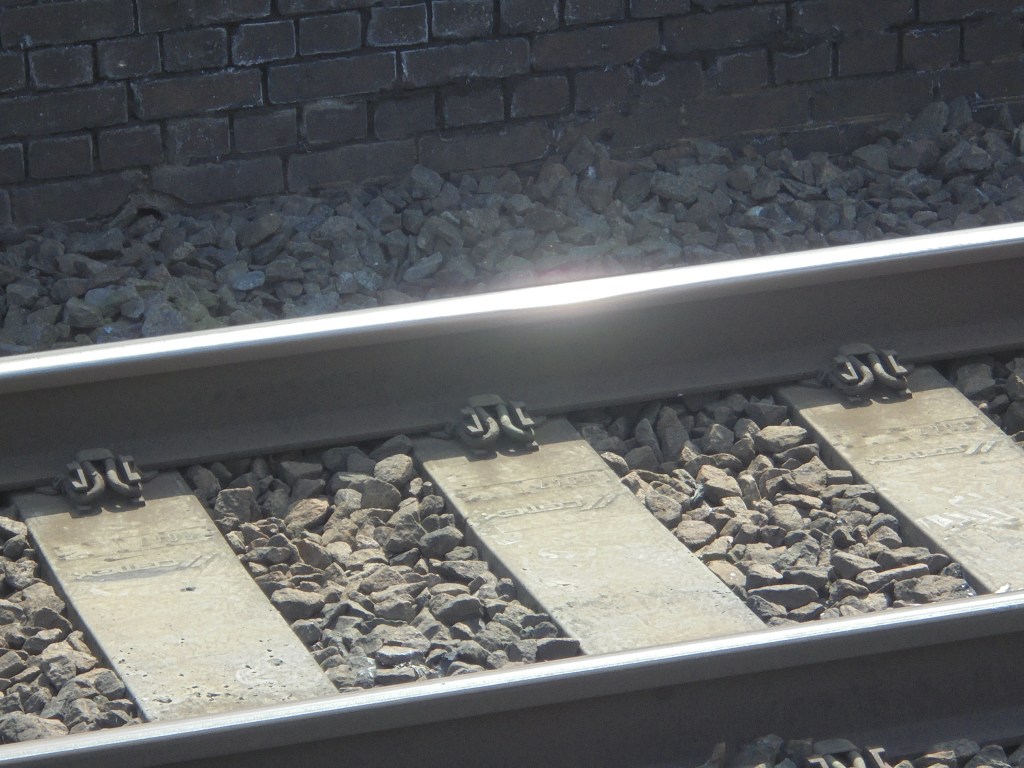
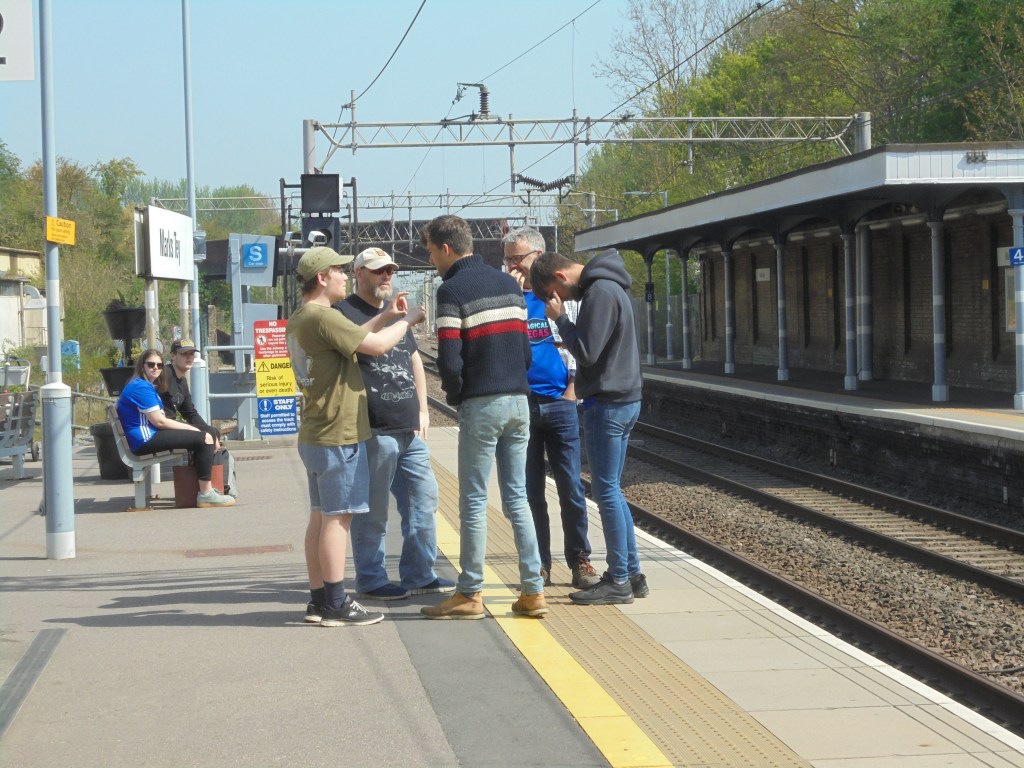
At the railway station it’s another gloriously warm, cloudless day and sunlight glints off the tracks.  The only travellers are all bound for Ipswich and the match; the train is on time.  The carriage is sparsely populated and I share it with a hard looking woman and two young children, a girl and a boy.  As the train arrives into Colchester she scolds them in a harsh voice that sounds like a man’s. “Drake, McKenna get away from the door”.  I can’t help but derive amusement from the names of children nowadays, it’s my age.  The children seem almost to roll their eyes as she speaks.  Pleasingly they leave the train at Colchester and twenty five minutes later I arrive peacefully in Ipswich.
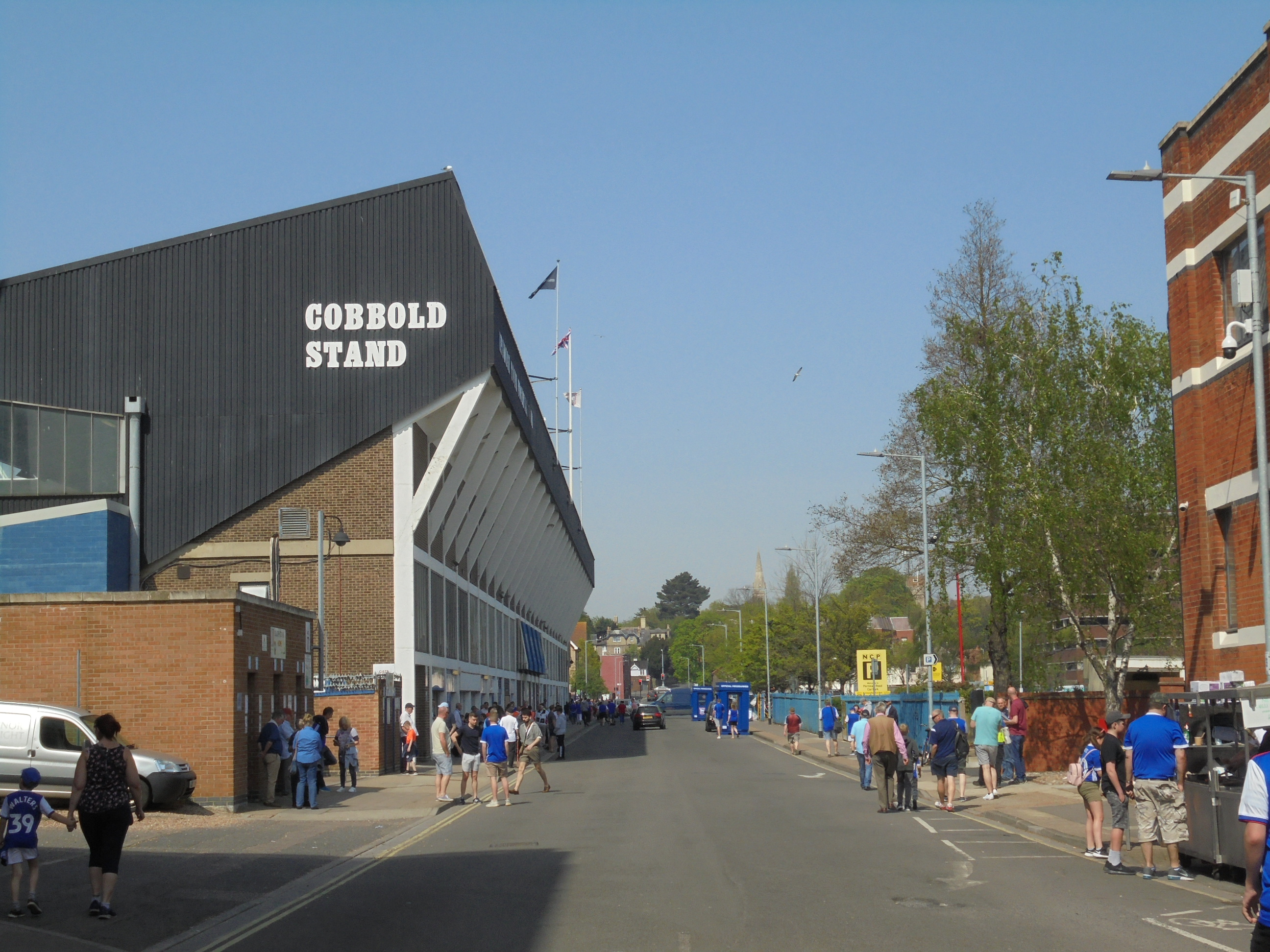
Ipswich is best under a blue sky and everything is beautiful as I walk up Princes Street and past the peeling paint of Portman Road with its ragged club flag to St Jude’s Tavern, which is dingy and the customers are reassuringly as old and ugly as ever. I order a pint of the Match Day Special (£2.50)  Nethergate Venture.  At the bar I meet Kev’ who I know from my days with Wivenhoe Town.  Kev’ is wearing a dark flat cap which in the gloom of St Jude’s looks like a beret.  I am wearing my “Allez les bleus” T-shirt today and tell him I thought the French had come to take me “home” to where I imagine I belong  –  that’s France, not Wales.   I sit with the regular old gits who assemble here on match days.  I talk to one of them (Phil) about statues of footballers and tell him that even Carlisle United has one, although I can’t remember who it is a statue of. Phil suggests it’s not a footballer but one of the Hairy Bikers because he knows one of them is from Cumbria.  I tell him the Hairy Biker he’s thinking of is from Barrow In Furness, where the nuclear submarines come from.  I drain my glass and fetch a pint of Butcomb Gold (£3.60), which seems livelier than the Venture even though I can’t help thinking Butcomb might be a West Country word for anus.

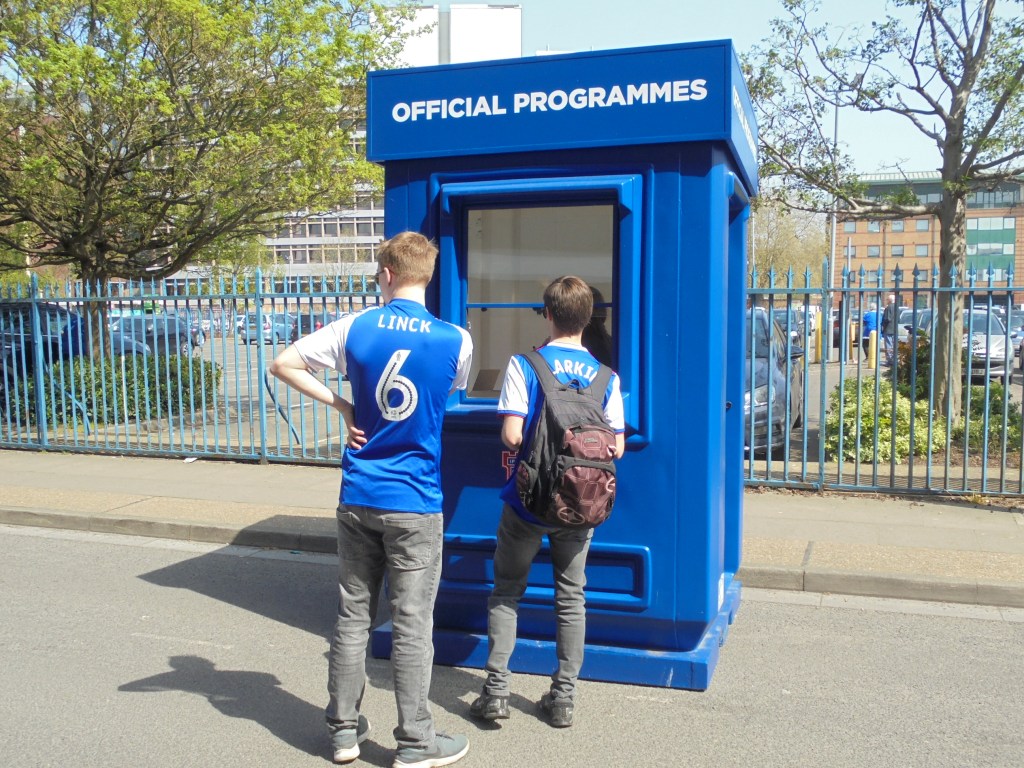
With the big hand heading up the clock face towards the figure eight, the pub empties and carried on a gentle human tide I soon find myself back in Portman Road.  A selection of people are hawking copies of the Turnstile Blue fanzine where Portman Road meets Sir Alf Ramsey Way and I buy one (£1);  it’s issue 20 and it’s much like the previous nineteen in its tone, but it’s nice when things are familiar.  Unusually there are queues to get into the Sir Alf Ramsey Stand; not because of weight of numbers but because not all the turnstiles are open.  Nevertheless, despite my desire to be French I like a good queue to get in the ground; it carries a faint hint of the ‘big match’ atmosphere, which is the best 17,247 people can really hope for in a 30,000 seat stadium.  I enter turnstile number seven and wish the bespectacled female operator a happy Easter as she returns my freshly scanned season ticket card to me.  She looks up, surprised as if she’d forgotten about the resurrection.
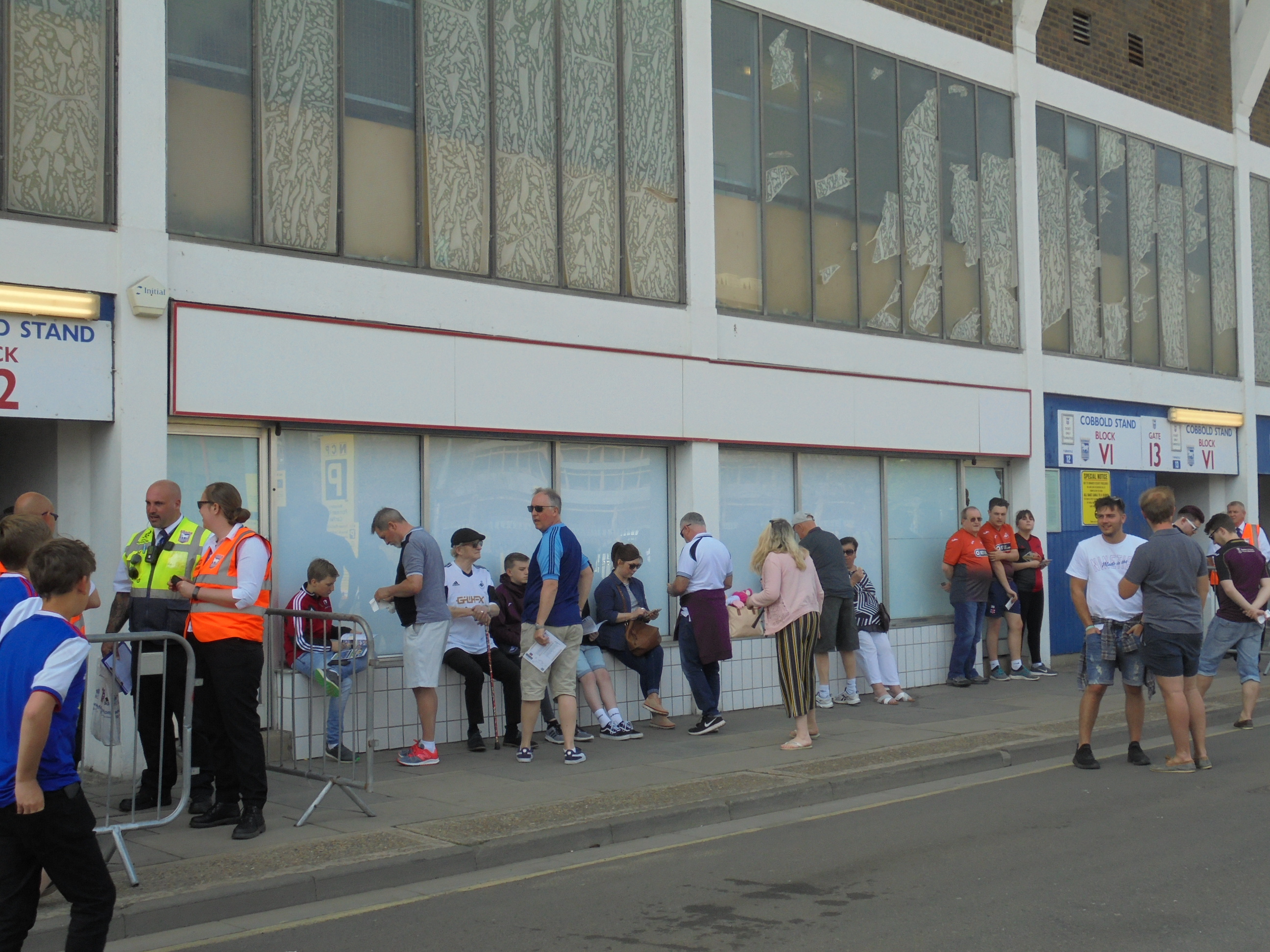
Bladder drained, I occupy a seat near ever-present Phil who never misses a game and just along from Pat from Clacton.  Pat is fed up because a large man in a red hat is sat directly in front of her today and she’s only short; whichever way she looks a big red head is in her field of vision.  We sit and wait for the teams to appear from the tunnel.   

Town have been officially relegated for over a week now and today’s match is amongst the most pointless they have ever played, childishly I live in the hope that  they will therefore treat it as a bit of fun, a bit like testimonial games  are supposed to be.  Would anyone be bothered if the two teams each agreed to play a 2-3-5 formation?   I am not optimistic for this however as professional football tends to take itself much too seriously, like many of the fans, as the drivel that appears on social media testifies.   The teams are announced and my hopes of football for fun are dashed. 

The flags of tiny mascots and larger furry mascots sway to an amplified soundtrack of swirling music giving an undeserved aura of grandeur to the two teams as they walk out for this meaningless encounter, but I stand and applaud nevertheless, swept up with the lie that this match is bigger than really it is. As the game begins the noise level simmers down and a degree of reality returns. Town are hopefully aiming at the goal just to the left of me, ever-present Phil and Pat from Clacton; they inevitably wear blue and white shirts adorned with the unwelcome red adidas stripes and that nasty sponsors’ logo. In crisp white shorts and black shorts Swansea look like Germany, they are the Teutonic Taffies.

“One Dylan Thomas, There’s only one Dylan Thomas” sing the male voice choir from Swansea from the top corner of the Cobbold Stand, or perhaps they don’t. A serious looking steward collects blue and white balloons that have drifted from the stand, thereby  suppressing someone’s expression of joy; no doubt the balloons had strayed dangerously close to the pitch. I like to think that as part of the club’s Community programme the balloons will later be released at the birthday parties of deprived children. Next to me Pat from Clacton continues to glower at the big red hat on the big head of the big man sitting in front of her. On the touchline Paul Lambert is celebrating Easter with a new jumper, a grey one, an infinite number of shades lighter than his usual black one, and people still accuse Scots of being dour.

On the pitch referee Mr Darren England, which seems a good name for a football referee, makes himself unpopular with the home support by seemingly giving fouls against Ipswich players and not Swansea ones.  “You’re not fit to referee Subbuteo, you tiny little bugger” bawls an incensed voice from somewhere behind me, failing to notice that being tiny is actually one of the main requirements of being a Subbuteo referee along with being made from brittle plastic and glued into a circular base.   The game is rather boring and Swansea are hogging the ball; like every other club that has been to Portman Road this season, they have the better players. into the Swansea penalty area and wins a corner. Will Keane misses a header and scuffs the ball against a post, the ball bounces about like it’s made of rubber bands before Trevoh Chalobah sends it flying past the other post into the stand.  Sixty seconds later, give or take, another corner is won and Toto N’siala heads Alan Judge’s kick solidly over the cross bar. The supporters behind the goal are getting almost as much possession of the ball as Andre Dozzell.  Pat and I are breathless at the sudden burst of attacking football from Town and are glad for the rest that half-time soon brings.

I use the facilities beneath the stand, eat a Panda brand liquorice stick and catch up on the half-time scores.  A young man in a shirt and tie and smart trousers compliments me on my ‘Allez les Bleus’ T-shirt, “Cool T-shirt” he says brightly. He’s not wrong.  The match stats on the TV screen above the concourse are blatantly wrong however, claiming Ipswich have had eight shots to Swansea’s six; it’s as if the stats are being reported by Donald Trump or the Brexit campaign.  I return to the stand to talk to Ray who confesses to being underwhelmed by the first half.

At six minutes past four the game resumes.  I laugh when Gwion Edwards stretches to head the ball by the touchline then tumbles out of sight over the perimeter wall; “well for me” to quote Mick Channon, it’s the best move of the match so far.  Happily, Gwion quickly bounces back up and plays on, but that’s the sort of entertainment end of season games need.  Minutes later Dean Gerken makes a  quite spectacular low,  diving, ‘finger-tip save’ from a Daniel James shot before the very tiny, thirty-four year old Wayne Routledge, whose shorts almost reach his calves, runs the ball over the goal line and is met with jeers and guffaws from the appreciative crowd in the Sir Alf Ramsey Stand.   But Wayne has a friend in fate today and within a few minutes a shot rebounds off Town’s right hand post and straight onto the turf in front of Wayne who is quick enough not to miss an open goal and Swansea are winning.

The attendance is announced as 17,247 with 557 of those being from Swansea; Collin Quaner and Kayden Jackson replace Andre Dozzell and Will Keane.  Wayne Routledge is replaced by Nathan Dyer.  “I can’t believe we’re losing again” says Pat from Clacton.  I make a sympathetic humming noise in reply, I couldn’t think of any proper words to say.   Behind Pat sit two large middle aged women. “We don’t really get the sun here, do we” says one obviously engrossed in the game, before adding “Coronation Street’s on tonight”.

Town struggle to equalise and Pat and I are a little despondent, “I don’t really enjoy coming here anymore” she says “It’s not like it used to be”.  We are Ipswich’s spoilt generation who remember the 1970’s and early 1980’s.  But Pat is already planning to renew her season ticket and might get one for her young niece too.   Of course, I am going to renew mine as well, as will ever-present Phil who never misses game; I’m looking forward to the big discount when the other 13, 996 sign up.  Pat takes a photograph using the 20x zoom lens on her compact Sony camera and picks out her brother stood in the North Stand, it’s one of the most impressive things I’ve seen all afternoon. 

Time drifts by under a hazy blue sky and at last the stadium clock turns nine minutes to five.  It’s been a disappointing hour and a half of football and to add insult to injury we are forced to sit through six minutes of time added on; as if relegation wasn’t bad enough we are now all in detention.  Hopes are raised with a last minute corner and Dean Gerken leaves his goal to join in the penalty area melee at the far end; I stand up and lurch forward as if to join him too, but realise just  in time that that sort of commitment is generally frowned upon nowadays.  Little Alan Judge’s corner kick is poorly judged and sails away over everyone’s heads anyway.  Finally Mr Darren England makes a belated and vain bid for popularity by blowing the final whistle.

Normally the team does a lap of honour or appreciation around the pitch after the last game of the season, but because the last game of this season will be against Leeds United, that lap is occurring today.  Having been relegated, the Town players don’t want thousands of oafish Yorkshireman flicking v’s at the them and screaming at  them from the Cobbold Stand to “Fuck Off” as they wander round clutching assorted  babies and toddlers and waving nicely.   The players re-emerge from the tunnel without delay and I slavishly applaud as they drift by beyond a wall of stewards; within a couple of minutes I go home for my tea.
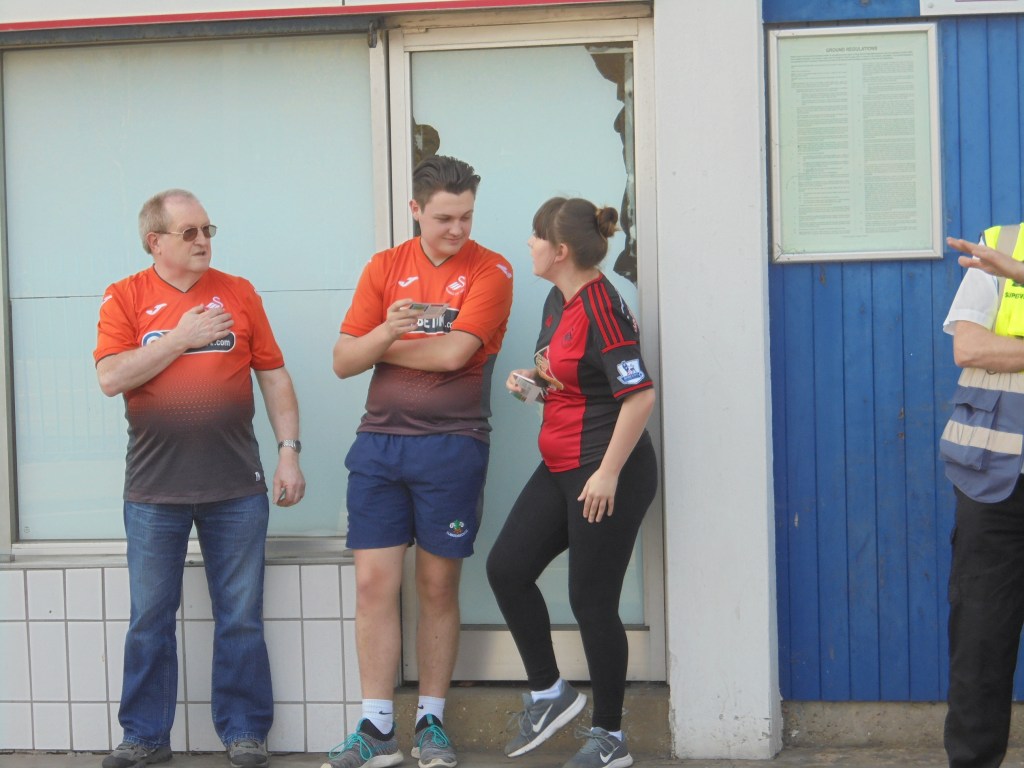
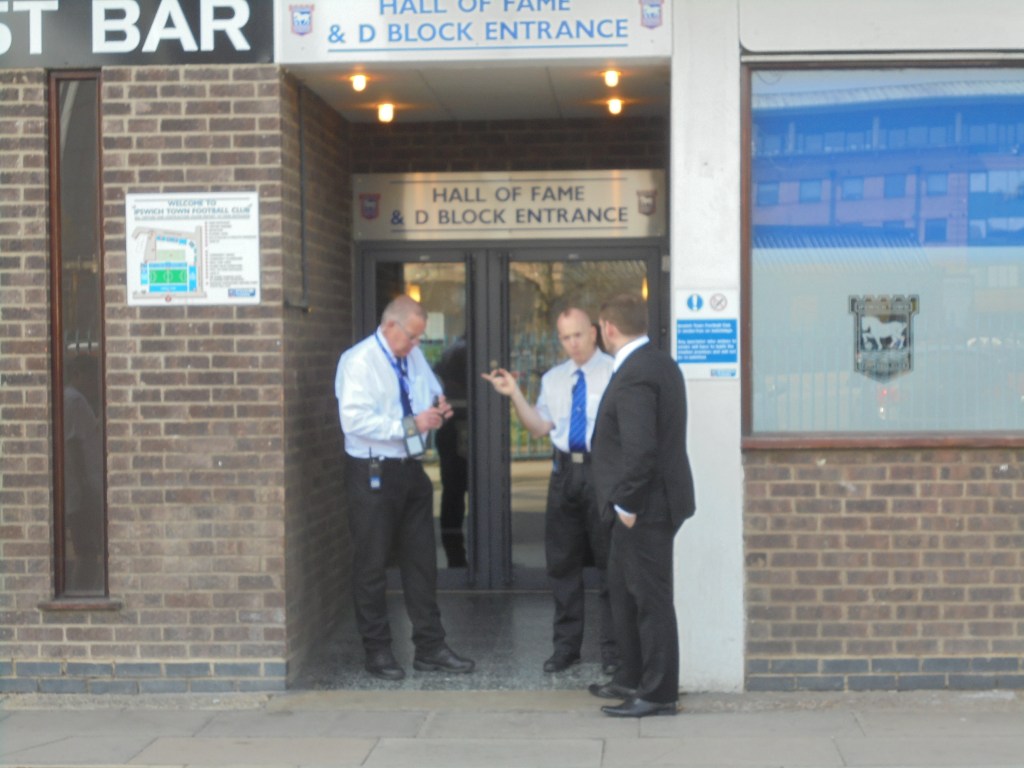
Halstead Town 2 Fire United 1

Had today’s fixture in the Thurlow Nunn Eastern Counties League Division One South been played at pretty much any time between April 1860 and January 1st 1962 I could have travelled to it by train. However, thanks to the evil Dr Beeching I am making the twenty minute journey to Rosemary Lane Halstead by Citroen C3. It’s not an unpleasant twenty minute drive on a bright, September afternoon along the winding and undulating rural roads of north Essex, through Earl’s Colne with its three pubs and finally down the hill of Halstead’s High Street and over the River Colne, but I can’t help thinking I would have arrived happier if I hadn’t been personally responsible for the burning of fossil fuel and release of carbon monoxide and other noxious gases. If I was Donald Trump I don’t suppose I would give a shit, but he is an ignoramus. There is a bus service via Colchester (Hedingham Omnibus route 88) but I’m 58, so time isn’t on my side.

In Rosemary Lane I reverse between two marks of Ford Fiesta and scrunch across the shingle, Halstead Town’s own beach, to the turnstile where I pay £6 for entry and £1 for a programme. An impatient youth wants to push past me and I tell him to hang on ten seconds until I have my change. Although the car park is full there doesn’t seem to be

OLYMPUS DIGITAL CAMERA

any one much here yet, it’s only twenty-five past two. A man stands at the end of the main stand and copies down names from today’s team sheet, the tea and food bar isn’t open so I take a look inside the club house. A cluster of drinkers stand at the bar and some sit at tables. I consider buying a drink, but there’s no real ale on offer and I can still taste the cup of tea I had before leaving home, so it’s not like I’m thirsty and I never have any real desire for a glass of artificially carbonated beer. I return outside and ‘do’ a circuit of the pitch to the soundtrack of some awful, sub-disco, bland pop playing over the public address system.

OLYMPUS DIGITAL CAMERA

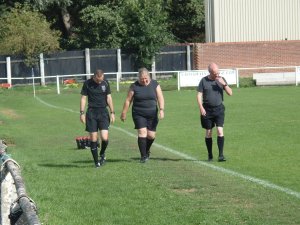
The referee and assistants are warming up; I noticed from the team sheet that the referee and one of his assistants share the surname Williams, and whilst they do stretches against the rail around the pitch I impudently ask if they are related. They are not, but the referee confirms that Messers Arnot, who officiated at the game I saw last week in Harwich are father and son, although they looked like grandfather and grandson to me. Unusually, but less so than in the not too distant past, the other assistant to the referee is a woman, Ms Withams. They form a contrasting threesome, the referee typically neat and fastidious looking, his male assistant older and almost frail in appearance and his female assistant a somewhat full-figured woman.

Halstead Town football ground, known for now as the Milbank Stadium, has only one stand, it is plain, a little dark and very utilitarian, but to a football fan it is a thing of beauty, arguably the finest stand in the Eastern Counties League after Great Yarmouth’s, which is a Listed Building. May be Heritage England should be listing buildings like this one; its corrugated pitched roof and steel stanchions are redolent of the 1950’s and it was indeed erected in 1950; its plain, post-war utility makes it a sort of football prefab. Most Football League clubs have already demolished their stands like this; it may be small but it’s perfectly formed.

This slideshow requires JavaScript.

Time ticks away, more spectators arrive, I choose a seat in the main stand and in due

OLYMPUS DIGITAL CAMERA

course the teams appear in the tunnel at the centre of the stand, beneath a metal cage. The programme tells me that Halstead are top of the league having played seven games, but suffered their first defeat of the season in midweek at home to nearby Coggeshall United, not to be confused with Coggeshall Town. Fire United languish in sixteenth place in the nineteen team league having played only four games, they lost the first three but won 4-0 in midweek.

Fire United Christian Football Club (fortunately they don’t use an acronym) are one of a small number of oddities amongst teams in the non-league football pyramid in that they don’t represent a town or geographical location, but rather people who share a common faith and who largely have a Brazilian background. Founded by a Christian ministry in only 2012, the club has progressed quickly into senior football and is made up of mainly Brazilian ex-pats living and working in London. Whilst they are a new club, interestingly Fire United’s Christian foundation echoes the earliest days of organised football in Britain in which many clubs including the likes of Fulham, Everton, Liverpool, Tottenham and Swindon Town all had their nineteenth century roots in local churches. For Fire United’s sake I hope they don’t end up like them.

The teams line up and the announcer receives a round of applause for his thoroughly plausible pronunciations of the Brazilian/Portuguese names of the Fire United team; but perhaps he was ‘speaking in tongues’ (see Acts of the Apostles 19:6). The Halstead Town chairman resplendent in shorts and T-shirt, no show-off club ties and blazers here, makes a presentation to a player (Nick Miller) making his 100th appearance for the club and then referee Mr Chris Williams begins the game. Fire United, wearing a kit of two

OLYMPUS DIGITAL CAMERA

shades of blue kick-off, playing towards the River Colne and small industrial units between the ground and the river. Halstead Town wear black shorts and socks with black and white striped shirts from which they derive their nickname “The Humbugs”, which as nicknames go is one of the very best. More teams should make reference to sweets and confectionary in their nicknames instead of birds and animals. Halstead are playing in the rough direction of the redundant Holy Trinity Church, a Grade II* Listed Building of the 1840’s designed by George Gilbert Scott (architect of the Midland Hotel at St Pancras Station) in the Gothic Revival style and well worth a look if you like such things.

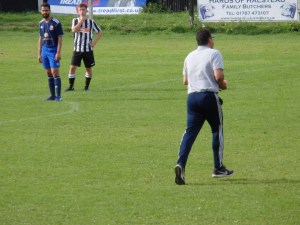
Early on, ⁹Halstead look eager and have the ball at their feet more than Fire United do. It is a Fire United player who commits the first foul and the one after that and their number seven, Diego Bitencourt is the first player to be spoken to by Mr Williams. Bitencourt is a balding, wiry man, greying at the temples and he looks like he could be any age between thirty and fifty; he can play a bit though. Despite Halstead’s early dominance, it is Fire United who earn the first corner and from then on they don’t look back and win a procession of corner kicks as they begin to dominate the match themselves. The Fire United number four Paulo Grigorio fails to make the best of a few headers from corners but it is his team’s play between the penalty areas that is most impressive. Unfortunately, this team of Brazilians are conforming to the stereotype that I thought had lazily earned them the nickname of the Samba Boys. But they do genuinely play a languid, smooth style of passing game. On the left, number eleven Daniel Lopes is quick and dribbles with both feet, and in the middle and everywhere else number twenty Felipe Melgaco flits and energetically dances about with the ball. At the back number three Rui Semedo is in the mould of OGC Nice’s Dante or Olympique Lyon’s Marcelo as he is unafraid to stop and look up, to stand with the ball at his feet, then nicking and dinking it away from on-rushing forwards before passing it again. It seems that even your average group of working or church-going Brazilians can just form a team and quickly make the ranks of English senior football, so superior is their understanding of the game to ours. Latin American rhythm versus boiled sweets.

Halstead have disappeared from the game largely and when in the twenty third minute Fire United take the lead it is thoroughly deserved, although it is an own-goal from Halstead’s number six Jack Schelvis, who diverts a cross after the Halstead defence give the ball away. Having taken the lead, Fire United fail however to build on their advantage. The game is punctuated by injuries; Paul Grigorio goes down and requires

OLYMPUS DIGITAL CAMERA

treatment; the trainer a large man in grey tracky bottoms and polo shirt runs on holding just a can of spray; miraculously it’s enough and Grigorio is soon back on his feet. As half-time draws near Fire United are comfortable, so much so that like Holland in the 1974 World Cup final they perhaps take things a little for granted. A nascent move down the right is stopped and played all the way back to the goalkeeper for no particular reason. Square passes are played between the Fire United defenders and Halstead close them down; the goalkeeper Lincoln Marques scuffs his clearance into touch. Halstead string a few short passes together from the throw and get into the penalty area, Fire United haven’t picked everyone up; a shot is blocked and runs to Joe Jones who has space to send a low shot beneath Marques and give Halstead a barely deserved equaliser with possibly their first shot on target. Within moments it’s half-time.

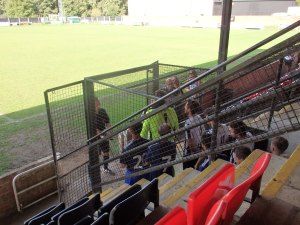
I wander down to the clubhouse behind the stand. There is an orderly queue for beer at the bar and two giant TV screens flash images brightly but silently on the walls. There is a print of a painting of the ground back in the 1950’s when the railway line still ran behind the end that doesn’t back on to the river, the painting is entitled “Playing to the whistle” proving that football and puns have never been strangers to one another. When I last came here there were some marvellous old photos of long dead Halstead Town teams on the walls but they seem to have gone, which is a shame. Just inside the door to the clubhouse an area is divided off from the main room and a small sign announces that this is the hospitality area. A long table is covered with plates of sandwiches, sausage rolls, cakes and biscuits, some wrapped in silver foil. It looks like a child’s birthday party minus the balloons and a cake. Rows of stackable chairs surround the table, upon which committee members and life members sit with paper plates on their laps. I head outside to the tea bar and invest in a pounds worth of tea.

From the very start of the second half Halstead Town are quicker and more energetic than before and they soon impose themselves on the game through sheer effort. Marques makes good saves from both Jones and Vincent and Jones heads wide when unchallenged. Pavett produces a hard low shot for which Marques throws himself down to his left to push away around the goal post. Fire United bring on a substitute, number eighteen Vasco Jardim, who is large in girth and rivals Humbugs’ number four Ben Morgan and goalkeeper Jack Cherry as the stoutest player on the pitch. Jardim has short legs and amuses several people in the crowd when he falls over spectacularly to claim a free-kick, but is the booked by Mr Williams.

It looks increasingly like Halstead will score again, it is just a question of when, but Fire

OLYMPUS DIGITAL CAMERA

United still create one or two opportunities of their own on the break. I wander around a bit to take in some different views that form the back drop to this game. The fourteenth century church of St Andrew is visible at the top of the hill and behind what is now the Halstead goal, where the railway track once ran a hedge row follows the line of the old embankment; berry laden bushes billowing out in a line like steam from a ghostly locomotive. As the sun begins to

OLYMPUS DIGITAL CAMERA

sink in the west, the shadows of trees envelope one corner of the ground in dappled shade.

I return to the main stand. Fire United’s Daniel Lopes shoots over an empty goal as Gabriel Dias and Jack Cherry collide, and after receiving treatment from the coach’s spray can, Dias is then substituted for number nineteen Glory Lukombo. “ What a great name” says a bloke behind me and I can’t disagree. The Mr Williams holding a flag has to defend not giving an offside decision against Halstead and seems to be talking to himself as he runs back up the line. Then Halstead score. Number eight Jordan Pavett chips a perfect pass over the Fire United defence onto which Callum Vincent runs before placing the ball beyond Marques with what could accurately be called aplomb. Purely on their second half performance Halstead probably deserve it, but as a naturally lazy person I am slightly disappointed that effort and hard work has seemingly won out over strolling about stylishly.

It’s not long before Mr Williams blows his whistle for the final time and with it an appreciative crowd of ninety-three make their respective ways back into the clubhouse or out into the car park and down Rosemary Lane. I and a few others wait a short while to applaud Fire United from the field, before I head back to my Citroen and the journey home.

Paris St Germain 2 Les Herbiers 0

For an Ipswich Town supporter FA Cup ties have become something of a rarity, and more than that, a disappointment. Despite winning the FA Cup itself, albeit forty years ago, (incidentally, only thirty-six of the current ninety-two league clubs have ever won the Cup, and Norwich City are not one of them) Town have failed to honour their past and have not even won an FA Cup tie since 2010, when they triumphed away at Blackpool. Starved of cup glory therefore, the opportunity to go to the final of the French equivalent of the FA Cup, the Coupe de France, is not to be missed. This year the final tie is between the current holders Paris St Germain and Vendee Les Herbiers Football (VHF) a semi-professional team who currently play in the Ligue National, the third tier of French league football. Francophile that I am I ‘signed up’ for e-mails from the Federation Football Française (French Football Association) a couple of seasons ago and my wife, who I shall introduce to you by name shortly is on Paris St Germain’s e-mailing list, so we both received invitations by e-mail to buy tickets for the final. For just 19 Euros each, yes, 19 Euros, about £16.50, we have tickets at the Stade de France for the show piece, end of season finale. I have paid more this season to watch Colchester United versus Morecambe.
My wife, Paulene and I arrived in St Denis in the north of Paris at lunchtime and from

OLYMPUS DIGITAL CAMERA
Basilica St Denis

our hotel room at the Novotel it is possible to see the Stade de France in one direction and in the other the Basilica Cathedral of St Denis, where nearly 1,600 years-worth of French kings and queens including Clovis, Dagobert, Catherine de Medici, Louis XIV, Louis XVI and Marie Antoinette were all buried. As if that is not enough this is considered to be the building where in the twelfth century all the elements that make up Gothic architecture were brought together for the first time; it is a most beautiful building of remarkable historic significance.

After a leisurely visit and a picnic in the nearby Parc de Legion d’Honneur we rest up back at the hotel before making the short walk to the Stade de France. In the hotel lobby Les Herbiers supporters are checking in and making use of the bar.
Today is the May 8th, a national holiday in France marking the liberation of the country from the Nazis in 1945; it is a glorious sunny day with temperatures up in the mid-twenties; one digital display says the temperature is 35 degrees but I’m not sure I believe it. Our approach to the Stade de France is at the end of the stadium where there is a sea of Les Herbiers supporters of all ages dressed up in red and white. Les Herbiers is just a small town with a population of about 16,000 situated in the Vendee department, some 50 kilometres south east of Nantes and almost a four hour journey by road from Paris. Today Les Herbiers and a good few places all around it must be completely empty.
Last night on French TV sports journalists were debating whether this cup final between Paris St Germain, with an annual budget of 340 million Euros, and a semi-professional third division team with an annual budget of 2 million Euros was a good thing or not. Seeing the excitement and joy on the faces of the Les Herbiers supporters leaves me in no doubt that it is a good thing. It does not matter that it is the final and it is a mis-match. Paris St Germain will win because they now win everything, but it will still be the show piece event of the season and both sets of supporters will love every minute of it; also in the scheme of things it doesn’t matter much because there will be another cup final next year, and another the year after that, provided Donald Trump hasn’t finally caused Armageddon.
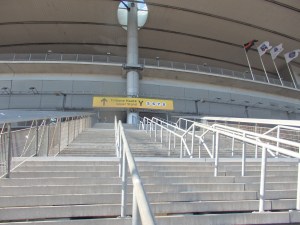
Security at all the bigger French football matches is reassuringly tight and once patted down we head up the ramp to the concourse that surrounds the Stade de France, a stadium that feels much more spacious and is much more beautiful than Wembley, although it is now twenty years old. Unable to resist acquiring souvenirs of the day, I buy myself a T-shirt (20 Euros) and Paulene a scarf (20 Euros) for which Paulene also learns the French, which is écharpe. There is a while to go before kick-off at five past nine so I get into the spirit of things joining the Les Herbiers supporters with a pint of Carlsberg (8 Euros), the price of which makes me feel that the T-shirt and scarf were massive bargains and I should buy more of them, but I don’t. The beer comes in a re-usable plastic “eco-cup” (2 Euros) of a type seen at many French stadiums and makes me feel much better in the knowledge that even though I have been robbed blind I am helping save the planet. Paulene has a bottle of water (3 Euros).
Paulene is keen to get in the stadium to watch the warm ups and pre-match

OLYMPUS DIGITAL CAMERA

entertainment and because she is a chronic asthmatic and will need to recover from the long climb to our seats. For Paulene visits to large stadiums such as Marseille’s Velodrome and the Stade Felix Boleart in Lens have in the past come with near death experiences after ascending staircase after staircase after staircase on a sort of stairway to Heaven. Whilst Paulene climbs, I callously hang around outside, slowly drinking my beer, savouring it as best I can and soaking up the ambiance with smiling, excited and inebriated French people. Eventually I head for the turnstile where I must show both my ticket and passport, the French show their identity cards. The steward seems pleased to see a “Rosbif “ and summons up his best English to say “Welcome”, which is nice. Inside the stadium I am patted down again and wished bon match before being offered a complimentary Pitch choco barre courtesy of a promotion by Brioche Pasquier an industrial French bakery whose products can be found in English supermarkets too.
Our seats are in the third tier of the stadium but are not together, Paulene sits in the second row from the front whilst I am another three or four rows back and off to the right. As I arrive at my seat, on the pitch the final ten minutes of the French FA Youth

This slideshow requires JavaScript.

Cup for Under 19’s, the Coupe Gambardella, between ESTAC Troyes and Tours FC are being played out. Troyes are winning 2-1 and hang on to lift the trophy amidst scenes of much excitement and generous appreciation for these young players. Although fully professional, Troyes and Tours are relatively small clubs, but in France this is no barrier to producing successful youth teams, a fact illustrated by Auxerre, a town a third the size of Ipswich having won the Coupe Gambardella a record seven times. I sit on the steps next to Paulene and after the presentation of the trophy and ensuing celebrations we watch the stadium gradually filling up until the steward just in front of us asks me to take my seat.
We are amongst the Paris St Germain supporters, although the hard core ultras are in a seemingly dedicated area in the lower tier where a platform is positioned in front of

them for the use of the two ultras who will lead and orchestrate the chanting. On the pitch the preparations are being made for the start of the final of the Coup de France and the celebration of French football that this represents. The teams warm up; the PSG players looking comfortable and familiar with the huge stadium, the Les Herbiers players looking slightly in awe of the setting and the vast numbers of their own supporters decked out in red and white; their home crowds in the Ligue National average about 1,300. Les Herbiers wear simple hi-vis jackets over their red tracksuit tops and look every bit the modest, provincial club that they are. The players warm up in a corner in front of their fans as if at a much smaller ground.
At last the scene is set and amidst two teams of drummers behind each goal, four separate formations of flag wavers, a huge circular FFF Coupe de France logo and two similarly massive club badges that all look like they could be used by the fire brigade to catch people jumping from high buildings, a marching band in French blue trousers with tunics decked in gold braid, a suspended image of the Coupe de France trophy and pitchside pyrotechnics the teams emerge from the tunnel. I join in as best I can with the singing of the Marseillaise, which is truly glorious and then the teams are introduced to President Macron who is roundly booed. I exchange amused smiles and raised eyebrows with the white haired bearded man stood next to me who admits he is not really a football fan, he prefers rugby and has just been brought along to the game by his two friends; he is however supporting Les Herbiers and so am I. It’s all absolutely brilliant and the game hasn’t started yet.

This slideshow requires JavaScript.


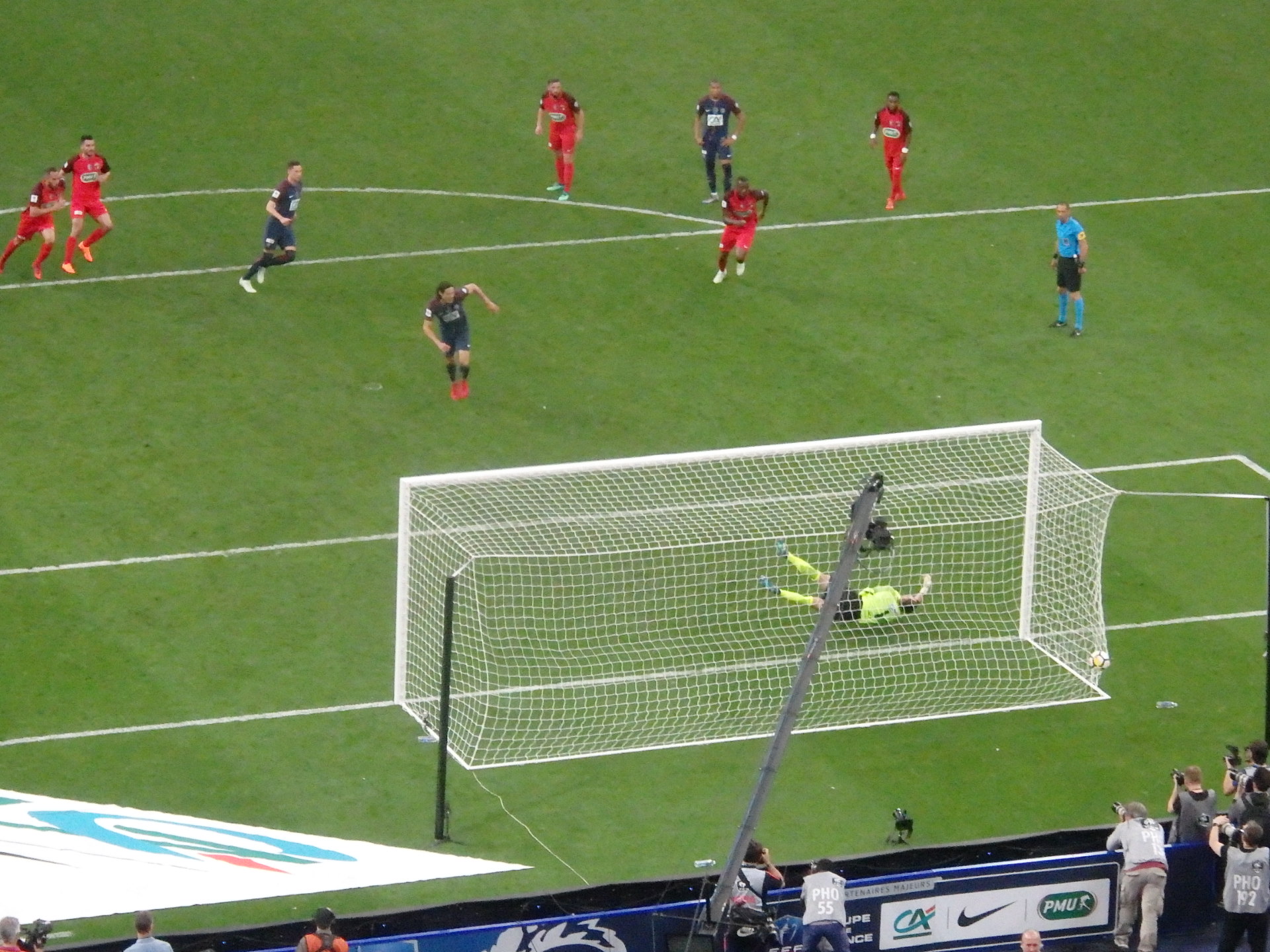
We sit and Les Herbiers kick off the match wearing all red and playing towards central Paris, the Arc de Triomphe and the Eiffel Tower; PSG are in their usual all navy blue kit and kicking towards the Cathédrale Basilique St Denis. Les Herbiers start well and within two minutes Joachim Eickmeyer breaks down the left, crosses the ball and Sebastien Flochon’s shot is deflected wide of the goal resulting in a corner from which Valentin Vanbeleghem shoots wide from some 25 metres out. The white-haired man and I applaud conspiratorially. But it doesn’t take long before PSG have two shots from Giovanni Lo Celso and Kylian Mbappé that hit a Les Herbier goal post, the second shot defying physics as its angle of incidence blatantly fails to equal its angle of reflection, instead the ball just bounces right back at him.
Satisfyingly for my white haired friend and me it is PSG’s Yuri Berchiche who is the first player to be booked by referee Mikael Lesage. But such events become crumbs of comfort as PSG predictably dominate and miss chance upon chance with Lo Celso again hitting a goalpost with a shot , although Les Herbiers are in fact playing extremely well, they’re just not as good as PSG. The Ligue National team do not ever resort to aimlessly booting the ball away in blind panic, but always attempt to play the ball from defence by passing it, certain Ipswich Town defenders could perhaps benefit from some coaching from Les Herbiers’ Stephane Masala; does he know there is a job going? He is perhaps one of the few successful managers of a lower league club not so far linked with the job.
Off the pitch, the far end of the stadium is a noisy, constantly choppy, but joyous sea of red and white flags, even when on 26 minutes Giovani Lo Celso surprises me at least by scoring with a low shot from the edge of the penalty area to inevitably give PSG the lead. PSG continue to dominate play but still only lead 1-0 at half-time, when I pop downstairs to buy a bottle of Evian (2.50 Euros) for Paulene.
The second half picks up where the first left off, but for the usual change of ends. Within five minutes it seems PSG have scored again as following a sequence of remarkable deflections and rebounds Mbappé sends the ball into the goal net. The PSG fans and ultras have celebrated the ‘goal’ but apparently under false pretences as following some sort of video conference at the side of the pitch Monsieur Lesage disallows the goal and awards Les Herbiers a free-kick. It is the first time I have witnessed the use of video technology at a match and it feels very odd because of the hiatus it creates; I don’t like it, it doesn’t feel right, although my neighbour and I gleefully cheer the decision nevertheless.
PSG probably dominate the second half more than ever and despite some fantastic saves from Matthieu Pichot in the Les Herbiers goal it eventually all becomes too much and a bit after twenty five to eleven he can’t help but knock over PSG’s Edinson Cavani who

OLYMPUS DIGITAL CAMERA

scores from the resultant penalty. Pichot is booked by Monsieur Lesage for his efforts but shakes his hand to acknowledge his mistake and show he has no hard feelings; what civilised people the French are.
PSG come close to scoring again more than once in the final minutes but pleasingly Les Herbiers have a late flourish too and both Diaranké Fofana and then substitute Clement Couturier almost beat PSG goalkeeper Kevin Trapp with a snap shot and a run into the penalty box. Finally, after five minutes of time added on however, Monsieur Lesage calls time on the 101st final of the Coupe de France and PSG have won it for a record 12th time. No one seriously thought they wouldn’t, but some of us hoped.
After an overlong wait, the presentation of the trophy follows with much jumping about and littering of the pitch with red, white and blue fluttery material. A massive scrum of photographers surrounds the players who are barely visible in the unseemly melee and the players make their way to the ultras to thank them for their support and to celebrate together. Nobly the vast majority of Les Herbiers supporters stay on to watch also; this is all part of their big day out. With their celebratory juices running dry the players leave the pitch which is covered by protective sheeting in preparation for the finale to the finale a display of fireworks, lights and lasers which says thank you to the 7,160 clubs who entered the Coupe de France this season, almost ten times the number that enter the English FA Cup. Reminders appear on the scoreboard of when the last metro trains leave the two nearest stations to the stadium.

This slideshow requires JavaScript.


The fireworks display is a fitting end to the evening, although Paulene and I actually thought the one put on by Lille Olympique at the end of their final league match last season was better, but we can be picky like that sometimes. It has been a terrific night for PSG, the Coupe de France, French football and most of all Vendee Les Herbiers Football and its supporters and we didn’t half enjoy it too. Vive La France!

41413999984_572310fba9_o

Felixstowe & Walton v Haverhill Borough Needham Market 0 Dulwich Hamlet 3

It had been a damp morning, I had walked to the village post office in a light drizzle and then driven back to collect a prescription for my wife from the pharmacist opposite the post office because I had forgotten it first time around. I now leave the house for the third time in an hour to walk to the railway station. The day is dull and grey, but as I turn the corner into the station forecourt there is a single bloom on a hawthorn bush. It seems Rachel Carson’s silent spring is delayed for another year, but it’s surely coming.
Putting aside thoughts of doomsday I board the train and text a man called Gary to let him know I am in the third car of the train. The smell of cheap perfume, so cheap it could just be the smell of washing powder, permeates the warm air of the carriage; behind me a couple speak to one another in a foreign language. Gary is accompanying me today and will join me on the train at Colchester and in due course he does so, but not before I anticipate his boarding of the train by the door nearest me only to see a man who looks like Iggy Pop’s heavier brother board in his place, which I find a little disconcerting. Gary has read previous entries on this blog and this has inspired him to want to join me, because it sounds such fun.
Gary and I catch up on events since we last met and soon arrive at Ipswich where there is another half an hour to wait for the train to Felixstowe, we therefore adjourn to the Station Hotel opposite where Gary drinks a pint of a strategically branded ‘American’ lager called Samuel Adams, served in a strangely shaped glass and I drink a pint of a fashionably hoppy ‘craft ale’ that I have never heard of, which is probably brewed furtively by the Greene King brewery. The Station Hotel is pleasant enough but reeks of the latest corporate house style of a national brewing chain.
At about ten to two we drain our glasses and cross the road back to the railway station to discover that due to a passenger being taken ill, the 13.58 to Felixstowe has been cancelled. The Ipswich to Felixstowe passenger rail service has to be one of the least reliable anywhere on Earth and suffers regular cancellations for a variety of reasons, sometimes for days at a time. This may be because it is just a one track, one carriage shuttle service, but this being so there should be a contingency plan to maintain a service. If this were mainland Europe there would probably be a regular tram or light rail service between Ipswich and Felixstowe, but sadly this is brexiting Britain.
The cancellation provokes a quick assessment of where else there is an accessible game this afternoon and it’s a choice between Needham Market, Whitton United or Ipswich Wanderers. Seeing as we are at the railway station from where trains run directly to Needham, but buses do not run directly to Whitton or Humber Doucy Lane it is easiest to go to Needham. A convoluted ticket refund and new ticket purchase procedure later (£3.05 for a day return with a Gold Card), we are ready to catch the 14.20 to Cambridge calling at Needham Market.
The hourly train journey to Needham is short and sweet, taking just ten minutes to sneak out of Ipswich’s back door past the ever more dilapidated, former Fison’s factory at Bramford and along the wide valley of the River Gipping. Needham Market station is aOLYMPUS DIGITAL CAMERA thing of beauty, a red brick building in the Jacobean style and dating from 1846, it is Grade 2 listed. Happily, although it was closed in 1967 it re-opened just four years later. Tearing myself away from the loveliness of the railway station, it is a numbingly simple and direct walk to Bloomfields, the home of Needham Market Town Football Club. Across, the station forecourt, sadly dominated by parked cars, past the wonderfully named Rampant Horse pub where Calvors beer and lager brewed locally in Coddenham is served, across the main road, down the side of the Swan Hotel and on up the side of the valley, leaving the timber framed buildings of central Needham and reaching the football ground through an estate of 1960’s bungalows. The route is so simple and direct it is as if the railway station and the football ground are the two most important things in Needham Market and as Gary remarks, the path between is akin to Wembley Way.
At Bloomfields we walk through the busy car park and are both £11 lighter having passed through the turnstile, on the other side of which a programme costs a further £2. It’s not twenty to three yet so we take a detour into the clubhouse and there being no real beer on offer we imbibe something called East Coast IPA (£3.00 a pint). The pump label shows the east coast of America for some reason, although the beer is manufactured by Greene King in Bury St Edmunds and my view is that they are hustling in on the good name of the ‘other’ Suffolk brewer Adnams, which uses the slogan ’beer from the coast’. Gary likes the beer, but then he likes Carlsberg; I find it much too cold, bland and fizzy and I’m glad when it’s over. That’s ‘the thing’ about drinking alcohol, it has to be pretty disgusting not to finish it.


Outside, the sizeable crowd of 495 mill about and lean over the pitchside rail, whilst the two teams appear to be caged up inside the tunnel from the dressing rooms. Eventually the teams process onto the field side by side and go through all that hand shaking malarkey. The stadium announcer speaks with a mild Suffolk accent which sounds clipped as if he doesn’t read very well, but in fact that is just the nature of reading out loud with a Suffolk accent. Gary and I remark on the name of the Dulwich number eleven, Sanchez Ming, the sort of name to strike fear into the heart of Donald Trump, if he has one. Today’s match is sponsored by John and Sue. Gary and I elect to stand with the Dulwich supporters in the barn like structure behind the near goal at the Ipswich end of the ground. If Needham ever had to make this stand all-seater they could do so with the addition of just a few straw bales.


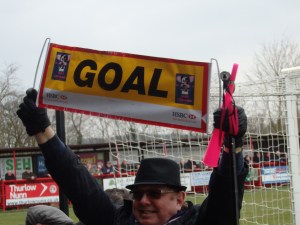
The match begins with Dulwich Hamlet, all in pink, kicking towards Ipswich whilst Needham, who are disguised as Melchester Rovers play in the direction of Stowmarket. Dulwich start well and have an early shot blocked. A Dulwich supporter sounds a doom-laden warning to the Needham goalkeeper, Danny Gay, that he is on borrowed time. When he does it again someone responds that we all are. It’s marvellous how Step 3 non-league football gets you in touch with a sense of your own mortality. The goalkeeper smiles kindly, but it’s not even ten past three when following a turn and through ball from Dipo Akenyemi, Dulwich’s nippy number seven Nyren Clunis appears in front of goal with the ball at his feet and just the large frame of Danny Gay between him and glory. Nyren and glory are united as the ball is at first blocked by big Danny, but Clunis rolls in the rebound and the Dulwich supporters cheer gleefully. A man in a dark raincoat and trilby hat dances around holding a banner that says ‘Goal’ in case anyone was in any doubt that Dulwich had scored. A woman swings a small pink and navy blue football rattle, but it doesn’t. OLYMPUS DIGITAL CAMERA
Dulwich continue to provide all the attempts on goal and a selection of corner kicks and shortly after twenty past three Clunis scores again, in similar circumstances to the first goal, but due to a defensive mistake and Danny Gay makes no initial save. This time the man in the dark raincoat and hat toots a pink plastic horn to celebrate. The Needham locals look on silently, inscrutably, like Ipswich Town fans do. They may have been expecting defeat, Dulwich, after all, are striking out at top of the twenty-four team Bostik Premier Division, whilst Needham are meandering around the wilderness of mid-table anonymity where existence has no meaning; they are 14th . A twenty-four team league is much too large.
As half-time approaches Gary asks if I fancy a cup of tea, coffee or hot chocolate and from his short menu I choose tea (£1). Gary has a tea too. Over tea Gary talks fondly about his grandfather who was a Communist and stood as such in a council election in the London Borough of Brent in the late 1960’s or early 1970’s. He was a well-known character on the west London estate where he lived, but he didn’t get elected. It was because of his grandad that Gary read Robert Tressell’s book “The Ragged Trousered Philanthropist”. We both agree that with today’s ‘gig economy’ the working life of many people is much the same in relative terms to what it would have been a hundred years ago.
We put the revolution on hold as the teams return to the field and we move to the other end of the ground to the side of the all-seated Les Ward stand, which is a small, prefabricated, metal structure. The Marketmen show glimpses of recovery as the new half begins but at seven minutes past four Dulwich score a third goal when Nyren Clunis passes to Nathan Ferguson who shoots accurately between the goalpost and the clawing, despairing, outstretched glove of Danny Gay.
Despite Needham showing a bit more attacking intent in the second half Dulwich are too good for them. Danny Gay has a chat with the Dulwich fans behind the goal; he seems to be counselling one supporter telling him that he is sure he could get a wife, because he has one. Later there is outrage amongst the Dulwich fans as The Marketmen’s Sam Nunn hacks down Clunis in full flight and is merely booked by referee Mr Paul Burnham who has blatantly ignored the supporters chants of “Off! Off! Off!”. Danny Gay then makes a fine save, diving to his left to tip away a shot that would otherwise have given Clunis his hat-trick.
The floodlights have now come on as the greyness of the day deepens and low cloud descends over the gaunt trees and power lines that provide a distant backdrop. A chill bites at my bare hands, which I push deep into my coat pockets. The game is drawing to a close and the result is already known. It is a somewhat pernickety and mean-spirited therefore when Mr Burnham penalises Dulwich goalkeeper Corey Addai for holding onto the ball too long, invoking a rarely enforced rule that results in an indirect free-kick to Needham and a harsh booking for Addai. Mr Burnham is a short, stocky, completely bald man whilst Addai is just 20 years old, 6 foot 7 inches tall and with an enormous head of hair. I suspect a barely hidden agenda provoked by jealousy.
Needham’s free-kick inevitably comes to nought and after four minutes of added time the game ends. The Needham number ten, Jamie Griffiths, who has worn a large head bandage throughout the afternoon is elected Man of the Match and receives a bottle of Champagne from John and Sue the match sponsors, whilst standing in front of a board plastered with company logos and being photographed.
Gary and I reflect on what has been an entertaining match as we head back down into Needham village. The next train is not until ten to six and therefore we have a good forty minutes or more to end the afternoon by enjoying a pint of ultra-locally brewed beer in the conveniently located and fabulously named Rampant Horse public house.

This slideshow requires JavaScript.

Finally, Dulwich Hamlet are currently going through a torrid time due to the development company Meadow Partners who own their Champion Hill ground having undertaken a number of immoral and twisted actions such a trying to seize the rights to the club name and trademarks, loading debt onto the club and preventing it from taking profits form match day bars. Presumably Meadow Partners want rid of the club so that they can make profit from developing the site for housing.
Go to https://savedulwichhamlet.org.uk for more information and details of the Fans United day on Good Friday when Dulwich invite fans from all clubs to attend their match versus Dorking at Tooting & Mitcham’s ground where they are now forced to finish their season.

Ipswich Town 0 Sheffield United 1

The ‘hectic Christmas schedule’ is over and today is the first Saturday of the new year and is therefore the day of the FA Cup third round, once one of the most auspicious dates in the English football calendar. The evil Premier League and the Football Association itself have together destroyed the glory of the FA Cup, but those of us who remember it as it was can stir our memories and pretend, shutting out the horrid reality to enjoy what should be a season highlight. Forty-four years ago I recall, Ipswich played Sheffield United in the FA Cup third round, it was the first FA Cup tie I ever saw and we won 3-2 having been 2-1 down. The wonderfully named Geoff Salmons and the brilliant Tony Currie scored for Sheffield United; ‘magic’ Kevin Beattie won the game with two goals in two minutes just before half-time and super Brian Hamilton got the other one for Town; marvellous. We went on to beat Manchester United at Old Trafford in the next round.
The draw has in one way been good to Ipswich, giving us a home tie, but sadly it is against a team in the same Division as us, so there is no chance of a ‘Cup upset’ and no road-trip to some far off exotic, provincial town like Fleetwood or Rochdale that Town have never graced.
It is nevertheless with a spring in my step that I set off for the railway station under a pale winter sun, wrapped up against the bitter cold.OLYMPUS DIGITAL CAMERA The train is three minutes late and I board it along with a bearded man in a khaki hat and camouflage jacket and a teenage boy and girl who are carrying skateboards. In the far corner of the carriage a bearded hippy in a leather jacket drinks from a tin one of those peculiar ‘ciders’ that contain fruit other than apples. The man in the camouflage jacket huddles into another corner as if trying not to be seen, but he clashes horribly with the blue moquette of the train seats.
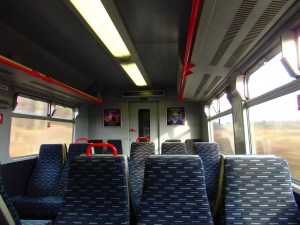
At Colchester all these passengers leave the train except for the hippy, who once the train OLYMPUS DIGITAL CAMERAleaves the station inexplicably moves to the other end of the carriage leaving me alone with my winter clothing and enthusiasm for the FA Cup. Arriving in Ipswich the afternoon is not as bright, there is a pall of grey cloud. Football supporters spill out of the station and across the bridge opposite, there are three swans swimming in the river below; the tide is high and all is quiet, almost serene.


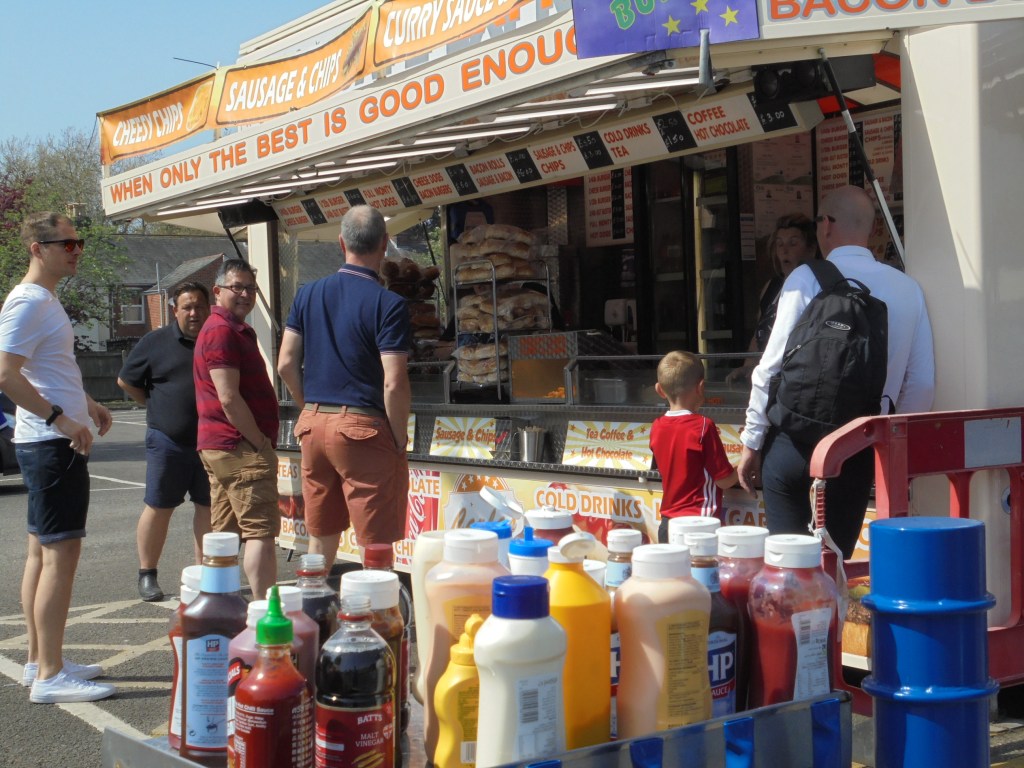
As usual Portman Road is a curious, greasy street cafe peopled with stewards in shapeless coats policing nothing in particular. The search dog looks happy and a man searches amongst the sauce bottles by one of the hot food stands. Programmes are only £2 today, so I buy one and a man on a bike weaves past me.


In St Jude’s Tavern the usual bunch of ageing Town fans sit and discuss football whilst I buy a pint of the Match Day Special (Yeovil Brewery Company’s Star Gazer – £2) and very good it is. I am soon joined by Mick who will be accompanying me to the game. We talk about travelling through Italy, Welsh counties, Donald Trump, Andrew Graham-Dixon and football. Mick gives me the £10 he owes me for the match ticket. After another pint of Star Gazer we head down Portman Road at about twenty minutes to three and into Sir Alf Ramsey Way. There is a short queue at the turnstile for the stand formerly known as the West Stand and once inside Mick remarks on the picturesque coffee stand, painted somewhat bizarrely to look like it’s built of stone.
In the stand we use the facilities and are both amused by the sign on the hand dryers which reads ‘Danger Electricity’. OLYMPUS DIGITAL CAMERAFearless as we are, and confident in our general familiarity with modern electrical appliances we use the dryers nevertheless, despite the jolting, tingling sensation it gives us. It is two minutes to three by the scoreboard clock as we take our seats, but the teams are already lined up and ready to kick-off. Town are of course wearing their traditional blue shirts and white shorts with blue socks, but I am bitterly disappointed, mortified even to see that Sheffield United are not wearing their distinctive red and white stripes with black shorts. Instead, the visiting team sport plain white shirts with black shorts, like some sort of pathetic imitation of Port Vale or Germany. What is wrong with these people? They just keep finding new ways to ruin the game.
The game begins and Ipswich, fielding a more or less full strength team, given that most of the first choice midfield is injured, start quite well. They pass the ball to one another and approach the opposition penalty area. Sadly Sheffield begin to play a little as well and after about ten minutes and it becomes apparent that Town won’t be able to just dismissively swat away their challenge, which is a pity. The game evens up and Ipswich’s early bravado dissipates a little, but it’s okay, we’re playing better than usual because we have the ball as much as the opposition do. Then, at about twenty five past three a bloke called Nathan Thomas shoots from way out into the top corner of the Ipswich net and we’re losing. Crap.
The 1,100 odd Sheffield supporters who have been shouting and singing support for theirOLYMPUS DIGITAL CAMERA team during the preceding minutes now do so with added joy and vigour. The 10,957 odd home supporters haven’t made much noise up until now and still don’t, although their team really needs some encouragement right now. The game dribbles on to half-time as depression sets in with the majority of those in attendance. Mick and I are sat in Block Y which is in the centre of the top tier of the West Stand; normally these are the most expensive seats in the ground, they are padded and they’re brown, not blue. But the people who sit in them are as quiet and miserable as the people I usually sit with in the more modestly appointed Sir Alf Ramsey Stand, they just look better fed and sound more pleased with themselves. A Sheffield player goes down injured and requires treatment, or at least that’s what we’re led to believe. I remark to Mick how back in 1974 the North Stand would have been braying “Dig a hole and fuckin’ bury him”, but now they just grumble a bit to each other. People knew how to make their own entertainment back then.
The top tiers of both the North Stand (Sir Bobby Robson Stand) and Churchman’s (Sir Alf Ramsey Stand) are closed to supporters today because of the reduced crowd due to it not

being another bloody boring League match, but an exciting FA Cup game. The club has nevertheless placed stewards amongst the rows of empty North Stand seats, and all around the ground there seem to be a lot of stewards in parts of the ground where they are the only people there. It all helps add to Portman Road’s unique atmosphere.
At half-time I use a different toilet where the hand dryers don’t carry health warnings,

before Mick and I gaze out across the practice pitch beyond a red Citroen H van towards the former municipal power station and tram shed. We marvel that local authorities once built and provided these fabulous things, but don’t comment on the Citroen. The sun is steadily setting behind the cloud and when we return to our seats the pitch is glowing gloriously from the illumination of the floodlights.
The second half begins with some rare vocal encouragement for Town from the North Stand and I realise that the Sheffield United fans must be the first away supporters this season to have witnessed a whole first half without singing “Is this a library?” I can only think they don’t have opera in Sheffield or if they do they don’t much care for Verdi. Perhaps it is a hangover from the Thatcher era when Sheffield was the People’s Republic of South Yorkshire and opera is just too patrician. But full marks to these Blades fans for being more interested in supporting their own team than berating the opposition.
The heady early minutes of the second half fade away like the taste of the half-time beers, snacks and hot beverages and the game descends into dullness. Ipswich don’t exactly play badly, they just don’t create any attempts on goal, which suggests they have misunderstood the point of the game. Sheffield on the other hand do fashion some chances but spurn them. Ipswich captain and centre-half Luke Chambers and goalkeeper Bart Bialkowski seemingly attempt to settle the result with the sorts of misjudgements that one would only expect from the most inept of youths in full-time education, but the Blades are not sharp enough to take advantage.
Apart from the noise from the Sheffielders the game is conducted in near silence, with swathes of seats completely empty it feels like a reserve game. As the contest spirals down towards its miserable conclusion the North Stand at last find a song in their dark hearts, “ We want a shot”, they chant. Having inspired themselves with their own wit they proceed to trawl through their back catalogue of scatological old favourites: “ We’re fucking shit, we’re fucking shit; we’re fucking shit” and “You’re football is shit, you’re football is shit, Mick McCarthy you’re football is shit”. It doesn’t help lighten the mood or motivate the players to do better, I can’t think why.
Oddly, the announcement of four minutes of added on time is greeted with a rare growl of enthusiasm from the crowd, but it makes no difference and there is a sense that people are just clearing their throats for the inevitable booing that greets the final whistle. Ipswich Town are once again out of the FA Cup and after the long descent from the top of the stand Mick and I bid each other farewell. Mick thanks me for getting him a ticket and he means it; he doesn’t see Town play often and although it was a poor game he has enjoyed it. Mick is a very rational man. We go our separate ways and I depart through the club car park and its array of obscenely expensive Ferraris, Mercedes Benz, Audis and Range Rovers. Humming the Buzzcocks’ ‘Fast cars’ I look back on the stadium, the dark shapes of the stands silhouetted in the beams of the floodlights; such beautiful sadness.