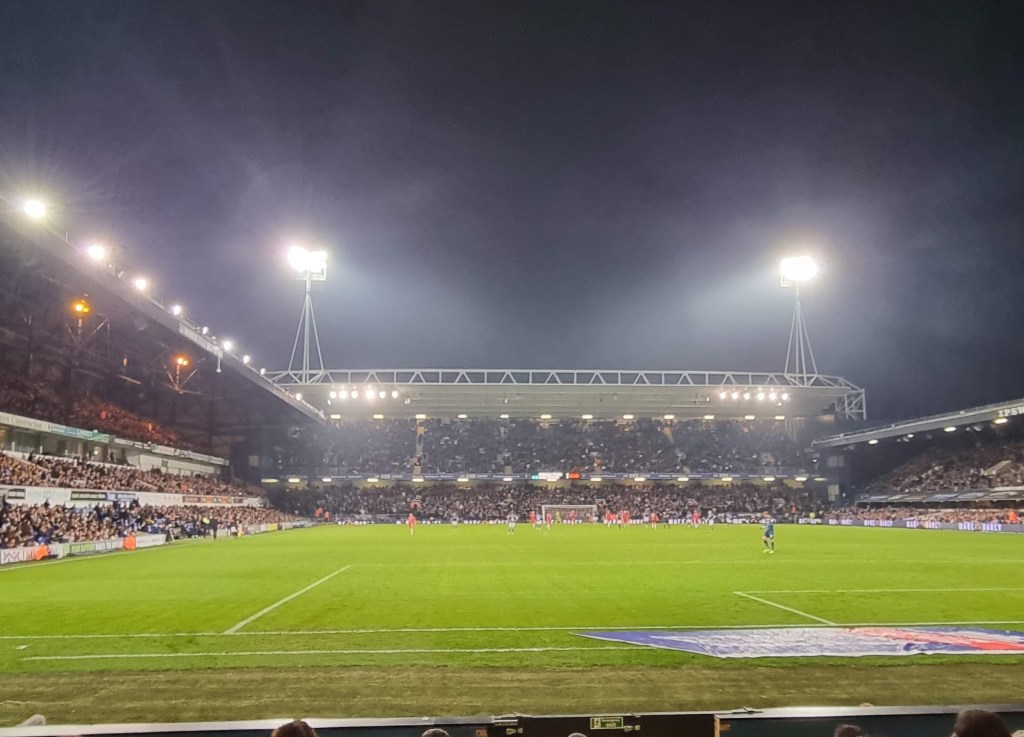
Ipswich Town 2 Bristol Rovers 0

When the draw for what used to be called the League Cup was made, I was quite pleased to find that Ipswich had drawn Bristol Rovers; this was because Bristol Rovers were the only one of Town’s third division opponents I didn’t see last season.  I’m not sure why that mattered, it’s not as if I keep notes on each team, although in an odd way, through this blog, I suppose I do. Oh dear.

Despite my earlier happiness at the draw, it has taken me until the night before the game to get round to buying a ticket because despite the grotty weather, in my head it’s still summer, and summer is for dreaming and for World Cups, oh, and occasionally for European Conference League qualifying games.   Football is mostly something for autumn, winter and spring.  As usual for League Cup matches, because all the seats cost a tenner I choose not to sit in my season ticket seat, but to explore one of the twenty-nine and half thousand odd other viewpoints.   Usually, I head for the best view and the padded seats of Block Y, and there are still single seats available, but craving company I texted my friend Gary to see if he is going; he is, and gives me his seat number which he tells me is close to where he usually sits in what used to be called the West Stand.  I buy the seat next to Gary which turns out to be uncomfortably  close to the corner of the ground; but it’s okay as I had warned Gary that I would blame him if the seat wasn’t very good, and now I can.  To think, I could have been in Block Y.   I also texted my friend Mick to see if he is going to the game, but he tells me that he has “no interest in the League (Carabao) Cup”, which I thought was a bit haughty of him.

Having parked up my planet-saving Citroen e-C4 in a street between Norwich Road and Anglesea Road, it’s a short walk to the Arb on High Street where I obtain a pint of Mauldon’s Suffolk Pride (£3.60 with Camra 10% discount). The bar is not very busy, and I tell the barman that I had expected it to be busier, but he tells me most people are in the beer garden.  He’s correct, most people are, but there are still free tables and I can only see one bloke in an Ipswich Town shirt.  I settle down to drink my unexpectedly cloudy pint, and read Issue 26 of the Turnstile Blue fanzine, a small pile of which were in the corridor between the bar and the gents.  I read an article which, in the context of the ‘fuss’ surrounding the death of the old queen, attempts to debunk the apparently mythical status afforded to former Town chairmen John and Patrick Cobbold.  The basis of the argument seems to be that they were incredibly wealthy and posh, and ‘Mr John’ drank and swore a lot.  I don’t read much more because the penetrating voice of a man possibly in his late twenties, who is with the bloke in an Ipswich shirt, and the mild but loud Ipswich accent of a woman probably in her forties are preventing me from concentrating.  After half an hour of slow supping and covering my ears, I leave for Portman Road.

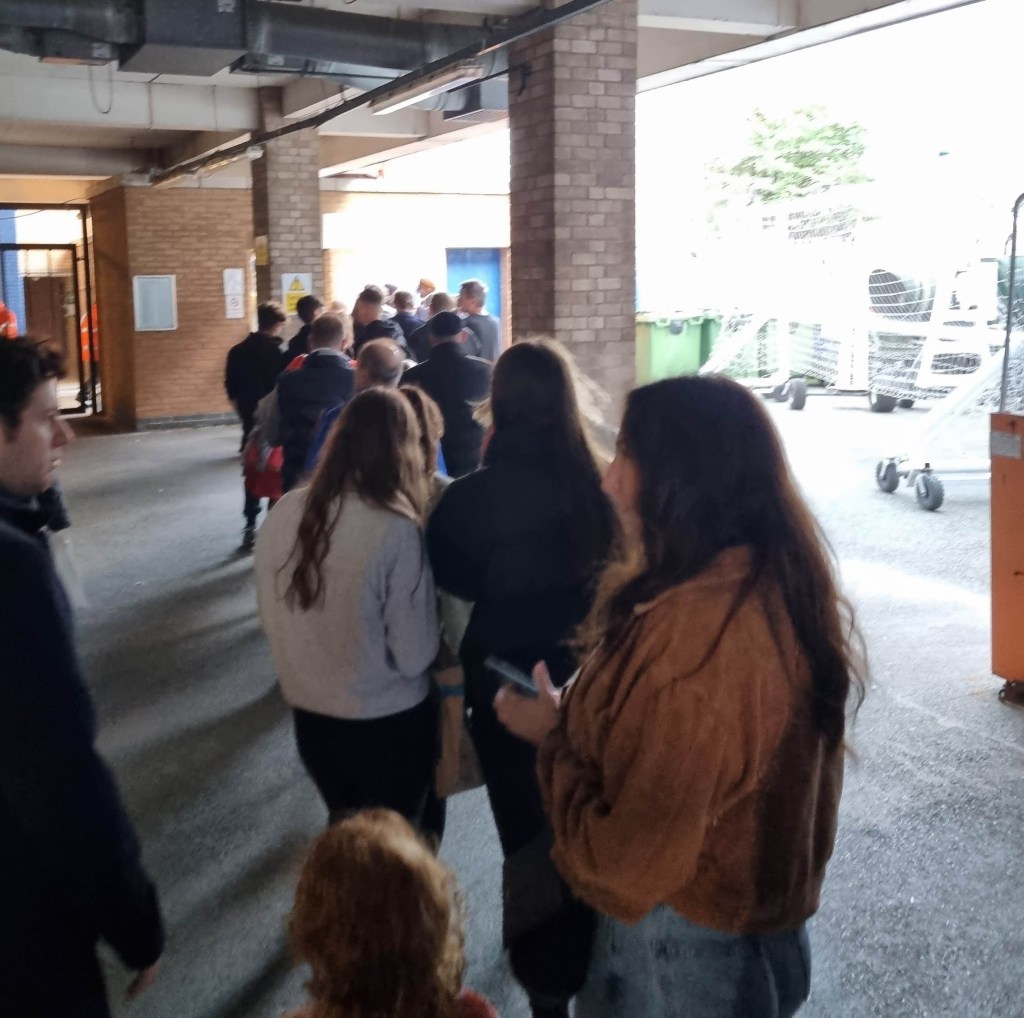
Arriving in Sir Alf Ramsey Way shortly after seven-thirty, I buy a programme (£2.00) in the modern cashless manner and am then surprised to see long queues at the turnstiles.  Tonight, in the spirit of saving the planet by not using unnecessary pieces of paper, my ticket is on my mobile phone and my inner Luddite wonders if technology is the reason for the slow progress into the stadium.  Moments before reaching the turnstile, my finger slips on my phone screen  and I accidentally delete the e-mail that includes my ticket, but fortunately I know I can still find it if  I look through all my e-mails and that’s what I do.  Happily, the QR code on my e-mail also works and I pass through the turnstile just in time to drain off some Suffolk Pride and make it to my seat before the names of the Ipswich team have all been announced.  I try to call out the surnames of Town players in the manner of a French football crowd, but the ‘new’ stadium announcer Mark Murphy says Dom Ball instead of Dominic Ball and ruins things completely.
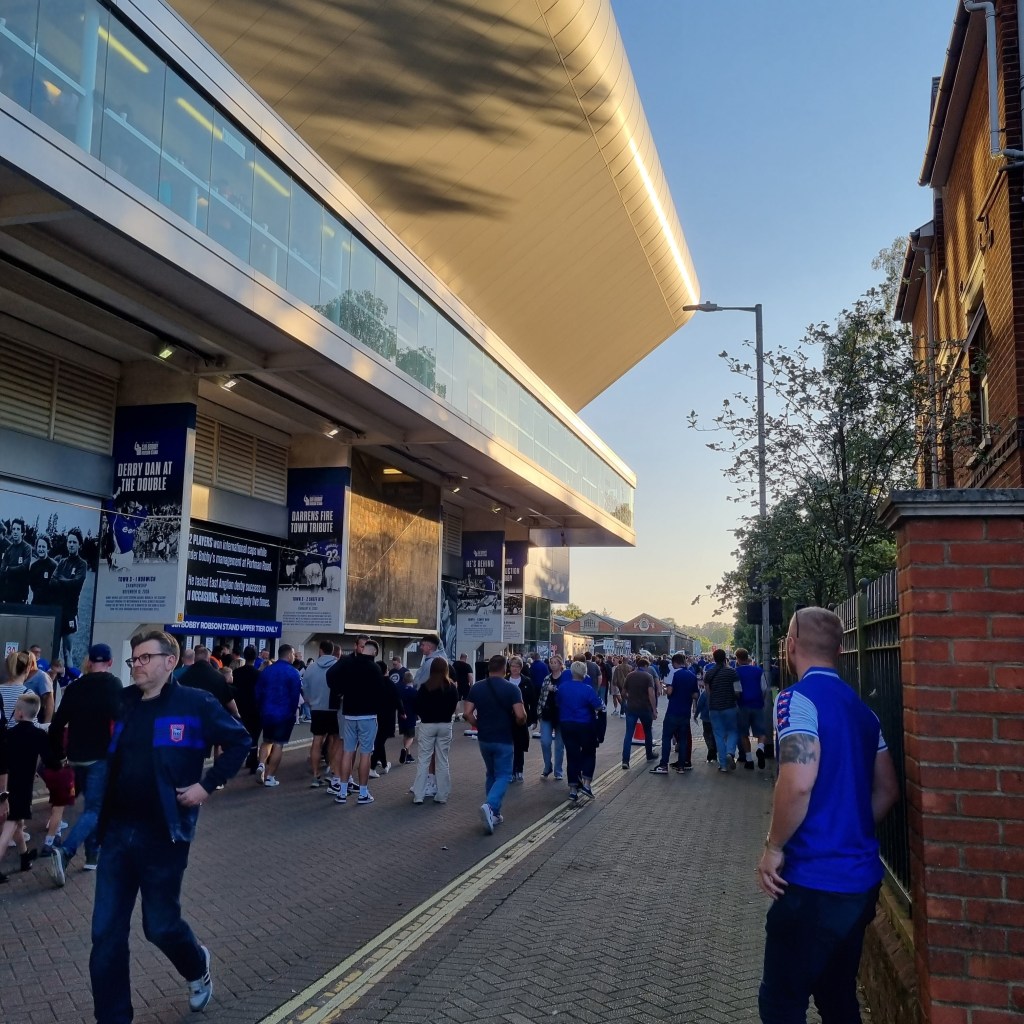
The match kicks off at fourteen minutes to eight according to the digital clock on the scoreboard. Town get first go with ball, kicking it mostly towards Sir Alf Ramsey’s stand, and are wearing the traditional blue and white kit, which this season has broad white stripes down the sleeves that from some angles make the whole sleeve look white.  Kits have to be imbued with meaning nowadays and we are told that the design is inspired by the kit worn by the promotion winning team of 2000.  When the sleeves look all white, I am reminded of our Premier League winning side of 1962.  Bristol Rovers for their part wear black shorts and white socks to cover their loins, buttocks and calves and grey shirts over their torsos.  I do not know if the Rovers shirts are imbued with meaning or not, but I like to think they are inspired by a foggy day in the Bristol Channel or specks of ghostly coal dust blown across from the South Wales pits or Cardiff docks.  Gary and I speculate as to whether we have already seen this season’s dullest kit worn by an away team at Portman Road and recall how Manchester United once wore a grey and black kit at Southampton and changed at half-time when already three or four goals down, supposedly because the players couldn’t see each other against the background of the crowd.  It seems probable from the half-time score that they couldn’t see the Southampton players either.

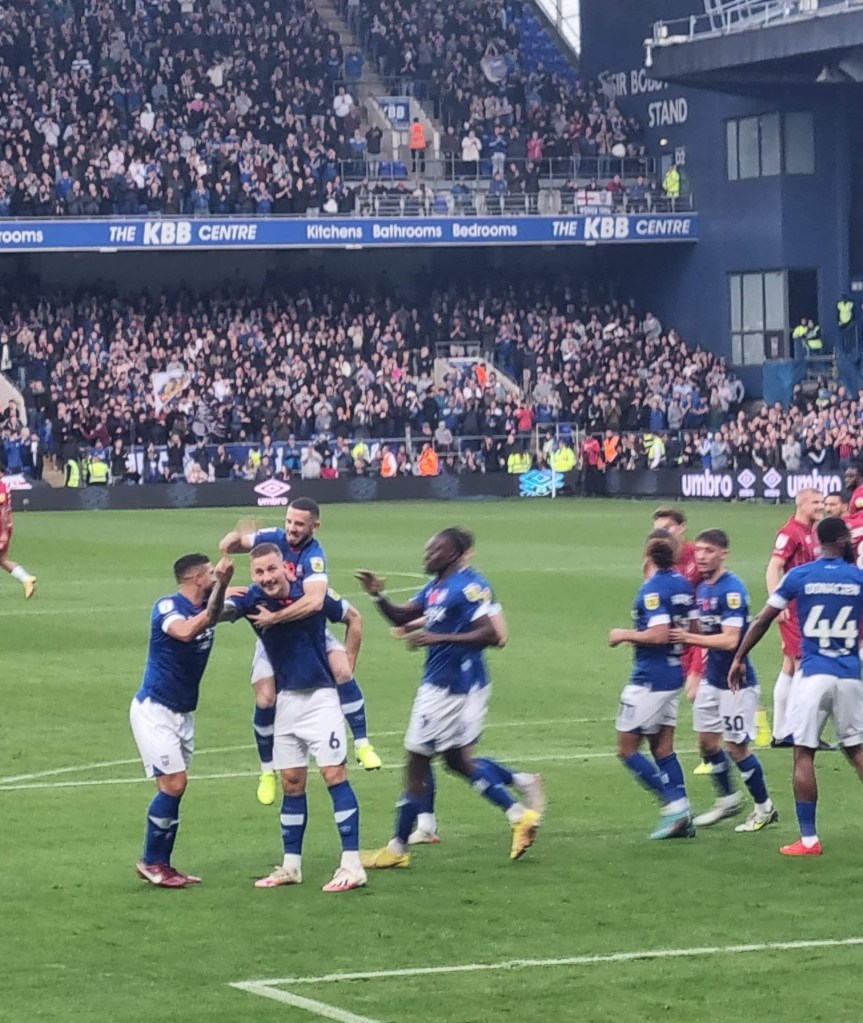
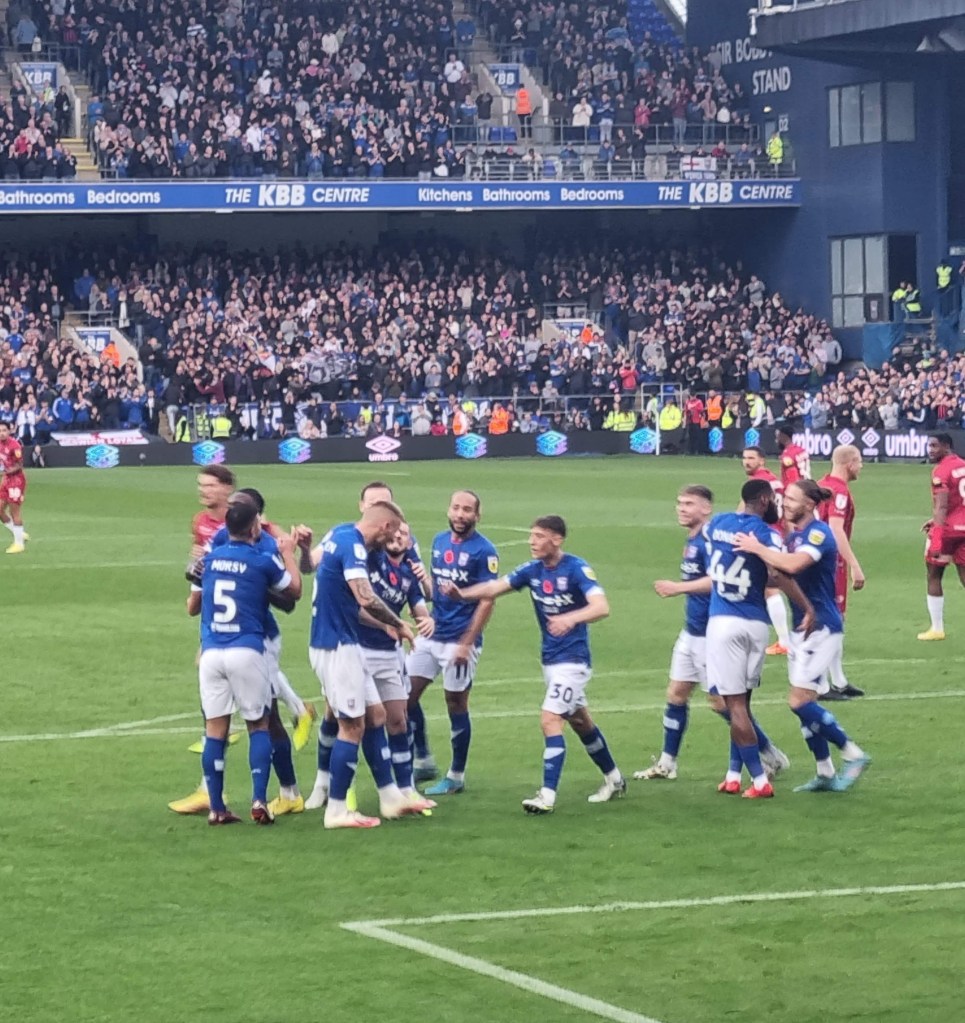
Town dominate possession and after just twelve minutes take the lead. A passing move down the right ends with Jack Taylor passing a ball from Kayden Jackson into the Bristol goal net.  That was easy.  I haven’t really tuned myself into the game yet however, and rather than leaping up and punching the air in a display of forgotten youthful exuberance like I would normally, I just slowly raise my bottom off my seat and applaud politely in a semi-stooped position.  Gary’s reaction is similarly sluggish. For these supporters it still feels like pre-season, the overture, or to employ a war-themed comparison popular with football pundits, like 1939, the phoney war.  Elsewhere in the stadium people are more attuned to the programme as they beat drums and chant “Blue and White Army.”

Town continue to dominate possession and occasionally come close to scoring a goal, but not close enough.  I haven’t seen Gary since July 1st, so we talk as much as we concentrate on the game.   Gary asks me what is the worst football ground I’ve ever been to. I tell him I think it was Oxford United’s Manor Ground.  He asks what the best ground was. I tell him possibly The Velodrome in Marseille, although the Allianz Riviera in Nice is pretty good when full.  Having been unexpectedly put on the spot I forget to mention the Stade Felix Boleart in Lens and the Stade Geoffrey Guichard in St Etienne.

Bristol Rovers only occasionally approach the Town goal and their first shot just creeps and bobs and bounces its way across the turf into the arms of the Town goalkeeper, the interestingly monikered Cieran Slicker. It takes a good twenty minutes or more for Rovers to have another shot and this time Grant Ward’s much more powerful shot is parried away by Slicker for what amounts to a pretty good save. It’s a moment which results in my hearing the faint call of “Come On Rovers” carried over the pitch on the warm evening air from the one hundred and twenty-three Bristolians in  the far corner of the stadium.  Otherwise, the first half of the game leaves no lasting impression on me and after a minute of time added on it’s time for Gary to nip to use the facilities whilst I stand up and try to manipulate my neck, which has grown achy and stiff from having my head turned towards the Sir Alf Ramsey stand for most of the previous forty-six minutes.

 Once Gary has returned, the ‘new’ stadium announcer Mark Murphy appears on the pitch wearing what looks like the same suit that replaced announcer Stephen Foster used to wear.  Murphy tells us he is going to talk to a Town legend and with the artificially excited intonation and words-all-rolled-into-one pronunciation of a former local radio DJ, he announces “Johnny Warks here” and Gary and I look at each other wondering who the hell Johnny Warksear is.  Johnny Wark appears on the big screen and all that’s missing are the subtitles when he speaks.

The game resumes at ten minutes to nine and my hopes of spending the second half just looking straight ahead take a dive as Bristol start quite well.  “Wo-o-o-oh, That’s the way we like it” or something like that sing the Sir Bobby Robson Stand to the tune of what seems to be an original composition or a song I don’t know.  Rovers are gifted a corner as Lee Evans passes the ball back to a place where Cieran Slicker isn’t standing.  But then Ipswich win a couple of corners of their own to redress the balance, before on-loan Omari Hutchinson is the first player to be booked after not so much a bad tackle as an inept one.  “Ole, Ole, Ole” sing the Sir Bobby Robson stand and the drums up in the corner of the stand by the club shop beat; inside the shop stuff must be bouncing off the shelves.  In the seat in front of me a bloke with not much hair has a pair of sunglasses perched on top of his head.    There’s a holiday feel to the crowd tonight with adults and children wearing T-shirts and shorts, looking as if they’ve been at the beach all day.  I half expect to see someome eating candy floss or wearing a ‘kiss me quick’ hat. On the pitch, the second half is reflecting the cheery mood with carefree attacking football and as result Cieran Slicker makes a spectacular save with his feet.

Substitutions arrive on sixty-six minutes with Cameron Humphryes and Sone Aluko taking a bow. Shots rain in on the Bristol goal and a corner is won.  “Oooh Sone Aluko” sing the Sir Bobby Robson Stand to the tune of the White Stripes’ Seven Nation Army.  Marcus Harness half-volleys the ball from close range, but too weakly to bother the Rovers’ goalkeeper.  As more substitutes warm up on the touchline in front of us I say the name of George Hirst to Gary.  “I know what you’re going to say” says Gary “He has a haircut that looks like his mum cut it using a pudding bowl”.  Gary knows me too well and is almost exactly right, but I’d say she used a side plate or small frying pan giving his hair the appearance of a little hat or beret.  I struggle so much to accept George’s haircut that if it had been up to me I wouldn’t have signed him, so it’s probably as well that it wasn’t.

In the seventy-third minute George and Conor Chaplin and Harry Clarke get to make the transition from bench to pitch, but the only immediate result is that Javani Brown shoots wide of the Town goal for Bristol. Within a minute of that however, a sweet passing move down the left sees the ball relayed across the penalty area for Sone Aluko, who seems to be existing in his own isolated moment of time and space, which allows him to then pass the ball into the far corner of the Bristol goal, and Town lead 2-0. Gary tells me how his mother recently received a new copy of the local telephone directory and that there were three people in it with his surname; they were Gary, his mother and his uncle who died several years ago, but it wouldn’t surprise me if BT was a hotbed of spiritualists.

All that remains is for Murphy to announce the crowd as being 15,047 with 123 of that number being from Bristol, and for people to applaud themselves, each other, and more acceptably the travelling Bristolians.  Bristol is a long way from Ipswich on a Wednesday night, although logically no further than at any other time of day or week.  Five minutes of time are added on to ensure we get our money’s worth and when that expires we rise as one to applaud and then seep out into the night.  It’s been a decent little game, a bit low key like a pre-season match, but it’s good to see a match where none of the players appear to think winning matters more than life itself.  Bristol Rovers played their part and should have scored at least once, but on the plus side they will now have time on their hands in the middle of the week to think about what their away kit should look like next season.   As for Ipswich,  we are on our way to Wembley, my stepson and his family live in the RG24 postcode area so if I get the urge I might march on to Basingstoke, or Reading.
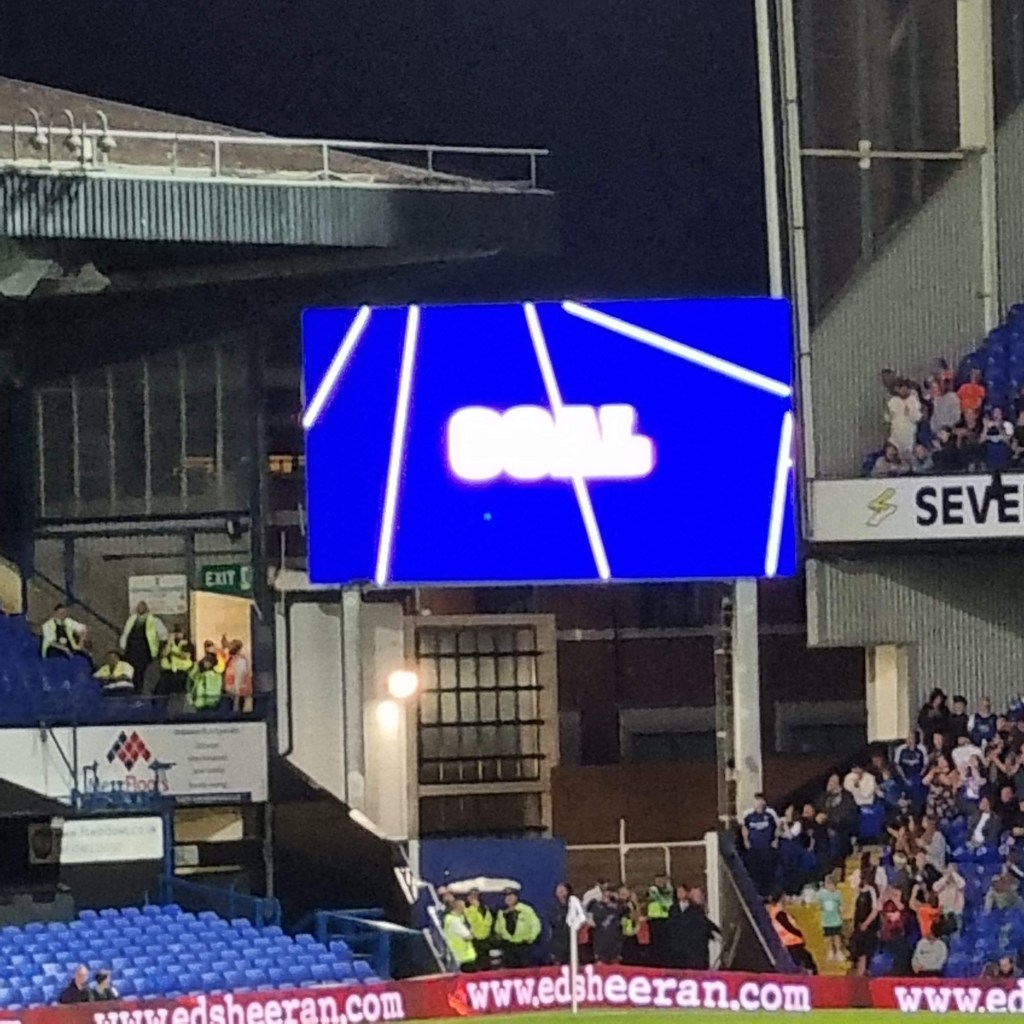
Ipswich Town 1 Cheltenham Town 1

In the final scenes of Lindsay Anderson’s 1968 film ‘If’, the central character Mick Travis, played by Malcolm McDowell, and his nameless girlfriend launch a machine gun attack on the parents, teachers and governors at a school speech day.  The scene was filmed at Cheltenham College and it’s one of my favourite scenes in one of my favourite films; Wikipedia tells us that ‘If’ won the Palme d’Or at Cannes in 1969 and in 1999 the British Film Institute ranked it as the 12th greatest British film of all time.  As if that association with such a great film is not enough kudos for Cheltenham, it also has a football team that has never lost to Ipswich Town. Today Ipswich Town and Cheltenham Town meet at Portman Road for only the second time in recorded history.  I don’t know it yet, but later today I’m going to feel like Mick Travis.

In north Essex it has been a stupendously dull morning, both still and depressingly grey, like November days should be. It’s only when I approach Ipswich that a diffuse yellow light begins to filter through the grimness and then bright sunshine bursts from a clear blue sky like a metaphor for the end of the working week and the arrival of Saturday, heralding a match at Portman Road.  Before the game I visit my mother and we reminisce about all manner of things from years ago and she tells me how her grandfather, Sam Scarff, an agricultural labourer from Needham Market, enrolled with a friend for evening classes, joined the police and rose to the rank of inspector in the Met’ before retiring to become a game-keeper in Shotley; his friend became a police commissioner, and I thought social mobility was a 1960’s thing.

Leaving my mother with her memories, I drive across town and park up on Chantry. The streets are busy with people in football-supporting attire. I walk across the wet grass of Gippeswyk Park and marvel at how lush and green the turf now is compared to how dried up, brown and withered it was on the first day of the football season three months ago.  In Sir Alf Ramsey way I attempt to buy a programme (£3.50) in the modern cashless manner, but the technology isn’t working today.  I laugh and hand over a five pound note to the somewhat miserable and overweight looking youth in the programme booth.  The Arbor House, formerly known as The Arboretum, is busy with pre-match drinkers, but I am served quite quickly and order a pint of Nethergate Complete Howler (£4.00). I head for the garden where Mick is already sat at a table with a pint of a dark beer from the Grain brewery which he’s not very keen on, I take a sip and agree that it’s not exactly moreish, but then the Grain brewery is located in Norfolk, albeit with an IP postcode.  Before long Roly joins us and proceeds to dominate the conversation, mainly because he seems to have the ability to talk without drawing breath, which means a polite person like me can’t get a word in edgeways, not that I have much to say.  We, by which I mean mostly Roly, talk of local council chief executives, Roly’s five-year-old daughter Lottie, primary schools on the Essex Suffolk border and the performances of Town player Dom Ball.  Between twenty-five and twenty to three we leave via the back gate of the beer garden and head for Portman Road.  I bid Mick and Roly farewell by the turnstiles to the Magnus Stand, formerly known as the West Stand.  We speak briefly of when we will next meet; it will be for the five o’clock kick off v Buxton in the FA Cup on Sunday 26th November.   I won’t be going to the mid-week game versus Portsmouth as I am boycotting the Papa John’s EFL Trophy, not because I have anything against oily, takeaway pizza, but because I think the competition has been debased by the inclusion of Evil Premier League under-21 teams.  I am particularly looking forward to not going to Wembley should Town make it to the final, when I will blow a metaphorical raspberry to all those people who believe that anyone boycotting the competition will automatically abandon their principles if Town get to the final.  Such beliefs help explain why we have a Tory government.

Most unusually, today there is a queue at the turnstiles for the Sir Alf Ramsey Stand which are accessed from Constantine Road, but quite soon an extra turnstile opens up (No61) and a cheerful man presents bar codes to a screen and I pass through the portal to another world.  That pint of beer has already found its way to the exit and from the gents beneath the stand I hear stadium announcer Stephen Foster reading the team line-ups from the scoreboard in his best local radio DJ voice.  I arrive at my seat just as a minute’s silence begins for Armistice day, although that was actually yesterday.  Oddly, the Football Association have decided not to cancel the fixtures today as they did when they felt they couldn’t trust football crowds to observe a minute’s silence for the death of Queen Elizabeth back in September.  The minute’s silence is of course observed perfectly. Stephen Foster reads from Laurence Binyon’s 1914 poem ‘For the Fallen’ and the last post is played exquisitely, even if it does slightly spoil the solemnity and dignity of the moment to then be told by Stephen Foster that Jon Holden who played it is a member of the Co-op East of England Brass Band.  It’s probably just me, but I can’t help sniggering a little at any mention of the Co-op.

After a fly-past by a couple of Army helicopters, and a brief burst of ‘Hey Jude’, the game begins with Town getting first go with the ball and kicking towards me , Pat from Clacton, ever-present Phil who never misses a game, Fiona and the man from Stowmarket.  Town are thankfully back to wearing their blue shirts and white shorts after the all-black aberration against Derby, whilst Cheltenham Town are wearing red shirts and shorts with their ruddiness off-set by white socks and a white pin-stripe on their shirt fronts.  Quickly, Portman Road sounds in good voice as the altered version of ‘Mary’s Boy Child’ in which she eternally fights Norwich on Boxing Day rings around the ground.  On the touchline, Town manager Kieran McKenna is looking stylish, if a little drab in a black jacket and trousers with a plain jumper, which I at first think is beige but then think is grey; perhaps it’s taupe?

From the start Ipswich dominate and it feels as if everyone, from the supporters to the players really wants to win this match. We all remember the life-denying, spirit crushing goalless draw against Cheltenham from last season and that’s our inspiration to see Town give these upstarts, better known for their poncey Regency spa a sound thrashing.   Crosses rain into the Cheltenham penalty area and although one from Conor Chaplin goes a bit off course and strikes Wes Burns in the throat Sam Morsy soon has the first shot on goal and then from a corner Luke Woolfenden hooks the ball into the goal from close range and Town lead 1-0.  Woolfenden runs off sucking his thumb with the ball up his jumper and ever-present Phil mentions something about the birth of wolf cubs; I suggest he has simply discovered the joy of sucking his thumb. 

More corners and crosses follow and I chant “Come On You Blues” and so does Phil, but no one else does.  “Two of you singing, there’s only two of you singing” announces Pat from Clacton, sort of singing herself, which is ironic.  Janoi Donacien strides forward into a rare bit of space and pulls the ball back to Marcus Harness; the Cheltenham defence is rent open like a tin of corned beef on which the key has broken half-way round and it’s been necessary to open both ends with a tin-opener to get the meat out. Harness must score, but somehow the ball strikes the under-side of the cross bar as if deflected away from the goal net by some invisible force…either that or Harness made a hash of it.

There are more corners to Ipswich, loads of them, and Phil and I keep chanting “Come On You Blues” vainly hoping someone will join in with us. We change to the simpler “Come on Ipswich, Come on Ipswich” but the occupants of the Sir Alf Ramsey stand aren’t moved.  I think to myself that I might as well be singing in French and so I do “Allez les Bleus, Allez les Bleus” I chant; Fiona says I’ve gone too far. On the pitch Janoi Donacien is hurt and is replaced by Kane Vincent-Young and the ball skims off the top of Cheltenham number six Lewis Freestone’s head as if he was a man who had applied too much brylcreem to his hair.  Another cross and Leif Davis precisely places a carefully controlled header over the Cheltenham cross bar.  Within a minute, Cheltenham equalise as Ryan Broom sweeps forward and shoots at Christian Walton, who somehow cannot stop the ball squirming around, or under,or through him into the goal.  It might have been the brylcreem on the ball.  It will prove to be Cheltenham’s only real shot of the game and up in the Cobbold stand a knot of about twenty excited youths jump around and wave their arms about like bookies on a race course, or idiots trying to fly.

Disappointing as that equaliser is, Town press on, although not quite as well as before.  When the Cheltenham goalkeeper parries a low Marcus Harness cross out to Cameron Humphreys, somehow the ball comes straight back to him.  Two minutes of added on time are announced very noisily by Stephen Foster, as if he’d turned the PA system up to eleven. “Speak Up” says Pat from Clacton.   I applaud Town off the field with the half-time whistle and go and talk with Ray, his son Michael and grandson Harrison.  I ask Harrison if he has got the new Robyn Hitchcock album ‘Shufflemania’ yet, he says he may get it for Christmas as he looks at his dad.

The match resumes at six minutes past four and a chorus of ‘Blue and White Army’ briefly rolls around the stands, not exactly like thunder. On the stroke of the 53rd minute the crowd rises for a minute’s applause in memory of Supporters’ Club Chairman Martin Swallow who died at the end of October.  A lone seagull floats above the pitch; no doubt someone would think it poignant. 

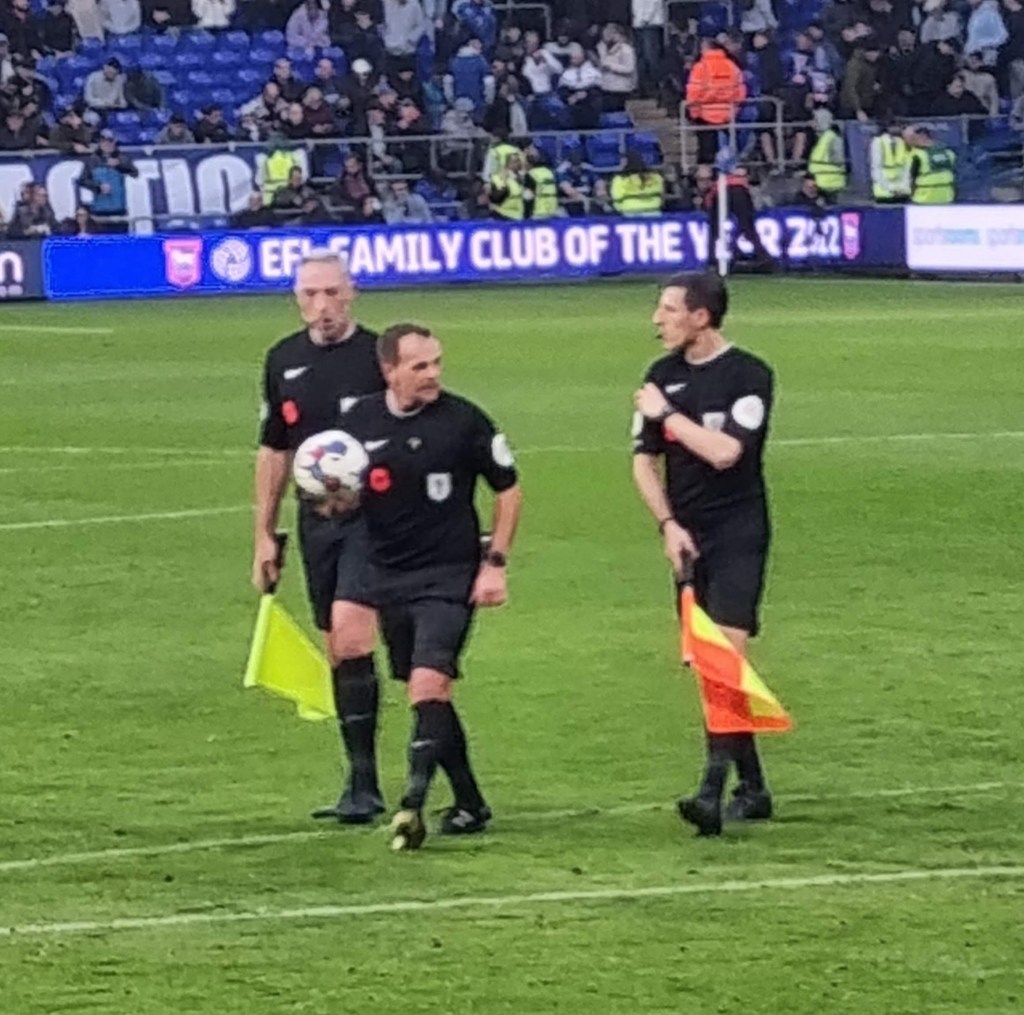
With Cheltenham confined to their half of the pitch due to constant Ipswich possession, this is the sort of game where every moment lost through a Cheltenham player sitting on the grass or receiving treatment is going to be attributed to time-wasting, and so it proves. Referee Mr Eltringham, a man with ‘ten to two’ feet, books the Cheltenham goalkeeper as a warning shot to his team-mates in this regard and in all fairness, they do not break the game up as much as they did in the goalless game last season, but it’s not enough to stop the bloke behind me from saying “He’s gotta be one of the worst fuckin’ refs we’ve ‘ad down here”.   When Cheltenham players do receive treatment their physio runs on with a huge bag and what looks like a small surf board; with a blonde wig and high cut one piece swim suit he could have doubled for Pamela Anderson in Baywatch. 

“Over and in” says Pat from Clacton in the time-honoured fashion, but it never happens. Marcus Harness heads carefully past the post in the same way Leif Davis headed over the bar in the first half, Wes Burns and Marcus Harness are replaced by Kayden Jackson and Kyle Edwards, but it makes little difference.  Chances come and inevitably go as if there is no possible way to get a ball across the line between the two goalposts.  The crowd is announced as 25,400 including 175 from Cheltenham; it’s the smallest away following at any Ipswich match this season; so more credit to those who did bother.  “Here for Cheltenham, you’re only here for the Cheltenham” they sing which I guess they are, and on the Clacton supporters coach Chris wins the prize with his guess of 25,444; Pat is disappointed that so few pet animals have been attributed guesses this week.

With time slipping away, the gloom of the late autumn evening descends along with a seasonal mist which softly shrouds the floodlights. “There’s nothing wrong with you, there’s nothing wrong with you” chant the North Stand appropriating some Verdi opera as another Cheltenham player takes a breather by sitting on the turf.  The final minute arrives and Panutche Camara replaces Conor Chaplin. There will be at least seven minutes of additional time, which is time enough for Camara to strike a shot against the inside of a goal post; again, the ball of course stays out of the goal rather than deflecting into it. All too soon the final whistle is blown and for a second time this year Cheltenham Town have clung on to a point at Portman Road with resolute defending and huge dollops of luck.  With defending like this and the ball having such an aversion to crossing their goal line, it seems odd that Cheltenham Town have ever lost any match.

“Frustrating” says the man from Stowmarket as he edges past me to the exit “Yes, but we’ve seen it all before, just a few weeks ago” I reply, re-living the pain of the match versus Lincoln.  But my comment hides my disappointment and beneath my reasonable exterior irrational thoughts and questions swirl in a maelstrom of post-match angst and anger; how can Ipswich Town be so much better than the opposition but still not beat them? Is Ipswich Town somehow cursed?  Where is there a high roof from which a sniper could shoot freely and indiscriminately?