Harwich & Parkeston 1 Hackney Wick 1

Having grown up in Shotley, in the extreme bottom right-hand corner of Suffolk, Harwich & Parkeston, in the extreme top right-hand corner of Essex had always been somewhere not very far from the top of the sludge in my mind.  All I had to do was look out of my bedroom window over the roofs of the Council bungalows behind our house, and along with Dovercourt, there they were across the River Stour estuary.  At night-time, the lights in the docks twinkled in the distance and at midnight on New Year’s Eve we would nip outside to hear the ship’s hooters and sirens sounding.   My maternal grandfather, who more or less lived in Shotley all his life would tell people who upset him to “Go to Harwich”, which was either an oblique way of telling them to go and jump in the river, or a polite way of saying “Go to Hell”, probably both.

My paternal grandmother claimed to have been born within the sound of Bow bells but was actually born in Tunbridge Wells although she did later live in Hackney.  It is with these loose family connections in mind that I choose today to eschew the probable delights of football fixtures a little closer to home such as Halstead Town versus Sporting Bengal United, Cornard United versus Ely City, Coggeshall Town versus London Fennecs and Brantham Athletic versus Thetford Town to watch Harwich & Parkeston versus Hackney Wick in the Essex Senior League.

It is a wet, windy, miserable afternoon as I step out of my front door to walk to the railway station, and I half wish I hadn’t already bought my rail ticket (£10.70 with Senior Person’s Railcard).  It’s a fifty-minute journey to Dovercourt with the final eighteen minutes of the journey being from Manningtree to Dovercourt along what is now called the Mayflower Line.  The Mayflower Line is sadly not known as such because the Pilgrim Fathers at some time caught the train to Harwich before making their somewhat fateful but nevertheless well-intentioned journey, which has years later indirectly resulted in Donald Trump, but because Harwich was The Mayflower’s home port and was where it was built.   If, in our ever more likely looking dystopian future Americans were to buy the Mayflower Line, I imagine we could look forward to hearing Chattanooga Choo Choo played as we pull out of Manningtree station.

From Manningtree station, the train pulls gently uphill away from the River Stour to run along its south bank through Mistley and Wrabness, with murky views through the raindrop coated train windows of the River Stour at high tide, the southern shore of the Shotley Peninsula and the tower of the Royal Hospital School at Holbrook, where incidentally my father was an unhappy pupil back in the 1930’s.  Harwich International Station is just yards from the dockside and here it is possible to catch a glimpse of the red hull of the RRS David Attenborough, or to the 124,109 members of the Great British public who voted to name it so, Boaty McBoatface.

Arriving in Dovercourt, it is thankfully no longer raining, and it is just a ten-minute walk up Kingsway, along High Street and Main Road past what was Woolworth’s and what still is the Royal Oak pub to the Royal Oak Ground, home of Harwich & Parkeston football club.  When I last came here almost exactly eight years ago (Harwich & Parkeston v Benfleet) , I entered the ground through the turnstile down the side of the ground in the shadow of the main stand. Today however, the turnstile is shut, and although the external metal door is hanging off slightly, I wouldn’t be able to squeeze through even if I wanted to.  I return to the main road and am directed through to the far end of the clubhouse, which in the tradition of scout huts and community halls everywhere smells a bit of damp. 

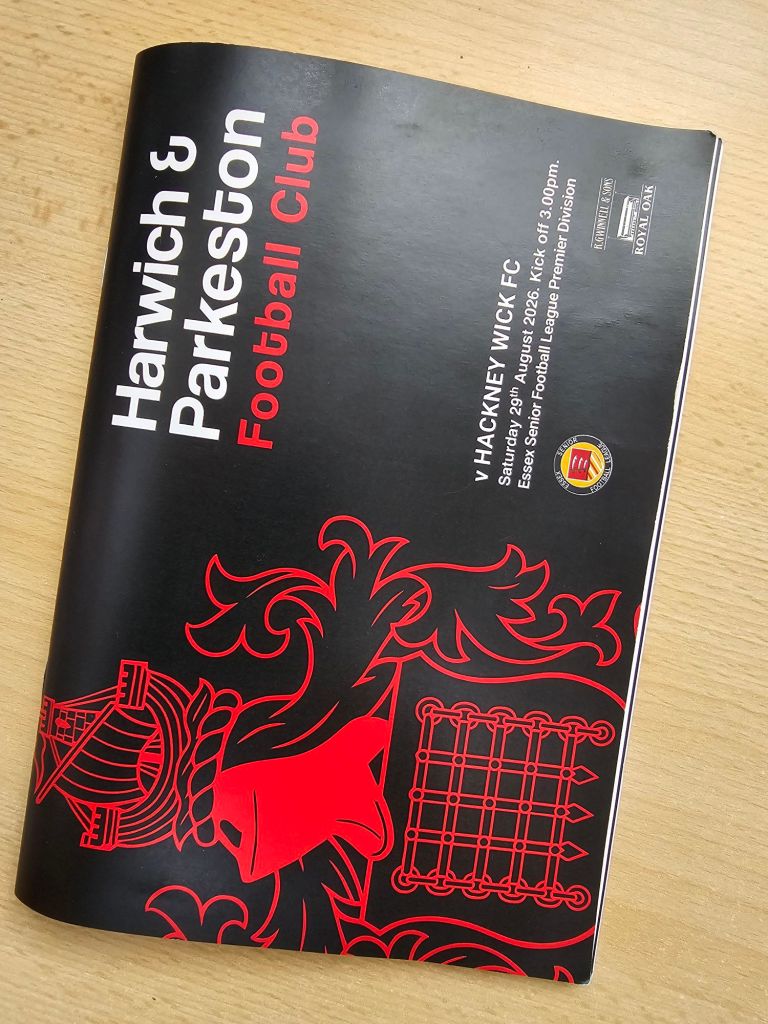
At the far end of the musty clubhouse two men stand at a table with a carboard box.  The one on the left looks at me enquiringly and I ask for “One for an old git, and a programme please”.  I am very pleased to see that Harwich still bother to print a proper hold in your hand and stuff in your pocket programme rather than rely on some digital, virtual creation which only exists in the ether.

Having paid up my seven quid using cash, I am mugged at the door by an elderly man at least in his seventies, who relieves me of a further pound in exchange for a strip of draw tickets.  Folding the tickets away in my pocket, I head for the tea bar where I buy a paper cup of tea and am served by a surly woman who seems to think I should know the price.  “One-fifty? A pound?” I ask her as I reach for my remaining change. “Two pounds” she barks aggressively “Unless they haven’t told me.” she adds, supplementing her aggressive with some passive.  “Well, it’s the first time I’ve been here in eight years” I tell her, “So I don’t know”.   As I walk away with my tea, I see that above the word tea on the blackboard menu outside it says “£1.50”.  “I’d better rub this out then” I say, so I do.   Wiping my chalky finger on my trousers I consume my tea and then find a seat up in the main stand.
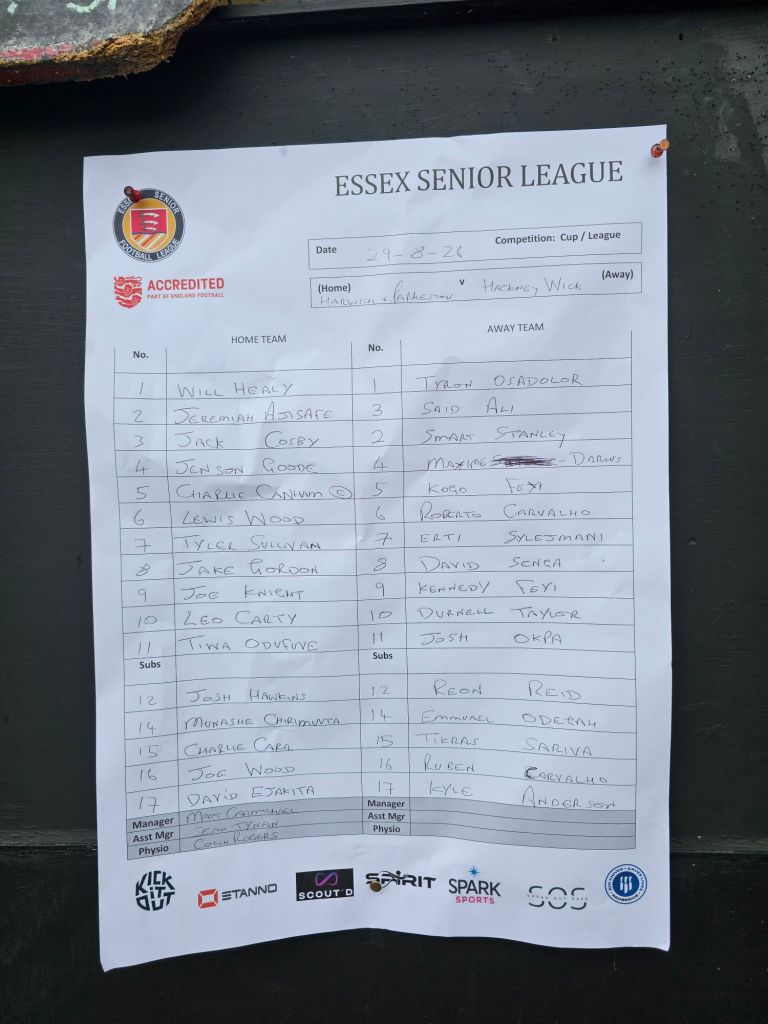
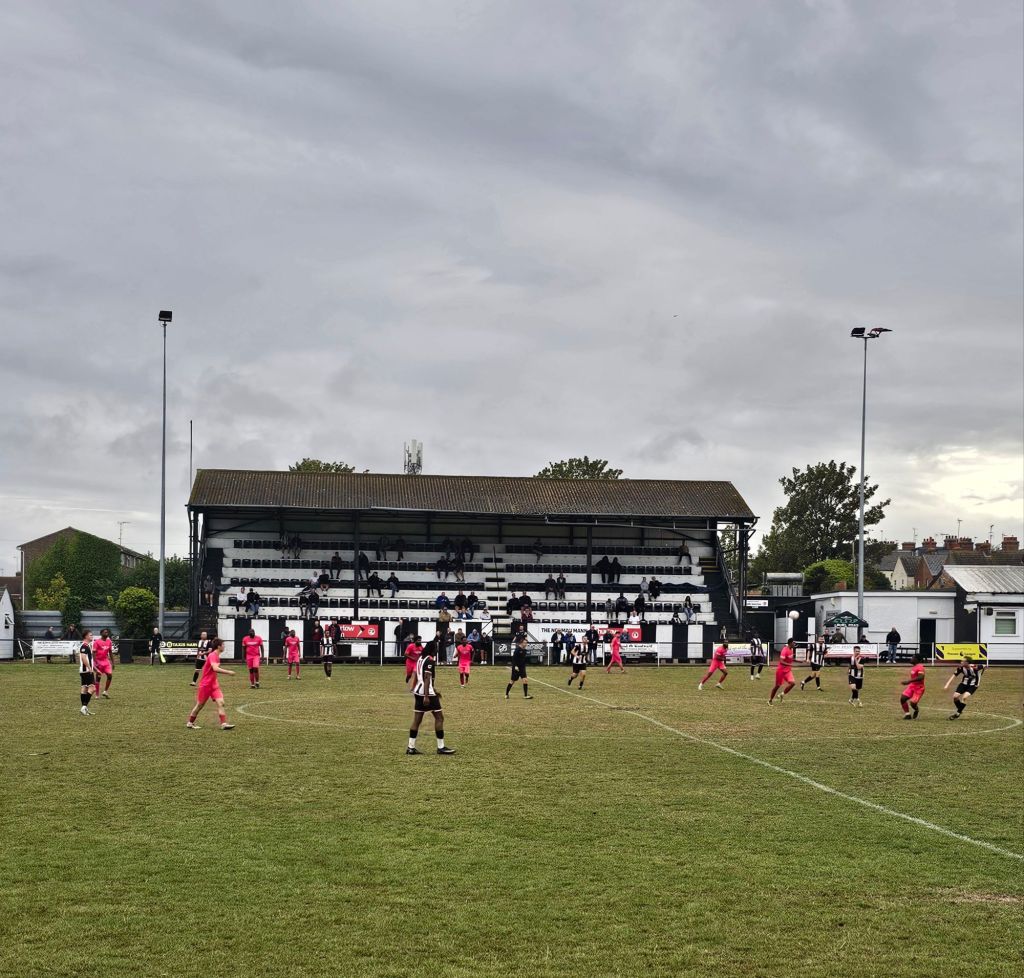
When the game begins, it is Harwich & Parkeston or ‘The Shrimpers’ as they are known colloquially that get first go with the ball, launching it towards the Royal Oak’s other covered stand more or less in the direction of Boaty McBoatface, the River Stour and Shotley beyond. Harwich & Parkeston look smart in their traditional black and white striped shirts and black shorts echoing the kits of their bigger east coast brothers Grimsby Town and Newcastle United.  Hackney Wick sport an all-cerise kit with yellow and green collars and cuffs and yellow numbers, which set off the dominant deep pink rather well. If it wasn’t for the yellow trim, and the heads and limbs, they’d look a bit like raspberry Mivvi ice lollies.  “Keep going Harwich” shouts somebody either from on the pitch or in the crowd, I’m not sure which, but the game has barely started.  I can’t decide if such a shout so early on is hyper-supportive or a bit pessimistic.  Either way, within a few moments Shrimpers’ number eight Jenson Goode lobs a shot over the Hackney Wick goalkeeper, but also wide of the goal.

From my seat, up in the vertiginous main stand, I can see dock cranes beyond the battered black and white corrugated tin roof of the one other stand, which backs on to Main Road.  Back on the pitch, both teams are looking to attack one another down the flanks.  The Hackney Wick ‘keeper Tyron Osadolor misses the ball completely as a Shrimpers cross from the left flies across the face of his goal. “Goalie, you’re rubbish” shouts a voice in the crowd, a little prematurely it will turn out. It’s nine minutes past three and The Shrimpers win the game’s first corner, but it comes to nothing and the match settles down to being a bit messy, perhaps in part because of the bumpy, slippery pitch and blustery wind.

I turn my collar up against the breeze, which is coming over the hill to my right and off the North Sea beyond.  It’s not cold but it’s unpleasantly drafty. Beneath me, the yellow pitch almost looks as if it’s coming back to life whilst we watch as it drinks up the rain that has fallen.  The Shrimpers number ten shoots on goal but the Hackney Wick goalkeeper makes a decent diving save at the expense of a corner.  Eighteen minutes have passed and it’s almost as if the sun is trying to shine, but not quite. “Ball forward, ball forward” shouts a wanna-be coach from the stand as Hackney Wick pass the ball amongst themselves in the centre circle.

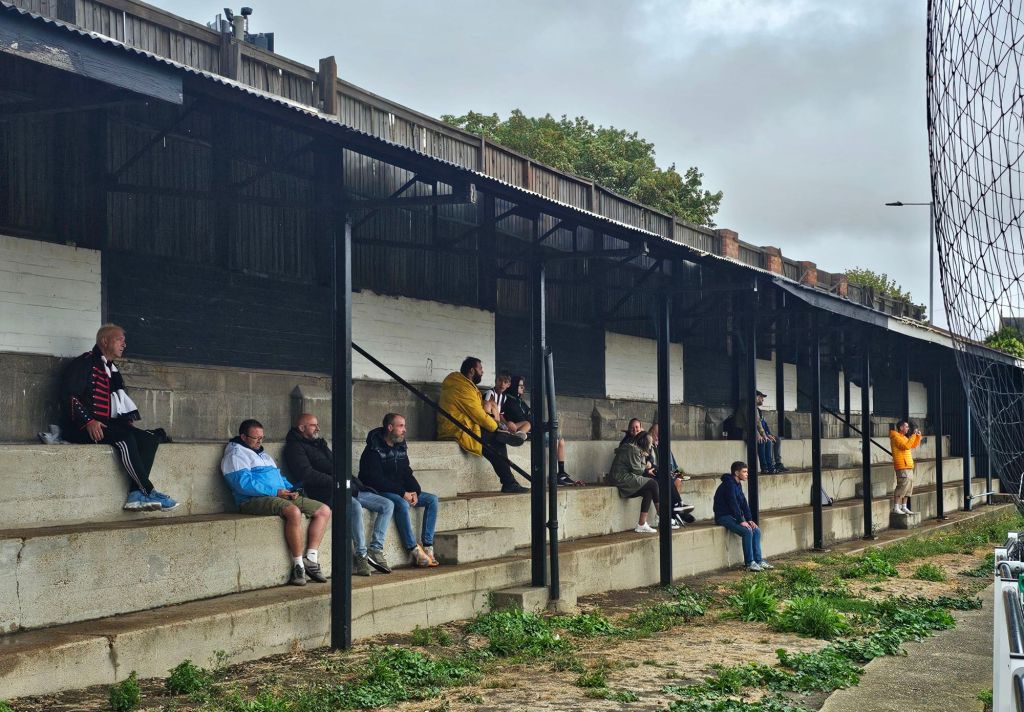
Twenty-five minutes have gone and as Shrimpers’ number three Jack Cosby receives treatment in the centre circle, there is an ad hoc drinks break, and I decide the breeze up here in the stand is more than I can bear so I make for the other covered stand behind the goal.  Two minutes later and the Shrimpers take the lead as their number nine Joe Knight runs towards goal and takes a shot from outside the penalty box, which strikes a defender and is deflected over the out-stretched goalkeeper. Knight performs a knee-slide by way of celebration and a jolly, well-fed looking woman in the crowd rings a hand bell.

The last worthwhile action of the half sees Hackney Wick’s number ten Durnall Taylor go through on goal and confidently lift the ball over the on-rushing goalkeeper only for the ball to go well wide of the goal. Taylor looks absolutely incredulous, as if the goal had somehow moved between his kicking the ball and looking up to see it not go in the goal.  The jolly woman with the bell is laughing like a drain and an elderly man wanders around the ground with a small blackboard displaying the winning draw numbers, none of which are sadly replicated by the tickets in my pocket.

Too scared to encounter the woman in the tea hut again, I forego a half-time cuppa and spend a few minutes on the phone to my wife, catching up on the latest at home. It seems we’ve lost power to the garage, kitchen and the fountain in the garden pond, but she’s rigged up an extension-lead to keep the freezer going. Good job I’m here really.

The football resumes at five past four and from somewhere unknown three Hackney Wick fans have taken up residence in the stand behind the goal and are chanting “Hackney Wick, Na Na Na, Hackney Wick, Na Na Na” repeatedly.   I’m now stood by the Hackney Wick dug out from where one of two coaches, a serious, slightly unhappy looking man bawls “Keep that pressure” and indeed his team do, pinning back the Shrimpers from the start, with their number eleven Josh Okpa in particular very busy down the right flank. “The Wick’n, The Wick’n” (I think, but possibly The Wicker?) continue the either newly arrived or miraculously cured of shyness Hackney Wick supporters, one of whom wears a bucket hat and one a bright yellow anorak.  The Hackney Wick coach is becoming a bit more effusive too. “Keep that fuckin’ pressure” he bawls, adding seemingly unnecessary coarseness to his advice. 

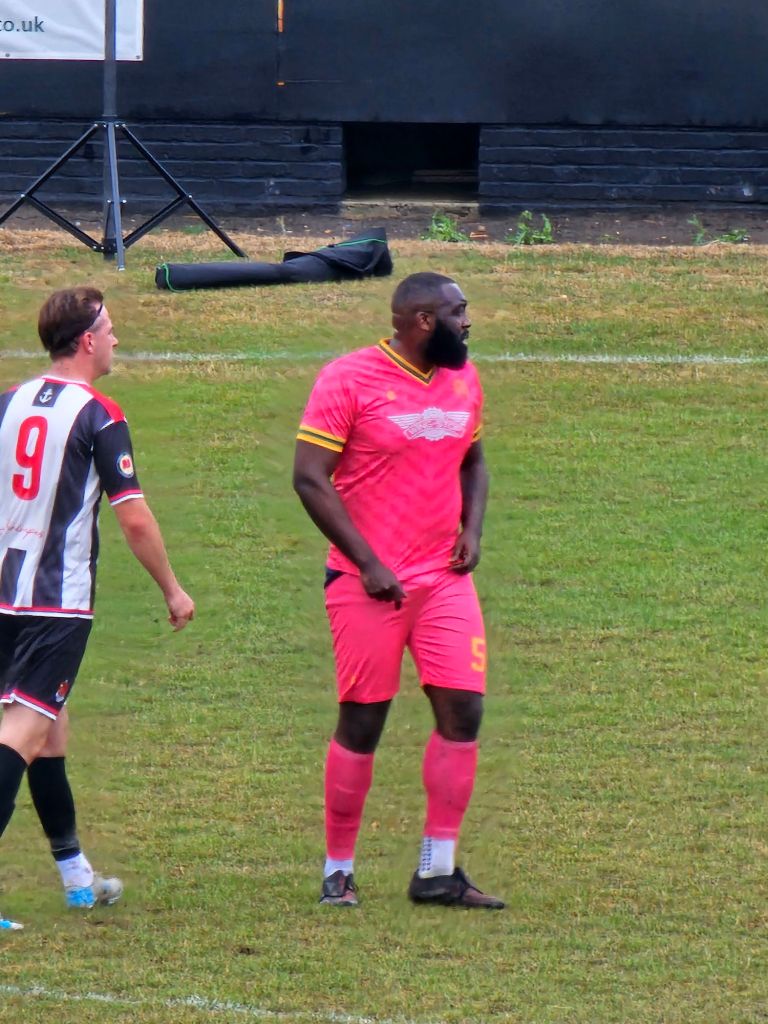
It has just gone a quarter past four and Shrimpers’ number eight Jake Gordon surges forward, only to overreach himself and slide through the legs of Hackney Wick’s massive number five and captain Kogo Feyi, who drops to the ground like a felled tree.  After the usual mass complaining and sweary advice to the referee that invariably accompanies these incidents, Gordon becomes the recipient of the afternoon’s first yellow card, to which strangely he gives the thumbs up. Five minutes later and Hackney Wick equalise as the ball is slipped through the square Shrimpers defence for number fourteen Emmuael Odegah to run after and roll past the exposed goalkeeper Will Healy. “We are The Wick, We are The Wick” chant the Hackney Wick Three in celebration.
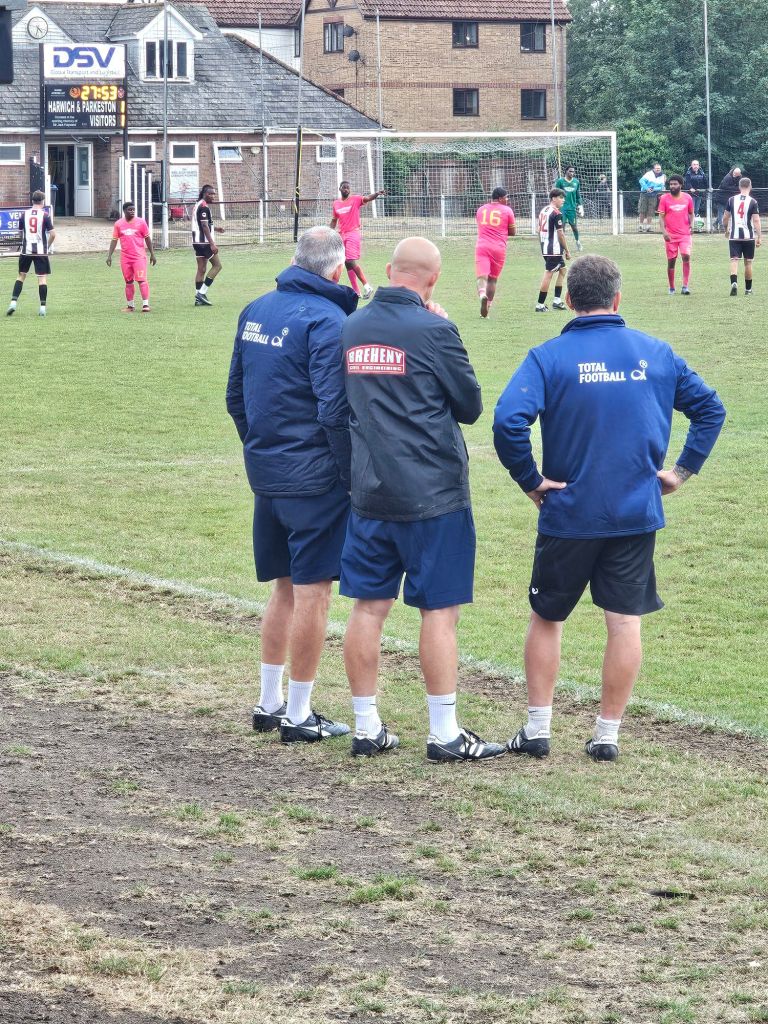
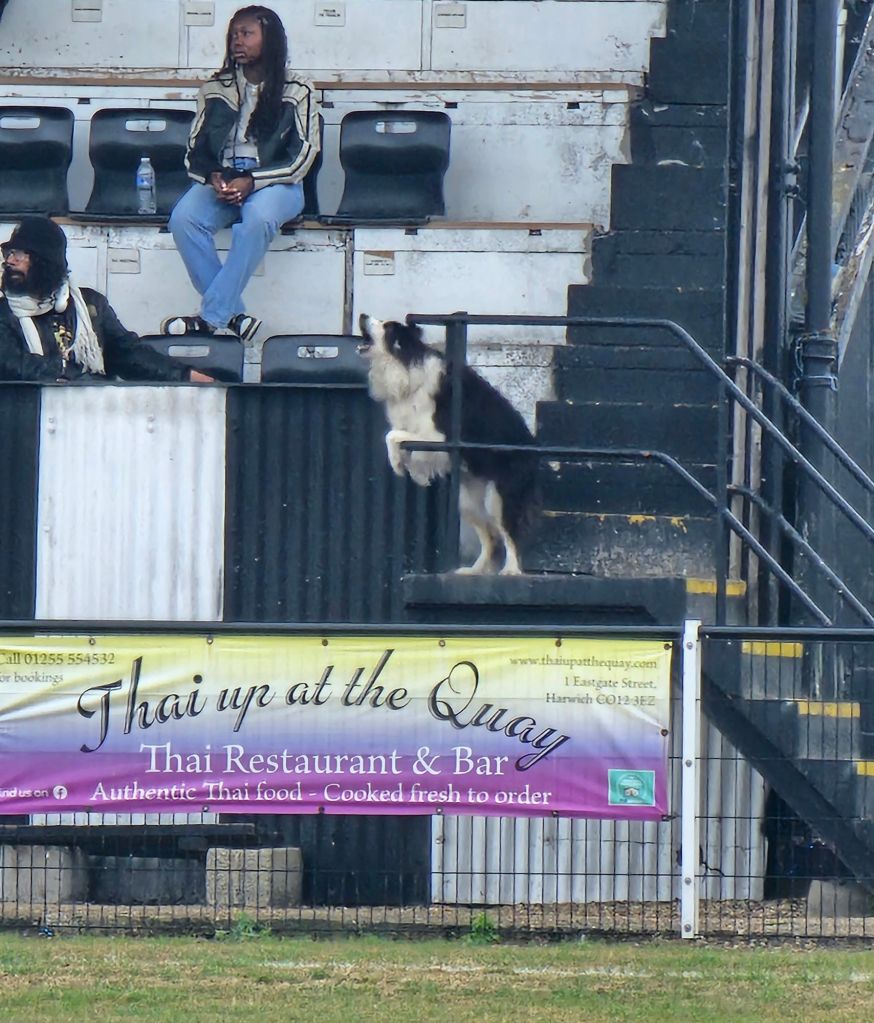
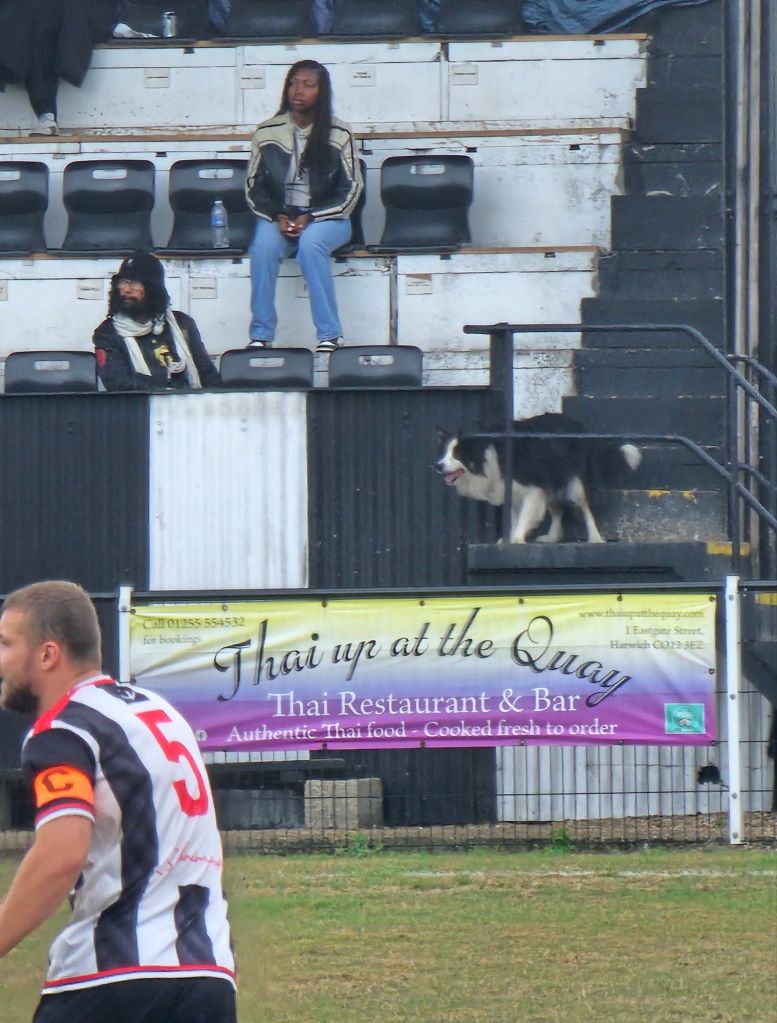
Another five minutes pass and both teams now make substitutions like they’re about to go out of fashion. Hackney Wick continue to press with the creative Josh Okpa revealing his frustration and possible artistic temperament as increasingly nothing his team does quite comes off.  The Shrimpers are the more stoic of the two teams.  “Gotta dig in” is their advice from the touchline. With the second half, half over, there is once again a hint of rain on the air, and the three Harwich & Parkeston coaches huddle conspiratorially to plan the ‘final push’.  There is mounting tension as both triumph and disaster remain possible outcomes for either team.  From the main stand a black and white dog (obviously a Shrimpers supporter) follows the action intently and every now and then barks his support or advice, I’m unsure which; he might even be swearing.
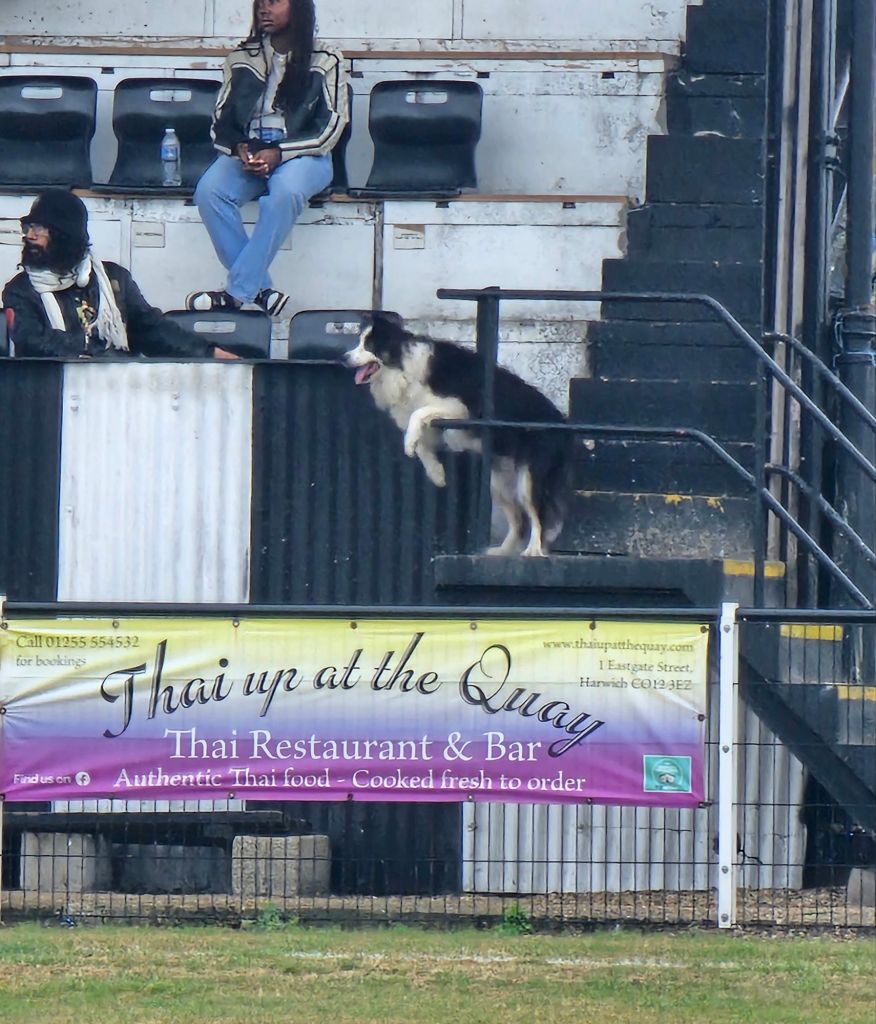
It’s nearly twenty to five. “Wicker Army, Oh, oh, oh” chant the Hackney Wick three, who just won’t shut up.  The Shrimpers win a corner; the ball sails over the penalty area but is crossed back in and number six Lewis Wood heads it firmly goalwards only for Wicker goalkeeper Tyron Osadolor to fly across the goal and spectacularly grasp it in mid-flight. It’s a save which reminds me of one I think I saw Ipswich Town’s David Best make against Real Madrid back in September 1973.

The end of the game is nigh.  One of the linesmen has to remind the referee to give a drop ball after he stops the game as Lewis Wood struggles to get up off the turf and then as sunshine momentarily threatens to break through the cloud, Wood recovers sufficiently to chip the ball against the Hackney Wick cross bar and number ten Leo Carty chases a ball over the top only for it to bounce off his shin and past the post.  The Shrimpers have ended the game more strongly and in the final minute a handball just outside the penalty area by goalkeeper Osadolor gives them a final direct free kick.    Substitute Joe Wood steps up to take the kick but his low shot is comfortably saved by the capable Tyron Osadolor.

The final whistle is blown at six minutes to five and there is a ripple of appreciative applause from the crowd, which I will later learn numbers 141, although I‘m not sure if that includes the dog.  I hang about to applaud the referee, linesmen and the teams from the pitch, but the teams take so long I am heading for the club house and the exit with the Shrimpers still on the field.  As I walk back to the railway station I reflect on what has made this an enjoyable afternoon and decide it is because the two teams were evenly matched, the Royal Oak Ground is delightfully scruffy and full of character, and there was a dog.  All that and I’ve still got the train ride home and another glimpse of Boaty McBoatface .

Ipswich Town 1 Stoke City 0

Matches against Stoke City always remind me of a bloke I knew when I was at university in the late 1970’s called Tony.  Tony was from Wolverhampton and had a thick West Midlands accent but supported Stoke City, or “Stowke” as his accent forced him to call them.  Tony, however, was what many people might term “a bit of an oik” and as well liking to boast that he had “shagged the Chief Constable’s daughter”, (Staffordshire’s or West Midlands’ I assumed), he also once defecated into a milk bottle and regularly claimed that he only went to Stoke City matches for the violence, or “vorlence” as his accent called it.  Oddly, however, he was also a really nice bloke.

Also a really nice bloke is my friend Gary, although he has no discernible accent and as far as I know has never been carnally involved with any relative of a senior police officer.   I must remember to ask him one day what he does with his empty milk bottles.    Gary joins me on the train to Ipswich, which a text from Greater Anglia has told me is running a little late this evening.  Unperturbed, we talk of the World Cup and Gary tells me how the city of Seattle, which has been nominated as one of the venues for World Cup matches, had decided to combine one of its match days with a Gay Pride Day.  The Gay Pride Day was chosen before the World Cup draw took place and when the draw was made last Friday Seattle discovered that on its Gay Pride Day it would be hosting Iran versus Egypt.  I laugh out loud as does the woman opposite us.

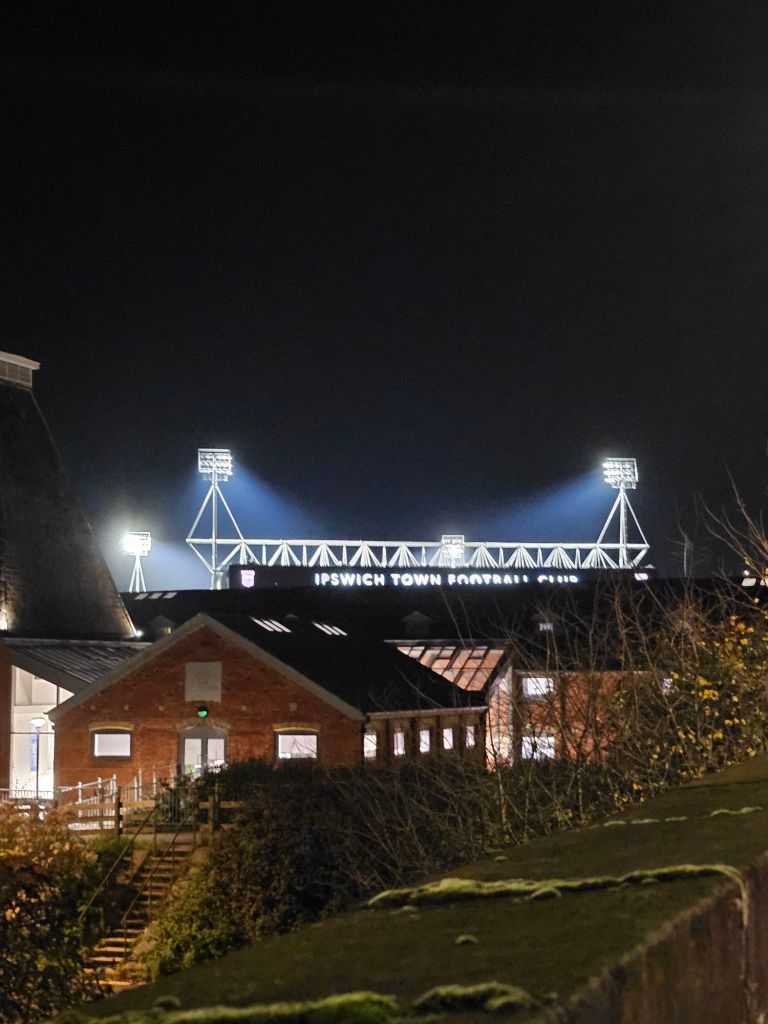
We arrive in Ipswich more than two hours before kick-off, but the floodlights of Portman Road are already shining, and Ipswich is aglow with electric light from lamp posts, buses, traffic signs, headlights and windows.  The sky is a deepening dark blue and the tarmac of the roads shiny black. The red and white stripes of a Stoke City shirt peak out from beneath a jumper. Gary and I hasten as best we can to ‘the Arb’, which isn’t quite as busy as usual, probably because it is mid-week.  First to the bar, I buy a pint of Lager 43 for Gary and a pint of Mauldon’s Suffolk Pride and, impressed by Mick’s lunchtime snack on Saturday order a Falafel Scotch egg for myself, before we retire to the beer garden to drink, eat and wait for Mick.

Mick arrives just as Gary returns from the bar with more Lager43 and more Mauldon’s Suffolk Pride; at my suggestion he also has a pint of Suffolk Pride for the previously imminent Mick.   We talk of relatives’ funerals, Gary’s grandfather, who was a member of the Communist Party, and I tell of how I was watching Toulouse v Strasbourg on tv at the weekend and how when Strasbourg replaced Diego Moreira with substitute Martial Godo I remarked that I had been waiting for him to come on.  In fact, however, I had been waiting for some club or other to sign a player called Godot, or Godo as it turned out, so I could make that joke.

The beer garden begins to empty out as other drinkers fold and head for Portman Road, but like the carefree over-sixties that we are Mick gets another round in; rather curiously a gin and tonic for Gary this time, but I have another pint of Suffolk Pride and  Mick, eager for alcohol has a pint of Leffe.  Gary then tells us about a friend of his who went to Ireland and wanted to buy a newspaper in a village shop, but all the newspapers were dated the day before.   When he asked if they had any of today’s newspapers, the shopkeeper told him yes, but he’ll need to come back tomorrow.   We continue to laugh and drink and enjoy living before I suddenly notice that it’s twenty-six minutes past seven and we probably ought to go.

Once again, down in Portman Road where I can already hear the excitable young stadium announcer excitedly announcing the Town team, there are no queues at the entrances to the Sir Alf Ramsey Stand and I breeze through, throwing my aeroplane pose as I’m cleared of carrying any weapons by a man in dark clothing and a hi-vis jacket with a hand-held scanner.  Another similarly attired man tries to scan me again as I reach the famous turnstile 62 but rather than tell him I’ve already been scanned I just say “Oooh, I’m gonna be scanned twice”, which perhaps oddly, perhaps not, seems enough to deter him.

After venting spent Suffolk Pride, I arrive in the strangely sulphurous smelling stand to edge past Pat from Clacton and Fiona to my seat just as everyone bursts into respectful, appreciative applause for former Town goalkeeper David Best, who has died this week at the age of eighty-two.  I don’t know why, but I always think of David Best in the context of the night Town beat Real Madrid, but also wearing a red goalkeeper’s jersey, flying horizontally across the face of the goal in front of the North Stand to perfectly catch a shot and, when he spoke to me as he autographed my Texaco Cup final programme, having the sort of Dorset accent that I imagined belonged in the fictional creations of Thomas Hardy . Incidentally, David Best was for a while manager of Dorchester Town (Casterbridge) where Hardy had lived.

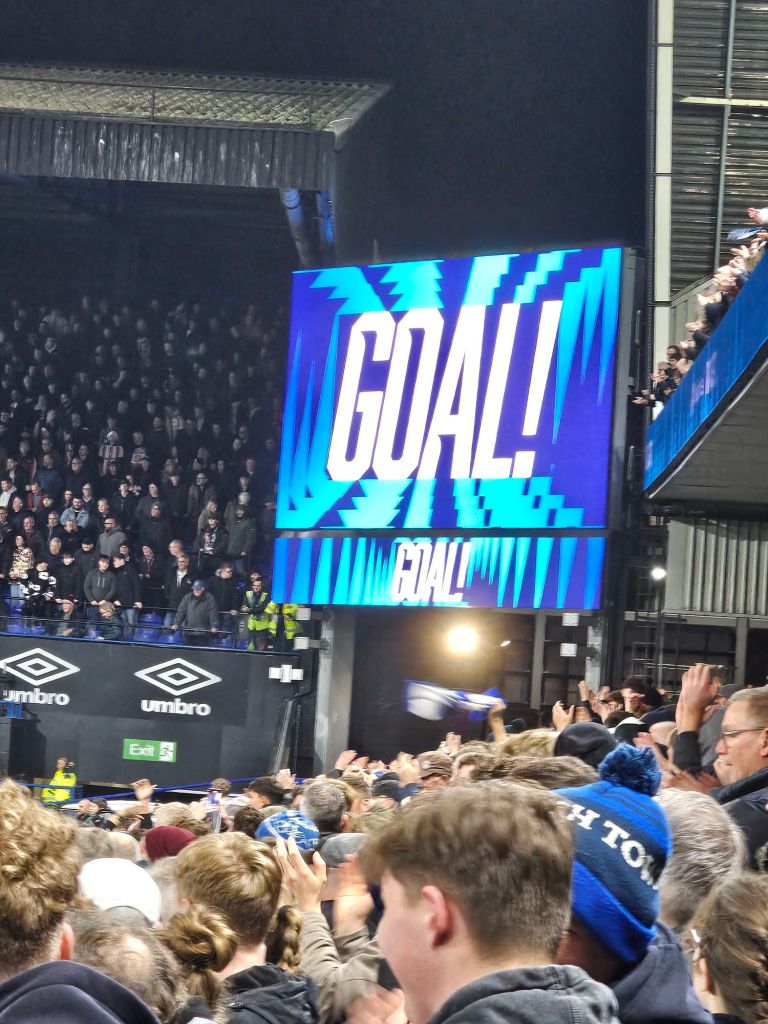
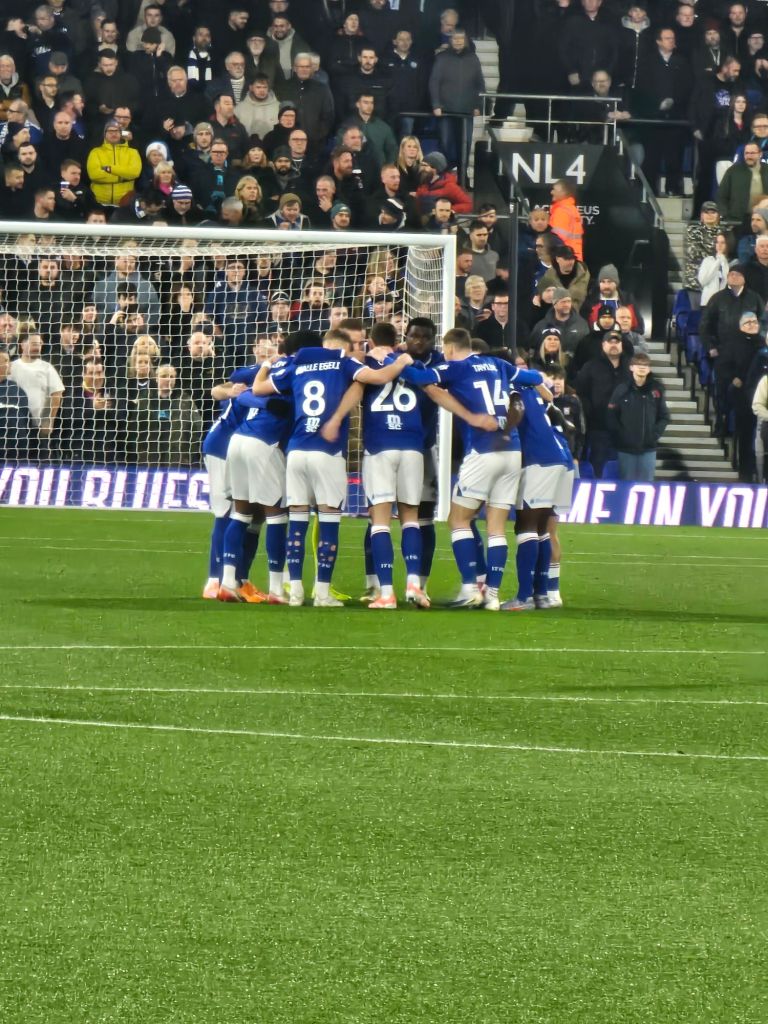
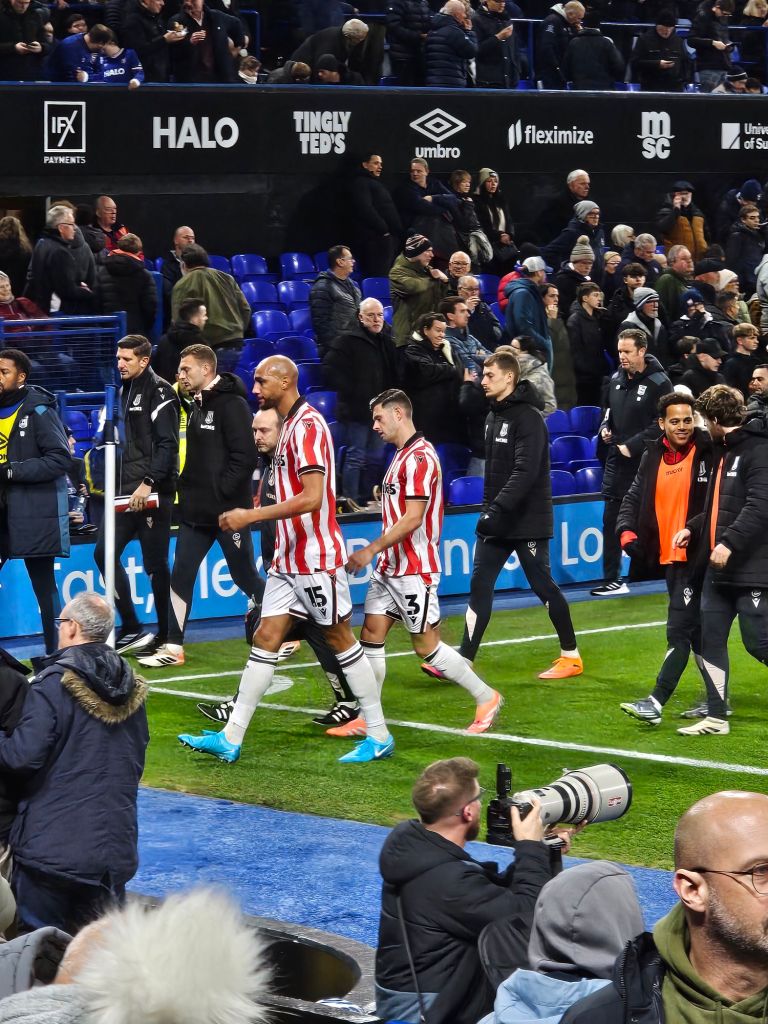
There’s barely time after the minute’s applause for Fiona and ever-present Phil who never misses a game to each hand me a Christmas card before the match begins.  It’s Stoke City who get first go with the ball, which they propel in the general direction of the Brewer’s Arms on Orford Street and the former Spiritualist church on Anglesea Road, whilst sporting their handsome traditional kit of red and white striped shirts and white shorts.   I will later notice however that the red stripes are all a bit wavy as if the kit designer had spent a long lunch hour in the Brewer’s Arms or was trying to convey the sort of weird ghostly aura normally accompanied by the made-up word “Woo-oooh”.  Happily, Town are in their standard blue and white and perhaps as a direct result of this soon have possession of the ball, are advancing down the left, exchanging a couple of passes and Jaden Philogene is cutting inside at the edge of the penalty area to curl the ball inside the far post of the Stoke City goal.  Town lead one-nil, and the game is barely two minutes old.  Every match should be like this I tell Fiona.

Two minutes later however, and Stoke have a corner, and three minutes after that their supporters are singing “Football in a library” and then “Your support is fucking shit” as they embark on a desperate attempt to make us feel bad about ourselves.  Stoke also start to dominate possession.  Behind me a bloke has his scarf wrapped over the top his head. “Dress rehearsal for your nativity play?” asks the bloke next to him.  Sixteen more minutes of winning one-nil elapse and Town dismantle the Stoke City defence again, only for Ivor Azon to shoot high and wide from a metre or so inside the penalty area with Stoke defenders scattered like shards of broken pottery.  The bloke behind me thinks he sees Nunez chuckling.

“One of you singing, there’s only one of you singing” chant the Stoke fans to an oblivious audience, and Jack Taylor generously allows time for the whole Stoke team to receive remedial coaching on the touchline as he receives treatment from a Town physio for some ailment or other.  “Who’s the Stoke manager?” asks Fiona, but I tell her I don’t know and all Fiona can come up with is Tony Pulis.  Later on, I will remember the name Tony Waddington, but Wikipedia will tell me he died in 1994.

The game re-starts and Stoke still keep the ball most of the time, but without ever looking like scoring.  I realise I recognise Stoke’s Nzonzi, having seen him play previously on the telly for Rennes and then I realise he even came on as a substitute for France in the 2018 World Cup final.  “Addy, Addy, Addy-O” sing the Sir Bobby Robson standers out of the blue, perhaps to celebrate the twenty-sixth minute but possibly in an attempt to encourage Town to keep possession of the ball a bit more often.  The chanting of “Come-On Ipswich”, a few minutes later, which sounds more like pleading, betrays our anxiety despite still being a goal ahead.  But gradually the chanting and pleading starts to work, and Town dominate the final ten minutes of the half, even inspiring more confident sounding but boringly repetitive chants of “Blue Army”, whilst Nunez and Philogene both shoot on target but at the Stoke goalkeeper, and Nunez also shoots wide.   

Three minutes of added on time are added on and then it’s time to leak more spent Suffolk Pride before speaking with Ray, his son Michael and grandson Harrison.  When asked by Ray for my thoughts on the game so far, I tell him that despite seemingly never having the ball, Ipswich look like the only team likely to score.  The football comes back at nine minutes to nine and Town soon have their first corner of the game in what will become a better half for the Town in which Stoke look even less like scoring than they did in the first half; although Pat from Clacton woke up with a blood-shot left eye this morning and so even if we did score again, it would be a bit blurry to her. 

Five minutes pass and it’s about now that I notice that the stripes on the Stoke shirts are not straight but a bit wiggly, and not for the first time when watching a team in red and white stripes I am reminded of Signal toothpaste.  Signal co-incidentally and appropriately, given tonight’s opponents, also being the name of the fictional local newspaper in Arnold Bennett’s passingly football-related, 1910, Potteries located novel ‘The Card’.  More Town corners ensue.  “Your support is fucking shit” opine the travelling “Stokies” as they ironically become the first set of away fans in well over two years to fail to fill at least half of the away section.  Not surprisingly, their chants are greeted with disinterested silence, which is followed later by confirmation that tonight’s attendance is a meagre 27,008, the lowest of the season so far.   The drop in attendance and therefore income is large enough to mean that at least one player won’t be getting paid this week.

Only fifteen minutes of normal time remain by now and later than usual Keiran McKenna dives into the world of multiple substitutions as Eggy, Azon and Taylor go for a sit down and Clarke, Cajuste and Akpom get to run around for a bit. Ten minutes left and Azor Matusiwa becomes the first player to be booked tonight by the referee, Mr Adam Herczeg, who is a sucker for giving a free-kick when anyone falls over. Meanwhile, Pat from Clacton won’t be having a baked potato when she gets in tonight, but she will have something cheesy from Marks & Spencer with a latte and she won’t be go to bed until midnight.  As for me, I wish my bed was just the other side of my front door so I could step straight into it when I get indoors.

The final ten minutes ebbs and flows a bit more than has been the pattern up to now but it’s Ipswich who should score and don’t.  Behind me a bloke complains that if he’d only known there would be no more goals he could have gone home after two minutes.   The game soon ends in the second and final minute of the unexpectedly brief period of added on time following a Stoke City corner, which doubtless has legions of pessimistic Ipswich fans anticipating going home disappointed.  With the final whistle, Pat from Clacton and Fiona disappear like water vapour, although Fiona does turn to say good-bye, which water vapour never does.  I applaud briefly and then, conscious that I have perhaps nine minutes in which to catch my train make a bolt for the exits.

It’s been a decent game again tonight, mainly because Ipswich have won again, but despite Stoke dominating possession by a reported 57% to 43%, Town have apparently had twice as many shots at goal (16) and six times as many shots on target.   Statistics are however famously boring and do nothing for one’s personal safety.  On my way back to the railway station therefore I instead keep a look out for any angry looking Stoke fans brandishing milk bottles. 

AS Béziers 1 Red Star 0

My return to the Stade de Sauclières in Béziers is an important one because of the toilets.

After the Dunkerque match I had e-mailed AS Béziers about the state of them. The club secretary replied telling me that the Ville de Béziers, the Borough Council, was responsible for this because it was their stadium and my e-mail had been forwarded on to them. I then received an e-mail from Monsieur Pintavy in the sports department of the mayor’s office telling me that they would do the necessary work before the next fixture.
So it is with a mission in mind that we arrive at the semi-rural setting of the Stade de Sauclières a little more than an hour before kick-off; but whereas on our previous visit it had been possible to park almost in front of the guichets, tonight there is a traffic jam outside the stadium, with cars parked all along the road and on the dusty, untended pitch that is behind one end of the stadium. Children and youths of both sexes in blue and white track suits are everywhere, along with their mums and dads who are wearing ordinary clothes. Parking our car on the roadside verge a good 250 metres up the road we make our way back to the stadium gates through the chatty, happy but mostly dawdling young French people. Fortunately, everyone has complimentary tickets so we don’t have to queue to pay our 10 Euros each at the guichets; only to be patted down on our way into the stadium. It is a cooler evening than when we were last here a fortnight ago and I am therefore wearing trousers instead of shorts and so never find out if it really is the local security policy to pat down bare legs. I don’t see the young man who had done this a fortnight ago; perhaps someone had complained. It wasn’t me, I only e-mailed about the toilets.
Once inside the stadium precincts we round the corner beneath a floodlight pylon and approach the toilets towards the rear of the main stand; now within a few metres of the door the fresh smell of pine toilet duck wafts alluringly towards us, the now opened door reveals the gleam of bright, white porcelain. Monsieur Pontavy and “Béziers Borough Council” sports department are true to their word, the system works, as I’m sure would the cistern if there was one. Vive La France!
I hang around outside the toilet whilst my wife uses it; this is because although the toilet is clean, the lock on the door doesn’t work. We then prepare to go up into the stand, but not before I notice that the stadium backs on to the River Orb

; there is a large white sign with red letters on the bank that spells danger. The Canal du Midi is over the road opposite the guichets and so it turns out the Stade de Sauclières is actually on an island or at least an isthmus. We go up into the stand and observe that all those French children in blue and white tracksuits are now sat on the terrace behind the goal by the entrance. Meanwhile, I wonder to myself if there is a club shop because I have developed a desire for a souvenir. In faltering French I ask a bloke in a hi-vis tabard who tells me there is one under the stand, but it’s not open now. I ask if it is open at “mi-temp” and quickly and smilingly he says his first words to me in English “Half-time? No”. It seems these are the only English words he knows; how odd. I return to my seat, but then decide to go and see for myself and it turns out that souvenirs are on sale at the buvette, although not all the staff, even in the buvette, seem to know this. Eventually, I come away with a petit fanion (pennant) for the somewhat inflated price of 7 euros (bloody Brexit!), but it’ll look nice hanging with the others in the spare toilet at home.
Flushed with success I return to my wife and my seat to await the start of the match. The track-suited children are now in the centre of the pitch and are lining up for a photograph. It turns out AS Béziers have organised a special night for all their youth and children’s teams of which there seem to be quite a number.

Clearly, AS Béziers has a firm place in the community of the town and tonight they are celebrating it. Why have I never witnessed such a thing at an English Football League club? Perhaps I haven’t been anywhere on the right day.
I have been looking forward to this match for several weeks because Bezier’s opponents tonight are Red Star, an almost legendary French club. Red Star is France’s second oldest club, founded in 1897 by none other than Monsieur Jules Rimet himself, the man after whom the World Cup trophy was named. The club is from the Paris suburb of Saint Ouen, the former docks area of the French capital. The club has a rich heritage and is known for its politically left-wing support, which has a strong anti-fascist stance. The club also has a really good badge; a red star inside a green circle.

Imagine my horror therefore when the Red Star players walk out onto the pitch wearing yellow shirts and green shorts, the colours of Norwich City. Happily, the kit isn’t theirs, but is a spare AS Béziers kit; although it isn’t clear why they needed to wear it as their usual green shirts and white shorts would not clash with AS Béziers’ all blue kit. Would they?
A cocktail of smells assaults our nostrils as the stand fills up; a mixture of Gitanes, perfumes and salt and vinegar. The game begins and referee Monsieur Cedric Dos Santos is soon explaining to Béziers’ number 21 that fouls are wrong, although the first player to be booked is Red Star’s number 12. Things then only get worse as a punt forward bypasses the Red Star defenders and Beziers’ number 17 pokes the ball past the only player in a Red Star shirt, albeit a day-glo orange one,

from a spot close to the one called penalty. The Bezier’s supporters at the other end of the stand sing something to the tune of Yellow Submarine, the last three words of which are Allez, Allez, Allez.
There are only five or six Red Star supporters here tonight but two of them are very vocal with shouts of “Allez Red Star” and plenty of clapping too; they have a small banner which proclaims “Gang Green” one of the Red Star ultras groups.
After going behind, Red Star increasingly look the better team, they have more skill and they win a remarkable succession of free-kicks all down the left flank. But the Red Star goalkeeper does also make one spectacular flying catch, a replica of one I saw Ipswich Town’s David Best make in about 1973 and which has stayed with me all these years.
Half-time comes and goes and Red Star get even better in the second half, but they don’t score. Some of their players are displaying wonderful levels of skill for a semi-professional team, everywhere there are flicks and dinks; the number eleven crosses the ball beautifully with the outside of his right foot. But they don’t defend as well and as AS Béziers’ number 17 chases a punt forward, the Red Star 29 chases him and sort of rolls into him. Monsieur Dos Santos awards a free-kick and cautions 29 for a second time resulting in his being sent-off. I usually like to see players in yellow and green sent off, but not tonight.
The imbalance in player numbers makes the task harder for Red Star but they continue to be the far more skilful team, whilst AS Béziers are big and physical and play on the break and by falling over when tackled. The Gang Green retain their faith with chants of “Come On l’etoile, Come On l’etoile” to the tune of Auld’s Lang Syne, adding Scottish into the strangely random mix of English and French that characterises their club.
In odd moments where the action stops as players play dead and Monsieur Dos Santos waves his yellow card about I notice that there are some massive insects fluttering about in the beams of the floodlights tonight, although it is also possible that there are some very small bats; but I’m not Chris Packham.
Red Star’s number 2 makes a brilliant run down the left and pulls the ball back only for the goalkeeper to make a spectacular save and then the Red Star ‘keeper pushes away a header, diving down low to his right in equally thrilling fashion. But it doesn’t look like Red Star will equalise, although they probably deserve to win. A second booking for AS Béziers’ number 29 comes too late to even things up sufficiently in terms of player numbers and despite a clearance off the line in time added-on the home team claim the points; their trainer jabs the air in front of him in that odd way football people do as if they can’t quite work out the difference between happiness and anger.
I feel quite deflated. This is Red Star’s first defeat of the season and I had hoped to see them win, but instead I’ve seen them play in yellow and green, have a player sent off and lose. Football, like the sea, is a cruel mistress. The Gang Green pack up their banner and move down to the steel fence around the pitch to applaud their team and we head off up the Chemin Moulin Neuf and back to our car, disappointed but pleased to have had good value for the meagre 10 Euro admission fee and to have seen French local government in action.