The village of Little Oakley in Essex, Wikipedia tells us, had a population in 2011 of 1,171 and is on the outskirts of Harwich. More precisely, Google maps tells us that Little Oakley is a four kilometre, fifty-eight minute walk from Harwich International railway station. Now, I reckon I could walk 4 kilometres in less than 58 minutes, but I am nevertheless of a lazy disposition and therefore, today I have opted to drive the thirty-six kilometres from my house to the Memorial Ground, home of Little Oakley FC in my planet saving Citroen e-C4, rather than enjoy a travel melange of rail, bus and walking, which would take me between one and half and two and a half hours depending on connections. Today at the Memorial Ground, Little Oakley FC are playing Barking in the Essex Senior League, the ninth level of English league football.
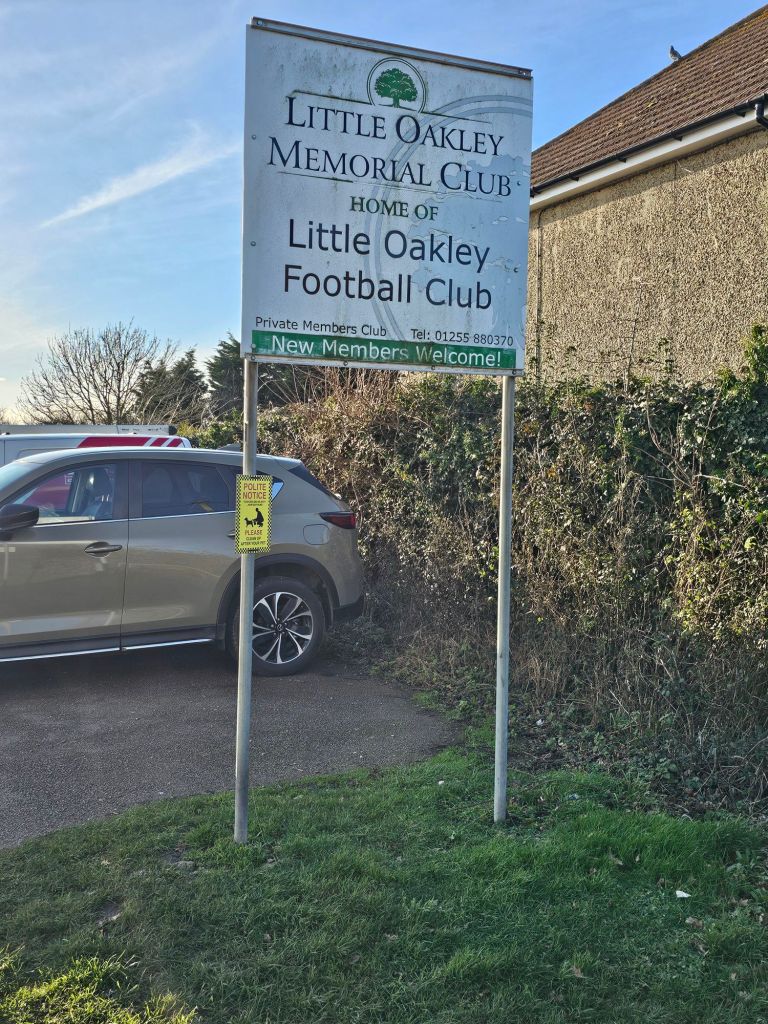
It’s a beautiful, bright, clear, winter’s day and but for a Luton van pulling out in front of me from a lay-by on the A120, I have a relaxed, trouble-free journey, played out to a soundtrack of the Saturday afternoon pre-match football coverage on BBC Radio Essex, featuring amongst others, the dulcet tones of Glenn Pennyfather and Danny Cowley. My Citroen’s SatNav doesn’t seem to know about the Memorial Ground, so my journey ends with an abrupt left hand turn when suddenly from the B1414 I see the street sign for Lodge Road, which I remember from looking at a map is adjacent to the Memorial Ground. I park up at the side of the narrow approach road, beneath an avenue of trees with a deep ditch on one side and wooden fence on the other on which several signs plead with drivers not to park too close to it. I make the short walk to the clubhouse enjoying the sound of birdsong whilst inhaling the smell of hot cooking oil, probably chip fat.


The clubhouse is welcoming and populated with happy pre-match drinkers. I buy a bottle of Adnams’ almost non-alcoholic ‘Ghostship’ (£3.20) and the bar maid asks if I’d like a glass, I would. I stand and look up at one of three TV screens showing Sky TV. From a hatch, behind which is the clubhouse kitchen, a middle-aged woman looks out glumly. “Fed up?” I ask her. “Bored” she says “It was busy, and now it’s quiet”. This lady seems responsible for fulfilling the whole crowd’s need for food and hot drink on her own but it will soon be kick-off, so for now she’s not needed.
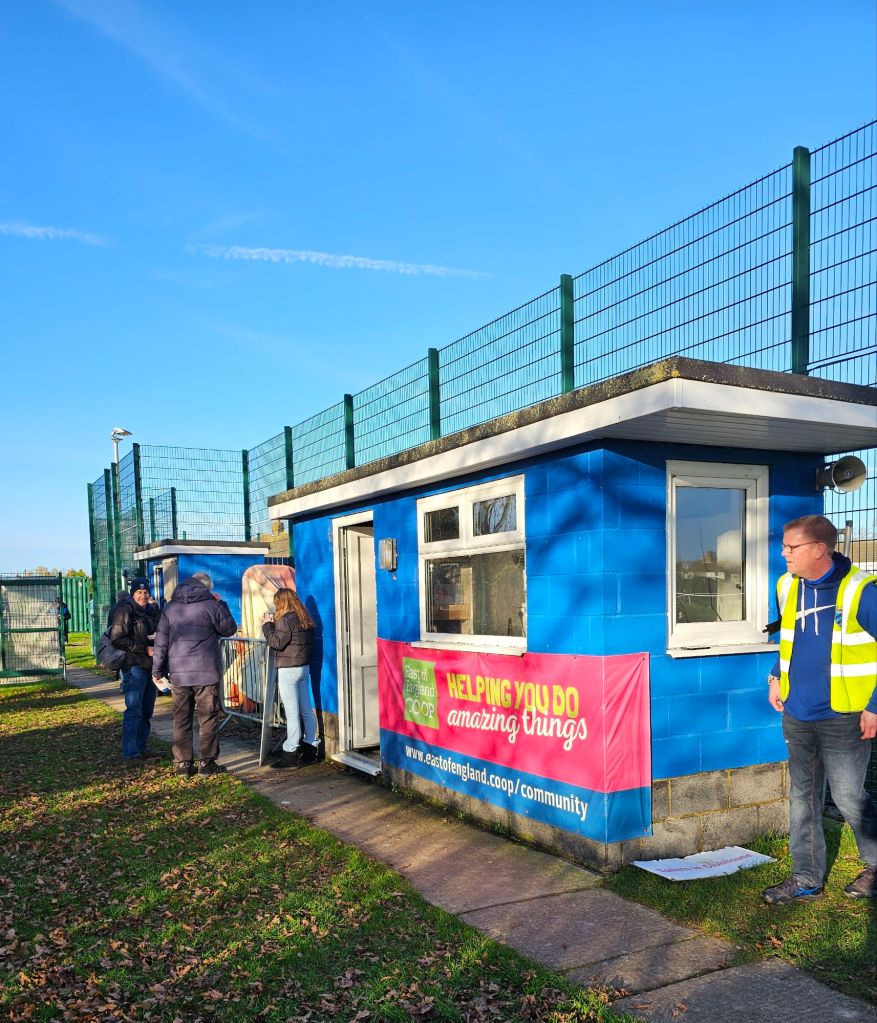
I sink my low alcohol beer as quickly as I can without burping and head outdoors where a man with a loud, deep voice directs me to turn left beyond the shipping container at the far end of the car park. A short, friendly man emerges from a hut, a bit like municipal car park attendants used to in the far off days before ‘Pay and Display’, and asks if I’m a concession. I ask how old you have to be to be a concession; it turns out it’s sixty-five and he apologises when I tell him I’m only sixty-four. But it does mean I’m about six months further from the grave than I would have been if I’d been a concession, even if I will be three quid poorer for it. Having handed over my £8.00 in cash, I ask if there is a programme and am surprised to find that there is. “Here you are, if you’d like something to read” says the man, handing me six colourful sheets of A4 paper stapled together in the top left-hand corner. Best of all the programme is free, as if a little bit of France has been re-located to the top right-hand corner of rural Essex.
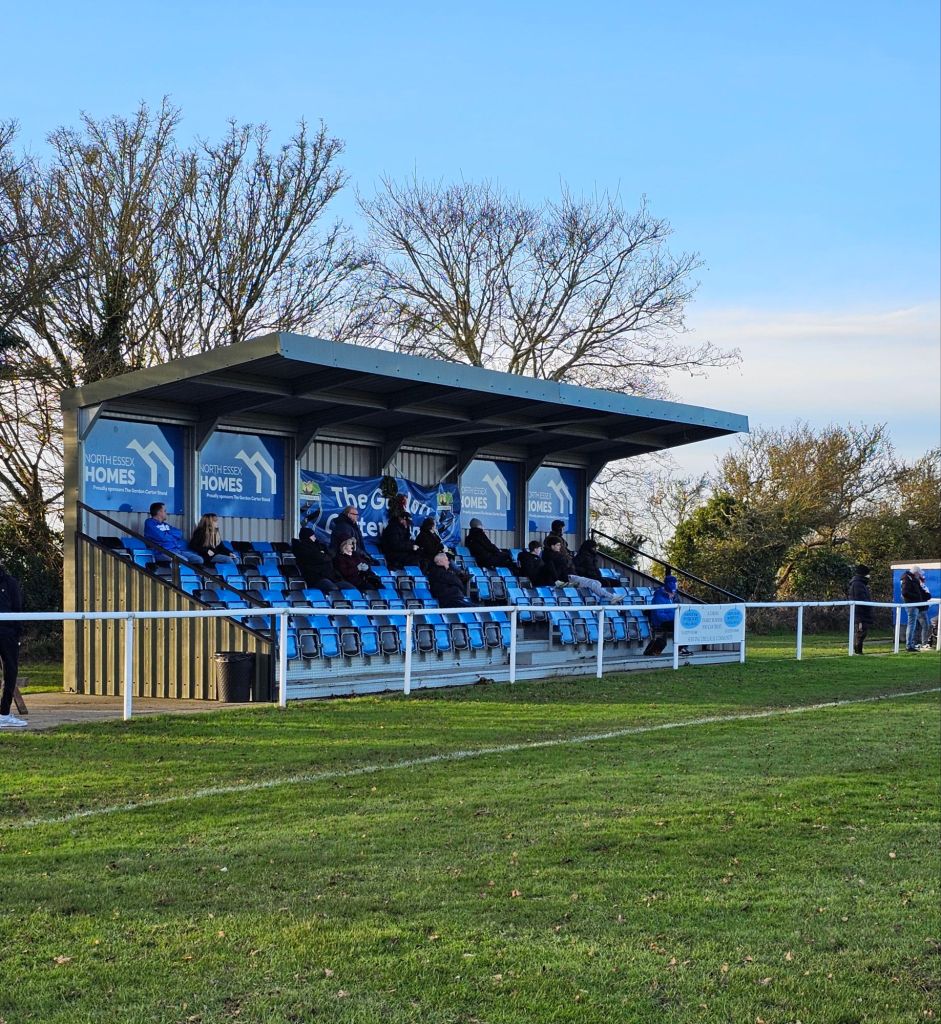
Pap-rock plays over the public address system as I take stock of the ground, which has two small pre-fabricated metal terraces behind one goal and another pre-fabricated metal stand with seats overlooking the far half of the pitch; it looks as if there wasn’t room behind the dugouts for the stand to be level with the half way line. The ground backs onto a hedge and a couple of Oak trees on one side and onto the gardens of a row of semi-detached houses on the other. At the far end there is just a playing field and a trio of teenagers have leaned their bikes against the rail around the pitch. I can also see from here that the clubhouse appears to have a partly corrugated metal roof; I bet it rattles when it rains.
The pap-rock gives way to Jeff Beck’s ‘Hi-Ho Silver Lining’ and the two teams amble onto the pitch; if there is any shaking of hands or other gestures of sportsmanship I miss them. I stand close to the home team dugout and next to me a man talking into his mobile phone says “We got two meal deals at the Co-op before we came out, so we ‘ad them”. In the ‘technical area’ in front of the dugout, a track-suited man calls out to the home players “Ave a look, ‘ave a look, just be aware of the fuckin’ double bluff”. I have no idea what he means, and decide not to ask him.
The match begins, and Barking get first go with the ball, their second touch being a hefty hoof out to the left wing. Little Oakley, known as ‘The Acorns’ are wearing blue and black striped shirts with black shorts, a bit like a destitute man’s Inter Milan and are defending the empty, featureless end of the ground with marshes, Hamford Water and the North Sea a kilometre or two beyond. Barking are all in yellow, with black sleeves, and they defend the clubhouse and Ramsey end of the ground, with the River Stour and Suffolk beyond that. Barking win an early corner with some clever play by their number seven Michele Maccari. “Why’s that big guy on the edge? ‘e’s got a massive head on him” asks a lad sat behind me of his two friends, who I think could all be Little Oakley players who are not playing today. The ‘guy on the edge’ is stood at the edge of the penalty box and whilst he is quite tall, I must admit I can’t really see that his head is any bigger than anyone else’s.


“Barking, Barking give us a song” chants a bloke tamely, somewhere off to my right. “If you all ‘ate Dagenham clap your ‘ands” comes the response from three or four other voices. Unfortunately, Little Oakley has no such choir. It’s just gone a quarter past three and despite Barking probably playing, or at least attempting to play the more attractive and neater football, it is Little Oakley who have the first decent shot on goal, as number ten, Daniel Rowe spectacularly volleys the ball against the foot of a goalpost creating a pleasing metallic pinging sound. Recovering from the momentary excitement, I notice that between the semi-detached houses on the far side of the ground and across the water inbetween, I can see two dockside cranes at the Port of Felixstowe, beyond which and unbeknown to me, Felixstowe & Walton Football Club are on their way to drawing nil-nil with Haringey Borough in the Isthmian League.
Barking make claims for a penalty as one of their number tumbles between two Oakley defenders and at this point the referee seems to lose any affection the visitors might have once had for him. “You’re a joke ref” calls a man from behind a camera with a tele-photo lens, “Absolute clown ref”. It’s nearly twenty-five past three and all of a sudden Barking take the lead; a clever, arcing cross being headed in at the near post by number six and captain Fahad Nyanja.
As the game is about to resume, an Acorns’ player calls out “We keep going, we fucking keep going”. It is stating the obvious and I for one would feel a bit short-changed if this early in the game they’d all along been secretly playing ‘next goal wins’ . As unnecessary as it should be, these apparent words of encouragement nevertheless almost work but in an unexpected way, as a low cross from the Oakley number seven, Idris Namisi is diverted against a goal post by Barking number four Sam Edwards. Idris Namisi seems a popular player amongst the home crowd, and I can’t help but like him too, even if it’s probably because his first name is the same as that of the dragon who lived in the firebox of Ivor the Engine.
Oakley’s number ten, Rowe claims the honour of being the first player to be booked as he pulls back a Barking player and I agree with the old boy stood next to me, whose grandson is the Oakley number eleven, Luke Hipkin, when he says it was a needless, stupid foul. The old boy asks me if I’m from Harwich and I tell him I grew up in Shotley just over the river from here. “Not far away, then “. He says. ”Not if you’ve got a boat” I reply. Back on the pitch, the Oakley players are arguing amongst themselves.
The half ends with Rowe being put through on goal for Oakley with just the Barking keeper to beat, but his shot is saved and Idris the popular dragon blazes the rebound high and wide. I check my phone and Ipswich are losing 0-3 at Liverpool, which makes me glad I’m here and not on Merseyside. With the half-time whistle I make for the club house to drain off excess low alcohol Ghostship and invest in one pound fifty’s worth of tea, because under a clear sky it’s beginning to get cold as the sun sinks in the west. The middle-aged woman in the kitchen is being cheerfully rushed off her feet serving tea, frying chips, griddling burgers and taking cash and card payments. I can’t help but think it’s a pity the players and managers of both teams can’t just get on with what they’re meant to be doing with as little complaint. I haven’t heard her say ‘fuck’ once.
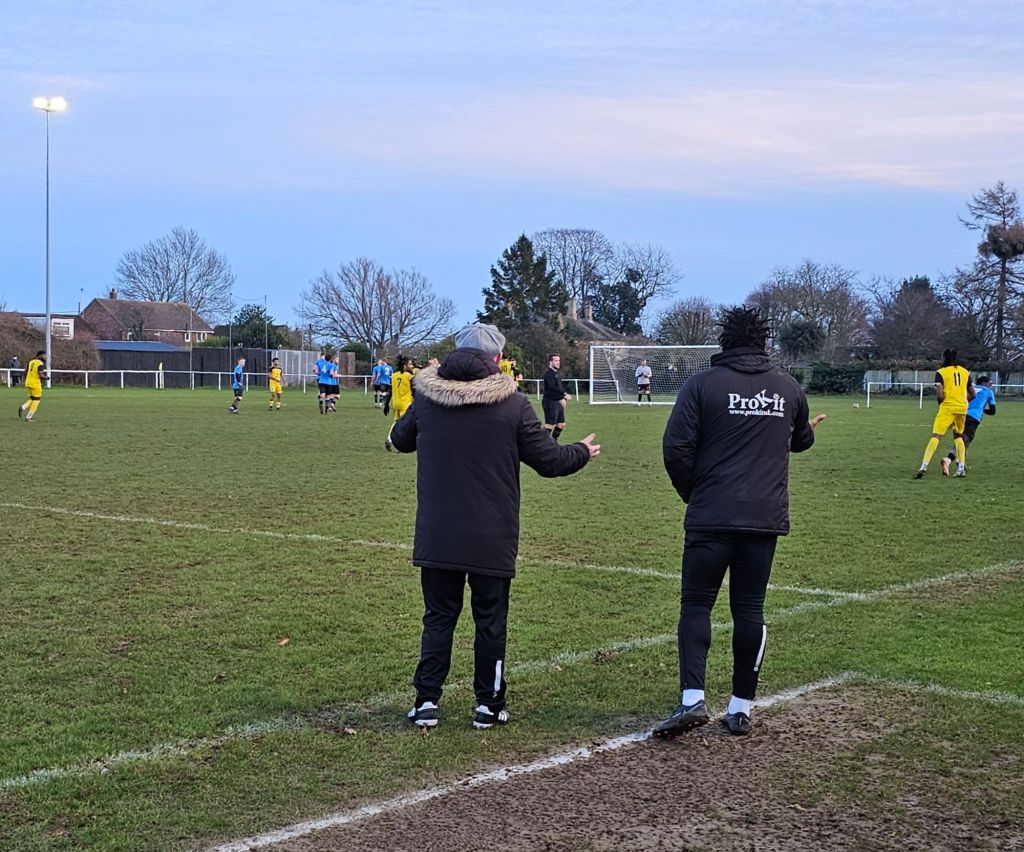
I take my tea outside into the softening, late, winter afternoon sunlight and the match resumes at two minutes past four; I stand by the Barking dugout. “Get ‘old of the fucker” barks the Barking manager a seemingly irascible man sporting a stylish grey cap and white goatee beard, who sounds like Ray Winstone and mostly never says ‘fuck’ or ‘fuckin’ in a sentence unless he can say it half a dozen times. Mostly, his exasperation seems to be directed at his own Barking team who, I can only guess, aren’t playing so much like the Spanish national team, as may be he told them to.
Time goes on and Barking’s number eleven Ugonna Emineke is booked for time wasting as he delays taking a throw-in because there is a rumpus happening in the penalty area and he’s waiting for it to subside. Unfortunately for Emineke, the referee only had eyes for him and hadn’t noticed the pushing and shoving in the penalty area, although before the throw is eventually taken he has to go and sort it out and speak to his assistant about it. Then, with twenty minutes of the half gone Oakley equalise, Idris Namisi nipping in to poke a cross over the goal line from close range.
As it has progressed, the game has become increasingly fractious, with a number of Acorns players being quite aggressive, whilst Barking players have acted out fouls where none has been made, sometimes squealing and moaning for additional effect. All this has been against a background of some of the most liberal use of the word ‘fuck’ I have ever heard and I wonder what people do during the week to make them so angry on a Saturday.
Things don’t improve when at twenty-seven minutes to five Emineke is sent off for a ‘professional’ (or, as this is only the Essex Senior League perhaps ‘semi-professional’) foul, and The Acorns are awarded a penalty, which the balding and bearded Darren Mills takes and Daniel Purdue saves, diving excellently to his right. “How many more fucking chances do we get?” moans The Acorns’ number three Adie Cant. “Calm the fuck down” shouts the coach “Fuckin’ ‘ell”. It’s as if Peter Cook and Dudley Moore’s Derek and Clive had had an afternoon out at the football.
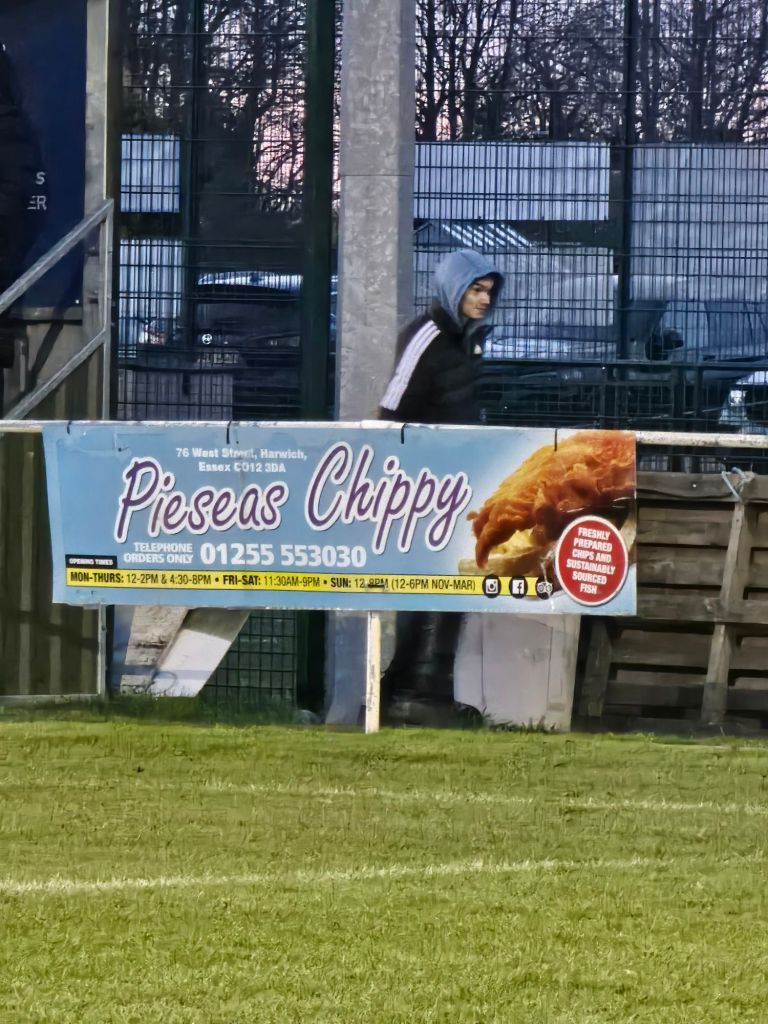
With the aftermath of the penalty, the worst of the afternoon’s fractiousness is over and much of the final twenty minutes plays out against the back-drop of a glorious, blood red sunset, A friendly man wearing a day-glo gilet bearing the words ‘LO Media Officer’ on the back, talks to me briefly and asks if I’m a ground hopper, “Not really” I tell him, “ I usually watch Ipswich”, although I don’t let on that for forty years I’ve kept a list of every game I’ve ever been to. He’s soon photographing the main stand against the sunset however, and the match plays out shifting freely from end to end, but with neither side looking much like scoring the winning goal. Meanwhile, I wonder at the name of a local fish and chip shop, Pieseas Chippy, which is advertised at the pitch side.
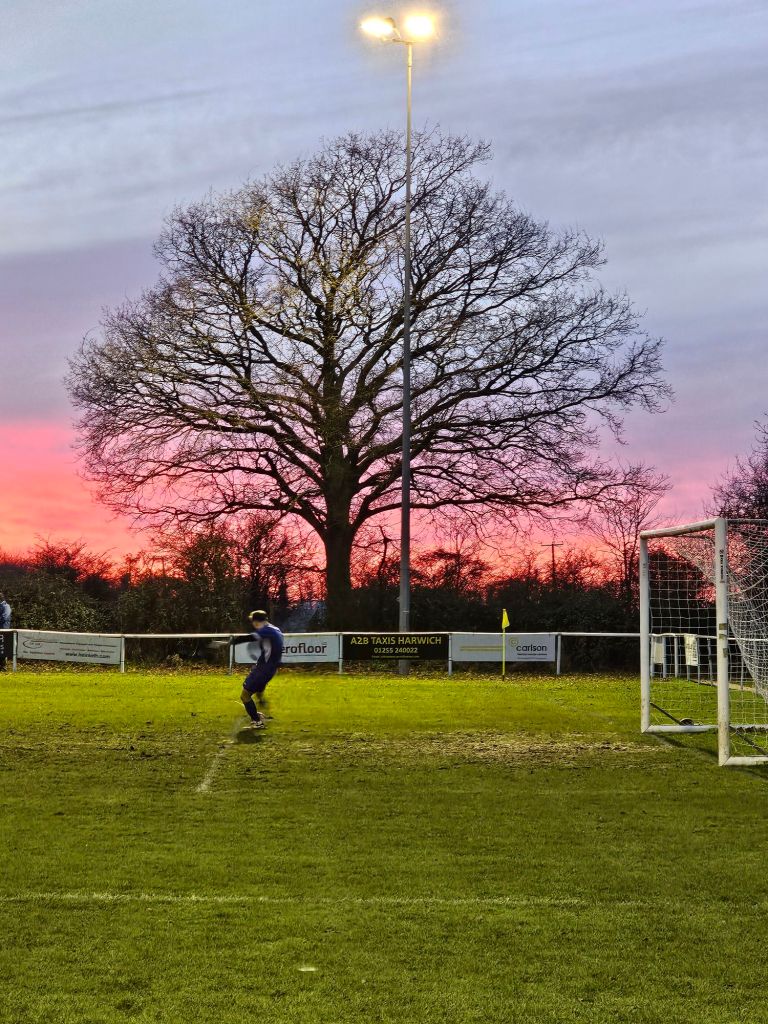
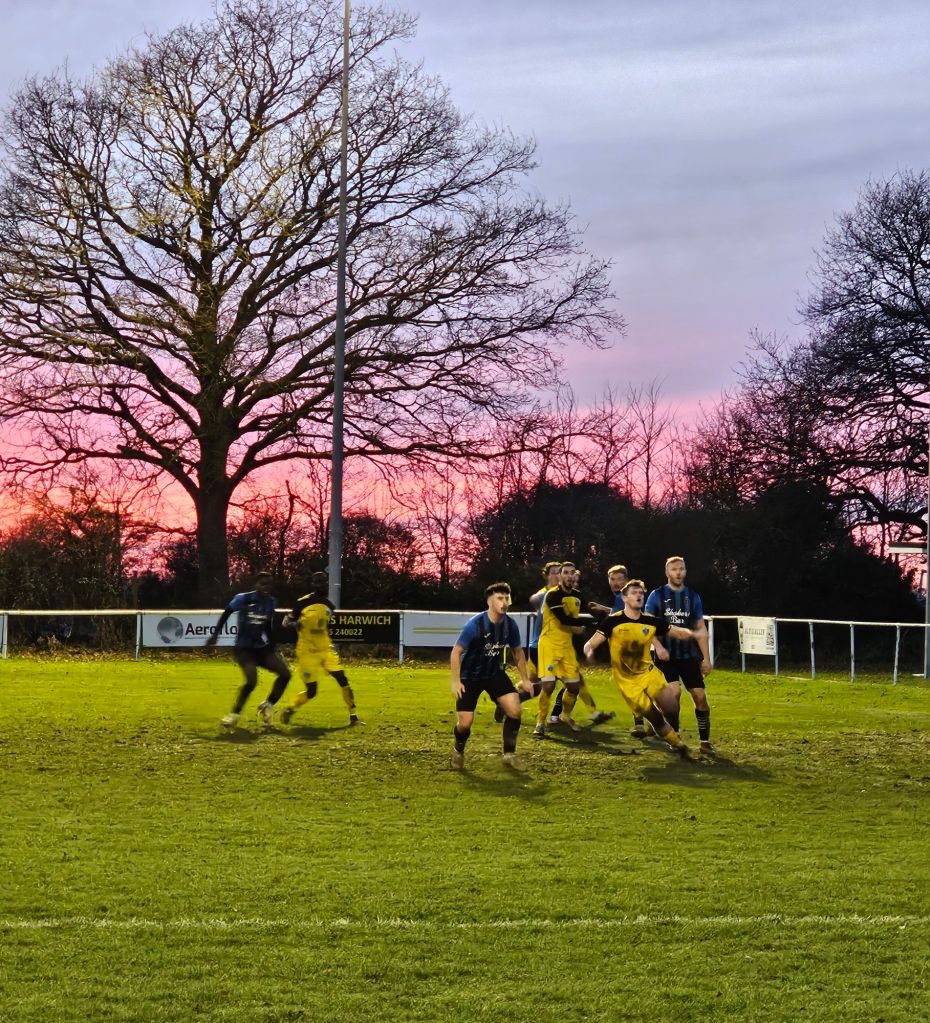
The final whistle blows at eight minutes to five and an appreciative crowd applaud the efforts of both teams in a match which whilst mostly not a thing of beauty, apart from the sunset, has been entertaining and hard fought. I think a draw is a fair result although home fans might not agree, and as I head for my car I hear a man muttering to himself about the ‘village team’ holding the team from the city (Wikipedia tells us that in 2011 Barking had a population of 59,011) as if the moral victory belongs to Little Oakley. Perhaps it does, but even if it doesn’t it’s been a lovely afternoon out.











 trippingovertheball