For an Ipswich Town supporter FA Cup ties have become something of a rarity, and more than that, a disappointment. Despite winning the FA Cup itself, albeit forty years ago, (incidentally, only thirty-six of the current ninety-two league clubs have ever won the Cup, and Norwich City are not one of them) Town have failed to honour their past and have not even won an FA Cup tie since 2010, when they triumphed away at Blackpool. Starved of cup glory therefore, the opportunity to go to the final of the French equivalent of the FA Cup, the Coupe de France, is not to be missed. This year the final tie is between the current holders Paris St Germain and Vendee Les Herbiers Football (VHF) a semi-professional team who currently play in the Ligue National, the third tier of French league football. Francophile that I am I ‘signed up’ for e-mails from the Federation Football Française (French Football Association) a couple of seasons ago and my wife, who I shall introduce to you by name shortly is on Paris St Germain’s e-mailing list, so we both received invitations by e-mail to buy tickets for the final. For just 19 Euros each, yes, 19 Euros, about £16.50, we have tickets at the Stade de France for the show piece, end of season finale. I have paid more this season to watch Colchester United versus Morecambe.
My wife, Paulene and I arrived in St Denis in the north of Paris at lunchtime and from

- Basilica St Denis
our hotel room at the Novotel it is possible to see the Stade de France in one direction and in the other the Basilica Cathedral of St Denis, where nearly 1,600 years-worth of French kings and queens including Clovis, Dagobert, Catherine de Medici, Louis XIV, Louis XVI and Marie Antoinette were all buried. As if that is not enough this is considered to be the building where in the twelfth century all the elements that make up Gothic architecture were brought together for the first time; it is a most beautiful building of remarkable historic significance.


After a leisurely visit and a picnic in the nearby Parc de Legion d’Honneur we rest up back at the hotel before making the short walk to the Stade de France. In the hotel lobby Les Herbiers supporters are checking in and making use of the bar.
Today is the May 8th, a national holiday in France marking the liberation of the country from the Nazis in 1945; it is a glorious sunny day with temperatures up in the mid-twenties; one digital display says the temperature is 35 degrees but I’m not sure I believe it. Our approach to the Stade de France is at the end of the stadium where there is a sea of Les Herbiers supporters of all ages dressed up in red and white. Les Herbiers is just a small town with a population of about 16,000 situated in the Vendee department, some 50 kilometres south east of Nantes and almost a four hour journey by road from Paris. Today Les Herbiers and a good few places all around it must be completely empty.
Last night on French TV sports journalists were debating whether this cup final between Paris St Germain, with an annual budget of 340 million Euros, and a semi-professional third division team with an annual budget of 2 million Euros was a good thing or not. Seeing the excitement and joy on the faces of the Les Herbiers supporters leaves me in no doubt that it is a good thing. It does not matter that it is the final and it is a mis-match. Paris St Germain will win because they now win everything, but it will still be the show piece event of the season and both sets of supporters will love every minute of it; also in the scheme of things it doesn’t matter much because there will be another cup final next year, and another the year after that, provided Donald Trump hasn’t finally caused Armageddon.
Security at all the bigger French football matches is reassuringly tight and once patted down we head up the ramp to the concourse that surrounds the Stade de France, a stadium that feels much more spacious and is much more beautiful than Wembley, although it is now twenty years old. Unable to resist acquiring souvenirs of the day, I buy myself a T-shirt (20 Euros) and Paulene a scarf (20 Euros) for which Paulene also learns the French, which is écharpe. There is a while to go before kick-off at five past nine so I get into the spirit of things joining the Les Herbiers supporters with a pint of Carlsberg (8 Euros), the price of which makes me feel that the T-shirt and scarf were massive bargains and I should buy more of them, but I don’t. The beer comes in a re-usable plastic “eco-cup” (2 Euros) of a type seen at many French stadiums and makes me feel much better in the knowledge that even though I have been robbed blind I am helping save the planet. Paulene has a bottle of water (3 Euros).
Paulene is keen to get in the stadium to watch the warm ups and pre-match
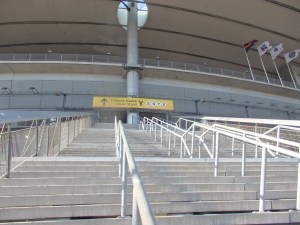
entertainment and because she is a chronic asthmatic and will need to recover from the long climb to our seats. For Paulene visits to large stadiums such as Marseille’s Velodrome and the Stade Felix Boleart in Lens have in the past come with near death experiences after ascending staircase after staircase after staircase on a sort of stairway to Heaven. Whilst Paulene climbs, I callously hang around outside, slowly drinking my beer, savouring it as best I can and soaking up the ambiance with smiling, excited and inebriated French people. Eventually I head for the turnstile where I must show both my ticket and passport, the French show their identity cards. The steward seems pleased to see a “Rosbif “ and summons up his best English to say “Welcome”, which is nice. Inside the stadium I am patted down again and wished bon match before being offered a complimentary Pitch choco barre courtesy of a promotion by Brioche Pasquier an industrial French bakery whose products can be found in English supermarkets too.
Our seats are in the third tier of the stadium but are not together, Paulene sits in the second row from the front whilst I am another three or four rows back and off to the right. As I arrive at my seat, on the pitch the final ten minutes of the French FA Youth
Cup for Under 19’s, the Coupe Gambardella, between ESTAC Troyes and Tours FC are being played out. Troyes are winning 2-1 and hang on to lift the trophy amidst scenes of much excitement and generous appreciation for these young players. Although fully professional, Troyes and Tours are relatively small clubs, but in France this is no barrier to producing successful youth teams, a fact illustrated by Auxerre, a town a third the size of Ipswich having won the Coupe Gambardella a record seven times. I sit on the steps next to Paulene and after the presentation of the trophy and ensuing celebrations we watch the stadium gradually filling up until the steward just in front of us asks me to take my seat.
We are amongst the Paris St Germain supporters, although the hard core ultras are in a seemingly dedicated area in the lower tier where a platform is positioned in front of


them for the use of the two ultras who will lead and orchestrate the chanting. On the pitch the preparations are being made for the start of the final of the Coup de France and the celebration of French football that this represents. The teams warm up; the PSG players looking comfortable and familiar with the huge stadium, the Les Herbiers players looking slightly in awe of the setting and the vast numbers of their own supporters decked out in red and white; their home crowds in the Ligue National average about 1,300. Les Herbiers wear simple hi-vis jackets over their red tracksuit tops and look every bit the modest, provincial club that they are. The players warm up in a corner in front of their fans as if at a much smaller ground.
At last the scene is set and amidst two teams of drummers behind each goal, four separate formations of flag wavers, a huge circular FFF Coupe de France logo and two similarly massive club badges that all look like they could be used by the fire brigade to catch people jumping from high buildings, a marching band in French blue trousers with tunics decked in gold braid, a suspended image of the Coupe de France trophy and pitchside pyrotechnics the teams emerge from the tunnel. I join in as best I can with the singing of the Marseillaise, which is truly glorious and then the teams are introduced to President Macron who is roundly booed. I exchange amused smiles and raised eyebrows with the white haired bearded man stood next to me who admits he is not really a football fan, he prefers rugby and has just been brought along to the game by his two friends; he is however supporting Les Herbiers and so am I. It’s all absolutely brilliant and the game hasn’t started yet.
We sit and Les Herbiers kick off the match wearing all red and playing towards central Paris, the Arc de Triomphe and the Eiffel Tower; PSG are in their usual all navy blue kit and kicking towards the Cathédrale Basilique St Denis. Les Herbiers start well and within two minutes Joachim Eickmeyer breaks down the left, crosses the ball and Sebastien Flochon’s shot is deflected wide of the goal resulting in a corner from which Valentin Vanbeleghem shoots wide from some 25 metres out. The white-haired man and I applaud conspiratorially. But it doesn’t take long before PSG have two shots from Giovanni Lo Celso and Kylian Mbappé that hit a Les Herbier goal post, the second shot defying physics as its angle of incidence blatantly fails to equal its angle of reflection, instead the ball just bounces right back at him.
Satisfyingly for my white haired friend and me it is PSG’s Yuri Berchiche who is the first player to be booked by referee Mikael Lesage. But such events become crumbs of comfort as PSG predictably dominate and miss chance upon chance with Lo Celso again hitting a goalpost with a shot , although Les Herbiers are in fact playing extremely well, they’re just not as good as PSG. The Ligue National team do not ever resort to aimlessly booting the ball away in blind panic, but always attempt to play the ball from defence by passing it, certain Ipswich Town defenders could perhaps benefit from some coaching from Les Herbiers’ Stephane Masala; does he know there is a job going? He is perhaps one of the few successful managers of a lower league club not so far linked with the job.
Off the pitch, the far end of the stadium is a noisy, constantly choppy, but joyous sea of red and white flags, even when on 26 minutes Giovani Lo Celso surprises me at least by scoring with a low shot from the edge of the penalty area to inevitably give PSG the lead. PSG continue to dominate play but still only lead 1-0 at half-time, when I pop downstairs to buy a bottle of Evian (2.50 Euros) for Paulene.
The second half picks up where the first left off, but for the usual change of ends. Within five minutes it seems PSG have scored again as following a sequence of remarkable deflections and rebounds Mbappé sends the ball into the goal net. The PSG fans and ultras have celebrated the ‘goal’ but apparently under false pretences as following some sort of video conference at the side of the pitch Monsieur Lesage disallows the goal and awards Les Herbiers a free-kick. It is the first time I have witnessed the use of video technology at a match and it feels very odd because of the hiatus it creates; I don’t like it, it doesn’t feel right, although my neighbour and I gleefully cheer the decision nevertheless.
PSG probably dominate the second half more than ever and despite some fantastic saves from Matthieu Pichot in the Les Herbiers goal it eventually all becomes too much and a bit after twenty five to eleven he can’t help but knock over PSG’s Edinson Cavani who

scores from the resultant penalty. Pichot is booked by Monsieur Lesage for his efforts but shakes his hand to acknowledge his mistake and show he has no hard feelings; what civilised people the French are.
PSG come close to scoring again more than once in the final minutes but pleasingly Les Herbiers have a late flourish too and both Diaranké Fofana and then substitute Clement Couturier almost beat PSG goalkeeper Kevin Trapp with a snap shot and a run into the penalty box. Finally, after five minutes of time added on however, Monsieur Lesage calls time on the 101st final of the Coupe de France and PSG have won it for a record 12th time. No one seriously thought they wouldn’t, but some of us hoped.
After an overlong wait, the presentation of the trophy follows with much jumping about and littering of the pitch with red, white and blue fluttery material. A massive scrum of photographers surrounds the players who are barely visible in the unseemly melee and the players make their way to the ultras to thank them for their support and to celebrate together. Nobly the vast majority of Les Herbiers supporters stay on to watch also; this is all part of their big day out. With their celebratory juices running dry the players leave the pitch which is covered by protective sheeting in preparation for the finale to the finale a display of fireworks, lights and lasers which says thank you to the 7,160 clubs who entered the Coupe de France this season, almost ten times the number that enter the English FA Cup. Reminders appear on the scoreboard of when the last metro trains leave the two nearest stations to the stadium.
The fireworks display is a fitting end to the evening, although Paulene and I actually thought the one put on by Lille Olympique at the end of their final league match last season was better, but we can be picky like that sometimes. It has been a terrific night for PSG, the Coupe de France, French football and most of all Vendee Les Herbiers Football and its supporters and we didn’t half enjoy it too. Vive La France!

 to see the tie with Clermontaise, who are from the town of Clermont l’Herault, some thirty kilometres to the north west.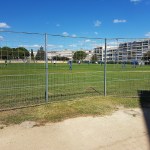
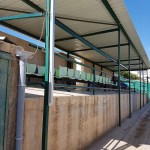 It looks like the original roof has been replaced with new metal sheeting on another metal frame, which obscures the row of the pitch from the front row of seats. We enter the stadium through a wide opening in the back wall and find ourselves in the players tunnel; it’s an entrance that is closed soon afterwards, but it’s not quite two -thirty yet and the game doesn’t kick off until three. A wonky sign points roughly in the direction of the buvette,
 which is a portakabin style structure with a counter even more wonky than the sign. To the other side of the stand is a dark room with high-up shelves of trophies on two walls and a bar counter;


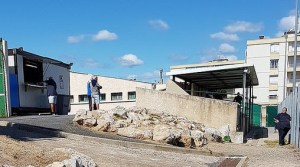 and the teams line up on the pitch. Balaruc wear an unattractive all-black kit with green trim, which displays no team badge or sponsor’s names. Clermontaise and Balaruc are in the same regional league (Poule A of the Languedoc-Rousillon section of the Occitanie region’s Division Honneur 2 – the seventh level of French football), but Clermontaise look much smarter and ‘professional’ in their all blue kit with badge. The McDonald’s golden arch logo is on the Clermontaise shorts; they can’t have read the poster on the table in the trophy room.
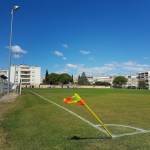 at the Mediterranean end of the ground. A bloke in a t-shirt and trakkie bottoms is called on to sort them out and once he has done so the game carries on. Early on Clermontaise look the better team, but it might just be because they’re wearing a nicer kit. Just before twenty past three it looks like they have scored, but I can’t tell if it was offside or the shot was missed. There are flattened practice goals either side of the real one and from my rock it’s hard to tell which is which.
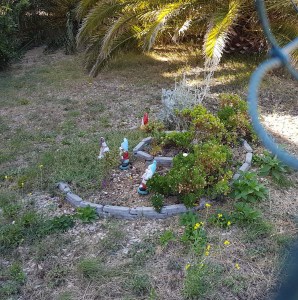 There are a number of people, mostly men in their sixties and seventies, sat at windows and balconies looking down on the game. I envy them their home comforts, it has to be better than perching like a lizard on a rock in the sun. Dissatisfied with my view sat on the rock, I watch the remainder of the first half standing up.
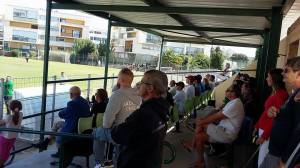 It proves to be a good choice and our enjoyment of the second half is much increased by our new location, which is shaded, out of the wind and high enough to see over the fence, with the added bonus of atmosphere as the stand is full; spectating nirvana.
 Monsieur Gerard Blanchet busy in front of us. Clermontaise’s number twelve confirms his presence by boldly attempting a shot from a thirty metre free kick; of course he misses, but not embarrassingly so. The Balaruc bookings continue and five blatantly kicks the Clermontaise twelve as he dribbles past him and three knocks over his opposite number as they run side by side. All afternoon tbere is a pleasing symmetry with many of the fouls and bookings as players with the same shirt number go for each other.
 near the Atlantic coast, some 380 kilometres away by road; they have won one and lost two of their four games so far. Kick-off is at six pm and we arrive about a half an hour beforehand, parking in the spacious gravel topped car park at the side of the Stade Louis Michel, although other spectators prefer to park in the road outside. Entry to the stadium costs €6 and we buy our tickets from the aptly porthole-shaped guichets
  outside the one gate into the ground. Just inside the gate a cardboard box propped on a chair provides a supply of the free eight-page, A4 sized programme ‘La Journal des Verts et Blancs’. Also today there is a separate team photo and fixture list on offer.
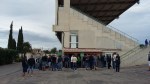
 the brutal angular concrete of the main stand, the Tribune Presidentielle, could be from the 1960’s or 1970’s, channeling the inspiration perhaps of Auguste Perret or even Le Corbusier. The concrete panels on the back of the stand are lightly decorated and sit above wide windows; a pair of curving staircases run up to the first floor around the main entrance,
  above which is a fret-cut dolphin, the symbol of the town and the club. The stand runs perhaps half the length of the pitch either side of the halfway line and holds about twelve hundred spectators, as well as club offices and changing rooms. Opposite the main stand a large bank of open,
  ‘temporary’ seating runs the length of the pitch, it is built up on an intricate lattice
  of steel supports. Behind both goals are well tended grass banks; there is a scoreboard at the end that backs onto the carpark.
 Sète in green and white hooped shirts with black shorts and socks, Stade Bordelais with black shirts with white shorts and socks. There is a ‘ceremonial’ kick-off before the real one, taken by a youmg woman with a green and white scarf draped around her shoulders. Eventually, referree Monsieur Guillaume Janin gives the signal for the game to start in earnest.
 man mountain with a wide shock of bleached hair on the top of his head, and thighs the size of other men’s waists.
 which is close by at the corner of the stand where we are sat. The reason for my eagerness is that Sète is the home of the tielle, a small, spicy, calamari and tomato pie, with a bread like case. I love a tielle, and I love that they are specific to Sete, and are served at the football ground as a half-time snack. I only wish there were English clubs that served local delicacies. Middlesbrough has its parmo, but I can’t think of any others. Do Southend United serve jellied eels or plates of winkles? Do West Ham United serve pie and mash? Do Newcastle United serve stotties? Did the McDonald’s in Anfield’s Kop serve lobscouse in a bun? I need to know. Sadly, I don’t think my town Ipswich even has a local dish. Many English clubs don’t even serve a local beer; Greene King doesn’t count because it is a national chain with all the blandness that entails.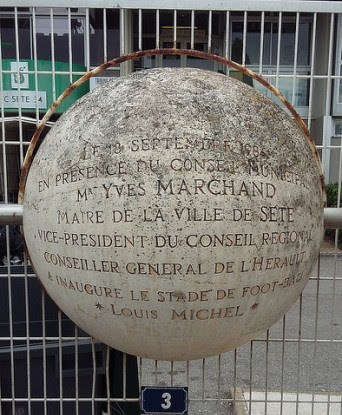
 trippingovertheball