EA Guingamp 2 USL Dunkerque 1

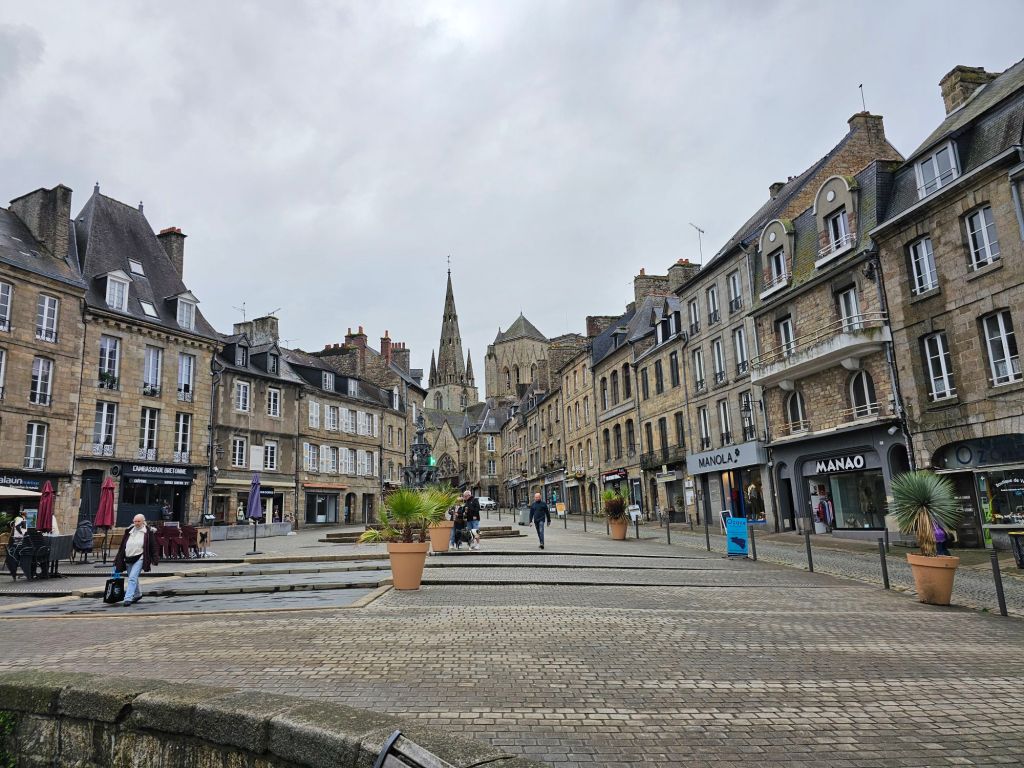
Guingamp (Gwengamp in the local Breton language, and pronounced gangomp) is a small town of only seven or eight thousand people, which sits on a rocky escarpment above the River Trieux in the heavily agricultural north-west corner of France. For thirteen seasons since 1995, this tiny rural town with a population smaller than Beccles, Mildenhall or Woodbridge had a team in the top division of French football, and also won the French FA Cup (the Coupe de France) twice in that time.    But more than that, the name ‘Guingamp’ is just beautiful to the ears, the club plays at the wonderfully named Stade de Roudourou and when Guingamp reached the final of the Coupe de France in Paris, some fans travelled there by tractor.  For these reasons, I am fulfilling an ambition today in making a 160-kilometre pilgrimage from where my wife Paulene and I are staying on holiday in Carnac in the south-west of Brittany.

Our journey is elongated a bit by a stopping off north of the topographically scintillating town of Morlaix, 60 km west of Guingamp to visit the huge six-thousand year old Neolitihic cairn at Barnenez, but we eventually rock up in good time in Guingamp to buy two tickets for the match (26.00 euros each) at the club ‘boutik’ in the town, along with a petit fanion (pennant) and fridge magnet (6.50 euros for the two) for my respective pointless collections.  Disappointingly, the T-shirts showing a representation of the town of Guingamp through its most prominent buildings such as the basilica and hotel de ville is only available in bizarrely small or large sizes, and whilst I’d like a mug that displays the same design, it would probably just sit on a shelf above the petit fanions overlooking the fridge magnet, and with a little thought I could surely spend that 12 euros doing good. More happily, the very pretty shop assistant, whose name, I think, from what it says on our tickets may be Angelique compliments me on my French, although after initial exchanges we mainly speak in English.  

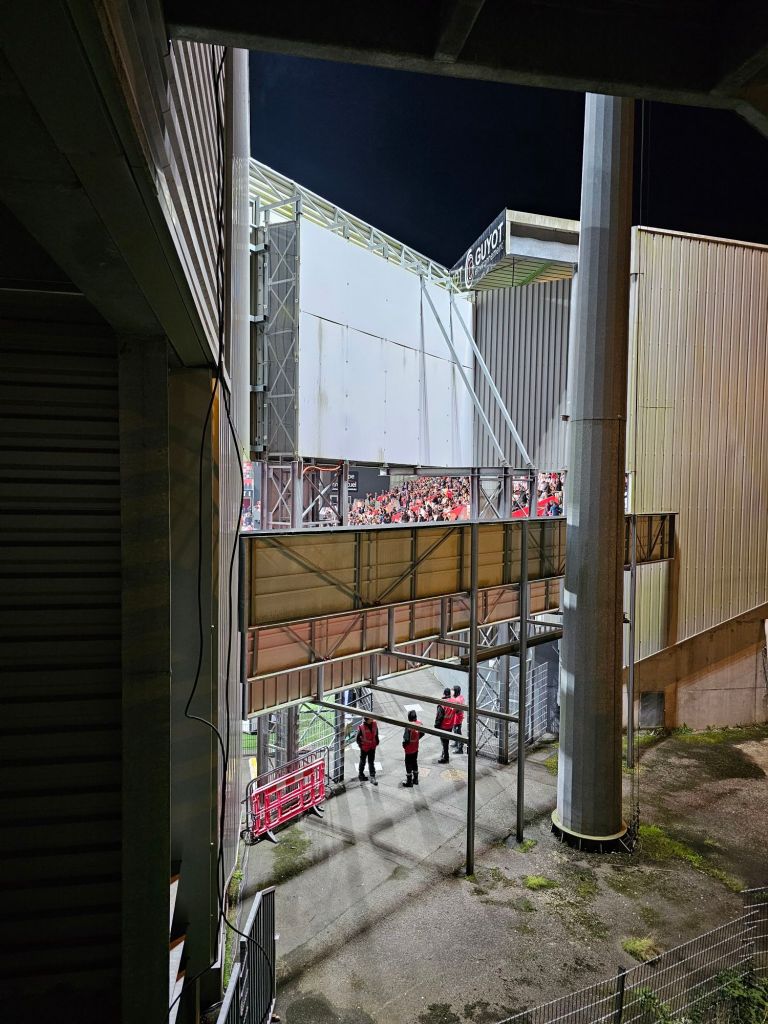
Our hotel room for the night is in a grand nineteenth century house not far from the town centre, but it is a half an hour’s walk from Stade Roudourou and Paulene’s asthma will not stand that once the cold night air surrounds us after 10:30 when the match will probably finish.  Sadly, there is no ‘navette’ (shuttle bus service) to the stadium, but on the advice of the two very helpful ladies in the local Tourist Information Office we make a short car journey across town to the Place St Saveur where we park up our planet saving Citroen e-C4 at no cost. Remarkably nearly all car parking in Guingamp seems to be free.  From the car park, we can see the floodlights of the stadium, and the walk to the Stade Roudourou takes us only a few minutes over the shallow looking, gurgling River Trieux and down a few closed off streets.  The stadium is situated in a residential area which has the appearance of one of the banlieus of a much larger town and is enclosed behind iron fences as if fortified against the outside world, an impression further strengthened by the harsh steel and concrete architecture of the stadium, which is in some ways is at odds with the stone buildings of the town but is perhaps also a modern and cost effective version of them.

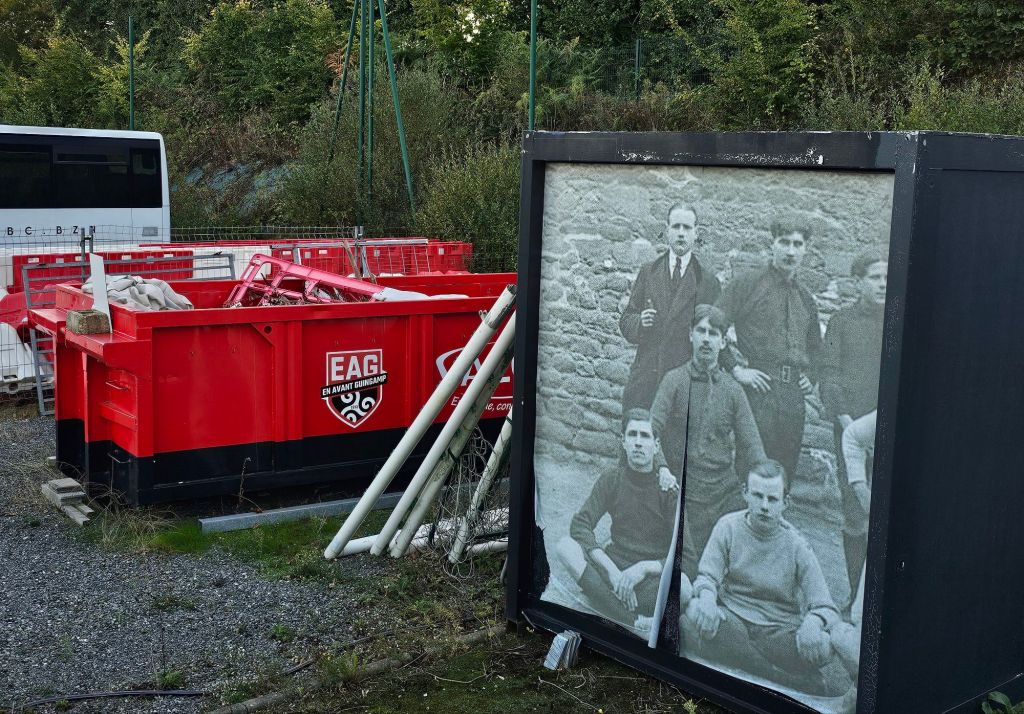
The walk to our seats in the Tribune France Barnums (presumably named after a sponsor) takes us around the back of the main stand (the Tribune Cotes d’Amour) past a small wooden hut from which two middle-aged women are selling club souvenirs.  I ask if they have any T-shirts like the ones I saw in the shop in the town; they don’t, but nevertheless they laugh either at my description of the very large and very small sizes available in the shop in the town, or just at my French, I’m not sure which. Paulene and I walk on past a skip decorated in club colours and the back of the Kop Rouge where the local Ultras will later gather.

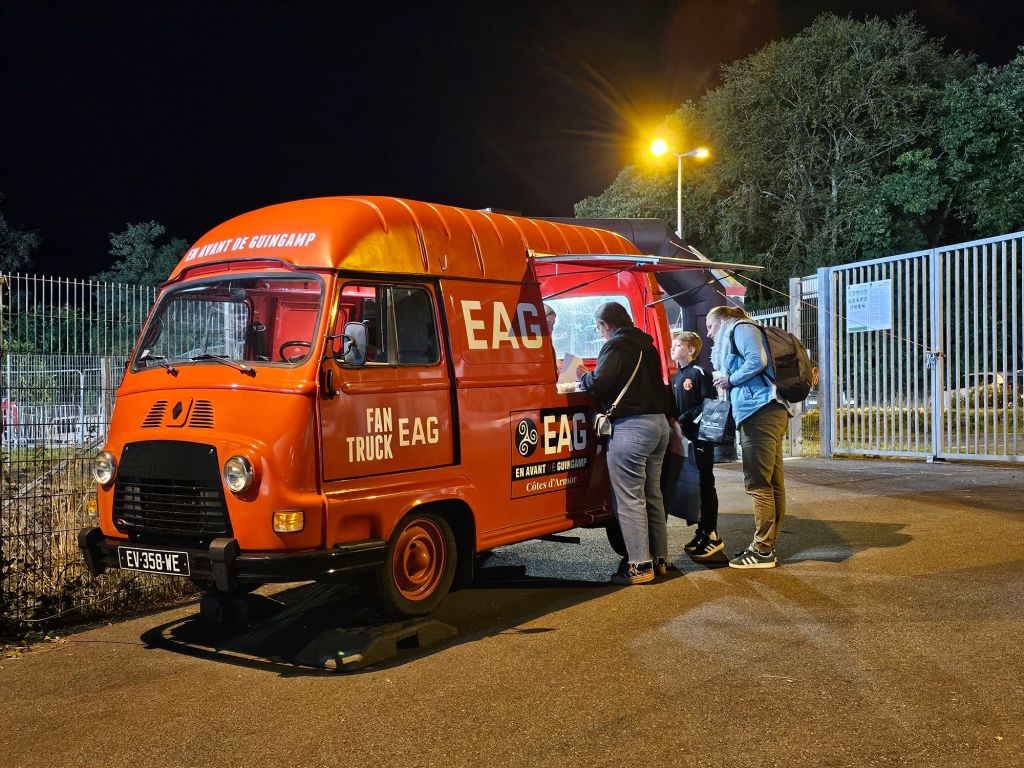
The back of the Tribune Frace Barnums is the least attractive of the four sides of the Stade Roudourou, consisting mostly of sheet metal, but undeterred I make my way in past a smiling member of security staff who frisks me and wishes me ‘Bon match’ under the somewhat glaring eye of another member of security staff whose demeanour suggests she does not approve of such bonhomie.  With our tickets duly validated by barcode technology we walk on towards our seats past a classic Renault Estafette van painted in Guingamp colours, from which Angelique of club ‘boutik’ fame is selling hats and scarves and shirts; she confirms that she has no stock of the cherished T-shirts stashed away in the Estafette.

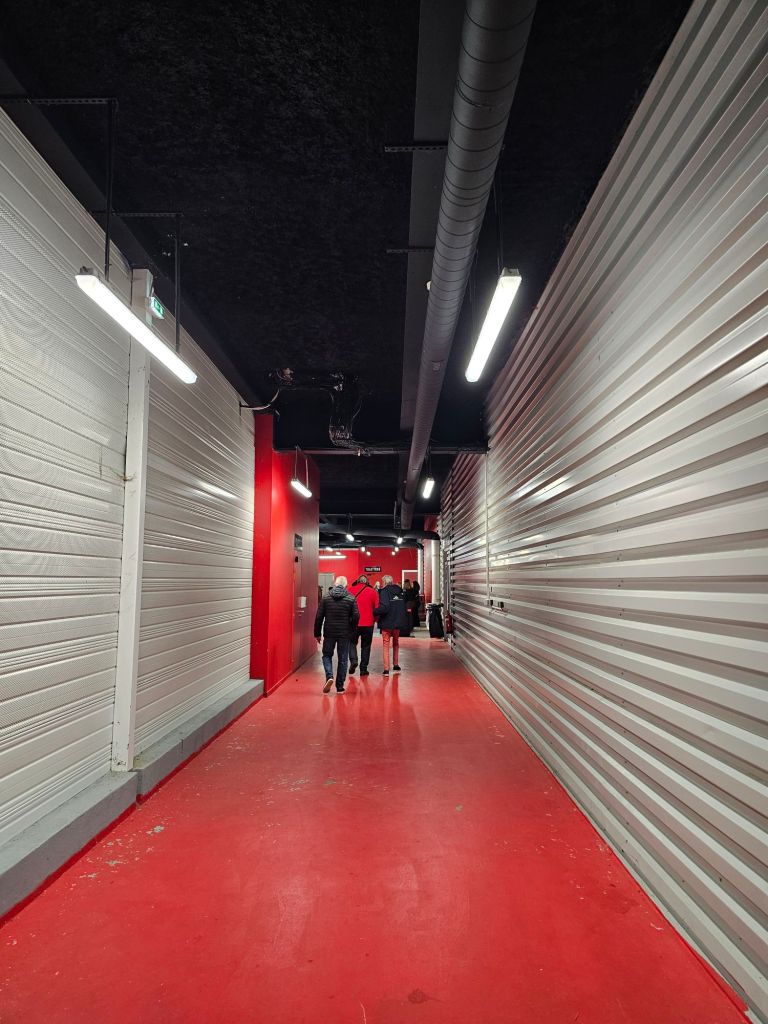
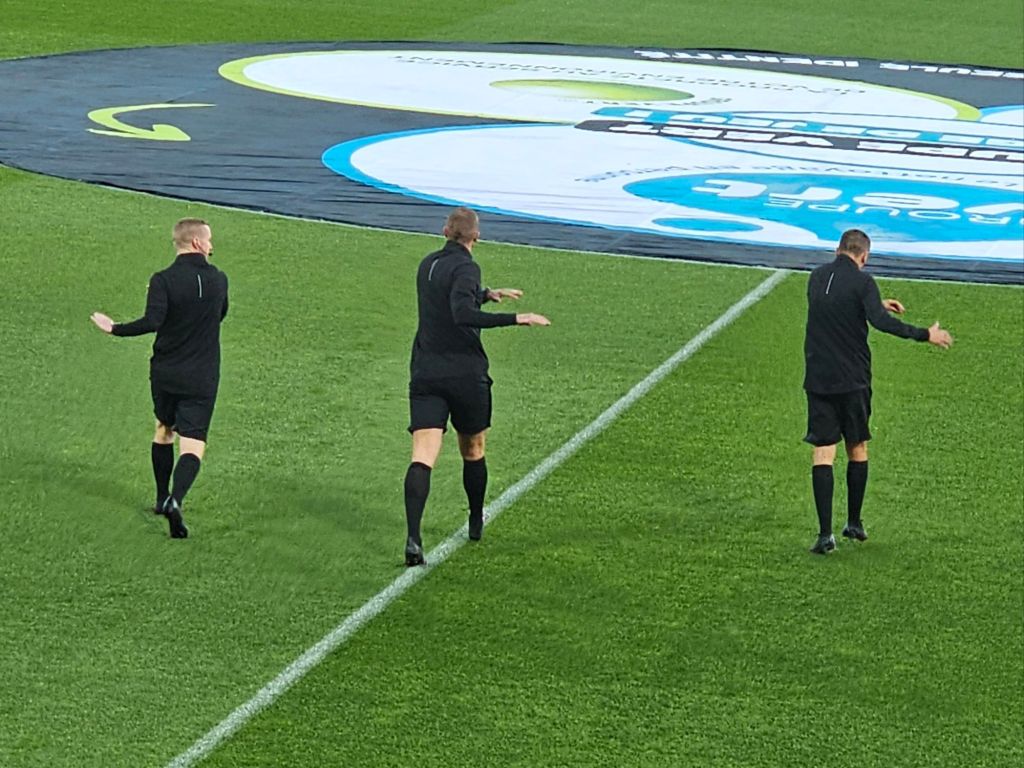
Our entrance to the stand itself, along a corridor, reminds me of the inside of one of carriages on Le Shuttle.  Up an external staircase, I am tempted by the ‘pub Lancelot’, only for two teenage doormen and the smell of sandwiches and nibbles wafting out to disappointingly confirm that it is a room reserved for those paying for hospitality.  Back downstairs I buy a small plastic cup of beer and a similar cup of the local Breizh Cola (8 euros for the two), which Paulene much prefers to the over-hyped American stuff.  We find our seats cosily situated at the back of the lower tier of the stand almost level with the halfway line and next to a galvanised tubular stanchion, which handily ensures people will not be able to edge past us to get to their seats. We pass the time before kick-off making up the life stories of the referee and his assistants, who are warming up in front of us and keeping us amused with their co-ordinated exercises, which with some appropriate music could enable them to pass themselves off as a small all-male dance troupe.   One of the assistants we decide looks slightly ill however,  and has dark shadows under his eyes.  The referee, Monsieur Landry meanwhile, is a tall man with a long body but capable of a neat heel turn, chasse and pirouette.

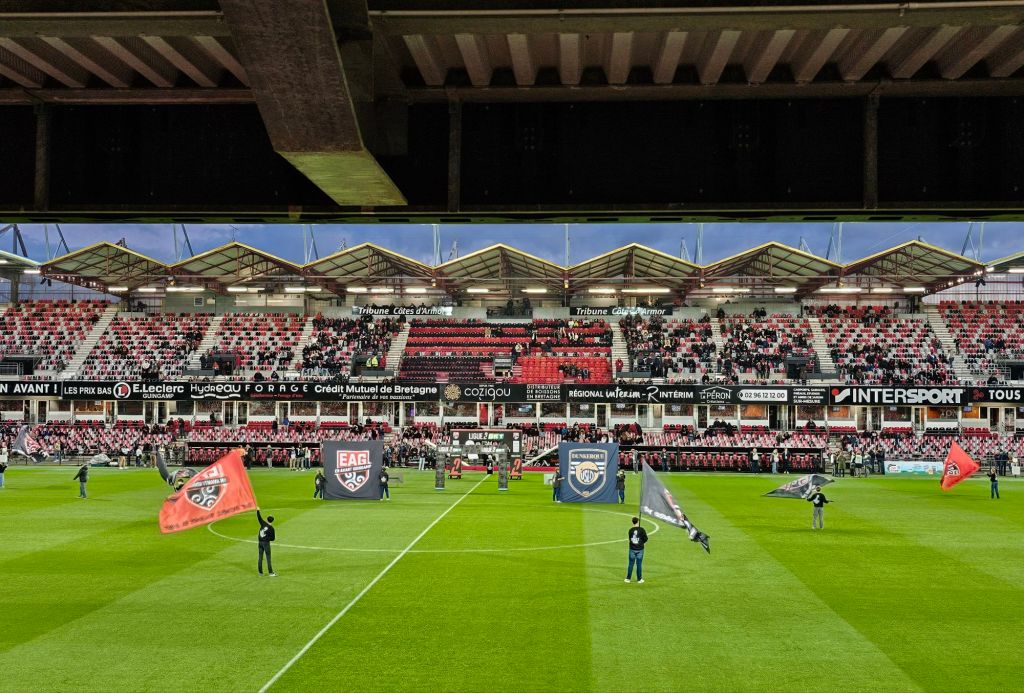
As kick-off (coupe d’envoi) approaches, the stand fills up with people bearing baguettes stuffed with chips, whilst a row or two in front of us a family unpack homemade sandwiches which appear to be of white sliced bread that has had the crusts cut off, which is not something I ever expected to see in France. Meanwhile, the pitch fills up with youths waving banners with varying degrees of enthusiasm but then, when the teams are read out by the stadium announcer  I am shocked, amazed  and I have to admit, disturbed to find that unlike everywhere else I’ve ever been in France, the home supporters do not bellow out the surnames of their players as they appear on the big screen in the corner of the ground; they just clap politely. I can’t quite believe it. Being in Brittany I had also expected bagpipe music as the teams trudged out, but It seems these Bretons aren’t like other French or Breton people at all.  I am a little disappointed; they don’t even have a cuddly mascot.

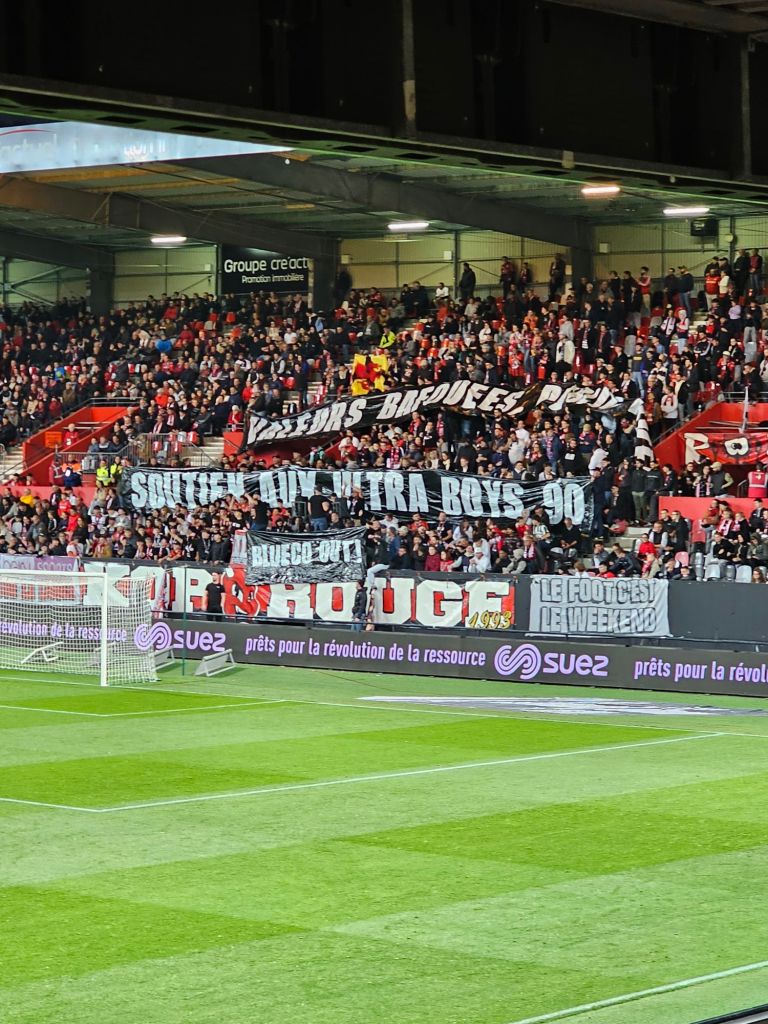
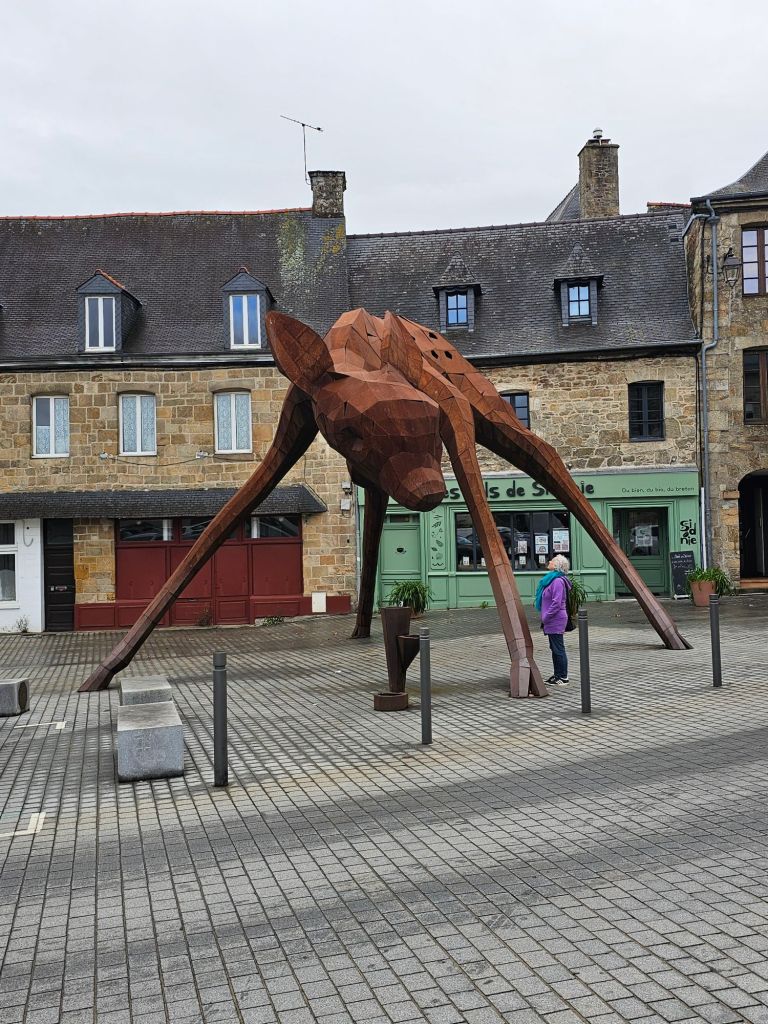
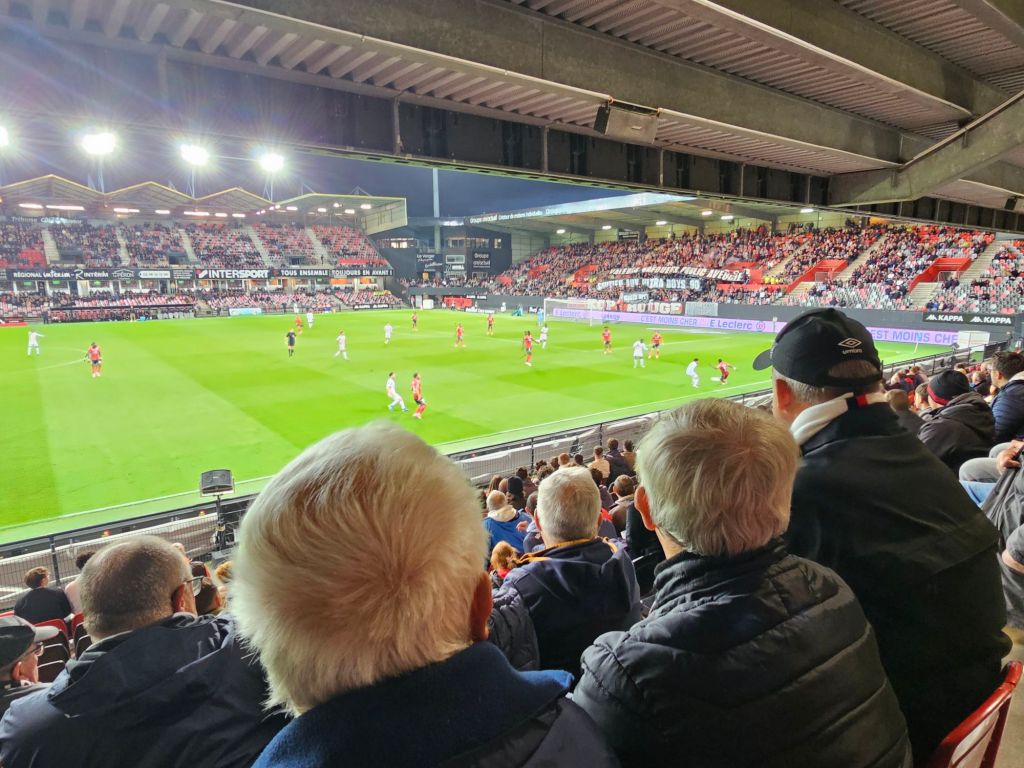
When the match eventually begins at half past eight, it is visiting Dunkerque who get first go with the ball, which they generally kick in the direction of the Kop Rouge and far off Morlaix, whilst Guingamp are aiming just to the north of the town centre with its Basilica, castle ruins and huge metal statue of Bambi. Guingamp sport their handsome signature kit of red and black striped shirts with black shorts whilst Dunkerque wear all white with golden squiggles down the shirt front.  Despite my disappointment before kick-off, the stadium has now come to life, with a flood of chip and beer quaffing latecomers finding their seats and the Kop Rouge now in full voice with chants of “Allez, Allez, Allez, Guingampaises”. I count thirteen Dunkerque supporters, who I could hear chanting before kick-off, but now they are drowned out by the Guingampaise voices and drums.

The opening play from both teams is fast and slick on the well-watered pitch but Guingamp appear slightly more direct and with only four minutes having passed into history a smart through ball and a low cross from the right lead to the ball being placed past the Dunkerque goalkeeper from about six metres out by Freddy Mbemba, who the interweb tells me is on loan to Guingamp from Charleroi in Belgium.  “Buuut” announces the giant screen in the corner in large letters, and when the stadium announcer says “Freddy” the home supporters bellow “Mbemba” and when the announcer says “Freddy” again and the crowd shout “Mbemba” again,  and then wonderfully the same thing happens again.  It feels like a weight has been lifted from my shoulders. “Mbemba!” I shout on cue after the final “Freddy”.

The game continues at pace with Guingamp looking sharper but Dunkerque not appearing to be slouches either.  Standing out for Guingamp, mainly but not entirely because he is two metres tall is their number eight, Kalidou Sidibe, whilst I am also impressed by the tangled mop of hair sprouting from behind the black headband of Guingamp’s number thirty-six, Albin Demouchy who often wins headers and elegantly ‘plays-out’ from the back.  On the electronic boards around the pitch there are advertisements for John Deere tractors and Husqvarna mini tractors as well as the supermarket E Leclerc, who if they had shops in Britain would surely employ the tv sitcom ‘Allo, ‘Allo in their advertising.

After fourteen minutes Dunkerque win their first corner; Guingamp have already had two however and as if to prove that this matters Guingamp’s Amine Hemia soon beats the square but not square enough Dunkerque defence on the right, bears down on goal and scores into the far corner off the goalkeeper’s out-stretched palm, and Guingamp lead two-nil.  “Amine” calls the stadium announcer, “Hemia” bawls the crowd. “Amine” calls the stadium announcer, “Hemia” bawls the crowd. “Amine” calls the stadium announcer, “Hemia” bawls the crowd, and the scoreboard silently but colourfully shouts “Buuut!” as well.

The row of seats in front of us consists mainly of men with grey hair whilst off to our left a younger bearded man looks a bit like Bob Ferris from the 1970’s sitcom The Likely Lads (actor Rodney Bewes).  Behind us there is a gathering of men and women in day-glo tabards; if they’re not orchestrating a “gillets jaune” style protest I guess they must be the first aiders and stewards watching the match. At the front of the stand clouds of smoke billow up from teenage vapers and then dissipate into the night air. I notice that Bob Ferris has quite girlish looking hands.

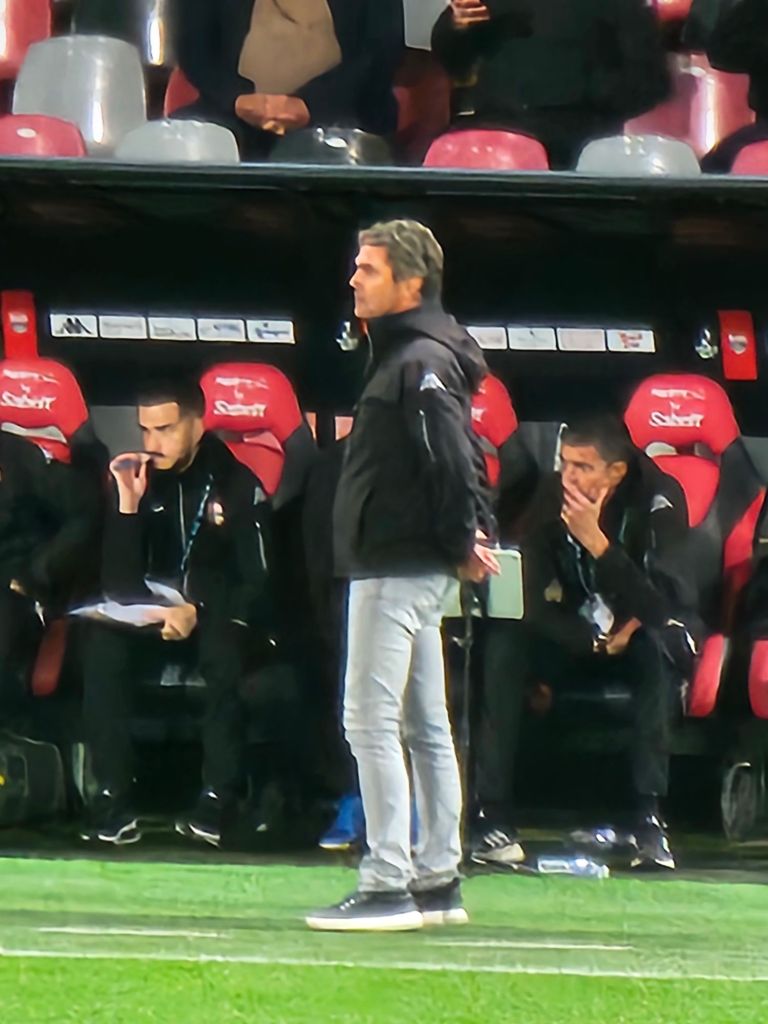
There are now less than ten minutes of the first half remaining; Dunkerque’s number twenty shoots from the edge of the penalty area and the impressively agile and wonderfully named Guingamp goalkeeper Teddy Bartouche tips the shot over the cross bar spectacularly.  Two minutes later and yet another move down the right for Guingamp leaves Louis Mafouta with a seemingly open goal, but with the co-ordination of someone whose foot has ‘gone to sleep’ and who has both arms strapped to his sides, he heads the resulting cross hopelessly and clumsily past the far post.  On the touchline, Guingamp manager Sylvain Ripoll, who incidentally once said ‘Bonjour’ to me and Paulene in the lift of a Paris hotel (the Mercure near Parc des Princes) looks frustrated in his pale trousers and zip-up jacket.

The last action of the half seems likely to be the substitution of the Dunkerque goalkeeper, who unexpectedly and mysteriously has hurt himself but then a quick pass in from the Dunkerque right finds Enzo Bartelli inside the ‘D’ outside the Guingamp penalty box. Almost in slow motion Bartelli gently passes the ball beyond agile Teddy in the Guingamp goal and Dunkerque, as they say on the telly, are “back in the game”, although of course as long as Monsieur Landry hadn’t terminally parped his whistle, they were never out of it.  Five minutes of added on time fail to alter the score any further.
Half-time is the usual melange of children on the pitch, but as before the start, with added flag waving of varying enthusiasm.  The match resumes at twenty-four minutes to ten and the Kop Rouge quickly dive back into endless chants of “Allez, Allez, Allez”.  I soon decide that for a man taller than your average back garden fence panel, Sidibe has quite a delicate touch and then within ten minutes Monsieur Landry airs his yellow card for the first time this evening after Dunkerque’s Inigo Eguaras fouls Mbemba.  

It is Dunkerque who are now selfishly dominating possession, a situation which Guingamp are contributing to by quickly giving the ball back to them whenever they lose it.  On the Kop Rouge, the ultras are swirling their scarves in the style of 1970’s Leeds United fans, whilst the big screen in the corner is showing pictures of real estate as if anyone interested in buying a house would pay more attention to the screen than the match.  As the people in the ground with least interest in buying property in Guingamp, surprise transfer moves notwithstanding, the Dunkerque players fashion an intricate passing move down the left only for Eddy Silvestre to shoot narrowly over the cross bar.  With the game now two-thirds over, Dunkerque blink first and make two substitutions.

The slick passing of the first half has been replaced with increased niggle and Paulene and I discuss the colour of the shorts worn by Dunkerque’s Brazilian number thirty, Abner.   They look more yellow than other Dunkerque players’ shorts, which Paulene attributes to his frequent falling over on the wet grass, whilst I suggest, a little unpleasantly perhaps, that maybe he ‘forgot to go’ before he left the dressing room. Twenty minutes remain and Eddy Silvestre shoots over the bar again for Dunkerque whilst the Kop Rouge sways with a sea of banners and the towering Kalidou Sidibe is replaced by a man with hair reminiscent of the late Tina Turner, Tanguy Ahile.

Somewhat annoyingly, the final ten minutes of normal time dissolve into something like chaos and nothing like football as players of both teams proceed to fall to the ground with alarming frequency.  If all the players who go down have genuine injuries, both clubs will need to be trawling the job centres of Brittany and Pas de Calais in the morning for additional physiotherapists.  Monsieur Landry, meanwhile, is rushed off his feet, airing his yellow card four more times and showing his red card to someone in the Dunkerque dugout.   Six minutes of added time are not so much played out, as acted out, and the final whistle comes as a blessed relief to all. The result lifts Guingamp to eighth in the Ligue 2 table, a point outside the barrage (play-off) places, whilst Dunkerque slide down to fourth from bottom, one above the relegation places.

Despite the weirdness of the last ten minutes, and the unexpected pre-match disappointments over T-shirts, bagpipes and the reading out of the players’ names, overall, the match has been a good one and everything has worked out fine; well except for the T-shirt and the bagpipes, but you can’t have everything. We therefore make our way back to our planet saving Citroen in good spirits, like all but thirteen of the 6,562 strong crowd, but who knows, they probably enjoyed it too.
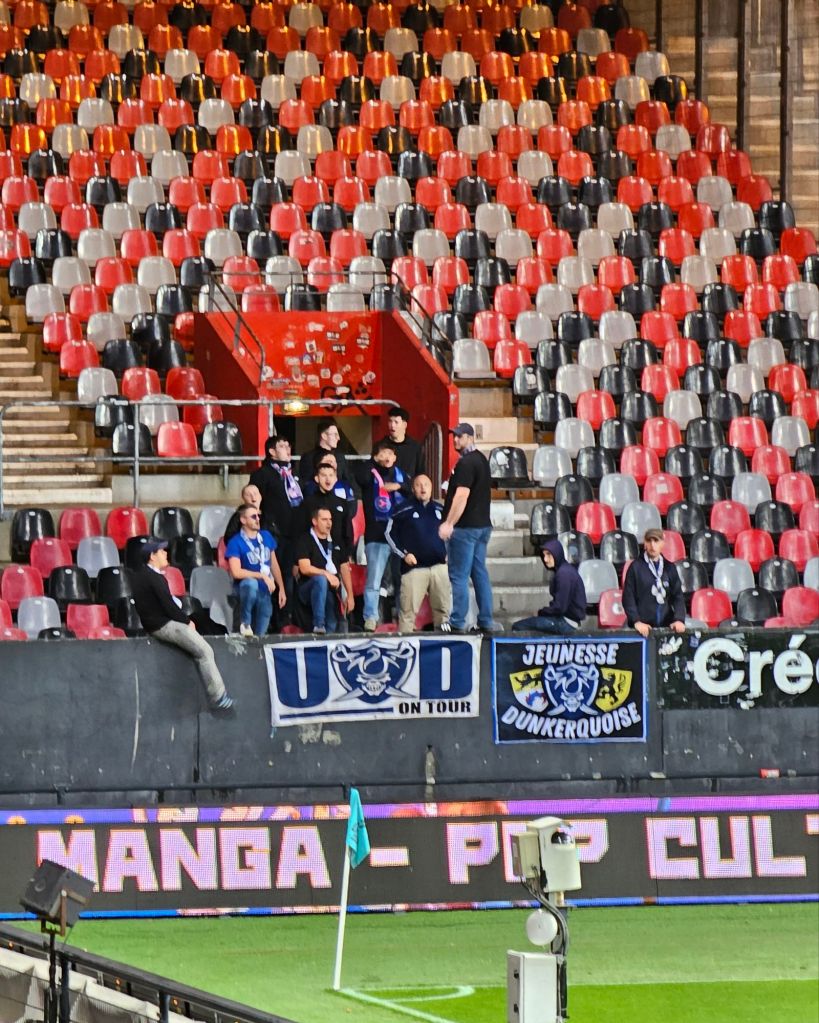
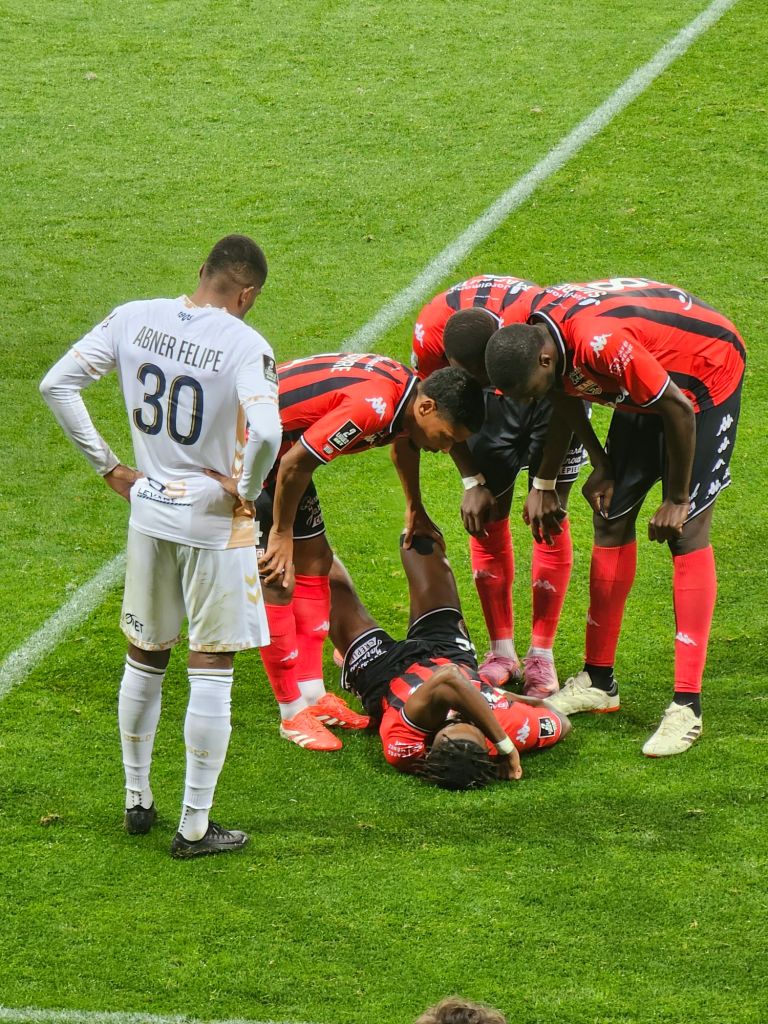
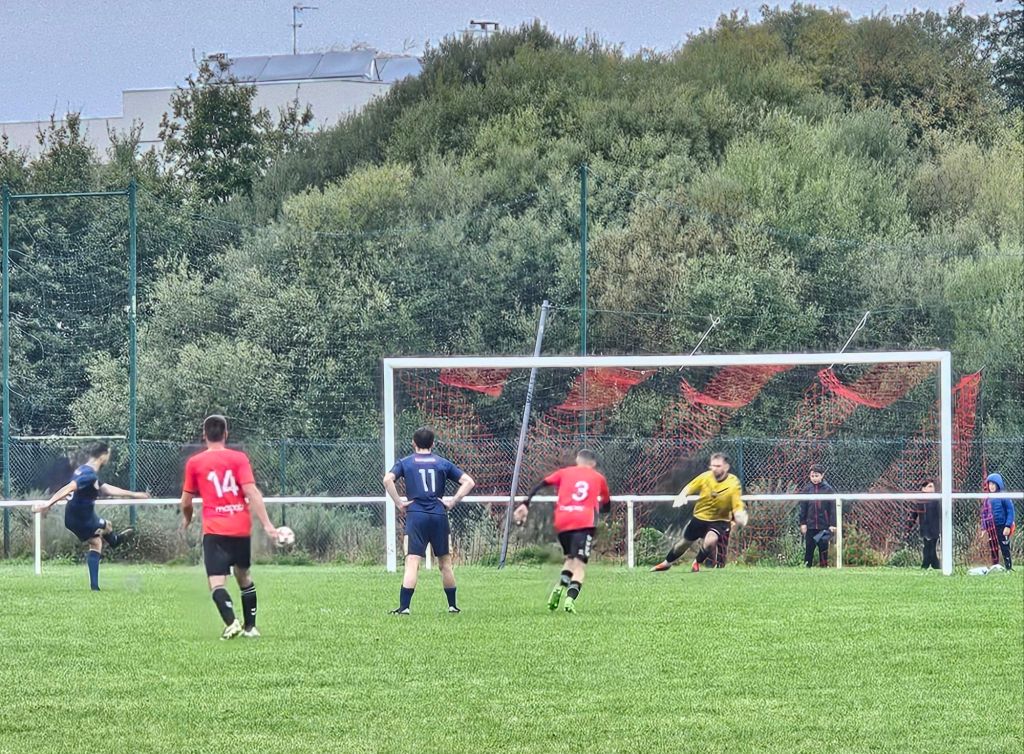
ASC St Anne d’Auray 1 Avenir Guiscriff 3

One of the best things about visiting France in September is being able to catch a game in the early rounds of the Coupe de France when the competition is still regionally based and there are ample opportunities to see village teams slug it out in quest of the sort of glory only village teams can enjoy.

Having arrived in Brittany just yesterday, after an overnight stop in Le Mans, I can’t be bothered to travel far from where my wife Paulene and I are staying in Carnac, added to which it’s a grey, miserable day and when if it’s not full-on raining there is a steady drizzle as if the Atlantic Ocean is stealthily relocating itself slightly inland.  After consulting the list of fixtures on the Ligue Bretagne de Foot website I have whittled the possibilities down to US Brec’h v Av.Campeneac-Augan or ASC Saint Anne d’Auray v Avenir Guiscriff.  Both are between twenty and twenty-five minutes away by planet saving Citroen e-C4 but St Anne-d’Auray ASC have a grass pitch as opposed to a plastic one, and taking a chance on the rain having not caused a postponement I decide that I would rather see people getting muddy than getting friction burns, and so I head for St Anne d’Auray.

St Anne-d’Auray is a curious place, a village with a population of less than 3,000 people but also the location of the third most visited pilgrimage site in France after Lourdes and Lisieux, as a result of which, and also because of which, it also has a huge basilica.  Wikipedia tells us that St Anne-d’Auray became a site of pilgrimage after a pious farmer in the early 17th century kept having persistent visions of St Anne, who somewhat weirdly told him to rebuild a chapel which had been demolished about 900 years previously. The farmer must have been a sort of renaissance era Nigel Farage figure as people were evidently keen to believe his unlikely tales, the chapel was built, and by the 1870’s had become the present basilica.

As a I drive into St Anne d’Auray along the D17, through the early afternoon gloom the tower of the basilica looms above the roof tops wreathed in low cloud.  A left turn takes me down the Rue de General de Gaulle and to the Stade Municipal where luck shines upon me and a car is leaving the otherwise full car park just as I arrive.  I park up and step out of my planet saving electric Citroen, and my nostrils are assaulted by the acrid smell of barbecue smoke.  I saunter through the gates to the Stade Municipal in my long navy-blue raincoat and join the throng of local inhabitants socialising, drinking and generally enjoying themselves in a sort of impromptu ‘fanzone’ where everybody seems to know everyone else.  Entry to the match is free of charge with the football club clearly being content with the income from beer, wine, coffee and food.

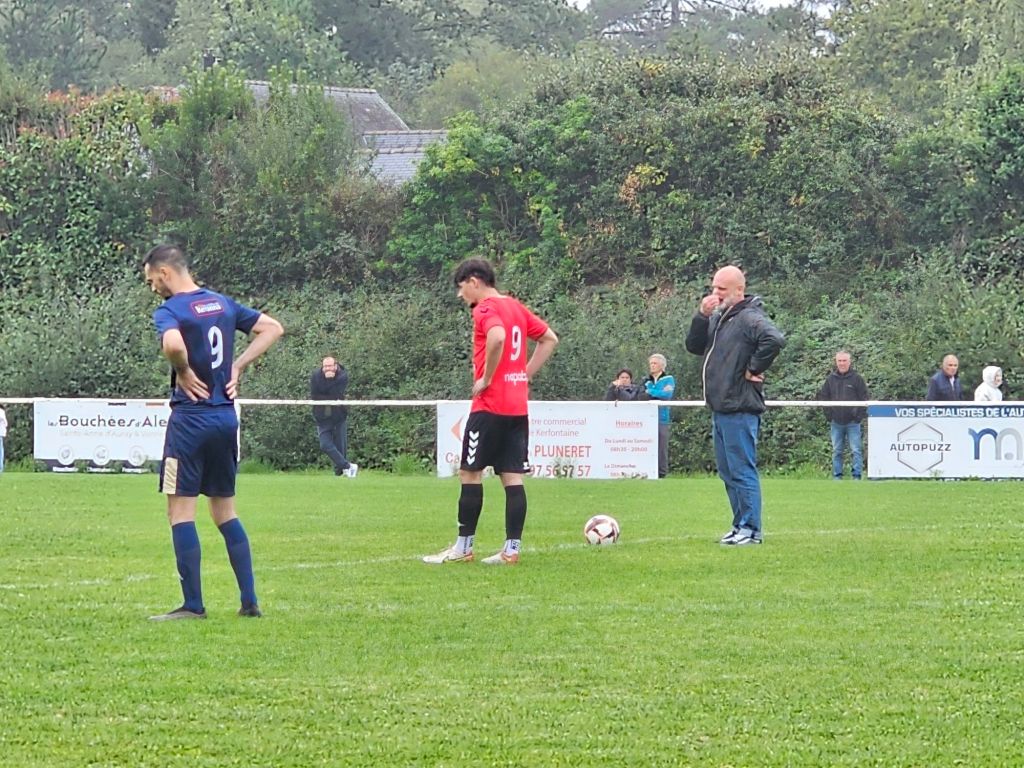
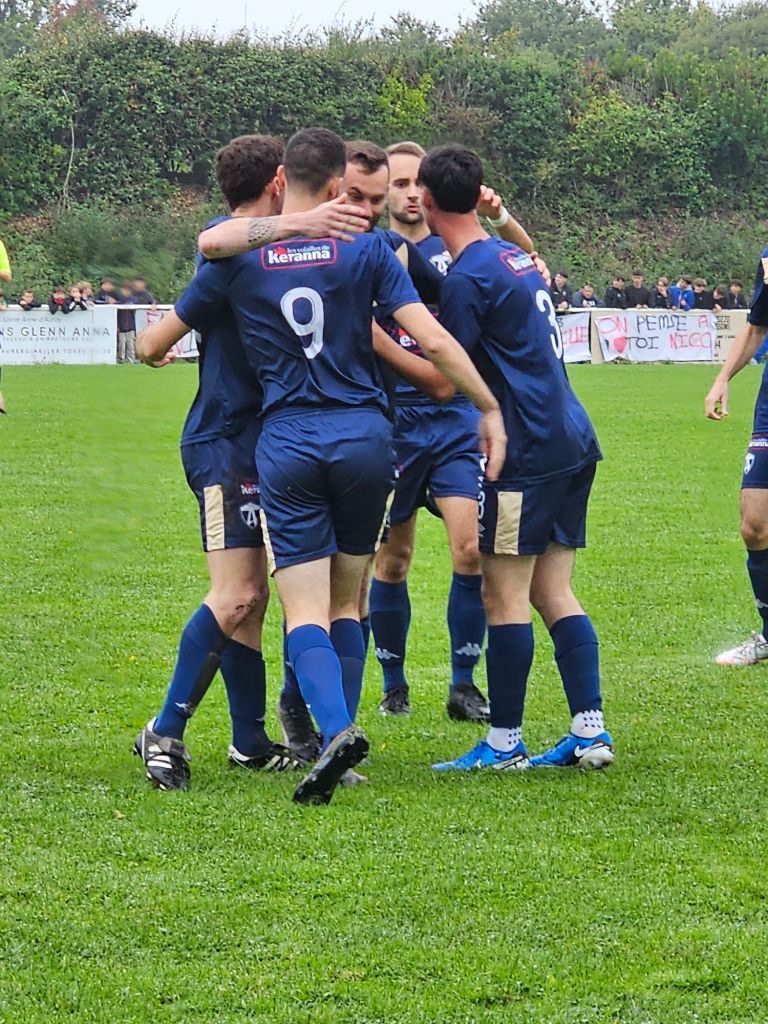
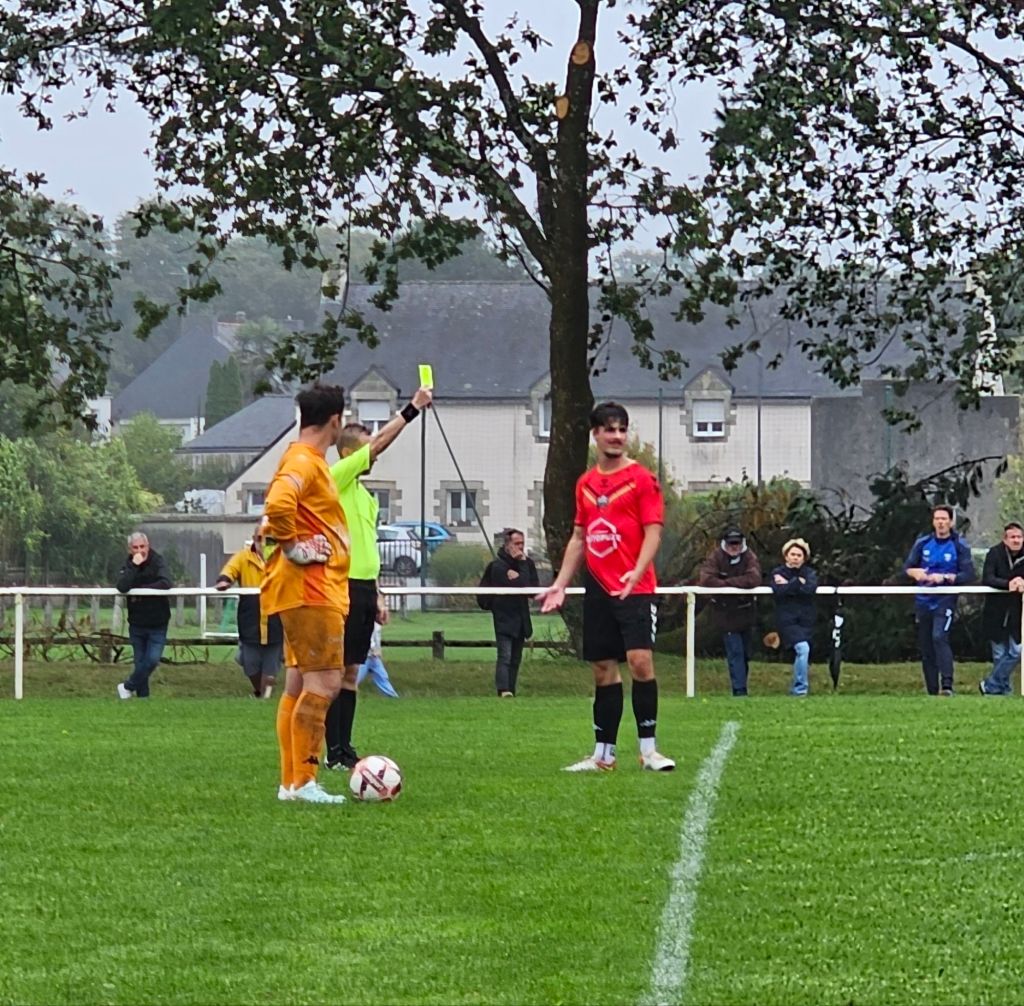
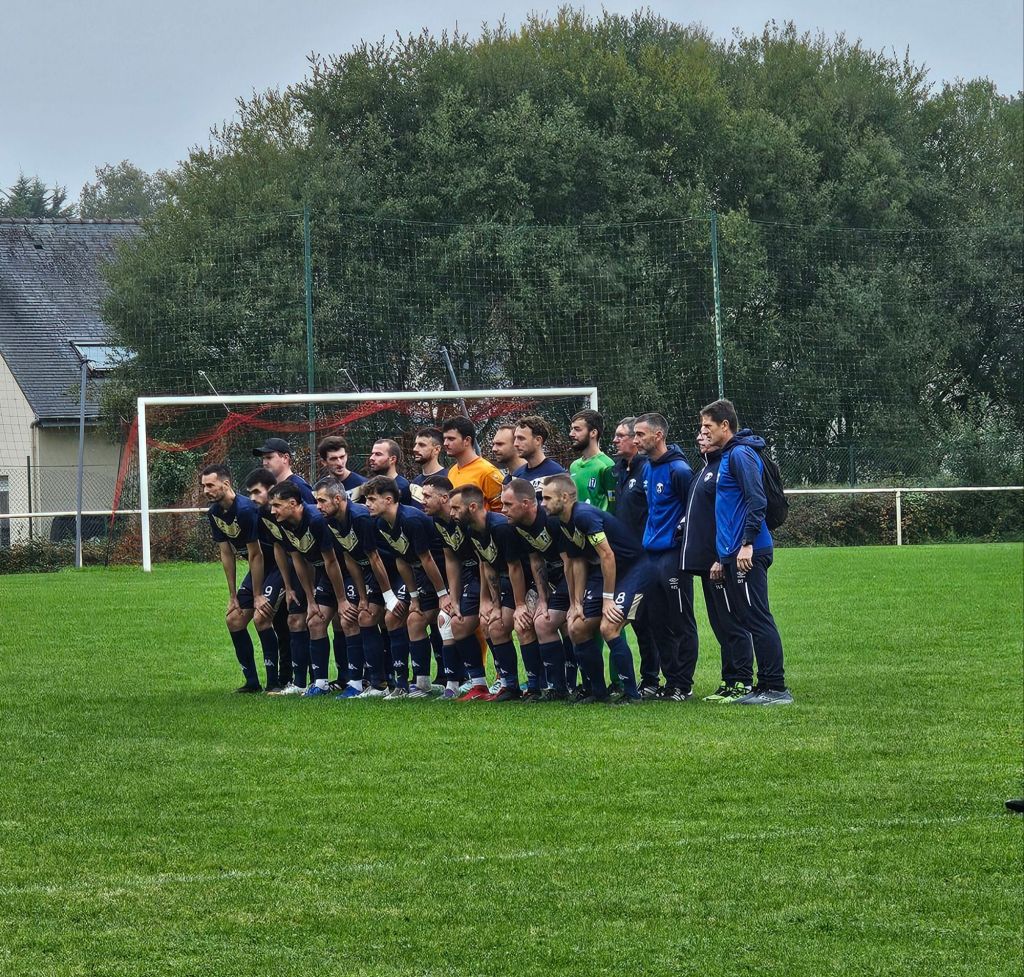
Kick-off is advertised as being at three o’clock but it’s nine minutes past by the time the two teams emerge from the dressing rooms and trudge their way to the pitch behind the referee and his assistants, the clumping of their metal boot studs on the tarmac sounding like a marching army and the basilica providing a suitably religious back drop for a Sunday afternoon.   The tarmac driveway passes through a gap in an impressive row of tall oak trees that line the east side of the stade, which has no stand, just a tarmac path all around and a metal rail surrounding the pitch.  After photos and the usual cursory handshakes, the teams line up and after an initial ‘ceremonial’ kick off by a bearded and balding man, it is visiting Guiscriff AV who get first go with the ball, sending it mostly in the rough direction of the nearby town of Auray, whilst the home team shoot towards the basilica.  St Anne d’Auray wear a kit of red shirts and black shorts whilst Guiscriff are adorned in all navy blue with gold or beige chevron on their chests.  

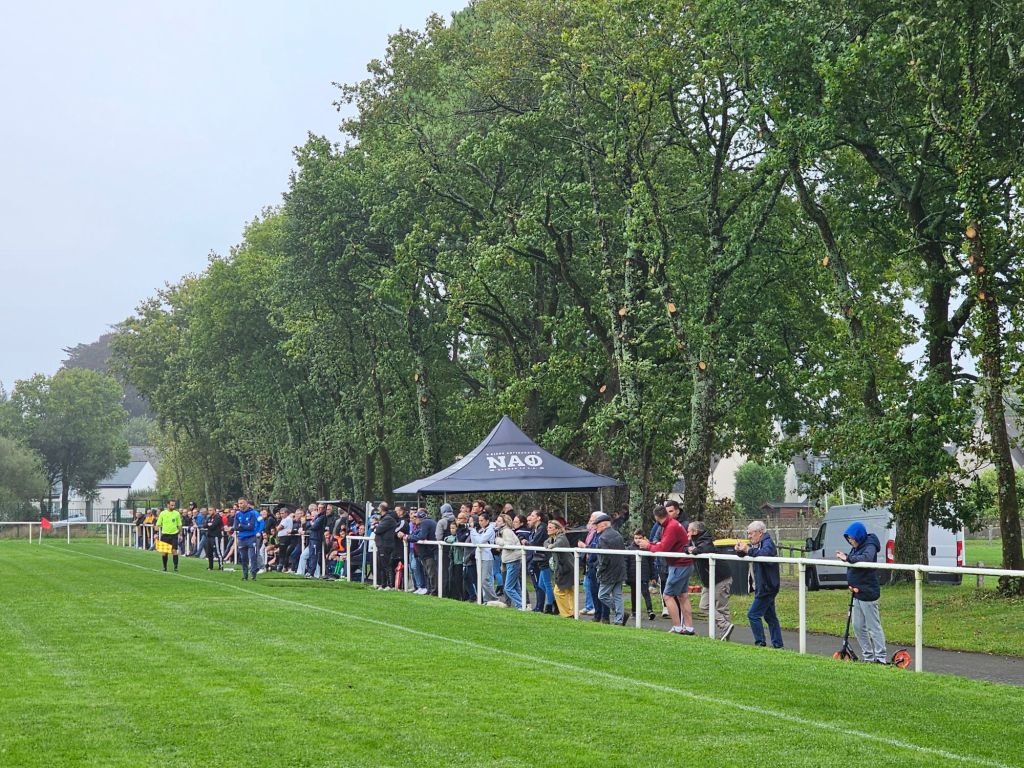
The crowd of at least two hundred is enthusiastic and congregates on each side of the pitch behind the well-maintained metal rail.  Guiscriff is a village 84 kilometres away to the northwest near Quimper, is about an hour and ten minutes’ drive away, and a good number of visiting supporters have travelled, including a man carrying a blue, cuddly, toy rabbit, which I assume is some sort of mascot, but he could just be a friend or comfort.  The stadium has no flood lights but although it’s a grey afternoon, it’s not so grey that these are going to be needed.

Just two minutes pass and a cute through ball down the left from the Guiscriff number nine sends their number eleven away into the penalty area where he comfortably slips the ball past the St Anne d’Auray goalkeeper to give the away team a very early lead. After the excitement of the start of the match and the teams marching to the pitch, the home supporters now appear as religious followers whose tenets of faith have suddenly all been disproved.  But whilst 84km apart geographically, the two sides are at the same level in the regional league, so all is by no means lost just yet, although when the bells of the basilica start to toll the sound is somewhat ominous.  The away supporters meanwhile are delirious and having visions of the fourth round.

Happily, the shock of going behind is soon processed mentally and the noisiest home supporters assembled opposite the team dugouts are quickly in good voice again with chants of “Aux Armes”.  An adversarial atmosphere is stoked as there are enough away supporters to render a few decent chants of “Allez les bleus” too.    On the pitch, the balding number five and number eight for St Anne d’Auray appear influential but Guiscriff are holding firm quite comfortably, with the home team’s forays forward mostly foundering on slippery grass, offsides and shoves and pushes that the referee (l’arbitre en Francais) Monsieur Romain Betrom spots but the home supporters don’t.
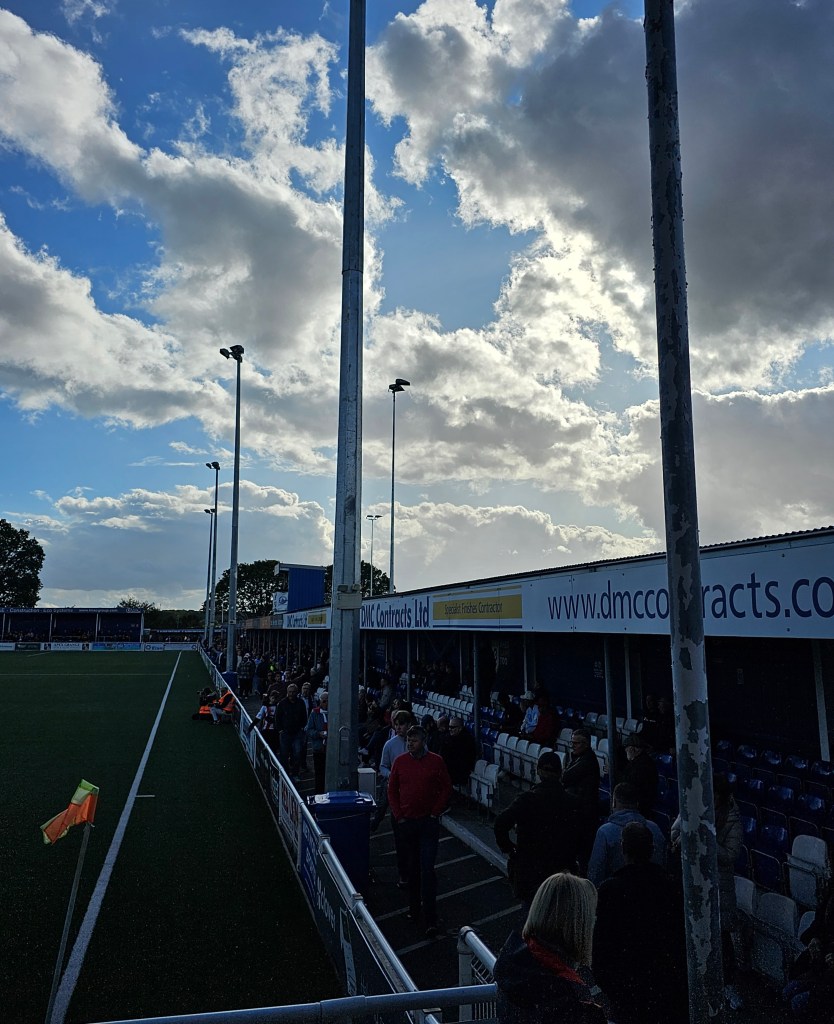
It’s now twenty-two minutes past three and it’s beginning to look like St Anne will struggle to reverse the early deficit but then almost miraculously there’s a careless trip and Monsieur Betrom is pointing to the penalty spot.  After a long lecture from Monsieur Betrom and eventually a yellow card (carton jaune) for Guiscriff’s number five, who I can only think postulated an alternative view of events a little too vigorously, the rangy number ten for St Anne d’Auray steps up to score, a good two minutes after the penalty kick had first been awarded.

With the scores level the whole match begins to even out and Guiscriff no longer look the better team.  At twenty-five to four St Anne d’Auray win a free kick, which ends up in the back of the Guiscriff net courtesy of one of their own player’s boots, but Monsieur Betrom disallows the ‘goal’ for pushing, shoving, holding, blocking or a combination of the four.  There was certainly a lot going on in the penalty area with fouls likely being committed by both sides; Monsieur Betrom clearly took the view that if in doubt just pretend the whole incident never happened and leave the score as it is, and who can blame him?

I wander around the ground taking the game in from different angles and enjoying the grey afternoon scene against the backdrop of oak trees and the tower of the basilica beyond.  Briefly I stand close to the village ‘ultras’, who are mostly teenagers but are well equipped with banners, two empty oil drums for percussion and a loud hailer.  Not long after I settle against the rail just beyond the bulk of the more boisterous home support, Monsieur Betrom makes a decision that will probably define the match, as he shows his carton rouge (red card) to the St Anne d’Auray number eleven.  There is an inevitable delay as this is discussed but eventually number eleven makes his way towards the gap in the tall oak trees and back to the changing rooms.

 Inevitably Monsieur Betrom’s decision is not a wholly popular one and there is much braying amongst the home crowd.   I exchange raised eyebrows with a middle-aged man a metre or two away along the rail and then move next to him when he speaks to me.  Happily, the extent of his English and my French seem vaguely complimentary, and in a somewhat stilted way we are able to discuss the Coupe de France, the match and Monsieur Betrom, the man even does an impression of Donald Trump.  Half-time (mi-temps) arrives and is accompanied by a sudden increase in precipitation, so I turn up the collar on my coat.  The man, who I will later learn is called Frederique invites me to join him and his friend Patrick at the bar.  He jokingly suggests we can talk about Brexit, which I suspect he feels as disappointed about as I do.  At the bar, Patrick very kindly buys me a beer, and Frederique introduces me to several other people including the local mayor a small, kindly looking man with a big moustache, and another friend, Jean Baptiste.  

When the football resumes, I stand near the dugouts with Frederique and Patrick and try to avoid the rain, which is now coming straight at us, from getting into my beer.  The match continues in much the same vein as it did in the first half and Guiscriff seem incapable of making any advantage of their extra player.  The Guiscriff coach strides up and down the touchline seemingly talking to himself but possibly cursing his players.  When his goalkeeper concedes a free kick by picking up a back pass, he almost has a seizure.  Monsieur Betrom meanwhile, a thin, gaunt looking man much younger than his two assistants, one of whom has grey hair, spends much of his time brandishing his carton jaune. For every one of the many bookings he delivers he stands to attention, with his card holding arm at 45 degrees, a pose he holds for a full two or three seconds as if at some sort of Nuremburg rally for referees.

“Carton rouge!” shouts Frederique for as many fouls as he thinks he can, which amuses a short elderly couple stood next to me, and then “Allez l’arbitre!”.  The game proceeds through the continuing gloom although happily the rain stops falling.  Substitutions are made, but no resolution seems in sight until suddenly by way of another miracle there is an ill-judged, attempted tackle on the edge of the St Anne d’Auray penalty area, and for the second time this afternoon monsieur Betrom points to the penalty spot.  The penalty is scored and with less than ten minutes left to play Guiscriff are once again heading for round four.

No more than five minutes later, Guiscriff lead 3-1 after a sequence of a corner, a shot and a deflection concludes with ball nestling once more in the back of the St Anne d’Auray goal net.  It’s a disappointing end to the afternoon for St Anne d’Auray and matters get slightly worse when there is a contretemps between a local and a man in a Guiscriff sports coat.  Glaring looks are exchanged, beer is spilt and the game stops as the matter is discussed by the referee, one of his assistants and a man wearing an armband who I assume is the delegue principal, a sort of fourth official.  “Just football” says Frederique philosophically.

With the final whistle, the celebrations from the Guiscriff players and supporters are ecstatic, winning a Coupe de France tie means a lot.  With Frederique, Patrick and Jean-Baptiste I turn away and head for the gap between the tall oaks.  Frederique asks if I am coming back to the bar with them, but reluctantly I must turn down their invitation as my wife Paulene is waiting for me back in Carnac.

Despite the rain, the gloom and the disappointing result for the home team it’s been another wonderful afternoon in the Coupe de France, and my love for this competition and all things French has just received another layer of gloss, although I’ve not learned anything new except perhaps that St Anne was possibly not a football fan, but given that she was supposedly the Virgin Mary’s mum, I never thought she was.

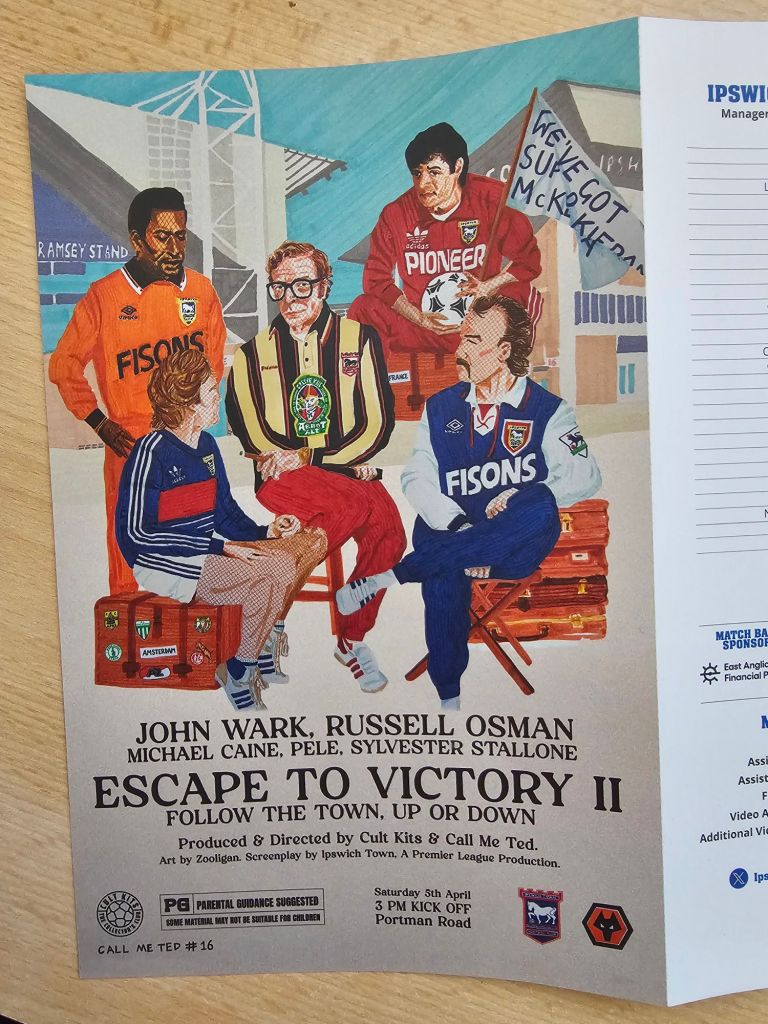
Ipswich Town 1 Wolverhampton Wanderers 2

This week has felt somewhat depressing, probably because I have been reading ‘The Kevin Beattie Story’ as told to Rob Finch (Cult Figure Publishing 2007).  It’s a sorry tale of lost innocence and cruel fate and its sadness was not helped by the fact that my copy of the book had belonged to a close, longstanding friend who sadly died; his wife kindly asked me if I’d like any of his collection of ITFC related stuff, and the Beattie book was the one thing I didn’t have in my own museum.

Wednesday’s win for the Town in Bournemouth perked me up a bit, although I hadn’t bothered to find it on the telly, preferring to watch the second semi-final of the Coupe de France between AS Cannes and Stade de Reims.  But now, as I step out into a bright blue Saturday afternoon, my mood has performed a summersault, and I can only think of a Town home win, a series of further improbable wins and the greatest escape from relegation ever seen.  The season starts now and given that today’s game is only the second match at Portman Road in almost six weeks, it genuinely feels like it.

Unhappily, my journey to the match begins with a rail replacement bus service, but on the plus side I sit across the gangway from a woman of retirement age brandishing an ‘Extinction Rebellion’ placard.  I think to myself how I might like to go on some demos in my retirement.  As a baby-boomer, moulded by the 1960’s I think I owe it to future generations to stoke up a bit of revolution before I shuffle off this mortal coil.  The diesel engine powered bus ride is mercifully brief and I’m soon with Gary on an electric train to Ipswich looking out for polar bears.  We sit at a table and a man about the same age as me, possibly a little younger, sits down opposite us, first asking if we don’t mind if he sits there. “As long as you don’t disturb us” I tell him, by which I really mean “As long as you don’t join in with our conversation”, and that of course is exactly what he does.  I’m not sure why I feel averse to social interaction today, perhaps it’s because with no match for three weeks I ‘ve become overly introverted.

Our arrival in wonderful down-town Ipswich is heralded by loud chanting from the car park of the Station Hotel where Wolverhampton supporters are singing “We are Wolves, We Are Wolves, We Are Wolves”.  Such loud, pre-match singing has been unusual from visiting supporters this season and Gary and I speculate as we head for the Arb, that either the beer here in Ipswich is stronger than they’re used to in Wolverhampton, or they’ve all arrived early and been here for several hours.  Gary asks if I’m going to get an ice cream; I tell him I am, but as usual I come away from the blue booth with just a match programme (£3.50).

At the Arb, there is no queue for the bar and I am soon stood in the beer garden holding my pint of  Mauldon’s Suffolk Pride and one of something called Rosa Blanca belonging to Gary (the Lager 43 is ‘off’), as I wait for him to emerge from the toilet.  He takes an age, so regrettably I can’t help surmising that he must ‘doing a number two’.   Mick does not join us today because he is watching his paramour’s granddaughter play for Ipswich Town Under-16 girls against Leeds United at Needham Market (kick off 12:30).  I assume that the Leeds team is also made up of under 16 girls. After another pint of Suffolk Pride for me and an Estrella Damme for Gary, (he didn’t like the Rosa Blanca) it’s gone twenty to three and is time to leave for Portman Road and the main event of the day.

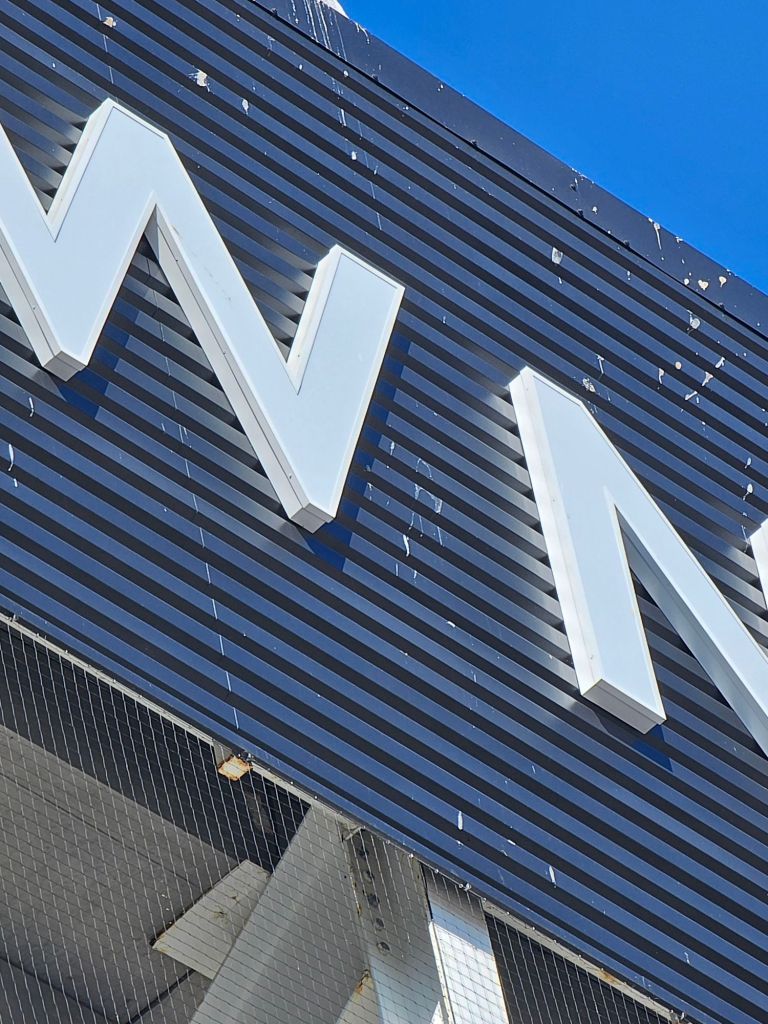
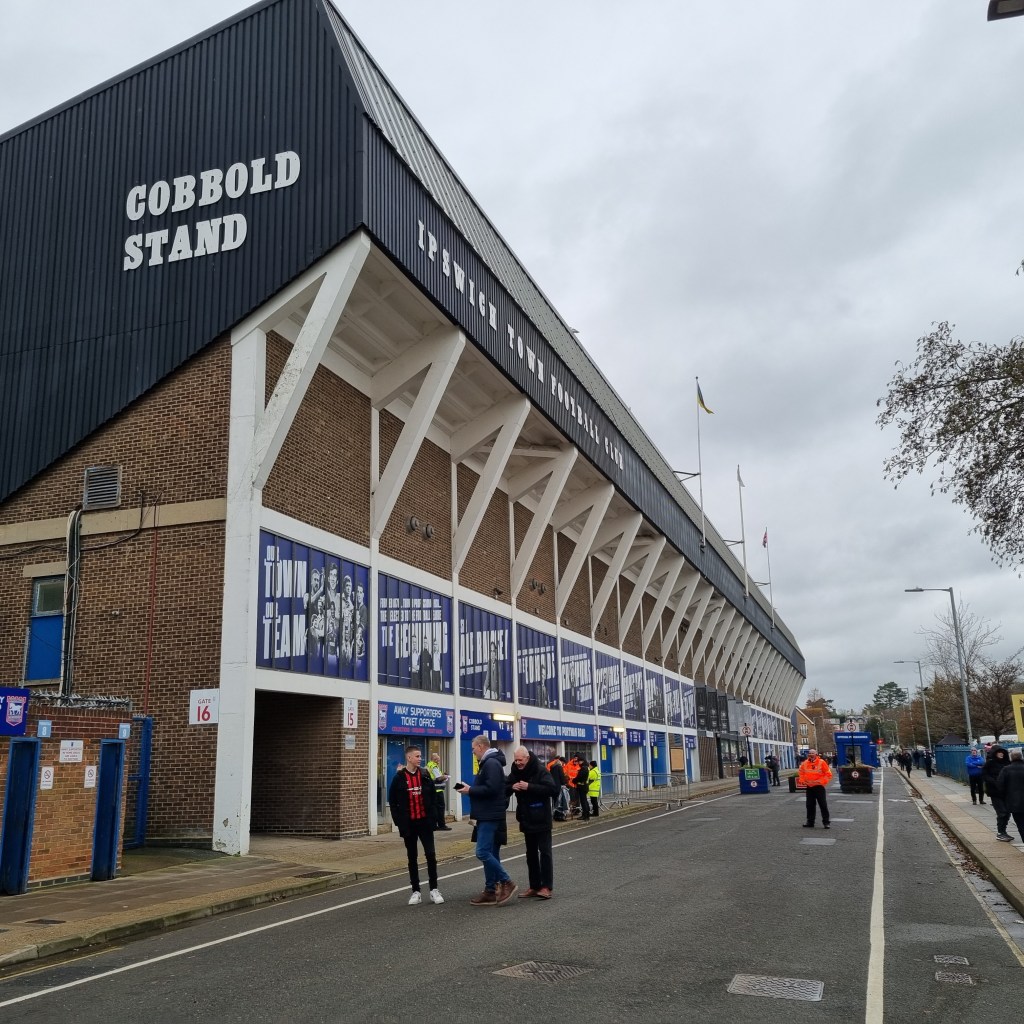
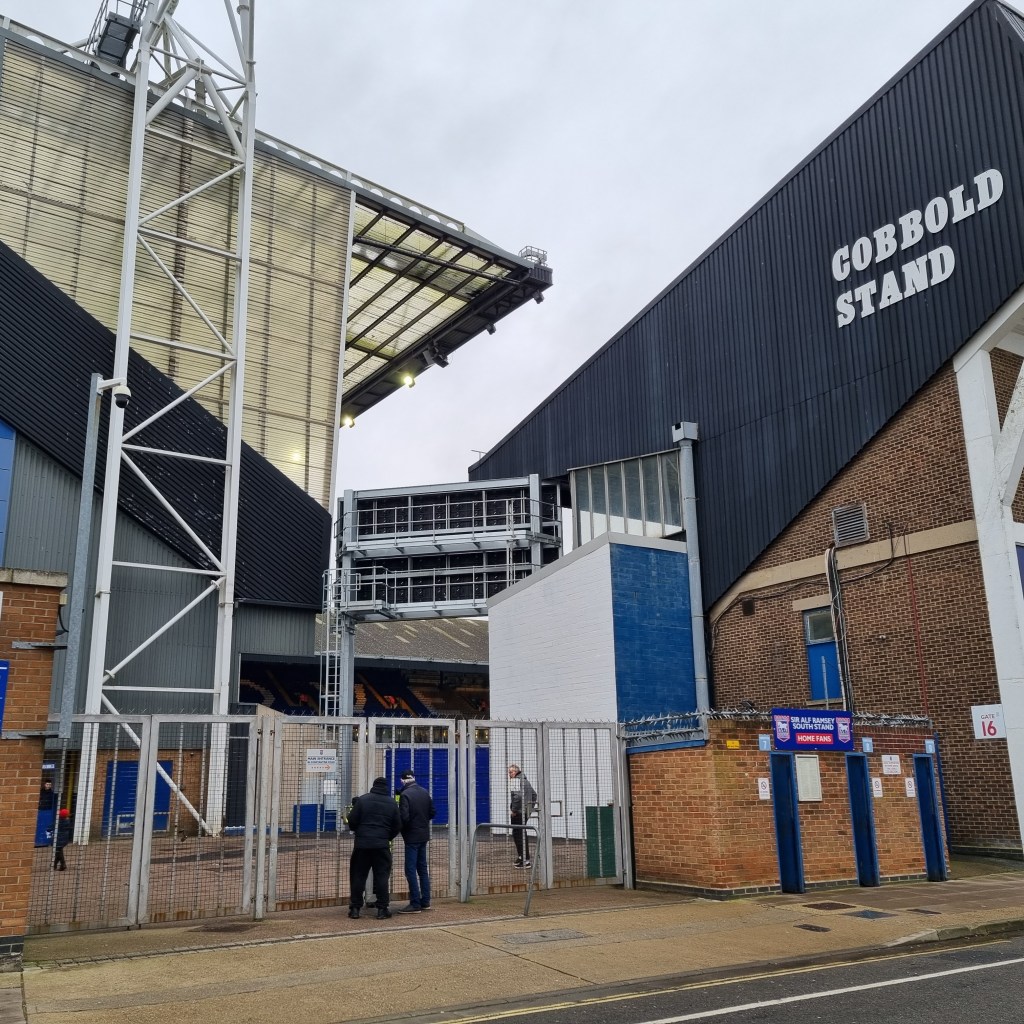
The back of the Sir Alf Ramsey stand is thick with queues when I arrive and as I stand in line I pass the time by looking up at the dark metal fascia of top of the stand, which is impressively streaked with guano, although there is not a seabird to be seen, as if when asked they will say “it was like that when we got here” .  The queue to turnstile 62 is as ever the slowest, so I switch to the seemingly better lubricated turnstile 61, but I’m still syphoning off excess Suffolk Pride as the team is read out and by the time I am reacquainting myself with Pat from Clacton, Fiona, the man from Stowmarket (Paul), ever-present Phil who never misses a game, and his young son Elwood, all trace of the excitable, young and somewhat lanky stadium announcer, and his sidekick Boo Boo, has gone.

It’s the Town that get first go with the ball this afternoon and naturally sporting the famous blue and white they are soon getting the ball to travel in the direction of the goal just in front of me and my fellow fifty plus (with the exception of Elwood) Ultras.  Wolverhampton are almost in their signature gold and black kit, but disappointingly their black shorts seem to be in the wash and their ‘gold’ shirts and substitute shorts aren’t that golden, more of a dark yellow, so anyone who is a bit short-sighted, or just contrary like me, might think they’re a poor man’s Cambridge United.

Pat is soon asking me if I’m well and we exchange complaints about aching knees and joints, it’s been that kind of a week.  “Oh when the Town go marching in” chant the north standers miserably as if we’ll be doing it under duress, and the Wolverhampton number twenty-seven shoots over the Town cross bar.  “Ed Sheeran, what a wanker, what a wanker” sing the Wulfrunians, as well they might, given that they share their love for their team with the likes of Robert Plant and Noddy Holder.

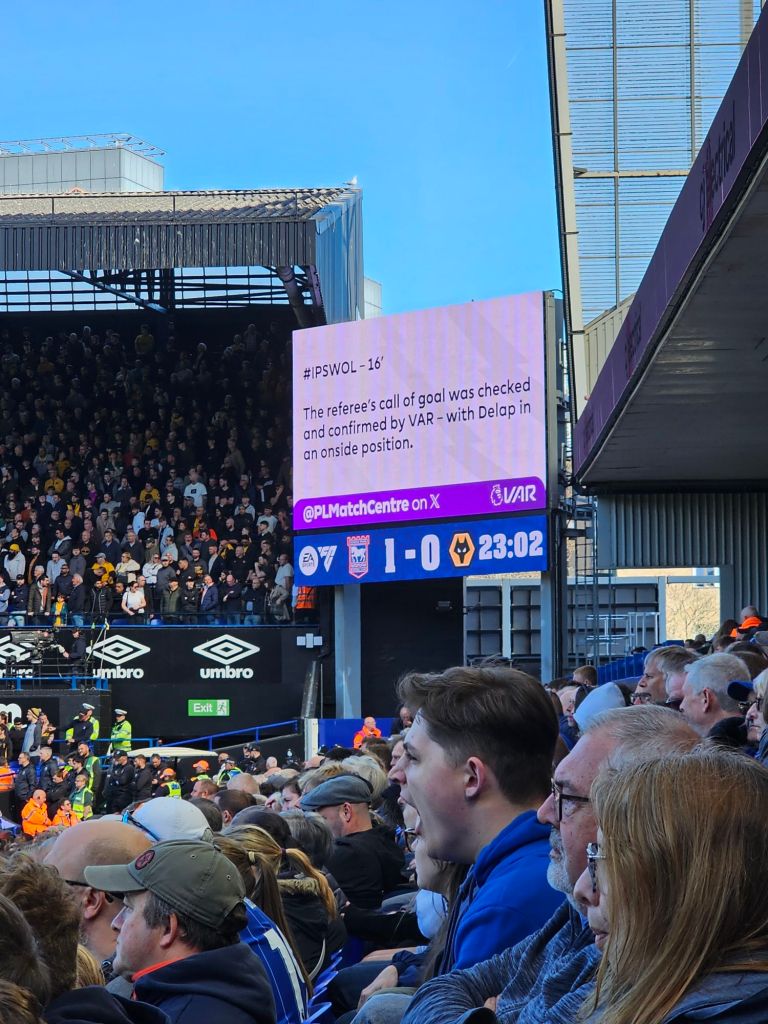
The Wolverhampton number nine shoots and Palmer saves as the prequel to repetitive chants of “Come on Wolvers” which are the soundtrack to three consecutive corners before Town earn a couple of corners of our own and I get to bellow “Come On You Blues”,  which always seems to amuse Pat from Clacton,   Then the ball is crossed in again.  Dara O’Shea heads the ball back across goal and Liam Delap slides in to score, and Town lead one-nil. “Liam Delap, Ole,” chant the multilingual home supporters and Pat from Clacton snaps pictures of our hysterical faces.    This is what being in the First Division is supposed to be like, but then reality bites as we have to wait for VAR to confirm that what we think we saw, we really saw.  “VAR don’t work in football” says the bloke behind me bitterly as we grow cold and old waiting for the decision, which presumably takes so long because there is controversy over whether the blade of grass on the toe of Liam Delap’s boot is a part of his boot, in which case he’d be offside, or part of the pitch, in which case he isn’t.  Surprisingly perhaps, the goal stands, and feeling even more excited than I did when we actually scored, I celebrate all over again.

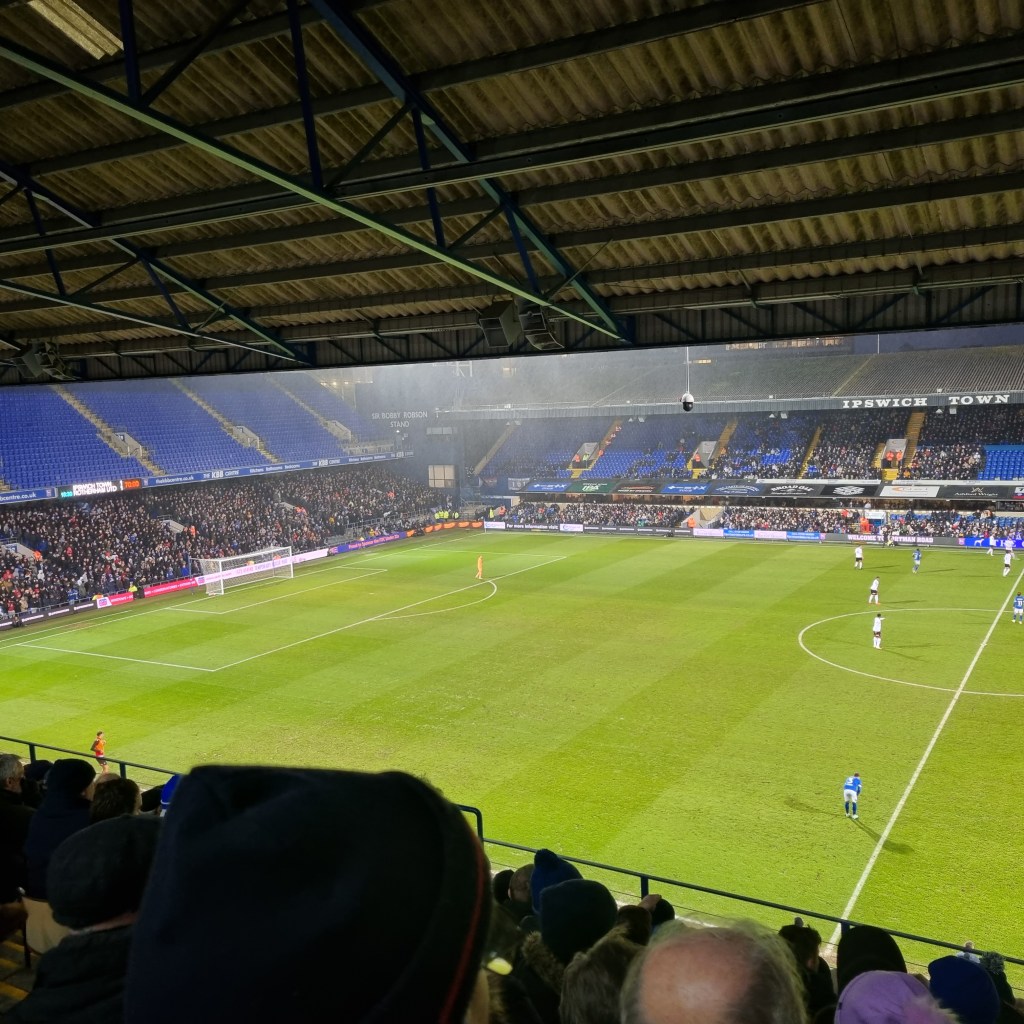
High on the goal and VAR decision I am  more convinced than ever that the Town will escape relegation, and decide that the Wolverhampton number seven, who mysteriously is just called ‘Andre’ , looks a bit like Freddie Mercury.  Naturally intrigued, Pat from Clacton zooms in on him with her camera and disappointingly concludes that he looks nothing like him.  It must have been the spring sunlight playing across his dark moustache.  “Balustrades” reads the electronic advert between the tiers of the Sir Bobby Robson Strand, and then “Hot Sausage Company”, before then trying to convince us  it is the ideal place to get one’s pre-match meal, making me wonder in the interests of a balanced diet what vegetables they serve to accompany the hot sausage.

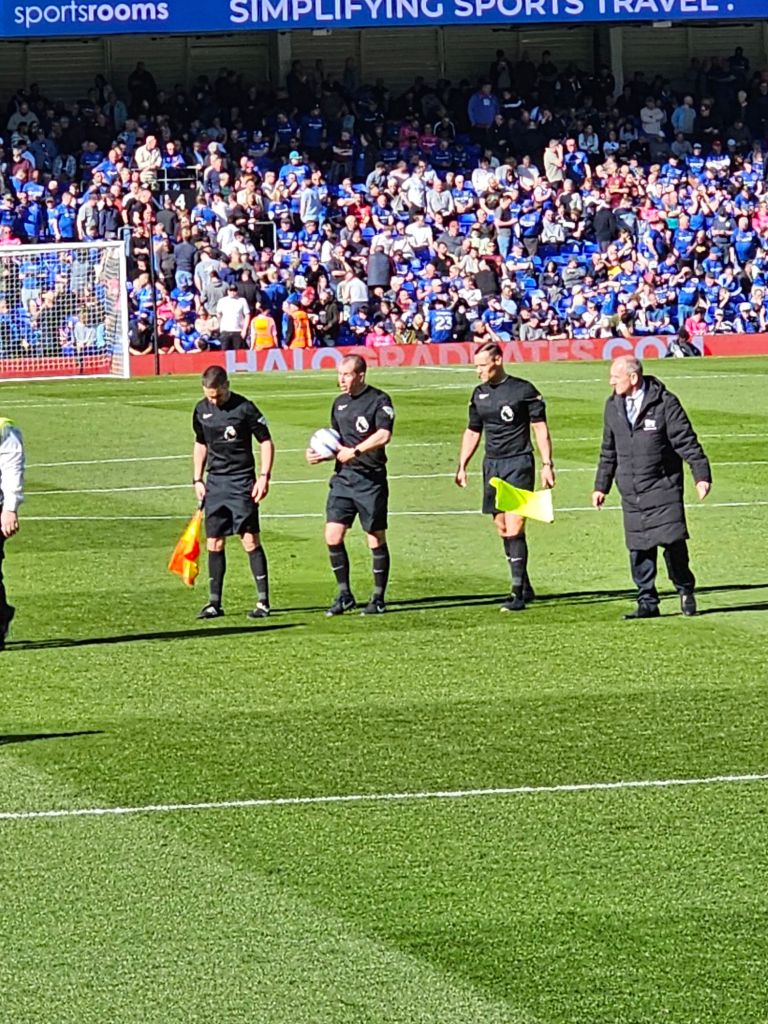
Life winds down towards half-time with an indirect free-kick on the edge of the Town six yard box after Alex Palmer misjudges a back pass and has to make a diving save to prevent the ball from going into the goal.   Another lengthy delay ensues as the referee struggles to employ the ten-yard rule within a space of only six yards, and predictably perhaps Wolverhampton miss anyway.  Alex Palmer is booked for encroachment, probably because he felt responsible.   Incredibly, but thankfully, only three minutes of added on time are added on and the first half ends with the home crowd feeling quite content with our lot.

Half-time is a blur of talking to Ray and his grandson Harrison, feeling a spot of water on my hand from the  sprinklers on the pitch, syphoning off more Suffolk Pride and eating an oddly named ‘Alibi’ chocolate bar,  which I found in the World Food aisle at Sainsbury’s and which comes from Poland and is a bit like a plain chocolate Toffee Crisp, but bigger; rather nice.

The football resumes at five minutes past four under the same clear blue sky that’s been here all day.  “Come On Wolvers, Come On Wolvers” is quaintly reprised up in the Cobbold Stand, Wolverhampton win a corner and Ipswich win two, but it is the team from the Black Country who are mostly running at the Town defence with the ball and looking quite good, much better than they did in the first half, unfortunately.  Silky Nathan Broadhead is replaced by the more combative Jack Taylor for Town.   There are only twenty minutes left and Town still lead but it doesn’t feel like it. “Come on Wolvers” continue the Wulfrunians and a SWAT team snatches away one of their number who has presumably been being doing something good football spectators shouldn’t. I beginning to think that the Wolverhampton team is a bit whingy, whiny and rough and a bad influence on their supporters.   “Hark now hear the Ipswich sing, the Norwich ran away” chant the Sir Bobby Robson standers referencing football hooliganism of yore in solidarity with the naughty boys of Wolverhampton.

After the seventy first minute, the seventy-second minute turns up as we expected it would, but with unexpected consequences as Wolverhampton’s Pablo Sarabia turns on the edge of the penalty area and shoots with no particular power at the Town goal.  From where I am sitting I am fully expecting Alex Palmer to dive across to his left and palm the ball away, but instead the ball unsportingly evades him and carries on onto the corner of the net.  Town are no longer winning and life is suddenly not as sweet as it was a few moments ago.  Of course, VAR has to give us false hope that a loose thread from a gold shirt was in an offside position and might have distracted Palmer,  but it is not to be and our pain is doubled with the seemingly inevitable confirmation that the goal was indeed a goal.

“We are Wolves, We are Wolves” chant the visiting Wulfrunians, at last feeling bold enough to identify themselves in public, and by way of confirmation we are told that there are 2,955 of them  amongst a total crowd of 29,549 and we are all thanked for our “incredible support,” which I can’t help thinking  gets a little less incredible and a little more ordinary every time we are told that it’s incredible.   Meanwhile, back in the Cobbold stand the Wulfrunians have broken free of their shackles and launched into a chorus of the socialist anthem the Red Flag, although despite the lyrics of the song expressly forbidding it, they have changed the colour of the flag from red to gold. Flippin’ revisionists.

Ten minutes of normal time remain as hopelessly inaccurate shots rain in on the Town goal and the Wolverhampton fans gain in confidence to the extent that they tell us we’re “Going down with the Albion”, by which I assume they must mean Burton Albion because both West Bromwich and Brighton & Hove are both securely mid-table.  Either their barbed taunts provoke a reaction, or Keiran McKenna looks at his watch and realises it’s nearly tea-time as he makes a sudden rash of substitutions with Delap, Townsend and Cajuste replacing Philogene, Davis and Hirst on the bench.  The changes unfortunately bring disaster for Town as within three minutes a run into the box and a low cross allows a large Norwegian by the name of Strand Larsen to score a close-range goal similar to that which Delap scored in the first half.  “Like a a bag of cement” says the bloke behind me about some Town defender or other. “Piss poor” he concludes.  VAR twists the knife by again making us wait for confirmation that the goal was a goal, as all hope at first slowly but then more quickly bleeds out of us.

Seven minutes of added time are of no help; we lose and are well beaten by a more skilful, more exciting, more proficient team, interestingly made up entirely of players from Portugal, Brazil, France, Spain and other countries that aren’t England.   But the league table still says that they are the next worst team after us.

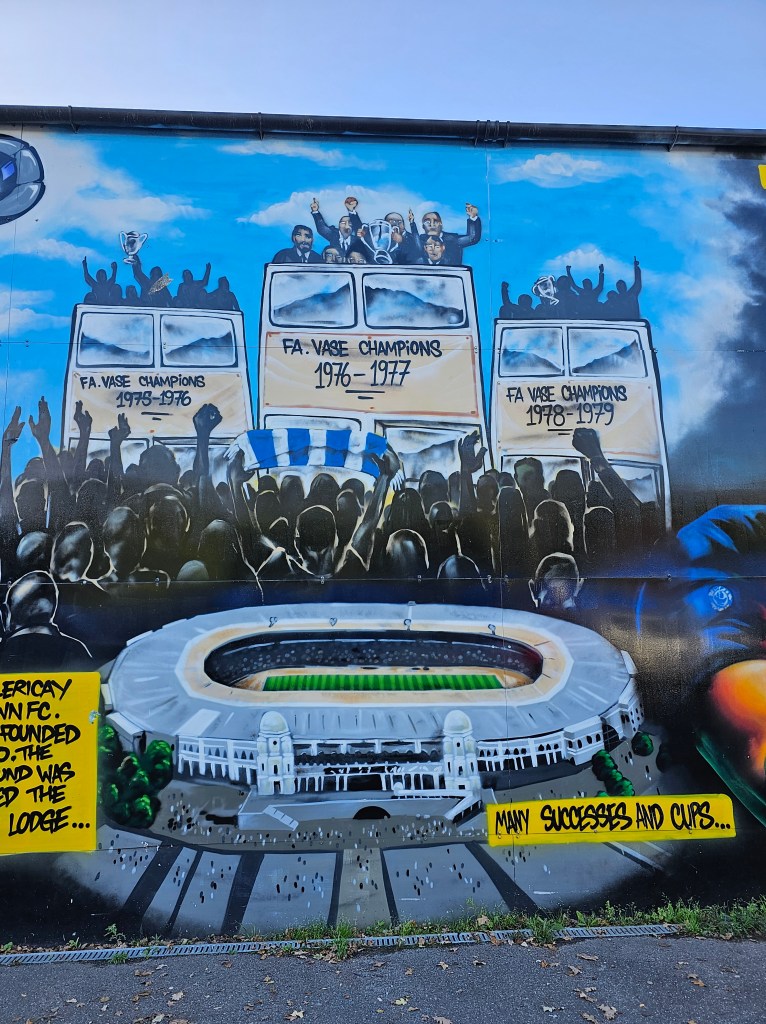
Not to worry, this sorry tale of a season of lost innocence and cruel fate will soon be over.

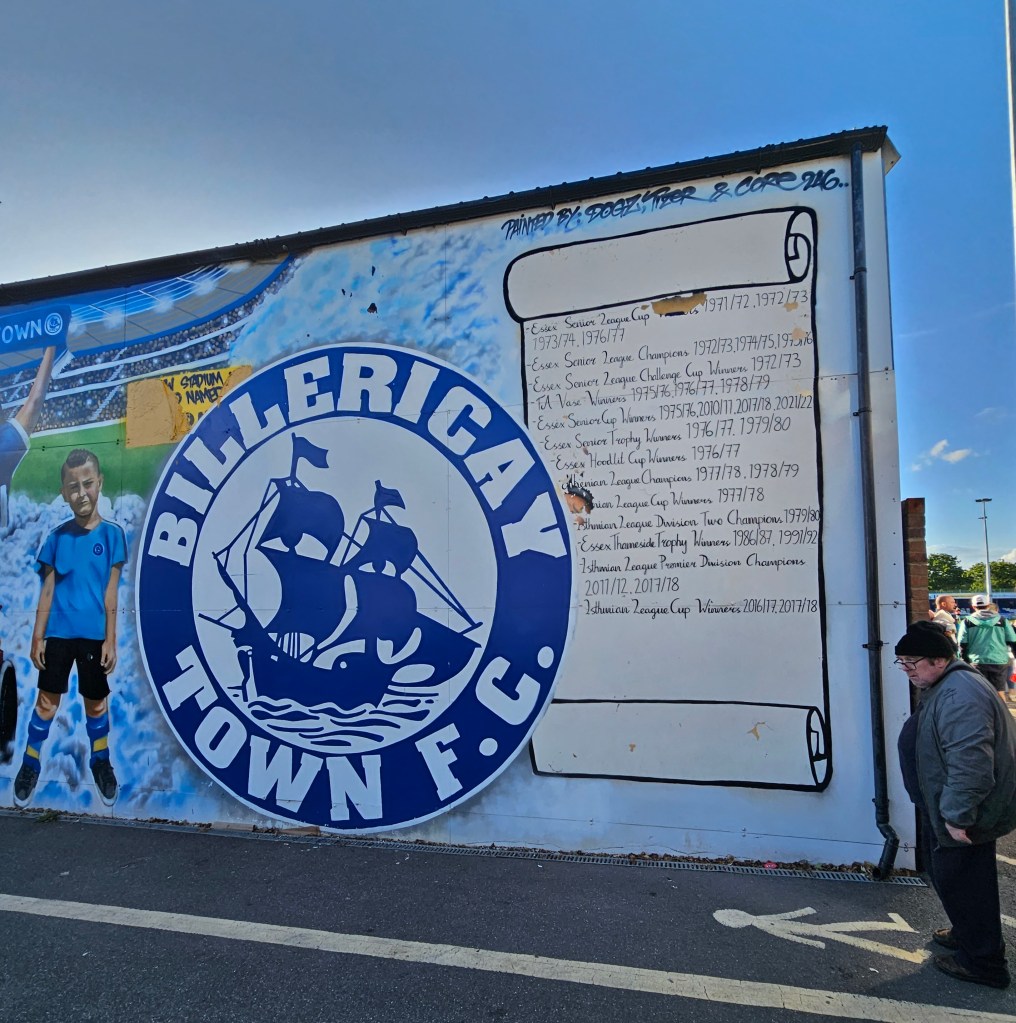
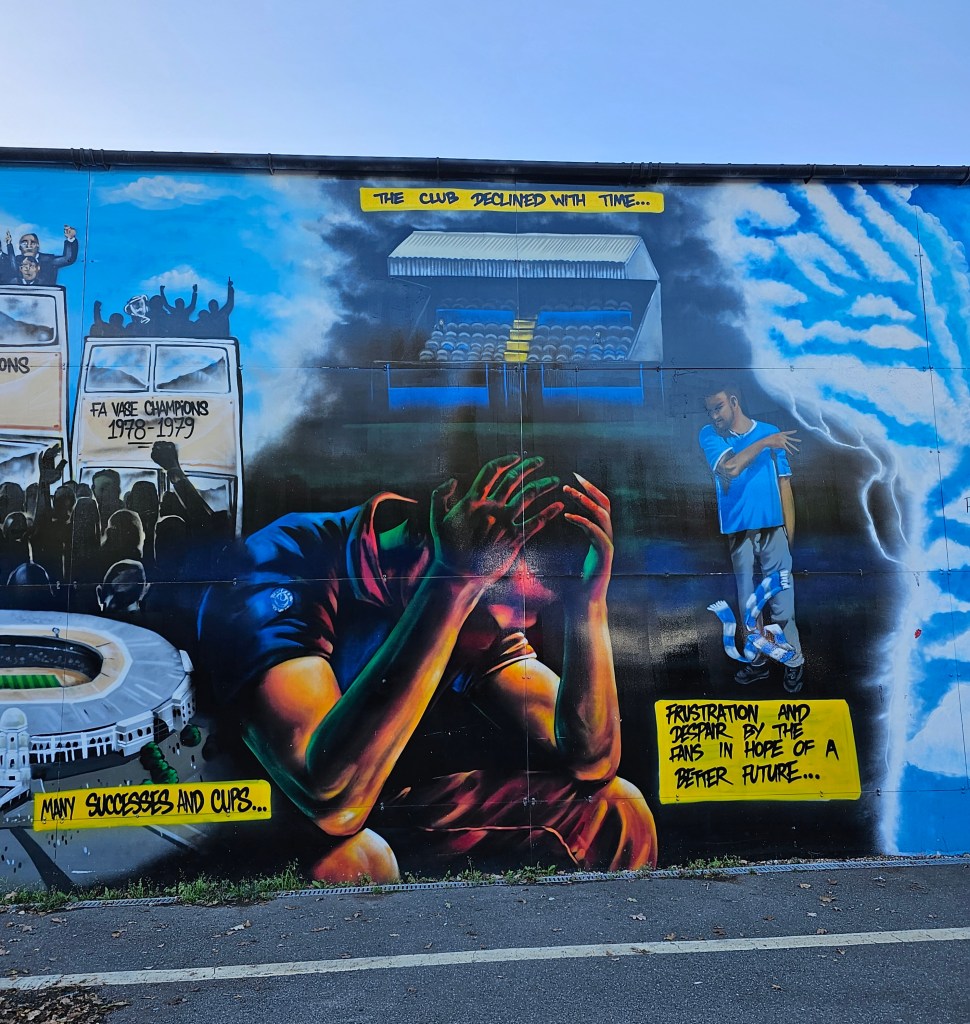
Billericay Town 1 Sheppey United 1

It’s a bright sunny day and I have spent the morning trimming the hedge that sits between my garden and the footpath outside my house and the road beyond. I didn’t know when I started hedging, that today was the day of the fourth qualifying round of the FA Cup, but something inside is nagging at me telling me that I should be seeking out non-league football on a sunny October Saturday when Ipswich Town aren’t playing.  In one of the many breaks from hedge trimming that I need in order to admire my work and drink tea, I therefore discover on the interweb that today is indeed an FA Cup day,  and scanning the fixtures for ‘local’ games I see that Billericay Town will be playing Sheppey United.  

Like seeing Haverfordwest County, which I did back in August, seeing Sheppey United has always been an ambition of mine. My father’s parents lived in Sheerness on the Isle of Sheppey from the 1930’s until they died forty odd years or more ago.  I can recall visiting them and discovering Sheppey United’s ground, which was then somewhere amongst the seeming maze of back alleys between their house in Vincent Gardens and Sheerness High Street. My father always laughed about Sheppey United, and I was a bit disappointed that neither he nor my grandfather ever suggested we go and watch them.   So, today presents an opportunity to fulfil a longstanding wish. To add to the family association, when my grandmother and father were first married, she apparently worked in Billericay, and the story goes that at this time she fell pregnant with twins.  There are no birth or death certificates for the twins however, so it is assumed they miscarried, but the story put about by my uncle was that she was going to name them Billy and Ricky, (as in Billericay) which seems unlikely, a bit ridiculous, and also very tragic all at the same time.  But my uncle did have an odd sense of humour.

Google maps tells me that I am only forty-five kilometres from Billericay Town; a thirty-five-minute drive down the A12 and along the B1007.   I drove that far a fortnight ago to see Garde St Cyr Moreac play OC Vannes in the fourth, and still amateur, round of the Coupe de France, so it only seems fair that I should drive as far to watch an FA Cup game this afternoon.  I ask my wife Paulene if she would like to accompany me, because after all she was with me in Moreac, but her response today is verging on the impolite, and so having had a light lunch of potato crisps and left over pizza I set off alone in my planet saving Citroen e-C4.

It’s an easy drive from my house to Billericay, but I nevertheless set the Satnav to take me to New Lodge, Billericay Town’s home ground.  I listen to BBC Radio Essex in the car in the hope of gleaning pre-match insight, but talk is mostly of Colchester United, Southend United and also Aveley, who like Billericay are playing in the FA Cup today, but at home to current National League leaders Barnet.  I am kept amused meanwhile  by the Satnav, which changes the pronunciation of the last syllable in Billericay from the usual ‘Key’ to ‘kay’.  As the writers of ‘Gavin and Stacey’ and possibly my uncle knew, there is may be something inherently funny about Billericay.

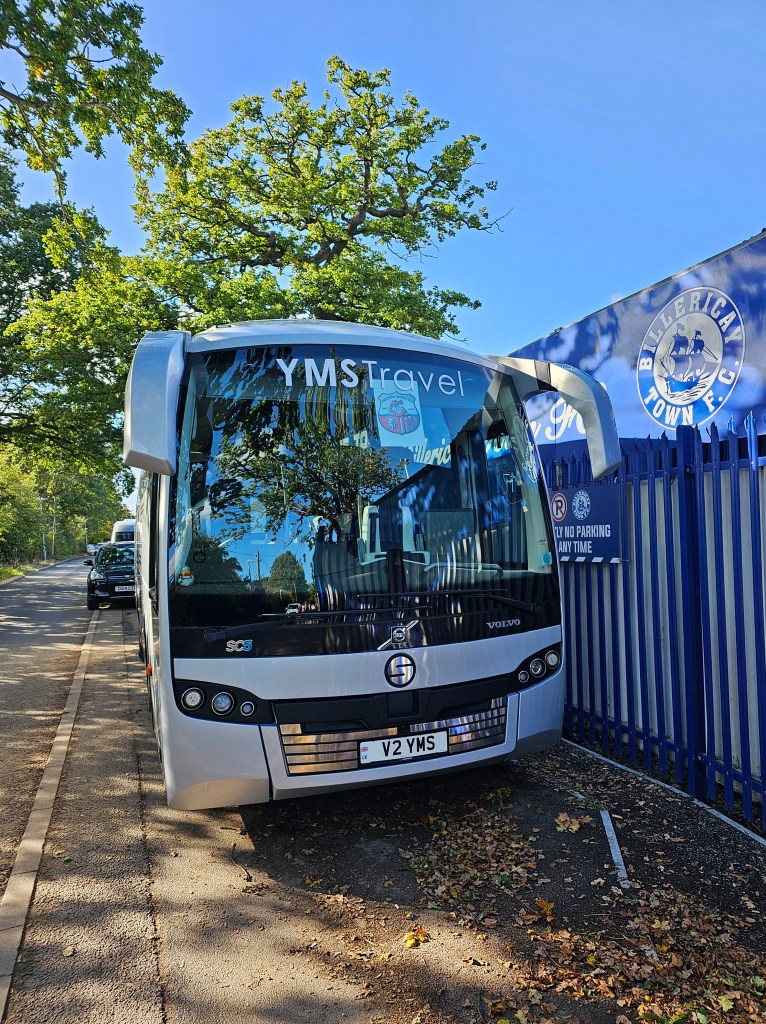
The Satnav in my car unerringly takes me to Billericay Town FC as expected, but had not foreseen that the club car park would be full, and so I switch ‘her’ off and pop down a nearby side road to doubtless annoy someone by parking outside their suburban bungalow.   At the bottom of the road on which I am parked, four blokes are getting out of a pick-up truck. A man stands on his front porch opposite and tells them to turn right then left to get to the ground, I guess they must be from Sheppey.  “Up from Sheppey are you?” I ask. The answer is as expected, and our conversation reveals not only that the bloke I’m talking to is the Sheppey United manager’s son,  but that one of the blokes with him owns a house in the same street in which my grandparents lived.

New Lodge lies down Blunts Wall Road, a bucolic, tree-lined lane which conveniently brings the pedestrian to a bank of four turnstiles at the corner of the ground.  Being the modern tech-savvy bloke that I’m not, I had already purchased my ticket on-line just minutes before I set off from home, responding to the advertised promise on the club website of not having to queue at the turnstiles.  It was a lie, there is no express check in, and so I begin to queue at the first in a row four turnstiles with all the mugs tendering bank cards and even cash.  When I get to the front of the queue, I present my phone to the turnstile operator, who promptly apologises that she can’t let me in here and I must queue at turnstile number four. Luckily, having queued at the first in a row of four turnstiles it’s easy to work out which must be number four, although the turnstiles are not actually numbered.   At least when I begin queuing again I can confirm to the two blokes behind me who also already have their tickets, that they are in the right queue.

Emerging from the turnstile, the pitch and stands of a very neat and well-appointed stadium appear before me, but sadly the same can’t be said of anyone selling programmes.  The only programme today is an electronic one, and when I photograph the QR code and go to look at it, I find only the programmes from four previous matches; although one of them was an FA Cup tie, it was versus Stowmarket Town.   A little down-hearted, I turn my attention back to my surroundings.  The pitch is synthetic and in the tradition of non-league football grounds it appears to slope, in this case from east to west; I had thought that artificial pitches needed to be level, so perhaps it’s the stands that are sloping, or me.  The stands are very smart, painted blue with neat rows of narrow, white roof stanchions fronting the pitch in wonderful repetition on all sides.  The ground seems almost too smart for non-league, and it comes as a relief to spot some flaking white paint on the main stand, even if the metal beneath is shiny not rusty.  The club house is large with two bars that wouldn’t look out of place in a Wetherspoons.  There are further outdoor bars in the southern corners of the ground.

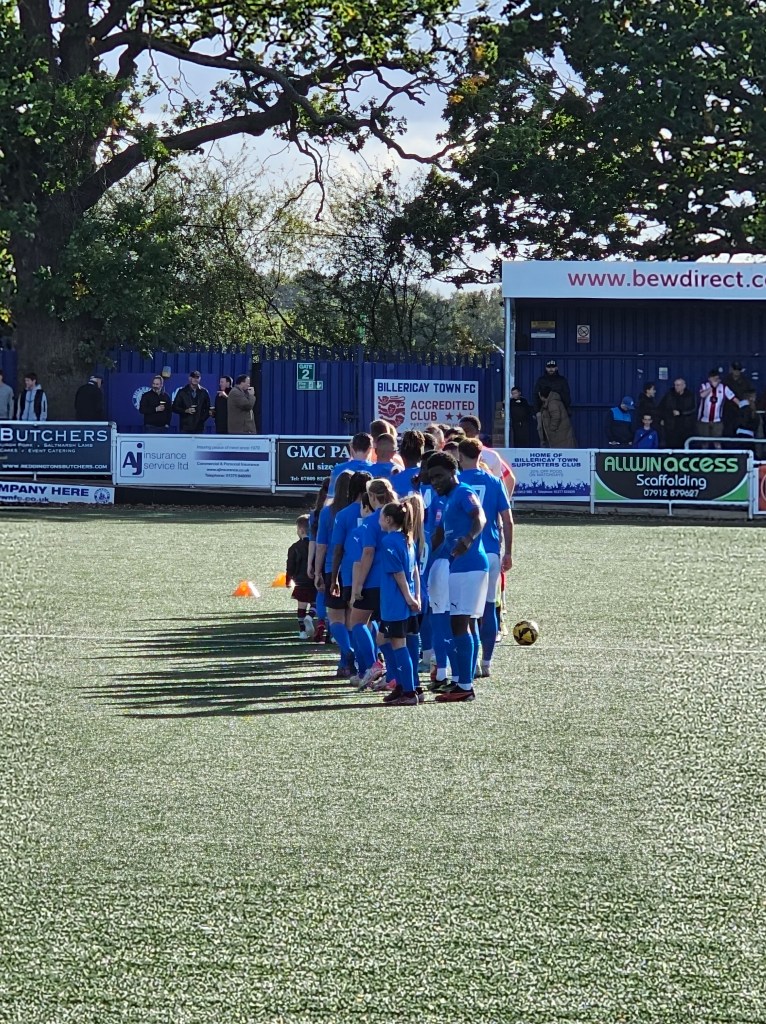
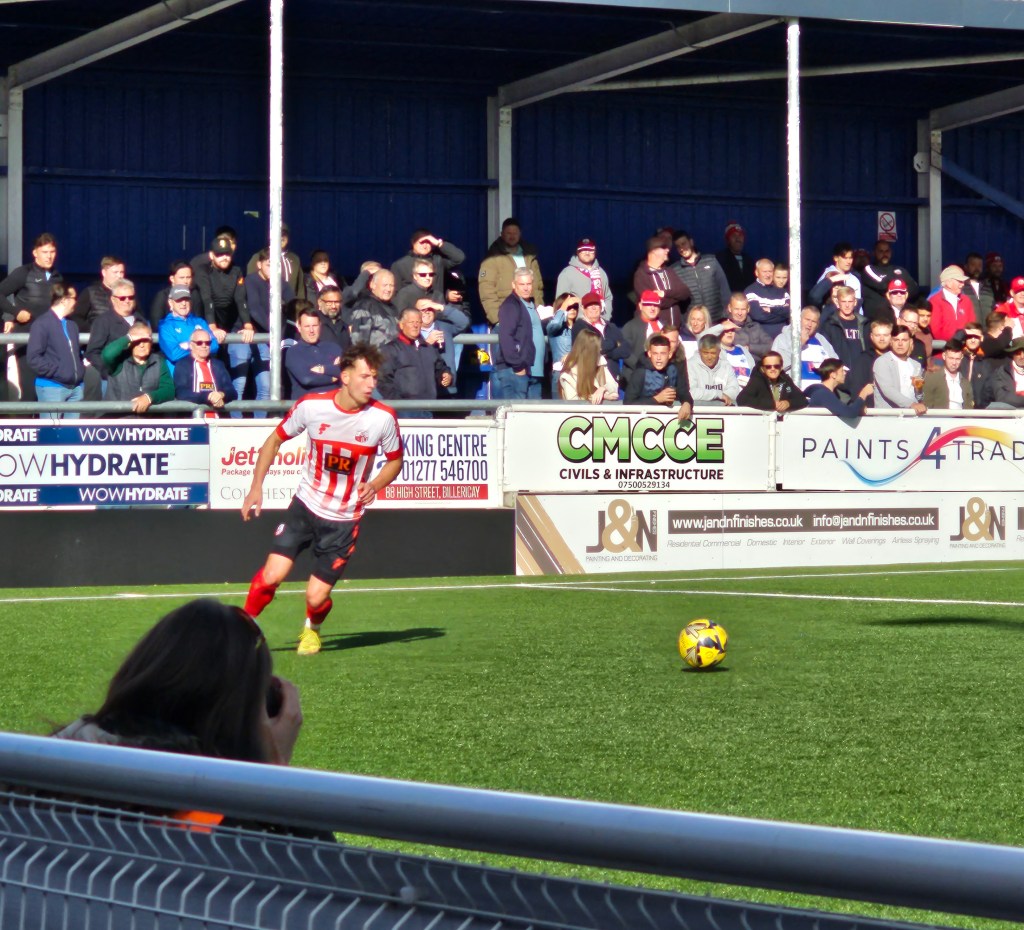
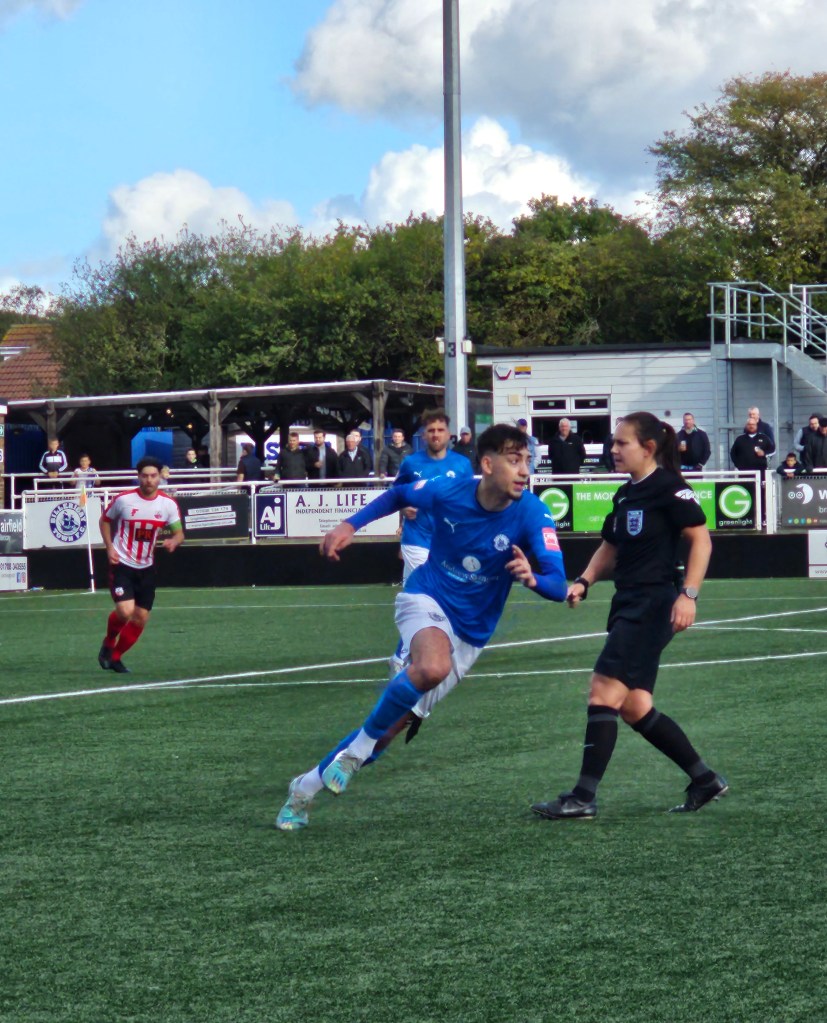
I eventually settle on the terrace where most of the Sheppey fans seem to have gathered. The teams process onto the pitch and the game begins.  It’s Billericay who get first go with the ball and they are kicking towards  the northern end, where I am standing.  Billericay wear blue shirts and white shorts whilst Sheppey are in red and white stripes with black shorts; the scene is a perfect picture.    The opening minutes of the game are dominated by people carrying plastic pints of beer and lager re-locating from the south end of the ground to the north, the end that Billericay are attacking.  Billericay’s number seven has a shot during this time and fortunately it flies over the cross bar, if it had gone in, I fear the walkways around the ground would have been awash with beer.

The sun is shining strongly into the stand and I decide it’s too warm, so when the Billericay Town diaspora is over I go and find a seat in the front row of the stand on the west side of the pitch, which is shaded.  It’s a good view if a little low down and afflicted with the pungent smell of what I think is pine from a close neighbour’s aftershave or may be an open bottle of toilet cleaner.  Despite the main migration having finished, there is nevertheless still a constant flow of mostly blokes with pints from the bars.

As might have been expected, because Billericay Town are in a league a level above Sheppey United, the home team have the ball more of the time than do their visitors.  Despite a lot of possession however they don’t have many shots at the Sheppey goal and Sheppey break down their attacks easily.  It’s only twelve minutes past three and another attack is broken down and Sheppey send the ball off down their right flank from where it is played through to their number nine who quickly sets himself up for a shot and scores.  Sheppey United lead 1-0 and there is an explosion of joy amongst the red and white shirts and scarves off to my left.

“Everywhere we go…” sing the Sheppey fans and then “No noise for the Essex Boys” which provokes the quickly thought out response “Essex, Essex , Essex” from the boys.   Billericay continue to keep the ball a lot of the time but it’s as if they think that’s all they have to do.   At twenty past three it’s Sheppey who win the first corner, and I notice the row of four Oak trees at the southern end of the ground, one of which is inside the ground, although it doesn’t look as healthy as the others.   It’s a beautiful light blue afternoon with heaped up clouds like cotton wool decorating the sky and puffs of black rubber springing up from the synthetic pitch.

Sheppey’s number eight shoots on goal. “Oh, no-oo” exclaims the bloke next to me a moment before the ball skims just beyond the far post and I hear him sigh with relief.  Sheppey win another corner, and then another but in between Billericay have another extended period of ultimately aimless possession.   It’s not until gone twenty-five to four that Billericay win a corner of their own, but the Sheppey goalkeeper is the first to the ball when is sails into the box.  The sight of groups of home and away fans side by side behind the goal has me reminiscing about the North Stand at Portman Road back in the 1970’s. 

With half-time approaching I decide to make my way to what I think is a tea hut, but is actually another bar, situated in the corner by the turnstiles.    I pause and watch the last action of the half from near the bar as Billericay gain another corner.  The ball is not cleared and to end the archetypal goal mouth scramble the Billericay number 10 jabs the ball into the net from close range and the scores are level.  I’m a bit disappointed.  After a minute’s worth of added on time it’s half-time, and hiding my disappointment that Sheppey are no longer winning I step away to the bar to get a tea (£1.20) and worry that the woman who serves me is eyeing me suspiciously because I seem to be the only person who isn’t buying beer.

Having previously felt too warm, by the end of the first half I was beginning to feel too cold, so for the second half I return to the terrace that’s in the sun at the north end of the ground, which reminds me of the old ‘Popular’ side at Layer Road, Colchester, but without the rust and with a better rake on the terrace.  The football begins again at six minutes past four.

“Get into ‘em and fuck ‘em up” chant the Billericay fans repeatedly and rather unpleasantly and their team responds with an early shot high into one of the Oak trees.  The afternoon’s attendance is announced as being 1,241 and the announcer thanks everyone for their “fantastic support”.   Billericay have the ball most of the time still and the football is neat and thoughtful, only occasionally punctuated by agricultural clearances from the big blokes at the back.  In front of my terrace fat blokes continue to ferry beers.   It’s nearly twenty-five past four and Billericay win a corner. “Come On You Blues” chant the home crowd from the other end of the ground.  A minute later Sheppey make the game’s first substitution and have a creative spell, which first sees number eleven volley the ball against the Billericay goalkeeper’s chest , before number six is booked and then number seven has a rising shot blocked by the up stretched arms of the Billericay ‘keeper.  Meanwhile, the Sheppey fans chant “Come On Sheppey” and in a quieter moment a pied wagtail flits across the pitch, confused perhaps by the synthetic grass.

Twenty-five to five slips by and Billericay make a substitution.  “Blue Army, Blue Army” chant the home crowd like a scratched record.  “Come on you Ites” chant the Sheppey fans, suddenly remembering their team’s slightly odd nickname; Ites being short for Sheppeyites.   Their team earns a corner and number four heads over the cross bar.   It’s now almost a quarter to five and as Billericay make a double substitution I notice two advertisement boards on opposite sides of the pitch; one for Greenlight Insurance,  the modified car insurance specialists, and the other for Bumps Away Minor Body Repairs; the symmetry appeals to my cliched picture of south east Essex as the home of the boy racer and his souped up Vauxhall Nova.

Only a few minutes of normal time remain but away to my right two young blokes return to their friends with more beer and two polystyrene trays of chips for which a blue recycling bin makes a convenient table. On the pitch, Sheppey’s number seven joins the list of cautioned players and the Sheppey supporters regale the referee with chants of “You don’t know what you’re doing”.   It’s ten to five when I decide to head towards the exit, making my way along the front of the main stand in instalments before resting near where I ended the first half.  With time running out and a midweek replay back in Kent looming, both teams make final desperate efforts to win.  Billericay hit the Sheppey cross bar with a free-kick and then inside the four minutes of time added on Sheppey also have a shot  that unexpectedly strikes the cross bar too.  But then it’s all over and amidst applause, relief, disappointment and appreciation I make my way back out into Blunt’s Wall Road and the short walk back to my planet saving Citroen e- C4.

The lesson learned today is that the FA Cup is still a wonderful thing, which at non-league level in particular still excites and enthuses, because it is all about the glory.   This afternoon’s match has done the old competition proud, and I can now go back to my hedge trimming to reflect on an afternoon well spent, to wonder about  who Billy and Ricky would have supported, and to bask in the self-satisfaction that I have at last seen Sheppey United.   

Further reading: ‘How Steeple Sinderby Wanderers won the FA Cup’ by J L Carr.

Ipswich Town 4 Rotherham United 1

The year of our Lord 2023 has not started well. I have been suffering with diarrhoea all week and on Friday evening the teams I was rooting for in their respective ties in the ‘round of thirty-two’ in the Coupe de France (Montpellier HSC, Nimes Olympique, RC Strasbourg and LB de Chateauroux) all lost.  Today began as dull and grey and has progressed to become both wet and miserable, but my gloom and despondency have lifted as today is also the third round of the FA Cup and mighty Ipswich Town have a home tie against mighty Rotherham United. 

When I saw my first FA Cup third round tie back on 5th January 1974 (Town v Sheffield United) it would have been inconceivable to think of first division Town beating fourth division Rotherham as ever being a giant killing, but forty-nine years on the tables have turned a bit.  With Rotherham now in the second division and Town in the third, if Town win today I shall be claiming this as a ‘giant killing’, albeit one akin to a school child who is rather big for their age thumping one who is small for theirs but in the year above.

Ipswich is grey, Gippeswyk Park is wet underfoot and traffic is queuing to get over the bridge opposite the railway station, but Portman Road is quiet as I step up to the first booth I come to to purchase a copy of today’s programme. “Let me guess, £2.00 today” I say to the young woman in the booth.  She smiles perhaps through pity but I like to think she almost appears impressed as I hand her a single coin and tell her it wasn’t that big a deal, I’ve been to Cup matches before. 

By and by I cross the threshold of ‘The Arb’ and at the bar tell the barman that I ought to have something non-alcoholic; he directs me to the third shelf from the bottom of a tall fridge with a glass door which is packed with cans of ‘craft’ beer.  I pick a can of Big Drop Galactic Milk Stout and returning to the bar the I hear the voice of Mick saying “I’ll get that” which is characteristically good of him.  Mick has a glass of an anonymous amber bitter and packet of Fairfield’s Farms cheese and onion flavour crisps.  We repair to the garden where we meet Gary coming in the opposite direction who texted me early this morning, but I didn’t reply because I hadn’t noticed.  Gary is on his way to buy himself a beer and returns with a pint of unidentified lager; Gary is from Essex.

The three of us talk a little of football, the tv series ‘detectorists’, but also of death, as ever.  Mick’s daughter’s neighbour died this week from cardiac arrest and Gary tells of a man whose birthday coincided with his wife being admitted to hospital and her father dying. Aside from the big things like wars, famine and climate change life can be pretty miserable on a micro-level, which puts football into perfect perspective, so we really should try and enjoy it whatever the result.

Not much after twenty-five to three we head for Portman Road, returning our glasses to the bar on the way and noting that ‘The Arb’ now has a menu for dogs; I make a silly comment about restaurants in Malaysia. Sir Alf Ramsey Way is thick with people queuing to get into Sir Alf’s eponymous stand and the Magnus west stand, but we carry on towards the Corporation bus depot and find no queue at all at the end turnstile, where for the first time in my life I gain entry by my wife having downloaded my ticket on my mobile phone and having it scanned.  Mick and I were both nervous that this would work but it did.  I find myself marvelling at the wonder of modern technology in the manner of uncle Bryn in tv’s ‘Gavin and Stacey’.

Having syphoned off some beer, Mick and I find our way to the ‘posh’ padded seats in Block Y from where will be watching this afternoon’s game.  Gary only bought his ticket last night and so is away in the humbler surroundings of F Block.  Courtesy of his season ticket, Gary normally sits in J Block which Mick tells me is also the name of an Ipswich drugs gang from the mean streets between Bramford Road and London Road.  In the oppressive dim light of the upper tier of the Magnus west stand, we edge ourselves past an unsmiling man and his unsmiling wife, although she could be his floozie, and we find our seats.  A little weirdly to my cold, unfeeling mind, today’s game is, according to page 23 of the programme, the Club’s annual Memorial Matchday in which members of the Blue Army who died in 2022, or ‘passed away’ as the programme calls it, can be remembered.   Before the game can begin the names of the deceased appear on the scoreboard and they receive a minute’s applause. “There are an awful lot of names” says Mick, who for a moment thinks these are all former players.  I’m not sentimental and find this Memorial Match idea a bit odd, but I am reminded nevertheless of former manager John Duncan and the excellent, original David Johnson,  John Jackson and, although I saw none of his thirty-four games for Town, Aled Owen. I recall seeing Jackson’s only game for Town, a 2-1 win over Manchester United and that Aled Owen played a single league game in the Championship winning season of 1961/62.  I think of fellow fan Andi Button with whom I saw many an away game in the 1980’s and 1990’s and even travelled with him by car to see Doncaster Rovers v Colchester United for what was the last game at Belle Vue before Doncaster were relegated from the Football League in 1998.

With applauses clapped and knees taken the game begins, Rotherham having first go with the ball, hoping to kick mostly towards the Sir Alf Ramsey Stand and looking like Derby County or Germany in white shirts with black shorts, despite their proper kit of red shirts with white sleeves and white shorts not clashing at all with Town’s blue and white ensemble.  Perhaps the absence of the red kit is a sign that Rotherham haven’t turned up as themselves today and aren’t much interested in the Cup, but in fact their team shows just one change from that which lost in the league at Millwall last weekend.

The crowd is loud with a good noise from the Sir Bobby Robson stand where the most vocal support, Blue Action, has re-located itself from stuck up the corner to the central section. Despite the impressive support, the game starts slowly, very slowly, with Richard Keogh and George Edmundson frequently standing still with the ball at their feet before merely passing the ball between one another. As I remark to Mick, it’s not exactly a ‘blood and thunder’ cup tie. I spend my time getting used to the unfamiliar surroundings of Block Y with its tight legroom and padded seats and the man behind me with a loud voice who likes to explain things to his children, although to be fair they are asking questions, as children do.  Slowly, Town venture forward and a couple of forays on the flanks nearly produce moves worth applauding and some people do. Both Conor Chaplin and Kayden Jackson have shots on goal, but both are poor efforts.  Then twice the ball is given away cheaply in the Town half and luckily Rotherham fail to take full advantage, Jamie Lindsay trying and failing to pass when he should have shot and then most luckily of all the ball is sent from close range into the Town net only for the ‘scorer’ to be flagged offside.  The home crowd is in good voice with the lower tiers of both the Sir Alf and Sir Bobby stands looking full.
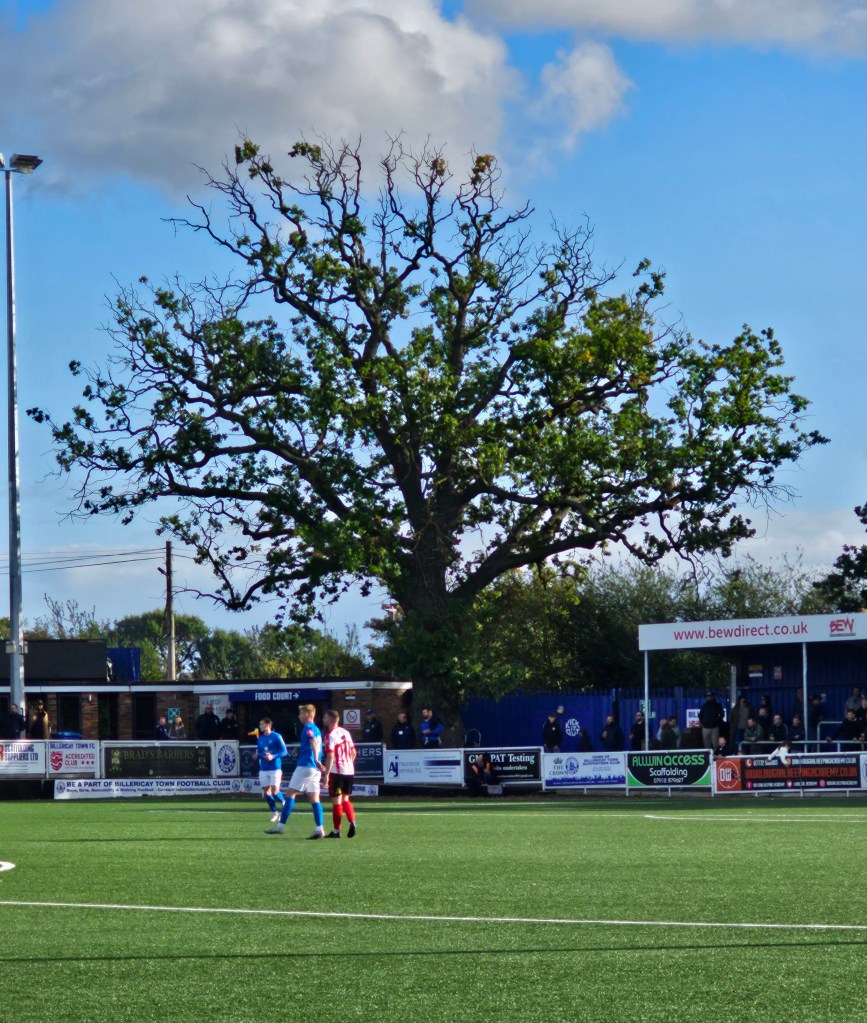
Freddie Ladapo chases a through ball. “Way offside” calls a bloke behind me in a tone of voice that implies that Ladapo being offside is a given.  “Way offside” he says again scornfully and then once more for luck when the assistant referee finally raises his flag.  This bloke behind me would seem to have turned up simply to let the world, or at least an unfortunate part of Block Y know that he doesn’t rate Freddie Ladapo.  The larger part of the first half is marred by such carping “Here we go, what are you gonna do with it? Do something with it” says another know-it-all as the opportunity for a match winning pass once again fails to materialise.   Much more enjoyably, when Kayden Jackson is fouled but gets no free-kick, a high-pitched, pre-pubescent voice from behind calls “Get your bloody glasses out”.

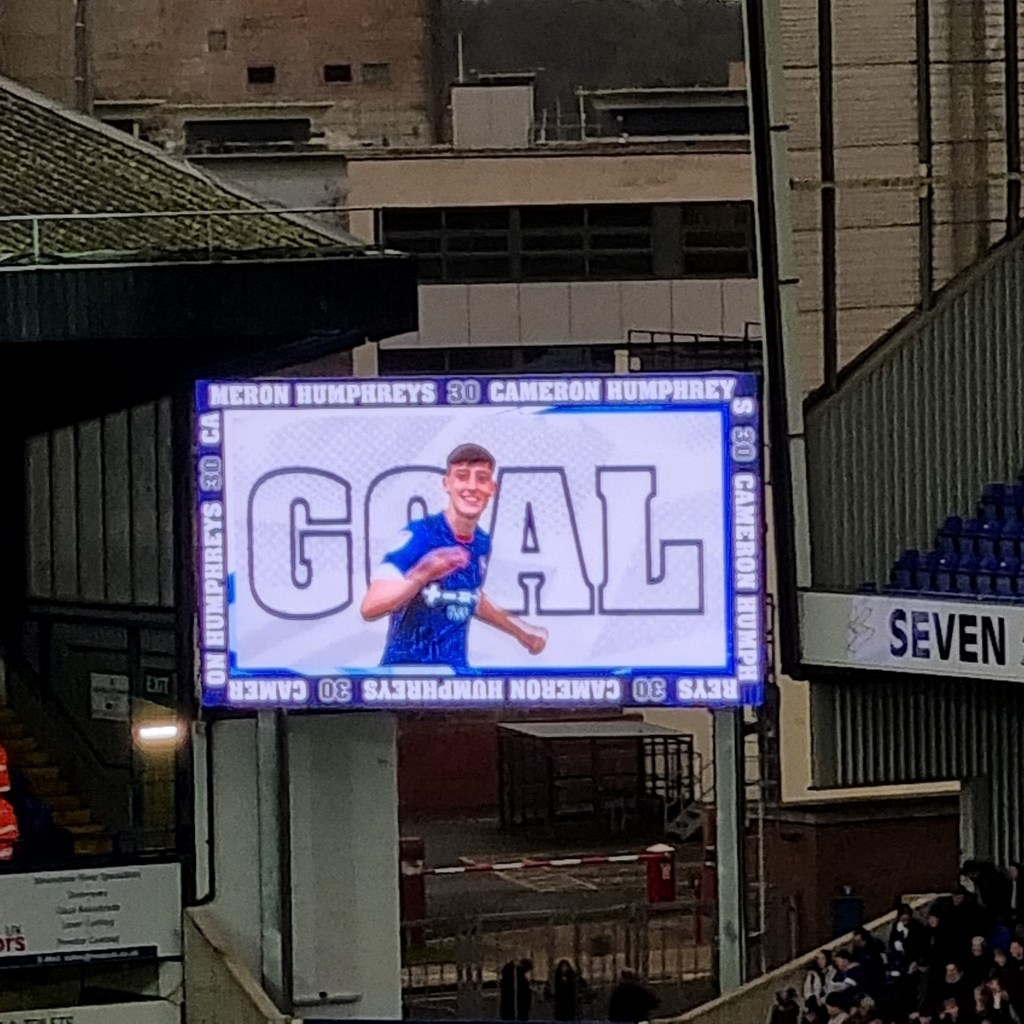
A half an hour has gone and whilst Ipswich have dominated, they have not been incisive, and shooting has been snatched at and inaccurate.  The children behind are eating savoury snacks that smell like a dog has farted.  In the corner between the Cobbold Stand and the Sir Alf Ramsey stand I can see a patch of blue sky above what must be Holywells Park.  A fine rain has started to fall and it’s nearly half-time. Kayden Jackson breaks down the right wing, as the Rotherham defence back pedal, Jackson sends a low cross towards the back of the penalty area, Conor Chaplin can’t reach it, but Cameron Humphreys is running in and strikes the ball smoothly inside the left hand post beyond the diving Viktor Johansson, and Town lead 1-0, it’s a fine, fine  goal.

Half-time follows on quickly and the crowd seems happy, a goal always works wonders. Mick had departed early to siphon more used beer and I meet him in the bar where we watch the half-time results on the tv and play spot the ‘giant-killing’ which leads to a discussion about which league clubs are in and how it was easier when it was divisions one to four. I admit to Mick that I still refer to divisions one to four bloody-mindedly to show my dislike of ‘modern ways’ in the same way that I call the internet the interweb.  Mick says he does the same when he still calls Ipswich’s ‘waterfront’ the docks.

The game resumes at five past four and it’s still raining, just a bit harder.  We’ve barely got comfortable again before Keogh and Leif Davis get in a muddle and allow Conor Washington to slip between them and get beyond Keogh who stretches out a leg or two giving Washington the opportunity to fall over him and win a penalty, which being unfamiliar with the Corinthian Spirit he naturally takes. Washington recovers sufficiently from his ordeal to score the penalty and the hard work of the first half is laid to waste.  Keogh hasn’t had a great match today, he could be the new Luke Chambers although happily he’s no Mark Fish or Ivar Ingimarsson.

The match resumes again and despite no doubt the worst fears of the crowd, Town continue to be the better team and Rotherham don’t look like scoring again.  The rain continues, swirling and drifting through the beams of the floodlights as natural daylight fades from the streets around the ground. Over an hour has passed and Marcus Harness replaces Sone Aluko, Rotherham bring on the only player from their last league match who didn’t begin the game today, Dan Barlaser, who sounds like a character from a sci-fi novel.

Town play a patient game, which is just as well because there are twenty-six minutes to wait until Freddie Ladapo, with his back to goal is wrestled to the ground by Rotherham’s Wes Harding.  Conor Chaplin scores the resulting penalty and the Sir Bobby Robson stand channel the spirit of Doris Day with an essential but tentative chorus of “Que Sera, Que Sera”.  “It wasn’t even a great penalty” says the know-it-all behind me.  Four minutes later Town make mass substitutions, which as often seems to happen bring quick relief to our pain and Freddie Ladapo gets a free run at goal; he rounds the goalkeeper and shoots low and hard to put Town 3-1 up, much to the chagrin no doubt of the know-it-all.

Today’s attendance is announced by the dangerously up-beat Stephen Foster as being 15,728 with 215 of that number being Rotherhamites. It has to be the biggest crowd for an FA Cup match at Portman Road in at least ten years, probably more.  Rotherham continue to flounder.  “Ha-ha” says the child behind me sounding like Nelson Munce from the Simpsons as a rare Rotherham foray forward squirms away over the line for a goal-kick.  All around, except up in the Cobbold stand there is a sense of joy.  Cup fever has broken out at Portman Road and is spreading fast through a crowd previously thought to have been vaccinated against it. The until now totally reserved man beside me begins to mutter “Ole, Ole, Ole” to himself following the lead of the Sir Bobby Robson stand, only they’re not muttering.

Eight minutes of normal time remain and a Kyle Edwards shot hits a post. Gassan Yahyi replaces Freddie Ladapo and then Kane Vincent-Young takes advantage of a shove by Hakeem Odoffin and Wes Burns adds a fourth goal from the penalty spot as a result.  “Championship you’re ‘avin’ a laugh” chant the Sir Bobby Robson standers safe in the knowledge that we can’t possibly lose now, and after three minutes of added on time Town’s ball books its place in the velvet bag for the fourth-round draw.

As we descend the stairs and head out into the drizzly darkness Mick and I reflect on our afternoon of FA Cup giant-killing .  I venture that it was pretty good. “After a very slow start” says Mick, tempering my enthusiasm, but I’m sure he’s only trying to keep my feet on the ground.   Wemberlee!