Ipswich Town 1 Nostalgia 1

On a damp May evening three years ago, I recall thinking to myself that it feels like 1978 and Ipswich Town have won the FA Cup all over again.  With my Portsmouth supporting wife Paulene, I had gone to see the Wolsey Theatre’s production of ‘Our Blue Heaven’, the music-backed play that celebrated the fortieth anniversary of Town’s FA Cup win. I can honestly say it was the most enjoyable Ipswich Town related evening I had had in nearly twenty years, since that season in the sun at the start of the third millennium when Town did things like beating Liverpool and Manchester City at their own grounds, having finally managed the previous May, to win a play-off semi-final and victoriously tread the turf at the old Wembley stadium for the last time. 

Fast forward to October 9th 2021, and in the spirit of celebration of Town’s winning the UEFA Cup forty years and five months before, which the club itself has seen fit to mark with the sale of a wallet, luxury boxed badge, and travel mug, the New Wolsey Theatre is staging the final performance of its production ‘Never Lost at Home’, the story of the 1980-81 season, but mainly the winning of the UEFA Cup, something no ordinarily lovable, small town football club will probably ever do again.  Not keen on spending an evening in an enclosed space with about 400 other people, most of whom will probably not be wearing a face mask, I have opted to cough up the £20 to watch the two- and a-bit hour performance on-line from the safety of my living room.

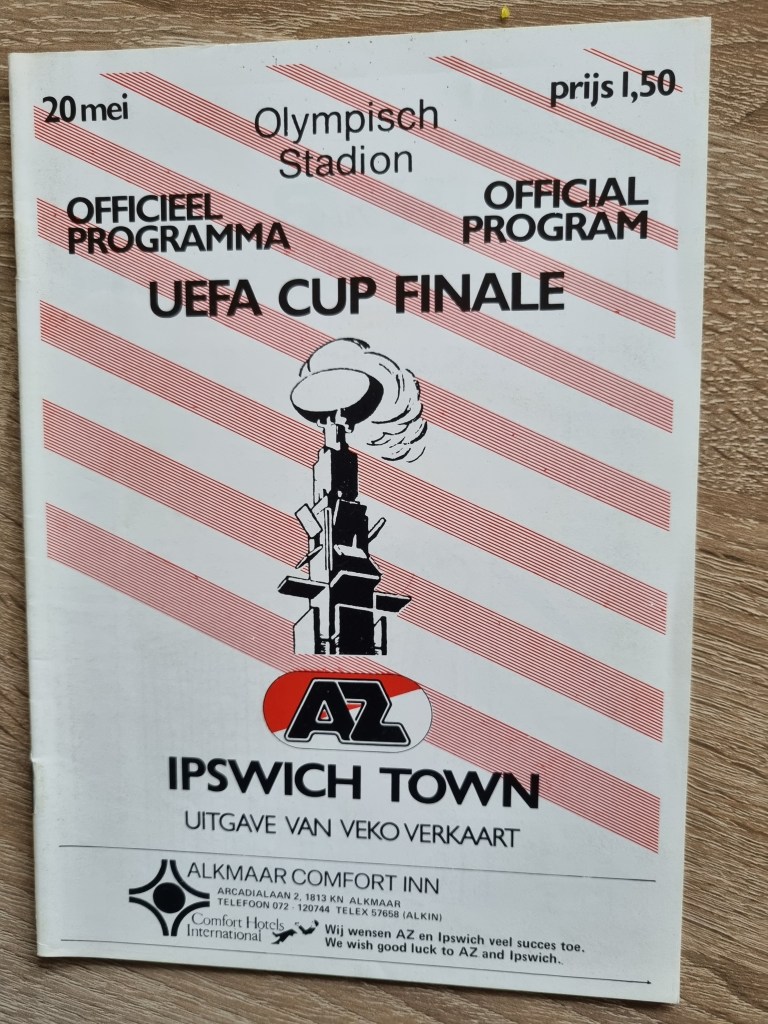
Forty and a bit years ago in May of 1981, I had just finished my final exam at the University of Sussex and I was now just wasting my time, until the lease on my shared student house was up, by playing football, going on pub crawls, walking on the Downs, visiting friends at the other end of the country and taking days out in an aged, bright orange, Dutch registered, left-hand drive Fiat 600 which my friend Chris (mainly known as ‘Jah’ due to his love of Reggae) had borrowed from a woman on his Social Anthropology course.  A lack of available cash and the demands of academia had sadly meant that in Town’s run to the final of the 1981 UEFA Cup final, I had only seen two home games, those against Aris Salonika and FC Koln.  Of the other games, I mostly remember the nervous anticipation of waiting for the result on the radio or television news.  The away matches I recall most are those at St Etienne and Koln.  I remember learning that Town were a goal down in St Etienne and was very chuffed to hear they had equalised as I headed off to the Student Union bar that March evening.  When I discovered Town had won 4-1, I could hardly believe it, and indeed it was a performance that has gone down in history as one of the best-ever by a British club in Europe and possibly Ipswich Town’s greatest performance ever.  As for the game in Koln, I remember that my friend Stephen went to the game on a supporters’ coach from Shotley and I remember seeing Terry Butcher’s winning goal on television, having been fearful that the one goal lead from the first leg would not be enough.

On the morning of 20th May 1981 my sister dropped me and my father off at Ipswich railway station where we caught a chartered train to Parkeston Quay and a chartered ferry to the Hook of Holland before boarding a chartered coach to Amsterdam.  Everyone travelled with the Ipswich Town Supporters Club and Anglia Tours back then, and I still have the pennant to prove it.  I wouldn’t enter Holland again for another 35 years, until I drove through a small corner of it on my way to Dusseldorf for a pre-season game in 2016, but I recall it being very neat.  In Amsterdam my father and I spent the time before the game in a small bar where we drank Amstel, a beer rarely seen in Britain back then, thankfully.  My father had encountered it before in foreign ports when in the Royal Navy and had warned me that it was gnats’; he was right, but it was all there was, they didn’t have any Tolly Cobbold Original.    Amsterdam was beautifully warm that May evening, which was just as well because terraces of the Olympic Stadium were open to the elements, which given that it was built for the 1928 Olympics isn’t that surprising; stadium builders weren’t always big on rooves back then.  In 1987 the Dutch government designated the Olympic Stadium as a National Monument, obviously because Town won the UEFA Cup there, but also because of the fine brick architecture by Jan Wils, an exponent of the Amsterdamse School.  It’s good to know that there is a corner of the Dutch capital that will forever be imbued with the memory of the presence of 7,500 Town fans.

My memory of the match that night in Amsterdam is one of anxiety and tension, despite taking an early lead that put us 4-0 up on aggregate and then gaining a second away goal.  AZ 67 Alkmaar were a bloody good team, but happily not quite good enough, despite Town being visibly knackered at the end of a colossal sixty-six game season. Forty years is a long time, and I’m not sure now what I remember from being there and what I remember from having seen various tv clips since.  I think I remember being frustrated that in the second half we couldn’t keep the ball away from Alkmaar, but I know I do recall wishing away the last twenty minutes of the game, and constantly checking my watch; willing Alkmaar not to score again and the Town defence to hold firm.  I remember nothing of the journey home, although I think my father might have invested in the luxury of a two-berth cabin in the hope of a couple of hours of sleep.

Tonight, “Never Lost at Home” picks up the story of the fictional Coombes family who followed Town to Wembley in “Our Blue Heaven”, and the story very much has the feel of being a sequel, which of course it is.  This time the tale begins with the family vowing to have someone at every game for what promises to be the greatest season in the club’s history as it vies to win an unprecedented treble.  Once again, the story is set against the background of the events of the times, in particular the high rates of unemployment resulting from the Thatcher government’s monetarist policies and indeed Scott loses his job to create some jeopardy in the story as it inevitably hinders his ability to get to games. Once again also, the story and the season unfold to a soundtrack of popular tunes of the time, although just like in ‘Our Blue Heaven’ it doesn’t, because several of the songs are from as much a four years later, which rankles somewhat because songs such as Tears for Fears ‘Everybody wants to rule the world’ (1985) were actually the soundtrack to avoiding relegation, not seeking glory.

Despite the failure to use the actual music of 1980 and 1981 (what a pity we never played Rapid Vienna or IK Start), rather than just generic 1980’s hits, there is nevertheless an authentic feeling of nostalgia for a time and a place.  I can’t fully explain why, but I had tears in my eyes in the first part of this production.  It might have been because I was reminded of how awful some of the music of the 1980’s was; I always hated ‘Eye of The Tiger’ (1982) and have consequently never seen any of the ‘Rocky’ films, but more likely I was mourning my lost youth and my lost football team, both of which seemed to go missing at much the same time.

 One major departure from the mostly repeated formula of “Our Blue Heaven” is the introduction in “Never Lost at Home” of one of the players as a recurring character, that player being the now legendary Arnold Muhren.  The choice of Arnold was, if not inspired, then obvious, because perhaps more than any other player, even his fellow Dutchman Frans Thijssen, Arnold somehow personifies that 1980-81 team, despite having actually joined Town three years before in September of 1978.  Again, the story employs a little artistic license as it almost implies that Arnold and Frans joined for the 80-81 season, but that is easily forgiven and does add to the mythology of that remarkable season.  I can only think that in casting actor Dan Bottomley as Arnold Muhren, one of the main considerations must have been his legs, because these have the same straight up and down shape of Arnold’s.  Not for Arnold the meaty thighs of Mick Mills or Paul Mariner; Arnold was a sinewy thoroughbred, built for the measured pass, the clever change of pace and direction in a single stride, the sort of footballer who simply danced through midfield and no longer exists in a game where speed, strength and bulk has usurped grace and subtlety.
The greatest triumph of ‘Never Lost at Home’, as it was of ‘Our Blue Heaven’, is the performance of Peter Peverley as Bobby Robson.   Not only does Peverley, with his gently hoarse County Durham accent, and perfectly observed Robson-esque mannerisms create a wholly believable vision of the Town manager, but he also delivers the great man’s words as he sends his team out in search of glory.  So stirring and convincing are Peverley’s words it might be an idea if the current Town management employed him to give Paul Cook’s team talks.

Oddly perhaps, ‘Never Lost at Home’ tails off towards the end, in contrast to the prequel which had something of a grand finale as the stories of the characters all came together on 6th May with a birth, a marriage and the Cup Final itself.  This time the characters don’t have their own stories to be resolved other than what happens to them as they travel across Europe in the rounds leading up to the final. We all know the ending, and although Town ultimately win the UEFA Cup, sadly mine and a lot of people’s memories of 1980-81 are probably tinged with a feeling of ‘what should have been’ with the loss of the FA Cup semi-final to the hugely inferior Manchester City and the loss of the ever-elusive League Championship to Aston Villa, a team we beat no less than three times over the course of the season.  But as one of the characters in the play points out, we had already won the Cup and the League before, so if it was to be only one out of three, best that it was the UEFA Cup.   Reassuringly however, it’s good to know that we only lost out in the Cup and the League because none of the characters in the play could get to the Cup semi-final or the penultimate League game of the season at Middlesbrough.

In truth, ‘Never Lost at Home’ wasn’t quite as good as ‘My Blue Heaven’, although my seeing it through the television screen rather than in the flesh is doubtless a factor in that. The story doesn’t have the drama of its predecessor and by drifting further into 1980’s the music is not so much ‘not as good’, as ‘worse’. Nevertheless, it was still massively enjoyable all the same, bringing back those memories of what genuinely was a marvelous time to be a Town supporter and which seems even more so given all that’s happened since. I can only hope that both ‘Our Blue Heaven’ and ‘Never Lost at Home’ are both resurrected in ten years time, not only to celebrate the fiftieth anniversaries of the FA Cup and UEFA Cup wins, but also their own 10th anniversaries; or perhaps we could have a musical about going to a musical about winning the FA Cup and UEFA Cup; I’d watch it.

Ipswich Town 1 Sunderland 1

Only the 10th of August and it’s bloody started already.  Summer is still here although today it has the good grace to pretend its autumn; a howling gale licks around the corners of my house and my Women’s World Cup bunting, strung joyfully across my back garden, slumps over the patio and plants in colourful tatters.

I look out of an upstairs windows to glimpse a silver Vauxhall Astra slip past; it’s Roly, he’s going to park on my back drive.  Roly is not the name of the Vauxhall Astra, he’s the driver. We had planned to meet at the railway station but seconds after he bought his ticket his train was cancelled; the result of a fallen tree, possibly two.  We walk to the railway station, the usual journey ensues. Roly tells me how his partner Sarah would castigate him for catching the train and not driving all the way to Ipswich, but he’s not going to tell her. Roly wants to save the planet, like me, and he also hates having to find somewhere to park and then sitting in traffic after the game.

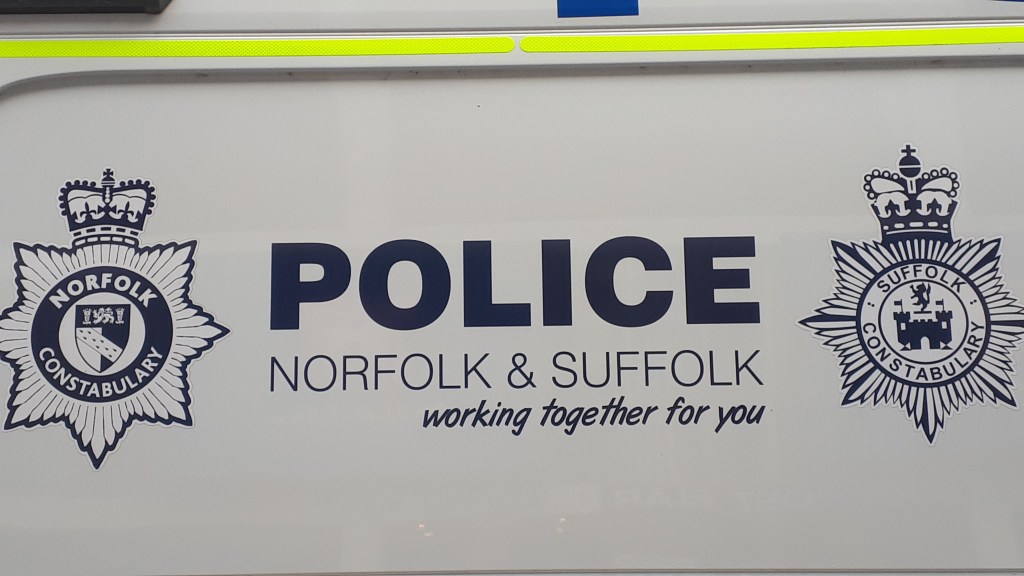
Ipswich appears to be in a state of emergency, a police van sits in the middle of the station plaza but in fact everything is okay, it’s just ‘Norfolk and Suffolk working together for you’.  Football chants in thick far northern accents are carried up on the wind from the beer garden of the Station Hotel.  We cross the road and hurry away; we pass a lairy looking youth who suddenly bawls something unintelligible.

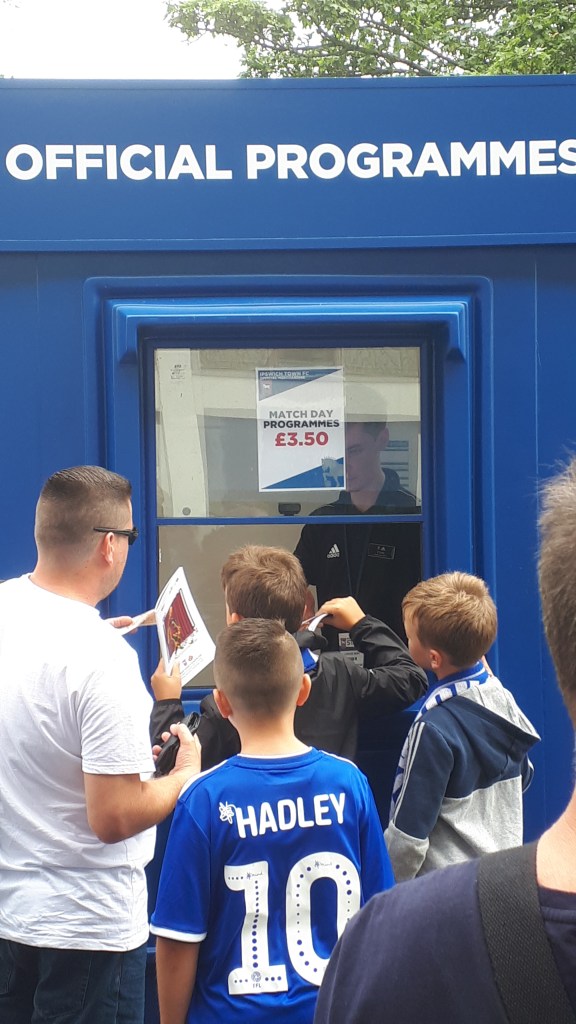
After a successful relegation season it’s a new dawn for Ipswich Town in division three and entering Portman Road I think I might buy a programme for every match this season to mark the newness, the difference.  I am looking forward to seeing the slightly unfamiliar clubs deemed ‘unfashionable’ by dullard journalists.  I approach a programme booth; I don’t think I will buy a programme after all, they’ve put the price up to £3.50 a copy, that’s an increase of 16.6%, way above the rate of inflation, not that I know what that is.  Why couldn’t they just make the programme less glossy, a bit smaller, add a couple of adverts and take out some of the drivel no one reads?  I want to blame Brexit.

At St Jude’s Tavern Roly buys two pints of the Match Day Special (£2.50) which today is Mr B’s Plan Bee, he gives one to me.  We invade the space of a man sat at a table on his own, but I ask him first if the seats are free, they are.  Mick arrives and buys a pint of porter and a packet of crisps, which he opens upon the table for us all to share, I don’t ask him how much the porter or the crisps costs.  It only takes one person with a loud voice in St Jude’s Tavern to make it difficult to hear what my fellow drinkers are saying and such a person is here today so I end up nodding and smiling as  the conversation drifts in and out of my comprehension.  I buy two more pints of the Match Day Special, Mick doesn’t want a second, but I get him a bag of dry-roasted peanuts (90p).  It’s barely half past two but Roly wants to get down to the Portman Road so that he can eat. We hang on ten minutes or so but soon give in to his gluttonous cravings.

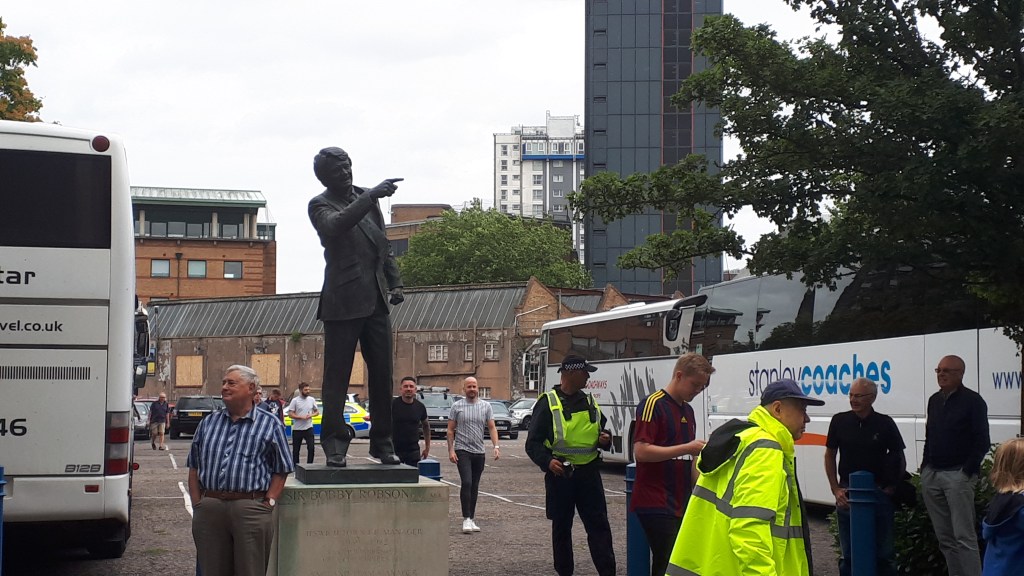
At the corner of Portman Walk I leave our trio andI head for the Sir Alf Ramsey Stand whilst Roly and Mick head west to the East of England Co-op Stand and the posh seats.  I tell them I will wave up at them and doff my cap from amongst the groundlings behind the goal.  I make my way to the far end of Portman Road, following the pointing finger of Sir Bobby Robson’s statue; the parked up away supporters coaches either side of him displaying the names of County Durham towns he would have been familiar with.   

Nearby, a ginger-haired bloke in a yellow hi-vis jacket sells Sunderland fanzines.  There are queues at the turnstiles, possibly because not all the turnstiles are open. I pause to select the fastest moving queue and am quickly in the ground.  I speak briefly with Dave the steward with whom I once worked and then use the toilet facilities before proceeding to my seat.  Nothing has changed, Pat from Clacton is here and so of course is ever-present Phil who never misses a game and his young son Elwood.  On the pitch before us the serious looking steward with the enormous headphones looks as worried as ever, as if fearing that a violent supporters’ rebellion might start at any moment.  To confuse the operators of the improved CCTV surveillance system I have moved my seat slightly, I no longer sit in front of the old dears behind me, but behind them, a couple of seats to the left of Pat from Clacton.  Otherwise it seems like the first day back at school, “Have you had a good summer?” asks Pat from Clacton,   “It’s not over yet” I tell her, not really answering the question but subconsciously implying that the start of the football season doesn’t mean an end to ‘summer fun’. Ever-present Phil and I shake one another’s hand “Happy New Year” says Phil, which seems apposite.

It’s busy here today, with plenty of seats occupied that may not be sat upon again all season.  The attendance will eventually be announced as 24,051. The Sunderland supporters are present in large numbers (1,847) and mostly seem a humble, self-effacing lot.  No unduly boastful or mean spirited songs can be heard from the Cobbold Stand, which is nice. Their continuing, numerically impressive support for a club which was successful in the 1890’s but otherwise is most notable for a level of mediocrity which puts Ipswich Town’s recent averageness in the shade is such that mass sainthood doesn’t seem unreasonable. In nineteen eighty-something Sunderland even lost a League Cup final to Norwich, for heaven’s sake.  That careless catastrophe aside, Sunderland have good reason to be forever loved a little by everyone outside West Yorkshire because of the 1973 FA Cup final, which not only saw hated Leeds United beaten by the then Second Division team, but gave us the joyful sight of a man in a trilby hat and pale raincoat running with arms and hands outstretched to embrace his victorious players.  Manager Bob Stokoe’s joyfulness is now captured forever at The Stadium of Lights in a statue to him and by association his team of Montgomery, Malone, Guthrie, Horswill, Watson, Pitt, Kerr, Hughes, Halom, Porterfield and Tueart.  They might have won the FA Cup before in 1937, but seeing the world through a filter of ‘Ipswichness’ and TV pictures then 1973 was Sunderland’s 1978.

It’s three o’clock, the game begins; Sunderland in their excellent traditional kit of red and white striped shirts, black shorts and red socks get first go with the ball. Town parade this season’s version of whatever Adidas is peddling, a similarly traditionally plain blue shirt, white shorts and blue socks number. The crowd is noisy but there’s little co-ordinated chanting or singing.  The football is fast and uncontrolled; the long ball is favoured. After not many minutes the child sitting behind me is bored; I can understand why, it’s not exactly recognisable as the ‘beautiful’ game, but to the trained eye Town are already looking better than Sunderland.  Kayden Jackson is very quickly booked for trying to con the referee Mr Neil Hair, a man who I wish was German, into awarding him a penalty.  I quite liked Kayden Jackson last season, I hope he isn’t going to be an arse this season.

 A fraction of the match passes that is equal to the percentage increase in the cost of the match programme since last season and a long throw is helped into the Sunderland penalty area; the ball is cut back, Luke Garbutt controls it and surges through a mass of players towards the touchline before striking a finely angled shot through the legs of Sunderland goalkeeper Jon McLaughlin and just behind the far post. “Garbutt, 1-0”, as David Coleman might have said had he not been long dead.   How we cheer.  This is what we came for. Joy abounds.

I think this is better than I expected, although even last season we took the lead in a few games. The remaining half an hour of the first half sees Sunderland fail to do anything to threaten Town’s lead. It takes them forty minutes to even have a shot at goal. Kayden Jackson pines for attention and has an ice bag pressed against his head.  Garbutt develops a mystery ailment and is substituted by little Alan Judge. Everyone in a blue shirt is playing well, but no one scores another goal.  This new system of two players ‘up-front’, isn’t working  that well; James Norwood and Kayden Jackson sometimes get in each other’s way, they’re no Johnson and Whymark or Crawford and Phillips, not yet anyway.

Half-time arrives and I dash from my seat to stand before the stainless steel urinals beneath the stand before checking on the half-time scores, which are singularly unremarkable.  I return to the stand to speak with Ray and his grandson Harrison.  Our verdict on the game is that it’s okay and Ipswich are by far the better team, but the quality of the football could be better.  Harrison predicts a final score of 3-0.  Ray and I reserve judgement, our capacity for unbridled optimism beaten, squeezed and drained out of us by decades of bitter experience.

The second half disappoints. The blue skies over the Sir Bobby Robson Stand are as lovely as ever and I bask in the warmth of the August sun, but Town have lost their way; all they can do is pump in inaccurate cross after over-hit cross after inaccurate cross, Alan Judge buzzes about doing nothing very successfully. An hour has passed and a Sunderland throw is punted forward.  Luke Chambers has this covered; he is a yard or two ahead of Marc McNulty even though he cannot run as fast.  But Chambers doesn’t decide what to do and as he waits for an almost static ball to roll into touch McNulty dispossesses him and then simply has to pass the ball into the path of the incoming Lynden Gooch who side foots the ball into a gaping wide goal.   It’s like last season all over again.

There’s plenty of time for another goal but Ipswich have no inspiration, no means to prise an opening.  Fortunately Sunderland have even less idea and their forays forward are both rare and ineffective.  “Your support is fucking shit” sing some Sir Bobby Robson Standers to the Sunderland fans, demonstrating a complete absence of any concept of irony.   Mr Hair annoys the home crowd with a series of decisions that penalise imaginary infringements and favour Sunderland.  Pat from Clacton offers me a sweet from a plastic bag and shows me her new blue and white watch that she’s only going to wear on match days.  It’s a nice looking watch, but I’m feeling very self-centred and prefer the crumbly peppermint I took from Pat’s pick’n mix selection; it’s probably my highlight of the second half.   The attendance is announced and I verify that Pat from Clacton’s brother has won the guess the crowd competition on the Clacton supporters’ bus; his guess was the highest of all, 24,001.

After three minutes of added on time the game ends.  I rise from my seat and quickly leave. It’s been an afternoon of three thirds, Sunderland, Wonderland, Blunderland……all infused with Peppermint.

Today my favourite name of an opposing team’s player was Denver Hume.  I also liked the names Dylan McGeouch and George Dobson.

This week I have been reading ”The man who hated football”, a novel by  Will Buckley (2005)