The ritual of every other Saturday from late summer to mid-spring has come round again, predictably after just a fortnight, but today I have broken free from the shackles of totally repetitive behaviour by making a pre-match visit to see my mother. As ever, she has more to say about my beard and the length of my hair than much else, and when I think I’ve successfully got her reminiscing about trolleybuses or a family holiday in Aberystwyth or her mother filling the copper from the garden well on wash days, she somehow, out of the blue, asks me when I’m getting my hair cut. To her credit however she does re-iterate her dis-like of Mothers’ Day, telling me that children have no reason to be grateful to their mothers; they didn’t ask to be brought here. I tell her that it’s only for one day a year though, and we both laugh. After an hour of such conversation, it’s time for her to eat her lunch and so after we’ve said our goodbyes and she’s told me to be good, even though she says she doesn’t believe I can be, I climb back into my trusty Citroen C3 and head back across town to resume the fortnightly ritual.
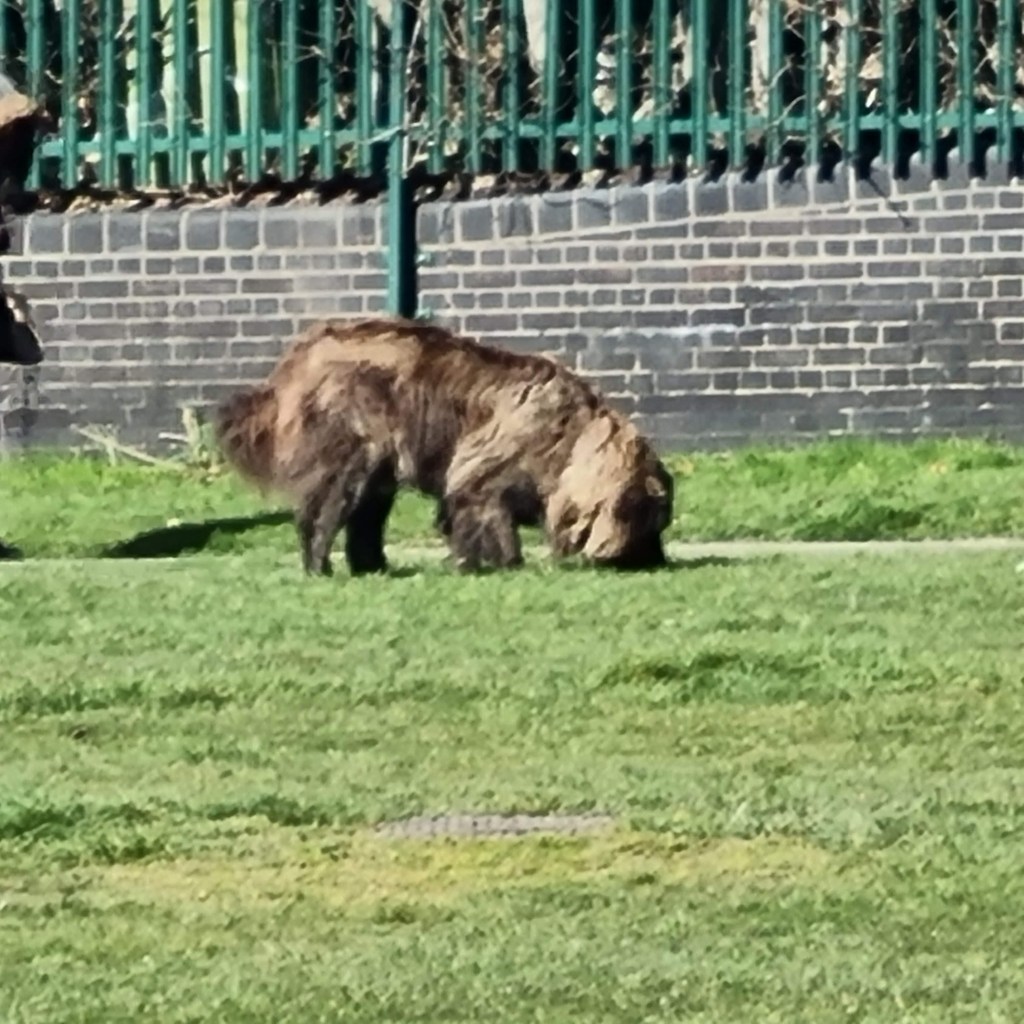
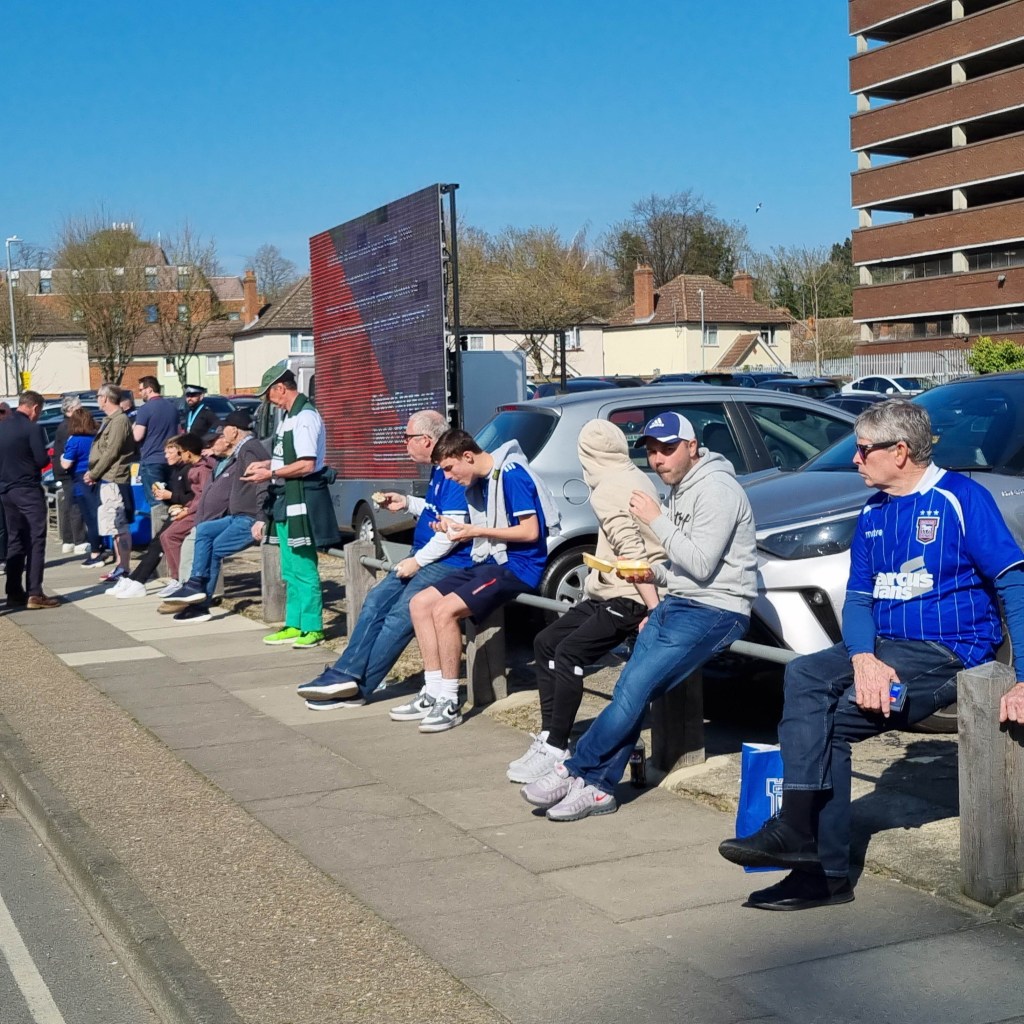
The sun is shining, it’s a beautiful day. Walking through Gippeswyk Park I hear a snippet of conversation from inside the tennis court, “I’ve got probation at 11:30”, says a voice. A little further on, three scruffy looking blokes with cans of lager and tattooed necks lurk expectantly behind a hedge; I feel the urge to start singing Lou Reed’s “I’m waiting for the man” from his Velvet Underground & Nico album with cover design by Andy Warhol, which coincidentally was released almost exactly fifty-five years ago (12th March 1967 to be precise). Meanwhile, a dog that looks like a bear sniffs the grass and a chubby youth takes a swig from a plastic bottle and then holds the bottle up to the light as if he can’t quite believe what he’s drinking. At the Station Hotel on Burrell Road, Plymouth Argyle supporters enjoy the delights of its riverside garden, and Portman Road is already busy with eager supporters chewing on factory produced bread and mechanically reclaimed meat products. I attempt to purchase a match day programme in the up-to-date cashless manner, but the smilingly apologetic programme seller tells me from within her booth that the wireless gadget has stopped working. I delve into my pocket for the four coins that will make up £3.50 and place them in her hand. Still smiling, the programme seller hands over a programme and wishes me an enjoyable afternoon.
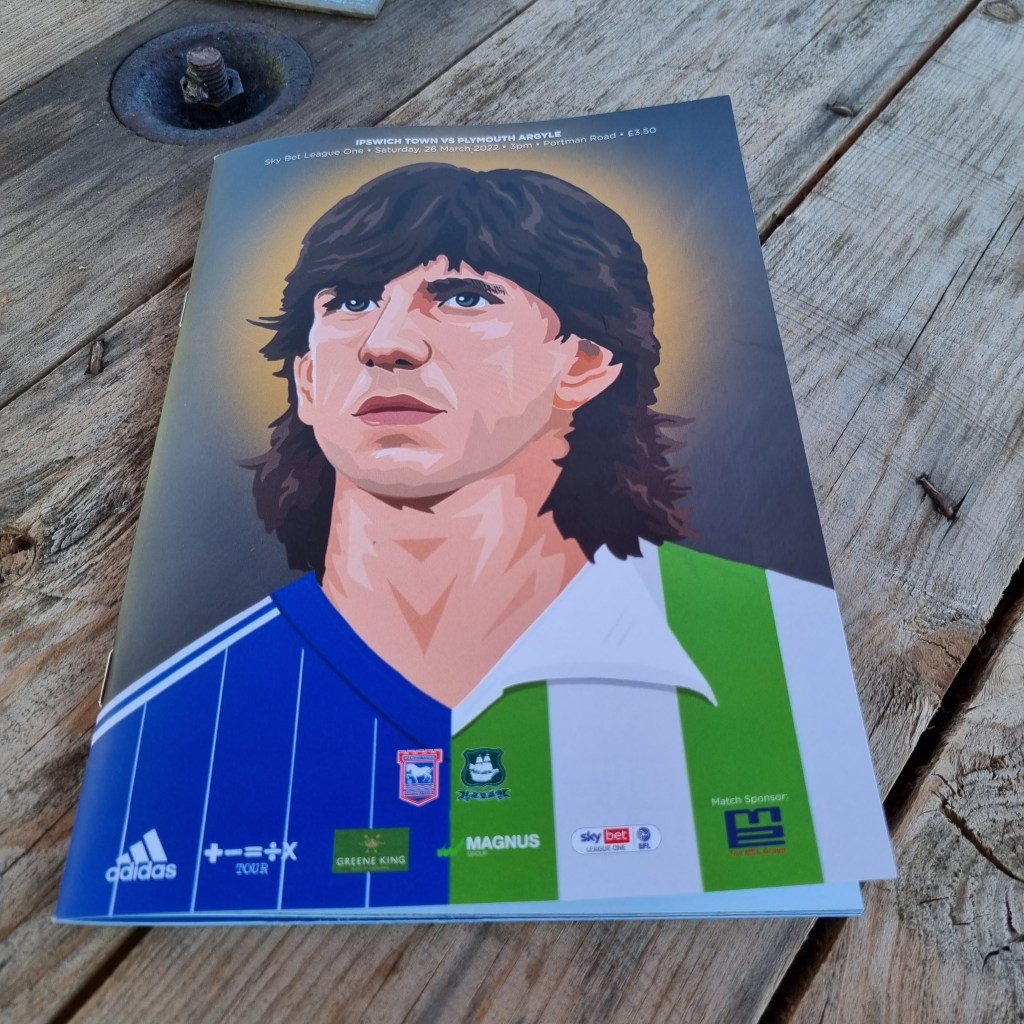
In the Arboretum pub (now known as the Arbor House) I have to queue for a pint of Mauldon’s Suffolk Pride (£3.80) and the beer garden is busy with drinkers, some of whom will clearly be Portman Road bound. Mick won’t be joining me today as he is in London meeting a friend who is over from Germany and so I thumb through my programme, which on its front cover has a picture of Paul Mariner drawn in a sort of cartoon style; it’s probably what Paul would have looked like if he’d appeared in the opening credits to BBC tv’s Grange Hill. Later at home, my wife will tell me she thinks the picture looks creepy. My view is that I think Roy Lichtenstein or Hanna and Barbera might have done it better.
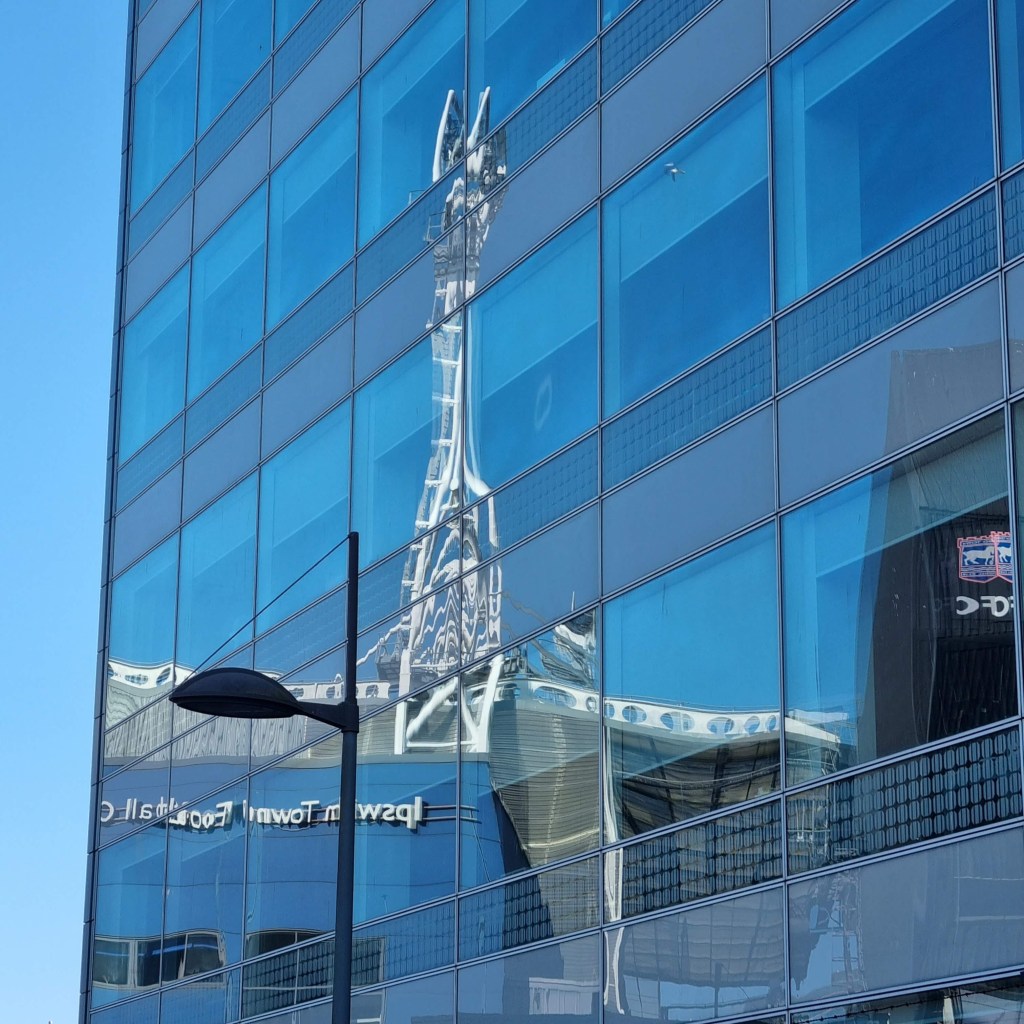
By twenty-five past two I have drained my glass of beer and with little else to do I decide to take a gentle stroll down to Portman Road, which gives me time as I pass Ipswich Museum to admire the elaborate terracotta mouldings above the ground floor windows, it really is a magnificent building, another of Ipswich’s architectural gems; but ignorant people will still tell you the town is a dump and that “The Council” have demolished all the ‘lovely old buildings’.
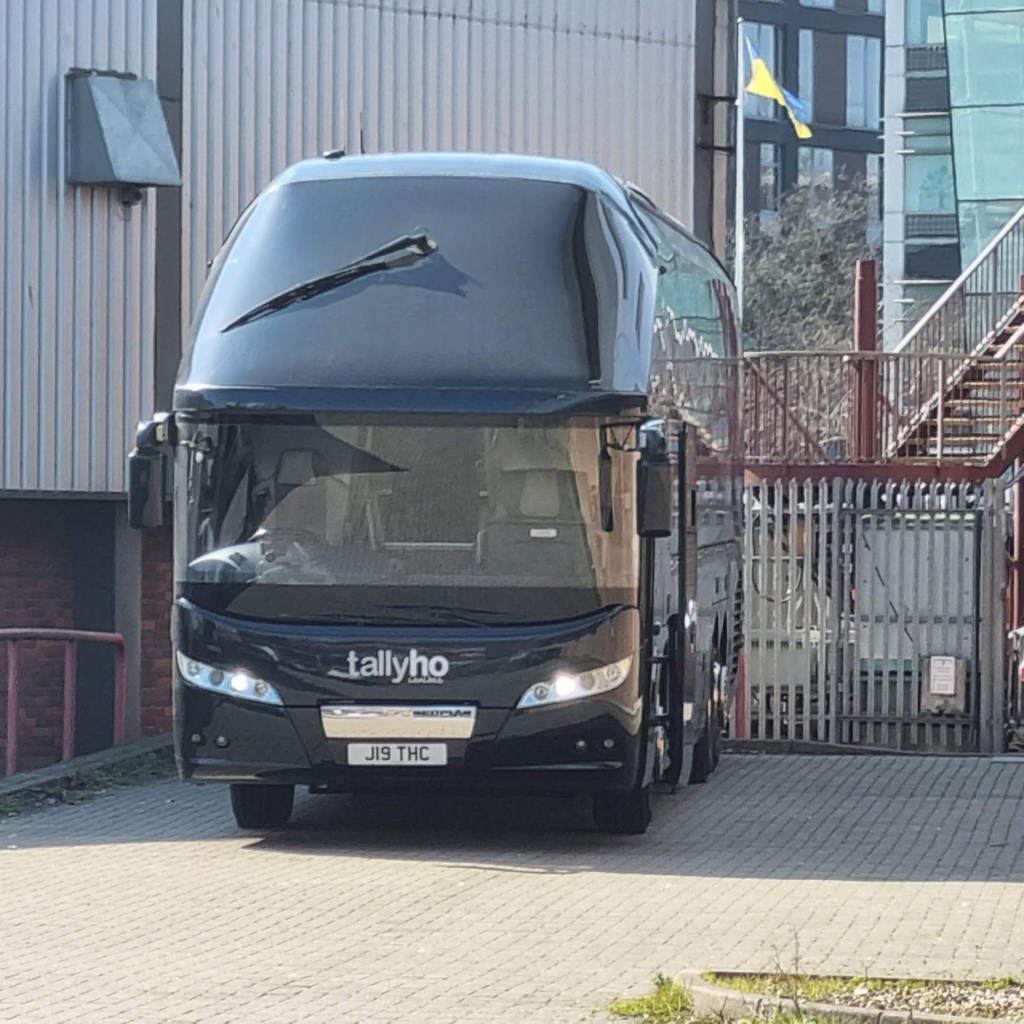
Back in Portman Road supporters head purposefully for ‘their turnstile’ or mill about waiting for friends; some queue for more last minute mechanically re-claimed meat products; on the grass of Alderman Road rec others recline, soaking up the sun as if this was the Cote d’Azur. I make my way between the assembled supporters’ coaches of Whincop, C & J and Tendring to the Constantine Road entrance. Passing through turnstile number 60, I thank the operator who smiles and says rather gushingly “Enjoy the football, have a lovely time.” This in the week in which I answered a club questionnaire about human inter-action with stewards and turnstile operators.


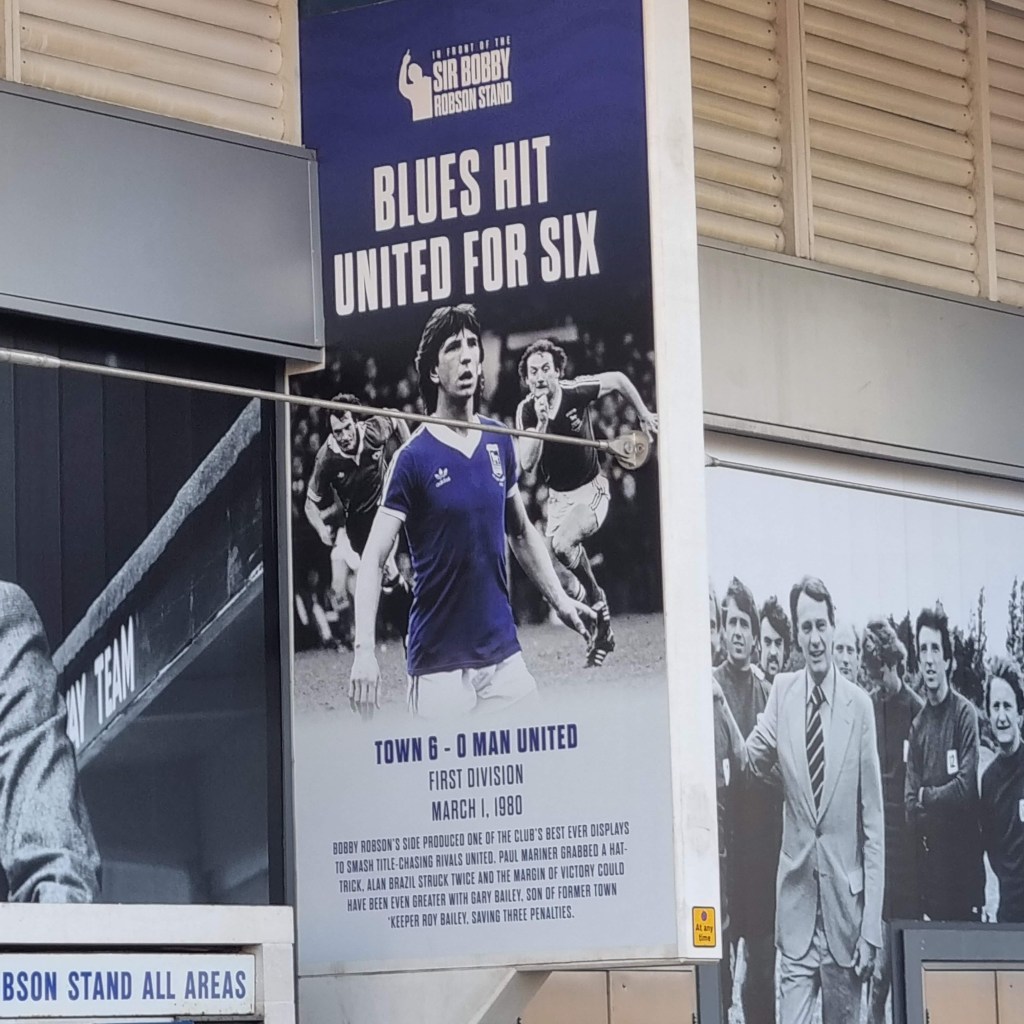

After making use of the toilet facilities to a soundtrack of Deep Purple’s ‘Smoke on the water’ playing over the PA system, I arrive on the lower tier of the Sir Alf Ramsey Stand, where ever-present Phil who never misses a game is of course present, with his young son Elwood, and I can see Harrison, his dad and his grandfather Ray ‘down the front’. Pat from Clacton soon arrives, and we prepare to wave the polythene flags that have been left on our seats to celebrate Paul Mariner day. The PA system has stopped playing the rock music that Paul Mariner was a fan of and ramps up the music designed to make us feel excited and full of expectation. “Exciting isn’t it” says the bloke who sits next to me. “It is, I just hope I can last out until kick-off” I tell him. At the North Stand end of the ground banners read “Mariner” and “A fire in the sky”; the latter words an extract from the lyrics of “Smoke on the Water” that was playing in the toilet earlier. Apart from Paul’s liking for Deep Purple, I don’t really get the connection as the song was about a casino burning down in Montreux in Switzerland and Town only ever played in Zurich ( versus Grasshoppers), and that’s over 200 kilometres away from Montreux.
With the parade on to the pitch of the teams, we wave our flags for all we’re worth, like a host of Liberties or Mariannes leading the people in Delacroix’s painting; but unlike her we all keep our tops on. Finally, with the first flush of excitement over, the game begins, although I don’t even notice who got first go with the ball, only that Town are kicking towards me, Pat from Clacton, Elwood and Phil, whilst Plymouth are wearing a rather attractive kit of all white with a green band across the chest bearing the name Ginster’s . Who, apart from my grain and lactose intolerant wife, doesn’t love a beef and pastry-based snack, even if much of Cornwall will tell you that a Ginster’s pasty is not a pasty at all, but a vile abomination? Diverting our attention from this controversy, the Argyle fans attempt a new World record by singing “Is this a library?” with just fifty-three seconds on the clock, which is an admirable effort by anyone’s standards and smacks of their knowing they would be singing it sooner or later so why not just start with it. I have much admiration for Plymouth supporters and their endless travelling. London is much the same distance (342 km) from both Plymouth and Paris, but whilst it takes about two and half hours to get from London to Paris by train, it takes three and a quarter to get to Plymouth.
Quickly, Town are on the attack and after a fine interplay of passes in front of the Cobbold Stand, Sone Aluko sends a shot just behind the goalpost into the side netting of the Plymouth goal, and Pat from Clacton tells me that she won £43.75 playing whist last week in Great Yarmouth; she had to pay £2.00 to play extra games, but reckons she came out on top by about £10 overall. Just as I’m thinking how well Cameron Burgess is playing, the bloke behind me says “Tell you what, Burgess has done well since he’s come in”. Cameron immediately passes to a Plymouth player. “ Apart from that “ says the bloke next to the bloke behind me.
“Stand up if you love the greens” sing the Plymouth fans to the tune of the Pet Shop Boys’ ‘Go West’ as they promote the eating of broccoli, French beans, Brussels sprouts and cabbage with their pasties. The same tune is then employed to chant “No noise from the Tractor Boys” to further goad us after their song about libraries failed to reduce anyone to tears. It’s the sixteenth minute and after Aluko tackles high up the pitch, the ball is swiftly moved to an overlapping Wes Burns who shoots across the face of the Plymouth goal. With no goal attempts of their own the Plymothians go all Welsh and employing the tune Cwm Rhondda, tell us we’re supposed to be at home; ‘home’ being Portman Road rather than our individual home addresses I imagine. I think they’re goading us again.
The game is close and Pat from Clacton tells me how my last blog, for the Pompey game, was all wrong because Fiona wasn’t on a cruise then, she was in the director’s box on a jolly, and today she is at her sister’s birthday party. Kindly, Pat hadn’t put anything on social media thinking it might make people think the blog was a load of inaccurate rubbish. There are a few isolated and short-lived bursts of chants from Town fans, but inexplicably the Plymouth fans respond with “Sit down shut up, Sit down shut up” chanted like the chimes of the Portsmouth Guildhall clock. Do they want us to sing or not?
“Hark now hear the Ipswich sing, the Norwich ran away” suddenly explodes from the North Stand, but peters out gently and the bloke behind me says “This ref is letting the game flow” just as I think the very same thing myself, probably because Mr Rock the referee doesn’t give a free-kick for a Sam Morsy ‘tackle’ that many referees would deem to be a foul. Twenty-three minutes have gone forever and a shot from Plymouth’s Niall Ennis is blocked before the plain sounding James Bolton is replaced by Romony Crichlow, whose name sounds like it could have been that of a bit-part actress in a 1950’s Ealing comedy.
The opening act of the game is now over, and Town are taking control. Janoi Donacien gets behind the Plymouth defence to produce a low cross which no one can get to. Plymouth strike back briefly with a shot from Steven Sessegnon, who sounds French but isn’t, although he does have a cousin from Benin, which is a former French colony; they win their first corner and Sam Morsy earns his customary booking, this one for a foul on Niall Ennis, but then Bersant Celina wins a corner for Town, and a chipped cross leads to a strongly directed header from Wes Burns, but it’s much too close to the Plymouth goalkeeper Mark Cooper who saves it without too much difficulty. “No noise from the Tractor Boys” chant the Plymouth fans again as Town win another comer and I shout “ Come On You Blues, Come On You Blues” and ever-present Phil joins in. “Two of you singing, there’s only two of us singing” sings Pat from Clacton softly, like the Chorus in an ancient Greek play.
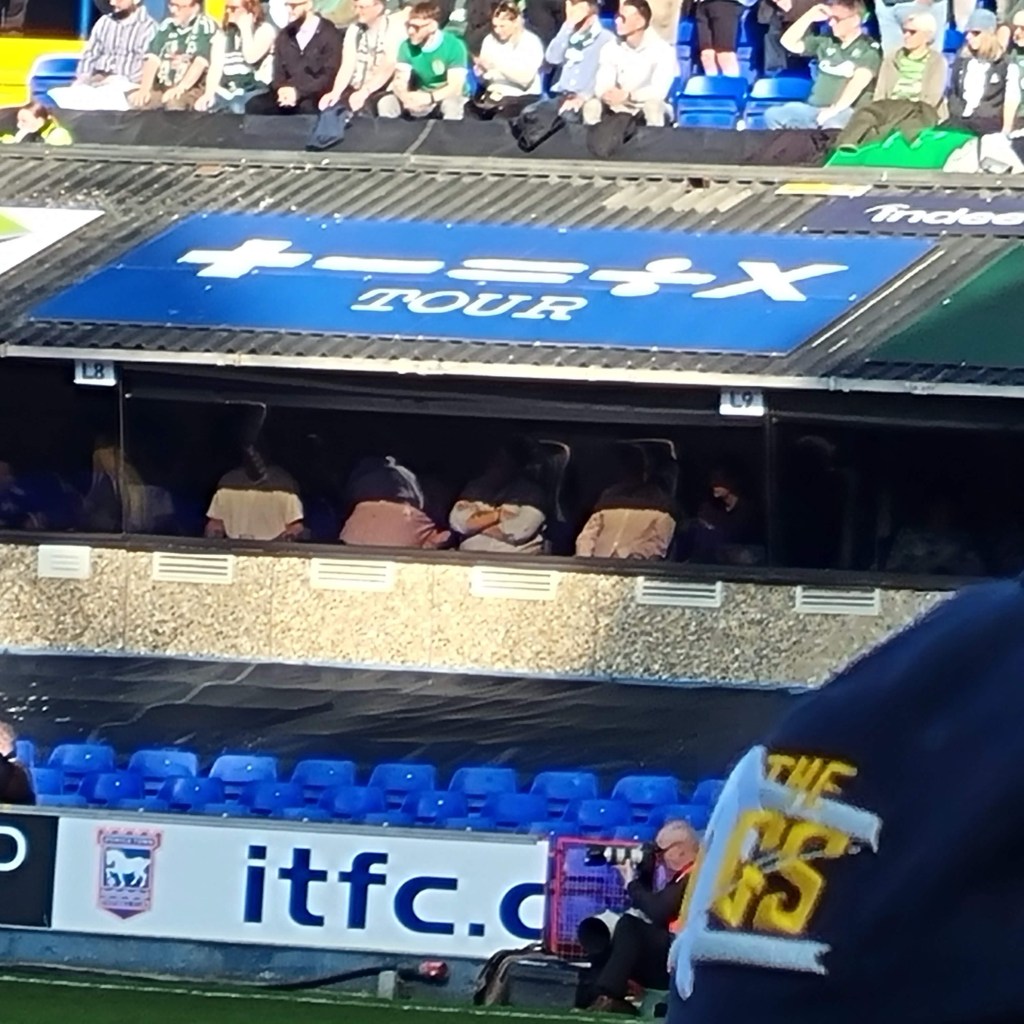
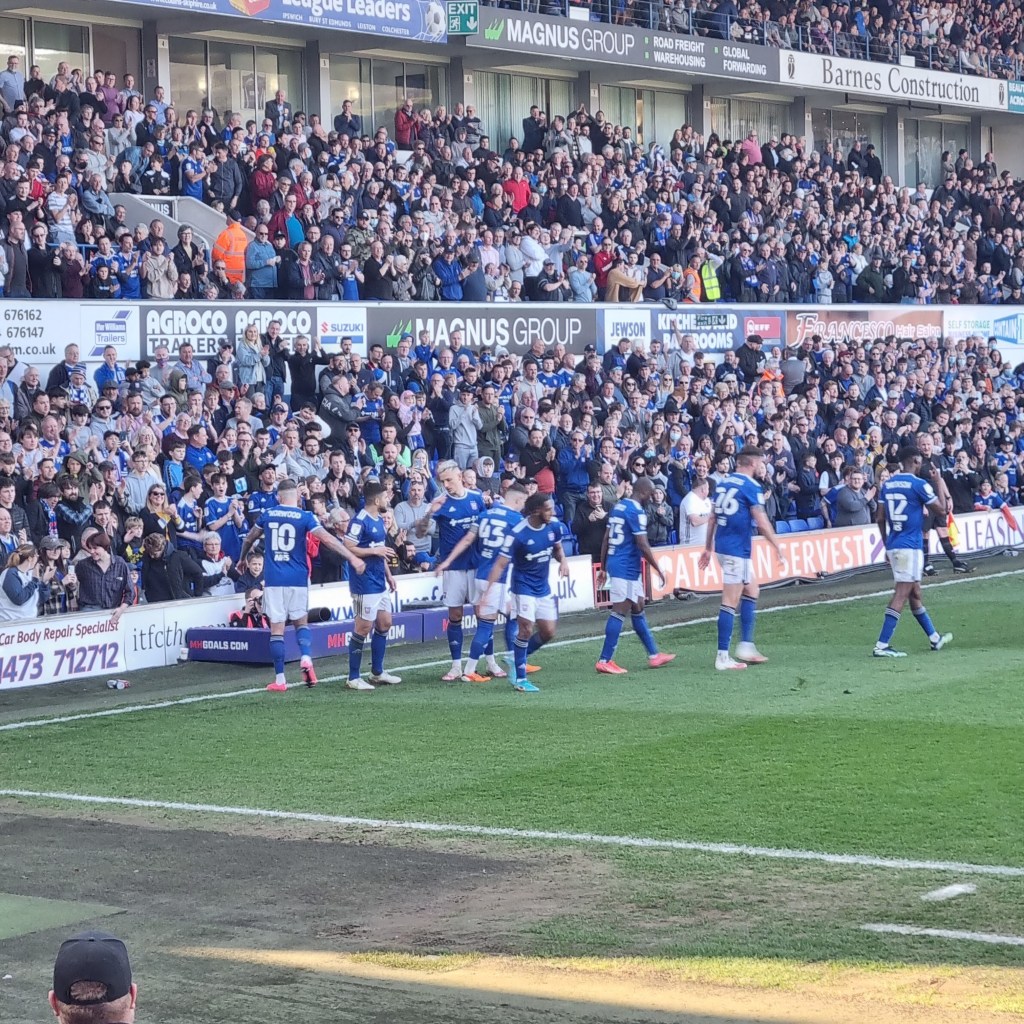
Town should have scored by now, we’ve been brilliant; then the 38th minutes arrives. A ball over the top is pursued by James Norwood, he catches it up, controls it, shields it and then crosses low to the near post where Sam Morsy scores from what looks no more than 2 metres from the goal. The roar from the home crowd is part celebration, but feels mostly like relief; we can score, we have scored, at last. “Sing when you’re winning, you only sing when you’re winning” chant the Plymouth fans employing a Cuban folk vibe whilst also stating the obvious. A minute later and Norwood shoots over the cross bar from 20 metres out and then a superb dribble from Sone Aluko sends Norwood to the goal line only for him to get over excited and launch the ball into orbit instead of laying on a second goal or scoring himself. In the executive boxes of the Cobbold stand four fat bellies of men enjoying hospitality are illuminated as if under spotlights by the afternoon sun. Three minutes of time added on are played before the team leave the field to warm applause. It’s been a great half of football, as good as we’ve seen at Portman Road in many years.
After eating a Nature Valley chocolate and peanut protein bar I join Ray and Harrison to talk of forthcoming concerts at the Regent theatre and other venues, and the pre-1973 recordings of Pink Floyd. Half-time passes quickly and I’m soon back next to Pat from Clacton; at seven minutes past four the game resumes. Town don’t immediately regain their rhythm from the first half and Plymouth enjoy a bit of possession and even a corner kick, although it goes straight to Christian Walton in the middle of the Town goal. Today’s attendance is announced as 23,256 of whom 1291 are Janners, as Plymothians and other country folk with thick accents are known in Devon and Cornwall. The guess the crowd competition on the Clacton supporters coach is won by Callum who isn’t even on the coach today, but his wife has had a go on his behalf.
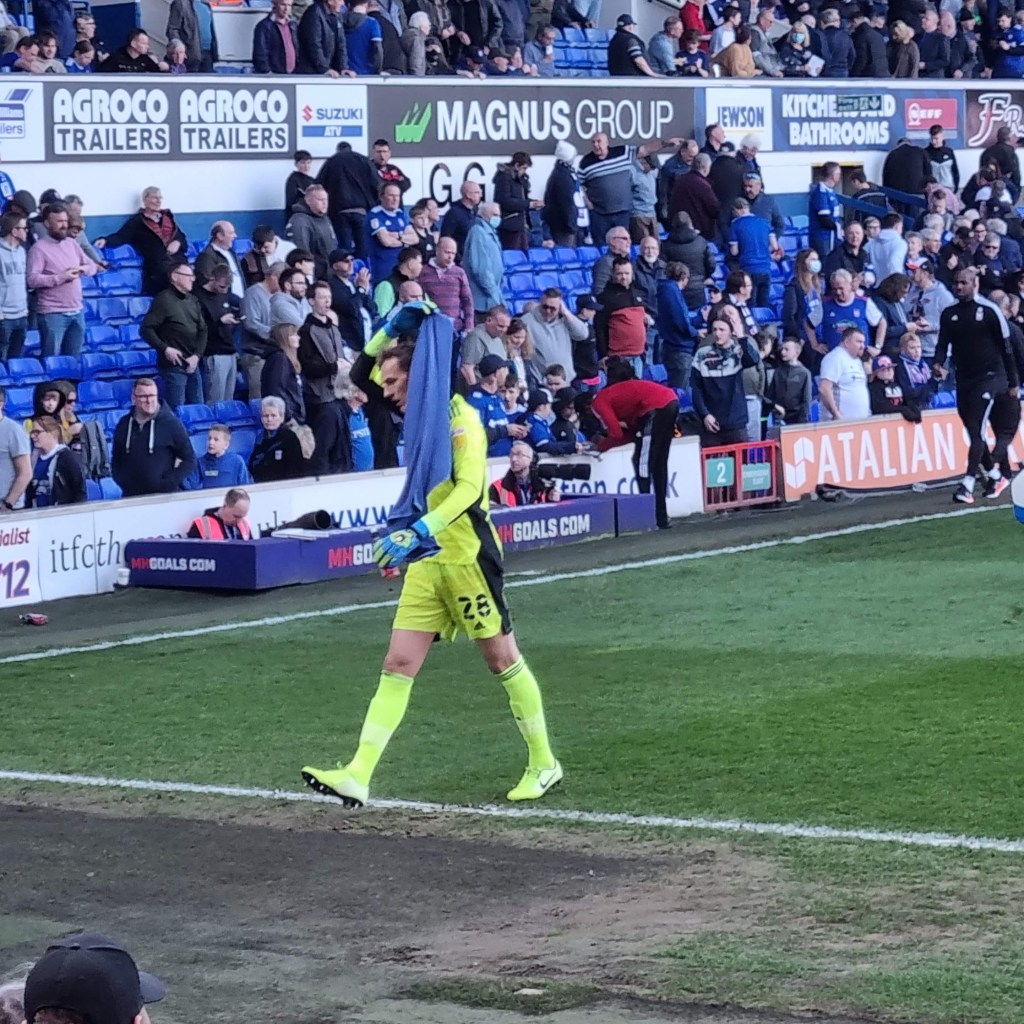
Plymouth’s substitutes are trotting up and down the touchline and in their red tops with green sleeves Elwood thinks they look like Robin, Batman’s sidekick. If this had been a Christmas fixture he might have thought they also looked like Elf. Town are returning to form again. Sam Morsy crosses the ball; we wait to see who might get on the end of it; “Is there anybody there?” asks Pat from Clacton hopefully, and sounding as if she’s at a séance. Conor Chaplin and the oddly named Macauley Bonne replace Sone Aluko and James Norwood. Sixty-seven minutes have passed and the North Stand start to chant Paul Mariner’s name, but most of them are doubtless too young to know of Paul’s own song which we would sing to the tune of Al Jolson’s Mammy. “Mariner, Mariner, I’d walk a million miles for one of your goals, Paul Mariner”. Pat sings it to me quietly for old times’ sake.
Fifteen minutes of normal time remain; Jordon Garrick replaces Ryan Hardie for Plymouth and Romony Crichlow is booked after cynically tugging back Macauley Bonne. It’s a pale blue afternoon with a cloudless sky above the North Stand and the sun now casts a shadow across the whole pitch. Ten minutes remain. “Here we are, over and in” pleads Pat from Clacton as Town move forward again. The ball reaches Conor Chaplin who twists and turns, finds crucial space and places a shot beyond the far post. Plymouth are getting desperate; their run of six consecutive victories is looking like it might end very soon indeed. “Careful” says Pat as a Plymouth cross drops in the Town penalty area. In the shadow of the West Stand the bright lime and lemon kits of the two goal keepers stand out as if they’re luminous.
Five minutes of normal time remain; Pat tells me she’s having Marks & Spencer prawn salad and a baked potato for her tea; I’m having fish and chips, I tell her. It’s the final minute of normal time and Plymouth win a corner; but Town clear it easily and Celina races away up field; he passes to Macualey Bonne who passes to Wes Burns who closes in on goal and shoots; past the far post. If that had gone in we would have been guaranteed the win. We’re now into five minutes injury time and Plymouth break down the right and the Ealing studios starlet wins a free-kick. Luminous lime green Mark Cooper joins the Plymouth attack and every player is within thirty-five metres of the Ipswich goal. The free-kick comes to nothing but the ball falls to Conor Chaplin; he shoots at the empty Plymouth goal and the occupants of the Sir Alf Ramsey Stand and the North Stand witness the painful arc of the ball drifting wide of the near post.
Happily, full-time follows soon after, and those who haven’t dashed away in the traditional post-match hurry to get home for tea applaud the teams and some of an Ipswich persuasion, including me and the bloke behind me join in with a few choruses of “Nana-Nana Ipswich” to the tune of The Beatles’ ‘Hey Jude.’ It’s been a fabulous afternoon’s football and I feel like the operator of turnstile number 60 must have known something when she said “Enjoy the football, have a lovely time” because I did and I have had, and I like to think that it had something to do with it being Paul Mariner day. Paul Mariner was easily the best forward I’ve ever seen play for the Town and probably one of the top five in any position. I loved the way he moved, I loved that he sometimes wore his shirt outside his shorts, I loved his floppy mullet, I loved that he never got his hair cut. I don’t believe in having ‘favourite ever players’ but if I had to choose one on pain of death or something worse I’d choose him.….or Frans Thijssen, or may be Arnold Muhren, or possibly Eric Gates…or…nah, I’d choose Paul Mariner.





 trippingovertheball