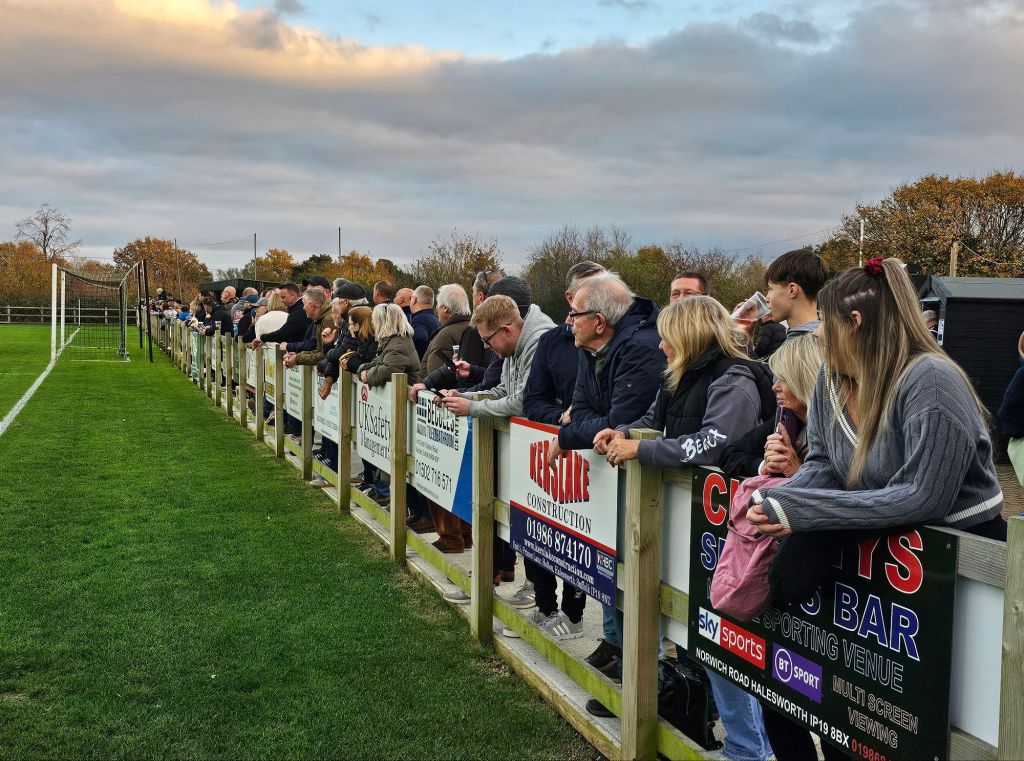
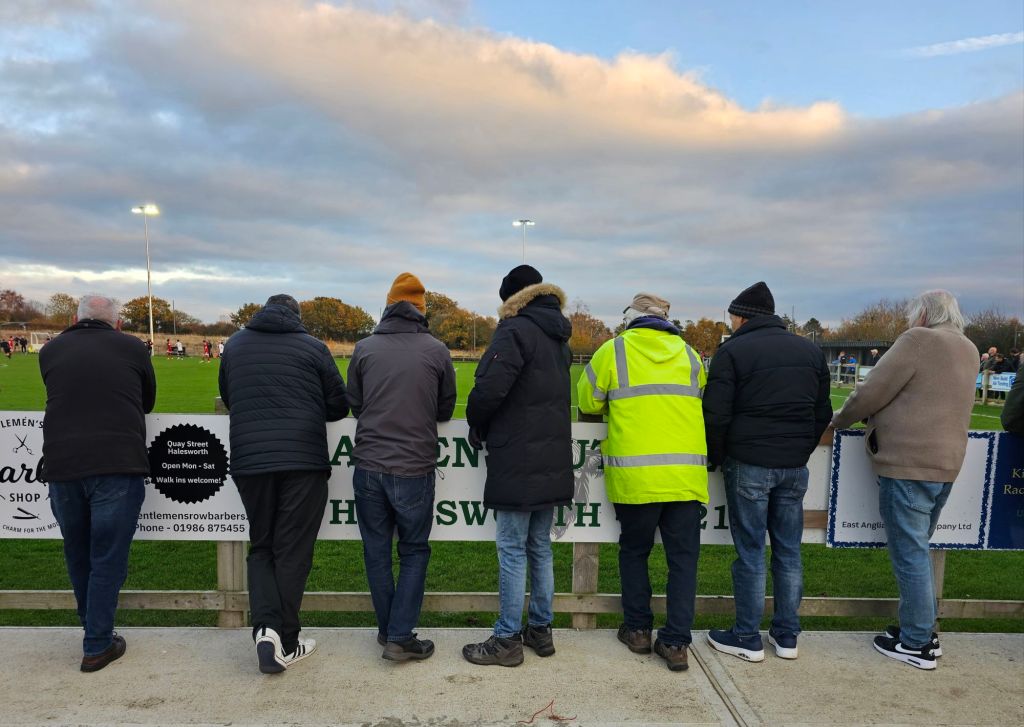
Harwich & Parkeston 1 Hackney Wick 1

Having grown up in Shotley, in the extreme bottom right-hand corner of Suffolk, Harwich & Parkeston, in the extreme top right-hand corner of Essex had always been somewhere not very far from the top of the sludge in my mind.  All I had to do was look out of my bedroom window over the roofs of the Council bungalows behind our house, and along with Dovercourt, there they were across the River Stour estuary.  At night-time, the lights in the docks twinkled in the distance and at midnight on New Year’s Eve we would nip outside to hear the ship’s hooters and sirens sounding.   My maternal grandfather, who more or less lived in Shotley all his life would tell people who upset him to “Go to Harwich”, which was either an oblique way of telling them to go and jump in the river, or a polite way of saying “Go to Hell”, probably both.

My maternal grandmother meanwhile, was born in Hackney Wick and lived there as a child.  It is with these loose family connections in mind that I choose today to eschew the probable delights of football fixtures a little closer to home such as Halstead Town versus Sporting Bengal United, Cornard United versus Ely City, Coggeshall Town versus London Fennecs and Brantham Athletic versus Thetford Town to watch Harwich & Parkeston versus Hackney Wick in the Essex Senior League.

It is a wet, windy, miserable afternoon as I step out of my front door to walk to the railway station, and I half wish I hadn’t already bought my rail ticket (£10.70 with Senior Person’s Railcard).  It’s a fifty-minute journey to Dovercourt with the final eighteen minutes of the journey being from Manningtree to Dovercourt along what is now called the Mayflower Line.  The Mayflower Line is sadly not known as such because the Pilgrim Fathers at some time caught the train to Harwich before making their somewhat fateful but nevertheless well-intentioned journey, which has years later indirectly resulted in Donald Trump, but because Harwich was The Mayflower’s home port and was where it was built.   If, in our ever more likely looking dystopian future Americans were to buy the Mayflower Line, I imagine we could look forward to hearing Chattanooga Choo Choo played as we pull out of Manningtree station.

From Manningtree station, the train pulls gently uphill away from the River Stour to run along its south bank through Mistley and Wrabness, with murky views through the raindrop coated train windows of the River Stour at high tide, the southern shore of the Shotley Peninsula and the tower of the Royal Hospital School at Holbrook, where incidentally my father was an unhappy pupil back in the 1930’s.  Harwich International Station is just yards from the dockside and here it is possible to catch a glimpse of the red hull of the RRS David Attenborough, or to the 124,109 members of the Great British public who voted to name it so, Boaty McBoatface.

Arriving in Dovercourt, it is thankfully no longer raining, and it is just a ten-minute walk up Kingsway, along High Street and Main Road past what was Woolworth’s and what still is the Royal Oak pub to the Royal Oak Ground, home of Harwich & Parkeston football club.  When I last came here almost exactly eight years ago (Harwich & Parkeston v Benfleet) , I entered the ground through the turnstile down the side of the ground in the shadow of the main stand. Today however, the turnstile is shut, and although the external metal door is hanging off slightly, I wouldn’t be able to squeeze through even if I wanted to.  I return to the main road and am directed through to the far end of the clubhouse, which in the tradition of scout huts and community halls everywhere smells a bit of damp. 

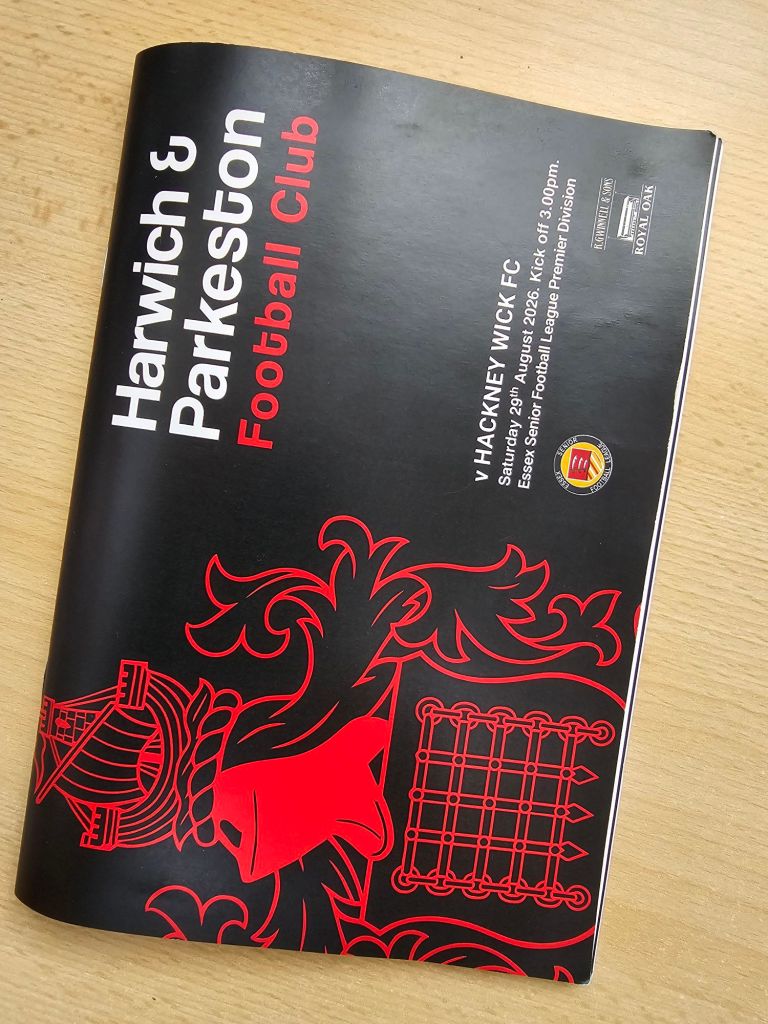
At the far end of the musty clubhouse two men stand at a table with a carboard box.  The one on the left looks at me enquiringly and I ask for “One for an old git, and a programme please”.  I am very pleased to see that Harwich still bother to print a proper hold in your hand and stuff in your pocket programme rather than rely on some digital, virtual creation which only exists in the ether.

Having paid up my seven quid using cash, I am mugged at the door by an elderly man at least in his seventies, who relieves me of a further pound in exchange for a strip of draw tickets.  Folding the tickets away in my pocket, I head for the tea bar where I buy a paper cup of tea and am served by a surly woman who seems to think I should know the price.  “One-fifty? A pound?” I ask her as I reach for my remaining change. “Two pounds” she barks aggressively “Unless they haven’t told me.” she adds, supplementing her aggressive with some passive.  “Well, it’s the first time I’ve been here in eight years” I tell her, “So I don’t know”.   As I walk away with my tea, I see that above the word tea on the blackboard menu outside it says “£1.50”.  “I’d better rub this out then” I say, so I do.   Wiping my chalky finger on my trousers I consume my tea and then find a seat up in the main stand.
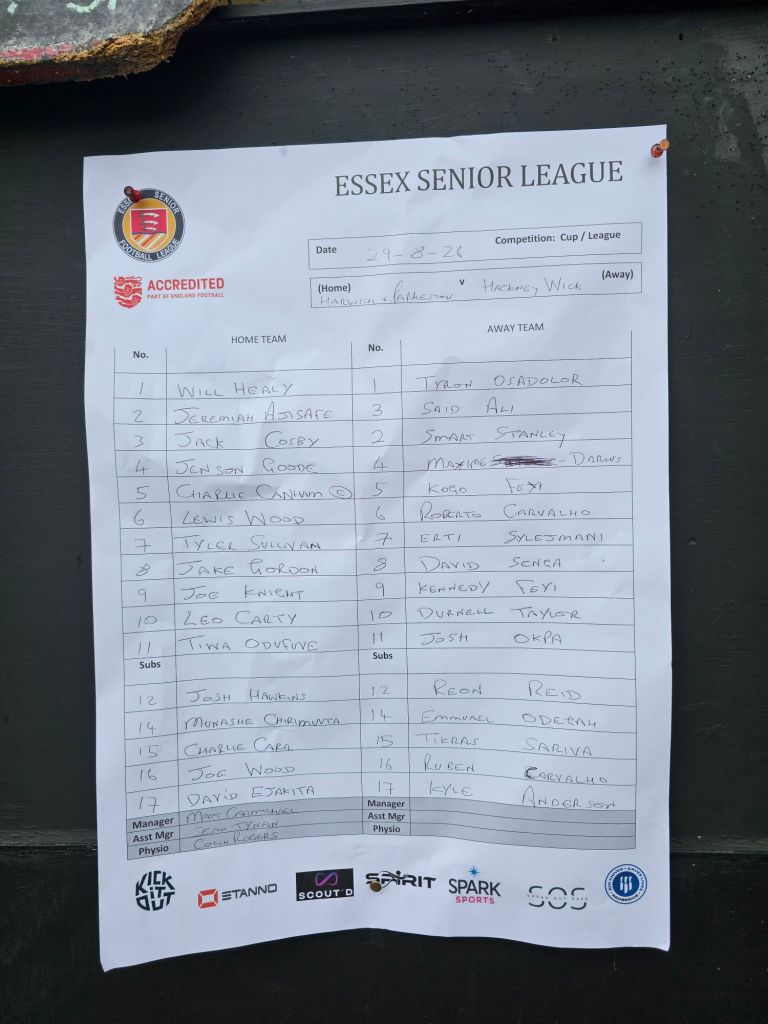
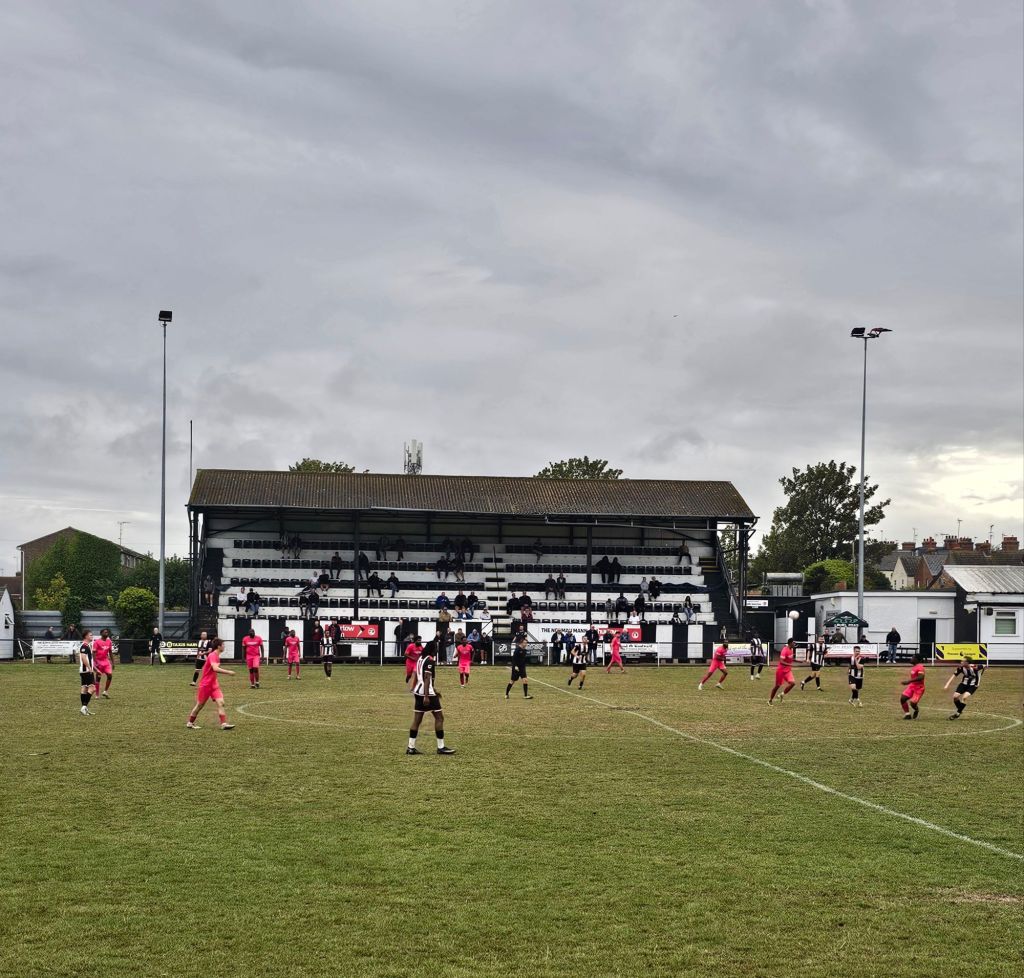
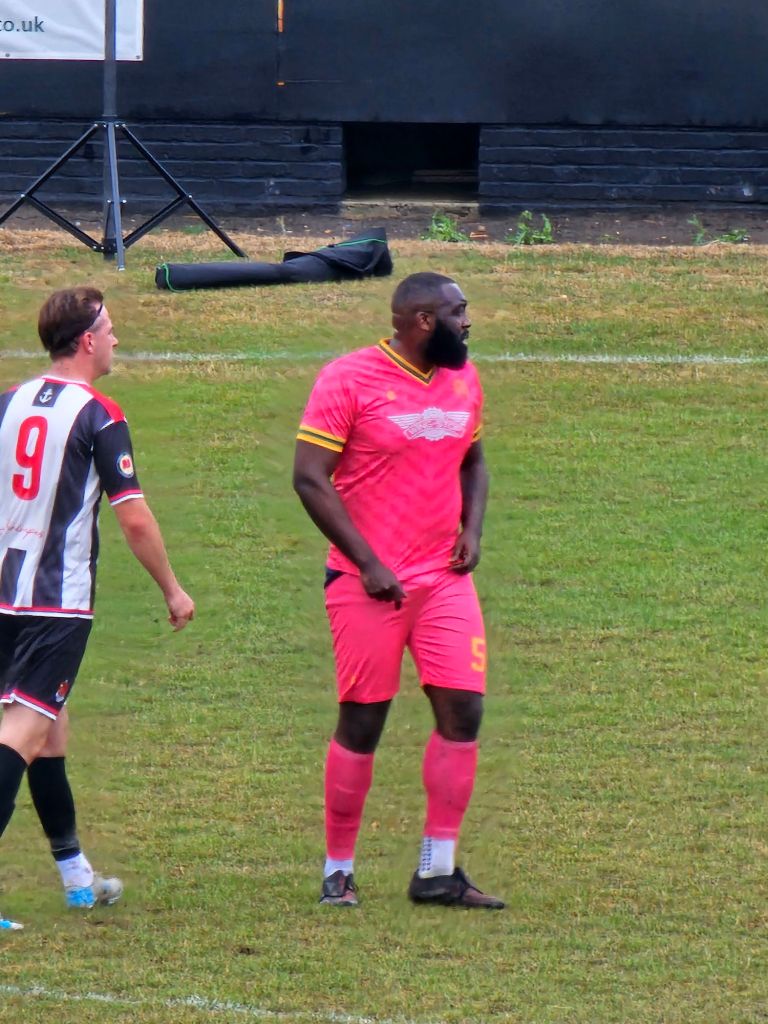
When the game begins, it is Harwich & Parkeston or ‘The Shrimpers’ as they are known colloquially that get first go with the ball, launching it towards the Royal Oak’s other covered stand more or less in the direction of Boaty McBoatface, the River Stour and Shotley beyond. Harwich & Parkeston look smart in their traditional black and white striped shirts and black shorts echoing the kits of their bigger east coast brothers Grimsby Town and Newcastle United.  Hackney Wick sport an all-cerise kit with yellow and green collars and cuffs and yellow numbers, which set off the dominant deep pink rather well. If it wasn’t for the yellow trim, and the heads and limbs, they’d look a bit like raspberry Mivvi ice lollies.  “Keep going Harwich” shouts somebody either from on the pitch or in the crowd, I’m not sure which, but the game has barely started.  I can’t decide if such a shout so early on is hyper-supportive or a bit pessimistic.  Either way, within a few moments Shrimpers’ number eight Jenson Goode lobs a shot over the Hackney Wick goalkeeper, but also wide of the goal.

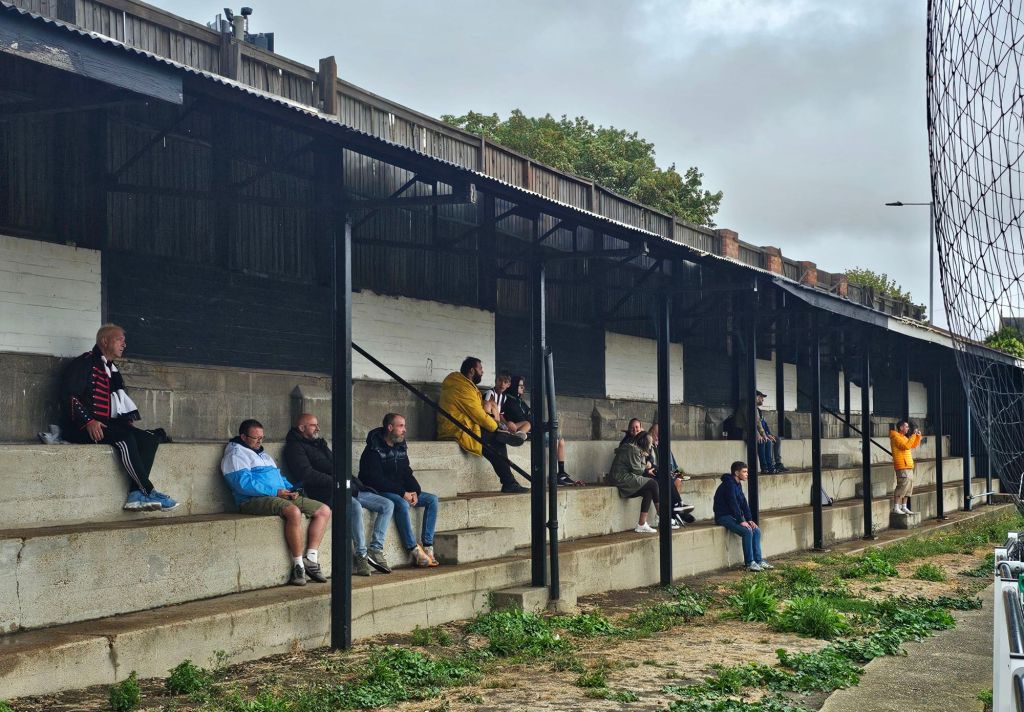
From my seat, up in the vertiginous main stand, I can see dock cranes beyond the battered black and white corrugated tin roof of the one other stand, which backs on to Main Road.  Back on the pitch, both teams are looking to attack one another down the flanks.  The Hackney Wick ‘keeper Tyron Osadolor misses the ball completely as a Shrimpers cross from the left flies across the face of his goal. “Goalie, you’re rubbish” shouts a voice in the crowd, a little prematurely it will turn out. It’s nine minutes past three and The Shrimpers win the game’s first corner, but it comes to nothing and the match settles down to being a bit messy, perhaps in part because of the bumpy, slippery pitch and blustery wind.

I turn my collar up against the breeze, which is coming over the hill to my right and off the North Sea beyond.  It’s not cold but it’s unpleasantly drafty. Beneath me, the yellow pitch almost looks as if it’s coming back to life whilst we watch as it drinks up the rain that has fallen.  The Shrimpers number ten shoots on goal but the Hackney Wick goalkeeper makes a decent diving save at the expense of a corner.  Eighteen minutes have passed and it’s almost as if the sun is trying to shine, but not quite. “Ball forward, ball forward” shouts a wanna-be coach from the stand as Hackney Wick pass the ball amongst themselves in the centre circle.

Twenty-five minutes have gone and as Shrimpers’ number three Jack Cosby receives treatment in the centre circle, there is an ad hoc drinks break, and I decide the breeze up here in the stand is more than I can bear so I make for the other covered stand behind the goal.  Two minutes later and the Shrimpers take the lead as their number nine Joe Knight runs towards goal and takes a shot from outside the penalty box, which strikes a defender and is deflected over the out-stretched goalkeeper. Knight performs a knee-slide by way of celebration and a jolly, well-fed looking woman in the crowd rings a hand bell.

The last worthwhile action of the half sees Hackney Wick’s number ten Durnall Taylor go through on goal and confidently lift the ball over the on-rushing goalkeeper only for the ball to go well wide of the goal. Taylor looks absolutely incredulous, as if the goal had somehow moved between his kicking the ball and looking up to see it not go in the goal.  The jolly woman with the bell is laughing like a drain and an elderly man wanders around the ground with a small blackboard displaying the winning draw numbers, none of which are sadly replicated by the tickets in my pocket.

Too scared to encounter the woman in the tea hut again, I forego a half-time cuppa and spend a few minutes on the phone to my wife, catching up on the latest at home. It seems we’ve lost power to the garage, kitchen and the fountain in the garden pond, but she’s rigged up an extension-lead to keep the freezer going. Good job I’m here really.

The football resumes at five past four and from somewhere unknown three Hackney Wick fans have taken up residence in the stand behind the goal and are chanting “Hackney Wick, Na Na Na, Hackney Wick, Na Na Na” repeatedly.   I’m now stood by the Hackney Wick dug out from where one of two coaches, a serious, slightly unhappy looking man bawls “Keep that pressure” and indeed his team do, pinning back the Shrimpers from the start, with their number eleven Josh Okpa in particular very busy down the right flank. “The Wick’n, The Wick’n” (I think, but possibly The Wicker?) continue the either newly arrived or miraculously cured of shyness Hackney Wick supporters, one of whom wears a bucket hat and one a bright yellow anorak.  The Hackney Wick coach is becoming a bit more effusive too. “Keep that fuckin’ pressure” he bawls, adding seemingly unnecessary coarseness to his advice. 

It has just gone a quarter past four and Shrimpers’ number eight Jake Gordon surges forward, only to overreach himself and slide through the legs of Hackney Wick’s massive number five and captain Kogo Feyi, who drops to the ground like a felled tree.  After the usual mass complaining and sweary advice to the referee that invariably accompanies these incidents, Gordon becomes the recipient of the afternoon’s first yellow card, to which strangely he gives the thumbs up. Five minutes later and Hackney Wick equalise as the ball is slipped through the square Shrimpers defence for number fourteen Emmuael Odegah to run after and roll past the exposed goalkeeper Will Healy. “We are The Wick, We are The Wick” chant the Hackney Wick Three in celebration.
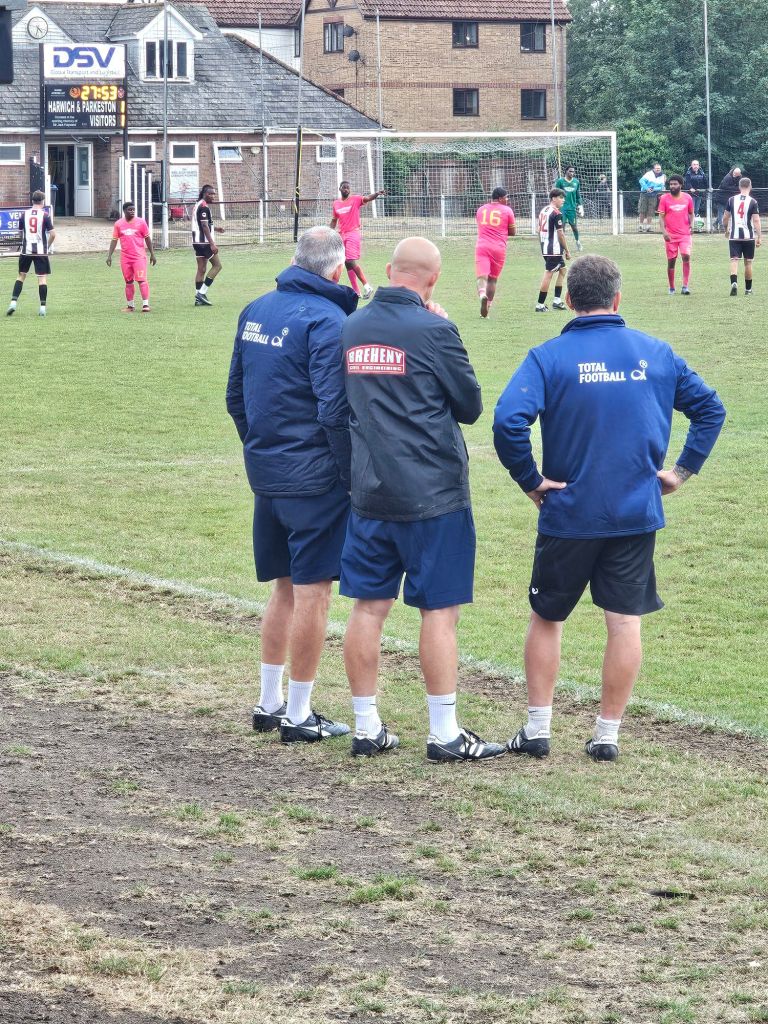
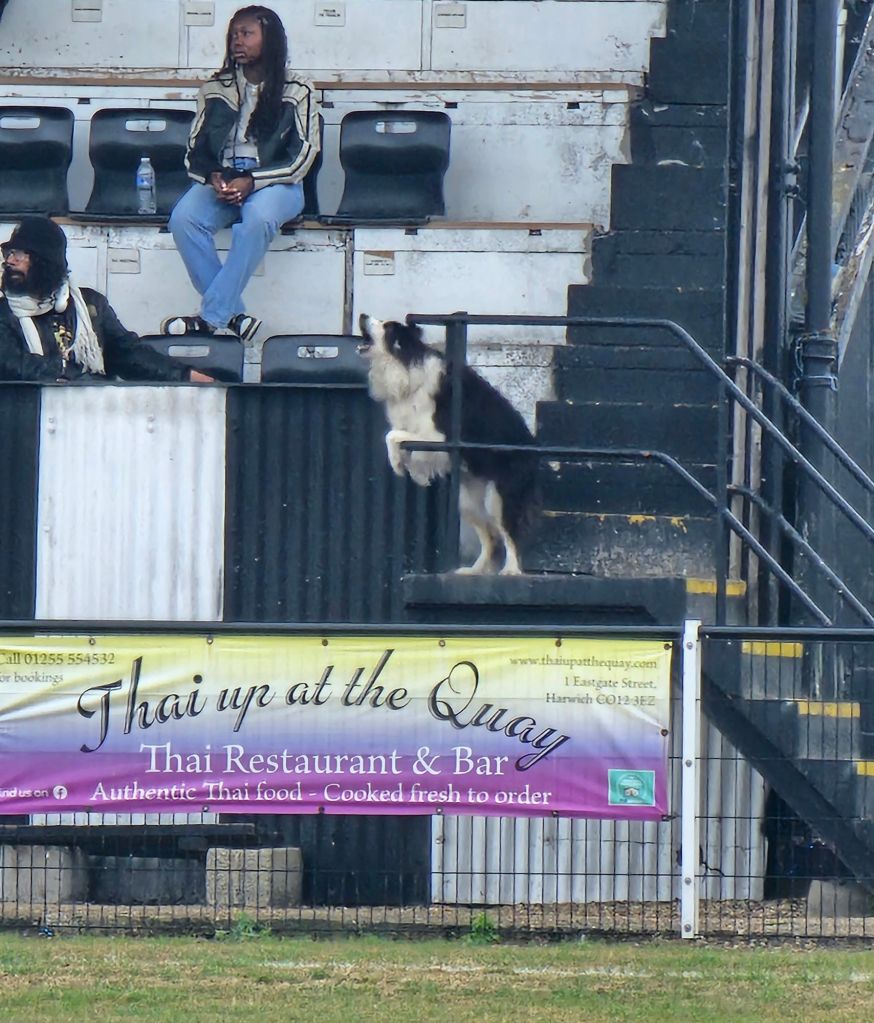
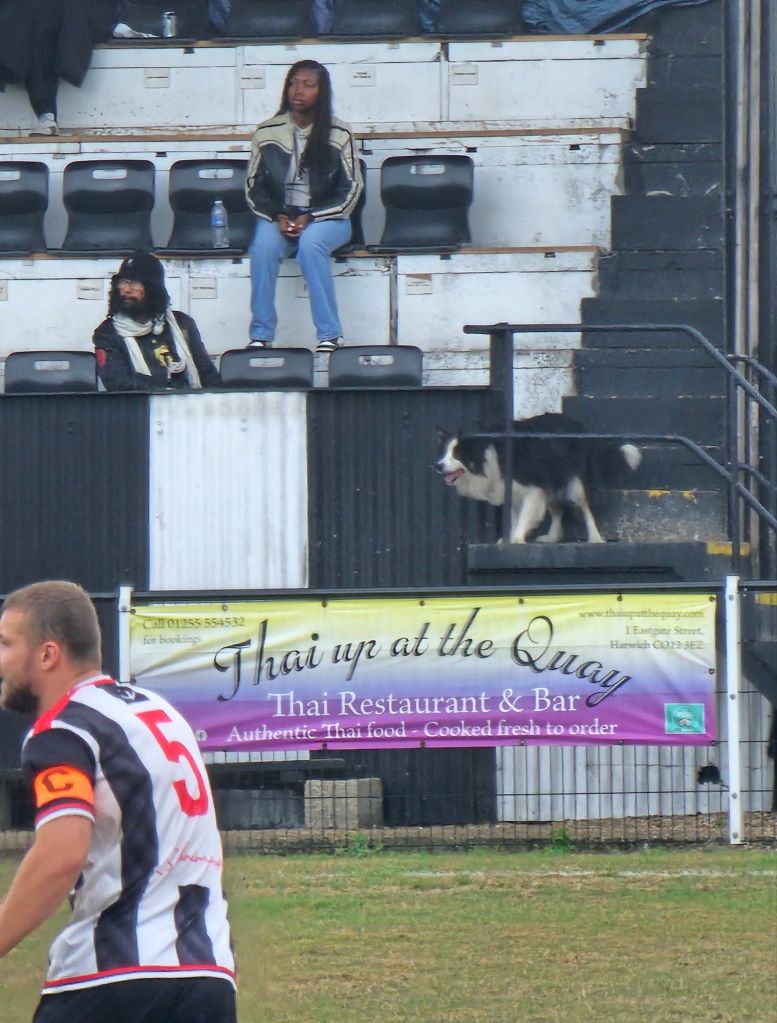
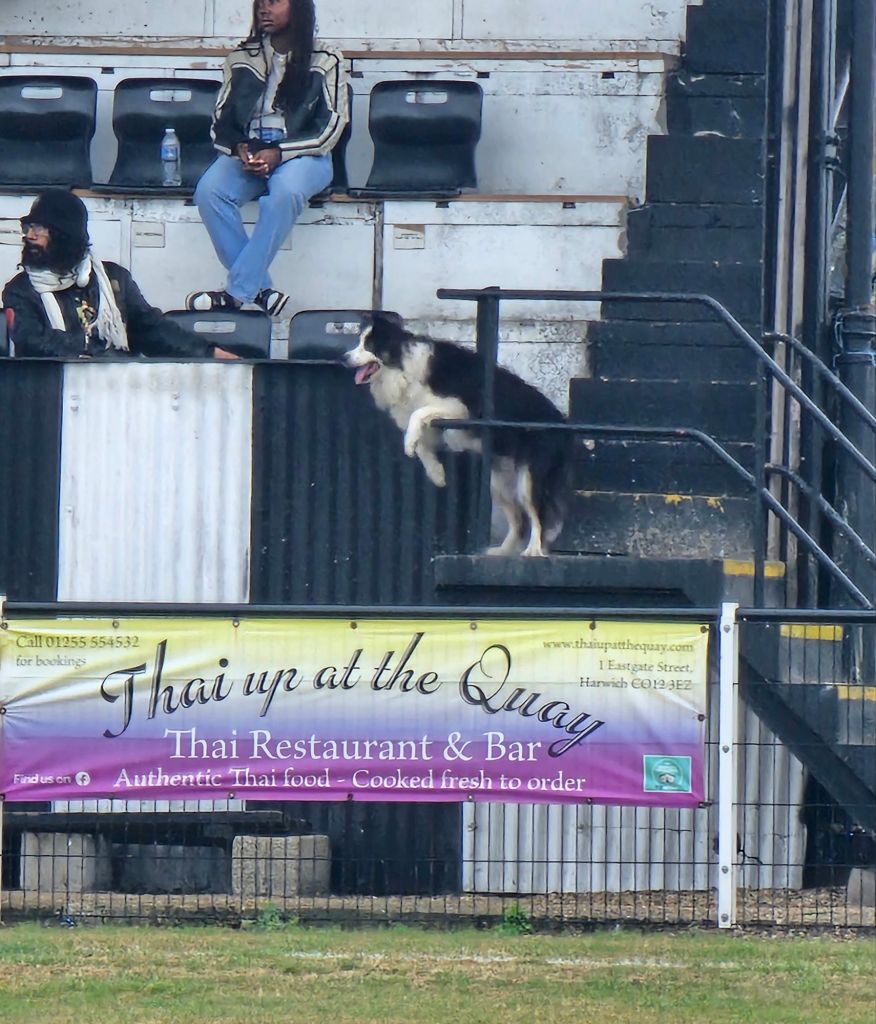
Another five minutes pass and both teams now make substitutions like they’re about to go out of fashion. Hackney Wick continue to press with the creative Josh Okpa revealing his frustration and possible artistic temperament as increasingly nothing his team does quite comes off.  The Shrimpers are the more stoic of the two teams.  “Gotta dig in” is their advice from the touchline. With the second half, half over, there is once again a hint of rain on the air, and the three Harwich & Parkeston coaches huddle conspiratorially to plan the ‘final push’.  There is mounting tension as both triumph and disaster remain possible outcomes for either team.  From the main stand a black and white dog (presumably a Shrimpers supporter) follows the action intently and every now and then barks his support or advice, I’m unsure which; he might even be swearing.
It’s nearly twenty to five. “Wicker Army, Oh, oh, oh” chant the Hackney Wick three, who just won’t shut up.  The Shrimpers win a corner; the ball sails over the penalty area but is crossed back in and number six Lewis Wood heads it firmly goalwards only for Wicker goalkeeper Tyron Osadolor to fly across the goal and spectacularly grasp it in mid-flight. It’s a save which reminds me of one I think I saw Ipswich Town’s David Best make against Real Madrid back in September 1973.

The end of the game is nigh.  One of the linesmen has to remind the referee to give a drop ball after he stops the game as Lewis Wood struggles to get up off the turf and then as sunshine momentarily threatens to break through the cloud, Wood recovers sufficiently to chip the ball against the Hackney Wick cross bar and number ten Leo Carty chases a ball over the top only for it to bounce off his shin and past the post.  The Shrimpers have ended the game more strongly and in the final minute a handball just outside the penalty area by goalkeeper Osadolor gives them a final direct free kick.    Substitute Joe Wood steps up to take the kick but his low shot is comfortably saved by the capable Tyron Osadolor.

The final whistle is blown at six minutes to five and there is a ripple of appreciative applause from the crowd, which I will later learn numbers 141, although I‘m not sure if that includes the dog.  I hang about to applaud the referee, linesmen and the teams from the pitch, but the teams take so long I am heading for the club house and the exit with the Shrimpers still on the field.  As I walk back to the railway station I reflect on what has made this an enjoyable afternoon and decide it is because the two teams were evenly matched, the Royal Oak Ground is delightfully scruffy and full of character, and there was a dog.  All that and I’ve still got the train ride home and another glimpse of Boaty McBoatface .
Kings Park Rangers 2 Stanway Pegasus 0

The snappily titled Thurlow Nunn Eastern Counties League Division One South has in the last year been shorn of two Suffolk clubs in the shape of Whitton United and Debenham Leisure Centre, who voluntarily dropped into the Suffolk and Ipswich League.  But as if by magic, two replacements have immediately filled the gaps left, one in the shape of the venerable Halesworth Town (founded 1887) and the other in the form of the altogether less venerable King’s Park Rangers,  who sprang suddenly from the Essex and Suffolk Border League after a brief two-season gestation, a bit like The Alien did from John Hurt’s stomach.

It is the final chapter of my two-part quest to be able to boast idly that I have seen every senior team in Suffolk play a home game.  Today I am making the brief 19.2-kilometre road trip across the border from Essex to Backhouse Lane, Little Cornard where I hope to see King’s Park Rangers play another team of recent graduates from the Border League, Stanway Pegasus.  If I was a younger man for whom the concept of time on this planet running out was less of an immediate concern, I might have caught the train to Colchester, or from Marks Tey to Bures, and then the number 44 bus to Great Cornard, but in truth I couldn’t really be bothered with the palaver, and in any case I have an electric car, so I am doing my bit to save the planet and reduce global warming.  It is therefore a little after two o’clock when I set off from my front drive towards Sudbury.

Being in Little Cornard, it is no surprise that Backhouse Lane is the longstanding home of Cornard United, but more intriguing is why is it now also the home of Kings Park Rangers, who are they, why are they, and where is Kings Park?   These questions have been niggling me all week in my idle moments, and fancifully I had postulated that they are perhaps a team from Kings Park, Suffolk County, Long Island, New York,  a team of South African ex-pats who have named their club after Kings Park Stadium in Durban, or even that they are an incel’s bitter and twisted response to the existence of Queens Park Rangers.  Eventually, there was nothing for it but to consult the interweb and hope I could find some information that was believable and not merely ‘content’ designed to enrage, influence or peddle consumer goods.   It turns out, so it seems, that Kings Park Rangers are a sort of works team for Kings Park Fulfilment Ltd of Pebmarsh, Essex, a company that works for Amazon, aiding Jeff Bezos’s bid for world domination.  According to ‘Suffolk News’, the club was set up in 2023 by “former Cornard resident” Josh Pollard “…as a way of connecting his family- including famous cousin Olly Murs – and work colleagues through their shared love of football.”  I can’t decide if this is philanthropy, megalomania or just weird but it probably makes Kings Park Rangers a Pebmarsh team, an Essex team, that just plays in Suffolk.

Looking out from the drizzle flecked windows of my planet saving Citroen e-C4 it’s a miserable, depressingly grey November day, the aftermath of an even more depressingly miserable, wet, November day, the day before.  The only thing to raise one’s spirits a little is the fact that today the moisture in the air is just occasional fine drizzle, not the persistent rain and occasional monsoon that hit yesterday.  Nevertheless, there’s no denying that the dripping trees, puddles, mud and soggy leaves are all rather glorious in their own way and provide a characterful backdrop to the twisting, turning, undulating B1508 as it makes its way along the north bank of the River Stour from Bures towards Sudbury.

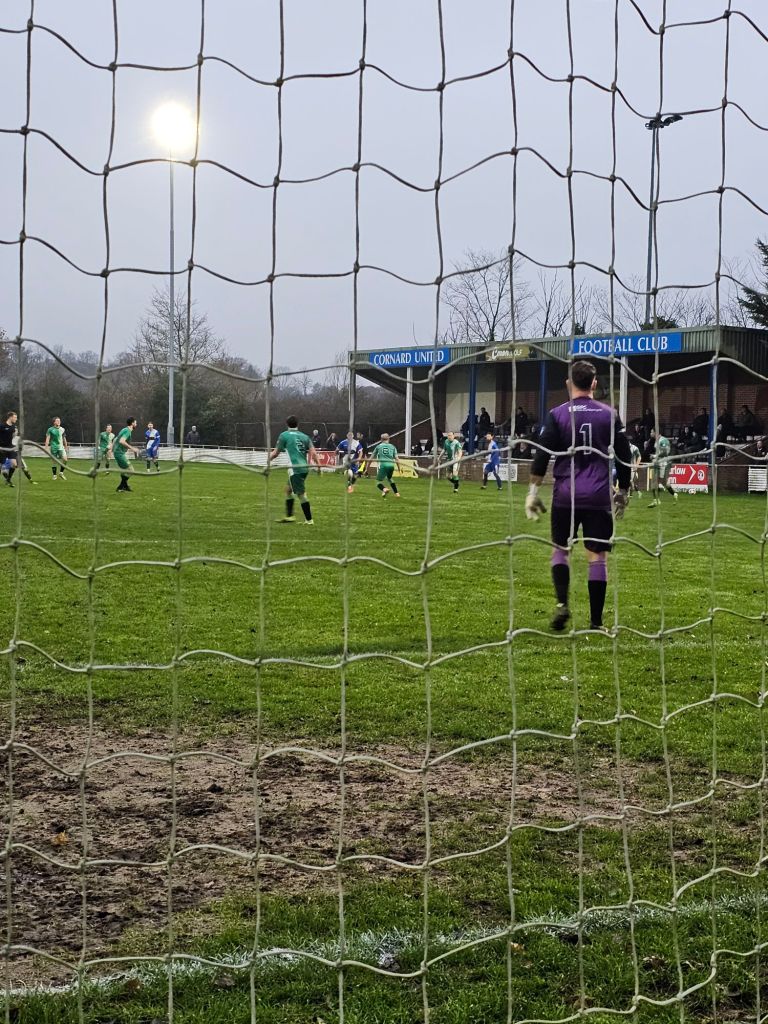
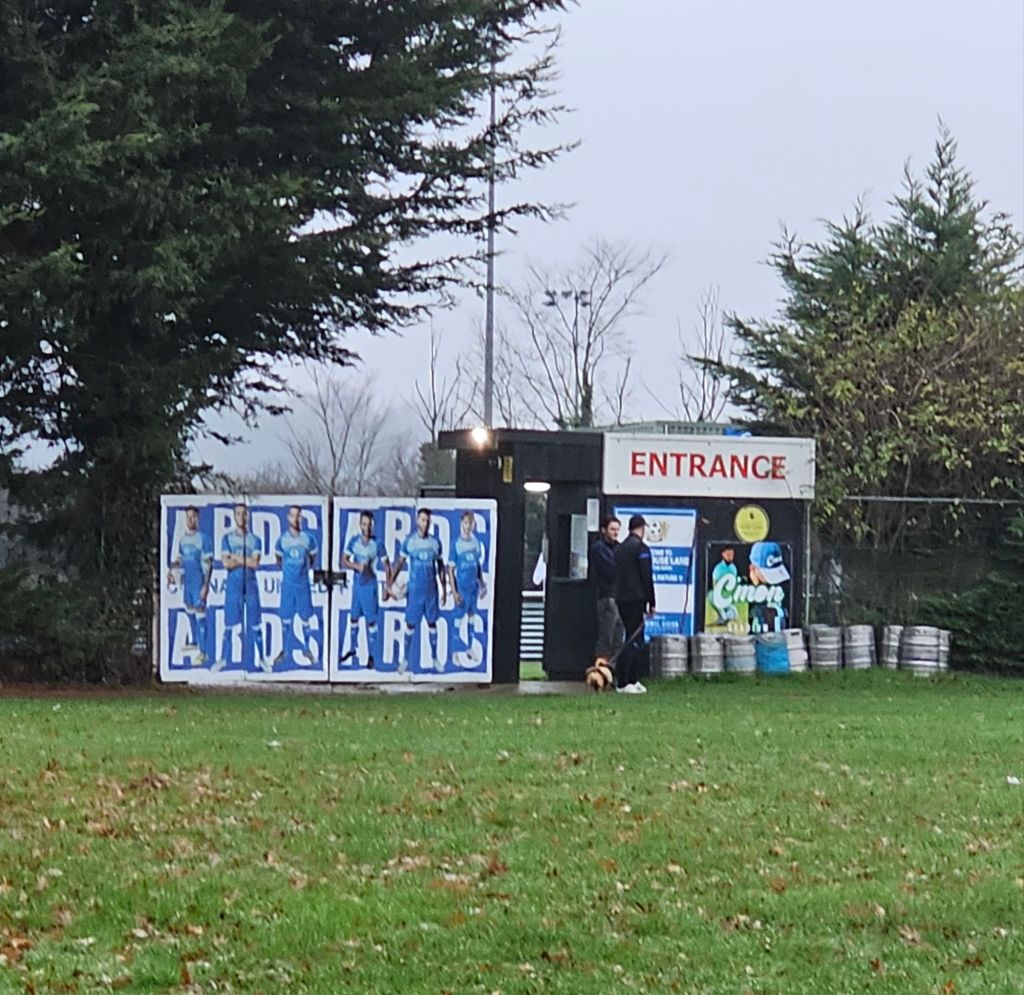
Suddenly, out of the gloom I reach Great Cornard and quickly identify the need to brake and turn right into Backhouse Lane, a very narrow road which in places has a deep water-filled ditch on one side; it is not wide enough for two cars to pass.  Fortunately, I meet only one car coming in the opposite direction and that is at one of the few passing places.  I am therefore soon parking up my planet saving Citroen in the mostly full car park, next to a white Ford Transit van.  The entrance to the football ground is off to my right, through the mist and back towards the B1508 along a concrete path strewn with fallen, brown leaves that have the consistency of wet papier mache.  Two men stand talking each other by the entrance, which seems to marked by a collection of beer kegs, and as I approach they end their conversation and one of them nips into the turnstile booth.  When I last came to Cornard, back in January 2019, the ‘turnstile’ was just a wooden hut but at some time in the intervening six years and ten months this has been replaced by a very neat structure that looks something like a cross between a very small domestic conservatory and one of the old toll booths at the Dartford tunnel.  I tender my £5 concessionary entry fee by means of my bank card.  There is no printed programme, but the window of the toll booth displays a QR code for a programme which is free.  Pretending to be completely familiar with QR codes I point my mobile phone at it, because I think I know that is what you do.  I have succeeded in accessing on-line programmes in the past, but not today, but at least I will have a nice photo of a QR code.  The young man at the turnstile then strangely tells me that there are plenty of people in the club house, perhaps he thinks I look lonely.

There are indeed plenty of people in the clubhouse as the young man in the toll booth said, but I only talk to the barman who, when I ask if there is a bitter available, tells me there isn’t the call for it nowadays but helpfully adds that a pub nearby wins awards for its beer.  Sadly, there’s no danger of that here and I settle for a bottle of alcohol-free St Austell Brewery Proper Job (£4.90).  The barman apologises for not letting me have the bottle to pour the beer myself and explains that whilst he doesn’t think I look like I would cause any trouble, he’s not allowed to.  Avoiding eye-contact with anyone else in the bar, I worry a little for my safety and take my beer outside where I watch the players, the referee and his assistants warm up, and a player in a track suit top walks a small brown dog. I notice that the two dugouts are almost at opposite ends of the pitch, when I was here in 2019, they were next to one another.

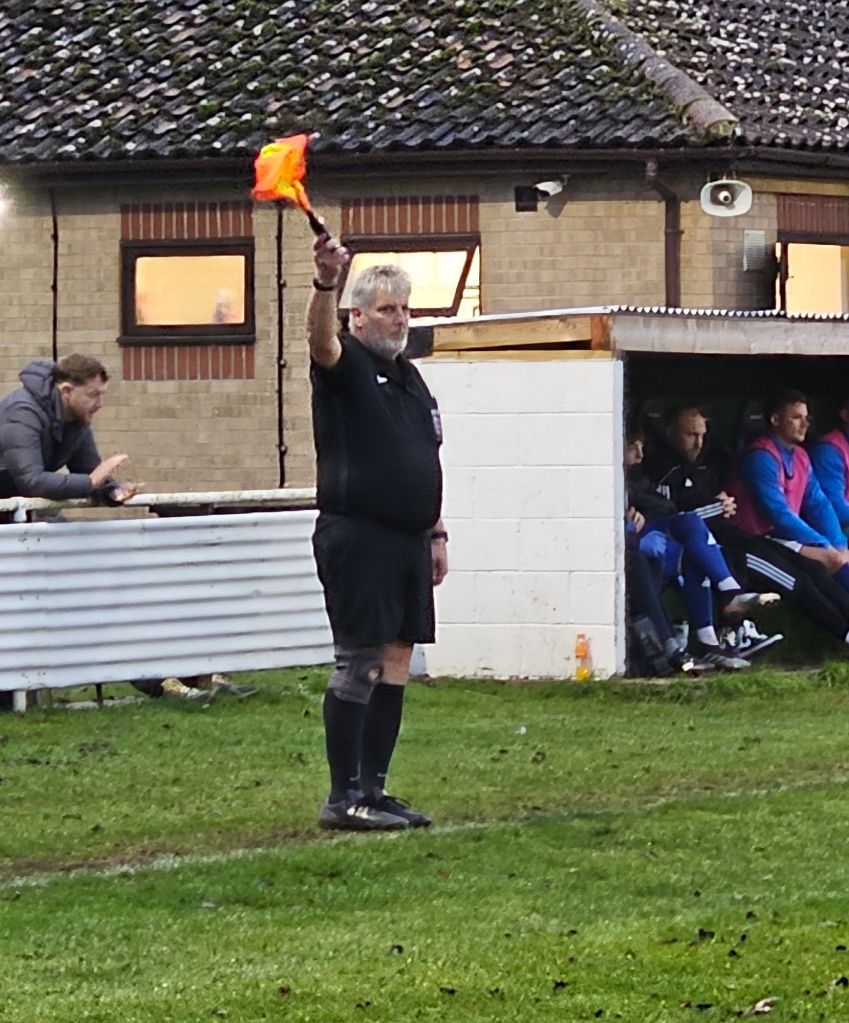
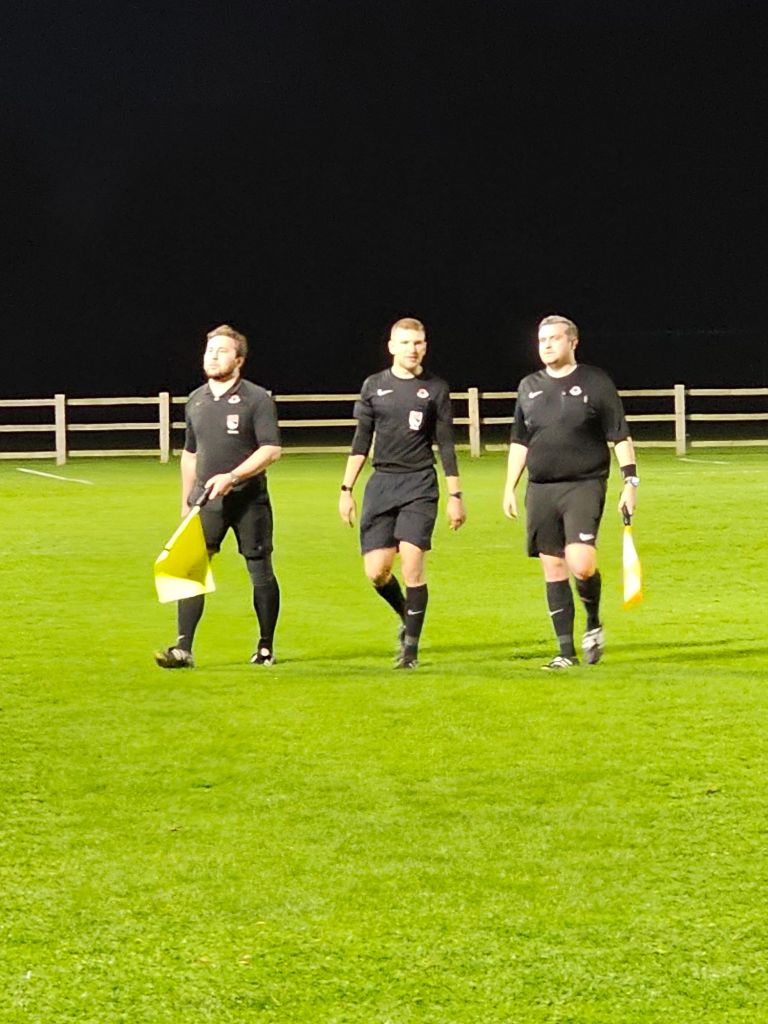
 The referee is a young man with impossibly short hair who looks very keen and serious as he turns and sprints along the touchline and then does the same again. His assistants, two much older men, follow him for all of a few seconds, by which time he is almost out of sight.  “Five minutes.  Do your stretches”, says the referee and one of the assistants a portly, grey-haired man wearing an open knee support stretches down to his knee once or twice and the expression on his face says “that’ll do”.

The game begins at a minute past three and it’s Kings Park who get first go with ball, which they rapidly boot towards Sudbury and the Thomas Gainsborough school, which is just over the fence from the ground.  Kings Park sport an all-blue kit with a wide, white, slightly blurry diagonal stripe across the front, and I think to myself what kit would I choose if I was inventing my own football club, probably not this one.   Stanway Pegasus meanwhile are in all-green with a blurry white stripe down their left side and black socks, like an unhappy man’s Plymouth Argyle.

The most notable thing about this game from the start is the shouting on the pitch and from the dugouts. “You gotta work”, “Chase”, come the early, more polite commands extolling effort over skill.  “Away” shouts the Kings Park goalkeeper and for some reason I think of the Teletubbies. Kings Park win an early corner.  “Seconds, seconds” is another shout, appropriately twice. On the pitch, both teams seem wound up already and the Pegasus number nine screams at the referee’s assistant as he strides towards him intimidatingly over the trivial matter of a throw in.  “Mental” he says to himself after being told to calm down by referee Mr Glasson-Cox, who coincidentally also refereed the match I saw at Halesworth last week.

The half is half over. “Fuckin’ ‘ell ref” says someone about possibly anything but soon the initial intensity of the match seems to have thankfully subsided a bit.  I move into the main stand, a utilitarian, boxy looking structure but with a bit more character than most of the prefabricated metal stands erected nowadays.   In a quiet moment I reflect upon the referee’s assistant stood in front of me, a wiry man with a large beard, which he looks as if he might have grown having been told by his doctor that he needs to put on a bit of weight.  Between me and the referee’s assistant raindrops cling to the white painted rail around the pitch.   The slightly calmer mood continues into a short delay in which the referee speaks to his assistant on the far side, the portly, grey-haired one with the dodgy knee who it seems has noticed that following a goal mouth scramble the goal at the Sudbury end of the ground, which is on wheels, has moved a little.  Mr Gasson-Cox takes a look and gives the goal a little shove.

After the calm, there follows a short storm as Kings Park’s number eight and captain Noah Collard scythes down an unidentified Pegasus player who proceeds to writhe on the ground screaming.  Once the Pegasus player has cried wolf for long enough Collard becomes the first player to see Mr Gasson-Cox’s yellow card, but discussion in the crowd is more about the girlish screaming than the booking.  “Does he have to go off with the screaming?” asks a spectator not unreasonably.   But as if to quickly even things up, a Pegasus player also gets to view the yellow card before half-time, although there is no further screaming from either side and the half ends goalless.

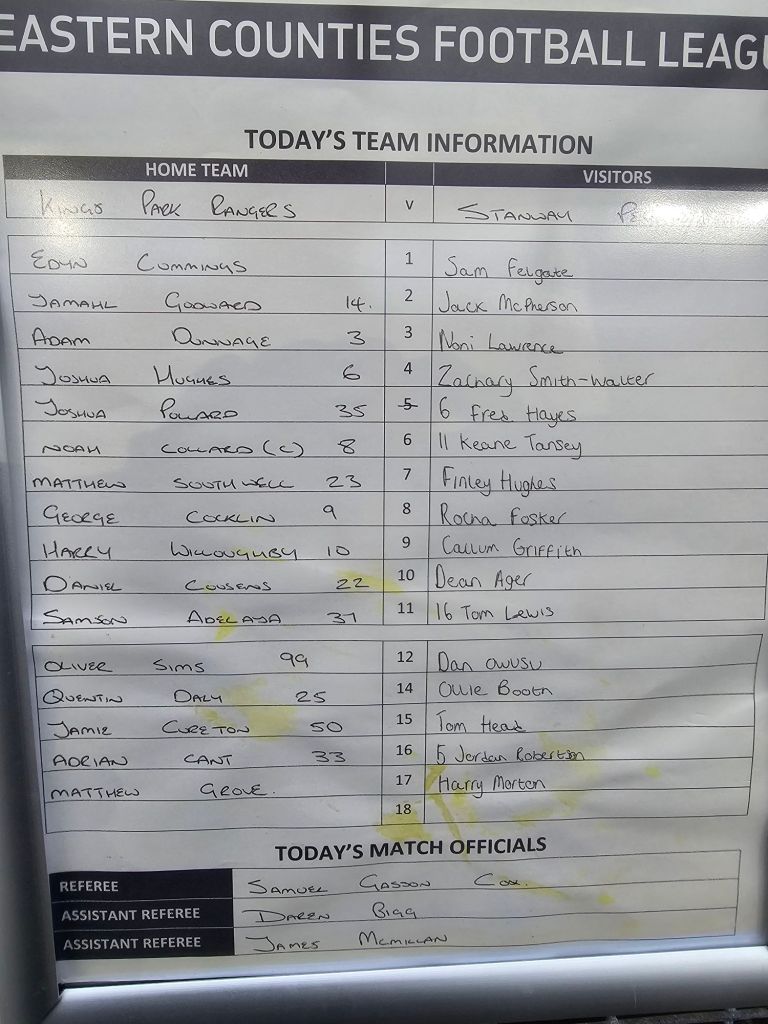
With half-time I drain-off some of the Proper Job and eat a Polish Grzeski chocolate bar from the World food aisle in Sainsbury’s.  I peer through the window of the club house where a man and a woman, presumably club officials from Stanway Pegasus, and two men in large black coats featuring the crest of the Suffolk County Football Association drink tea with an array of what look like shop bought sausage rolls and homemade bread pudding wrapped in tin foil laid out before them.  Only the man from Stanway Pegasus seems to be eating anything.  I wonder to myself where the Battenburg and Swiss Roll are.  Outside, next to the window I look at today’s team sheet, which looks like whoever wrote it might have been eating an orange at the same time.  Beyond the club house the small brown dog is being walked by a different man, possibly a player, who is evidently not playing today; I hear him say he doesn’t know the dog’s name.  “Come on you” he says.  Two other small dogs are present in the crowd today too, one in a coat and one not. 

At three minutes past four the match resumes and the Kings Park coach is immediately barking instructions to Georgie, Zammo and Hughsie as if his very existence depended on it, whilst also sounding like the games teacher from tv’s Grange Hill, but only because he said ‘Zammo’.   His shouting works however and six minutes later a ball from left to right finds number twenty-two Daniel Cousens inside the penalty area.  Cousens calmly places the ball wide of the Pegasus goalkeeper, and Kings Park lead one-nil.

Ten minutes later and Kings Park lead two-nil when a low cross from the right travels across the face of the goal, past the flailing limbs of a couple of Pegasus players until it reaches Kings Park number ten Harry Willoughby, who bundles it into the goal from close range before running off madly.  “Whatever ‘appens, don’t let ‘em fucking score again” bawls a rough voice, presumably of a Pegasus supporter. 

It’s getting on for half past four and the game seems over. Pegasus don’t offer much else but for a goal mouth scramble which leaves the Pegasus coach feeling hard done by and asking rhetorically “ ‘ow’s your luck?”  and then asking it again.  For Kings Park the goalscorer Willoughby is substituted for the 50-year-old former Norwich City, Colchester United, Reading, Queens Park Rangers, Swindon Town, Shrewsbury Town, Bristol Rovers, Leyton Orient, Bournemouth, Barnsley and umpteen other clubs’ player Jamie Cureton. As Willoughby heads for the changing room, he emits a sort of howl.

Back on the pitch, Pegasus number five Jordan Robertson is booked after Kings Park’s number ninety-nine Oliver Sims is not given offside, and Robertson seemingly exorcises his disappointment by hacking Sims down.  “Fucking embarrassing” says the Pegasus coach, but only about the presumed offside. Time runs down, on into the ninetieth minute.  Pegasus can’t decide whether to just boot the ball forward as quickly as possible or pass it. “Just kick the fuckin’ thing” shouts an elderly spectator summarising a century and a half of tactics from the country that apparently invented the game.  “Darren, time” shouts a player. “Darren, man on” shouts the same player a moment later. The final action sees another booking for Kings Park. “Fuck me, it’s getting boring now” say the Pegasus coach and happily at 16:52 Mr Gasson-Cox, who I think has had a good game calls time.

I wait as the players leave the field to no applause, just the blokey clasping of fists with a few spectators and shouts from inside the changing rooms.  It’s been a good game in terms of the ability shown, but it’s not been a particularly enjoyable one. There’s been too much trying to pressure the referee, too much needless swearing and too much of a sense of needing to win above all else. I think I’ll just try to remember the afternoon for the miserable weather, the soggy leaves and the small dogs.

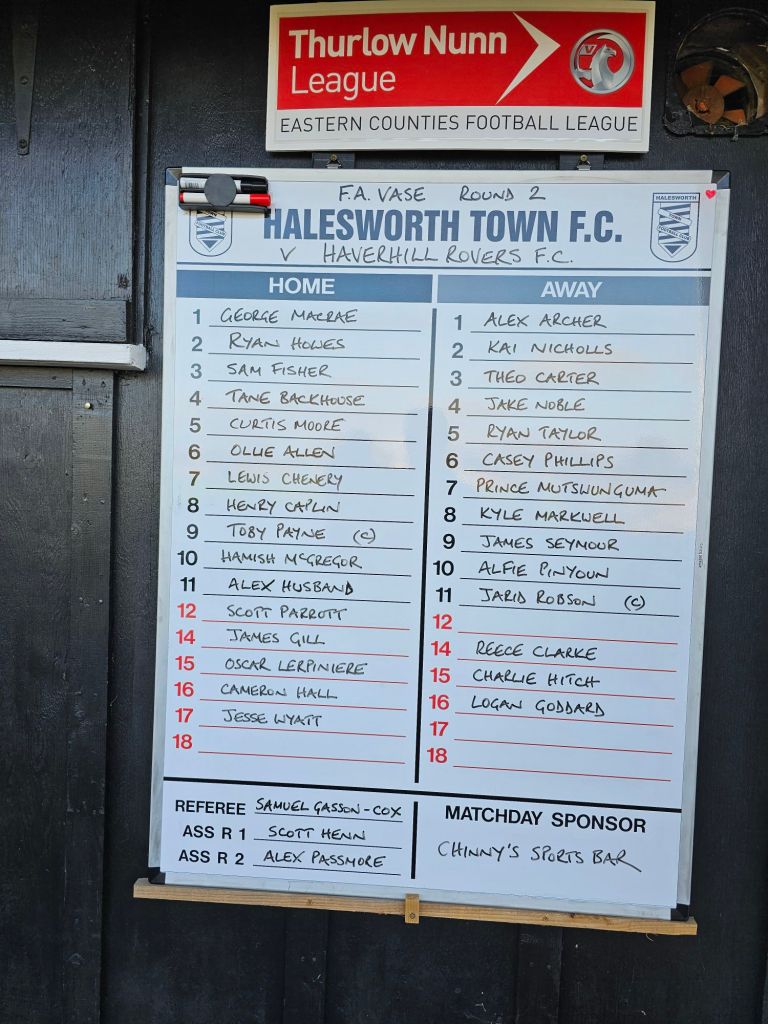
Halesworth Town 3 Haverhill Rovers 1

Between March 2017 and April 2019, I watched matches at each one of Suffolk’s then twenty-four senior football clubs and recounted my experiences in this here blog.  Since then, Debenham Leisure Centre and Whitton United have sadly dropped out of senior football but this season the Eastern Counties League First Division North has welcomed two more Suffolk clubs into the fold in the shape of Kings Park Rangers, who are from Great Cornard but seemingly too shy to admit it, and Halesworth Town, who are proudly, clearly from Halesworth. 

Today, with Ipswich Town playing far too far away in deepest Wales to trouble me to even think of getting a ticket, even if I had enough ‘points,’ I am travelling up to Halesworth in part one of my plan to restore my record of having seen all of Suffolk’s senior teams on their home turf.  Fortuitously, today’s fixture is also an all-Suffolk cup-tie against Haverhill Rovers of the Eastern Counties Premier League, and the first time Halesworth Town have ever reached the second round of the FA Vase.   To add to the adventure even more, despite the additional twenty minutes each way that it will take me, I am responsibly reducing congestion on the roads by eschewing making the 88-kilometre journey from my home by planet saving Citroen e-C4 in favour of taking the train (£18.10 return with senior railcard). It also means I can get plastered if I choose to.

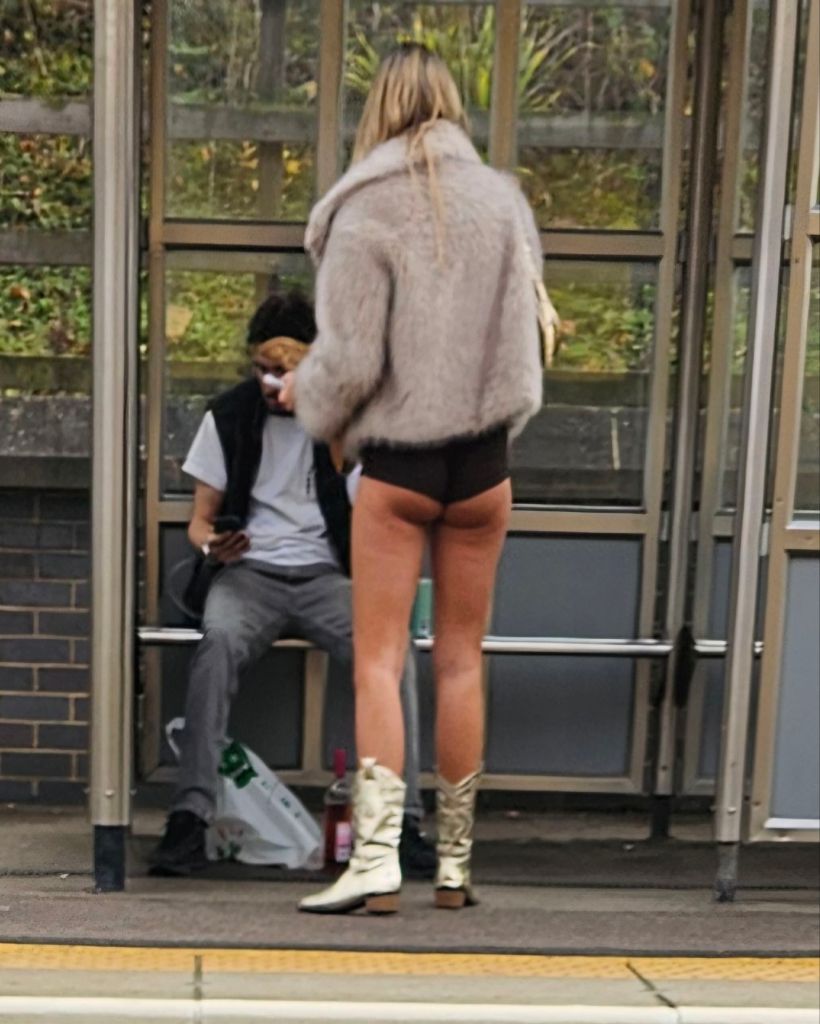
It’s an intermittently cloudy but mild November day as I set off for Halesworth, but I am nevertheless surprised as I wait for the train that one of my fellow travellers appears to have forgotten to put on any trousers or a skirt.  Once on the train, the infinite variety of human life continues to reveal itself as a small man of pensionable age repeats the names of the station stops as they are heard over the public address system; every now and then he delves headfirst into a large carrier bag as if checking on the wellbeing of a small animal or perhaps a baby.  When the woman sitting opposite me goes to the buffet car, she asks me to mind her belongings. I of course agree but tell her she needs to be back before we get to Ipswich.   When she returns, I tell her I had to fight off a couple of people who looked interested in her jacket but otherwise everything has been fine.  Fortunately, she laughs, but the man of east Asian origin next to me looks at me askance and when she begins to struggle to open a bottle of drink, he very quickly offers to help so that she doesn’t have to deal with the looney opposite her again.  The woman soon begins to chew on a large sandwich and a younger man on the other side of the aisle between the seats does the same thing, but takes much bigger bites, happily from a different sandwich, although with every bite he looks like he might lose a finger.

I change trains at Ipswich, boarding the 13:16 to Lowestoft, which departs a good twelve seconds early.  I like the East Suffolk line, to me it feels like a one-hundred- and seventy-year-old umbilical cord connecting the outside world to rural Suffolk with its rustic sounding stations such as Campsea Ashe and Darsham and their Victorian architecture.  Between the stations are Suffolk landscapes of river and marsh, Oak and Broom, sheep and pigs, outwash sands and boulder clay and gaunt, grey, flint church towers.  As the guard checks passengers’ tickets, he helpfully advises those alighting at Halesworth not to use the doors in the front carriage, because the Halesworth station platform is not that long.  There seem to be quite a few of us alighting at Halesworth.

The train arrives on time in Halesworth, where the sun shines from a pale blue autumn sky. A helpful sign points and tells pedestrians that it’s a seven-minute walk to the town centre and a minute’s walk to local bus stops on Norwich Road. Sadly however, no sign points helpfully towards Halesworth Town football ground, although having previously consulted the interweb I happen to know it is very close indeed, perhaps no more than a hefty goal-kick away.   I walk up an alley between the railway lines and Halesworth Police station, a huge four-storey block of a building, which although it probably dates from the1960’s makes me think of a Norman castle keep, built to keep the locals in check.  At the top of the alley, I turn right over a bridge above the railway and then right again down another alley the other side of the tracks, and down to the Ipswich bound railway platform. From here it is no more than 150 metres up Dairy Hill to the football ground, making it a toss-up between Halesworth and Newmarket as to which senior Suffolk football ground is most easily accessible by rail, my money’s on Halesworth.

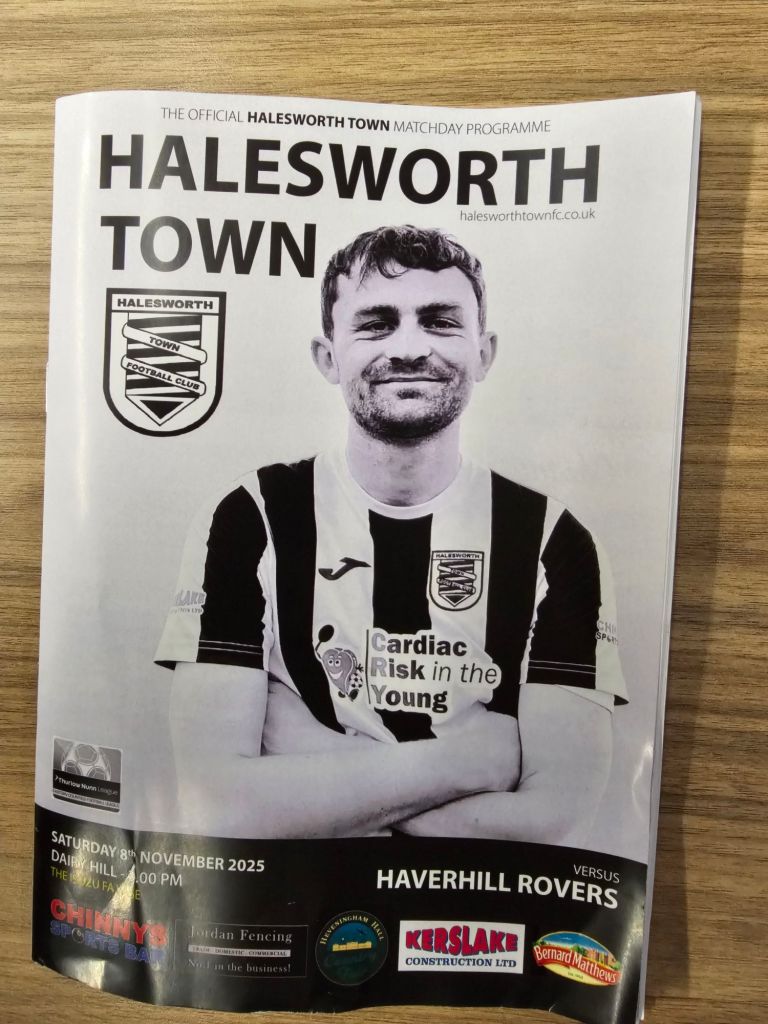
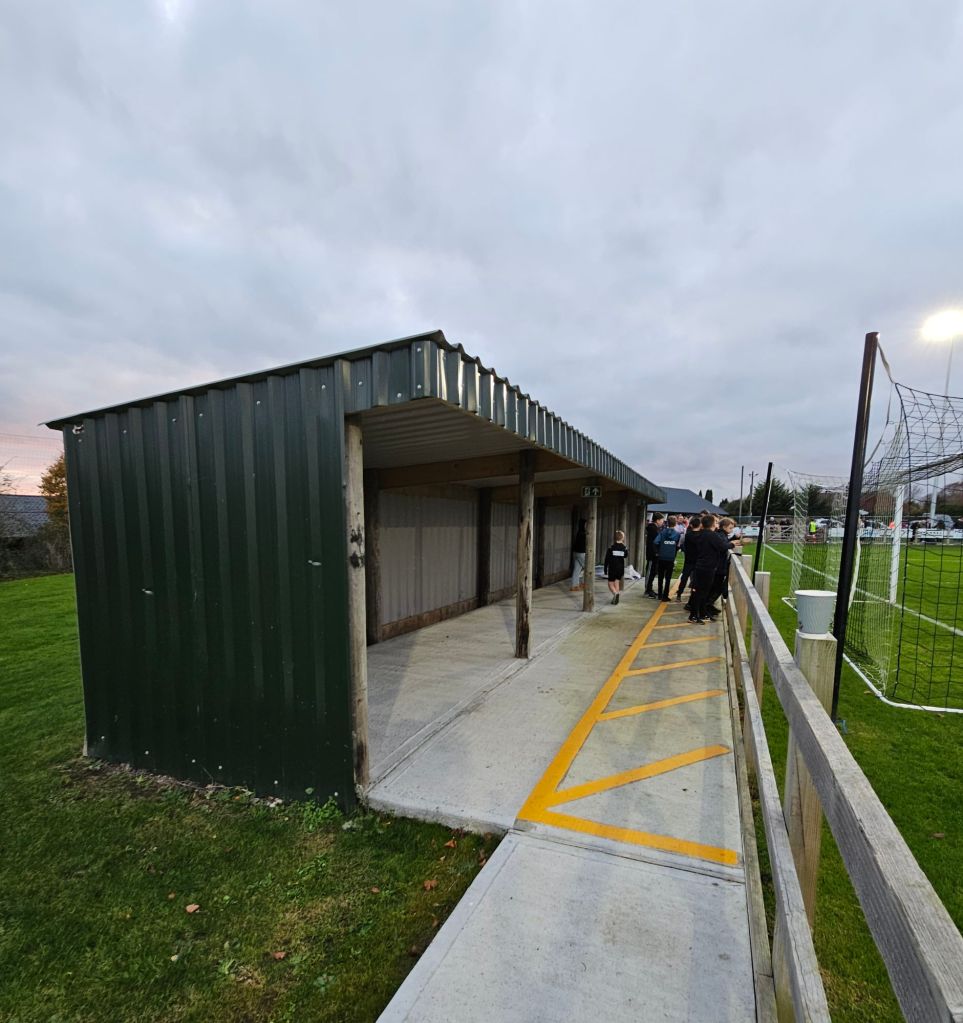
Despite its attractive name, Dairy Hill is just an uninspiring street of modest modern houses; from the top I make my way across the stony club car park and along the back of the club house to the ground entrance.  For a mere seven pounds I gain a programme (£1.00) and entry to the match as an over sixty-five, all that is missing is the click of a turnstile.  The ground itself is underwhelming, but it does boast a decent looking pitch with a smart timber fence all around and a small stand at the end nearest the clubhouse, which according to ground grading rules needs to be big enough to accommodate fifty spectators, although I’m not sure if FA rules say how large or small the spectators need to be.  The height of Halesworth’s stand suggests they should not be significantly taller than about 1.8 metres unless wearing crash helmets.

I head for the club house where the bar offers the usual array of fizzy lagers and cider and a pump which intriguingly bears the name ‘Wainwright’ written in biro on a plain white sticky label.  The barman generously allows me a sampler of the ‘Wainwright’ and seeing as there’s nothing-else I might like I order a pint (£4.60) before heading outside again to visit the food trailer, where a tall man with tattooed arms, who looks like men in food trailers often do serves me chilli, chips and cheese for a modest six pounds, less than half what I paid for much the same thing in an Ipswich pub earlier this week. 

I return to the club house to eat my chips and drink my beer, not being someone who likes to eat or drink standing up.  The club house looks like there might be an older timber building, which has had a new roof and supporting structure placed over the top of it, it smells a little like that too, having a faint musty odour which isn’t uncommon in old village halls and clubhouses.  The black and white interior décor and monochrome photos of old teams on the walls remind me a little of the Long Melford club house before it was re-built.

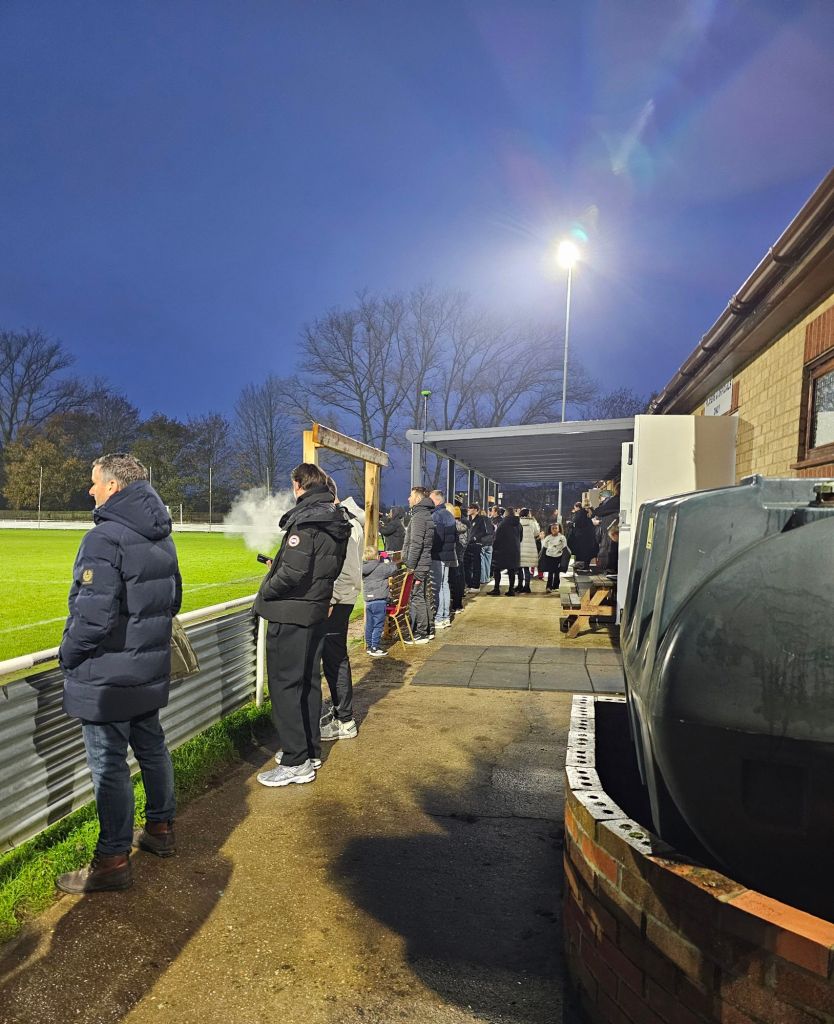
With chips eaten and beer drunk, I wait outside for kick-off, observing the growing crowd and the queue to get in at the gate, before standing closer to where the two teams will line up before the procession on to the pitch to shake hands and then observe the minute’s silence for remembrance day, a silence  which whilst well observed around the pitch plays out to a back ground of chatter from inside the bar and clubhouse, where life continues as usual, oblivious to the  silence outside.

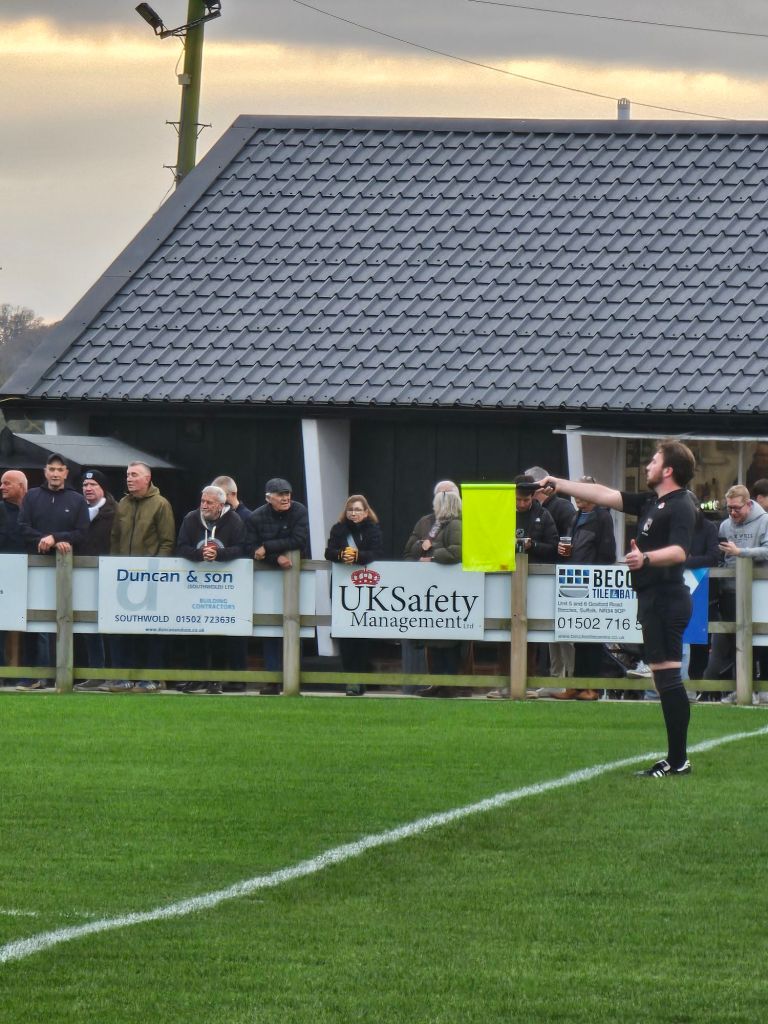
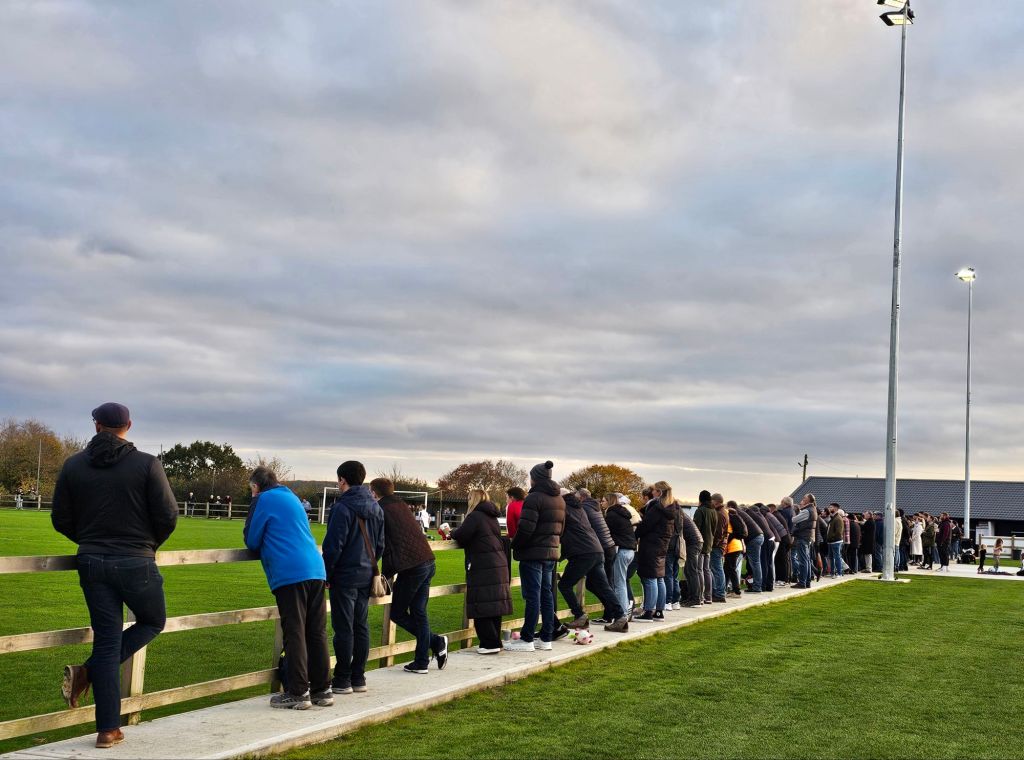
Eventually, it is Haverhill Rovers who begin the game, by getting first go with the ball, which they quickly hoof forward in the general direction of the stand, the railway station and town centre beyond, before it is booted into touch by a Halesworth defender, not unreasonably practicing safety first.  It’s good to see both teams wearing their signature kits, Rovers in a rich shade of all red, whilst Halesworth sport black and white stripes with black shorts. In front of the only stand, a youth bangs the sort of drum I wouldn’t bet against him having been given as a present for his sixth birthday, probably about six years ago.  The bulk of the crowd are lined up behind the post and rail fence along the touchline opposite the dug outs and when Halesworth win the ball they emit an encouraging rustic roar.

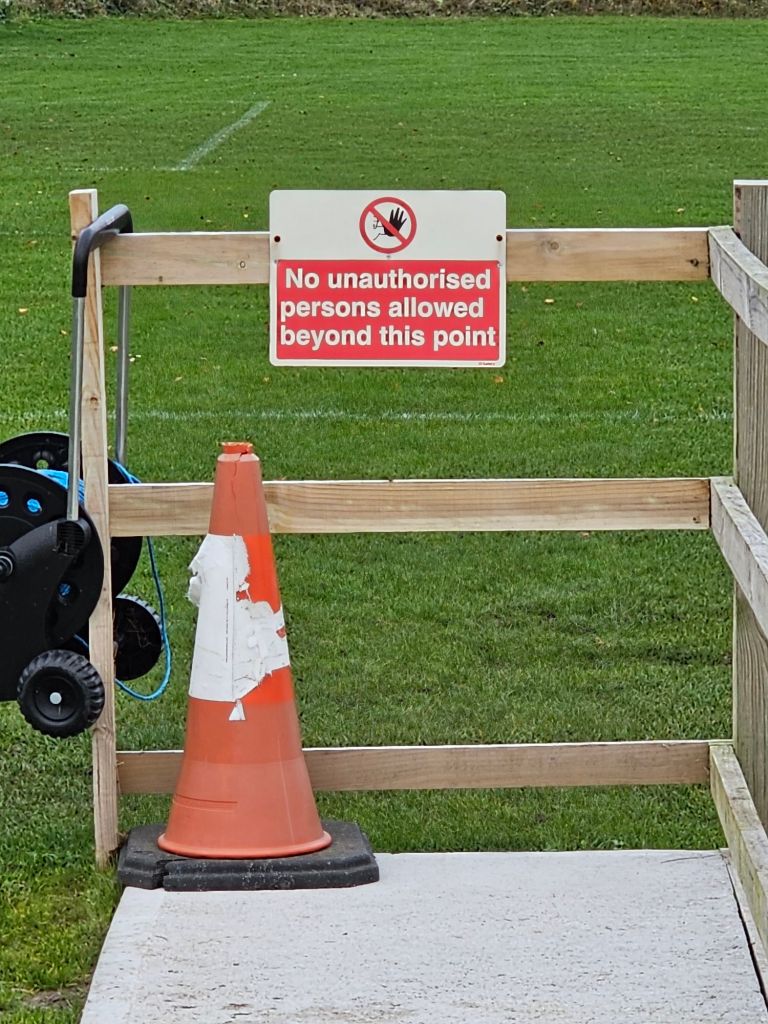
Seven minutes have passed and it’s Rovers who are the team kicking the ball most of the time; their number seven Prince Mutswunguma performs a neat turn and a decent cross which is headed over the Halesworth cross bar.  The pattern of the game is generally one where the long ball is favoured over short passes and two minutes later Mutswunguma blazes the ball high above the Halesworth cross bar.  I stroll along the front of the empty stand between it and the pre-pubescent ultras but remain nervous of hitting my head on the low roof.  I stop close to the corner flag, halted by a sign forbidding further progress and disappointingly preventing me from walking round to watch the game from behind or between the dugouts, where the angst and frequent bad language of the managers and coaches is often as entertaining as the match.   I am nevertheless now in a good position to see Rovers’ desperate claims for a penalty as Mutswunguma tumbles under a challenge from number 6, Ollie Allen and then two more players fall over. “Fucking disgraceful” opines a gruff voice from somewhere, either on the pitch or in the dugouts, but I’m not sure if he means not giving a penalty or having the temerity to appeal for one.

Keen to see the game from as many angles as possible I move again, this time to near the corner flag diagonally opposite the one I have been standing by.  I settle near a man in late middle age who sports a Stranglers t-shirt and beanie hat bearing the name of The Rezillos, the excellent late 1970’s Scottish ‘punk’ band fronted by Faye Fife and Eugene Reynolds.  He is on his mobile phone and seems to be arranging a claim on his motor insurance having hit something when parking his car in the club car park.  In my new position I also benefit from a good view of an increasing number of unsuccessful Halesworth breakaways as the home team gain in confidence from repelling all Rovers’ attempts to score.

In goal for Halesworth, George Macrae has made a string of fine saves as Rovers win a succession of corners.  Rovers’ best effort is a shot from Kyle Markwell, whose surname gives a clue to the opposition as to how to treat him, that whistles past a post.  A half an hour is lost to history and Halesworth fashion another breakaway as captain Toby Payne receives a diagonal pass out on the left.  “He’s on!  He’s on! Well, he’s not off” shouts a young man to my left with rising excitement as Rovers’ offside trap is sprung. Payne advances into the penalty box, shapes up to shoot but then side foots weakly too close to the goalkeeper Alex Archer, who doesn’t have to stretch far to prevent a goal.  Two minutes later however Halesworth break again down the left and this time the ball is pulled back from the by-line for Lewis Chenery to score easily into the middle of the Rovers’ goal from no more than 8 metres out and it’s 1-0 to Halesworth Town.

The remaining dozen minutes of the half repeat the established pattern of the previous thirty-three, and another Rovers’ corner is headed wide, which I view from back near the clubhouse as I prepare to be ahead of the queues for the toilet and the tea bar when the referee, the extravagantly monikered Mr Gasson-Cox sounds the half-time whistle.  Having invested in a pound’s worth of tea I take-up a position for the second half just to the right of the stand, but not before I overhear a club official talking to the man on the gate and learn that the attendance today is a stonking two-hundred and fifty-eight.    As the new half begins and the light fades, the lovely smell of the turf rises up from the pitch. A woman standing next to me tells me we will see the goals at this end in the second half and I agree, telling her that with the goal being scored at the other end in the first half, it figures that this is the end where the goals will be scored this half.  We talk a little more and after I reveal I have an Ipswich Town season ticket, she admits to being a Norwich City supporter, but sympathetically I tell her someone has to be.

With the start of the second half at three minutes past four Halesworth seem to have lost a little of the confidence they showed by the end of the first half, perhaps because they realise they have to go through another forty-five minutes similar to the first, and indeed they do. But with twenty minutes gone and no further score it is Rovers who first feel the need to make substitutions.  “Who are ya?” chant the pre-pubescent ultras, as well they might as the new players emerge from the dugout.  Five minutes later and Halesworth’s Tane Backhouse is the first player to see the yellow one of Mr Gasson-Cox’s two cards, although as I become increasingly biased in favour of the home team and their superb goalkeeper, I can’t really figure out why.  Two minutes later and I’m cheering as another characteristic break down the right sees Toby Payne run to the edge of the Rovers penalty area, cut across a little towards the middle and then shoot unerringly inside the far post and Halesworth lead 2-0.  “Oh when the Town go marching in” sing the mini ultras, as do a number of people old enough to know better, but understandably carried away by the moment.

Things get no better for Rovers as after  an innocuous looking foul Mr Gasson-Cox nevertheless seems annoyed with Prince Mutswunguma and standing his ground, summons him over before showing him the yellow card.  “Wemberley, Wemberley” sing the Halesworth fans who should know better but are now too happy to care, but as they do so Rovers, perhaps realising their desperate position with only ten minutes left embark on a final push.   It’s twenty to five as George Macrae makes another fine save, this time diving low to his left. “Two-nil down on your big day out” sing the pre-pubescents, not helping the situation with their cruel taunts and Rovers win another corner.  The corner is cleared but moments later the ball is crossed low from the right and Rovers’ number eleven and captain Jarid Robson half volleys it high into the centre of the goal from a narrow angle and the score is a nerve-wracking 2-1.

It’s now eleven minutes to five, the match is a minute into added on time and Rovers are besieging the Halesworth goal like local Saxons or Danes outside the Norman police station.  A cross comes in from the left, and a Rovers head goes up diverting the ball goalwards but once again George Macrae appears, seemingly from nowhere to save the day again by cleanly catching the ball.  “Six more minutes Haverhill” I hear a voice call, perhaps from the Rovers’ dugout, or perhaps it was Mr Gasson-Cox or someone just mucking about. Six minutes seems an awfully long time given that neither I nor the lady next to me can recall anyone really being injured.  Another Rovers corner goes straight to the arms of Macrae but then Halesworth break away again, bearing down on goal on the right and then switching the ball across the edge of the penalty box before number eleven Alex Husband shoots from a narrow angle and the ball strikes a Rovers defender and arcs up over Archer the goalkeeper and into the goal off the far post.  It’s 3-1 to Halesworth! The game is surely won and the knot of Halesworth players hugging by the corner flag and the under12’s ultras who have run along behind us hoping to celebrate with them clearly think so.

Very soon however, it’s three minutes to five and finally Mr Gasson-Cox parps his whistle for the last time today and Halesworth are into the third round of the FA Vase. Most people wait to cheer and applaud the team as they leave the pitch, but not before they applaud Mr Gasson-Cox the referee and his assistants, which is something you don’t see every day, and then the Haverhill players too.  It’s been a wonderful afternoon, an exciting cup-tie played in front of a large and appreciative crowd, and everyone’s had a lovely time.  As I leave the ground and make my way back across the stony car park and down Dairy Hill to the station I reflect on what a fine little town Halesworth is and how one day I really should return. All hail Halesworth!

Long Melford 2 Newmarket Town 1

Long Melford is a big village, one of the most appealing and attractive in Suffolk according to Suffolk Tourist Guide.com with, according to Wikipedia, a population in 2011 of some 3,518. Melford, as it is known locally, is just a few miles north of Sudbury, it used to have a railway but since 1967 and the evil Doctor Beeching, the line now terminates at Sudbury. If you want to get to Long Melford by public transport therefore, it is necessary get the No 753 bus from Sudbury to Bury St Edmunds. Like the train service from Marks Tey, the bus service runs hourly, but as this is England the trains and buses are not properly co-ordinated; the train to Sudbury arrives at 13.08 and the bus conveniently leaves at 13:30, reaching Long Melford Post Office ten minutes later. On the return journey however, the 754 bus passes Long Melford Post Office at 17:11 and arrives in Sudbury four minutes after the train has left, at 17:20, so there is nearly an hour’s wait in Sudbury for the next train at 18:16.
Today however, I am driving to Long Melford’s Stoneylands ground because I have agreed to give a lift to a man called Roly, who lives in nearby Borley. I happen to know Roly’s house is within walking distance of Stoneylands because Roly has walked it before, but I was in generous mood when we discussed by text message going to the game and very slightly inebriated.
It is a grey, still, cold winter’s day as I make the twisting, undulating drive through Chappel, home of the East Anglian Railway Museum, Mount Bures with its excellent Thatchers Arms pub, Bures with its large empty bus depot, the edge of Cornard and through busy Sudbury before taking the turn towards the wonderfully named Foxearth. In Borley, Roly’s Victorian cottage home is a scene of domestic bliss; his partner Sarah reclines on the sofa with their young baby Lottie, whilst Penny the dog rolls over at my feet and wriggles excitedly. But I don’t linger, there is football to go to and within

OLYMPUS DIGITAL CAMERA

OLYMPUS DIGITAL CAMERA

minutes Roly and I are bouncing down the pitted, puddle filled private road that leads to the football ground and my Citroen C3 gets a taste of what it must have been like to be a Citroen 2CV carrying a tray of eggs across a field somewhere in the Auvergne.
Getting parked takes longer than it should as the man in the car in front seems to want to park as close to the entrance as possible, which means reversing gingerly and at first unsuccessfully into a narrow space despite the presence of acres of car free space just 15metres away. There is an air of the village hall about Melford’s ground from the

OLYMPUS DIGITAL CAMERA

outside and indeed the club’s nickname is The Villagers. There is no turnstile as such here, just a few metal and plastic barriers herding would be spectators towards a kiosk of the type that used to be at the exit to municipal car parks back before the days of Pay & Display, when a bloke stamped your ticket and took your money as you left. There is a short queue to get in because it takes the

OLYMPUS DIGITAL CAMERA

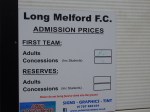
grey-haired woman in the kiosk a little while to root around for change from a plastic tub. A board on the side of the kiosk announces the price of admission, but in reality it’s just a green smudge of felt tip pen; fortunately I’ve done my homework so I know from the club website that admission is £7 including a programme.
Once inside, Roly buys me a bottle of Nethergate IPA (£3.50) in the bar, which is the least he could do after I went out of my way to drive him here, selfishly he gets one for himself too. We drink bottled beer because sadly the hand pump on the bar is covered over with a tea towel, which is very disappointing. The woman serving is struggling for change and asks rhetorically how she is expected to run a bar with a float of just four pound coins. I empty my pockets and find just short of ten pounds in change, which she is happy to exchange for a ten pound note; I’m 40p up!

OLYMPUS DIGITAL CAMERA

We sup our beer in the company of other middle-aged and older men stood around tables as men do in bars, but soon we are aware that the teams are coming on to the pitch. We leave the clubhouse just as the line-up for the obligatory handshakes is dissolving away into the two halves of the pitch. Newmarket Town are the visiting team today and they sit seventh with 53 points from 31 games in the Thurlow Nunn Eastern Counties Premier League table; Melford are 16th with 39 points from 32 games. It’s a clash between a village known for antique shops and a town known for horse racing. I suspect that watching local football puts us firmly outside those two spheres of activity although weirdly I think, there is an advert in the match programme for “Wealth management advice”, whatever happened to plain old financial advice?
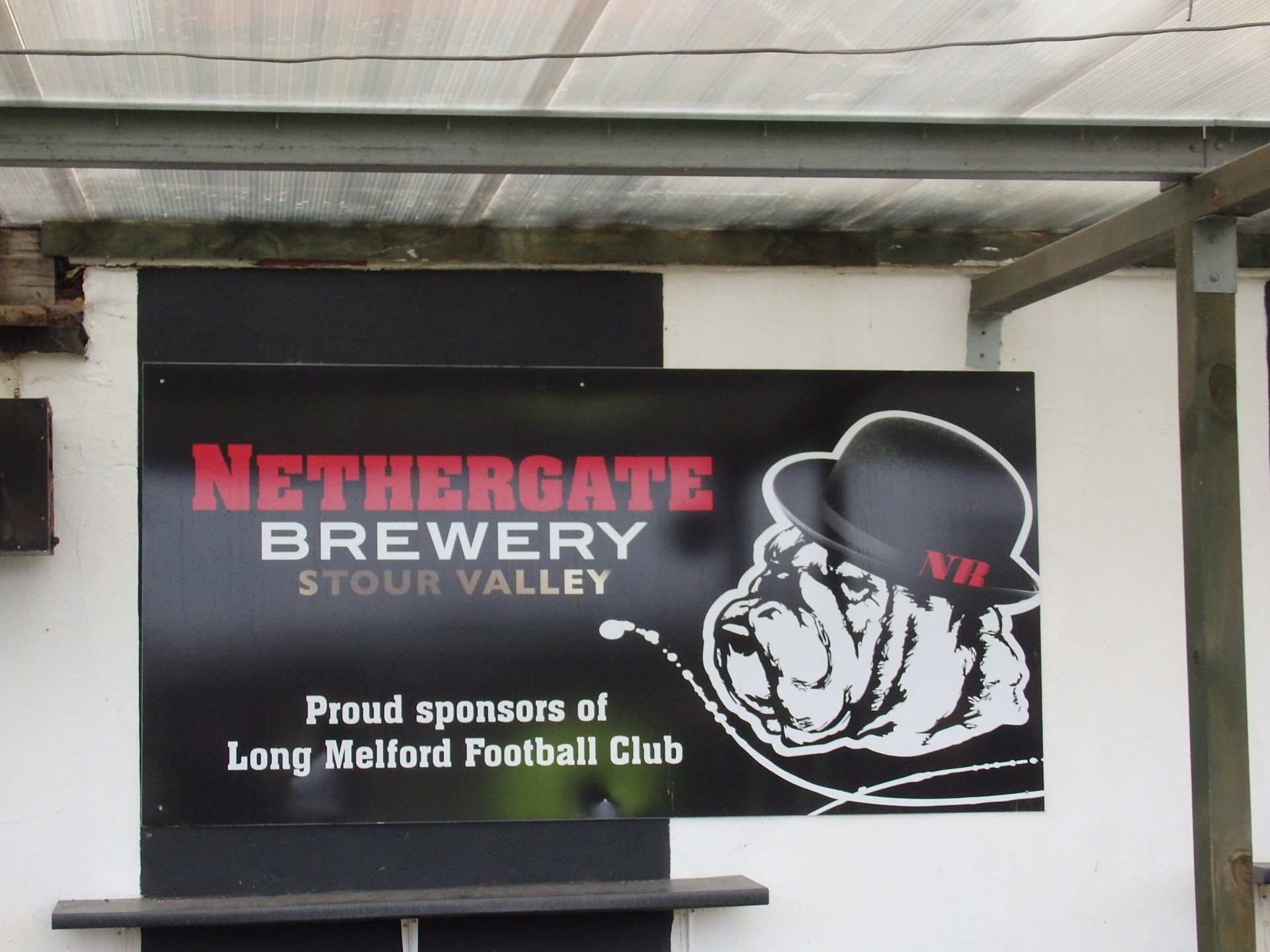
The 1970’s pop blaring from the tannoy stops abruptly as Newmarket, nicknamed predictably as the Jockeys, kick off towards the dull, suburban estate-style houses at the Sudbury end of the ground. Newmarket’s club colours are yellow and blue, but for some unknown reason today they are wearing a rather ugly all red kit with white stripes below the chest, as if they’d brushed their teeth before coming on and dribbled Colgate down their stomachs. Melford play towards the dilapidated wooden fence, shelter and open fields to the north, wearing their signature black and white striped shirts and black shorts. Melford’s kit is embellished with name of the excellent Nethergate Brewery, who have newly built premises at the entrance to the village by the turning to Foxearth.
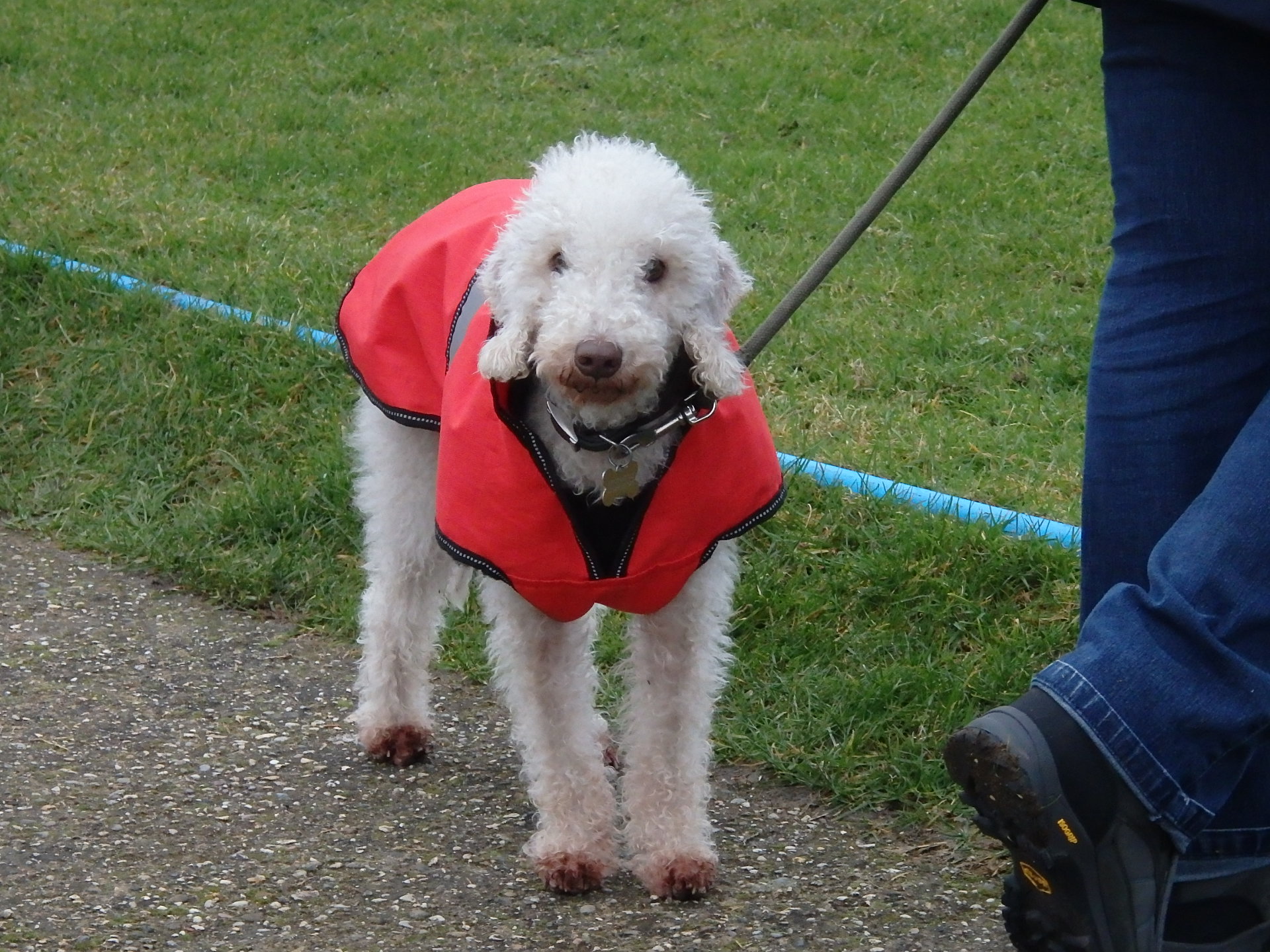
Newmarket start well, passing neatly and getting forward, but Melford suddenly win possession, breakaway and have a shot, and so it continues. Both teams have a lot of players with beards. Newmarket have the ball most of the time, but Melford spring the occasional surprise, getting the ball to their number seven Hassan Ally who is always in the right place, but never quite makes the final telling cross or pass. The Melford cross bar is hit by a header and then at about twenty five past three a long ball to the right is chased down by Lewis Whitehead who shoots across the Melford goal keeper; Newmarket lead and a number of middle aged men cheer unexpectedly. No one in the crowd is wearing club colours but for a Bedlington Terrier in a red coat, so the presence of away supporters is a surprise.

OLYMPUS DIGITAL CAMERA

Half-time arrives and Newmarket would seem to be in control. Roly has already treated

OLYMPUS DIGITAL CAMERA

or ‘tret’ himself, as he would say in his quaint rustic dialect, to a cheeseburger (£3.00) from the food bar which the programme tells us is called Deb’s Diner. The concluding paragraph of the joint managers’ column in the programme says “Whatever happens, we hope you enjoy your afternoon here in Long Melford, get yourself something to eat and drink…” and Roly has clearly taken note. I don’t ask him if it was an early tea or late lunch or just a celebration that his NHS health check during the week had shown him to be a well man, clearly capable of absorbing the ill-effects of junk food, for the time being at least.
We go into the club house again for two more bottles of Nethergate IPA and to catch the half-time scores on the TV and are much heartened that Ipswich are winning 2-0 at Sunderland. The club house is recently refurbished after the roof fell-in last year and there are several marvellous photos on the walls of past achievements such as Suffolk Senior Cup wins. A trophy cabinet contains a couple of old brown leather footballs which impress me more than the cups and trinkets. When there is a cosy clubhouse, half time is never long enough and it’s soon time to re-join the rows of middle-aged men hanging over the rail around the pitch.

This slideshow requires JavaScript.


The second half is not the same as the first, roles are reversed and it is the Villagers who more frequently have the ball at their feet whilst the Jockeys chase about in vain and are pushed back into their own half. For the second half we stand on the opposite side of the ground to the clubhouse near the dugouts and in front of a coniferous hedge, carefullyOLYMPUS DIGITAL CAMERA and neatly cut into a modernist architectural shape; behind the hedge a close-board wooden fence is in places nailed to its thick trunks. In its neatness the hedge is only matched by the Newmarket goalkeeper’s haircut, but is less contrived. There is more noise on this side of the pitch as the coaches of both team teams shout and urge their teams on.
As the game continues Melford dominate more and more and Newmarket are getting tetchy. Whilst there were hardly any fouls at all in the first half, tiredness and desperation and swearing are introducing a new kind of entertainment. A Melford player goes down and the Newmarket number two complains to Mr Pope and anyone who is listening, because Mr Pope isn’t, that Melford have some right prima donnas, although he pronounces it pre-madonnas. Another foul and a free-kick on the edge of the box and then another. Then, whilst Roly is in the toilet, Melford win a third free-kick. Despite referee Mr Pope taking time to book the perpetrator, Roly still isn’t back by the time Ross Waugh scores, apparently with a header, although to be honest it was one of those messy goals and I had lost track of the ball.
There are only eight minutes left and the blokes in trackie bottoms and sports coats onOLYMPUS DIGITAL CAMERA the touchline are visibly tense. The Melford number ten Scott Sloots is hurt and is substituted; as he hobbles off the pitch one or two of his own players seem to be complaining that he is taking his time. “Come on ref, make him get off quicker” I hear. I hadn’t previously realised that there was a point where team togetherness and the will to win would clash. But nevertheless, Melford continue to push forward and in the final minute of injury time there is a run down the left, the ball’s in the box, a shot is blocked and Hassan Ally is in the right place to score from the rebound. Rarely have I seen such elation from a team sixteenth in the league to a winning goal; both coaches burst onto the pitch to celebrate with the team as if this was a most crucial victory. I’m all in favour of making your own fun but this seems to be going a bit far.
To his credit, Mr Pope the referee makes nothing of the exuberance of the Melford coaches and in no time at all the match is over. Roly and I stroll round to the club house to make final use of the toilet before applauding the Melford team from the pitch. It’s been a very entertaining game with a dramatic finale and I’ve made 40p.