Stade de Reims 0 AS Monaco 0

When planning a long weekend trip to France, ostensibly to enjoy a Christmas market, it is important to ensure that there will also be a convenient football fixture to attend, there’s only so much mulled wine, churros and roast chestnuts that one can imbibe after all.  So it is that with Amiens away to Laval and Lille in Marseille, I find myself with my wife Paulene in Reims (pronounced Rance but without really saying the ‘n’), city of Champagne, art deco architecture, Gothic splendour and the place where Clovis, the first king of what would become France, was baptised in about four ninety-seven.  Coincidentally, in two night’s time this very same Clovis will be the answer to a question on University Challenge about which king was baptised in Reims in about four ninety-seven.

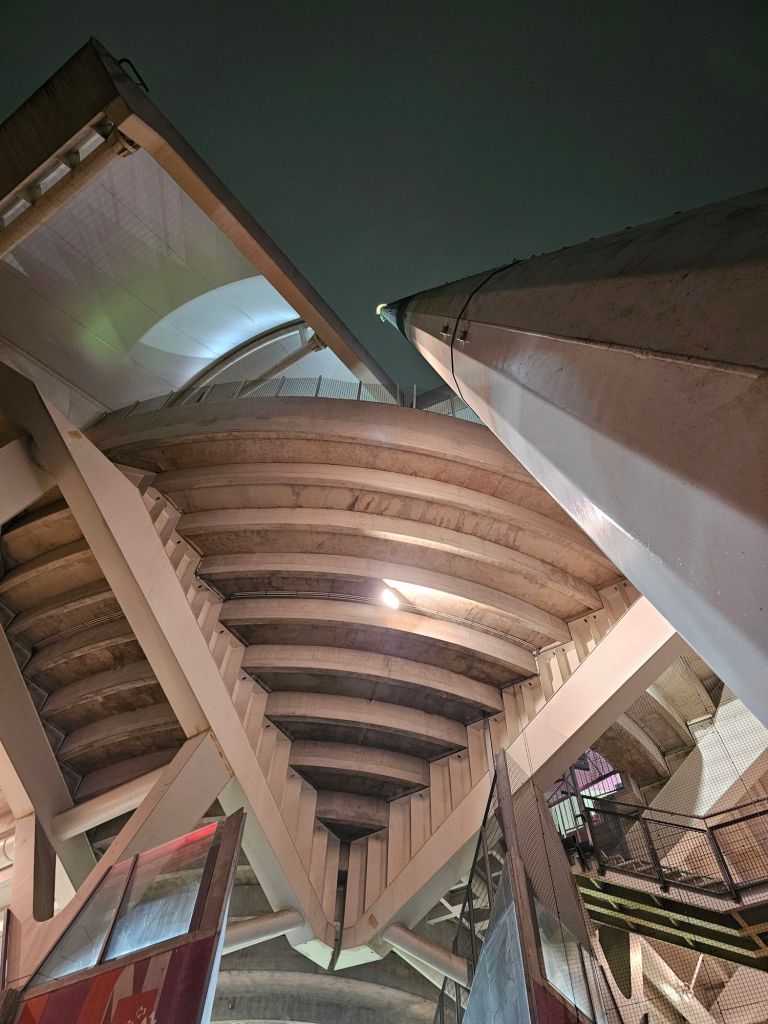
The dramatic concrete shapes of Stade Auguste Delaune, home of Stade de Reims are a twenty-five minute walk from our hotel according to Google maps.  With kick off at 9pm local time we set off well before eight o’clock to allow for my wife’s short legs and asthma, and getting lost.  The last time we went to a match in Reims we caught a tram, but that night our hotel was near a tram stop; tonight it’s not and it’s probably just as well because I don’t think the trams are running, something about an earlier “perturbation” (disturbance) and a “greve” (strike).  It’s a marrow chillingly cold evening, so a walk will keep the circulation going, and it is warmer than it has been during the afternoon, when it rained; an hour away to the north there are reports of snow.

Two of the satisfyingly avant-garde, pointy floodlights of the Stade Auguste Delaune eventually hove into view like a seven or eight centuries late alternative to the Gothic spires that the magnificent cathedral of Notre-Dame de Reims was meant to have, but never did; cancelled like a medieval HS2.  The whole stadium then appears before us as we reach the busy Boulevard Paul Doumer and cross over the Aisne-Marne canal and Voie Jean Tattinger, which run side by side.  Eventually, we reach the stadium and the short queue to negotiate security who pat us down thoroughly. It is strange how at French football matches, despite much tighter security than in England, someone, and often several people, always seem to be able to sneak in some flares or smoke canisters.

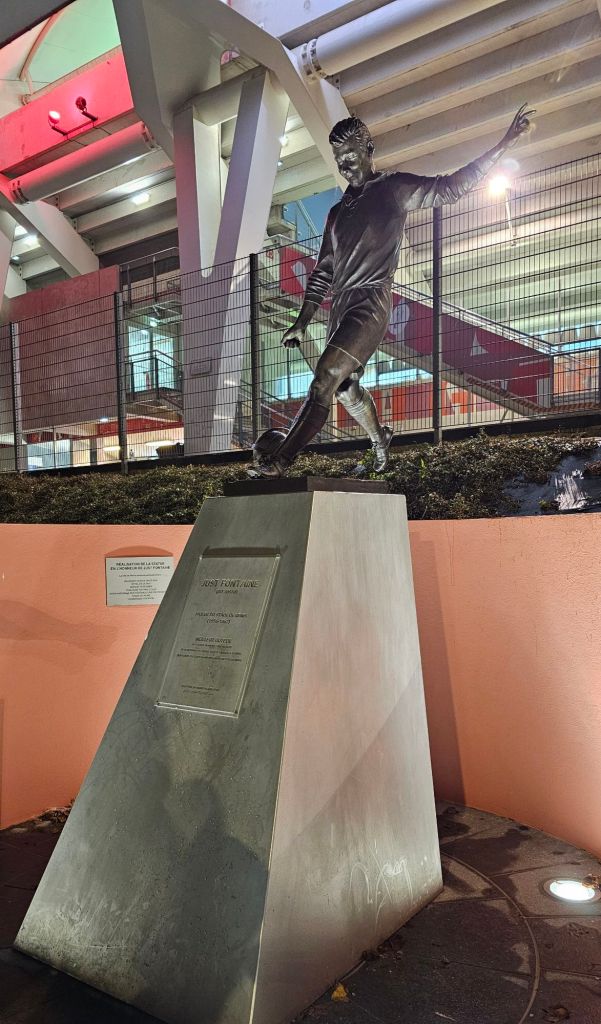
After a brief visit to the club boutique, where I decide 29.95 euros is too much for a T-shirt, we make our way to the other side of the stadium, past statues and murals of Raymond Kopa and Juste Fontaine, who were the French Ted Phillips and Ray Crawford in 1962, to the turnstiles and our seats  (35 euros each) in the  upper tier of the tribune Francis Meano.  We take it in turns to use the facilities and as I wait for Paulene I stand and watch two men looking very pleased with themselves as they drink champagne and photograph themselves at the back of the stand.  Sadly, I haven’t spotted any programmes, and with our tickets being on our phone I will have no memento of this game only memories, unless that is I rip my seat off its concrete base and hide it under my coat on the way out..
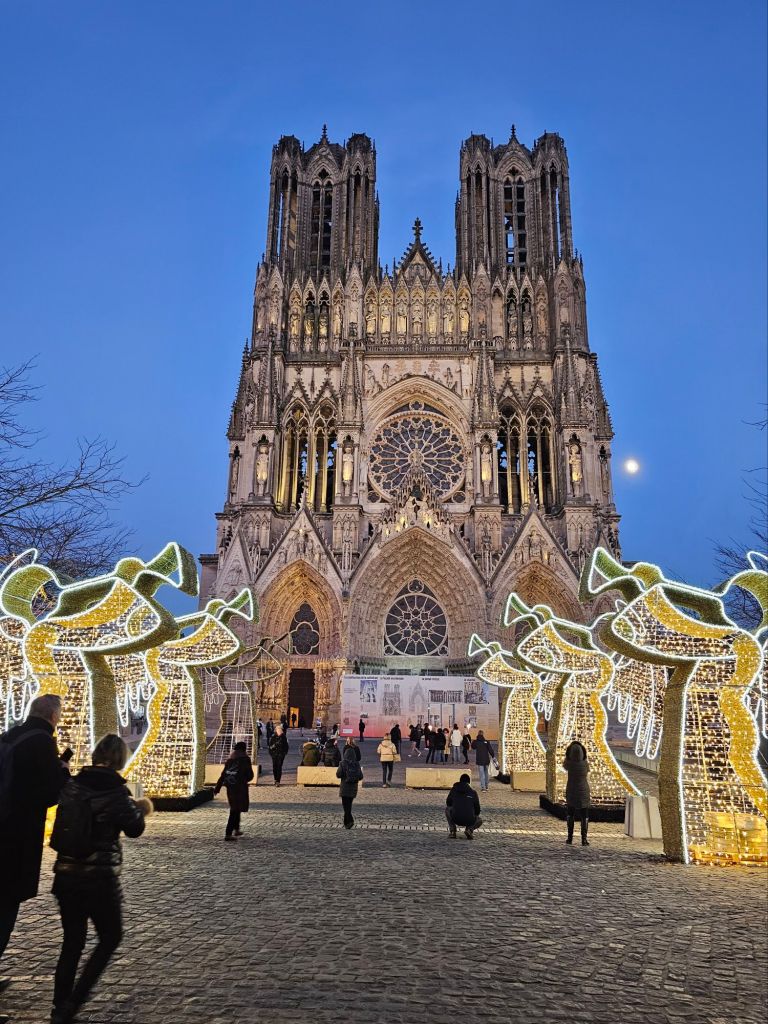
Stade Auguste Delaune is an exciting looking stadium, the work of architect Michel Remon. It was completed in 2008 and is on the site of the ground where the club has always played.  Weirdly however, there is perhaps less to it than meets the eye, as it is skeletal with no enclosed landings or concourses, only the vaulted, cantilevered roofs over the four tribunes.  In contrast to most similar sized English stadiums (21,684 capacity) however, it is a triumph of rakish angles, steps, curves and concrete, not a defeat to painted metal sheeting and tubular steel.

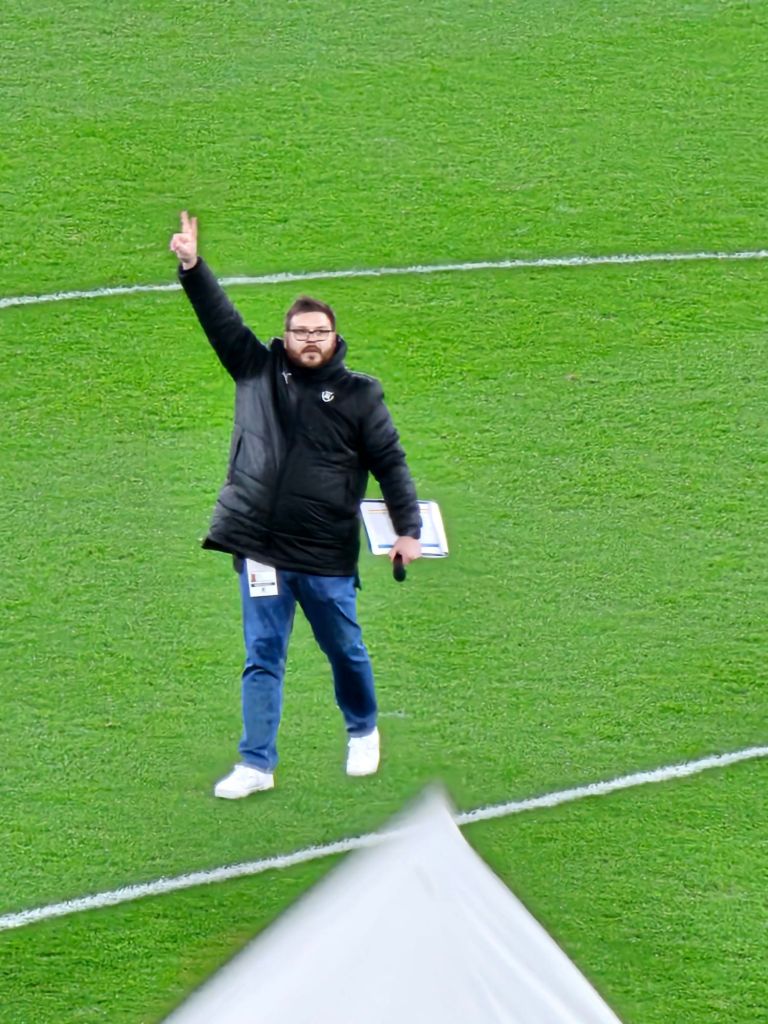
On arrival at the top of the final flight of stairs, we stand a moment to get our bearings and look about to try and spot our seats amongst the lettered rows.  Immediately to our right sits a line of six men and women in late middle age and one much younger male; all of them are, not to put too fine a point on it, very fat.  Like Michel Platini or Zinedine Zidane about to take a free-kick over a defensive wall into the top corner of the goal, our brains and eyes quickly and instinctively make a  calculation and conclude that we will not be able to squeeze past these enormous people to our seats, and nor would we want to.  Instead, we opt for a short free-kick, walking unopposed along the row behind, which fortuitously is completely vacant.  We sit in the seats directly behind where we should be sitting and hope no one has bought them. As  we await kick-off, we take in the sights and sounds of flashing floodlights and a bullish stadium announcer, who although annoying in almost every way imaginable, reads out the first names of the home team wonderfully, providing the perfect cues for the home crowd to bellow the players’ surnames; and what surnames they are, Agbadou, Atangana Edoa and Nakamura to name just three.  Who wouldn’t enjoy shouting those out?

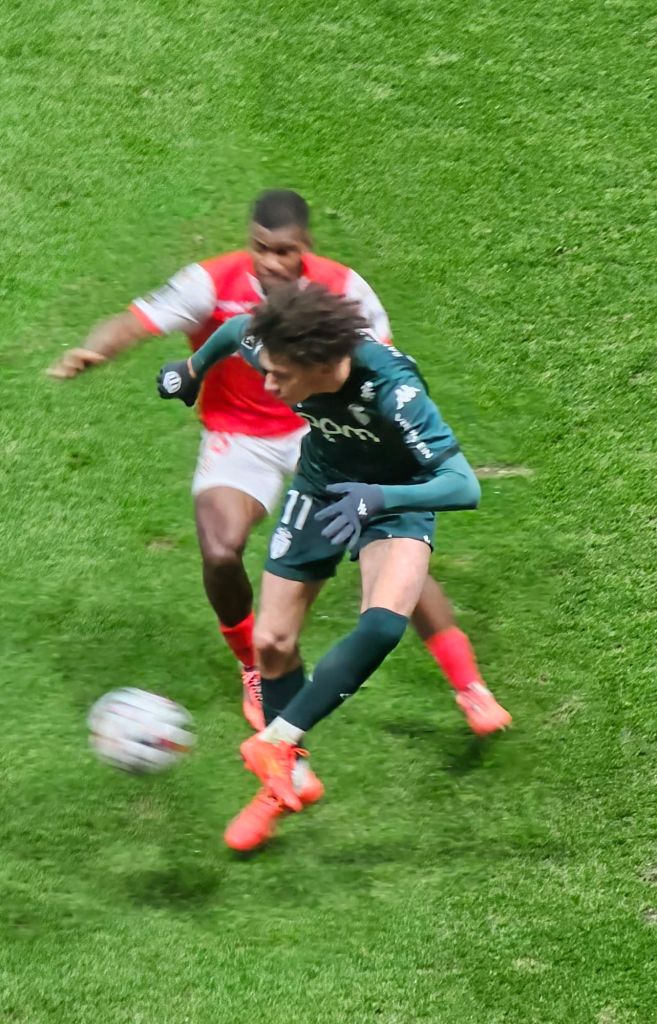
When the game begins it is Monaco who get first go with the ball, aiming it mostly in the direction of the goal to our left, which stands before the tribune Albert Batteux and the turnstiles through which we entered the stadium.  Monaco wear an all bottle green kit, looking like and yet looking nothing like a more chromatically subdued Yeovil Town or Gorleston.  Reims parade in their signature home kit of red shirts with white sleeves and shorts, like a sophisticated Rotherham United, albeit from a city steeped in Champagne and the historic coronation of French royalty rather than scrap metal.

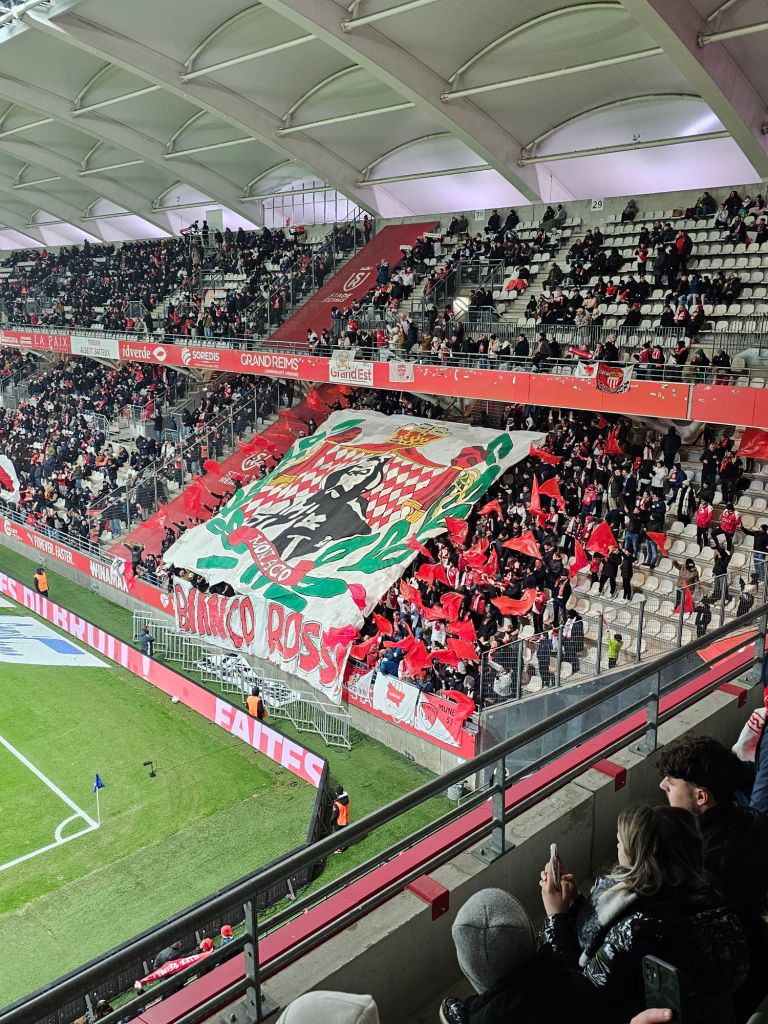
To our right, behind the other goal, but confined to a corner are the Monaco fans, about 900 of them and they are in fine voice, chanting “Monagasque, Monagasque” and “Allez, Allez, Monaco” to the constant rhythm of a drum, the beater of which hardly ever looks up at the match, it’s as if he’s here in a wholly professional capacity, just to beat the drum.  I like to think he’s on the payroll of Prince Albert, the Monagasque sovereign.

Since the game began, the seats to our right have become occupied, the three closest to us being a temporary home to three impossibly smart and neatly presented young people, a man and two women. The man sits between Paulene and the taller of the two women, who is dressed in white trousers over which she wears a long white fur coat; she probably spent more time applying her make-up and doing her hair than she’ll spend at the match.  On the pitch, eleven quite dull minutes pass before the first shot of the game arrives, an effort which goes both wide of and above the goal.  The shot is by the usually pretty reliable Aleksandr Golovin, a player who for some reason I consider to be a Dean Bowditch lookalike.

Golovin’s impressively inaccurate goal attempt will unexpectedly prove to be representative of the whole match and ten minutes later Monaco’s Eliesse Ben Seghir is through on goal but smashes a terrible shot over the cross bar.  Seven minutes after that Monaco’s Takumi Minamino is all on his own in much the same position and succeeds in winning the game’s first corner.  Although hopeless in front of goal, Monaco have been marginally the better side until Reims breakaway, win a corner and Marshall Munetsi glances a header over the Monaco cross bar.  The Monaco supporters continue to chant and sing however, undeterred by a line of half a dozen stewards who cover some of the area in front of the stand , like a sort of human Maginot line, which would inevitably be easily breached if anyone made it onto the pitch.

The descent towards half-time brings the worst miss yet as Reims’ Keto Nakamura appears to be set up perfectly at the far post after a break down the right , only to despatch the ball in almost the completely the wrong direction in the manner of someone who has no idea what he is doing, or if he does, he doesn’t want to do it.   Another type of entertainment is soon provided by Monaco’s extravagantly numbered Soungoutu Magassa (number 88, but still not the highest numbered player on the field) as he is pointlessly booked for tugging at Junya Ito before Ito himself joins the ranks of players intent on blazing the ball as high and wide of the goal as possible.  With the final minute of the half and then added on time, Ben Seghir and Golovin shoot straight at Diouf the Reims goalkeeper and Reims ruin a promising looking  break from defence with an awful cross.

Half-time comes as a welcome break from the frustrating performances on the pitch and the girl in white fur embarks on her own personal telephone photo shoot as she explores how, through pictures she can tell the world of social media that she is at a football match.  In front of us the tubbiest people in the ground all up and leave, presumably for a re-fuel at the buvette; they are joined by another even larger , but younger woman from the row in front of them whose clothes fail to cover up a large expanse of what must be cold flesh where her top was meant to meet the top of her trousers.  On the pitch, we are entertained by three people attempting to kick a football through holes in a sheet hung across the face of one of the goals.   One of them fails to lift the ball off the ground in three attempts, but another scores one out of three, which everyone seems to agree is a decent effort.

At ten o’clock the football resumes and the Monaco fans unfurl a tifo which reads Daghe Munegu, which, if the Monagasque dialect is as similar to the Ligurian dialect as Wikipedia says it is, possibly means something like “Give it a chance”.  Sadly, as to why this makes any sense as a slogan at a football match, I have no idea, but it all adds to the colour, even though on this occasion the words on the tifo are in black type on a white background. Back on the field of play, the pattern of the first half more or less continues as Ito runs down the wing, cuts inside and sets up Diakite to shoot against the cross bar for arguably the best shot of the game so far.

Monaco have improved on their first half display and win three corners in quickish succession as the first hour of the match slips away into history.  Just to prove his increased commitment Kassoum Ouattara also gets himself booked.  The increasing cold is penetrating deeper into our bones and Paulene puts a blanket over her knees whilst the seats directly behind us are filled by teenagers who all seem to be supporting Monaco, as does the young woman in the white fur, who has begun squealing excitedly when Soungoutu Magassa gets anywhere near the ball.  In front of us, the weight watchers on a night out have returned to their seats and have colonised the places that are really ours, with buttocks straddling two seats at a time.  Monaco are the first to make substitutions, perhaps as the team of whom more is expected because they sit second in the Ligue 1 league table to Reims’s middling ninth.
The final twenty minutes witness a Reims corner which is headed away, but otherwise it is Monaco who come closest, but never particularly close to scoring.  Minamino gets past a defender only to shoot wide, substitute Elio Matazo scoops a shot over the bar and Ben Seghir shoots high too.  But it’s all grist for the Monaco fans who happily  sing  “Na Na, Nana, Naa, Naa, Wey hey hey, Monaco” to the tune of the 1969  single “Na na, Hey hey, Kiss him goodbye” by the made-up band Steam.  In the final ten minutes Henrique and Minamino add to the catalogue of missed goal attempts for Monaco and in time added on play ebbs back and forth in vain, whilst the young woman in the white furs, and her friend continue to yelp and shriek.  The final whistle confirms what had become increasingly likely, that neither team would score.  As we go to leave, the young man raises his eyebrows and possibly almost rolls his eyes. I’m not sure if his gesture is made in reference to the game or his accomplices, or all three.

The walk back to the hotel will prove to be long, cold and gently uphill,  and there still won’t be any trams.  As enjoyable as tonight has been tomorrow evening I think we’ll go back to the mulled wine, churros and roast chestnuts.

Paris St Germain 2 Les Herbiers 0

For an Ipswich Town supporter FA Cup ties have become something of a rarity, and more than that, a disappointment. Despite winning the FA Cup itself, albeit forty years ago, (incidentally, only thirty-six of the current ninety-two league clubs have ever won the Cup, and Norwich City are not one of them) Town have failed to honour their past and have not even won an FA Cup tie since 2010, when they triumphed away at Blackpool. Starved of cup glory therefore, the opportunity to go to the final of the French equivalent of the FA Cup, the Coupe de France, is not to be missed. This year the final tie is between the current holders Paris St Germain and Vendee Les Herbiers Football (VHF) a semi-professional team who currently play in the Ligue National, the third tier of French league football. Francophile that I am I ‘signed up’ for e-mails from the Federation Football Française (French Football Association) a couple of seasons ago and my wife, who I shall introduce to you by name shortly is on Paris St Germain’s e-mailing list, so we both received invitations by e-mail to buy tickets for the final. For just 19 Euros each, yes, 19 Euros, about £16.50, we have tickets at the Stade de France for the show piece, end of season finale. I have paid more this season to watch Colchester United versus Morecambe.
My wife, Paulene and I arrived in St Denis in the north of Paris at lunchtime and from

OLYMPUS DIGITAL CAMERA
Basilica St Denis

our hotel room at the Novotel it is possible to see the Stade de France in one direction and in the other the Basilica Cathedral of St Denis, where nearly 1,600 years-worth of French kings and queens including Clovis, Dagobert, Catherine de Medici, Louis XIV, Louis XVI and Marie Antoinette were all buried. As if that is not enough this is considered to be the building where in the twelfth century all the elements that make up Gothic architecture were brought together for the first time; it is a most beautiful building of remarkable historic significance.

After a leisurely visit and a picnic in the nearby Parc de Legion d’Honneur we rest up back at the hotel before making the short walk to the Stade de France. In the hotel lobby Les Herbiers supporters are checking in and making use of the bar.
Today is the May 8th, a national holiday in France marking the liberation of the country from the Nazis in 1945; it is a glorious sunny day with temperatures up in the mid-twenties; one digital display says the temperature is 35 degrees but I’m not sure I believe it. Our approach to the Stade de France is at the end of the stadium where there is a sea of Les Herbiers supporters of all ages dressed up in red and white. Les Herbiers is just a small town with a population of about 16,000 situated in the Vendee department, some 50 kilometres south east of Nantes and almost a four hour journey by road from Paris. Today Les Herbiers and a good few places all around it must be completely empty.
Last night on French TV sports journalists were debating whether this cup final between Paris St Germain, with an annual budget of 340 million Euros, and a semi-professional third division team with an annual budget of 2 million Euros was a good thing or not. Seeing the excitement and joy on the faces of the Les Herbiers supporters leaves me in no doubt that it is a good thing. It does not matter that it is the final and it is a mis-match. Paris St Germain will win because they now win everything, but it will still be the show piece event of the season and both sets of supporters will love every minute of it; also in the scheme of things it doesn’t matter much because there will be another cup final next year, and another the year after that, provided Donald Trump hasn’t finally caused Armageddon.
Security at all the bigger French football matches is reassuringly tight and once patted down we head up the ramp to the concourse that surrounds the Stade de France, a stadium that feels much more spacious and is much more beautiful than Wembley, although it is now twenty years old. Unable to resist acquiring souvenirs of the day, I buy myself a T-shirt (20 Euros) and Paulene a scarf (20 Euros) for which Paulene also learns the French, which is écharpe. There is a while to go before kick-off at five past nine so I get into the spirit of things joining the Les Herbiers supporters with a pint of Carlsberg (8 Euros), the price of which makes me feel that the T-shirt and scarf were massive bargains and I should buy more of them, but I don’t. The beer comes in a re-usable plastic “eco-cup” (2 Euros) of a type seen at many French stadiums and makes me feel much better in the knowledge that even though I have been robbed blind I am helping save the planet. Paulene has a bottle of water (3 Euros).
Paulene is keen to get in the stadium to watch the warm ups and pre-match

OLYMPUS DIGITAL CAMERA

entertainment and because she is a chronic asthmatic and will need to recover from the long climb to our seats. For Paulene visits to large stadiums such as Marseille’s Velodrome and the Stade Felix Boleart in Lens have in the past come with near death experiences after ascending staircase after staircase after staircase on a sort of stairway to Heaven. Whilst Paulene climbs, I callously hang around outside, slowly drinking my beer, savouring it as best I can and soaking up the ambiance with smiling, excited and inebriated French people. Eventually I head for the turnstile where I must show both my ticket and passport, the French show their identity cards. The steward seems pleased to see a “Rosbif “ and summons up his best English to say “Welcome”, which is nice. Inside the stadium I am patted down again and wished bon match before being offered a complimentary Pitch choco barre courtesy of a promotion by Brioche Pasquier an industrial French bakery whose products can be found in English supermarkets too.
Our seats are in the third tier of the stadium but are not together, Paulene sits in the second row from the front whilst I am another three or four rows back and off to the right. As I arrive at my seat, on the pitch the final ten minutes of the French FA Youth

This slideshow requires JavaScript.

Cup for Under 19’s, the Coupe Gambardella, between ESTAC Troyes and Tours FC are being played out. Troyes are winning 2-1 and hang on to lift the trophy amidst scenes of much excitement and generous appreciation for these young players. Although fully professional, Troyes and Tours are relatively small clubs, but in France this is no barrier to producing successful youth teams, a fact illustrated by Auxerre, a town a third the size of Ipswich having won the Coupe Gambardella a record seven times. I sit on the steps next to Paulene and after the presentation of the trophy and ensuing celebrations we watch the stadium gradually filling up until the steward just in front of us asks me to take my seat.
We are amongst the Paris St Germain supporters, although the hard core ultras are in a seemingly dedicated area in the lower tier where a platform is positioned in front of

them for the use of the two ultras who will lead and orchestrate the chanting. On the pitch the preparations are being made for the start of the final of the Coup de France and the celebration of French football that this represents. The teams warm up; the PSG players looking comfortable and familiar with the huge stadium, the Les Herbiers players looking slightly in awe of the setting and the vast numbers of their own supporters decked out in red and white; their home crowds in the Ligue National average about 1,300. Les Herbiers wear simple hi-vis jackets over their red tracksuit tops and look every bit the modest, provincial club that they are. The players warm up in a corner in front of their fans as if at a much smaller ground.
At last the scene is set and amidst two teams of drummers behind each goal, four separate formations of flag wavers, a huge circular FFF Coupe de France logo and two similarly massive club badges that all look like they could be used by the fire brigade to catch people jumping from high buildings, a marching band in French blue trousers with tunics decked in gold braid, a suspended image of the Coupe de France trophy and pitchside pyrotechnics the teams emerge from the tunnel. I join in as best I can with the singing of the Marseillaise, which is truly glorious and then the teams are introduced to President Macron who is roundly booed. I exchange amused smiles and raised eyebrows with the white haired bearded man stood next to me who admits he is not really a football fan, he prefers rugby and has just been brought along to the game by his two friends; he is however supporting Les Herbiers and so am I. It’s all absolutely brilliant and the game hasn’t started yet.

This slideshow requires JavaScript.


We sit and Les Herbiers kick off the match wearing all red and playing towards central Paris, the Arc de Triomphe and the Eiffel Tower; PSG are in their usual all navy blue kit and kicking towards the Cathédrale Basilique St Denis. Les Herbiers start well and within two minutes Joachim Eickmeyer breaks down the left, crosses the ball and Sebastien Flochon’s shot is deflected wide of the goal resulting in a corner from which Valentin Vanbeleghem shoots wide from some 25 metres out. The white-haired man and I applaud conspiratorially. But it doesn’t take long before PSG have two shots from Giovanni Lo Celso and Kylian Mbappé that hit a Les Herbier goal post, the second shot defying physics as its angle of incidence blatantly fails to equal its angle of reflection, instead the ball just bounces right back at him.
Satisfyingly for my white haired friend and me it is PSG’s Yuri Berchiche who is the first player to be booked by referee Mikael Lesage. But such events become crumbs of comfort as PSG predictably dominate and miss chance upon chance with Lo Celso again hitting a goalpost with a shot , although Les Herbiers are in fact playing extremely well, they’re just not as good as PSG. The Ligue National team do not ever resort to aimlessly booting the ball away in blind panic, but always attempt to play the ball from defence by passing it, certain Ipswich Town defenders could perhaps benefit from some coaching from Les Herbiers’ Stephane Masala; does he know there is a job going? He is perhaps one of the few successful managers of a lower league club not so far linked with the job.
Off the pitch, the far end of the stadium is a noisy, constantly choppy, but joyous sea of red and white flags, even when on 26 minutes Giovani Lo Celso surprises me at least by scoring with a low shot from the edge of the penalty area to inevitably give PSG the lead. PSG continue to dominate play but still only lead 1-0 at half-time, when I pop downstairs to buy a bottle of Evian (2.50 Euros) for Paulene.
The second half picks up where the first left off, but for the usual change of ends. Within five minutes it seems PSG have scored again as following a sequence of remarkable deflections and rebounds Mbappé sends the ball into the goal net. The PSG fans and ultras have celebrated the ‘goal’ but apparently under false pretences as following some sort of video conference at the side of the pitch Monsieur Lesage disallows the goal and awards Les Herbiers a free-kick. It is the first time I have witnessed the use of video technology at a match and it feels very odd because of the hiatus it creates; I don’t like it, it doesn’t feel right, although my neighbour and I gleefully cheer the decision nevertheless.
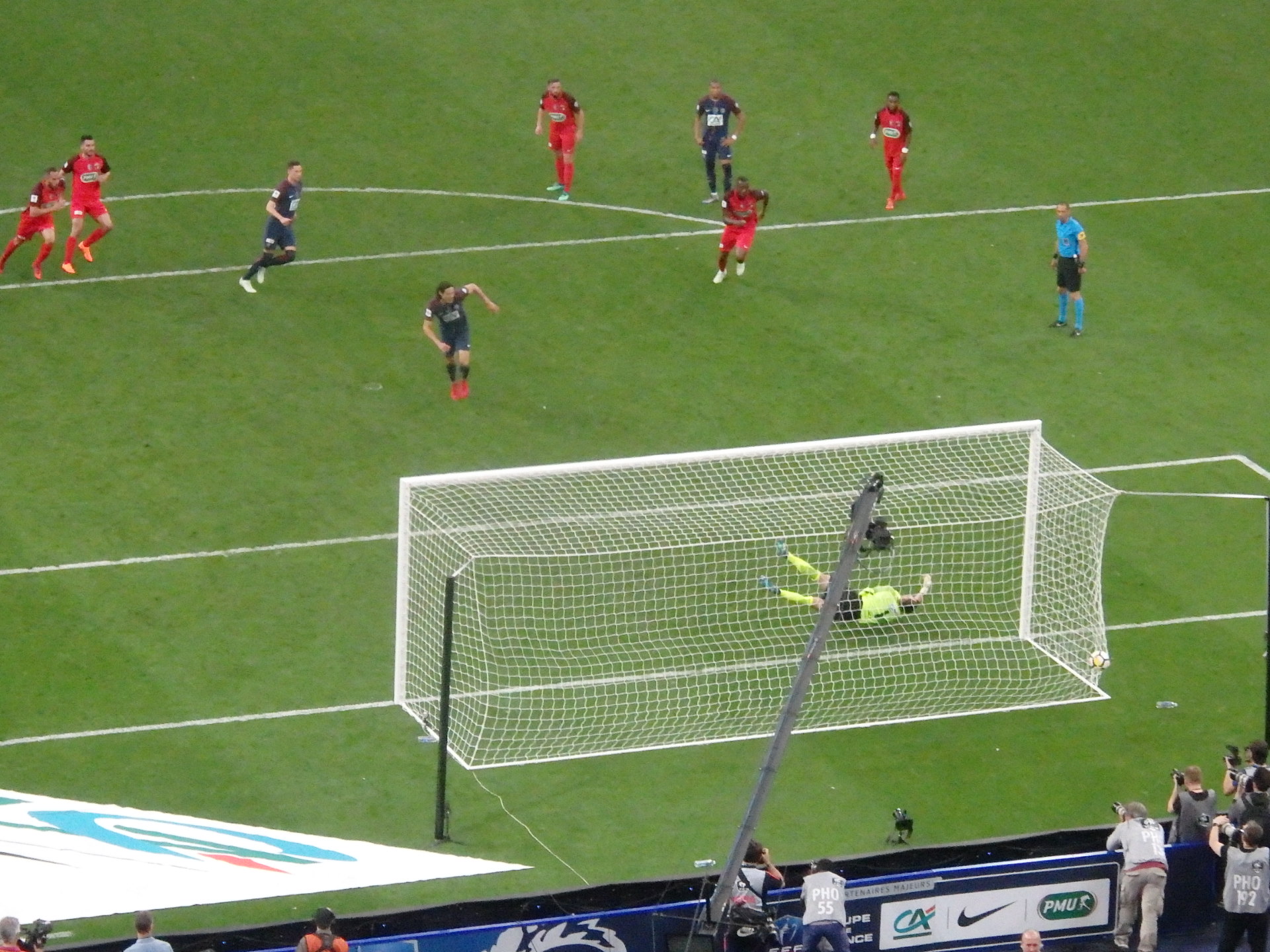
PSG probably dominate the second half more than ever and despite some fantastic saves from Matthieu Pichot in the Les Herbiers goal it eventually all becomes too much and a bit after twenty five to eleven he can’t help but knock over PSG’s Edinson Cavani who

OLYMPUS DIGITAL CAMERA

scores from the resultant penalty. Pichot is booked by Monsieur Lesage for his efforts but shakes his hand to acknowledge his mistake and show he has no hard feelings; what civilised people the French are.
PSG come close to scoring again more than once in the final minutes but pleasingly Les Herbiers have a late flourish too and both Diaranké Fofana and then substitute Clement Couturier almost beat PSG goalkeeper Kevin Trapp with a snap shot and a run into the penalty box. Finally, after five minutes of time added on however, Monsieur Lesage calls time on the 101st final of the Coupe de France and PSG have won it for a record 12th time. No one seriously thought they wouldn’t, but some of us hoped.
After an overlong wait, the presentation of the trophy follows with much jumping about and littering of the pitch with red, white and blue fluttery material. A massive scrum of photographers surrounds the players who are barely visible in the unseemly melee and the players make their way to the ultras to thank them for their support and to celebrate together. Nobly the vast majority of Les Herbiers supporters stay on to watch also; this is all part of their big day out. With their celebratory juices running dry the players leave the pitch which is covered by protective sheeting in preparation for the finale to the finale a display of fireworks, lights and lasers which says thank you to the 7,160 clubs who entered the Coupe de France this season, almost ten times the number that enter the English FA Cup. Reminders appear on the scoreboard of when the last metro trains leave the two nearest stations to the stadium.

This slideshow requires JavaScript.


The fireworks display is a fitting end to the evening, although Paulene and I actually thought the one put on by Lille Olympique at the end of their final league match last season was better, but we can be picky like that sometimes. It has been a terrific night for PSG, the Coupe de France, French football and most of all Vendee Les Herbiers Football and its supporters and we didn’t half enjoy it too. Vive La France!

41413999984_572310fba9_o