Meudon AS 0 St Ouen L’Aumone AS 2

Today is the last day of September, my wife Paulene and are staying in Meudon on the edge of Paris, and having enjoyed both professional Ligue 1 and Ligue 2 football in the past week and a bit, watching both Paris FC and Paris St Germain, this afternoon we are getting down with the French equivalent of ‘non-league’. Not much more than ten minutes away by car at the Stade Georges Millandy in Meudon Le Foret (twenty minutes by bus service No 289) is a Coupe de France fourth round tie between Meudon AS of the Ile de Paris regional league Division 3 and St Ouen L’Aumone AS of the Ile de Paris regional league Division 1. These leagues are the 6th and 8th levels of the French football league ladder, although probably not directly comparable to those levels in the English non-league ‘pyramid’.
The parking at the local community sports centre, where the match is to take place is full, so we park our trusty Citroen C3 around the corner in Rue Georges Millandy between large blocks of modern apartments. We are not sure exactly where we are going, but the Federation Football Francais (FFF, the French Football Association) website says this is the where the match is taking place and having walked through a corridor in a sports hall we find ourselves next to an artificial football pitch. There is no turnstile and watching this match is free. A bunch of blokes in tracksuits sit outside a portacabin eating baguettes and drinking coffee. In my exquisite school boy French I ask if this is this is where the Coupe de France game is taking place at 2.30; I am relieved to learn that it is, and flattered that the man I speak to recognises the Ipswich Town crest on my T-shirt. I explain that I am a fan and not from the club itself, but we both quickly make the connection that Ipswich’s Under 18 player Idris El Mazouni is from Meudon. I will later discover that I have been talking to Idris’s dad.
The Stade Georges Millandy is not a stadium as we might understand it in Britain, because it has no stands; it’s just a 3G synthetic pitch with dugouts and a metal fence, overlooked by five or six large, shiny white apartment blocks.

This slideshow requires JavaScript.

It wouldn’t make the grade for the Thurlow Nunn Eastern Counties League, although in truth the playing facilities are better than at most clubs in that league. It seems quite new, is in good condition and is the sort of installation that a town the size of Ipswich should probably have at least ten of. Given that these pitches are not cheap to install it is doubly impressive that the surface extends beyond the actual pitch to the area around it, with a mini pitch and goals in the space behind one goal. A game (possibly Under 15s) is

just finishing with a penalty shoot-out and I return to the portacabin, which is a sort of club house and buvette, to get two cups of green tea and a Kit-Kat (all 1 euro each); the tea is poured from a huge pot. On one wall is a large array of trophies won by all age groups within the club.

Paulene and I wander around the pitch as we drink our tea and I scoff a Kit-Kat trying to remember why Nestle products were boycotted and if they still should be; too late now, I have become complicit in their multi-national nastiness. It is a beautiful, bright sunny

45013661531_f3c54472c1_o

afternoon beneath a clear blue sky and the gaze of those shiny apartment blocks, which cast no shadows on one another or the pitch; this has to be how Le Corbusier imagined La Ville Radieuse.

A man in a loosely belted gabardine raincoat appears; if he was wearing a trilby hat he could have stepped from a 1940’s film. He sports a bright arm band which adds to the look, but in a slightly sinister manner; he is however the délègue principal, the FFF official who
43201967200_10152fe2e5_o

will oversee this afternoon’s game from the side lines. Out of the blue one of the spectators walks up to me and shakes my hand. In due course the two teams emerge from their respective changing rooms and walk through the metal gate onto the pitch before lining up side by side, then in a line before shaking hands. Introductions between the referee and players and délègue principal are made all-round, before the game kicks off about five minutes late (it was advertised as a 14:30 kick–off) with St Ouen having first go with the ball, aiming at the goal in front of the buvette. Meudon kick in the general direction of far off Stade Charlety and the 13th Arrondissement. St Ouen wear an all-green kit, whilst Meudon are all in red; neither club has its club crest on its shirts but instead bear the logo of the FFF with its cockerel.

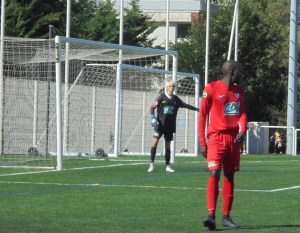
St Ouen quickly win a free-kick as their tricky number nine goes down under a challenge; he gets up to send a neat free-kick over the red wall of Meudon, but into the arms of the very young looking Meudon goalkeeper, who strangely is one of the smallest players on the pitch, a sort of French Laurie Sivell. It is also St Ouen who have the second serious goal attempt, again a free-kick, but this time firmly hit from a wide position by their number ten. Once again the goalkeeper, whose blond hair may not be its original
30077406907_10dcb243ea_o(1)

colour, saves, batting the ball away for the first of five corners that St Ouen will win this half. Most of these corners are either poorly taken or all the St Ouen players are waiting for the ball in the wrong places.
Meudon are very competitive and the game is played at a fast pace with the emphasis on passing rather than just getting the ball forward by the fastest route. Meudon come close to scoring a bit before three o’clock as their huge number eleven breaks through on the left. The St Ouen goalkeeper, who incidentally reminds me of St Etienne ‘keeper Stephane Ruffier on account of his designer stubble and very short dark hair, and is possibly the second smallest on the pitch, dives at his feet. The ball rebounds to the Meudon number seven whose goal-bound shot is headed away at improbably close range.
Meudon seem to be growing in confidence and their number ten does a few feints and jinks over the ball like a footballing Michael Jackson (Bubbles’ friend, not the one who played for Tranmere and Shrewsbury) might have done. There are a few jeers and within the next twenty seconds his ankles are swept away from beneath him by the St Ouen number three as he goes to dribble down the right touchline. It’s one of those situations that some people would try to excuse by saying that number ten had been ‘disrespectful’, but that’s just a modern buzzword, a sort of false political correctness and it is tosh; I blame Eastenders. Football is a game of skill, and dumping someone on their bum shows little ‘respect’ itself. Referee Monsieur Charly Legendre doesn’t see fit to book anyone either way.
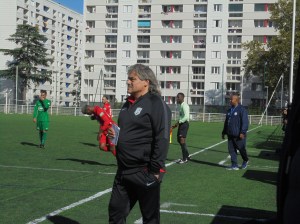
The coaches on the side lines are animated, “Parlez –vous” one calls urging his players to talk to one another. The St Ouen coach, a portly man in his fifties sports a fine mullet and
43201968530_160c2105a2_o

has the look of Maradona about him. The Meudon coach becomes involved in a prolonged discussion with the linesman Mefa Bakayoko about an offside or a free-kick which has been and gone and so no longer matters. On the field, the St Ouen number ten sends a free-kick solidly over the cross bar whilst Meudon’s number six comes as close as anyone else with a long range shot that goes wide. St Ouen’s number nine is proving industrious and creates a couple of shots for himself, one of which is well saved and Meudon replace their number three with substitute number thirteen. Half-time arrives and Paulene and I look back on a good but slightly frustrating forty-five minutes, which was too tight to be really entertaining. I head for the buvette to get a bottle of water (1 euro).
During the half-time break we stand about and as a man walks by he shouts “Ipswich!”. We could do with that sort of enthusiasm at Portman Road. As I stand I enjoy the
44294420204_39f8378ac4_o

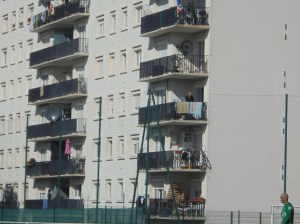
contents of the many balconies that overlook the pitch from the surrounding apartments. Bikes, mattresses, plants and drying clothes decorate the bright white buildings and on one corner is a tricolour, perhaps left over from the summer’s World Cup win. As the afternoon wears on more people seem to arrive to watch the game and by the end I estimate that at least one-hundred people are here.
The délègue principal oversees the away team leaving their dressing room by a side door to the sports centre building and heads back to the pitch still wearing his gabardine raincoat, although it’s a warm afternoon; he is perhaps the anti-thesis of the banker in The Beatles’ Penny Lane and also feels as if he’s in a play, or a British TV sitcom. The bearded referee begins the game again and St Ouen soon win their sixth and seventh corners of the game, although in between their number eleven also shoots over the cross bar. At about four o’clock the St Ouen number eleven breaks forward through the middle, stretching the Meudon defence before playing a through ball to number ten who slips the ball inside the near post past the ‘blonde’ goalkeeper; St Ouen lead 1-0.
They may be losing and disappointed to be doing so, but Meudon still pose a threat and a good run and cross from number eleven meets the thigh of number seven just a few yards out, but he can’t direct the ball past the goal keeper. The first booking of the game goes to Meudon’s number two and the game enters a tetchy stage where it seems it could flare up at any moment. As at most French football matches I have seen where this happens however, there are only outbreaks of animated discussion between the players, but the referee stands back and let’s this carry on. It’s a civilised approach which may reflect the character of a country that has produced far more philosophers than England has produced ‘World Class’ footballers.
St Ouen are buoyed by their goal and their bearded number three controls a ball beautifully on his chest before advancing down the flank. The lads watching near us jeer at his skill and nickname him Fekir, and they’re right to do so because he does vaguely resemble the French international. But Meudon are not beaten yet and the large number eleven strides past a couple of St Ouen players before playing a through ball to number twelve who either wasn’t paying attention or the pass wasn’t as good as it looked. Paulene and I belatedly realise that the number twelve has replaced the number seven, who we had thought was Meudon’s best player.
St Ouen almost score a second goal as their number nine diverts a cross from ‘Fekir’ the wrong side of the post from close range, but the game is becoming more scrappy and there are more fouls. The Meudon number ten spends more time than most not being upright. St Ouen win an eighth corner and as a passage of play ends Monsieur Legendre calls over Meudon’s number nine and ‘Fekir’ and books them for a mystery offence that neither Paulene or I saw. It is now gone half past four and we are witnessing time added on as St Ouen’s number eight runs down the right and then pulls the ball back across the penalty area for substitute number fourteen to side foot beyond the small, blond goalkeeper into the far corner of the goal. St Ouen L’Aumone AS is the name that will go into the draw for the 5th round of the Coupe de France.
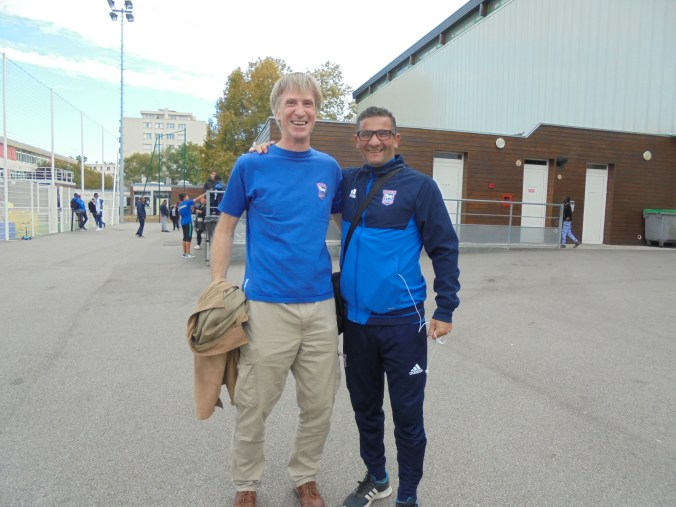
It’s been a reasonable game although not an exciting one in terms of goalmouth action. We turn to leave and Paulene notices a man with an Ipswich Town crest on his coat; I speak to him and it turns out he is the father of a second player from Meudon AS who is now in Ipswich Town’s Under 18 squad, Lounes Fodil.
44294397894_dca5642a04_o

Lounes’s dad, who is called Mustapha (apologies if the spelling is wrong) is a lovely bloke and is genuinely pleased to meet us and invites us for a coffee in the buvette. Our conversation probably isn’t the best as neither our French nor Mustapha’s English are fully fluent, but Mustapha gets across his philosophy of football; it’s a game of skill and intelligence not brute strength. He’s been to Portman Road and has noticed the glum atmosphere, which he attributes to the dull football. Whilst we are at the buvette some of the players come in for post-match drinks and snacks, one of them (I think it might have been the big number eleven or the captain) tells me Lounes is a good player. I tell him that’s good news because Ipswich Town really needs some good players; before he leaves he shakes my hand. The man who I first spoke to when we arrived comes to the bar counter and gets out his mobile phone before showing us a montage of clips of Idris El Mizouni playing for the Under 18’s, this is when I discover that this is Idris’s dad.
After a good half an hour or more we have to leave and walk from the ground with Mustapha who leaves us his phone number and invites us round to eat; sadly Paulene’s food intolerances and allergies will make that too complicated. We thank Mustapha and say how good it has been to meet him. Hopefully we will see him again.

This slideshow requires JavaScript.

Halstead Town 2 Fire United 1

Had today’s fixture in the Thurlow Nunn Eastern Counties League Division One South been played at pretty much any time between April 1860 and January 1st 1962 I could have travelled to it by train. However, thanks to the evil Dr Beeching I am making the twenty minute journey to Rosemary Lane Halstead by Citroen C3. It’s not an unpleasant twenty minute drive on a bright, September afternoon along the winding and undulating rural roads of north Essex, through Earl’s Colne with its three pubs and finally down the hill of Halstead’s High Street and over the River Colne, but I can’t help thinking I would have arrived happier if I hadn’t been personally responsible for the burning of fossil fuel and release of carbon monoxide and other noxious gases. If I was Donald Trump I don’t suppose I would give a shit, but he is an ignoramus. There is a bus service via Colchester (Hedingham Omnibus route 88) but I’m 58, so time isn’t on my side.

In Rosemary Lane I reverse between two marks of Ford Fiesta and scrunch across the shingle, Halstead Town’s own beach, to the turnstile where I pay £6 for entry and £1 for a programme. An impatient youth wants to push past me and I tell him to hang on ten seconds until I have my change. Although the car park is full there doesn’t seem to be

OLYMPUS DIGITAL CAMERA

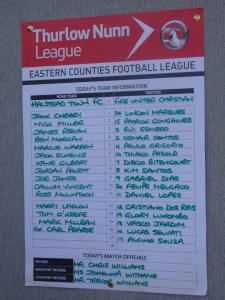
any one much here yet, it’s only twenty-five past two. A man stands at the end of the main stand and copies down names from today’s team sheet, the tea and food bar isn’t open so I take a look inside the club house. A cluster of drinkers stand at the bar and some sit at tables. I consider buying a drink, but there’s no real ale on offer and I can still taste the cup of tea I had before leaving home, so it’s not like I’m thirsty and I never have any real desire for a glass of artificially carbonated beer. I return outside and ‘do’ a circuit of the pitch to the soundtrack of some awful, sub-disco, bland pop playing over the public address system.

OLYMPUS DIGITAL CAMERA

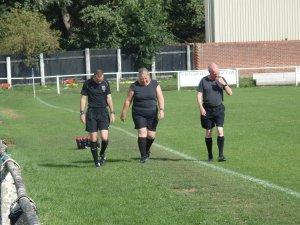
The referee and assistants are warming up; I noticed from the team sheet that the referee and one of his assistants share the surname Williams, and whilst they do stretches against the rail around the pitch I impudently ask if they are related. They are not, but the referee confirms that Messers Arnot, who officiated at the game I saw last week in Harwich are father and son, although they looked like grandfather and grandson to me. Unusually, but less so than in the not too distant past, the other assistant to the referee is a woman, Ms Withams. They form a contrasting threesome, the referee typically neat and fastidious looking, his male assistant older and almost frail in appearance and his female assistant a somewhat full-figured woman.

Halstead Town football ground, known for now as the Milbank Stadium, has only one stand, it is plain, a little dark and very utilitarian, but to a football fan it is a thing of beauty, arguably the finest stand in the Eastern Counties League after Great Yarmouth’s, which is a Listed Building. May be Heritage England should be listing buildings like this one; its corrugated pitched roof and steel stanchions are redolent of the 1950’s and it was indeed erected in 1950; its plain, post-war utility makes it a sort of football prefab. Most Football League clubs have already demolished their stands like this; it may be small but it’s perfectly formed.

This slideshow requires JavaScript.

Time ticks away, more spectators arrive, I choose a seat in the main stand and in due

OLYMPUS DIGITAL CAMERA

course the teams appear in the tunnel at the centre of the stand, beneath a metal cage. The programme tells me that Halstead are top of the league having played seven games, but suffered their first defeat of the season in midweek at home to nearby Coggeshall United, not to be confused with Coggeshall Town. Fire United languish in sixteenth place in the nineteen team league having played only four games, they lost the first three but won 4-0 in midweek.

Fire United Christian Football Club (fortunately they don’t use an acronym) are one of a small number of oddities amongst teams in the non-league football pyramid in that they don’t represent a town or geographical location, but rather people who share a common faith and who largely have a Brazilian background. Founded by a Christian ministry in only 2012, the club has progressed quickly into senior football and is made up of mainly Brazilian ex-pats living and working in London. Whilst they are a new club, interestingly Fire United’s Christian foundation echoes the earliest days of organised football in Britain in which many clubs including the likes of Fulham, Everton, Liverpool, Tottenham and Swindon Town all had their nineteenth century roots in local churches. For Fire United’s sake I hope they don’t end up like them.

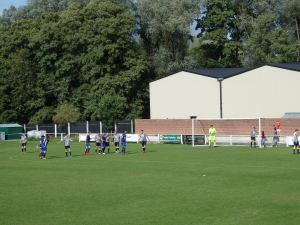
The teams line up and the announcer receives a round of applause for his thoroughly plausible pronunciations of the Brazilian/Portuguese names of the Fire United team; but perhaps he was ‘speaking in tongues’ (see Acts of the Apostles 19:6). The Halstead Town chairman resplendent in shorts and T-shirt, no show-off club ties and blazers here, makes a presentation to a player (Nick Miller) making his 100th appearance for the club and then referee Mr Chris Williams begins the game. Fire United, wearing a kit of two

OLYMPUS DIGITAL CAMERA

shades of blue kick-off, playing towards the River Colne and small industrial units between the ground and the river. Halstead Town wear black shorts and socks with black and white striped shirts from which they derive their nickname “The Humbugs”, which as nicknames go is one of the very best. More teams should make reference to sweets and confectionary in their nicknames instead of birds and animals. Halstead are playing in the rough direction of the redundant Holy Trinity Church, a Grade II* Listed Building of the 1840’s designed by George Gilbert Scott (architect of the Midland Hotel at St Pancras Station) in the Gothic Revival style and well worth a look if you like such things.

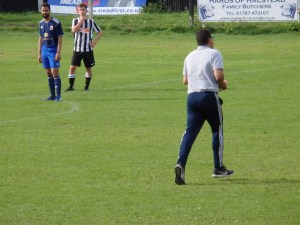
Early on, ⁹Halstead look eager and have the ball at their feet more than Fire United do. It is a Fire United player who commits the first foul and the one after that and their number seven, Diego Bitencourt is the first player to be spoken to by Mr Williams. Bitencourt is a balding, wiry man, greying at the temples and he looks like he could be any age between thirty and fifty; he can play a bit though. Despite Halstead’s early dominance, it is Fire United who earn the first corner and from then on they don’t look back and win a procession of corner kicks as they begin to dominate the match themselves. The Fire United number four Paulo Grigorio fails to make the best of a few headers from corners but it is his team’s play between the penalty areas that is most impressive. Unfortunately, this team of Brazilians are conforming to the stereotype that I thought had lazily earned them the nickname of the Samba Boys. But they do genuinely play a languid, smooth style of passing game. On the left, number eleven Daniel Lopes is quick and dribbles with both feet, and in the middle and everywhere else number twenty Felipe Melgaco flits and energetically dances about with the ball. At the back number three Rui Semedo is in the mould of OGC Nice’s Dante or Olympique Lyon’s Marcelo as he is unafraid to stop and look up, to stand with the ball at his feet, then nicking and dinking it away from on-rushing forwards before passing it again. It seems that even your average group of working or church-going Brazilians can just form a team and quickly make the ranks of English senior football, so superior is their understanding of the game to ours. Latin American rhythm versus boiled sweets.

Halstead have disappeared from the game largely and when in the twenty third minute Fire United take the lead it is thoroughly deserved, although it is an own-goal from Halstead’s number six Jack Schelvis, who diverts a cross after the Halstead defence give the ball away. Having taken the lead, Fire United fail however to build on their advantage. The game is punctuated by injuries; Paul Grigorio goes down and requires

OLYMPUS DIGITAL CAMERA

treatment; the trainer a large man in grey tracky bottoms and polo shirt runs on holding just a can of spray; miraculously it’s enough and Grigorio is soon back on his feet. As half-time draws near Fire United are comfortable, so much so that like Holland in the 1974 World Cup final they perhaps take things a little for granted. A nascent move down the right is stopped and played all the way back to the goalkeeper for no particular reason. Square passes are played between the Fire United defenders and Halstead close them down; the goalkeeper Lincoln Marques scuffs his clearance into touch. Halstead string a few short passes together from the throw and get into the penalty area, Fire United haven’t picked everyone up; a shot is blocked and runs to Joe Jones who has space to send a low shot beneath Marques and give Halstead a barely deserved equaliser with possibly their first shot on target. Within moments it’s half-time.

I wander down to the clubhouse behind the stand. There is an orderly queue for beer at the bar and two giant TV screens flash images brightly but silently on the walls. There is a print of a painting of the ground back in the 1950’s when the railway line still ran behind the end that doesn’t back on to the river, the painting is entitled “Playing to the whistle” proving that football and puns have never been strangers to one another. When I last came here there were some marvellous old photos of long dead Halstead Town teams on the walls but they seem to have gone, which is a shame. Just inside the door to the clubhouse an area is divided off from the main room and a small sign announces that this is the hospitality area. A long table is covered with plates of sandwiches, sausage rolls, cakes and biscuits, some wrapped in silver foil. It looks like a child’s birthday party minus the balloons and a cake. Rows of stackable chairs surround the table, upon which committee members and life members sit with paper plates on their laps. I head outside to the tea bar and invest in a pounds worth of tea.

From the very start of the second half Halstead Town are quicker and more energetic than before and they soon impose themselves on the game through sheer effort. Marques makes good saves from both Jones and Vincent and Jones heads wide when unchallenged. Pavett produces a hard low shot for which Marques throws himself down to his left to push away around the goal post. Fire United bring on a substitute, number eighteen Vasco Jardim, who is large in girth and rivals Humbugs’ number four Ben Morgan and goalkeeper Jack Cherry as the stoutest player on the pitch. Jardim has short legs and amuses several people in the crowd when he falls over spectacularly to claim a free-kick, but is the booked by Mr Williams.

It looks increasingly like Halstead will score again, it is just a question of when, but Fire

OLYMPUS DIGITAL CAMERA

United still create one or two opportunities of their own on the break. I wander around a bit to take in some different views that form the back drop to this game. The fourteenth century church of St Andrew is visible at the top of the hill and behind what is now the Halstead goal, where the railway track once ran a hedge row follows the line of the old embankment; berry laden bushes billowing out in a line like steam from a ghostly locomotive. As the sun begins to

OLYMPUS DIGITAL CAMERA

sink in the west, the shadows of trees envelope one corner of the ground in dappled shade.

I return to the main stand. Fire United’s Daniel Lopes shoots over an empty goal as Gabriel Dias and Jack Cherry collide, and after receiving treatment from the coach’s spray can, Dias is then substituted for number nineteen Glory Lukombo. “ What a great name” says a bloke behind me and I can’t disagree. The Mr Williams holding a flag has to defend not giving an offside decision against Halstead and seems to be talking to himself as he runs back up the line. Then Halstead score. Number eight Jordan Pavett chips a perfect pass over the Fire United defence onto which Callum Vincent runs before placing the ball beyond Marques with what could accurately be called aplomb. Purely on their second half performance Halstead probably deserve it, but as a naturally lazy person I am slightly disappointed that effort and hard work has seemingly won out over strolling about stylishly.

It’s not long before Mr Williams blows his whistle for the final time and with it an appreciative crowd of ninety-three make their respective ways back into the clubhouse or out into the car park and down Rosemary Lane. I and a few others wait a short while to applaud Fire United from the field, before I head back to my Citroen and the journey home.

Harwich & Parkeston 2 Benfleet 1

My mother was born and grew up in Shotley at the mouth of the River Stour. As a child she hardly ever went to Ipswich, and Saturday afternoon shopping would mean a boat trip with her mum across the estuary to Harwich and to Dovercourt. Her father was a mild-mannered man, but if someone did manage to annoy him he would not tell them to “Go to hell” but instead to “Go to Harwich”, by which I think he meant to go and jump in the river rather than any slur on the gateway to the Continent. My childhood memories from thirty odd years later were of going to Harwich by car, an ice cream cornet outside the town hall, Dovercourt Woolworth’s and having shrimps for tea.
With these fond family memories in mind I guide my Citroen C3 along the winding, undulating B1352 from Manningtree to Harwich, through Mistley, Bradfield, Wrabness and Ramsey. My wife Paulene and I have been to Ipswich to visit some of the historic buildings open to the public for the Heritage Open Days, but were a bit miffed to find two of the three buildings we wanted to view, which were advertised as open in the leaflet, were shut and only open next weekend. But arriving in Harwich our fortunes have improved, it is warm and it’s not raining, even if it is a bit cloudy and the Royal Oak

ground is open for this afternoon’s fixture in the tortuously titled Thurlow Nunn Eastern Counties First Division South. We park up in the car park at the side of the stadium and cross the lane to the turnstile by the main stand. Entry costs £4 each and the-grey haired man operating the turnstile helpfully verbalises the mental arithmetic of £4 plus £430684736148_a5cac6de7b_o making a total of £8 and the addition of the glossy and groovily typefaced, 16 page programme “Black and White” (£1) making a total of £9. A few steps inside the ground an old boy in a flat cap relieves me of the final tenth of the ten pound note I proffered at the turnstile, in exchange for a strip of draw tickets (Nos 61 to 65).
The Royal Oak Ground , where Harwich & Parkeston have played since 1898 stretches out before us , a green panorama, the broad pitch sloping away across its width, down towards Harwich town itself. Beyond the far side of the pitch a terrace of 1950’s houses, one with a hideous loft extension overlook the pitch. To the left behind one goal a steep but shallow concrete stand with a rusting tin roof and faded red steel stanchions, a sort of truncated barn backing on to Main Road, where the Royal Oak pub stands, and which leads into Dovercourt High Street; to the right and set back some way beyond the other goal, the changing rooms in a building with gabled dormer windows and a small clock on the roof, like a 1980’s pastiche of a village cricket pavilion. Behind us the main stand is short in length but disproportionately tall with a steep, corrugated, pitched roof; a typical football stand from the 1950’s, sadly its top half is now closed off.

This slideshow requires JavaScript.

It’s about twenty past two and the Harwich team are appearing from the changing rooms to warm up; we walk to that end of the ground to perhaps catch a word with their coach Michael, who we know from our previous mutual involvement at Wivenhoe Town.

This slideshow requires JavaScript.

Appropriately, page five of the programme has a small feature on Michael, from which we learn amongst other things that he drives a Citroen C4, his favourite food is curry and his favourite holiday resort is Acapulco. There is a photo of Michael stood with arms folded and looking quite butch, if a little overweight. After the game Michael will tell me that he likes to read this Blog whilst sat on the toilet.
“Well he should have some fresh milk, I put some in there on Tuesday, er no Thursday” we hear a man in a white shirt and black and white striped tie say to another man. At the corner of the ground a man with a Scottish accent asks us if we are from Benfleet, because, he explains, he didn’t recognise us. We tell him we are not but, are partly here to see Michael the coach, but also to just enjoy a Saturday afternoon at ‘the football’. Whilst Paulene watches the warm up, the Scottish man tells me how the club owns the ground and is debt-free. Harwich & Parkeston are playing at a lower level than they once did, but I am told that the club trustees saw that the need to simply keep the club alive was more important than trying to compete unsustainably in a higher league. The Scottish man bemoans the rise of ‘village teams’ into the semi-professional ranks, which he feels has fragmented local football and he’d like to see a league of clubs just from the main East Anglian towns. It’s a somewhat Stalinist approach, but I can see the attraction. The population of Harwich is about 18,000.
Kick-off is approaching and I buy two teas (£1 each) from the tea hut, a neat brick30685788148_87460e7c1e_o building probably dating from the 1950’s or 1960’s, which wouldn’t look out of place on a seafront esplanade. In the tea hut a woman is incredulous that an official has come from Norwich to referee a match in Harwich, she thought the point of the league re-structure was to cut travelling costs. “You can bet your arse that in Yarmouth they’ve got a referee from London” she says, and she’s probably right, although I’m not sure Ladbrokes would be interested in her or anyone else’s bottom as a wager. “There’s not many here today” she adds.
42747605380_9cc3b7bca7_oAs the game begins we take up a spot at a Yogi Bear–style picnic table in the corner of the ground by the bar and backing onto Main Road. Harwich kick off towards us, the River Stour and Shotley beyond. Harwich are wearing black and white striped shirts with black shorts and socks, completing a hat-trick of clubs along with Newcastle United and Grimsby Town that span the length of the east coast and wear black and white stripes. Benfleet are in a rather boring all red kit, although their home kit is a much more interesting light blue shirt with dark blue shorts.
From kick-off the ball is almost instantly hoofed into touch and early action sees the Benfleet number five take out both the Harwich number nine and one of his own team mates with a lunging tackle. The free-kick produces nothing of note but at least the tackle made me laugh. The football is scrappy but the passes that do get strung together are mostly strung together by Harwich or ‘The Shrimpers’ as they are known, a nickname which no doubt has to do with what I had for tea as a child. The neighbouring picnic tables are occupied too and on one of them some young women, possibly ‘wags’, talk about an away game they went to recently. “There was no bar” one of them says “Just a bottle of Blossom Hill in the fridge”. At another table a middle aged woman calls out “Come on ‘arridge”.
Despite Harwich’s dominance, at about twenty past three they almost fall behind as the centre-half misses the ball and Benfleet’s number nine Ben Foord is gifted a clear run at goal; he runs, looks up and shoots, but the Harwich ‘keeper Sam Felgate makes a fine diving save to his left. Stung by that near miss Harwich soon produce the best move of the match so far as number three Jake Kioussis overlaps into the penalty area, but loses his composure and blazes the ball high over the goal and onto the vegetation covered bank in the corner of the ground. Distraught at his failure to do better, Jake appears to try and garrotte himself in the netting behind the goal. Michael the Harwich coach leaves his post in front of the dug-outs to fetch the ball. The entertainment is improving and Benfleet win a corner but hit the ball straight to an unopposed Sam Felgate.
Just before half past three The Shrimpers take the lead as Sean Gunn dinks the ball into the net from close range as three Benfleet defenders look on admiringly; it’s what Harwich deserve in what has so far been quite a one-sided game. Paulene and I decide to get a different perspective on the match and wander further round behind the goal

enjoying the cascade of greenery in the corner of the stand and an abandoned roller. Non-league football just wouldn’t be the same without the atmosphere of decay and the implied memories of better days long ago; the Royal Oak has that beautiful faded glory in spades.
All of sudden a bit of ill-temper erupts on the pitch and the Benfleet number four squares up to the Harwich number two and shoves him backwards, not just once but three times. A melee ensues and Michael is on the pitch to help break it up. The referee Mr Harvey looks uncertain about what has happened and he consults his version of the VAR, the linesman Mr Arnot. 30686126038_1dc5f53e29_oUnusually both linesman are called Arnot, although if they are related the relationship looks like grandfather and grandson, with one being stocky and totally bald and the other lanky and very youthful. The referee consults Mr Arnot senior, who talks to Mr Harvey with his hand over his mouth, like players do on the telly. I’m not certain why he does this; even if Mr Arnot has a strange paranoia about lip-readers what can he possibly be saying that is such a big secret? The result is a free-kick to Benfleet and bookings for both players, although I’ve seen players sent off for shoving before. A short while later the match breaks down again into confrontation as Benfleet’s number five tackles horizontally at knee height and a Shrimper hits the turf clutching a leg. This time Mr Harvey sorts it out on his own, but again appears lenient as he doesn’t even show a yellow card. Happily, half-time soon arrives and everyone can go for a lie down.
Paulene and I continue our wander around the ground and I picture how the bank42747580570_69889cf102_o behind the dug- outs was perhaps once a grassy ‘terrace’. Beneath the vegetation a path can be discerned which runs up to a large pair of metal gates onto Main Road, I feel like some sort of football archaeologist, and as I look across at the terrace of 1950’s houses that overlook the ground I am struck with a sense of deja-vous. The layout of the Royal Oak with the houses on one side, the rickety main stand opposite and the club house up the corner is a lot like that of the Stade Municipal in Balaruc-les -Bains in southern France, where Paulene and I watched a Coupe de France (French FA Cup) game last September (see the archive section of this blog for an account of our visit and the match) . I buy two more teas (£2) and am served at the tea hut by the Scottish man who is helping out with the half-time rush. Paulene and I take a look in the club house where a display on the wall recalls Harwich & Parkeston’s appearance in the 1953 FA Amateur Cup final before a crowd of 100,000; The Shrimpers lost 6-0 to Pegasus (a combined Oxford & Cambridge University team) and it was probably Pegasus that drew the crowd rather than The Shrimpers, but it’s still an impressive piece of history nonetheless.

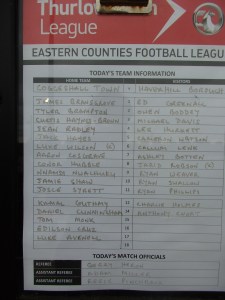
The game begins again and Benfleet are playing a bit better, although Harwich still get opportunities to score again. But at just gone twenty past four the Harwich defence recreates the error they made an hour ago. Harwich’s number five mis-reads the flight of the ball and fails to play it back to the goalkeeper who is a long way off his goal line; they are both left helpless as Benfleet’s number ten Rob Lacey nips in to lob the ball over Sam Felgate and into the goal to equalise. Quickly some of the Harwich players turn on one another to apportion blame. One of them stands with arms outstretched and says “If are going to make mistakes…” but sadly I don’t catch the end of the sentence. For a little while Benfleet are the better team and they seem to have broken up the link between the Harwich midfield and forwards. Benfleet’s blond-haired number six Martin Lacey has moved to left back and snuffed out the Harwich attacks down this flank; added to which his haircut has a hint of the 1960’s Mod about it.
Benfleet now look the more likely team to score again and we walk round behind the goal that they are attacking. We arrive in time to see the game again erupt into an unseemly mess as a Harwich player scrambles about on the ground and then a scrum of pushing and shoving and angry faces develops from seemingly nothing. Michael again appears to break things up. I don’t have a clue what happened or who was involved and sadly it seems neither does referee Mr Harvey who once again consults the human VAR Mr Arnot senior. The decision from Mr Harvey is to send off Harwich’s number five Ben Hammond and Benfleet’s number two Lewis Hunt and to book Harwich’s number four Shaun Kioussis and Benfleet substitute, number twenty Stephan Adeyemi , who hasn’t even come on to the pitch yet. Lewis Hunt and his team mates, manager and coaches protest his innocence and he certainly didn’t appear to be involved in the ruckus. Lewis heads for the dressing room and walks past us, I ask him what happened. He didn’t know but said he didn’t do anything, he tried to separate people and got hit in the mouth and then stepped away. He seems like a really nice bloke, which is what the Benfleet team were telling Mr Harvey. During the mayhem the Harwich ‘keeper takes to time to relax and have a lie down, adopting the pose of a gentleman-player in one of those photographs of a Victorian football team.
The break in play seems to have affected Benfleet more than Harwich, possibly because of the sense of injustice that Lewis Hunt has been wrongly sent off; perhaps whoever was guilty, and someone was, should have owned up and said “Send me off Ref, Lewis is innocent”. Never before has my wearing of my Albert Camus philosophy football T-shirt been so poignant, with its slogan “All that I know most surely know about morality and obligations I owe to football”. Benfleet have lost concentration and at a bit past four thirty The Shrimpers number eleven Sean Gunn breaks through the middle and places a low shot wide of Florent Gislette in the Benfleet goal. Understandably after all that has happened the Harwich team celebrate somewhat.
The final fifteen minutes play out without too much sense that there will be any more goals, although Shrimpers substitute Nicky Palmer sends a shot out towards the North Sea when nicely set up by number ten Michael Hammond, who had passed up on a chance to have a shot of his own. Hammond also becomes the eighth player to be booked before Mr Harvey eventually closes proceedings and the crowd of 160 give appreciative applause for what has been a thoroughly entertaining afternoon of football and brawling, but mostly football.
Paulene and I retire to the bar for a pint of Greene King Abbot Ale (easily Greene King’s best beer) and a Bacardi with Soda (£5.25) and a chance to reflect on a very enjoyable (and cheap) afternoon. We might have been disappointed not to sample the Heritage of Ipswich earlier today, but the sporting heritage of Harwich and Parkestone’s Royal Oak ground has more than made up for it. We’ll be back.

This slideshow requires JavaScript.

Coggeshall Town 4 Haverhill Borough 0

It’s a breezy, cool, late April evening with a threat of rain in the air; setting off along the A120 I set my car windscreen wipers to intermittent. But it’s still light and there’s no need for headlights. I might have travelled by bus (Service 70 from Colchester to Chelmsford via Braintree), except that I wouldn’t have been able to get home because the last bus in my direction from Coggeshall leaves before half past seven. An overnight stay in Coggeshall would have been extravagant.

My Citroen C3 bounces over the rutted surface of the Coggeshall Town car park and we come to rest facing the pitch. The car park is not yet full, but there are a good few

A Ford transit provides Haverhill Borough with a bus

vehicles here, including the white Ford Transit that is the Haverhill Borough team bus, which is encouraging. I nod and smile to the man who has parked next to me; I am impressed that the gaffer tape securing his Ford Mondeo’s rear bumper matches its silver paintwork. “Alright mate?” he says. I follow him and his wife through the turnstile and wait whilst they nominate their player of the season; they’re regulars. In time I pass through the turnstile myself, entry is £6 and I buy a programme too (£1.50). I walk along the concrete path behind and above the main stand towards the club house. The Haverhill Borough team are warming up on the main pitch whilst the Coggeshall players have a kick-about on the practice pitch.

In the clubhouse I speak to Paul who runs the club twitter account and films the games. We talk about marriage and being happy, but agree we’re here for the football. Paul goes to set up his camera and I head to the bar to buy a pint of Caledonian Brewery Coast to Coast (£3.90) which turns out to be very cold and very fizzy. I feel like I might explode as I struggle uncomfortably to suppress a series of frosty burps. I may not buy this beer again; I may not have to with its hoppy flavours repeatedly bubbling up from below. I speak with Jim who is usually with Keith, but not tonight because Keith was double-booked. Jim asks if will be writing about tonight. “I expect so” I say. “You can tell you’re an Ipswich fan” says Jim mysteriously. I step outside.

Kick-off is approaching and I rest my beer on the roof of the stand and look at the programme. Men huddle around the team sheet displayed on the outside wall of the

Coggeshal Town Fc v Haverhill Borough team sheet

changing rooms. I move down into the stand behind the goal before the two teams line up side by side behind the referee on the steps leading down from the changing rooms to the pitch. A Haverhill supporter lazily and thoughtlessly leaves open the gate from the steps into the stand, so I public spiritedly close it, joking to the referee that we don’t want any players taking a wrong turn into the stand. He makes reference to my beer implying that it might result in such an occurrence. I avoid burping in his general direction. With the players safely on the pitch I wander round to the main stand. “It’s a bit wet innit? The grass” says a man to his partner.

Haverhill kick off in the direction of the town wearing a somewhat dull all blue kit, whilst Coggeshall stand out under the lights in their handsome red and black stripes with black shorts. Coggeshall soon gain possession and on that basis proceed to do most of the attacking. They have the first shot. “Come on ref, keep an eye on the game” says a man angrily as Coggeshall’s number 7 is fouled.

The match is a bit scrappy, full of hoofs and meaty headers. Coggeshall’s play is disjointed as they try too hastily to get the ball forward; if they win tonight they will be promoted to the Bostik League Division 1 North. But it’s a fine night at West Street with a distinctive atmosphere emanating from the swears and shouts and the rattle and clatter of studs on the hard pitch, even though the grass is a bit wet, as the man said. On the far side of the pitch the Coggeshall bench is packed with players and coaches. But the Haverhill bench is home to just three, who look like they’re waiting for a bus; they’ve got a long wait; it’s a good job they’ve got their own in the car park. Beyond the far side of the ground the valley leads down to the River Blackwater, lined with spindly trees leaning in the breeze beneath a mass of travelling clouds; if the pitch had been covered in poppies Claude Monet might have painted it.

“Get it tight”. “Good boy”. It’s a minute to eight and Coggeshall’s number eight places a firm shot towards a point just behind the inside of the goal post, but the young Haverhill goalkeeper makes a fine save, diving to his right. There is banter in the stands amongst of old boys in their late sixties or seventies. A much younger woman in the front row turns round in appreciation. In conversation a Haverhill fan relays that their goalkeeper is just seventeen years-old. Sensing some sort of boastfulness a Coggeshall fan counters that their full-backs have mental ages of three and four.

It’s nearly ten past eight and Coggeshall’s star man, number nine Nnamdi Nwachuku shoots spectacularly over the angle of the goalpost and crossbar. There’s a corner to Coggeshall. “Who’s got the big man coming in?” shouts a concerned voice from within the stand. Haverhill’s number eight is booked by referee Mr Gerry Heron for a foul on Coggeshall’s number seven. Another corner to Coggeshall and an urgent voice from on the pitch asks “Who the fuckin’ ‘’ell’s got the free?” Good question; the ’free’ shoots, but misses.

Only ten minutes to half-time and there’s a free-kick to Coggeshall. The kick is taken, a hand goes up and Gerry Heron awards a penalty to Coggeshall. Haverhill’s number 4, a very chunky, quite skilful but gobby midfield player is not happy; had he been incandescent with rage he might have spontaneously combusted and burned very brightly. Fortunately he doesn’t and Gerry Heron cautions him amidst much animated waving of arms from the portly playmaker. Back to the penalty spot. Nwachuku scores. “ Cool as you like” says a man nearby.

Coggeshall want more goals and number seven makes a run down the right in front of the stand. “Do ‘im son, do ‘im, all day long” calls a voice with rising excitement before releasing a mournful groan as seven’s cross rises almost vertically from his ankle and over the stand. But it’s half time now and I invest in a pound’s worth of tea with a dash of Danish owned Cravendale brand milk, in the hope that it might quell the beery repetition I am still suffering and warm my chilled intestines. I stand about and like Edward Hopper enjoy the light spilling out through the window from the club house bar and onto the deck. It’s getting dark and the cloudy sky has turned cobalt blue.

For the second half I stand in the corner near the goal that Coggeshall are attacking, but it’s a bit breezy and I move ‘indoors’ into the seats of the main stand, close to the old boys whose banter had amused in the first half . It’s like sitting in front of Statler and Waldorf in the Muppet Show, but there’s five of them.

It’s now five past nine and rain is being carried on the wind into the front row of the stand, making a row of lads laugh as they get wet. “Is it raining?” asks a woman behind me somewhere. “I didn’t know it was raining” she adds unnecessarily. Seven minutes later Coggeshall number three Curtiss Haynes-Brown advances down the left, then a bit more. “Go on! Hit One!” Someone shouts, so he does and he scores and it’s 2-0 to Coggeshall.

Haverhill are still resisting as best they can and there is a brief contretemps between Nwachuku and the chunky number four. Gerry Heron intervenes but takes no specific action despite advice from the stand that “It’s that fat fucker, number four, ref!” Haverhill take heart and with about fifteen minutes to go their number ten forces the Coggeshall goalkeeper into making his first real save of the night. But Nwachuku soon scores another goal after making a dashing run towards goal and a bit later skips through the Haverhill defence once again to complete his hat-trick for the evening and increase Coggeshall’s goal difference to +117 for the season.

That’s promotion secured and the old fellas behind seem keen to leave a bit early, but fear that Coggeshall might score again and they’ll miss it. One of them says that they didn’t really leave early on Saturday but the team played on without them. Someone complains that it seems a very long half, but then perhaps sensing that people have seen enough Gerry Heron whistles for the last time; it’s not quite twenty five to ten. I’ll be home in five minutes.

This slideshow requires JavaScript.

Long Melford 2 Newmarket Town 1

Long Melford is a big village, one of the most appealing and attractive in Suffolk according to Suffolk Tourist Guide.com with, according to Wikipedia, a population in 2011 of some 3,518. Melford, as it is known locally, is just a few miles north of Sudbury, it used to have a railway but since 1967 and the evil Doctor Beeching, the line now terminates at Sudbury. If you want to get to Long Melford by public transport therefore, it is necessary get the No 753 bus from Sudbury to Bury St Edmunds. Like the train service from Marks Tey, the bus service runs hourly, but as this is England the trains and buses are not properly co-ordinated; the train to Sudbury arrives at 13.08 and the bus conveniently leaves at 13:30, reaching Long Melford Post Office ten minutes later. On the return journey however, the 754 bus passes Long Melford Post Office at 17:11 and arrives in Sudbury four minutes after the train has left, at 17:20, so there is nearly an hour’s wait in Sudbury for the next train at 18:16.
Today however, I am driving to Long Melford’s Stoneylands ground because I have agreed to give a lift to a man called Roly, who lives in nearby Borley. I happen to know Roly’s house is within walking distance of Stoneylands because Roly has walked it before, but I was in generous mood when we discussed by text message going to the game and very slightly inebriated.
It is a grey, still, cold winter’s day as I make the twisting, undulating drive through Chappel, home of the East Anglian Railway Museum, Mount Bures with its excellent Thatchers Arms pub, Bures with its large empty bus depot, the edge of Cornard and through busy Sudbury before taking the turn towards the wonderfully named Foxearth. In Borley, Roly’s Victorian cottage home is a scene of domestic bliss; his partner Sarah reclines on the sofa with their young baby Lottie, whilst Penny the dog rolls over at my feet and wriggles excitedly. But I don’t linger, there is football to go to and within

OLYMPUS DIGITAL CAMERA

OLYMPUS DIGITAL CAMERA

minutes Roly and I are bouncing down the pitted, puddle filled private road that leads to the football ground and my Citroen C3 gets a taste of what it must have been like to be a Citroen 2CV carrying a tray of eggs across a field somewhere in the Auvergne.
Getting parked takes longer than it should as the man in the car in front seems to want to park as close to the entrance as possible, which means reversing gingerly and at first unsuccessfully into a narrow space despite the presence of acres of car free space just 15metres away. There is an air of the village hall about Melford’s ground from the

OLYMPUS DIGITAL CAMERA

outside and indeed the club’s nickname is The Villagers. There is no turnstile as such here, just a few metal and plastic barriers herding would be spectators towards a kiosk of the type that used to be at the exit to municipal car parks back before the days of Pay & Display, when a bloke stamped your ticket and took your money as you left. There is a short queue to get in because it takes the

OLYMPUS DIGITAL CAMERA

grey-haired woman in the kiosk a little while to root around for change from a plastic tub. A board on the side of the kiosk announces the price of admission, but in reality it’s just a green smudge of felt tip pen; fortunately I’ve done my homework so I know from the club website that admission is £7 including a programme.
Once inside, Roly buys me a bottle of Nethergate IPA (£3.50) in the bar, which is the least he could do after I went out of my way to drive him here, selfishly he gets one for himself too. We drink bottled beer because sadly the hand pump on the bar is covered over with a tea towel, which is very disappointing. The woman serving is struggling for change and asks rhetorically how she is expected to run a bar with a float of just four pound coins. I empty my pockets and find just short of ten pounds in change, which she is happy to exchange for a ten pound note; I’m 40p up!

OLYMPUS DIGITAL CAMERA

We sup our beer in the company of other middle-aged and older men stood around tables as men do in bars, but soon we are aware that the teams are coming on to the pitch. We leave the clubhouse just as the line-up for the obligatory handshakes is dissolving away into the two halves of the pitch. Newmarket Town are the visiting team today and they sit seventh with 53 points from 31 games in the Thurlow Nunn Eastern Counties Premier League table; Melford are 16th with 39 points from 32 games. It’s a clash between a village known for antique shops and a town known for horse racing. I suspect that watching local football puts us firmly outside those two spheres of activity although weirdly I think, there is an advert in the match programme for “Wealth management advice”, whatever happened to plain old financial advice?
The 1970’s pop blaring from the tannoy stops abruptly as Newmarket, nicknamed predictably as the Jockeys, kick off towards the dull, suburban estate-style houses at the Sudbury end of the ground. Newmarket’s club colours are yellow and blue, but for some unknown reason today they are wearing a rather ugly all red kit with white stripes below the chest, as if they’d brushed their teeth before coming on and dribbled Colgate down their stomachs. Melford play towards the dilapidated wooden fence, shelter and open fields to the north, wearing their signature black and white striped shirts and black shorts. Melford’s kit is embellished with name of the excellent Nethergate Brewery, who have newly built premises at the entrance to the village by the turning to Foxearth.
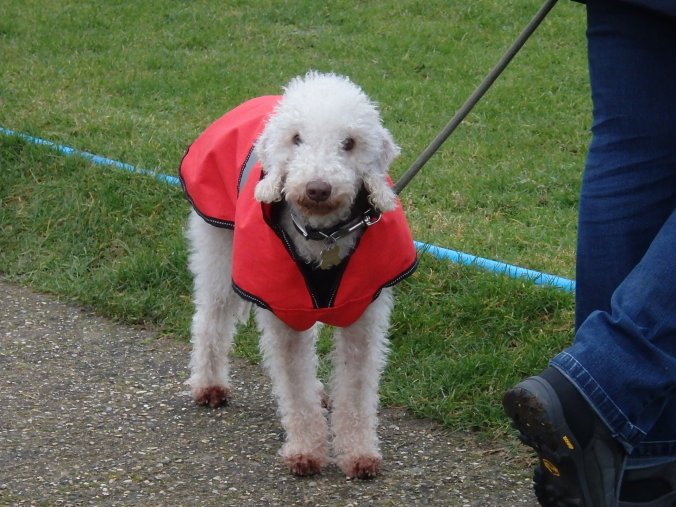
Newmarket start well, passing neatly and getting forward, but Melford suddenly win possession, breakaway and have a shot, and so it continues. Both teams have a lot of players with beards. Newmarket have the ball most of the time, but Melford spring the occasional surprise, getting the ball to their number seven Hassan Ally who is always in the right place, but never quite makes the final telling cross or pass. The Melford cross bar is hit by a header and then at about twenty five past three a long ball to the right is chased down by Lewis Whitehead who shoots across the Melford goal keeper; Newmarket lead and a number of middle aged men cheer unexpectedly. No one in the crowd is wearing club colours but for a Bedlington Terrier in a red coat, so the presence of away supporters is a surprise.

OLYMPUS DIGITAL CAMERA

Half-time arrives and Newmarket would seem to be in control. Roly has already treated

OLYMPUS DIGITAL CAMERA

or ‘tret’ himself, as he would say in his quaint rustic dialect, to a cheeseburger (£3.00) from the food bar which the programme tells us is called Deb’s Diner. The concluding paragraph of the joint managers’ column in the programme says “Whatever happens, we hope you enjoy your afternoon here in Long Melford, get yourself something to eat and drink…” and Roly has clearly taken note. I don’t ask him if it was an early tea or late lunch or just a celebration that his NHS health check during the week had shown him to be a well man, clearly capable of absorbing the ill-effects of junk food, for the time being at least.
We go into the club house again for two more bottles of Nethergate IPA and to catch the half-time scores on the TV and are much heartened that Ipswich are winning 2-0 at Sunderland. The club house is recently refurbished after the roof fell-in last year and there are several marvellous photos on the walls of past achievements such as Suffolk Senior Cup wins. A trophy cabinet contains a couple of old brown leather footballs which impress me more than the cups and trinkets. When there is a cosy clubhouse, half time is never long enough and it’s soon time to re-join the rows of middle-aged men hanging over the rail around the pitch.

This slideshow requires JavaScript.


The second half is not the same as the first, roles are reversed and it is the Villagers who more frequently have the ball at their feet whilst the Jockeys chase about in vain and are pushed back into their own half. For the second half we stand on the opposite side of the ground to the clubhouse near the dugouts and in front of a coniferous hedge, carefullyOLYMPUS DIGITAL CAMERA and neatly cut into a modernist architectural shape; behind the hedge a close-board wooden fence is in places nailed to its thick trunks. In its neatness the hedge is only matched by the Newmarket goalkeeper’s haircut, but is less contrived. There is more noise on this side of the pitch as the coaches of both team teams shout and urge their teams on.
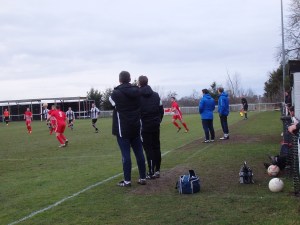
As the game continues Melford dominate more and more and Newmarket are getting tetchy. Whilst there were hardly any fouls at all in the first half, tiredness and desperation and swearing are introducing a new kind of entertainment. A Melford player goes down and the Newmarket number two complains to Mr Pope and anyone who is listening, because Mr Pope isn’t, that Melford have some right prima donnas, although he pronounces it pre-madonnas. Another foul and a free-kick on the edge of the box and then another. Then, whilst Roly is in the toilet, Melford win a third free-kick. Despite referee Mr Pope taking time to book the perpetrator, Roly still isn’t back by the time Ross Waugh scores, apparently with a header, although to be honest it was one of those messy goals and I had lost track of the ball.
There are only eight minutes left and the blokes in trackie bottoms and sports coats onOLYMPUS DIGITAL CAMERA the touchline are visibly tense. The Melford number ten Scott Sloots is hurt and is substituted; as he hobbles off the pitch one or two of his own players seem to be complaining that he is taking his time. “Come on ref, make him get off quicker” I hear. I hadn’t previously realised that there was a point where team togetherness and the will to win would clash. But nevertheless, Melford continue to push forward and in the final minute of injury time there is a run down the left, the ball’s in the box, a shot is blocked and Hassan Ally is in the right place to score from the rebound. Rarely have I seen such elation from a team sixteenth in the league to a winning goal; both coaches burst onto the pitch to celebrate with the team as if this was a most crucial victory. I’m all in favour of making your own fun but this seems to be going a bit far.
To his credit, Mr Pope the referee makes nothing of the exuberance of the Melford coaches and in no time at all the match is over. Roly and I stroll round to the club house to make final use of the toilet before applauding the Melford team from the pitch. It’s been a very entertaining game with a dramatic finale and I’ve made 40p.