
Until 1964 I could have journeyed all the way to Brightlingsea by train via Colchester and Wivenhoe, but the treacherous activities of the evil Dr Beeching mean that it is now necessary to leave the train at Colchester and then catch a number 62 bus. My excuse today for not using public transport is that the bus journey alone would take me the best part of an hour and it would also prevent me from stopping off on the way home to buy much needed mushrooms, salad and bananas at Waitrose. Today therefore I am making the 32 kilometre trip by Citroen C3 and saving the planet takes second place to future breakfasts, lunches and a boeuf bourguignon.
It’s a bright and blowy Saturday afternoon and wispy clouds scud across a pale blue sky. The B1029 twists its way across the flat lands of the Tendring peninsula and down into Brightlingsea from the north, past medieval All Saints Church with its impressive tower, sitting high on a hill outside the town; part place of worship, part lighthouse. Brightlingsea itself arrives as a sprawl of mid-twentieth century houses around a much older central core and a waterfront. I miss a turn, but having gone round the block I find my way. Residential North Road, all pebbledash and net curtains leads to Brightlingsea Regent’s home ground, currently called the Taydal Stadium, but more traditionally referred to as plain old North Road.
I reverse the Citroen into a space at the end of a line of other similarly neatly reversed family saloons. It’s a very short walk to the turnstile where I tender the correct money for entry and a programme (£10 + £2). Just inside and I am assailed by a lady with copper coloured haired selling draw tickets (£1 each); although not a gambling man I can’t help but feel it would be rude not to buy one, so I do. Come half-time ticket No372 will win, I’m sixteen tickets too late; if only I hadn’t missed that turning into Spring Road. It’s not quite twenty to three, so optimistically I think I might have a beer and therefore take a look in the bar; sadly there’s no hand pump, so I don’t bother; I can’t be doing with that cold stuff full of burps. At one end of the room however is a very brightly lit trophy cabinet which shines like a beacon and could easily attract magpies or ward off shipping from the mud banks in the Colne estuary; it has a slightly incongruous appearance in the otherwise very plain surroundings.
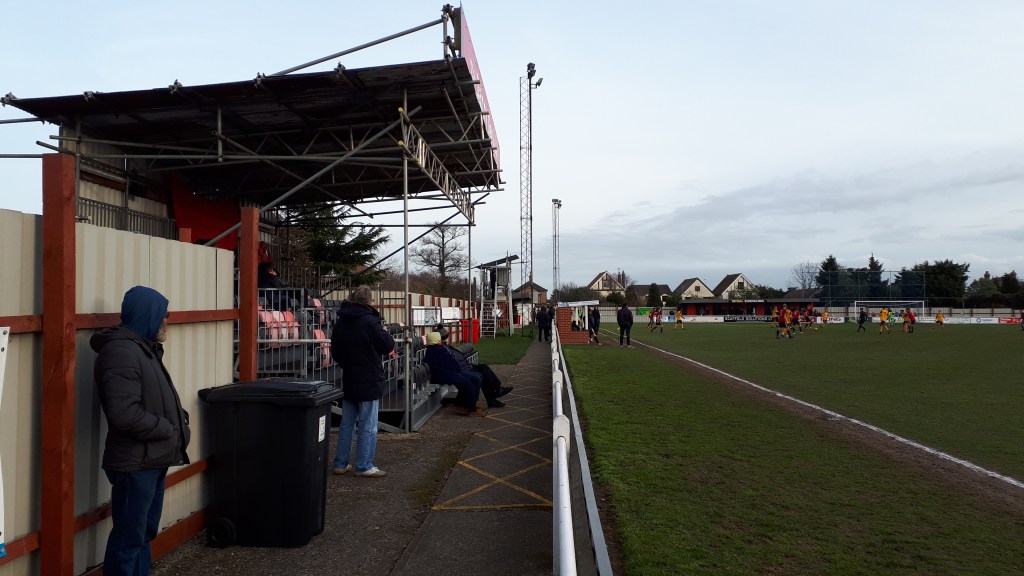
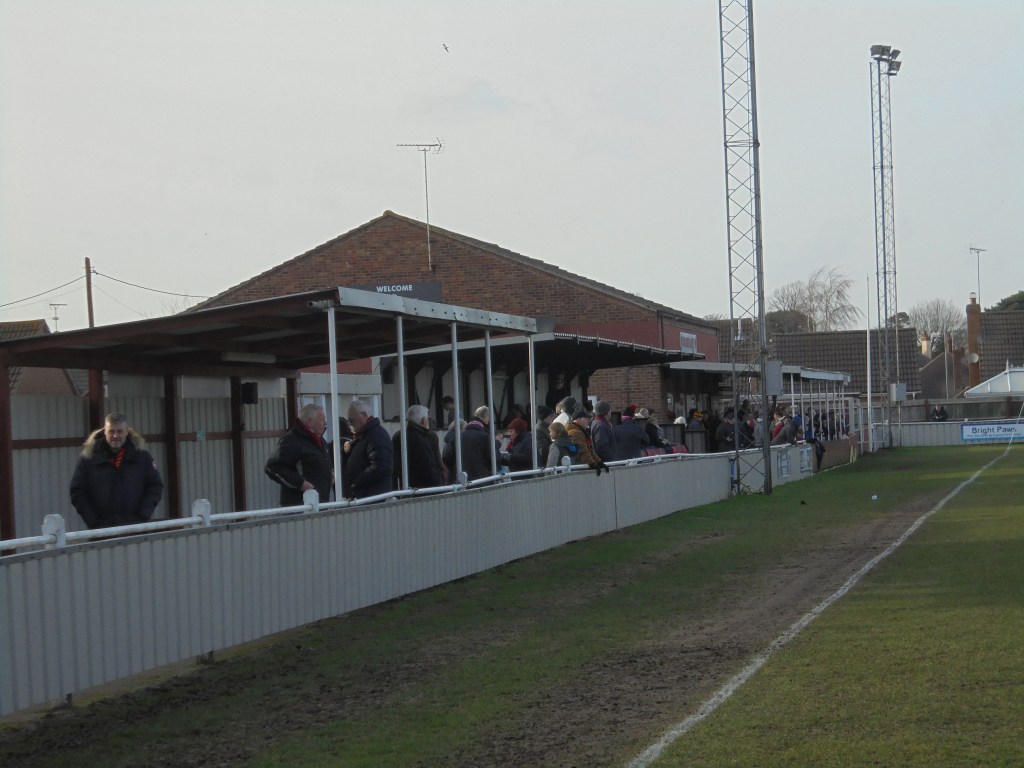
Back outside I seek out the ambience of non-league football. North Road is a hotch-potch of low stands and covered terraces confined within a steel fence backed up against the gardens of dull suburban houses. Beneath the cover outside the clubhouse people are eating chips from small polystyrene trays and drinking beer from plastic cups. The hatch in the club house wall beneath a sign that reads Regent Snacks is doing a steady trade.


Several free range children run about the stands and path around the pitch; today’s match is sponsored by the Brightlingsea Regent Youth Section which no doubt accounts for this. From the public address system, the names of the teams are announced. “First, the Mersham team” says the disembodied voice, mispronouncing the name of the visiting club and annoying at least one of their twenty or thirty supporters who are preparing to choose a goal to stand behind. As I drove to the ground this afternoon even the BBC Radio Essex announcer made the same mistake; I can only attribute this to being in a County where much of the population can’t pronounce the letters ‘th’ as anything other than an ‘f’ or a ‘v’, but ‘Mersfam’ would sound silly.
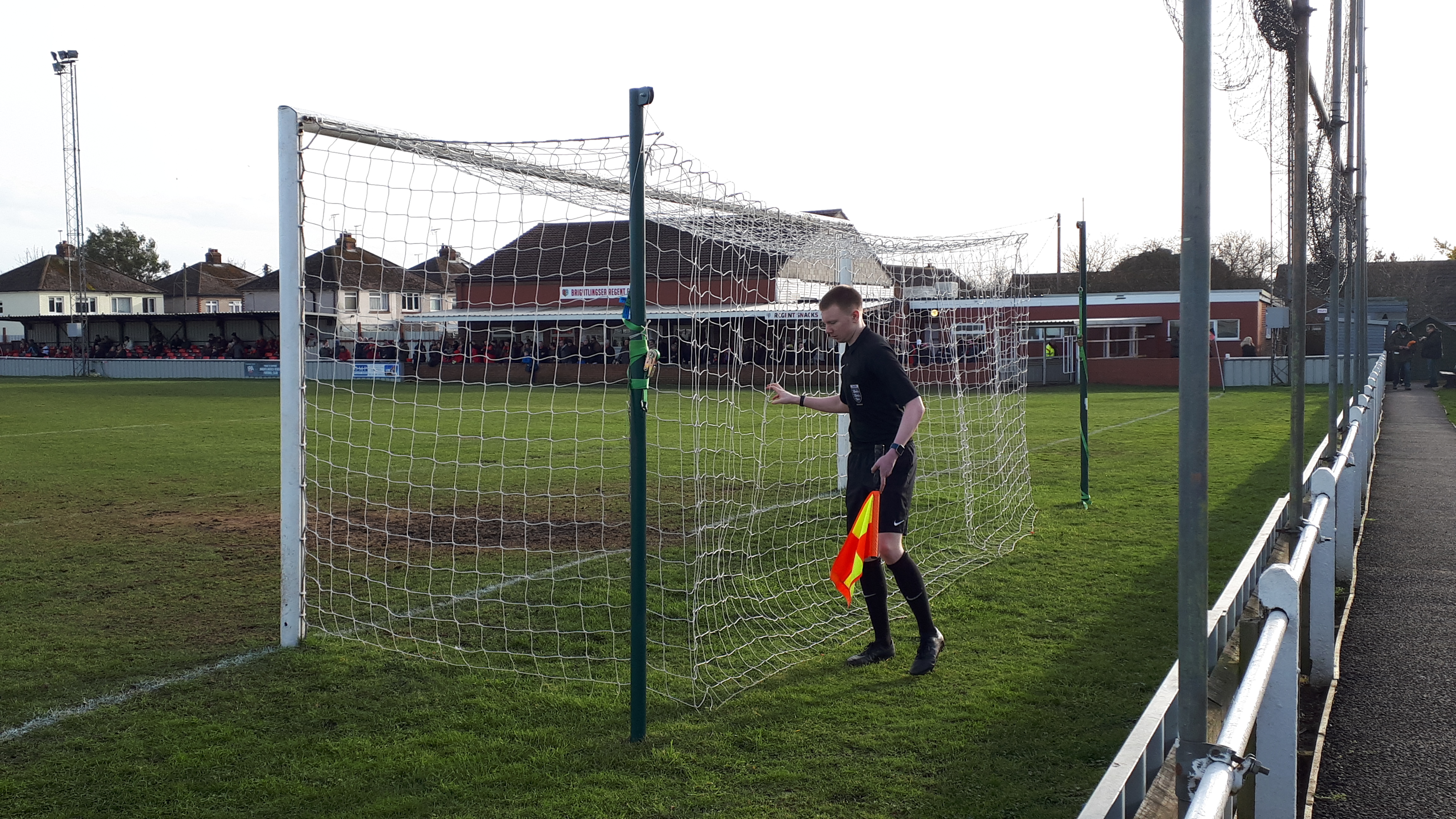
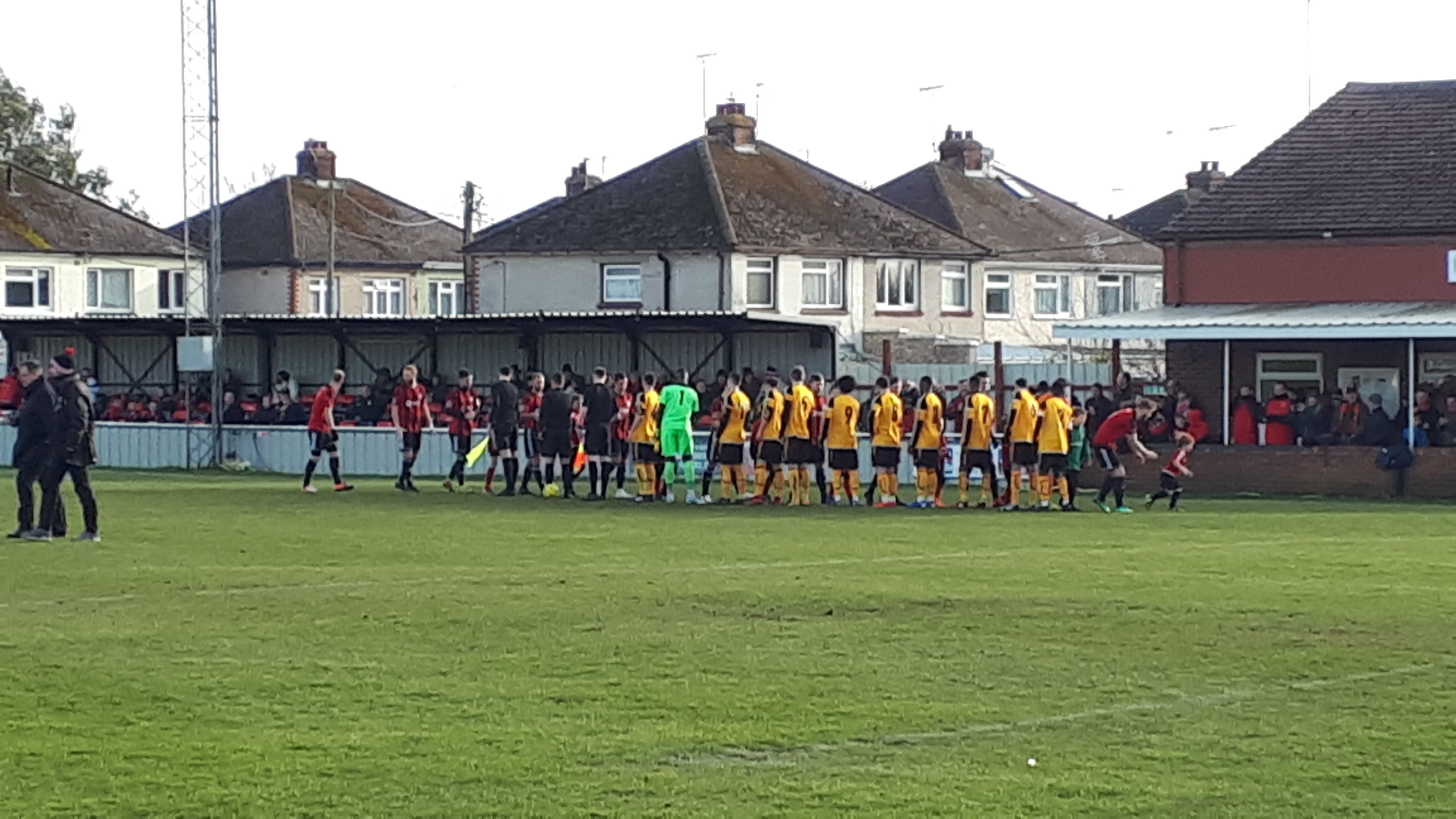


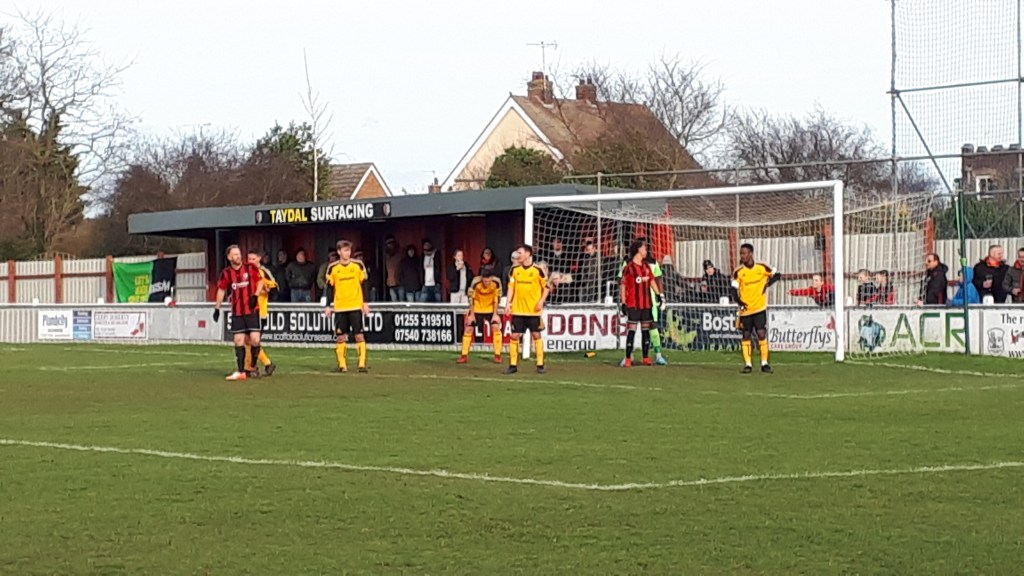
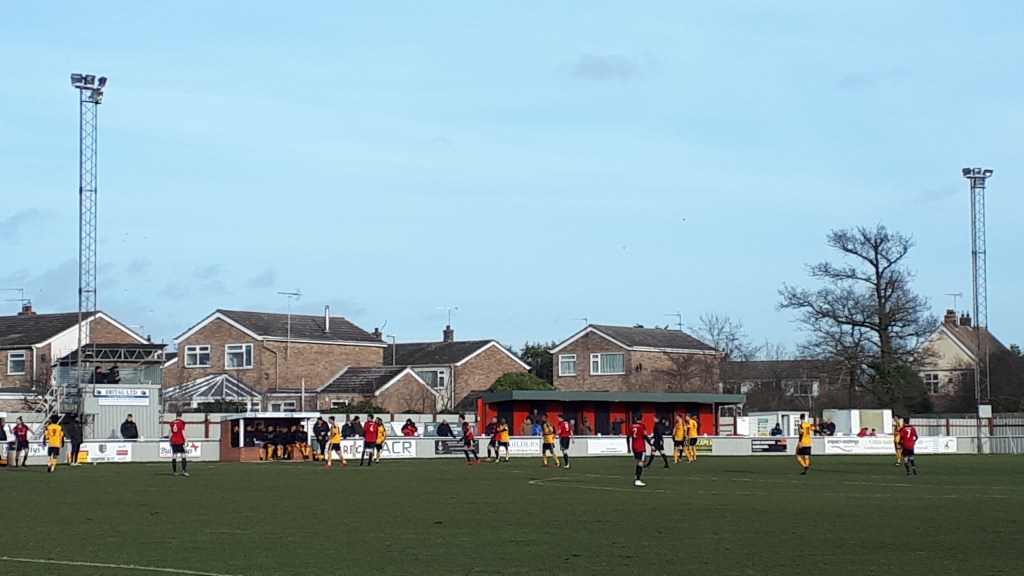
I take a walk around the perimeter of the pitch and then the teams emerge from the corner of the ground by the club house, walking in two neat lines behind the referee Mr Karl Sear and his leggy assistants Leo Del Rosso and Ashley Butler. The standard mass handshaking ensues before Merstham break from a team huddle to kick off towards a row of ugly bungalow roofs which form the backdrop to the goal at the clubhouse end of the ground. Merstham wear yellow shorts and socks with black shorts, whilst Brightlingsea sport a natty kit of black and red striped shirts with black shorts and red socks and kick towards the suburban back gardens of houses on Regent Road, one of which rather unexpectedly and splendidly has crennellations. It’s a colourful sight.
The opening minutes of the game see Merstham, who are third in the excitingly titled Bostik Premier League, but only five points ahead of twelfth placed Brightlingsea, spending as much time in the Brightlingsea half as Brightlingsea, but gradually the game evens out into an inconclusive midfield struggle. Brightlingsea have a shot cleared off the line which the home crowd are convinced was a goal. Fortunately there is no VAR to make shouting “Linesman, you’re useless” a redundant exercise, so somebody shouts it. On the covered shallow terrace behind the Merstham goal the self-styled Brightlingsea Ultras sing “Can you hear the Merstham Sing?” A respectable looking middle-aged woman quite quietly says “No swearing, please” and the Ultras complete their chant singing “I can’t hear (pause), anything, wo-oa, wo-oa-oah”.
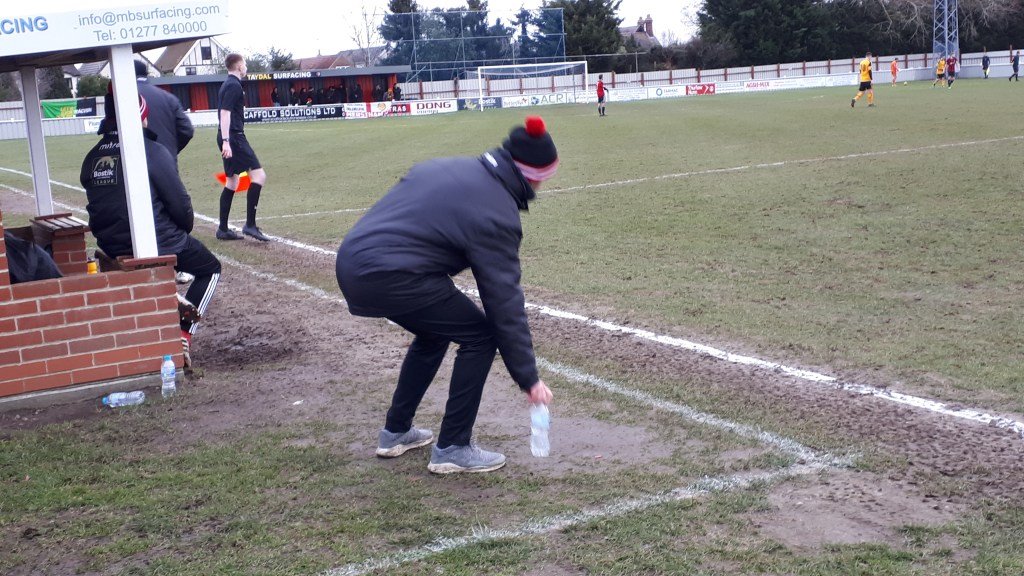
I wander round to the dugouts, interested in what the coaches and managers are doing. The Merstham manager is smartly dressed in a mid-length, navy blue rain coat, shiny black shoes and neatly pressed trousers; he sips from what appears to be a paper cup of coffee, although I guess it could be super-strength cider, but that wouldn’t really fit the pattern established by his wardrobe. The Brightlingsea manager wears a woolly hat, trackie-bottoms and football boots; he glugs from a plastic water bottle which he chucks to the floor when he’s finished. This is the Surrey stockbroker belt versus Tendring. Merstham is on the edge of Reigate, a town 21st out of 401 in a league of average tax bills drawn up by Chartered Accountants Hacker Young for 2011-12.


“Go Manny” shouts the Merstham manager, not just when number eleven Emanuel Ighorea has the ball, but whenever anyone else does too. “Come inside, keep sucking it in” he adds complicating matters. His subsequent plea to “Get the ball” seems sensible if perhaps over simple. On the Brightlingsea bench there is the same concern for their number eleven, Harrison Banner. “Look at Banner, look at Banner!” is the exasperated call, followed by “For fuck’s sake” suggesting that if anyone did look at Banner they forgot to do anything else.
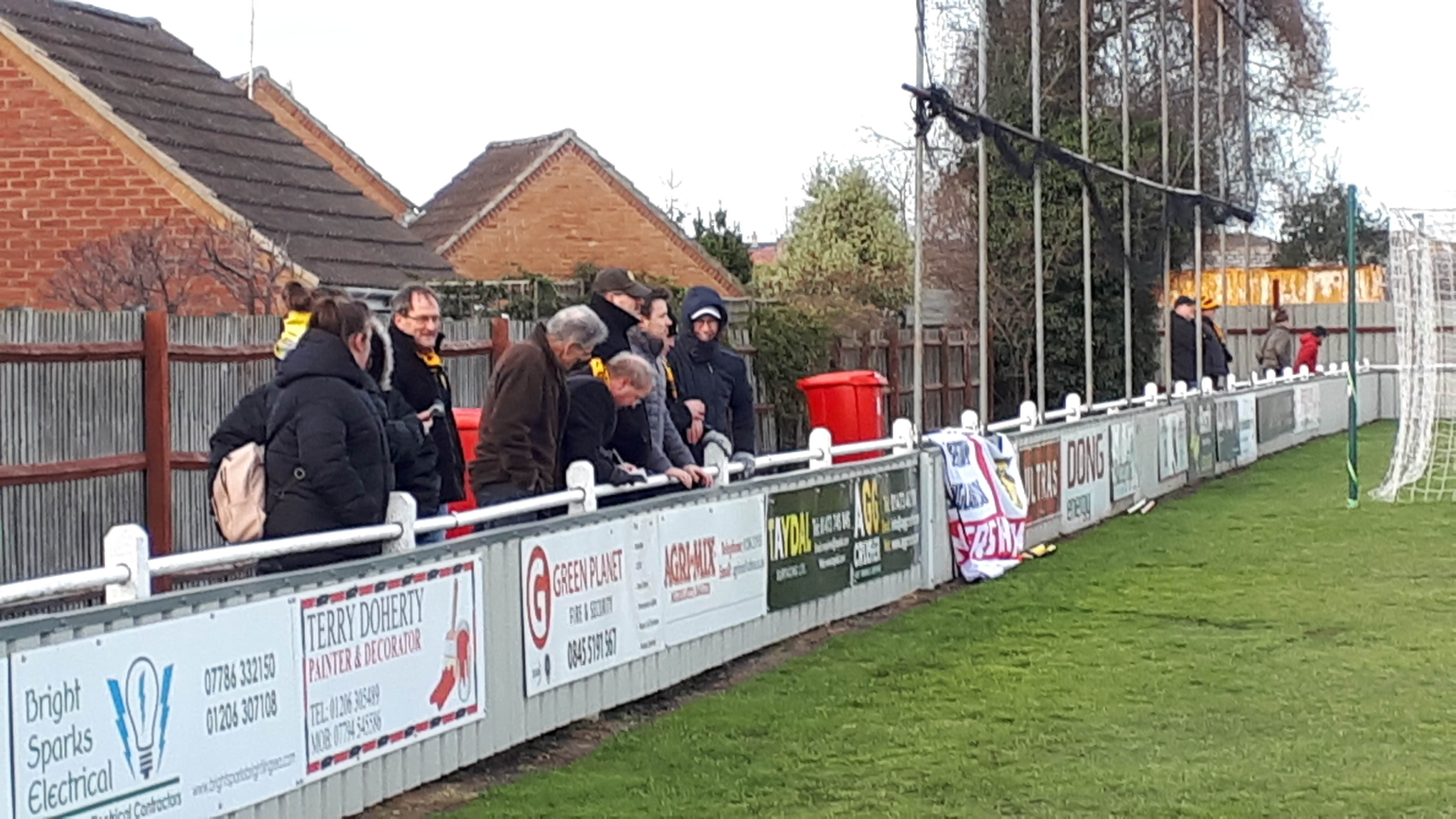


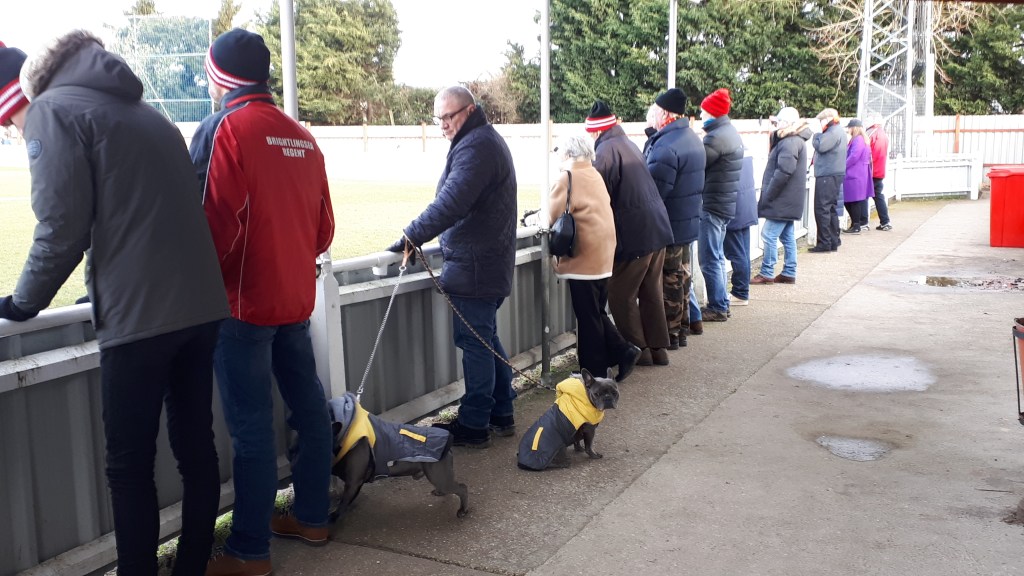
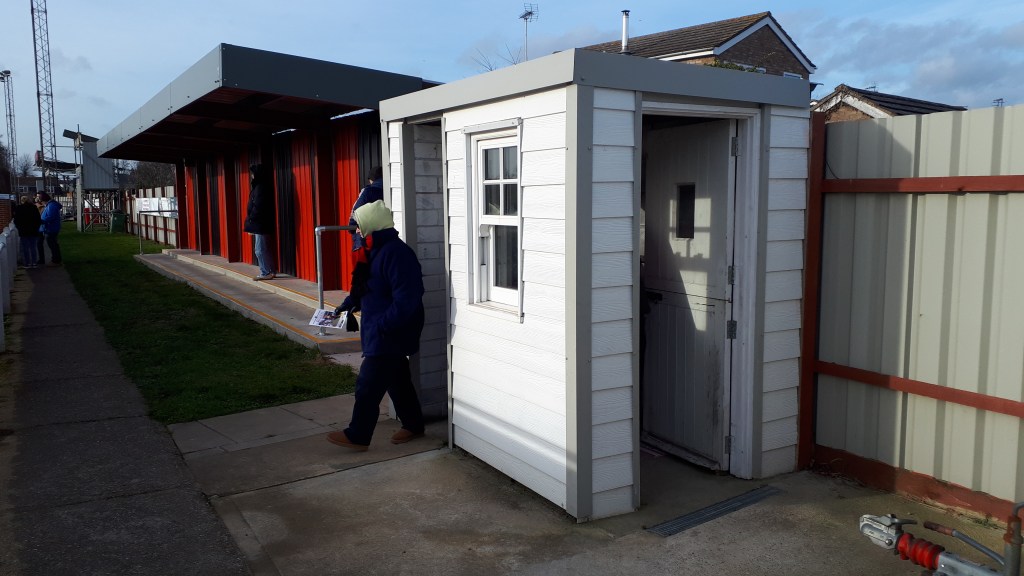
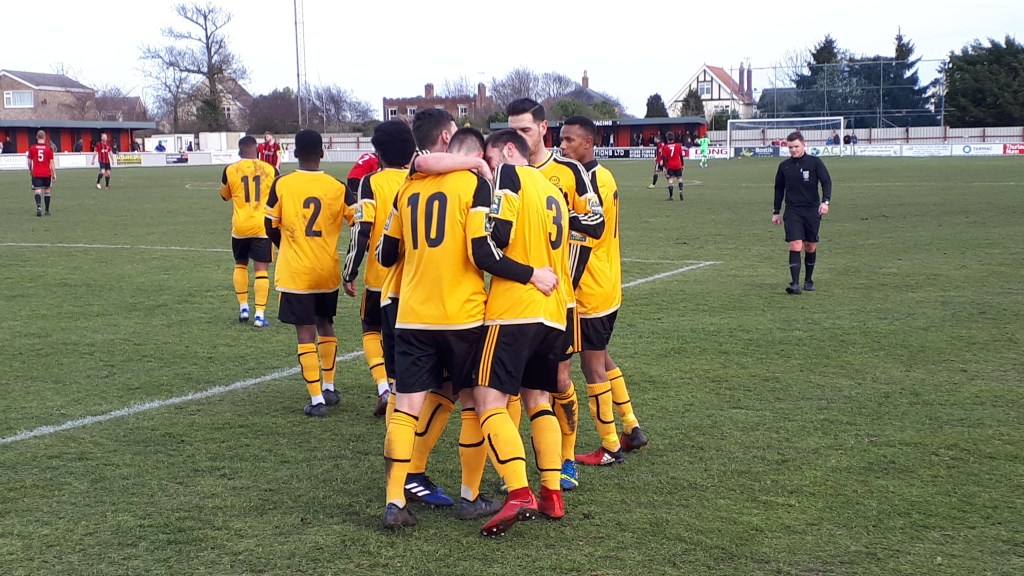
With half-time approaching I move on to behind the goal where the Merstham fans are congregated in a long line. Merstham enjoy a little flourish at the end of the half and all of a sudden number ten Fabio Saralva has the ball with no one much around him, he steps forward to the edge of the Brightlingsea penalty area before launching a shot into the top left hand corner of the Brightlingsea goal; ‘keeper James Bradbrook’s dive is despairing and Merstham lead 1-0 from a very fine looking goal. Understandably the Merstham supporters are thrilled by this event and I can’t deny being impressed somewhat too. I wander round past the players’ tunnel which looks like it might once have accommodated primates at Colchester zoo and wait just a few yards from the tea bar for half-time. The final action of the half sees referee Mr Sear wave his yellow card at Merstham’s number nine Walter Figuiera whom the referee has seemingly ‘had it in for’ all afternoon, to the extent of calling back play for a free-kick to Merstham as he was about to cross the ball. As the players leave the field for their half time cuppa the Merstham fans gather at the players’ tunnel and I add my voice to questions to Mr Sear about his attitude towards Figuiera; he doesn’t answer, confirming his guilt to my mind.

I queue for a cup of tea (£1.50) and consider why tea costs more the further up the football league pyramid one goes. I fish the tea bag from my cup and drop it in the bin next to the table on which the milk and sugar is placed. An elderly man with a flat cap and a stick tries to flick his teabag from his cup to the bin, but his tea bag falls on the ground with a wet splat. “That’s you out of the basketball team” I tell him, he smiles sympathetically. I stand my tea on the brick perimeter wall to allow it to cool. “Haringey are losing again” says an excited voice behind me “Potters Bar are winning at Worthing”. No one responds, but another voice declares that the hot chocolate is lovely. “Best in the league, since they cleaned the machine” says someone else. I look through the programme. It’s an attractive glossy publication and I am reminded why it is so disappointing that some clubs no longer produce one. Where else would it be possible to learn that Regent’s number nine Michael Brothers brings some “top banter” to the dressing room?
At four minutes past four the game resumes and Brightlingsea look to have had the more inspiring half-time team talk, getting forward more consistently than they managed before and they win a couple of corners. “Head it, head the ball” is the considered advice from the stands, as well as a more violent sounding “Attack it!” “Come on you R’s” sing the Ultras. At twenty past four a Brightlingsea corner is cleared but only to a point a few yards outside the penalty area from where it is lobbed high back towards the goal. Necks are craned but only Brightlingsea’s Jake Turner moves his feet and follows the flight of the ball and the two come together about five yards from the goal where he sweeps it unchallenged into the net past a surprised looking Amadou Tangara, the Merstham goalkeeper.
The remainder of the second half is more open than the first with both teams having chances as the sun is engulfed behind hazy cloud and the floodlights come on. Substitutions are made and the PA announcer attempts to induce excitement by lifting the tone of his voice on the final syllable of Clarke Gilbert, as he replaces Michael Brothers; it has no discernible impact. Having equalised, the urgency they had at the start of the half deserts Brightlingsea somewhat, but it remains an entertaining match. There’s a worrying few minutes late on however as Brightlingsea’s number seven Jordan Barnett appears to have some sort of fit after a collision with his own goalkeeper and after several minutes of uncertainty he is stretchered off.
Today’s attendance is announced as 231, and as the sun sinks towards the horizon, the telephone wires across North Road are silhouetted through the descending gloom, looking like a cat’s cradle. I stroll past the Merstham fans assembled behind the goal at the Regent Road end of the ground. “Come on Merstham” they shout. “Who’s that? Mersham?” I ask innocently. Happily, they seem get the joke, I think. I head past the main stand towards the exit and with the final whistle am handily placed for a swift departure.
I make the short walk back to my trusty Citroen reflecting that I have not witnessed a classic match, but it has had its moments and the result is a fair one, which counts for something in this unfair world. Waitrose awaits.


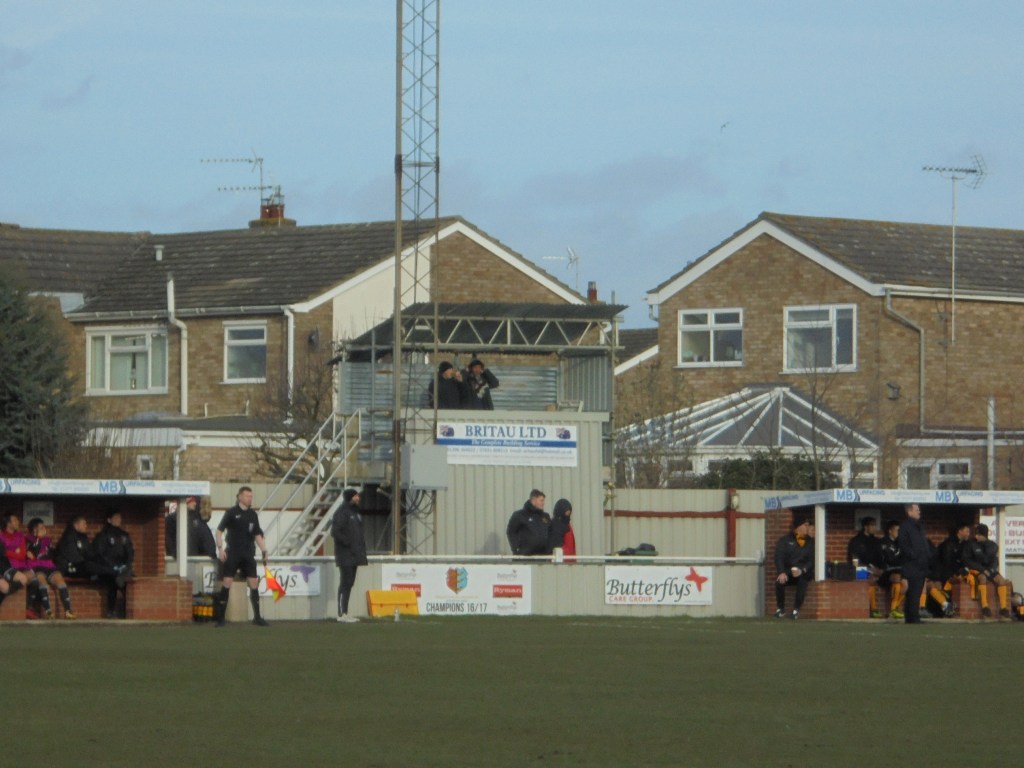

 Citroen and I roll into Victory Road at about twenty past two, where it is already so busy we are ushered into overflow car parking. I drive across the grass behind one goal and onto a field behind the pitch. Once out of my car a steward explains that entry today is through a side gate in order to keep pedestrians from slipping over where the cars have churned up the grass; health and safety eh? Entry costs £11, but I keep the gateman happy by tendering the right money. My wife Paulene has refused to join me today because she maintains that £11 is too much to pay to watch ‘local football’, and she makes a fair point, although today’s opponents aren’t exactly local, Rushall being about 285 kilometres away near Walsall in the West Midlands. In France it is possible to watch a fully professional second division match in a modern stadium for not much more than I have paid today, and sometimes for a bit less.

 one to one approach. As half time nears I head back round towards the giant bungalow so that I can be handily placed for the tea bar when the whistle blows. As I watch on from behind the Leiston bench their number two Matt Rutterford commits a fairly innocuous foul, sidling up behind a Rushall player. Sadly for Leiston, Mr Hancock doesn’t consider that the foul is that innocuous and proceeds to whip out his yellow card in the direction of the unfortunate full-back, who having already seen the card once earlier in the game gets to see Mr Hancock’s red card also. Much wailing and gnashing of teeth ensues and there is a strong feeling that Leiston cannot now possibly win and Mr Hancock has ruined the game more than a few fouls ever could.


 As darkness shrouds the ground it loses its plainness and takes on a new atmosphere. The long shadows have gone to be replaced by the glow of the floodlights. On the pitch Rushall push forward and Leiston defend; their goalkeeper Marcus Garnham makes a couple of smart saves. Leiston try to catch Rushall on the break with quick, astute passes and diagonal punts but it doesn’t feel as though Leiston or their supporters expect to win, and holding on for the goalless draw will be victory enough, of a sort. The story is a simple one; Leiston must keep Rushall at bay. But there have been injuries and delays and time added on at the end seems interminable. It’s the ninety fifth minute and Marcus Garnham makes a spectacular reaction save, followed quickly by another but before we have time to applaud the ball runs to Rushall substitute Keiron Berry stood just three yards from the open goal, a prod is all that’s needed.
 pitchside rail says he’s “had it” with the referee and he’s going home, he starts to untie his flag. Another group of young lads head off too. “Fucking Toby’s fault” says a lad with long curly hair like Marc Bolan “it’s the same every time we come here with him”. The despondent occupants of the Screwbolt Fixings stand shuffle off with Mr Hancock’s final whistle whilst jeering at the Rushall goalkeeper Joseph Slinn, “Cheats” they shout, rather un-sportingly. In return the ‘keeper tells them how much he enjoyed their Neil Diamond song, but such is their disappointment they’re not listening and he was only trying to be friendly.
 young and unusually trendy; one has a beard, one sports what may be designer stubble whilst the third has one of those tied-up, top-knot haircuts with two partings. I always thought the Football Association had their own barbers who tried to make all referees look like Action Man, but it seems not. They’ll have to keep an eye on the fella with the top-knot; seems a bit of a individualist.
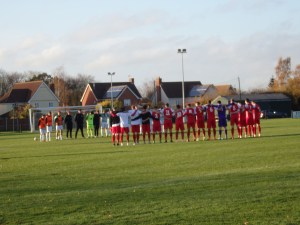 With the Last Post over, it’s time for the minute’s silence, which happily is well observed by everyone and I suspect we all feel much better for it. For future reference, the Last Post should probably follow the silence.

 Norwich number four Sam Applegate would seem to have a particularly vicious barber who has given Sam a haircut which makes him look as if he is wearing a skull cap. Fram’s number six James Mayhew becomes the first player to be booked by Mr Willmore. The excitement increases as Fram’ look for a second goal, but also look to hang on to their lead. “Go on Fram’”, “Go on, close ‘em down” “Come on Fram’, play football” are the calls of advice from the main stand.
 At just before twenty five past four Max Willets chases off down the right for Fram’ once again. He gets into the penalty area, checks, changes pace and gains half a yard on the full-back before crossing the ball and Jake Seaber, whose name doesn’t even appear in the programme, scores a simple tap-in at the far post. The cheer for the second goal is even bigger than for the first and I once again join in; witnessing a Suffolk team called Town score a second goal against a team from Norwich is something I’ve not done in quite a while. Up the Towun!


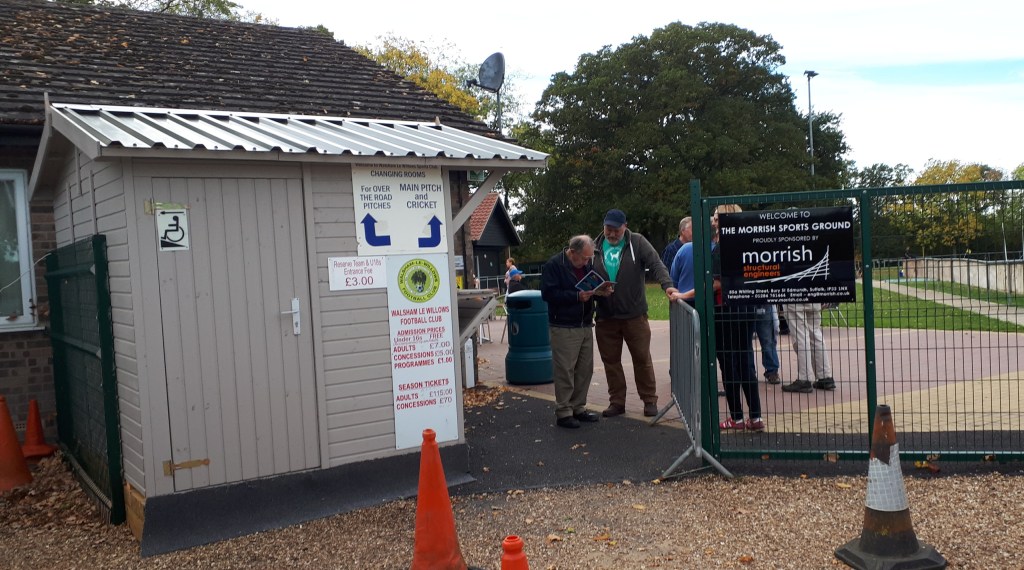 presumably paid to now have called The Morrish Stadium. The word ‘stadium’ does not do this delightful football ground justice and there really needs to be another word to describe a football pitch within the boundary of a cricket pitch surrounded by trees with just a metal stand on the half way line and a small covered standing area behind one goal. There is car parking on both sides of the road, but that adjacent to the pitch and club house is full so I parkover the road by the impressive array of all-weather, 3G pitches that have been built in the past few years. This is a truly magnificent facility and not what you might expect to find in the depths of the Suffolk countryside.
 cross Summer Road and walk on through the little blue gate marked ‘Match day entrance’, which looks like it might also serve the village primary school, although it doesn’t. I walk across the car park to a wooden hut where I pay my entrance money (£7 – it’s gone up £1 since I was last here inn 2014) and am handed a small yellow ticket: “Admit One”. I also purchase a programme (still £1). In front of the club house and bar is a patio area laid out with chairs and tables at which people are sat talking and drinking. I cross the patio to a dark timber clad building, which houses the changing rooms and the tea bar. I order a bacon-butty (£2) from one of the three middle aged ‘dinner ladies’ and am impressed that the meat is supplied by a local butcher, Rolfes of Walsham. This is how local football clubs should be run, promoting and partnering local businesses, not churning out the cheap and the dubious offerings from the Cash n’ Carry.

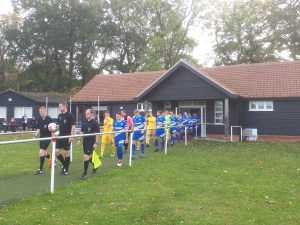 guess they are really just waiting to be sure no one gets left behind. Eventually referee Mr Alistair Wilson leads the teams along the open ‘corridor’ to the pitch where they all line up in front of the stand and indulge in the usual excessive shaking of hands; I always hope that one day the teams will also bow to the stand, but it hasn’t happened yet. Today Walsham are playing another ‘village team’, Brantham Athletic, in the Thurlow Nunn Eastern Counties League Premier Division. Walsham are seventh in the league table after nine games and Brantham are just a point behind in eighth, but having only played six games due to a bit of a run in the qualifying rounds of the FA Cup. Coincidentally, both clubs are village sports clubs, although with Brantham originally being borne out of the local BX plastics factory (since closed and demolished). Both clubs also play on pitches where cricket is played in summer.
 silent, although the hum of lively conversation can be heard at the other ‘rowdier’ end of the stand where a group of men in their sixties and seventies stand on a small terrace. The peaceful ambience allows me to appreciate just what a lovely, bucolic setting this is. What is possibly an old pavilion on the far side of the site looks like a blacksmith’s shop and the breeze through the leaves of the trees seems to whisper Walsham le Willows.


 trippingovertheball