Halesworth Town 3 Haverhill Rovers 1

Between March 2017 and April 2019, I watched matches at each one of Suffolk’s then twenty-four senior football clubs and recounted my experiences in this here blog.  Since then, Debenham Leisure Centre and Whitton United have sadly dropped out of senior football but this season the Eastern Counties League First Division North has welcomed two more Suffolk clubs into the fold in the shape of Kings Park Rangers, who are from Great Cornard but seemingly too shy to admit it, and Halesworth Town, who are proudly, clearly from Halesworth. 

Today, with Ipswich Town playing far too far away in deepest Wales to trouble me to even think of getting a ticket, even if I had enough ‘points,’ I am travelling up to Halesworth in part one of my plan to restore my record of having seen all of Suffolk’s senior teams on their home turf.  Fortuitously, today’s fixture is also an all-Suffolk cup-tie against Haverhill Rovers of the Eastern Counties Premier League, and the first time Halesworth Town have ever reached the second round of the FA Vase.   To add to the adventure even more, despite the additional twenty minutes each way that it will take me, I am responsibly reducing congestion on the roads by eschewing making the 88-kilometre journey from my home by planet saving Citroen e-C4 in favour of taking the train (£18.10 return with senior railcard). It also means I can get plastered if I choose to.

It’s an intermittently cloudy but mild November day as I set off for Halesworth, but I am nevertheless surprised as I wait for the train that one of my fellow travellers appears to have forgotten to put on any trousers or a skirt.  Once on the train, the infinite variety of human life continues to reveal itself as a small man of pensionable age repeats the names of the station stops as they are heard over the public address system; every now and then he delves headfirst into a large carrier bag as if checking on the wellbeing of a small animal or perhaps a baby.  When the woman sitting opposite me goes to the buffet car, she asks me to mind her belongings. I of course agree but tell her she needs to be back before we get to Ipswich.   When she returns, I tell her I had to fight off a couple of people who looked interested in her jacket but otherwise everything has been fine.  Fortunately, she laughs, but the man of east Asian origin next to me looks at me askance and when she begins to struggle to open a bottle of drink, he very quickly offers to help so that she doesn’t have to deal with the looney opposite her again.  The woman soon begins to chew on a large sandwich and a younger man on the other side of the aisle between the seats does the same thing, but takes much bigger bites, happily from a different sandwich, although with every bite he looks like he might lose a finger.

I change trains at Ipswich, boarding the 13:16 to Lowestoft, which departs a good twelve seconds early.  I like the East Suffolk line, to me it feels like a one-hundred- and seventy-year-old umbilical cord connecting the outside world to rural Suffolk with its rustic sounding stations such as Campsea Ashe and Darsham and their Victorian architecture.  Between the stations are Suffolk landscapes of river and marsh, Oak and Broom, sheep and pigs, outwash sands and boulder clay and gaunt, grey, flint church towers.  As the guard checks passengers’ tickets, he helpfully advises those alighting at Halesworth not to use the doors in the front carriage, because the Halesworth station platform is not that long.  There seem to be quite a few of us alighting at Halesworth.

The train arrives on time in Halesworth, where the sun shines from a pale blue autumn sky. A helpful sign points and tells pedestrians that it’s a seven-minute walk to the town centre and a minute’s walk to local bus stops on Norwich Road. Sadly however, no sign points helpfully towards Halesworth Town football ground, although having previously consulted the interweb I happen to know it is very close indeed, perhaps no more than a hefty goal-kick away.   I walk up an alley between the railway lines and Halesworth Police station, a huge four-storey block of a building, which although it probably dates from the1960’s makes me think of a Norman castle keep, built to keep the locals in check.  At the top of the alley, I turn right over a bridge above the railway and then right again down another alley the other side of the tracks, and down to the Ipswich bound railway platform. From here it is no more than 150 metres up Dairy Hill to the football ground, making it a toss-up between Halesworth and Newmarket as to which senior Suffolk football ground is most easily accessible by rail, my money’s on Halesworth.

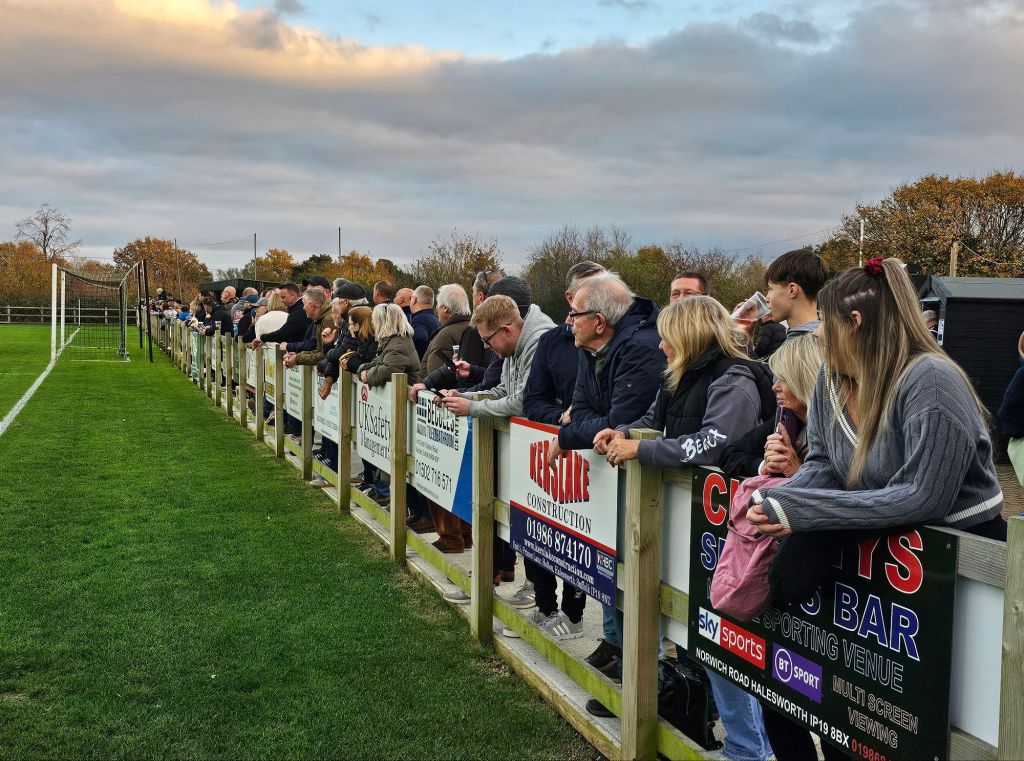
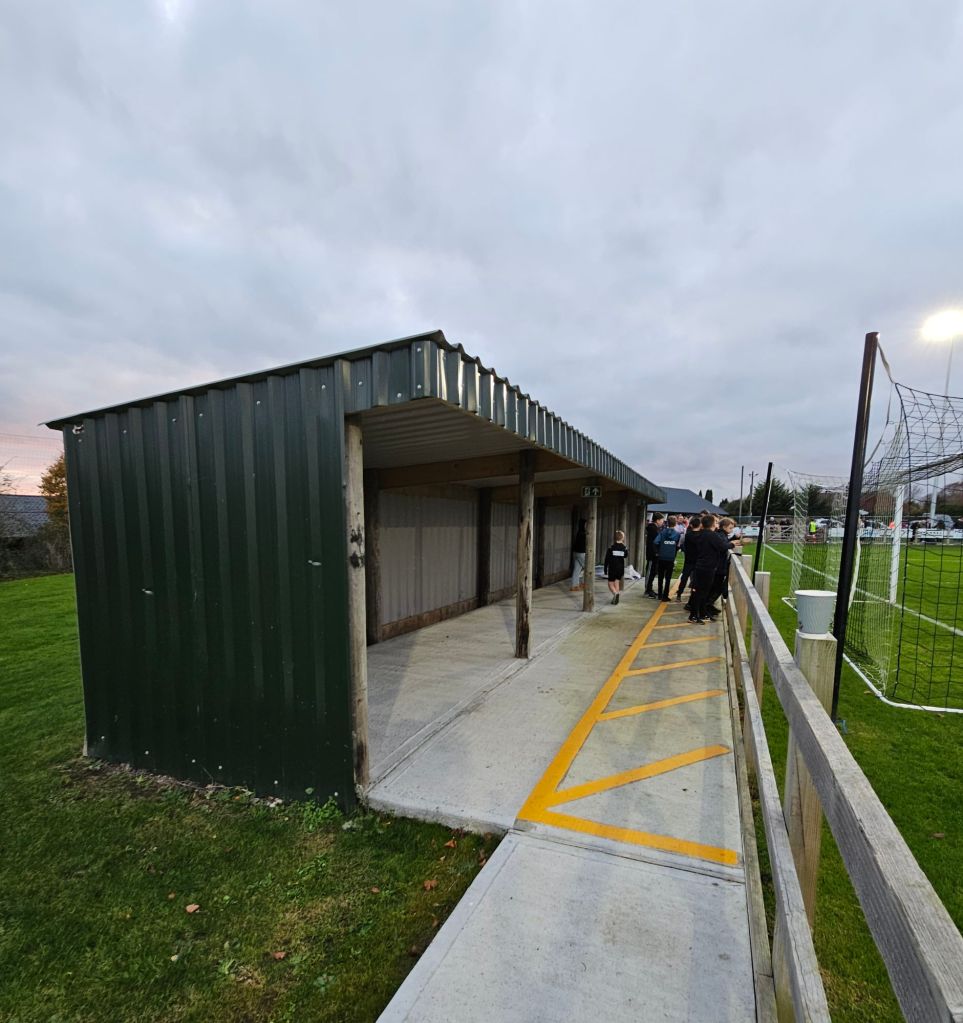
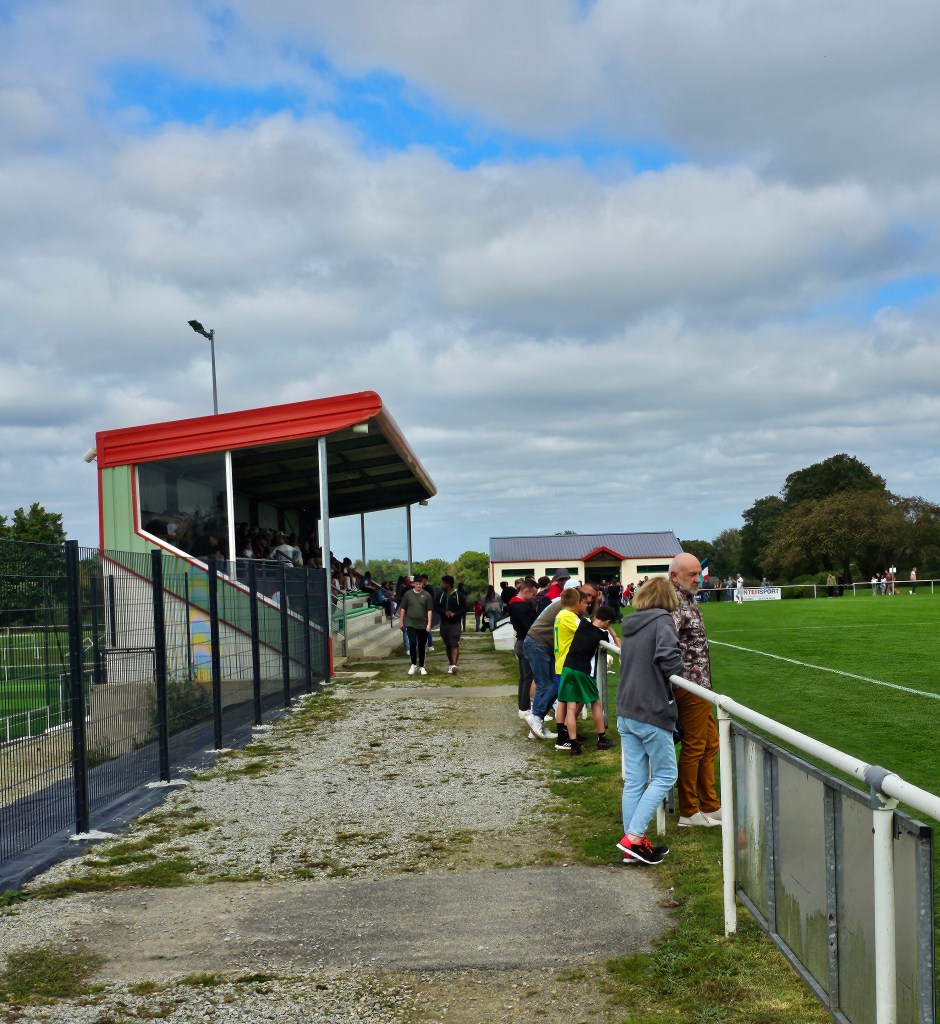
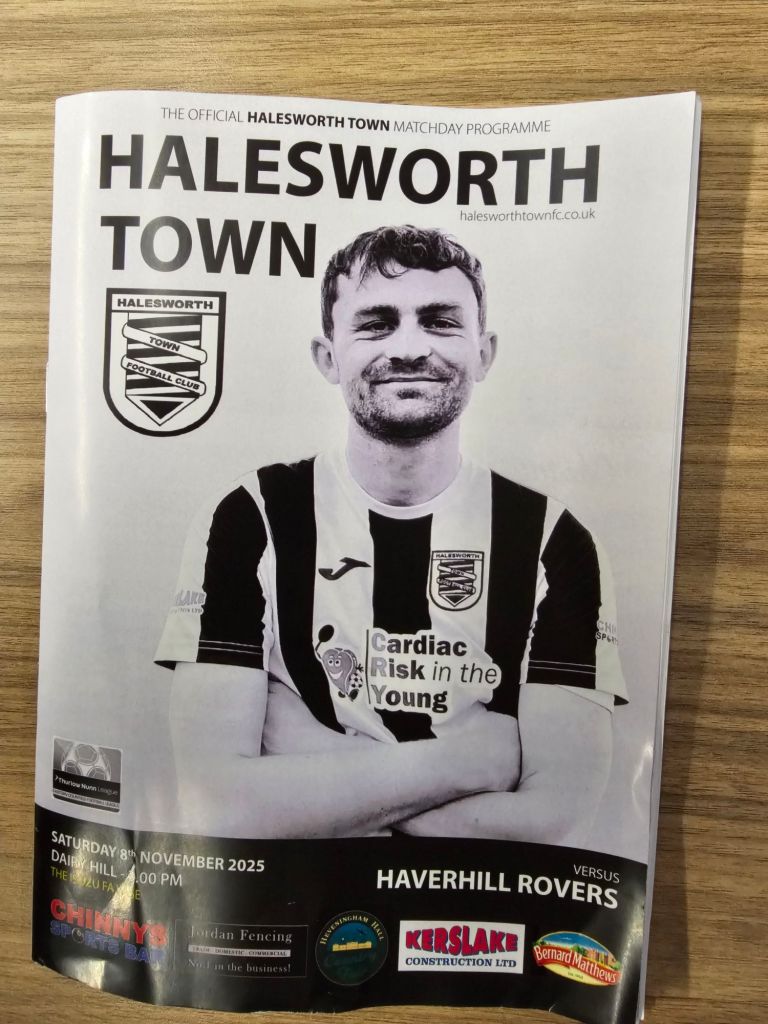
Despite its attractive name, Dairy Hill is just an uninspiring street of modest modern houses; from the top I make my way across the stony club car park and along the back of the club house to the ground entrance.  For a mere seven pounds I gain a programme (£1.00) and entry to the match as an over sixty-five, all that is missing is the click of a turnstile.  The ground itself is underwhelming, but it does boast a decent looking pitch with a smart timber fence all around and a small stand at the end nearest the clubhouse, which according to ground grading rules needs to be big enough to accommodate fifty spectators, although I’m not sure if FA rules say how large or small the spectators need to be.  The height of Halesworth’s stand suggests they should not be significantly taller than about 1.8 metres unless wearing crash helmets.
I head for the club house where the bar offers the usual array of fizzy lagers and cider and a pump which intriguingly bears the name ‘Wainwright’ written in biro on a plain white sticky label.  The barman generously allows me a sampler of the ‘Wainwright’ and seeing as there’s nothing-else I might like I order a pint (£4.60) before heading outside again to visit the food trailer, where a tall man with tattooed arms, who looks like men in food trailers often do serves me chilli, chips and cheese for a modest six pounds, less than half what I paid for much the same thing in an Ipswich pub earlier this week. 

I return to the club house to eat my chips and drink my beer, not being someone who likes to eat or drink standing up.  The club house looks like there might be an older timber building, which has had a new roof and supporting structure placed over the top of it, it smells a little like that too, having a faint musty odour which isn’t uncommon in old village halls and clubhouses.  The black and white interior décor and monochrome photos of old teams on the walls remind me a little of the Long Melford club house before it was re-built.

With chips eaten and beer drunk, I wait outside for kick-off, observing the growing crowd and the queue to get in at the gate, before standing closer to where the two teams will line up before the procession on to the pitch to shake hands and then observe the minute’s silence for remembrance day, a silence  which whilst well observed around the pitch plays out to a back ground of chatter from inside the bar and clubhouse, where life continues as usual, oblivious to the  silence outside.
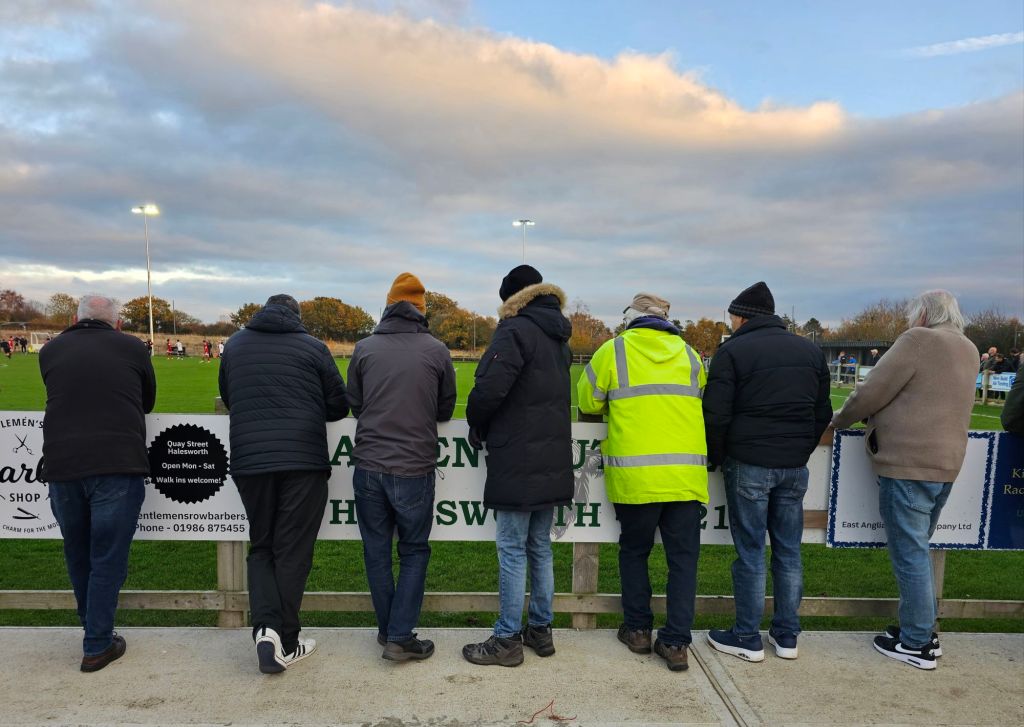
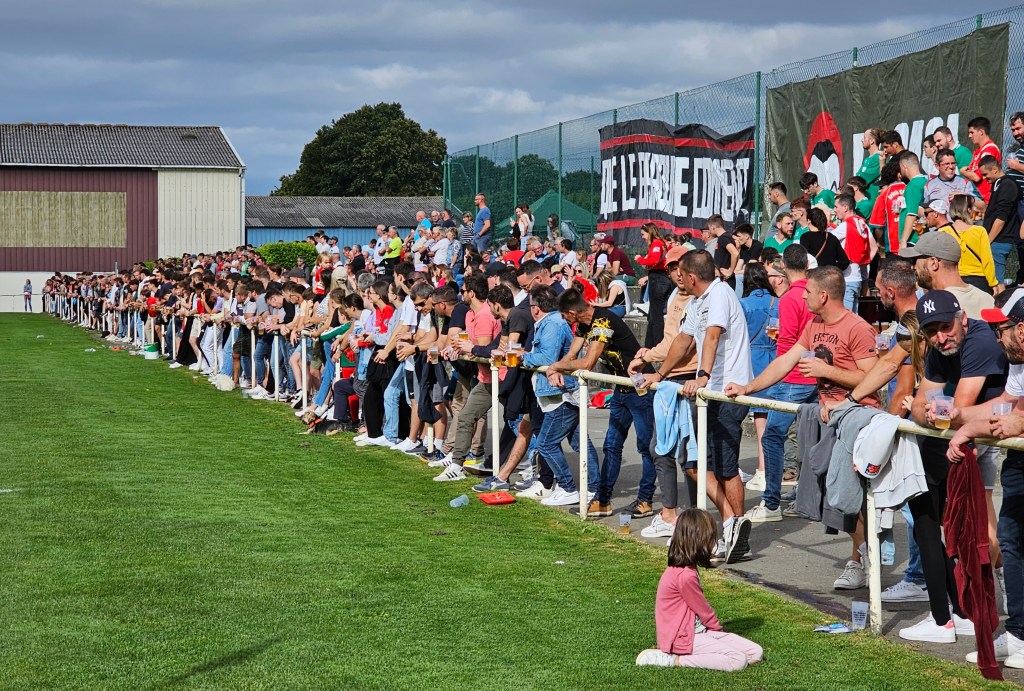
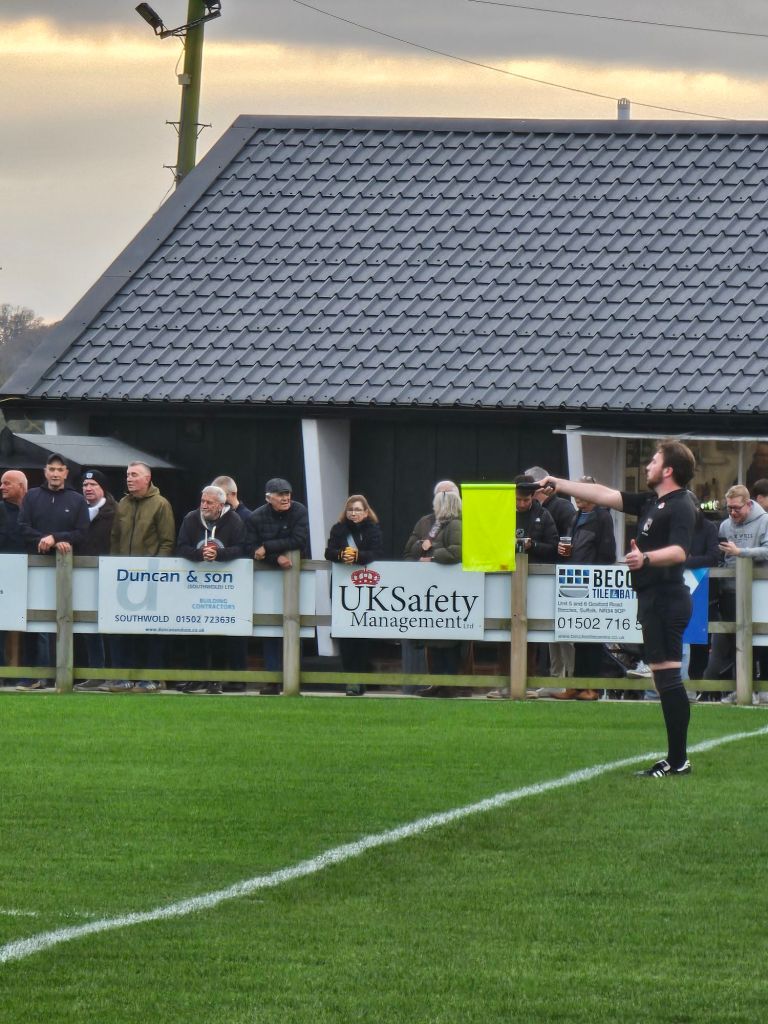
Eventually, it is Haverhill Rovers who begin the game, by getting first go with the ball, which they quickly hoof forward in the general direction of the stand, the railway station and town centre beyond, before it is booted into touch by a Halesworth defender, not unreasonably practicing safety first.  It’s good to see both teams wearing their signature kits, Rovers in a rich shade of all red, whilst Halesworth sport black and white stripes with black shorts. In front of the only stand, a youth bangs the sort of drum I wouldn’t bet against him having been given as a present for his sixth birthday, probably about six years ago.  The bulk of the crowd are lined up behind the post and rail fence along the touchline opposite the dug outs and when Halesworth win the ball they emit an encouraging rustic roar.

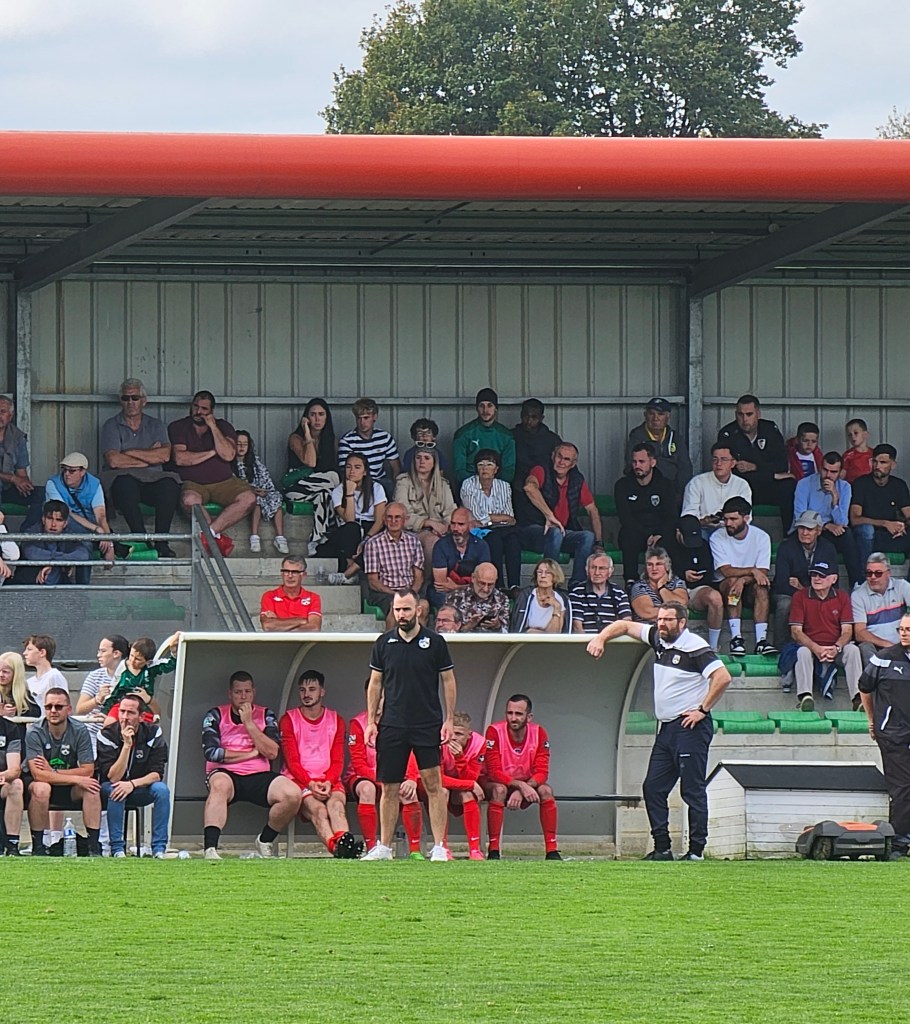
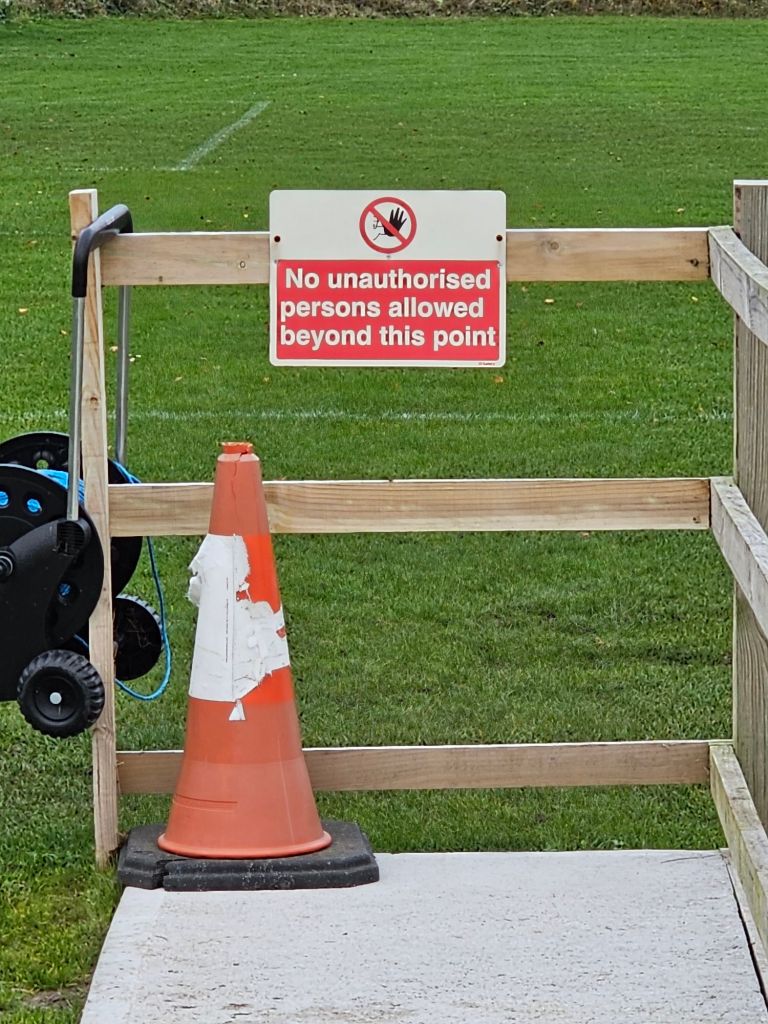
Seven minutes have passed and it’s Rovers who are the team kicking the ball most of the time; their number seven Prince Mutswunguma performs a neat turn and a decent cross which is headed over the Halesworth cross bar.  The pattern of the game is generally one where the long ball is favoured over short passes and two minutes later Mutswunguma blazes the ball high above the Halesworth cross bar.  I stroll along the front of the empty stand between it and the pre-pubescent ultras but remain nervous of hitting my head on the low roof.  I stop close to the corner flag, halted by a sign forbidding further progress and disappointingly preventing me from walking round to watch the game from behind or between the dugouts, where the angst and frequent bad language of the managers and coaches is often as entertaining as the match.   I am nevertheless now in a good position to see Rovers’ desperate claims for a penalty as Mutswunguma tumbles under a challenge from number 6, Ollie Allen and then two more players fall over. “Fucking disgraceful” opines a gruff voice from somewhere, either on the pitch or in the dugouts, but I’m not sure if he means not giving a penalty or having the temerity to appeal for one.

Keen to see the game from as many angles as possible I move again, this time to near the corner flag diagonally opposite the one I have been standing by.  I settle near a man in late middle age who sports a Stranglers t-shirt and beanie hat bearing the name of The Rezillos, the excellent late 1970’s Scottish ‘punk’ band fronted by Faye Fife and Eugene Reynolds.  He is on his mobile phone and seems to be arranging a claim on his motor insurance having hit something when parking his car in the club car park.  In my new position I also benefit from a good view of an increasing number of unsuccessful Halesworth breakaways as the home team gain in confidence from repelling all Rovers’ attempts to score.

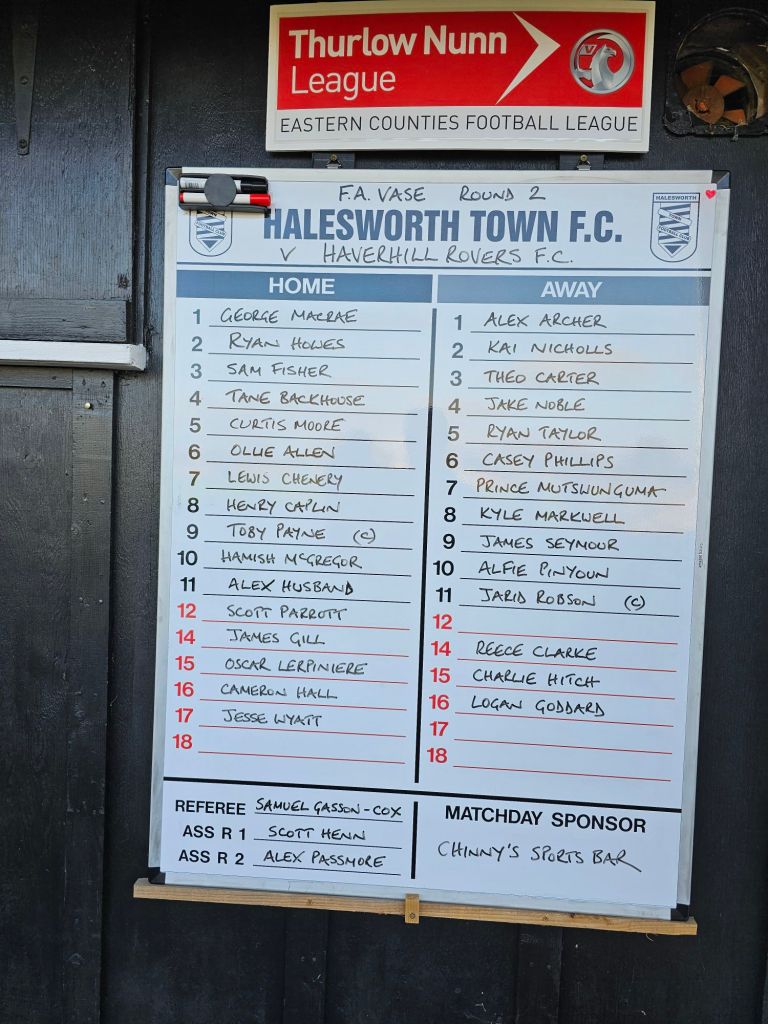
In goal for Halesworth, George Macrae has made a string of fine saves as Rovers win a succession of corners.  Rovers’ best effort is a shot from Kyle Markwell, whose surname gives a clue to the opposition as to how to treat him, that whistles past a post.  A half an hour is lost to history and Halesworth fashion another breakaway as captain Toby Payne receives a diagonal pass out on the left.  “He’s on!  He’s on! Well, he’s not off” shouts a young man to my left with rising excitement as Rovers’ offside trap is sprung. Payne advances into the penalty box, shapes up to shoot but then side foots weakly too close to the goalkeeper Alex Archer, who doesn’t have to stretch far to prevent a goal.  Two minutes later however Halesworth break again down the left and this time the ball is pulled back from the by-line for Lewis Chenery to score easily into the middle of the Rovers’ goal from no more than 8 metres out and it’s 1-0 to Halesworth Town.

The remaining dozen minutes of the half repeat the established pattern of the previous thirty-three, and another Rovers’ corner is headed wide, which I view from back near the clubhouse as I prepare to be ahead of the queues for the toilet and the tea bar when the referee, the extravagantly monikered Mr Gasson-Cox sounds the half-time whistle.  Having invested in a pound’s worth of tea I take-up a position for the second half just to the right of the stand, but not before I overhear a club official talking to the man on the gate and learn that the attendance today is a stonking two-hundred and fifty-eight.    As the new half begins and the light fades, the lovely smell of the turf rises up from the pitch. A woman standing next to me tells me we will see the goals at this end in the second half and I agree, telling her that with the goal being scored at the other end in the first half, it figures that this is the end where the goals will be scored this half.  We talk a little more and after I reveal I have an Ipswich Town season ticket, she admits to being a Norwich City supporter, but sympathetically I tell her someone has to be.
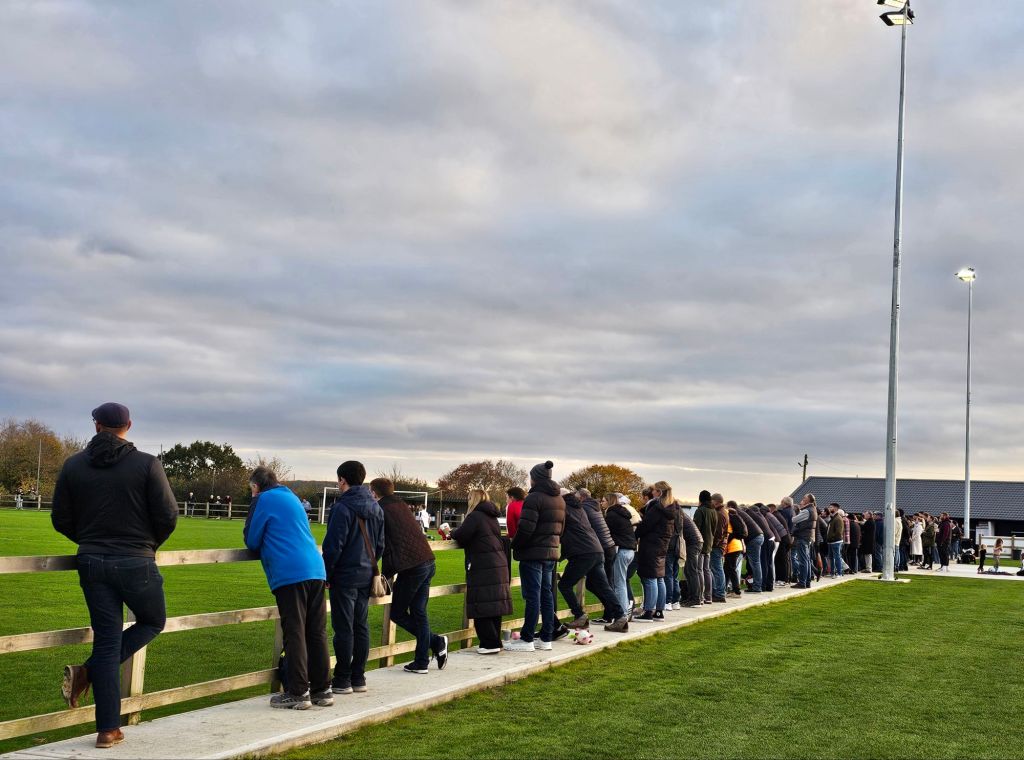
With the start of the second half at three minutes past four Halesworth seem to have lost a little of the confidence they showed by the end of the first half, perhaps because they realise they have to go through another forty-five minutes similar to the first, and indeed they do. But with twenty minutes gone and no further score it is Rovers who first feel the need to make substitutions.  “Who are ya?” chant the pre-pubescent ultras, as well they might as the new players emerge from the dugout.  Five minutes later and Halesworth’s Tane Backhouse is the first player to see the yellow one of Mr Gasson-Cox’s two cards, although as I become increasingly biased in favour of the home team and their superb goalkeeper, I can’t really figure out why.  Two minutes later and I’m cheering as another characteristic break down the right sees Toby Payne run to the edge of the Rovers penalty area, cut across a little towards the middle and then shoot unerringly inside the far post and Halesworth lead 2-0.  “Oh when the Town go marching in” sing the mini ultras, as do a number of people old enough to know better, but understandably carried away by the moment.

Things get no better for Rovers as after  an innocuous looking foul Mr Gasson-Cox nevertheless seems annoyed with Prince Mutswunguma and standing his ground, summons him over before showing him the yellow card.  “Wemberley, Wemberley” sing the Halesworth fans who should know better but are now too happy to care, but as they do so Rovers, perhaps realising their desperate position with only ten minutes left embark on a final push.   It’s twenty to five as George Macrae makes another fine save, this time diving low to his left. “Two-nil down on your big day out” sing the pre-pubescents, not helping the situation with their cruel taunts and Rovers win another corner.  The corner is cleared but moments later the ball is crossed low from the right and Rovers’ number eleven and captain Jarid Robson half volleys it high into the centre of the goal from a narrow angle and the score is a nerve-wracking 2-1.

It’s now eleven minutes to five, the match is a minute into added on time and Rovers are besieging the Halesworth goal like local Saxons or Danes outside the Norman police station.  A cross comes in from the left, and a Rovers head goes up diverting the ball goalwards but once again George Macrae appears, seemingly from nowhere to save the day again by cleanly catching the ball.  “Six more minutes Haverhill” I hear a voice call, perhaps from the Rovers’ dugout, or perhaps it was Mr Gasson-Cox or someone just mucking about. Six minutes seems an awfully long time given that neither I nor the lady next to me can recall anyone really being injured.  Another Rovers corner goes straight to the arms of Macrae but then Halesworth break away again, bearing down on goal on the right and then switching the ball across the edge of the penalty box before number eleven Alex Husband shoots from a narrow angle and the ball strikes a Rovers defender and arcs up over Archer the goalkeeper and into the goal off the far post.  It’s 3-1 to Halesworth! The game is surely won and the knot of Halesworth players hugging by the corner flag and the under12’s ultras who have run along behind us hoping to celebrate with them clearly think so.

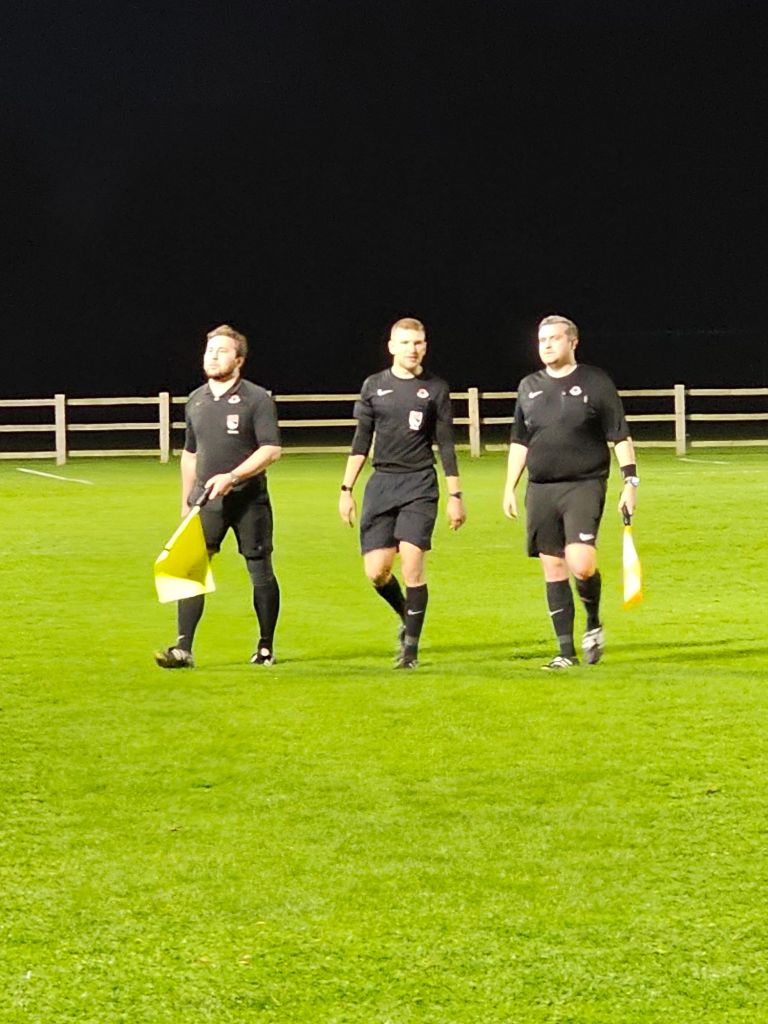
Very soon however, it’s three minutes to five and finally Mr Gasson-Cox parps his whistle for the last time today and Halesworth are into the third round of the FA Vase. Most people wait to cheer and applaud the team as they leave the pitch, but not before they applaud Mr Gasson-Cox the referee and his assistants, which is something you don’t see every day, and then the Haverhill players too.  It’s been a wonderful afternoon, an exciting cup-tie played in front of a large and appreciative crowd, and everyone’s had a lovely time.  As I leave the ground and make my way back across the stony car park and down Dairy Hill to the station I reflect on what a fine little town Halesworth is and how one day I really should return. All hail Halesworth!

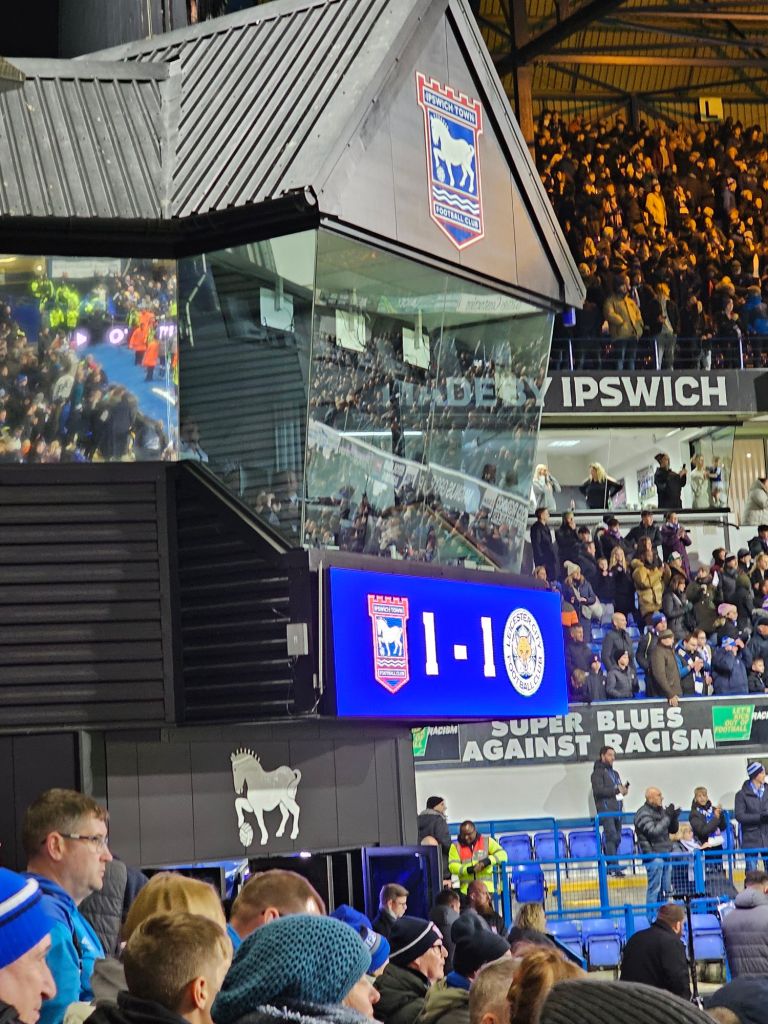
Ipswich Town 1 Leicester City 1

Today is Boxing Day, the day when in Britain we traditionally celebrate our lack of decent public transport and our love of global warming and air pollution by not running buses and trains and then arranging some of the biggest football fixtures of the season to which we flock in our tens of thousands by petrol and diesel-engined cars.  It’s a great day and shows just how much everyone really cares about our children’s future, because after all, if we leave aside the birth of the Messiah bit, Christmas time is all about the children, and the football.

I had thought about not attending today’s match. As a one-man protest however, it wouldn’t really have been measurable on the scale that includes the Buddhist monk Thich Quang Duc in Vietnam in 1963, so I sensibly reasoned that nobody would notice a bloke staying in doors for the evening, except my wife Paulene, who would be forced to watch the match on the telly with me and would therefore probably just go to bed early; if Town aren’t playing either Portsmouth or Paris St Germain she’s not really interested.   I have decided therefore that by driving my planet saving Citroen e-C4 and giving Gary a lift, I can both reduce noxious emissions and reduce congestion thereby earning me brownie points, which I can bank for Judgment Day.

After breezing silently through town, we park up in a quiet, dimly lit residential side street. As we leave the Citroen a family getting out of their car and sporting club colours eye us suspiciously, as if we might be a couple of the drug dealers, who they probably imagine populate this part of town.  I guess there’s no reason why some of the more socially responsible drug dealers won’t also be driving electric cars. Not wanting to disappoint we give the family a special Christmas deal on a couple of Solpadeine and a half a bottle of Night Nurse before we head for the Arb to spend our ill-gotten gains. 

It’s chilly and damp out tonight, and stepping into the glowing warmth of the Arb, my glasses immediately steam-up.  I buy Gary a pint of Lager 43 and in the absence of my ‘usual,’ Mauldon’s Suffolk Pride, order a pint of Mighty Oak Captain Bob for myself (£8.11 for the two including Camra discount). We retire to the cool and calm of the beer garden, where a good number of other drinkers are already enjoying the evening air. We sit and talk of the King’s Christmas broadcast, retirement, the ailments and disabilities of work colleagues we have known and how one who qualified for a parking space was considered disabled  on account of his poor eyesight.  We reminisce about the days when we worked in a fug of tobacco smoke and how many of the sick and infirm are to be found ‘puffing-up’ outside the entrance to Colchester General Hospital.  Gary fetches me a pint of Lacon’s Saint Nick (the Captain Bob was far too citrusy for a winter’s night) and a glass of mulled wine for himself. At about twenty-five past seven we depart for Portman Road.

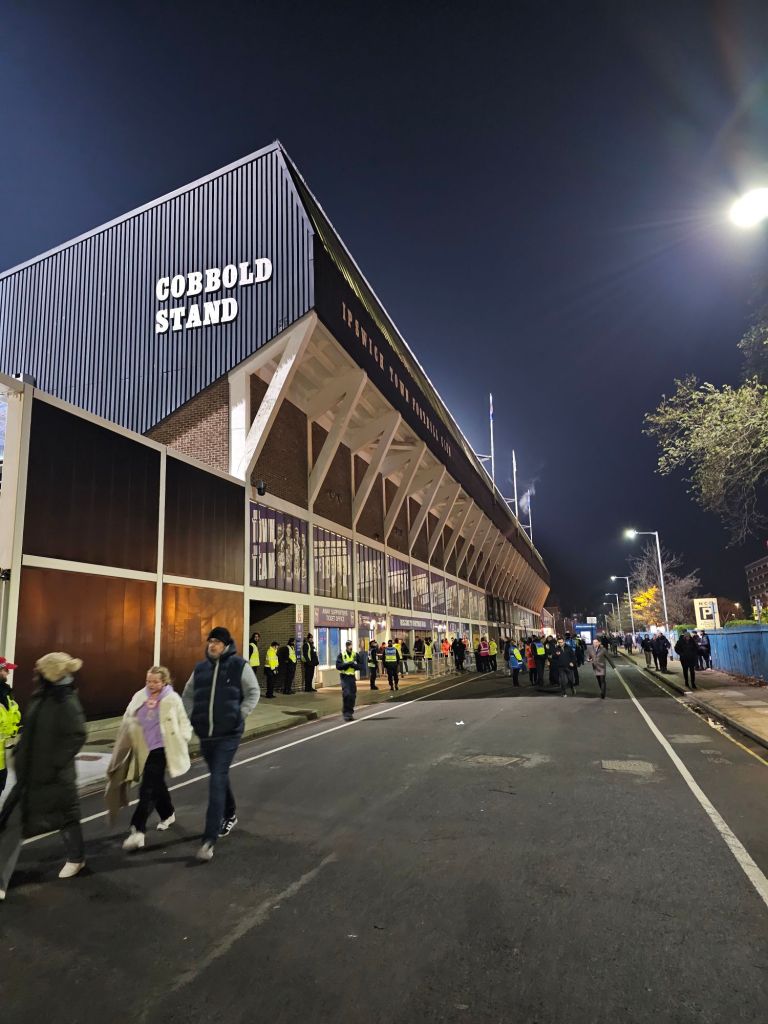
We march mob-handed down High Street with fellow fans who’ve just left the pub.  Gary and I part at the junction of Portman Road with Sir Alf Ramsey Way, and I check that he knows the way back to the Citroen and our stash of gear; he does. I walk on down past the Cobbold Stand pausing only to purchase a programme (£3.50) from one of the out-of-stock ice cream sellers that double up as programme vendors.  There are still queues at the back of the Sir Alf Ramsey Stand as people consumed with the conviviality of the season take their time getting here.  I join the queue at the legendary turnstile 62 and emerge onto the former terrace in time for the announcing of the names of the home team.  Wonderfully, Murphy the usual announcer is nowhere to be heard tonight and he is replaced by another announcer, who sounds less like a superannuated BBC local radio presenter and more like someone who does voiceovers for adverts.  Marvellously, the new man synchronises the announcement of the players’ names with their appearance on the  electronic scoreboard making it possible to bawl them out as if I was in the crowd at Lille, Lens or Lorient.  The joy on people’s faces at discovering this new ‘French’ way to support their team is wonderful to see. The new guy is a consummate professional and it is to be hoped that Murphy has been sacked or has fallen down a hole somewhere and will never be heard again at Portman Road.

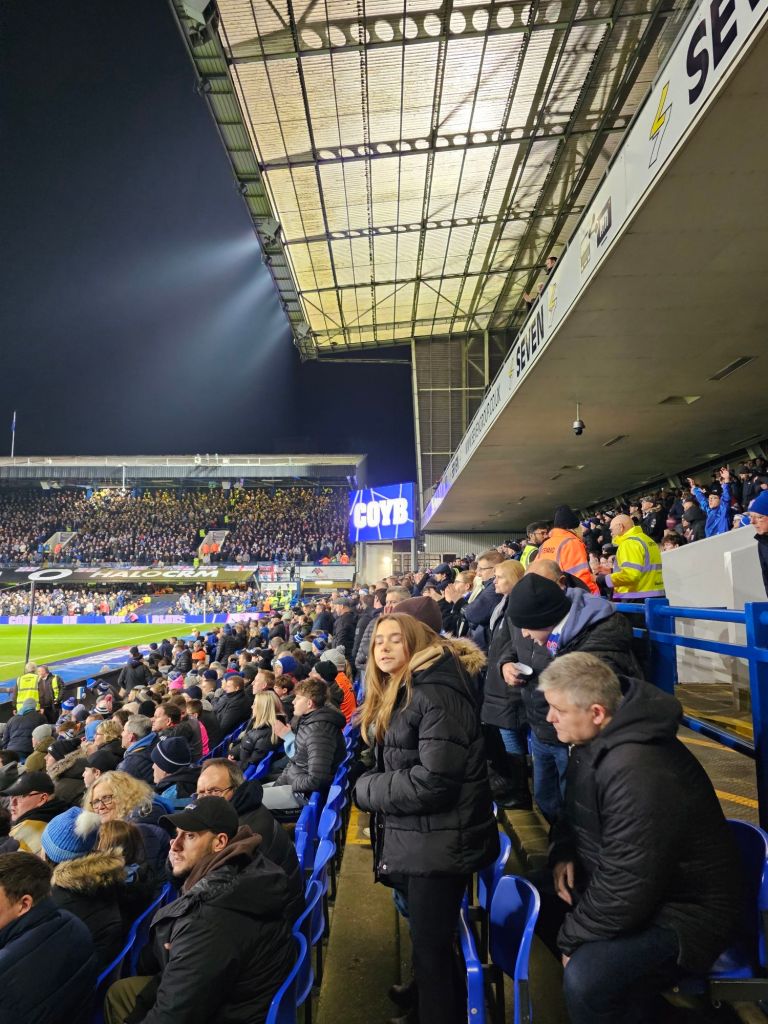
When the match begins it is Town who get first go with the ball, which they’re aiming at the goal just in front of me, Fiona, Pat from Clacton, ever-present Phil who never misses a game and his teenage son Elwood, but not the man from Stowmarket (Paul) who prefers Boxing Night at home, and who can blame him.  Town are of course in their signature blue shirts and white shorts whilst Leicester are in a rather unusual combination of yellow shirts and white shorts, which resurrects temporarily forgotten memories of Torquay United on Friday nights at Layer Road, Colchester in the 1980’s. 

Town start the match to a loud aural background of “We’ve got super Kieran Mckenna…” spilling from the stands, or bits of them, and for seven or eight minutes it inspires the team to put League leaders Leicester on the defensive.  An early Wes Burns run and cross invokes chants of “Blue Army, Blue Army” which almost seem to echo around the ground. Town win two corners.  Wes Burns heads well wide of the goal, as if he’d lost his bearings. “You’ve let yourself down, you’ve let your school down” says the bloke behind me as if to Wes, but probably recounting words from his own life story.  Pat from Clacton mouths to me “Who are these, behind?” as she swivels her eyes and raises her eyebrows.

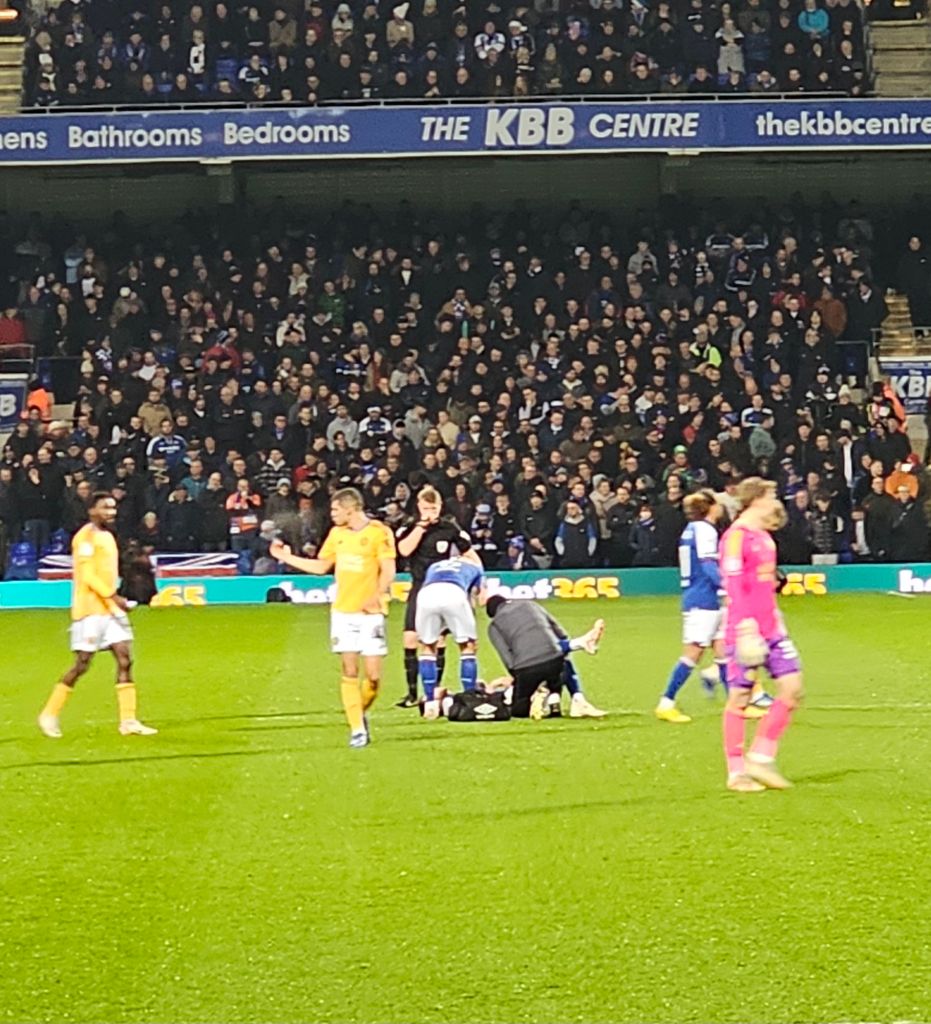
On the pitch, the Leicester goalkeeper looks festive in a bright pink top and purple shorts.  After ten minutes Leicester win a corner and one of them heads over the bar at the near post. “Small town in Norwich, You’re just a small town in Norwich” chant the Leicester fans as they risk hernias, straining themselves to be witty and amusing whilst at the same time doing a terrible dis-service to the Latin-American rhythms of Guantamera, drowning  them in essence of east Midlands.  George Hirst heads across the face of the Leicester goal and after more excellent work from Wes Burns Town have another corner. “ Fifteen minutes gone and no goals conceded” notes the bloke behind me.  “He’s a shit David Luiz and Luiz is shit” says the bloke behind me of Leicester number three, Wout Faes, a gloriously continental looking player with a fantastic mop of hair, the kind of bloke you’d see in the Eurovision Song contest or a heat of It’s a Knockout.  Belgian Faes is actually more like France’s Matteo Guendouzi, or Leo Sayer.  Ipswich needs more Belgians.

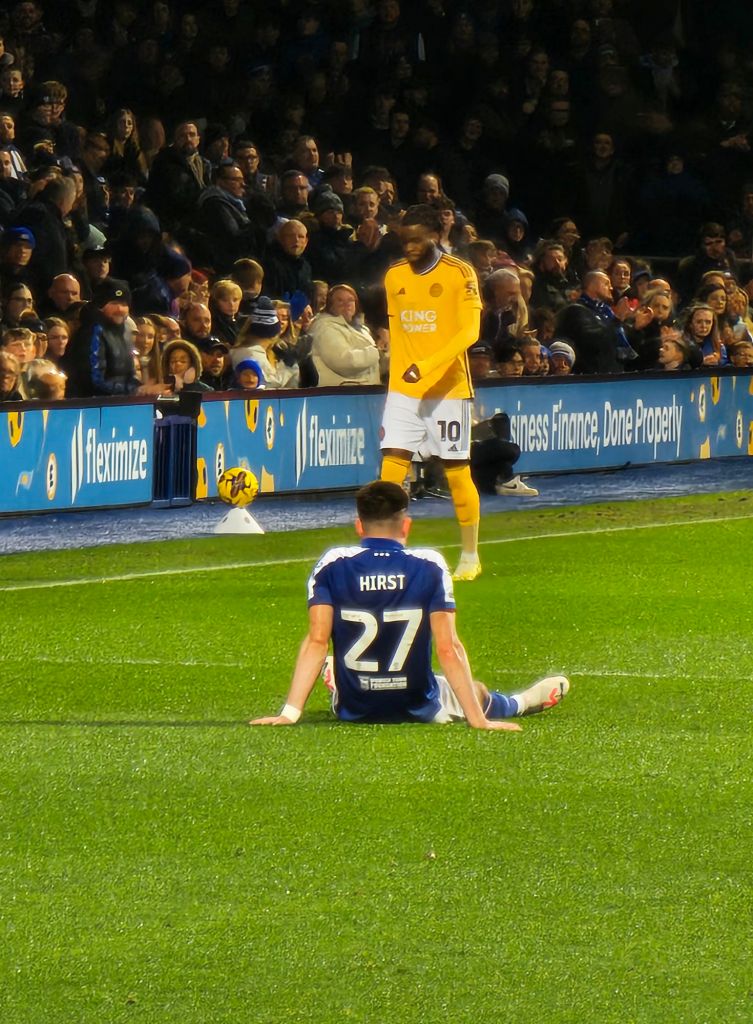
As the bloke behind me infers, so far so good, but Leicester are now in the game and then George Hirst pulls up hurt. Hirst is treated whilst everyone else has an impromptu drinks party on the touchline and get remedial coaching; the blokes to my left exit for the facilities, excusing themselves with the poor excuse that it’s Christmas.  Meanwhile, Pat from Clacton complains to the bloke behind her about his constant swearing, she’s “…fed up with it”.   He tries to defend the indefensible, as small boys and Tory politicians do, but I think Pat’s won the day.  Back out on the grass,  and George Hirst is on the touchline waiting to come on again. Referee Mr Sam Barrott, who I hope, when people ask him how to spell his name,  tells them “ Like Carrot, with a ‘B’, oh and two ‘T’s”,  eventually waves Hirst on, but after just a couple of paces he grips the back of his thigh and sits down on the  grass again.  He is replaced by Kayden Jackson.

Leicester’s Stephy Mavididi has a couple of unopposed sorties down the Town right and on the third occasion his shot into the far side of the goal gives Leicester the lead; it’s not any consolation that what Leicester paid Montpellier to sign him isn’t much short of what Town paid for their whole team.   Wes Burns and Harry Clarke are in discussion as Town kick-off again. The Leicester supporters sing a song about Mavididi, which sounds as if it is to the tune of Lonnie Donegan’s “My old man’s a dustman”. Skiffle is still new in Leicester apparently.

“We shall not be moved” sing the Leicester fans recalling another old song not much heard nowadays, but then the ground falls quiet but for some localised chanting in the Sir Bobby Robson stand.  Leicester are much the better team now and won’t let Town have the ball. When they do  Town earn a corner and Kayden Jackson hurriedly hooks a snap shot past a post.  Up on the back of the Cobbold Stand, the flags hang limp and motionless like very large soggy handkerchiefs.  Vaclav Hladky makes a decent save from Patson Daka but Town end the half winning a corner from which Kayden Jackson kicks the ball unintentionally into the pink and purple-clad goalkeeper’s face, for which the goalkeeper gets a free-kick; very strange.  Contrary to the laws of physics, time is extended by four minutes, in which moments Marcus Harness produces a fabulous dribble between two players and a low Leif Davis cross wins a corner.  “Come On You Blues” I chant, sensing a final chance to equalise before half-time and then“ Ipswich, Ipswich, Ipswich, Ipswich”.  I am a one man cauldron of noise inside a vacuum, a human volcano in a lifeless desert of blank faces.  Half-time is a relief even though Town haven’t equalised.

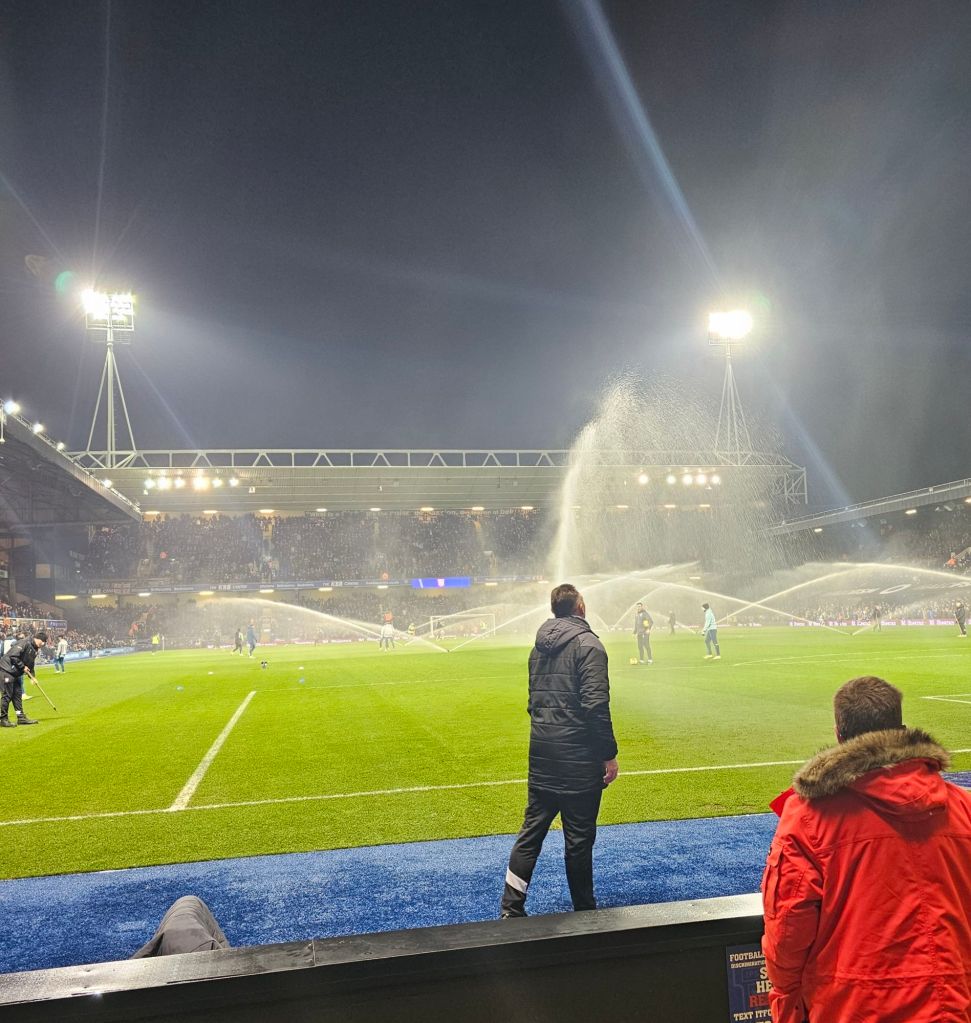
With the break I visit Ray, his son Michael, and his grandson Harrison at the front of the stand.  We all agree Leicester are easily the best team to have visited Portman Road this season, but it’s not hard to guess that given they are the one team above us in the League.  I watch the pitch being watered by what look like ornamental fountains and recall that under a rule instigated by Louis XIV, ‘third division’ Versailles FC in France don’t play floodlit matches at home because the light would disturb the setting of the palace and its gardens.  

As the game re-starts I munch my way through a Nature Valley Oats and Honey Crunchy bar and before I’ve finished it Kayden Jackson has earned Town yet another corner, from which Cameron Burgess heads wide. “Come On You Blues” chant the crowd to my surprise.  Town have Leicester pinned back and are having to employ ‘last ditch defending’ to block shots and stop us from tearing their defence apart like so much Christmas wrapping paper.   “De-de-de, Football in a library” chant the Leicester fans out of the blue, perhaps suddenly realising they haven’t sung that one yet and there’s not much more than 30 minutes left.

In the first half referee Mr Carrot with a B and two T’s had taken a relaxed attitude to people falling over, probably adopting the view that giving free-kicks is a mugs game when all footballers are cheating bastards who, if they’re not trying to kick the opposition are making out they’ve been kicked. The ref’s attitude has suddenly changed however and Ndidi and Pereira are both booked for fouls before Marcus Harness also has his name taken.

Despite dominating this half, Town haven’t had many shots at goal , then Conor Chaplin spots the goalkeeper Hermansen off his line and shoots from over 40 metres, forcing Hermansen to pat the ball away for yet another Town corner.  “Blue and white army, blue and white army” chants the crowd a good five times, which is almost impressive, but being a bit of a peacenik myself it’s a chant I find un-necessarily militaristic.  Time is slipping away; there are twenty minutes left and Pat fromClacton says she might have to get the masturbating monkey charm out of her hand bag.  That’s a bit of a threat I tell Fiona.  A Conor Chaplin shot brings a corner and then Conor shoots over the cross bar, when from 110 metres away he looked likely to score.

“Come On Leicester” plead the Leicestrians ; it seems we’ve got then worried.  Fifteen minutes remain and again the ground falls silent as Town fans concentrate hard, willing Town to score and Leicester fans curl up in a ball anxiously sucking their thumbs and rocking back and forth in their seats.   Today’s attendance is announced by the announcer who isn’t Murphy as 29,410, surely the biggest crowd to ever witness a match versus Leicester at Portman Road. “Thank you so much for your support” says the anti-Murphy “and thank you to our away end”, of whom he tells us there are 2,004.

It’s getting late and we’ve hardly made any substitutions yet, but then Wes Burns, Kayden Jackson and Jack Taylor are off and Omari Hutchinson, Massimo Luongo and Nathan Broadhead are on.  Amusingly to me and Fiona at least, Leicester also take off Dewsbury-Hall, the EFL player who most sounds like he was once owned by the National Trust. I also notice Leicester’s number eight, Harry Winks, and I am disappointed that his squad number isn’t 40.

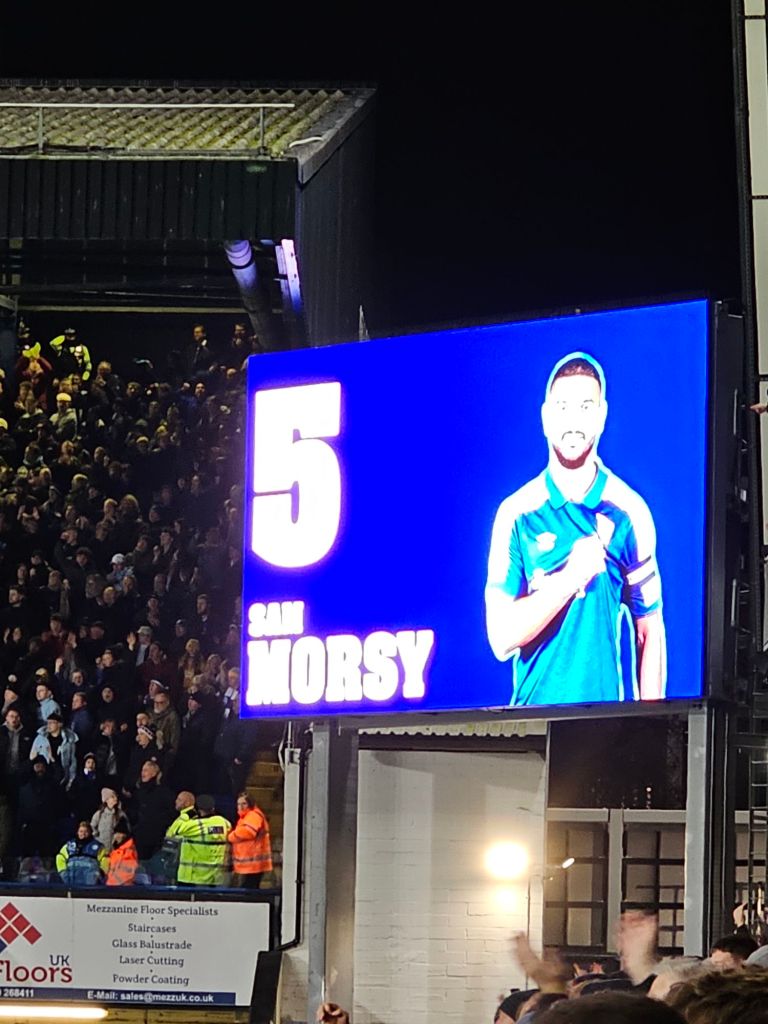
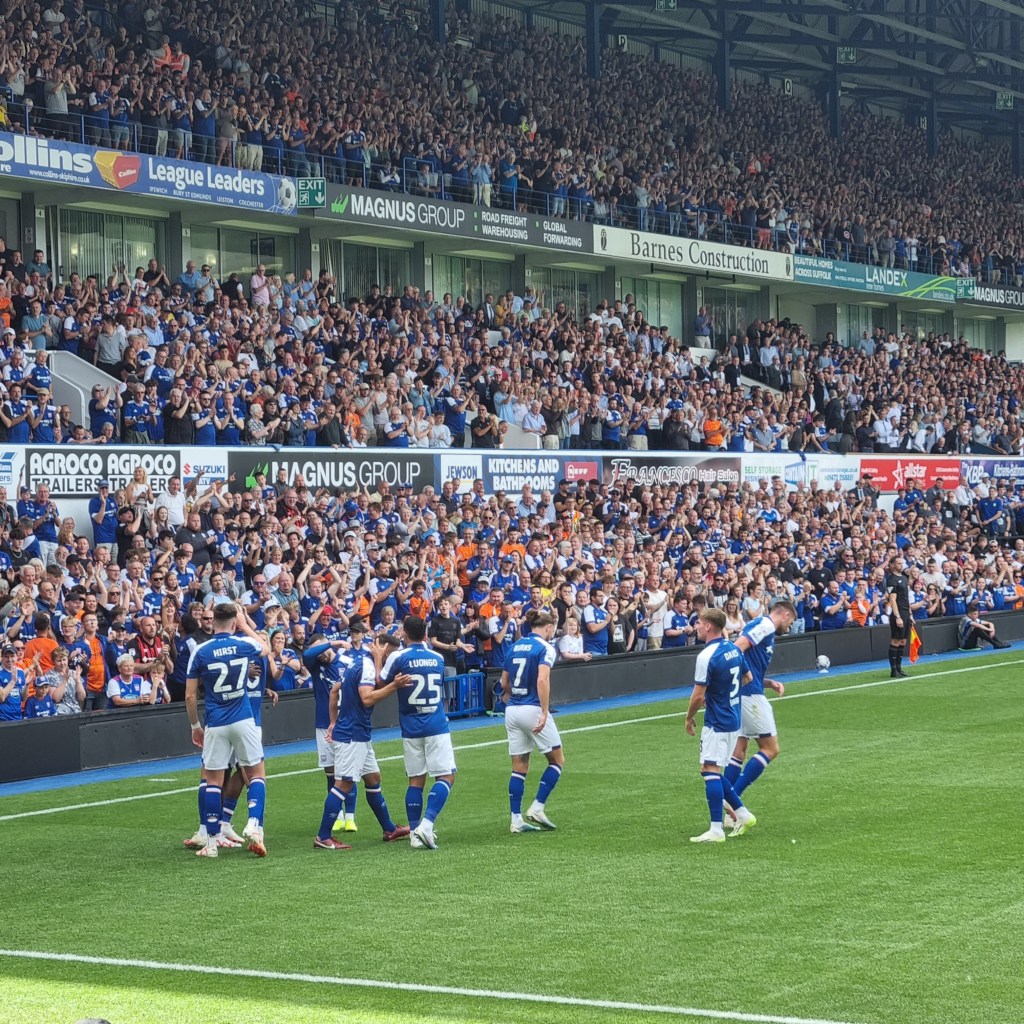
The substitutions work and see Town dominate even more. Leicester have a few break aways but nothing me, Pat and Fiona can’t handle.  Freddie Ladapo replaces Kayden Jackson with just two minutes of ‘normal time’ remaining.  “Come On Leicester, Come on Leicester” the Leicester fans continue to plead as they wring their hands.  Omari Hutchinson wins an eleventh Town corner.  “Your player of the match ………Sam Morsy” announces the announcer, although as I say to Fiona, he’s not our player of the match, he’s some sponsor’s man of the match.  But then Town win a throw, the ball is passed to Morsy; we need a goal; now, he shoots, the ball might be going wide, it hits a defender’s heel, it might still be going wide, then it hits another defender’s back and now it is spinning wide of Hermansen and we’ve scored,  and Portman Road erupts; it’s the biggest roar I’ve heard at Portman Road in, I don’t know how long. It might be the loudest roar ever, it might not, but it’s up there with the Bolton play-off match goals, and people are up and dancing and hugging one another like we’ve just woken up to find that the last fourteen years of Tory mis-rule has only been a bad dream after all.

There are five minutes of added on time and Mr Carrot with a B and two T’s adds another, just to crank up the tension for everyone, but sadly we don’t score again, but nor do Leicester and everyone can go home happy, or at least not sad.  The best of it is that it feels like we’ve won, such is the relief that we haven’t lost.

Back at the Citroen, Gary and I agree that tonight we have seen a very good game indeed.  I muse to myself that a goal such as Morsy’s tonight must only ever be scored very late in a game to realise it’s full delirium inducing effect.  The fact that it was, almost has you believing in some sort of divine intervention, it has to be Christmas.

Garde St Cyr Moreac 1 Vannes OC 3

Whilst the disadvantage of spending two and a half weeks in France during late September is that I am missing three Ipswich Town home games, this is offset to some extent by having tickets for two Ligue 1 matches, and is then offset quite a bit more by having the opportunity to see a game in the fourth round of the Coupe de France, a knockout cup competition every bit as much fun as England’s FA Cup and possibly even better on account of it not having been won for the last two years by the all-conquering pet team of some dodgy middle eastern emirate.

Having discovered that the weekend of 1st October was ‘cup weekend’, I struggled a little bit at first to discover the fourth-round draw, and then a little bit of further work was involved to find out which home teams were a reasonable distance from where I am staying in Carnac.  Unhappily for me, as I trawled through the fixtures it seemed that most games are being played on Sunday 1st October, when my wife Paulene and I shall be watching Lorient play Montpellier, and of the Saturday games most are in the area around Brest, which is a good two-hour drive away.  But then the fixture list on the footbretagne website came up with the rather grand sounding name of Garde St Cyr Moreac and Google maps quickly confirmed that Moreac is just 33 kilometres north of relatively nearby Vannes, and about the same distance from where my wife Paulene and I are staying as Framlingham or Leiston is from our house back in blighty, and I’ve driven to watch them before, more than once.  Moreac of the third tier of the regional league (Step8 – the same as Ipswich Wanderers, Stowmarket Town and Felixstowe in England) would be at home to Vannes OC of Ligue National 3 (Step5).

The drive to Moreac takes a little under an hour and the roads are quiet because it’s lunchtime. The countryside changes as we travel in land from the flatness and long straight road just in from the coast, to the greener, rolling countryside where the road twists and turns and rises and falls through valleys populated by grazing cattle and not much else, it feels miles from anywhere, not unlike Framlingham and Leiston.  At Locmine we pass a huge factory belonging to the Jean Floc’h company, a major producer of meat products in France, although being France the sign outside refers to charcuterie and not pies.  Jean Floc’h is nevertheless a massive purveyor of processed food.  Moreac is just a few kilometres beyond Locmine and is an attractive village built around the focal point of the large church of St Cyr, from which the football club takes its name.  Wikipedia tells us that in 2020, Moreac had a population of 3,703. The Stade Alfred le Biavant, home of the football club, is just a street or two away from the centre of the village and has a large, surfaced car park where Paulene and I rock up in our planet saving Citroen e-C4 with a bit more than an hour to go before kick-off at 3 pm.

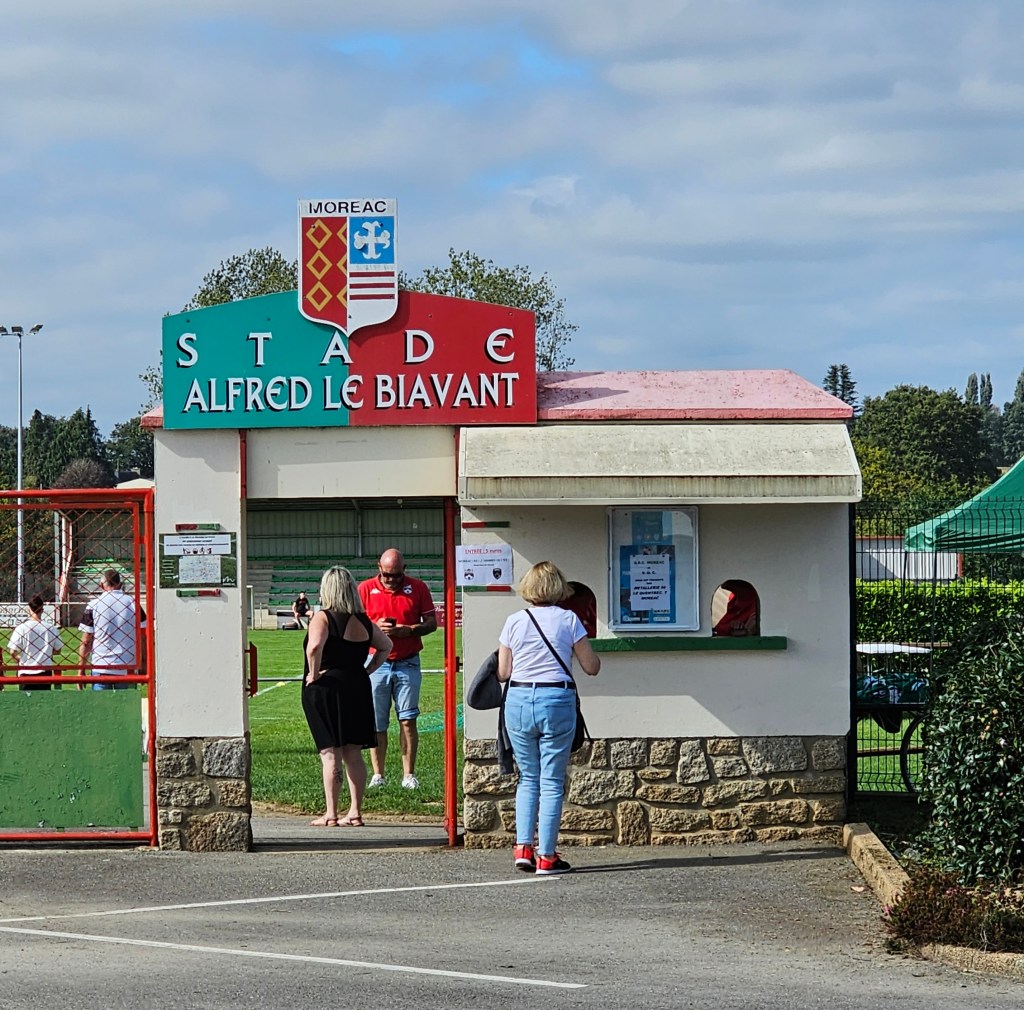
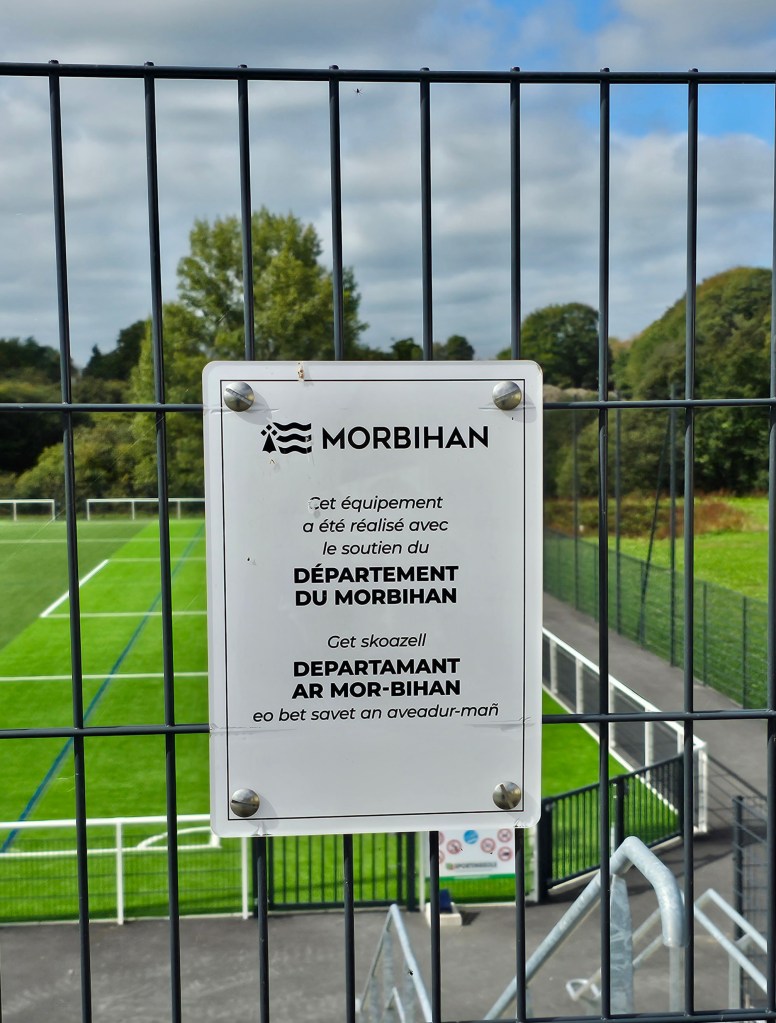
The entrance to the stadium has an elegant if small gate, and a guichet from which a middle-aged lady is selling tickets; today entry costs 5 euros for me but is free for Paulene and indeed all women, which is nice.   Even better, I get a little green ticket too as a souvenir.  The stadium has one small stand with seats on the far side and opposite that a very small bank of terracing, just two steps high but very steep; it’s a bit like a sea wall.  The  site also contains a huge sports hall, which looks like it could double as a barn to house some of the animals destined for the Jean Floc’h factory, a changing room block, a bar with glazed walls overlooking the pitch, a second full size grass pitch and a very smart plastic pitch, on the fence to which is a sign which tells us it was built with money from the local Morbihan Council. France, unlike the UK, is a country which despite problems with pensions seems to a large degree to be still run for the benefit of its general population.  Adding interest, in the corner between the sport shall and the car park is the village cemetery.

With time to spare until kick off, we watch the teams warm up and I take the opportunity to invest 2 euros in a small glass of Lancelot beer, considerately served in a re-usable plastic ‘glass’; why don’t all football clubs  do that?   The crowds are now streaming in and it feels like the whole village is turning out, a man in a club tracksuit top greets friends and neighbours and kisses on cheeks are being exchanged everywhere, although the younger men tend to only shake hands.  The French seem much more sociable and comfortable with each other than the English. A bunch of blokes in their twenties wearing faded green football shirts appear to be the Moreac ultras, and they parade along the path leading from the gate to the pitch following a bloke banging a drum, and holding aloft red distress flares.  If this happened in England they’d probably be arrested, but here no one bats an eyelid, although one or two people take photos for posterity.

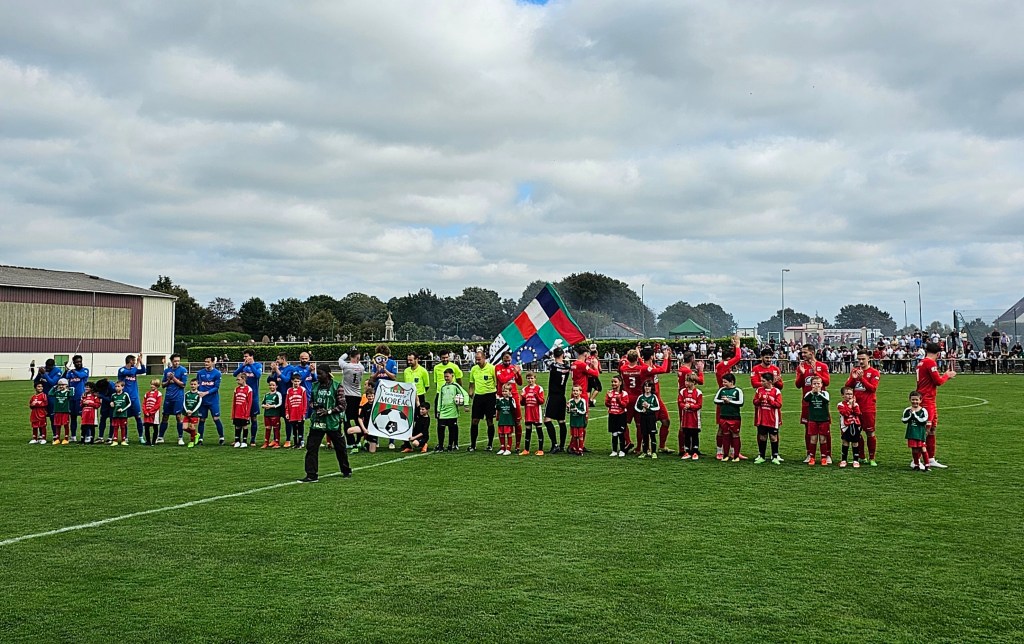
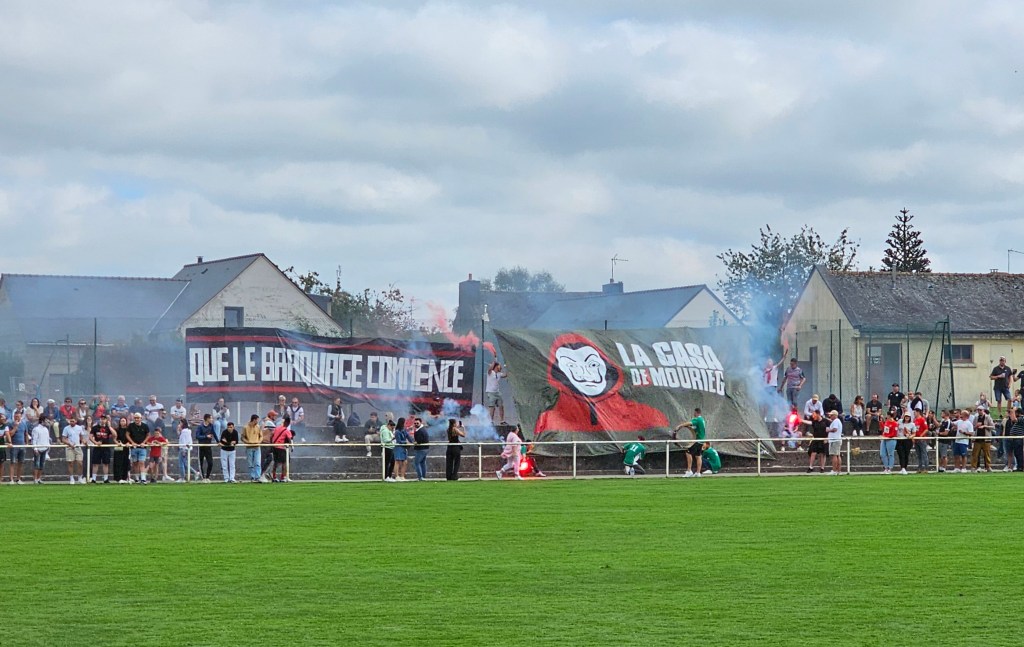
As three o’clock approaches the public address system gets tested with a few bursts of sound of gradually improving quality.  Eventually the ubiquitous 1983 rock anthem ‘Jump’ by Van Halen is played, but it ends abruptly as it’s still not quite time yet, although the teams can be seen lining up behind the referees at the door of the dressing room block in the corner of the ground.  The referee eventually gives the nod, and the teams parade on to the pitch attended by several small children as proud parents point mobile phone cameras at the event and Van Halen get to do an encore in full.  Over on the terrace the ultras light more flares, chant enthusiastically and unfurl a tifo which declares ‘La casa de Mourieg’ and displays a picture of what looks like a pale faced Salvador Dali in a red hoodie.  Mourieg is the Breton name for Moreac but casa is Spanish for house, so I it’s not clear to me what they’re trying to convey, although of course Dali was Spanish, perhaps they’re just being surreal like him. (Postscript, the next day, driving out of Lorient after seeing Lorient lose at home to Montpellier in Ligue 1, we passed a pizza restaurant in Lanester called Casa del Pizza which had the same Salvador Dali face for its logo. The surrealness continues)

At exactly three o’clock the game kicks off with Vannes getting first go with the ball, kicking it towards the sports hall and dressing room end of the ground. Moreac are all in red and Vannes all in blue; this reduction of team colours to blue and red is normal in the early rounds of the Coupe de France as is two common shirt sponsors in all games; today the Credit Agricole logo adorns the red shirts and Betclic the blue. Pleasingly both teams are numbered 1 to 11 and no one is wearing anything silly like a number 98.

The gulf of three divisions is soon apparent as Vannes begin to dominate possession.  Moreac manage to win a free kick wide on the right early on but Vannes earn a corner.  “Aux Armes” chant the ultras, and incidentally “Aux Armes et caetera” was the title of Serge Gainsbourg’s thirteenth studio album, but he didn’t then sing “Nous sommes les Moreacois, Et nous allons gagner, Allez GSC” (“ We are the Moreacois, and we will win, Go GSC”.)  Sadly, the chant will prove overly optimistic and Vannes score their first goal after just eleven minutes, their No9 being left in enough space in the middle of the penalty area to steer a half volley in off a post.  “Allez Moreac, Allez Moreac” sing a group of children undeterred by the early goal.

Vannes continue to dominate, but Moreac have the occasional foray forward, usually on the basis of a free-kick.  Twenty-two minutes gone and the Moreac goalkeeper has to make a decent diving save to keep out a low shot.  “La la  la, la la, la, la la, la la,  Allez GSC” sing the ultras celebrating small victories.  Three minutes later and Vannes’ number eleven doubles his team’s lead as he is left all alone on the left and he passes the ball across the goal into the far corner of the net.  It might be a matter of how many goals Vannes can get.  

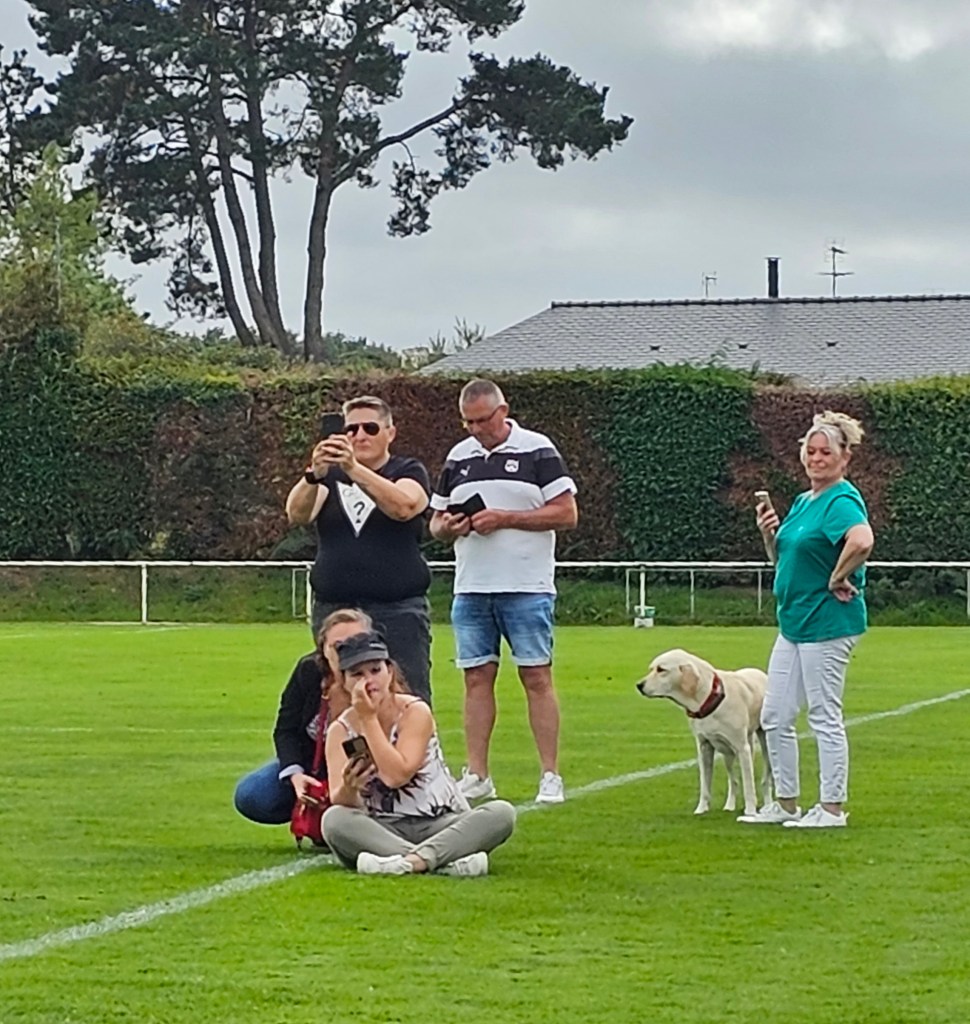
The home crowd, which seems to make up a good ninety per cent of those here don’t’ show their inevitable disappointment and their attention is still gripped, although that doesn’t go for all the dogs in attendance. A Labrador has a lie down, albeit almost on the pitch whilst a mongrel looks the wrong way. Only a sort of Yorkshire Terrier is concentrating on play, and when any player comes near he strains at his leash and yaps ferociously.  As for the away support, I’ve only seen a couple of the sort of grizzled old fanatics who tend to follow amateur teams away from home.

With almost a third of the game gone and lost to history, Moreac have their first shot on goal as their number 10 cleverly beats a man and then shoots optimistically from twenty-five metres out.  The prevailing, uneven balance is restored soon after however, as the Vannes number nine has a shot well saved and then shoots over from very close range. It’s enough to make the Stade Alfred Le Biavant as quiet as it has been all afternoon.  It doesn’t get any louder as the Vannes number seven has a shot deflected onto the top of the Moreac bar.  The lull is filled by Paulene revealing to me that she is always fascinated by young women at football matches on their own, as a smartly and alluringly (she has an off the shoulder top) dressed girl watches the game briefly a few metres away from us, before walking on towards the main stand.  I suggest that perhaps she’s just a lonesome WAG.

Fortunately, football is never entirely predictable and three minutes before half time Moreac attack down the right.  Surprisingly, the Vannes defence is drawn across the penalty area leaving Moreac’s number seven free to run onto a wide expanse of grass into which the ball is played.  The Vannes goalkeeper saves seven’s first shot, but can only parry it, and the number seven then strikes home the rebound.  It’s just a short run to the ultras for number seven and his teammates who form an impromptu human mound of celebration.  The game restarts. but it’s the last kick of the half.

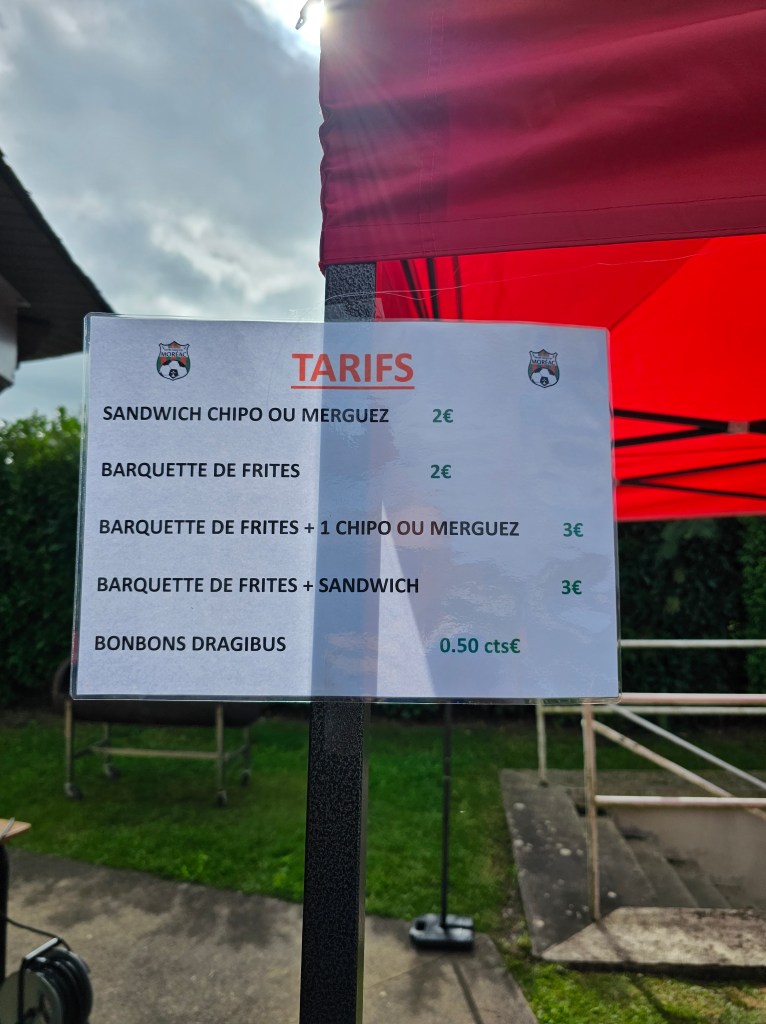
During the first half, we have watched as a barbecue has smoked away in the corner of the ground and now there is a human tide flowing towards it, attracted presumably by the promise of a mid-afternoon snack of a lamb and beef sausage (Merguez) and a chip butty for 3 euros. 

The match begins again promptly at four o’clock and the familiar pattern of Vannes passing the ball about too quickly and smartly for Moreac continues.  It is Vannes however who have the honour of being the first to have a player booked as their number seven hauls an opponent to the ground.  But Vannes press forward still. Numbers eight, eleven and nine combine cleverly but nine shoots over the goal again, then number ten does the same.  My attention is taken by the number eight, a tall creative midfielder who passes the ball well and makes me think of both France’s Adrien Rabiot and Arsenal’s Graeme Rix, although that it is entirely down to his mop of curly hair.

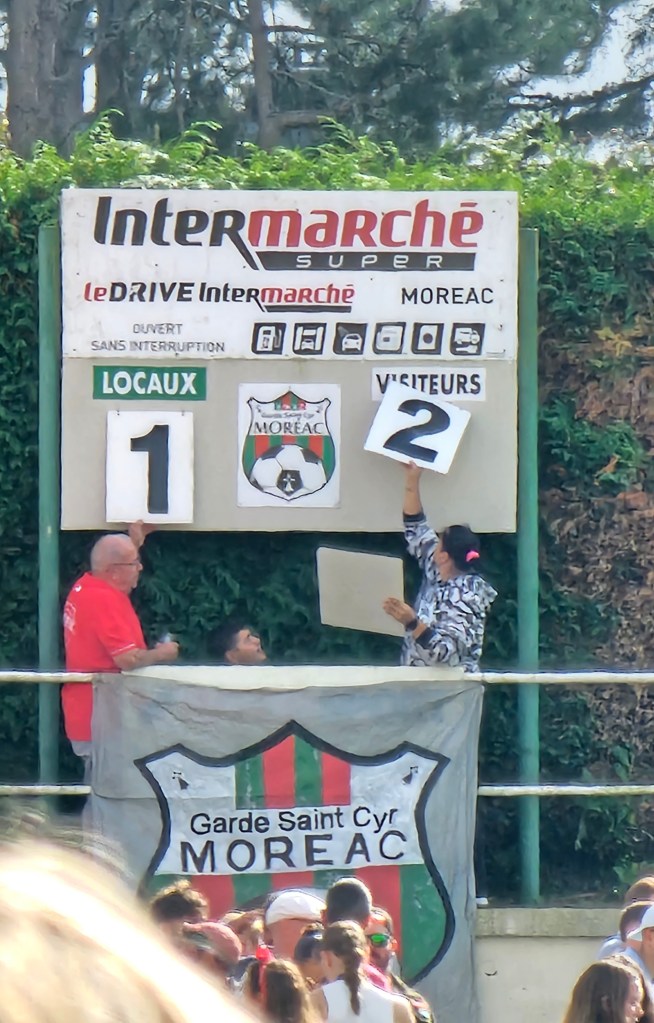
At a quarter past four Vannes score again, this time number ten tidies up as the ball runs loose and wellies it into the net from about 10 metres.  I watch as the number two on the scoreboard is unhooked and replaced with a three.  Moreac had had some hope at half-time thanks to their unexpected goal, but the game has settled down now, and the score will remain unaltered, despite a series of substitutions by both teams.  The substitutions are overseen by the Delegue Principal, a sort of fourth official in overall charge of the fixture, but in a shiny blue suit; he has his own designated seat at pitch side midway between the two team benches. From a distance he is unfortunate enough to look a bit like Norman Tebbitt, but it’s probably just because he’s bald.

I see out the game by wandering around and enjoying it from different angles from both sides of the ground and behind both goals.  Clouds and sunshine swap about altering the mood of the backdrop of trees, fields, houses and headstones.  Number three for Moreac evens up the score for bookings but there’s never any malice in the game.  The worst that happens is that the ultras take a dislike to the Vannes number ten who I think they perceive is a diver, so they boo him whenever he gets the ball.  With the final whistle, the ultras release a final salvo of flares and the victorious losers of GSC Moreac gather in front of them to give and receive appreciative applause.  It’s been a decent match on a  warm afternoon of late summer sun mixed with early autumn clouds and breezes and everyone has had a lovely time.  Just like in England, local football in France is a wonderful thing, there really is no need for professional football or the Premier League.

Ipswich Town 2 Stoke City 0

After the low key, League Cup game against the Rovers of Bristol on Wednesday night, which began mine and everyone’s new season at Portman Road, today is the start of the Football League season at home, and Town face the ancient City of Stoke, one of the founder members of the football league way back in 1888, before Sky television.  August 12th still seems a bit early to start playing football seriously, but Wednesday’s game has helped to immunise me against the shock and at about twenty minutes to one I am on my way out of my front door, setting off for Portman Road and the joys and horrors that may or may not await.

By way of a change from last season, I am leaving my planet saving Citroen e-C4 at home today and taking the train (£8.95 with senior railcard), at last feeling more confident or perhaps just blasé about my chances of not being struck down with the terrible lurgi that is Covid.  If I hold my breath, avoid anyone who looks a bit peaky or coughs, and don’t touch anything I might be alright.  The train is on time and the journey pleasant as I gaze out of the window at the world spinning by beneath a heavy grey August sky.  I look on in wonder at the myriad of colours and shapes and textures within the plain, familiar streets and landscapes outside.

Alighting from the train in Ipswich, I talk to a man I know called Kevin as we cross the bridge from platforms three and four to two.  We part as we cross the bridge over the river and I head first for Portman Road, where after a few moments hesitation as I think of the space they take up and the poor value for money, I decide I will nevertheless buy a programme (£3.50). I queue briefly behind two morbidly obese women one of whom ‘has a fag on’, before obtaining a programme in the modern cashless manner saying “Just the one please” to the youthful person in the blue sales booth who remains silent.

As I am about to turn the corner on to High Street, Mick appears on his bike, which having dismounted he locks to the railings outside the old art school before we enter the Arb together and Mick very kindly asks me what I want to drink.  At first, I opt for a pint of Mauldon’s Suffolk Pride, but then seeing the array of other beers on offer I change my mind, selecting the altogether more exotic, Moongazer BellyWhite Belgique IPA. Mick chooses the same and we head for the beer garden which is busy, but there is one vacant table, the same one I sat at when I was here on Wednesday evening.   Like the hypochondriac old men that we are, we talk of our physical ailments. Mick has had housemaid’s knee. He was lying in the back of a hearse cleaning the inside of the windows when he got cramp in his calf.  The cramp went, but a couple of hours later his knee began to swell, although it’s okay now.  From Mick’s knee we move on to his liver, our stomach’s, prostates and my eyes and heart.  The beer is tasty and not knowing how long I have left I quickly buy another for myself and a single Jamieson whisky for Mick.  Our conversation leaves the world of hypochondria for holidays, Haverfordwest County’s foray into the qualifying rounds of the European Conference League and Town’s new goalkeeper Cieran Slicker who, we discover through the wonder of the interweb, was born in Oldham, but has played youth football for Scotland; we agree that his surname can easily be imagined being announced with a Scottish accent.

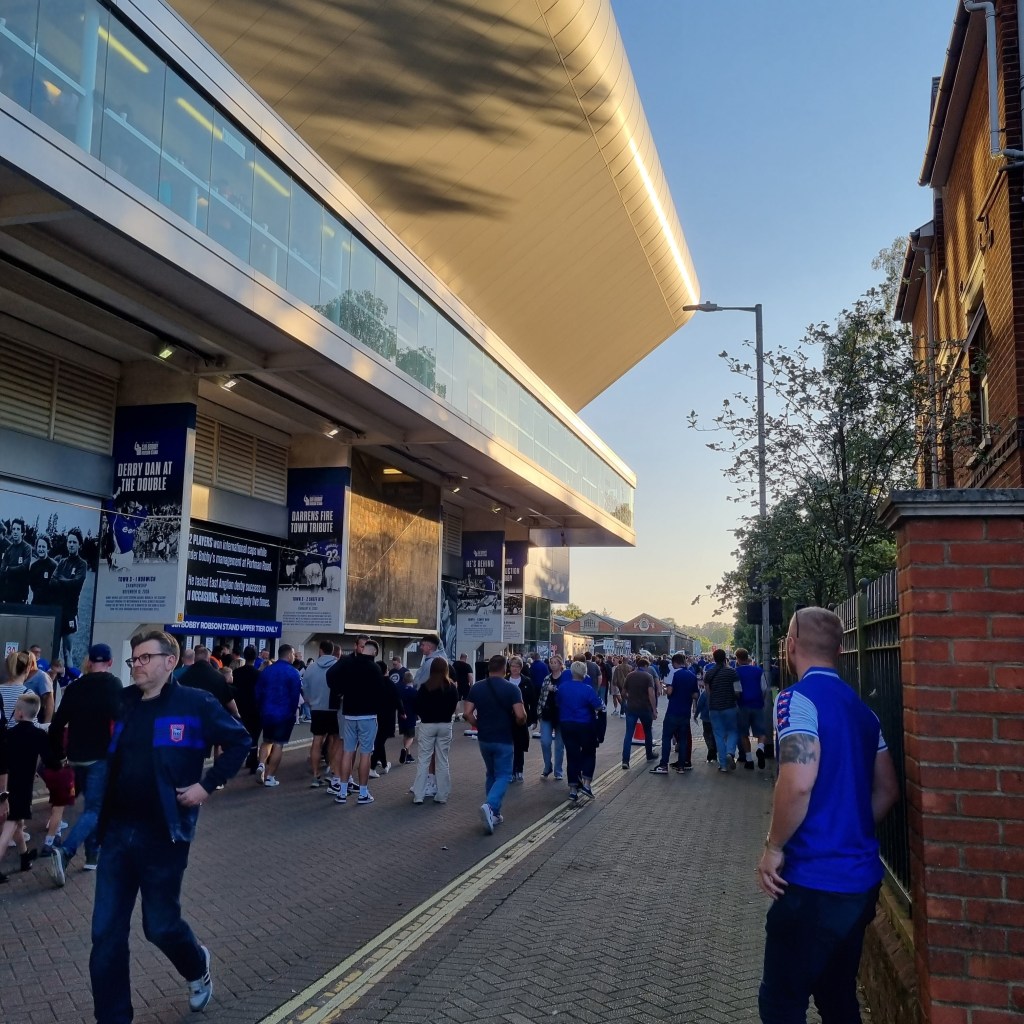
When we come to leave for Portman Road at about twenty-five minutes to three, the beer garden is already almost completely empty and the people remaining do not look like they will be watching the football this afternoon.  We join the gathering crowds on our journey to the match. Although we’ve had to wrench ourselves away from the pub, this is always one of the best bits of the afternoon with the steady accretion of souls and anticipation and the odour of frying onions all increasing the closer we get to the stadium.

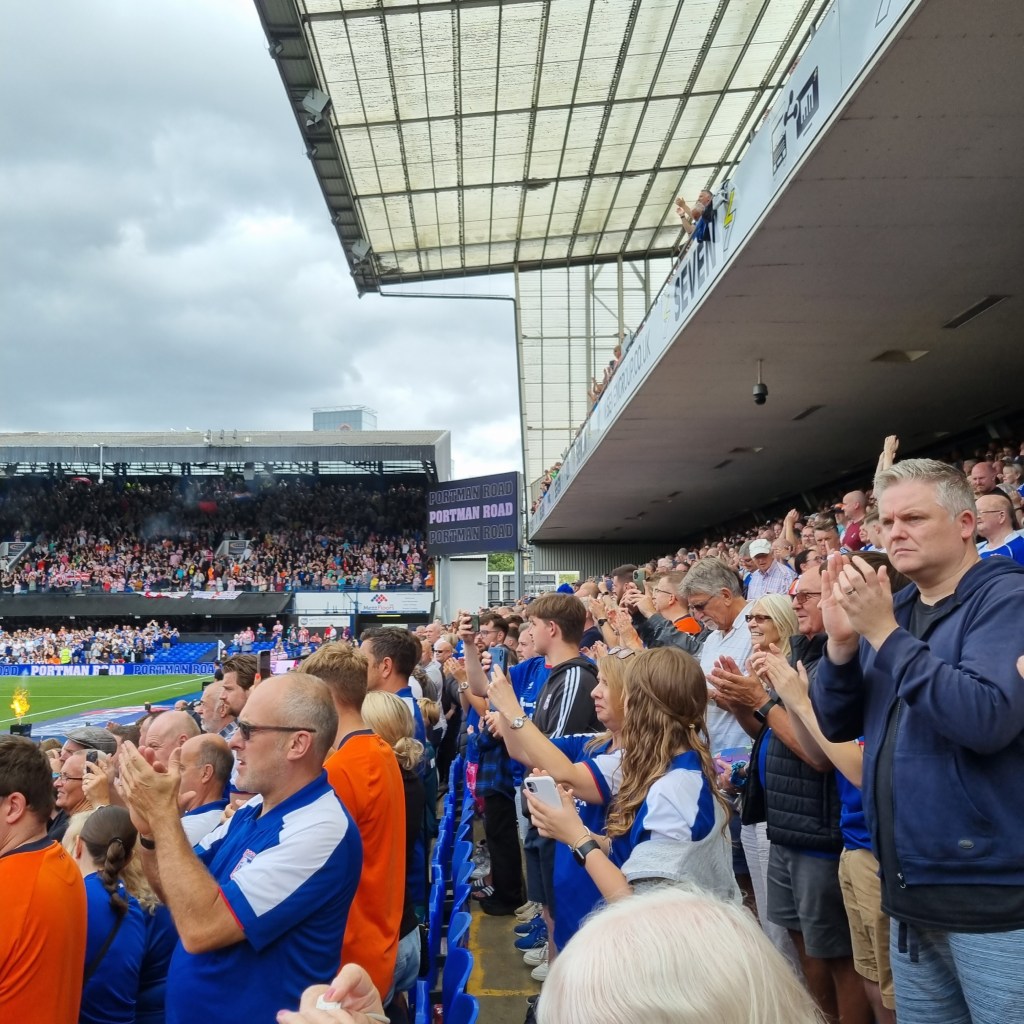
Mick and I go our separate ways somewhere near where Sir Alf Ramsey stands cooly with one hand in his suit pocket.  There are queues at the turnstiles, but they aren’t as long as on Wednesday and after waiting behind a man who has to present his mobile phone three times to let his family through the turnstile before him, I eventually walk into the Sir Alf Ramsey stand myself.  After draining away some Belgique IPA, I emerge into the bright sunlight of the stand and after two and a bit months absence re-acquaint myself with Pat from Clacton, Fiona, the man from Stowmarket, ever-present Phil who never misses a game, and his young son Elwood.

Today, I am in time for the announcing of the teams, and I shout out the surnames of the Town players like a Frenchman would. The ‘new’ stadium announcer Mark Murphy then proceeds to stoke up the crowd by asking, somewhat ridiculously, each stand in turn if they are ready. It’s enough to make anyone roll their eyes. The teams appear and bursts of flame shoot into the air like a Kevin Beattie barbecue; I can feel the heat from where I’m sitting. So much for football caring about global warming and its carbon footprint, but then we all join in with the na-na-nas of Hey Jude and the stadium is full of noise.

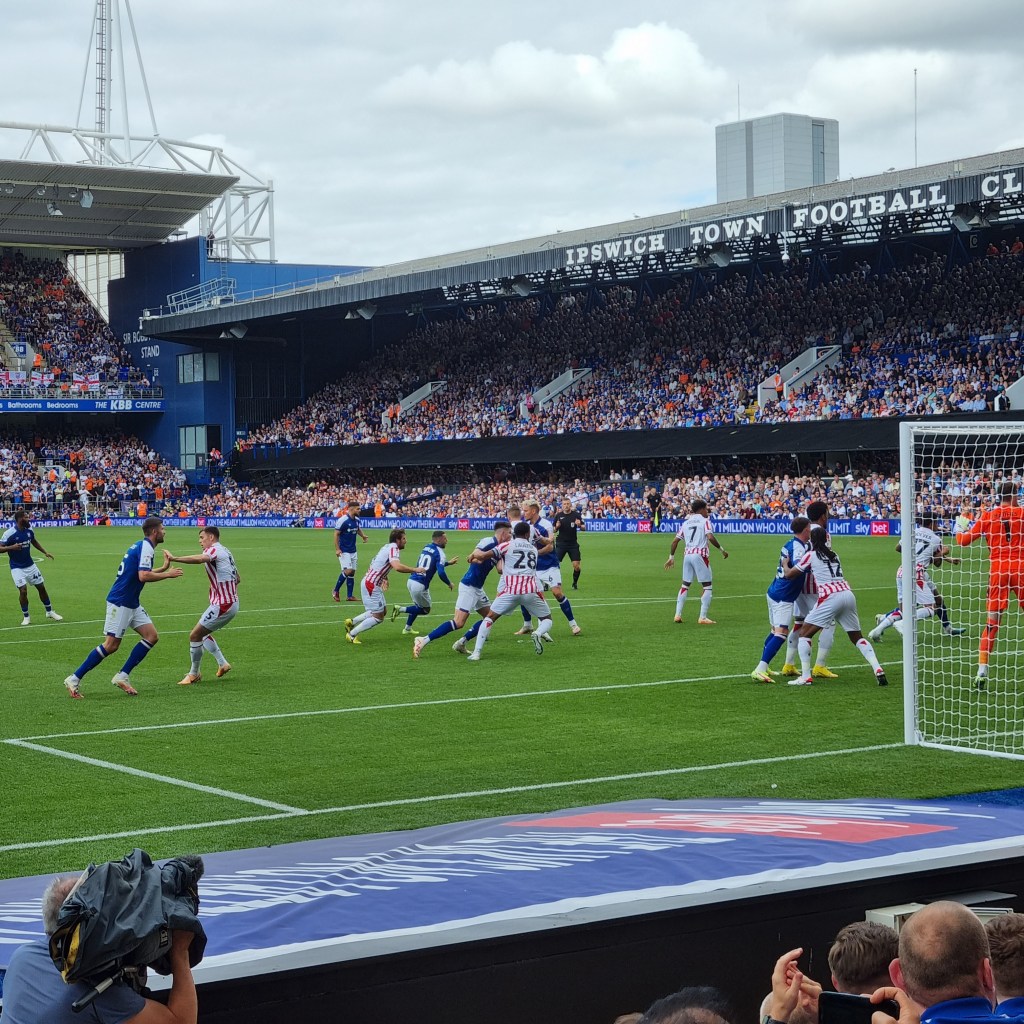
The game begins beneath azure blue skies punctuated with  puffy white cloud and Stoke City get first go with the ball, sending it mostly in the direction of what was the plain, old, tatty North Stand the first time I witnessed Stoke play at Portman Road back in the 1970’s. Happily, both teams are wearing their signature kits which is particularly  good in the case of Stoke because their red and white stripey ensemble is a classic, although if I have to be critical, and I do, I think the present incarnation has a few too many stripes. 

“We’re the Blue Armeee” chant the Sir Bobby Robson stand to rhyme with something else ending in ‘eee’ and the bloke behind me joins in just as the chant fades away.  The ambience in the ground is one of excitement as Town dominate the early part of the game inspiring more chants of “ Blue and White Army” and Wes Burns hits a shot which the Stoke goalkeeper Travers, who is dressed from head to toe in orange, tips spectacularly over the cross bar for the game’s first corner.  Travers is a surname similar enough to Travis to have me suddenly thinking of Lyndsay Anderson’s brilliant 1968 film ‘If’ , but it soon passes as Town’s early pressure earns two more corners in quick succession and I bellow “Come On You Blues” in the vain hope that my vocal encouragement will result in a goal.

The immediate hope of a goal fades for the moment and Pat tells Fiona that when the Clacton supporters coach arrived at the ground today and went to park in the usual spot by the bus depot, the driver had been told “You can’t park here”.  When he asked why not, the driver was told “Because someone might plant a bomb under it”.  I didn’t realise Clacton people had such a bad reputation.  Behind me the bloke says to the bloke beside him “We’re making it uncomfortable for them” which I think is in reference to what’s happening on the pitch, rather than the Clacton supporters bus.

Town continue to pour forward, threatening the Stoke goal with crosses and incisive passes but no proper shots. “Now switch it, switch it” calls the bloke beside me to Sam Morsy, but Sam ignores him. “Stand up if you ‘ate the scum” chant the Sir Bobby Robson to the tune of Village People’s ‘Go West’ and then, in a personal message to the Stoke manager and sung to the tune of the Beachboys’ ‘Sloop John B’ “You’ll always be scum, you’ll always be scum, Alex Neil, you’ll always be scum”.   Believing in forgiveness, redemption and that people can change, it’s not a view that I agree with.

After eighteen minutes Conor Chaplin delivers the first half-decent shot on goal and the Town fans sing “ Hark now hear the Ipswich sing, the Norwich ran way”before Wes Burns is cynically blocked  by some or other bloke in a pyjama top in the shadow of the west stand.   Sam Morsy takes the free kick, curving a cross into the penalty area where Luke Wooflenden heads the ball into the net in the style of Terry Butcher, and Town lead 1-0.  “Oh when the Town, Go marching in” chant the home crowd, a bit mournfully considering the score.  Town are imperious, and a superb move between Conor Chaplin and Nathan Broadhead results in another corner. “Champagne Football” says the bloke behind me, oblivious to the fact that Stade de Reims will later take the lead against Olympique Marseille but ultimately lose 1-2.

The game is not a third of the way through but Stoke find it necessary to replace the economically named Wesley with the almost as economically named Chiquinho. I wonder to myself if Wesley has an appointment or an early bus and whether league rules stipulate that you can only replace a player with just one name with another player with just one name.  Seven minutes on and Stoke have their first shot,  which loops wide of the goal and then, after an unexpectedly long passage of possession, another shot has to be saved by Town ‘keeper Vaclav Hladky.  The blokes behind me head for the bar as half-time approaches and the sky clouds over, Wes Burns sends over a low cross and George Hirst strikes the ball first time against the outside of the near post. Two minutes of additional time are played and on the touchline Kieran Mckenna looks agitated in a way he never did when we in the third division; I like to think that as manager of a ‘big club’  in the third division he didn’t think it was right to bemoan his team’s luck, whereas now, in a league full of Premier league wannabees it’s fine to get a bit huffy and precious every now and then.

With the half-time whistle I go down to the front of the stand to speak with Ray and his grandson Harrison.  I give Harrison a copy of ‘Life after Infinity’ the latest album by the excellent Robyn Hitchcock, an artist who makes Ed Sheeran look and sound like Neil Reid.  On the back of the programme I notice that the match ball sponsor today is Bob Harris and the home shirt sponsor is Henry Gibson; I am reminded the Old Grey Whistle Test and Rowan and Martin’s Laugh-In.

The match resumes at five minutes past four with Stoke winning a very early corner and the ‘Stokees’ in the corner of the Cobbold Stand optimistically singing “When the Reds go marching in” .  For a short while Stoke are the better side and only six minutes into the half the referee, Mr Smith even books Vaclav Hladky for perceived time-wasting as he waits to take a free-kick.  Cameron Burgess heads away a second corner kick, and George Hirst has a shot easily saved.

In the first half, several fouls by Stoke players were spotted by Mr Smith, but despite some of them being serious foul play he only booked one Stoke player.  It’s a theme that is continuing in the second half with Wes Burns and Massimo Luongo being hacked down without punishment.  But Town have weathered the early Stoke pressure  and the Sir Bobby Robson stand chant “ Ipswich, Ipswich, Ipswich”, interspersing the “Ipswiches” with  rhythmic clapping.  Pat from Clacton informs me that she is having chicken and prawn salad tonight with new potatoes, she won’t have a baked potato for her tea again until the autumn or the winter.

The final twenty minutes are approaching and with them come substitutions as Marcus Harness replaces the classy Nathan Broadhead and surprisingly perhaps to those expecting Freddie Ladapo, Kayden Jackson replaces George Hirst.  Massimo Luongo shoots over the Stoke cross bar. Town win a corner. Stoke win a corner.  Pat announces that the masturbating monkey ‘charm,’ which came from Cambodia, and which she keeps in her bag, has got something “…caught on his willy”.   Stoke’s fascinatingly surnamed Ryan Mmae is then substituted by someone or other, but his surname has made me think too much of the Steve Martin film ‘The Man With Two Brains’ and the names of Miss Uumellmahaye and Dr Hfuhruhurr.

Just a goal ahead and less than fifteen minutes to go, and we’re all willing a second goal to help us relax.  It’s not quite the same, but Murphy announcing todays’ attendance takes our minds off the close score for a moment, although he does spoil it rather by calling the attendance of 29,006 “staggering”. The last three league games at Portman Road have all had attendances of around 29,000 so 29,000 is now average. If the crowd had been 35,000, that would have been staggering because the ground doesn’t have that many seats.  To cap things, Murphy then says “Give yourself a round of applause”.  Why?

Back on the pitch, referee Smith shows his yellow card to Janoi Donacien, again for perceived time wasting, as he prepares to take a free-kick for a foul by a Stoke player.  Mr Smith seems to have no problem with one player kicking another, as long as it happens quickly and doesn’t delay the game. But then Conor Chaplin is in space in the middle, he sends Wesley Burns away down the right and his firm pass into the centre of the penalty area connects with the boot of the incoming Kayden Jackson who side foots the ball into the net with grace and style and Town lead 2-0, and it’s no more than they deserve. Several of the 1749 Stokees in the Cobbold Stand evacuate prematurely.

There are ten minutes left plus ‘time added on’, but it feels like the game is won and so it is.  Sam Morsy is announced by Murphy to be the man of the match, as selected by Jade Smiles, although I can’t decide if this is a person or just a sort of green-coloured, perhaps envious facial expression.  Just four minutes of additional time are announced, despite several substitutions and all the apparent timewasting by Vaclav Hladky and Janoi Donacien, and Sam Morsy is booked for a foul, which is a novelty.  The four minutes pass by without incident, but the home crowd is buoyant, thrilled by an exciting, fast, competitive match that Town have mostly dominated and deserve to win.    When the final whistle blows, the feeling is not of relief but of pride and joy and expectation for the remaining forty-four games.  On the basis of one home league game we have no idea if Stoke City or Ipswich are good second division teams or bad ones but we’ve not lost yet and for the moment everything feels good, and we’re all looking forward to being a part of more ‘staggering’ attendances at Portman Road.

Ipswich Town 2 Bristol Rovers 0

When the draw for what used to be called the League Cup was made, I was quite pleased to find that Ipswich had drawn Bristol Rovers; this was because Bristol Rovers were the only one of Town’s third division opponents I didn’t see last season.  I’m not sure why that mattered, it’s not as if I keep notes on each team, although in an odd way, through this blog, I suppose I do. Oh dear.

Despite my earlier happiness at the draw, it has taken me until the night before the game to get round to buying a ticket because despite the grotty weather, in my head it’s still summer, and summer is for dreaming and for World Cups, oh, and occasionally for European Conference League qualifying games.   Football is mostly something for autumn, winter and spring.  As usual for League Cup matches, because all the seats cost a tenner I choose not to sit in my season ticket seat, but to explore one of the twenty-nine and half thousand odd other viewpoints.   Usually, I head for the best view and the padded seats of Block Y, and there are still single seats available, but craving company I texted my friend Gary to see if he is going; he is, and gives me his seat number which he tells me is close to where he usually sits in what used to be called the West Stand.  I buy the seat next to Gary which turns out to be uncomfortably  close to the corner of the ground; but it’s okay as I had warned Gary that I would blame him if the seat wasn’t very good, and now I can.  To think, I could have been in Block Y.   I also texted my friend Mick to see if he is going to the game, but he tells me that he has “no interest in the League (Carabao) Cup”, which I thought was a bit haughty of him.

Having parked up my planet-saving Citroen e-C4 in a street between Norwich Road and Anglesea Road, it’s a short walk to the Arb on High Street where I obtain a pint of Mauldon’s Suffolk Pride (£3.60 with Camra 10% discount). The bar is not very busy, and I tell the barman that I had expected it to be busier, but he tells me most people are in the beer garden.  He’s correct, most people are, but there are still free tables and I can only see one bloke in an Ipswich Town shirt.  I settle down to drink my unexpectedly cloudy pint, and read Issue 26 of the Turnstile Blue fanzine, a small pile of which were in the corridor between the bar and the gents.  I read an article which, in the context of the ‘fuss’ surrounding the death of the old queen, attempts to debunk the apparently mythical status afforded to former Town chairmen John and Patrick Cobbold.  The basis of the argument seems to be that they were incredibly wealthy and posh, and ‘Mr John’ drank and swore a lot.  I don’t read much more because the penetrating voice of a man possibly in his late twenties, who is with the bloke in an Ipswich shirt, and the mild but loud Ipswich accent of a woman probably in her forties are preventing me from concentrating.  After half an hour of slow supping and covering my ears, I leave for Portman Road.

Arriving in Sir Alf Ramsey Way shortly after seven-thirty, I buy a programme (£2.00) in the modern cashless manner and am then surprised to see long queues at the turnstiles.  Tonight, in the spirit of saving the planet by not using unnecessary pieces of paper, my ticket is on my mobile phone and my inner Luddite wonders if technology is the reason for the slow progress into the stadium.  Moments before reaching the turnstile, my finger slips on my phone screen  and I accidentally delete the e-mail that includes my ticket, but fortunately I know I can still find it if  I look through all my e-mails and that’s what I do.  Happily, the QR code on my e-mail also works and I pass through the turnstile just in time to drain off some Suffolk Pride and make it to my seat before the names of the Ipswich team have all been announced.  I try to call out the surnames of Town players in the manner of a French football crowd, but the ‘new’ stadium announcer Mark Murphy says Dom Ball instead of Dominic Ball and ruins things completely.

The match kicks off at fourteen minutes to eight according to the digital clock on the scoreboard. Town get first go with ball, kicking it mostly towards Sir Alf Ramsey’s stand, and are wearing the traditional blue and white kit, which this season has broad white stripes down the sleeves that from some angles make the whole sleeve look white.  Kits have to be imbued with meaning nowadays and we are told that the design is inspired by the kit worn by the promotion winning team of 2000.  When the sleeves look all white, I am reminded of our Premier League winning side of 1962.  Bristol Rovers for their part wear black shorts and white socks to cover their loins, buttocks and calves and grey shirts over their torsos.  I do not know if the Rovers shirts are imbued with meaning or not, but I like to think they are inspired by a foggy day in the Bristol Channel or specks of ghostly coal dust blown across from the South Wales pits or Cardiff docks.  Gary and I speculate as to whether we have already seen this season’s dullest kit worn by an away team at Portman Road and recall how Manchester United once wore a grey and black kit at Southampton and changed at half-time when already three or four goals down, supposedly because the players couldn’t see each other against the background of the crowd.  It seems probable from the half-time score that they couldn’t see the Southampton players either.

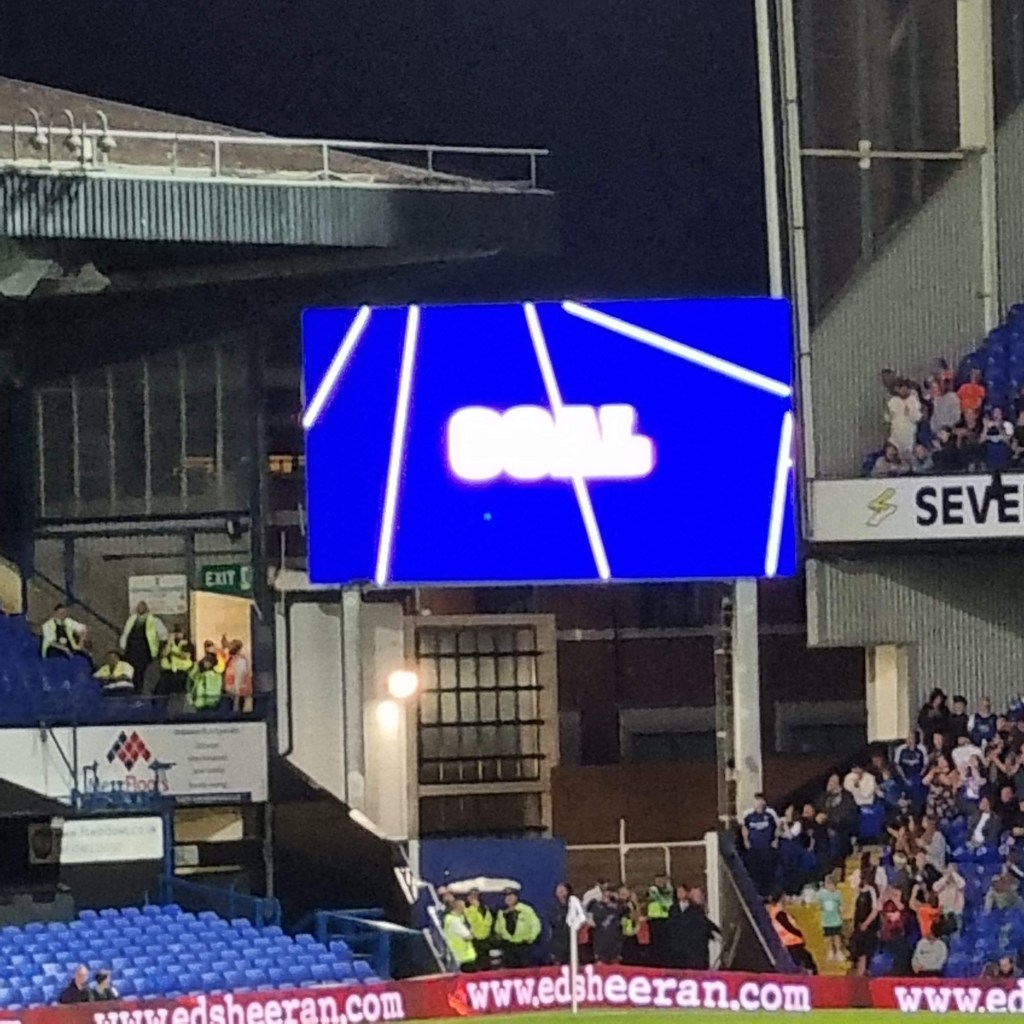
Town dominate possession and after just twelve minutes take the lead. A passing move down the right ends with Jack Taylor passing a ball from Kayden Jackson into the Bristol goal net.  That was easy.  I haven’t really tuned myself into the game yet however, and rather than leaping up and punching the air in a display of forgotten youthful exuberance like I would normally, I just slowly raise my bottom off my seat and applaud politely in a semi-stooped position.  Gary’s reaction is similarly sluggish. For these supporters it still feels like pre-season, the overture, or to employ a war-themed comparison popular with football pundits, like 1939, the phoney war.  Elsewhere in the stadium people are more attuned to the programme as they beat drums and chant “Blue and White Army.”

Town continue to dominate possession and occasionally come close to scoring a goal, but not close enough.  I haven’t seen Gary since July 1st, so we talk as much as we concentrate on the game.   Gary asks me what is the worst football ground I’ve ever been to. I tell him I think it was Oxford United’s Manor Ground.  He asks what the best ground was. I tell him possibly The Velodrome in Marseille, although the Allianz Riviera in Nice is pretty good when full.  Having been unexpectedly put on the spot I forget to mention the Stade Felix Boleart in Lens and the Stade Geoffrey Guichard in St Etienne.

Bristol Rovers only occasionally approach the Town goal and their first shot just creeps and bobs and bounces its way across the turf into the arms of the Town goalkeeper, the interestingly monikered Cieran Slicker. It takes a good twenty minutes or more for Rovers to have another shot and this time Grant Ward’s much more powerful shot is parried away by Slicker for what amounts to a pretty good save. It’s a moment which results in my hearing the faint call of “Come On Rovers” carried over the pitch on the warm evening air from the one hundred and twenty-three Bristolians in  the far corner of the stadium.  Otherwise, the first half of the game leaves no lasting impression on me and after a minute of time added on it’s time for Gary to nip to use the facilities whilst I stand up and try to manipulate my neck, which has grown achy and stiff from having my head turned towards the Sir Alf Ramsey stand for most of the previous forty-six minutes.

 Once Gary has returned, the ‘new’ stadium announcer Mark Murphy appears on the pitch wearing what looks like the same suit that replaced announcer Stephen Foster used to wear.  Murphy tells us he is going to talk to a Town legend and with the artificially excited intonation and words-all-rolled-into-one pronunciation of a former local radio DJ, he announces “Johnny Warks here” and Gary and I look at each other wondering who the hell Johnny Warksear is.  Johnny Wark appears on the big screen and all that’s missing are the subtitles when he speaks.

The game resumes at ten minutes to nine and my hopes of spending the second half just looking straight ahead take a dive as Bristol start quite well.  “Wo-o-o-oh, That’s the way we like it” or something like that sing the Sir Bobby Robson Stand to the tune of what seems to be an original composition or a song I don’t know.  Rovers are gifted a corner as Lee Evans passes the ball back to a place where Cieran Slicker isn’t standing.  But then Ipswich win a couple of corners of their own to redress the balance, before on-loan Omari Hutchinson is the first player to be booked after not so much a bad tackle as an inept one.  “Ole, Ole, Ole” sing the Sir Bobby Robson stand and the drums up in the corner of the stand by the club shop beat; inside the shop stuff must be bouncing off the shelves.  In the seat in front of me a bloke with not much hair has a pair of sunglasses perched on top of his head.    There’s a holiday feel to the crowd tonight with adults and children wearing T-shirts and shorts, looking as if they’ve been at the beach all day.  I half expect to see someome eating candy floss or wearing a ‘kiss me quick’ hat. On the pitch, the second half is reflecting the cheery mood with carefree attacking football and as result Cieran Slicker makes a spectacular save with his feet.

Substitutions arrive on sixty-six minutes with Cameron Humphryes and Sone Aluko taking a bow. Shots rain in on the Bristol goal and a corner is won.  “Oooh Sone Aluko” sing the Sir Bobby Robson Stand to the tune of the White Stripes’ Seven Nation Army.  Marcus Harness half-volleys the ball from close range, but too weakly to bother the Rovers’ goalkeeper.  As more substitutes warm up on the touchline in front of us I say the name of George Hirst to Gary.  “I know what you’re going to say” says Gary “He has a haircut that looks like his mum cut it using a pudding bowl”.  Gary knows me too well and is almost exactly right, but I’d say she used a side plate or small frying pan giving his hair the appearance of a little hat or beret.  I struggle so much to accept George’s haircut that if it had been up to me I wouldn’t have signed him, so it’s probably as well that it wasn’t.

In the seventy-third minute George and Conor Chaplin and Harry Clarke get to make the transition from bench to pitch, but the only immediate result is that Javani Brown shoots wide of the Town goal for Bristol. Within a minute of that however, a sweet passing move down the left sees the ball relayed across the penalty area for Sone Aluko, who seems to be existing in his own isolated moment of time and space, which allows him to then pass the ball into the far corner of the Bristol goal, and Town lead 2-0. Gary tells me how his mother recently received a new copy of the local telephone directory and that there were three people in it with his surname; they were Gary, his mother and his uncle who died several years ago, but it wouldn’t surprise me if BT was a hotbed of spiritualists.

All that remains is for Murphy to announce the crowd as being 15,047 with 123 of that number being from Bristol, and for people to applaud themselves, each other, and more acceptably the travelling Bristolians.  Bristol is a long way from Ipswich on a Wednesday night, although logically no further than at any other time of day or week.  Five minutes of time are added on to ensure we get our money’s worth and when that expires we rise as one to applaud and then seep out into the night.  It’s been a decent little game, a bit low key like a pre-season match, but it’s good to see a match where none of the players appear to think winning matters more than life itself.  Bristol Rovers played their part and should have scored at least once, but on the plus side they will now have time on their hands in the middle of the week to think about what their away kit should look like next season.   As for Ipswich,  we are on our way to Wembley, my stepson and his family live in the RG24 postcode area so if I get the urge I might march on to Basingstoke, or Reading.