ASC St Anne d’Auray 1 Avenir Guiscriff 3

One of the best things about visiting France in September is being able to catch a game in the early rounds of the Coupe de France when the competition is still regionally based and there are ample opportunities to see village teams slug it out in quest of the sort of glory only village teams can enjoy.

Having arrived in Brittany just yesterday, after an overnight stop in Le Mans, I can’t be bothered to travel far from where my wife Paulene and I are staying in Carnac, added to which it’s a grey, miserable day and when if it’s not full-on raining there is a steady drizzle as if the Atlantic Ocean is stealthily relocating itself slightly inland.  After consulting the list of fixtures on the Ligue Bretagne de Foot website I have whittled the possibilities down to US Brec’h v Av.Campeneac-Augan or ASC Saint Anne d’Auray v Avenir Guiscriff.  Both are between twenty and twenty-five minutes away by planet saving Citroen e-C4 but St Anne-d’Auray ASC have a grass pitch as opposed to a plastic one, and taking a chance on the rain having not caused a postponement I decide that I would rather see people getting muddy than getting friction burns, and so I head for St Anne d’Auray.

St Anne-d’Auray is a curious place, a village with a population of less than 3,000 people but also the location of the third most visited pilgrimage site in France after Lourdes and Lisieux, as a result of which, and also because of which, it also has a huge basilica.  Wikipedia tells us that St Anne-d’Auray became a site of pilgrimage after a pious farmer in the early 17th century kept having persistent visions of St Anne, who somewhat weirdly told him to rebuild a chapel which had been demolished about 900 years previously. The farmer must have been a sort of renaissance era Nigel Farage figure as people were evidently keen to believe his unlikely tales, the chapel was built, and by the 1870’s had become the present basilica.

As a I drive into St Anne d’Auray along the D17, through the early afternoon gloom the tower of the basilica looms above the roof tops wreathed in low cloud.  A left turn takes me down the Rue de General de Gaulle and to the Stade Municipal where luck shines upon me and a car is leaving the otherwise full car park just as I arrive.  I park up and step out of my planet saving electric Citroen, and my nostrils are assaulted by the acrid smell of barbecue smoke.  I saunter through the gates to the Stade Municipal in my long navy-blue raincoat and join the throng of local inhabitants socialising, drinking and generally enjoying themselves in a sort of impromptu ‘fanzone’ where everybody seems to know everyone else.  Entry to the match is free of charge with the football club clearly being content with the income from beer, wine, coffee and food.

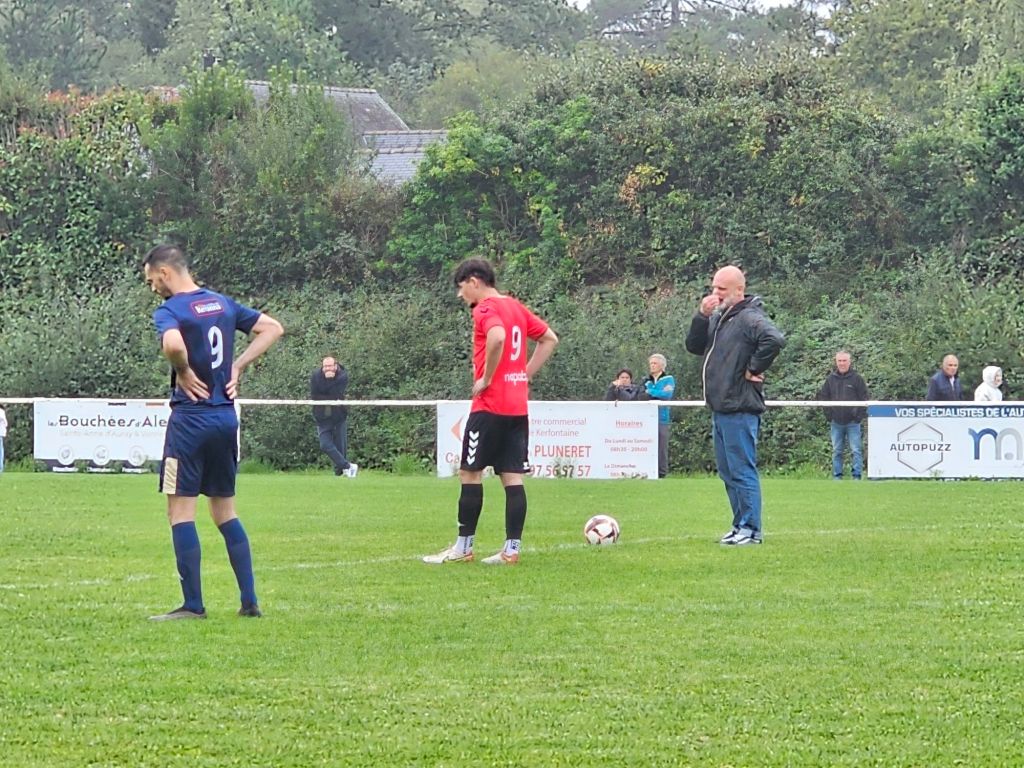
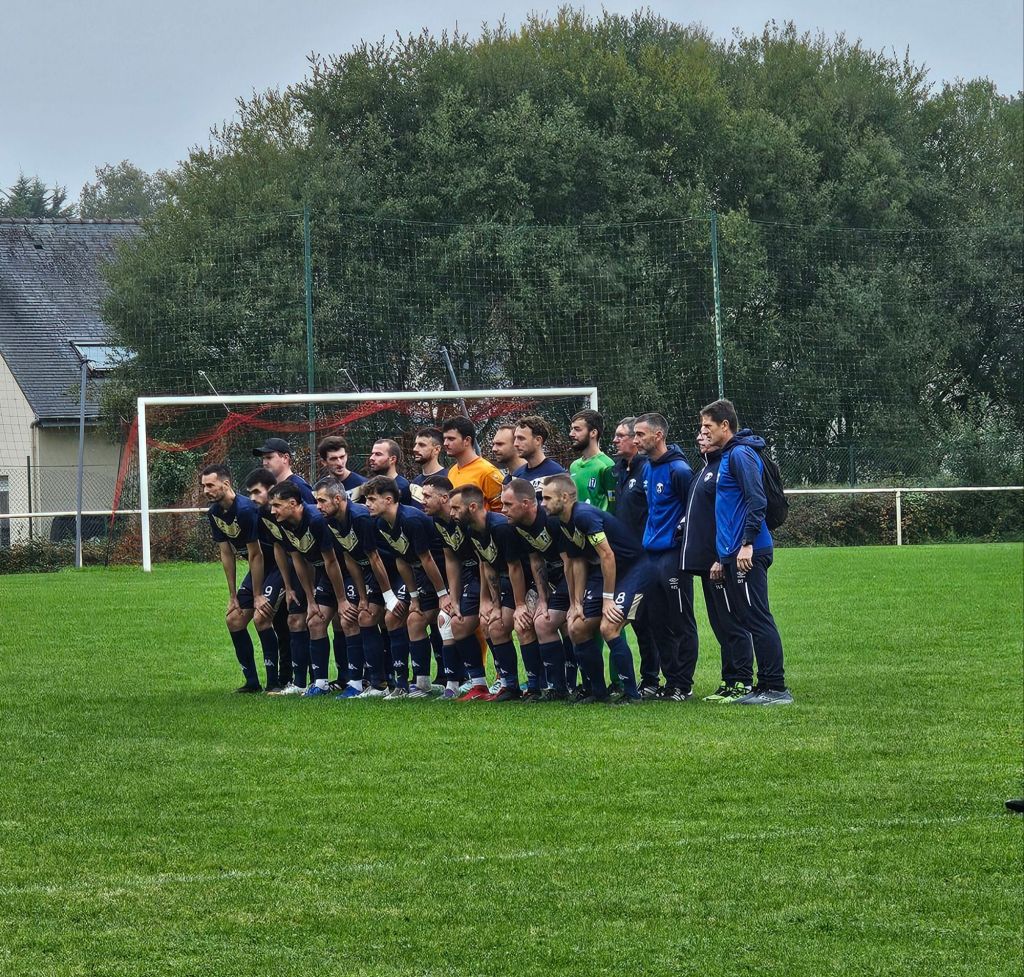
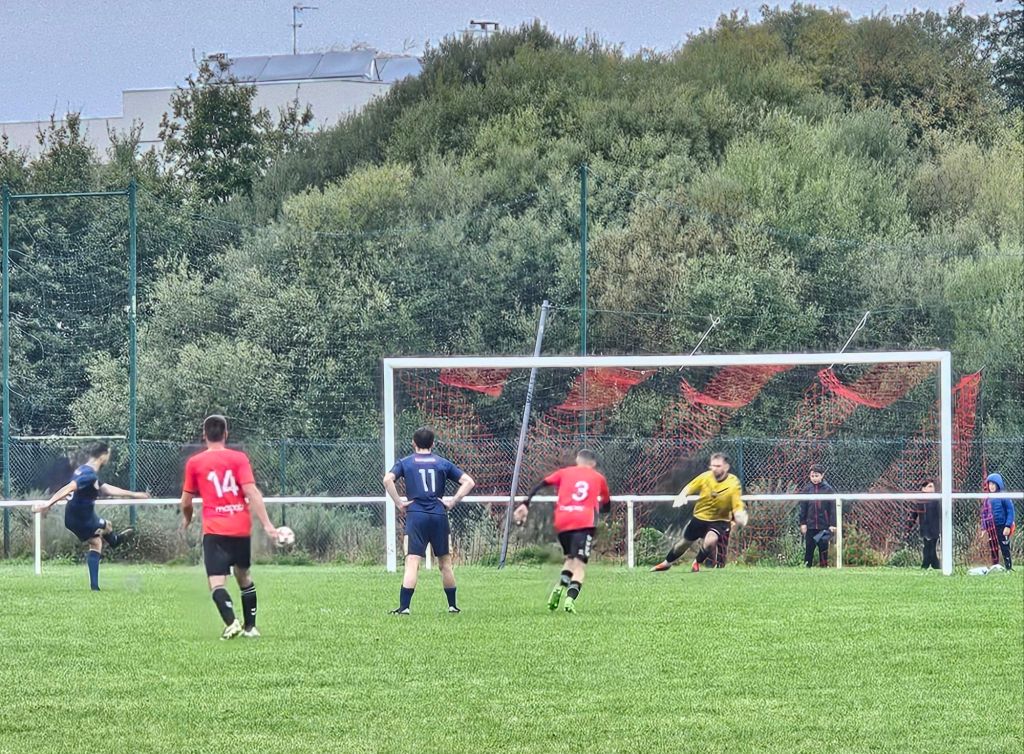
Kick-off is advertised as being at three o’clock but it’s nine minutes past by the time the two teams emerge from the dressing rooms and trudge their way to the pitch behind the referee and his assistants, the clumping of their metal boot studs on the tarmac sounding like a marching army and the basilica providing a suitably religious back drop for a Sunday afternoon.   The tarmac driveway passes through a gap in an impressive row of tall oak trees that line the east side of the stade, which has no stand, just a tarmac path all around and a metal rail surrounding the pitch.  After photos and the usual cursory handshakes, the teams line up and after an initial ‘ceremonial’ kick off by a bearded and balding man, it is visiting Guiscriff AV who get first go with the ball, sending it mostly in the rough direction of the nearby town of Auray, whilst the home team shoot towards the basilica.  St Anne d’Auray wear a kit of red shirts and black shorts whilst Guiscriff are adorned in all navy blue with gold or beige chevron on their chests.  

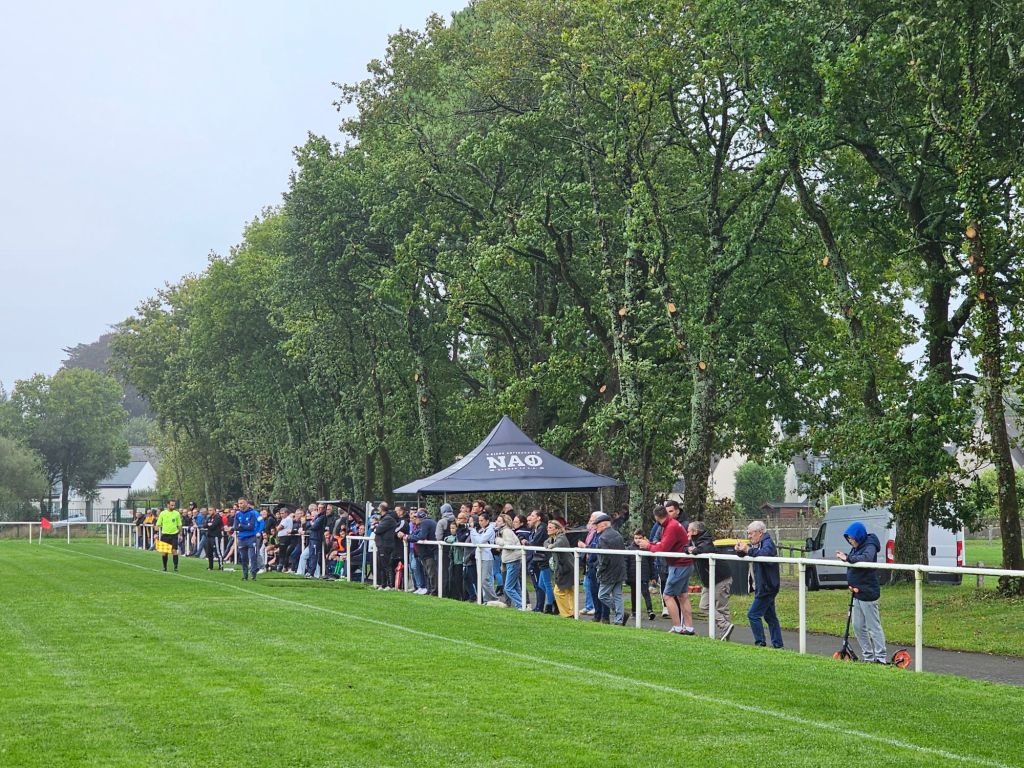
The crowd of at least two hundred is enthusiastic and congregates on each side of the pitch behind the well-maintained metal rail.  Guiscriff is a village 84 kilometres away to the northwest near Quimper, is about an hour and ten minutes’ drive away, and a good number of visiting supporters have travelled, including a man carrying a blue, cuddly, toy rabbit, which I assume is some sort of mascot, but he could just be a friend or comfort.  The stadium has no flood lights but although it’s a grey afternoon, it’s not so grey that these are going to be needed.

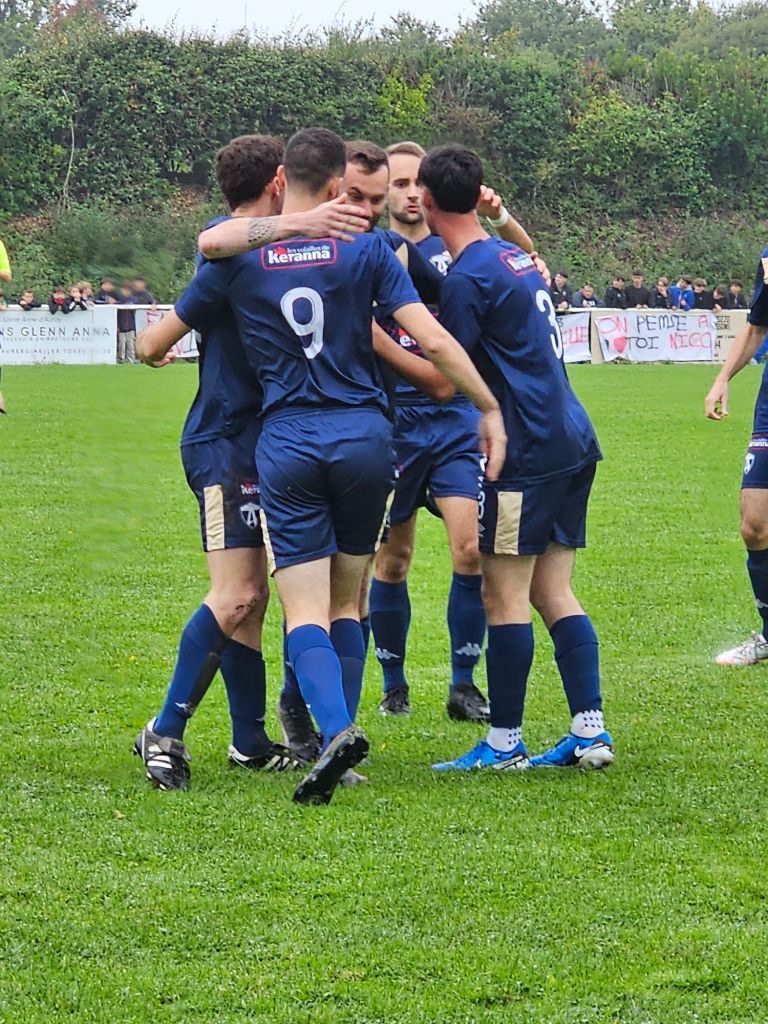
Just two minutes pass and a cute through ball down the left from the Guiscriff number nine sends their number eleven away into the penalty area where he comfortably slips the ball past the St Anne d’Auray goalkeeper to give the away team a very early lead. After the excitement of the start of the match and the teams marching to the pitch, the home supporters now appear as religious followers whose tenets of faith have suddenly all been disproved.  But whilst 84km apart geographically, the two sides are at the same level in the regional league, so all is by no means lost just yet, although when the bells of the basilica start to toll the sound is somewhat ominous.  The away supporters meanwhile are delirious and having visions of the fourth round.

Happily, the shock of going behind is soon processed mentally and the noisiest home supporters assembled opposite the team dugouts are quickly in good voice again with chants of “Aux Armes”.  An adversarial atmosphere is stoked as there are enough away supporters to render a few decent chants of “Allez les bleus” too.    On the pitch, the balding number five and number eight for St Anne d’Auray appear influential but Guiscriff are holding firm quite comfortably, with the home team’s forays forward mostly foundering on slippery grass, offsides and shoves and pushes that the referee (l’arbitre en Francais) Monsieur Romain Betrom spots but the home supporters don’t.

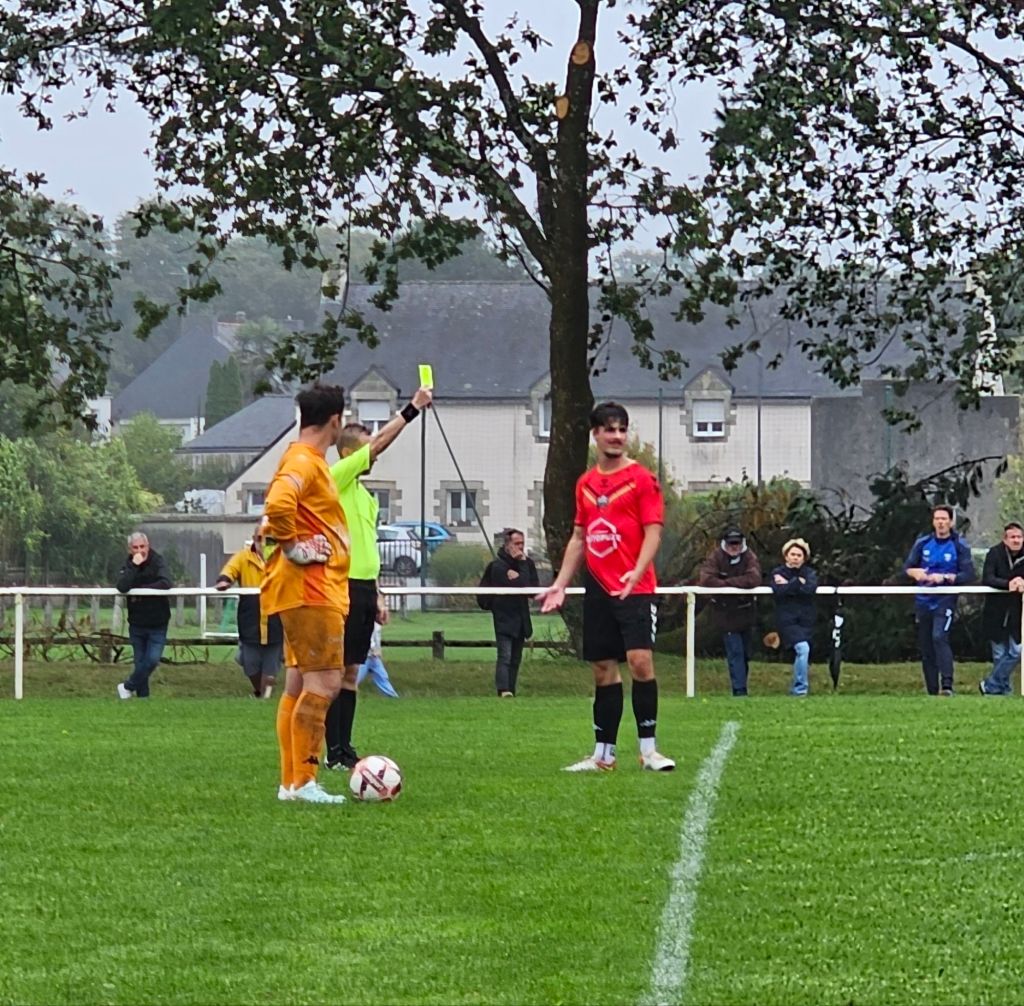
It’s now twenty-two minutes past three and it’s beginning to look like St Anne will struggle to reverse the early deficit but then almost miraculously there’s a careless trip and Monsieur Betrom is pointing to the penalty spot.  After a long lecture from Monsieur Betrom and eventually a yellow card (carton jaune) for Guiscriff’s number five, who I can only think postulated an alternative view of events a little too vigorously, the rangy number ten for St Anne d’Auray steps up to score, a good two minutes after the penalty kick had first been awarded.
With the scores level the whole match begins to even out and Guiscriff no longer look the better team.  At twenty-five to four St Anne d’Auray win a free kick, which ends up in the back of the Guiscriff net courtesy of one of their own player’s boots, but Monsieur Betrom disallows the ‘goal’ for pushing, shoving, holding, blocking or a combination of the four.  There was certainly a lot going on in the penalty area with fouls likely being committed by both sides; Monsieur Betrom clearly took the view that if in doubt just pretend the whole incident never happened and leave the score as it is, and who can blame him?

I wander around the ground taking the game in from different angles and enjoying the grey afternoon scene against the backdrop of oak trees and the tower of the basilica beyond.  Briefly I stand close to the village ‘ultras’, who are mostly teenagers but are well equipped with banners, two empty oil drums for percussion and a loud hailer.  Not long after I settle against the rail just beyond the bulk of the more boisterous home support, Monsieur Betrom makes a decision that will probably define the match, as he shows his carton rouge (red card) to the St Anne d’Auray number eleven.  There is an inevitable delay as this is discussed but eventually number eleven makes his way towards the gap in the tall oak trees and back to the changing rooms.

 Inevitably Monsieur Betrom’s decision is not a wholly popular one and there is much braying amongst the home crowd.   I exchange raised eyebrows with a middle-aged man a metre or two away along the rail and then move next to him when he speaks to me.  Happily, the extent of his English and my French seem vaguely complimentary, and in a somewhat stilted way we are able to discuss the Coupe de France, the match and Monsieur Betrom, the man even does an impression of Donald Trump.  Half-time (mi-temps) arrives and is accompanied by a sudden increase in precipitation, so I turn up the collar on my coat.  The man, who I will later learn is called Frederique invites me to join him and his friend Patrick at the bar.  He jokingly suggests we can talk about Brexit, which I suspect he feels as disappointed about as I do.  At the bar, Patrick very kindly buys me a beer, and Frederique introduces me to several other people including the local mayor a small, kindly looking man with a big moustache, and another friend, Jean Baptiste.  

When the football resumes, I stand near the dugouts with Frederique and Patrick and try to avoid the rain, which is now coming straight at us, from getting into my beer.  The match continues in much the same vein as it did in the first half and Guiscriff seem incapable of making any advantage of their extra player.  The Guiscriff coach strides up and down the touchline seemingly talking to himself but possibly cursing his players.  When his goalkeeper concedes a free kick by picking up a back pass, he almost has a seizure.  Monsieur Betrom meanwhile, a thin, gaunt looking man much younger than his two assistants, one of whom has grey hair, spends much of his time brandishing his carton jaune. For every one of the many bookings he delivers he stands to attention, with his card holding arm at 45 degrees, a pose he holds for a full two or three seconds as if at some sort of Nuremburg rally for referees.

“Carton rouge!” shouts Frederique for as many fouls as he thinks he can, which amuses a short elderly couple stood next to me, and then “Allez l’arbitre!”.  The game proceeds through the continuing gloom although happily the rain stops falling.  Substitutions are made, but no resolution seems in sight until suddenly by way of another miracle there is an ill-judged, attempted tackle on the edge of the St Anne d’Auray penalty area, and for the second time this afternoon monsieur Betrom points to the penalty spot.  The penalty is scored and with less than ten minutes left to play Guiscriff are once again heading for round four.

No more than five minutes later, Guiscriff lead 3-1 after a sequence of a corner, a shot and a deflection concludes with ball nestling once more in the back of the St Anne d’Auray goal net.  It’s a disappointing end to the afternoon for St Anne d’Auray and matters get slightly worse when there is a contretemps between a local and a man in a Guiscriff sports coat.  Glaring looks are exchanged, beer is spilt and the game stops as the matter is discussed by the referee, one of his assistants and a man wearing an armband who I assume is the delegue principal, a sort of fourth official.  “Just football” says Frederique philosophically.

With the final whistle, the celebrations from the Guiscriff players and supporters are ecstatic, winning a Coupe de France tie means a lot.  With Frederique, Patrick and Jean-Baptiste I turn away and head for the gap between the tall oaks.  Frederique asks if I am coming back to the bar with them, but reluctantly I must turn down their invitation as my wife Paulene is waiting for me back in Carnac.

Despite the rain, the gloom and the disappointing result for the home team it’s been another wonderful afternoon in the Coupe de France, and my love for this competition and all things French has just received another layer of gloss, although I’ve not learned anything new except perhaps that St Anne was possibly not a football fan, but given that she was supposedly the Virgin Mary’s mum, I never thought she was.
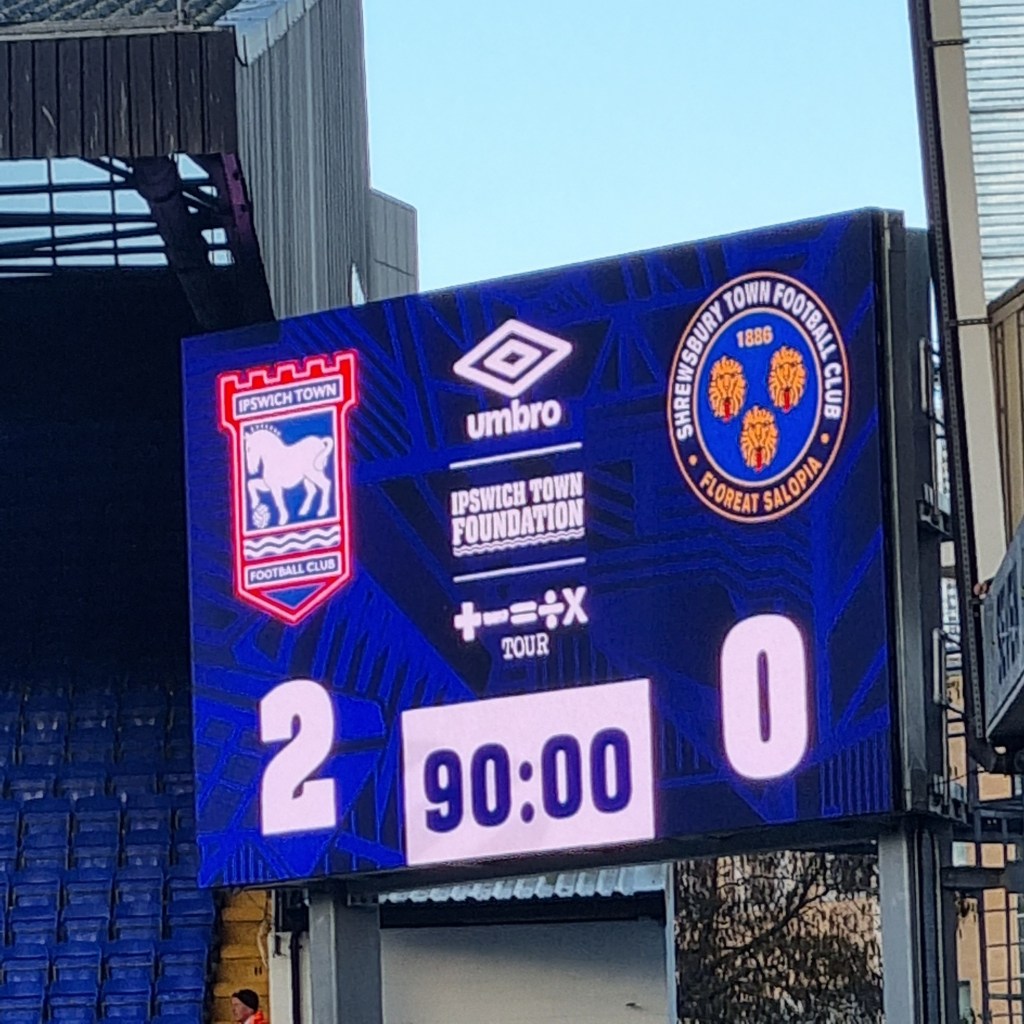
Ipswich Town 2 Shrewsbury Town 0

It’s been a beautiful wet morning of silvery grey light beneath a shroud of pale cloud.   I woke early, before six, when the sky was blue and red as the sun came up, but that was too early, so I went back to bed, then overslept.

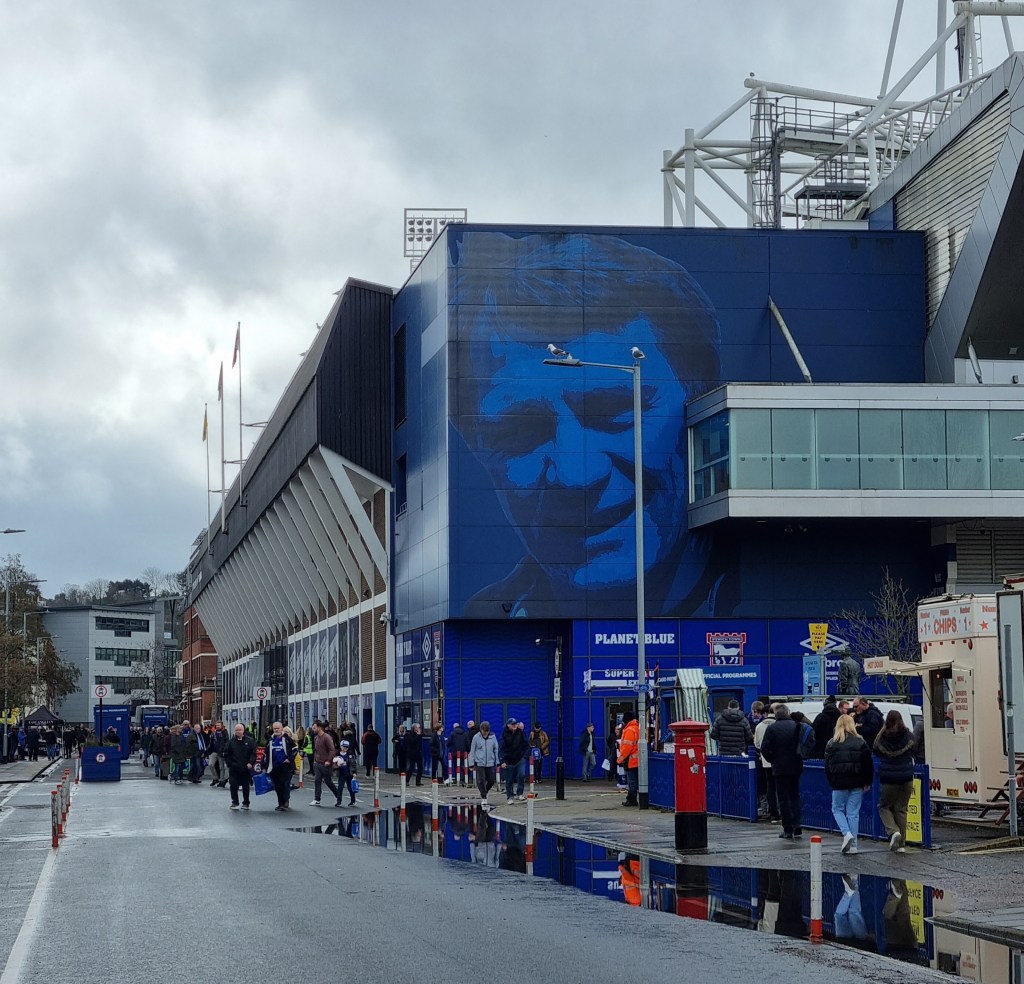
Earlier this week I woke up with my mind disturbed by vivid dreams of a time over forty years ago when I was a university student coming to terms with base desires to form shallow relationships with members of the opposite sex. Worryingly, in these dreams I fancied girls who at the time I didn’t think I did. Why my subconscious mind should want to re-appraise events of forty years ago I cannot fathom. The week has improved since then, and psychologically re-balanced I’ve now parked up my planet saving Citroen e-C4 and have stepped out across a slippery, soggy Gippeswyk Park, beneath Ancaster Road railway bridge and over the river to the old tram depot and Sir Alf Ramsey Way, where I cashlessly buy a programme for today’s match having waited my turn behind  a man who called the programme seller ‘mate’ at least four times and possibly as many as six during the  course of his brief transaction. I was tempted to address the programme seller as ‘programme seller’ but of course I didn’t. One day.

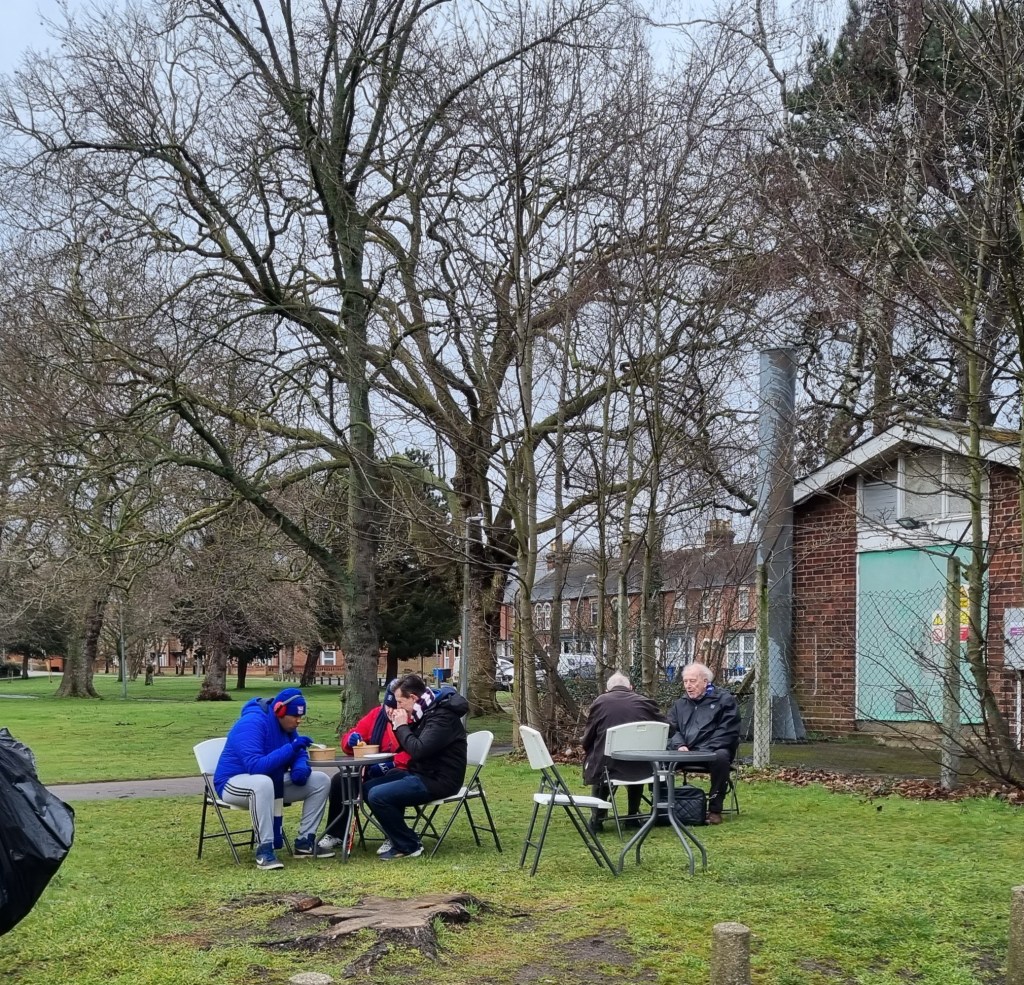
 At ‘the Arb’, I am a little bemused that there is no Mauldon’s Suffolk Pride today, but on the barman’s recommendation I order a pint of Mauldon’s Silver Adder (£4.00) and retire to the beer garden, which is already occupied by several drinkers of late middle age. I drink alone today because my friend Mick might be required away at any moment to collect a ‘stiff’; my words, not his and is taking the calls. Despite Mick’s absence, death still stalks me as at a nearby table I overhear a man talking of a funeral he had recently been to at the Seven Hills Crematorium.  “They just talked a bit about his life, played some music, and that was it” he says.  Later, he will tell his fellow drinkers about watching football on tv in Arabic by means of his Firestick, and how Richard Keys and Andy Gray are still working for beinsports in Qatar, where their grubby attitude towards women is clearly tolerated.  I would like to hear Andy Gray speaking Arabic.

I read my programme, gleaning from it the fact that Sam Morsy has been booked twelve times this season, which is four more times than any other Town player and twice as many times as the third most booked player, Wes Burns.  Finishing the Silver Adder, I return to the bar for a pint of Lacon’s Encore (£3.51 with Camra discount), by way of an encore.  At about twenty to three I depart for Portman Road. In Crown Street a young man steps out of a barber’s shop and sprays what I assume to be deodorant under his armpits from beneath his T-shirt.  An ambulance speeds by with its siren blaring; “Go, go save that person” shouts a lairy youth, no doubt trying to impress his friends with his off-the-wall ‘humour’.

I reach Portman Road and behind what was the North Stand a bearded man I know called Kevin sidles up to me and says hello. Kevin’s pre-match ritual is to have a pint at St Jude’s Tavern; he would join me at the Arb but can’t not stick to his ritual in case it causes a calamitous result.  We walk to turnstile 61 together; Kevin uses turnstile 61 because 1961 was the year he was born.  On what used to be the Churchman’s terrace I edge past Fiona to my seat next but one to the man from Stowmarket, although Fiona says he’s actually from Stowupland.  Two rows in front of us are ever-present Phil who never misses a game and his young son Elwood.  Pat from Clacton arrives a little after I do; she’s going to Great Yarmouth tomorrow on a ‘whist holiday’.

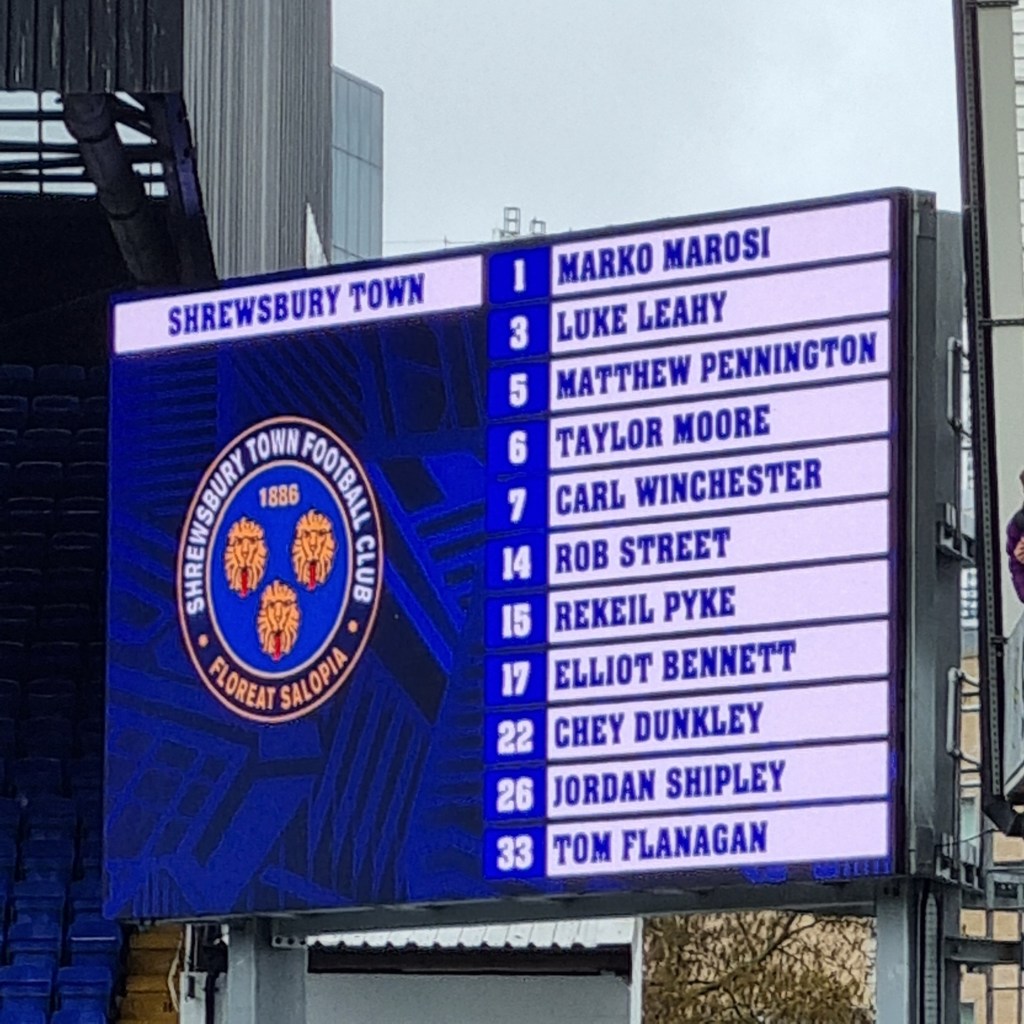
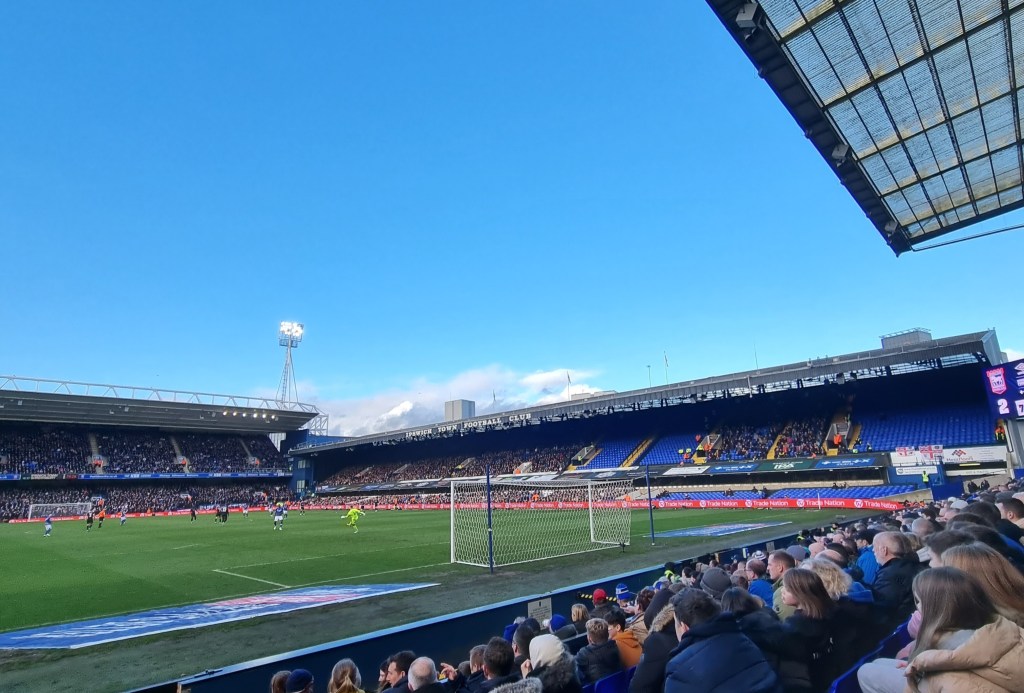
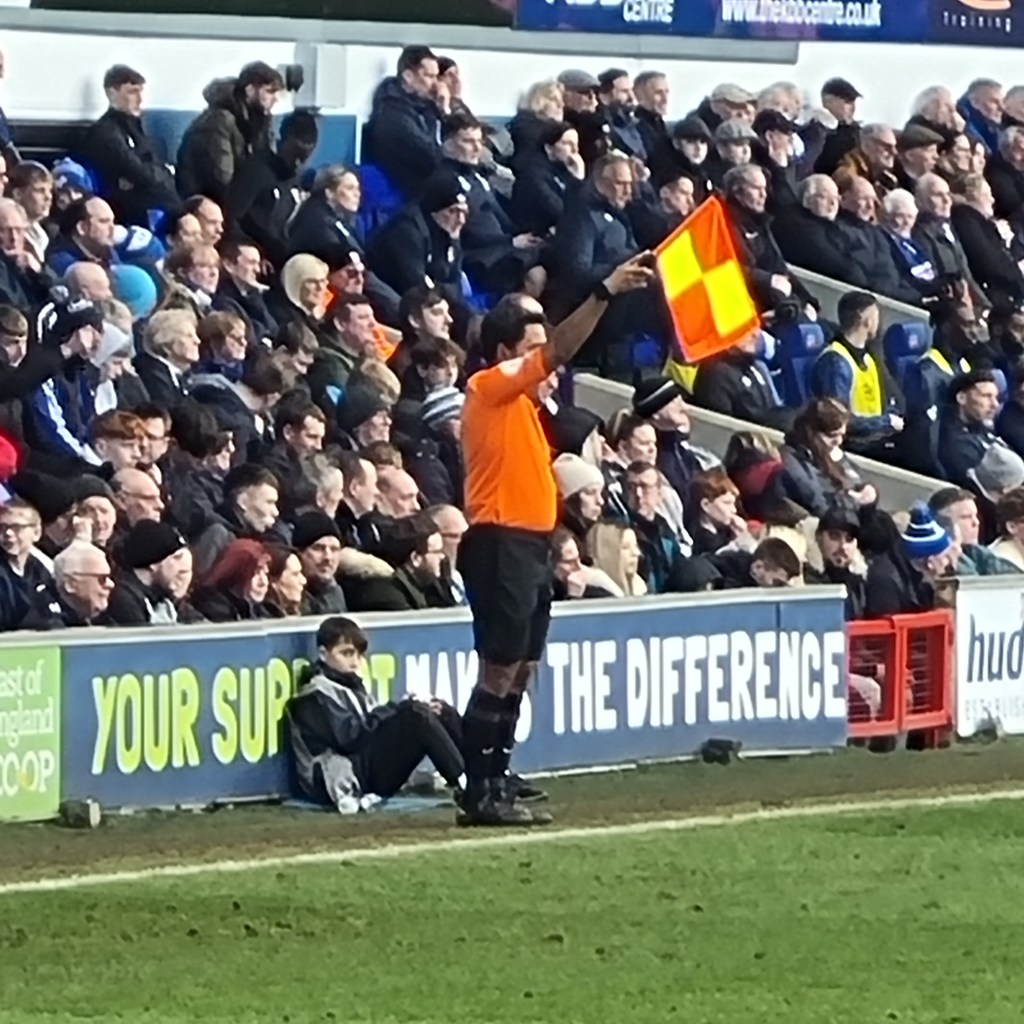
The teams process onto the pitch and Stephen Foster, the former BBC Radio Suffolk presenter and class-mate of my friends Pete and Ian, reads out the teams.  Along with ever-present Phil, I bawl out the Town players’ surnames, pretending to be French. If I was French, I’d already be retired now, and depending on where I lived I might support Racing Club de Lens, Lorient, Clermont Foot or Montpellier. It’s something I think about a lot in my many idle moments.  After a minute’s applause for former Town director John Kerr who died this week, Shrewsbury Town take the knee and applaud whilst Town players form a huddle, and then the match begins. Shrewsbury get first go with the ball attempting to send it mostly in the direction of the goal just in front of me, Pat, Fiona, Phil and Elwood.  Shrewsbury are sporting a change kit today because their usual, distinctive blue and yellow striped shirts would clash with Town’s all blue shirts.  Disappointingly,  Shrewsbury have opted for all-black, the magnolia of modern-day football kits,  for people who choose club kits but who also lack imagination. The addition of red smudges over the shoulders does nothing to alleviate the depressing absence of colour.  The referees however are doing their best for us and are wearing orange shirts.

An intimidating, brooding wall of silence encloses the ground providing the soundtrack to the games’ opening moves, but a bit of noise eventually emanates from the Blue Action section in the lower tier of the Sir Bobby Robson Stand, followed by the curious chants of “Addy, Addy, Addy-O”.  It’s damp, and a faint mist seems to hang over the pitch.  Town have the ball mostly, but all of a sudden Christian Walton is leaping acrobatically to tip a header from Luke Leahy (I like to think Leahy is pronounced leaky) over the cross bar to give Shrewsbury the game’s first corner. Quickly it has been established that Shrewsbury are going to be one of those teams who are all free-kicks, set pieces and shoving people over.  It’s a style of ‘football’ that is effective for a bit, but people soon get tired of it and that includes the players, just ask Mick McCarthy. 

Town soon re-establish their superiority, which manifests itself in three corners in five minutes as crosses and shots are blocked.  A dozen minutes have gone forever and half the pitch is now bathed in mottled sunlight and the other half wallows in the shadows of the stands.  I am struck by how spindly the legs of Shrewsbury’s number 33, Tom Flanagan, are and just to prove the point he slips over like new born Bambi.  The fifteenth minute arrives and Wes Burns scampers off down the wing, crosses the ball and George Hirst rises high, twists his neck, and heads the ball gloriously into the goal beyond goalkeeper Marko Marosi.  It’s the sort of goal centre forwards used to score all the time, and at half-time Ray will tell me how it reminded him very much of Trevor Whymark’s best work, and he’s right.  Town lead 1-0.

The sun is shining, the Town (Ipswich not Shrewsbury ) are winning and all is right with the world as I sit back and wait for Town’s next goal.  Before that however, comes the first booking as Wes Burns is tripped by Jordan Shipley, who forty years ago might have been called Gordon Shipley.  All twenty outfield players are within forty yards of the Shrewsbury goal as the resulting free-kick is taken, but the ball goes straight into the arms of Marosi.

With the game entering its second quarter, it feels like Town ease off a little as what had been a busy period of crosses and constantly probing possession comes to an end.  But the rest, is just a rest and soon Town are winning more corners. “Come On You Blues” I bawl.  “ They can’t hear you” says Pat from Clacton.  “I don’t think anyone can” I tell her, disappointed that all across the bottom tier of the Sir Alf Ramsey stand people haven’t joined in with me. “I can hear you” says Fiona, sounding like she wishes she couldn’t.

We descend towards half-time and from another  Wes Burns cross it looks as though the until now excellent Massimo Luongo has an open goal, but somehow he contrives to head the ball where we and presumably he didn’t want it to go, not into the goal.  In the interests of variety, Shrewsbury are awarded a corner as Cameron Burgess clears the ball behind from a rare, but awkward foray forward by the visting team, and Christian Walton saves a shot from that Gordon Shipley, before Conor Chaplin restores order but shoots wide of the Shrewsbury goal.  The half closes with an homage to BBC tv sitcom Dad’s Army as Shrewsbury number 15, Rekeil Pyke  fouls Luke Woolfenden, and hopefully referee Ollie Yates adopts a German accent to say “ Your name will also go into the book, what is it?”  From the touchline I think I hear Shrewsbury manager Steve Cotterill shout “Don’t tell him Pyke!” and both benches and Mr Yates fall about laughing.

With half-time, I hasten away beneath the stand to make use of the facilities and enjoy the luxury of the new hand dryers which since the last home game have replaced the old asthmatic ones.  I return to talk with Ray and his grandson Harrison at the front of the stand. Ray seems disappointed with the first half because Shrewsbury have had a couple of reasonable chances and Town have only scored once, but he liked the goal and talks of Trevor Whymark and Alan Lee.

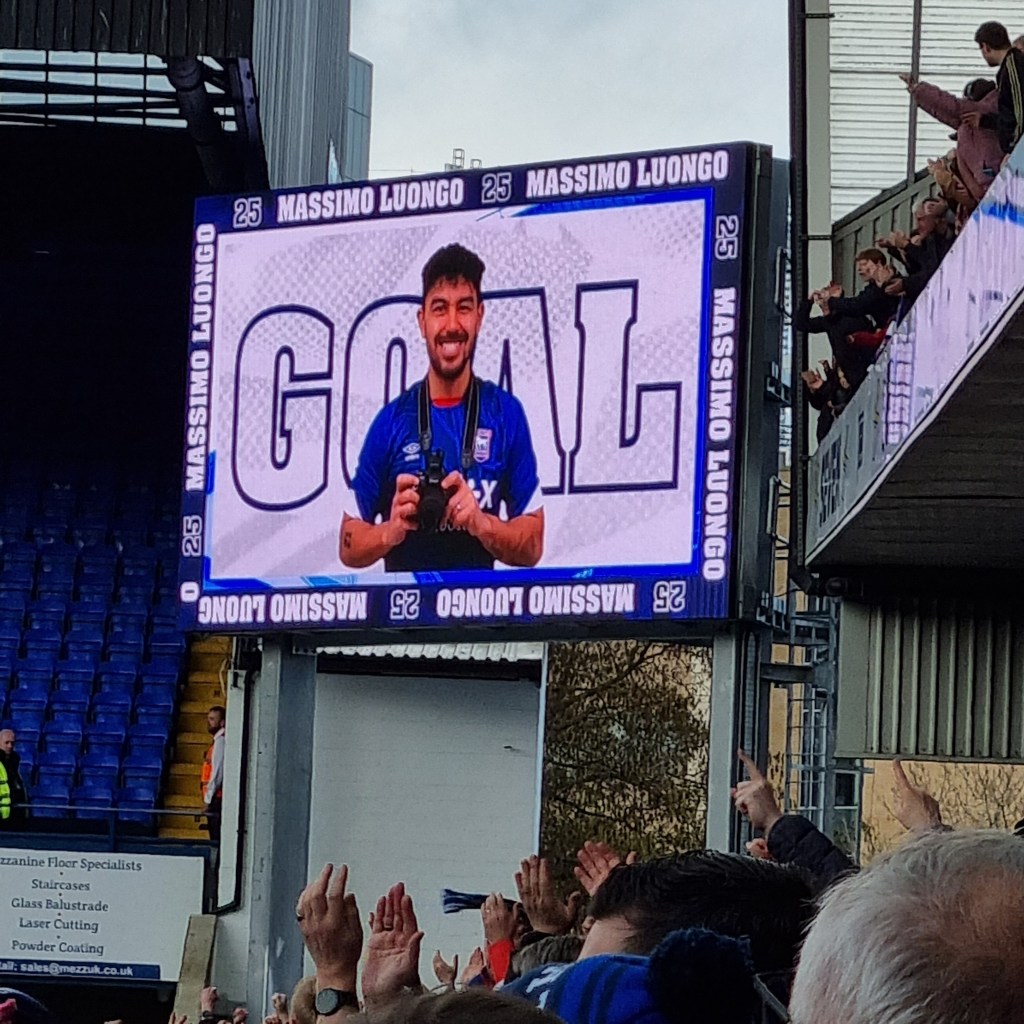
The football resumes at seven minutes past four and I eat a Nature Valley honey and nut cereal bar, which I finish before Town seemingly score again as Conor Chaplin taps the ball in at the far post after a deep cross, but apparently he is offside; he doesn’t argue so he probably was, or he is the first player to work out that referees do not change their decisions.   The disappointment is only temporary however, but what isn’t?  Two minutes later there’s a cross, a Conor Chaplin shot is blocked and Massimo Luongo places a precise hooked shot inside the far post to put Town 2-0 up.

It feels to me like we’ve won already and it’s just a matter of how many goals Town can get. Shrewsbury are putting up decent resistance but we’re too good for them and almost proving the point George Hi⁸rst thumps a shot against a goal post, although he must ask himself why he missed the 7.32m wide gap to its left.  A minute later  Shrewsbury’s Matthew Pennington is booked for reacting childishly to a perceived dive by Nathan Broadhead and then an unseemly melee ensues with all the usual posturing and macho behaviour that you would expect from the drivers of enormous black SUVs.   When the free-kick is eventually taken, Leif Davis uncharacteristically launches it wastefully over the cross bar.

Ipswich’s early dominance of the second half nevertheless inspires some noise from the home crowd and the Sir Bobby Robson stand treat everyone else to the usual truncated rendering of Harry Belafonte’s, or may be Boney M’s, Mary Boy Child with specially adapted lyrics that tell of what now seem like mythical fights with Norwich on Boxing Day.  Shrewsbury are first to blink with regard to substitutions and two are made together, one of them being the aforementioned Pyke. 

Time rattles on by twenty minutes and Shrewsbury win a corner and Nathan Broadhead is booked for being fouled in the Shrewsbury penalty area despite Shrewsbury players concernedly helping him to his feet rather than pointing accusing fingers.  Todays’ attendance is announced by Stephen Foster as 26, 432 with 343 from Shropshire, and weirdly but as per usual, people applaud themselves  or each other, or may be they’re applauding Stephen Foster.  On the Clacton supporters coach the guess the crowd competition is won by Pat from Clacton’s great nephew Liam, who is just visiting for the weekend and is a West Ham United supporter.  Understandably, Pat seems disappointed that this ‘part-time supporter’ has won the prize and suggests various other guesses  on her list to Fiona and me that might be closer, but none of them are.

Fifteen minutes remain and it’s time for Town to begin their usual catalogue of substitutions and Freddie Ladapo and Marcus Harness replace George Hirst and Nathan Broadhead.  Another Shrewsbury corner sees Chey Dunkley strike the Town cross-bar  with a header, but typically for a team reliant on ‘big blokes’  there has been a foul, and Town are awarded a free-kick and Christian Walton receives lengthy treatment whilst everyone else enjoys a break by the touchline.  “Get Up!” shouts a frustrated pre-pubescent voice behind me.  His dad explains that you don’t shout “Get Up” at your own players, but the child simply replies ”But it’s taking forever”.  When he’s older he’ll realise that some of life’s best moments are when nothing is happening.

The last ten minutes of normal time have found their way here and it still time for two more Shrewsbury players to be shown Ollie’s yellow card  for fouling Conor Chaplin, and Kayden Jackson, who has replaced Wes Burns, although they probably would have fouled him too given the chance.   The eternal treatment to Christian Walton results in only seven minutes of added on time and whilst I hope for a third Town goal which would mark out the result as a modest thrashing rather than just a satisfactory win, it doesn’t happen, despite two more Town substitutions and an outbreak of rhythmic clapping.

Finally, at a minute before five o’clock the game ends and my little band of ultras and I bid our adieus until Good Friday.  It’s been a fine performance from Ipswich and ultimately a comfortable, if hard fought victory.  I will travel home this evening content, and safe in the knowledge that in forty years’ time it is unlikely my subconscious mind will unexpectedly want to re-appraise todays events, because I expect I will be dead.