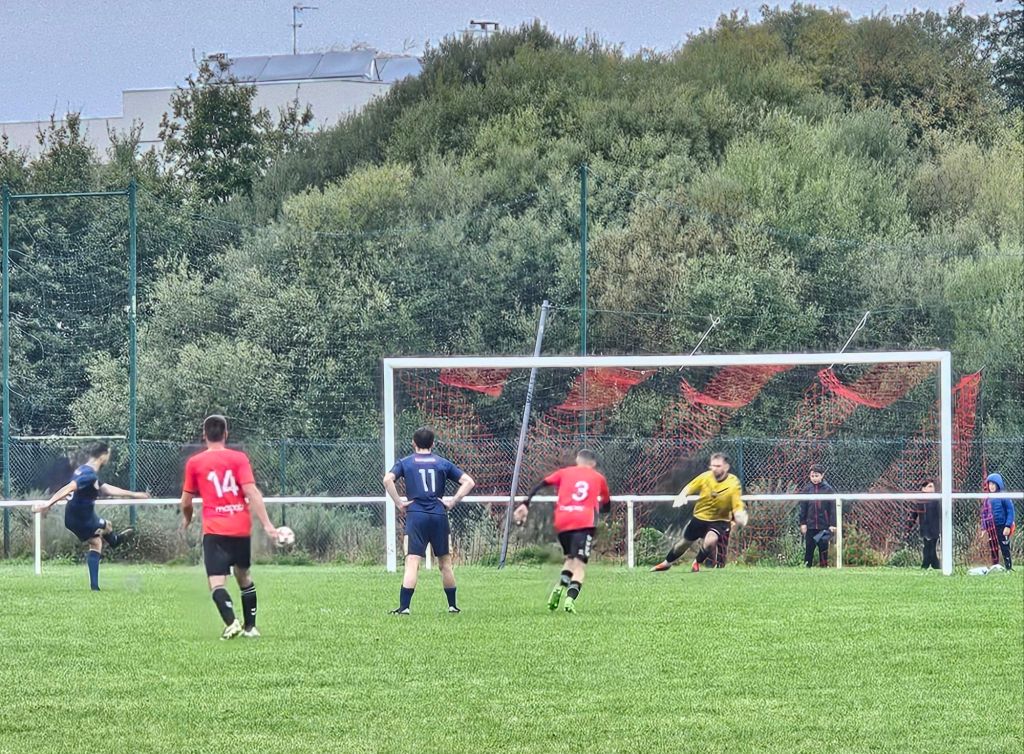
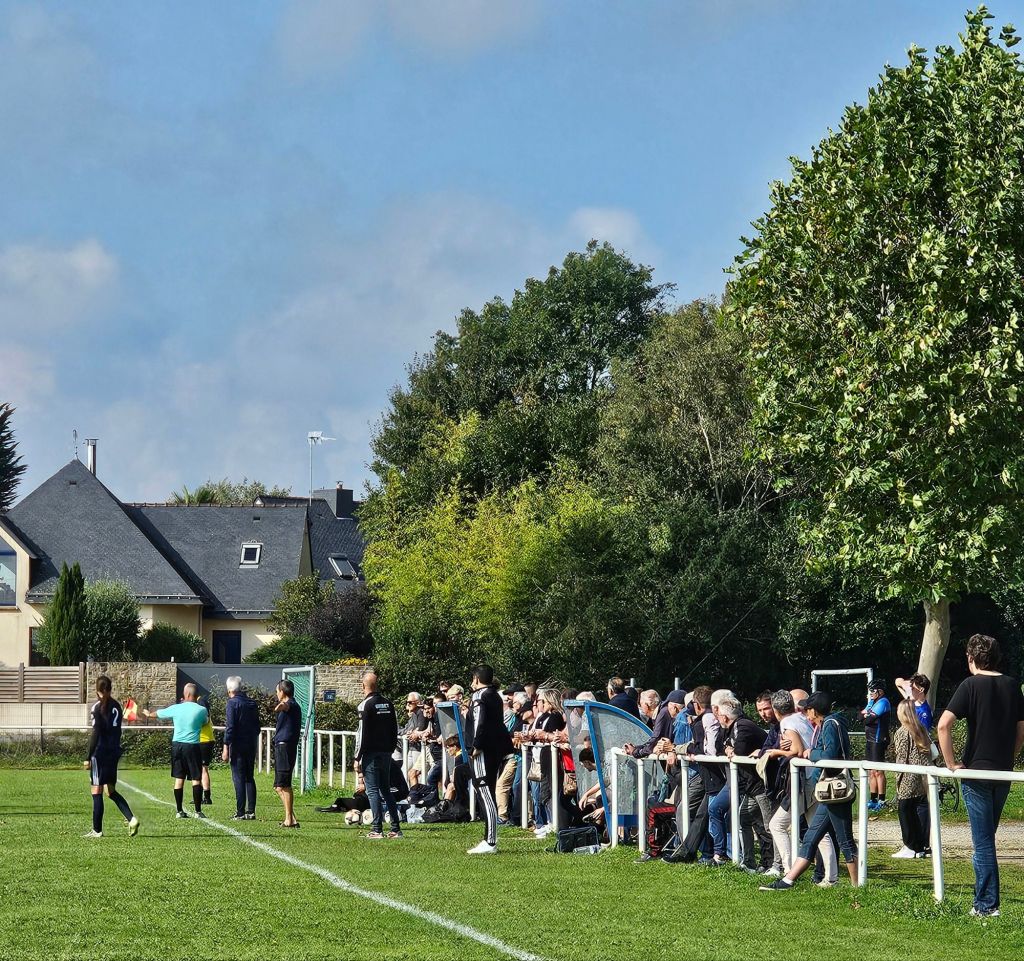
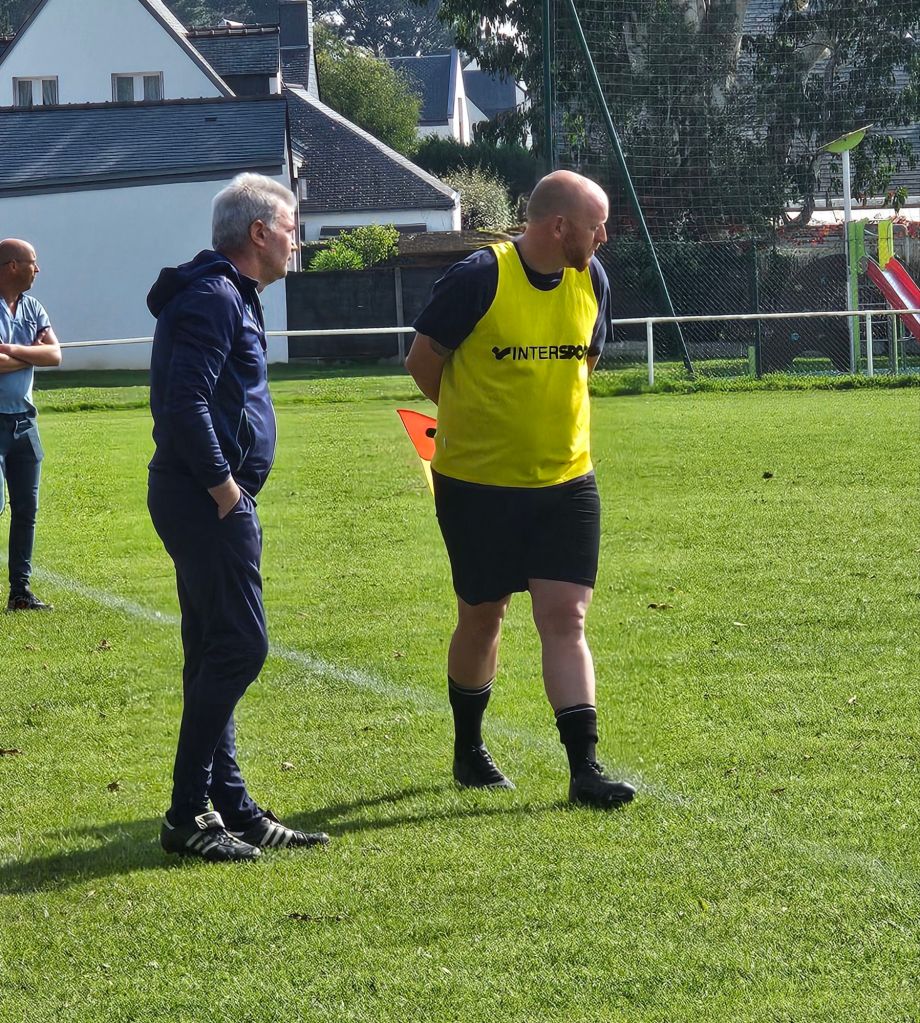
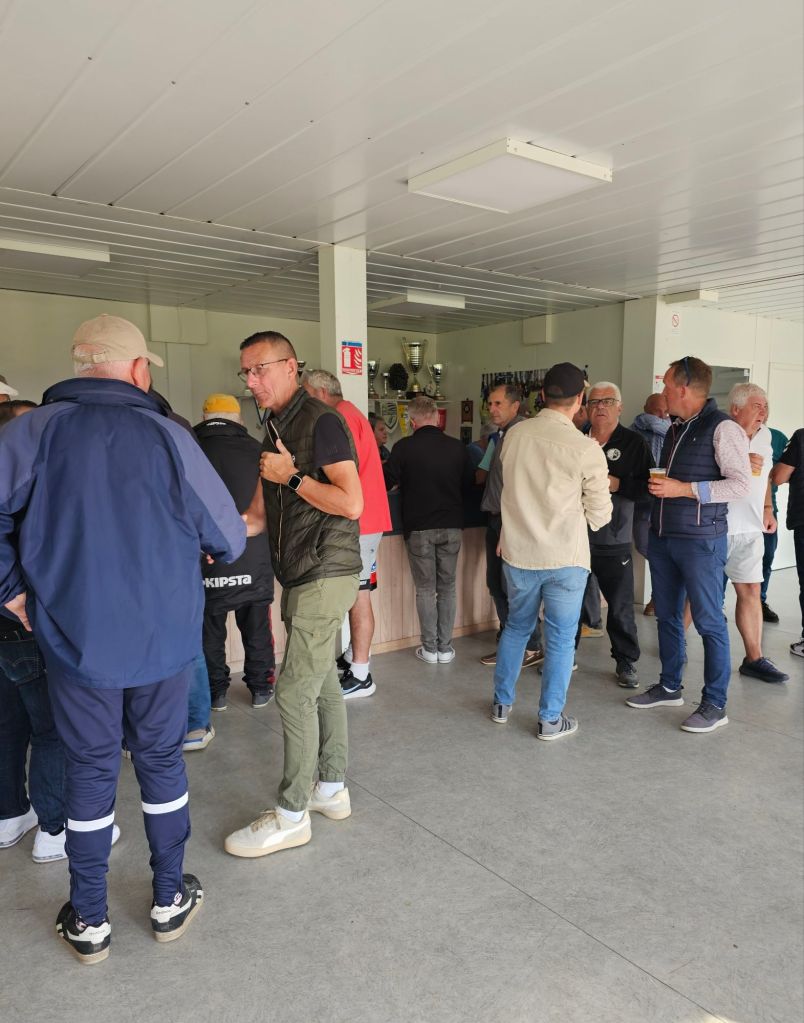
ASC St Anne d’Auray 1 Avenir Guiscriff 3

One of the best things about visiting France in September is being able to catch a game in the early rounds of the Coupe de France when the competition is still regionally based and there are ample opportunities to see village teams slug it out in quest of the sort of glory only village teams can enjoy.

Having arrived in Brittany just yesterday, after an overnight stop in Le Mans, I can’t be bothered to travel far from where my wife Paulene and I are staying in Carnac, added to which it’s a grey, miserable day and when if it’s not full-on raining there is a steady drizzle as if the Atlantic Ocean is stealthily relocating itself slightly inland.  After consulting the list of fixtures on the Ligue Bretagne de Foot website I have whittled the possibilities down to US Brec’h v Av.Campeneac-Augan or ASC Saint Anne d’Auray v Avenir Guiscriff.  Both are between twenty and twenty-five minutes away by planet saving Citroen e-C4 but St Anne-d’Auray ASC have a grass pitch as opposed to a plastic one, and taking a chance on the rain having not caused a postponement I decide that I would rather see people getting muddy than getting friction burns, and so I head for St Anne d’Auray.

St Anne-d’Auray is a curious place, a village with a population of less than 3,000 people but also the location of the third most visited pilgrimage site in France after Lourdes and Lisieux, as a result of which, and also because of which, it also has a huge basilica.  Wikipedia tells us that St Anne-d’Auray became a site of pilgrimage after a pious farmer in the early 17th century kept having persistent visions of St Anne, who somewhat weirdly told him to rebuild a chapel which had been demolished about 900 years previously. The farmer must have been a sort of renaissance era Nigel Farage figure as people were evidently keen to believe his unlikely tales, the chapel was built, and by the 1870’s had become the present basilica.

As a I drive into St Anne d’Auray along the D17, through the early afternoon gloom the tower of the basilica looms above the roof tops wreathed in low cloud.  A left turn takes me down the Rue de General de Gaulle and to the Stade Municipal where luck shines upon me and a car is leaving the otherwise full car park just as I arrive.  I park up and step out of my planet saving electric Citroen, and my nostrils are assaulted by the acrid smell of barbecue smoke.  I saunter through the gates to the Stade Municipal in my long navy-blue raincoat and join the throng of local inhabitants socialising, drinking and generally enjoying themselves in a sort of impromptu ‘fanzone’ where everybody seems to know everyone else.  Entry to the match is free of charge with the football club clearly being content with the income from beer, wine, coffee and food.

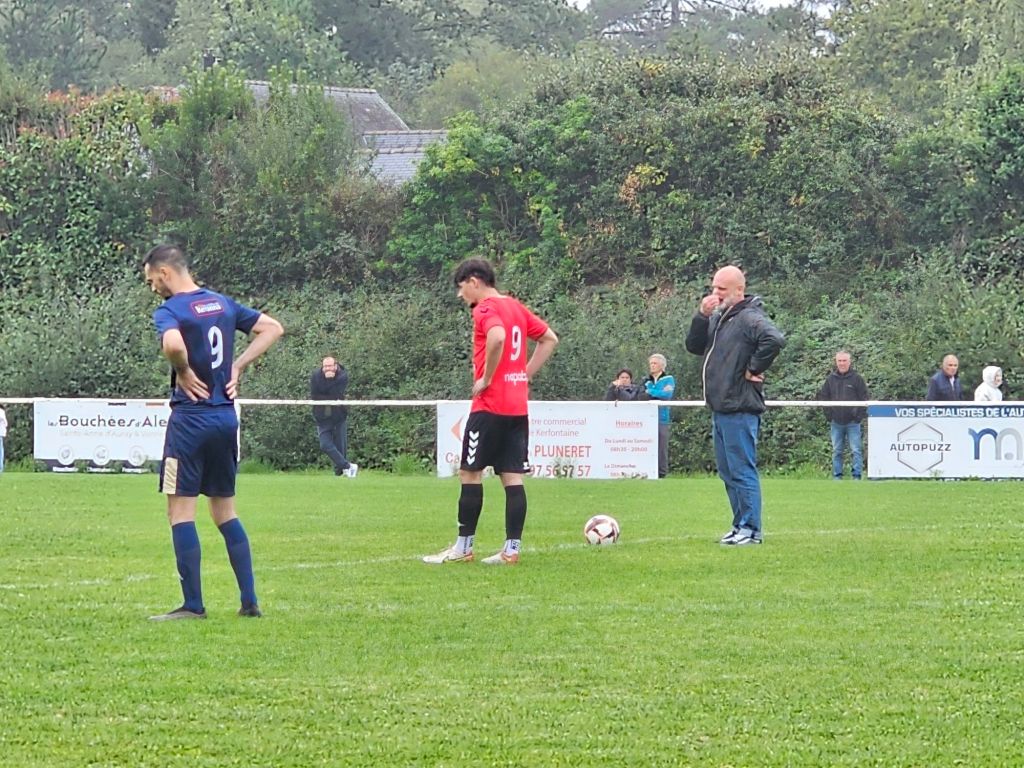
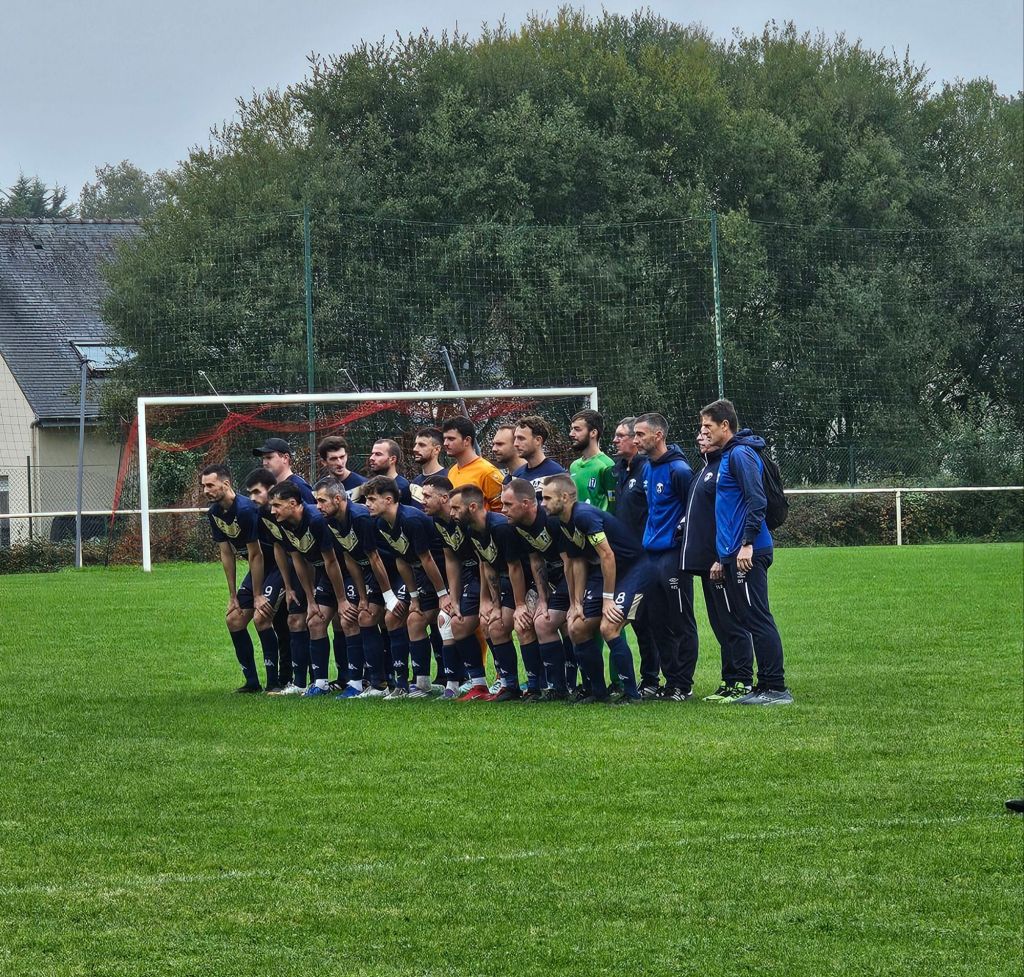
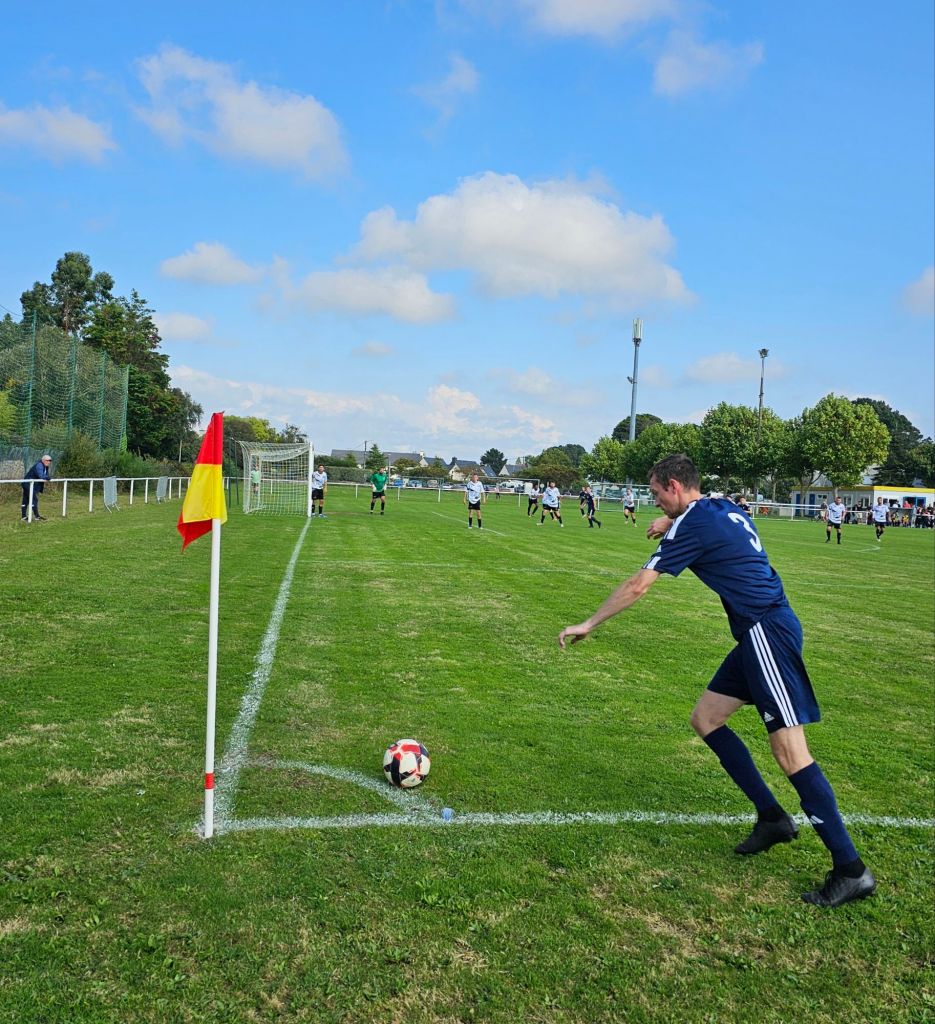
Kick-off is advertised as being at three o’clock but it’s nine minutes past by the time the two teams emerge from the dressing rooms and trudge their way to the pitch behind the referee and his assistants, the clumping of their metal boot studs on the tarmac sounding like a marching army and the basilica providing a suitably religious back drop for a Sunday afternoon.   The tarmac driveway passes through a gap in an impressive row of tall oak trees that line the east side of the stade, which has no stand, just a tarmac path all around and a metal rail surrounding the pitch.  After photos and the usual cursory handshakes, the teams line up and after an initial ‘ceremonial’ kick off by a bearded and balding man, it is visiting Guiscriff AV who get first go with the ball, sending it mostly in the rough direction of the nearby town of Auray, whilst the home team shoot towards the basilica.  St Anne d’Auray wear a kit of red shirts and black shorts whilst Guiscriff are adorned in all navy blue with gold or beige chevron on their chests.  

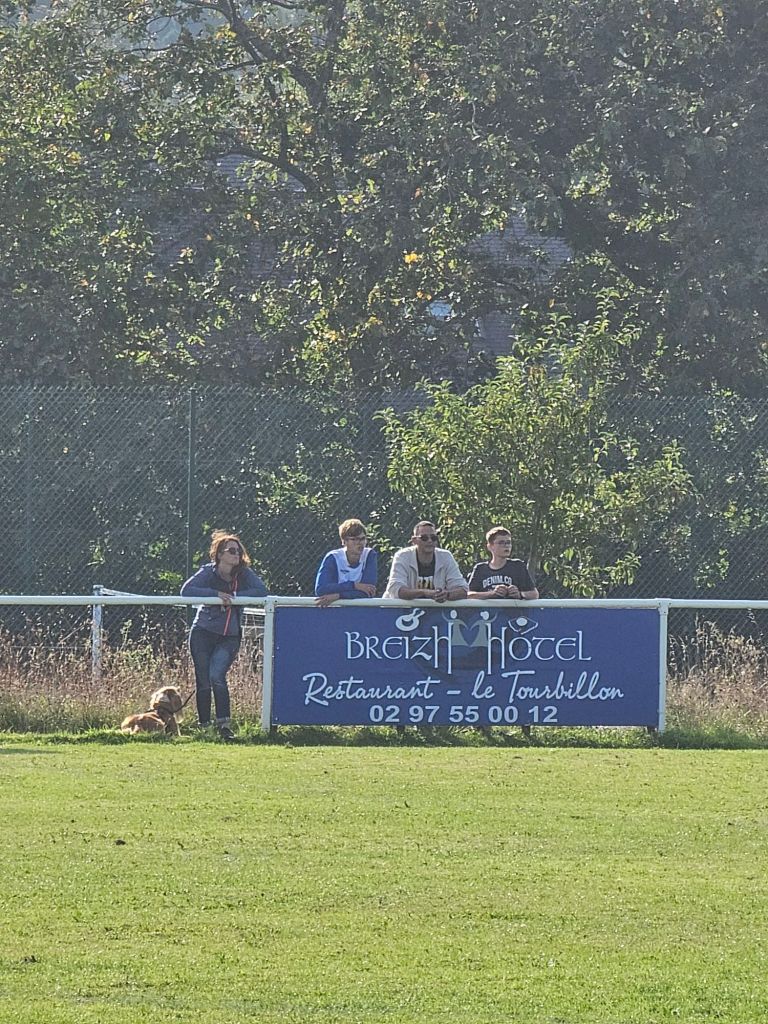
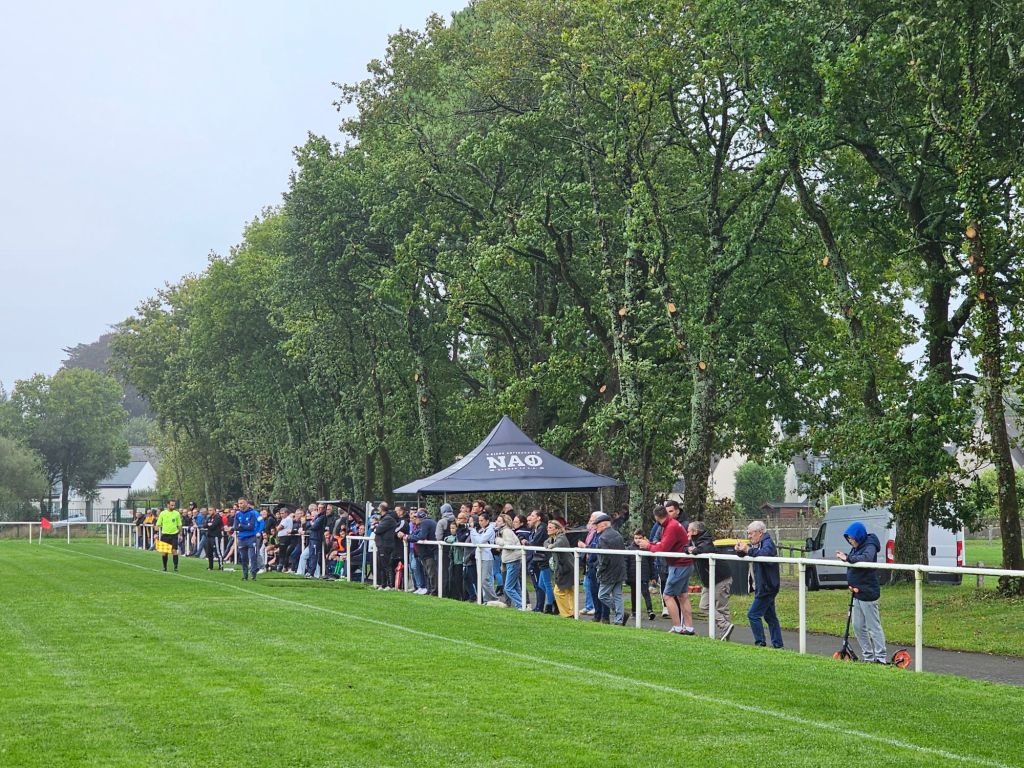
The crowd of at least two hundred is enthusiastic and congregates on each side of the pitch behind the well-maintained metal rail.  Guiscriff is a village 84 kilometres away to the northwest near Quimper, is about an hour and ten minutes’ drive away, and a good number of visiting supporters have travelled, including a man carrying a blue, cuddly, toy rabbit, which I assume is some sort of mascot, but he could just be a friend or comfort.  The stadium has no flood lights but although it’s a grey afternoon, it’s not so grey that these are going to be needed.

Just two minutes pass and a cute through ball down the left from the Guiscriff number nine sends their number eleven away into the penalty area where he comfortably slips the ball past the St Anne d’Auray goalkeeper to give the away team a very early lead. After the excitement of the start of the match and the teams marching to the pitch, the home supporters now appear as religious followers whose tenets of faith have suddenly all been disproved.  But whilst 84km apart geographically, the two sides are at the same level in the regional league, so all is by no means lost just yet, although when the bells of the basilica start to toll the sound is somewhat ominous.  The away supporters meanwhile are delirious and having visions of the fourth round.

Happily, the shock of going behind is soon processed mentally and the noisiest home supporters assembled opposite the team dugouts are quickly in good voice again with chants of “Aux Armes”.  An adversarial atmosphere is stoked as there are enough away supporters to render a few decent chants of “Allez les bleus” too.    On the pitch, the balding number five and number eight for St Anne d’Auray appear influential but Guiscriff are holding firm quite comfortably, with the home team’s forays forward mostly foundering on slippery grass, offsides and shoves and pushes that the referee (l’arbitre en Francais) Monsieur Romain Betrom spots but the home supporters don’t.

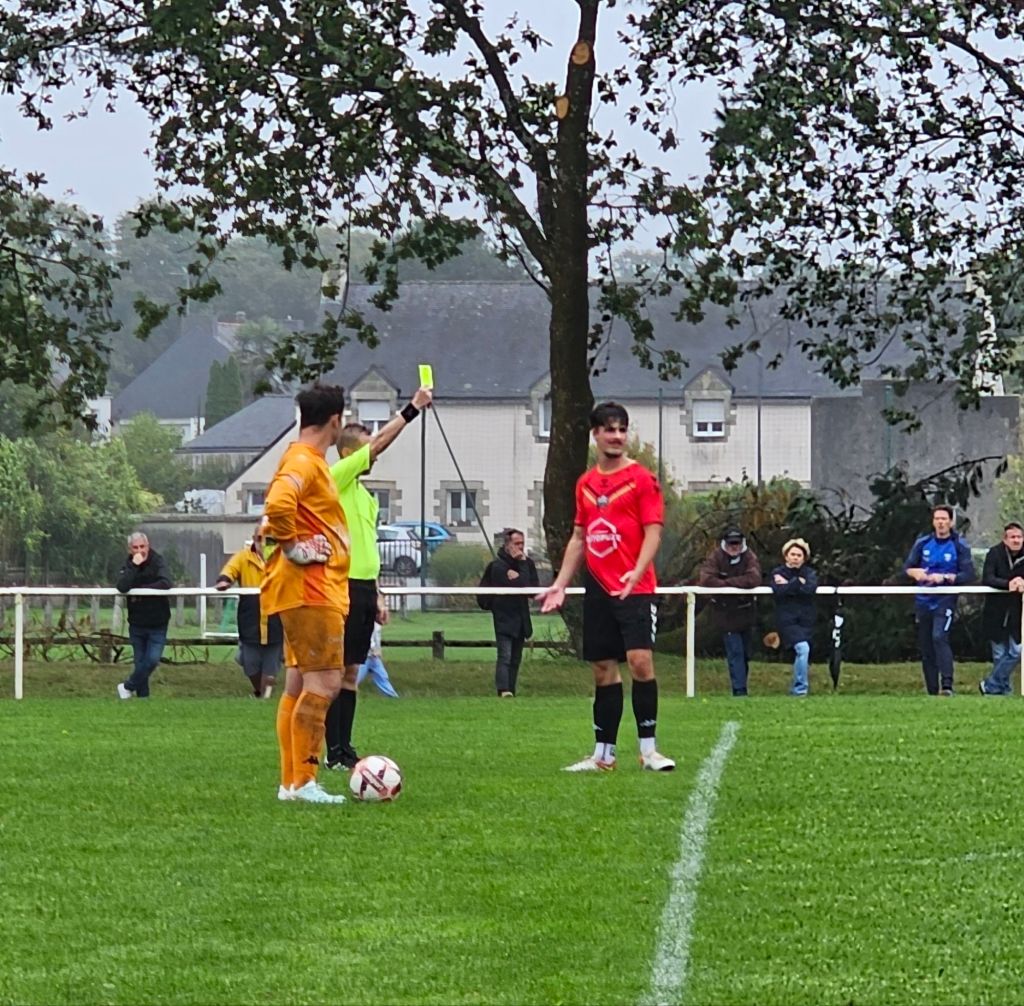
It’s now twenty-two minutes past three and it’s beginning to look like St Anne will struggle to reverse the early deficit but then almost miraculously there’s a careless trip and Monsieur Betrom is pointing to the penalty spot.  After a long lecture from Monsieur Betrom and eventually a yellow card (carton jaune) for Guiscriff’s number five, who I can only think postulated an alternative view of events a little too vigorously, the rangy number ten for St Anne d’Auray steps up to score, a good two minutes after the penalty kick had first been awarded.
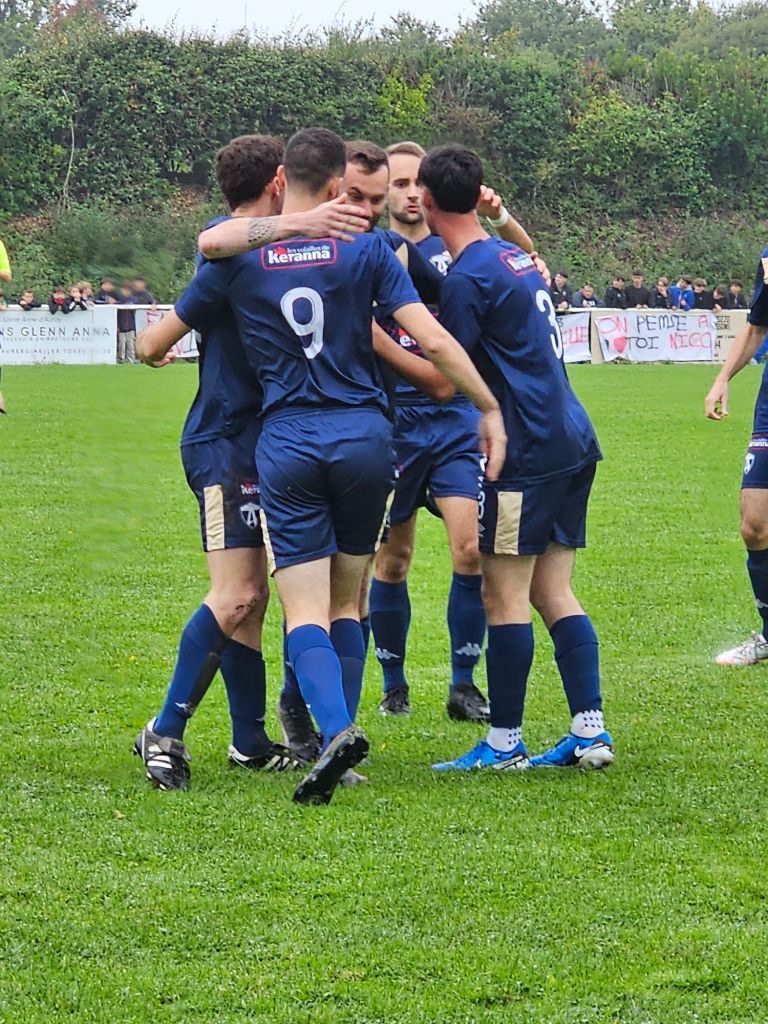
With the scores level the whole match begins to even out and Guiscriff no longer look the better team.  At twenty-five to four St Anne d’Auray win a free kick, which ends up in the back of the Guiscriff net courtesy of one of their own player’s boots, but Monsieur Betrom disallows the ‘goal’ for pushing, shoving, holding, blocking or a combination of the four.  There was certainly a lot going on in the penalty area with fouls likely being committed by both sides; Monsieur Betrom clearly took the view that if in doubt just pretend the whole incident never happened and leave the score as it is, and who can blame him?

I wander around the ground taking the game in from different angles and enjoying the grey afternoon scene against the backdrop of oak trees and the tower of the basilica beyond.  Briefly I stand close to the village ‘ultras’, who are mostly teenagers but are well equipped with banners, two empty oil drums for percussion and a loud hailer.  Not long after I settle against the rail just beyond the bulk of the more boisterous home support, Monsieur Betrom makes a decision that will probably define the match, as he shows his carton rouge (red card) to the St Anne d’Auray number eleven.  There is an inevitable delay as this is discussed but eventually number eleven makes his way towards the gap in the tall oak trees and back to the changing rooms.

 Inevitably Monsieur Betrom’s decision is not a wholly popular one and there is much braying amongst the home crowd.   I exchange raised eyebrows with a middle-aged man a metre or two away along the rail and then move next to him when he speaks to me.  Happily, the extent of his English and my French seem vaguely complimentary, and in a somewhat stilted way we are able to discuss the Coupe de France, the match and Monsieur Betrom, the man even does an impression of Donald Trump.  Half-time (mi-temps) arrives and is accompanied by a sudden increase in precipitation, so I turn up the collar on my coat.  The man, who I will later learn is called Frederique invites me to join him and his friend Patrick at the bar.  He jokingly suggests we can talk about Brexit, which I suspect he feels as disappointed about as I do.  At the bar, Patrick very kindly buys me a beer, and Frederique introduces me to several other people including the local mayor a small, kindly looking man with a big moustache, and another friend, Jean Baptiste.  

When the football resumes, I stand near the dugouts with Frederique and Patrick and try to avoid the rain, which is now coming straight at us, from getting into my beer.  The match continues in much the same vein as it did in the first half and Guiscriff seem incapable of making any advantage of their extra player.  The Guiscriff coach strides up and down the touchline seemingly talking to himself but possibly cursing his players.  When his goalkeeper concedes a free kick by picking up a back pass, he almost has a seizure.  Monsieur Betrom meanwhile, a thin, gaunt looking man much younger than his two assistants, one of whom has grey hair, spends much of his time brandishing his carton jaune. For every one of the many bookings he delivers he stands to attention, with his card holding arm at 45 degrees, a pose he holds for a full two or three seconds as if at some sort of Nuremburg rally for referees.

“Carton rouge!” shouts Frederique for as many fouls as he thinks he can, which amuses a short elderly couple stood next to me, and then “Allez l’arbitre!”.  The game proceeds through the continuing gloom although happily the rain stops falling.  Substitutions are made, but no resolution seems in sight until suddenly by way of another miracle there is an ill-judged, attempted tackle on the edge of the St Anne d’Auray penalty area, and for the second time this afternoon monsieur Betrom points to the penalty spot.  The penalty is scored and with less than ten minutes left to play Guiscriff are once again heading for round four.

No more than five minutes later, Guiscriff lead 3-1 after a sequence of a corner, a shot and a deflection concludes with ball nestling once more in the back of the St Anne d’Auray goal net.  It’s a disappointing end to the afternoon for St Anne d’Auray and matters get slightly worse when there is a contretemps between a local and a man in a Guiscriff sports coat.  Glaring looks are exchanged, beer is spilt and the game stops as the matter is discussed by the referee, one of his assistants and a man wearing an armband who I assume is the delegue principal, a sort of fourth official.  “Just football” says Frederique philosophically.

With the final whistle, the celebrations from the Guiscriff players and supporters are ecstatic, winning a Coupe de France tie means a lot.  With Frederique, Patrick and Jean-Baptiste I turn away and head for the gap between the tall oaks.  Frederique asks if I am coming back to the bar with them, but reluctantly I must turn down their invitation as my wife Paulene is waiting for me back in Carnac.

Despite the rain, the gloom and the disappointing result for the home team it’s been another wonderful afternoon in the Coupe de France, and my love for this competition and all things French has just received another layer of gloss, although I’ve not learned anything new except perhaps that St Anne was possibly not a football fan, but given that she was supposedly the Virgin Mary’s mum, I never thought she was.
FC Megalithes 2 Riantec OC 1

The small town of Carnac on the coast of Brittany is famed for its sprawling, ritual landscape of neolithic, megalithic alignments, menhirs and dolmens, but less so for its football clubs.  It is unlikely therefore that many people outside the local football fraternity of the Morbihan departement (County), noticed the merger in 2023 of two or maybe three local clubs to create what its name suggests is a giant ritualistic rock of a football club, FC Megalithes, which possibly prefers to kick-off games in the direction of the mid-winter sunrise.

The website for the French equivalent of the local County Football Association helpfully lists associated clubs and their fixtures and having arrived in Carnac the day before and settled in, my wife Paulene and I have dusted off our autumn almanac and are seeking entertainment on what is a sunny September Sunday afternoon.  The website tells us that FC Megalithes are at home to Riantec OC, playing their second league match of the season in the Ligue Bretagne de Football, District Morbihan, District 1 Poule B.  If Ligue 1, where the likes of Paris St Germain and Olympique Marseille hang out is level one of French football, we think this is about level ten of may be twelve or thirteen.  Riantec is a village a bit more than 30 kilometres away near the much larger town of Lorient, albeit this side of the estuary of the River Blavet; Wikipedia tells us that in 2017 Riantec had a population of about 5,600.

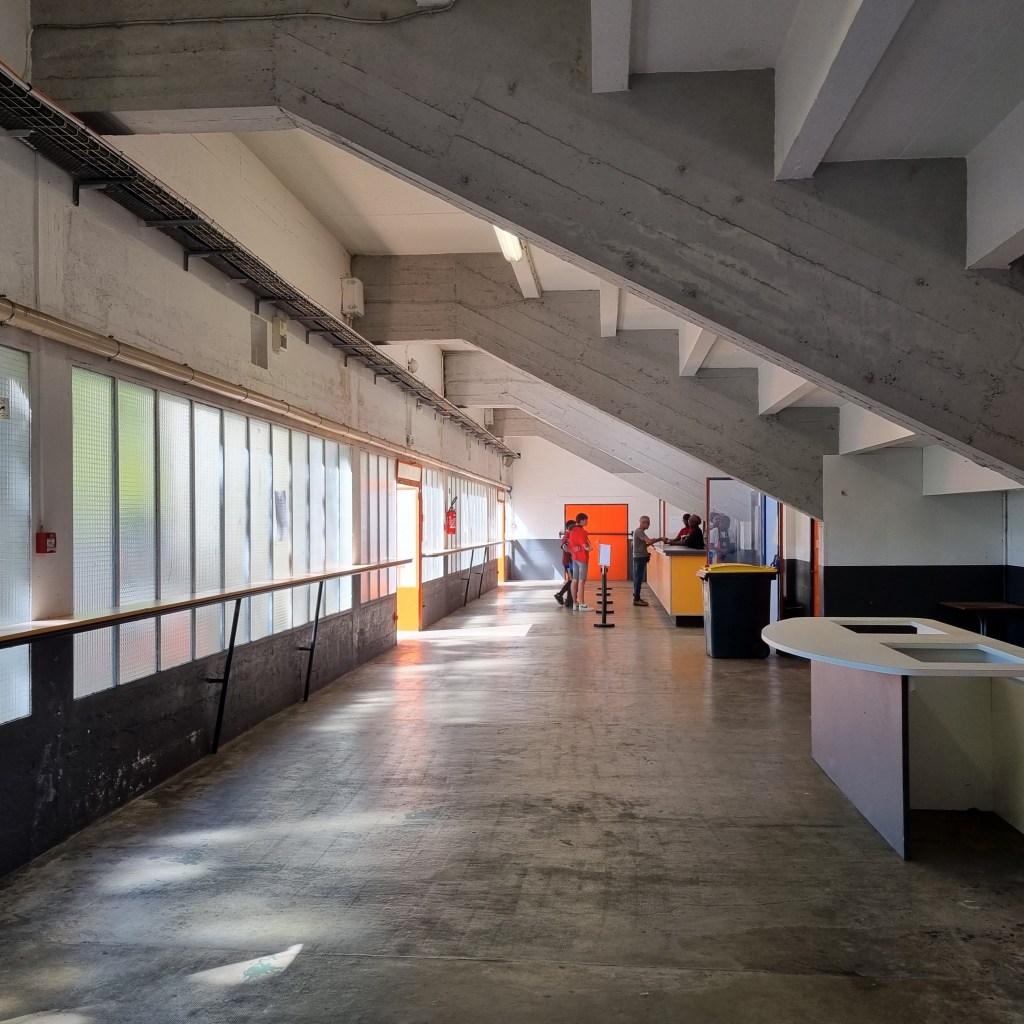
The football association website states that kick off is at 3.30 pm, and believing the match will be played at the main sports ground in Carnac, we set off at about ten to three from our ‘hut’ in a nearby camp site to make the 3.3 kilometre journey in our planet saving electric Citroen eC4.  As is often the case with local municipal sports grounds in France, there is plenty of free parking, but worryingly perhaps, as we roll up almost all of it is unoccupied,  and walking through the stone gateway of the Stade it is evident that there is no one else here except some youths playing an impromptu game of ‘three and in’ behind the albeit impressive, but lonely looking and very empty main stand.  The pitch is freshly marked out, but there aren’t even any goals up.  Clearly in the wrong place, we consult the interweb again and discover, courtesy of our very own administrative error, that we should be at Parc des Sports Kermouroux, about 7 kilometres away in St Philibert.

It is an easy trip across town to St Philibert, despite some 30 kilometre per hour maximum speed zones and a couple of red lights, and whilst we arrive after three-thirty we can see from the road outside that the players are only just lining up to shake hands and accept the applause of a crowd of what must be about a hundred people.  As we step through a side gate, we can even hear some Ultra-style chanting, although that seems to be from the players of the B team whose match had kicked off at one-thirty and has since ended.

The Parc des Sports Kermouroux has no stands or floodlights, just a neat white rail all around the pitch, a couple of dugouts and a clubhouse.  The site is surrounded by houses, but on the far side of the pitch is also a playground and what looks like judiciously mowed, planted wildlife area.  The majority of the crowd lean on the rail in front of the clubhouse, inside which a couple of middle-aged women are doing a good trade in beer.  Wine and coffee are also available. 

We miss the actual kick off, or coupe d’envoi as the French call it, as we find a decent spot against the rail, but we are paying attention when at eighteen minutes to four the Megalithes’ number nine bustles his way through the Riantec defence, checks and turns a couple of times and then boots the ball beyond the Riantec goalkeeper and into the goal.   Two minutes later he repeats the dose, running beyond the back four and a sluggish linesman to score from about six yards out.    The linesman doesn’t really seem to have grasped what his role is yet, but to be fair to him it does look like he didn’t expect to be linesman when he turned up, as he is wearing a day-glo yellow tabard rather than the standard officials’ uniform that the referee and the other linesman are wearing. As for the teams and their apparel, Megalithes are smart all in navy blue with white trim, whilst Riantec are less so in a messy looking combination of baggy white shirts and with streaks on,  and black shorts.

After two goals in the first five minutes, the arrival of the first corner of the match at seven minutes to four leaves everyone somewhat non-plussed.  This is even more the case when a minute later a punt forward for Riantec is met with another hopeful punt-cum-shot from their number ten and the ball sails into the top corner of the Megalithes’ net to make the score 2-1, against the run of play.  Although the goal adds to the excitement and sense of jeopardy, which I believe is what football matches are all about, I can’t help but feel a bit disappointed because Megalithes are by far the better team.

Megalithes continue to dominate the match and pass the ball well but seem unwilling to score again, although their number nine keeps threatening to nip behind the Riantec defence just as he did twice before, but he never quite manages to get his shot into the net.  Without more goals to concentrate players’ minds on keeping up to date with the score, a combination of fouls and outlandish acting creeps into the game, with more than one player letting out blood curdling screams as he collapses to the ground as if the subject of some sort of unexpected, attempted human sacrifice.

The gnarled looking, but neatly coiffured, grey-haired referee is totally in control of the shenanigans, looking down deeply unimpressed at the writhing players, whilst politely but firmly dealing with the perpetrators of genuine fouls. “S’il-vous plait Monsieur” he says politely but wearily as he beckons over the perpetrator of a foul to instruct him as to his future conduct.  In the first instance Rianec’s number eight is merely spoken to, but then Carnac’s number ten, a lithe youth with curly hair a la Adrien Rabiot, is booked after being summoned with the ominous words “Numero dix, s’il vous plait”

Half-time comes as a relief after the frustration of FC Megalithes not scoring the goals they deserve and all that falling about and screaming.  I head for the club house as the players make for the dressing rooms and am quickly acquiring two cups of coffee (one euro each), which are served from a filter coffee machine; none of your instant muck here. Paulene and I find a better position by the rail as almost everyone else heads indoors for more beer, and we nick their ‘spots’.

It is nineteen minutes to four when play resumes and within moments Megalithes number nine is centring a low cross, which number three easily and mournfully taps wide of the goal having arrived in position perfectly on time and completely unseen by the opposition.  The second half is twelve minutes old when Megalithes’ number nine elicits a fine save from the Riantec ‘keeper at the expense of a corner and then the scenario repeats itself.  Megalithes continue to dominate the second half as they had the first and the mystery of how they fail to score more goals continues every bit as mysteriously as the question of why the neolithic locals erected all these megaliths in the first place.

It is a quarter past five when Riantec win a corner and I can’t help thinking to myself that this is the first corner the away team has won, and it has taken them almost an hour and a quarter to do so.  Normal service is resumed however just two minutes later as Megalithes’ number twelve beats the offside ‘trap’, takes the ball around the Riantec goalkeeper and then places it precisely into the side netting of the goal.  A minute later Megalithes number two, a beautifully skilful player, repeats the process, taking the ball around the goalkeeper, but doing so without the necessary speed to get the ball into the goal before two defenders get back and combine to clear the goal bound ball.

Finally, and fittingly, in the final minute of the game, Megalithes place the ball in the Riantec goal to make the score justifiably, although sadly only temporarily 3-1, as almost inevitably the linesman raises his flag to declare it hors-jeu, offside, which it rather blatantly was.
The final whistle brings relief to both teams as the home side finally confirm their narrow win, and the away team gain respite from the footballing lesson they have been given.  The sun has now begun to sink low in the sky and a cool breeze has spoiled what was an almost balmy autumn afternoon for a while.  Pleasingly, the better team has won and whilst not winning by as many goals as they should have, a decent hour and a half’s entertainment has been provided by everyone involved. There is a palpable warmth and feeling of community amongst the crowd and as ever as we leave the ground and head happily  for our Citroen to make the short drive back to Carnac, our experience of French amateur football has been a pleasant and uplifting one.  Vive le Foot!

Stade Malherbe Caen 1 AC Ajaccio 0

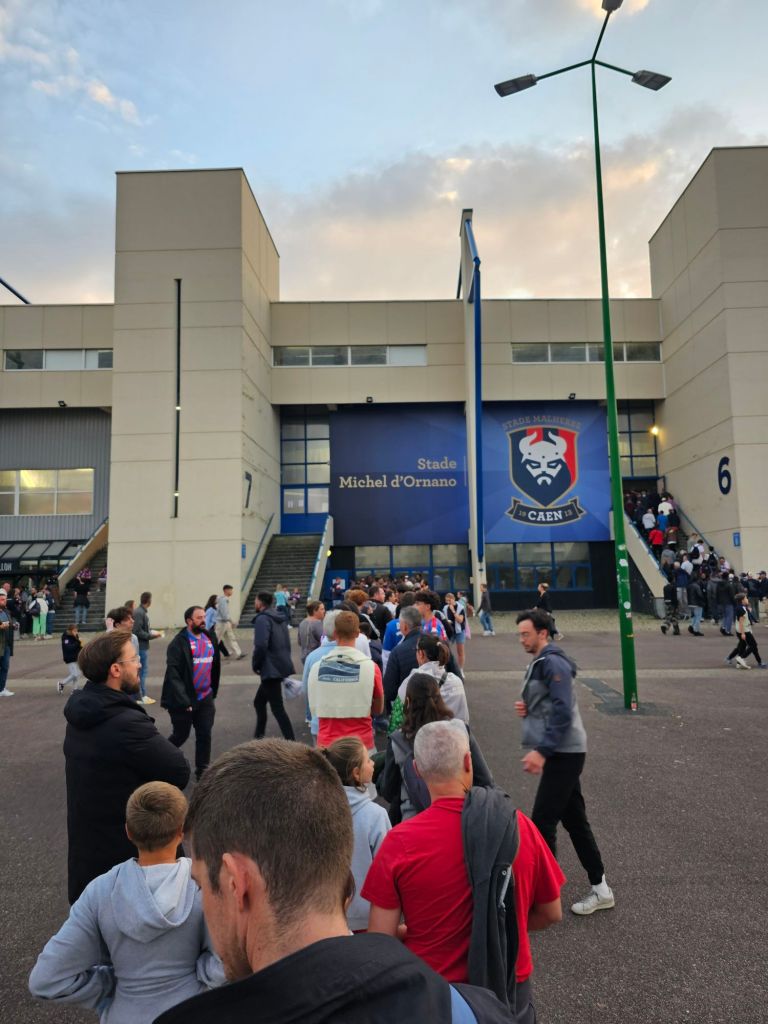
When travelling, in no real hurry, the 670 kilometres from Calais to Carnac in Brittany, the fine city of Caen is the perfect place to break the journey in two, particularly if SM Caen are playing at home.  So it is that I find myself with my wife Paulene on a Friday evening stood at the Bellivet bus stop in the centre of Caen, waiting for the free shuttle bus (navette) out to the Stade Michel d’Ornano in the suburbs of the city.  The bus is due at seven o’clock, but it’s barely six forty-five yet; we weren’t sure how long it would take to walk from our hotel on the Quai de Plaisance, not long it turns out.

We stand on the pavement outside the bus shelter, which is well populated with people who don’t look like they’re going to a football match, but then, the stop is served by several other bus routes. A man in his early thirties turns to us and asks if this is the stop for the navette (I think he must have deduced from the Ipswich Town badge on my T-shirt that we are football fans).  We tell him that’s what it says on the football club website, and we believe it.   The man is from Caen but has never used the navette before; he is going to the match with a friend who is also Caennais, but has lived in Paris and has never even been to any game before; they are taking the bus so they can have a drink before and after the game., which seems to be the main point of the exercise. The man who has lived in Paris reveals that when he was a teenager, he stayed in Ipswich on a student exchange scheme; they were good times he says, even though he never made it to Portman Road.

Time passes.  Seven o’clock passes. Several buses stop, passengers alight and others get on.  A ramp slides out from under one bus and a woman in a powered wheelchair backs along it onto the pavement.  “Oi Ipswich, my friend here is a Norwich fan” says a rich Welsh voice. “No I’m not, I’m from Cardiff” says the tall grey-haired man standing next to me.  “Have you got your match tickets?” asks the first Welshman.  “Yes” I tell him “But I don’t reckon you’ll need them for the bus, the driver isn’t going to want to check everyone has got one.”  The first Welshman asks if we had been to the ground earlier to buy them, but we tell him we bought them on-line.  “See, I told you we could have got them on-line” says Welshman number two to Welshman number one. “Well, I looked” says Welshman number one, “But it was all in French.”

We talk some more and tell the Welshmen how we were in Cardiff last year to see Haverfordwest (Hwlfordd in Welsh) play their two European Conference League qualifiers. They ask why, and I tell them I was born in Haverfordwest. “You’re Welsh then” they say.  Welshman number two then tells us he’s obsessed with going to new football grounds and after asking us to guess how many he’s been to, he reveals that he’s visited over seven-hundred.   It’s about a quarter past seven now, and an articulated single-deck bus hoves into view bearing the destination “Allez le SM Caen”, At last, it’s the navette, and about forty of us pile on before the bus lurches and twists off up the street, past William the Conqueror’s castle and on past the eleventh century l’Abbeye aux hommes, the Hotel de ville, and the palais de justice all of which miraculously survived allied bombing in World War Two.  On the bus ploughs, on a stop start journey past the more recently built palais des sports, and through the heavy traffic heading for the Caen international fair (Foire International de Caen), which begins tonight.

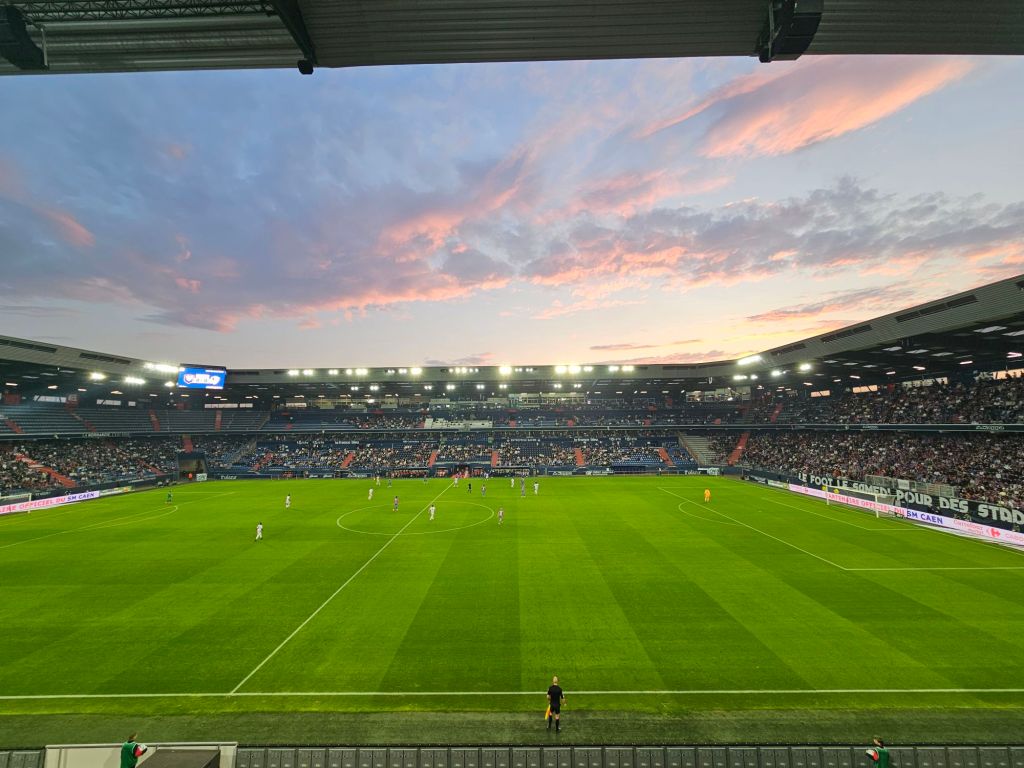
It’s gone twenty to eight by the time the bus disgorges its load at the oddly named  ‘Silicon Valley’ bus stop, directly opposite the Stade d’Onano, and Paulene and I head for the club shop to add to the pointless collections of cuddly club mascots, fridge magnets and T-shirts that clutter up our home back in blighty, although I do wear the T-shirts.   After then joining a queue for Gate 7, six flights of stairs take us to the top of the Tribune Caen from where we have to descend the steep gangway to our seats (24 euros each) in the front row of the top tier of the stand.  Within moments of our sitting down the game begins, tonight’s visiting team AC Ajaccio from Corsica getting first go with the ball, which they succeed in keeping to themselves for much of the first minute of the game. Ajaccio are wearing red and white striped shirts with white shorts, reminiscent of Stoke City and Signal toothpaste.  Caen meanwhile are kitted out in blue shorts and blue and red striped shirts, but the stripes are wavy, reminding me of the sleeve of the Cosmic Roughriders LP ‘Enjoy the Melodic Sunshine’.  Caen are kicking from right to left, back towards the city centre, whilst Ajaccio are aiming more in the direction of the Bayeux tapestry.

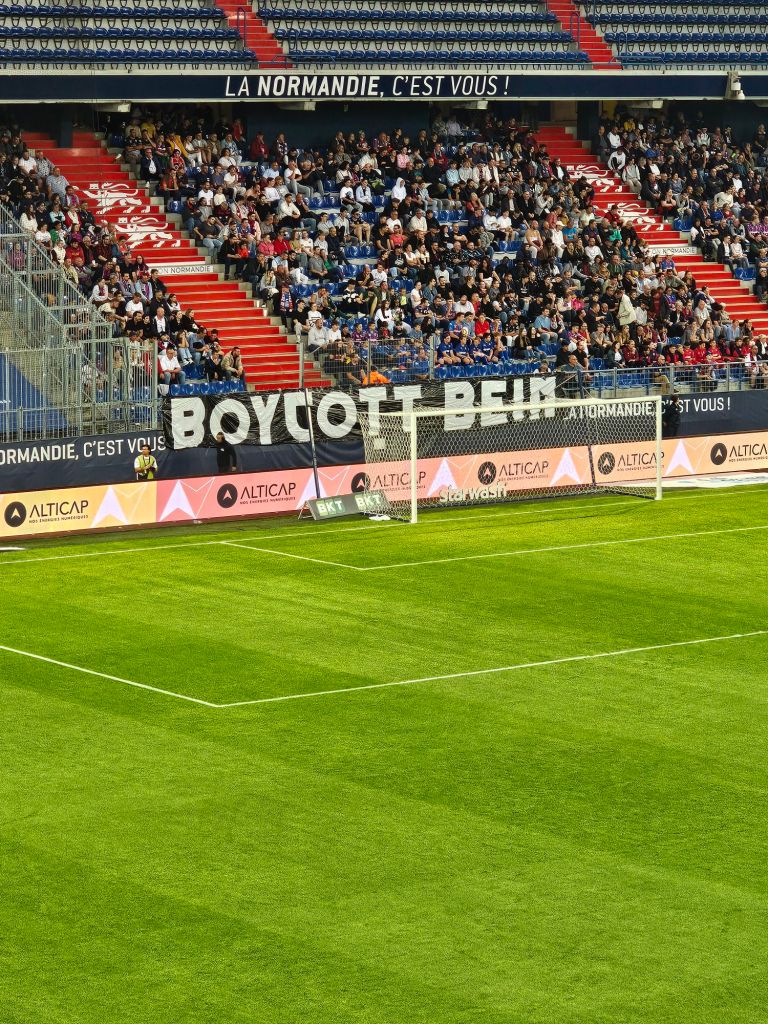
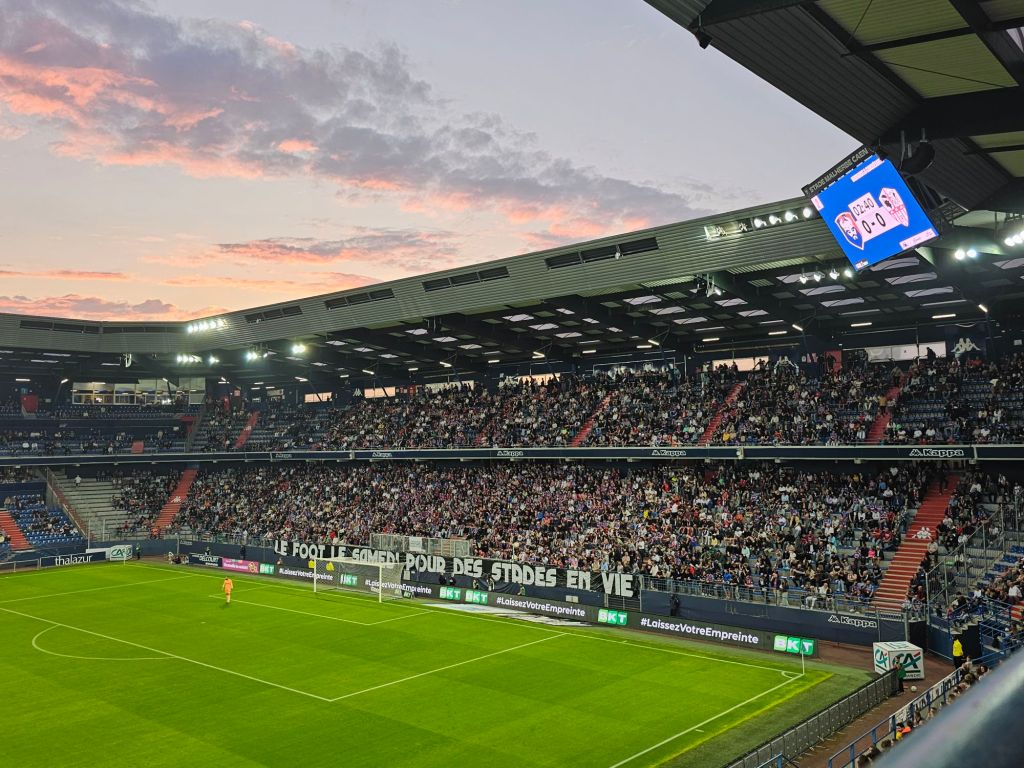
Unexpectedly, the ground seems very quiet as the game begins, possibly because in four matches in Ligue 2 so far this season, Caen have not won, only succeeding in losing three times.  Whenever a Caen player crosses into the opposition half however, I think I can hear a muffled murmurs of “Allez, allez, allez” all around me, and when Caen win an early corner rhythmic clapping breaks out.  With not much happening I take the opportunity to visit the buvette back at the top of the stand where I buy a bottle of water (2 euros) and a merguez sandwich (6 euros).  I return to my seat in time to witness a twelfth minute shot from a Caen player strike the Ajaccio cross bar. Before three minutes later a blizzard of paper planes rain down on to the pitch from behind the Ajaccio goal, possibly as part of the ongoing protest against Ligue 2 matches being moved to Friday nights this season at the behest of Bein Sports tv.  Banners behind the goals read “Le foot le Samedi pour des stades en vie” (Football on Saturdays for lively stadiums) and “Boycott Bein”.

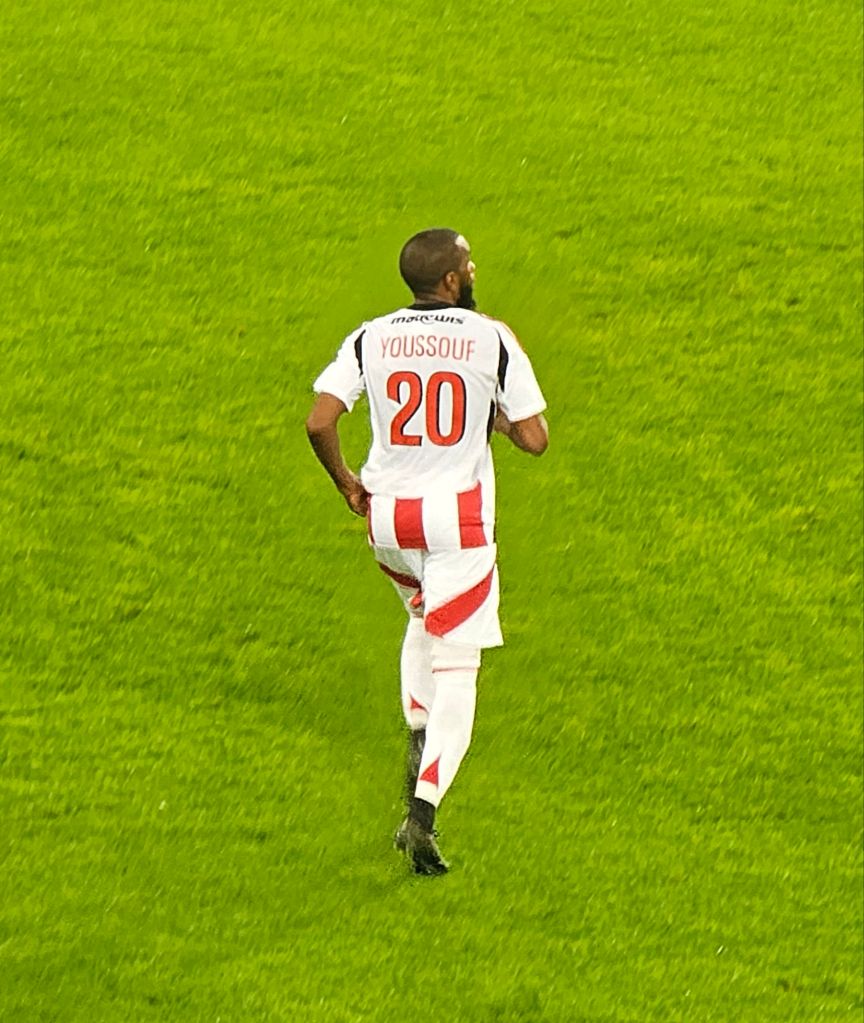
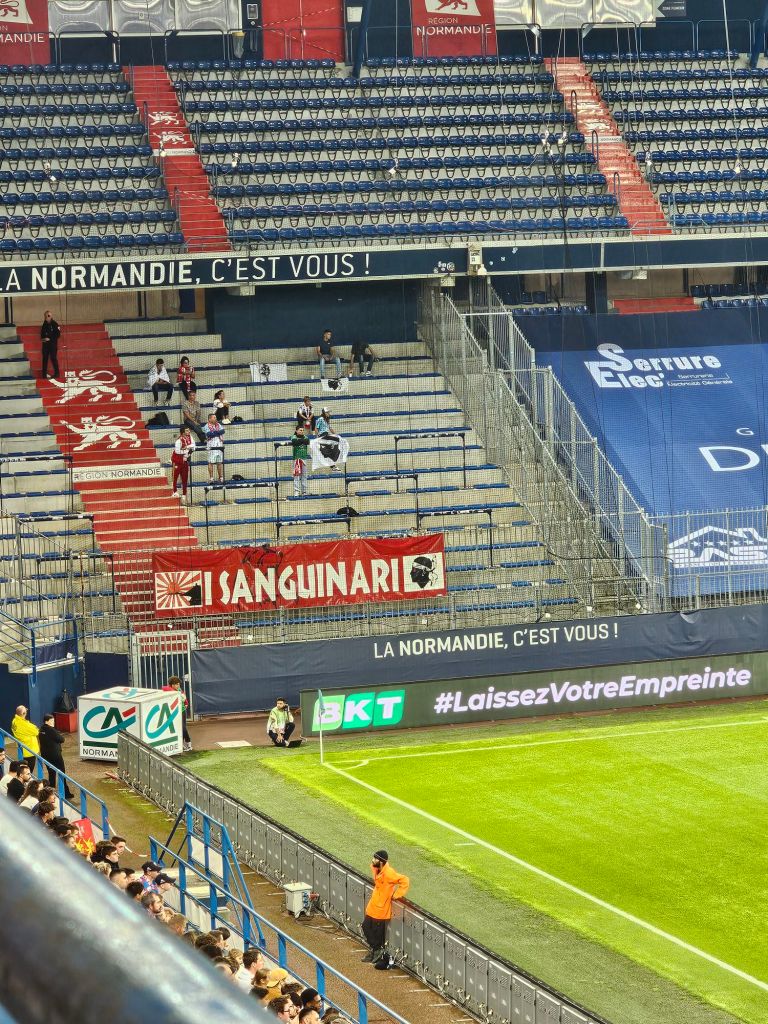
To our left, I count thirteen Ajaccio supporters in their enclosure behind the goal and I think of the Last Supper, before noticing that the Ajaccio number twenty Mohamed Youssef is so short that his socks meet his shorts, creating the effect that he is wearing puttees.  The first half is half over as Caen build a move down the left before wasting all the effort with a shot over the crossbar.  Nine minutes later Caen’s number seven flicks the ball up inside the penalty area before crashing a spectacular volley directly at the Ajaccio goalkeeper, who is in two shades of green.

The game is one-sided with Caen monopolising possession and attempts on goal until six minutes before half-time when Ajaccio have their first shot at goal, a curling effort from number 99, which nevertheless curls straight into the arms of the Caen goalkeeper who admittedly is not easy to miss because he is all in orange.  The first booking of the game follows soon afterwards when Ajaccio’s number thirty-one chooses to tug at the Caen number nineteen’s shoulder rather than attempt to tackle him in the conventional manner.  Two minutes of added on time are added on, to little effect, and at half-time the score remains blank. In a sense therefore, Ajaccio are winning.

Paulene and I move seat during the break because I have been having to duck my head whenever the ball has been in the Caen half due to a large, blue, metal safety rail at the foot of the steps, which extends in front of my seat.  The half-time break passes with people trying to kick a ball into a box for money, and two teams of children in red and blue kit taking a shoot-out competition. The red children all seem about twice the size of the blues and predictably they win, although the only girl in the competition is a blue and she scores her goal.

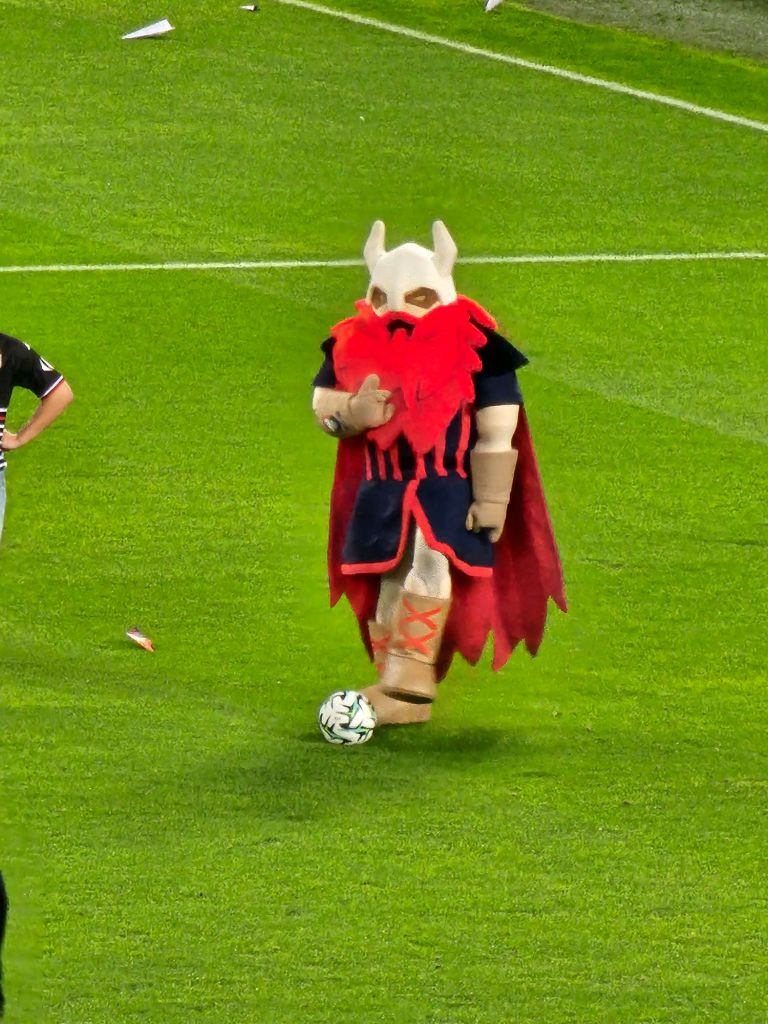
Now, with a clear view of the whole pitch we see the game re-start at nine o’clock and suddenly the stadium is full of enthusiasm and chanting. For no apparent reason the home supporters are singing “Allez, Allez, Allez” to Verdi’s Triumphal March from his opera Aida.  The effect is almost instantaneous as a ball into the box results in claims for a penalty, albeit somewhat specious ones. But a corner satisfies the more realistic supporters, which leads to a shot and another corner and more urging chants of “Allez, Allez, Allez” as the Caen fans loudly live up to what one would expect of their mascot, Vik the Viking.

Only five minutes of the half have gone and now number seventeen Kyheremeh is shooting straight at the Ajaccio goalkeeper before number nineteen heads over the cross bar from a corner.  Sadly however, the score remains blank and for a while the game descends into a Keystone Cops style knockabout with players falling over and colliding with abandon.  Paulene and I begin to notice the advertisements around the ground for the likes of Entreprise Bacon, Calvados the departement or County, as opposed to Calvados the apple brandy, and the interestingly named Twisto, the local transport company who brought us here this evening in one of their articulated buses.  Off to our left, I can only count eleven Ajaccio fans now and wonder if two have had to leave early to catch a ferry, or whether they just gave up hope.

Only twenty-five minutes remain as Caen’s Kyeremeh is through on goal, but he chooses to run wide and cross low to the near post where the ball is saved at the expense of a corner.  “Allez, Allez, Allez” sing the home fans again, but this time to the tune of the Beatles’ Yellow Submarine, not Verdi.  Thirteen minutes remains and Caen’s number four has come on as a substitute only to quickly get booked as he struggles to influence the game.   Three minutes later however, comes the decisive moment. Caen’s number ten, Bilal Brahimi, who has been neat but nothing more for most of the game, suddenly has space outside the Ajaccio penalty area from where he unexpectedly launches a shot into the top right-hand corner of the Corsican goal; Caen lead one-nil.  “Bilal, Bilal” chant the Caen fans as his picture appears on the scoreboard and the stadium announcer tells us who scored.

Ajaccio have made little effort to score themselves and now they might have left it too late.  Ajaccio substitute number twenty-one Ivane Chegra is brought on to add flair by the look of his Marc Bolan style coiffure, and number twenty-two Moussa Soumano succeeds only in getting booked as the match rolls on into five minutes of added on time.  The added-on time is of no consequence however, and with the final whistle the relief for Caen’s supporters having won their first match of the season is plain to see.

With a bus to catch we don’t linger to join the ensuing love-in, and that bus is almost full and ready to leave as we board it.  Down the streets beyond stadium vivid, sudden flashes of light appear and soon there are spots of rain on the windows of the bus as it weaves its way through the post-match traffic.  By the time we reach the city centre a heavy downpour is drumming against the roof of the bus and the streets are awash.  With the bus windows steamed up and streaked with rain I have to ask a fellow passenger to tell me when we’re back at Bellivet bus stop.  It’s a dramatic end to the evening and an uncomfortably wet walk back to the hotel, but I don’t think we’ll forget our night in Caen.

FC Lorient 3 FC Nantes 2

To Ipswich Town supporters like me, FC Lorient is known as the club from which the Town bought Ulrich Le Pen, a slight winger who was injured just minutes after coming on in a match against Bolton Wanderers and only ever featured in one other first team game, an FA Cup tie which I can’t remember. To the wider world Lorient is France’s second largest fishing port and home of a French submarine dockyard which grew out of the massive reinforced concrete U-Boat docks built by the Nazis during World War Two.  Sadly for Lorient, the town was mostly flattened by allied bombs as the Nazis were pushed out of France in 1944 and whilst the re-built town is well laid out with buildings in a quiet, modernist style, it doesn’t have the architectural verve of Le Havre or Amiens, or even, come to that of Plymouth and Bristol.

Today however FC Lorient host their Breton neighbours from 170 kilometres away (1hour and 51 minutes up the E60 according to Google maps) FC Nantes, but my wife Paulene and I have travelled a mere 40 kilometres from the campsite where we are staying in Carnac.  Car parking in Lorient on a Sunday is a curious affair as most of the town centre car parks are closed as is much of the town centre itself, including the tourist information office. There is plenty of street parking however with the usual restrictions being suspended. The Stade du Moustoir, home of FC Lorient is in an eminently sensible town centre location much like Ipswich’s Portman Road, and it is somewhat remarkably within 50 metres of the Hotel de Ville (town hall) and just a short walk from the main shopping streets, railway and bus stations.  The purpose in closing the car parks would seem to be to make people travel responsibly by bus, train, bike or on foot, although some parking can be pre-booked by those signing up to a car sharing scheme.

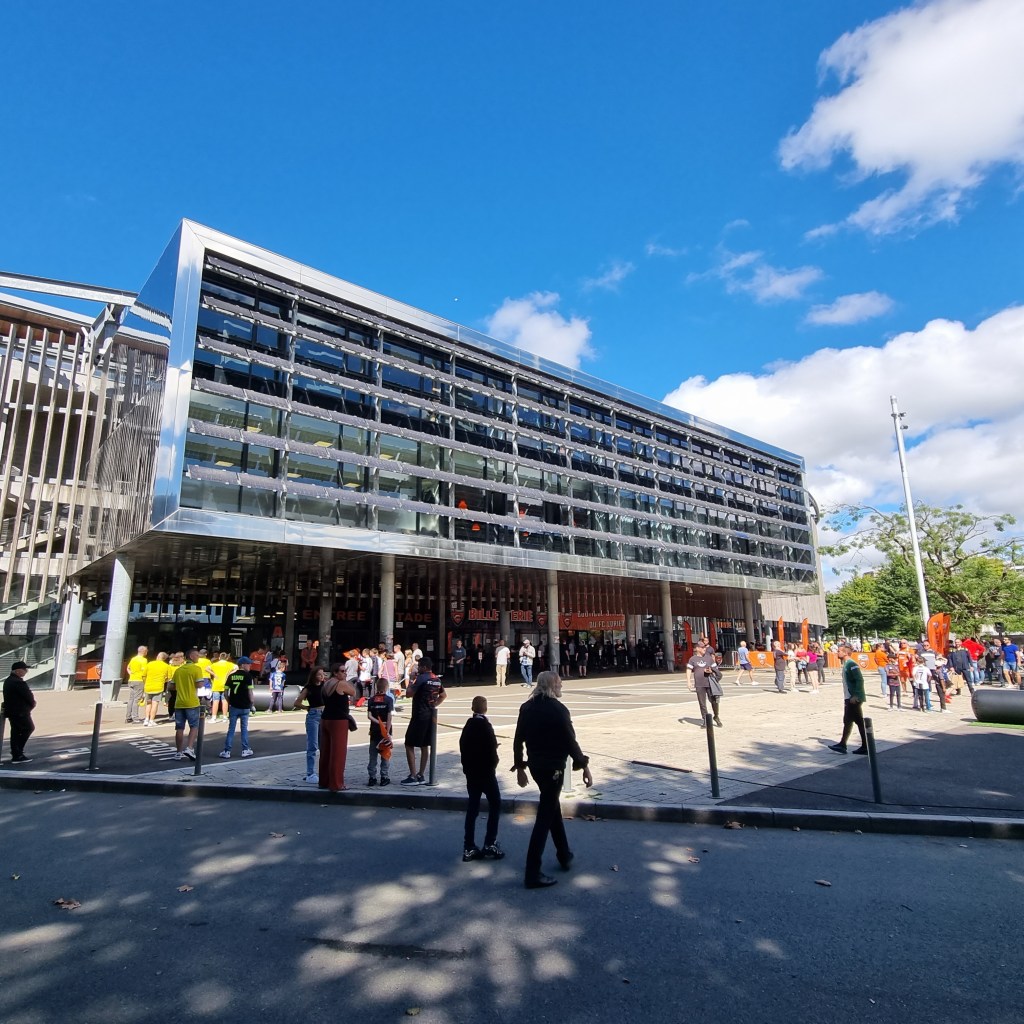
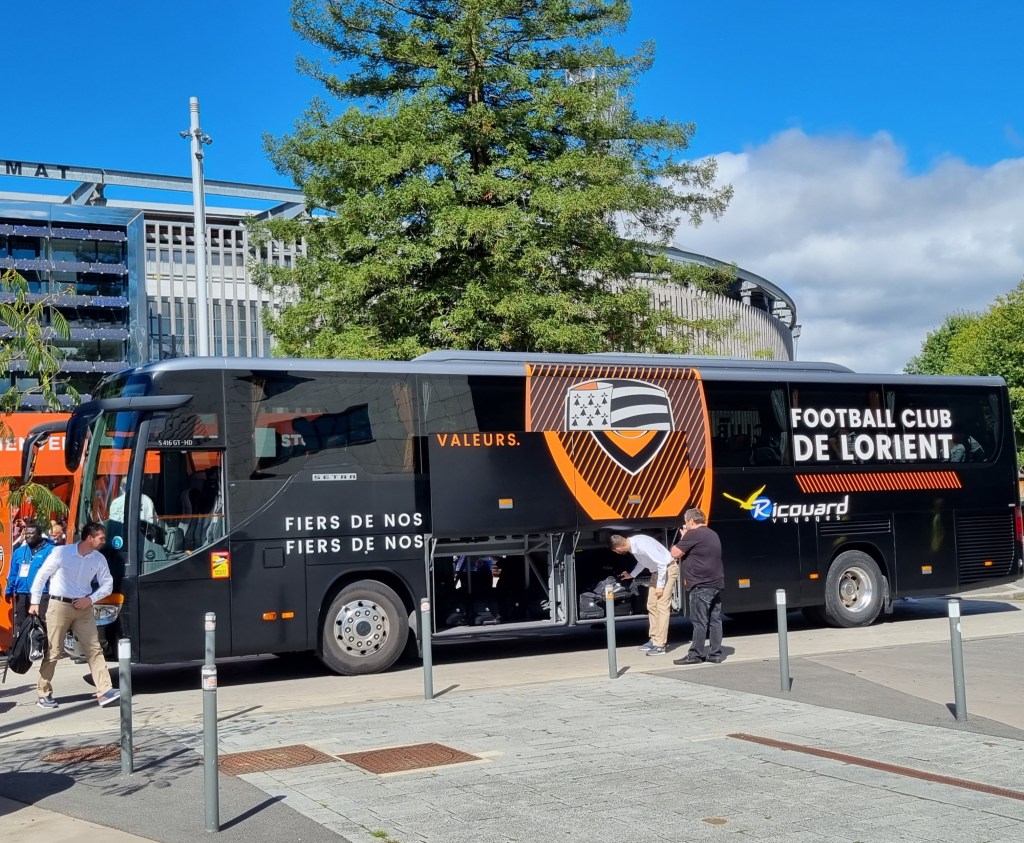
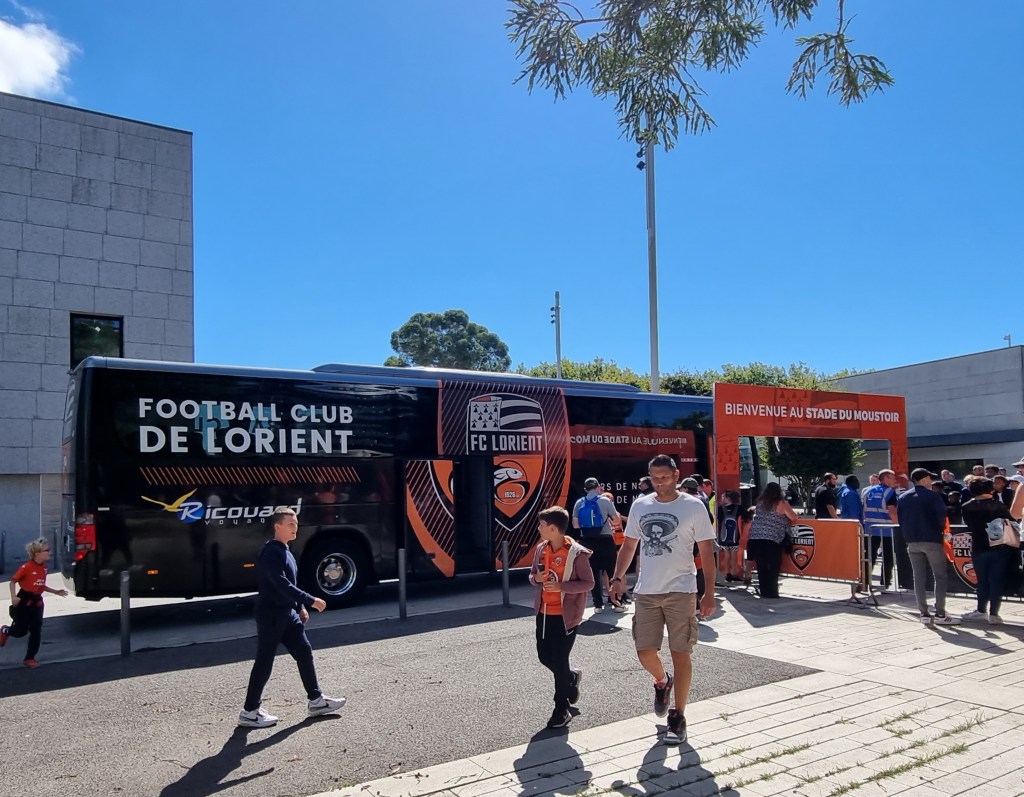
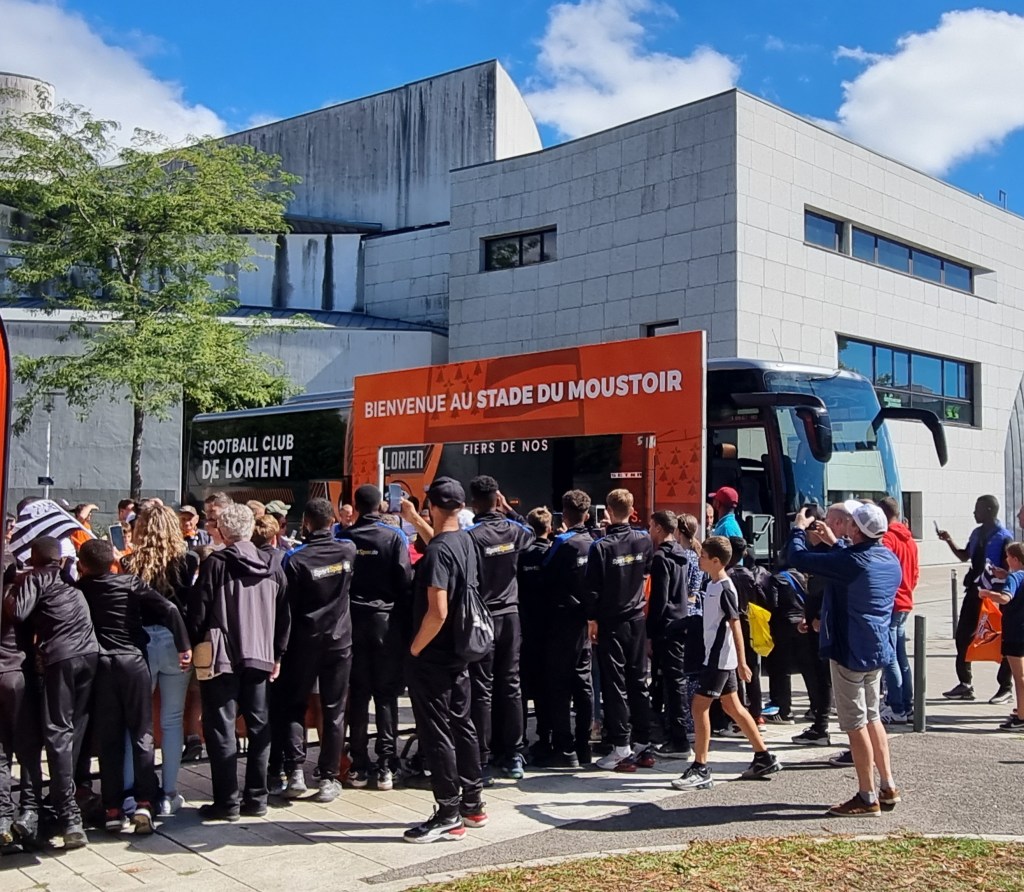
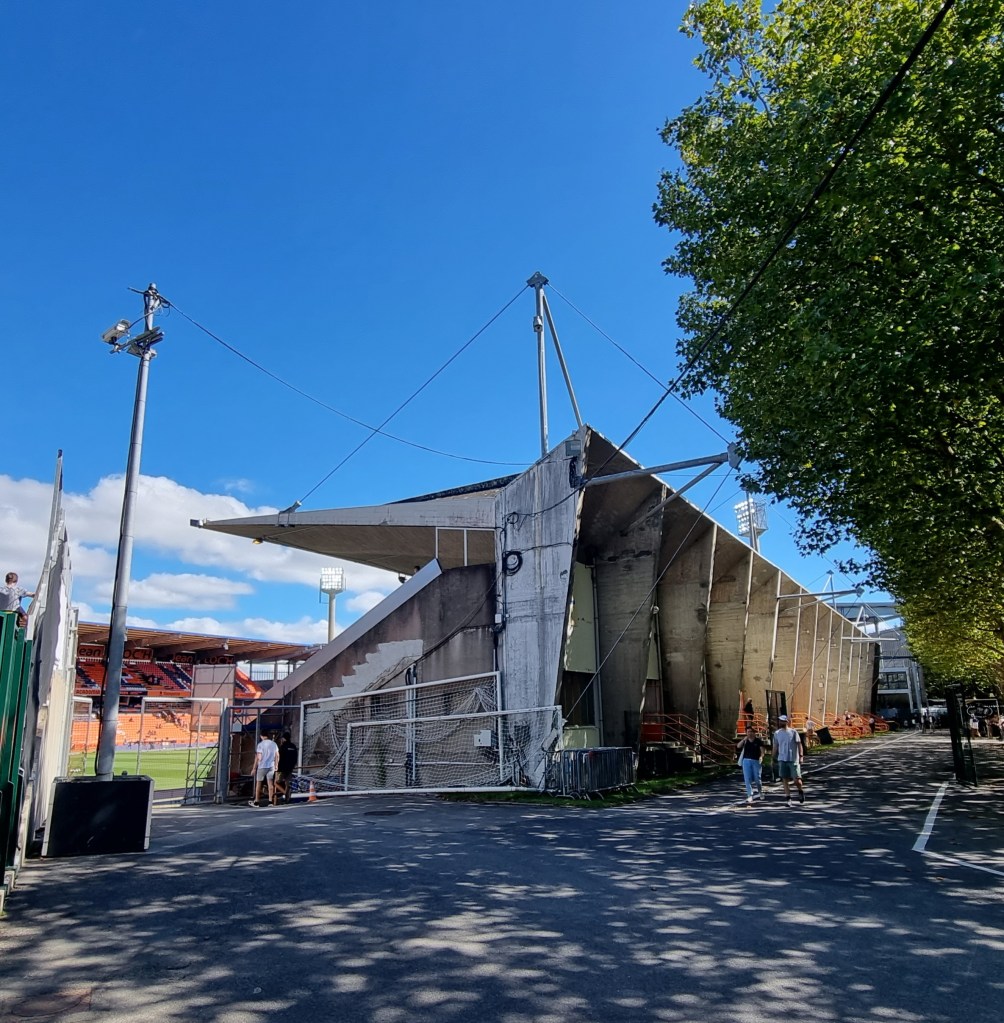
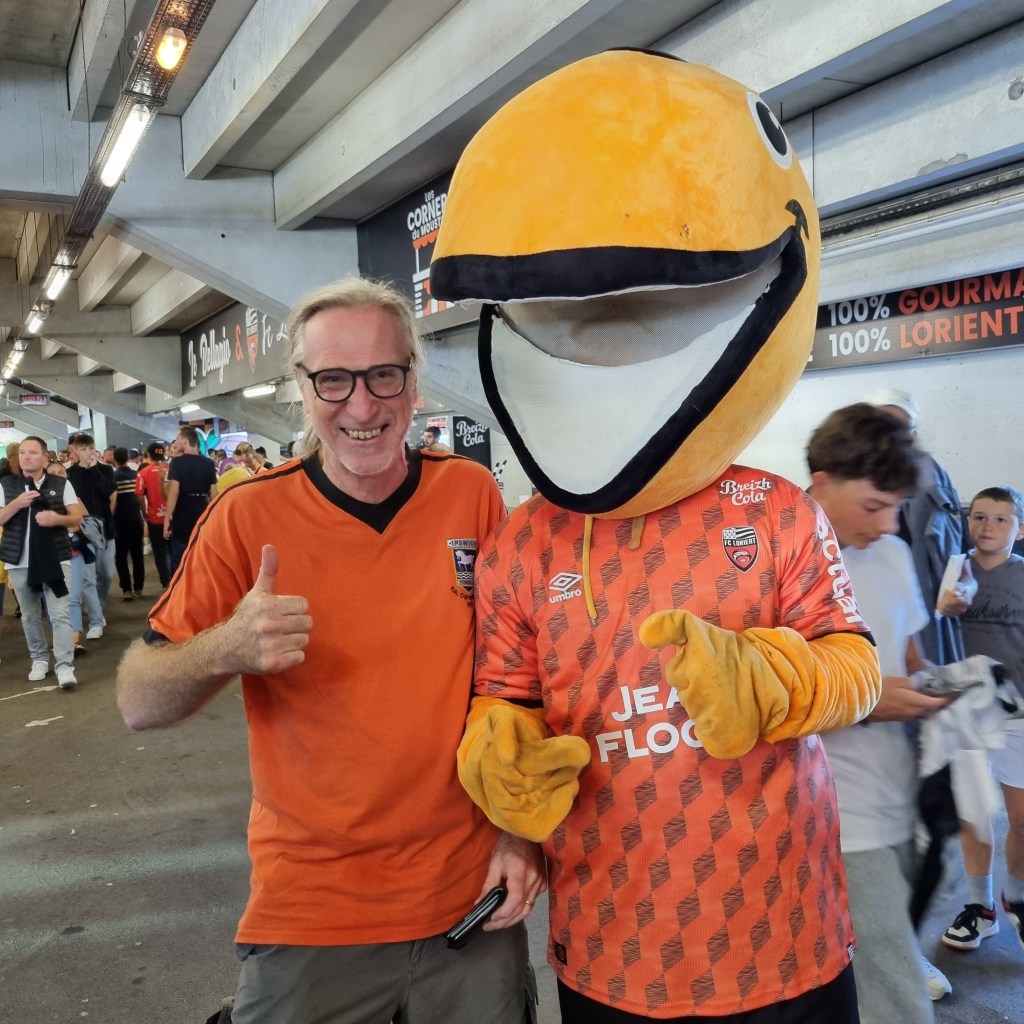
Paulene and I have arrived in Lorient in plenty of time to nab a handy street parking place.  Our short walk to the Stade de Moustoir affords a sneak preview of the stadium with the already illuminated floodlights being visible between the gaps between the buildings in nearby streets.  Near the railway station a bar has been requisitioned by visiting Nantes fans; a group of police stand a discreet distance away but there is no hint of any bad behaviour and we see many Nantes and Lorient fans walking to the stadium together.  Reaching the stadium early, we are in time to see the home team alight from their team bus wearing their horizontally striped, Breton-style jumpers or training tops. A crowd are waiting to see the players arrive and a ‘welcome arch’ has been erected as the gateway from the bus into the stadium.  The frontage of the Stade de Moustoir is clad with vertical strips of timber and looks every bit like a modern office or block of flats.  Whilst outside the ground, I get my first glimpse of the unusual club mascot, Merlux le Merlu (pretty much ‘Hakey the Hake’ in English) as he welcomes the players off the bus.

With the team in the stadium, the turnstiles open and Paulene and I enter also, but are surprised to be lectured by an officious man who tells us that we cannot take a bottle of water into the stadium, although he can exercise discretion with regard to Paulene’s bag.  Paulene had had an asthma attack as we approached the stadium and the very kind security man on the door at the club shop had arranged to get me a bottle of water for her.  I had returned to the club shop to source vital souvenirs of our visit but found that some of the items I might buy such as a mug or cuddly hake would, like the bottle of water, not be permitted in the ground.  Had I seen the e-mail the club sent me this morning I would have known that the LFP (French football league) had banned the carrying of virtually anything into football grounds this season, presumably in response to Marseille’s Dimitri Payet (known by me as the Very Hungry Caterpillar due to his ‘haircut’) getting hit on the head by a plastic bottle at Lyon last season as he went to take a corner.

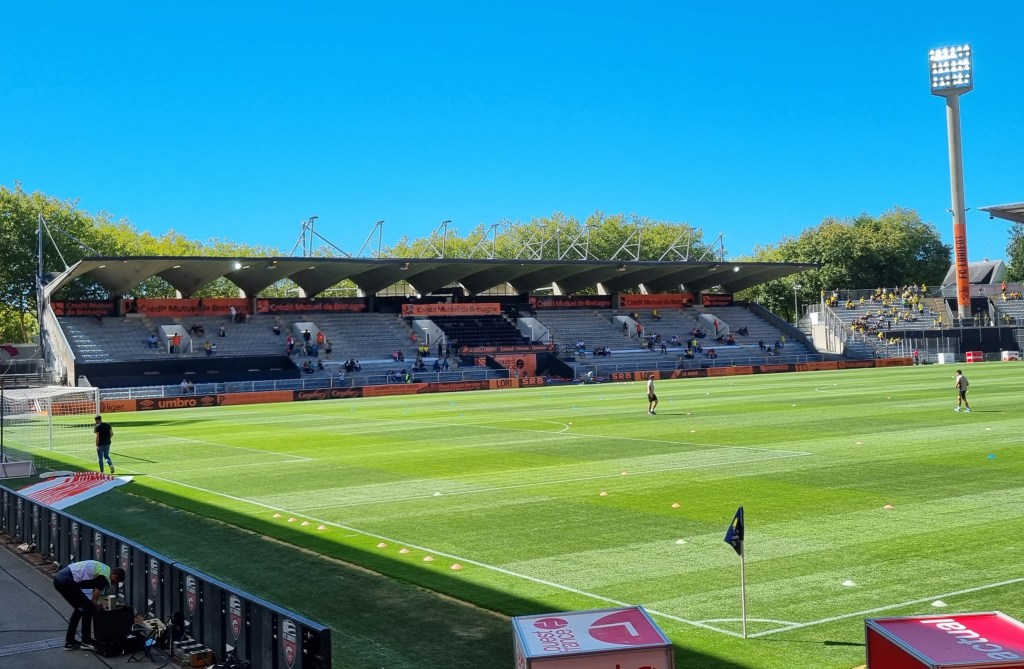
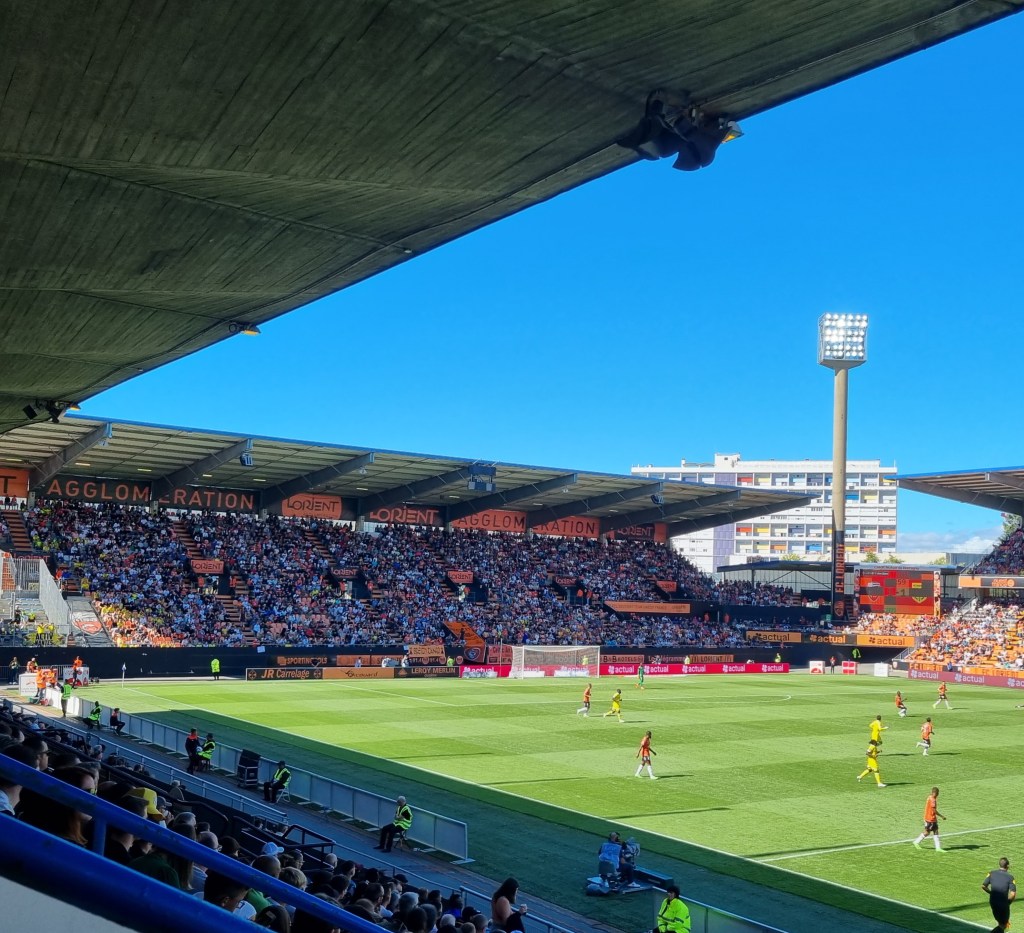
Having located our seats (20 euros each) in the Tribune Credit Mutuelle de Bretagne, a quite small single tier stand with a fabulous shuttered concrete roof and light steel and glass doors redolent of a 1950’s school hall, I set off to explore and perhaps look for beer.  I am quickly amazed and overjoyed to find that I can walk right the way round this stadium through the concourses of each stand. Behind the goal, the stand has access to the club shop which is now shut to the outside world.  The concourses are regularly punctuated with a variety of food and drink outlets and the club markets these as Les Corners du Moustoir.  Having passed by the Tavarn Lancelot, I stop at the Tavarn Morgana for an organic beer called Lancelot IPA (4 euros 50), brewed by the Breton Lancelot brewery. I mainly choose this beer so that I can pronounce Lancelot with a French accent (Lon-slow), something that has never failed to amuse me ever since seeing director Robert Bresson’s film Lancelot du Lac on BBC2’s Film International one Saturday night back in the 1970’s. Having consumed my beer, I return to my seat clutching two free eight-page match programmes and a Breton flag; there were piles of them on the floor beneath the programmes with a sign urging me and everyone else to take one.

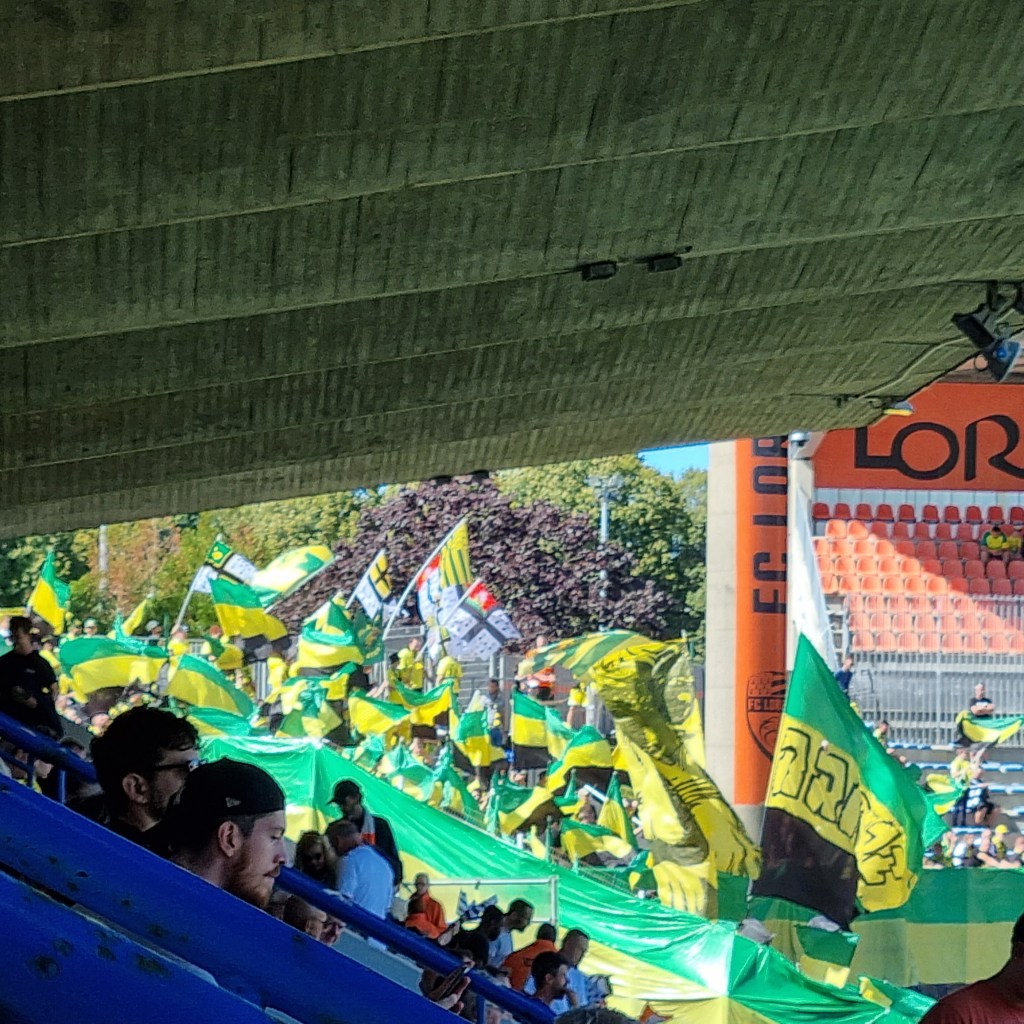
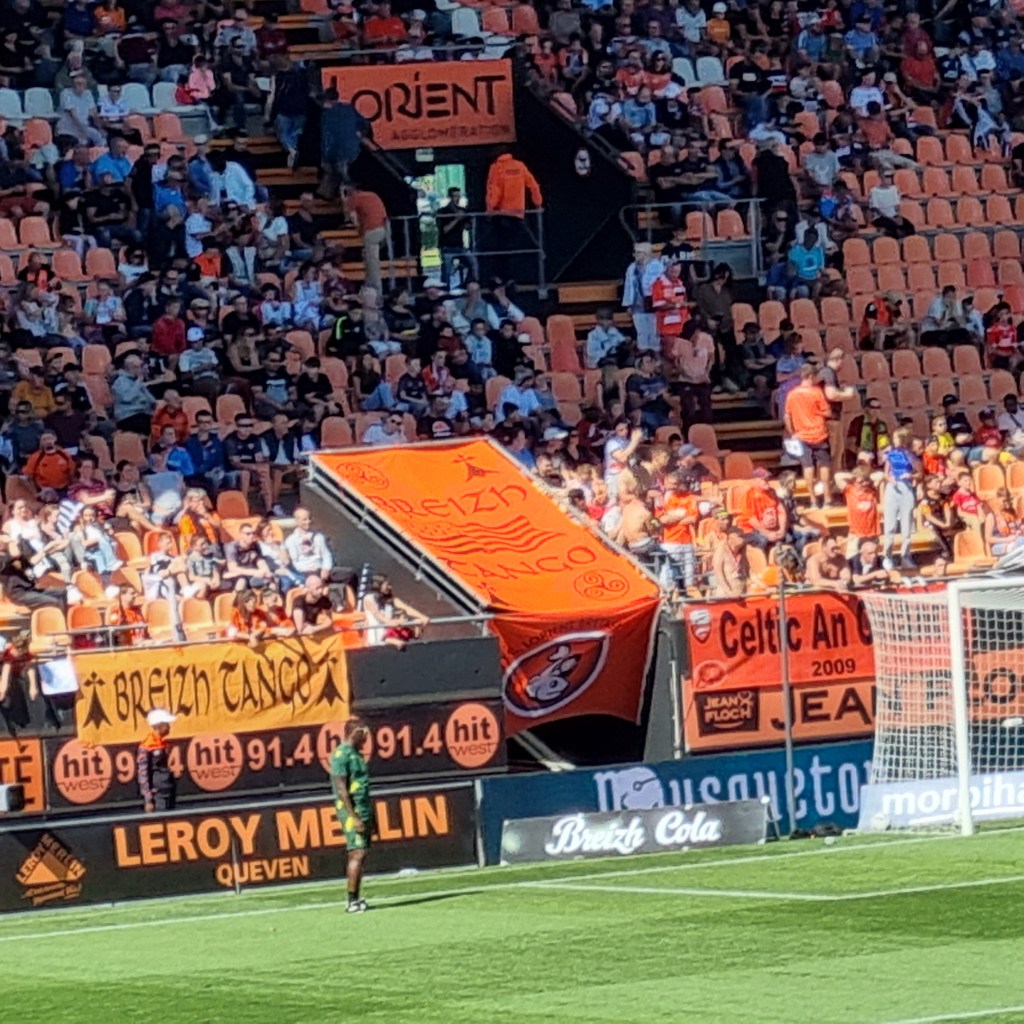
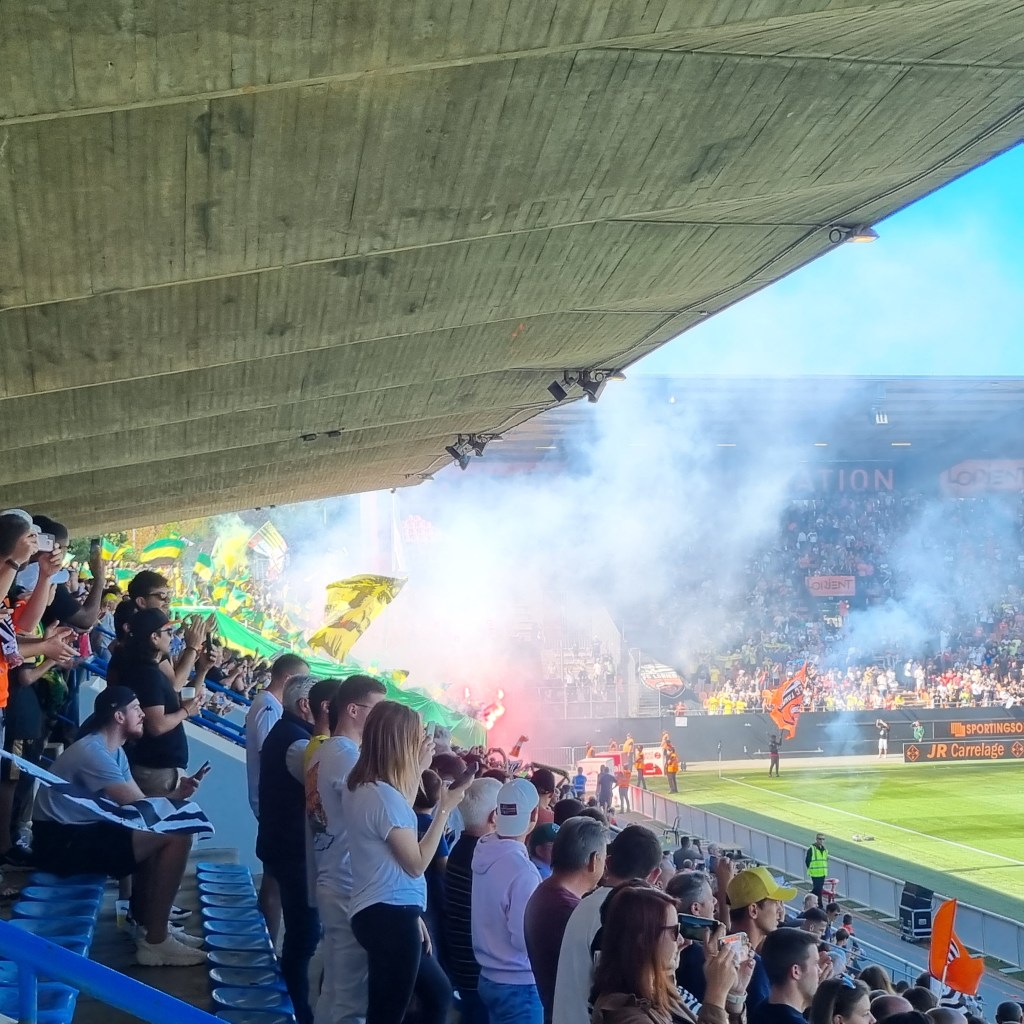
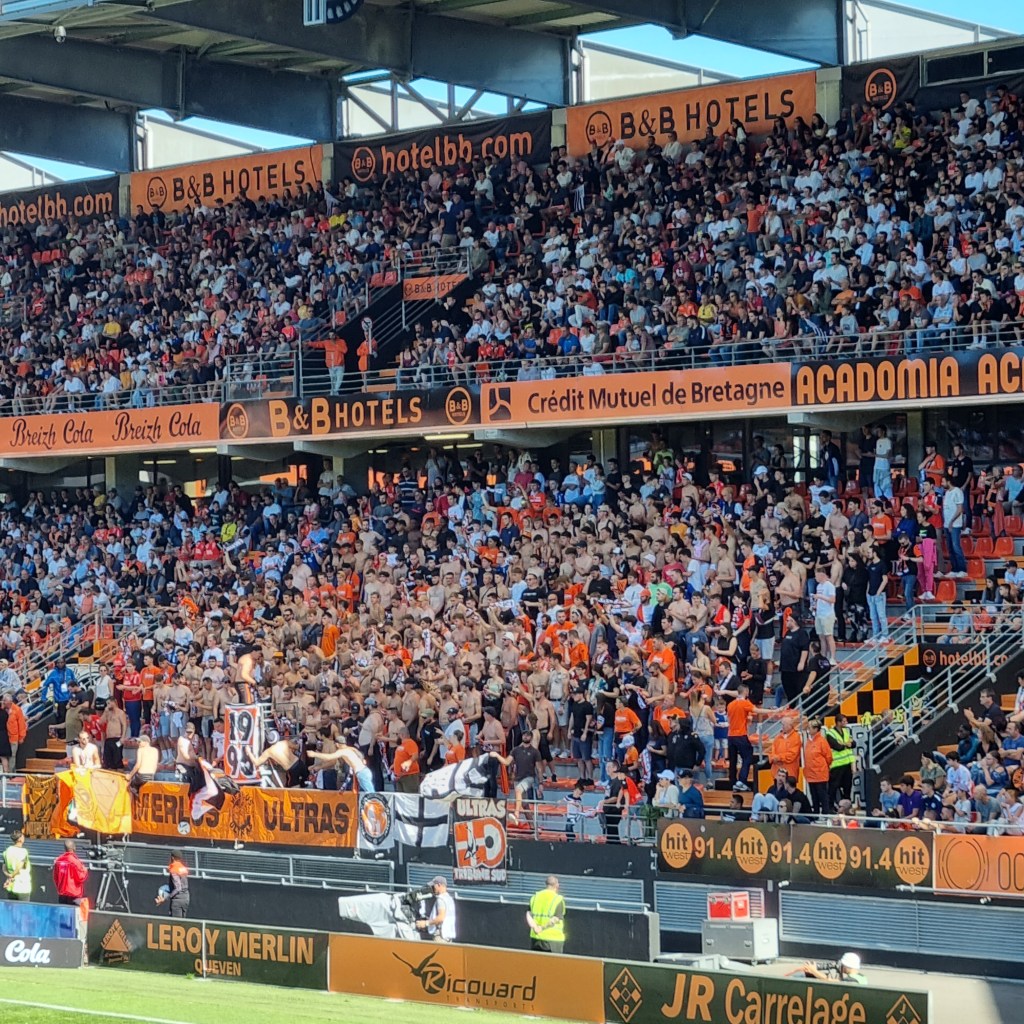
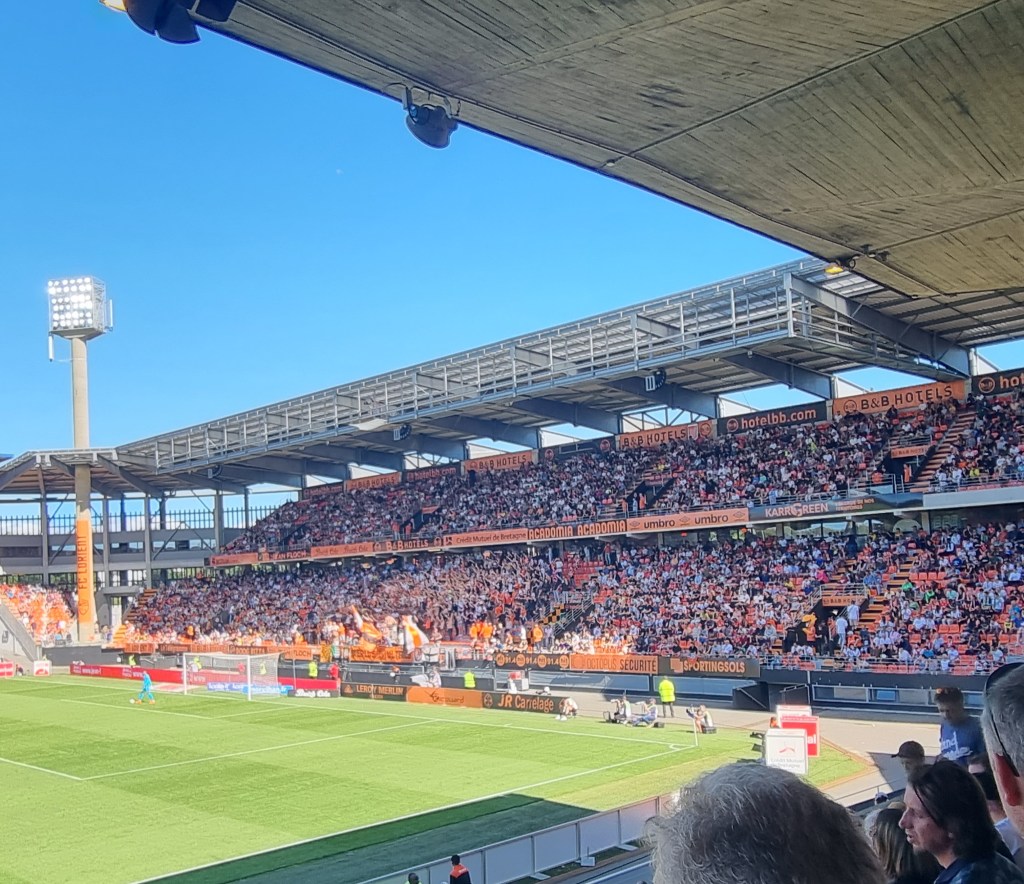
At a quarter to three a ship’s siren sounds three times and the scoreboard tells us there are fifteen minutes to go until Coup d’envoi (kick-off); the build up to the match begins.  As an opening act in the pre-match ritual an enthusiastic woman strides about the pitch in front of the main stand and sings the Breton anthem, whilst the whole crowd wave their Breton flags and club banners in a show of regional, celtic pride.  On the fabulously named Tribune B&B Hotels (B&B Hotels Stand), where the central section of the lower tier is occupied by the loudest Lorient ultras, an orange and black tifo folds down from the top tier to cover the whole stand. As the teams process onto the pitch to stand before the Ligue 1 banner and club crests, fireworks are set off on the pitch, more banners are waved and the Nantes fans, who fill the away enclosure in the corner between the Tribune Mutuelle de Bretagne and the Tribune Lorient Agglomeration wave a few flares about, making me wonder if they managed to smuggle in any bottles of water too; it’s all rather thrilling.

With the pyrotechnics and flags cleared away the game begins with Nantes getting first go with the ball and kicking towards the Tribune B&B hotels.  Nantes are in their signature kit of all yellow, whilst Lorient sport their traditional orange shirts, black shorts and white socks.  The atmosphere inside the stadium is wonderful, it has all the excitement of a ‘local’ derby game, but as well as the Nantes fans in the away enclosure there are plenty of them sitting with the Lorient supporters in all four stands and there are  dads with sons, and dads with daughters, and mums and dads with whole families and every family combination, and then there are the ultras standing on their seats and singing and mostly stripped to the waist showing off their rippling beer bellies. Brittany has its own cola called Breizh Cola, and my favourite name of one of the ultras groups is Breizh Tango.

Nantes start the match better than Lorient who look a little wobbly like a new-born foal or perhaps a young hake. It’s still a bit of a shock however when in the 13th minute a Quentin Merlin corner for Nantes is headed into the Lorient net from close range at the near post by Ignatius Ganago.  I have come to this match today to support Lorient and am wearing my orange Ipswich Town shirt in solidarity, they are supposed to win, but they are losing 0-1.

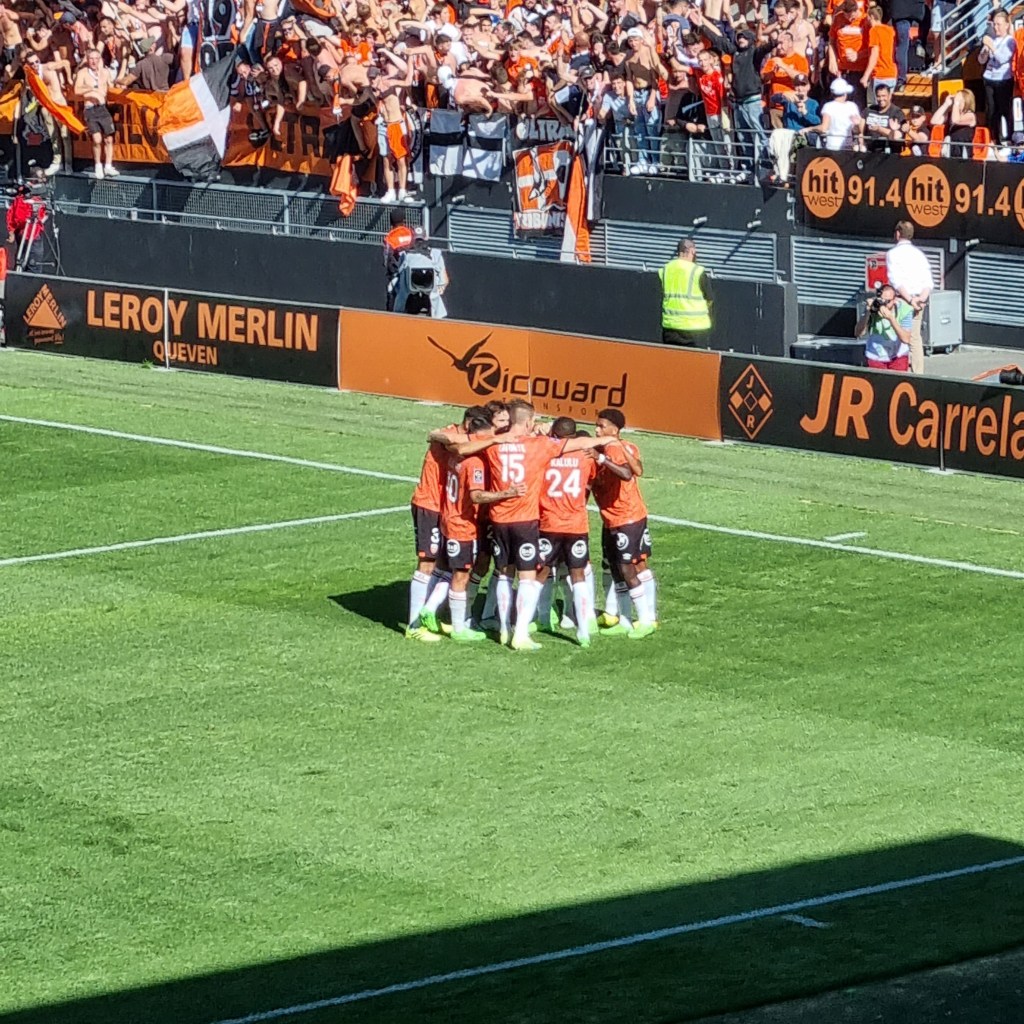
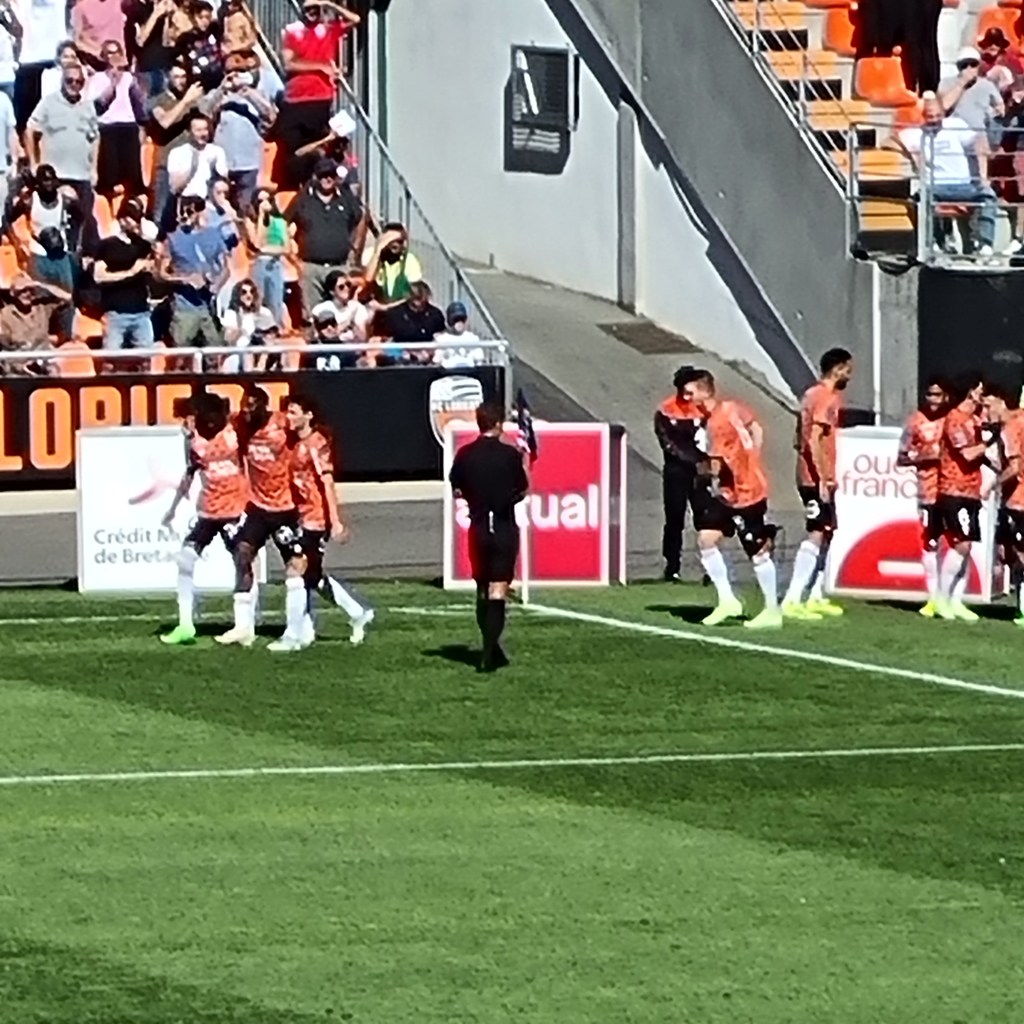
Lorient are fortunately stung into action by the goal as if Nantes had been a jellyfish and just six minutes later Stephane Diarra embarks on a dribble down the right and is literally ‘hacked down’ close to the edge of the Nantes penalty area by Andrei Girotto.  It takes a little while for the free-kick to be organised, but its worth waiting for as Dango Ouattara steps up to curl the ball beautifully over the defensive wall and into the top left hand corner of a stationery Alban Lafont’s goal.  It’s a goal that will be a joy forever and the score is one all.

The football flows back and forth and Lorient have grown into the game with their pacey wide and forward players constantly threatening, but Nantes are strong and well organised.  In defence for Nantes, the huge Nicolas Pallois strides about with his shorts hitched up showing off his massive thighs, which greatly impresses Paulene.  A 33rd minute corner goes to Lorient as a Stephane Diarra shot is deflected, but a minute later Ignatius Ganago runs onto an Evann Guessand through ball; he looks way offside, but he rounds the Lorient ‘keeper Yvon Mvogo and it is not until the ball is rolling over the goal line that the linesman puts his flag up.  It’s a ludicrous piece of assistant refereeing, although we then have to wait whilst the VAR people confirm that Ganago was offside – of course he was!

As Lorient begin to look more dangerous in attack, Enzo le Fee, who after the Arthurian theme with the bar and the beer makes me think of Morgan le Fey, and the incongruously named Bonke Innocent both have shots blocked for the home team.  Dango Outtara, a 20-year-old from Burkina Faso is also making some fantastic speedy runs for them too, inspiring repeated chants of “Allez Lorient, Allez Lorient” from the home crowd.  Five minutes of normal time remain in the first half and Nantes’ Moses Simon is the first player to be booked by referee Johan Hamel as he reduces Enzo Le Fee to a quivering heap on the turf with what appeared to be a well-aimed slap in the face.  The final minute of the half sees Nantes’ Ludovic Blas cut in from the right and have a decent shot tipped over the cross bar by Mvogo and then, as Lorient break way from the ensuing corner Pedro Chrivella scythes down Diarra to become the second Nantes player to have his name recorded by Monsieur Hamel.  A minute of time added-on is played and it is mi-temps (half-time).

Disappointingly mi-temp fails to offer up the spectacle of supporters attempting to toss a hake into a yoghurt pot or any similar test of skill inspired by local sponsors, but happily I am on the end of the row and close enough to the stairs to make it quickly to the toilet before pretty much anyone else, and that’s good enough for me.  Paulene takes a chance on the queues for the ‘ladies’ having subsided with a couple of minutes to go until the game begins again.  She returns late for the re-start and asks if she has missed anything, but I can’t in all honesty say she has.

The match resumes and the first action of note sees Lorient’s current top scorer Terem Moffi delight the crowd with an excellent dribble into the penalty area.  Even more impressively, he wears the number thirteen shirt.  Denis Appiah becomes the third Nantes player to be booked after fouling Moffi and then just twelve minutes into the second half Lorient boldly make two substitutions with Julian Ponceau replacing Bonke Innocent and Stephane Diarra making way for Yohan Cathine. Three minutes later and the scoreboard announces that it is the 56th minute. “Faites un Bruit” it then says (make a noise) and at least some of the crowd do so, although to be fair it’s been pretty noisy all along.  As an Ipswich supporter this apparently random entreaty to the fans across the whole ground seems like a good idea.  In this case it seems to work too, because there is some response and four minutes later a superb passing move down the Lorient left climaxes with Yoann Cathline sweeping the ball majestically into the top right-hand corner of the goal net from about 20 metres out, and Lorient lead 2-1.

Stade du Moustoir is now a cauldron of noise as Lorient fans celebrate, and like the best supporters should, Nantes fans get behind their team too, when they need it most. “Allez, Allez; Allez, Allez” echoes around from tribune to tribune and it’s hard to tell if it’s the Lorient or Nantes fans singing it, but it’s probably both.  It is certain however who is singing “Lorientaises, Lorientaises”.  With the home crowd exultant, it feels like good timing when the scoreboard announces today’s attendance with the words “Vous etes 15,081” (literally “you are 15,081”). It’s a figure close to the capacity of this ground which somehow feels and looks bigger than it is, whilst at the same time feeling compact and intimate; the orange colour scheme and all orange banks of seats doubtless help to create this effect.   “Lorient, Lorient” shout the crowd, punctuating the words with three successive claps.
Less than twenty minutes of normal time remain, and Lorient make a double substitution, replacing Moffi with Ibrahime Kone and Laurent Abergel with Adil Aouchiche, a recent signing from St Etienne.  The impact is immediate as Kone and Outtara exchange a couple of passes,  the last one of which puts Ikone through on goal with just Alban Lafont to beat, which he does, side footing the ball left-footed into the far corner of the goal.  I can’t help it, but I leap up in the air along with everyone else wearing orange.  Lorient lead 3-1.  Surely Les Merlus can’t lose now, although an iffy pass almost gives Nantes a run on goal, resulting in Julian Laporte being booked for his efforts to recover the situation, and then Kone also lunges in and is booked too.  The crowd chant “Lorientaises, Lorientaises” to celebrate their lead and to give the team an extra bit of support; and they need it as Ludovic Blas produces an excellent dribble to the edge of the box before sending a shot against the foot of the goalpost, which rebounds out and is cleared.  The Lorient supporters remain joyful and confident however, even complacent, and a Mexican Wave begins, but fortunately not many join in and it quickly peters out.

Five minutes of normal time remain and Nantes are pushing forward all the time, but without success; they don’t really seem to have the guile to get through the Lorient defence.  If Nantes are going to score they will need some luck and that is what happens as Moses Simon seemingly mis-hits a shot which trickles towards the goal, appears to hit a post, roll along the goal line and somehow goes in.  The goal is barely deserved, and Nantes only come anywhere near scoring again once more as Ignatius Ganago’s header is saved by Mvogo.   Unusually for the losing team, it is Nantes who make the late substitutions, and if it is an attempt to give the team and supporters a late fillip by increasing the amount of time added on it doesn’t work as time additionelle of just two minutes is announced.

The two minutes pass without further incident and the final whistle confirms Lorient’s win.  Paulene and I both agree that this has been a very good match and we have been impressed and a little surprised by Lorient’s slick forward play in particular.  But the whole afternoon has been wonderful, not just the football.  From the Arthurian themed, locally brewed organic beer to the mingling of home and away fans in such a fine, small but spacious stadium under warm blue skies it has been a joy to be here.  Full of happy thoughts we head for the club shop to buy that cuddly hake.