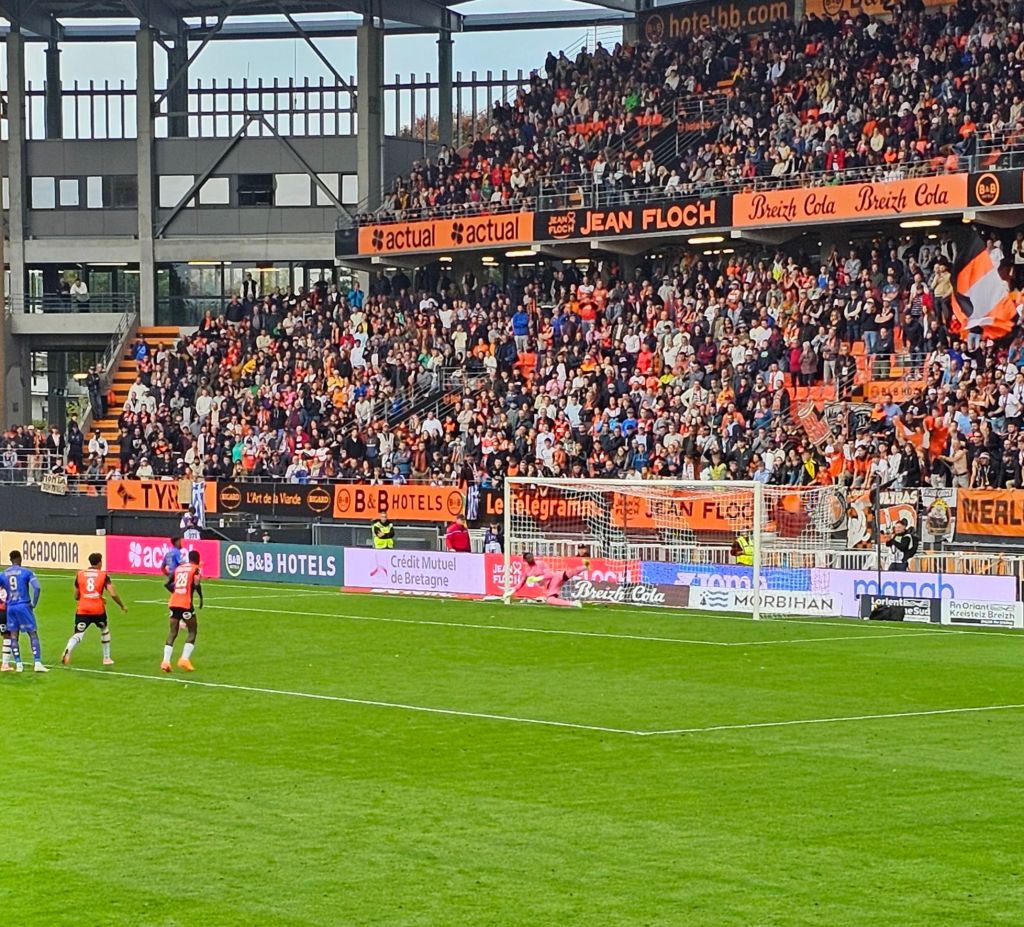
FC Lorient 3 AS Monaco 1

At the risk of becoming extremely boring, my wife Paulene and I have now holidayed in Carnac in Brittany for four years running.  There are probably several even more boring reasons for this, one of the less boring however, because it is made up, is that I like to think of myself as being in touch with my Neolithic ancestors on a sort of yearly pilgrimage to see the Neolithic standing stones, cairns and tumuli that abound in Brittany and particularly Carnac, which this year has become a UNESCO World Heritage site as a result.  Another more truthful reason is that it’s only a 40-odd kilometre trip up the E60 and along the N165 to the Stade du Moustoir to see FC Lorient play and FC Lorient’s mascot is a hake.

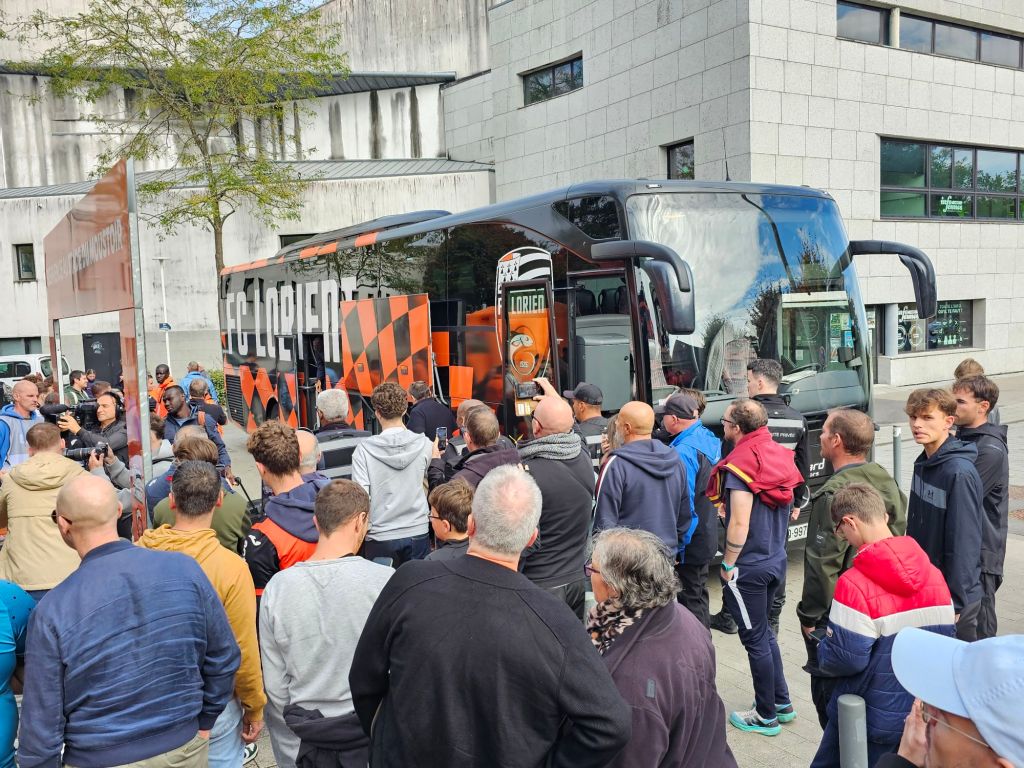
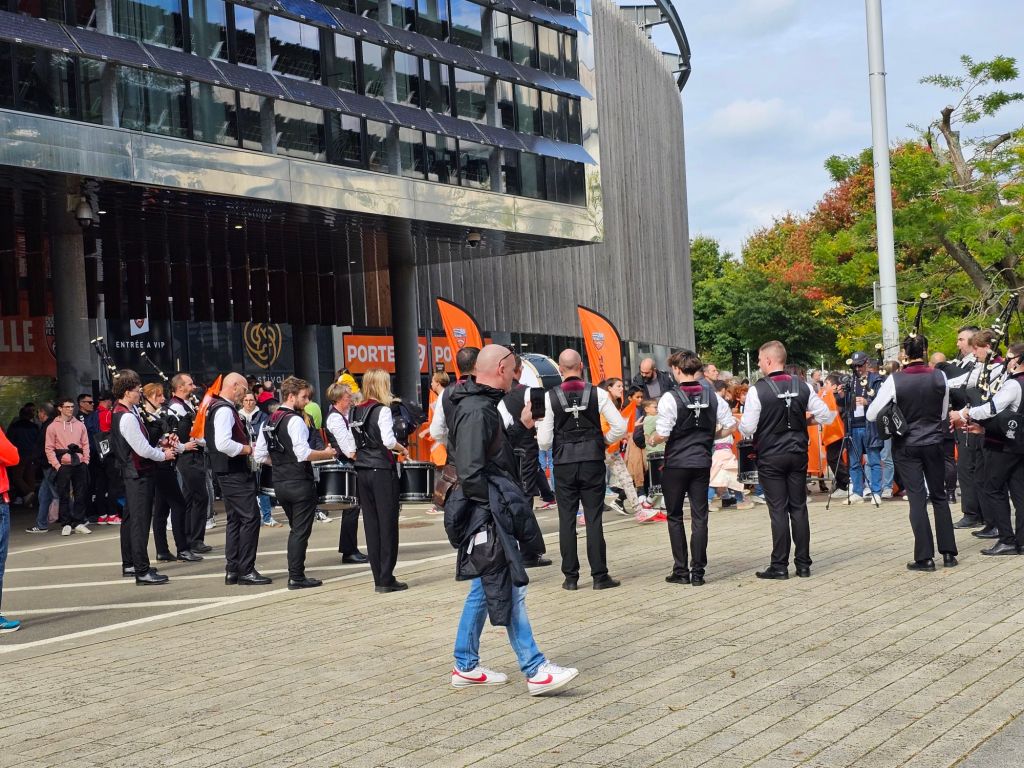
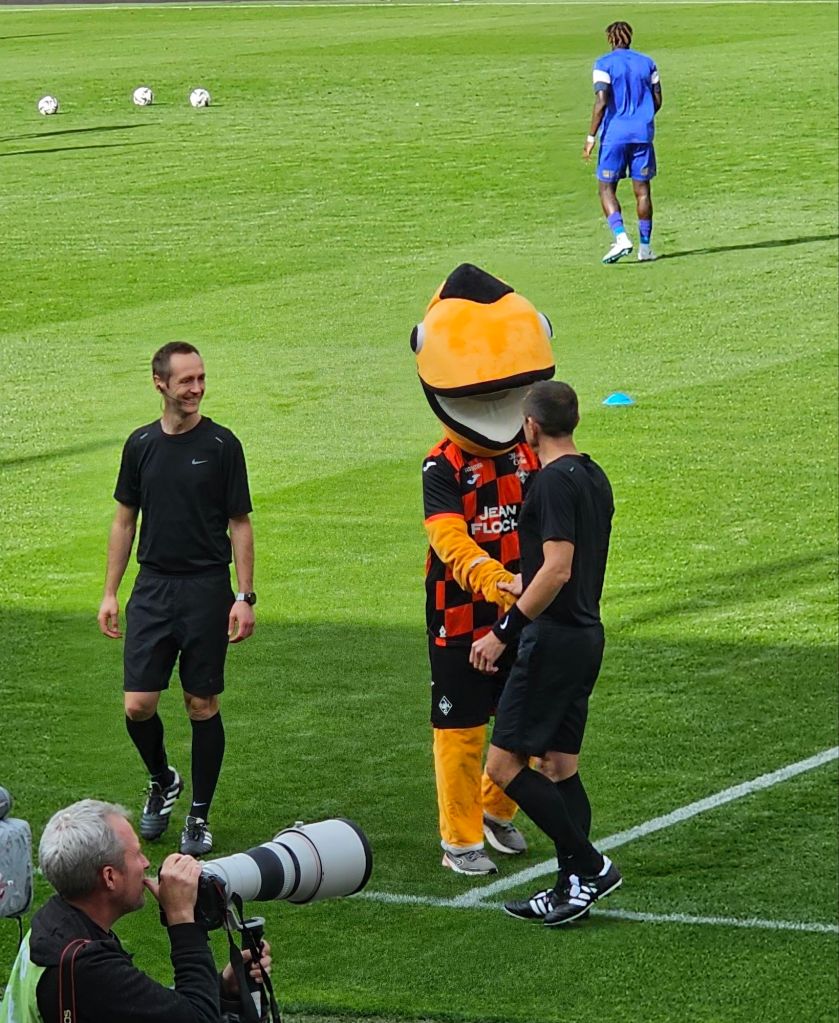
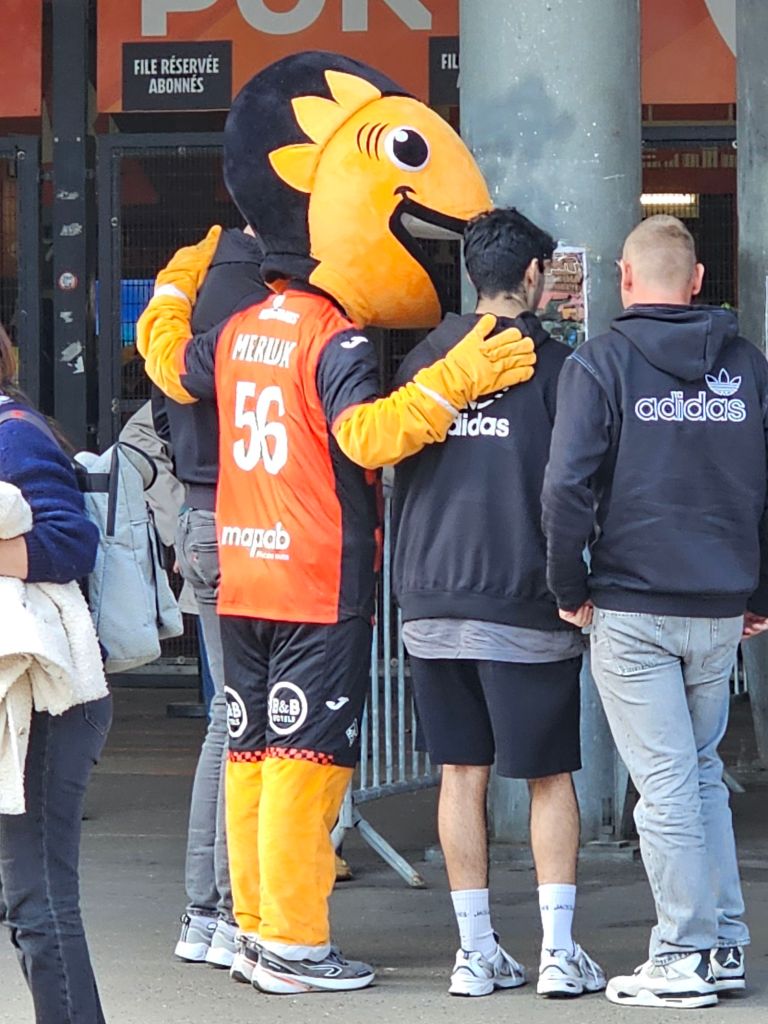
Our holiday is now sadly drawing to a close this year and today is the penultimate day before we must drive home in our planet saving Citroen e-C4.  But today, FC Lorient play AS Monaco in Ligue 1, the French version of the Premier League but with a less self-important title.  The match kicks off at 5 pm and we park up at the underground Place d’Armes car park about four hours beforehand to give time to explore a little of Lorient and at about 3pm see the Lorient team arrive at the Stade du Moustoir amidst bagpipe playing, banner waving and handshakes from Merlux and Mini-Merlux the FC Lorient mascots, (merlu is the French word for a hake).

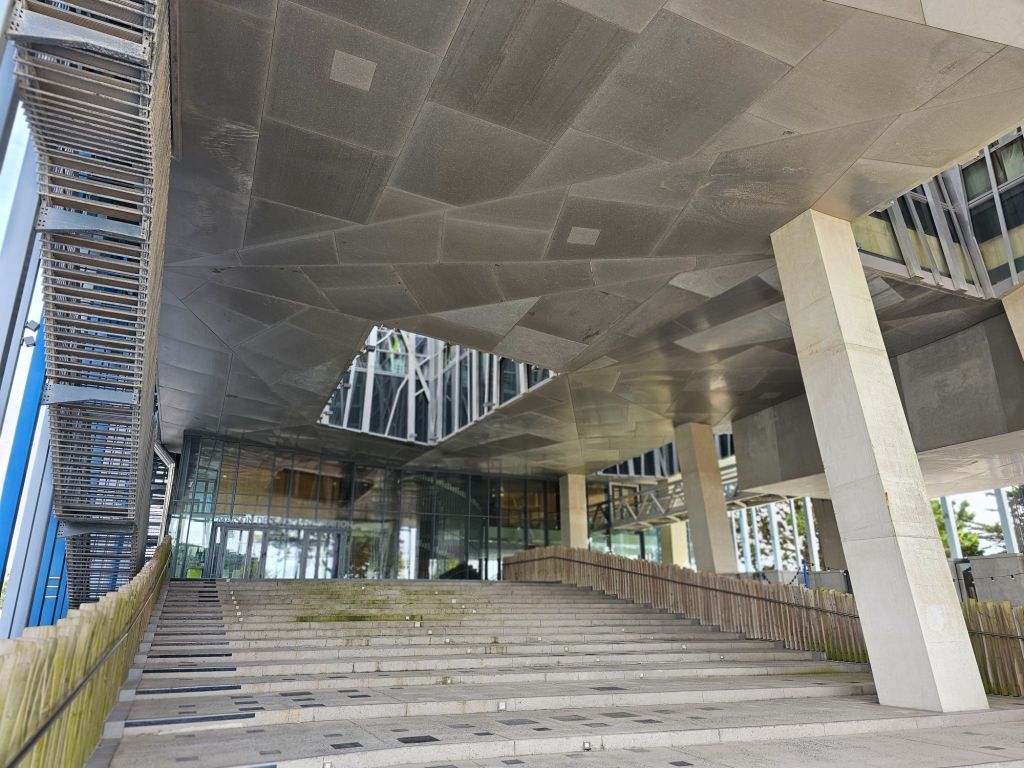
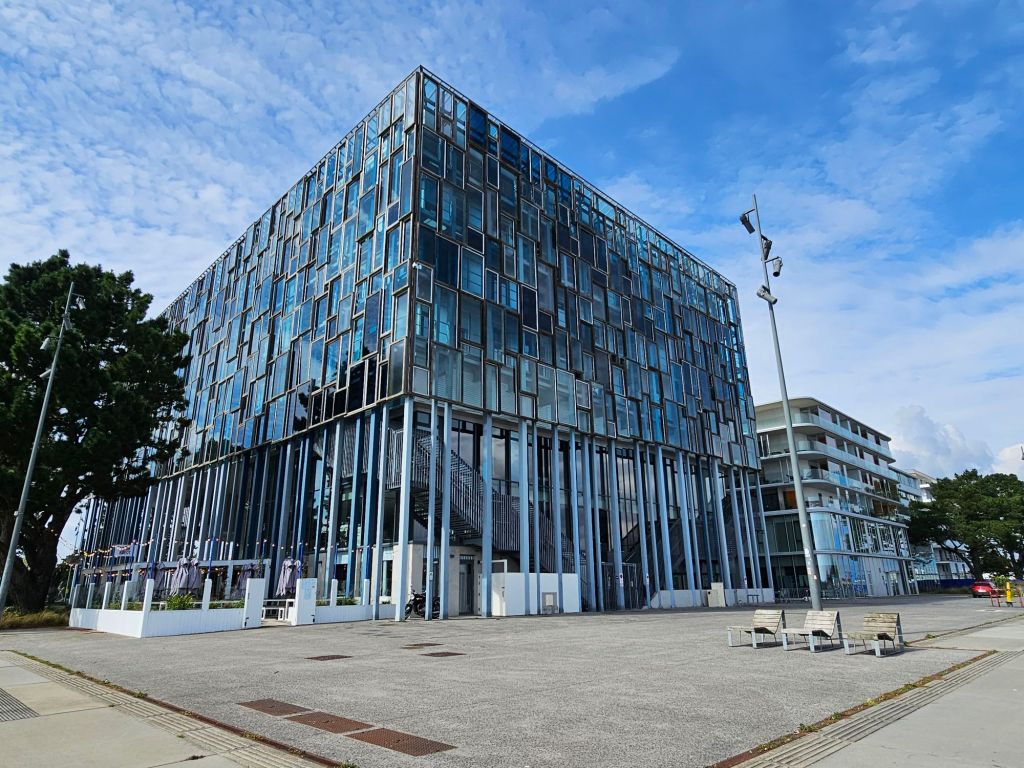
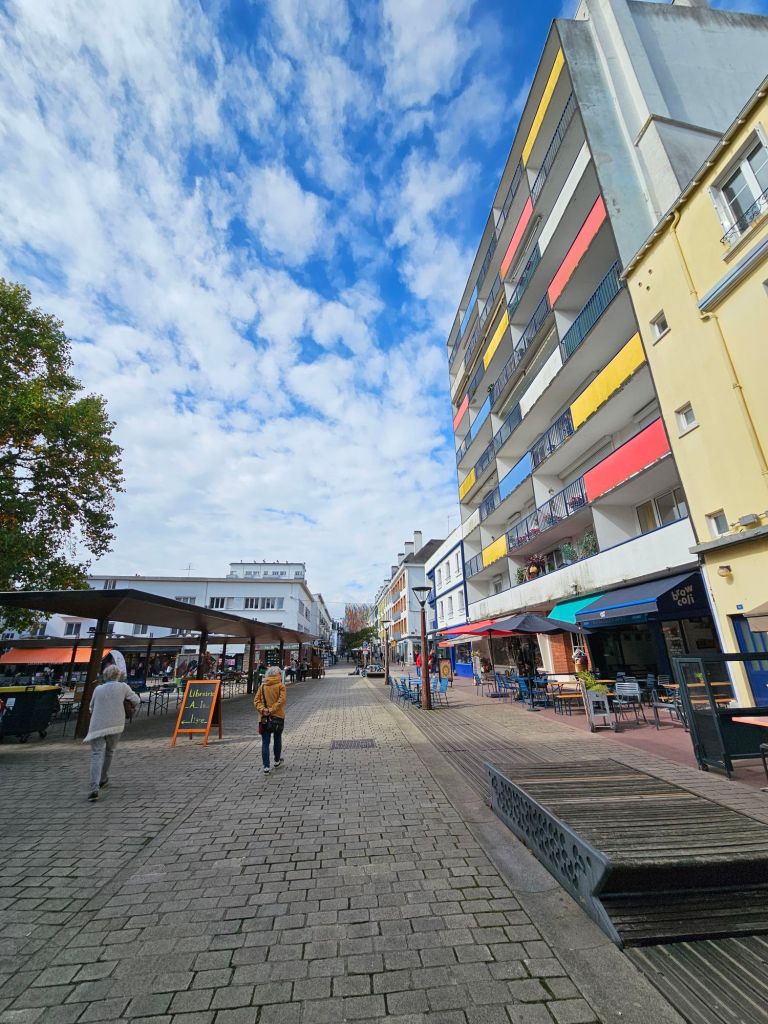
I imagine that to a lot of people Lorient is a dull sort of a place. Ninety-five percent of it was completely flattened by allied bombing in World War Two and therefore it consists almost entirely of buildings erected in the second half of the twentieth century.  But that’s why I like it; it’s not quaint or olde worlde and harking back to some forgotten or imaginary past, architecturally it’s modern and functional and was built with the optimism of the post-war years, the years before some people started to forget what Fascism did and how it started.  Our walk through Lorient is guided by a leaflet we were given in the Office du Tourisme which describes some of the buildings and the art and history of the town.

Around three o’clock we interrupt our walk to be at the Stade du Moustoir for the arrival of the Lorient team off the team bus in their Breton-style, stripey, pre-match shirts.  I make the obligatory visit to the club shop and buy a postcard of the stadium, and whilst Paulene then enters the Tribune d’honneur to find our seats, I make a detour up the road to find Les Halles de Merville, the town market hall, which is featured in the leaflet from the Office du Tourisme and is described as a “concrete and metal ring built in 1964”; it looks like a flying saucer that is no longer flying, perhaps because it is weighed down with fruit, veg, meat and fish.  On my way back from Les Halles I cross the path of a bunch of FC Lorient supporting youths who are making their way to the Stade du Moustoir whilst chanting, banging drums and waving flares.  A few bemused bystanders look on, as do two gendarmes in a dark blue Renault, but these young ultras are largely left to their own devices, as if being on a ‘demo’ is a sort of rite of passage.

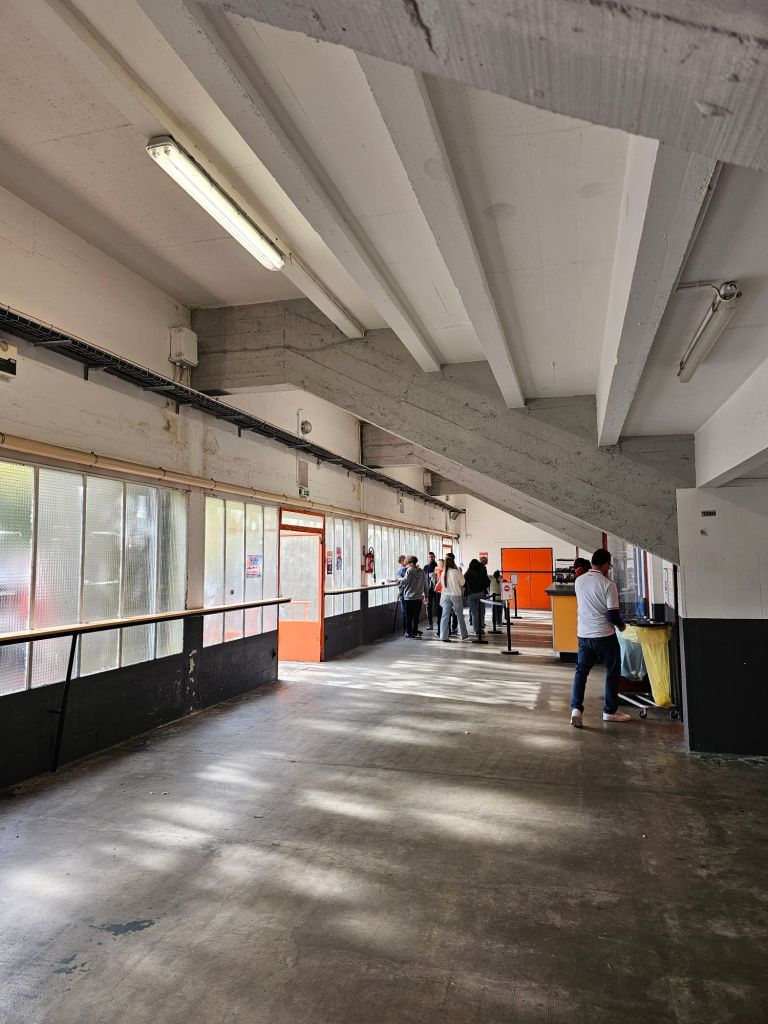
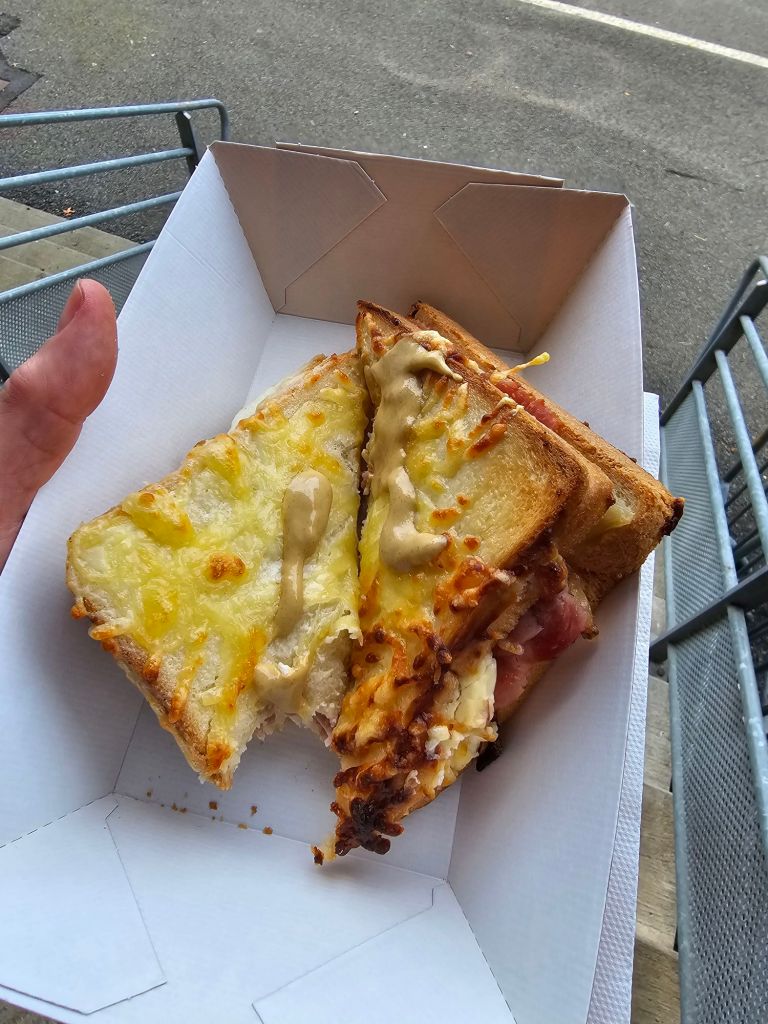
Back at the Stade du Moustoir, I make my way past the security where a man perhaps as old as me pats me down and wishes me ‘bon match’ and another then scans the bar code on my ticket with what looks like a toy ray gun and then says the same.  Our seats are once again in the fabulous Tribune d’honneur, a small, seated, stand of vaulted, shuttered concrete dating from 1959 with metal struts to ensure the cantilever roof remains cantilevered. After locating my seat, I set off to find Breizh Cola for Paulene and beer for myself and to check that it is still possible to walk all the way around the stadium and back to my seat; it is, and this is because the away supporters access their seats over a bridge.  As before, different food counters are serving different types of food and feeling a little hungry at the thought of this I buy a Croque Monsieur (8 euros 50) from the ‘Parisienne’ counter,  thinking that when Paulene reads this it will be the first she knows of it.  I don’t buy Paulene any food because her intolerances to wheat, dairy, and rapeseed oil make it highly unlikely there is anything on offer that she will be able to eat.  Sated with ham, bechamel sauce, melted cheese, toasted bread and a couple of squirts of mustard I return to Paulene with just a re-usable 40cl plastic cup of Breizh Cola (pronounced Brez, not Breej I learn from the young bloke who serves me before he wishes me ‘good match’) and a re-usable 40 cl plastic cup of Breton-brewed Lancelot IPA (10 euros 50 for the two).

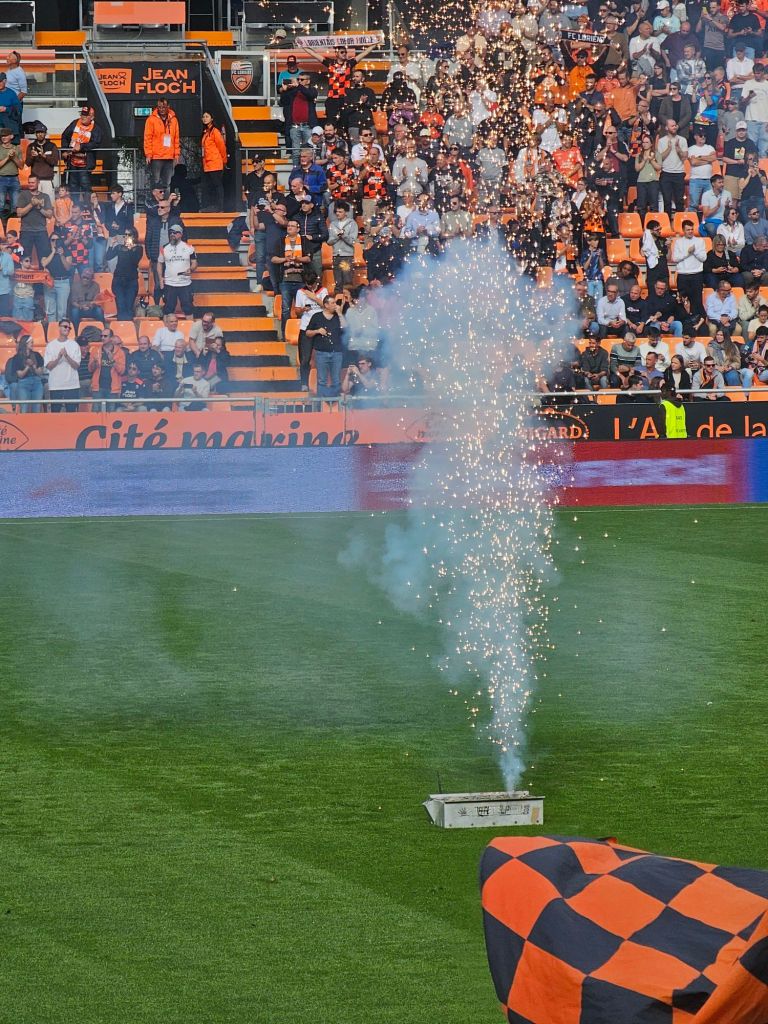
An hour, a half an hour and ten minutes before kick-off (coupe d’envoi in French) a foghorn (corne de brume in French) sounds, a bit like the bell at the end of the interval in the theatre, but appropriately for coastal Lorient, a bit more nautical, and louder.  It adds to the pre-match build-up, which eventually reaches a climax with the Breton anthem on bagpipes with karaoke style words in the Breton language on the big screen in the corner of the stadium, then a second Lorient hymn is played and the bloke next to Paulene joins in, which isn’t a good thing because as Paulene says, his voice sounds out of tune when he’s only speaking,  “Allez Les Merlus” chant the crowd as the teams process on to the pitch, youths wave banners, and a series of not particularly impressive Roman Candle style pyrotechnics ejaculate onto the grass,

Once everything cleared away it is Lorient who get first go with the ball, which they are mainly passing in the direction of the club shop, hotel de ville, docks and Office du Tourisme.  Monaco meanwhile point themselves towards the far-off towns of Quimper and Brest.  This season Lorient sport progressive looking shirts of orange and black check, which leans to one side like italics, and black shorts. Monaco are wearing an away kit of all purple with gold trim, like you might imagine a team of footballing Catholic bishops to wear.

It is a bright, sunny afternoon but the blue Breton sky is ruffled with high white cloud.  Within two minutes Lorient win a corner and two minutes later they get another.  After nine minutes the joyfully monikered referee Monsieur Ruddy Buquet records his first yellow card (carton jaune) of the evening in the shape of no less a player than the Monaco captain Thilo Kehrer who carelessly, even negligently sends Lorient’s Arthur Avom Ebong up into the air with a supposed tackle. Oddly, however, Monaco are dominating possession, although it takes another ten minutes before we see what can reasonably be called a decent shot on goal, and that is from Lorient’s number eleven, the short but enthusiastic Theo Le Bris, whose uncle Regis used to manage Lorient but is now manager at Sunderland.

Monaco’s confusing approach to the fixture is further shown just two minutes later when Vanderson also gets to smell Monsieur Buquet’s yellow card after he fouls Arsene Kouassi, who rolls and rolls and rolls about on the ground and appears to go into spasms before incredibly, getting up and carrying on. Another two minutes dissolve and Lorient’s Mohamed Bamba shoots over the cross bar.   Despite Monaco’s hogging of the ball for much of the game so far almost a third of it is history before they record a proper shot on goal as Takumi Minamino bounces a somewhat weak snap-shot past a post after what had looked a promising series of passes.

Meanwhile, in the Kop Sud there is a sudden outbreak of orange streamers and the chants of “Allez, Allez, Allez” seem inexplicably louder as if brightly coloured crepe paper has unexpected acoustic properties.  The additional orange on an orange background seemingly also causes problems for Lorient goalkeeper Yvon Mvogo who a short while later surprisingly boots the ball out to Minamino who, whilst looking confident and composed only manages to chip the ball over and wide of Mvogo’s goal whilst the Lorient supporters amongst whom I include myself and Paulene all hold our breath as one.

As if a punishment for such profligacy with gifts from fate, a minute later Monsieur Buquet adjudges that Thilo Kehler has fouled Lorient’s Dermane Karim (Dermane to readers of the back of his shirt), and sufficiently badly for him to show him his yellow card for a second time and consequently his red card too. From the subsequent free-kick out on the Lorient left, the ball is crossed in, falls to Mohamed Bamba and he scores from very close range to give Lorient an unexpected lead. “BUT!” announces the electronic scoreboard colourfully as the stadium announcer bellows Mohamed and we all shout “Bamba”, not just once but three times before signing off by shouting his full name just in case anyone was still in doubt about the goalscorer’s identity.

With a one goal lead and an extra player Lorient start to dominate . Bamba is set up well but shoots straight at the Monaco goalkeeper Philipp Kohn and a minute later Kohn is stood in the right place to catch a spectacular overhead kick from Tosin.  Monaco win a late corner to raise spectres of those horrible goals against the run of play and do it again inside the four minutes of added-on time, but the Kop Sud remain buoyant, bouncing up and down in the central terrace (safe-standing area to FFF and UEFA officialdom) and singing “Lorientais, Lorientais, Lorientais” like it was going out of fashion.
Half-time is a time of applause and an invasion of the pitch by players of mostly very youthful appearance, although one has a beard, who try to score “one-on-one” with the goalkeeper. The players in green shirts seem to win out over those in blue, and Merlux and Mini-Merlux look on feigning acute excitement or deep frustration and remorse according to whether players score or they don’t.  The French version of RADA for people dressed as outsized and vaguely cuddly fish seems to be doing a good job.

The proper football resumes at five minutes past six and Monaco have made some half-time⁹ substitutions; their manager or Prince Albert having presumably realised they need someone on the pitch who is the equivalent of two players.  The half starts strangely for Lorient, who appear to be trying to emulate Monaco’s first half display as they have two players, Dermain Karim and Mohamed Bamba booked in quick succession in the early minutes.  The sky has clouded over since the first half and its feeling cooler, so I put on my coat, covering up my orange and black Ipswich Town shirt, which was offering chromatic support to Lorient and badge-based support to Ipswich, both successfully as it turns out because both teams are currently winning.

As sure as night follows day, after half-time at Lorient comes the fifty-sixth minute, which is when the foghorn or ship’s siren sounds again, and the scoreboard entreats us all to make a noise.  This phenomenon is explained by the facts that Lorient is in the departement (like an English County) of Morbihan and in France each departement is numbered, more or less alphabetically, and Morbihan’s number is fifty-six. After the relaxation of half-time, the fifty-sixth minute seems an ideal time to wake everyone up to shout “Allez les Merlus!”  and the encouragement nearly works as the minute ends with Tosin Aiyegun shooting over the cross bar at the far post just as the noise subsides.   Meanwhile, Lorient fans are probably thankful their town is not located in Val d’Oise, (departement number ninety-five) .

With an hour then gone both sides indulge in double substitutions before Lorient’s number five  Bamo Meite sends a spectacularly awful shot from a good 20 metres out high into ‘Agglomeration de Lorient’ stand and a man sat in the row in front of me becomes very excited about a goalmouth scramble which has him bouncing up and down on his seat.  The attendance is then announced with the words “Vous etes 15,561 spectateurs et spectatrices” as the French language politely acknowledges that there are both male and female people watching.

The final twenty minutes arrive pretty much on time, as expected, and Lorient manager Olivier Pantaloni chooses this as the time substitutes the trouble-making Derman Karim from Togo for Pablo Pagis. It’s a  good move from Pantaloni as within five minutes Pagis is suddenly slaloming through the middle of the penalty area before poking the ball beyond the Monaco goalkeeper, and Lorient lead two-nil.  “Pagis” bawls the crowd each time the announcer shouts “Pablo”, and then they finish off the celebration by bawling out his name in full.  The sound of the crowd is wonderful; it matches the goal.

Lorient are dominant. Three shots are blocked in the Monaco penalty area in quick succession, Pagis shoots at the goalkeeper and then from the right hand edge of the penalty area Pagis strokes the ball with his right foot into the top left-hand corner of the Monaco goal as if effortlessly creating a beautiful work of art, as if it was naturally occurring, like a rainbow. “Pablo!”, “Pagis!” rings out again.  Lorient lead three-nil. Monaco are abject.  The bloke in front of me who was excited by the goalmouth scramble is now beside himself with joy. punching the air  and hugging the lad beside him, who I imagine is his son, but you never know.

It’s getting on for seven o’clock now and as the natural light fades shadows of the players begin to be cast onto the pitch by the floodlights from atop their concrete pylons; up beyond the floodlights the blue skies and sunshine have given way to cloud.  The five minutes of added on time are unexpectedly mostly played in the Lorient half and they win a couple of corners.  With the second corner comes a delay and a hiatus of doubt.  Monsieur Buquet consults VAR and awards a penalty, nobody knows what for but Monaco’s Ansu Fati scores anyway, giving his team underserved but more satisfyingly, scant consolation.

With the final whistle the Monaco goal is nothing more than a meaningless footnote to the match, a match that is just the frame for the masterpiece that was Pagis’s two goals.  Paulene and I head off back through the departing crowds to our planet saving Citroen in the Place des Armes car park, along the Quai des Indes.   We will have fish for our dinner, but haddock, not hake.  It’s been yet another fine afternoon in Lorient and although we may not return next year, I don’t want to stay away for too long from my Neolithic ancestors and the Stade du Moustoir.

Le Mans FC 0 Rodez Aveyron Foot 1

If travelling from where the channel tunnel burrows its way out from beneath the water into France across to Carnac in Britanny, there are several towns where it is convenient to make an overnight stop and, if you’re that way inclined (and I am), take in a football match.  Having previously enjoyed stops in Rouen, Caen and Rennes, this year it is the turn of Le Mans, whose team are hosting Rodez AF in Ligue 2, the French version of England’s Championship but with smaller budgets and better architecture.  According to the ‘Football’ Le guide ultime magazine, Le Mans have the joint smallest budget in Ligue 2 this season (5.0m euros), whilst Rodez have the next smallest (7.0m euros).

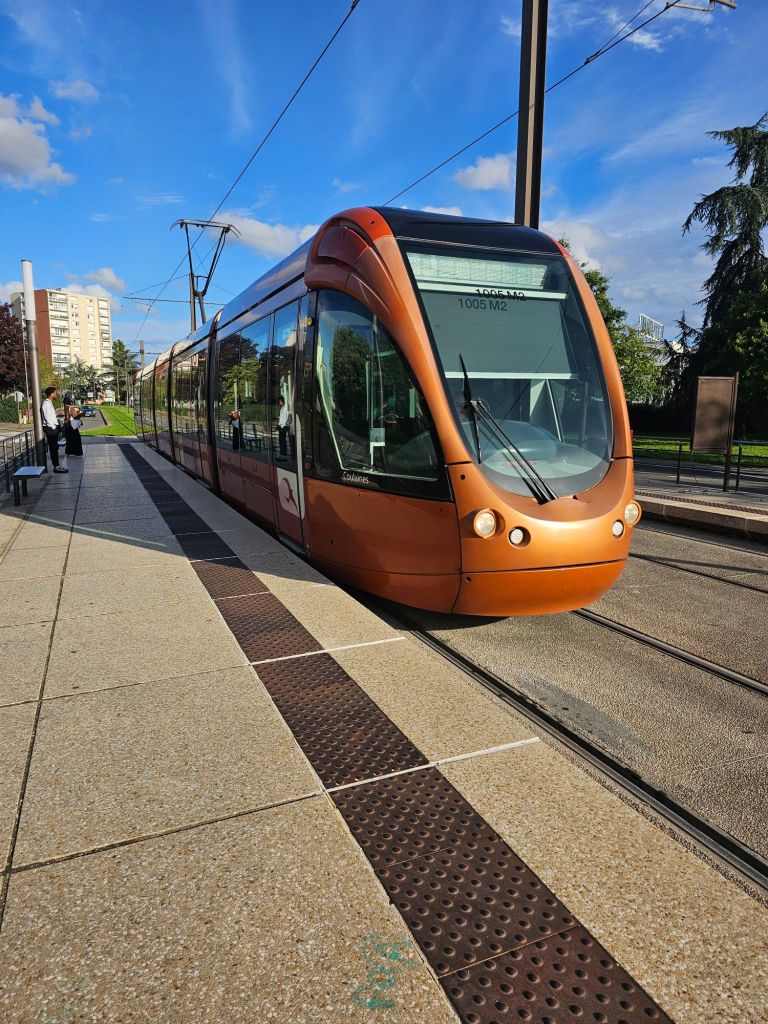
Our hotel is in a leafy suburb of tower blocks just 200 metres from the Ile de Sport tram stop from where it is a 35-minute journey (e1.50 or e2.90 for a return) changing from tram Line 2 to tram Line 1 at St Martin, to the Stade Marie-Marvingt.  This afternoon there is a large, six-wheeled luxury coach in the car park of the hotel and from a short and stilted conversation with the driver I learn that he is driving the Rodez team from the hotel to the stadium.  I photograph the coach with the Rodez club badge displayed in the front window as the driver stands back proudly but out of shot.  I am tempted to ask for a lift to the stadium but don’t want to miss out on the tram ride to the match, something which makes me pretend I’m Albert Camus.  In the hotel lobby, bored looking blokes in grey matching tracksuits hang about mournfully. I wish a couple of them ‘bon match’ and tell them my team is Ipswich Town, it doesn’t appear to relieve their boredom, but pleasingly they have heard of Ipswich Town.  

The match is due to kick off at eight o’clock, but keen to immerse ourselves in the pre-match atmosphere my wife Paulene and I head for the tram stop around six, before the team bus has left the hotel.  We just miss one tram as I fumble with my bank card at the ticket machine, but another soon arrives, and we are lucky enough to get a seat each.   It’s a mild but cloudy evening as we pass through tram stops with names such as Durand-Vaillant, Goya and Gionnieres and on through the uninteresting outskirts arriving eventually at the terminus close to the stadium, the tram depot and the world-famous racing car circuit.

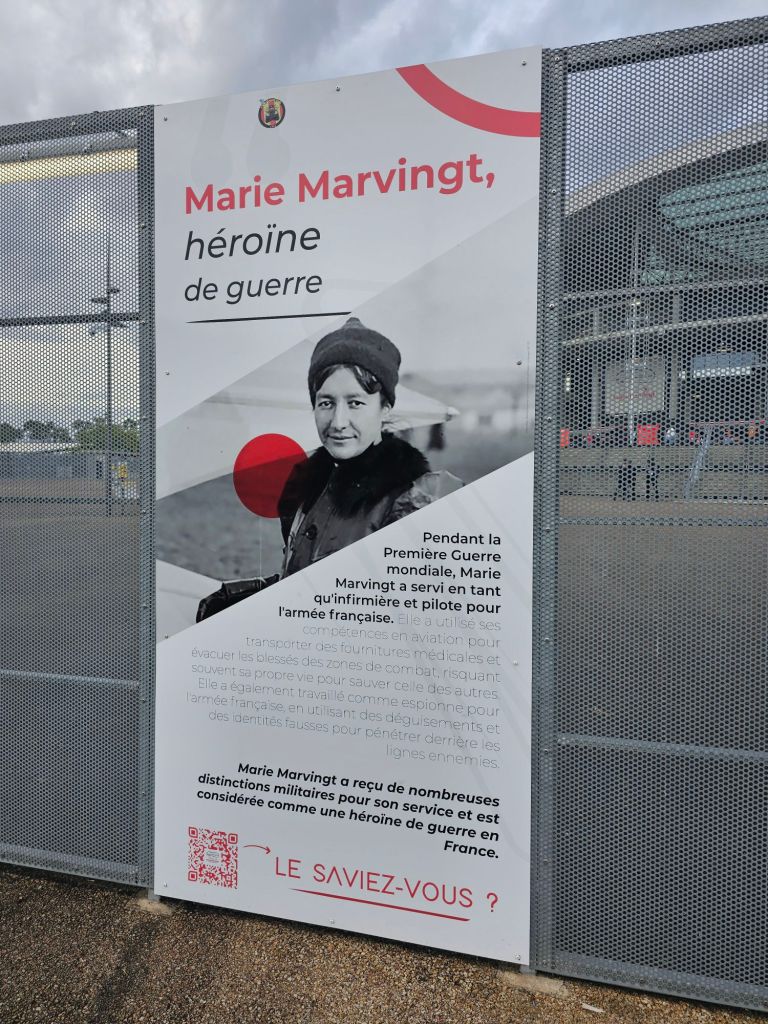
It’s only a short walk from the tram terminus to the stadium, but we accidentally make it longer by walking in the wrong direction, inexplicably failing to follow our fellow would-be spectators as we alight from the tram. Oddly, despite the size of the Stade Marie-Marvingt (it has a capacity in excess of 25,000), it is not visible above the trees.  Adjacent to the stadium is a large surface car park, which, showing an impressively sensible double use of the land is roofed by banks of solar panels.  A wall surrounds the stadium with blocks of automatic turnstiles at points along it.  The approach to the turnstiles features a series of information boards about Marie-Marvingt after whom the stadium is named.  Marie was a remarkable woman who not only spied and flew planes for the French Army during World War One but was an accomplished mountaineer.  Once inside we are frisked and wished ‘bon match’ by smiling security staff before a very helpful man directs us to the gate nearest our seats, and the club boutique, a lock-up hatch, where in the absence of a petit-fanion or fridge magnet I will later buy a key ring to add obsessively to my collection of French football club souvenirs.
Having located our seats (25 euros each), I decide to explore and discover I can make a complete circuit of the stadium.   It’s something of a lazy cliché to describe a modern stadium like the Stade Marie-Marvingt as a ‘soulless bowl’ and on the outside at least it is nothing like the metal-clad B&Q lookalikes found in England as its metal stairs and landings are exposed and sit beneath an elliptical, overhanging roof supported by what look like miniature versions of the Skylon from the Festival of Britain.  Having enjoyed the architecture, I buy a beer (7 euros plus 2 euros for an optional re-usable cup featuring club colours and crest) and a bottle of water for Paulene (2 euros) from a buvette where the attractive young woman who serves me has a heavily tattooed decolletage, which I don’t like to look at too closely given its location.

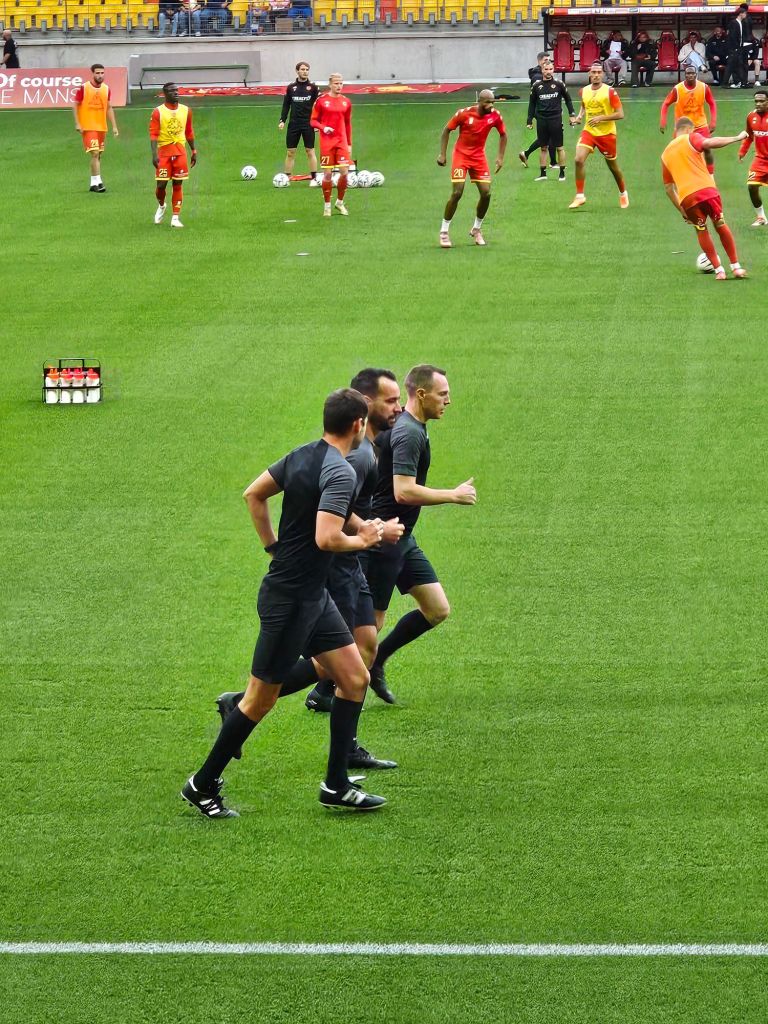
After returning to my seat, Paulene and I pass the time until kick-off laughing at the referee and his assistants as they warm up and rolling our eyes because of the drippy europop being played over the public address system.  Eventually, a sort of crescendo is reached, and the floodlights begin to flash on and off like some I’ve seen at non-league grounds, although at them it wasn’t intentional. This is the signal for the teams to process onto the pitch amidst the usual display of flags and banners before the team line-ups are read out and I join in with the home supporters in shouting out the Le Mans players’ surnames, my favourites amongst which are Rossignol and Vercruysse.

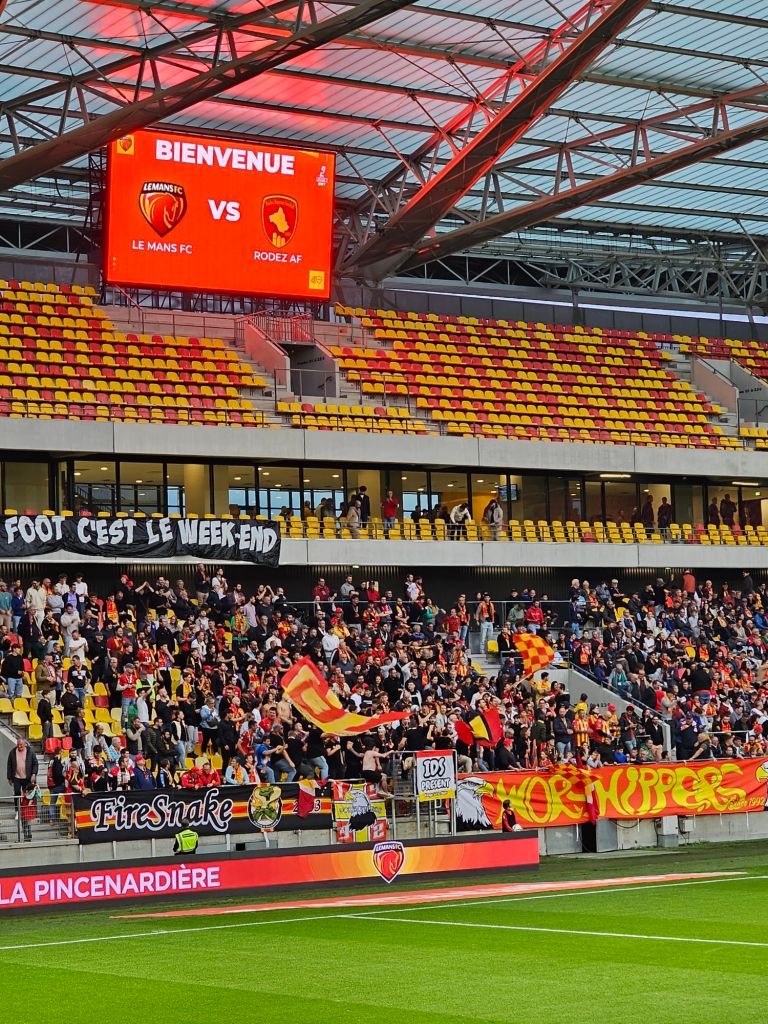
When the kick-off, or coupe d’envoi, finally happens it is Le Mans who get first go with the ball playing it back before punting it forward in the direction of the city centre and the medieval cathedral of Saint Julian with its fabulous stained glass; Rodez are playing towards the tram terminus.  Le Mans wear red and yellow striped shirts with red shorts although from behind they are all in red; Rodez meanwhile sport an all-white creation with black trim, which looks the same from any angle. From the start, and indeed since before it, the Le Mans fans behind the goal which Rodez are ‘attacking’ have been in fine voice with continuous chants of “Allez Le Mans” and “Aux Armes”.  I text my friend Mick back in blighty and send him a photo of the Le Mans fans.  He texts back to say they look like hedonists.

On the pitch, my attention is soon taken by the Le Mans numbers five and twenty-one, Harld Voyer and Theo Eyoum, who have their hair tied back in raffish fashion, whilst I also recognise the Rodez number twenty-seven from the hotel lobby. Early exchanges are cagey with Le Mans enjoying a little more possession but looking unsure what to do with it.  At the edge of the pitch behind the Rodez goal I am disappointed by the poor grammar of a Le Mans fan group, or possibly just an individual fan, whose banner reads Fanatic’s. Fanatic’s what? I wonder.  Another more literate fan group, perhaps from the top stream at the local lycee, are called ‘Worshippers’, whilst another banner reads ‘IDS Present’ and I begin to wonder why  former Tory party leader Ian Duncan Smith would be here. After fifteen minutes Le Mans win a corner. A minute later the first decent chance of the game appears but number twenty-five for Rodez, Nolan Galves boots it high over the cross bar.

Time proceeds to the twentieth minute and coincidentally perhaps the Le Mans number twenty William Harhouz is booked for making the Rodez number five Clement Jolibois roll around on the floor unnecessarily, but seven minutes later a rare display of skill in the form of a neat turn and cross by Le Mans’ eighteen, Lucas Buades ends with number twenty-five, Dame Gueye producing a spectacular overhead kick, which is so  spectacular it clears the cross bar.  More drama ensues after some odd refereeing from Monsieur Aurelien Petit who plays-on whilst Le Mans have the ball, only to then stop play and give a free-kick to Rodez, whose number twenty-eight Mathis Saka is subsequently carried off on a stretcher.

The match rolls on towards half-time, rarely threatening to produce a goal but instead producing the yellow card from the pocket of Monsieur Petit another five times whilst an aeroplane buzzes overhead invisibly through the deepening gloom of dusk. Five minutes of additional time are played during which the last two yellow cards of the half are shown, one for a player of each team, and then it is mi-temps.

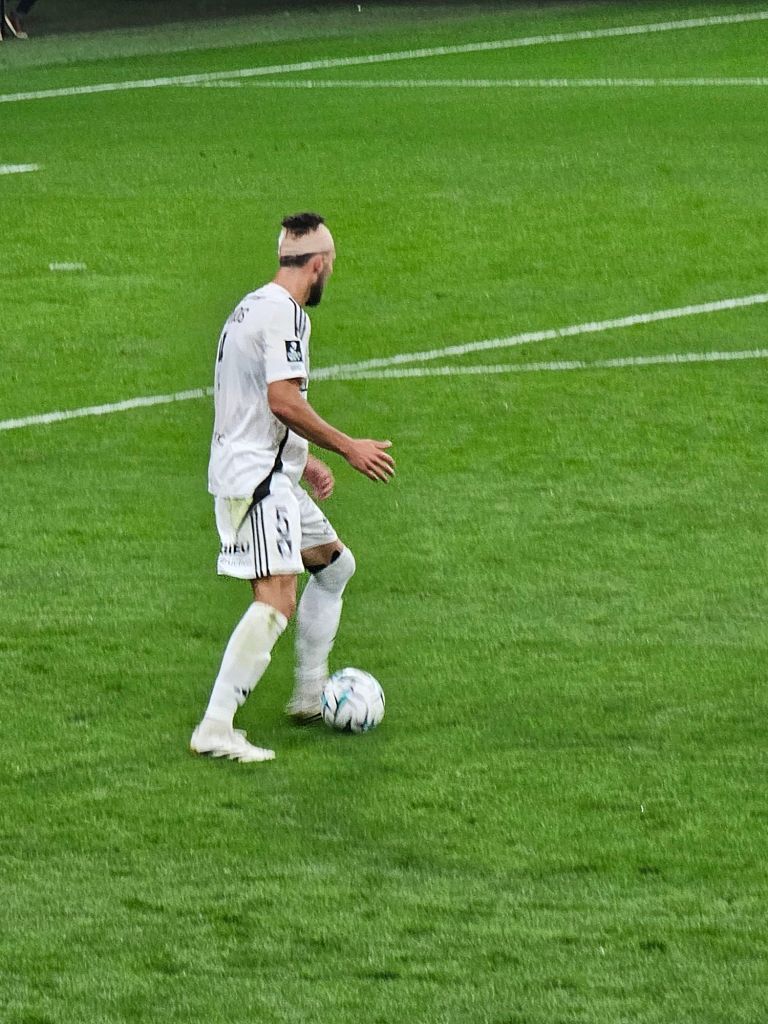
The football resumes at five minutes past nine with a boot into touch but things soon improve with a spectacular save from the Rodez goalkeeper Quentin Braat after a free-kick to Le Mans and a close range shot, which would surely have beaten Braat had it not been so weak.  At the back for Rodez it seems that number four Mathis Magnin is charged with spraying deep penetrating passes, some of which penetrate too far and result in goal kicks and throw-ins. He nevertheless wears a head band to signal his creativity. 

With the sun now having disappeared below the horizon it’s feeling colder, and the breeze previously only felt outside the stadium is finding its way inside; I zip up my jacket.  Back on the pitch, the Rodez number five Clement Jolibois appears to be channelling the spirit of Terry Butcher as he strides about with a bandage around the top of his head, although there is no visible trace of gore.  There doesn’t seem much prospect of a goal either, but then with a fraction more than thirty minutes of normal time remaining Rodez’s number fifteen, Jean Lambert Evans produces a cross from the left which allows number eleven Tairyk Arconte, who is stood all alone at the near post to head in the limpest looking goal I’ve seen in some time. Happily, for the fifteen away supporters I have counted, who have apparently made the 6 hour 20 minute, 657 kilometre journey up from Rodez, the goal is scored at their end of the ground.

The Le Mans coach Patrick Videira, who is unlikely to be confused with former Arsenal captain Patrick Vieira responds to the goal with a mass substitution, bringing on club captain Edwin Quarshie and the popular Erwan Colas as well as Baptiste Guillaume.  The change almost works as Le Mans quickly win a corner, but Guillaume volleys over the cross bar from about 10 metres out.  Two more substitutes appear just a few minutes later in the shape of Brice Oggad and Isaac Cossier and Rodez have some catching up to do in terms of player replacement, which begins as soon as the seventy-first minute and will be completed a mere nine minutes later.

With seventeen minutes of normal time remaining the opportunity to more or less guarantee victory presents itself to Rodez but although stood with the whole goal before him, recent substitute Ibrahima Balde cannot beat Nicolas Kocik in the Le Mans goal and merely wins a corner, not the match.  Meanwhile, I am becoming tetchy due to the pungent smell of the body spray or aftershave of the man sat in front of me.  I wonder to myself if his toiletries are becoming more active as the tension of the game mounts.

  Le Mans twice come close to equalising in the increasingly frantic final fifteen minutes with Quarshie shooting too high and then having another shot expertly tipped over the cross bar.  Brice Oggad also has a shot following a corner in what will prove to be the last decent opportunity for anyone to score, but he ‘shanks it’ high and wide.  The four minutes of added on time seem pretty solid when held up on the electronic display by the fourth official, but like grains of sand they slip through Le Mans’ fingers and the game ends.

On the walk back to the tram terminus Paulene and I agree that overall Rodez were the better team even if Le Mans had most of the possession.  We also agree that whilst it’s not been a particularly good match, it’s been an enjoyable one and I am therefore able to report that the best thing about the evening has not been the tram ride, although that was pretty good too.

FC Megalithes 2 Riantec OC 1

The small town of Carnac on the coast of Brittany is famed for its sprawling, ritual landscape of neolithic, megalithic alignments, menhirs and dolmens, but less so for its football clubs.  It is unlikely therefore that many people outside the local football fraternity of the Morbihan departement (County), noticed the merger in 2023 of two or maybe three local clubs to create what its name suggests is a giant ritualistic rock of a football club, FC Megalithes, which possibly prefers to kick-off games in the direction of the mid-winter sunrise.

The website for the French equivalent of the local County Football Association helpfully lists associated clubs and their fixtures and having arrived in Carnac the day before and settled in, my wife Paulene and I have dusted off our autumn almanac and are seeking entertainment on what is a sunny September Sunday afternoon.  The website tells us that FC Megalithes are at home to Riantec OC, playing their second league match of the season in the Ligue Bretagne de Football, District Morbihan, District 1 Poule B.  If Ligue 1, where the likes of Paris St Germain and Olympique Marseille hang out is level one of French football, we think this is about level ten of may be twelve or thirteen.  Riantec is a village a bit more than 30 kilometres away near the much larger town of Lorient, albeit this side of the estuary of the River Blavet; Wikipedia tells us that in 2017 Riantec had a population of about 5,600.

The football association website states that kick off is at 3.30 pm, and believing the match will be played at the main sports ground in Carnac, we set off at about ten to three from our ‘hut’ in a nearby camp site to make the 3.3 kilometre journey in our planet saving electric Citroen eC4.  As is often the case with local municipal sports grounds in France, there is plenty of free parking, but worryingly perhaps, as we roll up almost all of it is unoccupied,  and walking through the stone gateway of the Stade it is evident that there is no one else here except some youths playing an impromptu game of ‘three and in’ behind the albeit impressive, but lonely looking and very empty main stand.  The pitch is freshly marked out, but there aren’t even any goals up.  Clearly in the wrong place, we consult the interweb again and discover, courtesy of our very own administrative error, that we should be at Parc des Sports Kermouroux, about 7 kilometres away in St Philibert.

It is an easy trip across town to St Philibert, despite some 30 kilometre per hour maximum speed zones and a couple of red lights, and whilst we arrive after three-thirty we can see from the road outside that the players are only just lining up to shake hands and accept the applause of a crowd of what must be about a hundred people.  As we step through a side gate, we can even hear some Ultra-style chanting, although that seems to be from the players of the B team whose match had kicked off at one-thirty and has since ended.

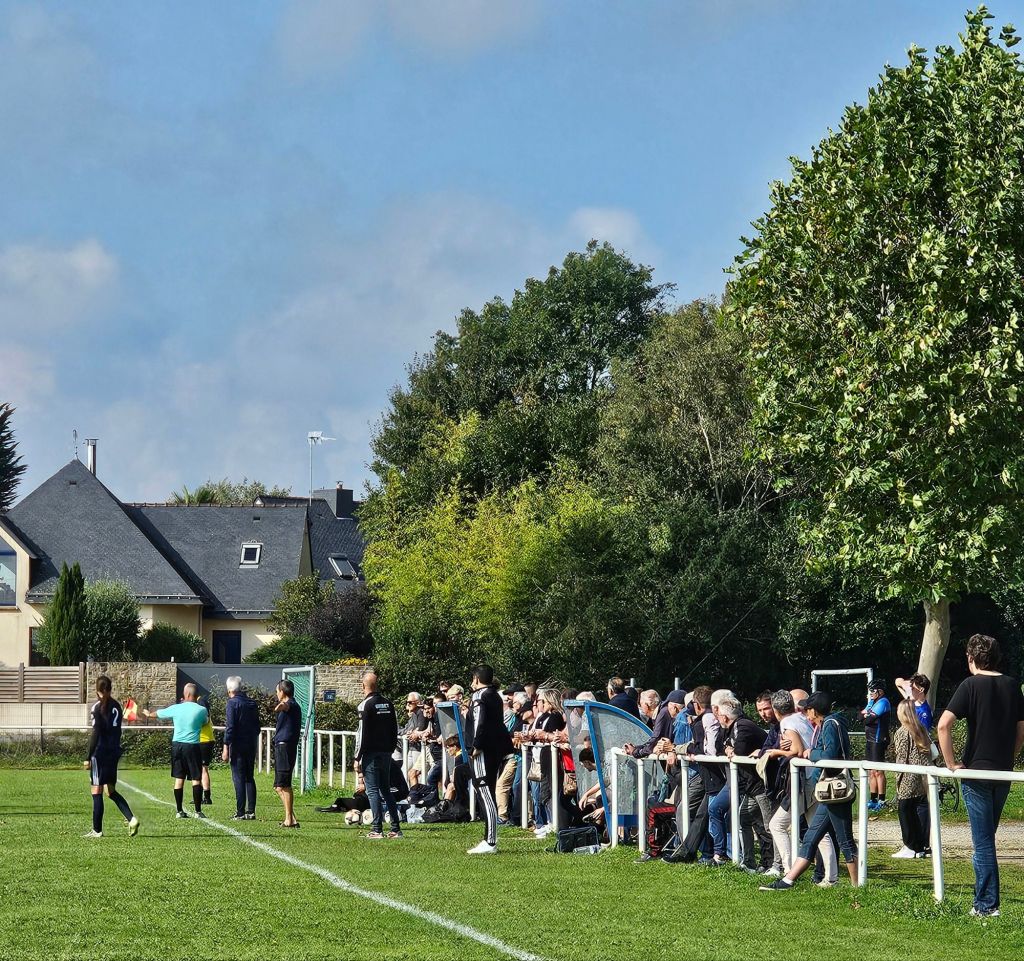
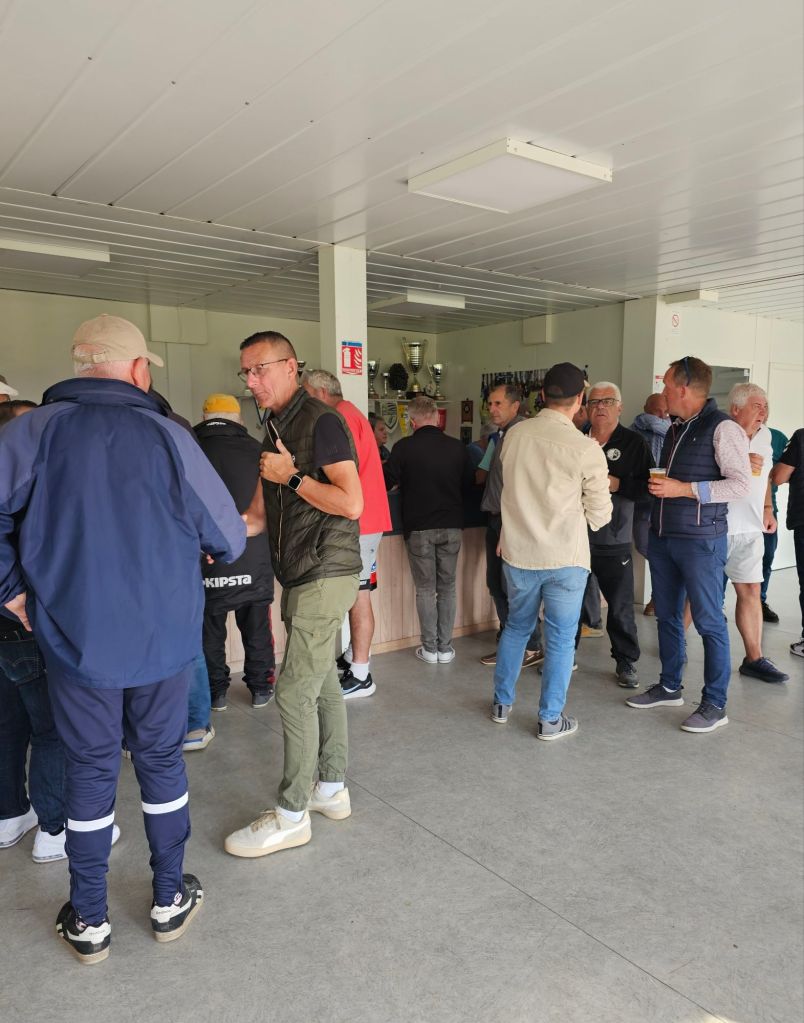
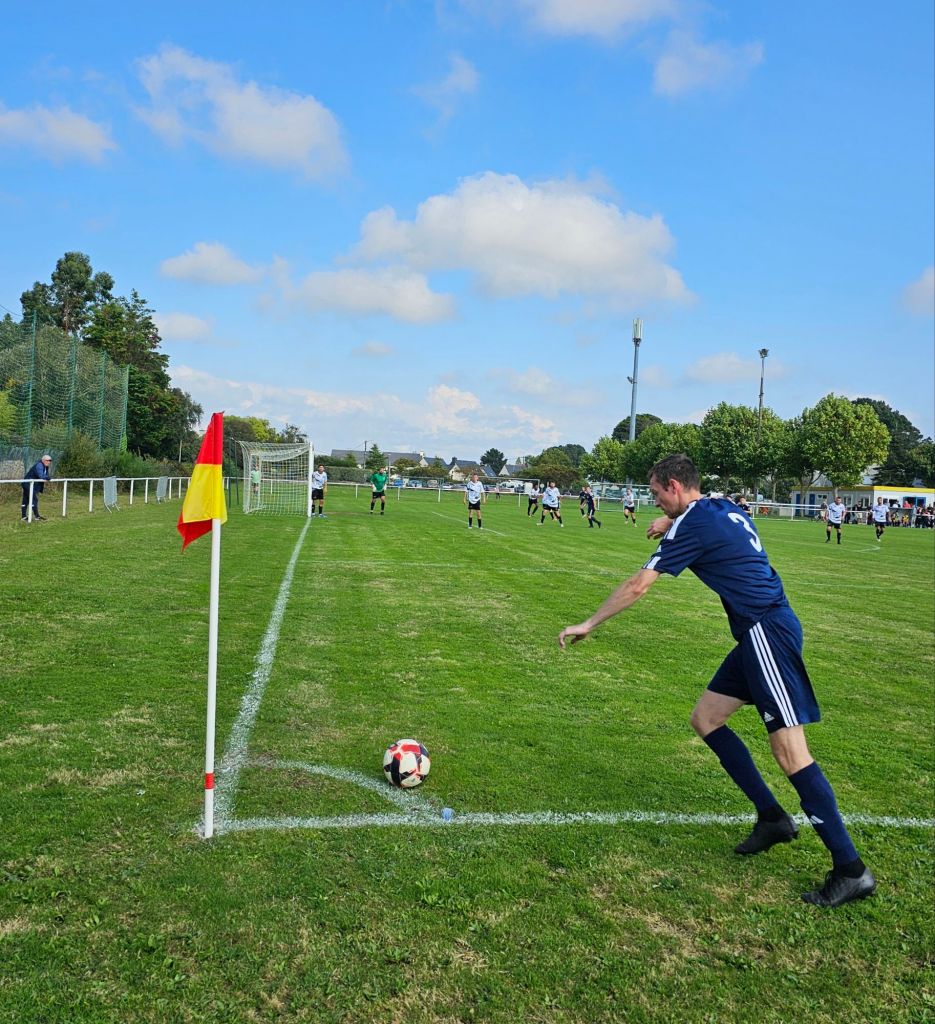
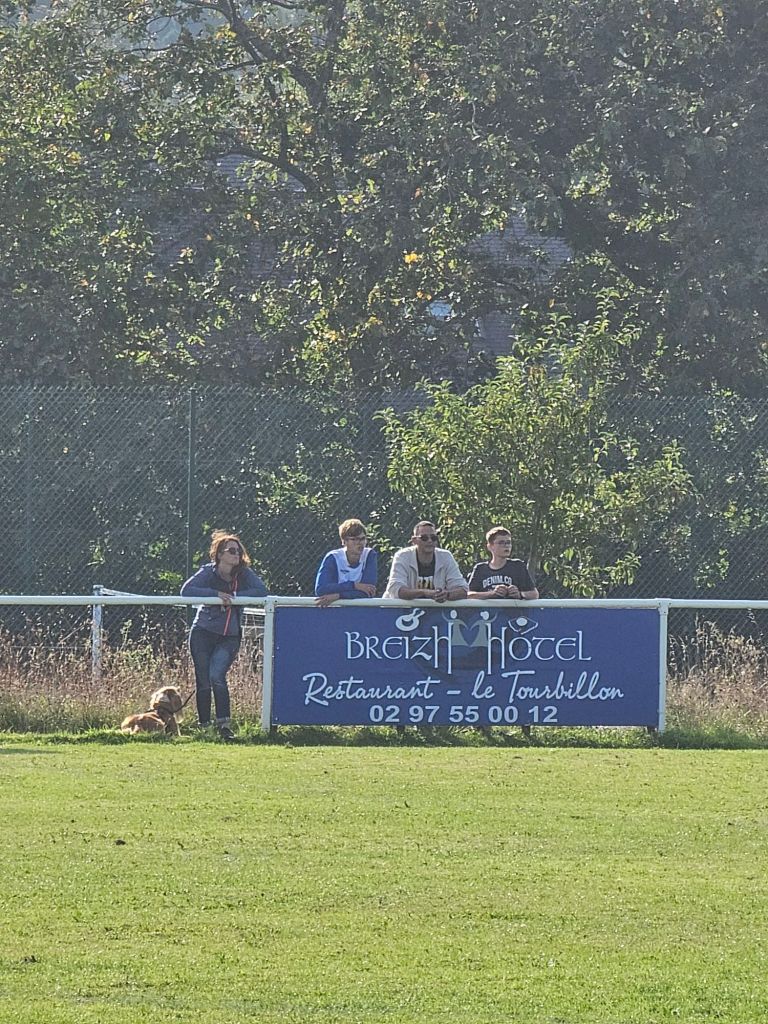
The Parc des Sports Kermouroux has no stands or floodlights, just a neat white rail all around the pitch, a couple of dugouts and a clubhouse.  The site is surrounded by houses, but on the far side of the pitch is also a playground and what looks like judiciously mowed, planted wildlife area.  The majority of the crowd lean on the rail in front of the clubhouse, inside which a couple of middle-aged women are doing a good trade in beer.  Wine and coffee are also available. 

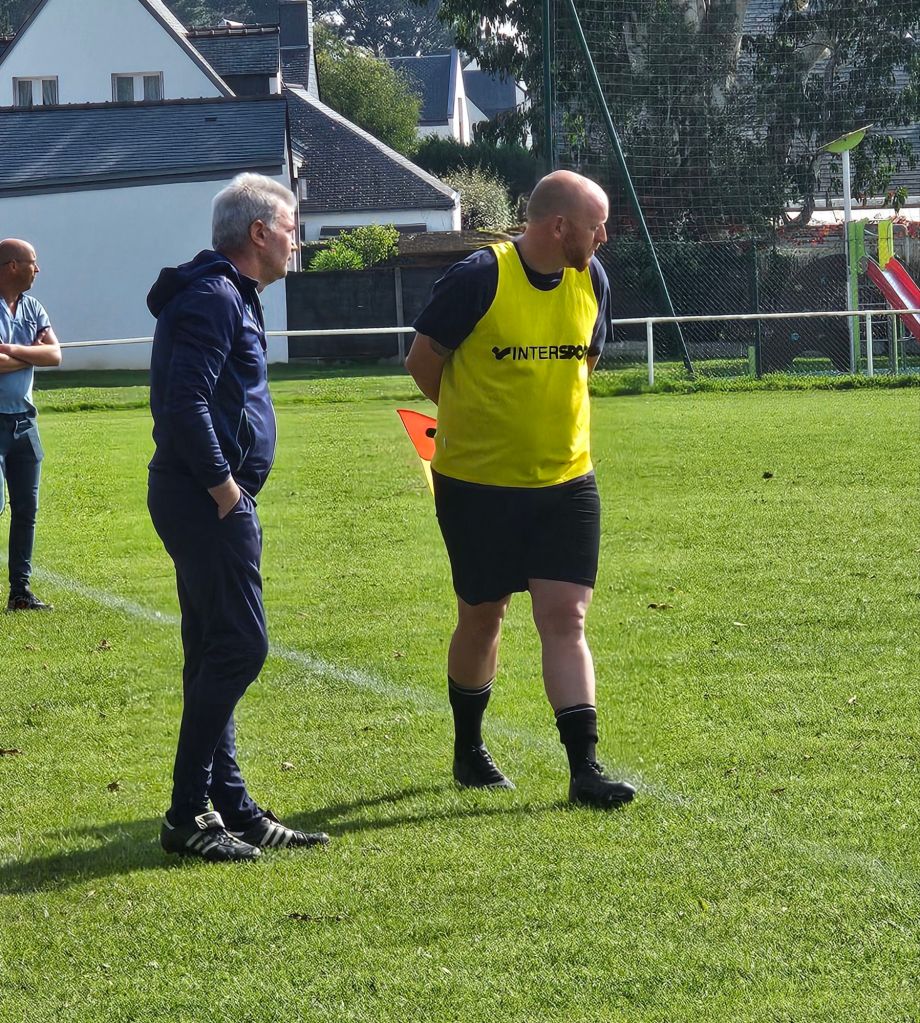
We miss the actual kick off, or coupe d’envoi as the French call it, as we find a decent spot against the rail, but we are paying attention when at eighteen minutes to four the Megalithes’ number nine bustles his way through the Riantec defence, checks and turns a couple of times and then boots the ball beyond the Riantec goalkeeper and into the goal.   Two minutes later he repeats the dose, running beyond the back four and a sluggish linesman to score from about six yards out.    The linesman doesn’t really seem to have grasped what his role is yet, but to be fair to him it does look like he didn’t expect to be linesman when he turned up, as he is wearing a day-glo yellow tabard rather than the standard officials’ uniform that the referee and the other linesman are wearing. As for the teams and their apparel, Megalithes are smart all in navy blue with white trim, whilst Riantec are less so in a messy looking combination of baggy white shirts and with streaks on,  and black shorts.

After two goals in the first five minutes, the arrival of the first corner of the match at seven minutes to four leaves everyone somewhat non-plussed.  This is even more the case when a minute later a punt forward for Riantec is met with another hopeful punt-cum-shot from their number ten and the ball sails into the top corner of the Megalithes’ net to make the score 2-1, against the run of play.  Although the goal adds to the excitement and sense of jeopardy, which I believe is what football matches are all about, I can’t help but feel a bit disappointed because Megalithes are by far the better team.

Megalithes continue to dominate the match and pass the ball well but seem unwilling to score again, although their number nine keeps threatening to nip behind the Riantec defence just as he did twice before, but he never quite manages to get his shot into the net.  Without more goals to concentrate players’ minds on keeping up to date with the score, a combination of fouls and outlandish acting creeps into the game, with more than one player letting out blood curdling screams as he collapses to the ground as if the subject of some sort of unexpected, attempted human sacrifice.

The gnarled looking, but neatly coiffured, grey-haired referee is totally in control of the shenanigans, looking down deeply unimpressed at the writhing players, whilst politely but firmly dealing with the perpetrators of genuine fouls. “S’il-vous plait Monsieur” he says politely but wearily as he beckons over the perpetrator of a foul to instruct him as to his future conduct.  In the first instance Rianec’s number eight is merely spoken to, but then Carnac’s number ten, a lithe youth with curly hair a la Adrien Rabiot, is booked after being summoned with the ominous words “Numero dix, s’il vous plait”

Half-time comes as a relief after the frustration of FC Megalithes not scoring the goals they deserve and all that falling about and screaming.  I head for the club house as the players make for the dressing rooms and am quickly acquiring two cups of coffee (one euro each), which are served from a filter coffee machine; none of your instant muck here. Paulene and I find a better position by the rail as almost everyone else heads indoors for more beer, and we nick their ‘spots’.

It is nineteen minutes to four when play resumes and within moments Megalithes number nine is centring a low cross, which number three easily and mournfully taps wide of the goal having arrived in position perfectly on time and completely unseen by the opposition.  The second half is twelve minutes old when Megalithes’ number nine elicits a fine save from the Riantec ‘keeper at the expense of a corner and then the scenario repeats itself.  Megalithes continue to dominate the second half as they had the first and the mystery of how they fail to score more goals continues every bit as mysteriously as the question of why the neolithic locals erected all these megaliths in the first place.

It is a quarter past five when Riantec win a corner and I can’t help thinking to myself that this is the first corner the away team has won, and it has taken them almost an hour and a quarter to do so.  Normal service is resumed however just two minutes later as Megalithes’ number twelve beats the offside ‘trap’, takes the ball around the Riantec goalkeeper and then places it precisely into the side netting of the goal.  A minute later Megalithes number two, a beautifully skilful player, repeats the process, taking the ball around the goalkeeper, but doing so without the necessary speed to get the ball into the goal before two defenders get back and combine to clear the goal bound ball.

Finally, and fittingly, in the final minute of the game, Megalithes place the ball in the Riantec goal to make the score justifiably, although sadly only temporarily 3-1, as almost inevitably the linesman raises his flag to declare it hors-jeu, offside, which it rather blatantly was.

The final whistle brings relief to both teams as the home side finally confirm their narrow win, and the away team gain respite from the footballing lesson they have been given.  The sun has now begun to sink low in the sky and a cool breeze has spoiled what was an almost balmy autumn afternoon for a while.  Pleasingly, the better team has won and whilst not winning by as many goals as they should have, a decent hour and a half’s entertainment has been provided by everyone involved. There is a palpable warmth and feeling of community amongst the crowd and as ever as we leave the ground and head happily  for our Citroen to make the short drive back to Carnac, our experience of French amateur football has been a pleasant and uplifting one.  Vive le Foot!

Stade Malherbe Caen 1 AC Ajaccio 0

When travelling, in no real hurry, the 670 kilometres from Calais to Carnac in Brittany, the fine city of Caen is the perfect place to break the journey in two, particularly if SM Caen are playing at home.  So it is that I find myself with my wife Paulene on a Friday evening stood at the Bellivet bus stop in the centre of Caen, waiting for the free shuttle bus (navette) out to the Stade Michel d’Ornano in the suburbs of the city.  The bus is due at seven o’clock, but it’s barely six forty-five yet; we weren’t sure how long it would take to walk from our hotel on the Quai de Plaisance, not long it turns out.

We stand on the pavement outside the bus shelter, which is well populated with people who don’t look like they’re going to a football match, but then, the stop is served by several other bus routes. A man in his early thirties turns to us and asks if this is the stop for the navette (I think he must have deduced from the Ipswich Town badge on my T-shirt that we are football fans).  We tell him that’s what it says on the football club website, and we believe it.   The man is from Caen but has never used the navette before; he is going to the match with a friend who is also Caennais, but has lived in Paris and has never even been to any game before; they are taking the bus so they can have a drink before and after the game., which seems to be the main point of the exercise. The man who has lived in Paris reveals that when he was a teenager, he stayed in Ipswich on a student exchange scheme; they were good times he says, even though he never made it to Portman Road.

Time passes.  Seven o’clock passes. Several buses stop, passengers alight and others get on.  A ramp slides out from under one bus and a woman in a powered wheelchair backs along it onto the pavement.  “Oi Ipswich, my friend here is a Norwich fan” says a rich Welsh voice. “No I’m not, I’m from Cardiff” says the tall grey-haired man standing next to me.  “Have you got your match tickets?” asks the first Welshman.  “Yes” I tell him “But I don’t reckon you’ll need them for the bus, the driver isn’t going to want to check everyone has got one.”  The first Welshman asks if we had been to the ground earlier to buy them, but we tell him we bought them on-line.  “See, I told you we could have got them on-line” says Welshman number two to Welshman number one. “Well, I looked” says Welshman number one, “But it was all in French.”

We talk some more and tell the Welshmen how we were in Cardiff last year to see Haverfordwest (Hwlfordd in Welsh) play their two European Conference League qualifiers. They ask why, and I tell them I was born in Haverfordwest. “You’re Welsh then” they say.  Welshman number two then tells us he’s obsessed with going to new football grounds and after asking us to guess how many he’s been to, he reveals that he’s visited over seven-hundred.   It’s about a quarter past seven now, and an articulated single-deck bus hoves into view bearing the destination “Allez le SM Caen”, At last, it’s the navette, and about forty of us pile on before the bus lurches and twists off up the street, past William the Conqueror’s castle and on past the eleventh century l’Abbeye aux hommes, the Hotel de ville, and the palais de justice all of which miraculously survived allied bombing in World War Two.  On the bus ploughs, on a stop start journey past the more recently built palais des sports, and through the heavy traffic heading for the Caen international fair (Foire International de Caen), which begins tonight.

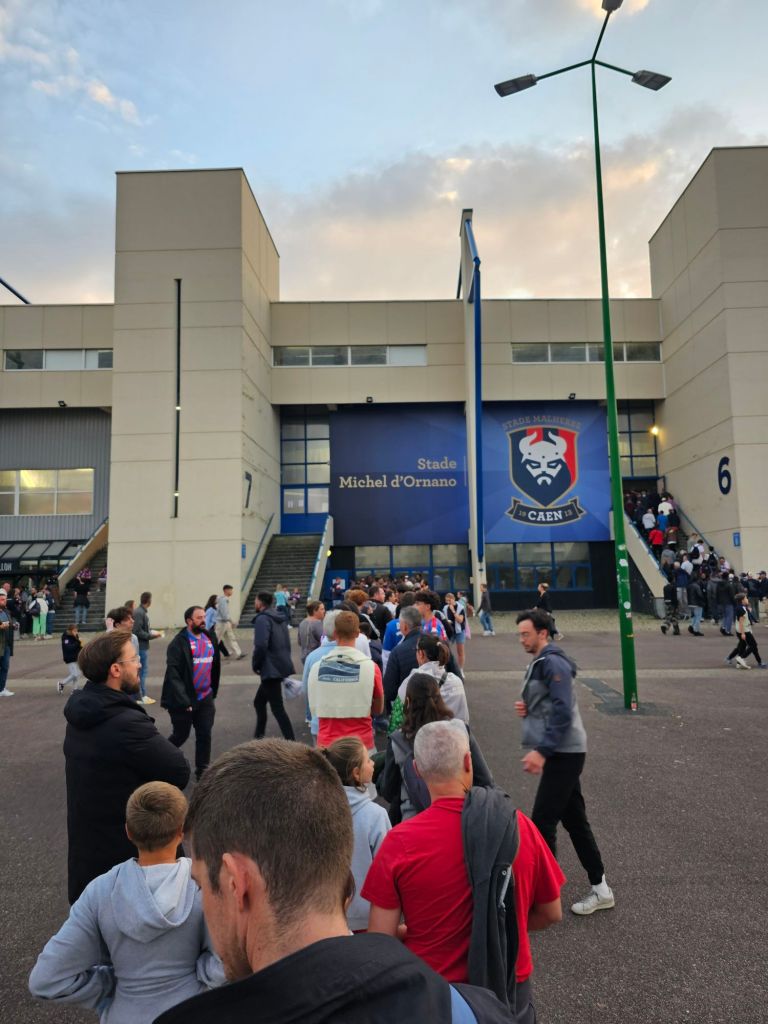
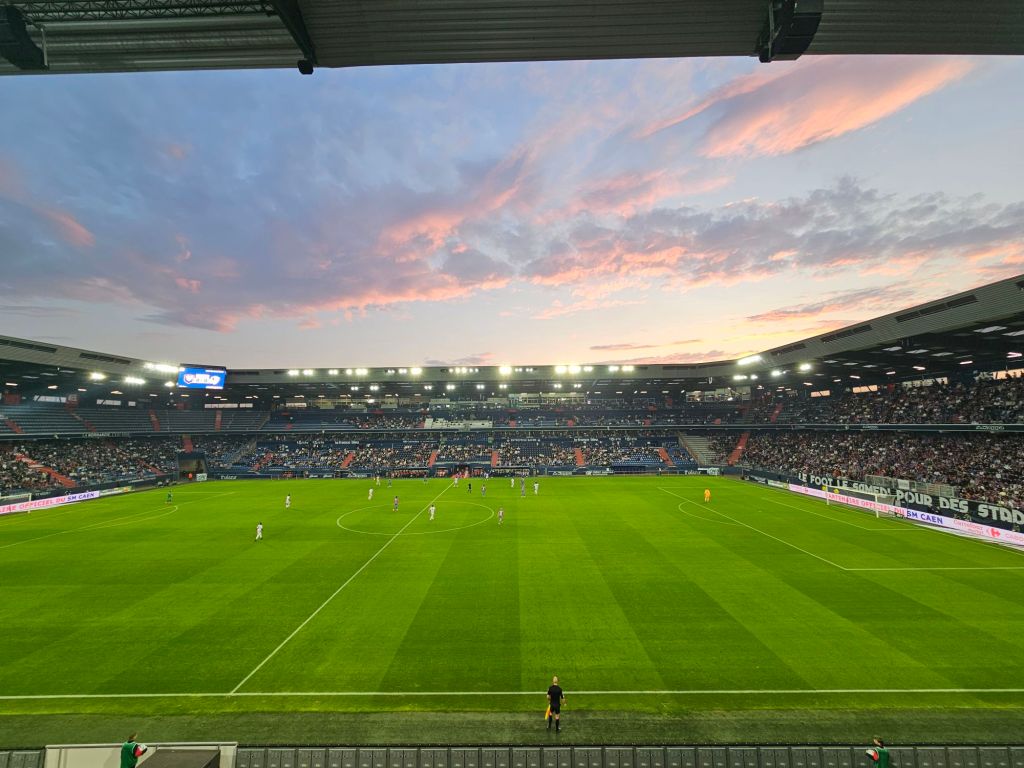
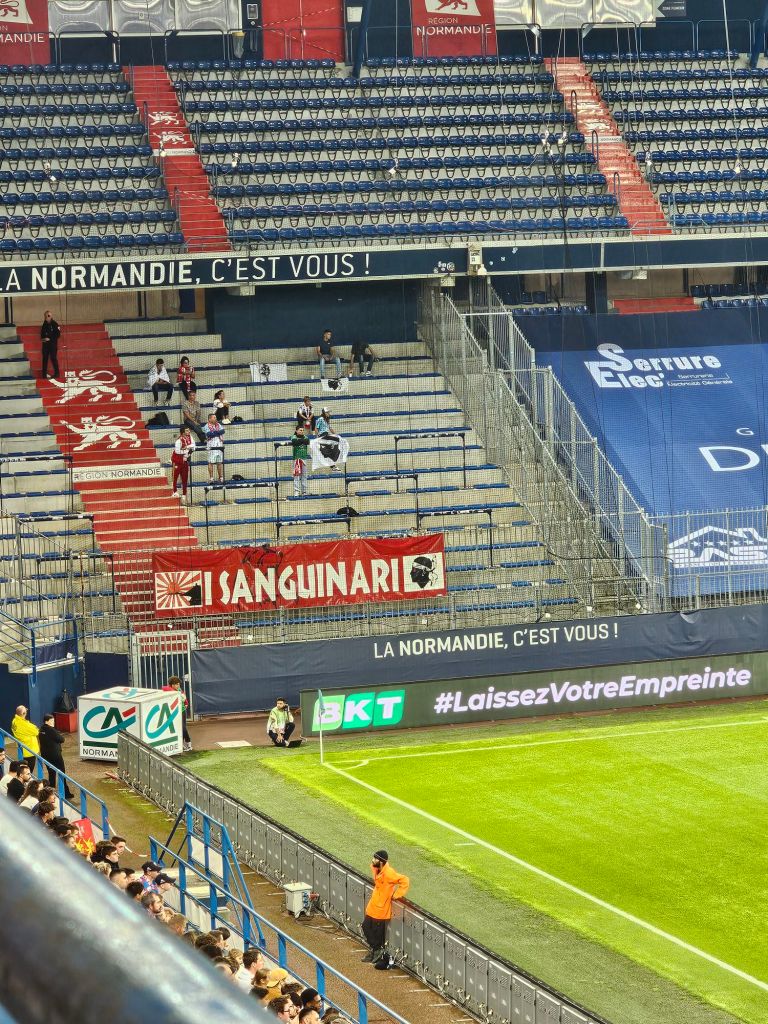
It’s gone twenty to eight by the time the bus disgorges its load at the oddly named  ‘Silicon Valley’ bus stop, directly opposite the Stade d’Onano, and Paulene and I head for the club shop to add to the pointless collections of cuddly club mascots, fridge magnets and T-shirts that clutter up our home back in blighty, although I do wear the T-shirts.   After then joining a queue for Gate 7, six flights of stairs take us to the top of the Tribune Caen from where we have to descend the steep gangway to our seats (24 euros each) in the front row of the top tier of the stand.  Within moments of our sitting down the game begins, tonight’s visiting team AC Ajaccio from Corsica getting first go with the ball, which they succeed in keeping to themselves for much of the first minute of the game. Ajaccio are wearing red and white striped shirts with white shorts, reminiscent of Stoke City and Signal toothpaste.  Caen meanwhile are kitted out in blue shorts and blue and red striped shirts, but the stripes are wavy, reminding me of the sleeve of the Cosmic Roughriders LP ‘Enjoy the Melodic Sunshine’.  Caen are kicking from right to left, back towards the city centre, whilst Ajaccio are aiming more in the direction of the Bayeux tapestry.

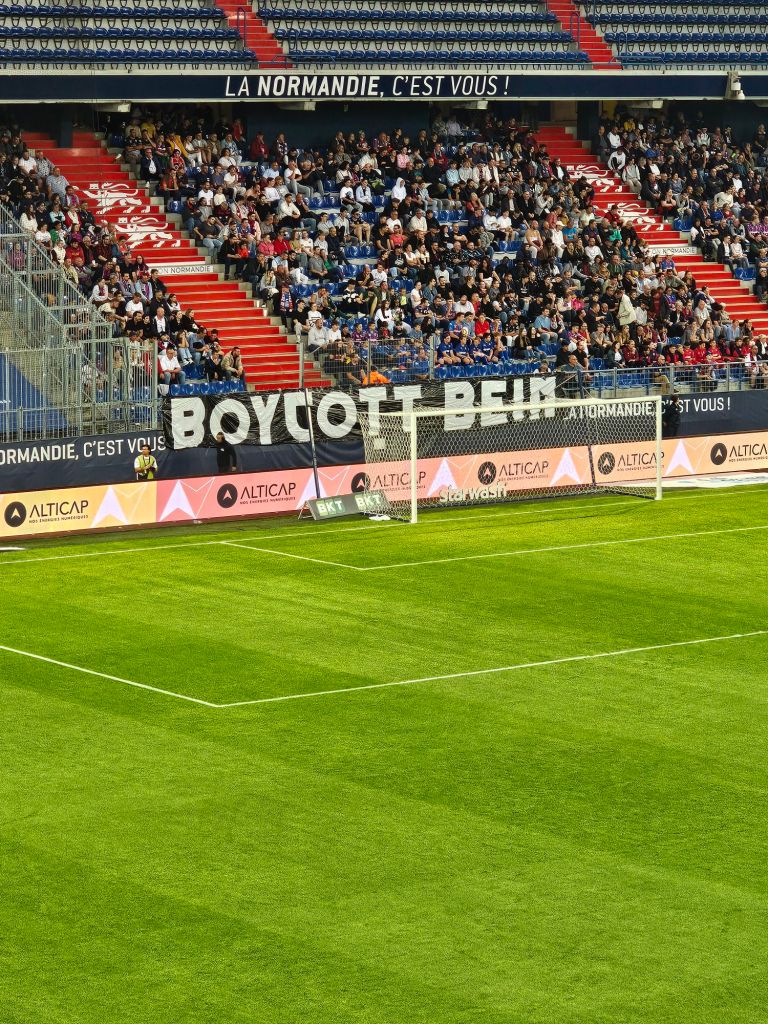
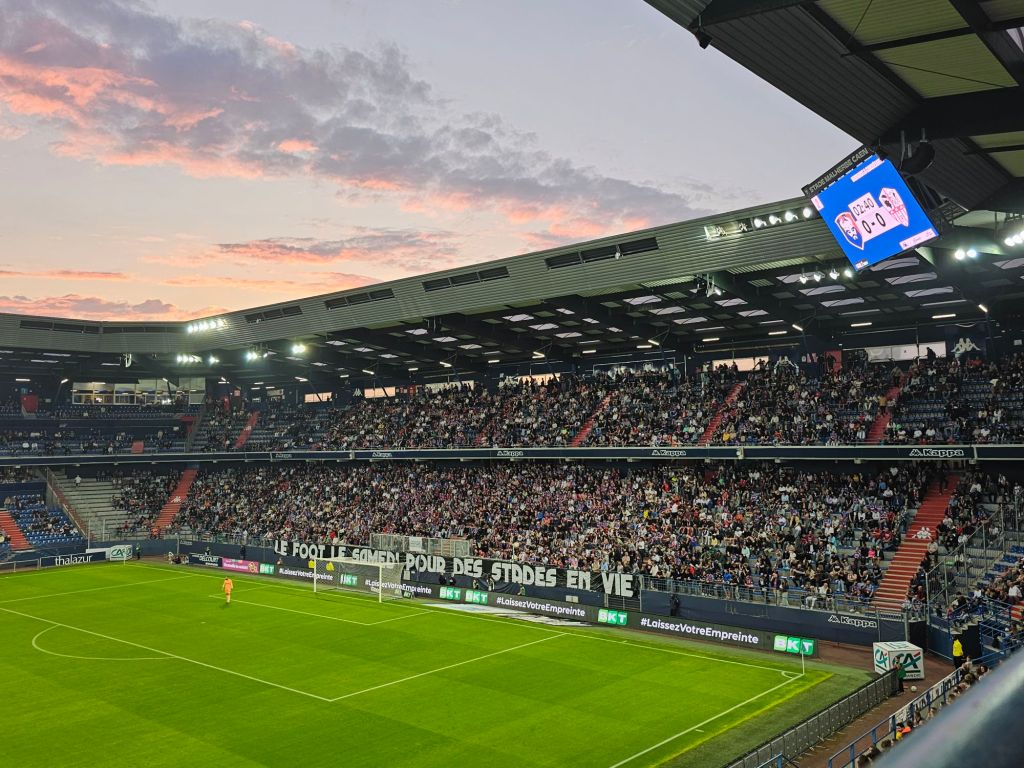
Unexpectedly, the ground seems very quiet as the game begins, possibly because in four matches in Ligue 2 so far this season, Caen have not won, only succeeding in losing three times.  Whenever a Caen player crosses into the opposition half however, I think I can hear a muffled murmurs of “Allez, allez, allez” all around me, and when Caen win an early corner rhythmic clapping breaks out.  With not much happening I take the opportunity to visit the buvette back at the top of the stand where I buy a bottle of water (2 euros) and a merguez sandwich (6 euros).  I return to my seat in time to witness a twelfth minute shot from a Caen player strike the Ajaccio cross bar. Before three minutes later a blizzard of paper planes rain down on to the pitch from behind the Ajaccio goal, possibly as part of the ongoing protest against Ligue 2 matches being moved to Friday nights this season at the behest of Bein Sports tv.  Banners behind the goals read “Le foot le Samedi pour des stades en vie” (Football on Saturdays for lively stadiums) and “Boycott Bein”.

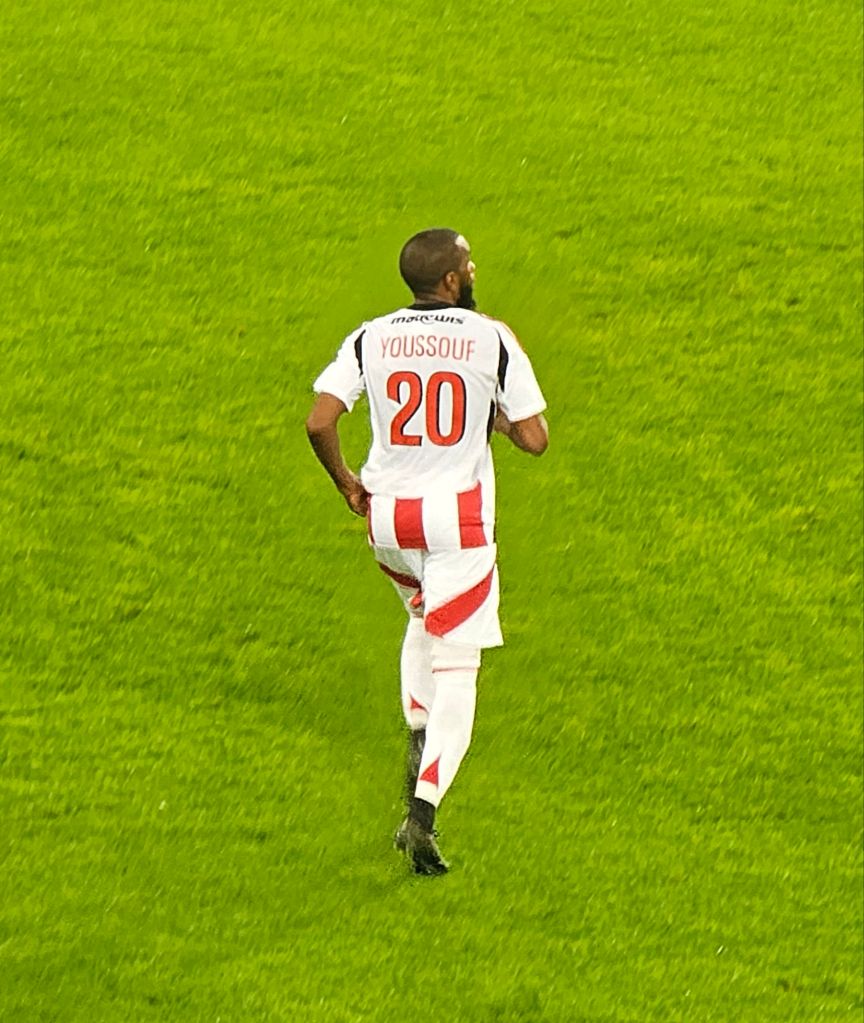
To our left, I count thirteen Ajaccio supporters in their enclosure behind the goal and I think of the Last Supper, before noticing that the Ajaccio number twenty Mohamed Youssef is so short that his socks meet his shorts, creating the effect that he is wearing puttees.  The first half is half over as Caen build a move down the left before wasting all the effort with a shot over the crossbar.  Nine minutes later Caen’s number seven flicks the ball up inside the penalty area before crashing a spectacular volley directly at the Ajaccio goalkeeper, who is in two shades of green.

The game is one-sided with Caen monopolising possession and attempts on goal until six minutes before half-time when Ajaccio have their first shot at goal, a curling effort from number 99, which nevertheless curls straight into the arms of the Caen goalkeeper who admittedly is not easy to miss because he is all in orange.  The first booking of the game follows soon afterwards when Ajaccio’s number thirty-one chooses to tug at the Caen number nineteen’s shoulder rather than attempt to tackle him in the conventional manner.  Two minutes of added on time are added on, to little effect, and at half-time the score remains blank. In a sense therefore, Ajaccio are winning.

Paulene and I move seat during the break because I have been having to duck my head whenever the ball has been in the Caen half due to a large, blue, metal safety rail at the foot of the steps, which extends in front of my seat.  The half-time break passes with people trying to kick a ball into a box for money, and two teams of children in red and blue kit taking a shoot-out competition. The red children all seem about twice the size of the blues and predictably they win, although the only girl in the competition is a blue and she scores her goal.

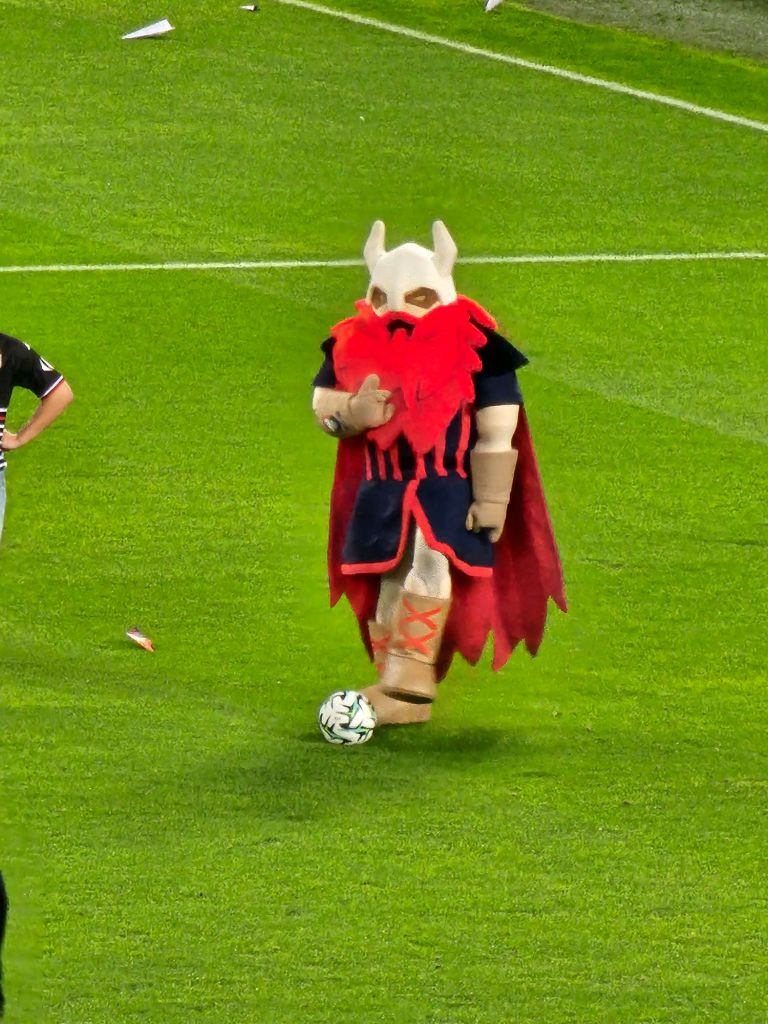
Now, with a clear view of the whole pitch we see the game re-start at nine o’clock and suddenly the stadium is full of enthusiasm and chanting. For no apparent reason the home supporters are singing “Allez, Allez, Allez” to Verdi’s Triumphal March from his opera Aida.  The effect is almost instantaneous as a ball into the box results in claims for a penalty, albeit somewhat specious ones. But a corner satisfies the more realistic supporters, which leads to a shot and another corner and more urging chants of “Allez, Allez, Allez” as the Caen fans loudly live up to what one would expect of their mascot, Vik the Viking.

Only five minutes of the half have gone and now number seventeen Kyheremeh is shooting straight at the Ajaccio goalkeeper before number nineteen heads over the cross bar from a corner.  Sadly however, the score remains blank and for a while the game descends into a Keystone Cops style knockabout with players falling over and colliding with abandon.  Paulene and I begin to notice the advertisements around the ground for the likes of Entreprise Bacon, Calvados the departement or County, as opposed to Calvados the apple brandy, and the interestingly named Twisto, the local transport company who brought us here this evening in one of their articulated buses.  Off to our left, I can only count eleven Ajaccio fans now and wonder if two have had to leave early to catch a ferry, or whether they just gave up hope.

Only twenty-five minutes remain as Caen’s Kyeremeh is through on goal, but he chooses to run wide and cross low to the near post where the ball is saved at the expense of a corner.  “Allez, Allez, Allez” sing the home fans again, but this time to the tune of the Beatles’ Yellow Submarine, not Verdi.  Thirteen minutes remains and Caen’s number four has come on as a substitute only to quickly get booked as he struggles to influence the game.   Three minutes later however, comes the decisive moment. Caen’s number ten, Bilal Brahimi, who has been neat but nothing more for most of the game, suddenly has space outside the Ajaccio penalty area from where he unexpectedly launches a shot into the top right-hand corner of the Corsican goal; Caen lead one-nil.  “Bilal, Bilal” chant the Caen fans as his picture appears on the scoreboard and the stadium announcer tells us who scored.

Ajaccio have made little effort to score themselves and now they might have left it too late.  Ajaccio substitute number twenty-one Ivane Chegra is brought on to add flair by the look of his Marc Bolan style coiffure, and number twenty-two Moussa Soumano succeeds only in getting booked as the match rolls on into five minutes of added on time.  The added-on time is of no consequence however, and with the final whistle the relief for Caen’s supporters having won their first match of the season is plain to see.

With a bus to catch we don’t linger to join the ensuing love-in, and that bus is almost full and ready to leave as we board it.  Down the streets beyond stadium vivid, sudden flashes of light appear and soon there are spots of rain on the windows of the bus as it weaves its way through the post-match traffic.  By the time we reach the city centre a heavy downpour is drumming against the roof of the bus and the streets are awash.  With the bus windows steamed up and streaked with rain I have to ask a fellow passenger to tell me when we’re back at Bellivet bus stop.  It’s a dramatic end to the evening and an uncomfortably wet walk back to the hotel, but I don’t think we’ll forget our night in Caen.

Ipswich Town 1 Derby County 0

I have been in the office, where I now work just one day a week, since eight o’clock this morning and it’s now half past four in the afternoon.  I have wasted enough of my day just existing and accumulating the means to continue my shallow, feckless Western lifestyle, now it’s time to live and be shallow and feckless.  I check my mobile telephone. At 16:12 I received a message from Pat from Clacton. Pat tells me she was joking last week when she told me she would not be at the match tonight, but then proceeds to tell me she won’t be at the match tonight.  Pat says she’s still suffering the after-effects of Covid, which apparently includes heavy breathing. As much as watching a football match with a 1968 vintage Jane Birkin appeals to me, it’s probably best for Pat that she stays in Clacton tonight.  The good news however is that Pat won £51.25 playing whist whilst on holiday in Great Yarmouth, but the real point of the message, I think, is to ask me to photograph ever-present Phil who never misses a game when he celebrates Town having scored a goal.  Pat from Clacton always photographs ever-present Phil when he celebrates a Town goal at Portman Road, it’s a ritual like a state funeral or pancakes on Shrove Tuesday.

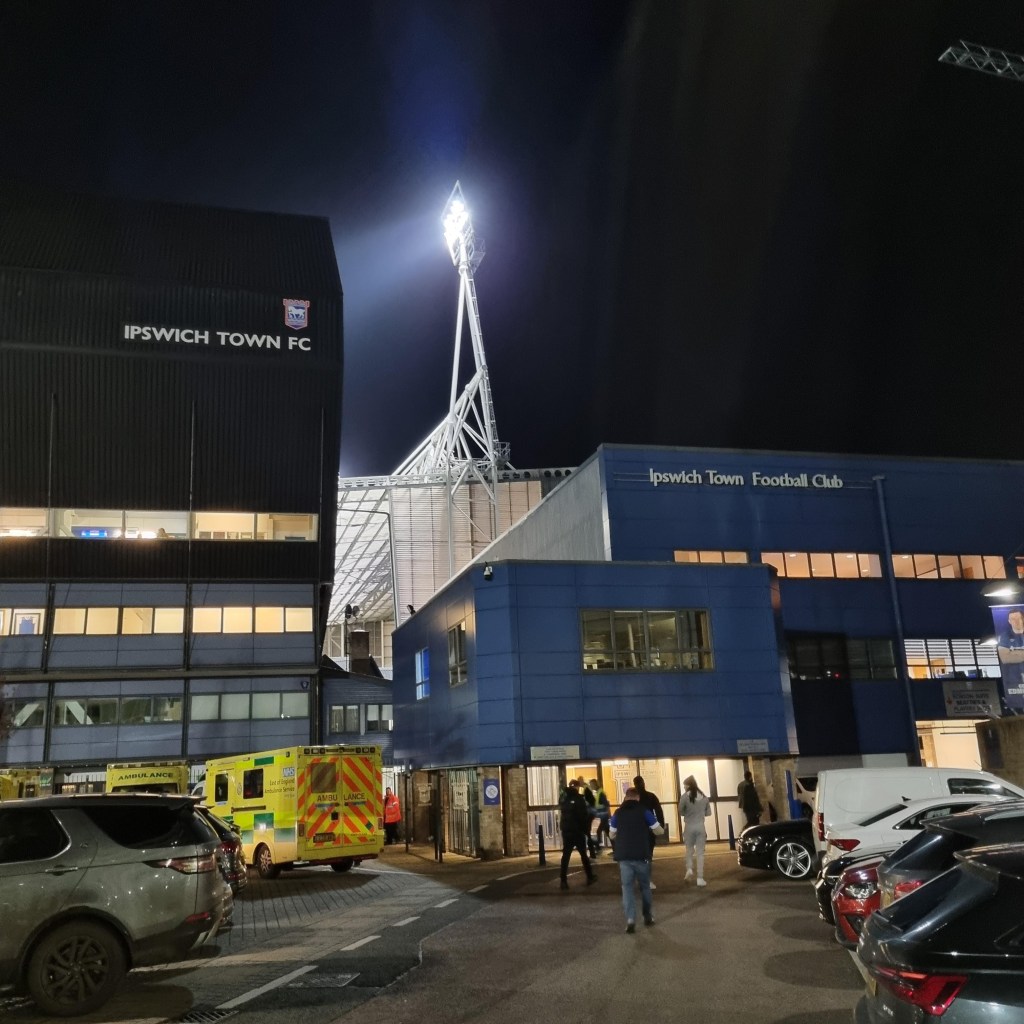
Tonight, Town are playing Derby County in a third division fixture, something that has never ever happened before in this universe, like Boris Johnson telling the truth.  If casually asked how many times I had seen Derby County play I would have guessed at a mere fifteen or sixteen. In fact, I have discovered that Derby County are one of twenty professional clubs I’ve seen play over thirty times.  Despite two League Championships, Brian Clough and Robert Maxwell, Derby County have seemingly made little impression on me, perhaps because of their anonymous monochrome kit or their uninteresting out of town stadium which has meant I know little of Derby itself. What is Derby famous for? Rolls Royce engines and East Midlands airport?  Still without answers to these questions time passes and a little short of two hours after receiving Pat from Clacton’s text message I walk through the front door of the Arbor House formerly the Arboretum pub; it’s heaving with Friday night revellers. I order a pint of Mauldon’s Suffolk Pride (£4.00) and a Scotch egg (£4.50) and retire to the beer garden to wait for my Scotch egg and the arrival of Mick.  As the evening light recedes into darkness I struggle to read the programme (£3.50) I had bought earlier in the club shop after I left work, but this is partly because the programme is hopelessly dull too, despite its rainbow colours on the front page, which also features an un-flattering cartoon image of George Edmundson in which he looks uncannily like Kryten from the BBC TV comedy series Red Dwarf.

By the time Mick arrives I’ve eaten my Scotch egg and am amusing myself with a private mobile phone-based exhibition of the photos from my holiday in Brittany whilst unavoidably hearing the conversation of the middle-aged couples on the next table which concerns whether they would go to a concert by Ed Sheeran at Portman Road. The consensus seems to be that they would go “just to say they’d seen him”.   It seems to me a bit like flushing a couple of fifty-pound notes down the khasi.  Over by the window to the gents’ toilet two old boys, possibly on their way to, or from, a ‘Tarts and Tramps’ fancy dress party shuffle in, one wears a floppy hat and talks loudly about the range of beers at the Moon and Mushroom pub in Swilland, whilst the other sounds like he’s growling.

When Mick arrives he buys us both pints of Mauldon’s Suffolk Pride plus a packet of Fairfield Farms cheese and onion flavour crisps, which pleasingly have only travelled from Wormingford near Colchester, some 33 kilometres away.  Our conversation this evening is punctuated with laughter as we discuss burials and the disposal of people’s ashes and how people seem to have become strangely sentimental lately.  With kick-off not until 8 o’clock this evening, courtesy of Sky TV’s broadcasting schedule, we have more time than usual to laugh about such things and don’t notice everyone else leaving for the match and it’s closer to kick-off than usual when we eventually leave, making a sharp exit through the back gate.

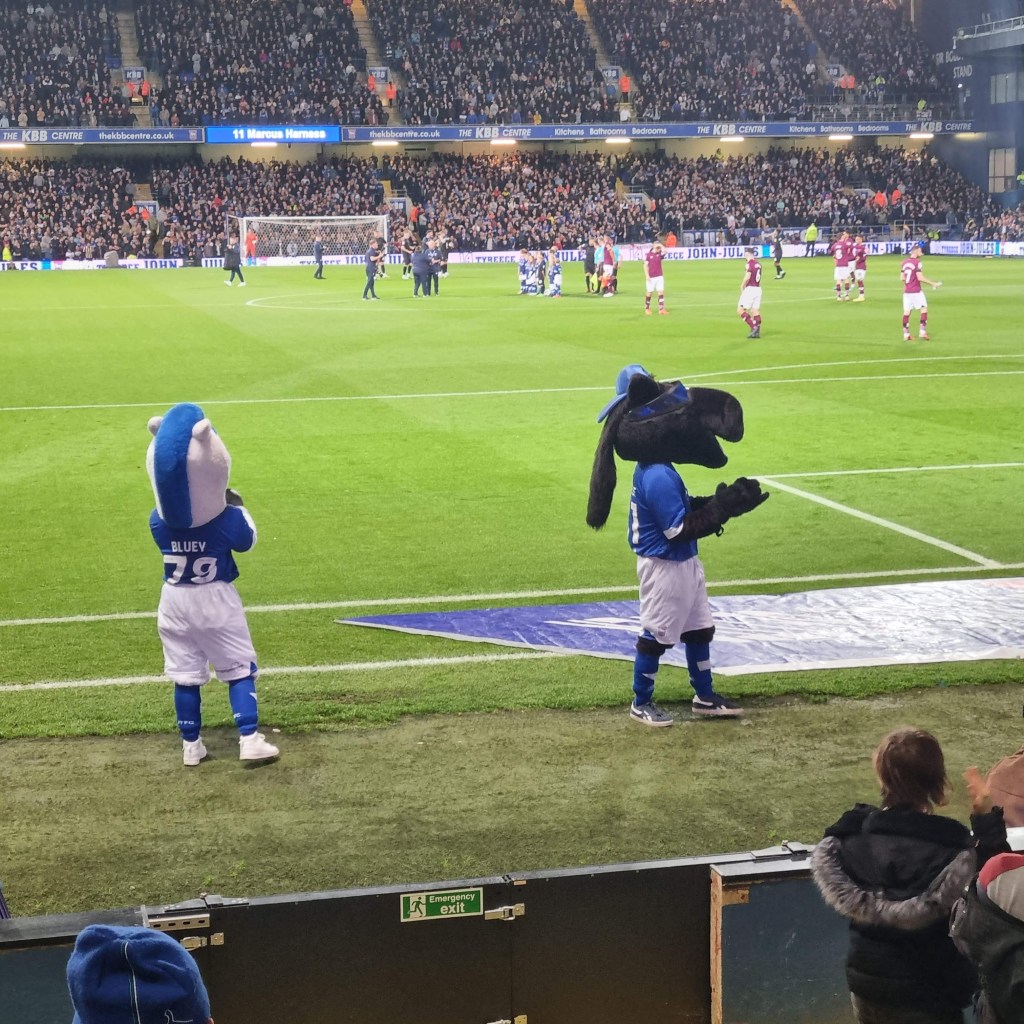
Portman Road and Sir Alf Ramsey Way are less busy than usual when we arrive because most people are already inside the ground.  As I hasten through the turnstiles, I can hear former BBC Radio Suffolk presenter Stephen Foster ‘giving it large’ as he reads out the team line-ups in his archetypal radio DJ manner; he sounds even more Tony Blackburn than usual tonight, no doubt for the benefit of Sky TV. By the time I take my seat next but one to the man from Stowmarket, the teams are on the pitch, and the Town team are forming a collaborative huddle preparing to start the match.  It’s Town who get first go with the ball I think, I’m not really paying attention yet as I get to grips with seeing Ipswich wearing all black and Derby in maroon or burgundy shirts and white shorts.  I imagine Derby think they look exotic like AS Roma or Sparta Prague, but they remind me of Northampton Town.  As for the Ipswich team, they look like Johnny Cash, though I guess that’s preferable to looking like Ed Sheeran.

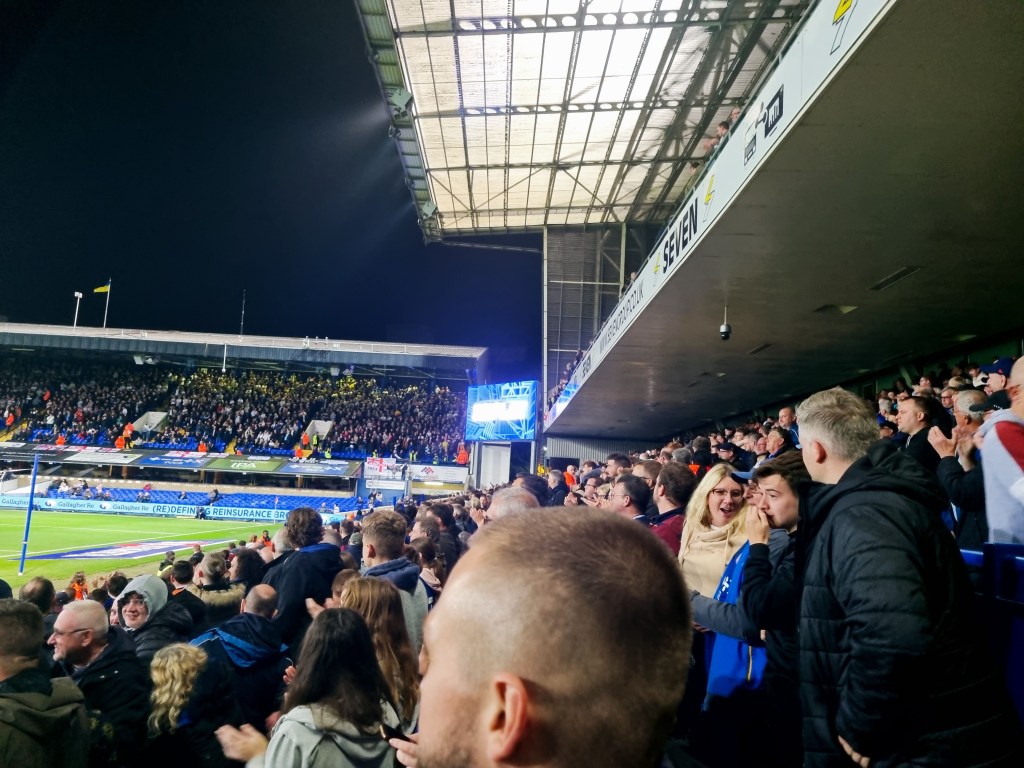
With the start of the game come the chants from both sets of supporters, Derby transporting us back to the 1970’s by repeating “Derby, Derby, Derby” over and over again to the tune of ‘Amazing Grace’, just like Town fans used to chant “Ipswich, Ipswich, Ipswich” in that run to the FA Cup semi-final in 1975, the year Derby last won what I believe is now called the Premier League.  “Score in a minute, we’re gonna score in a minute” continue the Derbeians less nostalgically but more optimistically.  “Addy, Addy, Addy-O” add the Town fans from what in 1975 was the North Stand, and there are even a few chants of the same from the top of what was the West Stand.  It’s a sign that the stadium must be as good as full to capacity.

 A young bloke with a beard sits himself down in Pat from Clacton’s seat. I give him a look like Paddington Bear. “Is this seat free” he asks a little nervously. “Well, there’s no one sitting there tonight” I tell him in a voice that’s as close as I can get to sounding like a Suffolk Johnny Cash.  He smiles broadly.  I think I’ve put him at his ease.  On the pitch the play is frenetic, with both teams trying to play neat, passing football but frequently interrupting one another. Sam Morsy is booked after just ten minutes for a foul on the wonderfully named Lewis Dobbin. Ipswich have more success at getting close to their opponents’ goal and win three early corners, George Edmundson heads wide and Tyreece John-Jules clearly dives in the penalty area having won a few free-kicks already elsewhere.  I thought it was an obvious dive; the way he had already established eye-contact with referee as he fell gave it away, a bit like a Labrador staring at you as you eat your dinner.  He should be told to leave any desire to cheat in North London where it belongs, or Kieran McKenna will write to his mum.

“Come on Dorby” comes the chant from the Cobbold Stand and I think I detect a hint of a Midlands accent. Soon the away support are riffing on a familiar theme,  “Football in a library, de-de-dur” is followed by “No noise from the Tractor Boys” and “Shall we sing a song for you” as the youth of Derby vainly goad the pensioners and families in the Sir Alf Ramsey Stand, who stoically wait for Town to take the lead before thinking about whether they might start to clap or break a smile.  But the ground has gone a little quiet, they’re right.

The half is half over and Derby equalise in the competition to see who can have most players booked as  the name of James Chester is recorded in referee Mr Swabey’s notebook.   The game is almost a third over before Derby win their first corner.  “Are you alright mate?” says the bloke behind me to his son, who answers “Yeah”.   My view of the pitch is temporarily blocked as the people in front all stand up to let pass someone, who I guess couldn’t wait thirteen minutes until half-time for a pee.  A chant of “Blue and White Army” builds quickly and then falls away just as soon.  I notice that Derby have no sponsor’s name on their shirts.  “Peter Sykes, please contact the nearest steward” announces the voice of Stephen Foster.  I look but can’t see anyone approaching their nearest steward. It’s not that the game isn’t holding my attention, it is, and it is unpredictable, but the goalkeepers could have made hammocks from their goal nets and it wouldn’t really have mattered.  Perhaps to relieve his own boredom, Derby ‘keeper Joe Wildsmith gestures wildly at the linesman for not flagging Kayden Jackson offside.  The linesman predictably ignores the wild Wildsmith,  but would probably secretly like to give him ‘the finger’.   The half ends with hopes of a goal as Town win a free-kick on the edge of the Derby penalty box.  Children at the front of the stand prepare to video the event with their mobile phones, but their youthful hope and enthusiasm is dashed as Lee Evans shot avoids the defensive wall but not Joe Wildsmith. Three minutes of added on time are announced with a flourish by Stephen Foster but bring forth nothing to justify his optimistic tones.

The half time break sees me join Ray, his grandson Harrison and Harrison’s dad Michael ‘down the front’ where I encourage Harrison to buy ‘Shufflemania’, the new LP by Robyn Hitchcock which is released today.  Ray regales me with a story about his dad who used to drive the Ipswich Town team bus in the 1960’s.  Ray’s dad was known as ‘The Cat’ by the Town players and he maintained that this was because he would play in goal in 6 or 7-a-side warm up games when only twelve or thirteen players would travel as there was only one substitute allowed, and before 1965 no substitutes at all.  Ray was to find out later from a Town player of the period that his dad wasn’t called ‘The Cat’ because of his goal keeping prowess, but because late one night, having returned from a distant away trip , he backed the bus off Constantine Road and over the club cat.

The second half begins with renewed vigour from Ipswich and Derby fans alike who both sing “Ole, Ole, Ole” as if vying with one another in some sort of choral competition.  The encouragement seemingly works and just seven minutes into the half we witness the first shot from open play that is worthy of the name as Marcus Harness conjures up a half-volley that is blocked.   It’s a symptom of Town now dominating possession and looking the team most likely to score.  In the Cobbold Stand the Derby fans sing a song which to my ears sounds as if it’s about a man, possibly called Michael, who found an octopus, but I doubt that’s right. “ We forgot that you were here” respond the Town fans in the old North Stand in a curious role reversal; I conclude that the half-time break can do funny things to people and to prove the point the Derby fans produce a chant which sounds like the theme from the Addams Family, but then it is nearly Hallowe’en.

The second half is a better ‘watch’ for home fans even if it is ‘all up the other end’ from my perspective in the Sir Alf Ramsey Stand. In the sixty-seventh minute it all gets much better still as Kayden Jackson breaks down the right, loses the ball but carries on running as the unsuspecting Derby defender decides on a back pass which is nothing more than a pass to Jackson who shoots on goal.  The ball hits the post but rebounds to Wes Burns who has plenty of time to hit the ball into the net and give Town a lead which they now probably deserve, and they haven’t even made any substitutions yet.  I remember to take ever-present Phil’s photo for Pat from Clacton as Phil and his son Elwood hold their arms aloft whilst grinning joyfully.  “E-i E-i E-i-o, Up the Football league we go” sing the Town fans, and not to be outdone the Derby fans sing the same before deciding that they would be better served by a chorus of the sneering “Sing when you’re winning, you only sing when you’re winning.”

Tonight’s attendance is announced by Stephen Foster as 28,415, with 1,777 of them being the people who have been shouting all evening about Derby and what poor supporters Ipswich fans are. Ipswich continue to be the better team however, and Kayden Jackson shoots the wrong side of the goal post, substitutions are made and with seven minutes left former Town player David McGoldrick tries to make amends for collecting much of his salary from Town whilst not actually playing, by kicking Wes Burns in the penalty area.  After pausing to decide if he should really give Ipswich a penalty, Mr Swabey points to the spot.  It seems he was right to pause for thought because sadly Town will waste the opportunity given to them.  “Jackson’s taking it! ” says the bloke behind me somewhat incredulously and his surprise proves well-founded as Kayden’s kick lacks both the pace and accuracy required unless the goalkeeper dives the wrong way.  Wildsmith dives the right way and the score remains 1-0. 

“Ken Rodwell, contact the nearest steward” announces Stephen Foster perhaps making up a surname laced with double entendre to help reduce the tension of the closing minutes as Derby win a rare corner.  Seven minutes of added on time are announced and at the first stoppage in play four Town players collapse to the ground.  I don’t think they’ve got the hang of this time-wasting thing, they’re surely meant to go down one at a time? 

Time moves on inexorably. “Got to be it” says the bloke behind me after what he thinks seven minutes feels like. “Got to be it” he says again a short while later and then again. “Got to be it, innit” he says before saying “Got to be” at least twice, and then inevitably it is it, the final whistle, and a tidal wave of relief floods from the stands, not because Derby had looked like scoring, but just because no one has any faith that Town can win a match that’s shown live on the telly, well they just did.