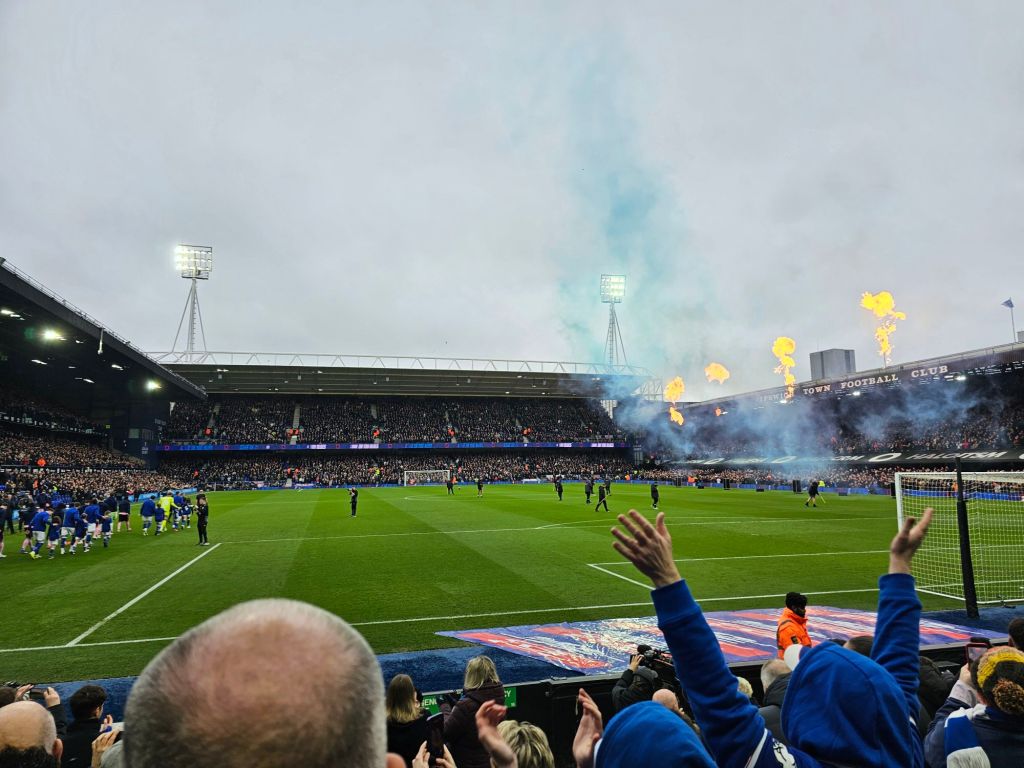
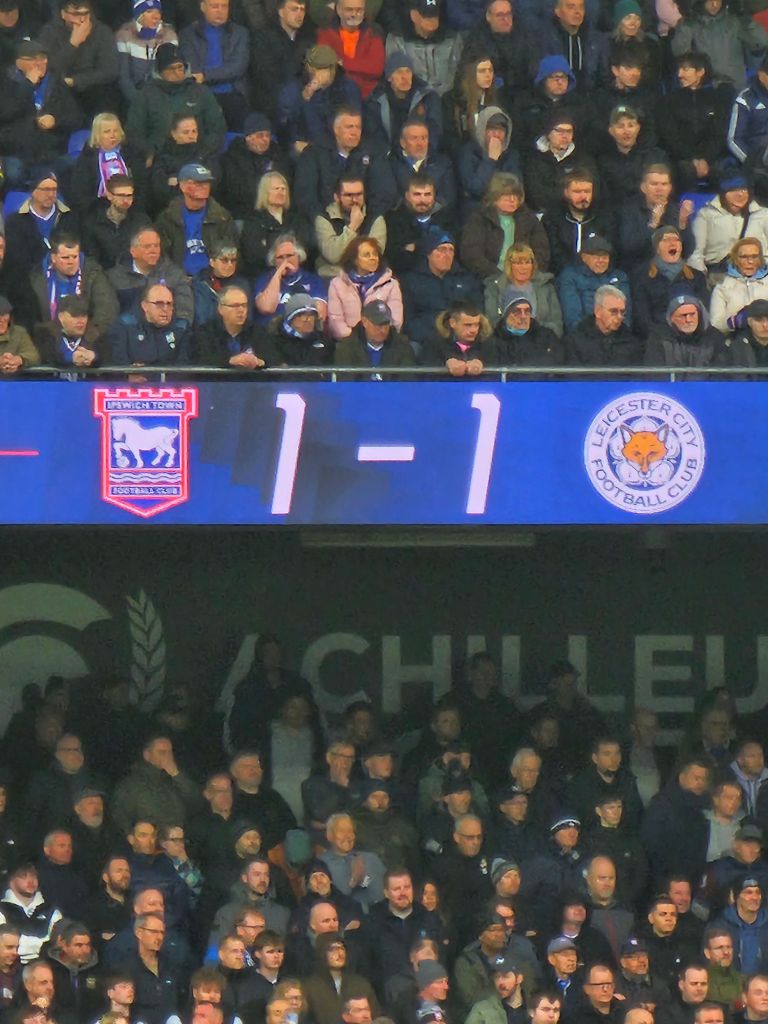
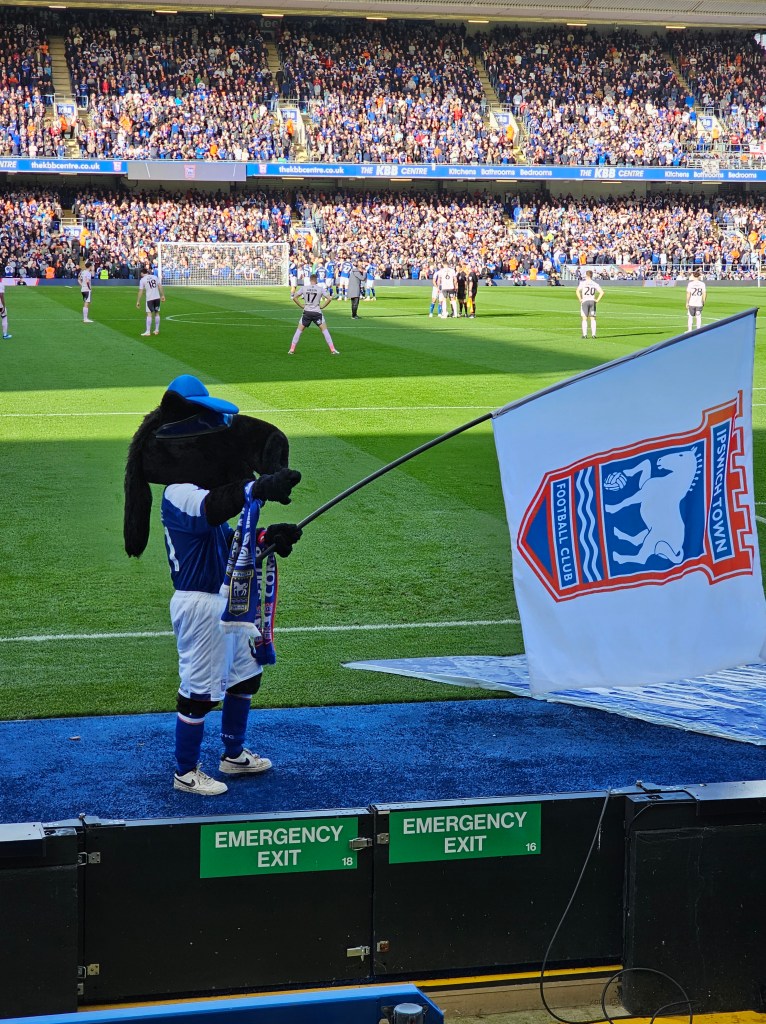
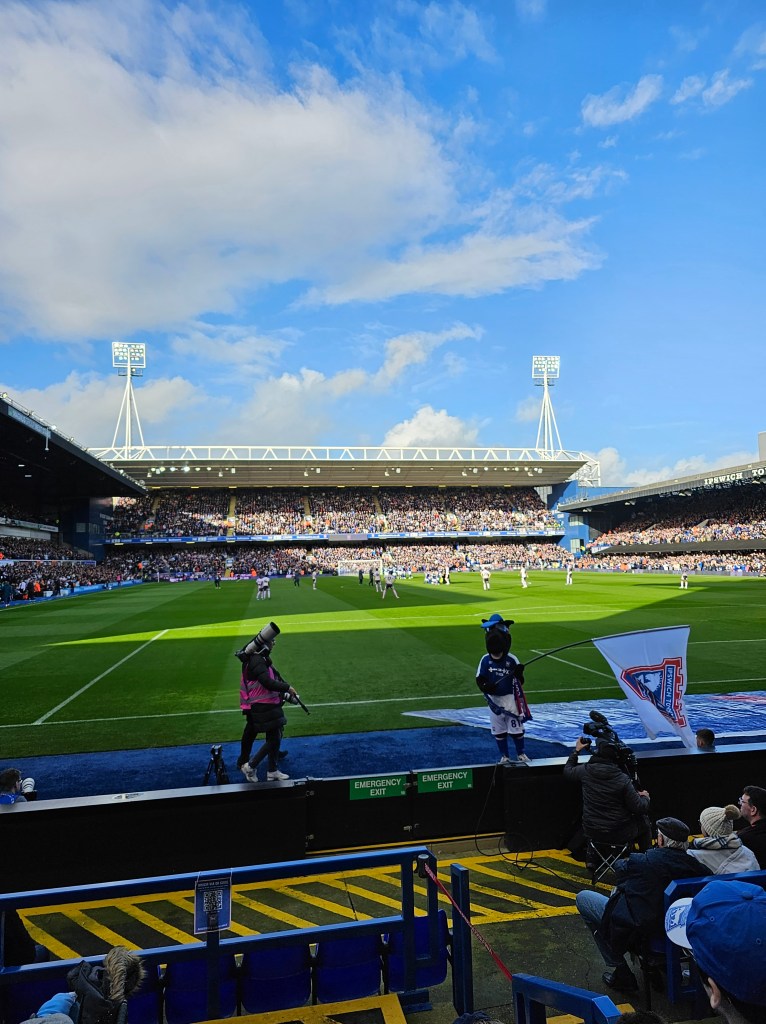
Ipswich Town 3 Plymouth Argyle 2

All of a sudden, summer turns to winter overnight, and it happens today, well tomorrow morning at 2 am to be precise, but as Brexit proved facts aren’t really important anymore.   Looking forward to another hour in bed or staying up late without really staying up late, I kiss my wife goodbye, step out of my front door and head for the railway station. The pale autumn sun shines down upon me.  As I cross the bridge over the railways tracks a man in pale grey trackie bottoms, pale grey sweatshirt and pale grey adidas baseball hat engages me in conversation about Ipswich Town’s remarkable start to the football season. Damn, he must have noticed my blue and white scarf, which I donned thinking the weather is cooler than it is.  I don’t really know what to say to him, I don’t talk about football if I can help it, but nothing surprises me in football anymore. After fifty-two years watching mostly  Ipswich Town, but with sizeable dollops of Colchester United, Brighton and Hove Albion and Wivenhoe Town, I’ve seen it all, haven’t I?

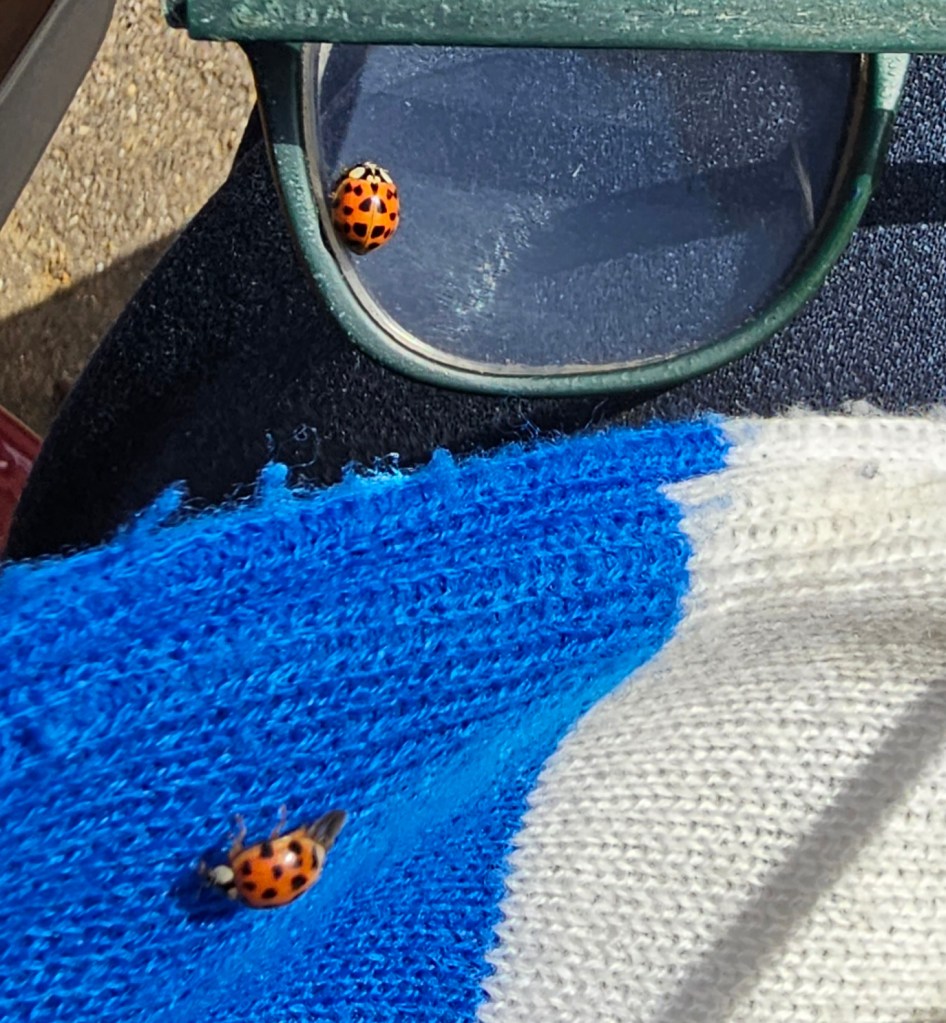
As I sit and wait for the train, which is a minute late, two ladybirds are also seemingly attracted by my blue and white scarf, but thankfully they don’t ask me any questions, they just settle on it until I blow them away and tell them their houses are on fire.   The train arrives, I get on and am unfortunate enough to sit where I can only see out of half a window, whilst on the other side of the gangway three men, a woman and two children discuss blood pressure, although to be honest the children don’t have an opinion, they just witter and gurgle as children do.  I move to a seat that is situated with a full window view. The carriage smells of whatever it’s been cleaned with and I’m feeling very warm indeed. Behind me a man says “Is it a glamorous building?”  The woman with him replies “Well, it’s nice”. I remove my jacket, scarf and jumper and reflect on what has gone right and what has gone wrong with my day so far.

The train arrives in Ipswich and I make swift progress down Princes St into Portman Road, where I purchase a programme (£3.50) at one of the blue booths that looks to me like they should also sell ice creams.  The programme today has a picture of the excellent Massimo Luongo on its cover, he is clenching his fists and thrusting forward his groin whilst lifting one foot off the ground as if he might be ostentatiously breaking wind. Middle-aged men and older sit on the rail fence to the nearby car park and eat packed lunches. It’s one of those days when people catch my eye and half smile as if they know me.  I check to see if the zip on my trousers is undone, it’s not, but it was on Thursday morning when I took in a parcel for my neighbour from the DHL delivery man.

In time I inevitably reach ‘The Arb’, which is very busy, and I join a queue at the bar.  An obese man with shiny pink lips and waxy complexion annoys me a little by “cutting the line”, as Americans say, and getting served before me.  Behind the bar the one female member of staff has brightly coloured hair, and for one fleeting, fanciful, enjoyable moment I imagine it’s TV’s favourite physical anthropologist professor Alice Roberts, but of course it’s not. When it’s my turn, I order a pint of Wolf Brewery Werewolf (£3.87 with Camra discount) before retiring to the beer garden where I look at my mobile phone and notice that Mick has tried to call me, twice.  I call him back and he explains that he is late because he has been called out to Felixstowe to collect a dead person. He’ll be with me later.  I have drunk my first pint of Werewolf and started a second when Mick arrives at about a quarter past two with his own pint of Werewolf.  We talk of the bottles of Lancelot organic beer I brought Mick back from Britanny, of Lorient and Brest and bowels, prescriptions and mutual friends. At about twenty to three we leave for Portman Road, exiting through the back gate.

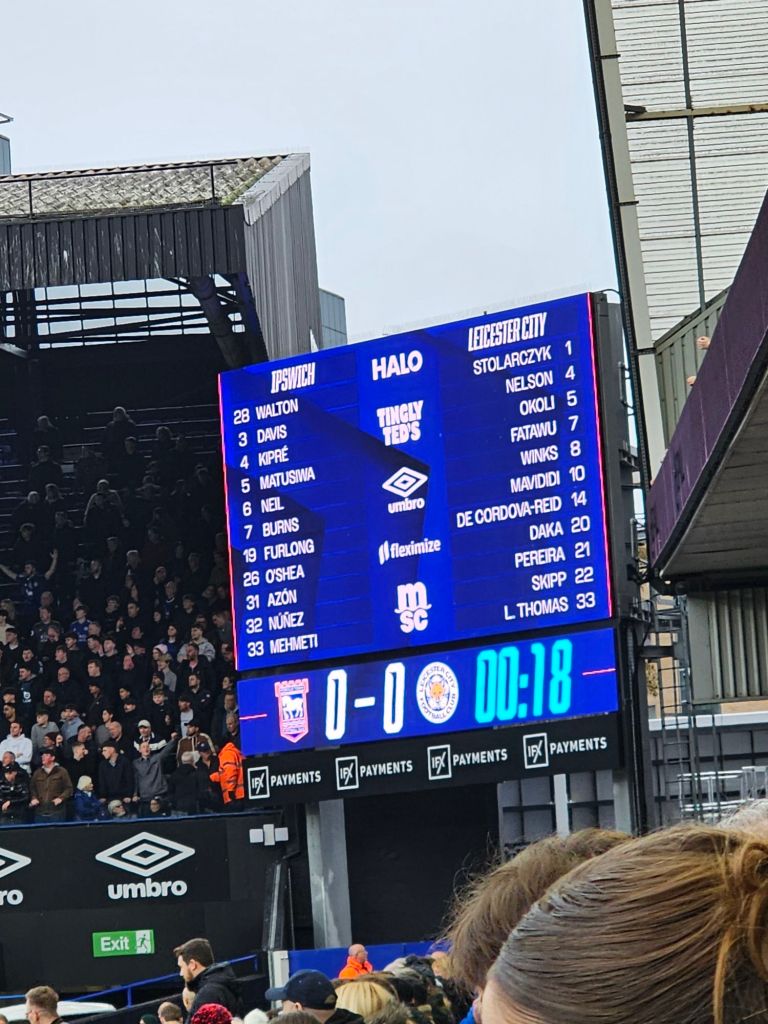
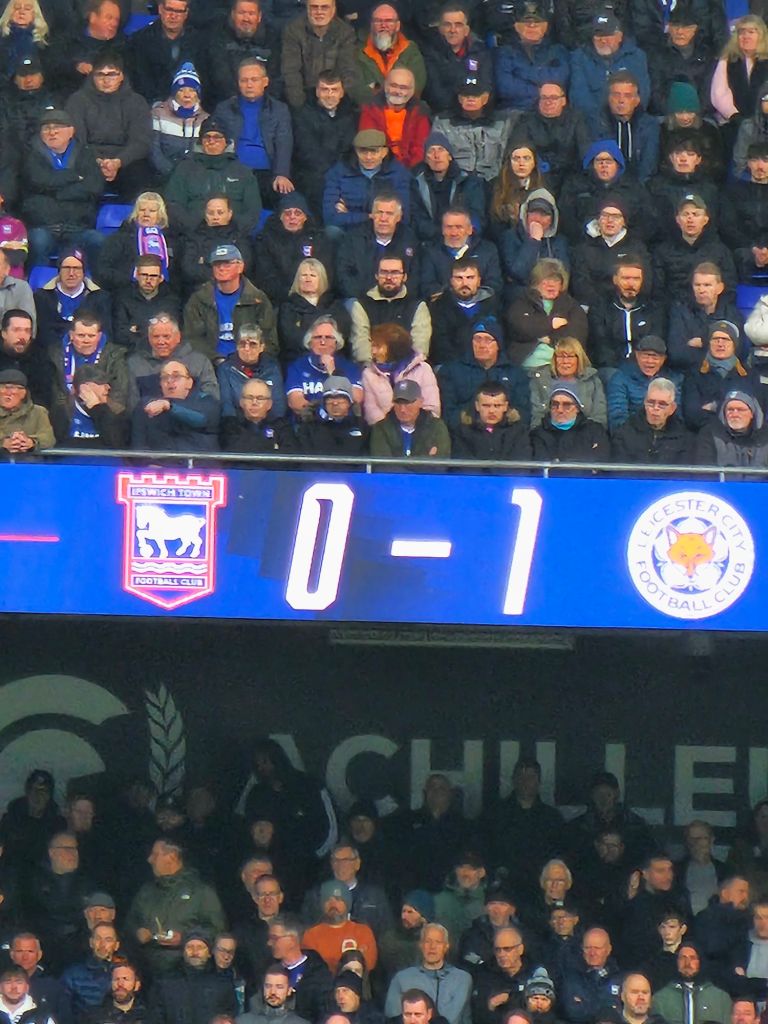
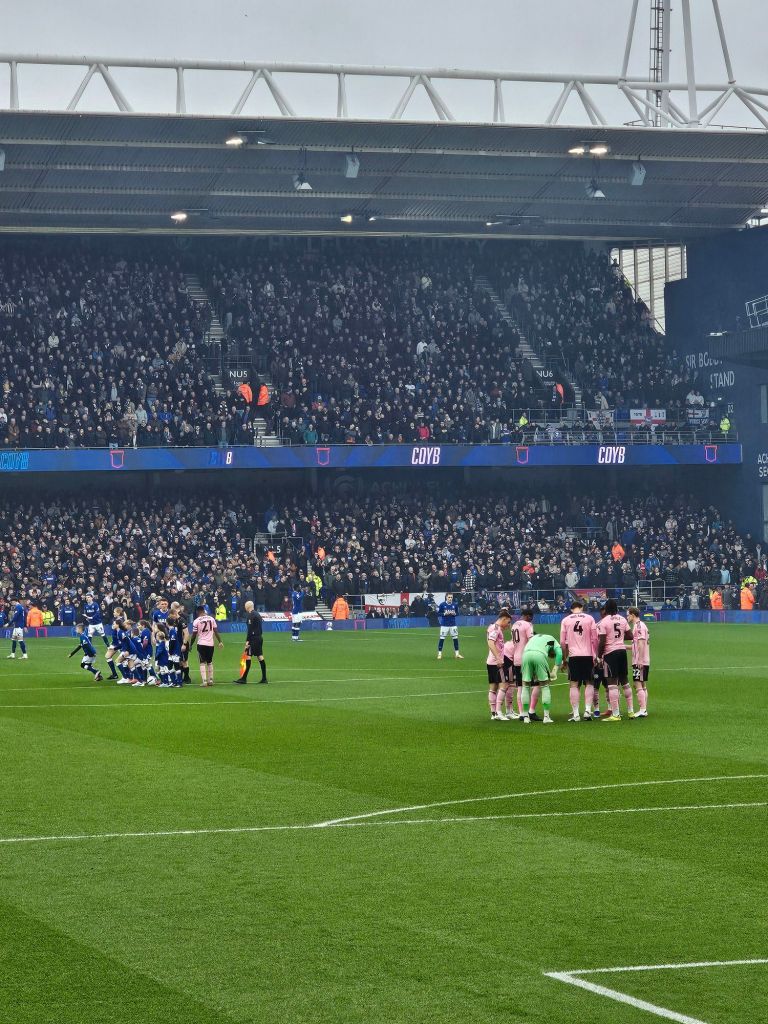
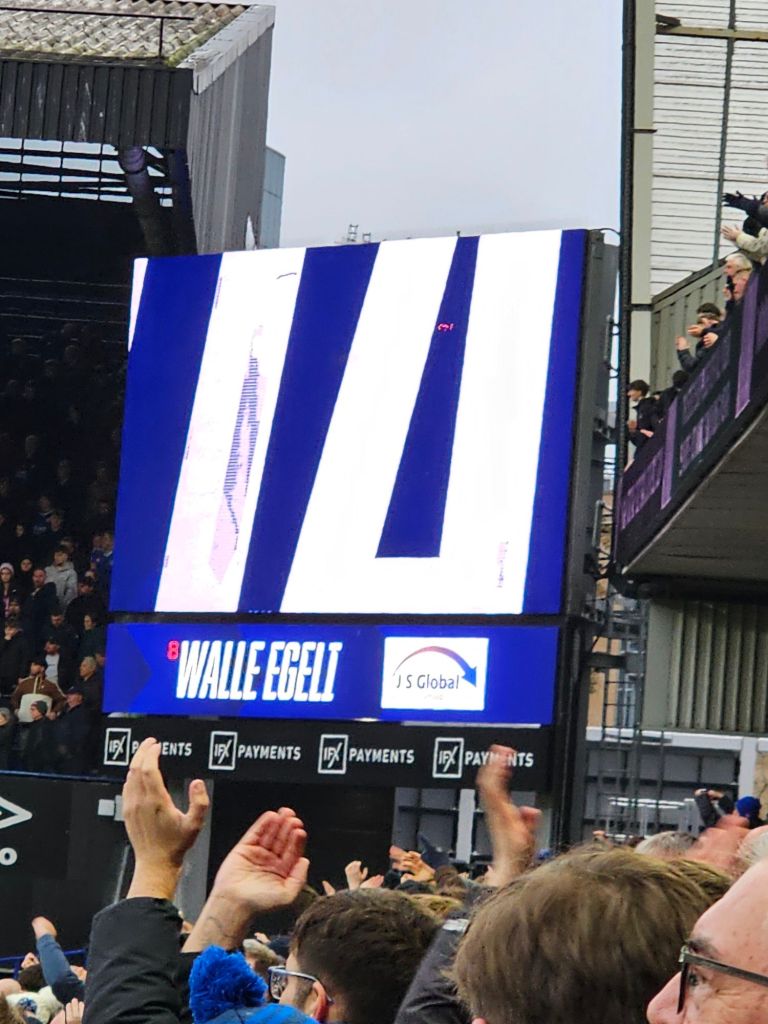
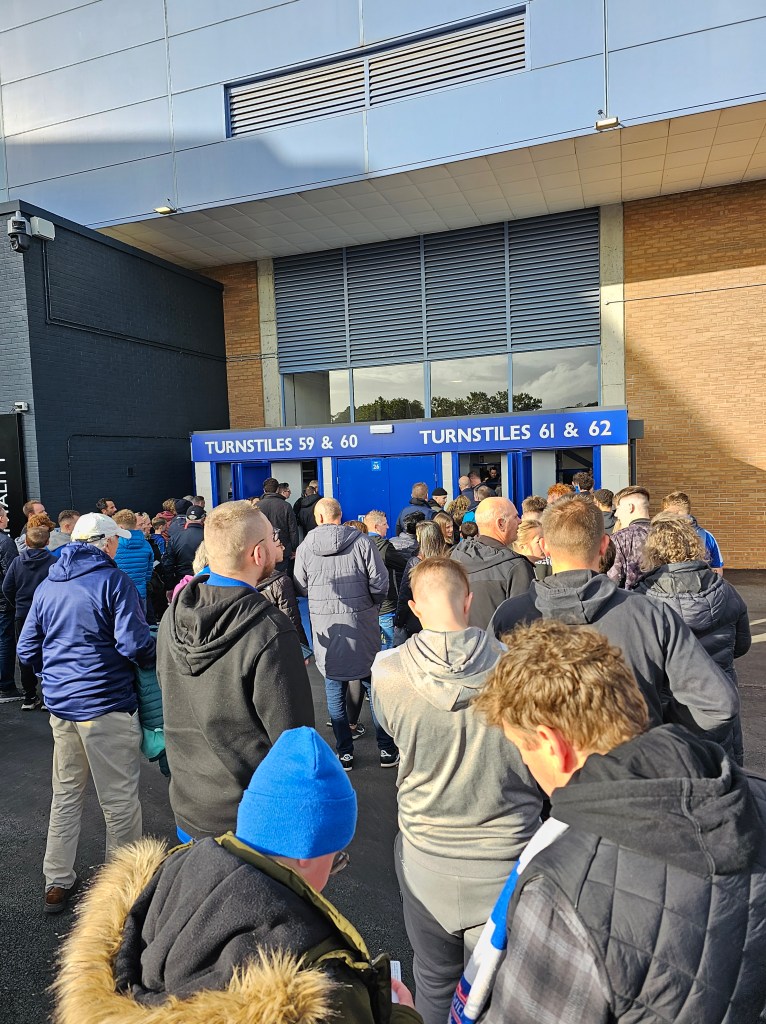
Portman Road is clogged with queues for the Cobbold Stand and there are queues at the turnstiles for the Sir Alf Ramsey Stand too.  Happily, the queue at turnstile 62, my favourite turnstile because 1962 was when Ipswich won what is now called the Premier League, is a bit shorter than most.  I wave my season ticket vaguely in front of the screen-thing, unable to remember which bit makes it work.  The bloke behind me says it’s the bit on the left, or he may have said it’s the bit on the right, I can’t remember now and will do the same thing again when I come to the next game.  Either way, I pass through the turnstile and having vented some surplus Werewolf, join Fiona, the man from Stowmarket, ever-present Phil who never misses a game, and his young son Elwood, who are as ever already in their seats and applauding the teams as they process onto the pitch.  Pat from Clacton is absent today, she’s playing whist in Mauritius.  Murphy the stadium announcer reads out the names of the teams, but he is no Stephen Foster and hopelessly fails to synchronise himself with the scoreboard as it displays the names of the Town players, which he garbles leaving insufficient space between first and second names to facilitate the bellowing of the players surnames by the crowd as if we were French.

The game begins with today’s opponents Plymouth Argyle getting first go with the ball, which they aim mostly in the direction of me, the river and railway station.  Town are inevitably in their signature kit of blue shirts and socks with white shorts.  At first, I think Plymouth are wearing white shirts and black shorts, but a less cursory glance reveals that their shorts are a deep grey, and their shirts are a very pale, washed-out pink.  I can’t decide if this is a tribute to prog rockers Caravan’s 1971 album ‘In the Land of Grey and Pink’ or if Plymouth had accidentally put their shirts in the wash with Exeter City’s.  There could of course be a sensible explanation like the kit being dedicated to breast cancer awareness month, and for readers who like ‘boob jokes’, the city of Plymouth is coincidentally twinned with Brest in France.

With tickets sold out, Portman Road is loud just from people talking, but there is singing too and Christmas soon arrives with a burst of “Hark now hear the Ipswich sing, the Norwich ran away” quickly followed by a rendition of “ We’ve got super Keiran McKenna, He knows exactly what we need…” and it’s just as well he does because the match is not seven minutes old and Plymouth’s Morgan Whittaker plants a curling shot into the top right hand corner of Vaclav Hladky’s goal and Town are trailing one-nil.  It’s a goal that inspires mass gloating from the Devonians up in the top tier of the Cobbold stand as the Argyle fans go inexplicably Spanish and start to sing “Championes, Championes, Ole, Ole, Ole” as if trying to convince us that they’re all linguists as well supporting the team that somehow pipped Town to the third division title a few months back.  My inner superstitious pessimist is unexpectedly awoken by the noise, and I start to think to myself “Oh no, it’s game thirteen and we’re going to lose”.  But I soon snap out of it and as Town respond with a corner, I repeatedly sing “Come on You Blues”, although solo.  “No noise from the Tractor Boys” chant the Argyle fans, which, as I tell Fiona, is harsh on me, but not untruthful otherwise.  Fully in character as vainglorious bastards, the Argyle fans proceed to sing “One-nil to the Champions”, and plagiarise the Pet Shop Boys in the process.

Town win a second corner and a third and Conor Chaplin has a shot blocked. A Plymouth man goes down and whilst he receives succour, everyone else has a drinks break and catches up on the coaching  they’ve forgotten since walking onto the pitch twenty minutes ago.  Meanwhile the away fans deliver a strangely muffled chant of “Small club in Norwich, you’re just a small club in Norwich” displaying a lack of wit normally only associated with supporters of small clubs genuinely in Norwich.  Plymouth make the first substitution of the afternoon as Ryan Hardie quits when his team is ahead to be replaced with Mustapha Bundu.  “Substitution for Leeds United” announces Murphy over the PA, crowning his inept performance so far this afternoon, before just announcing “Plymouth Argyle” with no accompanying word of apology or explanation for those who hadn’t heard his gaff.  Bring back Stephen Foster and his best man’s suit and poorly matched shoes I say.
Nearly a quarter of the match is gone for ever and the home crowd is beginning to sound and feel fractious, like toddlers who have been up too long and need a nap. “A bit sloppy there” says the bloke behind me as Plymouth busy themselves around the Town penalty area. “Unlucky” says the bloke continuing his commentary as Omari Hutchison makes a not very good cross.  Town win a fourth corner and a fifth.  “Come On You Blues” I chant again, and again, and miraculously the rest of the stadium join in.  “Fuckin’ ‘ell, he’s phenomenal today, he is” says the bloke behind me of Brandon Williams as the on loan full-back performs a ‘full-blooded tackle’.  “He’s on another level”.

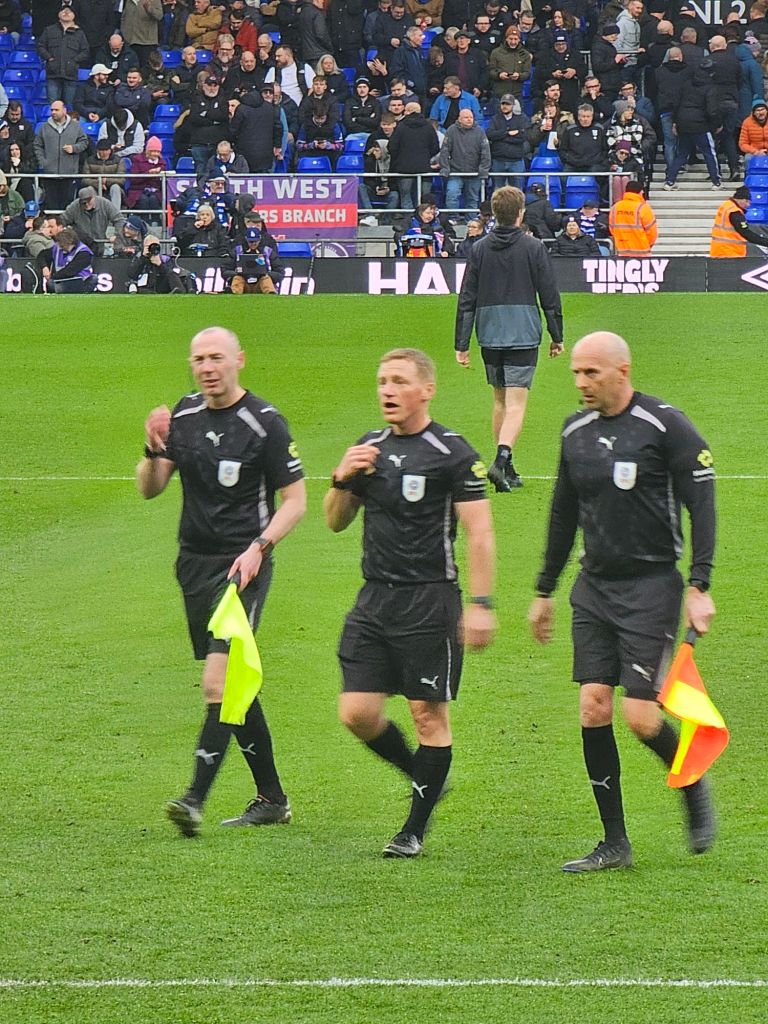
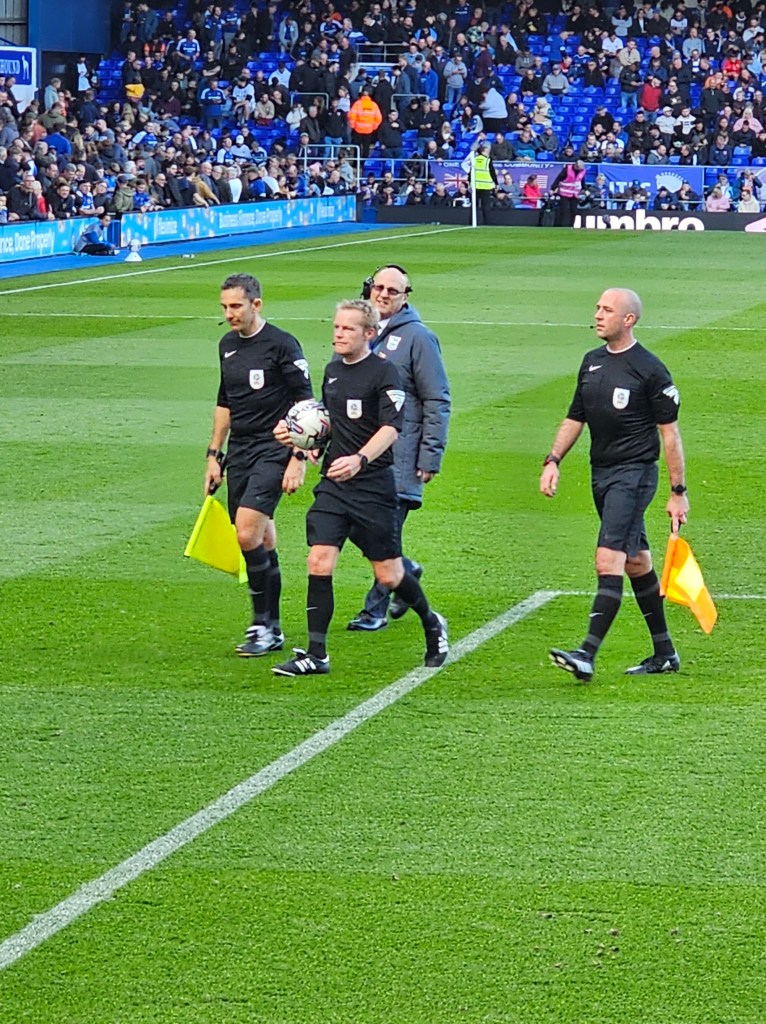
Nearly a third of the way through the game and the first airing of referee Gavin Ward’s yellow card is in the direction of Plymouth’s Mikel Miller, whose name reminds me of probably the most famous racing greyhound of all time.  “Diana Nicholson, report to the nearest steward” announces Murphy putting on the sort of serious voice that might get used when talking about Jimmy Savile or Rolf Harris.  Town win another corner, our seventh? I think I might have lost count. The name of Massimo Luongo joins that of the famous racing greyhound in Mr Ward’s black book.  “You don’t know what you’re doing” chant the Sir Boby Robson stand predictably.   Town win an eighth corner and a Nathan Broadhead header over the cross bar elicits polite applause.  Town win a ninth corner before, with five minutes to go until half-time Plymouth win their first and the away support debuts their rendition of “Argyle, Argyle” a soulless dirge in which the syllables in the word Argyle are elongated to depressing lengths.  A minute late the blokes behind me head for the bar.
Two minutes remain before the tea break and Whittaker breaks forward for Argyle and falls to the ground as George Edmundson makes a lunging challenge from behind. Whittaker claims a penalty, well he would, wouldn’t he, but Mr Ward is watching a different match, the same one I’m watching, and whilst it looked like a penalty perhaps, I don’t think Edmundson touched Whittaker at all.  It’s soon forgotten as Town claim yet another corner and four minutes of added on time appear before us.  From the corner I can’t see what happens as it’s up the other end of the pitch and I’m in the cheap seats.  But then a roar goes up and it seems we’ve scored, I’ll take everyone’s word for it I tell Fiona.  Massimo Luongo is given the credit and half-time soon follows.

With the break I talk to the man from Stowmarket, and he tells me how his son-in-law is a Norwich City supporter and how he went to a Norwich match with him and was lucky enough to see Norwich lose 6-1 at home to Manchester City.  Having syphoned off more spent Werewolf and stared blankly up at the half-time scores on the TV in the concourse below the stand I talk to Dave the steward.  We agree that we can’t quite decide what Town need to do to win the match other than score some more goals.

The football resumes at, I think, six minutes past four and Vaclav Hladky is soon saving at the feet of Plymouth’s Finn Aziz, whilst the blue skies above begin to turn more grey with gathering cloud. But then Town win yet another corner and it seems there has been a change in tactics with the ball being dropped behind the Plymouth defence as well as passed through and around it, but I could be wrong. A meagre fifth of the half has trotted off into he mists of time when Leif Davis sends a through ball for George Hirst and his accompanying marker to chase. Hirst wins and curls the ball beautifully beyond the despairing dive of the Plymouth ‘keeper and perfectly inside the far post.  Although I’m in the cheap seats, I doubt my view of the goal could be bettered on this occasion.  It’s a goal to prove that going two one up having been a goal down is worth the initial suffering, and the sense of relief is palpable. “Ei-Ei-Eio, Up the Football League We Go” chants the Sir Bobby Robson Stand cheerfully to prove the point.

The home crowd had been quiet and a bit miserable for most of the first half, but we really do only sing when we’re winning. Plymouth win a second corner, but Town win a twelfth or thirteenth; I’m no longer counting.  Omari Hutchison has a shot deflected wide when I was convinced the ball was in the net and Conor Chaplin heads over the Plymouth cross bar. Mr Ward the referee does something which inspires the lad who sits in front of me to say “The referee’s a talking point”, previously I’ve mostly heard referees described as bastards.  

Three-quarters of the match is now historical fact and I turn to Fiona to tell her it’s about now when Pat from Clacton usually tells us what she’s having for tea.  I ask Fiona what she’s having; she’s having fish and chips.  I tell her I’m having left over curry.  On the pitch, Town make substitutions and Mr Ward produces a rash of yellow cards, mostly directed at Town players, just to confirm his status as a talking point. Conor Chaplin and Omari Hutchison continuously almost link up well down the right, but frustratingly never quite manage it until Kayden Jackson replaces Hutchison with less than fifteen minutes left of normal time.  After the substitution, Hladky makes a superb flying save following a meagre third Plymouth corner, and Murphy announces this afternoon’s attendance as 29,028; “Thank you for your continued support” he says obsequiously, sounding like Uriah Heep would have if Charles Dickens had made him a stadium announcer at the weekends.

Into the last ten minutes and Hladky makes another stupendous save, perhaps the most stupendous yet; this time from a close range shot by Joe Edwards.  So perfect is Hladky’s performance in the second half that I am beginning to fear he might have sold his soul to the devil during the half-time break. “That’s better than a goal, that is” says the bloke behind me, getting a bit carried away. 

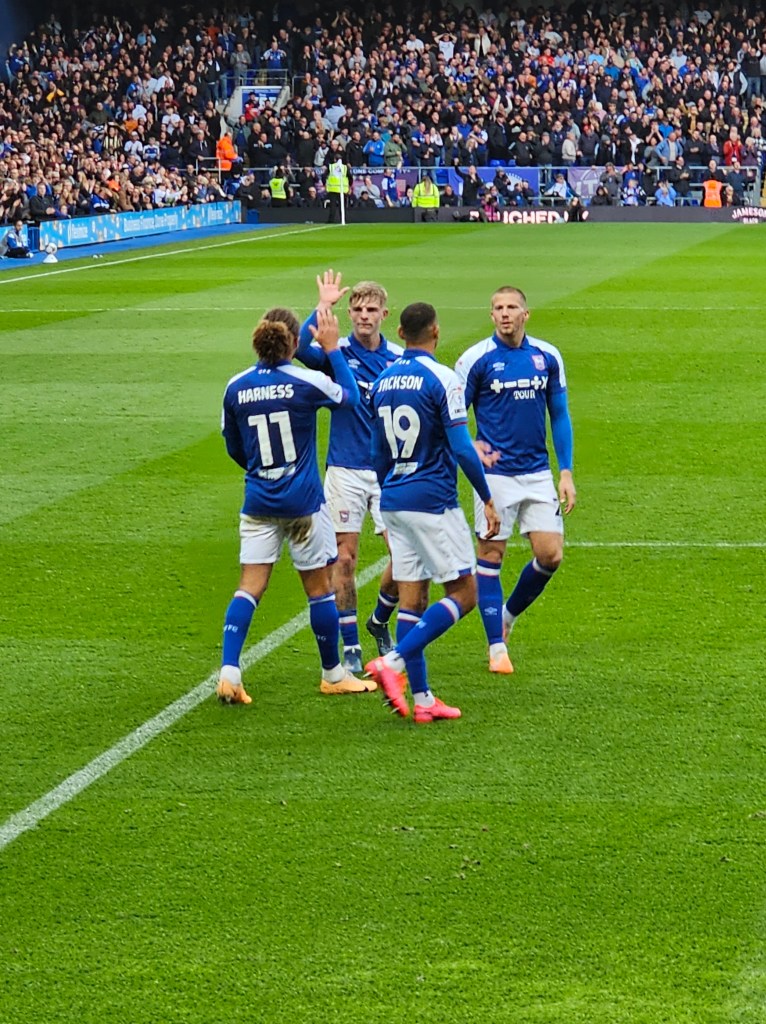
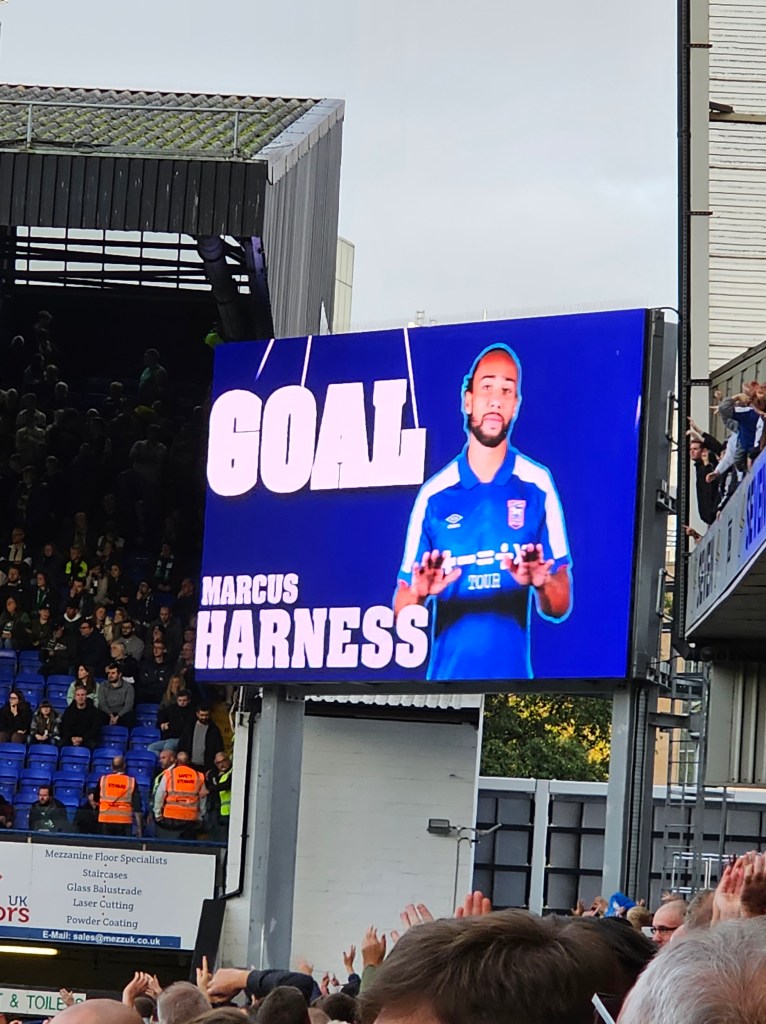
Four minutes of normal time remain and Town are looking leggy whilst Plymouth still look fresh; Town are hanging on but somehow retain an attacking threat because of the nature of our players, we simply have a team designed to create and score goals, apart from Vaclav Hladky that is. Sam Morsy sends Leif Davis down the left, he crosses the ball to Marcus Harness who shoots from perhaps ten metres out, but his shot strikes a defender, only for the ball to rebound to him and allow him a second chance, which he takes.  These things didn’t used to happen, but now they do, and Town lead 3-1.

There will be at least six minutes of added on time.  Hardly a minute of that time expires and Plymouth score again, a low cross knocked in from close range after Hladky apparently renounces Satan, and we’re back where we were.  Plymouth won all the points they needed to pip Town to the third division title and more in the closing minutes of games last season, but not today, and Town succeed in closing the game down by passing the ball amongst themselves and thereby draining the hope and possibly the will to live from the Argyle players.  Mr Ward is keen to remain a talking point and adds a bit more time onto the six minutes but it doesn’t matter and Town win again.

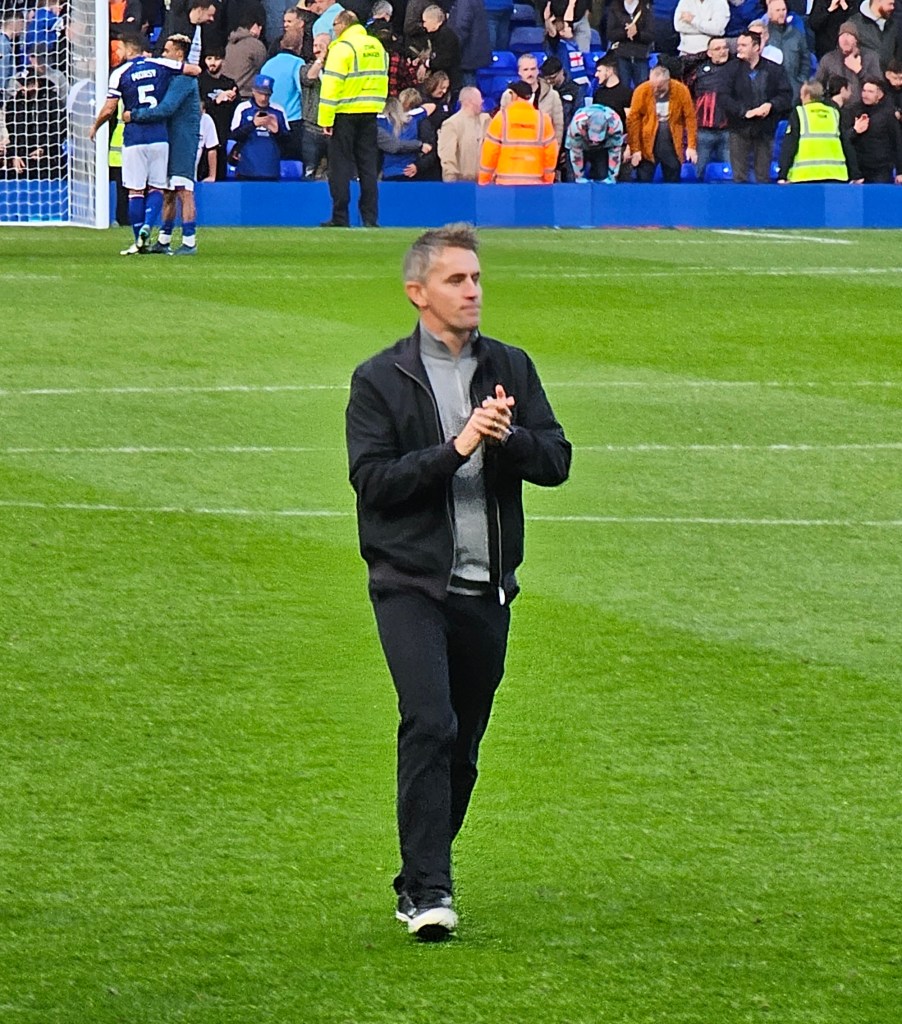
With the final whistle Fiona departs and so does the man from Stowmarket, but I stay a few minutes to applaud, whilst others seem keen to jeer the Plymouth players, I’m not sure why.  It has been a very close game, but Town have won yet again, and without having to rely on penalties or offside goals, or flukes.  Summer and now British summer time might have gone,  but since Kieran Mckenna arrived it’s been perpetual Springtime in Ipswich.

Garde St Cyr Moreac 1 Vannes OC 3

Whilst the disadvantage of spending two and a half weeks in France during late September is that I am missing three Ipswich Town home games, this is offset to some extent by having tickets for two Ligue 1 matches, and is then offset quite a bit more by having the opportunity to see a game in the fourth round of the Coupe de France, a knockout cup competition every bit as much fun as England’s FA Cup and possibly even better on account of it not having been won for the last two years by the all-conquering pet team of some dodgy middle eastern emirate.

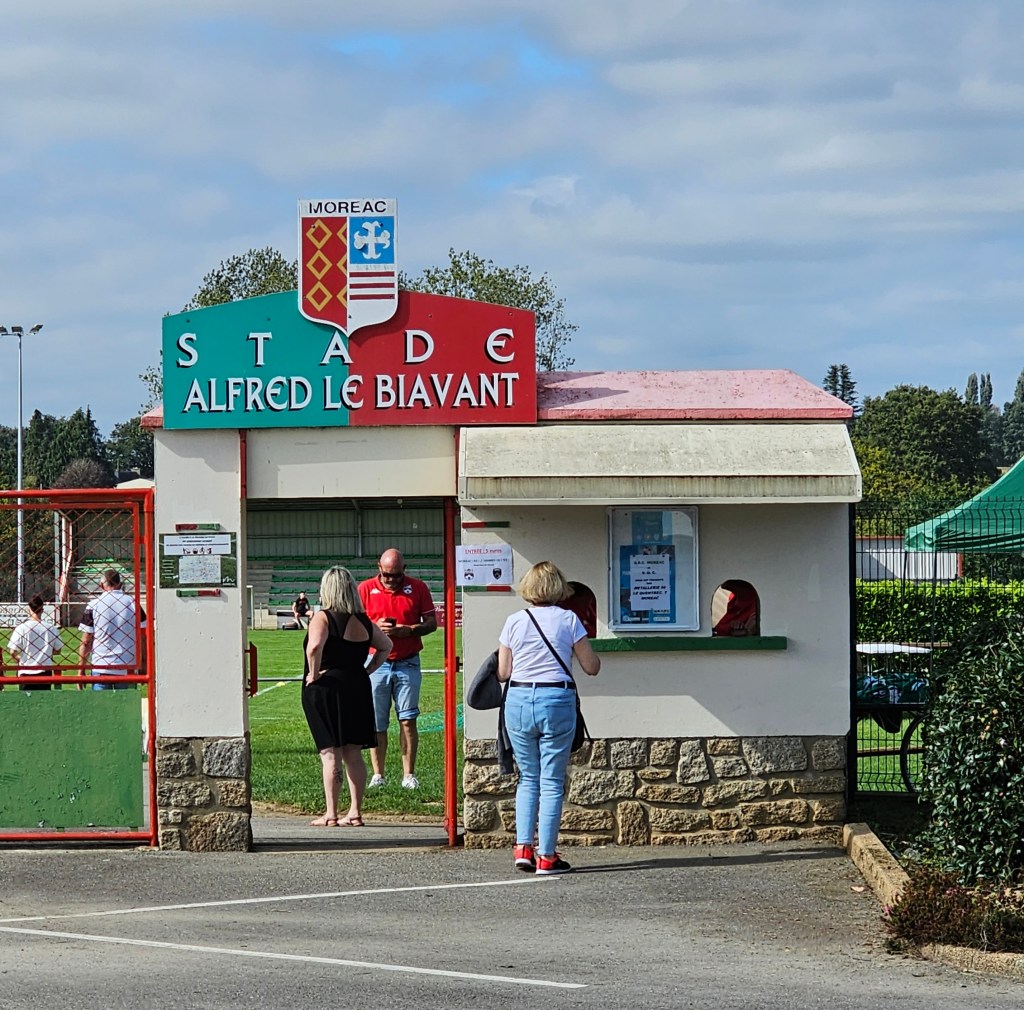
Having discovered that the weekend of 1st October was ‘cup weekend’, I struggled a little bit at first to discover the fourth-round draw, and then a little bit of further work was involved to find out which home teams were a reasonable distance from where I am staying in Carnac.  Unhappily for me, as I trawled through the fixtures it seemed that most games are being played on Sunday 1st October, when my wife Paulene and I shall be watching Lorient play Montpellier, and of the Saturday games most are in the area around Brest, which is a good two-hour drive away.  But then the fixture list on the footbretagne website came up with the rather grand sounding name of Garde St Cyr Moreac and Google maps quickly confirmed that Moreac is just 33 kilometres north of relatively nearby Vannes, and about the same distance from where my wife Paulene and I are staying as Framlingham or Leiston is from our house back in blighty, and I’ve driven to watch them before, more than once.  Moreac of the third tier of the regional league (Step8 – the same as Ipswich Wanderers, Stowmarket Town and Felixstowe in England) would be at home to Vannes OC of Ligue National 3 (Step5).

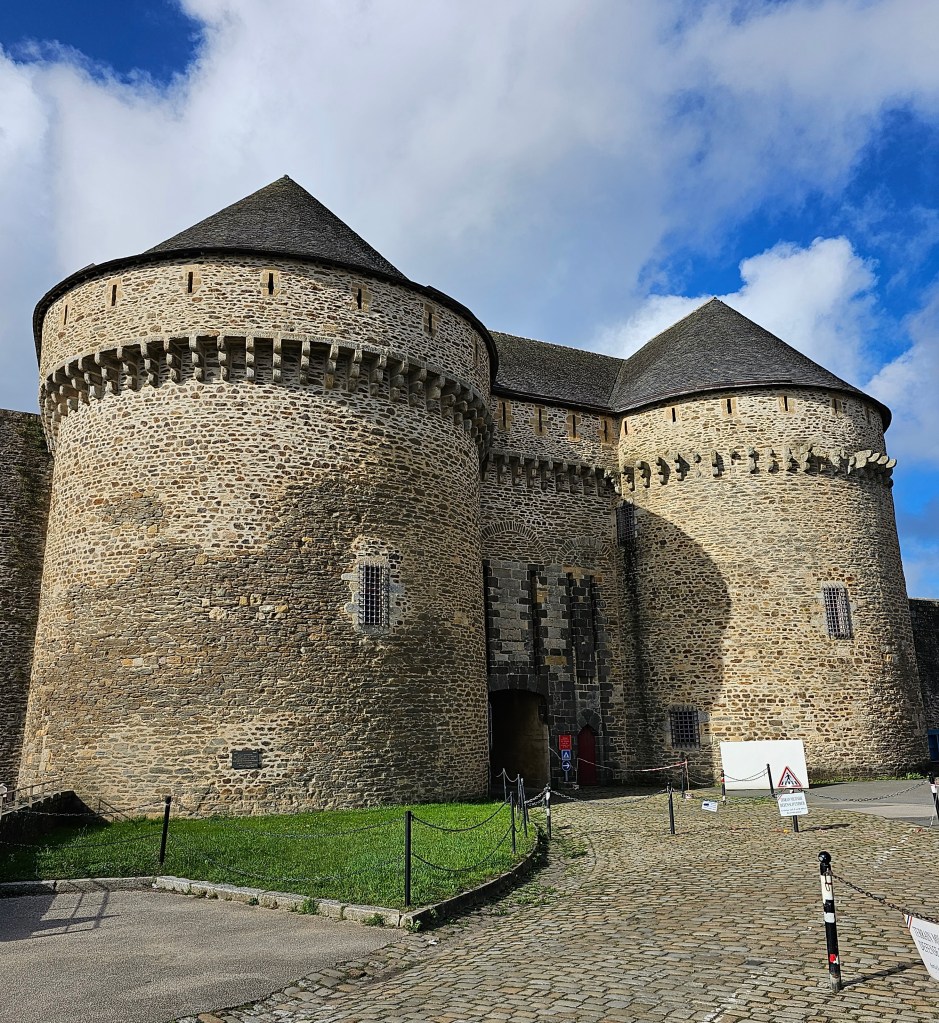
The drive to Moreac takes a little under an hour and the roads are quiet because it’s lunchtime. The countryside changes as we travel in land from the flatness and long straight road just in from the coast, to the greener, rolling countryside where the road twists and turns and rises and falls through valleys populated by grazing cattle and not much else, it feels miles from anywhere, not unlike Framlingham and Leiston.  At Locmine we pass a huge factory belonging to the Jean Floc’h company, a major producer of meat products in France, although being France the sign outside refers to charcuterie and not pies.  Jean Floc’h is nevertheless a massive purveyor of processed food.  Moreac is just a few kilometres beyond Locmine and is an attractive village built around the focal point of the large church of St Cyr, from which the football club takes its name.  Wikipedia tells us that in 2020, Moreac had a population of 3,703. The Stade Alfred le Biavant, home of the football club, is just a street or two away from the centre of the village and has a large, surfaced car park where Paulene and I rock up in our planet saving Citroen e-C4 with a bit more than an hour to go before kick-off at 3 pm.

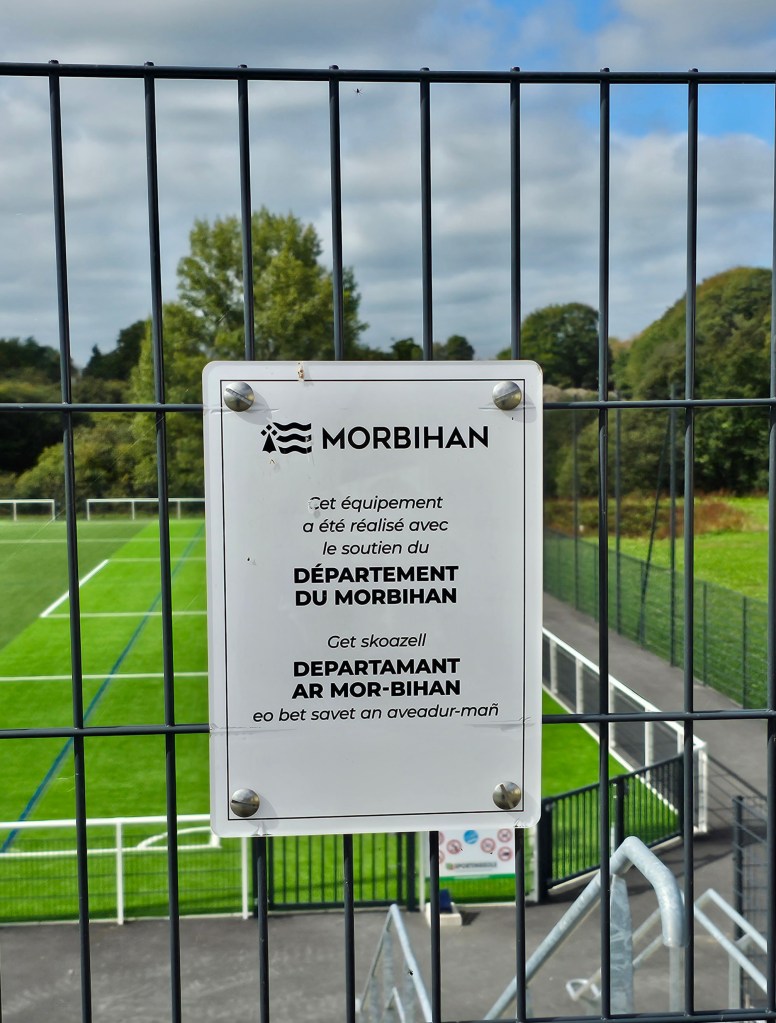
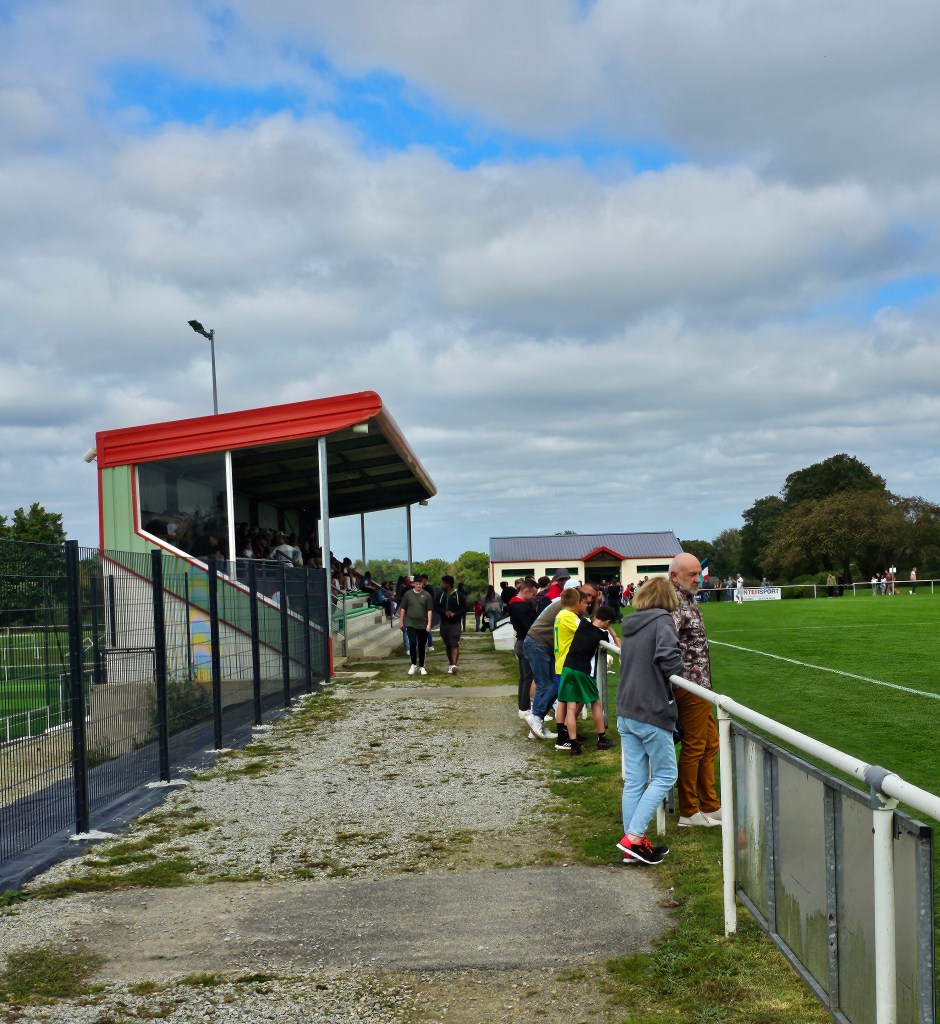
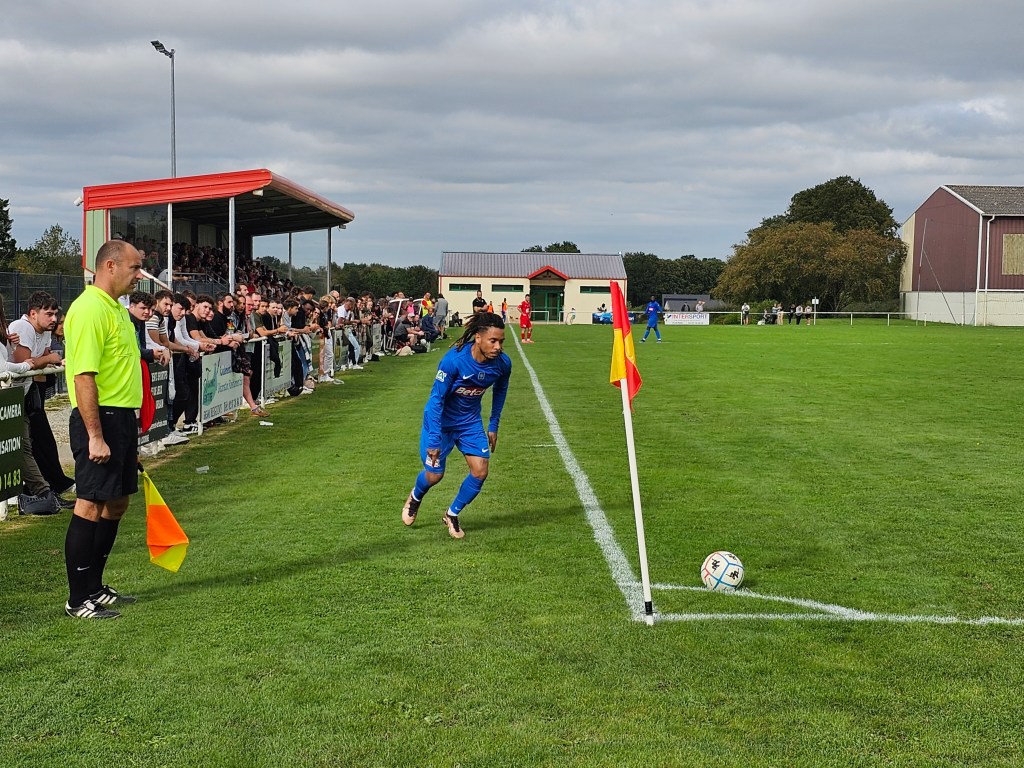
The entrance to the stadium has an elegant if small gate, and a guichet from which a middle-aged lady is selling tickets; today entry costs 5 euros for me but is free for Paulene and indeed all women, which is nice.   Even better, I get a little green ticket too as a souvenir.  The stadium has one small stand with seats on the far side and opposite that a very small bank of terracing, just two steps high but very steep; it’s a bit like a sea wall.  The  site also contains a huge sports hall, which looks like it could double as a barn to house some of the animals destined for the Jean Floc’h factory, a changing room block, a bar with glazed walls overlooking the pitch, a second full size grass pitch and a very smart plastic pitch, on the fence to which is a sign which tells us it was built with money from the local Morbihan Council. France, unlike the UK, is a country which despite problems with pensions seems to a large degree to be still run for the benefit of its general population.  Adding interest, in the corner between the sport shall and the car park is the village cemetery.

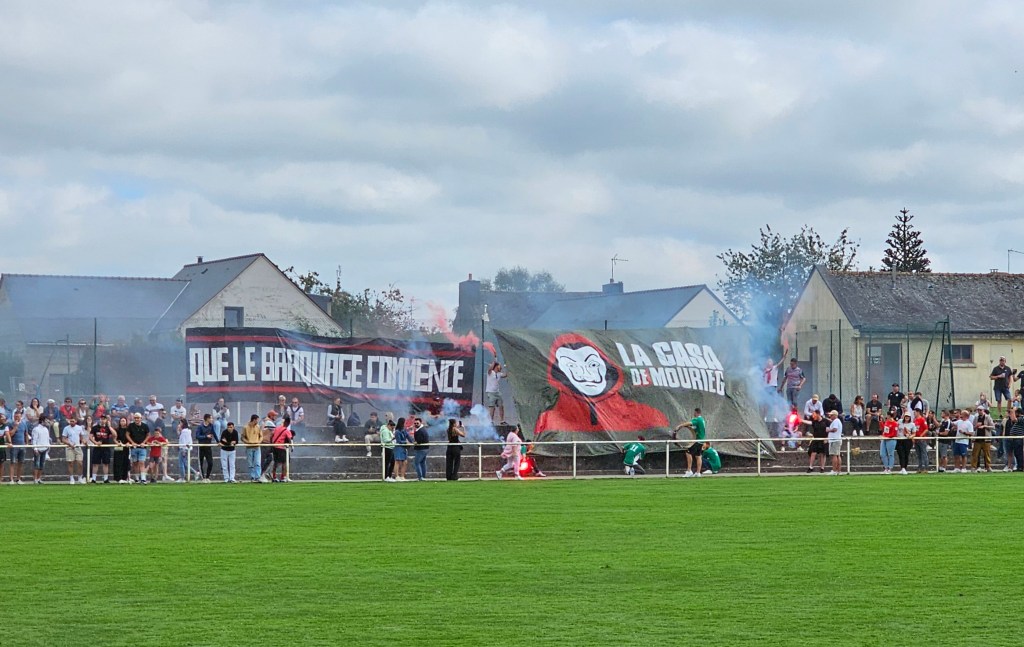
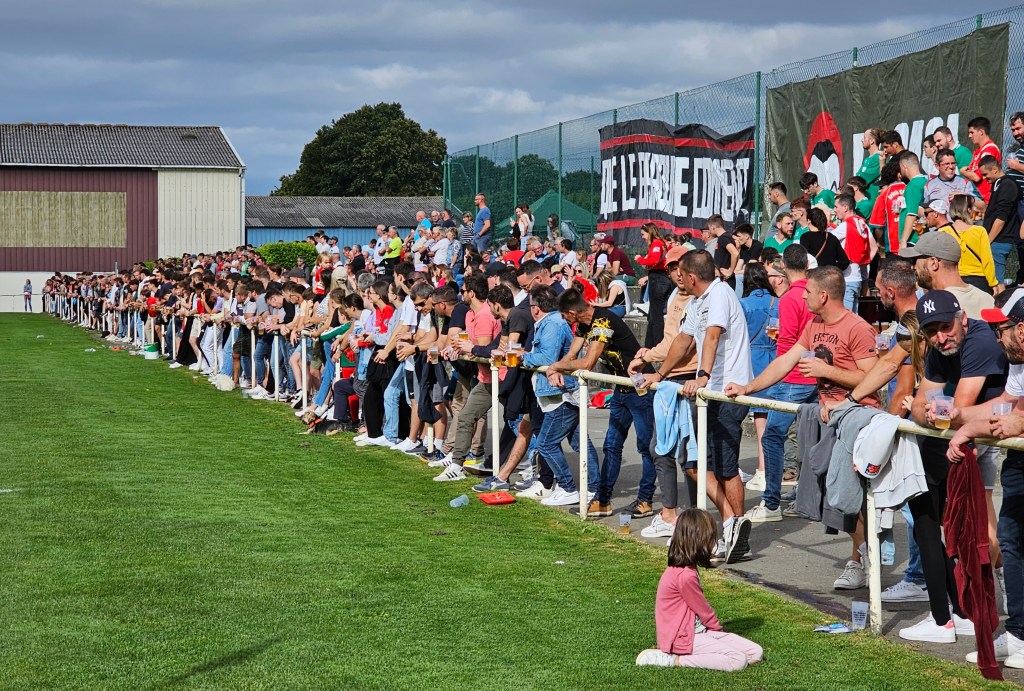
With time to spare until kick off, we watch the teams warm up and I take the opportunity to invest 2 euros in a small glass of Lancelot beer, considerately served in a re-usable plastic ‘glass’; why don’t all football clubs  do that?   The crowds are now streaming in and it feels like the whole village is turning out, a man in a club tracksuit top greets friends and neighbours and kisses on cheeks are being exchanged everywhere, although the younger men tend to only shake hands.  The French seem much more sociable and comfortable with each other than the English. A bunch of blokes in their twenties wearing faded green football shirts appear to be the Moreac ultras, and they parade along the path leading from the gate to the pitch following a bloke banging a drum, and holding aloft red distress flares.  If this happened in England they’d probably be arrested, but here no one bats an eyelid, although one or two people take photos for posterity.

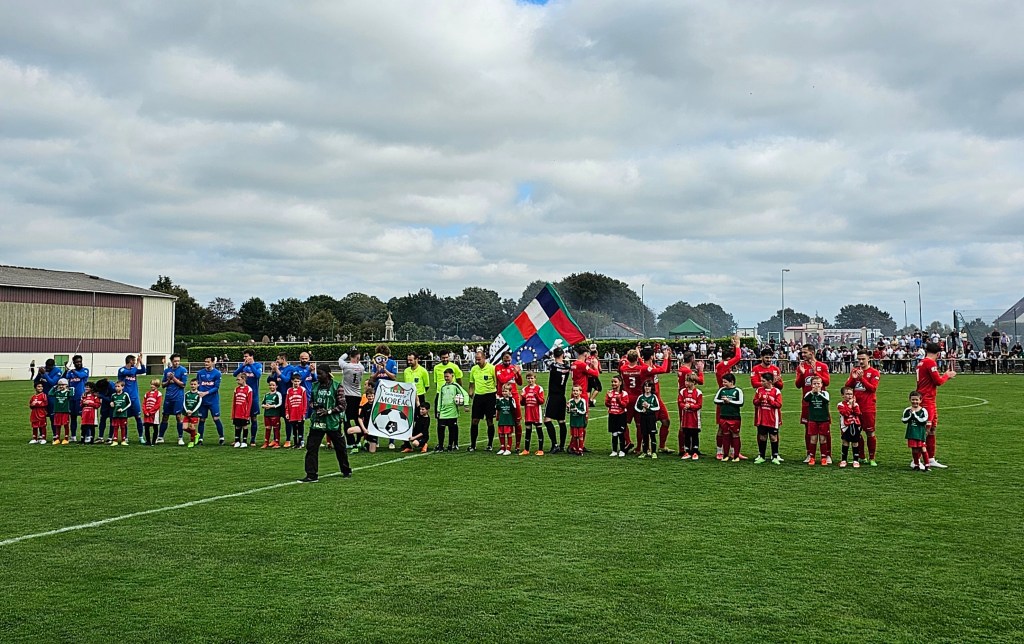
As three o’clock approaches the public address system gets tested with a few bursts of sound of gradually improving quality.  Eventually the ubiquitous 1983 rock anthem ‘Jump’ by Van Halen is played, but it ends abruptly as it’s still not quite time yet, although the teams can be seen lining up behind the referees at the door of the dressing room block in the corner of the ground.  The referee eventually gives the nod, and the teams parade on to the pitch attended by several small children as proud parents point mobile phone cameras at the event and Van Halen get to do an encore in full.  Over on the terrace the ultras light more flares, chant enthusiastically and unfurl a tifo which declares ‘La casa de Mourieg’ and displays a picture of what looks like a pale faced Salvador Dali in a red hoodie.  Mourieg is the Breton name for Moreac but casa is Spanish for house, so I it’s not clear to me what they’re trying to convey, although of course Dali was Spanish, perhaps they’re just being surreal like him. (Postscript, the next day, driving out of Lorient after seeing Lorient lose at home to Montpellier in Ligue 1, we passed a pizza restaurant in Lanester called Casa del Pizza which had the same Salvador Dali face for its logo. The surrealness continues)

At exactly three o’clock the game kicks off with Vannes getting first go with the ball, kicking it towards the sports hall and dressing room end of the ground. Moreac are all in red and Vannes all in blue; this reduction of team colours to blue and red is normal in the early rounds of the Coupe de France as is two common shirt sponsors in all games; today the Credit Agricole logo adorns the red shirts and Betclic the blue. Pleasingly both teams are numbered 1 to 11 and no one is wearing anything silly like a number 98.

The gulf of three divisions is soon apparent as Vannes begin to dominate possession.  Moreac manage to win a free kick wide on the right early on but Vannes earn a corner.  “Aux Armes” chant the ultras, and incidentally “Aux Armes et caetera” was the title of Serge Gainsbourg’s thirteenth studio album, but he didn’t then sing “Nous sommes les Moreacois, Et nous allons gagner, Allez GSC” (“ We are the Moreacois, and we will win, Go GSC”.)  Sadly, the chant will prove overly optimistic and Vannes score their first goal after just eleven minutes, their No9 being left in enough space in the middle of the penalty area to steer a half volley in off a post.  “Allez Moreac, Allez Moreac” sing a group of children undeterred by the early goal.

Vannes continue to dominate, but Moreac have the occasional foray forward, usually on the basis of a free-kick.  Twenty-two minutes gone and the Moreac goalkeeper has to make a decent diving save to keep out a low shot.  “La la  la, la la, la, la la, la la,  Allez GSC” sing the ultras celebrating small victories.  Three minutes later and Vannes’ number eleven doubles his team’s lead as he is left all alone on the left and he passes the ball across the goal into the far corner of the net.  It might be a matter of how many goals Vannes can get.  

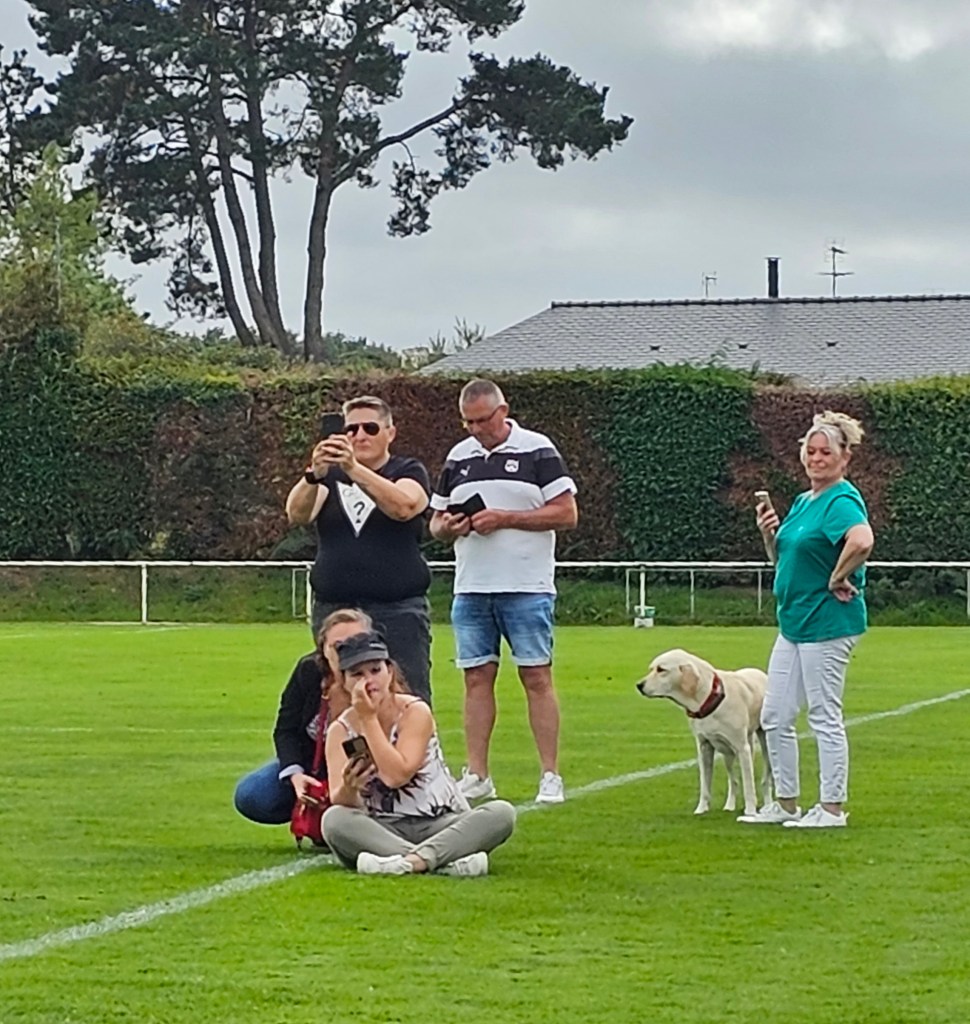
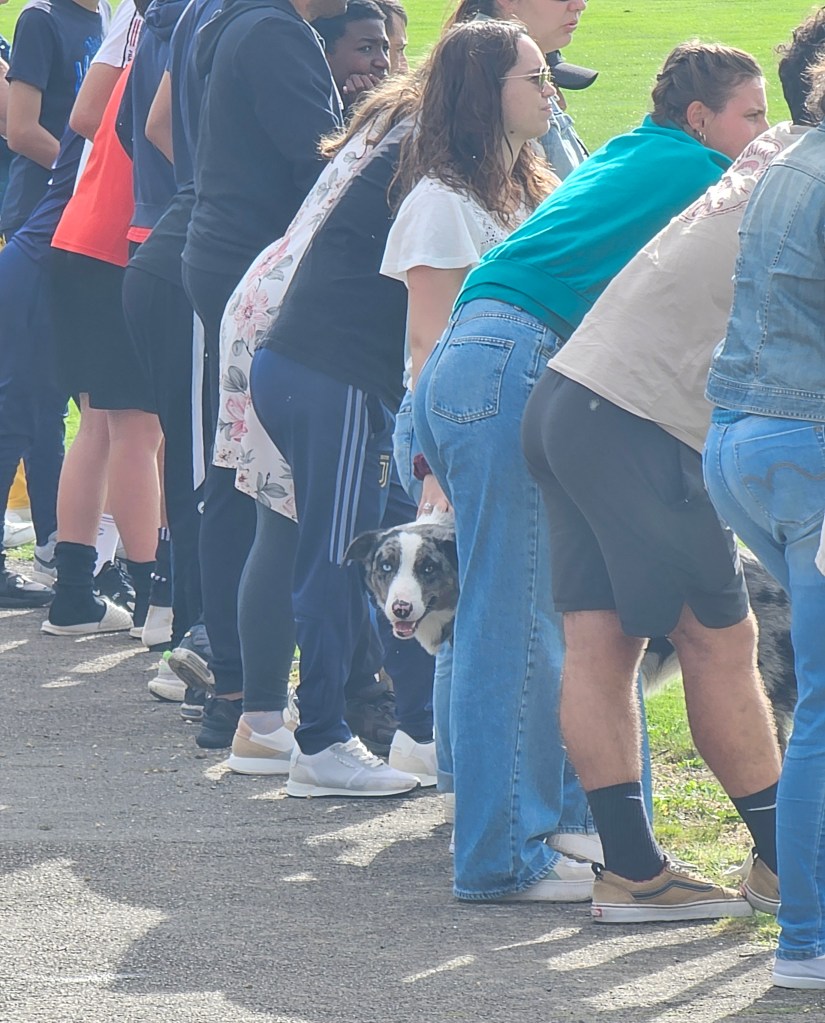
The home crowd, which seems to make up a good ninety per cent of those here don’t’ show their inevitable disappointment and their attention is still gripped, although that doesn’t go for all the dogs in attendance. A Labrador has a lie down, albeit almost on the pitch whilst a mongrel looks the wrong way. Only a sort of Yorkshire Terrier is concentrating on play, and when any player comes near he strains at his leash and yaps ferociously.  As for the away support, I’ve only seen a couple of the sort of grizzled old fanatics who tend to follow amateur teams away from home.

With almost a third of the game gone and lost to history, Moreac have their first shot on goal as their number 10 cleverly beats a man and then shoots optimistically from twenty-five metres out.  The prevailing, uneven balance is restored soon after however, as the Vannes number nine has a shot well saved and then shoots over from very close range. It’s enough to make the Stade Alfred Le Biavant as quiet as it has been all afternoon.  It doesn’t get any louder as the Vannes number seven has a shot deflected onto the top of the Moreac bar.  The lull is filled by Paulene revealing to me that she is always fascinated by young women at football matches on their own, as a smartly and alluringly (she has an off the shoulder top) dressed girl watches the game briefly a few metres away from us, before walking on towards the main stand.  I suggest that perhaps she’s just a lonesome WAG.

Fortunately, football is never entirely predictable and three minutes before half time Moreac attack down the right.  Surprisingly, the Vannes defence is drawn across the penalty area leaving Moreac’s number seven free to run onto a wide expanse of grass into which the ball is played.  The Vannes goalkeeper saves seven’s first shot, but can only parry it, and the number seven then strikes home the rebound.  It’s just a short run to the ultras for number seven and his teammates who form an impromptu human mound of celebration.  The game restarts. but it’s the last kick of the half.

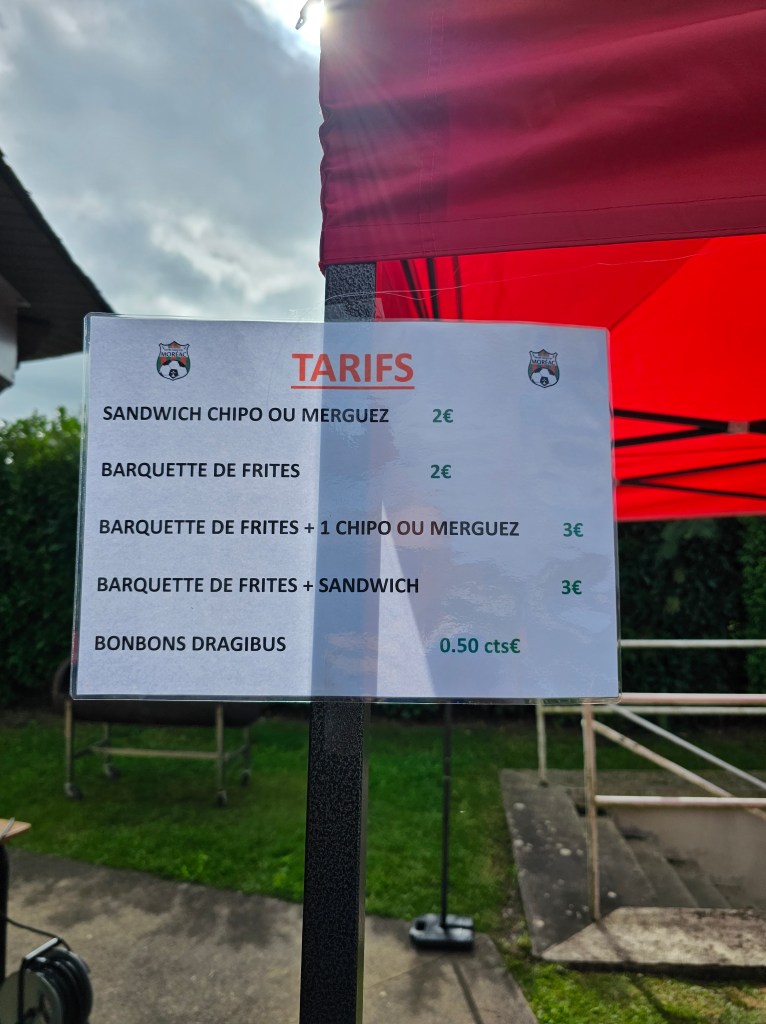
During the first half, we have watched as a barbecue has smoked away in the corner of the ground and now there is a human tide flowing towards it, attracted presumably by the promise of a mid-afternoon snack of a lamb and beef sausage (Merguez) and a chip butty for 3 euros. 

The match begins again promptly at four o’clock and the familiar pattern of Vannes passing the ball about too quickly and smartly for Moreac continues.  It is Vannes however who have the honour of being the first to have a player booked as their number seven hauls an opponent to the ground.  But Vannes press forward still. Numbers eight, eleven and nine combine cleverly but nine shoots over the goal again, then number ten does the same.  My attention is taken by the number eight, a tall creative midfielder who passes the ball well and makes me think of both France’s Adrien Rabiot and Arsenal’s Graeme Rix, although that it is entirely down to his mop of curly hair.

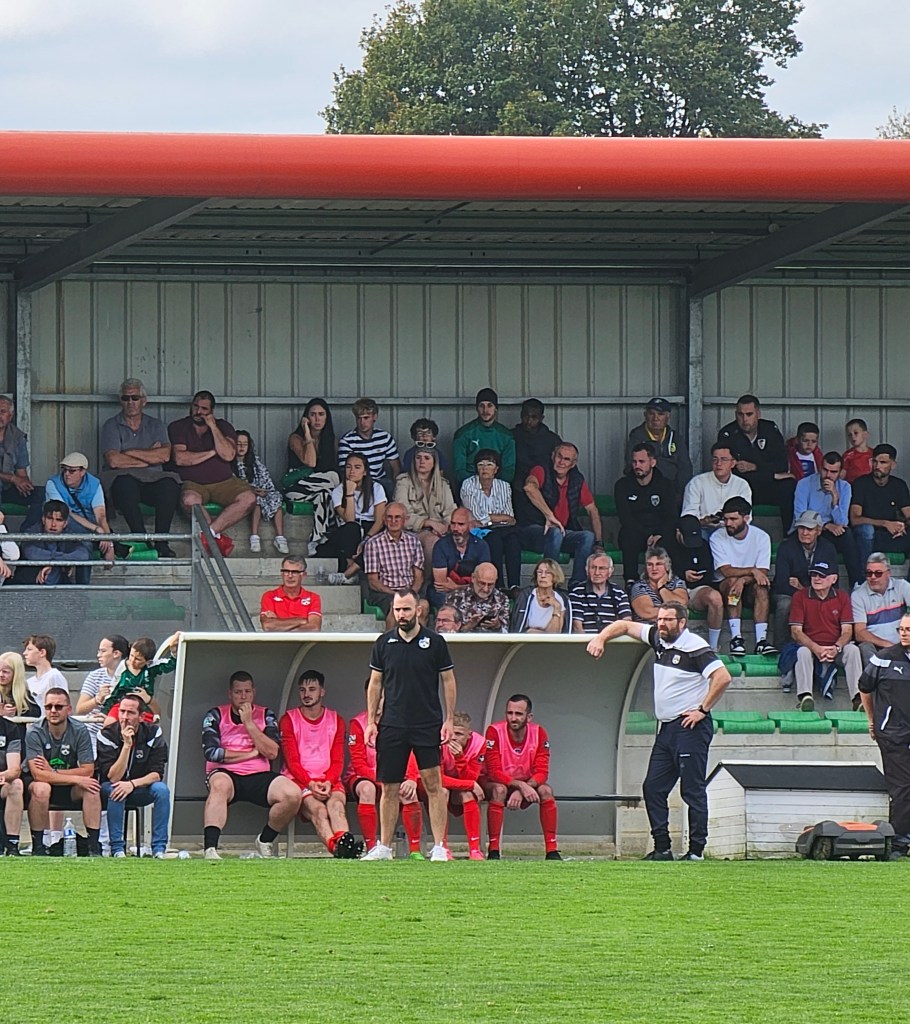
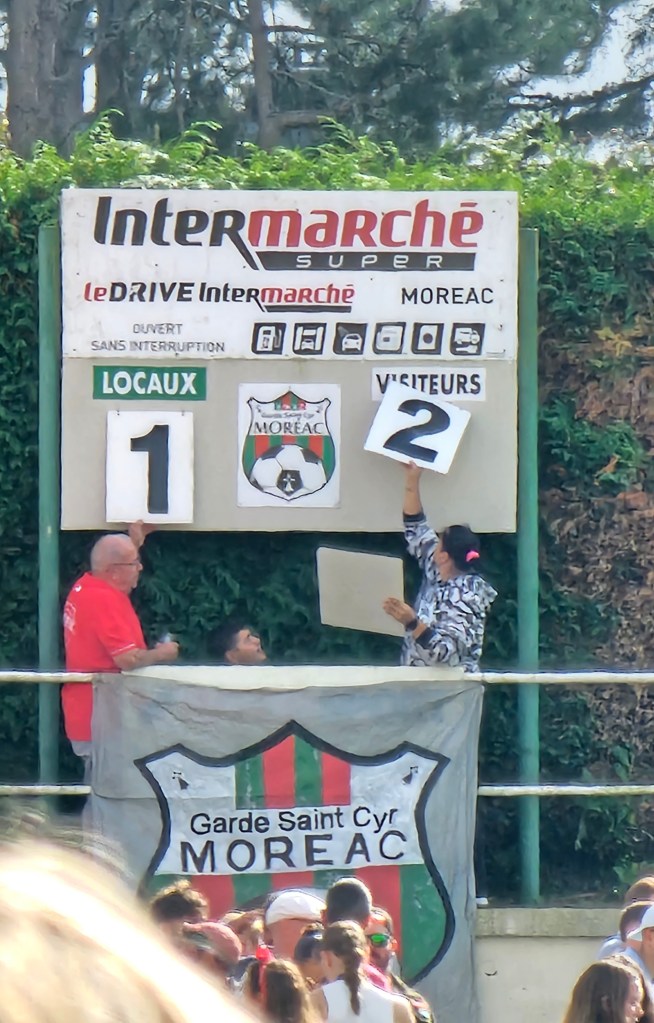
At a quarter past four Vannes score again, this time number ten tidies up as the ball runs loose and wellies it into the net from about 10 metres.  I watch as the number two on the scoreboard is unhooked and replaced with a three.  Moreac had had some hope at half-time thanks to their unexpected goal, but the game has settled down now, and the score will remain unaltered, despite a series of substitutions by both teams.  The substitutions are overseen by the Delegue Principal, a sort of fourth official in overall charge of the fixture, but in a shiny blue suit; he has his own designated seat at pitch side midway between the two team benches. From a distance he is unfortunate enough to look a bit like Norman Tebbitt, but it’s probably just because he’s bald.

I see out the game by wandering around and enjoying it from different angles from both sides of the ground and behind both goals.  Clouds and sunshine swap about altering the mood of the backdrop of trees, fields, houses and headstones.  Number three for Moreac evens up the score for bookings but there’s never any malice in the game.  The worst that happens is that the ultras take a dislike to the Vannes number ten who I think they perceive is a diver, so they boo him whenever he gets the ball.  With the final whistle, the ultras release a final salvo of flares and the victorious losers of GSC Moreac gather in front of them to give and receive appreciative applause.  It’s been a decent match on a  warm afternoon of late summer sun mixed with early autumn clouds and breezes and everyone has had a lovely time.  Just like in England, local football in France is a wonderful thing, there really is no need for professional football or the Premier League.

Stade Brestois 1 Olympique Lyonnais 0

Finistere is the most westerly departement or ‘county’ of metropolitan France, with its name translating pretty much as ’the end of the earth’.  Not far east of the most westerly point of the most westerly department is Finistere’s largest town, Brest, an historic port and naval city, which was almost totally flattened by allied bombing during World War Two because the Nazis occupied it and made it part of their strategic ‘Atlantic Wall’.  Today, having been rebuilt in the 1950’s with an emphasis on space and layout rather than impressive or pretty architecture, although the church of St Louis de Brest is a notable exception, Brest has a population a little larger than that of Ipswich, but serves a metropolitan area of twice as many people, and is home to Stade Brestois 29, a football club in their present incarnation now enjoying their longest spell in the French first division since the 1960’s. Tonight, Stade Brestois who are currently third in the first division table, play Olympique Lyonnais who are third from bottom and I will be there. A win for Brest will put them top of the league above OGC Nice who won 1-0 away to previous leaders AS Monaco last night.

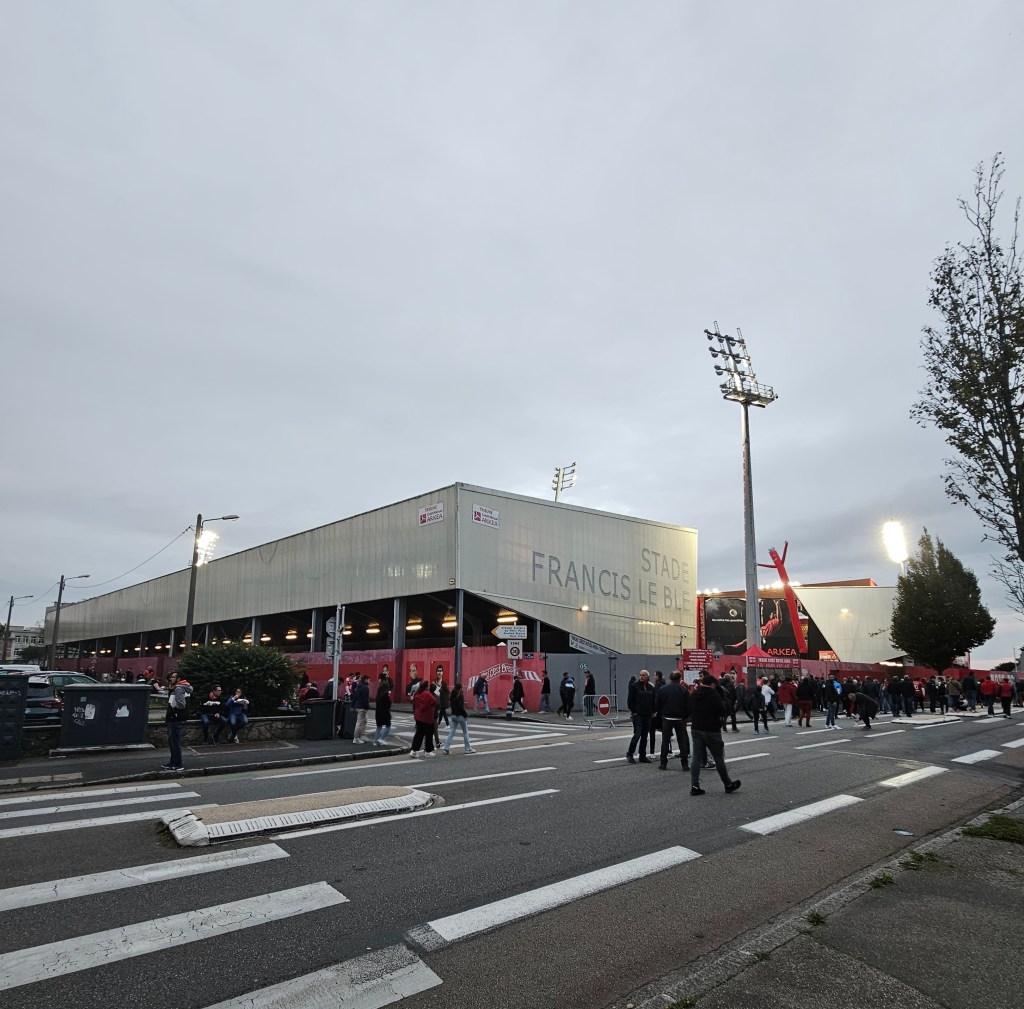
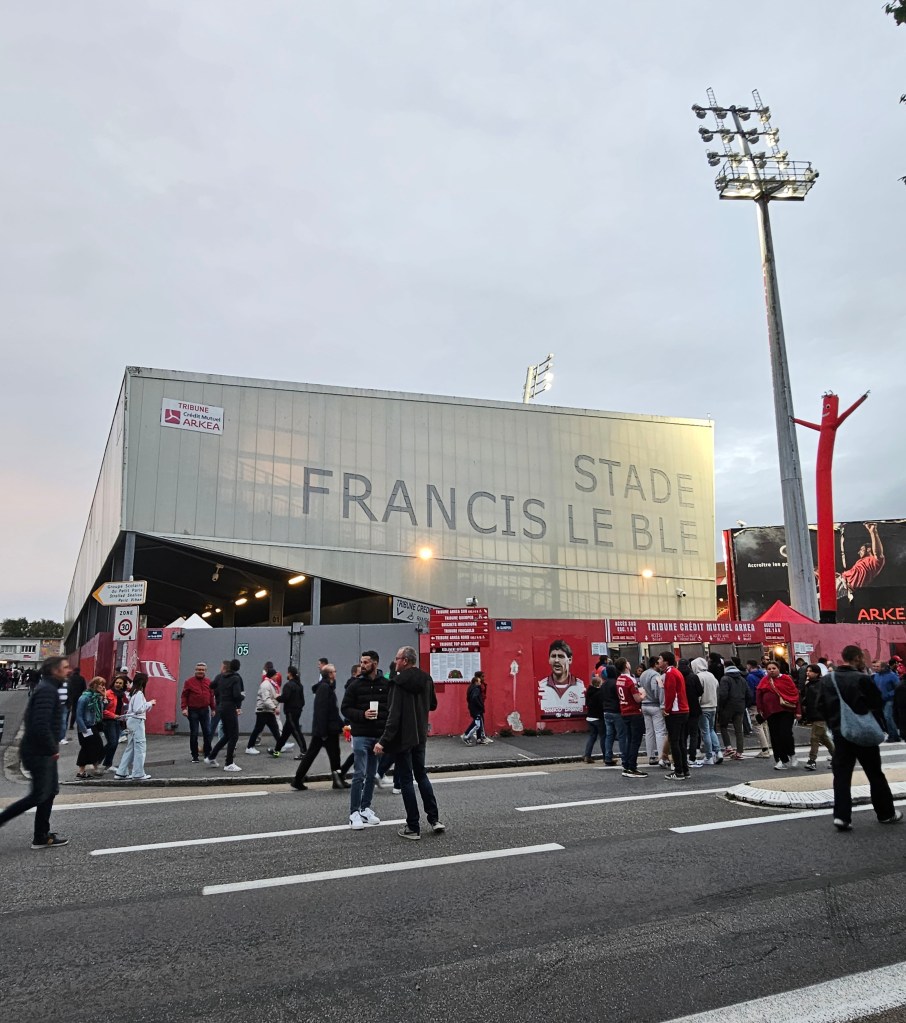
My wife Paulene and I are staying in a city centre hotel, which proves very handy indeed for the Liberte tram stop, where I just manage to extract two tickets (€1.70 each) from the vending machine and jump aboard a bright lime green Ligne A tram before it shuts its doors and begins a gentle, whirring, electricity-drinking ascent up Rue Jean Jaures towards Place de Strasbourg, from where it is just a short walk along Rue de Quimper to Stade de Francois Ble, home of Stade Brestois 29 (the 29 is the number of the Finistere departement – for some reason the mainland departements are numbered from 1 to 100, although weirdly Corsica gets to be 2A and 2B).   A gathering crowd is plainly in motion as we alight from the tram, and there is no difficulty finding the stadium as we are consumed by the human tide being drawn by the glow of floodlights shining out through the Breton dusk, and the promise of beer from the bar immediately behind the ground.  There is something about the approach to the ground and its relationship to the street that reminds me of the old Dell in Southampton, but I don’t let it worry me and not seeing any indication of a club shop I follow Paulene into the stadium after the usual ‘patting down’ by a huge, friendly man of Franco-African origin, who ensures I am not smuggling flares or other unfashionable trousers into the stadium. 

My fears about being unable to source club merchandise are quickly allayed as I spot a small wooden hut which looks like it could double up for use at a Christmas market.  I‘ve done my homework on-line, and know that for a bargain €9.90 I might be able to obtain a T-shirt bearing the club crest and the slogan Marree Rouge  (Red Tide). I point at a box of red T-shirts which bear the markings described and ask if there is one in ‘Large’ size.  The helpful young woman searches, examining the labels in collar after collar, one by one, but without success.  Eventually, sensing my desperation she holds up XL and XXL shirts as if suspecting that I am the sort of bloke who looks capable of putting on several kilos in weight if it suddenly proves necessary.  Optimistically, believing that I can fool the world by holding my stomach in, I ask if there is not a medium sized shirt instead; there is, but then, as she delves into the cardboard box just one more time a miracle happens, and she pulls out a ‘Large’; very possibly the last one in existence that isn’t already being worn by a well-proportioned Breton.

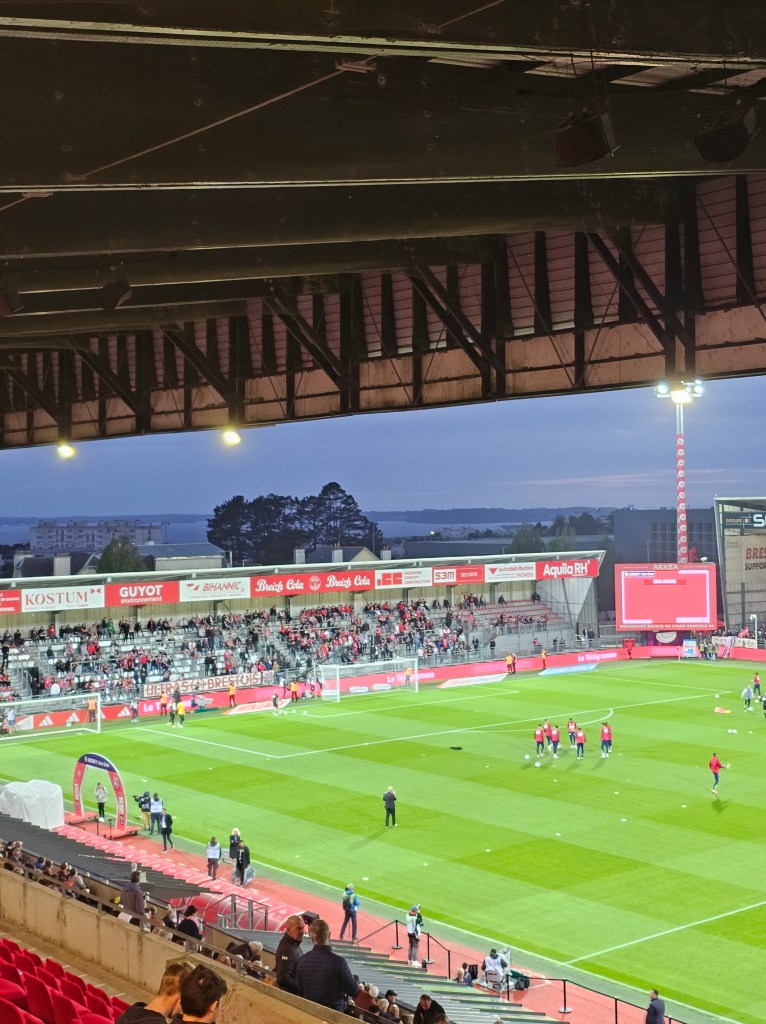
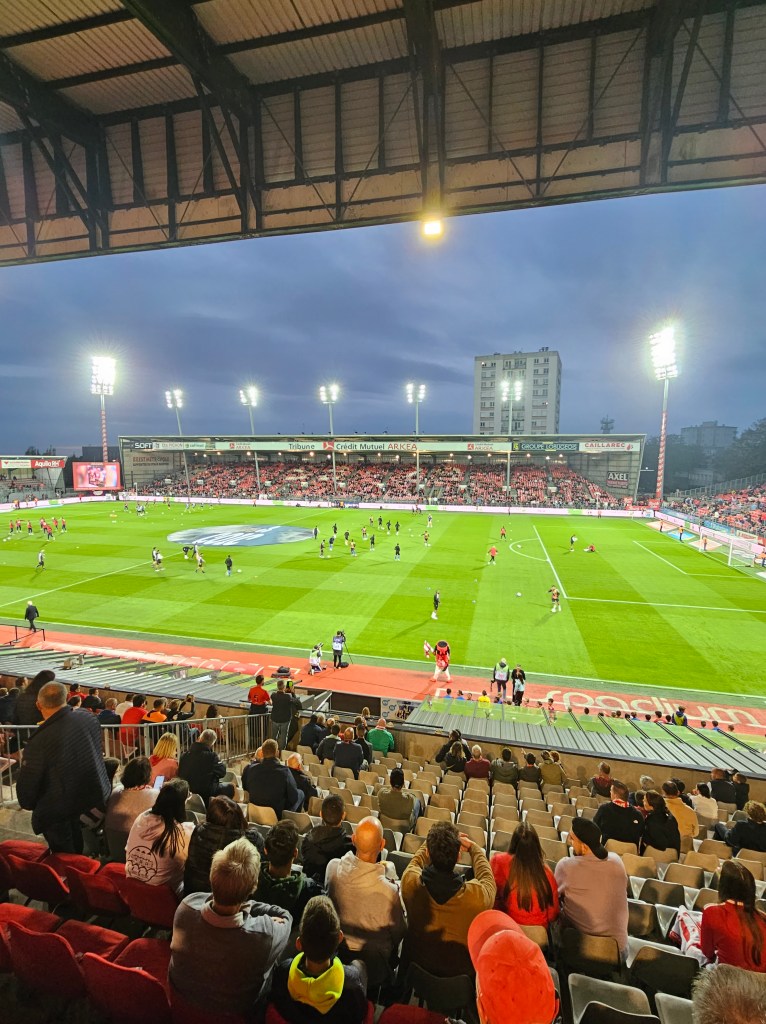
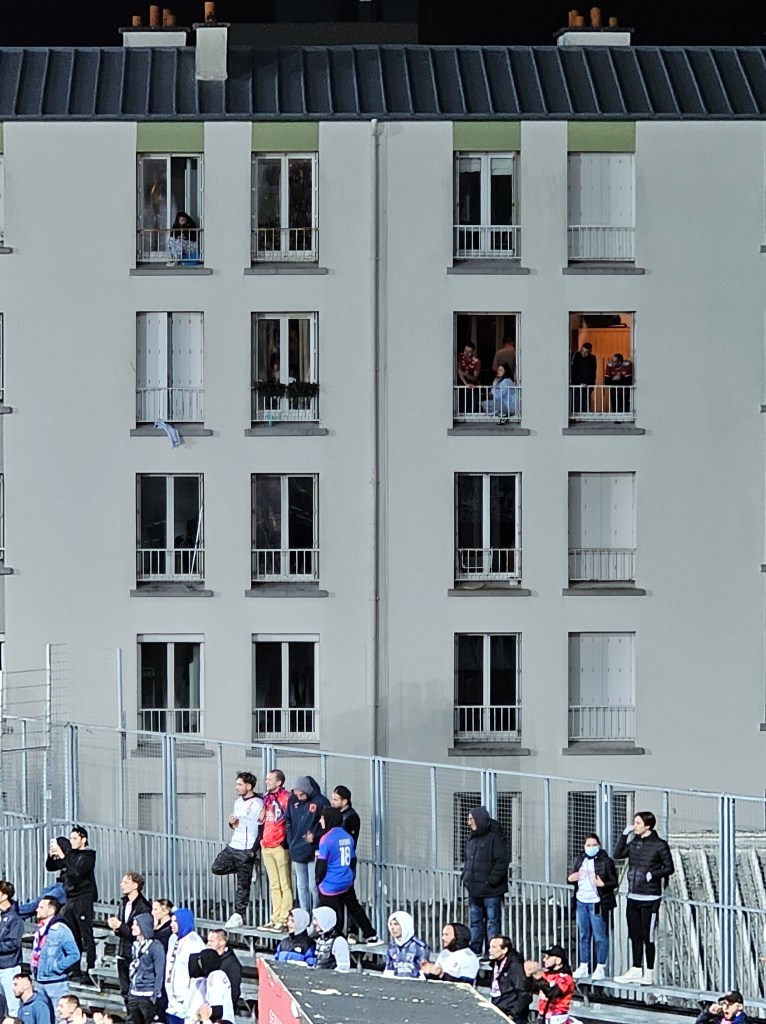
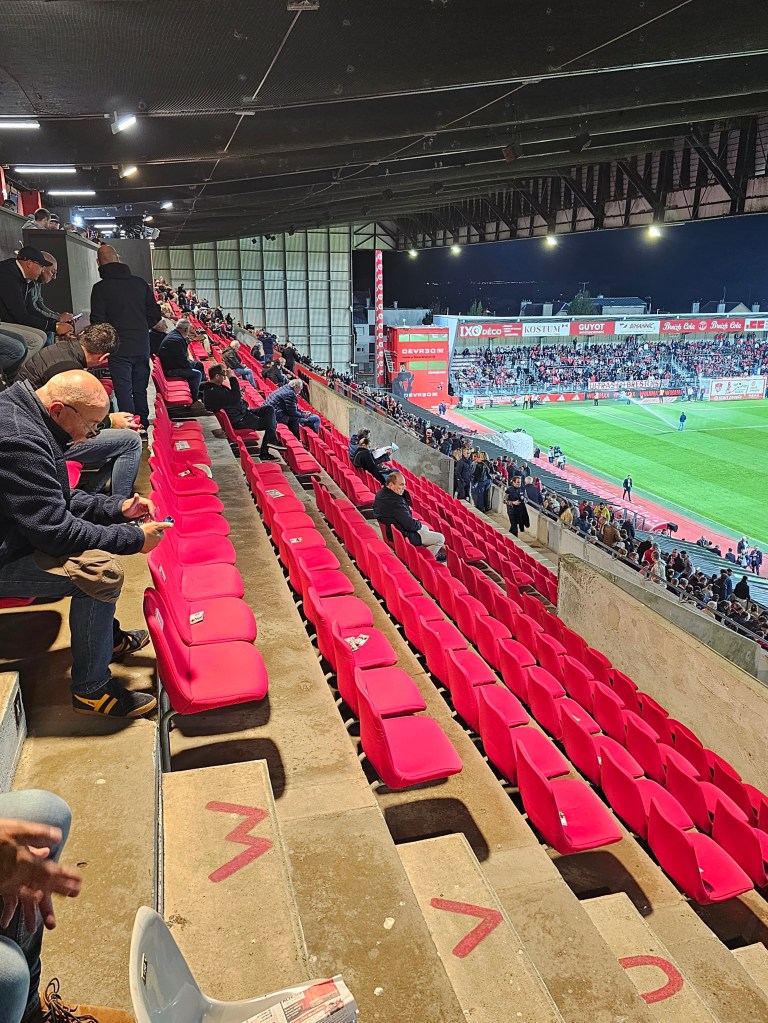
Clutching my precious T-shirt, I head for stairway five of the Tribune Foucauld and having climbed three flights of concrete steps I find myself looking over the brilliant green, floodlit pitch; all that remains is a further climb to row X and our seats, which I bought on-line a couple of weeks back.  Stade Brestois operate a loathsome ‘dynamic’ pricing system in which the club acts like a tout and the price of a seat changes, according to how much they think they can get for it.  When I first looked, tickets were €80 each; I eventually scored two of the few remaining ones for €45.  The club says the system means that people playing top price for seats allows less well-off fans to get cheap seats, but presumably this is only if these poorer fans have nothing to do with their time but be permanently logged onto the club website, waiting for a ticket price they might be able to afford.  The stadium has a capacity of not many more than 15,000 and is almost full for every Ligue 1 game. We sit in our over-priced seats and enjoy the view, which includes, through fading light, sight of the wide inlet from the Atlantic Ocean, which gives Brest its advantage as a port and naval dockyard.  Opposite us, the Tribune Credit Mutuel Arkea has five thick tubular stanchions set at a rakish angle to hold up the roof; atop the stanchions and the roof are floodlights, although the ground also has lights in all four corners.  To our right is the open Tribune Atlantique, a metal temporary stand a la Gillingham, and it’s where the away supporters are inevitably penned into a corner, they don’t even get seats, just metal benches.  Behind the stand, the occupants of a block of flats get a free view and can be seen crowding around windows and Juliet balconies. To the left is the small but freshly renovated Tribune Quimper; the ‘home end’ where the majority of the Brest Ultras congregate.

Whilst Paulene stays put to get maximum value from her seat, I soon take a wander to see what I can see and to find a programme, which is as ever free, and tonight is of the newspaper variety; it tells me the squads and who the referee and linesmen are and that’s it, which is all I need to know.  On the mezzanine level one staircase down from our seats is a bar, above which is a banner advertising the Breton Lancelot brewery.   Expecting one of Lancelot’s tasty beers, I invest 5 euros.  The beer is sweet and nasty and probably non-alcoholic; I tell the barmaid so and ask if it is Lancelot, because it doesn’t taste like it.  She doesn’t know but thinks it’s probably Carlsberg.  I’ve been poisoned.  At either ends of the stand are what look like private members bars, “Le Caban” and “L’esprit des Legendes”.  Spectators entering these bars do so only after having received the nod from people dressed intimidatingly all in black; presumably that’s where they serve the good stuff.  I’m guessing those spectators aren’t in the cheap seats.

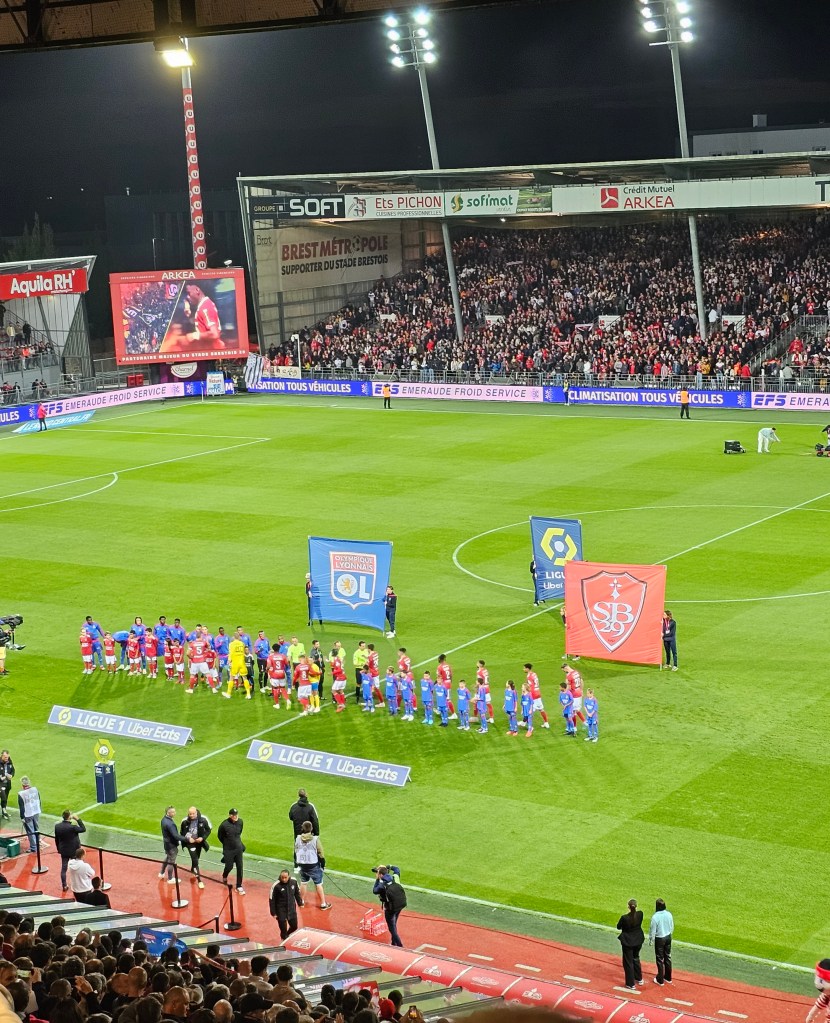
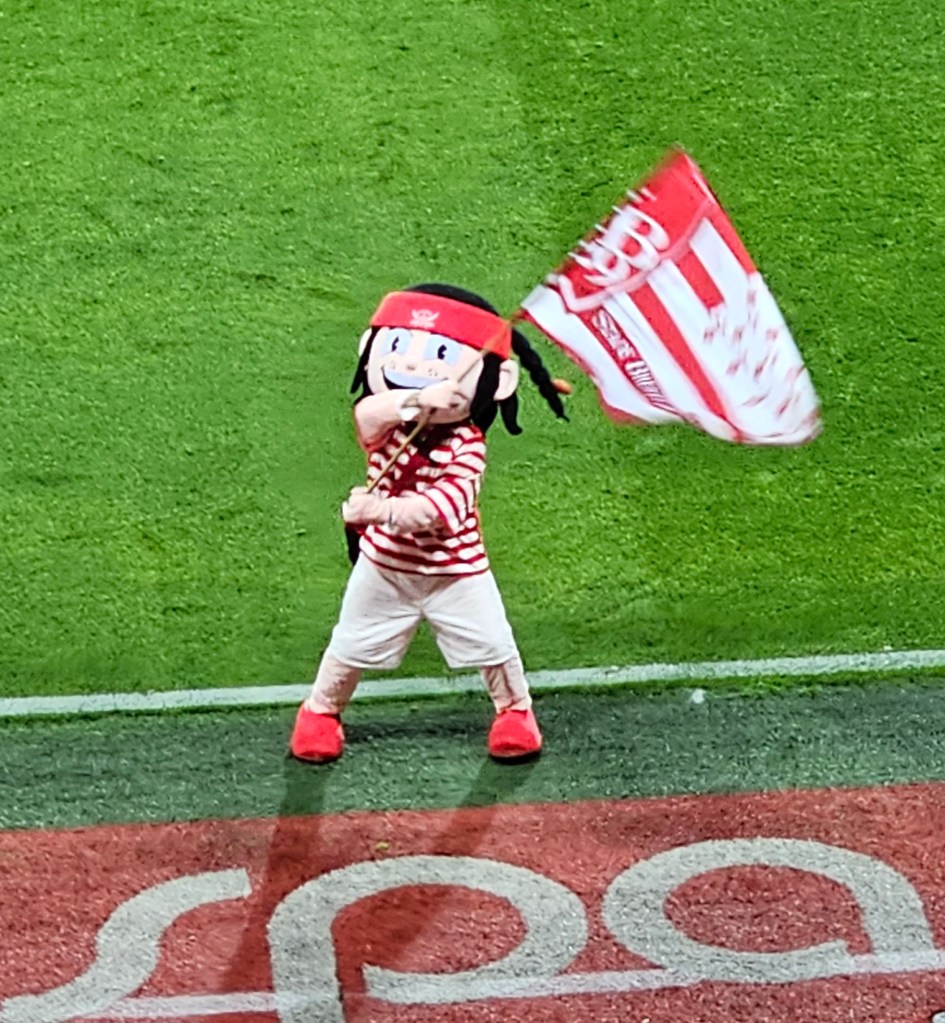
I return to my seat, and in the company of Paulene time passes quickly as we watch Zif, Brest’s pirate mascot, parade before the stand, and enjoy the arrival of the people in the seats around us, most of whom seem to be blokes in their seventies who all know each other.  The man next to me wears a beret and seems very clean, like Paul McCartney’s grandad in A Hard Day’s Night, but French. When the teams at last come onto the pitch, it’s to the fanfare of the Ligue 1 ‘anthem’, leaping flames, and the presentation of the match ball on a shiny plinth in front of banners displaying the two club badges and the Ligue 1 logo.  The public address system seems loud enough to make my ears bleed, but happily it doesn’t, although I do check.

When the game begins it is Lyon, generally known as OL in France, who get first go with the ball which they try and aim in the direction of the ocean whenever they can.  OL wear a frankly hideous, and annoyingly unnecessary away kit of all blue with red trim, whilst Brest are in their signature red shirts with white shorts and red socks. It’s been a warm day, but now a strong breeze blows up the hill from the dockyard and towards the OL goal. From the start, the slogan on my recently purchased T-shirt proves accurate as Brest sweep forward with wave after wave of attacking intent.  A shot goes way, way over the Lyon goal and then another soon earns a corner.  Brest are easily the better team but can’t find the final pass or the final touch that counts.  In midfield for Brest, Pierre Lees-Melou is brilliant, despite having previously played for Norwich City, and I imagine that the Canaries simply had no idea how to integrate a player into their team who can pass accurately, tackle, shoot, run with the ball and generally be quite good.  Fortunately, Lees-Melou seems to have suffered no ill-effects from his thirty-odd games wearing  yellow and green., but he’s probably receiving counselling.

All around the ground, the crowd brays with indignant disapproval whenever a Brest player is fouled. When referee Thomas Leonard books OL’s Ernest Nuamah for fouling Lees-Melou, the cheers sound like a goal has been scored.  I enjoy the wonderful name of Kenny Lala for Brest and the terrible haircut of Maxence Caqueret of Lyon, a player who looks like he was born 120 years too late and should have been the singer in a 1930’s dance band. On twenty-four minutes Lees-Melou has a shot tipped onto the cross bar by OL goalkeeper, the excellent Anthony Lopes, and then Brest’s Jeremy Le Douaran curls the rebound around the angle of the post and the bar.  “Allez-Allez-Allez” chant the home crowd from every stand.  A minute later OL get the ball into the Brest penalty area for the first time, but it comes to nought and instead all around is the noise of Brest fans urging their team on to score the goal the balance of play says they deserve.  The Ultras in the Tribune Quimper call out and the rest of the stadium answers back.  Mahdi Camara, a recent signing from Montpellier, dribbles deep into the OL box but again, there is no goal, only anticipation and excitement.  In the corner of the open end, the OL fans seem oblivious to their team’s ineffectiveness, other than in defence, and have sung and chanted all through the first half, prompted by two blokes perched astride the high metal fence that separates the supporters from the pitch.  Both blokes wield loud halers, but I don’t know if it’s the effect of the strong on shore breeze blowing away most of the sounds of their voices, but they both sound like Rob Brydon’s small man trapped in a box.

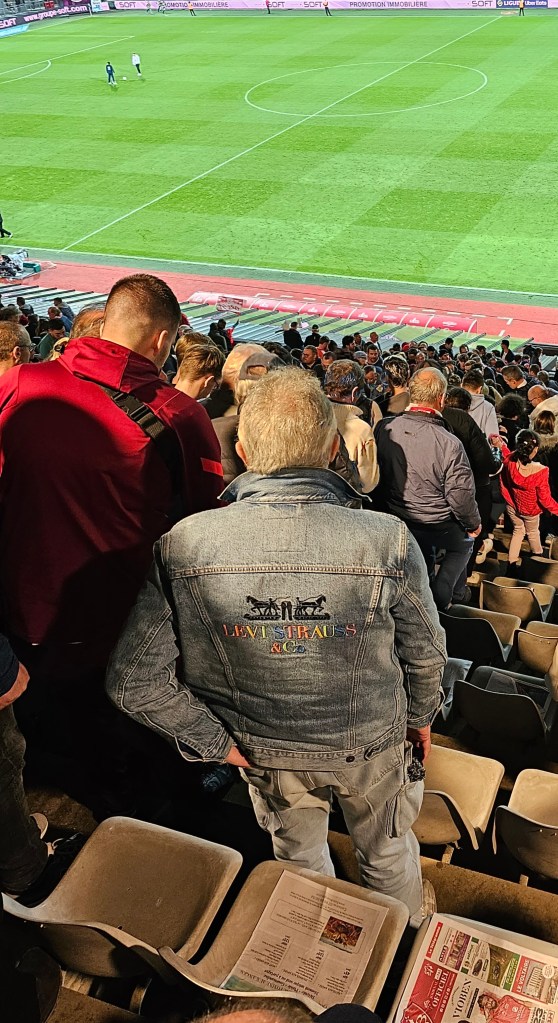
The fortieth minute is a milestone in the game as OL win their first corner, but of course it doesn’t result in a goal, and it’s the Brest supporters who remain in ebullient mood, holding their scarves aloft in the Tribune Quimper as the first half draws to a close in a sort of 1970’s tribute that suits the architecture of the stadium and the old blokes all around me who were themselves probably the Ultras of fifty years ago.  In front of me, a bloke wears double denim, and succeeds in accentuating the feeling, as if he’d come to a game in 1973 and never went home.

With half-time, the seats to our left are nearly all vacated, revealing the fact that they all sport red covers and suggesting perhaps that their occupants are now all enjoying some form of hospitality somewhere, perhaps in Le Caban or L’Esprit des Legendes. I will read later that the club owners wish to build a new stadium at the end of the tram line at the edge of the city, but that it will still only have a capacity of 15,000, no doubt because they want to be able to still charge top prices for the comfortable few and forget about the sweaty oiks who may be don’t wear shirts, and chant and light flares and drink too much beer containing alcohol in the bar across the road.

The second half begins and nothing changes, although encouragingly the block of seats to our left is soon re-populated, proving either that the occupants are genuinely interested in the match or that the hospitality isn’t free or unlimited. After just seven minutes however, OL roll the dice by replacing Ernest Nuamah, Diego Moreira and Paul Akounkou with Mama Balde, Tino Kadeware and Ainsley Naitland-Miles, who tonight wears a silly number 98 shirt and a few seasons ago mostly failed to excite when on loan at Ipswich from Arsenal.  The change sort of works for a short while and Alexandre Lacazette finds space to launch a thirty-yarder which flies over the Brest cross bar, but then a weak Caqueret pass is intercepted by Lees-Melou who dribbles away from his own half and to the edge of the OL penalty area before frustratingly shooting beyond the far post.  An hour has gone and Brest miss another chance, probably the best yet, as a low cross is somehow steered wide of the OL goal by Jeremy Douaron from just a couple of yards.  Whilst clutching their collective heads the crowds shout “Aye-Aye-Aye” and I find myself joining in with swelling chants of “Allez les Rouges! Allez les Rouges!”  Paulene, a Pompey fans says the atmosphere is like that of Fratton Park. “The same sort of people” she says. “What? All dockyard mateys” I reply, thinking of my dead father, a one-time Pompey based matelot who I know would have said exactly the same thing.

The game enters its final twenty minutes, and to mark the occasion tonight’s attendance is announced as being 14,636, and Brest substitute number seven, Martin Satriano for number nine, Steve Mounie.  But it’s OL who, still against the run of play, now come closest to a goal as Lacazette sends a decent low shot goalwards from the edge of the penalty area which Brest ‘keeper Marco Bizot dives to his right to stop and then jealously grab.  Lacazette lasts five minutes more before being replaced by Rayan Cherki, a man whose distinctly bushy facial hair and short back and sides give him the look of an Edwardian naval captain.

Three minutes of normal time now remain.  A move down the right produces a cross from Brest’s Kenny Lala, which Steve Mounie heads against the foot of Lopes’s left hand post.  As the crowd gasps in thrilled disappointment the ball runs back to Lala who crosses it again and Mounie, who has back-pedalled judiciously, this time hurls himself forward to head the ball past Lopes into the near top corner of the net, and Brest have the goal they deserve.  The crowd is on its feet, but OL defender Tino Kadewere is on the ground having been barged out of the way by the hurtling Mounie, although there was no real suspicion of a foul.

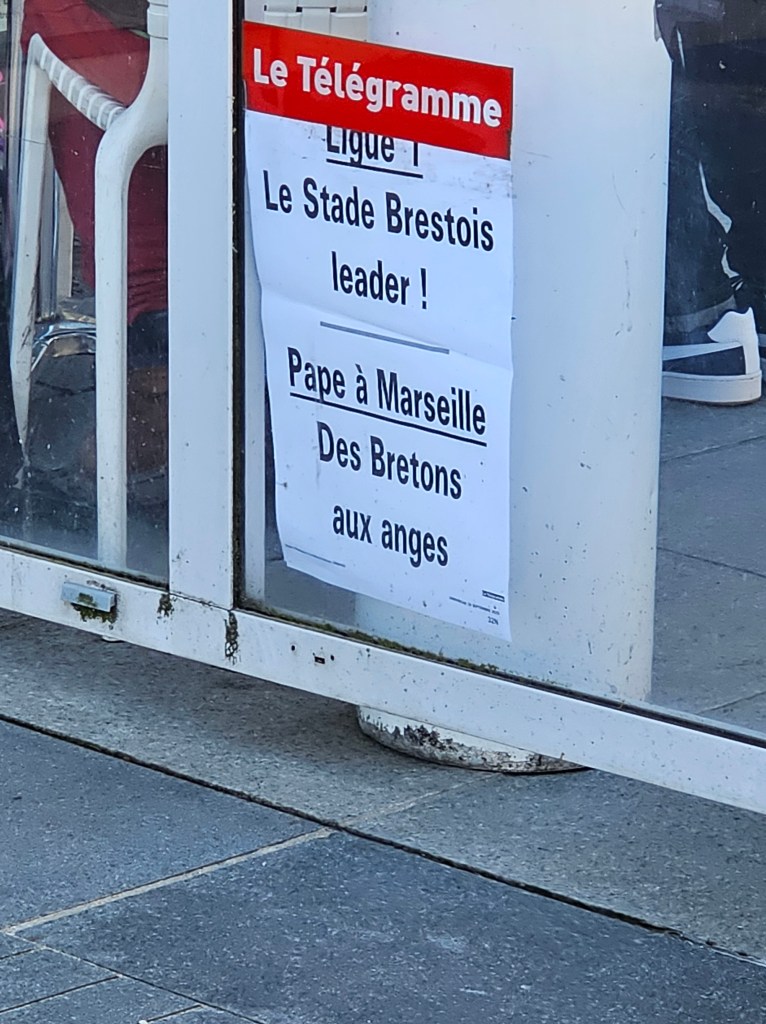
“Allez, Allez, Allez, Allez” we all sing triumphantly, Billal Brahimi shoots, Lopes saves, and Brest have a corner and five minutes of added on time in which to retain their clean sheet or even score again.  The very clean old bloke in the beret, next to me, leaves early, but very few others do.  Jonas Martin shoots and misses for Brest, and Naitland-Miles has a shot saved for OL, but there are no more goals and as the clock ticks towards eleven o’clock Monsieur Leonard blows his whistle for the last time.  Brest are top of the league, or more accurately given our geography, a la tete du classement.  We stay a short while to applaud before heading off into the night and back along Rue de Quimper to the tram stop, and a journey back to our hotel on the most crowded tram I have ever ridden on. It’s been a fantastic evening and still with our minds whirring excitedly, in our hotel room we celebrate Brest’s success by cracking open a small bottle of Cremant that had been cooling in the mini-bar, and unwind by watching the game all over again on Canal Plus tv. Allez les Rouges!