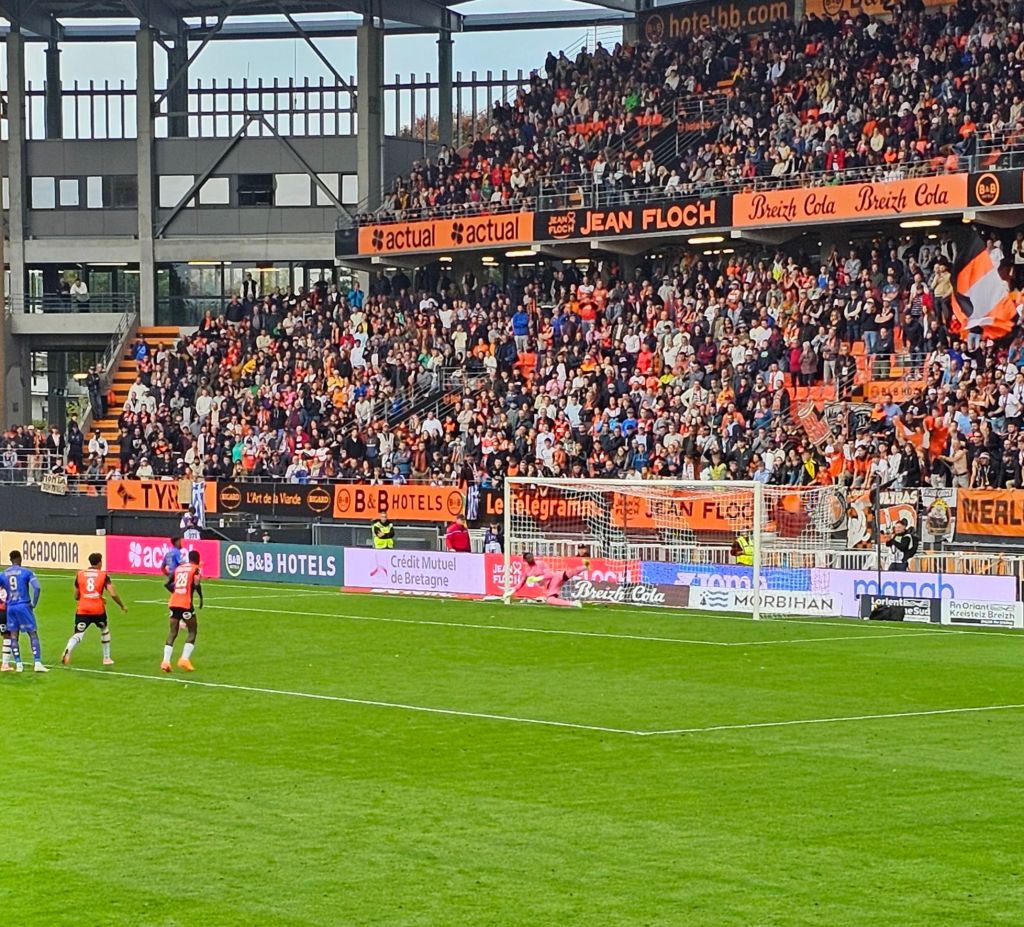
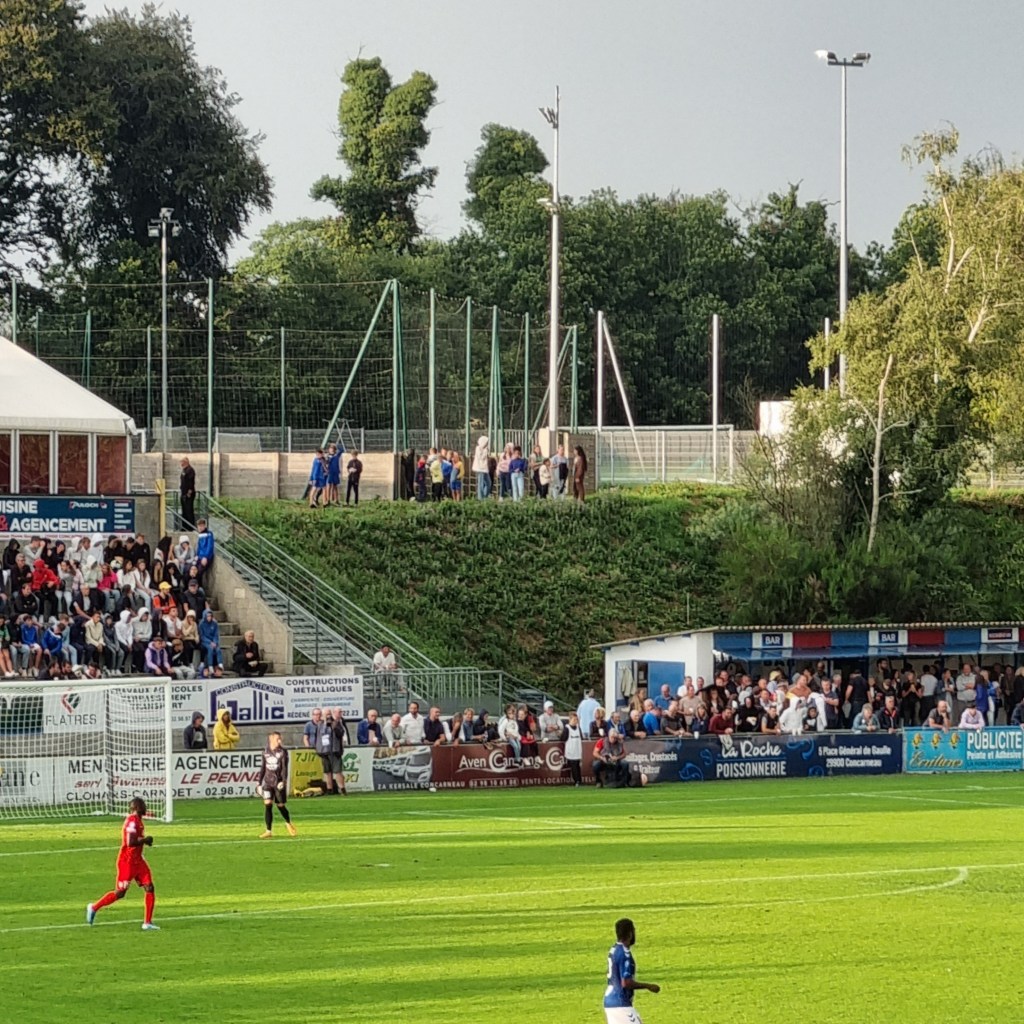
FC Lorient 3 AS Monaco 1

At the risk of becoming extremely boring, my wife Paulene and I have now holidayed in Carnac in Brittany for four years running.  There are probably several even more boring reasons for this, one of the less boring however, because it is made up, is that I like to think of myself as being in touch with my Neolithic ancestors on a sort of yearly pilgrimage to see the Neolithic standing stones, cairns and tumuli that abound in Brittany and particularly Carnac, which this year has become a UNESCO World Heritage site as a result.  Another more truthful reason is that it’s only a 40-odd kilometre trip up the E60 and along the N165 to the Stade du Moustoir to see FC Lorient play and FC Lorient’s mascot is a hake.

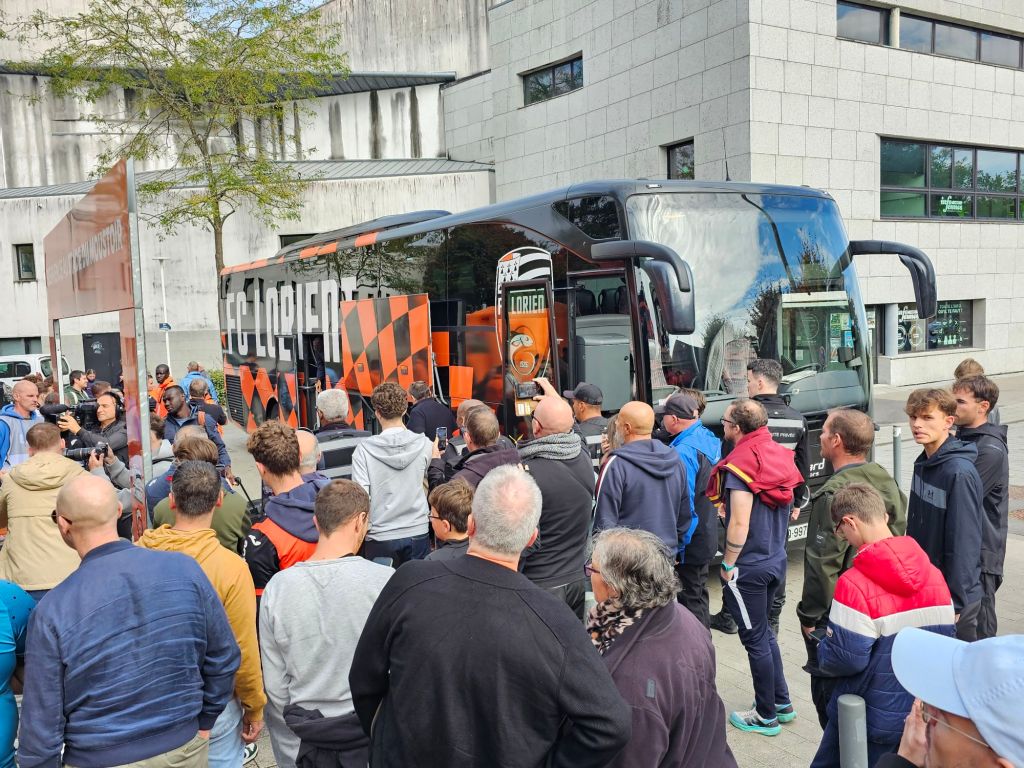
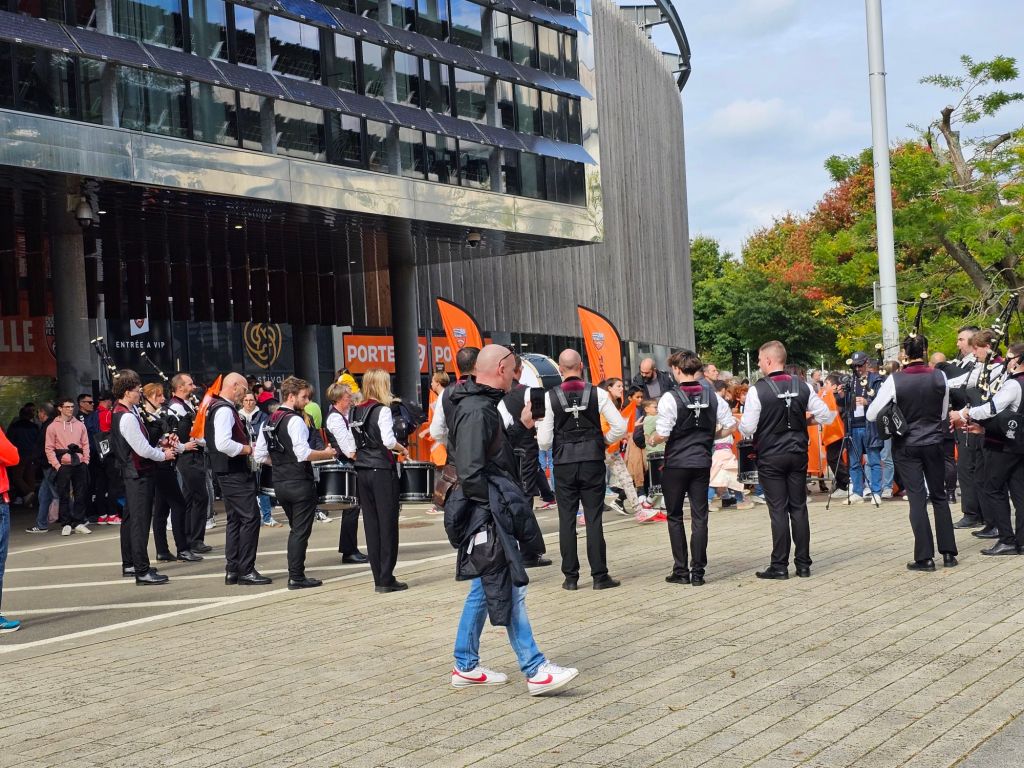
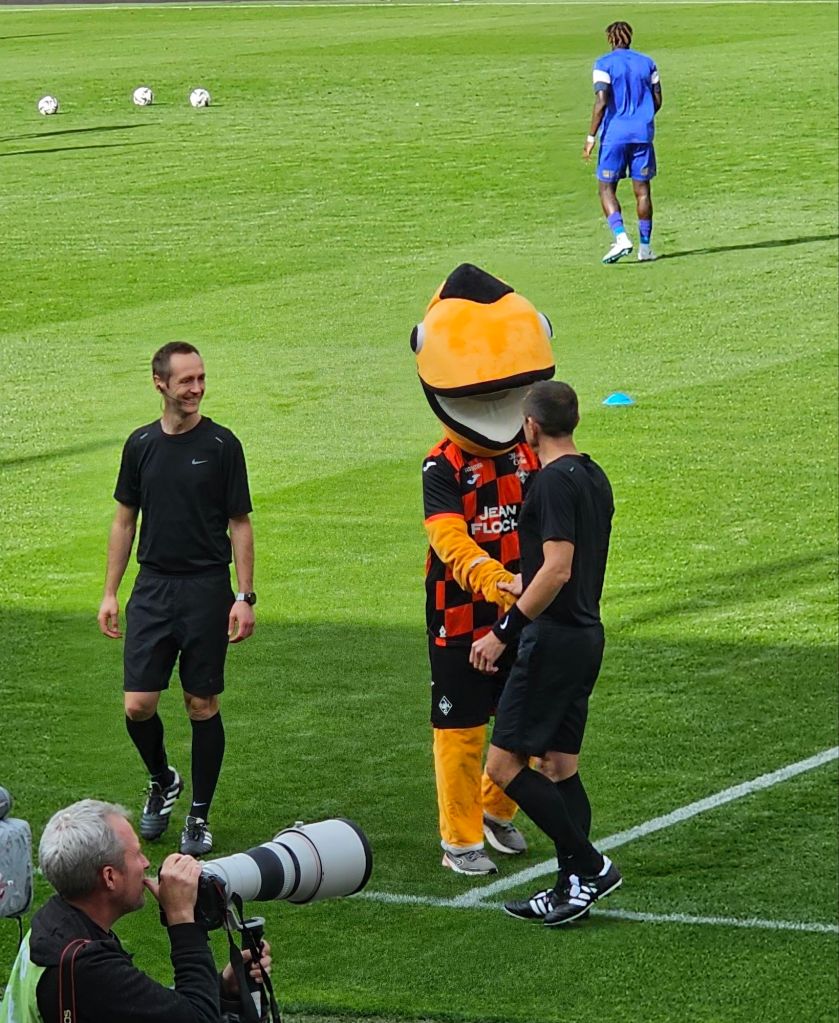
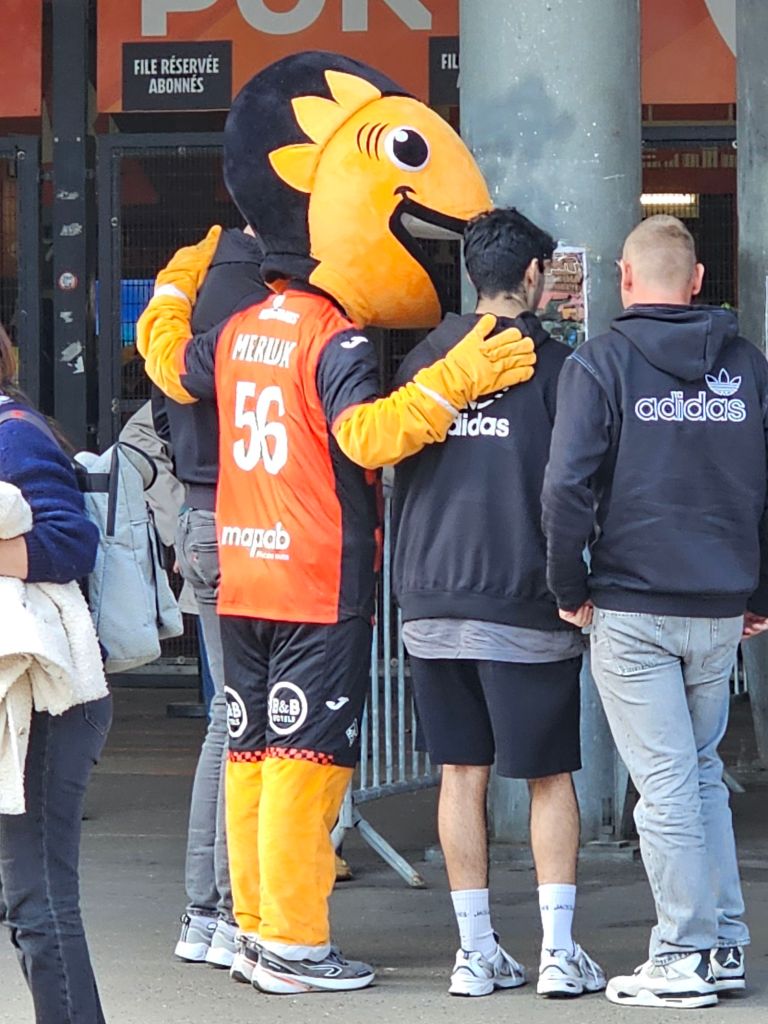
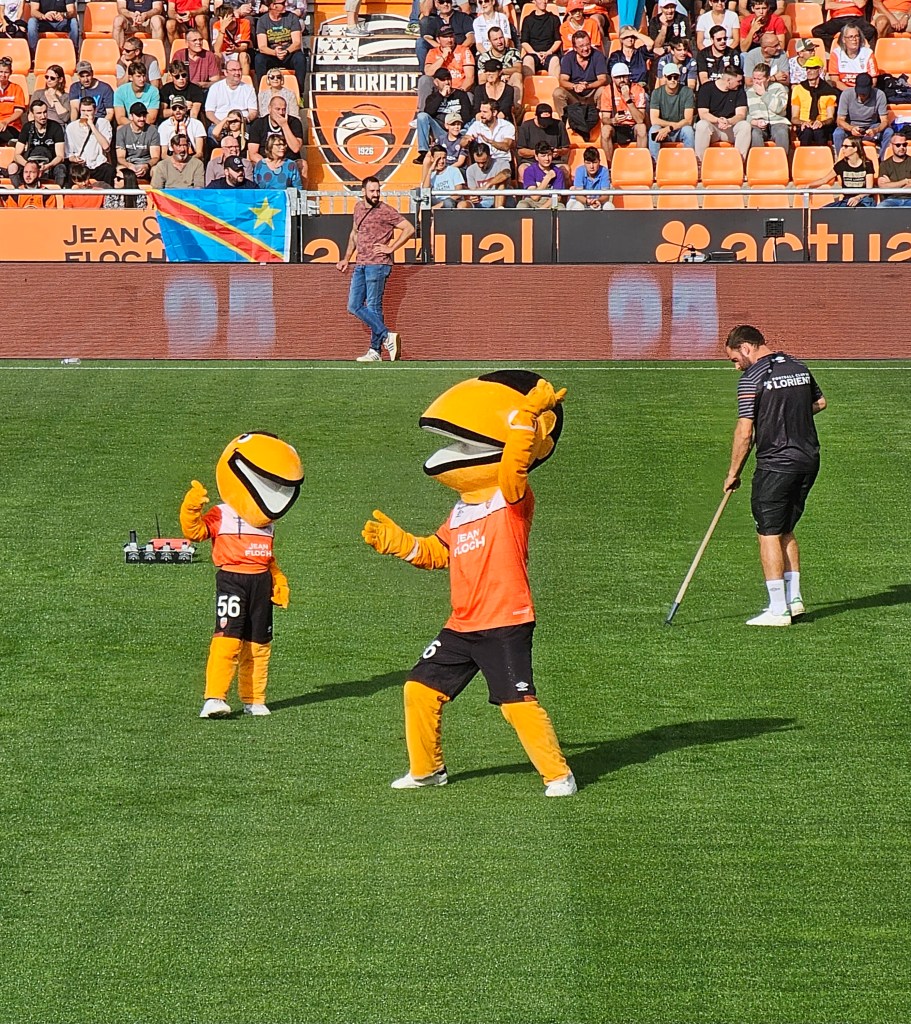
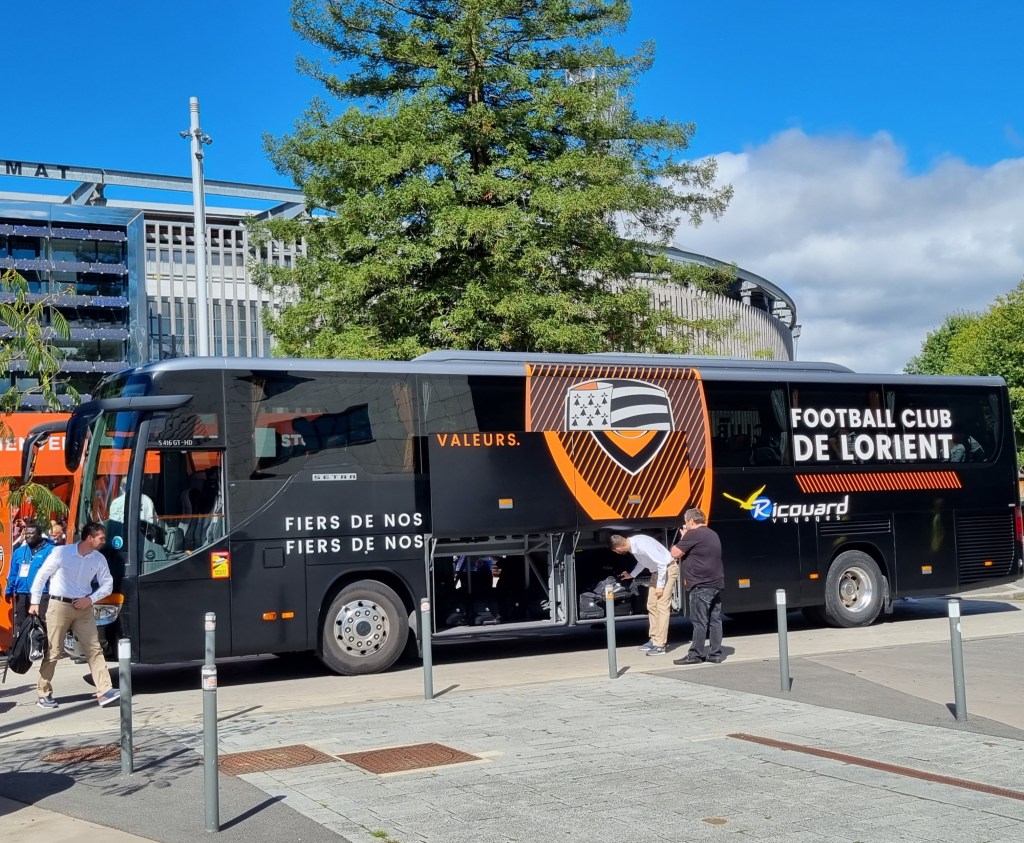
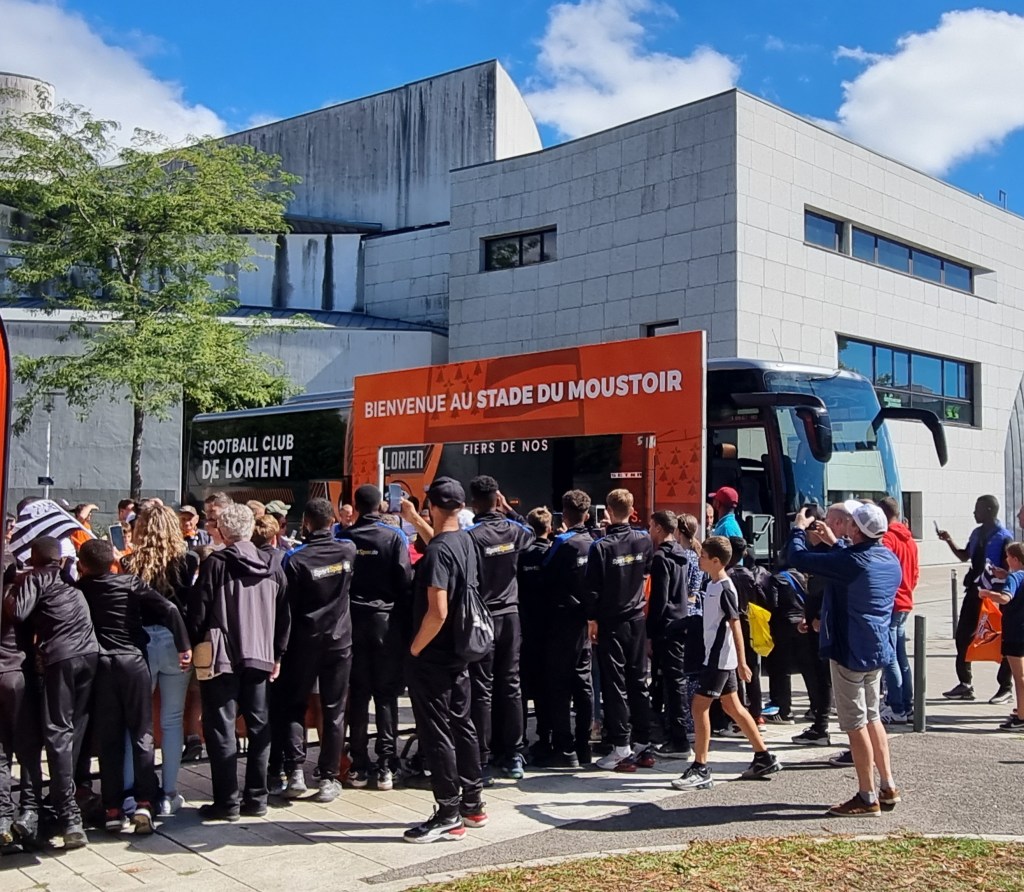
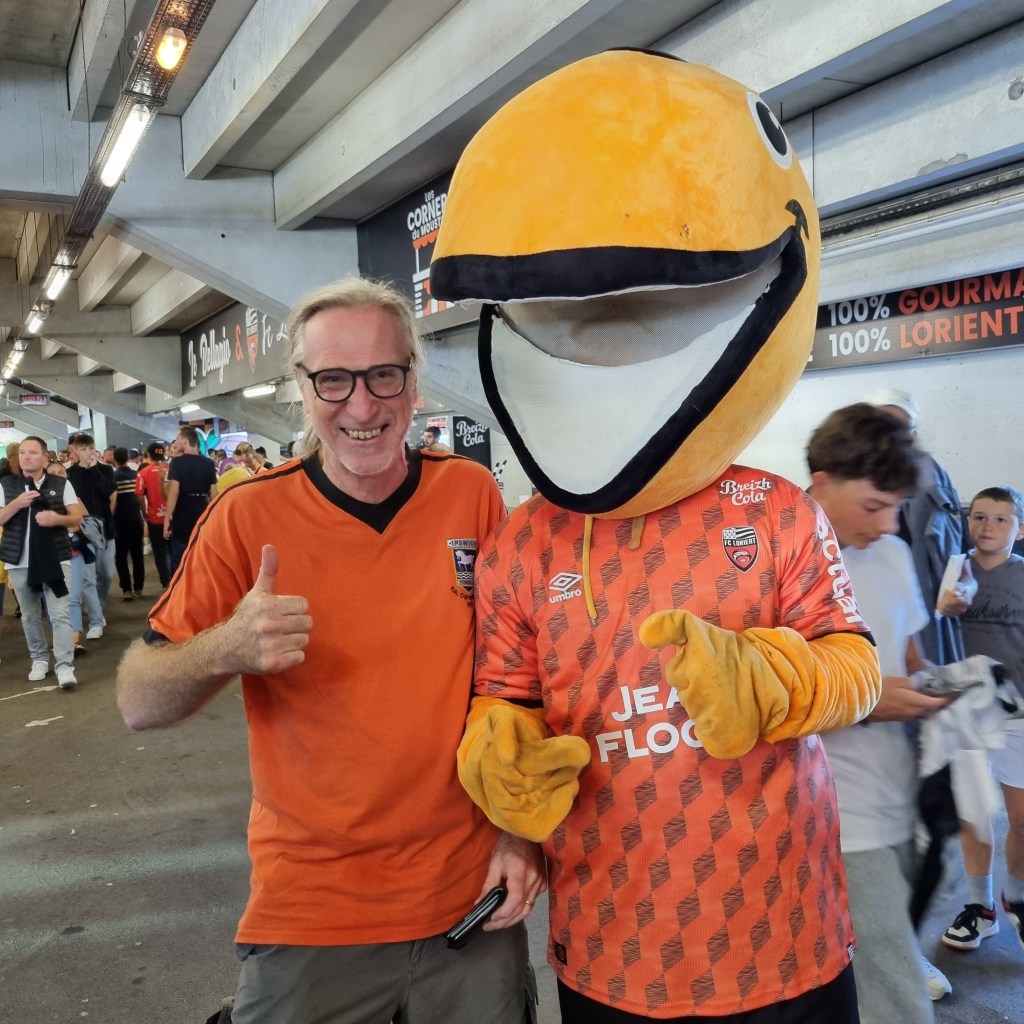
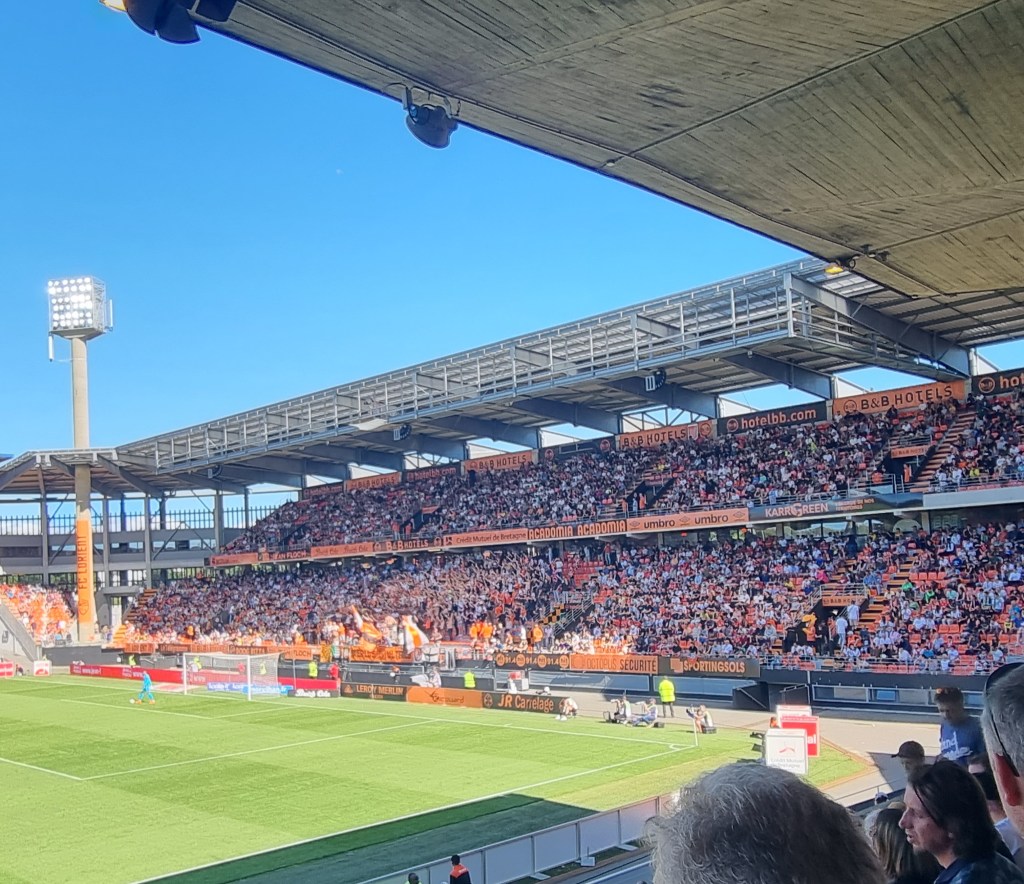
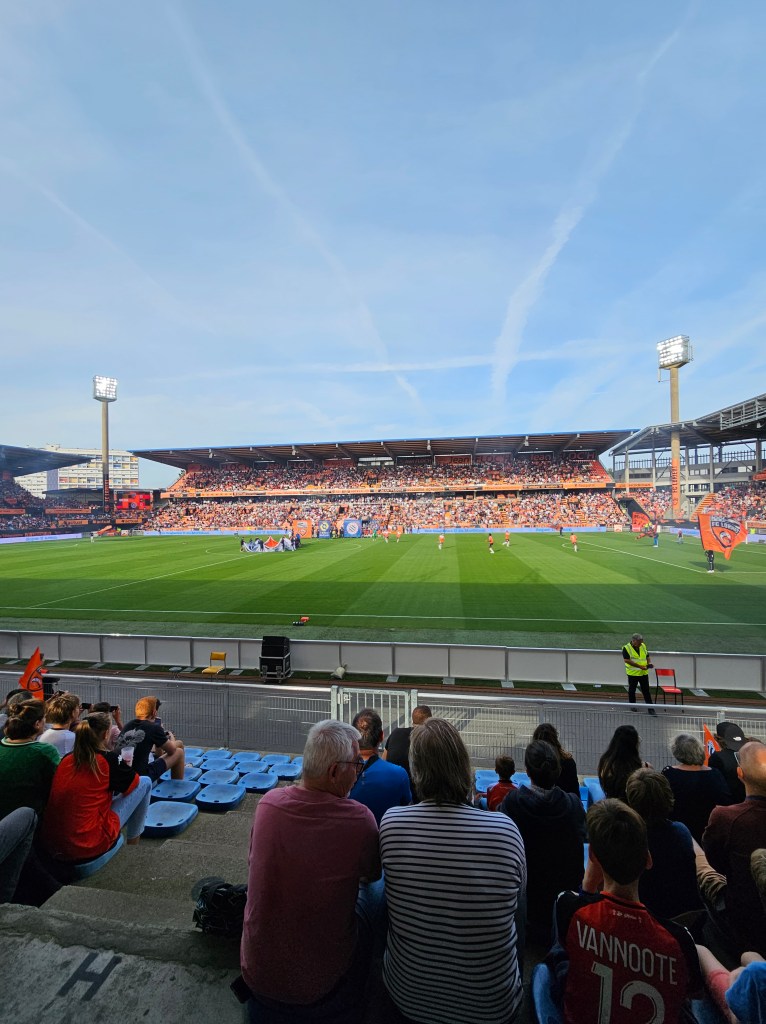
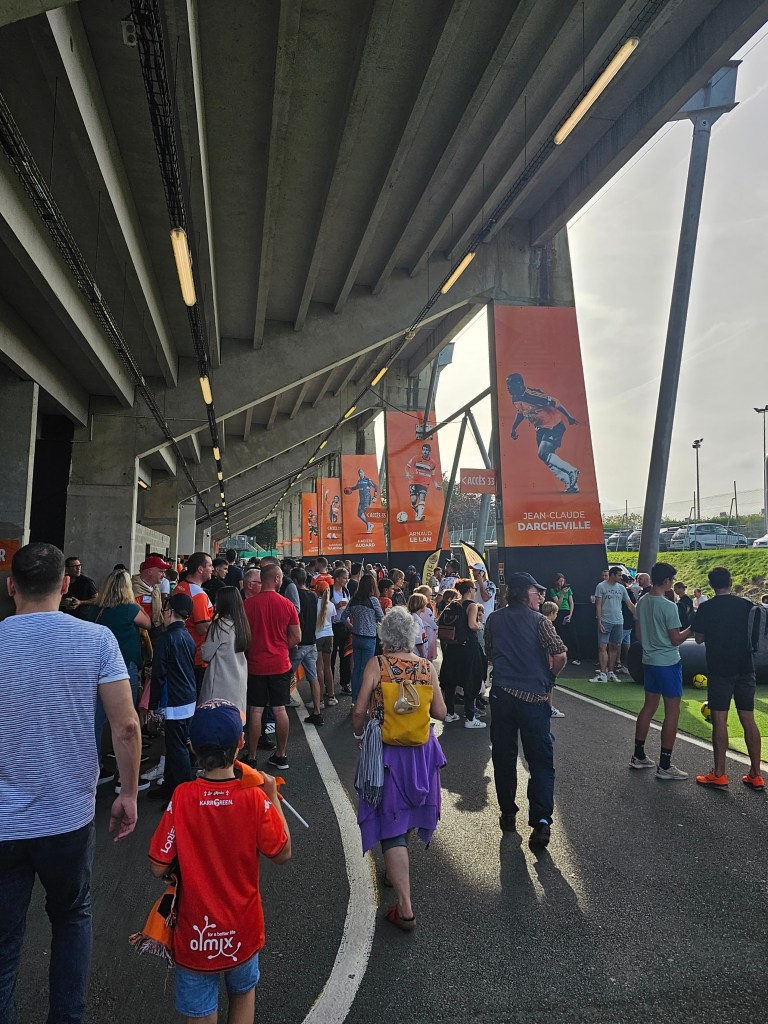
Our holiday is now sadly drawing to a close this year and today is the penultimate day before we must drive home in our planet saving Citroen e-C4.  But today, FC Lorient play AS Monaco in Ligue 1, the French version of the Premier League but with a less self-important title.  The match kicks off at 5 pm and we park up at the underground Place d’Armes car park about four hours beforehand to give time to explore a little of Lorient and at about 3pm see the Lorient team arrive at the Stade du Moustoir amidst bagpipe playing, banner waving and handshakes from Merlux and Mini-Merlux the FC Lorient mascots, (merlu is the French word for a hake).

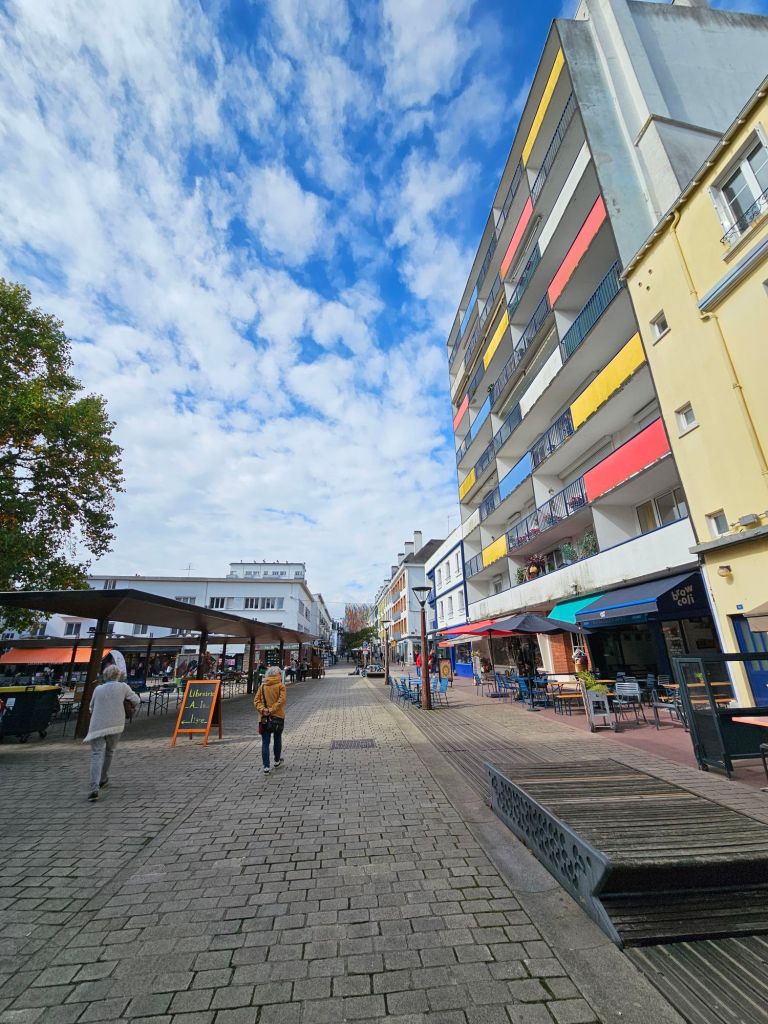
I imagine that to a lot of people Lorient is a dull sort of a place. Ninety-five percent of it was completely flattened by allied bombing in World War Two and therefore it consists almost entirely of buildings erected in the second half of the twentieth century.  But that’s why I like it; it’s not quaint or olde worlde and harking back to some forgotten or imaginary past, architecturally it’s modern and functional and was built with the optimism of the post-war years, the years before some people started to forget what Fascism did and how it started.  Our walk through Lorient is guided by a leaflet we were given in the Office du Tourisme which describes some of the buildings and the art and history of the town.

Around three o’clock we interrupt our walk to be at the Stade du Moustoir for the arrival of the Lorient team off the team bus in their Breton-style, stripey, pre-match shirts.  I make the obligatory visit to the club shop and buy a postcard of the stadium, and whilst Paulene then enters the Tribune d’honneur to find our seats, I make a detour up the road to find Les Halles de Merville, the town market hall, which is featured in the leaflet from the Office du Tourisme and is described as a “concrete and metal ring built in 1964”; it looks like a flying saucer that is no longer flying, perhaps because it is weighed down with fruit, veg, meat and fish.  On my way back from Les Halles I cross the path of a bunch of FC Lorient supporting youths who are making their way to the Stade du Moustoir whilst chanting, banging drums and waving flares.  A few bemused bystanders look on, as do two gendarmes in a dark blue Renault, but these young ultras are largely left to their own devices, as if being on a ‘demo’ is a sort of rite of passage.

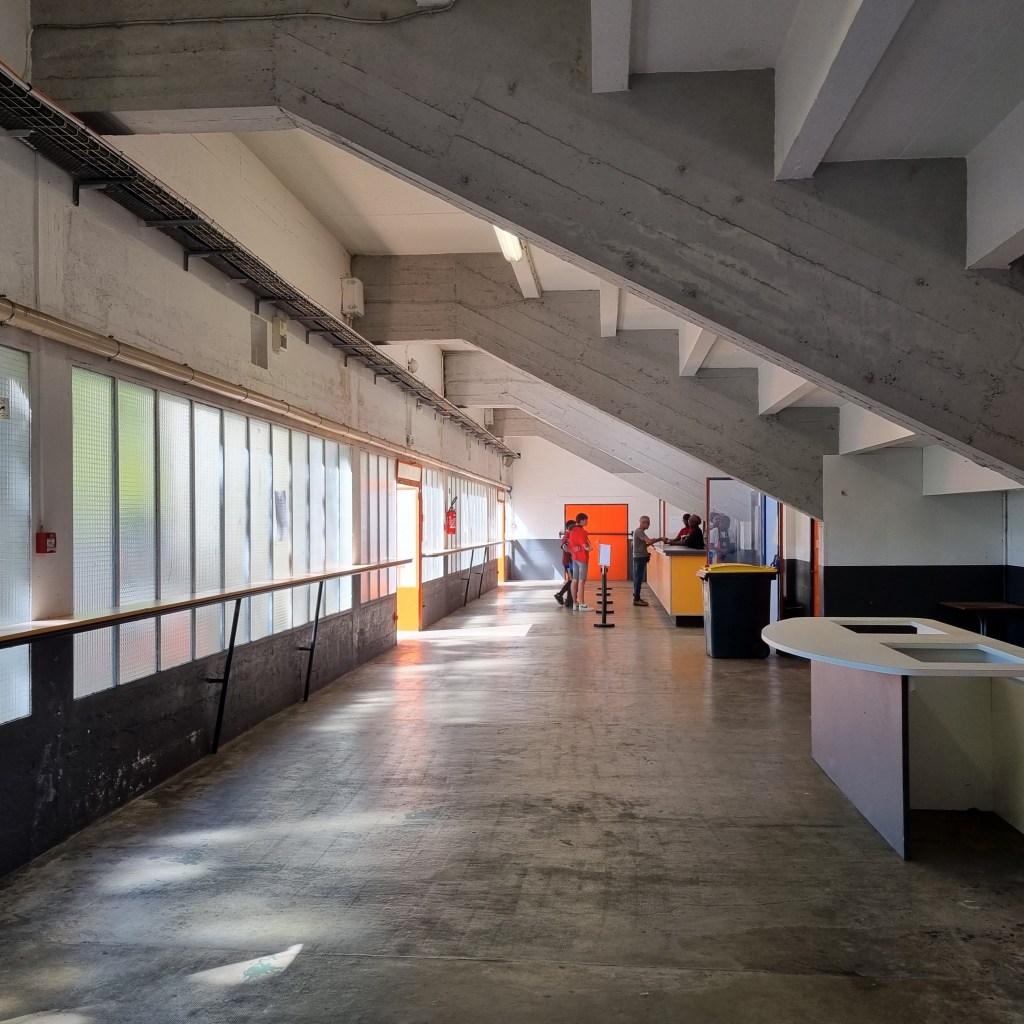
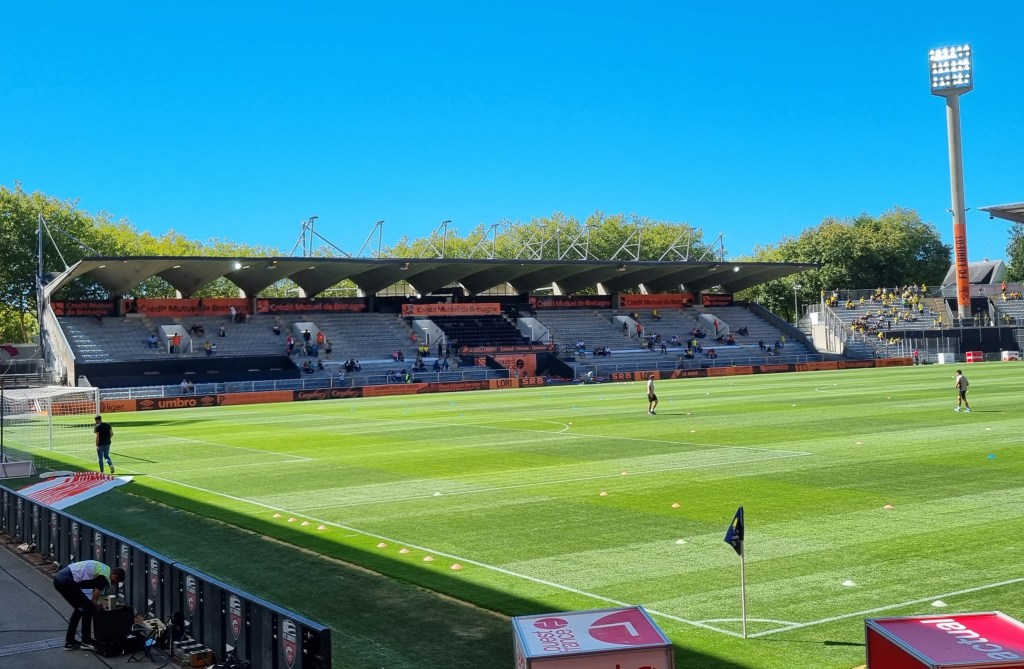
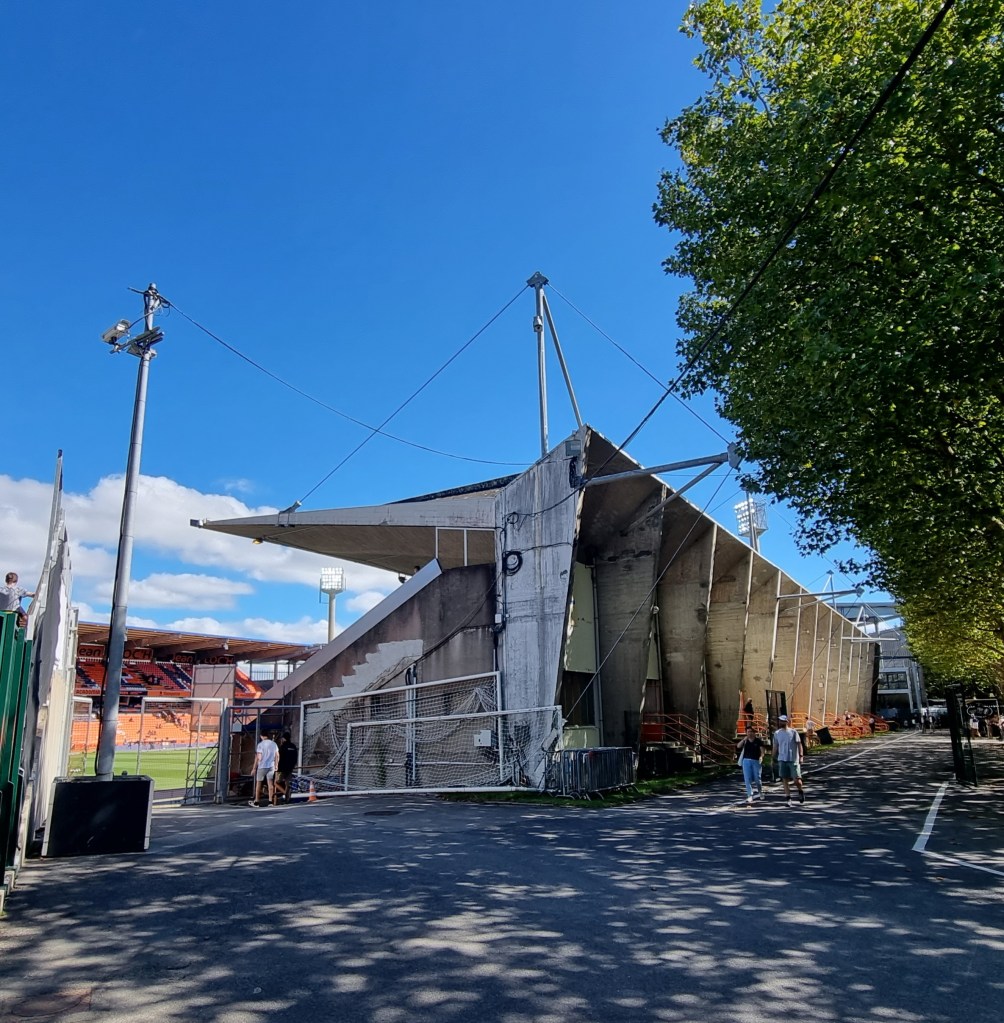
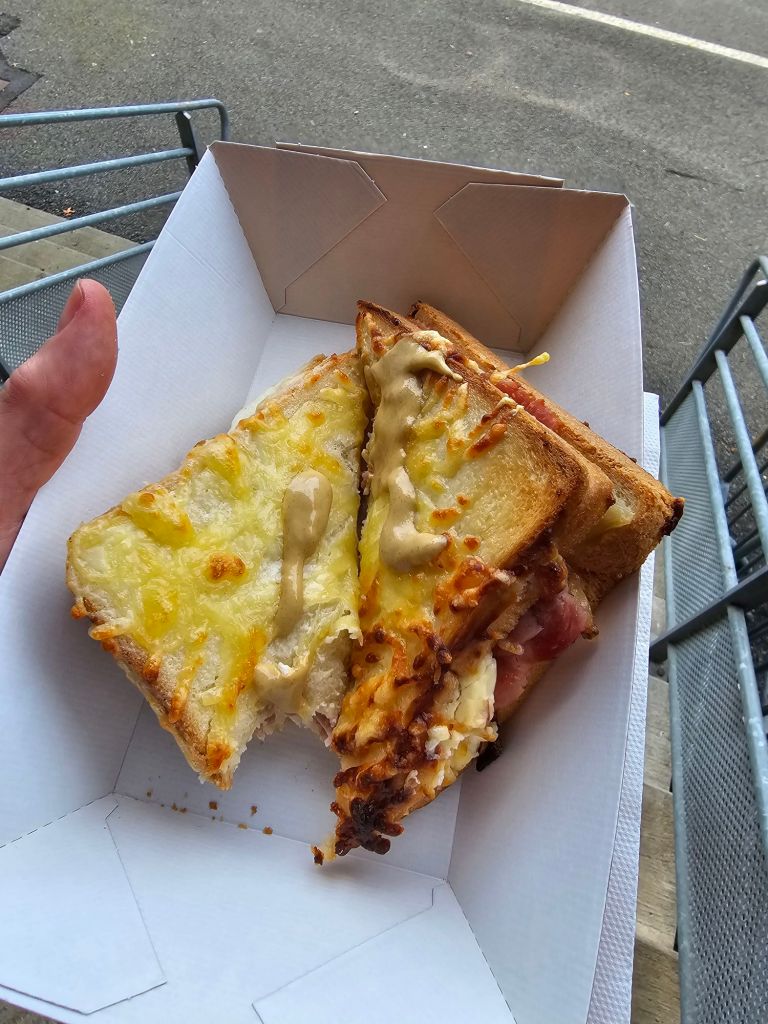
Back at the Stade du Moustoir, I make my way past the security where a man perhaps as old as me pats me down and wishes me ‘bon match’ and another then scans the bar code on my ticket with what looks like a toy ray gun and then says the same.  Our seats are once again in the fabulous Tribune d’honneur, a small, seated, stand of vaulted, shuttered concrete dating from 1959 with metal struts to ensure the cantilever roof remains cantilevered. After locating my seat, I set off to find Breizh Cola for Paulene and beer for myself and to check that it is still possible to walk all the way around the stadium and back to my seat; it is, and this is because the away supporters access their seats over a bridge.  As before, different food counters are serving different types of food and feeling a little hungry at the thought of this I buy a Croque Monsieur (8 euros 50) from the ‘Parisienne’ counter,  thinking that when Paulene reads this it will be the first she knows of it.  I don’t buy Paulene any food because her intolerances to wheat, dairy, and rapeseed oil make it highly unlikely there is anything on offer that she will be able to eat.  Sated with ham, bechamel sauce, melted cheese, toasted bread and a couple of squirts of mustard I return to Paulene with just a re-usable 40cl plastic cup of Breizh Cola (pronounced Brez, not Breej I learn from the young bloke who serves me before he wishes me ‘good match’) and a re-usable 40 cl plastic cup of Breton-brewed Lancelot IPA (10 euros 50 for the two).

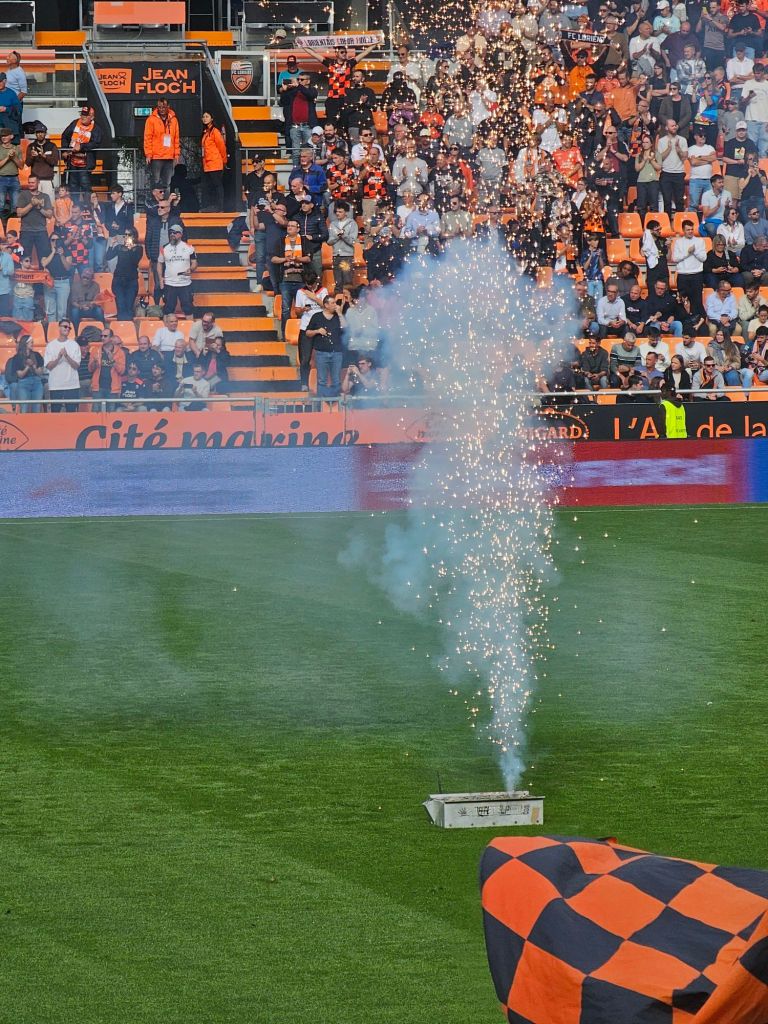
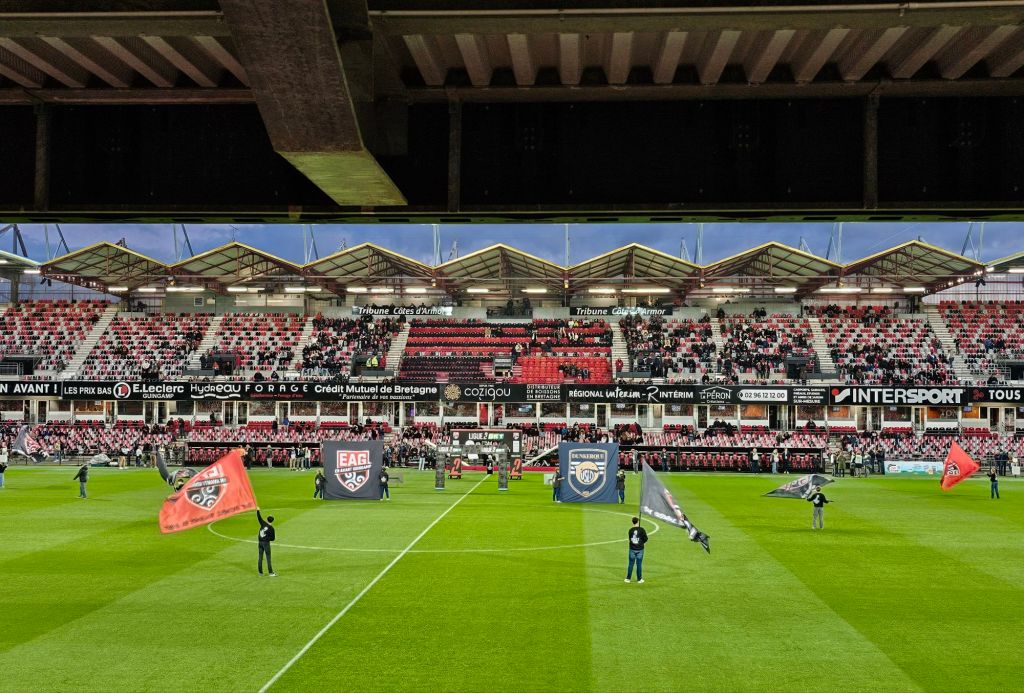
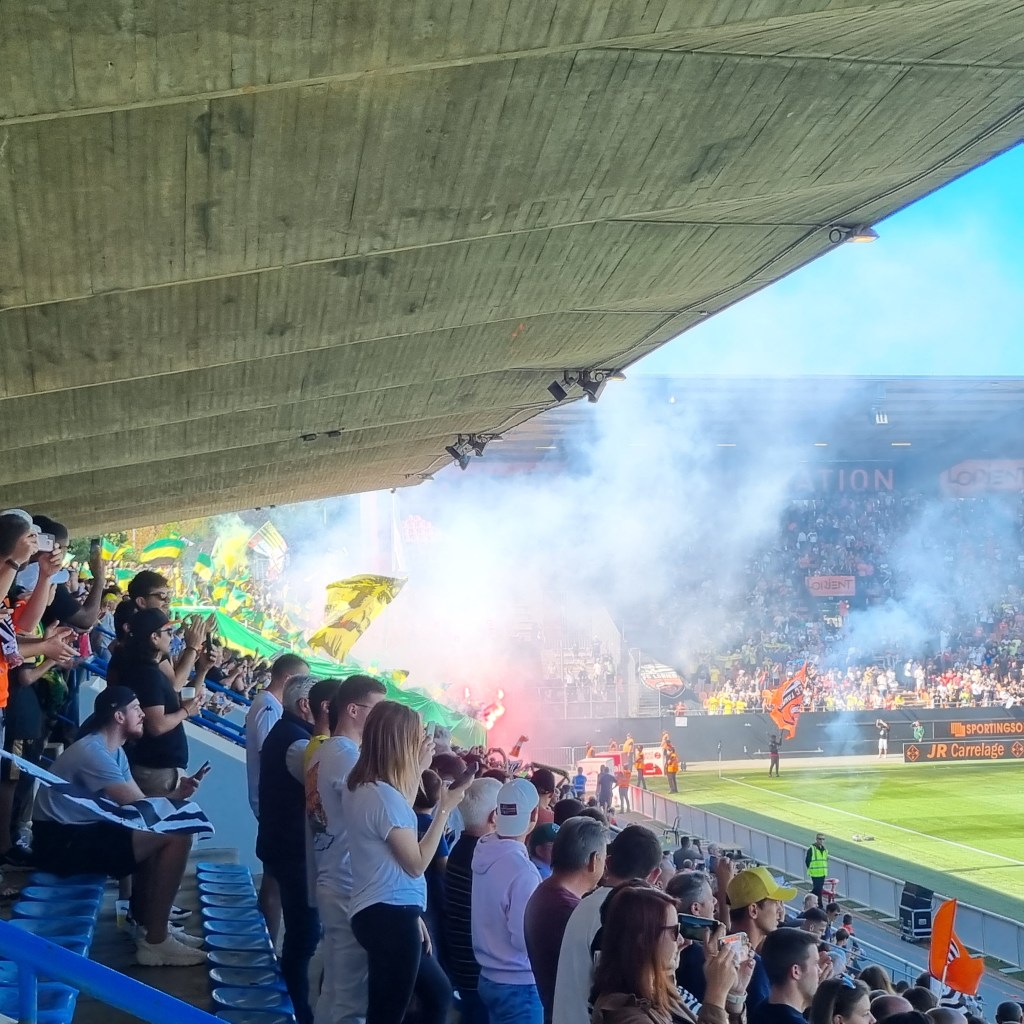
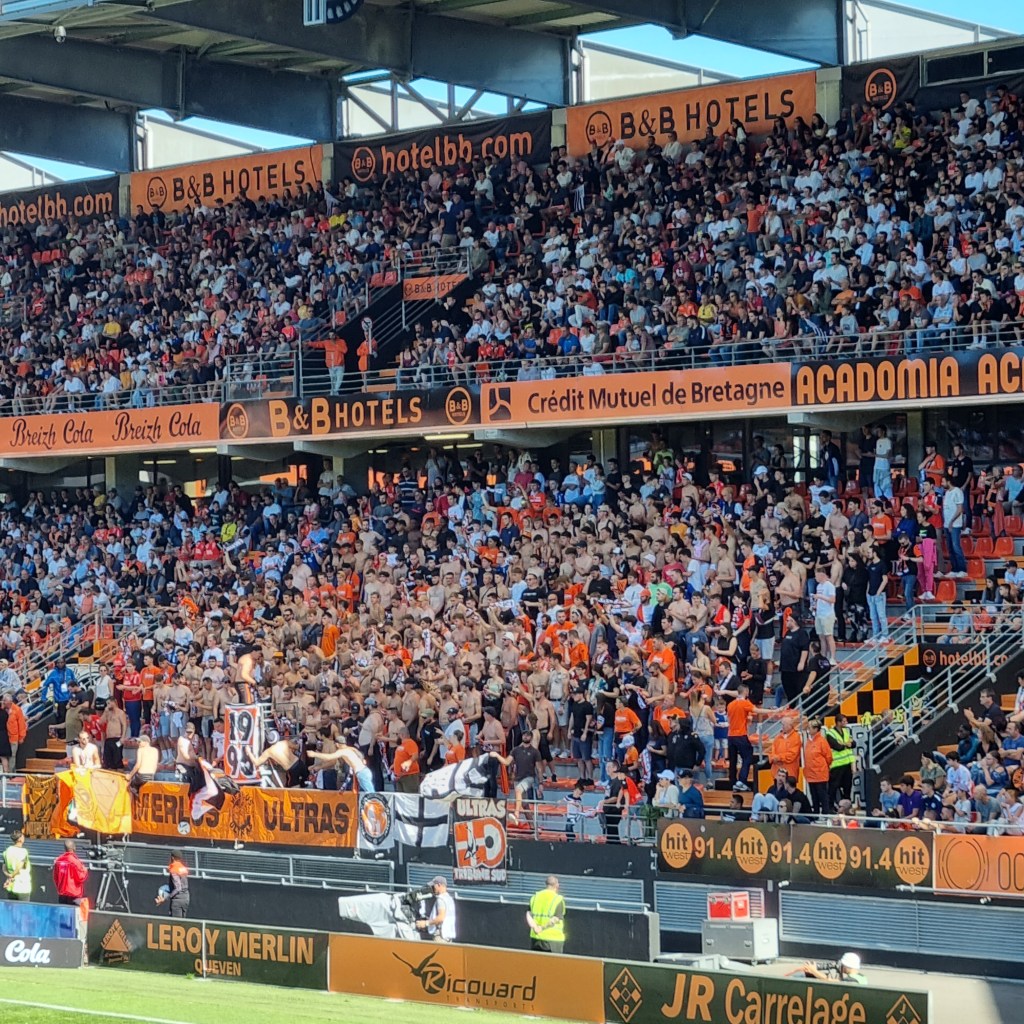
An hour, a half an hour and ten minutes before kick-off (coupe d’envoi in French) a foghorn (corne de brume in French) sounds, a bit like the bell at the end of the interval in the theatre, but appropriately for coastal Lorient, a bit more nautical, and louder.  It adds to the pre-match build-up, which eventually reaches a climax with the Breton anthem on bagpipes with karaoke style words in the Breton language on the big screen in the corner of the stadium, then a second Lorient hymn is played and the bloke next to Paulene joins in, which isn’t a good thing because as Paulene says, his voice sounds out of tune when he’s only speaking,  “Allez Les Merlus” chant the crowd as the teams process on to the pitch, youths wave banners, and a series of not particularly impressive Roman Candle style pyrotechnics ejaculate onto the grass,

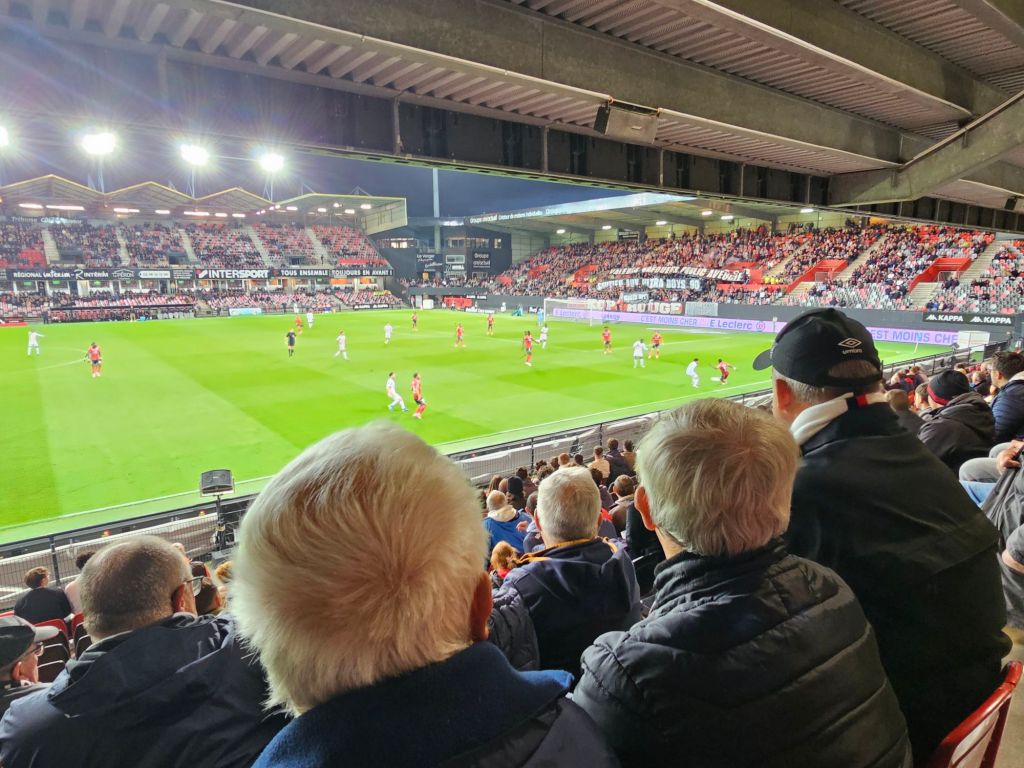
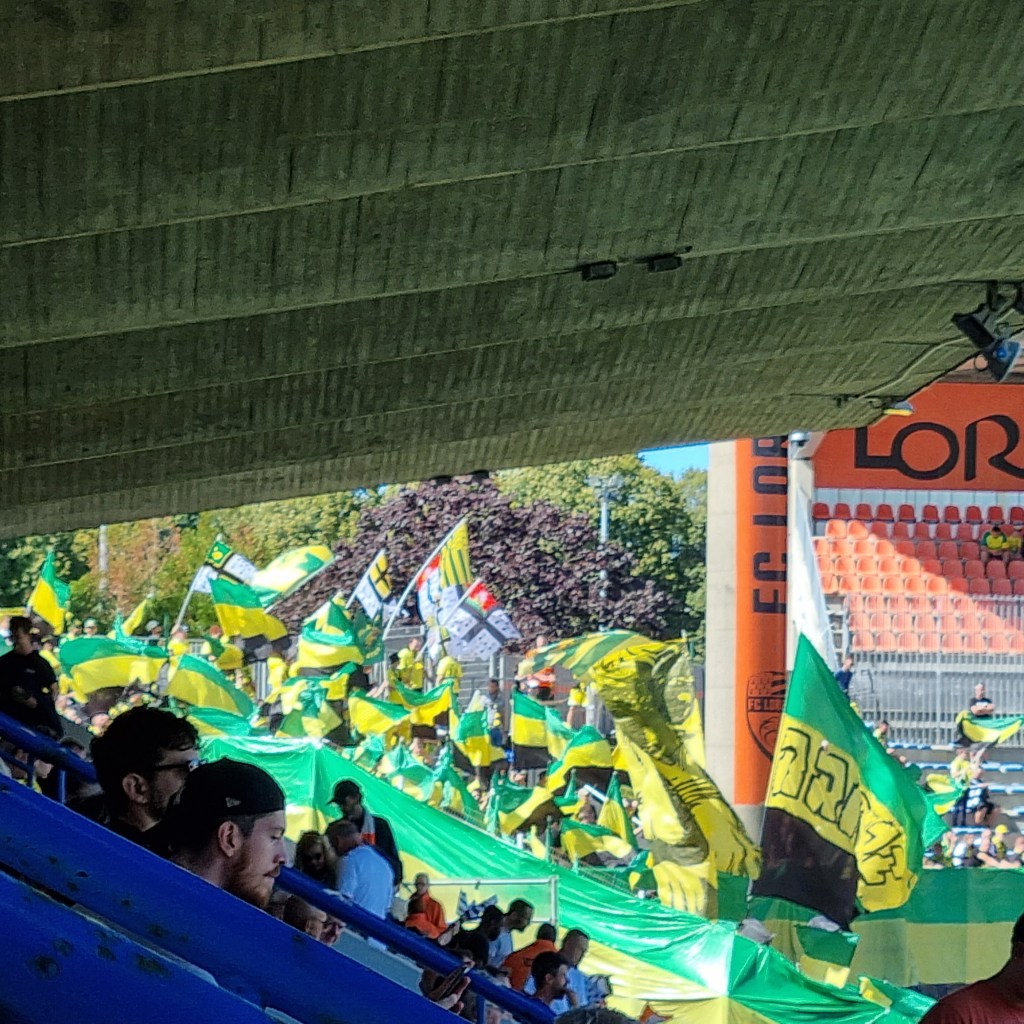
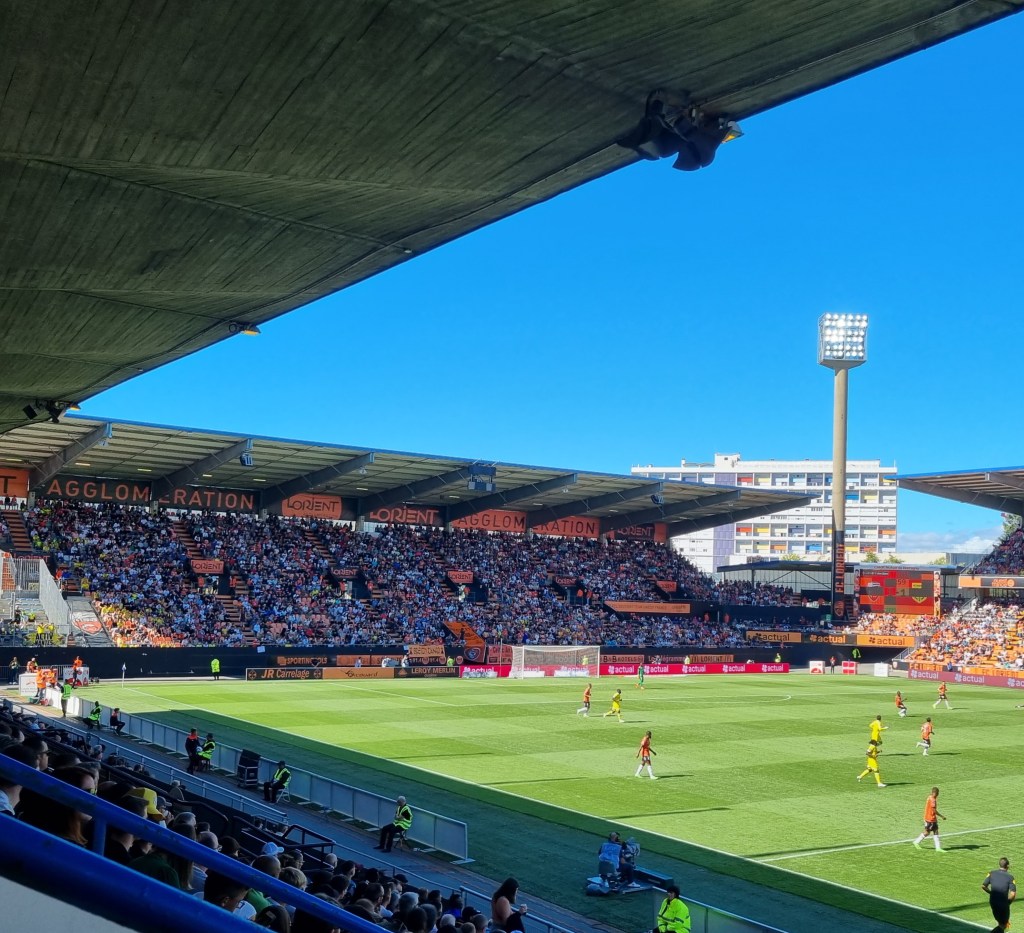
Once everything cleared away it is Lorient who get first go with the ball, which they are mainly passing in the direction of the club shop, hotel de ville, docks and Office du Tourisme.  Monaco meanwhile point themselves towards the far-off towns of Quimper and Brest.  This season Lorient sport progressive looking shirts of orange and black check, which leans to one side like italics, and black shorts. Monaco are wearing an away kit of all purple with gold trim, like you might imagine a team of footballing Catholic bishops to wear.

It is a bright, sunny afternoon but the blue Breton sky is ruffled with high white cloud.  Within two minutes Lorient win a corner and two minutes later they get another.  After nine minutes the joyfully monikered referee Monsieur Ruddy Buquet records his first yellow card (carton jaune) of the evening in the shape of no less a player than the Monaco captain Thilo Kehrer who carelessly, even negligently sends Lorient’s Arthur Avom Ebong up into the air with a supposed tackle. Oddly, however, Monaco are dominating possession, although it takes another ten minutes before we see what can reasonably be called a decent shot on goal, and that is from Lorient’s number eleven, the short but enthusiastic Theo Le Bris, whose uncle Regis used to manage Lorient but is now manager at Sunderland.

Monaco’s confusing approach to the fixture is further shown just two minutes later when Vanderson also gets to smell Monsieur Buquet’s yellow card after he fouls Arsene Kouassi, who rolls and rolls and rolls about on the ground and appears to go into spasms before incredibly, getting up and carrying on. Another two minutes dissolve and Lorient’s Mohamed Bamba shoots over the cross bar.   Despite Monaco’s hogging of the ball for much of the game so far almost a third of it is history before they record a proper shot on goal as Takumi Minamino bounces a somewhat weak snap-shot past a post after what had looked a promising series of passes.

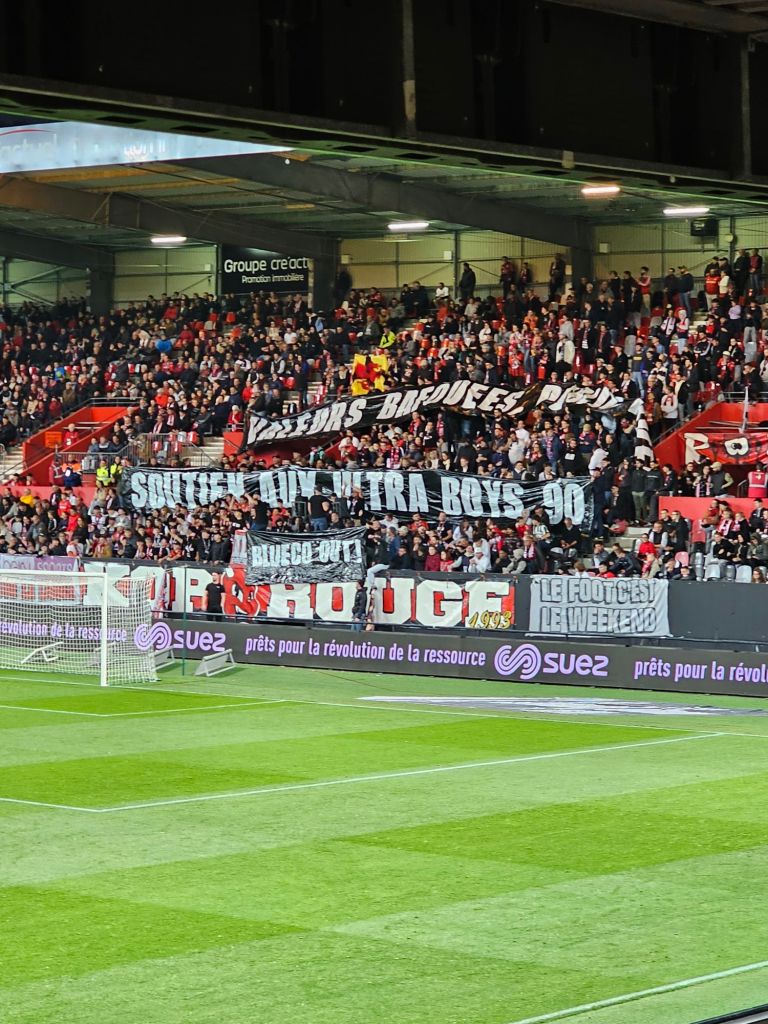
Meanwhile, in the Kop Sud there is a sudden outbreak of orange streamers and the chants of “Allez, Allez, Allez” seem inexplicably louder as if brightly coloured crepe paper has unexpected acoustic properties.  The additional orange on an orange background seemingly also causes problems for Lorient goalkeeper Yvon Mvogo who a short while later surprisingly boots the ball out to Minamino who, whilst looking confident and composed only manages to chip the ball over and wide of Mvogo’s goal whilst the Lorient supporters amongst whom I include myself and Paulene all hold our breath as one.

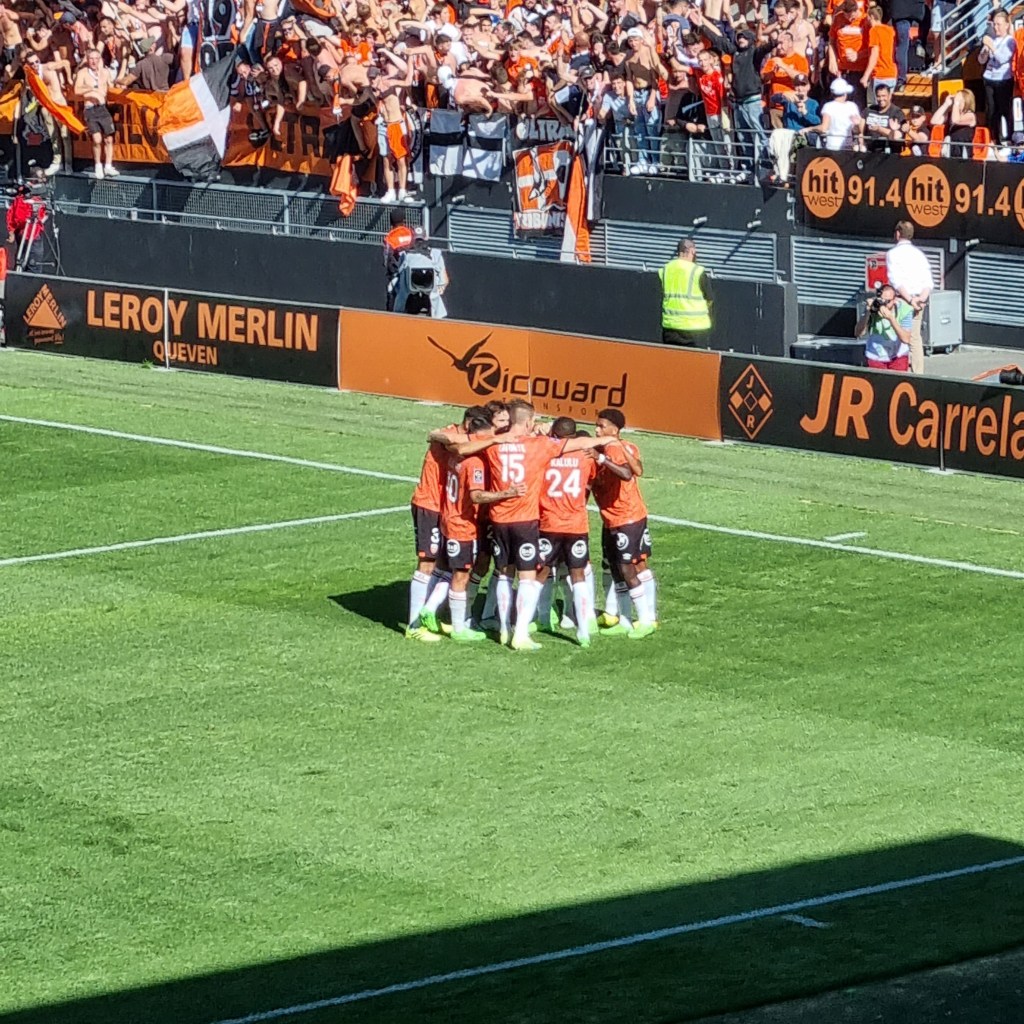
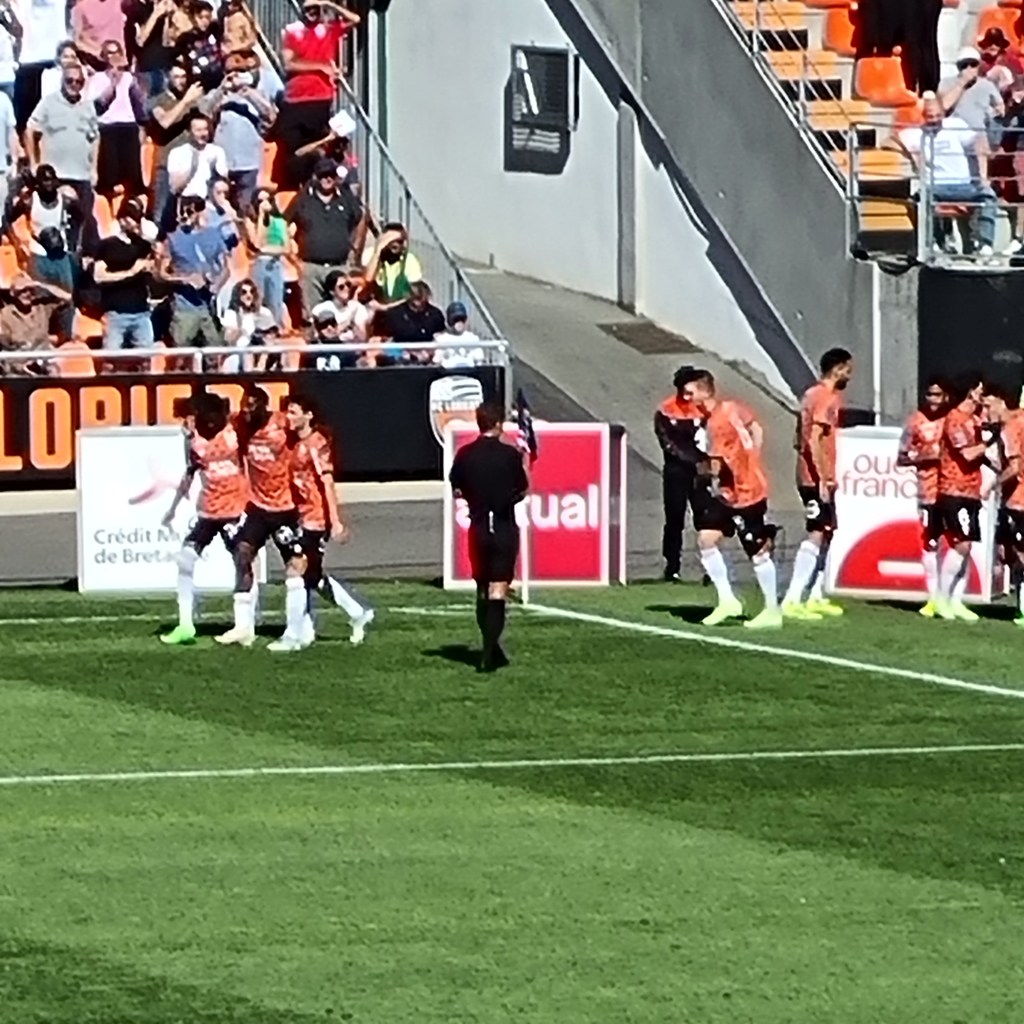
As if a punishment for such profligacy with gifts from fate, a minute later Monsieur Buquet adjudges that Thilo Kehler has fouled Lorient’s Dermane Karim (Dermane to readers of the back of his shirt), and sufficiently badly for him to show him his yellow card for a second time and consequently his red card too. From the subsequent free-kick out on the Lorient left, the ball is crossed in, falls to Mohamed Bamba and he scores from very close range to give Lorient an unexpected lead. “BUT!” announces the electronic scoreboard colourfully as the stadium announcer bellows Mohamed and we all shout “Bamba”, not just once but three times before signing off by shouting his full name just in case anyone was still in doubt about the goalscorer’s identity.

With a one goal lead and an extra player Lorient start to dominate . Bamba is set up well but shoots straight at the Monaco goalkeeper Philipp Kohn and a minute later Kohn is stood in the right place to catch a spectacular overhead kick from Tosin.  Monaco win a late corner to raise spectres of those horrible goals against the run of play and do it again inside the four minutes of added-on time, but the Kop Sud remain buoyant, bouncing up and down in the central terrace (safe-standing area to FFF and UEFA officialdom) and singing “Lorientais, Lorientais, Lorientais” like it was going out of fashion.
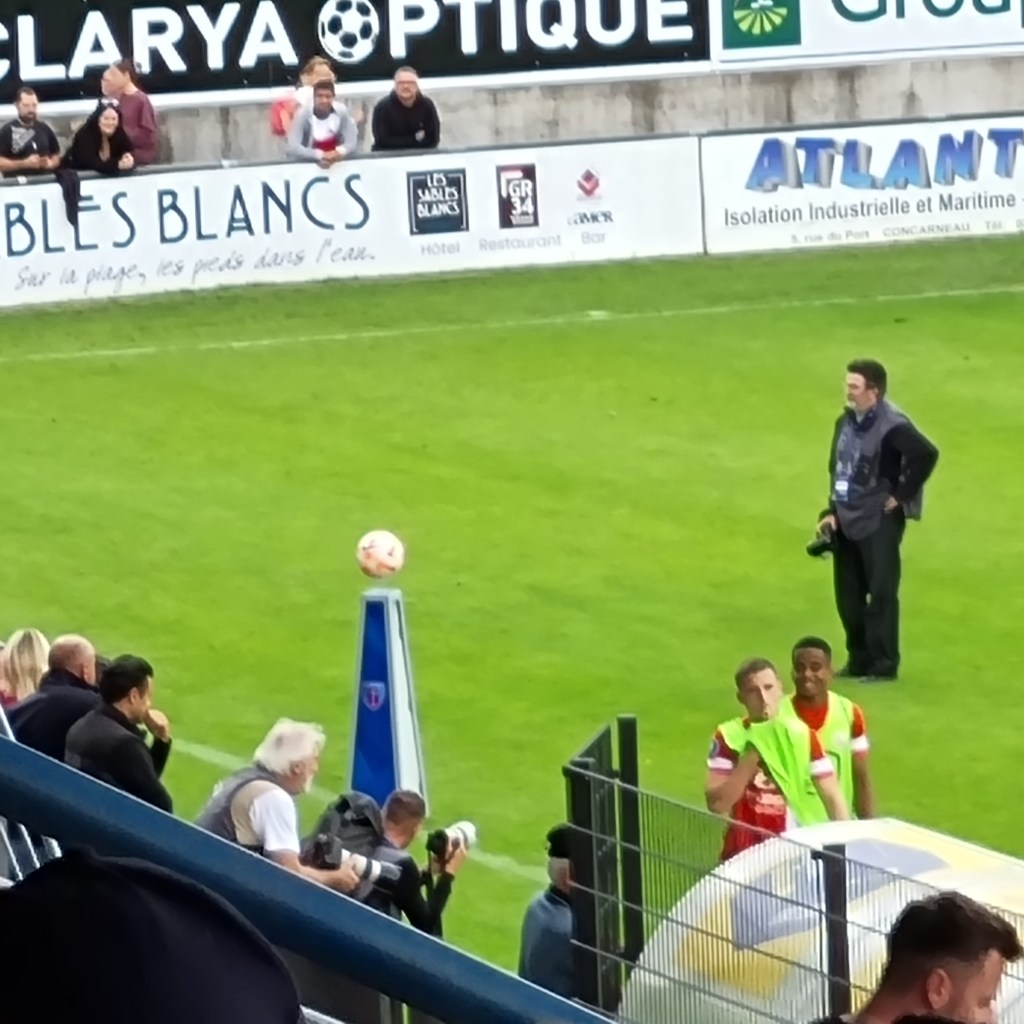
Half-time is a time of applause and an invasion of the pitch by players of mostly very youthful appearance, although one has a beard, who try to score “one-on-one” with the goalkeeper. The players in green shirts seem to win out over those in blue, and Merlux and Mini-Merlux look on feigning acute excitement or deep frustration and remorse according to whether players score or they don’t.  The French version of RADA for people dressed as outsized and vaguely cuddly fish seems to be doing a good job.

The proper football resumes at five minutes past six and Monaco have made some half-time⁹ substitutions; their manager or Prince Albert having presumably realised they need someone on the pitch who is the equivalent of two players.  The half starts strangely for Lorient, who appear to be trying to emulate Monaco’s first half display as they have two players, Dermain Karim and Mohamed Bamba booked in quick succession in the early minutes.  The sky has clouded over since the first half and its feeling cooler, so I put on my coat, covering up my orange and black Ipswich Town shirt, which was offering chromatic support to Lorient and badge-based support to Ipswich, both successfully as it turns out because both teams are currently winning.

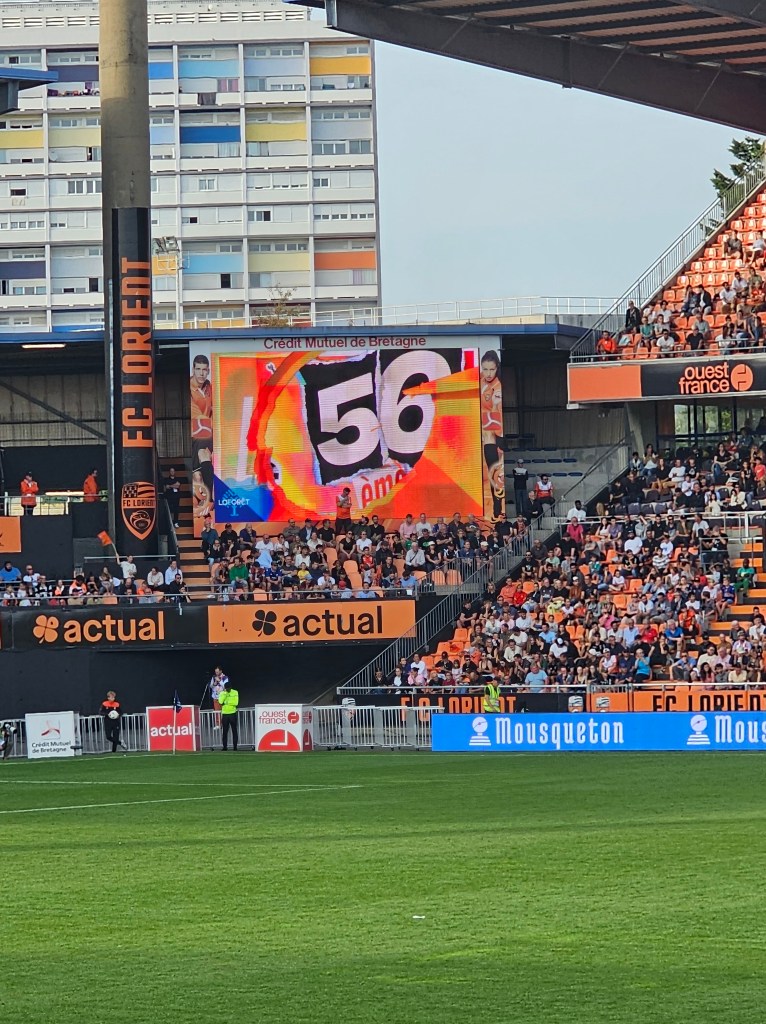
As sure as night follows day, after half-time at Lorient comes the fifty-sixth minute, which is when the foghorn or ship’s siren sounds again, and the scoreboard entreats us all to make a noise.  This phenomenon is explained by the facts that Lorient is in the departement (like an English County) of Morbihan and in France each departement is numbered, more or less alphabetically, and Morbihan’s number is fifty-six. After the relaxation of half-time, the fifty-sixth minute seems an ideal time to wake everyone up to shout “Allez les Merlus!”  and the encouragement nearly works as the minute ends with Tosin Aiyegun shooting over the cross bar at the far post just as the noise subsides.   Meanwhile, Lorient fans are probably thankful their town is not located in Val d’Oise, (departement number ninety-five) .

With an hour then gone both sides indulge in double substitutions before Lorient’s number five  Bamo Meite sends a spectacularly awful shot from a good 20 metres out high into ‘Agglomeration de Lorient’ stand and a man sat in the row in front of me becomes very excited about a goalmouth scramble which has him bouncing up and down on his seat.  The attendance is then announced with the words “Vous etes 15,561 spectateurs et spectatrices” as the French language politely acknowledges that there are both male and female people watching.

The final twenty minutes arrive pretty much on time, as expected, and Lorient manager Olivier Pantaloni chooses this as the time substitutes the trouble-making Derman Karim from Togo for Pablo Pagis. It’s a  good move from Pantaloni as within five minutes Pagis is suddenly slaloming through the middle of the penalty area before poking the ball beyond the Monaco goalkeeper, and Lorient lead two-nil.  “Pagis” bawls the crowd each time the announcer shouts “Pablo”, and then they finish off the celebration by bawling out his name in full.  The sound of the crowd is wonderful; it matches the goal.

Lorient are dominant. Three shots are blocked in the Monaco penalty area in quick succession, Pagis shoots at the goalkeeper and then from the right hand edge of the penalty area Pagis strokes the ball with his right foot into the top left-hand corner of the Monaco goal as if effortlessly creating a beautiful work of art, as if it was naturally occurring, like a rainbow. “Pablo!”, “Pagis!” rings out again.  Lorient lead three-nil. Monaco are abject.  The bloke in front of me who was excited by the goalmouth scramble is now beside himself with joy. punching the air  and hugging the lad beside him, who I imagine is his son, but you never know.

It’s getting on for seven o’clock now and as the natural light fades shadows of the players begin to be cast onto the pitch by the floodlights from atop their concrete pylons; up beyond the floodlights the blue skies and sunshine have given way to cloud.  The five minutes of added on time are unexpectedly mostly played in the Lorient half and they win a couple of corners.  With the second corner comes a delay and a hiatus of doubt.  Monsieur Buquet consults VAR and awards a penalty, nobody knows what for but Monaco’s Ansu Fati scores anyway, giving his team underserved but more satisfyingly, scant consolation.

With the final whistle the Monaco goal is nothing more than a meaningless footnote to the match, a match that is just the frame for the masterpiece that was Pagis’s two goals.  Paulene and I head off back through the departing crowds to our planet saving Citroen in the Place des Armes car park, along the Quai des Indes.   We will have fish for our dinner, but haddock, not hake.  It’s been yet another fine afternoon in Lorient and although we may not return next year, I don’t want to stay away for too long from my Neolithic ancestors and the Stade du Moustoir.

EA Guingamp 2 USL Dunkerque 1

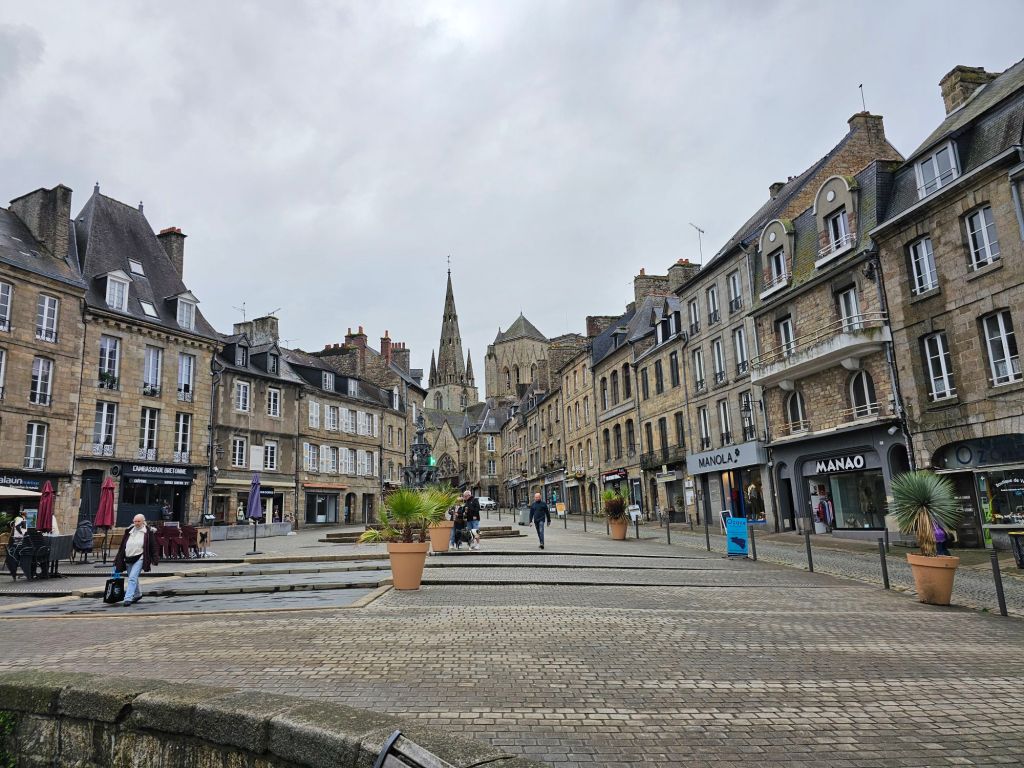
Guingamp (Gwengamp in the local Breton language, and pronounced gangomp) is a small town of only seven or eight thousand people, which sits on a rocky escarpment above the River Trieux in the heavily agricultural north-west corner of France. For thirteen seasons since 1995, this tiny rural town with a population smaller than Beccles, Mildenhall or Woodbridge had a team in the top division of French football, and also won the French FA Cup (the Coupe de France) twice in that time.    But more than that, the name ‘Guingamp’ is just beautiful to the ears, the club plays at the wonderfully named Stade de Roudourou and when Guingamp reached the final of the Coupe de France in Paris, some fans travelled there by tractor.  For these reasons, I am fulfilling an ambition today in making a 160-kilometre pilgrimage from where my wife Paulene and I are staying on holiday in Carnac in the south-west of Brittany.

Our journey is elongated a bit by a stopping off north of the topographically scintillating town of Morlaix, 60 km west of Guingamp to visit the huge six-thousand year old Neolitihic cairn at Barnenez, but we eventually rock up in good time in Guingamp to buy two tickets for the match (26.00 euros each) at the club ‘boutik’ in the town, along with a petit fanion (pennant) and fridge magnet (6.50 euros for the two) for my respective pointless collections.  Disappointingly, the T-shirts showing a representation of the town of Guingamp through its most prominent buildings such as the basilica and hotel de ville is only available in bizarrely small or large sizes, and whilst I’d like a mug that displays the same design, it would probably just sit on a shelf above the petit fanions overlooking the fridge magnet, and with a little thought I could surely spend that 12 euros doing good. More happily, the very pretty shop assistant, whose name, I think, from what it says on our tickets may be Angelique compliments me on my French, although after initial exchanges we mainly speak in English.  

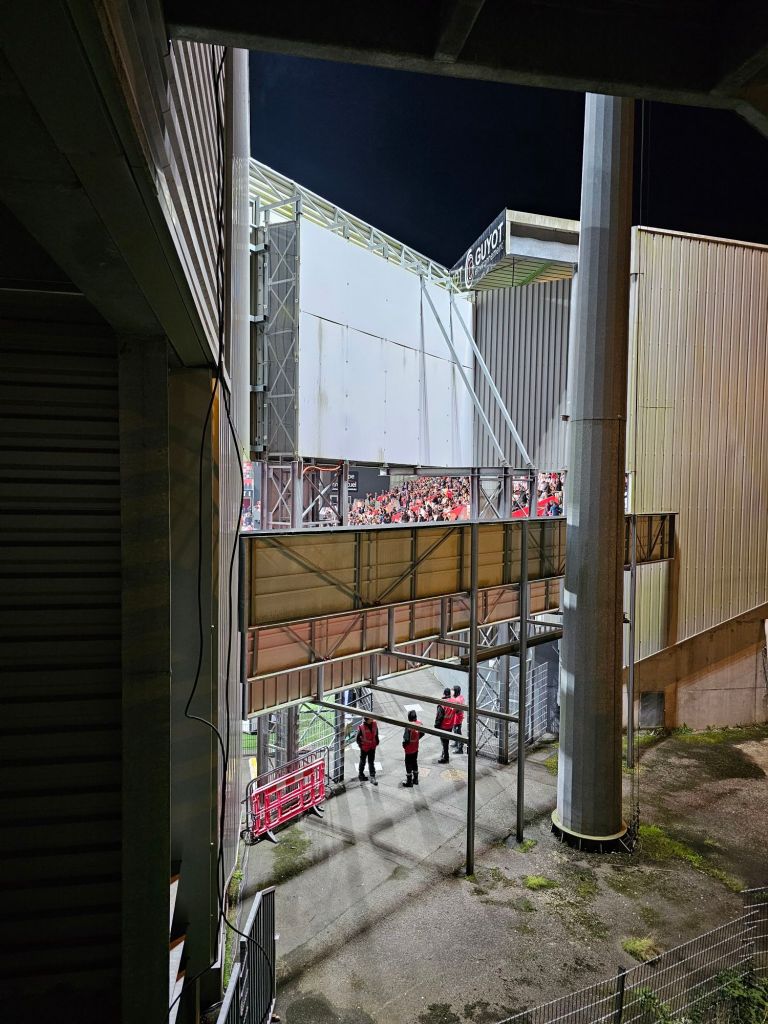
Our hotel room for the night is in a grand nineteenth century house not far from the town centre, but it is a half an hour’s walk from Stade Roudourou and Paulene’s asthma will not stand that once the cold night air surrounds us after 10:30 when the match will probably finish.  Sadly, there is no ‘navette’ (shuttle bus service) to the stadium, but on the advice of the two very helpful ladies in the local Tourist Information Office we make a short car journey across town to the Place St Saveur where we park up our planet saving Citroen e-C4 at no cost. Remarkably nearly all car parking in Guingamp seems to be free.  From the car park, we can see the floodlights of the stadium, and the walk to the Stade Roudourou takes us only a few minutes over the shallow looking, gurgling River Trieux and down a few closed off streets.  The stadium is situated in a residential area which has the appearance of one of the banlieus of a much larger town and is enclosed behind iron fences as if fortified against the outside world, an impression further strengthened by the harsh steel and concrete architecture of the stadium, which is in some ways is at odds with the stone buildings of the town but is perhaps also a modern and cost effective version of them.

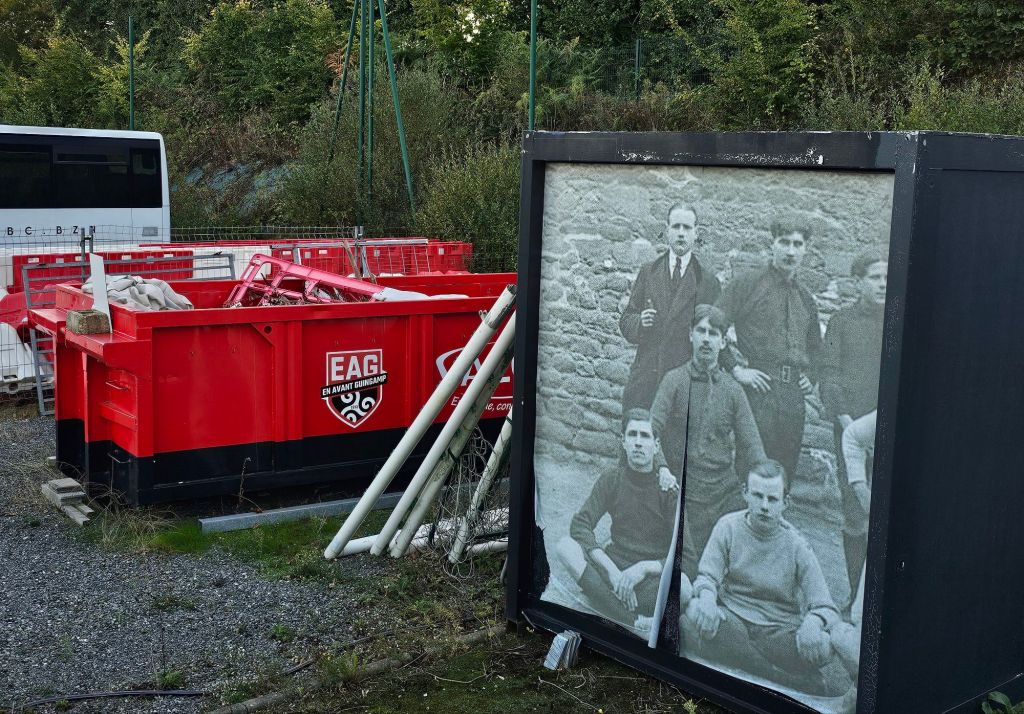
The walk to our seats in the Tribune France Barnums (presumably named after a sponsor) takes us around the back of the main stand (the Tribune Cotes d’Amour) past a small wooden hut from which two middle-aged women are selling club souvenirs.  I ask if they have any T-shirts like the ones I saw in the shop in the town; they don’t, but nevertheless they laugh either at my description of the very large and very small sizes available in the shop in the town, or just at my French, I’m not sure which. Paulene and I walk on past a skip decorated in club colours and the back of the Kop Rouge where the local Ultras will later gather.

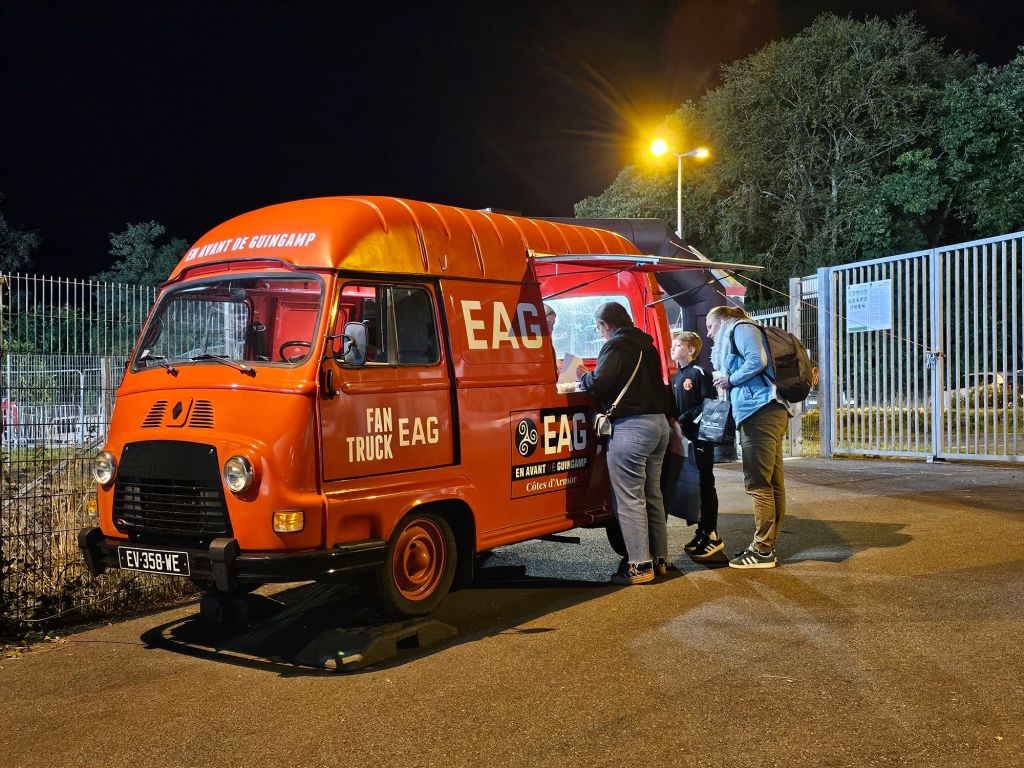
The back of the Tribune Frace Barnums is the least attractive of the four sides of the Stade Roudourou, consisting mostly of sheet metal, but undeterred I make my way in past a smiling member of security staff who frisks me and wishes me ‘Bon match’ under the somewhat glaring eye of another member of security staff whose demeanour suggests she does not approve of such bonhomie.  With our tickets duly validated by barcode technology we walk on towards our seats past a classic Renault Estafette van painted in Guingamp colours, from which Angelique of club ‘boutik’ fame is selling hats and scarves and shirts; she confirms that she has no stock of the cherished T-shirts stashed away in the Estafette.

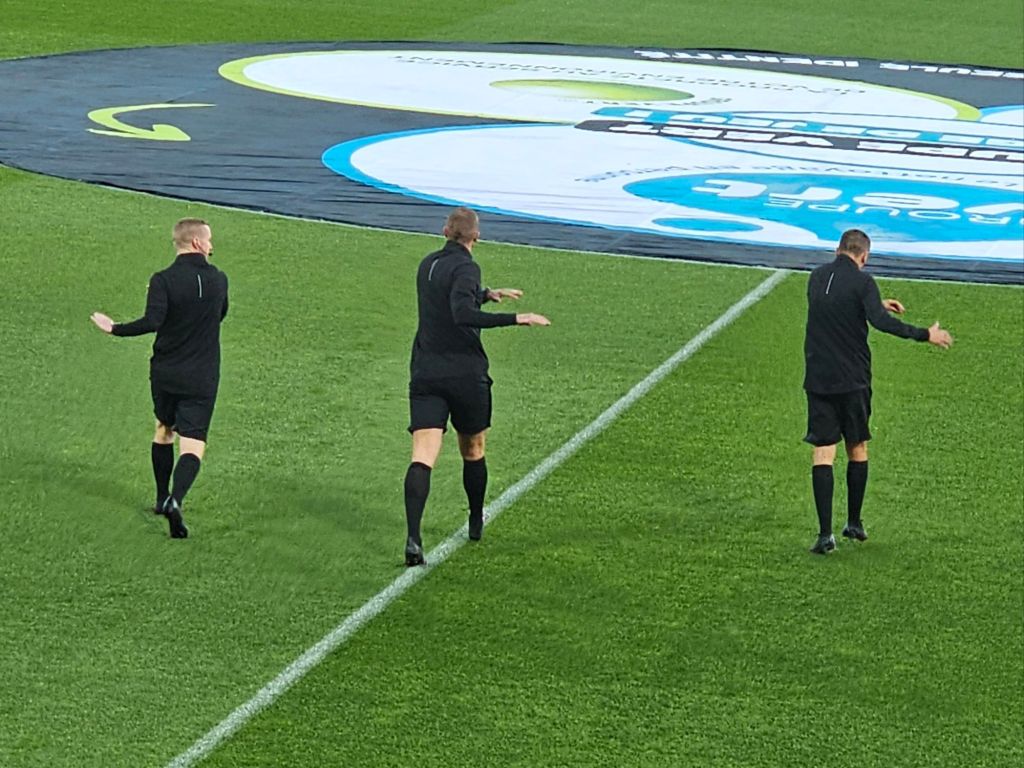
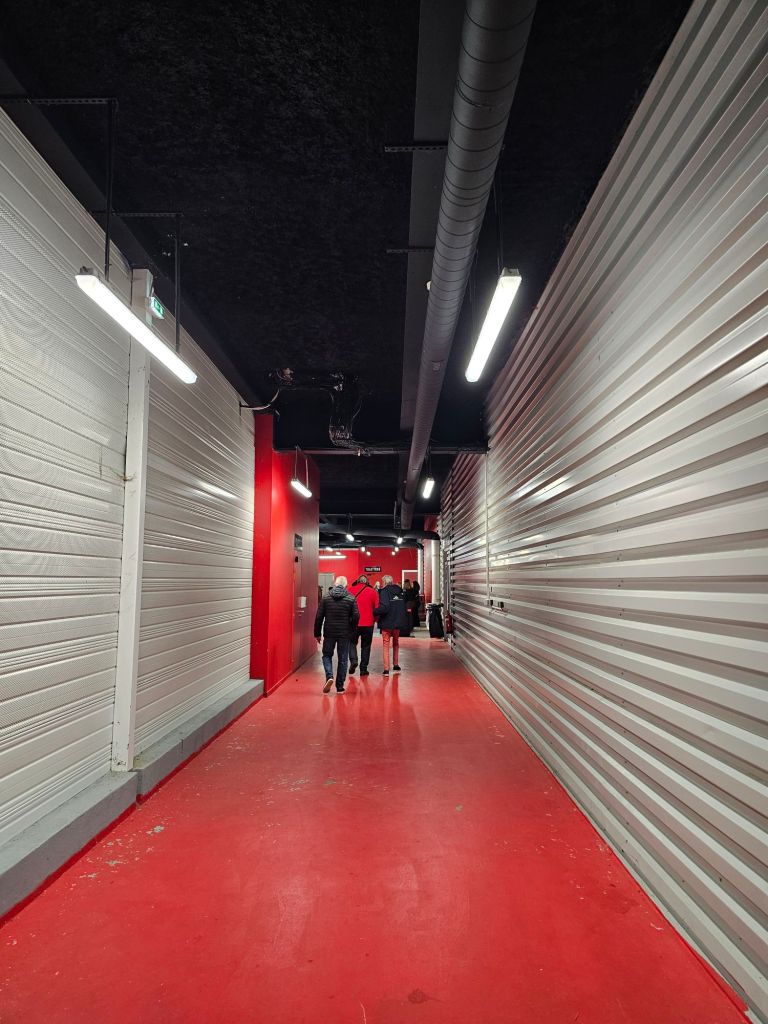
Our entrance to the stand itself, along a corridor, reminds me of the inside of one of carriages on Le Shuttle.  Up an external staircase, I am tempted by the ‘pub Lancelot’, only for two teenage doormen and the smell of sandwiches and nibbles wafting out to disappointingly confirm that it is a room reserved for those paying for hospitality.  Back downstairs I buy a small plastic cup of beer and a similar cup of the local Breizh Cola (8 euros for the two), which Paulene much prefers to the over-hyped American stuff.  We find our seats cosily situated at the back of the lower tier of the stand almost level with the halfway line and next to a galvanised tubular stanchion, which handily ensures people will not be able to edge past us to get to their seats. We pass the time before kick-off making up the life stories of the referee and his assistants, who are warming up in front of us and keeping us amused with their co-ordinated exercises, which with some appropriate music could enable them to pass themselves off as a small all-male dance troupe.   One of the assistants we decide looks slightly ill however,  and has dark shadows under his eyes.  The referee, Monsieur Landry meanwhile, is a tall man with a long body but capable of a neat heel turn, chasse and pirouette.

As kick-off (coupe d’envoi) approaches, the stand fills up with people bearing baguettes stuffed with chips, whilst a row or two in front of us a family unpack homemade sandwiches which appear to be of white sliced bread that has had the crusts cut off, which is not something I ever expected to see in France. Meanwhile, the pitch fills up with youths waving banners with varying degrees of enthusiasm but then, when the teams are read out by the stadium announcer  I am shocked, amazed  and I have to admit, disturbed to find that unlike everywhere else I’ve ever been in France, the home supporters do not bellow out the surnames of their players as they appear on the big screen in the corner of the ground; they just clap politely. I can’t quite believe it. Being in Brittany I had also expected bagpipe music as the teams trudged out, but It seems these Bretons aren’t like other French or Breton people at all.  I am a little disappointed; they don’t even have a cuddly mascot.

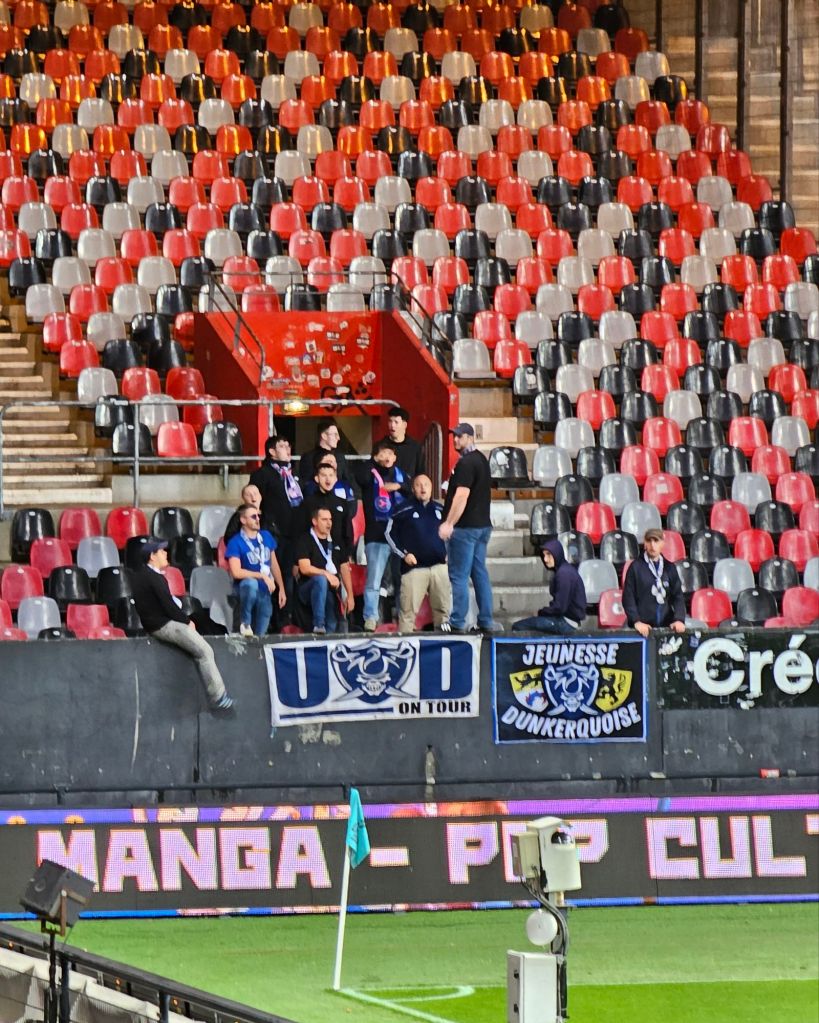
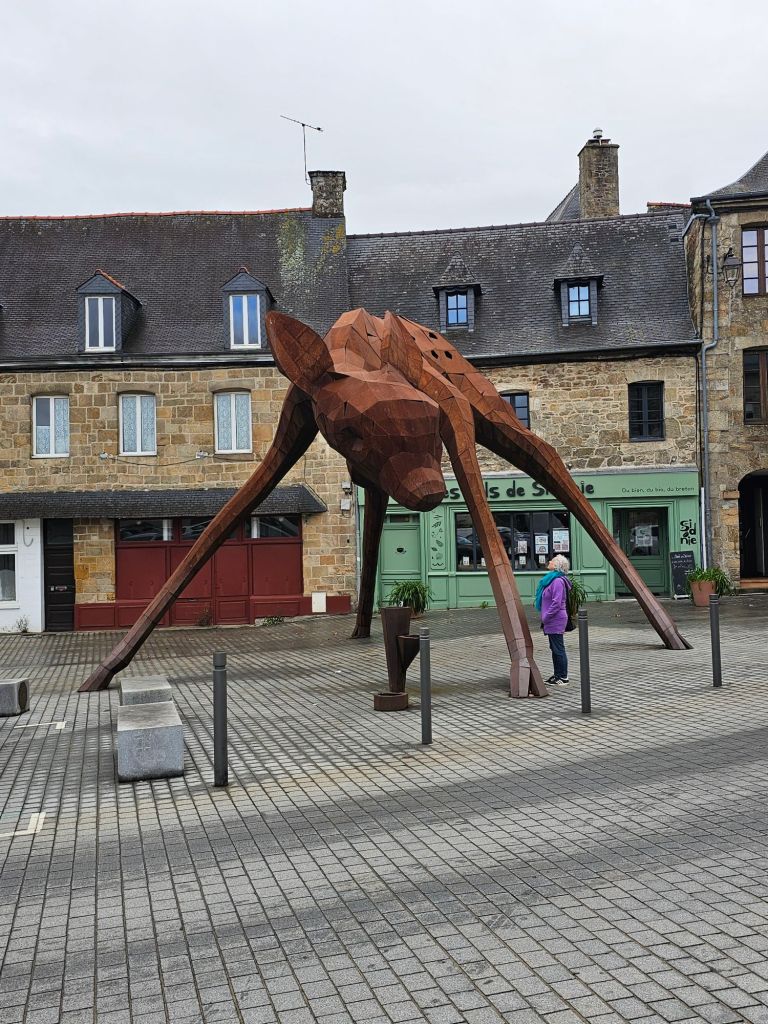
When the match eventually begins at half past eight, it is visiting Dunkerque who get first go with the ball, which they generally kick in the direction of the Kop Rouge and far off Morlaix, whilst Guingamp are aiming just to the north of the town centre with its Basilica, castle ruins and huge metal statue of Bambi. Guingamp sport their handsome signature kit of red and black striped shirts with black shorts whilst Dunkerque wear all white with golden squiggles down the shirt front.  Despite my disappointment before kick-off, the stadium has now come to life, with a flood of chip and beer quaffing latecomers finding their seats and the Kop Rouge now in full voice with chants of “Allez, Allez, Allez, Guingampaises”. I count thirteen Dunkerque supporters, who I could hear chanting before kick-off, but now they are drowned out by the Guingampaise voices and drums.

The opening play from both teams is fast and slick on the well-watered pitch but Guingamp appear slightly more direct and with only four minutes having passed into history a smart through ball and a low cross from the right lead to the ball being placed past the Dunkerque goalkeeper from about six metres out by Freddy Mbemba, who the interweb tells me is on loan to Guingamp from Charleroi in Belgium.  “Buuut” announces the giant screen in the corner in large letters, and when the stadium announcer says “Freddy” the home supporters bellow “Mbemba” and when the announcer says “Freddy” again and the crowd shout “Mbemba” again,  and then wonderfully the same thing happens again.  It feels like a weight has been lifted from my shoulders. “Mbemba!” I shout on cue after the final “Freddy”.

The game continues at pace with Guingamp looking sharper but Dunkerque not appearing to be slouches either.  Standing out for Guingamp, mainly but not entirely because he is two metres tall is their number eight, Kalidou Sidibe, whilst I am also impressed by the tangled mop of hair sprouting from behind the black headband of Guingamp’s number thirty-six, Albin Demouchy who often wins headers and elegantly ‘plays-out’ from the back.  On the electronic boards around the pitch there are advertisements for John Deere tractors and Husqvarna mini tractors as well as the supermarket E Leclerc, who if they had shops in Britain would surely employ the tv sitcom ‘Allo, ‘Allo in their advertising.

After fourteen minutes Dunkerque win their first corner; Guingamp have already had two however and as if to prove that this matters Guingamp’s Amine Hemia soon beats the square but not square enough Dunkerque defence on the right, bears down on goal and scores into the far corner off the goalkeeper’s out-stretched palm, and Guingamp lead two-nil.  “Amine” calls the stadium announcer, “Hemia” bawls the crowd. “Amine” calls the stadium announcer, “Hemia” bawls the crowd. “Amine” calls the stadium announcer, “Hemia” bawls the crowd, and the scoreboard silently but colourfully shouts “Buuut!” as well.

The row of seats in front of us consists mainly of men with grey hair whilst off to our left a younger bearded man looks a bit like Bob Ferris from the 1970’s sitcom The Likely Lads (actor Rodney Bewes).  Behind us there is a gathering of men and women in day-glo tabards; if they’re not orchestrating a “gillets jaune” style protest I guess they must be the first aiders and stewards watching the match. At the front of the stand clouds of smoke billow up from teenage vapers and then dissipate into the night air. I notice that Bob Ferris has quite girlish looking hands.

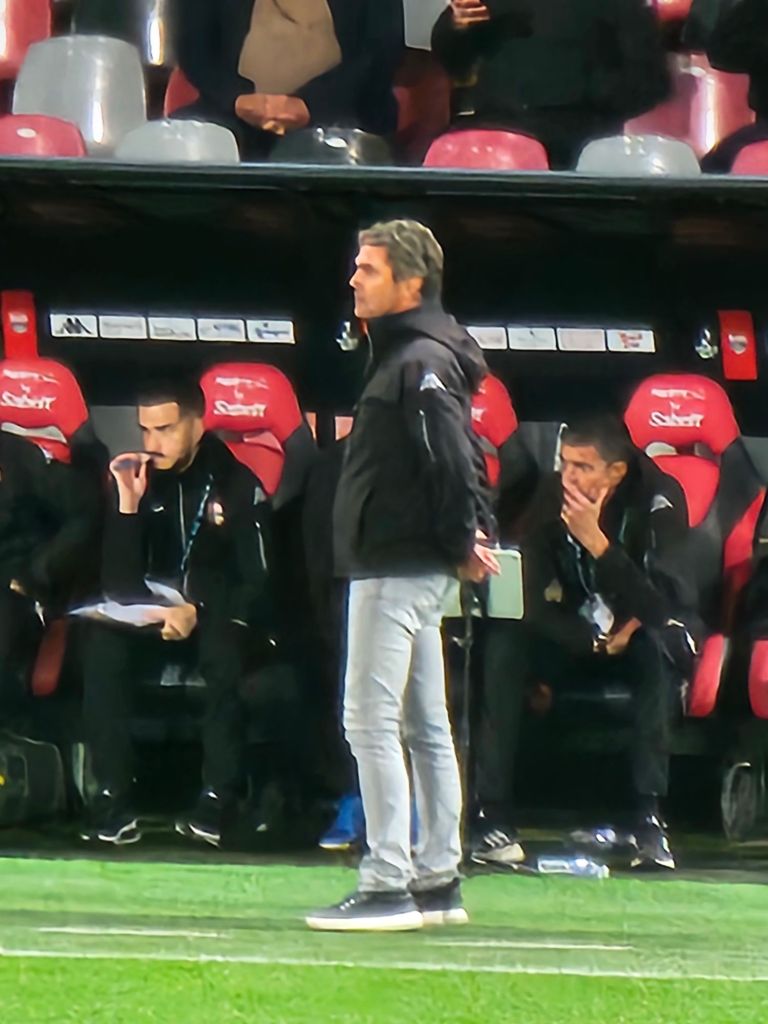
There are now less than ten minutes of the first half remaining; Dunkerque’s number twenty shoots from the edge of the penalty area and the impressively agile and wonderfully named Guingamp goalkeeper Teddy Bartouche tips the shot over the cross bar spectacularly.  Two minutes later and yet another move down the right for Guingamp leaves Louis Mafouta with a seemingly open goal, but with the co-ordination of someone whose foot has ‘gone to sleep’ and who has both arms strapped to his sides, he heads the resulting cross hopelessly and clumsily past the far post.  On the touchline, Guingamp manager Sylvain Ripoll, who incidentally once said ‘Bonjour’ to me and Paulene in the lift of a Paris hotel (the Mercure near Parc des Princes) looks frustrated in his pale trousers and zip-up jacket.

The last action of the half seems likely to be the substitution of the Dunkerque goalkeeper, who unexpectedly and mysteriously has hurt himself but then a quick pass in from the Dunkerque right finds Enzo Bartelli inside the ‘D’ outside the Guingamp penalty box. Almost in slow motion Bartelli gently passes the ball beyond agile Teddy in the Guingamp goal and Dunkerque, as they say on the telly, are “back in the game”, although of course as long as Monsieur Landry hadn’t terminally parped his whistle, they were never out of it.  Five minutes of added on time fail to alter the score any further.

Half-time is the usual melange of children on the pitch, but as before the start, with added flag waving of varying enthusiasm.  The match resumes at twenty-four minutes to ten and the Kop Rouge quickly dive back into endless chants of “Allez, Allez, Allez”.  I soon decide that for a man taller than your average back garden fence panel, Sidibe has quite a delicate touch and then within ten minutes Monsieur Landry airs his yellow card for the first time this evening after Dunkerque’s Inigo Eguaras fouls Mbemba.  

It is Dunkerque who are now selfishly dominating possession, a situation which Guingamp are contributing to by quickly giving the ball back to them whenever they lose it.  On the Kop Rouge, the ultras are swirling their scarves in the style of 1970’s Leeds United fans, whilst the big screen in the corner is showing pictures of real estate as if anyone interested in buying a house would pay more attention to the screen than the match.  As the people in the ground with least interest in buying property in Guingamp, surprise transfer moves notwithstanding, the Dunkerque players fashion an intricate passing move down the left only for Eddy Silvestre to shoot narrowly over the cross bar.  With the game now two-thirds over, Dunkerque blink first and make two substitutions.

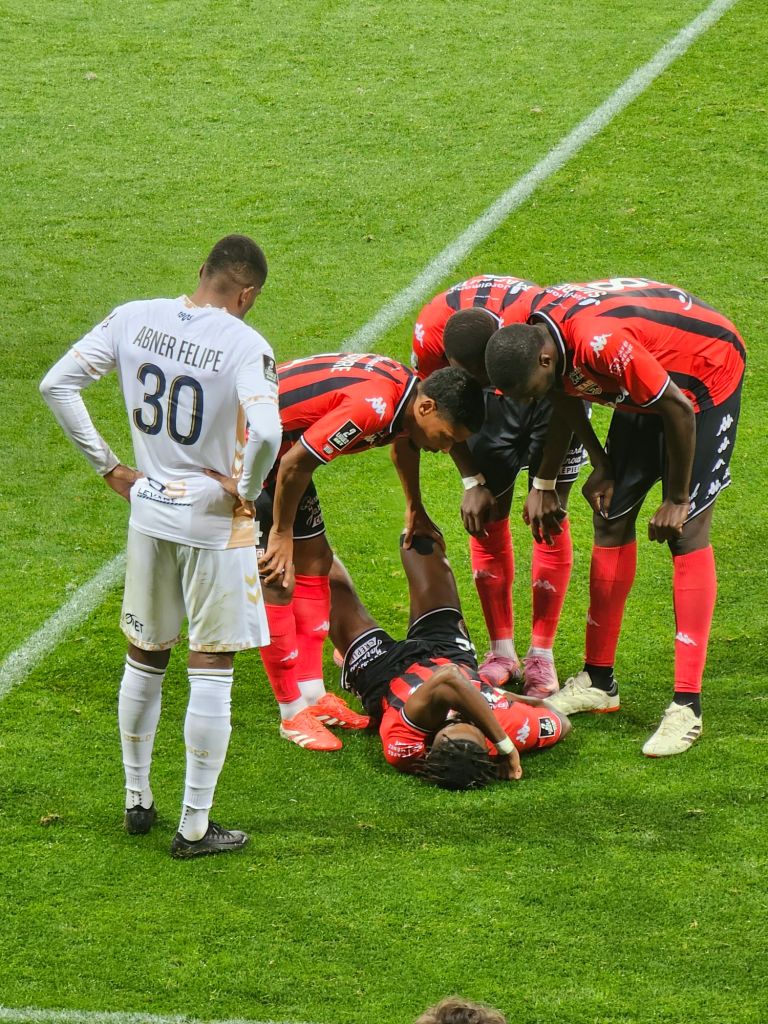
The slick passing of the first half has been replaced with increased niggle and Paulene and I discuss the colour of the shorts worn by Dunkerque’s Brazilian number thirty, Abner.   They look more yellow than other Dunkerque players’ shorts, which Paulene attributes to his frequent falling over on the wet grass, whilst I suggest, a little unpleasantly perhaps, that maybe he ‘forgot to go’ before he left the dressing room. Twenty minutes remain and Eddy Silvestre shoots over the bar again for Dunkerque whilst the Kop Rouge sways with a sea of banners and the towering Kalidou Sidibe is replaced by a man with hair reminiscent of the late Tina Turner, Tanguy Ahile.

Somewhat annoyingly, the final ten minutes of normal time dissolve into something like chaos and nothing like football as players of both teams proceed to fall to the ground with alarming frequency.  If all the players who go down have genuine injuries, both clubs will need to be trawling the job centres of Brittany and Pas de Calais in the morning for additional physiotherapists.  Monsieur Landry, meanwhile, is rushed off his feet, airing his yellow card four more times and showing his red card to someone in the Dunkerque dugout.   Six minutes of added time are not so much played out, as acted out, and the final whistle comes as a blessed relief to all. The result lifts Guingamp to eighth in the Ligue 2 table, a point outside the barrage (play-off) places, whilst Dunkerque slide down to fourth from bottom, one above the relegation places.

Despite the weirdness of the last ten minutes, and the unexpected pre-match disappointments over T-shirts, bagpipes and the reading out of the players’ names, overall, the match has been a good one and everything has worked out fine; well except for the T-shirt and the bagpipes, but you can’t have everything. We therefore make our way back to our planet saving Citroen in good spirits, like all but thirteen of the 6,562 strong crowd, but who knows, they probably enjoyed it too.

FC Lorient 0 Montpellier Herault SC 3

One sunny September afternoon last year, whilst on holiday in Brittany, my wife Paulene and I went to the coastal town of Lorient, to the Stade du Moustoir, to witness the Ligue 1 fixture between FC Lorient  and Breton rivals FC Nantes. It was a fabulous afternoon and before an almost capacity crowd we saw Lorient triumph by three goals to two. Everyone was marvellous, I met the Lorient mascot Merlux the hake, and in a fit of consumer madness powered by a premium bond win that week , I bought a T-shirt, a mug, a fridge magnet, a cuddly hake, and a pennant to adorn my upstairs toilet. I have yearned to return ever since and so has Paulene. Today is the day we fulfil our modest dream.

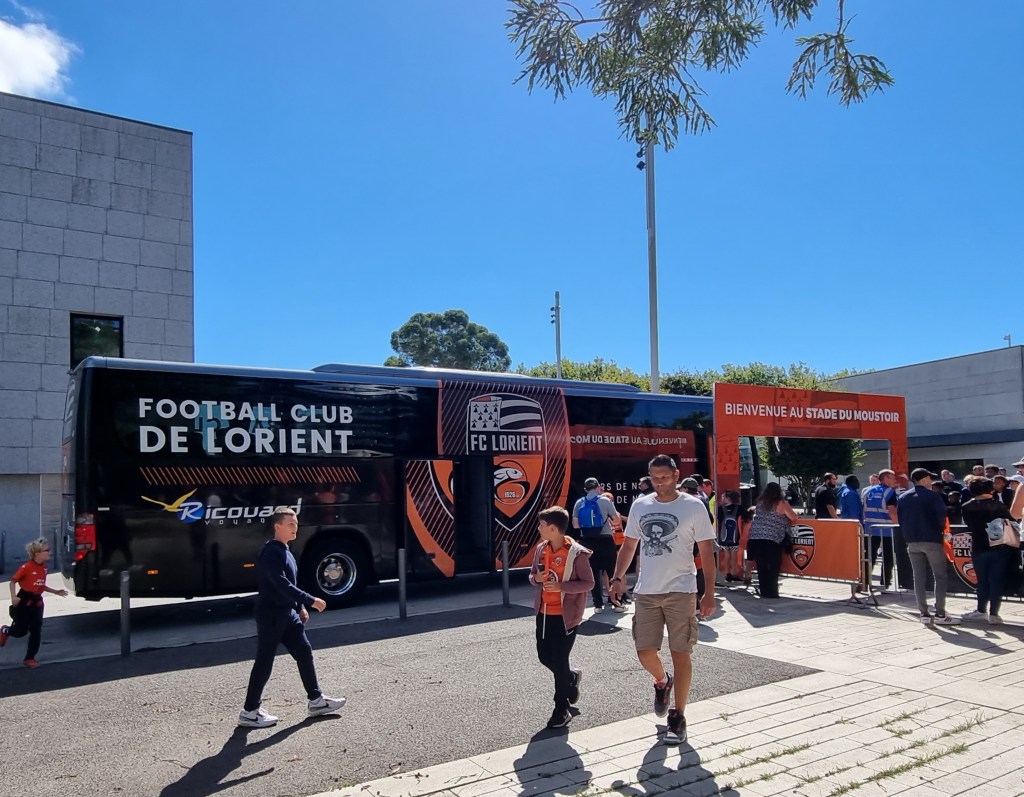
It’s only a thirty-five-minute drive up the E60 and along the N165 through neighbouring Lanester to Lorient from where we are staying, and being old hands we know where we can handily park our planet saving Citroen e-C4, and so set the controls for the heart of the town.  We find a parking spot beneath an avenue of shady limes in the Boulevard Marechal Joffe and walk to the ground, which is superbly central next to the town hall, handy for buses and trains like all football grounds should be.  In Lorient, the town centre car parks are closed on a Sunday match day which sounds daft, but when you think about it is a pretty good idea to encourage people to travel ‘responsibly’, although street parking is free and plentiful.  Yesterday, I received an e-mail from FC Lorient giving me the pre-match lowdown and inviting me along to greet the team as they arrive at the ground, so that’s what we do, joining mostly children and their parents to cheer the players off the bus and enjoy the sound of Fatboy Slim’s “Right Here, Right Now” played on Breton bagpipes.  Merlux the hake mascot (so-called because the binomial name for Hake is Merluccius merlucciusis and the French for Hake is Merlu) is of course present, and he now has an accomplice called Mini Merlux.  The spawning grounds of the Hake are in the Bay of Biscay, the expanse of water which the south coast of Brittany faces.  I had always thought that seafood-based club mascots were restricted to Sammy the Shrimp at Southend United, but I am very pleased to be able to report that this is not true and I’m now keeping a look out for any clubs with fish, crabs, lobsters or assorted shellfish on their crests.

Having greeted the team, who sport natty Breton-style stripey T-shirts making them look as if they should be disembarking from a ship not a bus, there is still over an hour to go until kick-off at five past five.  Keen to know more of Lorient than just the Stade du Moustoir and the route back to our car, we set off to explore a little, heading over the road towards what my instinct and a possible onshore breeze tells me could be the harbour.  My instinct is correct, and Lorient proves to be a town like Ipswich where if you have a yacht you can sail to matches, with a marina within easy walking distance of the stadium.  Arriving for a match under sail has to be even greener than catching the bus, I cannot think why everyone is not doing it.

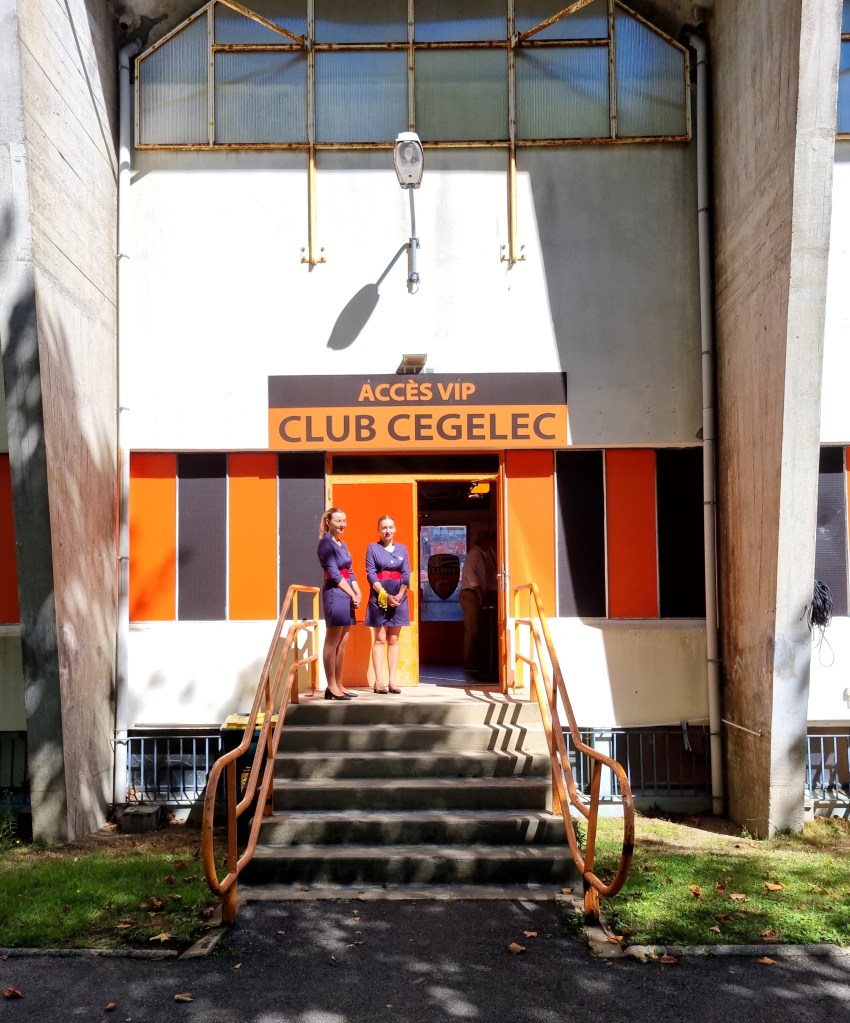
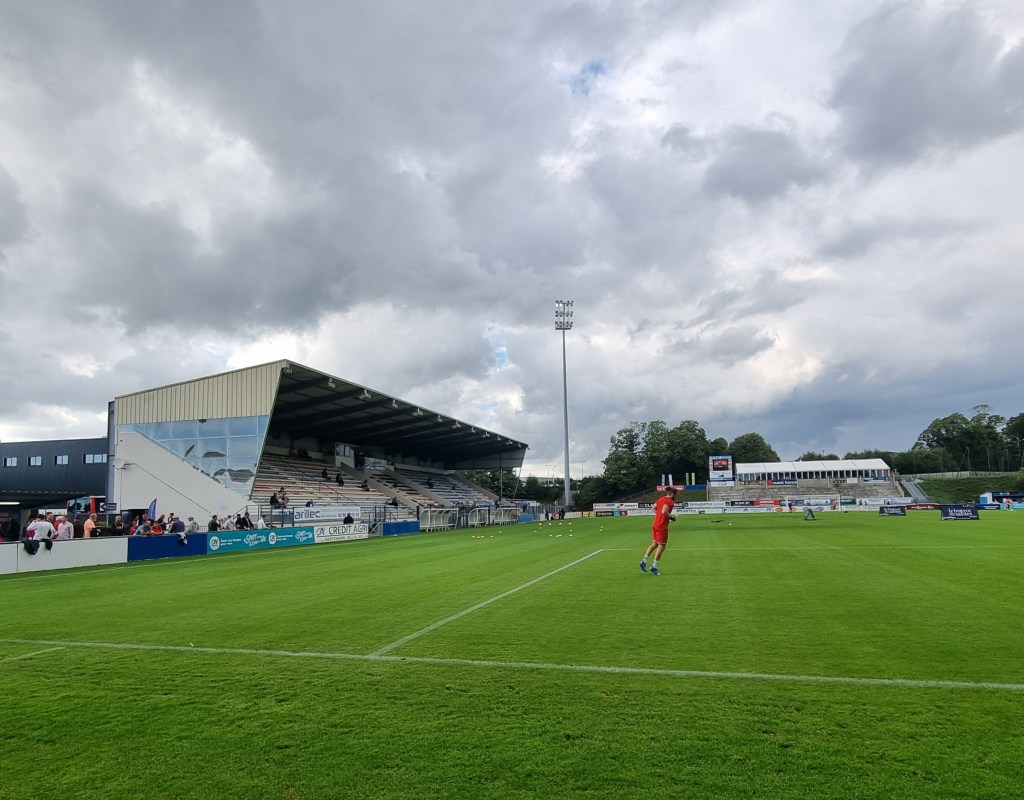
Wishing to visit the club shop again, have a wander inside the ground and sample the refreshments on offer, we return to the stadium having glimpsed the land on the other side of the water from Lorient. Our seats (20 euros each) are in the fabulous Tribune d’Honneur, now known as the Tribune Credit Mutuel de Bretagne, the smallest and oldest of the four stands, having been built when the ground was first opened in 1959.  The Tribune d’Honneur has a marvellous cantilever roof of beautiful, vaulted and shuttered concrete with shiny steel cables to help hold it up. The back of the stand has a series of narrow, angled concrete columns with angular shuttered concrete arches at the top, and metal framed doors and windows at ground level; behind the stand is an avenue of plane trees which cast a lovely, dappled shade over it.  The stand symbolises the renewal and rebuilding of the early postwar period and is a thing of beauty, way ahead of anything built in Britain at the time. Sadly, with grand proposals to upgrade the stadium to make it better suited to cultural events as well as football, the Tribune d’Honneur is likely to be demolished before we all get much older.

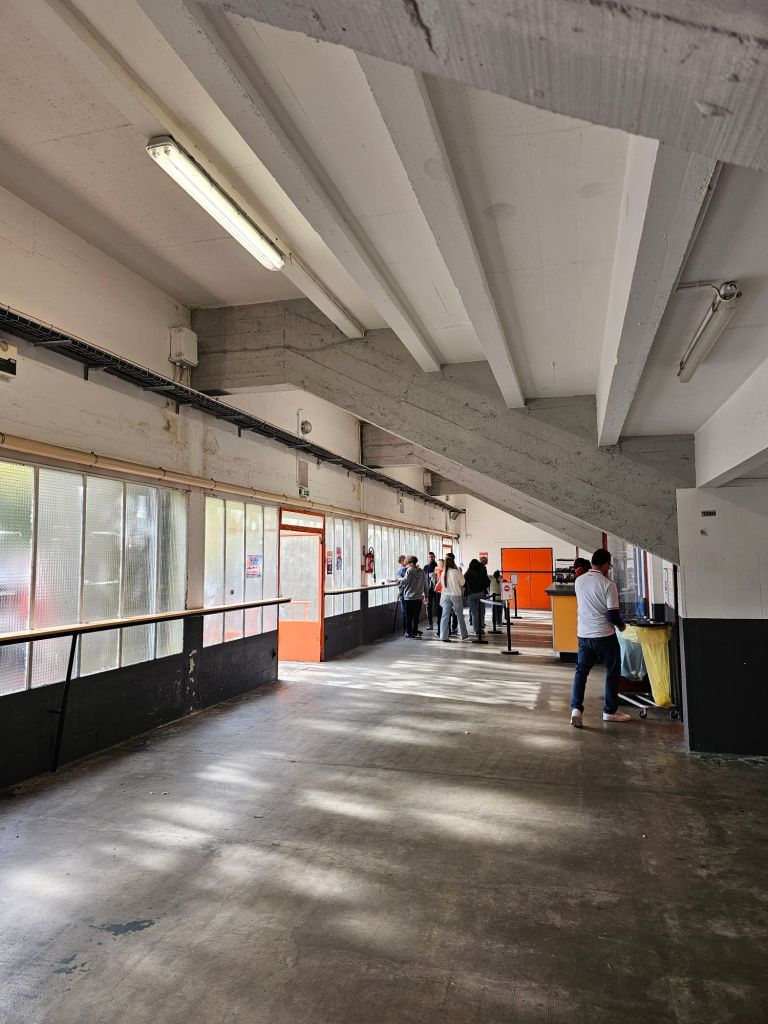
Tripping out on 1950’s concrete, I escort Paulene to the Tavarn Morgana bar beneath the Tribune B & B Hotels where I buy her a glass of the local Breizh Cola (4 euros), which she far prefers to the American rubbish, and a 40ml re-usable plastic glass of Lancelot IPA (6 euros), and pretty good it is too, by several country miles the best beer I’ve ever been served beneath a stand at a professional football club ground.  Paulene now holds my beer whilst I pop into the club shop, accessible from inside the ground but not from without at this stage, to purchase a glorious orange T-shirt (25 euros), the last large size one on the rail, which proudly displays a silhouette of the Lorient skyline with its dockside cranes and submarine dock, beneath the name Lorient.  The great thing about Stade du Moustoir is that it is possible to walk right around it beneath and behind each stand in turn, and that is what we do, taking in the sites and sounds and smells.  Last weekend, Breton team US Concarneau played St Etienne at Stade du Moustoir because their own home ground is not of sufficient standard for matches in Ligue 2; I am very excited to find evidence of the match behind the Tribune Lorient Agglomeration in the shape of the ‘ceremonial’ arch through which the teams would have run onto the pitch, I feel for a moment like Professor Alice Roberts discovering some archaeological wonder.

Back in our seats after our tour of the stadium, a ship’s siren or foghorn sounds three times to signal that there are just ten minutes until kick-off,  or coupe d’envoi to the French, and Paulene and I witness the mounting excitement of the build-up with a stirring Breton anthem, pyrotechnics, the Ligue 1 anthem played loudly over the PA system and multiple flag waving as the teams enter the pitch to line up before banners displaying both club crests and the Ligue 1 logo.  When the game eventually begins it feels like a massive anti-climax, just a few blokes tapping a ball about.

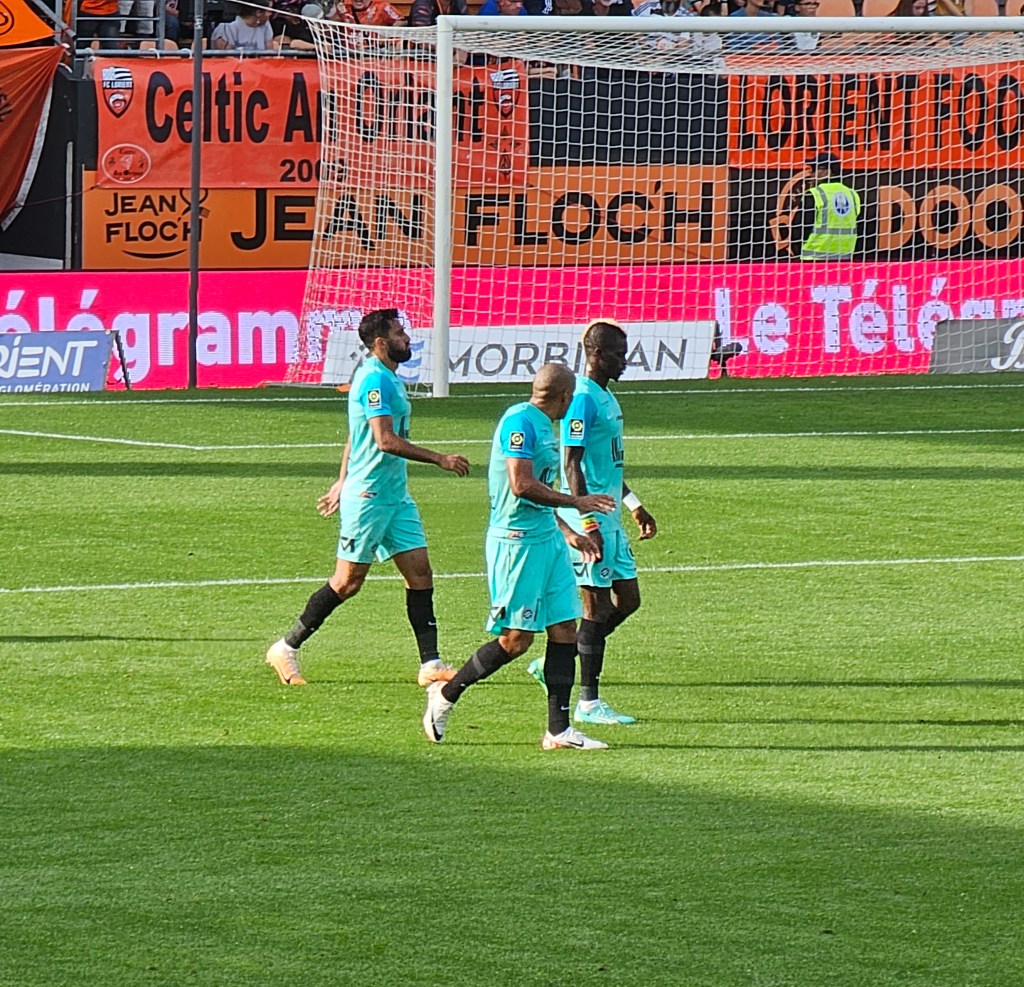
It’s Montpellier who get first go with the ball, attempting to send it mostly towards the most inland of the two goals.  Lorient are wearing their signature home kit of orange shirts, black shorts and white socks but Montpellier whose signature colours are orange and navy blue wear a change kit of all jade with aquamarine sleeves; it’s a bit of an odd or at least unusual ensemble and without the different coloured sleeves it would look washed out and awful.  Normally I would say “if you’re going to wear green, wear green” but I like Montpellier, so I let it go.  Although Montpellier’s Akor Adams heads straight at the Lorient goalkeeper after ten minutes, the first decent shot on goal takes eleven minutes to arrive and it’s Lorient who have it, with Vincent Le Goff sending a shot past the far post from an acute angle after a nippy run and pass from Julian Ponceau.  Three minutes later the first corner of the match goes to Lorient too, but the utterly enormous Isaak Toure sends a glancing header down towards the bottom corner of the Montpellier goal only for goalkeeper Benjamin Lecomte to make a spectacular diving save.  Toure wears a ludicrous number 95 shirt, but at 2.06m tall who’s going to tell him not to.

“Allez Lorientais, Lorientais” sing the home ultras off to our right in the Tribune B&B Hotels, fired by the early action but they just keep on singing and chanting without end, regardless of what happens on the pitch.  The game is settling down to a pattern of Montpellier playing slowly and patiently, frustrating eager Lorient who have occasional bursts of activity, racing forward excitingly only to be stopped by judicious interceptions and well-placed out-stretched boots.  It’s Lorient who first provoke referee Jeremy Stinat into whipping out his yellow card (carton jaune to the locals) however, as Ponceau fouls the wily Teji Savannier, a hugely skilful player who has never run about enough to attract the serious attention of English clubs.  Montpellier’s Wabi Khasri quietly goads a Lorient defender and pleads innocence as only Wabi Khasri can, and as he has done previously for St Etienne and Rennes and probably every club he’s ever played for .

Almost half the first half has gone when Montpellier win their first corner, and the ball is half-volleyed wide, and I am suddenly aware of how comfortable my seat is despite having no back, I think it must encourage good posture.  The bloke sat next to me is leaning forward and living every second of the match in a series of gallic shrugs greeting each free-kick and misplaced pass.  A half an hour has gone and suddenly Montpellier’s patience and quiet approach shatters and number 9 breaks away towards goal; he rounds the Lorient ‘keeper and then squares the ball to present Akor Adams with a simple tap in from a few yards. Montpelier lead 1-0 and seem to have just been biding their time.

The goal prompts Montassar Talbi to add to the tally of booked Lorient players as he drags down Adams and although the home team win another corner, Lorient’s Toure only manages to direct his seemingly unchallenged header straight to the waiting hands and gloves of Comte.  Two minutes of added on time don’t seem enough for Lorient to equalise, and despite some unexpected frantic attacking in which Theo Le Bris boots a shot against the Montpellier cross bar, they’re not.

With half-time there is a flood of parents and children to the back of the stand and some return clutching cardboard cartons of chips or re-usable plastic cups of cola; one or two never return, with forty-five minutes of football on a warm September afternoon evidently being enough.  We watch the stewards watching us and ponder whether one who looks a bit like the late actor Geoffrey Palmer, is wearing a wig or just has an elaborate and extensive comb-over; we decide we’d need to see him walking briskly towards the harbour into an on-shore breeze to truly decide.

At seven minutes past six the football resumes and very, very conspicuous by his absence is the gigantic number 95 for Lorient, Isaak Toure, who has surprisingly been replaced by Joel Mvuka, a man who according to the app on my mobile phone is a full thirty-three centimetres shorter and thirty-three kilograms lighter than him.  It seems likely it’s a tactical move by Lorient manager Regis Le Bris and Lorient start the half enthusiastically, pushing forward and pinning Montpellier in their own half much of the time.  The fifty sixth minutes arrives and the PA system suddenly lets out an almighty noise and the scoreboard flashes the word “Encouragement” and the number “56” as the crowd is urged to make a noise and encourage the team simply because fifty-six is the number of the Morbihan departement (like an English county) in which Lorient is situated.  The same thing happened at Brest last Saturday night when I was there, but in the 29th minute, the Finisterre departement, where Brest is, being departement number twenty-nine.

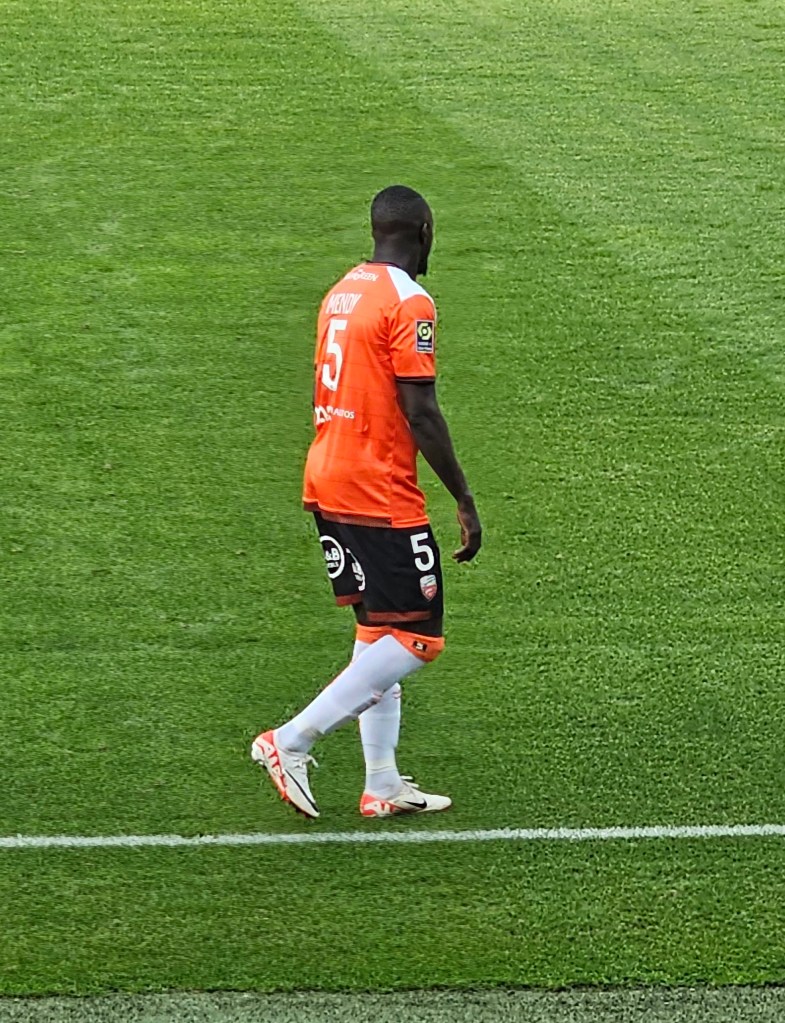
The ultras have been noisily supporting their team from the start, so the fifty-sixth minute hasn’t made much difference to them, but the substitution of Vincent Le Goff with summer signing Benjamin Mendy two minutes later seems to excite the crowd, and Mendy seems like a decent signing for Lorient, even though he hasn’t played a competitive match for almost two years.  Hopefully, the poor treatment he has suffered in those two years will spur him on to repay Lorient for showing the sort of faith in him, which Manchester City apparently didn’t.  Mendy looks a bit larger than when he played for Monaco, but he clearly hasn’t lost his touch.

An hour has gone, and Montpellier pull back a booking with Maxime Esteve finding the sharp end of referee Jeremy Stinat’s pencil for a foul on Mvuka.  The game is still interesting, but neither team is making much of an impression on the other and with twenty-five minutes left there have been six substitutions, four for Lorient and two for Montpellier, who have replaced Wabi Khasri to peals of heartfelt booing from the home crowd.  Lorient win a corner which comes to nothing, and today’s attendance is announced over the PA system as being 13,492, with the scoreboard referring to us as supporters and supportrices.  I like that the French language still acknowledges that there are two sexes, and surmise that the French understand that human existence is all the better for it.   

The bloke sat next to me has been growing increasingly exasperated, groaning a turning away from the pitch as Lorient players dither on the ball or fail to spot the incisive passes.  Monsieur Stinat is not helping matters, but then it’s not really his job to do so, although he does make them a whole lot worse when in the seventy-first minute he awards Montpellier a penalty having seen Mousa Tamari fall to the ground as Igor Silva brushes against him.  It looks a bit harsh, or alternatively soft from my seat in the old Tribune d’Honneur, but after a small delay, in which the Lorient players surround Mr Stinat, presumably in an attempt to send good vibes through his earpiece to the VAR officials, the VAR officials however, confirm that it is a penalty.  Teji Savannier nonchalantly makes it 2-0 to Montpellier.

Lorient are mildly stung into action by the second goal and win a succession of three corners as they once again keep Montpellier in one half of the pitch, although Montpellier don’t ever look too bothered about it.  Lorient desperately make their fifth substitution whilst Montpellier make some substitutions too, but more just because they can, it takes time, and it⁹ breaks up the game.  Teji Savannier is one of the players to be substituted for Montpellier, and he looks like he could do with a bit of a rest.  Lorient make their own penalty claim as Sirine Doucoure falls to the ground alongside Montpellier’s Kiki Kouyate, but instead Mr Stinat awards the free kick to Kouyate.

A minute of normal time remains, plus any added on for administrative reasons.  Out on the right, Joris Chotard looks up and plays an angled pass through and behind the Lorient defence, which only Akor Adams reacts to; he runs on, takes the ball past the Lorient goalkeeper, checks back to dodge a defender and then rolls the ball into the unguarded Lorient goal. The bloke beside me groans in despair. Seven minutes of additional time is announced and almost all of it is played, and Montpellier win 3-0.

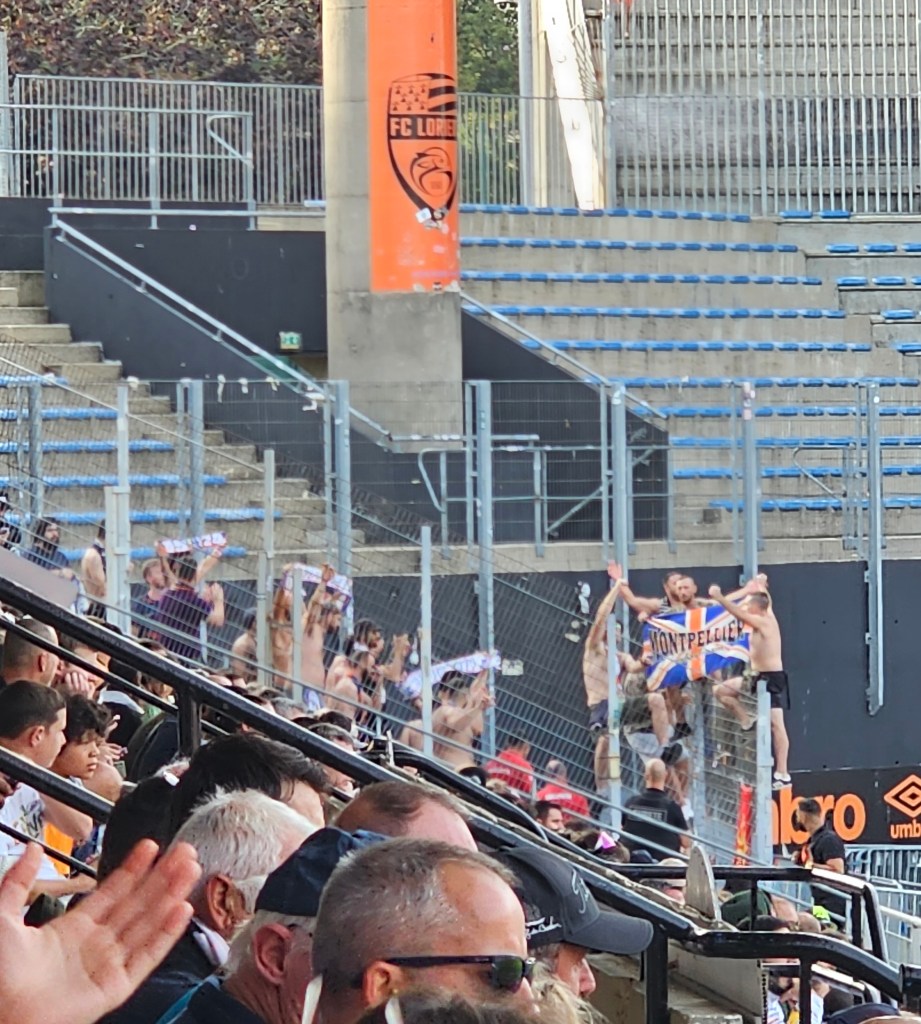
Montpellier deserve their win; they’ve played coolly and economically, and Lorient have not been good enough.   As many of the Montpellier supporters as can, balance themselves on the top of the steel fence that pens them in the corner of the stadium away to my left, most of them aren’t wearing shirts; they hail their conquering team.  At the other end of the ground the Lorient supporters hail their losing team as if they had won.

Once again Paulene and I have had a fab September afternoon at the Stade du Moustoir, it is a truly great place to watch a football match.  There has been so much about our afternoon that we have enjoyed from Lancelot beer and Breizh Cola to shuttered concrete and the last ‘Large’ orange T-shirt in the cub shop, but I think best of all is that Lorient’s club mascot is a Hake.

FC Lorient 3 FC Nantes 2

To Ipswich Town supporters like me, FC Lorient is known as the club from which the Town bought Ulrich Le Pen, a slight winger who was injured just minutes after coming on in a match against Bolton Wanderers and only ever featured in one other first team game, an FA Cup tie which I can’t remember. To the wider world Lorient is France’s second largest fishing port and home of a French submarine dockyard which grew out of the massive reinforced concrete U-Boat docks built by the Nazis during World War Two.  Sadly for Lorient, the town was mostly flattened by allied bombs as the Nazis were pushed out of France in 1944 and whilst the re-built town is well laid out with buildings in a quiet, modernist style, it doesn’t have the architectural verve of Le Havre or Amiens, or even, come to that of Plymouth and Bristol.

Today however FC Lorient host their Breton neighbours from 170 kilometres away (1hour and 51 minutes up the E60 according to Google maps) FC Nantes, but my wife Paulene and I have travelled a mere 40 kilometres from the campsite where we are staying in Carnac.  Car parking in Lorient on a Sunday is a curious affair as most of the town centre car parks are closed as is much of the town centre itself, including the tourist information office. There is plenty of street parking however with the usual restrictions being suspended. The Stade du Moustoir, home of FC Lorient is in an eminently sensible town centre location much like Ipswich’s Portman Road, and it is somewhat remarkably within 50 metres of the Hotel de Ville (town hall) and just a short walk from the main shopping streets, railway and bus stations.  The purpose in closing the car parks would seem to be to make people travel responsibly by bus, train, bike or on foot, although some parking can be pre-booked by those signing up to a car sharing scheme.

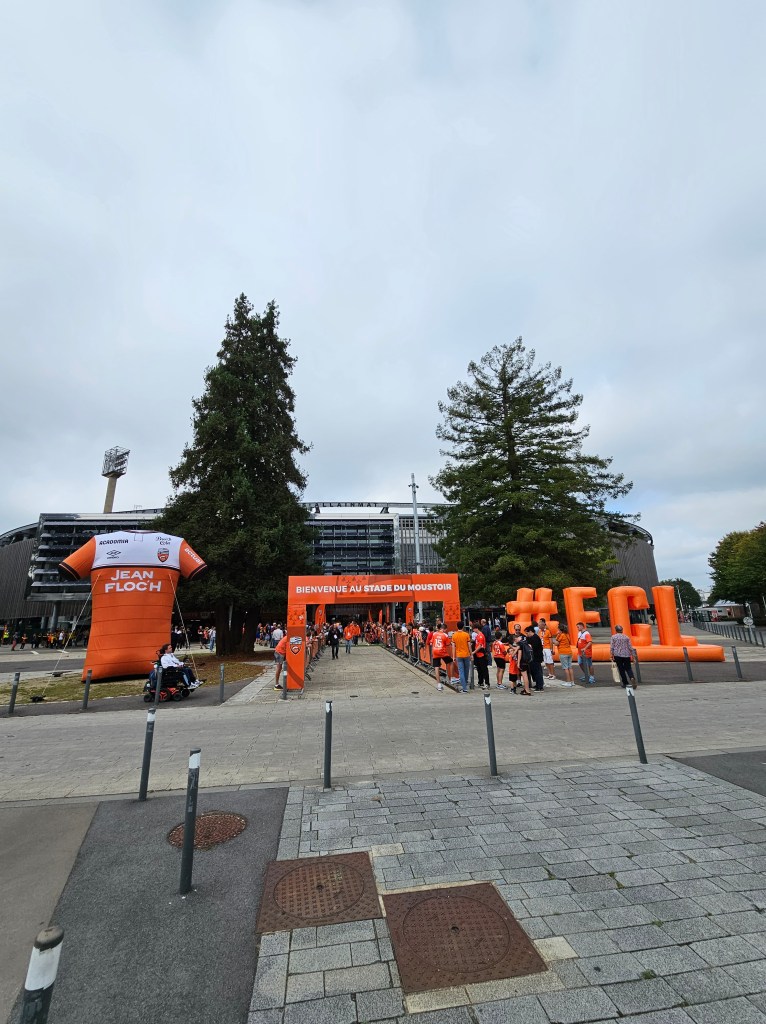
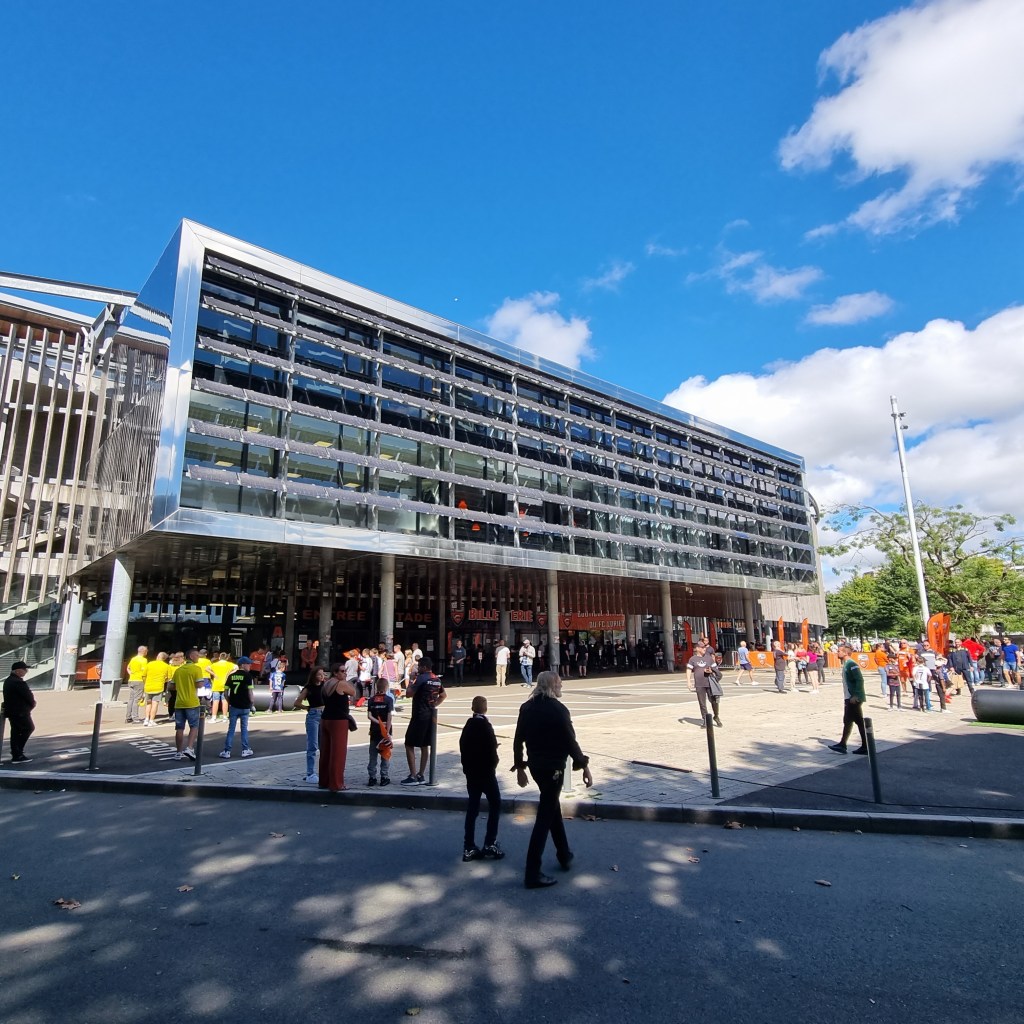
Paulene and I have arrived in Lorient in plenty of time to nab a handy street parking place.  Our short walk to the Stade de Moustoir affords a sneak preview of the stadium with the already illuminated floodlights being visible between the gaps between the buildings in nearby streets.  Near the railway station a bar has been requisitioned by visiting Nantes fans; a group of police stand a discreet distance away but there is no hint of any bad behaviour and we see many Nantes and Lorient fans walking to the stadium together.  Reaching the stadium early, we are in time to see the home team alight from their team bus wearing their horizontally striped, Breton-style jumpers or training tops. A crowd are waiting to see the players arrive and a ‘welcome arch’ has been erected as the gateway from the bus into the stadium.  The frontage of the Stade de Moustoir is clad with vertical strips of timber and looks every bit like a modern office or block of flats.  Whilst outside the ground, I get my first glimpse of the unusual club mascot, Merlux le Merlu (pretty much ‘Hakey the Hake’ in English) as he welcomes the players off the bus.

With the team in the stadium, the turnstiles open and Paulene and I enter also, but are surprised to be lectured by an officious man who tells us that we cannot take a bottle of water into the stadium, although he can exercise discretion with regard to Paulene’s bag.  Paulene had had an asthma attack as we approached the stadium and the very kind security man on the door at the club shop had arranged to get me a bottle of water for her.  I had returned to the club shop to source vital souvenirs of our visit but found that some of the items I might buy such as a mug or cuddly hake would, like the bottle of water, not be permitted in the ground.  Had I seen the e-mail the club sent me this morning I would have known that the LFP (French football league) had banned the carrying of virtually anything into football grounds this season, presumably in response to Marseille’s Dimitri Payet (known by me as the Very Hungry Caterpillar due to his ‘haircut’) getting hit on the head by a plastic bottle at Lyon last season as he went to take a corner.

Having located our seats (20 euros each) in the Tribune Credit Mutuelle de Bretagne, a quite small single tier stand with a fabulous shuttered concrete roof and light steel and glass doors redolent of a 1950’s school hall, I set off to explore and perhaps look for beer.  I am quickly amazed and overjoyed to find that I can walk right the way round this stadium through the concourses of each stand. Behind the goal, the stand has access to the club shop which is now shut to the outside world.  The concourses are regularly punctuated with a variety of food and drink outlets and the club markets these as Les Corners du Moustoir.  Having passed by the Tavarn Lancelot, I stop at the Tavarn Morgana for an organic beer called Lancelot IPA (4 euros 50), brewed by the Breton Lancelot brewery. I mainly choose this beer so that I can pronounce Lancelot with a French accent (Lon-slow), something that has never failed to amuse me ever since seeing director Robert Bresson’s film Lancelot du Lac on BBC2’s Film International one Saturday night back in the 1970’s. Having consumed my beer, I return to my seat clutching two free eight-page match programmes and a Breton flag; there were piles of them on the floor beneath the programmes with a sign urging me and everyone else to take one.

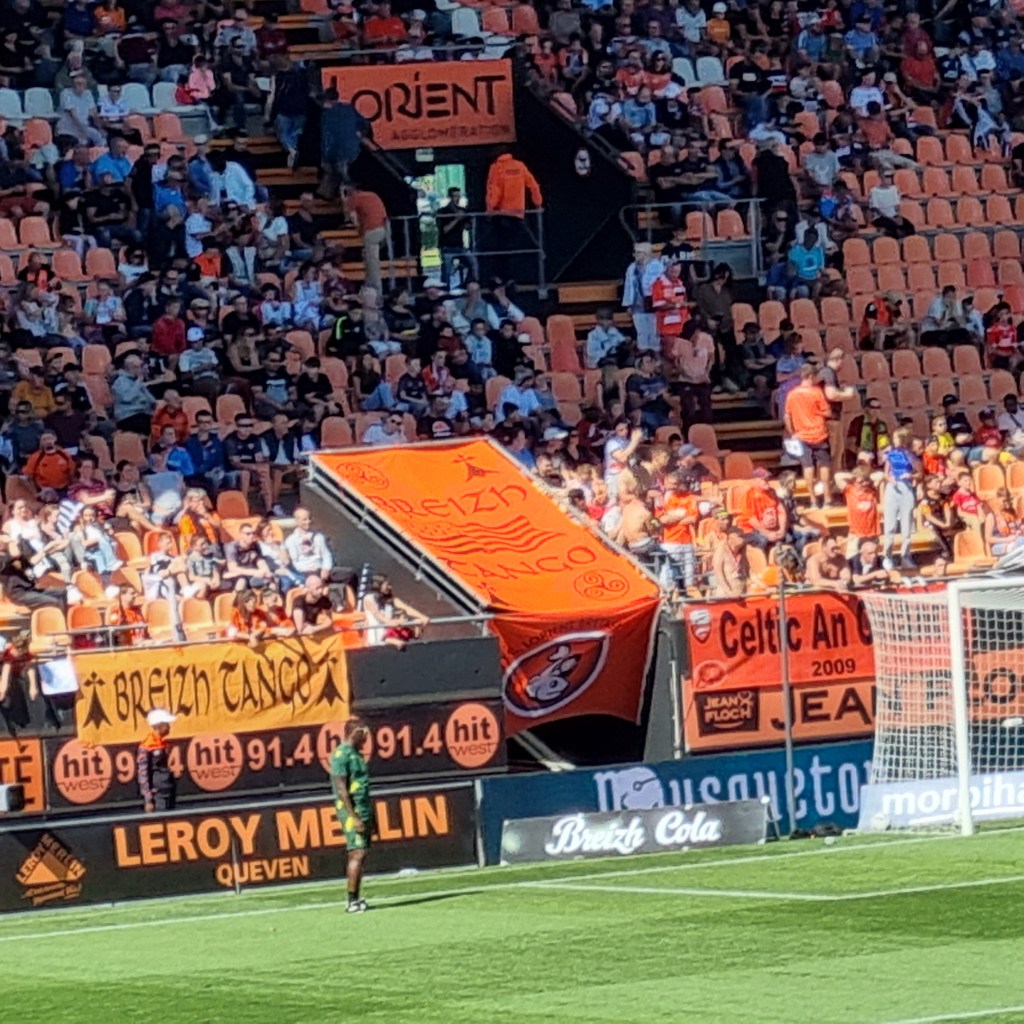
At a quarter to three a ship’s siren sounds three times and the scoreboard tells us there are fifteen minutes to go until Coup d’envoi (kick-off); the build up to the match begins.  As an opening act in the pre-match ritual an enthusiastic woman strides about the pitch in front of the main stand and sings the Breton anthem, whilst the whole crowd wave their Breton flags and club banners in a show of regional, celtic pride.  On the fabulously named Tribune B&B Hotels (B&B Hotels Stand), where the central section of the lower tier is occupied by the loudest Lorient ultras, an orange and black tifo folds down from the top tier to cover the whole stand. As the teams process onto the pitch to stand before the Ligue 1 banner and club crests, fireworks are set off on the pitch, more banners are waved and the Nantes fans, who fill the away enclosure in the corner between the Tribune Mutuelle de Bretagne and the Tribune Lorient Agglomeration wave a few flares about, making me wonder if they managed to smuggle in any bottles of water too; it’s all rather thrilling.

With the pyrotechnics and flags cleared away the game begins with Nantes getting first go with the ball and kicking towards the Tribune B&B hotels.  Nantes are in their signature kit of all yellow, whilst Lorient sport their traditional orange shirts, black shorts and white socks.  The atmosphere inside the stadium is wonderful, it has all the excitement of a ‘local’ derby game, but as well as the Nantes fans in the away enclosure there are plenty of them sitting with the Lorient supporters in all four stands and there are  dads with sons, and dads with daughters, and mums and dads with whole families and every family combination, and then there are the ultras standing on their seats and singing and mostly stripped to the waist showing off their rippling beer bellies. Brittany has its own cola called Breizh Cola, and my favourite name of one of the ultras groups is Breizh Tango.

Nantes start the match better than Lorient who look a little wobbly like a new-born foal or perhaps a young hake. It’s still a bit of a shock however when in the 13th minute a Quentin Merlin corner for Nantes is headed into the Lorient net from close range at the near post by Ignatius Ganago.  I have come to this match today to support Lorient and am wearing my orange Ipswich Town shirt in solidarity, they are supposed to win, but they are losing 0-1.

Lorient are fortunately stung into action by the goal as if Nantes had been a jellyfish and just six minutes later Stephane Diarra embarks on a dribble down the right and is literally ‘hacked down’ close to the edge of the Nantes penalty area by Andrei Girotto.  It takes a little while for the free-kick to be organised, but its worth waiting for as Dango Ouattara steps up to curl the ball beautifully over the defensive wall and into the top left hand corner of a stationery Alban Lafont’s goal.  It’s a goal that will be a joy forever and the score is one all.

The football flows back and forth and Lorient have grown into the game with their pacey wide and forward players constantly threatening, but Nantes are strong and well organised.  In defence for Nantes, the huge Nicolas Pallois strides about with his shorts hitched up showing off his massive thighs, which greatly impresses Paulene.  A 33rd minute corner goes to Lorient as a Stephane Diarra shot is deflected, but a minute later Ignatius Ganago runs onto an Evann Guessand through ball; he looks way offside, but he rounds the Lorient ‘keeper Yvon Mvogo and it is not until the ball is rolling over the goal line that the linesman puts his flag up.  It’s a ludicrous piece of assistant refereeing, although we then have to wait whilst the VAR people confirm that Ganago was offside – of course he was!

As Lorient begin to look more dangerous in attack, Enzo le Fee, who after the Arthurian theme with the bar and the beer makes me think of Morgan le Fey, and the incongruously named Bonke Innocent both have shots blocked for the home team.  Dango Outtara, a 20-year-old from Burkina Faso is also making some fantastic speedy runs for them too, inspiring repeated chants of “Allez Lorient, Allez Lorient” from the home crowd.  Five minutes of normal time remain in the first half and Nantes’ Moses Simon is the first player to be booked by referee Johan Hamel as he reduces Enzo Le Fee to a quivering heap on the turf with what appeared to be a well-aimed slap in the face.  The final minute of the half sees Nantes’ Ludovic Blas cut in from the right and have a decent shot tipped over the cross bar by Mvogo and then, as Lorient break way from the ensuing corner Pedro Chrivella scythes down Diarra to become the second Nantes player to have his name recorded by Monsieur Hamel.  A minute of time added-on is played and it is mi-temps (half-time).

Disappointingly mi-temp fails to offer up the spectacle of supporters attempting to toss a hake into a yoghurt pot or any similar test of skill inspired by local sponsors, but happily I am on the end of the row and close enough to the stairs to make it quickly to the toilet before pretty much anyone else, and that’s good enough for me.  Paulene takes a chance on the queues for the ‘ladies’ having subsided with a couple of minutes to go until the game begins again.  She returns late for the re-start and asks if she has missed anything, but I can’t in all honesty say she has.

The match resumes and the first action of note sees Lorient’s current top scorer Terem Moffi delight the crowd with an excellent dribble into the penalty area.  Even more impressively, he wears the number thirteen shirt.  Denis Appiah becomes the third Nantes player to be booked after fouling Moffi and then just twelve minutes into the second half Lorient boldly make two substitutions with Julian Ponceau replacing Bonke Innocent and Stephane Diarra making way for Yohan Cathine. Three minutes later and the scoreboard announces that it is the 56th minute. “Faites un Bruit” it then says (make a noise) and at least some of the crowd do so, although to be fair it’s been pretty noisy all along.  As an Ipswich supporter this apparently random entreaty to the fans across the whole ground seems like a good idea.  In this case it seems to work too, because there is some response and four minutes later a superb passing move down the Lorient left climaxes with Yoann Cathline sweeping the ball majestically into the top right-hand corner of the goal net from about 20 metres out, and Lorient lead 2-1.

Stade du Moustoir is now a cauldron of noise as Lorient fans celebrate, and like the best supporters should, Nantes fans get behind their team too, when they need it most. “Allez, Allez; Allez, Allez” echoes around from tribune to tribune and it’s hard to tell if it’s the Lorient or Nantes fans singing it, but it’s probably both.  It is certain however who is singing “Lorientaises, Lorientaises”.  With the home crowd exultant, it feels like good timing when the scoreboard announces today’s attendance with the words “Vous etes 15,081” (literally “you are 15,081”). It’s a figure close to the capacity of this ground which somehow feels and looks bigger than it is, whilst at the same time feeling compact and intimate; the orange colour scheme and all orange banks of seats doubtless help to create this effect.   “Lorient, Lorient” shout the crowd, punctuating the words with three successive claps.

Less than twenty minutes of normal time remain, and Lorient make a double substitution, replacing Moffi with Ibrahime Kone and Laurent Abergel with Adil Aouchiche, a recent signing from St Etienne.  The impact is immediate as Kone and Outtara exchange a couple of passes,  the last one of which puts Ikone through on goal with just Alban Lafont to beat, which he does, side footing the ball left-footed into the far corner of the goal.  I can’t help it, but I leap up in the air along with everyone else wearing orange.  Lorient lead 3-1.  Surely Les Merlus can’t lose now, although an iffy pass almost gives Nantes a run on goal, resulting in Julian Laporte being booked for his efforts to recover the situation, and then Kone also lunges in and is booked too.  The crowd chant “Lorientaises, Lorientaises” to celebrate their lead and to give the team an extra bit of support; and they need it as Ludovic Blas produces an excellent dribble to the edge of the box before sending a shot against the foot of the goalpost, which rebounds out and is cleared.  The Lorient supporters remain joyful and confident however, even complacent, and a Mexican Wave begins, but fortunately not many join in and it quickly peters out.

Five minutes of normal time remain and Nantes are pushing forward all the time, but without success; they don’t really seem to have the guile to get through the Lorient defence.  If Nantes are going to score they will need some luck and that is what happens as Moses Simon seemingly mis-hits a shot which trickles towards the goal, appears to hit a post, roll along the goal line and somehow goes in.  The goal is barely deserved, and Nantes only come anywhere near scoring again once more as Ignatius Ganago’s header is saved by Mvogo.   Unusually for the losing team, it is Nantes who make the late substitutions, and if it is an attempt to give the team and supporters a late fillip by increasing the amount of time added on it doesn’t work as time additionelle of just two minutes is announced.

The two minutes pass without further incident and the final whistle confirms Lorient’s win.  Paulene and I both agree that this has been a very good match and we have been impressed and a little surprised by Lorient’s slick forward play in particular.  But the whole afternoon has been wonderful, not just the football.  From the Arthurian themed, locally brewed organic beer to the mingling of home and away fans in such a fine, small but spacious stadium under warm blue skies it has been a joy to be here.  Full of happy thoughts we head for the club shop to buy that cuddly hake.

US Concarneau 1 AS Nancy 2

The Breton coastal town of Concarneau is apparently best known as a successful fishing port and for its walled Ville Close, a quaint and historic medieval fortified town transformed into an appalling tourist trap full of the sort of shops or pristine buildings you find in places like Lavenham or Bourton-On-The-Water in England. In its favour however, Concarneau is also home of the Brasserie de Bretagne (Britanny Brewery) and Union Sportive Concarnoise, its local football club, which plays in the third division of French football known as Ligue National.

US Concarneau, as they are commonly called, are relatively recent arrivals in Ligue National and have aspirations to reach Ligue 2; tonight, they face Association Sportive Nancy-Lorraine, more usually known as AS Nancy, a club which has twice won the French FA Cup and spent twenty-five seasons in Ligue 2 and thirty in Ligue 1.  Today however, Concarneau are second from top of Ligue National and Nancy seventeenth, albeit after just three games.

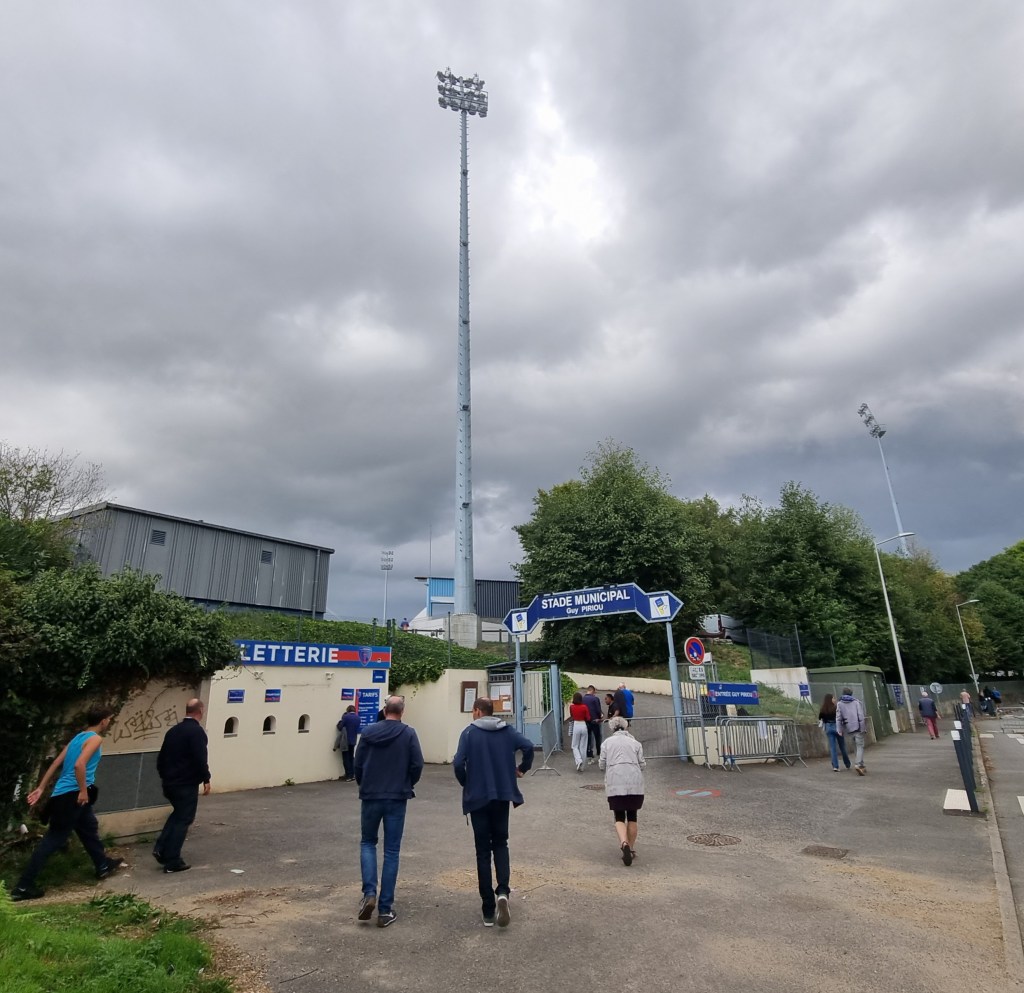
The Stade Guy Piriou where USC play their home games is at the edge of town in that nether world of retail parks, Zones Industrielles and feeder roads inaccessible to pedestrians. I had asked in the Tourist Information Office where is a good place to park and the pretty young woman there had rolled her eyes with a look that told of chaos, but then said we could park in the car park of the LeClerc supermarket which is about 100m from the ground through a tunnel beneath the main road.  After getting a bit of shopping and an evening picnic, which my wife Paulene and I eat in the car, we make for the ground.

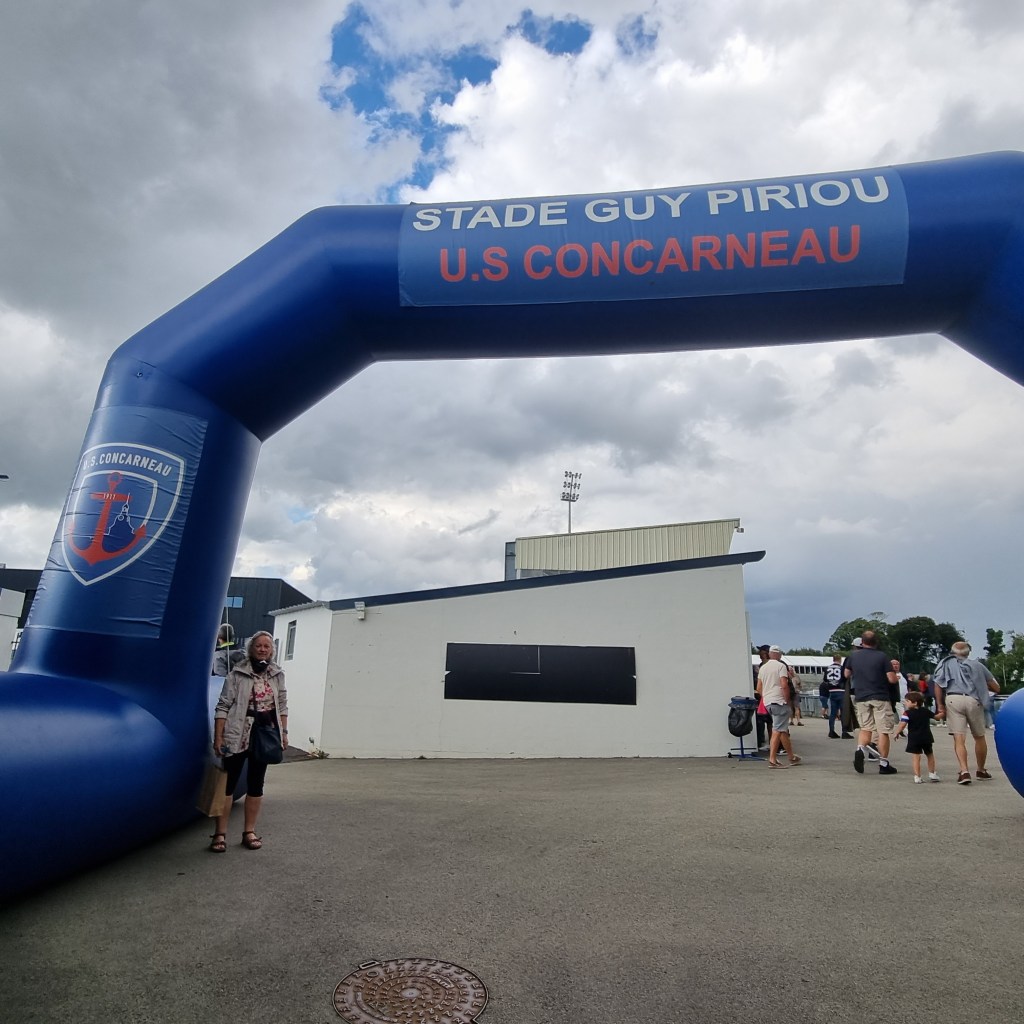
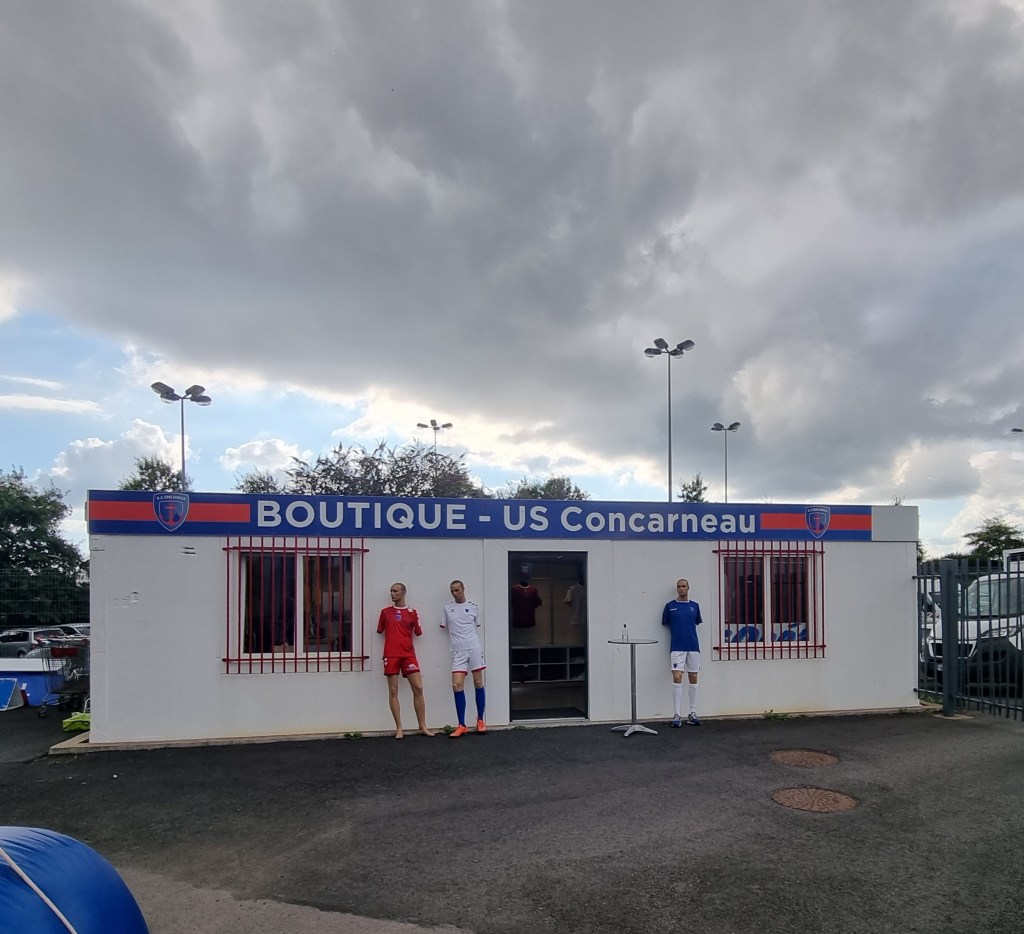
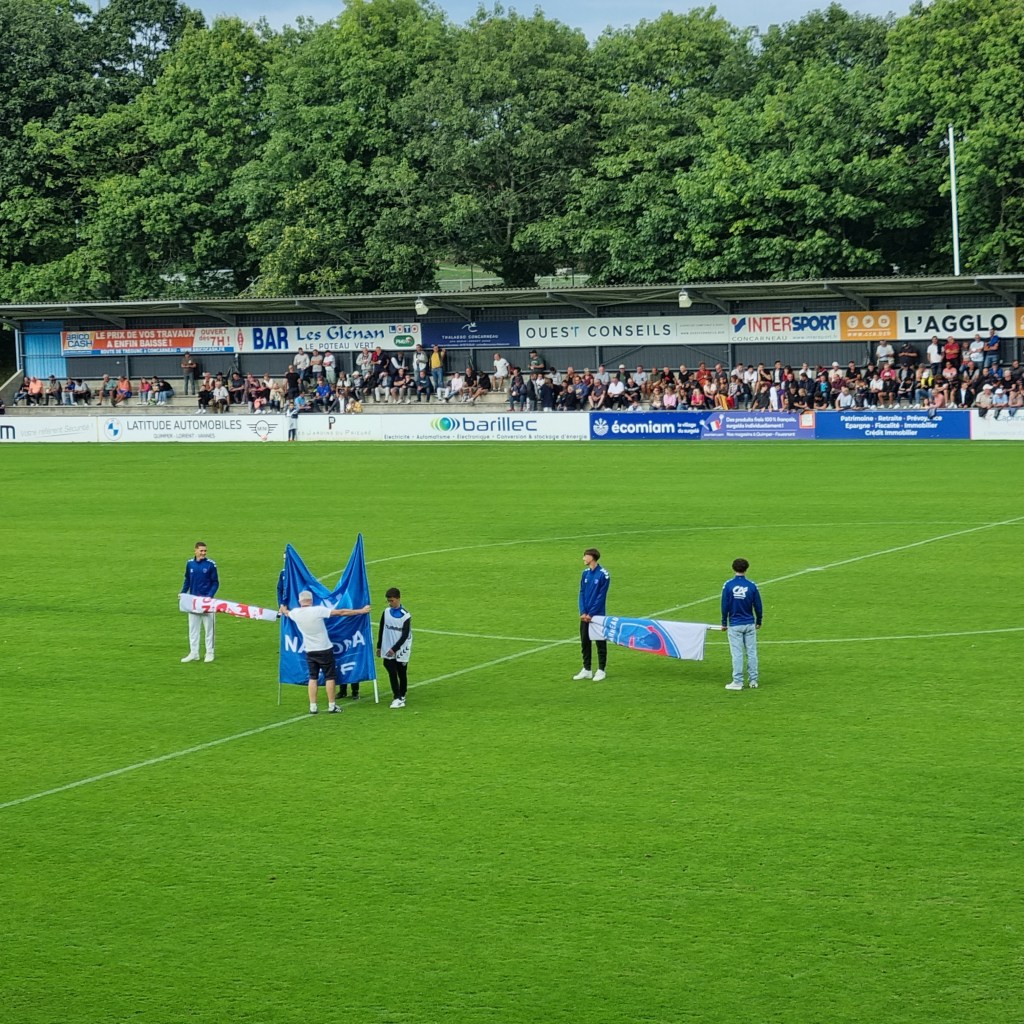
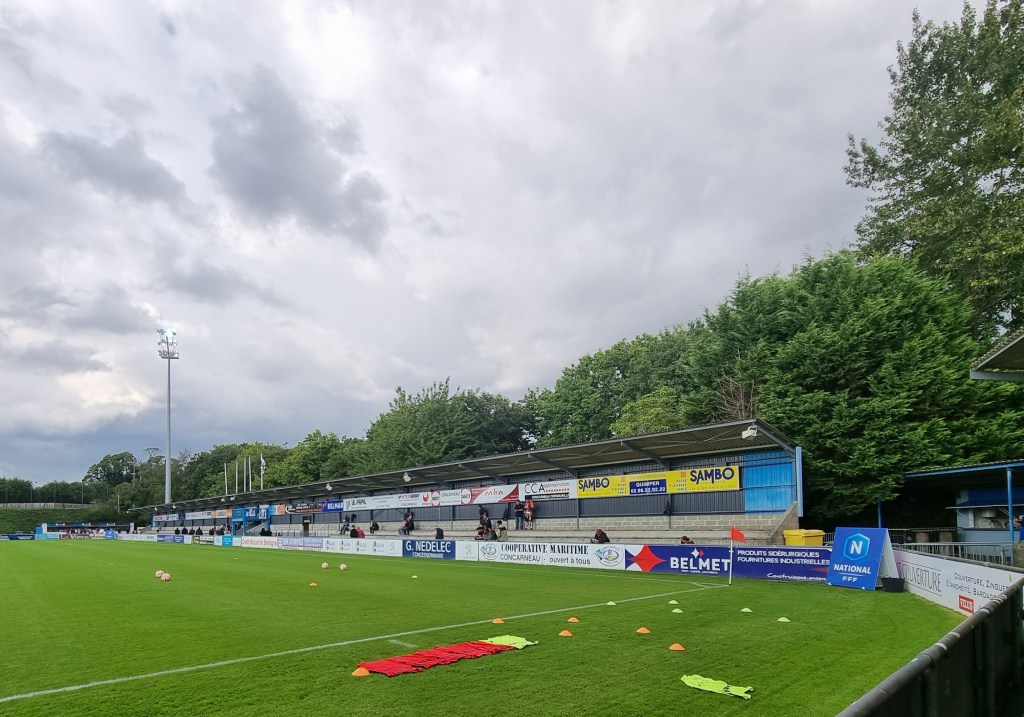
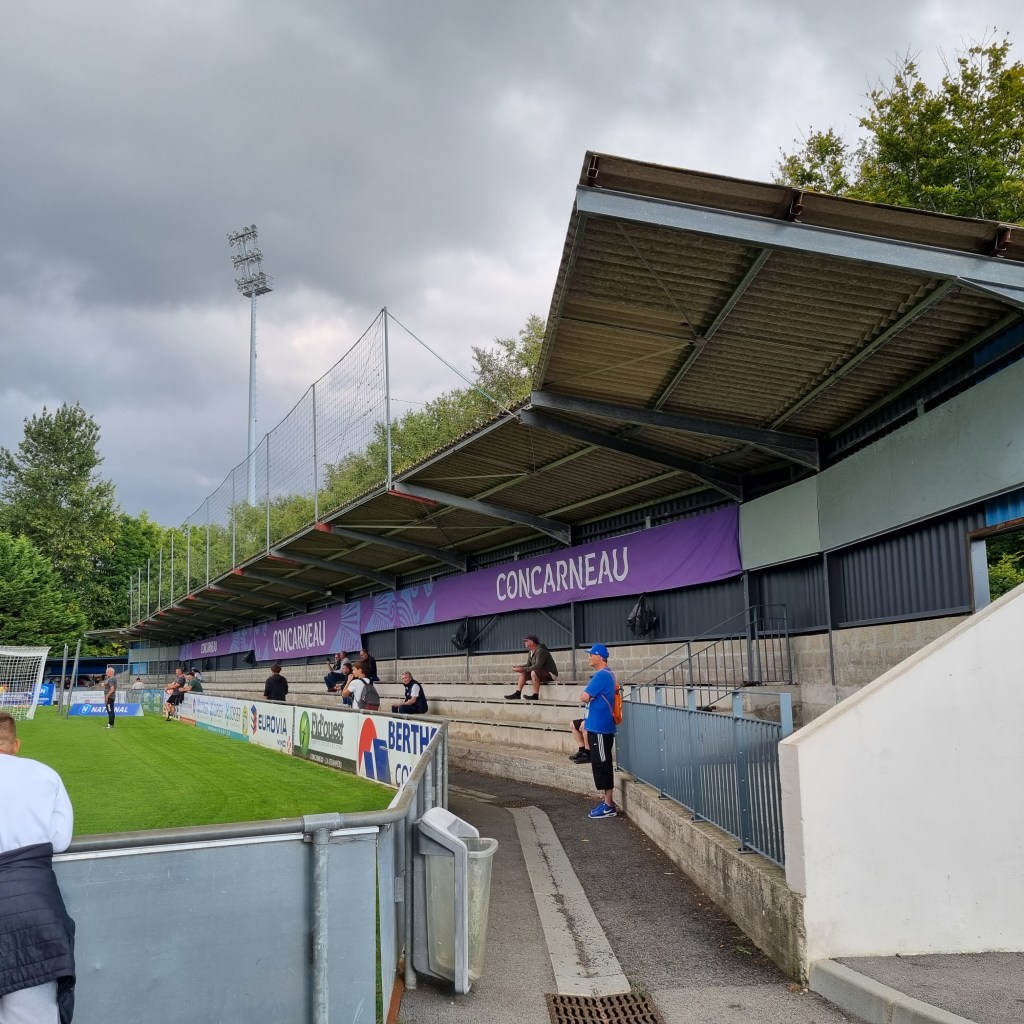
Having had difficulty trying to buy tickets on-line we had visited the ground earlier in the afternoon on arrival at Concarneau.  Although there are guichets open at the entrance to the ground selling tickets, these were shut when we arrived earlier and I had gone directly into the club office where I had selected our seats on someone’s lap-top and stood by his desk as he printed out two tickets for the main stand (12 euros each).  The stadium sits on the top of a small hill and the main entrance delivers us up a slope through an inflatable arch to the corner of the stadium; I don’t know if I’m in a football ground or a bouncy castle, but there is a main stand in front of us and to our left.  Pleasingly there is a club shop where for 5 euros I add to the collection of petit fanions (pennants) that adorn my upstairs toilet at home, and also purchase a mug (9 euros) and acquire a match day programme which, like at every French club that produces a programme, is free.  The ground has three excellent buvettes which remind me of stalls at a fairground; they serve huge sausages piled on top of massive heaps of chips, and the very tasty local ‘Britt’ beer. After visiting what is possibly the smartest and sweetest smelling toilet I have ever encountered in a football ground; it’s all stainless steel and shiny coloured tiles, I change euros into tokens worth a euro each and buy a beer for me (3 euros) and a cola (2 euros) for Paulene, which surprisingly and disappointingly is not Breizh Cola. I then join Paulene in the main stand for the pre-match entertainment of observing everyone else arrive, search for their seats or eat sausage and chips, before watching a fastidious man organise three pairs of youths into holding banners displaying the Ligue National logo and the two club crests.  Off to our left the match ball sits above a plinth in front of the players’ tunnel and appears to be hovering in mid-air.
At half past seven the match kicks off, with Nancy in their all-red kit getting first go with the ball.  Concarneau are in blue shirts and socks with white shorts and the first chant of the evening surprisingly emanates from the main stand; “Allez les bleus, Allez les bleus” confirms that I am not suddenly colour blind. On the far side of the ground, in the long, low, basic but well maintained partly seated, partly terraced stand a knot of supporters sing “Allez, Allez, Allez” to the tune of The Beatles ‘Yellow Submarine’.  

Perhaps because of the backing of the home crowd, USC quickly settle into the game and their number 24 Ambroise Gboho soon threads an excellent diagonal through ball into the path of Antoine Rabillard, who has made an overlapping run, but Rabillard hits his shot straight into the body of Nancy’s goalkeeper. USC’s Amine Boutrah then wins the games’ first corner and Tom Lebeau wins the second. “Allez les bleus, Allez les bleus” sings the home crowd again.  Lebeau crosses the ball and Rabillard heads over the bar. Low, evening sunlight falls across the pitch illuminating the grass vividly where it doesn’t cast a lengthening shadow of the main stand. The sky is gun metal grey in the distance; there have been heavy showers inland throughout the day and a rainbow extends up then fades away beyond the opposite stand.  Behind the left-hand goal, on the steep concrete terrace below the hospitality area people appear to be putting their coats on; it doesn’t seem to be raining but briefly there is a faint rattle on the metal roof of the stand.
Back on the pitch, Nancy’s defending is effective but becoming more desperate and Lucas Pellegrini is the first player to see the carton jaune (yellow card) of the referee after he knocks over USC’s Amine Boutrah, who I am not surprised to read in the programme is the player of the month for August.  Within sixty-seconds Nancy’s number eight, Lenny Nangis follows the bad example that has been set and is booked for a foul on USC’s Georges Gope Fenepes.  If Lenny Nangis has any defence, it is that he has a great name.  The resultant free-kick is deflected over the cross bar for another corner to Concarneau.  A third Nancy player is booked five minutes later when Baptiste Mouaza fouls Ambroise Gboho. The supporters on the far side of the ground sing the na-na-nas from The Beatles’ “Hey Jude” and then Mouaza provokes a sharp intake of breath as he trips USC’s Gaoussa Traore and we await the consequences. Like a not very good magician the referee holds up his yellow card and then with a distinct absence of sleight of hand replaces it with a red one.  Mouaza hangs around for a bit, seemingly discussing his misfortune with anyone who’ll listen as most of the other players crowd around the referee and the prostrate Gaussa Traore. When the melee clears and Traore has risen from the dead, Mouaza seeks clarification from the referee that he is no longer required on the pitch and his worst fears are confirmed with a wave of the referee’s arm.

  A minute of the first half remains, and USC win another corner; the ball is crossed from the left and having evaded everyone else, falls in front of captain Thibault Sinquin who appears to do little more than absent-mindedly stick out a leg, and thereby scores.  After two minutes of added on time, the teams retreat to the dressing rooms for mi-temps (half-time) with Concarneau in possession of a well-deserved lead, although having failed to score for the first forty-four minutes the eventual goal came as a bit of a surprise. Half-time sees a flood of people towards the buvettes and I get up from my seat to stretch my legs and peer down on them through the scratched Perspex screen at the end of the stand.

The game resumes at 8:32 and although Nancy have some early forays down the flanks it is USC’s Ambroise Gnoho who comes closest to scoring but for an offside flag and Lebeau shoots past the post from all of 30 metres.  With just ten minutes gone of the new half Georges Gape Fenepes,  who might be the first player from New Caledonia I have ever seen, is substituted by Faisal Mannai.  I don’t think it’s Mannai’s fault but within a minute of his appearance a passing move down the left for Nancy ends with the sort of cross commonly known as ‘inviting’, and Lenny Nangis  accepts the invitation, heading firmly into the Concarneau net to unexpectedly equalise.

Despite having lost their lead, Concarneau will surely still go onto win having a man advantage and they continue to press forward with Robillard, Traore and Boutrah always looking the most likely to conjure up a decent chance.  With a third of the match remaining USC win another corner after a flurry of activity around the Nancy goal.  A low cross from the right is just too far ahead of everyone to allow anyone to touch it into the net.  “Merde” says the bloke behind me through gritted teeth as a pass by substitute Faisal Mannai is intercepted by a Nancy player who breaks forward into the Concarneau half.  Nothing comes of it however and Thibault Sinquin in turn breaks forward for USC from his centre half position, but his low cross from inside the penalty area is cleared.

The game is into its last fifteen minutes or normal time and Gaoussa Traore lashes a shot somewhat desperately, which travels high and wide of the Nancy goal.  Nancy substitute Lamine Cisse for Isaak Umbdenstock, but not before Cisse looks confused as to which direction he must run to leave the pitch; after initially running away from the benches he checks and runs back and Umbdenstock runs on.  Concarneau replace Adrien Jouliex with Alec Georgen but are coming no closer to scoring a second goal.

Ten minutes remain of normal time and Nancy win a rare corner;  Diafra Sakho meets the ball on his forehead and Nancy are suddenly winning as the ball bulges the net with the Concarneau goalkeeper and defenders static.  Even now I can’t bring myself to believe that Concarneau won’t equalise,  but as Tom Lebeau is replaced by Pierre Jouan there are just seven minutes left and Nancy are taking every opportunity, and creating more to eke out that time by winning free kicks and staying down on the ground.  When a player goes down ‘injured’ on the far side of the field the slow-moving physio who looks about seventy-five can only trundle across the pitch.  Nancy make use of their penultimate substitution before six minutes of added on time are announced and then make the final one as they control the end of the game, not in terms of active football but in terms of frustrating Concarneau by fragmenting the remaining time into useless moments of nothingness.

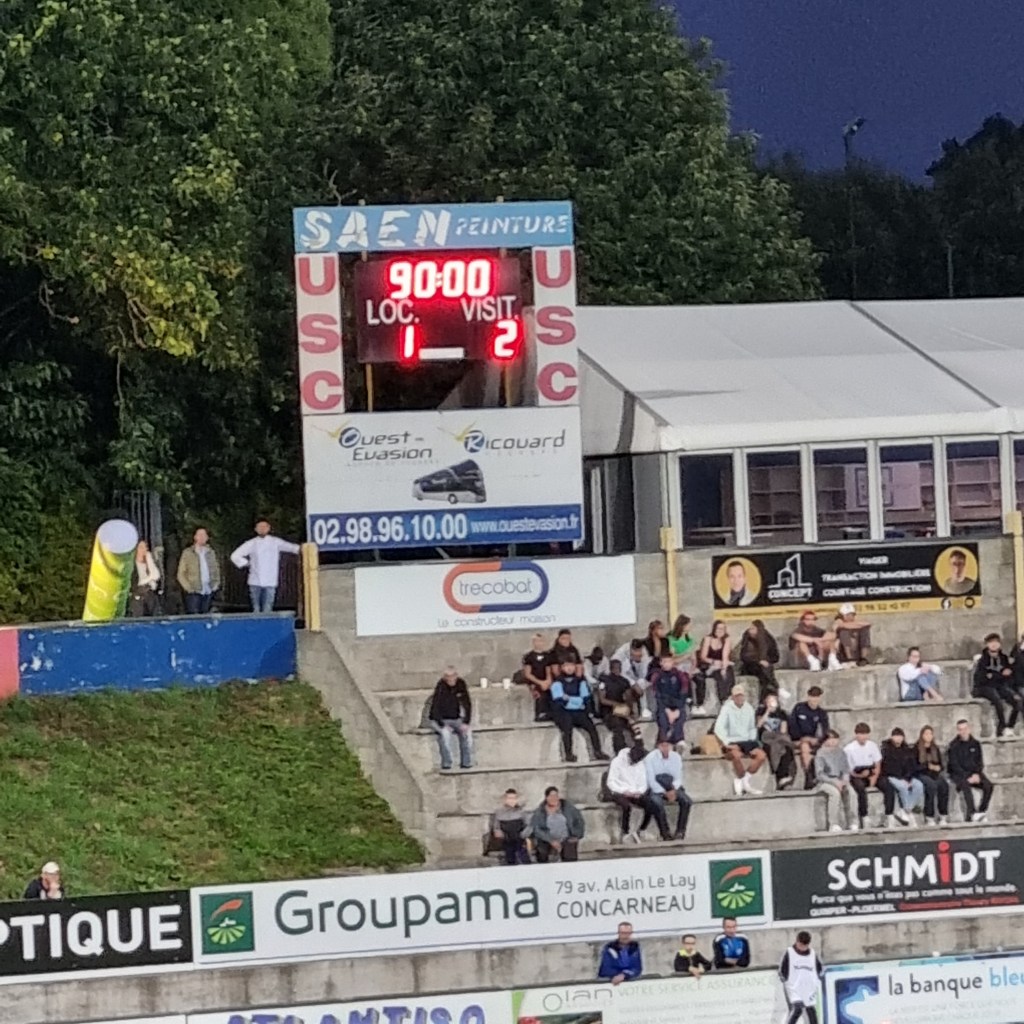
Full-time arrives too soon for Concarneau and Nancy will make the 920 kilometre journey back to Alsace with an unexpected win, which in the context of modern football they deserve, but it wasn’t always much fun to watch and many would say they had ‘stolen’ the points.  Nevertheless, Concarneau is a great place to come to watch a match and is reminiscent of an English fourth division ground but with better beer, better food and cheaper admission prices; Paulene and I therefore have had a splendid time.