Ipswich Town 5 ABBA 5

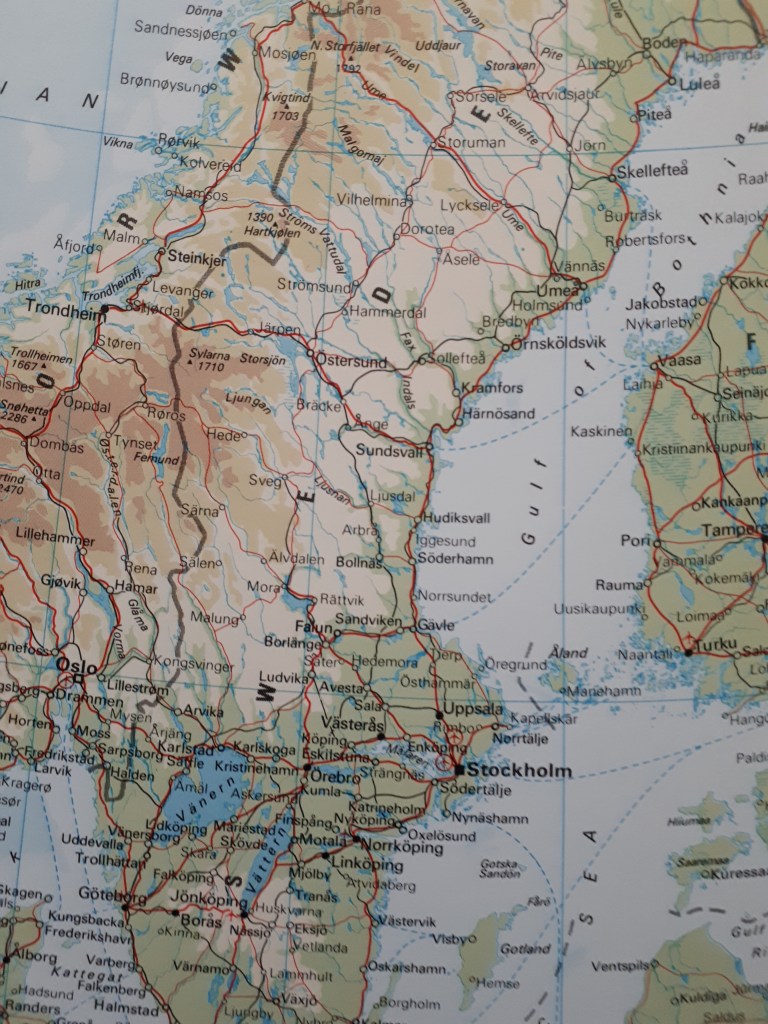
The football season is over save for the silly play-offs, and now it’s the height of Spring,  and with little else to occupy him a young man’s fancy lightly turns to thoughts of the Eurovision Song Contest;  or maybe not.  But last week’s transmission of the bizarre, annual , musical  television ritual extravaganza was inevitably accompanied by the airing of a clip show on BBC4 of past performances by the competition’s only notable success, Abba.  I have never bought, stolen, borrowed or owned an Abba record, tape, download or CD, but I will admit to being unable to suppress a smile when I hear one played.    Equally, I couldn’t resist watching that clip show and felt rewarded when it brought back memories of a road trip I made in the summer of 1995, which took me and my then girlfriend via Parkeston Quay, DFDS Seaways ferry, Gothenburg, Stockholm, Uppsala and Sundsvall to Pitea in northern Sweden, where we stayed with my girlfriend’s pen friend and her husband.  It was a very long drive for which the soundtrack for several stages of the journey came courtesy of a CD of Abba Gold belonging to my girlfriend.
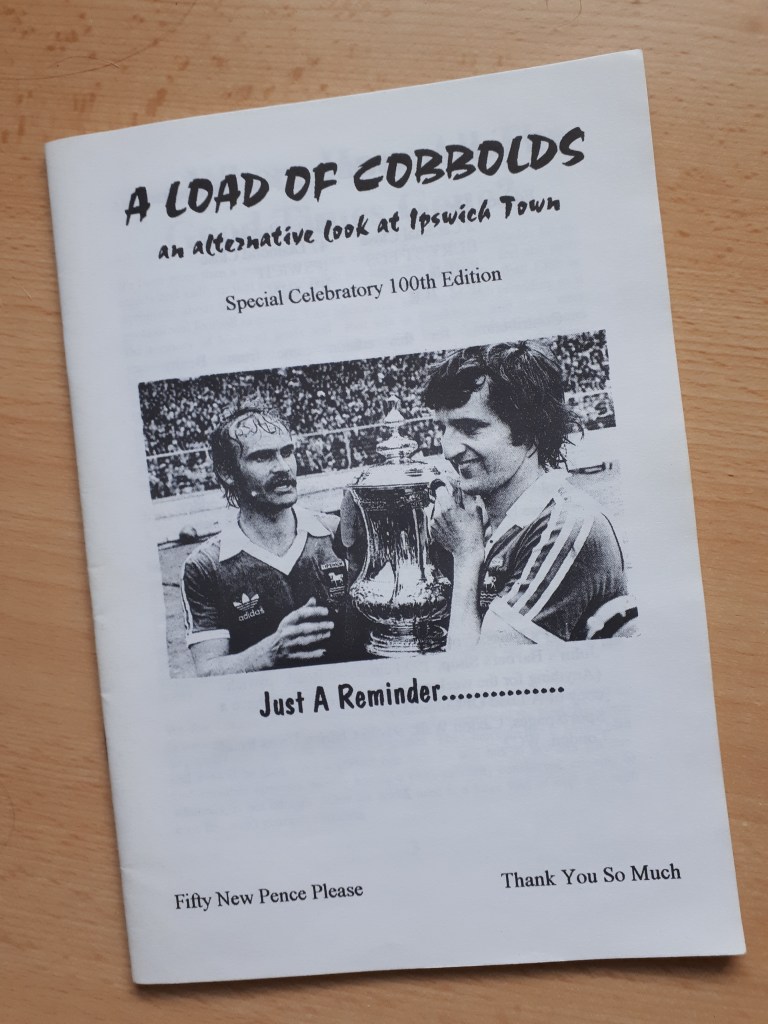
The experience of listening to Abba on that road trip has stayed with me and it led to an article in the erstwhile Ipswich Town fanzine A Load of Cobbolds.  Now, in the spirit of nostalgia inspired by the fortieth anniversary of Ipswich Town’s UEFA Cup win and  in the absence of anything better to do I have reproduced that article below, updating it to modern times where necessary:

When you’re an eleven or twelve year-old football and pop music loom large as pre-pubescent priorities.   I bought my first record (Happy Christmas (War Is Over) by John Lennon & Yoko Ono) in 1971,  the same year that I started watching Ipswich Town, and I  soon began to feel that footie and pop music were somehow inextricably linked. The late Sixties and early Seventies was a time when it was easy to confuse footballers with pop stars and my two worlds satisfyingly collided.  The fashion for any bloke who aspired to being hip and trendy was an enormous thatch of hair coupled with equally vast sideburns.  Squeezed into a pair of bollock-hugging, crushed-velvet flairs and sporting a deafeningly loud shirt,  Ian Collard or Rod Belfitt might have been members of The Hollies, or Kevin Beattie a member of Nazareth.

The similarities in the appearance of pop stars and footballers subsided a bit as the Seventies wore on and sadly, sartorially Punk Rock never seemed to catch on with any footballers at all.  There were however still some startling lookalikes within the ranks of the PFA, I thought.  It could have just been my addled perception, but I always felt that Arsenal’s Frank Stapleton and Shakin’ Stevens were the same bloke.  Moving on into the 1980’s the separation at birth of Oldham Athletic’s Andy Ritchie and Jimmy Somerville was ‘well documented’ at the time, but less well-known is the fact that Roy Keane and Sinead O’Connor were also twins.

More amazing than these superficial similarities, which admittedly are largely the invention of my fevered imagination, is the very precise correlation between the success of one particular football club during the 1970’s and early 1980’s and a particular pop group.  Both were at their peak between 1973 and 1982. The football club of course was Ipswich Town and the pop group was Abba.

If you take time to trawl through the collected works of the famous Swedish songsters, as Dave Allard might have called them, you will not only enjoy a richly rewarding aural experience, but you will soon reach the conclusion that the fact that Town and Abba were both at the peak of their powers over precisely the same period of time is no coincidence.   Listen carefully to the lyrics and you will be able to trace the history of the Town’s success through that glorious era.  You will find that listening to Abba Gold (Greatest Hits) is as close to a religious experience as you can hope to get;  something akin to an Ipswich Town Dreamtime, harking back to an epoch when Portman Road was inhabited by ancestral figures of heroic proportions who possessed supernatural powers.   In the film Muriel’s Wedding the eponymous Muriel says that Abba’s songs are better than real life.  Now, as we sit in the murky depths of the third division and look back at Town’s glorious past you too will believe this is true.

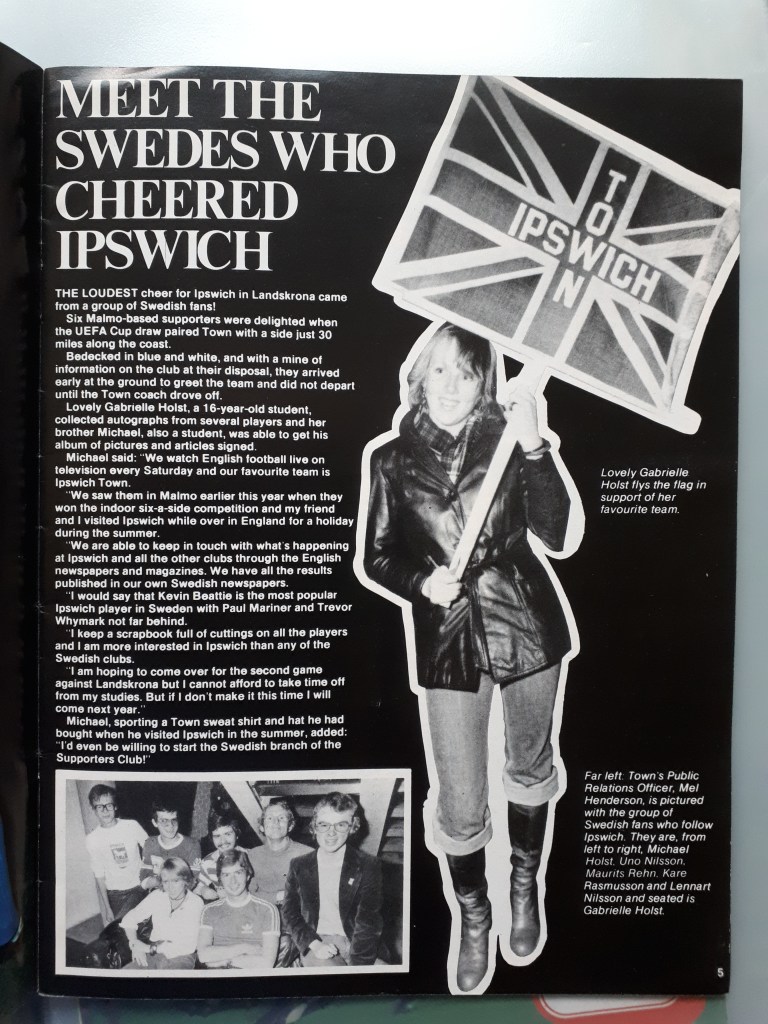
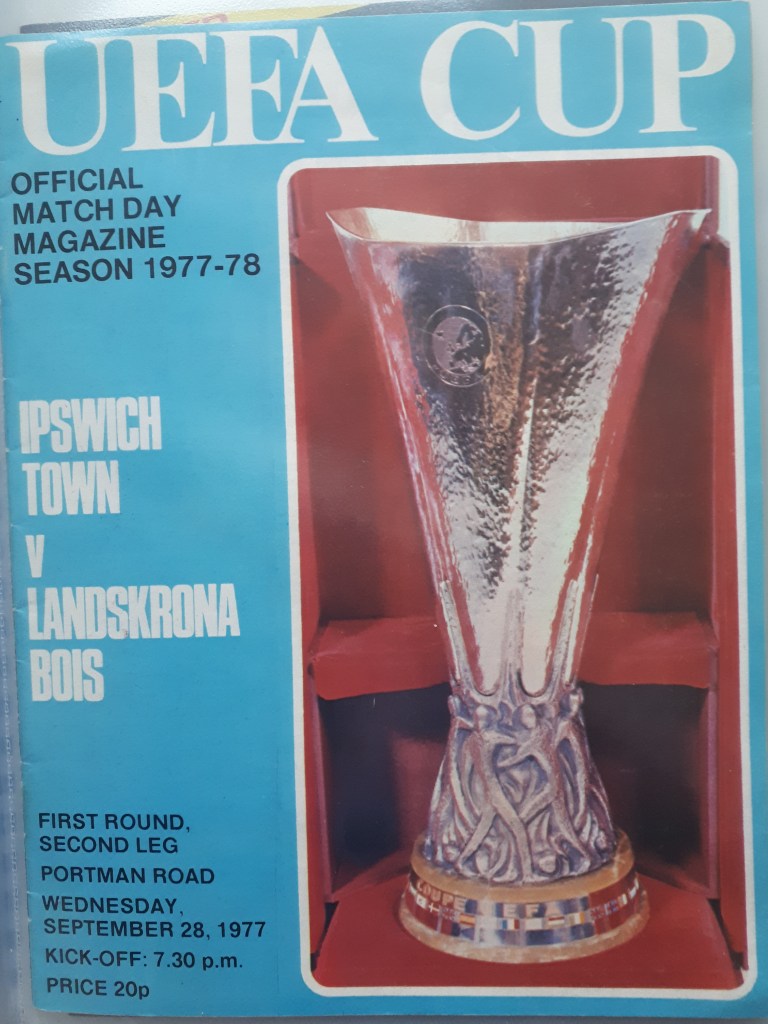
As you might expect from Europe’s foremost supergroup many of the songs make reference to Town’s European campaigns of that era in the UEFA and European Cup Winners’ cups.  It is likely that it was through Town’s exploits on the continent that the talented Swedes first became Town supporters, although we were actually only drawn against Swedish opposition  once when in 1977 we met Landskrona Bois and most inconveniently The Stranglers played the Ipswich Gaumont on the very same night as the home leg.  Naturally, I missed The Stranglers concert and sadly never got a second opportunity to see them.    There is clearly a reference to Town’s UEFA Cup triumph over Lazio in the title of the number one hit ‘Mamma Mia!’, a song which also contains a lyric that suggests one of Abba had perhaps had a brief flirtation with a Town player or supporter and may explain the uncanny connection between Abba and the mighty Blues;

“Yes, I’ve been broken hearted, Blue since the day we parted.”

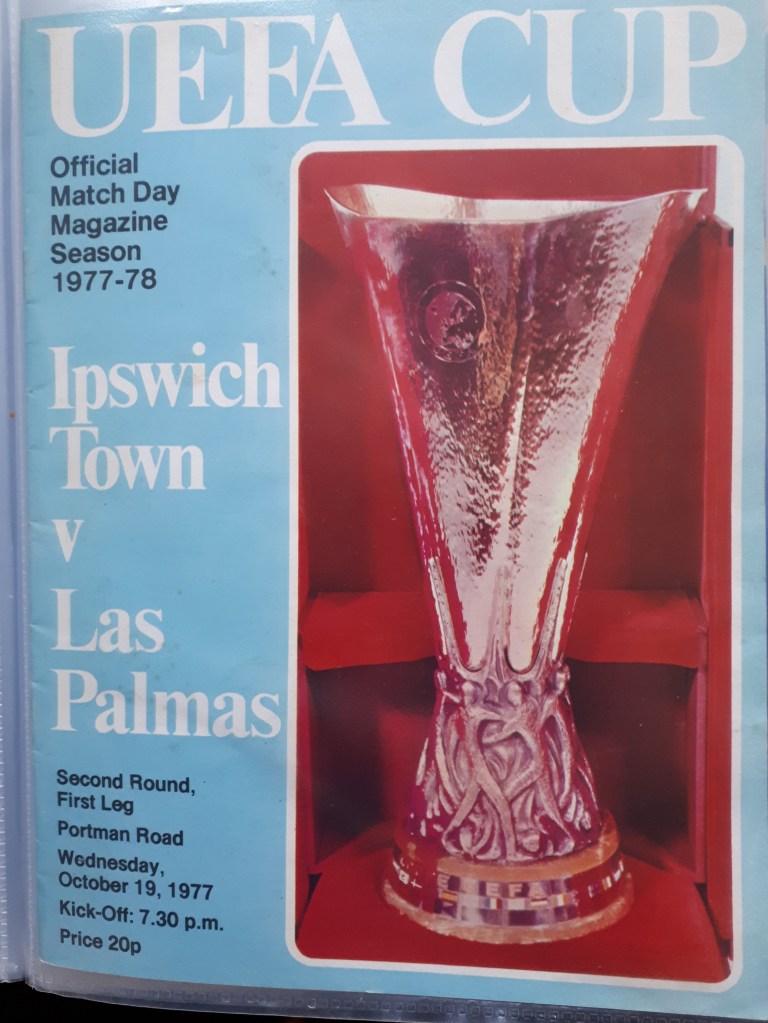
The moving ballad ‘Fernando’ is sung to an imaginary Spanish fan and recalls those sultry September and cooler autumn evenings when we entertained Iberian opposition from Real Madrid, Las Palmas and Barcelona.

“There was something in the air that night, the stars were bright, Fernando….

Though we never thought that we could lose, there’s no regrets. If I had to do the same again I would, my friend Fernando”

That last line referred to the fact that Town were twice drawn to play Barcelona, whilst the line  before that refers to our having lost both ties despite being confident after winning the first leg.  Another song, ‘Super Trouper’, whilst still referencing games played under floodlight, perhaps because of the lack of daylight hours in Sweden during the English football season, refers to an individual player and employs little-known Swedish rhyming slang in a thinly disguised paean to goalkeeper Paul Cooper.

“Super Trouper lights are gonna find me shining like the sun, Smiling having fun feeling like a number one”

In the 1978 Abba hit “Take a chance on me”   the subtle Swedish Blues fans reveal the little known story of how Frans Thijssen successfully pleaded with Bobby Robson to let him join his compatriot Arnold Muhren at Portman Road and to try his luck in English football. 

Honey I’m still free, take a chance on me. If you need me let me know and I’ll be around. Gonna do my very best and it ain’t no lie, if you put me to the test, if you let me try”.

Although those days were such wonderful times for Town, not every song described a happy or uplifting event.  There were sad days too at Portman Road back in the Seventies and hard decisions had to be made for the good of the team.  The 1977 ‘Number One’ hit ‘Knowing Me, Knowing You’ was about the departure of former Portman Road favourite David Johnson, the one-time ‘King of Portman Road’, who left Town to join rivals Liverpool.  In the song, the reflective Scouser looks back on the good times he has had at Portman Road since his move to Town from Everton four years earlier.

  “Memories, good days, bad days, they’ll be with me, always”

David appreciates however that his recent form has not been good and in the circumstances a move is the best thing for everyone.

  “Knowing me, knowing you, there is nothing we can do, we just have to face it this time we’re through; Breaking up is never easy I know but I had to go, Knowing me, knowing you it’s the best I could do”.

Back in the Seventies, money wasn’t the driving force in football that it is today.  Nevertheless, the spending power of clubs such as Manchester United, who were able to make expensive signings virtually every season despite being rubbish, rankled with Bobby Robson and he longed to be able to make big signings for Town.  Abba’s “Money, Money, Money” was a song about his frustration. 

“In my dreams I have a plan, if I got me a wealthy man…  “

”All the things I could do if I had a little money…”

“Money, money, money, always sunny in a rich man’s world”

Both ‘Knowing Me, Knowing You’ and ‘Money, Money, Money’ showed something of the downside of those glory years and as we look back on those days from the fag-end of the first quarter of the miserable twenty-first century a melancholy aura pervades our memories, in part because ultimately Town failed to win the League Championship that we deserved, but perhaps also because even at the time we knew it all had to end one day, and when Bobby Robson left to manage England in 1982 we secretly knew it had.  Abba knew it too and two of their hits put these feelings in to sharp perspective.  The haunting melody of ‘Winner takes it all’ explores the pain that looking back on the good times would bring; it begins:

 “I don’t want to talk about things we’ve gone through, though it’s hurting me now it’s history”

Abba’s last big hit ‘Thank you for the music’ is sung from the perspective of our legendary club captain Mick Mills who reminisces, having regretfully left Town for Southampton, about the joy and beauty of those days between 1973 and 1982.  If you’ve listened to the slightly dull monotone of Mick’s summaries as he sits alongside commentator Brenner Woolley on BBC Radio Suffolk, you will appreciate the opening lines to this song; 

“I’m nothing special in fact I’m a bit of a bore, If I tell a joke, you’ve probably heard it before…”

But Mick’s talent was as full-back and captain of the greatest Ipswich Town side ever and this was the ‘music’ referred to in the title of this most moving of Abba songs.  This was a song from the heart of ‘Mr Ipswich Town’, Mick Mills, and it is truly uncanny how Mick with his blond locks and luxurious facial hair even looks like a bit like a composite of Bjorn Ulvaeus and Benny Anderson the song’s composers.  This song is the ultimate celebration of those ten seasons at the top in which Mick thanks fate for the glorious hand he was dealt.

“I’ve been so lucky, I am the girl with golden hair

I want to sing it out to everybody

What a joy, what a life, what a chance

So I say Thank You for the music

The songs I’m singing

Thank you for the joy they’re bringing…”

The songs of Abba define and encapsulate a golden period in the story of the twentieth century and the time before Thatcherism and neo-liberalism destroyed your innocence.  Abba’s songs, their success and the glory of Ipswich Town, the nicest professional football club the world had ever known did not happen together by coincidence.  The proof is in the lyrics of the songs, and shows that cosmic forces were at work.  Those of us who lived through the 1970’s were truly blessed to have experienced the music of Abba as it happened, but we are doubly blessed to have been Ipswich Town supporters too.

Thank you for the music Bobby Robson and Mick and all the lads who played for us between 1973 and 1982 , and thank you for the music Agnetha Faltskog, Benny Anderson, Bjorn Ulvaeus and Anni-Frid Lyngstad.

Ipswich Town 1 Arsenal 0 – Our Blue Heaven

It’s Saturday May 6th 1978, I will be eighteen in about seven weeks’ time and today I am going to the FA Cup final. I am going with my dad; we were two of the 24,207 who saw Town beat Hartlepool United in the fourth round of the FA Cup and the 29,532 who witnessed the 3-0 win in the fifth round replay against Bristol Rovers; we went to the semi-final at Highbury on a supporters’ coach from Shotley. We saw Landskrona Bois, Las Palmas and Barcelona at Portman Road back in the autumn and have seen about a dozen league games on top of that, so we had the requisite vouchers to get tickets for the final. But this morning my father has woken up feeling unwell; he doesn’t think he’ll be up to going to Wembley and so for my friend Tim who lives five doors away, it’s his lucky day. I walk along the street, knock on his front door and ask if he wants to come to the FA Cup final; he does. Tim’s dad Charlie will this evening deliver a bottle of sherry by way of a thank you.
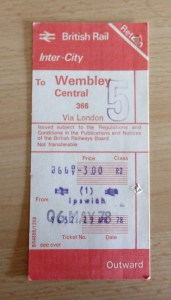
I listen to a few selected tracks from Blondie’s first album ‘Blondie’ (released in December 1976 )as I get ready to go; ‘Look good in Blue’ seems apposite this bright morning as does ‘In the sun’ with its lyric “In the sun , we’re gonna have some fun”. We get to Ipswich railway station somehow; on the 202 bus, or does someone give us a lift? Ticket to WembleyFrom Ipswich we are on a special chartered train that turns right at Stratford and plots a course through north London round to Wembley Central. In Wembley Stadium the terrace steps at the tunnel end are much bigger and steeper than those in Churchman’s or in front of the East Stand, blue and white abounds. The sun shines and Arsenal, wearing yellow and blue, kick off with Ipswich playing towards that blue and white tunnel end. Paul Mariner hits the cross bar, John Wark twice shoots against a post, Pat Jennings saves acrobatically from George Burley, Paul Mariner misses, bigmouth Malcolm McDonald is rubbish, Clive Woods is brilliant, David Geddes crosses, Willie Young is a lumbering donkey, Roger Osborne scores, we cheer, we sing, Roger Osborne is substituted for Mick Lambert, Town win and Mick Mills lifts the FA Cup and turns to show it to us.
Back at Wembley Central railway station after the match a half-brick or a stone bounces off the window of our train as we wait to depart back to Ipswich. Arriving back in Ipswich, Tim and I celebrate with a couple of pints of Tolly Cobbold bitter in the Railway Tavern on Burrell Road as we wait for a lift home in Tim’s dad’s green Morris Minor 1000.

OLYMPUS DIGITAL CAMERA
Forty years and eighteen days later it’s a dank evening in Ipswich, I have been to work, visited my mum, parked up in Portman Road and arrived at the New Wolsey theatre, which didn’t exist in 1978, although there was repertory theatre in Tower Street. I am with my wife Paulene. My father has been dead for nine years, happily his cause of death was unrelated to his illness of 6th May 1978, he enjoyed almost 21 years of good health subsequent to that and made it to the UEFA Cup final second leg in Amsterdam. Tim now lives in Weymouth and oddly he still only gets to see the Town when I get him a ticket (this season we went to Brentford). The Railway Tavern has been demolished; the green Morris Minor was scrapped long ago. But the name of Ipswich Town is still inscribed on the plinth of the FA Cup.
My seat at the Wolsey theatre tonight is in the front row of the auditorium, my wife Paulene is sat in the row behind; she sat behind to give me more legroom. The production is so popular we couldn’t get two seats together. We are the first people in the auditorium, Paulene’s asthma means she needs time to acclimatise. I read the programme (£4) and think “Cup final prices”. The stage is just a metre in front of me, the ‘boards’ are under a green covering patterned to look like turf. At the back of the stage a pair of blue doors look like the doors at the back of the old North Stand, above them is a projection of the type of corrugated cladding also redolent of the old North Stand. But there was never a sign that said ‘Welcome to Portman Road’ back then, there isn’t now. Also part of the projection is the old Ipswich Town crest, the slightly imperfect yellow and blue one, which should be restored out of respect to the past and to John Gammage who won the competition to design a distinct crest for the club back in 1972.41429848635_33f2609053_o
I watch the ‘crowd’ as the auditorium fills up to the sounds of assorted 1970’s pop hits, nostalgic but mostly awful. The majority of people here seem to be my age or older, old enough to have witnessed the 1978 Cup final. A few people are sporting blue and white scarves; one man wears a bright red blazer as if he’s just got here from Butlins. In the front row are three young lads, pre-teens, one of them wears a parka which lends an unexpected layer of 1970’s authenticity. Paulene says she feels cold, I say if I’d known she was going to I would have brought a blue and white bobble hat for her.
The lights dim and tonight’s performance of ‘Our Blue Heaven’ begins with Blondie’s “Hanging on the telephone” played live as the soundtrack to a domestic scene in which a young couple, Mel and Scott arrange their wedding for Saturday 6th May 1978, and then the draw for the third round of the FA Cup is announced. I resist the temptation to put my hand up to point that Blondie’s Parallel Lines album, from which ‘Hanging on the telephone’ was taken as a single would not be released until September 1978. I am not really a pedant and whilst I may not always like it, I do understand the concept of artistic licence and have been known to use it myself; I deny all accusations that it was merely lying.
Mel’s sister Sue is a dedicated and faithful Town fan and from the start foresees that she will want to be at Wembley on May 6th. Meanwhile, in a parallel story Smudger and Ange are awaiting their first child, with Ange’s ‘expected date of confinement’ surprisingly enough being 6th May, although the nurse at the hospital, who happens to be Mel and Sue’s mum Sheila tells them that babies never arrive on time. Smudger is as committed a Town fan as Sue and is predictably torn between his love for the Town and supporting his wife.
The simple domesticity portrayed is all a bit ‘Play for Today’, particularly when it transpires that Mel and Sue’s dad Paul is a striking fireman, whilst Scott’s dad Brian is a Thatcherite policeman; and that just adds to the authenticity and feel that it is 1978. I am transported back in time on a wave of Nostalgia (from the Buzzcocks Love Bites album and like Blondie’s Parallel Lines, also not released until September 1978, but also sadly not in the show).
Scenes from the two families’ stories are spliced with Town’s progress through each round of the FA Cup introduced by popular songs of the time, Bowie’s ‘Heroes’, Patti Smith’s ‘Because the night’, something or other by the Bee Gees. For the sixth round trip to Millwall the band plays the Clash’s London Calling, at which point I really do want to put my hand up because the Clash’s album was not released until December1979, a whole 20 months later. I only hold back when London Calling runs into White Riot, which is much more temporally authentic having been released as a single in March 1977, and a cracking tune to boot.
For each match a group of male and female dancers act out the crucial on-pitch events to the background of the songs and a BBC radio style commentary. My friend Gary texted me before the performance to tell me there was just one thing he did not like about the production and later he will tell me that it was the football sequences. Re-creating football well is notoriously difficult to do, as proven by awful films such as Yesterday’s Hero, in which incidentally the football sequences were filmed at half-time during a game at Portman Road; this is why I don’t consider that the director really bothered to do so. The dancers don’t look like footballers and they are only dancing, creating an impression through movement; they could have been supporters recreating the goals, children doing so in the school playground, and that is authentic. So Gary, you are wrong and need to brush up on your critiquing skills.
The intertwined stories of the families and the FA Cup run are good ones, there is drama, pathos, human emotion aplenty, humour and of course a happy ending. But the thread that runs through the production is the character of Bobby Robson who intermittently comes on to the stage like some sort of visiting angel wearing a series of 1970’s style suits and coats, imparting words of wisdom and assorted homilies about football and the wider experience of our lives beyond. As if this isn’t enough, the actor playing him, Peter Peverley does so brilliantly, better even than Michael Sheen’s rendering of Brian Clough in The Damned United. Peverley has the accent which is easy enough, and he has perfected the mannerisms too, but more than that he has captured the slight hoarseness in the voice, it’s almost uncanny. He wears a pretty bad wig though.
The finale to the production has the marriage, the birth and the FA Cup final taking place on stage simultaneously following the singing of Abide With Me, the Cup final hymn since 1927; a maudlin little number but a cracker nevertheless because it is the Cup final hymn and has been marinated in 90 years of Cup final history. Being sat right at the front, my view is now partly obscured by some of the on stage props, so I watch the audience. People who know the words sing along with Abide With Me, whilst others hold their scarves aloft. It is likely that many of the people here, like me were at the Cup final in May 1978 and are part of the story, but this makes people feel involved all over again, it’s nostalgia with knobs on, re-enacting the past, albeit part fictional, but this is somehow how it felt.
The story ends and it truly feels like Town have won the FA Cup all over again, and then Roger Osborne, the personification of the day because he scored the winning goal enters the stage, inevitably to a standing ovation. The ultimate finale however, comes with the cast all assembled on stage with Bobby Robson leading us in a sing-song, some Cup final community singing of our own; a rousing rendition of Edward Ebenezer Jeremiah Brown. It’s bloody marvellous and everything that matches at Portman Road no longer seem to be, utterly joyous. I give it my all.
I have had a most marvellous evening and for much of it I am not ashamed to admit I have had a tear in my eye. I have been taken back in time, but don’t know if I’m tearful for my lost youth and the passing of the days when Ipswich Town was such a wonderful football club and team, and when the FA Cup was something that really mattered, or if these are tears of joy and happiness, for a love of my team and a sense of belonging that has been re-kindled.
Nostalgia is warm and cosy, but it’s not a healthy thing, because we cannot go back and we have to live in the present; but tonight after watching Our Blue Heaven I genuinely feel uplifted.
My name is Edward Ebenezer Jeremiah Brown
I’m a football supporter of Ipswich Town
Wherever they play, you’ll find me
I haven’t missed a game since I was three
With me scarf and me rattle and me big rosette
Singing where was the goalie when the ball went in the net
Follow the Town
Up or Down
I’m Edward Ebenezer Jeremiah Brown but everybody calls me Ted.

Football, Football,
Whose the greatest of them all,
Let’s put it to the test
Come to Portman Road on a Saturday and you’ll see the best
Oi!
Ipswich! Ipswich! Come On The Town!

My name is Edward Ebenezer Jeremiah Brown
I’m a football supporter of Ipswich Town
Wherever they play, you’ll find me
I haven’t missed a game since I was three
With me scarf and me rattle and me big rosette
Singing where was the goalie when the ball went in the net
Follow the Town
Up or Down
I’m Edward Ebenezer Jeremiah Brown but everybody calls me Ted.

2-4-6-8 who de we appreciate?
It isn’t hard to tell
Just you take a closer look at me
And you’ll know darn well
Oi
Ipswich! Ipswich! Come On The Town!

La la la
La lala la lala lalala
Lala lalala la lala lalala
La lalala lalala, and lots more lalalaing, you get the picture ?


Gallia Club Uchaud 1 FAC Carcassonne 0

I am on holiday and travelling with my wife down through France to Marseillan Plage in the Hérault département.  Careful research has turned up the good news that we can take in a football match en route. The match is a league game between Uchaud and Carcassonne in the Languedoc – Roussillon section of the Occitanie region’s Division Honneur; the sixth level of French football.

It is now about half past one and we have stopped at an ‘aire’ on the A9 motorway just a few miles from Nimes; with a half hour stop for lunch we will still make it to the Stade Municipal in Uchaud with time to take in the ambience before kick off at 3pm. As we lay out our lunch on a concrete picnic table, a lady about our own age asks if she can share the table with us; being nice people, and in the interests of the entente cordiale, we agree and she joins us with her daughter, who is mentally handicapped. Through a winning combination of our useless French and her slightly less useless English we converse. She is a lovely, friendly ladywith a kind, smiling face and with her daughter Gladys ( a name that sounds much better in French; Gladeece not Gladiss) is on her way from their home in Grenoble for a week’s holiday at Grau du Roi, at a centre that provides holidays for handicapped people and their carers. Gladys, a pretty, joyful young woman, who today wears a large pink flower in her dark hair, is now twenty-nine years old and her mother has brought her up and looked after her on her own all that time. From Monday to Wednesday Gladys now lives in a home, but for the remainder of the week with her mum.  Having eaten lunch, we say goodbye wishing each other bons vacances; we feel a mixture of sadness and humility but also great happiness to have met Gladys and her mum as we set off back onto the motorway towards Nimes and then Uchaud.

Uchaud is a very small town about 8 miles south west of Nimes on the D113, which was the main road between Nimes and Montpellier before the A7 motorway was built. The D113 follows the route of the old Roma road, the Via Domitia. Uchaud is typical of such French towns, appearing to be just two rows of mostly slightly scruffy two and three-storey buildings either side of the road, although in truth it does spread out a little beyond.  According to Wikipedia, in 2014 Uchaud had a population of 4,230.

Just past the very centre of the town we turn off to the left down the Rue Jean Moulin which takes us over the motorway; to the right we see a set of floodlights and then we turn right down the Chemin des Poissoniers. Easing our Citroen C3 between a pair of concrete posts scarred by generations of other Citroens, Renaults, Peugeots and probably Simcas that were less expertly driven, we enter the unsurfaced car park of the Stade Municipal and come to rest beneath the welcome shade of a plane tree. It’s about twenty-five to three.

The Stade Municipal is not much more than a football pitch bounded by a high chain-linked fence. There is a changing room block and buvette (refreshment stall or buffet) at one end of the ground  and a tiny, open, metal ‘grandstand’ which has a capacity of about a dozen people. Otherwise there are just a couple of large rocks and two benches on which to sit and watch the match. The floodlights we saw belong to the neighbouring rugby club. On the opposite side of the ground by the half-way line are the dugouts, including a one-man dugout for the délègue principal, who oversees the whole staging of the match; today’s délègue principal is Monsieur Alain Mistral. He is the only person wearing a suit, although he has taken his jacket off because of the heat. Along this side of the ground runs a low grassy bank with a few young trees on top; a row of rhododendrons punctuate the side of the ground where the benches, rocks and grandstand are, although sadly by now most of their deep red blooms have died off. Such decorative plants are sadly lacking at most English football grounds.

It is free to watch games at this level in France and the players are amateurs playing for the love of the game, so there is no turnstile and we just pass through a metal gate and head for the buvette. The teams are already on the pitch and we ask two gentlemen of retirement age which is which. Uchaud are in all green whilst Carcassonne wear red and blue stripes with blue shorts in the style of Barcelona or, seeing as this is France, Stade Malherbe de Caen. Perhaps confused by my ‘Allez les Bleus’ t-shirt, the gentlemen ask who we are supporting; it seems rude not to support the home team, but I explain that back in England my team is Ipswich (‘les bleus’ of my t-shirt), and my wife adds that she follows Portsmouth; the Frenchmen are Marseilles fans. At the buvette we buy two filter coffees (one euro each); there’s none of your instant rubbish here. We walk about a bit and explore before eventually settling down on one of the rocks in time for kick off, which is slightly delayed because one of the assistant referees seems to be having a bit of trouble inspecting the goal net at the buvette end of the ground. But eventually we hear an electronic beep which signifies that the referee  (Monsieur Boris Gil) has synchronised his watch with his assistants (Monsieurs Laurent Mazauric and Anthony Chaptal) and the game begins.

Carcassonne kick off defending the town and motorway end of the ground and kicking in the general direction of the Camargue and Mediterranean Sea. I am quickly struck by the total absence of any tattooed forearms on any of the twenty-two players, something that is completely unthinkable in England. There are plenty of the ubiquitous beards, but not one tattoo, although the Uchaud number eleven, who bears a passing resemblance to the former Bastia and Lille full-back Julien Palmieri, does wear a bandage on his left forearm.  Could it be a tattoo that went horribly wrong? Does he have a tattoo but covers it up because no one else has one? Do tattoos remain the preserve of convicts in southern France?OLYMPUS DIGITAL CAMERA

The pace of the game is quick, which is surprising given that it is a warm afternoon with a temperature of a good 25 or 26 degrees, but nevertheless it takes more then five minutes for the first shot on goal, from Uchaud, and then another ten minutes before the next OLYMPUS DIGITAL CAMERAone, from Carcassonne; both shots are from angles, across the face of goal. Uchaud have an uncharacteristically solid, English looking centre half at number four, whilst as well as having a Julien Palmieri lookalike at number eleven, their number six bears a disturbing resemblance to former French international and alleged sex-tape starlet Matthieu Valbuena.

The match is quite absorbing even though there are very few attempts on goal, but we still find time to notice that the badge on the shirt of the assistant referee appears to be OLYMPUS DIGITAL CAMERAattached with velcro; his shirt, shorts and socks all look brand new as if this is their first outing; he’s like an outsized boy on his first day at school. Carcassonne look the slightly more accomplished team and have more forays forward, but Uchaud are well organised and in Palmieri (who the rest of the team call Kevin), Valbuena and their captain they have three players who stand out for their skill and good positional sense; their goalkeeper contributes too with his constant calls of “parlez vous” (talk) and “garde” (keep it) as well as the odd catch from a cross. Carcassonne finish the half with a flourish winning the game’s first corner and then seeing their number three place a free-kick carefully over the angle of post and crossbar, before their dreadlocked number eleven runs in behind the Uchaud defence only to hit a low shot beyond the far post.

Half – time, or mi – temps as the French would have it brings a return to the buvette for a bottle of water (one euro) and a wander to the far side of the ground to view the second half from a different perspective. There are plenty of people stretched out on the grassy bank and it brings to mind a football spectating version of Georges Seurat’s painting “Un dimanche après – midi à l’Ile de la Grande Jatte” (a Sunday afternoon at the island of Grand Jatte). There are no advertising hoardings, no programme and no team sheets to amuse us today so we have to talk. Of course, being a conversation with my wife I dont recall anything she says to me, although we do wonder how many people are here watching the game and decide there are at least 120, not including the people who have parked their cars right next to the fence and are watching from behind the wheel.

As the second half begins we too sit down on the grassy bank, but despite the warmth of the day the grass feels a bit damp and it seems likely that the bank has benefited from some ‘fall-out’ from the watering of the pitch, which is in pretty good condition given that the summers in these parts are on the hotter side of scorching. We don’t move however before the Uchaud goalkeeper misses a punch and has to rely on one of his full-backs to clear the ball for a corner. Carcassonne’s number two then has a yellow card waved at him by Monsiour Gil for roughly tackling Uchaud’s number ten and captain.

Now watching the game from behind the goal, the second half is slower than the first and not quite as good as some of the players start to rely a little more on breaking the game up, some by appealing for fouls, others by committing them. With twenty minutes to go there is a very quick drinks break, soon followed by Uchaud’s first corner, which is won by their young substitute wearing the number thirteen shirt. Heading into the final ten minutes Carcassone’s number seven is booked and not that suprisingly because he has been consistently overplaying the “who, me ref?” role for some time, whilst also provoking a series of complaints from the Uchaud players and coaches.

Despite Carcassonne’s less than always sporting approach, my wife and I agree that they look a little more likely to score because they seem just a little bit sharper. Seconds later the Uchaud number thirteen turns and lofts a diagonal cross to the corner of the Carcassonne penalty area where Uchaud’s number two controls and shoots across the alice – band wearing goalkeeper towards the far post. The Carcassonne number six runs back and attempts to clear his opponent’s shot off the line, but both he and the ball merely combine to bulge the net as Uchaud take the lead to the cheers and applause of the crowd. Carcassonne do not now seriously look like scoring an equaliser and only succeed in using up a bit more of the ink in Monsiour Gil’s biro or the lead in his pencil, as their number nine becomes the third player to be cautioned.

With the final whistle, there is a very small ripple of applause, which quickly dissipates and the crowd depart whilst we safely negotiate the perilous posts at the entrance to the the car park and are once again on our way south. It’s been an entertaining afternoon in the sun, in surroundings reminiscent of step six of the English non league, but with football of a slightly better standard and better coffee.

This slideshow requires JavaScript.