The historic and much under-valued port and town of Ipswich has two senior clubs within the pyramid of non-league football, albeit clubs close to or at the base of that pyramid. Whitton United has been knocking around since the 1920’s and possibly before, but Ipswich Wanderers are up-starts by comparison, having begun in 1980 as a boys’ team and joined the Eastern Counties League in 1987 they only became Ipswich Wanderers in 1988. The Wanderers are now struggling uncomfortably close to the foot of the Thurlow Nunn Eastern Counties League Premier Division, they are second from bottom and probably heading for relegation, whilst their opponents today from North Essex are second from top and keen to move up the pyramid from Step 5 to Step 4.
The Wanderers’ home on Humber Doucy Lane is on the north eastern edge of the town in a semi-rural setting which is actually within the village of Rushmere St Andrew. The environmentally responsible can access the ground by bus; not some country service that runs the third Tuesday of every month, but by Ipswich Buses route No 6 running every 20 minutes from Tower Ramparts bus station and passing near enough to leave just a five minute walk to the ground. But today I, along with my wife have been to visit my mum, so somewhat shamefully we have travelled by car.
It is a beautifully sunny, clear, winter’s day, some might think it spring-like, but it’s still a


bit too damp and chilly for that. We draw up into the large car park at ‘the Doucy’, parking on the grass behind the blue metal fence and the row of low metal-roofed stands. It’s ten to three and most people who are going to be here are here. An impressive row of portakabins line the route to the entrance, Ipswich Wanderers may be struggling on the pitch but they have portakabins to spare. The entrance, although it is a


couple of metres wide has a turnstile set on one side. I pay our entrance money (£6 each) to the cheery, welcoming gateman who records our presence with another couple of strikes from his biro on a piece of paper marked with ‘five bar gates’. We step past the turnstile, which I turn manually, just for fun so that it clicks twice; the gateman gets the joke, such as it is. I am disappointed to hear however that the programmes have sold out (normally £1.50).
Inside the ground the teams come onto the pitch to the strains of Dion’s “The Wanderer” but minus the words, meanwhile I fetch a couple of teas (£1 each) and start to see people I know; there’s Ipswich Town fan John, whose sister is serving in the tea hut, his friend


Michael, Jimmy from Coggeshall who introduces me to his friend Shane, Keith and Jim who live down the road from me, Geoff the Coggeshall Town turnstile operator with his slicked back hair and pint in hand, and quietly spoken Paul who runs the Coggeshall Town website and films the match. Feeling thoroughly at home, I stand my tea on the perimeter wall and Coggeshall Town kick the game off in their black and red striped shirts and black shorts travelling towards the battered, cream coloured, metal fence and equally battered looking and hacked about row of conifers at the Rushmere Road end of the ground. Ipswich Wanderers are in all blue and the scene is a colourful one with the clear sky, backdrop of conifers and the chill in the air lending it a Nordic feel, as if we might all have come to see Osterlenn FF versus Solvesborgs.
Coggeshall are soon dominating play and most of the game is being played out in the Wanderers’ half of the pitch. There are a couple of close calls for the Wanderers and it’s barely 3:15 when a free-kick on the right is brought down by Coggeshall number 7 Tom Monk, who then turns and half volleys into the corner of the net to give the ‘Seedgrowers’ of Coggeshall the lead. The good following of fans from Coggeshall cheer and the Wanderers fans look on stoically having seen it all before. I stand with Paul who is filming the match from between two of the three wonderful ‘home-made’ looking stands on the Humber Doucy Lane side of the ground. In front of us the Wanderers’ kit man bobs up and down making sure there is always another ball available every time one is booted out into the car park, which happens quite often. He curses Paul’s camera
and doesn’t seem happy in his work as he mutters profanities at the players of both teams when they don’t get the ball back into play as quickly as he’d like; he’s doing a worthwhile job though. I take a wander to view the game from behind the Coggeshall goal and then return to find my wife talking to Keith and Jim; they used to divide their football habit between Colchester United and Wivenhoe Town, but Coggeshall is much closer and have now taken Wivenhoe’s place as their second team. Keith is an upright, tall man whilst Dave is quite small; they make me think of Yogi and Boo Boo. Although I don’t think they’d nick anyone’s picnic or packed lunch, I think Keith would suit a hat.
Coggeshall still dominate but are struggling to turn possession into clear cut chances let alone goals. The Wanderers are in combative mood and always able to get a head or a foot in the way when it counts and when that fails their goal keeper Jack Spurling is always in just the right place to collect the ball. It takes until twenty to four for Wanderers to have a shot on goal as their lanky number 9 Ashley Rankin chases a punt forward and despite an over heavy first touch strikes a first time shot from a narrow angle, which the Coggeshall ‘keeper James Bransgrove parries before smothering. There’s still time for another Coggeshall attack, which Ipswich clear but not without a bit of a panic. It’s been a typically noisy game but now for the first time we get some really loud swearing; “Play the fucking ball deep” somebody shouts, forgetting to ‘Keep it down for the kids’.
Half-time arrives amongst lengthening shadows and it’s been a reasonably entertaining half. Coggeshall are clearly the better side going forward but Ipswich Wanderers have competed and defended well enough to thoroughly frustrate them and the result is still


in the balance. We saunter towards the club house and the tea hut where I join a queue, which moves very slowly. As I reach the head of the queue there seems to be some sort of hiatus in the kitchen; one of my teas is placed before me but then there’s a delay and the kitchen staff gather round the large urn of hot water; one of the ‘tea-ladies’ turns towards me “I am sorry” she says sincerely “The lid of the tea pot has fallen in the urn”. The tallest person in the kitchen carefully fishes out said teapot lid, happily avoids serious scalding and I get the second tea just as the teams are coming out for the second half. Phew.
The long shadows have made the stand side of the ground even chillier than before so we crave what little warmth there is from the winter sun and stand behind the goal that Coggeshall are now attacking. Within minutes of the re-start Coggeshall score a second goal. A ball forward sees Tom Monk bearing down on Wanderer’s number five who struggles and slips and Monk is through on goal. From the corner of the box he wellies the ball solidly against the inside of the far post and a satisfying metallic crack rings out as the ball ricochets across into the far corner of the net; on the goal line Jack Spurling reacts quickly enough to turn and see his undoing. I feel blessed, I had a great view of the goal, but also if the ball hadn’t hit the post it would have hit me, and I would surely have dropped my tea.
The second half follows the pattern of the first with Coggeshall providing all the best bits, but Jack Spurling is providing his own one man show with call after catch after save after dive; a giant of a man having a giant of a match. The stand behind the goal is another beautiful self-build, with corrugated sheeting over a frame of scaffolding poles and a floor of paving slabs; it strongly reminds me of the metal bus shelters that used to stand on the Cornhill in front of Ipswich’s marvellous town hall, which incidentally has its 150th anniversary this year. Behind the dugout a tall green metal pole that looks like it might once have held up trolley bus wires adds to a likeable look of municipal knock-offs.
Architecturally the ‘Doucy is a treasure and today it is illuminated to advantage by the low winter sun. The crooked roof on the terrace is as quaint as any crooked half-timber Tudor house in Coggeshall, whilst the wooden tip-up seats (possibly from the director’s box at Portman Road?) are also something to admire. Strangely, overall it reminds me inexplicably of the stadium of an amateur club from Balaruc les Bains near Montpellier in southern France (see previous blog post in September 2017). In a way this is appropriate because supposedly the name Humber Doucy is derived from the French ‘ombres douces’ meaning soft shadows, which is how Napoleonic prisoners of war referred to the lane as they sought shade, having been working out in the open fields. I like to think they had a kick about too with berets and strings of onions for goalposts.
The sunny side of the ground is more popular this half and the size of the crowd is doubled by the soft shadows on the metal fence behind.


In the ‘Cornhill bus shelter’ a bunch of lads sing occasional songs, ironically aping those sometimes heard at Portman Road. Twice Coggeshall ‘score’ only to see the flag of linesman Mr Elwalawang delete the achievement and the lads amuse themselves with a rendition of “You thought you had scored, you were wrong, you were wrong”. They progress later onto “You are my Wanderers, my only Wanderers you make me happy when skies are grey”. A gang of older men with silver hair stand in a group close to the corner; laughing and being blokes they are the singing lads fifty years on. A couple of them hadn’t noticed the score is now 2-0. A man who recognises me from pre-match drinking at St Jude’s Tavern says hello.
The shadows of trees forty metres behind the ground now stretch right across the pitch and I move to stand with Paul who has placed his camera in the corner of the ground by the club house; he has very kindly managed to get a programme for me through his contacts with the Coggeshall club officials. Mild-mannered Paul is secretly seething however, because the kit man caused him to miss the second Coggeshall goal, but a third goal, probably the best of the match hopefully applies balm to soothe his troubled brow. Coggeshall’s substitute Aaron Cosgrave repeats a trick of running along the edge of the box, taunting the Wanderers defence with his close control before eventually the ball runs to number nine Ross Wall who sends it firmly and neatly into the corner of the net from 20 metres or so.
There are only a couple of minutes to play now and Paul is wishing them away because on his own admission he is a bit under dressed today and is therefore freezing cold. The final whistle from referee Mr Carter is consequently a welcome sound. It’s been an enjoyable afternoon of decent football played competitively and sportingly in a quirky stadium of soft shadows and scaffolding poles. Ipswich’s Jack Spurling has been a colossus and a lesser goalkeeper might have let in six or seven. Coggeshall win, but Wanderers have the best player on the field .
 to see the tie with Clermontaise, who are from the town of Clermont l’Herault, some thirty kilometres to the north west.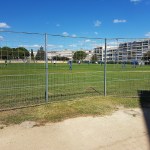
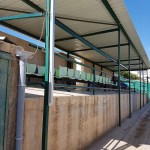 It looks like the original roof has been replaced with new metal sheeting on another metal frame, which obscures the row of the pitch from the front row of seats. We enter the stadium through a wide opening in the back wall and find ourselves in the players tunnel; it’s an entrance that is closed soon afterwards, but it’s not quite two -thirty yet and the game doesn’t kick off until three. A wonky sign points roughly in the direction of the buvette,
 which is a portakabin style structure with a counter even more wonky than the sign. To the other side of the stand is a dark room with high-up shelves of trophies on two walls and a bar counter;


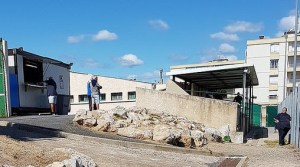 and the teams line up on the pitch. Balaruc wear an unattractive all-black kit with green trim, which displays no team badge or sponsor’s names. Clermontaise and Balaruc are in the same regional league (Poule A of the Languedoc-Rousillon section of the Occitanie region’s Division Honneur 2 – the seventh level of French football), but Clermontaise look much smarter and ‘professional’ in their all blue kit with badge. The McDonald’s golden arch logo is on the Clermontaise shorts; they can’t have read the poster on the table in the trophy room.
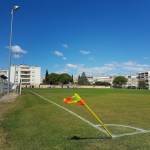 at the Mediterranean end of the ground. A bloke in a t-shirt and trakkie bottoms is called on to sort them out and once he has done so the game carries on. Early on Clermontaise look the better team, but it might just be because they’re wearing a nicer kit. Just before twenty past three it looks like they have scored, but I can’t tell if it was offside or the shot was missed. There are flattened practice goals either side of the real one and from my rock it’s hard to tell which is which.
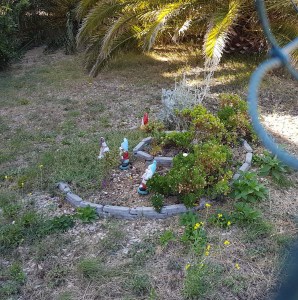 There are a number of people, mostly men in their sixties and seventies, sat at windows and balconies looking down on the game. I envy them their home comforts, it has to be better than perching like a lizard on a rock in the sun. Dissatisfied with my view sat on the rock, I watch the remainder of the first half standing up.
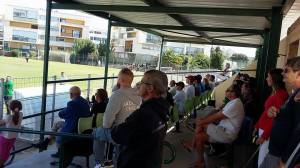 It proves to be a good choice and our enjoyment of the second half is much increased by our new location, which is shaded, out of the wind and high enough to see over the fence, with the added bonus of atmosphere as the stand is full; spectating nirvana.
 Monsieur Gerard Blanchet busy in front of us. Clermontaise’s number twelve confirms his presence by boldly attempting a shot from a thirty metre free kick; of course he misses, but not embarrassingly so. The Balaruc bookings continue and five blatantly kicks the Clermontaise twelve as he dribbles past him and three knocks over his opposite number as they run side by side. All afternoon tbere is a pleasing symmetry with many of the fouls and bookings as players with the same shirt number go for each other.
 trippingovertheball