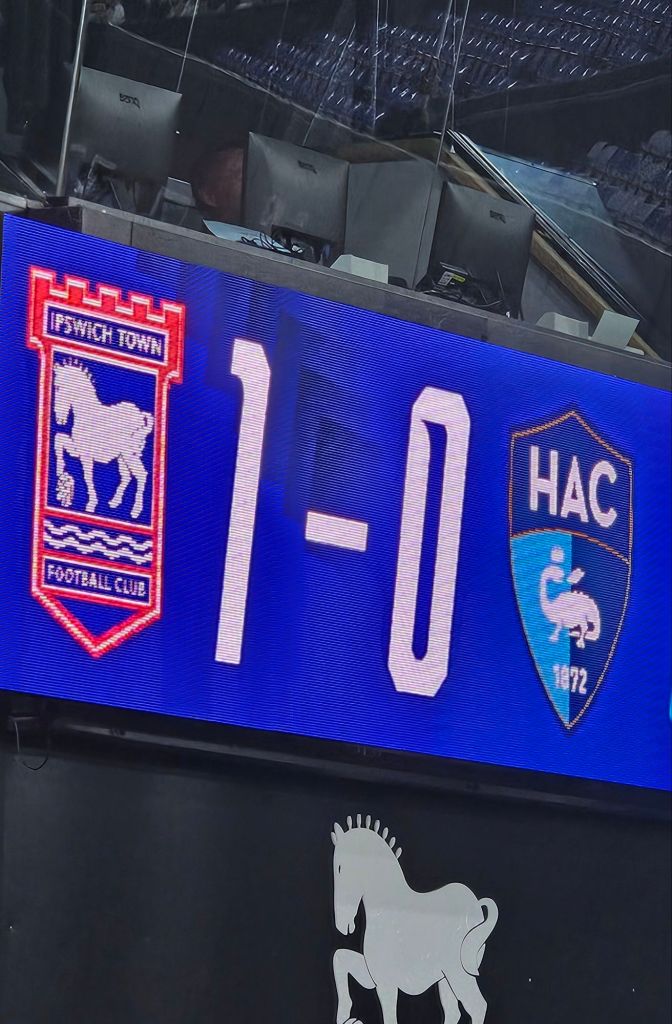
According to the Chargemap app on my mobile phone, the 495 kilometre trip from my house to Stade Oceane in Le Havre, home of Ligue 1 football team Havre AC, would currently take seven hours and twenty-five minutes including two stops totalling fifty minutes to re-charge my planet saving Citroen e-C4. This is a trip I made only last month and is one I would recommend, provided you have the cash to pay for the motorway tolls and the fare for le shuttle. Le Havre is a fascinating port city and on account of its being re-built in concrete by Auguste Perret after the RAF flattened it, it is now a UNESCO World Heritage site. Disappointingly however, Havre AC were not at home when I visited last month, so I made do with a trip to the Museum of Modern Art to see Ai Wei Wei’s Lego interpretation of Monet’s Water Lillies, several beers in the excellent bars of le brasserie L’Havrais biere, and wandering amongst some of my favourite buildings. But the world and time are nothing if not round and a month later Havre AC have come to see me, playing a friendly versus Ipswich Town at Portman Road.
Unusually, my wife Paulene is coming to the match tonight, attracted by the promise of French footballers, although having grown up in Portsmouth she was, and as far as I know still is, always wary of French sailors. Our journey this evening is by planet saving Citroen e-C4 and we pick-up Gary on the way before parking very conveniently just around the corner from the Arb’. Gary is sporting the very latest replica Ipswich Town away shirt this evening, and gets the drinks in first; a pint of Estrella for him, a small glass of dry rose for Paulene and a pint of Nethergate Stour Valley for me. A woman in the bar compliments Paulene on her earrings before we retire to the garden and a table in the shade to talk of relatives and friends and other stuff, and Gary is impressed by my Havre AC T-shirt. In due course, I buy another round of drinks the same as before, but I opt for a pint of the weaker Nethergate Voyager this time and am disappointed that it tastes a little like the pipes have been cleaned but not rinsed very well afterwards, as in fact did the Stour Valley.
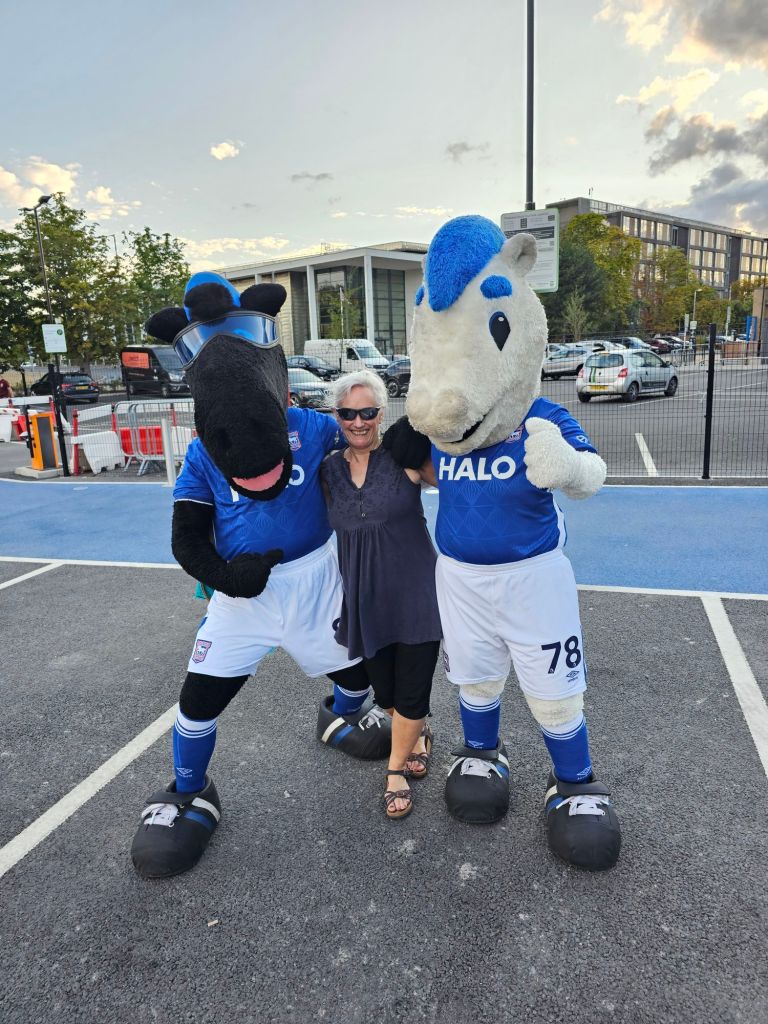
It’s about twenty past seven when we head for Portman Road and thankfully an easy downhill walk, because once again it is a very, very warm evening. There are long queues for the Cobbold stand in Portman Road, but what I notice first is that there are no programmes on sale again, which vexes me greatly; even in the days of Marcus Evans there were always programmes for pre-season friendlies, weren’t there? But my spirits lift slightly when I find there are no queues for the Sir Alf Ramsey stand and this gives me time to photograph Paulene with Town mascots Bluey and Crazee who are hanging around in the car park with a small man in spectacles. I tell Bluey and Crazee that Paulene has been photographed with an army of mascots, including Bouba the elephant in Monaco, Ri-Ri the Canary in Nantes, Auguste the lion in Reims, Merlux the Hake in Lorient, Erminig the ermine in Rennes, a very dodgy, moth-eaten looking Leopard in Rouen, but sadly not Sali the salamander in Le Havre. Bluey and Crazee unfortunately do not reply, and I commiserate with them that they do not speak.
Having been checked for scrap metal and explosives, I am ushered by a lady steward towards turnstile 61, but I tell her that I have to use turnstile 62, although I don’t know really know why and tonight’s match is only a pre-season friendly. “You never know” she says, and I think to myself “You never know what?” but like Bluey and Crazee I can’t say it. After venting excess spent Stour Valley and Voyager I meet up again with Paulene and Gary at our seats, which until we sit on them are an oasis of blue plastic amongst a sea of parents and children, many in last season’s replica kits. None of them are at all familiar and I look in vain for Pat from Clacton, Fiona, ever-present Phil who never misses a game, his son Elwood and the man from Stowmarket (Paul). I feel rather uncomfortable, like a walrus stranded amongst roosting penguins on a stoney beach somewhere in the South Atlantic. They seem to be giving off a lot of heat too because it is incredibly warm.
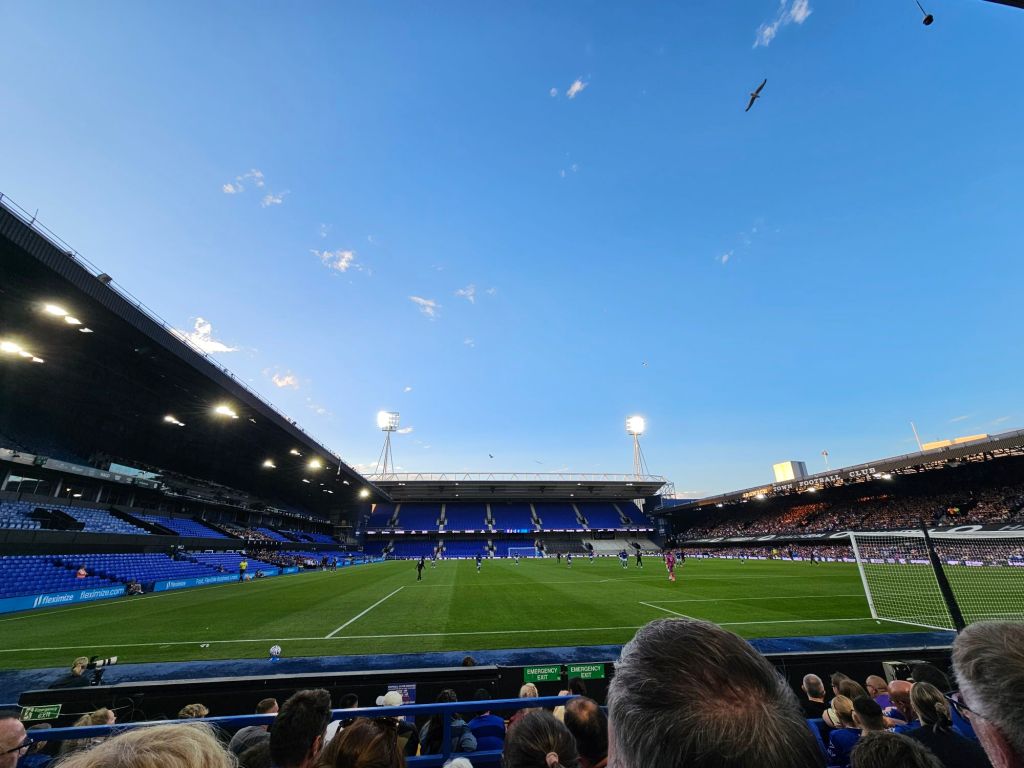
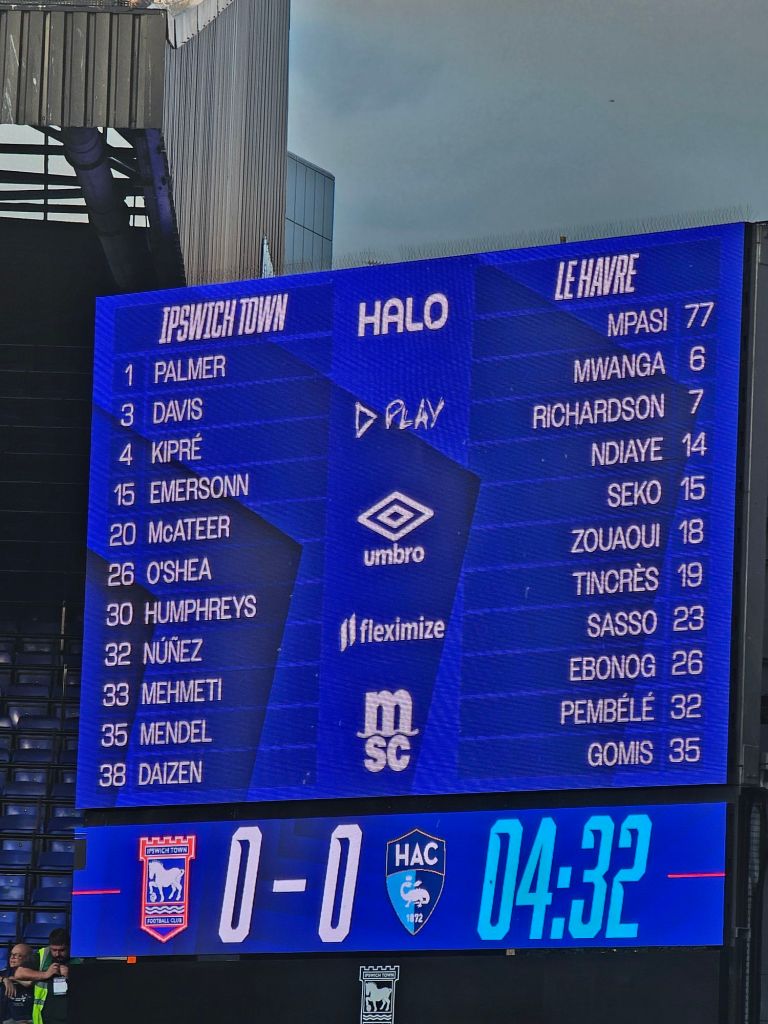
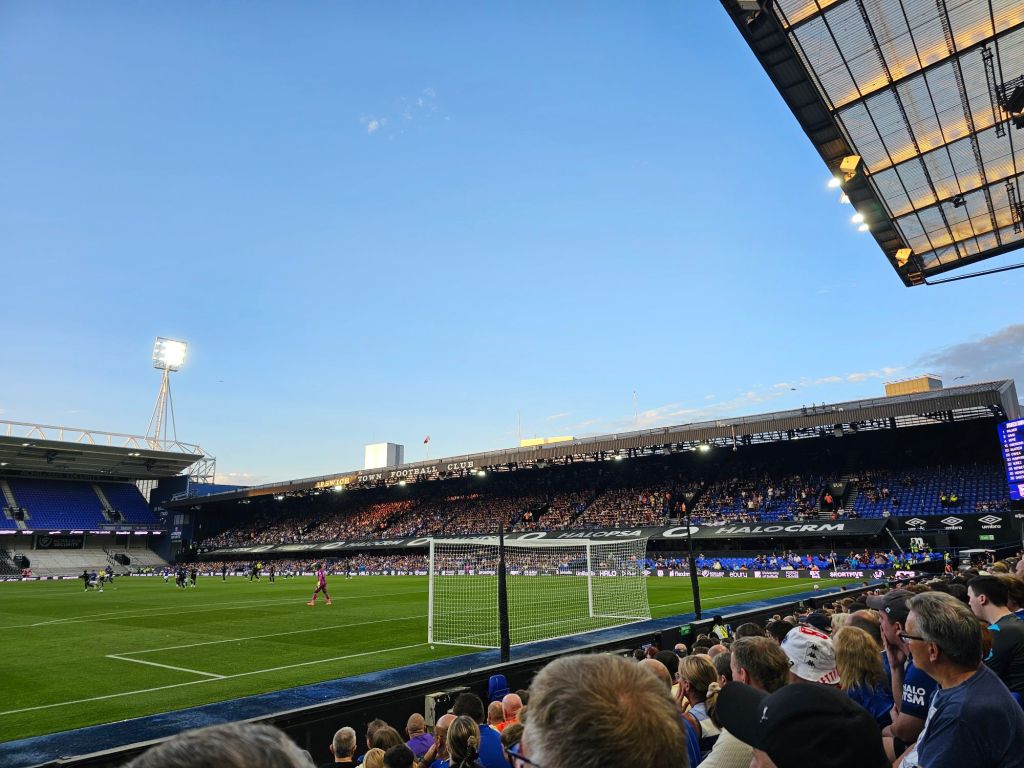
Eventually, the football begins with Town in their natural blue and white getting first go with the ball and kicking it towards the goal just off to our right. Havre are most disappointingly in all black rather than their signature pale blue and dark blue halved shirts and dark blue shorts, although a look on their website suggests they have no away kit, at least, perhaps not one they think anyone would want to purchase a replica of. Havre don’t know it, but they are of course kicking towards Cumberland Towers, a concrete building which is unlikely to earn Ipswich UNESCO World Heritage site status, but which I like because it looks a bit like a very big match box stood on its end.
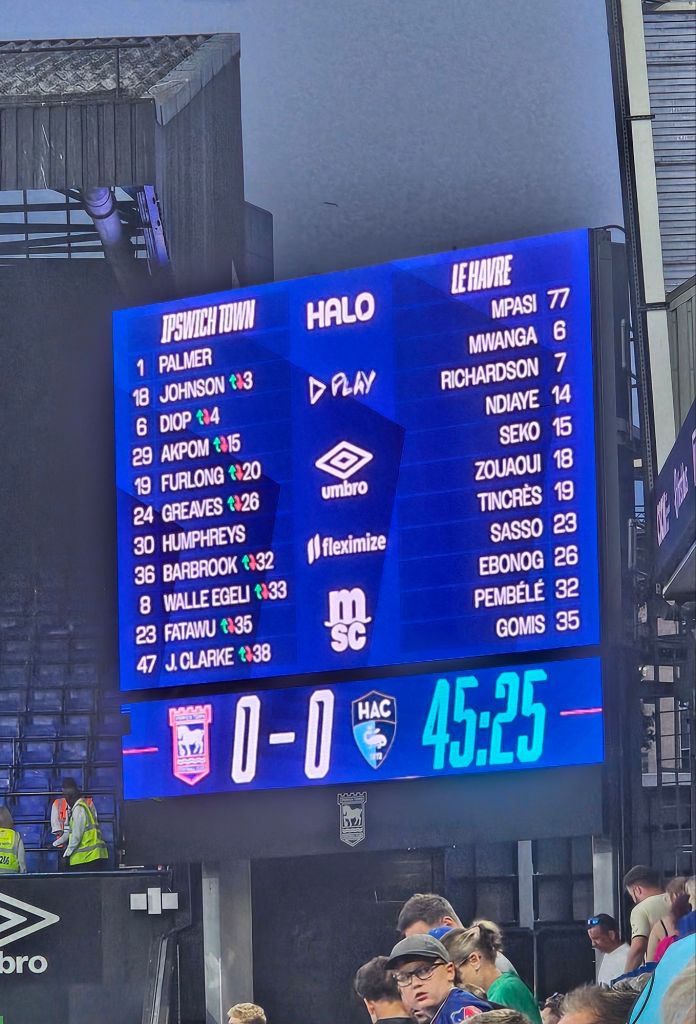
In terms of football, the first half is awful, but this is at least consistent with most pre-season games. We amuse ourselves by working out which players are which on both sides. Gary asks who Mendel is and is more amused than he should be when I tell him that he is Mendelssohn’s father. This is probably the highlight of the half but only if I ignore the fact that Town’s new Japanese signing Daizen Maeda looks about sixty-five and nearly ready for his pension, but this is solely due to the strange silvery colour of his hair. Otherwise, all I recall are the numerous seagulls swooping overhead (have Le Havre brought their own?) and that Havre have a player whose surname is Pembele, which because it rhymes Dembele sets me off thinking about an imaginary team whose names all sound a bit like those of other, far superior players, like Zinedine Sedan, Bobby Carlton or Lionel Nessi.
The welcome relief of half-time is spent talking to Harrison, who Gary has never met before, although Paulene has. Harrison’s grandfather Ray is watching the match from his Heath Road hospital bed, from where he at least might have access to drugs. I will visit Ray a day or two later and he will tell me that he missed the first fifteen minutes because Town TV is not very good. I reassure him that in fact he missed absolutely nothing at all.

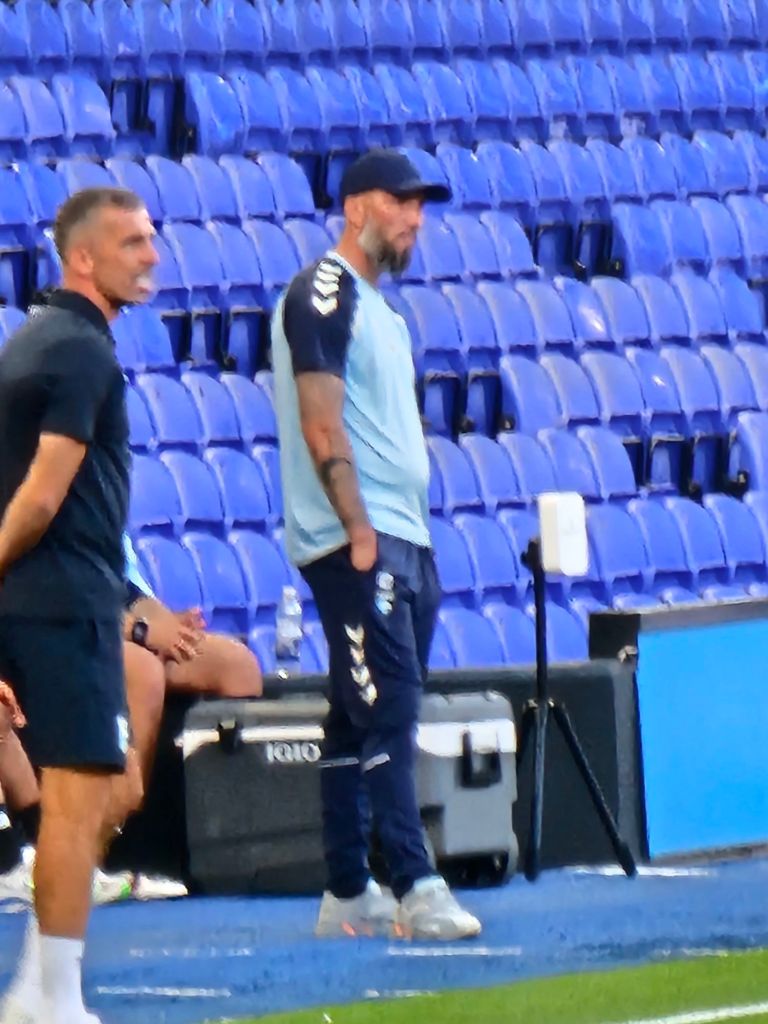
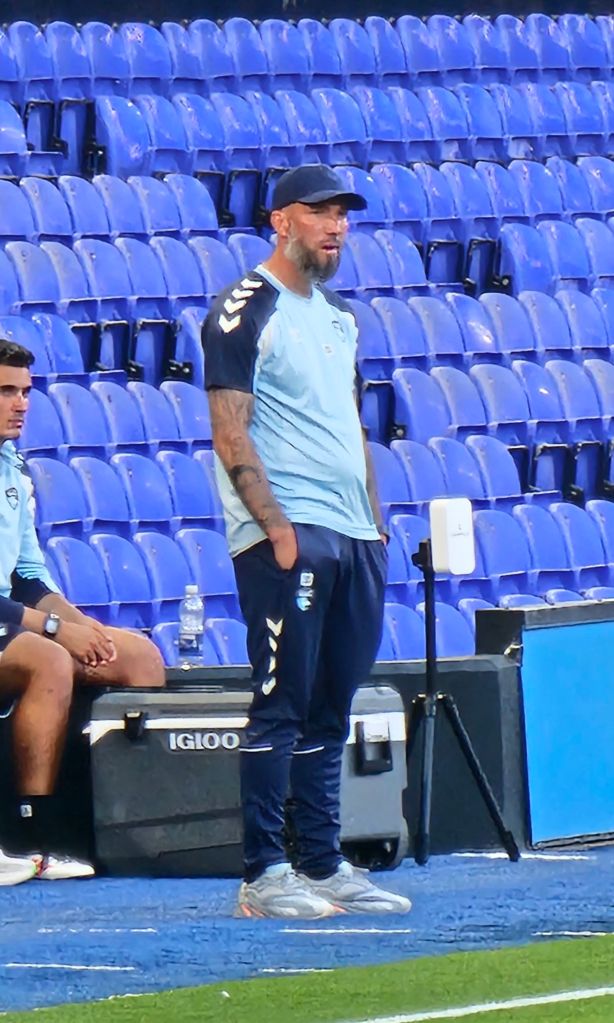
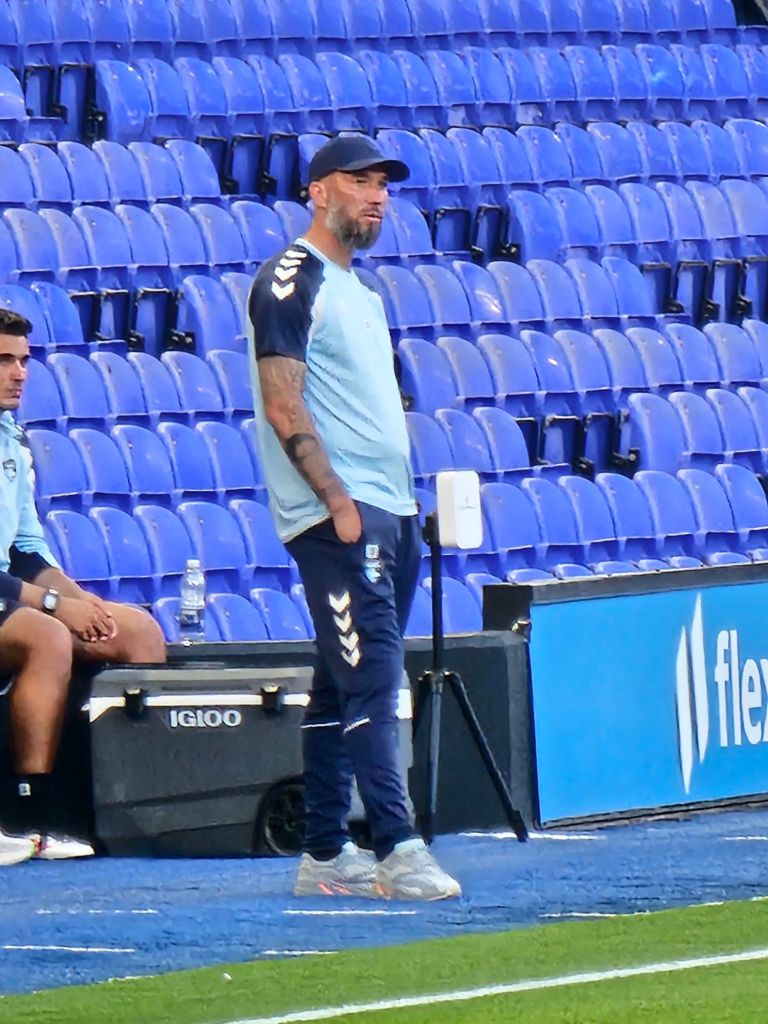
The match resumes at nine minutes to nine, predictably with a new Ipswich team. As happened in last week’s pre-season game versus Osasuna the more or less wholesale substitution of the team seems to do the trick and thirteen minutes later a Town goal is being celebrated as Chuba Akpom directs a free header into the Havre net after some startlingly bad defending from the Norman team and Town lead one-nil. On the touchline, the seldom smiling Havre manager Didier Digard, who incidentally played three games on loan for last week’s opponents Osasuna about ten years ago, is grim faced, looking as if he’s already deciding who to hit first when they all get back in the dressing room in half an hour’s time. Havre soon begun substitutions of their own, bringing on the players with the evening’s two most pleasurable surnames, Yanis Zouaoui and Hakim Dongopandji.
Twenty minutes of the second half have upped and left, and Jack Clarke has an early tilt at the worst shot of the season award as he shoots spectacularly wide and high. A minute later George Hirst is brought on to see if he can do better. Twelve minutes later, Havre produce what might be their only shot of the game, from substitute wide player Enzo Koffi, and the waning of interest in the stands begins to manifest itself with depressing calls of “Blue Army” from both adult males and small children. It’s something that doesn’t happen during ‘proper’ games and is another compelling argument for not attending pre-season friendlies.
The match nears its uninteresting conclusion and over the public address system we are told that collectively we number 6,669. It’s probably close to a capacity crowd for the limited areas of the stadium that are open, but I remain disappointed that I have not seen or heard a single French person in the crowd this evening, or smelled a Gauloise or even a faint whiff of garlic. I hope that we get to see RC Lens, Paris St Germain or Olympique Marseille at Portman Road before too long.
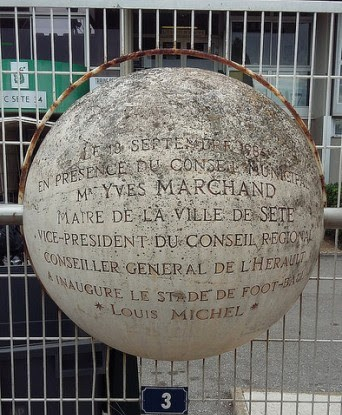
 near the Atlantic coast, some 380 kilometres away by road; they have won one and lost two of their four games so far. Kick-off is at six pm and we arrive about a half an hour beforehand, parking in the spacious gravel topped car park at the side of the Stade Louis Michel, although other spectators prefer to park in the road outside. Entry to the stadium costs €6 and we buy our tickets from the aptly porthole-shaped guichets
 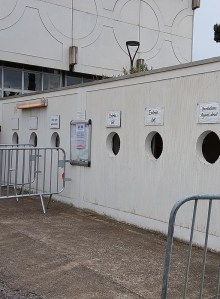 outside the one gate into the ground. Just inside the gate a cardboard box propped on a chair provides a supply of the free eight-page, A4 sized programme ‘La Journal des Verts et Blancs’. Also today there is a separate team photo and fixture list on offer.
 the brutal angular concrete of the main stand, the Tribune Presidentielle, could be from the 1960’s or 1970’s, channeling the inspiration perhaps of Auguste Perret or even Le Corbusier. The concrete panels on the back of the stand are lightly decorated and sit above wide windows; a pair of curving staircases run up to the first floor around the main entrance,
  above which is a fret-cut dolphin, the symbol of the town and the club. The stand runs perhaps half the length of the pitch either side of the halfway line and holds about twelve hundred spectators, as well as club offices and changing rooms. Opposite the main stand a large bank of open,
  ‘temporary’ seating runs the length of the pitch, it is built up on an intricate lattice
 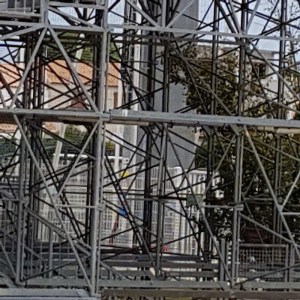 of steel supports. Behind both goals are well tended grass banks; there is a scoreboard at the end that backs onto the carpark.
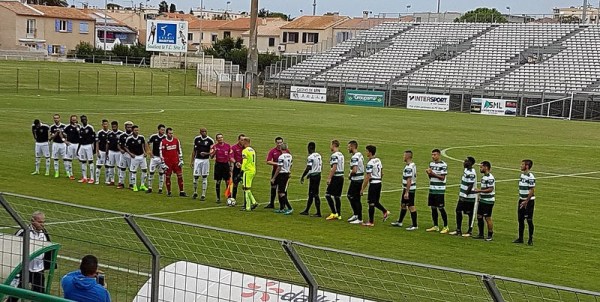 Sète in green and white hooped shirts with black shorts and socks, Stade Bordelais with black shirts with white shorts and socks. There is a ‘ceremonial’ kick-off before the real one, taken by a youmg woman with a green and white scarf draped around her shoulders. Eventually, referree Monsieur Guillaume Janin gives the signal for the game to start in earnest.
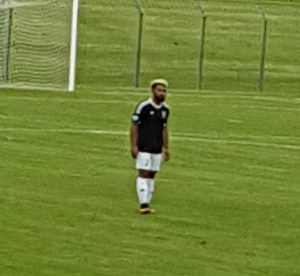 man mountain with a wide shock of bleached hair on the top of his head, and thighs the size of other men’s waists.
 which is close by at the corner of the stand where we are sat. The reason for my eagerness is that Sète is the home of the tielle, a small, spicy, calamari and tomato pie, with a bread like case. I love a tielle, and I love that they are specific to Sete, and are served at the football ground as a half-time snack. I only wish there were English clubs that served local delicacies. Middlesbrough has its parmo, but I can’t think of any others. Do Southend United serve jellied eels or plates of winkles? Do West Ham United serve pie and mash? Do Newcastle United serve stotties? Did the McDonald’s in Anfield’s Kop serve lobscouse in a bun? I need to know. Sadly, I don’t think my town Ipswich even has a local dish. Many English clubs don’t even serve a local beer; Greene King doesn’t count because it is a national chain with all the blandness that entails.