On a damp May evening three years ago, I recall thinking to myself that it feels like 1978 and Ipswich Town have won the FA Cup all over again. With my Portsmouth supporting wife Paulene, I had gone to see the Wolsey Theatre’s production of ‘Our Blue Heaven’, the music-backed play that celebrated the fortieth anniversary of Town’s FA Cup win. I can honestly say it was the most enjoyable Ipswich Town related evening I had had in nearly twenty years, since that season in the sun at the start of the third millennium when Town did things like beating Liverpool and Manchester City at their own grounds, having finally managed the previous May, to win a play-off semi-final and victoriously tread the turf at the old Wembley stadium for the last time.
Fast forward to October 9th 2021, and in the spirit of celebration of Town’s winning the UEFA Cup forty years and five months before, which the club itself has seen fit to mark with the sale of a wallet, luxury boxed badge, and travel mug, the New Wolsey Theatre is staging the final performance of its production ‘Never Lost at Home’, the story of the 1980-81 season, but mainly the winning of the UEFA Cup, something no ordinarily lovable, small town football club will probably ever do again. Not keen on spending an evening in an enclosed space with about 400 other people, most of whom will probably not be wearing a face mask, I have opted to cough up the £20 to watch the two- and a-bit hour performance on-line from the safety of my living room.

Forty and a bit years ago in May of 1981, I had just finished my final exam at the University of Sussex and I was now just wasting my time, until the lease on my shared student house was up, by playing football, going on pub crawls, walking on the Downs, visiting friends at the other end of the country and taking days out in an aged, bright orange, Dutch registered, left-hand drive Fiat 600 which my friend Chris (mainly known as ‘Jah’ due to his love of Reggae) had borrowed from a woman on his Social Anthropology course. A lack of available cash and the demands of academia had sadly meant that in Town’s run to the final of the 1981 UEFA Cup final, I had only seen two home games, those against Aris Salonika and FC Koln. Of the other games, I mostly remember the nervous anticipation of waiting for the result on the radio or television news. The away matches I recall most are those at St Etienne and Koln. I remember learning that Town were a goal down in St Etienne and was very chuffed to hear they had equalised as I headed off to the Student Union bar that March evening. When I discovered Town had won 4-1, I could hardly believe it, and indeed it was a performance that has gone down in history as one of the best-ever by a British club in Europe and possibly Ipswich Town’s greatest performance ever. As for the game in Koln, I remember that my friend Stephen went to the game on a supporters’ coach from Shotley and I remember seeing Terry Butcher’s winning goal on television, having been fearful that the one goal lead from the first leg would not be enough.


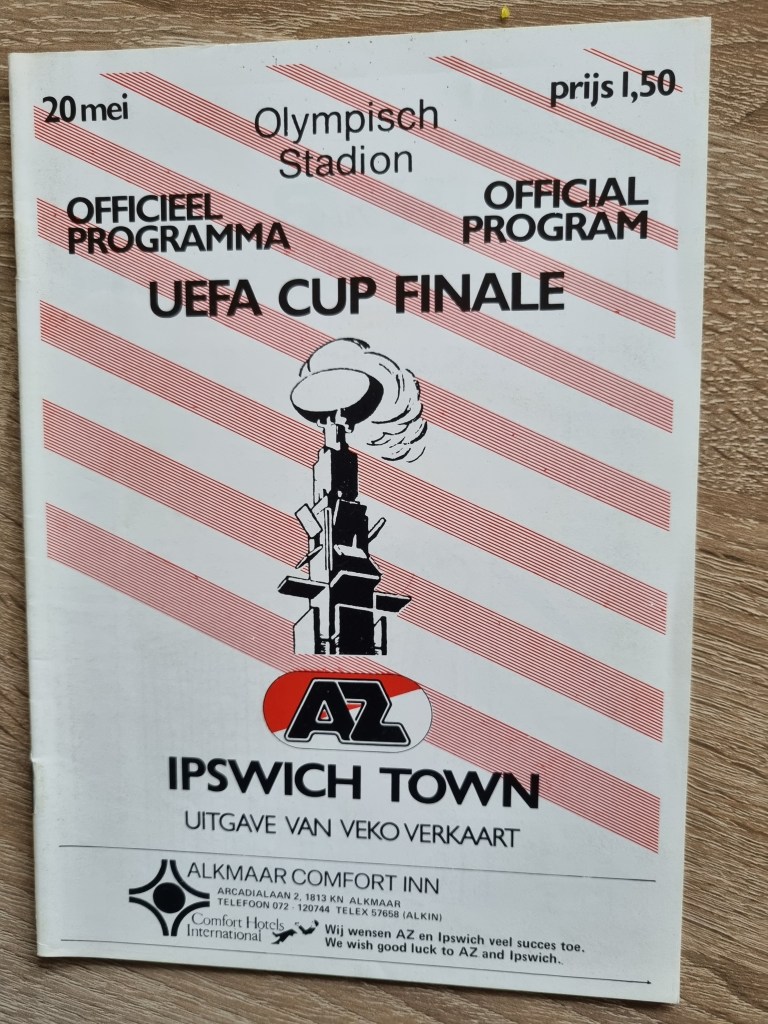
On the morning of 20th May 1981 my sister dropped me and my father off at Ipswich railway station where we caught a chartered train to Parkeston Quay and a chartered ferry to the Hook of Holland before boarding a chartered coach to Amsterdam. Everyone travelled with the Ipswich Town Supporters Club and Anglia Tours back then, and I still have the pennant to prove it. I wouldn’t enter Holland again for another 35 years, until I drove through a small corner of it on my way to Dusseldorf for a pre-season game in 2016, but I recall it being very neat. In Amsterdam my father and I spent the time before the game in a small bar where we drank Amstel, a beer rarely seen in Britain back then, thankfully. My father had encountered it before in foreign ports when in the Royal Navy and had warned me that it was gnats’; he was right, but it was all there was, they didn’t have any Tolly Cobbold Original. Amsterdam was beautifully warm that May evening, which was just as well because terraces of the Olympic Stadium were open to the elements, which given that it was built for the 1928 Olympics isn’t that surprising; stadium builders weren’t always big on rooves back then. In 1987 the Dutch government designated the Olympic Stadium as a National Monument, obviously because Town won the UEFA Cup there, but also because of the fine brick architecture by Jan Wils, an exponent of the Amsterdamse School. It’s good to know that there is a corner of the Dutch capital that will forever be imbued with the memory of the presence of 7,500 Town fans.
My memory of the match that night in Amsterdam is one of anxiety and tension, despite taking an early lead that put us 4-0 up on aggregate and then gaining a second away goal. AZ 67 Alkmaar were a bloody good team, but happily not quite good enough, despite Town being visibly knackered at the end of a colossal sixty-six game season. Forty years is a long time, and I’m not sure now what I remember from being there and what I remember from having seen various tv clips since. I think I remember being frustrated that in the second half we couldn’t keep the ball away from Alkmaar, but I know I do recall wishing away the last twenty minutes of the game, and constantly checking my watch; willing Alkmaar not to score again and the Town defence to hold firm. I remember nothing of the journey home, although I think my father might have invested in the luxury of a two-berth cabin in the hope of a couple of hours of sleep.

Tonight, “Never Lost at Home” picks up the story of the fictional Coombes family who followed Town to Wembley in “Our Blue Heaven”, and the story very much has the feel of being a sequel, which of course it is. This time the tale begins with the family vowing to have someone at every game for what promises to be the greatest season in the club’s history as it vies to win an unprecedented treble. Once again, the story is set against the background of the events of the times, in particular the high rates of unemployment resulting from the Thatcher government’s monetarist policies and indeed Scott loses his job to create some jeopardy in the story as it inevitably hinders his ability to get to games. Once again also, the story and the season unfold to a soundtrack of popular tunes of the time, although just like in ‘Our Blue Heaven’ it doesn’t, because several of the songs are from as much a four years later, which rankles somewhat because songs such as Tears for Fears ‘Everybody wants to rule the world’ (1985) were actually the soundtrack to avoiding relegation, not seeking glory.
Despite the failure to use the actual music of 1980 and 1981 (what a pity we never played Rapid Vienna or IK Start), rather than just generic 1980’s hits, there is nevertheless an authentic feeling of nostalgia for a time and a place. I can’t fully explain why, but I had tears in my eyes in the first part of this production. It might have been because I was reminded of how awful some of the music of the 1980’s was; I always hated ‘Eye of The Tiger’ (1982) and have consequently never seen any of the ‘Rocky’ films, but more likely I was mourning my lost youth and my lost football team, both of which seemed to go missing at much the same time.
One major departure from the mostly repeated formula of “Our Blue Heaven” is the introduction in “Never Lost at Home” of one of the players as a recurring character, that player being the now legendary Arnold Muhren. The choice of Arnold was, if not inspired, then obvious, because perhaps more than any other player, even his fellow Dutchman Frans Thijssen, Arnold somehow personifies that 1980-81 team, despite having actually joined Town three years before in September of 1978. Again, the story employs a little artistic license as it almost implies that Arnold and Frans joined for the 80-81 season, but that is easily forgiven and does add to the mythology of that remarkable season. I can only think that in casting actor Dan Bottomley as Arnold Muhren, one of the main considerations must have been his legs, because these have the same straight up and down shape of Arnold’s. Not for Arnold the meaty thighs of Mick Mills or Paul Mariner; Arnold was a sinewy thoroughbred, built for the measured pass, the clever change of pace and direction in a single stride, the sort of footballer who simply danced through midfield and no longer exists in a game where speed, strength and bulk has usurped grace and subtlety.
The greatest triumph of ‘Never Lost at Home’, as it was of ‘Our Blue Heaven’, is the performance of Peter Peverley as Bobby Robson. Not only does Peverley, with his gently hoarse County Durham accent, and perfectly observed Robson-esque mannerisms create a wholly believable vision of the Town manager, but he also delivers the great man’s words as he sends his team out in search of glory. So stirring and convincing are Peverley’s words it might be an idea if the current Town management employed him to give Paul Cook’s team talks.
Oddly perhaps, ‘Never Lost at Home’ tails off towards the end, in contrast to the prequel which had something of a grand finale as the stories of the characters all came together on 6th May with a birth, a marriage and the Cup Final itself. This time the characters don’t have their own stories to be resolved other than what happens to them as they travel across Europe in the rounds leading up to the final. We all know the ending, and although Town ultimately win the UEFA Cup, sadly mine and a lot of people’s memories of 1980-81 are probably tinged with a feeling of ‘what should have been’ with the loss of the FA Cup semi-final to the hugely inferior Manchester City and the loss of the ever-elusive League Championship to Aston Villa, a team we beat no less than three times over the course of the season. But as one of the characters in the play points out, we had already won the Cup and the League before, so if it was to be only one out of three, best that it was the UEFA Cup. Reassuringly however, it’s good to know that we only lost out in the Cup and the League because none of the characters in the play could get to the Cup semi-final or the penultimate League game of the season at Middlesbrough.

In truth, ‘Never Lost at Home’ wasn’t quite as good as ‘My Blue Heaven’, although my seeing it through the television screen rather than in the flesh is doubtless a factor in that. The story doesn’t have the drama of its predecessor and by drifting further into 1980’s the music is not so much ‘not as good’, as ‘worse’. Nevertheless, it was still massively enjoyable all the same, bringing back those memories of what genuinely was a marvelous time to be a Town supporter and which seems even more so given all that’s happened since. I can only hope that both ‘Our Blue Heaven’ and ‘Never Lost at Home’ are both resurrected in ten years time, not only to celebrate the fiftieth anniversaries of the FA Cup and UEFA Cup wins, but also their own 10th anniversaries; or perhaps we could have a musical about going to a musical about winning the FA Cup and UEFA Cup; I’d watch it.


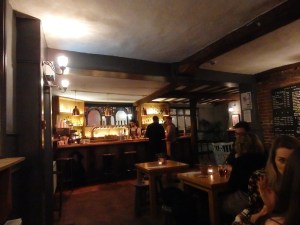 Spread Eagle, a Grade 2 listed building that dates back to the 17th century, where I drink Grain Brewery Best Bitter (£3.50 a pint). The leather aprons of the bar staff remind me of Fred Gee, the pot-man at the Rovers Return in Coronation Street, but I don’t suppose he’s still in it, particularly since Fred Feast, the actor who played him died in 1999. Roly and I continue not to talk about football, not from any previous agreement, but just because there doesn’t seem anything to say. From the Spread Eagle it is a bit more of a walk along Orwell Place and Tacket Street, up Brook Street and Buttermarket, over Giles Circus and Cornhill, along Westgate Street to St Jude’s Tavern in St Matthew’s Street. They may not all be looking at their best, but Ipswich’s medieval or even Saxon pattern of streets remains and is brim-full of fine buildings; if only the locals appreciated it.

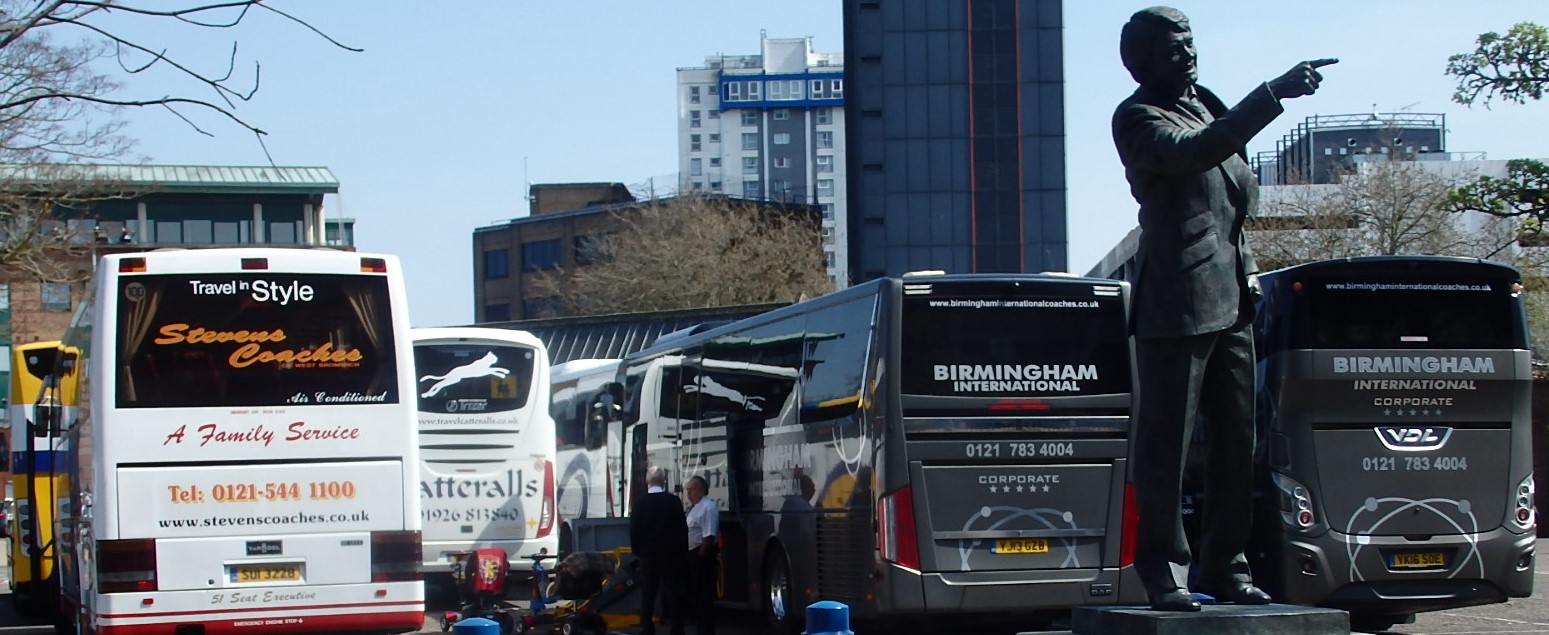
 The visitor looks somewhat bemused and blurts some exasperated expletives in the direction of one of his fellow supporters; his thick Midland’s accent rendering them incomprehensible and unpleasantly nasal. I pass the grinning statue of Bobby Robson; his best playing days were arguably with the ‘Baggies’ of West Bromwich, but thankfully he never picked up the accent.
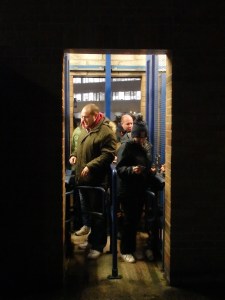 unequal lengths.; with a self-satisfied air of streetwise, intellectual superiority I join one of shorter ones and am inside the ground whilst others still queue. On nights like this it’s fun to laugh and sneer at those people who aren’t regular supporters and are only here because the tickets are cheap. I head for the betting shop bit beneath the stand where the handy shelf gives me somewhere to write the greeting on Elwood’s birthday card. I stop to talk to a steward I know called Dave, but at the very moment I arrive at his side so does another acquaintance of his who begins a personal monologue. I wait for the other man to pause so that I might speak to Dave, but the other man breathes through his ears and doesn’t draw breath for a second; so I screw my eyes up at Dave and nod sympathetically; I imagine my face might look a bit like the one Gary Lineker pulled in the 1990 World Cup semi-final after Paul Gascoigne was booked and became tearful. But tonight I’m not indicating that Gazza is upset, I’m signalling to Dave that I’m going to bugger off, and that’s what I do.
 misses a game and son Elwood are already here and I settle down a couple of seats along before giving Elwood his birthday card and a few ITFC ‘goodies’. Phil tells me that earlier in the club shop Elwood had handed in an ITFC badge that he found on the floor to the staff serving behind the counter. One of the things I have given Elwood is such a badge; it seems like Elwood has been rewarded for his honesty and whilst we all know that’s not true, in an ideal world it would be.


 odd West Bromwich Albion supporters cooped up in the corner of the Cobbold Stand. In the corner, in the bottom of the North Stand blue and white flags are being waved and drums drummed and voices voiced; for a little while anyway. But West Bromwich Albion are better at football than Town and as they start to dominate, some of the enthusiasm ebbs away, which is the opposite of what should happen of
  course because it obvious that a struggling team needs most support. But then logic is not always a strong point in ‘Leave’ voting Ipswich. The West Bromwich fans soon sense our weakness and after first chanting something stupid about being a “…shit Norwich City”, which is a bit rich from people supporting a team wearing yellow and green, they go for the jugular with the reliable old “ Your support, your support, your support is fucking shit”. Cut to the quick I try some chants of my own but the cowering reticence of the Suffolk public means I’m beaten before I begin, even with my cardboard clapper, which is a little too lightweight and disintegrates as I bash it relentlessly on the back of the seat in front of me. Only ten minutes have gone and Town’s Matthew Pennington is booked by referee Mr Keith Stroud who is possibly the
 smallest referee I have ever seen; he doesn’t even rival Paul Hurst in stature.


 Sainsbury’s. Down in Portman Road there are queues for the turnstiles, which is surprising. I assess which queue is shortest and join it, it is very short and I am soon inside the Sir Alf Ramsey Stand. I thank the turnstile operator, drain off some excess liquid and head for my seat near Pat from Clacton and ever-present Phil who never misses a game, and who today has his son Elwood with him. The teams appear to the strains of Neil Diamond’s Sweet Caroline, I don’t know why, but apparently people voted for it, like Brexit.
 Ipswich sport their new kit for this season; blue shirts with white sleeves evoking a memory of the shirts of the 1950’s and early 1960’s, but with added Addidas branded stripes in red to make sure we don’t miss them. Ipswich’s Polish goalkeeper Bartosz Bialkowski looks like a huge ‘Mivvi’ in all-orange. Aston Villa wear white shirts and maroon shorts and socks. Boots come in many colours, a rainbow of feet.
 of a heart he will hopefully sit in his little room and weep over his half-time tea whilst his two assistants ignore him and whisper between themselves. I eat a Panda brand liquorice bar and chat to Ray who is not impressed and foresees defeat, although he considers the sending off to have been unjust. I visit the latrines and beneath the stand people stare up at the TV screens replaying highlights of the first half.



 like an Imam. Villa’s number 19 Jack Grealish has calves the size of other men’s thighs and by twenty past three Villa are somewhat greedily beginning to keep the ball pretty much to themselves. They win some corners and then at about twenty five past three rudely score a goal as Conor Hourihane shoots when unsportingly close to the goal.

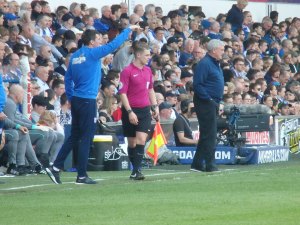 corpulent manager Steve Bruce looks on over his expanded waist, possibly affording time to imagine the enormous meal that he will perhaps later eat to celebrate the victory. I hope he has regular cardiovascular checks. Around him Villa’s coaching staff look like UPS delivery drivers in their dull uniforms. I admire the angles of the roofs of the stands at the other end of the ground.
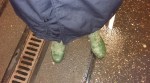 Proud to be different. A tall man walking towards me appears to be wearing spats but as he gets close I see he is wearing black and cream trainers; they won’t keep his feet dry like my wellies will.
 to take me to the Weston Homes Out in the Middle of Nowhere Stadium, the bit of Colchester the Romans just couldn’t be arsed to occupy. There’s no time to stop for a pint of Adnam’s Oyster Stout in the Bricklayers Arms tonight as the train is late and I just want to get in the stadium and out of the rain as quickly as possible. I step onto the bus and fumble for change, but the driver says that it’s free tonight, which is just as well because the top deck is already full so I will have to sit downstairs. A woman in her sixties politely budges-up and thanking her I settle down in a seat at the foot of the stairs. This bus is sweltering; it has warm air blowing down from vents in the roof and nearly everyone is sat in steaming wet coats. Most of the passengers are men, several are in their seventies or older. It’s not long before the bus is officially declared full, the doors sweep closed and it pulls away. The roar of the engine fills the ‘saloon’ and the swish of the rain and splash of the puddles in the gutter create an exciting cacophony of sound; men have to shout to be heard above the noise of this speeding, softly lit, mobile tin sauna. “With this team we should win about 3-0 most weeks” expounds an obese Villa fan of Asian descent. Less confidently he adds that Steve Bruce “..is a good manager, don’t get me wrong, but sometimes he could be better”. He concludes that if Villa aren’t promoted at the end of the season Bruce will be sacked.
 the corner of the stadium is a corral of trucks and broadcasting paraphernalia which looks like a traveller site; I half expect to see a couple of straggly-haired lurchers running about and some half-dressed, snotty-faced kids playing in the puddles. Sky TV have deigned to visit “Layer Road” tonight because this is a League Cup match with the prospect of plucky little fourth division Colchester knocking out famous, big city, and until recently Premier League club Aston Villa. Whilst I have called it a League Cup match it is in fact known by the name of its sponsor, a company I have never heard of , something like Caramac or Caribou. Whatever the cup is now called the sponsor is probably something to do with alcohol or on-line betting because modern football is classy like that.
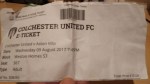 to a steward who passes it across the sensor on the automatic turnstile, which rather defeats the object of automatic turnstiles, but hey-ho. Safe and dry In the strip-lit cosiness of the breeze-block concourse beneath the stand I seek re-invigoration with a pounds-worth of Tetley tea and then head for my seat.
 Wow. Colchester are quick and play freely, but so do Aston Villa; this is good, an open game. Sadly, unluckily and possibly unfairly for the U’s, they trail quite soon when their goalkeeper spills the greasy ball, or has it kicked from his grasp and a Villain rolls it accurately beyond those around him into the net. The goal scorer’s name is announced as what sounds, perhaps because of the hiss and bubble of rain on standing water, like Squat Hogan. I think his name may be Scott, but he is a bit squat being slightly bandy and having the disfigured, pumped-up torso of a spinach filled Popeye. But soon afterwards Colchester are awarded a penalty, only to have it saved athletically by the Villa goalkeeper. It’s not even eight o’clock yet.
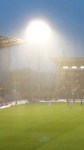 the intensity of the rain increases and the water bounces off the roofs of the stands and cascades down making the floodlights appear as watery roman candles through the moisture laden night air.
 trippingovertheball