As the football season begins to draw to its close, I sometimes start to look ahead and see what few fixtures are left, conscious that all of this will soon be over and when it returns summer will be almost gone too. Since last weekend I have therefore occasionally thought of Watford,
As far as I can remember, I have only ever known three Watford FC supporters. The first one I knew for just a fortnight back in 1982, when I worked for the Department of Health and Social Security and was sent on a course to distant Stockton-On -Tees. He was what might commonly be called a bit of a ‘Jack the lad’ and he had driven up north in a small saloon car with go faster stripes and a tinted windscreen, which might even have had his name printed on a sun strip across the top. He was the sort of bloke who wore white socks and loafers and had a small moustache. I worked with and occasionally played five a-side football with the other two, both of whom I would describe as suburban; they both had neat hair and doubtless still have. That’s how I think of Watford, suburban.
I first saw Ipswich play Watford in a League Cup quarter final tie in January of 1982. It was the first time the two clubs had met since Boxing Day 1956, and a factor in this is that it had taken Watford from 1920 until 1969 to even get into the Second Division. The Observer’s book of Association Football describes how in 1969 Watford were promoted as Champions and simultaneously earned a reputation as a Cup team, by drawing at Old Trafford and then the following season beating Bolton, Stoke and Liverpool. “But…” says the pocket-sized book “…second division life was hard”, which I think is a veiled reference to two seasons in the bottom five followed by relegation in 1972. But that was over fifty years ago and a club that once fielded players called Roy Sinclair, Ray Lugg and Barry Endean is now home to Edo Kayembe, Mileta Rjovic and and Vakoun Bayo.
When I talk of Watford to my wife Paulene she recalls what, judging by the pained expression on her face, was one of the worst nights of her life, when in about 1977 she was taken to a nightclub called Bailey’s. It was full of Stag and Hen parties she recalls, and the headline act for the night was ‘comedian’ and children’s TV presenter (Runaround) Mike Reid, who picked on her because she wasn’t laughing. She’s not been laughing ever since, except when I fell in the garden pond a few summers ago.
It’s now a cool, drafty, grey evening. After fulfilling my filial duty and visiting my surviving aged parent, I am now as ever in ‘the Arb’, stood amongst a knot of people at the bar , some of whom seem to be trying to form a queue. When did people start queueing at bars in pubs? As I say to the bloke next to me “It’s a free for all”, policed only by the bartender’s uncanny and yet unerring ability to know who’s next. Eventually, with a pint of Mauldon’s Suffolk Pride (£3.78 with Camra discount) in hand, I repair to the beer garden and wait for a bowl of “Very French, French Fries” for which, now looking back, I think was ludicrously overcharged, because I paid about £13.00 for the chips and the beer. Perhaps it’s Karma for jumping the imaginary queue.
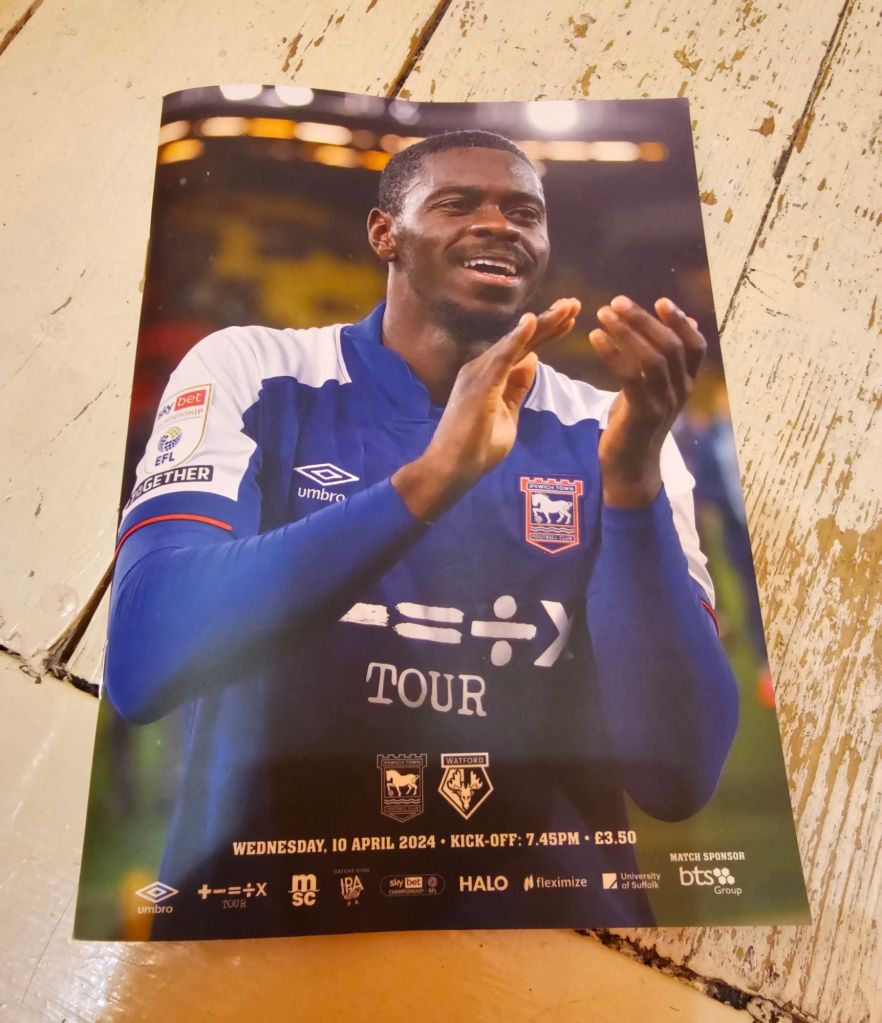
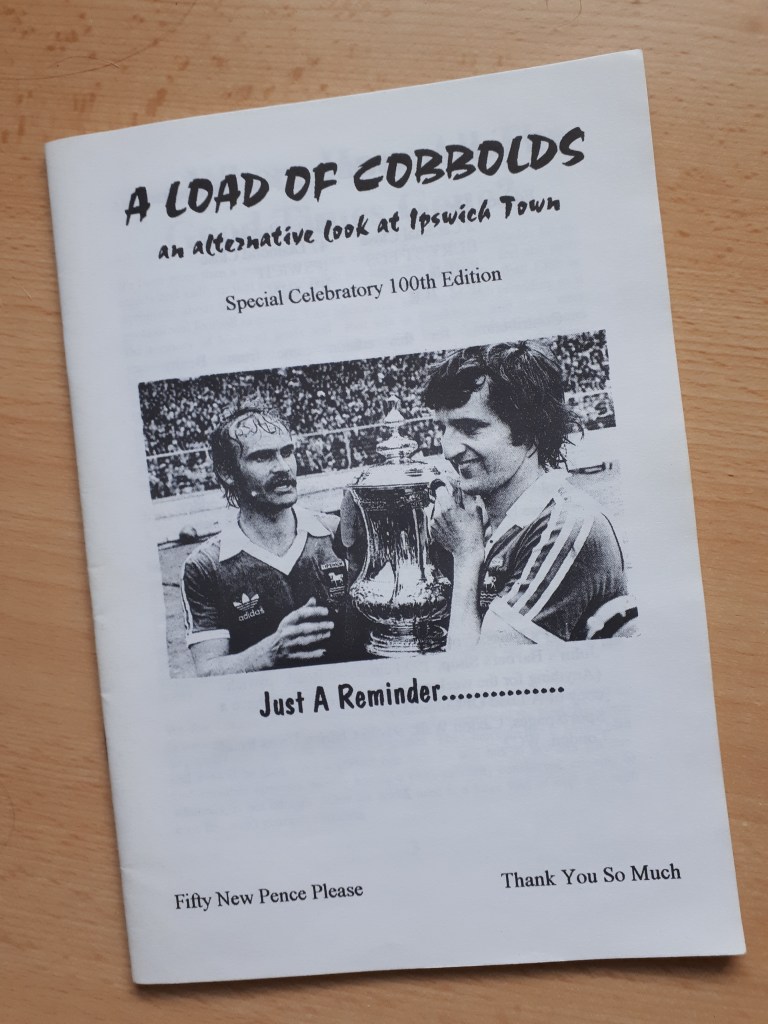
I sit and flick through the match programme (£3.50) that I bought earlier. I only paid £3.10 for the programme today because I had an impressive 40 pence worth of loyalty points amassed from previous purchases from the club shop, which I am now beginning to think of as being a bit like the Co-op. After drinking my pint and eating my chips I buy a second pint and listen to the conversation on the next table, where three old blokes denigrate the oeuvre of Taylor Swift, questioning whether her work will in fifty years’ time compare to that of The Eagles, Paul Simon and Elton John, all of whom are heard travelling through time via the speakers above our heads.
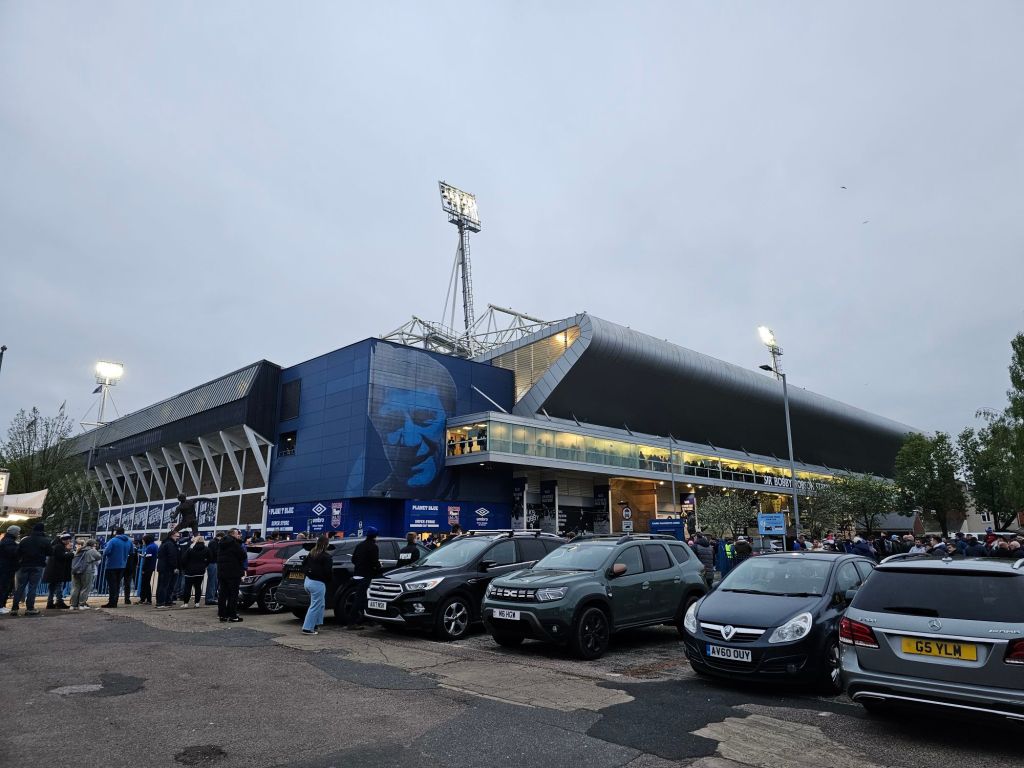
By and by I am the only person left in the garden who is going to the match, and so in order not to miss kick off I leave too. Portman Road and the back of the Sir Alf Ramsey stand are busy with queues for the turnstiles and by the time I reach my seat the teams are already on the pitch and Murphy the stadium announcer is beginning to announce the teams as I say good evening to Pat from Clacton, Fiona, the man from Stowmarket (Paul), and check on the presence of ever-present Phil who never misses a game, and his son Elwood. Murphy completes his hat-trick by synchronising for the third match in succession his reading out of the Town team with their names appearing on the scoreboard, allowing at least Phil and myself to behave like Frenchmen and bawl out their surnames as he announces them.
Predictably, kick-off soon follows a stirring rendition of Hey Jude and Town, in traditional blue and white, get first go with the ball, sending it hopefully towards the goal just in front of me and my fellow ultras. Watford meanwhile are in yellow shirts and black shorts, although their shirts appear to have been daubed with black paint across the front or dragged across a tray of soot. It’s one of those kits that exposes the folly of having a new kit every season because after not very long the good people of Puma, Hummel, Juma and Kelme clearly ran out of ideas and possibly motivation; and who wouldn’t, a polyester shirt is after all just a polyester shirt.
“Blue Army, Blue Army” chant the militaristic Sir Bobby Robson standers and I am struck by how few Watford supporters are here given that it’s only 150 kilometres away. “Wo-oh…” sing the Watfordians that are here, followed by something unintelligible before chanting what sounds like “Oh when the horns go marching in” . Above us the sky turns bluey grey as darkness descends. In front of us I notice the Watford goalkeeper has the name Bachmann across his shoulders and I wonder if in fifty-years’ time the live performances of Taylor Swift will be remembered like those of Bachman Turner Overdrive.
Ten minutes pass and Keiffer Moore heads a Kayden Jackson cross disappointingly high and wide. AT the far end of the ground “Ole, Ole, Ole” is the refrain after the bit that goes “We support the Ipswich, and that’s the way we like it…”. I don’t know the tune but don’t think it’s by Taylor Swift. Another five minutes pass and after the evening’s first particularly good outbreak of passing Town sadly earn no more than a throw in. From the top tier of the Cobbold Stand it sounds like the Watford fans are singing “Alternate Steve, Alternate Steve” which makes very little sense but sounds like a plausible nickname for that Watford fan I met in Stockton On Tees in 1982. My reverie is broken by a Nathan Broadhead shot which Bachmann must dive on to deny us the pleasure of a goal.
Nearly twenty minutes pass and Watford win the game’s first corner, but thereafter it is Town who begin to dominate. Omari Hutchinson makes a fabulous jinking run in to the penalty area before squaring the ball to a Watford defender and Kayden Jackson darts down the wing, crosses the ball and Keiffer Moore imperiously side foots it into an empty space on the un-netted side of Bachmann’s left goal post. “We forgot that you were ear” sing the Watford fans puzzlingly, but to the tune of Cwm Rhondda, which is nice if you’re Welsh. Watford’s number four Wesley Hoedt then kicks his own goalkeeper and referee Mr Barrot (like Carrot or Parrot but with a ‘B’) gives them a free-kick. I count eleven seagulls stood on the girder above the Sir Bobby Robson stand.
There are only ten minutes until half-time now and Nathan Broadhead turns neatly, glides towards goal and shoots, at Bachmann, but the way he moved across the turf was a beautiful sight. A minute later Broadhead shoots again. This time, his shot goes beyond a diving Bachmann and I begin to rise from my seat to celebrate the inevitable goal, but for a moment the laws of physics are seemingly suspended and the angle of incidence no longer equals the angle of reflection as the shot hits the inside of the goal post, but then curls out across the face of the goal instead of deflecting into the net as science and natural justice insists it should have.
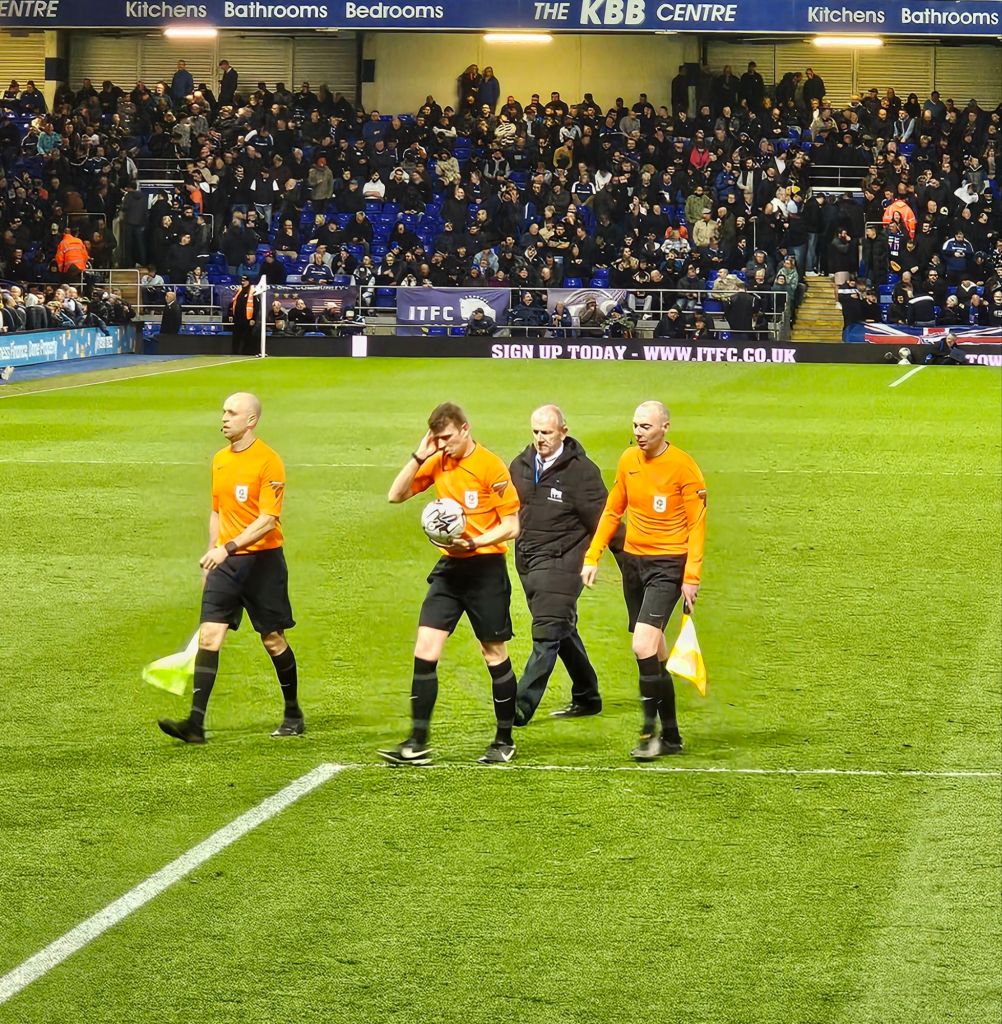
The last five minutes of the half witness Sam Morsy shooting at Bachman and then a Harry Clarke cross is headed powerfully down into the net by Keiffer Moore but Bachmann’s reactions go into overdrive and he pushes the ball away hurriedly for a corner before ball and net can be united. Two minutes of added on time follow repeated chants of “Come On You Blues “ from me and ever-present Phil before the corner as like the chorus in a Greek play Pat from Clacton repeats her mantra of “two of us singing, there’s only two of use singing”. Drums beat in the far end of the Cobbold Stand and I’m struck by how smart Mr Barrot and his assistants look in their orange shirts with black shorts; if I were a Watford player I think I might see if he’d be willing to swap at the end of the game.
With the half-time break I chat to the man from Stowmarket before speaking briefly with Dave the steward, Ray, and his grandson Harrison. At nine minutes to nine the game resumes with prophetic chants of “Come on Watford, Come on Watford, Come on Watford” , and they do as they begin to dominate possession and run around like someone’s cracked open the anti-depressants and they’ve all been slipped a few ‘bennies’ with the half-time tea. On the hour almost, and Vaclav Hladky makes his first save of the night as a fierce snap shot hits him in the chest and goes off for a corner, and then they get another.
It feels like we’ve just been waiting for a respectable amount of time to elapse before making substitutions and so it proves as in the sixty-third minute Luongo, Chaplin and Sarmiento move in at the expense of Taylor, Jackson and Broadhead. “Jeremy Sarmiento, he’s magic you know” sing the Sir Bobby standers to a tune I don’t know, but which could be by Taylor Swift.
Twenty minutes remain of normal time remain. “Over and in” says Pat from Clacton quietly coaching the team before rooting through her purse for a lucky charm that will work some magic. She picks out Ganesh with his elephant head and four arms, who could be useful at corners, although he’d probably like to see a few Hindus in the team before he promises too much. There are currently no seagulls on the roof of the Sir Bobby Robson stand. Pat’s prospects of winning the ‘predict the score’ draw on the Clacton supporters bus seems slim, she’s drawn two-all. But as Fiona says, with Ipswich this season you never know. Murphy announces the attendance as being 28,589, but mysteriously doesn’t tell us how many are from Watford as if perhaps we wouldn’t believe him. He nevertheless thanks us for our ”continued support”, although I’m getting bored with him saying that every single week and think he should just tell us how really lovely it is to see us all again.
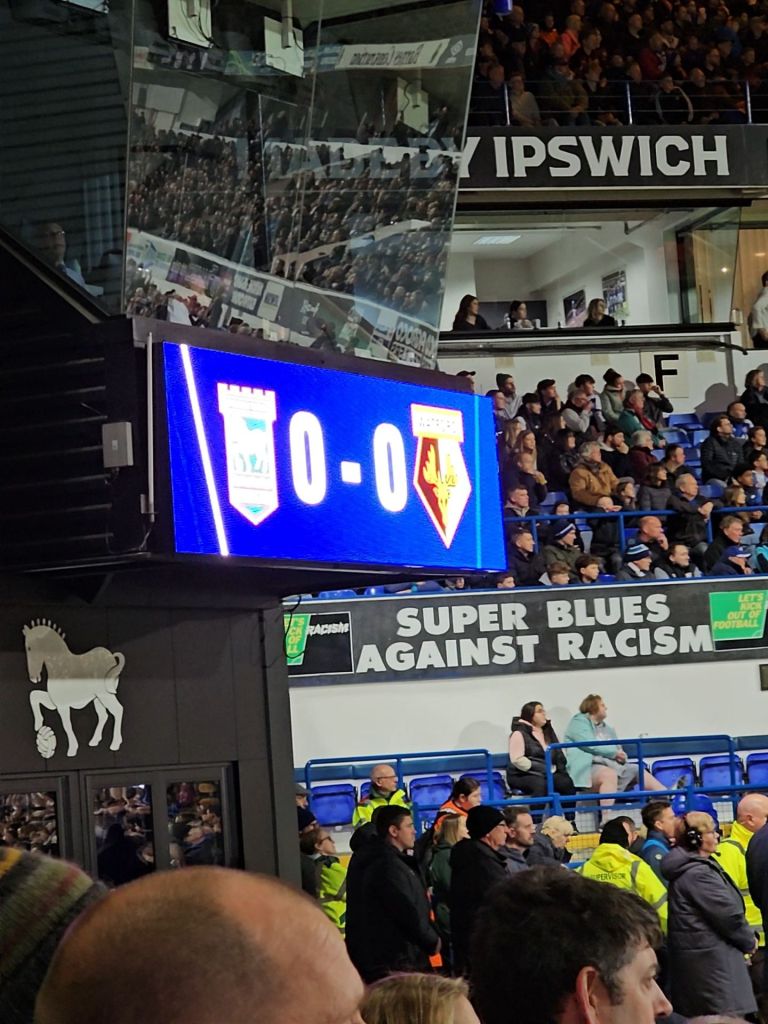
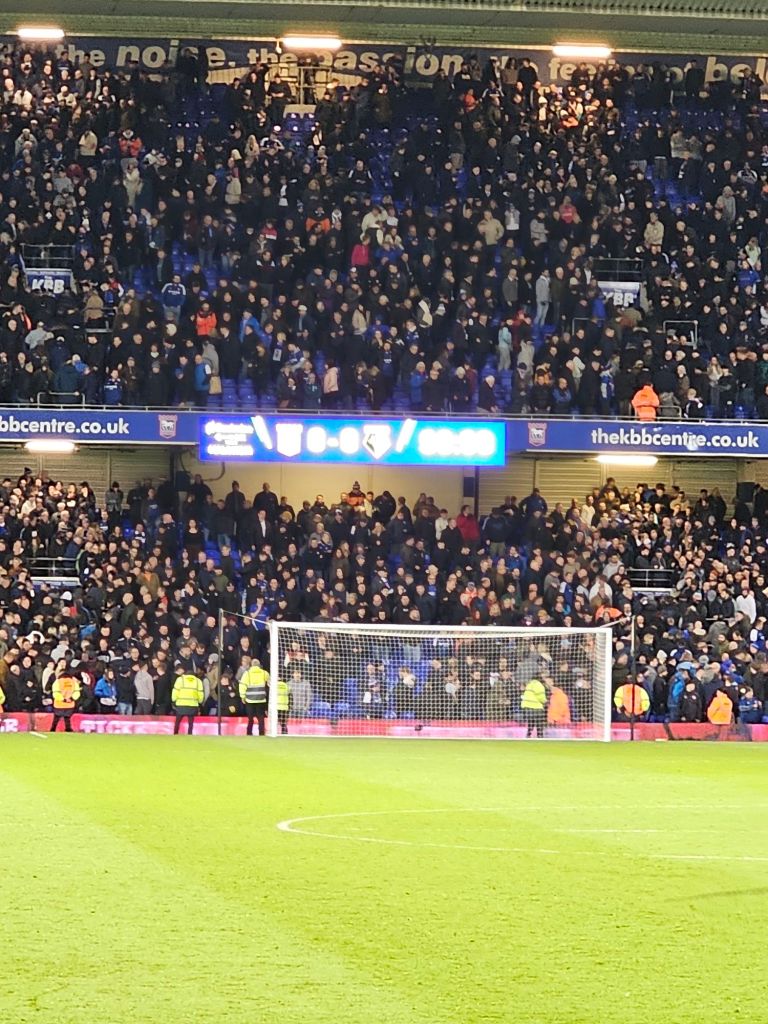
The final twenty minutes don’t see Town really come close to scoring, despite Ganesh, and Watford win a couple of corners as I wonder about Mr Q, which is the sponsor’s name on the front of the Watford shirts. I think of Mr Plow (Plough in English), in series four of The Simpsons and Mr Potato Head in Toy Story, but hope Mr Q is a second hand car dealer or industrial cleaner somewhere on a Watford industrial estate; he sounds like one. Then George Edmundson is kicked on the ankle and has to be replaced by Luke Woolfenden and our chances of bringing on a late attacking substitute who would be bound to score are dashed. Despite two corners, chants of “Blue and White Army, Blue and White Army” , and four minutes of added time Town fail to score at home for just the second time this season and for the first time in 2024. But just to remind us how lucky we really are a freakish punt at goal from the half way line has to be batted away by a desperately back-peddling Vaclav Hladky in the dying seconds. There were days when that would have gone in.
Just like when we played Grimsby on an April night in 1992 on the way to winning the Second Division Championship, the game has finished goalless. It’s not what we wanted, but at least it’ll stop me thinking about Watford.



 trippingovertheball