World Cup 1 Ipswich 0

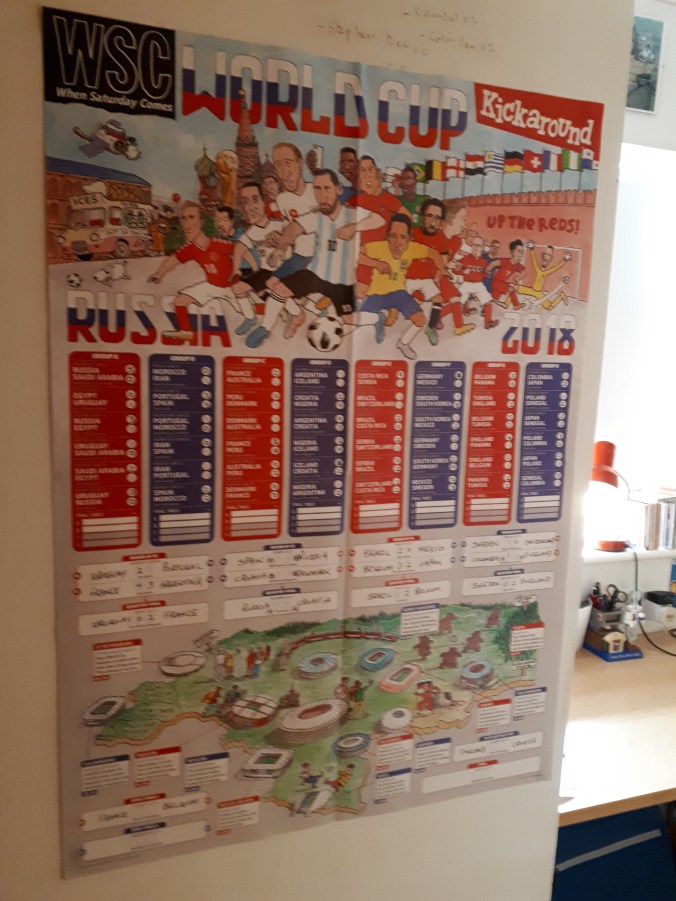
Oh how I love the World Cup. For a month every four years football is somehow reinvented; transformed into something more magical, intriguing, strange and joyous and I just want to wallow in it.

29402264768_be6e6e9583_o

The World Cup is not just sixty-four football matches in a month on the telly; for the first two weeks it’s thrice daily football on the telly and this year on the first Saturday there were four matches to watch in one day. But it’s not just the overdose of football that excites, we’re not exactly short of televised football anymore; what makes the World Cup so different, so much better is that it’s a celebration and it’s all so exotic. It’s not the same-old boring diet of Premier League and Champions League that gluts the airwaves the rest of the year, with the same boring, conceited, miserable clubs playing each other over and over and over again. Some of the players are the same, but lots of them aren’t and for a month they are released from prostituting themselves for filthy TV money and they play for something higher, for the glory (okay, there have been a few exceptions, step forward Togo2006 for example).
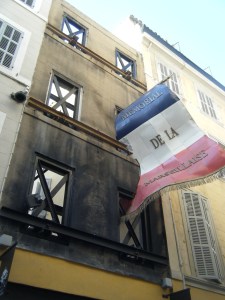
Just the idea of Japan v Senegal, Serbia v Cost Rica, Iran v Spain, Panama v Belgium, Australia v Peru and Iceland v Argentina is thrilling; such diversity of geography , weather, indigenous wildlife, people and culture is mind boggling and it’s all united for a month by football and a desire to hear each country’s national anthem at least three times, and of course the national anthems are marvellous. The South American countries have anthems that are like mini-symphonies with an overture and then what follows is so grand and so passionate. Then there is the wonderful Russian national anthem and of course the Marseillaise, in my opinion the finest of all national anthems. If you are ever

14214314935_6f473ee4ba_o

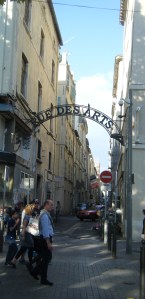
in Marseille then I can thoroughly recommend the

14214135594_26a46deac4_o

museum in Rue des Arts which is devoted to the Marseillaise and its history. As the anthems play we get to see the supporters in the stand, many in fancy dress or national costume, singing and holding on to the moment.
On the pitch there are players of different creeds and cultures representing those creeds and cultures that define their country, and whilst those things are beautiful and fascinating and really matter, and each team is driven by national pride and the essence of what identifies them as a nation, at the same time these things do not matter because the World Cup is actually all about the football; football is the common language and it unites. So whilst we cannot help but be aware of all this diversity of race, beliefs, attitudes, cultures and national anthems which matter to individuals from each country, at the same time we can ignore it and get on with just playing football. This is how not being racist really works, being aware of race and respecting it but simultaneously paying no attention to it at all, so that you don’t actually notice what race a person is; we are all just people.
Enthused by the melting pot that is the World Cup therefore, when I saw a Tweet from Ipswich Town saying that the fanzone would be open for people to watch England World Cup matches on a big screen I re-Tweeted it with this comment:
“Here’s an idea, what about showing Poland’s games and Portugal’s games in the fanzone too? Not everyone in Ipswich supports England. In fact, why not show every game?”
It wasn’t long before someone Tweeted a two word response; “Terrible idea” they Tweeted, which I thought was rather rude and a bit arrogant. If you want to disagree at least explain why. A polite person would surely have begun their Tweet with “Sorry, but I do not agree that that is a good idea, for the following reasons…” Foolishly rising to the bait, I replied to the rude tweet asking in an innocent and curious tone “Why’s that then?”. The ‘answer’ to my question was soon Tweeted, although it wasn’t really an answer but rather an unnecessary question, which suggested that the other Tweeter hadn’t really read and understood my initial Tweet properly; his question was “Where would it stop?”. I replied that it wouldn’t and that the whole of the World Cup could be shown. A further reply was soon forthcoming, once again in the form of a question, but with a couple of statements at the end.
“You want the whole of the World Cup shown in a fan zone, in a sleepy suffolk town. Columbia vs Japan? Azerbaijan vs Kazakhstan? There’s just no market for it Martin.” There were plenty of things wrong with this response beyond the absence of a capital ‘S’ in Suffolk and the mis-spelling of Colombia I thought, but the final sentence of this Tweet sent this exchange of tweets hurtling into the abyss with what I can only describe as the ‘punchline’; “Lets not forget brexit means brexit” it read. Despite the missing apostrophe I was particularly amused by the use of the words “Lets not forget… ”, but nevertheless, the overall effect on me was one of disappointment and incredulity. What was this bloke on about?
I didn’t reply to the Tweet because of the whiff of xenophobic nutcase that it had released. I had however desperately wanted to reply so that I could point out that neither Azerbaijan nor Kazakhstan are in the World Cup finals, that the Tweeter had seemingly confused Ipswich with Wickham Market or Eye (sleepy Suffolk Town?) and to ask for the evidence that there was no market for showing all of the World Cup in the Portman Road fan zone. But of course mostly I wanted to know what the heck the World Cup, Colombia, Japan, Azerbaijan and Kazakhstan had to do with ‘Brexit’. In fact what does anything have to do with ‘Brexit’, a composite word for something that doesn’t exist and which to date no one can define.

42368032625_3bb39ea081_o

At the very beginning of Simon Critchley’s book “What we think about when we think about football” he quotes nineteenth century American philosopher William James who wrote “I am sorry for the boy or girl, man or woman who has not been touched by the spell of this mysterious sensorial life…with its supreme felicity”. I know exactly what William James meant. It is so sad that people have such a blinkered, joyless perception of the world around them, that their worlds are so closed. I hope that the Tweeter I have quoted was the exception and not indicative of the general opinion of Ipswich Town fans, but later two other Tweeters ‘liked’ the “Terrible Idea“ response to my initial Tweet and I died a little inside.
But I’m alright again now, for the time being, until August when Championship football comes home to Portman Road once again.

42368032845_2db816905c_o(1)

Ipswich Town 1 Arsenal 0 – Our Blue Heaven

It’s Saturday May 6th 1978, I will be eighteen in about seven weeks’ time and today I am going to the FA Cup final. I am going with my dad; we were two of the 24,207 who saw Town beat Hartlepool United in the fourth round of the FA Cup and the 29,532 who witnessed the 3-0 win in the fifth round replay against Bristol Rovers; we went to the semi-final at Highbury on a supporters’ coach from Shotley. We saw Landskrona Bois, Las Palmas and Barcelona at Portman Road back in the autumn and have seen about a dozen league games on top of that, so we had the requisite vouchers to get tickets for the final. But this morning my father has woken up feeling unwell; he doesn’t think he’ll be up to going to Wembley and so for my friend Tim who lives five doors away, it’s his lucky day. I walk along the street, knock on his front door and ask if he wants to come to the FA Cup final; he does. Tim’s dad Charlie will this evening deliver a bottle of sherry by way of a thank you.
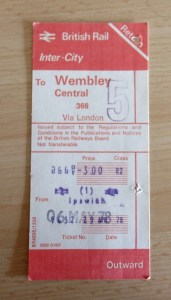
I listen to a few selected tracks from Blondie’s first album ‘Blondie’ (released in December 1976 )as I get ready to go; ‘Look good in Blue’ seems apposite this bright morning as does ‘In the sun’ with its lyric “In the sun , we’re gonna have some fun”. We get to Ipswich railway station somehow; on the 202 bus, or does someone give us a lift? Ticket to WembleyFrom Ipswich we are on a special chartered train that turns right at Stratford and plots a course through north London round to Wembley Central. In Wembley Stadium the terrace steps at the tunnel end are much bigger and steeper than those in Churchman’s or in front of the East Stand, blue and white abounds. The sun shines and Arsenal, wearing yellow and blue, kick off with Ipswich playing towards that blue and white tunnel end. Paul Mariner hits the cross bar, John Wark twice shoots against a post, Pat Jennings saves acrobatically from George Burley, Paul Mariner misses, bigmouth Malcolm McDonald is rubbish, Clive Woods is brilliant, David Geddes crosses, Willie Young is a lumbering donkey, Roger Osborne scores, we cheer, we sing, Roger Osborne is substituted for Mick Lambert, Town win and Mick Mills lifts the FA Cup and turns to show it to us.
Back at Wembley Central railway station after the match a half-brick or a stone bounces off the window of our train as we wait to depart back to Ipswich. Arriving back in Ipswich, Tim and I celebrate with a couple of pints of Tolly Cobbold bitter in the Railway Tavern on Burrell Road as we wait for a lift home in Tim’s dad’s green Morris Minor 1000.

OLYMPUS DIGITAL CAMERA
Forty years and eighteen days later it’s a dank evening in Ipswich, I have been to work, visited my mum, parked up in Portman Road and arrived at the New Wolsey theatre, which didn’t exist in 1978, although there was repertory theatre in Tower Street. I am with my wife Paulene. My father has been dead for nine years, happily his cause of death was unrelated to his illness of 6th May 1978, he enjoyed almost 21 years of good health subsequent to that and made it to the UEFA Cup final second leg in Amsterdam. Tim now lives in Weymouth and oddly he still only gets to see the Town when I get him a ticket (this season we went to Brentford). The Railway Tavern has been demolished; the green Morris Minor was scrapped long ago. But the name of Ipswich Town is still inscribed on the plinth of the FA Cup.
My seat at the Wolsey theatre tonight is in the front row of the auditorium, my wife Paulene is sat in the row behind; she sat behind to give me more legroom. The production is so popular we couldn’t get two seats together. We are the first people in the auditorium, Paulene’s asthma means she needs time to acclimatise. I read the programme (£4) and think “Cup final prices”. The stage is just a metre in front of me, the ‘boards’ are under a green covering patterned to look like turf. At the back of the stage a pair of blue doors look like the doors at the back of the old North Stand, above them is a projection of the type of corrugated cladding also redolent of the old North Stand. But there was never a sign that said ‘Welcome to Portman Road’ back then, there isn’t now. Also part of the projection is the old Ipswich Town crest, the slightly imperfect yellow and blue one, which should be restored out of respect to the past and to John Gammage who won the competition to design a distinct crest for the club back in 1972.41429848635_33f2609053_o
I watch the ‘crowd’ as the auditorium fills up to the sounds of assorted 1970’s pop hits, nostalgic but mostly awful. The majority of people here seem to be my age or older, old enough to have witnessed the 1978 Cup final. A few people are sporting blue and white scarves; one man wears a bright red blazer as if he’s just got here from Butlins. In the front row are three young lads, pre-teens, one of them wears a parka which lends an unexpected layer of 1970’s authenticity. Paulene says she feels cold, I say if I’d known she was going to I would have brought a blue and white bobble hat for her.
The lights dim and tonight’s performance of ‘Our Blue Heaven’ begins with Blondie’s “Hanging on the telephone” played live as the soundtrack to a domestic scene in which a young couple, Mel and Scott arrange their wedding for Saturday 6th May 1978, and then the draw for the third round of the FA Cup is announced. I resist the temptation to put my hand up to point that Blondie’s Parallel Lines album, from which ‘Hanging on the telephone’ was taken as a single would not be released until September 1978. I am not really a pedant and whilst I may not always like it, I do understand the concept of artistic licence and have been known to use it myself; I deny all accusations that it was merely lying.
Mel’s sister Sue is a dedicated and faithful Town fan and from the start foresees that she will want to be at Wembley on May 6th. Meanwhile, in a parallel story Smudger and Ange are awaiting their first child, with Ange’s ‘expected date of confinement’ surprisingly enough being 6th May, although the nurse at the hospital, who happens to be Mel and Sue’s mum Sheila tells them that babies never arrive on time. Smudger is as committed a Town fan as Sue and is predictably torn between his love for the Town and supporting his wife.
The simple domesticity portrayed is all a bit ‘Play for Today’, particularly when it transpires that Mel and Sue’s dad Paul is a striking fireman, whilst Scott’s dad Brian is a Thatcherite policeman; and that just adds to the authenticity and feel that it is 1978. I am transported back in time on a wave of Nostalgia (from the Buzzcocks Love Bites album and like Blondie’s Parallel Lines, also not released until September 1978, but also sadly not in the show).
Scenes from the two families’ stories are spliced with Town’s progress through each round of the FA Cup introduced by popular songs of the time, Bowie’s ‘Heroes’, Patti Smith’s ‘Because the night’, something or other by the Bee Gees. For the sixth round trip to Millwall the band plays the Clash’s London Calling, at which point I really do want to put my hand up because the Clash’s album was not released until December1979, a whole 20 months later. I only hold back when London Calling runs into White Riot, which is much more temporally authentic having been released as a single in March 1977, and a cracking tune to boot.
For each match a group of male and female dancers act out the crucial on-pitch events to the background of the songs and a BBC radio style commentary. My friend Gary texted me before the performance to tell me there was just one thing he did not like about the production and later he will tell me that it was the football sequences. Re-creating football well is notoriously difficult to do, as proven by awful films such as Yesterday’s Hero, in which incidentally the football sequences were filmed at half-time during a game at Portman Road; this is why I don’t consider that the director really bothered to do so. The dancers don’t look like footballers and they are only dancing, creating an impression through movement; they could have been supporters recreating the goals, children doing so in the school playground, and that is authentic. So Gary, you are wrong and need to brush up on your critiquing skills.
The intertwined stories of the families and the FA Cup run are good ones, there is drama, pathos, human emotion aplenty, humour and of course a happy ending. But the thread that runs through the production is the character of Bobby Robson who intermittently comes on to the stage like some sort of visiting angel wearing a series of 1970’s style suits and coats, imparting words of wisdom and assorted homilies about football and the wider experience of our lives beyond. As if this isn’t enough, the actor playing him, Peter Peverley does so brilliantly, better even than Michael Sheen’s rendering of Brian Clough in The Damned United. Peverley has the accent which is easy enough, and he has perfected the mannerisms too, but more than that he has captured the slight hoarseness in the voice, it’s almost uncanny. He wears a pretty bad wig though.
The finale to the production has the marriage, the birth and the FA Cup final taking place on stage simultaneously following the singing of Abide With Me, the Cup final hymn since 1927; a maudlin little number but a cracker nevertheless because it is the Cup final hymn and has been marinated in 90 years of Cup final history. Being sat right at the front, my view is now partly obscured by some of the on stage props, so I watch the audience. People who know the words sing along with Abide With Me, whilst others hold their scarves aloft. It is likely that many of the people here, like me were at the Cup final in May 1978 and are part of the story, but this makes people feel involved all over again, it’s nostalgia with knobs on, re-enacting the past, albeit part fictional, but this is somehow how it felt.
The story ends and it truly feels like Town have won the FA Cup all over again, and then Roger Osborne, the personification of the day because he scored the winning goal enters the stage, inevitably to a standing ovation. The ultimate finale however, comes with the cast all assembled on stage with Bobby Robson leading us in a sing-song, some Cup final community singing of our own; a rousing rendition of Edward Ebenezer Jeremiah Brown. It’s bloody marvellous and everything that matches at Portman Road no longer seem to be, utterly joyous. I give it my all.
I have had a most marvellous evening and for much of it I am not ashamed to admit I have had a tear in my eye. I have been taken back in time, but don’t know if I’m tearful for my lost youth and the passing of the days when Ipswich Town was such a wonderful football club and team, and when the FA Cup was something that really mattered, or if these are tears of joy and happiness, for a love of my team and a sense of belonging that has been re-kindled.
Nostalgia is warm and cosy, but it’s not a healthy thing, because we cannot go back and we have to live in the present; but tonight after watching Our Blue Heaven I genuinely feel uplifted.
My name is Edward Ebenezer Jeremiah Brown
I’m a football supporter of Ipswich Town
Wherever they play, you’ll find me
I haven’t missed a game since I was three
With me scarf and me rattle and me big rosette
Singing where was the goalie when the ball went in the net
Follow the Town
Up or Down
I’m Edward Ebenezer Jeremiah Brown but everybody calls me Ted.

Football, Football,
Whose the greatest of them all,
Let’s put it to the test
Come to Portman Road on a Saturday and you’ll see the best
Oi!
Ipswich! Ipswich! Come On The Town!

My name is Edward Ebenezer Jeremiah Brown
I’m a football supporter of Ipswich Town
Wherever they play, you’ll find me
I haven’t missed a game since I was three
With me scarf and me rattle and me big rosette
Singing where was the goalie when the ball went in the net
Follow the Town
Up or Down
I’m Edward Ebenezer Jeremiah Brown but everybody calls me Ted.

2-4-6-8 who de we appreciate?
It isn’t hard to tell
Just you take a closer look at me
And you’ll know darn well
Oi
Ipswich! Ipswich! Come On The Town!

La la la
La lala la lala lalala
Lala lalala la lala lalala
La lalala lalala, and lots more lalalaing, you get the picture ?


AS Fabregues 0 Canet Rousillon 2

Fabregues is a very attractive small town about 10 kilometres southwest of Montpellier in the Hérault department of southern France. The town has a population of fewer than 7,000 but has a history dating back a thousand years, the centre being set out in a pattern of concentric circles around the church or chateau, a form of early medieval urban development known as a circulade. The town’s history probably goes back further to the Gallo-Roman era as the name Fabregues being derived from a Latin word meaning forges.
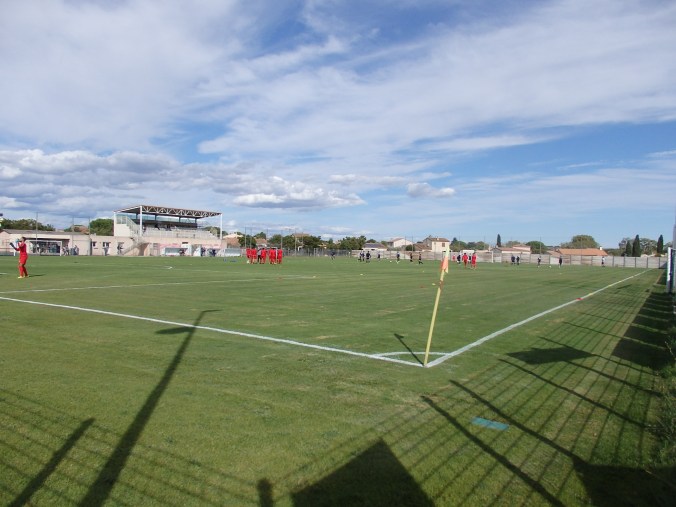
The Stade Joseph Jeanton is a part of a sports complex dating from 1993 that sits on the other side of the River Coulazu from the medieval town of Fabregues and it is here that my wife and I arrive today with a half an hour to spare before the kick-off of the match between Fabregues and Canet Roussillon in National Ligue 3, the fifth tier of French football, which is amateur, although the professional teams play reserve or ‘B’ teams in it. We park up in the neatly laid out car park which is landscaped with trees and shrubs and then walk through a metal gate to a wooden hut where we pay the 5 euros each admission fee. The Stade Joseph Jeanton is much like most other small town football grounds in France; a pitch surrounded by a high metal fence and a single stand affording a decent view of the pitch.

OLYMPUS DIGITAL CAMERA
The teams and referees are warming up as we walk behind one goal and round towards

the stand and buvette. I am impressed that one of the goalkeeping coaches is a woman and can’t imagine that many if any men’s teams in England have a female coach. The FA and English football in general really needs to get with the programme. We stop to ask three men in their sixties or seventies which team is which. One of them speaks a little English which he is keen to practice and he seems impressed that we have come to see Fabregues, which he describes as a good little club. At the buvette I buy a bottle of water (1 euro) and pick up a copy of the club’s directory. It is mostly adverts for local businesses, but contains details of every team in the club from the under 6 and 7’s up to the seniors. There is a statement from the president setting out the aims of the club and the overall impression is of the club being an important and well-run focus for the local community.
It is a warm afternoon and a strong breeze stretches white clouds out across the blue sky. We climb up into the stand and look out over the pitch towards the pink roof tops of 36538176213_715c21d13e_ocirculade and the old town. This is a pleasant spot to spend the afternoon it seems. Below us the referee (Monsieur Gauthier Lapalu) and his assistants (Monsieurs Jeremy Noiret and Maximilien Demoustier) are warming up, the referee looks very young, very neat and very enthusiastic, too enthusiastic and a little officious perhaps. He seems to want to organise his assistants overly and they don’t look that impressed.
Kick-off is scheduled for 3 pm but the teams aren’t on the pitch yet, although we can see them waiting at the mouth of the players’ tunnel, everyone seems to be waiting for the referee. Eventually, after the usual introductions, Canet Rousillon, from the town of Canet some 35 to 40 kilometres to the west, kick off in their white shirts with black shorts and socks; Fabregues wear all red. The first foul is committed after about five minutes and Monsieur Lapalu quickly airs his yellow card and then takes time to explain his decision to the Fabregues bench who are perhaps miffed, and understandably so because it wasn’t much of a foul. Five minutes later a Canet player is booked, but justifiably this time. It takes another fifteen minutes for Monsieur to get his hat-trick of cards.
This is a poor game. It may be because the afternoon is still warm, but the players aren’t running about much. One or two like to run with the ball, particularly the Fabregues number eleven, who is quite good at it, but there is not much running off the ball so there is seldom anyone to pass to near the opposition penalty area and therefore there are no shots on goal to speak of, except for optimistic long range ones. In addition, the players of both teams like to fall over and scream as if fatally wounded and Monsieur Lapalu is proving to be quite fussy and precise; he runs like Forrest Gump and his shorts fit too snugly, like his mum has cut down a pair of trousers from a dark suit.
Fabregues make a first-half substitution and the substitute adjusts his hair carefully before coming on, appearing to arrange his top-notch like the leaves on top of a carrot. But the substitute claims the distinction of being the first player to have a shot worthy of the name, in first half injury time.
With half-time we leave the stand to get out of the sun and the breeze, and to get away from the body spray of the young man next to me, which smells like pine disinfectant. This stadium has advertisement hoardings and they remind me of those at Eastern Counties League grounds. There is one for a Pompe Funèbre (undertaker) and one for Auto Ecole Thierry (Terry’s Driving School) as well as one for Pub Resto O’Papa Chico, which sounds like an Irish, Mexican pub. The local butcher, Bouchère des Beaux-Arts sounds a step up from an English pub meat raffle, but in a country that takes food seriously, such a name is probably not pretentious.
For the second half of the match we stand, peering through the fence from the opposite side of the ground to the main stand, where we are shielded from the wind by a hedge.

The second half starts well as the first discernible passing move of the game in an opponent’s half results in the Fabregues goalkeeper diving at the feet of the Canet number seven, to make a decent save. Just a minute later Canet’s number eight collapses to the turf inside the Fabregues penalty area and a penalty kick is awarded by Monsieur Lapalu. It seems a trifle harsh, but Monsieur Lapalu takes so long ensuring that no ones’ toes are in the penalty area that the number eight has far too long to think about his kick and when he eventually takes it, it provides a relatively easy save for the Fabregues ‘keeper, who dives to his right and smothers the ball completely to keep the scores level.
The game now enters a ridiculous stage where players fall like nine pins every few seconds; any physical contact apparently leads to mortal injury. The best moment is when three players come together and all three end up lying on the ground pleading for attention. If the Keystone Cops had played football it would have looked like this. It is at once both amusing and pathetic. The game is stopped and miraculously all three players recover to carry on. A banger goes off in the bushes close to where we are stood; everyone ignores it although some teenage girls trying their best to look innocent look like they might know who was responsible.
With an hour gone Canet somewhat surprisingly take the lead. The ball lands at the feet of their number ten; he shoots and the ball is saved, but the rebound bounces off him and into the net, although he may have adjusted his feet quickly enough to ensure the direction of the rebound was goal-wards rather than anywhere else. A good number of Canet supporters in the main stand celebrate. A second banger goes off in the bushes close to where we are stood and there is a delay as Monsieur Lapalu checks with his assistant that all is okay; he indicates that his ears are ringing a bit but otherwise he is fine. Monsieur Lapalu then checks with the Délègue Principal monsieur Jean Pierre Jullian, but carries on with the re-start. Fabregues are stung into action and are unlucky to have a goal disallowed five minutes later for offside when the ball was possibly heading into the net without the extra touch from the offside player. I detect the scent of cannabis on the breeze, but can understand why people watching this game may seek solace in illicit drugs.
There is about a quarter of an hour left and Canet’s number nine lofts the ball onto the roof of the goal net as his team hit Fabregues on the break. Two minutes later Fabregues’ number five stretches out a leg to win the ball, he does so, but he then catches his opponent too and Monsieur Lapalu deems this a foul and cautions number five for a second time this afternoon resulting in his sending off. To his credit number five does not complain, although having won the ball he probably had cause to. Monsieur Lapalu goes on to also caution Fabregues’ number three as he organises the human wall to defend the resulting free-kick.
Fabregues continue to search in vain for an equaliser and they seem more capable and energetic now that the sun is lower in the sky, casting a long shadow over the pitch from the adjacent sports hall. But with four minutes of normal time remaining Canet hit them on the break again as their number 10 feeds the ball beyond the Fabregues full-back for the moustachioed number two to run on to. The Clark Gable look-alike rounds the goalkeeper and scores. Canet celebrate wildly whilst Fabregues cannot believe they have conceded a goal to a bloke with a moustache.
The result is assured now and Canet almost claim an undeserved third goal as number nine strikes the ball against the cross bar. Monsieur Lapalu even seems to have lost interest a little and has seemingly relaxed his grip on the proceedings. Only two minutes added time are played, which is a relief for everyone. Canet and their supporters celebrate noisily again as the final whistle blows.
This has been a poor game, perhaps the worst I have ever seen in France. It is a shame because the Fabregues club appears to be such a well-run, ideal community based club; but I guess all teams have off days. I hope this was one of those days for both teams, because even though Canet won, they were terrible too. Monsieur Lapalu should also learn from this game too and we will look out for this name in Ligue 1 in may be ten years’ time.

This slideshow requires JavaScript.


Havre AC 2 Tours FC 0

It is Friday 11th May and tonight the 38th and final round of matches will be played in the French second division, known as Ligue 2, which despite the French reputation for gastronomy is sponsored by Domino’s Pizza. Tours have already been relegated to the Ligue National having been bottom of the league for much of the season. Le Havre, known as HAC, by contrast, have been within striking distance of les barrages (play-offs) positions for much of the season and a good recent run finds them in fifth place and needing a win to ensure that they will play in les barrages.
My wife Paulene and I arrived in Le Havre on Wednesday afternoon and bought our tickets (10 Euros each) at the smaller of two club shops, the one in the Place Perret in the centre of the city (the larger shop is in the Docks Vauban shopping mall, about 15 minutes away on foot). There is no longer a ticket office or club shop at the Stade Océane where HAC play their home matches, although guichets do open there on the evening of the match. Place Perret is named after the architect whose practice was charged with rebuilding Le Havre after a phenomenal 80% of it was destroyed by allied bombing in 1944. Perret was a great advocate of concrete construction and his planned city centre with its wide boulevards, massive city square and classically inspired concrete buildings is now a UNESCO World Heritage site. Walking its streets is like being in an idyllic 1950’s vision of the city of the future.

This slideshow requires JavaScript.


The Stade Océane is at the very edge of what is a sprawling city, with its vast docks strung along the mouth of the River Seine.  The HAC website refers to shuttle buses (navettes) that run from the city centre to the stadium but it doesn’t provide details.  The bloke in the club shop didn’t seem to know anything about the navettes, disappointingly recommending travelling by car; nor did the woman at the Tourist Information centre, although she was able to supply a bus map and timetable for the regular service that passes close to the stadium.  The HAC website does however provide a link to the website of CODAH (Communauté de l’agglomération havraise) the local public transport undertaking who provide the free navettes and where I learn that buses will run every forty minutes from Quai D (stand D) of the bus station (gare routier) beginning at 6.30pm.  After the match four separate routes will run to various destinations across the city.41233756055_f38c51250b_o
Although kick-off is not until 8:45pm we are perhaps over keen and are waiting at the bus station at 6.30 where a handful of people including a nerdish looking youth in a HAC tracksuit top are already hanging around Quai D. A white Mercedes bus swings onto the stand and first in the queue is a small boy who climbs aboard and stretches up to hug the driver, who it seems is his dad. Pausing briefly to go “awww” we board the bus and after waiting a few minutes, during which time no one else boards the bus who hadn’t already been waiting for it, we set off. The journey takes us through some less salubrious areas of the city, close to the docks through streets that might be termed both ‘gritty’ and ‘urban’ amongst other things.
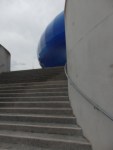
The journey takes about 15 minutes at the end of which we are dropped off next to some tenement blocks beyond which, across a railway track and grey concrete open space is the amazing, bright blue Stade Océane, which looks like an enormous beached rubber dinghy. A few fans wait by the entrance to a subterranean world into which the team coaches will soon descend, but we ascend a flight of steps to the concourse around theOLYMPUS DIGITAL CAMERA ground where not much is happening. A friendly faced man in the mobile club shop speaks to the nerd from earlier and then peers out in vain for customers who don’t think he is selling ice creams. I take a look OLYMPUS DIGITAL CAMERAat his stock and he tries to convince me to buy a scarf; I tell him I already have a petit fanion (pennant) from the shop in town and this seems to satisfy him. He asks me who my team are in England and is complimentary when I say it is Ipswich Town, revealing that his knowledge of the English game is perhaps not up to date.
We hang about waiting for the turnstiles to OLYMPUS DIGITAL CAMERAopen. Some people arrive and buy tickets at the guichets where club employees arrange plastic barriers and then take them away again. The huge car park beyond the stadium fills up slowly with a trickle of cars from the main road that runs close by. Children are being admitted free tonight and school parties gather at the south end of the stadium, where more barriers snake a path to the OLYMPUS DIGITAL CAMERAturnstiles. As we lean against a concrete wall two young women hand out free copies of the A4 sized, glossy four page match programme. There is a hot food van with the rather wonderful name of Friterie Momo parked on the concourse, providing a supply of massive cartons full of chips and sausage-filled baguettes (7 euros) to an increasing queue of casual diners. I wouldn’t usually eat this in England so see no reason to eat it in France, although it is likely to taste better, but I do buy a 500 ml can of Ch’ti Blonde (4 euros) the local beer of Pas de Calais and Picardie, which at 6.4% alcohol could probably not legally be sold at a football ground in England. But French people will drink one can of Ch’ti, English people would try and drink eight or ten.


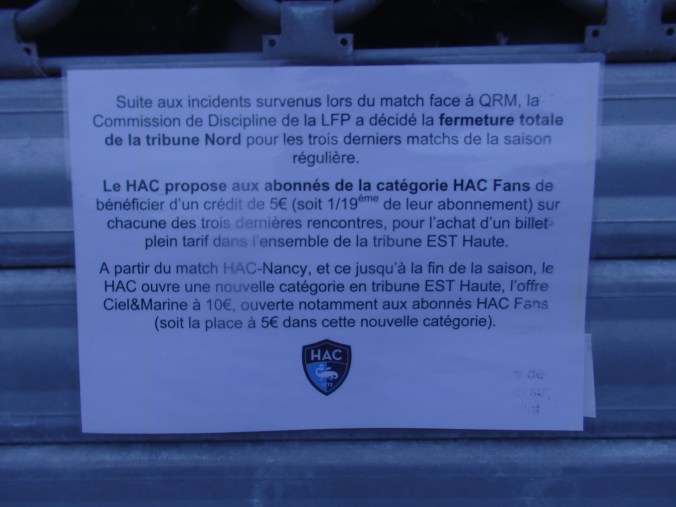
Eventually the turnstiles open; they are automatic and read the barcodes on the tickets, but entry to the stadium is not speedy because once through the turnstiles everyone has to be patted down. Then the turnstiles go haywire as the barcode readers stop working, but it doesn’t matter because people are already backed up at the security check. Happily the turnstiles begin to work again and we are both into the stadium and up the steps to the upper tier; we make our way to as near to the half way line as we can get. It is a ‘sit where you like night’ tonight in this part of the stadium because there will be displaced supporters from behind the north goal where the seats will remain empty after fans threw objects onto the pitch during the recent derby match with Quevilly-Rouen.OLYMPUS DIGITAL CAMERA
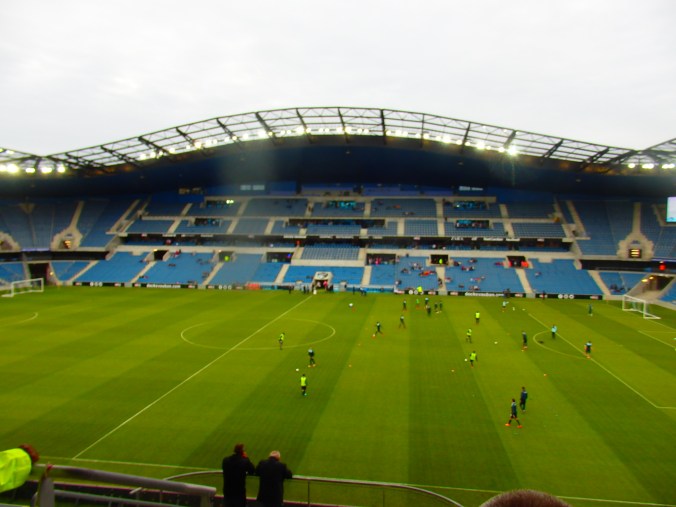
The Stade Océane is only six years old, it cost 80 million euros, it has a few more than 25,000 seats and the two I sit in were more comfortable, spacious and felt much more solid than the average football stadium seat; they even have a smooth spring action to tip up. I sit in two different seats because the bloke just along from my first seat is puffing an e-cigarette, which emits clouds of sickly fruit scented vapour that make me feel slightly ill; he also has quite a pungent body spray so it is doubly necessary to move a bit further away. I can’t believe that his natural smell was so bad that he had to go to such desperate lengths to cover it up.
The players warm up on the pitch as the ground fills up; eventually the ground will be almost exactly half full, which with a nice sense of numerical symmetry is about twice as full as it is has been for most Ligue 2 games this season. The teams are introduced in the customary French manner with the stadium announcer providing players’ first names and the crowd shouting out their surnames, it’s a lot of fun but I don’t think it would work as well with English surnames. Banners display the club crests and the teams enter

the arena. There is a band of ultras in one corner at the southern end of the ground they wave flags and then sing the national anthem, the British national anthem, which for Le Havre is the club song. (https://youtu.be/Wy2MhV8sFyw) Havre Athletic Club is France’s oldest football club, founded in 1872 by a bunch of Englishmen from Oxford and Cambridge universities, so possibly a Tory cabinet, and this English connection explains the use of Thomas Arne’s tune.
Le Havre kick-off the match towards the empty Tribune Nord wearing what is possibly an Oxbridge inspired kit of Cambridge blue and Oxford blue quarters with Oxford blue shorts and socks. Alternatively, the two blues could be of those of the sky and the sea as HAC are known as Ciel et Marine (sky and sea); two things that are prominent in Le Havre and somehow define the city and it situation. Tours meanwhile wear all white, but with blue and white checked sleeves. Havre are quickly on the attack passing the ball zippily on the lush playing surface and soon earn a corner and within four minutes the beautifully named Zinedine Ferhat crosses from the right and Jean-Philippe Mateta sends a fine header into the bottom left hand corner of the Tours goal. Six minutes later and a precise through ball from Jean-Pascal Fontaine precedes a right foot shot from Mateta and Havre are winning two-nil, with Tours having explained graphically why they are bottom of the league. That’s all that needs to happen this evening, if Havre can keep the score as it is they will be in les barrages. To an extent it seems that they realise this and after such an exciting opening ten minutes the game settles down to be not quite so exciting.
It takes twenty minutes for Tours to have a shot and despite the score the Le Havre supporters don’t seem overly thrilled; perhaps they are not wanting to tempt fate by celebrating too soon. The ultras provide another rendition of the club song, but the most interesting development is in the stand where some people complain to a steward about

two blokes who are stood at the top of the steps watching the game. The young steward is pressured into asking them to sit down or at least move because it seems they are blocking the view, which they may well be. The older of the men, who looks well in his fifties gesticulates and argues but eventually moves, walking past his accusers and jabbing his index figure at them angrily; it’s marginally more entertaining than the match, although Tours are now having more shots and their Baptiste Etcheverria is booked by referee Monsieur Olivier Thual for a rather violent assault on the impressive Zinedine Ferhat. Meanwhile, the other man who had been ‘outted’ for standing moves to stand at the side of the stairs and lights a cigarette.
All around the open sections of the ground there are people standing in the area at the

back of the lower tier, and skulking in the Tribune Sud behind the completely empty away supporters’ area are masses of police, all just watching the game apparently. I don’t know if the police were expecting Tours fans who never turned up; perhaps they were delayed, but heard the score after nine minutes and decided not to bother; it is a three and a half hour drive after all. With about five minutes to go until half time some rhythmic clapping breaks out and then the ultras sing another burst of ‘God Save The Queen’ as they hold their scarves aloft like English football fans used to before the Premier League spoiled everything.
Half-time arrives and I head downstairs to release some of that Ch’ti that I drank before the match and have since processed as nature demands. Passage downstairs however, is

difficult because bizarrely and surely contrary to safety requirements, the bottom of staircases E3 and E4 are blocked off with Heras fencing. This may be an odd attempt to keep the people who have paid 10 Euros for a seat out of the centre of the stand where normal prices have been charged, but it just has the effect of making people in the cheap seats walk through the central section to get to an open staircase. Down in the lower concourse children are playing on bouncy castles and the light shining through plastic outer ‘skin’ of the stadium creates a bluish hue. At the back of the lower tier people stand and smoke.

This slideshow requires JavaScript.


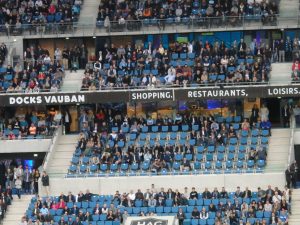
The football returns and the scoreboard encourages the fans to get behind the team; “Faites Du Bruit” it announces, “Make Some Noise”. The ultras obey but no one else much does. On the opposite side of the stadium is the directors box and it amuses me a little that above this are the words “Shopping, Restaurants, Loisirs (leisure)”, as if advertisingOLYMPUS DIGITAL CAMERA the thoughts of the wealthy people in the seats below. In the players’ tunnel a man in a suit, presumably a club official, lolls casually against the concrete wall with his hand on his hip, perhaps summing up in his casual posture the

OLYMPUS DIGITAL CAMERA

apparent attitude to the ongoing failure tonight to promote supporter safety in the Tribune Est (East Stand) opposite. A procession of people descend the steps of the Tribune Est expecting to be able to go down the staircase to the toilets or buvette, but of course they find the foot of the stairs closed. A small girl gets quite distressed until led away by her older brothers and an elderly man looks equally perplexed when he finds his way barred. There is no easy way to the other staircases except by walking along whole rows of seats and asking people to stand up to let you through. I just hope there is no need to evacuate the stand quickly.
As the game approaches its final minutes, at last a tangible sense of anticipation and excitement returns to supporters other than the ultras. There is clapping and singing and the fans at last seem confident that their team is capable of holding on to a 2-0 lead against the league’s bottom club and despite three minutes of time added on they do. Le Havre qualify for the play-offs where they will be at home to Stade Brestois 29, another club from a great French port that was also bombed heavily by the allies towards the end of World War Two. We leave the supporters to celebrate without us in order to head for the navette, because we’re not sure what time it will leave.
It has been a good night, but a slightly disappointing one nevertheless. The Stade Océane is fabulous, but has not been shown at its best and its management tonight has been nothing short of alarming. Everything is in place for football to be memorable in Le Havre, but the club really needs that promotion.OLYMPUS DIGITAL CAMERA
 

Paris St Germain 2 Les Herbiers 0

For an Ipswich Town supporter FA Cup ties have become something of a rarity, and more than that, a disappointment. Despite winning the FA Cup itself, albeit forty years ago, (incidentally, only thirty-six of the current ninety-two league clubs have ever won the Cup, and Norwich City are not one of them) Town have failed to honour their past and have not even won an FA Cup tie since 2010, when they triumphed away at Blackpool. Starved of cup glory therefore, the opportunity to go to the final of the French equivalent of the FA Cup, the Coupe de France, is not to be missed. This year the final tie is between the current holders Paris St Germain and Vendee Les Herbiers Football (VHF) a semi-professional team who currently play in the Ligue National, the third tier of French league football. Francophile that I am I ‘signed up’ for e-mails from the Federation Football Française (French Football Association) a couple of seasons ago and my wife, who I shall introduce to you by name shortly is on Paris St Germain’s e-mailing list, so we both received invitations by e-mail to buy tickets for the final. For just 19 Euros each, yes, 19 Euros, about £16.50, we have tickets at the Stade de France for the show piece, end of season finale. I have paid more this season to watch Colchester United versus Morecambe.
My wife, Paulene and I arrived in St Denis in the north of Paris at lunchtime and from

OLYMPUS DIGITAL CAMERA
Basilica St Denis

our hotel room at the Novotel it is possible to see the Stade de France in one direction and in the other the Basilica Cathedral of St Denis, where nearly 1,600 years-worth of French kings and queens including Clovis, Dagobert, Catherine de Medici, Louis XIV, Louis XVI and Marie Antoinette were all buried. As if that is not enough this is considered to be the building where in the twelfth century all the elements that make up Gothic architecture were brought together for the first time; it is a most beautiful building of remarkable historic significance.

After a leisurely visit and a picnic in the nearby Parc de Legion d’Honneur we rest up back at the hotel before making the short walk to the Stade de France. In the hotel lobby Les Herbiers supporters are checking in and making use of the bar.
Today is the May 8th, a national holiday in France marking the liberation of the country from the Nazis in 1945; it is a glorious sunny day with temperatures up in the mid-twenties; one digital display says the temperature is 35 degrees but I’m not sure I believe it. Our approach to the Stade de France is at the end of the stadium where there is a sea of Les Herbiers supporters of all ages dressed up in red and white. Les Herbiers is just a small town with a population of about 16,000 situated in the Vendee department, some 50 kilometres south east of Nantes and almost a four hour journey by road from Paris. Today Les Herbiers and a good few places all around it must be completely empty.
Last night on French TV sports journalists were debating whether this cup final between Paris St Germain, with an annual budget of 340 million Euros, and a semi-professional third division team with an annual budget of 2 million Euros was a good thing or not. Seeing the excitement and joy on the faces of the Les Herbiers supporters leaves me in no doubt that it is a good thing. It does not matter that it is the final and it is a mis-match. Paris St Germain will win because they now win everything, but it will still be the show piece event of the season and both sets of supporters will love every minute of it; also in the scheme of things it doesn’t matter much because there will be another cup final next year, and another the year after that, provided Donald Trump hasn’t finally caused Armageddon.
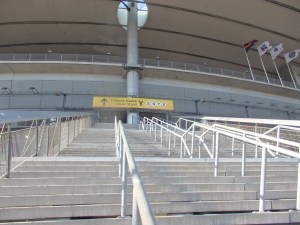
Security at all the bigger French football matches is reassuringly tight and once patted down we head up the ramp to the concourse that surrounds the Stade de France, a stadium that feels much more spacious and is much more beautiful than Wembley, although it is now twenty years old. Unable to resist acquiring souvenirs of the day, I buy myself a T-shirt (20 Euros) and Paulene a scarf (20 Euros) for which Paulene also learns the French, which is écharpe. There is a while to go before kick-off at five past nine so I get into the spirit of things joining the Les Herbiers supporters with a pint of Carlsberg (8 Euros), the price of which makes me feel that the T-shirt and scarf were massive bargains and I should buy more of them, but I don’t. The beer comes in a re-usable plastic “eco-cup” (2 Euros) of a type seen at many French stadiums and makes me feel much better in the knowledge that even though I have been robbed blind I am helping save the planet. Paulene has a bottle of water (3 Euros).
Paulene is keen to get in the stadium to watch the warm ups and pre-match

OLYMPUS DIGITAL CAMERA

entertainment and because she is a chronic asthmatic and will need to recover from the long climb to our seats. For Paulene visits to large stadiums such as Marseille’s Velodrome and the Stade Felix Boleart in Lens have in the past come with near death experiences after ascending staircase after staircase after staircase on a sort of stairway to Heaven. Whilst Paulene climbs, I callously hang around outside, slowly drinking my beer, savouring it as best I can and soaking up the ambiance with smiling, excited and inebriated French people. Eventually I head for the turnstile where I must show both my ticket and passport, the French show their identity cards. The steward seems pleased to see a “Rosbif “ and summons up his best English to say “Welcome”, which is nice. Inside the stadium I am patted down again and wished bon match before being offered a complimentary Pitch choco barre courtesy of a promotion by Brioche Pasquier an industrial French bakery whose products can be found in English supermarkets too.
Our seats are in the third tier of the stadium but are not together, Paulene sits in the second row from the front whilst I am another three or four rows back and off to the right. As I arrive at my seat, on the pitch the final ten minutes of the French FA Youth

This slideshow requires JavaScript.

Cup for Under 19’s, the Coupe Gambardella, between ESTAC Troyes and Tours FC are being played out. Troyes are winning 2-1 and hang on to lift the trophy amidst scenes of much excitement and generous appreciation for these young players. Although fully professional, Troyes and Tours are relatively small clubs, but in France this is no barrier to producing successful youth teams, a fact illustrated by Auxerre, a town a third the size of Ipswich having won the Coupe Gambardella a record seven times. I sit on the steps next to Paulene and after the presentation of the trophy and ensuing celebrations we watch the stadium gradually filling up until the steward just in front of us asks me to take my seat.
We are amongst the Paris St Germain supporters, although the hard core ultras are in a seemingly dedicated area in the lower tier where a platform is positioned in front of

them for the use of the two ultras who will lead and orchestrate the chanting. On the pitch the preparations are being made for the start of the final of the Coup de France and the celebration of French football that this represents. The teams warm up; the PSG players looking comfortable and familiar with the huge stadium, the Les Herbiers players looking slightly in awe of the setting and the vast numbers of their own supporters decked out in red and white; their home crowds in the Ligue National average about 1,300. Les Herbiers wear simple hi-vis jackets over their red tracksuit tops and look every bit the modest, provincial club that they are. The players warm up in a corner in front of their fans as if at a much smaller ground.
At last the scene is set and amidst two teams of drummers behind each goal, four separate formations of flag wavers, a huge circular FFF Coupe de France logo and two similarly massive club badges that all look like they could be used by the fire brigade to catch people jumping from high buildings, a marching band in French blue trousers with tunics decked in gold braid, a suspended image of the Coupe de France trophy and pitchside pyrotechnics the teams emerge from the tunnel. I join in as best I can with the singing of the Marseillaise, which is truly glorious and then the teams are introduced to President Macron who is roundly booed. I exchange amused smiles and raised eyebrows with the white haired bearded man stood next to me who admits he is not really a football fan, he prefers rugby and has just been brought along to the game by his two friends; he is however supporting Les Herbiers and so am I. It’s all absolutely brilliant and the game hasn’t started yet.

This slideshow requires JavaScript.


We sit and Les Herbiers kick off the match wearing all red and playing towards central Paris, the Arc de Triomphe and the Eiffel Tower; PSG are in their usual all navy blue kit and kicking towards the Cathédrale Basilique St Denis. Les Herbiers start well and within two minutes Joachim Eickmeyer breaks down the left, crosses the ball and Sebastien Flochon’s shot is deflected wide of the goal resulting in a corner from which Valentin Vanbeleghem shoots wide from some 25 metres out. The white-haired man and I applaud conspiratorially. But it doesn’t take long before PSG have two shots from Giovanni Lo Celso and Kylian Mbappé that hit a Les Herbier goal post, the second shot defying physics as its angle of incidence blatantly fails to equal its angle of reflection, instead the ball just bounces right back at him.
Satisfyingly for my white haired friend and me it is PSG’s Yuri Berchiche who is the first player to be booked by referee Mikael Lesage. But such events become crumbs of comfort as PSG predictably dominate and miss chance upon chance with Lo Celso again hitting a goalpost with a shot , although Les Herbiers are in fact playing extremely well, they’re just not as good as PSG. The Ligue National team do not ever resort to aimlessly booting the ball away in blind panic, but always attempt to play the ball from defence by passing it, certain Ipswich Town defenders could perhaps benefit from some coaching from Les Herbiers’ Stephane Masala; does he know there is a job going? He is perhaps one of the few successful managers of a lower league club not so far linked with the job.
Off the pitch, the far end of the stadium is a noisy, constantly choppy, but joyous sea of red and white flags, even when on 26 minutes Giovani Lo Celso surprises me at least by scoring with a low shot from the edge of the penalty area to inevitably give PSG the lead. PSG continue to dominate play but still only lead 1-0 at half-time, when I pop downstairs to buy a bottle of Evian (2.50 Euros) for Paulene.
The second half picks up where the first left off, but for the usual change of ends. Within five minutes it seems PSG have scored again as following a sequence of remarkable deflections and rebounds Mbappé sends the ball into the goal net. The PSG fans and ultras have celebrated the ‘goal’ but apparently under false pretences as following some sort of video conference at the side of the pitch Monsieur Lesage disallows the goal and awards Les Herbiers a free-kick. It is the first time I have witnessed the use of video technology at a match and it feels very odd because of the hiatus it creates; I don’t like it, it doesn’t feel right, although my neighbour and I gleefully cheer the decision nevertheless.
PSG probably dominate the second half more than ever and despite some fantastic saves from Matthieu Pichot in the Les Herbiers goal it eventually all becomes too much and a bit after twenty five to eleven he can’t help but knock over PSG’s Edinson Cavani who

OLYMPUS DIGITAL CAMERA

scores from the resultant penalty. Pichot is booked by Monsieur Lesage for his efforts but shakes his hand to acknowledge his mistake and show he has no hard feelings; what civilised people the French are.
PSG come close to scoring again more than once in the final minutes but pleasingly Les Herbiers have a late flourish too and both Diaranké Fofana and then substitute Clement Couturier almost beat PSG goalkeeper Kevin Trapp with a snap shot and a run into the penalty box. Finally, after five minutes of time added on however, Monsieur Lesage calls time on the 101st final of the Coupe de France and PSG have won it for a record 12th time. No one seriously thought they wouldn’t, but some of us hoped.
After an overlong wait, the presentation of the trophy follows with much jumping about and littering of the pitch with red, white and blue fluttery material. A massive scrum of photographers surrounds the players who are barely visible in the unseemly melee and the players make their way to the ultras to thank them for their support and to celebrate together. Nobly the vast majority of Les Herbiers supporters stay on to watch also; this is all part of their big day out. With their celebratory juices running dry the players leave the pitch which is covered by protective sheeting in preparation for the finale to the finale a display of fireworks, lights and lasers which says thank you to the 7,160 clubs who entered the Coupe de France this season, almost ten times the number that enter the English FA Cup. Reminders appear on the scoreboard of when the last metro trains leave the two nearest stations to the stadium.

This slideshow requires JavaScript.


The fireworks display is a fitting end to the evening, although Paulene and I actually thought the one put on by Lille Olympique at the end of their final league match last season was better, but we can be picky like that sometimes. It has been a terrific night for PSG, the Coupe de France, French football and most of all Vendee Les Herbiers Football and its supporters and we didn’t half enjoy it too. Vive La France!

41413999984_572310fba9_o