FC Nantes 2 Olimpiakos 1

The Stade de la Beaujoire in Nantes is a stadium I have long wanted to visit because on the telly it looks a bit different to your run of the mill English footie ground and certainly a cut above the diet of Portman and Layer Roads I grew up on, as lovely as Portman Road still is and the much-lamented Layer Road was.   Having missed out on tickets to see FC Nantes at home to Paris St Germain due to cost and lack of decisiveness, the opportunity to see the Breton club at home in the Europa League to Olimpiakos just five days later was not to be passed up.  To add further to the mix, historically FC Nantes is one of France’s most successful football clubs, with eight league titles and four Coupes de France to their name.  But until Nantes won the Coupe de France this year (1-0 versus Nice) they hadn’t won either of the major French trophies since 2001, which co-incidentally was the last time I was in Brittany.  Nantes’ return to European football and mine to Brittany seems serendipitous therefore.

Tickets for concerts and large sports events across France can usually be bought at the larger supermarkets but having had no luck at a branch of Super U on Monday, that evening my wife Paulene went on-line and acquired a couple of the last few tickets available from the club website.  Feeling flush after a recent cash windfall we also booked a hotel for the night, although we are actually staying at a campsite about an hour and a half’s drive north of Nantes.  Not surprisingly, being on holiday we don’t have a printer with us, but the hotel has kindly printed our tickets off for us.  Our hotel is just a ten or fifteen-minute walk from the Stade de la Beaujoire across a small municipal park.  The stadium and hotel are also conveniently situated at the end of Ligne 1 of the city’s tram network and the twenty-minute trip into town is a bargain at one euro seventy.

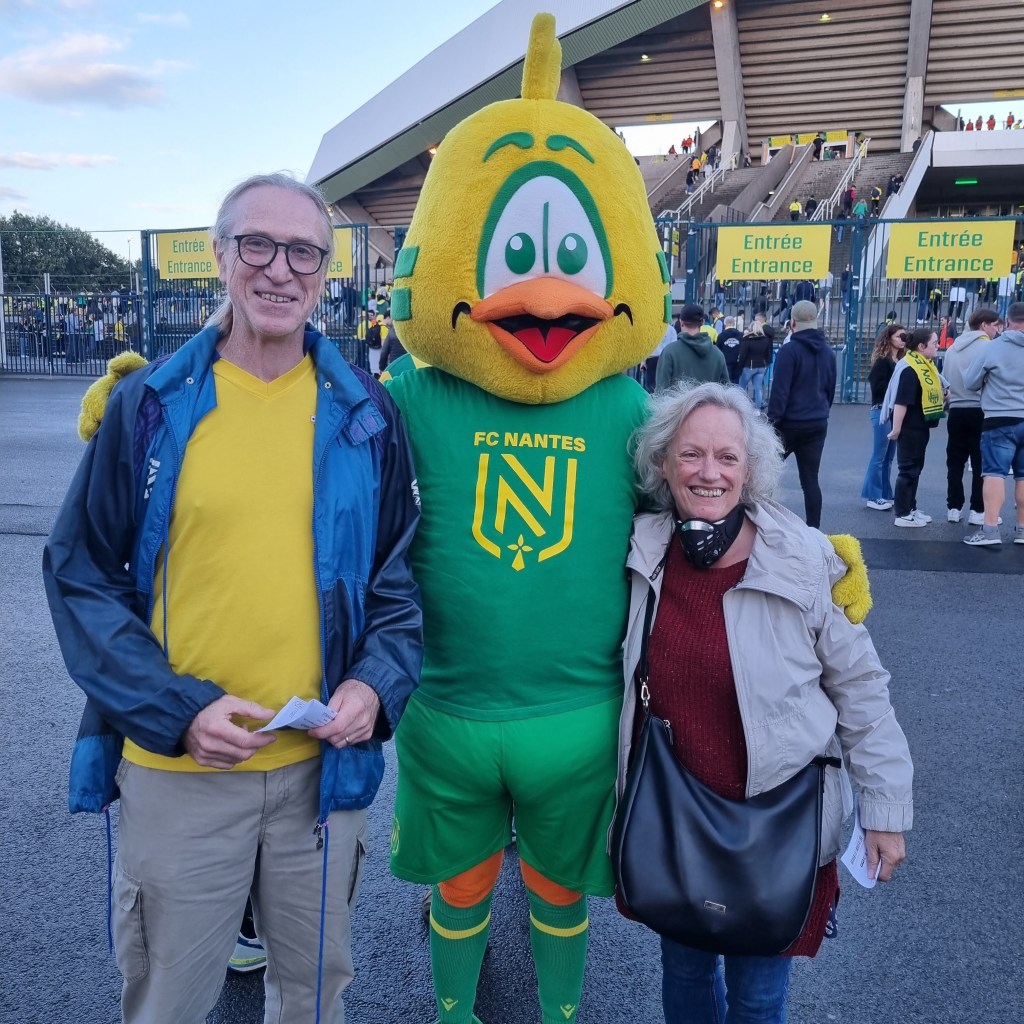
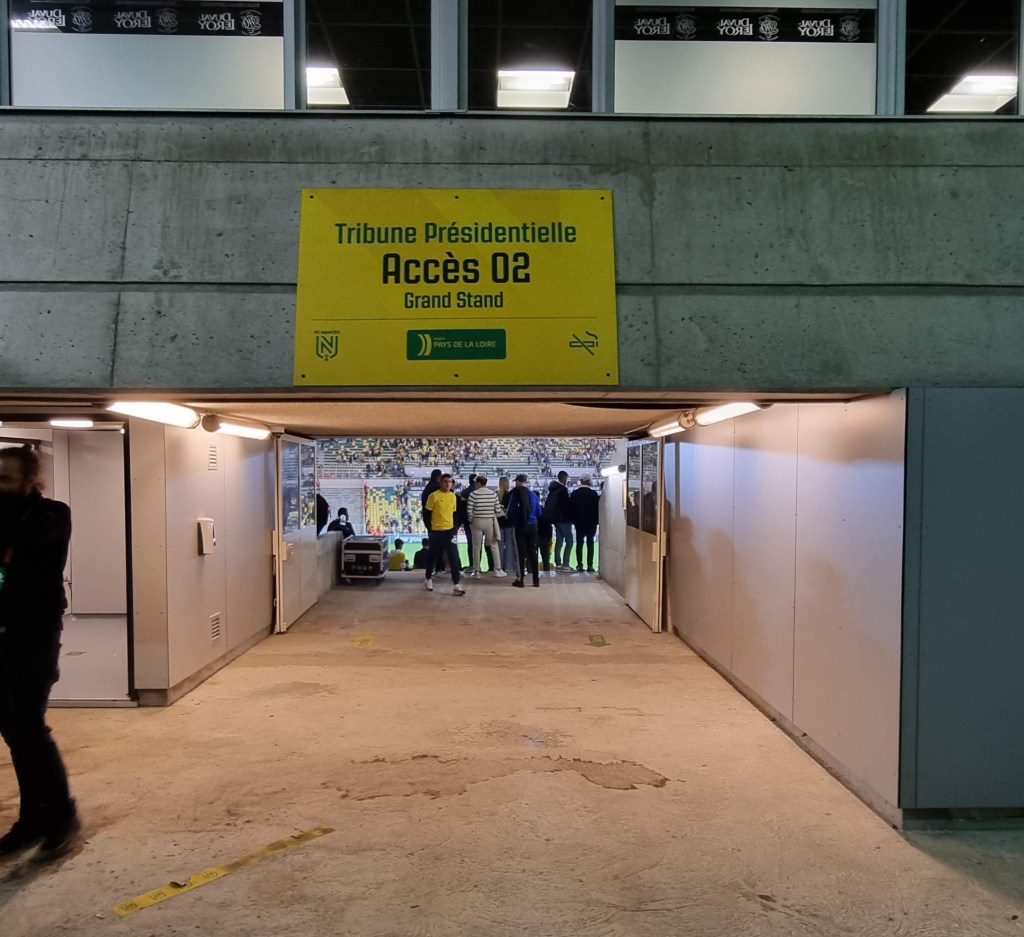
It’s been a warm but cloudy day with an ever-present threat of heavy showers, but thankfully we’ve avoided those and as had happened a week ago at Rennes, I had been in the club shop adding to my collection of petits fanions (pennants) and fridge magnets when the heavens had opened.  Now, at a bit after seven-thirty we queue to be patted down before entering the stadium.  I can’t help feeling that the security guy checking me out has decided I don’t look much of a threat and having tapped me about the arms a bit he looks bored and lets me through; it’s either that or my excited smile made him think I might enjoy a more thorough search a bit too much.  Either way, he wishes me ‘bon match’ and Paulene and I head for Access 02 of the Tribune Presidentielle, but not before we have met Riri the Nantes club mascot.  Nantes play in all yellow and are known as the Canaries, so as an Ipswich Town supporter it requires mental strength to be photographed with their mascot, but overcome with the spirit of liberte, egalite and fraternite I throw myself into the occasion and feel all the better for it.  But I am protected by my yellow 1970’s Town away shirt.

Like most of the bigger stadiums in France, Stade Beaujoire is a genuine piece of architecture, not just a feat of engineering, a box or a collection of individual stands clad in sheet metal.  Set into a gentle slope, its undulating roof arching above the two-tiered lateral stands and the two single tier ends, Beaujoire is an elegant essay in concrete and steel which seems bigger inside than out.  Our seats are at the side of the pitch but behind the goal line, nevertheless the view is excellent, aided by the stadium’s bowl-shaped floor plan.

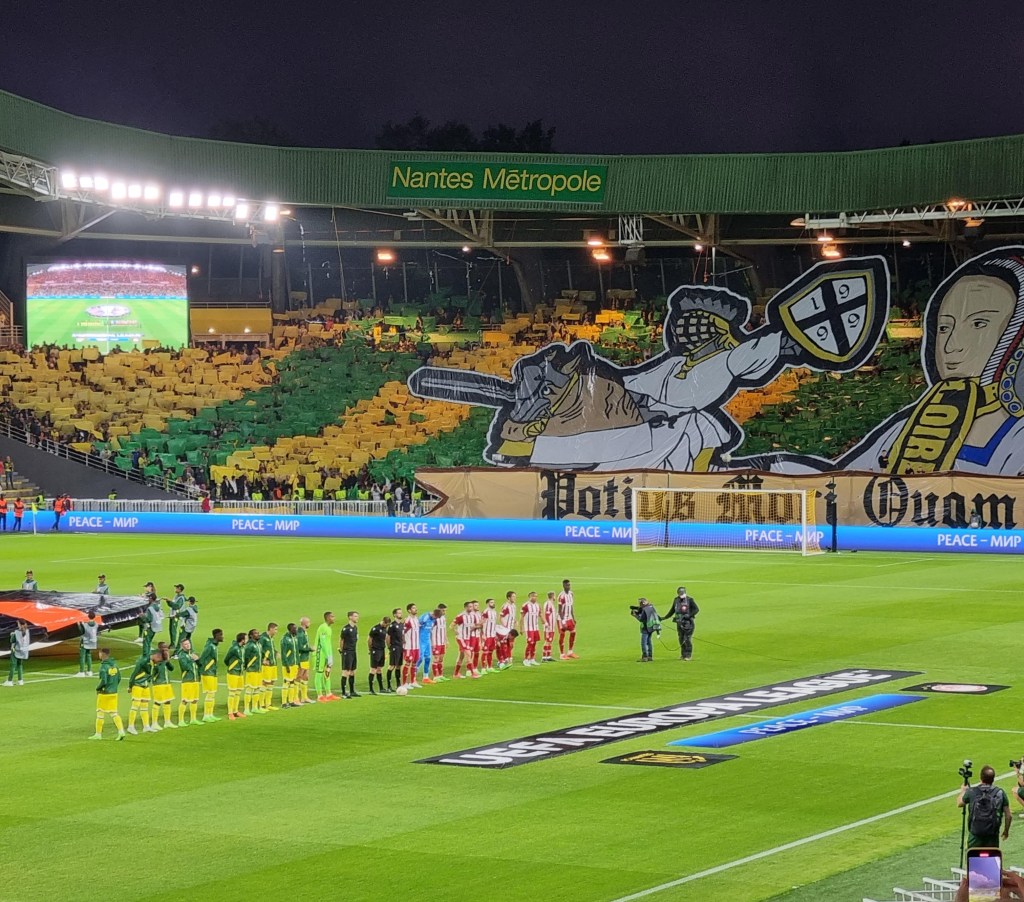
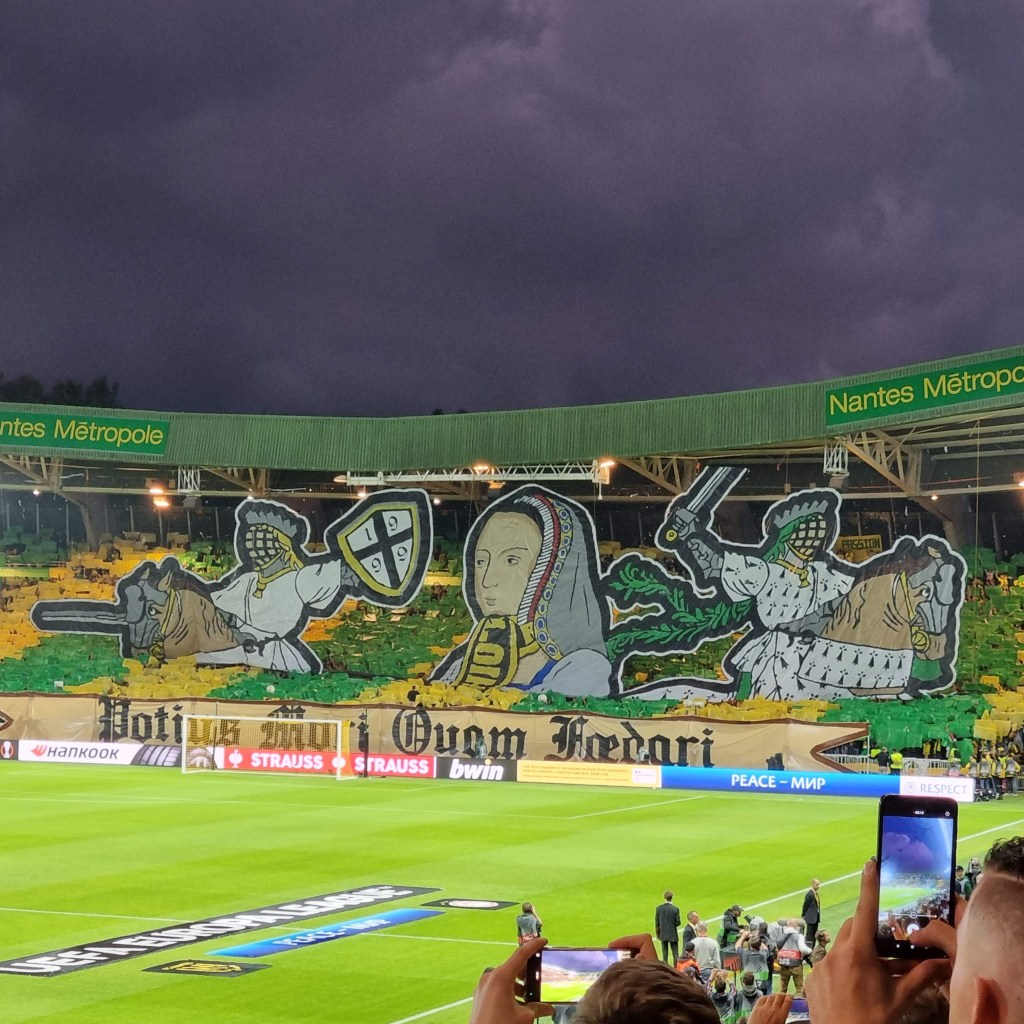
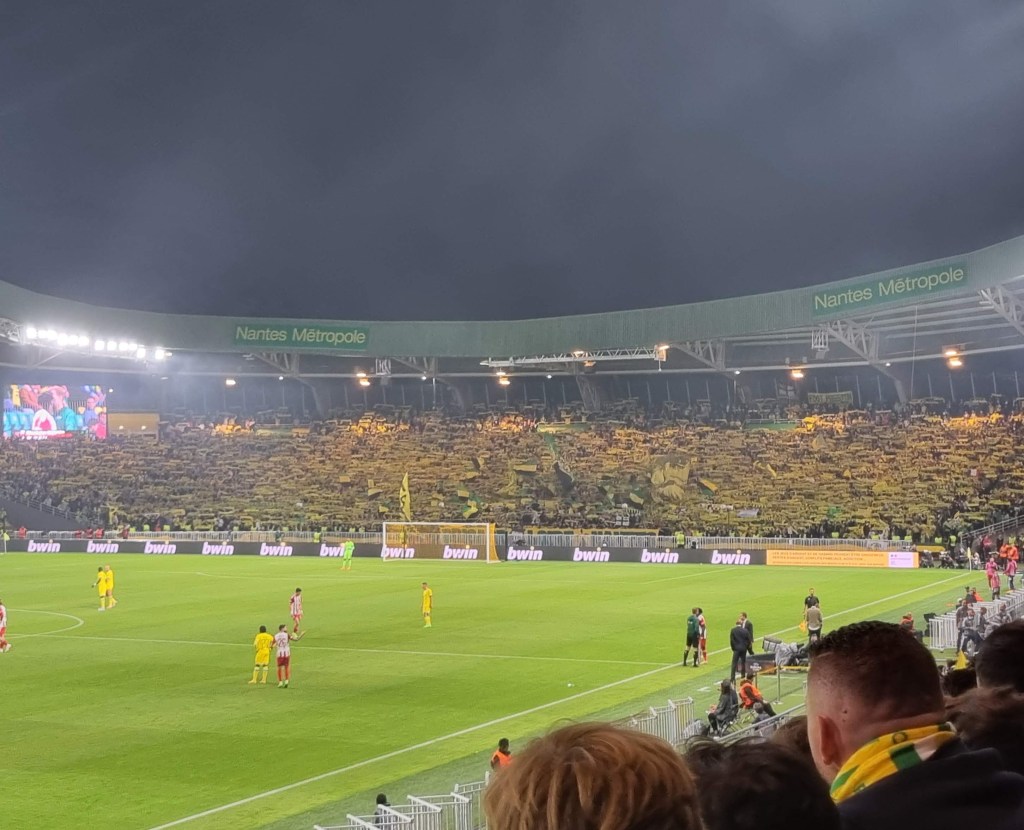
People get to big matches early in France and make use of the many stalls providing food and drink that surround the stadium.  Equally, the stadium is full before the nine o’clock Coupe d’envoi (kick-off) and with good reason because the prelude to the match includes a stirring anthem, which supporters sing whilst twirling their scarves a la Leeds United fans of the 1970’s; I had wondered, given that it is a warm September evening, why the club shop was doing such a roaring trade in scarves.  Most impressive however, and possibly the most impressive thing I have ever seen at a football match is the raising of a huge tifo at the Tribune Loire end of the ground depicting Anne the fifteenth century Duchess of Britanny (a local heroine for resisting Brittany’s annexation by France) wearing a Nantes scarf and flanked by a pair of jousting knights. Beneath the tifo in Gothic script and in Latin it reads “It is better to die than to be disgraced”, which seems to be going a bit far, even for a Europa League fixture.

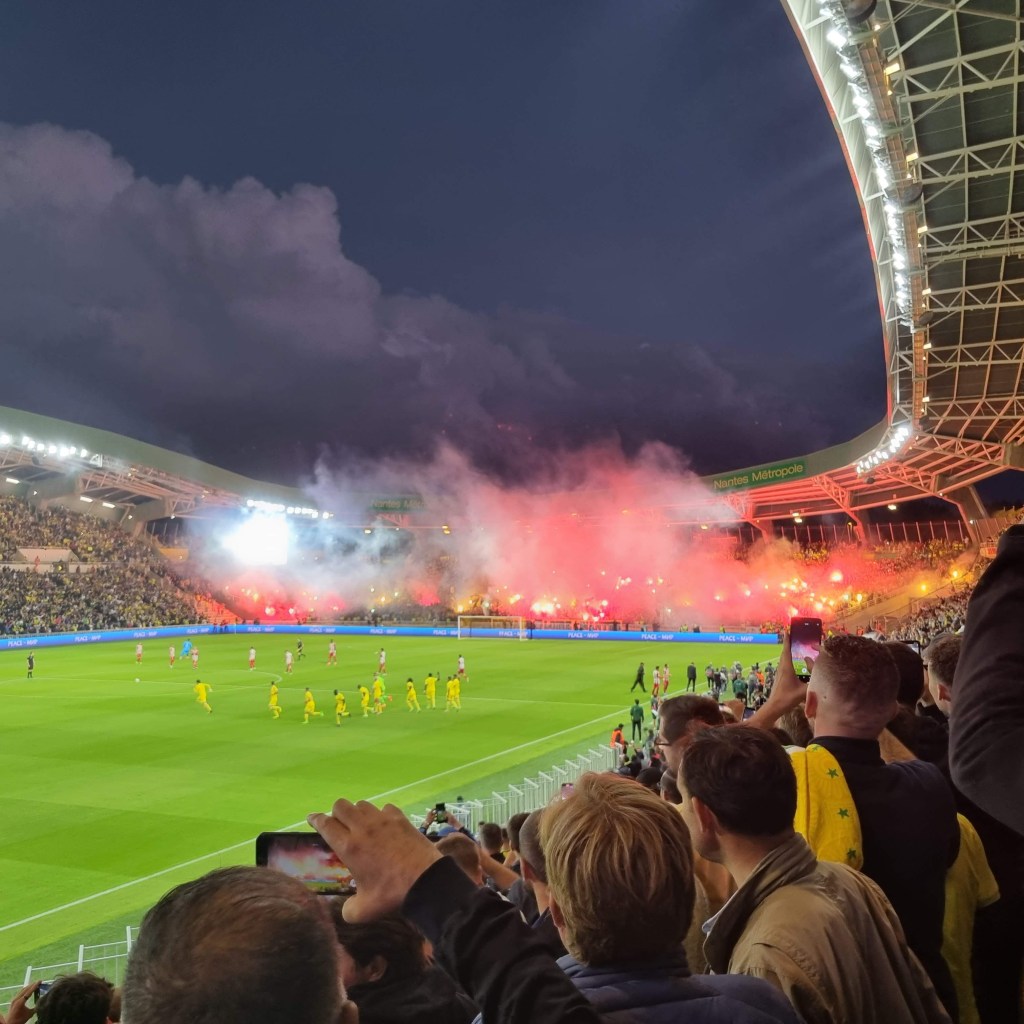
Less than an hour before kick-off the death of Queen Elizabeth II had been announced and most of the ground observes a minutes’ silence, although at the Tribune Loire end of the stadium there was never any likelihood of this happening given the levels of excitement, as witnessed by the ceaseless noise, flag waving and glow of flares.  I am sure many would say “Bloody French ‘ooligans”, but I don’t.

As the match begins it is Nantes who get first go with ball, aiming it at the goal through the drifting smoke at the Tribune Loire end of the stadium. Nantes are in all yellow whilst Olimpiakos wear red and white striped shirts with red shorts and socks. “Lo-lo, lo-lo-lo, lo-lo, Allez les Jaunes” (Come On  Yellows) sings the crowd and then the Tribune Loire calls out “Allez Nantaises” and the Tribune Erdes at the far end of the ground echoes the shout.  Nantes have started at a fast pace and with the first promising looking attack it seems that everyone in the ground but for the couple of hundred Olimpiakos fans, is up on their feet and bawling encouragement.  Everywhere is just noise, it is absolutely thrilling. “Allez, Allez, Allez” rings out to the tune of The Beatles’ Yellow Submarine.

On the field, Nantes are in truth struggling to get through the Greek defence.  In midfield Pedro Chirivalla is busy, but most attacks go through Ludovic Blas and Evann Guessand on the right, although the tactic of getting crosses into the lone forward Mustapha Mohamed isn’t coming close to creating a goal, only corners. Blas is set up twice, only to blast the ball hopelessly high and wide. Whilst the football isn’t always the best, the spectacle however is; but a little over half-way through the first half even the Tribune Loire has started to quieten down just a little. In front of us, a lone drummer with a massive bass drum tries to raise the crowd in the Tribune Erde and Tribune Presidentielle once more; he is wearing a Nantes kit over the top of what looks like silk pyjama bottoms; his face is smeared with green face paint and on his head he is wearing a lurid, long green wig.   Between rhythmic drum beats he claps his hands and sings “Allez Nantes”.  A middle-aged man to our right answers the call with a mad passion which belies his age, but mostly people just clap along almost out of politeness. 

The flame of really noisy support is rekindled however, just before the half-hour Nantes win a free-kick on the right. “Lo-lo, lo-lo-lo, lo-lo, Allez les Jaunes” is the theme once more and although the free-kick comes to nought the momentum is retained and four minutes later Blas’s through ball confounds the Greek defence and Mustapha Mohamed runs on to place the ball coolly and firmly into the far corner of the goal beyond the Olimpiakos goalkeeper Tomas Vaclik.  The roar from the crowd is immense and Nantes lead 1-0.

Only a second Nantes goal can feed the desire of the home crowd, but it is Olimpiakos who now get to have their first shot on goal as a neat passing move ends with an overlap on the right and a shot that goes both high and wide of the Nantes goal from only about 10 metres out.  The be-wigged drummer makes a second tour of the area at the front of the stand, but the first half soon ends, unusually with no additional time being played.

Over half-time Paulene and I stay in our seats whilst many in the crowd drift out to the buvettes for food and drink. We reflect on the first half and agree that this is possibly the most fantastic atmosphere we have ever experienced at a football match and that on tonight’s showing the Nantes supporters are probably even more passionate than those of Marseille or St Etienne.

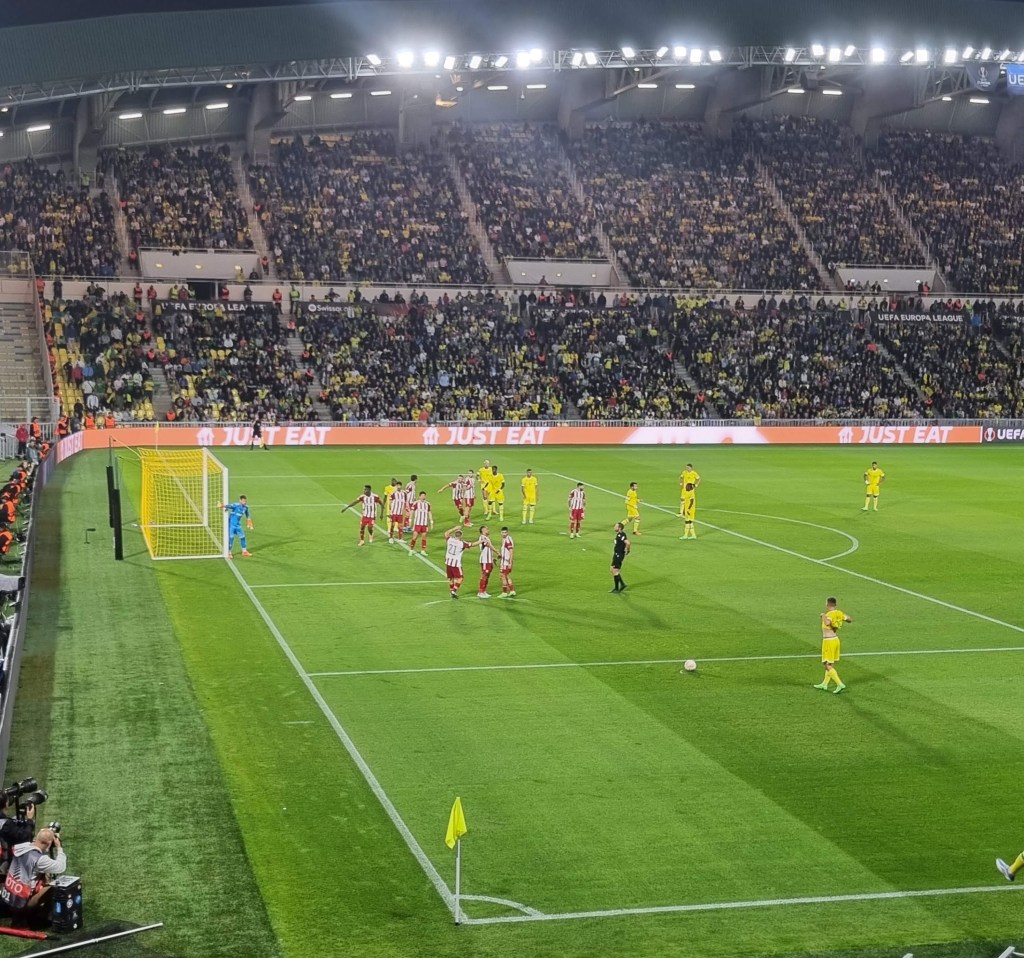
The game resumes at a minute past ten as the moon rises above the Tribune Oceane opposite. “Na-Na-Na, Na-Na-Nantaises” sings the crowd to the tune of The Beatles’ Hey Jude. Olimpiakos appear either to have been given a stiff talking to at half-time or they have simply decided to attack rather than just defend. Five minutes in and the Greeks win their first corner of the match.  The ball arcs across to the far post and Nantes ‘keeper Alban Lafont moves to punch the ball away but completely misses it, instead the ball strikes defender Samuel Moutassamy and drops feebly and apologetically into the goal net.  It is such a poor goal no one seems to believe it, not even the Olimpiakos players who can barely bring themselves to celebrate, making do with a few mutual pats on the back. Over in the corner of the stadium between the Erdre and Oceane Tribunes the travelling supporters are doing more than enough cheering and dancing for everyone.

The Olimpiakos goal gives them a lift and the balance of play evens out in the second half, but Olimpiakos are also much more combative and to prove the point Panagiotis Retsos is the first player to be booked, for a foul on Nantes’ Ignatius Ganago.  From the resultant free-kick on the right, Ludovic Blas is set up for a third time, but he boots his shot hopelessly high and wide again.  With a third of the match gone Nantes win a corner from which Andrei Girotto flashes a header just wide of the goal. Minutes later Olimpiakos win a corner, but Alban Lafont succeeds this time in punching the ball away.

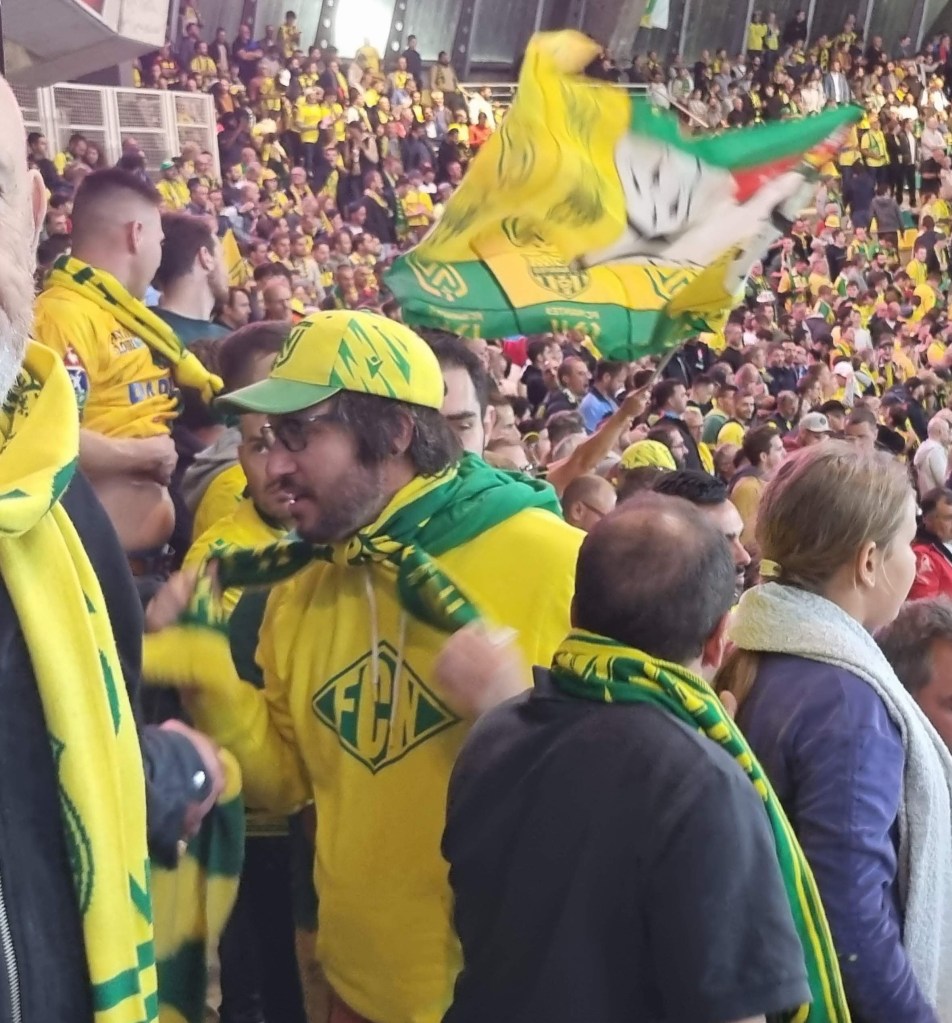
With twenty minutes left, Nantes make a couple of substitutions and quickly win a corner after a cross from Moses Simon, who has replaced Ganago, is met with a header from the other substitute Moussa Sissoko which Vaclik tips over the cross bar. “Nantes Allez, Nantes Allez, Nantes Allez” sing the crowd to the Triumphal March form Verdi’s Aida as they hold their scarves aloft all around the ground, a spectacle sadly no longer seen in England.  The sense of the crowd willing the team to score is palpable, but Nantes are not significantly threatening the Olimpiakos goal.  When Nicolas Pallois strides forward in the eightieth minute to launch a shot from at least 30 metres, which travels a respectably small distance over the bar, it is as if he had simply got fed up with his team-mates’ patient passing and had decided to take matters into his own hands.

A minute after Pallois’ effort, Nantes at last break speedily down their right and the ball is crossed low before being laid back to the incoming Guessand who strikes a spectacular rising shot into the roof of the goal net.  It looks the perfect goal, the sort worthy of winning any match. The Nantes players celebrate wildly as does the whole stadium, with the exception of one tiny quadrant in the corner where the Greek fans sit.  The scoreboard registers the second Nantes goal, and the players walk back to kick-off again, but the Olimpiakos players are whinging to the referee who has a hand to his ear. We wait.  The referee then draws a square in the air and points to patch of grass level with the Olimpiakos penalty box and the scoreboard confirms that VAR says the goal is annulled for an earlier hors-jeu (offside).

The feeling of disappointment subsides surprisingly quickly and soon we are distracted by some pushing and shoving on the touchline. The ball has gone out of play and runs to the Olimpiakos coach who seems to hold it out for Nicolas Pallois to take, but then turns away; Pallois gives him a little shove for his trouble and then anyone nearby joins in with the melee and those further away catch a tram to come and join in.  The referee possibly cautions Pallois and the Olimpiakos coach, but it’s hard to say for sure.  Sadly, it’s the last real action of the half and all hope is to be squashed into four minutes of time added on or the more poetic sounding time additionelle

Additional time begins, two minutes in and Blas and Oleg Reabciuk are both booked after the former fouls the latter and the latter gets upset.   A minute remains of added time; Nantes again attack down the right, Ludovic Blas crosses the ball and the sizeable figure of Evann Guessand  hurls himself at the ball. Spectacularly, Guessand scores with what is arguably the best type of goal, a diving header.  The rest is near mayhem, with Stade de La Beaujoire erupting into scenes of unbridled joy and pride in the team and being Nantoises.  All around me people are just deliriously happy, whilst some have a look on their faces of vindication, as if to say it’s taken nearly twenty years, but Nantes are back like they knew they would be.

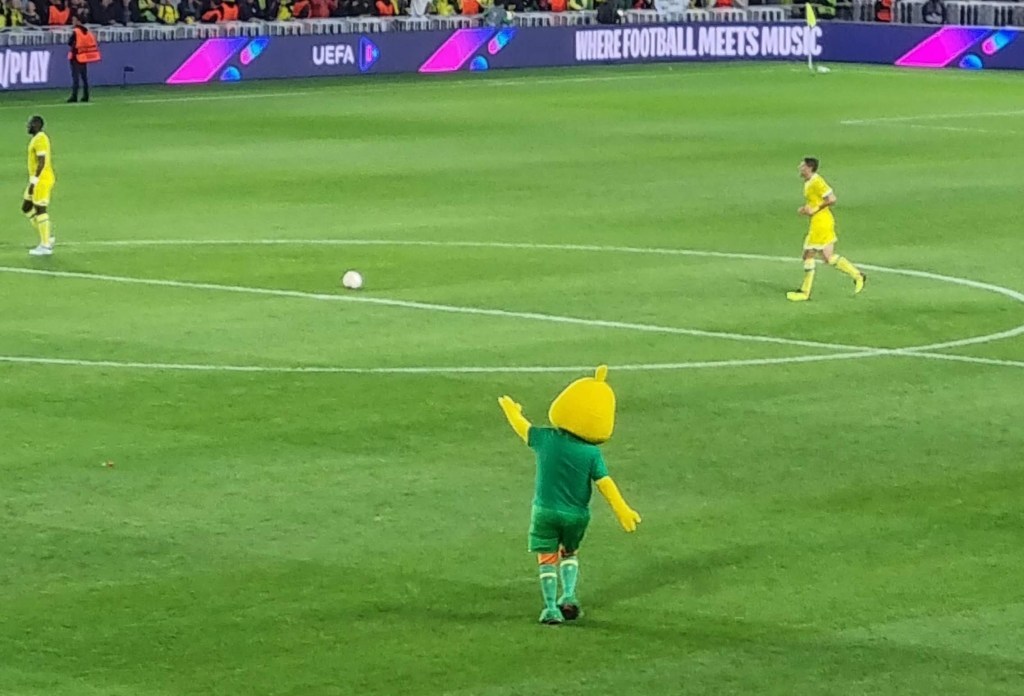
With the final whistle no one wants to leave. I don’t think I have ever been to a game where so few people, if any, have left before the end. The Nantes players gather in front of the Tribune Loire to salute and commune with the Ultras groups who have ceaselessly chanted, sung, shouted and waved their banners and flags throughout the match.  Riri the canary mascot runs across the pitch arms outstretched as if trying to take off and joins in with the players’ celebrations.  We, along with everyone else, wait for the players to break away from their love-in with the ultras and do a lap of honour to the rest of the stadium. As the players head back towards the tunnel we leave, joining the flood tide of happy, smiling people.  This has been a truly fantastic night.
FC Lorient 3 FC Nantes 2

To Ipswich Town supporters like me, FC Lorient is known as the club from which the Town bought Ulrich Le Pen, a slight winger who was injured just minutes after coming on in a match against Bolton Wanderers and only ever featured in one other first team game, an FA Cup tie which I can’t remember. To the wider world Lorient is France’s second largest fishing port and home of a French submarine dockyard which grew out of the massive reinforced concrete U-Boat docks built by the Nazis during World War Two.  Sadly for Lorient, the town was mostly flattened by allied bombs as the Nazis were pushed out of France in 1944 and whilst the re-built town is well laid out with buildings in a quiet, modernist style, it doesn’t have the architectural verve of Le Havre or Amiens, or even, come to that of Plymouth and Bristol.

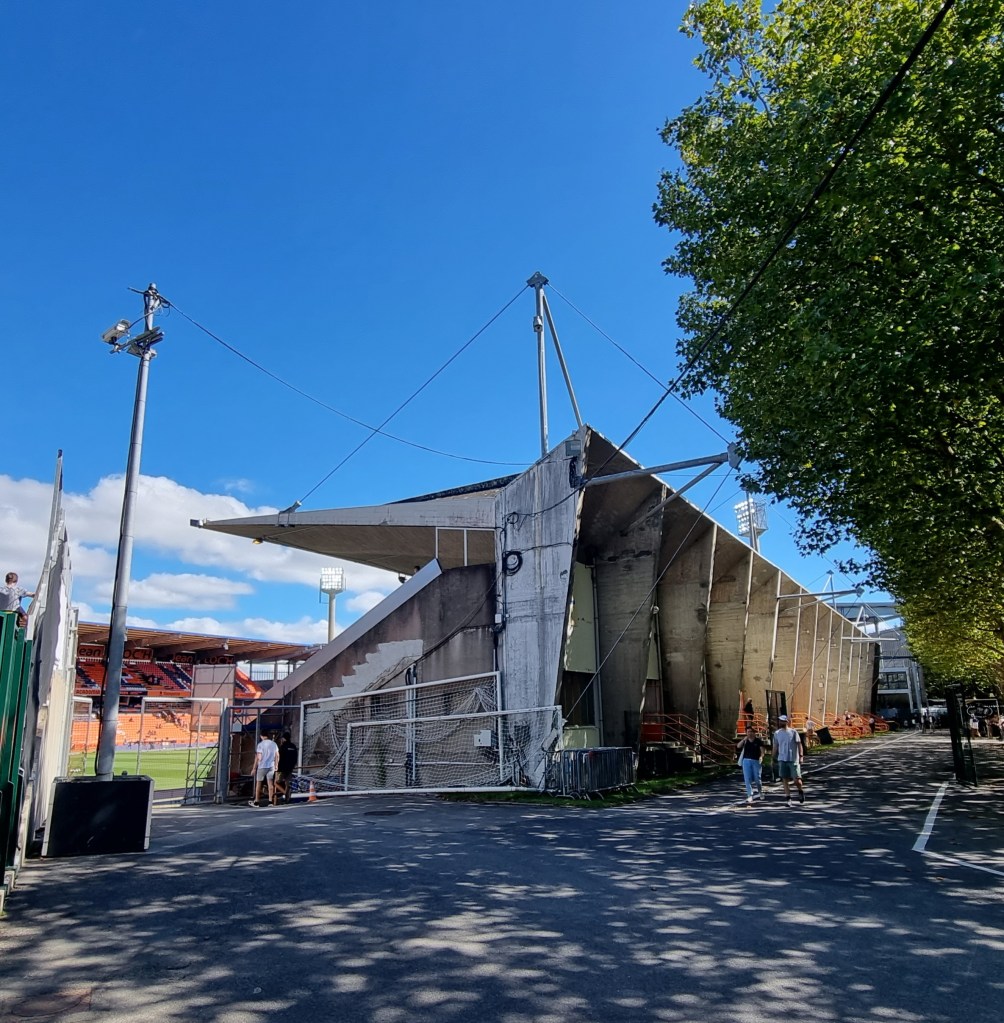
Today however FC Lorient host their Breton neighbours from 170 kilometres away (1hour and 51 minutes up the E60 according to Google maps) FC Nantes, but my wife Paulene and I have travelled a mere 40 kilometres from the campsite where we are staying in Carnac.  Car parking in Lorient on a Sunday is a curious affair as most of the town centre car parks are closed as is much of the town centre itself, including the tourist information office. There is plenty of street parking however with the usual restrictions being suspended. The Stade du Moustoir, home of FC Lorient is in an eminently sensible town centre location much like Ipswich’s Portman Road, and it is somewhat remarkably within 50 metres of the Hotel de Ville (town hall) and just a short walk from the main shopping streets, railway and bus stations.  The purpose in closing the car parks would seem to be to make people travel responsibly by bus, train, bike or on foot, although some parking can be pre-booked by those signing up to a car sharing scheme.

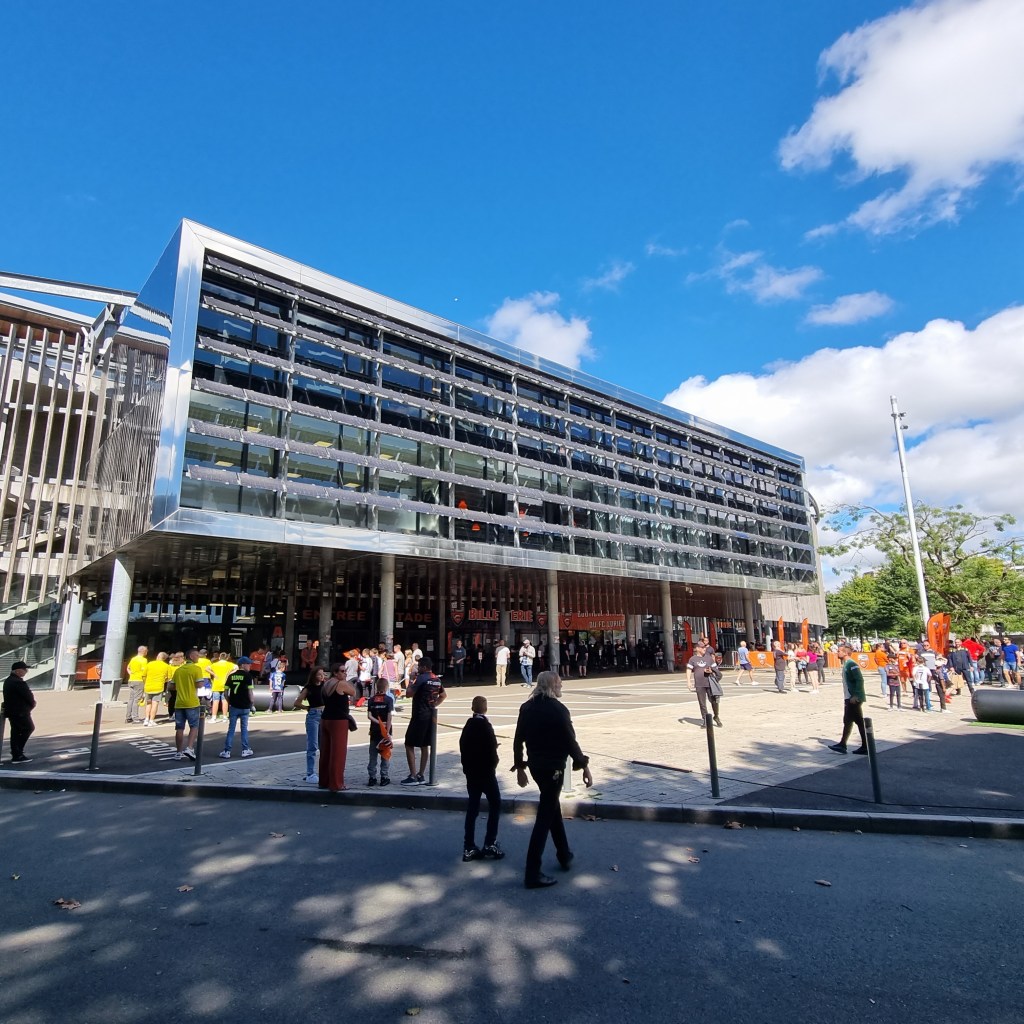
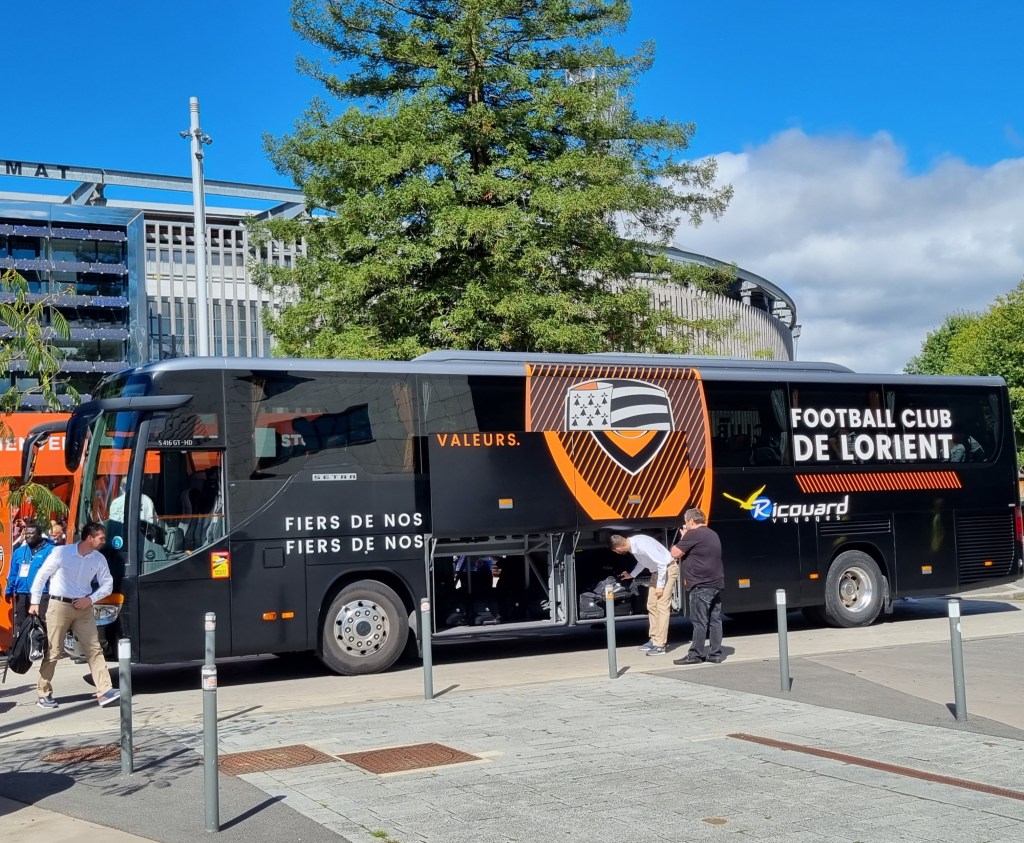
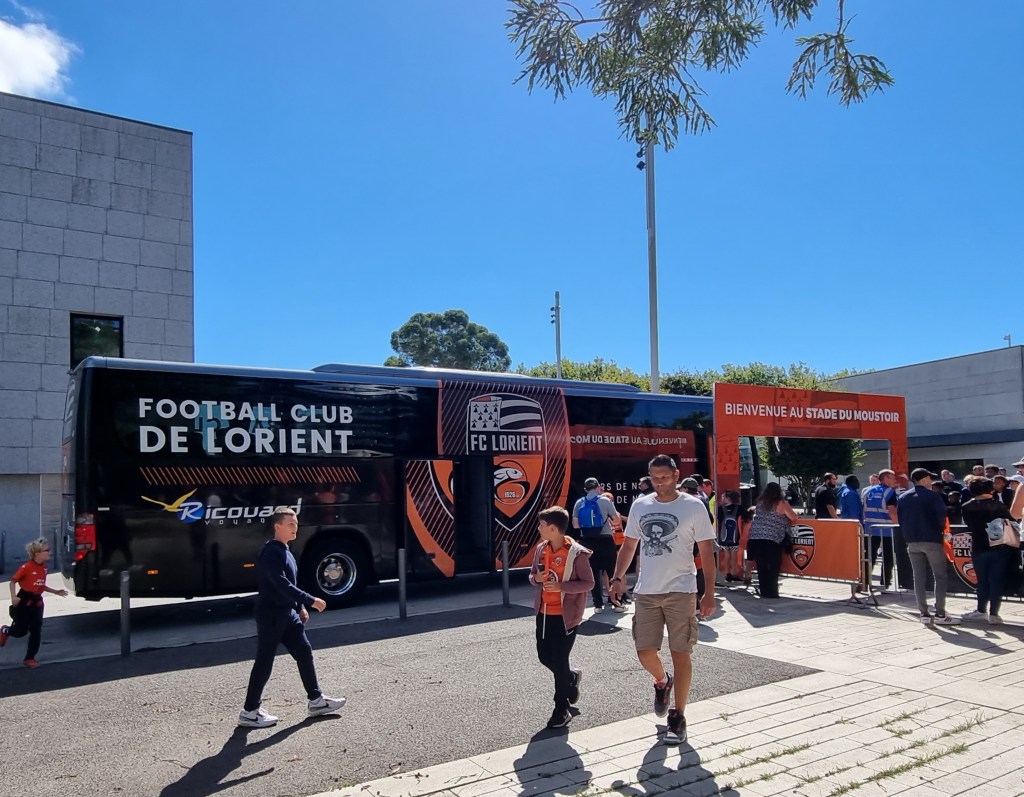
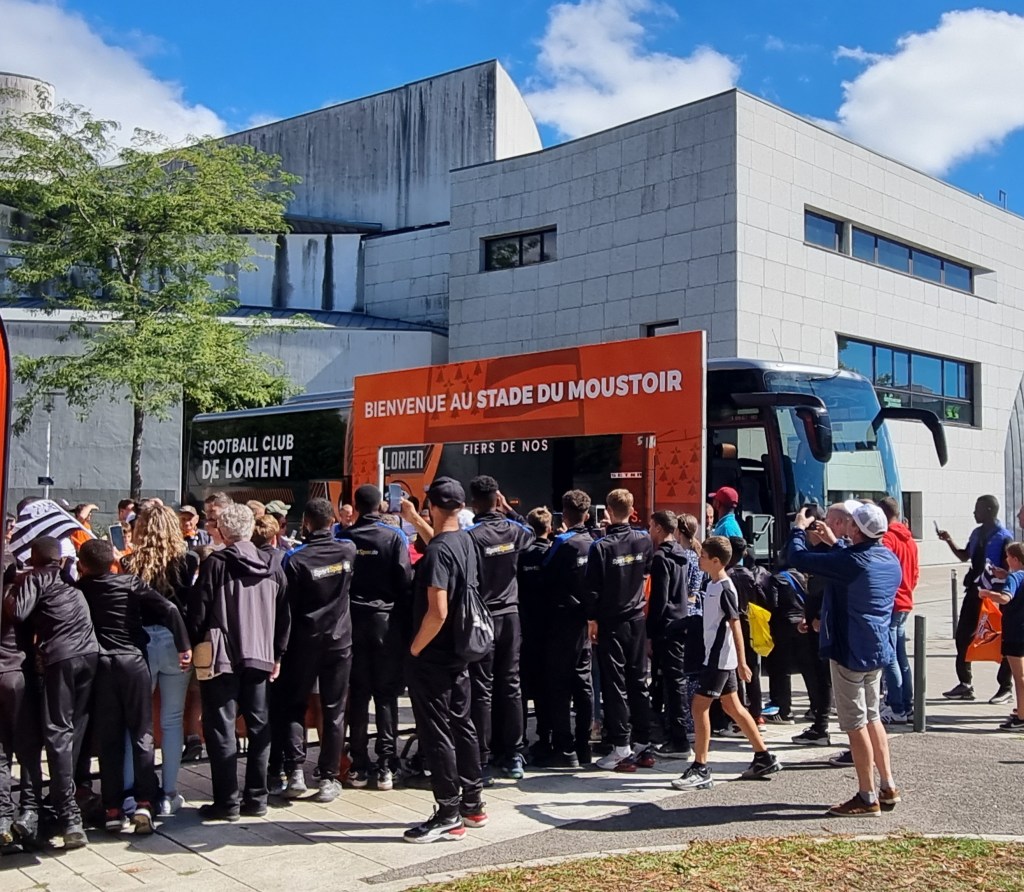
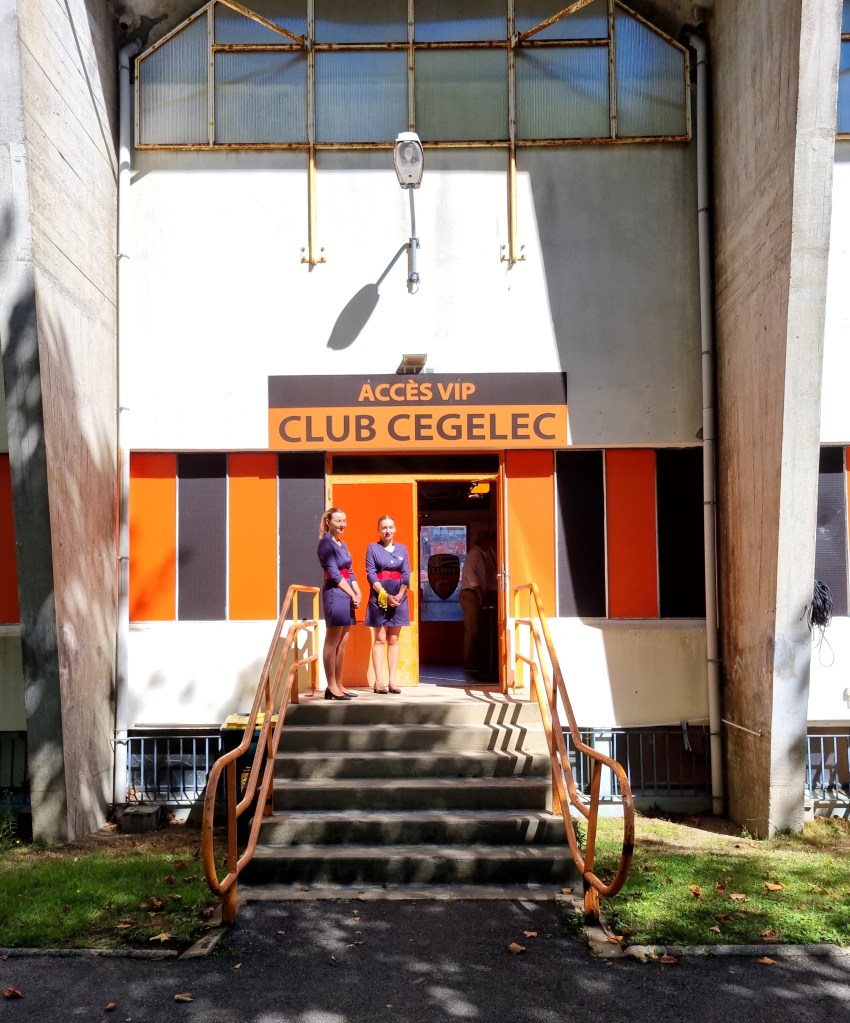
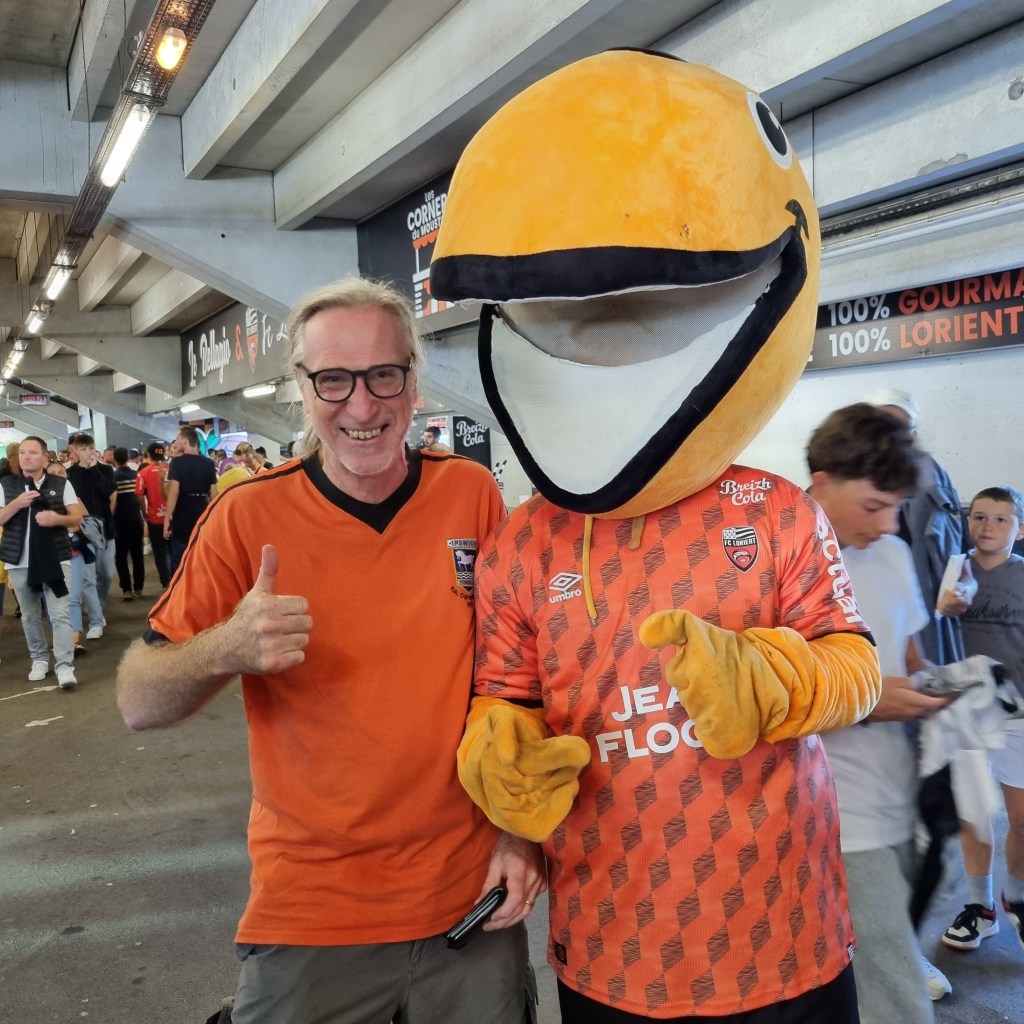
Paulene and I have arrived in Lorient in plenty of time to nab a handy street parking place.  Our short walk to the Stade de Moustoir affords a sneak preview of the stadium with the already illuminated floodlights being visible between the gaps between the buildings in nearby streets.  Near the railway station a bar has been requisitioned by visiting Nantes fans; a group of police stand a discreet distance away but there is no hint of any bad behaviour and we see many Nantes and Lorient fans walking to the stadium together.  Reaching the stadium early, we are in time to see the home team alight from their team bus wearing their horizontally striped, Breton-style jumpers or training tops. A crowd are waiting to see the players arrive and a ‘welcome arch’ has been erected as the gateway from the bus into the stadium.  The frontage of the Stade de Moustoir is clad with vertical strips of timber and looks every bit like a modern office or block of flats.  Whilst outside the ground, I get my first glimpse of the unusual club mascot, Merlux le Merlu (pretty much ‘Hakey the Hake’ in English) as he welcomes the players off the bus.

With the team in the stadium, the turnstiles open and Paulene and I enter also, but are surprised to be lectured by an officious man who tells us that we cannot take a bottle of water into the stadium, although he can exercise discretion with regard to Paulene’s bag.  Paulene had had an asthma attack as we approached the stadium and the very kind security man on the door at the club shop had arranged to get me a bottle of water for her.  I had returned to the club shop to source vital souvenirs of our visit but found that some of the items I might buy such as a mug or cuddly hake would, like the bottle of water, not be permitted in the ground.  Had I seen the e-mail the club sent me this morning I would have known that the LFP (French football league) had banned the carrying of virtually anything into football grounds this season, presumably in response to Marseille’s Dimitri Payet (known by me as the Very Hungry Caterpillar due to his ‘haircut’) getting hit on the head by a plastic bottle at Lyon last season as he went to take a corner.

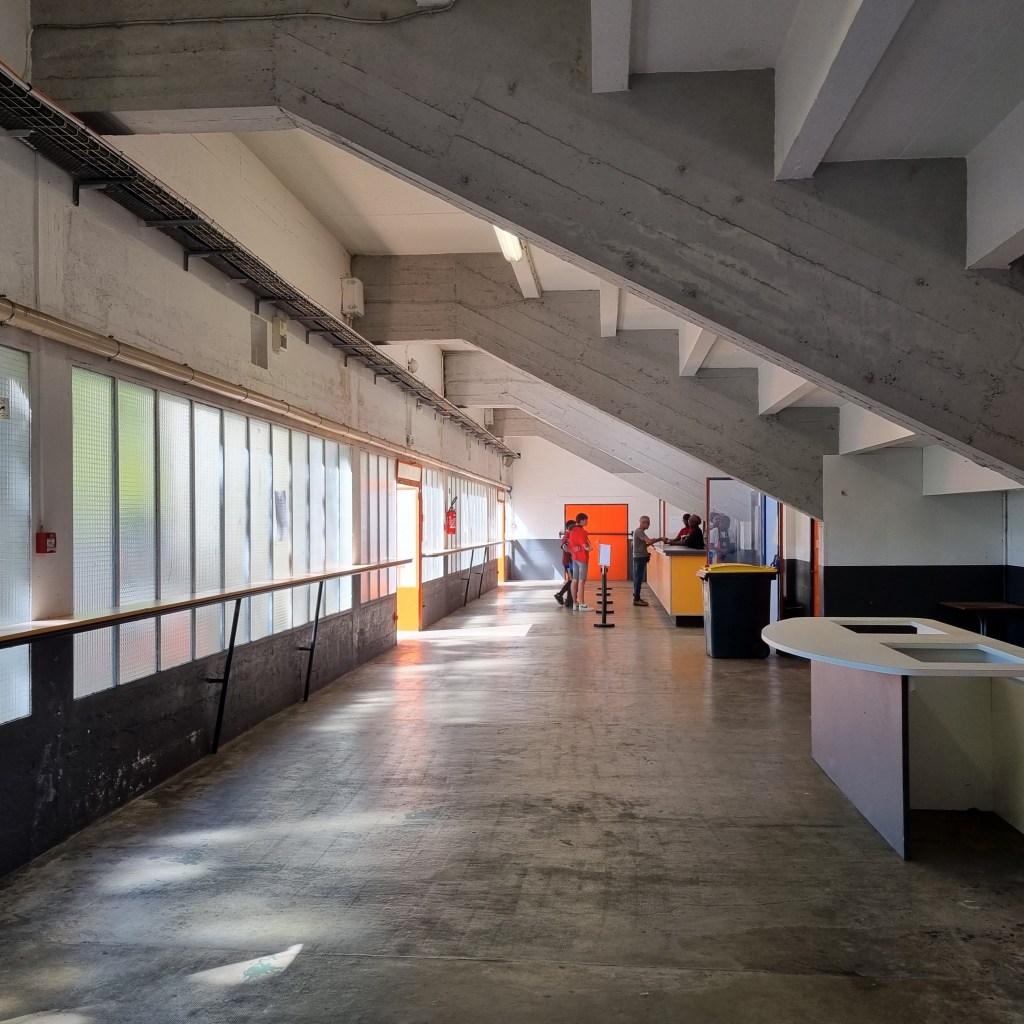
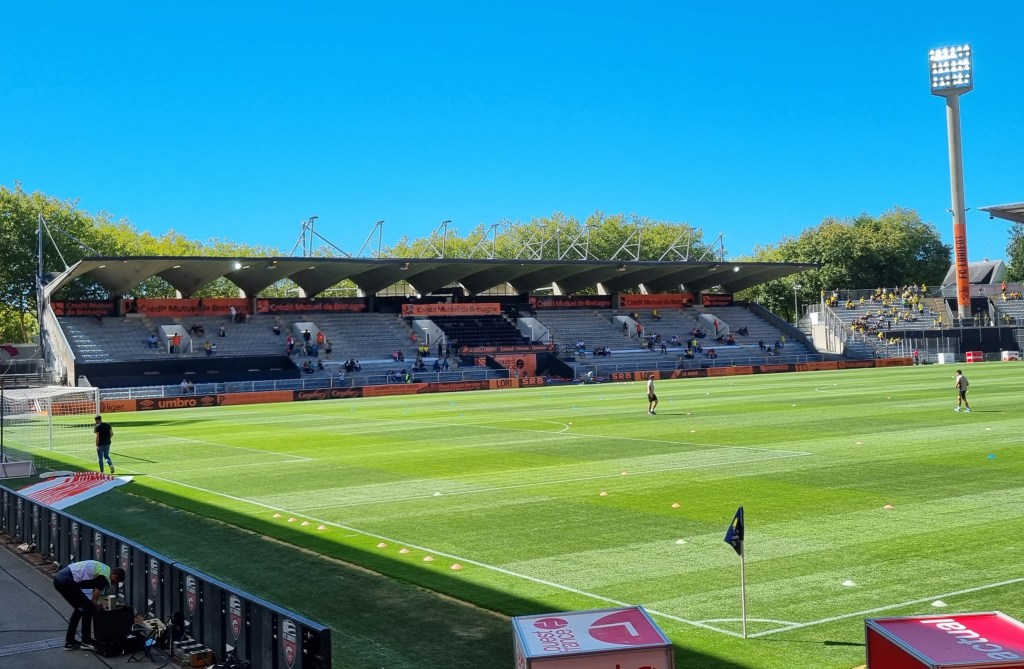
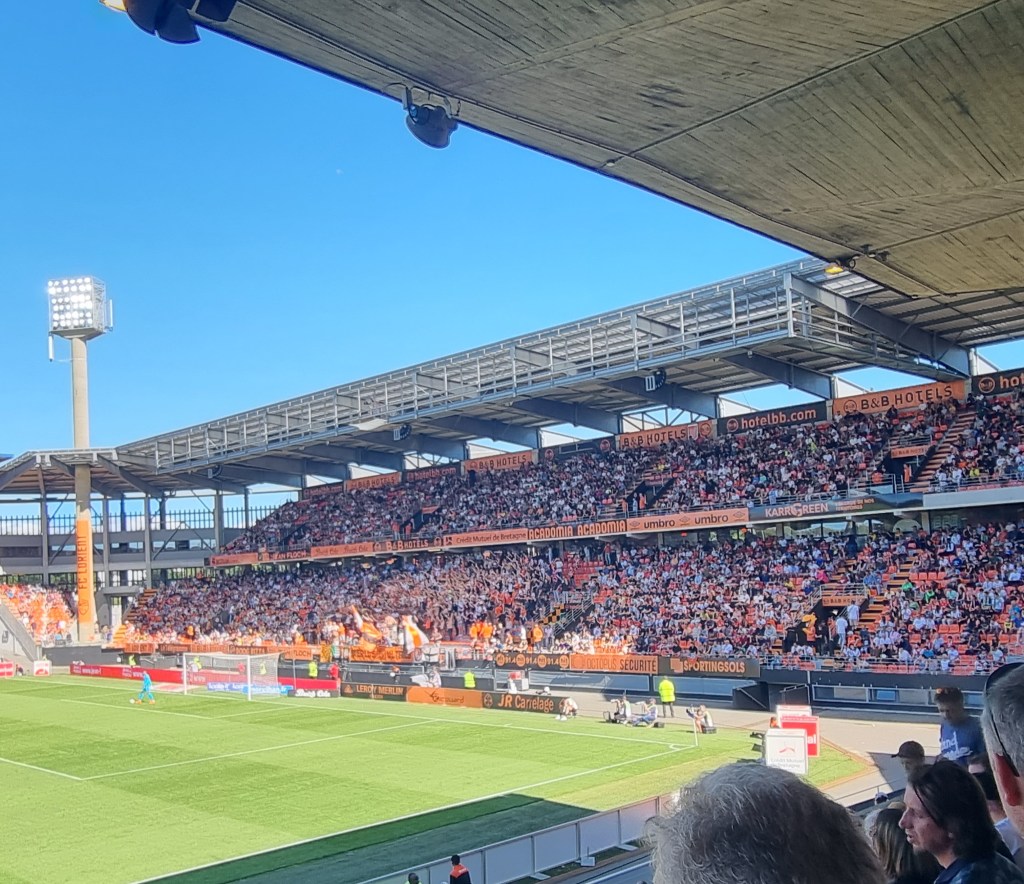
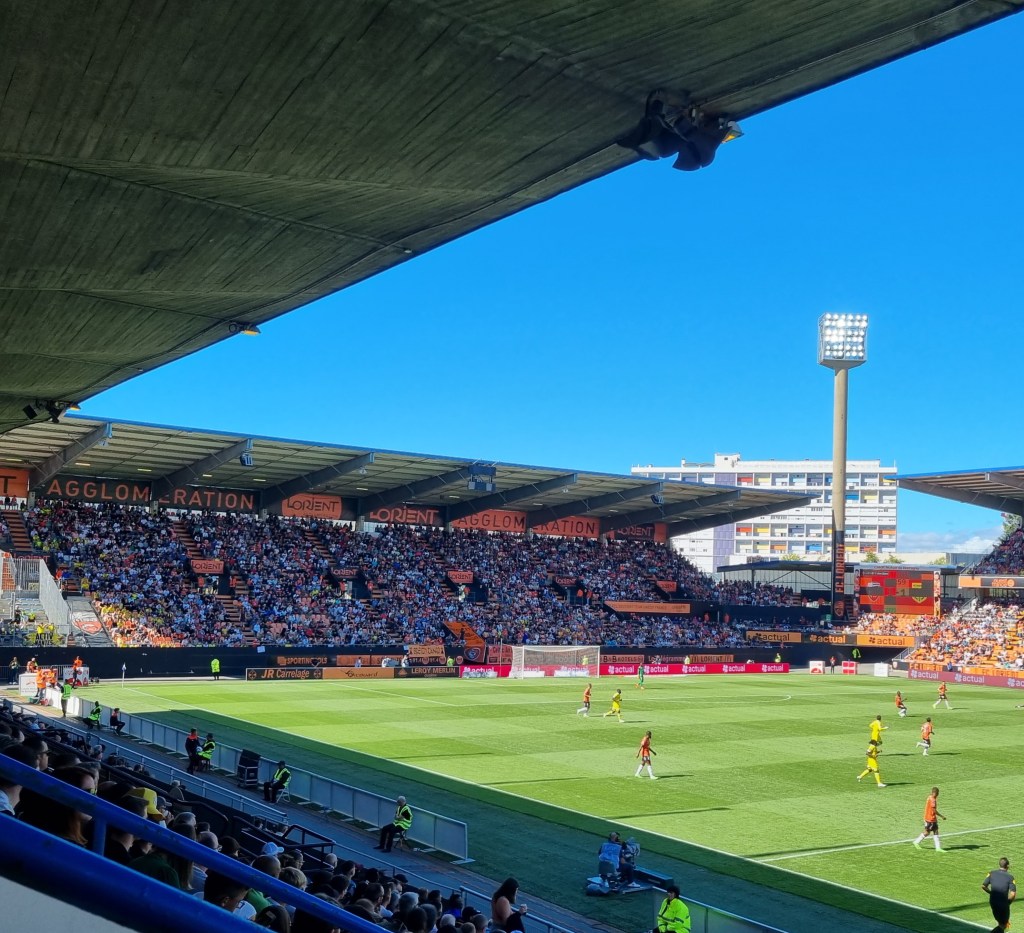
Having located our seats (20 euros each) in the Tribune Credit Mutuelle de Bretagne, a quite small single tier stand with a fabulous shuttered concrete roof and light steel and glass doors redolent of a 1950’s school hall, I set off to explore and perhaps look for beer.  I am quickly amazed and overjoyed to find that I can walk right the way round this stadium through the concourses of each stand. Behind the goal, the stand has access to the club shop which is now shut to the outside world.  The concourses are regularly punctuated with a variety of food and drink outlets and the club markets these as Les Corners du Moustoir.  Having passed by the Tavarn Lancelot, I stop at the Tavarn Morgana for an organic beer called Lancelot IPA (4 euros 50), brewed by the Breton Lancelot brewery. I mainly choose this beer so that I can pronounce Lancelot with a French accent (Lon-slow), something that has never failed to amuse me ever since seeing director Robert Bresson’s film Lancelot du Lac on BBC2’s Film International one Saturday night back in the 1970’s. Having consumed my beer, I return to my seat clutching two free eight-page match programmes and a Breton flag; there were piles of them on the floor beneath the programmes with a sign urging me and everyone else to take one.

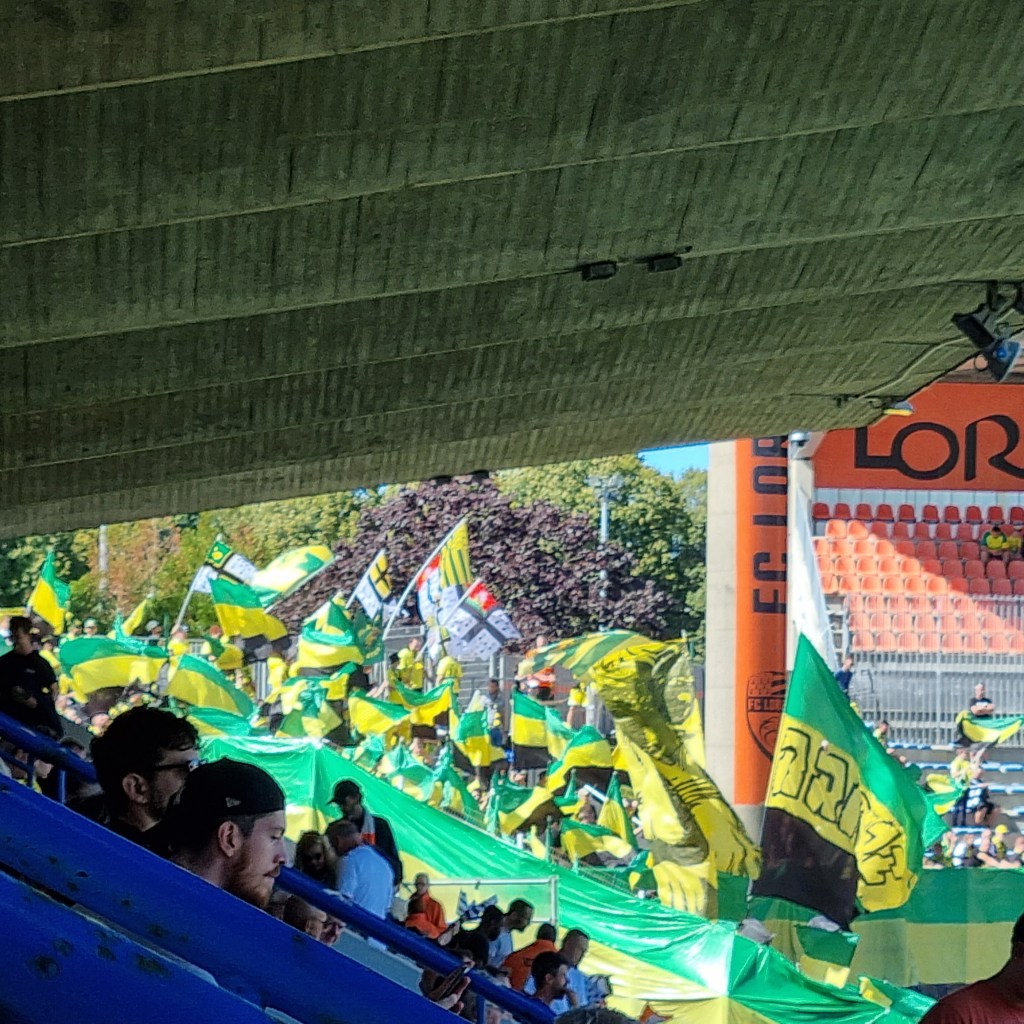
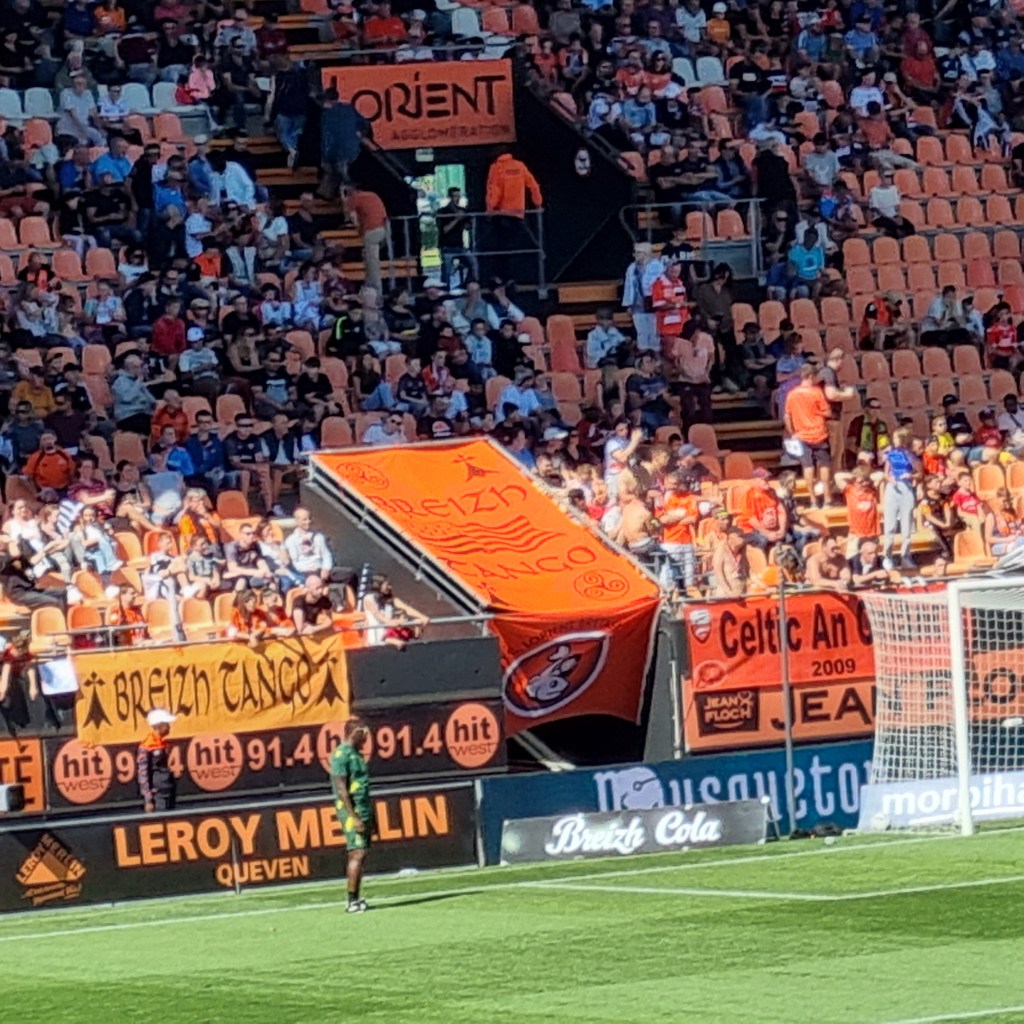
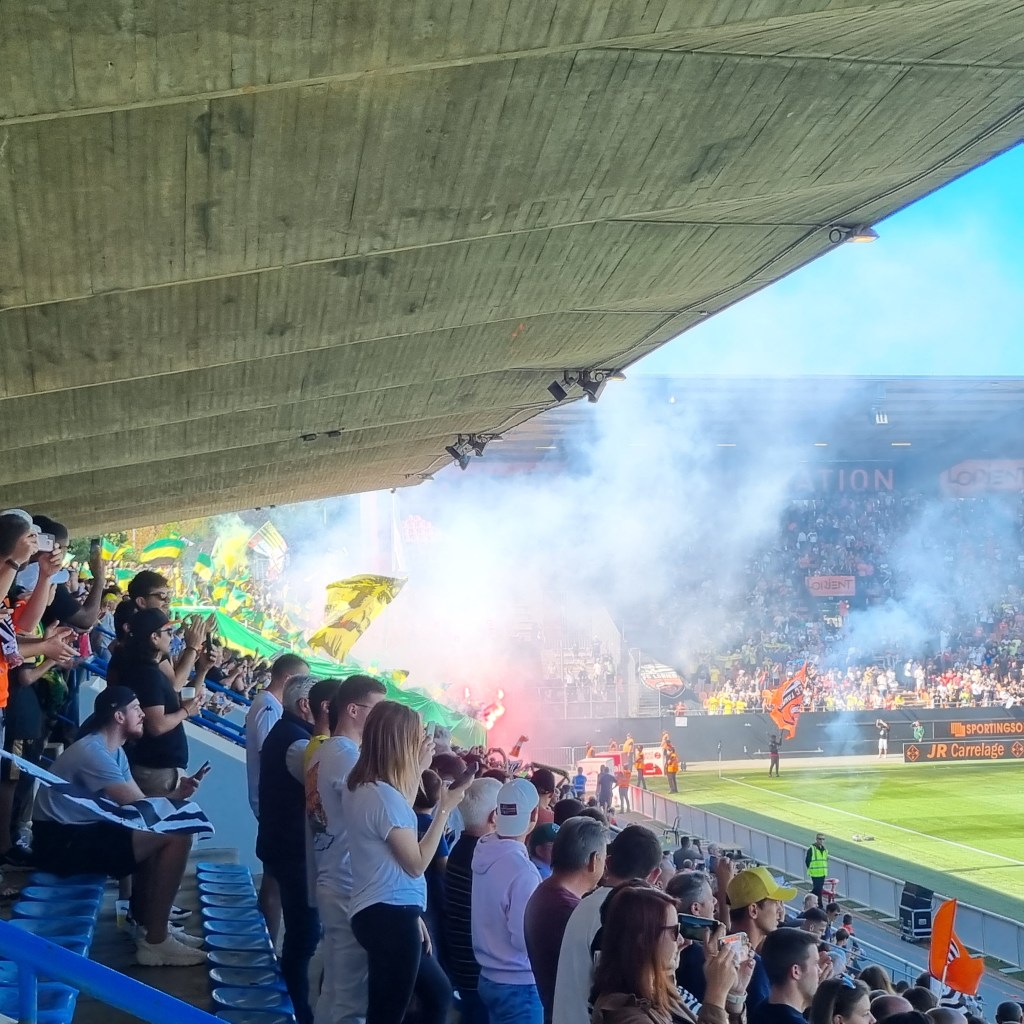
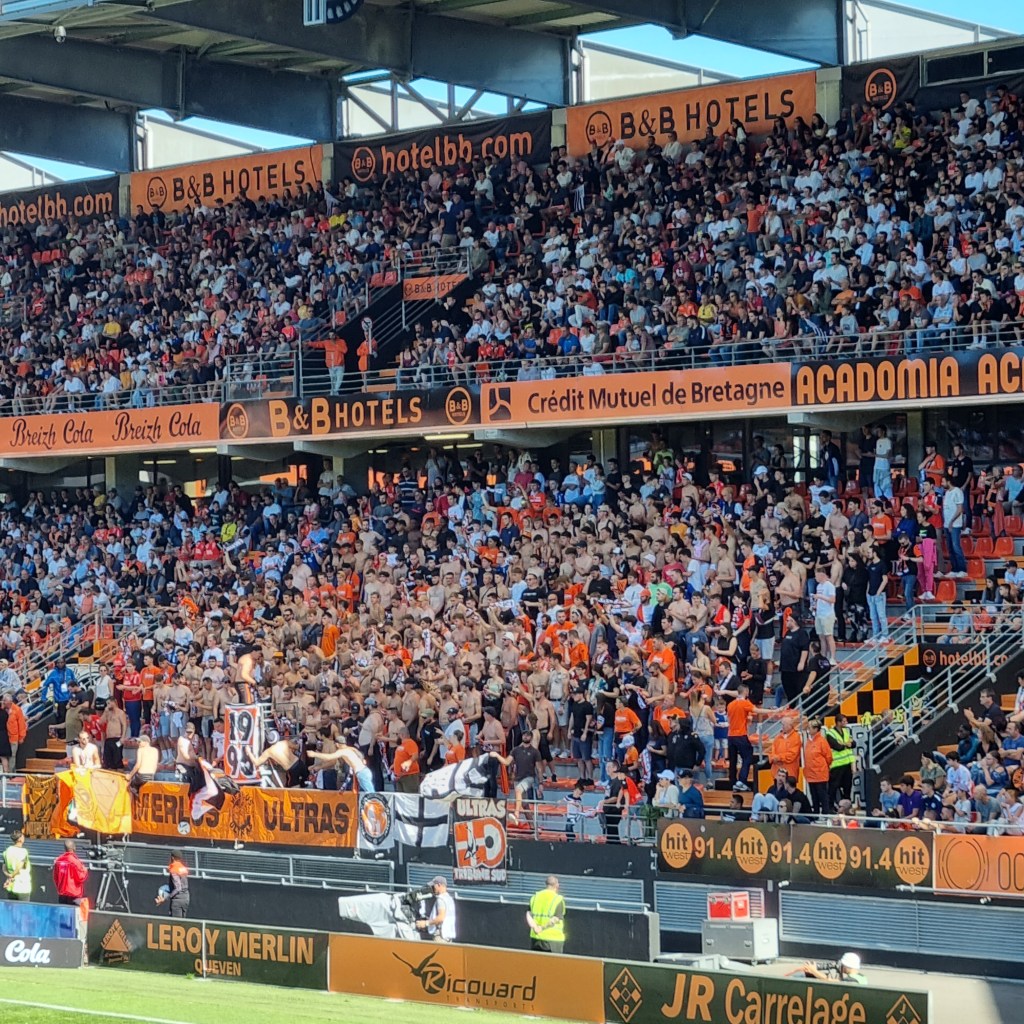
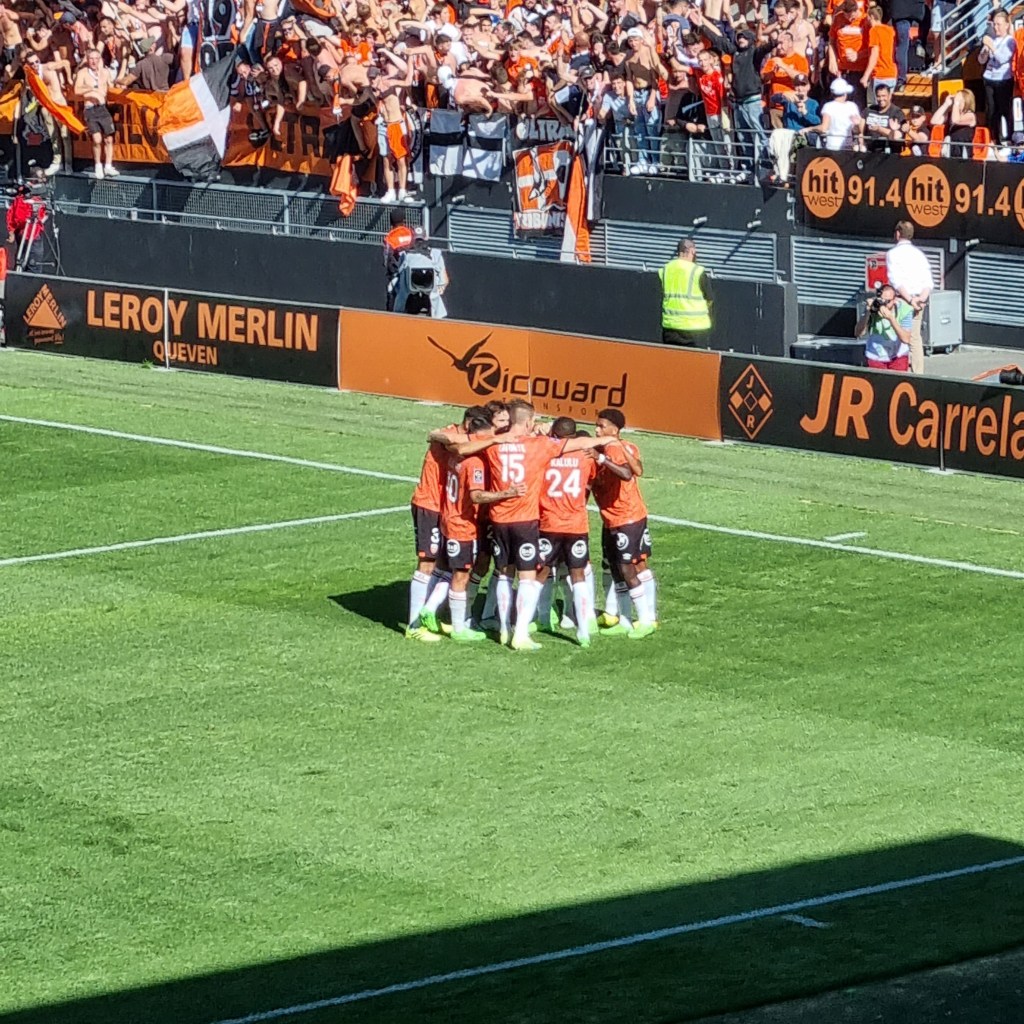
At a quarter to three a ship’s siren sounds three times and the scoreboard tells us there are fifteen minutes to go until Coup d’envoi (kick-off); the build up to the match begins.  As an opening act in the pre-match ritual an enthusiastic woman strides about the pitch in front of the main stand and sings the Breton anthem, whilst the whole crowd wave their Breton flags and club banners in a show of regional, celtic pride.  On the fabulously named Tribune B&B Hotels (B&B Hotels Stand), where the central section of the lower tier is occupied by the loudest Lorient ultras, an orange and black tifo folds down from the top tier to cover the whole stand. As the teams process onto the pitch to stand before the Ligue 1 banner and club crests, fireworks are set off on the pitch, more banners are waved and the Nantes fans, who fill the away enclosure in the corner between the Tribune Mutuelle de Bretagne and the Tribune Lorient Agglomeration wave a few flares about, making me wonder if they managed to smuggle in any bottles of water too; it’s all rather thrilling.

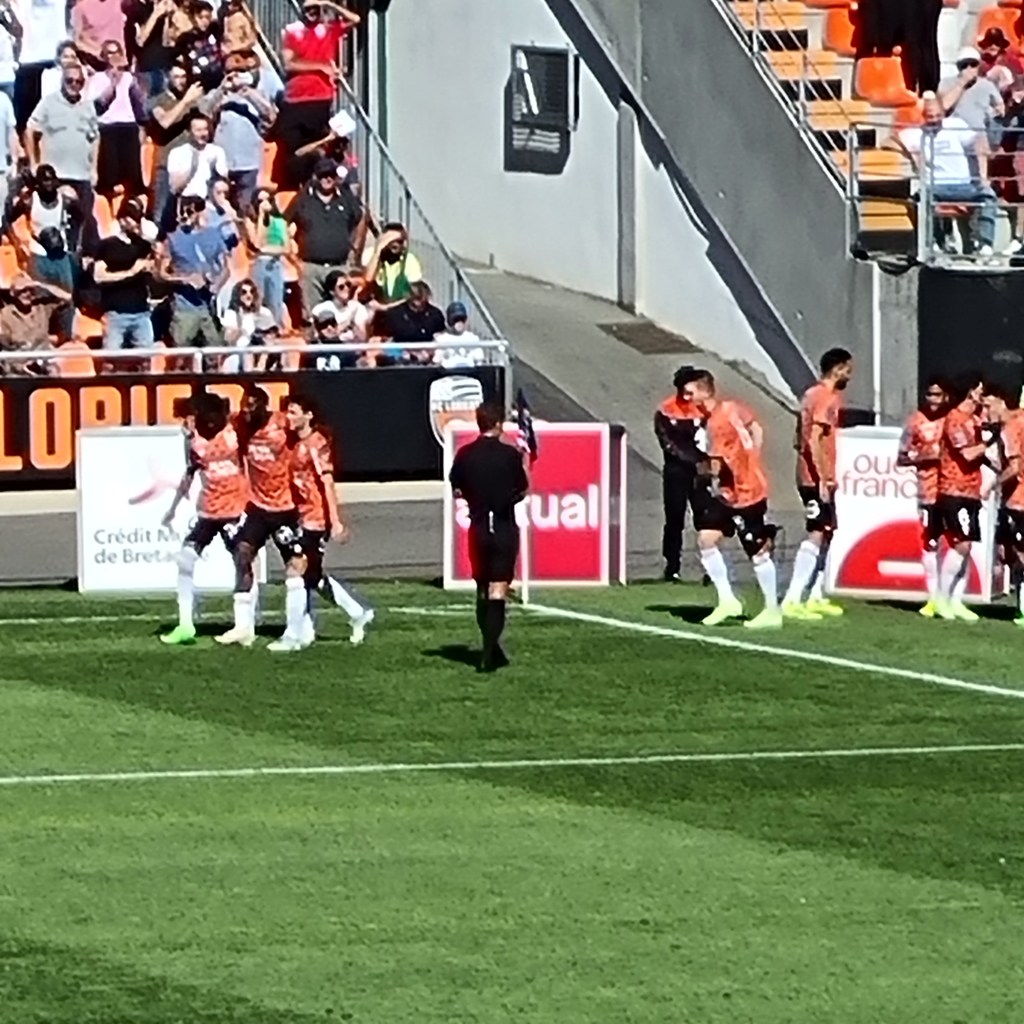
With the pyrotechnics and flags cleared away the game begins with Nantes getting first go with the ball and kicking towards the Tribune B&B hotels.  Nantes are in their signature kit of all yellow, whilst Lorient sport their traditional orange shirts, black shorts and white socks.  The atmosphere inside the stadium is wonderful, it has all the excitement of a ‘local’ derby game, but as well as the Nantes fans in the away enclosure there are plenty of them sitting with the Lorient supporters in all four stands and there are  dads with sons, and dads with daughters, and mums and dads with whole families and every family combination, and then there are the ultras standing on their seats and singing and mostly stripped to the waist showing off their rippling beer bellies. Brittany has its own cola called Breizh Cola, and my favourite name of one of the ultras groups is Breizh Tango.

Nantes start the match better than Lorient who look a little wobbly like a new-born foal or perhaps a young hake. It’s still a bit of a shock however when in the 13th minute a Quentin Merlin corner for Nantes is headed into the Lorient net from close range at the near post by Ignatius Ganago.  I have come to this match today to support Lorient and am wearing my orange Ipswich Town shirt in solidarity, they are supposed to win, but they are losing 0-1.

Lorient are fortunately stung into action by the goal as if Nantes had been a jellyfish and just six minutes later Stephane Diarra embarks on a dribble down the right and is literally ‘hacked down’ close to the edge of the Nantes penalty area by Andrei Girotto.  It takes a little while for the free-kick to be organised, but its worth waiting for as Dango Ouattara steps up to curl the ball beautifully over the defensive wall and into the top left hand corner of a stationery Alban Lafont’s goal.  It’s a goal that will be a joy forever and the score is one all.

The football flows back and forth and Lorient have grown into the game with their pacey wide and forward players constantly threatening, but Nantes are strong and well organised.  In defence for Nantes, the huge Nicolas Pallois strides about with his shorts hitched up showing off his massive thighs, which greatly impresses Paulene.  A 33rd minute corner goes to Lorient as a Stephane Diarra shot is deflected, but a minute later Ignatius Ganago runs onto an Evann Guessand through ball; he looks way offside, but he rounds the Lorient ‘keeper Yvon Mvogo and it is not until the ball is rolling over the goal line that the linesman puts his flag up.  It’s a ludicrous piece of assistant refereeing, although we then have to wait whilst the VAR people confirm that Ganago was offside – of course he was!

As Lorient begin to look more dangerous in attack, Enzo le Fee, who after the Arthurian theme with the bar and the beer makes me think of Morgan le Fey, and the incongruously named Bonke Innocent both have shots blocked for the home team.  Dango Outtara, a 20-year-old from Burkina Faso is also making some fantastic speedy runs for them too, inspiring repeated chants of “Allez Lorient, Allez Lorient” from the home crowd.  Five minutes of normal time remain in the first half and Nantes’ Moses Simon is the first player to be booked by referee Johan Hamel as he reduces Enzo Le Fee to a quivering heap on the turf with what appeared to be a well-aimed slap in the face.  The final minute of the half sees Nantes’ Ludovic Blas cut in from the right and have a decent shot tipped over the cross bar by Mvogo and then, as Lorient break way from the ensuing corner Pedro Chrivella scythes down Diarra to become the second Nantes player to have his name recorded by Monsieur Hamel.  A minute of time added-on is played and it is mi-temps (half-time).

Disappointingly mi-temp fails to offer up the spectacle of supporters attempting to toss a hake into a yoghurt pot or any similar test of skill inspired by local sponsors, but happily I am on the end of the row and close enough to the stairs to make it quickly to the toilet before pretty much anyone else, and that’s good enough for me.  Paulene takes a chance on the queues for the ‘ladies’ having subsided with a couple of minutes to go until the game begins again.  She returns late for the re-start and asks if she has missed anything, but I can’t in all honesty say she has.

The match resumes and the first action of note sees Lorient’s current top scorer Terem Moffi delight the crowd with an excellent dribble into the penalty area.  Even more impressively, he wears the number thirteen shirt.  Denis Appiah becomes the third Nantes player to be booked after fouling Moffi and then just twelve minutes into the second half Lorient boldly make two substitutions with Julian Ponceau replacing Bonke Innocent and Stephane Diarra making way for Yohan Cathine. Three minutes later and the scoreboard announces that it is the 56th minute. “Faites un Bruit” it then says (make a noise) and at least some of the crowd do so, although to be fair it’s been pretty noisy all along.  As an Ipswich supporter this apparently random entreaty to the fans across the whole ground seems like a good idea.  In this case it seems to work too, because there is some response and four minutes later a superb passing move down the Lorient left climaxes with Yoann Cathline sweeping the ball majestically into the top right-hand corner of the goal net from about 20 metres out, and Lorient lead 2-1.

Stade du Moustoir is now a cauldron of noise as Lorient fans celebrate, and like the best supporters should, Nantes fans get behind their team too, when they need it most. “Allez, Allez; Allez, Allez” echoes around from tribune to tribune and it’s hard to tell if it’s the Lorient or Nantes fans singing it, but it’s probably both.  It is certain however who is singing “Lorientaises, Lorientaises”.  With the home crowd exultant, it feels like good timing when the scoreboard announces today’s attendance with the words “Vous etes 15,081” (literally “you are 15,081”). It’s a figure close to the capacity of this ground which somehow feels and looks bigger than it is, whilst at the same time feeling compact and intimate; the orange colour scheme and all orange banks of seats doubtless help to create this effect.   “Lorient, Lorient” shout the crowd, punctuating the words with three successive claps.

Less than twenty minutes of normal time remain, and Lorient make a double substitution, replacing Moffi with Ibrahime Kone and Laurent Abergel with Adil Aouchiche, a recent signing from St Etienne.  The impact is immediate as Kone and Outtara exchange a couple of passes,  the last one of which puts Ikone through on goal with just Alban Lafont to beat, which he does, side footing the ball left-footed into the far corner of the goal.  I can’t help it, but I leap up in the air along with everyone else wearing orange.  Lorient lead 3-1.  Surely Les Merlus can’t lose now, although an iffy pass almost gives Nantes a run on goal, resulting in Julian Laporte being booked for his efforts to recover the situation, and then Kone also lunges in and is booked too.  The crowd chant “Lorientaises, Lorientaises” to celebrate their lead and to give the team an extra bit of support; and they need it as Ludovic Blas produces an excellent dribble to the edge of the box before sending a shot against the foot of the goalpost, which rebounds out and is cleared.  The Lorient supporters remain joyful and confident however, even complacent, and a Mexican Wave begins, but fortunately not many join in and it quickly peters out.

Five minutes of normal time remain and Nantes are pushing forward all the time, but without success; they don’t really seem to have the guile to get through the Lorient defence.  If Nantes are going to score they will need some luck and that is what happens as Moses Simon seemingly mis-hits a shot which trickles towards the goal, appears to hit a post, roll along the goal line and somehow goes in.  The goal is barely deserved, and Nantes only come anywhere near scoring again once more as Ignatius Ganago’s header is saved by Mvogo.   Unusually for the losing team, it is Nantes who make the late substitutions, and if it is an attempt to give the team and supporters a late fillip by increasing the amount of time added on it doesn’t work as time additionelle of just two minutes is announced.

The two minutes pass without further incident and the final whistle confirms Lorient’s win.  Paulene and I both agree that this has been a very good match and we have been impressed and a little surprised by Lorient’s slick forward play in particular.  But the whole afternoon has been wonderful, not just the football.  From the Arthurian themed, locally brewed organic beer to the mingling of home and away fans in such a fine, small but spacious stadium under warm blue skies it has been a joy to be here.  Full of happy thoughts we head for the club shop to buy that cuddly hake.

Vannes OC 1 Chambly-Oise 2

Ligue National 2 is the fourth tier of French league football; it consists of amateur clubs and the reserve teams of the clubs in Ligue 1 and 2 and is divided up into four regional groups each containing sixteen teams.  There are nevertheless many clubs at this level that have previously been in the two professional leagues, and both Vannes and Chambly fall into this category, with Chambly having had just a single season in Ligue 2 as recently as 2020; neither club has ever scaled the heights of Ligue 1 but Vannes were in Ligue 2 from 2008 to 2011 and reached the final of the Coupe de la Ligue (League Cup) at the Stade de France in 2008, although they lost 0-4 to Bordeaux.

Vannes is a coastal town and former port, which in some ways might be said to be comparable to my hometown of Ipswich due to its physical geography and former dockside and having a history dating back well over a thousand years, although based on how busy it is today Vannes seems to be thriving a little more than Ipswich at the present time, but then France is in the EU and the French realise in the spirit of egalite and fraternite that taxation and public spending allow money to be spent for the greater good.

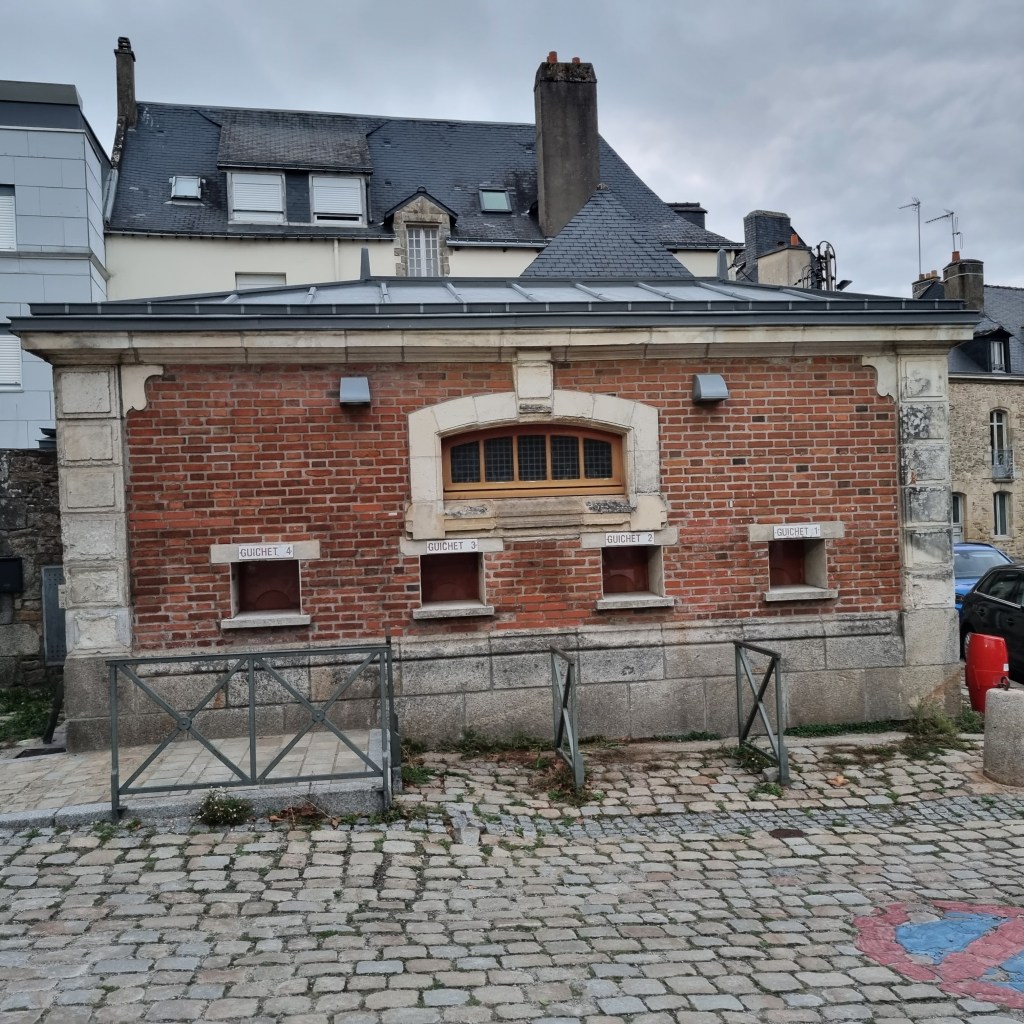
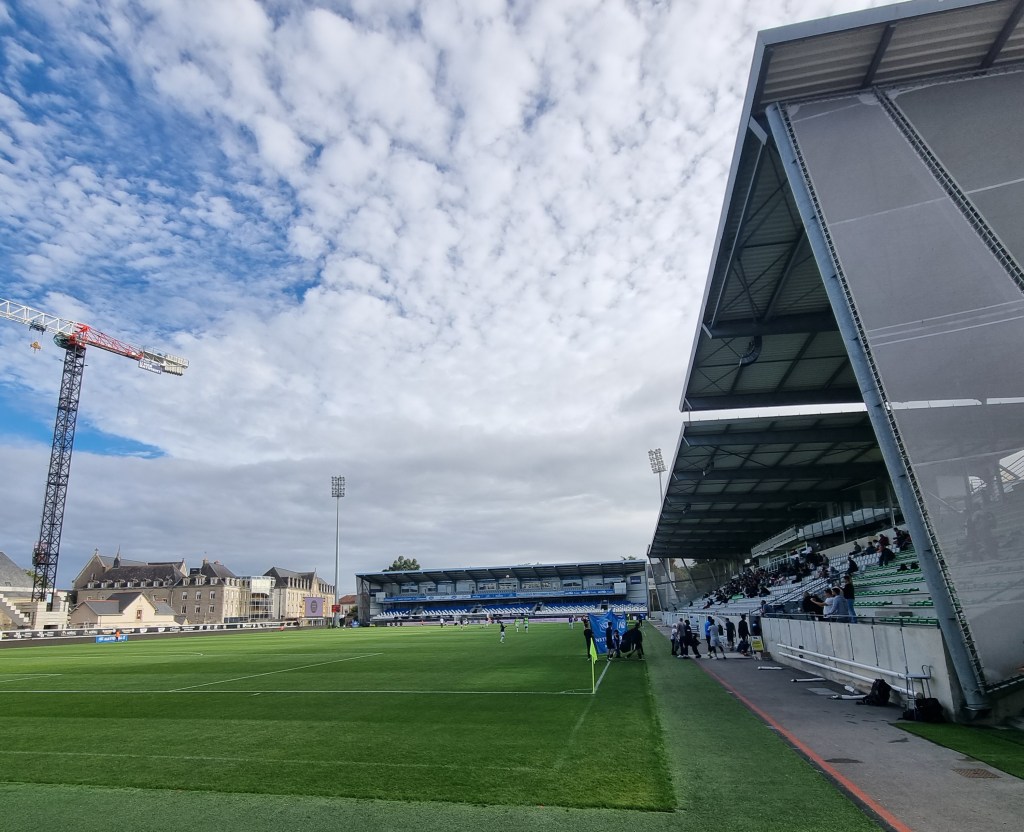
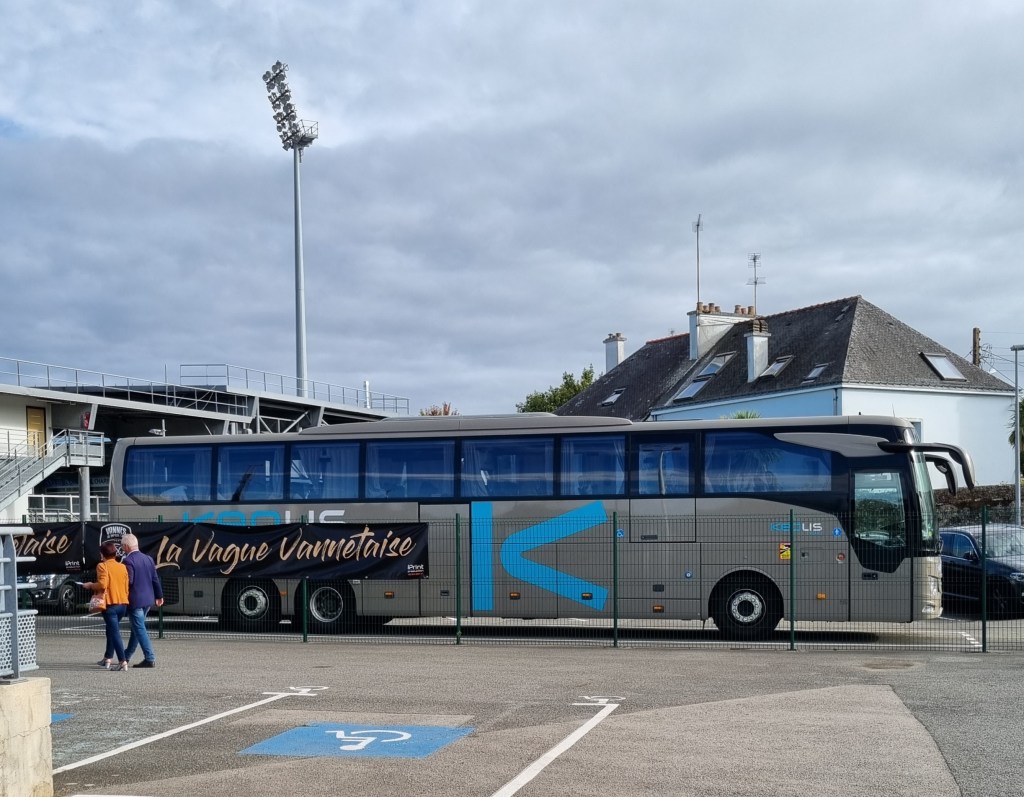
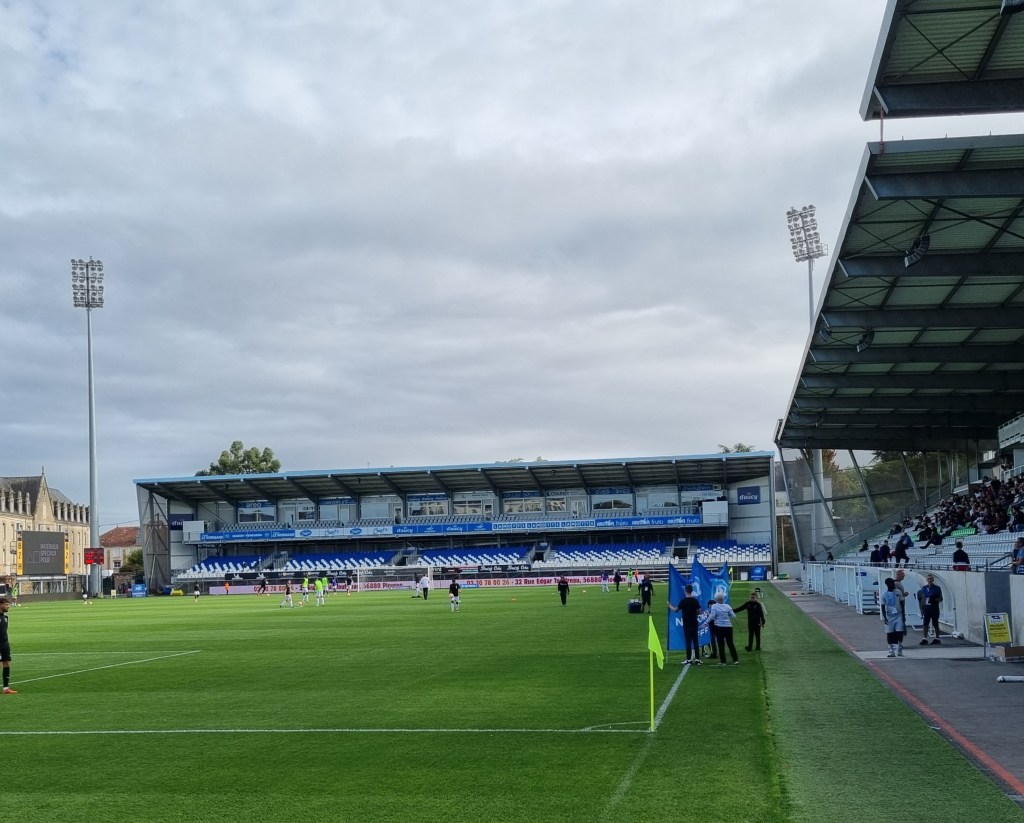
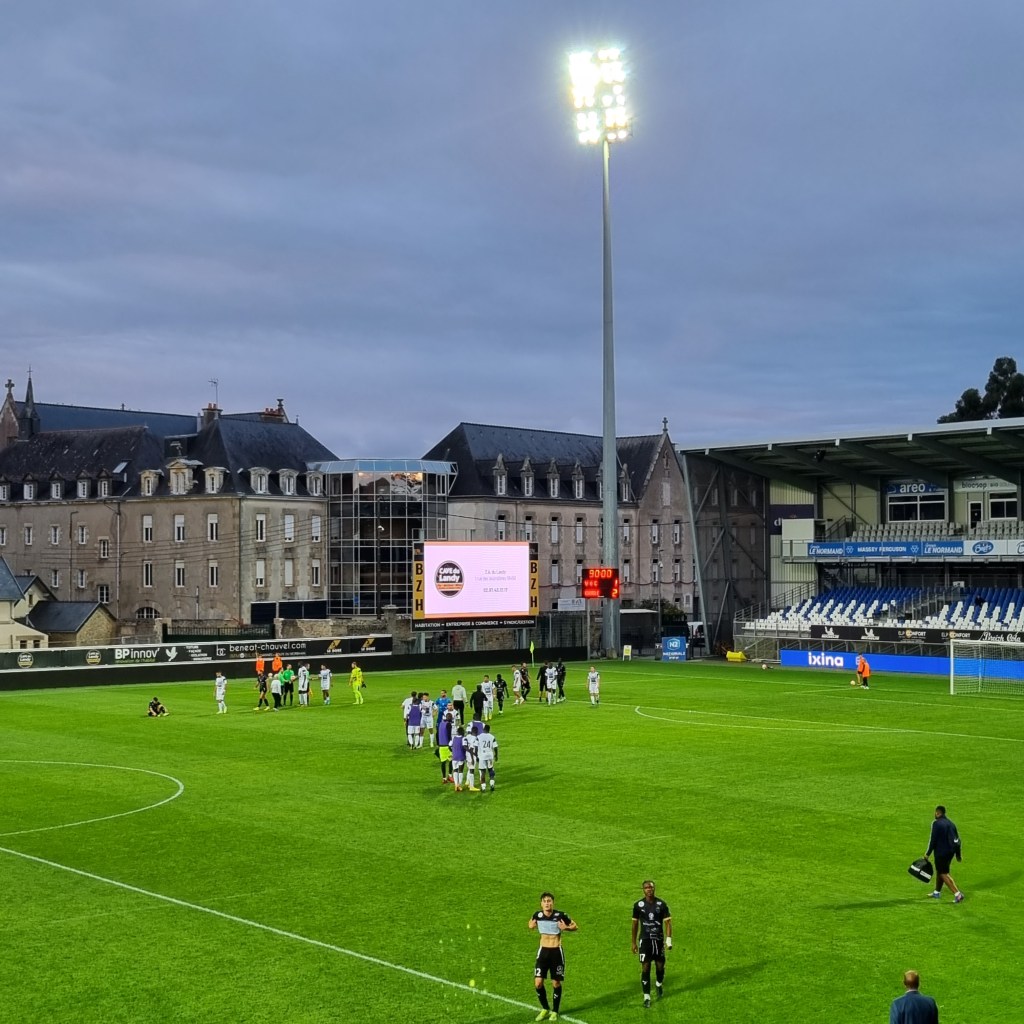
After a lazy afternoon in Vannes spent mostly sat at a pavement café, in the gardens beneath the town walls and by the old port which is now filled with yachts, my wife Paulene and I stroll across the road from the port to the guichets where we buy two tickets (8 euros each) for this evening’s match which kicks-off at six-thirty.  Entry to the Stade de la Rabine is just up the road and round the corner from the guichets and at the gate our tickets are checked, and the stubs torn off by two redoubtable looking middle-aged women.  Entry takes us directly into the under croft of the steel framed south stand; walking along beneath the upper tier it feels like we are in a lofty cloister.  The main stand is a plain concrete and steel structure typical of many French municipal stadiums but a little newer than most.

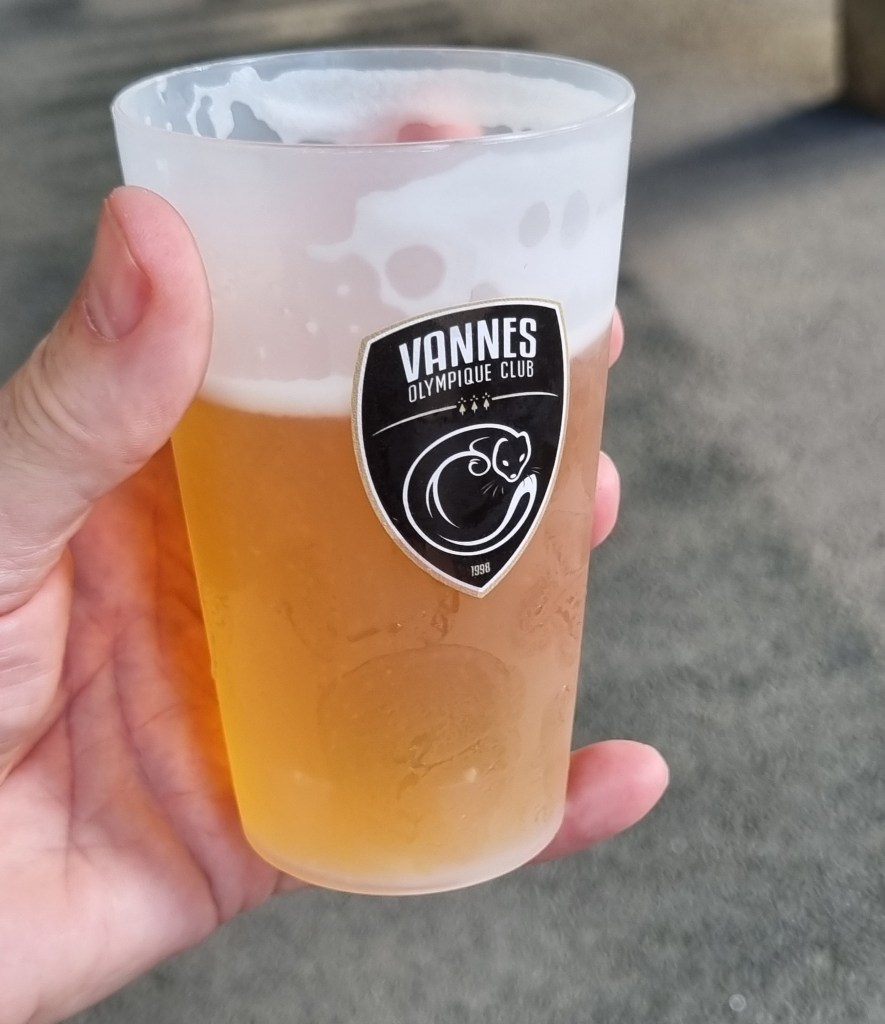
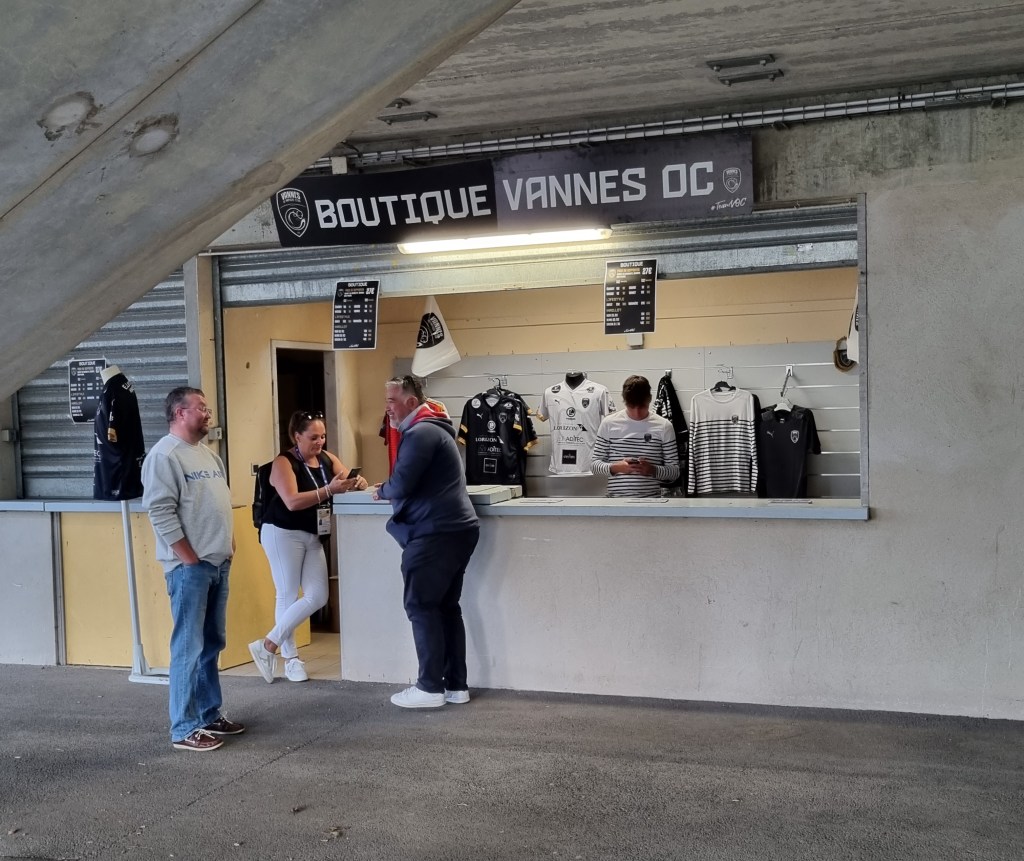
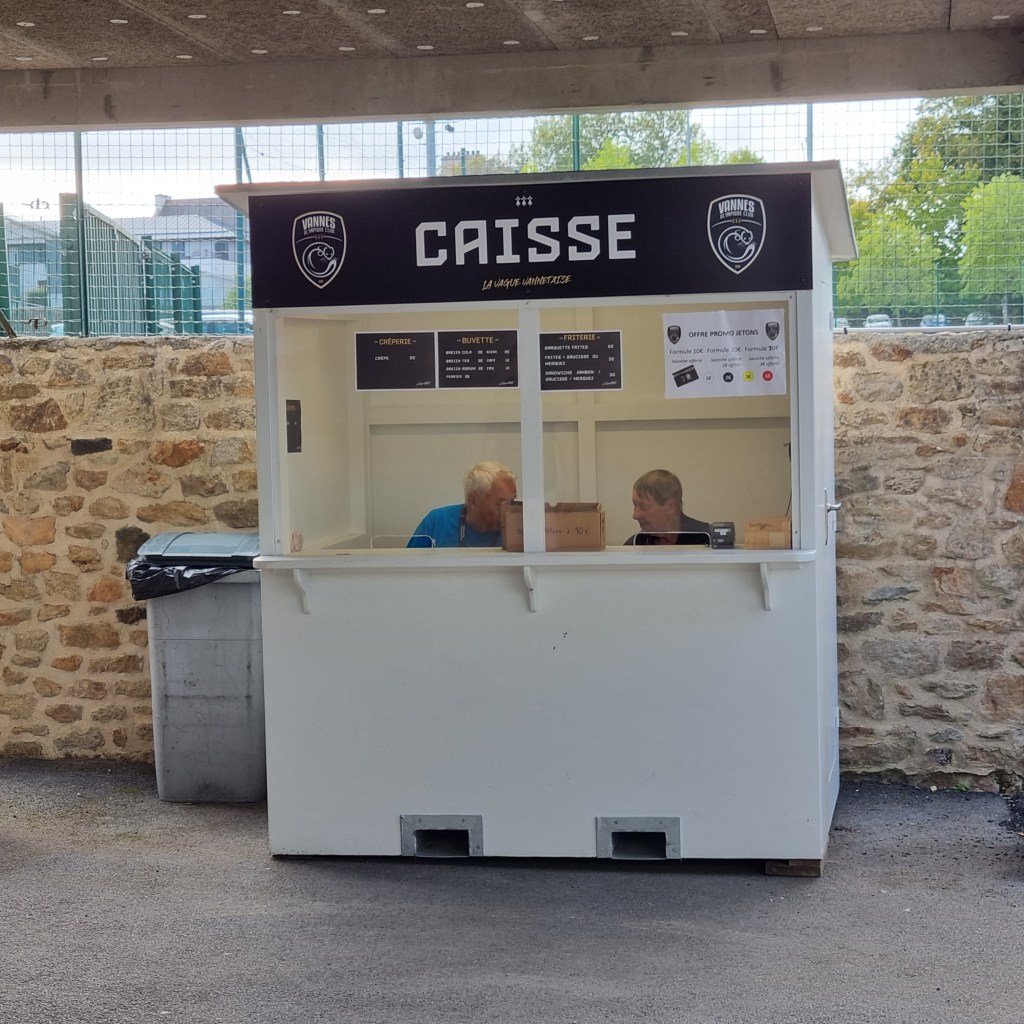
Getting into the feel of what is effectively the French equivalent of ‘non-league’ football, I have to have a beer. An un-identified blonde beer in a re-usable plastic cup adorned with the club crest costs just 2 euros. Paulene has a coffee and bottle of water which are a euro each, but first I must exchange my cash for the Jetons (tokens) that are the only means of paying for food and drink in the ground.  I am happy to see there is also a club shop where for just three euros I add another petit fanion (pennant) to the collection that hangs above the cistern in my upstairs toilet back home. I wander about a bit and snap a few photos and then we find our seats as the PA system plays some rather strange bland electro-pop music, as it has done since we first walked in.

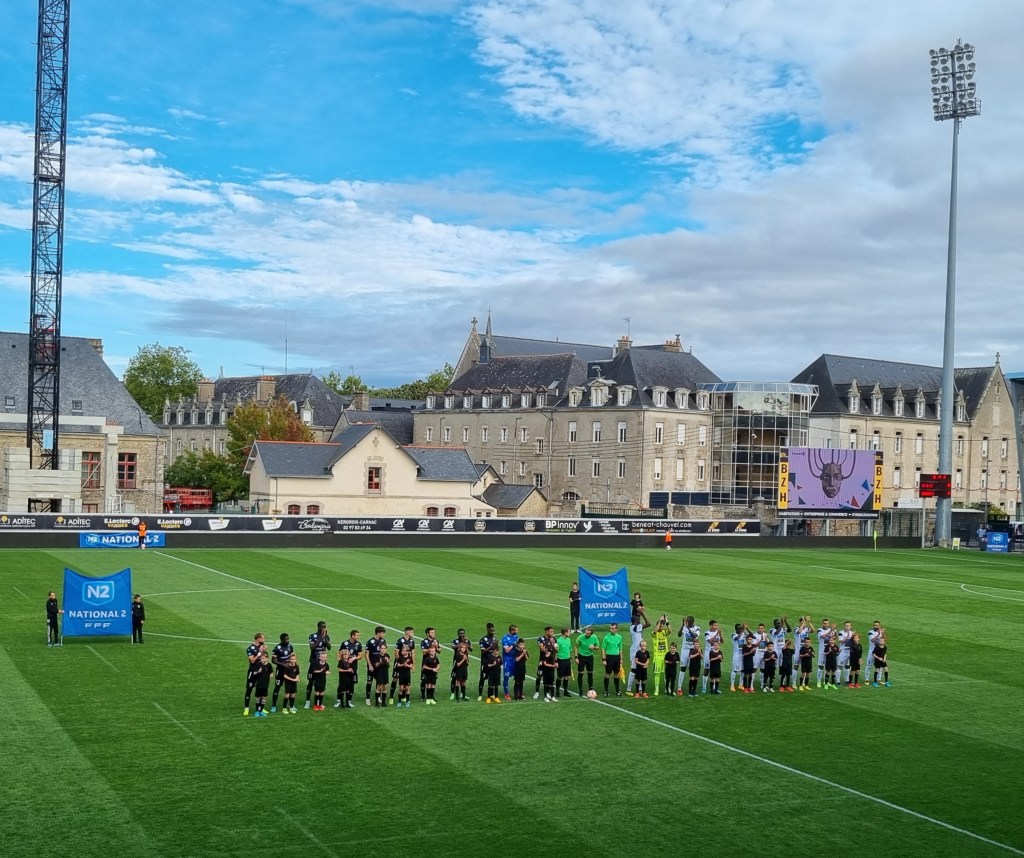
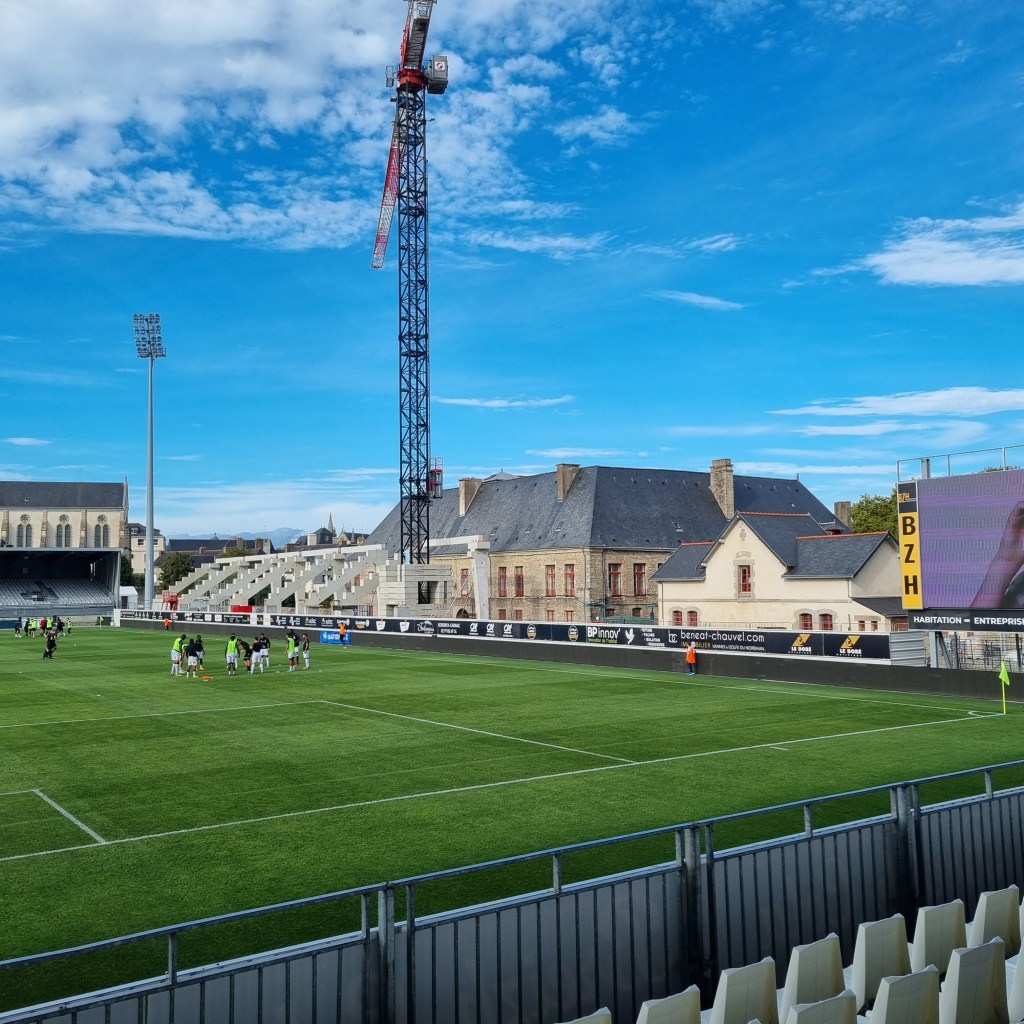
The main stand eventually fills up with the usual collection of old blokes, actual and would-be wives and girlfriends of players, young boys in club tracksuits who probably play for the under 13s team, and other sundry supporters of the local team.  The stand to our left is completely empty; there is one lonely man in the stand to our right and the far side of the ground is a building site on which the concrete frame that has so far been erected could be compared to a sort of modern-day Stonehenge, but only if the light was very, very bad.  The teams process onto the pitch and line up in a single row before two banners proclaiming the name of league National 2.  Three-minutes late, at twenty-seven minutes to seven after a ‘ceremonial’ kick-off involving two older men in smart but casual clothing, Chambly Oise kick off, aiming towards the goal in front of the two-tiered stand occupied by the lone supporter.

Before three minutes have passed, Chambly win the games’ first corner.  A minute later and a cross from the left is diverted into the Vannes goal by the foot on the end of the outstretched leg of Chambly’s number 19, which he has dangled beyond the defender who is alongside him.  The goal catches me by surprise a bit, as it did that defender, and I clap, drawing a look of mild disapproval from the very tall, elderly man who is folded up on the seat next but one to me.  To be honest I had thought Chambly were Vannes because Chambly are wearing an all-white kit whilst Vannes are wearing all-black and I couldn’t imagine that any club’s first choice kit would be all-black; I had therefore assumed that they were the away team.   The French Wikipedia page on Vannes OC later tells me that Vannes OC did formerly play in black and white but changed to all-black a few seasons ago; personally, as someone who still can’t get used to seeing teams of referees, I think it was a bad decision.

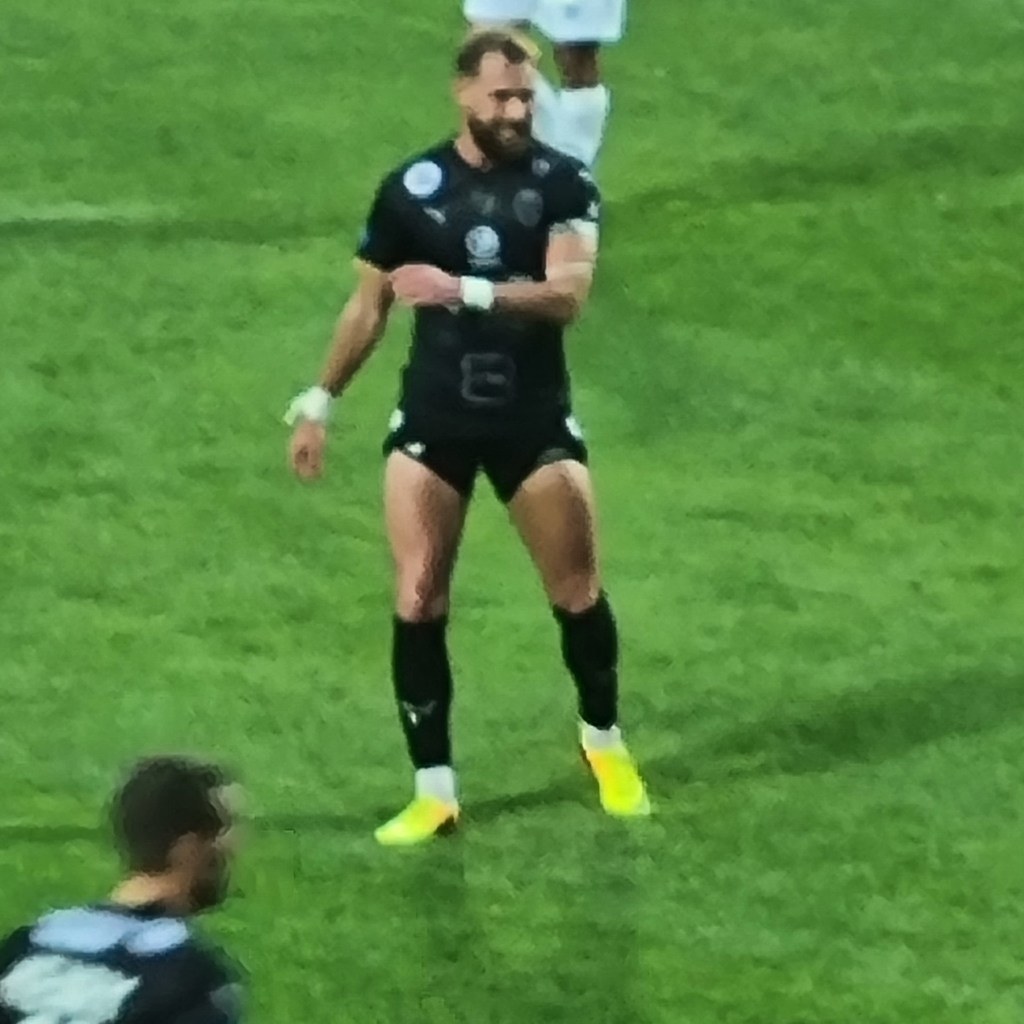
The quality of the football so far is not high and the crowd is quiet, particularly the lone man behind the goal, but Chambly look the better team.  In the absence of anything more interesting I note that the Chambly players do not have their names on the back of their shirts, but the Vannes players do with the exception of number 33.  Also, number 9 for Vannes, whose name is Ebrard, has one leg of his shorts hanging down, but the other one rolled up.  Paulene and I speculate as to why this is.  Is it perhaps to remind him to kick the ball now and then with his weaker foot or, in the absence of a knot in his hankie, is it something more prosaic such as a reminder to put the cat out when he gets home.

In the eighteenth minute a cross from the right by Chambly’s number 8, a short, stocky and industrious player, is headed in unchallenged by the towering number 23.  The Vannes goalkeeper Pettiogenet (number 40) gets a hand or two to the ball but cannot prevent it from hitting the net.  The goal seems to further prove the point so far made that Chambly are the better team. But slowly Vannes are improving, as if they needed at least twenty minutes to warm up, and they win a couple of corners. Ebrard looks keen and almost threatens on a couple of occasions before, as the game is about to enter its second third, he dribbles into the penalty area and tumbles to the ground as a result of a probable trip.  Ebrard gets up and strikes the ball to the anonymous goalkeeper’s right and with his right foot, the one beneath the long leg of his shorts.  The goalkeeper gets a hand to the shot but cannot keep it out, merely pushing it into the corner of the net. 

A couple of minutes after the goal the eager Ebrard concedes a free-kick as he dives in a little too keenly on a Chambly defender.  The defender doesn’t seem too bothered but the goalkeeper comes running out of his goal to remonstrate with Ebrard as if he now harbours a grudge against him for having beaten him with that penalty kick.  Vannes are now up and running and pressing for an equaliser and Kimbembe and Nzuzi link up well down the right and Nzuzi’s low cross travels to the far side of the penalty area where Ebrard has the time and space to sweep the ball majestically into the top left-hand corner of the stand behind the goal.  His attempt was a bold one as the outcome showed.

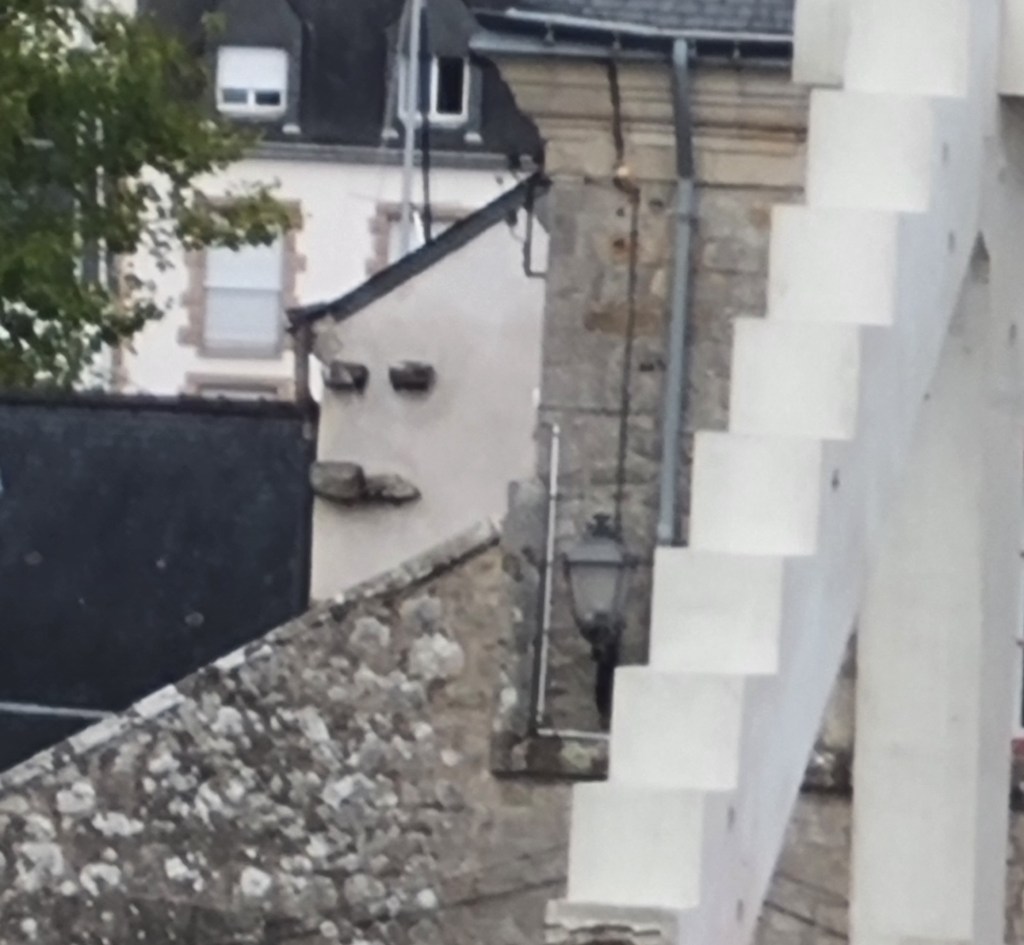
The last ten minutes of the first half are notable for Paulene spotting that a lean-to projection from the side of the building opposite looks like it has two eyes and pouting mouth.  A minute of additional time is played and I go and purchase a tray of chips (2 euros) with mayonnaise with my remaining jetons.  I return to the stand to eat my chips whilst a pair of black-headed gulls swoop into the stand on the look out for any stray deep fried food that might come their way; I guard my chips jealously and give the gulls a discouraging glare.

The match resumes at twenty-four minutes to eight. In the box like building next door to the lean-to building that looks like a face, a man is watching the game, presumably free of charge, from an upstairs window.  A short while later the windows are shut and we assume he decided it was either getting too cold to have the window wide open or he just got bored.  The second half sees substitutions for Chambly first as number twenty-seven replaces number eleven, and then for Vannes with Mvogo replacing Duclovel.  In a departure from how I have previously seen substitutions made, a woman in ‘late middle-age’ wearing a Breton jumper holds up the electronic board displaying the numbers of the incoming and outgoing players.  Paulene and I assume she is the club secretary , but alongside the referee’s assistant, the coaches and the delegue principal (an overseeing official) in his rather crumpled looking blue suit, she complements an interesting tableau of touchline figures.
The second half witnesses the first concerted outbreak of support from the crowd but in the form of the treble voices of the under 13’s who chant “Allez les Noires” over and over again, until they get bored, which thankfully doesn’t take too long.  More substitutions happen and Nzuzi is replaced by another anonymous player, the mysterious number thirty-four whilst anonymous thirty-three is replaced by equally anonymous thirty-two.  In due course the final minutes approach and there is a discernible effort from Vannes to finally equalise.  The ninetieth minute sees Vannes win a corner and in what seems like a final push both legs of Ebrard’s shorts miraculously appear to be the same length as he surges forward.  But it seems like his last hurrah and having lost the ball he stands bent over with his hands on his knees, a spent force.  Five minutes of time additionelle are announced, but Vannes can’t do enough to score and the initial judgement from the first twenty minutes that Chambly are the better team holds good.

With the full-time whistle we exit the ground the way we came in and head back to our car, where we will learn we have to pay a stonking 9 euros 80.  If you come to Vannes for more than an hour or so try not to park at Republique.  It’s not been the greatest evening’s football in truth, but Vannes OC is a decent little club with an excellent stadium and lovely people selling the tickets, the food and the drink.  I sincerely hope they get back to Ligue National and possibly Ligue 2 soon. As the Under13’s told us “Allez les Noires”.

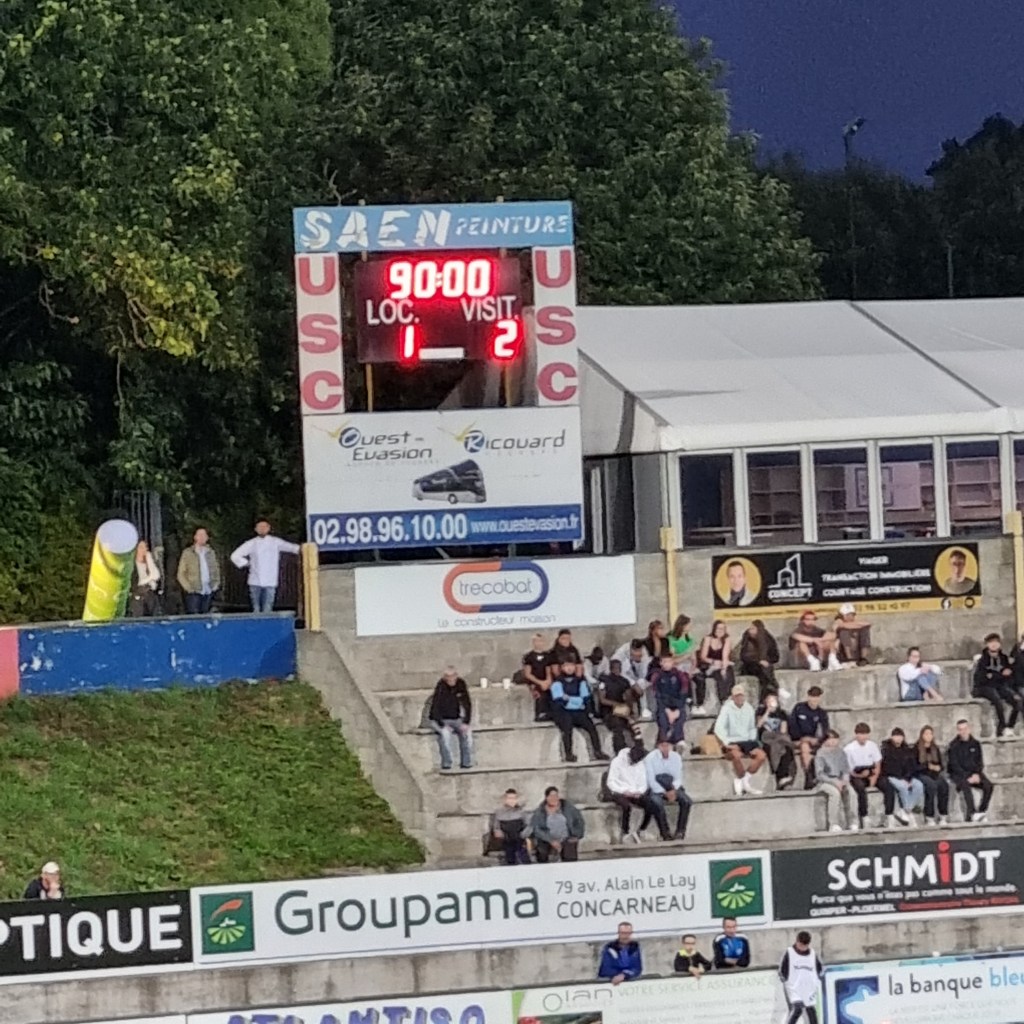
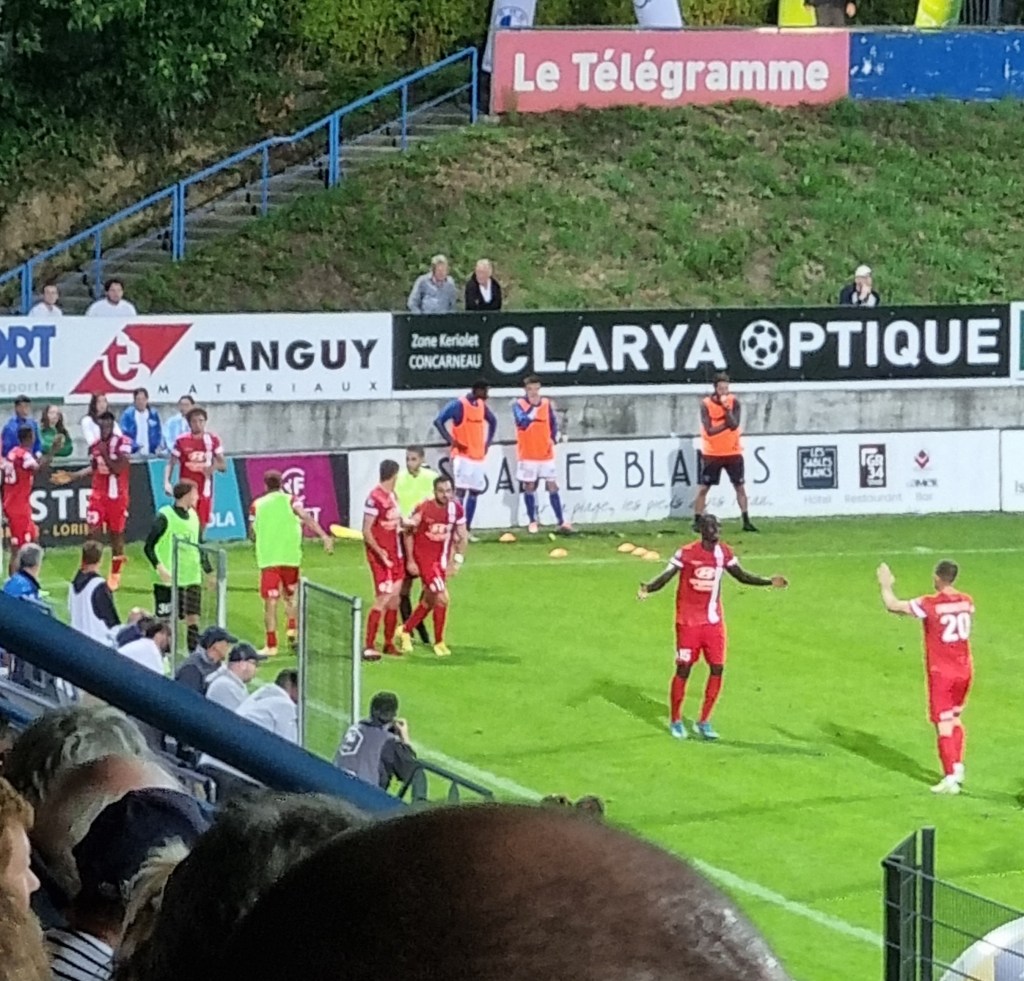
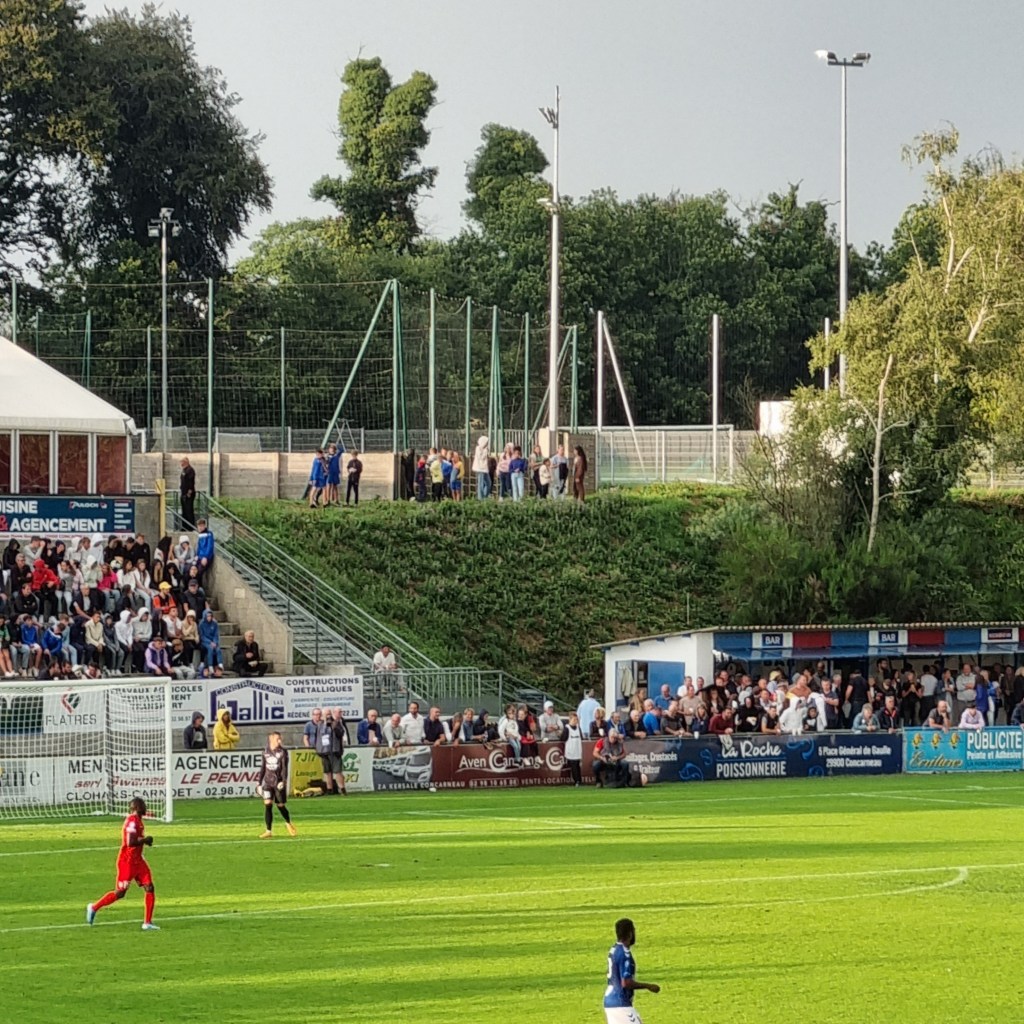
US Concarneau 1 AS Nancy 2

The Breton coastal town of Concarneau is apparently best known as a successful fishing port and for its walled Ville Close, a quaint and historic medieval fortified town transformed into an appalling tourist trap full of the sort of shops or pristine buildings you find in places like Lavenham or Bourton-On-The-Water in England. In its favour however, Concarneau is also home of the Brasserie de Bretagne (Britanny Brewery) and Union Sportive Concarnoise, its local football club, which plays in the third division of French football known as Ligue National.

US Concarneau, as they are commonly called, are relatively recent arrivals in Ligue National and have aspirations to reach Ligue 2; tonight, they face Association Sportive Nancy-Lorraine, more usually known as AS Nancy, a club which has twice won the French FA Cup and spent twenty-five seasons in Ligue 2 and thirty in Ligue 1.  Today however, Concarneau are second from top of Ligue National and Nancy seventeenth, albeit after just three games.

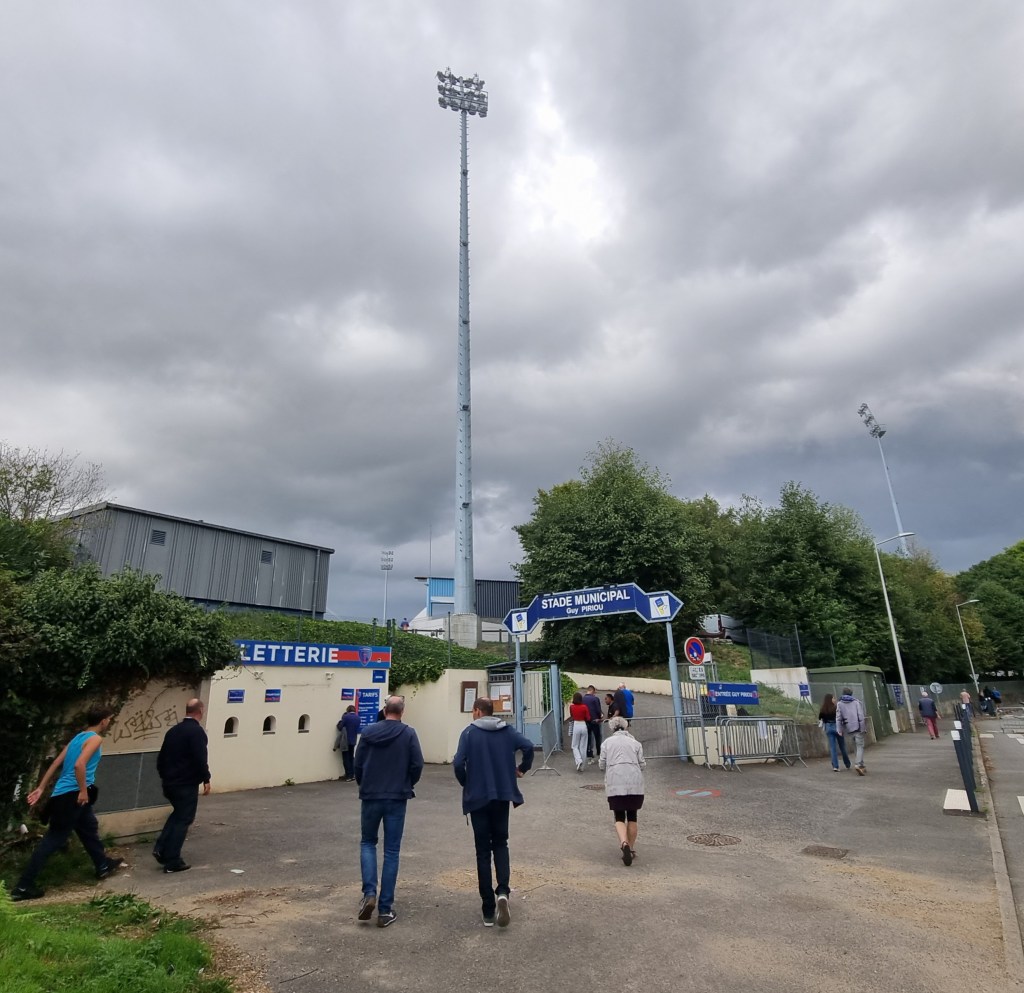
The Stade Guy Piriou where USC play their home games is at the edge of town in that nether world of retail parks, Zones Industrielles and feeder roads inaccessible to pedestrians. I had asked in the Tourist Information Office where is a good place to park and the pretty young woman there had rolled her eyes with a look that told of chaos, but then said we could park in the car park of the LeClerc supermarket which is about 100m from the ground through a tunnel beneath the main road.  After getting a bit of shopping and an evening picnic, which my wife Paulene and I eat in the car, we make for the ground.

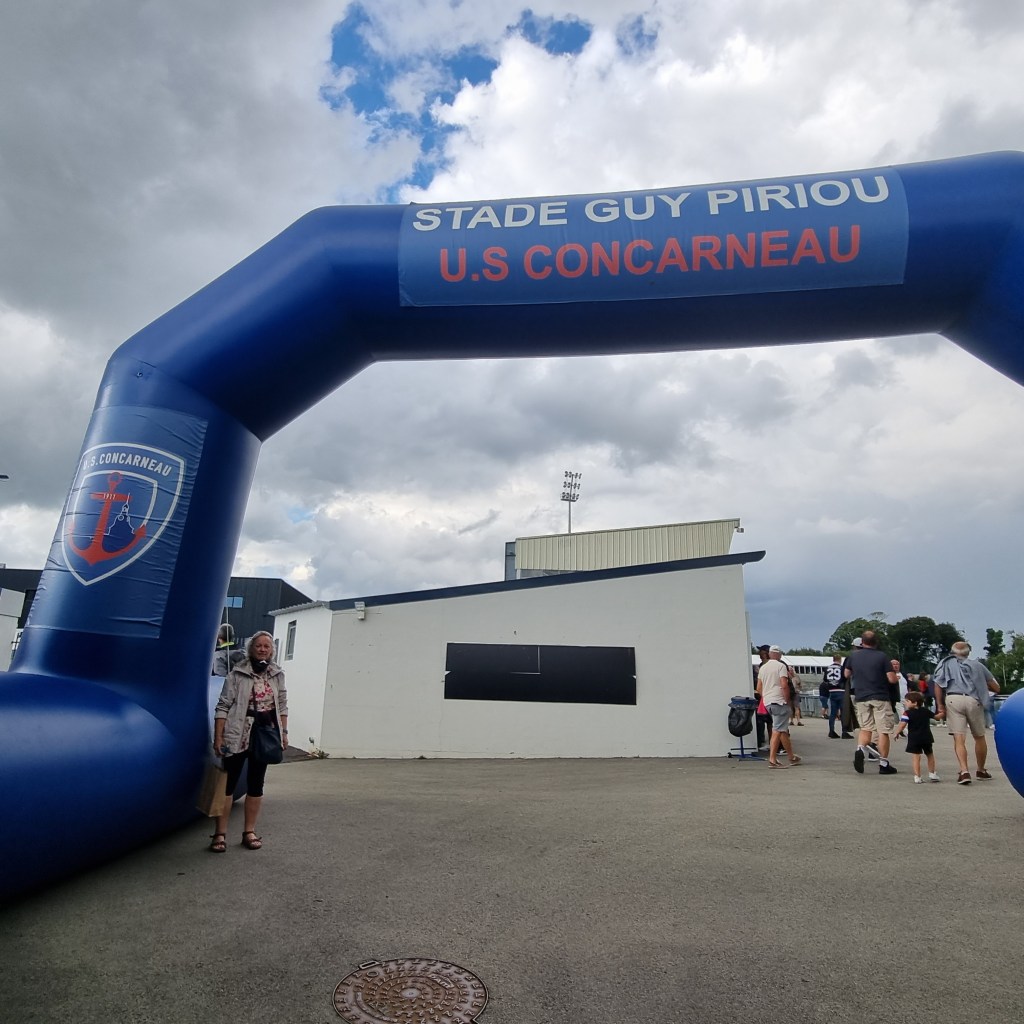
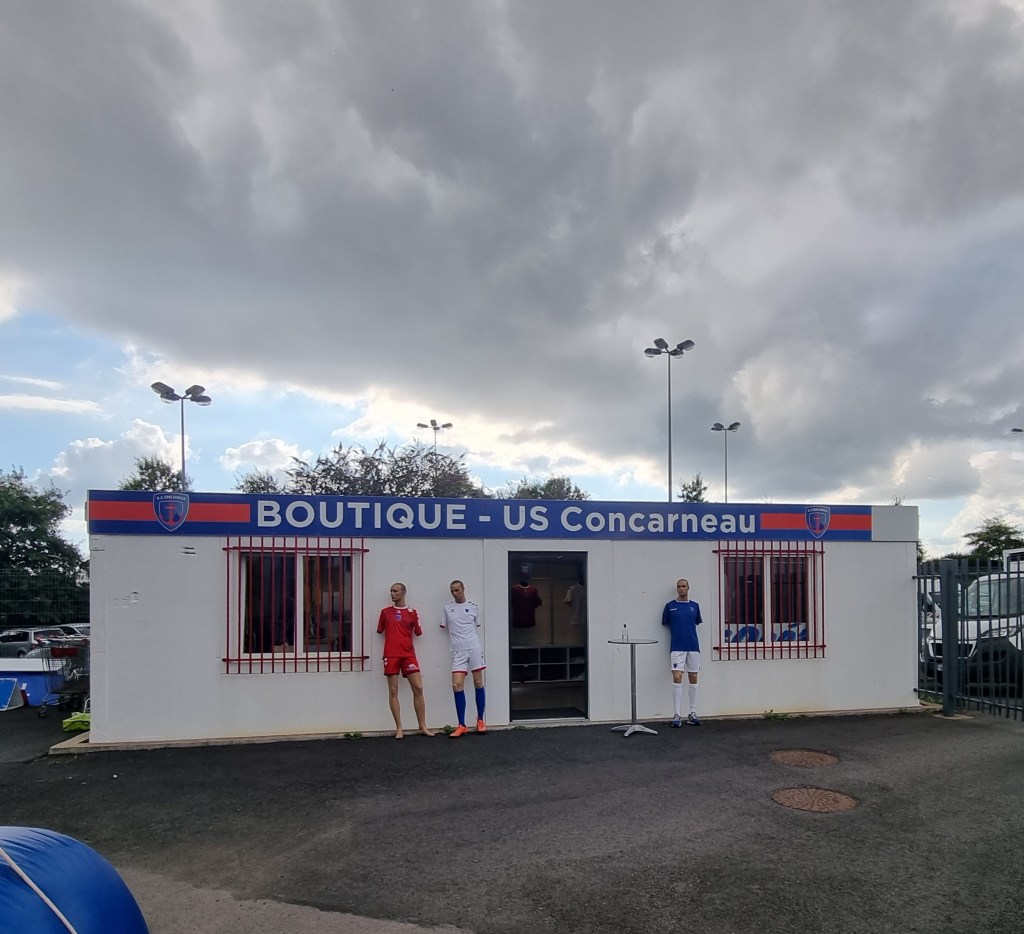
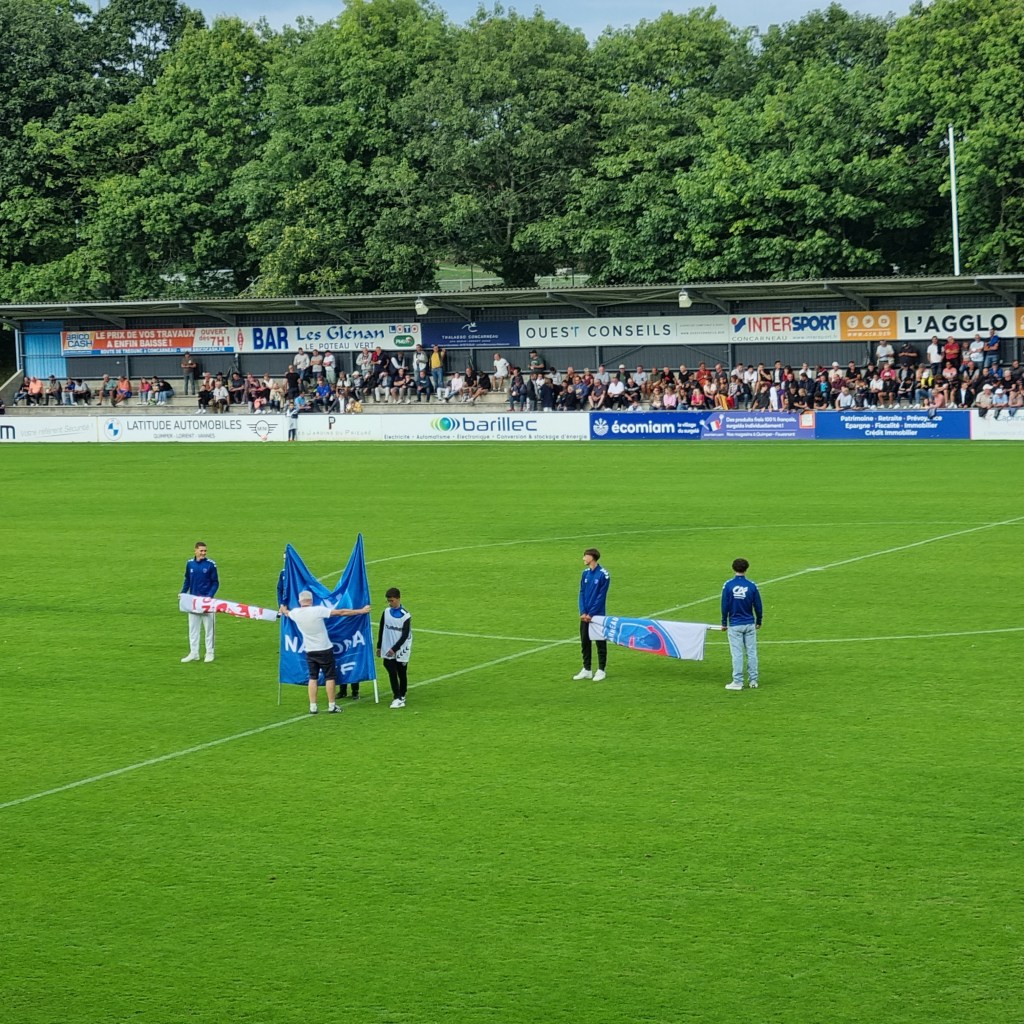
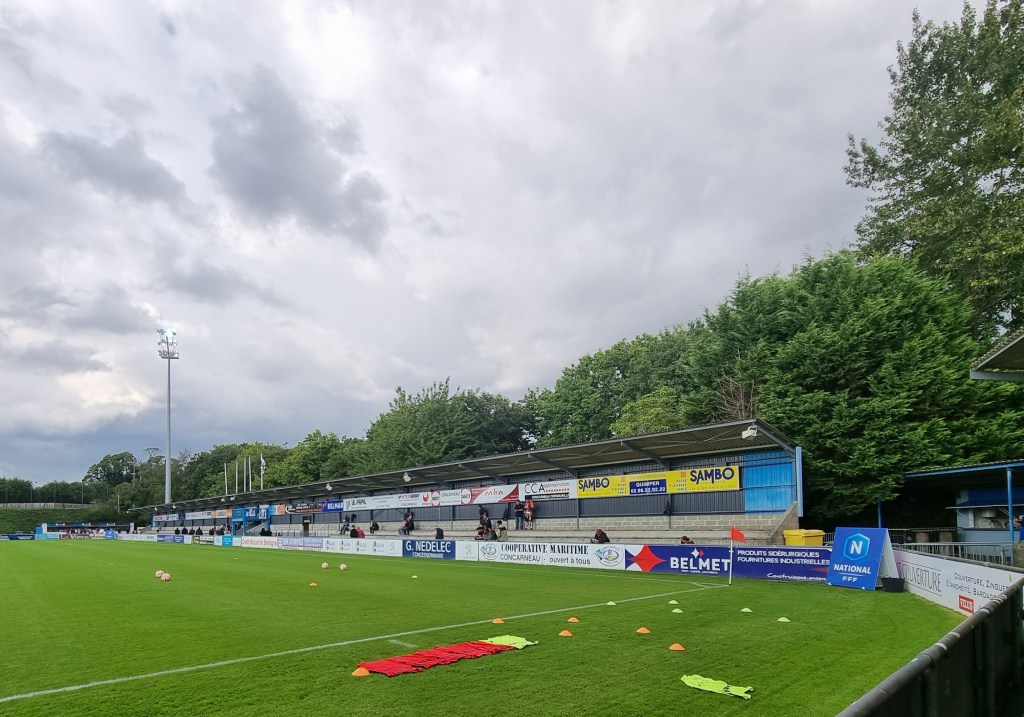
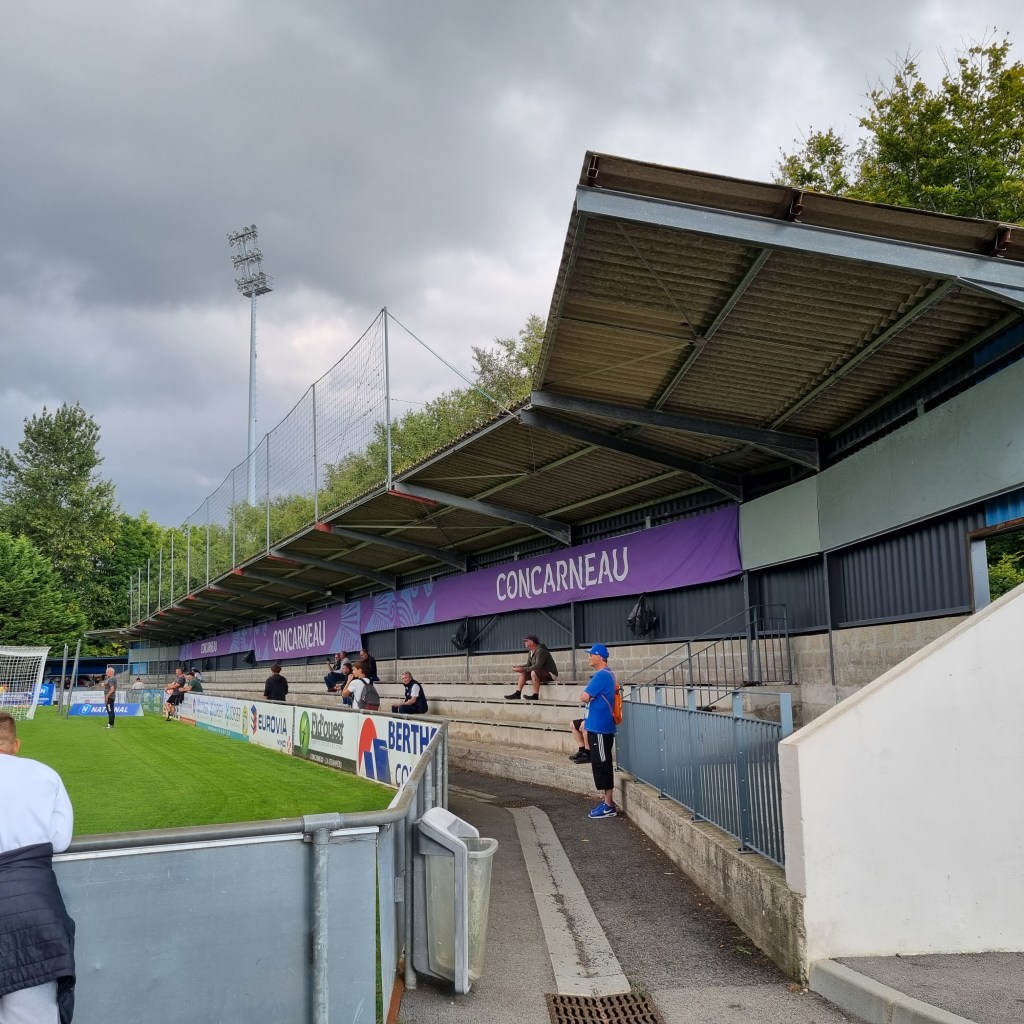
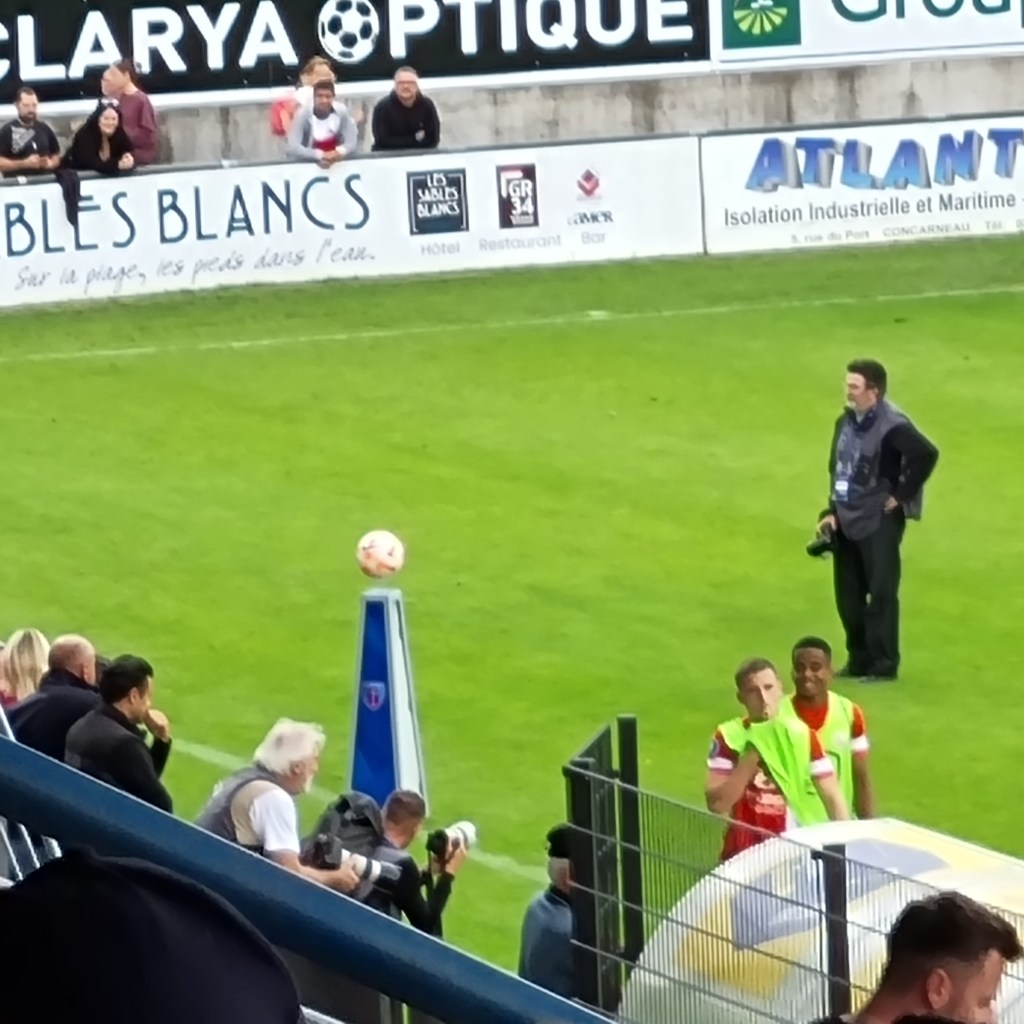
Having had difficulty trying to buy tickets on-line we had visited the ground earlier in the afternoon on arrival at Concarneau.  Although there are guichets open at the entrance to the ground selling tickets, these were shut when we arrived earlier and I had gone directly into the club office where I had selected our seats on someone’s lap-top and stood by his desk as he printed out two tickets for the main stand (12 euros each).  The stadium sits on the top of a small hill and the main entrance delivers us up a slope through an inflatable arch to the corner of the stadium; I don’t know if I’m in a football ground or a bouncy castle, but there is a main stand in front of us and to our left.  Pleasingly there is a club shop where for 5 euros I add to the collection of petit fanions (pennants) that adorn my upstairs toilet at home, and also purchase a mug (9 euros) and acquire a match day programme which, like at every French club that produces a programme, is free.  The ground has three excellent buvettes which remind me of stalls at a fairground; they serve huge sausages piled on top of massive heaps of chips, and the very tasty local ‘Britt’ beer. After visiting what is possibly the smartest and sweetest smelling toilet I have ever encountered in a football ground; it’s all stainless steel and shiny coloured tiles, I change euros into tokens worth a euro each and buy a beer for me (3 euros) and a cola (2 euros) for Paulene, which surprisingly and disappointingly is not Breizh Cola. I then join Paulene in the main stand for the pre-match entertainment of observing everyone else arrive, search for their seats or eat sausage and chips, before watching a fastidious man organise three pairs of youths into holding banners displaying the Ligue National logo and the two club crests.  Off to our left the match ball sits above a plinth in front of the players’ tunnel and appears to be hovering in mid-air.
At half past seven the match kicks off, with Nancy in their all-red kit getting first go with the ball.  Concarneau are in blue shirts and socks with white shorts and the first chant of the evening surprisingly emanates from the main stand; “Allez les bleus, Allez les bleus” confirms that I am not suddenly colour blind. On the far side of the ground, in the long, low, basic but well maintained partly seated, partly terraced stand a knot of supporters sing “Allez, Allez, Allez” to the tune of The Beatles ‘Yellow Submarine’.  

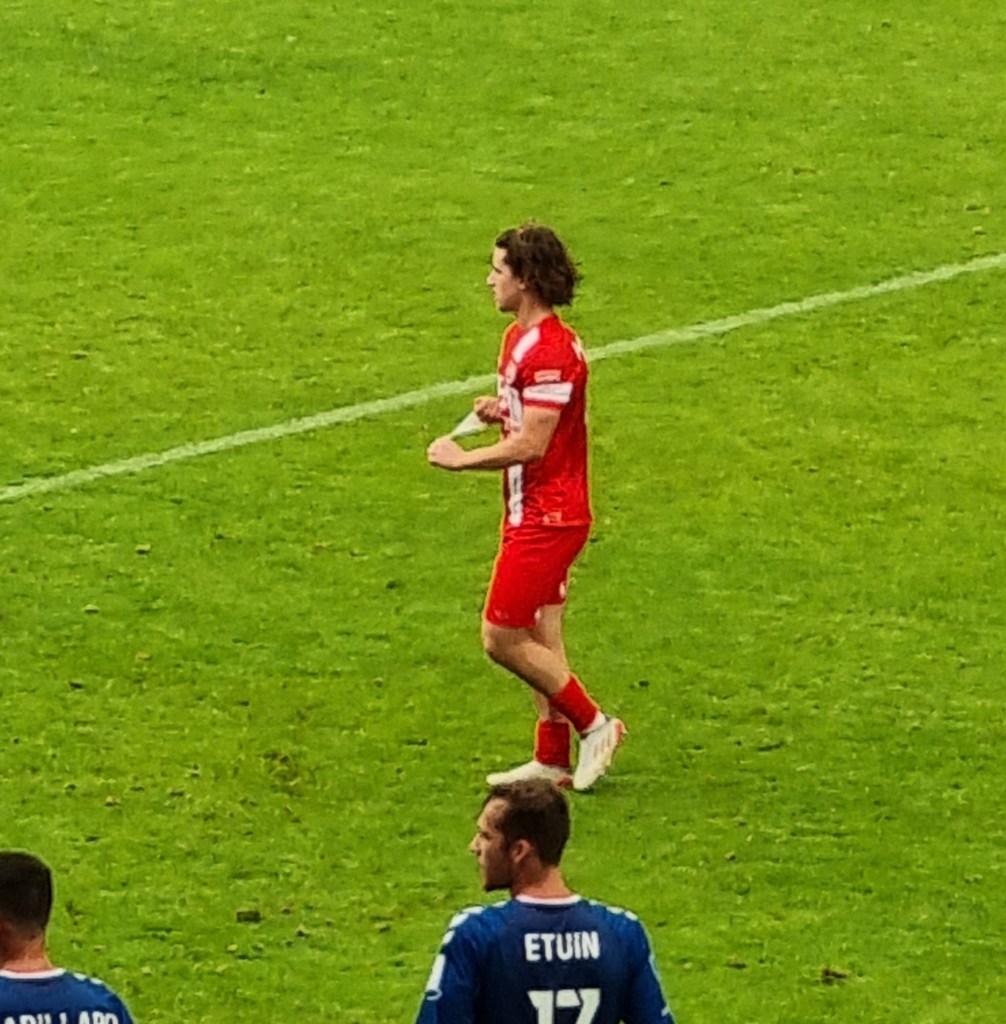
Perhaps because of the backing of the home crowd, USC quickly settle into the game and their number 24 Ambroise Gboho soon threads an excellent diagonal through ball into the path of Antoine Rabillard, who has made an overlapping run, but Rabillard hits his shot straight into the body of Nancy’s goalkeeper. USC’s Amine Boutrah then wins the games’ first corner and Tom Lebeau wins the second. “Allez les bleus, Allez les bleus” sings the home crowd again.  Lebeau crosses the ball and Rabillard heads over the bar. Low, evening sunlight falls across the pitch illuminating the grass vividly where it doesn’t cast a lengthening shadow of the main stand. The sky is gun metal grey in the distance; there have been heavy showers inland throughout the day and a rainbow extends up then fades away beyond the opposite stand.  Behind the left-hand goal, on the steep concrete terrace below the hospitality area people appear to be putting their coats on; it doesn’t seem to be raining but briefly there is a faint rattle on the metal roof of the stand.

Back on the pitch, Nancy’s defending is effective but becoming more desperate and Lucas Pellegrini is the first player to see the carton jaune (yellow card) of the referee after he knocks over USC’s Amine Boutrah, who I am not surprised to read in the programme is the player of the month for August.  Within sixty-seconds Nancy’s number eight, Lenny Nangis follows the bad example that has been set and is booked for a foul on USC’s Georges Gope Fenepes.  If Lenny Nangis has any defence, it is that he has a great name.  The resultant free-kick is deflected over the cross bar for another corner to Concarneau.  A third Nancy player is booked five minutes later when Baptiste Mouaza fouls Ambroise Gboho. The supporters on the far side of the ground sing the na-na-nas from The Beatles’ “Hey Jude” and then Mouaza provokes a sharp intake of breath as he trips USC’s Gaoussa Traore and we await the consequences. Like a not very good magician the referee holds up his yellow card and then with a distinct absence of sleight of hand replaces it with a red one.  Mouaza hangs around for a bit, seemingly discussing his misfortune with anyone who’ll listen as most of the other players crowd around the referee and the prostrate Gaussa Traore. When the melee clears and Traore has risen from the dead, Mouaza seeks clarification from the referee that he is no longer required on the pitch and his worst fears are confirmed with a wave of the referee’s arm.

  A minute of the first half remains, and USC win another corner; the ball is crossed from the left and having evaded everyone else, falls in front of captain Thibault Sinquin who appears to do little more than absent-mindedly stick out a leg, and thereby scores.  After two minutes of added on time, the teams retreat to the dressing rooms for mi-temps (half-time) with Concarneau in possession of a well-deserved lead, although having failed to score for the first forty-four minutes the eventual goal came as a bit of a surprise. Half-time sees a flood of people towards the buvettes and I get up from my seat to stretch my legs and peer down on them through the scratched Perspex screen at the end of the stand.

The game resumes at 8:32 and although Nancy have some early forays down the flanks it is USC’s Ambroise Gnoho who comes closest to scoring but for an offside flag and Lebeau shoots past the post from all of 30 metres.  With just ten minutes gone of the new half Georges Gape Fenepes,  who might be the first player from New Caledonia I have ever seen, is substituted by Faisal Mannai.  I don’t think it’s Mannai’s fault but within a minute of his appearance a passing move down the left for Nancy ends with the sort of cross commonly known as ‘inviting’, and Lenny Nangis  accepts the invitation, heading firmly into the Concarneau net to unexpectedly equalise.

Despite having lost their lead, Concarneau will surely still go onto win having a man advantage and they continue to press forward with Robillard, Traore and Boutrah always looking the most likely to conjure up a decent chance.  With a third of the match remaining USC win another corner after a flurry of activity around the Nancy goal.  A low cross from the right is just too far ahead of everyone to allow anyone to touch it into the net.  “Merde” says the bloke behind me through gritted teeth as a pass by substitute Faisal Mannai is intercepted by a Nancy player who breaks forward into the Concarneau half.  Nothing comes of it however and Thibault Sinquin in turn breaks forward for USC from his centre half position, but his low cross from inside the penalty area is cleared.

The game is into its last fifteen minutes or normal time and Gaoussa Traore lashes a shot somewhat desperately, which travels high and wide of the Nancy goal.  Nancy substitute Lamine Cisse for Isaak Umbdenstock, but not before Cisse looks confused as to which direction he must run to leave the pitch; after initially running away from the benches he checks and runs back and Umbdenstock runs on.  Concarneau replace Adrien Jouliex with Alec Georgen but are coming no closer to scoring a second goal.

Ten minutes remain of normal time and Nancy win a rare corner;  Diafra Sakho meets the ball on his forehead and Nancy are suddenly winning as the ball bulges the net with the Concarneau goalkeeper and defenders static.  Even now I can’t bring myself to believe that Concarneau won’t equalise,  but as Tom Lebeau is replaced by Pierre Jouan there are just seven minutes left and Nancy are taking every opportunity, and creating more to eke out that time by winning free kicks and staying down on the ground.  When a player goes down ‘injured’ on the far side of the field the slow-moving physio who looks about seventy-five can only trundle across the pitch.  Nancy make use of their penultimate substitution before six minutes of added on time are announced and then make the final one as they control the end of the game, not in terms of active football but in terms of frustrating Concarneau by fragmenting the remaining time into useless moments of nothingness.

Full-time arrives too soon for Concarneau and Nancy will make the 920 kilometre journey back to Alsace with an unexpected win, which in the context of modern football they deserve, but it wasn’t always much fun to watch and many would say they had ‘stolen’ the points.  Nevertheless, Concarneau is a great place to come to watch a match and is reminiscent of an English fourth division ground but with better beer, better food and cheaper admission prices; Paulene and I therefore have had a splendid time.

Stade Rennais 3 Stade Brestois 1

Conventional wisdom tells us that one of the important things about being a committed football supporter is that you don’t interrupt your nine or ten months of religious devotion with inconvenient weddings, family events or holidays that might prevent you from watching your team every week. Well, yah-boo to conventional wisdom, after over fifty years of watching Ipswich Town and forty years of being a season ticket holder I partly no longer care but have also found that going on holiday during the season opens up new possibilities of watching other football in foreign lands, and so it is on the sultry last day of August that I find myself in the Breton capital, the city of Rennes.

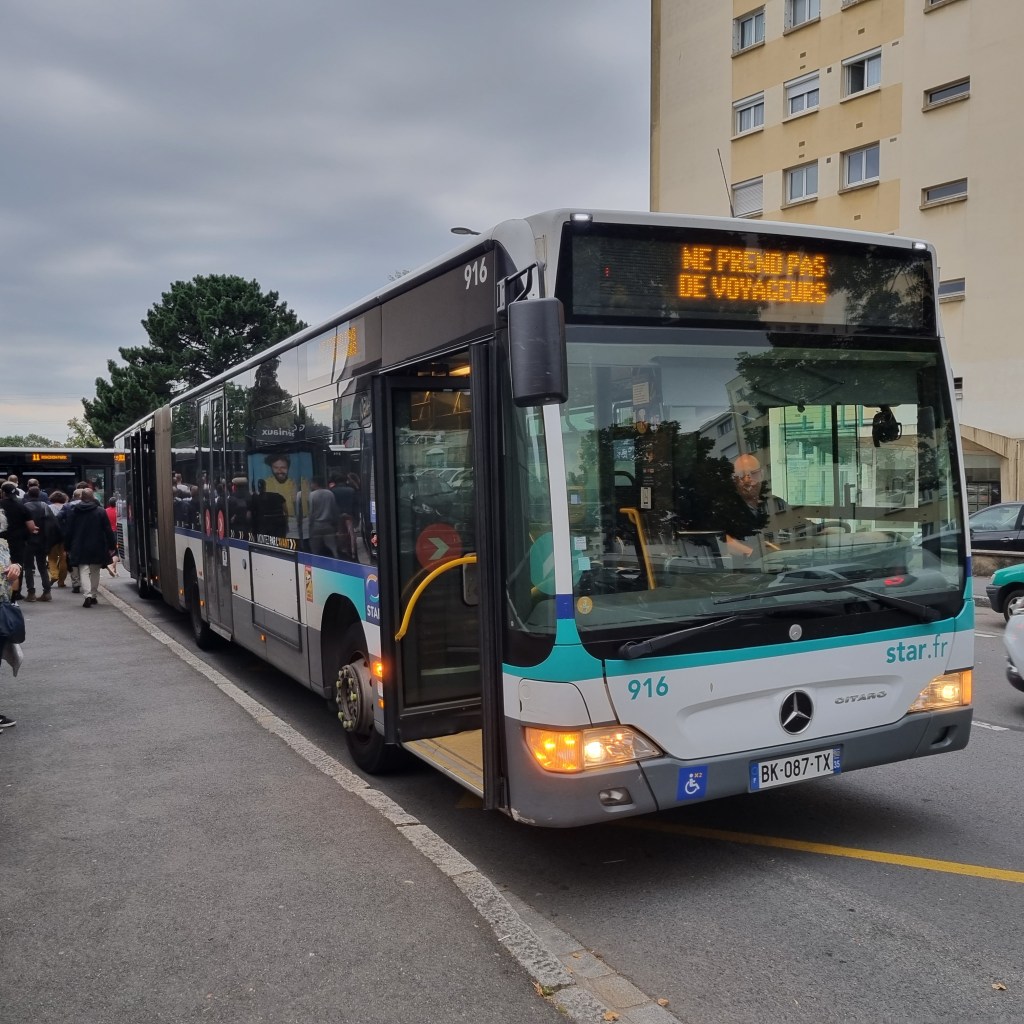
Number eleven buses leave frequently from Republique in the centre of Rennes for Roazhon Park home of Stade Rennais and the correct bus stop is easy to find because of large numbers of people in red football shirts. Bus company stewards patrol the stop ensuring people stay on the platform and giving advice to first time travellers like me and my wife.  A petite woman with auburn hair and clad in a hi-viz jacket bearing the legend ‘Ami-Star’ (Rennes’ buses are operated by Star) tells me that the fare is one euro fifty and we can pay on the bus with a bank card.  The bus soon arrives and consumes the waiting throng within its articulated 18 metre length. It takes just ten minutes to get to Roazhon Park; although the city centre traffic is heavy, our chauffeured Mercedes speeds unimpeded along bus lanes.

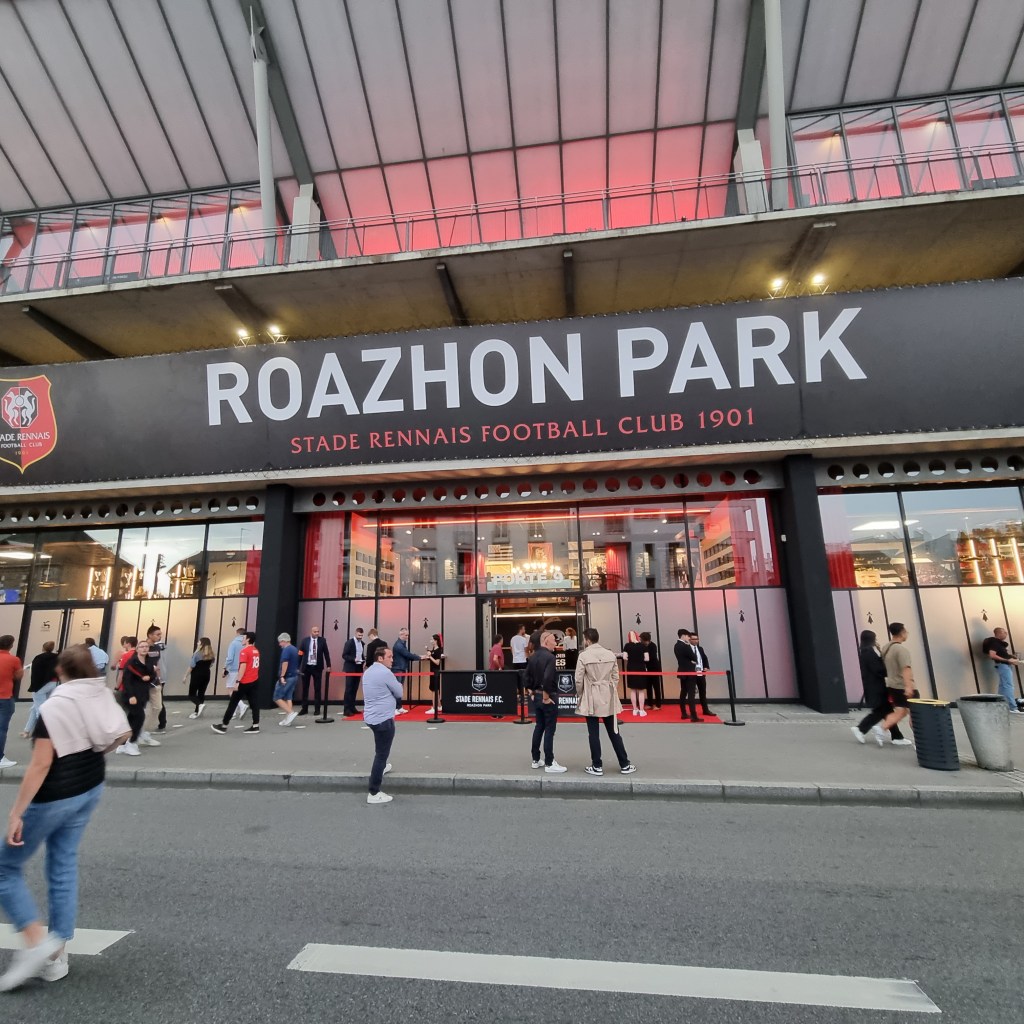
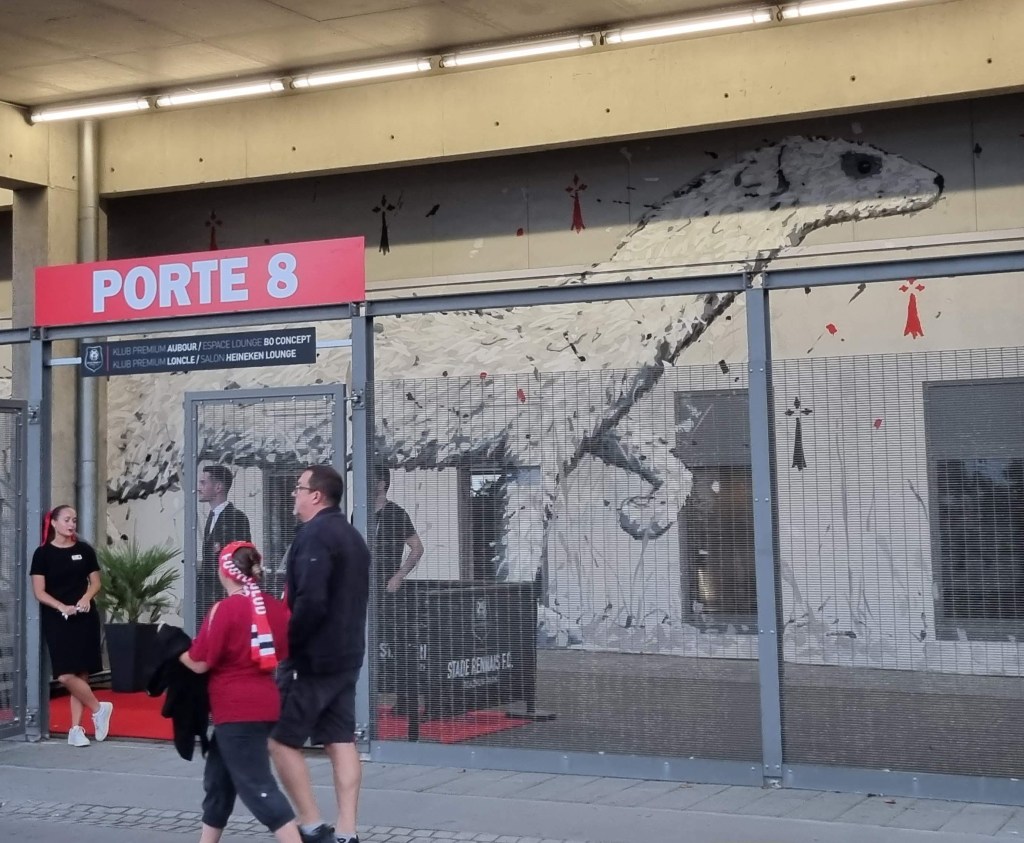
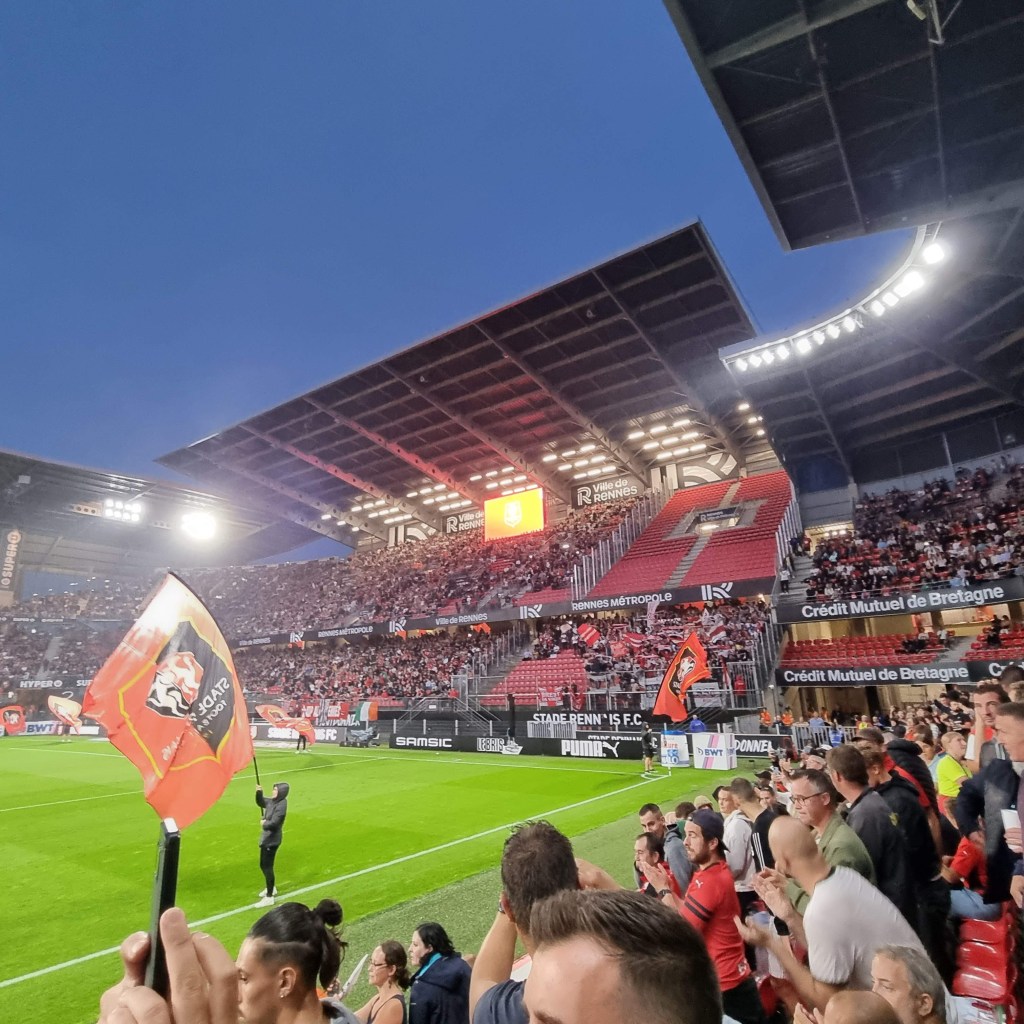
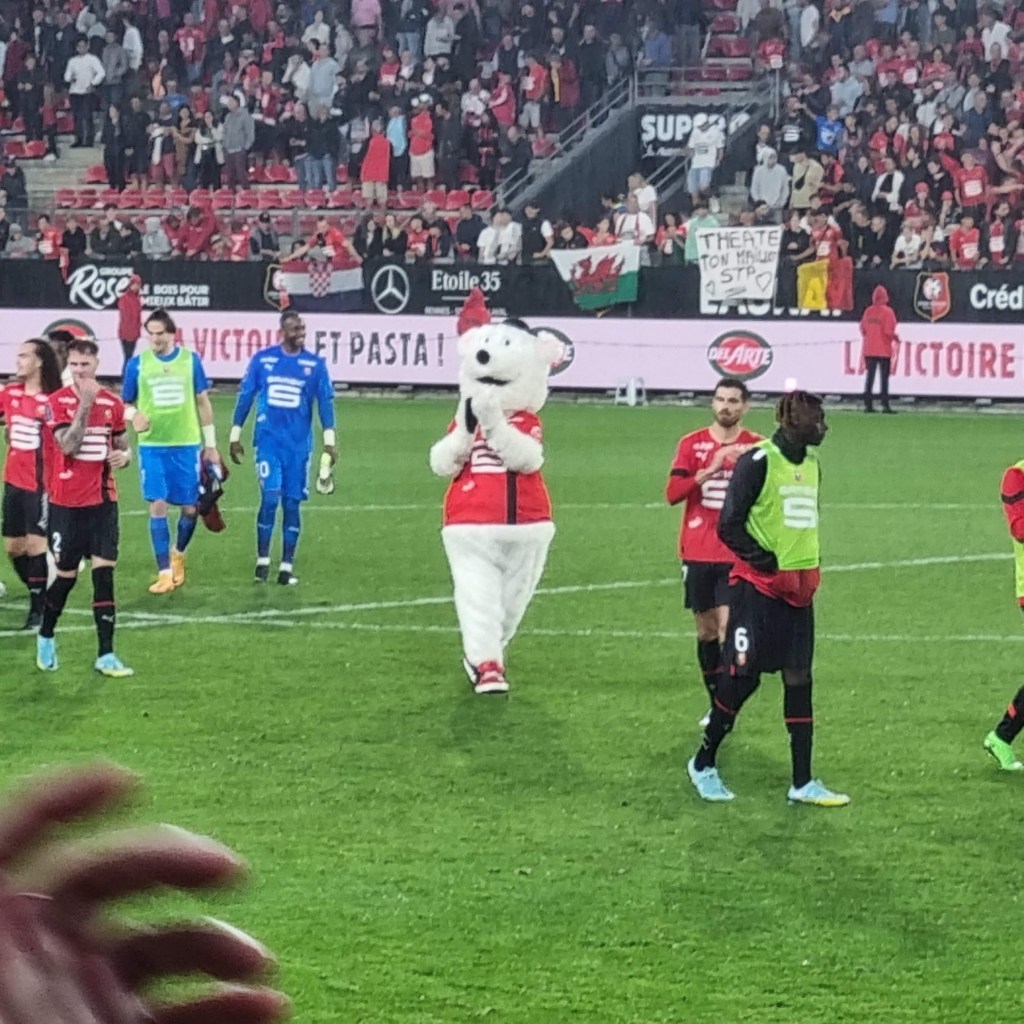
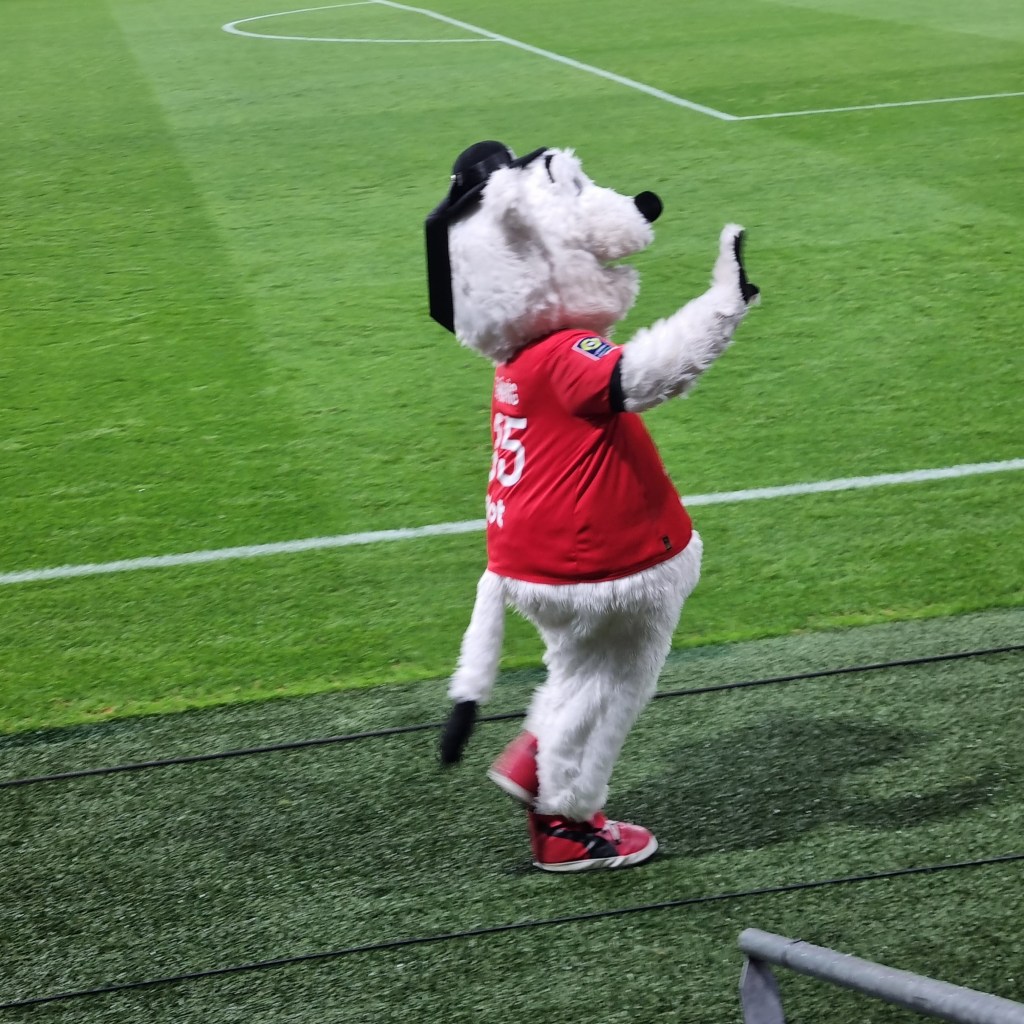
The bus drops us off within site of the stadium, there are still ninety minutes to go until the Coupe d’envoi (kick-off) at 9pm, but the street outside the towering angular stadium is a mass of people, most of whom are queuing for food and beer at the many bars and mobile food concessions that line the street. I think of how quiet Portman Road is even an hour before kick-off.  We make our way along the street to the far end of the stadium and find the club shop to make our traditional souvenir purchases, which today comprise a fridge magnet and a small furry rendering of the club mascot ‘Erminig’ the ermine, which is attached to a keyring.  It is very warm in the shop and my wife Paulene steps outside to get some fresh air whilst I queue to pay. After paying, I head for the door only to meet Paulene coming back into the shop, it has started to rain outside and she needs a hat. As I queue to pay once more, I see Paulene has met the real, I hesitate to say ‘life-size’ Erminig, who has surely also come indoors out of the rain and once I’ve paid for her hat I photograph her with the outsized weasel, who I must admit I thought was a polar bear when I first saw him on tv.

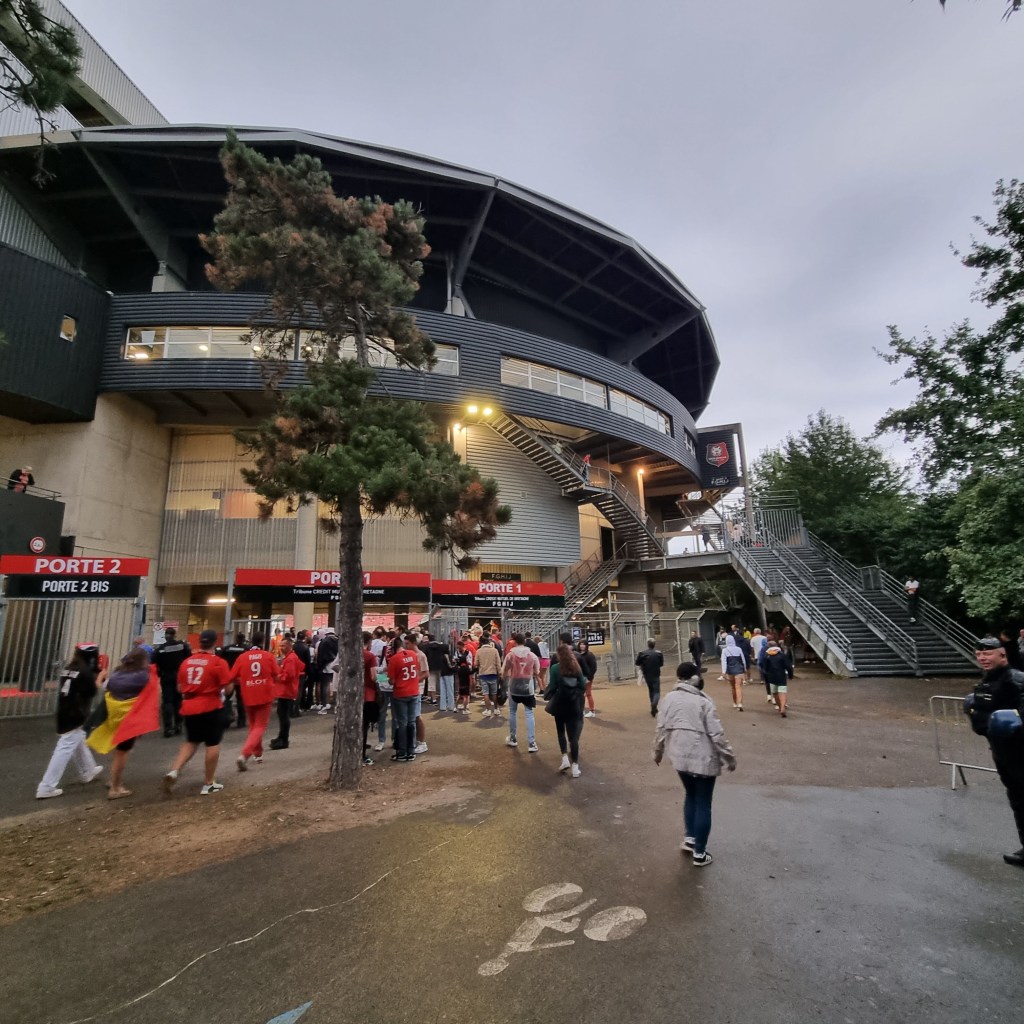
Emboldened by her hat and my thirty-year old Umbro shower jacket, Paulene and I venture out into the rain and walk behind the main stand next to the River Vilaine, which runs through the city; the deep grey sky is suddenly illuminated by an electric flash of light and a deep rumble of thunder; we hurry to turnstile 17 where after scanning the tickets we printed for ourselves back in blighty,  and a quick patting down, including a look under Paulene’s hat we are admitted into the Tribune Credit Mutuelle de Bretagne.  Sadly, there are no match programmes, but at the top of a flight of metal steps I am given two large pieces of corrugated card which read “Allez Rennes” on one side and carry an advert for Malo natural Yoghurt on the other. I am also given two foldable, pocket-size fixture lists.  Weighed down with cardboard, I head for the buvette to buy a cola (E2.50) for my wife and a bottle of water (E1.50) for me. I am surprised and disappointed to find that the cola is not the local Breton Breizh Cola but one of the inferior American brands.

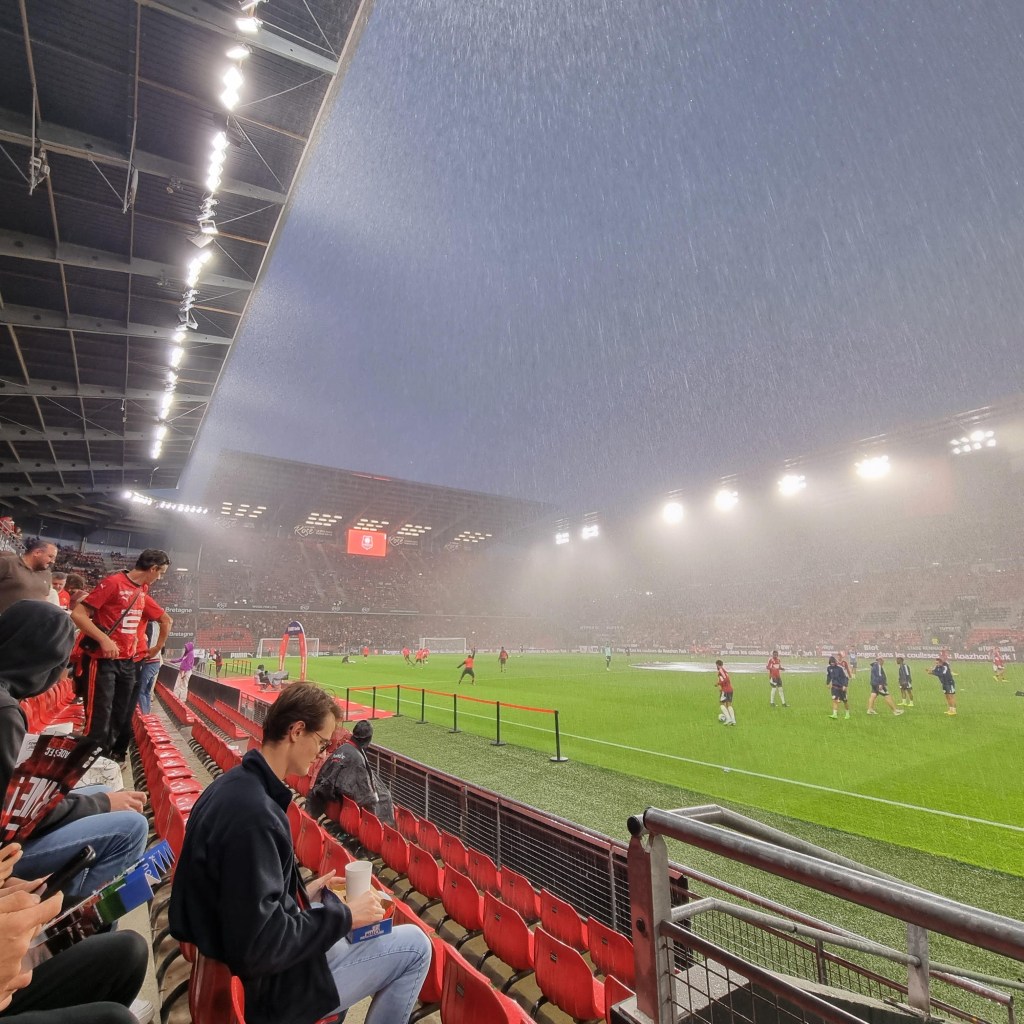
As we take our seats and look out onto the brilliant, floodlit, lush turf it is clear that the rain has become much, much heavier; cracks and flashes of thunder and lightning coarse through the air; people retreat from their seats at the front of the stand as the rain drifts in beneath the high roof.  On the pitch, the players of both teams continue to warm up, seemingly oblivious.  Incredibly, the rain falls even harder.  Even more incredibly the rain falls harder still, but the pitch drains impeccably.  It rains torrentially for possibly twenty minutes, but the storm then passes over, as storms do, and by 9 o’clock when kick-off arrives the sky is almost clear.

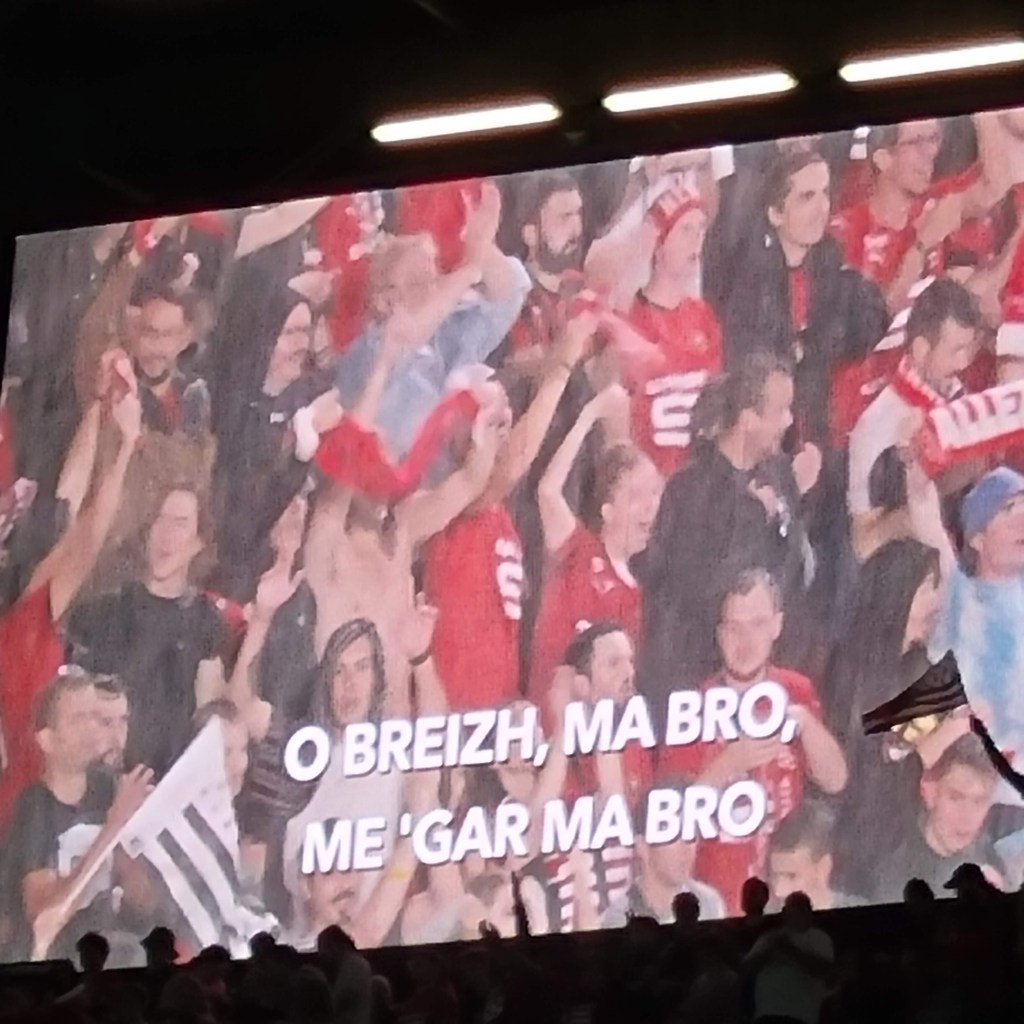
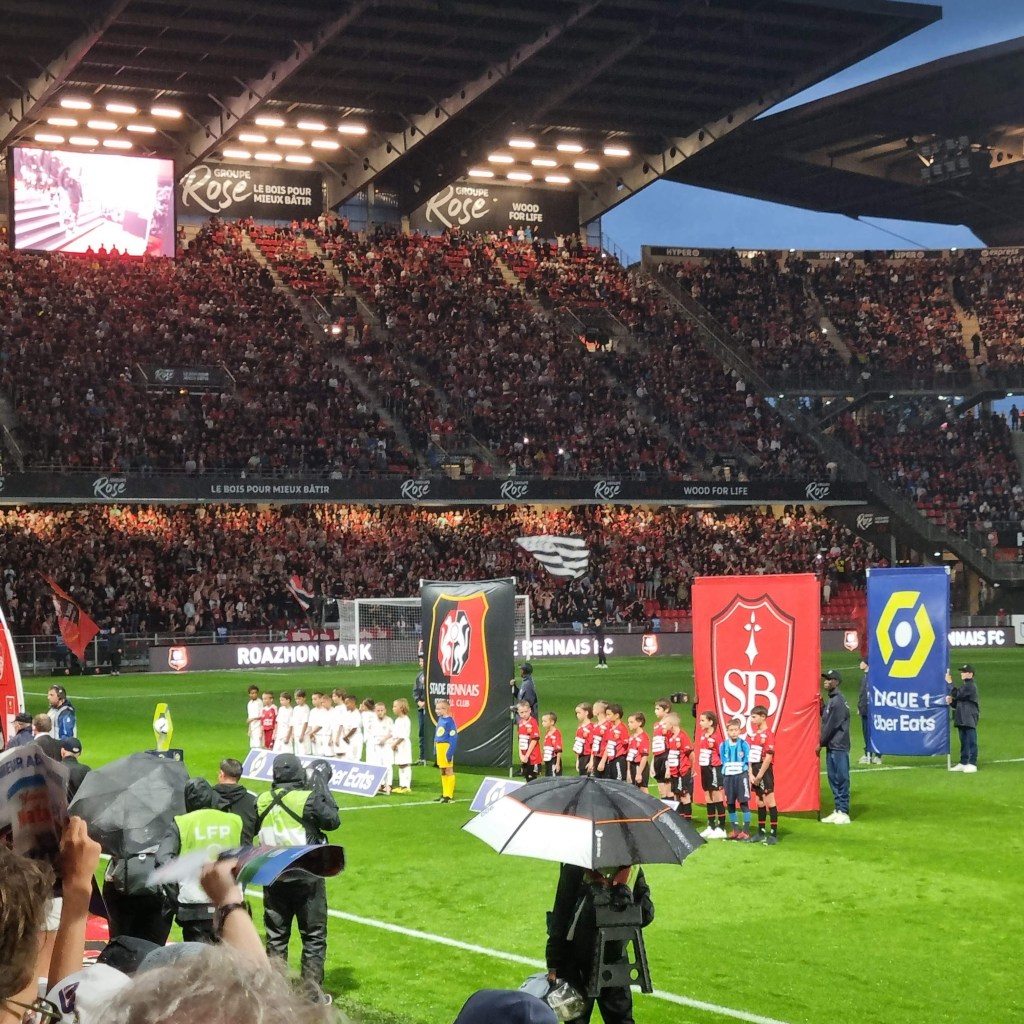
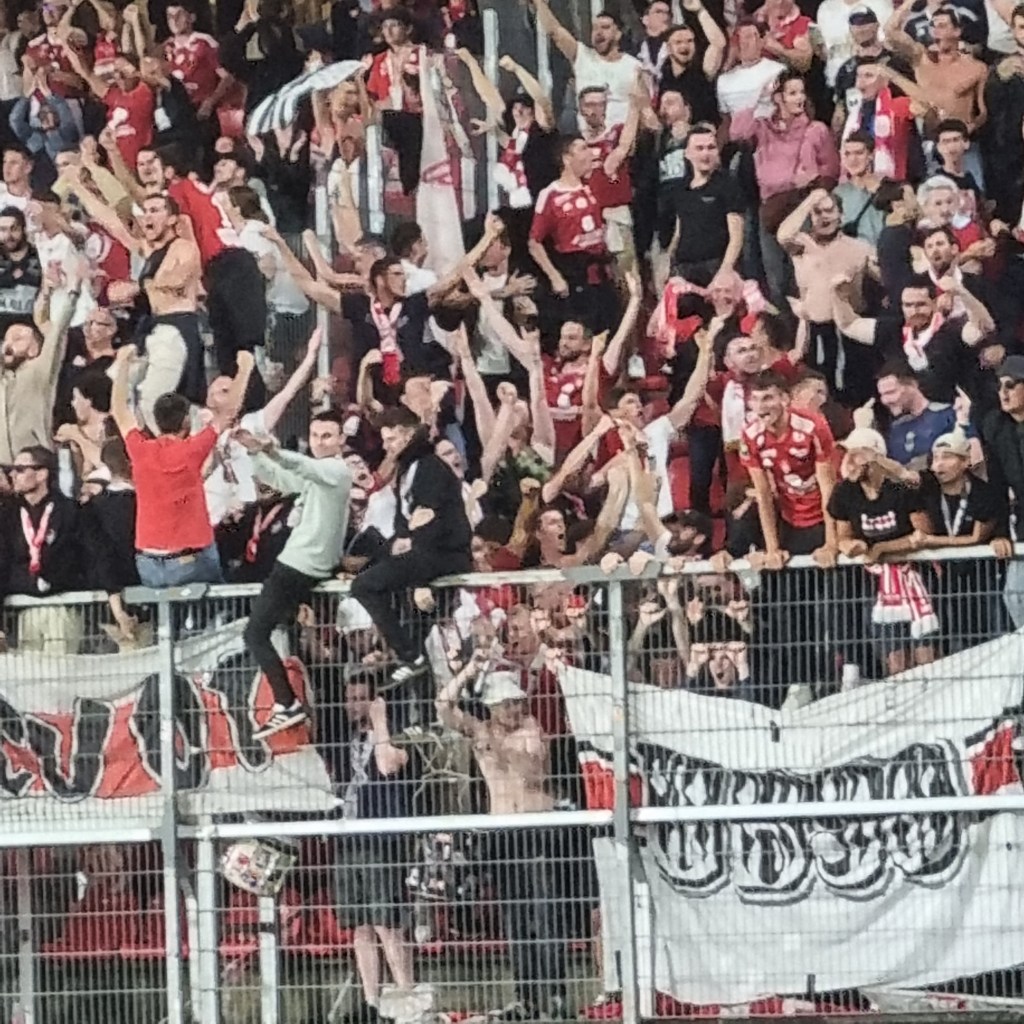
The stadium has filled-up with people who set out on a warm evening in t-shirts but now look as if they swam here. In the away supporters’ enclosure many of the male youth of Brest are topless, the same is true of the Rennes ultras in the lower tier of the stand at the other end of the stadium.  With the steep stands on all four sides now largely full, the atmosphere inside Roazhon Park is all those things that atmospheres in football grounds are usually described as, from bouncing to electric to rocking and all stations in between, and well worthy of the passions that a meeting between Brittany’s best supported team and the team from its second largest city might be expected to raise.  As we wait for the teams to appear the floodlights start to flash on and off; it’s not a power problem due to the storm but just a part of the build-up to this ‘Breton derby’ to go with the singing in Breton of a Celtic-sounding anthem to the same tune as the Welsh national anthem, pyrotechnics and thumping music.  

Finally, after the Rennes team is announced via a combined effort between the electric scoreboard and the crowd, who shout out the surnames of the players in response to the stadium announcer calling out their first names, the teams appear to a crescendo of noise and the lighting of flares amongst the Rennes ultras who rejoice under such names as Les Socios, Allez Rennes and Roazhon Celtic Kop.

Rennes kick-off and are on the attack from the start and massively dominate possession throughout the first half.  Rennes play quickly particularly down their left wing where full-back Birger Meling gets forward, constantly overlapping and linking up with the fluid midfield.  Despite Rennes’ dominance however, they can never quite penetrate the Brest defence which blocks and chases and runs but seldom breaks forward to any effect.  Rennes come closest with a free header which is somehow blocked or perhaps could be better directed, and a follow up shot which is also blocked.  Watching as a neutral surrounded by Rennes fans I feel their frustration.

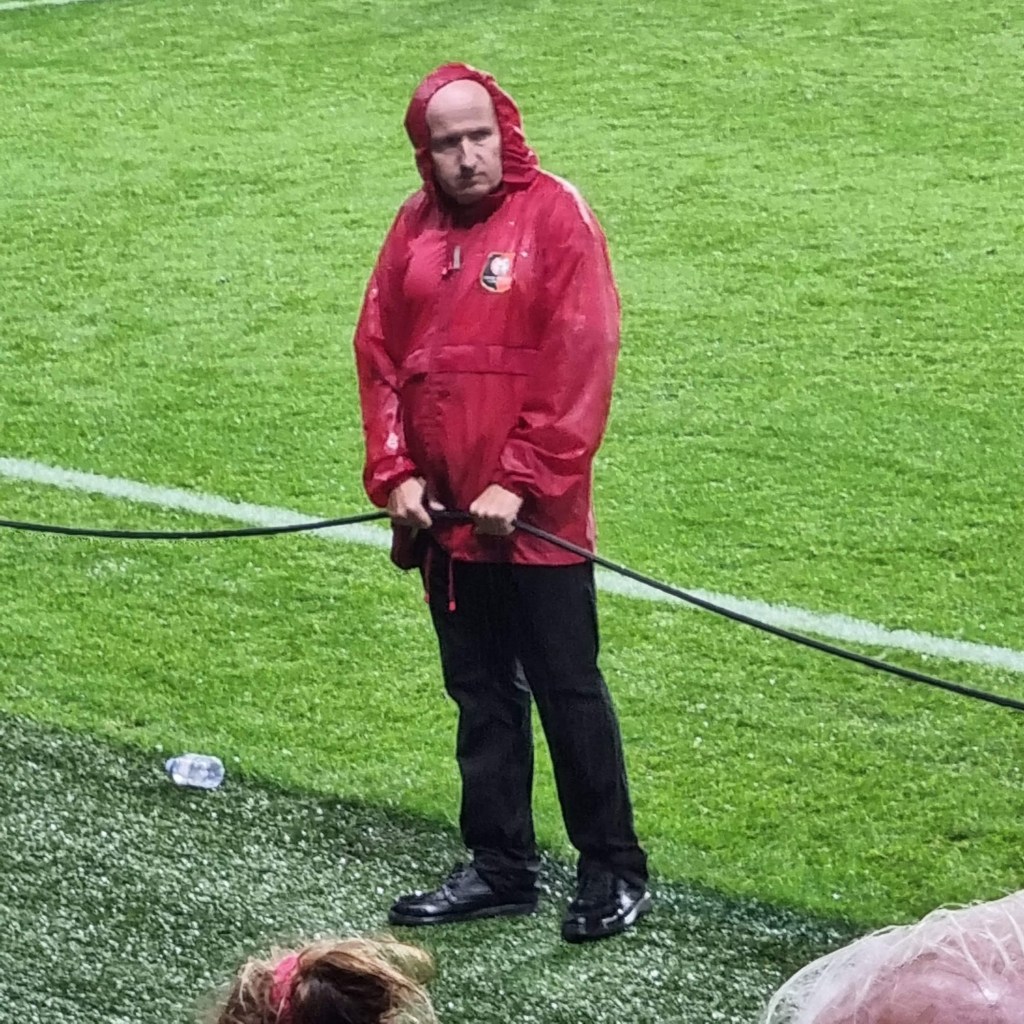
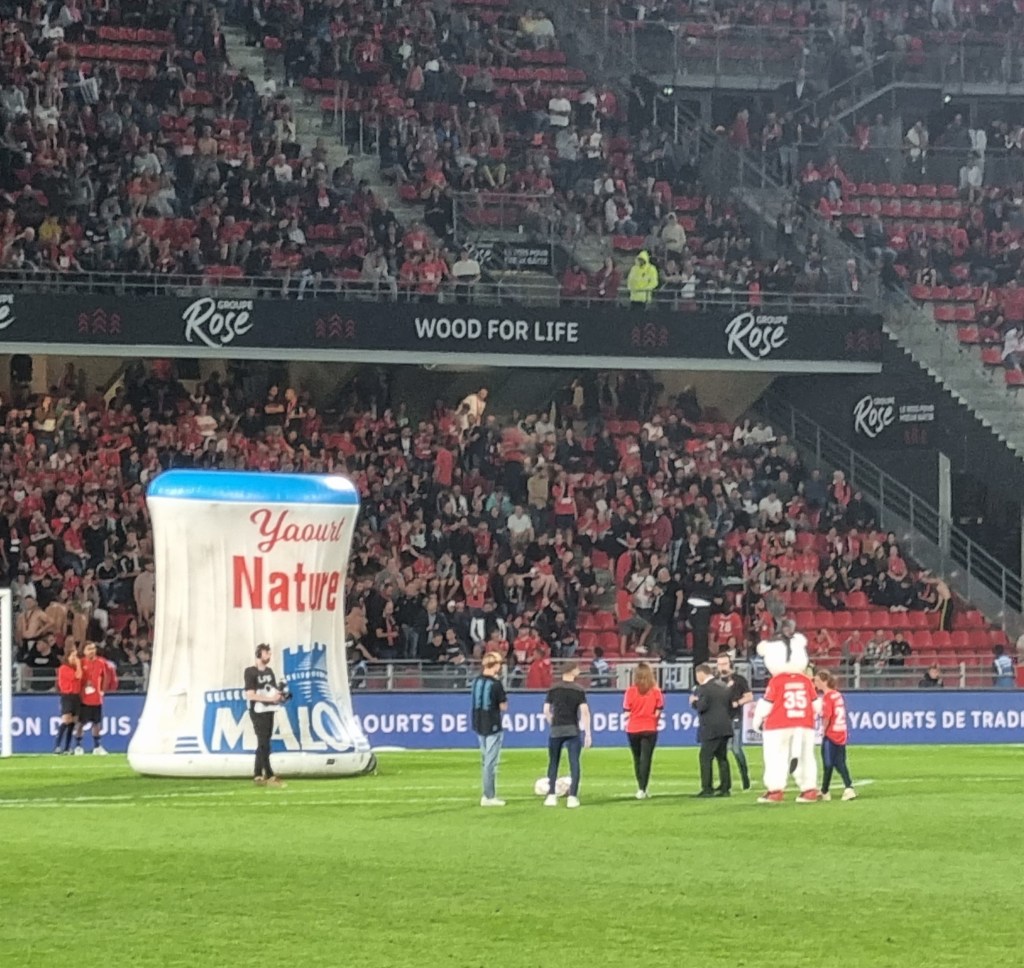
Although their team have not managed to score, the Rennes supporters evidently appreciate their efforts and their style of play and the applause is generous as the teams leave the field at half-time.  As for Brest, their team are not losing, and their supporters have had a whale of a time singing and chanting and linking arms and turning their backs to the pitch and letting everyone know they are here, even if their team hasn’t ‘turned up’ in quite the same way.  Half-time sees a line of stewards assemble in front of the stand holding what looks like a length of rubber tube, presumably this is to prevent any unexpected pitch invasion by me, my wife or the mostly respectable looking people sat around me.  One of the stewards, with his bald head visible inside the hood of his red cagoule looks like a cross between the murderous, red-coated figure in Nicolas Roeg’s 1971 film Don’t Look Now, and former Ipswich manager Paul Cook.  Aside from the stewards, half-time entertainment is limited and consists of people trying to drop kick a football into a huge and presumably fake pot of Malo yoghurt.  The first attempt by a young woman drops straight into the pot, but no one else succeeds and one boy embarrasses himself royally, slicing the ball horribly wide to the jeers of the crowd.  Finally, Erminig the giant stoat has a go and comes as close as anyone, except the first contestant who has struck another blow for women in football. 

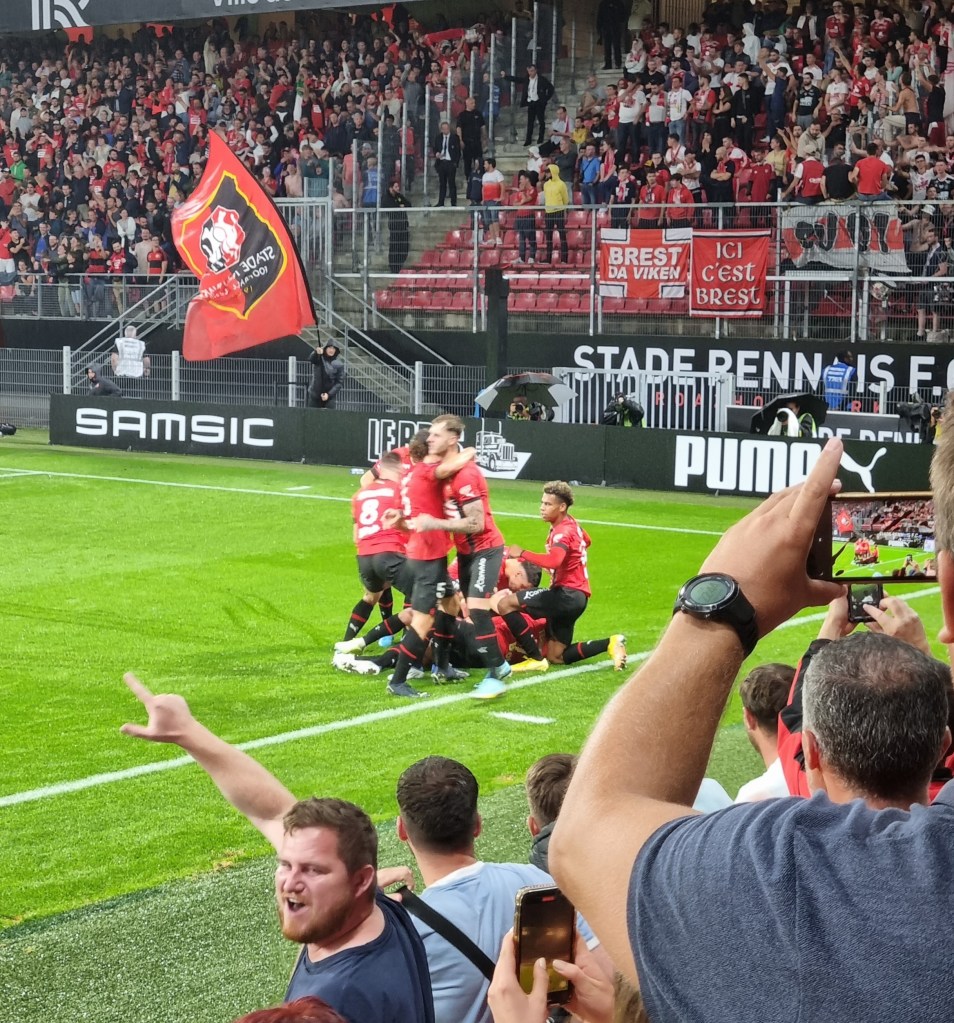
Our seats face the half of the pitch which Rennes will now be attacking and somewhat typically the start of the second half sees Brest come out with re-found purpose and for the first few minutes most of the play is at the far end of the pitch, but it soon begins to even out. Rennes win a corner just eight minutes after the re-start and directly from it, centre-half Joe Rodon heads his team into the lead that they probably should have had at half-time.  Roazhon Park explodes into a wall of noise as Rodon’s name is shouted out by the crowd after the stadium announcer has shouted out his first name.  Narrow canvas pylons inflate and deflate behind the goals as if advertising a remedy for erectile dysfunction and the players form a human tumulus, burying the goalscorer. Rennes will now surely go on to win.

Four minutes later, after a first shot is blocked Franck Honorat scores for Brest with a low shot inside the near post; but for an outbreak of pandemonium in the away enclosure to our right, Roazhon Park pouts in stunned silence.  Brest had had to do something more than just defend, and very quickly they had, to everyone’s surprise, possibly including their own.

The second half continues to be more evenly contested than the first. Brest have worked out a better plan that gives them more of the ball although Rennes are still the team that have more attacking verve and their best players Benjamin Bourigeaud and Martin Terrier are more involved than they were previously. Brest maintain a disciplined back line, successfully catching Rennes offside or tracking the Rennes players’ forays forward. The match continues to entertain, and the ultras of both teams are in good voice. The Rennes fans chant to each other from both ends of the stadium, one end echoing the shouts of the other.  The game enters its final ten minutes and based on the previous eighty minutes I dare to think to myself that no more goals will be scored.  The three blokes sat in front of us are clearly of that opinion too and boldly, but perhaps foolishly, they leave.

Three minutes of normal time remain.  Rennes win a free-kick in front of us and Bourigeaud arcs a cross into the penalty box. A cluster of players jump together and with his neck straining Martin Terrier flicks his head and the ball up, sending the ball behind him in a dipping curve beyond the figure of Marco Bizot the Brest goalkeeper. Rennes have surely scored what is a late winner.  The inevitable noise erupts all around us amidst waving hands and pumping fists and the sight of men in red shirts and black shorts cuddling one another.  Paulene enjoys the fact that our jointly held belief that one must never leave a game early has yet again been vindicated.

There is nothing now for Brest to do but once again alter their game plan and try and score a goal. Normal time ebbs quickly away and suddenly four minutes of added on time is all they have. It’s the ninety first minute and it’s Rennes who are getting forward; down their left, their substitute Desire Doue is running into the penalty box, he still has the ball, no tackle comes in, he looks up and smoothly passes the ball firmly beyond the diving Bizot and into the far corner of the goal. Doue looks up seemingly surprised that he has scored and the blur of noise, hugs and excitement of four minutes ago happens all over again.

With the final whistle, Ermining the giant stoat appears once more and joins the players on the pitch as both teams applaud their supporters and share post-match handshakes.  As neutrals Paulene and I applaud, but soon depart for the bus stop and the trip back to the city centre where we’ll enjoy a  night cap in the bar on the corner of the street where our hotel is situated as we look back on another memorable evening of football in France.