EA Guingamp 2 USL Dunkerque 1

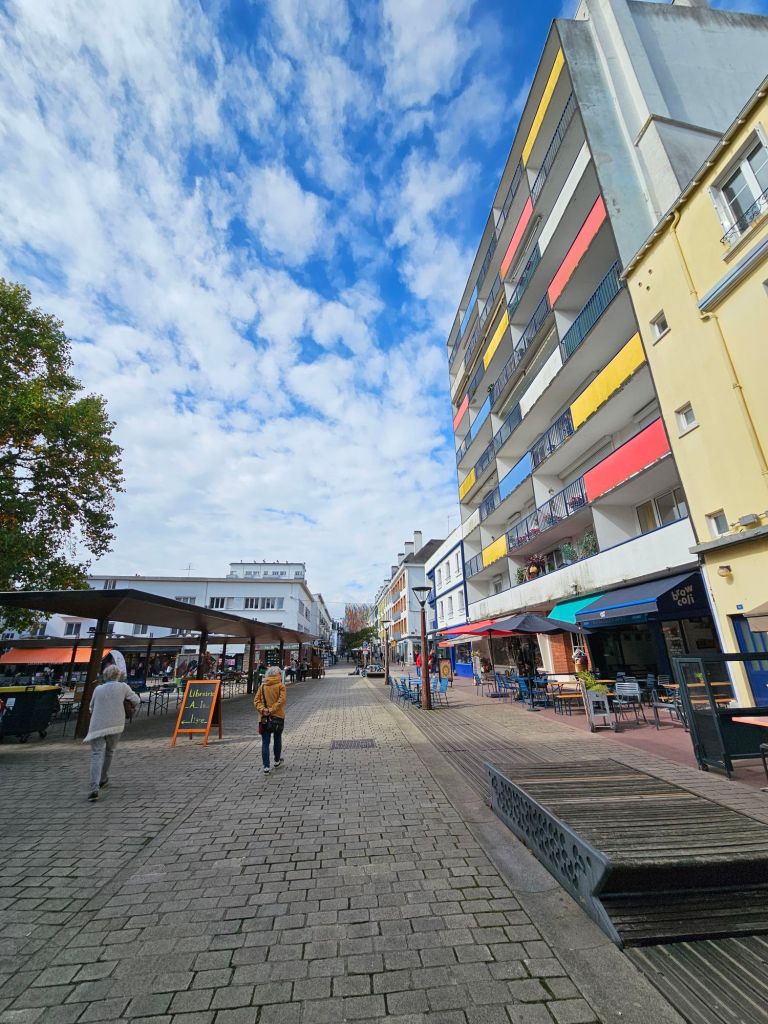
Guingamp (Gwengamp in the local Breton language, and pronounced gangomp) is a small town of only seven or eight thousand people, which sits on a rocky escarpment above the River Trieux in the heavily agricultural north-west corner of France. For thirteen seasons since 1995, this tiny rural town with a population smaller than Beccles, Mildenhall or Woodbridge had a team in the top division of French football, and also won the French FA Cup (the Coupe de France) twice in that time.    But more than that, the name ‘Guingamp’ is just beautiful to the ears, the club plays at the wonderfully named Stade de Roudourou and when Guingamp reached the final of the Coupe de France in Paris, some fans travelled there by tractor.  For these reasons, I am fulfilling an ambition today in making a 160-kilometre pilgrimage from where my wife Paulene and I are staying on holiday in Carnac in the south-west of Brittany.

Our journey is elongated a bit by a stopping off north of the topographically scintillating town of Morlaix, 60 km west of Guingamp to visit the huge six-thousand year old Neolitihic cairn at Barnenez, but we eventually rock up in good time in Guingamp to buy two tickets for the match (26.00 euros each) at the club ‘boutik’ in the town, along with a petit fanion (pennant) and fridge magnet (6.50 euros for the two) for my respective pointless collections.  Disappointingly, the T-shirts showing a representation of the town of Guingamp through its most prominent buildings such as the basilica and hotel de ville is only available in bizarrely small or large sizes, and whilst I’d like a mug that displays the same design, it would probably just sit on a shelf above the petit fanions overlooking the fridge magnet, and with a little thought I could surely spend that 12 euros doing good. More happily, the very pretty shop assistant, whose name, I think, from what it says on our tickets may be Angelique compliments me on my French, although after initial exchanges we mainly speak in English.  

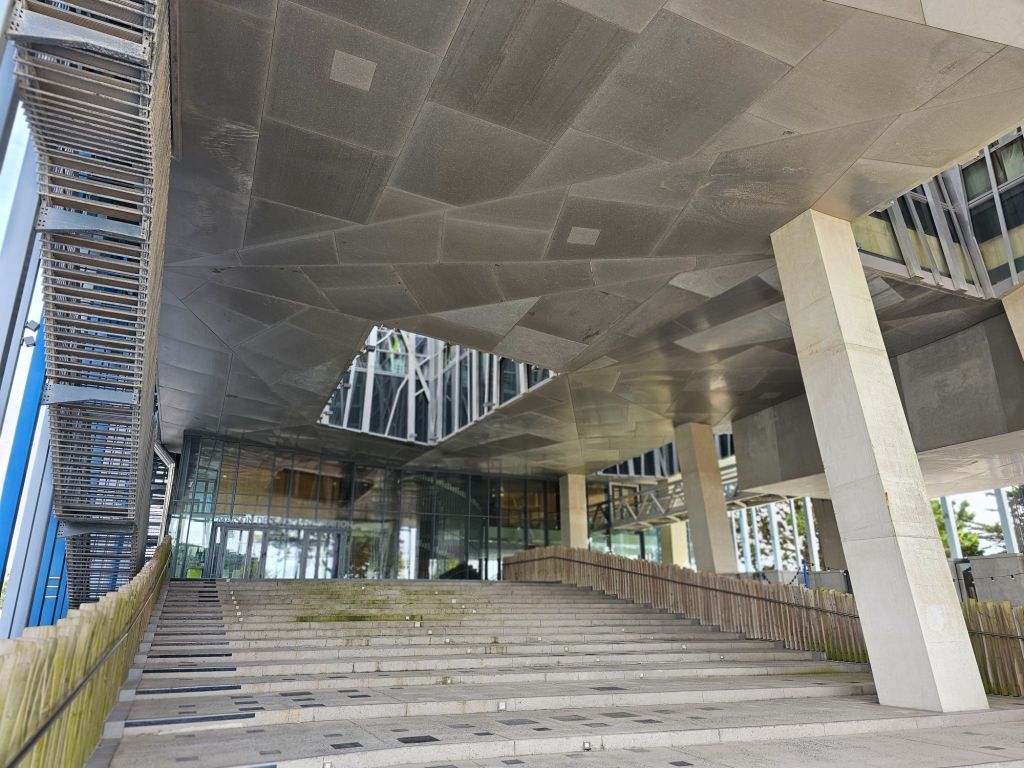
Our hotel room for the night is in a grand nineteenth century house not far from the town centre, but it is a half an hour’s walk from Stade Roudourou and Paulene’s asthma will not stand that once the cold night air surrounds us after 10:30 when the match will probably finish.  Sadly, there is no ‘navette’ (shuttle bus service) to the stadium, but on the advice of the two very helpful ladies in the local Tourist Information Office we make a short car journey across town to the Place St Saveur where we park up our planet saving Citroen e-C4 at no cost. Remarkably nearly all car parking in Guingamp seems to be free.  From the car park, we can see the floodlights of the stadium, and the walk to the Stade Roudourou takes us only a few minutes over the shallow looking, gurgling River Trieux and down a few closed off streets.  The stadium is situated in a residential area which has the appearance of one of the banlieus of a much larger town and is enclosed behind iron fences as if fortified against the outside world, an impression further strengthened by the harsh steel and concrete architecture of the stadium, which is in some ways is at odds with the stone buildings of the town but is perhaps also a modern and cost effective version of them.

The walk to our seats in the Tribune France Barnums (presumably named after a sponsor) takes us around the back of the main stand (the Tribune Cotes d’Amour) past a small wooden hut from which two middle-aged women are selling club souvenirs.  I ask if they have any T-shirts like the ones I saw in the shop in the town; they don’t, but nevertheless they laugh either at my description of the very large and very small sizes available in the shop in the town, or just at my French, I’m not sure which. Paulene and I walk on past a skip decorated in club colours and the back of the Kop Rouge where the local Ultras will later gather.

The back of the Tribune Frace Barnums is the least attractive of the four sides of the Stade Roudourou, consisting mostly of sheet metal, but undeterred I make my way in past a smiling member of security staff who frisks me and wishes me ‘Bon match’ under the somewhat glaring eye of another member of security staff whose demeanour suggests she does not approve of such bonhomie.  With our tickets duly validated by barcode technology we walk on towards our seats past a classic Renault Estafette van painted in Guingamp colours, from which Angelique of club ‘boutik’ fame is selling hats and scarves and shirts; she confirms that she has no stock of the cherished T-shirts stashed away in the Estafette.

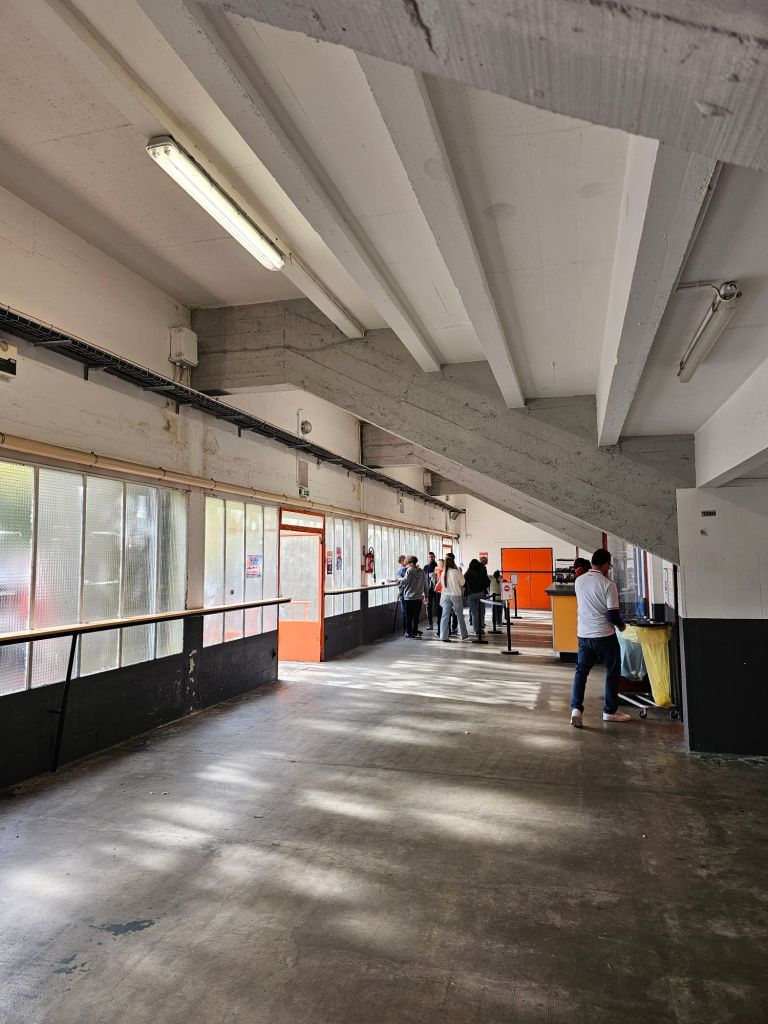
Our entrance to the stand itself, along a corridor, reminds me of the inside of one of carriages on Le Shuttle.  Up an external staircase, I am tempted by the ‘pub Lancelot’, only for two teenage doormen and the smell of sandwiches and nibbles wafting out to disappointingly confirm that it is a room reserved for those paying for hospitality.  Back downstairs I buy a small plastic cup of beer and a similar cup of the local Breizh Cola (8 euros for the two), which Paulene much prefers to the over-hyped American stuff.  We find our seats cosily situated at the back of the lower tier of the stand almost level with the halfway line and next to a galvanised tubular stanchion, which handily ensures people will not be able to edge past us to get to their seats. We pass the time before kick-off making up the life stories of the referee and his assistants, who are warming up in front of us and keeping us amused with their co-ordinated exercises, which with some appropriate music could enable them to pass themselves off as a small all-male dance troupe.   One of the assistants we decide looks slightly ill however,  and has dark shadows under his eyes.  The referee, Monsieur Landry meanwhile, is a tall man with a long body but capable of a neat heel turn, chasse and pirouette.

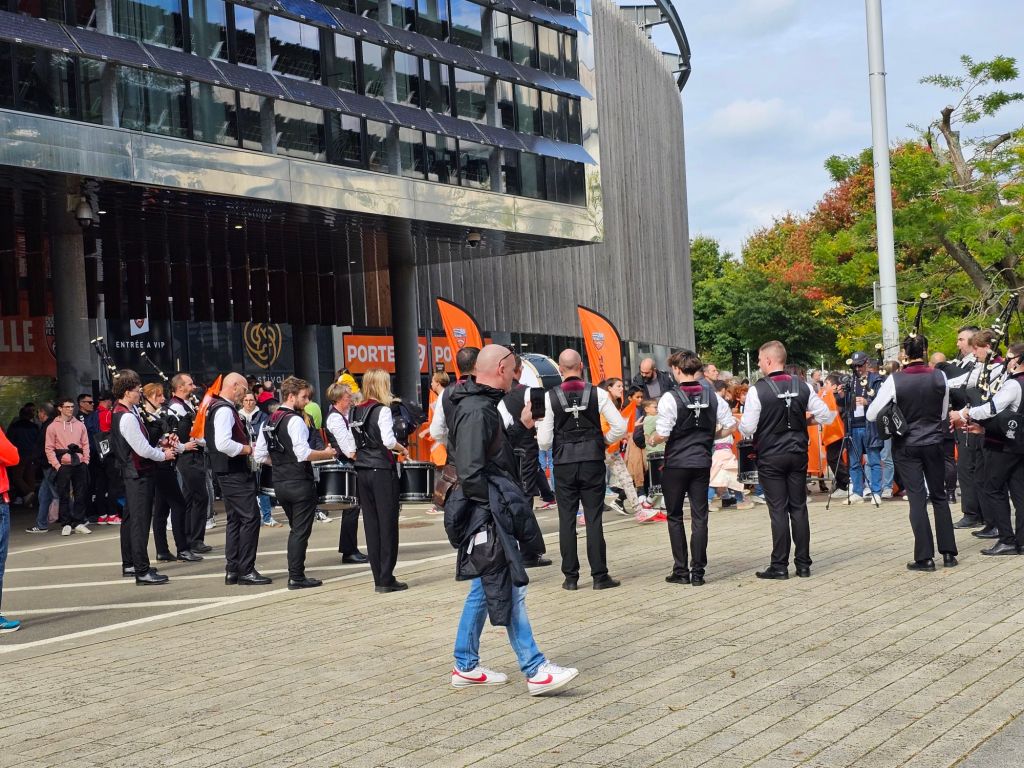
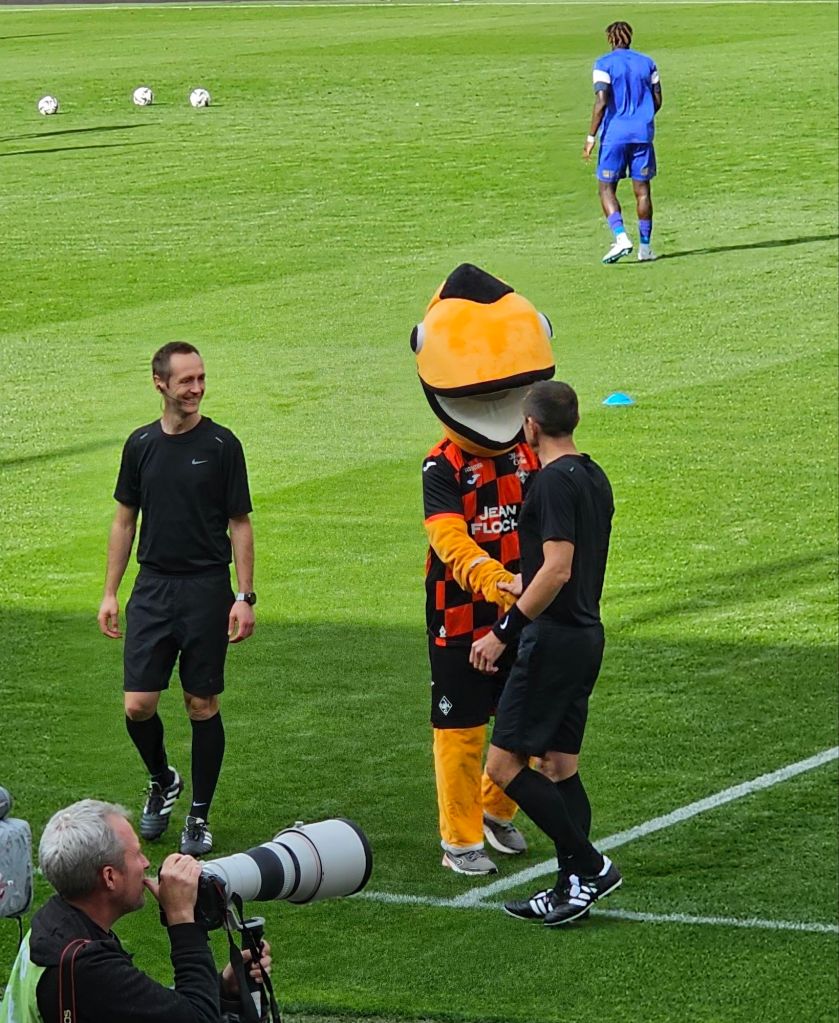
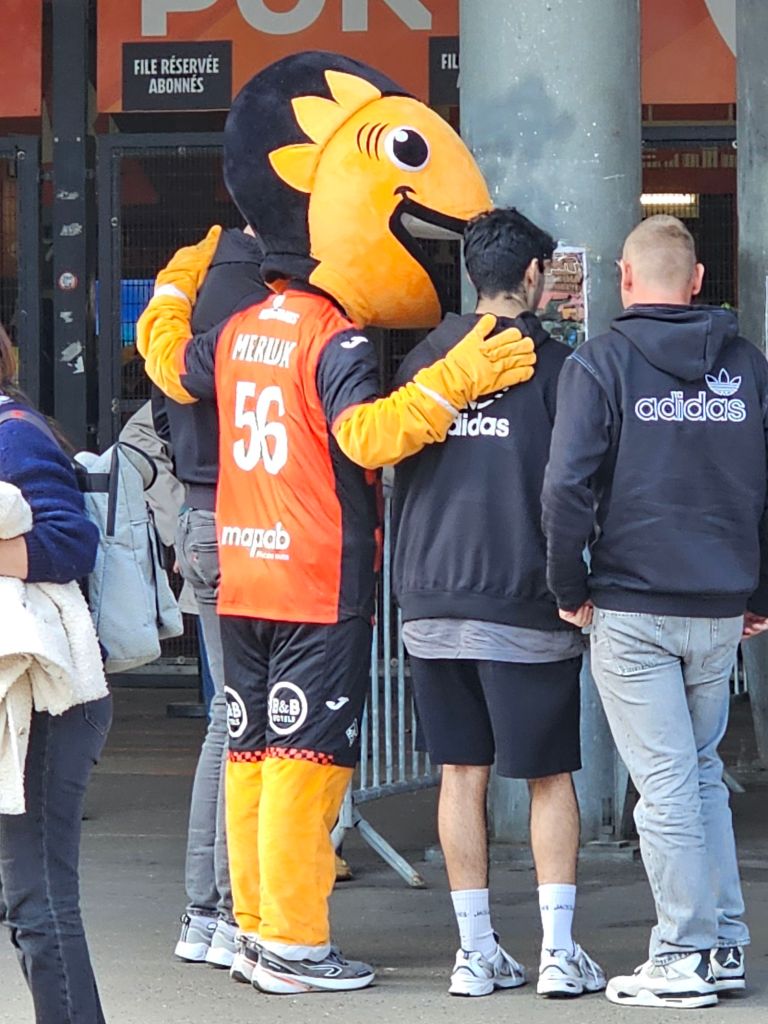
As kick-off (coupe d’envoi) approaches, the stand fills up with people bearing baguettes stuffed with chips, whilst a row or two in front of us a family unpack homemade sandwiches which appear to be of white sliced bread that has had the crusts cut off, which is not something I ever expected to see in France. Meanwhile, the pitch fills up with youths waving banners with varying degrees of enthusiasm but then, when the teams are read out by the stadium announcer  I am shocked, amazed  and I have to admit, disturbed to find that unlike everywhere else I’ve ever been in France, the home supporters do not bellow out the surnames of their players as they appear on the big screen in the corner of the ground; they just clap politely. I can’t quite believe it. Being in Brittany I had also expected bagpipe music as the teams trudged out, but It seems these Bretons aren’t like other French or Breton people at all.  I am a little disappointed; they don’t even have a cuddly mascot.

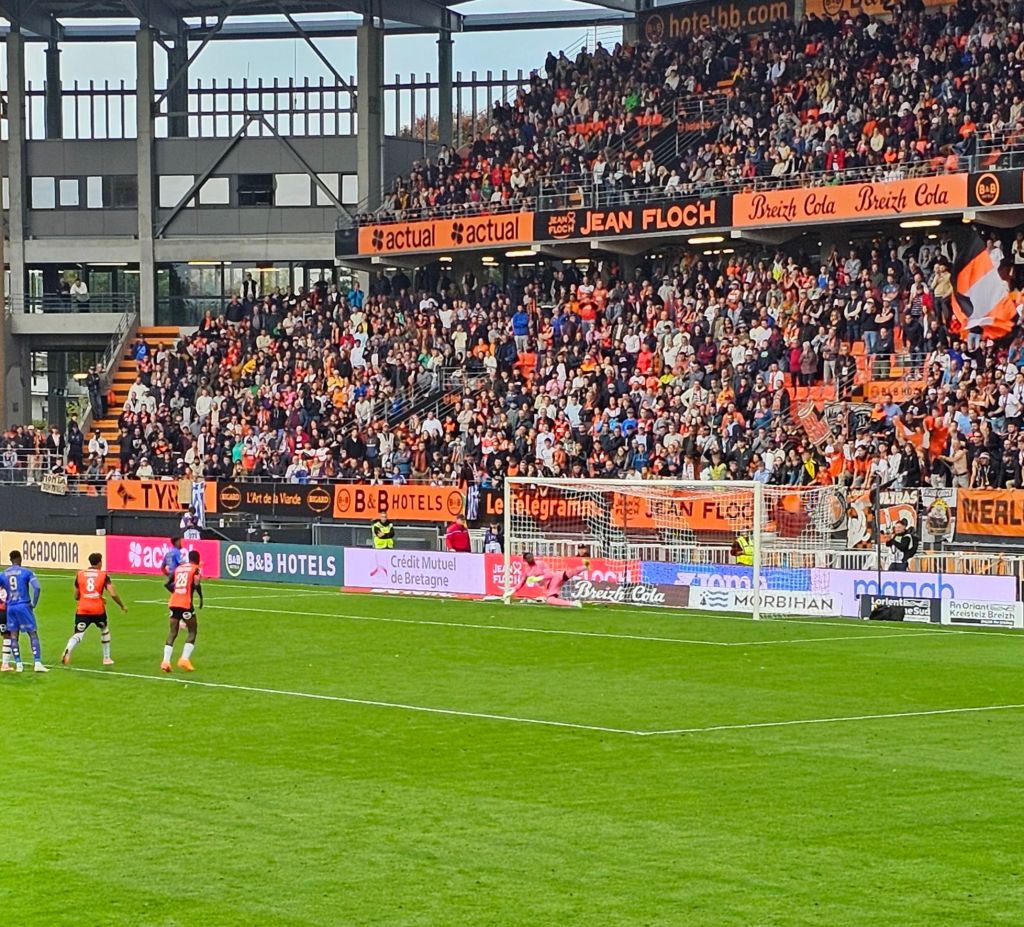
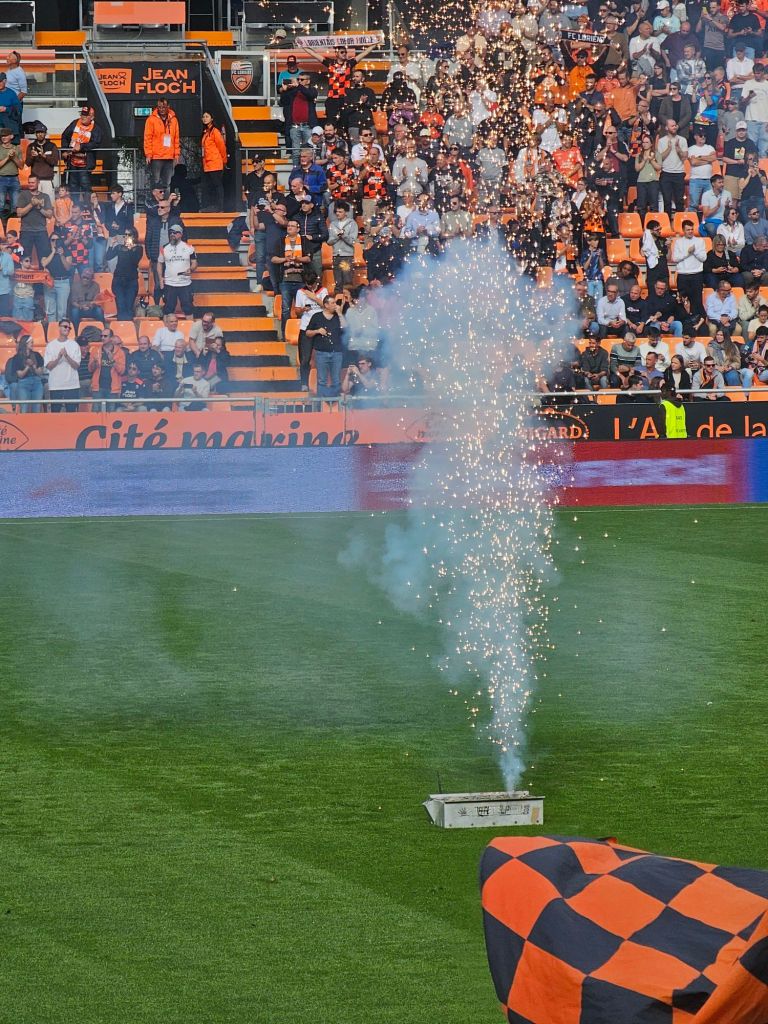
When the match eventually begins at half past eight, it is visiting Dunkerque who get first go with the ball, which they generally kick in the direction of the Kop Rouge and far off Morlaix, whilst Guingamp are aiming just to the north of the town centre with its Basilica, castle ruins and huge metal statue of Bambi. Guingamp sport their handsome signature kit of red and black striped shirts with black shorts whilst Dunkerque wear all white with golden squiggles down the shirt front.  Despite my disappointment before kick-off, the stadium has now come to life, with a flood of chip and beer quaffing latecomers finding their seats and the Kop Rouge now in full voice with chants of “Allez, Allez, Allez, Guingampaises”. I count thirteen Dunkerque supporters, who I could hear chanting before kick-off, but now they are drowned out by the Guingampaise voices and drums.

The opening play from both teams is fast and slick on the well-watered pitch but Guingamp appear slightly more direct and with only four minutes having passed into history a smart through ball and a low cross from the right lead to the ball being placed past the Dunkerque goalkeeper from about six metres out by Freddy Mbemba, who the interweb tells me is on loan to Guingamp from Charleroi in Belgium.  “Buuut” announces the giant screen in the corner in large letters, and when the stadium announcer says “Freddy” the home supporters bellow “Mbemba” and when the announcer says “Freddy” again and the crowd shout “Mbemba” again,  and then wonderfully the same thing happens again.  It feels like a weight has been lifted from my shoulders. “Mbemba!” I shout on cue after the final “Freddy”.

The game continues at pace with Guingamp looking sharper but Dunkerque not appearing to be slouches either.  Standing out for Guingamp, mainly but not entirely because he is two metres tall is their number eight, Kalidou Sidibe, whilst I am also impressed by the tangled mop of hair sprouting from behind the black headband of Guingamp’s number thirty-six, Albin Demouchy who often wins headers and elegantly ‘plays-out’ from the back.  On the electronic boards around the pitch there are advertisements for John Deere tractors and Husqvarna mini tractors as well as the supermarket E Leclerc, who if they had shops in Britain would surely employ the tv sitcom ‘Allo, ‘Allo in their advertising.

After fourteen minutes Dunkerque win their first corner; Guingamp have already had two however and as if to prove that this matters Guingamp’s Amine Hemia soon beats the square but not square enough Dunkerque defence on the right, bears down on goal and scores into the far corner off the goalkeeper’s out-stretched palm, and Guingamp lead two-nil.  “Amine” calls the stadium announcer, “Hemia” bawls the crowd. “Amine” calls the stadium announcer, “Hemia” bawls the crowd. “Amine” calls the stadium announcer, “Hemia” bawls the crowd, and the scoreboard silently but colourfully shouts “Buuut!” as well.

The row of seats in front of us consists mainly of men with grey hair whilst off to our left a younger bearded man looks a bit like Bob Ferris from the 1970’s sitcom The Likely Lads (actor Rodney Bewes).  Behind us there is a gathering of men and women in day-glo tabards; if they’re not orchestrating a “gillets jaune” style protest I guess they must be the first aiders and stewards watching the match. At the front of the stand clouds of smoke billow up from teenage vapers and then dissipate into the night air. I notice that Bob Ferris has quite girlish looking hands.

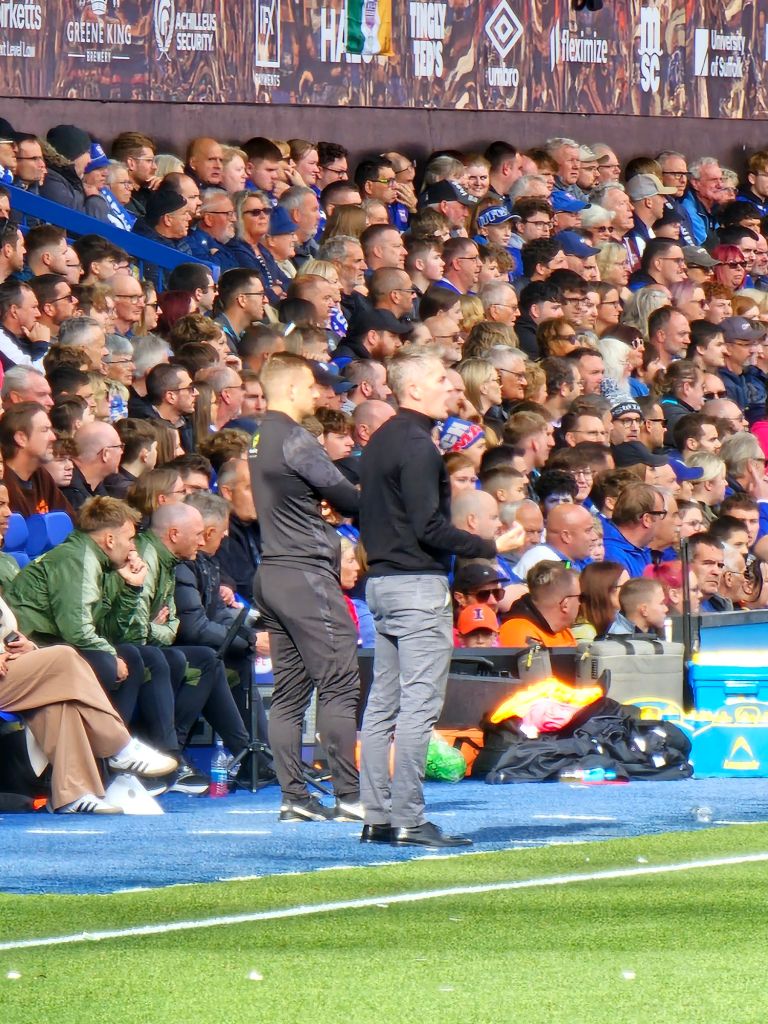
There are now less than ten minutes of the first half remaining; Dunkerque’s number twenty shoots from the edge of the penalty area and the impressively agile and wonderfully named Guingamp goalkeeper Teddy Bartouche tips the shot over the cross bar spectacularly.  Two minutes later and yet another move down the right for Guingamp leaves Louis Mafouta with a seemingly open goal, but with the co-ordination of someone whose foot has ‘gone to sleep’ and who has both arms strapped to his sides, he heads the resulting cross hopelessly and clumsily past the far post.  On the touchline, Guingamp manager Sylvain Ripoll, who incidentally once said ‘Bonjour’ to me and Paulene in the lift of a Paris hotel (the Mercure near Parc des Princes) looks frustrated in his pale trousers and zip-up jacket.

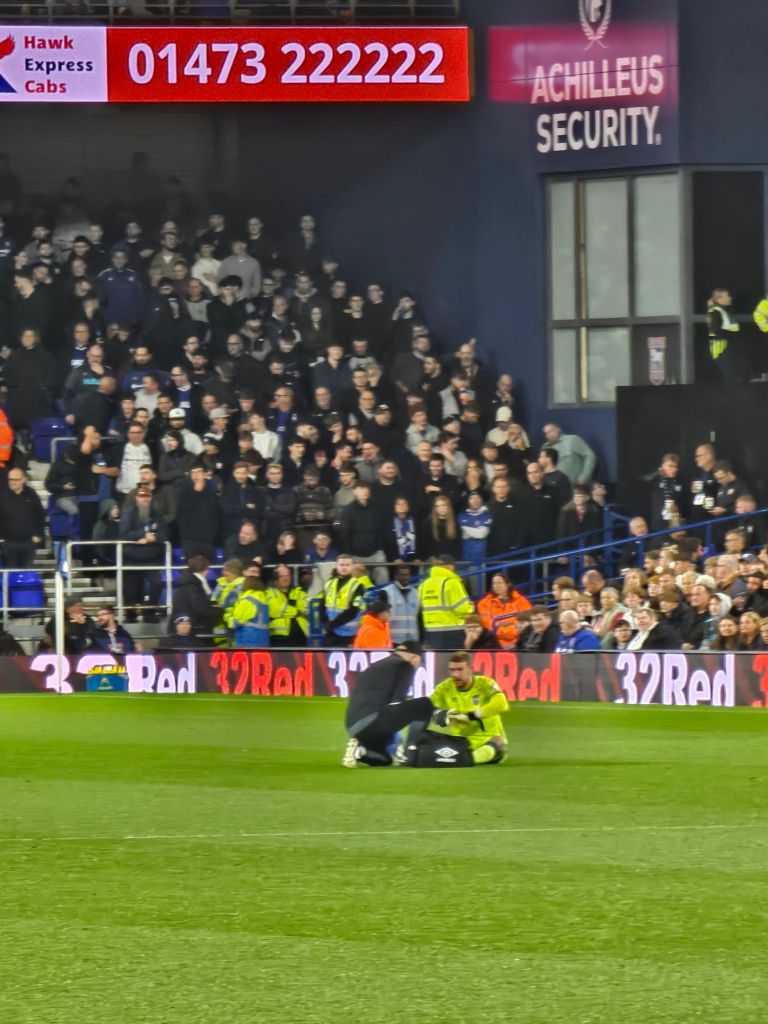
The last action of the half seems likely to be the substitution of the Dunkerque goalkeeper, who unexpectedly and mysteriously has hurt himself but then a quick pass in from the Dunkerque right finds Enzo Bartelli inside the ‘D’ outside the Guingamp penalty box. Almost in slow motion Bartelli gently passes the ball beyond agile Teddy in the Guingamp goal and Dunkerque, as they say on the telly, are “back in the game”, although of course as long as Monsieur Landry hadn’t terminally parped his whistle, they were never out of it.  Five minutes of added on time fail to alter the score any further.

Half-time is the usual melange of children on the pitch, but as before the start, with added flag waving of varying enthusiasm.  The match resumes at twenty-four minutes to ten and the Kop Rouge quickly dive back into endless chants of “Allez, Allez, Allez”.  I soon decide that for a man taller than your average back garden fence panel, Sidibe has quite a delicate touch and then within ten minutes Monsieur Landry airs his yellow card for the first time this evening after Dunkerque’s Inigo Eguaras fouls Mbemba.  

It is Dunkerque who are now selfishly dominating possession, a situation which Guingamp are contributing to by quickly giving the ball back to them whenever they lose it.  On the Kop Rouge, the ultras are swirling their scarves in the style of 1970’s Leeds United fans, whilst the big screen in the corner is showing pictures of real estate as if anyone interested in buying a house would pay more attention to the screen than the match.  As the people in the ground with least interest in buying property in Guingamp, surprise transfer moves notwithstanding, the Dunkerque players fashion an intricate passing move down the left only for Eddy Silvestre to shoot narrowly over the cross bar.  With the game now two-thirds over, Dunkerque blink first and make two substitutions.

The slick passing of the first half has been replaced with increased niggle and Paulene and I discuss the colour of the shorts worn by Dunkerque’s Brazilian number thirty, Abner.   They look more yellow than other Dunkerque players’ shorts, which Paulene attributes to his frequent falling over on the wet grass, whilst I suggest, a little unpleasantly perhaps, that maybe he ‘forgot to go’ before he left the dressing room. Twenty minutes remain and Eddy Silvestre shoots over the bar again for Dunkerque whilst the Kop Rouge sways with a sea of banners and the towering Kalidou Sidibe is replaced by a man with hair reminiscent of the late Tina Turner, Tanguy Ahile.

Somewhat annoyingly, the final ten minutes of normal time dissolve into something like chaos and nothing like football as players of both teams proceed to fall to the ground with alarming frequency.  If all the players who go down have genuine injuries, both clubs will need to be trawling the job centres of Brittany and Pas de Calais in the morning for additional physiotherapists.  Monsieur Landry, meanwhile, is rushed off his feet, airing his yellow card four more times and showing his red card to someone in the Dunkerque dugout.   Six minutes of added time are not so much played out, as acted out, and the final whistle comes as a blessed relief to all. The result lifts Guingamp to eighth in the Ligue 2 table, a point outside the barrage (play-off) places, whilst Dunkerque slide down to fourth from bottom, one above the relegation places.

Despite the weirdness of the last ten minutes, and the unexpected pre-match disappointments over T-shirts, bagpipes and the reading out of the players’ names, overall, the match has been a good one and everything has worked out fine; well except for the T-shirt and the bagpipes, but you can’t have everything. We therefore make our way back to our planet saving Citroen in good spirits, like all but thirteen of the 6,562 strong crowd, but who knows, they probably enjoyed it too.

ASC St Anne d’Auray 1 Avenir Guiscriff 3

One of the best things about visiting France in September is being able to catch a game in the early rounds of the Coupe de France when the competition is still regionally based and there are ample opportunities to see village teams slug it out in quest of the sort of glory only village teams can enjoy.

Having arrived in Brittany just yesterday, after an overnight stop in Le Mans, I can’t be bothered to travel far from where my wife Paulene and I are staying in Carnac, added to which it’s a grey, miserable day and when if it’s not full-on raining there is a steady drizzle as if the Atlantic Ocean is stealthily relocating itself slightly inland.  After consulting the list of fixtures on the Ligue Bretagne de Foot website I have whittled the possibilities down to US Brec’h v Av.Campeneac-Augan or ASC Saint Anne d’Auray v Avenir Guiscriff.  Both are between twenty and twenty-five minutes away by planet saving Citroen e-C4 but St Anne-d’Auray ASC have a grass pitch as opposed to a plastic one, and taking a chance on the rain having not caused a postponement I decide that I would rather see people getting muddy than getting friction burns, and so I head for St Anne d’Auray.

St Anne-d’Auray is a curious place, a village with a population of less than 3,000 people but also the location of the third most visited pilgrimage site in France after Lourdes and Lisieux, as a result of which, and also because of which, it also has a huge basilica.  Wikipedia tells us that St Anne-d’Auray became a site of pilgrimage after a pious farmer in the early 17th century kept having persistent visions of St Anne, who somewhat weirdly told him to rebuild a chapel which had been demolished about 900 years previously. The farmer must have been a sort of renaissance era Nigel Farage figure as people were evidently keen to believe his unlikely tales, the chapel was built, and by the 1870’s had become the present basilica.

As a I drive into St Anne d’Auray along the D17, through the early afternoon gloom the tower of the basilica looms above the roof tops wreathed in low cloud.  A left turn takes me down the Rue de General de Gaulle and to the Stade Municipal where luck shines upon me and a car is leaving the otherwise full car park just as I arrive.  I park up and step out of my planet saving electric Citroen, and my nostrils are assaulted by the acrid smell of barbecue smoke.  I saunter through the gates to the Stade Municipal in my long navy-blue raincoat and join the throng of local inhabitants socialising, drinking and generally enjoying themselves in a sort of impromptu ‘fanzone’ where everybody seems to know everyone else.  Entry to the match is free of charge with the football club clearly being content with the income from beer, wine, coffee and food.

Kick-off is advertised as being at three o’clock but it’s nine minutes past by the time the two teams emerge from the dressing rooms and trudge their way to the pitch behind the referee and his assistants, the clumping of their metal boot studs on the tarmac sounding like a marching army and the basilica providing a suitably religious back drop for a Sunday afternoon.   The tarmac driveway passes through a gap in an impressive row of tall oak trees that line the east side of the stade, which has no stand, just a tarmac path all around and a metal rail surrounding the pitch.  After photos and the usual cursory handshakes, the teams line up and after an initial ‘ceremonial’ kick off by a bearded and balding man, it is visiting Guiscriff AV who get first go with the ball, sending it mostly in the rough direction of the nearby town of Auray, whilst the home team shoot towards the basilica.  St Anne d’Auray wear a kit of red shirts and black shorts whilst Guiscriff are adorned in all navy blue with gold or beige chevron on their chests.  

The crowd of at least two hundred is enthusiastic and congregates on each side of the pitch behind the well-maintained metal rail.  Guiscriff is a village 84 kilometres away to the northwest near Quimper, is about an hour and ten minutes’ drive away, and a good number of visiting supporters have travelled, including a man carrying a blue, cuddly, toy rabbit, which I assume is some sort of mascot, but he could just be a friend or comfort.  The stadium has no flood lights but although it’s a grey afternoon, it’s not so grey that these are going to be needed.

Just two minutes pass and a cute through ball down the left from the Guiscriff number nine sends their number eleven away into the penalty area where he comfortably slips the ball past the St Anne d’Auray goalkeeper to give the away team a very early lead. After the excitement of the start of the match and the teams marching to the pitch, the home supporters now appear as religious followers whose tenets of faith have suddenly all been disproved.  But whilst 84km apart geographically, the two sides are at the same level in the regional league, so all is by no means lost just yet, although when the bells of the basilica start to toll the sound is somewhat ominous.  The away supporters meanwhile are delirious and having visions of the fourth round.

Happily, the shock of going behind is soon processed mentally and the noisiest home supporters assembled opposite the team dugouts are quickly in good voice again with chants of “Aux Armes”.  An adversarial atmosphere is stoked as there are enough away supporters to render a few decent chants of “Allez les bleus” too.    On the pitch, the balding number five and number eight for St Anne d’Auray appear influential but Guiscriff are holding firm quite comfortably, with the home team’s forays forward mostly foundering on slippery grass, offsides and shoves and pushes that the referee (l’arbitre en Francais) Monsieur Romain Betrom spots but the home supporters don’t.

It’s now twenty-two minutes past three and it’s beginning to look like St Anne will struggle to reverse the early deficit but then almost miraculously there’s a careless trip and Monsieur Betrom is pointing to the penalty spot.  After a long lecture from Monsieur Betrom and eventually a yellow card (carton jaune) for Guiscriff’s number five, who I can only think postulated an alternative view of events a little too vigorously, the rangy number ten for St Anne d’Auray steps up to score, a good two minutes after the penalty kick had first been awarded.

With the scores level the whole match begins to even out and Guiscriff no longer look the better team.  At twenty-five to four St Anne d’Auray win a free kick, which ends up in the back of the Guiscriff net courtesy of one of their own player’s boots, but Monsieur Betrom disallows the ‘goal’ for pushing, shoving, holding, blocking or a combination of the four.  There was certainly a lot going on in the penalty area with fouls likely being committed by both sides; Monsieur Betrom clearly took the view that if in doubt just pretend the whole incident never happened and leave the score as it is, and who can blame him?

I wander around the ground taking the game in from different angles and enjoying the grey afternoon scene against the backdrop of oak trees and the tower of the basilica beyond.  Briefly I stand close to the village ‘ultras’, who are mostly teenagers but are well equipped with banners, two empty oil drums for percussion and a loud hailer.  Not long after I settle against the rail just beyond the bulk of the more boisterous home support, Monsieur Betrom makes a decision that will probably define the match, as he shows his carton rouge (red card) to the St Anne d’Auray number eleven.  There is an inevitable delay as this is discussed but eventually number eleven makes his way towards the gap in the tall oak trees and back to the changing rooms.

 Inevitably Monsieur Betrom’s decision is not a wholly popular one and there is much braying amongst the home crowd.   I exchange raised eyebrows with a middle-aged man a metre or two away along the rail and then move next to him when he speaks to me.  Happily, the extent of his English and my French seem vaguely complimentary, and in a somewhat stilted way we are able to discuss the Coupe de France, the match and Monsieur Betrom, the man even does an impression of Donald Trump.  Half-time (mi-temps) arrives and is accompanied by a sudden increase in precipitation, so I turn up the collar on my coat.  The man, who I will later learn is called Frederique invites me to join him and his friend Patrick at the bar.  He jokingly suggests we can talk about Brexit, which I suspect he feels as disappointed about as I do.  At the bar, Patrick very kindly buys me a beer, and Frederique introduces me to several other people including the local mayor a small, kindly looking man with a big moustache, and another friend, Jean Baptiste.  

When the football resumes, I stand near the dugouts with Frederique and Patrick and try to avoid the rain, which is now coming straight at us, from getting into my beer.  The match continues in much the same vein as it did in the first half and Guiscriff seem incapable of making any advantage of their extra player.  The Guiscriff coach strides up and down the touchline seemingly talking to himself but possibly cursing his players.  When his goalkeeper concedes a free kick by picking up a back pass, he almost has a seizure.  Monsieur Betrom meanwhile, a thin, gaunt looking man much younger than his two assistants, one of whom has grey hair, spends much of his time brandishing his carton jaune. For every one of the many bookings he delivers he stands to attention, with his card holding arm at 45 degrees, a pose he holds for a full two or three seconds as if at some sort of Nuremburg rally for referees.

“Carton rouge!” shouts Frederique for as many fouls as he thinks he can, which amuses a short elderly couple stood next to me, and then “Allez l’arbitre!”.  The game proceeds through the continuing gloom although happily the rain stops falling.  Substitutions are made, but no resolution seems in sight until suddenly by way of another miracle there is an ill-judged, attempted tackle on the edge of the St Anne d’Auray penalty area, and for the second time this afternoon monsieur Betrom points to the penalty spot.  The penalty is scored and with less than ten minutes left to play Guiscriff are once again heading for round four.

No more than five minutes later, Guiscriff lead 3-1 after a sequence of a corner, a shot and a deflection concludes with ball nestling once more in the back of the St Anne d’Auray goal net.  It’s a disappointing end to the afternoon for St Anne d’Auray and matters get slightly worse when there is a contretemps between a local and a man in a Guiscriff sports coat.  Glaring looks are exchanged, beer is spilt and the game stops as the matter is discussed by the referee, one of his assistants and a man wearing an armband who I assume is the delegue principal, a sort of fourth official.  “Just football” says Frederique philosophically.

With the final whistle, the celebrations from the Guiscriff players and supporters are ecstatic, winning a Coupe de France tie means a lot.  With Frederique, Patrick and Jean-Baptiste I turn away and head for the gap between the tall oaks.  Frederique asks if I am coming back to the bar with them, but reluctantly I must turn down their invitation as my wife Paulene is waiting for me back in Carnac.

Despite the rain, the gloom and the disappointing result for the home team it’s been another wonderful afternoon in the Coupe de France, and my love for this competition and all things French has just received another layer of gloss, although I’ve not learned anything new except perhaps that St Anne was possibly not a football fan, but given that she was supposedly the Virgin Mary’s mum, I never thought she was.

Le Mans FC 0 Rodez Aveyron Foot 1

If travelling from where the channel tunnel burrows its way out from beneath the water into France across to Carnac in Britanny, there are several towns where it is convenient to make an overnight stop and, if you’re that way inclined (and I am), take in a football match.  Having previously enjoyed stops in Rouen, Caen and Rennes, this year it is the turn of Le Mans, whose team are hosting Rodez AF in Ligue 2, the French version of England’s Championship but with smaller budgets and better architecture.  According to the ‘Football’ Le guide ultime magazine, Le Mans have the joint smallest budget in Ligue 2 this season (5.0m euros), whilst Rodez have the next smallest (7.0m euros).

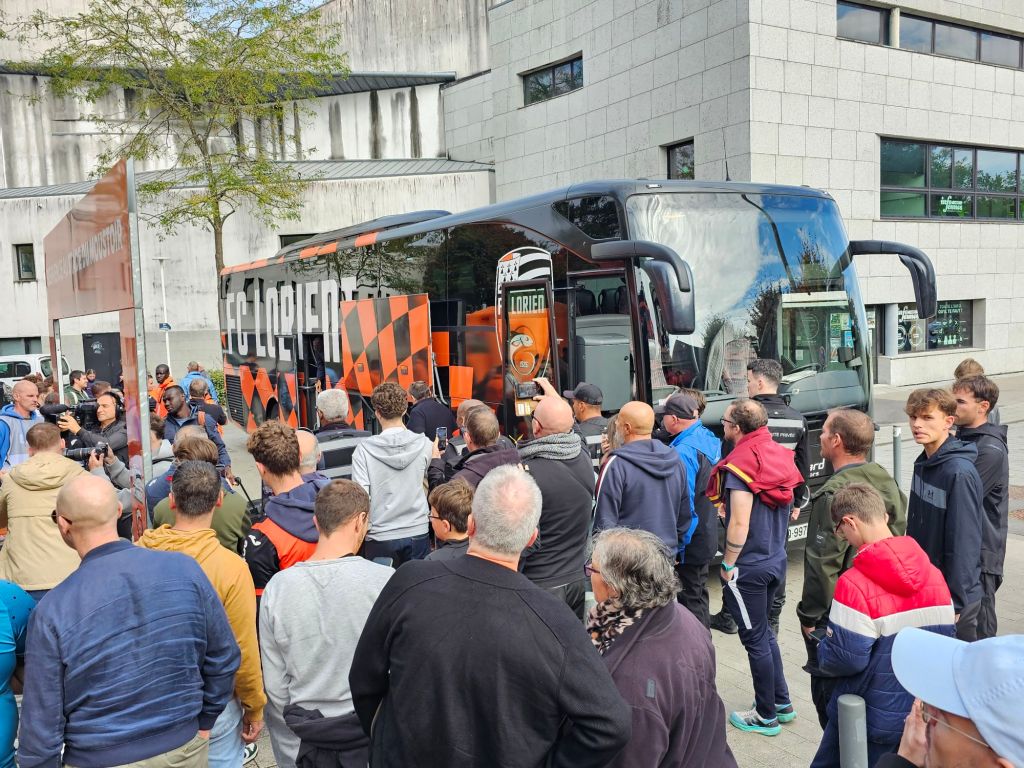
Our hotel is in a leafy suburb of tower blocks just 200 metres from the Ile de Sport tram stop from where it is a 35-minute journey (e1.50 or e2.90 for a return) changing from tram Line 2 to tram Line 1 at St Martin, to the Stade Marie-Marvingt.  This afternoon there is a large, six-wheeled luxury coach in the car park of the hotel and from a short and stilted conversation with the driver I learn that he is driving the Rodez team from the hotel to the stadium.  I photograph the coach with the Rodez club badge displayed in the front window as the driver stands back proudly but out of shot.  I am tempted to ask for a lift to the stadium but don’t want to miss out on the tram ride to the match, something which makes me pretend I’m Albert Camus.  In the hotel lobby, bored looking blokes in grey matching tracksuits hang about mournfully. I wish a couple of them ‘bon match’ and tell them my team is Ipswich Town, it doesn’t appear to relieve their boredom, but pleasingly they have heard of Ipswich Town.  

The match is due to kick off at eight o’clock, but keen to immerse ourselves in the pre-match atmosphere my wife Paulene and I head for the tram stop around six, before the team bus has left the hotel.  We just miss one tram as I fumble with my bank card at the ticket machine, but another soon arrives, and we are lucky enough to get a seat each.   It’s a mild but cloudy evening as we pass through tram stops with names such as Durand-Vaillant, Goya and Gionnieres and on through the uninteresting outskirts arriving eventually at the terminus close to the stadium, the tram depot and the world-famous racing car circuit.

It’s only a short walk from the tram terminus to the stadium, but we accidentally make it longer by walking in the wrong direction, inexplicably failing to follow our fellow would-be spectators as we alight from the tram. Oddly, despite the size of the Stade Marie-Marvingt (it has a capacity in excess of 25,000), it is not visible above the trees.  Adjacent to the stadium is a large surface car park, which, showing an impressively sensible double use of the land is roofed by banks of solar panels.  A wall surrounds the stadium with blocks of automatic turnstiles at points along it.  The approach to the turnstiles features a series of information boards about Marie-Marvingt after whom the stadium is named.  Marie was a remarkable woman who not only spied and flew planes for the French Army during World War One but was an accomplished mountaineer.  Once inside we are frisked and wished ‘bon match’ by smiling security staff before a very helpful man directs us to the gate nearest our seats, and the club boutique, a lock-up hatch, where in the absence of a petit-fanion or fridge magnet I will later buy a key ring to add obsessively to my collection of French football club souvenirs.

Having located our seats (25 euros each), I decide to explore and discover I can make a complete circuit of the stadium.   It’s something of a lazy cliché to describe a modern stadium like the Stade Marie-Marvingt as a ‘soulless bowl’ and on the outside at least it is nothing like the metal-clad B&Q lookalikes found in England as its metal stairs and landings are exposed and sit beneath an elliptical, overhanging roof supported by what look like miniature versions of the Skylon from the Festival of Britain.  Having enjoyed the architecture, I buy a beer (7 euros plus 2 euros for an optional re-usable cup featuring club colours and crest) and a bottle of water for Paulene (2 euros) from a buvette where the attractive young woman who serves me has a heavily tattooed decolletage, which I don’t like to look at too closely given its location.

After returning to my seat, Paulene and I pass the time until kick-off laughing at the referee and his assistants as they warm up and rolling our eyes because of the drippy europop being played over the public address system.  Eventually, a sort of crescendo is reached, and the floodlights begin to flash on and off like some I’ve seen at non-league grounds, although at them it wasn’t intentional. This is the signal for the teams to process onto the pitch amidst the usual display of flags and banners before the team line-ups are read out and I join in with the home supporters in shouting out the Le Mans players’ surnames, my favourites amongst which are Rossignol and Vercruysse.

When the kick-off, or coupe d’envoi, finally happens it is Le Mans who get first go with the ball playing it back before punting it forward in the direction of the city centre and the medieval cathedral of Saint Julian with its fabulous stained glass; Rodez are playing towards the tram terminus.  Le Mans wear red and yellow striped shirts with red shorts although from behind they are all in red; Rodez meanwhile sport an all-white creation with black trim, which looks the same from any angle. From the start, and indeed since before it, the Le Mans fans behind the goal which Rodez are ‘attacking’ have been in fine voice with continuous chants of “Allez Le Mans” and “Aux Armes”.  I text my friend Mick back in blighty and send him a photo of the Le Mans fans.  He texts back to say they look like hedonists.

On the pitch, my attention is soon taken by the Le Mans numbers five and twenty-one, Harld Voyer and Theo Eyoum, who have their hair tied back in raffish fashion, whilst I also recognise the Rodez number twenty-seven from the hotel lobby. Early exchanges are cagey with Le Mans enjoying a little more possession but looking unsure what to do with it.  At the edge of the pitch behind the Rodez goal I am disappointed by the poor grammar of a Le Mans fan group, or possibly just an individual fan, whose banner reads Fanatic’s. Fanatic’s what? I wonder.  Another more literate fan group, perhaps from the top stream at the local lycee, are called ‘Worshippers’, whilst another banner reads ‘IDS Present’ and I begin to wonder why  former Tory party leader Ian Duncan Smith would be here. After fifteen minutes Le Mans win a corner. A minute later the first decent chance of the game appears but number twenty-five for Rodez, Nolan Galves boots it high over the cross bar.

Time proceeds to the twentieth minute and coincidentally perhaps the Le Mans number twenty William Harhouz is booked for making the Rodez number five Clement Jolibois roll around on the floor unnecessarily, but seven minutes later a rare display of skill in the form of a neat turn and cross by Le Mans’ eighteen, Lucas Buades ends with number twenty-five, Dame Gueye producing a spectacular overhead kick, which is so  spectacular it clears the cross bar.  More drama ensues after some odd refereeing from Monsieur Aurelien Petit who plays-on whilst Le Mans have the ball, only to then stop play and give a free-kick to Rodez, whose number twenty-eight Mathis Saka is subsequently carried off on a stretcher.

The match rolls on towards half-time, rarely threatening to produce a goal but instead producing the yellow card from the pocket of Monsieur Petit another five times whilst an aeroplane buzzes overhead invisibly through the deepening gloom of dusk. Five minutes of additional time are played during which the last two yellow cards of the half are shown, one for a player of each team, and then it is mi-temps.

The football resumes at five minutes past nine with a boot into touch but things soon improve with a spectacular save from the Rodez goalkeeper Quentin Braat after a free-kick to Le Mans and a close range shot, which would surely have beaten Braat had it not been so weak.  At the back for Rodez it seems that number four Mathis Magnin is charged with spraying deep penetrating passes, some of which penetrate too far and result in goal kicks and throw-ins. He nevertheless wears a head band to signal his creativity. 

With the sun now having disappeared below the horizon it’s feeling colder, and the breeze previously only felt outside the stadium is finding its way inside; I zip up my jacket.  Back on the pitch, the Rodez number five Clement Jolibois appears to be channelling the spirit of Terry Butcher as he strides about with a bandage around the top of his head, although there is no visible trace of gore.  There doesn’t seem much prospect of a goal either, but then with a fraction more than thirty minutes of normal time remaining Rodez’s number fifteen, Jean Lambert Evans produces a cross from the left which allows number eleven Tairyk Arconte, who is stood all alone at the near post to head in the limpest looking goal I’ve seen in some time. Happily, for the fifteen away supporters I have counted, who have apparently made the 6 hour 20 minute, 657 kilometre journey up from Rodez, the goal is scored at their end of the ground.

The Le Mans coach Patrick Videira, who is unlikely to be confused with former Arsenal captain Patrick Vieira responds to the goal with a mass substitution, bringing on club captain Edwin Quarshie and the popular Erwan Colas as well as Baptiste Guillaume.  The change almost works as Le Mans quickly win a corner, but Guillaume volleys over the cross bar from about 10 metres out.  Two more substitutes appear just a few minutes later in the shape of Brice Oggad and Isaac Cossier and Rodez have some catching up to do in terms of player replacement, which begins as soon as the seventy-first minute and will be completed a mere nine minutes later.

With seventeen minutes of normal time remaining the opportunity to more or less guarantee victory presents itself to Rodez but although stood with the whole goal before him, recent substitute Ibrahima Balde cannot beat Nicolas Kocik in the Le Mans goal and merely wins a corner, not the match.  Meanwhile, I am becoming tetchy due to the pungent smell of the body spray or aftershave of the man sat in front of me.  I wonder to myself if his toiletries are becoming more active as the tension of the game mounts.

  Le Mans twice come close to equalising in the increasingly frantic final fifteen minutes with Quarshie shooting too high and then having another shot expertly tipped over the cross bar.  Brice Oggad also has a shot following a corner in what will prove to be the last decent opportunity for anyone to score, but he ‘shanks it’ high and wide.  The four minutes of added on time seem pretty solid when held up on the electronic display by the fourth official, but like grains of sand they slip through Le Mans’ fingers and the game ends.

On the walk back to the tram terminus Paulene and I agree that overall Rodez were the better team even if Le Mans had most of the possession.  We also agree that whilst it’s not been a particularly good match, it’s been an enjoyable one and I am therefore able to report that the best thing about the evening has not been the tram ride, although that was pretty good too.
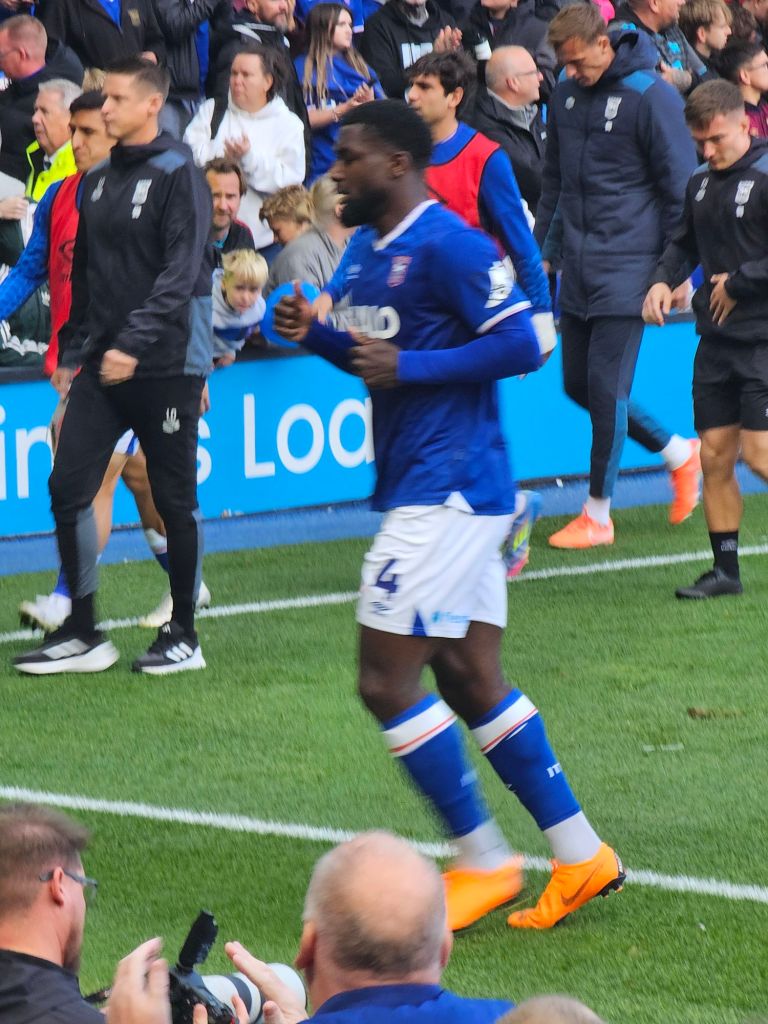
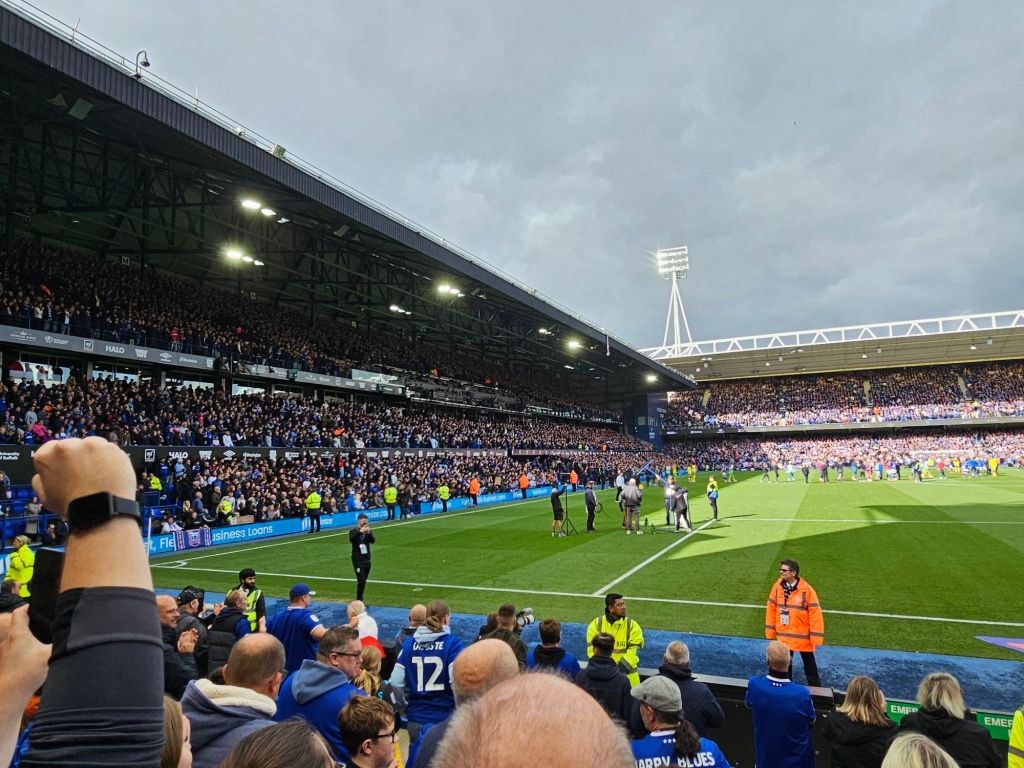
Ipswich Town 2 Derby County 2

It’s been a week in which summer, previously baked by the hot sun, has started to crumble away, buffeted by cool breezes, drenched by heavy showers and obscured by clouds.   As an Ipswich Town season ticket holder however, I am used to disappointment, and more than just believing it is, I know this is the natural order of things.  This morning, after a breakfast of sausage, egg, mushrooms and toast I put a coat of white gloss paint on the inside of my upstairs toilet door.  The paint was old and past its best, another coat or two will be needed and probably from a new tin.

Outside, the sun shone this morning, and it still does.  A wild array of billowing white clouds decorate the blue sky as I walk to my local railway station to catch the train to Ipswich, which is delayed by two minutes. Three blokes sat up straight on scooters, scoot past noisily.  At the station, a grey-haired man wears a T-shirt proclaiming, “Punk’s not Dead – The Exploited”, of course even in 1981 when that album was released, that wasn’t true, Punk inevitably committed suicide or took an overdose long before that.

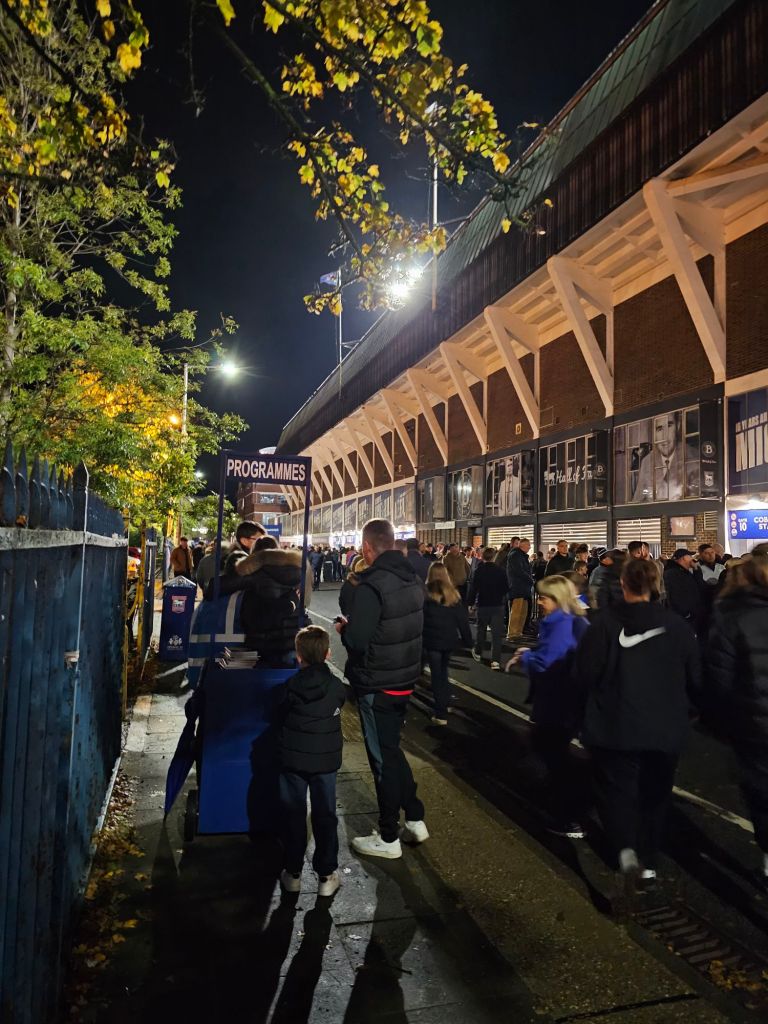
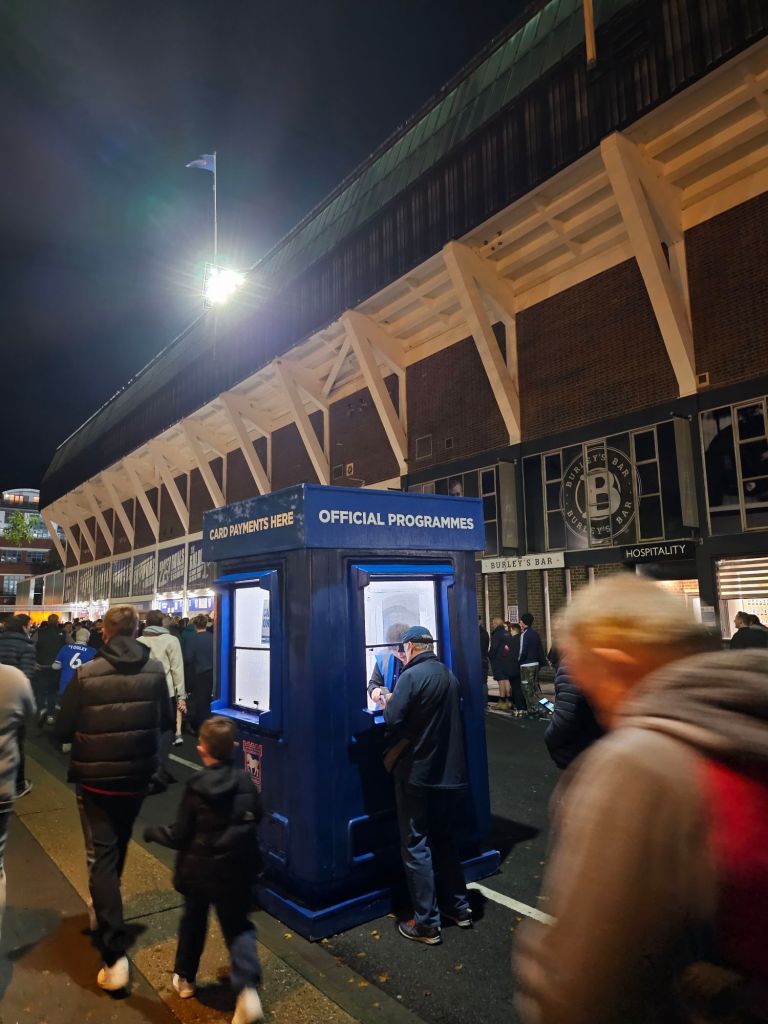
 Gary joins me at the first station stop and we discuss his injured achilles tendon, which means that on arrival in Ipswich we will not be walking to ‘the Arb’ but will drink in the Fanzone.  There are of course also still polar bears in Wherstead, although I only spot one today, which like a lot of other things is a little disappointing.   Gary asks if I will be buying an “ice cream” today and I think I probably will not because it feels like a football programme that costs four quid has lost sight of what a football programme is meant to be; not that football programmes can really see of course.

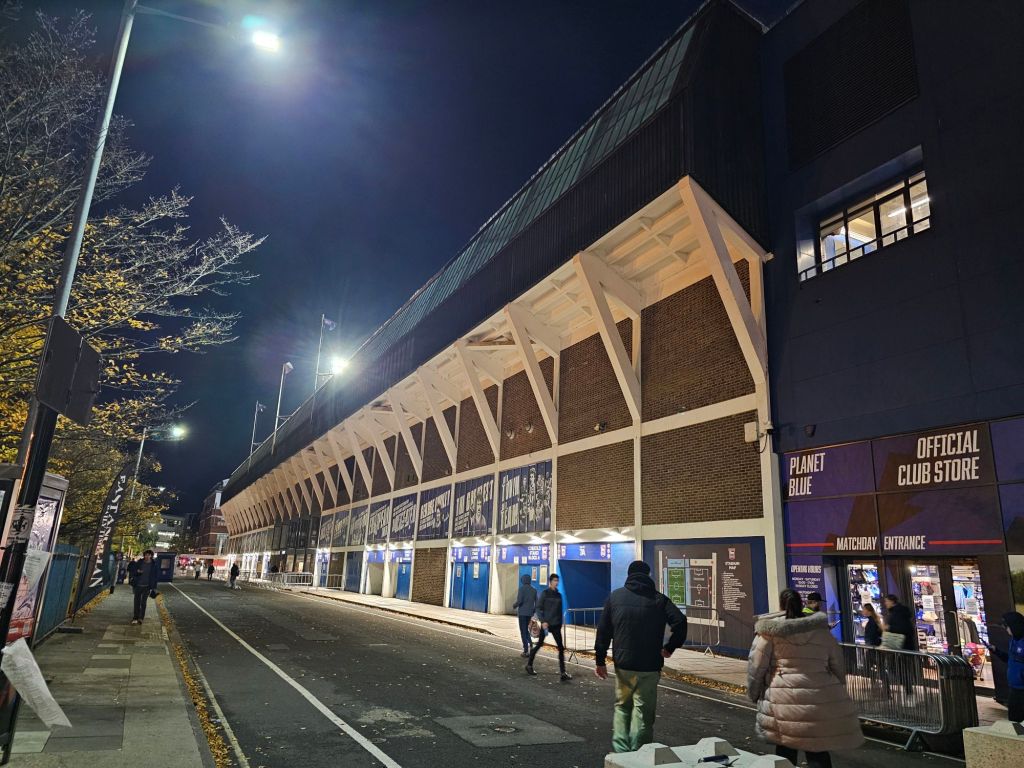
It feels like a long arduous walk down Princes Street and Portman Road and into Sir Alf Ramsey Way alongside a gently limping Gary, and our lack of speed worsens the confused pangs of longing I feel as I pass numerous programme sellers.  Eventually, we make it to the Fanzone with its  loud music, ice cream van, beer tent and huge tv screen, which today is telling us how lucky we are we aren’t from ‘Up North’ by showing Middlesbrough versus Sheffield United.  Many people seem strangely mesmerised by it, however.

In the beer tent queues of uneven length line up for young women to dispense plastic cups of dull yellow liquid.  Gary says he’s on a diet, so should not really have a drink but he’s going to anyway.  We look up at the list of beers, the names of which mean nothing to me. Why doesn’t it just say Lager and Bitter?  Gary has something that sounds Spanish and out of sheer cruelty I get him to ask the young woman server if they’ve got a bitter.  She looks worriedly at a list and says there’s a lager and then describes something else as an IPA, although she also mentions fruit.  Foolishly, half remembering IPAs as amber coloured beers I opt for the IPA and receive a cloudy looking tub of yellow liquid that tastes only of grapefruit; that was the fruit, I guess.  The ‘beers’ cost a staggering £6.50 each and miraculously I suddenly realise that in December 1976 the programme for the Ipswich v Liverpool match, which coincidentally advertised the Sex Pistols ‘Anarchy in the UK’ tour, cost 15 pence, whilst at that time a pint of beer cost about 23 pence.   So, in a world where the retail price index is based solely on beer and football programmes, in nearly forty-nine years the price of programmes relative to the price of beer has actually fallen a little. Nevertheless, given the choice, and I have been, I will give up football programmes before I give up beer.

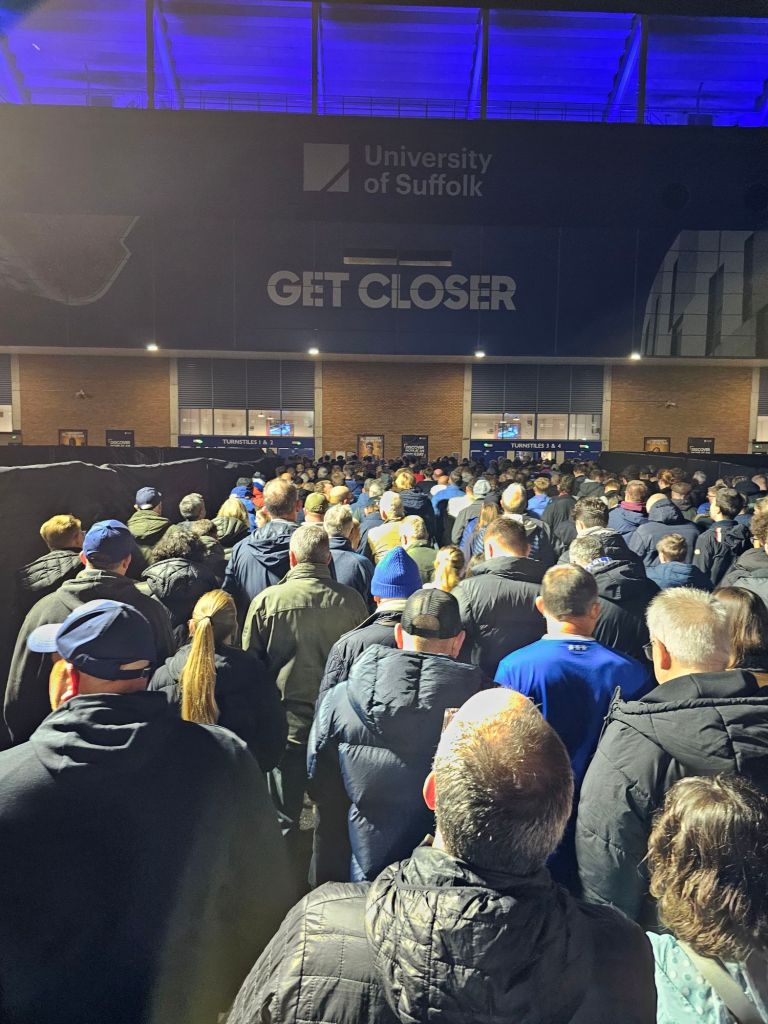
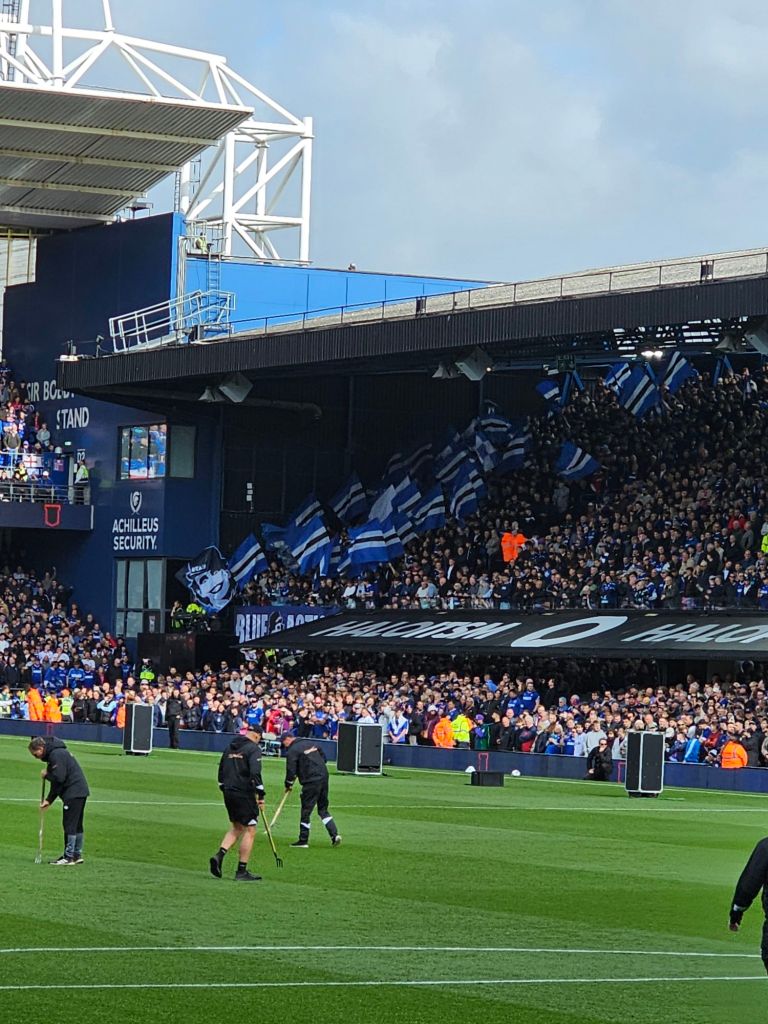
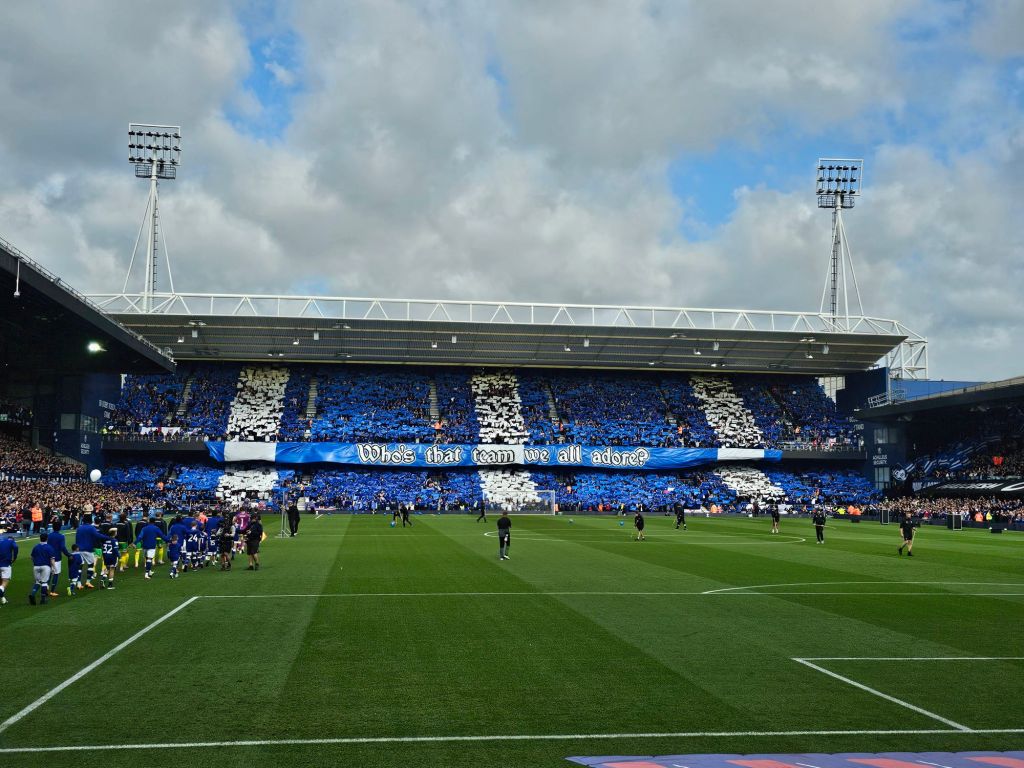
At about a quarter to three a man in a day-glo coat effectively tells us to leave and go to our seats. He seems a little curt, even rude, but I let it pass considering that a lot of people have strange jobs nowadays, and Gary and I soon bid our farewells.  The blue skies punctuated with white cloud have given way to grey cloud and there is a queue to the Sir Alf Ramsey stand, but it moves as if well lubricated and I am soon passing through the hallowed turnstile 62, named in honour of Sir Alf Ramsey’s team’s achievements back in 1962.  I arrive at my seat moments before Fiona arrives at hers and not long after Pat from Clacton reached hers.  The man from Stowmarket (Paul),  ever-present Phil who never misses a game, and his son Elwood are already here too and I’m in good time to join in, in the manner of a Frenchman at the Stade Marie Marvinght or Stade Marcel Picot when the excitable young stadium announcer, who today has seemingly mislaid his jacket but wears a shiny brown waistcoat, reads out the team.

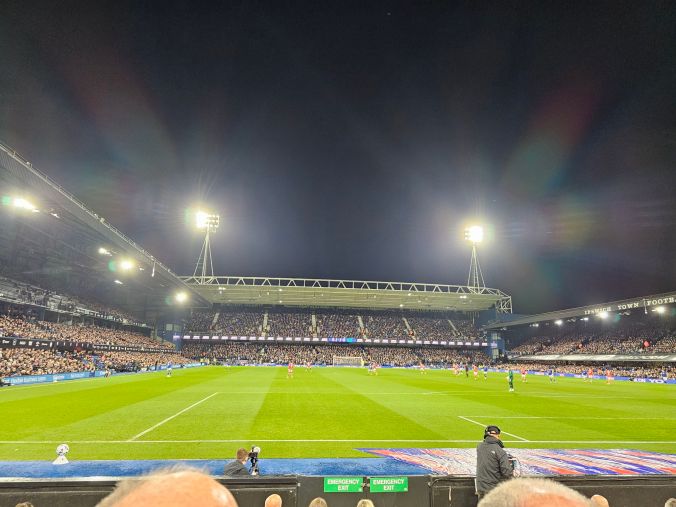
“Be loud, be proud” announces the excitable young stadium announcer as a final gesture, before the strains of The Beatles “Hey Jude” begin. With Jude’s na-na-nas fading away arm in arm with August, the game begins and it’s Derby who get first go with the ball, booting it where possible in the direction of the old telephone exchange, Coes and the Halal butcher on Norwich Road. Derby sport a modern, plastic looking version of their traditional kit of white shorts and black shorts, which sadly fails to conjure spectral visions of Kevin Hector, Archie Gemmill or Colin Todd.  Town are similarly in a modern incarnation of blue and white that doesn’t really suggest David Johnson, Jimmy Robertson or Trevor Whymark were once here either.

A man arrives and sits in the seat in front of me but then continuously turns around, his arm hanging over the back of his seat, to talk to the bloke beside me.  I try to watch the game. The bloke in front stays mostly turned round to talk to my neighbour.  The space in front of me has always been small and now it’s smaller, the seat is pressing against my knee, I’m trying to watch the match, I’m feeling a bit annoyed, a bit grumpy, that pint of IPA in the Fanzone was truly horrible, the bloke in front of me is still turning round. “Look, why don’t you just sit here, and I’ll sit there, this is getting on my nerves” I say, standing up and gesturing the bloke in front to climb over his seat whilst I do the same in the opposite direction.  The manoeuvre seems to cause a bit of consternation around me and I think the bloke now behind me is explaining what’s happened to the blokes behind him.  “I’m sure we can all read about it later” says ever-present Phil who never misses a game.

“We are Derby” sing the Derby fans.  “Create more space with a mezzanine floor” reads the illuminated advertisement between the two tiers of the Sir Bobby Robson stand.  “We hate Nottingham Forest” continue the Derby fans and it feels like the world is falling in on me. On the pitch,  Derby seem very enthusiastic, running and jumping and barging about like they’ve all over-dosed on pre-match Sunny Delight.  It’s not pretty to watch but it’s stopping Ipswich from playing much football. “Windows that Wow. Doors that delight” announces the Sir Bobby Robson stand as a Derby player takes a throw.  The Derby goalkeeper is wearing a dayglo orange kit that looks like it might also be worn by staff of the Derbyshire  County Council highways department.

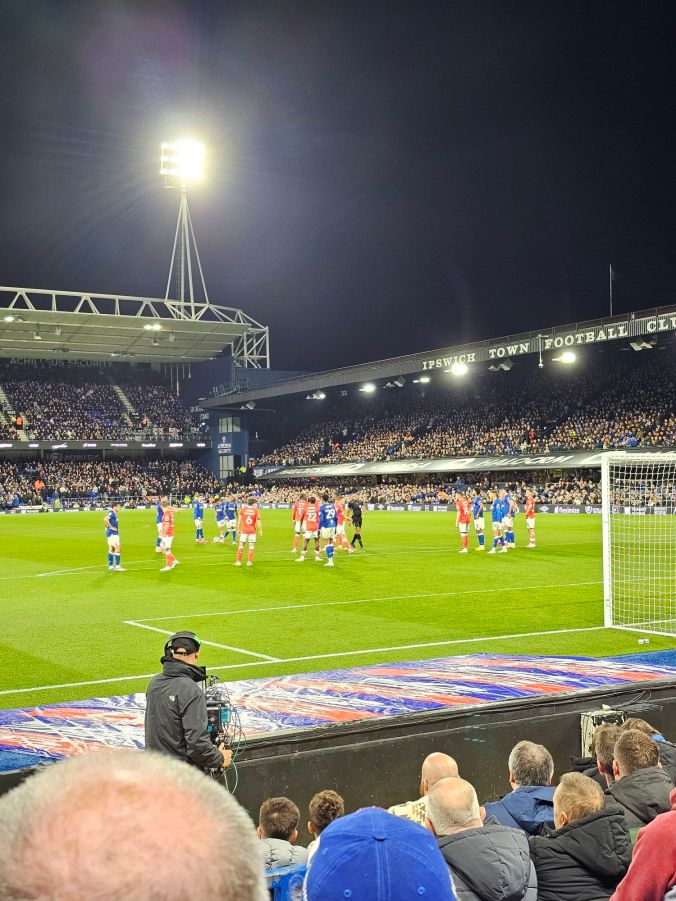
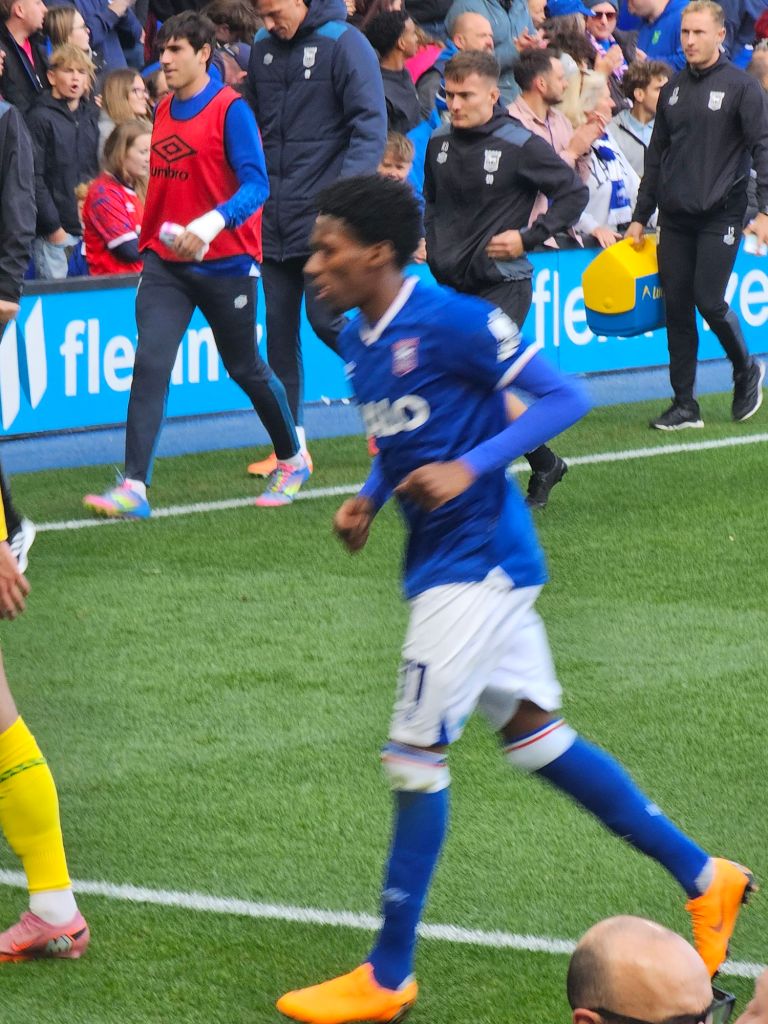
Nineteen minutes have gone the way of the previous twenty-nine and a half days of August and the Derby fans chant “Football in a library, do-do-do”, illustrating how human evolution seems to be standing still.  A break by Kasey McAteer, and a cross leads to Leif Davis having Town’s first decent shot on goal but it bounces conveniently into the arms of the man from the highways department, and Town begin to get to grips with Derby’s WWF inspired style of play.   Twenty-seven minutes are up and Town earn a corner.  “Come on you Blues” chant a handful of us lamely.  Five minutes later a Conor Chaplin shot earns another corner.  More half-hearted chants but they’re all Town need and as the ball sails over the flailing fist of the bloke from the Council, Jacob Greaves applies a stooping header, the humblest of all headers, to put Town one-nil up.

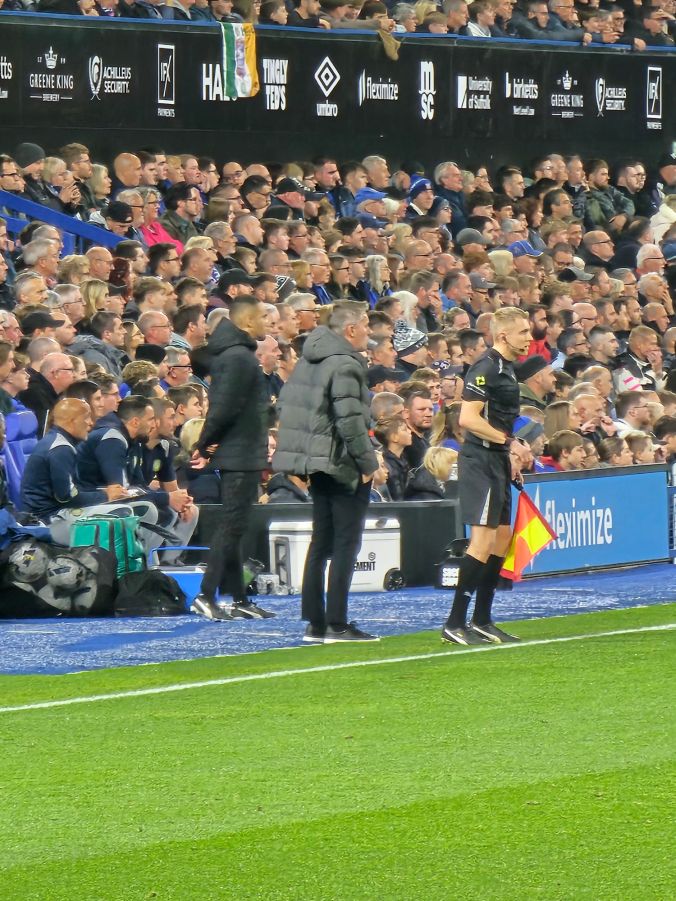
With Town ahead, it’s only a matter of two minutes before the first Derby player is booked for dissent as the Sunny Delight hangover begins to kick-in.  “Come on Town, this is good” shouts the bloke behind me and Town win another corner from which Dara O’Shea hits a post with a header before the referee laughably books McAteer, seemingly for over-optimistically jumping alongside the man from the Council who is eight centimetres taller than him.  Two minutes of additional time follow, in which Town win a fourth corner but nothing more.

Half-time is a time to talk to Ray, reflect on his forthcoming birthday which features a zero at the end and discuss why Kasey McAteer was booked. Even as a former county highways department employee Ray does not know.  On my way back to my seat Pat from Clacton tells me not to swap my seat with the same bloke again because he’s been getting on her nerves too.

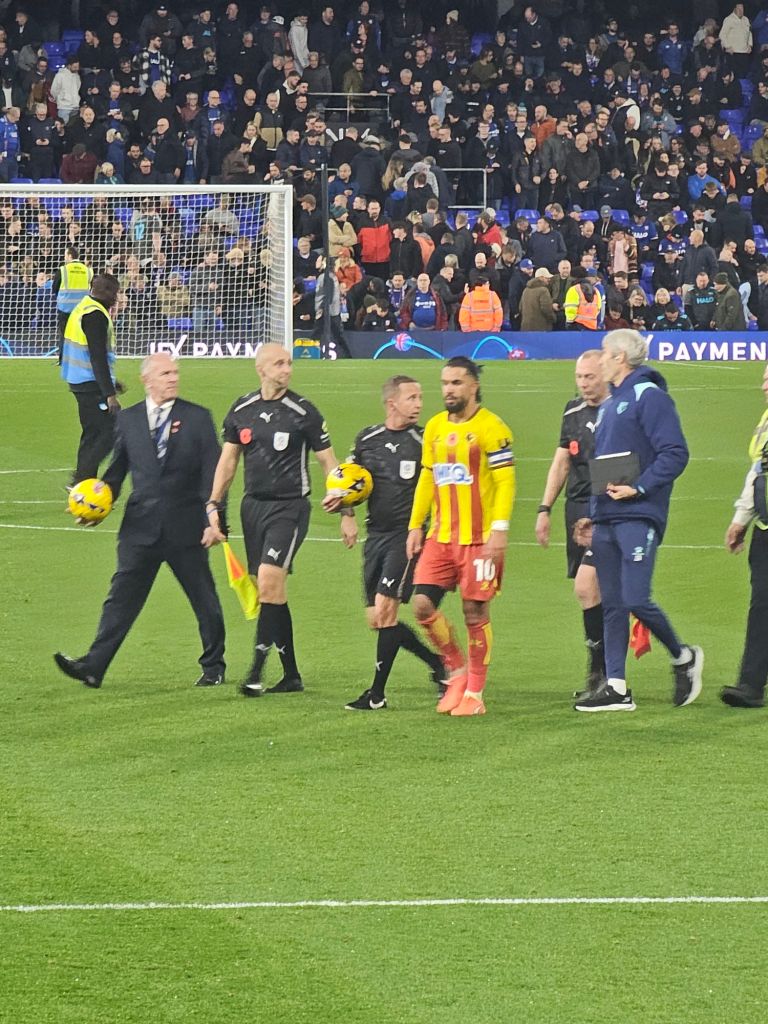
The game re-starts, and I eat a Slovakian Horalky wafer bar to help my body forget the memory of what I consumed in the Fanzone.  I’m not sure if my lack of concentration whilst eating is partly to blame, but there is also a sudden lack of concentration in the Town defence and some bloke in a white shirt has to be chased into the penalty area by Leif Davis, who is then adjudged to have handled the ball as he dives in to block a shot and Derby are awarded a penalty, which one of them scores.  Despite the equalising goal, which the balance of play suggests they should be slightly embarrassed about, Derby’s players are haranguing the referee seemingly wanting Davis sent off for the handball.  Quite why these players are not booked or even sent off for unsporting behaviour is a mystery, especially when George Hirst is then booked for alleged diving and weirdly we’re all wishing we still had VAR.

With the scores once again level, Derby clearly intend not to go behind again and have evidently decided the best way to do this is to ensure as little football as possible takes place in the remaining thirty-five minutes. At times the game now resembles a match involving the Keystones Cops and American Civil War soldiers as players comically fall about and then lay on the pitch like extras from the scene in Gone With the Wind after the battle of Atlanta.  “Shit referee, shit referee, shit referee” chant the home support imaginatively.  “We forgot you were here” reply the Derby fans also failing to roll back the frontiers of witty ripostes before doing it again by once more chanting “Football in a library, do-do-do”.

Time moves on and the inevitable rash of substitutions are made with twenty-two minutes left of normal time.  Two minutes later another lack of concentration in the Town defence sees both O’Shea and Greaves miss the ball to allow some brutish part-time actor from Derby to score and give his team the lead. Town win a corner, another substitution is made and we are told by the excitable young stadium announcer that we number 29,155 and 1,144 of us are supporting the bunch that are currently winning and have a road mender for a goalkeeper.

With time not unexpectedly continuing to ebb away into the abyss, Town struggle against  Derby’s “tactic” of not wanting any one to play football and the bloke behind me announces that “Nobody seems to want it”, although Chuba Akpom’s shot that goes narrowly over the bar doesn’t really back him up. Certainly, it seems many supporters don’t want to witness the final whistle, and the stands would only empty out more quickly if Nigel Farage had made a guest appearance.  Help eventually comes from an unexpected source as it is announced that there will be a minimum of thirteen minutes additional time, and I think I detect a sudden dash to the toilets amongst anxious Derby fans.  As the additional time, unfortunately, proves no better than the wasted time it replaces,  it seems like maybe my prevailing emotion on a Saturday evening will once  again be disappointment.

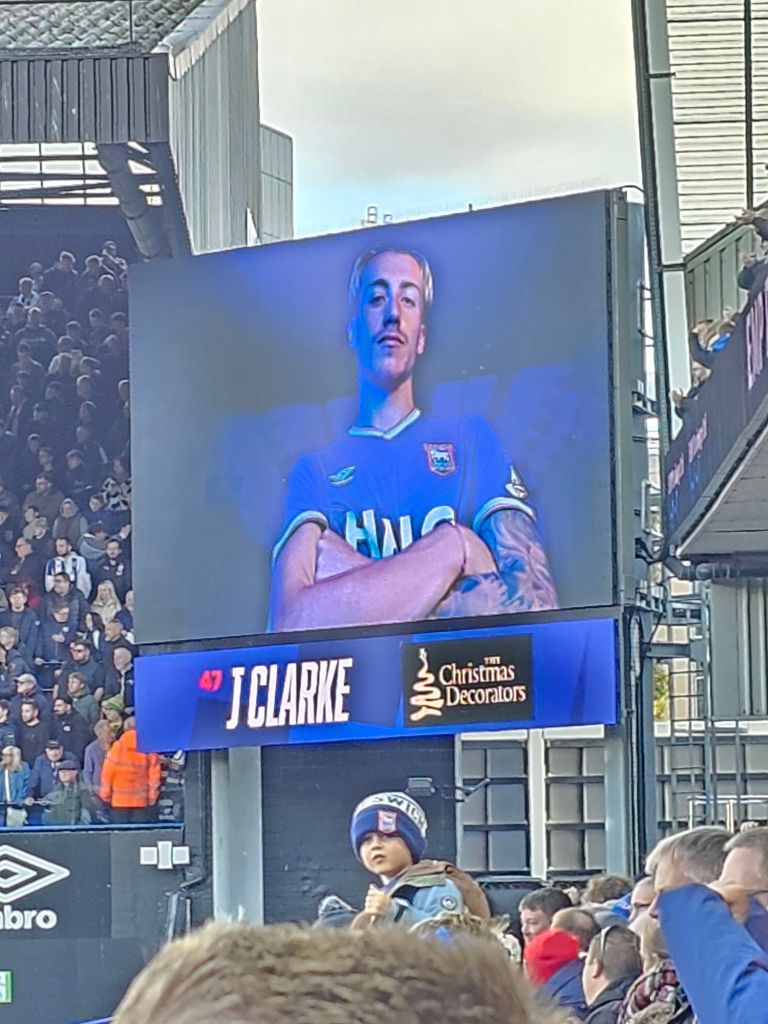
But then, as once more and then once more again Town sling the ball into the Derby penalty area, the referee awards a penalty.  I couldn’t see why from the far end of the ground, but in the absence of VAR I trust the referee who obviously knows what he’s doing, on this occasion.  Jack Clarke steps up to take the penalty as the blokes behind me agree that they would have Ashley Young take it and the bloke next to me holds his head in his hands and seems to weep as he says “Not, Jack Clarke, please not Jack Clarke.”  But happily, yes, Jack Clarke,  as he takes one of the best penalties by an Ipswich player that I think I’ve ever seen, striking the ball hard and into a corner and with a bit of a curl on it too for good measure.  There’s still time to win I say to myself, but it turns out there isn’t.

Inevitably, with sixteen minutes of additional time having been played, on hearing the final whistle people don’t hang about.  I too turn and head for the exit and my train home to reflect on what despite the last minute goal, still feels like a disappointing afternoon; that beer in the Fanzone was disgusting.

Stanway Pegasus 0 Haringey Borough 2

Pegasus, Wikipedia tells us was a Greek mythological winged stallion, the offspring of Poseidon and Medusa who sprang from the Medusa’s blood when in an everyday incident for the characters of Greek mythology she had her head chopped off by Perseus.  After time spent carrying lightning bolts for Zeus, being ridden about by Bellophron and then as a constellation of stars, having been killed by Zeus who presumably then had to carry his own lightning bolts, between 1948 and 1963 Pegasus more prosaically became the name of an amateur football team made up of Oxford and Cambridge graduates obviously keen to mix football with their classical education.   Even more prosaically, the name of Pegasus then became that of a youth and then Sunday football team in Colchester and most recently that club has aspired to men’s senior football and for reasons unknown has attached the name Pegasus to Stanway, a suburb of Colchester that some of its residents still think is a village and which already had one senior football team in the shape of Stanway Rovers.

Today, Stanway Pegasus who are now in the snappily titled Thurlow Nunn Eastern Counties League South play Haringey Borough of the only slightly less snappily titled Spartan South Midlands Football League in the first qualifying round of the FA Vase, a competition which, to my shame, I have not witnessed a game in for over ten years.  It is for this reason, and it being the closest game to where I live, that today I choose to ignore the ’Town’ -centric draw of Braintree Town v Yeovil Town in the National League and the charming alliteration of Chelmsford v Chippenham in the National League South, and make my way to ‘The Crops’ in West Street Coggeshall home of Coggeshall Town but where Stanway Pegasus currently play their home games too.

After a morning breathing in noxious fumes from the white gloss paint I am applying to the banisters, skirting boards and miscellaneous surrounding woodwork of a domestic staircase, standing at a bus stop on the A120 under a grey late August sky feels like suddenly being on holiday.  The X20 bus to Stansted Airport via Coggeshall, Braintree and Great Dunmow turns up more or less on time and I cheerily tender the correct fare (£3) in coins to the driver, who wears a peaked cap in the style of the late Sir Francis Chichester.  The driver, who does not speak looks at me inscrutably from beneath the peak of his hat as if weighing up this passenger’s likely back story.  I look back at him in the same way, imagining I too am wearing a hat, before climbing the stairs to the top deck where I sit behind a man sporting short hair and an earring.  Behind us, a girl evidently lacking all sense of self-awareness talks loudly on her mobile phone, broadcasting the other half of the conversation on speaker phone.   Leaving the A120, the bus (fleet number 34423) wends its way through Coggeshall’s narrow medieval streets before I alight at the stop called ‘Nursery’ just a couple of hundred yards away from ‘The Crops’.

Arriving at the turnstile I’m not surprised to find there is no queue but am delighted to see a small pile of glossy programmes, which I had not expected.   I ask if I should pay by cash or card. “Cash if you’ve got it, please” says the turnstile operator “I’ve started to run out”.  This is the first time I have paid on the turnstile at a match since I turned sixty-five, and paying in cash adds something to this auspicious occasion as I tender a five pound note for my concessionary entry fee and a two pound coin for the programme.

Once through the turnstile I head for the bar at the far end of the ground; it is virtually empty,  and not liking the look of the fizzy draught beer on offer I warily request a bottle of Adnams Southwold Bitter (£6) from the fridge. Much to my surprise the beer is merely cool not chilled and therefore very drinkable.  I step outside to await kick-off amongst a good following of Haringey supporters identifiable from their club colours but also as the only people obviously in the throes of enjoying a day out.  Two of them wear pork pie hats and I wonder if they play the saxophone.  Except for an old couple sat in foldable chairs the home supporters are rather anonymous.  In the corner of the pitch by what passes as the players’ tunnel but looks a bit like a stockade stands a plinth on top of which sits the match ball.  The Haringey fans eye the plinth both jealously and with a degree of amusement discussing what design of plinth they might have if they were to have one of their own, they seem keen on something more sculptural. 

“Sing if you’re Haringey, Sing if your happy that way” chant the Haringey fans imaginatively to the tune of the Tom Robinson Band’s 1978 hit “Glad to be gay” as the team emerge from the stockade and the plinth fulfils its job of relieving the referee of having to remember to bring the ball with him from the dressing room.   The match kicks off at five minutes to three with Stanway Pegasus getting first go with the ball and sending it in the direction of the bus stop from whence I arrived and Coggeshall beyond. “You on a promise Ref?” bawls a Haringey supporter “It’s only five to three”.  “That’s close to being abusive, that is” says another Haringeyite.  “No it’s not, it’s just a question” continues the first supporter.  “A very personal one” is the response. “Alright, do you have something nice waiting for you when you get home, Ref?” Comes the re-phrased enquiry.

Pegasus are wearing a kit of yellow shirts with black trim and black shorts, which weirdly are also the colours of Stanway Rovers.  Haringey meanwhile sport a change kit of all over green as their supporters expand on their theme of chants based on ‘new wave’ hits of the late 1970’s and sing the praises of their team’s Matty Young to the tune of “To much too young” by The Specials and then sample the  oeuvre of Sham69 with chants of “Come On, Come On, Come on Haringey Come On, We’re going down the pub”.

Back on the pitch, one of the linesmen is attracting a lot of attention to himself both with his offside decisions and his insistence on explaining them to the players.  As if that isn’t enough, he is very bouncy on his feet and, because he sports a poorly shaped goatee beard and has grey highlights in his swept back hair I am reminded of the match between Arsenal and Liverpool in September1972 when one of the linesmen was injured and Jimmy Hill emerged from the stands to run the line.

At three minutes past three Haringey Borough take the lead with a neat shot into the corner of the goal from somewhere near the edge of the penalty area.  The goal scorer, I think, is the aforementioned Matty Young  who evidently continues to strive to allow people to look back and say he did a lot in his youth.   “We’re the Borough, The Mighty Borough, We always sing away, We sing away, we sing away, we sing away, we sing away” chant the Haringey fans in response to the goal, channelling Tight Fit’s  cheesy cover version of “The Lion Sleeps Tonight” from 1982.

The Jimmy Hill lookalike linesman continues to grab attention as he rules a Haringey player onside and then proceeds to explain that the Pegasus number five had played him onside. “Don’t tell them lino, they can learn for themselves” shouts an exasperated Haringey fan. The Haringey support delve into their ‘new wave’ singles collection once more, impressively getting “We’re Haringey, We’re Haringey” into The Jam’s “Going Underground”.

Haringey are clearly the stronger team, as their higher league status implied before kick-off and the majority of play is at the club house end of the ground, although in a rare breakaway the Pegasus number four , Harry Morton is free in the centre of penalty area, has the ball pulled back to him perfectly, but then contrives to hit a truly, spectacularly terrible shot as high and as wide as anyone not under the influence of mind expanding drugs could imagine; in some circles it might be called ‘a worldy’.   Morton might be excused however for blaming the pitch, very little of which is any shade of green except in a few ‘fairy circles’, and when more than a handful of players are in the penalty area a cloud of dust is kicked up which lingers momentarily over the pitch like a swarm of tiny insects.

I am stood to one side of the suitably bucolic looking main stand and every now and then I receive a whiff of pungent and rather cloying body spray or scent.  At first, I think it must be from the occupants of the stand, but to be honest they don’t look the sort to be familiar with anything more than an occasional dab of Old Spice or bit of talc.  I eventually realise, when he bouncily stops near me to signal another offside, that the culprit is Jimmy Hill, the unique styling of whose hair is challenged, but not matched only by the Pegasus number sixteen, Tom Lewis who has a neat blond bob.

The game is being played in a good spirit with unusually little, if any audible swearing from the players, or the management on the benches.  Pegasus’s number nine Callum Griffith is booked however, just as the first third of the game rolls into the second third when twice in quick succession he fails to give space for a free-kick to be taken.  As thoughts of half-time refreshment begin to form Pegasus win a couple of corners and then almost unexpectedly there is a second goal as a poorly cleared low cross reaches Haringey’s number fourteen who firmly and concisely despatches it into the opposite bottom corner to the first goal, and Haringey lead 2-0.

Due to judicious manoeuvring in the approach to half-time, I am first in the queue at the refreshment hatch where I invest in £1.50’s worth of tea in large paper cup.  I read the half-time ‘results’ as I wait for my tea to cool and then for the teams to re-emerge.  My mood is barely affected by the news that Ipswich are losing at Preston; it’s not a place we often do well at; “a difficult place to go” is probably the accepted wisdom, despite the M6.   At four minutes to four the football resumes and I move to the other end of the main stand expecting most of the action to again take place in the half of the pitch that Haringey are attacking.

The first half was adequately entertaining if not exactly a pulsating cup-tie.  Sadly, the second half does not live up to what we didn’t know at the time was the comparatively high standard of its predecessor.  The Haringey supporters nevertheless continue to enjoy themselves as they repeatedly dip into the back catalogues of Sham69, The Jam and with somewhat less ‘street credibility’, but plenty of irony, Tight Fit.  My highlight of the half is when I realise that Derek Asamoah is playing as number forty-four for Haringey.  He is a player who I probably last saw playing on the telly for Ghana in the African Cup of Nations. I should have really worked out he was playing when the Haringey fans chanted his name in the first half, but I was probably too busy wondering which Buzzcocks, The Clash or The Damned single it was they were singing to.

With the final whistle there is justified applause for everyone’s efforts and I leave The Crops to the sound of the Haringey fans singing “Bus stop in Tottenham, we’re just a bus stop in Tottenham” because wonderfully, as anyone who has travelled the W3 through north London will know, they really are and as far as I’m concerned that’s just as interesting as Greek mythology.