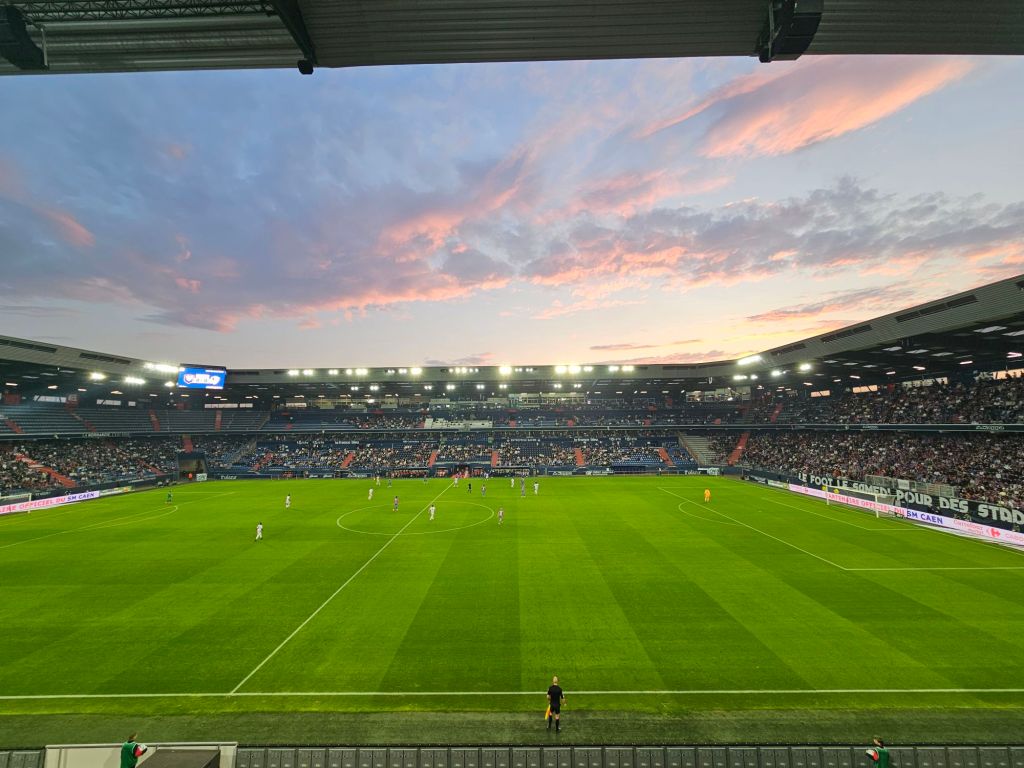
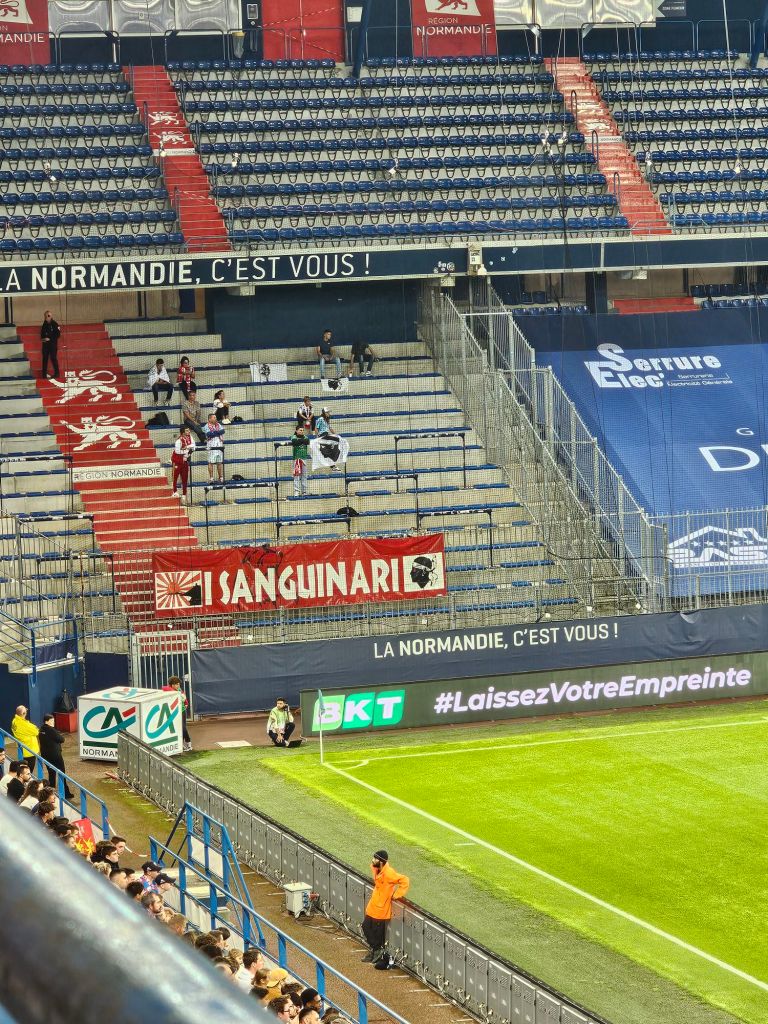
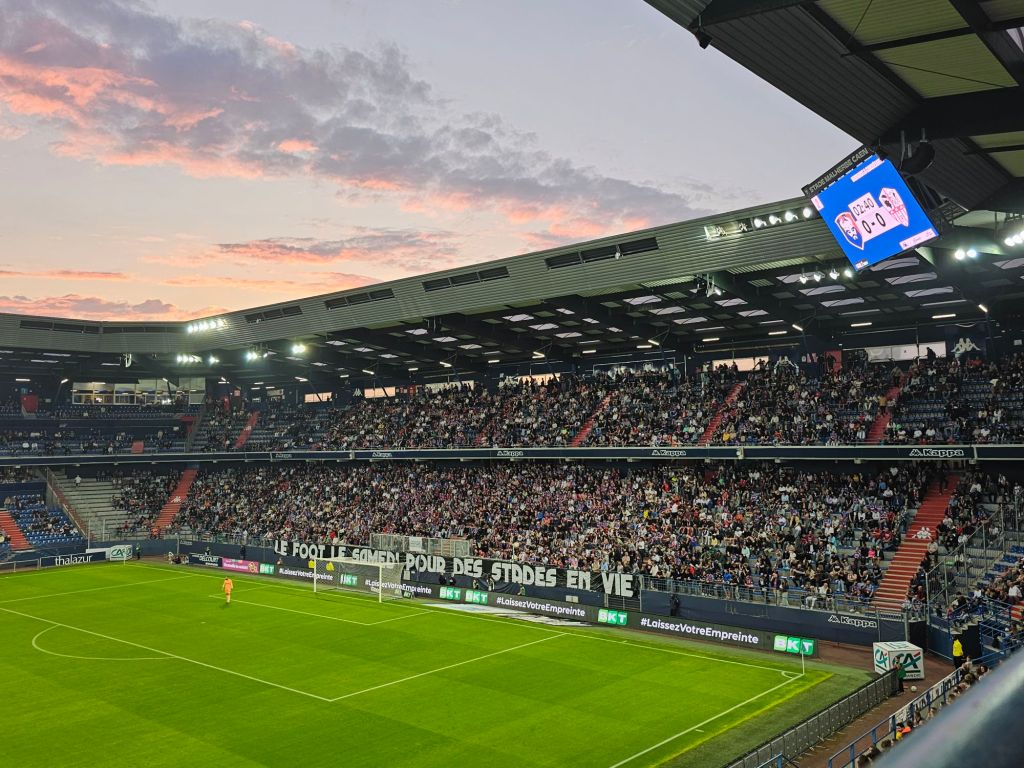
Stade Malherbe Caen 1 AC Ajaccio 0

When travelling, in no real hurry, the 670 kilometres from Calais to Carnac in Brittany, the fine city of Caen is the perfect place to break the journey in two, particularly if SM Caen are playing at home.  So it is that I find myself with my wife Paulene on a Friday evening stood at the Bellivet bus stop in the centre of Caen, waiting for the free shuttle bus (navette) out to the Stade Michel d’Ornano in the suburbs of the city.  The bus is due at seven o’clock, but it’s barely six forty-five yet; we weren’t sure how long it would take to walk from our hotel on the Quai de Plaisance, not long it turns out.

We stand on the pavement outside the bus shelter, which is well populated with people who don’t look like they’re going to a football match, but then, the stop is served by several other bus routes. A man in his early thirties turns to us and asks if this is the stop for the navette (I think he must have deduced from the Ipswich Town badge on my T-shirt that we are football fans).  We tell him that’s what it says on the football club website, and we believe it.   The man is from Caen but has never used the navette before; he is going to the match with a friend who is also Caennais, but has lived in Paris and has never even been to any game before; they are taking the bus so they can have a drink before and after the game., which seems to be the main point of the exercise. The man who has lived in Paris reveals that when he was a teenager, he stayed in Ipswich on a student exchange scheme; they were good times he says, even though he never made it to Portman Road.

Time passes.  Seven o’clock passes. Several buses stop, passengers alight and others get on.  A ramp slides out from under one bus and a woman in a powered wheelchair backs along it onto the pavement.  “Oi Ipswich, my friend here is a Norwich fan” says a rich Welsh voice. “No I’m not, I’m from Cardiff” says the tall grey-haired man standing next to me.  “Have you got your match tickets?” asks the first Welshman.  “Yes” I tell him “But I don’t reckon you’ll need them for the bus, the driver isn’t going to want to check everyone has got one.”  The first Welshman asks if we had been to the ground earlier to buy them, but we tell him we bought them on-line.  “See, I told you we could have got them on-line” says Welshman number two to Welshman number one. “Well, I looked” says Welshman number one, “But it was all in French.”

We talk some more and tell the Welshmen how we were in Cardiff last year to see Haverfordwest (Hwlfordd in Welsh) play their two European Conference League qualifiers. They ask why, and I tell them I was born in Haverfordwest. “You’re Welsh then” they say.  Welshman number two then tells us he’s obsessed with going to new football grounds and after asking us to guess how many he’s been to, he reveals that he’s visited over seven-hundred.   It’s about a quarter past seven now, and an articulated single-deck bus hoves into view bearing the destination “Allez le SM Caen”, At last, it’s the navette, and about forty of us pile on before the bus lurches and twists off up the street, past William the Conqueror’s castle and on past the eleventh century l’Abbeye aux hommes, the Hotel de ville, and the palais de justice all of which miraculously survived allied bombing in World War Two.  On the bus ploughs, on a stop start journey past the more recently built palais des sports, and through the heavy traffic heading for the Caen international fair (Foire International de Caen), which begins tonight.

It’s gone twenty to eight by the time the bus disgorges its load at the oddly named  ‘Silicon Valley’ bus stop, directly opposite the Stade d’Onano, and Paulene and I head for the club shop to add to the pointless collections of cuddly club mascots, fridge magnets and T-shirts that clutter up our home back in blighty, although I do wear the T-shirts.   After then joining a queue for Gate 7, six flights of stairs take us to the top of the Tribune Caen from where we have to descend the steep gangway to our seats (24 euros each) in the front row of the top tier of the stand.  Within moments of our sitting down the game begins, tonight’s visiting team AC Ajaccio from Corsica getting first go with the ball, which they succeed in keeping to themselves for much of the first minute of the game. Ajaccio are wearing red and white striped shirts with white shorts, reminiscent of Stoke City and Signal toothpaste.  Caen meanwhile are kitted out in blue shorts and blue and red striped shirts, but the stripes are wavy, reminding me of the sleeve of the Cosmic Roughriders LP ‘Enjoy the Melodic Sunshine’.  Caen are kicking from right to left, back towards the city centre, whilst Ajaccio are aiming more in the direction of the Bayeux tapestry.

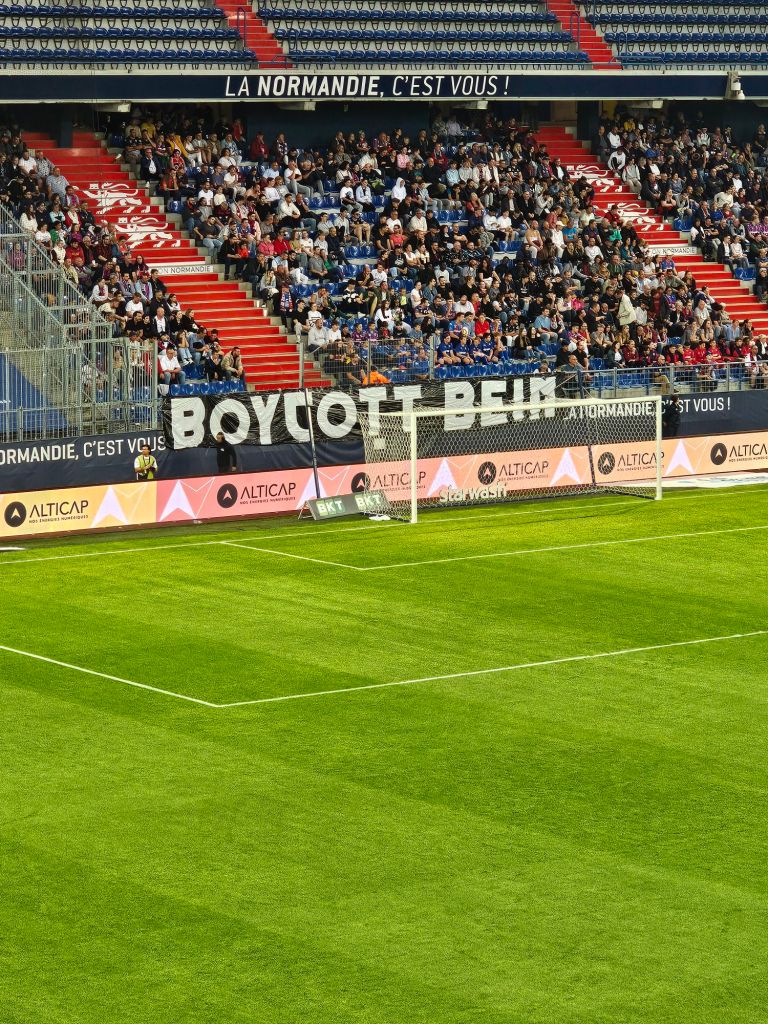
Unexpectedly, the ground seems very quiet as the game begins, possibly because in four matches in Ligue 2 so far this season, Caen have not won, only succeeding in losing three times.  Whenever a Caen player crosses into the opposition half however, I think I can hear a muffled murmurs of “Allez, allez, allez” all around me, and when Caen win an early corner rhythmic clapping breaks out.  With not much happening I take the opportunity to visit the buvette back at the top of the stand where I buy a bottle of water (2 euros) and a merguez sandwich (6 euros).  I return to my seat in time to witness a twelfth minute shot from a Caen player strike the Ajaccio cross bar. Before three minutes later a blizzard of paper planes rain down on to the pitch from behind the Ajaccio goal, possibly as part of the ongoing protest against Ligue 2 matches being moved to Friday nights this season at the behest of Bein Sports tv.  Banners behind the goals read “Le foot le Samedi pour des stades en vie” (Football on Saturdays for lively stadiums) and “Boycott Bein”.

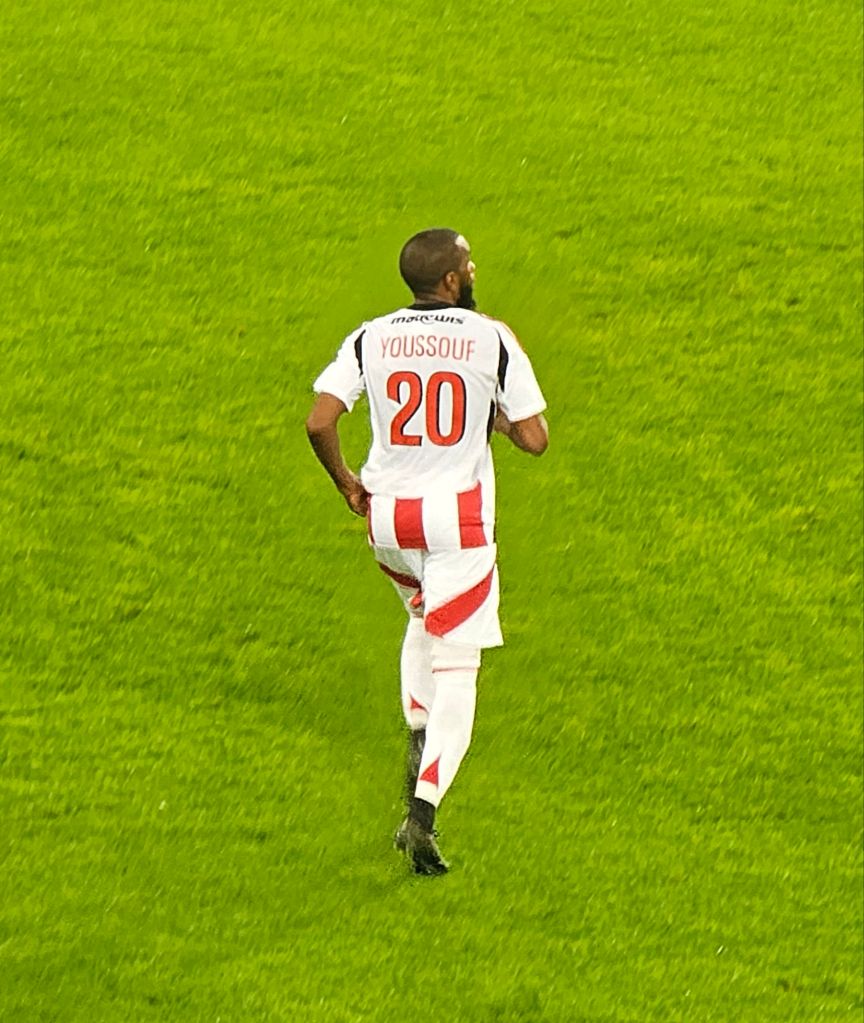
To our left, I count thirteen Ajaccio supporters in their enclosure behind the goal and I think of the Last Supper, before noticing that the Ajaccio number twenty Mohamed Youssef is so short that his socks meet his shorts, creating the effect that he is wearing puttees.  The first half is half over as Caen build a move down the left before wasting all the effort with a shot over the crossbar.  Nine minutes later Caen’s number seven flicks the ball up inside the penalty area before crashing a spectacular volley directly at the Ajaccio goalkeeper, who is in two shades of green.

The game is one-sided with Caen monopolising possession and attempts on goal until six minutes before half-time when Ajaccio have their first shot at goal, a curling effort from number 99, which nevertheless curls straight into the arms of the Caen goalkeeper who admittedly is not easy to miss because he is all in orange.  The first booking of the game follows soon afterwards when Ajaccio’s number thirty-one chooses to tug at the Caen number nineteen’s shoulder rather than attempt to tackle him in the conventional manner.  Two minutes of added on time are added on, to little effect, and at half-time the score remains blank. In a sense therefore, Ajaccio are winning.

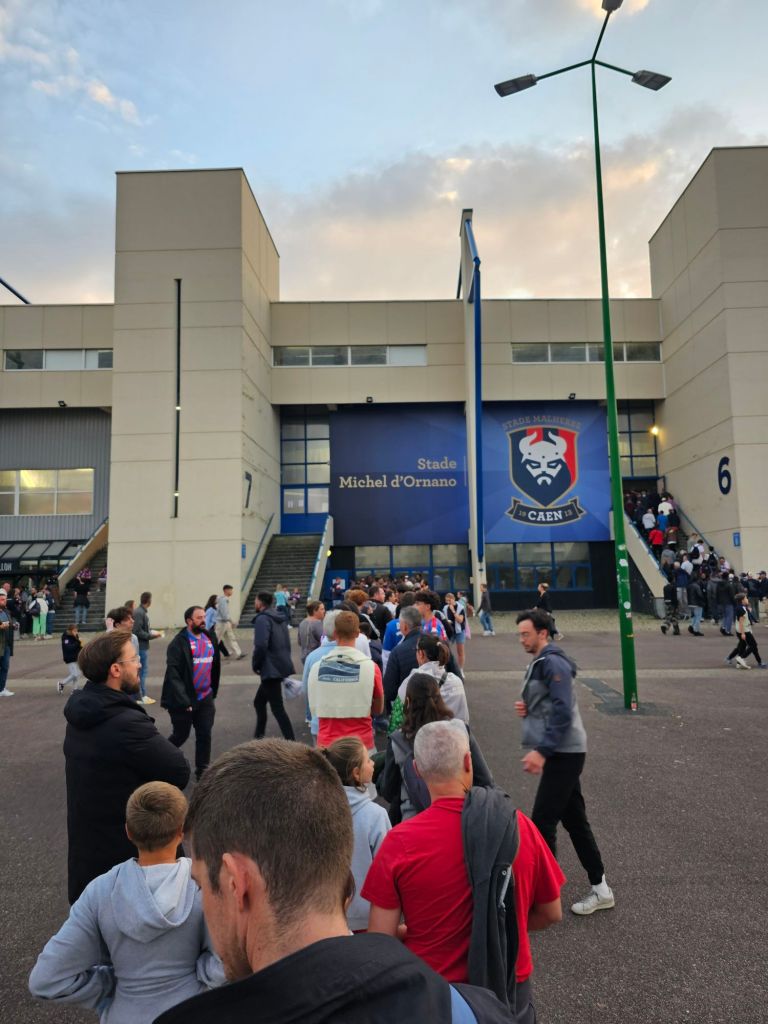
Paulene and I move seat during the break because I have been having to duck my head whenever the ball has been in the Caen half due to a large, blue, metal safety rail at the foot of the steps, which extends in front of my seat.  The half-time break passes with people trying to kick a ball into a box for money, and two teams of children in red and blue kit taking a shoot-out competition. The red children all seem about twice the size of the blues and predictably they win, although the only girl in the competition is a blue and she scores her goal.

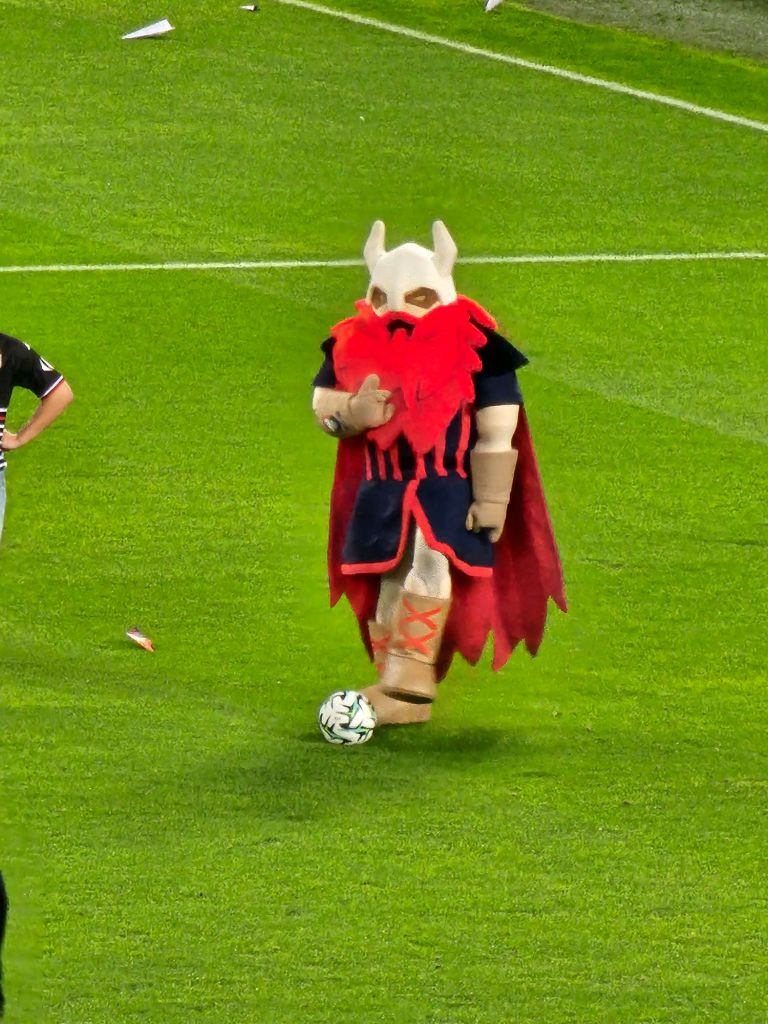
Now, with a clear view of the whole pitch we see the game re-start at nine o’clock and suddenly the stadium is full of enthusiasm and chanting. For no apparent reason the home supporters are singing “Allez, Allez, Allez” to Verdi’s Triumphal March from his opera Aida.  The effect is almost instantaneous as a ball into the box results in claims for a penalty, albeit somewhat specious ones. But a corner satisfies the more realistic supporters, which leads to a shot and another corner and more urging chants of “Allez, Allez, Allez” as the Caen fans loudly live up to what one would expect of their mascot, Vik the Viking.

Only five minutes of the half have gone and now number seventeen Kyheremeh is shooting straight at the Ajaccio goalkeeper before number nineteen heads over the cross bar from a corner.  Sadly however, the score remains blank and for a while the game descends into a Keystone Cops style knockabout with players falling over and colliding with abandon.  Paulene and I begin to notice the advertisements around the ground for the likes of Entreprise Bacon, Calvados the departement or County, as opposed to Calvados the apple brandy, and the interestingly named Twisto, the local transport company who brought us here this evening in one of their articulated buses.  Off to our left, I can only count eleven Ajaccio fans now and wonder if two have had to leave early to catch a ferry, or whether they just gave up hope.

Only twenty-five minutes remain as Caen’s Kyeremeh is through on goal, but he chooses to run wide and cross low to the near post where the ball is saved at the expense of a corner.  “Allez, Allez, Allez” sing the home fans again, but this time to the tune of the Beatles’ Yellow Submarine, not Verdi.  Thirteen minutes remains and Caen’s number four has come on as a substitute only to quickly get booked as he struggles to influence the game.   Three minutes later however, comes the decisive moment. Caen’s number ten, Bilal Brahimi, who has been neat but nothing more for most of the game, suddenly has space outside the Ajaccio penalty area from where he unexpectedly launches a shot into the top right-hand corner of the Corsican goal; Caen lead one-nil.  “Bilal, Bilal” chant the Caen fans as his picture appears on the scoreboard and the stadium announcer tells us who scored.

Ajaccio have made little effort to score themselves and now they might have left it too late.  Ajaccio substitute number twenty-one Ivane Chegra is brought on to add flair by the look of his Marc Bolan style coiffure, and number twenty-two Moussa Soumano succeeds only in getting booked as the match rolls on into five minutes of added on time.  The added-on time is of no consequence however, and with the final whistle the relief for Caen’s supporters having won their first match of the season is plain to see.

With a bus to catch we don’t linger to join the ensuing love-in, and that bus is almost full and ready to leave as we board it.  Down the streets beyond stadium vivid, sudden flashes of light appear and soon there are spots of rain on the windows of the bus as it weaves its way through the post-match traffic.  By the time we reach the city centre a heavy downpour is drumming against the roof of the bus and the streets are awash.  With the bus windows steamed up and streaked with rain I have to ask a fellow passenger to tell me when we’re back at Bellivet bus stop.  It’s a dramatic end to the evening and an uncomfortably wet walk back to the hotel, but I don’t think we’ll forget our night in Caen.
Holland 2  Dussindale & Hellesdon Rovers 1

Holland-On-Sea, Wikipedia tells us, is a suburb of Clacton-On-Sea and was known as Little Holland until the early twentieth century; it also has a football club called Holland FC.  What Wikipedia doesn’t tell us however is that Holland is just a 30 minute, thirty-eight-and-a-half-kilometre drive from my house, although Google maps does.  Stanway Rovers, Halstead Town, Coggeshall Town, Cornard United, Wivenhoe Town and Hadleigh United football clubs are all playing at home today and are probably all closer to home, but none of them are “On-Sea” and I’ve been to all of their home grounds in the last twelve years, which isn’t true of Holland FC’s Dulwich Road, where I am given to understand that the pitch, as if by some freakish movement of tectonic plates, has moved through ninety degrees in that time, throwing up a metal fence all around itself and a smart new clubhouse.  Therefore, with the promise of sea air and the prospect of a geologically formed football ground, it is on a warm but cloudy Saturday afternoon in early September that I set off in my planet saving Citroen eC4 for Holland-On-Sea.  I had contemplated catching the train to Clacton and making the half hour walk to Dulwich Road, but with only one train an hour I wouldn’t have got home until seven o’clock, and I have a wife whose heart I risk breaking if I stay out too long.

It’s an uneventful journey down the A133 and I arrive in relaxed mood in the Holland FC car park, where I have a wide choice of parking spaces; I draw up next to a modest silver-coloured family saloon, which had turned into the pebbly, beach-like car park shortly before my I and my Citroen did.  It’s not half past two yet , so I decide to take a look at the sea before entering the ground; the cliff top and sandy beach below are only 200 metres away across the grassy expanse of the Eastcliff Recreation Ground and Marine Parade.  From the cliff top, Clacton Pier is visible through the haze at the end of the beach, and out to sea sit the ranks of wind turbines that I like to think made the electricity that powered my car and brought me here.  A West Indian man of pensionable age and riding a low-slung tricycle asks me if I’m local and if I know where the Kings Cliff Hotel is.  I tell him I’m not and I don’t know where the hotel is, but I do know he is heading towards Kings Parade.  I think to myself that the ‘King’ in King’s Parade fame was probably either King Edward the Seventh or some egotistical Tendring District councillor with the surname King.

I walk back inland to the football ground up Lyndhurst Road, a typically suburban, tree-lined street of inter-war bungalows, all of which are almost frighteningly neat and well maintained. Just past a public toilet is a hedge which is teeming with bees and butterflies, mostly Red Admirals.  I am not sure I’ve ever seen so many butterflies in one place, but start to worry that wealthy local MP Nigel Farage might be having them specially bred so that he can pull their wings off or place them in his reptile-like mouth before washing them down with a pint of beer.  But then again, I don’t suppose he ever comes here; he probably gets his butterflies in Florida.

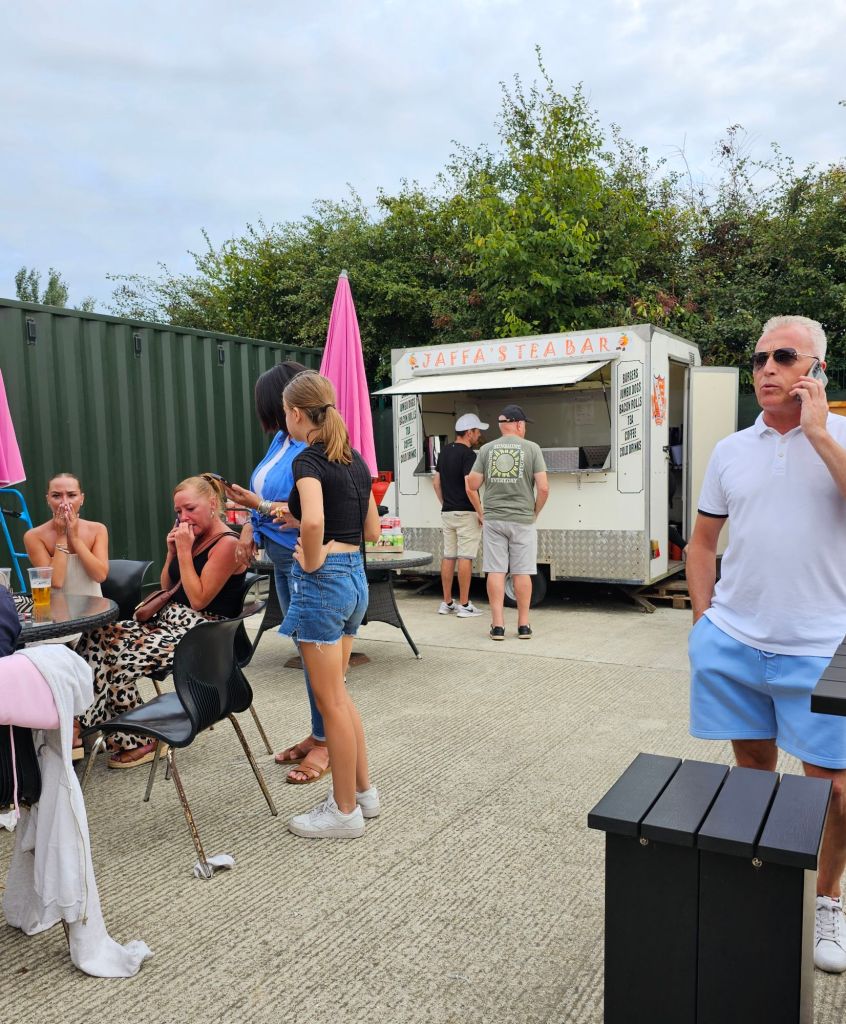
Back at the football ground, the friendly, cheery but visibly overweight man at the gate tells me that the concessionary entry fee of £5.00 applies to over sixties; I tender a twenty-pound note and receive fifteen pounds change.  After I ask if there is a programme today, I am told that the club does produce a match programme, but hasn’t done so today, which to me seems a bit lazy of them.  With the two pounds I saved at the gate by being old, I buy £1.50’s worth of tea from Jaffa’s Tea Bar.  I don’t know who Jaffa is, but his or her (it was a woman who served me) tea is pretty good, even if it is just a tea bag in a paper cup with some added water and milk.    I suspect however that the name of the tea bar is derived from the club nickname, “The Jaffas” and so the apostrophe is in the wrong place, this is Essex after all.  I wander inside the clubhouse which, although bright and new and with a display of trophies on one wall, seems a little soulless due to its grey floor, plain walls and vaulted ceiling; the only pumps on the bar are for Stella Artois, San Miguel and Carlsberg. I am pleased I bought tea and enjoy the irony that in Farage’s constituency all the ‘beers’ are, nominally at least, foreign brands.  Most of the drinkers are sat outside at an array of tables and look like they are settled in for the afternoon. 

“Are you sat here for the music?” I ask two old boys sat on stackable chairs in a covered area outside the home dressing room,  through the window of which can be heard the typical, pumped-up, high volume musical selection of the millennial footballer.  “Is that what it is?” Says one of the old boys.  I wonder to myself if Stanley Matthews, Len Shackleton and Tommy Lawton would get themselves ready for kick-off by cranking up the volume on the latest 78’s from Glenn Miller,  Al Bowlly and Bing Crosby.  With the music turned off we can hear the team talk. “It’s a long journey from Norwich or wherever they come from” says the coach encouragingly to the Holland players.

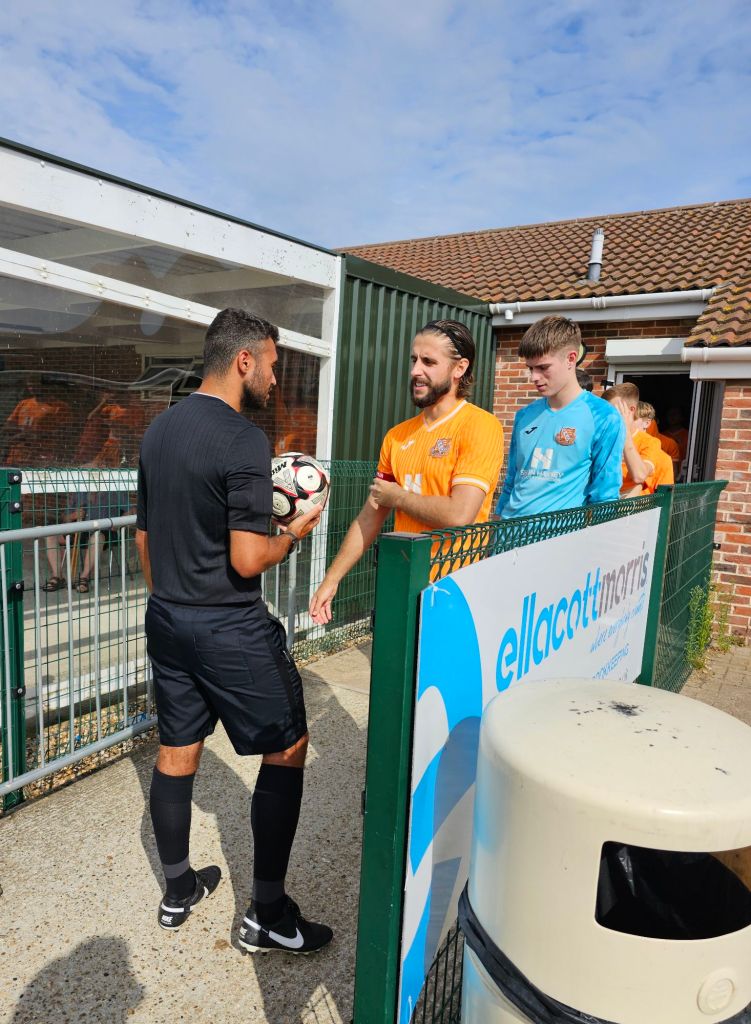
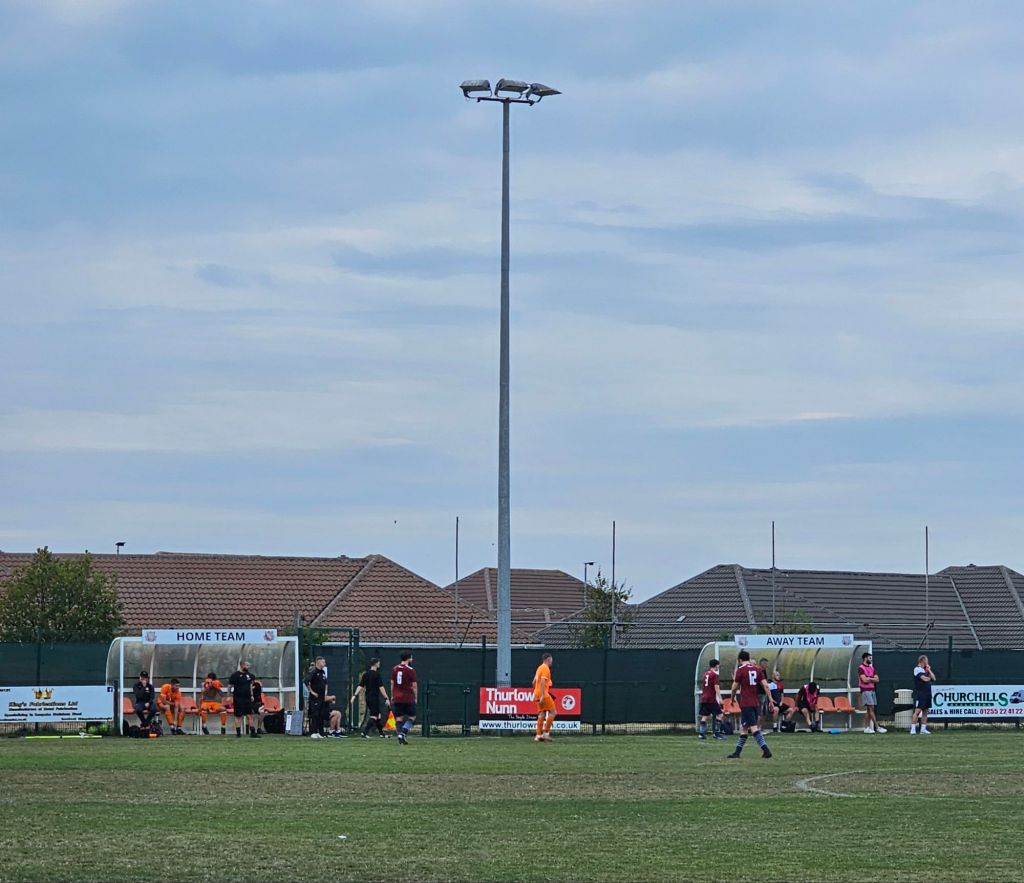
It’s not long before the teams are lining up to parade onto the pitch with the players of today’s opponents Dussindale and Hellesdon Rovers, looking suitably jet lagged.  Dussindale and Hellesdon are two suburban areas on opposite sides of Norwich, but their clubs amalgamated a few years ago and have made it into the snappily titled Thurlow Nunn Eastern Counties League First Division North and now play in Horsford, which is at least next to Hellesdon and close to Norwich airport, which is handy for away games.   After all the usual handshaking and hand-gripping malarkey, it is Dussindale and Hellesdon who kick-off towards the sea in burgundy shirts and navy-blue shorts. It’s a tasteful, if slightly dull kit and doesn’t compare with Holland’s vivid all orange ensemble.  Wikipedia tells us that the nickname of Holland FC is The Tangerines, no doubt due to the colour of their kit, but Holland’s own website refers to them as The Jaffas, although it doesn’t appear to have been updated since last May.  I wonder if there has perhaps been a referendum during the close season on what type of orange best represents the club, with members choosing to reject Satsumas, Mandarins, Clementines, Navels, Cara Caras and Easy peelers.   

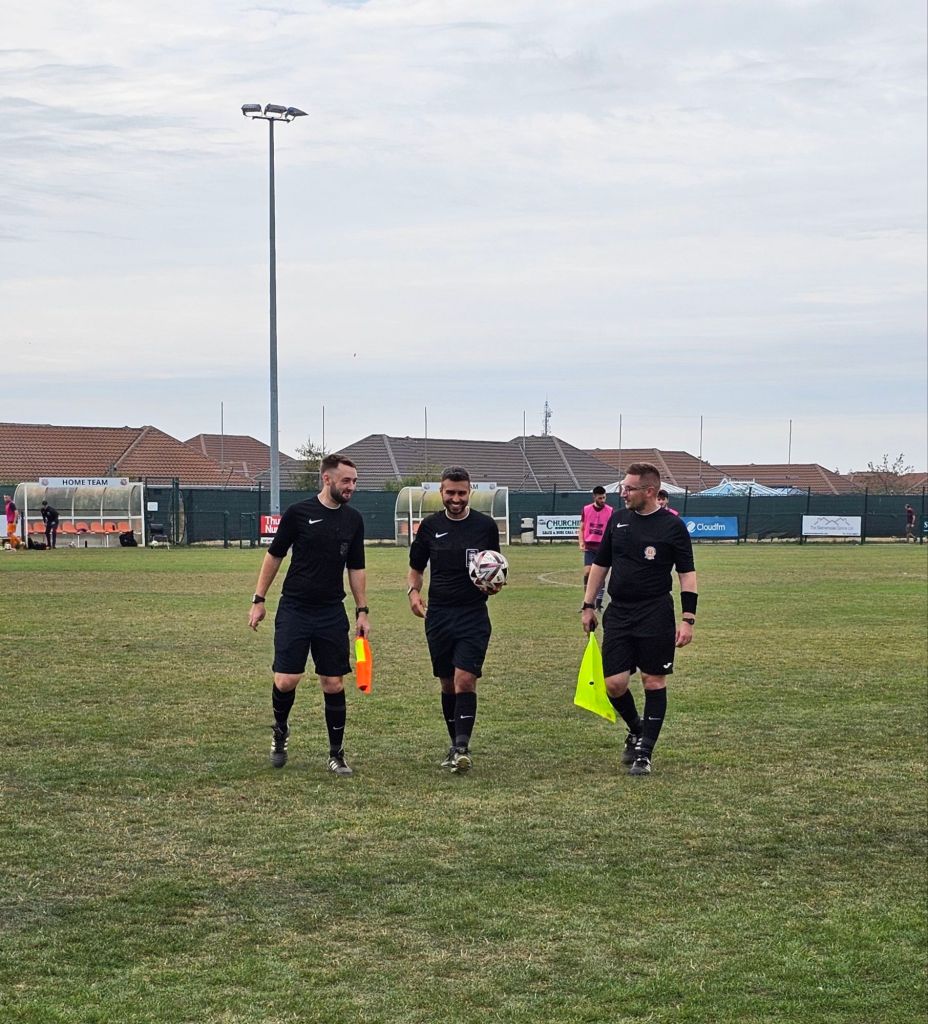
The early exchanges on the pitch are typically noisy with the ball frequently flying high into the afternoon sky as an optimistic through pass for someone to chase is booted away.  “Go wide, hit the channel, good chap” bawls the Rovers’ goalkeeper revealing a hint of a Norwich accent as the ball sails in to touch.  Holland have the classic two big blokes at the back, numbers 5 and 12.  Number 12 has the sort of build which, if this were a professional game, would no doubt leave him open to chants from opposing supporters of “You fat bastard”, but he is a ‘rock’ at the back for Holland. 

I walk round the pitch to stand between the team dugouts. Holland win two early corners.  More Norfolk accents are detected on the away team bench.  Holland seem to lack club volunteers, with there being no programme today and no team sheet posted on a wall anywhere either.  The on-pitch commentary from the players however reveals that the Rovers number three is called Eggy and the number four Martin; other players have names too.

A poor back pass lets in the Holland number eleven,  who crosses in a low ball which a Rovers centre-back clears over the cross bar for corner.  It’s the first real opportunity, even if it was entirely manufactured by one team for the other.  The game is full of endeavour, but no one is capable of providing a pass that will lead to a goal. It’s a game of just shouts at the moment.  “Get out”, “First and second ball”, “What we talked about”, “Jump early”, “Ref that was blatant”, the usual anxious nonsense that the players hear every week and must get sick of.  On the Rovers’ bench the coaches are simply willing their team to do better; “Get the ball” urges one, going back to basics.  Then Rovers break down the right; number eleven scampering into the penalty area and crossing the ball low to where somebody should be to tap it in but isn’t.

“That’s the first chance of the game, and it’s to us” says a Rovers coach moments before the Holland number nine heads the ball against the Rovers cross bar from what looked like inside the six-yard box.  Fortunately, he can’t hear the cursing on the Holland bench.  It was the sort of incident that explains why the Rovers number five displays a constantly slightly worried look on his face, in contrast however to the number four playing in front of him, who is calmness personified and always has unhurried time on the ball. “Go on Matt, Dylan” shouts another coach, and I think of a parallel world where a film director working with Jack Nicholson and Charlton Heston might say “Go On, Jack, Charlton.”

 “It’s a great run again” says a Holland coach sounding like a radio commentator as Holland move forward again down the right.   The pattern of the first half has now been established and Holland are the dominant team, but with Rovers are a constant threat on the break. In midfield for Holland, number eight has a beard, and hair swept back with an alice band; it makes him look a bit like a bargain basement Alessandro Pirlo, which would explain why he is captain.  “Keep on side” shouts someone as Rovers’ number eleven breaks forward again, but he’s too late, the linesman’s flag is raised, if only that advice had been shouted sooner.

Unusually, in the final twenty minutes of the first half there are three substitutions, with Holland’s number three, who has been looking physically uncomfortable, being usurped by number seventeen, who is soon having a shot on goal well saved.  For Rovers, numbers seven and eight leave the pitch to be replaced with numbers fourteen and fifteen, like the start of a mathematical puzzle.  Just as unusual is the smell of deep-frying fish and chips that is wafting around when at half past three in the afternoon people should surely be having no more than an afternoon cup of tea and a biscuit.

The thought of tea sends me further round the pitch, back towards Jaffa’s tea bar and when I pass behind the linesmen he warns “Nothing silly” as opposing players chase another hopeful punt forward for Rovers.  The ball is soon returned to the other end of the pitch however, where Holland’s number nine shoots weakly at the goalkeeper as he redirects a square pass.  But the disappointment is short-lived as number ten finds himself in much the same position, but crucially manages to shoot past the goalkeeper and high into the net to give Holland a more or less deserved lead.

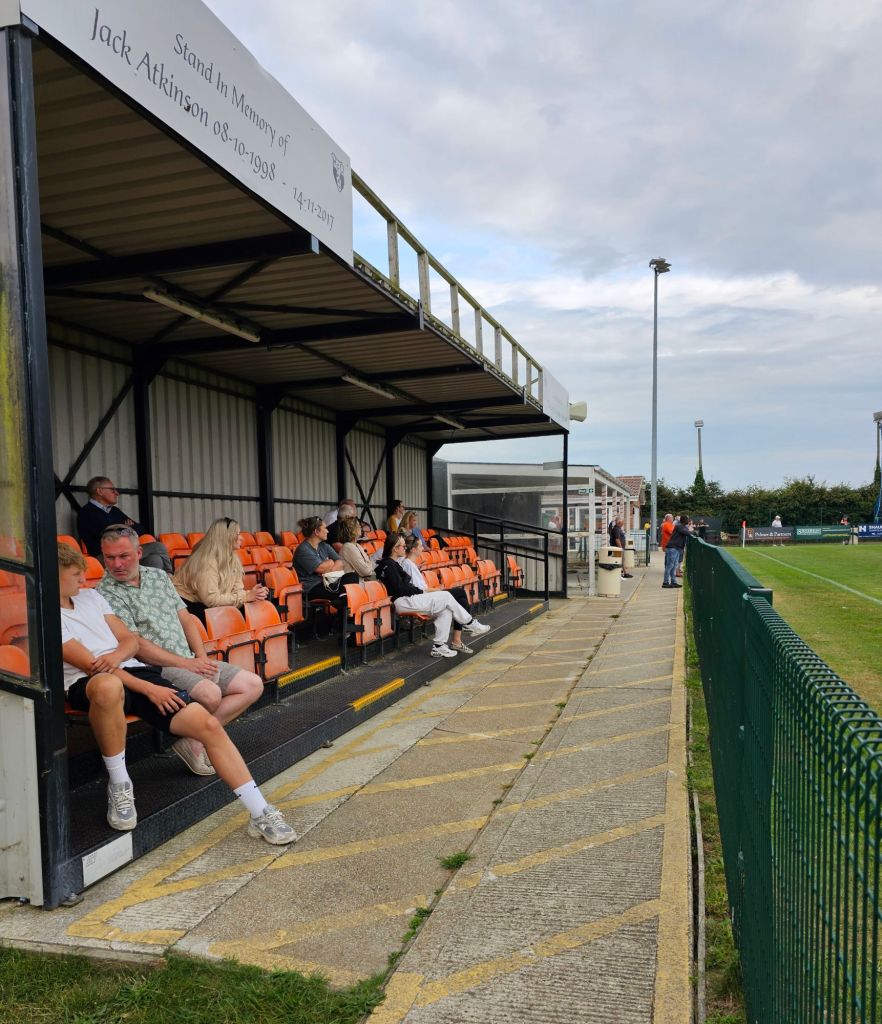
 Half-time arrives soon afterwards and teas and beers taste better than they would have if Holland had not scored, although I don’t think everyone sat drinking outside the bar noticed the goal or any of the first-half come to that.  For the second-half I decide to take up a seat in the main and only stand, selecting a spot in the middle of the second row where I can easily see most of the pitch above the metal mesh fence.   From here I can also see the sea of hipped bungalow roofs with ugly concrete tiles and the white UPVC conservatories that squat beyond the surrounding boundary fence and off into the distance.  A seagull stands and squawks from on top of a ridge tile.

The football resumes at two minutes past three and Rovers are soon seeing more of the ball than previously; they’re not playing so deep into their own half, but like Holland before the half-time break, they’re not creating many chances to score.  Suddenly, out of the blue, it all gets a bit too much for Rovers’ number nine who bawls in frustration “Fuckin’ell, fuckin’ play!”.  Moments later, as if to say “Alright, alright, keep your hair on”, his team-mates fashion a corner kick and then number fourteen becomes the first player to be booked as he fouls Holland’s number eleven.   In contrast to the increased excitement on the pitch the afternoon now feels quite still; the sky has clouded over and it’s cooler than it was. 

Despite both number nine and ten having decent shots on goal for Rovers, Holland are holding on fairly comfortably, but it must nevertheless come as a relief to them when around half past four  Rovers’ number five swings a foot to clear the ball and misses it, letting Holland’s number eight take it to the edge of the box, check inside and send a gently curling shot beyond the goalkeeper and inside the far post. Holland lead 2-0.

It’s the sort of a goal that commentators tell us will ‘wrap the game up’ and ‘put it to bed’; it’s just what Holland have been waiting for.  Two minutes later and it hasn’t, as Rover’s number ten has a shot parried by the Holland goalkeeper and number nine sweeps the rebound into the goal.  The score is 2-1 and anxiety takes hold.  It’s been a game of very few fouls, but someone cries “Late every time” when there is an accidental collision of boot and ankle, and I begin to wonder if all referees shouldn’t also be primary school teachers.

It is seven minutes to five when the game ends, and before returning to my trusty planet saving Citroen for the drive home, I pause to applaud and reflect on what has been a very good game. As I say to one of the old boys as he gathers up his sticks to toddle off home, we’ve had a decent five pounds worth of entertainment.   But shuddering slightly, I nevertheless can’t help wondering how all these people voted at the last general election.

Ipswich Town 1 Fulham 1

It’s been a grey morning; warm but cloudy and breezy, with two very sharp, short showers.  The apple tree in the garden has provided a good crop this year and I’ve been cooking them ready to put in the freezer and ensure a future that contains crumble and blackberry and apple pie.  I mopped the kitchen floor too after making waffles for breakfast.  We didn’t get any post, but heck, there’s football this afternoon.

The train to Ipswich is on time, but the carriage I sit in is full of people seemingly with no ability to control how loud they talk, or rather shout. Do they all operate pneumatic drills during the week I wonder, or listen to marbles inside tumble driers as a leisure pursuit?  Gary joins me at the first station stop, I have texted him to tell him I am in the second half of the train, in the carriage with the pointy front; I think it’s called streamlining and is all the rage on modern trains. We talk of people we both know and of what Gary has arranged to do to fill his days now he is retired; weeks of badminton, ten-pin bowling, crown green bowls , indoor bowls and quizzing stretch out before him invitingly.  We spot all four polar bears as we glide down the hill towards Ipswich through Wherstead and one is taking a swim.  It’s a highlight of my day so far, has saved me the cost of entry to Jimmy’s farm, about twenty quid, and I’ve had a train ride and conversation with Gary thrown-in.

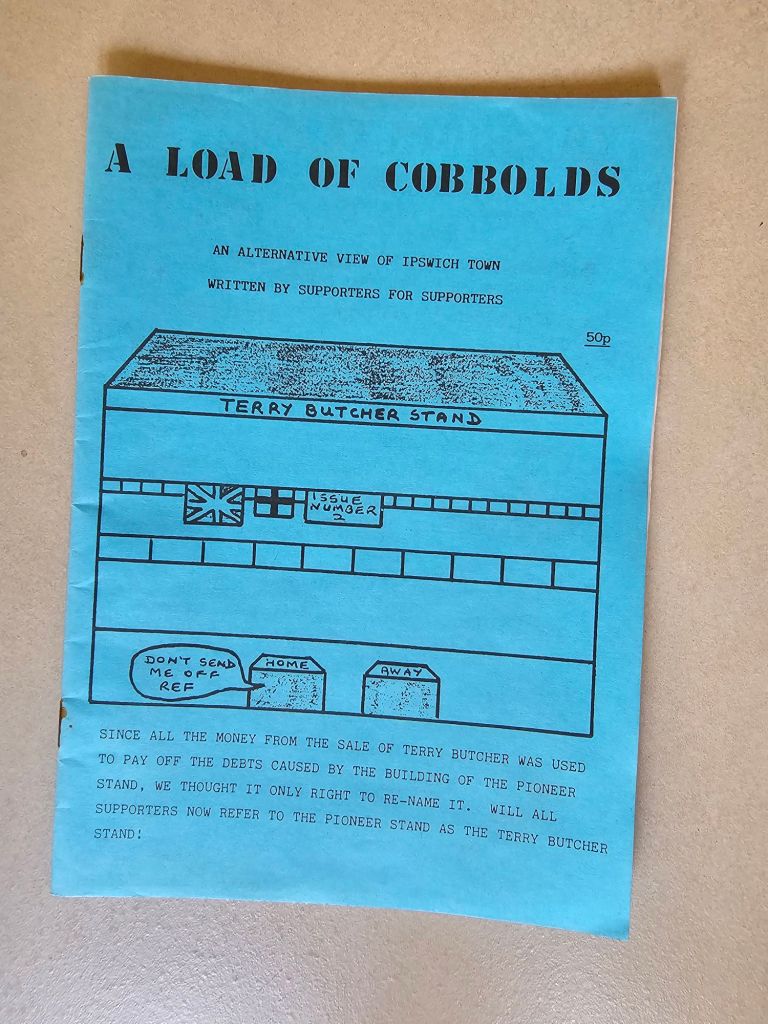
In Ipswich, the train stops conveniently close to the bridge that takes us across the tracks from Platform 4 to the exit and our walk along Princes Street, Portman Road and up to ‘the Arb’.  In the beer garden of the Station Hotel a chorus of “You’re going down, you’re going down, you’re going down “ rings out noisily. Premier League banter eh?  We buy programmes (£3.50 each) from one of the ice-cream booths that sell programmes on Portman Road.  Today’s front cover is in the style of a childishly drawn cartoon and very good it is too, and reminiscent of the cartoons that used to appear in the ‘A Load of Cobbolds’ fanzine in the 1980’s and 90’s, although not in a ‘My Sweet Lord’, by George Harrison, ‘He’s so fine’ by the Chiffons sort of a way.

‘The Arb’ is predictably busy and Gary gets the first round in, a pint of Lager 43 for him and a pint of Mauldon’s Suffolk Pride for me (£8.58 with Camra discount).  It’s odd how the pub seems even busier than it did last season, even though there will be no more home supporters present than before. Perhaps all the ‘Johnny-come-lately’ fans have been reading up on what to do before a game to enjoy the ‘full Premier League matchday experience’.   We talk of the paralympics, Walton On The Naze, religious observance and the religious persecution of women, Ipswich  Town’s latest signings, how strawberries and blackberries are apparently not berries and other inconsequential matters that I can’t recall, before I buy a second round of Lager 43 and Suffolk Pride. After all the other pre-match drinkers have left for Portman Road, we leave too.

Gary and I part ways near Sir Alf’s statue and I head on down Portman Road, flitting as best as a 64 year old man with a dodgy achilles tendon can through the queues into the Cobbold Stand on my way back to my usual seat in the lower tier of Sir Alf’s stand.  The queues at the turnstiles are long again today, unlike for the Liverpool game where there were barely any queues at all. So slow moving is the queue for the illustrious turnstile 62, that like  an impatient driver approaching roadworks on a motorway I switch lanes and join the queue for turnstile 60, where evidently supporters are more proficient at flashing a bar code in front of a screen.

The teams are on the pitch by the time I take my seat and of course ever-present Phil who never misses a game, his son Elwood, Pat from Clacton and the man from Stowmarket (Paul) are already present.  Fiona however is not, and instead a man who quickly identifies himself as Ian, tells me that he is not Fiona.  Ian is in fact Fiona’s next-door neighbour.  On the pitch, a tall, slim, young man in a suit announces the teams enthusiastically and does a reasonable job of co-ordinating with the scoreboard so that ever-present Phil and I can bawl out the Town players’ surnames as if we were at the Stade de la Licorne or Stade Felix Bollaert, two of my favourite places in northern France. Beside the tall, slim young man, is a shorter young man in a suit and I think of Yogi Bear and Boo-Boo.  The last strains of The Beatles’ Hey Jude drift away as the game begins and Fulham get first go with the ball, aiming it roughly in the general direction of the telephone exchange and London Road Baptist church.  Town wear their signature blue shirts and white shorts, whilst Fulham are in their signature white shirts and black shorts, but with vivid red go faster stripes on their shorts too, that surprisingly look rather good, I think it’s the contrast with the red and the black.  Feeling a little pretentious, I think of Stendahl.

“Blue and White Army” roar some of the crowd above the general loud hubbub of nearly thirty thousand excited people. “Temporary Boiler Hire” flash the electronic advertisement hoards that sit between the upper and lower tiers of the Sir Bobby Robson Stand.  I think to myself that that could come in handy in the winter if the water from the taps in the Alf Ramsey stand toilets is as cold as it usually is.  After only three minutes Leif Davis is lying on the turf clutching his back. “Looks serious “ says the bloke behind me, but happily it’s not, and the crowd are soon merrily singing “Addy, Addy, Addy-O” as if imagining the soundtrack from “A Taste of Honey” starring Rita Tushingham and Dora Bryan, which is what I’m doing.

Five minutes in and Town win the game’s first corner; Jacob Greaves’ far post header is saved  athletically by Fulham goalkeeper Bernd Leno who I do not think is related to American TV presenter Jay Leno, but I don’t honestly know. Leno is wearing a slightly dull looking lime green ensemble, if lime green can be dull.  It takes two minutes for Fulham to level the corner count. “Come On Fulham, Come On Fulham, Come on Fulham” is the entreaty from a large part of the top tier of the Cobbold stand, but happily for Town, the Fulham football tean doesn’t oblige.  Two minutes later and Fulham step ahead in the corner count as Luke Woolfenden clears accidentally towards the Sir Bobby Robson stand from distance.  The Fulham fans chant “Come On Fulham” twice as many times as for the previous corner, but it makes no difference, although it adds to the already febrile match-day ambience.  Seeking reassurance after their team’s corner related failure, the Fulham fans sing “We are Fulham, We Are Fulham” and I think I even hear some reference to their postcode, SW6, which is nice for Royal Mail pensioners like Gary and myself.

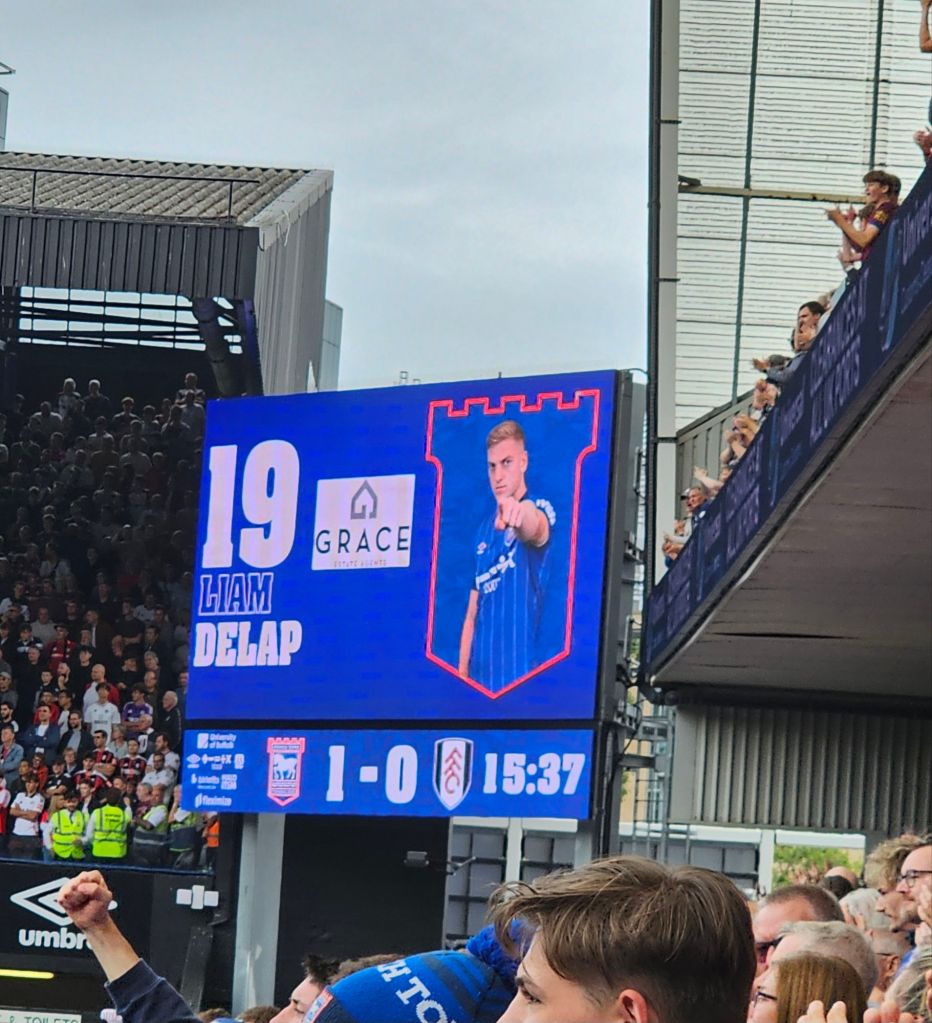
After twelve minutes, Fulham have another corner as Woolfenden blocks a low cross from Adama Traore. “Quick aint he?” says the bloke behind me of Traore. “He aint normal.”  The Fulham fans have given up on their chants of “Come On Fulham” for the time being at least and switch to “No noise from the Tractor Boys”, which, as prophetic football chants go, turns out to be one of the worst of all time as within sixty seconds Leif Davis breaks out of defence, runs, squares to Liam Delap who also runs, but at the goal, and then diagonally, before turning slightly to leather a shot past Leno, who can touch the ball but not stop it rocketing  high into the net. Wow. Town lead 1-0. “Hark now hear the Ipswich sing, The Norwich ran away” sing the Sir Bobby Robson standers feeling prematurely, but understandably festive.

The goal lifts Town, who set about levelling the corner count and Liam Delap heads wide when there wasn’t anything or anyone really preventing him from scoring. Town are dominating. “For a team that’s still gelling, we don’t pay bad” says the bloke behind me, and he’s right.  Like someone recently injected with morphine, I sit back and just enjoy the sensation of watching some excellent football.  “Get your head up” shouts a berk from somewhere a few rows back as Sam Morsy wrestles to retain possession.  As if anyone in the crowd could possibly teach these players anything.

Then Fulham equalise, the game has just under an hour left of normal time.  Fulham weathered Town’s onslaught then steadied themselves with a bout of prolonged possession, which was on the verge of becoming boring before a pass out wide, a run to the goal line, a low cross, and a shot swept in by Traore running into an open space.  It’s how good football works I believe.  “Who are ya?” chant the Fulhamites inquisitively, perhaps worried that we are Fulham too, but luckily for them we’re not.   Fulham are now on top and Rodrigo Muniz heads at the Town goal, but straight at Aro Muric.  “We are Fulham, We Are Fulham” chant the Fulham fans again, clearly weirdly obsessed with people’s identities, and possibly postcodes.

Sam Morsy’s standard booking happens in the thirty-seventh minute as he clatters Muniz, but a fine passing Town move follows, which earns another corner, although Kalvin Phillips wastes it by hitting it hopelessly beyond the goal.  The young announcer announces two minutes of added time very excitedly and in a manner that personally I would only think was appropriate if announcing free beer.  At half-time the score is 1-1 and the man from Stowmarket (Paul) is very content with what he considers to have been an even first half.  I concur, but add that Fulham have probably had more possession, although they’ve not done much with it.

During the break, I speak with Ray and his grandson Harrison and Ray tells me that they have tickets to see Oasis at Wembley.  I am pleased for them, especially Harrison, who then further pleases me by asking about Robyn Hitchcock’s book ‘1967: How I got there and why I never left’ and the accompanying album (1967: Vacations in the past) which is released in the UK on 13th September. I tell Harrison I shall be seeing Robyn play in Hackney, the weekend after next.

The football resumes at three minutes past four and I’m soon noticing the raspberry blancmange like colouring of Aro Muric’s shirt and shorts, and how from a distance the ball looks a bit like a very un-ripe wild strawberry.  Back in the game itself, Sasa Lukic kicks Liam Delap’s feet away from under him and is booked by referee Mr Lewis Smith, whose first name makes me think of Lewis Carroll and Alice Through the Looking Glass.  “The Hot Sausage Company” appears in bright lights across the electronic advertising boards and Liam Delap shoots over the Fulham cross bar. Ipswich win a corner. Antonee Robinson, the spelling of whose first name would only be improved if it was Antonknee is booked by Mr Smith for shoving over Omari Hutchinson and then Town win yet another corner.  An hour of the match is lost to history and recorded highlights, and the Sir Bobby Robson standers come over all festive again and sing about endlessly fighting Norwich.  “Quick, Easy, Affordable Balustrades” announce the bright lights of the electronic advertisement boards and I try to think of the occasions when I have needed a cheap balustrade in a hurry before deciding that Adama Traore looks a bit like he could be a handy weightlifter when not playing football for Fulham.

The second half belongs to Ipswich and the game is mostly taking place up the other end.  When Fulham do win a corner, it dissolves into a series of wild grabs and shoves and I’m surprised Mr Smith doesn’t tell the players that if they can’t play nicely there won’t be any more corners. The game hurtles into its last twenty minutes and the first substitutions are made, Jens Cajuste replacing Kalvin Phillips for Town.  “I liked him the other night” says the bloke behind me, possibly revealing details of his private life, but more probably that he saw the midweek League Cup game against AFC Wimbledon.  Not to be outdone, Fulham make a substitution too and then today’s attendance is announced as 29,517 with 2,952 of that number being of a Fulham persuasion.  Fulham win a corner, Traore is shown Mr Lewis’s yellow card for tugging at Leif Davis. I’m surprised the hulk look-alike didnt tear Davis’s shirt clean off.

The final ten minutes witness mass substitutions for both teams including a first sight of another new signing for Town, Jack Clarke, but disappointingly nothing more leaps out at me from the electronic advertising boards. Pat from Clacton is feeling nervous and we’re not even winning, but there seems to be a commonly held belief that a point today will be good enough; Fulham are a decent side.  The allotted ninety minutes have expired and the young man in the suit announces that there will five more. “Five added minutes” he concludes portentously, and the crowd responds with a final roar of encouragement, perhaps inspiring Town to win a corner and Omari Hutchinson to turn and shoot and have his shot saved by Leno.

The final whistle draws a torrent of appreciation from the stands as Pat from Clacton and Ian make a swift exit, but with no train home for half an hour, I hang around to watch the ensuing love-in and reflect on what has been a really good match.  I thought last season’s matches were fast and intense, probably because I had become used to what went on in the loveable old third division, but this football, now, has stepped up to a far higher level again.  Happily, it looks like this evolving Town team are capable of playing here.  I don’t like the Premier League, I strongly disapprove of it and its greed, but I have to admit the football we’ve seen at Portman Road in these first two games has been brilliant. But what can you do? Let’s hope we find out soon, and do it.