Ipswich Town 3 Plymouth Argyle 2

All of a sudden, summer turns to winter overnight, and it happens today, well tomorrow morning at 2 am to be precise, but as Brexit proved facts aren’t really important anymore.   Looking forward to another hour in bed or staying up late without really staying up late, I kiss my wife goodbye, step out of my front door and head for the railway station. The pale autumn sun shines down upon me.  As I cross the bridge over the railways tracks a man in pale grey trackie bottoms, pale grey sweatshirt and pale grey adidas baseball hat engages me in conversation about Ipswich Town’s remarkable start to the football season. Damn, he must have noticed my blue and white scarf, which I donned thinking the weather is cooler than it is.  I don’t really know what to say to him, I don’t talk about football if I can help it, but nothing surprises me in football anymore. After fifty-two years watching mostly  Ipswich Town, but with sizeable dollops of Colchester United, Brighton and Hove Albion and Wivenhoe Town, I’ve seen it all, haven’t I?

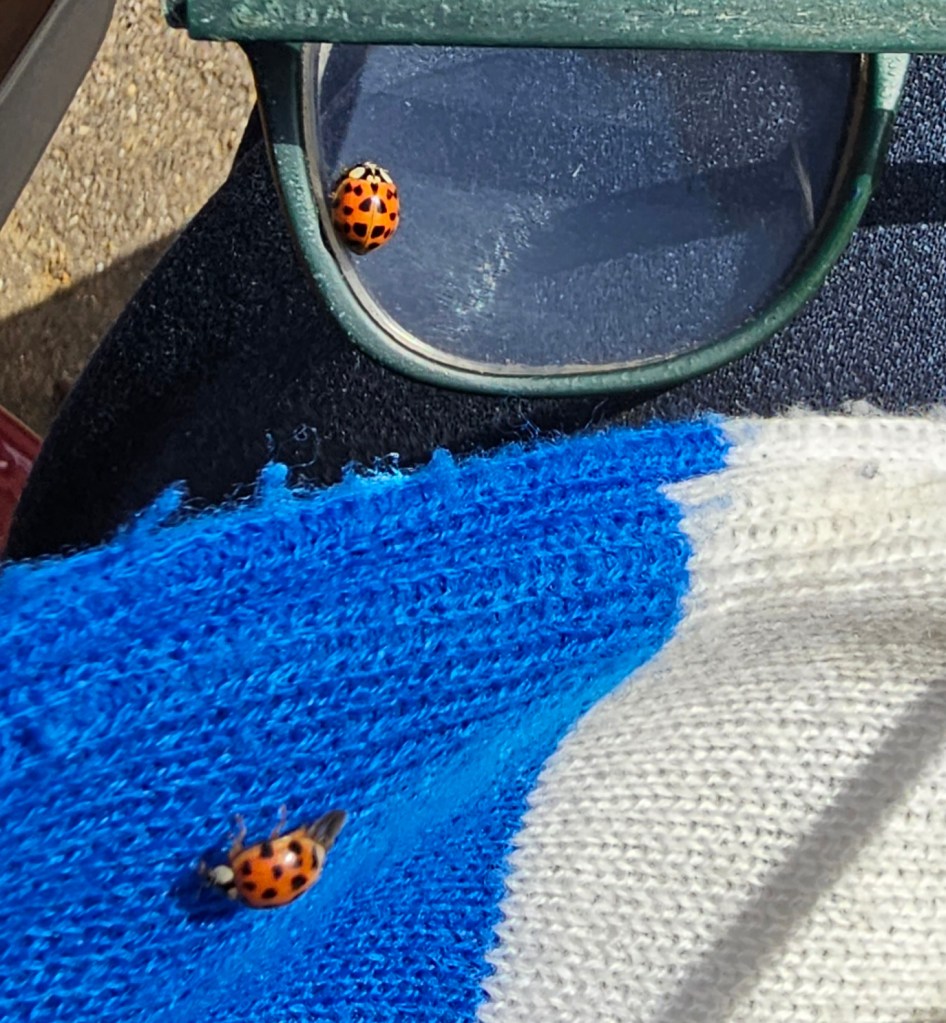
As I sit and wait for the train, which is a minute late, two ladybirds are also seemingly attracted by my blue and white scarf, but thankfully they don’t ask me any questions, they just settle on it until I blow them away and tell them their houses are on fire.   The train arrives, I get on and am unfortunate enough to sit where I can only see out of half a window, whilst on the other side of the gangway three men, a woman and two children discuss blood pressure, although to be honest the children don’t have an opinion, they just witter and gurgle as children do.  I move to a seat that is situated with a full window view. The carriage smells of whatever it’s been cleaned with and I’m feeling very warm indeed. Behind me a man says “Is it a glamorous building?”  The woman with him replies “Well, it’s nice”. I remove my jacket, scarf and jumper and reflect on what has gone right and what has gone wrong with my day so far.

The train arrives in Ipswich and I make swift progress down Princes St into Portman Road, where I purchase a programme (£3.50) at one of the blue booths that looks to me like they should also sell ice creams.  The programme today has a picture of the excellent Massimo Luongo on its cover, he is clenching his fists and thrusting forward his groin whilst lifting one foot off the ground as if he might be ostentatiously breaking wind. Middle-aged men and older sit on the rail fence to the nearby car park and eat packed lunches. It’s one of those days when people catch my eye and half smile as if they know me.  I check to see if the zip on my trousers is undone, it’s not, but it was on Thursday morning when I took in a parcel for my neighbour from the DHL delivery man.

In time I inevitably reach ‘The Arb’, which is very busy, and I join a queue at the bar.  An obese man with shiny pink lips and waxy complexion annoys me a little by “cutting the line”, as Americans say, and getting served before me.  Behind the bar the one female member of staff has brightly coloured hair, and for one fleeting, fanciful, enjoyable moment I imagine it’s TV’s favourite physical anthropologist professor Alice Roberts, but of course it’s not. When it’s my turn, I order a pint of Wolf Brewery Werewolf (£3.87 with Camra discount) before retiring to the beer garden where I look at my mobile phone and notice that Mick has tried to call me, twice.  I call him back and he explains that he is late because he has been called out to Felixstowe to collect a dead person. He’ll be with me later.  I have drunk my first pint of Werewolf and started a second when Mick arrives at about a quarter past two with his own pint of Werewolf.  We talk of the bottles of Lancelot organic beer I brought Mick back from Britanny, of Lorient and Brest and bowels, prescriptions and mutual friends. At about twenty to three we leave for Portman Road, exiting through the back gate.
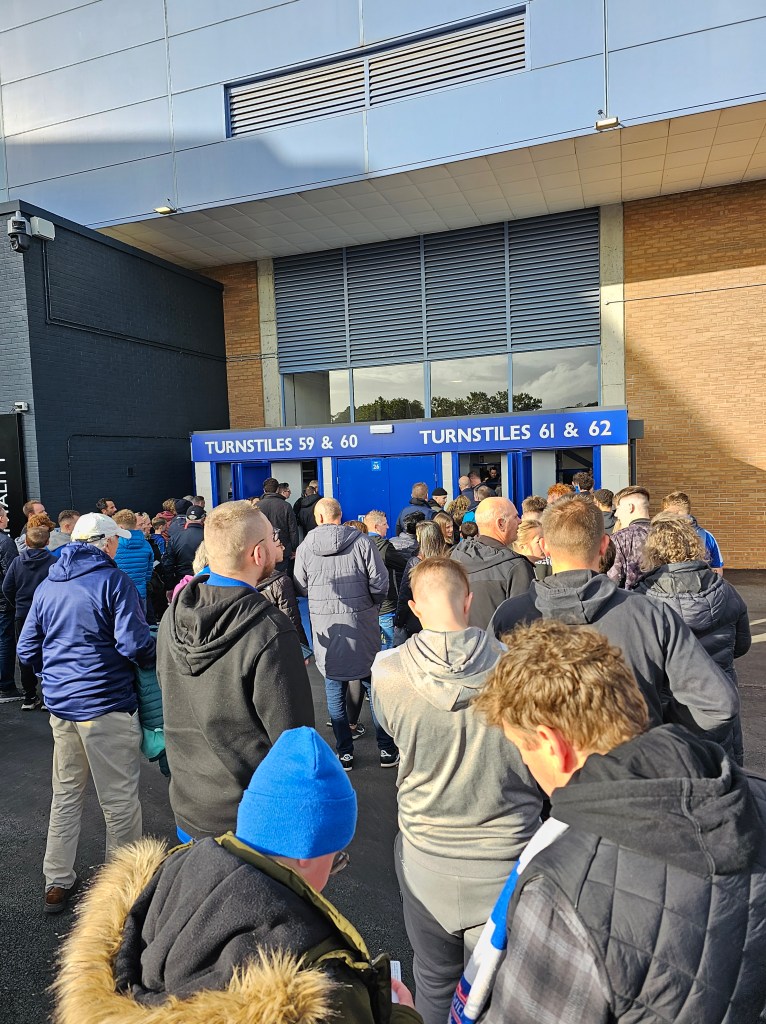
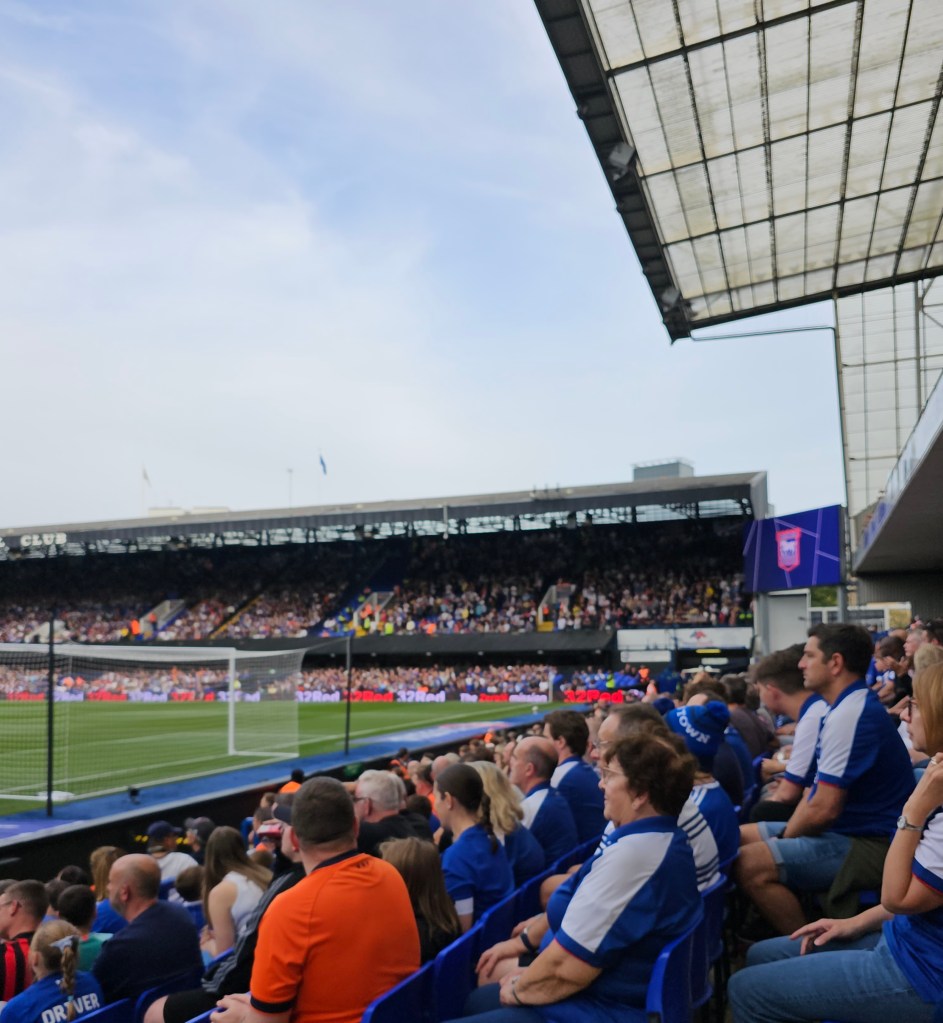
Portman Road is clogged with queues for the Cobbold Stand and there are queues at the turnstiles for the Sir Alf Ramsey Stand too.  Happily, the queue at turnstile 62, my favourite turnstile because 1962 was when Ipswich won what is now called the Premier League, is a bit shorter than most.  I wave my season ticket vaguely in front of the screen-thing, unable to remember which bit makes it work.  The bloke behind me says it’s the bit on the left, or he may have said it’s the bit on the right, I can’t remember now and will do the same thing again when I come to the next game.  Either way, I pass through the turnstile and having vented some surplus Werewolf, join Fiona, the man from Stowmarket, ever-present Phil who never misses a game, and his young son Elwood, who are as ever already in their seats and applauding the teams as they process onto the pitch.  Pat from Clacton is absent today, she’s playing whist in Mauritius.  Murphy the stadium announcer reads out the names of the teams, but he is no Stephen Foster and hopelessly fails to synchronise himself with the scoreboard as it displays the names of the Town players, which he garbles leaving insufficient space between first and second names to facilitate the bellowing of the players surnames by the crowd as if we were French.

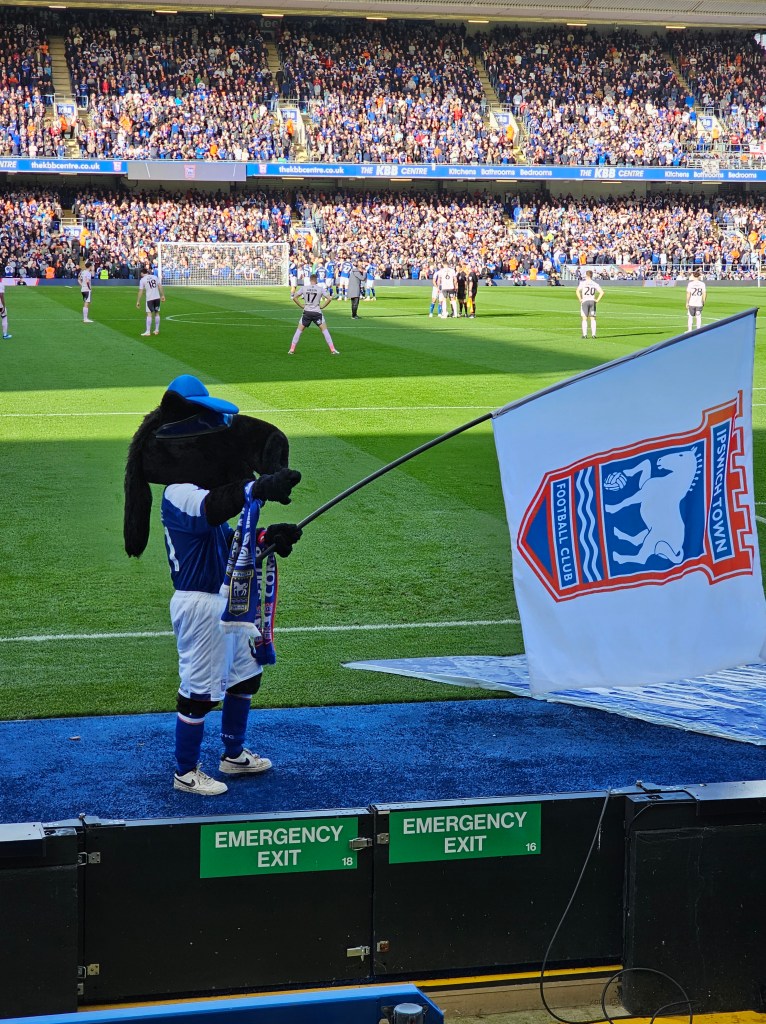
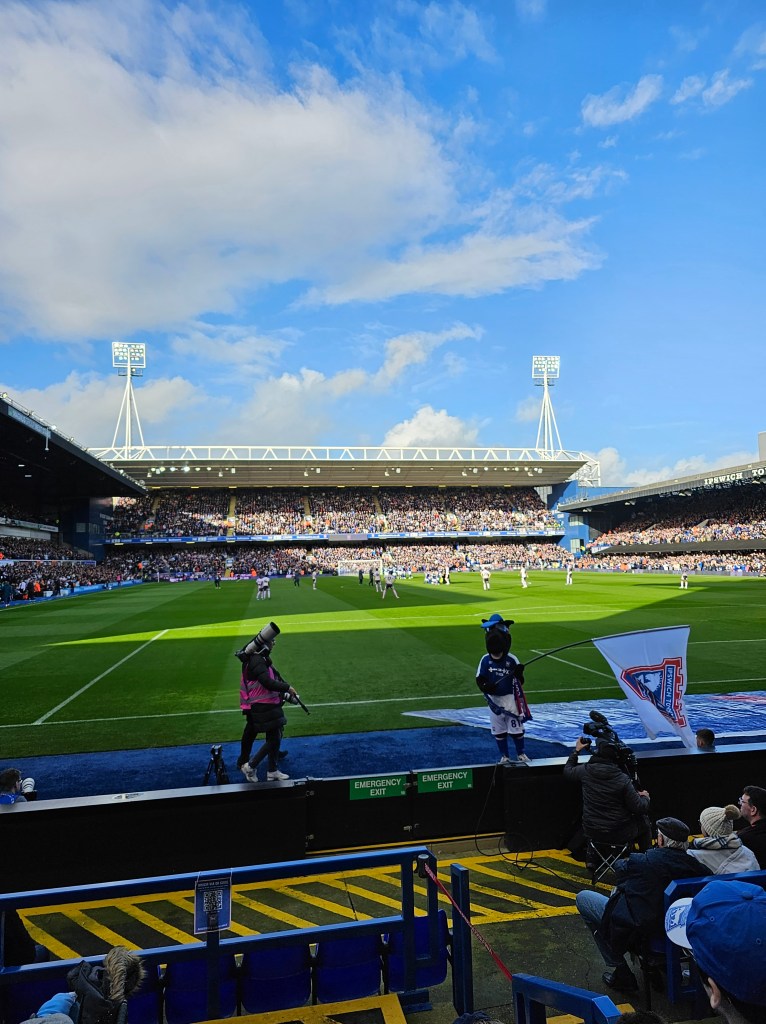
The game begins with today’s opponents Plymouth Argyle getting first go with the ball, which they aim mostly in the direction of me, the river and railway station.  Town are inevitably in their signature kit of blue shirts and socks with white shorts.  At first, I think Plymouth are wearing white shirts and black shorts, but a less cursory glance reveals that their shorts are a deep grey, and their shirts are a very pale, washed-out pink.  I can’t decide if this is a tribute to prog rockers Caravan’s 1971 album ‘In the Land of Grey and Pink’ or if Plymouth had accidentally put their shirts in the wash with Exeter City’s.  There could of course be a sensible explanation like the kit being dedicated to breast cancer awareness month, and for readers who like ‘boob jokes’, the city of Plymouth is coincidentally twinned with Brest in France.

With tickets sold out, Portman Road is loud just from people talking, but there is singing too and Christmas soon arrives with a burst of “Hark now hear the Ipswich sing, the Norwich ran away” quickly followed by a rendition of “ We’ve got super Keiran McKenna, He knows exactly what we need…” and it’s just as well he does because the match is not seven minutes old and Plymouth’s Morgan Whittaker plants a curling shot into the top right hand corner of Vaclav Hladky’s goal and Town are trailing one-nil.  It’s a goal that inspires mass gloating from the Devonians up in the top tier of the Cobbold stand as the Argyle fans go inexplicably Spanish and start to sing “Championes, Championes, Ole, Ole, Ole” as if trying to convince us that they’re all linguists as well supporting the team that somehow pipped Town to the third division title a few months back.  My inner superstitious pessimist is unexpectedly awoken by the noise, and I start to think to myself “Oh no, it’s game thirteen and we’re going to lose”.  But I soon snap out of it and as Town respond with a corner, I repeatedly sing “Come on You Blues”, although solo.  “No noise from the Tractor Boys” chant the Argyle fans, which, as I tell Fiona, is harsh on me, but not untruthful otherwise.  Fully in character as vainglorious bastards, the Argyle fans proceed to sing “One-nil to the Champions”, and plagiarise the Pet Shop Boys in the process.

Town win a second corner and a third and Conor Chaplin has a shot blocked. A Plymouth man goes down and whilst he receives succour, everyone else has a drinks break and catches up on the coaching  they’ve forgotten since walking onto the pitch twenty minutes ago.  Meanwhile the away fans deliver a strangely muffled chant of “Small club in Norwich, you’re just a small club in Norwich” displaying a lack of wit normally only associated with supporters of small clubs genuinely in Norwich.  Plymouth make the first substitution of the afternoon as Ryan Hardie quits when his team is ahead to be replaced with Mustapha Bundu.  “Substitution for Leeds United” announces Murphy over the PA, crowning his inept performance so far this afternoon, before just announcing “Plymouth Argyle” with no accompanying word of apology or explanation for those who hadn’t heard his gaff.  Bring back Stephen Foster and his best man’s suit and poorly matched shoes I say.

Nearly a quarter of the match is gone for ever and the home crowd is beginning to sound and feel fractious, like toddlers who have been up too long and need a nap. “A bit sloppy there” says the bloke behind me as Plymouth busy themselves around the Town penalty area. “Unlucky” says the bloke continuing his commentary as Omari Hutchison makes a not very good cross.  Town win a fourth corner and a fifth.  “Come On You Blues” I chant again, and again, and miraculously the rest of the stadium join in.  “Fuckin’ ‘ell, he’s phenomenal today, he is” says the bloke behind me of Brandon Williams as the on loan full-back performs a ‘full-blooded tackle’.  “He’s on another level”.

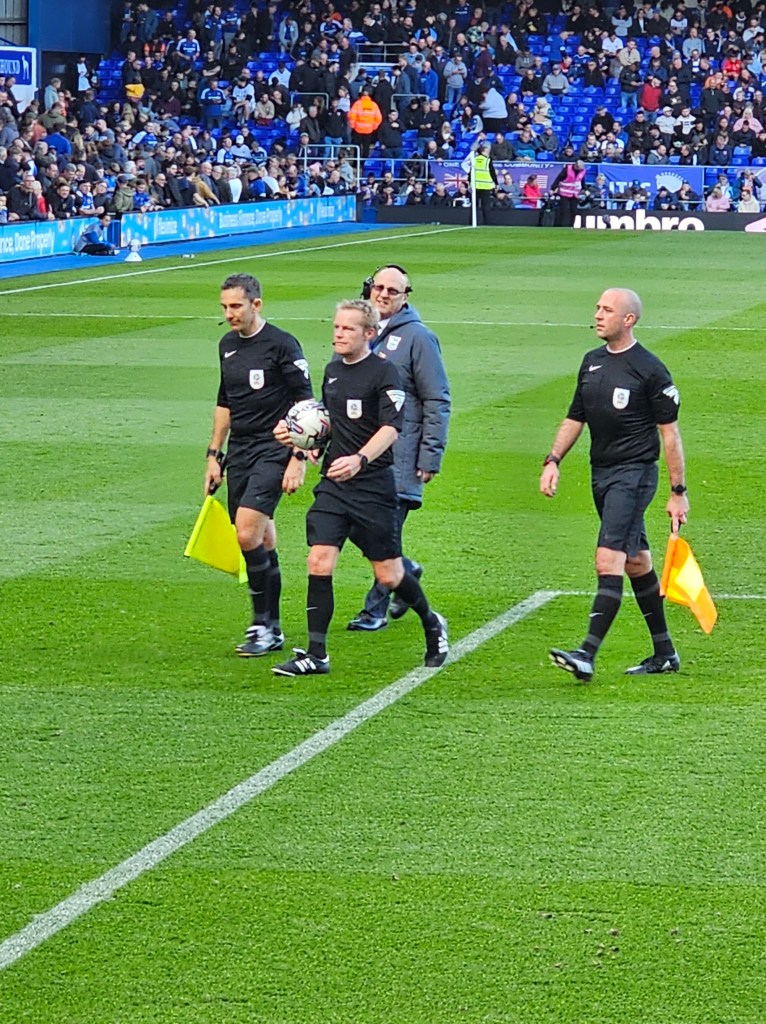
Nearly a third of the way through the game and the first airing of referee Gavin Ward’s yellow card is in the direction of Plymouth’s Mikel Miller, whose name reminds me of probably the most famous racing greyhound of all time.  “Diana Nicholson, report to the nearest steward” announces Murphy putting on the sort of serious voice that might get used when talking about Jimmy Savile or Rolf Harris.  Town win another corner, our seventh? I think I might have lost count. The name of Massimo Luongo joins that of the famous racing greyhound in Mr Ward’s black book.  “You don’t know what you’re doing” chant the Sir Boby Robson stand predictably.   Town win an eighth corner and a Nathan Broadhead header over the cross bar elicits polite applause.  Town win a ninth corner before, with five minutes to go until half-time Plymouth win their first and the away support debuts their rendition of “Argyle, Argyle” a soulless dirge in which the syllables in the word Argyle are elongated to depressing lengths.  A minute late the blokes behind me head for the bar.

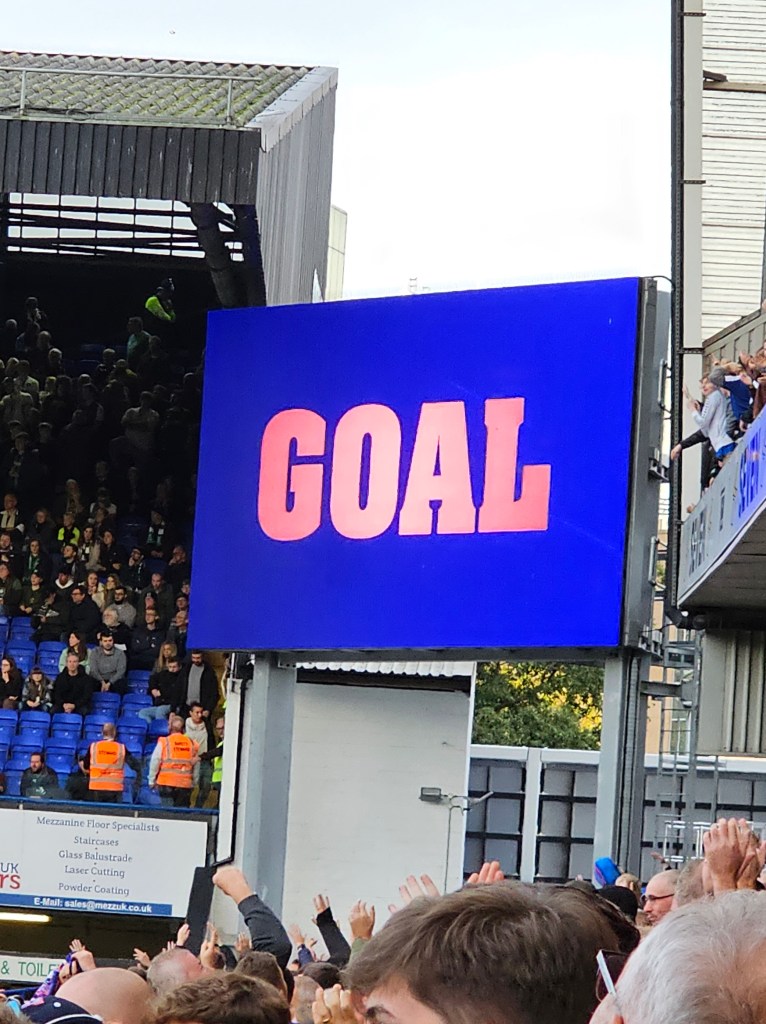
Two minutes remain before the tea break and Whittaker breaks forward for Argyle and falls to the ground as George Edmundson makes a lunging challenge from behind. Whittaker claims a penalty, well he would, wouldn’t he, but Mr Ward is watching a different match, the same one I’m watching, and whilst it looked like a penalty perhaps, I don’t think Edmundson touched Whittaker at all.  It’s soon forgotten as Town claim yet another corner and four minutes of added on time appear before us.  From the corner I can’t see what happens as it’s up the other end of the pitch and I’m in the cheap seats.  But then a roar goes up and it seems we’ve scored, I’ll take everyone’s word for it I tell Fiona.  Massimo Luongo is given the credit and half-time soon follows.
With the break I talk to the man from Stowmarket, and he tells me how his son-in-law is a Norwich City supporter and how he went to a Norwich match with him and was lucky enough to see Norwich lose 6-1 at home to Manchester City.  Having syphoned off more spent Werewolf and stared blankly up at the half-time scores on the TV in the concourse below the stand I talk to Dave the steward.  We agree that we can’t quite decide what Town need to do to win the match other than score some more goals.

The football resumes at, I think, six minutes past four and Vaclav Hladky is soon saving at the feet of Plymouth’s Finn Aziz, whilst the blue skies above begin to turn more grey with gathering cloud. But then Town win yet another corner and it seems there has been a change in tactics with the ball being dropped behind the Plymouth defence as well as passed through and around it, but I could be wrong. A meagre fifth of the half has trotted off into he mists of time when Leif Davis sends a through ball for George Hirst and his accompanying marker to chase. Hirst wins and curls the ball beautifully beyond the despairing dive of the Plymouth ‘keeper and perfectly inside the far post.  Although I’m in the cheap seats, I doubt my view of the goal could be bettered on this occasion.  It’s a goal to prove that going two one up having been a goal down is worth the initial suffering, and the sense of relief is palpable. “Ei-Ei-Eio, Up the Football League We Go” chants the Sir Bobby Robson Stand cheerfully to prove the point.

The home crowd had been quiet and a bit miserable for most of the first half, but we really do only sing when we’re winning. Plymouth win a second corner, but Town win a twelfth or thirteenth; I’m no longer counting.  Omari Hutchison has a shot deflected wide when I was convinced the ball was in the net and Conor Chaplin heads over the Plymouth cross bar. Mr Ward the referee does something which inspires the lad who sits in front of me to say “The referee’s a talking point”, previously I’ve mostly heard referees described as bastards.  

Three-quarters of the match is now historical fact and I turn to Fiona to tell her it’s about now when Pat from Clacton usually tells us what she’s having for tea.  I ask Fiona what she’s having; she’s having fish and chips.  I tell her I’m having left over curry.  On the pitch, Town make substitutions and Mr Ward produces a rash of yellow cards, mostly directed at Town players, just to confirm his status as a talking point. Conor Chaplin and Omari Hutchison continuously almost link up well down the right, but frustratingly never quite manage it until Kayden Jackson replaces Hutchison with less than fifteen minutes left of normal time.  After the substitution, Hladky makes a superb flying save following a meagre third Plymouth corner, and Murphy announces this afternoon’s attendance as 29,028; “Thank you for your continued support” he says obsequiously, sounding like Uriah Heep would have if Charles Dickens had made him a stadium announcer at the weekends.

Into the last ten minutes and Hladky makes another stupendous save, perhaps the most stupendous yet; this time from a close range shot by Joe Edwards.  So perfect is Hladky’s performance in the second half that I am beginning to fear he might have sold his soul to the devil during the half-time break. “That’s better than a goal, that is” says the bloke behind me, getting a bit carried away. 

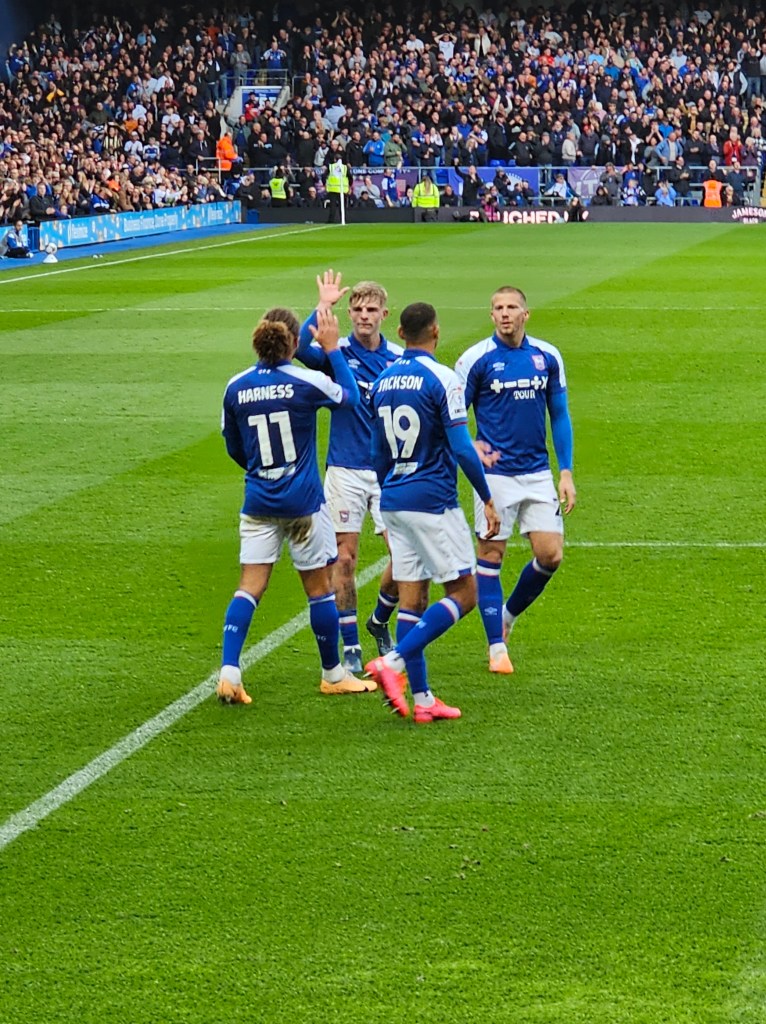
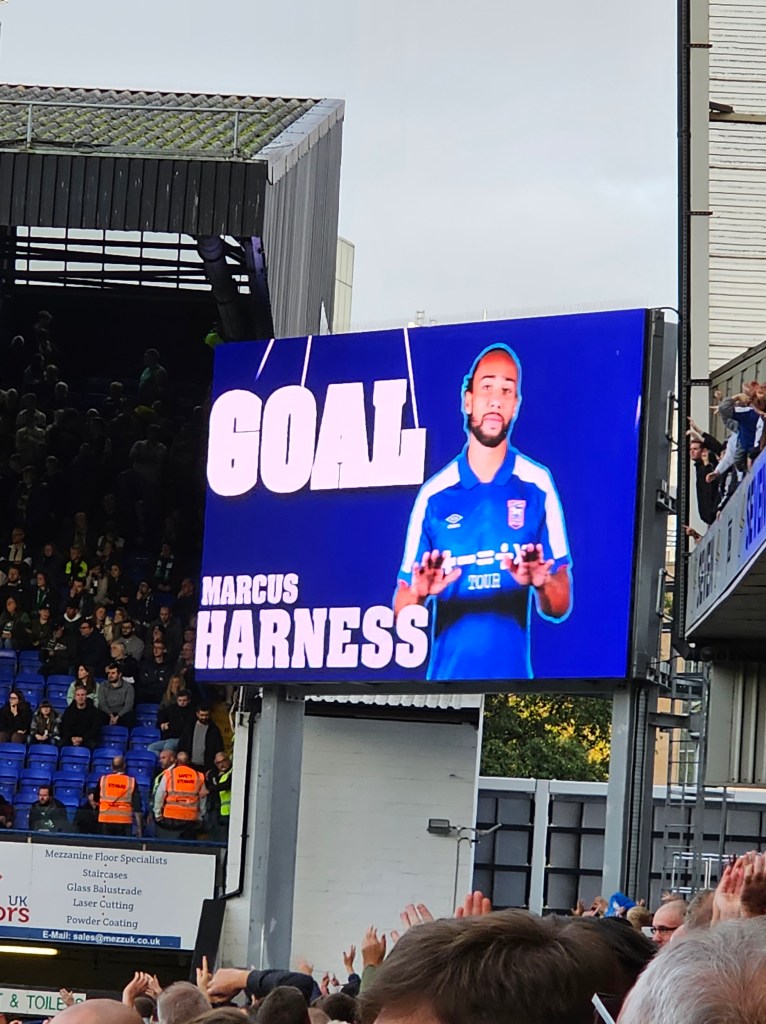
Four minutes of normal time remain and Town are looking leggy whilst Plymouth still look fresh; Town are hanging on but somehow retain an attacking threat because of the nature of our players, we simply have a team designed to create and score goals, apart from Vaclav Hladky that is. Sam Morsy sends Leif Davis down the left, he crosses the ball to Marcus Harness who shoots from perhaps ten metres out, but his shot strikes a defender, only for the ball to rebound to him and allow him a second chance, which he takes.  These things didn’t used to happen, but now they do, and Town lead 3-1.

There will be at least six minutes of added on time.  Hardly a minute of that time expires and Plymouth score again, a low cross knocked in from close range after Hladky apparently renounces Satan, and we’re back where we were.  Plymouth won all the points they needed to pip Town to the third division title and more in the closing minutes of games last season, but not today, and Town succeed in closing the game down by passing the ball amongst themselves and thereby draining the hope and possibly the will to live from the Argyle players.  Mr Ward is keen to remain a talking point and adds a bit more time onto the six minutes but it doesn’t matter and Town win again.

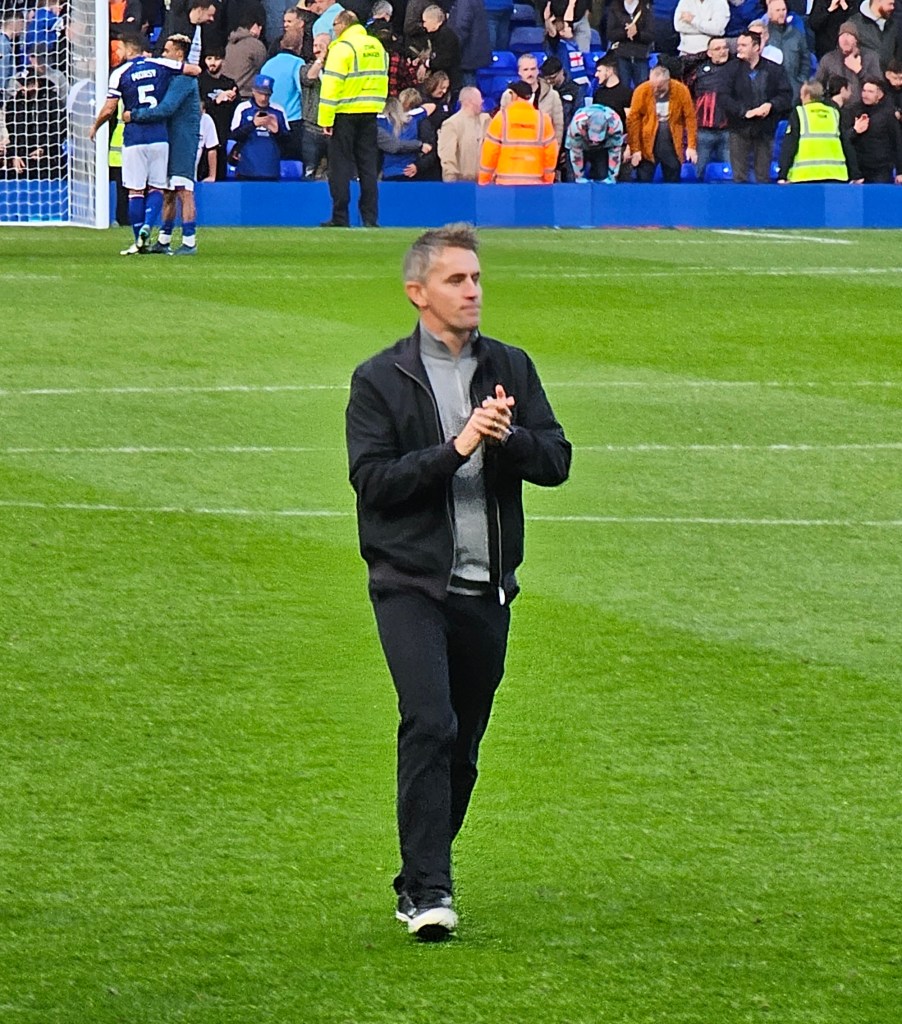
With the final whistle Fiona departs and so does the man from Stowmarket, but I stay a few minutes to applaud, whilst others seem keen to jeer the Plymouth players, I’m not sure why.  It has been a very close game, but Town have won yet again, and without having to rely on penalties or offside goals, or flukes.  Summer and now British summer time might have gone,  but since Kieran Mckenna arrived it’s been perpetual Springtime in Ipswich.

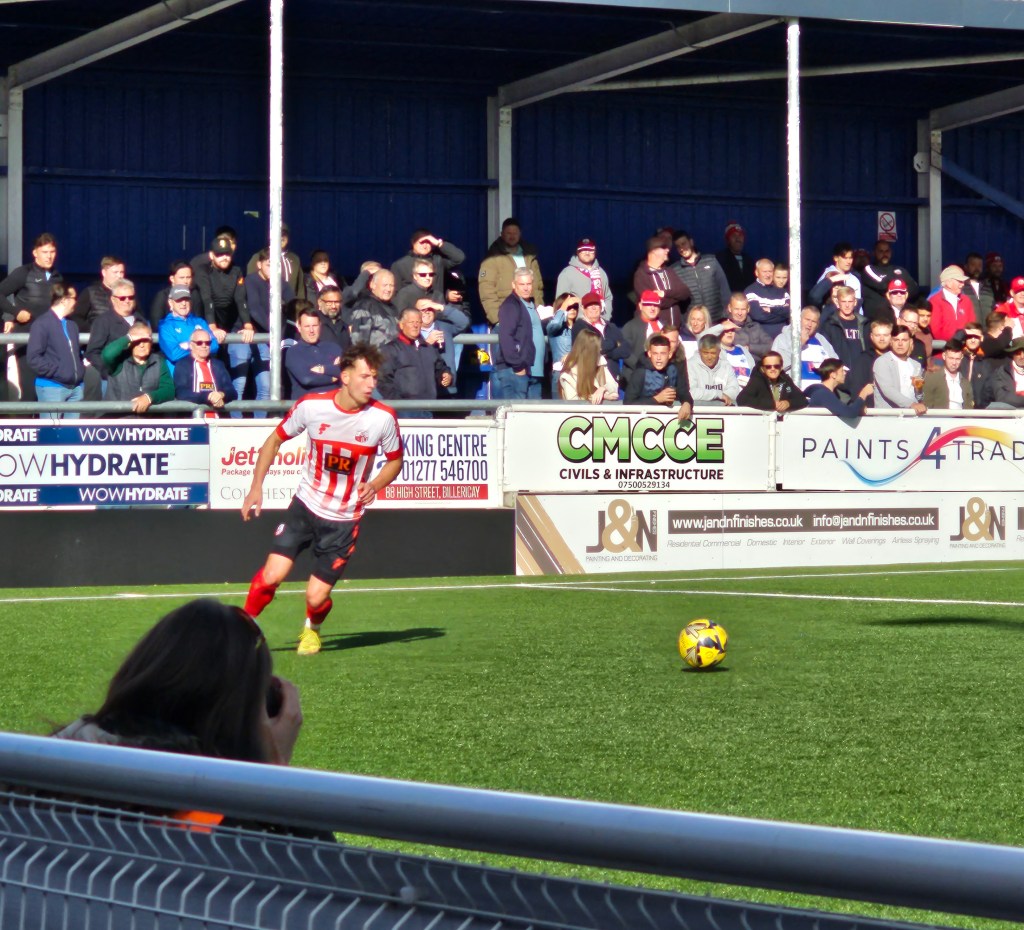
Billericay Town 1 Sheppey United 1

It’s a bright sunny day and I have spent the morning trimming the hedge that sits between my garden and the footpath outside my house and the road beyond. I didn’t know when I started hedging, that today was the day of the fourth qualifying round of the FA Cup, but something inside is nagging at me telling me that I should be seeking out non-league football on a sunny October Saturday when Ipswich Town aren’t playing.  In one of the many breaks from hedge trimming that I need in order to admire my work and drink tea, I therefore discover on the interweb that today is indeed an FA Cup day,  and scanning the fixtures for ‘local’ games I see that Billericay Town will be playing Sheppey United.  

Like seeing Haverfordwest County, which I did back in August, seeing Sheppey United has always been an ambition of mine. My father’s parents lived in Sheerness on the Isle of Sheppey from the 1930’s until they died forty odd years or more ago.  I can recall visiting them and discovering Sheppey United’s ground, which was then somewhere amongst the seeming maze of back alleys between their house in Vincent Gardens and Sheerness High Street. My father always laughed about Sheppey United, and I was a bit disappointed that neither he nor my grandfather ever suggested we go and watch them.   So, today presents an opportunity to fulfil a longstanding wish. To add to the family association, when my grandmother and father were first married, she apparently worked in Billericay, and the story goes that at this time she fell pregnant with twins.  There are no birth or death certificates for the twins however, so it is assumed they miscarried, but the story put about by my uncle was that she was going to name them Billy and Ricky, (as in Billericay) which seems unlikely, a bit ridiculous, and also very tragic all at the same time.  But my uncle did have an odd sense of humour.

Google maps tells me that I am only forty-five kilometres from Billericay Town; a thirty-five-minute drive down the A12 and along the B1007.   I drove that far a fortnight ago to see Garde St Cyr Moreac play OC Vannes in the fourth, and still amateur, round of the Coupe de France, so it only seems fair that I should drive as far to watch an FA Cup game this afternoon.  I ask my wife Paulene if she would like to accompany me, because after all she was with me in Moreac, but her response today is verging on the impolite, and so having had a light lunch of potato crisps and left over pizza I set off alone in my planet saving Citroen e-C4.

It’s an easy drive from my house to Billericay, but I nevertheless set the Satnav to take me to New Lodge, Billericay Town’s home ground.  I listen to BBC Radio Essex in the car in the hope of gleaning pre-match insight, but talk is mostly of Colchester United, Southend United and also Aveley, who like Billericay are playing in the FA Cup today, but at home to current National League leaders Barnet.  I am kept amused meanwhile  by the Satnav, which changes the pronunciation of the last syllable in Billericay from the usual ‘Key’ to ‘kay’.  As the writers of ‘Gavin and Stacey’ and possibly my uncle knew, there is may be something inherently funny about Billericay.

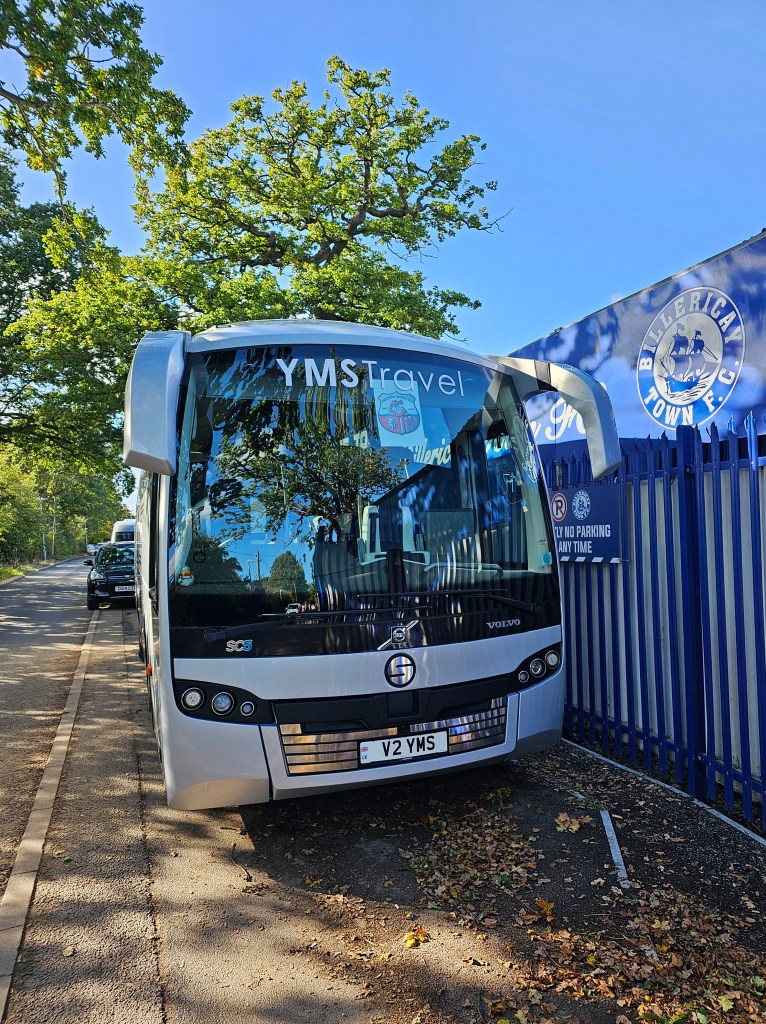
The Satnav in my car unerringly takes me to Billericay Town FC as expected, but had not foreseen that the club car park would be full, and so I switch ‘her’ off and pop down a nearby side road to doubtless annoy someone by parking outside their suburban bungalow.   At the bottom of the road on which I am parked, four blokes are getting out of a pick-up truck. A man stands on his front porch opposite and tells them to turn right then left to get to the ground, I guess they must be from Sheppey.  “Up from Sheppey are you?” I ask. The answer is as expected, and our conversation reveals not only that the bloke I’m talking to is the Sheppey United manager’s son,  but that one of the blokes with him owns a house in the same street in which my grandparents lived.

New Lodge lies down Blunts Wall Road, a bucolic, tree-lined lane which conveniently brings the pedestrian to a bank of four turnstiles at the corner of the ground.  Being the modern tech-savvy bloke that I’m not, I had already purchased my ticket on-line just minutes before I set off from home, responding to the advertised promise on the club website of not having to queue at the turnstiles.  It was a lie, there is no express check in, and so I begin to queue at the first in a row four turnstiles with all the mugs tendering bank cards and even cash.  When I get to the front of the queue, I present my phone to the turnstile operator, who promptly apologises that she can’t let me in here and I must queue at turnstile number four. Luckily, having queued at the first in a row of four turnstiles it’s easy to work out which must be number four, although the turnstiles are not actually numbered.   At least when I begin queuing again I can confirm to the two blokes behind me who also already have their tickets, that they are in the right queue.

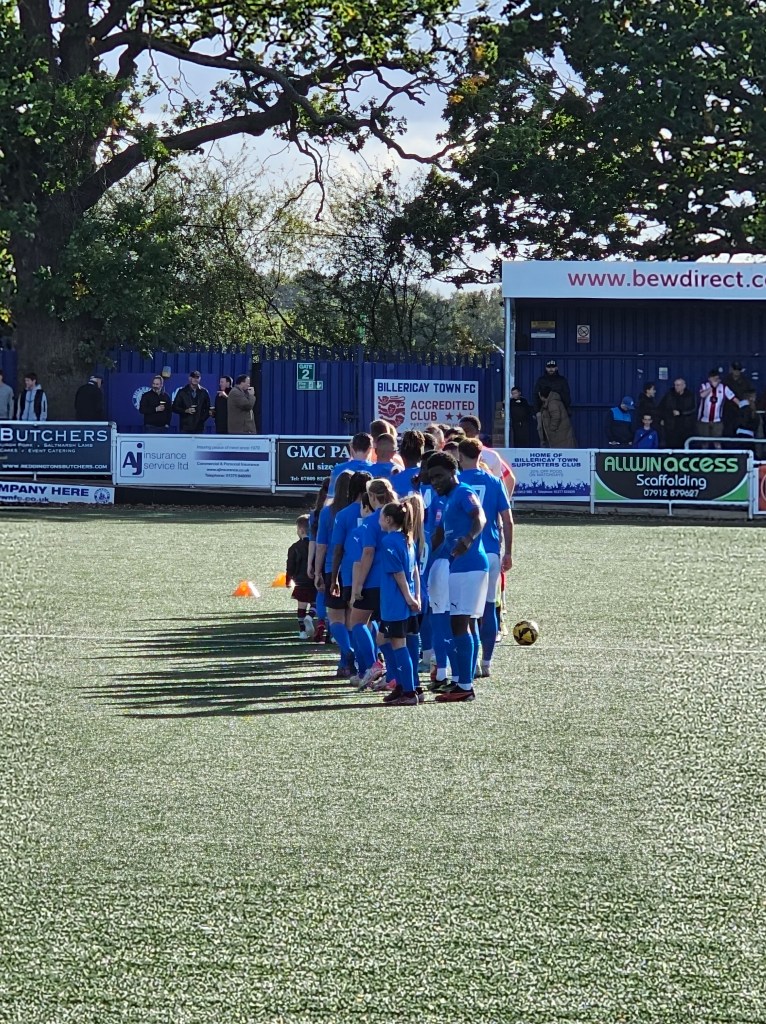
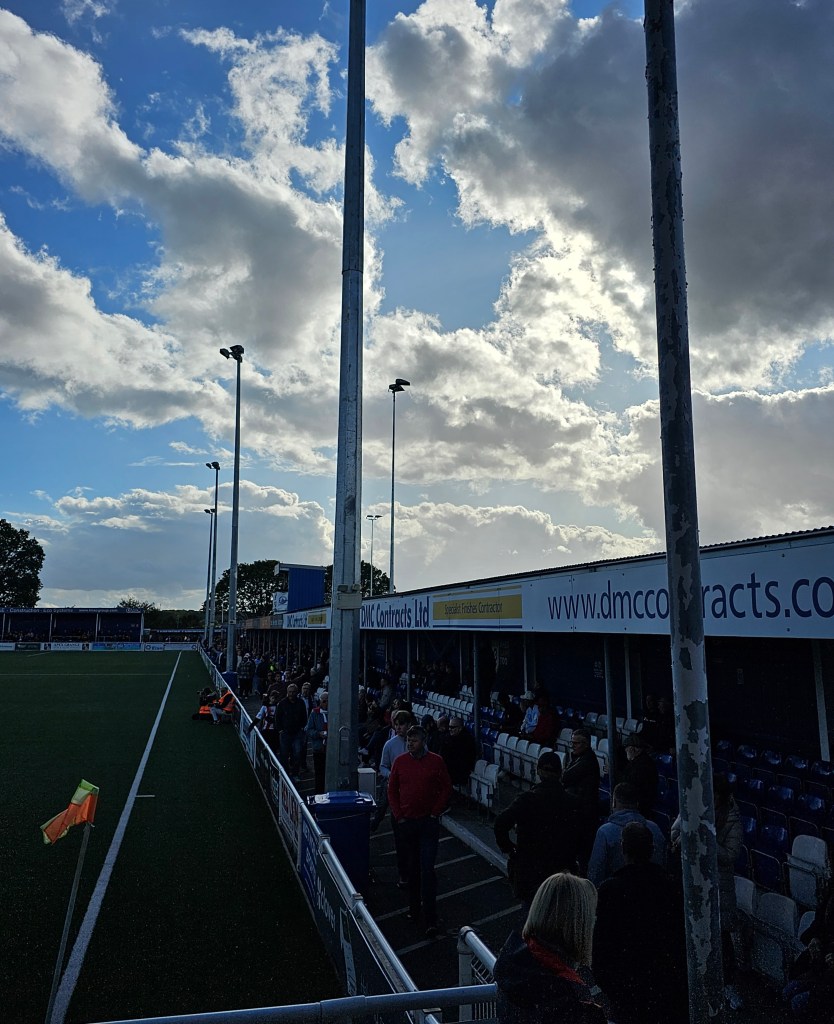
Emerging from the turnstile, the pitch and stands of a very neat and well-appointed stadium appear before me, but sadly the same can’t be said of anyone selling programmes.  The only programme today is an electronic one, and when I photograph the QR code and go to look at it, I find only the programmes from four previous matches; although one of them was an FA Cup tie, it was versus Stowmarket Town.   A little down-hearted, I turn my attention back to my surroundings.  The pitch is synthetic and in the tradition of non-league football grounds it appears to slope, in this case from east to west; I had thought that artificial pitches needed to be level, so perhaps it’s the stands that are sloping, or me.  The stands are very smart, painted blue with neat rows of narrow, white roof stanchions fronting the pitch in wonderful repetition on all sides.  The ground seems almost too smart for non-league, and it comes as a relief to spot some flaking white paint on the main stand, even if the metal beneath is shiny not rusty.  The club house is large with two bars that wouldn’t look out of place in a Wetherspoons.  There are further outdoor bars in the southern corners of the ground.

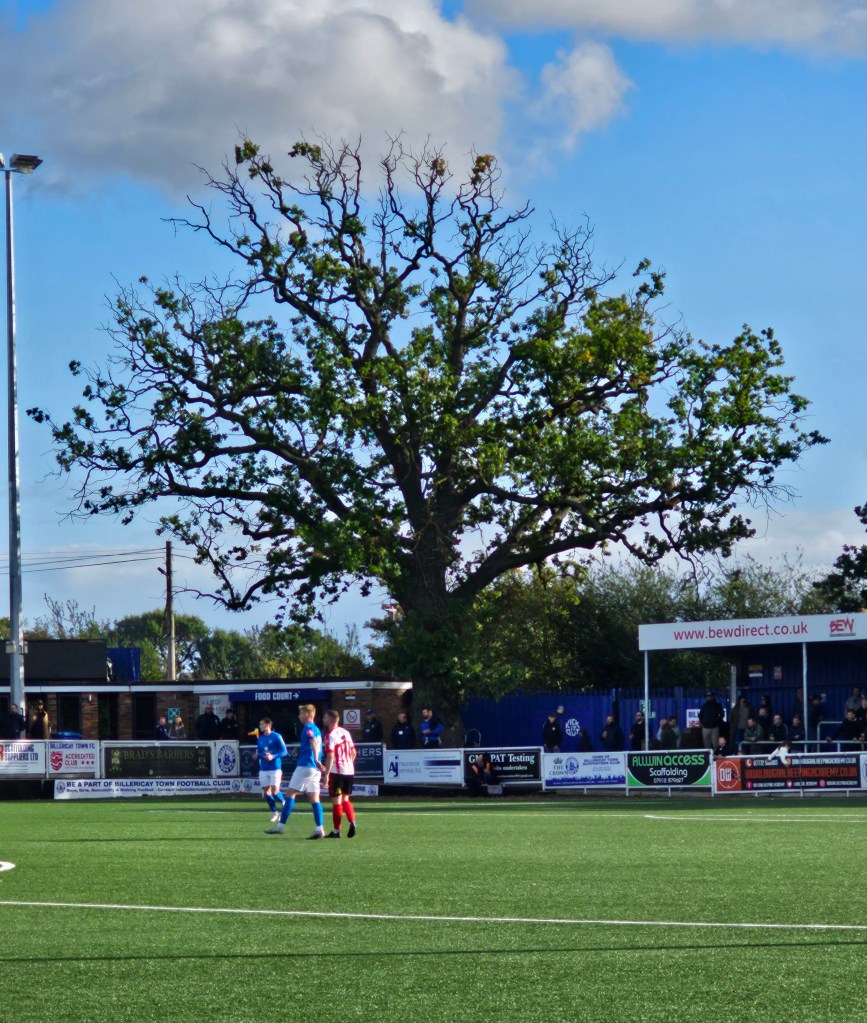
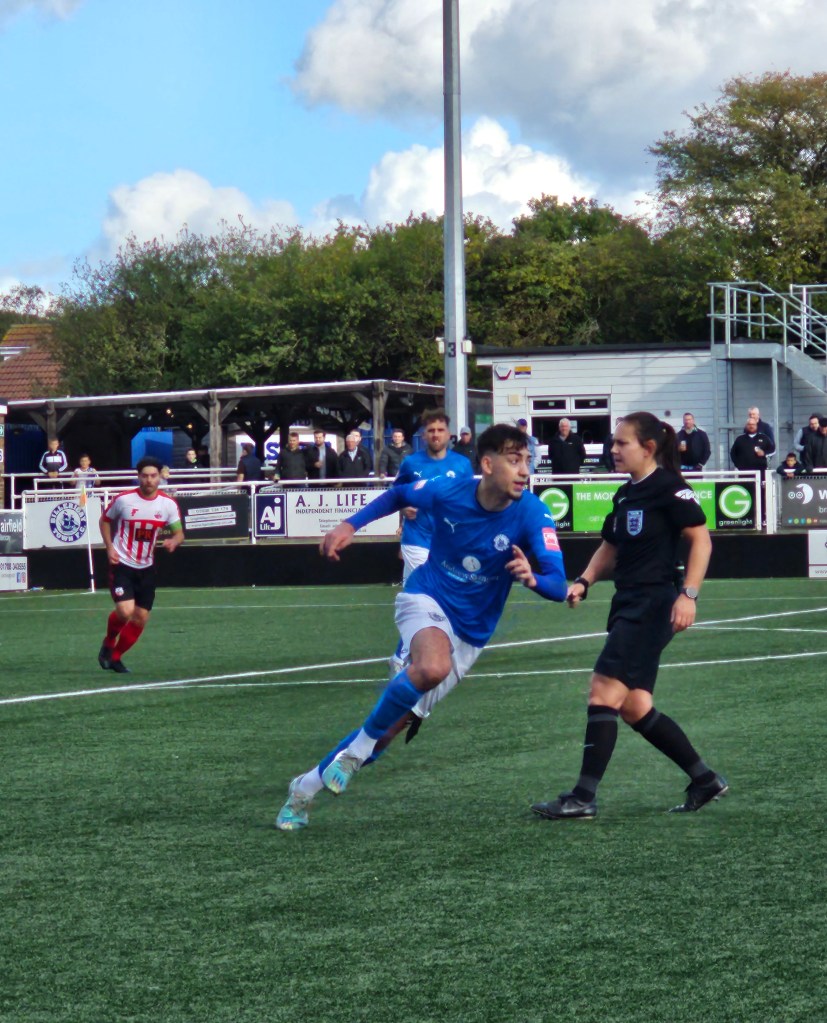
I eventually settle on the terrace where most of the Sheppey fans seem to have gathered. The teams process onto the pitch and the game begins.  It’s Billericay who get first go with the ball and they are kicking towards  the northern end, where I am standing.  Billericay wear blue shirts and white shorts whilst Sheppey are in red and white stripes with black shorts; the scene is a perfect picture.    The opening minutes of the game are dominated by people carrying plastic pints of beer and lager re-locating from the south end of the ground to the north, the end that Billericay are attacking.  Billericay’s number seven has a shot during this time and fortunately it flies over the cross bar, if it had gone in, I fear the walkways around the ground would have been awash with beer.

The sun is shining strongly into the stand and I decide it’s too warm, so when the Billericay Town diaspora is over I go and find a seat in the front row of the stand on the west side of the pitch, which is shaded.  It’s a good view if a little low down and afflicted with the pungent smell of what I think is pine from a close neighbour’s aftershave or may be an open bottle of toilet cleaner.  Despite the main migration having finished, there is nevertheless still a constant flow of mostly blokes with pints from the bars.

As might have been expected, because Billericay Town are in a league a level above Sheppey United, the home team have the ball more of the time than do their visitors.  Despite a lot of possession however they don’t have many shots at the Sheppey goal and Sheppey break down their attacks easily.  It’s only twelve minutes past three and another attack is broken down and Sheppey send the ball off down their right flank from where it is played through to their number nine who quickly sets himself up for a shot and scores.  Sheppey United lead 1-0 and there is an explosion of joy amongst the red and white shirts and scarves off to my left.

“Everywhere we go…” sing the Sheppey fans and then “No noise for the Essex Boys” which provokes the quickly thought out response “Essex, Essex , Essex” from the boys.   Billericay continue to keep the ball a lot of the time but it’s as if they think that’s all they have to do.   At twenty past three it’s Sheppey who win the first corner, and I notice the row of four Oak trees at the southern end of the ground, one of which is inside the ground, although it doesn’t look as healthy as the others.   It’s a beautiful light blue afternoon with heaped up clouds like cotton wool decorating the sky and puffs of black rubber springing up from the synthetic pitch.

Sheppey’s number eight shoots on goal. “Oh, no-oo” exclaims the bloke next to me a moment before the ball skims just beyond the far post and I hear him sigh with relief.  Sheppey win another corner, and then another but in between Billericay have another extended period of ultimately aimless possession.   It’s not until gone twenty-five to four that Billericay win a corner of their own, but the Sheppey goalkeeper is the first to the ball when is sails into the box.  The sight of groups of home and away fans side by side behind the goal has me reminiscing about the North Stand at Portman Road back in the 1970’s. 

With half-time approaching I decide to make my way to what I think is a tea hut, but is actually another bar, situated in the corner by the turnstiles.    I pause and watch the last action of the half from near the bar as Billericay gain another corner.  The ball is not cleared and to end the archetypal goal mouth scramble the Billericay number 10 jabs the ball into the net from close range and the scores are level.  I’m a bit disappointed.  After a minute’s worth of added on time it’s half-time, and hiding my disappointment that Sheppey are no longer winning I step away to the bar to get a tea (£1.20) and worry that the woman who serves me is eyeing me suspiciously because I seem to be the only person who isn’t buying beer.

Having previously felt too warm, by the end of the first half I was beginning to feel too cold, so for the second half I return to the terrace that’s in the sun at the north end of the ground, which reminds me of the old ‘Popular’ side at Layer Road, Colchester, but without the rust and with a better rake on the terrace.  The football begins again at six minutes past four.

“Get into ‘em and fuck ‘em up” chant the Billericay fans repeatedly and rather unpleasantly and their team responds with an early shot high into one of the Oak trees.  The afternoon’s attendance is announced as being 1,241 and the announcer thanks everyone for their “fantastic support”.   Billericay have the ball most of the time still and the football is neat and thoughtful, only occasionally punctuated by agricultural clearances from the big blokes at the back.  In front of my terrace fat blokes continue to ferry beers.   It’s nearly twenty-five past four and Billericay win a corner. “Come On You Blues” chant the home crowd from the other end of the ground.  A minute later Sheppey make the game’s first substitution and have a creative spell, which first sees number eleven volley the ball against the Billericay goalkeeper’s chest , before number six is booked and then number seven has a rising shot blocked by the up stretched arms of the Billericay ‘keeper.  Meanwhile, the Sheppey fans chant “Come On Sheppey” and in a quieter moment a pied wagtail flits across the pitch, confused perhaps by the synthetic grass.

Twenty-five to five slips by and Billericay make a substitution.  “Blue Army, Blue Army” chant the home crowd like a scratched record.  “Come on you Ites” chant the Sheppey fans, suddenly remembering their team’s slightly odd nickname; Ites being short for Sheppeyites.   Their team earns a corner and number four heads over the cross bar.   It’s now almost a quarter to five and as Billericay make a double substitution I notice two advertisement boards on opposite sides of the pitch; one for Greenlight Insurance,  the modified car insurance specialists, and the other for Bumps Away Minor Body Repairs; the symmetry appeals to my cliched picture of south east Essex as the home of the boy racer and his souped up Vauxhall Nova.

Only a few minutes of normal time remain but away to my right two young blokes return to their friends with more beer and two polystyrene trays of chips for which a blue recycling bin makes a convenient table. On the pitch, Sheppey’s number seven joins the list of cautioned players and the Sheppey supporters regale the referee with chants of “You don’t know what you’re doing”.   It’s ten to five when I decide to head towards the exit, making my way along the front of the main stand in instalments before resting near where I ended the first half.  With time running out and a midweek replay back in Kent looming, both teams make final desperate efforts to win.  Billericay hit the Sheppey cross bar with a free-kick and then inside the four minutes of time added on Sheppey also have a shot  that unexpectedly strikes the cross bar too.  But then it’s all over and amidst applause, relief, disappointment and appreciation I make my way back out into Blunt’s Wall Road and the short walk back to my planet saving Citroen e- C4.

The lesson learned today is that the FA Cup is still a wonderful thing, which at non-league level in particular still excites and enthuses, because it is all about the glory.   This afternoon’s match has done the old competition proud, and I can now go back to my hedge trimming to reflect on an afternoon well spent, to wonder about  who Billy and Ricky would have supported, and to bask in the self-satisfaction that I have at last seen Sheppey United.   

Further reading: ‘How Steeple Sinderby Wanderers won the FA Cup’ by J L Carr.

Ipswich Town 4 Preston North End 2

I first saw Preston North End, or “P’nee” as my wife Paulene likes to call them, back in April 1986, shortly before a part of my world fell down and Ipswich Town were relegated from what is now the Premier League for the first time since before I started school, but a while after the Lady Chatterly ban and the Beatles first LP.   The Preston North End I saw back then were rivals of Colchester United, but not equals, the U’s thrashed them by four goals to nil. Since then, I have seen nineteen matches featuring the once but no longer invincible Preston North End, first ever Premier League champions in 1888 and double winners to boot, but of those nineteen games they’ve only won two.  As an Ipswich Town fan, it is with an optimistic frame of mind therefore, that having bade farewell to Paulene and kissed her goodbye, I step out of my front door and head for my local railway station and the afternoon of delights that await me in that not far off Ipswich.  It is warm, but I carry a light coat because when I sat in the shade in my garden this morning drinking a coffee I thought I detected a cool breeze. ­­­
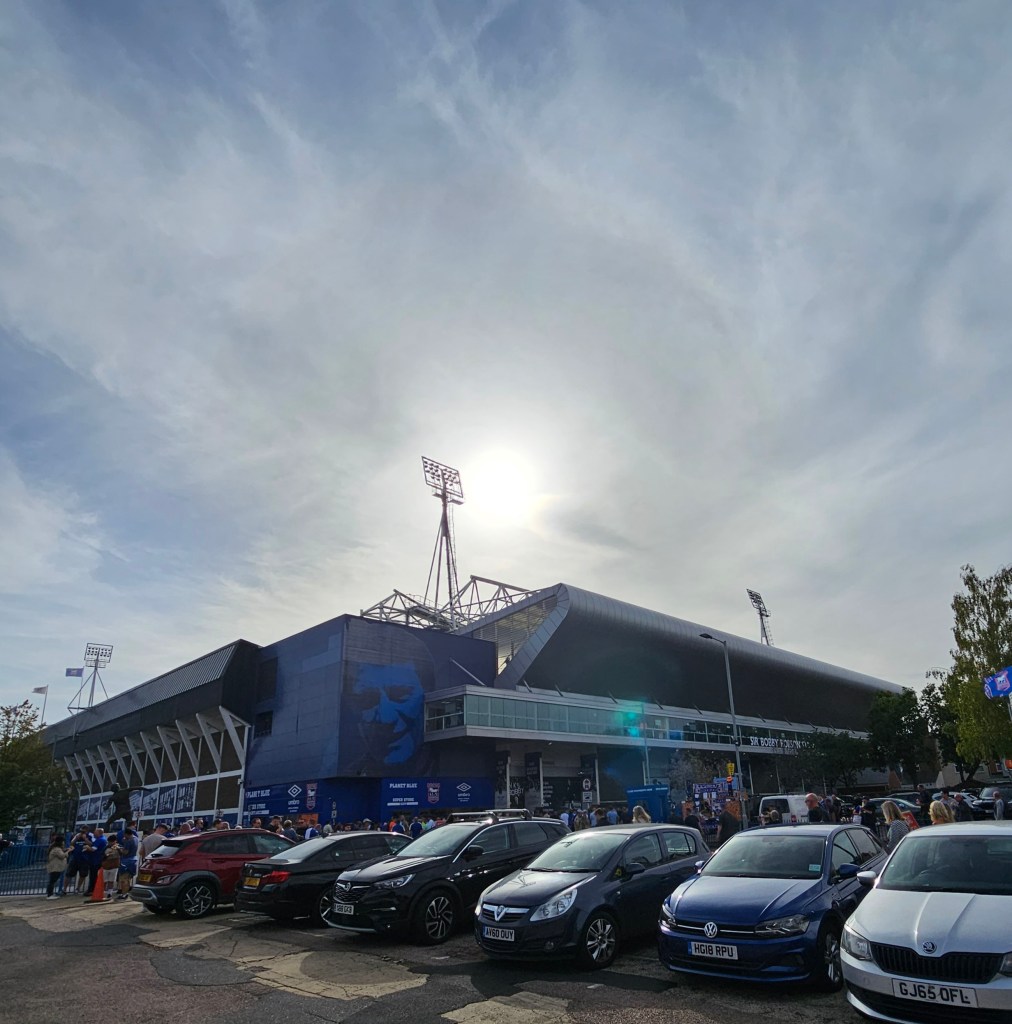
The railway station is busy with would be travellers, the majority wearing Ipswich Town branded shirts, although three young women drenched in perfume and stood at the foot of the bridge are surely displaying far too much cleavage and sparkly bare flesh to be going to the match.  The train arrives on time, and I find a pair of seats next to a window on the sunny side of the carriage.  The carriage is a noisy place full of chatter and people watching videos on mobile phones. At the first stop the three young women alight and a man boards, he sports a tattoo of a diamond on his neck, he has the demeanour of someone who is probably a ‘diamond geezer’.  He nods furtively at a pair of vacant seats and says to a friend that they could sit there, but he’s got to go to the loo first; they both walk on and never return.  The display above the gangway tells me that the carriage doesn’t contain a toilet, but I can still smell one.
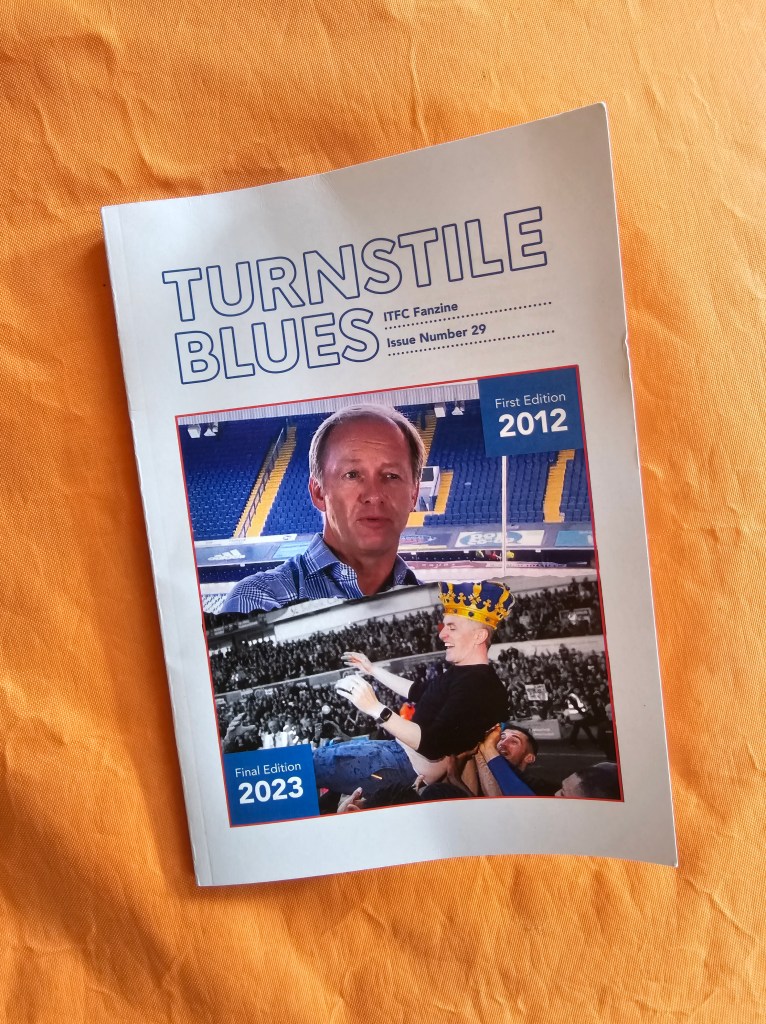
Arriving in Ipswich, I quickly cross the tracks and leave the railway station, pausing only to find my e-ticket on my mobile phone, which I flash at the ticket collector.  I head on to Portman Road. This morning, I found some coins in my bedside table and had thought to use them to buy a programme, but as I queue at one of the blue programme booths from which I think the club should also serve ice creams, I learn that even these no longer take cash.  I could pay by card, but that hadn’t been my plan, so I don’t bother and walk on.  Fate, however, is a curious thing and on the corner of Portman Road and Sir Alf Ramsey an Ipswich Borough councillor and former fanzine editor is selling copies of what is billed as the last edition of the Turnstile Blue fanzine.   “For old times sake” I say as I hand over one of my pound coins to him before continuing on to ‘The Arb’, where the doors are wide open and naturally, I walk in.
 Having purchased a pint of Mauldon’s Suffolk Pride (£3.60 with 10% Camra discount), I make for the beer garden and share a table with a young man and a woman having first asked if it is okay to do so, it is.  At the next table a man talks a lot and wears an Ipswich Town polo shirt featuring the Powergen logo, a reminder perhaps of the many Town fans now returning to Portman Road after twenty odd years of absence. Today, I am drinking alone because having contacted Mick he called me back to say that he was meeting a friend from London whom he hadn’t seen in a while. I understand, and pass my time reading Turnstile Blue, Ipswich’s most earnest fanzine, which today contains a particularly amusing piece about vloggers and an excellent article about Scott Duncan, the last manager Ipswich Town ‘poached’ from Manchester United before Kieran McKenna.  Sadly, as the last issue it is perhaps one of the best.  The Suffolk Pride is particularly good today and I am soon forced to buy another, and I ask the young man and woman at my table to keep an eye on my coat, fanzine and glasses whilst I’m at the bar.  Upon my return, with a fresh pint in my hand, I am happy to see my possessions where I left them. “I see my stuff’s still here, thanks” I say to the man and woman. “Yeah, a couple of people tried to get it, but I kept them off” says the man, pleasingly getting the joke.

At about twenty to three I depart for Portman Road moments after the last of my fellow drinkingTown fans, who I then overtake outside the museum.  There are queues in Portman Road and behind the Sir Alf Ramsey Stand with less than ten minutes to go until kick-off, an indication that the electronic entry system is still much slower than the old human being based one. I join the comparatively short queue for turnstile 62 behind former BBC Radio Suffolk presenter and usurped stadium announcer Stephen Foster.  Inside the stand, after a quick stop to drain off superfluous Suffolk Pride, I make it to my seat as the teams appear in the corner of the pitch. Ever-present Phil who never misses a game, his young son Elwood, Pat from Clacton, Fiona and the man from Stowmarket who is probably actually from Stowupland, are all here already as I would expect. Pat from Clacton kindly tells me that they’ve missed me whilst I’ve been away in France.  I join ever-present Phil in shouting out the Town players’ surnames as the stadium announcer reads them out.  Phil will reveal to me at half time that he had had a word with today’s announcer, who is standing in for the usual Murphy who is indisposed, to tell him not to run the players first names into their surnames; I think he has taken heed.

It is Ipswich who get first go with the ball which they mostly send in the direction of the goal in front of the Sir Bobby Robson stand; they wear the traditional blue and white.  Preston sport a kit which some might describe as an insipid all pale yellow, with a navy blue oblong below their navels, but I prefer to think of it as being primrose in colour.  The game begins at pace with lots of industrious running about from both teams and slick passing of the ball.  Town’s Brandon Williams is soon clattered by a Preston player and then before the referee gets a chance to blow his whistle he is clattered again; Williams is simply moving too quickly for anyone to keep up with him. “You dirty northern bastards” sing the Sir Bobby Robson stand and I join in, thinking how much I dislike short vowels, soot, mushy peas and talk of ginnels and Northern powerhouses.

Pat tells me she’s going to miss the next two games.  I quickly ask if that’s because she’ll be on her annual whist playing holiday in Great Yarmouth.  But no, she tells me, she’s going to Mauritius. “To play whist?” I ask, but no she’s going to her niece’s wedding.  Along with Fiona we agree it’s a long way to go to get married, or to play whist.  I tell them I just had a day off work when I got married.  Eleven minutes have gone and Wes Burns has a shot blocked almost as soon as it leaves his boot.  “Yellows, Yellows” chant the P’nee fans, unable to admit they’re actually playing in primrose, which considering their club’s nickname is “The Lilywhites” is a little surprising.

Town are dominating possession, but Preston are keeping us at bay. “Set up defensively well” says the bloke behind me sounding oddly serious considering the order in which he has placed the words in his sentence.  The seventeenth minute, Town have a corner, Leif Davis takes it. He strikes the ball low. “What?” I’m about to say, thinking that’s not a very good corner, when Conor Chaplin half volleys the ball just inside the post from about 12metres out, and Town lead 1-0, it’s a cracking goal.  “We’ve got super Kieran McKenna, he knows exactly what we need” chants pretty much everyone, in my imagination anyway.  The Preston fans sing something too, and are in good voice, but I can’t understand their accents.  The woman sat between me and the man from Stowmarket wears a Town shirt but is very quiet, and didn’t leap up excitedly when we scored.

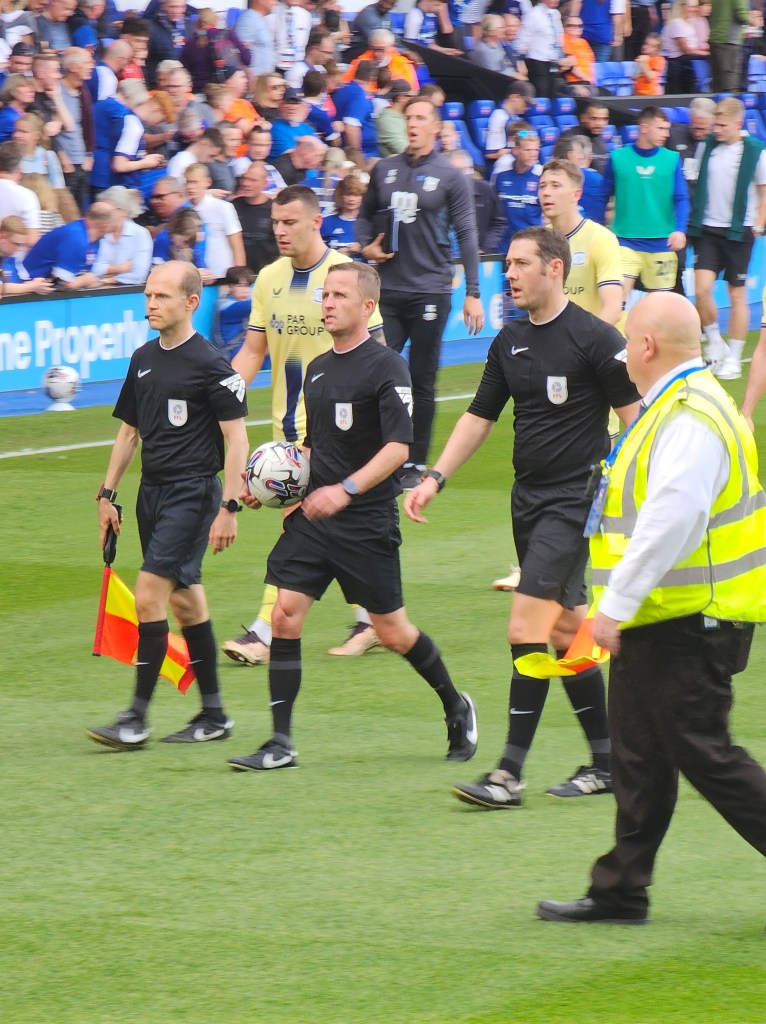
Nearly half of the half has disappeared forever, except on recorded highlights. Nathan Broadhead narrowly misses the goal with an audacious lob from long distance and Brandon Williams surges off down the touchline only to be clattered again spectacularly, and the perpetrator is booked by referee Mr David Webb. A drinks break and an early substitution for P’nee follow and then an up and under drops nastily outside the Town penalty area,  the ball studiously avoids Ipswich feet but presents itself  to Mads Frojaer-Jensen who un-sportingly boots it into the Ipswich goal and Preston have as many goals as the Town do.

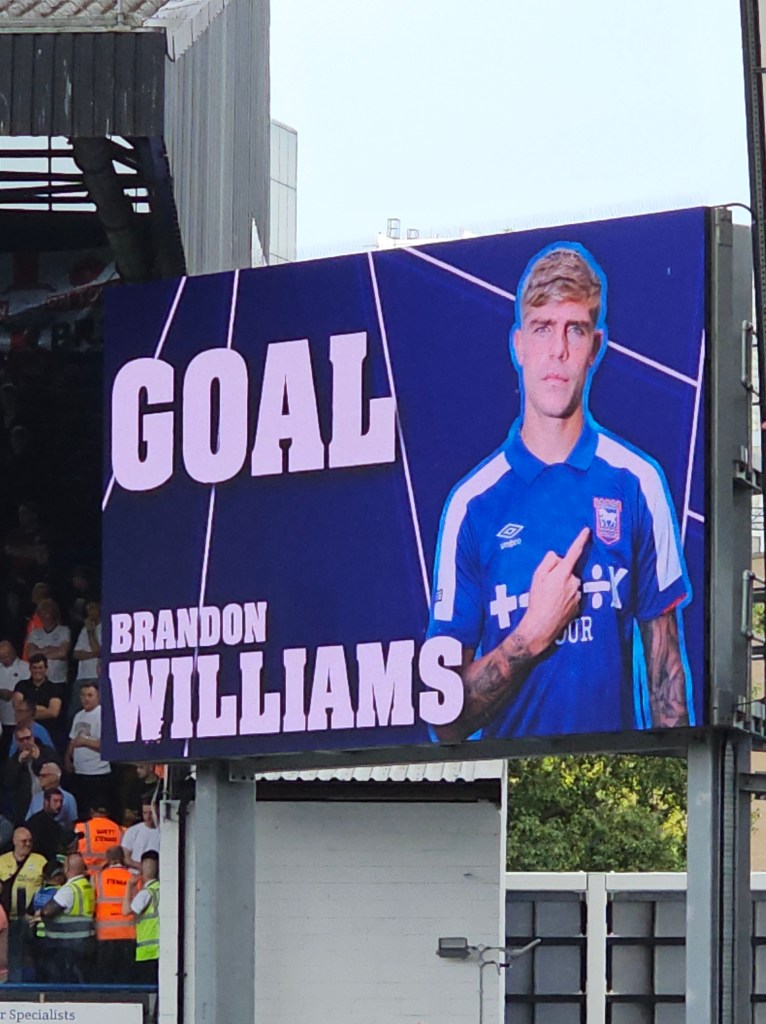
It proves to be a set-back for Town, but that’s all.  Two minutes later we think we have scored but we haven’t and shortly after that Mr Webb books a third Preston player, but Nathan Broadhead sends the resultant free-kick shamefully high and wide.  Town are sure to score sooner or later and with ten minutes until half-time Brandon Williams wins the ball off a Preston player, stands up straight and just runs from within the Town half at the Preston goal; he’s a marvellous sight as he charges away with his socks not reaching half way up his calves and his arms punching the air; he reaches the edge of the Preston penalty area and sends the ball towards the far post where it bounces off and into the goal and Town’s lead is restored.  It’s a fabulous goal.

Preston seek parity again and Osmajic shoots wide following a confusingly unorthodox free-kick routine, and Mr Webb inspires the home crowd to chant “You don’t know what you’re doing” as Conor Chaplin is penalised for falling backwards. Five minutes of added on time follow and Town win a corner which is cleared only for the ball to be crossed back to the far post, headed across the goal and then headed back again by a selfless George Hirst for Nathan Broadhead to knock over the goal line from minimal range.  It’s another fine goal, and following the still recent disappointment of the Preston goal,  it brings a certain sense of relief that Town are now two goals ahead.  The Sir Bobby Robson stand sing a Depeche Mode song from forty-two years ago and that tuneless chant about being on our way to the Premier League and not knowing how we’re going to get there; the woman next to me remains seated and just claps one hand against a knee, hers, not mine.  I turn to her and trying to convey incredulous curiosity say “You’re very calm”; she just smiles demurely.  Perhaps she doesn’t speak English or can’t understand my accent.

With the half-time whistle I decant more Suffolk Pride, speak with a steward with whom I used to work called Dave, and then visit Harrison down at the front of the stand, although his grandfather Ray is sat elsewhere today. Harrison asks how was the Robyn Hitchcock concert at St Stephen’s Church three weeks ago, and I tell him it was brilliant, because it was.  I return to my seat in time to see the names of people on the scoreboard who are attending their first game at Portman Road today; one of whom is called Huckleberry, and I think of the blue cartoon dog from the early 1960’s who Wikipedia tells us was the first TV animation to win an Emmy. 

The match resumes at eight minutes past four and the blokes behind me are late returning from the bar.  Preston are sharper this half, and are keeping the ball most of the time, it’s as if the Town players had mistakenly thought having a nap at half time would be a good idea and they haven’t properly woken up.  Preston win a free-kick, the ball is only half cleared and Benjamin Whiteman strikes the ball in off the far post for a second Preston goal, and all while I’d been hoping for a fourth Town goal.  “Making it a bit more exciting though, innit” says the bloke behind me before carrying on to say  “Them scoring might not be a bad thing… well it is… but it ain’t”.  Fiona and I exchange glances and smirk. “Yeah but, no but” I think to myself.

Preston continue to have the better of the half but whilst neat and methodical lack the vision, flair and inspiration of Ipswich, so they don’t score again.  Nevertheless, Kieran McKenna presumably thinks change is required and the attacking trio of Chaplin, Burns and Broadhead take a rest in favour of Harness, Jackson and Hutchinson, but not necessarily in that order.  The crowd is quieter than it has been all game and it feels like may be we’ll just have to see this one out.  Today’s attendance is announced as being 29,018 with 826 of that number being sat up the corner in the Cobbold stand supporting the away team, which is a respectable number because it’s a mighty long way down a dusty trail from Preston. People applaud themselves for their existence here this afternoon.

The game continues without reaching the heights of the first half and with fiteen minutes of normal time remaining, final substitutions are made by Kieran McKenna, with George Hirst and Massimo Luongo retiring in favour of Freddie Ladapo and Jack Taylor. Three minutes later the game is won as Jack Taylor breaks forward on the left, feeds the ball to Omari Hutchinson and he squares it to a lonely Kayden Jackson who quickly gains over 28,000 friends as he strokes the ball into the Preston goal beyond the despairing, purple clad Freddie Woodman.  Everyone is up on their feet with the exception of the woman sat next to me who slaps her knee gently as if tapping along to a popular song by the likes of Petula Clark or Ed Sheeran.  “I-pswich Town, I-pswich Town FC, They’re by far the greatest team the world has ever seen” sing lots of other people.

Time closes in on the final whistle and Town’s victory seems assured.  “You’ve seen the Ipswich, now fuck off home” chant the Sir Bobby Robson stand unpleasantly and uncharitably in an outbreak of nastiness reminiscent of Suella Braverman.  But still Town come close to a fifth goal as a Jack Taylor shot is parried away by Woodman who also saves a Freddie Ladapo attempt.  Preston have a shot too; “Fucking donkey” says the bloke behind me as Preston’s Ben Woodburn shoots impressively wide.  It’s time to celebrate another win “Brandon Williams, he’s a Blue, He hates Norwich” sing the Sir Bobby Robson stand exultantly.  Four minutes of added on time are added on, and the game ends. Ipswich win again.

If I kept a diary I would record another Saturday afternoon well spent, drinking good beer and watching excellent football beneath warm October skies in which the sun now sits so low that I need autumn sunglasses, my only grouse perhaps would be that I didn’t need that light coat after all.

FC Lorient 0 Montpellier Herault SC 3

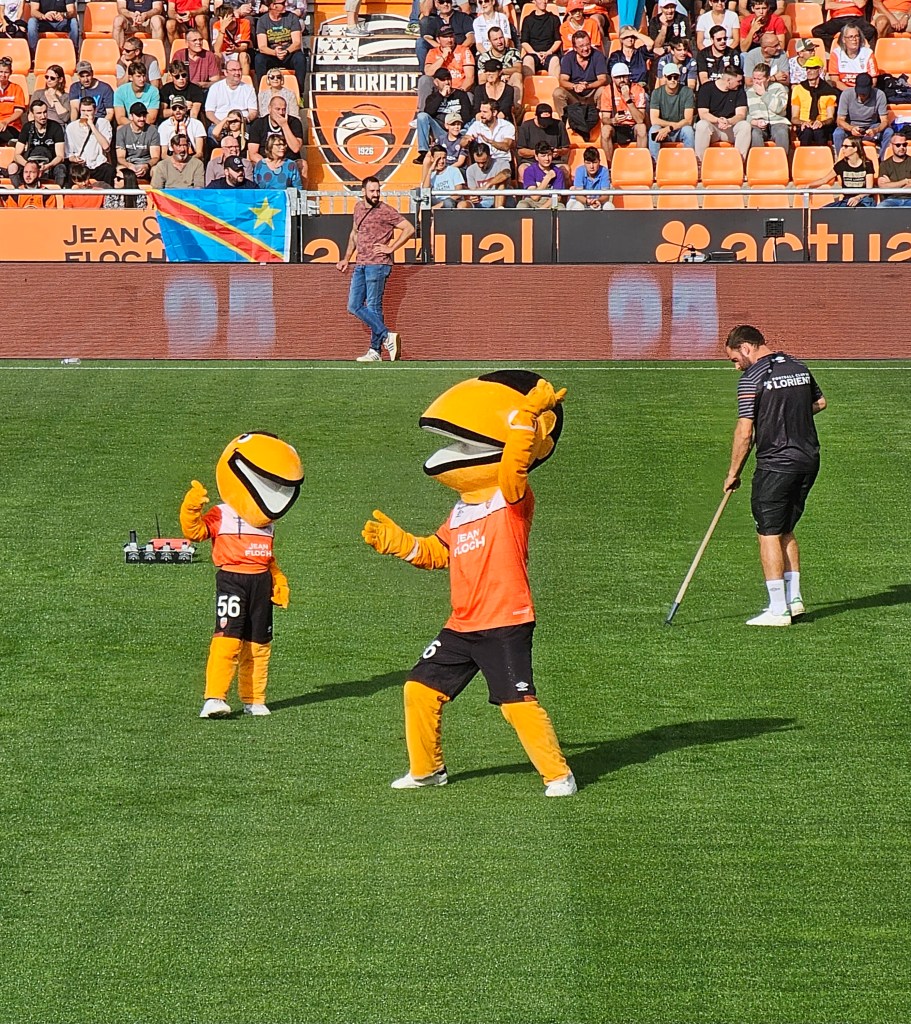
One sunny September afternoon last year, whilst on holiday in Brittany, my wife Paulene and I went to the coastal town of Lorient, to the Stade du Moustoir, to witness the Ligue 1 fixture between FC Lorient  and Breton rivals FC Nantes. It was a fabulous afternoon and before an almost capacity crowd we saw Lorient triumph by three goals to two. Everyone was marvellous, I met the Lorient mascot Merlux the hake, and in a fit of consumer madness powered by a premium bond win that week , I bought a T-shirt, a mug, a fridge magnet, a cuddly hake, and a pennant to adorn my upstairs toilet. I have yearned to return ever since and so has Paulene. Today is the day we fulfil our modest dream.

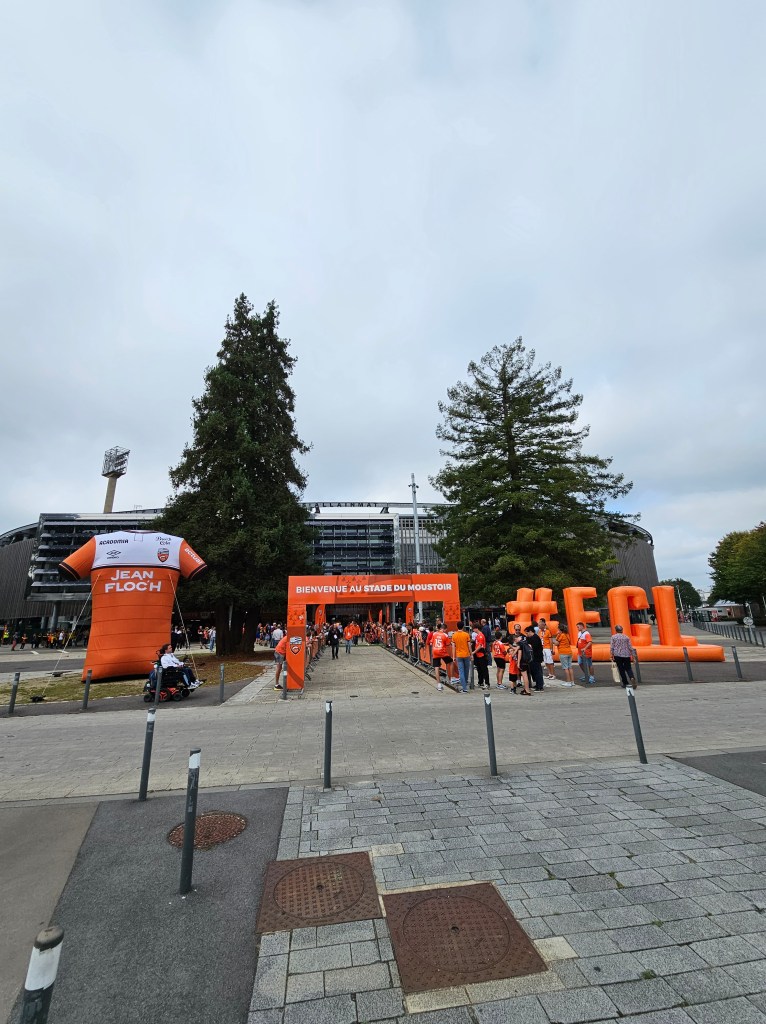
It’s only a thirty-five-minute drive up the E60 and along the N165 through neighbouring Lanester to Lorient from where we are staying, and being old hands we know where we can handily park our planet saving Citroen e-C4, and so set the controls for the heart of the town.  We find a parking spot beneath an avenue of shady limes in the Boulevard Marechal Joffe and walk to the ground, which is superbly central next to the town hall, handy for buses and trains like all football grounds should be.  In Lorient, the town centre car parks are closed on a Sunday match day which sounds daft, but when you think about it is a pretty good idea to encourage people to travel ‘responsibly’, although street parking is free and plentiful.  Yesterday, I received an e-mail from FC Lorient giving me the pre-match lowdown and inviting me along to greet the team as they arrive at the ground, so that’s what we do, joining mostly children and their parents to cheer the players off the bus and enjoy the sound of Fatboy Slim’s “Right Here, Right Now” played on Breton bagpipes.  Merlux the hake mascot (so-called because the binomial name for Hake is Merluccius merlucciusis and the French for Hake is Merlu) is of course present, and he now has an accomplice called Mini Merlux.  The spawning grounds of the Hake are in the Bay of Biscay, the expanse of water which the south coast of Brittany faces.  I had always thought that seafood-based club mascots were restricted to Sammy the Shrimp at Southend United, but I am very pleased to be able to report that this is not true and I’m now keeping a look out for any clubs with fish, crabs, lobsters or assorted shellfish on their crests.

Having greeted the team, who sport natty Breton-style stripey T-shirts making them look as if they should be disembarking from a ship not a bus, there is still over an hour to go until kick-off at five past five.  Keen to know more of Lorient than just the Stade du Moustoir and the route back to our car, we set off to explore a little, heading over the road towards what my instinct and a possible onshore breeze tells me could be the harbour.  My instinct is correct, and Lorient proves to be a town like Ipswich where if you have a yacht you can sail to matches, with a marina within easy walking distance of the stadium.  Arriving for a match under sail has to be even greener than catching the bus, I cannot think why everyone is not doing it.

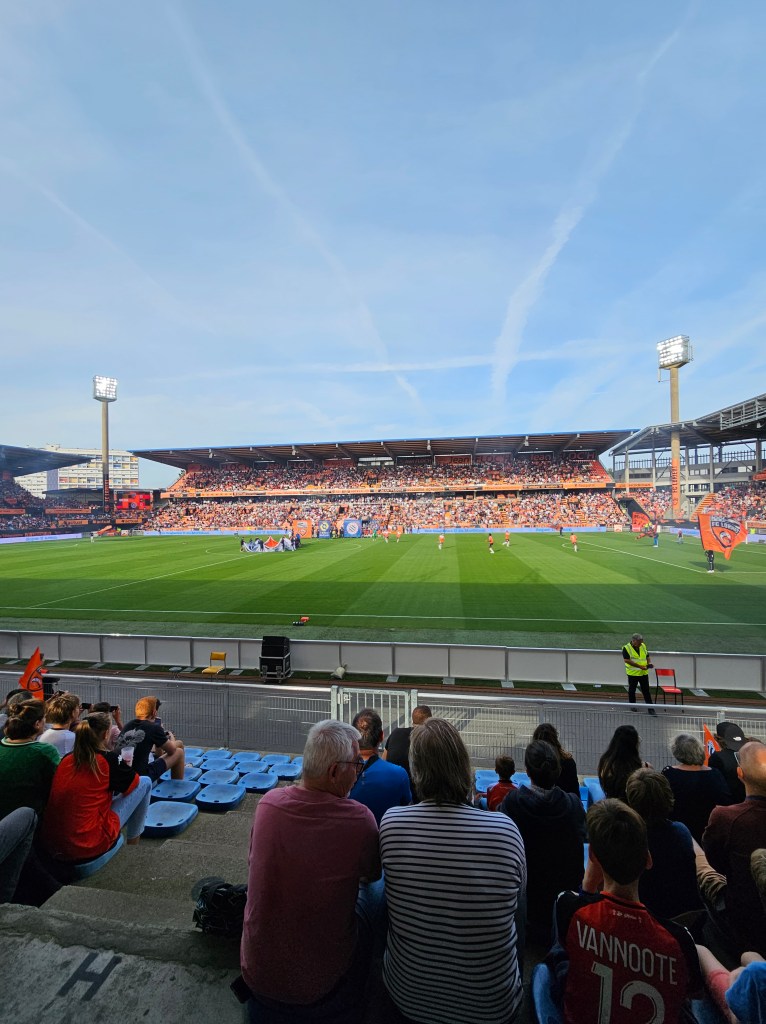
Wishing to visit the club shop again, have a wander inside the ground and sample the refreshments on offer, we return to the stadium having glimpsed the land on the other side of the water from Lorient. Our seats (20 euros each) are in the fabulous Tribune d’Honneur, now known as the Tribune Credit Mutuel de Bretagne, the smallest and oldest of the four stands, having been built when the ground was first opened in 1959.  The Tribune d’Honneur has a marvellous cantilever roof of beautiful, vaulted and shuttered concrete with shiny steel cables to help hold it up. The back of the stand has a series of narrow, angled concrete columns with angular shuttered concrete arches at the top, and metal framed doors and windows at ground level; behind the stand is an avenue of plane trees which cast a lovely, dappled shade over it.  The stand symbolises the renewal and rebuilding of the early postwar period and is a thing of beauty, way ahead of anything built in Britain at the time. Sadly, with grand proposals to upgrade the stadium to make it better suited to cultural events as well as football, the Tribune d’Honneur is likely to be demolished before we all get much older.

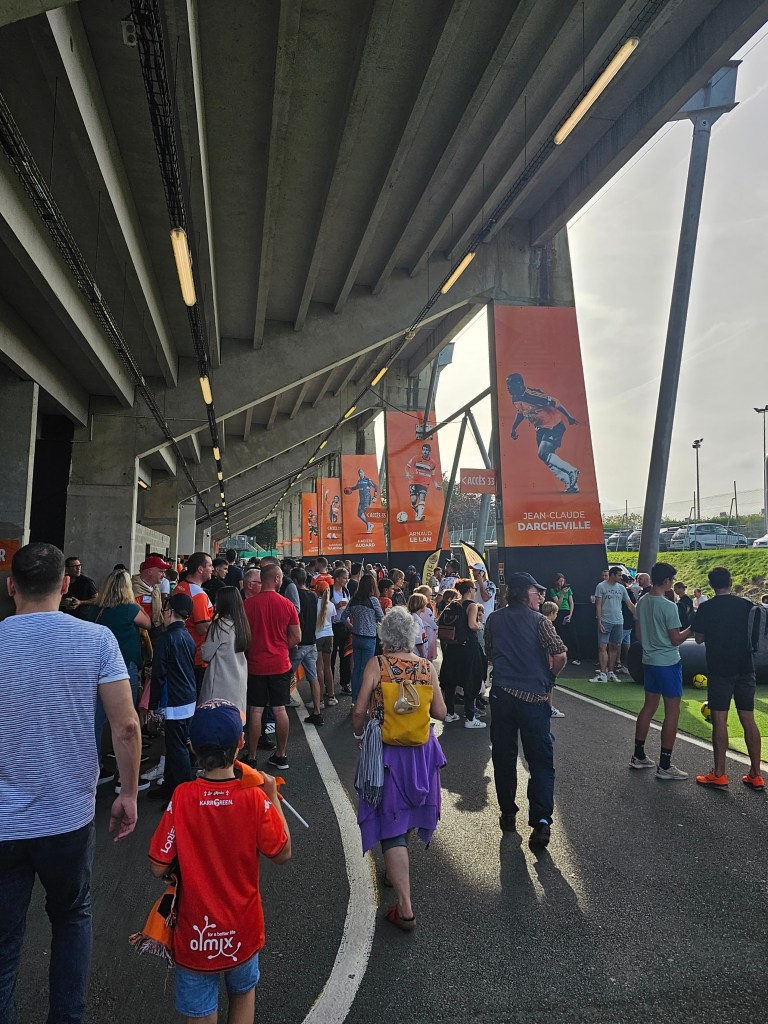
Tripping out on 1950’s concrete, I escort Paulene to the Tavarn Morgana bar beneath the Tribune B & B Hotels where I buy her a glass of the local Breizh Cola (4 euros), which she far prefers to the American rubbish, and a 40ml re-usable plastic glass of Lancelot IPA (6 euros), and pretty good it is too, by several country miles the best beer I’ve ever been served beneath a stand at a professional football club ground.  Paulene now holds my beer whilst I pop into the club shop, accessible from inside the ground but not from without at this stage, to purchase a glorious orange T-shirt (25 euros), the last large size one on the rail, which proudly displays a silhouette of the Lorient skyline with its dockside cranes and submarine dock, beneath the name Lorient.  The great thing about Stade du Moustoir is that it is possible to walk right around it beneath and behind each stand in turn, and that is what we do, taking in the sites and sounds and smells.  Last weekend, Breton team US Concarneau played St Etienne at Stade du Moustoir because their own home ground is not of sufficient standard for matches in Ligue 2; I am very excited to find evidence of the match behind the Tribune Lorient Agglomeration in the shape of the ‘ceremonial’ arch through which the teams would have run onto the pitch, I feel for a moment like Professor Alice Roberts discovering some archaeological wonder.

Back in our seats after our tour of the stadium, a ship’s siren or foghorn sounds three times to signal that there are just ten minutes until kick-off,  or coupe d’envoi to the French, and Paulene and I witness the mounting excitement of the build-up with a stirring Breton anthem, pyrotechnics, the Ligue 1 anthem played loudly over the PA system and multiple flag waving as the teams enter the pitch to line up before banners displaying both club crests and the Ligue 1 logo.  When the game eventually begins it feels like a massive anti-climax, just a few blokes tapping a ball about.

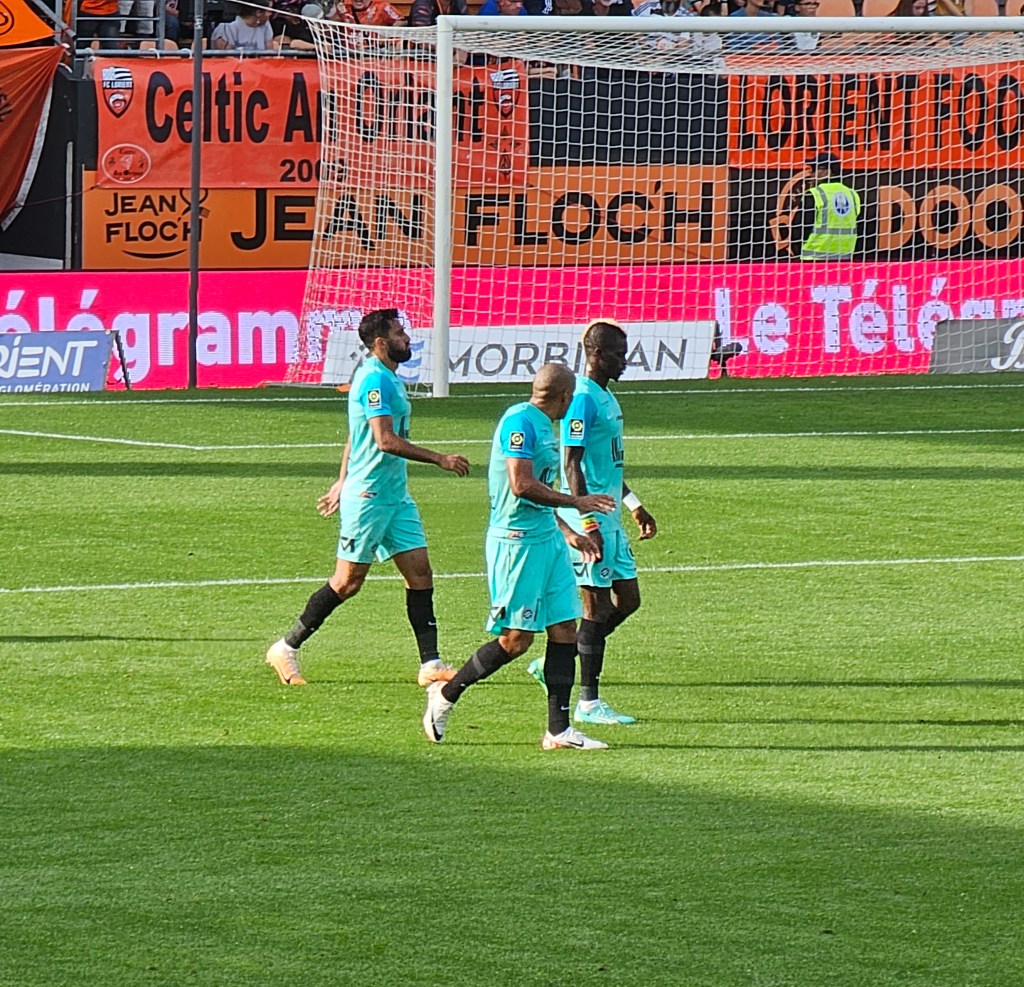
It’s Montpellier who get first go with the ball, attempting to send it mostly towards the most inland of the two goals.  Lorient are wearing their signature home kit of orange shirts, black shorts and white socks but Montpellier whose signature colours are orange and navy blue wear a change kit of all jade with aquamarine sleeves; it’s a bit of an odd or at least unusual ensemble and without the different coloured sleeves it would look washed out and awful.  Normally I would say “if you’re going to wear green, wear green” but I like Montpellier, so I let it go.  Although Montpellier’s Akor Adams heads straight at the Lorient goalkeeper after ten minutes, the first decent shot on goal takes eleven minutes to arrive and it’s Lorient who have it, with Vincent Le Goff sending a shot past the far post from an acute angle after a nippy run and pass from Julian Ponceau.  Three minutes later the first corner of the match goes to Lorient too, but the utterly enormous Isaak Toure sends a glancing header down towards the bottom corner of the Montpellier goal only for goalkeeper Benjamin Lecomte to make a spectacular diving save.  Toure wears a ludicrous number 95 shirt, but at 2.06m tall who’s going to tell him not to.

“Allez Lorientais, Lorientais” sing the home ultras off to our right in the Tribune B&B Hotels, fired by the early action but they just keep on singing and chanting without end, regardless of what happens on the pitch.  The game is settling down to a pattern of Montpellier playing slowly and patiently, frustrating eager Lorient who have occasional bursts of activity, racing forward excitingly only to be stopped by judicious interceptions and well-placed out-stretched boots.  It’s Lorient who first provoke referee Jeremy Stinat into whipping out his yellow card (carton jaune to the locals) however, as Ponceau fouls the wily Teji Savannier, a hugely skilful player who has never run about enough to attract the serious attention of English clubs.  Montpellier’s Wabi Khasri quietly goads a Lorient defender and pleads innocence as only Wabi Khasri can, and as he has done previously for St Etienne and Rennes and probably every club he’s ever played for .

Almost half the first half has gone when Montpellier win their first corner, and the ball is half-volleyed wide, and I am suddenly aware of how comfortable my seat is despite having no back, I think it must encourage good posture.  The bloke sat next to me is leaning forward and living every second of the match in a series of gallic shrugs greeting each free-kick and misplaced pass.  A half an hour has gone and suddenly Montpellier’s patience and quiet approach shatters and number 9 breaks away towards goal; he rounds the Lorient ‘keeper and then squares the ball to present Akor Adams with a simple tap in from a few yards. Montpelier lead 1-0 and seem to have just been biding their time.

The goal prompts Montassar Talbi to add to the tally of booked Lorient players as he drags down Adams and although the home team win another corner, Lorient’s Toure only manages to direct his seemingly unchallenged header straight to the waiting hands and gloves of Comte.  Two minutes of added on time don’t seem enough for Lorient to equalise, and despite some unexpected frantic attacking in which Theo Le Bris boots a shot against the Montpellier cross bar, they’re not.

With half-time there is a flood of parents and children to the back of the stand and some return clutching cardboard cartons of chips or re-usable plastic cups of cola; one or two never return, with forty-five minutes of football on a warm September afternoon evidently being enough.  We watch the stewards watching us and ponder whether one who looks a bit like the late actor Geoffrey Palmer, is wearing a wig or just has an elaborate and extensive comb-over; we decide we’d need to see him walking briskly towards the harbour into an on-shore breeze to truly decide.

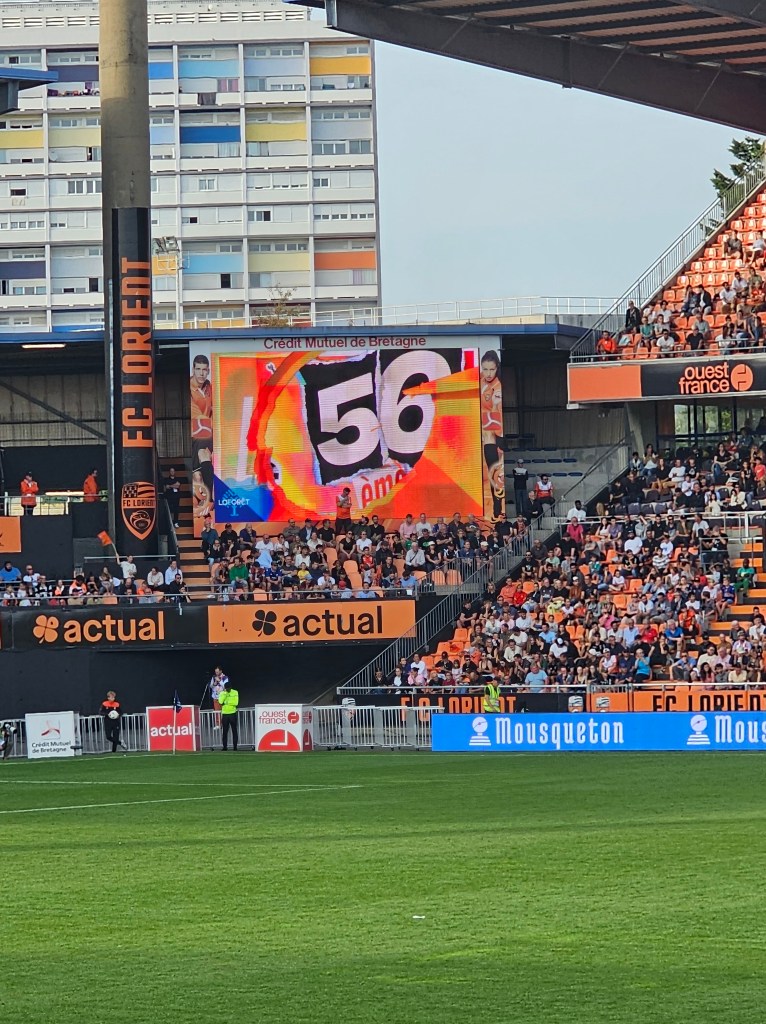
At seven minutes past six the football resumes and very, very conspicuous by his absence is the gigantic number 95 for Lorient, Isaak Toure, who has surprisingly been replaced by Joel Mvuka, a man who according to the app on my mobile phone is a full thirty-three centimetres shorter and thirty-three kilograms lighter than him.  It seems likely it’s a tactical move by Lorient manager Regis Le Bris and Lorient start the half enthusiastically, pushing forward and pinning Montpellier in their own half much of the time.  The fifty sixth minutes arrives and the PA system suddenly lets out an almighty noise and the scoreboard flashes the word “Encouragement” and the number “56” as the crowd is urged to make a noise and encourage the team simply because fifty-six is the number of the Morbihan departement (like an English county) in which Lorient is situated.  The same thing happened at Brest last Saturday night when I was there, but in the 29th minute, the Finisterre departement, where Brest is, being departement number twenty-nine.

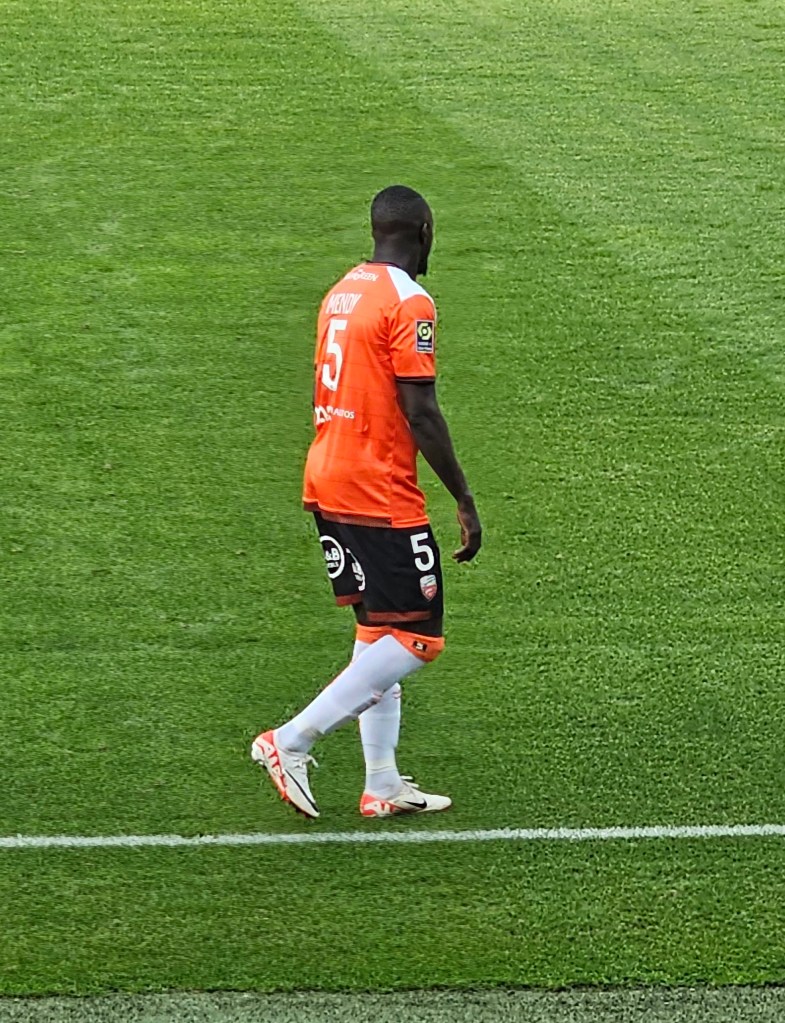
The ultras have been noisily supporting their team from the start, so the fifty-sixth minute hasn’t made much difference to them, but the substitution of Vincent Le Goff with summer signing Benjamin Mendy two minutes later seems to excite the crowd, and Mendy seems like a decent signing for Lorient, even though he hasn’t played a competitive match for almost two years.  Hopefully, the poor treatment he has suffered in those two years will spur him on to repay Lorient for showing the sort of faith in him, which Manchester City apparently didn’t.  Mendy looks a bit larger than when he played for Monaco, but he clearly hasn’t lost his touch.

An hour has gone, and Montpellier pull back a booking with Maxime Esteve finding the sharp end of referee Jeremy Stinat’s pencil for a foul on Mvuka.  The game is still interesting, but neither team is making much of an impression on the other and with twenty-five minutes left there have been six substitutions, four for Lorient and two for Montpellier, who have replaced Wabi Khasri to peals of heartfelt booing from the home crowd.  Lorient win a corner which comes to nothing, and today’s attendance is announced over the PA system as being 13,492, with the scoreboard referring to us as supporters and supportrices.  I like that the French language still acknowledges that there are two sexes, and surmise that the French understand that human existence is all the better for it.   

The bloke sat next to me has been growing increasingly exasperated, groaning a turning away from the pitch as Lorient players dither on the ball or fail to spot the incisive passes.  Monsieur Stinat is not helping matters, but then it’s not really his job to do so, although he does make them a whole lot worse when in the seventy-first minute he awards Montpellier a penalty having seen Mousa Tamari fall to the ground as Igor Silva brushes against him.  It looks a bit harsh, or alternatively soft from my seat in the old Tribune d’Honneur, but after a small delay, in which the Lorient players surround Mr Stinat, presumably in an attempt to send good vibes through his earpiece to the VAR officials, the VAR officials however, confirm that it is a penalty.  Teji Savannier nonchalantly makes it 2-0 to Montpellier.

Lorient are mildly stung into action by the second goal and win a succession of three corners as they once again keep Montpellier in one half of the pitch, although Montpellier don’t ever look too bothered about it.  Lorient desperately make their fifth substitution whilst Montpellier make some substitutions too, but more just because they can, it takes time, and it⁹ breaks up the game.  Teji Savannier is one of the players to be substituted for Montpellier, and he looks like he could do with a bit of a rest.  Lorient make their own penalty claim as Sirine Doucoure falls to the ground alongside Montpellier’s Kiki Kouyate, but instead Mr Stinat awards the free kick to Kouyate.

A minute of normal time remains, plus any added on for administrative reasons.  Out on the right, Joris Chotard looks up and plays an angled pass through and behind the Lorient defence, which only Akor Adams reacts to; he runs on, takes the ball past the Lorient goalkeeper, checks back to dodge a defender and then rolls the ball into the unguarded Lorient goal. The bloke beside me groans in despair. Seven minutes of additional time is announced and almost all of it is played, and Montpellier win 3-0.

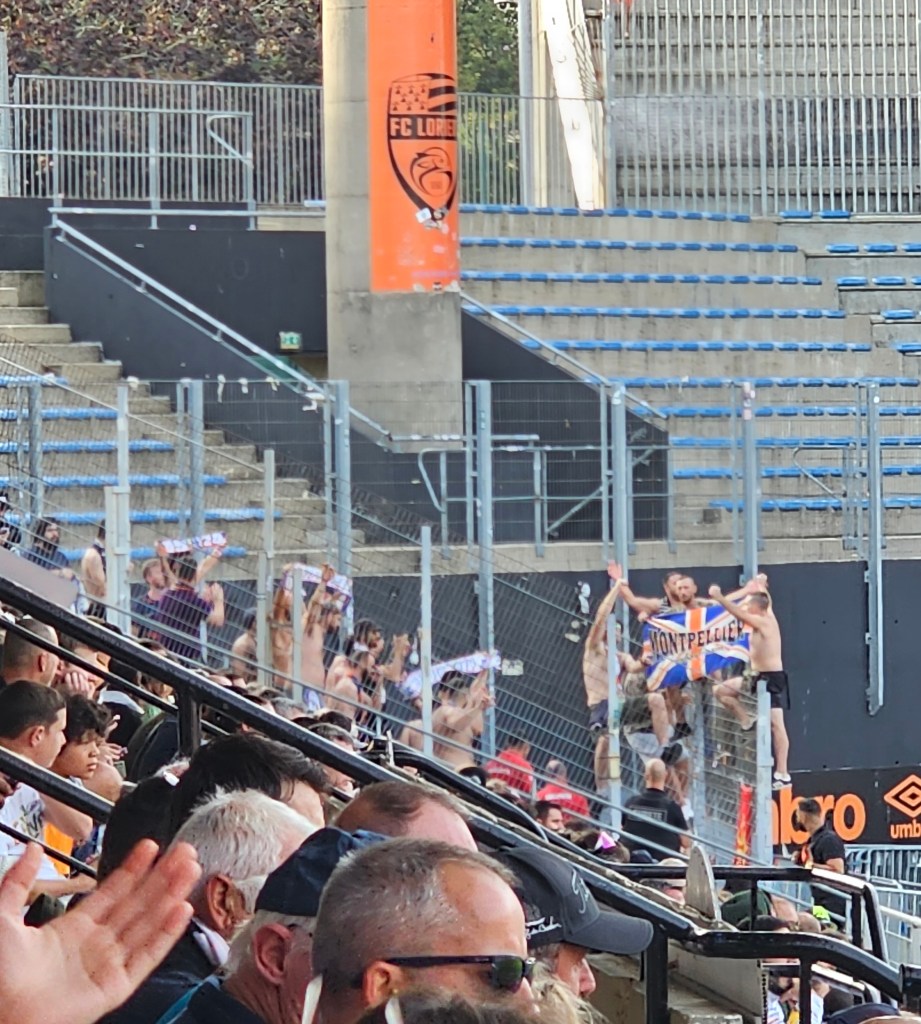
Montpellier deserve their win; they’ve played coolly and economically, and Lorient have not been good enough.   As many of the Montpellier supporters as can, balance themselves on the top of the steel fence that pens them in the corner of the stadium away to my left, most of them aren’t wearing shirts; they hail their conquering team.  At the other end of the ground the Lorient supporters hail their losing team as if they had won.

Once again Paulene and I have had a fab September afternoon at the Stade du Moustoir, it is a truly great place to watch a football match.  There has been so much about our afternoon that we have enjoyed from Lancelot beer and Breizh Cola to shuttered concrete and the last ‘Large’ orange T-shirt in the cub shop, but I think best of all is that Lorient’s club mascot is a Hake.

Garde St Cyr Moreac 1 Vannes OC 3

Whilst the disadvantage of spending two and a half weeks in France during late September is that I am missing three Ipswich Town home games, this is offset to some extent by having tickets for two Ligue 1 matches, and is then offset quite a bit more by having the opportunity to see a game in the fourth round of the Coupe de France, a knockout cup competition every bit as much fun as England’s FA Cup and possibly even better on account of it not having been won for the last two years by the all-conquering pet team of some dodgy middle eastern emirate.

Having discovered that the weekend of 1st October was ‘cup weekend’, I struggled a little bit at first to discover the fourth-round draw, and then a little bit of further work was involved to find out which home teams were a reasonable distance from where I am staying in Carnac.  Unhappily for me, as I trawled through the fixtures it seemed that most games are being played on Sunday 1st October, when my wife Paulene and I shall be watching Lorient play Montpellier, and of the Saturday games most are in the area around Brest, which is a good two-hour drive away.  But then the fixture list on the footbretagne website came up with the rather grand sounding name of Garde St Cyr Moreac and Google maps quickly confirmed that Moreac is just 33 kilometres north of relatively nearby Vannes, and about the same distance from where my wife Paulene and I are staying as Framlingham or Leiston is from our house back in blighty, and I’ve driven to watch them before, more than once.  Moreac of the third tier of the regional league (Step8 – the same as Ipswich Wanderers, Stowmarket Town and Felixstowe in England) would be at home to Vannes OC of Ligue National 3 (Step5).

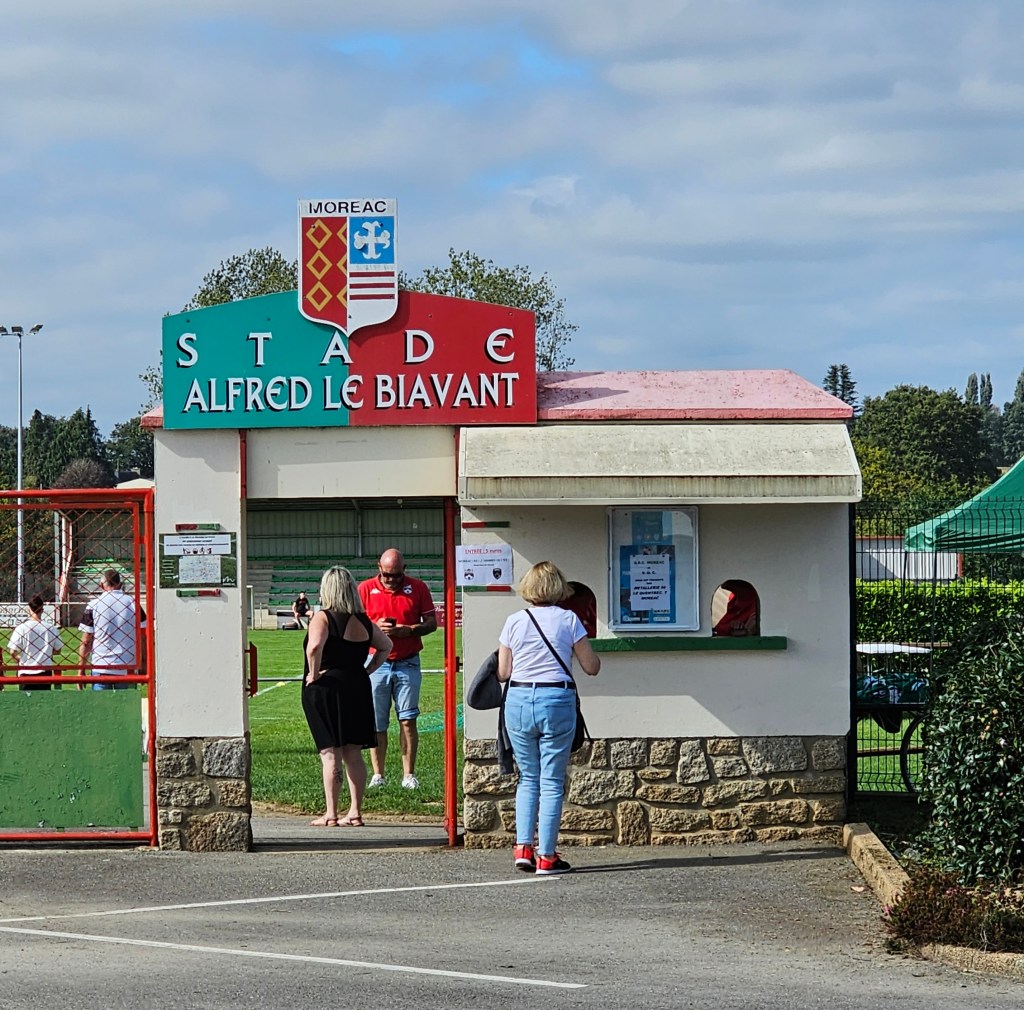
The drive to Moreac takes a little under an hour and the roads are quiet because it’s lunchtime. The countryside changes as we travel in land from the flatness and long straight road just in from the coast, to the greener, rolling countryside where the road twists and turns and rises and falls through valleys populated by grazing cattle and not much else, it feels miles from anywhere, not unlike Framlingham and Leiston.  At Locmine we pass a huge factory belonging to the Jean Floc’h company, a major producer of meat products in France, although being France the sign outside refers to charcuterie and not pies.  Jean Floc’h is nevertheless a massive purveyor of processed food.  Moreac is just a few kilometres beyond Locmine and is an attractive village built around the focal point of the large church of St Cyr, from which the football club takes its name.  Wikipedia tells us that in 2020, Moreac had a population of 3,703. The Stade Alfred le Biavant, home of the football club, is just a street or two away from the centre of the village and has a large, surfaced car park where Paulene and I rock up in our planet saving Citroen e-C4 with a bit more than an hour to go before kick-off at 3 pm.

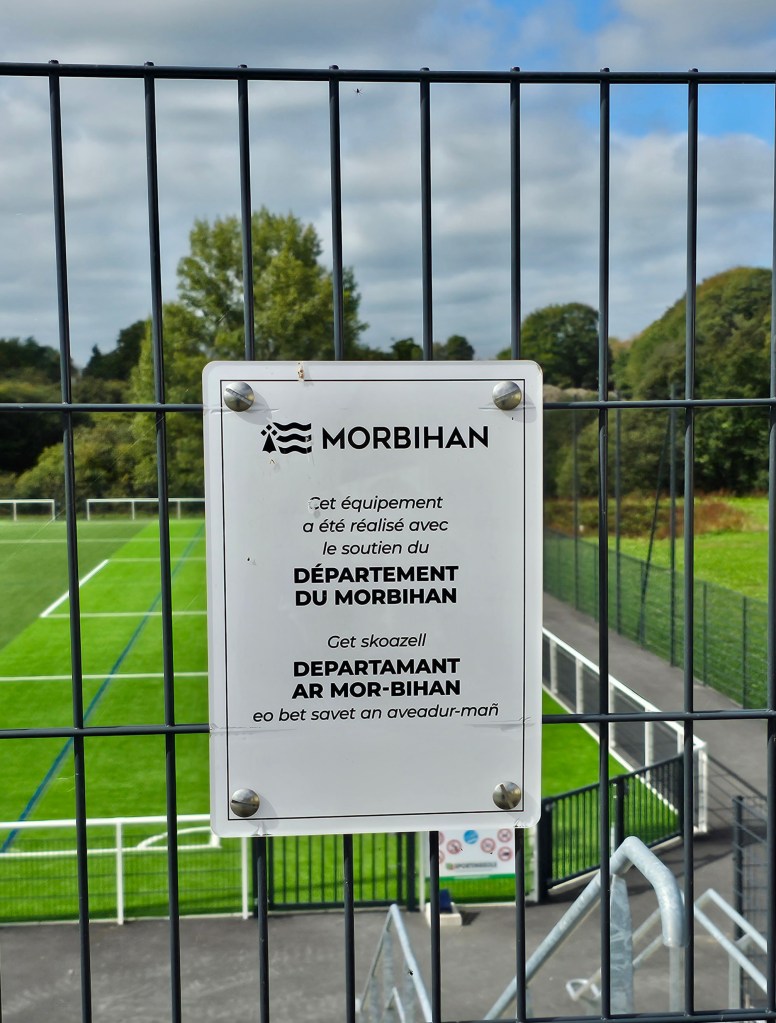
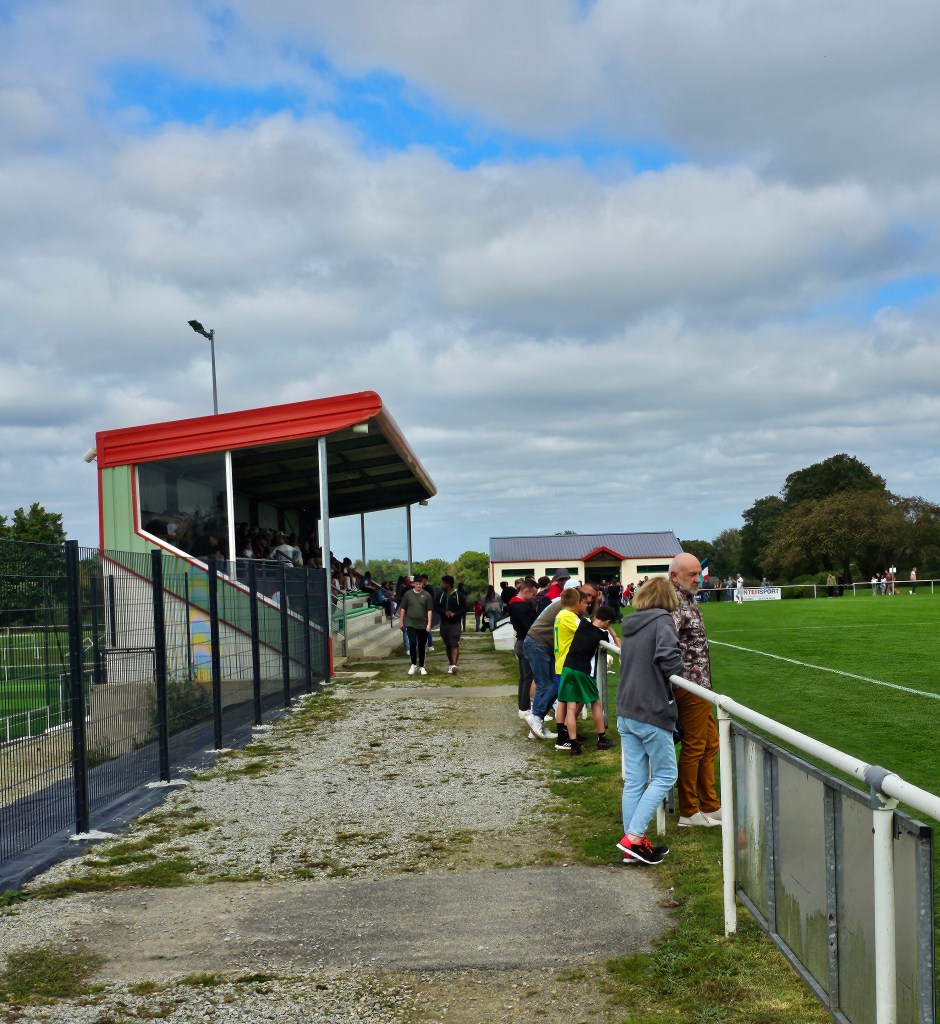
The entrance to the stadium has an elegant if small gate, and a guichet from which a middle-aged lady is selling tickets; today entry costs 5 euros for me but is free for Paulene and indeed all women, which is nice.   Even better, I get a little green ticket too as a souvenir.  The stadium has one small stand with seats on the far side and opposite that a very small bank of terracing, just two steps high but very steep; it’s a bit like a sea wall.  The  site also contains a huge sports hall, which looks like it could double as a barn to house some of the animals destined for the Jean Floc’h factory, a changing room block, a bar with glazed walls overlooking the pitch, a second full size grass pitch and a very smart plastic pitch, on the fence to which is a sign which tells us it was built with money from the local Morbihan Council. France, unlike the UK, is a country which despite problems with pensions seems to a large degree to be still run for the benefit of its general population.  Adding interest, in the corner between the sport shall and the car park is the village cemetery.

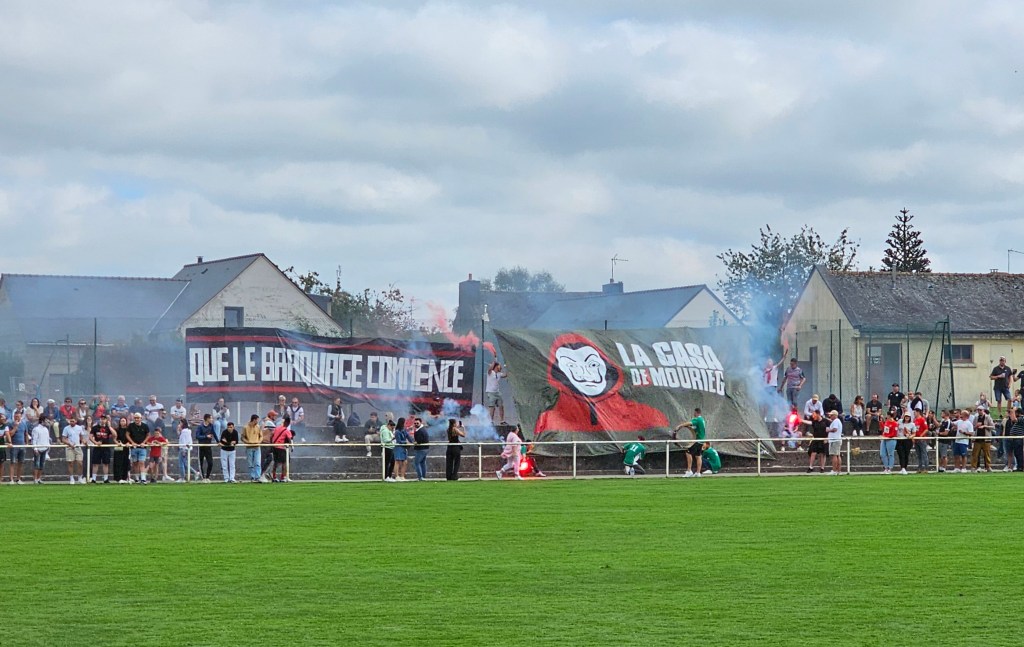
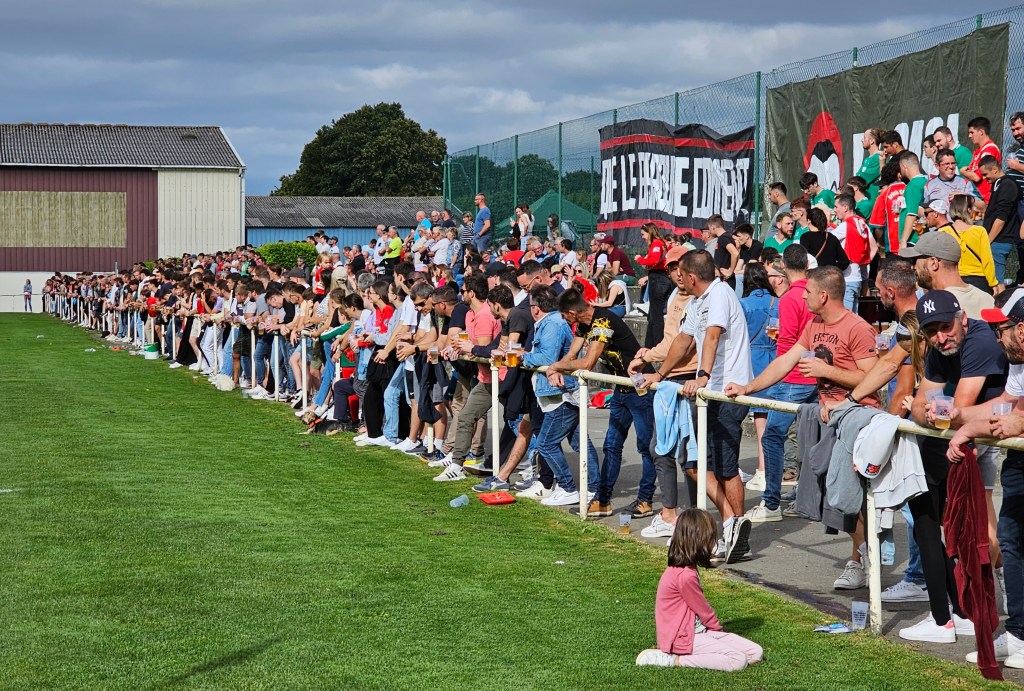
With time to spare until kick off, we watch the teams warm up and I take the opportunity to invest 2 euros in a small glass of Lancelot beer, considerately served in a re-usable plastic ‘glass’; why don’t all football clubs  do that?   The crowds are now streaming in and it feels like the whole village is turning out, a man in a club tracksuit top greets friends and neighbours and kisses on cheeks are being exchanged everywhere, although the younger men tend to only shake hands.  The French seem much more sociable and comfortable with each other than the English. A bunch of blokes in their twenties wearing faded green football shirts appear to be the Moreac ultras, and they parade along the path leading from the gate to the pitch following a bloke banging a drum, and holding aloft red distress flares.  If this happened in England they’d probably be arrested, but here no one bats an eyelid, although one or two people take photos for posterity.

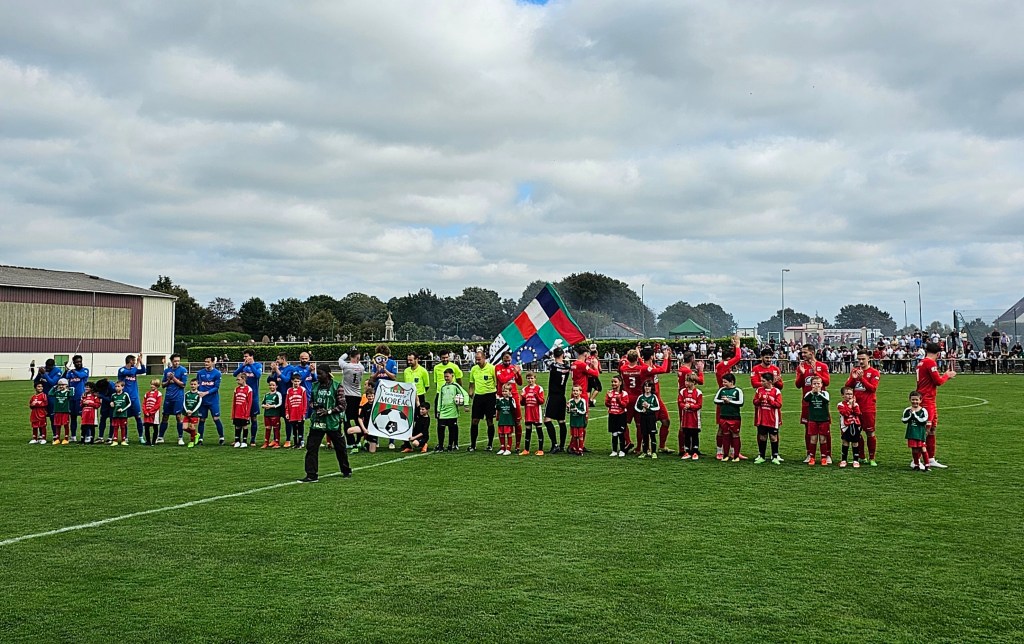
As three o’clock approaches the public address system gets tested with a few bursts of sound of gradually improving quality.  Eventually the ubiquitous 1983 rock anthem ‘Jump’ by Van Halen is played, but it ends abruptly as it’s still not quite time yet, although the teams can be seen lining up behind the referees at the door of the dressing room block in the corner of the ground.  The referee eventually gives the nod, and the teams parade on to the pitch attended by several small children as proud parents point mobile phone cameras at the event and Van Halen get to do an encore in full.  Over on the terrace the ultras light more flares, chant enthusiastically and unfurl a tifo which declares ‘La casa de Mourieg’ and displays a picture of what looks like a pale faced Salvador Dali in a red hoodie.  Mourieg is the Breton name for Moreac but casa is Spanish for house, so I it’s not clear to me what they’re trying to convey, although of course Dali was Spanish, perhaps they’re just being surreal like him. (Postscript, the next day, driving out of Lorient after seeing Lorient lose at home to Montpellier in Ligue 1, we passed a pizza restaurant in Lanester called Casa del Pizza which had the same Salvador Dali face for its logo. The surrealness continues)

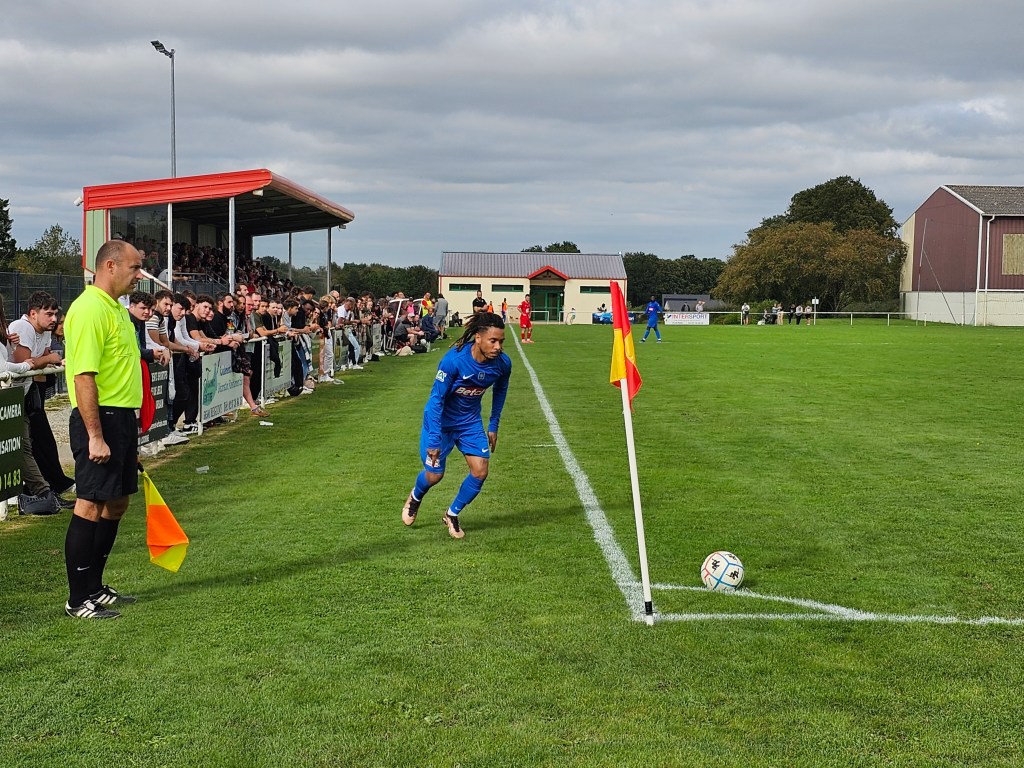
At exactly three o’clock the game kicks off with Vannes getting first go with the ball, kicking it towards the sports hall and dressing room end of the ground. Moreac are all in red and Vannes all in blue; this reduction of team colours to blue and red is normal in the early rounds of the Coupe de France as is two common shirt sponsors in all games; today the Credit Agricole logo adorns the red shirts and Betclic the blue. Pleasingly both teams are numbered 1 to 11 and no one is wearing anything silly like a number 98.

The gulf of three divisions is soon apparent as Vannes begin to dominate possession.  Moreac manage to win a free kick wide on the right early on but Vannes earn a corner.  “Aux Armes” chant the ultras, and incidentally “Aux Armes et caetera” was the title of Serge Gainsbourg’s thirteenth studio album, but he didn’t then sing “Nous sommes les Moreacois, Et nous allons gagner, Allez GSC” (“ We are the Moreacois, and we will win, Go GSC”.)  Sadly, the chant will prove overly optimistic and Vannes score their first goal after just eleven minutes, their No9 being left in enough space in the middle of the penalty area to steer a half volley in off a post.  “Allez Moreac, Allez Moreac” sing a group of children undeterred by the early goal.

Vannes continue to dominate, but Moreac have the occasional foray forward, usually on the basis of a free-kick.  Twenty-two minutes gone and the Moreac goalkeeper has to make a decent diving save to keep out a low shot.  “La la  la, la la, la, la la, la la,  Allez GSC” sing the ultras celebrating small victories.  Three minutes later and Vannes’ number eleven doubles his team’s lead as he is left all alone on the left and he passes the ball across the goal into the far corner of the net.  It might be a matter of how many goals Vannes can get.  

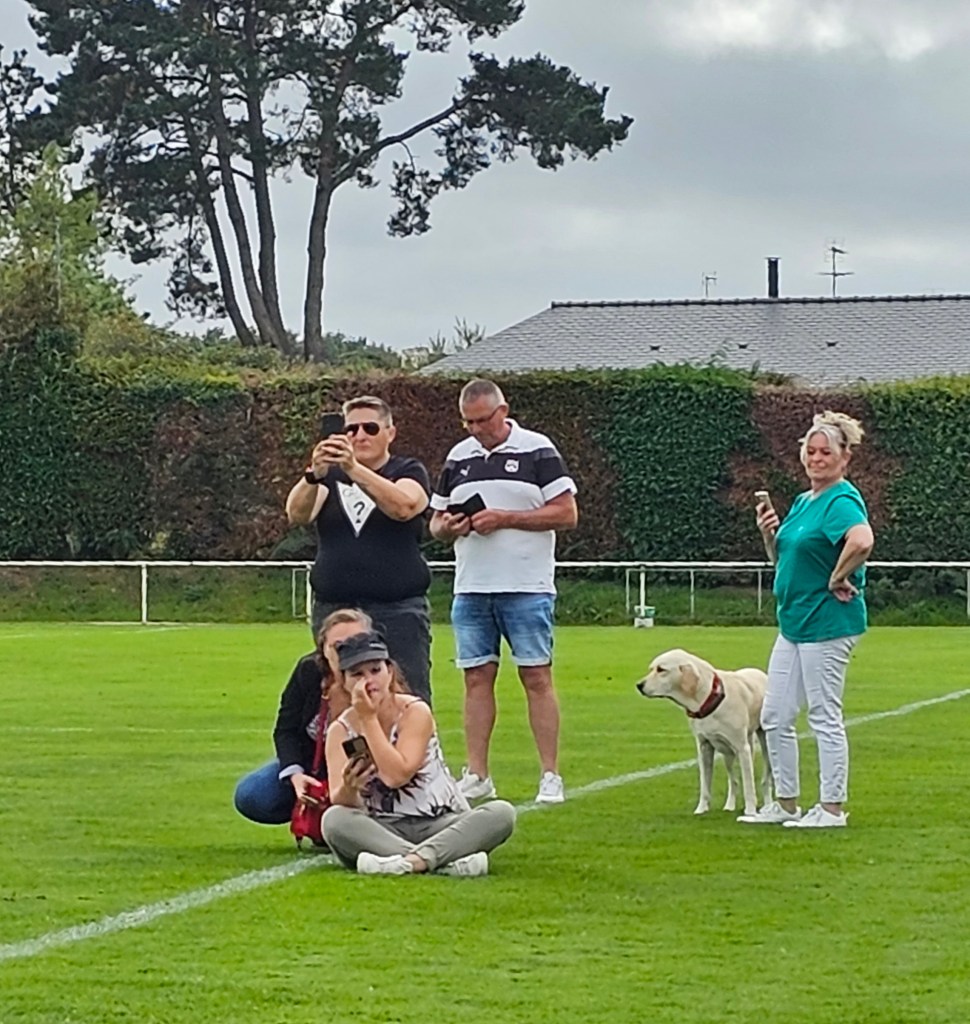
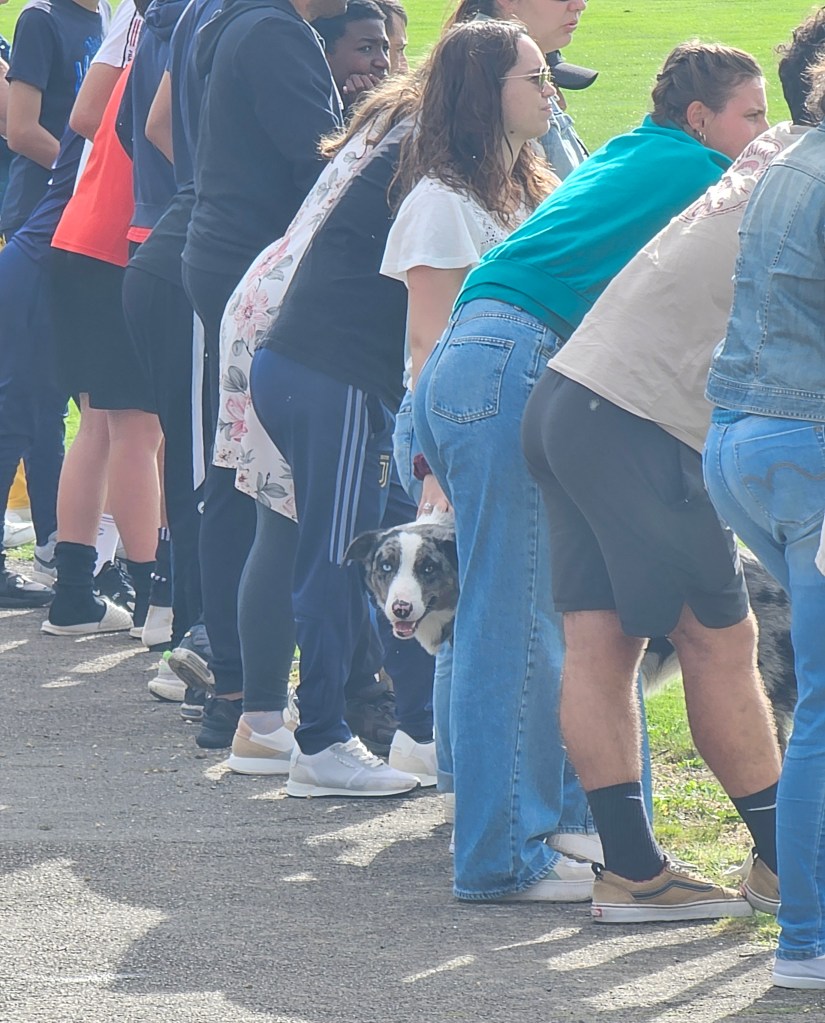
The home crowd, which seems to make up a good ninety per cent of those here don’t’ show their inevitable disappointment and their attention is still gripped, although that doesn’t go for all the dogs in attendance. A Labrador has a lie down, albeit almost on the pitch whilst a mongrel looks the wrong way. Only a sort of Yorkshire Terrier is concentrating on play, and when any player comes near he strains at his leash and yaps ferociously.  As for the away support, I’ve only seen a couple of the sort of grizzled old fanatics who tend to follow amateur teams away from home.

With almost a third of the game gone and lost to history, Moreac have their first shot on goal as their number 10 cleverly beats a man and then shoots optimistically from twenty-five metres out.  The prevailing, uneven balance is restored soon after however, as the Vannes number nine has a shot well saved and then shoots over from very close range. It’s enough to make the Stade Alfred Le Biavant as quiet as it has been all afternoon.  It doesn’t get any louder as the Vannes number seven has a shot deflected onto the top of the Moreac bar.  The lull is filled by Paulene revealing to me that she is always fascinated by young women at football matches on their own, as a smartly and alluringly (she has an off the shoulder top) dressed girl watches the game briefly a few metres away from us, before walking on towards the main stand.  I suggest that perhaps she’s just a lonesome WAG.

Fortunately, football is never entirely predictable and three minutes before half time Moreac attack down the right.  Surprisingly, the Vannes defence is drawn across the penalty area leaving Moreac’s number seven free to run onto a wide expanse of grass into which the ball is played.  The Vannes goalkeeper saves seven’s first shot, but can only parry it, and the number seven then strikes home the rebound.  It’s just a short run to the ultras for number seven and his teammates who form an impromptu human mound of celebration.  The game restarts. but it’s the last kick of the half.

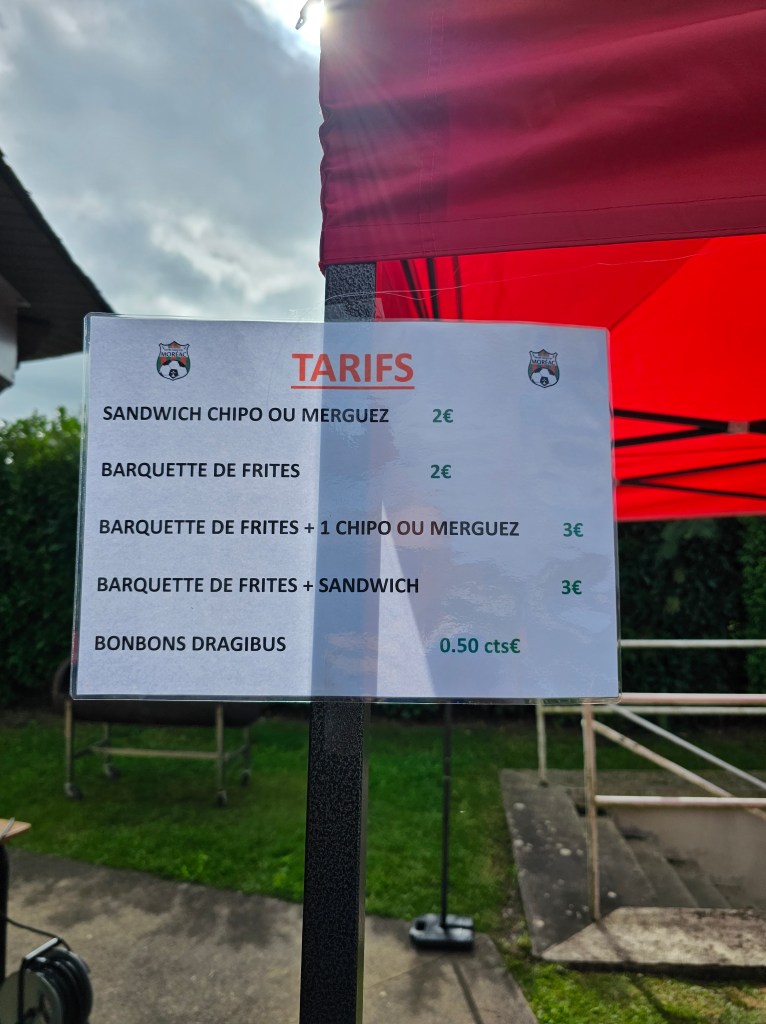
During the first half, we have watched as a barbecue has smoked away in the corner of the ground and now there is a human tide flowing towards it, attracted presumably by the promise of a mid-afternoon snack of a lamb and beef sausage (Merguez) and a chip butty for 3 euros. 

The match begins again promptly at four o’clock and the familiar pattern of Vannes passing the ball about too quickly and smartly for Moreac continues.  It is Vannes however who have the honour of being the first to have a player booked as their number seven hauls an opponent to the ground.  But Vannes press forward still. Numbers eight, eleven and nine combine cleverly but nine shoots over the goal again, then number ten does the same.  My attention is taken by the number eight, a tall creative midfielder who passes the ball well and makes me think of both France’s Adrien Rabiot and Arsenal’s Graeme Rix, although that it is entirely down to his mop of curly hair.

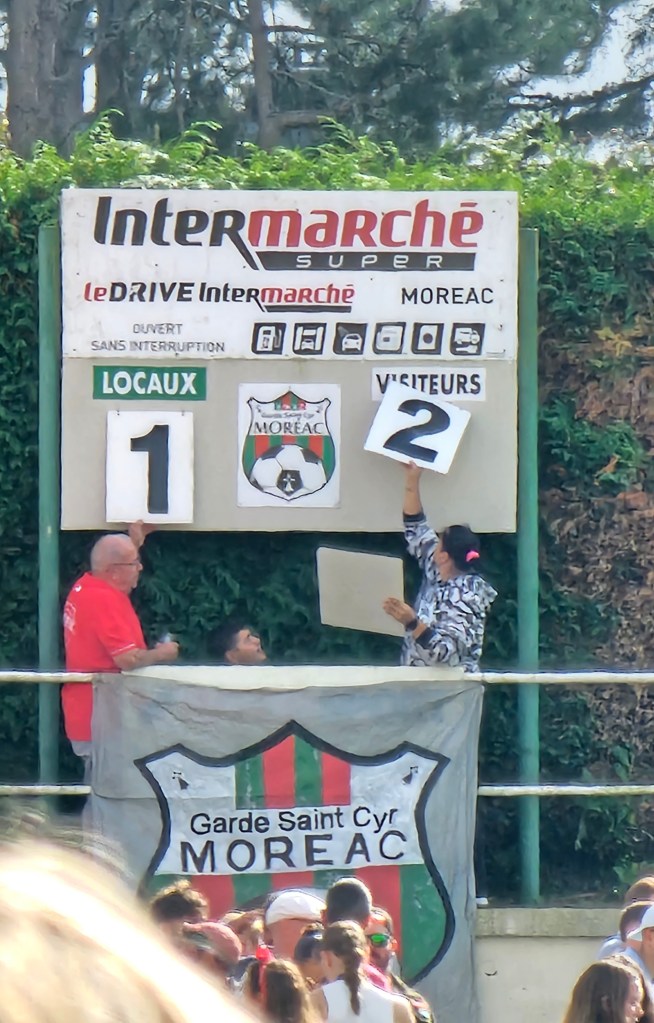
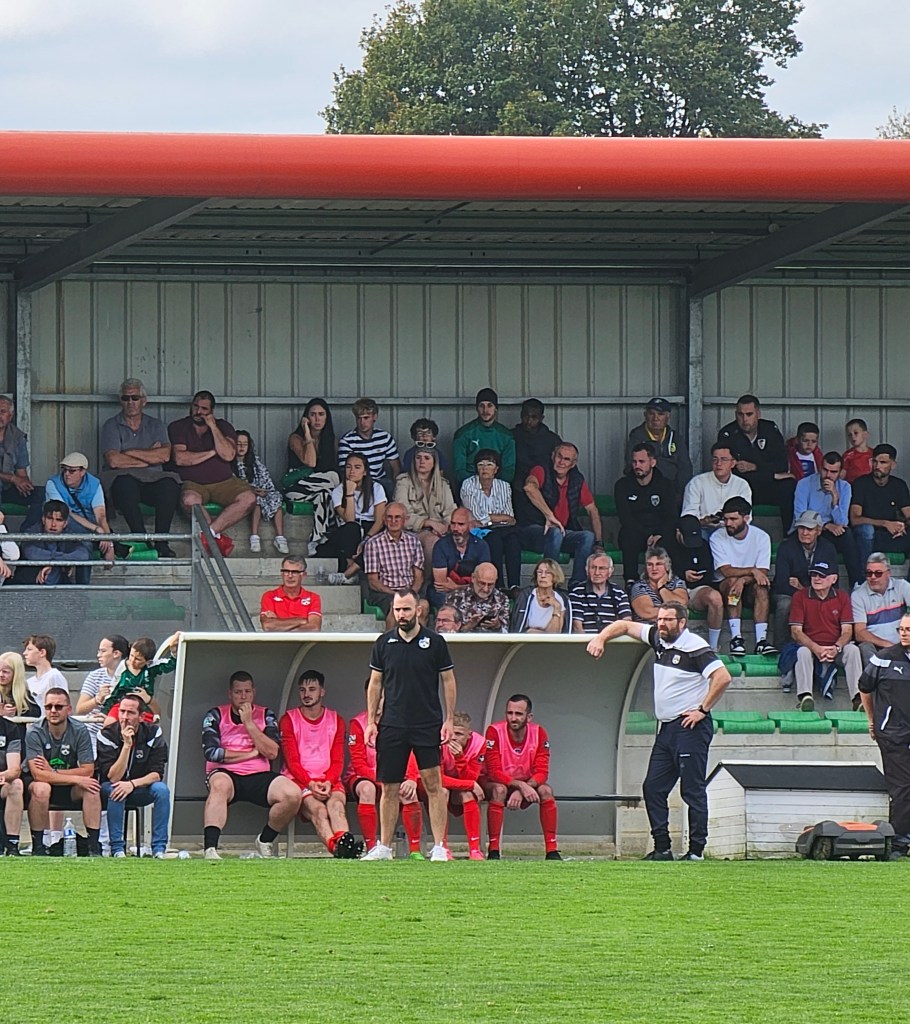
At a quarter past four Vannes score again, this time number ten tidies up as the ball runs loose and wellies it into the net from about 10 metres.  I watch as the number two on the scoreboard is unhooked and replaced with a three.  Moreac had had some hope at half-time thanks to their unexpected goal, but the game has settled down now, and the score will remain unaltered, despite a series of substitutions by both teams.  The substitutions are overseen by the Delegue Principal, a sort of fourth official in overall charge of the fixture, but in a shiny blue suit; he has his own designated seat at pitch side midway between the two team benches. From a distance he is unfortunate enough to look a bit like Norman Tebbitt, but it’s probably just because he’s bald.

I see out the game by wandering around and enjoying it from different angles from both sides of the ground and behind both goals.  Clouds and sunshine swap about altering the mood of the backdrop of trees, fields, houses and headstones.  Number three for Moreac evens up the score for bookings but there’s never any malice in the game.  The worst that happens is that the ultras take a dislike to the Vannes number ten who I think they perceive is a diver, so they boo him whenever he gets the ball.  With the final whistle, the ultras release a final salvo of flares and the victorious losers of GSC Moreac gather in front of them to give and receive appreciative applause.  It’s been a decent match on a  warm afternoon of late summer sun mixed with early autumn clouds and breezes and everyone has had a lovely time.  Just like in England, local football in France is a wonderful thing, there really is no need for professional football or the Premier League.